EP2048733A2 - Procédé de fabrication d'un terminal de paiement portable, terminal, dispositif et batterie correspondants - Google Patents
Procédé de fabrication d'un terminal de paiement portable, terminal, dispositif et batterie correspondants Download PDFInfo
- Publication number
- EP2048733A2 EP2048733A2 EP08166397A EP08166397A EP2048733A2 EP 2048733 A2 EP2048733 A2 EP 2048733A2 EP 08166397 A EP08166397 A EP 08166397A EP 08166397 A EP08166397 A EP 08166397A EP 2048733 A2 EP2048733 A2 EP 2048733A2
- Authority
- EP
- European Patent Office
- Prior art keywords
- battery
- terminal
- components
- payment terminal
- component
- Prior art date
- Legal status (The legal status is an assumption and is not a legal conclusion. Google has not performed a legal analysis and makes no representation as to the accuracy of the status listed.)
- Withdrawn
Links
- 238000004519 manufacturing process Methods 0.000 title claims abstract description 26
- 238000000465 moulding Methods 0.000 claims description 4
- 238000003780 insertion Methods 0.000 claims description 2
- 230000037431 insertion Effects 0.000 claims description 2
- 238000000034 method Methods 0.000 abstract description 10
- 238000013461 design Methods 0.000 description 5
- 230000008520 organization Effects 0.000 description 3
- 238000013459 approach Methods 0.000 description 2
- 230000010354 integration Effects 0.000 description 2
- 238000005457 optimization Methods 0.000 description 2
- 239000000470 constituent Substances 0.000 description 1
- 238000009472 formulation Methods 0.000 description 1
- 238000009434 installation Methods 0.000 description 1
- 239000000203 mixture Substances 0.000 description 1
- 238000005192 partition Methods 0.000 description 1
- 238000000926 separation method Methods 0.000 description 1
- 238000012546 transfer Methods 0.000 description 1
Images

Classifications
-
- H—ELECTRICITY
- H01—ELECTRIC ELEMENTS
- H01M—PROCESSES OR MEANS, e.g. BATTERIES, FOR THE DIRECT CONVERSION OF CHEMICAL ENERGY INTO ELECTRICAL ENERGY
- H01M10/00—Secondary cells; Manufacture thereof
- H01M10/04—Construction or manufacture in general
- H01M10/0436—Small-sized flat cells or batteries for portable equipment
-
- H—ELECTRICITY
- H01—ELECTRIC ELEMENTS
- H01M—PROCESSES OR MEANS, e.g. BATTERIES, FOR THE DIRECT CONVERSION OF CHEMICAL ENERGY INTO ELECTRICAL ENERGY
- H01M50/00—Constructional details or processes of manufacture of the non-active parts of electrochemical cells other than fuel cells, e.g. hybrid cells
- H01M50/20—Mountings; Secondary casings or frames; Racks, modules or packs; Suspension devices; Shock absorbers; Transport or carrying devices; Holders
- H01M50/202—Casings or frames around the primary casing of a single cell or a single battery
-
- H—ELECTRICITY
- H01—ELECTRIC ELEMENTS
- H01M—PROCESSES OR MEANS, e.g. BATTERIES, FOR THE DIRECT CONVERSION OF CHEMICAL ENERGY INTO ELECTRICAL ENERGY
- H01M50/00—Constructional details or processes of manufacture of the non-active parts of electrochemical cells other than fuel cells, e.g. hybrid cells
- H01M50/20—Mountings; Secondary casings or frames; Racks, modules or packs; Suspension devices; Shock absorbers; Transport or carrying devices; Holders
- H01M50/271—Lids or covers for the racks or secondary casings
-
- H—ELECTRICITY
- H04—ELECTRIC COMMUNICATION TECHNIQUE
- H04M—TELEPHONIC COMMUNICATION
- H04M1/00—Substation equipment, e.g. for use by subscribers
- H04M1/02—Constructional features of telephone sets
- H04M1/0202—Portable telephone sets, e.g. cordless phones, mobile phones or bar type handsets
- H04M1/026—Details of the structure or mounting of specific components
- H04M1/0262—Details of the structure or mounting of specific components for a battery compartment
-
- Y—GENERAL TAGGING OF NEW TECHNOLOGICAL DEVELOPMENTS; GENERAL TAGGING OF CROSS-SECTIONAL TECHNOLOGIES SPANNING OVER SEVERAL SECTIONS OF THE IPC; TECHNICAL SUBJECTS COVERED BY FORMER USPC CROSS-REFERENCE ART COLLECTIONS [XRACs] AND DIGESTS
- Y02—TECHNOLOGIES OR APPLICATIONS FOR MITIGATION OR ADAPTATION AGAINST CLIMATE CHANGE
- Y02E—REDUCTION OF GREENHOUSE GAS [GHG] EMISSIONS, RELATED TO ENERGY GENERATION, TRANSMISSION OR DISTRIBUTION
- Y02E60/00—Enabling technologies; Technologies with a potential or indirect contribution to GHG emissions mitigation
- Y02E60/10—Energy storage using batteries
-
- Y—GENERAL TAGGING OF NEW TECHNOLOGICAL DEVELOPMENTS; GENERAL TAGGING OF CROSS-SECTIONAL TECHNOLOGIES SPANNING OVER SEVERAL SECTIONS OF THE IPC; TECHNICAL SUBJECTS COVERED BY FORMER USPC CROSS-REFERENCE ART COLLECTIONS [XRACs] AND DIGESTS
- Y02—TECHNOLOGIES OR APPLICATIONS FOR MITIGATION OR ADAPTATION AGAINST CLIMATE CHANGE
- Y02P—CLIMATE CHANGE MITIGATION TECHNOLOGIES IN THE PRODUCTION OR PROCESSING OF GOODS
- Y02P70/00—Climate change mitigation technologies in the production process for final industrial or consumer products
- Y02P70/50—Manufacturing or production processes characterised by the final manufactured product
-
- Y—GENERAL TAGGING OF NEW TECHNOLOGICAL DEVELOPMENTS; GENERAL TAGGING OF CROSS-SECTIONAL TECHNOLOGIES SPANNING OVER SEVERAL SECTIONS OF THE IPC; TECHNICAL SUBJECTS COVERED BY FORMER USPC CROSS-REFERENCE ART COLLECTIONS [XRACs] AND DIGESTS
- Y10—TECHNICAL SUBJECTS COVERED BY FORMER USPC
- Y10T—TECHNICAL SUBJECTS COVERED BY FORMER US CLASSIFICATION
- Y10T29/00—Metal working
- Y10T29/49—Method of mechanical manufacture
- Y10T29/49002—Electrical device making
-
- Y—GENERAL TAGGING OF NEW TECHNOLOGICAL DEVELOPMENTS; GENERAL TAGGING OF CROSS-SECTIONAL TECHNOLOGIES SPANNING OVER SEVERAL SECTIONS OF THE IPC; TECHNICAL SUBJECTS COVERED BY FORMER USPC CROSS-REFERENCE ART COLLECTIONS [XRACs] AND DIGESTS
- Y10—TECHNICAL SUBJECTS COVERED BY FORMER USPC
- Y10T—TECHNICAL SUBJECTS COVERED BY FORMER US CLASSIFICATION
- Y10T29/00—Metal working
- Y10T29/53—Means to assemble or disassemble
- Y10T29/5313—Means to assemble electrical device
Definitions
- the field of the invention is that of payment terminals by credit card, and more specifically portable or mobile payment terminals.
- Such terminals include a smart card reader, a keyboard and a screen. They are mobile, so powered by batteries or batteries, and connected or connectable to a transfer unit to banking organizations, for example via a support base.
- battery is used to designate a battery or a set of batteries necessary for the operation of a payment terminal.
- the invention relates more precisely to the optimization of the size and the manufacture of such terminals.
- these batteries are replaceable, and therefore removable.
- Current terminals have an opening compartment allowing access to the battery or batteries to allow replacement, and therefore equipped with a removable door and means for insertion, removal and connection of batteries. The design of these terminals must therefore take into account a large and easily accessible space for these batteries.
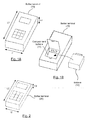
- FIGS. 1a and 1b illustrate an example of a box of such a payment terminal according to the prior art.
- FIG. 1a shows an external view from above of a box 10 of a payment terminal, the dimensions of which are L1 for the length (for example around 200 mm), h1 for the thickness (for example around 60 mm) and 11 for the width (for example around 95 mm).
- the figure 1b has an external view of the underside of the same housing 10, with a compartment 11 for the battery 12 extractable.
- the battery has a shape corresponding to the location in the compartment provided in the housing.
- the invention particularly aims to overcome these disadvantages of the prior art.
- an objective of the invention is to optimize the size and organization (internal and / or external) of the payment terminals.
- the invention thus particularly aims to provide a technique for making payment terminals of various shapes and reduced size.
- Another object of the invention is to provide a technique for increasing the organization and density in a payment terminal, in particular by optimizing the occupied internal space.
- Yet another object of the invention is to provide such a technique which is simple to implement and inexpensive.
- the invention proposes a new solution that does not have all of these disadvantages of the prior art, in the form of a manufacturing process. a payment terminal according to claim 1.
- the invention is based on a new and inventive approach to the manufacture of a payment terminal, according to which no means of access to a battery are provided, which is optimally placed between the components.
- the design and manufacture are especially around the batteries and their housing
- the invention proposes an opposite approach: the batteries are no longer a manufacturing constraint, but are instead placed in an optimized manner depending on the available space left by the components.
- the method according to the invention first comprises a step of obtaining a battery of a predetermined shape, in particular from the arrangement of the different elements making up the terminal.
- the battery has a shape that adapts to the component (s) surrounding it in the terminal.
- the shape of these batteries can be complex, depending on the constraints of available space.
- the method according to the invention comprises a step of assembling the various elements, and in particular the battery, so that it intermesh with the surrounding component or components.
- the manufacturing method comprises a step of inserting said assembly in a permanently closed housing, without access cover to said battery.
- the shape of said battery is defined so as to occupy at least partially at least one unoccupied complex space in said payment terminal.
- complex space is meant a space of non-elemental shape, different from a parallelepiped or a cylinder. It may for example be combinations of several parallelepipeds of different dimensions. Examples are presented later in the description, in connection with the Figures 3 and 4 .
- the space occupied by the components in the terminal is optimized, the battery does not have to respect particular constraints related for example to the need to make it extractable.
- the battery is considered like any other component for the arrangement of the internal space of the terminal.
- the optimization of the internal space of the terminal can be further improved for example by first arranging all the components other than the battery in the internal space of the terminal and defining a form of battery occupying a space that is still available, even if this space has a complex shape.
- said obtaining step and said assembling step of the manufacturing method are simultaneous and include a step of molding said battery in said identified unoccupied space.
- the battery is not manufactured before the assembly of the terminal components, but at the time of this assembly, during a molding step of this battery in the space available inside the terminal, previously identified for welcome the battery.
- Another aspect of the invention relates to a payment terminal comprising a set of components, including a battery and at least one component adjacent to said battery.
- said battery is a dedicated battery, of predetermined complex shape adapted to cooperate with the shape of at least one other component adjacent to said terminal, said battery being interleaved with said at least one neighboring component.
- said components are housed in a permanently closed housing, without access cover to said battery.
- the terminal thus comprises a closed housing, without access door, integrating all these components including a battery, having a shape to optimize its internal space, and therefore its size.
- the invention also relates to a device for manufacturing a payment terminal.
- such a device comprises means for assembling the components of said terminal, comprising means for setting up a dedicated battery, nested with at least one neighboring component, said dedicated battery having a predetermined complex shape. adapted to cooperate with the shape of said adjacent component (s).
- Such a device for manufacturing a terminal is particularly suitable for implementing the method of manufacturing a terminal described above.
- the invention finally relates to a payment terminal battery comprising a set of components, including a battery and at least one component adjacent to said battery.
- such a battery has a predetermined complex shape adapted to cooperate with the shape of at least one other component adjacent to said terminal, said battery being interleaved with the at least one neighboring component.
- the general principle of the invention is based on the use of a non-extractable battery and therefore on the fact that the arrangement of the components inside the housing of a terminal can be realized without the constraints related to the need for make the battery extractable.
- the manufacturing method according to the invention is based on the identification of a location for a battery, among the other components of the terminal, to design a form of battery adapted to this location.
- the step 50 of obtaining a dedicated battery thus consists in manufacturing a battery of dedicated form (whose design took into account the available space among the various components of a terminal), possibly complex, that is, that is, a location of complex shape.
- This arrangement leaves one or more unoccupied spaces in the terminal housing, due to the different shapes and sizes of the components.
- a battery form that can adapt to one or more of these unoccupied spaces is then defined.
- the shape of the battery can also be defined during the arrangement of the other components of the terminal. For example, one arranges one by one the different components of the terminal, except the battery, and with each integration of a new component, it is evaluated whether the integration of a battery of a particular shape would allow an optimized arrangement of the rest of the components. If this is the case, leave the location thus determined for the battery and continue to arrange the other components.
- the battery is integrated with the other components during a step 51 assembly.
- the battery is nested between different other elements, to optimize the use of space.
- the steps of obtaining a battery and assembling the components are simultaneous and the manufacture of the battery corresponds in fact to a molding of the battery in the predefined location, corresponding to a space unoccupied by the other components.
- the figure 2 shows an external view of a payment terminal 20 made according to the manufacturing method of the invention, whose dimensions are L2 for the length, h2 for the thickness and 12 for the width.
- L2 ⁇ L1, h2 ⁇ h1 and 12 ⁇ l1.
- a length L2 of less than 190 mm can be obtained (for L1 around 200 mm), a height h2 of less than 50 mm (for h1 around 60 mm) and a width 12 of less than 90 mm (for 11 at about 95 mm).
- the method according to the invention makes it possible to reduce the external dimensions of a payment terminal by optimally arranging the components inside.
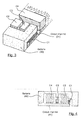
- the components presented C1, C2, C3 and C4 are constituent elements of the terminal, having dimensions and dimensions. variable locations and given as an example. It is assumed that they are placed in their respective positions according to various constraints or manufacturing requirements. It may in particular be electronic components, mounted on a printed circuit 31 or 41 but also any other necessary element in such a terminal (smart card reader, keyboard, screen, printer ).
- the battery actually has a complex shape, adapting to other components to optimize the internal space of the terminal.
- the battery is compact, and overlaps the component C1, and next to the components C2 and C3.
- the battery fits over the various components C1, C2, C3 and C4.
- the battery can also serve as the bottom of the housing.
- the battery can participate in the housing function, and thus further reduce the size and / or simplify the assembly.
- the battery can also be used as separation between two components, instead of a specific partition.
- the battery can also serve as a protection for a fragile component for example, again in place of a specific protection. It can also serve as a guide for assembling components, or even define a receptacle for one or other of these components.
- the method according to the invention makes it possible to assign to the battery one or more other functions than its main power supply function.
Landscapes
- Chemical & Material Sciences (AREA)
- Chemical Kinetics & Catalysis (AREA)
- Electrochemistry (AREA)
- General Chemical & Material Sciences (AREA)
- Engineering & Computer Science (AREA)
- Manufacturing & Machinery (AREA)
- Signal Processing (AREA)
- Battery Mounting, Suspending (AREA)
Abstract
Description
- Le domaine de l'invention est celui des terminaux de paiement par carte bancaire, et plus précisément des terminaux de paiement portables, ou mobiles. De tels terminaux comprennent notamment un lecteur de cartes à puce, un clavier et un écran. Ils sont mobiles, donc alimentés par piles ou batteries, et connectés ou connectables à une unité de transfert vers des organismes bancaires, par exemple par l'intermédiaire d'un socle support.
- On emploie dans la suite de la description le terme « batterie » pour désigner une batterie ou un ensemble de batteries nécessaire au fonctionnement d'un terminal de paiement.
- L'invention concerne plus précisément l'optimisation de la taille et de la fabrication de tels terminaux.
- Les terminaux existants mettent en oeuvre des batteries extractibles et standardisées, ce qui introduit des contraintes sur la taille et en particulier la forme de ces batteries, généralement parallélépipédiques ou cylindriques.
- Par ailleurs, ces batteries sont remplaçables, et donc amovibles. Les terminaux actuels présentent un compartiment à ouverture permettant l'accès à la ou les batteries pour en permettre le remplacement, et donc équipé d'une trappe amovible et de moyens permettant l'insertion, le retrait et la connexion des batteries. La conception de ces terminaux doit donc prendre en compte un espace important et aisément accessible pour ces batteries.
- Les
figures 1a et 1b illustrent un exemple de boîtier d'un tel terminal de paiement selon l'art antérieur. - La figure la présente une vue extérieure du dessus d'un boîtier 10 d'un terminal de paiement, dont les dimensions sont L1 pour la longueur (par exemple aux environs de 200 mm), h1 pour l'épaisseur (par exemple aux environs de 60 mm) et 11 pour la largeur (par exemple aux environs de 95 mm).
- La
figure 1b présente une vue extérieure du dessous du même boîtier 10, avec un compartiment 11 pour la batterie 12 extractible. - On constate que la batterie a une forme correspondant à l'emplacement dans le compartiment prévu dans le boîtier.
- Les inconvénients des techniques de l'art antérieur résident dans le fait que les formes actuelles de batteries et la nécessité de les rendre accessibles imposent des contraintes fortes sur la taille et la fabrication (implantation des composants, organisation et assemblage de ceux-ci,...) des terminaux. On peut noter que ces inconvénients n'ont jamais été identifiés en tant que tels, puisqu'ils correspondent à des contraintes considérées comme impératives par l'homme du métier. Ainsi, la formulation de ces inconvénients, c'est-à-dire l'identification jamais formulée dans ce domaine d'un problème à résoudre, constitue en soi une partie de l'invention.
- L'invention a notamment pour objectif de pallier ces inconvénients de l'art antérieur.
- Plus précisément, un objectif de l'invention, selon au moins un mode de réalisation, est d'optimiser la taille et l'organisation (interne et/ou externe) des terminaux de paiement.
- L'invention a ainsi notamment pour objectif de fournir une technique permettant de réaliser des terminaux de paiement de formes variées et de taille réduite.
- Un autre objectif de l'invention est de fournir une technique permettant d'augmenter l'organisation et la densité dans un terminal de paiement, notamment en optimisant l'espace interne occupé.
- Encore un objectif de l'invention est de fournir une telle technique qui soit simple à mettre en oeuvre et peu coûteuse.
- L'invention propose une solution nouvelle qui ne présente pas l'ensemble de ces inconvénients de l'art antérieur, sous la forme d'un procédé de fabrication d'un terminal de paiement selon la revendication 1.
- Selon l'invention, ledit procédé comprend les étapes suivantes :
- obtention d'une batterie dédiée, de forme complexe prédéterminée adaptée à coopérer avec la forme d'au moins un autre composant voisin dudit terminal ;
- assemblage des composants dudit terminal, comprenant l'installation de ladite batterie de façon imbriquée avec le ou lesdits composants voisins.
- Ainsi, l'invention repose sur une approche nouvelle et inventive de la fabrication d'un terminal de paiement, selon laquelle on ne prévoit pas de moyens d'accès à une batterie, que l'on place de façon optimisée entre les composants. En d'autres termes, alors que selon l'art antérieur, la conception et la fabrication se font notamment autour des batteries et de leur logement, l'invention propose une approche opposée : les batteries ne sont plus une contrainte de fabrication, mais sont au contraire placées de façon optimisée en fonction de l'espace disponible laissé par les composants.
- Ainsi, le procédé selon l'invention comprend tout d'abord une étape d'obtention d'une batterie d'une forme prédéterminée, notamment à partir de l'agencement des différents éléments composant le terminal. En particulier, la batterie a une forme qui s'adapte au(x) composant(s) qui l'entourent dans le terminal. La forme de ces batteries peut être complexe, en fonction des contraintes d'espace disponible.
- Ensuite, le procédé selon l'invention comprend une étape d'assemblage des différents éléments, et notamment de la batterie, de façon à ce qu'elle s'imbrique avec le ou les composants qui l'entourent.
- Selon une caractéristique particulière de l'invention, le procédé de fabrication comprend une étape d'insertion dudit assemblage dans un boîtier clos de façon définitive, sans capot d'accès à ladite batterie.
- Ainsi, une fois tous les éléments composant le terminal assemblés, ils sont insérés dans un boîtier clos, ne nécessitant pas la présence de moyens de démontage ou d'une trappe d'accès.
- En particulier, la forme de ladite batterie est définie de façon à occuper au moins partiellement au moins un espace complexe inoccupé dans ledit terminal de paiement.
- On entend par espace complexe un espace de forme non élémentaire, différente d'un parallélépipède ou d'un cylindre. Il peut par exemple s'agir de combinaisons de plusieurs parallélépipèdes de dimensions différentes. Des exemples sont présentés plus loin dans la description, en relation avec les
figures 3 et 4 . - Ainsi, l'espace occupé par les composants dans le terminal est optimisé, la batterie n'ayant pas à respecter de contraintes particulières liées par exemple à la nécessité de la rendre extractible. La batterie est prise en considération comme tout autre composant pour l'agencement de l'espace interne du terminal.
- L'optimisation de l'espace interne du terminal peut être encore amélioré par exemple en agençant d'abord tous les composants autres que la batterie dans l'espace interne du terminal et en définissant une forme de batterie occupant un espace resté disponible, même si cet espace a une forme complexe.
- Selon un mode de réalisation particulier, ladite étape d'obtention et ladite étape d'assemblage du procédé de fabrication sont simultanées et comprennent une étape de moulage de ladite batterie dans ledit espace inoccupé identifié.
- Ainsi, la batterie n'est pas fabriquée avant l'assemblage des composants du terminal, mais au moment de cet assemblage, lors d'une étape de moulage de cette batterie dans l'espace disponible à l'intérieur du terminal, préalablement identifié pour accueillir la batterie.
- Un autre aspect de l'invention concerne un terminal de paiement comprenant un ensemble de composants, dont une batterie et au moins un composant voisin de ladite batterie.
- Selon l'invention, ladite batterie est une batterie dédiée, de forme complexe prédéterminée adaptée à coopérer avec la forme d'au moins un autre composant voisin dudit terminal, ladite batterie étant imbriquée avec le ou lesdits composants voisins.
- En particulier, lesdits composants sont logés dans un boîtier clos de façon définitive, sans capot d'accès à ladite batterie.
- Selon l'invention, le terminal comprend donc un boîtier fermé, sans trappe d'accès, intégrant tous ces composants y compris une batterie, ayant une forme permettant d'optimiser son espace interne, et donc sa taille.
- L'invention concerne également un dispositif de fabrication d'un terminal de paiement.
- Selon l'invention, un tel dispositif comprend des moyens d'assemblage des composants dudit terminal, comprenant des moyens de mise en place d'une batterie dédiée, de façon imbriquée avec au moins un composant voisin, ladite batterie dédiée présentant une forme complexe prédéterminée adaptée à coopérer avec la forme du ou desdits composants voisins.
- Un tel dispositif de fabrication d'un terminal est notamment adapté à mettre en oeuvre le procédé de fabrication d'un terminal décrit précédemment.
- L'invention concerne enfin une batterie pour terminal de paiement comprenant un ensemble de composants, dont une batterie et au moins un composant voisin de ladite batterie.
- Selon l'invention, une telle batterie présente une forme complexe prédéterminée adaptée à coopérer avec la forme d'au moins un autre composant voisin dudit terminal, ladite batterie étant imbriquée avec le ou lesdits composants voisins.
- D'autres caractéristiques et avantages de l'invention apparaîtront plus clairement à la lecture de la description suivante d'un mode de réalisation particulier, donné à titre de simple exemple illustratif et non limitatif, et des dessins annexés, parmi lesquels :
- les
figures 1a et 1b présentent respectivement une vue extérieure du dessus et une vue extérieure du dessous d'un exemple de boîtier d'un terminal de paiement selon l'art antérieur ; - la
figure 2 présente un exemple de boîtier (vue extérieure) d'un terminal de paiement selon un mode de réalisation de l'invention ; - les
figures 3 et 4 présentent deux exemples d'agencement interne d'un terminal de paiement selon un mode de réalisation de l'invention ; - la
figure 5 décrit les principales étapes du procédé de fabrication d'un terminal de paiement selon un mode de réalisation de l'invention. - Le principe général de l'invention repose sur l'utilisation d'une batterie non extractible et par conséquent sur le fait que l'agencement des composants à l'intérieur du boîtier d'un terminal peut être réalisé sans les contraintes liées au besoin de rendre extractible la batterie.
- Par conséquent, le procédé de fabrication selon l'invention se base sur l'identification d'un emplacement pour une batterie, parmi les autres composants du terminal, pour concevoir une forme de batterie adaptée à cet emplacement.
- On présente ci-après, en relation avec la
figure 5 , les différentes étapes du procédé de fabrication selon un mode de réalisation de l'invention. - L'étape 50 d'obtention d'une batterie dédiée consiste donc à fabriquer une batterie de forme dédiée (dont la conception a pris en compte l'espace disponible parmi les différents composants d'un terminal), éventuellement complexe, c'est-à-dire correspondant à un emplacement de forme complexe.
- Ainsi, lors de la conception, on commence par agencer, de façon optimale, c'est-à-dire en essayant de minimiser la taille finale du terminal, tous les composants du terminal, exceptée la batterie. On ne prend pas en compte, a priori, un logement et un accès à prévoir pour une batterie classique.
- Cet agencement laisse un ou plusieurs espaces inoccupés dans le boîtier du terminal, du fait des formes et tailles différentes des composants. On définit ensuite une forme de batterie pouvant s'adapter à un ou plusieurs de ces espaces inoccupés.
- On peut également définir la forme de la batterie pendant l'agencement des autres composants du terminal. Par exemple, on agence un par un les différents composants du terminal, exceptée la batterie, et à chaque intégration d'un nouveau composant, on évalue si l'intégration d'une batterie d'une forme particulière permettrait un agencement optimisé du reste des composants. Si tel est le cas, on laisse vide l'emplacement ainsi déterminé pour la batterie et on continue d'agencer les autres composants.
- Une fois la batterie fabriquée, celle-ci est intégrée avec les autres composants lors d'une étape 51 d'assemblage. Ainsi, selon l'invention, la batterie est imbriquée entre différents autres éléments, permettant d'optimiser l'utilisation de l'espace.
- Selon un mode de réalisation particulier de l'invention, les étapes d'obtention d'une batterie et d'assemblage des composants sont simultanées et la fabrication de la batterie correspond en fait à un moulage de la batterie dans l'emplacement prédéfini, correspondant à un espace inoccupé par les autres composants.
- La
figure 2 présente une vue extérieure d'un terminal de paiement 20 réalisé selon le procédé de fabrication de l'invention, dont les dimensions sont L2 pour la longueur, h2 pour l'épaisseur et 12 pour la largeur. - On suppose que les composants internes, exceptés la batterie, sont les mêmes que pour l'exemple de terminal de l'art antérieur de la
figure 1 , et on note que L2<L1, h2<h1 et 12<l1. On peut obtenir par exemple une longueur L2 inférieure à 190 mm (pour L1 aux environs de 200 mm), une hauteur h2 inférieure à 50 mm (pour h1 aux environs de 60 mm) et une largeur 12 inférieure à 90 mm (pour 11 aux environs de 95 mm). - Ainsi, le procédé selon l'invention permet de réduire les dimensions extérieures d'un terminal de paiement, en agençant de façon optimale les composants à l'intérieur.
- On présente maintenant, en relation avec les
figures 3 et 4 , deux exemples d'agencement des composants d'un terminal de paiement réalisé selon le procédé de fabrication de l'invention. - Dans ces deux exemples, les composants présentés C1, C2, C3 et C4 sont des éléments constitutifs du terminal, présentant des dimensions et des emplacements variables et donnés à titre d'exemple. On suppose qu'ils sont placés dans leurs positions respectives en fonction de diverses contraintes ou exigences de fabrication. Il peut notamment s'agir de composants électroniques, montés sur un circuit imprimé 31 ou 41 mais également de tout autre élément nécessaire dans un tel terminal (lecteur de cartes à puce, clavier, écran, imprimante...).
- Les formes et dimensions de ces composants définissent des espaces libres, que la batterie de l'invention va exploiter.
- Sur ces deux figures, on observe que la batterie présente effectivement une forme complexe, s'adaptant aux autres composants afin d'optimiser l'espace interne du terminal.
- Ainsi, sur la
figure 3 , la batterie est compacte, et s'imbrique au dessus du composant C1, et à côté des composants C2 et C3. - Sur la
figure 4 , la batterie s'adapte au-dessus des différents composants C1, C2, C3 et C4. Dans ce cas, la batterie peut également faire office de fond du boîtier. En d'autres termes, la batterie peut participer à la fonction de boîtier, et ainsi réduire encore l'encombrement et/ou simplifier le montage. - Selon d'autres aspects de réalisation, la batterie peut également servir de séparation entre deux composants, à la place d'une cloison spécifique. La batterie peut également servir de protection pour un composant fragile par exemple, là encore à la place d'une protection spécifique. Elle peut également servir de guide pour l'assemblage de composants, voire définir un réceptacle pour l'un ou l'autre de ces composants.
- Ainsi, le procédé selon l'invention permet d'affecter à la batterie une ou plusieurs autres fonctions que sa fonction principale d'alimentation.
Claims (6)
- Procédé de fabrication d'un terminal de paiement, caractérisé en ce qu'il comprend les étapes suivantes :- obtention d'une batterie dédiée, de forme complexe prédéterminée adaptée à coopérer avec la forme d'au moins un autre composant voisin dudit terminal ;- assemblage des composants dudit terminal, comprenant l'installation de ladite batterie de façon imbriquée avec le ou lesdits composants voisins ;- insertion dudit assemblage dans un boîtier clos de façon définitive, sans capot d'accès à ladite batterie.
- Procédé de fabrication selon la revendication 1, caractérisé en ce que la forme de ladite batterie est définie de façon à occuper au moins partiellement au moins un espace complexe inoccupé dans ledit terminal de paiement.
- Procédé de fabrication selon l'une quelconque des revendications 1 et 2, caractérisé en ce que ladite étape d'obtention et ladite étape d'assemblage sont simultanées et comprennent une étape de moulage de ladite batterie dans ledit espace inoccupé identifié.
- Terminal de paiement comprenant un ensemble de composants, dont une batterie et au moins un composant voisin de ladite batterie, caractérisé en ce que ladite batterie est une batterie dédiée, de forme complexe prédéterminée adaptée à coopérer avec la forme d'au moins un autre composant voisin dudit terminal, ladite batterie étant imbriquée avec le ou lesdits composants voisins et en ce que lesdits composants sont logés dans un boîtier clos de façon définitive, sans capot d'accès à ladite batterie.
- Dispositif de fabrication d'un terminal de paiement, caractérisé en ce qu'il comprend des moyens d'assemblage des composants dudit terminal, comprenant des moyens de mise en place d'une batterie dédiée, de façon imbriquée avec au moins un composant voisin, ladite batterie dédiée présentant une forme complexe prédéterminée adaptée à coopérer avec la forme du ou desdits composants voisins, et des moyens d'insertion dudit assemblage des composants dudit terminal dans un boîtier clos de façon définitive, sans capot d'accès à ladite batterie.
- Batterie pour terminal de paiement comprenant un ensemble de composants, dont une batterie et au moins un composant voisin de ladite batterie, caractérisé en ce qu'elle présente une forme complexe prédéterminée adaptée à coopérer avec la forme d'au moins un autre composant voisin dudit terminal, ladite batterie étant imbriquée avec le ou lesdits composants voisins.
Applications Claiming Priority (1)
| Application Number | Priority Date | Filing Date | Title |
|---|---|---|---|
| FR0758296A FR2922399B1 (fr) | 2007-10-12 | 2007-10-12 | Procede de fabrication d'un terminal de paiement portable, terminal, dispositif et batterie correspondants |
Publications (2)
| Publication Number | Publication Date |
|---|---|
| EP2048733A2 true EP2048733A2 (fr) | 2009-04-15 |
| EP2048733A3 EP2048733A3 (fr) | 2011-11-23 |
Family
ID=39145965
Family Applications (1)
| Application Number | Title | Priority Date | Filing Date |
|---|---|---|---|
| EP08166397A Withdrawn EP2048733A3 (fr) | 2007-10-12 | 2008-10-10 | Procédé de fabrication d'un terminal de paiement portable, terminal, dispositif et batterie correspondants |
Country Status (3)
| Country | Link |
|---|---|
| US (1) | US20090095808A1 (fr) |
| EP (1) | EP2048733A3 (fr) |
| FR (1) | FR2922399B1 (fr) |
Families Citing this family (6)
| Publication number | Priority date | Publication date | Assignee | Title |
|---|---|---|---|---|
| US8940429B2 (en) | 2010-07-16 | 2015-01-27 | Apple Inc. | Construction of non-rectangular batteries |
| WO2013093553A1 (fr) | 2011-12-20 | 2013-06-27 | Nokia Corporation | Appareil pour emmagasiner de l'énergie électrique et dispositif électronique portatif |
| US20140113184A1 (en) * | 2012-10-18 | 2014-04-24 | Apple Inc. | Three-dimensional non-rectangular battery cell structures |
| US9929393B2 (en) | 2015-09-30 | 2018-03-27 | Apple Inc. | Wound battery cells with notches accommodating electrode connections |
| US10868290B2 (en) | 2016-02-26 | 2020-12-15 | Apple Inc. | Lithium-metal batteries having improved dimensional stability and methods of manufacture |
| US12244032B2 (en) * | 2021-09-21 | 2025-03-04 | Apple Inc. | Non-rectangular metal batteries |
Citations (1)
| Publication number | Priority date | Publication date | Assignee | Title |
|---|---|---|---|---|
| DE102005005553A1 (de) * | 2005-02-07 | 2006-08-10 | Robert Bosch Gmbh | Elektrische Handwerkzeugmaschine |
Family Cites Families (8)
| Publication number | Priority date | Publication date | Assignee | Title |
|---|---|---|---|---|
| US5124508A (en) * | 1990-08-14 | 1992-06-23 | The Scabbard Corp. | Application of sheet batteries as support base for electronic circuits |
| US5432017A (en) * | 1992-09-14 | 1995-07-11 | Motorola, Inc. | Battery pack and method of forming same |
| US6224995B1 (en) * | 1997-03-06 | 2001-05-01 | Mitsubishi Chemical Corporation | Three dimensional free form battery apparatus |
| AU2001274813A1 (en) * | 2000-04-25 | 2001-11-07 | Polystor Corporation | Custom geometry battery cells and methods and tools for their manufacture |
| JP4430804B2 (ja) * | 2000-08-31 | 2010-03-10 | ノキア コーポレイション | 装置カバーケース構造および電子装置 |
| EP1581975A2 (fr) * | 2002-12-30 | 2005-10-05 | Koninklijke Philips Electronics N.V. | Source d'energie electrochimique integralement formee dans un boitier non conducteur et procede de fabrication d'une telle source d'energie electrochimique |
| US20060064373A1 (en) * | 2004-09-02 | 2006-03-23 | Kelley Christopher L | Remote payment terminal |
| WO2007037405A1 (fr) * | 2005-09-29 | 2007-04-05 | Kyocera Corporation | Dispositif de terminal portable |
-
2007
- 2007-10-12 FR FR0758296A patent/FR2922399B1/fr active Active
-
2008
- 2008-10-10 US US12/249,599 patent/US20090095808A1/en not_active Abandoned
- 2008-10-10 EP EP08166397A patent/EP2048733A3/fr not_active Withdrawn
Patent Citations (1)
| Publication number | Priority date | Publication date | Assignee | Title |
|---|---|---|---|---|
| DE102005005553A1 (de) * | 2005-02-07 | 2006-08-10 | Robert Bosch Gmbh | Elektrische Handwerkzeugmaschine |
Also Published As
| Publication number | Publication date |
|---|---|
| FR2922399A1 (fr) | 2009-04-17 |
| EP2048733A3 (fr) | 2011-11-23 |
| FR2922399B1 (fr) | 2010-05-14 |
| US20090095808A1 (en) | 2009-04-16 |
Similar Documents
| Publication | Publication Date | Title |
|---|---|---|
| EP2048733A2 (fr) | Procédé de fabrication d'un terminal de paiement portable, terminal, dispositif et batterie correspondants | |
| CN105246360B (zh) | 用于电子尼古丁输送系统的容器 | |
| EP0469503B1 (fr) | Dispositif de logement d'une carte à mémoire | |
| EP0674287A1 (fr) | Boîtier pour lecteur de carte à microcircuit | |
| EP3231069B1 (fr) | Architecture compacte de groupe motopropulseur électrique pour véhicule automobile | |
| EP2355636B1 (fr) | Ensemble de connexion d'au moins un équipement électronique dans un aéronef | |
| FR3095735A1 (fr) | Etui d’enrôlement pour carte à puce | |
| EP0840247A1 (fr) | Modem radio équipé d'un lecteur de carte à mémoire | |
| BE1017300A7 (fr) | Perfectionnements introduits dans les systemes de connexion par interverrouillage applicables aux dispositifs electriques. | |
| EP2814008B1 (fr) | Boîte à finance avec unité de fermeture partiellement fermée en forme de plaque et dispositif de manipulation des billets de valeurs | |
| WO2017009816A1 (fr) | Dispositif périphérique actif et terminal de paiement électronique | |
| FR3049402A1 (fr) | Systeme de rechargement par induction universel d'appareil electronique portable | |
| FR2871832A1 (fr) | Mecanisme de verrouillage et son procede d'actionnement | |
| EP2926535B1 (fr) | Boitier de terminal | |
| WO2000066387A1 (fr) | Agencement d'appareillages pour vehicule automobile et tableau de bord comprenant un tel agencement | |
| FR2977970A1 (fr) | Cartouche de communication amovible d'un equipement, equipement, ensemble et systeme correspondants | |
| JP2012221734A (ja) | 電子機器 | |
| WO2005101940A2 (fr) | Boitier de reception de cartes electroniques | |
| FR3035974A1 (fr) | Dispositif de lecture augmentee | |
| WO2000066398A1 (fr) | Agencement d'appareillage pour vehicule automobile | |
| EP3312948B1 (fr) | Prise electrique comprenant une piece monobloc de support et de reception d'alveoles et procede d'assemblage d'une telle prise electrique | |
| EP2293287A1 (fr) | Sirène compacte pour véhicule automobile | |
| EP3717309B1 (fr) | Agencement d'un véhicule, dispositif de connexion électrique et véhicule équipé d'un tel dispositif | |
| WO2016034717A1 (fr) | Dispositif de terminaison intérieure optique et ensemble associé | |
| FR2821959A1 (fr) | Procede de fabrication d'un corps de support de donnees |
Legal Events
| Date | Code | Title | Description |
|---|---|---|---|
| PUAI | Public reference made under article 153(3) epc to a published international application that has entered the european phase |
Free format text: ORIGINAL CODE: 0009012 |
|
| AK | Designated contracting states |
Kind code of ref document: A2 Designated state(s): AT BE BG CH CY CZ DE DK EE ES FI FR GB GR HR HU IE IS IT LI LT LU LV MC MT NL NO PL PT RO SE SI SK TR |
|
| AX | Request for extension of the european patent |
Extension state: AL BA MK RS |
|
| PUAL | Search report despatched |
Free format text: ORIGINAL CODE: 0009013 |
|
| AK | Designated contracting states |
Kind code of ref document: A3 Designated state(s): AT BE BG CH CY CZ DE DK EE ES FI FR GB GR HR HU IE IS IT LI LT LU LV MC MT NL NO PL PT RO SE SI SK TR |
|
| AX | Request for extension of the european patent |
Extension state: AL BA MK RS |
|
| RIC1 | Information provided on ipc code assigned before grant |
Ipc: H01M 2/10 20060101ALI20111017BHEP Ipc: H04M 1/02 20060101ALI20111017BHEP Ipc: H01M 10/04 20060101AFI20111017BHEP |
|
| 17P | Request for examination filed |
Effective date: 20120507 |
|
| AKX | Designation fees paid |
Designated state(s): AT BE BG CH CY CZ DE DK EE ES FI FR GB GR HR HU IE IS IT LI LT LU LV MC MT NL NO PL PT RO SE SI SK TR |
|
| RAP1 | Party data changed (applicant data changed or rights of an application transferred) |
Owner name: INGENICO GROUP |
|
| 17Q | First examination report despatched |
Effective date: 20170116 |
|
| STAA | Information on the status of an ep patent application or granted ep patent |
Free format text: STATUS: THE APPLICATION IS DEEMED TO BE WITHDRAWN |
|
| 18D | Application deemed to be withdrawn |
Effective date: 20170527 |