EP2047534B1 - Diodes organiques électroluminescentes blanches à base de molécules dérivées du phosphole. - Google Patents
Diodes organiques électroluminescentes blanches à base de molécules dérivées du phosphole. Download PDFInfo
- Publication number
- EP2047534B1 EP2047534B1 EP07787846A EP07787846A EP2047534B1 EP 2047534 B1 EP2047534 B1 EP 2047534B1 EP 07787846 A EP07787846 A EP 07787846A EP 07787846 A EP07787846 A EP 07787846A EP 2047534 B1 EP2047534 B1 EP 2047534B1
- Authority
- EP
- European Patent Office
- Prior art keywords
- white
- diodes
- phosphole
- diode
- electroluminescent organic
- Prior art date
- Legal status (The legal status is an assumption and is not a legal conclusion. Google has not performed a legal analysis and makes no representation as to the accuracy of the status listed.)
- Not-in-force
Links
- JTWYCWYPUHNCEG-UHFFFAOYSA-N CCc1ccc(C2=C(CCCC3)C3=C(c3ccc(C)[s]3)P2(c2ccccc2)=S)[s]1 Chemical compound CCc1ccc(C2=C(CCCC3)C3=C(c3ccc(C)[s]3)P2(c2ccccc2)=S)[s]1 JTWYCWYPUHNCEG-UHFFFAOYSA-N 0.000 description 1
Images


Classifications
-
- H—ELECTRICITY
- H10—SEMICONDUCTOR DEVICES; ELECTRIC SOLID-STATE DEVICES NOT OTHERWISE PROVIDED FOR
- H10K—ORGANIC ELECTRIC SOLID-STATE DEVICES
- H10K50/00—Organic light-emitting devices
-
- C—CHEMISTRY; METALLURGY
- C07—ORGANIC CHEMISTRY
- C07F—ACYCLIC, CARBOCYCLIC OR HETEROCYCLIC COMPOUNDS CONTAINING ELEMENTS OTHER THAN CARBON, HYDROGEN, HALOGEN, OXYGEN, NITROGEN, SULFUR, SELENIUM OR TELLURIUM
- C07F9/00—Compounds containing elements of Groups 5 or 15 of the Periodic Table
- C07F9/02—Phosphorus compounds
- C07F9/547—Heterocyclic compounds, e.g. containing phosphorus as a ring hetero atom
- C07F9/6564—Heterocyclic compounds, e.g. containing phosphorus as a ring hetero atom having phosphorus atoms, with or without nitrogen, oxygen, sulfur, selenium or tellurium atoms, as ring hetero atoms
- C07F9/6568—Heterocyclic compounds, e.g. containing phosphorus as a ring hetero atom having phosphorus atoms, with or without nitrogen, oxygen, sulfur, selenium or tellurium atoms, as ring hetero atoms having phosphorus atoms as the only ring hetero atoms
- C07F9/65685—Heterocyclic compounds, e.g. containing phosphorus as a ring hetero atom having phosphorus atoms, with or without nitrogen, oxygen, sulfur, selenium or tellurium atoms, as ring hetero atoms having phosphorus atoms as the only ring hetero atoms the ring phosphorus atom being part of a phosphine oxide or thioxide
-
- C—CHEMISTRY; METALLURGY
- C09—DYES; PAINTS; POLISHES; NATURAL RESINS; ADHESIVES; COMPOSITIONS NOT OTHERWISE PROVIDED FOR; APPLICATIONS OF MATERIALS NOT OTHERWISE PROVIDED FOR
- C09K—MATERIALS FOR MISCELLANEOUS APPLICATIONS, NOT PROVIDED FOR ELSEWHERE
- C09K11/00—Luminescent materials, e.g. electroluminescent or chemiluminescent
- C09K11/06—Luminescent materials, e.g. electroluminescent or chemiluminescent containing organic luminescent materials
-
- H—ELECTRICITY
- H05—ELECTRIC TECHNIQUES NOT OTHERWISE PROVIDED FOR
- H05B—ELECTRIC HEATING; ELECTRIC LIGHT SOURCES NOT OTHERWISE PROVIDED FOR; CIRCUIT ARRANGEMENTS FOR ELECTRIC LIGHT SOURCES, IN GENERAL
- H05B33/00—Electroluminescent light sources
- H05B33/12—Light sources with substantially two-dimensional [2D] radiating surfaces
- H05B33/14—Light sources with substantially two-dimensional [2D] radiating surfaces characterised by the chemical or physical composition or the arrangement of the electroluminescent material, or by the simultaneous addition of the electroluminescent material in or onto the light source
-
- H—ELECTRICITY
- H10—SEMICONDUCTOR DEVICES; ELECTRIC SOLID-STATE DEVICES NOT OTHERWISE PROVIDED FOR
- H10K—ORGANIC ELECTRIC SOLID-STATE DEVICES
- H10K85/00—Organic materials used in the body or electrodes of devices covered by this subclass
- H10K85/60—Organic compounds having low molecular weight
- H10K85/649—Aromatic compounds comprising a hetero atom
- H10K85/655—Aromatic compounds comprising a hetero atom comprising only sulfur as heteroatom
-
- C—CHEMISTRY; METALLURGY
- C09—DYES; PAINTS; POLISHES; NATURAL RESINS; ADHESIVES; COMPOSITIONS NOT OTHERWISE PROVIDED FOR; APPLICATIONS OF MATERIALS NOT OTHERWISE PROVIDED FOR
- C09K—MATERIALS FOR MISCELLANEOUS APPLICATIONS, NOT PROVIDED FOR ELSEWHERE
- C09K2211/00—Chemical nature of organic luminescent or tenebrescent compounds
- C09K2211/10—Non-macromolecular compounds
- C09K2211/1003—Carbocyclic compounds
- C09K2211/1007—Non-condensed systems
-
- C—CHEMISTRY; METALLURGY
- C09—DYES; PAINTS; POLISHES; NATURAL RESINS; ADHESIVES; COMPOSITIONS NOT OTHERWISE PROVIDED FOR; APPLICATIONS OF MATERIALS NOT OTHERWISE PROVIDED FOR
- C09K—MATERIALS FOR MISCELLANEOUS APPLICATIONS, NOT PROVIDED FOR ELSEWHERE
- C09K2211/00—Chemical nature of organic luminescent or tenebrescent compounds
- C09K2211/10—Non-macromolecular compounds
- C09K2211/1018—Heterocyclic compounds
- C09K2211/1025—Heterocyclic compounds characterised by ligands
- C09K2211/1092—Heterocyclic compounds characterised by ligands containing sulfur as the only heteroatom
-
- C—CHEMISTRY; METALLURGY
- C09—DYES; PAINTS; POLISHES; NATURAL RESINS; ADHESIVES; COMPOSITIONS NOT OTHERWISE PROVIDED FOR; APPLICATIONS OF MATERIALS NOT OTHERWISE PROVIDED FOR
- C09K—MATERIALS FOR MISCELLANEOUS APPLICATIONS, NOT PROVIDED FOR ELSEWHERE
- C09K2211/00—Chemical nature of organic luminescent or tenebrescent compounds
- C09K2211/10—Non-macromolecular compounds
- C09K2211/1018—Heterocyclic compounds
- C09K2211/1025—Heterocyclic compounds characterised by ligands
- C09K2211/1096—Heterocyclic compounds characterised by ligands containing other heteroatoms
-
- C—CHEMISTRY; METALLURGY
- C09—DYES; PAINTS; POLISHES; NATURAL RESINS; ADHESIVES; COMPOSITIONS NOT OTHERWISE PROVIDED FOR; APPLICATIONS OF MATERIALS NOT OTHERWISE PROVIDED FOR
- C09K—MATERIALS FOR MISCELLANEOUS APPLICATIONS, NOT PROVIDED FOR ELSEWHERE
- C09K2211/00—Chemical nature of organic luminescent or tenebrescent compounds
- C09K2211/18—Metal complexes
- C09K2211/188—Metal complexes of other metals not provided for in one of the previous groups
-
- H—ELECTRICITY
- H10—SEMICONDUCTOR DEVICES; ELECTRIC SOLID-STATE DEVICES NOT OTHERWISE PROVIDED FOR
- H10K—ORGANIC ELECTRIC SOLID-STATE DEVICES
- H10K2101/00—Properties of the organic materials covered by group H10K85/00
- H10K2101/10—Triplet emission
-
- H—ELECTRICITY
- H10—SEMICONDUCTOR DEVICES; ELECTRIC SOLID-STATE DEVICES NOT OTHERWISE PROVIDED FOR
- H10K—ORGANIC ELECTRIC SOLID-STATE DEVICES
- H10K50/00—Organic light-emitting devices
- H10K50/10—OLEDs or polymer light-emitting diodes [PLED]
- H10K50/11—OLEDs or polymer light-emitting diodes [PLED] characterised by the electroluminescent [EL] layers
-
- H—ELECTRICITY
- H10—SEMICONDUCTOR DEVICES; ELECTRIC SOLID-STATE DEVICES NOT OTHERWISE PROVIDED FOR
- H10K—ORGANIC ELECTRIC SOLID-STATE DEVICES
- H10K50/00—Organic light-emitting devices
- H10K50/10—OLEDs or polymer light-emitting diodes [PLED]
- H10K50/11—OLEDs or polymer light-emitting diodes [PLED] characterised by the electroluminescent [EL] layers
- H10K50/125—OLEDs or polymer light-emitting diodes [PLED] characterised by the electroluminescent [EL] layers specially adapted for multicolour light emission, e.g. for emitting white light
-
- Y—GENERAL TAGGING OF NEW TECHNOLOGICAL DEVELOPMENTS; GENERAL TAGGING OF CROSS-SECTIONAL TECHNOLOGIES SPANNING OVER SEVERAL SECTIONS OF THE IPC; TECHNICAL SUBJECTS COVERED BY FORMER USPC CROSS-REFERENCE ART COLLECTIONS [XRACs] AND DIGESTS
- Y02—TECHNOLOGIES OR APPLICATIONS FOR MITIGATION OR ADAPTATION AGAINST CLIMATE CHANGE
- Y02B—CLIMATE CHANGE MITIGATION TECHNOLOGIES RELATED TO BUILDINGS, e.g. HOUSING, HOUSE APPLIANCES OR RELATED END-USER APPLICATIONS
- Y02B20/00—Energy efficient lighting technologies, e.g. halogen lamps or gas discharge lamps
Definitions
- the invention relates to white electroluminescent organic diodes whose emitted light comes from a mixture of colors provided by at least two phosphor materials.
- Electroluminescence is a phenomenon by which electrical excitation gives rise to the emission of electromagnetic radiation.
- An organic light-emitting diode operates by exciton creation. To create excitons, a layer of phosphor material is sandwiched between a cathode electrode and anode electrode. Electrons are injected from the cathode while holes are injected from the anode. The electrons and holes move in the phosphor material and meet to form excitons which are excited and bonded electron-hole pairs. When the electron and the hole of an exciton combine, a photon can be emitted.
- Electroluminescent organic diodes have been of increasing interest in recent years because of their low operating voltage, high luminance, large viewing angle and ability to lead to color devices. and dishes. Thanks to these properties, the first applications envisaged for these diodes, also called OLEDs (for “organic light-emitting diode”), were monochrome and then color display devices.
- OLEDs for “organic light-emitting diode”
- White OLEDs or WOLEDs are good candidates for the next generation of light sources, replacing incandescent lamps, thanks to their high energy saving potential, high efficiency possibility of driving to fine and flexible devices.
- White OLEDs are now considered as a low-cost light source for rear lighting of LCD devices, for home lighting, etc.
- the white OLEDs used must have high efficiency and brightness, as well as chromatic coordinates close to those of the D65, the standard illuminant of the International Commission on Illumination (see document [1] cited in end of the description), which are (0.313-0.329) under daylight.
- the width of the emission spectrum of chromophores conventionally used in OLEDs represents about one third of the visible spectrum, an efficient white emission that is very difficult to obtain from a single molecule.
- a composite white light can be obtained by mixing the three primary colors (blue, green and red) or two complementary colors in the right proportions at the same time. within the same diode. Reference can be made to documents [2] and [3].
- phosphol derivatives have been tested as emitters or matrix of a red dopant, 4- (dicyanomethylene) -2-t-butyl-6 (1,1,7,7-tetramethyljulolidyl) enyl) -4H-pyran or DCJTB, in multilayer structure between two electrodes (see documents [4] and [5]).
- the document JP 2003-231741 A discloses the synthesis and characterization of polymers containing a benzophosphole moiety. These polymers are described as potentially interesting as emissive compounds in OLEDs.
- the subject of the invention is therefore a white electroluminescent organic diode as described in claim 1.
- white electroluminescent organic diodes are produced. as described in claim 1.
- All the diodes presented are obtained by thermal evaporation under vacuum ( ⁇ 10 -6 Torr) of small organic molecules on glass-ITO substrates at deposition rates of the order of 0.2 to 0.3 nm / s.
- the doped layers are produced by thermal coevaporation of the matrix and the dopant.
- the organic materials used are commercial with the exception of phosphole derivatives, materials synthesized in the context of the invention.
- Hole injection (CuPc) and hole transport (NPB) and electron (Alq 3 ) layers are used to make the exemplary diodes.
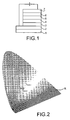
- the figure 1 is a schematic sectional view of a white light emitting diode according to the invention. It consists of a stack comprising a transparent glass substrate 1, a transparent electrode 2 serving as anode, a hole injection layer 3, a hole transport layer 4, a light emitting layer 5, an electron transport layer 6 and an electrode 7 serving as a cathode.
- the transparent electrode 2 is for example a layer of ITO (mixed oxide of tin and indium) 100 to 200 nm thick.
- the hole injection layer 3 may be made of copper phthalocyanine (or CuPc) and have a thickness of 10 nm.
- the hole-transporting layer 4 may be N, N'-bis- (1-naphthyl) -N, N'-diphenyl-1,1'-biphenyl (or NPB) -4-4'-diamine and have 50 nm of thickness.
- the light emitting layer 5 may be a DPVBi layer (forming a blue matrix) doped with a phosphole derivative, according to an example not in accordance with the invention. Its thickness can be 50 nm.
- the electron transport layer 6 may be a layer of tris (8-hydroxyquinoline) aluminum (or Alq 3 ) and be 10 nm thick.
- the cathode 7 may be formed by a 1.2 nm thick layer of lithium fluoride and a layer of 100 nm of aluminum thickness deposited successively on the layer 6.
- the current-voltage-luminance (I-V-L) characteristics as well as the electroluminescence spectra of the diodes are recorded under air at ambient temperature, without encapsulation of the devices.
- the chromatic coordinates (x, y) of the International Commission on Illumination (CIE) of the diodes are given according to the 1931 convention.
- Diode 1 is a blue reference diode for which the DPVBi matrix has not been doped. Its chromatic coordinates are (0.155, 0.130) and its quantum efficiency is 3.6%. The doping is given in% by weight of the dopant relative to the matrix. ⁇ em max is the wavelength of the maximum emission.
- the realized diode 2 has chromatic coordinates of (0.222, 0.344).
- the emission color of this diode is therefore green-blue as shown in FIG. figure 2 which is a representation of the chromatic coordinates of the diodes 1 to 4 in the CIE diagram of 1931.
- the red (R), green (V) and blue (B) zones have been indicated.
- Replacing the AuCl substituent of the P atom with a sulfur atom (molecule 2) makes it possible to shift the emission of the dopant from 500 to 548 nm and thus to obtain white diodes.
- the figure 3 represents the electroluminescence spectra of diodes 3 and 4.
- the ordinate axis represents the spectral luminance L ⁇ in watts per steradian and per m 2 .
- the abscissa axis represents the wavelength ⁇ .
- Curve 11 has been drawn for diode 3 and curve 12 has been drawn for diode 4.
- the modulation of the respective emissions of the matrix and the dopant (see figure 3 ) by playing on the percentage of doping makes it possible to adjust the chromatic coordinates of the diodes to obtain a white of good optical quality.
- the chromatic coordinates of the diodes go from (0, 305, 0.391) to (0.260, 0.310) either a slightly green white to a better optical white.
- the molecules of Example 1 can also be used as dopant of a layer of transport of the diode described above, for example the hole transport layer.
- the hole transport layer is in NPB.
- Table 2 gives the performances and the chromatic coordinates of the diode 5 made by doping the NPB with the molecule 2 at the rate of 0.25% by weight.
- Table 2 Diode ⁇ em max (nm) efficiencies CIE Color % cd / A Im / W x there 5 / NPB: molecule 2 (0.25%) 448/548 2.8 6.8 2.3 0.281 0.348 White
- the figure 4 is a representation of the chromatic coordinates of diodes 1 to 5 in the CIE diagram of 1931.
- the doping of the transport layer in place of the blue matrix by the molecule 2 can also lead to a white diode, as evidenced by the diode 5 whose chromatic coordinates are (0.281, 0.348).
- the alignment of the (x; y) coordinates of the diodes 1, 3, 4 and 5 on the same line shows that the emission of the dopant is similar to that found in the NPB or the DPVBi (see FIG. figure 4 ).
- the color of the diode is a composite color of two components: blue from DPVBi (diode 1) and orange-yellow from the dopant (molecule 2).
- the quantum efficiency of diode 5 is 2.8%, a yield similar to that of diodes 3 and 4.
- the dopant used in the hole transport layer is molecule 3 which, with respect to molecule 2, has methyl groups at the 4-position on the thiophene rings.
- the emission of the diode 6 is white. As for that of the diode 7, it is white-yellow as shown by their chromatic coordinates indicated on the figure 6 .
- the redshift of the emission of molecule 3 by substitution of its lateral thiophene groups has thus made it possible to obtain efficient white diodes with chromatic coordinates that are closer to those of D65, the CIE standard illuminant of reference under light. of the day, and which are (0.313, 0.329).
- the phosphole derivatives are preferentially used as a complement to a blue emitter.
Landscapes
- Chemical & Material Sciences (AREA)
- Organic Chemistry (AREA)
- Engineering & Computer Science (AREA)
- Materials Engineering (AREA)
- Physics & Mathematics (AREA)
- Health & Medical Sciences (AREA)
- Life Sciences & Earth Sciences (AREA)
- Biochemistry (AREA)
- General Health & Medical Sciences (AREA)
- Molecular Biology (AREA)
- Spectroscopy & Molecular Physics (AREA)
- Optics & Photonics (AREA)
- Electroluminescent Light Sources (AREA)
- Luminescent Compositions (AREA)
Description
- L'invention se rapporte à des diodes organiques électroluminescentes blanches dont la lumière émise provient d'un mélange de couleurs fournies par au moins deux matériaux luminophores.
- L'électroluminescence est un phénomène par lequel une excitation électrique donne lieu à l'émission d'un rayonnement électromagnétique. Une diode électroluminescente organique fonctionne par création d'excitons. Pour créer des excitons, une couche de matériau luminophore est prise en sandwich entre une électrode de cathode et une électrode d'anode. Des électrons sont injectés à partir de la cathode tandis que des trous sont injectés à partir de l'anode. Les électrons et les trous se déplacent dans le matériau luminophore et se rencontrent pour former des excitons qui sont des paires électron-trou excités et liés. Lorsque l'électron et le trou d'un exciton se combinent, un photon peut être émis.
- Les diodes organiques électroluminescentes ont connu un intérêt croissant ces dernières années à cause de leur faible tension de fonctionnement, leur forte luminance, leur angle de vue important ainsi qu'à leur capacité à conduire à des dispositifs en couleurs et plats. Grâce à ces propriétés, les premières applications envisagées pour ces diodes, encore appelées OLED (pour « organic light-emitting diode »), ont été des dispositifs d'affichage monochromes puis en couleurs.
- Le domaine de l'affichage n'est plus seulement en considération. En effet les OLED blanches ou WOLED (pour « White OLED ») sont de bons candidats pour la prochaine génération de sources lumineuses, en remplacement des lampes à incandescence, grâce à leur fort potentiel d'économie d'énergie, leur grande efficacité et leur possibilité de conduire à des dispositifs fins et flexibles. Les OLED blanches sont donc maintenant envisagées comme source lumineuse de faible coût pour la réalisation d'éclairage arrière de dispositifs LCD, pour l'éclairage domestique, etc. Pour toutes ces applications, les OLED blanches employées doivent posséder une grande efficacité et une grande luminosité, ainsi que des coordonnées chromatiques proches de celles du D65, illuminant standard de la Commission Internationale de l'Eclairage (voir le document [1] cité à la fin de la description), qui sont (0,313-0,329) sous lumière du jour.
- La largeur du spectre d'émission des chromophores classiquement utilisés dans les OLED représentant environ un tiers du spectre visible, une émission blanche efficace et très difficilement obtenue à partir d'une molécule unique. Cependant, une lumière blanche composite peut être obtenue en mélangeant les trois couleurs primaires (bleu, vert et rouge) ou deux couleurs complémentaires dans les bonnes proportions au sein d'une même diode. On peut se référer à ce sujet aux documents [2] et [3].
- L'obtention de lumière blanche par émission des trois couleurs bleu (B), Vert (V) et rouge (R) a été décrite dans l'art antérieur. Ainsi, le document
US 2003/099860 divulgue la combinaison d'une émission bleue provenant du 4,4'-bis (2,2-diphénylvinyl) biphényle ou DPVBi avec des émissions rouges et vertes provenant respectivement du [2-méthyl-6-[2-(2,3,6,7-tétrahydro -1H, 5H-benzo[ij] quinolizin-9-yl) éthényl]-4H-pyranne-4-ylidène] propane-dinitrite ou DCM2 et de la coumarine 6. Dans ce cas, la diode blanche est constituée des différentes couches émissives R, V, B ainsi que de couches de transport dans une structure multicouche. Une autre approche peut également être employée dans laquelle les émetteurs bleu, vert et rouge sont pixelisés au sein d'un dispositif comme le divulgue le documentUS 2003/197 665 . - L'utilisation de deux chromophores émettant des couleurs complémentaires pour la réalisation de diodes organiques électroluminescentes blanches a déjà été divulguée dans les documents
US 2004/0 241 491 ,US 2004/ 185 300 etEP-A-1 381 096 . Ces documents utilisent l'association d'une couche émettrice bleue avec un dérivé de rubrène ou de pérylène comme émetteur jaune orangé de façon à produire de la lumière blanche. Les émetteurs jaunes orangés peuvent être utilisés comme dopant de la couche émettrice bleue ou d'une couche de transport, ainsi qu'en couche émettrice continue. - Par ailleurs, des dérivés de phospholes ont été testés en tant qu'émetteur ou matrice d'un dopant rouge, le 4-(dicyanométhylène)-2-t-butyl-6(1,1,7,7-tétraméthyljulolidyl-9-enyl)-4H-pyranne ou DCJTB, en structure multicouche entre deux électrodes (voir les documents [4] et [5]). Le document
JP 2003-231741 A US 2005/042 195 ) divulgue la synthèse et la caractérisation de polymères contenant un fragment benzophosphole. Ces polymères sont décrits comme potentiellement intéressants en tant que composés émissifs dans des OLED. - Il est proposé par la présente invention d'utiliser des matériaux (polymères ou molécules) dérivés du phosphole pour la réalisation de diodes organiques électroluminescentes blanches. L'ingénierie moléculaire pouvant être réalisée sur cette famille de composés permet l'obtention de molécules fluorescentes et phosphorescentes efficaces, ainsi que la modulation de leur longueur d'onde d'émission. Cette modulation permet d'ajuster la couleur d'émission des molécules et ainsi d'obtenir une lumière blanche de bonne qualité.
- L'invention a donc pour objet une diode organique électroluminescente blanche telle que décrite dans la revendication 1.
- L'invention sera mieux comprise et d'autres avantages et particularités apparaîtront à la lecture de la description qui va suivre, donnée à titre d'exemple non limitatif, accompagnée des dessins annexés parmi lesquels :
- la
figure 1 est une vue schématique et en coupe transversale d'une diode électroluminescente blanche selon l'invention, - la
figure 2 est une représentation des coordonnées chromatiques de diodes utilisant des dérivés du phosphole et montrant l'influence de ces dérivés, - la
figure 3 représente des spectres d'électroluminescence des diodes utilisant des dérivés du phosphole, - la
figure 4 est une représentation des coordonnées chromatiques de diodes utilisant des dérivés du phosphole et montrant l'influence de ces dérivés, - la
figure 5 représente des spectres d'électroluminescence de diodes utilisant des dérivés du phosphole, - la
figure 6 est une représentation des coordonnées chromatiques de diodes utilisant des dérivés du phosphole et montrant l'influence de ces dérivés. - Selon la présente invention, on réalise des diodes organiques électroluminescentes blanches telle que décrite dans la revendication 1.
- Les exemples qui suivent illustrent la réalisation de WOLED conformément à l'invention et présentent les caractéristiques de ces dernières.
- Toutes les diodes présentées sont obtenues par évaporation thermique sous vide (< 10-6 Torr) de petites molécules organiques sur des substrats verre - ITO à des vitesses de dépôt de l'ordre de 0,2 à 0,3 nm/s. Les couches dopées sont réalisées par co-évaporation thermique de la matrice et du dopant. Les matériaux organiques utilisés sont commerciaux à l'exception des dérivés de phosphole, matériaux synthétisés dans le cadre de l'invention. Des couches d'injection de trous (CuPc) et de transport de trous (NPB) et d'électrons (Alq3) sont utilisées pour la réalisation des diodes présentées en exemple.
- La
figure 1 est une vue schématique et en coupe d'une diode électroluminescente blanche selon l'invention. Elle est constituée par un empilement comprenant un substrat transparent en verre 1, une électrode transparente 2 servant d'anode, une couche d'injection de trous 3, une couche de transport de trou 4, une couche émettrice de lumière 5, une couche de transport d'électrons 6 et une électrode 7 servant de cathode. L'électrode transparente 2 est par exemple une couche d'ITO (oxyde mixte d'étain et d'indium) de 100 à 200 nm d'épaisseur. La couche d'injection de trous 3 peut être en phthalocyanine de cuivre (ou CuPc) et avoir 10 nm d'épaisseur. La couche de transport de trous 4 peut être en N,N'-bis-(1-naphthyl)-N,N'-diphényl-1.1' biphényl (ou NPB)-4-4'-diamine et avoir 50 nm d'épaisseur. La couche émettrice de lumière 5 peut être une couche de DPVBi (formant une matrice bleue) dopée par un dérivé du phosphole, selon un exemple non-conforme à l'invention. Son épaisseur peut être de 50 nm. La couche de transport d'électrons 6 peut être une couche de tris (8-hydroxyquinoline) aluminium (ou Alq3) et avoir 10 nm d'épaisseur. La cathode 7 peut être formée par une couche de 1,2 nm d'épaisseur de fluorure de lithium et une couche de 100 nm d'épaisseur d'aluminium déposées successivement sur la couche 6. - Les caractéristiques courant-tension-luminance (I-V-L) ainsi que les spectres d'électroluminescence des diodes sont enregistrés sous air à température ambiante, sans encapsulation des dispositifs. Les coordonnés chromatiques (x ; y) de la Commission Internationale de l'Eclairage (CIE) des diodes sont données selon la convention de 1931.
- Les deux molécules fluorescentes suivantes ont été utilisées à différents pourcentages de dopage dans la matrice bleue DPVBi de la diode décrite ci-dessus et représentée à la
figure 1 .
- Le tableau 1 regroupe les performances et les coordonnées chromatiques des différentes diodes réalisées. La diode 1 est une diode bleue de référence pour laquelle la matrice DPVBi n'a pas été dopée. Ses coordonnées chromatiques sont (0,155 ; 0,130) et son efficacité quantique est de 3,6%. Le dopage est donné en % en poids du dopant par rapport à la matrice. λemmax est la longueur d'onde du maximum d'émission.
Tableau 1 Diode λem max (nm) Efficacités CIE Couleur % cd/A Im/W x y 1/DPVBi 452 3,6 4,0 1,2 0,155 0,130 bleu 2/DPVBi: molécule 1 (0,4%) 476/500 2,4 5,8 1,9 0,222 0,344 vert-bleu 3/DPVBi: molécule 2 (0,2%) 444/548 2,7 7,0 2,3 0,305 0,391 Blanc-vert 4/DPVBi: molécule 2 (0,1%) 444/548 2,7 6,1 2,0 0,260 0,310 blanc - La diode 2 réalisée possède des coordonnées chromatiques de (0,222 ; 0,344). La couleur d'émission de cette diode est donc vert-bleu comme le montre la
figure 2 qui est une représentation des coordonnées chromatiques des diodes 1 à 4 dans le diagramme CIE de 1931. Dans ce diagramme, les zones rouge (R), verte (V) et bleu (B) ont été indiquées. Le remplacement du substituant AuCl de l'atome de P par un atome de soufre (molécule 2) permet de décaler l'émission du dopant de 500 à 548 nm et ainsi d'obtenir des diodes blanches. - La
figure 3 représente les spectres d'électroluminescence des diodes 3 et 4. L'axe des ordonnées représente la luminance spectrale Lλ en watts par stéradian et par m2. L'axe des abscisses représente la longueur d'onde λ. La courbe 11 a été tracée pour la diode 3 et la courbe 12 a été tracée pour la diode 4. - La modulation des émissions respectives de la matrice et du dopant (voir la
figure 3 ) en jouant sur le pourcentage de dopage permet d'ajuster les coordonnées chromatiques des diodes pour obtenir un blanc de bonne qualité optique. Ainsi, en diminuant le pourcentage de dopage de la diode 3 de 0,2 % à 0,1 % pour obtenir la diode 4, les coordonnées chromatiques des diodes passent de (0, 305 ; 0,391) à (0,260 ; 0,310) soit d'un blanc légèrement vert à un blanc de meilleure qualité optique. - Les molécules de l'exemple 1 peuvent également être utilisées comme dopant d'une couche de transport de la diode décrite ci-dessus, par exemple la couche de transport de trous. Pour cette diode, la couche de transport de trous est en NPB. Le tableau 2 donne les performances et les coordonnées chromatiques de la diode 5 réalisée en dopant le NPB par la molécule 2 à raison de 0,25% en poids.
Tableau 2 Diode λem max (nm) Efficacités CIE Couleur % cd/A Im/W x y 5/NPB: molécule 2 (0,25%) 448/548 2,8 6,8 2,3 0,281 0,348 blanc - La
figure 4 est une représentation des coordonnées chromatiques des diodes 1 à 5 dans le diagramme CIE de 1931. - Le dopage de la couche de transport à la place de la matrice bleue par la molécule 2 peut également conduire à une diode blanche, comme le prouve la diode 5 dont les coordonnées chromatiques sont (0,281 ; 0,348). L'alignement des coordonnées (x ; y) des diodes 1, 3, 4 et 5 sur une même droite montre que l'émission du dopant est similaire qu'il se trouve dans le NPB ou le DPVBi (voir la
figure 4 ). La couleur de la diode est une couleur composite de deux constituants: le bleu provenant du DPVBi (diode 1) et du jaune orangé provenant du dopant (molécule 2). L'efficacité quantique de la diode 5 est de 2,8 %, rendement similaire à celui des diodes 3 et 4. - Ceci prouve que le dopage peut être réalisé dans la matrice bleue mais également dans la couche de transport.
- Dans cet exemple de réalisation, le dopant utilisé dans la couche de transport de trous est la molécule 3 qui, par rapport à la molécule 2, possède des groupements méthyles en position 4 sur les cycle thiophènes.

- Cette substitution des cycles thiophènes de la molécule 3 par un groupement donneur faible méthyle permet d'obtenir un léger décalage vers le rouge de l'émission du dopant, comme le montrent les spectres d'électroluminescence des diodes 6 et 7, en comparaison de celui de la diode 5. La
figure 5 représente les spectres d'électroluminescence des diodes 5 (courbe 13), 6 (courbe 14) et 7 (courbe 15). - De plus il en résulte des diodes ayant de très bonnes efficacités quantiques, de 3,6 à 3,9% pour des pourcentages en poids de dopage dans le NPB de 0,2% et 0,4% respectivement, comme le montre le tableau 3.
Tableau 3 Diode λem max (nm) Efficacités CIE Couleur % cd/A Im/W x y 6/NPB: molécule 3 (0,20%) 456/564 3,6 7,8 2,0 0,282 0,306 blanc 7/NPB: molécule 3 (0,40%) 456/568 3,9 10,0 2,6 0,362 0,41 blanc-jaune - L'émission de la diode 6 est blanche. Quant à celle de la diode 7, elle est blanc-jaune comme le montrent leurs coordonnées chromatiques indiquées sur la
figure 6 . - Le décalage vers le rouge de l'émission de la molécule 3 par substitution de ses groupes thiophènes latéraux a ainsi permis d'obtenir des diodes blanches efficaces avec des coordonnées chromatiques plus proches de celles du D65, l'illuminant standard CIE de référence sous lumière du jour, et qui sont (0,313; 0,329).
- Dans les exemples présentés ci-dessus, les dérivés du phosphole sont préférentiellement utilisés comme complément d'un émetteur bleu.
-
- [1] « White Organic hight-Emitting Devices for Solid-State Lighting », B. W. D'Andrade et al., Adv. Mater. 2004, 16, No. 18, 1585-1595.
- [2] « Blue and white emitting organic diodes based on anthracene derivative », Z. L. Zhang et al., Synthetic Metals 137 (2003), pages 1141-1142.
- [3] « Highly-bright white organic light-emitting diodes based on a single emission layer », C. H. Chuen et al., Appl. Phys. Lett., Vol. 81, No. 24, 9 décembre 2002, pages 4499 à 4501.
- [4] « First Examples of Organophosphorus-Containing Materials for Light-Emitting Diodes », C. Fave et al., J. Am. Chem. Soc., 2003, 125, pages 9254-9255.
- [5] « Toward functional pi-conjugated organophosphorus materials : design of phosphole-based oligomers for electroluminescent devices », H. C. Su et al., J. Am. Chem.. Soc., 2006, 128(3), pages 983 à 995.
- [6] « Synthesis and Properties of First Well-Defined Phosphole-Containing π-conjugated Polymers", Y. Morisaki et al., Macromolecules 2003, 36, 2594-2597.
Claims (1)
- Diode organique électroluminescente blanche, fournissant, sous l'effet d'une polarisation électrique, une lumière blanche composée du mélange d'au moins une première couleur et une deuxième couleur émises respectivement par un premier matériau luminophore et par un deuxième matériau luminophore, caractérisée en ce que l'un de ces matériaux luminophores est le matériau à base de phosphole suivant

Applications Claiming Priority (2)
| Application Number | Priority Date | Filing Date | Title |
|---|---|---|---|
| FR0653146A FR2904474B1 (fr) | 2006-07-27 | 2006-07-27 | Diodes organiques electroluminescentes blanches a base de molecules derivees du phosphole |
| PCT/EP2007/057604 WO2008012298A1 (fr) | 2006-07-27 | 2007-07-24 | Diodes organiques électroluminescentes blanches à base de molécules dérivées du phosphole. |
Publications (2)
| Publication Number | Publication Date |
|---|---|
| EP2047534A1 EP2047534A1 (fr) | 2009-04-15 |
| EP2047534B1 true EP2047534B1 (fr) | 2011-03-16 |
Family
ID=37775549
Family Applications (1)
| Application Number | Title | Priority Date | Filing Date |
|---|---|---|---|
| EP07787846A Not-in-force EP2047534B1 (fr) | 2006-07-27 | 2007-07-24 | Diodes organiques électroluminescentes blanches à base de molécules dérivées du phosphole. |
Country Status (9)
| Country | Link |
|---|---|
| US (1) | US20090236978A1 (fr) |
| EP (1) | EP2047534B1 (fr) |
| JP (1) | JP2009545151A (fr) |
| KR (1) | KR20090034902A (fr) |
| AT (1) | ATE502405T1 (fr) |
| CA (1) | CA2658908A1 (fr) |
| DE (1) | DE602007013245D1 (fr) |
| FR (1) | FR2904474B1 (fr) |
| WO (1) | WO2008012298A1 (fr) |
Families Citing this family (2)
| Publication number | Priority date | Publication date | Assignee | Title |
|---|---|---|---|---|
| JP5701766B2 (ja) | 2008-11-11 | 2015-04-15 | メルク パテント ゲーエムベーハー | 有機エレクトロルミネセント素子 |
| DE102010033548A1 (de) * | 2010-08-05 | 2012-02-09 | Merck Patent Gmbh | Materialien für elektronische Vorrichtungen |
Family Cites Families (7)
| Publication number | Priority date | Publication date | Assignee | Title |
|---|---|---|---|---|
| US6696177B1 (en) * | 2000-08-30 | 2004-02-24 | Eastman Kodak Company | White organic electroluminescent devices with improved stability and efficiency |
| JP4067286B2 (ja) * | 2000-09-21 | 2008-03-26 | 富士フイルム株式会社 | 発光素子及びイリジウム錯体 |
| TW519852B (en) * | 2001-10-18 | 2003-02-01 | Opto Tech Corp | Organic light emitting device capable of projecting white light source and its manufacturing method |
| SG124249A1 (en) | 2001-12-07 | 2006-08-30 | Sumitomo Chemical Co | New polymer and polymer light-emitting device using the same |
| US6876144B2 (en) * | 2002-09-09 | 2005-04-05 | Kuan-Chang Peng | Organic electroluminescent device having host material layer intermixed with luminescent material |
| TW200613515A (en) * | 2004-06-26 | 2006-05-01 | Merck Patent Gmbh | Compounds for organic electronic devices |
| FR2873586B1 (fr) * | 2004-07-30 | 2006-10-27 | Centre Nat Rech Scient Cnrse | Derives phospholes complexes a des metaux, et leurs utilisations pharmaceutiques |
-
2006
- 2006-07-27 FR FR0653146A patent/FR2904474B1/fr not_active Expired - Fee Related
-
2007
- 2007-07-24 CA CA002658908A patent/CA2658908A1/fr not_active Abandoned
- 2007-07-24 AT AT07787846T patent/ATE502405T1/de not_active IP Right Cessation
- 2007-07-24 KR KR1020097001389A patent/KR20090034902A/ko not_active Withdrawn
- 2007-07-24 JP JP2009521247A patent/JP2009545151A/ja active Pending
- 2007-07-24 EP EP07787846A patent/EP2047534B1/fr not_active Not-in-force
- 2007-07-24 WO PCT/EP2007/057604 patent/WO2008012298A1/fr not_active Ceased
- 2007-07-24 US US12/374,881 patent/US20090236978A1/en not_active Abandoned
- 2007-07-24 DE DE602007013245T patent/DE602007013245D1/de active Active
Also Published As
| Publication number | Publication date |
|---|---|
| DE602007013245D1 (de) | 2011-04-28 |
| EP2047534A1 (fr) | 2009-04-15 |
| ATE502405T1 (de) | 2011-04-15 |
| JP2009545151A (ja) | 2009-12-17 |
| WO2008012298A1 (fr) | 2008-01-31 |
| CA2658908A1 (fr) | 2008-01-31 |
| FR2904474B1 (fr) | 2008-10-24 |
| FR2904474A1 (fr) | 2008-02-01 |
| US20090236978A1 (en) | 2009-09-24 |
| KR20090034902A (ko) | 2009-04-08 |
Similar Documents
| Publication | Publication Date | Title |
|---|---|---|
| Zhang et al. | Efficient red/green/blue tandem quantum-dot light-emitting diodes with external quantum efficiency exceeding 21% | |
| US5861219A (en) | Organic light emitting devices containing a metal complex of 5-hydroxy-quinoxaline as a host material | |
| JP4511024B2 (ja) | 高透明性非金属カソード | |
| US6303238B1 (en) | OLEDs doped with phosphorescent compounds | |
| US6420031B1 (en) | Highly transparent non-metallic cathodes | |
| JP3897468B2 (ja) | 有機発光ダイオード | |
| KR101419810B1 (ko) | 엑시플렉스를 형성하는 공동 호스트를 포함하는 유기 발광 소자 | |
| CN1221040C (zh) | 有利于在有机发光装置中激子的有效利用的系统间过渡剂 | |
| US6329085B1 (en) | Red-emitting organic light emitting devices (OLED's) | |
| JP6918762B2 (ja) | 発光装置、テレビジョン | |
| US6451455B1 (en) | Metal complexes bearing both electron transporting and hole transporting moieties | |
| US20210135142A1 (en) | Organic electroluminescent device based on exciplex and excimer system | |
| JP2006528421A (ja) | 有機エレクトロルミネッセンス素子 | |
| KR20100042665A (ko) | 유기 엘이디의 인광성 도펀트로서의 사이클로메탈화 금속 복합체 | |
| WO2008012298A1 (fr) | Diodes organiques électroluminescentes blanches à base de molécules dérivées du phosphole. | |
| JPH0347890A (ja) | 有機エレクトロルミネッセンス素子 | |
| Xie et al. | Realizing high CRI white organic light-emitting diodes via exciplex emission optimization | |
| KR20260018749A (ko) | 유기 전계발광 디바이스 | |
| KR100668425B1 (ko) | 유기발광다이오드의 발광층에 사용되는 Al 금속 착체 및그 제조방법 | |
| EP2556549A1 (fr) | Diode electroluminescente organique comportant au moins deux couches electroluminescentes |
Legal Events
| Date | Code | Title | Description |
|---|---|---|---|
| PUAI | Public reference made under article 153(3) epc to a published international application that has entered the european phase |
Free format text: ORIGINAL CODE: 0009012 |
|
| 17P | Request for examination filed |
Effective date: 20090126 |
|
| AK | Designated contracting states |
Kind code of ref document: A1 Designated state(s): AT BE BG CH CY CZ DE DK EE ES FI FR GB GR HU IE IS IT LI LT LU LV MC MT NL PL PT RO SE SI SK TR |
|
| AX | Request for extension of the european patent |
Extension state: AL BA HR MK RS |
|
| 17Q | First examination report despatched |
Effective date: 20090423 |
|
| RAP1 | Party data changed (applicant data changed or rights of an application transferred) |
Owner name: UNIVERSITE RENNES 1 Owner name: COMMISSARIAT A L'ENERGIE ATOMIQUE ET AUX ENERGIES |
|
| GRAP | Despatch of communication of intention to grant a patent |
Free format text: ORIGINAL CODE: EPIDOSNIGR1 |
|
| GRAS | Grant fee paid |
Free format text: ORIGINAL CODE: EPIDOSNIGR3 |
|
| GRAA | (expected) grant |
Free format text: ORIGINAL CODE: 0009210 |
|
| AK | Designated contracting states |
Kind code of ref document: B1 Designated state(s): AT BE BG CH CY CZ DE DK EE ES FI FR GB GR HU IE IS IT LI LT LU LV MC MT NL PL PT RO SE SI SK TR |
|
| REG | Reference to a national code |
Ref country code: GB Ref legal event code: FG4D Free format text: NOT ENGLISH |
|
| REG | Reference to a national code |
Ref country code: CH Ref legal event code: EP |
|
| REG | Reference to a national code |
Ref country code: IE Ref legal event code: FG4D |
|
| REF | Corresponds to: |
Ref document number: 602007013245 Country of ref document: DE Date of ref document: 20110428 Kind code of ref document: P |
|
| REG | Reference to a national code |
Ref country code: DE Ref legal event code: R096 Ref document number: 602007013245 Country of ref document: DE Effective date: 20110428 |
|
| REG | Reference to a national code |
Ref country code: NL Ref legal event code: VDEP Effective date: 20110316 |
|
| PG25 | Lapsed in a contracting state [announced via postgrant information from national office to epo] |
Ref country code: LT Free format text: LAPSE BECAUSE OF FAILURE TO SUBMIT A TRANSLATION OF THE DESCRIPTION OR TO PAY THE FEE WITHIN THE PRESCRIBED TIME-LIMIT Effective date: 20110316 Ref country code: LV Free format text: LAPSE BECAUSE OF FAILURE TO SUBMIT A TRANSLATION OF THE DESCRIPTION OR TO PAY THE FEE WITHIN THE PRESCRIBED TIME-LIMIT Effective date: 20110316 Ref country code: ES Free format text: LAPSE BECAUSE OF FAILURE TO SUBMIT A TRANSLATION OF THE DESCRIPTION OR TO PAY THE FEE WITHIN THE PRESCRIBED TIME-LIMIT Effective date: 20110627 Ref country code: GR Free format text: LAPSE BECAUSE OF FAILURE TO SUBMIT A TRANSLATION OF THE DESCRIPTION OR TO PAY THE FEE WITHIN THE PRESCRIBED TIME-LIMIT Effective date: 20110617 Ref country code: SE Free format text: LAPSE BECAUSE OF FAILURE TO SUBMIT A TRANSLATION OF THE DESCRIPTION OR TO PAY THE FEE WITHIN THE PRESCRIBED TIME-LIMIT Effective date: 20110316 |
|
| LTIE | Lt: invalidation of european patent or patent extension |
Effective date: 20110316 |
|
| PG25 | Lapsed in a contracting state [announced via postgrant information from national office to epo] |
Ref country code: BG Free format text: LAPSE BECAUSE OF FAILURE TO SUBMIT A TRANSLATION OF THE DESCRIPTION OR TO PAY THE FEE WITHIN THE PRESCRIBED TIME-LIMIT Effective date: 20110616 Ref country code: AT Free format text: LAPSE BECAUSE OF FAILURE TO SUBMIT A TRANSLATION OF THE DESCRIPTION OR TO PAY THE FEE WITHIN THE PRESCRIBED TIME-LIMIT Effective date: 20110316 Ref country code: CY Free format text: LAPSE BECAUSE OF FAILURE TO SUBMIT A TRANSLATION OF THE DESCRIPTION OR TO PAY THE FEE WITHIN THE PRESCRIBED TIME-LIMIT Effective date: 20110316 Ref country code: SI Free format text: LAPSE BECAUSE OF FAILURE TO SUBMIT A TRANSLATION OF THE DESCRIPTION OR TO PAY THE FEE WITHIN THE PRESCRIBED TIME-LIMIT Effective date: 20110316 Ref country code: FI Free format text: LAPSE BECAUSE OF FAILURE TO SUBMIT A TRANSLATION OF THE DESCRIPTION OR TO PAY THE FEE WITHIN THE PRESCRIBED TIME-LIMIT Effective date: 20110316 |
|
| PGFP | Annual fee paid to national office [announced via postgrant information from national office to epo] |
Ref country code: LU Payment date: 20110725 Year of fee payment: 5 |
|
| REG | Reference to a national code |
Ref country code: IE Ref legal event code: FD4D |
|
| PG25 | Lapsed in a contracting state [announced via postgrant information from national office to epo] |
Ref country code: EE Free format text: LAPSE BECAUSE OF FAILURE TO SUBMIT A TRANSLATION OF THE DESCRIPTION OR TO PAY THE FEE WITHIN THE PRESCRIBED TIME-LIMIT Effective date: 20110316 Ref country code: IE Free format text: LAPSE BECAUSE OF FAILURE TO SUBMIT A TRANSLATION OF THE DESCRIPTION OR TO PAY THE FEE WITHIN THE PRESCRIBED TIME-LIMIT Effective date: 20110316 Ref country code: PT Free format text: LAPSE BECAUSE OF FAILURE TO SUBMIT A TRANSLATION OF THE DESCRIPTION OR TO PAY THE FEE WITHIN THE PRESCRIBED TIME-LIMIT Effective date: 20110718 |
|
| PGFP | Annual fee paid to national office [announced via postgrant information from national office to epo] |
Ref country code: CH Payment date: 20110725 Year of fee payment: 5 |
|
| PG25 | Lapsed in a contracting state [announced via postgrant information from national office to epo] |
Ref country code: RO Free format text: LAPSE BECAUSE OF FAILURE TO SUBMIT A TRANSLATION OF THE DESCRIPTION OR TO PAY THE FEE WITHIN THE PRESCRIBED TIME-LIMIT Effective date: 20110316 Ref country code: CZ Free format text: LAPSE BECAUSE OF FAILURE TO SUBMIT A TRANSLATION OF THE DESCRIPTION OR TO PAY THE FEE WITHIN THE PRESCRIBED TIME-LIMIT Effective date: 20110316 Ref country code: IS Free format text: LAPSE BECAUSE OF FAILURE TO SUBMIT A TRANSLATION OF THE DESCRIPTION OR TO PAY THE FEE WITHIN THE PRESCRIBED TIME-LIMIT Effective date: 20110716 Ref country code: SK Free format text: LAPSE BECAUSE OF FAILURE TO SUBMIT A TRANSLATION OF THE DESCRIPTION OR TO PAY THE FEE WITHIN THE PRESCRIBED TIME-LIMIT Effective date: 20110316 |
|
| PG25 | Lapsed in a contracting state [announced via postgrant information from national office to epo] |
Ref country code: NL Free format text: LAPSE BECAUSE OF FAILURE TO SUBMIT A TRANSLATION OF THE DESCRIPTION OR TO PAY THE FEE WITHIN THE PRESCRIBED TIME-LIMIT Effective date: 20110316 Ref country code: MT Free format text: LAPSE BECAUSE OF FAILURE TO SUBMIT A TRANSLATION OF THE DESCRIPTION OR TO PAY THE FEE WITHIN THE PRESCRIBED TIME-LIMIT Effective date: 20110316 |
|
| PLBE | No opposition filed within time limit |
Free format text: ORIGINAL CODE: 0009261 |
|
| STAA | Information on the status of an ep patent application or granted ep patent |
Free format text: STATUS: NO OPPOSITION FILED WITHIN TIME LIMIT |
|
| 26N | No opposition filed |
Effective date: 20111219 |
|
| PG25 | Lapsed in a contracting state [announced via postgrant information from national office to epo] |
Ref country code: MC Free format text: LAPSE BECAUSE OF NON-PAYMENT OF DUE FEES Effective date: 20110731 Ref country code: DK Free format text: LAPSE BECAUSE OF FAILURE TO SUBMIT A TRANSLATION OF THE DESCRIPTION OR TO PAY THE FEE WITHIN THE PRESCRIBED TIME-LIMIT Effective date: 20110316 Ref country code: PL Free format text: LAPSE BECAUSE OF FAILURE TO SUBMIT A TRANSLATION OF THE DESCRIPTION OR TO PAY THE FEE WITHIN THE PRESCRIBED TIME-LIMIT Effective date: 20110316 |
|
| REG | Reference to a national code |
Ref country code: DE Ref legal event code: R097 Ref document number: 602007013245 Country of ref document: DE Effective date: 20111219 |
|
| PG25 | Lapsed in a contracting state [announced via postgrant information from national office to epo] |
Ref country code: IT Free format text: LAPSE BECAUSE OF FAILURE TO SUBMIT A TRANSLATION OF THE DESCRIPTION OR TO PAY THE FEE WITHIN THE PRESCRIBED TIME-LIMIT Effective date: 20110316 |
|
| PGFP | Annual fee paid to national office [announced via postgrant information from national office to epo] |
Ref country code: GB Payment date: 20120723 Year of fee payment: 6 |
|
| PGFP | Annual fee paid to national office [announced via postgrant information from national office to epo] |
Ref country code: FR Payment date: 20120816 Year of fee payment: 6 Ref country code: BE Payment date: 20120726 Year of fee payment: 6 Ref country code: DE Payment date: 20120713 Year of fee payment: 6 |
|
| PG25 | Lapsed in a contracting state [announced via postgrant information from national office to epo] |
Ref country code: TR Free format text: LAPSE BECAUSE OF FAILURE TO SUBMIT A TRANSLATION OF THE DESCRIPTION OR TO PAY THE FEE WITHIN THE PRESCRIBED TIME-LIMIT Effective date: 20110316 |
|
| PG25 | Lapsed in a contracting state [announced via postgrant information from national office to epo] |
Ref country code: HU Free format text: LAPSE BECAUSE OF FAILURE TO SUBMIT A TRANSLATION OF THE DESCRIPTION OR TO PAY THE FEE WITHIN THE PRESCRIBED TIME-LIMIT Effective date: 20110316 |
|
| BERE | Be: lapsed |
Owner name: UNIVERSITE RENNES 1 Effective date: 20130731 Owner name: COMMISSARIAT A L'ENERGIE ATOMIQUE ET AUX ENERGIES Effective date: 20130731 |
|
| REG | Reference to a national code |
Ref country code: CH Ref legal event code: PL |
|
| GBPC | Gb: european patent ceased through non-payment of renewal fee |
Effective date: 20130724 |
|
| REG | Reference to a national code |
Ref country code: DE Ref legal event code: R119 Ref document number: 602007013245 Country of ref document: DE Effective date: 20140201 |
|
| REG | Reference to a national code |
Ref country code: FR Ref legal event code: ST Effective date: 20140331 |
|
| PG25 | Lapsed in a contracting state [announced via postgrant information from national office to epo] |
Ref country code: GB Free format text: LAPSE BECAUSE OF NON-PAYMENT OF DUE FEES Effective date: 20130724 Ref country code: DE Free format text: LAPSE BECAUSE OF NON-PAYMENT OF DUE FEES Effective date: 20140201 Ref country code: BE Free format text: LAPSE BECAUSE OF NON-PAYMENT OF DUE FEES Effective date: 20130731 Ref country code: LI Free format text: LAPSE BECAUSE OF NON-PAYMENT OF DUE FEES Effective date: 20130731 Ref country code: CH Free format text: LAPSE BECAUSE OF NON-PAYMENT OF DUE FEES Effective date: 20130731 |
|
| PG25 | Lapsed in a contracting state [announced via postgrant information from national office to epo] |
Ref country code: FR Free format text: LAPSE BECAUSE OF NON-PAYMENT OF DUE FEES Effective date: 20130731 |
|
| PG25 | Lapsed in a contracting state [announced via postgrant information from national office to epo] |
Ref country code: LU Free format text: LAPSE BECAUSE OF NON-PAYMENT OF DUE FEES Effective date: 20130724 |