EP2037597B1 - 1+1-dienstschutzverfahren in obs-netzen, vermittlungsknotenvorrichtung und dienstschutzsystem - Google Patents
1+1-dienstschutzverfahren in obs-netzen, vermittlungsknotenvorrichtung und dienstschutzsystem Download PDFInfo
- Publication number
- EP2037597B1 EP2037597B1 EP07764173A EP07764173A EP2037597B1 EP 2037597 B1 EP2037597 B1 EP 2037597B1 EP 07764173 A EP07764173 A EP 07764173A EP 07764173 A EP07764173 A EP 07764173A EP 2037597 B1 EP2037597 B1 EP 2037597B1
- Authority
- EP
- European Patent Office
- Prior art keywords
- packet
- burst
- control packet
- control
- packets
- Prior art date
- Legal status (The legal status is an assumption and is not a legal conclusion. Google has not performed a legal analysis and makes no representation as to the accuracy of the status listed.)
- Not-in-force
Links
- 238000000034 method Methods 0.000 title claims abstract description 36
- 230000003287 optical effect Effects 0.000 claims abstract description 17
- 238000012546 transfer Methods 0.000 claims description 15
- 230000001934 delay Effects 0.000 claims description 7
- 230000005540 biological transmission Effects 0.000 claims description 6
- 230000003362 replicative effect Effects 0.000 claims 1
- 238000010586 diagram Methods 0.000 description 6
- 230000003321 amplification Effects 0.000 description 2
- 238000003199 nucleic acid amplification method Methods 0.000 description 2
- 238000007493 shaping process Methods 0.000 description 2
- 238000004458 analytical method Methods 0.000 description 1
- 230000015556 catabolic process Effects 0.000 description 1
- 238000006243 chemical reaction Methods 0.000 description 1
- 238000004891 communication Methods 0.000 description 1
- 230000007812 deficiency Effects 0.000 description 1
- 238000006731 degradation reaction Methods 0.000 description 1
- 238000013461 design Methods 0.000 description 1
- 230000000694 effects Effects 0.000 description 1
- 238000005516 engineering process Methods 0.000 description 1
- 238000001914 filtration Methods 0.000 description 1
- 238000012986 modification Methods 0.000 description 1
- 230000004048 modification Effects 0.000 description 1
- 238000011084 recovery Methods 0.000 description 1
- 230000010076 replication Effects 0.000 description 1
- 230000011664 signaling Effects 0.000 description 1
- 238000004088 simulation Methods 0.000 description 1
- 230000009466 transformation Effects 0.000 description 1
Images

Classifications
-
- H—ELECTRICITY
- H04—ELECTRIC COMMUNICATION TECHNIQUE
- H04J—MULTIPLEX COMMUNICATION
- H04J14/00—Optical multiplex systems
- H04J14/02—Wavelength-division multiplex systems
- H04J14/0287—Protection in WDM systems
- H04J14/0293—Optical channel protection
- H04J14/0294—Dedicated protection at the optical channel (1+1)
-
- H—ELECTRICITY
- H04—ELECTRIC COMMUNICATION TECHNIQUE
- H04Q—SELECTING
- H04Q11/00—Selecting arrangements for multiplex systems
- H04Q11/0001—Selecting arrangements for multiplex systems using optical switching
- H04Q11/0062—Network aspects
- H04Q11/0066—Provisions for optical burst or packet networks
-
- H—ELECTRICITY
- H04—ELECTRIC COMMUNICATION TECHNIQUE
- H04J—MULTIPLEX COMMUNICATION
- H04J14/00—Optical multiplex systems
- H04J14/02—Wavelength-division multiplex systems
- H04J14/0227—Operation, administration, maintenance or provisioning [OAMP] of WDM networks, e.g. media access, routing or wavelength allocation
- H04J14/0254—Optical medium access
- H04J14/0256—Optical medium access at the optical channel layer
- H04J14/0258—Wavelength identification or labelling
-
- H—ELECTRICITY
- H04—ELECTRIC COMMUNICATION TECHNIQUE
- H04J—MULTIPLEX COMMUNICATION
- H04J14/00—Optical multiplex systems
- H04J14/02—Wavelength-division multiplex systems
- H04J14/0227—Operation, administration, maintenance or provisioning [OAMP] of WDM networks, e.g. media access, routing or wavelength allocation
- H04J14/0254—Optical medium access
- H04J14/0267—Optical signaling or routing
-
- H—ELECTRICITY
- H04—ELECTRIC COMMUNICATION TECHNIQUE
- H04J—MULTIPLEX COMMUNICATION
- H04J14/00—Optical multiplex systems
- H04J14/02—Wavelength-division multiplex systems
- H04J14/0278—WDM optical network architectures
- H04J14/0283—WDM ring architectures
-
- H—ELECTRICITY
- H04—ELECTRIC COMMUNICATION TECHNIQUE
- H04Q—SELECTING
- H04Q11/00—Selecting arrangements for multiplex systems
- H04Q11/0001—Selecting arrangements for multiplex systems using optical switching
- H04Q11/0062—Network aspects
- H04Q2011/0079—Operation or maintenance aspects
- H04Q2011/0081—Fault tolerance; Redundancy; Recovery; Reconfigurability
-
- H—ELECTRICITY
- H04—ELECTRIC COMMUNICATION TECHNIQUE
- H04Q—SELECTING
- H04Q11/00—Selecting arrangements for multiplex systems
- H04Q11/0001—Selecting arrangements for multiplex systems using optical switching
- H04Q11/0062—Network aspects
- H04Q2011/0079—Operation or maintenance aspects
- H04Q2011/0083—Testing; Monitoring
-
- H—ELECTRICITY
- H04—ELECTRIC COMMUNICATION TECHNIQUE
- H04Q—SELECTING
- H04Q11/00—Selecting arrangements for multiplex systems
- H04Q11/0001—Selecting arrangements for multiplex systems using optical switching
- H04Q11/0062—Network aspects
- H04Q2011/0084—Quality of service aspects
Definitions
- Optical burst switching is an optical switching technology newly developed in recent years.
- the basic principle of the OBS is to transfer the data and control information respectively through independent channels.
- An edge node of OBS networks assembles several IP packets having the same features such as the same destinations and the same service levels into one burst packet.
- the control information in the form of packet sent earlier than the burst packet referred to as a control packet, is used to reserve bandwidth resources for the burst packet at every intermediate node in a route to a destination node, so that the burst packet sent after the corresponding control packet remains in the optical domain all the time during the network transmission.
- the problem that the packet headers are processed one by one during the packet switching is avoided.
- the demands for the optical buffer at the intermediate nodes of the network may be avoided or reduced.
- a conventional multi-protocol label switching (MPLS) 1+1 service protection strategy is introduced into the OBS network.
- the solution mainly includes the following processes.
- When establishing a session between a service source and a sink node resources are reserved simultaneously on two routes.
- a burst packet bearing service is replicated, in an appropriate manner, into two packets with the same content and number and the two burst packets are placed on the two routes respectively for transfer.
- the sequence number of the burst packet is added in its corresponding control packet sent earlier than the burst packet.
- a receiving window of the sequence number of the burst packet having a width of L is disposed at an intersection node where the two routes converge together.
- the value of L should be great than the maximum number of burst packets that may possibly be continuously lost on a single route. That is, when the network operates normally, the number of the packets that are continuously lost on a certain route from the source node to the sink node is smaller than L. Then, the receiving window filters the burst packets at the intersection node where the two routes converge together, based on the following principle.
- the inventor discovers at least the following deficiencies of the aforementioned solution of the 1+1 service protection in the OBS networks of the prior art.
- the packet loss ratio of the burst packet is always far greater than that in the traditional electrical switching network.
- the best way is to utilize the characteristic that the packet loss ratios of the two routes are independent from each other, so as to reduce the packet loss ratio of the entire service.
- the above 1+1 protection solution obviously cannot achieve this.
- the packet loss ratio of the above protection solution is approximately the packet loss ratio of the shorter route.
- the burst packets may undergo a wavelength transformation, delay, and other processes at each of the nodes, so as to avoid the burst packet collision, and may probably undergo a shaping, amplification, and other processes, so as to optimize the signal quality. Therefore, at the sink node of a service, the signal qualities of multiple burst packets transferred through the same route are not definitely the same, and the signal quality of the burst packets transferred through the shorter route is not definitely better than that of the burst packets transferred through the longer route.
- This architecture is designed by modifying the diversity routing architecture that was originally proposed for non-optical packet networks and recently applied to networks employing the generalized multi-protocol label switched (GMPLS) architecture.
- GPLS generalized multi-protocol label switched
- We show that a sufficiently large difference in the propagation delays can cause performance degradations that may result in an unsatisfactory quality-of-service on the protected connection.
- the embodiments of the present invention is directed to provide a 1+1 protection method of service in OBS networks, an intersection node apparatus, and a service protection system, thereby providing effective 1+1 protection to services in the OBS networks.
- a 1+1 protection of service method in OBS networks is provided in an embodiment of the present invention, including the following steps.
- Burst packets bearing service are transferred through two routes.
- the burst packets have the same content and sequence number.
- Each of the burst packets transferred through the two routes corresponds to one control packet, and the control packet is provided with a waiting time field for recording the waiting time of the control packet, a sequence number field for recording a sequence number of the burst packet corresponding to the control packet and a quality loss field for recording a signal quality loss of the control packet.
- intersection node of the two routes receives a first control packet from either route with a sequence number firstly, and when the intersection node receives a second control packet which is from the other route and has the same sequence number field value within the waiting time of the first control packet, the intersection node selects the burst packet corresponding to the control packet with a smaller quality loss field value, from the first and second control packets.
- An intersection node apparatus disposed at an intersection node of two routes in OBS networks is provided in an embodiment of the present invention.
- the two routes are adapted to transfer burst packets bearing service in need of a 1+1 protection in OBS networks.
- the burst packets have the same content and sequence number.
- Each burst packet transferred through the two routes corresponds to one control packet.
- the control packet is provided with a waiting time field for recording the waiting time of the control packet, a sequence number field for recording the burst packet number corresponding to the control packet, and a quality loss field for recording a signal quality loss of the control packet.
- the intersection node apparatus includes a receiving module and a selecting module.
- the receiving module is adapted to receive a first control packet with a sequence number field value from either route firstly, and receive a second control packet which is from the other route and has the same sequence number field value within the waiting time of the first control packet.
- the selecting module is adapted to select a burst packet corresponding to the control packet with a smaller quality loss field value, from the first and second control packets.
- a service protection system is provided in an embodiment of the present invention, including a sending device and a receiving device.
- the sending device is adapted to transfer burst packets bearing service in need of a 1+1 protection in OBS networks through two routes in the networks.
- the burst packets have the same content and sequence number.
- Each burst packet transferred through the two routes corresponds to one control packet, and the control packet is provided with a waiting time field for recording the waiting time of the control packet, a sequence number field for recording the burst packet number corresponding to the control packet, and a quality loss field for recording a signal quality loss of the control packet.
- the receiving device is adapted to receive the control packets sent by the sending device.
- the receiving device first receives a first control packet having a sequence number field value from either route firstly, and receive a second control packet which is from the other route and has the same sequence number field value within the waiting time of the first control packet, and selects the burst packet corresponding to the control packet with a smaller quality loss field value of the first and second control packets.
- the burst packets bearing the service are transferred through two routes.
- the other route which operates normally maintains the normal transmission of the service, thereby preventing the service from being cut down.
- An appropriate waiting time is set for the control packet corresponding to each route respectively, and the loss in signal quality of the corresponding burst packet is recorded in the control packet.
- the burst packet with a better signal quality may be selected from the two burst packets with the same content transferred through the two different routes, thereby providing a better QoS for the services of higher service levels.
- the appropriate waiting time for the control packets corresponding to the routes respectively a large end-to-end time delay difference between the two routes may be accepted, and the packet loss ratio of the service may be effectively reduced.
- FIG. 1 is a schematic diagram illustrating a 1+1 service protection in OBS networks
- FIG. 2 is a schematic diagram illustrating processes of selecting a packet by a receiving window at an intersection node according to an MPLS 1+1 service protection strategy in the prior art
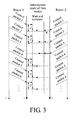
- FIG. 3 is a schematic diagram illustrating a 1+1 service protection method in OBS networks according to an embodiment of the present invention.
- a 1+1 service protection method, an intersection node apparatus, and a service protection system in OBS networks are provided by the embodiments of the present invention.
- two routes are selected for the service in need of a 1+1 protection.
- the two routes have the same fork node and intersection node in the direction from a service source node to a service sink node.
- two control packets respectively corresponding to the two routes are generated for the burst packet in an appropriate manner, and the burst packet is replicated to obtain two burst packets or the two burst packets may be obtained in other appropriate manners.
- the burst packets are transferred through the above two routes. Therefore, each of the burst packets transferred through the above two routes corresponds to a control packet.
- the above two burst packets obtained by replication or in other appropriate manners have the same content and sequence number.
- the control packet is provided with a waiting time field for recording the waiting time of the control packet, a sequence number field for recording the burst packet number corresponding to the control packet, and a quality loss field for recording the loss in signal quality of the burst packet corresponding to the control packet.
- the waiting time of the control packet specifies a maximum amount of time that after receiving the control packet, the intersection node where the two routes converge together should wait for the other control packet transferred through the other route with the same sequence number field value as the received control packet carries.
- the intersection node will wait according to the waiting time of the control packet. If the other control packet, which is transferred through the other route with the same sequence number field value as the reached control packet carries is received in the waiting time, the quality loss field values of the two control packets are compared, and the burst packet corresponding to the control packet having the greater quality loss field value is selected and the burst packet corresponding to the control packet having a bigger quality loss field value is discarded. Otherwise, the burst packet corresponding to the control packet transferred through a certain route and reached earlier is selected directly.
- the waiting time of the control packet is set in the following principle.
- the intersection node where the two routes converge together is capable of receiving the other control packet transferred through the other route with the same sequence number field value as the firstly-received control packet carries.
- the sequence number of each burst packet with different contents is usually periodically cycled in a certain range, for example, in the range of 1-100. That is, the sequence number of the burst packets initiates from 1, and when the sequence number of the burst packet reaches 100, the sequence number of the following burst packets starts from 1 once again, and so forth.
- the sequence number is preferred to be set in consideration of the actual conditions, so that the sequence numbers of the burst packets with different contents fall within a suitable range to ensure that after receiving a certain control packet, the intersection node where the two routes converge together will not receive the other control packet, which corresponds to the burst packet with a different content from that of the received control packet but having the same sequence number field value at least within the waiting time of the control packet. Therefore, the burst packets with different contents will not confuse the intersection node when selecting the burst.
- FIG. 3 is a schematic diagram illustrating a 1+1 service protection method in OBS networks according to an embodiment of the present invention.
- FIG. 3 processes of waiting at an intersection node of two routes and selecting a burst packet according to the method of the present invention are illustrated.
- a route 1 is assumed to have a shorter end-to-end time delay
- a control packet corresponding to the route 1 has a waiting time of Tw
- a control packet corresponding to a route 2 has a waiting time of 0.
- the method provided by the embodiment of the present invention in the situation that both the two routes operate normally, when two burst packets with the same content and two control packets respectively corresponding the two burst packets are transferred through the two routes respectively, neither of the two burst packets will reach the intersection node where the two routes converge together earlier than either of the two control packets.
- the above circumstance may be achieved by appropriately setting an offset time between each of the two burst packets and the control packet corresponding thereto.
- the offset time specifies the length of time the transmission of the burst packet lags behind the control packet corresponding thereto.
- the setting of the offset time will be illustrated below by taking example.
- the situation that both the two routes operate normally does not include the circumstance that a corresponding one of the two control packets ultimately fails to reach the intersection node or reaches the intersection node beyond the normal time limit due to the failure of a certain route.
- the normal time may be determined by a node hop count of the route through which the control packets pass, a time for each intermediate node on the route to process the control packet, and a safety time (for shielding the influence caused by the fluctuation of the time for each intermediate node on the route to process the control packet) that may be determined based on experiences.
- the burst packet bearing service may be transferred through two routes in a different manner depending on whether a fork node of the two routes is a service source node and the capability of the fork node, which will be illustrated as follows.
- the fork node is the service source node.
- the fork node is not the service source node.
- the service source node may send only one burst packet and the control packet corresponding thereto.
- the time the burst packet lags behind the control packet corresponding thereto is equal to the preset offset time.
- the fork node of the two routes After receiving the control packet sent by the service source node, the fork node of the two routes replicates the control packet and modifies the routing information, and then places the control packets on the two routes respectively.
- the fork node of the two routes directly replicates the control packet into two control packets in the optical domain and places the two control packets on the two routes respectively.
- the fork node has the ability to replicate the burst packet in the optical domain but poor routing ability, the fork node can only forward the control packet according to the routing information in the input control packet, the service source node needs to send two control packets respectively corresponding to the two routes for one burst packet bearing service. After receiving either of the control packets, the fork node forwards the control packet according to the routing information contained in the control packet, and after receiving the burst packet, the fork node replicates the burst packet into two burst packets in the optical domain and places the two burst packets on the two routes respectively.
- the service source node must send the control packets respectively corresponding to the two routes for one burst packet and then send the burst packet bearing service twice.
- a time interval between the sending of the control packets corresponding to the routes and the corresponding burst packet is equal to the preset offset time.
- two control packets corresponding to two different routes may be placed on the two routes for transfer at the same time or at different time.
- the sequence of sending the two control packets must be determined according to the end-to-end time delays of their respective corresponding routes.
- the control packet corresponding to the route having the longer end-to-end time delay must be sent earlier, so as to reduce the difference of time at which the two control packets reach the intersection node where the two routes converge together.
- the offset time is set for achieving the following purposes.
- both the two routes operate normally, when two burst packets with the same content and two control packets respectively corresponding thereto are transferred through the two routes respectively, neither of the two burst packets will reach the intersection node where the two routes converge together earlier than either of the two control packets. Therefore, the method provided by the embodiments of the present invention is more effective.
- the waiting time is set for achieving the following purposes.
- the intersection node where the two routes converge together is capable of receiving the other control packet transferred through the other route with the same sequence number field value as the firstly-received control packet carries within the waiting time of the control packet, so that the intersection node where the two routes converge together can make an effective selection.
- the waiting time of the control packet may be set based on the respective end-to-end time delays of the two routes and the corresponding routes of the control packets.
- the setting of the above waiting time and offset time will be illustrated by way of example below.
- Two routes selected for the service in need of 1+1 protection are assumed to be R0 and R1 respectively.
- the actual situation of the two routes is assumed to allow two burst packets with the same content and two control packets respectively corresponding thereto to be placed on the two routes respectively at the same time for transfer.
- H0 and H1 are node hop counts of the routes R0 and R1 respectively
- D0 and D1 are propagation time delays of the routes R0 and R1 respectively
- ⁇ is an average time for the intermediate nodes on the two routes to process the control packet.
- An offset time between the control packet corresponding to either of the routes and the corresponding burst packet thereof may be set to be MAX (H0, H1) * ⁇ +
- the waiting time of the control packet corresponding to each route may be set as follows.
- the waiting time value of the control packet corresponding to the route R0 is (H1-H0)* ⁇ + D1 - D0 + Ts
- the waiting time value of the control packet corresponding to the route R1 is max (Ts - ((H1 - H0) * 8 + D1 - D0), 0); otherwise, the waiting time value of the control packet corresponding to the route R1 is (H0-H1) * ⁇ + D0 - D1 + Ts
- the waiting time value of the control packet corresponding to the route R0 is max (Ts - ((H0-H1)* ⁇ + D0 - D1), 0), where Ts is another safety time which may be determined based on experiences, for shielding an influence of the fluctuation of the time for the intermediate nodes on the two routes to process the control packet, and Ts ⁇ T.
- the setting of the waiting time and the offset time is described under the condition that two burst packets with the same content and two control packets corresponding thereto are allowed to be placed on the two routes respectively at the same time, the above embodiments are not intended to limit the scope of the present invention in any way. Those of ordinary skill in the art would appreciate that the waiting time and offset time may be appropriately set according to specific situations based on the aforementioned principles.
- the transmission loss between the intermediate node and its neighboring nodes of each wavelength and an influence on the signal quality caused by various operations (including the wavelength conversion, delaying, shaping, amplification, etc.) performed by the intermediate nodes on the burst packet are stored.
- the loss in signal quality of the burst packet corresponding to the control packet may be determined by each of the intermediate nodes on the route through which the control packet passes.
- the intermediate node calculates the accumulated quality loss of the burst packet corresponding to the control packet starting from a source node to the output port of the current node and correspondingly changes the quality loss field value of the control packet according to the transmission loss from a previous node to the current node, the loss in signal quality that will be introduced by the operation performed by the current node on the burst packet corresponding to the control packet, and the current quality loss field value of the control packet.
- the intersection node apparatus provided by the embodiments of the present invention is disposed at an intersection node of two routes in OBS networks.
- the two routes are adapted to transfer the burst packets bearing service in need of a 1+1 protection in OBS networks.
- Each burst packet transferred through the two routes corresponds to one control packet.
- the control packet is provided with a waiting time field for recording the waiting time of the control packet, a sequence number field for recording the burst packet number corresponding to the control packet, and a quality loss field for recording a signal quality loss.
- the intersection node apparatus includes a receiving module and a selecting module.
- the receiving module is adapted to receive a first control packet with a sequence number field value from either route firstly, and then receive a second control packet which is from the other route and has the same sequence number field value as that of the first control packet within the waiting time of the first control packet.
- the selecting module is adapted to select a burst packet corresponding to the control packet with a smaller quality loss field value of the first and second control packets.
- the receiving module is further adapted to not receive the second control packet, which is from the other route and has the same sequence number field value as that of the first control packet within the waiting time of the first control packet; the selecting module is further adapted to select a corresponding burst packet of the first control packet.
- the 1+1 service protection system in OBS networks provided by the embodiment of the present invention concretely includes a sending device and a receiving device.
- the sending device is adapted to transfer burst packets bearing service in need of a 1+1 protection in OBS networks through two routes in the networks.
- Each burst packet transferred through the two routes corresponds to a control packet, and the control packet is provided with a waiting time field for recording the waiting time of the control packet, a sequence number field for recording the burst packet number corresponding to the control packet, and a quality loss field for recording a signal quality loss.
- the receiving device is adapted to receive the control packets sent by the sending device.
- the receiving device receives a first control packet having a sequence number field value from either route firstly, and receives a second control packet which is from the other route and has the same sequence number field value as that of the first control packet within the waiting time of the first control packet, and selects the burst packet corresponding to the control packet with a smaller quality loss field value of the first and second control packets.
- the receiving device is further adapted to select a corresponding burst packet of the first control packet when not receiving the second control packet, which is from the other route and has the same sequence number field value as that of the first control packet within the waiting time of the first control packet.
Landscapes
- Engineering & Computer Science (AREA)
- Computer Networks & Wireless Communication (AREA)
- Signal Processing (AREA)
- Data Exchanges In Wide-Area Networks (AREA)
Claims (14)
das Empfangsmodul ferner dafür ausgelegt ist, das zweite Steuerpaket, das aus der anderen Route stammt und denselben Sequenznummernfeldwert aufweist, innerhalb der Wartezeit des ersten Steuerpakets nicht zu empfangen;
das Auswahlmodul ferner dafür ausgelegt ist, das Burst-Paket auszuwählen, das dem ersten Steuerpaket entspricht.
Applications Claiming Priority (2)
| Application Number | Priority Date | Filing Date | Title |
|---|---|---|---|
| CN200610061520.9A CN101102260B (zh) | 2006-07-05 | 2006-07-05 | Obs网络中业务的一种1+1保护方法及相应的装置和系统 |
| PCT/CN2007/070245 WO2008006318A1 (en) | 2006-07-05 | 2007-07-05 | 1+1 service protection method in obs networks, switching node apparatus and service protection system |
Publications (3)
| Publication Number | Publication Date |
|---|---|
| EP2037597A1 EP2037597A1 (de) | 2009-03-18 |
| EP2037597A4 EP2037597A4 (de) | 2009-09-09 |
| EP2037597B1 true EP2037597B1 (de) | 2010-09-15 |
Family
ID=38922948
Family Applications (1)
| Application Number | Title | Priority Date | Filing Date |
|---|---|---|---|
| EP07764173A Not-in-force EP2037597B1 (de) | 2006-07-05 | 2007-07-05 | 1+1-dienstschutzverfahren in obs-netzen, vermittlungsknotenvorrichtung und dienstschutzsystem |
Country Status (7)
| Country | Link |
|---|---|
| US (1) | US7664396B2 (de) |
| EP (1) | EP2037597B1 (de) |
| CN (1) | CN101102260B (de) |
| AT (1) | ATE481782T1 (de) |
| DE (1) | DE602007009228D1 (de) |
| ES (1) | ES2352523T3 (de) |
| WO (1) | WO2008006318A1 (de) |
Families Citing this family (5)
| Publication number | Priority date | Publication date | Assignee | Title |
|---|---|---|---|---|
| US8948023B2 (en) * | 2010-08-31 | 2015-02-03 | Cisco Technology, Inc. | Enhancing mtrace to detect failure in multicast diverse paths |
| CN101998194A (zh) * | 2010-11-05 | 2011-03-30 | 电子科技大学 | 支持多业务融合传输的光突发交换网络资源预留协议的实现方法 |
| IL213893A0 (en) * | 2011-06-30 | 2011-11-30 | Eci Telecom Ltd | Technique for protecting service and equipment in communication networks |
| JP6531512B2 (ja) * | 2015-06-19 | 2019-06-19 | 富士通株式会社 | 情報処理装置、通信パケット滞留通知方法、および通信パケット滞留通知プログラム |
| GB2597487A (en) * | 2020-07-23 | 2022-02-02 | British Telecomm | Optical network configuration |
Family Cites Families (7)
| Publication number | Priority date | Publication date | Assignee | Title |
|---|---|---|---|---|
| DE10108146A1 (de) * | 2001-02-20 | 2002-08-29 | Siemens Ag | Datenübertragungsverfahren |
| US20050063701A1 (en) * | 2003-09-23 | 2005-03-24 | Shlomo Ovadia | Method and system to recover resources in the event of data burst loss within WDM-based optical-switched networks |
| DE102004018200A1 (de) * | 2004-04-15 | 2005-11-10 | Deutsche Thomson-Brandt Gmbh | Verfahren zum Verarbeiten einer Folge von Datenpaketen in einer Empfängervorrichtung sowie Empfängervorrichtung |
| KR100584968B1 (ko) * | 2004-09-10 | 2006-05-29 | 한국정보통신대학교 산학협력단 | 광 레이블 통합과 망 부하에 따른 동적 자원 공유방식을이용한 링크 장애 보호/복구 방법 |
| KR100680179B1 (ko) * | 2004-12-30 | 2007-02-08 | 삼성전자주식회사 | 광 버스트 반복전송에 의한 광 버스트 스위칭시스템과 방법 |
| CN100369419C (zh) * | 2005-07-14 | 2008-02-13 | 广东省电信有限公司研究院 | 自动交换光网络中连接的增强型主备保护的实现方法 |
| CN100382504C (zh) * | 2005-07-14 | 2008-04-16 | 广东省电信有限公司研究院 | 自动交换光网络中主备保护的跨域端到端连接的建立方法 |
-
2006
- 2006-07-05 CN CN200610061520.9A patent/CN101102260B/zh not_active Expired - Fee Related
-
2007
- 2007-07-05 DE DE602007009228T patent/DE602007009228D1/de active Active
- 2007-07-05 EP EP07764173A patent/EP2037597B1/de not_active Not-in-force
- 2007-07-05 ES ES07764173T patent/ES2352523T3/es active Active
- 2007-07-05 WO PCT/CN2007/070245 patent/WO2008006318A1/zh not_active Ceased
- 2007-07-05 AT AT07764173T patent/ATE481782T1/de not_active IP Right Cessation
-
2008
- 2008-12-23 US US12/342,593 patent/US7664396B2/en not_active Expired - Fee Related
Also Published As
| Publication number | Publication date |
|---|---|
| DE602007009228D1 (de) | 2010-10-28 |
| CN101102260A (zh) | 2008-01-09 |
| ES2352523T3 (es) | 2011-02-21 |
| US7664396B2 (en) | 2010-02-16 |
| EP2037597A1 (de) | 2009-03-18 |
| US20090110394A1 (en) | 2009-04-30 |
| WO2008006318A1 (en) | 2008-01-17 |
| CN101102260B (zh) | 2010-09-29 |
| EP2037597A4 (de) | 2009-09-09 |
| ATE481782T1 (de) | 2010-10-15 |
Similar Documents
| Publication | Publication Date | Title |
|---|---|---|
| US7660235B2 (en) | Low latency shared data path allocation | |
| US7817542B2 (en) | Method and network device for fast service convergence | |
| US5953312A (en) | Method and apparatus for determining alternate routes in a network using a connection-oriented protocol | |
| US20030095554A1 (en) | Network transfer system and transfer method | |
| US20050019031A1 (en) | Single-fiber protection in telecommunications networks | |
| US20030161303A1 (en) | Traffic switching using multi-dimensional packet classification | |
| US20020116669A1 (en) | System and method for fault notification in a data communication network | |
| US20020178397A1 (en) | System for managing layered network | |
| EP2391085A1 (de) | Multiport-lastenteilungsverfahren, vorrichtung und netzwerksystem | |
| US20070211623A1 (en) | Failure recovery method, network device, and program | |
| EP1198157B1 (de) | Datenkommunkiationsnetzwerke mit hoher Leistung und Zuverlässigkeit | |
| JPH04276944A (ja) | 光パケットのエンコーディング方法及びスイッチングノード | |
| EP2037597B1 (de) | 1+1-dienstschutzverfahren in obs-netzen, vermittlungsknotenvorrichtung und dienstschutzsystem | |
| US7764609B1 (en) | Automatic switchover mechanism in a network device | |
| EP1657952B1 (de) | Ein Ringnetz für ein Burst-geschaltetes Netz mit verteiltem Management | |
| US7525960B2 (en) | Methods and systems preventing frame mis-ordering in explicitly routed networks | |
| Xin et al. | Fault management with fast restoration for optical burst switched networks | |
| Gurel et al. | nOBS: an ns2 based simulation tool for performance evaluation of TCP traffic in OBS networks | |
| CN100428703C (zh) | 对路由器进行整机测试的方法和系统 | |
| US20080205269A1 (en) | Method and system for rerouting traffic | |
| EP1942609A1 (de) | System und verfahren zum schutz eines multicast-dienstweges | |
| Maier et al. | Protectoration: a fast and efficient multiple-failure recovery technique for resilient packet ring using dark fiber | |
| US20120087277A1 (en) | Network protection method and network protection architecture | |
| JP3869436B2 (ja) | パケット伝送システムおよびトラフィック移行方法 | |
| US8457141B2 (en) | Telecommunication network |
Legal Events
| Date | Code | Title | Description |
|---|---|---|---|
| PUAI | Public reference made under article 153(3) epc to a published international application that has entered the european phase |
Free format text: ORIGINAL CODE: 0009012 |
|
| 17P | Request for examination filed |
Effective date: 20081230 |
|
| AK | Designated contracting states |
Kind code of ref document: A1 Designated state(s): AT BE BG CH CY CZ DE DK EE ES FI FR GB GR HU IE IS IT LI LT LU LV MC MT NL PL PT RO SE SI SK TR |
|
| AX | Request for extension of the european patent |
Extension state: AL BA HR MK RS |
|
| A4 | Supplementary search report drawn up and despatched |
Effective date: 20090807 |
|
| 17Q | First examination report despatched |
Effective date: 20090902 |
|
| R17C | First examination report despatched (corrected) |
Effective date: 20100305 |
|
| GRAP | Despatch of communication of intention to grant a patent |
Free format text: ORIGINAL CODE: EPIDOSNIGR1 |
|
| DAX | Request for extension of the european patent (deleted) | ||
| GRAS | Grant fee paid |
Free format text: ORIGINAL CODE: EPIDOSNIGR3 |
|
| GRAA | (expected) grant |
Free format text: ORIGINAL CODE: 0009210 |
|
| AK | Designated contracting states |
Kind code of ref document: B1 Designated state(s): AT BE BG CH CY CZ DE DK EE ES FI FR GB GR HU IE IS IT LI LT LU LV MC MT NL PL PT RO SE SI SK TR |
|
| REG | Reference to a national code |
Ref country code: CH Ref legal event code: EP Ref country code: GB Ref legal event code: FG4D |
|
| REG | Reference to a national code |
Ref country code: IE Ref legal event code: FG4D |
|
| REF | Corresponds to: |
Ref document number: 602007009228 Country of ref document: DE Date of ref document: 20101028 Kind code of ref document: P |
|
| REG | Reference to a national code |
Ref country code: NL Ref legal event code: VDEP Effective date: 20100915 |
|
| PG25 | Lapsed in a contracting state [announced via postgrant information from national office to epo] |
Ref country code: FI Free format text: LAPSE BECAUSE OF FAILURE TO SUBMIT A TRANSLATION OF THE DESCRIPTION OR TO PAY THE FEE WITHIN THE PRESCRIBED TIME-LIMIT Effective date: 20100915 Ref country code: LT Free format text: LAPSE BECAUSE OF FAILURE TO SUBMIT A TRANSLATION OF THE DESCRIPTION OR TO PAY THE FEE WITHIN THE PRESCRIBED TIME-LIMIT Effective date: 20100915 Ref country code: AT Free format text: LAPSE BECAUSE OF FAILURE TO SUBMIT A TRANSLATION OF THE DESCRIPTION OR TO PAY THE FEE WITHIN THE PRESCRIBED TIME-LIMIT Effective date: 20100915 |
|
| REG | Reference to a national code |
Ref country code: ES Ref legal event code: FG2A Effective date: 20110209 |
|
| LTIE | Lt: invalidation of european patent or patent extension |
Effective date: 20100915 |
|
| PG25 | Lapsed in a contracting state [announced via postgrant information from national office to epo] |
Ref country code: CY Free format text: LAPSE BECAUSE OF FAILURE TO SUBMIT A TRANSLATION OF THE DESCRIPTION OR TO PAY THE FEE WITHIN THE PRESCRIBED TIME-LIMIT Effective date: 20100915 Ref country code: SI Free format text: LAPSE BECAUSE OF FAILURE TO SUBMIT A TRANSLATION OF THE DESCRIPTION OR TO PAY THE FEE WITHIN THE PRESCRIBED TIME-LIMIT Effective date: 20100915 Ref country code: PL Free format text: LAPSE BECAUSE OF FAILURE TO SUBMIT A TRANSLATION OF THE DESCRIPTION OR TO PAY THE FEE WITHIN THE PRESCRIBED TIME-LIMIT Effective date: 20100915 |
|
| PG25 | Lapsed in a contracting state [announced via postgrant information from national office to epo] |
Ref country code: SE Free format text: LAPSE BECAUSE OF FAILURE TO SUBMIT A TRANSLATION OF THE DESCRIPTION OR TO PAY THE FEE WITHIN THE PRESCRIBED TIME-LIMIT Effective date: 20100915 Ref country code: GR Free format text: LAPSE BECAUSE OF FAILURE TO SUBMIT A TRANSLATION OF THE DESCRIPTION OR TO PAY THE FEE WITHIN THE PRESCRIBED TIME-LIMIT Effective date: 20101216 Ref country code: LV Free format text: LAPSE BECAUSE OF FAILURE TO SUBMIT A TRANSLATION OF THE DESCRIPTION OR TO PAY THE FEE WITHIN THE PRESCRIBED TIME-LIMIT Effective date: 20100915 |
|
| PG25 | Lapsed in a contracting state [announced via postgrant information from national office to epo] |
Ref country code: EE Free format text: LAPSE BECAUSE OF FAILURE TO SUBMIT A TRANSLATION OF THE DESCRIPTION OR TO PAY THE FEE WITHIN THE PRESCRIBED TIME-LIMIT Effective date: 20100915 Ref country code: RO Free format text: LAPSE BECAUSE OF FAILURE TO SUBMIT A TRANSLATION OF THE DESCRIPTION OR TO PAY THE FEE WITHIN THE PRESCRIBED TIME-LIMIT Effective date: 20100915 Ref country code: PT Free format text: LAPSE BECAUSE OF FAILURE TO SUBMIT A TRANSLATION OF THE DESCRIPTION OR TO PAY THE FEE WITHIN THE PRESCRIBED TIME-LIMIT Effective date: 20110117 Ref country code: NL Free format text: LAPSE BECAUSE OF FAILURE TO SUBMIT A TRANSLATION OF THE DESCRIPTION OR TO PAY THE FEE WITHIN THE PRESCRIBED TIME-LIMIT Effective date: 20100915 Ref country code: IS Free format text: LAPSE BECAUSE OF FAILURE TO SUBMIT A TRANSLATION OF THE DESCRIPTION OR TO PAY THE FEE WITHIN THE PRESCRIBED TIME-LIMIT Effective date: 20110115 Ref country code: SK Free format text: LAPSE BECAUSE OF FAILURE TO SUBMIT A TRANSLATION OF THE DESCRIPTION OR TO PAY THE FEE WITHIN THE PRESCRIBED TIME-LIMIT Effective date: 20100915 Ref country code: IT Free format text: LAPSE BECAUSE OF FAILURE TO SUBMIT A TRANSLATION OF THE DESCRIPTION OR TO PAY THE FEE WITHIN THE PRESCRIBED TIME-LIMIT Effective date: 20100915 Ref country code: CZ Free format text: LAPSE BECAUSE OF FAILURE TO SUBMIT A TRANSLATION OF THE DESCRIPTION OR TO PAY THE FEE WITHIN THE PRESCRIBED TIME-LIMIT Effective date: 20100915 |
|
| PG25 | Lapsed in a contracting state [announced via postgrant information from national office to epo] |
Ref country code: BE Free format text: LAPSE BECAUSE OF FAILURE TO SUBMIT A TRANSLATION OF THE DESCRIPTION OR TO PAY THE FEE WITHIN THE PRESCRIBED TIME-LIMIT Effective date: 20100915 |
|
| PLBE | No opposition filed within time limit |
Free format text: ORIGINAL CODE: 0009261 |
|
| STAA | Information on the status of an ep patent application or granted ep patent |
Free format text: STATUS: NO OPPOSITION FILED WITHIN TIME LIMIT |
|
| 26N | No opposition filed |
Effective date: 20110616 |
|
| PG25 | Lapsed in a contracting state [announced via postgrant information from national office to epo] |
Ref country code: DK Free format text: LAPSE BECAUSE OF FAILURE TO SUBMIT A TRANSLATION OF THE DESCRIPTION OR TO PAY THE FEE WITHIN THE PRESCRIBED TIME-LIMIT Effective date: 20100915 |
|
| REG | Reference to a national code |
Ref country code: DE Ref legal event code: R097 Ref document number: 602007009228 Country of ref document: DE Effective date: 20110616 |
|
| PG25 | Lapsed in a contracting state [announced via postgrant information from national office to epo] |
Ref country code: MT Free format text: LAPSE BECAUSE OF FAILURE TO SUBMIT A TRANSLATION OF THE DESCRIPTION OR TO PAY THE FEE WITHIN THE PRESCRIBED TIME-LIMIT Effective date: 20100915 |
|
| PG25 | Lapsed in a contracting state [announced via postgrant information from national office to epo] |
Ref country code: MC Free format text: LAPSE BECAUSE OF NON-PAYMENT OF DUE FEES Effective date: 20110731 |
|
| REG | Reference to a national code |
Ref country code: CH Ref legal event code: PL |
|
| PG25 | Lapsed in a contracting state [announced via postgrant information from national office to epo] |
Ref country code: CH Free format text: LAPSE BECAUSE OF NON-PAYMENT OF DUE FEES Effective date: 20110731 Ref country code: LI Free format text: LAPSE BECAUSE OF NON-PAYMENT OF DUE FEES Effective date: 20110731 |
|
| PG25 | Lapsed in a contracting state [announced via postgrant information from national office to epo] |
Ref country code: IE Free format text: LAPSE BECAUSE OF NON-PAYMENT OF DUE FEES Effective date: 20110705 |
|
| PG25 | Lapsed in a contracting state [announced via postgrant information from national office to epo] |
Ref country code: LU Free format text: LAPSE BECAUSE OF NON-PAYMENT OF DUE FEES Effective date: 20110705 |
|
| PG25 | Lapsed in a contracting state [announced via postgrant information from national office to epo] |
Ref country code: BG Free format text: LAPSE BECAUSE OF FAILURE TO SUBMIT A TRANSLATION OF THE DESCRIPTION OR TO PAY THE FEE WITHIN THE PRESCRIBED TIME-LIMIT Effective date: 20101215 Ref country code: TR Free format text: LAPSE BECAUSE OF FAILURE TO SUBMIT A TRANSLATION OF THE DESCRIPTION OR TO PAY THE FEE WITHIN THE PRESCRIBED TIME-LIMIT Effective date: 20100915 |
|
| PG25 | Lapsed in a contracting state [announced via postgrant information from national office to epo] |
Ref country code: HU Free format text: LAPSE BECAUSE OF FAILURE TO SUBMIT A TRANSLATION OF THE DESCRIPTION OR TO PAY THE FEE WITHIN THE PRESCRIBED TIME-LIMIT Effective date: 20100915 |
|
| REG | Reference to a national code |
Ref country code: FR Ref legal event code: PLFP Year of fee payment: 10 |
|
| PGFP | Annual fee paid to national office [announced via postgrant information from national office to epo] |
Ref country code: GB Payment date: 20160629 Year of fee payment: 10 |
|
| PGFP | Annual fee paid to national office [announced via postgrant information from national office to epo] |
Ref country code: FR Payment date: 20160613 Year of fee payment: 10 |
|
| PGFP | Annual fee paid to national office [announced via postgrant information from national office to epo] |
Ref country code: DE Payment date: 20160628 Year of fee payment: 10 |
|
| PGFP | Annual fee paid to national office [announced via postgrant information from national office to epo] |
Ref country code: ES Payment date: 20160705 Year of fee payment: 10 |
|
| REG | Reference to a national code |
Ref country code: DE Ref legal event code: R119 Ref document number: 602007009228 Country of ref document: DE |
|
| GBPC | Gb: european patent ceased through non-payment of renewal fee |
Effective date: 20170705 |
|
| REG | Reference to a national code |
Ref country code: FR Ref legal event code: ST Effective date: 20180330 |
|
| PG25 | Lapsed in a contracting state [announced via postgrant information from national office to epo] |
Ref country code: DE Free format text: LAPSE BECAUSE OF NON-PAYMENT OF DUE FEES Effective date: 20180201 Ref country code: GB Free format text: LAPSE BECAUSE OF NON-PAYMENT OF DUE FEES Effective date: 20170705 |
|
| PG25 | Lapsed in a contracting state [announced via postgrant information from national office to epo] |
Ref country code: FR Free format text: LAPSE BECAUSE OF NON-PAYMENT OF DUE FEES Effective date: 20170731 |
|
| REG | Reference to a national code |
Ref country code: ES Ref legal event code: FD2A Effective date: 20181112 |
|
| PG25 | Lapsed in a contracting state [announced via postgrant information from national office to epo] |
Ref country code: ES Free format text: LAPSE BECAUSE OF NON-PAYMENT OF DUE FEES Effective date: 20170706 |