EP2033957A1 - Process for the manufacture of alkyl compounds - Google Patents
Process for the manufacture of alkyl compounds Download PDFInfo
- Publication number
- EP2033957A1 EP2033957A1 EP07115782A EP07115782A EP2033957A1 EP 2033957 A1 EP2033957 A1 EP 2033957A1 EP 07115782 A EP07115782 A EP 07115782A EP 07115782 A EP07115782 A EP 07115782A EP 2033957 A1 EP2033957 A1 EP 2033957A1
- Authority
- EP
- European Patent Office
- Prior art keywords
- process according
- formula
- anyone
- group
- compound
- Prior art date
- Legal status (The legal status is an assumption and is not a legal conclusion. Google has not performed a legal analysis and makes no representation as to the accuracy of the status listed.)
- Withdrawn
Links
- 238000000034 method Methods 0.000 title claims abstract description 36
- 125000000217 alkyl group Chemical group 0.000 title claims abstract description 23
- 238000004519 manufacturing process Methods 0.000 title claims abstract description 16
- 239000003153 chemical reaction reagent Substances 0.000 claims abstract description 21
- 150000001875 compounds Chemical class 0.000 claims abstract description 13
- 229910052751 metal Inorganic materials 0.000 claims abstract description 11
- 239000002184 metal Substances 0.000 claims abstract description 11
- LMBFAGIMSUYTBN-MPZNNTNKSA-N teixobactin Chemical compound C([C@H](C(=O)N[C@@H]([C@@H](C)CC)C(=O)N[C@@H](CO)C(=O)N[C@H](CCC(N)=O)C(=O)N[C@H]([C@@H](C)CC)C(=O)N[C@@H]([C@@H](C)CC)C(=O)N[C@@H](CO)C(=O)N[C@H]1C(N[C@@H](C)C(=O)N[C@@H](C[C@@H]2NC(=N)NC2)C(=O)N[C@H](C(=O)O[C@H]1C)[C@@H](C)CC)=O)NC)C1=CC=CC=C1 LMBFAGIMSUYTBN-MPZNNTNKSA-N 0.000 claims abstract description 11
- 125000004432 carbon atom Chemical group C* 0.000 claims abstract description 9
- 125000002252 acyl group Chemical group 0.000 claims abstract description 7
- 125000003917 carbamoyl group Chemical group [H]N([H])C(*)=O 0.000 claims abstract description 5
- 125000003342 alkenyl group Chemical group 0.000 claims abstract description 3
- OKKJLVBELUTLKV-UHFFFAOYSA-N Methanol Chemical group OC OKKJLVBELUTLKV-UHFFFAOYSA-N 0.000 claims description 18
- 238000006243 chemical reaction Methods 0.000 claims description 16
- -1 n-decyl Chemical group 0.000 claims description 13
- 239000010949 copper Substances 0.000 claims description 12
- RYGMFSIKBFXOCR-UHFFFAOYSA-N Copper Chemical compound [Cu] RYGMFSIKBFXOCR-UHFFFAOYSA-N 0.000 claims description 11
- 229910052802 copper Inorganic materials 0.000 claims description 11
- QTBSBXVTEAMEQO-UHFFFAOYSA-N Acetic acid Chemical group CC(O)=O QTBSBXVTEAMEQO-UHFFFAOYSA-N 0.000 claims description 9
- 238000006056 electrooxidation reaction Methods 0.000 claims description 9
- WFDIJRYMOXRFFG-UHFFFAOYSA-N Acetic anhydride Chemical group CC(=O)OC(C)=O WFDIJRYMOXRFFG-UHFFFAOYSA-N 0.000 claims description 6
- 239000002243 precursor Substances 0.000 claims description 6
- MHCFAGZWMAWTNR-UHFFFAOYSA-M lithium perchlorate Chemical compound [Li+].[O-]Cl(=O)(=O)=O MHCFAGZWMAWTNR-UHFFFAOYSA-M 0.000 claims description 4
- 229910001486 lithium perchlorate Inorganic materials 0.000 claims description 4
- 150000003839 salts Chemical class 0.000 claims description 4
- 125000004423 acyloxy group Chemical group 0.000 claims description 3
- 125000003545 alkoxy group Chemical group 0.000 claims description 3
- 125000000956 methoxy group Chemical group [H]C([H])([H])O* 0.000 claims description 3
- 150000002894 organic compounds Chemical class 0.000 claims description 3
- 230000001590 oxidative effect Effects 0.000 claims description 3
- 125000002777 acetyl group Chemical group [H]C([H])([H])C(*)=O 0.000 claims description 2
- 239000000010 aprotic solvent Substances 0.000 claims description 2
- 230000003407 synthetizing effect Effects 0.000 claims 1
- RTZKZFJDLAIYFH-UHFFFAOYSA-N Diethyl ether Chemical compound CCOCC RTZKZFJDLAIYFH-UHFFFAOYSA-N 0.000 description 11
- WYURNTSHIVDZCO-UHFFFAOYSA-N Tetrahydrofuran Chemical compound C1CCOC1 WYURNTSHIVDZCO-UHFFFAOYSA-N 0.000 description 10
- BASFCYQUMIYNBI-UHFFFAOYSA-N platinum Chemical compound [Pt] BASFCYQUMIYNBI-UHFFFAOYSA-N 0.000 description 10
- 239000002904 solvent Substances 0.000 description 7
- 125000001424 substituent group Chemical group 0.000 description 7
- IZXIZTKNFFYFOF-UHFFFAOYSA-N 2-Oxazolidone Chemical compound O=C1NCCO1 IZXIZTKNFFYFOF-UHFFFAOYSA-N 0.000 description 6
- IUWVYVOQTFVXKL-UHFFFAOYSA-N 4-decyl-1,3-oxazolidin-2-one Chemical compound CCCCCCCCCCC1COC(=O)N1 IUWVYVOQTFVXKL-UHFFFAOYSA-N 0.000 description 6
- 229910052697 platinum Inorganic materials 0.000 description 5
- XLYOFNOQVPJJNP-UHFFFAOYSA-N water Substances O XLYOFNOQVPJJNP-UHFFFAOYSA-N 0.000 description 5
- DQEHFINNXNPZBV-UHFFFAOYSA-N 4-methoxy-1,3-oxazolidin-2-one Chemical compound COC1COC(=O)N1 DQEHFINNXNPZBV-UHFFFAOYSA-N 0.000 description 4
- 238000002425 crystallisation Methods 0.000 description 4
- 230000008025 crystallization Effects 0.000 description 4
- 229910052757 nitrogen Inorganic materials 0.000 description 4
- 125000004433 nitrogen atom Chemical group N* 0.000 description 4
- XEKOWRVHYACXOJ-UHFFFAOYSA-N Ethyl acetate Chemical compound CCOC(C)=O XEKOWRVHYACXOJ-UHFFFAOYSA-N 0.000 description 3
- 239000003513 alkali Substances 0.000 description 3
- 239000012043 crude product Substances 0.000 description 3
- 238000000605 extraction Methods 0.000 description 3
- 125000000623 heterocyclic group Chemical group 0.000 description 3
- 150000002739 metals Chemical class 0.000 description 3
- 125000001570 methylene group Chemical group [H]C([H])([*:1])[*:2] 0.000 description 3
- 125000002524 organometallic group Chemical group 0.000 description 3
- 239000012429 reaction media Substances 0.000 description 3
- VFAALMIZIKQCCB-UHFFFAOYSA-N 2-aminododecan-1-ol Chemical compound CCCCCCCCCCC(N)CO VFAALMIZIKQCCB-UHFFFAOYSA-N 0.000 description 2
- NLXLAEXVIDQMFP-UHFFFAOYSA-N Ammonia chloride Chemical class [NH4+].[Cl-] NLXLAEXVIDQMFP-UHFFFAOYSA-N 0.000 description 2
- KZMGYPLQYOPHEL-UHFFFAOYSA-N Boron trifluoride etherate Chemical compound FB(F)F.CCOCC KZMGYPLQYOPHEL-UHFFFAOYSA-N 0.000 description 2
- 229910052684 Cerium Inorganic materials 0.000 description 2
- 239000012691 Cu precursor Substances 0.000 description 2
- VMQMZMRVKUZKQL-UHFFFAOYSA-N Cu+ Chemical class [Cu+] VMQMZMRVKUZKQL-UHFFFAOYSA-N 0.000 description 2
- 239000007818 Grignard reagent Substances 0.000 description 2
- XEEYBQQBJWHFJM-UHFFFAOYSA-N Iron Chemical compound [Fe] XEEYBQQBJWHFJM-UHFFFAOYSA-N 0.000 description 2
- FYYHWMGAXLPEAU-UHFFFAOYSA-N Magnesium Chemical compound [Mg] FYYHWMGAXLPEAU-UHFFFAOYSA-N 0.000 description 2
- HCHKCACWOHOZIP-UHFFFAOYSA-N Zinc Chemical compound [Zn] HCHKCACWOHOZIP-UHFFFAOYSA-N 0.000 description 2
- QCWXUUIWCKQGHC-UHFFFAOYSA-N Zirconium Chemical compound [Zr] QCWXUUIWCKQGHC-UHFFFAOYSA-N 0.000 description 2
- 239000012190 activator Substances 0.000 description 2
- 125000003118 aryl group Chemical group 0.000 description 2
- 229910052793 cadmium Inorganic materials 0.000 description 2
- BDOSMKKIYDKNTQ-UHFFFAOYSA-N cadmium atom Chemical compound [Cd] BDOSMKKIYDKNTQ-UHFFFAOYSA-N 0.000 description 2
- 229910052799 carbon Inorganic materials 0.000 description 2
- ZMIGMASIKSOYAM-UHFFFAOYSA-N cerium Chemical compound [Ce][Ce][Ce][Ce][Ce][Ce][Ce][Ce][Ce][Ce][Ce][Ce][Ce][Ce][Ce][Ce][Ce][Ce][Ce][Ce][Ce][Ce][Ce][Ce][Ce][Ce][Ce][Ce][Ce][Ce][Ce][Ce][Ce][Ce][Ce][Ce][Ce][Ce] ZMIGMASIKSOYAM-UHFFFAOYSA-N 0.000 description 2
- IJOOHPMOJXWVHK-UHFFFAOYSA-N chlorotrimethylsilane Chemical compound C[Si](C)(C)Cl IJOOHPMOJXWVHK-UHFFFAOYSA-N 0.000 description 2
- DOBRDRYODQBAMW-UHFFFAOYSA-N copper(i) cyanide Chemical compound [Cu+].N#[C-] DOBRDRYODQBAMW-UHFFFAOYSA-N 0.000 description 2
- 229960004132 diethyl ether Drugs 0.000 description 2
- 238000001704 evaporation Methods 0.000 description 2
- 230000008020 evaporation Effects 0.000 description 2
- 150000004795 grignard reagents Chemical class 0.000 description 2
- 238000002955 isolation Methods 0.000 description 2
- KWGKDLIKAYFUFQ-UHFFFAOYSA-M lithium chloride Chemical compound [Li+].[Cl-] KWGKDLIKAYFUFQ-UHFFFAOYSA-M 0.000 description 2
- 229910052749 magnesium Inorganic materials 0.000 description 2
- 239000011777 magnesium Substances 0.000 description 2
- 239000000463 material Substances 0.000 description 2
- QSHDDOUJBYECFT-UHFFFAOYSA-N mercury Chemical compound [Hg] QSHDDOUJBYECFT-UHFFFAOYSA-N 0.000 description 2
- 229910052753 mercury Inorganic materials 0.000 description 2
- 239000000203 mixture Substances 0.000 description 2
- 238000010534 nucleophilic substitution reaction Methods 0.000 description 2
- VLTRZXGMWDSKGL-UHFFFAOYSA-N perchloric acid Chemical class OCl(=O)(=O)=O VLTRZXGMWDSKGL-UHFFFAOYSA-N 0.000 description 2
- 239000011541 reaction mixture Substances 0.000 description 2
- 230000002194 synthesizing effect Effects 0.000 description 2
- 229910052725 zinc Inorganic materials 0.000 description 2
- 239000011701 zinc Substances 0.000 description 2
- 229910052726 zirconium Inorganic materials 0.000 description 2
- 125000000008 (C1-C10) alkyl group Chemical group 0.000 description 1
- RYHBNJHYFVUHQT-UHFFFAOYSA-N 1,4-Dioxane Chemical compound C1COCCO1 RYHBNJHYFVUHQT-UHFFFAOYSA-N 0.000 description 1
- MYMSJFSOOQERIO-UHFFFAOYSA-N 1-bromodecane Chemical compound CCCCCCCCCCBr MYMSJFSOOQERIO-UHFFFAOYSA-N 0.000 description 1
- VHUUQVKOLVNVRT-UHFFFAOYSA-N Ammonium hydroxide Chemical compound [NH4+].[OH-] VHUUQVKOLVNVRT-UHFFFAOYSA-N 0.000 description 1
- CPELXLSAUQHCOX-UHFFFAOYSA-M Bromide Chemical compound [Br-] CPELXLSAUQHCOX-UHFFFAOYSA-M 0.000 description 1
- OKTJSMMVPCPJKN-UHFFFAOYSA-N Carbon Chemical compound [C] OKTJSMMVPCPJKN-UHFFFAOYSA-N 0.000 description 1
- FKLJPTJMIBLJAV-UHFFFAOYSA-N Compound IV Chemical compound O1N=C(C)C=C1CCCCCCCOC1=CC=C(C=2OCCN=2)C=C1 FKLJPTJMIBLJAV-UHFFFAOYSA-N 0.000 description 1
- 229910021589 Copper(I) bromide Inorganic materials 0.000 description 1
- QMMFVYPAHWMCMS-UHFFFAOYSA-N Dimethyl sulfide Chemical compound CSC QMMFVYPAHWMCMS-UHFFFAOYSA-N 0.000 description 1
- KMTRUDSVKNLOMY-UHFFFAOYSA-N Ethylene carbonate Chemical compound O=C1OCCO1 KMTRUDSVKNLOMY-UHFFFAOYSA-N 0.000 description 1
- 239000002841 Lewis acid Substances 0.000 description 1
- WHXSMMKQMYFTQS-UHFFFAOYSA-N Lithium Chemical compound [Li] WHXSMMKQMYFTQS-UHFFFAOYSA-N 0.000 description 1
- BZLVMXJERCGZMT-UHFFFAOYSA-N Methyl tert-butyl ether Chemical compound COC(C)(C)C BZLVMXJERCGZMT-UHFFFAOYSA-N 0.000 description 1
- 229910000831 Steel Inorganic materials 0.000 description 1
- NINIDFKCEFEMDL-UHFFFAOYSA-N Sulfur Chemical compound [S] NINIDFKCEFEMDL-UHFFFAOYSA-N 0.000 description 1
- 239000005864 Sulphur Substances 0.000 description 1
- RTAQQCXQSZGOHL-UHFFFAOYSA-N Titanium Chemical compound [Ti] RTAQQCXQSZGOHL-UHFFFAOYSA-N 0.000 description 1
- 125000003668 acetyloxy group Chemical group [H]C([H])([H])C(=O)O[*] 0.000 description 1
- 150000005215 alkyl ethers Chemical class 0.000 description 1
- 150000001412 amines Chemical class 0.000 description 1
- 125000003710 aryl alkyl group Chemical group 0.000 description 1
- 238000010533 azeotropic distillation Methods 0.000 description 1
- 150000001639 boron compounds Chemical class 0.000 description 1
- 244000309464 bull Species 0.000 description 1
- 239000003795 chemical substances by application Substances 0.000 description 1
- PMHQVHHXPFUNSP-UHFFFAOYSA-M copper(1+);methylsulfanylmethane;bromide Chemical compound Br[Cu].CSC PMHQVHHXPFUNSP-UHFFFAOYSA-M 0.000 description 1
- 239000002537 cosmetic Substances 0.000 description 1
- 238000003487 electrochemical reaction Methods 0.000 description 1
- 239000003623 enhancer Substances 0.000 description 1
- 125000001301 ethoxy group Chemical group [H]C([H])([H])C([H])([H])O* 0.000 description 1
- 125000001495 ethyl group Chemical group [H]C([H])([H])C([H])([H])* 0.000 description 1
- 125000002485 formyl group Chemical group [H]C(*)=O 0.000 description 1
- 229910002804 graphite Inorganic materials 0.000 description 1
- 239000010439 graphite Substances 0.000 description 1
- 150000004820 halides Chemical class 0.000 description 1
- 125000005842 heteroatom Chemical group 0.000 description 1
- 229910052742 iron Inorganic materials 0.000 description 1
- JMMWKPVZQRWMSS-UHFFFAOYSA-N isopropanol acetate Natural products CC(C)OC(C)=O JMMWKPVZQRWMSS-UHFFFAOYSA-N 0.000 description 1
- 229940011051 isopropyl acetate Drugs 0.000 description 1
- GWYFCOCPABKNJV-UHFFFAOYSA-M isovalerate Chemical compound CC(C)CC([O-])=O GWYFCOCPABKNJV-UHFFFAOYSA-M 0.000 description 1
- 150000007517 lewis acids Chemical class 0.000 description 1
- 229910052744 lithium Inorganic materials 0.000 description 1
- CWTPEXDGZPTZSH-UHFFFAOYSA-M magnesium;decane;bromide Chemical compound [Mg+2].[Br-].CCCCCCCCC[CH2-] CWTPEXDGZPTZSH-UHFFFAOYSA-M 0.000 description 1
- 229910044991 metal oxide Inorganic materials 0.000 description 1
- 150000004706 metal oxides Chemical class 0.000 description 1
- 238000006198 methoxylation reaction Methods 0.000 description 1
- 125000002496 methyl group Chemical group [H]C([H])([H])* 0.000 description 1
- 239000012299 nitrogen atmosphere Substances 0.000 description 1
- 239000012074 organic phase Substances 0.000 description 1
- 239000003960 organic solvent Substances 0.000 description 1
- 125000004430 oxygen atom Chemical group O* 0.000 description 1
- 230000035515 penetration Effects 0.000 description 1
- 238000002360 preparation method Methods 0.000 description 1
- 239000000047 product Substances 0.000 description 1
- 230000009257 reactivity Effects 0.000 description 1
- 229910052703 rhodium Inorganic materials 0.000 description 1
- 239000010948 rhodium Substances 0.000 description 1
- MHOVAHRLVXNVSD-UHFFFAOYSA-N rhodium atom Chemical compound [Rh] MHOVAHRLVXNVSD-UHFFFAOYSA-N 0.000 description 1
- 238000007711 solidification Methods 0.000 description 1
- 230000008023 solidification Effects 0.000 description 1
- 239000007858 starting material Substances 0.000 description 1
- 239000010959 steel Substances 0.000 description 1
- 125000000547 substituted alkyl group Chemical group 0.000 description 1
- 239000000725 suspension Substances 0.000 description 1
- 125000005207 tetraalkylammonium group Chemical group 0.000 description 1
- 150000003568 thioethers Chemical class 0.000 description 1
- 239000010936 titanium Substances 0.000 description 1
- 229910052719 titanium Inorganic materials 0.000 description 1
- 229910052723 transition metal Inorganic materials 0.000 description 1
- 150000003624 transition metals Chemical class 0.000 description 1
- 238000006478 transmetalation reaction Methods 0.000 description 1
- 239000005051 trimethylchlorosilane Substances 0.000 description 1
Classifications
-
- C—CHEMISTRY; METALLURGY
- C07—ORGANIC CHEMISTRY
- C07D—HETEROCYCLIC COMPOUNDS
- C07D263/00—Heterocyclic compounds containing 1,3-oxazole or hydrogenated 1,3-oxazole rings
- C07D263/02—Heterocyclic compounds containing 1,3-oxazole or hydrogenated 1,3-oxazole rings not condensed with other rings
- C07D263/08—Heterocyclic compounds containing 1,3-oxazole or hydrogenated 1,3-oxazole rings not condensed with other rings having one double bond between ring members or between a ring member and a non-ring member
- C07D263/16—Heterocyclic compounds containing 1,3-oxazole or hydrogenated 1,3-oxazole rings not condensed with other rings having one double bond between ring members or between a ring member and a non-ring member with hetero atoms or with carbon atoms having three bonds to hetero atoms with at the most one bond to halogen, e.g. ester or nitrile radicals, directly attached to ring carbon atoms
- C07D263/18—Oxygen atoms
- C07D263/20—Oxygen atoms attached in position 2
- C07D263/22—Oxygen atoms attached in position 2 with only hydrogen atoms or radicals containing only hydrogen and carbon atoms, directly attached to other ring carbon atoms
Definitions
- the present invention relates to a process for the manufacture of long chain alkyl compounds and to reagents for use in such manufacture.
- Long-chain alkyl compounds are useful, amongst others in pharmaceutical or in particular cosmetic preparations, where they act as skin penetration enhancers.
- a particular advantageous compound of this class is 4-decyloxazolidin-2-one which is commercialized by Girindus AG.
- WO-A-90/00407 discloses the manufacture of the latter compound by reaction of 2-aminododecan-1-ol with ethylene carbonate.
- 2-aminododecan-1-ol required is not readily available.
- the invention concerns in consequence a process for the manufacture of a compound of formula I wherein R1 is H, acyl, alkyl or carbamoyl, R2 is a linear alkyl or alkenyl group, preferably a linear alkyl group comprising from 6 to 20 carbon atoms and n is 0, 1, 2, or 3, which comprises reacting a compound of formula II wherein R1 and n are as above and X is a leaving group with a reagent of formula III M-R2 wherein R2 is as above and M denotes a metal or a metal containing group.
- the process according to the invention allows in particular for efficient industrializable production of long chain alkyl substituted compounds. This is unexpected, as reactivity of long-chain organometallics is expected to decrease.
- An embodiment of the process according to the invention consequently further comprises synthesizing the compound of formula II by electrochemically oxidizing a compound of formula IV wherein R1 is H, acyl, alkyl or carbamoyl and n is 0, 1, 2, or 3, in the presence of a precursor of leaving group X.
- the leaving group X is often a substituent which is bonded to the heterocycle through a sulphur or, preferably, an oxygen atom.
- O-bonded leaving groups are alkoxy or acyloxy groups.
- Alkoxy groups useful as substitutent X generally contain 1 to 4 carbon atoms. Ethoxy and, in particular, methoxy are preferred.
- Acyloxy groups useful as substitutent X generally contain 2 to 10 carbon atoms. Propionyloxy, and, in particular, acetoxy are preferred.
- the substituent R1 is a linear alkyl group it is often a C1 to C10 alkyl group, more specifically a methyl or an ethyl group. If the substituent R1 is an acyl group it is often a C1 to C10 acyl group, more specifically a formyl or, preferably, an acetyl group. In a particularly preferred embodiment, R1 is H.
- n 1 or 2, preferably 1. It is understood that the process according to the invention will equally apply to compounds in which the optional methylene group or groups shown in the formulae bear one or more substituents which are substantially stable under the conditions of the reaction. Such substituents are for example alkyl or aryl substituents. However the process according to the invention applies preferably when all groups are methylene. It applies more particularly to the manufacture of 4-n-decyloxazolidin-2-one.
- the substituent R2 is generally a linear C6-C20 alkyl group.
- R2 is preferably a linear alkyl group comprising 8, 9, 10, 11, 12, 13, 14, 15 or 16 carbon atoms and more preferably 8, 10, 12, 14 or 16 carbon atoms.
- An n-decyl group is more particularly preferred as R2.
- M in the reagent M-R2 contains often a metal selected from lithium, magnesium, or transition metals, such as copper, zinc, cadmium, mercury, cerium and zirconium. Often the metal is selected from copper, zinc, cadmium, mercury, cerium and zirconium and is preferably copper.
- the reagents M-R2 can suitably be obtained either through direct reaction or by transmetallation from the corresponding halides Y-R2 wherein Y is selected from Cl, Br and I. It is preferred to use a bromide Br-R2 as starting material.
- M contains copper.
- a particularly preferred reagent has the formula Cu-R2 wherein R2 is as described above.
- a suitable copper containing reagent can be obtained, for example, by the reaction of a Grignard reagent as described above with a copper precursor.
- Suitable copper precursors are selected for example from copper (I) complexes or salts such as CuBr, CuI, CuCN or complexes of these salts with thioethers such as in particular dimethylsulphide.
- the reagent can be suitably activated with an activator such as for example a Lewis acid.
- an activator such as for example a Lewis acid.
- Boron compounds such as in particular BF 3 which can be supplied to the reaction as adduct with an ether such as diethylether can be used, in particular when M contains copper.
- the activator is an active silyl compound such as a halotrialkylsilane in particular trimethylchlorosilane.
- a particularly preferred activated reagent corresponds in consequence to the formula BF 3 .Cu-R2.
- the invention also concerns the copper-containing reagents described here before. It has been found that these reagents are particularly efficient to introduce long-chain alkyl residues by nucleophilic substitution notably of O-bonded leaving groups as described herein before.
- the reaction is generally carried out in an organic solvent.
- This solvent is generally an inert more specifically an aprotic solvent, what means that the solvent does not interfere with the reaction of the compound of formula II with the reagent.
- suitable solvents include alkylethers such as diethylether, methyl-tert.butylether, tetrahydrofurane and 1,4-dioxane. Tetrahydrofurane is preferred as solvent.
- the invention also concerns a solution of the copper-containing reagents described here before in the solvents described here before.
- the invention concerns also the use of the copper-containing reagent or its solution for the manufacture of an organic compound containing a C6-C20 linear alkyl substitutent.
- the manufacture of the organic compound is preferably carried out by nucleophilic substitution of an O-bonded leaving group as described herein before. More preferably, the O-bonded leaving group is attached to a carbon atom in ⁇ -position to a nitrogen atom. Said nitrogen atom is preferably an optionally alkylated or acylated amine.
- R1 is as described above
- RO is an O-bonded leaving group as described above, preferably methoxy
- R3 and R4 are independently selected from H, and optionally substituted alkyl, aryl or aralkyl groups or preferably R3 and R4 form together a heterocycle which contains the nitrogen atom shown in the formula, which heterocycle is preferably 4- to 7-membered and more preferably 5- or 6-membered and which can optionally contain further heteroatoms in the ring and R5 is a substituent, preferably H.
- reaction is generally carried out at a temperature from -80°C to 50°C, preferably from -50°C to 30°C and more preferably from -40°C to 25°C.
- the molar ratio of the reagent M-R2 to the compound of formula II or IV respectively is generally equal to or greater than 1, preferably equal to or greater than about 1.2. Generally this molar ratio is lower than about 4, often equal to or lower than 3, preferably equal to or lower than 2.
- the reaction is carried out in the substantial absence of water.
- Typical contents of water in the reaction medium are from 1 mg/kg to 1000 mg/kg relative to the total weight of the reaction medium.
- Preferably the water contents is from 5 mg/kg to 100 mg/kg.
- the reaction mixture can be worked up by extraction/crystallization. It has been found that notably the isolation of 4-decyloxazolidin-2-one can be improved by (a) controlling and optionally reducing the water content of a crude product obtained from extraction and recrystallizing the dry crude product.
- the precursor of leaving group X is advantageously selected from methanol, acetic anhydride and acetic acid.
- the precursor of leaving group X consists essentially of methanol.
- the electrochemical oxidation can be carried out in a compartmentalized or non-compartmentalized cell.
- the electrodes used in the electrochemical oxidation should be resistant with respect to the conditions of the electrochemical reaction.
- Suitable materials are in particular chosen from metals, metal oxides and graphite.
- Particularly suitable metals are chosen from steel, iron and titanium, and in particular from the metals of the group of platinum and their oxides, or electrodes coated with the latter materials. Platinum or rhodium is preferred.
- An electrode comprising platinum is particularly suitable.
- the distance between the electrodes is generally at least 0.2 mm. This distance is often at least 0.5 mm. It is preferably at least 1 mm.
- the distance between the electrodes is generally at most 20 mm. This distance is often at most 10 mm. It is preferably at most 5 mm.
- the electrochemical oxidation is generally carried out at a current density greater than or equal to 0.1 A/dm 2 .
- the current density is often greater than or equal to 1 A/dm 2 . It is preferably greater than or equal to 3 A/dm 2 .
- the electrochemical oxidation is generally carried out at a current density less than or equal to 50 A/dm 2 .
- the current density is often less than or equal to 30 A/dm 2 . It is preferably less than or equal to 20 A/dm 2 .
- the electrochemical oxidation is generally carried out at a temperature greater than or equal to -50°C.
- the temperature is often greater than or equal to -20°C. It is preferably greater than or equal to 0°C.
- the electrochemical oxidation is generally carried out at a temperature less than or equal to 100°C.
- the temperature is often less than or equal to 80°C. It is preferably less than or equal to 60°C.
- the electrochemical oxidation is generally carried out in the presence of a conducting salt such as tetraalkyl ammonium tetrafluoroborate in particular tetrabutylammonium tetrafluoroborate, alkali tetrafluoroborate such as potassium tetrafluoroborate or alkali perchlorates, preferably lithium perchlorate.
- a conducting salt such as tetraalkyl ammonium tetrafluoroborate in particular tetrabutylammonium tetrafluoroborate, alkali tetrafluoroborate such as potassium tetrafluoroborate or alkali perchlorates, preferably lithium perchlorate.
- alkali perchlorates, in particular lithium perchlorate allow for highly selective manufacture of compound of formula II and allow for efficient isolation of compound of formula II from the reaction medium.
- Oxazolidin-2-one was dissolved in acetic acid, and added to dry methanol containing tetrabutylammoniumtetrafluoroborate, in an undivided dry cell equipped with a platinum anode at 10°C and an electric current of 7A for 9 hours.
- Oxazolidin-2-on (355.5 g, 4 moles) dissolved in methanol (1100 cm 3 ) containing lithium perchlorate (7.74 g, 72 mmoles), was subjected to methoxylation in an undivided dry cell equipped with a platinum anode at 18°C and an electric current of 7 A for 41.4 hours. Consumption of oxazolidin-2-on was monitored by GC. After evaporation of the solvents, crystallization of the residue in isopropyl acetate and tert-butlymethyl ether yielded 4-methoxy-oxazolidin-2-on Yield 74 % purity GC 98 %.
Landscapes
- Chemical & Material Sciences (AREA)
- Organic Chemistry (AREA)
- Heterocyclic Carbon Compounds Containing A Hetero Ring Having Nitrogen And Oxygen As The Only Ring Hetero Atoms (AREA)
Abstract
Process for the manufacture of a compound of formula I
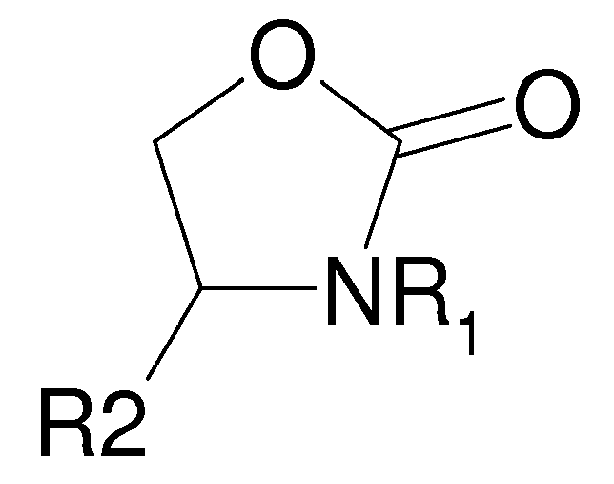
wherein R1 is H, acyl, alkyl or carbamoyl, R2 is a linear alkyl or alkenyl group, preferably a linear alkyl group comprising from 6 to 20 carbon atoms and n is 0, 1, 2, or 3, which comprises reacting a compound of formula II
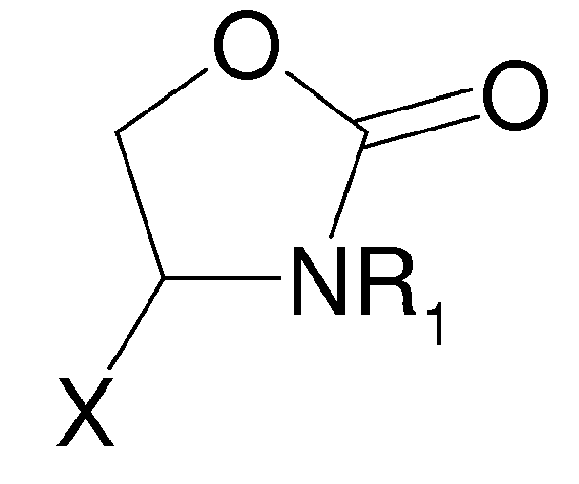
wherein R1 and n are as above and X is a leaving group with a carbanionic reagent of formula II
M-R2
wherein R2 is as above and M denotes a metal or a metal containing group.
M-R2
wherein R2 is as above and M denotes a metal or a metal containing group.
Description
- The present invention relates to a process for the manufacture of long chain alkyl compounds and to reagents for use in such manufacture.
- Long-chain alkyl compounds are useful, amongst others in pharmaceutical or in particular cosmetic preparations, where they act as skin penetration enhancers. A particular advantageous compound of this class is 4-decyloxazolidin-2-one which is commercialized by Girindus AG.
-
WO-A-90/00407 - According to Ishizuka et al., Chem. Lett. 1992, p.991-994, certain chiral 4-substituted 2-oxazolidinones have been manufactured by a reaction sequence involving addition of certain organometallics, including organocuprates, to 4-methoxy-2-oxazolidinone. However that reference is unrelated to the manufacture of long chain alkyl compounds.
- Now, applicants have found a process which allows for efficient and selective manufacture of long chain alkyl compounds such as in particular 4-decyloxazolidin-2-one.
- The invention concerns in consequence a process for the manufacture of a compound of formula I


M-R2
wherein R2 is as above and M denotes a metal or a metal containing group. - The process according to the invention allows in particular for efficient industrializable production of long chain alkyl substituted compounds. This is unexpected, as reactivity of long-chain organometallics is expected to decrease.
- Compounds of formula II are readily available for example starting from commercially available oxazolidin-2-one.
- An embodiment of the process according to the invention consequently further comprises synthesizing the compound of formula II by electrochemically oxidizing a compound of formula IV

- Electrochemical oxidation of oxazolidin-2-one to provide certain 4-substituted oxazolidin-2-ones was described in Tavernier et al. Bull. Soc. Chim. Belg. 1988, p.859-865, however this reference falls short of any suggestion that the 4-substituted oxazolidin-2-ones disclosed therein could be reactive in the present invention and be efficiently converted into oxazolidin-2-ones having a long-chain alkyl substituent in 4-position.
- In the process according to the invention, the leaving group X is often a substituent which is bonded to the heterocycle through a sulphur or, preferably, an oxygen atom. Examples of O-bonded leaving groups are alkoxy or acyloxy groups. Alkoxy groups useful as substitutent X generally contain 1 to 4 carbon atoms. Ethoxy and, in particular, methoxy are preferred. Acyloxy groups useful as substitutent X generally contain 2 to 10 carbon atoms. Propionyloxy, and, in particular, acetoxy are preferred.
- In the process according to the invention, if the substituent R1 is a linear alkyl group it is often a C1 to C10 alkyl group, more specifically a methyl or an ethyl group. If the substituent R1 is an acyl group it is often a C1 to C10 acyl group, more specifically a formyl or, preferably, an acetyl group. In a particularly preferred embodiment, R1 is H.
- The process according to the invention applies in particular to compounds wherein n is 1 or 2, preferably 1. It is understood that the process according to the invention will equally apply to compounds in which the optional methylene group or groups shown in the formulae bear one or more substituents which are substantially stable under the conditions of the reaction. Such substituents are for example alkyl or aryl substituents. However the process according to the invention applies preferably when all groups are methylene. It applies more particularly to the manufacture of 4-n-decyloxazolidin-2-one.
- In the process according to the invention, the substituent R2 is generally a linear C6-C20 alkyl group. R2 is preferably a linear alkyl group comprising 8, 9, 10, 11, 12, 13, 14, 15 or 16 carbon atoms and more preferably 8, 10, 12, 14 or 16 carbon atoms. An n-decyl group is more particularly preferred as R2.
- In the process according to the invention M in the reagent M-R2 contains often a metal selected from lithium, magnesium, or transition metals, such as copper, zinc, cadmium, mercury, cerium and zirconium. Often the metal is selected from copper, zinc, cadmium, mercury, cerium and zirconium and is preferably copper.
- The reagents M-R2 can suitably be obtained either through direct reaction or by transmetallation from the corresponding halides Y-R2 wherein Y is selected from Cl, Br and I. It is preferred to use a bromide Br-R2 as starting material.
- In a particular embodiment, which is particularly preferred when the leaving group X is an O-bonded leaving group as described herein before, M contains copper. A particularly preferred reagent has the formula Cu-R2 wherein R2 is as described above.
- A suitable copper containing reagent can be obtained, for example, by the reaction of a Grignard reagent as described above with a copper precursor. Suitable copper precursors are selected for example from copper (I) complexes or salts such as CuBr, CuI, CuCN or complexes of these salts with thioethers such as in particular dimethylsulphide.
- In the process according to the invention, the reagent can be suitably activated with an activator such as for example a Lewis acid. Boron compounds such as in particular BF3 which can be supplied to the reaction as adduct with an ether such as diethylether can be used, in particular when M contains copper. In another aspect the activator is an active silyl compound such as a halotrialkylsilane in particular trimethylchlorosilane. A particularly preferred activated reagent corresponds in consequence to the formula BF3.Cu-R2.
- The invention also concerns the copper-containing reagents described here before. It has been found that these reagents are particularly efficient to introduce long-chain alkyl residues by nucleophilic substitution notably of O-bonded leaving groups as described herein before.
- In the process according to the invention, the reaction is generally carried out in an organic solvent. This solvent is generally an inert more specifically an aprotic solvent, what means that the solvent does not interfere with the reaction of the compound of formula II with the reagent. Examples of suitable solvents include alkylethers such as diethylether, methyl-tert.butylether, tetrahydrofurane and 1,4-dioxane. Tetrahydrofurane is preferred as solvent.
- The invention also concerns a solution of the copper-containing reagents described here before in the solvents described here before.
- The invention concerns also the use of the copper-containing reagent or its solution for the manufacture of an organic compound containing a C6-C20 linear alkyl substitutent. In the use according to the invention, the manufacture of the organic compound is preferably carried out by nucleophilic substitution of an O-bonded leaving group as described herein before. More preferably, the O-bonded leaving group is attached to a carbon atom in α-position to a nitrogen atom. Said nitrogen atom is preferably an optionally alkylated or acylated amine.
- Particular examples of compounds containing an O-bonded leaving group is attached to a carbon atom in α-position to a nitrogen atom correspond to the formula IV

- In the process according to the invention or the use according to the invention the reaction is generally carried out at a temperature from -80°C to 50°C, preferably from -50°C to 30°C and more preferably from -40°C to 25°C.
- In the process according to the invention or the use according to the invention the molar ratio of the reagent M-R2 to the compound of formula II or IV respectively is generally equal to or greater than 1, preferably equal to or greater than about 1.2. Generally this molar ratio is lower than about 4, often equal to or lower than 3, preferably equal to or lower than 2.
- It has been found, surprisingly, that high yield of long chain alkyl compound can be obtained with a moderate quantity of organometallic reagent thus allowing for more economic manufacturing.
- In general, the reaction is carried out in the substantial absence of water. Typical contents of water in the reaction medium are from 1 mg/kg to 1000 mg/kg relative to the total weight of the reaction medium. Preferably the water contents is from 5 mg/kg to 100 mg/kg.
- The reaction mixture can be worked up by extraction/crystallization. It has been found that notably the isolation of 4-decyloxazolidin-2-one can be improved by (a) controlling and optionally reducing the water content of a crude product obtained from extraction and recrystallizing the dry crude product.
- When the process according to the invention further comprises synthesizing the compound of formula II by electrochemically oxidizing a compound of formula IV, the precursor of leaving group X is advantageously selected from methanol, acetic anhydride and acetic acid. In a particular preferred embodiment the precursor of leaving group X consists essentially of methanol.
- In this embodiment, the electrochemical oxidation can be carried out in a compartmentalized or non-compartmentalized cell.
- The electrodes used in the electrochemical oxidation should be resistant with respect to the conditions of the electrochemical reaction. Suitable materials are in particular chosen from metals, metal oxides and graphite. Particularly suitable metals are chosen from steel, iron and titanium, and in particular from the metals of the group of platinum and their oxides, or electrodes coated with the latter materials. Platinum or rhodium is preferred. An electrode comprising platinum is particularly suitable.
- The distance between the electrodes is generally at least 0.2 mm. This distance is often at least 0.5 mm. It is preferably at least 1 mm. The distance between the electrodes is generally at most 20 mm. This distance is often at most 10 mm. It is preferably at most 5 mm.
- In this embodiment, the electrochemical oxidation is generally carried out at a current density greater than or equal to 0.1 A/dm2. The current density is often greater than or equal to 1 A/dm2. It is preferably greater than or equal to 3 A/dm2. In this embodiment, the electrochemical oxidation is generally carried out at a current density less than or equal to 50 A/dm2. The current density is often less than or equal to 30 A/dm2. It is preferably less than or equal to 20 A/dm2.
- In this embodiment, the electrochemical oxidation is generally carried out at a temperature greater than or equal to -50°C. The temperature is often greater than or equal to -20°C. It is preferably greater than or equal to 0°C. In this embodiment, the electrochemical oxidation is generally carried out at a temperature less than or equal to 100°C. The temperature is often less than or equal to 80°C. It is preferably less than or equal to 60°C.
- In this embodiment, the electrochemical oxidation is generally carried out in the presence of a conducting salt such as tetraalkyl ammonium tetrafluoroborate in particular tetrabutylammonium tetrafluoroborate, alkali tetrafluoroborate such as potassium tetrafluoroborate or alkali perchlorates, preferably lithium perchlorate. It has been found that alkali perchlorates, in particular lithium perchlorate allow for highly selective manufacture of compound of formula II and allow for efficient isolation of compound of formula II from the reaction medium.
- The examples below are intended to illustrate the invention without, however, limiting it.
- A solution of the Grignard reagent (1.3 equivalents) obtained by reaction of n-decylbromide with magnesium was added to a stirred suspension of CuBr.Me2S (1.5 equivalents) in dry THF, at- 45°C. Subsequently, BF3.Et2O (1.5 equivalents) was added at - 50°C and then a solution of 4-methoxy-oxazolidin-2-one (1 equivalent) in THF was added. The mixture was stirred and allowed to reach room temperature. After 4 h the conversion was 100 %, the reaction was quenched with a mixture of an aqueous saturated NH4Cl solution and diluted NH4OH 28 %. The product 4-n-decyloxazolidin-2-one was isolated by extraction. The crude product was dried by azeotropic distillation of water with ethyl acetate. This allowed for improved solidification/crystallization.
- Yield 68 % purity GC > 99 %.
- To a THF (50cm3) solution of cuprous cyanide (1.99g, 22 mmol) and anhydrous lithium chloride (1.87 g, 44 mmol), n-decylmagnesium bromide (20 cm3, 1 M in THF) was dropwise added at - 30°C under nitrogen atmosphere. 4-methoxy-2-oxazolidin-2-one (0.85 g, 5 mmol) and BF3.Et2O (1.27 cm3, 10 mmol) were added successively and the reaction mixture was kept at - 30°C overnight. The reaction was quenched by addition of saturated NH4Cl solution (5 cm3) and extracted twice with Et2O (100 cm3). Organic phases were concentrated in vacuo and the residue was precipated at low temperature to give an isolated yield of 4-n-decyloxazolidin-2-one of 0.54 g, (48 %).
- Oxazolidin-2-one was dissolved in acetic acid, and added to dry methanol containing tetrabutylammoniumtetrafluoroborate, in an undivided dry cell equipped with a platinum anode at 10°C and an electric current of 7A for 9 hours.
- After partial evaporation of the solvents, crystallization of the residue at 0°C yielded 4-methoxy-oxazolidin-2-one.
- Yield 61 % purity GC 99 %.
- Oxazolidin-2-on (355.5 g, 4 moles) dissolved in methanol (1100 cm3) containing lithium perchlorate (7.74 g, 72 mmoles), was subjected to methoxylation in an undivided dry cell equipped with a platinum anode at 18°C and an electric current of 7 A for 41.4 hours. Consumption of oxazolidin-2-on was monitored by GC. After evaporation of the solvents, crystallization of the residue in isopropyl acetate and tert-butlymethyl ether yielded 4-methoxy-oxazolidin-2-on Yield 74 % purity GC 98 %.
Claims (20)
- Process for the manufacture of a compound of formula I


M-R2
wherein R2 is as above and M denotes a metal or a metal containing group. - Process according to claim 1 wherein X is an alkoxy or an acyloxy group.
- Process according to claim 2, wherein X is a methoxy group.
- Process according to claim 2, wherein X is an acetyl group.
- Process according to anyone of claims 1 to 4, wherein R1 is H.
- Process according to anyone of claims 1 to 5 wherein n is 1.
- Process according to anyone of claims 1 to 6 wherein R2 is n-decyl.
- Process according to anyone of claims 1 to 7 wherein M contains copper.
- Process according to claim 8 wherein M is Cu.BF3.
- Process anyone of claims 1 to 9 wherein the molar ratio of reagent M-R2 to compound of formula II is from 1 to less than 4.
- Process according to claim 10, wherein the molar ratio is from 1.2 to 2.
- Process according to anyone of claims 1 to 11 wherein the reaction is carried out at a temperature from -80°C to +50°C.
- Process according to anyone of claims 1 to 12 wherein the reaction is carried out in an organic aprotic solvent.
- Process according to anyone of claims 1 to 13 which further comprises synthetizing the compound of formula II by electrochemically oxidizing a compound of formula IV

- Process according to claim 14 wherein the precursor of leaving group X is selected from methanol, acetic anhydride and acetic acid.
- Process according to claim 15 wherein the precursor of leaving group X consists essentially of methanol.
- Process according to anyone of claims 14 to 16, wherein the electrochemical oxidation is carried out in the presence of lithium perchlorate as conducting salt.
- A reagent of formula M-R2 wherein M contains copper and R2 is a C6-C20 linear alkyl residue.
- The reagent of claim 18, wherein R2 is n-decyl.
- Use of the reagent according to claims 19 or 20 for the manufacture of an organic compound containing a linear C6-C20 alkyl substituent.
Priority Applications (2)
| Application Number | Priority Date | Filing Date | Title |
|---|---|---|---|
| EP07115782A EP2033957A1 (en) | 2007-09-06 | 2007-09-06 | Process for the manufacture of alkyl compounds |
| PCT/EP2008/061516 WO2009030672A1 (en) | 2007-09-06 | 2008-09-02 | Process for the manufacture of alkyl compounds |
Applications Claiming Priority (1)
| Application Number | Priority Date | Filing Date | Title |
|---|---|---|---|
| EP07115782A EP2033957A1 (en) | 2007-09-06 | 2007-09-06 | Process for the manufacture of alkyl compounds |
Publications (1)
| Publication Number | Publication Date |
|---|---|
| EP2033957A1 true EP2033957A1 (en) | 2009-03-11 |
Family
ID=39126191
Family Applications (1)
| Application Number | Title | Priority Date | Filing Date |
|---|---|---|---|
| EP07115782A Withdrawn EP2033957A1 (en) | 2007-09-06 | 2007-09-06 | Process for the manufacture of alkyl compounds |
Country Status (2)
| Country | Link |
|---|---|
| EP (1) | EP2033957A1 (en) |
| WO (1) | WO2009030672A1 (en) |
Families Citing this family (2)
| Publication number | Priority date | Publication date | Assignee | Title |
|---|---|---|---|---|
| CN112424338B (en) | 2018-07-17 | 2025-09-02 | 科纳根公司 | Biosynthesis of γ-lactones |
| WO2020191385A1 (en) | 2019-03-21 | 2020-09-24 | Conagen Inc. | Biosynthetic production of gamma- and delta-lactones using cytochrome p450 enzymes having subterminal hydroxylase activity |
Citations (2)
| Publication number | Priority date | Publication date | Assignee | Title |
|---|---|---|---|---|
| WO1990000407A1 (en) * | 1988-07-12 | 1990-01-25 | Rajadhyaksha Vithal J | Oxazolidinone penetration enhancing compounds |
| WO2004039788A1 (en) * | 2002-11-01 | 2004-05-13 | Pfizer Products Inc. | Methods for preparing n-arylated oxazolidinones via a copper catalyzed cross coupling reaction |
-
2007
- 2007-09-06 EP EP07115782A patent/EP2033957A1/en not_active Withdrawn
-
2008
- 2008-09-02 WO PCT/EP2008/061516 patent/WO2009030672A1/en not_active Ceased
Patent Citations (2)
| Publication number | Priority date | Publication date | Assignee | Title |
|---|---|---|---|---|
| WO1990000407A1 (en) * | 1988-07-12 | 1990-01-25 | Rajadhyaksha Vithal J | Oxazolidinone penetration enhancing compounds |
| WO2004039788A1 (en) * | 2002-11-01 | 2004-05-13 | Pfizer Products Inc. | Methods for preparing n-arylated oxazolidinones via a copper catalyzed cross coupling reaction |
Non-Patent Citations (11)
| Title |
|---|
| A. EL MARINI AND CO: "Synthesis of enentiomerically pure beta and gamma-amino acids from aspartic and glutamic acid derivatives", SYNTHESIS, vol. 11, 1992, pages 1104 - 1108, XP002472420 * |
| DYEN, MARTIN E. ET AL: "Chemistry of epoxy compounds. XXII. Preparation of some long-chain 2-oxazolidinones", JOURNAL OF THE AMERICAN OIL CHEMISTS' SOCIETY , 45(5), 325-30 CODEN: JAOCA7; ISSN: 0003-021X, 1968, XP002472423 * |
| ISHIZUKA T ET AL: "Practical Preparation of Chiral 4-Substituted 2-Oxazolidinones", CHEMISTRY LETTERS, CHEMICAL SOCIETY OF JAPAN. TOKYO, JP, 1992, pages 991 - 994, XP009097024, ISSN: 0366-7022 * |
| J.BUND AND CO: "Regioselective and eneantioselective substitution of allylic sulfoximines with organocopper reagents", J.AM.CHEM.SOC., vol. 113, 1991, pages 1442 - 1444, XP002472416 * |
| K. MORI AND CO: "Stereocontrolled synthesis of all of the four possible stereoisomers of erythro-3,7-dimethyl-pentadec-2-yl acetate and propionate the sex peromone of the pine sawflies", TETRAHEDRON, vol. 35, 1979, pages 1279 - 1284, XP002472422 * |
| M. SKRINJAR AND CO: "Highly stereoselective addition of alkylcopper reagents to N-acylinium ions, enantioselective synthesis of trans-2-butyl-5-heptylpyrrolidine", TETRAHEDRON LETTERS, vol. 31, no. 12, 1990, pages 1775 - 1778, XP002472415 * |
| M.TOTH AND CO: "Identification of (3z,6z)-1,3,6-9,10-epoxyheneicosatriene and (3z,6z)-1,3,6-9,10-epoxyeicosatriene in the sex pheromone of hyphantria cunea", TETRAHEDRON LETTERS, vol. 30, no. 26, 1989, pages 3405 - 3408, XP002472419 * |
| S. MARCZAK AND CO: "Synthesis of (+)-disparlure using the reaction of 6-methylheptyl phenyl sulphone with trimethylsilyl ethylene oxide and asymmetric epoxidation", TETRAHEDRON LETTERS, vol. 30, no. 21, 1989, pages 2845 - 2846, XP002472421 * |
| SIBI, MUKUND P. ET AL: "A new electrophilic alaninol synthon. A general route to oxazolidinones of D or (R)-2-amino alcohols from L-serine", JOURNAL OF THE CHEMICAL SOCIETY, PERKIN TRANSACTIONS 1: ORGANIC AND BIO-ORGANIC CHEMISTRY (1972-1999) , (13), 1675-8 CODEN: JCPRB4; ISSN: 0300-922X, 1994, XP009097107 * |
| V. BOLITT: "Direct anomeric substitution of pyranyl esters using organocopper reagents", TETRAHEDRON LETTERS, vol. 30, no. 44, 1989, pages 6027 - 6030, XP002472417 * |
| W. KARSTENS AND CO: "N-acyliminium ion chemistry and palladium catalysis: a useful combination to obtain bicyclic heterocycles", TETRAHEDRON, vol. 57, 2001, pages 5123 - 5130, XP002472424 * |
Also Published As
| Publication number | Publication date |
|---|---|
| WO2009030672A1 (en) | 2009-03-12 |
Similar Documents
| Publication | Publication Date | Title |
|---|---|---|
| Shu et al. | Tandem Gold (III)‐Catalyzed Amination‐Intramolecular Hydroamination Reactions of 1‐En‐4‐yn‐3‐ols with Sulfonamides: Efficient Approach to Highly Substituted Pyrroles | |
| JPWO2008102661A1 (en) | Method for producing trialkylsilyl nitrile | |
| CN109705172B (en) | Heteronuclear metal complex and preparation method of cyclic carbonate catalyzed by the same | |
| WO2013108024A1 (en) | Aromatic compounds and methods of making the same | |
| JP6225358B2 (en) | Process for producing 2-amino substituted benzaldehyde compounds | |
| CN1259113A (en) | Process for the preparation of 1,3-dicarbonyl compounds | |
| WO2009030672A1 (en) | Process for the manufacture of alkyl compounds | |
| JP6388065B2 (en) | Method for producing difluoroester compound | |
| CN113200914A (en) | Alkynylated tetrahydroisoquinoline compound and preparation method and application thereof | |
| CN114540844B (en) | A method for preparing benzothiophene derivatives under electrocatalysis | |
| JP5574476B2 (en) | Method for producing carbonate ester | |
| JP2004508463A (en) | Method for producing trialkyl orthocarboxylate | |
| CN120666349A (en) | Preparation method of aryl borate derivative | |
| JP2006213617A (en) | Acetylene aldehyde and method for producing the same, acetylene aldehyde acetal and method for producing the same | |
| JP5134883B2 (en) | Asymmetric catalyst having fluorine substituent and method for producing optically active compound | |
| JP2006104151A (en) | Process for producing 3-benzo [1,3] dioxol-5-yl-2-methylpropionaldehyde | |
| JP7788145B2 (en) | Method for producing azanucleoside precursors | |
| US6603034B2 (en) | Preparation of organozinc halides from reactive halogen compounds and their use | |
| CN118048634A (en) | A method for electrochemical synthesis of sulfoximine N-H aromatic acylated derivatives | |
| WO2018097150A1 (en) | Epoxy compound production method | |
| JP4487674B2 (en) | Method for producing tetrahydropyranyl-4-carboxylate compound | |
| CN114481172A (en) | Electrochemical preparation method of (Z) -2-vinyl thio-oxadiazole compound | |
| JP2017202992A (en) | Method for producing (trifluoromethyl)malonic acid ester | |
| JP5623103B2 (en) | Process for producing N-acyl- (2S) -oxycarbonyl- (5R) -phosphonylpyrrolidine derivatives | |
| JP5678655B2 (en) | Method for producing α-silyldifluoromethylcarbonyl compound |
Legal Events
| Date | Code | Title | Description |
|---|---|---|---|
| PUAI | Public reference made under article 153(3) epc to a published international application that has entered the european phase |
Free format text: ORIGINAL CODE: 0009012 |
|
| AK | Designated contracting states |
Kind code of ref document: A1 Designated state(s): AT BE BG CH CY CZ DE DK EE ES FI FR GB GR HU IE IS IT LI LT LU LV MC MT NL PL PT RO SE SI SK TR |
|
| AX | Request for extension of the european patent |
Extension state: AL BA HR MK RS |
|
| AKX | Designation fees paid | ||
| REG | Reference to a national code |
Ref country code: DE Ref legal event code: 8566 |
|
| STAA | Information on the status of an ep patent application or granted ep patent |
Free format text: STATUS: THE APPLICATION IS DEEMED TO BE WITHDRAWN |
|
| 18D | Application deemed to be withdrawn |
Effective date: 20090912 |