EP2033770B1 - Harzoberflächenschicht mit einem visuellen Effekt in der Form einer 3D-Struktur und Herstellungsverfahren dafür, Zusammensetzung mit der Harzoberflächenschicht und Herstellungsverfahren dafür - Google Patents
Harzoberflächenschicht mit einem visuellen Effekt in der Form einer 3D-Struktur und Herstellungsverfahren dafür, Zusammensetzung mit der Harzoberflächenschicht und Herstellungsverfahren dafür Download PDFInfo
- Publication number
- EP2033770B1 EP2033770B1 EP08100124A EP08100124A EP2033770B1 EP 2033770 B1 EP2033770 B1 EP 2033770B1 EP 08100124 A EP08100124 A EP 08100124A EP 08100124 A EP08100124 A EP 08100124A EP 2033770 B1 EP2033770 B1 EP 2033770B1
- Authority
- EP
- European Patent Office
- Prior art keywords
- layer
- resin
- additive particles
- composite
- surface layer
- Prior art date
- Legal status (The legal status is an assumption and is not a legal conclusion. Google has not performed a legal analysis and makes no representation as to the accuracy of the status listed.)
- Ceased
Links
Images




Classifications
-
- B—PERFORMING OPERATIONS; TRANSPORTING
- B29—WORKING OF PLASTICS; WORKING OF SUBSTANCES IN A PLASTIC STATE IN GENERAL
- B29C—SHAPING OR JOINING OF PLASTICS; SHAPING OF MATERIAL IN A PLASTIC STATE, NOT OTHERWISE PROVIDED FOR; AFTER-TREATMENT OF THE SHAPED PRODUCTS, e.g. REPAIRING
- B29C33/00—Moulds or cores; Details thereof or accessories therefor
- B29C33/56—Coatings, e.g. enameled or galvanised; Releasing, lubricating or separating agents
- B29C33/68—Release sheets
-
- B—PERFORMING OPERATIONS; TRANSPORTING
- B32—LAYERED PRODUCTS
- B32B—LAYERED PRODUCTS, i.e. PRODUCTS BUILT-UP OF STRATA OF FLAT OR NON-FLAT, e.g. CELLULAR OR HONEYCOMB, FORM
- B32B27/00—Layered products comprising a layer of synthetic resin
- B32B27/06—Layered products comprising a layer of synthetic resin as the main or only constituent of a layer, which is next to another layer of the same or of a different material
- B32B27/08—Layered products comprising a layer of synthetic resin as the main or only constituent of a layer, which is next to another layer of the same or of a different material of synthetic resin
-
- B—PERFORMING OPERATIONS; TRANSPORTING
- B32—LAYERED PRODUCTS
- B32B—LAYERED PRODUCTS, i.e. PRODUCTS BUILT-UP OF STRATA OF FLAT OR NON-FLAT, e.g. CELLULAR OR HONEYCOMB, FORM
- B32B27/00—Layered products comprising a layer of synthetic resin
- B32B27/12—Layered products comprising a layer of synthetic resin next to a fibrous or filamentary layer
-
- B—PERFORMING OPERATIONS; TRANSPORTING
- B32—LAYERED PRODUCTS
- B32B—LAYERED PRODUCTS, i.e. PRODUCTS BUILT-UP OF STRATA OF FLAT OR NON-FLAT, e.g. CELLULAR OR HONEYCOMB, FORM
- B32B27/00—Layered products comprising a layer of synthetic resin
- B32B27/18—Layered products comprising a layer of synthetic resin characterised by the use of special additives
- B32B27/20—Layered products comprising a layer of synthetic resin characterised by the use of special additives using fillers, pigments, thixotroping agents
-
- B—PERFORMING OPERATIONS; TRANSPORTING
- B32—LAYERED PRODUCTS
- B32B—LAYERED PRODUCTS, i.e. PRODUCTS BUILT-UP OF STRATA OF FLAT OR NON-FLAT, e.g. CELLULAR OR HONEYCOMB, FORM
- B32B5/00—Layered products characterised by the non- homogeneity or physical structure, i.e. comprising a fibrous, filamentary, particulate or foam layer; Layered products characterised by having a layer differing constitutionally or physically in different parts
- B32B5/02—Layered products characterised by the non- homogeneity or physical structure, i.e. comprising a fibrous, filamentary, particulate or foam layer; Layered products characterised by having a layer differing constitutionally or physically in different parts characterised by structural features of a fibrous or filamentary layer
- B32B5/022—Non-woven fabric
-
- B—PERFORMING OPERATIONS; TRANSPORTING
- B32—LAYERED PRODUCTS
- B32B—LAYERED PRODUCTS, i.e. PRODUCTS BUILT-UP OF STRATA OF FLAT OR NON-FLAT, e.g. CELLULAR OR HONEYCOMB, FORM
- B32B5/00—Layered products characterised by the non- homogeneity or physical structure, i.e. comprising a fibrous, filamentary, particulate or foam layer; Layered products characterised by having a layer differing constitutionally or physically in different parts
- B32B5/02—Layered products characterised by the non- homogeneity or physical structure, i.e. comprising a fibrous, filamentary, particulate or foam layer; Layered products characterised by having a layer differing constitutionally or physically in different parts characterised by structural features of a fibrous or filamentary layer
- B32B5/024—Woven fabric
-
- B—PERFORMING OPERATIONS; TRANSPORTING
- B32—LAYERED PRODUCTS
- B32B—LAYERED PRODUCTS, i.e. PRODUCTS BUILT-UP OF STRATA OF FLAT OR NON-FLAT, e.g. CELLULAR OR HONEYCOMB, FORM
- B32B7/00—Layered products characterised by the relation between layers; Layered products characterised by the relative orientation of features between layers, or by the relative values of a measurable parameter between layers, i.e. products comprising layers having different physical, chemical or physicochemical properties; Layered products characterised by the interconnection of layers
- B32B7/04—Interconnection of layers
- B32B7/12—Interconnection of layers using interposed adhesives or interposed materials with bonding properties
-
- B—PERFORMING OPERATIONS; TRANSPORTING
- B32—LAYERED PRODUCTS
- B32B—LAYERED PRODUCTS, i.e. PRODUCTS BUILT-UP OF STRATA OF FLAT OR NON-FLAT, e.g. CELLULAR OR HONEYCOMB, FORM
- B32B9/00—Layered products comprising a layer of a particular substance not covered by groups B32B11/00 - B32B29/00
- B32B9/02—Layered products comprising a layer of a particular substance not covered by groups B32B11/00 - B32B29/00 comprising animal or vegetable substances, e.g. cork, bamboo, starch
- B32B9/025—Layered products comprising a layer of a particular substance not covered by groups B32B11/00 - B32B29/00 comprising animal or vegetable substances, e.g. cork, bamboo, starch comprising leather
-
- B—PERFORMING OPERATIONS; TRANSPORTING
- B32—LAYERED PRODUCTS
- B32B—LAYERED PRODUCTS, i.e. PRODUCTS BUILT-UP OF STRATA OF FLAT OR NON-FLAT, e.g. CELLULAR OR HONEYCOMB, FORM
- B32B9/00—Layered products comprising a layer of a particular substance not covered by groups B32B11/00 - B32B29/00
- B32B9/04—Layered products comprising a layer of a particular substance not covered by groups B32B11/00 - B32B29/00 comprising such particular substance as the main or only constituent of a layer, which is next to another layer of the same or of a different material
- B32B9/046—Layered products comprising a layer of a particular substance not covered by groups B32B11/00 - B32B29/00 comprising such particular substance as the main or only constituent of a layer, which is next to another layer of the same or of a different material of foam
-
- B—PERFORMING OPERATIONS; TRANSPORTING
- B44—DECORATIVE ARTS
- B44C—PRODUCING DECORATIVE EFFECTS; MOSAICS; TARSIA WORK; PAPERHANGING
- B44C1/00—Processes, not specifically provided for elsewhere, for producing decorative surface effects
- B44C1/20—Applying plastic materials and superficially modelling the surface of these materials
-
- B—PERFORMING OPERATIONS; TRANSPORTING
- B44—DECORATIVE ARTS
- B44F—SPECIAL DESIGNS OR PICTURES
- B44F9/00—Designs imitating natural patterns
-
- B—PERFORMING OPERATIONS; TRANSPORTING
- B44—DECORATIVE ARTS
- B44F—SPECIAL DESIGNS OR PICTURES
- B44F9/00—Designs imitating natural patterns
- B44F9/12—Designs imitating natural patterns of leather
-
- C—CHEMISTRY; METALLURGY
- C09—DYES; PAINTS; POLISHES; NATURAL RESINS; ADHESIVES; COMPOSITIONS NOT OTHERWISE PROVIDED FOR; APPLICATIONS OF MATERIALS NOT OTHERWISE PROVIDED FOR
- C09C—TREATMENT OF INORGANIC MATERIALS, OTHER THAN FIBROUS FILLERS, TO ENHANCE THEIR PIGMENTING OR FILLING PROPERTIES ; PREPARATION OF CARBON BLACK ; PREPARATION OF INORGANIC MATERIALS WHICH ARE NO SINGLE CHEMICAL COMPOUNDS AND WHICH ARE MAINLY USED AS PIGMENTS OR FILLERS
- C09C1/00—Treatment of specific inorganic materials other than fibrous fillers; Preparation of carbon black
-
- H—ELECTRICITY
- H01—ELECTRIC ELEMENTS
- H01F—MAGNETS; INDUCTANCES; TRANSFORMERS; SELECTION OF MATERIALS FOR THEIR MAGNETIC PROPERTIES
- H01F1/00—Magnets or magnetic bodies characterised by the magnetic materials therefor; Selection of materials for their magnetic properties
- H01F1/0027—Thick magnetic films
-
- B—PERFORMING OPERATIONS; TRANSPORTING
- B29—WORKING OF PLASTICS; WORKING OF SUBSTANCES IN A PLASTIC STATE IN GENERAL
- B29K—INDEXING SCHEME ASSOCIATED WITH SUBCLASSES B29B, B29C OR B29D, RELATING TO MOULDING MATERIALS OR TO MATERIALS FOR MOULDS, REINFORCEMENTS, FILLERS OR PREFORMED PARTS, e.g. INSERTS
- B29K2105/00—Condition, form or state of moulded material or of the material to be shaped
- B29K2105/06—Condition, form or state of moulded material or of the material to be shaped containing reinforcements, fillers or inserts
- B29K2105/16—Fillers
-
- H—ELECTRICITY
- H01—ELECTRIC ELEMENTS
- H01F—MAGNETS; INDUCTANCES; TRANSFORMERS; SELECTION OF MATERIALS FOR THEIR MAGNETIC PROPERTIES
- H01F1/00—Magnets or magnetic bodies characterised by the magnetic materials therefor; Selection of materials for their magnetic properties
- H01F1/01—Magnets or magnetic bodies characterised by the magnetic materials therefor; Selection of materials for their magnetic properties of inorganic materials
- H01F1/03—Magnets or magnetic bodies characterised by the magnetic materials therefor; Selection of materials for their magnetic properties of inorganic materials characterised by their coercivity
- H01F1/032—Magnets or magnetic bodies characterised by the magnetic materials therefor; Selection of materials for their magnetic properties of inorganic materials characterised by their coercivity of hard-magnetic materials
- H01F1/04—Magnets or magnetic bodies characterised by the magnetic materials therefor; Selection of materials for their magnetic properties of inorganic materials characterised by their coercivity of hard-magnetic materials metals or alloys
- H01F1/06—Magnets or magnetic bodies characterised by the magnetic materials therefor; Selection of materials for their magnetic properties of inorganic materials characterised by their coercivity of hard-magnetic materials metals or alloys in the form of particles, e.g. powder
- H01F1/08—Magnets or magnetic bodies characterised by the magnetic materials therefor; Selection of materials for their magnetic properties of inorganic materials characterised by their coercivity of hard-magnetic materials metals or alloys in the form of particles, e.g. powder pressed, sintered, or bound together
- H01F1/083—Magnets or magnetic bodies characterised by the magnetic materials therefor; Selection of materials for their magnetic properties of inorganic materials characterised by their coercivity of hard-magnetic materials metals or alloys in the form of particles, e.g. powder pressed, sintered, or bound together in a bonding agent
-
- H—ELECTRICITY
- H01—ELECTRIC ELEMENTS
- H01F—MAGNETS; INDUCTANCES; TRANSFORMERS; SELECTION OF MATERIALS FOR THEIR MAGNETIC PROPERTIES
- H01F1/00—Magnets or magnetic bodies characterised by the magnetic materials therefor; Selection of materials for their magnetic properties
- H01F1/01—Magnets or magnetic bodies characterised by the magnetic materials therefor; Selection of materials for their magnetic properties of inorganic materials
- H01F1/03—Magnets or magnetic bodies characterised by the magnetic materials therefor; Selection of materials for their magnetic properties of inorganic materials characterised by their coercivity
- H01F1/032—Magnets or magnetic bodies characterised by the magnetic materials therefor; Selection of materials for their magnetic properties of inorganic materials characterised by their coercivity of hard-magnetic materials
- H01F1/10—Magnets or magnetic bodies characterised by the magnetic materials therefor; Selection of materials for their magnetic properties of inorganic materials characterised by their coercivity of hard-magnetic materials non-metallic substances, e.g. ferrites, e.g. [(Ba,Sr)O(Fe2O3)6] ferrites with hexagonal structure
- H01F1/11—Magnets or magnetic bodies characterised by the magnetic materials therefor; Selection of materials for their magnetic properties of inorganic materials characterised by their coercivity of hard-magnetic materials non-metallic substances, e.g. ferrites, e.g. [(Ba,Sr)O(Fe2O3)6] ferrites with hexagonal structure in the form of particles
- H01F1/113—Magnets or magnetic bodies characterised by the magnetic materials therefor; Selection of materials for their magnetic properties of inorganic materials characterised by their coercivity of hard-magnetic materials non-metallic substances, e.g. ferrites, e.g. [(Ba,Sr)O(Fe2O3)6] ferrites with hexagonal structure in the form of particles in a bonding agent
-
- Y—GENERAL TAGGING OF NEW TECHNOLOGICAL DEVELOPMENTS; GENERAL TAGGING OF CROSS-SECTIONAL TECHNOLOGIES SPANNING OVER SEVERAL SECTIONS OF THE IPC; TECHNICAL SUBJECTS COVERED BY FORMER USPC CROSS-REFERENCE ART COLLECTIONS [XRACs] AND DIGESTS
- Y10—TECHNICAL SUBJECTS COVERED BY FORMER USPC
- Y10T—TECHNICAL SUBJECTS COVERED BY FORMER US CLASSIFICATION
- Y10T428/00—Stock material or miscellaneous articles
- Y10T428/24—Structurally defined web or sheet [e.g., overall dimension, etc.]
- Y10T428/24355—Continuous and nonuniform or irregular surface on layer or component [e.g., roofing, etc.]
-
- Y—GENERAL TAGGING OF NEW TECHNOLOGICAL DEVELOPMENTS; GENERAL TAGGING OF CROSS-SECTIONAL TECHNOLOGIES SPANNING OVER SEVERAL SECTIONS OF THE IPC; TECHNICAL SUBJECTS COVERED BY FORMER USPC CROSS-REFERENCE ART COLLECTIONS [XRACs] AND DIGESTS
- Y10—TECHNICAL SUBJECTS COVERED BY FORMER USPC
- Y10T—TECHNICAL SUBJECTS COVERED BY FORMER US CLASSIFICATION
- Y10T428/00—Stock material or miscellaneous articles
- Y10T428/24—Structurally defined web or sheet [e.g., overall dimension, etc.]
- Y10T428/24355—Continuous and nonuniform or irregular surface on layer or component [e.g., roofing, etc.]
- Y10T428/24372—Particulate matter
Definitions
- the present invention relates to a resin surface layer and a method of fabricating the same. More particularly, the present invention relates to a resin surface layer not having a physical texture of bumps and pits but capable of exhibiting a visual effect of 3D texture and a method of fabricating the same.
- FIG. 1 shows a schematic cross-sectional view of a conventional composite.
- the conventional composite 1 is artificial leather, including a bottom cloth layer 11, an intermediate layer 12, and a surface layer 13.
- the bottom cloth layer 11 generally is a woven fabric, a nonwoven fabric, leather, a microfiber, or a resin.
- the intermediate layer 12 is formed on the bottom cloth layer 11, and generally is a foam layer.
- the surface layer 13 is located on the intermediate layer 12 and is made of PU resin.
- a texture 14 is formed on the surface of the surface layer 13.
- the texture 14 is a physical texture of bumps and pits which is mostly formed by means of texture contact and transfer, such as printing, embossing, or release paper laminating, or directly polishing the surface of the surface layer 13.
- the above methods of forming a texture have the following shortcomings. First, the methods will influence the surface flatness of the surface layer 13. Second, the pattern of the formed texture is limited, and the 3D textures cannot be achieved.
- EP 0 556 449 A1 discloses a method of fabricating a resin film intended to be a surface layer laminated to most various substrates, including soft and flexible substrates.
- a layer comprising a transparent resin and a multiplicity of magnetic non-spherical particles is applied in liquid state on a surface, and a pattern (effectively threedimensional) is generated by the application of a magnetic field, after which the layer is solidified.
- DE 44 19 173 A1 discloses glossy pigments that can be magnetized. These pigments are based on multi-layered metallic substrates that are coated, plate-shaped and non-ferromagnetic.
- the pigments comprise a first ferromagnetic layer, a second layer, which is substantially made of silcon-oxide or similar compounds, and a third layer consisting of a metal oxide.
- US 2005/0100710 A1 discloses a flame-proof environmentally friendly artificial leather including a substrate, an adhesive layer, an intermediate layer and a surface layer.
- the artificial leather includes the intermediate layer made of a high solid-content polyurethane resin compound added with a chlorine-free flame-proof agent.
- the high solid-content polyurethane resin compound is made through mixing the chlorine-free flame-proof agent, polyurethane resin with a solid-content higher than 50% and a curing agent.
- a process is disclosed for making such an artificial leather.
- US 2006/0272770 A1 discloses a method for making artificial leather with superficial texture.
- a substrate is coated, in a non-overall manner, with a wet polyurethane resin. After curing, there is provided a polyurethane resin coated on releasing paper.
- a semi-product is made. Texture of the releasing paper is transferred to a surface of the semi-product. Then, the semi-product with the texture on the surface is coated with a layer of a chemical. A machine is used to heat and flatten the surface of the semi-product. Finally, the semi-product is physically finished by forces so that the surface of the final product is formed with texture like that of real leather.
- the present invention is still directed to provide a composite having the above resin surface layer.
- a method of fabricating a resin surface layer which is related to the present invention, includes the following steps:
- the material of the base in Step (a) is selected from a group consisting of PU, polyethylene (polyvinyl chloride), acrylic resin, polycarbonate, and epoxy resin.
- the additive particles in Step (a) are selected from a group consisting of pigments, dyes, colorants, coloring matters, and pearl powders.
- Step (a) a step of forming the base on a carrier is further included, in which the carrier is selected from a group consisting of a release paper, a woven fabric, a nonwoven fabric, leather, a microfiber, and a resin.
- Step (b) includes applying an energy field to polarize the additive particles, so as to change the orientation of the additive particles.
- polarisation refers to the reaction changing the orientation of the additive particles.
- the energy field is a magnetic field or electric field.
- the word “orientation” refers to the distribution (density) of the additive particles, or the angle of the additive particles.
- FIGs. 2 to 4 show schematic views illustrating a method of fabricating a resin surface layer according to a first embodiment of the present invention.
- a base 22 is provided.
- the material of the base 22 is a single-component PU resin (U-BEST POLYMER INDUSTRY CO., LTD®, AT-508ETM).
- the base 22 includes a plurality of additive particles 23.
- the additive particles 23 are pigment particles, and the material of the pigment is 41P series, TAH KONG CHEMICAL INDUSTRIAL CORP.
- the additive particles 23 are randomly distributed in the base 22.
- the base 22 is formed on a release paper (Favini® ASTRAKANTM) 21, so that the base 22 has a surface 221.
- a release paper Favini® ASTRAKANTM
- the surface 221 of the base 22 is smooth and does not have a physical texture of bumps and pits.
- a magnetic field is applied on the lower surface of the release paper 21 to polarize the additive particles 23, so as to change the distribution of the additive particles 23, so that the additive particles 23 have a predetermined density.
- additive particles 23 are dense in a first region 24, while no additive particle is in a second region 25.
- the base 22 is dried and the release paper 21 is removed, so as to form a surface layer 2.
- the surface 221 of the base 22 can exhibit the visual effect of 3D texture.
- the first region 24 is a bright area
- the second region 25 is a dark area and exhibits a 3D texture of a plurality of cuboids.
- the resin surface layer 2 includes a base 22 and a plurality of additive particles 23.
- the base 22 has a surface 221, and the material of the base 22 is a resin selected from a group consisting of PU, polyethylene (polyvinyl chloride), acrylic resin, polycarbonate, and epoxy resin.
- the material of the base 22 is a single-component PU resin (U-BEST POLYMER INDUSTRY CO., LTD®, AT-508ETM).
- the surface 221 of the base 22 is smooth and does not have the physical texture of bumps and pits.
- the additive particles 23 are located in the base 22.
- the additive particles 23 are selected from a group consisting of pigments, dyes, colorants, coloring matters, and pearl powders.
- the additive particles 23 are pigment particles, and the material of the pigment is 41P series, TAH KONG CHEMICAL INDUSTRIAL CORP.
- the additive particles 23 are arranged in a predetermined form instead of randomly distributed in the base 22, so that the surface 221 of the base 22 can exhibit the visual effect of 3D texture.
- the additive particles 23 have a predetermined density. That is, the density of the additive particles 23 in the first region 24 is different from that of the additive particles 23 in the second region 25, so that the first region 24 is a bright area, and the second region 25 is a dark area and exhibits the 3D texture of cuboids.
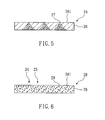
- FIG. 5 shows a schematic view of a resin surface layer according to a second embodiment of the present invention.
- the resin surface layer 2A includes a base 26 and a plurality of additive particles 27.
- the base 26 is the same as the base 22 of the first embodiment.
- the additive particles 27 are substantially the same as the additive particles 23 of the first embodiment, except that the additive particles 27 are arranged into a triangular shape.
- the 3D texture of a plurality of prisms can be seen as if viewed from a surface 261 of the base 26.
- FIG. 6 shows a schematic view of a resin surface layer according to a third embodiment of the present invention.
- the resin surface layer 2B includes a base 28 and a plurality of additive particles 29.
- the base 28 is the same as the base 22 of the first embodiment.
- the additive particles 29 are substantially the same as the additive particles 23 of the first embodiment, except that the orientation of the additive particles 29 is different.
- the angles of the additive particles 29 are changed, so that the additive particles 29 have a predetermined density. As shown in the figure, the angle of the additive particles 29 in the first region 24 is different from the angle of the additive particles 29 in the second region 25.
- the additive particles 29 are uniformly distributed in the base 28, due to the distribution of additive particles at a specific angle, the first region 24 is a bright area, and the second region 25 is a dark area.
- a surface 281 of the base 28 exhibits the 3D texture of a plurality of cuboids, which is the same effect as that of the first embodiment.
- the visual effects of any 3D textures can be achieved by controlling the energy field in order to control the orientation of the additive particles.
- the above resin surface layer may be used alone, or may be used in a layer structure of a composite, which is described in the following embodiments.
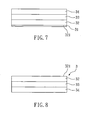
- FIGs. 7 and 8 show schematic views of a method of fabricating the composite having a resin surface layer according to the first embodiment of the present invention.
- a release paper (Favini® ASTRAKANTM) 31 is provided.
- a base is provided.
- the material of the base is a resin selected from a group consisting of PU, polyethylene (polyvinyl chloride), acrylic resin, polycarbonate, and epoxy resin.
- the base includes a plurality of additive particles selected from the group consisting of pigments, dyes, colorants, coloring matters, and pearl powders. The additive particles are randomly distributed in the base.
- the material of the base is a single-component PU resin (U-BEST POLYMER INDUSTRY CO., LTD®, AT-508ETM).
- the additive particles are pigment particles, and the material of the pigment is 41P series of TAH KONG CHEMICAL INDUSTRIAL CORP.
- the base is formed on the release paper 31 in the weight distribution of 120 g/m 2 .
- an energy field is applied to polarize the additive particles, so as to change the orientation of the additive particles.
- the base is dried to form a surface layer 32 having a surface 321.
- the surface layer 32 is the same as the above resin surface layer.
- an adhesion layer 33 is formed on the surface layer 32.
- the material of the adhesion layer 33 is a two-component PU resin (U-BEST POLYMER INDUSTRY CO., LTD®, BD636MTM), and has a weight distribution of 120 g/m 2 .
- the adhesion layer 33 is dried into a half-dried state at 70°C.
- a bottom cloth layer 34 is formed on the adhesion layer 33, and the bottom cloth layer 34 is selected from a group consisting of a woven fabric, a non-woven fabric, leather, a microfiber, and a resin.
- the bottom cloth layer 34 is artificial leather (San Fang).
- the release paper 31 is removed and inverted 180 degrees, and thus a composite 3 is formed.
- the composite 3 is fabricated by the method of the first embodiment.
- the composite 3 includes a bottom cloth layer 34, an adhesion layer 33, and a surface layer 32.
- the bottom cloth layer 34 is artificial leather (San Fang).
- the adhesion layer 33 is located on the bottom cloth layer 34, and the material of the adhesion layer 33 is a two-component PU resin (U-BEST POLYMER INDUSTRY CO., LTD®, BD636MTM).
- the surface layer 32 is located on the adhesion layer 33.
- the surface layer 32 has a surface 321.
- the surface layer 32 has a base and a plurality of additive particles.
- the material of the base is a resin.
- the additive particles are arranged in a predetermined form instead of randomly distributed in the base, so that the surface 321 of the surface layer 32 can exhibit the visual effect of 3D texture, although the surface 321 is smooth and does not have a physical texture of bumps and pits.
- FIGs. 9 and 10 show schematic views of a method of fabricating the composite having a resin surface layer according to the second embodiment of the present invention.
- a release paper (Favini® ASTRAKANTM) 41 is provided.
- a base is provided.
- the material of the base is resin and the base includes a plurality of first additive particles randomly distributed therein.
- the material of the base is a single-component PU resin (U-BEST POLYMER INDUSTRY CO., LTD®, AT-508ETM).
- the first additive particles are pigment particles, and the material of the pigment is 41P series of TAH KONG CHEMICAL INDUSTRIAL CORP.
- the base is formed on the release paper 41 in the weight distribution of 120 g/m 2 .
- an energy field is applied to polarize the first additive particles, so as to change the orientation of the first additive particles.
- the base is dried to form a surface layer 42 having a surface 421.
- the surface layer 42 is the same as the above resin surface layer.
- an intermediate layer 43 is formed on the surface layer 42.
- the material of the intermediate layer 43 is resin and the intermediate layer 43 includes a plurality of second additive particles randomly distributed therein.
- the material of the intermediate layer 43 is selected from a group consisting of PU, polyethylene (polyvinyl chloride), acrylic resin, polycarbonate, and epoxy resin.
- the second additive particles are selected from a group consisting of pigments, dyes, colorants, coloring matters, and pearl powders.
- the material of the intermediate layer 43 is a single-component PU resin (U-BEST POLYMER INDUSTRY CO., LTD®, AT-508ETM).
- the second additive particles are pigment particles, and the material of the pigment is 41P series of TAH KONG CHEMICAL INDUSTRIAL CORP.
- the intermediate layer 43 is formed on the surface layer 42 in the weight distribution of 120 g/m 2 . It should be noted that the intermediate layer 43 can be directly dried without polarization.
- an adhesion layer 44 is formed on the intermediate layer 43.
- the material of the adhesion layer 44 is a two-component PU resin (U-BEST POLYMER INDUSTRY CO., LTD®, BD636MTM), and has the weight distribution of 120 g/m 2 .
- the adhesion layer 44 is dried into a half-dried state at 70°C.
- a bottom cloth layer 45 is formed on the adhesion layer 44, and the bottom cloth layer 45 is selected from a group consisting of a woven fabric, a non-woven fabric, leather, a microfiber, and a resin.
- the bottom cloth layer 45 is artificial leather (San Fang).
- the release paper 41 is removed and inverted 180 degrees, thus forming a composite 4.
- the composite 4 is fabricated by the method of the second embodiment and is substantially the same as the composite 3 of the first embodiment, except that the composite 4 further has an intermediate layer 43 between the surface layer 42 and the adhesion layer 44.
- the material of the intermediate layer 43 is resin, and the intermediate layer 43 includes a plurality of second additive particles randomly distributed therein.
- FIGs. 11 and 12 show schematic views of a method of fabricating the composite having a resin surface layer according to the third embodiment of the present invention.
- the fabrication method of this embodiment occurs subsequent to the second embodiment.
- a second release paper (Favini® ASTRAKANTM) 51 is provided.
- a top layer 52 is formed on the second release paper 51.
- the material of the top layer 52 is resin and the top layer 52 includes a plurality of third additive particles randomly distributed therein.
- the material of the top layer 52 is selected from a group consisting of PU, polyethylene (polyvinyl chloride), acrylic resin, polycarbonate, and epoxy resin.
- the third additive particles are selected from the group consisting of pigments, dyes, colorants, coloring matters, and pearl powders.
- the material of the top layer 52 is a single-component PU resin (U-BEST POLYMER INDUSTRY CO., LTD®, AT-508ETM).
- the third additive particles are pigment particles, and the material of the pigment is 41P series of TAH KONG CHEMICAL INDUSTRIAL CORP.
- the top layer 52 is formed on the second release paper 51 in the weight distribution of 120 g/m 2 . It should be noted that the top layer 52 can be directly dried without polarization, and the third additive particles are required to have transparency.
- a second adhesion layer 53 is formed on the top layer 52.
- the material of the second adhesion layer 53 is a two-component PU resin (U-BEST POLYMER INDUSTRY CO., LTD®, BD636MTM), and has a weight distribution of 120 g/m 2 . Thereafter, the second adhesion layer 53 is dried into a half-dried state at 70°C.
- the second release paper 51, the top layer 52, and the second adhesion layer 53 are inverted, so as to adhere the second release paper 51 and the top layer 52 to the surface layer 42 of the composite 4 of the second embodiment by the use of the second adhesion layer 53. Finally, the second release paper 51 is removed, thus obtaining a composite 5.
- FIG. 12 a schematic view of a composite having a resin surface layer according to the third embodiment of the present invention is shown.
- the composite 5 is fabricated by the method of the third embodiment.
- the composite 5 is substantially the same as the composite 4 of the second embodiment, except that the composite 5 further has a top layer 52 and a second adhesion layer 53.
- the second adhesion layer 53 is located on the surface layer 42, and the top layer 52 is located on the second adhesion layer 53.
- the material of the top layer 52 is resin, and the top layer 52 includes a plurality of third additive particles randomly distributed therein.
- the third additive particles are required to have transparency.
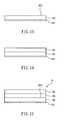
- FIGs. 13 and 15 show schematic views of a method of fabricating the composite having a resin surface layer according to the fourth embodiment of the present invention.
- a bottom cloth layer 61 is provided.
- the bottom cloth layer 61 is selected from a group consisting of a woven fabric, a non-woven fabric, leather, a microfiber, and a resin.
- the bottom cloth layer 61 is artificial leather (San Fang).
- the material of the base is a resin selected from the group consisting of PU, polyethylene (polyvinyl chloride), acrylic resin, polycarbonate, and epoxy resin.
- the base includes a plurality of first additive particles, and the first additive particles are selected from the group consisting of pigments, dyes, colorants, coloring matters, and pearl powders.
- the first additive particles are randomly distributed in the base.
- the material of the base is a single-component PU resin (U-BEST POLYMER INDUSTRY CO., LTD®, AT-508ETM).
- the first additive particles are pigment particles, and the material of the pigment is 41P series of TAH KONG CHEMICAL INDUSTRIAL CORP.
- the base is formed on the bottom cloth layer 61 in the weight distribution of 120 g/m 2 .
- an energy field is applied to polarize the first additive particles, so as to change the orientation of the first additive particles.
- the base is dried to form a surface layer 62 having a surface 621.
- the surface layer 62 is the same as the above resin surface layer.
- a release paper (Favini® ASTRAKANTM) 63 is provided. Then, a top layer 64 is formed on the release paper 63.
- the material of the top layer 64 is resin, and the top layer 64 includes a plurality of second additive particles randomly distributed therein.
- the material of the top layer 64 is selected from a group consisting of PU, polyethylene (polyvinyl chloride), acrylic resin, polycarbonate, and epoxy resin.
- the second additive particles are selected from a group consisting of pigments, dyes, colorants, coloring matters, and pearl powders.
- the material of the top layer 64 is a single-component PU resin (U-BEST POLYMER INDUSTRY CO., LTD®, AT-508ETM).
- the second additive particles are pigment particles, and the material of the pigment is 41P series of TAH KONG CHEMICAL INDUSTRIAL CORP.
- the top layer 64 is formed on the release paper 63 in the weight distribution of 120 g/m 2 . It should be noted that the top layer 64 can be directly dried without polarization, and the second additive particles are required to have transparency.
- an adhesion layer 65 is formed on the top layer 64.
- the material of the adhesion layer 65 is a two-component PU resin (U-BEST POLYMER INDUSTRY CO., LTD®, BD636MTM), and has a weight distribution of 120 g/m 2 . Thereafter, the adhesion layer 65 is dried into a half-dried state at 70°C.
- the release paper 63, the top layer 64, and the adhesion layer 65 are inverted, so as to adhere the release paper 63 and the top layer 64 to the surface 621 of the surface layer 62 by the use of the adhesion layer 65. Finally, the release paper 63 is removed, thus obtaining a composite 6.
- the composite 6 is fabricated by the method of the third embodiment.
- the composite 6 includes a bottom cloth layer 61, a surface layer 62, an adhesion layer 65, and a top layer 64.
- the bottom cloth layer 61 is artificial leather (San Fang).
- the surface layer 62 is located on the bottom cloth layer 61.
- the surface layer 62 has a surface 621.
- the surface layer 62 has a base and a plurality of first additive particles.
- the material of the base is a resin
- the first additive particles are arranged in a predetermined form instead of randomly distributed in the base, so that the surface 621 of the surface layer 62 can exhibit the visual effect of 3D texture, although the surface 621 of the surface layer 62 is smooth and does not have a physical texture of bumps and pits.
- the adhesion layer 65 is located on the surface layer 62, and the material of the adhesion layer 65 is a two-component PU resin (U-BEST POLYMER INDUSTRY CO., LTD®, BD636MTM).
- the top layer 64 is located on the adhesion layer 65.
- the material of the top layer 64 is resin, and the top layer 64 includes a plurality of second additive particles randomly distributed therein. The second additive particles are required to have transparency.
Landscapes
- Engineering & Computer Science (AREA)
- Textile Engineering (AREA)
- Ceramic Engineering (AREA)
- Power Engineering (AREA)
- Mechanical Engineering (AREA)
- Chemical & Material Sciences (AREA)
- Organic Chemistry (AREA)
- Laminated Bodies (AREA)
Claims (9)
- Verfahren zur Herstellung eines Verbundmaterials (3; 4; 5) mit einer Kunstharz-Oberflächenschicht (32; 42), umfassend:(a) Bereitstellen eines Trennpapiers (31; 41);(b) Ausbilden einer Kunstharz-Oberflächenschicht (32; 42) auf dem Trennpapier durch(b1) Ausbilden einer Basis aus einem Kunstharz auf dem Trennpapier (31; 41), die eine Mehrzahl von Additiv-Partikeln aufweist, die zufällig in der Basis verteilt sind;(b2) Anlegen eines magnetischen oder eines elektrischen Feldes, um die Additiv-Partikel zu polarisieren, um dadurch die Aufrichtung der Additiv-Partikel zu ändern oder um dadurch die Verteilung der Additiv-Partikel, so dass die Additiv-Partikel eine vorbestimmte Dichte aufweisen, oder um dadurch die Winkelstellung der Additiv-Partikel zu ändern, so dass die Additiv-Partikel gleichmäßig in der Basis verteilt sind und eine vorbestimmte Winkelverteilung haben, so dass die Additiv-Partikel in einer vorbestimmten Form angeordnet sind, und(b3) Trocknen der Basis, um dadurch eine Oberfläche auszubilden, die die visuelle Wirkung einer 3D-Struktur hat;(c) Ausbilden einer ersten Haft- bzw. Klebeschicht (33; 44) auf der Kunstharzoberflächen-Schicht;(d) Ausbilden einer unteren Gewebeschicht (34; 45) auf der ersten Haft- bzw. Klebeschicht, und(e) Entfernen des Trennpapiers zur Bildung des Verbundmaterials (3; 4).
- Verfahren nach Anspruch 1, weiterhin umfassend einen Schritt des Ausbildens einer Zwischenschicht (43) auf der Kunstharzoberflächen-Schicht (42), wobei die erste Haft- bzw. Klebeschicht (44) auf der Zwischenschicht (43) im Schritt (c) ausgebildet wird.
- Verfahren nach Anspruch 2, dadurch gekennzeichnet, dass das Material der Zwischenschicht (43) ist ein Kunstharz ist und die Zwischenschicht eine Mehrzahl von zweiten Additiv-Partikeln aufweist, die darin zufällig verteilt sind.
- Verfahren nach einem der Ansprüche 1 bis 3, nach dem Schritt (e) weiterhin umfassend:(F) Bereitstellen eines zweiten Trennpapiers (51);(G) Ausbilden einer Deckschicht (52) auf dem zweiten Trennpapier (51);(H) Ausbilden einer zweiten Haftschicht (53) auf der Deckschicht;(K) Ankleben der zweiten Haftschicht (53) an die Kunstharz-Oberflächenschicht (42) des Verbundmaterials (4), so dass das zweite Trennpapier (51) und die obere Schicht (52) an der Kunstharz-Oberflächenschicht (42) des Verbundmaterials (4) anhaften, und(L) Entfernen der zweiten Trennpapiers (51), um so das Verbundmaterial (5) auszubilden.
- Verfahren nach Anspruch 4, wobei das Material der Deckschicht (52) ein Kunstharz und die Deckschicht eine Vielzahl von dritten Additiv-Partikeln aufweist, die darin zufällig verteilt sind.
- Verfahren nach einem der vorhergehenden Ansprüche, wobei das Material der Basis von Schritt (b1) PU, Polyethylen (Polyvinylchlorid), Acrylharz, Polycarbonat oder Epoxidharz ist und die Additiv-Partikel Farbstoffe oder Perlmuttpulver ist.
- Verbundmaterial (3; 4; 5) mit einer Kunstharz-Oberflächenschicht, umfassend:eine untere Schicht aus einem Gewebe, einem nicht-gewebten Stoff, Leder, einer Mikrofaser oder einem Kunstharz;eine Haft- bzw. Klebeschicht (33; 45), auf der unteren Schicht angeordnet ist, undeine Kunstharz-Oberflächenschicht (32; 42), hergestellt nach einem Verfahren nach einem der Ansprüche 1 bis 6, die auf der Idaft- bzw. Klebeschicht (33, 45) angeordnet ist.
- Verbundmaterial nach Anspruch 7, wobei die Additiv-Partikel Farbstoffe und das Verbundmaterial ferner eine Zwischenschicht (43) zwischen der Kunstharz-Oberflächenschicht und der Haft- bzw. Klebeschicht aufweist, wobei das Material der Zwischenschicht eine Kunstharz ist und die Zwischenschicht eine Mehrzahl von zweiten Additiv-Partikeln aufweist, die darin zufällig verteilt sind.
- Verbundmaterial nach Anspruch 8, weiterhin umfassend eine zweite Haft- bzw. Klebeschicht (53) und eine Deckschicht (52), wobei die zweite Haft- bzw. Klebeschicht auf der Kunstharzoberflächen-Schicht (42) angeordnet ist, und die Deckschicht (52) auf der zweiten Haft- bzw. Klebeschicht (53) angeordnet ist, wobei das Material der Deckschicht ein Kunstharz ist und eine Vielzahl von dritten Additiv-Partikeln gleichmäßig in der Deckschicht verteilt sind..
Applications Claiming Priority (1)
| Application Number | Priority Date | Filing Date | Title |
|---|---|---|---|
| TW096132988A TW200911525A (en) | 2007-09-05 | 2007-09-05 | Resin surface layer and method of fabricating the same, composite having the resin surface layer and method of fabricating the same |
Publications (3)
| Publication Number | Publication Date |
|---|---|
| EP2033770A2 EP2033770A2 (de) | 2009-03-11 |
| EP2033770A3 EP2033770A3 (de) | 2010-03-10 |
| EP2033770B1 true EP2033770B1 (de) | 2012-06-27 |
Family
ID=40193489
Family Applications (1)
| Application Number | Title | Priority Date | Filing Date |
|---|---|---|---|
| EP08100124A Ceased EP2033770B1 (de) | 2007-09-05 | 2008-01-04 | Harzoberflächenschicht mit einem visuellen Effekt in der Form einer 3D-Struktur und Herstellungsverfahren dafür, Zusammensetzung mit der Harzoberflächenschicht und Herstellungsverfahren dafür |
Country Status (3)
| Country | Link |
|---|---|
| US (2) | US20090061155A1 (de) |
| EP (1) | EP2033770B1 (de) |
| TW (1) | TW200911525A (de) |
Cited By (1)
| Publication number | Priority date | Publication date | Assignee | Title |
|---|---|---|---|---|
| TWI717208B (zh) * | 2020-02-07 | 2021-01-21 | 南亞塑膠工業股份有限公司 | 離型底紙及其製造方法 |
Families Citing this family (3)
| Publication number | Priority date | Publication date | Assignee | Title |
|---|---|---|---|---|
| TW200948631A (en) * | 2008-05-26 | 2009-12-01 | San Fang Chemical Industry Co | Resin cover layer, method for manufacturing the same, composite material having the same and method for manufacturing the composition material |
| EP3266583A1 (de) * | 2016-06-15 | 2018-01-10 | Renolit SE | Effektfolien und verfahren zu ihrer herstellung |
| CN114211004B (zh) * | 2021-12-17 | 2024-01-12 | 北京工商大学 | 3d打印不锈钢工件表面的pva基复合膜层及制备方法 |
Family Cites Families (8)
| Publication number | Priority date | Publication date | Assignee | Title |
|---|---|---|---|---|
| US3507938A (en) * | 1963-04-04 | 1970-04-21 | Heinz Hundsdiecker | Method for producing shaped articles of hardened synthetic resin having a pigment pattern incorporated therein |
| DE69218582T2 (de) * | 1992-02-21 | 1997-07-10 | Hashimoto Forming Kogyo Co | Lackierung mit magnetisch hergestelltem Muster und lackiertes Produkt mit magnetisch hergestelltem Muster |
| DE4419173A1 (de) * | 1994-06-01 | 1995-12-07 | Basf Ag | Magnetisierbare mehrfach beschichtete metallische Glanzpigmente |
| GB2400315B (en) * | 2003-04-11 | 2005-11-02 | Milliken Ind Ltd | Patterned square carpet tiles |
| TWI285697B (en) * | 2003-12-29 | 2007-08-21 | San Fang Chemical Industry Co | Flameproof environmentally friendly artificial leather and process for making the same |
| US20060272770A1 (en) * | 2004-08-24 | 2006-12-07 | San Fang Chemical Industry Co., Ltd. | Method for making artificial leather with superficial texture |
| JP5129935B2 (ja) * | 2006-06-13 | 2013-01-30 | 日東電工株式会社 | シート状複合材料及びその製造方法 |
| TW200948631A (en) * | 2008-05-26 | 2009-12-01 | San Fang Chemical Industry Co | Resin cover layer, method for manufacturing the same, composite material having the same and method for manufacturing the composition material |
-
2007
- 2007-09-05 TW TW096132988A patent/TW200911525A/zh not_active IP Right Cessation
- 2007-12-19 US US11/959,609 patent/US20090061155A1/en not_active Abandoned
-
2008
- 2008-01-04 EP EP08100124A patent/EP2033770B1/de not_active Ceased
-
2011
- 2011-08-04 US US13/197,927 patent/US20110311772A1/en not_active Abandoned
Cited By (2)
| Publication number | Priority date | Publication date | Assignee | Title |
|---|---|---|---|---|
| TWI717208B (zh) * | 2020-02-07 | 2021-01-21 | 南亞塑膠工業股份有限公司 | 離型底紙及其製造方法 |
| US11518150B2 (en) | 2020-02-07 | 2022-12-06 | Nan Ya Plastics Corporation | Release liner and method for producing the same |
Also Published As
| Publication number | Publication date |
|---|---|
| US20110311772A1 (en) | 2011-12-22 |
| TWI348421B (de) | 2011-09-11 |
| EP2033770A3 (de) | 2010-03-10 |
| US20090061155A1 (en) | 2009-03-05 |
| TW200911525A (en) | 2009-03-16 |
| EP2033770A2 (de) | 2009-03-11 |
Similar Documents
| Publication | Publication Date | Title |
|---|---|---|
| JP2025111772A (ja) | 選択された質感と色を有する取引及びidカード | |
| CA2776399C (en) | Dry adhesives | |
| KR101437783B1 (ko) | 횡방향 헤어라인이 구현된 인테리어 필름 및 이의 제조방법 | |
| EP2033770B1 (de) | Harzoberflächenschicht mit einem visuellen Effekt in der Form einer 3D-Struktur und Herstellungsverfahren dafür, Zusammensetzung mit der Harzoberflächenschicht und Herstellungsverfahren dafür | |
| EP3466677A1 (de) | Dekoratives material | |
| TWI339232B (de) | ||
| US10640916B2 (en) | Decorative material | |
| WO2008147037A1 (en) | Transfer sheet having excellent cubic effect | |
| JP2013193298A (ja) | 転写箔および装飾成形品 | |
| KR20170108508A (ko) | 입체 패턴을 갖는 실리콘 디자인 전사지 | |
| CN110869999B (zh) | 变色热转印标签 | |
| US20090291268A1 (en) | Resin surface layer and method of fabricating the same, composite having the resin surface layer and method of fabricating the same | |
| WO2009066710A1 (ja) | 研磨シート及び研磨シートの製造方法 | |
| JP7516017B2 (ja) | 三次元成形された形状を有する接着フィルム | |
| KR100909172B1 (ko) | 자력을 이용한 엠보시트 및 그 제조방법 | |
| JP2006239967A (ja) | 転写シート | |
| CN101439587A (zh) | 树脂表面层和其制造方法,具有所述树脂表面层的复合材和其制造方法 | |
| JP2023022024A (ja) | 加飾フィルム成形体、加飾フィルム成形体の製造方法、転写基材の装着方法、サテンめっき調製品、容器、筐体、車両用内外装部材 | |
| CN101628984B (zh) | 树脂表面层和其制造方法,具有所述树脂表面层的复合材和其制造方法 | |
| KR20150069676A (ko) | 홀로그램 난반사 효과를 가지는 바닥재 및 이 바닥재의 제조방법 | |
| JP7207175B2 (ja) | 壁紙シート | |
| JP2005119021A (ja) | 化粧シート | |
| JP2019196481A (ja) | 扉用化粧粘着シート | |
| JP2011161888A (ja) | 自己治癒性転写箔 | |
| JP2013230612A (ja) | 水圧転写フィルム製造用転写箔、水圧転写フィルム及び加飾成形品並びにそれらの製造方法 |
Legal Events
| Date | Code | Title | Description |
|---|---|---|---|
| PUAI | Public reference made under article 153(3) epc to a published international application that has entered the european phase |
Free format text: ORIGINAL CODE: 0009012 |
|
| AK | Designated contracting states |
Kind code of ref document: A2 Designated state(s): AT BE BG CH CY CZ DE DK EE ES FI FR GB GR HR HU IE IS IT LI LT LU LV MC MT NL NO PL PT RO SE SI SK TR |
|
| AX | Request for extension of the european patent |
Extension state: AL BA MK RS |
|
| PUAL | Search report despatched |
Free format text: ORIGINAL CODE: 0009013 |
|
| AK | Designated contracting states |
Kind code of ref document: A3 Designated state(s): AT BE BG CH CY CZ DE DK EE ES FI FR GB GR HR HU IE IS IT LI LT LU LV MC MT NL NO PL PT RO SE SI SK TR |
|
| AX | Request for extension of the european patent |
Extension state: AL BA MK RS |
|
| RIC1 | Information provided on ipc code assigned before grant |
Ipc: B29D 7/01 20060101AFI20090116BHEP Ipc: B32B 3/00 20060101ALI20100129BHEP Ipc: D06N 3/00 20060101ALI20100129BHEP Ipc: H01F 1/08 20060101ALI20100129BHEP Ipc: B05D 7/12 20060101ALI20100129BHEP Ipc: B32B 3/30 20060101ALI20100129BHEP Ipc: B32B 27/00 20060101ALI20100129BHEP Ipc: B32B 27/12 20060101ALI20100129BHEP |
|
| AKY | No designation fees paid | ||
| 17P | Request for examination filed |
Effective date: 20100909 |
|
| RBV | Designated contracting states (corrected) |
Designated state(s): DE FR IT |
|
| 17Q | First examination report despatched |
Effective date: 20110407 |
|
| GRAP | Despatch of communication of intention to grant a patent |
Free format text: ORIGINAL CODE: EPIDOSNIGR1 |
|
| GRAS | Grant fee paid |
Free format text: ORIGINAL CODE: EPIDOSNIGR3 |
|
| GRAA | (expected) grant |
Free format text: ORIGINAL CODE: 0009210 |
|
| AK | Designated contracting states |
Kind code of ref document: B1 Designated state(s): DE FR IT |
|
| REG | Reference to a national code |
Ref country code: DE Ref legal event code: R096 Ref document number: 602008016659 Country of ref document: DE Effective date: 20120830 |
|
| PLBE | No opposition filed within time limit |
Free format text: ORIGINAL CODE: 0009261 |
|
| STAA | Information on the status of an ep patent application or granted ep patent |
Free format text: STATUS: NO OPPOSITION FILED WITHIN TIME LIMIT |
|
| 26N | No opposition filed |
Effective date: 20130328 |
|
| REG | Reference to a national code |
Ref country code: DE Ref legal event code: R097 Ref document number: 602008016659 Country of ref document: DE Effective date: 20130328 |
|
| REG | Reference to a national code |
Ref country code: FR Ref legal event code: PLFP Year of fee payment: 9 |
|
| REG | Reference to a national code |
Ref country code: FR Ref legal event code: PLFP Year of fee payment: 10 |
|
| REG | Reference to a national code |
Ref country code: FR Ref legal event code: PLFP Year of fee payment: 11 |
|
| PGFP | Annual fee paid to national office [announced via postgrant information from national office to epo] |
Ref country code: IT Payment date: 20190121 Year of fee payment: 12 Ref country code: FR Payment date: 20190123 Year of fee payment: 12 Ref country code: DE Payment date: 20190131 Year of fee payment: 12 |
|
| REG | Reference to a national code |
Ref country code: DE Ref legal event code: R119 Ref document number: 602008016659 Country of ref document: DE |
|
| PG25 | Lapsed in a contracting state [announced via postgrant information from national office to epo] |
Ref country code: FR Free format text: LAPSE BECAUSE OF NON-PAYMENT OF DUE FEES Effective date: 20200131 Ref country code: DE Free format text: LAPSE BECAUSE OF NON-PAYMENT OF DUE FEES Effective date: 20200801 |
|
| PG25 | Lapsed in a contracting state [announced via postgrant information from national office to epo] |
Ref country code: IT Free format text: LAPSE BECAUSE OF NON-PAYMENT OF DUE FEES Effective date: 20200104 |