EP2026505A2 - Communication method for connection device, program for performing said communication method and connection device - Google Patents
Communication method for connection device, program for performing said communication method and connection device Download PDFInfo
- Publication number
- EP2026505A2 EP2026505A2 EP08014222A EP08014222A EP2026505A2 EP 2026505 A2 EP2026505 A2 EP 2026505A2 EP 08014222 A EP08014222 A EP 08014222A EP 08014222 A EP08014222 A EP 08014222A EP 2026505 A2 EP2026505 A2 EP 2026505A2
- Authority
- EP
- European Patent Office
- Prior art keywords
- protocol
- network
- connection device
- communication method
- certain message
- Prior art date
- Legal status (The legal status is an assumption and is not a legal conclusion. Google has not performed a legal analysis and makes no representation as to the accuracy of the status listed.)
- Granted
Links
Images



Classifications
-
- H—ELECTRICITY
- H04—ELECTRIC COMMUNICATION TECHNIQUE
- H04L—TRANSMISSION OF DIGITAL INFORMATION, e.g. TELEGRAPHIC COMMUNICATION
- H04L67/00—Network arrangements or protocols for supporting network services or applications
- H04L67/01—Protocols
- H04L67/12—Protocols specially adapted for proprietary or special-purpose networking environments, e.g. medical networks, sensor networks, networks in vehicles or remote metering networks
-
- H—ELECTRICITY
- H04—ELECTRIC COMMUNICATION TECHNIQUE
- H04L—TRANSMISSION OF DIGITAL INFORMATION, e.g. TELEGRAPHIC COMMUNICATION
- H04L69/00—Network arrangements, protocols or services independent of the application payload and not provided for in the other groups of this subclass
- H04L69/18—Multiprotocol handlers, e.g. single devices capable of handling multiple protocols
-
- B—PERFORMING OPERATIONS; TRANSPORTING
- B63—SHIPS OR OTHER WATERBORNE VESSELS; RELATED EQUIPMENT
- B63H—MARINE PROPULSION OR STEERING
- B63H21/00—Use of propulsion power plant or units on vessels
- B63H21/21—Control means for engine or transmission, specially adapted for use on marine vessels
- B63H2021/216—Control means for engine or transmission, specially adapted for use on marine vessels using electric control means
-
- H—ELECTRICITY
- H04—ELECTRIC COMMUNICATION TECHNIQUE
- H04L—TRANSMISSION OF DIGITAL INFORMATION, e.g. TELEGRAPHIC COMMUNICATION
- H04L69/00—Network arrangements, protocols or services independent of the application payload and not provided for in the other groups of this subclass
- H04L69/24—Negotiation of communication capabilities
Definitions
- the present invention relates to a communication method for a connection device connected to a network, in particular a network mounted on a boat, a program for performing said communication method, and a connection device.
- connection device when a connection device is connected to this type of network, it is necessary to prepare the connection device in conformity with a protocol (communication protocol) of a network. Therefore, in a case that there are plural types of protocols in the network, it troubles to prepare the same number of connection devices as of protocols.
- protocol communication protocol
- JP-U-Hei 5-59282 has problems as follows.
- connection device conforming to the protocol that performs authentication (hereinafter referred to as an authentication conforming device) is connected to the network of the protocol that does not perform authentication (hereinafter referred to as an unauthenticated protocol), it may cause authentication failure. Therefore, upward compatibility cannot be ensured, and usability lowers.
- JP-B-3669671 requires plural communication lines corresponding to a number of failure diagnosis circuits, so it cannot be realized in low-cost.
- said objective is solved by a communication method for a connection device connected to a network, in particular a network mounted on a boat, the communication method comprising the following steps: identifying a protocol of the network based on specific information in a certain message transmitted through the network; determining a device protocol for the connection device in accordance with the identified protocol of the network; and performing data communication with the network conforming to the determined device protocol.
- connection device when the connection device is connected to the network, the connection device identifies a protocol of the network by itself and operates appropriately. Therefore, it is possible to ensure upward compatibility of the connection device and improve usability. Also, it is possible to be realized in low-cost because plural communication lines are not necessary unlike in JP-B-3669671 .
- a predetermined waiting time period is set, in which the connection device awaits reception of the certain message transmitted through the network.
- the certain message is sent by another connection device connected to the network.
- the protocol of the network is identified based on an identification field of the certain message, preferably based on a communication identifier of said identification field.
- the identified protocol of the network is stored in a nonvolatile memory of the connection device in order to determine the device protocol.
- the identification of the protocol of the network by means of a certain message is prevented, when the connection device is connected for the second or a further time to the network, and when the protocol of the network has been identified before.
- identification of the protocol of the network is performed based on specific information in a certain message transmitted through the network, when the connection device is connected to the network for the next time, and/or the next certain message is sent through the network.
- said objective is also solved by a program for performing a communication method according to one of the embodiments above, when being executed by a central processing unit of a connection device.
- connection device in particular connection device for a boat, having a central processing unit configured to perform a method according to one of the embodiments above.
- a nonvolatile memory means configured to store the protocol of the network as protocol information is provided.
- a memory-reset means configured to erase the protocol information stored in the memory means to return to its initial state.
- the device protocol stored in the memory means can be erased and returned to an initial state by a memory reset means, so it can easily react to a change of the network to which the connection device is connected.
- connection device is a gauge and/or a gateway and/or an outboard motor and/or a remote control, and/or an immobilizer and/or a multifunction sensor for a boat.
- connection device preferably is detachably connected.
- a boat 1 includes a hull 2, and an outboard motor 6 is detachably attached to the rear portion (stern) of the hull 2. Also, three hubs 3 are provided to the hull 2, and these hubs 3 are detachably connected with various connection devices 10 that includes specifically a gauge 4, a gateway 5, a remote control 7, an immobilizer 8, and a multi function sensor 9. And, a network N is configured by these devices.
- This network N supports both of a first protocol P1 and a second protocol P2.
- the former connection device is set to start transmitting a certain message M such as an address application message or the like when connected to the network N, on the other hand, the latter connection device is set not to transmit any data when connected to the network N.
- a outboard motor 6 and a remote control 7 are connected by the connection method of a mechanical cable 20.
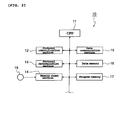
- the connection device 10 includes a CPU (central processing section), and the CPU 11 is connected with a protocol identification section (protocol identification means) 12, a protocol determination section (protocol determination means) 13, a memory reset section (memory reset means) 14, a data communication section (data communication means) 15, a nonvolatile data memory (memory means) 16, and a program memory 17. Furthermore, a reset button 19 is connected to the memory reset section 14.
- the data communication section 15 has a function to conform to both of the first protocol P1 and the second protocol P2 and perform data communication with the network N.
- the data memory 16 is provided with an area to readably and writably store the protocol information.
- a protocol switching program PRG shown in FIG. 3 is readably stored in the program memory 17.
- the CPU 11 When the connection device 10 with the above mentioned configuration is connected to the network N for the first time, the CPU 11 reads out the protocol-switching program PRG shown in FIG. 3 from the program memory 17, and executes a protocol switching action as follows based on the protocol switching program PRG.
- the CPU 11 performs a predetermined initializing action (refer to the arrow indicating from "Power OFF" to "Initialization” shown in FIG. 4 ), and then commands a identification action of a protocol of the network N to the protocol identification section 12.
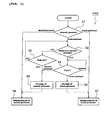
- the protocol identification section 12 attempts to identify the protocol of the network N based on the protocol information stored in the data memory 16 (step S1 of the protocol switching program PRG).
- this is a first time connection, so that no protocol information is stored in the data memory 16. Therefore, the protocol identification section 12 cannot identify a protocol of the network N based on the protocol information. Then, the protocol identification section 12 outputs a signal of the information to the CPU 11.
- the CPU 11 changes a communication state to a waiting state (refer to the arrow indicating from "Initialization” to "Waiting State” shown in FIG. 4 ), and then commands an acceptance check action of the certain message M to the protocol identification section 12.
- the protocol identification section 12 performs acceptance check of the certain message M transmitted from another connection device 10 connected to the network N until a predetermined waiting time period (for example, 3 seconds) is elapsed (the step 2 of the protocol switching program PRG).
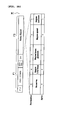
- This message M is configured by a identification field F1 and a data field F2.
- the identification field F1 stores identification information such as P (priority), communication identifier PGN (communication ID), DA (destination address), SA (source address).
- the data field F2 stores various engine information such as engine speed.
- the protocol identification section 12 identifies a protocol of the network N based on the attribution of PGN in this message M (step S3 in the protocol switching program PRG).
- the protocol identification section 12 determines that the protocol of the network N is the first protocol P1, and outputs the signal of the information to the CPU 11.
- the CPU 11 for the convenience of connection for the second time or later, writes the "first protocol P1" as protocol information and stores it in the data memory 16 (step S4 of the protocol switching program PRG), then commands the determination action of the device protocol to the protocol determination section 13.
- the protocol determination section 13 determines the device protocol as "first protocol P1" (step S7 of the protocol switching program PRG: refer to the arrow indicating from "Waiting State” to "First Protocol” shown in FIG.
- the connection device 10 functions as a device that corresponds to the first protocol P1.
- the protocol identification section 12 determines that the protocol of the network N is the second protocol P2, and outputs the signal of the information to the CPU 11.
- the CPU 11 for the convenience of connection for the second time or later, writes the "second protocol P2" as protocol information in the data memory 16 and lets it store the information (step S6 of the protocol switching program PRG), then commands the determination action of the device protocol to the protocol determination section 13.
- the protocol determination section 13 determines the device protocol as "second protocol P2" (step S8 of the protocol switching program PRG: refer to the arrow indicating from "Waiting State” to "Second Protocol” shown in FIG. 4 ), and outputs the signal of the information to the CPU 11. Then, the CPU 11 commands a data communication action by the device protocol to the data communication section 15. When the command is received, the data communication section 15 performs data communication with the network N in conformity with the second protocol P2. As a result, the connection device 10 functions as a device that corresponds to the second protocol P2.
- the protocol identification section 12 determines that the protocol of the network N is the second protocol P2, and outputs the signal of the information to the CPU 11. This process is performed based on the following logic. If there is at least one device among other connection devices 10 connected to the network N, which corresponds to the first protocol P1, a certain message M must be received within a predetermined waiting time. In other words, if no message is received within a predetermined waiting time, other connection devices 10 connected to the network N should be all corresponding to the second protocol P2.
- the protocol determination section 13 determines the device protocol as "second protocol P2" (step S8 of the protocol switching program PRG, refer to the arrow indicating from "Waiting State” to "Second Protocol” shown in FIG. 4 ), and outputs the signal of the information to the CPU 11.
- the CPU 11 commands a data communication action by the device protocol to the data communication section 15.
- the data communication section 15 performs data communication with the network N conforming to the second protocol P2.
- the connection device 10 functions as a device that corresponds to the second protocol P2.
- connection device 10 when the connection device 10 is connected to the network N, the connection device 10 identifies the protocol of the network N by itself and performs appropriately no matter whether the protocol of this network N is the first protocol P1 or the second protocol P2. Therefore, even in a case that the protocol of the network N is an unauthenticated protocol and the connection device 10 is an authentication conforming device, authentication failure is prevented, and upward compatibility of the connection device 10 can be maintained, and usability can be improved.
- the CPU 11 When the connection device 10 is connected to the network N for the second time or later, the CPU 11 reads out the protocol-switching program PRG shown in FIG. 3 from the program memory 17 in the same way as in the first time connection, and performs a protocol switching action as follows based on the protocol switching program PRG.
- the CPU 11 performs a predetermined initialization action (refer to the arrow indicating from "Power Off' to "Initialization” shown in FIG. 4 ).
- protocol information in the data memory 16 is not erased by the initialization action but retained even after initialization.
- the CPU 11 commands the identification action of a protocol of the network N to the protocol identification section 12.
- the protocol identification section 12 attempts to identify the protocol of the network N based on the protocol information stored in the data memory 16 (step S1 of the protocol switching program PRG).
- protocol information (the "First Protocol P1" or the "Second Protocol P2") is stored in the data memory 16, so that the protocol identification section 12 identifies a protocol of the network N based on this protocol information.
- the protocol identification section 12 determines that the protocol of the network N is the first protocol P1, and outputs the signal of the information to the CPU 11. Then, the CPU 11 commands a determination action of the device protocol to the protocol determination section 13.
- the protocol determination section 13 determines the device protocol as the "first protocol P1" (step S7 of the protocol switching program PRG: refer to the arrow indicating from "Initialization” to "First Protocol” shown in FIG. 4 ), and outputs the signal of the information to the CPU 11.
- the CPU 11 commands a data communication action by the device protocol to the data communication section 15.
- the data communication section 15 performs data communication with the network N in conformity with the first protocol P1.
- the connection device 10 functions as a device that corresponds to the first protocol P1.
- the protocol identification section 12 determines that the protocol of the network N is the second protocol P2, and outputs the signal of the information to the CPU 11. Then, the CPU 11 commands a determination action of the device protocol to the protocol determination section 13.
- the protocol determination section 13 determines the device protocol as the "Second Protocol P2" (step S8 of the protocol switching program PRG, refer to the arrow indicating from "Initialization” to the "Second Protocol” shown in FIG. 4 ), and outputs the signal of the information to the CPU 11.
- the CPU 11 commands a data communication action by the device protocol to the data communication section 15.
- the data communication section 15 performs data communication with the network N in conformity with the second protocol P2.
- the connection device 10 functions as a device that corresponds to the second protocol P2.
- a process of determining a type of protocol becomes unnecessary by referring the protocol information in the data memory 16, at the time of connection for the second time or later. Therefore, a waiting time is reduced as much, so that prompt and stable communication is possible. As a result, practicality and reliability of the communication device 10 can be improved in comparison with JP-U-Hei 5-59282 .
- the reset button 19 is pressed in order to reset the protocol information in the data memory 16. Then, the memory reset section 14 erases the protocol information in the data memory 16 to return it to the initial state.
- the memory reset section 14 erases this "First Protocol” and changes the communication state to the waiting state (refer to the arrow indicating from "First Protocol” to "Waiting State” shown in FIG. 4 ).
- the memory reset section 14 erases this "Second Protocol” and changes the communication state to the waiting state (refer to the arrow indicating from "Second Protocol” to "Waiting State” shown in FIG. 4 ).
- the protocol information in the data memory 16 can be erased and returned to its initial state by pressing the reset button 19, so it can easily react to a change of the network N to which the connection device 10 is connected.
- identification of the protocol of the network is performed based on specific information in said certain message M as disclosed before with regard to step S2.
- the embodiment 1 described above explains the case in which a protocol in the network N is identified based on PGN in the certain message M; however, identification of a protocol in the network N may be performed based on the information other than PGN.
- the embodiment 1 described above explains about the boat 1 connected by the connection method in which the outboard motor 6 and the remote control 7 are connected by the mechanical cable 20; however, it is understood that the present teaching is applicable to the boat 1 that uses a DBW (drive by wire) system, in which the ECU of the outboard motor 6 and the ECU of the remote controller 7 are electrically connected through a LAN (Local Area Network).
- DBW drive by wire
- LAN Local Area Network
- the embodiment 1 explains the boat 1 in which the outboard motor 6 is attached to the hull 2.
- the present teaching is applicable to the boat 1 in which a boat propulsion device (such as an inboard-outboard drive) other than the outboard motor 6 is attached to the hull 2.
- the present teaching is widely applicable to various boats such as pleasure boats, small planing boats, personal water craft, etc.
- connection device connected to a network mounted in a boat, comprising: a protocol identification means for identifying a protocol of the network based on specific information in a certain message transmitted through the network; a protocol determination means for determining a device protocol in accordance with the protocol of the network identified by the protocol identification means; and a data communication means to perform data communication with the network conforming to the device protocol determined by the protocol determination means.
- a nonvolatile memory means for storing the protocol of the network as protocol information is provided.
- a memory-reset means that erases protocol information stored in the memory means to return to its initial state is provided.
- connection device connected to a network mounted in a boat executes: a protocol identification process of identifying a protocol of the network based on specific information in a certain message transmitted through the network; a protocol determination process of determining a device protocol in accordance with the protocol of the network; and a data communication process of performing data communication with the network in conformity with the device protocol.
Landscapes
- Engineering & Computer Science (AREA)
- Computer Networks & Wireless Communication (AREA)
- Signal Processing (AREA)
- Health & Medical Sciences (AREA)
- Computing Systems (AREA)
- General Health & Medical Sciences (AREA)
- Medical Informatics (AREA)
- Computer Security & Cryptography (AREA)
- Communication Control (AREA)
- Computer And Data Communications (AREA)
- Small-Scale Networks (AREA)
Abstract
Description
- The present invention relates to a communication method for a connection device connected to a network, in particular a network mounted on a boat, a program for performing said communication method, and a connection device.
- Conventionally, when a connection device is connected to this type of network, it is necessary to prepare the connection device in conformity with a protocol (communication protocol) of a network. Therefore, in a case that there are plural types of protocols in the network, it troubles to prepare the same number of connection devices as of protocols.
- For a method to prevent this kind of trouble, there have been proposed a technique disclosed in
JP-U-Hei 5-59282 JP-B-3669671 - However,
JP-U-Hei 5-59282 - First, it is necessary to determine a type of protocol every time that a failure diagnosis device is connected, so in a case of the connection device that is connected at all times, a waiting time for determination to complete is long and not practical, and also erroneous determination occurs more frequently, therefore enough reliability cannot be ensured.
- Second, when the connection device conforming to the protocol that performs authentication (hereinafter referred to as an authentication conforming device) is connected to the network of the protocol that does not perform authentication (hereinafter referred to as an unauthenticated protocol), it may cause authentication failure. Therefore, upward compatibility cannot be ensured, and usability lowers.
- On the other hand,
JP-B-3669671 - In view of these problems, it is an objective of the present invention to provide a communication method for a communication device, a program for performing said communication method and a connection device that are practical and reliable, able to improve usability by ensuring upward compatibility, and also able to be realized in low-cost.
- According to the present invention, said objective is solved by a communication method for a connection device connected to a network, in particular a network mounted on a boat, the communication method comprising the following steps: identifying a protocol of the network based on specific information in a certain message transmitted through the network; determining a device protocol for the connection device in accordance with the identified protocol of the network; and performing data communication with the network conforming to the determined device protocol.
- Accordingly, when the connection device is connected to the network, the connection device identifies a protocol of the network by itself and operates appropriately. Therefore, it is possible to ensure upward compatibility of the connection device and improve usability. Also, it is possible to be realized in low-cost because plural communication lines are not necessary unlike in
JP-B-3669671 - Preferably, when the connection device is connected to the network for the first time, a predetermined waiting time period is set, in which the connection device awaits reception of the certain message transmitted through the network.
- Further, preferably the certain message is sent by another connection device connected to the network.
- Still further, preferably the protocol of the network is identified based on an identification field of the certain message, preferably based on a communication identifier of said identification field.
- Yet further still, preferably the identified protocol of the network is stored in a nonvolatile memory of the connection device in order to determine the device protocol.
- Preferably, the identification of the protocol of the network by means of a certain message is prevented, when the connection device is connected for the second or a further time to the network, and when the protocol of the network has been identified before.
- Further, preferably if the device protocol is erased from the nonvolatile memory by means of a reset operation, identification of the protocol of the network is performed based on specific information in a certain message transmitted through the network, when the connection device is connected to the network for the next time, and/or the next certain message is sent through the network.
- According to the present invention, said objective is also solved by a program for performing a communication method according to one of the embodiments above, when being executed by a central processing unit of a connection device.
- Accordingly, same effects as above can be obtained.
- According to the present invention, said objective is also solved by a connection device, in particular connection device for a boat, having a central processing unit configured to perform a method according to one of the embodiments above.
- Preferably, a nonvolatile memory means configured to store the protocol of the network as protocol information is provided.
- Accordingly, at the time of connection for the second time or later, a determining process of protocol type becomes unnecessary and a waiting time shortens as much, so that prompt and stable communication is possible. As a result, practicality and reliability of the communication device can be improved in comparison with
JP-U-Hei 5-59282 - Further, preferably a memory-reset means configured to erase the protocol information stored in the memory means to return to its initial state is provided.
- Accordingly, the device protocol stored in the memory means can be erased and returned to an initial state by a memory reset means, so it can easily react to a change of the network to which the connection device is connected.
- Preferably, the connection device is a gauge and/or a gateway and/or an outboard motor and/or a remote control, and/or an immobilizer and/or a multifunction sensor for a boat.
- There is also provide a system comprising a boat and a network installed thereon to which at least one connection device according to one of the embodiments above is connected, preferably is detachably connected.
- In the following, the present invention is explained in greater detail by means of embodiments thereof in conjunction with the accompanying drawings, wherein:
- FIG.1
- is a schematic view of a connection device according to the
embodiment 1 connected to a network; - FIG. 2
- is a block diagram of a connection device according to the
embodiment 1; - FIG. 3
- is a flow chart of a protocol-switching program according to the
embodiment 1; - FIG. 4
- is a schematic view of a change of a communication state according to the
embodiment 1; and - FIG.5
- is a schematic view representing a certain message according to the
embodiment 1. -
- 1 :
- boat
- 2:
- hull
- 3:
- hub
- 4:
- gauge
- 5:
- gateway
- 6:
- outboard motor
- 7:
- remote control
- 8:
- immobilizer
- 9:
- multi function sensor
- 10:
- connection device
- 11:
- CPU (central processing unit)
- 12:
- protocol identification section (protocol identification means)
- 13:
- protocol determination section (protocol determination means)
- 14:
- memory reset section (memory reset means)
- 15:
- data communication section (data communication means)
- 16:
- data memory (memory means)
- 17:
- program memory
- 19:
- reset button
- 20:
- mechanical cable
- F1:
- identification field
- F2:
- data field
- M:
- certain message
- N:
- network
- PRG:
- protocol switching program
- First, the structure of the embodiment will be described. As shown in
FIG. 1 , aboat 1 includes ahull 2, and anoutboard motor 6 is detachably attached to the rear portion (stern) of thehull 2. Also, threehubs 3 are provided to thehull 2, and thesehubs 3 are detachably connected withvarious connection devices 10 that includes specifically agauge 4, agateway 5, aremote control 7, animmobilizer 8, and amulti function sensor 9. And, a network N is configured by these devices. This network N supports both of a first protocol P1 and a second protocol P2. There are two types ofconnection devices 10. One type of these supports the first protocol P1, and the other one supports the second protocol P2. The former connection device is set to start transmitting a certain message M such as an address application message or the like when connected to the network N, on the other hand, the latter connection device is set not to transmit any data when connected to the network N. - A
outboard motor 6 and aremote control 7 are connected by the connection method of amechanical cable 20. - As shown in
FIG. 2 , theconnection device 10 includes a CPU (central processing section), and theCPU 11 is connected with a protocol identification section (protocol identification means) 12, a protocol determination section (protocol determination means) 13, a memory reset section (memory reset means) 14, a data communication section (data communication means) 15, a nonvolatile data memory (memory means) 16, and aprogram memory 17. Furthermore, areset button 19 is connected to thememory reset section 14. - Here, the
data communication section 15 has a function to conform to both of the first protocol P1 and the second protocol P2 and perform data communication with the network N. Also, thedata memory 16 is provided with an area to readably and writably store the protocol information. Furthermore, a protocol switching program PRG shown inFIG. 3 is readably stored in theprogram memory 17. - The function is next described.
- When the
connection device 10 with the above mentioned configuration is connected to the network N for the first time, theCPU 11 reads out the protocol-switching program PRG shown inFIG. 3 from theprogram memory 17, and executes a protocol switching action as follows based on the protocol switching program PRG. - At first, the
CPU 11 performs a predetermined initializing action (refer to the arrow indicating from "Power OFF" to "Initialization" shown inFIG. 4 ), and then commands a identification action of a protocol of the network N to theprotocol identification section 12. When this is received, theprotocol identification section 12 attempts to identify the protocol of the network N based on the protocol information stored in the data memory 16 (step S1 of the protocol switching program PRG). However, this is a first time connection, so that no protocol information is stored in thedata memory 16. Therefore, theprotocol identification section 12 cannot identify a protocol of the network N based on the protocol information. Then, theprotocol identification section 12 outputs a signal of the information to theCPU 11. - And, the
CPU 11 changes a communication state to a waiting state (refer to the arrow indicating from "Initialization" to "Waiting State" shown inFIG. 4 ), and then commands an acceptance check action of the certain message M to theprotocol identification section 12. When this is received, theprotocol identification section 12 performs acceptance check of the certain message M transmitted from anotherconnection device 10 connected to the network N until a predetermined waiting time period (for example, 3 seconds) is elapsed (thestep 2 of the protocol switching program PRG). - This message M, for example as shown in
FIG. 5A andFIG. 5B , is configured by a identification field F1 and a data field F2. Here, the identification field F1 stores identification information such as P (priority), communication identifier PGN (communication ID), DA (destination address), SA (source address). The data field F2 stores various engine information such as engine speed. - And, in a case that a certain message M is received within a predetermined waiting time, the
protocol identification section 12 identifies a protocol of the network N based on the attribution of PGN in this message M (step S3 in the protocol switching program PRG). - That is, in a case that this PGN is used in the first protocol P1 alone (for example "127488" shown in
FIG. 5A ), theprotocol identification section 12 determines that the protocol of the network N is the first protocol P1, and outputs the signal of the information to theCPU 11. TheCPU 11, for the convenience of connection for the second time or later, writes the "first protocol P1" as protocol information and stores it in the data memory 16 (step S4 of the protocol switching program PRG), then commands the determination action of the device protocol to theprotocol determination section 13. When this is received, theprotocol determination section 13 determines the device protocol as "first protocol P1" (step S7 of the protocol switching program PRG: refer to the arrow indicating from "Waiting State" to "First Protocol" shown inFIG. 4 ), and outputs the signal of the information to theCPU 11. Then, theCPU 11 commands a data communication action by the device protocol to thedata communication section 15. When this is received, thedata communication section 15 performs data communication with the network N in conformity with the first protocol P1. As a result, theconnection device 10 functions as a device that corresponds to the first protocol P1. - Also, in a case that this PGN is used in the second protocol P2 alone (for example "65280" shown in
FIG. 5(B) ), theprotocol identification section 12 determines that the protocol of the network N is the second protocol P2, and outputs the signal of the information to theCPU 11. TheCPU 11, for the convenience of connection for the second time or later, writes the "second protocol P2" as protocol information in thedata memory 16 and lets it store the information (step S6 of the protocol switching program PRG), then commands the determination action of the device protocol to theprotocol determination section 13. When this is received, theprotocol determination section 13 determines the device protocol as "second protocol P2" (step S8 of the protocol switching program PRG: refer to the arrow indicating from "Waiting State" to "Second Protocol" shown inFIG. 4 ), and outputs the signal of the information to theCPU 11. Then, theCPU 11 commands a data communication action by the device protocol to thedata communication section 15. When the command is received, thedata communication section 15 performs data communication with the network N in conformity with the second protocol P2. As a result, theconnection device 10 functions as a device that corresponds to the second protocol P2. - In a case that this PGN is used commonly in the first and second protocols P1, P2, it is unknown whether the protocol of the network N is the first protocol P1 or the second protocol P2, so that the
protocol identification section 12 waits for receiving the next certain message M. - On the other hand, in a case that the message M is not received at all within a predetermined waiting time (step S5 of the protocol switching program PRG), the
protocol identification section 12 determines that the protocol of the network N is the second protocol P2, and outputs the signal of the information to theCPU 11. This process is performed based on the following logic. If there is at least one device amongother connection devices 10 connected to the network N, which corresponds to the first protocol P1, a certain message M must be received within a predetermined waiting time. In other words, if no message is received within a predetermined waiting time,other connection devices 10 connected to the network N should be all corresponding to the second protocol P2. - The
CPU 11, for the convenience of connection for the second time or later, writes the "second protocol P2" as protocol information and stores the information in the data memory 16 (step S6 of the protocol switching program PRG), then commands the determination action of the device protocol to theprotocol determination section 13. When this is received, theprotocol determination section 13 determines the device protocol as "second protocol P2" (step S8 of the protocol switching program PRG, refer to the arrow indicating from "Waiting State" to "Second Protocol" shown inFIG. 4 ), and outputs the signal of the information to theCPU 11. Then, theCPU 11 commands a data communication action by the device protocol to thedata communication section 15. When the command is received, thedata communication section 15 performs data communication with the network N conforming to the second protocol P2. As a result, theconnection device 10 functions as a device that corresponds to the second protocol P2. - Here, the procedure of first time connection is complete.
- As described above, when the
connection device 10 is connected to the network N, theconnection device 10 identifies the protocol of the network N by itself and performs appropriately no matter whether the protocol of this network N is the first protocol P1 or the second protocol P2. Therefore, even in a case that the protocol of the network N is an unauthenticated protocol and theconnection device 10 is an authentication conforming device, authentication failure is prevented, and upward compatibility of theconnection device 10 can be maintained, and usability can be improved. - Also, it is possible to be realized in low-cost because plural communication lines are not necessary unlike in
JP-B-3669671 - When power supply of the
connection device 10 is turned off in a state that the device protocol is the "First Protocol P1" or the "Second Protocol P2" or in an initialization state, an electric current to theCPU 11 and the like is shut off (refer to the arrow indicating from "Initialization" to "Power Off', the arrow indicating from the "First Protocol" to the "Power Off', and the arrow indicating from the "Second Protocol" to the "Power Off', as shown inFIG. 4 ). At this time, thedata memory 16 is nonvolatile, so that protocol information is not erased by the power off operation. - When the
connection device 10 is connected to the network N for the second time or later, theCPU 11 reads out the protocol-switching program PRG shown inFIG. 3 from theprogram memory 17 in the same way as in the first time connection, and performs a protocol switching action as follows based on the protocol switching program PRG. - At first, the
CPU 11 performs a predetermined initialization action (refer to the arrow indicating from "Power Off' to "Initialization" shown inFIG. 4 ). Here, protocol information in thedata memory 16 is not erased by the initialization action but retained even after initialization. - Next, the
CPU 11 commands the identification action of a protocol of the network N to theprotocol identification section 12. When the command is received, theprotocol identification section 12 attempts to identify the protocol of the network N based on the protocol information stored in the data memory 16 (step S1 of the protocol switching program PRG). At this time, unlike the first time connection, protocol information (the "First Protocol P1" or the "Second Protocol P2") is stored in thedata memory 16, so that theprotocol identification section 12 identifies a protocol of the network N based on this protocol information. - That is, in a case that the "first protocol P1" as protocol information is stored in the
data memory 16, theprotocol identification section 12 determines that the protocol of the network N is the first protocol P1, and outputs the signal of the information to theCPU 11. Then, theCPU 11 commands a determination action of the device protocol to theprotocol determination section 13. When the command is received, theprotocol determination section 13 determines the device protocol as the "first protocol P1" (step S7 of the protocol switching program PRG: refer to the arrow indicating from "Initialization" to "First Protocol" shown inFIG. 4 ), and outputs the signal of the information to theCPU 11. Then, theCPU 11 commands a data communication action by the device protocol to thedata communication section 15. When the command is received, thedata communication section 15 performs data communication with the network N in conformity with the first protocol P1. As a result, theconnection device 10 functions as a device that corresponds to the first protocol P1. - In a case that the "second protocol P2" as protocol information is stored in the
data memory 16, theprotocol identification section 12 determines that the protocol of the network N is the second protocol P2, and outputs the signal of the information to theCPU 11. Then, theCPU 11 commands a determination action of the device protocol to theprotocol determination section 13. When the command is received, theprotocol determination section 13 determines the device protocol as the "Second Protocol P2" (step S8 of the protocol switching program PRG, refer to the arrow indicating from "Initialization" to the "Second Protocol" shown inFIG. 4 ), and outputs the signal of the information to theCPU 11. Then, theCPU 11 commands a data communication action by the device protocol to thedata communication section 15. When the command is received, thedata communication section 15 performs data communication with the network N in conformity with the second protocol P2. As a result, theconnection device 10 functions as a device that corresponds to the second protocol P2. - Here, the procedure of the connection for the second time or later is complete.
- As described above, a process of determining a type of protocol (steps S2 to S6 in the protocol switching program PRG) becomes unnecessary by referring the protocol information in the
data memory 16, at the time of connection for the second time or later. Therefore, a waiting time is reduced as much, so that prompt and stable communication is possible. As a result, practicality and reliability of thecommunication device 10 can be improved in comparison withJP-U-Hei 5-59282 - By the way, in accordance with a change or the like of the network N connected with the
connection device 10, thereset button 19 is pressed in order to reset the protocol information in thedata memory 16. Then, thememory reset section 14 erases the protocol information in thedata memory 16 to return it to the initial state. - For example, in a case that the protocol information immediately before resetting is the "First Protocol", the
memory reset section 14 erases this "First Protocol" and changes the communication state to the waiting state (refer to the arrow indicating from "First Protocol" to "Waiting State" shown inFIG. 4 ). - Also, in a case that the protocol information immediately before resetting is the "Second Protocol", the
memory reset section 14 erases this "Second Protocol" and changes the communication state to the waiting state (refer to the arrow indicating from "Second Protocol" to "Waiting State" shown inFIG. 4 ). - As described above, the protocol information in the
data memory 16 can be erased and returned to its initial state by pressing thereset button 19, so it can easily react to a change of the network N to which theconnection device 10 is connected. Thus, when theconnection device 10 is connected to the network N or another network for the next time and/or the next certain message M is sent, identification of the protocol of the network is performed based on specific information in said certain message M as disclosed before with regard to step S2. - The
embodiment 1 described above explains the case in which a protocol in the network N is identified based on PGN in the certain message M; however, identification of a protocol in the network N may be performed based on the information other than PGN. - Also, the
embodiment 1 described above explains about theboat 1 connected by the connection method in which theoutboard motor 6 and theremote control 7 are connected by themechanical cable 20; however, it is understood that the present teaching is applicable to theboat 1 that uses a DBW (drive by wire) system, in which the ECU of theoutboard motor 6 and the ECU of theremote controller 7 are electrically connected through a LAN (Local Area Network). - Furthermore, the
embodiment 1 explains theboat 1 in which theoutboard motor 6 is attached to thehull 2. However, the present teaching is applicable to theboat 1 in which a boat propulsion device (such as an inboard-outboard drive) other than theoutboard motor 6 is attached to thehull 2. - The present teaching is widely applicable to various boats such as pleasure boats, small planing boats, personal water craft, etc.
- The description above discloses (among others) an embodiment of a connection device connected to a network mounted in a boat, comprising: a protocol identification means for identifying a protocol of the network based on specific information in a certain message transmitted through the network; a protocol determination means for determining a device protocol in accordance with the protocol of the network identified by the protocol identification means; and a data communication means to perform data communication with the network conforming to the device protocol determined by the protocol determination means.
- Preferably, a nonvolatile memory means for storing the protocol of the network as protocol information is provided.
- Further, preferably a memory-reset means that erases protocol information stored in the memory means to return to its initial state is provided.
- There is also disclosed an embodiment of a program, wherein a connection device connected to a network mounted in a boat executes: a protocol identification process of identifying a protocol of the network based on specific information in a certain message transmitted through the network; a protocol determination process of determining a device protocol in accordance with the protocol of the network; and a data communication process of performing data communication with the network in conformity with the device protocol.
- In order to maintain upward compatibility and to improve usability in a connection device connected to a network mounted in a boat, the following is preferably suggested:
- A protocol of this network is identified based on PGN (communication ID) in a certain message transmitted through a network (step S3). Device protocol is determined in accordance with the protocol of this network (steps S7, S8). Data communication with the network is performed in conformity with this device protocol. Accordingly, when the connection device is connected to the network, the connection device identifies a protocol of the network by itself and operates appropriately. Therefore, upward compatibility is maintained, and usability is improved.
Claims (13)
- Communication method for a connection device (10) connected to a network (N), in particular a network (N) mounted on a boat (1), the communication method comprising the following steps:identifying a protocol of the network (N) based on specific information in a certain message (M) transmitted through the network (N);determining a device protocol for the connection device (10) in accordance with the identified protocol of the network (N); andperforming data communication with the network (N) conforming to the determined device protocol.
- Communication method according to claim 1, wherein, when the connection device (10) is connected to the network (N) for the first time, a predetermined waiting time period is set, in which the connection device (10) awaits reception of the certain message (M) transmitted through the network (N).
- Communication method according to claim 1 or 2, wherein the certain message (M) is sent by another connection device connected to the network (N).
- Communication method according to one of claims 1 to 3, wherein the protocol of the network (N) is identified based on an identification field (F1) of the certain message (M), preferably based on a communication identifier (PGN) of said identification field (F1).
- Communication method according to one of claims 1 to 4, wherein the identified protocol of the network (N) is stored in a nonvolatile memory (16) of the connection device (10) in order to determine the device protocol.
- Communication method according to one of claims 1 to 5, wherein the identification of the protocol of the network (N) by means of a certain message (M) is prevented, when the connection device (10) is connected for the second or a further time to the network (N), and when the protocol of the network (N) has been identified before.
- Communication method according to claim 5 or 6, wherein, if the device protocol is erased from the nonvolatile memory (16) by means of a reset operation, identification of the protocol of the network (N) is performed based on specific information in a certain message (M) transmitted through the network (N), when the connection device (10) is connected to the network (N) for the next time, and/or the next certain message (M) is sent through the network (N).
- Program for performing a communication method according to one of claims 1 to 7, when being executed by a central processing unit (11) of a connection device (10).
- Connection device, in particular connection device for a boat (1), having a central processing unit (11) configured to perform a method according to one of claims 1 to 7.
- Connection device according to claim 9, wherein a nonvolatile memory means (16) configured to store the protocol of the network (N) as protocol information is provided.
- Connection device according to claim 10, wherein a memory-reset means (14,19) configured to erase the protocol information stored in the memory means (16) to return to its initial state is provided.
- Connection device according to one of claims 9 to 11, wherein the connection device (10) is a gauge (4) and/or a gateway (5) and/or an outboard motor (6) and/or a remote control (7), and/or an immobilizer (8) and/or a multifunction sensor (9) for a boat (1).
- System comprising a boat (1) and a network (N) installed thereon to which at least one connection device according to one of claims 9 to 12 is connected, preferably is detachably connected.
Applications Claiming Priority (1)
| Application Number | Priority Date | Filing Date | Title |
|---|---|---|---|
| JP2007209911A JP5259137B2 (en) | 2007-08-10 | 2007-08-10 | Connected devices and programs |
Publications (3)
| Publication Number | Publication Date |
|---|---|
| EP2026505A2 true EP2026505A2 (en) | 2009-02-18 |
| EP2026505A3 EP2026505A3 (en) | 2012-12-05 |
| EP2026505B1 EP2026505B1 (en) | 2014-06-11 |
Family
ID=40219499
Family Applications (1)
| Application Number | Title | Priority Date | Filing Date |
|---|---|---|---|
| EP08014222.7A Active EP2026505B1 (en) | 2007-08-10 | 2008-08-08 | Communication method for connection device, program for performing said communication method and connection device |
Country Status (3)
| Country | Link |
|---|---|
| US (1) | US8510456B2 (en) |
| EP (1) | EP2026505B1 (en) |
| JP (1) | JP5259137B2 (en) |
Families Citing this family (7)
| Publication number | Priority date | Publication date | Assignee | Title |
|---|---|---|---|---|
| WO2012150531A1 (en) | 2011-05-03 | 2012-11-08 | Aselsan Elektronik Sanayi Ve Ticaret Anonim Sirketi | A marine inertial navigation system |
| US11505292B2 (en) | 2014-12-31 | 2022-11-22 | FLIR Belgium BVBA | Perimeter ranging sensor systems and methods |
| WO2019157400A1 (en) * | 2018-02-09 | 2019-08-15 | FLIR Belgium BVBA | Autopilot interface systems and methods |
| US12084155B2 (en) | 2017-06-16 | 2024-09-10 | FLIR Belgium BVBA | Assisted docking graphical user interface systems and methods |
| US12205473B2 (en) | 2017-06-16 | 2025-01-21 | FLIR Belgium BVBA | Collision avoidance systems and methods |
| JP2019214339A (en) * | 2018-06-14 | 2019-12-19 | ヤマハ発動機株式会社 | Small boat |
| US12117832B2 (en) | 2018-10-31 | 2024-10-15 | FLIR Belgium BVBA | Dynamic proximity alert systems and methods |
Citations (2)
| Publication number | Priority date | Publication date | Assignee | Title |
|---|---|---|---|---|
| JPH0559282U (en) | 1992-01-20 | 1993-08-06 | 日産ディーゼル工業株式会社 | Failure diagnosis device for vehicle electronic control system |
| JP3669671B2 (en) | 1999-03-31 | 2005-07-13 | 日産ディーゼル工業株式会社 | Signal compatible device for failure diagnosis device |
Family Cites Families (17)
| Publication number | Priority date | Publication date | Assignee | Title |
|---|---|---|---|---|
| JPH0787480B2 (en) * | 1987-11-11 | 1995-09-20 | 松下電器産業株式会社 | Multi-protocol processor |
| JP3132232B2 (en) * | 1993-04-23 | 2001-02-05 | 富士ゼロックス株式会社 | Data link layer type automatic setting device |
| JP3999322B2 (en) * | 1997-12-25 | 2007-10-31 | 株式会社東芝 | Inter-LAN connection device, frame format conversion method, and recording medium storing frame format conversion program |
| DE19847701C2 (en) * | 1998-10-16 | 2001-11-22 | Pepperl & Fuchs | Method for adapting bus-compatible devices to the data transmission protocol used by a sending station |
| JP3456692B2 (en) * | 1998-10-30 | 2003-10-14 | 株式会社デジタル | Data processing device |
| US6701233B2 (en) * | 2001-06-01 | 2004-03-02 | Actron Manufacturing Company | Scan tool with dropped communications detection and recovery and improved protocol selection |
| JP3993421B2 (en) * | 2001-11-12 | 2007-10-17 | ヤマハマリン株式会社 | Outboard motor operation device |
| US6862502B2 (en) * | 2002-05-15 | 2005-03-01 | General Electric Company | Intelligent communications, command, and control system for a land-based vehicle |
| JP2004036420A (en) * | 2002-07-01 | 2004-02-05 | Yamaha Marine Co Ltd | Failure diagnostic system for engine |
| JP4033294B2 (en) * | 2002-07-11 | 2008-01-16 | ヤマハマリン株式会社 | Data communication method in ship network |
| US20040010349A1 (en) * | 2002-07-12 | 2004-01-15 | Larry Perez | Device and method for monitoring a genset using a controller area network bus interface |
| JP2004118347A (en) * | 2002-09-24 | 2004-04-15 | Matsushita Electric Works Ltd | Programmable logic controller |
| JP4080846B2 (en) * | 2002-10-31 | 2008-04-23 | 株式会社メガチップス | Network unit and network device |
| JP2005323324A (en) * | 2004-04-05 | 2005-11-17 | Aruze Corp | Media communication apparatus and media communication program |
| US20060095233A1 (en) * | 2004-11-02 | 2006-05-04 | Carr Bernard J | Method and systems for determining conditional failures within vehicles |
| JP4486483B2 (en) * | 2004-11-26 | 2010-06-23 | 古野電気株式会社 | TDMA communication device |
| US7363129B1 (en) * | 2007-01-05 | 2008-04-22 | Moon Valley Software | Apparatus, system and method that interfaces with an automobile engine control unit |
-
2007
- 2007-08-10 JP JP2007209911A patent/JP5259137B2/en active Active
-
2008
- 2008-07-23 US US12/177,975 patent/US8510456B2/en active Active
- 2008-08-08 EP EP08014222.7A patent/EP2026505B1/en active Active
Patent Citations (2)
| Publication number | Priority date | Publication date | Assignee | Title |
|---|---|---|---|---|
| JPH0559282U (en) | 1992-01-20 | 1993-08-06 | 日産ディーゼル工業株式会社 | Failure diagnosis device for vehicle electronic control system |
| JP3669671B2 (en) | 1999-03-31 | 2005-07-13 | 日産ディーゼル工業株式会社 | Signal compatible device for failure diagnosis device |
Also Published As
| Publication number | Publication date |
|---|---|
| US8510456B2 (en) | 2013-08-13 |
| JP2009044653A (en) | 2009-02-26 |
| US20090043904A1 (en) | 2009-02-12 |
| JP5259137B2 (en) | 2013-08-07 |
| EP2026505A3 (en) | 2012-12-05 |
| EP2026505B1 (en) | 2014-06-11 |
Similar Documents
| Publication | Publication Date | Title |
|---|---|---|
| EP2026505B1 (en) | Communication method for connection device, program for performing said communication method and connection device | |
| JP3707233B2 (en) | Network adapter and terminal system having the same | |
| CN100507861C (en) | Fault diagnosis data recording system and method | |
| US8977782B2 (en) | Electronic device and control method thereof | |
| JP2003195913A (en) | Control unit starting and ending method and control unit starting and ending device | |
| US6997764B2 (en) | Outboard motor identification number setting device and system | |
| JP6443482B2 (en) | In-vehicle device, relay device, and computer program | |
| US10469129B2 (en) | Vehicle-mounted apparatus, relay apparatus and computer program | |
| CN117826746A (en) | Vehicle diagnosis method, gateway, device and storage medium | |
| US20230107783A1 (en) | In-vehicle information processing apparatus, information processing method, and server program | |
| JP2008025505A (en) | Ship | |
| JP2003172199A (en) | Program rewriting system for vehicle electronic control unit | |
| JP2005149401A (en) | Electronic controller | |
| KR20030048598A (en) | Self diagnostic apparatus for automobile and diagnosis method using the same | |
| JP3979202B2 (en) | In-vehicle communication system | |
| JP2007206827A (en) | Electronic control unit, and method for generating program for controlling on-vehicle device | |
| CN118661406A (en) | Power supply control device, power supply control system and power supply control method | |
| JP4225264B2 (en) | Communication device | |
| US8307216B2 (en) | Device authentication control method, device authentication control device, and boat | |
| US12043262B2 (en) | System and method for integrated management of vehicle sensors | |
| JP2021088246A (en) | On-vehicle system, on-vehicle information registration device and information registration method | |
| JP7513126B2 (en) | Vehicle-mounted device and relay method | |
| JP2011231698A (en) | Onboard electronic control device | |
| JP5214189B2 (en) | Ship engine information communication method, ship propulsion device gateway, and program | |
| JP2007196708A (en) | VEHICLE CONTROL DEVICE, FAILURE DIAGNOSIS METHOD, AND PROGRAM |
Legal Events
| Date | Code | Title | Description |
|---|---|---|---|
| PUAI | Public reference made under article 153(3) epc to a published international application that has entered the european phase |
Free format text: ORIGINAL CODE: 0009012 |
|
| AK | Designated contracting states |
Kind code of ref document: A2 Designated state(s): AT BE BG CH CY CZ DE DK EE ES FI FR GB GR HR HU IE IS IT LI LT LU LV MC MT NL NO PL PT RO SE SI SK TR |
|
| AX | Request for extension of the european patent |
Extension state: AL BA MK RS |
|
| RAP1 | Party data changed (applicant data changed or rights of an application transferred) |
Owner name: YAMAHA HATSUDOKI KABUSHIKI KAISHA |
|
| PUAL | Search report despatched |
Free format text: ORIGINAL CODE: 0009013 |
|
| AK | Designated contracting states |
Kind code of ref document: A3 Designated state(s): AT BE BG CH CY CZ DE DK EE ES FI FR GB GR HR HU IE IS IT LI LT LU LV MC MT NL NO PL PT RO SE SI SK TR |
|
| AX | Request for extension of the european patent |
Extension state: AL BA MK RS |
|
| RIC1 | Information provided on ipc code assigned before grant |
Ipc: H04L 29/06 20060101AFI20121031BHEP Ipc: H04L 29/08 20060101ALI20121031BHEP |
|
| 17P | Request for examination filed |
Effective date: 20130222 |
|
| AKX | Designation fees paid |
Designated state(s): AT BE BG CH CY CZ DE DK EE ES FI FR GB GR HR HU IE IS IT LI LT LU LV MC MT NL NO PL PT RO SE SI SK TR |
|
| REG | Reference to a national code |
Ref country code: DE Ref legal event code: R079 Ref document number: 602008032657 Country of ref document: DE Free format text: PREVIOUS MAIN CLASS: H04L0012280000 Ipc: H04L0029060000 |
|
| GRAP | Despatch of communication of intention to grant a patent |
Free format text: ORIGINAL CODE: EPIDOSNIGR1 |
|
| RIC1 | Information provided on ipc code assigned before grant |
Ipc: H04L 29/06 20060101AFI20131125BHEP Ipc: H04L 29/08 20060101ALI20131125BHEP |
|
| INTG | Intention to grant announced |
Effective date: 20131219 |
|
| GRAS | Grant fee paid |
Free format text: ORIGINAL CODE: EPIDOSNIGR3 |
|
| GRAA | (expected) grant |
Free format text: ORIGINAL CODE: 0009210 |
|
| AK | Designated contracting states |
Kind code of ref document: B1 Designated state(s): AT BE BG CH CY CZ DE DK EE ES FI FR GB GR HR HU IE IS IT LI LT LU LV MC MT NL NO PL PT RO SE SI SK TR |
|
| REG | Reference to a national code |
Ref country code: GB Ref legal event code: FG4D |
|
| REG | Reference to a national code |
Ref country code: CH Ref legal event code: EP |
|
| REG | Reference to a national code |
Ref country code: IE Ref legal event code: FG4D |
|
| REG | Reference to a national code |
Ref country code: AT Ref legal event code: REF Ref document number: 672702 Country of ref document: AT Kind code of ref document: T Effective date: 20140715 |
|
| REG | Reference to a national code |
Ref country code: DE Ref legal event code: R096 Ref document number: 602008032657 Country of ref document: DE Effective date: 20140724 |
|
| REG | Reference to a national code |
Ref country code: NL Ref legal event code: T3 |
|
| REG | Reference to a national code |
Ref country code: SE Ref legal event code: TRGR |
|
| PG25 | Lapsed in a contracting state [announced via postgrant information from national office to epo] |
Ref country code: NO Free format text: LAPSE BECAUSE OF FAILURE TO SUBMIT A TRANSLATION OF THE DESCRIPTION OR TO PAY THE FEE WITHIN THE PRESCRIBED TIME-LIMIT Effective date: 20140911 Ref country code: FI Free format text: LAPSE BECAUSE OF FAILURE TO SUBMIT A TRANSLATION OF THE DESCRIPTION OR TO PAY THE FEE WITHIN THE PRESCRIBED TIME-LIMIT Effective date: 20140611 Ref country code: LT Free format text: LAPSE BECAUSE OF FAILURE TO SUBMIT A TRANSLATION OF THE DESCRIPTION OR TO PAY THE FEE WITHIN THE PRESCRIBED TIME-LIMIT Effective date: 20140611 Ref country code: GR Free format text: LAPSE BECAUSE OF FAILURE TO SUBMIT A TRANSLATION OF THE DESCRIPTION OR TO PAY THE FEE WITHIN THE PRESCRIBED TIME-LIMIT Effective date: 20140912 |
|
| REG | Reference to a national code |
Ref country code: AT Ref legal event code: MK05 Ref document number: 672702 Country of ref document: AT Kind code of ref document: T Effective date: 20140611 |
|
| REG | Reference to a national code |
Ref country code: LT Ref legal event code: MG4D |
|
| PG25 | Lapsed in a contracting state [announced via postgrant information from national office to epo] |
Ref country code: LV Free format text: LAPSE BECAUSE OF FAILURE TO SUBMIT A TRANSLATION OF THE DESCRIPTION OR TO PAY THE FEE WITHIN THE PRESCRIBED TIME-LIMIT Effective date: 20140611 Ref country code: HR Free format text: LAPSE BECAUSE OF FAILURE TO SUBMIT A TRANSLATION OF THE DESCRIPTION OR TO PAY THE FEE WITHIN THE PRESCRIBED TIME-LIMIT Effective date: 20140611 |
|
| PG25 | Lapsed in a contracting state [announced via postgrant information from national office to epo] |
Ref country code: CZ Free format text: LAPSE BECAUSE OF FAILURE TO SUBMIT A TRANSLATION OF THE DESCRIPTION OR TO PAY THE FEE WITHIN THE PRESCRIBED TIME-LIMIT Effective date: 20140611 Ref country code: EE Free format text: LAPSE BECAUSE OF FAILURE TO SUBMIT A TRANSLATION OF THE DESCRIPTION OR TO PAY THE FEE WITHIN THE PRESCRIBED TIME-LIMIT Effective date: 20140611 Ref country code: PT Free format text: LAPSE BECAUSE OF FAILURE TO SUBMIT A TRANSLATION OF THE DESCRIPTION OR TO PAY THE FEE WITHIN THE PRESCRIBED TIME-LIMIT Effective date: 20141013 Ref country code: ES Free format text: LAPSE BECAUSE OF FAILURE TO SUBMIT A TRANSLATION OF THE DESCRIPTION OR TO PAY THE FEE WITHIN THE PRESCRIBED TIME-LIMIT Effective date: 20140611 Ref country code: SK Free format text: LAPSE BECAUSE OF FAILURE TO SUBMIT A TRANSLATION OF THE DESCRIPTION OR TO PAY THE FEE WITHIN THE PRESCRIBED TIME-LIMIT Effective date: 20140611 Ref country code: RO Free format text: LAPSE BECAUSE OF FAILURE TO SUBMIT A TRANSLATION OF THE DESCRIPTION OR TO PAY THE FEE WITHIN THE PRESCRIBED TIME-LIMIT Effective date: 20140611 |
|
| PG25 | Lapsed in a contracting state [announced via postgrant information from national office to epo] |
Ref country code: AT Free format text: LAPSE BECAUSE OF FAILURE TO SUBMIT A TRANSLATION OF THE DESCRIPTION OR TO PAY THE FEE WITHIN THE PRESCRIBED TIME-LIMIT Effective date: 20140611 Ref country code: PL Free format text: LAPSE BECAUSE OF FAILURE TO SUBMIT A TRANSLATION OF THE DESCRIPTION OR TO PAY THE FEE WITHIN THE PRESCRIBED TIME-LIMIT Effective date: 20140611 Ref country code: IS Free format text: LAPSE BECAUSE OF FAILURE TO SUBMIT A TRANSLATION OF THE DESCRIPTION OR TO PAY THE FEE WITHIN THE PRESCRIBED TIME-LIMIT Effective date: 20141011 |
|
| REG | Reference to a national code |
Ref country code: DE Ref legal event code: R097 Ref document number: 602008032657 Country of ref document: DE |
|
| PG25 | Lapsed in a contracting state [announced via postgrant information from national office to epo] |
Ref country code: LU Free format text: LAPSE BECAUSE OF FAILURE TO SUBMIT A TRANSLATION OF THE DESCRIPTION OR TO PAY THE FEE WITHIN THE PRESCRIBED TIME-LIMIT Effective date: 20140808 Ref country code: MC Free format text: LAPSE BECAUSE OF FAILURE TO SUBMIT A TRANSLATION OF THE DESCRIPTION OR TO PAY THE FEE WITHIN THE PRESCRIBED TIME-LIMIT Effective date: 20140611 |
|
| REG | Reference to a national code |
Ref country code: CH Ref legal event code: PL |
|
| PLBE | No opposition filed within time limit |
Free format text: ORIGINAL CODE: 0009261 |
|
| STAA | Information on the status of an ep patent application or granted ep patent |
Free format text: STATUS: NO OPPOSITION FILED WITHIN TIME LIMIT |
|
| PG25 | Lapsed in a contracting state [announced via postgrant information from national office to epo] |
Ref country code: CH Free format text: LAPSE BECAUSE OF NON-PAYMENT OF DUE FEES Effective date: 20140831 Ref country code: DK Free format text: LAPSE BECAUSE OF FAILURE TO SUBMIT A TRANSLATION OF THE DESCRIPTION OR TO PAY THE FEE WITHIN THE PRESCRIBED TIME-LIMIT Effective date: 20140611 Ref country code: BE Free format text: LAPSE BECAUSE OF NON-PAYMENT OF DUE FEES Effective date: 20140831 Ref country code: LI Free format text: LAPSE BECAUSE OF NON-PAYMENT OF DUE FEES Effective date: 20140831 |
|
| 26N | No opposition filed |
Effective date: 20150312 |
|
| REG | Reference to a national code |
Ref country code: IE Ref legal event code: MM4A |
|
| GBPC | Gb: european patent ceased through non-payment of renewal fee |
Effective date: 20140911 |
|
| REG | Reference to a national code |
Ref country code: DE Ref legal event code: R097 Ref document number: 602008032657 Country of ref document: DE Effective date: 20150312 |
|
| PG25 | Lapsed in a contracting state [announced via postgrant information from national office to epo] |
Ref country code: BE Free format text: LAPSE BECAUSE OF FAILURE TO SUBMIT A TRANSLATION OF THE DESCRIPTION OR TO PAY THE FEE WITHIN THE PRESCRIBED TIME-LIMIT Effective date: 20140611 |
|
| PG25 | Lapsed in a contracting state [announced via postgrant information from national office to epo] |
Ref country code: GB Free format text: LAPSE BECAUSE OF NON-PAYMENT OF DUE FEES Effective date: 20140911 Ref country code: SI Free format text: LAPSE BECAUSE OF FAILURE TO SUBMIT A TRANSLATION OF THE DESCRIPTION OR TO PAY THE FEE WITHIN THE PRESCRIBED TIME-LIMIT Effective date: 20140611 |
|
| PG25 | Lapsed in a contracting state [announced via postgrant information from national office to epo] |
Ref country code: IE Free format text: LAPSE BECAUSE OF NON-PAYMENT OF DUE FEES Effective date: 20140808 |
|
| PG25 | Lapsed in a contracting state [announced via postgrant information from national office to epo] |
Ref country code: BG Free format text: LAPSE BECAUSE OF FAILURE TO SUBMIT A TRANSLATION OF THE DESCRIPTION OR TO PAY THE FEE WITHIN THE PRESCRIBED TIME-LIMIT Effective date: 20140611 |
|
| PG25 | Lapsed in a contracting state [announced via postgrant information from national office to epo] |
Ref country code: MT Free format text: LAPSE BECAUSE OF FAILURE TO SUBMIT A TRANSLATION OF THE DESCRIPTION OR TO PAY THE FEE WITHIN THE PRESCRIBED TIME-LIMIT Effective date: 20140611 Ref country code: CY Free format text: LAPSE BECAUSE OF FAILURE TO SUBMIT A TRANSLATION OF THE DESCRIPTION OR TO PAY THE FEE WITHIN THE PRESCRIBED TIME-LIMIT Effective date: 20140611 |
|
| PG25 | Lapsed in a contracting state [announced via postgrant information from national office to epo] |
Ref country code: TR Free format text: LAPSE BECAUSE OF FAILURE TO SUBMIT A TRANSLATION OF THE DESCRIPTION OR TO PAY THE FEE WITHIN THE PRESCRIBED TIME-LIMIT Effective date: 20140611 Ref country code: HU Free format text: LAPSE BECAUSE OF FAILURE TO SUBMIT A TRANSLATION OF THE DESCRIPTION OR TO PAY THE FEE WITHIN THE PRESCRIBED TIME-LIMIT; INVALID AB INITIO Effective date: 20080808 |
|
| REG | Reference to a national code |
Ref country code: FR Ref legal event code: PLFP Year of fee payment: 9 |
|
| REG | Reference to a national code |
Ref country code: FR Ref legal event code: PLFP Year of fee payment: 10 |
|
| REG | Reference to a national code |
Ref country code: FR Ref legal event code: PLFP Year of fee payment: 11 |
|
| REG | Reference to a national code |
Ref country code: DE Ref legal event code: R079 Ref document number: 602008032657 Country of ref document: DE Free format text: PREVIOUS MAIN CLASS: H04L0029060000 Ipc: H04L0065000000 |
|
| P01 | Opt-out of the competence of the unified patent court (upc) registered |
Effective date: 20230526 |
|
| PGFP | Annual fee paid to national office [announced via postgrant information from national office to epo] |
Ref country code: NL Payment date: 20250821 Year of fee payment: 18 |
|
| PGFP | Annual fee paid to national office [announced via postgrant information from national office to epo] |
Ref country code: DE Payment date: 20250820 Year of fee payment: 18 |
|
| PGFP | Annual fee paid to national office [announced via postgrant information from national office to epo] |
Ref country code: IT Payment date: 20250825 Year of fee payment: 18 |
|
| PGFP | Annual fee paid to national office [announced via postgrant information from national office to epo] |
Ref country code: FR Payment date: 20250829 Year of fee payment: 18 |
|
| PGFP | Annual fee paid to national office [announced via postgrant information from national office to epo] |
Ref country code: SE Payment date: 20250820 Year of fee payment: 18 |