EP2026149A2 - Hausgerät und Verfahren zum Betreiben eines Hausgeräts - Google Patents
Hausgerät und Verfahren zum Betreiben eines Hausgeräts Download PDFInfo
- Publication number
- EP2026149A2 EP2026149A2 EP08104969A EP08104969A EP2026149A2 EP 2026149 A2 EP2026149 A2 EP 2026149A2 EP 08104969 A EP08104969 A EP 08104969A EP 08104969 A EP08104969 A EP 08104969A EP 2026149 A2 EP2026149 A2 EP 2026149A2
- Authority
- EP
- European Patent Office
- Prior art keywords
- domestic appliance
- memory
- memory area
- control device
- data
- Prior art date
- Legal status (The legal status is an assumption and is not a legal conclusion. Google has not performed a legal analysis and makes no representation as to the accuracy of the status listed.)
- Granted
Links
Images

Classifications
-
- G—PHYSICS
- G05—CONTROLLING; REGULATING
- G05B—CONTROL OR REGULATING SYSTEMS IN GENERAL; FUNCTIONAL ELEMENTS OF SUCH SYSTEMS; MONITORING OR TESTING ARRANGEMENTS FOR SUCH SYSTEMS OR ELEMENTS
- G05B19/00—Program-control systems
- G05B19/02—Program-control systems electric
- G05B19/04—Program control other than numerical control, i.e. in sequence controllers or logic controllers
- G05B19/042—Program control other than numerical control, i.e. in sequence controllers or logic controllers using digital processors
- G05B19/0426—Programming the control sequence
-
- G—PHYSICS
- G05—CONTROLLING; REGULATING
- G05B—CONTROL OR REGULATING SYSTEMS IN GENERAL; FUNCTIONAL ELEMENTS OF SUCH SYSTEMS; MONITORING OR TESTING ARRANGEMENTS FOR SUCH SYSTEMS OR ELEMENTS
- G05B2219/00—Program-control systems
- G05B2219/20—Pc systems
- G05B2219/24—Pc safety
- G05B2219/24164—Parts of program accesible only during execution, no access with programming tool
-
- G—PHYSICS
- G05—CONTROLLING; REGULATING
- G05B—CONTROL OR REGULATING SYSTEMS IN GENERAL; FUNCTIONAL ELEMENTS OF SUCH SYSTEMS; MONITORING OR TESTING ARRANGEMENTS FOR SUCH SYSTEMS OR ELEMENTS
- G05B2219/00—Program-control systems
- G05B2219/20—Pc systems
- G05B2219/26—Pc applications
- G05B2219/2613—Household appliance in general
Definitions
- the invention relates to a domestic appliance according to the preamble of patent claim 1 and a method for operating a domestic appliance.
- Modern home appliances can have a high functionality, the interaction between electromechanical components and control electronics can be extremely complex. It is well known that as the complexity of a product increases, so does the likelihood of malfunction and misuse.
- the control electronics of a domestic appliance comprises persistent, rewritable memory elements which are implemented as EEPROM or flash components.
- the software required for operating the household appliance, as well as other data, for example data determined during operation, are stored in these blocks.
- a transmitting / receiving device wherein a home appliance control program is transmitted from the transmitting / receiving device to an external control device and by means of which a control of the domestic appliance takes place. Furthermore, at least one sensor for detecting status information about the device is provided in the device, the detected sensor data being transmitted to the external control device.
- the control program and the sensor data are stored in corresponding memories.
- a disadvantage of this domestic appliance is to be considered that the control device has a high complexity and that the reliability of the control device may be compromised due to incorrect overwriting of memory contents.
- the invention is therefore an object of the invention to provide a domestic appliance, which is superior in terms of reliability of the prior art and is simpler in terms of the control device.
- the household appliance thus comprises a control device and a memory having at least a first memory area and a second memory area, the access to the first memory area being read-only and the access to the second memory area being reading and writing.
- the control device reads an initialization program from one of the two storage areas and then executes it, the control device controlling its components during operation.
- the initialization program comprises information about at least one block address of the first memory area, whereby it is determined that access to the block corresponding to the block address is exclusively read.
- the block addresses to be read in effectively define that memory area which is exclusively readable during normal operation of the household appliance, i. can not be overwritten or deleted.
- the first memory area contain safety-critical data that ensure the operation of the household appliance. Due to the described memory access by the generally implemented as a boot loader initialization program prevents accidental deletion or overwriting sensitive data affect the operation of the household appliance. This represents a significant contribution to the stable, safe operation of the household appliance.
- the control device comprises a data model of the domestic appliance coupled to the first of the two memory areas, and means for carrying out measurements of operating data of the domestic appliance.
- These means are preferably sensors, which are arranged on various components of the household appliance to measure, for example, water temperature, water flow rate, rotation speed of the laundry drum and electrical conductivity of the water. The measured data are available to the control device.
- the data model includes a variety of data that technically describe the home appliance or that characterize it.
- the latter includes information on the identity of the household appliance, including date of manufacture, series and place of manufacture. This allows the device and its manufacturing process to be precisely identified. This greatly facilitates the maintenance and repair work, as well as an associated efficient access to suitable replacement parts.
- the data model also includes a multivariate, linear or nonlinear model as an expression of the relation between the operating data, and / or a look-up table for the tolerances of the operating data. Thus, a relationship between measured operating data and under optimum conditions determined or simulated operating data can be produced. As a result, a diagnosis of the active operating state and, based thereon, an efficient control and increased operational safety of the domestic appliance are possible.
- the home appliance has a dockable memory module, wherein the access to this memory module is exclusively read.
- the memory module can be coupled to read out initialization or identity information by operating a switch to the control device.
- the switch can be realized by means of so-called "jumpers".
- the advantage of a hardware storage protection as an alternative to the software option by means of an initialization program lies in the definition of the scope of protection already in the manufacturing process and the associated additional security.
- the hardware memory protection can also be added to the software option as additional security.
- the memory is a flash memory.
- the costs are considerably lower than those of an EPROM, with almost the same functionality.
- a conversion of the initialization program as a bootloader is particularly advantageous for a program that is readable and executable by the household appliance, or the associated control device, when the domestic appliance is put into operation.
- An alternative implementation is the, as a driver.
- the inventive operation of a control device and a memory having at least a first memory area and a second memory area comprehensive domestic appliance is carried out such that the control device accesses a first memory area exclusively reading and reading and writing to a second memory area.
- the controller Upon startup of the domestic appliance, the controller reads an initialization program from one of the two storage areas and then executes it, including controlling the components of the domestic appliance during operation.
- the initialization program comprises information about at least one block address of the first memory area, whereby it is determined that the block corresponding to the block address is read-only.
- Operating the home appliance requires a data model.
- the measurements are carried out automatically by the domestic appliance with means for taking measurements of operating data, preferably with sensors, under the direction of the control program.
- the comparison of measured with desired data provides the basis for a control or regulation of the domestic appliance.
- An update of parts of the data model by the inclusion of measurement data also takes place.
- a comprehensive examination of the home appliance state during operation is possible, resulting in improved reliability.
- Describing the first memory area which is accessed only by the control device, takes place outside normal operation only by an external flash tool. This accesses all memory areas with read and write access.
- an external flash tool is implemented by a flash program running on a PC coupled to the controller.
- the invention thus represents an efficient way to improve the reliability of a domestic appliance.
- the compact realization of the control device by on-board execution of the necessary programs for operation also has an improved economy.
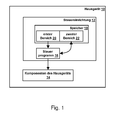
- Fig. 1 schematically shows a domestic appliance 10, in which a control device 12, and components of the domestic appliance 14 are arranged.
- the control device 12 is designed to control or regulate the components of the domestic appliance 14 by executing a control program 16.
- the control program 16 accesses a memory 18, which comprises a first memory area 20, to which exclusively read access is possible, and a second memory area 22, to which read and write access is possible.
- the normal state of the home appliance 10 is the inactive sleep state (step S10). From this state, the user can, by manual operation, put the domestic appliance into operation (step S12). After startup, it decides whether to execute an external flash program (step S14) or whether to perform the normal operation whose first step is to read an initialization program (step S16).
- Execution of the external flash program by operating a PC coupled to the controller 12 is performed to write the security-critical data including the initialization program and a data model of the home appliance into the first storage area 20. If the data model is to be updated during normal operation of the domestic appliance by the control program 16, which corresponds to a partial overwriting of the data model, corresponding parts of the data model are written into the second storage area 22. Further, the control program 16 is written in the second memory area. Thereafter, the operation of the home appliance is ended (step S18), and the home appliance enters the sleep state (step S10).
- the first steps are "read initialization program” (step S16) and “execute initialization program” (step S20).
- the initialization program step S20
- the block addresses of the blocks corresponding to the first memory area 20 are read from the first memory area 20, which in the initial state possibly consists of only one block. With the reading of the block addresses mentioned, the first memory area is thus uniquely determined, wherein a change in this definition is possible only by a renewed execution of the external flash program (step S14).
- writing data to the second memory area 22, for example overwriting the control program 16 stored there is possible when executing the initialization program.
- step S22 In the normal operation of the home appliance 10, the controller 12 then executes the steps "read control program” (step S22) and "execute control program” (step S24). In executing the control program 16 (step S24), operation data measured by sensors are measured and related to the data model of the home appliance 10. Based on this, control of the domestic appliance 10 takes place. Finally, after the end of the control program 10, the user can end the operation of the home appliance 10 by manual operation (step S18), after which the home appliance 10 returns to the idle state (step S10).
Landscapes
- Physics & Mathematics (AREA)
- General Physics & Mathematics (AREA)
- Engineering & Computer Science (AREA)
- Automation & Control Theory (AREA)
- Stored Programmes (AREA)
Abstract
Description
- Die Erfindung betrifft ein Hausgerät nach dem Oberbegriff von Patentanspruch 1 sowie ein Verfahren zum Betreiben eines Hausgeräts.
- Moderne Hausgeräte können einen hohen Funktionsumfang haben, wobei das Zusammenspiel zwischen elektromechanischen Bauteilen und Steuerungselektronik außerordentlich vielschichtig sein kann. Es ist wohl bekannt, dass mit zunehmender Komplexität eines Produkts auch die Wahrscheinlichkeit für Fehlfunktionen und Fehlbedienung steigt. Typischerweise umfasst die Steuerungselektronik eines Hausgeräts persistente, wiederbeschreibbare Speicherelemente, die als EEPROM- oder Flash-Bausteine realisiert sind. Die zum Betrieb des Hausgeräts notwendige Software, als auch weitere Daten, beispielsweise während des Betriebs ermittelte Daten, werden in diese Bausteine gespeichert.
- Aus der
DE 103 40 627 A1 ist eine Sende-/Empfangs-Einrichtung bekannt, wobei ein Hausgeräte-Steuerprogramm von der Sende-/Empfangs-Einrichtung zu einer externen Steuer-Vorrichtung übertragen wird und mittels dieser eine Steuerung des Hausgeräts erfolgt. Ferner ist im Gerät mindestens ein Sensor zur Erfassung von Zustandsinformation über das Gerät vorgesehen, wobei die erfassten Sensordaten an die externe Steuer-Vorrichtung übertragen werden. Das Steuerprogramm und die Sensordaten werden in entsprechende Speicher abgelegt. - Als nachteilig an diesem Hausgerät ist anzusehen, dass die Steuereinrichtung eine hohe Komplexität aufweist und, dass die Betriebssicherheit der Steuereinrichtung infolge fehlerhaften Überschreibens von Speicherinhalten gefährdet sein kann.
- Der Erfindung liegt daher die Aufgabe zugrunde, ein Hausgerät zu schaffen, welches bezüglich Betriebssicherheit dem Stand der Technik überlegen ist und bezüglich der Steuereinrichtung einfacher aufgebaut ist.
- Diese Aufgabe wird erfindungsgemäß durch ein Hausgerät mit den Merkmalen gemäß Patentanspruch 1 und durch ein Verfahren gemäß Anspruch 7 gelöst.
- Vorteilhafte Ausführungsformen der Erfindung mit zweckmäßigen Weiterbildungen sind in den Unteransprüchen angegeben.
- Das erfindungsgemäße Hausgerät umfasst somit eine Steuereinrichtung und einen Speicher mit zumindest einem ersten Speicherbereich und einem zweiten Speicherbereich, wobei der Zugriff auf den ersten Speicherbereich ausschließlich lesend und der Zugriff auf den zweiten Speicherbereich lesend und schreibend ist. Bei Inbetriebnahme des Hausgeräts liest die Steuereinrichtung aus einem der beiden Speicherbereiche ein Initialisierungsprogramm und führt es anschließend aus, wobei die Steuereinrichtung während des Betriebs dessen Komponenten steuert. Das Initialisierungsprogramm umfasst eine Information über mindestens eine Blockadresse des ersten Speicherbereichs, wodurch festgelegt ist, dass der Zugriff auf den mit der Blockadresse korrespondierenden Block ausschließlich lesend ist. Die einzulesenden Blockadressen definieren praktisch denjenigen Speicherbereich, der im normalen Betrieb des Hausgeräts ausschließlich lesbar ist, d.h. weder überschrieben noch gelöscht werden darf. Somit kann der erste Speicherbereich sicherheitskritische Daten enthalten, die den Betrieb des Hausgeräts gewährleisten. Aufgrund des geschilderten Speicherzugriffs durch das im Allgemeinen als Bootloader realisierte Initialisierungsprogramm wird verhindert, dass ein versehentliches Löschen oder Überschreiben sicherheitskritischer Daten den Betrieb des Hausgeräts beeinträchtigen. Dies stellt einen erheblichen Beitrag zu einem stabilen, sicheren Betrieb des Hausgeräts dar.
- Die Steuereinrichtung umfasst ein mit dem ersten der beiden Speicherbereiche gekoppeltes Datenmodell des Hausgeräts, sowie Mittel zum Durchführen von Messungen von Betriebsdaten des Hausgeräts. Hierbei besteht ein Zusammenhang zwischen gemessenen Betriebsdaten und dem Datenmodell und durch diesen Zusammenhang sind die Komponenten des Hausgeräts mittels der Steuereinrichtung steuerbar oder regelbar. Diese Mittel sind vorzugsweise Sensoren, die an diversen Komponenten des Hausgeräts angeordnet sind um beispielsweise Wassertemperatur, Wasserdurchfluss, Umdrehungsgeschwindigkeit der Wäschetrommel und elektrische Leitfähigkeit des Wassers zu messen. Die Messdaten stehen der Steuereinrichtung zur Verfügung.
- Das Datenmodell umfasst eine Vielzahl von Daten, die das Hausgerät technisch beschreiben oder, die es kennzeichnen. Zu den letzteren gehören die Informationen zur Identität des Hausgeräts, umfassend Fertigungsdatum, Baureihe und Fertigungsort. Damit lässt sich das Gerät und sein Herstellungsprozess präzise identifizieren. Dies erleichtert in erheblichem Masse die Wartungs- und Reparaturarbeiten, sowie einen damit verbundenen effizienten Zugriff auf passende Ersatzteile. Das Datenmodell umfasst zugleich ein multivariates, lineares oder nichtlineares Modell als Ausdruck der Relation zwischen den Betriebsdaten, und/oder ein Look-Up-Table für die Toleranzen der Betriebsdaten. Damit ist ein Bezug zwischen gemessenen Betriebsdaten und unter optimalen Bedingungen ermittelten bzw. simulierten Betriebsdaten herstellbar. Dadurch ist eine Diagnose des aktiven Betriebszustands und darauf basierend eine effiziente Steuerung und erhöhte Betriebssicherheit des Hausgeräts möglich.
- Das Hausgerät weist einen koppelbaren Speicherbaustein auf, wobei der Zugriff auf diesen Speicherbaustein ausschließlich lesend ist. Der Speicherbaustein ist, zum Auslesen von Initialisierungs- oder Identitätsinformationen, durch Bedienen eines Schalters an die Steuereinrichtung koppelbar. Der Schalter ist mittels sogenannten "Jumpern" realisierbar. Der Vorteil eines hardwaremäßigen Speicherschutzes als Alternative zur Software-Option mittels Initialisierungsprogramm liegt in der Festlegung des Schutzbereichs bereits im Fertigungsprozess und der damit verbundenenen zusätzlichen Sicherheit. Der hardwaremäßige Speicherschutz kann auch in Ergänzung zur Software-Option als weitere, zusätzliche Sicherheit hinzugenommen werden.
- In einer vorteilhaften Ausführung der Erfindung ist der Speicher ein Flash-Speicher. Die Kosten dafür sind erheblich niedriger als die eines EPROMs, bei nahezu gleichem Funktionsumfang.
- Eine Umsetzung des Initialisierungsprogramms als Bootloader ist besonders vorteilhaft für ein Programm, das bei Inbetriebnahme des Hausgeräts, bzw. der damit verbundenen Steuereinrichtung, von dieser lesbar und ausführbar ist. Eine alternative Umsetzung ist die, als Treiber.
- Das erfindungsgemäße Betreiben eines eine Steuereinrichtung und einen Speicher mit zumindest einem ersten Speicherbereich und einem zweiten Speicherbereich umfassenden Hausgeräts erfolgt derart, dass die Steuereinrichtung auf einen ersten Speicherbereich ausschließlich lesend und auf einen zweiten Speicherbereich lesend und schreibend zugreift. Bei Inbetriebnahme des Hausgeräts liest die Steuereinrichtung ein Initialisierungsprogramm aus einem der beiden Speicherbereiche ein und führt es anschließend aus, wobei ein Steuern der Komponenten des Hausgeräts während des Betriebs eingeschlossen ist. Das Initialisierungsprogramm umfasst eine Information über mindestens eine Blockadresse des ersten Speicherbereichs, wodurch festgelegt ist, dass auf den mit der Blockadresse korrespondierenden Block ausschließlich lesend zugegriffen wird. Die Vorteile des erfindungsgemäßen Verfahrens entsprechen denen der genannten Vorrichtung.
- Für das Betreiben des Hausgeräts ist ein Datenmodell erforderlich. Dieses umfasst technische Modelldaten des Hausgeräts, die das Steuerprogramm mit realen, im praktischen Einsatz gemessenen Betriebsdaten, vergleicht. Die Messungen werden, mit Mitteln zum Durchführen von Messungen von Betriebsdaten, vorzugsweise mit Sensoren, unter Anweisung des Steuerprogramms, durch das Hausgerät selbsttätig ausgeführt. Der Vergleich von gemessenen mit Soll-Daten stellt die Grundlage für eine Steuerung bzw. Regelung des Hausgeräts dar. Vornehmlich wird die unscharfe, sogenannte "fuzzy" Logik, und selbstlernende Systeme, beispielsweise neuronale Netze, eingesetzt. Auch eine Aktualisierung von Teilen des Datenmodels durch die Einbeziehung von Messdaten findet statt. Vorteilhafterweise ist durch Einsatz des Datenmodells eine umfassende Prüfung des Hausgerätezustands im laufenden Betrieb möglich, woraus eine verbesserte Betriebssicherheit resultiert.
- Das Beschreiben des ersten Speicherbereichs, auf den die Steuereinrichtung nur lesend zugreift, findet außerhalb des Normalbetriebs nur durch ein externes Flashwerkzeug statt. Dieses greift lesend und schreibend auf alle Speicherbereiche zu. Typischerweise ist ein solches Flashwerkzeug durch ein auf einem an die Steuereinrichtung gekoppelten PC laufendes Flash-Programm, realisiert.
- Das Betreiben des Hausgeräts umfasst grundsätzlich ein Schreiben der für den Betrieb benötigten Daten und Programme mittels des externen Flashwerkzeugs in den Speicher einerseits, sowie ein Lesen aus dem Speicher und Ausführen von Programmen andererseits. Somit werden folgende Schritte ausgeführt:
- a) Einschalten des Hausgeräts,
- b) einer der folgenden Schritte b1) und b2):
- b1) Schreiben des Datenmodells und/oder des Initialisierungsprogramms mittels des externen Flashwerkzeugs in den ersten Speicherbereich und/oder Schreiben des Steuerprogramms mittels des externen Flashwerkzeugs in den zweiten Speicherbereich, oder
- b2) Lesen und Ausführen des Initialisierungsprogramms durch die Steuereinrichtung und/oder Lesen und Ausführen des Steuerprogramms durch die Steuereinrichtung,
- c) Abschalten des Hausgeräts.
- Die Erfindung stellt somit eine effiziente Möglichkeit dar, die Betriebssicherheit eines Hausgeräts zu verbessern. Die kompakte Realisierung der Steuereinrichtung durch onboard- Ausführen der zum Betrieb nötigen Programme hat auch eine verbesserte Wirtschaftlichkeit zur Folge.
- Nachfolgend wird eine bevorzugte Ausführungsform der Erfindung unter Bezug auf die Zeichnungen beschrieben, in denen
- Fig. 1
- ein Schaubild der Komponenten eines erfindungsgemäßen Hausgeräts mit Signalfluss zeigt, und
- Fig. 2
- ein Ablaufdiagramm des erfindungsgemäßen Verfahrens zum Betreiben des Hausgeräts zeigt.
-
Fig. 1 zeigt schematisch ein Hausgerät 10, in dem eine Steuereinrichtung 12, sowie Komponenten des Hausgeräts 14 angeordnet sind. Die Steuereinrichtung 12 ist dazu ausgelegt, durch Ausführen eines Steuerprogramms 16 die Komponenten des Hausgeräts 14 zu steuern bzw. zu regeln. Das Steuerprogramm 16 greift auf einen Speicher 18 zu, der einen ersten Speicherbereich 20, auf den ausschließlich lesender Zugriff möglich ist, und einem zweiten Speicherbereich 22 umfasst, auf den lesender und schreibender Zugriff möglich ist. - Im Folgenden wird das erfindungsgemäße Verfahren unter Bezug auf
Fig. 2 als Funktionsweise der Komponenten im erfindungsgemäßen Hausgerät nachFig. 1 beschrieben. - Der Normalzustand des Hausgeräts 10 ist der inaktive Ruhezustand (Schritt S10). Aus diesem Zustand heraus kann der Nutzer, durch manuelle Bedienung, das Hausgerät in Betrieb nehmen (Schritt S12). Nach Inbetriebnahme entscheidet er, ob er ein externes Flashprogramm (Schritt S14), oder ob er den normalen Betrieb ausführen will, dessen erster Schritt darin besteht, ein Initialisierungsprogramm zu lesen (Schritt S16).
- Das Ausführen des externen Flashprogramms, durch Bedienen eines mit der Steuereinrichtung 12 gekoppelten PCs, wird durchgeführt, um die sicherheitskritischen Daten, umfassend das Initialisierungsprogramm und ein Datenmodell des Hausgeräts, in den ersten Speicherbereich 20 zu schreiben. Sofern das Datenmodell im Normalbetrieb des Hausgeräts durch das Steuerprogramm 16 zu aktualisieren ist, was einem partiellen Überschreibens des Datenmodells entspricht, werden entsprechende Teile des Datenmodells in den zweiten Speicherbereich 22 geschrieben. Ferner wird das Steuerprogramm 16 in den zweiten Speicherbereich geschrieben. Anschließend wird der Betrieb des Hausgeräts beendet (Schritt S18) und das Hausgerät geht in den Ruhezustand (Schritt S10) über.
- Im Normalbetrieb des Hausgeräts 10 sind die ersten Schritte "Initialisierungsprogramm lesen" (Schritt S16) und "Initialisierungsprogramm ausführen" (Schritt S20). Beim Ausführen des Initialisierungsprogramms (Schritt S20) werden aus dem ersten Speicherbereich 20, der im Initialzustand aus gegebenenfalls nur einem Block besteht, die Blockadressen der mit dem ersten Speicherbereich 20 korrespondierenden Blöcke eingelesen. Mit dem Einlesen der genannten Blockadressen wird somit der erste Speicherbereich eindeutig festgelegt, wobei eine Änderung dieser Festlegung nur durch ein erneutes Ausführen des externen Flashprogramms (Schritt S14) möglich ist. Im Normalbetrieb des Hausgeräts 10 ist eine Änderung dieser Festlegung, bzw. ein Überschreiben oder Löschen der im ersten Speicherbereich 20 gespeicherten Daten nicht möglich. Hingegen ein Schreiben von Daten in den zweiten Speicherbereich 22, beispielsweise ein Überschreiben des dort gespeicherten Steuerprogramms 16, ist beim Ausführen des Initialisierungsprogramms möglich.
- Im Normalbetrieb des Hausgeräts 10 führt die Steuereinrichtung 12 anschließend die Schritte "Steuerprogramm lesen" (Schritt S22) und "Steuerprogramm ausführen" (Schritt S24) aus. Beim Ausführen des Steuerprogramms 16 (Schritt S24) werden durch Sensoren gemessene Betriebsdaten gemessen und mit dem Datenmodell des Hausgeräts 10 in Bezug gesetzt. Darauf basierend findet eine Steuerung bzw. Regelung des Hausgeräts 10 statt. Schließlich kann der Nutzer, nach dem Ende des Steuerprogramms 10, durch manuelle Bedienung den Betrieb des Hausgeräts 10 beenden (Schritt S18), wonach das Hausgerät 10 in den Ruhezustand (Schritt S10) zurückkehrt.
Claims (10)
- Hausgerät (10) mit• einem Speicher (18), der zumindest einen ersten Speicherbereich (20) und einen zweiten Speicherbereich (22) umfasst, wobei der Zugriff auf den ersten Speicherbereich (20) ausschließlich lesend ist, der Zugriff auf den zweiten Speicherbereich (22) lesend und schreibend ist, und• einer Steuereinrichtung (12), die bei Inbetriebnahme des Hausgeräts (10) aus einem der beiden Speicherbereiche (20 oder 22) ein Initialisierungsprogramm liest und anschließend ausführt, wobei die Steuereinrichtung (12) während des Betriebs dessen Komponenten (14) steuert, und wobei• das Initialisierungsprogramm eine Information über mindestens eine Blockadresse des ersten Speicherbereichs (20) umfasst, wodurch festgelegt ist, dass der Zugriff auf den mit der Blockadresse korrespondierenden Block ausschließlich lesend ist.
- Hausgerät (10) nach Anspruch 1,
gekennzeichnet dadurch, dass
die Steuereinrichtung (12) ein mit dem ersten der beiden Speicherbereiche (20) gekoppeltes Datenmodell des Hausgeräts (10), sowie Mittel zum Durchführen von Messungen von Betriebsdaten des Hausgeräts (10) umfasst, wobei ein Zusammenhang zwischen gemessenen Betriebsdaten und dem Datenmodell besteht und durch diesen Zusammenhang die Komponenten des Hausgeräts (10) mittels der Steuereinrichtung (12) steuerbar oder regelbar sind. - Hausgerät (10) nach Anspruch 1 oder 2,
gekennzeichnet dadurch, dass
das Datenmodell• Informationen zur Identität des Hausgeräts (10), umfassend Fertigungsdatum, Baureihe und Fertigungsort,• ein multivariates, lineares oder nichtlineares Modell als Ausdruck der Relation zwischen den Betriebsdaten, und/oder• ein Look-Up-Table für die Toleranzen der Betriebsdaten umfasst. - Hausgerät (10) nach einem der vorhergehenden Ansprüche,
gekennzeichnet dadurch, dass
das Hausgerät (10) einen koppelbaren Speicherbaustein aufweist, wobei der Zugriff auf diesen Speicherbaustein ausschließlich lesend ist und der Speicherbaustein durch Bedienen eines Schalters an die Steuereinrichtung (12), zum Auslesen von Initialisierungs- oder Identitätsinformationen, koppelbar ist. - Hausgerät (10) nach einem der vorhergehenden Ansprüche,
gekennzeichnet dadurch, dass
der Speicher (18) ein Flash-Speicher ist. - Hausgerät (10) nach einem der vorhergehenden Ansprüche,
gekennzeichnet dadurch, dass
das Initialisierungsprogramm ein Bootloader oder Treiber ist. - Verfahren zum Betreiben eines Hausgeräts (10), wobei das Hausgerät (10) eine Steuereinrichtung (12) und einen Speicher (18) mit zumindest einem ersten Speicherbereich (20) und einem zweiten Speicherbereich (22) umfasst, und wobei folgende Schritte ausgeführt werden:a) auf einen ersten Speicherbereich (20) ausschließlich lesendes Zugreifen und auf einen zweiten Speicherbereich (22) lesendes und schreibendes Zugreifen undb) bei Inbetriebnahme des Hausgeräts (10) Lesen eines Initialisierungsprogramms aus einem der beiden Speicherbereiche (20 oder 22) und anschließendes Ausführen des Initialisierungsprogramms, einschließlich Steuern der Komponenten des Hausgeräts (14) während des Betriebs, wobei das Initialisierungsprogramm eine Information über mindestens eine Blockadresse des ersten Speicherbereichs (20) umfasst, wodurch festgelegt ist, dass auf den mit der Blockadresse korrespondierenden Block ausschließlich lesend zugegriffen wird.
- Verfahren nach Anspruch 7, wobei das Hausgerät (10) ein Datenmodell und Mittel zum Durchführen von Messungen von Betriebsdaten des Hausgeräts (10) nach Anspruch 2 umfasst, wobei• die Steuereinrichtung (12) aus einem der zumindest zwei Speicherbereiche (20 oder 22) ein Steuerprogramm (16) einliest und anschließend ausführt, und• das Steuerprogramm (16) einen Vergleich von gemessenen Daten mit Modelldaten und damit ein Steuern des Hausgeräts (10) ausführt.
- Verfahren nach Anspruch 7, wobei ein externes Flashwerkzeug lesend und schreibend auf den ersten (20) und/oder den zweiten Speicherbereich (22) zugreift.
- Verfahren nach einem der Ansprüche 7 oder 9, wobei folgende Schritte ausgeführt werden:a) Einschalten des Hausgeräts (10),b) einer der folgenden Schritte b1) und b2):b1) Schreiben des Datenmodells und/oder des Initialisierungsprogramms mittels des externen Flashwerkzeugs in den ersten Speicherbereich (20) und/oder Schreiben des Steuerprogramms (16) mittels des externen Flashwerkzeugs in den zweiten Speicherbereich (22), oderb2) Lesen und Ausführen des Initialisierungsprogramms durch die Steuereinrichtung (12) und/oder Lesen und Ausführen des Steuerprogramms (16) durch die Steuereinrichtung (12),undc) Abschalten des Hausgeräts (10).
Applications Claiming Priority (1)
| Application Number | Priority Date | Filing Date | Title |
|---|---|---|---|
| DE102007037879A DE102007037879A1 (de) | 2007-08-10 | 2007-08-10 | Hausgerät und Verfahren zum Betreiben eines Hausgeräts |
Publications (3)
| Publication Number | Publication Date |
|---|---|
| EP2026149A2 true EP2026149A2 (de) | 2009-02-18 |
| EP2026149A3 EP2026149A3 (de) | 2012-05-30 |
| EP2026149B1 EP2026149B1 (de) | 2013-06-12 |
Family
ID=40134747
Family Applications (1)
| Application Number | Title | Priority Date | Filing Date |
|---|---|---|---|
| EP20080104969 Active EP2026149B1 (de) | 2007-08-10 | 2008-08-06 | Hausgerät und Verfahren zum Betreiben eines Hausgeräts |
Country Status (3)
| Country | Link |
|---|---|
| EP (1) | EP2026149B1 (de) |
| DE (1) | DE102007037879A1 (de) |
| ES (1) | ES2415679T3 (de) |
Citations (1)
| Publication number | Priority date | Publication date | Assignee | Title |
|---|---|---|---|---|
| DE10340627A1 (de) | 2003-09-03 | 2005-04-07 | Infineon Technologies Ag | Steuerbare Hausgeräte-Anordnung und/oder steuerbare Industriegeräte-Anordnung und Steuersystem zum Steuern einer Hausgeräte-Anordnung und/oder Industriegeräte-Anordnung |
Family Cites Families (12)
| Publication number | Priority date | Publication date | Assignee | Title |
|---|---|---|---|---|
| ATE149704T1 (de) * | 1992-08-27 | 1997-03-15 | Siemens Ag | Steuergerät, insbesondere für die kraftfahrzeugtechnik |
| DE59207631D1 (de) * | 1992-09-17 | 1997-01-16 | Siemens Ag | Steuergerät, insbesondere zur Verwendung in einem Kraftfahrzeug |
| DE4425388B4 (de) * | 1994-07-19 | 2005-07-21 | Robert Bosch Gmbh | Steuergerät |
| DE19525100C2 (de) * | 1995-06-29 | 2001-10-18 | Abb Patent Gmbh | Verfahren zur On-Board-Programmierung eines elektrisch programmierbaren Nur-Lese-Speichers |
| DE19634341A1 (de) * | 1996-08-24 | 1998-02-26 | Bosch Gmbh Robert | Verfahren zum Schutz von speicherprogrammierten Steuerungen vor einem Überschreiben |
| EP1108984B1 (de) * | 1999-10-18 | 2019-08-14 | Endress + Hauser Flowtec AG | Programmierbares Feldgerät |
| EP1276033B1 (de) * | 2001-07-10 | 2012-03-14 | Trident Microsystems (Far East) Ltd. | Speichereinrichtung mit Datenschutz in einem Prozessor |
| DE10146611A1 (de) * | 2001-09-21 | 2003-04-10 | Abb Patent Gmbh | Busteilnehmergerät und Verfahren zur Änderung, Erweiterung und Fehlerkorrektur von blockweise gespeicherten Daten in einem Mikrocontroller eines Busteilnehmers |
| DE10255540A1 (de) * | 2002-11-28 | 2004-06-24 | Abb Patent Gmbh | Verfahren zur Aktualisierung des Betriebssystems einer Mikrorechnerschaltung |
| DE102004061891A1 (de) * | 2004-12-22 | 2006-09-21 | BSH Bosch und Siemens Hausgeräte GmbH | Verfahren und Schaltungsanordnung zur Ausführung von Initialisierungs- bzw. Registrierungsvorgängen für ein Gerät, insbesondere ein Hausgerät |
| DE102005018910A1 (de) * | 2005-04-22 | 2006-10-26 | Endress + Hauser Gmbh + Co. Kg | Verfahren zum Aufrüsten eines mikroprozessorgesteuerten Geräts mit neuem Softwarecode über ein Kommunikationsnetzwerk |
| DE102005059319A1 (de) * | 2005-12-09 | 2007-06-14 | Robert Bosch Gmbh | Verfahren zum Betreiben einer Einrichtung |
-
2007
- 2007-08-10 DE DE102007037879A patent/DE102007037879A1/de not_active Withdrawn
-
2008
- 2008-08-06 EP EP20080104969 patent/EP2026149B1/de active Active
- 2008-08-06 ES ES08104969T patent/ES2415679T3/es active Active
Patent Citations (1)
| Publication number | Priority date | Publication date | Assignee | Title |
|---|---|---|---|---|
| DE10340627A1 (de) | 2003-09-03 | 2005-04-07 | Infineon Technologies Ag | Steuerbare Hausgeräte-Anordnung und/oder steuerbare Industriegeräte-Anordnung und Steuersystem zum Steuern einer Hausgeräte-Anordnung und/oder Industriegeräte-Anordnung |
Also Published As
| Publication number | Publication date |
|---|---|
| EP2026149A3 (de) | 2012-05-30 |
| EP2026149B1 (de) | 2013-06-12 |
| DE102007037879A1 (de) | 2009-02-12 |
| ES2415679T3 (es) | 2013-07-26 |
Similar Documents
| Publication | Publication Date | Title |
|---|---|---|
| DE10212064B4 (de) | Betriebssteuerung für eine Handwerkzeugmaschine | |
| EP1108984B1 (de) | Programmierbares Feldgerät | |
| DE4004097A1 (de) | Bedienung und ueberwachung von haushaltsgeraeten | |
| DE10115729B4 (de) | Vielseitiges Boot-Verfahren für eine Anwendungs-Software eines Mikrocontrollers | |
| DE69831985T2 (de) | Mikrocomputer mit Flash-EEPROM | |
| EP1818819A1 (de) | Verfahren zum Organisieren der Software eines Fluidmanagementsystems | |
| EP0788291A2 (de) | Verfahren zur Bestimmung und zur Anzeige der Restzeit eines Behandlungsprogramms in einem Haushaltgerät | |
| DE102005032075B4 (de) | Verfahren zum Datenabgleich aus einem und für einen Antriebsregler einer Maschine | |
| EP2026149B1 (de) | Hausgerät und Verfahren zum Betreiben eines Hausgeräts | |
| DE4140804C1 (de) | Steuereinrichtung für Heizvorrichtungen | |
| WO2017089150A1 (de) | Sicherheitssteuerungseinrichtung und verfahren zur änderung eines funktionsumfangs einer sicherheitssteuerungseinrichtung | |
| DE102008023873A1 (de) | Verfahren zum Betrieb eines Antriebssystems | |
| EP2702196B1 (de) | Hausgerät mit nachträglich abänderbarem, technischem programm sowie zugehöriges verfahren und computerprogrammprodukt | |
| DE102010039942B4 (de) | Verfahren zur Herstellung eines Haushaltsgerätes und Haushaltsgerät | |
| EP1870787B1 (de) | Verfahren zur Überwachung eines zyklischen Steuerungsprogramms | |
| EP1566711B1 (de) | Rechnergesteuertes Haushaltsgerät | |
| DE10143142A1 (de) | Verfahren zum Betreiben einer Schaltungsanordnung, die einen Mikrocontroller und ein EEPROM enthält | |
| DE102013002085A1 (de) | SPS-Funktionsbausteine für Energieverwaltungsfunktionalitäten | |
| DE112006002699T5 (de) | Waschmaschine und Steuerungsverfahren für diese | |
| DE102010049671B4 (de) | Verfahren zum Steuern von Komponenten eines Automationssystems | |
| WO2017157528A1 (de) | Elektrogerät, insbesondere wechselrichter oder umrichter, und verfahren zum betreiben eines elektrogeräts | |
| DE10312694B4 (de) | Gerätesteuerung | |
| DE10234922A1 (de) | Eingabevorrichtung und Verfahren zur Eingabe einer Information in eine Steuereinheit | |
| DE102024100257A1 (de) | Gargerät mit einem Garraum und Verfahren zum Betrieb eines Gargeräts mit einem Garraum | |
| DE102017007816A1 (de) | Elektrogerät mit Spracherkennung und Verfahren zum Betreiben eines Elektrogeräts mit Spracherkennung |
Legal Events
| Date | Code | Title | Description |
|---|---|---|---|
| PUAI | Public reference made under article 153(3) epc to a published international application that has entered the european phase |
Free format text: ORIGINAL CODE: 0009012 |
|
| AK | Designated contracting states |
Kind code of ref document: A2 Designated state(s): AT BE BG CH CY CZ DE DK EE ES FI FR GB GR HR HU IE IS IT LI LT LU LV MC MT NL NO PL PT RO SE SI SK TR |
|
| AX | Request for extension of the european patent |
Extension state: AL BA MK RS |
|
| PUAL | Search report despatched |
Free format text: ORIGINAL CODE: 0009013 |
|
| RIC1 | Information provided on ipc code assigned before grant |
Ipc: G05B 19/042 20060101AFI20120420BHEP |
|
| AK | Designated contracting states |
Kind code of ref document: A3 Designated state(s): AT BE BG CH CY CZ DE DK EE ES FI FR GB GR HR HU IE IS IT LI LT LU LV MC MT NL NO PL PT RO SE SI SK TR |
|
| AX | Request for extension of the european patent |
Extension state: AL BA MK RS |
|
| 17P | Request for examination filed |
Effective date: 20121130 |
|
| GRAP | Despatch of communication of intention to grant a patent |
Free format text: ORIGINAL CODE: EPIDOSNIGR1 |
|
| AKX | Designation fees paid |
Designated state(s): AT BE BG CH CY CZ DE DK EE ES FI FR GB GR HR HU IE IS IT LI LT LU LV MC MT NL NO PL PT RO SE SI SK TR |
|
| GRAS | Grant fee paid |
Free format text: ORIGINAL CODE: EPIDOSNIGR3 |
|
| GRAA | (expected) grant |
Free format text: ORIGINAL CODE: 0009210 |
|
| AK | Designated contracting states |
Kind code of ref document: B1 Designated state(s): AT BE BG CH CY CZ DE DK EE ES FI FR GB GR HR HU IE IS IT LI LT LU LV MC MT NL NO PL PT RO SE SI SK TR |
|
| REG | Reference to a national code |
Ref country code: GB Ref legal event code: FG4D Free format text: NOT ENGLISH |
|
| REG | Reference to a national code |
Ref country code: CH Ref legal event code: EP |
|
| REG | Reference to a national code |
Ref country code: AT Ref legal event code: REF Ref document number: 616905 Country of ref document: AT Kind code of ref document: T Effective date: 20130615 |
|
| REG | Reference to a national code |
Ref country code: IE Ref legal event code: FG4D Free format text: LANGUAGE OF EP DOCUMENT: GERMAN |
|
| REG | Reference to a national code |
Ref country code: ES Ref legal event code: FG2A Ref document number: 2415679 Country of ref document: ES Kind code of ref document: T3 Effective date: 20130726 |
|
| REG | Reference to a national code |
Ref country code: DE Ref legal event code: R096 Ref document number: 502008010103 Country of ref document: DE Effective date: 20130808 |
|
| PG25 | Lapsed in a contracting state [announced via postgrant information from national office to epo] |
Ref country code: NO Free format text: LAPSE BECAUSE OF FAILURE TO SUBMIT A TRANSLATION OF THE DESCRIPTION OR TO PAY THE FEE WITHIN THE PRESCRIBED TIME-LIMIT Effective date: 20130912 Ref country code: SI Free format text: LAPSE BECAUSE OF FAILURE TO SUBMIT A TRANSLATION OF THE DESCRIPTION OR TO PAY THE FEE WITHIN THE PRESCRIBED TIME-LIMIT Effective date: 20130612 Ref country code: SE Free format text: LAPSE BECAUSE OF FAILURE TO SUBMIT A TRANSLATION OF THE DESCRIPTION OR TO PAY THE FEE WITHIN THE PRESCRIBED TIME-LIMIT Effective date: 20130612 Ref country code: FI Free format text: LAPSE BECAUSE OF FAILURE TO SUBMIT A TRANSLATION OF THE DESCRIPTION OR TO PAY THE FEE WITHIN THE PRESCRIBED TIME-LIMIT Effective date: 20130612 Ref country code: GR Free format text: LAPSE BECAUSE OF FAILURE TO SUBMIT A TRANSLATION OF THE DESCRIPTION OR TO PAY THE FEE WITHIN THE PRESCRIBED TIME-LIMIT Effective date: 20130913 Ref country code: LT Free format text: LAPSE BECAUSE OF FAILURE TO SUBMIT A TRANSLATION OF THE DESCRIPTION OR TO PAY THE FEE WITHIN THE PRESCRIBED TIME-LIMIT Effective date: 20130612 |
|
| REG | Reference to a national code |
Ref country code: NL Ref legal event code: VDEP Effective date: 20130612 |
|
| REG | Reference to a national code |
Ref country code: LT Ref legal event code: MG4D |
|
| PG25 | Lapsed in a contracting state [announced via postgrant information from national office to epo] |
Ref country code: BG Free format text: LAPSE BECAUSE OF FAILURE TO SUBMIT A TRANSLATION OF THE DESCRIPTION OR TO PAY THE FEE WITHIN THE PRESCRIBED TIME-LIMIT Effective date: 20130912 Ref country code: HR Free format text: LAPSE BECAUSE OF FAILURE TO SUBMIT A TRANSLATION OF THE DESCRIPTION OR TO PAY THE FEE WITHIN THE PRESCRIBED TIME-LIMIT Effective date: 20130612 |
|
| PG25 | Lapsed in a contracting state [announced via postgrant information from national office to epo] |
Ref country code: LV Free format text: LAPSE BECAUSE OF FAILURE TO SUBMIT A TRANSLATION OF THE DESCRIPTION OR TO PAY THE FEE WITHIN THE PRESCRIBED TIME-LIMIT Effective date: 20130612 |
|
| PG25 | Lapsed in a contracting state [announced via postgrant information from national office to epo] |
Ref country code: SK Free format text: LAPSE BECAUSE OF FAILURE TO SUBMIT A TRANSLATION OF THE DESCRIPTION OR TO PAY THE FEE WITHIN THE PRESCRIBED TIME-LIMIT Effective date: 20130612 Ref country code: IS Free format text: LAPSE BECAUSE OF FAILURE TO SUBMIT A TRANSLATION OF THE DESCRIPTION OR TO PAY THE FEE WITHIN THE PRESCRIBED TIME-LIMIT Effective date: 20131012 Ref country code: CZ Free format text: LAPSE BECAUSE OF FAILURE TO SUBMIT A TRANSLATION OF THE DESCRIPTION OR TO PAY THE FEE WITHIN THE PRESCRIBED TIME-LIMIT Effective date: 20130612 Ref country code: EE Free format text: LAPSE BECAUSE OF FAILURE TO SUBMIT A TRANSLATION OF THE DESCRIPTION OR TO PAY THE FEE WITHIN THE PRESCRIBED TIME-LIMIT Effective date: 20130612 Ref country code: PT Free format text: LAPSE BECAUSE OF FAILURE TO SUBMIT A TRANSLATION OF THE DESCRIPTION OR TO PAY THE FEE WITHIN THE PRESCRIBED TIME-LIMIT Effective date: 20131014 |
|
| BERE | Be: lapsed |
Owner name: BSH BOSCH UND SIEMENS HAUSGERATE G.M.B.H. Effective date: 20130831 |
|
| PG25 | Lapsed in a contracting state [announced via postgrant information from national office to epo] |
Ref country code: PL Free format text: LAPSE BECAUSE OF FAILURE TO SUBMIT A TRANSLATION OF THE DESCRIPTION OR TO PAY THE FEE WITHIN THE PRESCRIBED TIME-LIMIT Effective date: 20130612 Ref country code: NL Free format text: LAPSE BECAUSE OF FAILURE TO SUBMIT A TRANSLATION OF THE DESCRIPTION OR TO PAY THE FEE WITHIN THE PRESCRIBED TIME-LIMIT Effective date: 20130612 Ref country code: RO Free format text: LAPSE BECAUSE OF FAILURE TO SUBMIT A TRANSLATION OF THE DESCRIPTION OR TO PAY THE FEE WITHIN THE PRESCRIBED TIME-LIMIT Effective date: 20130612 |
|
| REG | Reference to a national code |
Ref country code: CH Ref legal event code: PL |
|
| PLBE | No opposition filed within time limit |
Free format text: ORIGINAL CODE: 0009261 |
|
| STAA | Information on the status of an ep patent application or granted ep patent |
Free format text: STATUS: NO OPPOSITION FILED WITHIN TIME LIMIT |
|
| PG25 | Lapsed in a contracting state [announced via postgrant information from national office to epo] |
Ref country code: DK Free format text: LAPSE BECAUSE OF FAILURE TO SUBMIT A TRANSLATION OF THE DESCRIPTION OR TO PAY THE FEE WITHIN THE PRESCRIBED TIME-LIMIT Effective date: 20130612 Ref country code: CH Free format text: LAPSE BECAUSE OF NON-PAYMENT OF DUE FEES Effective date: 20130831 Ref country code: LI Free format text: LAPSE BECAUSE OF NON-PAYMENT OF DUE FEES Effective date: 20130831 Ref country code: MC Free format text: LAPSE BECAUSE OF FAILURE TO SUBMIT A TRANSLATION OF THE DESCRIPTION OR TO PAY THE FEE WITHIN THE PRESCRIBED TIME-LIMIT Effective date: 20130612 |
|
| 26N | No opposition filed |
Effective date: 20140313 |
|
| REG | Reference to a national code |
Ref country code: IE Ref legal event code: MM4A |
|
| PG25 | Lapsed in a contracting state [announced via postgrant information from national office to epo] |
Ref country code: BE Free format text: LAPSE BECAUSE OF NON-PAYMENT OF DUE FEES Effective date: 20130831 |
|
| REG | Reference to a national code |
Ref country code: DE Ref legal event code: R097 Ref document number: 502008010103 Country of ref document: DE Effective date: 20140313 |
|
| PG25 | Lapsed in a contracting state [announced via postgrant information from national office to epo] |
Ref country code: IE Free format text: LAPSE BECAUSE OF NON-PAYMENT OF DUE FEES Effective date: 20130806 |
|
| REG | Reference to a national code |
Ref country code: AT Ref legal event code: MM01 Ref document number: 616905 Country of ref document: AT Kind code of ref document: T Effective date: 20130806 |
|
| PG25 | Lapsed in a contracting state [announced via postgrant information from national office to epo] |
Ref country code: AT Free format text: LAPSE BECAUSE OF NON-PAYMENT OF DUE FEES Effective date: 20130806 |
|
| REG | Reference to a national code |
Ref country code: DE Ref legal event code: R081 Ref document number: 502008010103 Country of ref document: DE Owner name: BSH HAUSGERAETE GMBH, DE Free format text: FORMER OWNER: BSH BOSCH UND SIEMENS HAUSGERAETE GMBH, 81739 MUENCHEN, DE Effective date: 20150408 |
|
| REG | Reference to a national code |
Ref country code: ES Ref legal event code: PC2A Owner name: BSH HAUSGERATE GMBH Effective date: 20150529 |
|
| PG25 | Lapsed in a contracting state [announced via postgrant information from national office to epo] |
Ref country code: CY Free format text: LAPSE BECAUSE OF FAILURE TO SUBMIT A TRANSLATION OF THE DESCRIPTION OR TO PAY THE FEE WITHIN THE PRESCRIBED TIME-LIMIT Effective date: 20130612 Ref country code: MT Free format text: LAPSE BECAUSE OF FAILURE TO SUBMIT A TRANSLATION OF THE DESCRIPTION OR TO PAY THE FEE WITHIN THE PRESCRIBED TIME-LIMIT Effective date: 20130612 |
|
| PG25 | Lapsed in a contracting state [announced via postgrant information from national office to epo] |
Ref country code: LU Free format text: LAPSE BECAUSE OF NON-PAYMENT OF DUE FEES Effective date: 20130806 Ref country code: HU Free format text: LAPSE BECAUSE OF FAILURE TO SUBMIT A TRANSLATION OF THE DESCRIPTION OR TO PAY THE FEE WITHIN THE PRESCRIBED TIME-LIMIT; INVALID AB INITIO Effective date: 20080806 |
|
| REG | Reference to a national code |
Ref country code: FR Ref legal event code: PLFP Year of fee payment: 8 |
|
| REG | Reference to a national code |
Ref country code: FR Ref legal event code: CD Owner name: BSH HAUSGERATE GMBH, DE Effective date: 20151022 |
|
| REG | Reference to a national code |
Ref country code: FR Ref legal event code: PLFP Year of fee payment: 9 |
|
| REG | Reference to a national code |
Ref country code: FR Ref legal event code: PLFP Year of fee payment: 10 |
|
| REG | Reference to a national code |
Ref country code: FR Ref legal event code: PLFP Year of fee payment: 11 |
|
| PGFP | Annual fee paid to national office [announced via postgrant information from national office to epo] |
Ref country code: ES Payment date: 20250917 Year of fee payment: 18 |
|
| PGFP | Annual fee paid to national office [announced via postgrant information from national office to epo] |
Ref country code: DE Payment date: 20250831 Year of fee payment: 18 |
|
| PGFP | Annual fee paid to national office [announced via postgrant information from national office to epo] |
Ref country code: TR Payment date: 20250731 Year of fee payment: 18 Ref country code: IT Payment date: 20250829 Year of fee payment: 18 |
|
| PGFP | Annual fee paid to national office [announced via postgrant information from national office to epo] |
Ref country code: GB Payment date: 20250818 Year of fee payment: 18 |
|
| PGFP | Annual fee paid to national office [announced via postgrant information from national office to epo] |
Ref country code: FR Payment date: 20250827 Year of fee payment: 18 |