EP2020282B1 - Moldings of fiber-reinforced thermoplastic resin - Google Patents
Moldings of fiber-reinforced thermoplastic resin Download PDFInfo
- Publication number
- EP2020282B1 EP2020282B1 EP20070744010 EP07744010A EP2020282B1 EP 2020282 B1 EP2020282 B1 EP 2020282B1 EP 20070744010 EP20070744010 EP 20070744010 EP 07744010 A EP07744010 A EP 07744010A EP 2020282 B1 EP2020282 B1 EP 2020282B1
- Authority
- EP
- European Patent Office
- Prior art keywords
- fiber
- resin
- molded article
- thermoplastic resin
- weight
- Prior art date
- Legal status (The legal status is an assumption and is not a legal conclusion. Google has not performed a legal analysis and makes no representation as to the accuracy of the status listed.)
- Active
Links
Classifications
-
- B—PERFORMING OPERATIONS; TRANSPORTING
- B29—WORKING OF PLASTICS; WORKING OF SUBSTANCES IN A PLASTIC STATE IN GENERAL
- B29C—SHAPING OR JOINING OF PLASTICS; SHAPING OF MATERIAL IN A PLASTIC STATE, NOT OTHERWISE PROVIDED FOR; AFTER-TREATMENT OF THE SHAPED PRODUCTS, e.g. REPAIRING
- B29C45/00—Injection moulding, i.e. forcing the required volume of moulding material through a nozzle into a closed mould; Apparatus therefor
- B29C45/0005—Injection moulding, i.e. forcing the required volume of moulding material through a nozzle into a closed mould; Apparatus therefor using fibre reinforcements
-
- B—PERFORMING OPERATIONS; TRANSPORTING
- B29—WORKING OF PLASTICS; WORKING OF SUBSTANCES IN A PLASTIC STATE IN GENERAL
- B29B—PREPARATION OR PRETREATMENT OF THE MATERIAL TO BE SHAPED; MAKING GRANULES OR PREFORMS; RECOVERY OF PLASTICS OR OTHER CONSTITUENTS OF WASTE MATERIAL CONTAINING PLASTICS
- B29B7/00—Mixing; Kneading
- B29B7/30—Mixing; Kneading continuous, with mechanical mixing or kneading devices
- B29B7/34—Mixing; Kneading continuous, with mechanical mixing or kneading devices with movable mixing or kneading devices
- B29B7/38—Mixing; Kneading continuous, with mechanical mixing or kneading devices with movable mixing or kneading devices rotary
- B29B7/46—Mixing; Kneading continuous, with mechanical mixing or kneading devices with movable mixing or kneading devices rotary with more than one shaft
- B29B7/48—Mixing; Kneading continuous, with mechanical mixing or kneading devices with movable mixing or kneading devices rotary with more than one shaft with intermeshing devices, e.g. screws
-
- B—PERFORMING OPERATIONS; TRANSPORTING
- B29—WORKING OF PLASTICS; WORKING OF SUBSTANCES IN A PLASTIC STATE IN GENERAL
- B29B—PREPARATION OR PRETREATMENT OF THE MATERIAL TO BE SHAPED; MAKING GRANULES OR PREFORMS; RECOVERY OF PLASTICS OR OTHER CONSTITUENTS OF WASTE MATERIAL CONTAINING PLASTICS
- B29B7/00—Mixing; Kneading
- B29B7/30—Mixing; Kneading continuous, with mechanical mixing or kneading devices
- B29B7/58—Component parts, details or accessories; Auxiliary operations
- B29B7/72—Measuring, controlling or regulating
-
- B—PERFORMING OPERATIONS; TRANSPORTING
- B29—WORKING OF PLASTICS; WORKING OF SUBSTANCES IN A PLASTIC STATE IN GENERAL
- B29B—PREPARATION OR PRETREATMENT OF THE MATERIAL TO BE SHAPED; MAKING GRANULES OR PREFORMS; RECOVERY OF PLASTICS OR OTHER CONSTITUENTS OF WASTE MATERIAL CONTAINING PLASTICS
- B29B7/00—Mixing; Kneading
- B29B7/80—Component parts, details or accessories; Auxiliary operations
- B29B7/82—Heating or cooling
-
- B—PERFORMING OPERATIONS; TRANSPORTING
- B29—WORKING OF PLASTICS; WORKING OF SUBSTANCES IN A PLASTIC STATE IN GENERAL
- B29B—PREPARATION OR PRETREATMENT OF THE MATERIAL TO BE SHAPED; MAKING GRANULES OR PREFORMS; RECOVERY OF PLASTICS OR OTHER CONSTITUENTS OF WASTE MATERIAL CONTAINING PLASTICS
- B29B7/00—Mixing; Kneading
- B29B7/80—Component parts, details or accessories; Auxiliary operations
- B29B7/88—Adding charges, i.e. additives
- B29B7/90—Fillers or reinforcements, e.g. fibres
-
- B—PERFORMING OPERATIONS; TRANSPORTING
- B29—WORKING OF PLASTICS; WORKING OF SUBSTANCES IN A PLASTIC STATE IN GENERAL
- B29B—PREPARATION OR PRETREATMENT OF THE MATERIAL TO BE SHAPED; MAKING GRANULES OR PREFORMS; RECOVERY OF PLASTICS OR OTHER CONSTITUENTS OF WASTE MATERIAL CONTAINING PLASTICS
- B29B9/00—Making granules
- B29B9/02—Making granules by dividing preformed material
- B29B9/06—Making granules by dividing preformed material in the form of filamentary material, e.g. combined with extrusion
-
- B—PERFORMING OPERATIONS; TRANSPORTING
- B29—WORKING OF PLASTICS; WORKING OF SUBSTANCES IN A PLASTIC STATE IN GENERAL
- B29B—PREPARATION OR PRETREATMENT OF THE MATERIAL TO BE SHAPED; MAKING GRANULES OR PREFORMS; RECOVERY OF PLASTICS OR OTHER CONSTITUENTS OF WASTE MATERIAL CONTAINING PLASTICS
- B29B9/00—Making granules
- B29B9/12—Making granules characterised by structure or composition
-
- B—PERFORMING OPERATIONS; TRANSPORTING
- B29—WORKING OF PLASTICS; WORKING OF SUBSTANCES IN A PLASTIC STATE IN GENERAL
- B29B—PREPARATION OR PRETREATMENT OF THE MATERIAL TO BE SHAPED; MAKING GRANULES OR PREFORMS; RECOVERY OF PLASTICS OR OTHER CONSTITUENTS OF WASTE MATERIAL CONTAINING PLASTICS
- B29B9/00—Making granules
- B29B9/12—Making granules characterised by structure or composition
- B29B9/14—Making granules characterised by structure or composition fibre-reinforced
-
- B—PERFORMING OPERATIONS; TRANSPORTING
- B29—WORKING OF PLASTICS; WORKING OF SUBSTANCES IN A PLASTIC STATE IN GENERAL
- B29C—SHAPING OR JOINING OF PLASTICS; SHAPING OF MATERIAL IN A PLASTIC STATE, NOT OTHERWISE PROVIDED FOR; AFTER-TREATMENT OF THE SHAPED PRODUCTS, e.g. REPAIRING
- B29C48/00—Extrusion moulding, i.e. expressing the moulding material through a die or nozzle which imparts the desired form; Apparatus therefor
- B29C48/022—Extrusion moulding, i.e. expressing the moulding material through a die or nozzle which imparts the desired form; Apparatus therefor characterised by the choice of material
-
- B—PERFORMING OPERATIONS; TRANSPORTING
- B29—WORKING OF PLASTICS; WORKING OF SUBSTANCES IN A PLASTIC STATE IN GENERAL
- B29C—SHAPING OR JOINING OF PLASTICS; SHAPING OF MATERIAL IN A PLASTIC STATE, NOT OTHERWISE PROVIDED FOR; AFTER-TREATMENT OF THE SHAPED PRODUCTS, e.g. REPAIRING
- B29C70/00—Shaping composites, i.e. plastics material comprising reinforcements, fillers or preformed parts, e.g. inserts
- B29C70/04—Shaping composites, i.e. plastics material comprising reinforcements, fillers or preformed parts, e.g. inserts comprising reinforcements only, e.g. self-reinforcing plastics
- B29C70/06—Fibrous reinforcements only
- B29C70/10—Fibrous reinforcements only characterised by the structure of fibrous reinforcements, e.g. hollow fibres
- B29C70/12—Fibrous reinforcements only characterised by the structure of fibrous reinforcements, e.g. hollow fibres using fibres of short length, e.g. in the form of a mat
-
- C—CHEMISTRY; METALLURGY
- C08—ORGANIC MACROMOLECULAR COMPOUNDS; THEIR PREPARATION OR CHEMICAL WORKING-UP; COMPOSITIONS BASED THEREON
- C08J—WORKING-UP; GENERAL PROCESSES OF COMPOUNDING; AFTER-TREATMENT NOT COVERED BY SUBCLASSES C08B, C08C, C08F, C08G or C08H
- C08J5/00—Manufacture of articles or shaped materials containing macromolecular substances
- C08J5/04—Reinforcing macromolecular compounds with loose or coherent fibrous material
-
- C—CHEMISTRY; METALLURGY
- C08—ORGANIC MACROMOLECULAR COMPOUNDS; THEIR PREPARATION OR CHEMICAL WORKING-UP; COMPOSITIONS BASED THEREON
- C08J—WORKING-UP; GENERAL PROCESSES OF COMPOUNDING; AFTER-TREATMENT NOT COVERED BY SUBCLASSES C08B, C08C, C08F, C08G or C08H
- C08J5/00—Manufacture of articles or shaped materials containing macromolecular substances
- C08J5/04—Reinforcing macromolecular compounds with loose or coherent fibrous material
- C08J5/046—Reinforcing macromolecular compounds with loose or coherent fibrous material with synthetic macromolecular fibrous material
-
- C—CHEMISTRY; METALLURGY
- C08—ORGANIC MACROMOLECULAR COMPOUNDS; THEIR PREPARATION OR CHEMICAL WORKING-UP; COMPOSITIONS BASED THEREON
- C08K—Use of inorganic or non-macromolecular organic substances as compounding ingredients
- C08K7/00—Use of ingredients characterised by shape
- C08K7/02—Fibres or whiskers
-
- B—PERFORMING OPERATIONS; TRANSPORTING
- B29—WORKING OF PLASTICS; WORKING OF SUBSTANCES IN A PLASTIC STATE IN GENERAL
- B29C—SHAPING OR JOINING OF PLASTICS; SHAPING OF MATERIAL IN A PLASTIC STATE, NOT OTHERWISE PROVIDED FOR; AFTER-TREATMENT OF THE SHAPED PRODUCTS, e.g. REPAIRING
- B29C48/00—Extrusion moulding, i.e. expressing the moulding material through a die or nozzle which imparts the desired form; Apparatus therefor
- B29C48/03—Extrusion moulding, i.e. expressing the moulding material through a die or nozzle which imparts the desired form; Apparatus therefor characterised by the shape of the extruded material at extrusion
-
- B—PERFORMING OPERATIONS; TRANSPORTING
- B29—WORKING OF PLASTICS; WORKING OF SUBSTANCES IN A PLASTIC STATE IN GENERAL
- B29K—INDEXING SCHEME ASSOCIATED WITH SUBCLASSES B29B, B29C OR B29D, RELATING TO MOULDING MATERIALS OR TO MATERIALS FOR MOULDS, REINFORCEMENTS, FILLERS OR PREFORMED PARTS, e.g. INSERTS
- B29K2067/00—Use of polyesters or derivatives thereof, as moulding material
-
- B—PERFORMING OPERATIONS; TRANSPORTING
- B29—WORKING OF PLASTICS; WORKING OF SUBSTANCES IN A PLASTIC STATE IN GENERAL
- B29K—INDEXING SCHEME ASSOCIATED WITH SUBCLASSES B29B, B29C OR B29D, RELATING TO MOULDING MATERIALS OR TO MATERIALS FOR MOULDS, REINFORCEMENTS, FILLERS OR PREFORMED PARTS, e.g. INSERTS
- B29K2067/00—Use of polyesters or derivatives thereof, as moulding material
- B29K2067/006—PBT, i.e. polybutylene terephthalate
-
- B—PERFORMING OPERATIONS; TRANSPORTING
- B29—WORKING OF PLASTICS; WORKING OF SUBSTANCES IN A PLASTIC STATE IN GENERAL
- B29K—INDEXING SCHEME ASSOCIATED WITH SUBCLASSES B29B, B29C OR B29D, RELATING TO MOULDING MATERIALS OR TO MATERIALS FOR MOULDS, REINFORCEMENTS, FILLERS OR PREFORMED PARTS, e.g. INSERTS
- B29K2077/00—Use of PA, i.e. polyamides, e.g. polyesteramides or derivatives thereof, as moulding material
-
- B—PERFORMING OPERATIONS; TRANSPORTING
- B29—WORKING OF PLASTICS; WORKING OF SUBSTANCES IN A PLASTIC STATE IN GENERAL
- B29K—INDEXING SCHEME ASSOCIATED WITH SUBCLASSES B29B, B29C OR B29D, RELATING TO MOULDING MATERIALS OR TO MATERIALS FOR MOULDS, REINFORCEMENTS, FILLERS OR PREFORMED PARTS, e.g. INSERTS
- B29K2105/00—Condition, form or state of moulded material or of the material to be shaped
- B29K2105/06—Condition, form or state of moulded material or of the material to be shaped containing reinforcements, fillers or inserts
-
- B—PERFORMING OPERATIONS; TRANSPORTING
- B29—WORKING OF PLASTICS; WORKING OF SUBSTANCES IN A PLASTIC STATE IN GENERAL
- B29K—INDEXING SCHEME ASSOCIATED WITH SUBCLASSES B29B, B29C OR B29D, RELATING TO MOULDING MATERIALS OR TO MATERIALS FOR MOULDS, REINFORCEMENTS, FILLERS OR PREFORMED PARTS, e.g. INSERTS
- B29K2105/00—Condition, form or state of moulded material or of the material to be shaped
- B29K2105/06—Condition, form or state of moulded material or of the material to be shaped containing reinforcements, fillers or inserts
- B29K2105/08—Condition, form or state of moulded material or of the material to be shaped containing reinforcements, fillers or inserts of continuous length, e.g. cords, rovings, mats, fabrics, strands or yarns
-
- C—CHEMISTRY; METALLURGY
- C08—ORGANIC MACROMOLECULAR COMPOUNDS; THEIR PREPARATION OR CHEMICAL WORKING-UP; COMPOSITIONS BASED THEREON
- C08J—WORKING-UP; GENERAL PROCESSES OF COMPOUNDING; AFTER-TREATMENT NOT COVERED BY SUBCLASSES C08B, C08C, C08F, C08G or C08H
- C08J2367/00—Characterised by the use of polyesters obtained by reactions forming a carboxylic ester link in the main chain; Derivatives of such polymers
- C08J2367/02—Polyesters derived from dicarboxylic acids and dihydroxy compounds
-
- C—CHEMISTRY; METALLURGY
- C08—ORGANIC MACROMOLECULAR COMPOUNDS; THEIR PREPARATION OR CHEMICAL WORKING-UP; COMPOSITIONS BASED THEREON
- C08J—WORKING-UP; GENERAL PROCESSES OF COMPOUNDING; AFTER-TREATMENT NOT COVERED BY SUBCLASSES C08B, C08C, C08F, C08G or C08H
- C08J2377/00—Characterised by the use of polyamides obtained by reactions forming a carboxylic amide link in the main chain; Derivatives of such polymers
-
- Y—GENERAL TAGGING OF NEW TECHNOLOGICAL DEVELOPMENTS; GENERAL TAGGING OF CROSS-SECTIONAL TECHNOLOGIES SPANNING OVER SEVERAL SECTIONS OF THE IPC; TECHNICAL SUBJECTS COVERED BY FORMER USPC CROSS-REFERENCE ART COLLECTIONS [XRACs] AND DIGESTS
- Y10—TECHNICAL SUBJECTS COVERED BY FORMER USPC
- Y10T—TECHNICAL SUBJECTS COVERED BY FORMER US CLASSIFICATION
- Y10T428/00—Stock material or miscellaneous articles
- Y10T428/249921—Web or sheet containing structurally defined element or component
- Y10T428/249922—Embodying intertwined or helical component[s]
-
- Y—GENERAL TAGGING OF NEW TECHNOLOGICAL DEVELOPMENTS; GENERAL TAGGING OF CROSS-SECTIONAL TECHNOLOGIES SPANNING OVER SEVERAL SECTIONS OF THE IPC; TECHNICAL SUBJECTS COVERED BY FORMER USPC CROSS-REFERENCE ART COLLECTIONS [XRACs] AND DIGESTS
- Y10—TECHNICAL SUBJECTS COVERED BY FORMER USPC
- Y10T—TECHNICAL SUBJECTS COVERED BY FORMER US CLASSIFICATION
- Y10T428/00—Stock material or miscellaneous articles
- Y10T428/249921—Web or sheet containing structurally defined element or component
- Y10T428/249924—Noninterengaged fiber-containing paper-free web or sheet which is not of specified porosity
- Y10T428/24994—Fiber embedded in or on the surface of a polymeric matrix
-
- Y—GENERAL TAGGING OF NEW TECHNOLOGICAL DEVELOPMENTS; GENERAL TAGGING OF CROSS-SECTIONAL TECHNOLOGIES SPANNING OVER SEVERAL SECTIONS OF THE IPC; TECHNICAL SUBJECTS COVERED BY FORMER USPC CROSS-REFERENCE ART COLLECTIONS [XRACs] AND DIGESTS
- Y10—TECHNICAL SUBJECTS COVERED BY FORMER USPC
- Y10T—TECHNICAL SUBJECTS COVERED BY FORMER US CLASSIFICATION
- Y10T428/00—Stock material or miscellaneous articles
- Y10T428/249921—Web or sheet containing structurally defined element or component
- Y10T428/249924—Noninterengaged fiber-containing paper-free web or sheet which is not of specified porosity
- Y10T428/24994—Fiber embedded in or on the surface of a polymeric matrix
- Y10T428/249942—Fibers are aligned substantially parallel
- Y10T428/249946—Glass fiber
Definitions
- the present invention relates to a fiber-reinforced thermoplastic resin molded article, and more precisely, to a fiber-reinforced thermoplastic resin molded article excellent in mechanical strength, heat resistance, warpage resistance and surface appearance, which contains reinforcing fibers having a flattened cross-sectional profile and in which the fiber length distribution of the reinforcing fibers is shifted on the side of long fibers.
- thermoplastic resin molded article containing reinforcing fibers such as typically glass fibers or carbon fibers is excellent in mechanical strength, heat resistance and chemical resistance, and is utilized as parts in the field of automobiles, in the field of electric and electronic appliances and in the field of precision machines.
- such parts are much down-sized and thinned, and are further required to have increased mechanical strength and dimensional stability; and at the same time, for the molding materials to be used for them, it is required to develop materials capable of satisfying the above-mentioned necessary properties.
- the parts to be used in the engine room are required to have sufficient mechanical strength even at high temperatures of 100°C or more, and resin materials have come to be used for the exterior panels and the structural components for supporting them.
- Patent Reference 1 discloses a long fiber-reinforced polyamide resin composition and a molded article produced by injection-molding the resin composition, which are excellent in mechanical strength and moldability and which comprises (A) a polyamide resin, (B) a fibrous reinforcing material having a length of at least 3 mm in an amount of from 5 to 80 % by weight (of the composition), and (C) a fatty acid metal salt having from 22 to 32 carbon atoms in an amount of from 0.01 to 3 % by weight (of the composition).
- the fibrous reinforcing material used in the resin compositions described in Patent References 1 and 2 have a circular cross section because of the easiness in their production, and in case where-the fibrous reinforcing material having such a cross-sectional profile is used, even though it may improve the mechanical strength of articles, the fibrous reinforcing material is often ground into powder during injection-molding and the fiber length of the reinforcing material remaining in the molded articles may be shortened, thereby bringing about some problems in that the reinforcing effect of the reinforcing material is lowered, and the molded.
- the fiber length of the fibrous reinforcing material dispersed in the injection-molded article is defined to be at least 1 mm in terms of the weight-average fiber length thereof, but no description is given therein relating to a method of measuring the weight-average fiber length and to the length of the fibers in the articles really formed therein.
- Patent Reference 3 describes an invention of approximating the relation between the profile of the fiber length distribution in a long fiber reinforcing material-containing resin molded article, and the moldability and the physical properties of the molded article in accordance with two-parameter Weibull distribution, saying that, when the distribution profile is gentle and tailed from the short side to the long side of the fiber length, then the moldability and the physical properties of the molded article can be well balanced.
- Patent Reference 4 discloses an exterior molded article of a long fiber-reinforced thermoplastic resin whose anisotropy to be caused by the fiber orientation occurring in injection-molding is reduced, wherein the content of the reinforcing fibers dispersing in the molded article is from 30 % by weight to 90 % by weight, the weight-average fiber length is from 1.
- the maximum projected area of the molded article is at least 20000 mm 2
- the flow path length of a narrow flow path having a cross section of at most 100 mm 2 in molding is at most 150 mm
- the maximum linear expansion coefficient of the part of the molded article having a wall thickness of at least 2 mm is at most 5 ⁇ 10 -5 K -1
- the ratio of (maximum linear expansion coefficient)/(minimum linear expansion coefficient) is at most 1.8.
- the reinforcing material used in these techniques has an ordinary circular cross-sectional profile, and the techniques are not still satisfactory in point of the moldability and the impact strength with the fibrous reinforcing material having a long fiber length, the outward appearance of the molded articles, and the dimensional stability thereof free from molding shrinkage and warpage.
- Patent Reference 5 shows that, when the cross-sectional profile of glass fibers, as typical reinforcing fibers, is flattened, then the specific surface area thereof increases as compared with that of glass fibers having a circular cross section and the adhesiveness thereof to a matrix resin composition therefore increases, and when the fiber length in the molded article is prolonged (the average fiber length of the fibers having a circular cross-sectional profile is 0.47 mm, while the average fiber length of the fibers having a cocoon-molded cross-sectional profile is 0.57 mm), then the mechanical strength of the molded article is enhanced.
- the resin composition described in Patent Reference 5 may be effective for enhancing the tensile strength and the surface smoothness and for preventing the warpage, as compared with the resin composition containing glass fibers having a circular cross section, but is not still satisfactory; and in particular, when a polyamide resin is used as the thermoplastic resin, then the impact strength of the molded article often lowers to the same degree as that in the case where glass fibers having a circular cross section are used.
- Patent Reference 6 discloses a method of prolonging the fiber length of the flattened glass fibers so as to solve the problems discussed in Patent Reference 5. Concretely, this describes provision of flattened glass fibers-containing thermoplastic resin pellets, in which a plurality of flattened glass fiber filaments having a flattened cross section are aligned in one direction so that both ends thereof may reach the pellet surface. Patent Reference 6 has a description relating to the length of the fibers remaining in the molded article, but is silent at all on the overall fiber length distribution and on the relationship between the fiber length distribution and the physical properties of the molded article.
- the impact strength of the molded article could be enhanced in some degree; however, since the length of the glass fibers remaining in the molded article is not sufficiently long (in the examples, the length is at most 0.49 mm), the technique could not still satisfactorily solve the problems of mechanical strength depression, strength retentiveness in high-temperature atmospheres, and dimensional change owing to resin shrinkage and warpage.
- the invention has been made in consideration of the above-mentioned situation, and its object is to provide a fiber-reinforced thermoplastic resin molded article excellent in mechanical strength, heat resistance, dimensional accuracy such as warpage resistance, and surface appearance.
- the present inventors have assiduously studied to solve the above-mentioned problems and, as a result, have found that, when reinforcing fibers having a flattened cross-sectional profile are used, and at the same time, when the fiber length of the reinforcing fibers remaining in a molded article is kept long, concretely, when the weight-average fiber length of the reinforcing fibers is at least 1 mm, then not only the mechanical strength but also surprisingly the heat resistance, the dimensional accuracy and the surface appearance of the molded article can be all enhanced, and have reached the present invention.
- the subject matter of the invention resides in a fiber-reinforced thermoplastic resin molded article of a thermoplastic resin composition
- a thermoplastic resin composition comprising from 70 to 35 % by weight of a thermoplastic resin (A), and from 30 to 65 % by weight of reinforcing fibers (B) of which the cross section is flattened to have a degree of flatness, as expressed by the formula mentioned below, of from 2.3 to 5 (hereinafter referred to as "flattened reinforcing fibers”), wherein the weight-average fiber length of the reinforcing fibers in the molded article is from 1 mm to 10 mm.
- the object of the invention is attained by the following:
- thermoplastic resin molded article excellent not only in mechanical strength but also in heat resistance, dimensional accuracy and surface appearance.
- the resin molded article fully satisfies the requirements for weight reduction, thickness reduction, as well as improvement of dimensional accuracy and outward appearance, and is therefore utilizable for various applications of parts in the field of automobiles, in the field of electric and electronic appliances and in the field of precision machines; and the industrial value of the invention is remarkable.
- the numerical range expressed by the wording "a number to another number” means the range that falls between the former number indicating the lowermost limit of the range and the latter number indicating the uppermost limit thereof.
- the polyamide resin for use in the invention is a thermofusible polyamide polymer having an acid amide group (-CONH-) in the molecule.
- it includes various polyamide resins such as lactam polycondensates, polycondensates of a diamine compound and a dicarboxylic acid compound, ⁇ -aminocarboxylic acid polycondensates, and their copolymerized polyamide resins and blends, etc., as long as it contains at least 20% by weight of MX nylon.
- lactam for polycondensation to give polyamide resins includes, for example, ⁇ -caprolactam, ⁇ -laurolactam, etc.
- the diamine compound includes, for example, aliphatic, alicyclic or aromatic diamine compounds such as tetramethylenediamine, pentamethylenediamine, hexamethylenediamine, octamethylenediamine, undecamethylenediamine, dodecamethylenediamine, 2-methylpentamethylenediamine, (2,2,4- or 2,4,4-)trimethylhexamethylenediamine, 5-methylnonane-methylenediamine, metaxylylenediamine (MXDA), paraxylylenediamine, 1,3-bis(aminomethyl)cyclohexane, 1,4-bis(aminomethyl)cyclohexane, 1-amino-3-aminomethyl-3,5,5-trimethylcyclohexane, bis(4-aminocyclohexyl)methane, bis(3-methyl-9-aminocyclohexyl)methane, 2,2-bis(4-aminocyclohexyl)
- the dicarboxylic acid compound includes, for example, aliphatic, alicyclic or aromatic dicarboxylic acids such as adipic acid, suberic acid, azelaic acid, sebacic acid, dodecane diacid, terephthalic acid, isophthalic acid, 2-chloroterephthalic acid, 2-methylterephthalic acid, 5-methylisophthalic acid, 5-sodium sulfoisophthalic acid, hexahydroterephthalic acid, hexahydroisophthalic acid, etc.
- aliphatic, alicyclic or aromatic dicarboxylic acids such as adipic acid, suberic acid, azelaic acid, sebacic acid, dodecane diacid, terephthalic acid, isophthalic acid, 2-chloroterephthalic acid, 2-methylterephthalic acid, 5-methylisophthalic acid, 5-sodium sulfoisophthalic acid, hexahydr
- the ⁇ -aminocarboxylic acid includes, for example, 6-aminocaproic acid, 11-aminoundecanoic acid, 12-aminododecanoic acid, paraaminomethylbenzoic acid, etc.
- polyamide resins to be produced through polycondensation of any of these starting materials include polyamide 4, polyamide 6, polyamide 11, polyamide 12, polyamide 46, polyamide 56, polyamide 66, polyamide 610, polyamide 612, polyhexamethylene-terephthalamide (polyamide 6T), polyhexamethylene-isophthalamide (polyamide 6I), polymetaxylylene-adipamide (polyamide MXD6), polymetaxylylene-dodecamide, polyamide 9T, polyamide 9MT, etc.
- these polyamide homopolymers or copolymers may be used singly or as a mixture thereof.
- polyamide resins such as polyamide 6, polyamide 66 or MX nylon, which are widely known as polyamide MXD, are preferred for use herein from the viewpoint of the moldability and the heat resistance thereof. Of those, more preferred is MX nylon from the viewpoint of the heat resistance and the surface appearance of the molded articles.
- the proportion of MX nylon in the polyamide resin is at least 20 % by weight, preferably at least 50 % by weight, more preferably at least 70 % by weight.
- MX nylon a type of polyamide resin used herein is a xylylenediamine-based polyamide resin obtained through polycondensation of an ⁇ , ⁇ -linear aliphatic dicarboxylic acid and a xylylenediamine.
- a polyamide resin obtained through polycondensation of a mixed diamine comprising from 0 to 50 mol% of paraxylylenediamine and from 50 to 100 mol% of metaxylylenediamine, and an ⁇ , ⁇ -linear aliphatic dicarboxylic acid having from 6 to 12 carbon atoms.
- the crystallization speed of the MX nylon is relatively low as compared with that of aliphatic polyamide resins such as polyamide 66, polyamide 6, polyamide 46 and polyamide 9T, and therefore, especially for the purpose of shortening the molding cycle, it is desirable that the MX nylon is combined with an aliphatic polyamide resin.
- the aliphatic polyamide resin to be used for the purpose of shortening the molding cycle includes polyamide resins having a high crystallization speed, such as polyamide 66, polyamide 6 and polyamide 46, and polyamide resins having a high melting point such as polyamide 66/6T, 66/6T/6I, and polyamide 9T; and from the viewpoint of the economical aspect, preferred is polyamide 66 or polyamide 6.
- the proportion of the aliphatic polyamide resin to be combined is preferably at most 60 % by weight of all the polyamide resins. When the proportion of the aliphatic polyamide resin is at most 60 % by weight, then the resin composition may keep good heat resistance.
- ⁇ , ⁇ -linear aliphatic dicarboxylic acid preferred for use herein are ⁇ , ⁇ -linear aliphatic dicarboxylic acids having from 6 to 20 carbon atoms, more preferably from 6 to 12 carbon atoms, for example, adipic acid, sebacic acid, suberic acid, dodecane diacid, eicodionic acid, etc. Of those ⁇ , ⁇ -linear aliphatic dicarboxylic acids, more preferred is adipic acid in consideration of the balance between the moldability and the properties of the molded article.
- xylylenediamine is a metaxylylenediamine or a mixed xylylenediamine of paraxylylenediamine and metaxylylenediamine.
- the molar ratio of metaxylylenediamine to paraxylylenediamine in the mixed xylylenediamine is preferably from 50/50 to 100/0, more preferably from 55/45 to 100/0.
- the proportion of paraxylylenediamine is at most 50 mol%, then it is favorable since the melting point of the polyamide resin may be kept low therefore facilitating polymerization into MX nylon and molding of the MX nylon-containing resin composition.
- the proportion of paraxylylenediamine is at least 10 mol%, then it is favorable since the crystallization speed of the polyamide resin may be high and the amount of the aliphatic polyamide resin to be in the resin composition may be reduced.
- the relative viscosity of the polyamide resin is preferably from 2.0 to 4.0, more preferably from 2.0 to 2.7.
- the relative viscosity means the viscosity measured using 96 % sulfuric acid as a solvent under the condition of a resin concentration of 1 g/100 ml and a temperature of 23°C.
- the terminal amino group concentration in the polyamide resin is preferably from 10 to 140 eq/ton, more preferably from 30 to 100 eq/ton, from the viewpoint of the molecular weight of the polymer.
- the terminal carboxyl group concentration in the polyamide resin is preferably from 10 to 140 eq/ton, more preferably from 30 to 100 eq/ton, from the viewpoint of the molecular weight of the polymer.
- the polyester resin in the invention is preferably a polymer or copolymer obtained through polycondensation of an aromatic dicarboxylic acid or its derivative and an aliphatic glycol.
- One or more polyester resins may be used herein either singly or as combined.
- the aromatic dicarboxylic acid or its derivative includes, for example, terephthalic acid, phthalic acid, isophthalic acid, 2,6-naphthalenedicarboxylic acid, 4,4'-diphenyldicarboxylic acid, 4,4'-diphenylether-dicarboxylic acid, 4,4'-benzophenonedicarboxylic acid, 4,4'-diphenoxyethanedicarboxylic acid, 4,4'-diphenylsulfonedicarboxylic acid, and their alkyl (e.g., having from 1 to 4 carbon atoms) or glycol esters. Above all, more preferred are terephthalic acid and its dialkyl esters; even more preferred are terephthalic acid and its dimethyl ester.
- One or more such aromatic dicarboxylic acids may be used either singly or as combined.
- the aromatic dicarboxylic acid or its derivative may be used, as mixed with a small amount of any other dibasic acid or polybasic acid or their alkyl or glycol ester, or the like.
- an aliphatic dicarboxylic acid such as adipic acid or sebacic acid
- an alicyclic dicarboxylic acid such as 1,2-cyclohexanedicarboxylic- acid, 1,3-cyclohexanedicarboxylic acid or 1,4-cyclohexanedicarboxylic acid
- a polybasic acid such as trimesic acid or trimellitic acid, or their alkyl and glycol esters or the like may be mixed in an amount of at most 20 % by weight of the aromatic dicarboxylic acid or its derivative.
- the aliphatic glycol is preferably a glycol having from 2 to 20 carbon atoms, including ethylene glycol, propylene glycol, tetramethylene glycol, hexamethylene glycol, diethylene glycol, dibutylene glycol, polyethylene glycol, polypropylene glycol, polytetramethylene glycol, etc.
- ethylene glycol propylene glycol
- tetramethylene glycol hexamethylene glycol
- diethylene glycol diethylene glycol
- dibutylene glycol polyethylene glycol
- polypropylene glycol polytetramethylene glycol
- the aliphatic glycol may be used, as mixed with a small amount of any other glycol or polyalcohol or the like.
- an alicyclic glycol such as cyclohexanediol or cyclohexanedimethanol, or an aromatic glycol such as xylylene glycol, 2,2-bis(4-hydroxyphenyl)propane, 2,2-bis(4-hydroxy-3,5-dibromopheny-1)propane, 2,2-bis(4-hydroxyethoxyphenyl)propane or 2,2-bis(4-hydroxyethoxy-3,5-dibromophenyl)propane, or a polyalcohol such as glycerin or pentaerythritol may be mixed in an amount of at most 20 % by weight of the aliphatic glycol.
- the polyester resin for use in the invention may comprise, in addition to the above-mentioned components, a hydroxycarboxylic acid such as lactic acid, glycolic acid, m-hydroxybenzoic acid, p-hydroxybenzoic, acid, 6-hydroxy-2-naphthalenecarboxylic acid or p- ⁇ -hydroxyethoxybenzoic acid, or a monofunctional ingredient such as alkoxycarboxylic acid, stearyl alcohol, benzyl alcohol, stearic acid, benzoic acid, tert-butylbenzoic acid or benzoylbenzoic acid, as a copolymerizing component.
- a hydroxycarboxylic acid such as lactic acid, glycolic acid, m-hydroxybenzoic acid, p-hydroxybenzoic, acid, 6-hydroxy-2-naphthalenecarboxylic acid or p- ⁇ -hydroxyethoxybenzoic acid
- a monofunctional ingredient such as alkoxycarboxylic acid, stearyl alcohol,
- the polyester resin typically includes a polyalkylene terephthalate resin or a copolymer mainly comprising it; and concretely preferred are polyethylene terephthalate resin, polybutylene terephthalate resin and their copolymers excellent in mechanical strength and heat resistance.
- terephthalic acid accounts for at least 50 mol% of all the dicarboxylic acid component, more preferably at least 70 mol%, even more preferably at least 90 mol%.
- ethylene glycol or tetramethylene glycol accounts for at least 50 mol% of all the glycol component, more preferably at least 70 mol%, even more preferably at least 90 mol%.
- Using the polyalkylene terephthalate resin of the type is preferred, as tending to enhance more the mechanical strength and the heat resistance.
- polyester resin in the invention preferred is a polybutylene terephthalate resin, and more preferred is a polybutylene terephthalate resin having a limiting viscosity, as measured in a 1/1 (by weight) mixed solvent of phenol and 1,1,2,2,-tetrachloroethane at a temperature of 30°C, of from 0.3 to 1.2 dl/g.
- a polybutylene terephthalate resin has a limiting viscosity of at least 0.3 dl/g, then it further betters the mechanical properties of the fiber-reinforced polyester resin to be obtained.
- the limiting viscosity is at most 1.2 dl/g, then the flowability of the fiber-reinforced polyester resin may be kept good, and the moldability thereof may be thereby enhanced.
- the reinforcing fibers may be prevented from being bent or broken during the molding process, and therefore the fiber length of the reinforcing fibers in the molded article may be kept long and the mechanical strength of the article may be prevented from being lowered.
- Two or more types of polybutylene terephthalate resins differing in point of the limiting viscosity may be combined to give a mixed polybutylene terephthalate resin for use herein, having a limiting viscosity that falls within the above range.
- the titanium content of the polybutylene terephthalate resin is preferably at most 80 ppm, more preferably at most 60 ppm.
- the titanium content may be controlled by controlling the amount of the titanium compound to be used in producing the polybutylene terephthalate resin.
- the polyester resin also preferably usable herein is a polyethylene terephthalate resin.
- its limiting viscosity is preferably from 0.5 to 0.9 dl/g. Having a limiting viscosity that falls within the range, the resin may have good moldability and may enhance the mechanical strength of the resin composition to be obtained.
- Two or more types of polyethylene terephthalate resins differing in point of the limiting viscosity may be combined to give a mixed polyethylene terephthalate resin for use herein, having a limiting viscosity that falls within the above range.
- employable is any known method.
- a direct polymerization method is, for example, a method of direct esterification of terephthalic acid and tetramethylene glycol, in which water is formed in the initial stage of esterification.
- the interesterification method is, for example, a method of using dimethyl terephthalate as the main starting material, in which an alcohol is formed in the initial stage of interesterification.
- the direct esterification is preferred from the viewpoint of the cost of starting materials.
- a titanium compound is preferably selected.
- the titanium compound is not specifically defined. Concretely, for example, it includes inorganic titanium compounds such as titanium oxide, and titanium tetrachloride; titanium alcoholates such as tetramethyl titanate, tetraisopropyl titanate, and tetrabutyl titanate; and titanium phenolates such as tetraphenyl titanate etc. Of those, preferred are titanium alcoholates; more preferred are tetraalkyl titanates; and even more preferred is tetrabutyl titanate.
- the polymerization catalyst is fed as its solution in water, tetramethylene glycol or the like, and its amount to be fed is preferably at most 80 ppm, in terms of the titanium atom per the theoretical yield of the polybutylene terephthalate resin, more preferably at most 60 ppm.
- the polyester resin may be produced in any method of a batch method or a continuous method.
- the initial-stage esterification or interesterification may be attained in a continuous mode, and the subsequent polycondensation may be attained in a batch operation mode; or contrary to it, the initial-stage esterification or interesterification may be attained in a batch operation mode, and the subsequent polycondensation may be attained in a continuous mode.
- the flattened reinforcing fibers in the invention are a fibrous reinforcing material known as glass fibers, carbon fibers or the like incorporated into plastics mainly for the purpose of improving the mechanical strength thereof, and are characterized in that the cross section of the fiber is not circular like that of conventional ones, but is flattened.
- Examples of flattened reinforcing fibers are shown as cocoon-shaped, oval or ellipse ones of (i), (ro) and (ha), respectively, in Fig. 1 in Patent Reference 5.
- the major diameter is indicated by (a)
- the minor diameter is by (b).
- the degree of flatness of the reinforcing fibers is represented by major diameter (a) /minor diameter (b).
- the degree of flatness of the reinforcing fibers must be from 2.3 to 5, preferably from 3 to 4.5. Having a degree of flatness of at least 2.3, the fibers may effectively prevent the molded articles from warping or shrinking during molding.
- the major diameter (a) and the minor diameter (b) of the reinforcing fibers for computing the degree of flatness thereof are determined by measuring the actual dimension of the cross section of the fiber on a microscopic photograph thereof.
- the area of the cross section of the flattened reinforcing fibers (B) is preferably from 2 ⁇ 10 -5 to 8 ⁇ 10 -3 mm 2 , more preferably from 8 ⁇ 10 -5 to 8 ⁇ 10 -3 mm 2 , even more preferably from 8 ⁇ 10 -5 to 8 ⁇ 10 -4 mm 2 .
- the reinforcing fibers are favorable as they are easily handled in their production or in production of resin composition pellets to be used for molding.
- the contact area between the fibers and a thermoplastic resin may be large and the fibers may exhibit a sufficient reinforcing effect.
- the content of the flattened reinforcing fibers (B) is from 30 to 65 % by weight relative to the total of the component (A) and the component (B) of 100 % by weight, preferably from 35 to 60 % by weight.
- the content of the component (B) is at most 65 % by weight, it is favorable since the flowability of the resin composition in molding may be good, and in addition, since the reinforcing fibers may be prevented from being broken during molding and the fiber length in the molded article may be kept long, and the mechanical strength of the molded article may thereby prevented from lowering.
- the lowermost limit of the content may be basically the same as in a case of using conventional reinforcing fibers having a circular cross-sectional profile; and when the content is at least 20 % by weight, the mechanical strength may be improved.
- the content of the reinforcing fibers is less than 30 % by weight, then the resin flowability in molding is good and therefore almost all the reinforcing fibers may be oriented in the resin flowing direction irrespective of the cross-sectional profile of the fibers; and if so, the flattened reinforcing fibers added to the resin composition could not sufficiently exhibit the effect of enhancing and improving the dimensional accuracy (in point of the degree of molding shrinkage and the anisotropy of the degree of shrinkage), the warpage resistance and the surface appearance of the molded article, and therefore the difference between the reinforcing fibers having a flattened cross-sectional profile and those having a circular cross-sectional profile is not clear.
- the content of the flattened reinforcing fibers (B) is at least 30 % by weight, the characteristics of the reinforcing fibers themselves come to appear remarkably.
- the resin flowability in molding may lower, and further for preventing the reinforcing fibers from being broken and for securing the long reinforcing fiber length, the resin composition is plasticized and injection-molded at a low shear speed, and therefore the orientation of the reinforcing fibers in the resin flow direction may be retarded lower.
- the resin flow may occur in the direction of the major diameter (a) of the fiber cross section in addition to the resin flow in the fiber length direction, and therefore the reinforcing fibers may be readily oriented in the direction parallel to the direction (a).
- the orientation of the type is stronger. Owing to the influence of the fiber orientation, which is characterized in the flattened reinforcing fibers, and which is generally free from ordinary fibers having a circular cross-sectional profile, the flattened reinforcing fibers can exhibit the effect of improving the dimensional accuracy, the warpage resistance and the surface appearance.
- the reinforcing fibers are aligned along the direction of the major diameter (a) and since the fiber length of the reinforcing fibers in the molded article is long, it may be understood that, in the fiber-reinforced thermoplastic resin molded article of the invention, the matrix resin is hardly warped even under heat applied thereto, and therefore the molded article can exhibit better heat resistance.
- the influence of the fiber orientation along the direction of the major diameter (a) is more remarkable when the cross section of the fibers are oval, and therefore, in the invention, preferred are reinforcing fibers having a oval cross section.
- the cross section has a cocoon-like profile or an ellipse profile
- the resin flow in the direction of the major diameter (a) may be retarded by the cocoon grooves or by the ellipse embankment, and a part of the flow tends to run in the fiber length direction, and as a result, the orientation of the reinforcing fibers in the direction (a) hardly occurs and, as compared with that of the oval reinforcing fibers, the effect of the cocoon-like or ellipse reinforcing fibers for improving the dimensional accuracy, the warpage resistance, the heat resistance and the surface appearance of the molded article may be poor in some degree.
- the oval form is meant to indicate a form having parts nearly parallel to the positions that are symmetric relative to the gravity point of the
- the flattened reinforcing fibers (B) are optionally surface-treated with a fiber binder and/or a surface-treating agent before use, from the standpoint of the handlability and the adhesiveness thereto to resin.
- a fiber binder and/or a surface-treating agent for example, usable are ordinary fiber binder and surface-treating agents such as epoxy compounds, isocyanate compounds, silane compounds, and titanate compounds.
- its amount to be adhered is at least 0.05% by weight of the reinforcing fibers.
- the reinforcing fibers may be previously processed for surface treatment or fiber-binding treatment with any of these compounds, or the agent may be added to the resin composition in preparing the resin composition pellets for the resin molded article of the invention.
- the flattened reinforcing fibers (B) of the type may be produced by spinning through a nozzle having a suitable orifice profile such as a oval, cocoon-shaped, ellipse or rectangular slit-like profile, as the bushing for spinning out the fiber melt through it.
- the melt may be spun out through plural nozzles provided near to each other and having any of various cross-sectional profiles (including a circular cross-sectional profile), and the thus-spun melt filaments may be bonded together into a single filament. In that manner, the fibers can also be produced.
- the production techniques are disclosed, for example, in JP-A 7-291649 and 2000-344541 .
- the weight-average fiber length of the reinforcing fibers in the molded article is from 1 to 10 mm, preferably from 1. 5 to 8 mm.
- the, proportion of the reinforcing fibers having a length of at least 1 mm is preferably at least 30 % by weight of all the reinforcing fibers from the viewpoint of the mechanical strength and the strength retentiveness at high temperatures.
- the proportion of the reinforcing fibers having a weight-average fiber length of at least 1 mm in the molded article is more preferably from 33 % by weight to 95 % by weight of all the reinforcing fibers.
- the length of the reinforcing fibers may be measured as follows: About 5 g of is sampled out of the center of the molded article, then ashed in an electric furnace at a temperature of 600°C for 2 hours, and the reinforcing fibers having remained in the sample are analyzed. Not broken, the obtained reinforcing fibers are dispersed in an aqueous solution of a neutral surfactant, and the aqueous dispersion is transferred onto a slide glass with a pipette, and its photographic picture is taken via a microscope. Using an image-analyzing software, from 1000 to 2000 reinforcing fibers on the photographic image are analyzed.
- At least the defined fiber length must be secured at least in the stage of the resin composition pellets to be subjected to injection-molding or extrusion-molding.
- a method for producing the resin composition pellets in which the defined fiber length is secured for example, employable is a method of pressing both sides of a reinforcing fiber mat with a molten resin sheet followed by cutting it with a sheet cutter to give rectangular granules, or a method of coating the surface of reinforcing fiber rovings with a resin to give coated strands in a manner of producing covered cables, followed by cutting them into pellets.
- the kneading condition is so selected that the reinforcing fibers are not broken during kneading.
- a pultrusion method USP 3042570 , JP-A 53-50279 , etc.
- the pultrusion method is a method basically comprising infiltrating a resin into reinforcing fibers while continuous bundles of the reinforcing fibers are drawn, for which are applicable all known techniques disclosed by various patents (roving profiles of reinforcing fibers, preheating method for reinforcing fibers, opening method, method of infiltrating thermoplastic resin into reinforcing fibers, shaping method after resin infiltration, cooling method, cutting method, etc.).
- the size of the long fiber-reinforced pellets is at least 1 mm in terms of the pellet length (that is, the length of the reinforcing fibers), preferably at least 3 mm; and more preferred are columnar pellets having a pellet length of from 3 to 50 mm and a pellet diameter of from 1.5 to 4 mm.
- the molded article of the invention can be produced efficiently and stably, with retarding the bulk density increase, and preventing the occurrence of bridges inside the hopper during molding and preventing a phenomenon of poor engaging with screws.
- the resin composition pellets are produced by melt-kneading
- various extruders Blavender plastographs, laboratory plastomills, kneaders, Banbury mixers, etc.
- thermoplastic resin (A) and optional additives thereto may be premixed with a ribbon blender, a Henschel mixer or the like, or may be put into the melt-kneading machine without being premixed; however, it is desirable that the flattened reinforcing fibers (B) are separately put into the system via the exclusive inlet port provided on the downstream side of the double-screw extruder, and also preferably, the mixing time and the number of screw rotation are so controlled that the reinforcing fibers being mixed could be protected from being broken as much as possible.
- the heating temperature in melt-kneading varies depending on the type of the thermoplastic resin used, but in the invention, it is desirable that the plasticizing temperature of the melting resin is set higher than usual for reducing the pressure of the melting resin in melt-kneading.
- the plasticizing temperature of the melting resin is set higher than usual for reducing the pressure of the melting resin in melt-kneading.
- a polyamide resin or a polyester resin is melt-kneaded
- it is generally plasticized at 220 to 280°C, but preferably in the invention, it is plasticized at a higher temperature than usual, or at 260 to 280°C for the purpose of reducing the pressure of the melting resin in kneading and for preventing the reinforcing fibers being mixed from being broken as much as possible.
- the preferred fiber length of the reinforcing fibers in the resin composition pellets is from 1 to 20 mm, more preferably from 1.5 to 20 mm, even more preferably from 2 to 15 mm.
- thermoplastic resin A
- flattened reinforcing fibers B
- optional additive components in a ribbon blender, a Henschel mixer, a drum blender or the like, and, directly using the dry blend for molding as it is, not melt-kneading it.
- the reinforcing fibers are prevented from being broken owing to the melt-kneaded, and therefore, the fiber length of the reinforcing fibers in the molded article obtained can be kept longer.
- melt-kneaded resin composition pellets or dry blend there are mentioned other various methods for protecting the reinforcing fibers from being broken during injection-molding or extrusion-molding and for increasing the proportion of the reinforcing fibers having a fiber length of at least 1 mm in the molded article, for example, methods of selection of molding machine conditions of screw constitution, screw and cylinder inner wall modification, nozzle diameter, mold structure or the like, methods of controlling molding conditions in plasticization, material metering, injection or the like, methods of adding other components to molding materials, etc.
- employable is a method of using a screw structure for milder compression so as not to give any rapid shearing to an unmelted resin, or a method of enlarging the clearance of the check valve at the tip of the screw in an in-line screw molding machine.
- the cylinder temperature must be suitably controlled depending on the type of the thermoplastic resin used; and for example, in case where the thermoplastic resin is a polyamide resin, the temperature is preferably so set as to be from 270 to 320°C, more preferably from 280 to 300°C. In case where the thermoplastic resin is a polyester resin, the temperature is preferably set to be from 250 to 300°C, more preferably from 260 to 280°C.
- the back pressure is controlled, it is preferably set to be from 0.2 to 5 MPa, more preferably from 0.3 to 3 MPa.
- the screw rotating speed is controlled, preferably, it is set to be from 30 to 150 rpm, more preferably from 40 to 100 rpm.
- the injection speed is controlled, preferably it is set to be from 10 to 100 mm/sec, more preferably from 10 to 50 mm/sec.
- any of the molding machine conditions or the molding conditions of cylinder temperature, back pressure, screw rotating speed, injection speed and the like are controlled within the above-mentioned preferred range, or two or more of those conditions within the preferred range are combined, whereby the resin composition can be molded at a suitable melt viscosity and under a suitable pressure thereby giving a molded article having excellent surface appearance, with protecting the reinforcing fibers from being broken.
- a method of adding a molding material to other components is-also effective.
- a method of adding a lubricant to thereby lower the resin melt viscosity in injection-molding, and a method of adding a plasticizer to improve the resin flowability are effective.
- the lubricant includes, for example, metal salts of fatty acids such as metal salts of stearic acid and metal salts of montanic acid, long-chain saturated fatty acid waxes, amide-based waxes, etc. Preferably, any of these is added within a range not having any significant influence on the mechanical properties of the molding material.
- the amount of the lubricant to be added is, for example, preferably from 0.01 to 5 parts by weight relative to 100 parts by weight of the thermoplastic resin (A), more preferably from 0.05 to 3 parts by weight.
- the plasticizer includes, for example, pyrrolidone-carboxylic acid compounds, parahydroxybenzoic acid and others that are solid at room temperature but become liquid at the melting point thereof; and preferably, the plasticizer is added within a range not having any significant influence on the mechanical properties of the molding material.
- the amount of the plasticizer to be added is, for example, preferably from 0.01 to 5 parts by weight relative to 100 parts by weight of the thermoplastic resin (A), more preferably from 0.05 to 2 parts by weight.
- any other components than the above-mentioned indispensable components and optional components may be added thereto within a range not detracting from the properties of the resin composition of the invention.
- They include, for example, a crystal nucleating agent such as talc; a stabilizer such as a copper halide (e.g., copper iodide, copper chloride, copper bromide) and/or an alkali metal halide (e.g., potassium iodide, potassium bromide); an antioxidant such as hindered phenols and phosphites; inorganic filler except the component (B), such as wollastonite; and a releasability improver, a flame retardant and/or flame co-retardant, a pigment, a dye, a dispersant, an antistatic agent, a UV absorbent, an impact modifier, and other known additives.
- a crystal nucleating agent such as talc
- a stabilizer such as a copper halide (e.
- a crystal nucleating agent of the above-mentioned additives is preferably added thereto for increasing the crystallization speed and enhancing the moldability thereof.
- the crystal nucleating agent may be an inorganic crystal nucleating agent such as talc or boron nitride; but an organic crystal nucleating agent may also be used.
- the amount of the crystal nucleating agent to be added is preferably from 0.01 to 10 parts by weight relative to 100 parts by weight of the thermoplastic resin (A), more preferably from 0.05 to 5 parts by weight.
- the crystal nucleating agent added When its amount is at least 0.01 parts by weight, the crystal nucleating agent added may sufficiently exhibit its effect; and when at most 10 parts by weight, it is favorable since it does not cause strength or impact resistance depression owing to the impurity effect and since the agent in an amount more than required is not added and therefore the cost is low.
- a releasability improver is added to the thermoplastic resin composition of the invention for improving the releasability in molding.
- the releasability improver includes, for example, long-chain aliphatic carboxylic acids having at least 14 carbon atoms such as stearic acid and palmitic acid, and their derivatives (e.g., esters, alkali metal salts, alkaline earth metal salts, amides); higher aliphatic alcohols having at least 14 carbon atoms such as stearyl alcohol, and their derivatives; amines having at least 14 carbon atoms such as stearylamine, and their derivatives; waxes such as low-molecular-weight polyethylene wax and paraffin wax; and silicone oil, silicone rubber, etc.
- Its amount to be added may be generally from 0.01 to 5 parts by weight relative to 100 parts by weight of the thermoplastic resin (A), preferably from 0.1 to 3 parts by weight. When the amount falls within the above range, then it is favorable since the agent may fully exhibit the releasability-improving effect thereof and since gas generation during molding may be prevented and the surface appearance of the molded article may be prevented from being worsened.
- the impact modifier includes, for example, ⁇ -olefin-based, styrene-based, acrylic-based or silicone-based thermoplastic elastomers, and core/shell polymers such as methyl methacrylate/butadiene/styrene resins. It amount to be added may be generally from 1 to 30 parts by weight relative to 100 parts by weight of the thermoplastic resin (A), preferably from 1 to 20 parts by weight, more preferably from 3 to 10 parts by weight.
- the inorganic filler except the component (B) include, for example, glass fibers, carbon fibers and aramide fibers having a circular cross section, as well as mica, talc, wollastonite, potassium titanate, calcium carbonate, silica, etc. Its amount to be added may be generally from 1 to 50 parts by weight relative to 100 parts by weight of the thermoplastic resin (A), preferably from 3 to 40 parts by weight, more preferably from 5 to 30 parts by weight.
- thermoplastic resin composition for use in the invention may contain, if desired, a thermosetting resin as a part of the thermoplastic resin (A) within a range not detracting from the effect of the invention.
- the thermosetting resin includes, for example, phenol resins, melamine resins, silicone resins, epoxy resins, etc.
- the amount of the thermosetting resin in the case that contains the thermosetting resin of the type is preferably at most 50 % by weight in the thermoplastic resin (A), more preferably at most 30 % by weight.
- a recycled resin may be incorporated in the composition as a part of the thermoplastic resin (A) therein.
- the recycled resin may be any of recycled products in various stages, such as purged resin in molding, matters in sprue or runner, failed products in molding, secondary working or assembly lines, and molded articles used for the intended object and recovered after use.
- its amount to be added is preferably at most 50 % by weight in the total, 100 % by weight of the thermoplastic resin (A) and the recycled resin, more preferably at most 30 % by weight.
- the amount of the recycled resin is at most 50 % by weight, then the molded article may have good mechanical strength, dimensional stability and outward appearance.
- the thermoplastic resin (A) and the recycled resin are mixed and used in molding, it is desirable that they are unified as much as possible in point of their shape and size for the purpose of preventing classification in molding.
- glass fiber rovings While being opened and drawn, glass fiber rovings were dipped in a melt of a polyamide resin (resin temperature 280°C), then taken as strands via a die, and cut into long fiber-reinforced polyamide resin composition pellets halving a length of 3 mm in Example 1-2, and having a length of 12 mm in the other Examples and Comparative Examples.
- the ratio of the amount of the glass fiber rovings to the amount of the polyamide resin were controlled to thereby control the content of the reinforcing fibers in the pellets.
- the cross-sectional profile of the glass fibers and the type of the polyamide resin are as shown in Tables 1 to 3.
- the polyamide resin composition pellets of Examples and Comparative Examples prepared according to the above-mentioned method were dried at 80°C for 12 hours, and then molded under the molding condition mentioned below to give molded articles for evaluation test. The obtained molded articles were tested and evaluated according to the condition mentioned below.
- the ISO test pieces produced under the above-mentioned molding condition were tested in an tensile test according to the standard of ISO527, in a bending test according to the standard of ISO178, and in a Charpy impact test (with notch) according to the standard of ISO179.
- the test pieces were tested in the bending test while heated at 120°C or lower.
- Table 1 shows Examples and Comparative Examples in which MX nylon was used as the polyamide resin. The results confirmed the following:
- Comparative Example 1-4 used were the same flattened glass fibers as in Examples 1-1 and 1-2; and in Comparative Examples 1-5, used were the same circular glass fibers as in Comparative Example 1-2. In the two, the average fiber length in the molded article is short, and the proportion of the fibers not shorter than 1 mm is small. In these Comparative Examples, in particular, the Charpy impact strength, and the 120°C flexural strength and modulus of the molded articles greatly lowered, and the molded articles were poor in point of the molding shrinkage, the warpage resistance and the surface appearance.
- Table 2 shows Examples and Comparative Examples in which was used polyamide 6, or a mixture of polyamide 6 and MX nylon as the polyamide resin.
- Example 1-5 the mechanical strength greatly lowered as compared with that in Example 1-5 where glass fibers having a degree of flatness of 4 were used.
- polybutylene terephthalate resin (A-1) Mitsubishi Engineering Plastics' "trade name, Novaduran® 5008", having a limiting viscosity of 0.85 dl/g
- A-1 polybutylene terephthalate resin
- the glass fibers had a diameter of 16 ⁇ m and a fiber length of 12 mm, the same as the pellet length, and they were aligned in parallel to the length direction of the pellets.
- the resin temperature was 280°C, the screw rotating speed was 250 rpm.
- the polybutylene terephthalate resin (A-1) was fed through the hopper, and the flattened glass fiber chopped strands (B-3) were via the side feeder at the 5th block from the hopper side, and these were mel-t-kneaded, and then cut to give fiber-reinforced polyester resin pellets having a length of 3 mm.
- Fiber-reinforced polyester resin pellets were produced in the same manner as in Comparative Example 2-2, for which, however, the reinforcing fibers were changed to circular glass fiber rovings (B-4) having a circular cross section (Nittobo's circular fibers having a fiber diameter of 13 ⁇ m and a fiber length of 3 mm).
- the obtained fiber-reinforced polyester resin pellets were dried at 120°C for 5 hours.
- An injection-molding machine (Nippon Seikosho's "J150E-P-2M" was used.
- Example 2-4 an ordinary screw was used.
- Example 2-4 a mild compression-type screw was used.
- the cylinder temperature was 275°C
- the mold temperature was 80°C
- the screw rotating speed was 80 rpm.
- the back pressure was 6.0 MPa in Comparative Examples 2-4 and 2-5, and was 0.6 MPa in the other Examples and Comparative Examples.
- test pieces for measurement of mechanical strength and deflection temperature under load were produced.
- the test pieces were analyzed for the content of fibers having a fiber length of at least 1 mm, for the weight-average fiber length and for the surface appearance in the same manner as in Example 1 mentioned above; and were analyzed for the mechanical strength, for the deflection temperature under load and for the warpage, according the conditions described below.
- the results are shown in Tables 4 and 5.
- the ISO test pieces produced under the above-mentioned molding condition were tested in an tensile test according to the standard of ISO527, in a bending test according to the standard of ISO178, and in a Charpy impact test (with notch) according to the standard of ISO179. They were analyzed for the deflection temperature under load (1.80 MPa) according to the standard of ISO75, which indicates the heat resistance of the tested sample.
- the curving height was measured as the warpage of the sample.
- the samples with no curving and therefore having excellent warpage resistance are rated as " ⁇ "; those with some curving to a degree of warpage of at most 5 mm and therefore judged to have no problem in practical use are rated as " ⁇ "; those with warpage of from more than 5 mm to 10 mm and therefore judged to have some problem in practical use are rated as " ⁇ "; and those much curving up with warpage of more than 10 mm are rated as " ⁇ ".
- Comparative Examples 2-1 and 2-3 circular cross-section glass fiber rovings (Comparative Example 2-1) or chopped strands (Comparative Example 2-3) are used in production of resin pellets.
- Comparative Example 2-3 where the chopped strands are used, the fiber length in the molded article is short, and the molded article obtained could not attain the object of the invention.
- Comparative Example 2-1 where the glass fiber rovings are used, the fiber length in the molded article is kept long; however, since the cross section of the glass fibers is circular, the molded article could not attain the object of the invention as having poor warpage resistance and appearance.
- the proportion of the glass fibers in the resin pellets is the same, and in the stage of producing the resin pellets for use for injection-molding, the length of the resin pellets is 12 mm (Example 2-1) or 9 mm (Example 2-5). It is known that, when the length of the resin pellets is long, the fiber length of the reinforcing fibers in the pellets may also be long, and in case where the resin pellets are molded into a molded article, the reinforcing fibers in the molded article can also be kept long, and the molded article may have more excellent mechanical strength.
- the invention enjoys the advantages mentioned below, and its industrial applicability is extremely high.
- a fiber-reinforced thermoplastic resin molded article can be obtained, which is excellent not only in mechanical strength but also in heat resistance, surface appearance and dimensional accuracy; and therefore, the invention may fully satisfy the requirements for weight reduction, thickness reduction, as well as dimensional accuracy and improved appearance of molded articles, and can be used for broad-range applications such as parts in the field of automobiles, in the field of electric and electronic appliances and in the field of precision machines, etc.
Landscapes
- Engineering & Computer Science (AREA)
- Chemical & Material Sciences (AREA)
- Mechanical Engineering (AREA)
- Chemical Kinetics & Catalysis (AREA)
- Health & Medical Sciences (AREA)
- Manufacturing & Machinery (AREA)
- Medicinal Chemistry (AREA)
- Polymers & Plastics (AREA)
- Organic Chemistry (AREA)
- Materials Engineering (AREA)
- Textile Engineering (AREA)
- Composite Materials (AREA)
- Compositions Of Macromolecular Compounds (AREA)
- Injection Moulding Of Plastics Or The Like (AREA)
- Reinforced Plastic Materials (AREA)
Description
- The present invention relates to a fiber-reinforced thermoplastic resin molded article, and more precisely, to a fiber-reinforced thermoplastic resin molded article excellent in mechanical strength, heat resistance, warpage resistance and surface appearance, which contains reinforcing fibers having a flattened cross-sectional profile and in which the fiber length distribution of the reinforcing fibers is shifted on the side of long fibers.
- A thermoplastic resin molded article containing reinforcing fibers such as typically glass fibers or carbon fibers is excellent in mechanical strength, heat resistance and chemical resistance, and is utilized as parts in the field of automobiles, in the field of electric and electronic appliances and in the field of precision machines. However, with the recent requirement for weight reduction thereof, such parts are much down-sized and thinned, and are further required to have increased mechanical strength and dimensional stability; and at the same time, for the molding materials to be used for them, it is required to develop materials capable of satisfying the above-mentioned necessary properties. In particular, in the field of automobiles, the parts to be used in the engine room are required to have sufficient mechanical strength even at high temperatures of 100°C or more, and resin materials have come to be used for the exterior panels and the structural components for supporting them.
- Regarding the reinforcing fiber length in molded articles, it has been known for a long time that the mechanical strength such as rigidity and impact resistance of the articles can be enhanced by prolonging the fiber length. For example, Patent Reference 1 discloses a long fiber-reinforced polyamide resin composition and a molded article produced by injection-molding the resin composition, which are excellent in mechanical strength and moldability and which comprises (A)
a polyamide resin, (B) a fibrous reinforcing material having a length of at least 3 mm in an amount of from 5 to 80 % by weight (of the composition), and (C) a fatty acid metal salt having from 22 to 32 carbon atoms in an amount of from 0.01 to 3 % by weight (of the composition). Patent Reference 2 discloses a resin composition and a molded article produced by injection-molding the resin composition which have a good surface appearance and have a high thermal deformation temperature, and contain a blend of nylon-66/nylon 6 = (99 to 1 % by weight) / (1 to 99 % by weight) as the (A) polyamide resin in Patent Reference 1. - However, the fibrous reinforcing material used in the resin compositions described in Patent References 1 and 2 have a circular cross section because of the easiness in their production, and in case where-the fibrous reinforcing material having such a cross-sectional profile is used, even though it may improve the mechanical strength of articles, the fibrous reinforcing material is often ground into powder during injection-molding and the fiber length of the reinforcing material remaining in the molded articles may be shortened, thereby bringing about some problems in that the reinforcing effect of the reinforcing material is lowered, and the molded. article is oriented owing to the orientation of the reinforcing material along the resin flow and is thereby warped; and for these reasons, the application of the fibrous reinforcing material of the type is limited to only specific parts. In Patent Reference 2, the fiber length of the fibrous reinforcing material dispersed in the injection-molded article is defined to be at least 1 mm in terms of the weight-average fiber length thereof, but no description is given therein relating to a method of measuring the weight-average fiber length and to the length of the fibers in the articles really formed therein.
- Patent Reference 3 describes an invention of approximating the relation between the profile of the fiber length distribution in a long fiber reinforcing material-containing resin molded article, and the moldability and the physical properties of the molded article in accordance with two-parameter Weibull distribution, saying that, when the distribution profile is gentle and tailed from the short side to the long side of the fiber length, then the moldability and the physical properties of the molded article can be well balanced. Patent Reference 4 discloses an exterior molded article of a long fiber-reinforced thermoplastic resin whose anisotropy to be caused by the fiber orientation occurring in injection-molding is reduced, wherein the content of the reinforcing fibers dispersing in the molded article is from 30 % by weight to 90 % by weight, the weight-average fiber length is from 1. 5 mm to 10 mm, the maximum projected area of the molded article is at least 20000 mm2, the flow path length of a narrow flow path having a cross section of at most 100 mm2 in molding is at most 150 mm, the maximum linear expansion coefficient of the part of the molded article having a wall thickness of at least 2 mm is at most 5 × 10⁻⁵ K-1, and the ratio of (maximum linear expansion coefficient)/(minimum linear expansion coefficient) is at most 1.8. However, the reinforcing material used in these techniques has an ordinary circular cross-sectional profile, and the techniques are not still satisfactory in point of the moldability and the impact strength with the fibrous reinforcing material having a long fiber length, the outward appearance of the molded articles, and the dimensional stability thereof free from molding shrinkage and warpage.
- To solve these problems, Patent Reference 5 shows that, when the cross-sectional profile of glass fibers, as typical reinforcing fibers, is flattened, then the specific surface area thereof increases as compared with that of glass fibers having a circular cross section and the adhesiveness thereof to a matrix resin composition therefore increases, and when the fiber length in the molded article is prolonged (the average fiber length of the fibers having a circular cross-sectional profile is 0.47 mm, while the average fiber length of the fibers having a cocoon-molded cross-sectional profile is 0.57 mm), then the mechanical strength of the molded article is enhanced. The resin composition described in Patent Reference 5 may be effective for enhancing the tensile strength and the surface smoothness and for preventing the warpage, as compared with the resin composition containing glass fibers having a circular cross section, but is not still satisfactory; and in particular, when a polyamide resin is used as the thermoplastic resin, then the impact strength of the molded article often lowers to the same degree as that in the case where glass fibers having a circular cross section are used.
- Patent Reference 6 discloses a method of prolonging the fiber length of the flattened glass fibers so as to solve the problems discussed in Patent Reference 5. Concretely, this describes provision of flattened glass fibers-containing thermoplastic resin pellets, in which a plurality of flattened glass fiber filaments having a flattened cross section are aligned in one direction so that both ends thereof may reach the pellet surface. Patent Reference 6 has a description relating to the length of the fibers remaining in the molded article, but is silent at all on the overall fiber length distribution and on the relationship between the fiber length distribution and the physical properties of the molded article. When the technique is employed, the impact strength of the molded article could be enhanced in some degree; however, since the length of the glass fibers remaining in the molded article is not sufficiently long (in the examples, the length is at most 0.49 mm), the technique could not still satisfactorily solve the problems of mechanical strength depression, strength retentiveness in high-temperature atmospheres, and dimensional change owing to resin shrinkage and warpage.
-
- Patent Reference 1:
JP-A 5-9380 - Patent Reference 2:
JP-A 6-107944 - Patent Reference 3:
JP-A 9-286036 - Patent Reference 4:
JP-A 2006-82275 - Patent Reference 5:
JP-B 2-60494 - Patent Reference 6:
JP-A 2006-45390 - The invention has been made in consideration of the above-mentioned situation, and its object is to provide a fiber-reinforced thermoplastic resin molded article excellent in mechanical strength, heat resistance, dimensional accuracy such as warpage resistance, and surface appearance.
- The present inventors have assiduously studied to solve the above-mentioned problems and, as a result, have found that, when reinforcing fibers having a flattened cross-sectional profile are used, and at the same time, when the fiber length of the reinforcing fibers remaining in a molded article is kept long, concretely, when the weight-average fiber length of the reinforcing fibers is at least 1 mm, then not only the mechanical strength but also surprisingly the heat resistance, the dimensional accuracy and the surface appearance of the molded article can be all enhanced, and have reached the present invention.
- Specifically, the subject matter of the invention resides in a fiber-reinforced thermoplastic resin molded article of a thermoplastic resin composition comprising from 70 to 35 % by weight of a thermoplastic resin (A), and from 30 to 65 % by weight of reinforcing fibers (B) of which the cross section is flattened to have a degree of flatness, as expressed by the formula mentioned below, of from 2.3 to 5 (hereinafter referred to as "flattened reinforcing fibers"), wherein the weight-average fiber length of the reinforcing fibers in the molded article is from 1 mm to 10 mm.
- Concretely, the object of the invention is attained by the following:
- (1) A fiber-reinforced thermoplastic resin molded article of a thermoplastic resin composition comprising from 70 to 35 % by weight of a thermoplastic resin (A), and from 30 to 65 % by weight of reinforcing fibers (B) of which the cross section is flattened to have a degree of flatness, as expressed by the formula mentioned below, of from 2.3 to 5, wherein the thermoplastic resin (A) is polyamide resin containing at least 20% by weight of MX nylon or polyester resin, and the weight-average fiber length of the reinforcing fibers in the molded article is from 1 mm to 10 mm:

- (2) The fiber-reinforced thermoplastic resin molded article of (1), wherein the proportion of the reinforcing fibers having a fiber length of at least 1 mm in the molded article is at least 30 % by weight of all the reinforcing fibers.
- (3) The fiber-reinforced thermoplastic resin molded article of (1) or (2), wherein the cross-sectional profile of the reinforcing fibers (B) is oval.
- (4) The fiber-reinforced thermoplastic resin molded article of any of (1) to (3), which contains a polybutylene terephthalate resin and/or a polyethylene terephthalate resin as the polyester resin (A).
- (5) The fiber-reinforced thermoplastic resin molded article of any of (1) to (3), which contains a polybutylene terephthalate resin having a limiting viscosity, as measured in a 1/1 (by weight) mixed solution of phenol and 1,1,2,2-tetrachloroethane at 30°C, of from 0.3 to 1.2 dl/g, and having a titanium content of at most 80 ppm, as the polyester resin (A).
- (6) The fiber-reinforced thermoplastic resin molded article of any of (1) to (5), which is produced according to an injection-molding method or an extrusion-molding method using pellets prepared by coating reinforcing fiber rovings with the thermoplastic resin followed by cutting into pellets having a length of at least 3 mm.
- (7) A method for producing a fiber-reinforced thermoplastic resin molded article of any one of (1) to (6), which comprises performing injection-molding or extrusion-molding of pellets prepared by coating reinforcing fiber rovings with the thermoplastic resin followed by cutting into pellets having a length of at least 3 mm.
- According to the invention, there can be obtained a fiber-reinforced thermoplastic resin molded article excellent not only in mechanical strength but also in heat resistance, dimensional accuracy and surface appearance. The resin molded article fully satisfies the requirements for weight reduction, thickness reduction, as well as improvement of dimensional accuracy and outward appearance, and is therefore utilizable for various applications of parts in the field of automobiles, in the field of electric and electronic appliances and in the field of precision machines; and the industrial value of the invention is remarkable.
- The contents of the invention are described in detail hereinunder. In this description, the numerical range expressed by the wording "a number to another number" means the range that falls between the former number indicating the lowermost limit of the range and the latter number indicating the uppermost limit thereof.
-
- (A) Thermoplastic Resin:
- The thermoplastic resin (A) for use in the invention is polyamide resin containing at least 20% by weight of MX nylon or polyester resin.
- The polyamide resin for use in the invention is a thermofusible polyamide polymer having an acid amide group (-CONH-) in the molecule. Concretely, it includes various polyamide resins such as lactam polycondensates, polycondensates of a diamine compound and a dicarboxylic acid compound, ω-aminocarboxylic acid polycondensates, and their copolymerized polyamide resins and blends, etc., as long as it contains at least 20% by weight of MX nylon.
- The starting material, lactam for polycondensation to give polyamide resins includes, for example, ε-caprolactam, ε-laurolactam, etc.
- The diamine compound includes, for example, aliphatic, alicyclic or aromatic diamine compounds such as tetramethylenediamine, pentamethylenediamine, hexamethylenediamine, octamethylenediamine, undecamethylenediamine, dodecamethylenediamine, 2-methylpentamethylenediamine, (2,2,4- or 2,4,4-)trimethylhexamethylenediamine, 5-methylnonane-methylenediamine, metaxylylenediamine (MXDA), paraxylylenediamine, 1,3-bis(aminomethyl)cyclohexane, 1,4-bis(aminomethyl)cyclohexane, 1-amino-3-aminomethyl-3,5,5-trimethylcyclohexane, bis(4-aminocyclohexyl)methane, bis(3-methyl-9-aminocyclohexyl)methane, 2,2-bis(4-aminocyclohexyl)propane, bis(aminopropyl)piperazine, aminoethylpiperazine, etc.
- The dicarboxylic acid compound includes, for example, aliphatic, alicyclic or aromatic dicarboxylic acids such as adipic acid, suberic acid, azelaic acid, sebacic acid, dodecane diacid, terephthalic acid, isophthalic acid, 2-chloroterephthalic acid, 2-methylterephthalic acid, 5-methylisophthalic acid, 5-sodium sulfoisophthalic acid, hexahydroterephthalic acid, hexahydroisophthalic acid, etc.
- The ω-aminocarboxylic acid includes, for example, 6-aminocaproic acid, 11-aminoundecanoic acid, 12-aminododecanoic acid, paraaminomethylbenzoic acid, etc.
- Specific examples of the polyamide resins to be produced through polycondensation of any of these starting materials include polyamide 4, polyamide 6, polyamide 11, polyamide 12, polyamide 46, polyamide 56, polyamide 66, polyamide 610, polyamide 612, polyhexamethylene-terephthalamide (polyamide 6T), polyhexamethylene-isophthalamide (polyamide 6I), polymetaxylylene-adipamide (polyamide MXD6), polymetaxylylene-dodecamide, polyamide 9T, polyamide 9MT, etc. In the invention, these polyamide homopolymers or copolymers may be used singly or as a mixture thereof.
- Of the above-mentioned polyamide resins, polyamide resins such as polyamide 6, polyamide 66 or MX nylon, which are widely known as polyamide MXD, are preferred for use herein from the viewpoint of the moldability and the heat resistance thereof. Of those, more preferred is MX nylon from the viewpoint of the heat resistance and the surface appearance of the molded articles. In case where the polyamide resin is a mixture, the proportion of MX nylon in the polyamide resin is at least 20 % by weight, preferably at least 50 % by weight, more preferably at least 70 % by weight.
- MX nylon, a type of polyamide resin used herein is a xylylenediamine-based polyamide resin obtained through polycondensation of an α,ω-linear aliphatic dicarboxylic acid and a xylylenediamine. In the invention, preferred is a polyamide resin obtained through polycondensation of a mixed diamine comprising from 0 to 50 mol% of paraxylylenediamine and from 50 to 100 mol% of metaxylylenediamine, and an α,ω-linear aliphatic dicarboxylic acid having from 6 to 12 carbon atoms. The crystallization speed of the MX nylon is relatively low as compared with that of aliphatic polyamide resins such as polyamide 66, polyamide 6, polyamide 46 and polyamide 9T, and therefore, especially for the purpose of shortening the molding cycle, it is desirable that the MX nylon is combined with an aliphatic polyamide resin.
- The aliphatic polyamide resin to be used for the purpose of shortening the molding cycle includes polyamide resins having a high crystallization speed, such as polyamide 66, polyamide 6 and polyamide 46, and polyamide resins having a high melting point such as polyamide 66/6T, 66/6T/6I, and polyamide 9T; and from the viewpoint of the economical aspect, preferred is polyamide 66 or polyamide 6. In view of the balance between the moldability and the physical properties, the proportion of the aliphatic polyamide resin to be combined is preferably at most 60 % by weight of all the polyamide resins. When the proportion of the aliphatic polyamide resin is at most 60 % by weight, then the resin composition may keep good heat resistance.
- As the starting material for MX, α,ω-linear aliphatic dicarboxylic acid, preferred for use herein are α,ω-linear aliphatic dicarboxylic acids having from 6 to 20 carbon atoms, more preferably from 6 to 12 carbon atoms, for example, adipic acid, sebacic acid, suberic acid, dodecane diacid, eicodionic acid, etc. Of those α,ω-linear aliphatic dicarboxylic acids, more preferred is adipic acid in consideration of the balance between the moldability and the properties of the molded article.
- Another starting material for MX, xylylenediamine is a metaxylylenediamine or a mixed xylylenediamine of paraxylylenediamine and metaxylylenediamine. The molar ratio of metaxylylenediamine to paraxylylenediamine in the mixed xylylenediamine is preferably from 50/50 to 100/0, more preferably from 55/45 to 100/0. When the molar proportion of paraxylylenediamine is at most 50 mol%, then it is favorable since the melting point of the polyamide resin may be kept low therefore facilitating polymerization into MX nylon and molding of the MX nylon-containing resin composition. In particular, when the proportion of paraxylylenediamine is at least 10 mol%, then it is favorable since the crystallization speed of the polyamide resin may be high and the amount of the aliphatic polyamide resin to be in the resin composition may be reduced.
- The relative viscosity of the polyamide resin is preferably from 2.0 to 4.0, more preferably from 2.0 to 2.7. When the relative viscosity is at least 2.0, then it is favorable since the polyamide resin composition may be prevented from becoming brittle; and when at most 4.0, then it is also favorable since the flowability of the polyamide resin composition in molding may be bettered thereby facilitating the molding of the composition. In the invention, the relative viscosity means the viscosity measured using 96 % sulfuric acid as a solvent under the condition of a resin concentration of 1 g/100 ml and a temperature of 23°C.
- The terminal amino group concentration in the polyamide resin is preferably from 10 to 140 eq/ton, more preferably from 30 to 100 eq/ton, from the viewpoint of the molecular weight of the polymer. The terminal carboxyl group concentration in the polyamide resin is preferably from 10 to 140 eq/ton, more preferably from 30 to 100 eq/ton, from the viewpoint of the molecular weight of the polymer.
- The polyester resin in the invention is preferably a polymer or copolymer obtained through polycondensation of an aromatic dicarboxylic acid or its derivative and an aliphatic glycol. One or more polyester resins may be used herein either singly or as combined.
- The aromatic dicarboxylic acid or its derivative includes, for example, terephthalic acid, phthalic acid, isophthalic acid, 2,6-naphthalenedicarboxylic acid, 4,4'-diphenyldicarboxylic acid, 4,4'-diphenylether-dicarboxylic acid, 4,4'-benzophenonedicarboxylic acid, 4,4'-diphenoxyethanedicarboxylic acid, 4,4'-diphenylsulfonedicarboxylic acid, and their alkyl (e.g., having from 1 to 4 carbon atoms) or glycol esters. Above all, more preferred are terephthalic acid and its dialkyl esters; even more preferred are terephthalic acid and its dimethyl ester. One or more such aromatic dicarboxylic acids may be used either singly or as combined.
- The aromatic dicarboxylic acid or its derivative may be used, as mixed with a small amount of any other dibasic acid or polybasic acid or their alkyl or glycol ester, or the like. For example, an aliphatic dicarboxylic acid such as adipic acid or sebacic acid, or an alicyclic dicarboxylic acid such as 1,2-cyclohexanedicarboxylic- acid, 1,3-cyclohexanedicarboxylic acid or 1,4-cyclohexanedicarboxylic acid, or a polybasic acid such as trimesic acid or trimellitic acid, or their alkyl and glycol esters or the like may be mixed in an amount of at most 20 % by weight of the aromatic dicarboxylic acid or its derivative.
- The aliphatic glycol is preferably a glycol having from 2 to 20 carbon atoms, including ethylene glycol, propylene glycol, tetramethylene glycol, hexamethylene glycol, diethylene glycol, dibutylene glycol, polyethylene glycol, polypropylene glycol, polytetramethylene glycol, etc. One or more these glycols may be used either singly or as combined.
- The aliphatic glycol may be used, as mixed with a small amount of any other glycol or polyalcohol or the like. For example, an alicyclic glycol such as cyclohexanediol or cyclohexanedimethanol, or an aromatic glycol such as xylylene glycol, 2,2-bis(4-hydroxyphenyl)propane, 2,2-bis(4-hydroxy-3,5-dibromopheny-1)propane, 2,2-bis(4-hydroxyethoxyphenyl)propane or 2,2-bis(4-hydroxyethoxy-3,5-dibromophenyl)propane, or a polyalcohol such as glycerin or pentaerythritol may be mixed in an amount of at most 20 % by weight of the aliphatic glycol.
- The polyester resin for use in the invention may comprise, in addition to the above-mentioned components, a hydroxycarboxylic acid such as lactic acid, glycolic acid, m-hydroxybenzoic acid, p-hydroxybenzoic, acid, 6-hydroxy-2-naphthalenecarboxylic acid or p-β-hydroxyethoxybenzoic acid, or a monofunctional ingredient such as alkoxycarboxylic acid, stearyl alcohol, benzyl alcohol, stearic acid, benzoic acid, tert-butylbenzoic acid or benzoylbenzoic acid, as a copolymerizing component.
- The polyester resin typically includes a polyalkylene terephthalate resin or a copolymer mainly comprising it; and concretely preferred are polyethylene terephthalate resin, polybutylene terephthalate resin and their copolymers excellent in mechanical strength and heat resistance. In case where the resin copolymer is used, preferably, terephthalic acid accounts for at least 50 mol% of all the dicarboxylic acid component, more preferably at least 70 mol%, even more preferably at least 90 mol%. Also preferably, ethylene glycol or tetramethylene glycol accounts for at least 50 mol% of all the glycol component, more preferably at least 70 mol%, even more preferably at least 90 mol%. Using the polyalkylene terephthalate resin of the type is preferred, as tending to enhance more the mechanical strength and the heat resistance.
- As the polyester resin in the invention, preferred is a polybutylene terephthalate resin, and more preferred is a polybutylene terephthalate resin having a limiting viscosity, as measured in a 1/1 (by weight) mixed solvent of phenol and 1,1,2,2,-tetrachloroethane at a temperature of 30°C, of from 0.3 to 1.2 dl/g. When the polybutylene terephthalate resin has a limiting viscosity of at least 0.3 dl/g, then it further betters the mechanical properties of the fiber-reinforced polyester resin to be obtained. When the limiting viscosity is at most 1.2 dl/g, then the flowability of the fiber-reinforced polyester resin may be kept good, and the moldability thereof may be thereby enhanced. In addition, the reinforcing fibers may be prevented from being bent or broken during the molding process, and therefore the fiber length of the reinforcing fibers in the molded article may be kept long and the mechanical strength of the article may be prevented from being lowered. Two or more types of polybutylene terephthalate resins differing in point of the limiting viscosity may be combined to give a mixed polybutylene terephthalate resin for use herein, having a limiting viscosity that falls within the above range.
- For preventing the reduction in the strength of the polybutylene terephthalate resin by hydrolysis, the titanium content of the polybutylene terephthalate resin is preferably at most 80 ppm, more preferably at most 60 ppm. The titanium content may be controlled by controlling the amount of the titanium compound to be used in producing the polybutylene terephthalate resin.
- As the polyester resin, also preferably usable herein is a polyethylene terephthalate resin. In case where the polyester resin is a polyethylene terephthalate resin, its limiting viscosity is preferably from 0.5 to 0.9 dl/g. Having a limiting viscosity that falls within the range, the resin may have good moldability and may enhance the mechanical strength of the resin composition to be obtained. Two or more types of polyethylene terephthalate resins differing in point of the limiting viscosity may be combined to give a mixed polyethylene terephthalate resin for use herein, having a limiting viscosity that falls within the above range.
- When the polyester resin is produced, employable is any known method. For example, in case where a polybutylene terephthalate resin comprising a terephthalic acid component and a tetramethylene glycol component is produced, employable is any method of a direct polymerization method or an interesterification method. The direct polymerization method is, for example, a method of direct esterification of terephthalic acid and tetramethylene glycol, in which water is formed in the initial stage of esterification. The interesterification method is, for example, a method of using dimethyl terephthalate as the main starting material, in which an alcohol is formed in the initial stage of interesterification. The direct esterification is preferred from the viewpoint of the cost of starting materials.
- In case where a polymerization catalyst is used, a titanium compound is preferably selected. The titanium compound is not specifically defined. Concretely, for example, it includes inorganic titanium compounds such as titanium oxide, and titanium tetrachloride; titanium alcoholates such as tetramethyl titanate, tetraisopropyl titanate, and tetrabutyl titanate; and titanium phenolates such as tetraphenyl titanate etc. Of those, preferred are titanium alcoholates; more preferred are tetraalkyl titanates; and even more preferred is tetrabutyl titanate. The polymerization catalyst is fed as its solution in water, tetramethylene glycol or the like, and its amount to be fed is preferably at most 80 ppm, in terms of the titanium atom per the theoretical yield of the polybutylene terephthalate resin, more preferably at most 60 ppm.
- Regarding the starting material feeding system and the polymer collection system, the polyester resin may be produced in any method of a batch method or a continuous method. The initial-stage esterification or interesterification may be attained in a continuous mode, and the subsequent polycondensation may be attained in a batch operation mode; or contrary to it, the initial-stage esterification or interesterification may be attained in a batch operation mode, and the subsequent polycondensation may be attained in a continuous mode.
- The flattened reinforcing fibers in the invention are a fibrous reinforcing material known as glass fibers, carbon fibers or the like incorporated into plastics mainly for the purpose of improving the mechanical strength thereof, and are characterized in that the cross section of the fiber is not circular like that of conventional ones, but is flattened. Examples of flattened reinforcing fibers are shown as cocoon-shaped, oval or ellipse ones of (i), (ro) and (ha), respectively, in Fig. 1 in Patent Reference 5. In Fig. 1, the major diameter is indicated by (a), and the minor diameter is by (b). The degree of flatness of the reinforcing fibers is represented by major diameter (a) /minor diameter (b). In the present invention, the degree of flatness of the reinforcing fibers must be from 2.3 to 5, preferably from 3 to 4.5. Having a degree of flatness of at least 2.3, the fibers may effectively prevent the molded articles from warping or shrinking during molding. The major diameter (a) and the minor diameter (b) of the reinforcing fibers for computing the degree of flatness thereof are determined by measuring the actual dimension of the cross section of the fiber on a microscopic photograph thereof.
- The area of the cross section of the flattened reinforcing fibers (B) is preferably from 2 × 10⁻⁵ to 8 × 10⁻³ mm2, more preferably from 8 × 10⁻⁵ to 8 × 10⁻³ mm2, even more preferably from 8 × 10⁻⁵ to 8 × 10⁻⁴ mm2. Having the cross-section area that falls within the above range, the reinforcing fibers are favorable as they are easily handled in their production or in production of resin composition pellets to be used for molding. When the reinforcing fibers having the above-mentioned cross-section area range are used, the contact area between the fibers and a thermoplastic resin may be large and the fibers may exhibit a sufficient reinforcing effect.
- The content of the flattened reinforcing fibers (B) is from 30 to 65 % by weight relative to the total of the component (A) and the component (B) of 100 % by weight, preferably from 35 to 60 % by weight. When the content of the component (B) is at most 65 % by weight, it is favorable since the flowability of the resin composition in molding may be good, and in addition, since the reinforcing fibers may be prevented from being broken during molding and the fiber length in the molded article may be kept long, and the mechanical strength of the molded article may thereby prevented from lowering. The lowermost limit of the content may be basically the same as in a case of using conventional reinforcing fibers having a circular cross-sectional profile; and when the content is at least 20 % by weight, the mechanical strength may be improved. However, when the content of the reinforcing fibers is less than 30 % by weight, then the resin flowability in molding is good and therefore almost all the reinforcing fibers may be oriented in the resin flowing direction irrespective of the cross-sectional profile of the fibers; and if so, the flattened reinforcing fibers added to the resin composition could not sufficiently exhibit the effect of enhancing and improving the dimensional accuracy (in point of the degree of molding shrinkage and the anisotropy of the degree of shrinkage), the warpage resistance and the surface appearance of the molded article, and therefore the difference between the reinforcing fibers having a flattened cross-sectional profile and those having a circular cross-sectional profile is not clear.
- As opposed to this, in case where the content of the flattened reinforcing fibers (B) is at least 30 % by weight, the characteristics of the reinforcing fibers themselves come to appear remarkably. With the increase in the content of the reinforcing fibers, the resin flowability in molding may lower, and further for preventing the reinforcing fibers from being broken and for securing the long reinforcing fiber length, the resin composition is plasticized and injection-molded at a low shear speed, and therefore the orientation of the reinforcing fibers in the resin flow direction may be retarded lower. In case where the flattened reinforcing fibers are used and especially where the degree of flatness of the cross section of the fibers is large, the resin flow may occur in the direction of the major diameter (a) of the fiber cross section in addition to the resin flow in the fiber length direction, and therefore the reinforcing fibers may be readily oriented in the direction parallel to the direction (a). Especially in the vicinity of the surface of the molded article, the orientation of the type is stronger. Owing to the influence of the fiber orientation, which is characterized in the flattened reinforcing fibers, and which is generally free from ordinary fibers having a circular cross-sectional profile, the flattened reinforcing fibers can exhibit the effect of improving the dimensional accuracy, the warpage resistance and the surface appearance.
- In addition, since the reinforcing fibers are aligned along the direction of the major diameter (a) and since the fiber length of the reinforcing fibers in the molded article is long, it may be understood that, in the fiber-reinforced thermoplastic resin molded article of the invention, the matrix resin is hardly warped even under heat applied thereto, and therefore the molded article can exhibit better heat resistance.
- The influence of the fiber orientation along the direction of the major diameter (a) is more remarkable when the cross section of the fibers are oval, and therefore, in the invention, preferred are reinforcing fibers having a oval cross section. In a case where the cross section has a cocoon-like profile or an ellipse profile, the resin flow in the direction of the major diameter (a) may be retarded by the cocoon grooves or by the ellipse embankment, and a part of the flow tends to run in the fiber length direction, and as a result, the orientation of the reinforcing fibers in the direction (a) hardly occurs and, as compared with that of the oval reinforcing fibers, the effect of the cocoon-like or ellipse reinforcing fibers for improving the dimensional accuracy, the warpage resistance, the heat resistance and the surface appearance of the molded article may be poor in some degree. In the invention, the oval form is meant to indicate a form having parts nearly parallel to the positions that are symmetric relative to the gravity point of the cross section of the fiber, as in Fig. 1-(B) in
JP-B 2-60494 - Preferably, the flattened reinforcing fibers (B) are optionally surface-treated with a fiber binder and/or a surface-treating agent before use, from the standpoint of the handlability and the adhesiveness thereto to resin. As the fiber binder and/or the surface-treating agent, for example, usable are ordinary fiber binder and surface-treating agents such as epoxy compounds, isocyanate compounds, silane compounds, and titanate compounds. Preferably, its amount to be adhered is at least 0.05% by weight of the reinforcing fibers. The reinforcing fibers may be previously processed for surface treatment or fiber-binding treatment with any of these compounds, or the agent may be added to the resin composition in preparing the resin composition pellets for the resin molded article of the invention.
- The flattened reinforcing fibers (B) of the type may be produced by spinning through a nozzle having a suitable orifice profile such as a oval, cocoon-shaped, ellipse or rectangular slit-like profile, as the bushing for spinning out the fiber melt through it. The melt may be spun out through plural nozzles provided near to each other and having any of various cross-sectional profiles (including a circular cross-sectional profile), and the thus-spun melt filaments may be bonded together into a single filament. In that manner, the fibers can also be produced. The production techniques are disclosed, for example, in
JP-A 7-291649 2000-344541 - In the invention, the weight-average fiber length of the reinforcing fibers in the molded article is from 1 to 10 mm, preferably from 1. 5 to 8 mm. In particular, in the invention, the, proportion of the reinforcing fibers having a length of at least 1 mm is preferably at least 30 % by weight of all the reinforcing fibers from the viewpoint of the mechanical strength and the strength retentiveness at high temperatures. When the proportion of the reinforcing fibers having a weight-average fiber length of at least 1 mm in the molded article is more preferably from 33 % by weight to 95 % by weight of all the reinforcing fibers.
- The length of the reinforcing fibers may be measured as follows: About 5 g of is sampled out of the center of the molded article, then ashed in an electric furnace at a temperature of 600°C for 2 hours, and the reinforcing fibers having remained in the sample are analyzed. Not broken, the obtained reinforcing fibers are dispersed in an aqueous solution of a neutral surfactant, and the aqueous dispersion is transferred onto a slide glass with a pipette, and its photographic picture is taken via a microscope. Using an image-analyzing software, from 1000 to 2000 reinforcing fibers on the photographic image are analyzed.
- To attain the above-mentioned condition, at least the defined fiber length must be secured at least in the stage of the resin composition pellets to be subjected to injection-molding or extrusion-molding. As a method for producing the resin composition pellets in which the defined fiber length is secured, for example, employable is a method of pressing both sides of a reinforcing fiber mat with a molten resin sheet followed by cutting it with a sheet cutter to give rectangular granules, or a method of coating the surface of reinforcing fiber rovings with a resin to give coated strands in a manner of producing covered cables, followed by cutting them into pellets. In case where resin composition pellets are produced by melt-kneading, the kneading condition is so selected that the reinforcing fibers are not broken during kneading. Of those methods, preferably employed herein is a pultrusion method (
USP 3042570 ,JP-A 53-50279 - The pultrusion method is a method basically comprising infiltrating a resin into reinforcing fibers while continuous bundles of the reinforcing fibers are drawn, for which are applicable all known techniques disclosed by various patents (roving profiles of reinforcing fibers, preheating method for reinforcing fibers, opening method, method of infiltrating thermoplastic resin into reinforcing fibers, shaping method after resin infiltration, cooling method, cutting method, etc.). In consideration of the breaking trouble of reinforcing fibers in injection-molding or extrusion-molding, the size of the long fiber-reinforced pellets is at least 1 mm in terms of the pellet length (that is, the length of the reinforcing fibers), preferably at least 3 mm; and more preferred are columnar pellets having a pellet length of from 3 to 50 mm and a pellet diameter of from 1.5 to 4 mm. When the long fiber-reinforced pellets containing the reinforcing fibers having the same length as that of the pellets are used in injection-molding or extrusion-molding, then the molded article of the invention can be produced efficiently and stably, with retarding the bulk density increase, and preventing the occurrence of bridges inside the hopper during molding and preventing a phenomenon of poor engaging with screws.
- In case where the resin composition pellets are produced by melt-kneading, for example, used are various extruders, Blavender plastographs, laboratory plastomills, kneaders, Banbury mixers, etc. In the invention, preferred is a method of using, as a kneading machine, a double-screw extruder equipped with a unit for degassing through the vent thereof. The thermoplastic resin (A) and optional additives thereto may be premixed with a ribbon blender, a Henschel mixer or the like, or may be put into the melt-kneading machine without being premixed; however, it is desirable that the flattened reinforcing fibers (B) are separately put into the system via the exclusive inlet port provided on the downstream side of the double-screw extruder, and also preferably, the mixing time and the number of screw rotation are so controlled that the reinforcing fibers being mixed could be protected from being broken as much as possible.
- The heating temperature in melt-kneading varies depending on the type of the thermoplastic resin used, but in the invention, it is desirable that the plasticizing temperature of the melting resin is set higher than usual for reducing the pressure of the melting resin in melt-kneading. For example, in case where a polyamide resin or a polyester resin is melt-kneaded, it is generally plasticized at 220 to 280°C, but preferably in the invention, it is plasticized at a higher temperature than usual, or at 260 to 280°C for the purpose of reducing the pressure of the melting resin in kneading and for preventing the reinforcing fibers being mixed from being broken as much as possible.
- Employing any of the above-mentioned conditions or combining a plurality of those conditions makes it possible to keep the fiber length of the reinforcing fibers in the resin composition pellets long. In case where the resin composition pellets are produced by melt-kneading, the preferred fiber length of the reinforcing fibers in the resin composition pellets is from 1 to 20 mm, more preferably from 1.5 to 20 mm, even more preferably from 2 to 15 mm.
- Apart from the above-mentioned methods, also effective is a method of premixing a thermoplastic resin (A), flattened reinforcing fibers (B) and optional additive components, in a ribbon blender, a Henschel mixer, a drum blender or the like, and, directly using the dry blend for molding as it is, not melt-kneading it. According to the method, the reinforcing fibers are prevented from being broken owing to the melt-kneaded, and therefore, the fiber length of the reinforcing fibers in the molded article obtained can be kept longer.
- Apart from the methods of using the above-mentioned long fiber-reinforced pellets, melt-kneaded resin composition pellets or dry blend, there are mentioned other various methods for protecting the reinforcing fibers from being broken during injection-molding or extrusion-molding and for increasing the proportion of the reinforcing fibers having a fiber length of at least 1 mm in the molded article, for example, methods of selection of molding machine conditions of screw constitution, screw and cylinder inner wall modification, nozzle diameter, mold structure or the like, methods of controlling molding conditions in plasticization, material metering, injection or the like, methods of adding other components to molding materials, etc.
- Regarding molding machines, for example, employable is a method of using a screw structure for milder compression so as not to give any rapid shearing to an unmelted resin, or a method of enlarging the clearance of the check valve at the tip of the screw in an in-line screw molding machine.
- In controlling the molding condition, in particular, plasticization or injection at a high shear speed must be evaded. In the invention, as the condition in plasticization, material metering and injection, for example, it is desirable to control the cylinder temperature, the back pressure, the screw rotating speed, and the injection speed. The cylinder temperature must be suitably controlled depending on the type of the thermoplastic resin used; and for example, in case where the thermoplastic resin is a polyamide resin, the temperature is preferably so set as to be from 270 to 320°C, more preferably from 280 to 300°C. In case where the thermoplastic resin is a polyester resin, the temperature is preferably set to be from 250 to 300°C, more preferably from 260 to 280°C.
- In case where the back pressure is controlled, it is preferably set to be from 0.2 to 5 MPa, more preferably from 0.3 to 3 MPa. In case the screw rotating speed is controlled, preferably, it is set to be from 30 to 150 rpm, more preferably from 40 to 100 rpm. In case where the injection speed is controlled, preferably it is set to be from 10 to 100 mm/sec, more preferably from 10 to 50 mm/sec.
- In order not to detract from the moldability, the reinforcing fiber dispersibility and the molded article properties, any of the molding machine conditions or the molding conditions of cylinder temperature, back pressure, screw rotating speed, injection speed and the like are controlled within the above-mentioned preferred range, or two or more of those conditions within the preferred range are combined, whereby the resin composition can be molded at a suitable melt viscosity and under a suitable pressure thereby giving a molded article having excellent surface appearance, with protecting the reinforcing fibers from being broken.
- In addition, a method of adding a molding material to other components is-also effective. For example, a method of adding a lubricant to thereby lower the resin melt viscosity in injection-molding, and a method of adding a plasticizer to improve the resin flowability are effective.
- The lubricant includes, for example, metal salts of fatty acids such as metal salts of stearic acid and metal salts of montanic acid, long-chain saturated fatty acid waxes, amide-based waxes, etc. Preferably, any of these is added within a range not having any significant influence on the mechanical properties of the molding material. The amount of the lubricant to be added is, for example, preferably from 0.01 to 5 parts by weight relative to 100 parts by weight of the thermoplastic resin (A), more preferably from 0.05 to 3 parts by weight.
- The plasticizer includes, for example, pyrrolidone-carboxylic acid compounds, parahydroxybenzoic acid and others that are solid at room temperature but become liquid at the melting point thereof; and preferably, the plasticizer is added within a range not having any significant influence on the mechanical properties of the molding material. The amount of the plasticizer to be added is, for example, preferably from 0.01 to 5 parts by weight relative to 100 parts by weight of the thermoplastic resin (A), more preferably from 0.05 to 2 parts by weight.
- In producing the above-mentioned resin composition pellets, any other components than the above-mentioned indispensable components and optional components may be added thereto within a range not detracting from the properties of the resin composition of the invention. They include, for example, a crystal nucleating agent such as talc; a stabilizer such as a copper halide (e.g., copper iodide, copper chloride, copper bromide) and/or an alkali metal halide (e.g., potassium iodide, potassium bromide); an antioxidant such as hindered phenols and phosphites; inorganic filler except the component (B), such as wollastonite; and a releasability improver, a flame retardant and/or flame co-retardant, a pigment, a dye, a dispersant, an antistatic agent, a UV absorbent, an impact modifier, and other known additives.
- In the invention, in case where the thermoplastic resin (A) is crystalline, a crystal nucleating agent of the above-mentioned additives is preferably added thereto for increasing the crystallization speed and enhancing the moldability thereof. The crystal nucleating agent may be an inorganic crystal nucleating agent such as talc or boron nitride; but an organic crystal nucleating agent may also be used. The amount of the crystal nucleating agent to be added is preferably from 0.01 to 10 parts by weight relative to 100 parts by weight of the thermoplastic resin (A), more preferably from 0.05 to 5 parts by weight. When its amount is at least 0.01 parts by weight, the crystal nucleating agent added may sufficiently exhibit its effect; and when at most 10 parts by weight, it is favorable since it does not cause strength or impact resistance depression owing to the impurity effect and since the agent in an amount more than required is not added and therefore the cost is low.
- Preferably, a releasability improver is added to the thermoplastic resin composition of the invention for improving the releasability in molding. The releasability improver includes, for example, long-chain aliphatic carboxylic acids having at least 14 carbon atoms such as stearic acid and palmitic acid, and their derivatives (e.g., esters, alkali metal salts, alkaline earth metal salts, amides); higher aliphatic alcohols having at least 14 carbon atoms such as stearyl alcohol, and their derivatives; amines having at least 14 carbon atoms such as stearylamine, and their derivatives; waxes such as low-molecular-weight polyethylene wax and paraffin wax; and silicone oil, silicone rubber, etc. Its amount to be added may be generally from 0.01 to 5 parts by weight relative to 100 parts by weight of the thermoplastic resin (A), preferably from 0.1 to 3 parts by weight. When the amount falls within the above range, then it is favorable since the agent may fully exhibit the releasability-improving effect thereof and since gas generation during molding may be prevented and the surface appearance of the molded article may be prevented from being worsened.
- The impact modifier includes, for example, α-olefin-based, styrene-based, acrylic-based or silicone-based thermoplastic elastomers, and core/shell polymers such as methyl methacrylate/butadiene/styrene resins. It amount to be added may be generally from 1 to 30 parts by weight relative to 100 parts by weight of the thermoplastic resin (A), preferably from 1 to 20 parts by weight, more preferably from 3 to 10 parts by weight.
- Specific examples of the inorganic filler except the component (B) include, for example, glass fibers, carbon fibers and aramide fibers having a circular cross section, as well as mica, talc, wollastonite, potassium titanate, calcium carbonate, silica, etc. Its amount to be added may be generally from 1 to 50 parts by weight relative to 100 parts by weight of the thermoplastic resin (A), preferably from 3 to 40 parts by weight, more preferably from 5 to 30 parts by weight.
- Further, the thermoplastic resin composition for use in the invention may contain, if desired, a thermosetting resin as a part of the thermoplastic resin (A) within a range not detracting from the effect of the invention. The thermosetting resin includes, for example, phenol resins, melamine resins, silicone resins, epoxy resins, etc. The amount of the thermosetting resin in the case that contains the thermosetting resin of the type is preferably at most 50 % by weight in the thermoplastic resin (A), more preferably at most 30 % by weight.
- In the invention, a recycled resin may be incorporated in the composition as a part of the thermoplastic resin (A) therein. Not specifically defined, the recycled resin may be any of recycled products in various stages, such as purged resin in molding, matters in sprue or runner, failed products in molding, secondary working or assembly lines, and molded articles used for the intended object and recovered after use. In case where the recycled resin is used, its amount to be added is preferably at most 50 % by weight in the total, 100 % by weight of the thermoplastic resin (A) and the recycled resin, more preferably at most 30 % by weight. When the amount of the recycled resin is at most 50 % by weight, then the molded article may have good mechanical strength, dimensional stability and outward appearance. In case where the thermoplastic resin (A) and the recycled resin are mixed and used in molding, it is desirable that they are unified as much as possible in point of their shape and size for the purpose of preventing classification in molding.
- The invention is described more concretely with reference to the following Examples, in which the material used, its amount and the ratio, the details of the treatment and the treatment process may be suitably modified or changed.
- Method for Production of Pellets used in Examples 1-1 to 1-8, Comparative Examples 1-1 to 1-3, 1-6 to 1-9, 1-11, and 1-12:
- While being opened and drawn, glass fiber rovings were dipped in a melt of a polyamide resin (resin temperature 280°C), then taken as strands via a die, and cut into long fiber-reinforced polyamide resin composition pellets halving a length of 3 mm in Example 1-2, and having a length of 12 mm in the other Examples and Comparative Examples. The ratio of the amount of the glass fiber rovings to the amount of the polyamide resin were controlled to thereby control the content of the reinforcing fibers in the pellets. In Examples and Comparative Examples, the cross-sectional profile of the glass fibers and the type of the polyamide resin are as shown in Tables 1 to 3.
- In the blend ratio shown in Tables 1 and 2, those except the glass fiber chopped strands were dry-blended, and then, using a double-screw extruder (Nippon Seikosho's "TEX30XCT", 9-block barrel constitution), the dry blend except the glass fibers was fed via the hopper and the glass fibers were via the side feeder at the 5th block from the hopper side, and these were melt-kneaded at a resin temperature of 280°C and a screw rotating speed of 250 rpm, and then cut into pellets having a length of 3 mm, which are for injection-molding.
- The polyamide resin composition pellets of Examples and Comparative Examples prepared according to the above-mentioned method were dried at 80°C for 12 hours, and then molded under the molding condition mentioned below to give molded articles for evaluation test. The obtained molded articles were tested and evaluated according to the condition mentioned below.
- An injection-molding machine (Nippon Seikosho's "J150E-P-2M") was used. For the samples of Examples 1-1 to 1-5 and Comparative Examples 1-1 to 1-10 in Tables 1 and 2, a standard-type screw was used, the cylinder temperature was 280°C, the mold temperature was 120°C, the screw rotating speed was 65 rpm. The back pressure was 6.0 MPa in Comparative Example 1-3, and was 0.4 MPa in the others. For the samples of Examples 1-6 to 1-8 and Comparative Examples 1-11 and 1-12 in Table 3, a mild compression-type screw was used, the mold temperature was 120°C, and the cylinder temperature, the back pressure and the screw rotating speed are as in Table 3. Under the condition, ISO test pieces for measurement of mechanical strength, test pieces for measurement of molding shrinkage, test pieces for measurement of warpage, and test pieces for evaluation of surface appearance were produced.
- About 5 g of a sample was cut out of the center of each of the test pieces for bending test, determination of molding shrinkage and determination of warpage, as produced according to the above-mentioned method, ashed in an electric furnace (Toyo Seisakusho's "Electric Muffle Furnace KM-28") at 600°C for 2 hours, whereby only the thermoplastic resin component was fired away; and then this was spread and dispersed in an aqueous solution of a neutral surfactant by gently picking up with tweezers so as not to break the glass fibers. The aqueous dispersion was transferred onto a slide glass, using tweezers, and its photographic picture was taken via a microscope at a magnification of 20-power and 40-power. Using an image-analyzing software (Planetron's "Image-Pro Plus"), from 1000 to 2000 glass fibers on the photographic image were analyzed, thereby determining the proportion of the fibers having a length of at least 1 mm. In addition, the weight-averaged data of the fiber length was determined as a weight-average fiber length; and the number-averaged data thereof was as a number-average fiber length.
- The ISO test pieces produced under the above-mentioned molding condition were tested in an tensile test according to the standard of ISO527, in a bending test according to the standard of ISO178, and in a Charpy impact test (with notch) according to the standard of ISO179. For evaluating the heat resistance thereof, the test pieces were tested in the bending test while heated at 120°C or lower.
- Under the above-mentioned molding condition, square plates having a length of 100 mm, a width of 100 mm and a thickness of 2 mm were molded in a film-gate mold, and the molding shrinkage thereof was measured in the machine (resin flow) direction (MD) and in the transverse direction (TD). Samples having a low average shrinkage both in MD and TD and having a ratio of shrinkage in MD to that in TD (anisotropy MD/TD) nearer to 1, or that is, having a smaller anisotropy are generally good, as mold planning for them is easy and they may have good dimensional accuracy.
- Under the above-mentioned molding condition, circular discs having a diameter of 100 mm and a thickness of 1.6 mm were produced (one-point gate on the circumference). One end of the disc was fixed on a flat plate, and the height at the portion most warped up from the plate was measured. This indicates the warpage of the tested sample. Molded articles having a smaller value of the warpage are better, as not warped.
- Under the above-mentioned molding condition, tabular test pieces having a length of 100 mm, a width of 100 mm and a thickness of 2 mm were produced. The surface of each test pieces thus produced was checked visually, and the surface appearance was evaluated from the presence or absence of swelling owing to glass fibers. Samples having no swelling with glass fibers and having extremely excellent surface condition are rated as "⊚"; those within an ordinary acceptable range are as "○"; and those partly having swelling with glass fibers are as "Δ": and those having swelling with glass fibers in a relatively broad range and are entirely outside the acceptable range are as "×".
-
- (A) Polyamide resin:
- (A-1) MX nylon: Mitsubishi Gas Chemical's "trade name, MX Nylon 6000", relative viscosity (measured in 96 % sulfuric acid, concentration 1 g/100 ml, 23°C) 2.14.
- (A-2) Polyamide 6: Mitsubishi Engineering Plastics' "trade name, Novamid® 1007J", relative viscosity (measured in 96 % sulfuric acid, concentration 1 g/100 ml, 23°C) 2.14.
- (B) Reinforcing fibers:
- (B-1) Modified cross-section glass fiber rovings: Nittobo's oval (FF) fibers having a major diameter (a) = 28 µm and a minor diameter (b) = 7 µm, and a degree of flatness of 4.
- (B-2) Modified cross-section glass fiber rovings: Nittobo's cocoon-molded (HIS) fibers having a major diameter (a) = 20 µm and a minor diameter (b) = 10 µm, and a degree of flatness of 2.
- (B-3) Circular cross-section glass fiber rovings: Nittobo's circular fibers having a fiber diameter of 13 µm.
- (B-4) Modified cross-section glass fiber chopped strands: Nittobo's oval (FF) fibers having a major.diameter (a) = 28 µm and a minor diameter (b) = 7 µm, a degree of flatness of 4, and a fiber length of 3 mm.
- (B-5) Circular cross-section glass fiber chopped strands: Nittobo's circular fibers having a fiber diameter of 13 µm, and a fiber length of 3 mm.

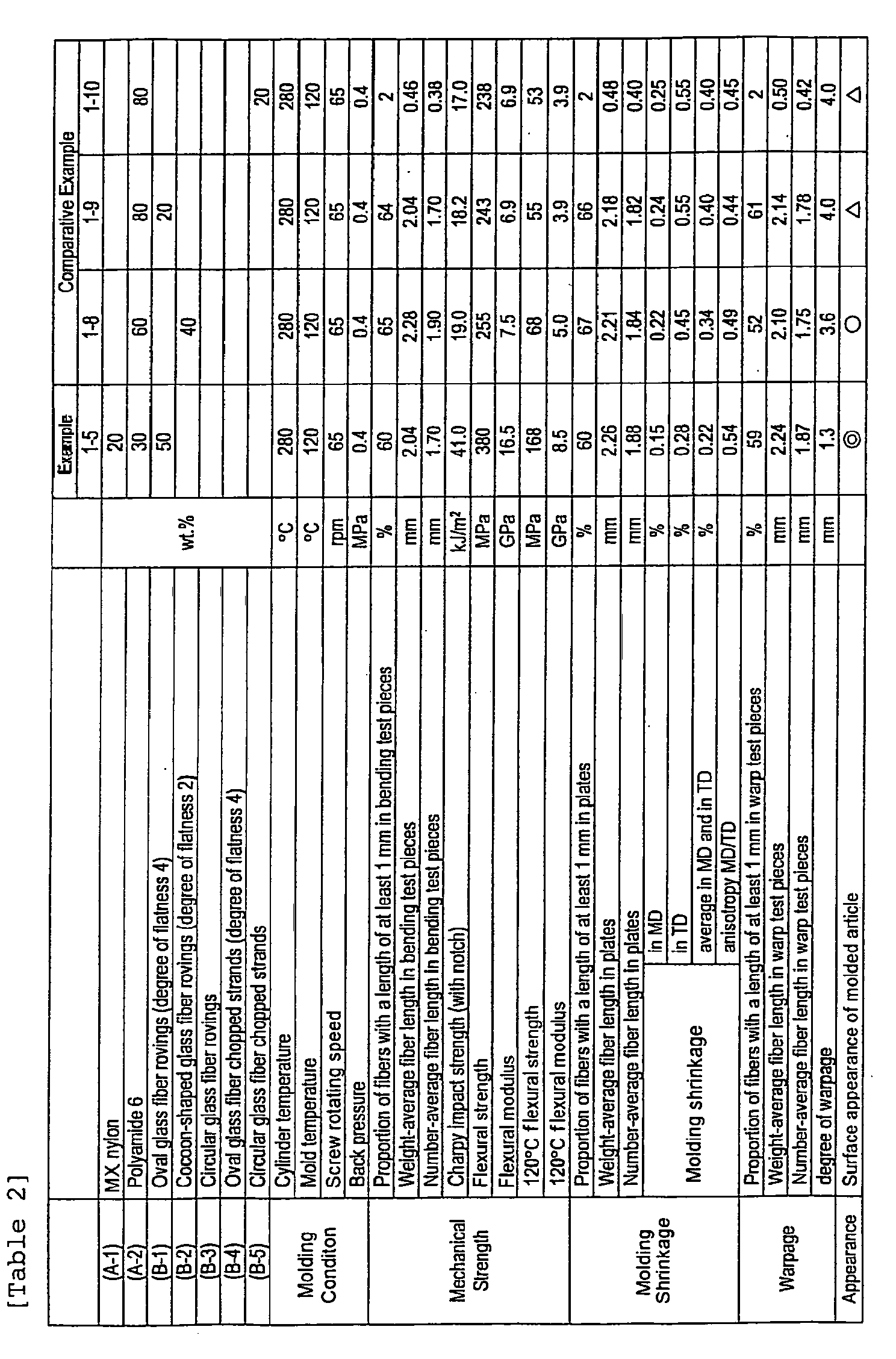

- Table 1 shows Examples and Comparative Examples in which MX nylon was used as the polyamide resin. The results confirmed the following:
- (1) Comparative Example 1-1 is the same as Examples 1-1 and 1-2 in point of the resin composition; but in the former, circular glass fibers were used as the reinforcing fibers. In this case, even though the average glass fiber length and the proportion of the glass fibers having a length of at least 1 mm in the molded article are both on the same level as in Example 1-1, and even though the average glass fiber length is longer than in Example 1-2 and the proportion of the glass fibers having a length of at least 1 mm is larger than therein, the molded article was inferior to that in Example 1-1 in point of all the mechanical strength, the heat resistance, the molding shrinkage, the warpage resistance and the surface appearance. Even when flattened glass fibers are used as the reinforcing fibers as in Comparative Example 1-2, the molded article could not satisfy the level of the invention in point of the mechanical strength, the heat resistance, the molding shrinkage, the warpage resistance and the surface appearance, in case where the degree of flatness is smaller than the range defined in the invention.
- (2) Comparative Example 1-3 is the same as Examples 1-1 and 1-2 in point of the resin composition; but in the former, the average glass fiber length in the molded article is short and the proportion of the glass fibers having a length of at least 1 mm is small. In this case, the Charpy impact strength and the 120°C flexural strength of the molded article are significantly low, and the article could not reach the level of the invention in point of the molding shrinkage and the warpage resistance.
- (3) In Comparative Examples 1-4 and 1-5, chopped strands of glass fibers were incorporated.
- In Comparative Example 1-4, used were the same flattened glass fibers as in Examples 1-1 and 1-2; and in Comparative Examples 1-5, used were the same circular glass fibers as in Comparative Example 1-2. In the two, the average fiber length in the molded article is short, and the proportion of the fibers not shorter than 1 mm is small. In these Comparative Examples, in particular, the Charpy impact strength, and the 120°C flexural strength and modulus of the molded articles greatly lowered, and the molded articles were poor in point of the molding shrinkage, the warpage resistance and the surface appearance.
- (4) In Comparative Examples 1-6 and 1-7, the blend ratio of MX nylon to glass fibers is 80/20, and the compositions differ from those in the above (1) to (3). In Comparative Example 1-6, used were flattened glass fibers satisfying the requirement in the invention; and in Comparative Example 1-7, used were circular glass fibers. In case where the amount of the glass fibers was smaller than the range defined in the invention, no difference was confirmed in point of the mechanical strength, the molding shrinkage, the warpage resistance and the surface appearance between the case where flattened glass fibers were used and the case where circular glass fibers were used; and the flattened glass fibers could not exhibit the effect thereof.
- Table 2 shows Examples and Comparative Examples in which was used polyamide 6, or a mixture of polyamide 6 and MX nylon as the polyamide resin.
- (5) The sample of Example 1-5 is excellent in the mechanical strength, the heat resistance, the molding shrinkage resistance, the warpage resistance, and the surface appearance.
- (6) In Comparative Example 1-8, used were flattened glass fibers having a degree of flatness of 2, as reinforcing fibers.
- In this case, the mechanical strength greatly lowered as compared with that in Example 1-5 where glass fibers having a degree of flatness of 4 were used. In particular, the 120°C flexural strength and modulus greatly lowered, and the heat resistance was poor.
- (7) In Comparative Examples 1-9 and 1-10, the blend ratio of polyamide 6 to glass fibers was 80/20. In Comparative Example 1-9, used were glass fibers having a degree of flatness of 4; and in Comparative Example 1-10, used were circular glass fiber chopped strands. In case where the amount of the glass fibers was smaller than the range defined in the invention, the molded article could not exhibit the effect of the flattened glass fibers as compared with the resin molded article which contains circular fibers and in which the proportion of the fibers having a length of at least 1 mm is 2 % and is low. This is the same as in the above-mentioned (4).
- In Table 3, the screw type in the injection-molding machine used in Examples in Tables 1 and 2 was changed to a mild compression-type screw, and the influence of the conditions of cylinder temperature, back pressure and screw rotating speed on the test results was confirmed.
- (8) From the results in Examples 1-6 and 1-7 and Comparative Example 1-11, it is known that with the increase in the back pressure, the average glass fiber length is shortened and the proportion of the glass fibers having a fiber length of at least 1 mm lowers. As in Comparative Example 1-11, when the back pressure is increased up to 6.0 MPa, then the average glass fiber length and the proportion of the glass fibers having a fiber length of at least 1 mm are both lower than those in the range defined in the invention, and therefore the mechanical strength of the molded articles lowers.
- (9) From the results in Example 1-8 and Comparative Example 1-12, it is known that when the screw rotating speed is increased, then the average glass fiber length is shortened and the proportion of the glass fibers having a fiber length of at least 1 mm lowers. As in Comparative Example 1-12, when the screw rotating speed is increased up to 120 rpm, then the average glass fiber length and the proportion of the glass fibers having a fiber length of at least 1 mm are both lower than those in the range defined in the invention, and therefore the mechanical strength of the molded articles lowers.
- While being opened and drawn, long-continuous flattened glass fiber rovings (B-1) (Nittobo's oval (FF) fibers having a major diameter (a) = 28 µm and a minor diameter (b) = 7 µm, and having a degree of flatness of 4) were led to pass through a dipping die so that the molten resin fed to the dipping die was infiltrated into the fiber rovings, and then processed according to a pultrusion method of shaping, cooling and cutting them, thereby giving long fiber-reinforced polyester resin pellets having a content of the glass fibers (B-1) of 50 % by weight and having a pellet length of 12 mm. As the resin, polybutylene terephthalate resin (A-1) (Mitsubishi Engineering Plastics' "trade name, Novaduran® 5008", having a limiting viscosity of 0.85 dl/g) was melted and used herein. In the obtained pellets, the glass fibers had a diameter of 16 µm and a fiber length of 12 mm, the same as the pellet length, and they were aligned in parallel to the length direction of the pellets.
- Long fiber-reinforced polyester resin pellets were produced in the same manner as in Example 2-1, for which, however, the ratio of the amount of the flattened glass fiber rovings (B-1) to that of the polybutylene terephthalate resin (A-1) was so controlled that the content of the glass fibers (B-1) in the pellets could be 30 % by weight.
- Long fiber-reinforced polyester resin pellets were produced in the same manner as in Example 2-1, for which, however, the resin component was changed to a mixture of polybutylene terephthalate resin (A-1) and polyethylene terephthalate resin (A-2) (Mitsubishi Chemical's "trade name Novapex® GS385", having a limiting viscosity of 0.65 dl/g). The ratio by weight of the polybutylene terephthalate resin (A-1) to the polyethylene terephthalate resin (A-2) was (A-1)/(A-2) = 40/10.
- Long fiber-reinforced polyester resin pellets were produced in the same manner as in Example 2-1, for which, however, the pellet length was changed to 9 mm.
- Long fiber-reinforced polyester resin pellets were produced in the same manner as in Example 2-1, for which, however, the reinforcing fibers were changed to circular glass fiber rovings (B-2) having a circular cross section (Nittobo's circular fibers having a fiber diameter = 13 µim).
- Polybutylene terephthalate resin (A-1) and flattened glass fiber chopped strands (B-3) (Nittobo's oval fibers (FF), having a major diameter (a) = 28 µm and a minor diameter (b) = 7 µm, and having a degree of flatness of 4, and a fiber length of 3 mm) were pelletized, using a double-screw extruder (Nippon Seikosho's "TEX30XCT", 9-block barrel constitution) The resin temperature was 280°C, the screw rotating speed was 250 rpm. The polybutylene terephthalate resin (A-1) was fed through the hopper, and the flattened glass fiber chopped strands (B-3) were via the side feeder at the 5th block from the hopper side, and these were mel-t-kneaded, and then cut to give fiber-reinforced polyester resin pellets having a length of 3 mm.
- Fiber-reinforced polyester resin pellets were produced in the same manner as in Comparative Example 2-2, for which, however, the reinforcing fibers were changed to circular glass fiber rovings (B-4) having a circular cross section (Nittobo's circular fibers having a fiber diameter of 13 µm and a fiber length of 3 mm).
- Long fiber-reinforced polyester resin pellets were produced in the same manner as in Example 2-1, for which, however, the ratio of the amount of the flattened glass fiber rovings (B-1) to that of the polybutylene terephthalate resin (A-1) was so controlled that the content of the glass fibers (B-1) in the pellets could be 15 % by weight.
- Long fiber-reinforced polyester resin pellets were produced in the same manner as in Comparative Example 2-1, for which, however, the ratio of the amount of the circular glass fiber rovings (B-2) to that of the polybutylene terephthalate resin (A-1) was so controlled that the content of the glass fibers (B-1) in the pellets could be 15 % by weight.
- The obtained fiber-reinforced polyester resin pellets were dried at 120°C for 5 hours. An injection-molding machine (Nippon Seikosho's "J150E-P-2M") was used. For the samples of Example 2-4, an ordinary screw was used. For the samples of the other Examples and Comparative Examples than Example 2-4, a mild compression-type screw was used. The cylinder temperature was 275°C, the mold temperature was 80°C, the screw rotating speed was 80 rpm. The back pressure was 6.0 MPa in Comparative Examples 2-4 and 2-5, and was 0.6 MPa in the other Examples and Comparative Examples. Under the condition, ISO test pieces for measurement of mechanical strength and deflection temperature under load; test pieces having a diameter of 100 mm and a thickness of 1.6 mm for measurement warpage (one-point gate on the circumference) ; and test pieces having a length of 100 mm, a width of 100 mm and a thickness of 2 mm for evaluation of surface appearance were produced. The test pieces were analyzed for the content of fibers having a fiber length of at least 1 mm, for the weight-average fiber length and for the surface appearance in the same manner as in Example 1 mentioned above; and were analyzed for the mechanical strength, for the deflection temperature under load and for the warpage, according the conditions described below. The results are shown in Tables 4 and 5.
- The ISO test pieces produced under the above-mentioned molding condition were tested in an tensile test according to the standard of ISO527, in a bending test according to the standard of ISO178, and in a Charpy impact test (with notch) according to the standard of ISO179. They were analyzed for the deflection temperature under load (1.80 MPa) according to the standard of ISO75, which indicates the heat resistance of the tested sample.
- One end of the test piece for determination of warpage, as obtained under the above-mentioned molding condition, was fixed on a precision surface plate (JIS B7513) , and visually observed the opposite end thereof curving up from the precision surface plate. The curving height was measured as the warpage of the sample. The samples with no curving and therefore having excellent warpage resistance are rated as "⊚"; those with some curving to a degree of warpage of at most 5 mm and therefore judged to have no problem in practical use are rated as "○"; those with warpage of from more than 5 mm to 10 mm and therefore judged to have some problem in practical use are rated as "Δ"; and those much curving up with warpage of more than 10 mm are rated as "×".


- The results in Tables 4 and 5 confirm the following:
- (1) In Examples 2-1 to 2-5, polybutylene terephthalate resin, or a mixture of polybutylene terephthalate resin and polyethylene terephthalate resin is used as the resin component, and the weight-average fiber length in the molded articles falls within the scope of the invention. It is known that all the molded articles have good mechanical strength, heat resistance, warpage resistance and appearance.
- (2) In Example 2-1 and Comparative Example 2-1, the proportion of the glass fibers in the resin pellets is the same; and the cross section of the glass fibers is flattened (Example 2-1) or circular (Comparative Example 2-1). Example 2-1 is compared with Comparative Example 2-1, and it is known that the glass fibers having a flattened cross section used enhance the mechanical strength and the heat resistance of the molded articles, significantly reduce warpage thereof and improve the appearance thereof.
- (3) In Example 2-1 and Comparative Example 2-2, flattened cross-section glass fiber rovings (Example 2-1) or chopped strands (Comparative Example 2-2) are used in production of resin pellets. When the glass fiber rovings are used, the fiber length in the resin pellets may be kept long, and therefore, the fiber length in the molded article formed of the resin pellets may be also kept long, and the molded article may have more excellent mechanical strength, heat resistance, warpage resistance and appearance.
- In Comparative Examples 2-1 and 2-3, circular cross-section glass fiber rovings (Comparative Example 2-1) or chopped strands (Comparative Example 2-3) are used in production of resin pellets. In Comparative Example 2-3 where the chopped strands are used, the fiber length in the molded article is short, and the molded article obtained could not attain the object of the invention. On the other hand, in Comparative Example 2-1 where the glass fiber rovings are used, the fiber length in the molded article is kept long; however, since the cross section of the glass fibers is circular, the molded article could not attain the object of the invention as having poor warpage resistance and appearance.
- (4) In Example 2-1 and Comparative Examples 2-4 and 2-5, the resin pellet composition is the same but the condition in injection-molding differs. These are compared with each other, and it is known that, when the back pressure is reduced, then the glass fibers in the molded article are prevented from being broken and the proportion of the glass fibers having a length of at least 1 mm and the weight-average fiber length can be thereby increased more. It is also known that, in case where the back pressure is high and the glass fibers in the molded article do not satisfy the range defined in the invention, it could not attain the object of the invention.
- (5) In Comparative Examples 2-6 and 2-7, the blend ratio of polybutylene terephthalate and glass fibers is 85/15. In Comparative Example 2-6, flattened glass fibers like in the invention are used; and in Comparative Example 2-7, circular glass fibers are used. Even though the weight-average fiber length in the molded article is within the scope of the invention, the mechanical strength, the heat resistance and the warpage resistance of the molded article could not be improved, and in particular, the flattened cross-section glass fibers could not exhibit the effect thereof in both cases where flattened glass fibers or circular glass fibers are used, when the amount of the glass fibers is smaller than the range defined in the invention.
- (6) In Examples 2-1 and 2-4, the proportion of the glass fibers in the resin pellets is the same, and the screw type of the molding machine used in injection-molding is a mild compression type (Example 2-1) or an ordinary type (Example 2-4). Regarding the screw type for use in injection-molding, it is known that the mild compression type is better than the ordinary type in that the former may reduce the breakage of glass fibers and may increase the proportion of the fibers having a length of at least 1 mm and the weight-average fiber length, and therefore the molded article obtained may have more excellent mechanical strength, heat resistance and warpage resistance.
- In Examples 2-1 and 2-5, the proportion of the glass fibers in the resin pellets is the same, and in the stage of producing the resin pellets for use for injection-molding, the length of the resin pellets is 12 mm (Example 2-1) or 9 mm (Example 2-5). It is known that, when the length of the resin pellets is long, the fiber length of the reinforcing fibers in the pellets may also be long, and in case where the resin pellets are molded into a molded article, the reinforcing fibers in the molded article can also be kept long, and the molded article may have more excellent mechanical strength.
- As described in detail hereinabove, the invention enjoys the advantages mentioned below, and its industrial applicability is extremely high.
- Specifically, according to the invention, a fiber-reinforced thermoplastic resin molded article can be obtained, which is excellent not only in mechanical strength but also in heat resistance, surface appearance and dimensional accuracy; and therefore, the invention may fully satisfy the requirements for weight reduction, thickness reduction, as well as dimensional accuracy and improved appearance of molded articles, and can be used for broad-range applications such as parts in the field of automobiles, in the field of electric and electronic appliances and in the field of precision machines, etc.
Claims (7)
- A fiber-reinforced thermoplastic resin molded article of a thermoplastic resin composition comprising from 70 to 35 % by weight of a thermoplastic resin (A), and from 30 to 65 % by weight of reinforcing fibers (B) of which the cross section is flattened to have a degree of flatness, as expressed by the formula mentioned below, of from 2.3 to 5, wherein the thermoplastic resin (A) is polyamide resin containing at least 20 % by weight of MX nylon or polyester resin, and the weight-average fiber length of the reinforcing fibers in the molded article is from 1 to 10 mm:

- The fiber-reinforced thermoplastic resin molded article of Claim 1, wherein the proportion of the reinforcing fibers having a fiber length of at least 1 mm in the molded article is at least 30 % by weight of all the reinforcing fibers.
- The fiber-reinforced thermoplastic resin molded article of Claim 1 or 2, wherein the cross-sectional profile of the reinforcing fibers (B) is oval.
- The fiber-reinforced thermoplastic resin molded article of any of Claims 1 to 3, which contains a polybutylene terephthalate resin and/or a polyethylene terephthalate resin as the polyester resin (A).
- The fiber-reinforced thermoplastic resin molded article of any of Claims 1 to 3, which contains a polybutylene terephthalate resin having a limiting viscosity, as measured in a 1/1 (by weight) mixed solution of phenol and 1,1,2,2-tetrachloroethane at 30°C, of from 0.3 to 1.2 dl/g, and having a titanium content of at most 80 ppm, as the polyester resin (A).
- The fiber-reinforced thermoplastic resin molded article of any of Claims 1 to 5, which is produced according to an injection-molding method or an extrusion-molding method using pellets prepared by coating reinforcing fiber rovings with the thermoplastic resin followed by cutting into pellets having a length of at least 3 mm.
- A method for producing a fiber-reinforced thermoplastic resin molded article of any one of Claims 1 to 6, which comprises performing injection-molding or extrusion-molding of pellets prepared by coating reinforcing fiber rovings with the thermoplastic resin followed by cutting into pellets having a length of at least 3 mm.
Applications Claiming Priority (4)
| Application Number | Priority Date | Filing Date | Title |
|---|---|---|---|
| JP2006144738 | 2006-05-25 | ||
| JP2006165475 | 2006-06-15 | ||
| JP2006251019 | 2006-09-15 | ||
| PCT/JP2007/060576 WO2007138966A1 (en) | 2006-05-25 | 2007-05-24 | Moldings of fiber-reinforced thermoplastic resin |
Publications (3)
| Publication Number | Publication Date |
|---|---|
| EP2020282A1 EP2020282A1 (en) | 2009-02-04 |
| EP2020282A4 EP2020282A4 (en) | 2012-10-31 |
| EP2020282B1 true EP2020282B1 (en) | 2014-08-13 |
Family
ID=38778486
Family Applications (1)
| Application Number | Title | Priority Date | Filing Date |
|---|---|---|---|
| EP20070744010 Active EP2020282B1 (en) | 2006-05-25 | 2007-05-24 | Moldings of fiber-reinforced thermoplastic resin |
Country Status (5)
| Country | Link |
|---|---|
| US (1) | US7858172B2 (en) |
| EP (1) | EP2020282B1 (en) |
| JP (2) | JP2013199121A (en) |
| CN (1) | CN101454132B (en) |
| WO (1) | WO2007138966A1 (en) |
Families Citing this family (90)
| Publication number | Priority date | Publication date | Assignee | Title |
|---|---|---|---|---|
| WO2007080754A1 (en) * | 2006-01-13 | 2007-07-19 | Mitsubishi Engineering-Plastics Corporation | Polyamide resin composition for portable electronic device and molded article for portable electronic device |
| US7858172B2 (en) * | 2006-05-25 | 2010-12-28 | Mitsubishi Engineering-Plastics Corporation | Fiber-reinforced thermoplastic resin molded article |
| BRPI0716056A2 (en) * | 2006-08-23 | 2013-08-06 | Basf Se | thermoplastic impression material, use of thermoplastic impression materials, and molded body of any kind |
| CN102341450A (en) * | 2009-03-04 | 2012-02-01 | 帝斯曼知识产权资产管理有限公司 | Process for preparing injection molded parts with reduced glass fiber development |
| DE102009036018A1 (en) * | 2009-08-04 | 2011-02-17 | Siemens Aktiengesellschaft | Thermoplastic final stage blade |
| WO2010131602A1 (en) * | 2009-05-13 | 2010-11-18 | コニカミノルタホールディングス株式会社 | Method for producing cellulose fiber-containing resin material |
| KR101288561B1 (en) * | 2009-12-11 | 2013-07-22 | 제일모직주식회사 | Glass fiber-reinforced polyester resin composition and molded product using the same |
| CN102803392B (en) * | 2010-03-25 | 2013-10-30 | 积水化学工业株式会社 | Resin composition, synthetic resin sheet, synthetic resin molded article, and synthetic resin laminate |
| JP5792957B2 (en) * | 2010-09-15 | 2015-10-14 | 積水化学工業株式会社 | Resin composite molded body and method for producing the same |
| JP5728577B2 (en) * | 2010-11-03 | 2015-06-03 | エスゲーエル・オートモーティブ・カーボン・ファイバーズ・ゲーエムベーハー・ウント・コ・カーゲー | Pile layer with curved bundle |
| JP5785408B2 (en) * | 2011-03-23 | 2015-09-30 | Ykk株式会社 | Resin frame material, joinery, and method of manufacturing resin frame material |
| US20120246873A1 (en) * | 2011-04-01 | 2012-10-04 | Rama Konduri | Hollow articles comprising fiber-filled polyester compositions, methods of manufacture, and uses thereof |
| CN102862259A (en) * | 2011-07-08 | 2013-01-09 | 昆山瑞华电器有限公司 | Non-metal material motor gearbox |
| US20130131405A1 (en) * | 2011-11-18 | 2013-05-23 | Metton America, Inc. | Liquid molding resin with nonswelling mica |
| JP5959183B2 (en) * | 2011-11-21 | 2016-08-02 | ダイセルポリマー株式会社 | Resin composition |
| CN103974811B (en) | 2011-12-06 | 2016-08-24 | 日东纺绩株式会社 | Long-fiber-reinforced thermoplastic resin preform and fiber-reinforced resin molded article using the preform |
| BR112014013991A2 (en) * | 2011-12-16 | 2017-06-13 | Mitsubishi Gas Chemical Co | molded product and process for preparing a molded product |
| US8910669B2 (en) | 2012-02-23 | 2014-12-16 | Ticona Llc | Insert for pipe assembly and method for forming pipe assembly |
| JP5817586B2 (en) * | 2012-02-27 | 2015-11-18 | 株式会社オートネットワーク技術研究所 | Protective material for wire harness and wire harness |
| CN103374217A (en) * | 2012-04-24 | 2013-10-30 | 苏州汉扬精密电子有限公司 | Glass fibre reinforced polyphenyl ether resin |
| CN103509319A (en) * | 2012-06-28 | 2014-01-15 | 苏州汉扬精密电子有限公司 | Glass fiber reinforced PC (Polycarbonate)/ABS (Acrylonitrile Butadiene Styrene) composite material and preparation method thereof |
| CN103540097A (en) * | 2012-07-16 | 2014-01-29 | 汉达精密电子(昆山)有限公司 | Glass fiber reinforcement acetal resin and preparation method thereof |
| CN103540077A (en) * | 2012-07-16 | 2014-01-29 | 苏州汉扬精密电子有限公司 | Glass fiber reinforcement acrylonitrile butadiene styrene (ABS) resin and preparation method thereof |
| CN104582926B (en) * | 2012-09-14 | 2016-08-17 | 三菱工程塑料株式会社 | The manufacture method of thermoplastic resin molded article and thermoplastic resin molded article |
| CN103865246B (en) * | 2012-12-14 | 2016-08-10 | 苏州汉扬精密电子有限公司 | A kind of glass fiber-reinforced resin composition |
| JP2014154511A (en) * | 2013-02-13 | 2014-08-25 | Hitachi Metals Ltd | Insulated wire and method of manufacturing the same |
| TWI568538B (en) * | 2013-03-15 | 2017-02-01 | 中國砂輪企業股份有限公司 | Chemical mechanical polishing conditioner and manufacturing method thereof |
| CN103358457A (en) * | 2013-08-05 | 2013-10-23 | 格林精密部件(惠州)有限公司 | Molding process for high-strength injection-molded part |
| WO2015091416A1 (en) * | 2013-12-20 | 2015-06-25 | Solvay Specialty Polymers Usa, Llc | Polyamide-polyester blends with improved properties |
| US10961360B2 (en) | 2014-01-10 | 2021-03-30 | Komatsu Matere Co., Ltd. | Fiber-reinforced resin material and molded fiber-reinforced resin body obtained using the same |
| US10414883B2 (en) | 2014-01-29 | 2019-09-17 | Sumitomo Bakelite Co., Ltd. | Method for producing molded article, molded article, back plate and brake pad |
| EP2910597B1 (en) * | 2014-02-21 | 2018-12-26 | LANXESS Deutschland GmbH | Thermoplastic compositions |
| JP6266094B2 (en) * | 2014-04-09 | 2018-01-24 | Ykk株式会社 | Polyamide resin composition for slide fastener, slide fastener part and slide fastener provided with the same |
| CA2950405C (en) | 2014-05-30 | 2022-11-29 | Ascend Performance Materials Operations Llc | Low phosphorus low color polyamides |
| EP2952319B1 (en) * | 2014-06-06 | 2017-04-19 | Ems-Patent Ag | Method for low stress injection moulding of amorphous or microcrystalline polyamides |
| JP6453575B2 (en) * | 2014-06-18 | 2019-01-16 | ダイセルポリマー株式会社 | Fiber reinforced resin composition |
| WO2016002764A1 (en) * | 2014-07-01 | 2016-01-07 | 旭化成ケミカルズ株式会社 | Polyolefin resin composition, film, and medical bag and tube |
| EP3196237B1 (en) * | 2014-09-12 | 2018-08-15 | Mitsubishi Chemical Corporation | Molding material, sheet molding compound, and fiber-reinforced composite material obtained using same |
| WO2016043258A1 (en) * | 2014-09-17 | 2016-03-24 | 三菱レイヨン株式会社 | Production method for fiber-reinforced thermoplastic resin composite material, production method for fiber-reinforced thermoplastic resin tape, production method for press-molding material, production method for molded article, unidirectional prepreg, and molded article |
| FR3027546B1 (en) | 2014-10-24 | 2017-07-21 | Porcher Ind | POWDERED MACHINES BY ELECTROSTATIC PROCESS |
| DE102015204494B4 (en) * | 2015-03-12 | 2025-06-18 | Hyundai Motor Company | Hybrid side skirts for a motor vehicle and manufacturing method thereof |
| CN118027512A (en) * | 2015-03-25 | 2024-05-14 | 泽费罗斯股份有限公司 | Reinforcing member comprising structural adhesive on polyester carrier |
| JP6278286B2 (en) | 2015-04-02 | 2018-02-14 | 三菱ケミカル株式会社 | Laminate |
| CN111690256B (en) | 2015-12-01 | 2023-03-14 | 三井化学株式会社 | High-fluidity polyamide resin composition |
| JP6739210B2 (en) * | 2016-03-11 | 2020-08-12 | ダイセルポリマー株式会社 | Resin-impregnated fiber bundle, compression molded product and method for producing the same |
| WO2017155009A1 (en) * | 2016-03-11 | 2017-09-14 | ダイセルポリマー株式会社 | Resin-impregnated fiber bundle, compression molded article and method for producing same |
| WO2017159921A1 (en) * | 2016-03-17 | 2017-09-21 | 도레이첨단소재 주식회사 | Liner for fuel storage tank and fuel storage tank comprising same |
| JP6784042B2 (en) * | 2016-03-22 | 2020-11-11 | 富士ゼロックス株式会社 | Resin composition, resin molded product, and method for producing the resin composition |
| CN108883600B (en) | 2016-03-24 | 2021-08-06 | 提克纳有限责任公司 | composite structure |
| KR20170110915A (en) * | 2016-03-24 | 2017-10-12 | 현대자동차주식회사 | Long fiber reinforced polyamide pellet, polyamide resin composition including the same and molded article thereof |
| JP7096159B2 (en) * | 2016-09-30 | 2022-07-05 | ダイセルポリマー株式会社 | Resin composition |
| FR3057572A1 (en) | 2016-10-19 | 2018-04-20 | Arkema France | USE OF A SEMI-AROMATIC POLYAMIDE IN AN ALIPHATIC POLYAMIDE MIXTURE COMPRISING CIRCULAR SECTION GLASS FIBERS FOR LIMITING WEIGHT |
| JP2018076399A (en) * | 2016-11-07 | 2018-05-17 | 三菱エンジニアリングプラスチックス株式会社 | Molding and method for producing molding |
| US10633535B2 (en) | 2017-02-06 | 2020-04-28 | Ticona Llc | Polyester polymer compositions |
| WO2018148171A1 (en) * | 2017-02-08 | 2018-08-16 | E. I. Du Pont De Nemours And Company | Polyester resin composition |
| JP6300997B1 (en) * | 2017-08-04 | 2018-03-28 | 株式会社名機製作所 | Molding method of reinforced fiber-containing resin molded product |
| FR3071503B1 (en) * | 2017-09-25 | 2020-06-19 | Arkema France | USE OF A COPOLYAMIDE COMPOSITION AS A MATRIX OF MATERIAL LOADED WITH GLASS FIBERS WITH A CIRCULAR SECTION TO LIMIT YELLOW |
| WO2018159861A2 (en) * | 2017-10-06 | 2018-09-07 | 日東紡績株式会社 | Glass fiber–reinforced resin molded article |
| EP3749710A1 (en) | 2018-02-08 | 2020-12-16 | Celanese Sales Germany GmbH | Polymer composite containing recycled carbon fibers |
| CN109401068A (en) * | 2018-09-30 | 2019-03-01 | 金旸(厦门)新材料科技有限公司 | A kind of modified polypropene compound and preparation method thereof of low warpage high impact |
| JP2019052323A (en) * | 2018-12-27 | 2019-04-04 | 日東紡績株式会社 | Glass fiber reinforced resin molded product |
| MX2021009284A (en) | 2019-01-31 | 2021-11-12 | Ascend Performance Mat Operations Llc | Impact-modified injection-molded polyamide. |
| BR112021015395A2 (en) | 2019-02-06 | 2021-10-05 | Ascend Performance Materials Operations Llc | POLYAMIDES THAT HAVE HIGH LEVELS OF AMINE END GROUPS |
| US11459458B2 (en) | 2019-02-12 | 2022-10-04 | Ascend Performance Materials Operations Llc | Hydrolysis resistant polyamides |
| JP2020164660A (en) * | 2019-03-29 | 2020-10-08 | 三井化学株式会社 | Glass fiber reinforced polyamide resin composition and molded product |
| KR102879514B1 (en) * | 2019-05-17 | 2025-10-30 | 오츠카 가가쿠 가부시키가이샤 | Composite laminate and method for producing the same |
| WO2020250509A1 (en) | 2019-06-12 | 2020-12-17 | 三菱瓦斯化学株式会社 | Method for producing molded article |
| JP6741833B1 (en) * | 2019-08-09 | 2020-08-19 | 住友化学株式会社 | Injection molded products |
| MX2022004816A (en) | 2019-10-24 | 2022-05-16 | Invista Textiles Uk Ltd | Polyamide compositions and articles made therefrom. |
| CN111704797A (en) * | 2019-12-12 | 2020-09-25 | 上海普利特伴泰材料科技有限公司 | Low-warpage, conductive and high-mechanical-property fiber-reinforced nylon composite material and preparation method thereof |
| CN110951202B (en) * | 2019-12-12 | 2022-11-08 | 界首市昌隆塑业有限公司 | Production process of environment-friendly polyester tile based on rag |
| CN111117203A (en) * | 2019-12-12 | 2020-05-08 | 上海普利特伴泰材料科技有限公司 | Conductive, high-mechanical-property and low-warpage fiber-reinforced polyphenyl ether composite material and preparation method thereof |
| CN111073287A (en) * | 2019-12-12 | 2020-04-28 | 上海普利特伴泰材料科技有限公司 | Low-warpage and high-mechanical-property carbon fiber reinforced polyphenylene sulfide composite material and preparation method thereof |
| CN115885008B (en) * | 2020-06-15 | 2024-04-16 | 株式会社巴川制纸所 | Thermoplastic resin composite material, thermoplastic resin composite material particle, and molded article |
| US11851561B2 (en) * | 2020-06-25 | 2023-12-26 | Ticona Llc | Fiber-reinforced polymer composition |
| TWI846279B (en) | 2020-08-13 | 2024-06-21 | 美商阿散德性能材料營運公司 | Aliphatic and semi-aromatic polyamides with dimer acids and dimer amines |
| CN115551952B (en) * | 2020-09-11 | 2023-12-08 | 日东纺绩株式会社 | Glass fiber reinforced resin plate |
| CN115916877B (en) * | 2020-10-15 | 2023-12-22 | 日东纺绩株式会社 | Glass fiber reinforced resin board |
| CN112552676B (en) * | 2020-12-11 | 2022-04-08 | 天津金发新材料有限公司 | Polyamide composite material capable of being formed in gas-assisted mode |
| JP2023554374A (en) | 2020-12-16 | 2023-12-27 | インヴィスタ テキスタイルズ(ユー.ケー.)リミテッド | Thermoplastic resin for compression molding |
| JP7619218B2 (en) * | 2021-09-08 | 2025-01-22 | 日本電気硝子株式会社 | Fiber-reinforced resin molded body and its manufacturing method, composite pellets, and chopped strands |
| KR102679183B1 (en) * | 2021-10-13 | 2024-06-28 | 한화컴파운드 주식회사 | A Recycled polyamide-based resin composition and a molded article prepared therefrom |
| WO2023086461A1 (en) | 2021-11-10 | 2023-05-19 | Ascend Performance Materials Operations Llc | Improving dry and cold performance of polyamides via incorporation of polyether diamines |
| CN118215703A (en) | 2021-11-10 | 2024-06-18 | 奥升德功能材料运营有限公司 | Improvement of dry and low temperature properties of polyamide by introducing polyether diamine |
| US12600859B2 (en) | 2021-12-17 | 2026-04-14 | Ascend Performance Materials Operations Llc | Polyamide compositions with high heat performance |
| WO2023203715A1 (en) * | 2022-04-21 | 2023-10-26 | ファナック株式会社 | Control device and control method |
| WO2023203714A1 (en) * | 2022-04-21 | 2023-10-26 | ファナック株式会社 | Control device and control method |
| WO2024077045A1 (en) | 2022-10-05 | 2024-04-11 | Ascend Performance Materials Operations Llc | Flame retardant polyamide compositions with improved glow wire performance |
| WO2024130074A1 (en) | 2022-12-16 | 2024-06-20 | Ascend Performance Materials Operations Llc | Polyamide compositions with dual copper stabilizers |
| CN121311537A (en) * | 2023-03-17 | 2026-01-09 | 世索科特殊聚合物美国有限责任公司 | Polyamide molding compositions with enhanced fire resistance |
Family Cites Families (33)
| Publication number | Priority date | Publication date | Assignee | Title |
|---|---|---|---|---|
| US3042570A (en) | 1958-02-20 | 1962-07-03 | Fiberfil Corp | Apparatus and method for producing reinforced molding composition |
| JPS606764B2 (en) | 1976-10-19 | 1985-02-20 | 旭化成株式会社 | Manufacturing method of molding material |
| JPS62268612A (en) | 1986-05-19 | 1987-11-21 | Nitto Boseki Co Ltd | Glass-fiber reinforced resin molded form |
| JPH0241364A (en) * | 1988-08-01 | 1990-02-09 | Ube Ind Ltd | Conductive thermoplastic resin composition with high rigidity |
| JPH0260494A (en) | 1988-08-25 | 1990-02-28 | Secoh Giken Inc | Reluctance type two-phase motor |
| JP2610671B2 (en) * | 1988-12-26 | 1997-05-14 | ポリプラスチックス 株式会社 | Fiber reinforced thermoplastic resin composition |
| JPH059380A (en) | 1991-07-03 | 1993-01-19 | Polyplastics Co | Long-fiber reinforced polyamide resin composition and its molded article |
| JP3352121B2 (en) | 1992-10-01 | 2002-12-03 | 住友化学工業株式会社 | Long fiber reinforced polyamide resin composition and molded article thereof |
| KR950003362A (en) | 1993-07-21 | 1995-02-16 | 마에다 가츠노스케 | Fiber Reinforced Thermoplastic Structures, Manufacturing Method and Extruder |
| JPH07291649A (en) | 1994-04-26 | 1995-11-07 | Nitto Boseki Co Ltd | Nozzle tip for spinning glass fiber, glass fiber with irregular cross section and method for producing the same |
| JP2986702B2 (en) * | 1995-01-31 | 1999-12-06 | 株式会社日本製鋼所 | Screw for plasticizing apparatus and plasticizing method |
| JPH08318561A (en) * | 1995-05-26 | 1996-12-03 | Mitsubishi Heavy Ind Ltd | Resin plasticizing screw |
| JPH09286036A (en) | 1996-04-22 | 1997-11-04 | Toray Ind Inc | Resin molded product |
| JP4186202B2 (en) | 1999-06-02 | 2008-11-26 | 日東紡績株式会社 | Nozzle tip for glass fiber spinning |
| US6855755B1 (en) * | 1999-08-04 | 2005-02-15 | Mitsubishi Engineering-Plastics Corporation | Polyamide resin composition having improved weathering resistance and its molded products |
| US6562179B1 (en) * | 1999-11-04 | 2003-05-13 | Mitsubishi Gas Chemical Company, Inc. | High relative-permittivity B-staged sheet, high relative-permittivity prepreg, its production process, and printed wiring board comprising any one of these |
| JP2001277279A (en) * | 2000-04-04 | 2001-10-09 | Chuo Kaseihin Kk | Injection molded article using recovered resin |
| JP2002088259A (en) * | 2000-09-18 | 2002-03-27 | Toray Ind Inc | Molding material manufacturing method and molded article |
| JP2002234999A (en) * | 2001-02-09 | 2002-08-23 | Toray Ind Inc | Molding material, molded article and method for producing the same |
| JP3700726B2 (en) * | 2002-01-11 | 2005-09-28 | 東洋紡績株式会社 | Production method of polyester film |
| JP2003321555A (en) * | 2002-04-26 | 2003-11-14 | Denso Corp | Long fiber reinforced resin molded product |
| JP4633341B2 (en) * | 2003-07-02 | 2011-02-16 | ユニチカ株式会社 | Gas barrier composition precursor, coating agent and film |
| JP2005060547A (en) * | 2003-08-13 | 2005-03-10 | Daicel Chem Ind Ltd | Long fiber reinforced polymer alloy resin structure and molded product |
| JP4429087B2 (en) * | 2004-06-10 | 2010-03-10 | 出光興産株式会社 | Manufacturing method of fiber reinforced resin pellet |
| JP4876377B2 (en) | 2004-08-05 | 2012-02-15 | 日東紡績株式会社 | Method for producing flat glass fiber-containing pellets |
| JP2006083227A (en) * | 2004-09-14 | 2006-03-30 | Mitsubishi Engineering Plastics Corp | Long fiber reinforced polyamide resin exterior molding |
| JP4439361B2 (en) | 2004-09-14 | 2010-03-24 | 三菱エンジニアリングプラスチックス株式会社 | Long fiber reinforced thermoplastic resin exterior molding |
| EP1790454B1 (en) * | 2004-09-14 | 2017-01-11 | Mitsubishi Engineering-Plastics Corporation | Process for producing an exterior body comprising long fiber reinforced thermoplastic resin |
| JP2008095066A (en) * | 2006-05-25 | 2008-04-24 | Mitsubishi Engineering Plastics Corp | Fiber reinforced thermoplastic resin molded product |
| US7858172B2 (en) * | 2006-05-25 | 2010-12-28 | Mitsubishi Engineering-Plastics Corporation | Fiber-reinforced thermoplastic resin molded article |
| ES2324237T3 (en) * | 2006-12-28 | 2009-08-03 | Ems-Chemie Ag | POLYAMIDE MOLDING COMPOUNDS REINFORCED WITH FLAT GLASS FIBERS AS WELL AS INJECTION MOLDED PIECES MANUFACTURED FROM THE SAME. |
| EP2196494B1 (en) * | 2008-12-12 | 2014-03-26 | Ems-Patent Ag | Polyamide layer silicate compounds |
| US7829614B2 (en) * | 2008-12-30 | 2010-11-09 | Sabic Innovative Plastics Ip B.V. | Reinforced polyester compositions, methods of manufacture, and articles thereof |
-
2007
- 2007-05-24 US US12/302,257 patent/US7858172B2/en active Active
- 2007-05-24 CN CN2007800191492A patent/CN101454132B/en active Active
- 2007-05-24 WO PCT/JP2007/060576 patent/WO2007138966A1/en not_active Ceased
- 2007-05-24 EP EP20070744010 patent/EP2020282B1/en active Active
-
2013
- 2013-05-16 JP JP2013104079A patent/JP2013199121A/en active Pending
-
2015
- 2015-05-14 JP JP2015098801A patent/JP2015147428A/en active Pending
Also Published As
| Publication number | Publication date |
|---|---|
| US20100009158A1 (en) | 2010-01-14 |
| EP2020282A4 (en) | 2012-10-31 |
| CN101454132B (en) | 2012-02-29 |
| WO2007138966A1 (en) | 2007-12-06 |
| US7858172B2 (en) | 2010-12-28 |
| CN101454132A (en) | 2009-06-10 |
| JP2013199121A (en) | 2013-10-03 |
| JP2015147428A (en) | 2015-08-20 |
| EP2020282A1 (en) | 2009-02-04 |
Similar Documents
| Publication | Publication Date | Title |
|---|---|---|
| US7858172B2 (en) | Fiber-reinforced thermoplastic resin molded article | |
| JP2008095066A (en) | Fiber reinforced thermoplastic resin molded product | |
| JP5853376B2 (en) | Polyalkylene terephthalate resin composition and molded article | |
| JP4859260B2 (en) | Glass fiber reinforced thermoplastic resin composition and molded article | |
| JP5526500B2 (en) | Fiber reinforced polyamide resin composition | |
| KR101530464B1 (en) | Copolymer polyamide | |
| JP5329804B2 (en) | Mobile terminal parts | |
| US20090280311A1 (en) | Polyamide resin composition and molded article | |
| US20070197706A1 (en) | Planar connector | |
| CN101652430A (en) | Glass fiber reinforced polyamide resin composition | |
| US9884953B2 (en) | Polybutylene terephthalate resin composition and molded article thereof | |
| WO2009081571A1 (en) | Polybutylene terephthalate resin composition and thin molded article | |
| CN109666291A (en) | A kind of low water suction nylon 6 composite material of high rigidity | |
| US20210002478A1 (en) | Resin composition and filament-like molded body formed from same | |
| JP2008088377A (en) | Polyamide resin composition for breaker casing and breaker casing | |
| JP5292744B2 (en) | Long fiber reinforced polyamide resin composition | |
| KR20210096157A (en) | Polyamide resin composition, and manufacturing method thereof | |
| JP4633532B2 (en) | Airtight switch parts | |
| JP2010174064A (en) | Glass fiber-reinforced resin composition | |
| JP3736658B2 (en) | Thermoplastic polyester resin composition | |
| CN112745671A (en) | Polyamide composition with good appearance and high modulus as well as preparation method and application thereof | |
| JP2019175584A (en) | Connector and resin composition | |
| JP2009191206A (en) | Polyalkylene terephthalate resin composition | |
| JPH10231421A (en) | Welding resin composition | |
| JP2007154162A (en) | Thermoplastic polyester resin composition |
Legal Events
| Date | Code | Title | Description |
|---|---|---|---|
| PUAI | Public reference made under article 153(3) epc to a published international application that has entered the european phase |
Free format text: ORIGINAL CODE: 0009012 |
|
| 17P | Request for examination filed |
Effective date: 20081204 |
|
| AK | Designated contracting states |
Kind code of ref document: A1 Designated state(s): AT BE BG CH CY CZ DE DK EE ES FI FR GB GR HU IE IS IT LI LT LU LV MC MT NL PL PT RO SE SI SK TR |
|
| AX | Request for extension of the european patent |
Extension state: AL BA HR MK RS |
|
| RBV | Designated contracting states (corrected) |
Designated state(s): DE |
|
| RAP1 | Party data changed (applicant data changed or rights of an application transferred) |
Owner name: MITSUBISHI ENGINEERING-PLASTICS CORPORATION |
|
| DAX | Request for extension of the european patent (deleted) | ||
| A4 | Supplementary search report drawn up and despatched |
Effective date: 20121002 |
|
| RIC1 | Information provided on ipc code assigned before grant |
Ipc: C08L 101/00 20060101ALI20120926BHEP Ipc: B29C 45/00 20060101ALI20120926BHEP Ipc: B29B 9/14 20060101ALI20120926BHEP Ipc: C08K 7/00 20060101ALI20120926BHEP Ipc: C08J 5/04 20060101ALI20120926BHEP Ipc: B29C 47/00 20060101ALI20120926BHEP Ipc: B29B 11/16 20060101AFI20120926BHEP |
|
| 17Q | First examination report despatched |
Effective date: 20130527 |
|
| GRAP | Despatch of communication of intention to grant a patent |
Free format text: ORIGINAL CODE: EPIDOSNIGR1 |
|
| GRAJ | Information related to disapproval of communication of intention to grant by the applicant or resumption of examination proceedings by the epo deleted |
Free format text: ORIGINAL CODE: EPIDOSDIGR1 |
|
| INTG | Intention to grant announced |
Effective date: 20140106 |
|
| INTC | Intention to grant announced (deleted) | ||
| GRAP | Despatch of communication of intention to grant a patent |
Free format text: ORIGINAL CODE: EPIDOSNIGR1 |
|
| INTG | Intention to grant announced |
Effective date: 20140220 |
|
| GRAS | Grant fee paid |
Free format text: ORIGINAL CODE: EPIDOSNIGR3 |
|
| GRAA | (expected) grant |
Free format text: ORIGINAL CODE: 0009210 |
|
| AK | Designated contracting states |
Kind code of ref document: B1 Designated state(s): DE |
|
| REG | Reference to a national code |
Ref country code: DE Ref legal event code: R096 Ref document number: 602007038089 Country of ref document: DE Effective date: 20140925 |
|
| REG | Reference to a national code |
Ref country code: DE Ref legal event code: R097 Ref document number: 602007038089 Country of ref document: DE |
|
| PLBE | No opposition filed within time limit |
Free format text: ORIGINAL CODE: 0009261 |
|
| STAA | Information on the status of an ep patent application or granted ep patent |
Free format text: STATUS: NO OPPOSITION FILED WITHIN TIME LIMIT |
|
| 26N | No opposition filed |
Effective date: 20150515 |
|
| P01 | Opt-out of the competence of the unified patent court (upc) registered |
Effective date: 20230509 |
|
| REG | Reference to a national code |
Ref country code: DE Ref legal event code: R081 Ref document number: 602007038089 Country of ref document: DE Owner name: MITSUBISHI CHEMICAL CORPORATION, JP Free format text: FORMER OWNER: MITSUBISHI ENGINEERING-PLASTICS CORP., TOKIO/TOKYO, JP Ref country code: DE Ref legal event code: R081 Ref document number: 602007038089 Country of ref document: DE Owner name: GLOBAL POLYACETAL CO., LTD., JP Free format text: FORMER OWNER: MITSUBISHI ENGINEERING-PLASTICS CORP., TOKIO/TOKYO, JP |
|
| PGFP | Annual fee paid to national office [announced via postgrant information from national office to epo] |
Ref country code: DE Payment date: 20250402 Year of fee payment: 19 |