EP2020105B1 - Rétroaction par canaux regroupés - Google Patents
Rétroaction par canaux regroupés Download PDFInfo
- Publication number
- EP2020105B1 EP2020105B1 EP07761658.9A EP07761658A EP2020105B1 EP 2020105 B1 EP2020105 B1 EP 2020105B1 EP 07761658 A EP07761658 A EP 07761658A EP 2020105 B1 EP2020105 B1 EP 2020105B1
- Authority
- EP
- European Patent Office
- Prior art keywords
- feedback
- feedback information
- channel
- base station
- aggregated
- Prior art date
- Legal status (The legal status is an assumption and is not a legal conclusion. Google has not performed a legal analysis and makes no representation as to the accuracy of the status listed.)
- Not-in-force
Links
- 238000004891 communication Methods 0.000 claims description 36
- 230000004044 response Effects 0.000 claims description 33
- 238000000034 method Methods 0.000 claims description 30
- 230000005540 biological transmission Effects 0.000 claims description 13
- 238000003860 storage Methods 0.000 claims description 6
- 230000001413 cellular effect Effects 0.000 claims description 5
- 238000004519 manufacturing process Methods 0.000 claims description 4
- 238000005516 engineering process Methods 0.000 description 16
- 230000002776 aggregation Effects 0.000 description 9
- 238000004220 aggregation Methods 0.000 description 9
- 238000010586 diagram Methods 0.000 description 7
- 230000006870 function Effects 0.000 description 5
- 230000008569 process Effects 0.000 description 3
- 238000012545 processing Methods 0.000 description 3
- 239000004065 semiconductor Substances 0.000 description 3
- 238000001228 spectrum Methods 0.000 description 3
- 230000003044 adaptive effect Effects 0.000 description 2
- 230000002093 peripheral effect Effects 0.000 description 2
- 241001071864 Lethrinus laticaudis Species 0.000 description 1
- 230000036772 blood pressure Effects 0.000 description 1
- 230000008878 coupling Effects 0.000 description 1
- 238000010168 coupling process Methods 0.000 description 1
- 238000005859 coupling reaction Methods 0.000 description 1
- 238000011161 development Methods 0.000 description 1
- 239000004973 liquid crystal related substance Substances 0.000 description 1
- 230000007774 longterm Effects 0.000 description 1
- 238000010295 mobile communication Methods 0.000 description 1
- 230000005404 monopole Effects 0.000 description 1
- 230000003287 optical effect Effects 0.000 description 1
- 238000005192 partition Methods 0.000 description 1
- 230000003595 spectral effect Effects 0.000 description 1
- 230000001360 synchronised effect Effects 0.000 description 1
- 230000002123 temporal effect Effects 0.000 description 1
- 238000012549 training Methods 0.000 description 1
- 239000013598 vector Substances 0.000 description 1
Images


Classifications
-
- H—ELECTRICITY
- H04—ELECTRIC COMMUNICATION TECHNIQUE
- H04B—TRANSMISSION
- H04B7/00—Radio transmission systems, i.e. using radiation field
- H04B7/02—Diversity systems; Multi-antenna system, i.e. transmission or reception using multiple antennas
- H04B7/04—Diversity systems; Multi-antenna system, i.e. transmission or reception using multiple antennas using two or more spaced independent antennas
- H04B7/06—Diversity systems; Multi-antenna system, i.e. transmission or reception using multiple antennas using two or more spaced independent antennas at the transmitting station
- H04B7/0613—Diversity systems; Multi-antenna system, i.e. transmission or reception using multiple antennas using two or more spaced independent antennas at the transmitting station using simultaneous transmission
- H04B7/0615—Diversity systems; Multi-antenna system, i.e. transmission or reception using multiple antennas using two or more spaced independent antennas at the transmitting station using simultaneous transmission of weighted versions of same signal
- H04B7/0619—Diversity systems; Multi-antenna system, i.e. transmission or reception using multiple antennas using two or more spaced independent antennas at the transmitting station using simultaneous transmission of weighted versions of same signal using feedback from receiving side
- H04B7/0621—Feedback content
- H04B7/0632—Channel quality parameters, e.g. channel quality indicator [CQI]
-
- H—ELECTRICITY
- H04—ELECTRIC COMMUNICATION TECHNIQUE
- H04B—TRANSMISSION
- H04B7/00—Radio transmission systems, i.e. using radiation field
- H04B7/02—Diversity systems; Multi-antenna system, i.e. transmission or reception using multiple antennas
- H04B7/04—Diversity systems; Multi-antenna system, i.e. transmission or reception using multiple antennas using two or more spaced independent antennas
- H04B7/06—Diversity systems; Multi-antenna system, i.e. transmission or reception using multiple antennas using two or more spaced independent antennas at the transmitting station
- H04B7/0613—Diversity systems; Multi-antenna system, i.e. transmission or reception using multiple antennas using two or more spaced independent antennas at the transmitting station using simultaneous transmission
- H04B7/0615—Diversity systems; Multi-antenna system, i.e. transmission or reception using multiple antennas using two or more spaced independent antennas at the transmitting station using simultaneous transmission of weighted versions of same signal
- H04B7/0619—Diversity systems; Multi-antenna system, i.e. transmission or reception using multiple antennas using two or more spaced independent antennas at the transmitting station using simultaneous transmission of weighted versions of same signal using feedback from receiving side
- H04B7/0621—Feedback content
- H04B7/0634—Antenna weights or vector/matrix coefficients
-
- H—ELECTRICITY
- H04—ELECTRIC COMMUNICATION TECHNIQUE
- H04B—TRANSMISSION
- H04B7/00—Radio transmission systems, i.e. using radiation field
- H04B7/02—Diversity systems; Multi-antenna system, i.e. transmission or reception using multiple antennas
- H04B7/04—Diversity systems; Multi-antenna system, i.e. transmission or reception using multiple antennas using two or more spaced independent antennas
- H04B7/08—Diversity systems; Multi-antenna system, i.e. transmission or reception using multiple antennas using two or more spaced independent antennas at the receiving station
- H04B7/0837—Diversity systems; Multi-antenna system, i.e. transmission or reception using multiple antennas using two or more spaced independent antennas at the receiving station using pre-detection combining
- H04B7/0842—Weighted combining
- H04B7/0862—Weighted combining receiver computing weights based on information from the transmitter
-
- H—ELECTRICITY
- H04—ELECTRIC COMMUNICATION TECHNIQUE
- H04L—TRANSMISSION OF DIGITAL INFORMATION, e.g. TELEGRAPHIC COMMUNICATION
- H04L1/00—Arrangements for detecting or preventing errors in the information received
- H04L1/0001—Systems modifying transmission characteristics according to link quality, e.g. power backoff
- H04L1/0023—Systems modifying transmission characteristics according to link quality, e.g. power backoff characterised by the signalling
- H04L1/0027—Scheduling of signalling, e.g. occurrence thereof
-
- H—ELECTRICITY
- H04—ELECTRIC COMMUNICATION TECHNIQUE
- H04L—TRANSMISSION OF DIGITAL INFORMATION, e.g. TELEGRAPHIC COMMUNICATION
- H04L1/00—Arrangements for detecting or preventing errors in the information received
- H04L1/0001—Systems modifying transmission characteristics according to link quality, e.g. power backoff
- H04L1/0023—Systems modifying transmission characteristics according to link quality, e.g. power backoff characterised by the signalling
- H04L1/0028—Formatting
-
- H—ELECTRICITY
- H04—ELECTRIC COMMUNICATION TECHNIQUE
- H04L—TRANSMISSION OF DIGITAL INFORMATION, e.g. TELEGRAPHIC COMMUNICATION
- H04L1/00—Arrangements for detecting or preventing errors in the information received
- H04L1/0001—Systems modifying transmission characteristics according to link quality, e.g. power backoff
- H04L1/0036—Systems modifying transmission characteristics according to link quality, e.g. power backoff arrangements specific to the receiver
-
- H—ELECTRICITY
- H04—ELECTRIC COMMUNICATION TECHNIQUE
- H04L—TRANSMISSION OF DIGITAL INFORMATION, e.g. TELEGRAPHIC COMMUNICATION
- H04L1/00—Arrangements for detecting or preventing errors in the information received
- H04L1/0001—Systems modifying transmission characteristics according to link quality, e.g. power backoff
- H04L1/0023—Systems modifying transmission characteristics according to link quality, e.g. power backoff characterised by the signalling
- H04L1/0026—Transmission of channel quality indication
-
- H—ELECTRICITY
- H04—ELECTRIC COMMUNICATION TECHNIQUE
- H04L—TRANSMISSION OF DIGITAL INFORMATION, e.g. TELEGRAPHIC COMMUNICATION
- H04L1/00—Arrangements for detecting or preventing errors in the information received
- H04L1/12—Arrangements for detecting or preventing errors in the information received by using return channel
- H04L1/16—Arrangements for detecting or preventing errors in the information received by using return channel in which the return channel carries supervisory signals, e.g. repetition request signals
- H04L1/1607—Details of the supervisory signal
- H04L1/1671—Details of the supervisory signal the supervisory signal being transmitted together with control information
-
- H—ELECTRICITY
- H04—ELECTRIC COMMUNICATION TECHNIQUE
- H04L—TRANSMISSION OF DIGITAL INFORMATION, e.g. TELEGRAPHIC COMMUNICATION
- H04L1/00—Arrangements for detecting or preventing errors in the information received
- H04L1/12—Arrangements for detecting or preventing errors in the information received by using return channel
- H04L1/16—Arrangements for detecting or preventing errors in the information received by using return channel in which the return channel carries supervisory signals, e.g. repetition request signals
- H04L1/18—Automatic repetition systems, e.g. Van Duuren systems
- H04L1/1812—Hybrid protocols; Hybrid automatic repeat request [HARQ]
Definitions
- provisional application 60/796,812 titled “Methods and Apparatus for Providing A Feedback Aggregation System Associated with Multiple-Input-Multiple-Output System," filed on May 1, 2006.
- This non-provisional application claims priority to the 60/796,812 provisional application.
- the present disclosure relates generally to wireless communication systems, and more particularly, to methods and apparatus for providing aggregated channel feedback.
- wireless communication becomes more and more popular at offices, homes, schools, etc.
- different wireless technologies and applications may work in tandem to meet the demand for computing and communications at anytime and/or anywhere.
- a variety of wireless communication networks may coexist to provide a wireless environment with more computing and/or communication capability, greater mobility, and/or eventually seamless roaming.
- wireless personal area networks may offer fast, short-distance connectivity within a relatively small space such as an office workspace or a room within a home.
- Wireless local area networks may provide broader range than WPANs within office buildings, homes, schools, etc.
- Wireless metropolitan area networks may cover a greater distance than WLANs by connecting, for example, buildings to one another over a broader geographic area.
- WWANs Wireless wide area networks
- WWANs may provide the broadest range as such networks are widely deployed in cellular infrastructure.
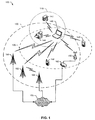
- an example wireless communication system 100 may include one or more wireless communication networks, generally shown as 110, 120, and 130.
- the wireless communication system 100 may include a wireless personal area network (WPAN) 110, a wireless local area network (WLAN) 120, and a wireless metropolitan area network (WMAN) 130.
- WPAN wireless personal area network
- WLAN wireless local area network
- WMAN wireless metropolitan area network
- FIG. 1 depicts three wireless communication networks, the wireless communication system 100 may include additional or fewer wireless communication networks.
- the wireless communication networks 100 may include additional WPANs, WLAN, and/or WMANs. The methods and apparatus described herein are not limited in this regard.
- the wireless communication system 100 may also include one or more subscriber stations, generally shown as 140, 142, 144, 146, and 148.
- the subscriber stations 140, 142, 144, 146, and 148 may include wireless electronic devices such as a desktop computer, a laptop computer, a handheld computer, a tablet computer, a cellular telephone, a pager, an audio and/or video player (e.g., an MP3 player or a DVD player), a gaming device, a video camera, a digital camera, a navigation device (e.g., a GPS device), a wireless peripheral (e.g., a printer, a scanner, a headset, a keyboard, a mouse, etc.), a medical device (e.g., a heart rate monitor, a blood pressure monitor, etc.), and/or other suitable fixed, portable, or mobile electronic devices.
- FIG. 1 depicts five subscriber stations, the wireless communication system 100 may include more or less subscriber stations.
- the subscriber stations 140, 142, 144, 146, and 148 may use a variety of modulation techniques such as spread spectrum modulation (e.g., direct sequence code division multiple access (DS-CDMA) and/or frequency hopping code division multiple access (FH-CDMA)), time-division multiplexing (TDM) modulation, frequency-division multiplexing (FDM) modulation, orthogonal frequency-division multiplexing (OFDM) modulation, multi-carrier modulation (MDM), and/or other suitable modulation techniques to communicate via wireless links.
- spread spectrum modulation e.g., direct sequence code division multiple access (DS-CDMA) and/or frequency hopping code division multiple access (FH-CDMA)
- TDM time-division multiplexing
- FDM frequency-division multiplexing
- OFDM orthogonal frequency-division multiplexing
- MDM multi-carrier modulation
- the laptop computer 140 may operate in accordance with suitable wireless communication protocols that require very low power such as Bluetooth ® , ultra-wide band (UWB), and/or radio frequency identification (RFID) to implement the WPAN 110.
- the laptop computer 140 may communicate with devices associated with the WPAN 110 such as the video camera 142 and/or the printer 144 via wireless links.
- the laptop computer 140 may use direct sequence spread spectrum (DSSS) modulation and/or frequency hopping spread spectrum (FHSS) modulation to implement the WLAN 120 (e.g., the 802.11 family of standards developed by the Institute of Electrical and Electronic Engineers (IEEE) and/or variations and evolutions of these standards).
- DSSS direct sequence spread spectrum
- FHSS frequency hopping spread spectrum
- the laptop computer 140 may communicate with devices associated with the WLAN 120 such as the printer 144, the handheld computer 146 and/or the smart phone 148 via wireless links.
- the laptop computer 140 may also communicate with an access point (AP) 150 via a wireless link.
- the AP 150 may be operatively coupled to a router 152 as described in further detail below.
- the AP 150 and the router 152 may be integrated into a single device (e.g., a wireless router).
- the laptop computer 140 may use OFDM modulation to transmit large amounts of digital data by splitting a radio frequency signal into multiple small subsignals, which in turn, are transmitted simultaneously at different frequencies.
- the laptop computer 140 may use OFDM modulation to implement the WMAN 130.
- the laptop computer 140 may operate in accordance with the 802.16 family of standards developed by IEEE to provide for fixed, portable, and/or mobile broadband wireless access (BWA) networks (e.g., the IEEE std. 802.16-2004 (published September 18, 2004), the IEEE std. 802.16e (published February 28, 2006), the IEEE std. 802.16f (published December 1, 2005), etc.) to communicate with base stations, generally shown as 160, 162, and 164, via wireless link(s).
- BWA mobile broadband wireless access
- the methods and apparatus disclosed herein are readily applicable to many specifications and/or standards developed by other special interest groups and/or standard development organizations (e.g., Wireless Fidelity (Wi-Fi) Alliance, Worldwide Interoperability for Microwave Access (WiMAX) Forum, Infrared Data Association (IrDA), Third Generation Partnership Project (3GPP), etc.).
- Wi-Fi Wireless Fidelity
- WiMAX Worldwide Interoperability for Microwave Access
- IrDA Infrared Data Association
- 3GPP Third Generation Partnership Project
- the WLAN 120 and WMAN 130 may be operatively coupled to a common public or private network 170 such as the Internet, a telephone network (e.g., public switched telephone network (PSTN)), a local area network (LAN), a cable network, and/or another wireless network via connection to an Ethernet, a digital subscriber line (DSL), a telephone line, a coaxial cable, and/or any wireless connection, etc.
- a common public or private network 170 such as the Internet, a telephone network (e.g., public switched telephone network (PSTN)), a local area network (LAN), a cable network, and/or another wireless network via connection to an Ethernet, a digital subscriber line (DSL), a telephone line, a coaxial cable, and/or any wireless connection, etc.
- the WLAN 120 may be operatively coupled to the common public or private network 170 via the AP 150 and/or the router 152.
- the WMAN 130 may be operatively coupled to the common public or private network 170 via the base station(s) 160
- the wireless communication system 100 may include other suitable wireless communication networks.
- the wireless communication system 100 may include a wireless wide area network (WWAN) (not shown).
- the laptop computer 140 may operate in accordance with other wireless communication protocols to support a WWAN.
- these wireless communication protocols may be based on analog, digital, and/or duai-mode communication system technologies such as Global System for Mobile Communications (GSM) technology, Wideband Code Division Multiple Access (WCDMA) technology, General Packet Radio Services (GPRS) technology, Enhanced Data GSM Environment (EDGE) technology, Universal Mobiie Telecommunications System (UMTS) technology, Third Generation Partnership Project (3GPP) technology, standards based on these technologies, variations and evolutions of these standards, and/or other suitable wireless communication standards.
- GSM Global System for Mobile Communications
- WCDMA Wideband Code Division Multiple Access
- GPRS General Packet Radio Services
- EDGE Enhanced Data GSM Environment
- UMTS Universal Mobiie Telecommunications System
- 3GPP Third Generation Partnership Project
- FIG. 1
- the wireless communication system 100 may include other WPAN, WLAN, WMAN, and/or WWAN devices (not shown) such as network interface devices and peripherals (e.g., network interface cards (NICs)), access points (APs), redistribution points, end points, gateways, bridges, hubs, etc. to implement a cellular telephone system, a satellite system, a personal communication system (PCS), a two-way radio system, a one-way pager system, a two-way pager system, a personal computer (PC) system, a personal data assistant (PDA) system, a personal computing accessory (PCA) system, and/or any other suitable communication system.
- PCS personal communication system
- PDA personal data assistant
- PCA personal computing accessory
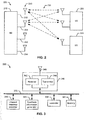
- an example wireless MIMO system 200 may include a base station 210 and one or more subscriber stations, generally shown as 220 and 225.
- the wireless MIMO system 200 may include a point-to-point MIMO system and/or a point-to-multiple point MIMO system.
- a point-to-point MIMO system may include the base station 210 and the subscriber station 220.
- a point-to-multiple point MIMO system may include the base station 210 and the subscriber station 225.
- the base station 210 may transmit data streams to the subscriber stations 220, 225 simultaneously.
- the base station 310 may transmit two data streams to the subscriber station 220 and one data stream to the subscriber station 225.
- FIG. 2 may depict one subscriber station, the wireless MIMO system 200 may include additional subscriber stations.
- the base station 210 may transmit two or more data streams over four transmit antennas 250, generally shown as 252, 254, 256, and 258. Although FIG. 2 depicts four transmit antennas, the base station 210 may include additional or fewer transmit antennas. The methods and apparatus described herein are not limited in this regard.
- channel state feedback is employed in most WMAN systems.
- the feedback can be for transmit beamforming, user scheduling, modulation coding selection, etc.
- the feedback is usually sent by the subscriber station 220 (or UE) to the base station 210 (or Node B) through a dedicated feedback channel (e.g., control channel). Since the dedicated channel is designed to be robust in various channel conditions, it is heavily coded. Because the number of bits is small (i.e., a few bits for each feedback), the coding efficiency is very low to achieve the robust protection. It is desirable to aggregate multiple feedbacks and encode them together and send through an ordinary data channel. However, the feedback has to be sent timely to report the current channel state in the legacy system. It prevents the subscriber station 220 from aggregation.
- the subscriber station 220 predicts the channel responses of several original feedback periods ahead and generates the feedback information for the periods.
- the feedback information can be for transmit beamforming, user scheduling, modulation coding selection, etc.
- the information can be compressed by exploiting the correlation among them and channel coded jointly.
- the aggregated information block enables efficient coding.
- the coded block can be sent by normal data channel that has a longer latency than the dedicated feedback channel, because the latency can be compensated by the prediction. Therefore, the prediction not only enables the aggregation for efficient coding but also allows the feedback sending over low-cost data channel.
- channel state feedback is employed in most WMAN system.
- the feedback can be for transmit beamforming, user scheduling, modulation coding selection, etc.
- CQI channel quality indicator
- power control feedback tells the base station to increase or decrease the transmission power
- beamforming feedback provides the beamforming vectors for the base station to direct energy to the mobile.
- the feedbacks are usually sent by the subscriber station 220 (or UE) to the base station 210 (or Node B) through a dedicated feedback channel (e.g., control channel. 230 as shown in FIG. 2 ). Since the dedicated channel is designed to be robust in various channel conditions, it is heavily coded. Because the number of bits is small i.e.
- the coding efficiency is very low to achieve the robust protection.
- power control feedback may use one bit and there is no efficient channel coding to protect it, while there are many strong codes to protect 1k bits jointly.
- H-ARQ acknowledgement packet in HSDPA which is sent through HS-DPCCH channel, has two information bits and the coded block has ten bits. The code rate is very low 1/5. Therefore, the efficiency of the dedicated channel is low or its usage is costly.
- the bandwidth of the feedback channel is limited in the system, and can't support a large bandwidth of feedback. It is desirable to aggregate multiple feedbacks and code them together and send them through an ordinary data channel. However, the feedback has to be sent timely to report the current channel state for the legacy system. It prevents the mobile station from aggregation.
- the subscriber station 220 may include a channel response predictor 310, a feedback information generator 320, a network interface device (NID) 340, a processor 350, and a memory 360.
- the channel response predictor 310, the feedback information generator 320, the NID 340, the processor 350, and the memory 360 may be operatively coupled to each other via a bus 370. While FIG. 3 depicts components of the subscriber station 220 coupling to each other via the bus 370, these components may be operatively coupled to each other via other suitable direct or indirect connections (e.g., a point-to-point connection or a point-to-multiple point connection).
- the NID 340 may include a receiver 342, a transmitter 344, and an antenna 346.
- the subscriber station 220 may receive and/or transmit data via the receiver 342 and the transmitter 344, respectively.
- the antenna 346 may include one or more directional or omni-directional antennas such as dipole antennas, monopole antennas, patch antennas, loop antennas, microstrip antennas, and/or other types of antennas suitable for transmission of radio frequency (RF) signals.
- RF radio frequency
- FIG. 3 depicts a single antenna, the subscriber station 220 may include additional antennas.
- the subscriber station 220 may include a plurality of antennas to implement a multiple-input-multiple-output (MIMO) system.
- MIMO multiple-input-multiple-output
- the components shown in FIG. 3 are depicted as separate blocks within the subscriber station 220, the functions performed by some of these blocks may be integrated within a single semiconductor circuit or may be implemented using two or more separate integrated circuits.
- the receiver 342 and the transmitter 344 are depicted as separate blocks within the NID 340, the receiver 342 may be integrated into the transmitter 344 (e.g., a transceiver). The methods and apparatus described herein are not limited in this regard.
- the subscriber station 220 predicts the channel responses of several original feedback periods and generates the feedback information for the periods.
- the feedback information can be for transmit beamforming, user scheduling, modulation coding selection, etc.
- the information can be compressed by exploiting the correlation among them and then channel coded jointly.
- the aggregated information block enables efficient coding due to the increased length.
- the coded block can be sent by an ordinary data channel that has a longer latency than the dedicated feedback channel, because the latency can be compensated by the prediction.
- the ordinary data channel has a greater bandwidth than the dedicated feedback channel.
- the ordinary data channel can use the efficient MIMO transmission, while the dedicated channel usually uses the less efficient single antenna transmission. Therefore, the prediction not only enables the aggregation for efficient coding but also allows the feedback sending over low-cost data channel.
- the subscriber station 220 may predict channel responses at t 8 , t 9 , and t 10 at time t 4 after observing t 1 , t 2 , t 3 , and t 4 .
- the predictions may contain prediction errors.
- the predicted channel responses are bundled, compressed, coded into one block, and fed back to the base station using a MIMO channel designed for ordinary uplink traffic. Because there is an interval from t 4 to t 8 when the feedback information starts to be used by the base station (e.g., the base station 210 of FIG.
- the subscriber station 220 has the flexibility to find an opportunity to send the information within the interval less the processing delay at the base station 210.
- the sample points and the predicted points are not necessary to coincide in time and they can be offset and have different periods.
- the subscriber station 220 samples at time t i and feeds back the sample at the early chance without prediction.
- the subscriber station 220 may attach the feedback with other uplink traffics in a piggy back way within the time window offered by the prediction.
- the feedback may be jointly coded with H-ARQ ACK or TCP/IP ACK or even uplink data packet.
- the subscriber station 220 be may remove some partition of the uplink data packet to accommodate the feedback. If the time window is large enough, there is a high chance that the other traffics occur.
- channel state information including beamforming and CQI of multiple frequency sub-bands are needed to be fed back, they may be jointly compressed, coded and sent in one block.
- FIG. 5 depicts one manner in which the subscriber station 220 may be configured to provide a feedback aggregation system.
- the example process 500 of FIG. 5 may be implemented as machine-accessible instructions utilizing any of many different programming codes stored on any combination of machine-accessible media such as a volatile or non-volatile memory or other mass storage device (e.g., a floppy disk, a CD, and a DVD).
- a volatile or non-volatile memory or other mass storage device e.g., a floppy disk, a CD, and a DVD.
- the machine-accessible instructions may be embodied in a machine-accessible medium such as a programmable gate array, an application specific integrated circuit (ASIC), an erasable programmable read only memory (EPROM), a read only memory (ROM), a random access memory (RAM), a magnetic media, an optical media, and/or any other suitable type of medium.
- a machine-accessible medium such as a programmable gate array, an application specific integrated circuit (ASIC), an erasable programmable read only memory (EPROM), a read only memory (ROM), a random access memory (RAM), a magnetic media, an optical media, and/or any other suitable type of medium.
- FIG. 5 Although a particular order of actions is illustrated in FIG. 5 , these actions may be performed in other temporal sequences. Again, the example process 500 is merely provided and described in conjunction with the system and apparatus of FIGs. 2 and 3 as an example of one way to provide a feedback aggregation system.
- the process 500 may begin with the subscriber station 220 (e.g., via the channel response predictor 310) predicting one or more channel responses (block 510).
- Each channel response is associated with a feedback period.
- the channel response predictor 310 may sample channel response during each feedback period.
- the subscriber station 220 (e.g., via the feedback information generator 320) may generate feedback information based on the one or more channel responses.
- the feedback information generator 320 may bundle (also referred to as aggregate) the channel response(s), compress the bundled/aggregated channel response(s), and code the compressed channel response(s).
- the subscriber station 220 may transmit the feedback information to a base station via a data channel for uplink traffic.
- the methods and apparatus described herein are not limited in this regard.
- the methods and apparatus described herein may provide efficient feedback in time varying channels.
- the efficiency is provided by channel prediction, information bit aggregation, and/or usage of low cost data channel.
- the methods and apparatus described herein are not limited in this regard.
- the methods and apparatus described herein may be associated with the Third Generation Partnership Project (3GPP) for the Long Term Evolution (LTE), the methods and apparatus described herein may be readily applicable with other suitable wireless technologies, protocols, and/or standards. The methods and apparatus described herein are not limited in this regard.
- 3GPP Third Generation Partnership Project
- LTE Long Term Evolution
- FIG. 6 is a block diagram of an example processor system 2000 adapted to implement the methods and apparatus disclosed herein.
- the processor system 2000 may be a desktop computer, a laptop computer, a handheld computer, a tablet computer, a PDA, a server, an Internet appliance, and/or any other type of computing device.
- the processor system 2000 illustrated in FIG. 6 includes a chipset 2010, which includes a memory controller 2012 and an input/output (I/O) controller 2014.
- the chipset 2010 may provide memory and I/O management functions as well as a plurality of general purpose and/or special purpose registers, timers, etc. that are accessible or used by a processor 2020.
- the processor 2020 may be implemented using one or more processors, WLAN components, WMAN components, WWAN components, and/or other suitable processing components.
- the processor 2020 may be implemented using one or more of the Intel ® Pentium ® technology, the Intel ® Itanium ® technology, the Intel ® Centrino TM technology, the Intel ® Xeon TM technology, and/or the Intel ® XScale ® technology, in the alternative, other processing technology may be used to implement the processor 2020.
- the processor 2020 may include a cache 2022, which may be implemented using a first-level unified cache (L1), a second-level unified cache (L2), a third-level unified cache (L3), and/or any other suitable structures to store data.
- L1 first-level unified cache
- L2 second-level unified cache
- L3 third-level unified cache
- the memory controller 2012 may perform functions that enable the processor 2020 to access and communicate with a main memory 2030 including a volatile memory 2032 and a non-volatile memory 2034 via a bus 2040.
- the volatile memory 2032 may be implemented by Synchronous Dynamic Random Access Memory (SDRAM), Dynamic Random Access Memory (DRAM), RAMBUS Dynamic Random Access Memory (RDRAM), and/or any other type of random access memory device.
- the non-volatile memory 2034 may be implemented using flash memory, Read Only Memory (ROM), Electrically Erasable Programmable Read Only Memory (EEPROM), and/or any other desired type of memory device.
- the processor system 2000 may also include an interface circuit 2050 that is coupled to the bus 2040.
- the interface circuit 2050 may be implemented using any type of interface standard such as an Ethernet interface, a universal serial bus (USB), a third generation input/output interface (3GIO) interface, and/or any other suitable type of wired or wireless interface.
- interface unit 2050 is endowed with the earlier described channel response predictor 310 and/or feedback information generator 320.
- One or more input devices 2060 may be connected to the interface circuit 2050.
- the input device(s) 2060 permit an individual to enter data and commands into the processor 2020.
- the input device(s) 2060 may be implemented by a keyboard, a mouse, a touch-sensitive display, a track pad, a track ball, an isopoint, and/or a voice recognition system.
- One or more output devices 2070 may also be connected to the interface circuit 2050.
- the output device(s) 2070 may be implemented by display devices (e.g., a light emitting display (LED), a liquid crystal display (LCD), a cathode ray tube (CRT) display, a printer and/or speakers).
- the interface circuit 2050 may include, among other things, a graphics driver card.
- the processor system 2000 may also include one or more mass storage devices 2080 to store software and data.
- mass storage device(s) 2080 include floppy disks and drives, hard disk drives, compact disks and drives, and digital versatile disks (DVD) and drives.
- the interface circuit 2050 may also include a communication device such as a modem or a network interface card to facilitate exchange of data with external computers via a network.
- the communication link between the processor system 2000 and the network may be any type of network connection such as an Ethernet connection, a digital subscriber line (DSL), a telephone line, a cellular telephone system, a coaxial cable, etc.
- Access to the input device(s) 2060, the output device(s) 2070, the mass storage device(s) 2080 and/or the network may be controlled by the I/O controller 2014.
- the I/O controller 2014 may perform functions that enable the processor 2020 to communicate with the input device(s) 2060, the output device(s) 2070, the mass storage device(s) 2080 and/or the network via the bus 2040 and the interface circuit 2050.
- FIG. 6 While the components shown in FIG. 6 are depicted as separate blocks within the processor system 2000, the functions performed by some of these blocks may be integrated within a single semiconductor circuit or may be implemented using two or more separate integrated circuits.
- the memory controller 2012 and the I/O controller 2014 are depicted as separate blocks within the chipset 2010, the memory controller 2012 and the I/O controller 2014 may be integrated within a single semiconductor circuit.
Landscapes
- Engineering & Computer Science (AREA)
- Computer Networks & Wireless Communication (AREA)
- Signal Processing (AREA)
- Quality & Reliability (AREA)
- Physics & Mathematics (AREA)
- Mathematical Physics (AREA)
- Theoretical Computer Science (AREA)
- Mobile Radio Communication Systems (AREA)
Claims (14)
- Appareil, comprenant :un prédicteur de réponses de canal (310) pour prédire, pour une station d'abonné (220) hébergeant l'appareil, une pluralité de réponses de canal pour une première pluralité d'instants correspondant à une pluralité de périodes de retour d'informations futures pour que la station d'abonné (220) fournisse un retour d'informations à une station de base (210) ; etun générateur d'informations en retour (320) couplé au prédicteur de réponses de canal (310) pour recevoir les réponses de canal prédites, pour générer des informations en retour pour chacune de la pluralité de périodes de retour d'informations futures sur la base des réponses de canal prédites, pour regrouper dans un bloc d'informations regroupées les informations en retour pour chacune de la pluralité de périodes de retour d'informations futures et pour coder le bloc d'informations regroupées sous forme d'un bloc de transmission unique destiné à être transmis à la station de base (210) dans un canal de données de liaison montante.
- Appareil selon la revendication 1, dans lequel le prédicteur de réponses de canal (310) est configuré pour échantillonner une autre pluralité de réponses de canal à une deuxième pluralité d'instants précédant la première pluralité d'instants et pour prédire la pluralité de réponses de canal sur la base en partie au moins de l'autre pluralité de réponses de canal échantillonnées.
- Appareil selon la revendication 1, dans lequel les informations en retour comprennent au moins deux types d'informations en retour sélectionnés parmi un groupe constitué par un retour d'informations sur la qualité de canal, un retour d'informations sur la régulation de puissance et un retour d'informations sur la mise en forme de faisceau.
- Appareil selon la revendication 3, dans lequel le générateur d'informations en retour (320) est configuré pour compresser le bloc d'informations regroupées sur la base en partie au moins d'une corrélation entre les réponses de canal prédites.
- Appareil selon la revendication 4, dans lequel le générateur d'informations en retour (320) est configuré pour coder le bloc d'informations regroupées compressé.
- Appareil selon la revendication 1, dans lequel le générateur d'informations en retour (320) sert à coder le bloc d'informations regroupées sous forme du bloc de transmission unique destiné à être transmis à la station de base (210) par une pluralité d'antennes d'émission dans le canal de données de liaison montante.
- Appareil selon la revendication 1, dans lequel le générateur d'informations en retour (320) est en outre configuré pour regrouper les informations en retour et des données de liaison montante dans le bloc d'informations regroupées.
- Procédé, comprenant les étapes consistant à :recevoir, par une station de base (210), un bloc de transmission unique sur un canal de données de liaison montante, le bloc de transmission unique comprenant des informations en retour regroupées en provenance d'une station d'abonné (220), les informations en retour regroupées comprenant des informations en retour pour une pluralité de périodes de retour d'informations futures sur la base de réponses de canal prédites ;récupérer, par la station de base (210), les informations en retour ; ettransmettre une transmission de liaison descendante à la station d'abonné (220) sur la base des informations en retour.
- Procédé selon la revendication 8, comprenant en outre les étapes consistant à procéder, par la station de base (210), à une mise en forme de faisceau sur la base en partie au moins des informations en retour récupérées ; et transmettre la transmission de liaison descendante sur la base de la mise en forme de faisceau.
- Procédé selon la revendication 8, comprenant en outre les étapes consistant à sélectionner, par la station de base (210), au moins un schéma parmi un schéma de modulation ou un schéma de codage sur la base en partie au moins des informations en retour récupérées ; et transmettre la transmission de liaison descendante sur la base dudit au moins un schéma sélectionné parmi le schéma de modulation ou le schéma de codage.
- Article de fabrication, comprenant :un support de stockage ; etune pluralité d'instructions de programmation qui y sont stockées, et configurées pour programmer un module de communication d'une station d'abonné (220) pour permettre au module de communication :de prédire, pour la station d'abonné (220), une pluralité de réponses de canal pour une première pluralité d'instants correspondant à une pluralité de périodes de retour d'informations futures pour que la station d'abonné (220) fournisse un retour d'informations à une station de base (210), de générer, pour la station d'abonné (220), des informations en retour pour chacune de la pluralité de périodes de retour d'informations futures sur la base des réponses de canal prédites, pour regrouper dans un bloc d'informations regroupées les informations en retour pour chacune de la pluralité de périodes de retour d'informations futures et pour coder le bloc d'informations regroupées sous forme d'un bloc de transmission unique destiné à être transmis à la station de base (210) dans un canal de données de liaison montante ; oupour mettre en oeuvre les revendications 8 à 10 du procédé.
- Système, comprenant :une pluralité d'antennes ;une mémoire ;un processeur couplé à la mémoire ; etun module de communication couplé au processeur et à la pluralité d'antennes, configuré :pour prédire, pour le système, une pluralité de réponses de canal pour une première pluralité d'instants correspondant à une pluralité de périodes de retour d'informations futures pour que le système fournisse un retour d'informations à une station de base (210) ; etpour générer des informations en retour pour chacune de la pluralité de périodes de retour d'informations futures sur la base des réponses de canal prédites, pour regrouper dans un bloc d'informations regroupées les informations en retour pour chacune de la pluralité de périodes de retour d'informations futures et pour coder le bloc d'informations regroupées sous forme d'un bloc de transmission unique destiné à être transmis à la station de base (210) par la pluralité d'antennes dans un canal de données de liaison montante.
- Système selon la revendication 12, dans lequel la pluralité d'antennes comprennent une pluralité d'antennes équidirectives configurées pour un fonctionnement à entrées multiples, sorties multiples.
- Système selon la revendication 12, lequel système est un système sélectionné parmi un ordinateur de bureau, un ordinateur portable, un ordinateur de poche, une tablette électronique, un téléphone cellulaire, un téléavertisseur, un lecteur audio, un lecteur vidéo, un dispositif de jeu, une caméra vidéo, un appareil photo numérique, un dispositif de navigation, une imprimante, un scanner ou un dispositif médical.
Applications Claiming Priority (3)
| Application Number | Priority Date | Filing Date | Title |
|---|---|---|---|
| US79681206P | 2006-05-01 | 2006-05-01 | |
| US11/617,403 US7778599B2 (en) | 2006-05-01 | 2006-12-28 | Aggregated channel feedback |
| PCT/US2007/067901 WO2007130955A1 (fr) | 2006-05-01 | 2007-05-01 | Rétroaction par canaux regroupés |
Publications (3)
| Publication Number | Publication Date |
|---|---|
| EP2020105A1 EP2020105A1 (fr) | 2009-02-04 |
| EP2020105A4 EP2020105A4 (fr) | 2012-11-14 |
| EP2020105B1 true EP2020105B1 (fr) | 2014-08-20 |
Family
ID=38648922
Family Applications (1)
| Application Number | Title | Priority Date | Filing Date |
|---|---|---|---|
| EP07761658.9A Not-in-force EP2020105B1 (fr) | 2006-05-01 | 2007-05-01 | Rétroaction par canaux regroupés |
Country Status (4)
| Country | Link |
|---|---|
| US (1) | US7778599B2 (fr) |
| EP (1) | EP2020105B1 (fr) |
| CN (1) | CN101433001B (fr) |
| WO (1) | WO2007130955A1 (fr) |
Families Citing this family (43)
| Publication number | Priority date | Publication date | Assignee | Title |
|---|---|---|---|---|
| US8449989B2 (en) * | 2003-10-17 | 2013-05-28 | Lg Chem, Ltd. | Organic compound and organic light emitting device using the same |
| US7599714B2 (en) * | 2005-09-30 | 2009-10-06 | Alcatel-Lucent Usa Inc. | Increasing the range of access point cells for a given throughput in a downlink of a wireless local area network |
| WO2007078171A2 (fr) * | 2006-01-05 | 2007-07-12 | Lg Electronics Inc. | Procede de transmission d'informations en retour dans un systeme de communication sans fil |
| KR101203841B1 (ko) * | 2006-01-05 | 2012-11-21 | 엘지전자 주식회사 | 무선 통신 시스템에서의 페이징 메시지 전송 및 수신 방법 |
| KR101333918B1 (ko) | 2006-01-05 | 2013-11-27 | 엘지전자 주식회사 | 이동 통신 시스템의 점-대-다 서비스 통신 |
| KR101211807B1 (ko) | 2006-01-05 | 2012-12-12 | 엘지전자 주식회사 | 이동통신 시스템에서 무선단말의 동기상태 관리방법 |
| KR101268200B1 (ko) | 2006-01-05 | 2013-05-27 | 엘지전자 주식회사 | 이동통신 시스템에서의 무선자원 할당방법 |
| KR101319870B1 (ko) | 2006-01-05 | 2013-10-18 | 엘지전자 주식회사 | 이동 통신 시스템에서의 핸드오버 방법 |
| KR101265628B1 (ko) * | 2006-01-05 | 2013-05-22 | 엘지전자 주식회사 | 이동 통신 시스템에서의 무선 자원 스케줄링 방법 |
| KR101358469B1 (ko) | 2006-02-07 | 2014-02-06 | 엘지전자 주식회사 | 무선 네트워크(network) 안에서 상향(uplink)및 하향(downlink) 대역폭(bandwidth)의선택 및 신호 방법 |
| KR101216751B1 (ko) * | 2006-02-07 | 2012-12-28 | 엘지전자 주식회사 | 이동 통신 시스템에서 식별자를 이용한 충돌 회피 방법 |
| KR101387475B1 (ko) * | 2006-03-22 | 2014-04-22 | 엘지전자 주식회사 | 복수의 네트워크 엔터티를 포함하는 이동 통신시스템에서의 데이터 처리 방법 |
| US7894820B2 (en) * | 2006-05-01 | 2011-02-22 | Intel Corporation | Channel feedback using channel state predictions based also on delays |
| KR20070121505A (ko) | 2006-06-21 | 2007-12-27 | 엘지전자 주식회사 | 무선링크 재설정 방법 |
| KR101369135B1 (ko) | 2006-06-21 | 2014-03-05 | 엘지전자 주식회사 | 이동통신 시스템에서의 멀티미디어 및 방송서비스의 품질보장 방법 및 그 단말 |
| US20080182625A1 (en) * | 2007-01-30 | 2008-07-31 | Broadcom Corporation, A California Corporation | RF transeiver system with antenna configuration control and methods for use therewith |
| US8130699B2 (en) | 2007-03-07 | 2012-03-06 | Wi-Lan, Inc. | Multi-band channel aggregation |
| US8020075B2 (en) * | 2007-03-16 | 2011-09-13 | Apple Inc. | Channel quality index feedback reduction for broadband systems |
| ES2391697T3 (es) | 2007-06-08 | 2012-11-29 | Sharp Kabushiki Kaisha | Sistema de comunicación móvil, aparato de estación base y aparato de estación móvil |
| EP2019496B1 (fr) | 2007-07-23 | 2017-06-07 | Sony Corporation | Procédé pour la transmission d'un signal entre un transmetteur et un récepteur dans un réseau électrique, transmetteur, récepteur, modem de communications de réseau électrique et système de communications de réseau électrique |
| US7907677B2 (en) * | 2007-08-10 | 2011-03-15 | Intel Corporation | Open loop MU-MIMO |
| EA015164B1 (ru) | 2007-09-06 | 2011-06-30 | Шарп Кабусики Кайся | Устройство связи и способ связи |
| CN101409576A (zh) * | 2007-10-12 | 2009-04-15 | Nxp股份有限公司 | 用于管理多用户无线通信系统中的预编码的方法及系统 |
| KR101476202B1 (ko) * | 2008-01-08 | 2014-12-24 | 엘지전자 주식회사 | 주기적/비주기적 채널상태정보 송수신 방법 |
| KR20140051418A (ko) | 2008-06-25 | 2014-04-30 | 애플 인크. | 무선 채널의 개별 서브밴드에 관한 피드백 정보를 포함시키는 방법 |
| US8312337B2 (en) | 2009-05-01 | 2012-11-13 | Clearwire Ip Holdings Llc | System and method for dynamic hybrid automatic repeat request (HARQ) enable/disable |
| US8233434B2 (en) * | 2009-05-01 | 2012-07-31 | Clearwire Ip Holdings Llc | System and method for adaptive control of an averaging parameter for PCINR and RSSI |
| US8797945B2 (en) * | 2009-05-01 | 2014-08-05 | Clearwire Ip Holdings Llc | System and method for hybrid schemes of MIMO mode decision |
| US8231795B2 (en) * | 2009-05-01 | 2012-07-31 | Avago Technologies Wireless Ip (Singapore) Pte. Ltd. | Micromachined horn |
| DE102009043439A1 (de) * | 2009-09-29 | 2011-03-31 | Rohde & Schwarz Gmbh & Co. Kg | Vorrichtung und Verfahren zur Messung der Kanalqualitäts-Rückmeldungen von Mobilstationen |
| GB2475098B (en) * | 2009-11-06 | 2012-09-05 | Toshiba Res Europ Ltd | Compression and decompression of channel state information in a wireless communication network |
| WO2011104718A1 (fr) * | 2010-02-28 | 2011-09-01 | Celeno Communications Ltd. | Procédé de formation de faisceau en un seul flux à contraintes de puissance mixtes |
| US9544882B2 (en) | 2010-11-24 | 2017-01-10 | Lg Electronics Inc. | Method and apparatus for transmitting channel status information in carrier aggregation system |
| WO2012077930A2 (fr) * | 2010-12-06 | 2012-06-14 | 엘지전자 주식회사 | Procédé de signalement d'informations d'état des canaux dans un système de communication sans fil et dispositif associé |
| US20140077967A1 (en) * | 2011-08-06 | 2014-03-20 | Imaxdi Real Innovation Sl | Wireless patient monitoring system |
| TWI514786B (zh) * | 2013-11-29 | 2015-12-21 | Wistron Neweb Corp | 無線電子裝置及其無線傳輸方法 |
| US10234292B2 (en) * | 2014-08-08 | 2019-03-19 | Stmicroelefctronics S.R.L. | Positioning apparatus and global navigation satellite system, method of detecting satellite signals |
| WO2017173567A1 (fr) * | 2016-04-05 | 2017-10-12 | Intel IP Corporation | Système à entrées multiples-sorties multiples à faisceaux multiples |
| DE102017205785A1 (de) * | 2017-04-05 | 2018-10-11 | Robert Bosch Gmbh | Teilnehmerstation für ein Bussystem und Verfahren zur Verbesserung der Einhaltung der Bit-Timing-Anforderung in einem Bussystem |
| WO2019148399A1 (fr) * | 2018-01-31 | 2019-08-08 | 华为技术有限公司 | Procédé et appareil de rapport d'informations d'état de canal (csi) |
| WO2019231823A1 (fr) | 2018-05-29 | 2019-12-05 | Skyworks Solutions, Inc. | Systèmes de communication de formation de faisceau avec commande de puissance à base de configuration de diagramme d'antenne |
| CN115176438B (zh) * | 2020-02-28 | 2024-04-19 | 高通股份有限公司 | 用于捆绑下行链路共享信道的信道状态信息报告 |
| CN113381950B (zh) * | 2021-04-25 | 2022-11-25 | 清华大学 | 基于网络聚合策略的高效mimo信道反馈方法及装置 |
Family Cites Families (12)
| Publication number | Priority date | Publication date | Assignee | Title |
|---|---|---|---|---|
| US8291007B2 (en) * | 2000-02-22 | 2012-10-16 | Flash Networks Ltd | System and method to accelerate client/server interactions using predictive requests |
| JP2002050996A (ja) * | 2000-07-31 | 2002-02-15 | Sony Corp | 整数倍相互関係を有するブロック長を用いて符号化された信号を通信伝送路を介して送信する通信システム |
| US6496535B2 (en) * | 2001-03-23 | 2002-12-17 | Navini Networks, Inc. | Method and system for effective channel estimation in a telecommunication system |
| US7174178B2 (en) * | 2001-07-19 | 2007-02-06 | Intel Corporation | Deriving a more accurate estimate from prediction data in closed loop transmit diversity modes |
| US7050759B2 (en) * | 2002-02-19 | 2006-05-23 | Qualcomm Incorporated | Channel quality feedback mechanism and method |
| WO2004042982A2 (fr) * | 2002-11-01 | 2004-05-21 | Interdigital Technology Corporation | Procede de prediction de la qualite de la voie dans des systemes de communications sans fil |
| CN1943152B (zh) | 2004-02-13 | 2011-07-27 | 桥扬科技有限公司 | 用于具有自适应发射和反馈的多载波通信系统的方法和设备 |
| US7539253B2 (en) | 2004-09-10 | 2009-05-26 | Intel Corporation | Interpolation in channel state feedback |
| US7433434B2 (en) * | 2004-10-01 | 2008-10-07 | General Dynamics C4 Systems, Inc. | Communication channel tracking apparatus |
| MX2007004384A (es) * | 2004-10-29 | 2007-06-05 | Ericsson Telefon Ab L M | Asignacion de recursos en redes de comunicaciones. |
| US7492722B2 (en) * | 2004-11-04 | 2009-02-17 | Interdigital Technology Corporation | Wireless communication method and apparatus for adaptively biasing channel quality indicators to maintain a desired block error rate |
| US7548730B2 (en) * | 2006-03-16 | 2009-06-16 | Intel Corporation | Systems and methods for improving performance of multiple spatial communication channels |
-
2006
- 2006-12-28 US US11/617,403 patent/US7778599B2/en not_active Expired - Fee Related
-
2007
- 2007-05-01 CN CN200780015594.1A patent/CN101433001B/zh not_active Expired - Fee Related
- 2007-05-01 EP EP07761658.9A patent/EP2020105B1/fr not_active Not-in-force
- 2007-05-01 WO PCT/US2007/067901 patent/WO2007130955A1/fr not_active Ceased
Also Published As
| Publication number | Publication date |
|---|---|
| WO2007130955A1 (fr) | 2007-11-15 |
| CN101433001A (zh) | 2009-05-13 |
| EP2020105A4 (fr) | 2012-11-14 |
| CN101433001B (zh) | 2013-03-20 |
| EP2020105A1 (fr) | 2009-02-04 |
| US20070254597A1 (en) | 2007-11-01 |
| US7778599B2 (en) | 2010-08-17 |
Similar Documents
| Publication | Publication Date | Title |
|---|---|---|
| EP2020105B1 (fr) | Rétroaction par canaux regroupés | |
| US7894820B2 (en) | Channel feedback using channel state predictions based also on delays | |
| JP6457741B2 (ja) | Mimoシステムの下りリンクチャネルパラメータの決定 | |
| US7751368B2 (en) | Providing CQI feedback to a transmitter station in a closed-loop MIMO system | |
| US12040854B2 (en) | Wireless communication method, terminal device and network device | |
| EP2047636A1 (fr) | Procédés et appareils pour assurer des opérations en mode repos pour une plate-forme avec une pluralité de dispositifs de communication sans fil | |
| WO2019157995A1 (fr) | Procédé et dispositif de transmission de données et appareil de communication | |
| CN114902743A (zh) | 传输系统信息块的方法、装置和存储介质 | |
| CN113114442B (zh) | 一种通信方法、终端设备和网络设备 | |
| WO2019154259A1 (fr) | Procédé et dispositif de communication sans fil dans une station de base et un équipement utilisateur | |
| WO2022077142A1 (fr) | Procédé d'envoi de canal partagé de liaison montante physique et appareil de communication | |
| CN113365356B (zh) | 无线通信方法、网络设备和终端设备 | |
| EP3579630B1 (fr) | Procédé et dispositif de transmission d'informations de commande de liaison descendante | |
| WO2019149242A1 (fr) | Procédé et appareil pour une communication sans fil dans une station de base et un équipement utilisateur | |
| CN101432996A (zh) | 利用基于延迟的信道状态预测进行信道反馈 | |
| US20070183352A1 (en) | Methods and apparatus for providing a shared server system for a platform of multiple wireless communication devices | |
| US20230344601A1 (en) | Wireless communication method, terminal device, and network device | |
| JP2019537286A (ja) | データ伝送方法、受信側装置及び送信側装置 | |
| CN114642035A (zh) | 一种信息指示方法及装置、终端设备、网络设备 | |
| HK1240420A1 (en) | Downlink channel parameters determination for a multiple-input-multiple-output (mimo) system |
Legal Events
| Date | Code | Title | Description |
|---|---|---|---|
| PUAI | Public reference made under article 153(3) epc to a published international application that has entered the european phase |
Free format text: ORIGINAL CODE: 0009012 |
|
| 17P | Request for examination filed |
Effective date: 20081128 |
|
| AK | Designated contracting states |
Kind code of ref document: A1 Designated state(s): AT BE BG CH CY CZ DE DK EE ES FI FR GB GR HU IE IS IT LI LT LU LV MC MT NL PL PT RO SE SI SK TR |
|
| AX | Request for extension of the european patent |
Extension state: AL BA HR MK RS |
|
| DAX | Request for extension of the european patent (deleted) | ||
| A4 | Supplementary search report drawn up and despatched |
Effective date: 20121015 |
|
| RIC1 | Information provided on ipc code assigned before grant |
Ipc: H04B 7/212 20060101ALI20121009BHEP Ipc: H04J 3/14 20060101AFI20121009BHEP Ipc: H04B 7/216 20060101ALI20121009BHEP |
|
| GRAP | Despatch of communication of intention to grant a patent |
Free format text: ORIGINAL CODE: EPIDOSNIGR1 |
|
| INTG | Intention to grant announced |
Effective date: 20140425 |
|
| GRAS | Grant fee paid |
Free format text: ORIGINAL CODE: EPIDOSNIGR3 |
|
| GRAA | (expected) grant |
Free format text: ORIGINAL CODE: 0009210 |
|
| AK | Designated contracting states |
Kind code of ref document: B1 Designated state(s): AT BE BG CH CY CZ DE DK EE ES FI FR GB GR HU IE IS IT LI LT LU LV MC MT NL PL PT RO SE SI SK TR |
|
| REG | Reference to a national code |
Ref country code: GB Ref legal event code: FG4D |
|
| REG | Reference to a national code |
Ref country code: CH Ref legal event code: EP |
|
| REG | Reference to a national code |
Ref country code: AT Ref legal event code: REF Ref document number: 683934 Country of ref document: AT Kind code of ref document: T Effective date: 20140915 |
|
| REG | Reference to a national code |
Ref country code: IE Ref legal event code: FG4D |
|
| REG | Reference to a national code |
Ref country code: DE Ref legal event code: R096 Ref document number: 602007038225 Country of ref document: DE Effective date: 20141002 |
|
| REG | Reference to a national code |
Ref country code: AT Ref legal event code: MK05 Ref document number: 683934 Country of ref document: AT Kind code of ref document: T Effective date: 20140820 |
|
| REG | Reference to a national code |
Ref country code: NL Ref legal event code: VDEP Effective date: 20140820 |
|
| REG | Reference to a national code |
Ref country code: LT Ref legal event code: MG4D |
|
| PG25 | Lapsed in a contracting state [announced via postgrant information from national office to epo] |
Ref country code: GR Free format text: LAPSE BECAUSE OF FAILURE TO SUBMIT A TRANSLATION OF THE DESCRIPTION OR TO PAY THE FEE WITHIN THE PRESCRIBED TIME-LIMIT Effective date: 20141121 Ref country code: LT Free format text: LAPSE BECAUSE OF FAILURE TO SUBMIT A TRANSLATION OF THE DESCRIPTION OR TO PAY THE FEE WITHIN THE PRESCRIBED TIME-LIMIT Effective date: 20140820 Ref country code: BG Free format text: LAPSE BECAUSE OF FAILURE TO SUBMIT A TRANSLATION OF THE DESCRIPTION OR TO PAY THE FEE WITHIN THE PRESCRIBED TIME-LIMIT Effective date: 20141120 Ref country code: PT Free format text: LAPSE BECAUSE OF FAILURE TO SUBMIT A TRANSLATION OF THE DESCRIPTION OR TO PAY THE FEE WITHIN THE PRESCRIBED TIME-LIMIT Effective date: 20141222 Ref country code: ES Free format text: LAPSE BECAUSE OF FAILURE TO SUBMIT A TRANSLATION OF THE DESCRIPTION OR TO PAY THE FEE WITHIN THE PRESCRIBED TIME-LIMIT Effective date: 20140820 Ref country code: FI Free format text: LAPSE BECAUSE OF FAILURE TO SUBMIT A TRANSLATION OF THE DESCRIPTION OR TO PAY THE FEE WITHIN THE PRESCRIBED TIME-LIMIT Effective date: 20140820 Ref country code: SE Free format text: LAPSE BECAUSE OF FAILURE TO SUBMIT A TRANSLATION OF THE DESCRIPTION OR TO PAY THE FEE WITHIN THE PRESCRIBED TIME-LIMIT Effective date: 20140820 |
|
| PG25 | Lapsed in a contracting state [announced via postgrant information from national office to epo] |
Ref country code: LV Free format text: LAPSE BECAUSE OF FAILURE TO SUBMIT A TRANSLATION OF THE DESCRIPTION OR TO PAY THE FEE WITHIN THE PRESCRIBED TIME-LIMIT Effective date: 20140820 Ref country code: AT Free format text: LAPSE BECAUSE OF FAILURE TO SUBMIT A TRANSLATION OF THE DESCRIPTION OR TO PAY THE FEE WITHIN THE PRESCRIBED TIME-LIMIT Effective date: 20140820 Ref country code: IS Free format text: LAPSE BECAUSE OF FAILURE TO SUBMIT A TRANSLATION OF THE DESCRIPTION OR TO PAY THE FEE WITHIN THE PRESCRIBED TIME-LIMIT Effective date: 20141220 |
|
| PG25 | Lapsed in a contracting state [announced via postgrant information from national office to epo] |
Ref country code: NL Free format text: LAPSE BECAUSE OF FAILURE TO SUBMIT A TRANSLATION OF THE DESCRIPTION OR TO PAY THE FEE WITHIN THE PRESCRIBED TIME-LIMIT Effective date: 20140820 |
|
| PG25 | Lapsed in a contracting state [announced via postgrant information from national office to epo] |
Ref country code: SK Free format text: LAPSE BECAUSE OF FAILURE TO SUBMIT A TRANSLATION OF THE DESCRIPTION OR TO PAY THE FEE WITHIN THE PRESCRIBED TIME-LIMIT Effective date: 20140820 Ref country code: CZ Free format text: LAPSE BECAUSE OF FAILURE TO SUBMIT A TRANSLATION OF THE DESCRIPTION OR TO PAY THE FEE WITHIN THE PRESCRIBED TIME-LIMIT Effective date: 20140820 Ref country code: RO Free format text: LAPSE BECAUSE OF FAILURE TO SUBMIT A TRANSLATION OF THE DESCRIPTION OR TO PAY THE FEE WITHIN THE PRESCRIBED TIME-LIMIT Effective date: 20140820 Ref country code: EE Free format text: LAPSE BECAUSE OF FAILURE TO SUBMIT A TRANSLATION OF THE DESCRIPTION OR TO PAY THE FEE WITHIN THE PRESCRIBED TIME-LIMIT Effective date: 20140820 Ref country code: DK Free format text: LAPSE BECAUSE OF FAILURE TO SUBMIT A TRANSLATION OF THE DESCRIPTION OR TO PAY THE FEE WITHIN THE PRESCRIBED TIME-LIMIT Effective date: 20140820 Ref country code: IT Free format text: LAPSE BECAUSE OF FAILURE TO SUBMIT A TRANSLATION OF THE DESCRIPTION OR TO PAY THE FEE WITHIN THE PRESCRIBED TIME-LIMIT Effective date: 20140820 |
|
| REG | Reference to a national code |
Ref country code: DE Ref legal event code: R097 Ref document number: 602007038225 Country of ref document: DE |
|
| PG25 | Lapsed in a contracting state [announced via postgrant information from national office to epo] |
Ref country code: PL Free format text: LAPSE BECAUSE OF FAILURE TO SUBMIT A TRANSLATION OF THE DESCRIPTION OR TO PAY THE FEE WITHIN THE PRESCRIBED TIME-LIMIT Effective date: 20140820 |
|
| PLBE | No opposition filed within time limit |
Free format text: ORIGINAL CODE: 0009261 |
|
| STAA | Information on the status of an ep patent application or granted ep patent |
Free format text: STATUS: NO OPPOSITION FILED WITHIN TIME LIMIT |
|
| 26N | No opposition filed |
Effective date: 20150521 |
|
| PG25 | Lapsed in a contracting state [announced via postgrant information from national office to epo] |
Ref country code: SI Free format text: LAPSE BECAUSE OF FAILURE TO SUBMIT A TRANSLATION OF THE DESCRIPTION OR TO PAY THE FEE WITHIN THE PRESCRIBED TIME-LIMIT Effective date: 20140820 |
|
| REG | Reference to a national code |
Ref country code: CH Ref legal event code: PL |
|
| GBPC | Gb: european patent ceased through non-payment of renewal fee |
Effective date: 20150501 |
|
| PG25 | Lapsed in a contracting state [announced via postgrant information from national office to epo] |
Ref country code: LI Free format text: LAPSE BECAUSE OF NON-PAYMENT OF DUE FEES Effective date: 20150531 Ref country code: LU Free format text: LAPSE BECAUSE OF FAILURE TO SUBMIT A TRANSLATION OF THE DESCRIPTION OR TO PAY THE FEE WITHIN THE PRESCRIBED TIME-LIMIT Effective date: 20150501 Ref country code: CH Free format text: LAPSE BECAUSE OF NON-PAYMENT OF DUE FEES Effective date: 20150531 Ref country code: MC Free format text: LAPSE BECAUSE OF FAILURE TO SUBMIT A TRANSLATION OF THE DESCRIPTION OR TO PAY THE FEE WITHIN THE PRESCRIBED TIME-LIMIT Effective date: 20140820 |
|
| REG | Reference to a national code |
Ref country code: IE Ref legal event code: MM4A |
|
| REG | Reference to a national code |
Ref country code: FR Ref legal event code: ST Effective date: 20160129 |
|
| PG25 | Lapsed in a contracting state [announced via postgrant information from national office to epo] |
Ref country code: GB Free format text: LAPSE BECAUSE OF NON-PAYMENT OF DUE FEES Effective date: 20150501 Ref country code: IE Free format text: LAPSE BECAUSE OF NON-PAYMENT OF DUE FEES Effective date: 20150501 |
|
| PG25 | Lapsed in a contracting state [announced via postgrant information from national office to epo] |
Ref country code: FR Free format text: LAPSE BECAUSE OF NON-PAYMENT OF DUE FEES Effective date: 20150601 |
|
| PG25 | Lapsed in a contracting state [announced via postgrant information from national office to epo] |
Ref country code: BE Free format text: LAPSE BECAUSE OF FAILURE TO SUBMIT A TRANSLATION OF THE DESCRIPTION OR TO PAY THE FEE WITHIN THE PRESCRIBED TIME-LIMIT Effective date: 20140820 |
|
| PG25 | Lapsed in a contracting state [announced via postgrant information from national office to epo] |
Ref country code: MT Free format text: LAPSE BECAUSE OF FAILURE TO SUBMIT A TRANSLATION OF THE DESCRIPTION OR TO PAY THE FEE WITHIN THE PRESCRIBED TIME-LIMIT Effective date: 20140820 |
|
| PG25 | Lapsed in a contracting state [announced via postgrant information from national office to epo] |
Ref country code: HU Free format text: LAPSE BECAUSE OF FAILURE TO SUBMIT A TRANSLATION OF THE DESCRIPTION OR TO PAY THE FEE WITHIN THE PRESCRIBED TIME-LIMIT; INVALID AB INITIO Effective date: 20070501 |
|
| PG25 | Lapsed in a contracting state [announced via postgrant information from national office to epo] |
Ref country code: CY Free format text: LAPSE BECAUSE OF FAILURE TO SUBMIT A TRANSLATION OF THE DESCRIPTION OR TO PAY THE FEE WITHIN THE PRESCRIBED TIME-LIMIT Effective date: 20140820 |
|
| PGFP | Annual fee paid to national office [announced via postgrant information from national office to epo] |
Ref country code: DE Payment date: 20170426 Year of fee payment: 11 |
|
| PG25 | Lapsed in a contracting state [announced via postgrant information from national office to epo] |
Ref country code: TR Free format text: LAPSE BECAUSE OF FAILURE TO SUBMIT A TRANSLATION OF THE DESCRIPTION OR TO PAY THE FEE WITHIN THE PRESCRIBED TIME-LIMIT Effective date: 20140820 |
|
| REG | Reference to a national code |
Ref country code: DE Ref legal event code: R119 Ref document number: 602007038225 Country of ref document: DE |
|
| PG25 | Lapsed in a contracting state [announced via postgrant information from national office to epo] |
Ref country code: DE Free format text: LAPSE BECAUSE OF NON-PAYMENT OF DUE FEES Effective date: 20181201 |