EP2018572B1 - Refractive compact range - Google Patents
Refractive compact range Download PDFInfo
- Publication number
- EP2018572B1 EP2018572B1 EP07782555A EP07782555A EP2018572B1 EP 2018572 B1 EP2018572 B1 EP 2018572B1 EP 07782555 A EP07782555 A EP 07782555A EP 07782555 A EP07782555 A EP 07782555A EP 2018572 B1 EP2018572 B1 EP 2018572B1
- Authority
- EP
- European Patent Office
- Prior art keywords
- lens
- test
- zone
- apodizer
- test zone
- Prior art date
- Legal status (The legal status is an assumption and is not a legal conclusion. Google has not performed a legal analysis and makes no representation as to the accuracy of the status listed.)
- Ceased
Links
Images



Classifications
-
- G—PHYSICS
- G01—MEASURING; TESTING
- G01S—RADIO DIRECTION-FINDING; RADIO NAVIGATION; DETERMINING DISTANCE OR VELOCITY BY USE OF RADIO WAVES; LOCATING OR PRESENCE-DETECTING BY USE OF THE REFLECTION OR RERADIATION OF RADIO WAVES; ANALOGOUS ARRANGEMENTS USING OTHER WAVES
- G01S7/00—Details of systems according to groups G01S13/00, G01S15/00, G01S17/00
- G01S7/02—Details of systems according to groups G01S13/00, G01S15/00, G01S17/00 of systems according to group G01S13/00
- G01S7/40—Means for monitoring or calibrating
- G01S7/4004—Means for monitoring or calibrating of parts of a radar system
-
- G—PHYSICS
- G01—MEASURING; TESTING
- G01R—MEASURING ELECTRIC VARIABLES; MEASURING MAGNETIC VARIABLES
- G01R29/00—Arrangements for measuring or indicating electric quantities not covered by groups G01R19/00 - G01R27/00
- G01R29/08—Measuring electromagnetic field characteristics
- G01R29/10—Radiation diagrams of antennas
- G01R29/105—Radiation diagrams of antennas using anechoic chambers; Chambers or open field sites used therefor
-
- H—ELECTRICITY
- H01—ELECTRIC ELEMENTS
- H01Q—ANTENNAS, i.e. RADIO AERIALS
- H01Q15/00—Devices for reflection, refraction, diffraction or polarisation of waves radiated from an antenna, e.g. quasi-optical devices
- H01Q15/02—Refracting or diffracting devices, e.g. lens, prism
Definitions
- This invention relates generally to systems and methods for testing devices utilizing radio frequency signals.
- Performing testing on devices utilizing radio frequency signals may involve outdoor testing, in controlled conditions and/or in large buildings, under conditions simulating actual use of the antenna.
- testing outdoors or in a large building under controlled conditions is often impractical and/or expensive, and thus smaller indoor test ranges are often desired and used for testing.
- the simplest type of prior art indoor testing facility involves surrounding an interior space with radar-absorbing material, and relying on direct illumination of a sensor by an antenna or antenna array in performing testing.
- the sensor may be rotated and/or moved in order to examine the effect of orientation and movement on antenna performance.
- Such a direct illumination test facility has the disadvantage of requiring a large interior space, as well as a significant quantity of radar-absorbing material.
- Another type of prior art indoor test range for testing sensors uses one or more curved metal mirrors (or curved shapes coated with metal) illuminated by one or more antennas to collimate the energy and achieve the same effect on a test zone as would be achieved by a far field source (as in an outdoor range).
- the use of mirrors reduces the size of the test range, relative to ranges without metal mirrors.
- Such indoor test ranges have a limited field of regard (nominally about seven to ten degrees) which limits the field of regard for the sensor.
- This limitation on the field of regard for the sensor is a severe limitation for performing hardware in the loop testing (also known as HWIL, HIL, or HITL testing) against targets generated by an array of antennas.
- an expensive high quality reflective mirror may be required to achieve a high level of performance.
- a high quality reflector dish requires an edge treatment (to reduce energy bouncing off the edge of the mirror and mixing - out of phase - with the direct reflection from the surface).
- the edge treatment of the mirror has to handle not only the diffraction effects of direct illumination, but the diffraction effects of energy traveling along the surface of the mirror to the edge.
- extremely expensive custom designs must be resorted to, and even then there are performance limitations.
- a test range using a lens and absorber is known form US 4218683 .
- the present invention provides a radio frequency test range as recited in claims 1 to 6.
- the apodizer greatly reduces destructive diffractive interference patterns from reaching the test zone by blocking the energy from reaching the edge of the lens.
- the R-Card apodizer may be implemented either as a stand-alone element or incorporated into the surface of the lens itself.
- the surface coating be part of an apodizer incorporated into the lens surface.
- the present invention also provides a method of testing a device in a radio frequency field as recited in claim 7.
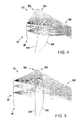
- Fig. 1 is a schematic view of a test range in accordance with an embodiment of the present invention
- Fig. 2 is a cross-section schematic side view of an embodiment of an aspheric lens for use with the test range of Fig. 1 ;
- Figs. 3A and 3B are front views of patterned aspheric lenses for use with the test range of Fig. 1 ;
- Fig. 4 is a cross-section side view of a representative embodiment aspheric lens for use with the test range of Fig. 1 ;
- Fig. 5 is a cross-section side view of a second representative embodiment aspheric lens for use with the test range of Fig. 1 ;
- Fig. 6 is a schematic view of one embodiment of an achromat lens usable with the test range of Fig. 1 ;
- Fig. 7 is a schematic view of another embodiment of an achromat lens usable with the test range of Fig. 1 ;
- Fig. 8 is a schematic view of an embodiment of an apochromat lens usable with the test range of Fig. 1 ;
- Fig. 9 is a schematic view of an embodiment of a superachromat lens usable with the test range of Fig. 1 .
- a radio-frequency-device test range includes a physical space having a source zone for placing an antenna or array of antennas, and a test zone for placing a sensor or other device to be tested.
- a lens and an apodizer are placed in the physical space between the source zone and the test zone.
- the lens serves to collimate the energy emanating from the antenna/antenna-array toward the test zone.
- the lens may be an aspheric lens.
- the lens may have a surface treatment, such as an anti-reflective coating or a surface pattern, on one or both surfaces.
- the apodizer functions to keep energy from diffracting off the edge of the lens and getting into the field of view (the test zone).
- the apodizer may be a resistance (R-Card) fence.
- the sensor or other device to be tested may be placed on a moveable mount to allow it to be moved, to simulate relative movement of the device and a radio frequency source, such as an antenna.
- the test zone for the system may have at least a 30 degree field of regard.
- the field intensity in the test zone may be uniform to within 5% or less over the test zone.
- the signal within the test zone may be in phase to within 20 degrees or less.
- the test range may be useful for testing in X-band or Ka-band radiation, or more broadly radiation from about 2 GHz to 110 GHz.
- Fig. 1 shows a test range 10 for testing a device or devices with radio frequency energy.
- the test range 10 includes a physical space 12 for placing the equipment and performing the testing.
- the physical space 12 may be surrounded with a suitable radar-absorbing material.
- radio frequency energy is defined herein to refer to the band of the frequency spectrum that includes 2 GHz to 110 GHz. This portion of the electromagnetic spectrum includes millimeter waves and microwaves, as well as portions of the radio band.
- the physical space includes a source zone 14 and a test zone 16.
- An antenna or array of antennas 18 is placed in the source zone 14.
- the term "antenna,” as used herein, is defined so as to include arrays of antennas, in addition to single antennas.
- the antenna 18 may be an electronic steerable array (ESA) antenna, to give one example. Many other sorts of antennas may be arranged in suitable antenna arrays.
- ESA electronic steerable array
- a device under test 20 is placed in the test zone 16.
- the antenna 18 is used to emit radio frequency energy to test the response of the device 20.
- the device 20 may be any of a variety of suitable devices for which information regarding response to radio frequency (RF) signals is desired. Examples of such devices include sensors and antennas such as, but not limited to, scanning devices, radiometers, radar systems, electronic warfare systems, GPS systems, communication sensors and angle of arrival systems.
- the device 20 is placed on a platform or table 22 that can be used to move the device 20 in any of a variety of ways.
- platforms or tables
- Such platforms may be commercially-available motion simulators, such as three degree of freedom tables available from Acutronic USA of Pittsburgh, Pennsylvania.
- Another suitable device is a positioner designed for performing selected antenna cuts (e.g., Az/El (azimuth over elevation) cuts, coordinated cuts, or even a 4-axis system that provides control of roll, pitch, yaw and linear radial motion).
- the platform 22 may be used, for example, to translate, tilt, rotate, or otherwise move the device under test 20 at either high rates of speed or precisely controlled pattern cuts.
- the platform 22 may have any of a variety of configurations, from a tower to a pylon, with or without a turntable/3-DOF Table/Positioner to allow the device under test 20 to be rotated.
- a lens 24 and an apodizer 26 are located in the physical space 12 between the source zone 14 and the test zone 16.
- the lens 24 serves to collimate radiated energy emanating from the antenna 18, through a field of regard 25, toward the test zone 16.
- the lens 24 may have any of a variety of suitable shapes to accomplish the purpose of focusing the radiated energy.
- the lens 24 may be an aspheric lens, a lens with surfaces that have a profile that is neither a portion of a sphere nor of a circular cylinder.
- the lens 24 may have other suitable shapes and/or characteristics, for example being a monochromat lens, an acromatic lens, an apochromat lens, or a superchromat lens.
- the lens 24 may have a diameter of about 1.5 meters (5 feet) to about 3 meters (10 feet).
- the lens 24 may be made of any of a variety of materials. Such materials include a variety of ceramic or composite materials, including materials suitable for use in radomes. Another broad category of suitable materials is suitable plastics that are homogeneous enough to have substantially uniform radiation transmission properties. Glass may also be usable for the lens 24, although glass is heavy and relatively difficult to work with. An example of a specific suitable material for the lens is the material sold as ECHOSORB.
- the lens 24 may have a surface treatment 28 on one or both of its surfaces 30 and 32.
- the surface treatment may be an anti-reflective coating 34.
- the coating 34 increases the brightness of the lens 24 by reducing the amount of incident radiation that is reflected by the lens 24. This increases the amount of incident radiation that is directed to the test zone 16.
- the material for the anti-reflective coating 34 may include layers of dielectric materials with different indices of refraction and thicknesses, in a manner similar to that of optical anti-reflection coatings.
- the materials are generally any dielectric with the suitable electrical and mechanical properties.
- the materials for the anti-reflective coating may be similar to materials that are used in R-Card fences (described further below).
- the coating 34 may be placed on the lens 24 as part of the manufacturing process for making the lens 24. Alternatively, the coating 34 may be added as a layer on one or both of the surfaces 30 and 32 after fabrication of the lens 24.
- a decrease in reflectiveness may be achieved by putting a surface pattern 40 on the surfaces 30 and/or 32.
- Figs. 3A and 3B show two examples of such patterns.
- the phrase "surface pattern" is used herein to broadly refer to a controlled closely-spaced pattern introduced onto a surface.
- the surface pattern 40 would have a spacing dense enough so that there are many pattern elements per wavelength of incident energy.
- the pattern 40 may allow energy that is normally reflected from the surfaces 30 and/or 32 to interfere with itself in such a manner as to get canceled out. This reduces the amount of energy lost in reflections at the surfaces 30 and 32 of the lens 24.
- One example of the pattern 40 is a series of dimples placed on the surfaces 30 and 32.
- Another example is a Chebyshev pattern.
- the pattern 40 may be etched into the lens, or may be otherwise suitably formed.
- the apodizer 26 functions to keep incident radiated energy from bouncing off the edge of the lens 24 and getting into the test zone.
- the apodizer 26 may include resistive sheets (R-cards) that are arrayed so as to make an R-card fence along the perimeter of the apodizer 26.
- the apodizer 26 is different from prior R-card fences in that the apodizer 26 may be substantial radially symmetric, with the apodizer 26 selectively preventing radiated energy from passing through along an outer edge.
- prior art R-card fences used to prevent or attenuate reflected energy were straight fences.
- apodizer 26 Without the apodizer 26 being present, destructive interference patterns from the edge of the lens 24 degrade the signal at the test zone 16, such as by creation of Fresnel zones. This results in variations in signal amplitude in the test zone 16, rather than the more desired smooth intensity. Essentially, it is desirable to remove the edges of the lens 24 as re-radiating surfaces, by use of the apodizer 26.
- the lens 24 and the apodizer 26 may be integrated into a single device. Alternatively, the lens 24 and the apodizer 26 may be separate items.
- the test range 10 provides good test characteristics.
- the test zone 16 may be much larger than that for reflective test ranges.
- the test zone 16 may be a cylinder at least 30 cm in diameter and 30 cm deep, with at least a 30 degree field of regard. It will be appreciated that a larger test zone allows for more movement of devices under test, as well as testing of larger devices.
- the field intensity in the test zone 16 may be uniform to within 5% over the test zone.
- the signal within the test zone 16 may be in phase to within 20 degrees.
- test zone 16 may have a volume of at least 21 liters, with a field intensity uniform to within 5%, and the signal in phase to within 20 degrees. It will be appreciated that these values are only examples, and the volume of the test zone 16, and the degree to which field intensity uniformity and signals are in phase may vary from the values given.
- the test range 10 may be used, for example, in Ka-band radiation (27 to 40 GHz) and/or X-band (8 to 12 GHz). It will be appreciated that devices allowing for compactness of a test range are of greater importance as the frequency increases. This is because the items being tested are generally much larger at higher frequencies when measured in wavelengths than those at lower frequencies (e.g., the wavelength of 10 GHz energy is 3 cm while the wavelength of 30 GHz is 1 cm, which means that a disk 9 cm in diameter has a 3 wavelength diameter at 10 GHz but a diameter of 9 wavelengths at 30 GHz).
- the lens 24 and the apodizer 26 will be suitably placed relative to the antenna 18 (in the source zone 14) and the test zone 16 so as to collimate the energy emitted by the antenna 18 into the test zone 16.
- the device under test 20 may be secured to the movement platform 22, and moved within the test zone 16. During the testing the response of the device under test 20 to the emitted radiated energy is measured. These measurements may be used for any of a variety of purposes. For example, the response of the sensor under various movement or vibration environments may be measured in a controlled, repeatable manner.
- Figs. 4 and 5 show a pair of possible configurations for the lens 24.
- Fig. 4 shows an embodiment of the lens 24 that is a concave-convex lens 50, having a concave surface 54 facing the source zone 14, and a convex surface 56 facing the test zone 16.
- Fig. 5 illustrates a plano-convex lens 60, having a substantially planar surface 64 facing the source zone 14, and a convex surface 66 facing the test zone 16.
- the lenses 50 and 60 may be configured by use of a ray-tracing computer program, for example by tracing rays out from a desired size of test zone, and selecting a lens configuration to bend the rays to a desired source location and configuration.
- any of a variety of suitable lenses may be configured based on a number of factors, such as the relative locations of the source zone 14 and the test zone 16, the configuration of the antenna 18, the characteristics of the material for the lens 24 (in particular the index of refraction for the material - a material having an index of refraction of 3 is used for the lenses 50 and 60), the wavelength of the radiated energy to be emitted, and the desired size and configuration for the test zone 16.
- a double convex lens may be a possibility.
- Figs. 6-9 illustrate multipart lens configurations for various embodiments of the lens 24.
- the embodiments shown in Figs. 6-9 are configured to collimate multiple wavelengths of radiation into a test zone.
- the embodiments in Figs. 6-9 are thus suitable for wideband use, involving sources that emit multiple wavelengths of radiation. This is in contrast to the monochromatic lenses described above.
- Fig. 6 illustrates an acromat lens 80 having a pair of individual lenses 82 and 84 operatively coupled together.
- the lenses 82 and 84 have different respective indices of refraction, and together the lenses 82 and 84 collimate a pair of different wavelengths from the source antenna 18 to the test zone 16.
- the lenses 82 and 84 may be joined together in any of a wide variety of possible ways, for example being adhesively bonded together. Alternatively, the lenses 82 and 84 may be separated in space, but both attached to a single frame.
- Fig. 7 shows an alternative achromat lens 90 in which the materials with different indices of refraction are portions 92 and 94 of a single lens.
- the portions 92 and 94 may be permanently combined together by suitable bonding and/or melding of the two materials.
- Figs. 8 and 9 show extensions of the wideband concept.
- Fig. 8 illustrates an apochromat lens 100, including three lenses or portions 102, 104, and 106 with different indices of refraction.
- the apochromat lens 100 may collimate at least three wavelengths of radiation.
- Fig. 9 shows a superachromat lens 110 with four lenses, portions, or components 112, 114, 116, and 118.
- the portions 112-118 may have different indices of refraction, and may have different shapes.
- the lenses 100 and 110 may have their individual components fused together to form a single lens having portions with different indices of refraction, as is shown in the achromat lens 90 ( Fig. 7 ).
Landscapes
- Physics & Mathematics (AREA)
- Engineering & Computer Science (AREA)
- General Physics & Mathematics (AREA)
- Radar, Positioning & Navigation (AREA)
- Remote Sensing (AREA)
- Electromagnetism (AREA)
- Computer Networks & Wireless Communication (AREA)
- Aerials With Secondary Devices (AREA)
- Investigating Or Analysing Materials By Optical Means (AREA)
- Radar Systems Or Details Thereof (AREA)
Applications Claiming Priority (2)
| Application Number | Priority Date | Filing Date | Title |
|---|---|---|---|
| US11/435,623 US7541994B2 (en) | 2006-05-17 | 2006-05-17 | Refractive compact range |
| PCT/US2007/067387 WO2007136964A2 (en) | 2006-05-17 | 2007-04-25 | Refractive compact range |
Publications (2)
| Publication Number | Publication Date |
|---|---|
| EP2018572A2 EP2018572A2 (en) | 2009-01-28 |
| EP2018572B1 true EP2018572B1 (en) | 2011-11-16 |
Family
ID=38711499
Family Applications (1)
| Application Number | Title | Priority Date | Filing Date |
|---|---|---|---|
| EP07782555A Ceased EP2018572B1 (en) | 2006-05-17 | 2007-04-25 | Refractive compact range |
Country Status (5)
| Country | Link |
|---|---|
| US (1) | US7541994B2 (https=) |
| EP (1) | EP2018572B1 (https=) |
| JP (1) | JP2009537823A (https=) |
| IL (1) | IL194822A (https=) |
| WO (1) | WO2007136964A2 (https=) |
Cited By (1)
| Publication number | Priority date | Publication date | Assignee | Title |
|---|---|---|---|---|
| CN105676005A (zh) * | 2016-01-20 | 2016-06-15 | 北京理工大学 | 一种1mm频段紧缩场系统 |
Families Citing this family (12)
| Publication number | Priority date | Publication date | Assignee | Title |
|---|---|---|---|---|
| DE60310944T3 (de) | 2002-08-05 | 2017-08-03 | Silence Therapeutics Gmbh | Weitere neue formen von interferierende rns moleküle |
| DE102009027433A1 (de) * | 2009-07-02 | 2011-01-05 | Robert Bosch Gmbh | Radarsensor für Kraftfahrzeuge |
| US8259028B2 (en) * | 2009-12-11 | 2012-09-04 | Andrew Llc | Reflector antenna radome attachment band clamp |
| US9083083B2 (en) | 2009-12-11 | 2015-07-14 | Commscope Technologies Llc | Radome attachment band clamp |
| CA2789490A1 (en) * | 2010-02-15 | 2011-08-18 | Bae Systems Plc | Antenna system |
| US9722316B2 (en) * | 2014-07-07 | 2017-08-01 | Google Inc. | Horn lens antenna |
| WO2016166564A1 (de) * | 2015-04-14 | 2016-10-20 | Cascade Microtech, Inc. | Prober mit einem vergrössernden optischen instrument |
| US10033473B1 (en) | 2017-01-23 | 2018-07-24 | Keysight Technologies, Inc. | Systems and methods for performing multiple input, multiple output (MIMO) over-the-air testing |
| CN107727946A (zh) * | 2017-11-08 | 2018-02-23 | 北京航空航天大学 | 一种高交叉极化隔离的单反射面紧缩场装置 |
| US10866305B1 (en) * | 2017-12-29 | 2020-12-15 | Waymo Llc | Signal processing for near-field radar |
| JP7223843B2 (ja) | 2018-10-09 | 2023-02-16 | エミテ、インヘニエリア、ソシエダッド、リミターダ | ハイブリッドコンパクト近傍-遠方界テスト範囲システム |
| CN112768951B (zh) * | 2021-01-20 | 2021-10-22 | 中国科学技术大学 | 面向收端小型化的可见光通信双凸透镜天线及其设计方法 |
Family Cites Families (16)
| Publication number | Priority date | Publication date | Assignee | Title |
|---|---|---|---|---|
| BE474864A (https=) * | 1944-04-22 | |||
| BE500060A (https=) * | 1949-12-23 | |||
| NL244999A (https=) * | 1958-11-21 | |||
| DE2733015A1 (de) * | 1977-04-01 | 1978-10-12 | Plessey Inc | Elektromagnetische versuchsanordnung, insbesondere antennenversuchsfeld |
| CA1100625A (en) * | 1977-04-01 | 1981-05-05 | Leland H. Hemming | Plane wave lens |
| GB2029114B (en) * | 1978-08-25 | 1982-12-01 | Plessey Inc | Dielectric lens |
| US4397558A (en) * | 1981-03-02 | 1983-08-09 | The University Of Arizona Foundation | System for reducing the effects of background radiation |
| US5001494A (en) * | 1989-06-19 | 1991-03-19 | Raytheon Company | Compact antenna range |
| FR2749087B1 (fr) * | 1996-05-21 | 1998-08-14 | Angenieux Sa | Procede de correction d'aberration optique d'une lentille |
| JP2001111291A (ja) * | 1998-10-08 | 2001-04-20 | Tokai Rubber Ind Ltd | 透明電波吸収体 |
| FR2795522B1 (fr) * | 1999-06-23 | 2001-08-10 | Agence Spatiale Europeenne | Dispositif de mesure de caracteristiques d'un champ electromagnetique, notamment du diagramme de rayonnement d'une antenne |
| JP2002228697A (ja) * | 2001-01-30 | 2002-08-14 | Mitsubishi Electric Corp | コンパクトレンジ |
| JP2003121485A (ja) * | 2001-10-09 | 2003-04-23 | Ntt Docomo Inc | 電波照射装置 |
| JP3599058B1 (ja) * | 2003-07-31 | 2004-12-08 | 住友電気工業株式会社 | ルーネベルグレンズ及びそれを用いたアンテナ装置 |
| US7339551B2 (en) * | 2004-12-21 | 2008-03-04 | Northrop Grumman Corporation | Reflective fresnel lens for sub-millimeter wave power distribution |
| JP2007187642A (ja) * | 2006-01-13 | 2007-07-26 | Keycom Corp | 放射電磁界測定装置 |
-
2006
- 2006-05-17 US US11/435,623 patent/US7541994B2/en active Active
-
2007
- 2007-04-25 WO PCT/US2007/067387 patent/WO2007136964A2/en not_active Ceased
- 2007-04-25 EP EP07782555A patent/EP2018572B1/en not_active Ceased
- 2007-04-25 JP JP2009511141A patent/JP2009537823A/ja active Pending
-
2008
- 2008-10-22 IL IL194822A patent/IL194822A/en active IP Right Grant
Cited By (2)
| Publication number | Priority date | Publication date | Assignee | Title |
|---|---|---|---|---|
| CN105676005A (zh) * | 2016-01-20 | 2016-06-15 | 北京理工大学 | 一种1mm频段紧缩场系统 |
| CN105676005B (zh) * | 2016-01-20 | 2018-06-29 | 北京理工大学 | 一种1mm频段紧缩场系统 |
Also Published As
| Publication number | Publication date |
|---|---|
| US20070268198A1 (en) | 2007-11-22 |
| EP2018572A2 (en) | 2009-01-28 |
| WO2007136964A3 (en) | 2008-03-06 |
| JP2009537823A (ja) | 2009-10-29 |
| WO2007136964A2 (en) | 2007-11-29 |
| IL194822A (en) | 2013-07-31 |
| IL194822A0 (en) | 2009-08-03 |
| US7541994B2 (en) | 2009-06-02 |
Similar Documents
| Publication | Publication Date | Title |
|---|---|---|
| EP2018572B1 (en) | Refractive compact range | |
| US5432523A (en) | Elliptical near field test facility | |
| US7576701B2 (en) | Rotating screen dual reflector antenna | |
| CA1100625A (en) | Plane wave lens | |
| CN102749529B (zh) | 紧缩场天线测量系统 | |
| CN108987926B (zh) | 一种龙勃透镜阵列收发天线装置的制作方法及装置 | |
| US5936568A (en) | Low radar cross-section (RCS) support pylon and low RCS measurement system employing same | |
| JP2023547206A (ja) | レーダービーコンおよびレーダー測定システム | |
| CN108933334B (zh) | 一种球体龙勃电磁透镜反射器的制作方法及装置 | |
| FI88750C (fi) | Kompakt antenntestbana | |
| RU2615012C2 (ru) | Способы моделирования многолучевых отражений сигналов глобальных навигационных спутниковых систем с помощью испытательных стендов и устройства для реализации способов испытаний | |
| US8471757B2 (en) | Device using dielectric lens | |
| Liang et al. | A quantitative study of Luneberg-lens reflectors | |
| RU2594667C1 (ru) | Радиолокационный уголковый отражатель | |
| US6339393B1 (en) | Rolled edge compact range reflectors | |
| US20040080447A1 (en) | Miniature omni-directional corner reflector | |
| Menshikh et al. | Application of antenna-lens system for measurement of bistatic parameters of materials | |
| Liang et al. | Ground-plane-backed hemispherical Luneberg-lens reflector | |
| Anderson et al. | Reflector surface deviations in large parabolic antennas | |
| Provencher | Experimental study of a diffraction reflector | |
| Koch et al. | 0.6 m antennae for the AMiBA interferometry array” | |
| Kosulnikov et al. | Comparative experimental characterization of phase-gradient and non-local anomalous reflectors | |
| Kotajima et al. | A novel radar reflector with variable RCS | |
| SU1555686A1 (ru) | Компактный полигон | |
| RU2300163C1 (ru) | Линзовая антенна |
Legal Events
| Date | Code | Title | Description |
|---|---|---|---|
| PUAI | Public reference made under article 153(3) epc to a published international application that has entered the european phase |
Free format text: ORIGINAL CODE: 0009012 |
|
| 17P | Request for examination filed |
Effective date: 20081024 |
|
| AK | Designated contracting states |
Kind code of ref document: A2 Designated state(s): AT BE BG CH CY CZ DE DK EE ES FI FR GB GR HU IE IS IT LI LT LU LV MC MT NL PL PT RO SE SI SK TR |
|
| AX | Request for extension of the european patent |
Extension state: AL BA HR MK RS |
|
| RBV | Designated contracting states (corrected) |
Designated state(s): DE FR GB IT NL |
|
| 17Q | First examination report despatched |
Effective date: 20090619 |
|
| DAX | Request for extension of the european patent (deleted) | ||
| GRAP | Despatch of communication of intention to grant a patent |
Free format text: ORIGINAL CODE: EPIDOSNIGR1 |
|
| DAX | Request for extension of the european patent (deleted) | ||
| GRAS | Grant fee paid |
Free format text: ORIGINAL CODE: EPIDOSNIGR3 |
|
| GRAA | (expected) grant |
Free format text: ORIGINAL CODE: 0009210 |
|
| DAX | Request for extension of the european patent (deleted) | ||
| AK | Designated contracting states |
Kind code of ref document: B1 Designated state(s): DE FR GB IT NL |
|
| REG | Reference to a national code |
Ref country code: GB Ref legal event code: FG4D |
|
| REG | Reference to a national code |
Ref country code: DE Ref legal event code: R096 Ref document number: 602007018787 Country of ref document: DE Effective date: 20120126 |
|
| REG | Reference to a national code |
Ref country code: NL Ref legal event code: VDEP Effective date: 20111116 |
|
| PG25 | Lapsed in a contracting state [announced via postgrant information from national office to epo] |
Ref country code: NL Free format text: LAPSE BECAUSE OF FAILURE TO SUBMIT A TRANSLATION OF THE DESCRIPTION OR TO PAY THE FEE WITHIN THE PRESCRIBED TIME-LIMIT Effective date: 20111116 |
|
| PLBE | No opposition filed within time limit |
Free format text: ORIGINAL CODE: 0009261 |
|
| STAA | Information on the status of an ep patent application or granted ep patent |
Free format text: STATUS: NO OPPOSITION FILED WITHIN TIME LIMIT |
|
| 26N | No opposition filed |
Effective date: 20120817 |
|
| REG | Reference to a national code |
Ref country code: DE Ref legal event code: R097 Ref document number: 602007018787 Country of ref document: DE Effective date: 20120817 |
|
| REG | Reference to a national code |
Ref country code: FR Ref legal event code: PLFP Year of fee payment: 10 |
|
| REG | Reference to a national code |
Ref country code: FR Ref legal event code: PLFP Year of fee payment: 11 |
|
| REG | Reference to a national code |
Ref country code: FR Ref legal event code: PLFP Year of fee payment: 12 |
|
| P01 | Opt-out of the competence of the unified patent court (upc) registered |
Effective date: 20230530 |
|
| PGFP | Annual fee paid to national office [announced via postgrant information from national office to epo] |
Ref country code: GB Payment date: 20240320 Year of fee payment: 18 |
|
| PGFP | Annual fee paid to national office [announced via postgrant information from national office to epo] |
Ref country code: IT Payment date: 20240320 Year of fee payment: 18 Ref country code: FR Payment date: 20240320 Year of fee payment: 18 |
|
| PGFP | Annual fee paid to national office [announced via postgrant information from national office to epo] |
Ref country code: DE Payment date: 20240320 Year of fee payment: 18 |
|
| REG | Reference to a national code |
Ref country code: DE Ref legal event code: R119 Ref document number: 602007018787 Country of ref document: DE |
|
| GBPC | Gb: european patent ceased through non-payment of renewal fee |
Effective date: 20250425 |
|
| PG25 | Lapsed in a contracting state [announced via postgrant information from national office to epo] |
Ref country code: DE Free format text: LAPSE BECAUSE OF NON-PAYMENT OF DUE FEES Effective date: 20251104 |
|
| PG25 | Lapsed in a contracting state [announced via postgrant information from national office to epo] |
Ref country code: GB Free format text: LAPSE BECAUSE OF NON-PAYMENT OF DUE FEES Effective date: 20250425 |
|
| PG25 | Lapsed in a contracting state [announced via postgrant information from national office to epo] |
Ref country code: FR Free format text: LAPSE BECAUSE OF NON-PAYMENT OF DUE FEES Effective date: 20250430 |
|
| PG25 | Lapsed in a contracting state [announced via postgrant information from national office to epo] |
Ref country code: IT Free format text: LAPSE BECAUSE OF NON-PAYMENT OF DUE FEES Effective date: 20250425 |