EP2018233B1 - Verfahren zur Rezyklierung und Transformation von gefährlichen Abfällen und von Metallen und Metalloxiden bei technischem Ausgangsmaterial - Google Patents
Verfahren zur Rezyklierung und Transformation von gefährlichen Abfällen und von Metallen und Metalloxiden bei technischem Ausgangsmaterial Download PDFInfo
- Publication number
- EP2018233B1 EP2018233B1 EP07733853A EP07733853A EP2018233B1 EP 2018233 B1 EP2018233 B1 EP 2018233B1 EP 07733853 A EP07733853 A EP 07733853A EP 07733853 A EP07733853 A EP 07733853A EP 2018233 B1 EP2018233 B1 EP 2018233B1
- Authority
- EP
- European Patent Office
- Prior art keywords
- layer
- oil
- metals
- iron
- metal oxides
- Prior art date
- Legal status (The legal status is an assumption and is not a legal conclusion. Google has not performed a legal analysis and makes no representation as to the accuracy of the status listed.)
- Active
Links
Images

Classifications
-
- B—PERFORMING OPERATIONS; TRANSPORTING
- B09—DISPOSAL OF SOLID WASTE; RECLAMATION OF CONTAMINATED SOIL
- B09B—DISPOSAL OF SOLID WASTE NOT OTHERWISE PROVIDED FOR
- B09B3/00—Destroying solid waste or transforming solid waste into something useful or harmless
- B09B3/70—Chemical treatment, e.g. pH adjustment or oxidation
-
- B—PERFORMING OPERATIONS; TRANSPORTING
- B09—DISPOSAL OF SOLID WASTE; RECLAMATION OF CONTAMINATED SOIL
- B09B—DISPOSAL OF SOLID WASTE NOT OTHERWISE PROVIDED FOR
- B09B3/00—Destroying solid waste or transforming solid waste into something useful or harmless
- B09B3/20—Agglomeration, binding or encapsulation of solid waste
- B09B3/25—Agglomeration, binding or encapsulation of solid waste using mineral binders or matrix
- B09B3/29—Agglomeration, binding or encapsulation of solid waste using mineral binders or matrix involving a melting or softening step
-
- B—PERFORMING OPERATIONS; TRANSPORTING
- B09—DISPOSAL OF SOLID WASTE; RECLAMATION OF CONTAMINATED SOIL
- B09B—DISPOSAL OF SOLID WASTE NOT OTHERWISE PROVIDED FOR
- B09B3/00—Destroying solid waste or transforming solid waste into something useful or harmless
- B09B3/30—Destroying solid waste or transforming solid waste into something useful or harmless involving mechanical treatment
- B09B3/35—Shredding, crushing or cutting
-
- Y—GENERAL TAGGING OF NEW TECHNOLOGICAL DEVELOPMENTS; GENERAL TAGGING OF CROSS-SECTIONAL TECHNOLOGIES SPANNING OVER SEVERAL SECTIONS OF THE IPC; TECHNICAL SUBJECTS COVERED BY FORMER USPC CROSS-REFERENCE ART COLLECTIONS [XRACs] AND DIGESTS
- Y02—TECHNOLOGIES OR APPLICATIONS FOR MITIGATION OR ADAPTATION AGAINST CLIMATE CHANGE
- Y02P—CLIMATE CHANGE MITIGATION TECHNOLOGIES IN THE PRODUCTION OR PROCESSING OF GOODS
- Y02P10/00—Technologies related to metal processing
- Y02P10/20—Recycling
Definitions
- the subject of the invention is a method for recycling and transformation of metallurgical by-products and hazardous wastes containing iron or other metals, metal oxides into industrial raw materials, which makes possible industrial use, respectively recycling of iron and other metallic industry by-products otherwise impossible to use directly.
- the air coming through the compound feeds the movement of the fire, respectively the reaching of the burning zone towards the lower layer.
- the suction is ensured by an exhaust.
- the end-products of the burning get to the dust detaching cyclones resp. filters through a collecting pipe, then they leave the funnel through the exhaust.
- the dust detaching cyclones control the dust of burn products, and feed the dust back into the compound to be sintered.
- the sintered material will leave the sintering belt and will be classified according to particle size and they will be further used according to their size.
- the HU 223 304 Hungarian patent description describes such a method, which relates to carbonization of wastes, respectively powders of metals, metal alloys, ores or metal-compound content with the use of synthetic bitumen.
- the method for utilization of disperse wastes and/or environment contaminating powders and sludge takes place with the help of a binding material by cold carbonization. It is characterized by using a synthetic bitumen granule as binding material produced from the mixture of plastic wastes, preferably polypropylen, polyamid and polyethylen.
- the Hungarian patent description HU 222 518 makes known a method for immobilizing hazardous materials, especially water soluble inorganic and/or organic hazardous materials, such as metal salts, organic or inorganic acids, wastes, solvents.
- an acid especially hydrochlroric acid-water solution and/or suspension containing silicates - especially clinker of fine size, or for example blast-furnace clinker from iron production - is mixed with hazardous material, alkaline materials, in given case with cement and/or loose ashes, and/or lime.
- This mixture is formed to such a consistency, which is usual in cement technology, setting its water content making it suitable for depositing and they let it set.
- the characteristics of the method is, that before adding alkaline materials to a water solvent and/or suspension glass-like silicates of rough particle size especially clinker of fine size are mixed.
- the quantity of clinker is between 20-80 weight%, with particle size of 2 mm-8 mm, preferably 8 mm and from melted state it is cooled down by water quickly.
- the Hungarian patent description HU 210 396 describes a method for pyrometallurgical treatment of metallurgical raw material, when the metallurgical raw material is exposed to the effect of high temperature and the sulphidizing and/or reduction reaction result in an end-product of metallic character. Its essence is, that
- the document XP 002041891 ( SU 86 068742 860328 ) makes known a process comprising loading the charge in two layers , with the oil-bearing components in the top layer, igniting the bottom layer, laying the upper layer on it, igniting and sintering with air being blown or sucked downwards through the charge.
- the sintering of the top layer is done after sintering of the bottom layer for 0.75-0.92 of its ht., with ratio of hts. Of bottom and top layers 0.3:1.3.
- the advantage of this solution is that the productivity is increased, and the efficiency of combustion of the oil is greater.
- the WO 98 02593 patent description makes known a process in which the second layer has improved sintering quality, and also improved waste-gas values.
- a second layer (8) is applied which contains organic substances and has a maximum layer thickness of 20 % of the first layer and the second layer is heat treated when the combustion zone of the first layer burns up to at least 70 % of the organic substances entering the combustion zone of the first layer from the second layer and following the pressure difference.
- the region above the combustion zone of the first layer has to have a different temperature which prevents condensation of the organic substances entering the first layer from the second layer.
- the invention is a method for recycling and transformation of hazardous wastes and of to metals, metal oxides to industrial starting material as defined in claim 1.
- the particle size of the material of the bedding layer is 5-20 mm, and it does not contain combustible material.
- the thickness of the spread of bedding layer is 10-15% of that of the full agglomerate end product in given case 20-25 mm.
- the suction vacuum below the wandering grid is 2500 Pa.
- the composition of the basic layer is: pelletized iron, and/or hazardous waste of metal content and solid fuel.
- the composition of the upper layer is: pelletized iron and/or hazardous waste of metal and oil content and solid fuel.
- the solid fuel mixed to the basic layer and to the upper layer is ground coke or the mixture of ground coke and coal dust.
- the process takes place in vacuum-sealed technological system in a regulated way.
- the bedding layer 17 used is: limestone or dolomit.
- the basic layer 1 is: iron and/or other by-products with metal content, respectively hazardous wastes and coal dust or ground coke.
- the upper layer 2 is: iron and/or other products with metal content and iron and/or other hazardous wastes contaminated with oil resp. oil-derivates.
- first composition of the materials of certain layers during separate preparatory processes takes place. Following this during the method according to the invention first spreading of the bedding layer 17 takes place, then the basic layer 1 and the upper layer 2 are spread. At the end of the process the cooled down agglomerate 14 is chopped, classified, then transported for further application.
- the bedding layer 17 which is in this case limestone or dolomit is spread. It binds mainly as an example sulphuric dioxide. We can also use limestone, resp. ground dolomit for binding heavy metals, but this method is more expensive than using the material of the agglomerate as bedding layer 17 (see Example 2).
- the material of the agglomerate is: the material of the bedding layer 17.
- the basic layer 1 is: iron and/or other by-products with metal content, respectively hazardous wastes and ground coke or the mixture of ground coke and coal dust.
- the upper layer 2 is: iron and/or other products with metal content and iron and/or other hazardous wastes with metal content contaminated with oil resp. oil-derivatives, and ground coke or mixture of ground coke and coal dust.
- first composition of the materials of certain layers during separate preparatory processes takes place. Following this during the method according to the invention first spreading of the bedding layer 17 takes place, then the basic layer 1 and the upper layer 2 are spread. At the end of the process the cooled down agglomerate 14 is chopped, classified, then transported for further application.
- the bedding layer 17 is spread, but here its role is different than in case of other technologies, because here it serves expressly the absorbtion of contaminating gases. During the technological process there is no heating at the bedding layer 17 and sucking through the air is also not absolutely necessary.
- the exact spot of the spreading is influenced by the moving speed of wandering grid 20, the thickness of the basic layer 1, the fuel content and the rate of vacuum.
- the exact spot of the spreading can be controlled by the measuring of the temperature of flue-gas of vacuum chambers 21. The temperature of the last three vacuum chambers 21 is measured.
- a solid zone is formed after a time, on top of which is the upper layer 2 spread.
- the upper layer 2 moves together with the glowing agglomerate and resulting from a second igniting furnace 5 burning starts.
- Resulting from the second igniting furnace 5 and the heat of the glowing basic layer 1 steam and gases of oil content develop from the upper layer 2 and go through the primary fire zone 4 of the basic layer 1 resulting from suction.
- different chemical and physical processes take place.
- the oil content of the glowing upper layer 2 bums partly directly, partly going through the basic layer 1 and resulting from the suction the burnt products leaving the bedding layer 17 as the effect of sucking through are practically free of oily hazardous gases (dioxins) and oil derivatives. So it is not necessary to apply after-burning, because the technological process includes it.
- Fig 1 shows the theoretical process diagram of the realization of the method according to the invention in the schematical section of the equipment used during the method.
- the bedding layer 17 is spread. Its material can be limestone, or dolomit, resp. the material of the agglomerate itself produced at the end of the method.
- This layer 1 does not contain iron and/or other metal contaminated with oil derivatives.
- the iron and/or other metals together with the calculated solid fuel with the addition of water are exposed in pelletized form to the production machine.
- the third layer to be spread is the upper layer 2, which is obviously spread after the basic layer 1.
- the third layer to be spread is the upper layer 2, which is obviously spread after the basic layer 1.
- the basic layer 1 gets directly below the first igniting furnace 3 of natural gas fuelling after the spreading, where the solid fuel part of the basic layer 1 ignites at a temperature of 1150 °C - 1200 °C and the primary fire-zone 4 is formed resulting from the air 6 pumped through the layer from the top, which bums through with the advance of the burning cars in a syncronized way in the full cross-section of the basic layer 1.
- upper layer 2 is spread on the already solid surface of the basic layer 1. With the advance of the burning cars, the upper layer 2 located to the proper site is ignited with the help of the second igniting furnace 5 similarly to basic layer 1.
- the air 6 sucked through going through the upper fire zone 7 heats the layers below the upper fire zone 7 so the iron and/or other metals contaminated with oil derivates fed into the upper layer 2 are pre-heated as well, the contaminating oil derivatives become gases and going from the top downwards in the same direction as that of the definite direction of sucking through reach the primary fire zone 4, where they are ignited together with the other flammable gases and get burnt.
- the fire zone of the basic layer 1 is the primary fire zone 4.
- the heat developing here is one of the components of the heat requirement of sintering, the balance of the heat requirement is ensured by the burning of the solid fuel.
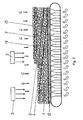
- Fig 2 shows the layering of the agglomerate during the process in section.
- the bedding layer 17 limestone, dolomit
- sulphuric dioxide a material that is used as an example sulphuric dioxide.
- This bedding layer 17 is suitable for binding the steams of heavy metals at the cold points in the exhaust system preventing their escape into the environment, respectively not to load the flue gas cleaning unit 15.
- Determining the material of the bedding layer 17 depends on the composition of the wastes used. In case of wastes of higher sulphur content it is practical to use limestone or dolomit as bedding layer 17 because their sulphur binding parameters are better.
- the basic layer 1 glowing from the top bums out the bedding layer 17 joining it and there active CaO develops. This CaO reacts with the gases with sulphur content flowing from the top downwards and depending on humidity content and other factors different sulphate compounds are produced.
- the active CaO is also proper to bind heavy metals in the process mentioned before, but it is more expensive and less efficient to use it for this purpose than the application of the bedding layer 17 of the materials of the agglomerate.
- the agglomerate spread here is the classified to suitable size and fractioned agglomerate 14 end-product produced at the end of the process.
- the bedding layer 17 has a traditional mechanical protecting function as well, because it protects the wandering grid 20 and the gases condensing do not condense on the grid, but in the bedding layer 17.
- the basic layer 1 is spread onto the bedding layer 17, which is ignited by the first igniting furnace 3.
- Resulting from the igniting the primary fire zone 4 develops, moving from the top downwards due to the lower vacuum (suction).
- the following step is the spreading of the upper layer 2 containing wastes of oil content as well on the given site, which is determined in advance by experiments.
- the site is set with the moving speed of the grid, the thickness of the basic layer, the fuel content and the extent of the vacuum.
- the exact spot of the spreading can be controlled with the measuring of the flue-gas temperature of the vacuum chambers 21. The temperature of the flue-gas is measured in the last three vacuum chambers.
- the upper layer 2 After the spreading the upper layer 2 is ignited as well with the second igniting furnace 5, which is necessary to ensure leaving of oily steams in the upper layer 2 through the primary fire zone 4 of the basic layer 1. Resulting from the second igniting the upper layer 2 itself develops agglomerates as well. The process is going on till the agglomerization of the upper layer 2 has been completed and the primary fire zone 4 of the basic layer 1 starts cooling.
- the end-product 14 produced this way is the agglomerate. It is chopped, classified in conformity with the user's requirements, that is it depends on the field of application hereafter.
- bedding layer 17 for making harmless the steams and gases of the wastes of oil content in the upper layer 2, because the reduced gas absorbing capacity resulting from the overheating of the oil in the basic layer 1 is compensated by the lower temperature of the bedding layer 17 so its cooling effect works even if the basic layer 1 overheats.
- the technology worked out by us is such, where a continuous production machine with wandering grids and burning cars functions.
- the basic process is based on a process of Dwight-Lloyd principle with wandering grid and sintering function. Equipment of this type is transformed. This is a technology of sucking through, where in each case burning takes place from the top downwards and the burning process itself is carried out on the grid-rods.
- such a compound is made from the above mentioned products and from the components considered as raw materials during the production which makes possible, that on the production machine designed for this purpose the compound compiled can be fed in two layers in order to be able to oxidize the unburnt hydrocarbons - which are leaving the upper layer - in the fire zone of the lower layer. There is an equilibrium of the liquid and solid phase in both layers, so an agglomerate (product) of proper strength, particle size and chemical composition is produced.
- the method according to the invention it is essential from the point of view of processible metals or metal oxides, that these are possibly of similar characteristics than iron from the point of view of the main process. So as the reaction capacity of them are the same or close to that of the iron.
- metals are for example: mangane, crom, nickel, vanadium, titan, calcium, magnezium.
- the method is suitable for the process of other metals, for example aluminium, silicium, but those do not take part in the main process, but are included in the end product.
- the basic layer 1 above the bedding layer is a mixture containing several components:
- the particle size of the basic layer 1 can change from the finest to max. 50-60 mm, they must be homogenized and mixed.
- the particle size is important from the point of view of burning, it influences the efficiency of sucking through.
- the upper layer 2 Above the primary layer 1 on the top is located the upper layer 2, the components of which are:
- the materials processed are non-minerals, but expressly wastes, hazardous wastes, which should be otherwise stored. It is possible not only to re-cycle wastes of iron content, but wastes containing other metals as well. Resulting from this valuable metallurgical, respectively building industrial raw materials and auxiliary materials can be gained with this method.
- An additional advantage of the method according to the invention is that the oxides of the metal components form a complex clinker. It is advantageous from the point of view of further processing. It is not necessary to concentrate only on the iron content of the raw material.
- the end product is a bound material, not a hazardous waste. It can be put back not only to iron production, but can be used for road construction or as building materials.
Landscapes
- Engineering & Computer Science (AREA)
- Environmental & Geological Engineering (AREA)
- Health & Medical Sciences (AREA)
- Chemical & Material Sciences (AREA)
- Chemical Kinetics & Catalysis (AREA)
- General Chemical & Material Sciences (AREA)
- General Health & Medical Sciences (AREA)
- Toxicology (AREA)
- Manufacture And Refinement Of Metals (AREA)
- Treatment Of Sludge (AREA)
- Processing Of Solid Wastes (AREA)
Claims (8)
- Verfahren zum Recycling und zur Transformation gefährlicher Abfälle. Metallen und Metalloxyden zum industriellen Grundstoff in einem kontinuierlichen Schrumpfapparat mit Wanderrost, dieses Verfahren enthält die nächsten Schritte:- Aufstellung der Bettungsschicht (17) auf den Wanderrost des kontinuierlich laufenden Schrumpfapparats:- Auftragung einer Schicht (2), die mit Öl oder Ölderivat verschmutzte. Eisen und andere Metallen oder Metalloxyden und andere gefährliche Abfälle enthaltende Nebenprodukte enthält. auf die Bettungsschicht (17):- Zündung der mit Öl oder Ölderivaten verschmutzten Schicht (2) mit einem Zündofen (5), wobei der feste Brennstoffteil sich entzündet und daher eine Feuerzone (7) gebildet wird, dank der Luftdurchsaugung vom Oberteil der Schicht, und daher laufen die Zündung und das Nachbrennen der Öl oder Ölderivat in einem Verfahren ab:- nach der kompletten Agglomeration der beschmutzten Schicht wird das Agglomerat zerstückelt und klassifiziert entsprechend der Anforderung des Recycling bezogen auf die Festigkeit, die Teilchengröße und die chemische Zusammensetzung,
dadurch gekennzeichnet, daß- das Material der Bettungsschicht (17) ist Kalkmahlgut oder Dolomitmahlgut, oder Agglomeratendprodukt frakzioniert und entsprechend klassifiziert, hergestellt durch das Recyclingsverfahren, und es hat einen so großen CaO Inhalt, durch den es mit schwefelhaltigen Gases reagieren kann, oder es die Schwermetallen binden kann.- vor der Auftragung der mit Öl oder Ölderivaten verschmutzten Schicht (2) wird eine Grundschicht (I), die mit Öl und Ölderivaten nicht verschmutzt ist, und andere Metallen oder Metalloxyden und andere, Metallen oder Metalloxyden enthaltende gefährliche Abfälle enthaltende Nebenprodukte enthält, auf die Bettungsschicht (17) aufgetragen, und wird mit einem ersten Zündofen (3) entzündet, wobei der feste Brennstoffteil sich ent/ündet und daher bildet sich eine erste Feuerzone (4) mit einer Fortbewegung von Oben nach Unten dank der Luftdurchsaugung vom Oberteil der Schicht. - Verfahren nach Anspruch 1, dadurch gekennzeichnet, daß die Teilchengröße des Materials der Bettungsschicht (17) 5-20mm ist, und es enthält kein verbrennbares Material.
- Verfahren nach Anspruch 1 oder 2, dadurch gekennzeichnet, daß die Aufstellungsdicke der Bettungsschicht (17) 10-15% der Dicke des ganzen Agglomeratendprodukts ist, gegebenfalls sie ist 20-25mm.
- Verfahren nach Ansprüchen 1 bis 3, dadurch gekennzeichnet, daß das Ansaugsvakuum unter dem Wanderrost (20) 2500 Pa ist.
- Verfahren nach Ansprüchen 1 bis 4, dadurch gekennzeichnet. daß die Zusammensetzung der Grundschicht (1) ist: pelletisiertes Eisen, und/oder gefährliche Abflälle mit Metallinhalt und fester Brennstoff.
- Verfahren nach Ansprüchen 1 bis 5, dadurch gekennzeichnet, daß die Zusammensetzung der oberen Schicht (2) ist: pelletisiert Eisen und/oder gefährliche Abfälle mit Metallinhalt und Ölinhalt und fester Brennstoff.
- Verfahren nach Ansprüchen 1 bis 6, dadurch gekennzeichnet, daß der zur Grundschicht (1) und zur oberen Schicht (2) gemischte, feste Brennstoff Koksmahlgut oder das Gemisch des Mahlgutes und des Kohtenstaubes ist.
- Verfahren nach Ansprüchen 1 bis 6, dadurch gekennzeichnet, daß das Verfahren im vakuumgeschlossenen technologischen System auf regulierte Weise stattfindet.
Applications Claiming Priority (2)
| Application Number | Priority Date | Filing Date | Title |
|---|---|---|---|
| HU0600317A HUP0600317A2 (en) | 2006-04-24 | 2006-04-24 | Recicling and transformation of hazardous wastes and of metals, metal oxides at industrial starting material |
| PCT/HU2007/000036 WO2007122436A2 (en) | 2006-04-24 | 2007-04-23 | Method for recycling and transformation of hazardous wastes and of metals, metal oxides at industrial starting material |
Publications (2)
| Publication Number | Publication Date |
|---|---|
| EP2018233A2 EP2018233A2 (de) | 2009-01-28 |
| EP2018233B1 true EP2018233B1 (de) | 2012-03-21 |
Family
ID=89986721
Family Applications (1)
| Application Number | Title | Priority Date | Filing Date |
|---|---|---|---|
| EP07733853A Active EP2018233B1 (de) | 2006-04-24 | 2007-04-23 | Verfahren zur Rezyklierung und Transformation von gefährlichen Abfällen und von Metallen und Metalloxiden bei technischem Ausgangsmaterial |
Country Status (4)
| Country | Link |
|---|---|
| EP (1) | EP2018233B1 (de) |
| AT (1) | ATE550111T1 (de) |
| HU (1) | HUP0600317A2 (de) |
| WO (1) | WO2007122436A2 (de) |
Families Citing this family (1)
| Publication number | Priority date | Publication date | Assignee | Title |
|---|---|---|---|---|
| JP5789883B2 (ja) * | 2011-12-05 | 2015-10-07 | Primetals Technologies Japan株式会社 | 部分還元鉄製造方法および部分還元鉄製造装置 |
Family Cites Families (3)
| Publication number | Priority date | Publication date | Assignee | Title |
|---|---|---|---|---|
| DE539818C (de) * | 1930-05-08 | 1931-12-02 | Metallgesellschaft Ag | Verfahren zum Behandeln von Gut auf Verblaseapparaten zum Zwecke seiner chemischen Umwandlung |
| DE4414321A1 (de) * | 1994-04-25 | 1995-10-26 | Res Oesterreich Kg Gmbh & Co | Verfahren und Anlage zur Verwertung von mit organischen Rückständen versetzten Reststoffen sowie Sinter |
| AT405530B (de) * | 1996-07-11 | 1999-09-27 | Voest Alpine Ind Anlagen | Verfahren zur thermischen behandlung von organisch belasteten materialien |
-
2006
- 2006-04-24 HU HU0600317A patent/HUP0600317A2/hu unknown
-
2007
- 2007-04-23 AT AT07733853T patent/ATE550111T1/de active
- 2007-04-23 WO PCT/HU2007/000036 patent/WO2007122436A2/en not_active Ceased
- 2007-04-23 EP EP07733853A patent/EP2018233B1/de active Active
Also Published As
| Publication number | Publication date |
|---|---|
| HUP0600317A2 (en) | 2008-08-28 |
| HU0600317D0 (en) | 2006-06-28 |
| WO2007122436A3 (en) | 2008-01-03 |
| WO2007122436A2 (en) | 2007-11-01 |
| EP2018233A2 (de) | 2009-01-28 |
| ATE550111T1 (de) | 2012-04-15 |
Similar Documents
| Publication | Publication Date | Title |
|---|---|---|
| US5496392A (en) | Method of recycling industrial waste | |
| Reuter et al. | Recycling and environmental issues of metallurgical slags and salt fluxes | |
| US5364447A (en) | Method of recycling hazardous waste | |
| US5405429A (en) | Method for treatment and conversion of refuse incineration residues into environmentally acceptable and reusable material, especially for construction purposes | |
| KiranKumar et al. | A review on processing of electric arc furnace dust (EAFD) by pyro-metallurgical processes | |
| JPH11310832A (ja) | 製鋼廃棄物の金属酸化物の処理法 | |
| WO1998018971A1 (en) | Method for extraction of metals and metal oxides from minerals, industrial by-products and waste materials | |
| Jordán et al. | Technological behaviour and leaching tests in ceramic tile bodies obtained by recycling of copper slag and MSW fly ash wastes | |
| CN108249892A (zh) | 一种氰化尾渣无害化处理制备烧结砖的方法 | |
| Khojiev et al. | The technology for the reduction of metal oxides using waste polyethylene materials | |
| EP0150805B1 (de) | Verfahren zur Zinkgewinnung aus Stoffen die einen Zinkbestandteil enthalten | |
| KR0165858B1 (ko) | 제철 더스트로부터 유가금속을 회수하는 방법 | |
| WO2009114155A2 (en) | Feed material compostion and handling in a channel induction furnace | |
| EP2018233B1 (de) | Verfahren zur Rezyklierung und Transformation von gefährlichen Abfällen und von Metallen und Metalloxiden bei technischem Ausgangsmaterial | |
| WO2009114157A2 (en) | Feed material compostion and handling in a channel induction furnace | |
| US5685244A (en) | Gas-fired smelting apparatus and process | |
| WO2009114156A2 (en) | Feed material compostion and handling in a channel induction furnace | |
| JPH07216464A (ja) | 亜鉛、鉛及び酸化鉄を含む材料のウェルツ式再処理方法 | |
| EA013690B1 (ru) | Извлечение ценных металлов из отходов выщелачивания цинка | |
| CN108138260A (zh) | 由含铜和含硫的材料制备各种金属及其衍生物的方法 | |
| CN111809058A (zh) | 一步挥发还原处理冶炼尾渣的方法 | |
| JP4889925B2 (ja) | 硫酸ピッチの処理方法及び処理装置 | |
| RU2287496C1 (ru) | Способ получения извести и установка для его осуществления | |
| RU2418079C2 (ru) | Способ производства агломерата для доменной плавки | |
| CN1871365B (zh) | 使用烧结混合物增强剂所进行的烧结 |
Legal Events
| Date | Code | Title | Description |
|---|---|---|---|
| PUAI | Public reference made under article 153(3) epc to a published international application that has entered the european phase |
Free format text: ORIGINAL CODE: 0009012 |
|
| 17P | Request for examination filed |
Effective date: 20081124 |
|
| AK | Designated contracting states |
Kind code of ref document: A2 Designated state(s): AT BE BG CH CY CZ DE DK EE ES FI FR GB GR HU IE IS IT LI LT LU LV MC MT NL PL PT RO SE SI SK TR |
|
| AX | Request for extension of the european patent |
Extension state: AL BA HR MK RS |
|
| 17Q | First examination report despatched |
Effective date: 20101021 |
|
| GRAP | Despatch of communication of intention to grant a patent |
Free format text: ORIGINAL CODE: EPIDOSNIGR1 |
|
| RTI1 | Title (correction) |
Free format text: METHOD FOR RECYCLING AND TRANSFORMATION OF HAZARDOUS WASTES AND OF METALS, METAL OXIDES AT INDUSTRIAL STARTING MATERIAL |
|
| GRAS | Grant fee paid |
Free format text: ORIGINAL CODE: EPIDOSNIGR3 |
|
| GRAA | (expected) grant |
Free format text: ORIGINAL CODE: 0009210 |
|
| AK | Designated contracting states |
Kind code of ref document: B1 Designated state(s): AT BE BG CH CY CZ DE DK EE ES FI FR GB GR HU IE IS IT LI LT LU LV MC MT NL PL PT RO SE SI SK TR |
|
| AX | Request for extension of the european patent |
Extension state: AL BA HR MK RS |
|
| REG | Reference to a national code |
Ref country code: GB Ref legal event code: FG4D |
|
| REG | Reference to a national code |
Ref country code: CH Ref legal event code: EP |
|
| REG | Reference to a national code |
Ref country code: IE Ref legal event code: FG4D |
|
| REG | Reference to a national code |
Ref country code: AT Ref legal event code: REF Ref document number: 550111 Country of ref document: AT Kind code of ref document: T Effective date: 20120415 |
|
| REG | Reference to a national code |
Ref country code: DE Ref legal event code: R096 Ref document number: 602007021454 Country of ref document: DE Effective date: 20120516 |
|
| REG | Reference to a national code |
Ref country code: NL Ref legal event code: VDEP Effective date: 20120321 |
|
| PG25 | Lapsed in a contracting state [announced via postgrant information from national office to epo] |
Ref country code: LT Free format text: LAPSE BECAUSE OF FAILURE TO SUBMIT A TRANSLATION OF THE DESCRIPTION OR TO PAY THE FEE WITHIN THE PRESCRIBED TIME-LIMIT Effective date: 20120321 |
|
| LTIE | Lt: invalidation of european patent or patent extension |
Effective date: 20120321 |
|
| PG25 | Lapsed in a contracting state [announced via postgrant information from national office to epo] |
Ref country code: GR Free format text: LAPSE BECAUSE OF FAILURE TO SUBMIT A TRANSLATION OF THE DESCRIPTION OR TO PAY THE FEE WITHIN THE PRESCRIBED TIME-LIMIT Effective date: 20120622 Ref country code: LV Free format text: LAPSE BECAUSE OF FAILURE TO SUBMIT A TRANSLATION OF THE DESCRIPTION OR TO PAY THE FEE WITHIN THE PRESCRIBED TIME-LIMIT Effective date: 20120321 Ref country code: FI Free format text: LAPSE BECAUSE OF FAILURE TO SUBMIT A TRANSLATION OF THE DESCRIPTION OR TO PAY THE FEE WITHIN THE PRESCRIBED TIME-LIMIT Effective date: 20120321 |
|
| REG | Reference to a national code |
Ref country code: AT Ref legal event code: MK05 Ref document number: 550111 Country of ref document: AT Kind code of ref document: T Effective date: 20120321 |
|
| PG25 | Lapsed in a contracting state [announced via postgrant information from national office to epo] |
Ref country code: CY Free format text: LAPSE BECAUSE OF FAILURE TO SUBMIT A TRANSLATION OF THE DESCRIPTION OR TO PAY THE FEE WITHIN THE PRESCRIBED TIME-LIMIT Effective date: 20120321 |
|
| PG25 | Lapsed in a contracting state [announced via postgrant information from national office to epo] |
Ref country code: SI Free format text: LAPSE BECAUSE OF FAILURE TO SUBMIT A TRANSLATION OF THE DESCRIPTION OR TO PAY THE FEE WITHIN THE PRESCRIBED TIME-LIMIT Effective date: 20120321 Ref country code: PL Free format text: LAPSE BECAUSE OF FAILURE TO SUBMIT A TRANSLATION OF THE DESCRIPTION OR TO PAY THE FEE WITHIN THE PRESCRIBED TIME-LIMIT Effective date: 20120321 Ref country code: IS Free format text: LAPSE BECAUSE OF FAILURE TO SUBMIT A TRANSLATION OF THE DESCRIPTION OR TO PAY THE FEE WITHIN THE PRESCRIBED TIME-LIMIT Effective date: 20120721 Ref country code: RO Free format text: LAPSE BECAUSE OF FAILURE TO SUBMIT A TRANSLATION OF THE DESCRIPTION OR TO PAY THE FEE WITHIN THE PRESCRIBED TIME-LIMIT Effective date: 20120321 Ref country code: BE Free format text: LAPSE BECAUSE OF FAILURE TO SUBMIT A TRANSLATION OF THE DESCRIPTION OR TO PAY THE FEE WITHIN THE PRESCRIBED TIME-LIMIT Effective date: 20120321 Ref country code: CZ Free format text: LAPSE BECAUSE OF FAILURE TO SUBMIT A TRANSLATION OF THE DESCRIPTION OR TO PAY THE FEE WITHIN THE PRESCRIBED TIME-LIMIT Effective date: 20120321 Ref country code: SE Free format text: LAPSE BECAUSE OF FAILURE TO SUBMIT A TRANSLATION OF THE DESCRIPTION OR TO PAY THE FEE WITHIN THE PRESCRIBED TIME-LIMIT Effective date: 20120321 Ref country code: EE Free format text: LAPSE BECAUSE OF FAILURE TO SUBMIT A TRANSLATION OF THE DESCRIPTION OR TO PAY THE FEE WITHIN THE PRESCRIBED TIME-LIMIT Effective date: 20120321 |
|
| REG | Reference to a national code |
Ref country code: HU Ref legal event code: AG4A Ref document number: E014510 Country of ref document: HU |
|
| PG25 | Lapsed in a contracting state [announced via postgrant information from national office to epo] |
Ref country code: MC Free format text: LAPSE BECAUSE OF NON-PAYMENT OF DUE FEES Effective date: 20120430 Ref country code: SK Free format text: LAPSE BECAUSE OF FAILURE TO SUBMIT A TRANSLATION OF THE DESCRIPTION OR TO PAY THE FEE WITHIN THE PRESCRIBED TIME-LIMIT Effective date: 20120321 Ref country code: PT Free format text: LAPSE BECAUSE OF FAILURE TO SUBMIT A TRANSLATION OF THE DESCRIPTION OR TO PAY THE FEE WITHIN THE PRESCRIBED TIME-LIMIT Effective date: 20120723 |
|
| REG | Reference to a national code |
Ref country code: CH Ref legal event code: PL |
|
| REG | Reference to a national code |
Ref country code: IE Ref legal event code: MM4A |
|
| PLBE | No opposition filed within time limit |
Free format text: ORIGINAL CODE: 0009261 |
|
| STAA | Information on the status of an ep patent application or granted ep patent |
Free format text: STATUS: NO OPPOSITION FILED WITHIN TIME LIMIT |
|
| PG25 | Lapsed in a contracting state [announced via postgrant information from national office to epo] |
Ref country code: CH Free format text: LAPSE BECAUSE OF NON-PAYMENT OF DUE FEES Effective date: 20120430 Ref country code: NL Free format text: LAPSE BECAUSE OF FAILURE TO SUBMIT A TRANSLATION OF THE DESCRIPTION OR TO PAY THE FEE WITHIN THE PRESCRIBED TIME-LIMIT Effective date: 20120321 Ref country code: IE Free format text: LAPSE BECAUSE OF NON-PAYMENT OF DUE FEES Effective date: 20120423 Ref country code: LI Free format text: LAPSE BECAUSE OF NON-PAYMENT OF DUE FEES Effective date: 20120430 Ref country code: DK Free format text: LAPSE BECAUSE OF FAILURE TO SUBMIT A TRANSLATION OF THE DESCRIPTION OR TO PAY THE FEE WITHIN THE PRESCRIBED TIME-LIMIT Effective date: 20120321 Ref country code: AT Free format text: LAPSE BECAUSE OF FAILURE TO SUBMIT A TRANSLATION OF THE DESCRIPTION OR TO PAY THE FEE WITHIN THE PRESCRIBED TIME-LIMIT Effective date: 20120321 |
|
| PGFP | Annual fee paid to national office [announced via postgrant information from national office to epo] |
Ref country code: HU Payment date: 20121019 Year of fee payment: 6 |
|
| REG | Reference to a national code |
Ref country code: FR Ref legal event code: ST Effective date: 20130104 |
|
| REG | Reference to a national code |
Ref country code: DE Ref legal event code: R119 Ref document number: 602007021454 Country of ref document: DE Effective date: 20121101 |
|
| 26N | No opposition filed |
Effective date: 20130102 |
|
| GBPC | Gb: european patent ceased through non-payment of renewal fee |
Effective date: 20120621 |
|
| PG25 | Lapsed in a contracting state [announced via postgrant information from national office to epo] |
Ref country code: FR Free format text: LAPSE BECAUSE OF NON-PAYMENT OF DUE FEES Effective date: 20120521 Ref country code: IT Free format text: LAPSE BECAUSE OF FAILURE TO SUBMIT A TRANSLATION OF THE DESCRIPTION OR TO PAY THE FEE WITHIN THE PRESCRIBED TIME-LIMIT Effective date: 20120321 |
|
| PG25 | Lapsed in a contracting state [announced via postgrant information from national office to epo] |
Ref country code: ES Free format text: LAPSE BECAUSE OF FAILURE TO SUBMIT A TRANSLATION OF THE DESCRIPTION OR TO PAY THE FEE WITHIN THE PRESCRIBED TIME-LIMIT Effective date: 20120702 Ref country code: GB Free format text: LAPSE BECAUSE OF NON-PAYMENT OF DUE FEES Effective date: 20120621 |
|
| PG25 | Lapsed in a contracting state [announced via postgrant information from national office to epo] |
Ref country code: BG Free format text: LAPSE BECAUSE OF FAILURE TO SUBMIT A TRANSLATION OF THE DESCRIPTION OR TO PAY THE FEE WITHIN THE PRESCRIBED TIME-LIMIT Effective date: 20120621 Ref country code: MT Free format text: LAPSE BECAUSE OF FAILURE TO SUBMIT A TRANSLATION OF THE DESCRIPTION OR TO PAY THE FEE WITHIN THE PRESCRIBED TIME-LIMIT Effective date: 20120321 |
|
| PG25 | Lapsed in a contracting state [announced via postgrant information from national office to epo] |
Ref country code: HU Free format text: LAPSE BECAUSE OF NON-PAYMENT OF DUE FEES Effective date: 20130424 |
|
| PG25 | Lapsed in a contracting state [announced via postgrant information from national office to epo] |
Ref country code: TR Free format text: LAPSE BECAUSE OF FAILURE TO SUBMIT A TRANSLATION OF THE DESCRIPTION OR TO PAY THE FEE WITHIN THE PRESCRIBED TIME-LIMIT Effective date: 20120321 |
|
| PG25 | Lapsed in a contracting state [announced via postgrant information from national office to epo] |
Ref country code: LU Free format text: LAPSE BECAUSE OF NON-PAYMENT OF DUE FEES Effective date: 20120423 |
|
| PG25 | Lapsed in a contracting state [announced via postgrant information from national office to epo] |
Ref country code: DE Free format text: LAPSE BECAUSE OF FAILURE TO SUBMIT A TRANSLATION OF THE DESCRIPTION OR TO PAY THE FEE WITHIN THE PRESCRIBED TIME-LIMIT Effective date: 20121101 |