EP2016251B1 - Schalldämmende tür - Google Patents
Schalldämmende tür Download PDFInfo
- Publication number
- EP2016251B1 EP2016251B1 EP07748439.2A EP07748439A EP2016251B1 EP 2016251 B1 EP2016251 B1 EP 2016251B1 EP 07748439 A EP07748439 A EP 07748439A EP 2016251 B1 EP2016251 B1 EP 2016251B1
- Authority
- EP
- European Patent Office
- Prior art keywords
- door
- sound
- insulation
- spacers
- layers
- Prior art date
- Legal status (The legal status is an assumption and is not a legal conclusion. Google has not performed a legal analysis and makes no representation as to the accuracy of the status listed.)
- Active
Links
Images

Classifications
-
- E—FIXED CONSTRUCTIONS
- E04—BUILDING
- E04B—GENERAL BUILDING CONSTRUCTIONS; WALLS, e.g. PARTITIONS; ROOFS; FLOORS; CEILINGS; INSULATION OR OTHER PROTECTION OF BUILDINGS
- E04B1/00—Constructions in general; Structures which are not restricted either to walls, e.g. partitions, or floors or ceilings or roofs
- E04B1/62—Insulation or other protection; Elements or use of specified material therefor
- E04B1/74—Heat, sound or noise insulation, absorption, or reflection; Other building methods affording favourable thermal or acoustical conditions, e.g. accumulating of heat within walls
- E04B1/82—Heat, sound or noise insulation, absorption, or reflection; Other building methods affording favourable thermal or acoustical conditions, e.g. accumulating of heat within walls specifically with respect to sound only
- E04B1/84—Sound-absorbing elements
- E04B1/86—Sound-absorbing elements slab-shaped
-
- E—FIXED CONSTRUCTIONS
- E06—DOORS, WINDOWS, SHUTTERS, OR ROLLER BLINDS IN GENERAL; LADDERS
- E06B—FIXED OR MOVABLE CLOSURES FOR OPENINGS IN BUILDINGS, VEHICLES, FENCES OR LIKE ENCLOSURES IN GENERAL, e.g. DOORS, WINDOWS, BLINDS, GATES
- E06B5/00—Doors, windows, or like closures for special purposes; Border constructions therefor
- E06B5/20—Doors, windows, or like closures for special purposes; Border constructions therefor for insulation against noise
-
- E—FIXED CONSTRUCTIONS
- E06—DOORS, WINDOWS, SHUTTERS, OR ROLLER BLINDS IN GENERAL; LADDERS
- E06B—FIXED OR MOVABLE CLOSURES FOR OPENINGS IN BUILDINGS, VEHICLES, FENCES OR LIKE ENCLOSURES IN GENERAL, e.g. DOORS, WINDOWS, BLINDS, GATES
- E06B3/00—Window sashes, door leaves, or like elements for closing wall or like openings; Layout of fixed or moving closures, e.g. windows in wall or like openings; Features of rigidly-mounted outer frames relating to the mounting of wing frames
- E06B3/70—Door leaves
- E06B3/7015—Door leaves characterised by the filling between two external panels
- E06B2003/703—Door leaves characterised by the filling between two external panels containing a metallic layer
-
- E—FIXED CONSTRUCTIONS
- E06—DOORS, WINDOWS, SHUTTERS, OR ROLLER BLINDS IN GENERAL; LADDERS
- E06B—FIXED OR MOVABLE CLOSURES FOR OPENINGS IN BUILDINGS, VEHICLES, FENCES OR LIKE ENCLOSURES IN GENERAL, e.g. DOORS, WINDOWS, BLINDS, GATES
- E06B3/00—Window sashes, door leaves, or like elements for closing wall or like openings; Layout of fixed or moving closures, e.g. windows in wall or like openings; Features of rigidly-mounted outer frames relating to the mounting of wing frames
- E06B3/70—Door leaves
- E06B3/7015—Door leaves characterised by the filling between two external panels
Definitions
- the invention relates to a door comprising a laminate of a first outer layer and a second outer layer with an insulating arrangement between them.
- a normal door for a house comprises an outer layer and an inner layer manufactured of a laminate of wood and aluminium, with a layer of insulation between the layers. While such a door damps sound, it only does so relatively poorly. If there is a requirement for a door providing better sound insulation, the materials in the door and/or the thickness of the layers must be changed in order to improve the sound-insulating capability.
- the invention relates to a door comprising a laminate of a first outer layer and a second outer layer with an insulating arrangement between them, wherein the insulating arrangement comprises at least two insulation layers separated from each other and from the outer layers by air gaps, and wherein the insulating arrangement comprises spacers placed between the insulation layers and arranged to create the air gaps.
- the door according to the invention is characterised in that the spacers are positioned in such a way that two spacers are never positioned exactly opposite each other on either side of said insulation layer.
- An advantage of the invention is that the relative positioning of the layers provides a damping of sound that is surprisingly good, considering the weight of the door.
- the design according to the invention makes it possible to use outer layers of a combustible material, for example wood, to obtain a sound-insulating capability that corresponds to that of a door comprising outer layers of steel plate or similar non-combustible material.
- the air gaps are created by spacers being placed between the insulation layers.
- the spacers are advantageously constructed of a non-rigid material that absorbs vibrations and thus does not transmit sound from layer to layer.
- the spacers are advantageously designed in such a way that the surface that is in contact with the layers is as small as possible in order to minimise the possibility of sound being transmitted from layer to layer via the spacers. It is known that the smaller the contact surface, the less possibility there is of the transmission of sound.
- the spacers must, however, be sufficiently rigid so that they do not collapse during the manufacture or use of the door.
- the spacers must have a sufficiently large total contact surface in order for the air gaps to be able to be maintained without the risk of the insulation layers coming into contact with each other or with the outer layers in the areas that are between the spacers. If the spacers are positioned incorrectly, contact can arise between the insulation layers as a result of relative movement of the layers in the door when the door is manufactured or used. Such a contact between the layers results in a deterioration in the sound-insulating capability, as the sound is transmitted at the points of contact. It should, however, be mentioned that the spacers can consist of strips of material with a relatively large contact surface if the material is not particularly rigid, since a less rigid material transmits sound less effectively than a more rigid material.
- Sound insulation is a very advanced technical field which means that it is difficult or impossible to forecast the sound-insulating effects of different combinations of material precisely by theoretical means. It is also difficult or impossible to explain certain phenomena that arise when different materials are combined.
- the door has external dimensions of 77 mm x 925 mm x 2031 mm and outer frame dimensions of 988 mm x 2080 mm, that is module 10x21.
- the external dimensions of the door also apply as dimensions for the outer layers.
- the insulating arrangement has external dimensions of approx. 845 mm x 1861 mm and comprises four insulation layers and five air gaps which are 63 mm thick in total.
- the door comprises a peripheral strip of wood with a cross-section of 63 mm x 45 mm that encloses the insulation between the two outer layers. At the upper and lower part of the door, two such strips are arranged alongside each other across the width of the door. The two outer layers overlap the peripheral strip all round.
- the size of the door is of no actual significance for the sound-insulating effect, it being the air gaps together with the other materials that are of importance for the invention.
- the outer layers consist of a laminate of two sheets of wood with a 0.7 mm aluminium plate between. The three layers are glued together.
- the sheets of wood comprise a sheet of high density fibreboard (HDF) with a thickness of 3.2 mm and a density of 1050 kg/m 3 .
- HDF high density fibreboard
- the insulation layers consist of an insulating fibre material with a density from 125 kg/m 3 up to and including 265 kg/m 3 .
- the material can, for example, be a sheet of mineral wool or some other suitable insulating material.
- the insulation layers can each have a thickness of 12.5 mm.
- the air gaps are each nominally 2.6 mm in width, but this varies slightly due to the fact that the insulating boards are not completely flat. By variation it is meant here that not only are the gaps are different sizes, but also that each air gap has variations.
- the narrowest air gap is, however, at least 1 mm.
- the spacers consist of three strips of foamed plastic/cellular plastic that are 100 mm wide and approx. 2.5-3 mm thick and are laid along almost the whole of the insulation, extending to essentially the whole of the insulation layer, that is approx. 1861 mm.
- the door according to the example weighs approx. 51 kg and has a sound-damping capability of 43 dB or more, which means that the door is in the class Rw 40.
- Previously-known doors in the class Rw 40 with the same dimensions have a weight of approx. 81 kg with outer layers consisting of steel plate, which means that the door according to the invention has a sound-insulating effect per kilo of door that greatly exceeds that which was previously known.
- the door can be manufactured from other materials and with different dimensions while continuing to have a low weight, whereby the sound-damping capability per kilo remains the same or is slightly reduced. Even if the sound-damping capability per kilo is somewhat reduced, the ratio between sound insulation and weight continues to be high in comparison to previously-known doors, thanks to the air gaps.
- the air gaps according to the invention thus provide an improvement in the sound-insulating capability, irrespective of what material is used, but the door according to the example provides surprisingly good sound insulation per kilo of door.
- the air gaps have advantageously a width from 0.5 mm up to and including 5 mm, but are most advantageously approx. 2.6 mm wide according to the example, as the thickness of the door is then minimal while providing optimal sound damping.
- the insulation layer can have a thickness from 5 mm upwards, but has a preferred thickness of 12 mm up to and including 20 mm.
- the insulation layers can consist of a material with a density from 25 kg/m 3 up to and including 500 kg/m 3 .
- the thickness of the insulation layers can be determined on the basis of the density in such a way that the door has a weight that remains low in comparison to previously-known doors.
- the following materials can be used as insulation in the door: insulating fibreboard; cellular plastic such as polystyrene, polyurethane, phenol, PVC, acrylic plastic, cellular plastic, etc; mineral wools such as glass wool or rock wool; Foamglass; cork; straw; flax particle board; etc.
- the outer layers can each be made of wood, plywood, high density fibreboard (HDF) or medium density fibreboard (MDF), metal, plastic or a combination of the different materials.
- the outer layers can thus consist of plywood, MDF, HDF, fibreglass, PVC, aluminium plating, steel plating, etc.
- the outer layers can comprise a number of combinations of materials in separate layers, for example plywood combined with aluminium sheeting, etc.
- the total thickness of the layers is from 0.7 mm for a steel door and 3-12 mm for a plywood door.
- the invention can be used for internal doors or external doors.
- the spacers can consist of any previously-known resilient material such as foamed plastic, rubber, etc.
- the spacers can comprise a number of strips of a non-rigid and at least partly resilient material with a breadth exceeding its thickness.
- the strips can extend between the insulation layers in order to create the air gaps.
- the strips can be up to 100 mm x 100 mm in size and there can be 10-30 strips per air gap.
- spacers have been described that have been found by experiment to be advantageous for the invention.
- the spacers can thus have an extent up to and including essentially the whole of the longitudinal extent of the insulation layer and a breadth of up to and including approx. 100 mm.
- the number of air gaps is always more than the number of insulation layers, which in turn is always at least two.
- the number of insulation layers in the door according to the invention can be two, three, four, five or any other suitable integer. According to the above, the number of air gaps will thus be the number of insulation layers plus one.
- the air gaps are decisive for the invention as sound takes the easiest path, i.e. sound travels more readily through the air gaps than through the insulation layer.
- sound travels more readily through the air gaps than through the insulation layer.
- the air gaps enable the sound wave to travel along the surface of each insulation layer and then to be reflected off the peripheral strip and back in towards the middle of the door. In this way, the sound is reduced more quickly than if it only had to pass through an insulation layer.
- the holes in the different layers are not aligned in the direction of the thickness of the door, but are displaced in relation to each other in such a way that they overlap each other to a certain extent in the direction of the height of the door.
- a hole right through all the layers would provide a direct passage from outer layer to outer layer which is undesirable.
- the fact that it is possible to make holes in the layers proves, however, that the sound waves tend to diverge in the air gaps before they pass through the next layer of insulation.
- the door according to the invention has the best sound-insulating capability per kilo when the door weighs from 45 kg up to and including 65 kg, and from 51 kg it has a sound-damping capability of at least 43 dB.
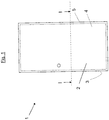
- Figure 1 shows schematically a view of a door 1 with a first outer layer facing the viewer.
- the door consists of a laminate of a first outer layer 2, a second outer layer 3 placed at a distance from and parallel to the first outer layer 2, and an insulating arrangement 4 between the outer layers 2, 3.
- the door comprises a peripheral edging strip 5 that surrounds the insulating arrangement.
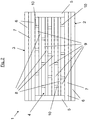
- Figure 2 shows a cross-section of the door along the line I-I in Figure 1 .
- the first outer layer comprises a sheet of wood 6 and a light metal sheet 7 of aluminium.
- the second outer layer 3 is constructed in the same way as the first outer layer 2 and also comprises a sheet of wood 6 and a light metal sheet 7 of aluminium.
- the insulating arrangement 4 comprises four insulation layers 8 in the form of insulating boards 8 and five air gaps 9.
- the insulating arrangement 4 comprises spacers 10 arranged to create the air gaps 9 between the insulation layers 8.
- Figure 2 shows that the spacers 10 are positioned in such a way that two spacers are never positioned exactly opposite each other on either side of an insulation layer 8. The reason for this is to prevent two spacers forming a bridge for the transmission of an impulse caused by a sound.
- the spacers 10 comprise three strips of a non-rigid and at least partially resilient material that consists of foam rubber/cellular plastic. Such a material is particularly sound-absorbent, which means that the spacers can be positioned completely or partially opposite each other, without the sound-insulating capability being affected significantly.
Landscapes
- Physics & Mathematics (AREA)
- Engineering & Computer Science (AREA)
- Acoustics & Sound (AREA)
- Civil Engineering (AREA)
- Structural Engineering (AREA)
- Architecture (AREA)
- Electromagnetism (AREA)
- Securing Of Glass Panes Or The Like (AREA)
- Special Wing (AREA)
- Specific Sealing Or Ventilating Devices For Doors And Windows (AREA)
- Wing Frames And Configurations (AREA)
- Building Environments (AREA)
Claims (13)
- Tür (1) umfassend ein Laminat aus einer ersten Außenschicht (2) und einer zweiten Außenschicht (3) mit einer zwischenliegenden Dämmungsvorrichtung (4), wobei die Dämmungsvorrichtung (4) mindestens zwei Dämmschichten (8) umfasst, die voneinander getrennt sind und durch Luftspalte (9) von den Außenschichten getrennt sind, wobei die Dämmungsvorrichtung (4) zwischen den Dämmschichten (8) angeordnete und zur Bildung der Luftspalte (9) ausgebildete Abstandselemente (10) umfasst, dadurch gekennzeichnet, dass die Abstandselemente (10) derart angeordnet sind, dass zwei Abstandselemente (10) nie genau einander gegenüberliegend an jeweils einer Seite der Dämmschicht (8) angeordnet sind.
- Tür (1) nach Anspruch 1, dadurch gekennzeichnet, dass die Dämmungsvorrichtung (4) vier Dämmschichten (8) und vier Luftspalte (9) umfasst.
- Tür (1) nach einem der vorgehenden Ansprüche, dadurch gekennzeichnet, dass jeder Luftspalt eine Breite von mindestens 0,5 mm aufweist.
- Tür (1) nach Anspruch 3, dadurch gekennzeichnet, dass jeder Luftspalt eine Breite von mindestens 1 mm bis zu und einschließlich 2,6 mm aufweist.
- Tür (1) nach Anspruch 4, dadurch gekennzeichnet, dass die Abstandselemente (10) drei Streifen aus einem nicht steifen und zumindest teilweise elastischen Material mit einer Breite umfasst, die die Weite überschreitet, die etwa 2,5-3 mm überschreitet.
- Tür (1) nach Anspruch 5, dadurch gekennzeichnet, dass die Abstandselemente (10) eine Länge von bis zu und einschließlich im Wesentlichen der Gesamtheit der Längserstreckung der Dämmschicht und eine Breite von bis zu und einschließlich etwa 100 mm aufweisen.
- Tür (1) nach einem der vorgehenden Ansprüche, dadurch gekennzeichnet, dass die erste Außenschicht (2) und/oder die zweite Außenschicht (3) ein Laminat aus zwei Schichten aus hochdichter Faserplatte mit einem dazwischen vorgesehenen leichten Metallblech umfasst bzw. umfassen.
- Tür (1) nach einem der vorgehenden Ansprüche, dadurch gekennzeichnet, dass die erste Außenschicht (2) und/oder die zweite Außenschicht (3) Platten aus hochdichter Faserplatte mit einer Dichte von höchstens 1050 kg/m<3> umfasst bzw. umfassen.
- Tür (1) nach einem der vorgehenden Ansprüche, dadurch gekennzeichnet, dass jede Dämmschicht (8) eine Dicke von mindestens 5 mm aufweist.
- Tür (1) nach Anspruch 9, dadurch gekennzeichnet, dass jede Dämmschicht (8) eine Dicke von ab 12 mm bis zu und einschließlich 20 mm aufweist.
- Tür (1) nach einem der vorgehenden Ansprüche, dadurch gekennzeichnet, dass jede Dämmschicht (8) ein Material mit einer Dichte von ab 25 kg/m<3> bis zu und einschließlich 500 kg/m<3> umfasst.
- Tür (1) nach Anspruch 12, dadurch gekennzeichnet, dass jede Dämmschicht (8) einen Faserdämmstoff mit einer Dichte von ab 125 kg/m<3> bis zu und einschließlich 265 kg/m<3> umfasst.
- Tür (1) nach einem der vorgehenden Ansprüche, dadurch gekennzeichnet, dass die Tür eine Schalldämpfungsfähigkeit von mindestens 43 dB aufweist.
Applications Claiming Priority (2)
| Application Number | Priority Date | Filing Date | Title |
|---|---|---|---|
| SE0600969A SE0600969L (sv) | 2006-04-28 | 2006-04-28 | Ljudisolerande dörr |
| PCT/SE2007/050278 WO2007126379A1 (en) | 2006-04-28 | 2007-04-26 | Sound-insulating door |
Publications (3)
| Publication Number | Publication Date |
|---|---|
| EP2016251A1 EP2016251A1 (de) | 2009-01-21 |
| EP2016251A4 EP2016251A4 (de) | 2015-01-14 |
| EP2016251B1 true EP2016251B1 (de) | 2017-06-28 |
Family
ID=38091652
Family Applications (1)
| Application Number | Title | Priority Date | Filing Date |
|---|---|---|---|
| EP07748439.2A Active EP2016251B1 (de) | 2006-04-28 | 2007-04-26 | Schalldämmende tür |
Country Status (5)
| Country | Link |
|---|---|
| EP (1) | EP2016251B1 (de) |
| DK (1) | DK2016251T3 (de) |
| NO (1) | NO338494B1 (de) |
| SE (1) | SE0600969L (de) |
| WO (1) | WO2007126379A1 (de) |
Family Cites Families (9)
| Publication number | Priority date | Publication date | Assignee | Title |
|---|---|---|---|---|
| CA708393A (en) * | 1965-04-27 | F. Loncoske Richard | Sound insulating structure | |
| DE665387C (de) * | 1938-09-23 | Nikolaus Monz | Schalldaempfende Sperrholztuer | |
| FR1073718A (fr) * | 1952-10-20 | 1954-09-28 | Dispositif de panneau | |
| CH660389A5 (en) * | 1983-03-28 | 1987-04-15 | Tuerenfabrik Brunegg Ag | Sound-insulating sheet-like element, in particular for doors and walls |
| SE457815C (sv) * | 1984-07-04 | 1996-04-29 | Svensk Doerrteknik Ab | Krökning och brandgenomslag motverkande, åtminstone utvändigt som trädörr identifierbar dörrkonstruktion |
| DE8714436U1 (de) * | 1987-10-30 | 1988-02-11 | HDW-Isoliertechnik GmbH, 24149 Kiel | Füllplatte aus schalldämpfendem und wärmedämmendem Material |
| US5416285A (en) * | 1993-12-17 | 1995-05-16 | Eggers Industries | Acoustical door |
| US6112496A (en) * | 1998-09-25 | 2000-09-05 | Weyerhaeuser And Overly Manufacturing Company | Metal and wood door with composite perimeter |
| JP2002348986A (ja) * | 2001-05-28 | 2002-12-04 | Taiyo Kogyo Corp | 断熱、防音パネル |
-
2006
- 2006-04-28 SE SE0600969A patent/SE0600969L/xx unknown
-
2007
- 2007-04-18 NO NO20072018A patent/NO338494B1/no unknown
- 2007-04-26 EP EP07748439.2A patent/EP2016251B1/de active Active
- 2007-04-26 WO PCT/SE2007/050278 patent/WO2007126379A1/en not_active Ceased
- 2007-04-26 DK DK07748439.2T patent/DK2016251T3/en active
Also Published As
| Publication number | Publication date |
|---|---|
| WO2007126379A1 (en) | 2007-11-08 |
| SE529197C2 (sv) | 2007-05-29 |
| NO338494B1 (no) | 2016-08-22 |
| EP2016251A4 (de) | 2015-01-14 |
| EP2016251A1 (de) | 2009-01-21 |
| NO20072018L (no) | 2007-10-29 |
| SE0600969L (sv) | 2007-05-29 |
| DK2016251T3 (en) | 2017-10-02 |
Similar Documents
| Publication | Publication Date | Title |
|---|---|---|
| US7798287B1 (en) | Acoustical ceiling panels | |
| AU2004273008B2 (en) | Accoustical sound proofing material and methods for manufacturing same | |
| US8495851B2 (en) | Acoustical sound proofing material and methods for manufacturing same | |
| US6789645B1 (en) | Sound-insulating sandwich element | |
| US20150075901A1 (en) | Interlocking soundproofing block system and method | |
| KR101477783B1 (ko) | 복합자재를 이용한 뜬바닥구조용 층간차음재 | |
| GB2499063A (en) | Building panel with elastomer-modified bituminous strips | |
| KR20160104507A (ko) | 소음방지재 | |
| KR101373091B1 (ko) | 바닥 충격음 저감용 층간 차음재 | |
| KR100429103B1 (ko) | 바닥충격음 저감용 뜬바닥층 구조 및 건축용 바닥재 | |
| JP2017101402A (ja) | 戸 | |
| EP0965701A1 (de) | Schallisolierende Platte | |
| WO2007126379A1 (en) | Sound-insulating door | |
| CN200989010Y (zh) | 一种复合隔声构件 | |
| KR20060097228A (ko) | 복합방음판 및 그의 제조방법 | |
| KR100499822B1 (ko) | 건축물용 층간 방진재 적층구조 | |
| GB2428696A (en) | Sound insulating stud wall batten and acoustic wall system | |
| CN210850652U (zh) | 复合多层板 | |
| KR200312358Y1 (ko) | 건축물용 층간 방진재 적층구조 | |
| US20260078632A1 (en) | Hollow core door with enhanced acoustic performance | |
| CN115257976B (zh) | 一种隔音结构及音频车 | |
| KR102818516B1 (ko) | 잔류 변형 기준을 만족시키는 바닥 충격음 완충재 | |
| CN223922434U (zh) | 一种隔音发泡板 | |
| US12444395B1 (en) | Composite damping lightweight sound insulation wall | |
| CN213014763U (zh) | 一种建筑施工管理环保降噪装置 |
Legal Events
| Date | Code | Title | Description |
|---|---|---|---|
| PUAI | Public reference made under article 153(3) epc to a published international application that has entered the european phase |
Free format text: ORIGINAL CODE: 0009012 |
|
| 17P | Request for examination filed |
Effective date: 20081127 |
|
| AK | Designated contracting states |
Kind code of ref document: A1 Designated state(s): AT BE BG CH CY CZ DE DK EE ES FI FR GB GR HU IE IS IT LI LT LU LV MC MT NL PL PT RO SE SI SK TR |
|
| AX | Request for extension of the european patent |
Extension state: AL BA HR MK RS |
|
| 111Z | Information provided on other rights and legal means of execution |
Free format text: AT BE BG CH CY CZ DE DK EE ES FI FR GB GR HU IE IS IT LT LU LV MC MT NL PL PT RO SE SI SK TR Effective date: 20100528 |
|
| RAP1 | Party data changed (applicant data changed or rights of an application transferred) |
Owner name: JELD-WEN SVERIGE AB |
|
| D11X | Information provided on other rights and legal means of execution (deleted) | ||
| DAX | Request for extension of the european patent (deleted) | ||
| A4 | Supplementary search report drawn up and despatched |
Effective date: 20141212 |
|
| RIC1 | Information provided on ipc code assigned before grant |
Ipc: E06B 5/20 20060101AFI20141208BHEP Ipc: E06B 3/70 20060101ALI20141208BHEP Ipc: E04B 1/86 20060101ALI20141208BHEP |
|
| GRAP | Despatch of communication of intention to grant a patent |
Free format text: ORIGINAL CODE: EPIDOSNIGR1 |
|
| STAA | Information on the status of an ep patent application or granted ep patent |
Free format text: STATUS: GRANT OF PATENT IS INTENDED |
|
| INTG | Intention to grant announced |
Effective date: 20170117 |
|
| GRAS | Grant fee paid |
Free format text: ORIGINAL CODE: EPIDOSNIGR3 |
|
| GRAA | (expected) grant |
Free format text: ORIGINAL CODE: 0009210 |
|
| STAA | Information on the status of an ep patent application or granted ep patent |
Free format text: STATUS: THE PATENT HAS BEEN GRANTED |
|
| AK | Designated contracting states |
Kind code of ref document: B1 Designated state(s): AT BE BG CH CY CZ DE DK EE ES FI FR GB GR HU IE IS IT LI LT LU LV MC MT NL PL PT RO SE SI SK TR |
|
| REG | Reference to a national code |
Ref country code: GB Ref legal event code: FG4D |
|
| REG | Reference to a national code |
Ref country code: CH Ref legal event code: EP |
|
| REG | Reference to a national code |
Ref country code: AT Ref legal event code: REF Ref document number: 904996 Country of ref document: AT Kind code of ref document: T Effective date: 20170715 |
|
| REG | Reference to a national code |
Ref country code: IE Ref legal event code: FG4D |
|
| REG | Reference to a national code |
Ref country code: DE Ref legal event code: R096 Ref document number: 602007051482 Country of ref document: DE |
|
| REG | Reference to a national code |
Ref country code: DK Ref legal event code: T3 Effective date: 20170925 |
|
| REG | Reference to a national code |
Ref country code: SE Ref legal event code: TRGR |
|
| PG25 | Lapsed in a contracting state [announced via postgrant information from national office to epo] |
Ref country code: LT Free format text: LAPSE BECAUSE OF FAILURE TO SUBMIT A TRANSLATION OF THE DESCRIPTION OR TO PAY THE FEE WITHIN THE PRESCRIBED TIME-LIMIT Effective date: 20170628 Ref country code: GR Free format text: LAPSE BECAUSE OF FAILURE TO SUBMIT A TRANSLATION OF THE DESCRIPTION OR TO PAY THE FEE WITHIN THE PRESCRIBED TIME-LIMIT Effective date: 20170929 |
|
| REG | Reference to a national code |
Ref country code: NL Ref legal event code: MP Effective date: 20170628 |
|
| REG | Reference to a national code |
Ref country code: LT Ref legal event code: MG4D |
|
| REG | Reference to a national code |
Ref country code: EE Ref legal event code: FG4A Ref document number: E014335 Country of ref document: EE Effective date: 20170918 Ref country code: AT Ref legal event code: MK05 Ref document number: 904996 Country of ref document: AT Kind code of ref document: T Effective date: 20170628 |
|
| PG25 | Lapsed in a contracting state [announced via postgrant information from national office to epo] |
Ref country code: NL Free format text: LAPSE BECAUSE OF FAILURE TO SUBMIT A TRANSLATION OF THE DESCRIPTION OR TO PAY THE FEE WITHIN THE PRESCRIBED TIME-LIMIT Effective date: 20170628 Ref country code: BG Free format text: LAPSE BECAUSE OF FAILURE TO SUBMIT A TRANSLATION OF THE DESCRIPTION OR TO PAY THE FEE WITHIN THE PRESCRIBED TIME-LIMIT Effective date: 20170928 |
|
| PG25 | Lapsed in a contracting state [announced via postgrant information from national office to epo] |
Ref country code: SK Free format text: LAPSE BECAUSE OF FAILURE TO SUBMIT A TRANSLATION OF THE DESCRIPTION OR TO PAY THE FEE WITHIN THE PRESCRIBED TIME-LIMIT Effective date: 20170628 Ref country code: AT Free format text: LAPSE BECAUSE OF FAILURE TO SUBMIT A TRANSLATION OF THE DESCRIPTION OR TO PAY THE FEE WITHIN THE PRESCRIBED TIME-LIMIT Effective date: 20170628 Ref country code: CZ Free format text: LAPSE BECAUSE OF FAILURE TO SUBMIT A TRANSLATION OF THE DESCRIPTION OR TO PAY THE FEE WITHIN THE PRESCRIBED TIME-LIMIT Effective date: 20170628 Ref country code: RO Free format text: LAPSE BECAUSE OF FAILURE TO SUBMIT A TRANSLATION OF THE DESCRIPTION OR TO PAY THE FEE WITHIN THE PRESCRIBED TIME-LIMIT Effective date: 20170628 |
|
| PG25 | Lapsed in a contracting state [announced via postgrant information from national office to epo] |
Ref country code: IS Free format text: LAPSE BECAUSE OF FAILURE TO SUBMIT A TRANSLATION OF THE DESCRIPTION OR TO PAY THE FEE WITHIN THE PRESCRIBED TIME-LIMIT Effective date: 20171028 Ref country code: PL Free format text: LAPSE BECAUSE OF FAILURE TO SUBMIT A TRANSLATION OF THE DESCRIPTION OR TO PAY THE FEE WITHIN THE PRESCRIBED TIME-LIMIT Effective date: 20170628 Ref country code: ES Free format text: LAPSE BECAUSE OF FAILURE TO SUBMIT A TRANSLATION OF THE DESCRIPTION OR TO PAY THE FEE WITHIN THE PRESCRIBED TIME-LIMIT Effective date: 20170628 Ref country code: IT Free format text: LAPSE BECAUSE OF FAILURE TO SUBMIT A TRANSLATION OF THE DESCRIPTION OR TO PAY THE FEE WITHIN THE PRESCRIBED TIME-LIMIT Effective date: 20170628 |
|
| REG | Reference to a national code |
Ref country code: DE Ref legal event code: R097 Ref document number: 602007051482 Country of ref document: DE |
|
| PLBE | No opposition filed within time limit |
Free format text: ORIGINAL CODE: 0009261 |
|
| STAA | Information on the status of an ep patent application or granted ep patent |
Free format text: STATUS: NO OPPOSITION FILED WITHIN TIME LIMIT |
|
| 26N | No opposition filed |
Effective date: 20180329 |
|
| PG25 | Lapsed in a contracting state [announced via postgrant information from national office to epo] |
Ref country code: SI Free format text: LAPSE BECAUSE OF FAILURE TO SUBMIT A TRANSLATION OF THE DESCRIPTION OR TO PAY THE FEE WITHIN THE PRESCRIBED TIME-LIMIT Effective date: 20170628 |
|
| REG | Reference to a national code |
Ref country code: DE Ref legal event code: R119 Ref document number: 602007051482 Country of ref document: DE |
|
| PG25 | Lapsed in a contracting state [announced via postgrant information from national office to epo] |
Ref country code: MC Free format text: LAPSE BECAUSE OF FAILURE TO SUBMIT A TRANSLATION OF THE DESCRIPTION OR TO PAY THE FEE WITHIN THE PRESCRIBED TIME-LIMIT Effective date: 20170628 |
|
| REG | Reference to a national code |
Ref country code: CH Ref legal event code: PL |
|
| REG | Reference to a national code |
Ref country code: BE Ref legal event code: MM Effective date: 20180430 |
|
| REG | Reference to a national code |
Ref country code: IE Ref legal event code: MM4A |
|
| PG25 | Lapsed in a contracting state [announced via postgrant information from national office to epo] |
Ref country code: DE Free format text: LAPSE BECAUSE OF NON-PAYMENT OF DUE FEES Effective date: 20181101 Ref country code: LU Free format text: LAPSE BECAUSE OF NON-PAYMENT OF DUE FEES Effective date: 20180426 |
|
| PG25 | Lapsed in a contracting state [announced via postgrant information from national office to epo] |
Ref country code: BE Free format text: LAPSE BECAUSE OF NON-PAYMENT OF DUE FEES Effective date: 20180430 Ref country code: LI Free format text: LAPSE BECAUSE OF NON-PAYMENT OF DUE FEES Effective date: 20180430 Ref country code: CH Free format text: LAPSE BECAUSE OF NON-PAYMENT OF DUE FEES Effective date: 20180430 |
|
| PG25 | Lapsed in a contracting state [announced via postgrant information from national office to epo] |
Ref country code: IE Free format text: LAPSE BECAUSE OF NON-PAYMENT OF DUE FEES Effective date: 20180426 Ref country code: FR Free format text: LAPSE BECAUSE OF NON-PAYMENT OF DUE FEES Effective date: 20180430 |
|
| PG25 | Lapsed in a contracting state [announced via postgrant information from national office to epo] |
Ref country code: MT Free format text: LAPSE BECAUSE OF NON-PAYMENT OF DUE FEES Effective date: 20180426 |
|
| PG25 | Lapsed in a contracting state [announced via postgrant information from national office to epo] |
Ref country code: TR Free format text: LAPSE BECAUSE OF FAILURE TO SUBMIT A TRANSLATION OF THE DESCRIPTION OR TO PAY THE FEE WITHIN THE PRESCRIBED TIME-LIMIT Effective date: 20170628 |
|
| PG25 | Lapsed in a contracting state [announced via postgrant information from national office to epo] |
Ref country code: HU Free format text: LAPSE BECAUSE OF FAILURE TO SUBMIT A TRANSLATION OF THE DESCRIPTION OR TO PAY THE FEE WITHIN THE PRESCRIBED TIME-LIMIT; INVALID AB INITIO Effective date: 20070426 Ref country code: PT Free format text: LAPSE BECAUSE OF FAILURE TO SUBMIT A TRANSLATION OF THE DESCRIPTION OR TO PAY THE FEE WITHIN THE PRESCRIBED TIME-LIMIT Effective date: 20170628 |
|
| PG25 | Lapsed in a contracting state [announced via postgrant information from national office to epo] |
Ref country code: CY Free format text: LAPSE BECAUSE OF FAILURE TO SUBMIT A TRANSLATION OF THE DESCRIPTION OR TO PAY THE FEE WITHIN THE PRESCRIBED TIME-LIMIT Effective date: 20170628 |
|
| P01 | Opt-out of the competence of the unified patent court (upc) registered |
Effective date: 20230518 |
|
| PGFP | Annual fee paid to national office [announced via postgrant information from national office to epo] |
Ref country code: LV Payment date: 20260331 Year of fee payment: 20 |
|
| PGFP | Annual fee paid to national office [announced via postgrant information from national office to epo] |
Ref country code: GB Payment date: 20260427 Year of fee payment: 20 Ref country code: DK Payment date: 20260427 Year of fee payment: 20 |
|
| PGFP | Annual fee paid to national office [announced via postgrant information from national office to epo] |
Ref country code: SE Payment date: 20260427 Year of fee payment: 20 Ref country code: FI Payment date: 20260427 Year of fee payment: 20 |
|
| PGFP | Annual fee paid to national office [announced via postgrant information from national office to epo] |
Ref country code: EE Payment date: 20260402 Year of fee payment: 20 |