EP2016154B1 - Elektrolumineszierende bi-cyclometallisierte idirium-verbindungen und aus solchen verbindungen hergestellte geräte - Google Patents
Elektrolumineszierende bi-cyclometallisierte idirium-verbindungen und aus solchen verbindungen hergestellte geräte Download PDFInfo
- Publication number
- EP2016154B1 EP2016154B1 EP07776864A EP07776864A EP2016154B1 EP 2016154 B1 EP2016154 B1 EP 2016154B1 EP 07776864 A EP07776864 A EP 07776864A EP 07776864 A EP07776864 A EP 07776864A EP 2016154 B1 EP2016154 B1 EP 2016154B1
- Authority
- EP
- European Patent Office
- Prior art keywords
- bis
- iridium
- mol
- layer
- compounds
- Prior art date
- Legal status (The legal status is an assumption and is not a legal conclusion. Google has not performed a legal analysis and makes no representation as to the accuracy of the status listed.)
- Not-in-force
Links
- 0 CCCc1c(*)cc*(*)c1-c1c(C)c(*)cc(N)c1 Chemical compound CCCc1c(*)cc*(*)c1-c1c(C)c(*)cc(N)c1 0.000 description 2
Classifications
-
- C—CHEMISTRY; METALLURGY
- C07—ORGANIC CHEMISTRY
- C07F—ACYCLIC, CARBOCYCLIC OR HETEROCYCLIC COMPOUNDS CONTAINING ELEMENTS OTHER THAN CARBON, HYDROGEN, HALOGEN, OXYGEN, NITROGEN, SULFUR, SELENIUM OR TELLURIUM
- C07F15/00—Compounds containing elements of Groups 8, 9, 10 or 18 of the Periodic Table
-
- C—CHEMISTRY; METALLURGY
- C09—DYES; PAINTS; POLISHES; NATURAL RESINS; ADHESIVES; COMPOSITIONS NOT OTHERWISE PROVIDED FOR; APPLICATIONS OF MATERIALS NOT OTHERWISE PROVIDED FOR
- C09K—MATERIALS FOR MISCELLANEOUS APPLICATIONS, NOT PROVIDED FOR ELSEWHERE
- C09K11/00—Luminescent materials, e.g. electroluminescent or chemiluminescent
- C09K11/06—Luminescent materials, e.g. electroluminescent or chemiluminescent containing organic luminescent materials
-
- C—CHEMISTRY; METALLURGY
- C07—ORGANIC CHEMISTRY
- C07F—ACYCLIC, CARBOCYCLIC OR HETEROCYCLIC COMPOUNDS CONTAINING ELEMENTS OTHER THAN CARBON, HYDROGEN, HALOGEN, OXYGEN, NITROGEN, SULFUR, SELENIUM OR TELLURIUM
- C07F15/00—Compounds containing elements of Groups 8, 9, 10 or 18 of the Periodic Table
- C07F15/0006—Compounds containing elements of Groups 8, 9, 10 or 18 of the Periodic Table compounds of the platinum group
- C07F15/0033—Iridium compounds
-
- H—ELECTRICITY
- H05—ELECTRIC TECHNIQUES NOT OTHERWISE PROVIDED FOR
- H05B—ELECTRIC HEATING; ELECTRIC LIGHT SOURCES NOT OTHERWISE PROVIDED FOR; CIRCUIT ARRANGEMENTS FOR ELECTRIC LIGHT SOURCES, IN GENERAL
- H05B33/00—Electroluminescent light sources
- H05B33/12—Light sources with substantially two-dimensional [2D] radiating surfaces
- H05B33/14—Light sources with substantially two-dimensional [2D] radiating surfaces characterised by the chemical or physical composition or the arrangement of the electroluminescent material, or by the simultaneous addition of the electroluminescent material in or onto the light source
-
- H—ELECTRICITY
- H10—SEMICONDUCTOR DEVICES; ELECTRIC SOLID-STATE DEVICES NOT OTHERWISE PROVIDED FOR
- H10K—ORGANIC ELECTRIC SOLID-STATE DEVICES
- H10K85/00—Organic materials used in the body or electrodes of devices covered by this subclass
- H10K85/30—Coordination compounds
- H10K85/341—Transition metal complexes, e.g. Ru(II)polypyridine complexes
- H10K85/342—Transition metal complexes, e.g. Ru(II)polypyridine complexes comprising iridium
-
- C—CHEMISTRY; METALLURGY
- C09—DYES; PAINTS; POLISHES; NATURAL RESINS; ADHESIVES; COMPOSITIONS NOT OTHERWISE PROVIDED FOR; APPLICATIONS OF MATERIALS NOT OTHERWISE PROVIDED FOR
- C09K—MATERIALS FOR MISCELLANEOUS APPLICATIONS, NOT PROVIDED FOR ELSEWHERE
- C09K2211/00—Chemical nature of organic luminescent or tenebrescent compounds
- C09K2211/10—Non-macromolecular compounds
- C09K2211/1018—Heterocyclic compounds
- C09K2211/1025—Heterocyclic compounds characterised by ligands
- C09K2211/1029—Heterocyclic compounds characterised by ligands containing one nitrogen atom as the heteroatom
-
- C—CHEMISTRY; METALLURGY
- C09—DYES; PAINTS; POLISHES; NATURAL RESINS; ADHESIVES; COMPOSITIONS NOT OTHERWISE PROVIDED FOR; APPLICATIONS OF MATERIALS NOT OTHERWISE PROVIDED FOR
- C09K—MATERIALS FOR MISCELLANEOUS APPLICATIONS, NOT PROVIDED FOR ELSEWHERE
- C09K2211/00—Chemical nature of organic luminescent or tenebrescent compounds
- C09K2211/18—Metal complexes
- C09K2211/185—Metal complexes of the platinum group, i.e. Os, Ir, Pt, Ru, Rh or Pd
-
- H—ELECTRICITY
- H10—SEMICONDUCTOR DEVICES; ELECTRIC SOLID-STATE DEVICES NOT OTHERWISE PROVIDED FOR
- H10K—ORGANIC ELECTRIC SOLID-STATE DEVICES
- H10K2101/00—Properties of the organic materials covered by group H10K85/00
- H10K2101/10—Triplet emission
-
- H—ELECTRICITY
- H10—SEMICONDUCTOR DEVICES; ELECTRIC SOLID-STATE DEVICES NOT OTHERWISE PROVIDED FOR
- H10K—ORGANIC ELECTRIC SOLID-STATE DEVICES
- H10K50/00—Organic light-emitting devices
- H10K50/10—OLEDs or polymer light-emitting diodes [PLED]
- H10K50/11—OLEDs or polymer light-emitting diodes [PLED] characterised by the electroluminescent [EL] layers
-
- H—ELECTRICITY
- H10—SEMICONDUCTOR DEVICES; ELECTRIC SOLID-STATE DEVICES NOT OTHERWISE PROVIDED FOR
- H10K—ORGANIC ELECTRIC SOLID-STATE DEVICES
- H10K85/00—Organic materials used in the body or electrodes of devices covered by this subclass
- H10K85/30—Coordination compounds
- H10K85/321—Metal complexes comprising a group IIIA element, e.g. Tris (8-hydroxyquinoline) gallium [Gaq3]
- H10K85/324—Metal complexes comprising a group IIIA element, e.g. Tris (8-hydroxyquinoline) gallium [Gaq3] comprising aluminium, e.g. Alq3
-
- H—ELECTRICITY
- H10—SEMICONDUCTOR DEVICES; ELECTRIC SOLID-STATE DEVICES NOT OTHERWISE PROVIDED FOR
- H10K—ORGANIC ELECTRIC SOLID-STATE DEVICES
- H10K85/00—Organic materials used in the body or electrodes of devices covered by this subclass
- H10K85/60—Organic compounds having low molecular weight
- H10K85/631—Amine compounds having at least two aryl rest on at least one amine-nitrogen atom, e.g. triphenylamine
-
- Y—GENERAL TAGGING OF NEW TECHNOLOGICAL DEVELOPMENTS; GENERAL TAGGING OF CROSS-SECTIONAL TECHNOLOGIES SPANNING OVER SEVERAL SECTIONS OF THE IPC; TECHNICAL SUBJECTS COVERED BY FORMER USPC CROSS-REFERENCE ART COLLECTIONS [XRACs] AND DIGESTS
- Y10—TECHNICAL SUBJECTS COVERED BY FORMER USPC
- Y10S—TECHNICAL SUBJECTS COVERED BY FORMER USPC CROSS-REFERENCE ART COLLECTIONS [XRACs] AND DIGESTS
- Y10S428/00—Stock material or miscellaneous articles
- Y10S428/917—Electroluminescent
Definitions
- One embodiment of this invention is bis-cyclometalled electroluminescent complexes of iridium(III).
- Another embodiment of this invention is electronic devices in which the active layer includes an bis-cyclometalled electroluminescent Ir(III) complex.
- Organic electronic devices that emit light, such as light-emitting diodes that make up displays, are present in many different kinds of electronic equipment.
- an organic active layer is sandwiched between two electrical contact layers. At least one of the electrical contact layers is light-transmitting so that light can pass through the electrical contact layer.
- the organic active layer emits light through the light-transmitting electrical contact layer upon application of electricity across the electrical contact layers.
- organic electroluminescent compounds As the active component in light-emitting diodes. Simple organic molecules such as anthracene, thiadiazole derivatives, and coumarin derivatives are known to show electroluminescence. Semiconductive conjugated polymers have also been used as electroluminescent components, as has been disclosed in US 5,247,190 , US 5,408,109 , and EP443 861 . Complexes of 8-hydroxyquinolate with trivalent metal ions, particularly aluminum, have been extensively used as electroluminescent components, as has been disclosed in US 5,552,678 .
- US 2002/0190250 discloses electroluminescent iridium compounds with fluorinated phenylpyridines, and devices made with such compounds.
- Electroluminescent iridium complexes having fluorinated phenylpyridine, phenylpyrimidine, or phenylquinoline ligands have been disclosed in WO 02/02714 , and WO 03/069961 .
- FIG. 1 is a schematic diagram of a light-emitting device (LED).
- the term "compound” is intended to mean an electrically uncharged substance made up of molecules that further consist of atoms, wherein the atoms cannot be separated by physical means.
- ligand is intended to mean a molecule, ion, or atom that is attached to the coordination sphere of a metallic ion.
- complex when used as a noun, is intended to mean a compound having at least one metallic ion and at least one ligand.
- group is intended to mean a part of a compound, such a substituent in an organic compound or a ligand in a complex.
- the term "facial” is intended to mean one isomer of a complex, Ma 3 b 3 , where "a" and “b” represent different coordinating atoms, having octahedral geometry, in which the three "a” atoms are all adjacent, i.e. at the corners of one face of the octahedron.
- the term “meridional” is intended to mean one isomer of a complex, Ma 3 b 3 , having octahedral geometry, in which the three "a” atoms occupy three positions such that two are trans to each other.
- the term “hexacoordinate” is intended to mean that six groups or points of attachment are coordinated to a central metal.
- adjacent to when used to refer to layers in a device does not necessarily mean that one layer is immediately next to another layer.
- adjacent R groups is used to refer to R groups that are next to each other in a chemical formula (i.e., R groups that are on atoms joined by a bond).
- photoactive refers to any material that exhibits electroluminescence and/or photosensitivity.
- L, R, Y, and Z are used to designate atoms or groups, which are defined within. All other letters are used to designate conventional atomic symbols.
- alkylaryl denotes an alkyl-substituted aryl group.
- the terms “comprises,” “comprising,” “includes,” “including,” “has,” “having” or any other variation thereof, are intended to cover a non-exclusive inclusion.
- a process, method, article, or apparatus that comprises a list of elements is not necessarily limited to only those elements but may include other elements not expressly listed or inherent to such process, method, article, or apparatus.
- “or” refers to an inclusive or and not to an exclusive or. For example, a condition A or B is satisfied by any one of the following: A is true (or present) and B is false (or not present), A is false (or not present) and B is true (or present), and both A and B are true (or present).
- iridium compounds include:
- Monodentate ligand L" can be anionic or nonionic.
- Anionic ligands include, but are not limited to, H- ("hydride") and ligands having C, O or S as coordinating atoms. Coordinating groups include, but are not limited to alkoxides, carboxylates, thiocarboxylates, dithiocarboxylates, sulfonates, thiolates, carbamates, dithiocarbamates, thiocarbazone anions, or sulfonamide anions.
- ligands listed above as L' such as ⁇ -enolates and non-fluorinated phosphinoalkoxides, can act as monodentate ligands.
- the monodentate ligand can also be a coordinating anion such as halide, nitrate, sulfate, or hexahaloantimonate.
- the substituted 2-phenylpyridines and related compounds are prepared in good to excellent yield using the Suzuki coupling of the substituted 2-chloropyridine (or chloroquinoline or choloroisoquinoline) with arylboronic acid, as described in O. Lohse, P.Thevenin, E. Waldvogel Synlett, 1999, 45-48.
- the 2-phenylpyridines and related compounds can be used for the synthesis of cyclometalated iridium complexes.
- One method uses commercially available iridium trichloride hydrate and silver trifluoroacetate.
- the reactions are generally carried out with an excess of the appropriate 2-phenylpyridine (or pyrimidine or quinoline), without a solvent, in the presence of 3 equivalents of AgOCOCF 3 . This reaction is illustrated in Equation (1) below:
- Bis-cyclometalated iridium complexes having Formula I can, in some cases, be isolated from the reaction mixture using the same synthetic procedures as preparing the tris-cyclometalated complexes above.
- the complexes can also be prepared by first preparing an intermediate iridium dimer where L is the same or different and is a phenylpyridine, phenylquinoline or phenylisoquinoline ligand, and Z is Cl or OR 16 , where R 16 is H, CH 3 , or C 2 H 5 .
- the iridium dimers can generally be prepared by first reacting iridium trichloride hydrate with the 2-phenylpyridine and optionally adding NaOR 16 .
- the chloro-bridged iridium dimer is prepared by reacting iridium (III) chloride trihydrate with the appropriate ligand precursor in trimethylphosphate.
- Mono-cyclometalated iridium complexes of the invention can, in some cases, be isolated from reaction mixtures formed by the above-described processes. Such mono-cyclometalated species can be favored by use of phosphine-containing ligands such as that shown in Formula VI and by using a stoichiometric excess of such ligands (>2equivalents per Ir). These materials can be isolated from the reaction mixture by standard techniques, such as chromatography on silica with methylene chloride as eluent.
- One embodiment of this invention is an electronic device comprising at least one photoactive layer positioned between two electrical contact layers, wherein the at least one layer of the device includes the iridium complex of the invention.
- Devices frequently have additional hole-transport and electron-transport layers.
- a typical structure is shown in Figure 1.
- the device 100 has an anode layer 110 and a cathode layer 150. Adjacent to the anode is a layer 120 comprising hole-transport material. Adjacent to the cathode is a layer 140 comprising an electron-transport material. Between the hole-transport layer and the electron-transport layer is the photoactive layer 130.
- the photoactive layer 130 can be a light-emitting layer that is activated by an applied voltage (such as in a light-emitting diode or light-emitting electrochemical cell), a layer of material that responds to radiant energy and generates a signal with or without an applied bias voltage (such as in a photodetector).
- an applied voltage such as in a light-emitting diode or light-emitting electrochemical cell
- a layer of material that responds to radiant energy and generates a signal with or without an applied bias voltage
- Examples of photodetectors include photoconductive cells, photoresistors, photoswitches, phototransistors, phototubes, and photovoltaic cells, as these terms are described by John Markus in Electronics and Nucleonics Dictionary, 470 and 476 (McGraw-Hill, Inc. 1966 ).
- the iridium compounds of the invention are particularly useful as the photoactive material in layer 130, or as electron-transport material in layer 140.
- the iridium complexes of the invention can be used as the light-emitting material in diodes. Additional materials can be present in the emitting layer with the iridium compound.
- a diluent or host material can also be added. Suitable diluents include charge transport materials, processing aids and inert matrix materials.
- the diluent can be polymeric materials, small molecule or mixtures thereof.
- the diluent may improve the physical or electrical properties of films containing the iridium compound, may decrease self-quenching in the iridium compounds described herein, and/or may decrease the aggregation of the iridium compounds described herein.
- suitable polymeric materials include poly(N-vinyl carbazole) and polysilane.
- suitable small molecules includes 4,4'-N,N'-dicarbazole biphenyl and tertiary aromatic amines.
- the iridium compound is generally present in a small amount. In one embodiment, the iridium compound is less than 20% by weight, based on the total weight of the layer; in another embodiment, the iridium compound is less than 10% by weight.
- the iridium complexes may be present in more than one isomeric form, or mixtures of different complexes may be present. It will be understood that in the above discussion of OLEDs, the term "the iridium compound" is intended to encompass mixtures of compounds and/or isomers.
- the other layers in the OLED can be made of any materials which are known to be useful in such layers.
- the anode 110 is an electrode that is particularly efficient for injecting positive charge carriers.
- it can be made of materials containing a metal, mixed metals, alloys, metal oxides or mixed-metal oxides, or it can be a conducting polymer. Suitable metals include the Group 11 metals, the metals in Groups 4, 5, and 6, and the Group 8-10 transition metals. If the anode is to be light-transmitting, mixed-metal oxides of Groups 12, 13 and 14 metals, such as indium-tin-oxide, are generally used.
- the IUPAC numbering system is used throughout, where the groups from the Periodic Table are numbered from left to right as 1-18 ( CRC Handbook of Chemistry and Physics, 81st Edition, 2000 ).
- the anode 110 may also comprise an organic material such as polyaniline as described in " Flexible light-emitting diodes made from soluble conducting polymer," Nature vol. 357, pp 477-479 (11 June 1992 ). At least one of the anode and cathode should be at least partially transparent to allow the generated light to be observed.
- hole-transport materials for layer 120 have been summarized for example, in Kirk-Othmer Encyclopedia of Chemical Technology, Fourth Edition, Vol. 18, p. 837-860, 1996, by Y. Wang . Both hole-transporting molecules and polymers can be used. Commonly used hole-transporting molecules are: N,N'-diphenyl-N,N'-bis(3-methylphenyl)-[1,1'-biphenyl]-4,4'-diamine (TPD), 1,1-bis[(di-4-tolylamino) phenyl]cyclohexane (TAPC), N,N'-bis(4-methylphenyl)-N,N'-bis(4-ethylphenyl)-[1,1'-(3,3'-dimethyl)biphenyl]-4,4'-diamine (ETPD), tetrakis-(3-methylphenyl)-N,N,N',N'-2,5-phenylenediamine (PDA
- hole-transporting polymers are polyvinylcarbazole, (phenylmethyl)polysilane, and polyaniline. It is also possible to obtain hole-transporting polymers by doping hole-transporting molecules such as those mentioned above into polymers such as polystyrene and polycarbonate.
- Examples of electron-transport materials for layer 140 include metal chelated oxinoid compounds, such as tris(8-hydroxyquinolato)aluminum (Alq 3 ); phenanthroline-based compounds, such as 2,9-dimethyl-4,7-diphenyl-1,10-phenanthroline (DDPA) or 4,7-diphenyl-1,10-phenanthroline (DPA), and azole compounds such as 2-(4-biphenylyl)-5-(4-t-butylphenyl)-1,3,4-oxadiazole (PBD) and 3-(4-biphenylyl)-4-phenyl-5-(4-t-butylphenyl)-1,2,4-triazole (TAZ).
- Layer 140 can function both to facilitate electron-transport, and also serve as a buffer layer or confinement layer to prevent quenching of the exciton at layer interfaces. Preferably, this layer promotes electron mobility and reduces exciton quenching.
- the cathode 150 is an electrode that is particularly efficient for injecting electrons or negative charge carriers.
- the cathode can be any metal or nonmetal having a lower work function than the anode.
- Materials for the cathode can be selected from alkali metals of Group 1 (e.g., Li, Cs), the Group 2 (alkaline earth) metals, the Group 12 metals, including the rare earth elements and lanthanides, and the actinides. Materials such as aluminum, indium, calcium, barium, samarium and magnesium, as well as combinations, can be used.
- Li-containing organometallic compounds can also be deposited between the organic layer and the cathode layer to lower the operating voltage.
- a layer between the conductive polymer layer 120 and the active layer 130 to facilitate positive charge transport and/or band-gap matching of the layers, or to function as a protective layer.
- additional layers between the active layer 130 and the cathode layer 150 to facilitate negative charge transport and/or band-gap matching between the layers, or to function as a protective layer.
- Layers that are known in the art can be used.
- any of the above-described layers can be made of two or more layers.
- inorganic anode layer 110 can be surface treated to increase charge carrier transport efficiency.
- the choice of materials for each of the component layers is preferably determined by balancing the goals of providing a device with high device efficiency.
- each functional layer can be made up of more than one layer.
- the device can be prepared by sequentially vapor depositing the individual layers on a suitable substrate.
- Substrates such as glass and polymeric films can be used.
- Conventional vapor deposition techniques can be used, such as thermal evaporation and chemical vapor deposition.
- the organic layers can be coated from solutions or dispersions in suitable solvents, using any conventional coating technique.
- the different layers will have the following range of thicknesses: anode 110, 500-5000 ⁇ , preferably 1000-2000 ⁇ ; hole-transport layer 120, 50-1 000 ⁇ , preferably 200-800 ⁇ ; light-emitting layer 130, 10-1000 A, preferably 100-800 ⁇ ; electron-transport layer 140, 50-1000 ⁇ , preferably 200-800 ⁇ ; cathode 150, 200-10000 ⁇ , preferably 300-5000A.
- the location of the electron-hole recombination zone in the device, and thus the emission spectrum of the device, can be affected by the relative thickness of each layer.
- the thickness of the electron-transport layer should be chosen so that the electron-hole recombination zone is in the light-emitting layer.
- the desired ratio of layer thicknesses will depend on the exact nature of the materials used.
- the efficiency of devices made with the iridium compounds of the invention can be further improved by optimizing the other layers in the device.
- more efficient cathodes such as Ca, Ba or LiF can be used.
- Shaped substrates and novel hole-transport materials that result in a reduction in operating voltage or increase quantum efficiency are also applicable.
- Additional layers can also be added to tailor the energy levels of the various layers and facilitate electroluminescence.
- the iridium complexes of the invention are photoluminescent and may be useful in applications other than OLEDs.
- organometallic complexes of iridium have been used as oxygen sensitive indicators, as phosphorescent indicators in bioassays, and as catalysts.
- the bis-cyclometalated complexes can be used to sythesize tris-cyclometalated complexes where the third ligand is the same or different.
- 2-Diphenylphosphanyl-ethanol and 1-diphenylphosphanyl-propan-2-ol were synthesized by the reaction of diphenylphosphine with appropriate epoxy compounds as described in Issleib, K.; Reischel. R. Chem. Ber. 1965, 98, 2086 .
- Diphenylphosphanyl-methanol was prepared by reaction of diphenylphosphine and formaldehyde as described in Hellmann, H.; Bader, J. ; Birkner, H.; Schumacher. O. Ann. 1962, 659, 49 .
- Di- tert -butyl-trimethylsilanylmethyl-phosphane (5) 50.00 g (0.277 mol) of Di- t -butylchlorophosphine, 304 ml of 1.0 M pentane solution of (trimethylsilylmethyl)lithium and 150 ml of THF) were refluxed under argon for 3 days. The reaction mixture was allowed to cool off to RT and an aqueous solution of ammonium chloride was added slowly. The organic phase was separated, and dried with magnesium sulfate. After removal of the solvent, the product was purified by distillation in vacuum.
- Iridium bis[4,6-bis(trifluromethyl)-2-(4-methyl-2-pyridinyl- ⁇ N)phenyl- ⁇ C](2,4-pentanedionato- ⁇ O, ⁇ O')-, (9).
- the reaction mixture was poured in the 200 ml of the water and extracted by 200 ml of diethyl ether twice. The extracts were dried over magnesium sulfate overnight. The solvent was removed in rotavapor and residue was purified by chromatography on silica gel with eluent petroleum ether/ethyl ether at 10/0.5. Yield of iridium, bis[4,6-bis(trifluromethyl)-2-(4-methyl-2-pyridinyl- ⁇ N)phenyl- ⁇ C](2,4-pentanedionato- ⁇ O, ⁇ O')-, was 2.17 g (81 %) as yellow solid with m.p. 351.48°C.
- Iridium bis[4,6-bis(trifluromethyl)-2-(4-methyl-2-pyridinyl- ⁇ N)phenyl- ⁇ C](2,2,6,6-tetramethyl-3,5-heptanedionato- ⁇ O, ⁇ O')-, (12).
- Iridium bis[4,6-bis(trifluromethyl)-2-(4-methyl-2-pyridinyl- ⁇ N)phenyl- ⁇ C],((2,2-dimethyl-1-oxopropyl)phosphinato-O,O')-, (15).
- 1.0 g (0.0006 mol) of Iridium, di- ⁇ -chlorotetrakis[4,6-bis(trifluromethyl)-2-(4-methyl-2-pyridinyl- ⁇ N)phenyl- ⁇ C]di-, 0.95 g (0.00345 mol) of dipivaloyltrimethylsilylphosphine 14, and 30 ml of THF were refluxed for 2 hours under argon atmosphere.
- Iridium bis[4,6-bis(trifluromethyl)-2-(4-methyl-2-pyridinyl- ⁇ N)phenyl- ⁇ C],(6,6,7,7,8,8,8-heptafluoro-2,2-dimethyl-3,5-octanedionato- ⁇ O, ⁇ O')-, (17).
- reaction mixture was poured in the 200 ml of the water and extracted by 200 ml of diethyl ether twice. The extracts were dried over magnesium sulfate overnight. The solvent was removed in rotavapor and residue was purified by chromatography on silica gel with eluent petroleum ether/ethyl ether at 10/0.5.
- Iridium bis[4,6-bis(trifluromethyl)-2-(4-methyl-2-pyridinyl- ⁇ N)phenyl- ⁇ C],[ ⁇ , ⁇ -bis(trifluoromethyl)-2-pyridinemethanolato- ⁇ N1, ⁇ O2], (19).
- Iridium bis[4,6-bis(trifluromethyl)-2-(4-methyl-2-pyridinyl- ⁇ N)phenyl- ⁇ C],[ ⁇ , ⁇ -bis(trifluoromethyl)-2-pyrazol-1-ylmethyl-propan-2-olato- ⁇ N1, ⁇ O2], (21).
- Iridium bis[4,6-bis(trifluromethyl)-2-(4-methyl-2-pyridinyl- ⁇ N)phenyl- ⁇ C],[3-(di-phenylphosphino)-1-propanolato-O,P], (23).
- Iridium bis[4,6-bis(trifluromethyl)-2-(4-methyl-2-pyridinyl- ⁇ N)phenyl- ⁇ C],[1-(di-phenylphosphino)-2-propanolato-O,P], (25).
- Iridium chlorobis[4,6-bis(trifluromethyl)-2-(4-methyl-2-pyridinyl- ⁇ N)phenyl- ⁇ C],[diphenylphosphine], (27).
- the reaction mixture was poured in the 200 ml of the water and extracted by 200 ml of diethyl ether twice. The extracts were dried over magnesium sulfate overnight. The solvent was removed in rotavapor and residue was purified by chromatography on silica gel with eluent petroleum ether/ethyl ether at 10/0.5. Yield of iridium, chlorobis[4,6-bis(trifluromethyl)-2-(4-methyl-2-pyridinyl- ⁇ N)phenyl- ⁇ C],[diphenylphosphine], (27) was 0.33 g (27%) as yellow solid with no m.p. until 200°C.
- OLED devices were fabricated by a thermal evaporation technique.
- the base vacuum for all of the thin film deposition was in the range of 10 -6 torr.
- the deposition chamber was capable of depositing eight different films without the need to break up the vacuum.
- ITO indium tin oxide
- the cleaned, patterned ITO substrate was then loaded into the vacuum chamber and the chamber was pumped down to 10 -6 torr. The substrate was then further cleaned using an oxygen plasma for about 5 min. After cleaning, multiple layers of thin films were then deposited sequentially onto the substrate by thermal evaporation. Patterned metal electrodes (Al or LiF/Al) or bipolar electrode were deposited through a mask. The thickness of the film was measured during deposition using a quartz crystal monitor (Sycon STC-200). All film thickness reported in the Examples are nominal, calculated assuming the density of the material deposited to be one. The completed OLED device was then taken out of the vacuum chamber and characterized immediately without encapsulation.
- the OLED samples were characterized by measuring their (1) current-voltage (I-V) curves, (2) electroluminescence radiance versus voltage, and (3) electroluminescence spectra versus voltage
- I-V curves were measured with a Source-Measurement Unit (Keithley Model 237, USA).
- the electroluminescence radiance (in units of cd/m 2 ) vs. voltage was measured with a luminescence meter (Minolta LS-110, Japan), while the voltage was scanned using the Keithley SMU.
- the electroluminescence spectrum was obtained by collecting light using an optical fiber, through an electronic shutter, dispersed through a spectrograph, and then measured with a diode array detector. All three measurements were performed at the same time and controlled by a computer.
- the efficiency of the device at certain voltage is determined by dividing the electroluminescence radiance of the LED by the current density needed to run the device. The unit is in cd/A.
- Table I summarizes device configuration and efficiency of OLED devices fabricated using materials disclosed in the present invention.
- MPMP is the hole-transport material
- DPA is the electron-transport material for Emitters 2-4
- DPA/AIQ is the electron-transport material for Emitter 1.
- AIQ is the electron-injection material.
- the molecular structures of MPMP, DPA, and ALQ are shown below.
- the (x,y) color coordinate is based on 1931 convention. Table I.
Landscapes
- Chemical & Material Sciences (AREA)
- Organic Chemistry (AREA)
- Engineering & Computer Science (AREA)
- Materials Engineering (AREA)
- Crystallography & Structural Chemistry (AREA)
- Inorganic Chemistry (AREA)
- Electroluminescent Light Sources (AREA)
Claims (7)
- Zusammensetzung umfassend einen Iridiumkomplex der Formel:
 L' = ein β-Enolatligand der Formel:
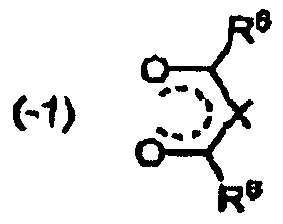 R6 bei jedem Vorkommen gleich oder anders sein kann und aus der Gruppe von substituiertem oder unsubstituiertem Alkyl, Aryl, Alkylaryl und heterocyclischen Gruppen ausgewählt ist;X ein Phosphor- oder Stickstoffatom ist; oderL' ein stickstoffhaltiger Ligand der Formel:
 R7 eine Alkylgruppe (C1 bis C12) oder Aryl ist; oderein stickstoffhaltiger Ligand der Formel:unter der Voraussetzung, dass das Iridium hexakoordiniert ist.
 R8 bei jedem Vorkommen gleich oder anders sein kann und unter CF3, C2F5, n-C3F7 ausgewählt ist,
 - Zusammensetzung nach Anspruch 1, wobei der Iridiumkomplex eine Formel aufweist ausgewählt aus der Gruppe bestehend aus:


- Zusammensetzung nach Anspruch 1, wobei der zweizähnige Ligand die Formel:

- Zusammensetzung nach Anspruch 1, wobei der zweizähnige Ligand die Formel:

- Zusammensetzung nach Anspruch 1, wobei der zweizähnige Ligand die Formel:

- Organische elektronische Vorrichtung umfassend mindestens eine Schicht umfassend einen Komplex nach einem der vorhergehenden Ansprüche.
- Vorrichtung nach Anspruch 6, die eine Spitzenleuchtdichte von 1800 cd/m2 bei 22 Volt und eine Spitzenwellenlänge von 470 nm aufweist.
Applications Claiming Priority (2)
| Application Number | Priority Date | Filing Date | Title |
|---|---|---|---|
| US11/430,473 US7737277B2 (en) | 2006-05-08 | 2006-05-08 | Electroluminescent bis-cyclometalled iridium compounds and devices made with such compounds |
| PCT/US2007/011068 WO2007133523A2 (en) | 2006-05-08 | 2007-05-08 | Electroluminescent bis-cyclometalled iridium compounds and devices made with such compounds |
Publications (2)
| Publication Number | Publication Date |
|---|---|
| EP2016154A2 EP2016154A2 (de) | 2009-01-21 |
| EP2016154B1 true EP2016154B1 (de) | 2012-06-13 |
Family
ID=38577448
Family Applications (1)
| Application Number | Title | Priority Date | Filing Date |
|---|---|---|---|
| EP07776864A Not-in-force EP2016154B1 (de) | 2006-05-08 | 2007-05-08 | Elektrolumineszierende bi-cyclometallisierte idirium-verbindungen und aus solchen verbindungen hergestellte geräte |
Country Status (6)
| Country | Link |
|---|---|
| US (1) | US7737277B2 (de) |
| EP (1) | EP2016154B1 (de) |
| JP (1) | JP2009536681A (de) |
| KR (1) | KR20090018937A (de) |
| CN (1) | CN101437921A (de) |
| WO (1) | WO2007133523A2 (de) |
Families Citing this family (18)
| Publication number | Priority date | Publication date | Assignee | Title |
|---|---|---|---|---|
| EP2196518B1 (de) * | 2008-11-17 | 2018-09-26 | Semiconductor Energy Laboratory Co., Ltd. | Lichtemittierendes Element und lichtemittierende Vorrichtung |
| JP5668071B2 (ja) * | 2010-09-10 | 2015-02-12 | 株式会社日立製作所 | 有機発光素子および有機発光素子の製造方法 |
| CN103814035A (zh) | 2011-09-12 | 2014-05-21 | 新日铁住金化学株式会社 | 具有含硅四元环构造的有机场致发光元件用材料及有机场致发光元件 |
| JP5914500B2 (ja) | 2011-09-12 | 2016-05-11 | 新日鉄住金化学株式会社 | 有機電界発光素子 |
| WO2013038843A1 (ja) | 2011-09-12 | 2013-03-21 | 新日鉄住金化学株式会社 | 有機電界発光素子 |
| US9865829B2 (en) | 2011-12-12 | 2018-01-09 | Nippon Steel & Sumikin Chemical Co., Ltd. | Organic electroluminescent element material and organic electroluminescent element using same |
| KR102005723B1 (ko) | 2012-03-12 | 2019-07-31 | 닛테츠 케미컬 앤드 머티리얼 가부시키가이샤 | 유기 전계 발광 소자 |
| KR102014888B1 (ko) | 2012-06-28 | 2019-08-27 | 닛테츠 케미컬 앤드 머티리얼 가부시키가이샤 | 유기 전계발광 소자용 재료 및 유기 전계발광 소자 |
| CN104471734B (zh) | 2012-07-19 | 2016-11-09 | 新日铁住金化学株式会社 | 有机电场发光元件 |
| TWI599570B (zh) | 2012-09-28 | 2017-09-21 | 新日鐵住金化學股份有限公司 | Compounds for organic electroluminescent devices and organic electroluminescent devices |
| EP3296301A1 (de) * | 2016-09-19 | 2018-03-21 | ETH Zürich | Vielseitiges verfahren zur herstellung von acylphosphinen |
| US20190077818A1 (en) * | 2017-09-08 | 2019-03-14 | Chuanjun Xia | Organic luminescent materials containing fluorine ancillary ligands |
| CN111909213B (zh) | 2019-05-09 | 2024-02-27 | 北京夏禾科技有限公司 | 一种含有三个不同配体的金属配合物 |
| CN111909214B (zh) | 2019-05-09 | 2024-03-29 | 北京夏禾科技有限公司 | 一种含有3-氘取代异喹啉配体的有机发光材料 |
| CN111909212B (zh) | 2019-05-09 | 2023-12-26 | 北京夏禾科技有限公司 | 一种含有6-硅基取代异喹啉配体的有机发光材料 |
| CN112679548B (zh) | 2019-10-18 | 2023-07-28 | 北京夏禾科技有限公司 | 具有部分氟取代的取代基的辅助配体的有机发光材料 |
| CN118084980A (zh) | 2020-01-10 | 2024-05-28 | 北京夏禾科技有限公司 | 有机发光材料 |
| CN113121609B (zh) | 2020-01-16 | 2024-03-29 | 北京夏禾科技有限公司 | 一种金属配合物、包含其的电致发光器件及其用途 |
Family Cites Families (10)
| Publication number | Priority date | Publication date | Assignee | Title |
|---|---|---|---|---|
| GB8909011D0 (en) * | 1989-04-20 | 1989-06-07 | Friend Richard H | Electroluminescent devices |
| DE69110922T2 (de) | 1990-02-23 | 1995-12-07 | Sumitomo Chemical Co | Organisch elektrolumineszente Vorrichtung. |
| US5408109A (en) * | 1991-02-27 | 1995-04-18 | The Regents Of The University Of California | Visible light emitting diodes fabricated from soluble semiconducting polymers |
| US5552678A (en) * | 1994-09-23 | 1996-09-03 | Eastman Kodak Company | AC drive scheme for organic led |
| US6821645B2 (en) * | 1999-12-27 | 2004-11-23 | Fuji Photo Film Co., Ltd. | Light-emitting material comprising orthometalated iridium complex, light-emitting device, high efficiency red light-emitting device, and novel iridium complex |
| US20020121638A1 (en) | 2000-06-30 | 2002-09-05 | Vladimir Grushin | Electroluminescent iridium compounds with fluorinated phenylpyridines, phenylpyrimidines, and phenylquinolines and devices made with such compounds |
| US6670645B2 (en) * | 2000-06-30 | 2003-12-30 | E. I. Du Pont De Nemours And Company | Electroluminescent iridium compounds with fluorinated phenylpyridines, phenylpyrimidines, and phenylquinolines and devices made with such compounds |
| US6939624B2 (en) * | 2000-08-11 | 2005-09-06 | Universal Display Corporation | Organometallic compounds and emission-shifting organic electrophosphorescence |
| JP4006335B2 (ja) * | 2000-11-30 | 2007-11-14 | キヤノン株式会社 | 発光素子及び表示装置 |
| US6919139B2 (en) * | 2002-02-14 | 2005-07-19 | E. I. Du Pont De Nemours And Company | Electroluminescent iridium compounds with phosphinoalkoxides and phenylpyridines or phenylpyrimidines and devices made with such compounds |
-
2006
- 2006-05-08 US US11/430,473 patent/US7737277B2/en not_active Expired - Fee Related
-
2007
- 2007-05-08 EP EP07776864A patent/EP2016154B1/de not_active Not-in-force
- 2007-05-08 WO PCT/US2007/011068 patent/WO2007133523A2/en not_active Ceased
- 2007-05-08 CN CNA2007800166575A patent/CN101437921A/zh active Pending
- 2007-05-08 JP JP2009509791A patent/JP2009536681A/ja active Pending
- 2007-05-08 KR KR1020087029746A patent/KR20090018937A/ko not_active Ceased
Also Published As
| Publication number | Publication date |
|---|---|
| WO2007133523A2 (en) | 2007-11-22 |
| US7737277B2 (en) | 2010-06-15 |
| CN101437921A (zh) | 2009-05-20 |
| US20070259205A1 (en) | 2007-11-08 |
| JP2009536681A (ja) | 2009-10-15 |
| KR20090018937A (ko) | 2009-02-24 |
| EP2016154A2 (de) | 2009-01-21 |
| WO2007133523A3 (en) | 2008-01-10 |
Similar Documents
| Publication | Publication Date | Title |
|---|---|---|
| EP2016154B1 (de) | Elektrolumineszierende bi-cyclometallisierte idirium-verbindungen und aus solchen verbindungen hergestellte geräte | |
| US7675228B2 (en) | Electroluminescent iridium compounds with silylated, germanylated, and stannylated ligands, and devices made with such compounds | |
| EP1442094B1 (de) | Elektrolumineszente iridiumverbindungen mit rot-oranger oder roter emission und vorrichtungen, hergestellt unter verwendung solcher verbindungen | |
| KR100838010B1 (ko) | 플루오르화 페닐피리딘, 페닐피리미딘 및 페닐퀴놀린을갖는 전기발광 이리듐 화합물 및 이러한 화합물로 제조된장치 | |
| US7476452B2 (en) | Electroluminescent iridium compounds with fluorinated phenylpyridine ligands, and devices made with such compounds | |
| US6963005B2 (en) | Compounds comprising phosphorus-containing metal complexes | |
| EP1442095A1 (de) | Elektrolumineszierende platinverbindungen und el vorrichtungen, diese beinhaltend | |
| EP1466506A1 (de) | Elektrolumineszenz-iridiumzusammensetzungen mit fluorierten phenylpyridinen, phenylpyrimidinen und phenylchinolinen und mit solchen verbindungen hergestellte einrichtungen | |
| US7132681B2 (en) | Electroluminescent iridium compounds with fluorinated phenylpyridines, phenylpyrimidines, and phenylquinolines and devices made with such compounds | |
| US7816016B1 (en) | Electroluminescent iridium compounds and devices made therefrom | |
| US7402345B2 (en) | Electroluminescent iridium compounds with fluorinated phenylpyridine ligands, and devices made with such compounds | |
| AU2002350128A1 (en) | Electroluminescent iridium compounds having red-orange or red emission and devices made with such compounds | |
| AU2002354028A1 (en) | Electroluminescent platinum compounds and devices made with such compounds | |
| AU2002231155A1 (en) | Electroluminescent iridium compounds with fluorinated phenylpyridines, phenylpyrimidines, and phenylquinolines and devices made with such compounds |
Legal Events
| Date | Code | Title | Description |
|---|---|---|---|
| PUAI | Public reference made under article 153(3) epc to a published international application that has entered the european phase |
Free format text: ORIGINAL CODE: 0009012 |
|
| 17P | Request for examination filed |
Effective date: 20081030 |
|
| AK | Designated contracting states |
Kind code of ref document: A2 Designated state(s): AT BE BG CH CY CZ DE DK EE ES FI FR GB GR HU IE IS IT LI LT LU LV MC MT NL PL PT RO SE SI SK TR |
|
| AX | Request for extension of the european patent |
Extension state: AL BA HR MK RS |
|
| 17Q | First examination report despatched |
Effective date: 20090211 |
|
| RBV | Designated contracting states (corrected) |
Designated state(s): DE FR GB IT |
|
| DAX | Request for extension of the european patent (deleted) | ||
| REG | Reference to a national code |
Ref country code: DE Ref legal event code: R079 Ref document number: 602007023386 Country of ref document: DE Free format text: PREVIOUS MAIN CLASS: C09K0011060000 Ipc: C07F0015000000 |
|
| RIC1 | Information provided on ipc code assigned before grant |
Ipc: H05B 33/14 20060101ALI20110810BHEP Ipc: C09K 11/06 20060101ALI20110810BHEP Ipc: H01L 51/00 20060101ALI20110810BHEP Ipc: C07F 15/00 20060101AFI20110810BHEP |
|
| GRAP | Despatch of communication of intention to grant a patent |
Free format text: ORIGINAL CODE: EPIDOSNIGR1 |
|
| GRAS | Grant fee paid |
Free format text: ORIGINAL CODE: EPIDOSNIGR3 |
|
| GRAA | (expected) grant |
Free format text: ORIGINAL CODE: 0009210 |
|
| AK | Designated contracting states |
Kind code of ref document: B1 Designated state(s): DE FR GB IT |
|
| REG | Reference to a national code |
Ref country code: GB Ref legal event code: FG4D |
|
| REG | Reference to a national code |
Ref country code: DE Ref legal event code: R096 Ref document number: 602007023386 Country of ref document: DE Effective date: 20120809 |
|
| PG25 | Lapsed in a contracting state [announced via postgrant information from national office to epo] |
Ref country code: IT Free format text: LAPSE BECAUSE OF FAILURE TO SUBMIT A TRANSLATION OF THE DESCRIPTION OR TO PAY THE FEE WITHIN THE PRESCRIBED TIME-LIMIT Effective date: 20120613 |
|
| PLBE | No opposition filed within time limit |
Free format text: ORIGINAL CODE: 0009261 |
|
| STAA | Information on the status of an ep patent application or granted ep patent |
Free format text: STATUS: NO OPPOSITION FILED WITHIN TIME LIMIT |
|
| 26N | No opposition filed |
Effective date: 20130314 |
|
| REG | Reference to a national code |
Ref country code: DE Ref legal event code: R097 Ref document number: 602007023386 Country of ref document: DE Effective date: 20130314 |
|
| GBPC | Gb: european patent ceased through non-payment of renewal fee |
Effective date: 20130508 |
|
| PG25 | Lapsed in a contracting state [announced via postgrant information from national office to epo] |
Ref country code: DE Free format text: LAPSE BECAUSE OF NON-PAYMENT OF DUE FEES Effective date: 20131203 |
|
| REG | Reference to a national code |
Ref country code: DE Ref legal event code: R119 Ref document number: 602007023386 Country of ref document: DE Effective date: 20131203 |
|
| REG | Reference to a national code |
Ref country code: FR Ref legal event code: ST Effective date: 20140131 |
|
| PG25 | Lapsed in a contracting state [announced via postgrant information from national office to epo] |
Ref country code: GB Free format text: LAPSE BECAUSE OF NON-PAYMENT OF DUE FEES Effective date: 20130508 |
|
| PG25 | Lapsed in a contracting state [announced via postgrant information from national office to epo] |
Ref country code: FR Free format text: LAPSE BECAUSE OF NON-PAYMENT OF DUE FEES Effective date: 20130531 |