EP2016064B1 - Herstellungsverfahren für pyrazolhaltige verbindungen - Google Patents
Herstellungsverfahren für pyrazolhaltige verbindungen Download PDFInfo
- Publication number
- EP2016064B1 EP2016064B1 EP07761874A EP07761874A EP2016064B1 EP 2016064 B1 EP2016064 B1 EP 2016064B1 EP 07761874 A EP07761874 A EP 07761874A EP 07761874 A EP07761874 A EP 07761874A EP 2016064 B1 EP2016064 B1 EP 2016064B1
- Authority
- EP
- European Patent Office
- Prior art keywords
- triaza
- phenyl
- hexahydro
- azulene
- alkyl
- Prior art date
- Legal status (The legal status is an assumption and is not a legal conclusion. Google has not performed a legal analysis and makes no representation as to the accuracy of the status listed.)
- Not-in-force
Links
- 0 *NN=C[C@@](C(C(C(CO)O)O)O)O Chemical compound *NN=C[C@@](C(C(C(CO)O)O)O)O 0.000 description 11
- JVAFWKCKPQHIFL-MHWRWJLKSA-N CC(C)N/N=C/CCNC(OCc1ccccc1)=O Chemical compound CC(C)N/N=C/CCNC(OCc1ccccc1)=O JVAFWKCKPQHIFL-MHWRWJLKSA-N 0.000 description 1
- RBYJHELKTYHZNG-UHFFFAOYSA-N CC(C)[n]1nc(CCNCC2)c2c1-c(cc1)ccc1F Chemical compound CC(C)[n]1nc(CCNCC2)c2c1-c(cc1)ccc1F RBYJHELKTYHZNG-UHFFFAOYSA-N 0.000 description 1
- YMNJVMAJRIGPBS-UHFFFAOYSA-N O=C(NCCc1n[n](C2CCCC2)c(-c(cc2)ccc2F)c1CC1OCCO1)OCc1ccccc1 Chemical compound O=C(NCCc1n[n](C2CCCC2)c(-c(cc2)ccc2F)c1CC1OCCO1)OCc1ccccc1 YMNJVMAJRIGPBS-UHFFFAOYSA-N 0.000 description 1
- BQJWBPVFRABRDM-UHFFFAOYSA-N [AlH2]c1c(CCNCC2)c2n[n]1O[AlH2] Chemical compound [AlH2]c1c(CCNCC2)c2n[n]1O[AlH2] BQJWBPVFRABRDM-UHFFFAOYSA-N 0.000 description 1
- JJJKFFNMMMSOGZ-UHFFFAOYSA-N [O-][N+](/C(/CC(O)O)=C\[AlH2])=O Chemical compound [O-][N+](/C(/CC(O)O)=C\[AlH2])=O JJJKFFNMMMSOGZ-UHFFFAOYSA-N 0.000 description 1
Classifications
-
- C—CHEMISTRY; METALLURGY
- C07—ORGANIC CHEMISTRY
- C07D—HETEROCYCLIC COMPOUNDS
- C07D487/00—Heterocyclic compounds containing nitrogen atoms as the only ring hetero atoms in the condensed system, not provided for by groups C07D451/00 - C07D477/00
- C07D487/02—Heterocyclic compounds containing nitrogen atoms as the only ring hetero atoms in the condensed system, not provided for by groups C07D451/00 - C07D477/00 in which the condensed system contains two hetero rings
- C07D487/04—Ortho-condensed systems
-
- C—CHEMISTRY; METALLURGY
- C07—ORGANIC CHEMISTRY
- C07D—HETEROCYCLIC COMPOUNDS
- C07D317/00—Heterocyclic compounds containing five-membered rings having two oxygen atoms as the only ring hetero atoms
- C07D317/08—Heterocyclic compounds containing five-membered rings having two oxygen atoms as the only ring hetero atoms having the hetero atoms in positions 1 and 3
- C07D317/10—Heterocyclic compounds containing five-membered rings having two oxygen atoms as the only ring hetero atoms having the hetero atoms in positions 1 and 3 not condensed with other rings
- C07D317/14—Heterocyclic compounds containing five-membered rings having two oxygen atoms as the only ring hetero atoms having the hetero atoms in positions 1 and 3 not condensed with other rings with substituted hydrocarbon radicals attached to ring carbon atoms
- C07D317/16—Radicals substituted by halogen atoms or nitro radicals
-
- C—CHEMISTRY; METALLURGY
- C07—ORGANIC CHEMISTRY
- C07D—HETEROCYCLIC COMPOUNDS
- C07D405/00—Heterocyclic compounds containing both one or more hetero rings having oxygen atoms as the only ring hetero atoms, and one or more rings having nitrogen as the only ring hetero atom
- C07D405/02—Heterocyclic compounds containing both one or more hetero rings having oxygen atoms as the only ring hetero atoms, and one or more rings having nitrogen as the only ring hetero atom containing two hetero rings
- C07D405/06—Heterocyclic compounds containing both one or more hetero rings having oxygen atoms as the only ring hetero atoms, and one or more rings having nitrogen as the only ring hetero atom containing two hetero rings linked by a carbon chain containing only aliphatic carbon atoms
Definitions
- the present invention is directed to processes for the preparation of fused pyrazole compounds, useful for the treatment of disease states mediated by serotonin receptor activity.
- the present invention is directed to processes for the preparation of compounds of Formula (I): where Ar and ALK are defined as below.
- Compounds of Formula (I) are modulators of serotonin receptors, and are useful in methods for treating or preventing diseases and conditions mediated by serotonin receptors, particularly the 5HT 7 and/or 5HT 2 receptor subtypes. Said compounds were disclosed in US Pat. Appl. Publ. US 20050119295, published June 2, 2005 , which is hereby incorporated by reference.
- the compounds are useful for treating or preventing CNS disorders, such as sleep disorders, depression/anxiety, generalized anxiety disorder, schizophrenia, bipolar disorders, psychotic disorders, obsessive-compulsive disorder, mood disorders, post-traumatic stress and other stress-related disorders, migraine, pain, eating disorders, obesity, sexual dysfunction, metabolic disturbances, hormonal imbalance, alcohol abuse, addictive disorders, nausea, inflammation, centrally mediated hypertension, sleep/wake disturbances, jetlag, and circadian rhythm abnormalities.
- CNS disorders such as sleep disorders, depression/anxiety, generalized anxiety disorder, schizophrenia, bipolar disorders, psychotic disorders, obsessive-compulsive disorder, mood disorders, post-traumatic stress and other stress-related disorders, migraine, pain, eating disorders, obesity, sexual dysfunction, metabolic disturbances, hormonal imbalance, alcohol abuse, addictive disorders, nausea, inflammation, centrally mediated hypertension, sleep/wake disturbances, jetlag, and circadian rhythm abnormalities.
- the compounds may also be used in the treatment and prevention of hypotension, peripheral vascular disorders, cardiovascular shock, renal disorders, gastric motility, diarrhea, spastic colon, irritable bowel disorders, ischemias, septic shock, urinary incontinence, and other disorders related to the gastrointestinal and vascular systems.
- the compounds may be used in the treatment or prevention of a range of ocular disorders including glaucoma, optic neuritis, diabetic retinopathy, retinal edema, and age-related macular degeneration.
- Substituted pyrazoles are important synthetic targets in the pharmaceutical industry, as the pyrazole motif makes of the core structure of numerous biologically active compounds ( Elguero, J.; Goya, P.; Jagerovic, N.; Silva, A.M.S. Targets in Heterocyclic Systems 2002, 6, 52-98 ) including marketed drugs such as sildenafil ( Terrett, N.K. et al. Bioorg. Med. Chem. Lett. 1996, 6, 1819-1824 ) and celecoxib ( Penning, T.D. et al. J. Med. Chem. 1997, 40, 1347-1365 ).
- sildenafil Terrett, N.K. et al. Bioorg. Med. Chem. Lett. 1996, 6, 1819-1824
- celecoxib Penning, T.D. et al. J. Med. Chem. 1997, 40, 1347-1365 .
- Pyrazoles are often prepared by the reaction of hydrazines with 1,3-dicarbonyl compounds or their equivalents, such as ⁇ , ⁇ -ethynylketones or esters. These condensation reactions generally result in mixtures of regioisomers, which complicates isolation and purification processes. Cyclization reactions of 1,3-dipoles such as deazoalkanes or nitrilimines with olefins has also been used, but these reactions often suffer from low yields and harsh conditions ( Elguero, J. Comp. Heterocycl. Chem. 1984, 5,167 ; Elguero, J. Comp. Heterocycl. Chem. II 1996, 3, 1-75 and 817-932 , and references cited therein). These processes are therefore unsuitable for large scale production of substituted pyrazoles.
- embodiments of the synthetic route according to this invention provide a concise methodology that is suitable for readily making a range of structurally related substituted pyrazole analogs.
- the present invention relates to a method of making a compound of Formula (I): or an enantiomer, diastereomer, hydrate, solvate, or pharmaceutically acceptable salt thereof; comprising reacting a compound of formula (IV): with an acid under reducing conditions, in a non-basic organic solvent, at a temperature between about room temperature and the reflux temperature of the solvent, to provide the compound of Formula (I), wherein Ar is:
- the method of making a compound of Formula (I) further comprises:
- the present invention is further directed to compounds of formulae (IV), (II), and (III): wherein R 2 , Ar, ALK, P 1 , and P 2 are defined as above.
- Compounds of formulae (IV), (II), and (III) are useful in the preparation of compounds of Formula (I).
- the present invention is further directed to a method of making a compound of Formula (XVI): or an enantiomer, diastereomer, hydrate, solvate, or pharmaceutically acceptable salt thereof; comprising reacting a compound of formula (XV): with an acid under reducing conditions, in a non-basic organic solvent, to provide the compound of Formula (XVI), wherein ALK1 is isopropyl or cyclopropyl; and Ar1 is 4-fluorophenyl.
- the present invention is further directed to a compound of Formula (I) prepared according to any of the processes disclosed herein.
- Illustrative of the invention is a pharmaceutical composition comprising a pharmaceutically acceptable carrier and a compound of Formula (I) prepared according to any of the processes described herein.
- An illustration of the invention is a pharmaceutical composition comprising a) a compound of Formula (I) prepared according to any of the processes described herein, and b) a pharmaceutically acceptable carrier.
- Illustrating the invention is a process for making a pharmaceutical composition comprising mixing a compound of Formula (I) prepared according to any of the processes described herein and a pharmaceutically acceptable carrier.
- Exemplifying the invention are methods of treating or preventing a disorder mediated by the serotonin receptor, preferably, the 5HT 7 and/or 5HT 2 receptors, wherein said disorder is selected from the group consisting of sleep disorders, depression/anxiety, generalized anxiety disorder, schizophrenia, bipolar disorders, psychotic disorders, obsessive-compulsive disorder, mood disorders, post-traumatic stress and other stress-related disorders, migraine, pain, eating disorders, obesity, sexual dysfunction, metabolic disturbances, hormonal imbalance, alcohol abuse, addictive disorders, nausea, inflammation, centrally mediated hypertension, sleep/wake disturbances, jetlag, circadian rhythm abnormalities, hypotension, peripheral vascular disorders, cardiovascular shock, renal disorders, gastric motility, diarrhea, spastic colon, irritable bowel disorders, ischemias, septic shock, urinary incontinence, other disorders related to the gastrointestinal and vascular systems, and ocular disorders including glaucoma, optic neuritis, diabetic retinopathy, retinal edema, and age-related
- halo shall mean chlorine, bromine, fluorine and iodine.
- alkyl whether used alone or as part of a substituent group, include straight and branched alkyl chain of the specified number of carbon atoms.
- alkyl radicals include methyl (Me), ethyl (Et), propyl (Pr), isopropyl (iPr), butyl (Bu), isobutyl, sec-butyl, t-butyl, pentyl and the like.
- alkylene refers to a biradical substituent formed from an alkyl group, as defined herein, in which the biradical is formed by the removal of two hydrogen atoms.
- cycloalkyl represents a stable three to eight membered monocyclic ring structure consisting of saturated carbon atoms. Suitable examples include cyclopropyl, cyclobutyl, cyclopentyl, cyclohexyl, cycloheptyl and cyclooctyl.
- acid represents a protic acid of a pH below about 3, including, but not limited to, TFA, HCI, and H 2 SO 4 .
- non-basic organic solvent means an organic solvent with a pH less than or equal to 7.
- regioisomeric excess refers to the production of regioisomeric products in unequal amounts.
- F (a) + F (b) 1.
- some compounds referred to herein are chiral and/or have geometric isomeric centers, for example E- and Z- isomers.
- the present invention encompasses all such optical isomers, including diastereomers and racemic mixtures, atropisomers, and geometric isomers, and mixtures thereof, that possess the activity that characterizes the compounds of this invention.
- certain compounds referred to herein can exist in solvated as well as unsolvated forms. It is understood that this invention encompasses all such solvated and unsolvated forms that possess the activity that characterizes the compounds of this invention.
- the compounds of the present invention may be labeled with radioactive elements such as 125 I, 18 F, 11 C, 64 Cu, and the like for use in imaging or for radioactive treatment of patients.
- radioactive elements such as 125 I, 18 F, 11 C, 64 Cu, and the like for use in imaging or for radioactive treatment of patients.
- An example of such compounds is an isotopically labeled compound, such as an 18 F isotopically labeled compound that may be used as a probe in detection and/or imaging techniques, such as positron emission tomography (PET) and single-photon emission computed tomography (SPECT).
- PET positron emission tomography
- SPECT single-photon emission computed tomography
- compounds of the present invention labeled with 18 F or 11 C may be used as a PET molecular probe for studying serotonin-mediated disorders.
- an isotopically labeled compound such as a deuterium and/or tritium labeled compound, that may be used in reaction kinetic studies.
- the compounds described herein may be reacted with an appropriate functionalized radioactive reagents using conventional chemistry to provide radiolabeled compounds.
- Ar is selected from the group consisting of: phenyl, furanyl, oxazolyl, isoxazolyl, 1,2,3-oxadiazolyl, 1,2,4-oxadiazolyl, 1,2,5-oxadiazolyl, 1,3,4-oxadiazolyl, thiophenyl, thiazolyl, isothiazolyl, pyrrolyl, imidazolyl, pyrazolyl, 1,2,3-triazolyl, 1,2,4-triazolyl, pyridinyl, pyridinyl-N-oxide, pyrazinyl, pyrimidinyl, and pyridazinyl. More preferably, Ar, optionally substituted, is selected from the group consisting of phenyl, furan-3-yl, thiophen-2-yl, and thiophen-3-yl.
- Ar is selected from the group consisting of phenyl, 4-methoxyphenyl, 2-methylphenyl, 3-methylphenyl, 4-methylphenyl, 4-ethylphenyl, 4-isopropylphenyl, 4-tert-butylphenyl, 2-chlorophenyl, 3-chlorophenyl, 4-chlorophenyl, 2-fluorophenyl, 3-fluorophenyl, 4-fluorophenyl, 4-trifluoromethylphenyl, 4-trifluoromethoxyphenyl, 4-cyanophenyl, 4-acetylphenyl, 3,4-difluorophenyl, 3,4-dichlorophenyl, 2,4-dichlorophenyl, 4-nitrophenyl, 3-fluoro-4-chlorophenyl, 4-dimethylaminophenyl, 4-carbamoylphenyl, 4-fluoro-3-methylphenyl, furan-3-yl,
- ALK is selected from the group consisting of methyl, ethyl, propyl, isopropyl, butyl, isobutyl, sec-butyl, tert-butyl, pentyl, isopentyl, hexyl, heptyl, octyl, cyclopropyl, cyclobutyl, cyclopentyl, cyclohexyl, cycloheptyl, cyclooctyl, phenyl, -CH 2 -CYC, and -CH 2 CH 2 -CYC.
- ALK is selected from the group consisting of methyl, trifluoroethyl, methoxycarbonylmethyl, methylcarbamoylmethyl, ethyl, propyl, 3-methoxycarbonylpropyl, 3-carboxypropyl, butyl, tert-butyl, 4-hydroxybutyl, 4-methoxycarbonylbutyl, 4-carboxybutyl, pentyl, 5-hydroxypentyl, 1-ethylpropyl, 2-ethylpropyl, 2-ethylbutyl, isopropyl, but-3-enyl, isobutyl, 3-methylbutyl, 2-dimethylaminoethyl, 2-cyanoethyl, cyclopropyl, cyclobutyl, cyclopentyl, 3,3-dimethylcyclopentyl, cyclohexyl, 4-methylcyclohexyl, cycloheptyl,
- CYC is selected from the group consisting of phenyl, pyridyl, and cyclohexyl, thiophen-2-yl, and furan-2-yl.
- CYC is selected from the group consisting of phenyl, 2-methoxyphenyl, 2-methylphenyl, 4-methylphenyl, 2-trifluoro-methylphenyl, 3,4-difluorophenyl, 2,4-difluorophenyl, 2,6-difluorophenyl, 3,4,5-trimethoxyphenyl, 4-methoxy-3-fluorophenyl, thiophen-2-yl, 5-chlorothiophen-2-yl, 2-hydroxyphenyl, 4-hydroxy-2-methylphenyl, 4-hydroxy-3-fluorophenyl, benzo[1,3]dioxol-4 or 5-yl, 5-carboxyethyl-furan-2-yl, naphthalen-1-yl, and cyclohexyl.
- R 2 is a tert-butoxycarbonyl (Boc) or benzyloxycarbonyl (Cbz) group.
- P 1 and P 2 are both methyl or are taken together to form -(CH 2 ) 2 -.
- the compound of Formula (I) is selected from the group consisting of:
- the compound of Formula (I) is 3-(4-fluoro-phenyl)-2-isopropyl-2,4,5,6,7,8-hexahydro-1,2,6-triaza-azulene or 2-cyclopentyl-3-(4-fluoro-phenyl)-2,4,5,6,7,8-hexahydro-1,2,6-triaza-azulene, or a pharmaceutically acceptable salt thereof.
- the compound of formula (IV) is ⁇ 2-[4-[1,3]dioxolan-2-ylmethyl-5-(4-fluoro-phenyl)-1-isopropyl-1H-pyrazol-3-yl]-ethyl ⁇ -carbamic acid benzyl ester or ⁇ 2-[4-[1,3]dioxolan-2-ylmethyl-5-(4-fluoro-phenyl)-1-cyclopentyl-1H-pyrazol-3-yl]-ethyl ⁇ -carbamic acid benzyl ester.
- the compound of formula (II) is [3-(ALK-hydrazono)-propyl]-carbamic acid benzyl ester, where ALK is defined as above.
- the compound of formula (II) is [3-(isopropyl-hydrazono)-propyl]-carbamic acid benzyl ester or [3-(cyclopentyl-hydrazono)-propyl]-carbamic acid benzyl ester.
- the compound of formula (III) is 2-[3-(4-fluoro-phenyl)-2-nitro-allyl]-[1,3]dioxolane.
- a method of making a compound of Formula (I) according to the present invention comprises reacting a compound of formula (IV) with an acid under reducing conditions, in a non-basic organic solvent, at a temperature between about room temperature and the reflux temperature of the solvent, to give the compound of Formula (I), as depicted in Scheme A.
- Preferred conditions include those where deprotection of the R 2 protecting group, deprotection of P 1 and P 2 , cyclization, and reduction occur in the same reaction step.
- a compound of formula (IV) is reacted with an acid (such as TFA, HCl, H 2 SO 4 , and the like), and i) a reducing agent (such as Et 3 SiH, NaB(OAc) 3 H, NaCNBH 3 , and the like) or ii) a hydrogen donor (such as H 2 , cyclohexene, ammonium formate, formic acid, an the like) and a catalyst (such as palladium on carbon (Pd/C), palladium black (Pd-black), Pd(OH) 2 , platinum on carbon, Raney nickel, ruthenium black, and the like), in a non-basic organic solvent, to form the compound of Formula (I).
- an acid such as TFA, HCl, H 2 SO 4 , and the like
- non-basic organic solvent examples include an alcohol solvent (such as t-amyl alcohol, isopropanol, ethanol, methanol., and the like), an ethereal solvent (such as THF, MTBE, and the like), an aromatic solvent (such as toluene and the like), an acidic solvent (such as AcOH, TFA, and the like), water, EtOAc, and the like,or a mixture thereof.
- the acid is HCl at a concentration less than 6 M.
- the acid is TFA
- the reducing agent is Et 3 SiH
- the non-basic organic solvent is TFA.
- the acid is 3 M HCl
- the hydrogen donor is H 2
- the catalyst is Pd/C
- the non-basic organic solvent is t-amyl alcohol.
- Methods of making a compound of Formula (I) also include those wherein removal of P 1 and P 2 and cyclization occur in the presence of an acid in a first step, and reducing conditions are employed in a subsequent step.
- the method of making a compound of Formula (I) comprises reacting a compound of formula (VI): where R 11 is H or Cbz; and Ar and ALK are as previously defined, with i) a reducing agent or NaBH 4 , or ii) a hydrogen donor and a catalyst; in a non-basic organic solvent, at a temperature between about room temperature and reflux temperature of the solvent, to form the compound of Formula (I).
- the hydrogen donor is H 2
- the catalyst is Pd/C
- the non-basic organic solvent is isopropanol.
- the reducing agent is Et 3 SiH and the non-basic organic solvent is TFA.
- the compound of formula (VI) is 3-(4-fluoro-phenyl)-2-isopropyl-7,8-dihydro-2H-1,2,6-triaza-azulene-6-carboxylic acid benzyl ester.
- the method further comprises reacting a compound of formula (IV) with an acid, in a non-basic organic solvent, at a temperature between about room temperature and reflux temperature of the solvent, to form a compound of formula (VI).
- the acid is TFA and the non-basic organic solvent is water.
- the non-basic organic solvent may be the same or different in the first and subsequent steps.
- the present invention is further directed to compounds of formula (VI), which are useful in the preparation of compounds of Formula (I).
- a method of making a compound of Formula (I) further comprises reacting a hydrazone of formula (II) with a nitroolefin of formula (III), in an organic solvent, in the presence of oxygen, at a temperature between about room temperature and the reflux temperature of the solvent, to form the compound of formula (IV), as depicted in Scheme B.
- the compound of formula (IV) is formed with a regioisomeric excess of at least about 90% with respect to a compound of formula (IVa): More preferably, the compound of formula (IV) is formed with a regioisomeric excess of at least about 95%.
- an organic solvent examples include an alcohol solvent (such as methanol, ethanol, isopropanol, and the like), an alcohol/water mixture (such as methanol/water, ethanol/water, and the like), a tertiary amine solvent (such as Et 3 N, iPr 2 NEt, N-methylmorpholine, and the like), AcOH, DCM, THF, DMF, pyridine, and the like, or a mixture thereof.
- the organic solvent is Et 3 N, THF, or pyridine.
- the organic solvent is isopropanol, THF, or DMF, further comprising at least about one equivalent of Et 3 N or pyridine.
- the organic solvent is isopropanol, THF, or DMF, further comprising at least about four equivalents of Et 3 N.
- the method of making a compound of Formula (I) further comprises mixing an aldehyde of formula (X) with a hydrazine of formula (XI), in a solvent selected from a tertiary amine base, pyridine, and a non-basic organic solvent, further comprising at least one equivalent of a tertiary amine base, at a temperature between about room temperature and the reflux temperature of the solvent, to form a compound of formula (II), as depicted in Scheme B.
- the non-basic organic solvent may be the same or different as in Scheme A.
- the tertiary amine base is Et 3 N, iPr 2 NEt, or N-methylmorpholine.
- the non-basic organic solvent is an alcohol solvent (such as methanol, ethanol, or isopropanol), an alcohol/water mixture (such as ethanol/water), or a polar solvent (such as THF or DMF), or a mixture thereof.
- an alcohol solvent such as methanol, ethanol, or isopropanol
- an alcohol/water mixture such as ethanol/water
- a polar solvent such as THF or DMF
- Conversion of a compound of formula (X) to a compound of formula (IV) is optionally accomplished in a single reaction vessel.
- the method of making a compound of Formula (I) therefore comprises: 1) mixing an aldehyde of formula (X) with a hydrazine of formula (XI) in a solvent selected from a tertiary amine base, pyridine, and a non-basic organic solvent further comprising at least one equivalent of a tertiary amine base, to form an organic mixture; and 2) adding a nitroolefin of formula (III) to the organic mixture to form the compound of formula (IV).
- the tertiary amine base is Et 3 N, iPr 2 NEt, or N-methylmorpholine.
- the non-basic organic solvent is an alcohol solvent (such as methanol, ethanol, or isopropanol), alcohol/water mixtures (such as ethanol/water), or a polar solvent (such as THF or DMF), or a mixture thereof.
- the organic solvent is isopropanol or DMF, further comprising at least one equivalent of Et 3 N.
- the organic solvent is isopropanol or DMF, further comprising at least four equivalents of Et 3 N.
- a method of making a compound of Formula (I) further comprises reacting a nitroalkane of formula (XII) with an aldehyde Ar-CHO, in the presence of an amine base, in an aromatic organic solvent, at a temperature between about room temperature and the reflux temperature of the solvent, to form a nitroolefin of formula (III), as depicted in Scheme C.
- the amine base is Et 3 N, iPr 2 NEt, pyridine, morpholine, pyrrolidine, or piperidine, or a mixture thereof.
- the aromatic organic solvent is toluene, benzene, or xylene, or a mixture thereof.
- water is removed from the reaction with a Dean-Stark trap.
- the amine base is piperidine and the aromatic organic solvent is toluene.
- a compound of Formula (I) is optionally processed into a compound of formula (XIII), where R 1 is -C 1-7 alkyl or -C 1-3 alkylphenyl, by alkylation or reductive amination protocols such as those described in Intl. Pat. Appl. Publ. WO2005040169 ( See, e . g ., Scheme 3 and Examples 208, 259, 260, 269-272, 287, 289-291, 302).
- Such compounds are modulators of serotonin receptors, and are useful in methods for treating or preventing diseases and conditions mediated by serotonin receptors, particularly the 5HT 7 and/or 5HT 2 receptor subtypes. Said compounds were disclosed in Intl.
- the method of the present invention thus further comprises reacting a compound of Formula (I) with a compound of formula (Xlla) or a compound of formula (XIIb), wherein X is a suitable leaving group such as Cl, Br, I, p-toluenesulfonyloxy, methanesulfonyloxy, and the like, to provide a compound of formula (XIII).
- R 1 is methyl, ethyl, isopropyl, benzyl, phenethyl, or phenpropyl.
- the compound of formula (XIII) is selected from the group consisting of: 6-methyl-2,3-diphenyl-2,4,5,6,7,8-hexahydro-1,2,6-triaza-azulene; 3-(4-fluoro-phenyl)-2-isopropyl-6-methyl-2,4,5,6,7,8-hexahydro-1,2,6-triaza-azulene; 3-(4-fluoro-phenyl)-2,6-diisopropyl-2,4,5,6,7,8-hexahydro-1,2,6-triaza-azulene; 6-benzyl-3-(4-fluoro-phenyl)-2-isopropyl-2,4,5,6,7,8-hexahydro-1,2,6-triaza-azulene; 3-(4-fluoro-
- a method of making a compound of Formula (XVI) according to the present invention comprises reacting a compound of formula (XV) with an acid under reducing conditions, in a non-basic organic solvent, at a temperature between about room temperature and the reflux temperature of the solvent, to give the compound of Formula (XVI) as depicted in Scheme E, where ALK1 and Ar1 are defined as for Formula (XVI) and (XV) above.
- Preferred conditions include those where deprotection of the Cbz group, deprotection of the dioxolane group, cyclization, and reduction occur in the same reaction step.
- a compound of formula (XV) is reacted with an acid (such as TFA, HCl, H 2 SO 4 , and the like), and i) a reducing agent (such as Et 3 SiH, NaB(OAc) 3 H, NaCNBH 3 , and the like) or ii) a hydrogen donor (such as H 2 , cyclohexene, ammonium formate, formic acid, and the like) and a catalyst (such as palladium on carbon (Pd/C), palladium black (Pd-black), Pd(OH) 2 , platinum on carbon, Raney nickel, ruthenium black, and the like), in a non-basic organic solvent, to form the compound of Formula (XVI).
- an acid such as TFA, HCl, H 2 SO 4 , and the like
- non-basic organic solvent examples include an alcohol solvent (such as t-amyl alcohol, isopropanol, ethanol, methanol, and the like), an ethereal solvent (such as THF, MTBE, and the like), an aromatic solvent (such as toluene and the like), an acidic solvent (such as AcOH, TFA, and the like), water, EtOAc, and the like, or a mixture thereof.
- the acid is HCl at a concentration less than 6 M.
- the acid is TFA
- the reducing agent is Et 3 SiH
- the non-basic organic solvent is TFA.
- the acid is 3 M HCl
- the hydrogen donor is H 2
- the catalyst is Pd/C
- the non-basic organic solvent is t-amyl alcohol.
- Methods of making a compound of Formula (XVI) also include those wherein removal of the dioxolane and cyclization occur in the presence of an acid in a first step, and reducing conditions are employed in a subsequent step.
- the method of making a compound of Formula (XVI) comprises reacting a compound of formula (XVII): where Ar1 and ALK1 are as previously defined, with i) a reducing agent or NaBH 4 , or ii) a hydrogen donor and a catalyst; in a non-basic organic solvent, at a temperature between about room temperature and reflux temperature of the solvent, to form the compound of Formula (XVI).
- the method further comprises reacting a compound of formula (XV) with an acid, in a non-basic solvent, at a temperature between about room temperature and reflux temperature of the solvent, to form a compound of formula (XVII).
- the acid is TFA and the non-basic organic solvent is water.
- the non-basic organic solvent may be the same or different in the first and subsequent steps.
- the present invention is further directed to compounds of formula (XVII), which are useful in the preparation of compounds of Formula (XVI).
- an organic solvent examples include an alcohol solvent (such as methanol, ethanol, isopropanol, and the like), an alcohol/water mixture (such as methanol/water, ethanol/water, and the like), a tertiary amine solvent (such as Et 3 N, iPr 2 NEt, N-methylmorpholine, and the like), AcOH, DCM, THF, DMF, pyridine, and the like, or a mixture thereof.
- the organic solvent is Et 3 N, THF, or pyridine.
- the organic solvent is isopropanol, THF, or DMF, further comprising at least about one equivalent of Et 3 N or pyridine.
- the organic solvent is isopropanol, THF, or DMF, further comprising at least about four equivalents of Et 3 N.
- Conversion of a compound of formula (XVIII) to a compound of Formula (XVI) is optionally accomplished in a single reaction vessel.
- the method of making a compound of Formula (XVI) therefore comprises: 1) mixing an aldehyde of formula (XVIII) with a hydrazine of formula (XIX) in a solvent selected from a tertiary amine base, pyridine, and a non-basic organic solvent further comprising at least one equivalent of a tertiary amine base, to form an organic mixture; and 2) adding a nitroolefin of formula (XXII) to the organic mixture to form the compound of formula (XV).
- a method of making a compound of Formula (XVI) further comprises reacting a nitroalkane of formula (XXIII) with an aldehyde Ar1-CHO, in the presence of an amine base, in an aromatic organic solvent, at a temperature between about room temperature and the reflux temperature of the solvent, to form a nitroolefin of formula (XXII), as depicted in Scheme G.
- the amine base is Et 3 N, iPr 2 NEt, pyridine, morpholine, pyrrolidine, or piperidine, or a mixture thereof.
- the aromatic organic solvent is toluene, benzene, or xylene, or a mixture thereof.
- water is removed from the reaction with a Dean-Stark trap.
- the amine base is piperidine and the aromatic organic solvent is toluene.
- a compound of Formula (XVI) is optionally processed into a compound of formula (XXIV), where R 5 is -C 1-7 alkyl or -C 1-3 alkylphenyl, by alkylation or reductive amination protocols such as those described in Intl. Pat. Appl. Publ. WO2005040169 ( See, e . g ., Scheme 3 and Examples 208, 259, 260, 269-272, 287, 289-291, 302).
- the method of the present invention thus further comprises reacting a compound of Formula (XVI) with a compound of formula (XXV) or a compound of formula (XXVI), wherein X is a suitable leaving group such as Cl, Br, I, p-toluenesulfonyloxy, methanesulfonyloxy, and the like, to provide a compound of formula (XXIV).
- R 5 is methyl, ethyl, isopropyl, benzyl, phenethyl, and phenpropyl.
- the compound of formula (XXIV) is selected from the group consisting of: 3-(4-fluoro-phenyl)-2-isopropyl-6-methyl-2,4,5,6,7,8-hexahydro-1,2,6-triaza-azulene; 3-(4-fluoro-phenyl)-2,6-diisopropyl-2,4,5,6,7,8-hexahydro-1,2,6-triaza-azulene; 6-benzyl-3-(4-fluoro-phenyl)-2-isopropyl-2,4,5,6,7,8-hexahydro-1,2,6-triaza-azulene; 3-(4-fluoro-phenyl)-2-isopropyl-6-(3-phenylpropyl)-2,4,5,6,7,8-hexahydro-1,2,6-triaza-azulene; 3-(4-fluoro-phenyl)-2-isopropyl-6-phenethyl-2
- Compounds of Formula (I) are converted to their corresponding salts using methods known to those skilled in the art. For example, an amine of Formula (I) is treated with TFA, HCl, or citric acid, in a solvent such as methanol, to provide the corresponding salt form.
- Compounds prepared according to the methods of the invention may be obtained as single enantiomers, diastereomers, or regioisomers by enantio-, diastero-, or regiospecific synthesis, or by resolution.
- Compounds prepared according to the methods of the invention may also be obtained as racemic (1:1) or non-racemic (not 1:1) mixtures of enantiomers, or as mixtures of diastereomers, regioisomers, or atropisomers.
- single enantiomers may be isolated using conventional separation methods known to one skilled in the art, such as chiral chromatography, recrystallization, diastereomeric salt formation, derivatization into diastereomeric adducts, biotransformation, or enzymatic transformation.
- separation methods known to one skilled in the art, such as chiral chromatography, recrystallization, diastereomeric salt formation, derivatization into diastereomeric adducts, biotransformation, or enzymatic transformation.
- regioisomeric, diastereomeric, or atropisomeric mixtures are obtained, single isomers may be separated using conventional methods such as chromatography or crystallization.
- reaction mixtures were magnetically stirred at room temperature (rt). Where solutions are “dried,” they are generally dried over a drying agent such as Na 2 SO 4 or MgSO 4 . Where mixtures, solutions, and extracts were “concentrated”, they were typically concentrated on a rotary evaporator under reduced pressure.
- Thin-layer chromatography was performed using Merck silica gel 60 F 254 2.5 cm x 7.5 cm 250 ⁇ m or 5.0 cm x 10.0 cm 250 ⁇ m pre-coated silica gel plates.
- Preparative thin-layer chromatography was performed using EM Science silica gel 60 F 254 20 cm x 20 cm 0.5 mm pre-coated plates with a 20 cm x 4 cm concentrating zone.
- Mass spectra were obtained on an Agilent series 1100 MSD using electrospray ionization (ESI) in positive mode unless otherwise indicated. Calculated (calcd.) mass corresponds to the exact mass.
- Nuclear magnetic resonance (NMR) spectra were obtained on Bruker model DRX spectrometers.
- the format of the 1 H NMR data below is: chemical shift in ppm downfield of the tetramethylsilane reference (multiplicity, coupling constant J in Hz, integration).
- Example 1 (3-Oxo-propyl)-carbamic acid benzyl ester.
- Step B In a flask fitted with a Dean-Stark trap and reflux condenser, a solution of 3-nitro-propionaldehyde (138 g, 1.34 mol) in toluene (1 L) was treated with ethylene glycol (83 g, 1.34 mol) and p-toluenesulfonic acid monohydrate (5.0 g, 26 mmol). The mixture was heated at reflux, open to air, for 4 h, and then cooled to rt. A black residue was removed by paper filtration. The filtrate was washed with satd. aq. NaHCO 3 (250 mL) and brine (3 x 100 mL).
- Example 5 ⁇ 2-[4-[1,3]Dioxolan-2-ylmethyl-5-(4-fluoro-phenyl)-1-isopropyl-1H-pyrazol-3-yl]-ethyl ⁇ -carbamic acid benzyl ester.
- Example 7 3-(4-Fluoro-phenyl)-2-isopropyl-7,8-dihydro-2H-1,2,6-triaza-azulene-6-carboxylic acid benzyl ester.
- Example 9 3-(4-Fluoro-phenyl)-2-isopropyl-2,4,5,6,7,8-hexahydro-1,2,6-triaza-azulene, citrate salt.
- the aqueous solution was extracted with EtOAc (3 x 200 mL). The combined organic layers were dried (Na 2 SO 4 ) and concentrated to recover 52 g of the free base of the title compound.
- the free base was diluted with methanol (300 mL) and treated with citric acid (21.5 g, 0.112 mol). The mixture was stirred for 18 h, concentrated to approx. 150 mL, diluted with EtOAc (300 mL), and stirred for 24 h. The resulting precipitate was collected by filtration, washed with 4:1 EtOAc/methanol, and dried, to give a second crop of the title compound. mp 164-166 °C.
- Example 11 2-Cyclopentyl-3-(4-fluoro-phenyl)-2,4,5,6,7,8-hexahydro-1,2,6-triaza-azulene.
Landscapes
- Chemical & Material Sciences (AREA)
- Organic Chemistry (AREA)
- Pharmaceuticals Containing Other Organic And Inorganic Compounds (AREA)
- Plural Heterocyclic Compounds (AREA)
- Nitrogen Condensed Heterocyclic Rings (AREA)
Claims (38)
- Verfahren zur Herstellung einer Verbindung von Formel (I):

welches umfasst, dass eine Verbindung von Formel (IV):
wobei
Ar:A) Phenyl, das gegebenenfalls einfach, zweifach oder dreifach mit Ra substituiert ist oder zweifach auf benachbarten Kohlenstoffen mit -OC1-4-AlkylenO- substituiert ist;
wobei jedes Ra unabhängig ausgewählt ist aus der Gruppe, bestehend aus -OH, -C1-6-Alkyl, -OC1-6-Alkyl, -CN, -NO2, -N(Rb)Rc, -C(O)N(Rb)Rc, -N(Rd)C(O)Ra, -N(Rd)SO2C1-6-Alkyl, -C(O)C1-6-Alkyl, -S(O)0-2-C1-6-Alkyl, -SO2N(Rb)Rc, -SCF3, Halo, -CF3, -OCF3, -COOH, -COOC1-6-Alkyl und Tetrazolyl;
wobei Rb und Rc jeweils unabhängig -H oder -C1-6-Alkyl sind;
wobei Rd -H oder -C1-6-Alkyl ist;B) eine monocyclische aromatische Kohlenwasserstoffgruppe mit fünf Ringatomen, die ein Kohlenstoffatom aufweist, das der Bindungspunkt ist, bei der ein Kohlenstoffatom durch >O, >S, >NH oder >N(C1-4-Alkyl) ersetzt ist, bei der bis zu ein zusätzliches Kohlenstoffatom gegebenenfalls durch -N= ersetzt ist und die gegebenenfalls einfach oder zweifach mit Ra substituiert ist; oderC) eine monocyclische aromatische Kohlenwasserstoffgruppe mit sechs Ringatomen, die ein Kohlenstoffatom aufweist, das der Bindungspunkt ist, bei der ein oder zwei Kohlenstoffatome durch -N= ersetzt sind und die gegebenenfalls einfach oder zweifach mit Ra substituiert ist;ist;
ALK:i) C1-7-Alkyl, gegebenenfalls substituiert mit Re;
wobei Re ausgewählt ist aus der Gruppe, bestehend aus -OH, -OC1-6-Alkyl, -CN, -N(Rf)Rg, -C(O)N(Rf)Rg, -N(Rh)C(O)Rh, -N(Rh)SO2C1-6-Alkyl, -C(O)C1-6-Alkyl, -S(O)0-2-C1-6-Alkyl, -SO2N(Rf)Rg, Fluor, -CF3, -COOH und -COOC1-6-Alkyl;
wobei Rf und Rg jeweils unabhängig -H oder -C1-6-Alkyl sind; und
wobei Rh -H oder -C1-6-Alkyl ist;ii) ein Cycloalkyl-Ring, der gegebenenfalls einfach, zweifach oder dreifach mit Re oder C1-6-Alkyl substituiert ist;iii) Phenyl, das gegebenenfalls einfach, zweifach oder dreifach mit Re substituiert ist; oderiv) -C1-2-Alkyl-CYC;wobei CYC ausgewählt ist aus der Gruppe, bestehend aus:a) einer Phenyl- oder Naphthylgruppe, die gegebenenfalls einfach, zweifach oder dreifach mit Rh substituiert ist oder zweifach auf benachbarten Kohlenstoffen mit -OC1-4-AlkylenO- substituiert ist;
wobei Rh jeweils unabhängig ausgewählt ist aus der Gruppe, bestehend aus -OH, -C1-6-Alkyl, -OC1-6-Alkyl, -CN, -NO2, -N(Ri)Rj, -C(O)N(Ri)Rj, -N(Ri)C(O)Rj, -N(Ri)SO2C1-6-Alkyl, -C(O)C1-6-Alkyl, -S(O)0-2-C1-6-Alkyl, -SO2N(Ri)Rj, -SCF3, Halo, -CF3, -OCF3, -COOH und -COOC1-6-Alkyl;
wobei Ri und Rj jeweils unabhängig -H oder -C1-6-Alkyl sind; undb) einer monocyclischen aromatischen Kohlenwasserstoffgruppe mit fünf Ringatomen, die ein Kohlenstoffatom aufweist, das der Bindungspunkt ist, bei der ein Kohlenstoffatom durch >O, >S, >NH oder >N(C1-4-Alkyl) ersetzt ist, bei der bis zu ein zusätzliches Kohlenstoffatom gegebenenfalls durch -N= ersetzt ist, die gegebenenfalls einfach oder zweifach mit Rh substituiert ist;c) einer monocyclischen aromatischen Kohlenwasserstoffgruppe mit sechs Ringatomen, die ein Kohlenstoffatom aufweist, das der Bindungspunkt ist, bei der ein oder zwei Kohlenstoffatome durch -N= ersetzt sind, die gegebenenfalls einfach oder zweifach mit Rh substituiert ist; undd) einem Cycloalkylring mit 0, 1 oder 2 ungesättigten Bindungen, der gegebenenfalls einfach oder zweifach mit Rh substituiert,ist;
R2 -CO2R10 oder eine Benzylgruppe ist, unsubstituiert oder substituiert mit einem oder zwei -OCH3-Substituenten;
wobei R10 Methyl, Ethyl, 2-Trimethylsilylethyl, 2-Phenylethyl, 1-(1-Adamantyl)-1-methylethyl, t-Butyl, 1-Adamantyl, Vinyl, Allyl, Benzyl, p-Methoxybenzyl, p-Nitrobenzyl, p-Chlorbenzyl, 2,4-Dichlorbenzyl oder Diphenylmethyl ist; und
P1 und P2 jeweils unabhängig -C1-4-Alkyl sind oder alternativ P1 und P2 zusammengenommen -(CH2)2-3- bilden. - Verfahren nach Anspruch 1, wobei Ar, gegebenenfalls substituiert, ausgewählt ist aus der Gruppe, bestehend aus: Phenyl, Furanyl, Oxazolyl, Isoxazolyl, 1,2,3-Oxadiazolyl, 1,2,4-Oxadiazolyl, 1,2,5-Oxadiazolyl, 1,3,4-Oxadiazolyl, Thiophenyl, Thiazolyl, Isothiazolyl, Pyrrolyl, Imidazolyl, Pyrazolyl, 1,2,3-Triazolyl, 1,2,4-Triazolyl, Pyridinyl, Pyridinyl-N-oxid, Pyrazinyl, Pyrimidinyl und Pyridazinyl.
- Verfahren nach Anspruch 1, wobei Ar, gegebenenfalls substituiert, ausgewählt ist aus der Gruppe, bestehend aus Phenyl, Furan-3-yl, Thiophen-2-yl und Thiophen-3-yl.
- Verfahren nach Anspruch 1, wobei Ar ausgewählt ist aus der Gruppe, bestehend aus Phenyl, 4-Methoxyphenyl, 2-Methylphenyl, 3-Methylphenyl, 4-Methylphenyl, 4-Ethylphenyl, 4-Isopropylphenyl, 4-tert-Butylphenyl, 2-Chlorphenyl, 3-Chlorphenyl, 4-Chlorphenyl, 2-Fluorphenyl, 3-Fluorphenyl, 4-Fluorphenyl, 4-Trifluormethylphenyl, 4-Trifluormethoxyphenyl, 4-Cyanophenyl, 4-Acetylphenyl, 3,4-Difluorphenyl, 3,4-Dichlorphenyl, 2,4-Dichlorphenyl, 4-Nitrophenyl, 3-Fluor-4-chlorphenyl, 4-Dimethylaminophenyl, 4-Carbamoylphenyl, 4-Fluor-3-methylphenyl, Furan-3-yl, Thiophen-2-yl, Thiophen-3-yl und 4-Tetrazolylphenyl.
- Verfahren nach Anspruch 1, wobei Ar Phenyl ist, das gegebenenfalls mit Halo substituiert ist.
- Verfahren nach Anspruch 1, wobei Ar 4-Fluorphenyl ist.
- Verfahren nach Anspruch 1, wobei ALK, gegebenenfalls substituiert, ausgewählt ist aus der Gruppe, bestehend aus Methyl, Ethyl, Propyl, Isopropyl, Butyl, Isobutyl, sec-Butyl, tert-Butyl, Pentyl, Isopentyl, Hexyl, Heptyl, Octyl, Cyclopropyl, Cyclobutyl, Cyclopentyl, Cyclohexyl, Cycloheptyl, Cyclooctyl, Phenyl, -CH2-CYC und -CH2CH2-CYC.
- Verfahren nach Anspruch 1, wobei ALK ausgewählt ist aus der Gruppe, bestehend aus Methyl, Trifluorethyl, Methoxycarbonylmethyl, Methylcarbamoylmethyl, Ethyl, Propyl, 3-Methoxycarbonylpropyl, 3-Carboxypropyl, Butyl, tert-Butyl, 4-Hydroxybutyl, 4-Methoxycarbonylbutyl, 4-Carboxybutyl, Pentyl, 5-Hydroxypentyl, 1-Ethylpropyl, 2-Ethylpropyl, 2-Ethylbutyl, Isopropyl, But-3-enyl, Isobutyl, 3-Methylbutyl, 2-Dimethylaminoethyl, 2-Cyanoethyl, Cyclopropyl, Cyclobutyl, Cyclopentyl, 3,3-Dimethylcyclopentyl, Cyclohexyl, 4-Methylcyclohexyl, Cycloheptyl, Cyclooctyl, Phenyl, 3-Chlorphenyl, 3-Fluorphenyl, 2-Chlorphenyl, 3-Trifluormethylphenyl, 4-Chlorphenyl, -CH2-CYC und -CH2CH2-CYC, worin CYC, gegebenenfalls substituiert, ausgewählt ist aus der Gruppe, bestehend aus Phenyl, Naphthyl, Furanyl, Oxazolyl, Isoxazolyl, 1,2,3-Oxadiazolyl, 1,2,4-Oxadiazolyl, 1,2,5-Oxadiazolyl, 1,3,4-Oxadiazolyl, Thiophenyl, Thiazolyl, Isothiazolyl, Pyrrolyl, Imidazolyl, Pyrazolyl, 1,2,3-Triazolyl, 1,2,4-Triazolyl, Pyridinyl, Pyridinyl-N-oxid, Pyrazinyl, Pyrimidinyl, Pyridazinyl, Cyclopropyl, Cyclobutyl, Cyclopentyl, Cyclohexyl, Cycloheptyl und Cyclooctyl.
- Verfahren nach Anspruch 1, wobei ALK Isopropyl oder Cyclopentyl ist.
- Verfahren nach Anspruch 1, wobei CYC, gegebenenfalls substituiert, ausgewählt ist aus der Gruppe, bestehend aus Phenyl, Pyridyl und Cyclohexyl, Thiophen-2-yl und Furan-2-yl.
- Verfahren nach Anspruch 1, wobei CYC ausgewählt ist aus der Gruppe, bestehend aus Phenyl, 2-Methoxyphenyl, 2-Methylphenyl, 4-Methylphenyl, 2-Trifluormethylphenyl, 3,4-Difluorphenyl, 2,4-Difluorphenyl, 2,6-Difluorphenyl, 3,4,5-Trimethoxyphenyl, 4-Methoxy-3-fluorphenyl, Thiophen-2-yl, 5-Chlorthiophen-2-yl, 2-Hydroxyphenyl, 4-Hydroxy-2-methylphenyl, 4-Hydroxy-3-fluorphenyl, Benzo[1,3]dioxol-4- oder -5-yl, 5-Carboxyethylfuran-2-yl, Naphthalin-1-yl und Cyclohexyl.
- Verfahren nach Anspruch 1, wobei R2 eine tert-Butoxycarbonyl- oder Benzyloxycarbonyl-Gruppe ist.
- Verfahren nach Anspruch 1, wobei P1 und P2 beide Methyl sind oder zusammengenommen sind, um -(CH2)2- zu bilden.
- Verfahren nach Anspruch 1, wobei die Verbindung von Formel (I) ausgewählt ist aus der Gruppe, bestehend aus:3-(4-Chlorphenyl)-2-methyl-2,4,5,6,7,8-hexahydro-1,2,6-triazaazulen;3-(4-Chlorphenyl)-2-ethyl-2,4,5,6,7,8-hexahydro-1,2,6-triazaazulen;3-(4-Chlorphenyl)-2-propyl-2,4,5,6,7,8-hexahydro-1,2,6-triazaazulen;2-Butyl-3-(4-chlorphenyl)-2,4,5,6,7,8-hexahydro-1,2,6-triazaazulen;3-(4-Chlorphenyl)-2-(2-cyclohexylethyl)-2,4,5,6,7,8-hexahydro-1,2,6-triazaazulen;3-(4-Chlorphenyl)-2-phenethyl-2,4,5,6,7,8-hexahydro-1,2,6-triazaazulen;5-[3-(4-Chlorphenyl)-5,6,7,8-tetrahydro-4H-1,2,6-triazaazulen-2-yl]-pentansäuremethylester;5-[3-(4-Chlorphenyl)-5,6,7,8-tetrahydro-4H-1,2,6-triazaazulen-2-yl]-pentansäure;5-[3-(4-Chlorphenyl)-5,6,7,8-tetrahydro-4H-1,2,6-triazaazulen-2-yl]-pentan-1-ol;4-[3-(4-Chlorphenyl)-5,6,7,8-tetrahydro-4H-1,2,6-triazaazulen-2-yl]-buttersäuremethylester;4-[3-(4-Chlorphenyl)-5,6,7,8-tetrahydro-4H-1,2,6-triazaazulen-2-yl]-buttersäure;4-[3-(4-Chlorphenyl)-5,6,7,8-tetrahydro-4H-1,2,6-triazaazulen-2-yl]-butan-1-ol;3-(4-Chlorphenyl)-2-(3,4-difluorbenzyl)-2,4,5,6,7,8-hexahydro-1,2,6-triazaazulen;3-(4-Chlorphenyl)-2-(4-methylbenzyl)-2,4,5,6,7,8-hexahydro-1,2,6-triazaazulen;3-(4-Chlorphenyl)-2-(3-fluor-4-methoxybenzyl)-2,4,5,6,7,8-hexahydro-1,2,6-triazaazulen;3-(4-Chlorphenyl)-2-cyclohexylmethyl-2,4,5,6,7,8-hexahydro-1,2,6-triazaazulen;3-(4-Chlorphenyl)-2-(2-methylbenzyl)-2,4,5,6,7,8-hexahydro-1,2,6-triazaazulen;2-Benzyl-3-(4-chlorphenyl)-2,4,5,6,7,8-hexahydro-1,2,6-triazaazulen;3-(4-Chlorphenyl)-2-(2,4-difluorbenzyl)-2,4,5,6,7,8-hexahydro-1,2,6-triazaazulen;5-[3-(4-Chlorphenyl)-5,6,7,8-tetrahydro-4H-1,2,6-triazaazulen-2-ylmethyl]-furan-2-carbonsäureethylester;3-(4-Chlorphenyl)-2-isobutyl-2,4,5,6,7,8-hexahydro-1,2,6-triazaazulen;3-(4-Chlorphenyl)-2-(2-methoxybenzyl)-2,4,5,6,7,8-hexahydro-1,2,6-triazaazulen;2-Benzyl-3-phenyl-2,4,5,6,7,8-hexahydro-1,2,6-triazaazulen;3-(4-Chlorphenyl)-2-thiophen-2-ylmethyl-2,4,5,6,7,8-hexahydro-1,2,6-triazaazulen;3-(4-Chlorphenyl)-2-(5-chlorthiophen-2-ylmethyl)-2,4,5,6,7,8-hexahydro-1,2,6-triazaazulen;3-(4-Chlorphenyl)-2-(2,6-difluorbenzyl)-2,4,5,6,7,8-hexahydro-1,2,6-triazaazulen;3-(4-Chlorphenyl)-2-(2-trifluormethylbenzyl)-2,4,5,6,7,8-hexahydro-1,2,6-triazaazulen;3-(4-Chlorphenyl)-2-(2-ethylbutyl)-2,4,5,6,7,8-hexahydro-1,2,6-triazaazulen;2-Benzo[1,3]dioxol-5-ylmethyl-3-(4-chlorphenyl)-2,4,5,6,7,8-hexahydro-1,2,6-triazaazulen;3-(4-Chlorphenyl)-2-naphthalin-1-ylmethyl-2,4,5,6,7,8-hexahydro-1,2,6-triazaazulen;3-(4-Chlorphenyl)-2-(3,4,5-trimethoxybenzyl)-2,4,5,6,7,8-hexahydro-1,2,6-triazaazulen;2-(3,4-Bisbenzyloxybenzyl)-3-(4-chlorphenyl)-2,4,5,6,7,8-hexahydro-1,2,6-triazaazulen;4-[3-(4-Chlorphenyl)-5,6,7,8-tetrahydro-4H-1,2,6-triazaazulen-2-ylmethyl]-2-fluorphenol;4-[3-(4-Chlorphenyl)-5,6,7,8-tetrahydro-4H-1,2,6-triazaazulen-2-ylmethyl]-3-methylphenol;2-[3-(4-Chlorphenyl)-5,6,7,8-tetrahydro-4H-1,2,6-triazaazulen-2-ylmethyl]-phenol;2,3-Diphenyl-2,4,5,6,7,8-hexahydro-1,2,6-triazaazulen;2-Cyclohexyl-3-phenyl-2,4,5,6,7,8-hexahydro-1,2,6-triazaazulen;3-(4-Chlorphenyl)-2-cyclohexyl-2,4,5,6,7,8-hexahydro-1,2,6-triazaazulen;2-Cyclohexyl-3-(4-trifluormethylphenyl)-2,4,5,6,7,8-hexahydro-1,2,6-triazaazulen;2-Cyclopentyl-3-phenyl-2,4,5,6,7,8-hexahydro-1,2,6-triazaazulen;3-(4-Chlorphenyl)-2-cyclopentyl-2,4,5,6,7,8-hexahydro-1,2,6-triazaazulen;2-Cyclopentyl-3-(4-fluorphenyl)-2,4,5,6,7,8-hexahydro-1,2,6-triazaazulen;2-(1-Ethylpropyl)-3-(3-fluorphenyl)-2,4,5,6,7,8-hexahydro-1,2,6-triazaazulen;2-(1-Ethylpropyl)-3-(4-fluorphenyl)-2,4,5,6,7,8-hexahydro-1,2,6-triazaazulen;2-(1-Ethylpropyl)-3-thiophen-3-yl-2,4,5,6,7,8-hexahydro-1,2,6-triazaazulen;2-(1-Ethylpropyl)-3-phenyl-2,4,5,6,7,8-hexahydro-1,2,6-triazaazulen;3-(4-Chlorphenyl)-2-(2,2,2-trifluorethyl)-2,4,5,6,7,8-hexahydro-1,2,6-triazaazulen;2-(2,2,2-Trifluorethyl)-3-(4-trifluormethylphenyl)-2,4,5,6,7,8-hexahydro-1,2,6-triazaazulen;2-Isopropyl-3-phenyl-2,4,5,6,7,8-hexahydro-1,2,6-triazaazulen;3-(4-Fluorphenyl)-2-isopropyl-2,4,5,6,7,8-hexahydro-1,2,6-triazaazulen;2-(1-Ethylpropyl)-3-thiophen-2-yl-2,4,5,6,7,8-hexahydro-1,2,6-triazaazulen;2-Cyclopentyl-3-thiophen-3-yl-2,4,5,6,7,8-hexahydro-1,2,6-triazaazulen;2-Ethyl-3-phenyl-2,4,5,6,7,8-hexahydro-1,2,6-triazaazulen;2-Ethyl-3-(4-fluorphenyl)-2,4,5,6,7,8-hexahydro-1,2,6-triazaazulen;2-Ethyl-3-thiophen-2-yl-2,4,5,6,7,8-hexahydro-1,2,6-triazaazulen;2-(3-Chlorphenyl)-3-phenyl-2,4,5,6,7,8-hexahydro-1,2,6-triazaazulen;2-(3-Fluorphenyl)-3-phenyl-2,4,5,6,7,8-hexahydro-1,2,6-triazaazulen;2-(2-Chlorphenyl)-3-phenyl-2,4,5,6,7,8-hexahydro-1,2,6-triazaazulen;2-Phenyl-3-thiophen-2-yl-2,4,5,6,7,8-hexahydro-1,2,6-triazaazulen;3-(4-Fluorphenyl)-2-phenyl-2,4,5,6,7,8-hexahydro-1,2,6-triazaazulen;3-(4-Chlorphenyl)-2-phenyl-2,4,5,6,7,8-hexahydro-1,2,6-triazaazulen;3-(3-Chlorphenyl)-2-phenyl-2,4,5,6,7,8-hexahydro-1,2,6-triazaazulen;2-Phenyl-3-p-tolyl-2,4,5,6,7,8-hexahydro-1,2,6-triazaazulen;3-Phenyl-2-(3-trifluormethylphenyl)-2,4,5,6,7,8-hexahydro-1,2,6-triazaazulen;3-(4-Methoxyphenyl)-2-phenyl-2,4,5,6,7,8-hexahydro-1,2,6-triazaazulen;2-(4-Chlorphenyl)-3-phenyl-2,4,5,6,7,8-hexahydro-1,2,6-triazaazulen;2-Isopropyl-3-p-tolyl-2,4,5,6,7,8-hexahydro-1,2,6-triazaazulen;3-(4-Ethylphenyl)-2-isopropyl-2,4,5,6,7,8-hexahydro-1,2,6-triazaazulen;3-(4-Chlorphenyl)-2-isopropyl-2,4,5,6,7,8-hexahydro-1,2,6-triazaazulen;4-(2-Isopropyl-2,4,5,6,7,8-hexahydro-1,2,6-triazaazulen-3-yl)-benzonitril;2-Isopropyl-3-(4-trifluormethylphenyl)-2,4,5,6,7,8-hexahydro-1,2,6-triazaazulen;2-Ethyl-3-p-tolyl-2,4,5,6,7,8-hexahydro-1,2,6-triazaazulen;2-tert-Butyl-3-phenyl-2,4,5,6,7,8-hexahydro-1,2,6-triazaazulen;2-tert-Butyl-3-(4-fluorphenyl)-2,4,5,6,7,8-hexahydro-1,2,6-triazaazulen;2-Cyclopentyl-3-p-tolyl-2,4,5,6,7,8-hexahydro-1,2,6-triazaazulen;2-Cyclopentyl-3-(4-trifluormethylphenyl)-2,4,5,6,7,8-hexahydro-1,2,6-triazaazulen;3-(3-Chlorphenyl)-2-cyclopentyl-2,4,5,6,7,8-hexahydro-1,2,6-triazaazulen;2-Cyclopentyl-3-(4-methoxyphenyl)-2,4,5,6,7,8-hexahydro-1,2,6-triazaazulen;2-(3,3-Dimethylcyclopentyl)-3-phenyl-2,4,5,6,7,8-hexahydro-1,2,6-triazaazulen;2-(3,3-Dimethylcyclopentyl)-3-(4-fluorphenyl)-2,4,5,6,7,8-hexahydro-1,2,6-triazaazulen;3-(4-Chlorphenyl)-2-(3,3-dimethylcyclopentyl)-2,4,5,6,7,8-hexahydro-1,2,6-triazaazulen;2-Cyclohexyl-3-(4-fluorphenyl)-2,4,5,6,7,8-hexahydro-1,2,6-triazaazulen;2-Cyclohexyl-3-(3,4-difluorphenyl)-2,4,5,6,7,8-hexahydro-1,2,6-triazaazulen;2-Cyclohexyl-3-p-tolyl-2,4,5,6,7,8-hexahydro-1,2,6-triazaazulen;2-Cyclohexyl-3-(4-methoxyphenyl)-2,4,5,6,7,8-hexahydro-1,2,6-triazaazulen;4-(2-Cyclohexyl-2,4,5,6,7,8-hexahydro-1,2,6-triazaazulen-3-yl)-benzonitril;3-(3-Chlorphenyl)-2-cyclohexyl-2,4,5,6,7,8-hexahydro-1,2,6-triazaazulen;2-Cyclopentyl-3-furan-3-yl-2,4,5,6,7,8-hexahydro-1,2,6-triazaazulen;2-Cyclopentyl-3-thiophen-2-yl-2,4,5,6,7,8-hexahydro-1,2,6-triazaazulen;2-tert-Butyl-3-thiophen-3-yl-2,4,5,6,7,8-hexahydro-1,2,6-triazaazulen;2-tert-Butyl-3-furan-3-yl-2,4,5,6,7,8-hexahydro-1,2,6-triazaazulen;2-Cyclopentyl-3-(3,4-difluorphenyl)-2,4,5,6,7,8-hexahydro-1,2,6-triazaazulen;3-(4-Chlorphenyl)-2-cyclobutyl-2,4,5,6,7,8-hexahydro-1,2,6-triazaazulen;2-tert-Butyl-3-thiophen-2-yl-2,4,5,6,7,8-hexahydro-1,2,6-triazaazulen;3-(3-Chlor-4-fluorphenyl)-2-cyclopentyl-2,4,5,6,7,8-hexahydo-1,2,6-triazaazulen;2-Isopropyl-3-(4-methoxyphenyl)-2,4,5,6,7,8-hexahydro-1,2,6-triazaazulen;2-Isopropyl-3-(4-trifluormethoxyphenyl)-2,4,5,6,7,8-hexahydro-1,2,6-triazaazulen;2-Isopropyl-3-(4-isopropylphenyl)-2,4,5,6,7,8-hexahydro-1,2,6-triazaazulen;3-(4-tert-Butylphenyl)-2-isopropyl-2,4,5,6,7,8-hexahydro-1,2,6-triazaazulen;2-Isopropyl-3-m-tolyl-2,4,5,6,7,8-hexahydro-1,2,6-triazaazulen;2-Isopropyl-3-o-tolyl-2,4,5,6,7,8-hexahydro-1,2,6-triazaazulen;3-(3,4-Dichlorphenyl)-2-isopropyl-2,4,5,6,7,8-hexahydro-1,2,6-triazaazulen;2-Benzyl-3-(4-fluorphenyl)-2,4,5,6,7,8-hexahydro-1,2,6-triazaazulen;2-Isopropyl-3-thiophen-2-yl-2,4,5,6,7,8-hexahydro-1,2,6-triazaazulen;3-(2-Chlorphenyl)-2-isopropyl-2,4,5,6,7,8-hexahydro-1,2,6-triazaazulen;1-[4-(2-Isopropyl-2,4,5,6,7,8-hexahydro-1,2,6-triazaazulen-3-yl)-phenyl]-ethanon;2-Isopropyl-3-(4-nitrophenyl)-2,4,5,6,7,8-hexahydro-1,2,6-triazaazulen;2-Ethyl-3-(4-ethylphenyl)-2,4,5,6,7,8-hexahydro-1,2,6-triazaazulen;4-(2-Ethyl-2,4,5,6,7,8-hexahydro-1,2,6-triazaazulen-3-yl)-benzonitril;2-Ethyl-3-(4-isopropylphenyl)-2,4,5,6,7,8-hexahydro-1,2,6-triazaazulen;2-Ethyl-3-(4-methoxyphenyl)-2,4,5,6,7,8-hexahydro-1,2,6-triazaazulen;2-Ethyl-3-(4-trifluormethylphenyl)-2,4,5,6,7,8-hexahydro-1,2,6-triazaazulen;2-Ethyl-3-o-tolyl-2,4,5,6,7,8-hexahydro-1,2,6-triazaazulen;3-(2-Chlorphenyl)-2-ethyl-2,4,5,6,7,8-hexahydro-1,2,6-triazaazulen;2-Ethyl-3-(2-fluorphenyl)-2,4,5,6,7,8-hexahydro-1,2,6-triazaazulen;3-(2,4-Dichlorphenyl)-2-isopropyl-2,4,5,6,7,8-hexahydro-1,2,6-triazaazulen;[4-(2-Ethyl-2,4,5,6,7,8-hexahydro-1,2,6-triazaazulen-3-yl)-phenyl]-dimethylamin;3-(4'-Chlorbiphenyl-4-yl)-2-(2,2,2-trifluorethyl)-2,4,5,6,7,8-hexahydro-1,2,6-triazaazulen;3-(4'-Chlorbiphenyl-4-yl)-2-cyclopentyl-2,4,5,6,7,8-hexahydro-1,2,6-triazaazulen;2-Cyclobutyl-3-phenyl-2,4,5,6,7,8-hexahydro-1,2,6-triazaazulen;2-Cyclobutyl-3-(4-fluorphenyl)-2,4,5,6,7,8-hexahydro-1,2,6-triazaazulen;2-Cyclobutyl-3-p-tolyl-2,4,5,6,7,8-hexahydro-1,2,6-triazaazulen;2-Cyclobutyl-3-(4-trifluormethylphenyl)-2,4,5,6,7,8-hexahydro-1,2,6-triazaazulen;4-(2-Cyclobutyl-2,4,5,6,7,8-hexahydro-1,2,6-triazaazulen-3-yl)-benzonitril;2-Cyclopropyl-3-phenyl-2,4,5,6,7,8-hexahydro-1,2,6-triazaazulen;2-Cyclopropyl-3-(4-fluorphenyl)-2,4,5,6,7,8-hexahydro-1,2,6-triazaazulen;2-(1-Ethylpropyl)-3-(4-fluor-3-methylphenyl)-2,4,5,6,7,8-hexahydro-1,2,6-triazaazulen;2-Cyclopropyl-3-p-tolyl-2,4,5,6,7,8-hexahydro-1,2,6-triazaazulen;2-Cyclopropyl-3-thiophen-3-yl-2,4,5,6,7,8-hexahydro-1,2,6-triazaazulen;4-(2-Cyclopropyl-2,4,5,6,7,8-hexahydro-1,2,6-triazaazulen-3-yl)-benzonitril;2-sec-Butyl-3-phenyl-2,4,5,6,7,8-hexahydro-1,2,6-triazaazulen;2-sec-Butyl-3-(4-fluorphenyl)-2,4,5,6,7,8-hexahydro-1,2,6-triazaazulen;2-sec-Butyl-3-p-tolyl-2,4,5,6,7,8-hexahydro-1,2,6-triazaazulen;2-sec-Butyl-3-(4-trifluormethylphenyl)-2,4,5,6,7,8-hexahydro-1,2,6-triazaazulen;4-(2-Isopropyl-2,4,5,6,7,8-hexahydro-1,2,6-triazaazulen-3-yl)-benzamid;2-Isopropyl-3-[4-(1H-tetrazol-5-yl)-phenyl]-2,4,5,6,7,8-hexahydro-1,2,6-triazaazulen;3-(4-Chlorphenyl)-2-pyridin-2-ylmethyl-1,4,5,6,7,8-hexahydro-1,2,6-triazaazulen;3-[3-(4-Chlorphenyl)-5,6,7,8-tetrahydro-4H-1,2,6-triazaazulen-2-yl]-propionitril;3-(4-Chlorphenyl)-2-cycloheptyl-2,4,5,6,7,8-hexahydro-1,2,6-triazaazulen;3-(4-Chlorphenyl)-2-cyclooctyl-2,4,5,6,7,8-hexahydro-1,2,6-triazaazulen; und3-(4-Chlorphenyl)-2-(4-methylcyclohexyl)-2,4,5,6,7,8-hexahydro-1,2,6-triazaazulen; und pharmazeutisch verträglichen Salzen davon.
- Verfahren nach Anspruch 1, wobei die Verbindung von Formel (I) 3-(4-Fluorphenyl)-2-isopropyl-2,4,5,6,7,8-hexahydro-1,2,6-triazaazulen oder 2-Cyclopentyl-3-(4-fluorphenyl)-2,4,5,6,7,8-hexahydro-1,2,6-triazaazulen oder ein pharmazeutisch verträgliches Salz davon ist.
- Verfahren nach Anspruch 1, wobei die Säure ausgewählt ist aus TFA, HCl oder H2SO4.
- Verfahren nach Anspruch 1, wobei die reduzierenden Bedingungen ein Reduktionsmittel umfassen, das ausgewählt ist aus Et3SiH, NaB(OAc)3H oder NaCNBH3.
- Verfahren nach Anspruch 1, wobei die reduzierenden Bedingungen einen Wasserstoffdonor, der ausgewählt ist aus H2, Cyclohexen, Ammoniumformiat oder Ameisensäure, und einen Katalysator, der ausgewählt ist aus Palladium-auf-Kohlenstoff, Palladiumschwarz, Pd(OH)2, Platin-auf-Kohlenstoff, Raney-Nickel oder Rutheniumschwarz, umfassen.
- Verfahren nach Anspruch 1, wobei das nicht-basische organische Lösemittel ausgewählt ist aus t-Amylalkohol, Isopropanol, Ethanol, Methanol, THF, MTBE, Toluol, AcOH, TFA, Wasser oder EtOAc oder einer Mischung davon.
- Verfahren nach Anspruch 16, wobei die Säure HCl mit einer Konzentration von weniger als 6 M ist.
- Verfahren nach Anspruch 17, wobei die Säure TFA ist, das Reduktionsmittel Et3SiH ist und das nicht-basische organische Lösemittel TFA ist.
- Verfahren nach Anspruch 18, wobei die Säure 3 M HCl ist, der Wasserstoffdonor H2 ist, der Katalysator Pd/C ist und das nicht-basische organische Lösemittel t-Amylalkohol ist.
- Verfahren zur Herstellung einer Verbindung von Formel (I):

welches umfasst, dass eine Verbindung von Formel (VI):
wobei
Ar:A) Phenyl, das gegebenenfalls einfach, zweifach oder dreifach mit Ra substituiert ist oder zweifach auf benachbarten Kohlenstoffen mit -OC1-4-AlkylenO- substituiert ist;
wobei jedes Ra unabhängig ausgewählt ist aus der Gruppe, bestehend aus -OH, -C1-6-Alkyl, -OC1-6-Alkyl, -CN, -NO2, -N(Rb)Rc, -C(O)N(Rb)Rc, -N(Rd)C(O)Rd, -N(Rd)SO2C1-6-Alkyl, -C(O)C1-6-Alkyl, -S(O)0-2-C1-6-Alkyl, -SO2N(Rb)Rc, -SCF3, Halo, -CF3, -OCF3, -COOH, -COOC1-6-Alkyl und Tetrazolyl;
wobei Rb und Rc jeweils unabhängig -H oder -C1-6-Alkyl sind;
wobei Rd -H oder -C1-6-Alkyl ist;B) eine monocyclische aromatische Kohlenwasserstoffgruppe mit fünf Ringatomen, die ein Kohlenstoffatom aufweist, das der Bindungspunkt ist, bei der ein Kohlenstoffatom durch >O, >S, >NH oder >N(C1-4-Alkyl) ersetzt ist, bei der bis zu ein zusätzliches Kohlenstoffatom gegebenenfalls durch -N= ersetzt ist und die gegebenenfalls einfach oder zweifach mit Ra substituiert ist; oderC) eine monocyclische aromatische Kohlenwasserstoffgruppe mit sechs Ringatomen, die ein Kohlenstoffatom aufweist, das der Bindungspunkt ist, bei der ein oder zwei Kohlenstoffatome durch -N= ersetzt sind und die gegebenenfalls einfach oder zweifach mit Ra substituiert ist;ist;
ALK:i) C1-7-Alkyl, gegebenenfalls substituiert mit Re;
wobei Re ausgewählt ist aus der Gruppe, bestehend aus -OH, -OC1-6-Alkyl, -CN, -N(Rf)Rg, -C(O)N(Rf)Rg, -N(Rh)C(O)Rh, -N(Rh)SO2C1-6-Alkyl, -C(O)C1-6-Alkyl, -S(O)0-2-C1-6-Alkyl, -SO2N(Rf)Rg, Fluor, -CF3, -COOH und -COOC1-6-Alkyl;
wobei Rf und Rg jeweils unabhängig -H oder -C1-6-Alkyl sind; und
wobei Rh -H oder -C1-6-Alkyl ist;ii) ein Cycloalkyl-Ring, der gegebenenfalls einfach, zweifach oder dreifach mit Re oder C1-6-Alkyl substituiert ist;iii) Phenyl, das gegebenenfalls einfach, zweifach oder dreifach mit Re substituiert ist; oderiv) -C1-2-Alkyl-CYC;R11 H oder Benzyloxycarbonyl ist.
wobei CYC ausgewählt ist aus der Gruppe, bestehend aus:a) einer Phenyl- oder Naphthylgruppe, die gegebenenfalls einfach, zweifach oder dreifach mit Rh substituiert ist oder zweifach auf benachbarten Kohlenstoffen mit -OC1-4-AlkylenO- substituiert ist;
wobei Ra jeweils unabhängig ausgewählt ist aus der Gruppe, bestehend aus -OH, -C1-6-Alkyl, -OC1-6-Alkyl, -CN, -N(Ri)Rj, -C(O)N(Ri)Rj, -N(Ri)C(O)Rj, -N(Ri)SO2C1-6-Alkyl, -C(O)C1-6-Alkyl, -S(O)0-2-C1-6-Alkyl, -SO2N(Ri)Rj, -SCF3, Halo, -CF3, -OCF3, -COOH und -COOC1-6-Alkyl;
wobei Ri und Rj jeweils unabhängig -H oder -C1-6-Alkyl sind; undb) einer monocyclischen aromatischen Kohlenwasserstoffgruppe mit fünf Ringatomen, die ein Kohlenstoffatom aufweist, das der Bindungspunkt ist, bei der ein Kohlenstoffatom durch >O, >S, >NH oder >N(C1-4-Alkyl) ersetzt ist, bei der bis zu ein zusätzliches Kohlenstoffatom gegebenenfalls durch -N= ersetzt ist, die gegebenenfalls einfach oder zweifach mit Rh substituiert ist;c) einer monocyclischen aromatischen Kohlenwasserstoffgruppe mit sechs Ringatomen, die ein Kohlenstoffatom aufweist, das der Bindungspunkt ist, bei der ein oder zwei Kohlenstoffatome durch -N= ersetzt sind, die gegebenenfalls einfach oder zweifach mit Rh substituiert ist; undd) einem Cycloalkylring mit 0, 1 oder 2 ungesättigten Bindungen, der gegebenenfalls einfach oder zweifach mit Rh substituiert; und - Verfahren nach Anspruch 23, wobei der Wasserstoffdonor H2 ist, der Katalysator Pd/C ist und das nicht-basische organische Lösemittel Isopropanol ist.
- Verfahren nach Anspruch 23, wobei das Reduktionsmittel Et3SiH ist und das nicht-basische organische Lösemittel TFA ist.
- Verfahren nach Anspruch 23, wobei die Verbindung von Formel (VI) 3-(4-Fluorphenyl)-2-isopropyl-7,8-dihydro-2H-1,2,6-triazaazulen-6-carbonsäurebenzyl-ester ist.
- Verfahren nach Anspruch 23, das weiter umfasst, dass eine Verbindung von Formel (IV):

wobei
R2 -CO2R10 oder eine Benzylgruppe ist, unsubstituiert oder substituiert mit einem oder zwei -OCH3-Substituenten;
wobei R10 Methyl, Ethyl, 2-Trimethylsilylethyl, 2-Phenylethyl, 1-(1-Adamantyl)-1-methylethyl, t-Butyl, 1-Adamantyl, Vinyl, Allyl, Benzyl, p-Methoxybenzyl, p-Nitrobenzyl, p-Chlorbenzyl, 2,4-Dichlorbenzyl oder Diphenylmethyl ist; und
P1 und P2 jeweils unabhängig -C1-4-Alkyl sind oder alternativ P1 und P2 zusammengenommen -(CH2)2-3- bilden. - Verfahren nach Anspruch 27, wobei die Säure TFA ist und das nicht-basische organische Lösemittel Wasser ist.
- Verfahren nach Anspruch 23, das weiter umfasst:Umsetzen eines Hydrazons von Formel (II):


- Verfahren nach Anspruch 29, das weiter umfasst:Mischen eines Aldehyds von Formel (X):

ALK-NH-NH2 (XI)
in Gegenwart einer tertiären Aminbase in einem Lösemittel, das ausgewählt ist aus einer tertiären Aminbase, Pyridin und einem nicht-basischen organischen Lösemittel, das weiter wenigstens ein Äquivalent einer tertiären Aminbase umfasst, bei einer Temperatur zwischen etwa Raumtemperatur und der Rückflusstemperatur des Lösemittels, um die Verbindung von Formel (II) zu bilden. - Verfahren nach Anspruch 29, das weiter umfasst:1) Mischen eines Aldehyds von Formel (X)

ALK-NH-NH2 (XI)
in einem Lösemittel, das ausgewählt ist aus einer tertiären Aminbase, Pyridin oder einem nicht-basischen organischen Lösemittel, das weiter wenigstens ein Äquivalent einer tertiären Aminbase umfasst, um eine organische Mischung zu bilden, und2) Zugeben eines Nitroolefins von Formel (III)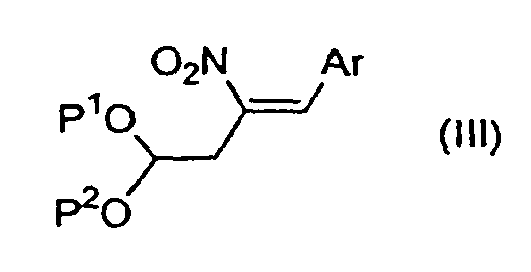

- Verfahren nach Anspruch 1 oder 23, das weiter umfasst:Umsetzen einer Verbindung von Formel (I):wobei


R1 -C1-7-Alkyl oder -C1-3-Alkylphenyl ist; und
X Cl, Br, I, p-Toluolsulfonyloxy oder Methansulfonyloxy ist. - Verbindung der Formeln (II), (III), (IV) oder (VI):
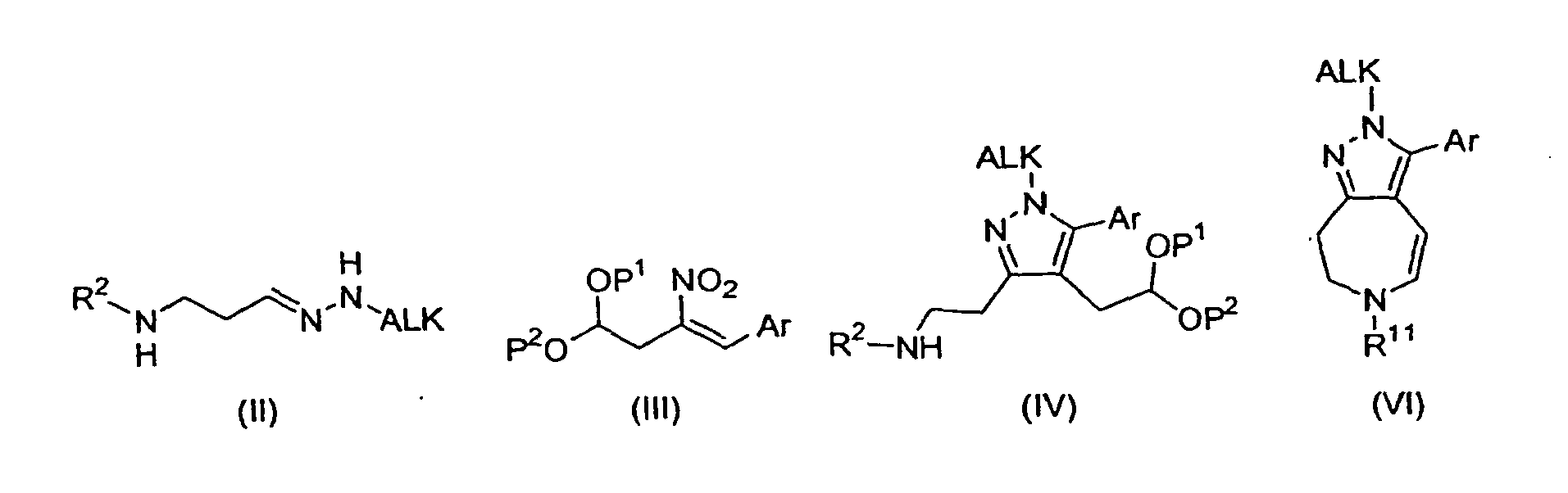
Ar:A) Phenyl, das gegebenenfalls einfach, zweifach oder dreifach mit Ra substituiert ist oder zweifach auf benachbarten Kohlenstoffen mit -OC1-4-AlkylenO- substituiert ist;
wobei jedes Ra unabhängig ausgewählt ist aus der Gruppe, bestehend aus -OH, -C1-6-Alkyl, -OC1-6-Alkyl, -CN, -NO2, -N(Rb)Rc, -C(O)N(kb)Rc, -N(Rd)C(O)Rd, -N(Rd)SO2C1-6-Alkyl, -C(O)C1-6-Alkyl, -S(O)0-2-C1-6-Alkyl, -SO2N(Rb)Rc, -SCF3, Halo, -CF3, -OCF3, -COOH, -COOC1-6-Alkyl und Tetrazolyl;
wobei Rb und Rc jeweils unabhängig -H oder -C1-6-Alkyl sind;
wobei Rd -H oder -C1-6-Alkyl ist;B) eine monocyclische aromatische Kohlenwasserstoffgruppe mit fünf Ringatomen, die ein Kohlenstoffatom aufweist, das der Bindungspunkt ist, bei der ein Kohlenstoffatom durch >O, >S, >NH oder >N(C1-4-Alkyl) ersetzt ist, bei der bis zu ein zusätzliches Kohlenstoffatom gegebenenfalls durch -N= ersetzt ist und die gegebenenfalls einfach oder zweifach mit Ra substituiert ist; oderC) eine monocyclische aromatische Kohlenwasserstoffgruppe mit sechs Ringatomen, die ein Kohlenstoffatom aufweist, das der Bindungspunkt ist, bei der ein oder zwei Kohlenstoffatome durch -N= ersetzt sind und die gegebenenfalls einfach oder zweifach mit Ra substituiert ist;
ist;
ALK:i) C1-7-Alkyl, gegebenenfalls substituiert mit Re;
wobei Re ausgewählt ist aus der Gruppe, bestehend aus -OH, -OC1-6-Alkyl, -CN, -N(Rf)Rg, -C(O)N(Rf)Rg, -N(Rh)C(O)Rh, -N(Rh)SO2C1-6-Alkyl, -C(O)C1-6-Alkyl, -S(O)0-2-C1-6-Alkyl, -SO2N(Rf)Rg, Fluor, -CF3, -COOH und -COOC1-6-Alkyl;
wobei Rf und Rg jeweils unabhängig -H oder -C1-6-Alkyl sind; und
wobei Rh -H oder -C1-6-Alkyl ist;ii) ein Cycloalkyl-Ring, der gegebenenfalls einfach, zweifach oder dreifach mit Re oder C1-6-Alkyl substituiert ist;iii) Phenyl, gegebenenfalls einfach, zweifach oder dreifach mit Re substituiert ist; oderiv) -C1-2-Alkyl-CYC;ist;
wobei CYC ausgewählt ist aus der Gruppe, bestehend aus:a) einer Phenyl- oder Naphthylgruppe, die gegebenenfalls einfach, zweifach oder dreifach mit Rh substituiert ist oder zweifach auf benachbarten Kohlenstoffen mit -OC1-4-AlkylenO- substituiert ist;
wobei Rh jeweils unabhängig ausgewählt ist aus der Gruppe, bestehend aus -OH, -C1-6-Alkyl, -OC1-6-Alkyl, -CN, -N(Ri)Rj, -C(O)N(Ri)Rj, -N(Ri)C(O)Rj, -N(Ri)SO2C1-6-Alkyl, -C(O)C1-6-Alkyl, -S(O)0-2-C1-6-Alkyl, -SO2N(Ri)Rj, -SCF3, Halo, -CF3, -OCF3, -COOH und -COOC1-6-Alkyl;
wobei Ri und Rj jeweils unabhängig -H oder -C1-6-Alkyl sind; undb) einer monocyclischen aromatischen Kohlenwasserstoffgruppe mit fünf Ringatomen, die ein Kohlenstoffatom aufweist, das der Bindungspunkt ist, bei der ein Kohlenstoffatom durch >O, >S, >NH oder >N(C1-4-Alkyl) ersetzt ist, bei der bis zu ein zusätzliches Kohlenstoffatom gegebenenfalls durch -N= ersetzt ist, die gegebenenfalls einfach oder zweifach mit Rh substituiert ist;c) einer monocyclischen aromatischen Kohlenwasserstoffgruppe mit sechs Ringatomen, die ein Kohlenstoffatom aufweist, das der Bindungspunkt ist, bei der ein oder zwei Kohlenstoffatome durch -N= ersetzt sind, die gegebenenfalls einfach oder zweifach mit Rh substituiert ist; undd) einem Cycloalkylring mit 0, 1 oder 2 ungesättigten Bindungen, der gegebenenfalls einfach oder zweifach mit Rh substituiert;
R2 -CO2R10 oder eine Benzylgruppe ist, unsubstituiert oder substituiert mit einem oder zwei -OCH3-Substituenten;
wobei R10 Methyl, Ethyl, 2-Trimethylsilylethyl, 2-Phenylethyl, 1-(1-Adamantyl)-1-methylethyl, t-Butyl, 1-Adamantyl, Vinyl, Allyl, Benzyl, p-Methoxybenzyl, p-Nitrobenzyl, p-Chlorbenzyl, 2,4-Dichlorbenzyl oder Diphenylmethyl ist; und
P1 und P2 jeweils unabhängig -C1-4-Alkyl sind oder alternativ P1 und P2 zusammengenommen -(CH2)2-3- bilden; und
R11 H oder Benzyloxycarbonyl ist. - Verbindung von Formel (IV) nach Anspruch 33, ausgewählt aus der Gruppe, bestehend aus {2-[4-[1,3]Dioxolan-2-ylmethyl-5-(4-fluorphenyl)-1-isopropyl-1H-pyrazol-3-yl]-ethyl}-carbamidsäurebenzylester und {2-[1-Cyclopentyl-4-[1,3]dioxolan-2-ylmethyl-5-(4-fluorphenyl)-1H-pyrazol-3-yl]-ethyl}-carbamidsäure-benzylester.
- Verbindung von Formel (II) nach Anspruch 33, ausgewählt aus der Gruppe, bestehend aus: [3-(ALK-hydrazono)-propyl]-carbamidsäurebenzylester.
- Verbindung nach Anspruch 35, ausgewählt aus der Gruppe, bestehend aus [3-(Isopropylhydrazono)-propyl]-carbamidsäurebenzylester und [3-(Cyclopentylhydrazono)-propyl]-carbamidsäurebenzylester.
- Verbindung von Formel (III) nach Anspruch 33, die 2-[3-(4-Fluorphenyl)-2-nitroallyl]-[1,3]dioxolan ist.
- Verbindung von Formel (VI) nach Anspruch 33, die 3-(4-Fluorphenyl)-2-isopropyl-7,8-dihydro-2H-1,2,6-triazaazulen-6-carbonsäurebenzylester ist.
Priority Applications (3)
| Application Number | Priority Date | Filing Date | Title |
|---|---|---|---|
| SI200730228T SI2016064T1 (sl) | 2006-05-05 | 2007-05-04 | Postopki za pripravo spojin, ki vsebujejo pirazol |
| PL07761874T PL2016064T3 (pl) | 2006-05-05 | 2007-05-04 | Sposoby wytwarzania związków zawierających pirazol |
| CY20101100451T CY1110087T1 (el) | 2006-05-05 | 2010-05-21 | Μεθοδοι παρασκευης ενωσεων που περιεχουν πυρραζολιο |
Applications Claiming Priority (2)
| Application Number | Priority Date | Filing Date | Title |
|---|---|---|---|
| US74649706P | 2006-05-05 | 2006-05-05 | |
| PCT/US2007/068210 WO2007131153A2 (en) | 2006-05-05 | 2007-05-04 | Methods for the preparation of pyrazole-containing compounds |
Publications (2)
| Publication Number | Publication Date |
|---|---|
| EP2016064A2 EP2016064A2 (de) | 2009-01-21 |
| EP2016064B1 true EP2016064B1 (de) | 2010-03-03 |
Family
ID=38566748
Family Applications (1)
| Application Number | Title | Priority Date | Filing Date |
|---|---|---|---|
| EP07761874A Not-in-force EP2016064B1 (de) | 2006-05-05 | 2007-05-04 | Herstellungsverfahren für pyrazolhaltige verbindungen |
Country Status (12)
| Country | Link |
|---|---|
| US (1) | US7915404B2 (de) |
| EP (1) | EP2016064B1 (de) |
| CN (1) | CN101479252B (de) |
| AT (1) | ATE459614T1 (de) |
| CY (1) | CY1110087T1 (de) |
| DE (1) | DE602007005117D1 (de) |
| DK (1) | DK2016064T3 (de) |
| ES (1) | ES2340217T3 (de) |
| PL (1) | PL2016064T3 (de) |
| PT (1) | PT2016064E (de) |
| SI (1) | SI2016064T1 (de) |
| WO (1) | WO2007131153A2 (de) |
Families Citing this family (4)
| Publication number | Priority date | Publication date | Assignee | Title |
|---|---|---|---|---|
| SI1668014T1 (sl) * | 2003-09-17 | 2009-06-30 | Janssen Pharmaceutica Nv | Kondenzirane heterociklične spojine kot modulatorji serotoninskih receptorjev |
| US7598255B2 (en) * | 2005-08-04 | 2009-10-06 | Janssen Pharmaceutica Nv | Pyrimidine compounds as serotonin receptor modulators |
| WO2009058810A1 (en) * | 2007-11-02 | 2009-05-07 | Janssen Pharmaceutica N.V. | Process for the preparation of substituted 2,4,5,6,7,8-hexahydro-1,2,6-triaza-azulene derivatives |
| EP2370437B1 (de) * | 2008-11-25 | 2013-09-04 | Nerviano Medical Sciences S.r.l. | Bicyclische pyrazol- und isoxazolderivate als antitumormittel und antineurodegenerative mittel |
Family Cites Families (3)
| Publication number | Priority date | Publication date | Assignee | Title |
|---|---|---|---|---|
| EP0272866A1 (de) * | 1986-12-23 | 1988-06-29 | Merck & Co. Inc. | 1,4-Benzodiazepine mit 5-gliedrigen heterocyclischen Ringen |
| SI1668014T1 (sl) | 2003-09-17 | 2009-06-30 | Janssen Pharmaceutica Nv | Kondenzirane heterociklične spojine kot modulatorji serotoninskih receptorjev |
| US7598255B2 (en) | 2005-08-04 | 2009-10-06 | Janssen Pharmaceutica Nv | Pyrimidine compounds as serotonin receptor modulators |
-
2007
- 2007-05-04 DE DE602007005117T patent/DE602007005117D1/de active Active
- 2007-05-04 SI SI200730228T patent/SI2016064T1/sl unknown
- 2007-05-04 WO PCT/US2007/068210 patent/WO2007131153A2/en not_active Ceased
- 2007-05-04 PT PT07761874T patent/PT2016064E/pt unknown
- 2007-05-04 AT AT07761874T patent/ATE459614T1/de active
- 2007-05-04 US US11/744,340 patent/US7915404B2/en not_active Expired - Fee Related
- 2007-05-04 DK DK07761874.2T patent/DK2016064T3/da active
- 2007-05-04 EP EP07761874A patent/EP2016064B1/de not_active Not-in-force
- 2007-05-04 ES ES07761874T patent/ES2340217T3/es active Active
- 2007-05-04 CN CN200780024352.9A patent/CN101479252B/zh not_active Expired - Fee Related
- 2007-05-04 PL PL07761874T patent/PL2016064T3/pl unknown
-
2010
- 2010-05-21 CY CY20101100451T patent/CY1110087T1/el unknown
Also Published As
| Publication number | Publication date |
|---|---|
| DE602007005117D1 (de) | 2010-04-15 |
| ATE459614T1 (de) | 2010-03-15 |
| WO2007131153A3 (en) | 2008-01-10 |
| PL2016064T3 (pl) | 2010-08-31 |
| PT2016064E (pt) | 2010-04-16 |
| CY1110087T1 (el) | 2015-01-14 |
| WO2007131153A2 (en) | 2007-11-15 |
| US7915404B2 (en) | 2011-03-29 |
| SI2016064T1 (sl) | 2010-07-30 |
| ES2340217T3 (es) | 2010-05-31 |
| DK2016064T3 (da) | 2010-06-07 |
| EP2016064A2 (de) | 2009-01-21 |
| CN101479252A (zh) | 2009-07-08 |
| CN101479252B (zh) | 2014-01-29 |
| US20070260057A1 (en) | 2007-11-08 |
Similar Documents
| Publication | Publication Date | Title |
|---|---|---|
| JP5069907B2 (ja) | 縮合複素環式化合物 | |
| CA2701150C (fr) | Derives de quinazolinedione, leur preparation et leurs applications therapeutiques | |
| JP2008503460A (ja) | β−セクレターゼのインヒビターとしてのジフェニルイミダゾピリミジンおよびイミダゾールアミン | |
| JP2001114765A (ja) | 骨関節症治療におけるアグリカナーゼの選択的阻害 | |
| EP2016064B1 (de) | Herstellungsverfahren für pyrazolhaltige verbindungen | |
| US6566357B1 (en) | Spirocyclic-6,7-dihydro-5H-pyrazolo[1,2-a]pyrazol-1-ones which control inflammatory cytokines | |
| AU2002334641A1 (en) | Spirocyclic-6,7-dihydro-5h-pyrazolo[1,2-a]pyrazol-1-ones which control inflammatory cytokines | |
| US7456208B2 (en) | CCK-1 receptor modulators | |
| US6730668B2 (en) | 6,7-dihydro-5H-pyrazolo[1,2-a]pyrazol-1-ones which control inflammatory cytokines | |
| EP1905774B1 (de) | Kondensierte heterocyclische Verbindungen als Modulatoren des Serotoninrezeptors | |
| FI109536B (fi) | Menetelmä uusien farmaseuttisesti aktiivisten 4-(3-bentsofuranyyli)- ja 4-(3-bentsotienyyli)piperidinyylijohdannaisten valmistamiseksi | |
| CA2782783A1 (en) | Fused heterocyclic compounds | |
| CA1060027A (en) | 1-(.alpha.-PHENYL-O-TOLYL) IMIDAZOLES AND 2-(IMIDAZOL-1-YL) BENZOPHENONES | |
| JPH10101653A (ja) | ピリミジン誘導体 | |
| US20040038971A1 (en) | 6,7-dihydro-5H-pyrazolo[1,2-a]pyrazol-1-ones which control inflammatory cytokines | |
| HK1123281A (en) | Fused heterocyclic compounds as serotonin receptor modulators | |
| AU2011253635A1 (en) | Fused heterocyclic compounds | |
| HK1118550B (en) | Fused heterocyclic compounds as serotonin receptor modulators |
Legal Events
| Date | Code | Title | Description |
|---|---|---|---|
| PUAI | Public reference made under article 153(3) epc to a published international application that has entered the european phase |
Free format text: ORIGINAL CODE: 0009012 |
|
| 17P | Request for examination filed |
Effective date: 20081126 |
|
| AK | Designated contracting states |
Kind code of ref document: A2 Designated state(s): AT BE BG CH CY CZ DE DK EE ES FI FR GB GR HU IE IS IT LI LT LU LV MC MT NL PL PT RO SE SI SK TR |
|
| AX | Request for extension of the european patent |
Extension state: AL BA HR MK RS |
|
| DAX | Request for extension of the european patent (deleted) | ||
| GRAP | Despatch of communication of intention to grant a patent |
Free format text: ORIGINAL CODE: EPIDOSNIGR1 |
|
| GRAS | Grant fee paid |
Free format text: ORIGINAL CODE: EPIDOSNIGR3 |
|
| GRAA | (expected) grant |
Free format text: ORIGINAL CODE: 0009210 |
|
| AK | Designated contracting states |
Kind code of ref document: B1 Designated state(s): AT BE BG CH CY CZ DE DK EE ES FI FR GB GR HU IE IS IT LI LT LU LV MC MT NL PL PT RO SE SI SK TR |
|
| REG | Reference to a national code |
Ref country code: GB Ref legal event code: FG4D |
|
| REG | Reference to a national code |
Ref country code: CH Ref legal event code: EP |
|
| REG | Reference to a national code |
Ref country code: IE Ref legal event code: FG4D |
|
| REF | Corresponds to: |
Ref document number: 602007005117 Country of ref document: DE Date of ref document: 20100415 Kind code of ref document: P |
|
| REG | Reference to a national code |
Ref country code: PT Ref legal event code: SC4A Free format text: AVAILABILITY OF NATIONAL TRANSLATION Effective date: 20100409 |
|
| REG | Reference to a national code |
Ref country code: NL Ref legal event code: T3 |
|
| REG | Reference to a national code |
Ref country code: CH Ref legal event code: NV Representative=s name: E. BLUM & CO. AG PATENT- UND MARKENANWAELTE VSP |
|
| REG | Reference to a national code |
Ref country code: SE Ref legal event code: TRGR |
|
| REG | Reference to a national code |
Ref country code: GR Ref legal event code: EP Ref document number: 20100400937 Country of ref document: GR |
|
| REG | Reference to a national code |
Ref country code: RO Ref legal event code: EPE |
|
| REG | Reference to a national code |
Ref country code: ES Ref legal event code: FG2A Ref document number: 2340217 Country of ref document: ES Kind code of ref document: T3 |
|
| REG | Reference to a national code |
Ref country code: DK Ref legal event code: T3 |
|
| REG | Reference to a national code |
Ref country code: PL Ref legal event code: T3 |
|
| REG | Reference to a national code |
Ref country code: SK Ref legal event code: T3 Ref document number: E 7344 Country of ref document: SK |
|
| REG | Reference to a national code |
Ref country code: HU Ref legal event code: AG4A Ref document number: E008075 Country of ref document: HU |
|
| PLBE | No opposition filed within time limit |
Free format text: ORIGINAL CODE: 0009261 |
|
| STAA | Information on the status of an ep patent application or granted ep patent |
Free format text: STATUS: NO OPPOSITION FILED WITHIN TIME LIMIT |
|
| 26N | No opposition filed |
Effective date: 20101206 |
|
| PG25 | Lapsed in a contracting state [announced via postgrant information from national office to epo] |
Ref country code: IT Free format text: LAPSE BECAUSE OF NON-PAYMENT OF DUE FEES Effective date: 20100504 |
|
| REG | Reference to a national code |
Ref country code: FR Ref legal event code: PLFP Year of fee payment: 10 |
|
| REG | Reference to a national code |
Ref country code: FR Ref legal event code: PLFP Year of fee payment: 11 |
|
| REG | Reference to a national code |
Ref country code: FR Ref legal event code: PLFP Year of fee payment: 12 |
|
| PGFP | Annual fee paid to national office [announced via postgrant information from national office to epo] |
Ref country code: LU Payment date: 20210426 Year of fee payment: 15 |
|
| PGFP | Annual fee paid to national office [announced via postgrant information from national office to epo] |
Ref country code: CZ Payment date: 20210414 Year of fee payment: 15 Ref country code: CY Payment date: 20210423 Year of fee payment: 15 Ref country code: DE Payment date: 20210408 Year of fee payment: 15 Ref country code: GR Payment date: 20210413 Year of fee payment: 15 Ref country code: MC Payment date: 20210430 Year of fee payment: 15 Ref country code: LT Payment date: 20210421 Year of fee payment: 15 Ref country code: IT Payment date: 20210412 Year of fee payment: 15 Ref country code: PT Payment date: 20210504 Year of fee payment: 15 Ref country code: SK Payment date: 20210413 Year of fee payment: 15 Ref country code: RO Payment date: 20210427 Year of fee payment: 15 Ref country code: FI Payment date: 20210511 Year of fee payment: 15 Ref country code: EE Payment date: 20210423 Year of fee payment: 15 Ref country code: FR Payment date: 20210412 Year of fee payment: 15 |
|
| PGFP | Annual fee paid to national office [announced via postgrant information from national office to epo] |
Ref country code: GB Payment date: 20210408 Year of fee payment: 15 Ref country code: DK Payment date: 20210511 Year of fee payment: 15 Ref country code: CH Payment date: 20210519 Year of fee payment: 15 Ref country code: BG Payment date: 20210416 Year of fee payment: 15 Ref country code: ES Payment date: 20210609 Year of fee payment: 15 Ref country code: TR Payment date: 20210429 Year of fee payment: 15 Ref country code: SI Payment date: 20210414 Year of fee payment: 15 Ref country code: IE Payment date: 20210511 Year of fee payment: 15 Ref country code: SE Payment date: 20210511 Year of fee payment: 15 Ref country code: LV Payment date: 20210428 Year of fee payment: 15 Ref country code: HU Payment date: 20210413 Year of fee payment: 15 Ref country code: PL Payment date: 20210414 Year of fee payment: 15 Ref country code: BE Payment date: 20210415 Year of fee payment: 15 Ref country code: AT Payment date: 20210426 Year of fee payment: 15 |
|
| PGFP | Annual fee paid to national office [announced via postgrant information from national office to epo] |
Ref country code: IS Payment date: 20210408 Year of fee payment: 15 |
|
| PGFP | Annual fee paid to national office [announced via postgrant information from national office to epo] |
Ref country code: NL Payment date: 20210415 Year of fee payment: 15 |
|
| PGFP | Annual fee paid to national office [announced via postgrant information from national office to epo] |
Ref country code: MT Payment date: 20210518 Year of fee payment: 15 |
|
| REG | Reference to a national code |
Ref country code: LT Ref legal event code: MM4D Effective date: 20220504 |
|
| REG | Reference to a national code |
Ref country code: DE Ref legal event code: R119 Ref document number: 602007005117 Country of ref document: DE |
|
| REG | Reference to a national code |
Ref country code: EE Ref legal event code: MM4A Ref document number: E004195 Country of ref document: EE Effective date: 20220531 |
|
| REG | Reference to a national code |
Ref country code: DK Ref legal event code: EBP Effective date: 20220531 |
|
| REG | Reference to a national code |
Ref country code: SK Ref legal event code: MM4A Ref document number: E 7344 Country of ref document: SK Effective date: 20220504 |
|
| REG | Reference to a national code |
Ref country code: CH Ref legal event code: PL |
|
| REG | Reference to a national code |
Ref country code: SE Ref legal event code: EUG |
|
| REG | Reference to a national code |
Ref country code: NL Ref legal event code: MM Effective date: 20220601 |
|
| REG | Reference to a national code |
Ref country code: AT Ref legal event code: MM01 Ref document number: 459614 Country of ref document: AT Kind code of ref document: T Effective date: 20220504 |
|
| REG | Reference to a national code |
Ref country code: BE Ref legal event code: MM Effective date: 20220531 |
|
| GBPC | Gb: european patent ceased through non-payment of renewal fee |
Effective date: 20220504 |
|
| PG25 | Lapsed in a contracting state [announced via postgrant information from national office to epo] |
Ref country code: SK Free format text: LAPSE BECAUSE OF NON-PAYMENT OF DUE FEES Effective date: 20220504 Ref country code: SE Free format text: LAPSE BECAUSE OF NON-PAYMENT OF DUE FEES Effective date: 20220505 Ref country code: RO Free format text: LAPSE BECAUSE OF NON-PAYMENT OF DUE FEES Effective date: 20220504 Ref country code: PT Free format text: LAPSE BECAUSE OF NON-PAYMENT OF DUE FEES Effective date: 20221104 Ref country code: MC Free format text: LAPSE BECAUSE OF NON-PAYMENT OF DUE FEES Effective date: 20220531 Ref country code: LV Free format text: LAPSE BECAUSE OF NON-PAYMENT OF DUE FEES Effective date: 20220504 Ref country code: LU Free format text: LAPSE BECAUSE OF NON-PAYMENT OF DUE FEES Effective date: 20220504 Ref country code: LT Free format text: LAPSE BECAUSE OF NON-PAYMENT OF DUE FEES Effective date: 20220504 Ref country code: LI Free format text: LAPSE BECAUSE OF NON-PAYMENT OF DUE FEES Effective date: 20220531 Ref country code: HU Free format text: LAPSE BECAUSE OF NON-PAYMENT OF DUE FEES Effective date: 20220505 Ref country code: FI Free format text: LAPSE BECAUSE OF NON-PAYMENT OF DUE FEES Effective date: 20220504 Ref country code: EE Free format text: LAPSE BECAUSE OF NON-PAYMENT OF DUE FEES Effective date: 20220531 Ref country code: CZ Free format text: LAPSE BECAUSE OF NON-PAYMENT OF DUE FEES Effective date: 20220504 Ref country code: CY Free format text: LAPSE BECAUSE OF NON-PAYMENT OF DUE FEES Effective date: 20220504 Ref country code: CH Free format text: LAPSE BECAUSE OF NON-PAYMENT OF DUE FEES Effective date: 20220531 Ref country code: AT Free format text: LAPSE BECAUSE OF NON-PAYMENT OF DUE FEES Effective date: 20220504 |
|
| PG25 | Lapsed in a contracting state [announced via postgrant information from national office to epo] |
Ref country code: SI Free format text: LAPSE BECAUSE OF NON-PAYMENT OF DUE FEES Effective date: 20220505 Ref country code: GR Free format text: LAPSE BECAUSE OF NON-PAYMENT OF DUE FEES Effective date: 20221208 |
|
| PG25 | Lapsed in a contracting state [announced via postgrant information from national office to epo] |
Ref country code: IE Free format text: LAPSE BECAUSE OF NON-PAYMENT OF DUE FEES Effective date: 20220504 Ref country code: FR Free format text: LAPSE BECAUSE OF NON-PAYMENT OF DUE FEES Effective date: 20220531 Ref country code: DK Free format text: LAPSE BECAUSE OF NON-PAYMENT OF DUE FEES Effective date: 20220531 |
|
| PG25 | Lapsed in a contracting state [announced via postgrant information from national office to epo] |
Ref country code: GB Free format text: LAPSE BECAUSE OF NON-PAYMENT OF DUE FEES Effective date: 20220504 Ref country code: DE Free format text: LAPSE BECAUSE OF NON-PAYMENT OF DUE FEES Effective date: 20221201 Ref country code: BE Free format text: LAPSE BECAUSE OF NON-PAYMENT OF DUE FEES Effective date: 20220531 |
|
| REG | Reference to a national code |
Ref country code: ES Ref legal event code: FD2A Effective date: 20230626 |
|
| PG25 | Lapsed in a contracting state [announced via postgrant information from national office to epo] |
Ref country code: NL Free format text: LAPSE BECAUSE OF NON-PAYMENT OF DUE FEES Effective date: 20220601 |
|
| PG25 | Lapsed in a contracting state [announced via postgrant information from national office to epo] |
Ref country code: ES Free format text: LAPSE BECAUSE OF NON-PAYMENT OF DUE FEES Effective date: 20220505 |
|
| PG25 | Lapsed in a contracting state [announced via postgrant information from national office to epo] |
Ref country code: PL Free format text: LAPSE BECAUSE OF NON-PAYMENT OF DUE FEES Effective date: 20220504 |
|
| PG25 | Lapsed in a contracting state [announced via postgrant information from national office to epo] |
Ref country code: BG Free format text: LAPSE BECAUSE OF NON-PAYMENT OF DUE FEES Effective date: 20220504 |
|
| PG25 | Lapsed in a contracting state [announced via postgrant information from national office to epo] |
Ref country code: MT Free format text: LAPSE BECAUSE OF NON-PAYMENT OF DUE FEES Effective date: 20220405 |
|
| PG25 | Lapsed in a contracting state [announced via postgrant information from national office to epo] |
Ref country code: TR Free format text: LAPSE BECAUSE OF NON-PAYMENT OF DUE FEES Effective date: 20220504 |
|
| PG25 | Lapsed in a contracting state [announced via postgrant information from national office to epo] |
Ref country code: IT Free format text: LAPSE BECAUSE OF NON-PAYMENT OF DUE FEES Effective date: 20220504 |
|
| PG25 | Lapsed in a contracting state [announced via postgrant information from national office to epo] |
Ref country code: IS Free format text: LAPSE BECAUSE OF NON-PAYMENT OF DUE FEES Effective date: 20221205 |