EP2013995B1 - Verfahren zur synchronisation von baugruppen einer basisstation - Google Patents
Verfahren zur synchronisation von baugruppen einer basisstation Download PDFInfo
- Publication number
- EP2013995B1 EP2013995B1 EP07727599A EP07727599A EP2013995B1 EP 2013995 B1 EP2013995 B1 EP 2013995B1 EP 07727599 A EP07727599 A EP 07727599A EP 07727599 A EP07727599 A EP 07727599A EP 2013995 B1 EP2013995 B1 EP 2013995B1
- Authority
- EP
- European Patent Office
- Prior art keywords
- frame
- clock signal
- assembly
- time
- gps
- Prior art date
- Legal status (The legal status is an assumption and is not a legal conclusion. Google has not performed a legal analysis and makes no representation as to the accuracy of the status listed.)
- Not-in-force
Links
Images
Classifications
-
- H—ELECTRICITY
- H04—ELECTRIC COMMUNICATION TECHNIQUE
- H04J—MULTIPLEX COMMUNICATION
- H04J3/00—Time-division multiplex systems
- H04J3/02—Details
- H04J3/06—Synchronising arrangements
- H04J3/0635—Clock or time synchronisation in a network
- H04J3/0685—Clock or time synchronisation in a node; Intranode synchronisation
- H04J3/0691—Synchronisation in a TDM node
-
- H—ELECTRICITY
- H04—ELECTRIC COMMUNICATION TECHNIQUE
- H04B—TRANSMISSION
- H04B7/00—Radio transmission systems, i.e. using radiation field
- H04B7/24—Radio transmission systems, i.e. using radiation field for communication between two or more posts
- H04B7/26—Radio transmission systems, i.e. using radiation field for communication between two or more posts at least one of which is mobile
- H04B7/2662—Arrangements for Wireless System Synchronisation
- H04B7/2671—Arrangements for Wireless Time-Division Multiple Access [TDMA] System Synchronisation
- H04B7/2678—Time synchronisation
- H04B7/2687—Inter base stations synchronisation
- H04B7/2693—Centralised synchronisation, i.e. using external universal time reference, e.g. by using a global positioning system [GPS] or by distributing time reference over the wireline network
Definitions
- the invention relates to a method for synchronizing modules of a base station to a reference clock signal.
- GPS Global Positioning System
- the GPS antenna is usually arranged near a transmitting-receiving antenna of the base station.
- the received GPS signal then usually has to be routed to the master oscillator over a longer distance using a dedicated transmission link or line. This is generally done with considerable signal attenuation due to the power length. In addition, high costs are caused by the line length and by an additional line assembly effort.
- a first module called a "radio head” is arranged close to the antenna, while further modules are arranged remote from the antenna. Accordingly, it is necessary to synchronize both the remote first module and the remaining modules with the reference signal with high accuracy in time.
- EP 1 519 505 (Alcatel) discloses the transmission of a phase difference from a first to a second assembly.
- a local clock signal and a frame are formed by a first module.
- the clock signal and the frame are transmitted to a second module using a predictable-term synchronous transmission.
- the second module receives a reference clock signal and determines a phase difference and a time difference between the transmitted clock signal on the one hand and the reference clock signal on the other hand.
- the phase difference and the time difference are transmitted from the second module to the first module via a connection with no predictable delay.
- the first module uses the phase difference and the time difference to determine a manipulated variable, wherein the manipulated variable controls the formation of the local clock signal such that the first and the second module are time-synchronized.
- the time synchronization takes place using a CPRI interface or a CPRI network, which is present in any case between the modules for the transmission of data and control signals.
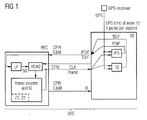
- FIG. 1 shows a first embodiment of the method according to the invention.
- a first module REC and a second module RE of a base station BTS are preferably connected to one another via a network CPRI.
- the CPRI network enables synchronous transmission of signals with a predictable delay between the modules RE and REC.
- the first subassembly REC comprises an oscillator VCXO and a frame generator RG, wherein a local clock signal CLK is formed by means of the oscillator VCXO and a frame frame by means of the frame generator RG.
- the local clock signal CLK and the frame frame are transmitted to a second module RE using the predictive-time synchronous transmission.
- a layerl protocol of the CPRI network is preferably used.
- the second module RE receives a reference clock signal GPS via a GPS receiver.
- the second module RE includes a phase indicator PD and a time indicator TD, with which a phase difference PDIF and a time difference TDIF between the transmitted Clock signal CLK on the one hand and the reference clock signal GPS on the other hand is determined.
- phase difference PDIF and the time difference TDIF are transmitted from the second module RE to the first module REC via a connection with no predictable delay.
- This transmission is preferably performed as packet data transmission using an internet protocol.
- connection is designed without predictable runtime as a control & management channel (C & M) of the CPRI network.
- C & M control & management channel
- the phase difference PDIF and the time difference TDIF are used to determine a manipulated variable SG, with which the formation of the local clock signal CLK is controlled. This control is performed such that a time synchronization of the first module REC and the second module RE is performed.
- a temporal frequency is determined, with which the measurement results of phase difference PDIF and time difference TDIF are received by the first module REC. This frequency is additionally taken into account when determining the manipulated variable.
- the times of the measurements of the phase difference PDIF and the time difference TDIF are identified with a frame number and communicated to the first module REC in order to be able to take these times into account when determining the manipulated variable of the oscillator VCXO.
- the GPS receiver transmits a time signal GPS in the form of one pulse per second to the second module RE.
- the oscillator VCXO is preceded by a loop filter LF for forming the manipulated variable SG, to which the time difference TDIF and the phase difference PDIF are applied.
- the oscillator VCXO may be formed, for example, as furnace quartz.
- the master oscillator VCXO is connected on the output side to a counting unit "frame counter and t0", which first counts oscillation periods of the master oscillator VCXO within a frame "frame”.
- a UMTS frame "frame” of length 10 ms is used.
- the counter “frame counter and t0” counts in a first part of a value “0” to “383999” and then starts counting again from the value "0".
- the counting unit "frame counter and t0" has a first counter Z1.
- the second counter Z2 would count from value "0" to a value "4095", thereby indexing a "Node B frame number, BFN" defined in 3GPP TS 25.402 and used in the CPRI standard ,
- a time variable t0 is managed.
- the time variable t0 is always increased by a value of "40.96 sec" when the second counter Z2 jumps from the value "4095” to the value "0".
- the first counter Z1 which counts the values from “0” to "383999”, the second counter Z2 which counts the values from “0" to "4095” and the time variable t0 constitute a time system.
- the time variable t0 is transmitted to the time indicator TD, this transmission preferably taking place via the CPRI_channel "C & M".
- the counter indicators of the first counter Z1 and the second counter Z2 are transmitted to the time indicator TD via the CPRI frame information BFN according to the standard CPRI, version V2.0.
- the time variable t0 is transmitted to the time indicator TD, this transmission preferably taking place via the CPRI_channel "C & M".
- the counter "frame counter and t0" is selectively reset due to information of the time indicator TD.
- This reset can be done using the time difference "TDIF".
- the count of the first counter is set to the value "0"
- a count of the first counter Z1 and the second counter Z2 can also be defined unambiguously for each GPS time t1, the count of the second counter being defined via the "Node B frame number, BFN".
- the targeted reset takes place in such a way that the counter readings of the first and the second counter are set to the value "0" at a time defined identically for all base stations.
- a time is selected “Monday, 01.01.2007, 0: 00'00” Uhr. "The reset can be done not only on” Monday, 01.01.2007, 0: 00'00 “clock”, but can be any integer Multiples of 40.96sec after this "Monday 0: 00'00" clock "done.
Landscapes
- Engineering & Computer Science (AREA)
- Computer Networks & Wireless Communication (AREA)
- Signal Processing (AREA)
- Radar, Positioning & Navigation (AREA)
- Remote Sensing (AREA)
- Synchronisation In Digital Transmission Systems (AREA)
- Mobile Radio Communication Systems (AREA)
- Electric Clocks (AREA)
Description
- Die Erfindung betrifft ein Verfahren zur Synchronisation von Baugruppen einer Basisstation auf ein Referenz-Taktsignal.
- Es ist bekannt, zur Synchronisation von abgesetzten Einheiten bzw. von Baugruppen einer Basisstation einen so genannten "Master-Oszillator" zu verwenden, der eine hohe absolute Frequenzgenauigkeit aufweisen muss. Der Oszillator wird dabei über eine Phasenregelschleife auf ein Referenzsignal einer im allgemeinen externen Referenzquelle abgestimmt.
- Beispielsweise wird als Referenz für eine absolute Zeit- bzw. Phasengenauigkeit ein GPS-Signal ("Global Positioning System", GPS) verwendet, das über eine GPS-Antenne empfangen wird. Die GPS-Antenne ist dabei üblicherweise nahe einer Sende-Empfangsantenne der Basisstation angeordnet. Das empfangene GPS-Signal muss dann üblicherweise über eine längere Wegstrecke unter Verwendung einer eigens dafür vorgesehenen Übertragungsverbindung bzw. Leitung zum Master-Oszillator geleitet werden. Dies erfolgt aufgrund der Leistungslänge im allgemeinen unter einer beträchtlichen Signaldämpfung. Zusätzlich werden hohe Kosten durch die Leitungslänge und durch einen zusätzlichen Leitungs-Montageaufwand verursacht.
- Insbesondere bei räumlich getrennten Baugruppen einer Basisstation, die als "Tower-Mounted-Radio"-Anordnung ausgebildet ist, sind diese Nachteile bedeutend. Dabei ist eine als "Radio-Head" bezeichnete erste Baugruppe antennennah angeordnet, während weitere Baugruppen antennenfern angeordnet sind. Entsprechend ist es notwendig, sowohl die abgesetzte erste Baugruppe als auch die restlichen Baugruppen mit dem Referenzsignal hochgenau zeitlich zu synchronisieren.
- Das DoKument CPRI specification V2-0, veröffentlicht um 1 Oktober 2004 offenbart den Oberbegriff von Anspruch 1.
-
EP 1 519 505 (Alcatel) offenbart die Übertragung einer Phasendifferenz von einer ersten zu einer zweiten Baugruppe. - Es ist daher Aufgabe der vorliegenden Erfindung, ein Verfahren für eine hochgenaue Zeitsynchronisation von verteilten Baugruppen einer Basisstation anzugeben, das mit möglichst geringem Aufwand kostengünstig realisierbar ist.
- Diese Aufgabe wird durch die Merkmale des Patentanspruchs 1 gelöst. Vorteilhafte Weiterbildungen sind in den Unteransprüchen angeben.
- Beim erfindungsgemäßen Verfahren werden seitens einer ersten Baugruppe ein lokales Taktsignal und ein Rahmen gebildet. Das Taktsignal und der Rahmen werden unter Verwendung einer synchronen Übertragung mit vorhersagbarer Laufzeit an eine zweite Baugruppe übertragen. Seitens der zweiten Baugruppe wird ein Referenz-Taktsignal empfangen und eine Phasendifferenz und eine Zeitdifferenz zwischen dem übertragenen Taktsignal einerseits und dem Referenz-Taktsignal andererseits bestimmt.
- Die Phasendifferenz und die Zeitdifferenz werden von der zweiten Baugruppe zur ersten Baugruppe über eine Verbindung ohne vorhersagbare Laufzeit übertragen. Seitens der ersten Baugruppe werden die Phasendifferenz und die Zeitdifferenz zur Ermittlung einer Stellgröße verwendet, wobei die Stellgröße die Bildung des lokalen Taktsignals derart steuert, dass die erste und die zweite Baugruppe zeitsynchronisiert sind.
- Mit Hilfe des erfindungsgemäßen Verfahrens kann eine für die ausschließliche Übertragung des hochgenauen Referenzsignals vorgesehene Übertragungsleitung eingespart werden.
- In einer vorteilhaften Weiterbildung erfolgt die Zeitsynchronisation unter Verwendung einer CPRI-Schnittstelle bzw. eines CPRI-Netzwerks, das ohnehin zwischen den Baugruppen zur Übertragung von Daten- und Steuersignalen vorhanden ist.
- Mit einer CPRI-Schnittstelle ist es möglich, Entfernungen bis zu 10 km zu überbrücken.
- Nachfolgend wird die Erfindung anhand einer Zeichnung näher erläutert. Dabei zeigt:
- FIG 1
- ein erstes Ausführungsbeispiel des erfindungsgemäßen Verfahrens, und
- FIG 2
- ein zweites Ausführungsbeispiel des erfindungsgemäßen Verfahrens.
-
FIG 1 zeigt ein erstes Ausführungsbeispiel des erfindungsgemäßen Verfahrens. - Eine erste Baugruppe REC und eine zweite Baugruppe RE einer Basisstation BTS sind bevorzugt über ein Netzwerk CPRI miteinander verbunden. Das CPRI-Netzwerk ermöglicht eine synchrone Übertragung von Signalen mit einer vorhersagbaren Laufzeit zwischen den Baugruppen RE und REC.
- Die erste Baugruppe REC beinhaltet einen Oszillator VCXO und einen Rahmengenerator RG, wobei mit Hilfe des Oszillators VCXO ein lokales Taktsignal CLK und mit Hilfe des Rahmengenerators RG ein Rahmen Frame gebildet wird.
- Das lokale Taktsignal CLK und der Rahmen Frame werden unter Verwendung der synchronen Übertragung mit vorhersagbarer Laufzeit an eine zweite Baugruppe RE übertragen.
- Zur Übertragung des Taktsignals CLK und des Rahmens Frame wird bevorzugt ein Layerl-Protokoll des CPRI-Netzwerks verwendet.
- Seitens der zweiten Baugruppe RE wird ein Referenz-Taktsignal GPS über einen GPS-Receiver empfangen.
- Die zweite Baugruppe RE beinhaltet einen Phasenindikator PD und einen Zeitindikator TD, mit denen eine Phasendifferenz PDIF und eine Zeitdifferenz TDIF zwischen dem übertragenen Taktsignal CLK einerseits und dem Referenz-Taktsignal GPS andererseits bestimmt wird.
- Die Phasendifferenz PDIF und die Zeitdifferenz TDIF werden von der zweiten Baugruppe RE zur ersten Baugruppe REC über eine Verbindung ohne vorhersagbare Laufzeit übertragen.
- Diese Übertragung wird bevorzugt als Paketdatenübertragung unter Verwendung eines Internet-Protokolls durchgeführt.
- Bevorzugt ist die Verbindung ohne vorhersagbare Laufzeit als Control&Management-Kanal (C&M) des CPRI-Netzwerks ausgebildet.
- Seitens der ersten Baugruppe REC wird die Phasendifferenz PDIF und die Zeitdifferenz TDIF zur Ermittlung einer Stellgröße SG verwendet, mit der die Bildung des lokalen Taktsignals CLK gesteuert wird. Diese Steuerung erfolgt derart, dass eine Zeitsynchronisierung der ersten Baugruppe REC und der zweiten Baugruppe RE durchgeführt wird.
- Bevorzugt wird eine zeitliche Häufigkeit bestimmt, mit der die Messergebnisse von Phasendifferenz PDIF und Zeitdifferenz TDIF seitens der ersten Baugruppe REC empfangen werden. Diese Häufigkeit wird bei der Ermittlung der Stellgröße zusätzlich berücksichtigt.
- In einer bevorzugten Weiterbildung werden die Zeitpunkte der Messungen der Phasendifferenz PDIF und der Zeitdifferenz TDIF mit einer Rahmennummer gekennzeichnet und an die erste Baugruppe REC übermittelt, um diese Zeitpunkte bei der Ermittlung der Stellgröße des Oszillators VCXO berücksichtigen zu können.
- Vom GPS-Empfänger wird beispielsweise ein Zeitsignal GPS in Form von einem Puls pro Sekunde an die zweite Baugruppe RE übertragen. Alternativ dazu kann eine als "GPS time of week t1" bezeichnetes Zeitsignal als Wochenzeit t1 an die zweite Baugruppe RE übertragen werden.
- Seitens der ersten Baugruppe REC ist dem Oszillator VCXO ein Schleifenfilter LF zur Bildung der Stellgröße SG vorgeschaltet, an den die Zeitdifferenz TDIF und die Phasendifferenz PDIF gelangt.
- Der Oszillator VCXO kann beispielsweise als Ofenquarz ausgebildet sein.
- Der Master-Oszillator VCXO ist ausgangsseitig mit einer Zähleinheit "frame counter and t0" verbunden, die Schwingungsperioden des Master-Oszillators VCXO zunächst innerhalb eines Rahmen "frame" zählt.
- Beispielsweise wird bei einem UMTS-Funkkommunikationssystem ein UMTS-Rahmen "frame" der zeitlichen Länge von 10ms verwendet. Bei einer Schwingungsfrequenz von 38,4 MHz zählt die Zähleinheit "frame counter and t0" in einem ersten Teil von einem Wert "0" bis "383999" und beginnt dann erneut vom Wert "0" an zu zählen. Zu diesem Zweck weist die Zähleinheit "frame counter and t0" einen ersten Zähler Z1 auf.
- In einem zweiten Teil werden durch die Zähleinheit "frame counter and t0" nun Rahmen "frame" gezählt, wobei ein zweiter Zähler Z2 der Zähleinheit "frame counter and t0" erhöht wird. Die Erhöhung erfolgt immer dann, wenn der erste Zähler Z1 im vom oben genannten Wert "383999" auf den Wert "0" springt.
- Beim beispielhaften UMTS-Funkkommunikationssystem würde der zweite Zähler Z2 vom Wert "0" bis zu einem Wert "4095" zählen und damit eine "Node B frame number, BFN" indizieren, die in 3GPP TS 25.402 definiert ist und im CPRI-Standard verwendet wird.
- In einem dritten Teil der Zähleinheit "frame counter and t0" wird eine Zeitvariable t0 verwaltet. Beim beispielhaften UMTS-Funkkommunikationssystem wird die Zeitvariable t0 immer um einen Wert von "40.96 sec" erhöht, wenn der zweite Zähler Z2 vom Wert "4095" auf den Wert "0" springt.
- Der erste Zähler Z1, der die Werte von "0" bis "383999" zählt, der zweite Zähler Z2, der die Werte von "0" bis "4095" zählt und die Zeitvariable t0 stellen ein Uhrzeitsystem dar.
- An den Zeitindikator TD wird die Zeitvariable t0 übertragen, wobei diese Übertragung bevorzugt über den CPRI_Kanal "C&M" erfolgt.
- Das Uhrzeitsystem kann auf eine Wochenzeit "GPS time of week" t1 oder auf eine GPS-Zeit t1 bzw. auf die koordinierte Weltzeit (UTC) bezogen werden. Dabei sind nachfolgend zwei beispielhafte Möglichkeiten näher beschrieben:
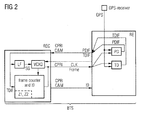
- In einer ersten Ausgestaltung gemäß
FIG 2 gibt es für die Zählerstände des ersten Zählers Z1="0" und des zweiten Zählers Z2="0" für jede Zeitvariable t0 eine Zuordnung zur GPS-Zeit t1, die vom Zeitindikator TD ermittelt wird. - Zu diesem Zweck werden dem Zeitindikator TD die Zählerstände des ersten Zählers Z1 und des zweiten Zählers Z2 über die CPRI-Rahmeninformation BFN gemäß dem Standard CPRI, Version V2.0, übertragen. Außerdem wird an den Zeitindikator TD die Zeitvariable t0 übertragen, wobei diese Übertragung bevorzugt über den CPRI_Kanal "C&M" erfolgt.
- In einer zweiten Ausgestaltung wird die Zähleinheit "frame counter and t0" aufgrund einer Information des Zeitindikator TD gezielt rückgesetzt.
- Diese Rücksetzung kann unter Verwendung der Zeitdifferenz "TDIF" erfolgen.
- Beispielsweise wird der Zählerstand des ersten Zählers auf den Wert "0" gesetzt, während der Zählerstand des zweiten Zählers auf den Wert "0" für BFN=Z2="0" gesetzt wird.
- Durch das gezielte Rücksetzen die CPRI-Rahmens "frame" mit der Wochenzeit t1 wird eine Synchronisation derart durchgeführt, dass zum Beginn jeder Sekunde der Wochenzeit t1 exakt ein CPRI-Rahmen "frame" beginnt. Im Beispiel erfolgt dies dann, wenn der erste Zähler vom Wert "383999" auf den Wert "0" springt.
- Darüber hinaus kann auch für jede GPS-Zeit t1 eindeutig ein Zählerstand des ersten Zählers Z1 und des zweiten Zählers Z2 definiert werden, wobei der Zählerstand des zweiten Zählers über die "Node B frame number, BFN" definiert wird.
- Durch die Zählerstände des ersten und des zweiten Zählers Z1, Z2 können mehrere Basisstationen synchronisiert werden. Dabei erfolgt das gezielte Rücksetzen derart, dass zu einer für alle Basisstationen gleich definierten Zeit die Zählerstände des ersten und des zweiten Zählers auf den Wert "0" definiert gesetzt werden.
- Beispielsweise wird dazu ein Zeitpunkt "Montag, 01.01.2007, 0:00'00" Uhr" gewählt. Das Rücksetzen kann nicht nur am "Montag, 01.01.2007, 0:00'00" Uhr" erfolgen, sondern kann um beliebige ganzzahlige Vielfache von 40.96sec nach diesem "Montag 0:00'00" Uhr" erfolgen.
Claims (11)
- Verfahren zur Synchronisation von Baugruppen (REC, RE) einer Basisstation (BTS) auf ein Referenz-Taktsignal (GPS),- bei dem seitens einer ersten Baugruppe (REC) ein lokales Taktsignal (CLK) und ein Rahmen (Frame) gebildet wird,- bei dem das Taktsignal (CLK) und der Rahmen (Frame) unter Verwendung einer synchronen Übertragung mit vorhersagbarer Laufzeit an eine zweite Baugruppe (RE) übertragen wird,- bei dem seitens der zweiten Baugruppe (RE) das Referenz-Taktsignal (GPS) empfangen wird, dadurch gekennzeichnet daß seitens der zweiten Baugruppe weiterhin eine Phasendifferenz (PDIF) und eine Zeitdifferenz (TDIF) zwischen dem übertragenen Taktsignal (CLK) und dem Rahmen (Frame) einerseits und dem Referenz-Taktsignal (GPS) andererseits bestimmt wird,- bei dem die Phasendifferenz (PDIF) und die Zeitdifferenz (TDIF) von der zweiten Baugruppe (RE) zur ersten Baugruppe (REC) über eine Verbindung ohne vorhersagbare Laufzeit übertragen werden,- bei dem seitens der ersten Baugruppe (REC) die Phasendifferenz (PDIF) und die Zeitdifferenz (TDIF) zur Ermittlung einer Stellgröße (SG), die die Bildung des lokalen Taktsignals (CLK) steuert, verwendet wird, so dass die erste und die zweite Baugruppe (REC, RE) zeitsynchronisiert werden.
- Verfahren nach Anspruch 1,- bei dem seitens der zweiten Baugruppe (RE) ein Phasenindikator (PD) und ein Zeitindikator (TD) verwendet wird, um die Phasendifferenz (PDIF) und die Zeitdifferenz (TDIF) zu bestimmen, und/oder- bei dem seitens der ersten Baugruppe (REC) ein Oszillator (VCXO) und ein Rahmengenerator (RG) verwendet wird, um das lokale Taktsignal (CLK) und den Rahmen (Frame) zu bilden.
- Verfahren nach Anspruch 1 oder 2, bei dem seitens der zweiten Baugruppe (RE) ein GPS-Signal (GPS) als Referenz-Taktsignal (GPS) empfangen wird.
- Verfahren nach Anspruch 1, bei dem ein CPRI-Netzwerk zur synchronen Übertragung mit vorhersagbarer Laufzeit verwendet wird.
- Verfahren nach Anspruch 4, bei dem zur Übertragung des Taktsignals (CLK) und des Rahmens (Frame) ein Layerl-Protokoll des CPRI-Netzwerks verwendet wird.
- Verfahren nach Anspruch 1 oder 2, bei dem über die Verbindung ohne vorhersagbare Laufzeit Paketdaten übertragen werden.
- Verfahren nach Anspruch 6, bei dem zur Übertragung der Paketdaten ein Internet-Protokoll verwendet wird.
- Verfahren nach Anspruch 6 oder 7, bei dem zur Übertragung der Datenpakete ein Control&Management-Kanal (C&M) des CPRI-Netzwerks verwendet wird.
- Verfahren nach einem der vorhergehenden Ansprüche, bei dem eine zeitliche Häufigkeit bestimmt wird, mit der die Messergebnisse von Phasendifferenz (PDIF) und Zeitdifferenz (TDIF) seitens der ersten Baugruppe (REC) empfangen werden, und diese Häufigkeit bei der Ermittlung der Stellgröße (SG) berücksichtigt wird.
- Verfahren nach einem der vorhergehenden Ansprüche, bei dem Zeitpunkte der Messungen mit einer Rahmennummer gekennzeichnet werden und die Zeitpunkte der Messungen bei der Ermittlung der Stellgröße (SG) des Oszillators (VCXO) berücksichtigt werden.
- Eine Baugruppe (RE) einer Basisstation bestehend aus einem Phasenindikator (PD) und einem Zeitindikator (TD) zum Empfang eines Taktsignals (CLK) und eines Rahmens (Frame) und eines Referenz-Taktsignal (GPS),
zur Bestimmung einer Phasendifferenz (PDIF) und einer Zeitdifferenz (TDIF)
zwischen dem Taktsignal (CLK) und dem Rahmen (Frame) einerseits und dem Referenz-Taktsignal (GPS) andererseits, und
zum Senden der Phasendifferenz (PDIF) und der Zeitdifferenz (TDIF)zur Synchronisation.
Applications Claiming Priority (2)
| Application Number | Priority Date | Filing Date | Title |
|---|---|---|---|
| DE102006019475A DE102006019475B4 (de) | 2006-04-26 | 2006-04-26 | Verfahren zur Synchronisation von Baugruppen einer Basisstation |
| PCT/EP2007/053127 WO2007124995A1 (de) | 2006-04-26 | 2007-03-30 | Verfahren zur synchronisation von baugruppen einer basisstation |
Publications (2)
| Publication Number | Publication Date |
|---|---|
| EP2013995A1 EP2013995A1 (de) | 2009-01-14 |
| EP2013995B1 true EP2013995B1 (de) | 2011-07-20 |
Family
ID=38137558
Family Applications (1)
| Application Number | Title | Priority Date | Filing Date |
|---|---|---|---|
| EP07727599A Not-in-force EP2013995B1 (de) | 2006-04-26 | 2007-03-30 | Verfahren zur synchronisation von baugruppen einer basisstation |
Country Status (8)
| Country | Link |
|---|---|
| US (1) | US8244304B2 (de) |
| EP (1) | EP2013995B1 (de) |
| CN (2) | CN104469929A (de) |
| AT (1) | ATE517476T1 (de) |
| DE (1) | DE102006019475B4 (de) |
| RU (1) | RU2438247C2 (de) |
| WO (1) | WO2007124995A1 (de) |
| ZA (1) | ZA200808899B (de) |
Families Citing this family (20)
| Publication number | Priority date | Publication date | Assignee | Title |
|---|---|---|---|---|
| CN101527959B (zh) * | 2008-03-03 | 2012-09-05 | 中兴通讯股份有限公司 | 时钟同步系统 |
| US8654796B2 (en) | 2008-03-03 | 2014-02-18 | Zte Corporation | System for synchronizing clock |
| EP2099146A1 (de) * | 2008-03-04 | 2009-09-09 | Cambridge Positioning Systems Limited | Netzwerkuhr für Mobiltelefone |
| US8050296B2 (en) | 2008-03-31 | 2011-11-01 | Telefonaktiebolaget Lm Ericsson (Publ) | Radio equipment (RE)-based synchronization |
| JP5131026B2 (ja) * | 2008-05-20 | 2013-01-30 | 富士通株式会社 | 無線基地局システム並びに制御装置及び無線装置 |
| DE102008046737B4 (de) * | 2008-09-11 | 2010-12-30 | Siemens Aktiengesellschaft | Verfahren und System zum Synchronisieren der Taktfrequenzen eines Senders und eines Empfängers |
| EP2579678B1 (de) | 2010-05-31 | 2018-02-28 | Huawei Technologies Co., Ltd. | Basisstation und taktsynchronisationsverfahren dafür |
| CN101868055B (zh) * | 2010-05-31 | 2012-08-15 | 华为技术有限公司 | 一种无线基站 |
| JP5770309B2 (ja) * | 2011-01-26 | 2015-08-26 | 華為技術有限公司Huawei Technologies Co.,Ltd. | 時間同期を実施する方法及び装置 |
| US9036544B2 (en) * | 2011-10-25 | 2015-05-19 | Telefonaktiebolaget L M Ericsson (Publ) | Delay compensation during synchronization in a base station in a cellular communication network |
| JP2014159685A (ja) * | 2013-02-19 | 2014-09-04 | Tokai Rika Co Ltd | 伝搬時間測定装置 |
| US9204312B2 (en) | 2013-11-27 | 2015-12-01 | Freescale Semiconductor, Inc. | Method for adding leaf node to multi-node base station |
| US9094908B1 (en) | 2014-04-22 | 2015-07-28 | Freescale Semiconductor, Inc. | Device and method for synchronization in a mobile communication system |
| US9521636B2 (en) | 2014-04-22 | 2016-12-13 | Nxp Usa, Inc. | Synchronization circuitry, common public radio interface enable device, and a method of synchronizing a synchronized clock signal of a second transceiver to a clock of a first transceiver |
| PL225485B1 (pl) * | 2014-11-19 | 2017-04-28 | Inst Technik Innowacyjnych Emag | Sposób i układ do synchronizacji sejsmicznych i sejsmoakustycznych sieci pomiarowych, zwłaszcza kopalnianych sieci iskrobezpiecznych |
| WO2016201619A1 (zh) * | 2015-06-16 | 2016-12-22 | 华为技术有限公司 | 一种信号转换方法,信号转换装置以及系统 |
| CN105577650A (zh) * | 2015-12-16 | 2016-05-11 | 北京握奇智能科技有限公司 | 一种动态令牌的远程时间同步方法及系统 |
| WO2017134533A1 (en) * | 2016-02-02 | 2017-08-10 | Marvell World Trade Ltd. | Method and apparatus for network synchronization |
| CN111786741B (zh) * | 2020-07-20 | 2023-02-28 | 哈尔滨海能达科技有限公司 | 一种cpri传输数据的时钟同步方法及相关装置 |
| CN117479202A (zh) * | 2022-07-20 | 2024-01-30 | 华为技术有限公司 | 一种通信方法、通信装置和通信系统 |
Family Cites Families (18)
| Publication number | Priority date | Publication date | Assignee | Title |
|---|---|---|---|---|
| US4696052A (en) * | 1985-12-31 | 1987-09-22 | Motorola Inc. | Simulcast transmitter apparatus having automatic synchronization capability |
| JPH0267033A (ja) * | 1988-09-01 | 1990-03-07 | Fujitsu Ltd | 網同期システム |
| GB9111313D0 (en) * | 1991-05-24 | 1991-07-17 | British Telecomm | Radio system |
| US5544324A (en) * | 1992-11-02 | 1996-08-06 | National Semiconductor Corporation | Network for transmitting isochronous-source data using a frame structure with variable number of time slots to compensate for timing variance between reference clock and data rate |
| US5638410A (en) * | 1993-10-14 | 1997-06-10 | Alcatel Network Systems, Inc. | Method and system for aligning the phase of high speed clocks in telecommunications systems |
| US6307868B1 (en) * | 1995-08-25 | 2001-10-23 | Terayon Communication Systems, Inc. | Apparatus and method for SCDMA digital data transmission using orthogonal codes and a head end modem with no tracking loops |
| SE509836C2 (sv) * | 1997-06-13 | 1999-03-15 | Ericsson Telefon Ab L M | Förfarande och arrangemang i ett radiokommunikationssystem |
| US6421322B1 (en) * | 1997-11-17 | 2002-07-16 | Adc Telecommunications, Inc. | System and method for electronically identifying connections of a cross-connect system |
| CN1335000A (zh) * | 1998-12-18 | 2002-02-06 | 艾利森电话股份有限公司 | 电信网中利用系统帧号的时钟同步 |
| US20010039192A1 (en) | 2000-01-27 | 2001-11-08 | Osterling Jacob Kristian | Time synchronization of radio networks |
| JP4313044B2 (ja) * | 2001-03-15 | 2009-08-12 | クゥアルコム・インコーポレイテッド | 無線位置決定システムにおける時間取得 |
| US6839391B2 (en) * | 2002-01-08 | 2005-01-04 | Motorola, Inc. | Method and apparatus for a redundant clock |
| US20040057543A1 (en) * | 2002-09-24 | 2004-03-25 | Arie Huijgen | Synchronizing radio units in a main-remote radio base station and in a hybrid radio base station |
| DE60313812T3 (de) * | 2003-04-02 | 2019-04-11 | Christopher Julian Travis | Methode zur erzeugung eines oszillator-taktsignales |
| US7209530B2 (en) * | 2003-09-26 | 2007-04-24 | Alcatei | Multi-shelf system clock synchronization |
| US7571338B2 (en) * | 2004-05-24 | 2009-08-04 | Telefonaktiebolaget Lm Ericsson (Publ) | Determining a time difference between first and second clock domains |
| EP1630979B1 (de) * | 2004-08-25 | 2008-12-24 | Nokia Siemens Networks Gmbh & Co. Kg | Verfahren und System zur Taktuhrenaktualisierung in Komponenten eines Kommunikationsnetzwerks |
| EP1810534B1 (de) * | 2004-10-12 | 2015-06-17 | Telefonaktiebolaget LM Ericsson (publ) | Kommunikation zwischen einem funkgeräte -steuerknoten und mehreren abgesetzten funkgeräte-knoten |
-
2006
- 2006-04-26 DE DE102006019475A patent/DE102006019475B4/de not_active Expired - Fee Related
-
2007
- 2007-03-30 AT AT07727599T patent/ATE517476T1/de active
- 2007-03-30 EP EP07727599A patent/EP2013995B1/de not_active Not-in-force
- 2007-03-30 WO PCT/EP2007/053127 patent/WO2007124995A1/de not_active Ceased
- 2007-03-30 US US12/226,724 patent/US8244304B2/en not_active Expired - Fee Related
- 2007-03-30 RU RU2008146506/08A patent/RU2438247C2/ru not_active IP Right Cessation
- 2007-03-30 CN CN201410831822.4A patent/CN104469929A/zh active Pending
- 2007-03-30 CN CN200780014977.7A patent/CN101485126A/zh active Pending
-
2008
- 2008-10-17 ZA ZA200808899A patent/ZA200808899B/xx unknown
Also Published As
| Publication number | Publication date |
|---|---|
| RU2008146506A (ru) | 2010-06-10 |
| US20090238154A1 (en) | 2009-09-24 |
| EP2013995A1 (de) | 2009-01-14 |
| DE102006019475B4 (de) | 2008-08-28 |
| CN104469929A (zh) | 2015-03-25 |
| CN101485126A (zh) | 2009-07-15 |
| US8244304B2 (en) | 2012-08-14 |
| ZA200808899B (en) | 2009-11-25 |
| RU2438247C2 (ru) | 2011-12-27 |
| WO2007124995A1 (de) | 2007-11-08 |
| ATE517476T1 (de) | 2011-08-15 |
| DE102006019475A1 (de) | 2007-10-31 |
Similar Documents
| Publication | Publication Date | Title |
|---|---|---|
| WO2007124995A1 (de) | Verfahren zur synchronisation von baugruppen einer basisstation | |
| DE60117522T2 (de) | Verfahren zur synchronisierung einer basisstation für drahtlose kommunikationssysteme | |
| EP1720022B1 (de) | Zeitlich synchronisiertes Messsystem und Verfahren zum zeitlichen Synchronisieren von mindestens einer Master- und einer Slave-Vorrichtung | |
| DE60304689T2 (de) | Verfahren und vorrichtung zum synchronisieren von basisstationen | |
| AT515452B1 (de) | Zeitsynchronisation in einem Satellitennetzwerk | |
| DE102006012466A1 (de) | Systeme und Verfahren zum Synchronisieren einer Zeit über Netze hinweg | |
| EP3155736B1 (de) | Verfahren zum übertragen von zeitsynchronisationsnachrichten in einem kommunikationsnetzwerk, netzwerkkomponente und kommunikationsnetzwerk | |
| EP3170285B1 (de) | Verfahren zum bestimmen einer übertragungszeit eines telegramms in einem kommunikationsnetzwerk und entsprechende netzwerkkomponenten | |
| DE102008023908A1 (de) | Transparent-Spinne | |
| EP3440846B1 (de) | Drahtlos-mikrofon- und/oder in-ear-monitoring-system und verfahren zum steuern eines drahtlos-mikrofon- und/oder in-ear-monitoring-systems | |
| EP1198911B1 (de) | Synchronisierungsverfahren und -system für taktquellen bei insbesondere paketvermittelnden kommunikationssystemen | |
| EP1211824B1 (de) | Verfahren zum Synchronisieren von an verschiedene Vermittlungssystemteile gekoppelten Basisstationen eines Mobilfunknetzes | |
| EP0198448A1 (de) | Verfahren zur Synchronisation mehrerer taktgesteuerter Sender-Empfänger | |
| EP3932113B1 (de) | Signalisierung einer multicast-nachricht in nicht koordinierten netzen | |
| EP1024618B1 (de) | Anordnung zur Synchronisierung zumindest einer abgesetzten Baugruppe mit einer zentralen Baugruppe | |
| EP1079559A2 (de) | Verfahren und Anordnung zur Synchronisation von Systemeinheiten | |
| DE3540572A1 (de) | Verfahren zur synchronisation eines empfaengers bei der digitalen datenuebertragung | |
| EP1241814B1 (de) | RDS-TMC-Rundfunkempfänger und Verfahren zum Kalibrieren eines internen Zeitgebers in einem Rundfunkempfänger | |
| EP1169796B1 (de) | Korrektur von frequenzfehlern in teilnehmerstationen | |
| DE102019115116A1 (de) | Synchronisieren der aktualisierung von tageszeitzählern unter verwendung von zeitstempelaustausch über eine steuerebene | |
| EP3796723A1 (de) | Verfahren und vorrichtung zur einfachen zeitsynchronisation einer kommunikation im industriellen umfeld | |
| DE10110177B4 (de) | Verfahren zum Messen und Kompensieren der Fortpflanzungsverzögerung zwischen Knoten in einem Kommunikationsnetzwerk | |
| DE102013220420A1 (de) | Verfahren und Vorrichtung zum Überwachen des Zustands einer Maschine | |
| WO2001039390A2 (de) | Verfahren zur synchronisierung von funkfeststationen in einem gsm-mobilfunksystem | |
| EP1619818B1 (de) | Vorrichtung und Verfahren zum Ableiten eines Referenztakts aus einem Referenztakt-Übertragungssignal |
Legal Events
| Date | Code | Title | Description |
|---|---|---|---|
| PUAI | Public reference made under article 153(3) epc to a published international application that has entered the european phase |
Free format text: ORIGINAL CODE: 0009012 |
|
| 17P | Request for examination filed |
Effective date: 20081126 |
|
| AK | Designated contracting states |
Kind code of ref document: A1 Designated state(s): AT BE BG CH CY CZ DE DK EE ES FI FR GB GR HU IE IS IT LI LT LU LV MC MT NL PL PT RO SE SI SK TR |
|
| AX | Request for extension of the european patent |
Extension state: AL BA HR MK RS |
|
| GRAP | Despatch of communication of intention to grant a patent |
Free format text: ORIGINAL CODE: EPIDOSNIGR1 |
|
| DAX | Request for extension of the european patent (deleted) | ||
| GRAS | Grant fee paid |
Free format text: ORIGINAL CODE: EPIDOSNIGR3 |
|
| GRAA | (expected) grant |
Free format text: ORIGINAL CODE: 0009210 |
|
| AK | Designated contracting states |
Kind code of ref document: B1 Designated state(s): AT BE BG CH CY CZ DE DK EE ES FI FR GB GR HU IE IS IT LI LT LU LV MC MT NL PL PT RO SE SI SK TR |
|
| REG | Reference to a national code |
Ref country code: GB Ref legal event code: FG4D Free format text: NOT ENGLISH |
|
| REG | Reference to a national code |
Ref country code: CH Ref legal event code: EP |
|
| REG | Reference to a national code |
Ref country code: DE Ref legal event code: R096 Ref document number: 502007007729 Country of ref document: DE Effective date: 20110915 |
|
| REG | Reference to a national code |
Ref country code: NL Ref legal event code: VDEP Effective date: 20110720 |
|
| PG25 | Lapsed in a contracting state [announced via postgrant information from national office to epo] |
Ref country code: SE Free format text: LAPSE BECAUSE OF FAILURE TO SUBMIT A TRANSLATION OF THE DESCRIPTION OR TO PAY THE FEE WITHIN THE PRESCRIBED TIME-LIMIT Effective date: 20110720 Ref country code: IS Free format text: LAPSE BECAUSE OF FAILURE TO SUBMIT A TRANSLATION OF THE DESCRIPTION OR TO PAY THE FEE WITHIN THE PRESCRIBED TIME-LIMIT Effective date: 20111120 Ref country code: LT Free format text: LAPSE BECAUSE OF FAILURE TO SUBMIT A TRANSLATION OF THE DESCRIPTION OR TO PAY THE FEE WITHIN THE PRESCRIBED TIME-LIMIT Effective date: 20110720 Ref country code: PT Free format text: LAPSE BECAUSE OF FAILURE TO SUBMIT A TRANSLATION OF THE DESCRIPTION OR TO PAY THE FEE WITHIN THE PRESCRIBED TIME-LIMIT Effective date: 20111121 Ref country code: FI Free format text: LAPSE BECAUSE OF FAILURE TO SUBMIT A TRANSLATION OF THE DESCRIPTION OR TO PAY THE FEE WITHIN THE PRESCRIBED TIME-LIMIT Effective date: 20110720 Ref country code: NL Free format text: LAPSE BECAUSE OF FAILURE TO SUBMIT A TRANSLATION OF THE DESCRIPTION OR TO PAY THE FEE WITHIN THE PRESCRIBED TIME-LIMIT Effective date: 20110720 |
|
| REG | Reference to a national code |
Ref country code: IE Ref legal event code: FD4D |
|
| PG25 | Lapsed in a contracting state [announced via postgrant information from national office to epo] |
Ref country code: PL Free format text: LAPSE BECAUSE OF FAILURE TO SUBMIT A TRANSLATION OF THE DESCRIPTION OR TO PAY THE FEE WITHIN THE PRESCRIBED TIME-LIMIT Effective date: 20110720 Ref country code: CY Free format text: LAPSE BECAUSE OF FAILURE TO SUBMIT A TRANSLATION OF THE DESCRIPTION OR TO PAY THE FEE WITHIN THE PRESCRIBED TIME-LIMIT Effective date: 20110720 Ref country code: SI Free format text: LAPSE BECAUSE OF FAILURE TO SUBMIT A TRANSLATION OF THE DESCRIPTION OR TO PAY THE FEE WITHIN THE PRESCRIBED TIME-LIMIT Effective date: 20110720 Ref country code: LV Free format text: LAPSE BECAUSE OF FAILURE TO SUBMIT A TRANSLATION OF THE DESCRIPTION OR TO PAY THE FEE WITHIN THE PRESCRIBED TIME-LIMIT Effective date: 20110720 Ref country code: GR Free format text: LAPSE BECAUSE OF FAILURE TO SUBMIT A TRANSLATION OF THE DESCRIPTION OR TO PAY THE FEE WITHIN THE PRESCRIBED TIME-LIMIT Effective date: 20111021 |
|
| PG25 | Lapsed in a contracting state [announced via postgrant information from national office to epo] |
Ref country code: SK Free format text: LAPSE BECAUSE OF FAILURE TO SUBMIT A TRANSLATION OF THE DESCRIPTION OR TO PAY THE FEE WITHIN THE PRESCRIBED TIME-LIMIT Effective date: 20110720 Ref country code: CZ Free format text: LAPSE BECAUSE OF FAILURE TO SUBMIT A TRANSLATION OF THE DESCRIPTION OR TO PAY THE FEE WITHIN THE PRESCRIBED TIME-LIMIT Effective date: 20110720 Ref country code: IE Free format text: LAPSE BECAUSE OF FAILURE TO SUBMIT A TRANSLATION OF THE DESCRIPTION OR TO PAY THE FEE WITHIN THE PRESCRIBED TIME-LIMIT Effective date: 20110720 |
|
| PLBE | No opposition filed within time limit |
Free format text: ORIGINAL CODE: 0009261 |
|
| STAA | Information on the status of an ep patent application or granted ep patent |
Free format text: STATUS: NO OPPOSITION FILED WITHIN TIME LIMIT |
|
| PG25 | Lapsed in a contracting state [announced via postgrant information from national office to epo] |
Ref country code: RO Free format text: LAPSE BECAUSE OF FAILURE TO SUBMIT A TRANSLATION OF THE DESCRIPTION OR TO PAY THE FEE WITHIN THE PRESCRIBED TIME-LIMIT Effective date: 20110720 Ref country code: EE Free format text: LAPSE BECAUSE OF FAILURE TO SUBMIT A TRANSLATION OF THE DESCRIPTION OR TO PAY THE FEE WITHIN THE PRESCRIBED TIME-LIMIT Effective date: 20110720 Ref country code: IT Free format text: LAPSE BECAUSE OF FAILURE TO SUBMIT A TRANSLATION OF THE DESCRIPTION OR TO PAY THE FEE WITHIN THE PRESCRIBED TIME-LIMIT Effective date: 20110720 |
|
| 26N | No opposition filed |
Effective date: 20120423 |
|
| PG25 | Lapsed in a contracting state [announced via postgrant information from national office to epo] |
Ref country code: DK Free format text: LAPSE BECAUSE OF FAILURE TO SUBMIT A TRANSLATION OF THE DESCRIPTION OR TO PAY THE FEE WITHIN THE PRESCRIBED TIME-LIMIT Effective date: 20110720 |
|
| REG | Reference to a national code |
Ref country code: DE Ref legal event code: R097 Ref document number: 502007007729 Country of ref document: DE Effective date: 20120423 |
|
| BERE | Be: lapsed |
Owner name: NOKIA SIEMENS NETWORKS G.M.B.H. & CO. KG Effective date: 20120331 |
|
| PG25 | Lapsed in a contracting state [announced via postgrant information from national office to epo] |
Ref country code: MC Free format text: LAPSE BECAUSE OF NON-PAYMENT OF DUE FEES Effective date: 20120331 |
|
| REG | Reference to a national code |
Ref country code: CH Ref legal event code: PL |
|
| REG | Reference to a national code |
Ref country code: FR Ref legal event code: ST Effective date: 20121130 |
|
| PG25 | Lapsed in a contracting state [announced via postgrant information from national office to epo] |
Ref country code: CH Free format text: LAPSE BECAUSE OF NON-PAYMENT OF DUE FEES Effective date: 20120331 Ref country code: FR Free format text: LAPSE BECAUSE OF NON-PAYMENT OF DUE FEES Effective date: 20120402 Ref country code: LI Free format text: LAPSE BECAUSE OF NON-PAYMENT OF DUE FEES Effective date: 20120331 Ref country code: BE Free format text: LAPSE BECAUSE OF NON-PAYMENT OF DUE FEES Effective date: 20120331 |
|
| PG25 | Lapsed in a contracting state [announced via postgrant information from national office to epo] |
Ref country code: ES Free format text: LAPSE BECAUSE OF FAILURE TO SUBMIT A TRANSLATION OF THE DESCRIPTION OR TO PAY THE FEE WITHIN THE PRESCRIBED TIME-LIMIT Effective date: 20111031 |
|
| REG | Reference to a national code |
Ref country code: AT Ref legal event code: MM01 Ref document number: 517476 Country of ref document: AT Kind code of ref document: T Effective date: 20120330 |
|
| PG25 | Lapsed in a contracting state [announced via postgrant information from national office to epo] |
Ref country code: BG Free format text: LAPSE BECAUSE OF FAILURE TO SUBMIT A TRANSLATION OF THE DESCRIPTION OR TO PAY THE FEE WITHIN THE PRESCRIBED TIME-LIMIT Effective date: 20111020 |
|
| PG25 | Lapsed in a contracting state [announced via postgrant information from national office to epo] |
Ref country code: MT Free format text: LAPSE BECAUSE OF FAILURE TO SUBMIT A TRANSLATION OF THE DESCRIPTION OR TO PAY THE FEE WITHIN THE PRESCRIBED TIME-LIMIT Effective date: 20110720 Ref country code: AT Free format text: LAPSE BECAUSE OF NON-PAYMENT OF DUE FEES Effective date: 20120330 |
|
| PG25 | Lapsed in a contracting state [announced via postgrant information from national office to epo] |
Ref country code: TR Free format text: LAPSE BECAUSE OF FAILURE TO SUBMIT A TRANSLATION OF THE DESCRIPTION OR TO PAY THE FEE WITHIN THE PRESCRIBED TIME-LIMIT Effective date: 20110720 |
|
| PG25 | Lapsed in a contracting state [announced via postgrant information from national office to epo] |
Ref country code: LU Free format text: LAPSE BECAUSE OF NON-PAYMENT OF DUE FEES Effective date: 20120330 |
|
| PG25 | Lapsed in a contracting state [announced via postgrant information from national office to epo] |
Ref country code: HU Free format text: LAPSE BECAUSE OF FAILURE TO SUBMIT A TRANSLATION OF THE DESCRIPTION OR TO PAY THE FEE WITHIN THE PRESCRIBED TIME-LIMIT Effective date: 20070330 |
|
| REG | Reference to a national code |
Ref country code: DE Ref legal event code: R081 Ref document number: 502007007729 Country of ref document: DE Owner name: NOKIA SOLUTIONS AND NETWORKS GMBH & CO. KG, DE Free format text: FORMER OWNER: NOKIA SIEMENS NETWORKS GMBH & CO. KG, 81541 MUENCHEN, DE Effective date: 20140731 |
|
| PGFP | Annual fee paid to national office [announced via postgrant information from national office to epo] |
Ref country code: DE Payment date: 20170322 Year of fee payment: 11 |
|
| PGFP | Annual fee paid to national office [announced via postgrant information from national office to epo] |
Ref country code: GB Payment date: 20170322 Year of fee payment: 11 |
|
| REG | Reference to a national code |
Ref country code: DE Ref legal event code: R119 Ref document number: 502007007729 Country of ref document: DE |
|
| GBPC | Gb: european patent ceased through non-payment of renewal fee |
Effective date: 20180330 |
|
| PG25 | Lapsed in a contracting state [announced via postgrant information from national office to epo] |
Ref country code: DE Free format text: LAPSE BECAUSE OF NON-PAYMENT OF DUE FEES Effective date: 20181002 |
|
| PG25 | Lapsed in a contracting state [announced via postgrant information from national office to epo] |
Ref country code: GB Free format text: LAPSE BECAUSE OF NON-PAYMENT OF DUE FEES Effective date: 20180330 |
|
| REG | Reference to a national code |
Ref country code: DE Ref legal event code: R081 Ref document number: 502007007729 Country of ref document: DE Owner name: PROVENANCE ASSET GROUP LLC, PITTSFORD, US Free format text: FORMER OWNER: NOKIA SOLUTIONS AND NETWORKS GMBH & CO. KG, 81541 MUENCHEN, DE |