EP2012512A2 - Vorrichtung und Verfahren zur Verwendung einer Alarmfunktion auf einem tragbaren Endgerät - Google Patents
Vorrichtung und Verfahren zur Verwendung einer Alarmfunktion auf einem tragbaren Endgerät Download PDFInfo
- Publication number
- EP2012512A2 EP2012512A2 EP08159482A EP08159482A EP2012512A2 EP 2012512 A2 EP2012512 A2 EP 2012512A2 EP 08159482 A EP08159482 A EP 08159482A EP 08159482 A EP08159482 A EP 08159482A EP 2012512 A2 EP2012512 A2 EP 2012512A2
- Authority
- EP
- European Patent Office
- Prior art keywords
- portable terminal
- alarm
- time
- battery voltage
- input
- Prior art date
- Legal status (The legal status is an assumption and is not a legal conclusion. Google has not performed a legal analysis and makes no representation as to the accuracy of the status listed.)
- Withdrawn
Links
Images

Classifications
-
- H—ELECTRICITY
- H04—ELECTRIC COMMUNICATION TECHNIQUE
- H04W—WIRELESS COMMUNICATION NETWORKS
- H04W52/00—Power management, e.g. Transmission Power Control [TPC] or power classes
- H04W52/02—Power saving arrangements
- H04W52/0209—Power saving arrangements in terminal devices
- H04W52/0261—Power saving arrangements in terminal devices managing power supply demand, e.g. depending on battery level
-
- H—ELECTRICITY
- H04—ELECTRIC COMMUNICATION TECHNIQUE
- H04M—TELEPHONIC COMMUNICATION
- H04M1/00—Substation equipment, e.g. for use by subscribers
- H04M1/72—Mobile telephones; Cordless telephones, i.e. devices for establishing wireless links to base stations without route selection
- H04M1/724—User interfaces specially adapted for cordless or mobile telephones
- H04M1/72448—User interfaces specially adapted for cordless or mobile telephones with means for adapting the functionality of the device according to specific conditions
- H04M1/72451—User interfaces specially adapted for cordless or mobile telephones with means for adapting the functionality of the device according to specific conditions according to schedules, e.g. using calendar applications
-
- H—ELECTRICITY
- H04—ELECTRIC COMMUNICATION TECHNIQUE
- H04B—TRANSMISSION
- H04B1/00—Details of transmission systems, not covered by a single one of groups H04B3/00 - H04B13/00; Details of transmission systems not characterised by the medium used for transmission
- H04B1/38—Transceivers, i.e. devices in which transmitter and receiver form a structural unit and in which at least one part is used for functions of transmitting and receiving
- H04B1/40—Circuits
-
- Y—GENERAL TAGGING OF NEW TECHNOLOGICAL DEVELOPMENTS; GENERAL TAGGING OF CROSS-SECTIONAL TECHNOLOGIES SPANNING OVER SEVERAL SECTIONS OF THE IPC; TECHNICAL SUBJECTS COVERED BY FORMER USPC CROSS-REFERENCE ART COLLECTIONS [XRACs] AND DIGESTS
- Y02—TECHNOLOGIES OR APPLICATIONS FOR MITIGATION OR ADAPTATION AGAINST CLIMATE CHANGE
- Y02D—CLIMATE CHANGE MITIGATION TECHNOLOGIES IN INFORMATION AND COMMUNICATION TECHNOLOGIES [ICT], I.E. INFORMATION AND COMMUNICATION TECHNOLOGIES AIMING AT THE REDUCTION OF THEIR OWN ENERGY USE
- Y02D30/00—Reducing energy consumption in communication networks
- Y02D30/70—Reducing energy consumption in communication networks in wireless communication networks
Definitions
- the present invention relates to an apparatus and method for using an alarm function in a portable terminal. More particularly, the present invention relates to an apparatus and method for using an alarm function of a portable terminal even in a turn-off mode of the portable terminal.
- portable terminals are becoming popular with the development of electronics and communications industries.
- portable terminals have been developed to provide a variety of additional functions in addition to a basic function.
- the additional functions include a phonebook function, a game function, a scheduler function, a short message function, an Internet function, an e-mail function, a morning call function, an alarm function, a file viewer function, an automatic response function, a camera function and the like.
- the morning call/alarm function is used to inform users of times (e.g., wake-up times and appointed times) or dates set by the users.
- the morning call/alarm function may be disabled when the portable terminal is turned off. Because the portable terminal is limited in battery capacity, the battery of the portable terminal must be charged periodically so that the portable terminal can maintain a turn-on state. When a user of the portable terminal fails to charge the battery of the portable terminal in a timely manner and thus the portable terminal is turned off, the user cannot use the morning call/alarm function of the portable terminal.
- An aspect of the present invention is to address at least the above-mentioned problems and/or disadvantages and to provide at least the advantages described below. Accordingly, an aspect of the present invention is to provide an apparatus and method for using an alarm function in a portable terminal.
- Another aspect of the present invention is to provide an apparatus and method for using an alarm function of a portable terminal even in a turn-off mode, by managing the power of the portable terminal depending on a battery voltage of the portable terminal.
- a method for using an alarm function in a portable terminal includes detecting a residual battery voltage of the portable terminal, turning off the portable terminal when the residual battery voltage becomes identical to a threshold voltage, and turning on the portable terminal to generate an alarm when the present time becomes identical to a preset alarm time.
- an apparatus for using an alarm function in a portable terminal includes a residual battery voltage detector for detecting a residual battery voltage of the portable terminal, a power manager for turning off the portable terminal when the residual battery voltage becomes identical to a threshold voltage, and turning on the portable terminal when the present time becomes identical to a preset alarm time, and an alarm generator for generating an alarm if the portable terminal is turned on when the present time becomes identical to the preset alarm time.
- FIG. 1 is a block diagram of an apparatus for using an alarm function by managing the power of a portable terminal according to an exemplary embodiment of the present invention.
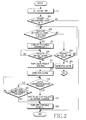
- FIG. 2 is a flow diagram illustrating a process for using an alarm function by managing the power of a portable terminal according to an exemplary embodiment of the present invention.
- the present invention is intended to provide an apparatus and method for using an alarm function of a portable terminal even in a turn-off mode of the portable terminal, by turning off the portable terminal when a residual battery voltage of the portable terminal becomes lower than a threshold voltage.
- FIG. 1 is a block diagram of an apparatus for using an alarm function by managing the power of a portable terminal according to an exemplary embodiment of the present invention.
- the portable terminal includes a controller (e.g., a Micro-Processor Unit (MPU)) 100, a residual battery voltage detector 101, a power manager (e.g., a Power Management_Integrated Circuit (PM_IC)) 102, an alarm generator 103, a Real-Time Clock (RTC) 104, a display unit 106, an input unit 108, a communication module 110, a coder-decoder (codec) 112, a speaker 114, and a microphone 116.
- a controller e.g., a Micro-Processor Unit (MPU)
- PM_IC Power Management_Integrated Circuit
- RTC Real-Time Clock
- the controller 100 controls the overall operations of the portable terminal. According to an exemplary embodiment of the present invention, the controller 100 controls an operation for performing an alarm function by using a residual battery voltage after turning off the portable terminal when a residual battery voltage of the portable terminal becomes lower than a threshold voltage.
- the controller 100 controls an operation for detecting the residual battery voltage of the portable terminal by means of the residual battery voltage detector 101 when an alarm power management function is set, and turning off the portable terminal by means of the power manager 102 when the residual battery voltage becomes lower than the threshold voltage.
- the controller 100 controls an operation for comparing the set alarm time with the present time provided from the real-time clock 104 in a turn-off state of the portable terminal, for turning on the portable terminal by means of the power manager 102, and for generating an alarm by means of the alarm generator 103 when the present time is identical to the alarm time.
- the controller 100 controls an operation for outputting a battery voltage shortage message to the display unit 106 and for turning off the portable terminal by means of the power manager 102 when an alarm termination button is input by means of the input unit 108 after the generated alarm is output through the speaker 114.
- the residual battery voltage detector 101 detects a present battery voltage level of the portable terminal and provides the detected present battery voltage level to the controller 100.
- the power manager 102 turns on/off the portable terminal under the control of the controller 100 when the detected present battery voltage level is identical to a threshold voltage.
- the alarm generator 103 generates an alarm under the control of the controller 100 when the present time is identical to the alarm time.
- the real-time clock 104 receives power from an internal power source or a backup battery to generate a clock periodically even in a turn-off state of the portable terminal, thereby retaining and providing the time and date of the portable terminal to the controller 100.
- the display unit 106 displays a limited number of characters and state information that are generated during the operation of the portable terminal.
- the display unit 106 may be implemented using a color Liquid Crystal Display (LCD). According to an exemplary embodiment of the present invention, the display unit 106 displays a battery voltage shortage message under the control of the controller 100.
- LCD Liquid Crystal Display
- the input unit 108 includes a plurality of keys for inputting numeric or character data and a plurality of function keys for setting various functions.
- the input unit 108 provides the controller 100 with key input data corresponding to a key pressed by a user.
- the input unit 108 provides the controller 100 with alarm setting data including voltage management data and input data of the alarm termination button.
- the communication module 110 processes Radio Frequency (RF) signals transmitted/received through an antenna (not shown). For example, for a transmission operation, the communication module 110 channel-codes/spreads TX data into a baseband signal and converts the baseband signal into an RF signal. For a reception operation, the communication module 110 converts a received RF signal into a baseband signal and despreads/channel-decodes the baseband signal into original data.
- RF Radio Frequency
- the codec 112 connected to the controller 100, and the speaker 114 and the microphone 116 connected to the codec 112 constitute an audio input/output block that is used for telephone communications and voice recordings.
- the codec 112 converts Pulse Code Modulation (PCM) data received from the controller 100 into analog audio signals and outputs the analog audio signals to the speaker 114. Also, the codec 112 converts audio signals received from the microphone 116 into PCM data and provides the PCM data to the controller 100.
- the speaker 114 outputs an alarm under the control of the controller 100 when the present time is identical to the alarm time.
- PCM Pulse Code Modulation
- FIG. 2 is a flow diagram illustrating a process for using an alarm function by managing power of a portable terminal according to an exemplary embodiment of the present invention.
- the user sets an alarm time at the portable terminal in step 201.
- the portable terminal determines whether a power management mode is set by the user.
- step 203 If the power management mode is not set in step 203, the portable terminal ends the process.
- step 205 the process proceeds to step 205.
- the portable terminal compares a residual battery voltage with a threshold voltage in step 205. If the residual battery voltage is not identical to the threshold voltage in step 205, the process proceeds to step 223. In step 223, the portable terminal determines whether the present time is identical to the set alarm time. If the present time is identical to the set alarm time in step 223, the process proceeds to step 225. In step 225, the portable terminal generates an alarm. Thereafter, the process returns to step 205.
- step 207 the portable terminal is turned off. For example, assuming that the portable terminal is correctly turned off when the residual battery voltage becomes 3.4 V and that a battery voltage of 0.1 V is necessary to turn on the portable terminal and generate an alarm, the power manager 102 turns off the portable terminal when the residual battery voltage becomes 3.5 V.
- step 209 the portable terminal determines whether the present time received through the real-time clock 104 is identical to the set alarm time. If the present time is identical to the set alarm time in step 209, the process proceeds to step 211. In step 211, the portable terminal is turned on. In step 213, the portable terminal generates an alarm.
- step 215 the portable terminal determines whether the alarm termination button is input by the user. If the alarm termination button is input by the user in step 215, the process proceeds to step 217. In step 217, the portable terminal displays a battery voltage shortage message on the display unit 106. In step 219, the portable terminal is turned off. Thereafter, the portable terminal ends the process.
- step 221 the portable terminal determines whether the residual battery voltage becomes identical to an automatic termination voltage. If the residual battery voltage becomes identical to the automatic termination voltage in step 221, the process proceeds to step 219 so that the portable terminal is turned off. That is, the portable terminal is turned off when the residual battery voltage becomes identical to the automatic termination voltage in order to prevent a malfunction of the portable terminal. In contrast, if the residual battery voltage is not identical to the automatic termination voltage in step 221, the process proceeds to step 215.
- an exemplary embodiment of the present invention turns off the portable terminal while leaving the residual battery voltage capable of generating an alarm, by managing the power of the portable terminal depending on the battery voltage of the portable terminal.
- the present invention can generate the alarm even in a turn-off mode of the portable terminal by turning on the portable terminal at a set alarm time.
Landscapes
- Engineering & Computer Science (AREA)
- Computer Networks & Wireless Communication (AREA)
- Signal Processing (AREA)
- Human Computer Interaction (AREA)
- Telephone Function (AREA)
- Charge And Discharge Circuits For Batteries Or The Like (AREA)
Applications Claiming Priority (1)
| Application Number | Priority Date | Filing Date | Title |
|---|---|---|---|
| KR1020070067490A KR20090003007A (ko) | 2007-07-05 | 2007-07-05 | 휴대용 단말기에서 알람 기능 사용방법 및 장치 |
Publications (2)
| Publication Number | Publication Date |
|---|---|
| EP2012512A2 true EP2012512A2 (de) | 2009-01-07 |
| EP2012512A3 EP2012512A3 (de) | 2009-05-27 |
Family
ID=39777118
Family Applications (1)
| Application Number | Title | Priority Date | Filing Date |
|---|---|---|---|
| EP08159482A Withdrawn EP2012512A3 (de) | 2007-07-05 | 2008-07-02 | Vorrichtung und Verfahren zur Verwendung einer Alarmfunktion auf einem tragbaren Endgerät |
Country Status (4)
| Country | Link |
|---|---|
| US (1) | US20090009324A1 (de) |
| EP (1) | EP2012512A3 (de) |
| KR (1) | KR20090003007A (de) |
| CN (1) | CN101340484A (de) |
Cited By (1)
| Publication number | Priority date | Publication date | Assignee | Title |
|---|---|---|---|---|
| CN103188379A (zh) * | 2011-12-29 | 2013-07-03 | 中兴通讯股份有限公司 | 信息提醒方法和装置 |
Families Citing this family (2)
| Publication number | Priority date | Publication date | Assignee | Title |
|---|---|---|---|---|
| KR101809954B1 (ko) * | 2011-10-12 | 2017-12-18 | 엘지전자 주식회사 | 이동 단말기 및 그 제어방법 |
| FR2985404A1 (fr) * | 2012-01-03 | 2013-07-05 | France Telecom | Procede dynamique de determination d'une liste de services dans un reseau sip |
Family Cites Families (5)
| Publication number | Priority date | Publication date | Assignee | Title |
|---|---|---|---|---|
| US6453182B1 (en) * | 2000-02-15 | 2002-09-17 | Qualcomm, Incorporated | Wireless telephone airplane and alarm clock modes |
| US20020142792A1 (en) * | 2001-04-03 | 2002-10-03 | Telefonaktiebolaget L M Ericsson(Publ) | Method and apparatus for automated selection of user preference information |
| US20060176167A1 (en) * | 2005-01-25 | 2006-08-10 | Laser Shield Systems, Inc. | Apparatus, system, and method for alarm systems |
| US20060271798A1 (en) * | 2005-05-31 | 2006-11-30 | Sony Computer Entertainment America Inc. | Configurable interrupt scheme for waking up a system from sleep mode |
| GB2433612A (en) * | 2005-12-21 | 2007-06-27 | Symbian Software Ltd | Power conservation in a computing device by categorising applications and functionality in dependence upon available power |
-
2007
- 2007-07-05 KR KR1020070067490A patent/KR20090003007A/ko not_active Withdrawn
-
2008
- 2008-07-01 US US12/166,242 patent/US20090009324A1/en not_active Abandoned
- 2008-07-02 EP EP08159482A patent/EP2012512A3/de not_active Withdrawn
- 2008-07-04 CN CNA2008101319907A patent/CN101340484A/zh active Pending
Non-Patent Citations (1)
| Title |
|---|
| None |
Cited By (1)
| Publication number | Priority date | Publication date | Assignee | Title |
|---|---|---|---|---|
| CN103188379A (zh) * | 2011-12-29 | 2013-07-03 | 中兴通讯股份有限公司 | 信息提醒方法和装置 |
Also Published As
| Publication number | Publication date |
|---|---|
| US20090009324A1 (en) | 2009-01-08 |
| EP2012512A3 (de) | 2009-05-27 |
| CN101340484A (zh) | 2009-01-07 |
| KR20090003007A (ko) | 2009-01-09 |
Similar Documents
| Publication | Publication Date | Title |
|---|---|---|
| US20040121802A1 (en) | Hybrid mobile terminal and method for automatically powering on/off mobile phone | |
| US20060090088A1 (en) | Method and apparatus for managing power of portable information device | |
| JP3078286B1 (ja) | バッテリ残量表示回路とこの回路を備えた移動通信端末装置 | |
| KR101359031B1 (ko) | 휴대용 단말기에서 이메일 폴링 방법 및 장치 | |
| US7181006B2 (en) | Portable terminal device having timer | |
| US20010023198A1 (en) | Portable telephone apparatus with battery alarm function | |
| WO2000038338A1 (en) | Real time clock system and method | |
| US20010055986A1 (en) | Electric power supply device and portable information device | |
| EP2012512A2 (de) | Vorrichtung und Verfahren zur Verwendung einer Alarmfunktion auf einem tragbaren Endgerät | |
| JP2004078881A (ja) | Pdaと無線通信システムとの統合インターフェイス用の回路と動作方式 | |
| US6829492B2 (en) | Service lock release for a wireless communication device | |
| CN116867042A (zh) | 功耗控制方法、系统、装置及介质 | |
| CN1394374A (zh) | 在电子装置中容纳一个以上电池的系统和方法 | |
| KR20050023822A (ko) | 이동통신단말기에서 저전력모드 수행 방법 | |
| JP4210086B2 (ja) | 携帯情報端末 | |
| KR20030009775A (ko) | 화상 이동통신 단말기의 통화모드에서 전원 제어를 통한배터리 소모량 절약방법 | |
| US8190216B2 (en) | Mobile phone power-saving by usage learning | |
| US20050269883A1 (en) | Universal serial bus current limit | |
| EP1603009A1 (de) | Universal Serial Bus Strombegrenzung | |
| KR20030051008A (ko) | 이동통신 단말기에서 배터리 소모 시 긴급통화 설정방법 | |
| JP2000201215A (ja) | 携帯通信端末 | |
| KR100706396B1 (ko) | 화면 밝기 조절 기능을 가지는 무선통신 단말기 및 그 방법 | |
| KR101147746B1 (ko) | 이동통신 단말기 및 이를 이용한 긴급 통화 제공 방법 | |
| KR20020078967A (ko) | 이동통신단말기에서의 문자슬라이딩을 이용한 스케줄 알림방법 | |
| KR20040110232A (ko) | 날씨정보가 제공되는 휴대폰 |
Legal Events
| Date | Code | Title | Description |
|---|---|---|---|
| PUAI | Public reference made under article 153(3) epc to a published international application that has entered the european phase |
Free format text: ORIGINAL CODE: 0009012 |
|
| 17P | Request for examination filed |
Effective date: 20080702 |
|
| AK | Designated contracting states |
Kind code of ref document: A2 Designated state(s): AT BE BG CH CY CZ DE DK EE ES FI FR GB GR HR HU IE IS IT LI LT LU LV MC MT NL NO PL PT RO SE SI SK TR |
|
| AX | Request for extension of the european patent |
Extension state: AL BA MK RS |
|
| PUAL | Search report despatched |
Free format text: ORIGINAL CODE: 0009013 |
|
| AK | Designated contracting states |
Kind code of ref document: A3 Designated state(s): AT BE BG CH CY CZ DE DK EE ES FI FR GB GR HR HU IE IS IT LI LT LU LV MC MT NL NO PL PT RO SE SI SK TR |
|
| AX | Request for extension of the european patent |
Extension state: AL BA MK RS |
|
| 17Q | First examination report despatched |
Effective date: 20090812 |
|
| AKX | Designation fees paid |
Designated state(s): DE GB NL |
|
| STAA | Information on the status of an ep patent application or granted ep patent |
Free format text: STATUS: THE APPLICATION HAS BEEN WITHDRAWN |
|
| 18W | Application withdrawn |
Effective date: 20110111 |