EP2008798B1 - Trommel zur Reifenerzeugung - Google Patents
Trommel zur Reifenerzeugung Download PDFInfo
- Publication number
- EP2008798B1 EP2008798B1 EP08153853A EP08153853A EP2008798B1 EP 2008798 B1 EP2008798 B1 EP 2008798B1 EP 08153853 A EP08153853 A EP 08153853A EP 08153853 A EP08153853 A EP 08153853A EP 2008798 B1 EP2008798 B1 EP 2008798B1
- Authority
- EP
- European Patent Office
- Prior art keywords
- building drum
- segments
- piston
- annular
- supporting body
- Prior art date
- Legal status (The legal status is an assumption and is not a legal conclusion. Google has not performed a legal analysis and makes no representation as to the accuracy of the status listed.)
- Not-in-force
Links
Images




Classifications
-
- B—PERFORMING OPERATIONS; TRANSPORTING
- B29—WORKING OF PLASTICS; WORKING OF SUBSTANCES IN A PLASTIC STATE IN GENERAL
- B29D—PRODUCING PARTICULAR ARTICLES FROM PLASTICS OR FROM SUBSTANCES IN A PLASTIC STATE
- B29D30/00—Producing pneumatic or solid tyres or parts thereof
- B29D30/06—Pneumatic tyres or parts thereof (e.g. produced by casting, moulding, compression moulding, injection moulding, centrifugal casting)
- B29D30/08—Building tyres
- B29D30/20—Building tyres by the flat-tyre method, i.e. building on cylindrical drums
- B29D30/24—Drums
- B29D30/244—Drums for manufacturing substantially cylindrical tyre components with cores or beads, e.g. carcasses
- B29D30/245—Drums for the single stage building process, i.e. the building-up of the cylindrical carcass and the toroidal expansion of it are realised on the same drum
Definitions
- the present invention relates to a tyre building drum according to the preamble of claim 1.
- Conventional tyre manufacturing employs a first-stage building drum, on which the various parts of the tyre are applied successively to form a cylindrical carcass; and the cylindrical carcass is transferred to an expandible second-stage building drum, on which the cylindrical carcass is expanded centrally into a toroidal shape and fitted with the remaining parts of the tyre (belts and tread).
- conventional tyre manufacturing employs two separate building drums, and calls for transferring the carcass from one drum to the other.
- a single-stage building drum has been proposed, on which to both assemble and expand the carcass.
- a single-stage building drum is of complex design, by having to expand and contract both axially and radially.
- a single-stage building drum such as the one described, for example, in Patent Application EP1674248 , is supported on a central shaft mounted to rotate about a longitudinal axis of rotation, and comprises two specularly identical half-drums (one right and one left) movable axially to and from each other (i.e. parallel to the longitudinal axis of rotation).
- each half-drum comprises a lateral section with a bead locking device, which is also movable radially (i.e. perpendicular to the longitudinal axis of rotation) to expand or contract; and a central section, which is also movable radially to expand or contract independently of the bead locking device.
- Each central section comprises an annular supporting body supporting a number of segments equally spaced about and movable radially with respect to the supporting body.
- Each segment comprises a number of fingers spaced a given distance apart to define, between each two adjacent fingers, a recess of at least the same width as a finger.
- the fingers of the segments of one central section are positioned facing and aligned with the recesses of the segments of the other central section, so that each finger slides freely inside a respective recess between two fingers on the other central section, and the fingers of the segments interlace when the two central sections are brought together.
- Both the central sections are covered with a toroidal, deformable, flexible former bladder (or sleeve) fixed laterally to each supporting body by a fastening ring screwed to an outer lateral wall of the supporting body.
- the former bladder is inflated with compressed air to impart a toroidal shape to the carcass of the tyre being built.
- the former bladder and possibly also the segments of the two central sections must be changed. Whichever the case, the former bladder must always be removed from the central sections, which means removing the former bladder fastening rings. This is a complicated, time-consuming job, which involves removing the lateral sections to remove the fastening ring screws from the outer lateral walls of the supporting bodies of the central sections.
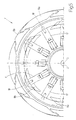
- Number 1 in Figures 1 and 2 indicates as a whole a single-stage building drum supported on a central shaft 2 ( Figure 5 ) mounted to rotate about a longitudinal axis of rotation 3.
- Building drum 1 comprises two specularly identical half-drums 4 movable to and from each other axially (i.e. parallel to longitudinal axis of rotation 3). That is, each half-drum 4 is mounted on a slide to slide axially, with respect to central shaft 2, under the control of a pneumatic actuator.
- each half-drum 4 comprises a lateral section 5 with a bead locking device 6, which is also movable radially (i.e. perpendicular to longitudinal axis of rotation 3) to expand or contract; and a central section 7, which is also movable radially to expand or contract independently of bead locking device 6.
- each central section 7 comprises an annular supporting body 8 supporting a number of segments 9 equally spaced about and movable radially with respect to supporting body 8.
- Each segment 9 comprises a number of fingers 10 spaced a given distance apart to define, between each two adjacent fingers 10, a recess 11 ( Figure 1 ) of at least the same width as a finger 10.
- the fingers 10 of segments 9 of one central section 7 are positioned facing and aligned with the recesses 11 of segments 9 of the other central section 7, so that each finger 10 slides freely inside a respective recess 11 between two fingers 10 on the other central section 7, and the fingers 10 of segments 9 interlace when the two central sections 7 are brought together.
- Both the central sections 7 are covered with a common toroidal, deformable, flexible former bladder 12 fixed laterally to each supporting body 8 by a fastening ring 13 screwed to an outer lateral wall 14 of supporting body 8 by screws 15.
- former bladder 12 is inflated with compressed air to impart a toroidal shape to the carcass of the tyre being built.
- Annular supporting body 8 has a number of cylindrical radial seats 16, each housing in sliding manner a piston 17 supporting a segment 9. More specifically, each segment 9 is screwed to piston 17 by two radial screws 18 (only one shown in Figure 4 ); and each piston 17 is moved radially along cylindrical radial seat 16 by a pneumatic actuating device 19 connected mechanically to piston 17 by a curved transmission lever 20.
- pneumatic actuating device 19 comprises an annular actuating body 21, in which are defined two annular chambers 22a, 22b, in which respective integral pistons 23a, 23b slide axially; and each curved transmission lever 20 is hinged at one end to piston 23b, and at the other end to piston 17.
- the two chambers 22a, 22b of pneumatic actuating device 19 operate in series, and are connectable by respective solenoid valves to a compressed-air source to move pistons 23 towards the centre of building drum 1 and so move segments 9 away from shaft 2, or are connectable by the respective solenoid valves to a vacuum source to move pistons 23 towards the periphery of building drum 1, and so move segments 9 towards shaft 2.
- actuating device 19 comprises one annular chamber 22, along which one piston 23 slides.
- Each lateral section 5 comprises an annular supporting body 24 mounted to slide axially, on annular actuating body 21 of pneumatic actuating device 19, between a work position ( Figure 2 ) and a maintenance position ( Figure 3 ).
- annular supporting body 24 in the work position, is locked to annular actuating body 21 of pneumatic actuating device 19 by a number of radial lock screws 25 (only one shown in Figure 4 ).
- Each annular supporting body 24 supports an inflatable annular bag 26 connectable by a respective solenoid valve to a compressed-air source for inflation, or to a vacuum source for deflation.
- each supporting body 24 has a number of cylindrical radial seats 27, each housing in sliding manner a piston 28 supporting a segment 29; segments 29 all combine to define bead locking device 6; and each piston 28 is moved radially along cylindrical radial seat 27 by a pneumatic actuating device 30 connected mechanically to piston 28 by a connecting wedge 31.
- Pneumatic actuating device 30 comprises an annular chamber 32 formed inside supporting body 24, and along which a piston 33, integral with connecting wedge 31, slides axially.
- a piston 33 integral with connecting wedge 31, slides axially.
- the bottom portion of each piston 28 is preferably fitted with an idle roller 34 which rolls along the sloping surface of connecting wedge 31.
- Chamber 32 of pneumatic actuating device 30 is connectable by a respective solenoid valve to a compressed-air source to move pistons 33 outwards of building drum 1 and so move segments 29 away from shaft 2, or is connectable by the respective solenoid valve to a vacuum source to move pistons 33 inwards of building drum 1, and so move segments 29 towards shaft 2.
- former bladder 12 and possibly also segments 9 of the two central sections 7 must be changed. Whichever the case, former bladder 12 must always be removed from central sections 7, which means removing fastening rings 13 of former bladder 12.
- lateral sections 5 To remove/assemble fastening rings 13 of former bladder 12, lateral sections 5 must be withdrawn from central sections 7 to remove/tighten screws 15 of fastening rings 13 from/to the outer lateral walls 14 of supporting bodies 8 of central sections 7. Lateral sections 5 are withdrawn from central sections 7 by simply moving the two supporting bodies 24 of lateral sections 5 from the work position ( Figure 2 ) to the maintenance position ( Figure 3 ), which can be done quickly and easily, by virtue of each supporting body 24 being mounted to slide axially on actuating body 21 of pneumatic actuating device 19. In other words, by simply loosening (or removing) lock screws 25 securing each supporting body 24 to actuating body 21 of pneumatic actuating device 19 underneath, and then pushing supporting body 24 manually outwards.
- former bladder 12 of building drum 1 described above can be changed 70% faster than that of a similar conventional building drum.
- segments 9 may also be changed quickly and easily, by virtue of screws 15 of segments 9 being clearly visible and accessible from the outside once former bladder 12 is removed.
- segments 9 are not all alike, but divided into two alternating types, i.e. outer segments 9a alternating with inner segments 9b.
- Each outer segment 9a has a trapezoidal section with a circular outer major base, so that a recess is formed, between each two adjacent outer segments 9a, in which to fit an inner segment 9b, which has a trapezoidal section with an outer minor base.
- central sections 7 When segments 9 are in the contracted position, the outer surface of central sections 7 is defined solely by the union of the outer surfaces of outer segments 9a; conversely, when segments 9 expand, the gap formed between each two adjacent outer segments 9a is filled by an underlying inner segment 9b, so that, even in the expanded configuration, central sections 7 have a sufficiently even outer surface (i.e. with no major breaks) to effectively support the component parts of the tyre being formed.
- Bead locking devices 6 are then activated to lock beads 37 ( Figure 7 ).
- pre-forming is performed by inflating former bladder 12, bringing central sections 7 closer together axially, i.e. reducing the overall width of central sections 7 ( Figure 8 ), and expanding central sections 7 radially to adequately support sidewalls 35.
Landscapes
- Engineering & Computer Science (AREA)
- Manufacturing & Machinery (AREA)
- Mechanical Engineering (AREA)
- Tyre Moulding (AREA)
- Drying Of Solid Materials (AREA)
Claims (20)
- Eine Trommel (1) zur Reifenerzeugung, umfassend:eine Zentralachse (2), die für eine Rotation um eine längsgerichtete Rotationsachse (3) befestigt ist;zwei laterale Abschnitte (5), die jeweils eine Sickenverschließvorrichtung (6) aufweisen;zwei Zentralabschnitte (7), die radial beweglich sind, um sich auszudehnen oder sich zusammenzuziehen; undeine toroidale flexible Formerblase (12), die die Zentralabschnitte (7) bedeckt;wobei die Erzeugungstrommel (1) dadurch gekennzeichnet ist, dass die lateralen Abschnitte (5) befestigt sind, um axial bezüglich der Zentralabschnitte (7) zwischen einer Arbeitsposition zu gleiten, in welcher die lateralen Abschnitte (5) die Zentralabschnitte (7) berühren, und einer Wartungsposition, in welcher die lateralen Abschnitte (5) von den Zentralabschnitten (7) abgetrennt sind.
- Erzeugungstrommel (1) nach Anspruch 1, wobei jeder Zentralabschnitt (7) eine erste pneumatische Betätigungsvorrichtung (19) umfasst, die wiederum einen ringförmigen ersten Betätigungskörper (21) umfasst; und
jeder laterale Abschnitt (5) befestigt ist, um auf dem ersten Betätigungskörper (21) der ersten pneumatischen Betätigungsvorrichtung (19) zu gleiten. - Erzeugungstrommel (1) nach Anspruch 1 oder 2, wobei jeder Zentralabschnitt (7) einen ringförmigen ersten Stützkörper (8) umfasst, der eine Anzahl erster Segmente (9) stützt, welche gleichmäßig von dem ersten Stützkörper (8) beabstandet sind, und radial beweglich mit Bezug zu dem ersten Stützkörper (8) sind.
- Erzeugungstrommel (1) nach Anspruch 3, wobei jedes erste Segment (9) eine Anzahl von Fingern (10) aufweist, die mit einem vorgegebenen Abstand beabstandet sind, um jeweils zwischen zwei benachbarten Fingern (10) eine Aussparung (11) mit zumindest der gleichen Breite wie ein Finger (10) zu definieren, wobei die Finger (10) der ersten Segmente (9) des einen Zentralabschnitts (7) mit den Aussparungen (11) der ersten Segmente (9) des anderen Zentralabschnitts (7) ausgerichtet und diesen zugewandt sind, so dass jeder Finger (10) frei innerhalb einer entsprechenden Aussparung (11) zwischen zwei Fingern (10) des anderen Zentralabschnitts (7) gleitet; und die Finger (10) der ersten Segmente (9) ineinander greifen, wenn die zwei Zentralabschnitte (7) zusammengebracht werden.
- Erzeugungstrommel (1) nach Anspruch 3 oder 4, wobei die Formerblase (12) lateral an jedem ersten Stützkörper (8) mittels eines Befestigungsrings (13) befestigt ist, welcher auf eine äußere laterale Wand (14) des ersten Stützkörpers (8) mittels Schrauben (15) geschraubt ist.
- Erzeugungstrommel (1) nach Anspruch 3, 4 oder 5, wobei jeder ringförmige erste Stützkörper (8) eine Anzahl radialer erster zylindrischer Sitze (16) aufweist, jedes Gehäuse in einer gleitenden Weise einen ersten Kolben (17), der ein erstes Segment (9) stützt, und jeder erste Kolben (17) mechanisch mit der ersten pneumatischen Betätigungsvorrichtung (19) durch einen gekrümmten Übertragungshebel (20) verbunden ist, um sich radial entlang des ersten zylindrischen Sitzes (16) zu bewegen.
- Erzeugungstrommel (1) nach Anspruch 6, wobei jedes erste Segment (9) auf den ersten Kolben (17) durch ein Paar radialer Schrauben (18) geschraubt ist.
- Erzeugungstrommel (1) nach Anspruch 6 oder 7, wobei zwei ringförmige erste Kammern (22a, 22b) innerhalb des ersten Betätigungskörpers (21) der ersten pneumatischen Betätigungsvorrichtung (19) definiert sind, und wobei entsprechende zweite Kolben (23a, 23b), die einstückig miteinander sind, axial gleiten; und jeder gekrümmte Übertragungshebel (20) mit einem Ende an einem zweiten Kolben (23b) gelenkig befestigt ist, und das andere Ende an dem ersten Kolben (17) gelenkig befestigt ist.
- Erzeugungstrommel (1) nach Anspruch 3, 4 oder 5, wobei die ersten Segmente (9) in zwei Typen aufgeteilt werden, die abwechselnd angeordnet sind, und erste äußere Segmente (9a) umfassen, die sich mit ersten inneren Segmenten (9b) abwechseln; wenn die ersten Segmente (9) in der zusammengezogenen Position sind, die äußere Oberfläche der Zentralabschnitte (7) lediglich durch die Vereinigung der äußeren Oberflächen der ersten äußeren Segmente (9a) definiert wird; und, wenn die ersten Segmente (9) ausgedehnt sind, der Spalt, der zwischen jeden zwei benachbarten ersten äußeren Segmenten (9a) gebildet wird, durch ein darunterliegendes erstes inneres Segment (9b) gefüllt wird.
- Erzeugungstrommel (1) nach Anspruch 9, wobei jedes erste äußere Segment (9a) im Querschnitt trapezförmig ist, mit einer kreisförmigen äußeren Hauptbasis; und, zwischen jeden zwei benachbarten ersten äußeren Segmenten (9a) eine Aussparung gebildet ist, in welcher ein erstes inneres Segment (9b) eingefügt ist, welches im Querschnitt trapezförmig ist mit einer äußeren Nebenbasis.
- Erzeugungstrommel (1) nach Anspruch 9 oder 10, wobei die ersten inneren Segmente (9b) weiter als die ersten äußeren Segmente (9a) verfahren, wenn sich die Zentralabschnitte (7) ausdehnen/zusammenziehen.
- Erzeugungstrommel (1) nach Anspruch 11, wobei:jeder ringförmige erste Unterstützungskörper (8) eine Anzahl radialer erster zylindrischer Sitze (16) aufweist, wobei jedes Gehäuse in einer gleitenden Art einen ersten Kolben (17) aufweist, welcher ein erstes Segment (9) stützt;jeder erste Kolben (17) mechanisch mit der ersten pneumatischen Betätigungsvorrichtung durch einen gekrümmten Übertragungshebel (20) verbunden ist, um sich radial entlang des ersten zylindrischen Sitzes (16) zu bewegen;die erste pneumatische Betätigungsvorrichtung (19) für alle ersten Segmente (9) gemeinsam ist; undder Unterschied im Verfahrweg der ersten inneren Segmente (9b) und der ersten äußeren Segmente (9a) lediglich durch ein unterschiedliches Übertragungsverhältnis erreicht wird, welches durch Unterschiede bei den Übertragungshebeln (20) erzeugt wird, die Bewegung von der ersten pneumatischen Betätigungsvorrichtung (19) zu den ersten Segmenten (9) übertragen.
- Erzeugungstrommel (1) nach Anspruch 2 bis 12, wobei jeder laterale Abschnitt (5) einen ringförmigen zweiten Stützkörper (24) umfasst, der befestigt ist, um axial auf der ersten pneumatischen Betätigungsvorrichtung (19) zu gleiten.
- Erzeugungstrommel (1) nach Anspruch 13, wobei in der Arbeitsposition der ringförmige zweite Stützkörper (24) mit der ersten pneumatischen Betätigungsvorrichtung (19) durch zumindest eine radiale Verschlußschraube (25) verschlossen ist.
- Erzeugungstrommel (1) nach Anspruch 13 oder 14, wobei jeder ringförmige zweite Stützkörper (24) eine aufblasbare ringförmige Tasche (26) stützt, welche mit einer Druckluftquelle zum Aufblasen oder mit einer Vakuumquelle zum Luftablassen verbindbar ist.
- Erzeugungstrommel (1) nach Anspruch 13,14 oder 15, wobei auf der Seite, welche dem Zentralabschnitt (7) zugewandt ist, jeder zweite Stützkörper (24) eine Anzahl radialer zweiter zylindrischer Sitze (27) aufweist, die jeweils in einer gleitenden Art einen dritten Kolben (28) beherbergen, welcher ein zweites Segment (29) stützt; wobei all die zweiten Segmente (29) zusammen die Sickenverschließvorrichtung (6) definieren; und jeder dritte Kolben (28) radial entlang des radialen zweiten zylindrischen Sitzes (27) durch eine zweite pneumatische Betätigungsvorrichtung (30) bewegt wird, die mechanisch mit dem dritten Kolben (28) durch einen Verbindungskeil (31) verbunden ist.
- Erzeugungstrommel (1) nach Anspruch 16, wobei die zweite pneumatische Betätigungsvorrichtung (30) eine ringförmige zweite Kammer (32) umfasst, die in dem zweiten Stützkörper (24) gebildet ist; und einen vierten Kolben (33), der einstückig mit dem Verbindungskeil (31) ist, und axial entlang der ringförmigen zweiten Kammer (32) gleitet.
- Erzeugungstrommel (1) nach Anspruch 17, wobei der untere Bereich jedes dritten Kolbens (28) mit einer Leerlaufrolle (34) versehen ist, welche entlang der geneigten Oberfläche des Verbindungskeils (31) rollt.
- Erzeugungstrommel (1) nach irgendeinem der Ansprüche 1 bis 18, wobei die Erzeugungstrommel (1) zwei identische Halbtrommeln (4) umfasst, die axial zu- und voneinander beweglich sind; und wobei jede Halbtrommel (4) einen lateralen Abschnitt (5) und einen Zentralabschnitt (7) umfasst.
- Erzeugungstrommel (1) nach Anspruch 19, wobei jede Halbtrommel (4) auf einer Gleitfläche befestigt ist, und axial bezüglich der Zentralachse (2) durch einen pneumatischen Betätiger gleitend angetrieben wird.
Priority Applications (1)
| Application Number | Priority Date | Filing Date | Title |
|---|---|---|---|
| PL08153853T PL2008798T3 (pl) | 2007-06-27 | 2008-03-31 | Bęben do montażu opony |
Applications Claiming Priority (1)
| Application Number | Priority Date | Filing Date | Title |
|---|---|---|---|
| IT000465A ITTO20070465A1 (it) | 2007-06-27 | 2007-06-27 | Tamburo di formatura di pneumatici |
Publications (2)
| Publication Number | Publication Date |
|---|---|
| EP2008798A1 EP2008798A1 (de) | 2008-12-31 |
| EP2008798B1 true EP2008798B1 (de) | 2012-06-06 |
Family
ID=39768787
Family Applications (1)
| Application Number | Title | Priority Date | Filing Date |
|---|---|---|---|
| EP08153853A Not-in-force EP2008798B1 (de) | 2007-06-27 | 2008-03-31 | Trommel zur Reifenerzeugung |
Country Status (5)
| Country | Link |
|---|---|
| EP (1) | EP2008798B1 (de) |
| ES (1) | ES2387515T3 (de) |
| IT (1) | ITTO20070465A1 (de) |
| PL (1) | PL2008798T3 (de) |
| ZA (1) | ZA200803132B (de) |
Cited By (1)
| Publication number | Priority date | Publication date | Assignee | Title |
|---|---|---|---|---|
| US10259181B2 (en) | 2012-08-15 | 2019-04-16 | The Goodyear Tire & Rubber Company | Sleeveless tire building drum |
Families Citing this family (7)
| Publication number | Priority date | Publication date | Assignee | Title |
|---|---|---|---|---|
| ITTO20100323A1 (it) | 2010-04-20 | 2011-10-21 | Bridgestone Corp | Metodo di costruzione di un pneumatico mediante un unico tamburo di formatura |
| CN103085301A (zh) * | 2011-10-27 | 2013-05-08 | 软控股份有限公司 | 轮胎成型机带束层鼓及其径向张缩方法 |
| KR102263087B1 (ko) * | 2017-10-30 | 2021-06-10 | 세이프-런 머시너리(쑤저우) 컴퍼니 리미티드 | 성형드럼, 타이어 성형기 및 타이어 성형기의 타이어 성형방법 |
| CN107584786A (zh) * | 2017-10-30 | 2018-01-16 | 萨驰华辰机械(苏州)有限公司 | 成型鼓及轮胎成型机 |
| KR20210131345A (ko) * | 2019-01-28 | 2021-11-02 | 다비안 엔터프라이즈, 엘엘씨 | 역방향 오프셋 핑거를 갖는 팽창 가능한 벨트 및 트레드 드럼 |
| CN111002611B (zh) * | 2019-12-26 | 2025-03-07 | 山东宏盛橡胶科技有限公司 | 一种缺气保用成型鼓 |
| CN114683599B (zh) * | 2020-12-31 | 2025-07-04 | 软控股份有限公司 | 成型鼓规格调节方法和装置 |
Family Cites Families (4)
| Publication number | Priority date | Publication date | Assignee | Title |
|---|---|---|---|---|
| US4214939A (en) | 1978-03-15 | 1980-07-29 | Nrm Corporation | Tire building machine |
| JPH07100954A (ja) | 1993-10-06 | 1995-04-18 | Bridgestone Corp | 生ケースの芯出し方法 |
| RU2005124278A (ru) | 2002-12-30 | 2006-01-20 | Сосьете Де Текноложи Мишлен (Fr) | Устройство для сборки шины и способ ее сборки |
| BRPI0419038B1 (pt) | 2004-09-20 | 2014-04-08 | Pirelli | Aparelho e método para fabricar pneus |
-
2007
- 2007-06-27 IT IT000465A patent/ITTO20070465A1/it unknown
-
2008
- 2008-03-31 PL PL08153853T patent/PL2008798T3/pl unknown
- 2008-03-31 ES ES08153853T patent/ES2387515T3/es active Active
- 2008-03-31 EP EP08153853A patent/EP2008798B1/de not_active Not-in-force
- 2008-04-09 ZA ZA200803132A patent/ZA200803132B/xx unknown
Cited By (1)
| Publication number | Priority date | Publication date | Assignee | Title |
|---|---|---|---|---|
| US10259181B2 (en) | 2012-08-15 | 2019-04-16 | The Goodyear Tire & Rubber Company | Sleeveless tire building drum |
Also Published As
| Publication number | Publication date |
|---|---|
| PL2008798T3 (pl) | 2012-10-31 |
| ITTO20070465A1 (it) | 2008-12-28 |
| ZA200803132B (en) | 2009-02-25 |
| EP2008798A1 (de) | 2008-12-31 |
| ES2387515T3 (es) | 2012-09-25 |
Similar Documents
| Publication | Publication Date | Title |
|---|---|---|
| EP2008798B1 (de) | Trommel zur Reifenerzeugung | |
| EP2111334B1 (de) | Verfahren und vorrichtung zur herstellung von reifen | |
| US20150158261A1 (en) | Process and apparatus for assembling tyres | |
| CN103429420B (zh) | 用于制造用于车轮的充气轮胎的方法和设备 | |
| EP2698244B1 (de) | Manschettenlose Reifenbautrommel mit auswechselbaren Breitenelementen | |
| EP2698243A1 (de) | Manschettenlose Reifenbautrommel | |
| JP6425944B2 (ja) | タイヤ組立ドラム | |
| EP1771295B1 (de) | Reifentrommelanordnung mit umschlagmechanismen zum bau eines unvulkanisierten reifens | |
| NL2014555B1 (en) | Method and drum for manufacturing a tyre, in particular a run-flat tyre. | |
| JP4447820B2 (ja) | タイヤのシェーピング成形ドラム及び成型方法 | |
| JPH07266455A (ja) | タイヤ組立用ドラム | |
| JP5281671B2 (ja) | ランフラットタイヤ用のシェーピングフォーマ | |
| WO2004080701A1 (en) | A method and an apparatus for manufacturing tyres for vehicle wheels | |
| WO2016060560A1 (en) | Method and drum for manufacturing a tyre, in particular a run-flat tyre | |
| EP0692368B1 (de) | Reifenaufbautrommel und Verfahren zum Herstellen eines Rohreifens | |
| JP2006168367A (ja) | タイヤ製造ドラム用の交錯させられたビード固定セグメント | |
| GB2031815A (en) | Tyre building drums | |
| EP1556208B1 (de) | Verfahren und vorrichtung zur herstellung eines fahrzeugreifens | |
| EP1551619A4 (de) | Reifenbauverfahren und vorrichtung | |
| WO1992007708A1 (fr) | Dispositif de confection de pneus crus | |
| EP1556207B1 (de) | Verfahren und vorrichtung zur herstellung eines fahrzeugreifens | |
| WO2001036186A1 (en) | Process and apparatus for tire manufacturing with optimized bead positioning |
Legal Events
| Date | Code | Title | Description |
|---|---|---|---|
| PUAI | Public reference made under article 153(3) epc to a published international application that has entered the european phase |
Free format text: ORIGINAL CODE: 0009012 |
|
| AK | Designated contracting states |
Kind code of ref document: A1 Designated state(s): AT BE BG CH CY CZ DE DK EE ES FI FR GB GR HR HU IE IS IT LI LT LU LV MC MT NL NO PL PT RO SE SI SK TR |
|
| AX | Request for extension of the european patent |
Extension state: AL BA MK RS |
|
| 17P | Request for examination filed |
Effective date: 20090629 |
|
| 17Q | First examination report despatched |
Effective date: 20090722 |
|
| AKX | Designation fees paid |
Designated state(s): DE ES FR GB PL |
|
| GRAP | Despatch of communication of intention to grant a patent |
Free format text: ORIGINAL CODE: EPIDOSNIGR1 |
|
| GRAS | Grant fee paid |
Free format text: ORIGINAL CODE: EPIDOSNIGR3 |
|
| GRAA | (expected) grant |
Free format text: ORIGINAL CODE: 0009210 |
|
| AK | Designated contracting states |
Kind code of ref document: B1 Designated state(s): DE ES FR GB PL |
|
| REG | Reference to a national code |
Ref country code: GB Ref legal event code: FG4D |
|
| REG | Reference to a national code |
Ref country code: DE Ref legal event code: R096 Ref document number: 602008016131 Country of ref document: DE Effective date: 20120809 |
|
| REG | Reference to a national code |
Ref country code: ES Ref legal event code: FG2A Ref document number: 2387515 Country of ref document: ES Kind code of ref document: T3 Effective date: 20120925 |
|
| REG | Reference to a national code |
Ref country code: PL Ref legal event code: T3 |
|
| PLBE | No opposition filed within time limit |
Free format text: ORIGINAL CODE: 0009261 |
|
| STAA | Information on the status of an ep patent application or granted ep patent |
Free format text: STATUS: NO OPPOSITION FILED WITHIN TIME LIMIT |
|
| 26N | No opposition filed |
Effective date: 20130307 |
|
| REG | Reference to a national code |
Ref country code: DE Ref legal event code: R097 Ref document number: 602008016131 Country of ref document: DE Effective date: 20130307 |
|
| REG | Reference to a national code |
Ref country code: FR Ref legal event code: CA Effective date: 20140812 |
|
| REG | Reference to a national code |
Ref country code: FR Ref legal event code: PLFP Year of fee payment: 9 |
|
| REG | Reference to a national code |
Ref country code: FR Ref legal event code: PLFP Year of fee payment: 10 |
|
| REG | Reference to a national code |
Ref country code: FR Ref legal event code: PLFP Year of fee payment: 11 |
|
| PGFP | Annual fee paid to national office [announced via postgrant information from national office to epo] |
Ref country code: GB Payment date: 20190320 Year of fee payment: 12 Ref country code: DE Payment date: 20190321 Year of fee payment: 12 Ref country code: FR Payment date: 20190322 Year of fee payment: 12 Ref country code: PL Payment date: 20190328 Year of fee payment: 12 |
|
| PGFP | Annual fee paid to national office [announced via postgrant information from national office to epo] |
Ref country code: ES Payment date: 20190418 Year of fee payment: 12 |
|
| REG | Reference to a national code |
Ref country code: DE Ref legal event code: R119 Ref document number: 602008016131 Country of ref document: DE |
|
| PG25 | Lapsed in a contracting state [announced via postgrant information from national office to epo] |
Ref country code: FR Free format text: LAPSE BECAUSE OF NON-PAYMENT OF DUE FEES Effective date: 20200331 Ref country code: DE Free format text: LAPSE BECAUSE OF NON-PAYMENT OF DUE FEES Effective date: 20201001 |
|
| GBPC | Gb: european patent ceased through non-payment of renewal fee |
Effective date: 20200331 |
|
| PG25 | Lapsed in a contracting state [announced via postgrant information from national office to epo] |
Ref country code: GB Free format text: LAPSE BECAUSE OF NON-PAYMENT OF DUE FEES Effective date: 20200331 |
|
| REG | Reference to a national code |
Ref country code: ES Ref legal event code: FD2A Effective date: 20210812 |
|
| PG25 | Lapsed in a contracting state [announced via postgrant information from national office to epo] |
Ref country code: ES Free format text: LAPSE BECAUSE OF NON-PAYMENT OF DUE FEES Effective date: 20200401 |
|
| PG25 | Lapsed in a contracting state [announced via postgrant information from national office to epo] |
Ref country code: PL Free format text: LAPSE BECAUSE OF NON-PAYMENT OF DUE FEES Effective date: 20200331 |