EP2004814B1 - A group of novel enantioselective microbial nitrile hydratases with broad substrate specificity - Google Patents
A group of novel enantioselective microbial nitrile hydratases with broad substrate specificity Download PDFInfo
- Publication number
- EP2004814B1 EP2004814B1 EP07724055A EP07724055A EP2004814B1 EP 2004814 B1 EP2004814 B1 EP 2004814B1 EP 07724055 A EP07724055 A EP 07724055A EP 07724055 A EP07724055 A EP 07724055A EP 2004814 B1 EP2004814 B1 EP 2004814B1
- Authority
- EP
- European Patent Office
- Prior art keywords
- pair
- polynucleotide
- polynucleotides
- seq
- subunit
- Prior art date
- Legal status (The legal status is an assumption and is not a legal conclusion. Google has not performed a legal analysis and makes no representation as to the accuracy of the status listed.)
- Not-in-force
Links
- 108010024026 Nitrile hydratase Proteins 0.000 title claims abstract description 168
- 239000000758 substrate Substances 0.000 title description 37
- 230000000813 microbial effect Effects 0.000 title description 3
- 108091033319 polynucleotide Proteins 0.000 claims abstract description 230
- 102000040430 polynucleotide Human genes 0.000 claims abstract description 230
- 239000002157 polynucleotide Substances 0.000 claims abstract description 229
- 102000004190 Enzymes Human genes 0.000 claims abstract description 81
- 108090000790 Enzymes Proteins 0.000 claims abstract description 81
- 108090000765 processed proteins & peptides Proteins 0.000 claims abstract description 77
- 230000000694 effects Effects 0.000 claims abstract description 72
- 229920001184 polypeptide Polymers 0.000 claims abstract description 72
- 102000004196 processed proteins & peptides Human genes 0.000 claims abstract description 72
- 238000000034 method Methods 0.000 claims abstract description 50
- 102000037865 fusion proteins Human genes 0.000 claims abstract description 42
- 108020001507 fusion proteins Proteins 0.000 claims abstract description 42
- 238000006243 chemical reaction Methods 0.000 claims abstract description 34
- 239000013598 vector Substances 0.000 claims abstract description 30
- 238000004519 manufacturing process Methods 0.000 claims abstract description 17
- 150000001408 amides Chemical class 0.000 claims abstract description 13
- 150000002825 nitriles Chemical class 0.000 claims abstract description 13
- 239000000203 mixture Substances 0.000 claims abstract description 9
- 125000003729 nucleotide group Chemical group 0.000 claims description 73
- 239000002773 nucleotide Substances 0.000 claims description 72
- 230000000295 complement effect Effects 0.000 claims description 24
- 125000003275 alpha amino acid group Chemical group 0.000 claims description 19
- 241000894006 Bacteria Species 0.000 claims description 16
- 108091026890 Coding region Proteins 0.000 claims description 13
- 230000008569 process Effects 0.000 claims description 13
- 108091028043 Nucleic acid sequence Proteins 0.000 claims description 9
- 210000003527 eukaryotic cell Anatomy 0.000 claims description 9
- 238000012258 culturing Methods 0.000 claims description 2
- 239000000523 sample Substances 0.000 abstract description 8
- 229940088598 enzyme Drugs 0.000 description 79
- 108090000623 proteins and genes Proteins 0.000 description 56
- 241000588756 Raoultella terrigena Species 0.000 description 44
- 210000004027 cell Anatomy 0.000 description 43
- 108020004414 DNA Proteins 0.000 description 37
- 235000018102 proteins Nutrition 0.000 description 29
- 102000004169 proteins and genes Human genes 0.000 description 29
- 150000007523 nucleic acids Chemical class 0.000 description 28
- 241000588749 Klebsiella oxytoca Species 0.000 description 27
- NVAOLENBKNECGF-UHFFFAOYSA-N 2-phenylpropanenitrile Chemical compound N#CC(C)C1=CC=CC=C1 NVAOLENBKNECGF-UHFFFAOYSA-N 0.000 description 26
- 229910052720 vanadium Inorganic materials 0.000 description 26
- 230000014509 gene expression Effects 0.000 description 23
- 102000039446 nucleic acids Human genes 0.000 description 23
- 108020004707 nucleic acids Proteins 0.000 description 23
- NNICRUQPODTGRU-UHFFFAOYSA-N mandelonitrile Chemical compound N#CC(O)C1=CC=CC=C1 NNICRUQPODTGRU-UHFFFAOYSA-N 0.000 description 22
- 229910052698 phosphorus Inorganic materials 0.000 description 22
- 244000177578 Bacterium linens Species 0.000 description 21
- 235000012539 Bacterium linens Nutrition 0.000 description 21
- 229910052700 potassium Inorganic materials 0.000 description 21
- 238000009396 hybridization Methods 0.000 description 20
- 239000012634 fragment Substances 0.000 description 19
- 229910052740 iodine Inorganic materials 0.000 description 19
- 229910052717 sulfur Inorganic materials 0.000 description 19
- 241000589155 Agrobacterium tumefaciens Species 0.000 description 18
- 238000007792 addition Methods 0.000 description 16
- 239000000872 buffer Substances 0.000 description 16
- 229910052739 hydrogen Inorganic materials 0.000 description 16
- 241000983368 Pantoea sp. Species 0.000 description 15
- 241000589776 Pseudomonas putida Species 0.000 description 15
- 239000007983 Tris buffer Substances 0.000 description 14
- 229910052757 nitrogen Inorganic materials 0.000 description 14
- LENZDBCJOHFCAS-UHFFFAOYSA-N tris Chemical compound OCC(N)(CO)CO LENZDBCJOHFCAS-UHFFFAOYSA-N 0.000 description 14
- 229910052727 yttrium Inorganic materials 0.000 description 14
- 229910052731 fluorine Inorganic materials 0.000 description 13
- 235000001014 amino acid Nutrition 0.000 description 10
- 150000001413 amino acids Chemical class 0.000 description 10
- 239000013604 expression vector Substances 0.000 description 10
- 239000000047 product Substances 0.000 description 10
- 241000588724 Escherichia coli Species 0.000 description 9
- 108091093037 Peptide nucleic acid Proteins 0.000 description 9
- 241000894007 species Species 0.000 description 9
- ZHNUHDYFZUAESO-UHFFFAOYSA-N Formamide Chemical compound NC=O ZHNUHDYFZUAESO-UHFFFAOYSA-N 0.000 description 8
- 241000588754 Klebsiella sp. Species 0.000 description 8
- 230000004048 modification Effects 0.000 description 8
- 238000012986 modification Methods 0.000 description 8
- 238000003752 polymerase chain reaction Methods 0.000 description 8
- 241000589518 Comamonas testosteroni Species 0.000 description 7
- 241000187562 Rhodococcus sp. Species 0.000 description 7
- 230000003321 amplification Effects 0.000 description 7
- 230000036983 biotransformation Effects 0.000 description 7
- 239000000287 crude extract Substances 0.000 description 7
- 230000002255 enzymatic effect Effects 0.000 description 7
- 238000003199 nucleic acid amplification method Methods 0.000 description 7
- 239000000243 solution Substances 0.000 description 7
- XEEYBQQBJWHFJM-UHFFFAOYSA-N Iron Chemical compound [Fe] XEEYBQQBJWHFJM-UHFFFAOYSA-N 0.000 description 6
- KFZMGEQAYNKOFK-UHFFFAOYSA-N Isopropanol Chemical compound CC(C)O KFZMGEQAYNKOFK-UHFFFAOYSA-N 0.000 description 6
- OKKJLVBELUTLKV-UHFFFAOYSA-N Methanol Chemical compound OC OKKJLVBELUTLKV-UHFFFAOYSA-N 0.000 description 6
- 108091006088 activator proteins Proteins 0.000 description 6
- 229910052799 carbon Inorganic materials 0.000 description 6
- GUTLYIVDDKVIGB-UHFFFAOYSA-N cobalt atom Chemical group [Co] GUTLYIVDDKVIGB-UHFFFAOYSA-N 0.000 description 6
- 229910052805 deuterium Inorganic materials 0.000 description 6
- 238000004128 high performance liquid chromatography Methods 0.000 description 6
- 239000002609 medium Substances 0.000 description 6
- 239000008363 phosphate buffer Substances 0.000 description 6
- 230000001105 regulatory effect Effects 0.000 description 6
- 238000006467 substitution reaction Methods 0.000 description 6
- PKQKHWNHCKNYSW-UHFFFAOYSA-N (+-)-2-(4'-isobutylphenyl)propionitrile Chemical compound CC(C)CC1=CC=C(C(C)C#N)C=C1 PKQKHWNHCKNYSW-UHFFFAOYSA-N 0.000 description 5
- 108091032973 (ribonucleotides)n+m Proteins 0.000 description 5
- RBGSZIRWNWQDOK-UHFFFAOYSA-N 2-(4-chlorophenyl)-3-methylbutanenitrile Chemical compound CC(C)C(C#N)C1=CC=C(Cl)C=C1 RBGSZIRWNWQDOK-UHFFFAOYSA-N 0.000 description 5
- KRKNYBCHXYNGOX-UHFFFAOYSA-K Citrate Chemical compound [O-]C(=O)CC(O)(CC([O-])=O)C([O-])=O KRKNYBCHXYNGOX-UHFFFAOYSA-K 0.000 description 5
- 239000012190 activator Substances 0.000 description 5
- 230000000903 blocking effect Effects 0.000 description 5
- 238000004422 calculation algorithm Methods 0.000 description 5
- 238000006555 catalytic reaction Methods 0.000 description 5
- 239000007979 citrate buffer Substances 0.000 description 5
- 229910017052 cobalt Inorganic materials 0.000 description 5
- 239000010941 cobalt Substances 0.000 description 5
- 238000001228 spectrum Methods 0.000 description 5
- 230000014616 translation Effects 0.000 description 5
- 229910052722 tritium Inorganic materials 0.000 description 5
- 241000701022 Cytomegalovirus Species 0.000 description 4
- 241001198387 Escherichia coli BL21(DE3) Species 0.000 description 4
- 241000589516 Pseudomonas Species 0.000 description 4
- -1 Q]-[T Inorganic materials 0.000 description 4
- 241000158504 Rhodococcus hoagii Species 0.000 description 4
- FAPWRFPIFSIZLT-UHFFFAOYSA-M Sodium chloride Chemical compound [Na+].[Cl-] FAPWRFPIFSIZLT-UHFFFAOYSA-M 0.000 description 4
- 125000000539 amino acid group Chemical group 0.000 description 4
- 229960000723 ampicillin Drugs 0.000 description 4
- AVKUERGKIZMTKX-NJBDSQKTSA-N ampicillin Chemical compound C1([C@@H](N)C(=O)N[C@H]2[C@H]3SC([C@@H](N3C2=O)C(O)=O)(C)C)=CC=CC=C1 AVKUERGKIZMTKX-NJBDSQKTSA-N 0.000 description 4
- 238000004458 analytical method Methods 0.000 description 4
- 230000015572 biosynthetic process Effects 0.000 description 4
- 239000003153 chemical reaction reagent Substances 0.000 description 4
- 238000010367 cloning Methods 0.000 description 4
- 150000001875 compounds Chemical class 0.000 description 4
- 230000001419 dependent effect Effects 0.000 description 4
- 239000003623 enhancer Substances 0.000 description 4
- 239000000284 extract Substances 0.000 description 4
- 239000003446 ligand Substances 0.000 description 4
- 229910021645 metal ion Inorganic materials 0.000 description 4
- VLKZOEOYAKHREP-UHFFFAOYSA-N n-Hexane Chemical compound CCCCCC VLKZOEOYAKHREP-UHFFFAOYSA-N 0.000 description 4
- 239000012071 phase Substances 0.000 description 4
- 238000000746 purification Methods 0.000 description 4
- 230000010076 replication Effects 0.000 description 4
- 230000000717 retained effect Effects 0.000 description 4
- 150000003839 salts Chemical class 0.000 description 4
- 239000006228 supernatant Substances 0.000 description 4
- 238000013518 transcription Methods 0.000 description 4
- 230000035897 transcription Effects 0.000 description 4
- IZPUPXNVRNBDSW-UHFFFAOYSA-N 2-phenylbutanenitrile Chemical compound CCC(C#N)C1=CC=CC=C1 IZPUPXNVRNBDSW-UHFFFAOYSA-N 0.000 description 3
- WEVYAHXRMPXWCK-UHFFFAOYSA-N Acetonitrile Chemical compound CC#N WEVYAHXRMPXWCK-UHFFFAOYSA-N 0.000 description 3
- 241000972773 Aulopiformes Species 0.000 description 3
- 241000186146 Brevibacterium Species 0.000 description 3
- 241000196324 Embryophyta Species 0.000 description 3
- WQZGKKKJIJFFOK-GASJEMHNSA-N Glucose Natural products OC[C@H]1OC(O)[C@H](O)[C@@H](O)[C@@H]1O WQZGKKKJIJFFOK-GASJEMHNSA-N 0.000 description 3
- 241000588621 Moraxella Species 0.000 description 3
- 241000316848 Rhodococcus <scale insect> Species 0.000 description 3
- 241000187693 Rhodococcus rhodochrous Species 0.000 description 3
- 238000002105 Southern blotting Methods 0.000 description 3
- 208000037065 Subacute sclerosing leukoencephalitis Diseases 0.000 description 3
- 206010042297 Subacute sclerosing panencephalitis Diseases 0.000 description 3
- 241000700605 Viruses Species 0.000 description 3
- 239000002253 acid Substances 0.000 description 3
- 125000003118 aryl group Chemical class 0.000 description 3
- JFDZBHWFFUWGJE-UHFFFAOYSA-N benzonitrile Chemical compound N#CC1=CC=CC=C1 JFDZBHWFFUWGJE-UHFFFAOYSA-N 0.000 description 3
- 238000005119 centrifugation Methods 0.000 description 3
- 239000002299 complementary DNA Substances 0.000 description 3
- 230000004927 fusion Effects 0.000 description 3
- 239000008103 glucose Substances 0.000 description 3
- 210000004408 hybridoma Anatomy 0.000 description 3
- 238000011534 incubation Methods 0.000 description 3
- 229910052742 iron Inorganic materials 0.000 description 3
- 229930027917 kanamycin Natural products 0.000 description 3
- 229960000318 kanamycin Drugs 0.000 description 3
- SBUJHOSQTJFQJX-NOAMYHISSA-N kanamycin Chemical compound O[C@@H]1[C@@H](O)[C@H](O)[C@@H](CN)O[C@@H]1O[C@H]1[C@H](O)[C@@H](O[C@@H]2[C@@H]([C@@H](N)[C@H](O)[C@@H](CO)O2)O)[C@H](N)C[C@@H]1N SBUJHOSQTJFQJX-NOAMYHISSA-N 0.000 description 3
- 229930182823 kanamycin A Natural products 0.000 description 3
- 239000012528 membrane Substances 0.000 description 3
- 230000003287 optical effect Effects 0.000 description 3
- 239000013600 plasmid vector Substances 0.000 description 3
- 108091008146 restriction endonucleases Proteins 0.000 description 3
- 235000019515 salmon Nutrition 0.000 description 3
- 239000007790 solid phase Substances 0.000 description 3
- 238000003786 synthesis reaction Methods 0.000 description 3
- 238000012360 testing method Methods 0.000 description 3
- 238000013519 translation Methods 0.000 description 3
- 239000013638 trimer Substances 0.000 description 3
- YBJHBAHKTGYVGT-ZKWXMUAHSA-N (+)-Biotin Chemical compound N1C(=O)N[C@@H]2[C@H](CCCCC(=O)O)SC[C@@H]21 YBJHBAHKTGYVGT-ZKWXMUAHSA-N 0.000 description 2
- DOZZSWAOPDYVLH-UHFFFAOYSA-N 2-phenylpropanamide Chemical compound NC(=O)C(C)C1=CC=CC=C1 DOZZSWAOPDYVLH-UHFFFAOYSA-N 0.000 description 2
- HBAQYPYDRFILMT-UHFFFAOYSA-N 8-[3-(1-cyclopropylpyrazol-4-yl)-1H-pyrazolo[4,3-d]pyrimidin-5-yl]-3-methyl-3,8-diazabicyclo[3.2.1]octan-2-one Chemical class C1(CC1)N1N=CC(=C1)C1=NNC2=C1N=C(N=C2)N1C2C(N(CC1CC2)C)=O HBAQYPYDRFILMT-UHFFFAOYSA-N 0.000 description 2
- 241000589158 Agrobacterium Species 0.000 description 2
- 240000003291 Armoracia rusticana Species 0.000 description 2
- 241000194110 Bacillus sp. (in: Bacteria) Species 0.000 description 2
- 229910021580 Cobalt(II) chloride Inorganic materials 0.000 description 2
- 241000238631 Hexapoda Species 0.000 description 2
- 102000008394 Immunoglobulin Fragments Human genes 0.000 description 2
- 108010021625 Immunoglobulin Fragments Proteins 0.000 description 2
- 239000007836 KH2PO4 Substances 0.000 description 2
- 241000235058 Komagataella pastoris Species 0.000 description 2
- OUYCCCASQSFEME-QMMMGPOBSA-N L-tyrosine Chemical compound OC(=O)[C@@H](N)CC1=CC=C(O)C=C1 OUYCCCASQSFEME-QMMMGPOBSA-N 0.000 description 2
- CMWTZPSULFXXJA-UHFFFAOYSA-N Naproxen Natural products C1=C(C(C)C(O)=O)C=CC2=CC(OC)=CC=C21 CMWTZPSULFXXJA-UHFFFAOYSA-N 0.000 description 2
- PXHVJJICTQNCMI-UHFFFAOYSA-N Nickel Chemical compound [Ni] PXHVJJICTQNCMI-UHFFFAOYSA-N 0.000 description 2
- DFPAKSUCGFBDDF-UHFFFAOYSA-N Nicotinamide Chemical compound NC(=O)C1=CC=CN=C1 DFPAKSUCGFBDDF-UHFFFAOYSA-N 0.000 description 2
- 238000000636 Northern blotting Methods 0.000 description 2
- 108091034117 Oligonucleotide Proteins 0.000 description 2
- 108700026244 Open Reading Frames Proteins 0.000 description 2
- 239000004952 Polyamide Substances 0.000 description 2
- 241001645955 Pseudomonas chlororaphis subsp. aureofaciens Species 0.000 description 2
- 241000187602 Pseudonocardia thermophila Species 0.000 description 2
- 241001524101 Rhodococcus opacus Species 0.000 description 2
- 241001420000 Rhodopseudomonas palustris CGA009 Species 0.000 description 2
- 240000004808 Saccharomyces cerevisiae Species 0.000 description 2
- 108700029229 Transcriptional Regulatory Elements Proteins 0.000 description 2
- JLCPHMBAVCMARE-UHFFFAOYSA-N [3-[[3-[[3-[[3-[[3-[[3-[[3-[[3-[[3-[[3-[[3-[[5-(2-amino-6-oxo-1H-purin-9-yl)-3-[[3-[[3-[[3-[[3-[[3-[[5-(2-amino-6-oxo-1H-purin-9-yl)-3-[[5-(2-amino-6-oxo-1H-purin-9-yl)-3-hydroxyoxolan-2-yl]methoxy-hydroxyphosphoryl]oxyoxolan-2-yl]methoxy-hydroxyphosphoryl]oxy-5-(5-methyl-2,4-dioxopyrimidin-1-yl)oxolan-2-yl]methoxy-hydroxyphosphoryl]oxy-5-(6-aminopurin-9-yl)oxolan-2-yl]methoxy-hydroxyphosphoryl]oxy-5-(6-aminopurin-9-yl)oxolan-2-yl]methoxy-hydroxyphosphoryl]oxy-5-(6-aminopurin-9-yl)oxolan-2-yl]methoxy-hydroxyphosphoryl]oxy-5-(6-aminopurin-9-yl)oxolan-2-yl]methoxy-hydroxyphosphoryl]oxyoxolan-2-yl]methoxy-hydroxyphosphoryl]oxy-5-(5-methyl-2,4-dioxopyrimidin-1-yl)oxolan-2-yl]methoxy-hydroxyphosphoryl]oxy-5-(4-amino-2-oxopyrimidin-1-yl)oxolan-2-yl]methoxy-hydroxyphosphoryl]oxy-5-(5-methyl-2,4-dioxopyrimidin-1-yl)oxolan-2-yl]methoxy-hydroxyphosphoryl]oxy-5-(5-methyl-2,4-dioxopyrimidin-1-yl)oxolan-2-yl]methoxy-hydroxyphosphoryl]oxy-5-(6-aminopurin-9-yl)oxolan-2-yl]methoxy-hydroxyphosphoryl]oxy-5-(6-aminopurin-9-yl)oxolan-2-yl]methoxy-hydroxyphosphoryl]oxy-5-(4-amino-2-oxopyrimidin-1-yl)oxolan-2-yl]methoxy-hydroxyphosphoryl]oxy-5-(4-amino-2-oxopyrimidin-1-yl)oxolan-2-yl]methoxy-hydroxyphosphoryl]oxy-5-(4-amino-2-oxopyrimidin-1-yl)oxolan-2-yl]methoxy-hydroxyphosphoryl]oxy-5-(6-aminopurin-9-yl)oxolan-2-yl]methoxy-hydroxyphosphoryl]oxy-5-(4-amino-2-oxopyrimidin-1-yl)oxolan-2-yl]methyl [5-(6-aminopurin-9-yl)-2-(hydroxymethyl)oxolan-3-yl] hydrogen phosphate Polymers Cc1cn(C2CC(OP(O)(=O)OCC3OC(CC3OP(O)(=O)OCC3OC(CC3O)n3cnc4c3nc(N)[nH]c4=O)n3cnc4c3nc(N)[nH]c4=O)C(COP(O)(=O)OC3CC(OC3COP(O)(=O)OC3CC(OC3COP(O)(=O)OC3CC(OC3COP(O)(=O)OC3CC(OC3COP(O)(=O)OC3CC(OC3COP(O)(=O)OC3CC(OC3COP(O)(=O)OC3CC(OC3COP(O)(=O)OC3CC(OC3COP(O)(=O)OC3CC(OC3COP(O)(=O)OC3CC(OC3COP(O)(=O)OC3CC(OC3COP(O)(=O)OC3CC(OC3COP(O)(=O)OC3CC(OC3COP(O)(=O)OC3CC(OC3COP(O)(=O)OC3CC(OC3COP(O)(=O)OC3CC(OC3COP(O)(=O)OC3CC(OC3CO)n3cnc4c(N)ncnc34)n3ccc(N)nc3=O)n3cnc4c(N)ncnc34)n3ccc(N)nc3=O)n3ccc(N)nc3=O)n3ccc(N)nc3=O)n3cnc4c(N)ncnc34)n3cnc4c(N)ncnc34)n3cc(C)c(=O)[nH]c3=O)n3cc(C)c(=O)[nH]c3=O)n3ccc(N)nc3=O)n3cc(C)c(=O)[nH]c3=O)n3cnc4c3nc(N)[nH]c4=O)n3cnc4c(N)ncnc34)n3cnc4c(N)ncnc34)n3cnc4c(N)ncnc34)n3cnc4c(N)ncnc34)O2)c(=O)[nH]c1=O JLCPHMBAVCMARE-UHFFFAOYSA-N 0.000 description 2
- 150000007513 acids Chemical class 0.000 description 2
- 239000000427 antigen Substances 0.000 description 2
- 102000036639 antigens Human genes 0.000 description 2
- 108091007433 antigens Proteins 0.000 description 2
- 238000003556 assay Methods 0.000 description 2
- 230000001580 bacterial effect Effects 0.000 description 2
- HUMNYLRZRPPJDN-UHFFFAOYSA-N benzaldehyde Chemical compound O=CC1=CC=CC=C1 HUMNYLRZRPPJDN-UHFFFAOYSA-N 0.000 description 2
- 238000004364 calculation method Methods 0.000 description 2
- 239000006285 cell suspension Substances 0.000 description 2
- 230000008859 change Effects 0.000 description 2
- 229960005091 chloramphenicol Drugs 0.000 description 2
- WIIZWVCIJKGZOK-RKDXNWHRSA-N chloramphenicol Chemical compound ClC(Cl)C(=O)N[C@H](CO)[C@H](O)C1=CC=C([N+]([O-])=O)C=C1 WIIZWVCIJKGZOK-RKDXNWHRSA-N 0.000 description 2
- OPTASPLRGRRNAP-UHFFFAOYSA-N cytosine Chemical compound NC=1C=CNC(=O)N=1 OPTASPLRGRRNAP-UHFFFAOYSA-N 0.000 description 2
- 239000000539 dimer Substances 0.000 description 2
- BNIILDVGGAEEIG-UHFFFAOYSA-L disodium hydrogen phosphate Chemical compound [Na+].[Na+].OP([O-])([O-])=O BNIILDVGGAEEIG-UHFFFAOYSA-L 0.000 description 2
- 229910000397 disodium phosphate Inorganic materials 0.000 description 2
- 230000007613 environmental effect Effects 0.000 description 2
- 238000002474 experimental method Methods 0.000 description 2
- 230000006870 function Effects 0.000 description 2
- 230000002538 fungal effect Effects 0.000 description 2
- 230000002068 genetic effect Effects 0.000 description 2
- UYTPUPDQBNUYGX-UHFFFAOYSA-N guanine Chemical compound O=C1NC(N)=NC2=C1N=CN2 UYTPUPDQBNUYGX-UHFFFAOYSA-N 0.000 description 2
- 239000000833 heterodimer Substances 0.000 description 2
- 238000010348 incorporation Methods 0.000 description 2
- 230000000977 initiatory effect Effects 0.000 description 2
- 238000002955 isolation Methods 0.000 description 2
- 101150066555 lacZ gene Proteins 0.000 description 2
- 238000007834 ligase chain reaction Methods 0.000 description 2
- 239000006166 lysate Substances 0.000 description 2
- 210000004962 mammalian cell Anatomy 0.000 description 2
- 108020004999 messenger RNA Proteins 0.000 description 2
- 238000010369 molecular cloning Methods 0.000 description 2
- 229910000402 monopotassium phosphate Inorganic materials 0.000 description 2
- 238000010647 peptide synthesis reaction Methods 0.000 description 2
- 239000000816 peptidomimetic Substances 0.000 description 2
- SUSQOBVLVYHIEX-UHFFFAOYSA-N phenylacetonitrile Chemical compound N#CCC1=CC=CC=C1 SUSQOBVLVYHIEX-UHFFFAOYSA-N 0.000 description 2
- 239000013612 plasmid Substances 0.000 description 2
- 229920002647 polyamide Polymers 0.000 description 2
- GNSKLFRGEWLPPA-UHFFFAOYSA-M potassium dihydrogen phosphate Chemical compound [K+].OP(O)([O-])=O GNSKLFRGEWLPPA-UHFFFAOYSA-M 0.000 description 2
- 238000002360 preparation method Methods 0.000 description 2
- 238000000164 protein isolation Methods 0.000 description 2
- 230000002285 radioactive effect Effects 0.000 description 2
- 238000003259 recombinant expression Methods 0.000 description 2
- 238000012216 screening Methods 0.000 description 2
- 238000000926 separation method Methods 0.000 description 2
- 239000011780 sodium chloride Substances 0.000 description 2
- 229910000162 sodium phosphate Inorganic materials 0.000 description 2
- 239000007787 solid Substances 0.000 description 2
- 239000000126 substance Substances 0.000 description 2
- 125000000341 threoninyl group Chemical group [H]OC([H])(C([H])([H])[H])C([H])(N([H])[H])C(*)=O 0.000 description 2
- RWQNBRDOKXIBIV-UHFFFAOYSA-N thymine Chemical compound CC1=CNC(=O)NC1=O RWQNBRDOKXIBIV-UHFFFAOYSA-N 0.000 description 2
- OUYCCCASQSFEME-UHFFFAOYSA-N tyrosine Natural products OC(=O)C(N)CC1=CC=C(O)C=C1 OUYCCCASQSFEME-UHFFFAOYSA-N 0.000 description 2
- XLYOFNOQVPJJNP-UHFFFAOYSA-N water Substances O XLYOFNOQVPJJNP-UHFFFAOYSA-N 0.000 description 2
- FDKWRPBBCBCIGA-REOHCLBHSA-N (2r)-2-azaniumyl-3-$l^{1}-selanylpropanoate Chemical compound [Se]C[C@H](N)C(O)=O FDKWRPBBCBCIGA-REOHCLBHSA-N 0.000 description 1
- KAXCEFLQAYFJKV-UHFFFAOYSA-N 2-anilinoacetonitrile Chemical compound N#CCNC1=CC=CC=C1 KAXCEFLQAYFJKV-UHFFFAOYSA-N 0.000 description 1
- ASJSAQIRZKANQN-CRCLSJGQSA-N 2-deoxy-D-ribose Chemical class OC[C@@H](O)[C@@H](O)CC=O ASJSAQIRZKANQN-CRCLSJGQSA-N 0.000 description 1
- GZPHSAQLYPIAIN-UHFFFAOYSA-N 3-pyridinecarbonitrile Chemical compound N#CC1=CC=CN=C1 GZPHSAQLYPIAIN-UHFFFAOYSA-N 0.000 description 1
- ASNHGEVAWNWCRQ-UHFFFAOYSA-N 4-(hydroxymethyl)oxolane-2,3,4-triol Chemical compound OCC1(O)COC(O)C1O ASNHGEVAWNWCRQ-UHFFFAOYSA-N 0.000 description 1
- XZUDGZXKOFPLBC-UHFFFAOYSA-N 5-cyanopentanamide Chemical compound NC(=O)CCCCC#N XZUDGZXKOFPLBC-UHFFFAOYSA-N 0.000 description 1
- XJGFWWJLMVZSIG-UHFFFAOYSA-N 9-aminoacridine Chemical group C1=CC=C2C(N)=C(C=CC=C3)C3=NC2=C1 XJGFWWJLMVZSIG-UHFFFAOYSA-N 0.000 description 1
- HRPVXLWXLXDGHG-UHFFFAOYSA-N Acrylamide Chemical compound NC(=O)C=C HRPVXLWXLXDGHG-UHFFFAOYSA-N 0.000 description 1
- 241000251468 Actinopterygii Species 0.000 description 1
- 108700023418 Amidases Proteins 0.000 description 1
- 108091093088 Amplicon Proteins 0.000 description 1
- 244000105975 Antidesma platyphyllum Species 0.000 description 1
- 241001367049 Autographa Species 0.000 description 1
- 244000063299 Bacillus subtilis Species 0.000 description 1
- 235000014469 Bacillus subtilis Nutrition 0.000 description 1
- 239000002028 Biomass Substances 0.000 description 1
- UXVMQQNJUSDDNG-UHFFFAOYSA-L Calcium chloride Chemical compound [Cl-].[Cl-].[Ca+2] UXVMQQNJUSDDNG-UHFFFAOYSA-L 0.000 description 1
- 241000282465 Canis Species 0.000 description 1
- 108020004635 Complementary DNA Proteins 0.000 description 1
- 229910021592 Copper(II) chloride Inorganic materials 0.000 description 1
- XFXPMWWXUTWYJX-UHFFFAOYSA-N Cyanide Chemical compound N#[C-] XFXPMWWXUTWYJX-UHFFFAOYSA-N 0.000 description 1
- FDKWRPBBCBCIGA-UWTATZPHSA-N D-Selenocysteine Natural products [Se]C[C@@H](N)C(O)=O FDKWRPBBCBCIGA-UWTATZPHSA-N 0.000 description 1
- SHIBSTMRCDJXLN-UHFFFAOYSA-N Digoxigenin Natural products C1CC(C2C(C3(C)CCC(O)CC3CC2)CC2O)(O)C2(C)C1C1=CC(=O)OC1 SHIBSTMRCDJXLN-UHFFFAOYSA-N 0.000 description 1
- KCXVZYZYPLLWCC-UHFFFAOYSA-N EDTA Chemical compound OC(=O)CN(CC(O)=O)CCN(CC(O)=O)CC(O)=O KCXVZYZYPLLWCC-UHFFFAOYSA-N 0.000 description 1
- YQYJSBFKSSDGFO-UHFFFAOYSA-N Epihygromycin Natural products OC1C(O)C(C(=O)C)OC1OC(C(=C1)O)=CC=C1C=C(C)C(=O)NC1C(O)C(O)C2OCOC2C1O YQYJSBFKSSDGFO-UHFFFAOYSA-N 0.000 description 1
- 229930091371 Fructose Natural products 0.000 description 1
- RFSUNEUAIZKAJO-ARQDHWQXSA-N Fructose Chemical compound OC[C@H]1O[C@](O)(CO)[C@@H](O)[C@@H]1O RFSUNEUAIZKAJO-ARQDHWQXSA-N 0.000 description 1
- 239000005715 Fructose Substances 0.000 description 1
- 108700039691 Genetic Promoter Regions Proteins 0.000 description 1
- 229930182566 Gentamicin Natural products 0.000 description 1
- CEAZRRDELHUEMR-URQXQFDESA-N Gentamicin Chemical compound O1[C@H](C(C)NC)CC[C@@H](N)[C@H]1O[C@H]1[C@H](O)[C@@H](O[C@@H]2[C@@H]([C@@H](NC)[C@@](C)(O)CO2)O)[C@H](N)C[C@@H]1N CEAZRRDELHUEMR-URQXQFDESA-N 0.000 description 1
- HTTJABKRGRZYRN-UHFFFAOYSA-N Heparin Chemical compound OC1C(NC(=O)C)C(O)OC(COS(O)(=O)=O)C1OC1C(OS(O)(=O)=O)C(O)C(OC2C(C(OS(O)(=O)=O)C(OC3C(C(O)C(O)C(O3)C(O)=O)OS(O)(=O)=O)C(CO)O2)NS(O)(=O)=O)C(C(O)=O)O1 HTTJABKRGRZYRN-UHFFFAOYSA-N 0.000 description 1
- 108090001042 Hydro-Lyases Proteins 0.000 description 1
- 102000004867 Hydro-Lyases Human genes 0.000 description 1
- DGAQECJNVWCQMB-PUAWFVPOSA-M Ilexoside XXIX Chemical compound C[C@@H]1CC[C@@]2(CC[C@@]3(C(=CC[C@H]4[C@]3(CC[C@@H]5[C@@]4(CC[C@@H](C5(C)C)OS(=O)(=O)[O-])C)C)[C@@H]2[C@]1(C)O)C)C(=O)O[C@H]6[C@@H]([C@H]([C@@H]([C@H](O6)CO)O)O)O.[Na+] DGAQECJNVWCQMB-PUAWFVPOSA-M 0.000 description 1
- 102000001706 Immunoglobulin Fab Fragments Human genes 0.000 description 1
- 108010054477 Immunoglobulin Fab Fragments Proteins 0.000 description 1
- 241000588748 Klebsiella Species 0.000 description 1
- 229910021380 Manganese Chloride Inorganic materials 0.000 description 1
- GLFNIEUTAYBVOC-UHFFFAOYSA-L Manganese chloride Chemical compound Cl[Mn]Cl GLFNIEUTAYBVOC-UHFFFAOYSA-L 0.000 description 1
- 241001465754 Metazoa Species 0.000 description 1
- GYCMBHHDWRMZGG-UHFFFAOYSA-N Methylacrylonitrile Chemical compound CC(=C)C#N GYCMBHHDWRMZGG-UHFFFAOYSA-N 0.000 description 1
- 229910017621 MgSO4-7H2O Inorganic materials 0.000 description 1
- 241000187480 Mycobacterium smegmatis Species 0.000 description 1
- JTIHSSVKTWPPHI-UHFFFAOYSA-N NC(c1ccccc1)C#N Chemical compound NC(c1ccccc1)C#N JTIHSSVKTWPPHI-UHFFFAOYSA-N 0.000 description 1
- 229910004619 Na2MoO4 Inorganic materials 0.000 description 1
- 229930193140 Neomycin Natural products 0.000 description 1
- 229910021586 Nickel(II) chloride Inorganic materials 0.000 description 1
- 108010033272 Nitrilase Proteins 0.000 description 1
- IOVCWXUNBOPUCH-UHFFFAOYSA-M Nitrite anion Chemical compound [O-]N=O IOVCWXUNBOPUCH-UHFFFAOYSA-M 0.000 description 1
- 101710163270 Nuclease Proteins 0.000 description 1
- 241000283973 Oryctolagus cuniculus Species 0.000 description 1
- 241000520272 Pantoea Species 0.000 description 1
- 102000002508 Peptide Elongation Factors Human genes 0.000 description 1
- 108010068204 Peptide Elongation Factors Proteins 0.000 description 1
- NBIIXXVUZAFLBC-UHFFFAOYSA-N Phosphoric acid Chemical compound OP(O)(O)=O NBIIXXVUZAFLBC-UHFFFAOYSA-N 0.000 description 1
- OAICVXFJPJFONN-UHFFFAOYSA-N Phosphorus Chemical compound [P] OAICVXFJPJFONN-UHFFFAOYSA-N 0.000 description 1
- 241000206607 Porphyra umbilicalis Species 0.000 description 1
- 241000589540 Pseudomonas fluorescens Species 0.000 description 1
- 241000321184 Raoultella Species 0.000 description 1
- 241000293869 Salmonella enterica subsp. enterica serovar Typhimurium Species 0.000 description 1
- 241000710961 Semliki Forest virus Species 0.000 description 1
- MTCFGRXMJLQNBG-UHFFFAOYSA-N Serine Natural products OCC(N)C(O)=O MTCFGRXMJLQNBG-UHFFFAOYSA-N 0.000 description 1
- 241000607720 Serratia Species 0.000 description 1
- 241000607717 Serratia liquefaciens Species 0.000 description 1
- 241000607715 Serratia marcescens Species 0.000 description 1
- 241000589196 Sinorhizobium meliloti Species 0.000 description 1
- PMZURENOXWZQFD-UHFFFAOYSA-L Sodium Sulfate Chemical compound [Na+].[Na+].[O-]S([O-])(=O)=O PMZURENOXWZQFD-UHFFFAOYSA-L 0.000 description 1
- 108091081024 Start codon Proteins 0.000 description 1
- 244000057717 Streptococcus lactis Species 0.000 description 1
- 235000014897 Streptococcus lactis Nutrition 0.000 description 1
- 241000187398 Streptomyces lividans Species 0.000 description 1
- 108010006785 Taq Polymerase Proteins 0.000 description 1
- RYYWUUFWQRZTIU-UHFFFAOYSA-N Thiophosphoric acid Chemical class OP(O)(S)=O RYYWUUFWQRZTIU-UHFFFAOYSA-N 0.000 description 1
- AYFVYJQAPQTCCC-UHFFFAOYSA-N Threonine Natural products CC(O)C(N)C(O)=O AYFVYJQAPQTCCC-UHFFFAOYSA-N 0.000 description 1
- 239000004473 Threonine Substances 0.000 description 1
- IQFYYKKMVGJFEH-XLPZGREQSA-N Thymidine Chemical group O=C1NC(=O)C(C)=CN1[C@@H]1O[C@H](CO)[C@@H](O)C1 IQFYYKKMVGJFEH-XLPZGREQSA-N 0.000 description 1
- 241000209140 Triticum Species 0.000 description 1
- 235000021307 Triticum Nutrition 0.000 description 1
- DRTQHJPVMGBUCF-XVFCMESISA-N Uridine Chemical group O[C@@H]1[C@H](O)[C@@H](CO)O[C@H]1N1C(=O)NC(=O)C=C1 DRTQHJPVMGBUCF-XVFCMESISA-N 0.000 description 1
- 241000700618 Vaccinia virus Species 0.000 description 1
- 230000021736 acetylation Effects 0.000 description 1
- 238000006640 acetylation reaction Methods 0.000 description 1
- 230000003213 activating effect Effects 0.000 description 1
- GFFGJBXGBJISGV-UHFFFAOYSA-N adenyl group Chemical class N1=CN=C2N=CNC2=C1N GFFGJBXGBJISGV-UHFFFAOYSA-N 0.000 description 1
- 239000000443 aerosol Substances 0.000 description 1
- 238000001042 affinity chromatography Methods 0.000 description 1
- 238000001261 affinity purification Methods 0.000 description 1
- 239000003905 agrochemical Substances 0.000 description 1
- 125000001931 aliphatic group Chemical group 0.000 description 1
- 102000005922 amidase Human genes 0.000 description 1
- 238000000137 annealing Methods 0.000 description 1
- 230000003110 anti-inflammatory effect Effects 0.000 description 1
- 230000000692 anti-sense effect Effects 0.000 description 1
- 230000000890 antigenic effect Effects 0.000 description 1
- 238000013459 approach Methods 0.000 description 1
- 235000009697 arginine Nutrition 0.000 description 1
- 150000001484 arginines Chemical class 0.000 description 1
- 125000004429 atom Chemical group 0.000 description 1
- 210000003719 b-lymphocyte Anatomy 0.000 description 1
- 230000003115 biocidal effect Effects 0.000 description 1
- 239000011616 biotin Substances 0.000 description 1
- 229960002685 biotin Drugs 0.000 description 1
- 235000020958 biotin Nutrition 0.000 description 1
- KGBXLFKZBHKPEV-UHFFFAOYSA-N boric acid Chemical compound OB(O)O KGBXLFKZBHKPEV-UHFFFAOYSA-N 0.000 description 1
- KVNRLNFWIYMESJ-UHFFFAOYSA-N butyronitrile Chemical compound CCCC#N KVNRLNFWIYMESJ-UHFFFAOYSA-N 0.000 description 1
- 238000010804 cDNA synthesis Methods 0.000 description 1
- 239000001110 calcium chloride Substances 0.000 description 1
- 229910001628 calcium chloride Inorganic materials 0.000 description 1
- 239000003054 catalyst Substances 0.000 description 1
- 230000003197 catalytic effect Effects 0.000 description 1
- 230000001413 cellular effect Effects 0.000 description 1
- 239000007795 chemical reaction product Substances 0.000 description 1
- 239000003795 chemical substances by application Substances 0.000 description 1
- 238000004296 chiral HPLC Methods 0.000 description 1
- 238000004590 computer program Methods 0.000 description 1
- 108091036078 conserved sequence Proteins 0.000 description 1
- 238000010276 construction Methods 0.000 description 1
- 238000007796 conventional method Methods 0.000 description 1
- ORTQZVOHEJQUHG-UHFFFAOYSA-L copper(II) chloride Chemical compound Cl[Cu]Cl ORTQZVOHEJQUHG-UHFFFAOYSA-L 0.000 description 1
- 230000009260 cross reactivity Effects 0.000 description 1
- XUJNEKJLAYXESH-UHFFFAOYSA-N cysteine Natural products SCC(N)C(O)=O XUJNEKJLAYXESH-UHFFFAOYSA-N 0.000 description 1
- 229940104302 cytosine Drugs 0.000 description 1
- 238000012217 deletion Methods 0.000 description 1
- 230000037430 deletion Effects 0.000 description 1
- 238000004925 denaturation Methods 0.000 description 1
- 230000036425 denaturation Effects 0.000 description 1
- 238000001514 detection method Methods 0.000 description 1
- 229960000633 dextran sulfate Drugs 0.000 description 1
- 229940079919 digestives enzyme preparation Drugs 0.000 description 1
- QONQRTHLHBTMGP-UHFFFAOYSA-N digitoxigenin Natural products CC12CCC(C3(CCC(O)CC3CC3)C)C3C11OC1CC2C1=CC(=O)OC1 QONQRTHLHBTMGP-UHFFFAOYSA-N 0.000 description 1
- SHIBSTMRCDJXLN-KCZCNTNESA-N digoxigenin Chemical compound C1([C@@H]2[C@@]3([C@@](CC2)(O)[C@H]2[C@@H]([C@@]4(C)CC[C@H](O)C[C@H]4CC2)C[C@H]3O)C)=CC(=O)OC1 SHIBSTMRCDJXLN-KCZCNTNESA-N 0.000 description 1
- 229940079593 drug Drugs 0.000 description 1
- 239000003814 drug Substances 0.000 description 1
- 239000000975 dye Substances 0.000 description 1
- 230000009088 enzymatic function Effects 0.000 description 1
- 239000012467 final product Substances 0.000 description 1
- 235000019688 fish Nutrition 0.000 description 1
- 239000007850 fluorescent dye Substances 0.000 description 1
- 238000009472 formulation Methods 0.000 description 1
- 238000001502 gel electrophoresis Methods 0.000 description 1
- 238000001641 gel filtration chromatography Methods 0.000 description 1
- 108091006104 gene-regulatory proteins Proteins 0.000 description 1
- 102000034356 gene-regulatory proteins Human genes 0.000 description 1
- 238000010353 genetic engineering Methods 0.000 description 1
- 239000011521 glass Substances 0.000 description 1
- 230000013595 glycosylation Effects 0.000 description 1
- 238000006206 glycosylation reaction Methods 0.000 description 1
- 239000001963 growth medium Substances 0.000 description 1
- 235000009424 haa Nutrition 0.000 description 1
- 150000003278 haem Chemical class 0.000 description 1
- XLYOFNOQVPJJNP-ZSJDYOACSA-N heavy water Substances [2H]O[2H] XLYOFNOQVPJJNP-ZSJDYOACSA-N 0.000 description 1
- 229960002897 heparin Drugs 0.000 description 1
- 229920000669 heparin Polymers 0.000 description 1
- HNDVDQJCIGZPNO-UHFFFAOYSA-N histidine Natural products OC(=O)C(N)CC1=CN=CN1 HNDVDQJCIGZPNO-UHFFFAOYSA-N 0.000 description 1
- 238000002744 homologous recombination Methods 0.000 description 1
- 230000006801 homologous recombination Effects 0.000 description 1
- 230000007062 hydrolysis Effects 0.000 description 1
- 238000006460 hydrolysis reaction Methods 0.000 description 1
- 238000001114 immunoprecipitation Methods 0.000 description 1
- 230000006872 improvement Effects 0.000 description 1
- 238000000338 in vitro Methods 0.000 description 1
- 230000006698 induction Effects 0.000 description 1
- 238000002347 injection Methods 0.000 description 1
- 239000007924 injection Substances 0.000 description 1
- 239000012212 insulator Substances 0.000 description 1
- 238000011835 investigation Methods 0.000 description 1
- 238000004255 ion exchange chromatography Methods 0.000 description 1
- NPFOYSMITVOQOS-UHFFFAOYSA-K iron(III) citrate Chemical compound [Fe+3].[O-]C(=O)CC(O)(CC([O-])=O)C([O-])=O NPFOYSMITVOQOS-UHFFFAOYSA-K 0.000 description 1
- BPHPUYQFMNQIOC-NXRLNHOXSA-N isopropyl beta-D-thiogalactopyranoside Chemical compound CC(C)S[C@@H]1O[C@H](CO)[C@H](O)[C@H](O)[C@H]1O BPHPUYQFMNQIOC-NXRLNHOXSA-N 0.000 description 1
- 239000002502 liposome Substances 0.000 description 1
- 239000007788 liquid Substances 0.000 description 1
- MAGPZHKLEZXLNU-UHFFFAOYSA-N mandelamide Chemical compound NC(=O)C(O)C1=CC=CC=C1 MAGPZHKLEZXLNU-UHFFFAOYSA-N 0.000 description 1
- 239000011565 manganese chloride Substances 0.000 description 1
- 239000003550 marker Substances 0.000 description 1
- 239000000463 material Substances 0.000 description 1
- 239000011159 matrix material Substances 0.000 description 1
- 230000007246 mechanism Effects 0.000 description 1
- 238000002844 melting Methods 0.000 description 1
- 230000008018 melting Effects 0.000 description 1
- 230000004060 metabolic process Effects 0.000 description 1
- 229910052751 metal Inorganic materials 0.000 description 1
- 239000002184 metal Substances 0.000 description 1
- 230000003228 microsomal effect Effects 0.000 description 1
- 238000012544 monitoring process Methods 0.000 description 1
- 230000035772 mutation Effects 0.000 description 1
- CMWTZPSULFXXJA-VIFPVBQESA-N naproxen Chemical compound C1=C([C@H](C)C(O)=O)C=CC2=CC(OC)=CC=C21 CMWTZPSULFXXJA-VIFPVBQESA-N 0.000 description 1
- 229960002009 naproxen Drugs 0.000 description 1
- 229960004927 neomycin Drugs 0.000 description 1
- 229910052759 nickel Inorganic materials 0.000 description 1
- QMMRZOWCJAIUJA-UHFFFAOYSA-L nickel dichloride Chemical compound Cl[Ni]Cl QMMRZOWCJAIUJA-UHFFFAOYSA-L 0.000 description 1
- 229960003966 nicotinamide Drugs 0.000 description 1
- 235000005152 nicotinamide Nutrition 0.000 description 1
- 239000011570 nicotinamide Substances 0.000 description 1
- 125000004433 nitrogen atom Chemical group N* 0.000 description 1
- 238000007899 nucleic acid hybridization Methods 0.000 description 1
- 238000011275 oncology therapy Methods 0.000 description 1
- QNGNSVIICDLXHT-UHFFFAOYSA-N para-ethylbenzaldehyde Natural products CCC1=CC=C(C=O)C=C1 QNGNSVIICDLXHT-UHFFFAOYSA-N 0.000 description 1
- 239000011574 phosphorus Substances 0.000 description 1
- 229910001392 phosphorus oxide Inorganic materials 0.000 description 1
- LFGREXWGYUGZLY-UHFFFAOYSA-N phosphoryl Chemical class [P]=O LFGREXWGYUGZLY-UHFFFAOYSA-N 0.000 description 1
- 230000026731 phosphorylation Effects 0.000 description 1
- 238000006366 phosphorylation reaction Methods 0.000 description 1
- 230000000704 physical effect Effects 0.000 description 1
- 230000008488 polyadenylation Effects 0.000 description 1
- 229920000642 polymer Polymers 0.000 description 1
- 239000008057 potassium phosphate buffer Substances 0.000 description 1
- 239000000843 powder Substances 0.000 description 1
- 230000009465 prokaryotic expression Effects 0.000 description 1
- FVSKHRXBFJPNKK-UHFFFAOYSA-N propionitrile Chemical compound CCC#N FVSKHRXBFJPNKK-UHFFFAOYSA-N 0.000 description 1
- 238000001742 protein purification Methods 0.000 description 1
- 238000001243 protein synthesis Methods 0.000 description 1
- 210000001995 reticulocyte Anatomy 0.000 description 1
- 230000001177 retroviral effect Effects 0.000 description 1
- 238000004007 reversed phase HPLC Methods 0.000 description 1
- 238000012552 review Methods 0.000 description 1
- 210000003705 ribosome Anatomy 0.000 description 1
- 230000028327 secretion Effects 0.000 description 1
- 229940055619 selenocysteine Drugs 0.000 description 1
- ZKZBPNGNEQAJSX-UHFFFAOYSA-N selenocysteine Natural products [SeH]CC(N)C(O)=O ZKZBPNGNEQAJSX-UHFFFAOYSA-N 0.000 description 1
- 235000016491 selenocysteine Nutrition 0.000 description 1
- 238000002864 sequence alignment Methods 0.000 description 1
- 238000012163 sequencing technique Methods 0.000 description 1
- 239000001509 sodium citrate Substances 0.000 description 1
- NLJMYIDDQXHKNR-UHFFFAOYSA-K sodium citrate Chemical compound O.O.[Na+].[Na+].[Na+].[O-]C(=O)CC(O)(CC([O-])=O)C([O-])=O NLJMYIDDQXHKNR-UHFFFAOYSA-K 0.000 description 1
- AJPJDKMHJJGVTQ-UHFFFAOYSA-M sodium dihydrogen phosphate Chemical compound [Na+].OP(O)([O-])=O AJPJDKMHJJGVTQ-UHFFFAOYSA-M 0.000 description 1
- 239000011684 sodium molybdate Substances 0.000 description 1
- TVXXNOYZHKPKGW-UHFFFAOYSA-N sodium molybdate (anhydrous) Chemical compound [Na+].[Na+].[O-][Mo]([O-])(=O)=O TVXXNOYZHKPKGW-UHFFFAOYSA-N 0.000 description 1
- 239000001488 sodium phosphate Substances 0.000 description 1
- 239000012064 sodium phosphate buffer Substances 0.000 description 1
- 229910052938 sodium sulfate Inorganic materials 0.000 description 1
- 235000011152 sodium sulphate Nutrition 0.000 description 1
- 230000006641 stabilisation Effects 0.000 description 1
- 238000011105 stabilization Methods 0.000 description 1
- 230000000087 stabilizing effect Effects 0.000 description 1
- 238000010561 standard procedure Methods 0.000 description 1
- 238000002198 surface plasmon resonance spectroscopy Methods 0.000 description 1
- 239000000725 suspension Substances 0.000 description 1
- 150000007944 thiolates Chemical class 0.000 description 1
- 229940113082 thymine Drugs 0.000 description 1
- 231100000331 toxic Toxicity 0.000 description 1
- 230000002588 toxic effect Effects 0.000 description 1
- 230000005030 transcription termination Effects 0.000 description 1
- 230000002103 transcriptional effect Effects 0.000 description 1
- 230000009261 transgenic effect Effects 0.000 description 1
- 230000014621 translational initiation Effects 0.000 description 1
- RYFMWSXOAZQYPI-UHFFFAOYSA-K trisodium phosphate Chemical compound [Na+].[Na+].[Na+].[O-]P([O-])([O-])=O RYFMWSXOAZQYPI-UHFFFAOYSA-K 0.000 description 1
- 229910052721 tungsten Inorganic materials 0.000 description 1
- 241000701366 unidentified nuclear polyhedrosis viruses Species 0.000 description 1
- 241001515965 unidentified phage Species 0.000 description 1
- 238000011144 upstream manufacturing Methods 0.000 description 1
- 239000013603 viral vector Substances 0.000 description 1
- 230000003612 virological effect Effects 0.000 description 1
- 238000005406 washing Methods 0.000 description 1
- 239000011592 zinc chloride Substances 0.000 description 1
- JIAARYAFYJHUJI-UHFFFAOYSA-L zinc dichloride Chemical compound [Cl-].[Cl-].[Zn+2] JIAARYAFYJHUJI-UHFFFAOYSA-L 0.000 description 1
Images




Classifications
-
- C—CHEMISTRY; METALLURGY
- C12—BIOCHEMISTRY; BEER; SPIRITS; WINE; VINEGAR; MICROBIOLOGY; ENZYMOLOGY; MUTATION OR GENETIC ENGINEERING
- C12N—MICROORGANISMS OR ENZYMES; COMPOSITIONS THEREOF; PROPAGATING, PRESERVING, OR MAINTAINING MICROORGANISMS; MUTATION OR GENETIC ENGINEERING; CULTURE MEDIA
- C12N9/00—Enzymes; Proenzymes; Compositions thereof; Processes for preparing, activating, inhibiting, separating or purifying enzymes
- C12N9/88—Lyases (4.)
-
- C—CHEMISTRY; METALLURGY
- C12—BIOCHEMISTRY; BEER; SPIRITS; WINE; VINEGAR; MICROBIOLOGY; ENZYMOLOGY; MUTATION OR GENETIC ENGINEERING
- C12P—FERMENTATION OR ENZYME-USING PROCESSES TO SYNTHESISE A DESIRED CHEMICAL COMPOUND OR COMPOSITION OR TO SEPARATE OPTICAL ISOMERS FROM A RACEMIC MIXTURE
- C12P13/00—Preparation of nitrogen-containing organic compounds
- C12P13/02—Amides, e.g. chloramphenicol or polyamides; Imides or polyimides; Urethanes, i.e. compounds comprising N-C=O structural element or polyurethanes
-
- C—CHEMISTRY; METALLURGY
- C12—BIOCHEMISTRY; BEER; SPIRITS; WINE; VINEGAR; MICROBIOLOGY; ENZYMOLOGY; MUTATION OR GENETIC ENGINEERING
- C12P—FERMENTATION OR ENZYME-USING PROCESSES TO SYNTHESISE A DESIRED CHEMICAL COMPOUND OR COMPOSITION OR TO SEPARATE OPTICAL ISOMERS FROM A RACEMIC MIXTURE
- C12P41/00—Processes using enzymes or microorganisms to separate optical isomers from a racemic mixture
- C12P41/006—Processes using enzymes or microorganisms to separate optical isomers from a racemic mixture by reactions involving C-N bonds, e.g. nitriles, amides, hydantoins, carbamates, lactames, transamination reactions, or keto group formation from racemic mixtures
Definitions
- the present invention provides a polynucleotide or a pair of polynucleotides encoding an enzyme having nitrile hydratase (NHase) [E.C. 4.2.1.84] activity. Furthermore, a vector and a host comprising the disclosed polynucleotide or pair of polynucleotides and methods for the production of the same are provided.
- NHase nitrile hydratase
- the invention relates to polypeptides or a fusion protein having NHase activity, an antibody specifically binding to the polypeptides or fusion protein, a composition comprising the polynucleotide or pair of polynucleotides, the polypeptides or fusion protein and/or the antibody of the invention and a method for the production of amides comprising the enantioselective conversion of nitriles.
- NHases are typically composed of two different subunits ( ⁇ and ⁇ ) building heteromultimers, usually heterodimers or heterotetramers [1].
- the subunits typically have molecular weights ranging from 22- 28 kDa.
- the structural genes of NHases are located usually in a cluster comprising also the genes encoding an amidase, regulatory proteins and in certain cases an NHase activator protein [2, 3, 4]. It seems that the physiological role of NHases in bacteria is the metabolism of plant derived aldoxims, since the ability to convert aldoxims to nitriles by aldoxim dehydratase and nitrile converting activity are tightly coupled [5].
- cysteins Two of the cysteins were found to be posttranslationally oxidized to cystein-sulfinic and cystein-sulfenic acids.
- the cobalt NHases have a threonine residue in the conserved active-site motif, whereas the ferric NHases have a serine.
- Biotransformations using microbial nitrite and amide-converting enzymes have developed considerably in recent years [13]. Such biotransformations using enantioselective NHases and/or enatioselective nitrilases are described in WO 2002/29079 , WO 2005/090595 , or Robertson et al. (Applied and Environmental Microbiology, 2004, Vol. 70, No. 4, p. 2429-2436 ).
- the large scale NHase-catalysed synthetic processes for the production of acrylamide, nicotinamide and 5-cyanovaleramide are outstanding examples of the use of enzymes in an industrial environment [14].
- Products intended for use in biological systems must often be synthesized in a particular enantiomeric form due to preferences that correlate with the "handedness" (i.e., optical rotation) of the molecule.
- the ( S )-form of the widely prescribed anti-inflammatory Naproxen (2-(6-methoxy-2-naphthyl)propionic acid) is clinically effective.
- the ( R )-form is toxic [15]. Therefore, the drug must be supplied such that the ( S )-enantiomer, and not the ( R )-enantiomer, is highly enriched in the final product.
- the synthesis chemist is often faced with a difficult problem because most chemical catalysts do not discriminate by optical form.
- C substrate and C product denote the concentrations of the substrates and products, respectively.
- NHases with an enantiopreference for certain cyanohydrine substrates were described for a few genera of bacteria, namely Pseudomonas, Agrobacterium, Rhodococcus, Moraxella and Serratia (Tables 1 + 2). However, the enantioselectivity given as E- value of NHases was determined only in very few cases (Table 2).
- the technical problem underlying the present invention was to provide means and methods for an improvement of the spectrum of enzymes capable of the enantioselective catalysis of nitriles to the corresponding amides.
- the provision of such enzymes is expected to increase the efficiency of the conversion and further reduce the costs for the industrial applications of the produced amides.
- the solution to this technical problem is achieved by the embodiments characterized in the claims.
- the present invention relates in a first embodiment to a polynucleotide or a pair of polynucleotides encoding an enzyme having nitrile hydratase (NHase) [E.C. 4.2.1.84] activity, wherein the coding sequence is selected from the group consisting of:
- the fragment, derivative etc. encoded by the polynucleotide or pair of polynucleotides of any items (c) to (d) retains or essentially retains NHases enzymatic activity.
- NHase nitrile hydratase
- Assays for the determination of the characteristic activity profile of a given enzyme are known in the art.
- a characteristic activity profile for a NHase can be determined as described in Bauer et al, 1998 [22]. Briefly, cells showing NHase activity are washed and resuspended e.g. in sodium/potassium phosphate buffer (50 mM pH 7,4). Cell suspensions are incubated with the substrates in a final concentration of 0,5 - 1 mM under defined conditions with respect to temperature and shaking. Cells are removed by centrifugation from aliquots taken in defined intervals.
- the supernatants are analyzed by HPLC. These assays can be employed by the skilled artesian without further ado in the determination whether e.g. a fragment or derivative or homolog etc. encoded by the polynucleotide or pair of polynucleotides in any of items (c) to (d); above, will retain or essentially retain NHase activity.
- activity is essentially retained, if at least 20% of the enzymatic activity of the corresponding "wild type" enzyme recited in items (a) or (b), supra, is obtained, preferably applying one of the test formats described herein above in the context of the determination of the enzyme activity of NHases of the state of the art.
- at least 50 such as at least 60%, at least 75% or at least 80% of the activity are retained. More preferred is that at least 90% such as at least 95%, even more preferred at least 98% such as at least 99% of the enzymatic activity are retained.
- the enzymatic activity i.e.
- the capacity to convert nitriles to the corresponding amides is fully, i.e. to 100% retained.
- an enzyme having increased NHase activity compared to the corresponding wild type enzyme i.e. more than 100% enzyme activity of the reference wild type enzyme.
- a reduced or enhanced enzymatic activity as compared to the corresponding "wild type" enzyme may be a consequence of e.g. the substitution of one of the three cysteins in the consensus motif "C-S/T-L-C-S-C”in the ⁇ -subunits of NHases [23], of the substitution of the threonine (T) in the consensus motif "C-T-L-C-S-C” of cobalt-dependent NHases [24], of the substitution of a conserved tyrosine (Y) in the ⁇ -subunits of NHases [24], of the substitution of two conserved arginines (R) in the ⁇ -subunits of NHases [25, 26], of the replacement of a conserved tyrosine (Y) residue which follows the consensus motif "C-T-L-C-S-C" in cobalt-dependent NHases [24], of the expression of the genes encoding the subunits of the NHase in host
- a NHase is typically composed of an ⁇ - and a ⁇ -subunit.
- the ⁇ - and the ⁇ -subunit of a NHase may be derived from two different organisms of the same strain, two different strains of the same species, two different species of the same genus or from two different genera.
- the subunits are derived from the organisms of the same genus, more preferred from the same species, or even more preferred form the same strain.
- the genera from which the subunits are derived from are selected from the group of genera consisting of Raoultella, Pantoea, Brevibacterium and Klebsiella.
- the ⁇ - and the ⁇ -subunit, of a NHase are derived from Raoultella terrigena, strain 77.1 or strain 37.1, Pantoea sp., strain 17.3.1, Brevibacterium linens, strain 32B.1 or Klebsiella oxytoca, strain 38.1.2.
- the isolation of the corresponding strains has been reported by Hensel et al. 2002 [28].
- one of the polynucleotides encodes the ⁇ -subunit of the NHases whereas the second polynucleotide of the pair of polynucleotides encodes the ⁇ -subunit.
- polynucleotide defines a nucleic acid molecule consisting of more than 30 nucleotides.
- the group of molecules subsumed under polynucleotides also comprise complete genes.
- vectors such as cloning and expression vectors.
- oligonucleotides describes in the context of the invention nucleic acid molecules consisting of at least ten and up to 30 nucleotides.
- Nucleic acid molecules include DNA, such as cDNA or genomic DNA, RNA (e.g. mRNA), also in synthetic or semisynthetic form, further synthetic or semisynthetic derivatives of DNA or RNA (e.g. PNA or phosphorothioates) and mixed polymers, both sense and antisense strands. They may contain additional non-natural or derivatized nucleotide bases, as will be readily appreciated by those skilled in the art. In a preferred embodiment of polynucleotide or pair of polynucleotide the nucleic acid molecule(s) is/are DNA.
- a peptide nucleic acid is a polyamide type of DNA analog and the monomeric units for the derivatives of adenine, guanine, thymine and cytosine are available commercially (Perceptive Biosystems). Certain components of DNA, such as phosphorus, phosphorus oxides, or deoxyribose derivatives, are not present in PNAs. As disclosed by Nielsen et al., Science 254:1497 (1991 ); and Egholm et al., Nature 365:666 (1993 ), PNAs bind specifically and tightly to complementary DNA strands and are not degraded by nucleases. In fact, PNA binds more strongly to DNA than DNA itself does.
- PNA/DNA duplexes bind under a wider range of stringency conditions than DNA/DNA duplexes, making it easier to perform multiplex hybridization. Smaller probes can be used than with DNA due to the strong binding.
- T.sub.m melting point
- vs. 4°-16° C melting point
- the absence of charge groups in PNA means that hybridization can be done at low ionic strengths and reduce possible interference by salt during the analysis.
- additional nucleotides extend over the specific sequence either on the 5' end or the 3' end or both.
- Those additional polynucleotides may be of heterologous or homologous nature and may comprise stretches of about 50 to 500 nucleotides although higher or lower values are not excluded.
- homologous sequences those embodiments do not include complete genomes and are generally confined to about 1000 additional nucleotides ate the 5' and/or the 3' end.
- Additional heterologous sequences may include heterologous promoters which are operatively linked to the coding sequences of the invention.
- polypeptide as used herein describes a group of molecules which consist of more than 30 amino acids.
- the group of polypeptides comprises "proteins" as long as the proteins consist of a single polypeptide.
- polypeptide describes fragments of proteins as long as these fragments consist of more than 30 amino acids.
- Polypeptides may further form multimers such as dimers, trimers and higher oligomers, i.e. consisting of more than one polypeptide molecule. Polypeptide molecules forming such dimers, trimers etc. may be identical or non-identical. The corresponding higher order structures of such multimers are, consequently, termed homo- or heterodimers, homo- or heterotrimers etc.
- heteromultimer is a NHase according to the invention, which exists as heterodimer, a heterotetramer or even higher numbers of pairs of subunits.
- Homodimers, trimers etc. of fusion proteins, wherein each single fusion protein comprises at least one ⁇ -subunit and one ⁇ -subunit, giving rise or corresponding to enzymes such as the NHases of the present invention also fall under the definition of the term "protein".
- peptidomimetics of such proteins/polypeptides wherein amino acid(s) and/or peptide bond(s) have been replaced by functional analogs are also encompassed by the invention.
- Such functional analogues include all known amino acids other than the 20 gene-encoded amino acids, such as selenocysteine.
- polypeptide and protein also refer to naturally modified polypeptides/proteins wherein the modification is effected e.g. by glycosylation, acetylation, phosphorylation and the like. Such modifications are well known in the art.
- enzyme defines in the context of the invention a polypeptide, polypeptides and/or protein(s), all comprising at least one ⁇ -subunit and one ⁇ -subunit according to the invention (as well as higher mulitmeric structures thereof) and having a specific NHase enzymatic activity.
- percent identity describes the number of matches ("hits") of identical nucleotides/amino acids of two or more aligned nucleic acid or amino acid sequences as compared to the number of nucleotides making up the overall length of the nucleic acid or amino acid sequences (or the overall compared part thereof).
- the percentage of amino acid residues or nucleotides that are the same may be determined, when the (sub)sequences are compared and aligned for maximum correspondence over a window of comparison, or over a designated region as measured using a sequence comparison algorithm as known in the art, or when manually alignment and visually inspected.
- This definition also applies to the complement of a test sequence.
- Preferred polynucleotides/polypeptides in accordance with the invention are those where the described identity exists over a region that is at least about 15 to 25 amino acids or nucleotides in length, more preferably, over a region that is about 50 to 100 amino acids or nucleotides in length.
- Those having skill in the art will know how to determine percent identity between/among sequences using, for example, algorithms such as those based on CLUSTALW computer program ( Thompson Nucl. Acids Res. 2 (1994), 4673-4680 ) or FASTA [19], as known in the art.
- the BLASTP program uses as defaults a wordlength (W) of 3, and an expectation (E) of 10.
- W wordlength
- E expectation
- the values for the % identity are identified herein always with regard to a single subunit. Accordingly, for a single polynucleotide, which encodes an ⁇ - and a ⁇ -subunit of a NHase according to the invention, the % identity value to a second polynucleotide is calculated separately in alignments of the subsequences for the ⁇ -subunit and for the ⁇ -subunit.
- hybridizes/hybridizing refers to a pairing of a polynucleotide to a (partially) complementary strand of this polynucleotide which thereby form a hybrid.
- Said complementary polynucleotides may be useful as probes in Northern or Southern blot analysis of RNA or DNA preparations, PCRs and the like or primer extension protocols respectively.
- fragments thereof useful as specific probes or primers refers to nucleic acid molecules the sequence of which is uniquely fitting to (hybridizing to/complementary to preferably 100%) the sequences of the nucleic acid molecules described in accordance with the present invention, but not to prior art sequences. The skilled person can identify such fragments by simple sequence alignments.
- Hybridizing polynucleotides of the present invention to be used as a probe in Southern or Northern blot preferably comprises at least 100, more preferably at least 200, and most preferably at least 500 nucleotides in length.
- polynucleotides or pairs of polynucleotides that hybridize to the complementary strand of the specifically disclosed polynucleotide sequences and retain or essentially retain NHase activity must encode at least the active center of the enzyme.
- hybridization conditions s/he has to use to allow for a successful hybridization in accordance with item (e), above.
- the establishment of suitable hybridization conditions is referred to in standard text books such as Sambrook, Russell “Molecular Cloning, A Laboratory Manual”, Cold Spring Harbor Laboratory, N.Y. (2001 ); Ausubel, “Current Protocols in Molecular Biology”, Green Publishing Associates and Wiley Interscience, N.Y. (1989 ), or Higgins and Hames (Eds.) "Nucleic acid hybridization, a practical approach” IRL Press Oxford, Washington DC, (1985 ).
- the hybridization is effected is under stringent conditions.
- “Stringent hybridization conditions” refers to conditions which comprise, e.g. an overnight incubation at 42°C in a solution comprising 50% formamide, 5x SSC (750 mM NaCl, 75 mM sodium citrate), 50 mM sodium phosphate (pH 7.6), 5x Denhardt's solution, 10% dextran sulfate; and 20 ⁇ g/ml denatured, sheared salmon sperm DNA, followed by washing the filters in 0.1 x SSC at about 65°C. Said conditions for hybridization are also known by a person skilled in the art as “highly stringent conditions for hybridization”.
- lower stringency conditions for hybridization Changes in the stringency of hybridization and signal detection are primarily accomplished through the manipulation of formamide concentration (lower percentages of formamide result in lowered stringency), salt conditions, or temperature.
- washes performed following stringent hybridization can be done at higher salt concentrations (e.g. 5X SSC).
- salt concentrations e.g. 5X SSC.
- Typical blocking reagents include Denhardt's reagent, BLOTTO, heparin, denatured salmon sperm DNA, and commercially available proprietary formulations.
- the inclusion of specific blocking reagents may require modification of the hybridization conditions described above, due to problems with compatibility. Such modifications can generally be effected by the skilled person without further ado.
- a hybridization complex may be formed in solution (e.g., Cot or Rot analysis) or between one nucleic acid sequence present in solution and another nucleic acid sequence immobilized on a solid support (e.g., membranes, filters, chips, pins or glass slides to which, e.g., cells have been fixed).
- a solid support e.g., membranes, filters, chips, pins or glass slides to which, e.g., cells have been fixed.
- a polynucleotide or a pair of polynucleotides having a nucleotide sequence the complementary strand of which hybridizes to a polynucleotide or pair of polynucleotides as defined in any one of (a) to (c) preferably refers to sequences which display a sequence identity of at least 70%, preferably of at least 80%, more preferred of at least 90%, even more preferred of at least 95% and most preferred of at least 97% with a nucleotide sequence as described above in items (a) or (b) encoding an enzyme having NHase activity of the invention.
- polynucleotides which are capable of hybridizing to the polynucleotides of the invention or parts thereof, under (highly) stringent hybridization conditions, i.e. which do not cross hybridize to polynucleotides unrelated in nucleotide sequence.
- Polynucleoties related but not identical in sequence with the polynucleotides of items a and (b) are also encompassed by the invention.
- the complementary strand of the polynucleotide hybridizes to the polynucleotide of (a) or (b), preferably under stringent conditions.
- stringent conditions preferably self-evident for fragments of polynucleotides of items (a) or (b) that retain enzymatic activity.
- Polynucleotides are (partially) "complementary” if they naturally bind to each other under permissive salt and temperature conditions by base-pairing.
- sequence "A-G-T” binds to the complementary sequence "T-C-A”.
- Complementarity between two single-stranded molecules may be "partial", in which only a portion of the nucleotides base pair, or it may be complete when all nucleotides over a given length base-pair.
- the degree of complementary between nucleic acid strands has significant effects on the efficiency and strength of hybridization between nucleic acid strands. This is of particular importance in nucleic acid amplification reactions, which depend upon binding between nucleic acids strands.
- the present invention also relates to nucleic acid molecules the sequence of which is degenerate in comparison with the sequence of an above-described polynucleotide of item (c).
- the term "being degenerate as a result of the genetic code” means that due to the redundancy of the genetic code different nucleotide sequences code for the same amino acid.
- polynucleotides or pairs of polynucleotides encode novel NHases with a characteristic substrate specificity, enantioselectivity, reaction velocity, structure and/or reaction mechanism which is/are different compared to the ones of enzymes known in the art.
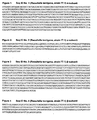
- the enzymes of strains Raoultella terrigena, strain 77.1 (Seq ID No. 2 and 4), Raoultella terrigena, strain 37.1 (Seq ID No. 6 and 8) and Klebsiella oxytoca, strain 38.1.2 (Seq ID No. 18 and 20) are characterized by the presence of the following motives in the primary structure of the ⁇ -subunit and/or ⁇ -subunit which are not present in anyone of the enzymes in the state of the art:
- sequence comparisons were based on a ClustalX- alignment of complete and non-redundant protein sequences of ⁇ - and ⁇ -subunits available at the NCBI.
- NCBI's Entrez search and retrieval system have been compiled from a variety of sources, including SwissProt, PIR, PRF, PDB, and translations from annotated coding regions in GenBank and RefSeq. These databases were searched by the key word: "nitrile hydratase”. From these sequences a Hidden Markov Model (HMM) was build and used to search the environmental database. These entries were then included in the alignment.
- HMM Hidden Markov Model
- strains Raoultella terrigena are characterized by higher enantioselectivities towards rac-mandelonitrile and rac-2-phenylpropionitrile than reported for any other nitrile hydratase.
- the recombinant enzyme comprising the polypeptides according to Seq ID Nos.
- HT40-6 was reported to convert racemic mandelonitrile enantioselectively also with a preference for the ( S )-enantiomer, but no E -values were given for this conversion ( EP 0711836 ). Furthermore, the enzymes comprising the polypetides according to Seq ID Nos. 2 and 4 ( Raoultella terrigena 77.1), according to Seq ID Nos. 6 and 8 ( Raoultella terrigena 37.1), according to Seq ID Nos. 10 and 12 ( Pantoea sp. 17.3.1), according to Seq ID Nos. 14 and 16 ( Brevibacterium lines 32B.1) and according to Seq ID Nos.
- the enzyme comprising polypeptides according to Nos. 2 and 4 ( Raoultella terrigena 77.1) and according to Seq ID Nos. 18 and 20 ( Klebsiella oxytoca 38.1.2) surprisingly showed a broad substrate specificity converting a series of aromatic as well as aliphatic nitriles as given in table 16.
- the low-molecular mass nitrile hydratase from Rhodococcus rhodochrous J1 was reported also to convert aromatic and aliphatic nitriles (Wieser et al, 1998 [32]). A preference for one enantiomer in the conversion of racemic nitriles was not reported.
- NHase enzyme consisting of the ⁇ - and ⁇ -subunits encoded by SEQ ID NOs: 13 and 15 which are isolated from Brevibacterium linens, strain 32B.1, for which a gene for an activator, designated P16K, was identified.
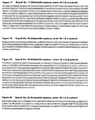
- the nucleic acid sequence of the P16K gene isolated from Brevibacterium linens, strain 32B.1 is depicted in figure 21 (SEQ ID NO: 21).
- the amino acid sequence of the encoded protein is depicted in figure 22 (SEQ ID NO: 22).
- the polynucleotide or pair of polynucleotides has/have (a) sequence(s) encoding the ⁇ - and the ⁇ -subunit or the complementary strand of such a polynucleotide are derived from the same species.
- the enzymes consisting of subunits having a sequence of the pairs of Seq. ID NOs: 2 and 4, 6 and 8, 10 and 12, 14 and 16 as well as 18 and 20 were found to convert rac-mandelonitrile enantioselectively with E app -values as given in Table 13.
- polynucleotide or a pair of polynucleotides encoding an enzyme having nitrile hydratase (NHase) [E.C. 4.2.1.84] activity, wherein the coding sequence is selected from the group consisting of:
- this alternative polynucleotide or pair of polynucleotides encode an enzyme having NHase activity which comprises at least one ⁇ -subunit and one ⁇ -subunit.
- a first subunit which is an ⁇ - or a ⁇ -subunit corresponds to or is derivable from one of the polynucleotides as shown in SEQ ID NOs: 1, 5, 9, 13 or 17 or SEQ ID NOs: 3, 7, 11, 15 or 19.
- the second subunit which completes the pair of the ⁇ - and the ⁇ -subunit, may be a subunit from a NHase of the state of the art which forms with the first subunit the enzyme having NHase activity.
- a combination of an ⁇ - and a ⁇ -subunit from two different organisms (of two different strains of the same species, of two different species of the same genus or of two different species of different polynucleotide or pair of polynucleotides genera) according to the alternative provide chimeric enzymes which can have unexpected substrate spectra and/or substrate specificity.
- the change of the substrate spectrum and/or the substrate specificity of such chimeric enzymes compared to the non-chimeric enzymes can be a result from the grouping of subunits from two different organisms. This grouping can e.g.
- the polynucleotide or pair of polynucleotides of the invention all thymidine residues may be replaced by uridine residues.
- the polynucleotide or pair of polynucleotides is/are (a) RNA.
- polynucleotide or pair of polynucleotides of the invention is/are characterized by a substitution of the sugar-phosphate backbone by a peptide backbone.
- polynucleotide or pair of polynucleotides is/are (a) PNA.
- polynucleotide or pair of polynucleotides of the invention is/are DNA, including genomic DNA.
- At least one of the coding regions for the ⁇ - or the ⁇ -subunit of the polynucleotide or pair of polynucleotides is fused with a heterologous or homologous polynucleotide.
- This heterologous or homologous polynucleotide may or may not be or comprise a coding region.
- the polynucleotide and/or the encoded enzyme having NHase activity is/are either heterologous with respect to the host or is/are homologous with respect to the host but located in a different genomic environment than the naturally occurring counterpart of said nucleotide sequence.
- a polynucleotide is "heterologous" when it is derived from a cell or organism belonging to a different strain (preferably to a different species) with regard to the origin of the sequence encoding the ⁇ - or ⁇ -subunit of the NHase.
- a polynucleotide is "homologous" when it is derived from the same cell or organism as the sequence encoding the ⁇ - or ⁇ -subunit of the NHase of the invention.
- "Homologous" with respect to the host but located in a different genomic environment than the naturally occurring counterpart of said nucleotide sequence means that, if the nucleotide sequence is homologous with respect to the host (i.e. is naturally present in the same strain or species), it is not located in its natural location in the genome of said host. In particular it may be surrounded by different genes. In this case the nucleotide sequence may be either under the control of its own promoter or under the control of a heterologous promoter.
- the location of the introduced nucleic acid molecule can be determined by the skilled person by using methods well-known in the art, including Southern blotting.
- the polynucleotide(s) according to the invention which is/are present in the host may either be integrated into the genome of the host or be maintained extrachromosomally.
- the polynucleotide or pairs of polynucleotides of the invention can be used to restore or create a mutant gene via homologous recombination.
- the heterologous or homologous polynucleotide encodes a polypeptide.
- a homologous polypeptide is the P16K polypeptide/protein (albeit this protein is in the construct of the invention located in a different position relative to the ⁇ or ⁇ coding sequence as compared to the natural situation).
- the P16K protein is an example for an activator derived from Brevibacterium linens , strain 32B.1. As also described herein above, such activators are supposed to be involved in the incorporation of the cofactor into the active site of some NHases.
- the polypeptide encoded by the heterologous polynucleotide may be the P16K activator or a functional fragment thereof.
- the polynucleotide or pair of polynucleotides of the present invention is part of a vector or a pair of vectors.
- a vector may be, e.g., a plasmid, cosmid, virus, bacteriophage or another vector used e.g. conventionally in genetic engineering.
- the polynucleotide or the pair of polynucleotides of the present invention may be inserted into several commercially available vectors.
- Non-limiting examples include prokaryotic plasmid vectors, such as the pUC-series, pBluescript (Stratagene), the pET-series of expression vectors including the pETduet-vectors (Novagen) or pCRTOPO (Invitrogen) and vectors compatible with an expression in mammalian cells like pREP (Invitrogen), pcDNA3 (Invitrogen), pCEP4 (Invitrogen), pMC1neo (Stratagene), pXT1 (Stratagene), pSG5 (Stratagene), EBO-pSV2neo, pBPV-1, pdBPVMMTneo, pRSVgpt, pRSVneo, pSV2-dhfr, pIZD35, pLX
- yeast expression systems for the expression of a prokaryotic NHase has been e.g. described for the methylotropic yeast Pichia pastoris [33].
- Examples for plasmid vectors suitable for Pichia pastoris comprise e.g. the plasmids pAO815, pPIC9K and pPIC3.5K (all Intvitrogen).
- the polynucleotide or the pair of polynucleotides of the present invention referred to above may also be inserted into vectors such that a translational fusion with another polynucleotide is generated.
- the other polynucleotide may encode a protein which may e.g. increase the solubility and/or facilitate the purifcation of the fusion protein.
- Non-limiting examples include pET32, pET41, pET43.
- vector modification techniques see Sambrook and Russel (2001), loc. cit.
- vectors can contain one or more origin of replication (ori) and inheritance systems for cloning or expression, one or more markers for selection in the host, e. g., antibiotic resistance, and one or more expression cassettes.
- Suitable origins of replication include, for example, the Col E1, the SV40 viral and the M 13 origins of replication.
- the coding sequences inserted in the vector can e.g. be synthesized by standard methods, or isolated from natural sources. Ligation of the coding sequences to transcriptional regulatory elements and/or to other amino acid encoding sequences can be carried out using established methods.
- Transcriptional regulatory elements parts of an expression cassette
- These elements comprise regulatory sequences ensuring the initiation of the transcription (e. g., translation initiation codon, promoters, enhancers, and/or insulators), internal ribosomal entry sites (IRES) ( Owens, Proc. Natl. Acad. Sci.
- poly-A signals ensuring termination of transcription and stabilization of the transcript.
- Additional regulatory elements may include transcriptional as well as translational enhancers, and/or naturally-associated or heterologous promoter regions.
- the polynucleotide or pair of polynucleotides of the invention is operatively linked to such expression control sequences allowing expression in prokaryotes or eukaryotic cells.
- the vector may further comprises nucleotide sequences encoding secretion signals as further regulatory elements. Such sequences are well known to the person skilled in the art.
- leader sequences capable of directing the expressed polypeptide to a cellular compartment may be added to the coding sequence of the polynucleotide of the invention. Such leader sequences are well known in the art.
- regulatory elements ensuring the initiation of transcription comprise the cytomegalovirus (CMV) promoter, SV40-promoter, RSV-promoter (Rous sarcome virus), the lacZ promoter, the gai10 promoter, human elongation factor 1 ⁇ -promoter, CMV enhancer, CaM-kinase promoter, the Autographa califomica multiple nuclear polyhedrosis virus (AcMNPV) polyhedral promoter or the SV40-enhancer.
- CMV cytomegalovirus
- SV40-promoter RSV-promoter
- RSV-promoter Rousarcome virus
- the lacZ promoter the gai10 promoter
- human elongation factor 1 ⁇ -promoter CMV enhancer
- CaM-kinase promoter the Autographa califomica multiple nuclear polyhedrosis virus (AcMNPV) polyhedral promoter or the SV40-enhancer.
- transcription termination signals such as SV40-poly-A site or the tk-poly-A site or the SV40, lacZ and AcMNPV polyhedral polyadenylation signals, downstream of the polynucleotide.
- the vector of the invention comprises a selectable marker.
- selectable markers include neomycin, ampicillin, and hygromycin resistance and the like.
- Specifically-designed vectors allow the shuttling of DNA between different hosts, such as bacteria- fungal cells or bacteria-animal cells.
- An expression vector according to this invention is capable of directing the replication, and the expression, of the polynucleotide or pair of polynucleotides and encoded enzyme of this invention.
- Suitable expression vectors which comprise the described regulatory elements are known in the art such as Okayama-Berg cDNA expression vector pcDV1 (Pharmacia), pRc/CMV, pcDNA1, pcDNA3 (In-Vitrogene, as used, inter alia in the appended examples), pSPORT1 (GIBCO BRL) or pGEMHE (Promega), or prokaryotic expression vectors, such as lambda gt11, pJOE, the pBBR1-MCS -series, pJB861, pBSMuL. pBC2, pUCPKS, pTACT1 or, preferably, the pET vector (Novagen).
- nucleic acid molecules of the invention as described herein above may be designed for direct introduction or for introduction via liposomes, phage vectors or viral vectors (e.g. adenoviral, retroviral) into the cell. Additionally, baculoviral systems or systems based on vaccinia virus or Semliki Forest Virus can be used as eukaryotic expression system for the nucleic acid molecules of the invention.
- the present invention in addition relates to a host genetically engineered with the polynucleotide or pairs of polynucleotides of the invention or with a vector of the invention.
- Said host may be produced by introducing said polynucleotide or pair of polynucleotides or vector(s) into a host which upon its/their presence mediates the expression of the enzyme having NHase activity.
- the host may be any prokaryote or eukaryotic cell.
- Suitable prokaryotes/bacteria are those generally used for cloning like E. coli (e.g., E coli strains HB101, DH5 ⁇ , XL1 Blue, Y1090 and JM101), Salmonella typhimurium, Serratia marcescens, Pseudomonas putida, Pseudomonas fluorescens, Streptomyces lividans, Lactococcus lactis, Mycobacterium smegmatis or Bacillus subtilis.
- a suitable eukaryotic host may be a mammalian cell, an amphibian cell, a fish cell, an insect cell, a fungal cell or a plant cell.
- Preferred examples for hosts to be genetically engineered with the polynucleotid or pair of polypeptidenucleotids of the invention are E. coli and Rhodococcus sp. The use of Rhodococcus sp. as host for recombinant expression of nucleic acid sequences is described e.g. in Mizunashi, W. et al. (Appl Microbiol Biotechnol. (1998) 49(5):568-72 ).
- the present invention relates to a process for producing a pair of polypeptides, forming heteromultimers, or a fusion protein having nitrile hydratase (NHase) [E.C. 4.2.1.84] activity and consisting of or comprising (an) ⁇ - and (a) ⁇ - subunit(s) as described herein above, the process comprising culturing the host of the invention and recovering the pair of polypeptides or the fusion protein encoded by the polynucleotide or pairs of polynucleotides of the invention.
- NHase nitrile hydratase
- fusion protein defines in the context of the invention an artificial protein retaining or essentially retaining NHase activity comprising at least two subunits comprised in a single amino acid chain which do not naturally occur as a single amino acid chain.
- a fusion protein according to the invention comprises at least one subunit which is a polypeptide of an ⁇ - or a ⁇ -subunit of an enzyme, having NHase activity.
- the fusion protein may comprise as an/the additional subunit a polypeptide or a peptide, which is fused to the polypeptide of the ⁇ - or a ⁇ -subunit.
- This other polypeptide or peptide (“fusion partner"), may e.g. increase the solubility or facilitate the purification of the fusion protein.
- the "fusion protein” comprises the ⁇ - and ⁇ -subunit of an enzyme having NHase activity in a single amino acid chain.
- the subunits may be connected via a peptide sequence which functions as a "linker".
- the linker is not naturally part of the polypeptide of either subunit.
- the linker may allow for a functional formation of the subunits of the NHase, i.e. allow for the formation of a functional enzyme.
- a fusion protein is preferably produced by ligation of the polynucleotides encoding the subunits and forming a single coding region comprising the coding regions for both subunits in a single uninterrupted reading frame.
- polypeptides or fusion proteins
- the host is a unicellular organism such as a prokaryote, a mammalian or insect cell, the person skilled in the art can revert to a variety of culture conditions.
- the produced protein is harvested from the culture medium, lysates of the cultured organisms or from isolated (biological) membranes by established techniques.
- the host may be a cell which is part of or derived from a part of the organism, for example said host cell may be the harvestable part of a plant.
- a preferred method involves the recombinant production of protein in hosts as indicated above.
- nucleotide acid sequences comprising the polynucleotide or pair of polynucleotides according to the invention can be synthesized by PCR, inserted into an expression vector. Subsequently a suitable host may be transformed with the expression vector. Thereafter, the host is cultured to produce the desired polypeptide(s), which is/are isolated and purified.
- Suitable cell-free expression systems for use in accordance with the present invention include rabbit reticulocyte lysate, wheat germ extract, canine pancreatic microsomal membranes, E. coli S30 extract, and coupled transcription/translation systems such as the TNT-system (Promega). These systems allow the expression of recombinant polypeptides upon the addition of cloning vectors, DNA fragments, or RNA sequences containing coding regions and appropriate promoter elements.
- fragments of the protein, the fusion protein or antigenic fragments of the invention may e.g. be produced by direct peptide synthesis using solid-phase techniques (cf Stewart et al. (1969) Solid Phase Peptide Synthesis; Freeman Co, San Francisco ; Merrifield, J. Am. Chem. Soc. 85 (1963), 2149-2154 ). Synthetic protein synthesis may be performed using manual techniques or by automation. Automated synthesis may be achieved, for example, using the Applied Biosystems 431A Peptide Synthesizer (Perkin Elmer, Foster City CA) in accordance with the instructions provided by the manufacturer. Various fragments may be chemically synthesized separately and combined using chemical methods to produce the full length molecule. As indicated above, chemical synthesis, such as the solid phase procedure described by Houghton Proc. Natl. Acad. Sci. USA (82) (1985), 5131-5135 , can be used.
- Protein isolation and purification can be achieved by any one of several known techniques; for example and without limitation, ion exchange chromatography, gel filtration chromatography and affinity chromatography, high pressure liquid chromatography (HPLC), reversed phase HPLC, and preparative disc gel electrophoresis.
- Protein isolation/purification techniques may require modification of the proteins of the present invention using conventional methods. For example, a histidine tag can be added to the protein to allow purification on a nickel column. Other modifications may cause higher or lower activity, permit higher levels of protein production, or simplify purification of the protein.
- the invention also relates in a further alternative embodiment to a process for producing bacteria or eukaryotic cells capable of expressing a pair of polypeptides or a fusion protein having nitrile hydratase (NHase) [E.C. 4.2.1.84] activity and consisting or comprising of (an) ⁇ - and (a) ⁇ -subunit(s), the process comprising genetically engineering bacteria or eukaryotic cells with the vector of the invention.
- NHase nitrile hydratase
- the present invention relates to a pair of polypeptides or a fusion protein comprising the amino acid sequence encoded by a polynucleotide or pair of polynucleotides of the invention or obtainable by the process of the invention.
- the pair of polypeptides or fusion protein of the invention is produced according to the method of the invention.
- the pair of polypeptides or fusion protein of the invention may be produced synthetically or semisynthetically.
- the pair of polypeptides is suitable to form heteromultimers having NHase enzyme activity.
- the present invention relates to an antibody specifically binding to the pair of polypeptides or fusion protein of the invention. It is preferred that the antibody binds to the polypeptides or fusion protein of the invention in the form having NHase enzyme activity. Thus, it is preferred that the antibody binds to a heterodimer, a heterotetramer or a heteromer of even higher number of pairs of subunits of the pair of polypeptides. In the embodiment of the antibody which specifically binds to the fusion protein of the invention, the antibody specifically binds either to epitopes formed by the ⁇ - or the ⁇ -subunit of the fusion protein.
- the antibody may also bind to epitopes formed by the stretch of amino acids including the fusion point of the two heterologous polypeptides. This epitopes are characteristic (unique) for the fusion protein of the invention.
- the antibody of the present invention can be, for example, polyclonal or monoclonal.
- the term "antibody” also comprises derivatives or fragments thereof which still retain the binding specificity. Techniques for the production of antibodies are well known in the art and described, e.g. in Harlow and Lane “Antibodies, A Laboratory Manual”, Cold Spring Harbor Laboratory Press, 1988 and Harlow and Lane “Using Antibodies: A Laboratory Manual” Cold Spring Harbor Laboratory Press, 1999 .
- antibodies can be used, for example, for the immunoprecipitation, affinity purification and immunolocalization of the polypeptides or fusion proteins of the invention as well as for the monitoring of the presence and amount of such polypeptides, for example, in cultures of recombinant prokaryotes or eukaryotic cells or organisms.
- the antibody of the invention also includes embodiments such as chimeric single chain and humanized antibodies, as well as antibody fragments, like, inter alia, Fab fragments.
- Antibody fragments or derivatives further comprise F(ab') 2 , Fv or scFv fragments; see, for example, Harlow and Lane (1988) and (1999), loc. cit.
- F(ab') 2 , Fv or scFv fragments see, for example, Harlow and Lane (1988) and (1999), loc. cit.
- the (antibody) derivatives can be produced by peptidomimetics.
- techniques described for the production of single chain antibodies see, inter alia, US Patent 4,946,778 ) can be adapted to produce single chain antibodies specific for polypeptide(s) and fusion proteins of this invention.
- transgenic animals may be used to express humanized antibodies specific for polypeptides and fusion proteins of this invention.
- the antibody of this invention is a monoclonal antibody.
- any technique which provides antibodies produced by continuous cell line cultures can be used. Examples for such techniques include the hybridoma technique ( Köhler and Milstein Nature 256 (1975), 495-497 ), the trioma technique, the human B-cell hybridoma technique ( Kozbor, Immunology Today 4 (1983), 72 ) and the EBV-hybridoma technique to produce human monoclonal antibodies ( Cole et al., Monoclonal Antibodies and Cancer Therapy, Alan R. Liss, Inc. (1985), 77-96 ).
- antibody comprises antibody constructs which may be expressed in cells, e.g. antibody constructs which may be transfected and/or transduced via, inter alia, viruses or plasmid vectors.
- the antibody described in the context of the invention is capable to specifically bind/interact with an epitope of the polypeptides or fusion protein of the invention.
- the term "specifically binding/interacting with” as used in accordance with the present invention means that the antibody does not or essentially does not cross-react with an epitope of similar structure. Thus, the antibody does not bind to prior art NHases.
- Cross-reactivity of a panel of antibodies under investigation may be tested, for example, by assessing binding of said panel of antibodies under conventional conditions to the epitope of interest as well as to a number of more or less (structurally and/or functionally) closely related epitopes. Only those antibodies that bind to the epitope of interest in its relevant context (e.g.
- the antibody specifically binds to/interacts with conformational or continuous epitopes which are unique for the polypeptides or fusion protein of the invention.
- a conformational or discontinuous epitope is characterized for polypeptide antigens by the presence of two or more discrete amino acid residues which are separated in the primary sequence, but come together on the surface of the molecule when the polypeptide folds into the native protein/antigen ( Sela, (1969) Science 166, 1365 and Laver, (1990) Cell 61, 553-6 ).
- the two or more discrete amino acid residues contributing to the epitope are present on separate sections of one or more polypeptide chain(s).
- a continuous or linear epitope consists of two or more discrete amino acid residues which are present in a single linear segment of a polypeptide chain.
- primer which specifically hybridizes under stringent conditions to a polynucleotide or either one of the pair of polynucleotides of the invention.
- the primer is at least 10, more preferably at least 15, further preferably at least 20, furthermore preferably at least 25 nucleotides in length.
- primer when used in the present invention means a single-stranded nucleic acid molecule capable of annealing to the nucleic acid molecule of the present invention and thereby being capable of serving as a starting point for amplification or elongation. For an amplification reaction it is preferred that a pair of primers is elected.
- primers means a pair of primers that are with respect to a complementary region of a nucleic acid molecule directed in the opposite direction towards each other to enable, for example, amplification by polymerase chain reaction (PCR).
- PCR polymerase chain reaction
- amplifying refers to repeated copying of a specified sequence of nucleotides resulting in an increase in the amount of said specified sequence of nucleotides and allows the generation of a multitude of identical or essentially identical (i.e. at least 95% more preferred at least 98%, even more preferred at least 99% and most preferred at least 99.5% such as 99.9% identical) nucleic acid molecules or parts thereof.
- Such methods are well established in the art; see Sambrook et al. "Molecular Cloning, A Laboratory Manual", 2nd edition 1989, CSH Press, Cold Spring Harb or. They include polymerase chain reaction (PCR) and modifications thereof, ligase chain reaction (LCR) to name some preferred amplification methods.
- the nucleic acid molecule of the invention is labeled.
- the label may, for example, be a radioactive label, such as 32 P, 33 P or 35 S.
- the label may be a non-radioactive label, for example, digoxigenin, biotin and fluorescence dye or a dye.
- the present invention relates to a composition
- a composition comprising the polynucleotide or pair of polynucleotide, the pair of polypeptides or fusion protein, and/or the antibody of the invention.
- composition as used in accordance with the present invention, relates to a composition which comprise at least one of the recited compounds. It may, optionally, comprises further molecules capable of altering the characteristics of the compounds of the invention thereby, for example, suppressing, stabilizing, blocking, modulating and/or activating their function.
- the composition may be in solid, liquid or gaseous form and may be, inter alia, in the form of (a) powder(s), (a) tablet(s), (a) solution(s) or (an) aerosol(s).
- the invention relates to a method for the production of amides comprising the enantioselective conversion of nitriles by a heteromultimer, formed by the pair of polypeptides, or a fusion protein according to the invention.
- a corresponding process is exemplified in the appended example 9.
- sequence tags were amplified from the genomic DNA of the strains isolated as described above.
- the PCR reactions were performed with 100 ng of genomic DNA, 10 pmol each of forward and reverse primer, 200 ⁇ M of each dNTP and 2,5 U of Taq polymerase, e.g. the HotStarTaq-Polymerase (Qiagen), in a 50 ⁇ l volume of buffer provided by the manufacturer of the polymerase.
- Taq polymerase e.g. the HotStarTaq-Polymerase (Qiagen)
- PCR-products were cloned and sequenced by techniques known to persons in the state of the art. To determine the full length sequence of the genes encoding the ⁇ - and the ⁇ -subunits, genomic libraries were constructed for each of the identified strain in E. coli. Clones from the libraries carrying the genes encoding the nitrile hydratases were identified by a PCR-screening using specific primers derived from the sequence-tags.
- the determination of the full length sequence was performed by techniques known to persons in the state of the art.
- the corresponding NHase genes were PCR amplified to introduce unique restriction enzyme recognition sequences upstream and downstream of the open reading frame (ORF) which allowed to ligate the genes encoding the NHases to the expression vector in a definite way.
- the restriction enzyme recognition sequences were chosen on the basis of their absence in the coding region of the NHase genes and could be e.g. Ndel, Xhol.
- the absence of unwanted second site mutations due to erroneous amplification by the polymerase was confirmed by sequencing of the cloned amplicons.
- the genes encoding the ⁇ - and the ⁇ -subunits were amplified separately.
- E. coli BL21 DE3
- E. coli Rosetta DE3
- Freshly transformed cells were grown over night at 37°C in 5 ml LB-medium containing 100 ⁇ g/ml ampicillin, 25 ⁇ g/ml kanamycin and 2% (w/v) glucose.
- E. coli BL21 DE3
- E. coli Rosetta DE3
- Freshly transformed cells were grown over night at 37°C in 5 ml LB-medium containing 100 ⁇ g/ml ampicillin, 25 ⁇ g/ml kanamycin and 2% (w/v) glucose.
- enzyme samples were prepared as follows: the cells from 1 ml of the culture were washed with 50 mM Tris/HCl pH 7.5 and resuspended in 750 ⁇ l of the same buffer. This suspension was incubated at 30°C in a thermomixer at 1000 rpm. The biotransformation was started by addition of the substrate 2-phenylpropionitrile (PPN) in 50 mM Tris/HCl pH 7.5. The concentration of the substrate was 1 mM, if not otherwise stated. The reaction was stopped after 1 min, 5 min or 10 min as indicated by addition of 1 M HCl. Cells were removed by centrifugation and the supernatant analysed by HPLC for the presence of the corresponding amide.
- PPN 2-phenylpropionitrile
- the HPLC analysis was carried out on a system comprising a Surveyor 4 channel Pump, AutoSampler and UV/VIS detector at 210 nm from Thermo Finnigan on a Grom-Sil 120 ODS-3cp 3 ⁇ m (125 x 4.6 mm) reverse phase column.
- As mobile phase acetonitrile and 0.3% H 3 PO 4 were used in a ratio of 50:50 at a flow of 0.7 ml/min, respectively.
- rac-Mandeloamide was analysed on a HPLC comprising a Surveyor 4 channel Pump, AutoSampler and UV/VIS detector at 210 nm from Thermo Finnigan on a Nucleodex ⁇ -OH column (Macherey & Nagel) using 50% methanol/water : water (40:60) as mobile phase at a flow rate of 0.7 ml/min.
- E app The apparent enantiomeric ratio (E app ) of the conversion of mandelonitrile was calculated according to Straathof and Jongejan for asymmetric catalysis (see example 9).
- 2-phenylpropionamide the samples were lyophilized and resuspended in n-hexane : 2-propanol (80:20). Prior to injection, the samples were additionally dried with sodium sulfate and were centrifugated at 16,000 g for 5 min.
- the supernatants were analyzed using a Chiracel OD column (Daicel) on a Spectra System (AS3000, P2000, UV2000 at 210 nm) from Thermo Separation Products with n-hexane : 2-propanol (80:20) as mobile phase at a flow rate of 0.5 ml/min.
- the enantiomeric ratio (E) of the conversion of PPN was calculated according to Chen et al [17] .
- the pH-optimum for the enzyme according to Seq ID No. 2 and 4 has its pH-optimum at pH 6.75 ( fig. 27 ). Whereas the recombinantly produced enzyme showed no activity at a pH ⁇ 6.0 the homologously produced enzyme displays a residual activity of abaout 6% at pH 4.0. Both enzyme preparations had a residual activity of about 27% at pH 10.0 ( fig 25 and 26 )
- the NHase according to Seq ID. No. 18 and 20 was determined to be between pH 7.0 - pH 7.5 ( fig 28 and fig 29 ).
- the enzyme is inactivated at a pH-value ⁇ 6 whereas lyophilized cells showed a residual activity of about 10 % even at pH 3.0.
- the residual activity of the enzyme is about 65 - 75%.
- the IEP of the purified enzyme accoding to Seq. ID No. 2 and 4 was determined to be 3.5 - 3.6 using the Phast-System (Amersham Pharmacia).
- Washed cells are resuspended in 50 mM Na 2 HPO 4 /KH 2 PO 4 pH 7.5. The reaction is started by addition of mandelonitrile to a final concentration of 1 mM. The biotransformation is performed at 30°C.
- aureofaciens MOB C2-1 2-(6-methoxy-2-naphtyl)-propionitrile R [13, 16]
- aureofaciens MOB C2-1 2-(4-isobutylphenyl)-propionitrile S [13, 16] A.
- nitrile hydratase beta subunit E03848 Rhodococcus rhodochrous 62,0% 677bp [49]
- Tab. 11 Sequence identity of the enzyme according to Seq Id No. 17 ( Klebsiella oxytoca, strain 38.1.2 ⁇ -subunit) next neighbour gene identifier organism identity overlap reference nitrile hydratase alpha subunit E08305 Klebsiella sp. MCI2609 86,0% 609 bp [42] nitrile hydratase alpha subunit ATU511276 Agrobacterium tumefaciens 76,3% 579 bp Lourenco et al.
- Enzyme samples of the NHase from Raoultella terrigena, 77.1 were used as cell free crude cell extracts whereas those from Klebsiella oxytoca, 38.1.2 were lyophilized cells. 100% activity towards 2-phenyl-propionitrile relates to 2,43 nkat and 4.0 nkat for the NHases from Raoultella terrigena, 77.1 and Klebsiella oxytoca, 38.1.2, respectively. rel.
Landscapes
- Chemical & Material Sciences (AREA)
- Organic Chemistry (AREA)
- Life Sciences & Earth Sciences (AREA)
- Zoology (AREA)
- Engineering & Computer Science (AREA)
- Wood Science & Technology (AREA)
- Health & Medical Sciences (AREA)
- Genetics & Genomics (AREA)
- Bioinformatics & Cheminformatics (AREA)
- Microbiology (AREA)
- General Engineering & Computer Science (AREA)
- Biotechnology (AREA)
- General Health & Medical Sciences (AREA)
- Biochemistry (AREA)
- General Chemical & Material Sciences (AREA)
- Chemical Kinetics & Catalysis (AREA)
- Molecular Biology (AREA)
- Medicinal Chemistry (AREA)
- Analytical Chemistry (AREA)
- Biomedical Technology (AREA)
- Enzymes And Modification Thereof (AREA)
- Micro-Organisms Or Cultivation Processes Thereof (AREA)
- Peptides Or Proteins (AREA)
Abstract
Description
- The present invention provides a polynucleotide or a pair of polynucleotides encoding an enzyme having nitrile hydratase (NHase) [E.C. 4.2.1.84] activity. Furthermore, a vector and a host comprising the disclosed polynucleotide or pair of polynucleotides and methods for the production of the same are provided. Moreover, the invention relates to polypeptides or a fusion protein having NHase activity, an antibody specifically binding to the polypeptides or fusion protein, a composition comprising the polynucleotide or pair of polynucleotides, the polypeptides or fusion protein and/or the antibody of the invention and a method for the production of amides comprising the enantioselective conversion of nitriles.
- NHases are typically composed of two different subunits (α and β) building heteromultimers, usually heterodimers or heterotetramers [1]. The subunits typically have molecular weights ranging from 22- 28 kDa. In bacteria the structural genes of NHases are located usually in a cluster comprising also the genes encoding an amidase, regulatory proteins and in certain cases an NHase activator protein [2, 3, 4]. It seems that the physiological role of NHases in bacteria is the metabolism of plant derived aldoxims, since the ability to convert aldoxims to nitriles by aldoxim dehydratase and nitrile converting activity are tightly coupled [5].
- NHase are metalloenzymes, containing a non-heme iron or a non-corrinoid cobalt atom at the catalytic site [6]. All the metal ion protein ligands are contained within the α-subunit [7]. Spectroscopic and three-dimensional structure analysis of NHases revealed that the metal atoms were found on five verticals of an octahedron. The ligands were found to be located in the conserved sequence motif "-V-C-(T/S)-L-C-S-C="; the ligands being three cystein thiolate and two main chain nitrogen atoms. Two of the cysteins were found to be posttranslationally oxidized to cystein-sulfinic and cystein-sulfenic acids. The cobalt NHases have a threonine residue in the conserved active-site motif, whereas the ferric NHases have a serine.
- The requirement of other proteins for the production of active NHases from different organisms has been reported [5, 8, 9, 10]. While small proteins (12-16 kDa) homologous to the N-terminus of NHase β-subunits (β-homologues) are associated with the cobalt-dependent enzymes, the corresponding proteins of the iron-dependent NHases have a molecular weight of 43-47 kDa [2]. These "activators" might be involved in the incorporation of the cofactor into the active site of NHases [11]. However, not for all NHases activator proteins have been described and in the case of the NHases from the thermophile Bacillus sp. BR449 [12] and Bacillus sp. RAPc8 [2] homologous genes were identified downstream of the NHase structural genes which are not necessary for the functional expression.
- Biotransformations using microbial nitrite and amide-converting enzymes have developed considerably in recent years [13]. Such biotransformations using enantioselective NHases and/or enatioselective nitrilases are described in
WO 2002/29079 WO 2005/090595 , or Robertson et al. (Applied and Environmental Microbiology, 2004, Vol. 70, No. 4, p. 2429-2436). The large scale NHase-catalysed synthetic processes for the production of acrylamide, nicotinamide and 5-cyanovaleramide are outstanding examples of the use of enzymes in an industrial environment [14]. - Products intended for use in biological systems must often be synthesized in a particular enantiomeric form due to preferences that correlate with the "handedness" (i.e., optical rotation) of the molecule. For example, only the (S)-form of the widely prescribed anti-inflammatory Naproxen (2-(6-methoxy-2-naphthyl)propionic acid) is clinically effective. The (R)-form is toxic [15]. Therefore, the drug must be supplied such that the (S)-enantiomer, and not the (R)-enantiomer, is highly enriched in the final product. A similar situation exists for many other pharmaceutical and agricultural chemicals. However, the synthesis chemist is often faced with a difficult problem because most chemical catalysts do not discriminate by optical form. In fact, it is very difficult to synthesize a single enantiomer. Moreover, because enantiomers, by definition, have identical physical properties and differ only in the direction that they rotate plane polarized light, separation of individual enantiomers from a mixture of (S)- and (R)-enantiomers is difficult [16].
- The stereopreference of an enzyme is described by the enantiomeric excess (ee) which is given by the formula
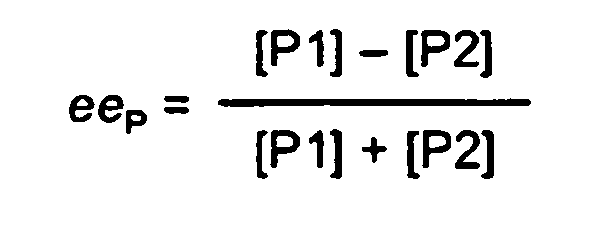
where P1 and P2 are the concentrations of the two stereoisomers in the reaction product and P1 is present in a higher concentration than P2. However, this term is not sufficient to describe the enantioselectivity of an enzyme since the term "ee" depends on the degree of conversion of the substrate. Initially the preferred substrate will be converted faster to the product P1 than the non-preferred substrate to product P2 so that the concentration of the preferred substrate will decrease during the reaction. This in turn will lead to an increased conversion of the non-preferred substrate and to a decrease in eep with increasing conversion. - Thus the enantioselectivity of an enzyme is better described by the term "E" given by the formula

where the conversion ξ is given by
- Csubstrate and Cproduct denote the concentrations of the substrates and products, respectively. [17, 18]
- The apparent enantiomeric ratio (E app) is used in the case of asymmetric catalysis. E app is calculated from

as described by Straathof and Jongejan, 1997 [41]. - NHases with an enantiopreference for certain cyanohydrine substrates were described for a few genera of bacteria, namely Pseudomonas, Agrobacterium, Rhodococcus, Moraxella and Serratia (Tables 1 + 2). However, the enantioselectivity given as E-value of NHases was determined only in very few cases (Table 2).
- Although there are numerous publications describing possible biotransformations using NHases as summarized by Cowan et al. [1], the limited availability of novel and well-characterised NHases especially with respect to enantioselectivity and substrate specificity [6] restricts their application in industrial processes [13].
- Thus, the technical problem underlying the present invention was to provide means and methods for an improvement of the spectrum of enzymes capable of the enantioselective catalysis of nitriles to the corresponding amides. The provision of such enzymes is expected to increase the efficiency of the conversion and further reduce the costs for the industrial applications of the produced amides. The solution to this technical problem is achieved by the embodiments characterized in the claims.
- Accordingly, the present invention relates in a first embodiment to a polynucleotide or a pair of polynucleotides encoding an enzyme having nitrile hydratase (NHase) [E.C. 4.2.1.84] activity, wherein the coding sequence is selected from the group consisting of:
- (a) a polynucleotide or a pair of polynucleotides having or comprising a nucleotide sequence encoding an α-subunit of the NHase having the amino acid sequence as shown in one of SEQ ID NOs: 2, 6 and 18, and a β-subunit of the NHase having the amino acid sequence as shown in one of SEQ ID NOs: 4, 8 and 20;
- (b) a polynucleotide or a pair of polynucleotides having or comprising a nucleotide sequence as shown in one of SEQ ID NOs: 1, 5 and 17 and encoding an α-subunit of the NHase, and a nucleotide sequence as shown in one of SEQ ID NOs: 3, 7 and 19 and encoding a β-subunit of the NHase;
- (c) a polynucleotide or a pair of polynucleotides comprising a nucleotide sequence which is at least 85% identical to a polynucleotide encoding the β-subunit of the NHase as shown in one of SEQ ID NOs: 3, 7 or 19, or at least 90% identical to a polynucleotide encoding the α-subunit of the NHase as shown in one of SEQ ID NOs: 1, 5 or 17; and
- (d) a polynucleotide or a pair of polynucleotides having a nucleotide sequence being degenerate to the nucleotide sequence of the polynucleotide or pair of polynucleotides of (c);
- In accordance with the present invention, the fragment, derivative etc. encoded by the polynucleotide or pair of polynucleotides of any items (c) to (d) retains or essentially retains NHases enzymatic activity.
- An enzyme having nitrile hydratase (NHase) [E.C. 4.2.1.84 according to the IUBMB Enzyme Nomenclature] activity is capable to convert nitrile to the corresponding amide. Assays for the determination of the characteristic activity profile of a given enzyme are known in the art. A characteristic activity profile for a NHase can be determined as described in Bauer et al, 1998 [22]. Briefly, cells showing NHase activity are washed and resuspended e.g. in sodium/potassium phosphate buffer (50
mM pH 7,4). Cell suspensions are incubated with the substrates in a final concentration of 0,5 - 1 mM under defined conditions with respect to temperature and shaking. Cells are removed by centrifugation from aliquots taken in defined intervals. - The supernatants are analyzed by HPLC. These assays can be employed by the skilled artesian without further ado in the determination whether e.g. a fragment or derivative or homolog etc. encoded by the polynucleotide or pair of polynucleotides in any of items (c) to (d); above, will retain or essentially retain NHase activity.
- In accordance with the present invention, activity is essentially retained, if at least 20% of the enzymatic activity of the corresponding "wild type" enzyme recited in items (a) or (b), supra, is obtained, preferably applying one of the test formats described herein above in the context of the determination of the enzyme activity of NHases of the state of the art. Preferably, at least 50, such as at least 60%, at least 75% or at least 80% of the activity are retained. More preferred is that at least 90% such as at least 95%, even more preferred at least 98% such as at least 99% of the enzymatic activity are retained. Most preferred is that the enzymatic activity, i.e. the capacity to convert nitriles to the corresponding amides, is fully, i.e. to 100% retained. Also in accordance with the invention is an enzyme having increased NHase activity compared to the corresponding wild type enzyme, i.e. more than 100% enzyme activity of the reference wild type enzyme.
- A reduced or enhanced enzymatic activity as compared to the corresponding "wild type" enzyme may be a consequence of e.g. the substitution of one of the three cysteins in the consensus motif "C-S/T-L-C-S-C"in the α-subunits of NHases [23], of the substitution of the threonine (T) in the consensus motif "C-T-L-C-S-C" of cobalt-dependent NHases [24], of the substitution of a conserved tyrosine (Y) in the β-subunits of NHases [24], of the substitution of two conserved arginines (R) in the β-subunits of NHases [25, 26], of the replacement of a conserved tyrosine (Y) residue which follows the consensus motif "C-T-L-C-S-C" in cobalt-dependent NHases [24], of the expression of the genes encoding the subunits of the NHase in host cells in a medium lacking the necessary metal ion [cobalt or iron] [24] or supplying only the metal ion not found in the wild type NHase [27], of the expression of the genes encoding the subunits of the NHase in the absence of the corresponding activator protein [5,8,9,10], or of any other pertubation of the ligand set necessary to coordinate the metal ion essential for catalysis.
- As outlined herein above, a NHase is typically composed of an α- and a β-subunit. In line with the invention the α- and the β-subunit of a NHase may be derived from two different organisms of the same strain, two different strains of the same species, two different species of the same genus or from two different genera. Alternatively, the subunits are derived from the organisms of the same genus, more preferred from the same species, or even more preferred form the same strain. Preferably, the genera from which the subunits are derived from are selected from the group of genera consisting of Raoultella, Pantoea, Brevibacterium and Klebsiella. More preferably, the α- and the β-subunit, of a NHase are derived from Raoultella terrigena, strain 77.1 or strain 37.1, Pantoea sp., strain 17.3.1, Brevibacterium linens, strain 32B.1 or Klebsiella oxytoca, strain 38.1.2. The isolation of the corresponding strains has been reported by Hensel et al. 2002 [28].
- According to the present invention, it is generally preferred that, in the case of a pair of polynucleotides, one of the polynucleotides encodes the α-subunit of the NHases whereas the second polynucleotide of the pair of polynucleotides encodes the β-subunit.
- In accordance with the present invention the term "polynucleotide" defines a nucleic acid molecule consisting of more than 30 nucleotides. The group of molecules subsumed under polynucleotides also comprise complete genes. Also included by said definition are vectors such as cloning and expression vectors.
The term "oligonucleotides" describes in the context of the invention nucleic acid molecules consisting of at least ten and up to 30 nucleotides. - Nucleic acid molecules, in accordance with the present invention, include DNA, such as cDNA or genomic DNA, RNA (e.g. mRNA), also in synthetic or semisynthetic form, further synthetic or semisynthetic derivatives of DNA or RNA (e.g. PNA or phosphorothioates) and mixed polymers, both sense and antisense strands. They may contain additional non-natural or derivatized nucleotide bases, as will be readily appreciated by those skilled in the art. In a preferred embodiment of polynucleotide or pair of polynucleotide the nucleic acid molecule(s) is/are DNA.
- For the purposes of the present invention, a peptide nucleic acid (PNA) is a polyamide type of DNA analog and the monomeric units for the derivatives of adenine, guanine, thymine and cytosine are available commercially (Perceptive Biosystems). Certain components of DNA, such as phosphorus, phosphorus oxides, or deoxyribose derivatives, are not present in PNAs. As disclosed by Nielsen et al., Science 254:1497 (1991); and Egholm et al., Nature 365:666 (1993), PNAs bind specifically and tightly to complementary DNA strands and are not degraded by nucleases. In fact, PNA binds more strongly to DNA than DNA itself does. This is probably because there is no electrostatic repulsion between the two strands, and also the polyamide backbone is more flexible. Because of this, PNA/DNA duplexes bind under a wider range of stringency conditions than DNA/DNA duplexes, making it easier to perform multiplex hybridization. Smaller probes can be used than with DNA due to the strong binding. In addition, it is more likely that single base mismatches can be determined with PNA/DNA hybridization because a single mismatch in a PNA/DNA 15-mer lowers the melting point (T.sub.m) by 8°-20° C, vs. 4°-16° C for the DNA/DNA 15-mer duplex. Also, the absence of charge groups in PNA means that hybridization can be done at low ionic strengths and reduce possible interference by salt during the analysis.
- In those embodiments where the polynucleotide or pair of polynucleotides comprises (rather than have) the recited sequence, additional nucleotides extend over the specific sequence either on the 5' end or the 3' end or both. Those additional polynucleotides may be of heterologous or homologous nature and may comprise stretches of about 50 to 500 nucleotides although higher or lower values are not excluded. In the case of homologous sequences, those embodiments do not include complete genomes and are generally confined to about 1000 additional nucleotides ate the 5' and/or the 3' end. Additional heterologous sequences may include heterologous promoters which are operatively linked to the coding sequences of the invention.
- The term "polypeptide" as used herein describes a group of molecules which consist of more than 30 amino acids. In accordance with the invention, the group of polypeptides comprises "proteins" as long as the proteins consist of a single polypeptide. Also in line with the definition the term "polypeptide" describes fragments of proteins as long as these fragments consist of more than 30 amino acids. Polypeptides may further form multimers such as dimers, trimers and higher oligomers, i.e. consisting of more than one polypeptide molecule. Polypeptide molecules forming such dimers, trimers etc. may be identical or non-identical. The corresponding higher order structures of such multimers are, consequently, termed homo- or heterodimers, homo- or heterotrimers etc. An example of a heteromultimer is a NHase according to the invention, which exists as heterodimer, a heterotetramer or even higher numbers of pairs of subunits. Homodimers, trimers etc. of fusion proteins, wherein each single fusion protein comprises at least one α-subunit and one β-subunit, giving rise or corresponding to enzymes such as the NHases of the present invention also fall under the definition of the term "protein". Furthermore, peptidomimetics of such proteins/polypeptides wherein amino acid(s) and/or peptide bond(s) have been replaced by functional analogs are also encompassed by the invention. Such functional analogues include all known amino acids other than the 20 gene-encoded amino acids, such as selenocysteine. The terms "polypeptide" and "protein" also refer to naturally modified polypeptides/proteins wherein the modification is effected e.g. by glycosylation, acetylation, phosphorylation and the like. Such modifications are well known in the art.
- The term "enzyme" defines in the context of the invention a polypeptide, polypeptides and/or protein(s), all comprising at least one α-subunit and one β-subunit according to the invention (as well as higher mulitmeric structures thereof) and having a specific NHase enzymatic activity.
- In accordance with the present invention, the term "percent identity" describes the number of matches ("hits") of identical nucleotides/amino acids of two or more aligned nucleic acid or amino acid sequences as compared to the number of nucleotides making up the overall length of the nucleic acid or amino acid sequences (or the overall compared part thereof). In other terms, using an alignment, for two or more sequences or subsequences the percentage of amino acid residues or nucleotides that are the same (e.g., 60% or 65% identity) may be determined, when the (sub)sequences are compared and aligned for maximum correspondence over a window of comparison, or over a designated region as measured using a sequence comparison algorithm as known in the art, or when manually alignment and visually inspected. This definition also applies to the complement of a test sequence. Preferred polynucleotides/polypeptides in accordance with the invention are those where the described identity exists over a region that is at least about 15 to 25 amino acids or nucleotides in length, more preferably, over a region that is about 50 to 100 amino acids or nucleotides in length. Those having skill in the art will know how to determine percent identity between/among sequences using, for example, algorithms such as those based on CLUSTALW computer program (Thompson Nucl. Acids Res. 2 (1994), 4673-4680) or FASTA [19], as known in the art.
- Although the FASTDB algorithm typically does not consider internal non-matching deletions or additions in sequences, i.e., gaps, in its calculation, this can be corrected manually to avoid an overestimation of the % identity. CLUSTALW, however, does take sequence gaps into account in its identity calculations. Also available to those having skill in this art are the BLAST and BLAST 2.0 algorithms (Altschul Nucl. Acids Res. 25 (1977), 3389-3402). The BLASTN program for nucleic acid sequences uses as defaults a word length (W) of 11, an expectation (E) of 10, M=5, N=4, and a comparison of both strands. For amino acid sequences, the BLASTP program uses as defaults a wordlength (W) of 3, and an expectation (E) of 10. The BLOSUM62 scoring matrix (Henikoff Proc. Natl. Acad. Sci., USA, 89, (1989), 10915) uses alignments (B) of 50, expectation (E) of 10, M=5, N=4, and a comparison of both strands. All those programs may be used for the purposes of the present invention. All of the above programs can be used in accordance with the invention.
- The values for the % identity are identified herein always with regard to a single subunit. Accordingly, for a single polynucleotide, which encodes an α- and a β-subunit of a NHase according to the invention, the % identity value to a second polynucleotide is calculated separately in alignments of the subsequences for the α-subunit and for the β-subunit.
- The term "hybridizes/hybridizing" as used herein refers to a pairing of a polynucleotide to a (partially) complementary strand of this polynucleotide which thereby form a hybrid.
- Said complementary polynucleotides may be useful as probes in Northern or Southern blot analysis of RNA or DNA preparations, PCRs and the like or primer extension protocols respectively. In this connection, the term "fragments thereof useful as specific probes or primers" refers to nucleic acid molecules the sequence of which is uniquely fitting to (hybridizing to/complementary to preferably 100%) the sequences of the nucleic acid molecules described in accordance with the present invention, but not to prior art sequences. The skilled person can identify such fragments by simple sequence alignments. For example, if there is a 100% stretch of identity with a prior art sequence, the addition of a further nucleotide to that sequence of identity will yield a novel sequence which is encompassed by the present invention, since it is to 100% complementary to the polynucleotide of the invention but not to the prior art sequence. Hybridizing polynucleotides of the present invention to be used as a probe in Southern or Northern blot preferably comprises at least 100, more preferably at least 200, and most preferably at least 500 nucleotides in length. As regards those polynucleotides or pairs of polynucleotides that hybridize to the complementary strand of the specifically disclosed polynucleotide sequences and retain or essentially retain NHase activity must encode at least the active center of the enzyme.
- It is well known in the art how to perform hybridization experiments with nucleic acid molecules. Correspondingly, the person skilled in the art knows what hybridization conditions s/he has to use to allow for a successful hybridization in accordance with item (e), above. The establishment of suitable hybridization conditions is referred to in standard text books such as Sambrook, Russell "Molecular Cloning, A Laboratory Manual", Cold Spring Harbor Laboratory, N.Y. (2001); Ausubel, "Current Protocols in Molecular Biology", Green Publishing Associates and Wiley Interscience, N.Y. (1989), or Higgins and Hames (Eds.) "Nucleic acid hybridization, a practical approach" IRL Press Oxford, Washington DC, (1985). In one preferred embodiment, the hybridization is effected is under stringent conditions.
- "Stringent hybridization conditions" refers to conditions which comprise, e.g. an overnight incubation at 42°C in a solution comprising 50% formamide, 5x SSC (750 mM NaCl, 75 mM sodium citrate), 50 mM sodium phosphate (pH 7.6), 5x Denhardt's solution, 10% dextran sulfate; and 20 µg/ml denatured, sheared salmon sperm DNA, followed by washing the filters in 0.1 x SSC at about 65°C. Said conditions for hybridization are also known by a person skilled in the art as "highly stringent conditions for hybridization". Also contemplated are nucleic acid molecules that hybridize to the polynucleotides of the invention at lower stringency hybridization conditions ("low stringency conditions for hybridization"). Changes in the stringency of hybridization and signal detection are primarily accomplished through the manipulation of formamide concentration (lower percentages of formamide result in lowered stringency), salt conditions, or temperature. For example, lower stringency conditions include an overnight incubation at 37°C in a solution comprising 6X SSPE (20X SSPE = 3M NaCl; 0.2M NaH2PO4; 0.02M EDTA, pH 7.4), 0.5% SDS, 30% formamide, 100 µg/ml salmon sperm blocking DNA; followed by washes at 50°C with 1X SSPE, 0.1% SDS. In addition, to achieve an even lower stringency, washes performed following stringent hybridization can be done at higher salt concentrations (e.g. 5X SSC). It is of note that variations in the above conditions may be accomplished through the inclusion and/or substitution of alternate blocking reagents used to suppress background in hybridization experiments. Typical blocking reagents include Denhardt's reagent, BLOTTO, heparin, denatured salmon sperm DNA, and commercially available proprietary formulations. The inclusion of specific blocking reagents may require modification of the hybridization conditions described above, due to problems with compatibility. Such modifications can generally be effected by the skilled person without further ado. A hybridization complex may be formed in solution (e.g., Cot or Rot analysis) or between one nucleic acid sequence present in solution and another nucleic acid sequence immobilized on a solid support (e.g., membranes, filters, chips, pins or glass slides to which, e.g., cells have been fixed). The embodiment recited herein above preferably refers to highly stringent conditions and alternatively to conditions of lower stringency.
- Further to the above, the term "a polynucleotide or a pair of polynucleotides having a nucleotide sequence the complementary strand of which hybridizes to a polynucleotide or pair of polynucleotides as defined in any one of (a) to (c) preferably refers to sequences which display a sequence identity of at least 70%, preferably of at least 80%, more preferred of at least 90%, even more preferred of at least 95% and most preferred of at least 97% with a nucleotide sequence as described above in items (a) or (b) encoding an enzyme having NHase activity of the invention.
- As stated herein above, also described herein are polynucleotides which are capable of hybridizing to the polynucleotides of the invention or parts thereof, under (highly) stringent hybridization conditions, i.e. which do not cross hybridize to polynucleotides unrelated in nucleotide sequence. Polynucleoties related but not identical in sequence with the polynucleotides of items a and (b) are also encompassed by the invention. In addition, also described herein are fragments of the polynucleotides of (a) and (b). It is essential that all fragments retain or essentially retain the enzymatic function of the NHase of the invention. In addition, it is essential that the complementary strand of the polynucleotide hybridizes to the polynucleotide of (a) or (b), preferably under stringent conditions. (The latter requirement is self-evident for fragments of polynucleotides of items (a) or (b) that retain enzymatic activity.) Also encompassed by the polynucleotides are allelic variants of polynucleotides of items (a) and (b).
- Polynucleotides are (partially) "complementary" if they naturally bind to each other under permissive salt and temperature conditions by base-pairing. For example, the sequence "A-G-T" binds to the complementary sequence "T-C-A". Complementarity between two single-stranded molecules may be "partial", in which only a portion of the nucleotides base pair, or it may be complete when all nucleotides over a given length base-pair. The degree of complementary between nucleic acid strands has significant effects on the efficiency and strength of hybridization between nucleic acid strands. This is of particular importance in nucleic acid amplification reactions, which depend upon binding between nucleic acids strands.
- Moreover, the present invention also relates to nucleic acid molecules the sequence of which is degenerate in comparison with the sequence of an above-described polynucleotide of item (c). When used in accordance with the present invention the term "being degenerate as a result of the genetic code" means that due to the redundancy of the genetic code different nucleotide sequences code for the same amino acid.
- It has been surprisingly found that the above described polynucleotides or pairs of polynucleotides encode novel NHases with a characteristic substrate specificity, enantioselectivity, reaction velocity, structure and/or reaction mechanism which is/are different compared to the ones of enzymes known in the art. The enzymes of strains Raoultella terrigena, strain 77.1 (Seq ID No. 2 and 4), Raoultella terrigena, strain 37.1 (Seq ID No. 6 and 8) and Klebsiella oxytoca, strain 38.1.2 (Seq ID No. 18 and 20) are characterized by the presence of the following motives in the primary structure of the α-subunit and/or β-subunit which are not present in anyone of the enzymes in the state of the art:
- α-subunits:
- "F-G-L-H-1-P" where other NHases are characterized by a sequence given by the motif [F, V, M, L]-[G, D, N,K]-[L, T, H, V, Y, F]-[S, H, E, D, T, A, P, N, R, K, V, M, I]-[L, F, I, P]
- "S-E-L-I" where other NHases are characterized by a sequence given by the motif [S, A, M, E, V, T, I, Q, R]-[E, A, S, D, P, T, K, Q, G, L]-[I, L, R]-[I, V, L]
- "V-V-T-A-P" where other NHases are characterized by a sequence given by the motif [L, V, P, N, K, R, G, F, I, D, E]- [P, T, A, V, D, E, I, L, C]-[K, Q, R, T, G, A, V, L, E, S, F, I, H]-[P, D, L, Q, A, R, T, K, S, E, N, Y, G, I, V]-[G, D, P, T, A, E, V, L, Q, H, V, S, P,'1]
- β-subunits:
- "P-I-P-T" where other NHases are characterized by a sequence given by the motif [K, Q, P, R, A, L, G, V]-[V, I, L, N, P]-[P, D, R, E, K, I, M, Y, A, L, Q, N, V, K, T]-[H, Y, I, A, K, R, P. N, L, Q, T, D, S, V]
- "Q-S" where other NHases are characterized by a sequence given by the motif [M, G, A, T, K, E, Q, R, S, N, D, L]-[T, A, L, S, G, M, V, K, F, Y, N]
- "L-A" where other NHases are characterized by a sequence given by the motif [V, T, I, L, A, S, E, A, K, R, Q, N]-[E, D, L, R, S, A, H, N, Q]
- "T-V" where other NHases are characterized by a sequence given by the motif [T, A, N, D, S, G, E, D, R]-[Q, H, R, E, S, P, A, L, M]
- "A-K-P" where other NHases are characterized by a sequence given by the motif [A, L, I, M, T, S, R, E, H, K, V, G, D]-[G, Q, A, R, E, K, T, P, M, S, D, A, E, H]-[G, S, E, V, A, Q, P, L, I, R, M, T, D, F, Y]
- "C-K-P-G-T-P" where other NHases are characterized by a sequence given by the motif [I, L, G, C, A, T, R, S, K, V, P, H, E]-[P, Q, K, A, V, E, T, S, M, N, D, G, R, I, H]-[R, T, Q, P, K, I, G, V, L, A, E]-[R, W, T, A, I, G, S, K, P, N, V, Q, D, E]-[E, D, T, M, R, A, H, K, E, S, Q, F, N]-[D, N, R, P, A, G, K, L, T, Q]
- "S-M-V-V" where other NHases are characterized by a sequence given by the motif [R, N, M, S, E, A, D, Q, T, P, G, V, I ]-[P, C, V, K; A, G, M, D, S, R, Q, E, L]-[S, A, P, N, V, L, I, Y, T, M, R]-[E, H, R, A, V, L, D, M, Y, W, P, T]
- "G-G-S" where other NHases are characterized by a sequence given by the motif [G, P, K, A, L, E, L, I, F]-[R, T, V, I, P, L, S, A, K, F, D, H]-[P, A, S, T, G, E, D, K, Y]
- "V-A-P" where other NHases are characterized by a sequence given by the motif [E, D, G, A, P, V, S, K, I, T, Q, R]-[T,R, S, A, Q, G, F, P, E, H, I]-[T, I, A, P, E, H, S, Q, F, G]
- "R-V-G" where other NHases are characterized by a sequence given by the motif [E, Q, A, D, R, K, T, P, V, S, N, G]-[V, I, P, A, T, F, R, L, E]-[G, S]
- "E-I-A" where other NHases are characterized by a sequence given by the motif [H, S, T, E, D, V, W, L, Q, A, C, I]-[R, E, L, S, I, T, A, C, K, Q]-[T, S, V, C, I, L, H, D, N, K, Q, F, Y, M]
- "E-P-R-P" where other NHases are characterized by a sequence given by the motif [S, D, A, G, Q, T, E, P, H, V, K]- [D, A, S, V, Y, E, P, T, G, R, Q, N]-[T, A, R, Y, V, S, D, G, C, P, E, K]-[D, G, H, K, E, S, P, R, T, A, N]
- "V-F-I" where other NHases are characterized by a sequence given by the motif [V, A, L, I,T, N]-[V, L, H, E, N, Y, M, R, Y, S, C, T, I]-[V, A, I, M, L, Y, F]
- The sequence comparisons were based on a ClustalX- alignment of complete and non-redundant protein sequences of α- and β-subunits available at the NCBI. The protein entries in NCBI's Entrez search and retrieval system have been compiled from a variety of sources, including SwissProt, PIR, PRF, PDB, and translations from annotated coding regions in GenBank and RefSeq. These databases were searched by the key word: "nitrile hydratase". From these sequences a Hidden Markov Model (HMM) was build and used to search the environmental database. These entries were then included in the alignment.
- Furthermore, the enzymes of strains Raoultella terrigena, strain 77.1 (Seq ID No. 2 and 4), Raoultella terrigena, strain 37.1 (Seq ID No. 6 and 8) and Klebsiella oxytoca, strain 38.1.2 (Seq ID No. 18 and 20) are characterized by higher enantioselectivities towards rac-mandelonitrile and rac-2-phenylpropionitrile than reported for any other nitrile hydratase. The recombinant enzyme comprising the polypeptides according to Seq ID Nos. 2 and 4 (Raoultella terrigena 77.1) showed an enantiopreference for the (S)-isomer of (R/S)-mandelonitrile with an E app -value of 20. For the enzymes comprising the polypeptides according to Seq ID Nos. 6 and 8 (Raoultella terrigena 37.1) an Eapp -value of 18 was observed in the kinetic resolution of this substrate with a preference for the (S)-enantiomer. The recombinant enzyme comprising the polypeptides according to Seq ID Nos. 18 and 20 (Klebsiella oxytoca 38.1.2) showed an enantiopreference for the (S)-isomer of (R/S)-mandelonitrile with an Eapp -value of 19. For the enzymes comprising the polypeptides according to Seq ID Nos. 10 and 12 (Pantoea sp. 17.3.1) and Seq ID Nos. 14 and 16 (Brevibacterium lines 32B.1) Eapp-value of 4 were observed in the kinetic resolution of this substrate with a preference for the (S)-enantiomer. The bacterial strain Rhodococcus sp. HT40-6 was reported to convert racemic mandelonitrile enantioselectively also with a preference for the (S)-enantiomer, but no E-values were given for this conversion (
EP 0711836 ). Furthermore, the enzymes comprising the polypetides according to Seq ID Nos. 2 and 4 (Raoultella terrigena 77.1), according to Seq ID Nos. 6 and 8 (Raoultella terrigena 37.1), according to Seq ID Nos. 10 and 12 (Pantoea sp. 17.3.1), according to Seq ID Nos. 14 and 16 (Brevibacterium lines 32B.1) and according to Seq ID Nos. 18 and 20 (Klebsiella oxytoca 38.1.2) were found to be enantioselective in the kinetic resolution of rac-2-phenylpropionitrile with a preference for the (S)-enantiomer and with E-values of 47, 47, 2, 8 and 35 respectively. The bacterial strain Agrobacterium tumefaciens strain d3 was reported to convert rac-2-phenylpropionitrile enantioselectively, also with a preference for the (S)-enantiomer. For the amide formed from this compound, an ee value above 90% was observed until about 30% of the respective substrate was converted but no E value was given for this conversion (Bauer et al., 1998 [22]). An enantioselectivity of E = 253 was calculated from these data by Martinkova & Kren (2002) in a review article. However, the original literature from Bauer et al., 1998 [22] and Bauer,1997 Dissertation University of Stuttgart) which was cited by Martinkova & Kren did not provide these data. Therefore, there is no experimental evidence for such a high enantioselectvity towards 2-phenylpropionitrile. - The enzyme comprising polypeptides according to Nos. 2 and 4 (Raoultella terrigena 77.1) and according to Seq ID Nos. 18 and 20 (Klebsiella oxytoca 38.1.2) surprisingly showed a broad substrate specificity converting a series of aromatic as well as aliphatic nitriles as given in table 16.
The low-molecular mass nitrile hydratase from Rhodococcus rhodochrous J1 was reported also to convert aromatic and aliphatic nitriles (Wieser et al, 1998 [32]). A preference for one enantiomer in the conversion of racemic nitriles was not reported. - As described herein above, the presence of proteins for the production of active NHases is required in some organisms. Accordingly, when these specific NHases are recombinantly expressed in a host, an active enzyme is produced only when the required activator protein(s) is/are present in the host. In contrast, the recombinant expression of polynucleotides of the invention encoding polypeptides with NHase activity does not require the presence of such activator proteins in a host, although their presence may increase the activity. This is even true for the NHase enzyme consisting of the α- and β-subunits encoded by SEQ ID NOs: 13 and 15 which are isolated from Brevibacterium linens, strain 32B.1, for which a gene for an activator, designated P16K, was identified. The nucleic acid sequence of the P16K gene isolated from Brevibacterium linens, strain 32B.1 is depicted in
figure 21 (SEQ ID NO: 21). The amino acid sequence of the encoded protein is depicted infigure 22 (SEQ ID NO: 22). - The similarity of the polynucleotides according to Seq ID NOs: 1, 3, 5, 7, 9, 11, 13, 15, 17 and 19 to other NHases encoding polynucleotides from the state of the art is given in Tables 3 - 12. The analysis was performed using the Fasta algorithm [19] using the following database: EMBL [20], GenBank [21]. Determining sequence homologies/identities with this method/those means is particularly preferred in accordance with the present invention.
- In a preferred embodiment of the polynucleotide or a pair of polynucleotides of the invention said polynucleotide or a pair of polynucleotides is selected from:
- (a) a polynucleotide or a pair of polynucleotides having or comprising a nucleotide sequence encoding pairs of α- and β-subunits of the NHase, wherein the pairs of subunits have the amino acid sequences: (i) SEQ ID NOs: 2 and 4, (ii) SEQ ID NOs: 6 and 8 or (iii) SEQ ID NOs: 18 and 20;
- (b) a polynucleotide or a pair of polynucleotides polynucleotide having or comprising a nucleotide sequence encoding pairs of α- and β-subunit, of the NHase, wherein the pairs of nucleotide sequences are as shown in: (i) SEQ ID NOs: 1 and 3, (ii) Set ID NOs: 5 and 7 or (iii) SEQ ID NOs: 17 and 19;
- (c) a polynucleotide or a pair of polynucleotides comprising a nucleotide sequence which is at least 85% identical to a polynucleotide encoding the β-subunit of the NHase as shown in one of SEQ ID NOs: 3, 7 or 19, or at least 90% identical to a polynucleotide encoding the α-subunit of the NHase as shown in one of SEQ ID NOs: 1, 5 or 17 and wherein the polynucleotide or pair of polynucleotides have a nucleotide sequence encoding a pair of an α- and a β-subunit having the required identity with the pairs of nucleotide sequences of. (i) SEQ ID NOs: 1 and 3, (ii) SEQ ID NOs: 5 and 7 or (iii) SEQ ID NOs: 17 and 19; and
- (d) a polynucleotide or a pair of polynucleotides having a nucleotide sequence being degenerate to the nucleotide sequence of the polynucleotide or pair of polynucleotides of (c);
- According to this preferred embodiment the polynucleotide or pair of polynucleotides has/have (a) sequence(s) encoding the α- and the β-subunit or the complementary strand of such a polynucleotide are derived from the same species.
- The enzymes consisting of subunits having a sequence of the pairs of Seq. ID NOs: 2 and 4, 6 and 8, 10 and 12, 14 and 16 as well as 18 and 20 were found to convert rac-mandelonitrile enantioselectively with Eapp -values as given in Table 13.
- Also described herein is an alternative a polynucleotide or a pair of polynucleotides encoding an enzyme having nitrile hydratase (NHase) [E.C. 4.2.1.84] activity, wherein the coding sequence is selected from the group consisting of:
- (a) a polynucleotide or a pair of polynucleotides having or comprising a nucleotide sequence encoding an α-subunit and a β-subunit of the NHase, wherein
- (i) the α-subunit has the amino acid sequence as shown in one of SEQ ID NOs: 2, 6, 10, 14 or 18; or
- (ii) the β-subunit of the NHase has the amino acid sequence as shown in one of SEQ ID NOs: 4, 8, 12, 16 or 20;
- (b) a polynucleotide or a pair of polynucleotides having or comprising a nucleotide sequence encoding an α-subunit and a β-subunit of the NHase, wherein
- (i) the α-subunit has a nucleotide sequence as shown in one of SEQ ID NOs: 1, 5, 9, 13 or 17 and encoding an α-subunit of the NHase; or
- (ii) the β-subunit has a nucleotide sequence as shown in one of SEQ ID NOs: 3, 7, 11, 15 or 19 and encoding a β-subunit of the NHase;
- (c) a polynucleotide or a pair of polynucleotides having or comprising a nucleotide sequence encoding a fragment or derivative of the NHase encoded by the polynucleotide or pair of polynucleotides of any one of (a) or (b), wherein in said derivative one or more amino acrid residues are conservatively substituted compared to said polypeptide;
- (d) a polynucleotide or a pair of polynucleotides comprising a nucleotide sequence encoding an α-subunit and a β-subunit of the NHase, wherein
- (i) the nucleotide sequence encoding the α-subunit of the NHase is at least 75% identical to a nucleotide sequence as shown in one of SEQ ID NOs: 9 or 13 or at least 90% identical to a nucleotide sequence as shown in one of SEQ ID NOs: 1, 5 or 17; or
- (ii) the nucleotide sequence encoding the β-subunit of the NHase is at least 75% identical to a nucleotide sequence as shown in one of SEQ ID NOs: 11 or 15 or at least 85% identical to a nucleotide sequence as shown in one of SEQ ID NOs: 3, 7 or 19;
- (e) a polynucleotide or a pair of polynucleotides having or comprising a nucleotide sequence the complementary strand of which hybridizes to
- (i) the nucleotide sequence which encodes the α-suburiit of the NHase which has the amino acid sequence as shown in one of SEQ ID NOs: 2, 6, 10, 14 or 18, or is a nucleotide sequence as shown in one of SEQ ID NOs: 1, 5, 9, 13 or 17 or encodes the α-subunit of the NHase which is at least 75% identical to a nucleotide sequence as shown in one of SEQ ID NOs: 9 or 13 or at least 90% identical to a nucleotide sequence as shown in one of SEQ ID NOs: 1, 5 or 17; or
- (ii) the nucleotide sequence which encodes the β-subunit of the NHase which has the amino acid sequence as shown in one of SEQ ID NOs: 4, 8, 12, 16 or 20, or is a nucleotide sequence as shown in one of SEQ ID NOs: 3, 7, 11, 15 or 19 or encodes the β-subunit of the NHase which is at least 75% identical to a nucleotide sequence as shown in one of SEQ ID NOs: 11 or 15 or at least 85% identical to a nucleotide sequence as shown in one of SEQ ID NOs: 3, 7 or 19;
- (f) a polynucleotide or a pair of polynucleotides having or comprising a nucleotide sequence being degenerate to the nucleotide sequence of the polynucleotide or pair of polynucleotides of (d) or (e);
- Accordingly, this alternative polynucleotide or pair of polynucleotides encode an enzyme having NHase activity which comprises at least one α-subunit and one β-subunit. A first subunit, which is an α- or a β-subunit corresponds to or is derivable from one of the polynucleotides as shown in SEQ ID NOs: 1, 5, 9, 13 or 17 or SEQ ID NOs: 3, 7, 11, 15 or 19. The second subunit, which completes the pair of the α- and the β-subunit, may be a subunit from a NHase of the state of the art which forms with the first subunit the enzyme having NHase activity.
- A combination of an α- and a β-subunit from two different organisms (of two different strains of the same species, of two different species of the same genus or of two different species of different polynucleotide or pair of polynucleotides genera) according to the alternative provide chimeric enzymes which can have unexpected substrate spectra and/or substrate specificity. Without being bound by theory, the change of the substrate spectrum and/or the substrate specificity of such chimeric enzymes compared to the non-chimeric enzymes can be a result from the grouping of subunits from two different organisms. This grouping can e.g. result in a change of the size and/or the sterical accessibility of the reaction center and/or the binding pocket(s) for the substrate(s) of a chimeric enzyme compared to the non-chimeric enzymes. This all holds true for combinations of α and β subunits from different organisms wherein both α and β subunits are disclosed for the first time herein as well as for those embodiments where only one subunit is provided herein and the second one is provided by the prior art. Appropriate tests for assessing the desired specificity etc. are referred to throughout this specification.
- All the following preferred and alternative embodiment of the invention refer to the above described embodiments of the polynucleotides or pairs of polynucleotides of the invention.
- As described herein above, in the polynucleotide or pair of polynucleotides of the invention all thymidine residues may be replaced by uridine residues. According to this preferred embodiment the polynucleotide or pair of polynucleotides is/are (a) RNA.
- As further described herein above, it is also preferred that the polynucleotide or pair of polynucleotides of the invention is/are characterized by a substitution of the sugar-phosphate backbone by a peptide backbone. According to this preferred embodiment the polynucleotide or pair of polynucleotides is/are (a) PNA.
- As already described herein above, it is further preferred that the polynucleotide or pair of polynucleotides of the invention is/are DNA, including genomic DNA.
- In a preferred embodiment of the invention at least one of the coding regions for the α- or the β-subunit of the polynucleotide or pair of polynucleotides is fused with a heterologous or homologous polynucleotide. This heterologous or homologous polynucleotide may or may not be or comprise a coding region.
- The polynucleotide and/or the encoded enzyme having NHase activity is/are either heterologous with respect to the host or is/are homologous with respect to the host but located in a different genomic environment than the naturally occurring counterpart of said nucleotide sequence. A polynucleotide is "heterologous" when it is derived from a cell or organism belonging to a different strain (preferably to a different species) with regard to the origin of the sequence encoding the α- or β-subunit of the NHase. In contrast, a polynucleotide is "homologous" when it is derived from the same cell or organism as the sequence encoding the α- or β-subunit of the NHase of the invention. "Homologous" with respect to the host but located in a different genomic environment than the naturally occurring counterpart of said nucleotide sequence means that, if the nucleotide sequence is homologous with respect to the host (i.e. is naturally present in the same strain or species), it is not located in its natural location in the genome of said host. In particular it may be surrounded by different genes. In this case the nucleotide sequence may be either under the control of its own promoter or under the control of a heterologous promoter. The location of the introduced nucleic acid molecule can be determined by the skilled person by using methods well-known in the art, including Southern blotting. The polynucleotide(s) according to the invention which is/are present in the host may either be integrated into the genome of the host or be maintained extrachromosomally. With respect to the first option it is also to be understood that the polynucleotide or pairs of polynucleotides of the invention can be used to restore or create a mutant gene via homologous recombination.
- In a preferred embodiment the heterologous or homologous polynucleotide encodes a polypeptide. An example of a homologous polypeptide is the P16K polypeptide/protein (albeit this protein is in the construct of the invention located in a different position relative to the α or β coding sequence as compared to the natural situation). As described herein above, the P16K protein is an example for an activator derived from Brevibacterium linens, strain 32B.1. As also described herein above, such activators are supposed to be involved in the incorporation of the cofactor into the active site of some NHases. The polypeptide encoded by the heterologous polynucleotide may be the P16K activator or a functional fragment thereof.
- Preferably, the polynucleotide or pair of polynucleotides of the present invention is part of a vector or a pair of vectors. In the case of a pair of vectors, it is preferred that one of the pair of polynucleotides is inserted into one vector whereas the second polynucleotide is inserted into a second vector. Such a vector may be, e.g., a plasmid, cosmid, virus, bacteriophage or another vector used e.g. conventionally in genetic engineering.
- The polynucleotide or the pair of polynucleotides of the present invention may be inserted into several commercially available vectors. Non-limiting examples include prokaryotic plasmid vectors, such as the pUC-series, pBluescript (Stratagene), the pET-series of expression vectors including the pETduet-vectors (Novagen) or pCRTOPO (Invitrogen) and vectors compatible with an expression in mammalian cells like pREP (Invitrogen), pcDNA3 (Invitrogen), pCEP4 (Invitrogen), pMC1neo (Stratagene), pXT1 (Stratagene), pSG5 (Stratagene), EBO-pSV2neo, pBPV-1, pdBPVMMTneo, pRSVgpt, pRSVneo, pSV2-dhfr, pIZD35, pLXIN, pSIR (Clontech), pIRES-EGFP (Clontech), pEAK-10 (Edge Biosystems) pTriEx-Hygro (Novagen) and pCINeo (Promega). The use of yeast expression systems for the expression of a prokaryotic NHase has been e.g. described for the methylotropic yeast Pichia pastoris [33]. Examples for plasmid vectors suitable for Pichia pastoris comprise e.g. the plasmids pAO815, pPIC9K and pPIC3.5K (all Intvitrogen).
- The polynucleotide or the pair of polynucleotides of the present invention referred to above may also be inserted into vectors such that a translational fusion with another polynucleotide is generated. The other polynucleotide may encode a protein which may e.g. increase the solubility and/or facilitate the purifcation of the fusion protein. Non-limiting examples include pET32, pET41, pET43.
For vector modification techniques, see Sambrook and Russel (2001), loc. cit. Generally, vectors can contain one or more origin of replication (ori) and inheritance systems for cloning or expression, one or more markers for selection in the host, e. g., antibiotic resistance, and one or more expression cassettes. - Suitable origins of replication (ori) include, for example, the Col E1, the SV40 viral and the
M 13 origins of replication. - The coding sequences inserted in the vector can e.g. be synthesized by standard methods, or isolated from natural sources. Ligation of the coding sequences to transcriptional regulatory elements and/or to other amino acid encoding sequences can be carried out using established methods. Transcriptional regulatory elements (parts of an expression cassette) ensuring expression in prokaryotes or eukaryotic cells are well known to those skilled in the art. These elements comprise regulatory sequences ensuring the initiation of the transcription (e. g., translation initiation codon, promoters, enhancers, and/or insulators), internal ribosomal entry sites (IRES) (Owens, Proc. Natl. Acad. Sci. USA 98 (2001), 1471-1476) and optionally poly-A signals ensuring termination of transcription and stabilization of the transcript. Additional regulatory elements may include transcriptional as well as translational enhancers, and/or naturally-associated or heterologous promoter regions. Preferably, the polynucleotide or pair of polynucleotides of the invention is operatively linked to such expression control sequences allowing expression in prokaryotes or eukaryotic cells. The vector may further comprises nucleotide sequences encoding secretion signals as further regulatory elements. Such sequences are well known to the person skilled in the art. Furthermore, depending on the expression system used, leader sequences capable of directing the expressed polypeptide to a cellular compartment may be added to the coding sequence of the polynucleotide of the invention. Such leader sequences are well known in the art.
- Possible examples for regulatory elements ensuring the initiation of transcription comprise the cytomegalovirus (CMV) promoter, SV40-promoter, RSV-promoter (Rous sarcome virus), the lacZ promoter, the gai10 promoter, human elongation factor 1α-promoter, CMV enhancer, CaM-kinase promoter, the Autographa califomica multiple nuclear polyhedrosis virus (AcMNPV) polyhedral promoter or the SV40-enhancer. For the expression in prokaryotes, a multitude of promoters including, for example, the tac-lac-promoter, the lacUV5 or the trp promoter, has been described. Examples for further regulatory elements in prokaryotes and eukaryotic cells comprise transcription termination signals, such as SV40-poly-A site or the tk-poly-A site or the SV40, lacZ and AcMNPV polyhedral polyadenylation signals, downstream of the polynucleotide.
- Furthermore, it is preferred that the vector of the invention comprises a selectable marker. Examples of selectable markers include neomycin, ampicillin, and hygromycin resistance and the like. Specifically-designed vectors allow the shuttling of DNA between different hosts, such as bacteria- fungal cells or bacteria-animal cells.
- An expression vector according to this invention is capable of directing the replication, and the expression, of the polynucleotide or pair of polynucleotides and encoded enzyme of this invention. Suitable expression vectors which comprise the described regulatory elements are known in the art such as Okayama-Berg cDNA expression vector pcDV1 (Pharmacia), pRc/CMV, pcDNA1, pcDNA3 (In-Vitrogene, as used, inter alia in the appended examples), pSPORT1 (GIBCO BRL) or pGEMHE (Promega), or prokaryotic expression vectors, such as lambda gt11, pJOE, the pBBR1-MCS -series, pJB861, pBSMuL. pBC2, pUCPKS, pTACT1 or, preferably, the pET vector (Novagen).
- The nucleic acid molecules of the invention as described herein above may be designed for direct introduction or for introduction via liposomes, phage vectors or viral vectors (e.g. adenoviral, retroviral) into the cell. Additionally, baculoviral systems or systems based on vaccinia virus or Semliki Forest Virus can be used as eukaryotic expression system for the nucleic acid molecules of the invention.
- The present invention in addition relates to a host genetically engineered with the polynucleotide or pairs of polynucleotides of the invention or with a vector of the invention. Said host may be produced by introducing said polynucleotide or pair of polynucleotides or vector(s) into a host which upon its/their presence mediates the expression of the enzyme having NHase activity.
- The host may be any prokaryote or eukaryotic cell. Suitable prokaryotes/bacteria are those generally used for cloning like E. coli (e.g., E coli strains HB101, DH5α, XL1 Blue, Y1090 and JM101), Salmonella typhimurium, Serratia marcescens, Pseudomonas putida, Pseudomonas fluorescens, Streptomyces lividans, Lactococcus lactis, Mycobacterium smegmatis or Bacillus subtilis. A suitable eukaryotic host may be a mammalian cell, an amphibian cell, a fish cell, an insect cell, a fungal cell or a plant cell. Preferred examples for hosts to be genetically engineered with the polynucleotid or pair of polypeptidenucleotids of the invention are E. coli and Rhodococcus sp. The use of Rhodococcus sp. as host for recombinant expression of nucleic acid sequences is described e.g. in Mizunashi, W. et al. (Appl Microbiol Biotechnol. (1998) 49(5):568-72).
- In another embodiment, the present invention relates to a process for producing a pair of polypeptides, forming heteromultimers, or a fusion protein having nitrile hydratase (NHase) [E.C. 4.2.1.84] activity and consisting of or comprising (an) α- and (a) β- subunit(s) as described herein above, the process comprising culturing the host of the invention and recovering the pair of polypeptides or the fusion protein encoded by the polynucleotide or pairs of polynucleotides of the invention.
- The term "fusion protein" defines in the context of the invention an artificial protein retaining or essentially retaining NHase activity comprising at least two subunits comprised in a single amino acid chain which do not naturally occur as a single amino acid chain. A fusion protein according to the invention comprises at least one subunit which is a polypeptide of an α- or a β-subunit of an enzyme, having NHase activity. The fusion protein may comprise as an/the additional subunit a polypeptide or a peptide, which is fused to the polypeptide of the α- or a β-subunit. This other polypeptide or peptide ("fusion partner"), may e.g. increase the solubility or facilitate the purification of the fusion protein. In another sense the "fusion protein" comprises the α- and β-subunit of an enzyme having NHase activity in a single amino acid chain. The subunits may be connected via a peptide sequence which functions as a "linker". In line with the above, the linker is not naturally part of the polypeptide of either subunit. The linker may allow for a functional formation of the subunits of the NHase, i.e. allow for the formation of a functional enzyme.
A fusion protein is preferably produced by ligation of the polynucleotides encoding the subunits and forming a single coding region comprising the coding regions for both subunits in a single uninterrupted reading frame. - A large number of suitable methods exist in the art to produce polypeptides (or fusion proteins) in appropriate hosts. If the host is a unicellular organism such as a prokaryote, a mammalian or insect cell, the person skilled in the art can revert to a variety of culture conditions. Conveniently, the produced protein is harvested from the culture medium, lysates of the cultured organisms or from isolated (biological) membranes by established techniques. In the case of a multicellular organism, the host may be a cell which is part of or derived from a part of the organism, for example said host cell may be the harvestable part of a plant. A preferred method involves the recombinant production of protein in hosts as indicated above. For example, nucleotide acid sequences comprising the polynucleotide or pair of polynucleotides according to the invention can be synthesized by PCR, inserted into an expression vector. Subsequently a suitable host may be transformed with the expression vector. Thereafter, the host is cultured to produce the desired polypeptide(s), which is/are isolated and purified.
- An alternative method for producing the NHases of the invention is in vitro translation of mRNA. Suitable cell-free expression systems for use in accordance with the present invention include rabbit reticulocyte lysate, wheat germ extract, canine pancreatic microsomal membranes, E. coli S30 extract, and coupled transcription/translation systems such as the TNT-system (Promega). These systems allow the expression of recombinant polypeptides upon the addition of cloning vectors, DNA fragments, or RNA sequences containing coding regions and appropriate promoter elements.
- In addition to recombinant production, fragments of the protein, the fusion protein or antigenic fragments of the invention may e.g. be produced by direct peptide synthesis using solid-phase techniques (cf Stewart et al. (1969) Solid Phase Peptide Synthesis; Freeman Co, San Francisco; Merrifield, J. Am. Chem. Soc. 85 (1963), 2149-2154). Synthetic protein synthesis may be performed using manual techniques or by automation. Automated synthesis may be achieved, for example, using the Applied Biosystems 431A Peptide Synthesizer (Perkin Elmer, Foster City CA) in accordance with the instructions provided by the manufacturer. Various fragments may be chemically synthesized separately and combined using chemical methods to produce the full length molecule. As indicated above, chemical synthesis, such as the solid phase procedure described by Houghton Proc. Natl. Acad. Sci. USA (82) (1985), 5131-5135, can be used.
- Protein isolation and purification can be achieved by any one of several known techniques; for example and without limitation, ion exchange chromatography, gel filtration chromatography and affinity chromatography, high pressure liquid chromatography (HPLC), reversed phase HPLC, and preparative disc gel electrophoresis. Protein isolation/purification techniques may require modification of the proteins of the present invention using conventional methods. For example, a histidine tag can be added to the protein to allow purification on a nickel column. Other modifications may cause higher or lower activity, permit higher levels of protein production, or simplify purification of the protein.
- The invention also relates in a further alternative embodiment to a process for producing bacteria or eukaryotic cells capable of expressing a pair of polypeptides or a fusion protein having nitrile hydratase (NHase) [E.C. 4.2.1.84] activity and consisting or comprising of (an) α- and (a) β-subunit(s), the process comprising genetically engineering bacteria or eukaryotic cells with the vector of the invention.
- Additionally the present invention relates to a pair of polypeptides or a fusion protein comprising the amino acid sequence encoded by a polynucleotide or pair of polynucleotides of the invention or obtainable by the process of the invention. Preferably, the pair of polypeptides or fusion protein of the invention is produced according to the method of the invention. Alternatively, the pair of polypeptides or fusion protein of the invention may be produced synthetically or semisynthetically. In line with the invention the pair of polypeptides is suitable to form heteromultimers having NHase enzyme activity.
- In a further embodiment, the present invention relates to an antibody specifically binding to the pair of polypeptides or fusion protein of the invention. It is preferred that the antibody binds to the polypeptides or fusion protein of the invention in the form having NHase enzyme activity. Thus, it is preferred that the antibody binds to a heterodimer, a heterotetramer or a heteromer of even higher number of pairs of subunits of the pair of polypeptides. In the embodiment of the antibody which specifically binds to the fusion protein of the invention, the antibody specifically binds either to epitopes formed by the α- or the β-subunit of the fusion protein. The antibody may also bind to epitopes formed by the stretch of amino acids including the fusion point of the two heterologous polypeptides. This epitopes are characteristic (unique) for the fusion protein of the invention.
The antibody of the present invention can be, for example, polyclonal or monoclonal. The term "antibody" also comprises derivatives or fragments thereof which still retain the binding specificity. Techniques for the production of antibodies are well known in the art and described, e.g. in Harlow and Lane "Antibodies, A Laboratory Manual", Cold Spring Harbor Laboratory Press, 1988 and Harlow and Lane "Using Antibodies: A Laboratory Manual" Cold Spring Harbor Laboratory Press, 1999. These antibodies can be used, for example, for the immunoprecipitation, affinity purification and immunolocalization of the polypeptides or fusion proteins of the invention as well as for the monitoring of the presence and amount of such polypeptides, for example, in cultures of recombinant prokaryotes or eukaryotic cells or organisms. - The antibody of the invention also includes embodiments such as chimeric single chain and humanized antibodies, as well as antibody fragments, like, inter alia, Fab fragments. Antibody fragments or derivatives further comprise F(ab')2, Fv or scFv fragments; see, for example, Harlow and Lane (1988) and (1999), loc. cit. Various procedures are known in the art and may be used for the production of such antibodies and/or fragments. Thus, the (antibody) derivatives can be produced by peptidomimetics. Further, techniques described for the production of single chain antibodies (see, inter alia,
US Patent 4,946,778 ) can be adapted to produce single chain antibodies specific for polypeptide(s) and fusion proteins of this invention. Also, transgenic animals may be used to express humanized antibodies specific for polypeptides and fusion proteins of this invention. Most preferably, the antibody of this invention is a monoclonal antibody. For the preparation of monoclonal antibodies, any technique which provides antibodies produced by continuous cell line cultures can be used. Examples for such techniques include the hybridoma technique (Köhler and Milstein Nature 256 (1975), 495-497), the trioma technique, the human B-cell hybridoma technique (Kozbor, Immunology Today 4 (1983), 72) and the EBV-hybridoma technique to produce human monoclonal antibodies (Cole et al., Monoclonal Antibodies and Cancer Therapy, Alan R. Liss, Inc. (1985), 77-96). Surface plasmon resonance as employed in the BlAcore system can be used to increase the efficiency of phage antibodies which bind to an epitope of an polypeptide of the invention (Schier, Human Antibodies Hybridomas 7 (1996), 97-105; Malmborg, J. Immunol. Methods 183 (1995), 7-13). It is also envisaged in the context of this invention that the term "antibody" comprises antibody constructs which may be expressed in cells, e.g. antibody constructs which may be transfected and/or transduced via, inter alia, viruses or plasmid vectors. - The antibody described in the context of the invention is capable to specifically bind/interact with an epitope of the polypeptides or fusion protein of the invention. The term "specifically binding/interacting with" as used in accordance with the present invention means that the antibody does not or essentially does not cross-react with an epitope of similar structure. Thus, the antibody does not bind to prior art NHases. Cross-reactivity of a panel of antibodies under investigation may be tested, for example, by assessing binding of said panel of antibodies under conventional conditions to the epitope of interest as well as to a number of more or less (structurally and/or functionally) closely related epitopes. Only those antibodies that bind to the epitope of interest in its relevant context (e.g. a specific motif in the structure of a protein) but do not or do not essentially bind to any of the other epitope are considered specific for the epitope of interest and thus to be antibodies in accordance with this invention. Corresponding methods are described e.g. in Harlow and Lane, 1988 and 1999, loc cit.
- The antibody specifically binds to/interacts with conformational or continuous epitopes which are unique for the polypeptides or fusion protein of the invention. A conformational or discontinuous epitope is characterized for polypeptide antigens by the presence of two or more discrete amino acid residues which are separated in the primary sequence, but come together on the surface of the molecule when the polypeptide folds into the native protein/antigen (Sela, (1969) Science 166, 1365 and Laver, (1990) Cell 61, 553-6). The two or more discrete amino acid residues contributing to the epitope are present on separate sections of one or more polypeptide chain(s). These residues come together on the surface of the molecule when the polypeptide chain(s) fold(s) into a three-dimensional structure to constitute the epitope. In contrast, a continuous or linear epitope consists of two or more discrete amino acid residues which are present in a single linear segment of a polypeptide chain.
- Furthermore, also described herein is a primer which specifically hybridizes under stringent conditions to a polynucleotide or either one of the pair of polynucleotides of the invention.
The primer is at least 10, more preferably at least 15, further preferably at least 20, furthermore preferably at least 25 nucleotides in length. The term "primer" when used in the present invention means a single-stranded nucleic acid molecule capable of annealing to the nucleic acid molecule of the present invention and thereby being capable of serving as a starting point for amplification or elongation. For an amplification reaction it is preferred that a pair of primers is elected. According to the present invention the term "pair of primers" means a pair of primers that are with respect to a complementary region of a nucleic acid molecule directed in the opposite direction towards each other to enable, for example, amplification by polymerase chain reaction (PCR). - The term "amplifying" refers to repeated copying of a specified sequence of nucleotides resulting in an increase in the amount of said specified sequence of nucleotides and allows the generation of a multitude of identical or essentially identical (i.e. at least 95% more preferred at least 98%, even more preferred at least 99% and most preferred at least 99.5% such as 99.9% identical) nucleic acid molecules or parts thereof. Such methods are well established in the art; see Sambrook et al. "Molecular Cloning, A Laboratory Manual", 2nd edition 1989, CSH Press, Cold Spring Harbor. They include polymerase chain reaction (PCR) and modifications thereof, ligase chain reaction (LCR) to name some preferred amplification methods.
- It is also preferred that the nucleic acid molecule of the invention is labeled. The label may, for example, be a radioactive label, such as 32P, 33P or 35S. The label may be a non-radioactive label, for example, digoxigenin, biotin and fluorescence dye or a dye.
- In yet another embodiment, the present invention relates to a composition comprising the polynucleotide or pair of polynucleotide, the pair of polypeptides or fusion protein, and/or the antibody of the invention.
The term "composition", as used in accordance with the present invention, relates to a composition which comprise at least one of the recited compounds. It may, optionally, comprises further molecules capable of altering the characteristics of the compounds of the invention thereby, for example, suppressing, stabilizing, blocking, modulating and/or activating their function. The composition may be in solid, liquid or gaseous form and may be, inter alia, in the form of (a) powder(s), (a) tablet(s), (a) solution(s) or (an) aerosol(s). - In a further embodiment the invention relates to a method for the production of amides comprising the enantioselective conversion of nitriles by a heteromultimer, formed by the pair of polypeptides, or a fusion protein according to the invention. A corresponding process is exemplified in the appended example 9.
- It is particularly preferred for the method for the production of amides according to the invention that the racemic amygdalic nitrile is converted into (S)- amygdalic amide.
- The figures show:
-
Figure 1 :
Seq ID NO: 1 (Raoultella terrigena, strain 77.1) α-subunit -
Figure 2 :
Seq ID NO: 2 (Raoultella terrigena, strain 77.1) α-subunit -
Figure 3 :
Seq ID NO: 3 (Raoulteha terrigena,strain 77. 1) β-subunit -
Figure 4 :
Seq ID NO: 4 (Raoultella terrigena, strain 77.1) β-subunit -
Figure 5 :
Seq ID NO: 5 (Raoultella terrigena, strain 37.1) α-subunit -
Figure 6 :
Seq ID NO: 6 (Raoultella terrigena, strain 37.1) α-subunit -
Figure 7 :
Seq ID NO: 7 (Raoultella terrigena, strain 37.1) β-subunit -
Figure 8 :
Seq ID NO: 8 (Raoultella terrigena, strain 37.1) β-subunit -
Figure 9 :
Seq ID NO: 9 (Pantoea sp., strain 17.3.1) α-subunit -
Figure 10 :
Seq ID NO: 10 (Pantoea sp., strain 17.3.1) α-subunit -
Figure 11 :
Seq ID NO: 11 (Pantoea sp., strain 17.3.1) β-subunit -
Figure 12 :
Seq ID NO: 12 (Pantoea sp., strain 17.3.1) β-subunit -
Figure 13 :
Seq ID NO: 13 (Brevibacterium linens, strain 32B.1) α-subunit -
Figure 14 :
Seq ID NO: 14 (Brevibacterium linens, strain 32B.1) α-subunit -
Figure 15 :
Seq ID NO: 15 (Brevibacterium linens, strain 32B.1) β-subunit -
Figure 16 :
Seq ID NO: 16 (Brevibacterium linens, strain 32B.1) β-subunit -
Figure 17 :
Seq ID NO: 17 (Klebsiella oxytoca, strain 38.1.2) α-subunit -
Figure 18 :
Seq ID NO: 18 (Klebsiella oxytoca, strain 38.1.2) α-subunit -
Figure 19 :
Seq ID NO: 19 (Klebsiella oxytoca , strain 38.1.2) β-subunit -
Figure 20 :
Seq ID NO: 20 (Klebsiella oxytoca, strain 38.1.2) β-subunit -
Figure 21 :
Seq ID No. 21 (Brevibacterium linens, strain 32B.1) P16K -
Figure 22 :
Seq ID No. 21 (Brevibacterium linens, strain 32B.1) P16K -
Figure 23 :
Dependence of the activity of the NHase according to Seq ID No. 2 and 4 (Raoultella terrigena, 77.1) on the temperature.
As enzyme samples cell free crude extracts were used either of the heterologously or homologously produced enzyme. The substrate (1 mM 2-phenylpropionitrile (PPN) in 50 mM Tris/HCl pH 7.5)) was equilibrated at the indicated temperatures before the reaction was started by addition of 50 µl of enzyme sample. The activity was determined as described in example 4. -
Figure 24 :
Dependence of the activity of the NHase according to Seq ID No. 18 and 20 (Klebsiella oxytoca, 38.1.2) on the temperature.
As enzyme samples lyophilized cells or a cell free crude extract were used. The samples were equilibrated for 5 min at the indicated temperatures before the reaction was started by addition of PPN to a final concentration of 1 mM. The activity was determined as described in example 4. -
Figure 25 :
Dependence of the activity of the NHase according to Seq ID No. 2 and 4 (Raoultella terrigena, 77.1) on the pH.
Cell free crude extracts from Raoultella terrigena (77.1) were incubated for 5 min at 30°C and the indicated pH-values. The reaction was subsequently started by addition of substrate (1mM PPN). The activity was determined as described in example 4. Buffers used: Mcllvaine buffer: ∼0,1 M citrate/phosphate-buffer; Tris-buffer: 0,1 M Tris/HCl-buffer -
Figure 26 :
Dependence of the activity of the NHase according to Seq ID No. 2 and 4 (Raoultella terrigena, 77.1) on the pH.
Cell free crude extracts from E. coli BL21 (DE3) pET22_77.1a/pET26_77.1b were incubated for 5 min at 30°C and the indicated pH-values. The reaction was subsequently started by addition of substrate (1mM PPN). The activity was determined as described in example 4. Buffers used: Mcllvaine buffer: -0,1 M citrate/phosphate-buffer; Tris-buffer: 0,1 M Tris/HCl-buffer -
Figure 27 :
Dependence of the activity of the NHase according to Seq ID No. 2 and 4 (Raoultella terrigena, 77.1) on the pH.
Cell free crude extracts from Klebsiella sp. (77.1) and E. coli BL21 (DE3) pET22_77.1a/pET26_77.1b were incubated for 5 min at 30°C and the indicated pH-values. The reaction was subsequently started by addition of substrate (1mM PPN). The activity was determined as described in example 4. Buffers used: Mcllvaine buffer: -0,1 M citrate/phosphate-buffer -
Figure 28 :
Dependence of the activity of the NHase according to Seq ID No. 18 and 20 (Klebsiella oxytoca, 38.1.2) on the pH.
Lyophilized cells were incubated for 5 min at the indicated pH-values. The reaction was subsequently started by addition of substrate (1mM PPN). The activity was determined as described in example 4. Buffers used: Mcllvaine buffer: -0,1 M citrate/phosphate-buffer; Tris-buffer: 0,1 M Tris/HCl-buffer -
Figure 29 :
Dependence of the activity of the NHase according to Seq ID No. 18 and 20 (Klebsiella oxytoca, 38.1.2) on the pH.
Cell free crude extracts were incubated for 5 min at the indicated pH-values. The reaction was subsequently started by addition of substrate (1mM PPN). The activity was determined as described in example 4. Buffers used: Mcllvaine buffer: -0,1 M citrate/phosphate-buffer; Tris-buffer: 0,1 M Tris/HCl-buffer - The invention will now be described by reference to the following examples which are merely illustrative and are not to be construed as a limitation of scope of the present invention.
- For the isolation of the NHase-producing strains a minimal medium containing the following compounds per liter was used: KH2PO4 (1.4 g), Na2HPO4 (7.0 g), fructose (5.0 g), iron (III) citrate (20 mg), MgSO4-7H2O (1.0 g), CaCl2·2H2O (50 mg ) SL6 (1ml, 1000x; 1000x SL6 is composed of
ZnCl 2 70 mg; MnCl2 x 4 H2O 100 mg; H3BO3 62 mg; CoCl2 x 6 H2O 190 mg; CuCl2 x 2 H2O 17 mg; NiCl2 x 6 H2O 24 mg; Na2MoO4 x 2 H2O 36 mg; HCl (25%) 1,3 mL ad 1I H2O) and 2-phenylpropionitrile (100 mM in MeOH, 10 ml) was added. Samples from different habitates were used to inoculate the minimal medium. - By the use of degenerate oligonucleotides designed to target sequences encoding conserved structural motifs in the α-subunits of NHases sequence tags were amplified from the genomic DNA of the strains isolated as described above. The PCR reactions were performed with 100 ng of genomic DNA, 10 pmol each of forward and reverse primer, 200µM of each dNTP and 2,5 U of Taq polymerase, e.g. the HotStarTaq-Polymerase (Qiagen), in a 50 µl volume of buffer provided by the manufacturer of the polymerase. Following one initial denaturation step (15 min at 95°C), 35 cycles of amplification (30 sec at 95°C, 1 min at 55°C - 65°C, 1 min at 72°C) and a final elongation step (7 min at 72°C) were carried out. PCR-products were cloned and sequenced by techniques known to persons in the state of the art. To determine the full length sequence of the genes encoding the α- and the β-subunits, genomic libraries were constructed for each of the identified strain in E. coli. Clones from the libraries carrying the genes encoding the nitrile hydratases were identified by a PCR-screening using specific primers derived from the sequence-tags. The determination of the full length sequence was performed by techniques known to persons in the state of the art. For the construction of the expression constructs, the corresponding NHase genes were PCR amplified to introduce unique restriction enzyme recognition sequences upstream and downstream of the open reading frame (ORF) which allowed to ligate the genes encoding the NHases to the expression vector in a definite way. The restriction enzyme recognition sequences were chosen on the basis of their absence in the coding region of the NHase genes and could be e.g. Ndel, Xhol. The absence of unwanted second site mutations due to erroneous amplification by the polymerase was confirmed by sequencing of the cloned amplicons. The genes encoding the α- and the β-subunits were amplified separately.
- The amplified α-subunits were ligated to pET22b whereas the β-subunits were ligated to pET26b by use of the unique Ndel and XhoI restriction enzyme recognition sites. E. coli BL21 (DE3) or E. coli Rosetta (DE3) was cotransformed with the vectors carrying the genes for the corresponding α- and β-subunits of the NHases. Freshly transformed cells were grown over night at 37°C in 5 ml LB-medium containing 100 µg/ml ampicillin, 25 µg/ml kanamycin and 2% (w/v) glucose. In case of E. coli Rosetta (DE3) 12,5 µg/ml chloramphenicol was additionally used. 1 ml of this culture was used to inoculate 100 ml of LB-medium containing 100 µg/ml ampicillin, 25 µg/ml kanamycin and 1% (w/v) glucose. Cells were incubated at 20°C or 30°C on a gyratory shaker at 100 rpm. At an optical density O.D.595 = 1 cells were induced by addition of 100 µg/ml IPTG. Simultaneously, CoCl2 *
6H 20 was added in a concentration of 250 µM. When the P16K activator protein from the strain Brevibacterium linens was coexpressed with the corresponding NHase E. coli Rosetta (DE3) pET22_32B1α pET26_32B.1β pBBR5_32B_P16K was grown in LB-medium containing 100 µg/ml ampicillin, 25 µg/ml kanamycin, 12,5 µg/ml chloramphenicol and 10 µg/ml gentamycin and 1% (w/v) glucose. Samples were taken 24 h after induction. - If not otherwise indicated enzyme samples were prepared as follows: the cells from 1 ml of the culture were washed with 50 mM Tris/HCl pH 7.5 and resuspended in 750 µl of the same buffer. This suspension was incubated at 30°C in a thermomixer at 1000 rpm. The biotransformation was started by addition of the substrate 2-phenylpropionitrile (PPN) in 50 mM Tris/HCl pH 7.5. The concentration of the substrate was 1 mM, if not otherwise stated. The reaction was stopped after 1 min, 5 min or 10 min as indicated by addition of 1 M HCl. Cells were removed by centrifugation and the supernatant analysed by HPLC for the presence of the corresponding amide. The HPLC analysis was carried out on a system comprising a
Surveyor 4 channel Pump, AutoSampler and UV/VIS detector at 210 nm from Thermo Finnigan on a Grom-Sil 120 ODS-3cp 3 µm (125 x 4.6 mm) reverse phase column. As mobile phase, acetonitrile and 0.3% H3PO4 were used in a ratio of 50:50 at a flow of 0.7 ml/min, respectively. - The activity of the NHases towards PPN is given in Table 15.
- For the determination of enantioselectivity towards rac-mandelonitrile and 2-phenylpropionitrile 40 - 50 mg of washed cells were resuspended in 1 ml of 50 mM Tris/HCl pH 7.5. 100 µl of cell suspension were mixed with 800
µl 50 mM Tris/HCl pH 7.5 and incubated at 30°C in a thermomixer at 1000 rpm. The biotransformation was started by addition of 100 µl of 10 mM rac-mandelonitrile or rac-2-phenylpropionitrile in 50 mM Tris/HCl pH 7.5. The reaction was stopped by addition of 100 µl 1 M HCl after 1, 5 or 10 min. Cells were removed by centrifugation and the supernatant analysed by chiral HPLC for the presence of mandeloamide and phenylpropionamide, respectively. rac-Mandeloamide was analysed on a HPLC comprising aSurveyor 4 channel Pump, AutoSampler and UV/VIS detector at 210 nm from Thermo Finnigan on a Nucleodex β-OH column (Macherey & Nagel) using 50% methanol/water : water (40:60) as mobile phase at a flow rate of 0.7 ml/min. The apparent enantiomeric ratio (E app ) of the conversion of mandelonitrile was calculated according to Straathof and Jongejan for asymmetric catalysis (see example 9).In case of 2-phenylpropionamide, the samples were lyophilized and resuspended in n-hexane : 2-propanol (80:20). Prior to injection, the samples were additionally dried with sodium sulfate and were centrifugated at 16,000 g for 5 min. The supernatants were analyzed using a Chiracel OD column (Daicel) on a Spectra System (AS3000, P2000, UV2000 at 210 nm) from Thermo Separation Products with n-hexane : 2-propanol (80:20) as mobile phase at a flow rate of 0.5 ml/min. The enantiomeric ratio (E) of the conversion of PPN was calculated according to Chen et al [17]. - All enzymes showed a preference for the (S)-enantiomer of mandelonitrile and the (S)-enantiomer of 2-phenylpropionitrile.The enantiomeric excess (ee%) and the enantioselectivity are given in Tables .13 and 14, respectively.
- For the enzyme according Seq ID No. 2 and 4 (Raoultella terrigena, 77.1) and Seq ID. No. 18 and 20 (Klebsiella oxytoca, 38.1.2) the substrate spectrum was determined. Relative activities towards a variety of substrates are given in Table 16. The activities were compared to the activity towards 2-phenylpropionitrile which was set to 100%. Both enzymes are capable of the conversion of aliphatic as well as aromatic substrates.
- The optimal temperatures for the NHases according to Seq ID No. 2 and 4 (Raoultella terrigena, 77.1) and Seq ID. No. 18 and 20 (Klebsiella oxytoca, 38.1.2) were determined to be at 45°C. (
Fig. 23 andFig 24 ). At 55°C a residual activity of about 20% was found for the enzyme according to Seq ID-No. No. 18 and 20 whereas at 60°C no activity could be determined. However the enzyme according to Seq ID No. 2 and 4 showed a residual activity at 60°C of 60 - 79% - The pH-optimum for the enzyme according to Seq ID No. 2 and 4 (Raoultella terrigena, 77.1) has its pH-optimum at pH 6.75 (
fig. 27 ). Whereas the recombinantly produced enzyme showed no activity at a pH < 6.0 the homologously produced enzyme displays a residual activity ofabaout 6% at pH 4.0. Both enzyme preparations had a residual activity of about 27% at pH 10.0 (fig 25 and26 ) - The NHase according to Seq ID. No. 18 and 20 (Klebsiella oxytoca, 38.1.2) was determined to be between pH 7.0 - pH 7.5 (
fig 28 and fig 29 ). When using crude cell extracts as enzyme samples the enzyme is inactivated at a pH-value < 6 whereas lyophilized cells showed a residual activity of about 10 % even at pH 3.0. At apH 10, the residual activity of the enzyme is about 65 - 75%. - The IEP of the purified enzyme accoding to Seq. ID No. 2 and 4 was determined to be 3.5 - 3.6 using the Phast-System (Amersham Pharmacia).
- For the hydrolysis of rac-mandelonitrile washed cells or cell free crude extract having nitrile hydratase activity could be used. The heterologous expression of NHase is described in Example 3.
- Washed cells are resuspended in 50 mM Na2HPO4/KH2PO4 pH 7.5. The reaction is started by addition of mandelonitrile to a final concentration of 1 mM. The biotransformation is performed at 30°C.
- Due to the instability of mandelonitrile and reverse chemical reaction of benzaldehyde with cyanide in phosphate buffer to form rac-mandelonitrile, a theoretically 100% yield of enantiopure mandeloamide is possible by asymmetric catalysis.
-
Tab.1 nitrile hydratases with enantiopreference for the given substrate strain substrate enantio-
preferencereference P. putida 5B 2-(4-chlorophenyl)-3-methylbutyronitrile S [34, 4] P. putida 5B 2-(6-methoxy-2-naphtyl)-propionitrile R [38] P. putida 13-5S-ACN-2a 2-(4-isobutylphenyl)propionitrile R [13, 16] P. putida 5B-MNG-2P 2-(4-chlorophenyl)-3-methylbutyronitrile S [13, 16] P. putida 5B-MNG-2P 2-(4-isobutylphenyl)propionitrile R [13, 16] P. putida 5B-MNG-2P 2-(6-methoxy-2-naphtyl)-propionitrile R [13, 16] Pseudomonas species 2D-11-5-1c 2-(6-methoxy-2-naphtyl)-propionitrile S [13, 16] Pseudomonas species 2G-8-5-1 a 2-(6-methoxy-2-naphtyl)-propionitrile S [13, 16] Pseudomonas species 3L-G-1-5-1a 2-(6-methoxy-2-naphtyl)-propionitrile S [13, 16] P. aureofaciens MOB C2-1 2-(6-methoxy-2-naphtyl)-propionitrile R [13, 16] P. aureofaciens MOB C2-1 2-(4-isobutylphenyl)-propionitrile S [13, 16] A. tumefaciens d3 ketoprufen nitrile S [35] Moraxella species 3L-A-1-5-1a-1 2-(4-chlorophenyl)-3-methylbutyronitrile S [13, 16] Moraxella species 3L-A-1-5-1a-1 2-(4-isobutylphenyl)propionitrile R [13, 16] Serratia liquefaciens MOB/IM/N3 2-(4-chlorophenyl)-3-methylbutyronitrile S [13, 16] Rhodococcus sp. AJ270 2-phenylbutyronitrile R [36] Rhodococcus sp. HT40-6 mandelonitrile S [37] P. putida 5B 2-(4-chlorophenyl)-3-methylbutyronitrile S [34, 4] Tab. 2: Enantioselective nitrile hydratases strain substrate enantio-preference enantio-selectivity
[E]reference P. putida 2D-11-5-1b 2-(4-chlorophenyl)-3-metyhlbutyronitrile S ca. 63 [13, 16] P. putida 2D-11-5-1b 2-(4-isobutylphenyl)-propionitrile R ca. 13 [13, 16] P. putida 13-5S-ACN-2a 2-(4-chlorophenyl)-3-metyhlbutyronitrile S ca. 48 [[13, 16] A. tumefaciens d3 2-phenylpropionitrile S 253 [13, 35, 39] A. tumefaciens d3 2-phenylbutyronitrile S 58 [13, 35, 39] A. tumefaciens d3 3-(Bz)Ph-propionitrile S 43 [13, 39] A. tumefaciens d3 2-(4-chlorophenyl)-3-propionitrile S 18 [13, 35, 39] A. tumefaciens d3 2-(4-methoxyphenyl)-3-propionitrile S 8 [13, 35, 39] Rhodococcus equi A4 2-(6-methoxy-2-naphtyl)propionitrile S 41 [40] Rhodococcus equi A4 2-(4-methoxyphenyl)-3-propionitrile S 19 [40] Rhodococcus equi A4 2-(2-methoxyphenyl)-3-propionitrile S 7 [40] Rhodococcus equi A4 2-(4-chlorophenyl)-3-propionitrile S 5 [40] Tab. 3: Sequence identity of the enzyme according to Seq Id No. 1 (Raoultella terrigena, strain 77.1 α-subunit) next neighbour gene identifier organism identity overlap reference nitrile hydratase alpha subunit E08305 Klebsiella sp. MCI2609 85,9% 609 bp [42] nitrile hydratase alpha subunit AJ971318 Agrobacterium tumefaciens 74,6% 579 bp Lourenco P.M.L. unpublished nitrile hydratase alpha subunit BX572602 Rhodopseudomonas palustris CGA009 70,6% 603 bp [43] nitrile hydratase alpha subunit PPU89363 Pseudomonas putida 70,1% 602 bp [34] nitrile hydratase alpha subunit AR116601 Sequence 16 from patent US 6133421 69,8% 600 bp [44] Tab. 4: Sequence identity of the enzyme according to Seq Id No. 3 (Raoultella terrigena, strain 77.1 β-subunit) next neighbour gene identifier organism identity overlap reference nitrile hydratase beta subunit E08305 Klebsiella sp. MCI2609 82,0% 654 bp [42] nitrile hydratase beta subunit AJ971318 Agrobacterium tumefaciens 66,7% 664 bp Lourenco unpublished nitrile hydratase beta subunit ATU511276 Agrobacterium tumefaciens 66,8% 665 bp Lourenco et al. unpublished nitrile hydratase beta subunit AY743666 Comamonas testosteroni 5-MGAM-4D 64,2% 612 bp [45] nitrile hydratase beta subunit CS174944 Sequence 65 from Patent WO2005090595 61,0% 656 bp [46] Tab 5: Sequence identity of the enzyme according to Seq Id No. 5 (Raoultella terrigena, strain 37.1 α-subunit) next neighbour gene identifier organism identity overlap reference nitrile hydratase alpha subunit E08305 Klebsiella sp. MCI2609 85,7% 609 bp [42] nitrile hydratase alpha subunit AJ971318 Agrobacterium tumefaciens 75,0% 579 bp Lourenco P.M.L. unpublished nitrile hydratase alpha subunit BX572602 Rhodopseudomonas palustris CGA009 70,6% 603 bp [43] nitrile hydratase alpha subunit AY743666 Comamonas testosteroni 5-MGAM- 4D 69,4% 602 bp [45] nitrile hydratase alpha subunit PPU89363 Pseudomonas putida 69,3% 603 bp [34] Tab. 6: Sequence identity of the enzyme according to Seq Id No. 7 (Raoultella terrigena, strain 37.1 β-subunit) next neighbour gene identifier organism identity overlap reference nitrile hydratase beta subunit E08305 Klebsiella sp. MCI2609 82,9% 654 bp [42] nitrile hydratase beta subunit AJ971318 Agrobacterium tumefaciens 67,2% 667 bp Lourenco unpublished nitrile hydratase beta subunit ATU511276 Agrobacterium tumefaciens 67,1% 668 bp Lourenco et al. unpublished nitrile hydratase beta subunit AY743666 Comamonas testosteroni 5-MGAM-4D 64,2% 611 bp [45] nitrile hydratase beta subunit CS174944 Sequence 65 from Patent WO2005090595 60,8% 656 bp [46] Tab. 7: Sequence identity of the enzyme according to Seq Id No. 9 (Pantoea sp., strain 17.3.1 α-subunit) next neighbour gene identifier organism identity overlap reference nitrile hydratase alpha subunit CS174936 Sequence 57 from Patent WO2005090595 64,9% 570 bp [46] nitrile hydratase alpha subunit AY743666 Comamonas testosteroni 5-MGAM- 4D 65,4% 563 bp [45] nitrile hydratase alpha subunit CS174920 Sequence 41 from Patent WO2005090595 64,6% 562 bp [46] nitrile hydratase alpha subunit PPU89363 Pseudomonas putida 63,9% % 563bp [34]) nitrile hydratase alpha subunit AJ971318 Agrobacterium . tumefaciens 64,2% 561 bp Lourenco P.M.L. unpublished Tab. 8: Sequence identity of the enzyme according to Seq Id No. 11 (Pantoea sp., strain 17.3.1 β-subunit) next neighbour gene identifier organism identity overlap reference nitrile hydratase beta subunit AY743666 Comamonas testosteroni 5-MGAM- 4D 55,5% 602 bp [45] nitrile hydratase beta subunit SME59178 9 1021 Sinorhizobium meliloti 53,7% 657 bp [47] nitrile hydratase beta subunit AJ971318 Agrobacterium tumefaciens 53,8% 654 bp Lourenco P.M.L. unpublished nitrile hydratase beta subunit ATU511276 Agrobacterium tumefaciens 53,7% 654 bp Lourenco et al. unpublished nitrile hydratase beta subunit E08305 Klebsiella sp. MCI2609 52,9% 601 bp [42] Tab. 9: Sequence identity of the enzyme according to Seq Id No. 13 (Brevibacterium linens, strain 32B.1 α-subunit) next neighbour gene identifier organism identity overlap reference nitrile hydratase alpha subunit M74531 Rhodococcus sp 73,6% 584 bp [48] nitrile hydratase alpha subunit E03848 Rhodococcus rhodochrous 74,2% 569 bp [49] nitrile hydratase alpha subunit CS176720 Rhodococcus opacus 72,0% 590 bp [50] nitrile hydratase alpha subunit AX538034 Rhodococcus sp. 73,1% 568 bp [51] nitrile hydratase alpha subunit E28648 Pseudonocardia thermophila 72,3% 577 bp [52] Tab. 10: Sequence identity of the enzyme according to Seq Id No. 15 (Brevibacterium linens ,strain 32B.1β-subunit) next neighbour gene identifier organism identity overlap reference nitrile hydratase beta subunit DD029959 Pseudonocardia thermophila 70,3% 688 bp [53] nitrile hydratase beta subunit M74531 Rhodococcus sp 67,0% 713 bp [48] nitrile hydratase beta subunit CS176720 Rhodococcus opacus 65,5% 693 bp [50] nitrile hydratase beta subunit AX538034 Rhodococcus sp. 62,4% 681bp [51] nitrile hydratase beta subunit E03848 Rhodococcus rhodochrous 62,0% 677bp [49] Tab. 11: Sequence identity of the enzyme according to Seq Id No. 17 (Klebsiella oxytoca, strain 38.1.2 α-subunit) next neighbour gene identifier organism identity overlap reference nitrile hydratase alpha subunit E08305 Klebsiella sp. MCI2609 86,0% 609 bp [42] nitrile hydratase alpha subunit ATU511276 Agrobacterium tumefaciens 76,3% 579 bp Lourenco et al. unpublished nitrile hydratase alpha subunit PPU89363 Pseudomonas putida 71,1% 602bp [34] nitrile hydratase alpha subunit AY743666 Comamonas testosteroni 5-MGAM- 4D 70,9% 602 bp [45] nitrile hydratase alpha subunit AR159944 unidentified 71,1% 598 bp [54] Tab. 12: Sequence identity of the enzyme according to Seq Id No. 19 (Klebsiella oxytoca, strain 38.1.2 β-subunit) next neighbour gene identifier organism identity overlap reference nitrile hydratase beta subunit E08305 Klebsiella sp. MCI2609 82,9% 654 bp [42] nitrile hydratase beta subunit AJ971318 Agrobacterium tumefaciens 66,4% 664 bp Lourenco P.M.L. unpublished nitrile hydratase beta subunit ATU511276 Agrobacterium tumefaciens 66,7% 670 bp Lourenco et al. unpublished nitrile hydratase beta subunit AY743666 Comamonas testosteroni 5-MGAM-4D 65,1% 622 bp [45] nitrile hydratase beta subunit CS174944 Sequence 65 from Patent WO2005090595 61,4% 655 bp [46] Tab. 13: Enantioselectivity of NHases towards rac-mandelonitrile Eapp -value strain NHase (Seq ID No.) homologously expressed heterologously expressed Raoultella terrigena, 77.1 2 and 4 19 20 Raoultella terrigena, 37.1 6 and 8 17 18 Pantoea sp., 17.3.1 10 and 12 5 4 Brevibacterium linens, 32B.1 14 and 16 4 4 Klebsiella oxytoca, 38.1.2 18 and 20 17 19 Tab 14: Enantioselectivity of NHases towards rac-2-phenylproplonitrile strain NHase (Seq ID No.) E-value Raoultella terrigena, 77.1 2 and 4 47 Raoultella terrigena, 37.1 6 and 8 47 Pantoea sp., 17.3.1 10 and 12 2 Brevibacterium linens, 32B.1 14 and 16 8 Klebsiella oxytoca, 38.1.2 18 and 20 35 Tab 15: Activity of enzyme samples after heterologous expression of NHases in E. coli towards 1 mM 2-phenyl-propionitrile (PPN). The biotransformation reactions were stopped after 1 min incubation. expression vectors biomass
[g cdw/L cultur]vol. activity
[µkat/L cultur]spec. activity
[µkat/g cdw]pET22_17.3.1a/pET26_17.3.1b a) 1.6 0.6 0.4 pET22 37.1a/pET26 37.1ba) 2 5.5 2.8 pET22 38.1.2a/pET26 38.1.2ba) 0.9 8.6 9.6 pET22_77.1a/pET26 77.1ba) n.d. 4.9 n.d. pET22 328.1a/pET26 32B.1bb) 1.5 25.3 16.9 pET22_32B.1a/pET26_32B.1b/ 1 36.7 36.7 pBBR P16K 32B.1 b) a) E. coli BL21(DE3), b) E. coli Rosetta (DE3), n.d.: not determined Tab. 16 Relative activity of NHases from Raoultella terrigena, 77.1 and Klebsiella oxytoca, 38.1.2 towards different cyanohydrins. Enzyme samples of the NHase from Raoultella terrigena, 77.1 were used as cell free crude cell extracts whereas those from Klebsiella oxytoca, 38.1.2 were lyophilized cells. 100% activity towards 2-phenyl-propionitrile relates to 2,43 nkat and 4.0 nkat for the NHases from Raoultella terrigena, 77.1 and Klebsiella oxytoca, 38.1.2, respectively. rel. activity [%] substrate Structure 77.1 38.1.2 2-phenyl- propionitrile 
100 100 mandelonitrile 
5 9 benzonitrile 
18 25 phenyl-acetonitrile 
1 1 2-phenyl-butyronitrile 
1 18 phenyl-glycine nitrile 
19 17 3- cyanopyridine 
21 n.b. butyronitrile 
242 281 methacrylonitrile 
109 138 -
- [1] D. A. Cowan et al. Comparative biology of mesophilic and thermophilic nitrile hydratases, Adv. Appl. Microbiol., 2003, 52, 123-158
- [2] J. Lu et al. Motif CXCC in nitrile hydratase activator is critical for NHase biogenesis in vivo, FEBS Lett., 2003, 553, 391-396
- [3] M. Nojir M et al. Functional expression of nitrile hydratase in Escherichia coli: requirement of a nitrile hydratase activator and post-translational modification of a ligand cysteine, J. Biochem., 1999, 125, 696-704
- [4] S. Wu et al. Over-production of stereoselective nitrile hydratase from Pseudomonas putida 5B in Escherichia coli: activity requires a novel downstream protein, Appl. Microbiol. Biotechnol., 1997, 48, 704-708
- [5] Y. Kato et al. Distribution of Aldoxime Dehydratase in Microorganisms, Appl. Envir. Microbiol., 2000, 66, 2290-2296.
- [6] M. Kobayashi & S. Shimizu, Metalloenzyme nitrile hydratase: structure, regulation, and application to biotechnology, Nat Biotechnol., 1998, 16, 733-736
- [7] Huang W, Jia J, Cummings J, Nelson M, Schneider G, Lindqvist Y., Crystal structure of nitrile hydratase reveals a novel iron centre in a novel fold, 1997, Structure, 5, 691-699
- [8] M. Nishiyama et al. Cloning and characterization of genes responsible for metabolism of nitrile compounds from Pseudomonas chlororaphis B23, J. Bacteriol., 1991, 173, 2465-2472
- [9] Y. Hashimoto et al. Nitrile hydratase gene from Rhodococcus sp. N-774 requirement for its downstream region for efficient expression, Biosci. Biotechnol. Biochem., 1994, 58, 1859-1865
- [10] K. Liebeton & J. Eck, Identification and expression in E. coli of novel nitrile hydratases from the metagenome, Eng Life Sci., 2004, 4, 557- 5562
- [11] A. W. Bunch, Biotransformation of nitriles by rhodococci, Antonie Van Leeuwenhoek, 1998, 74, 89-97
- [12] S. Kim & P. Oriel, Cloning and expression of the nitrile hydratase and amidase genes from Bacillus sp. BR449 into Escherichia coli, Enzyme Microb Technol., 2000, 27, 492-501
- [13] L. Martinková & V. Krn, Nitrile- and amide-converting microbial enzymes: stereo-, regio- and chemoselectivity, Bicat Biotrans, 2002, 20, 73-93

- [14] S. Thomas et al. Biocatalysis: Applications and potentials for the chemical industry, Trends Biotechnol., 2002, 20, 238-242
- [15] R.N. Brogden et al. Naproxen up to date: a review of its pharmacological properties and therapeutic efficacy and use in rheumatic diseases and pain states. 1979, Drugs, 18, 241-277
- [16] D.L. Anton et al. Process for the preparation of enantiomeric 2-alkanoic acid amides from nitriles, 1997,
US Patent 5593871 - [17] C.S Chen et al. Quantitative analyses of the biochemical kinetic resolutions of enantiomers, 1987, J. Am. Chem. Soc., 104, 7294-7299
- [18] C.S Chen, S. Wu, G. Girdaukas, C.J. Sih., Quantitative analyses of the biochemical kinetic resolutions of enantiomers 2: Enzyme catalysed esterification in water-organic solvents biphasic systems, 1987, J. Am. Chem. Soc., 109, 2812-2817
- [19] W.R. Pearson and D.J. Lipman, Improved Tools for Biological Sequence Comparison, 1988, Proc. Natl. Acad. Sci., USA 85; 2444-2448
- [20] C. Kanz, P. Aldebert, N. Althorpe, W. Baker, A. Baldwin, K. Bates, P. Browne, Al. van den Broek, M. Castro, G. Cochrane, K. Duggan, R. Eberhardt, N. Faruque, J. Gamble, F. G. Diez, N. Harte, T. Kulikova, Q. Lin, V. Lombard, R. Lopez, R. Mancuso, M. McHale, F. Nardone, V. Silventoinen, S. Sobhany, P. Stoehr, M. A. Tuli, K. Tzouvara, R.Vaughan, D. Wu, W. Zhu and R. Apweiler , The EMBL Nucleotide Sequence Database, 2005, Nucleic Acids Res. 33, D29-D33
- [21] D.A. Benson, I.K. Mizrachi, D.J. Lipman, J. Ostell, D.L. Wheeler, GenBank, 2005, Nucleic Acids Res. 33, D34-D38
- [22] R. Bauer, H.J. Knackmuss & A. Stolz, Enantioselective hydration of 2-arylpropionitriles by a nitrile hydratase from Agrobacterium tumefaciens d3, 1998, Appl Microbiol Biotechnol, 49, 89-95
- [23] Y. Hashimoto et al., Site-directed mutagenesis for cysteine residues of cobalt-containing nitrile hydratase, J. Inorg Biochem, 2002, 91, 70-77
- [24] Minyanaga et al., Mutational and structural analysis of cobalt-containing nitrile hydratase on substrate and metal binding, Eur. J. Biochem, 2004, 271, 429-438
- [25] Piersma et al.,
- [26] Endo et al. Fe-type nitrile hydratses, J Inorg Biochem, 2001, 83, 247-253
- [27] Nojiri et al., Cobalt-substituted Fe-type nitrile hydratase of Rhodococcus sp. N-771, 2000, FEBS Letters, 465, 173-177
- [28] M. Hensel et al., Stereoselective hydration of (RS)-phenylglycine nitrile by new whole cell biocatalysts., 2002, Tetrahedron Asym. 13, 2629-2633.
- [29] D. Barettino et al., Improved method for PCR-site directed mutagensis, 1994, Nucleic Acids Res, 22, 541-542
- [30] A. Urban et al. A rapid and efficient method for site-directed mutagenesis using one-step overlap extension PCR, 1997, Nucleic Acids Res, 25, 2227-2228.
- [31] A. Seyfang & J.H. Jin, Multiple site-directed mutagenesis of more than 10 sites simultaneously and in a single round, 2004, Anal Biochem, 324, 285-291
- [32] Wieser, M., Takeuchi, K., Wada, Y., Yamada, H. and Nagasawa, T. Low-molecular-mass nitrile hydratase from Rhodococcus rhodochrous J1: purification, substrate specificity and comparison with the analogous high-molecular-mass enzyme. 1998, FEMS Microbiol. Lett., 169, 17-22
- [33] S. Wu, R. D. Fallon, M. S. Payne, Engineering Pichia pastoris for stereoselective nitrile hydrolysis by co-producing three heterologous proteins, 1999, Appl Microbiol Biotechnol, 52, 186-190
- [34] M.S. Payne, S. Wu, R.D. Fallon, G. Tudor, B. Stieglitz, J.M. Turner, M.J. Nelson, A stereoselective cobalt-containing nitrile hydratase, 1997, Biochemistry, 36, 5447-5454
- [35] A. Stolz, S. Trott, M. Binder, R. Bauer, B. Hirrlinger, N. Layh,& H.J. Knackmuss, Enantioselective hydratases and amidases from different bacterial isolates, 1998, J Mol Cat B, 5, 137-141
- [36] A.J. Blakey, mJ. Colby, E. Willams, & C. O'Reilly, Regio- and stereo-specific nitrile hydrolysis by the nitrile hydratase from Rhodococcus AJ270, 1995, FEMS Microbiol Letters, 129, 57-62
- [37] K. Tamura, Method of producing optically active aplha-hydroxy acid or alphahydroxyamide, 2000,
EP 0 711 836 - [38] R.D. Fallon, B. Stieglitz & I. Turner, A Pseudomonas putida capable of stereoselective hydrolysis of nitriles, 1997, Appl Microbiol Biotechnol, 47, 156-161
- [39] R. Bauer, Untersuchungen zur Substratspezifität und Enantioselektivität der Nitril-Hydratase aund Amidase aus Agrobacterium tumefaciens d3, 1997, PhD-thesis, Stuttgart, Germany
- [40] I. Pepechalová, L. Martínková, A. Stolz, M. Ovesná, K. Bezou
 ka, J. Kopecky, V. K
 en, Purification abd characterization of the enantioselective nitrile hydratase from Rhodococcus equi A4, 2001, Appl Microbiol Biotechnol, 55, 150-156
- [41] A.J.J Staathof f& J.A. Jongejan, The enantiomeric ratio: origin, determination and prediction, 1997, Enzyme and Microbial Technology, 21, 559-571.
- [42]
Pooru et al.JP 1994303971-A - [43] Larimer FW, Chain P, Hauser L, Lamerdin J, Malfatti S, Do L, Land ML, Pelletier DA, Beatty JT, Lang AS, Tabita FR, Gibson JL, Hanson TE, Bobst C, Torres JL, Peres C, Harrison FH, Gibson J, Harwood CS., Complete genome sequence of the metabolically versatile photosynthetic bacterium Rhodopseudomonas palustris, 2004, Nature Biotechnol, 22, 55-61
- [44]
Fallon et al. US6133411-A /16 - [45] Petrillo et al.Appl. Microbiol. Biotechnol. 67(5):664-670(2005)
- [46]
Verseck et al. WO2005090595-A /65 - [47] Capela D, Barloy-Hubler F, Gouzy J, Bothe G, Ampe F, Batut J, Boistard P, Becker A, Boutry M, Cadieu E, Dreano S, Gloux S, Godrie T, Goffeau A, Kahn D, Kiss E, Lelaure V, Masuy D, Pohl T, Portetelle D, Puhler A, Pumelle B, Ramsperger U, Renard C, Thebault P, Vandenbol M, Weidner S, Galibert F, Analysis of the chromosome sequence of the legume symbiont Sinorhizobium meliloti strain 1021, 2001, PNAS, 98, 9877-9882
- [48] Mayaux JF, Cerbelaud E, Soubrier F, Yeh P, Blanche F, Petre D., Purification, cloning, and primary structure of a new enantiomer-selective amidase from a Rhodococcus strain: structural evidence for a conserved genetic coupling with nitrile hydratase, 1991, J Bacteriol., 173, 6694-704.
- [49]
Beppu et al. JP 1992211379-A - [50]
Osswald et al. WO 2005093080-A 24 - [51]
Nagsawa et al, W002070717 A - [52]
Kiyoshi et al. JP1999253168-A - [53]
Oikawa et al. WO 2004056990-A /96 - [54]
Fallon et al. US6251650-A /16 -
- <110> B.R.A.I.N. AG
- <120> A group of novel enantioselective microbial nitrile hydratases with broad substrate specificity
- <130> L2363 PCT
- <150>
EP 06 00 7383.0
<151> 2006-04-07 - <160> 29
- <170> PatentIn version 3.3
- <210> 1 .
<211> 609
<212> DNA
<213> Raoultella terrigena, strain 77.1 - <400> 1
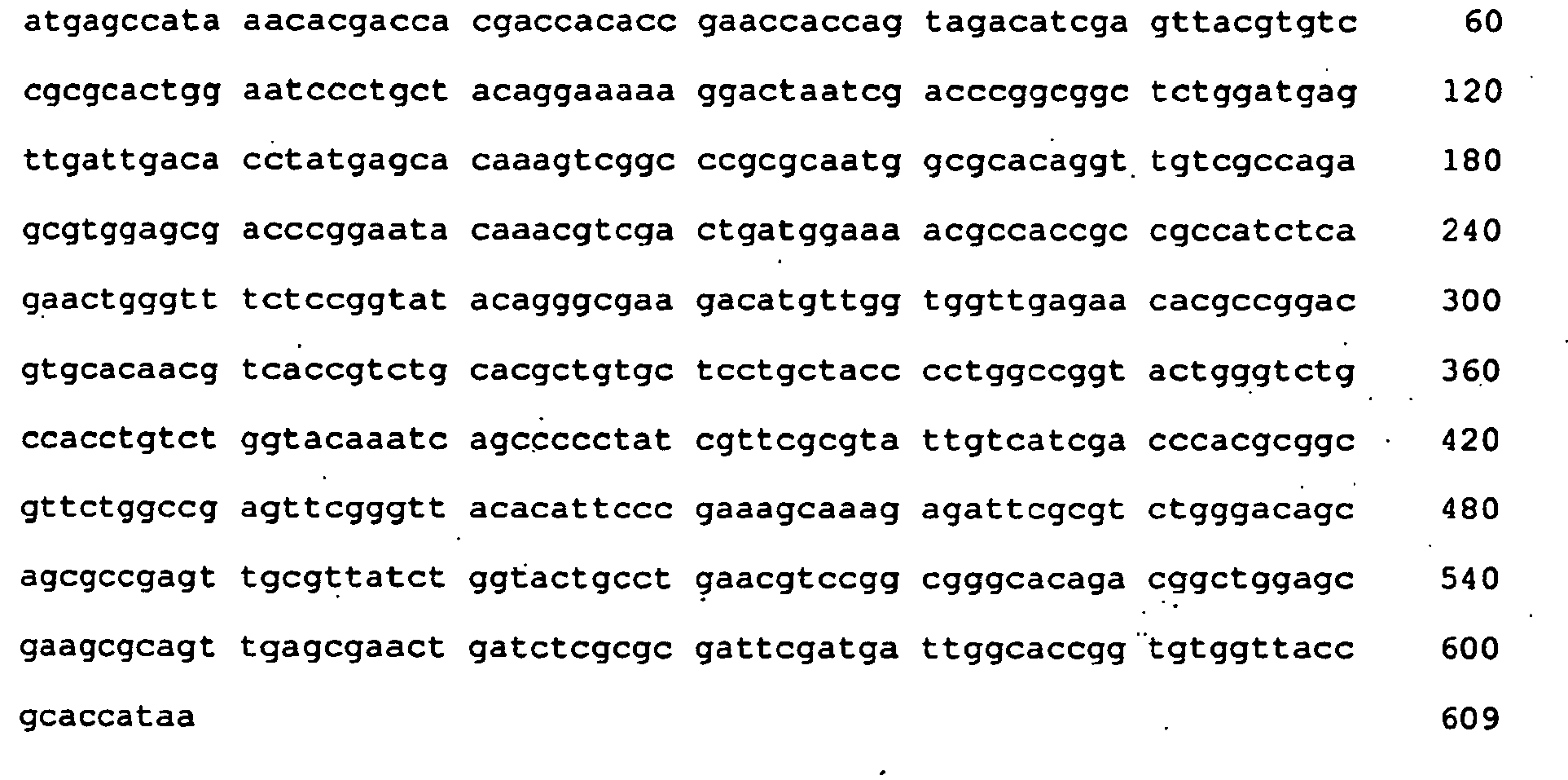
- <210> 2
<211> 202
<212> PRT
<213> Raoultella terrigena, strain 77.1 - <400> 2


- <210> 3
<211> 654
<212> DNA
<213> Raoultella terrigena, strain 77.1. - <400> 3


- <210> 4
<211> 217
<212> PRT
<213> Raoultella terrigena, strain 77.1 - <400> 4


- <210> 5
<211> 609
<212> DNA
<213> Raoultella terrigena, strain 37.1 - <400> 5
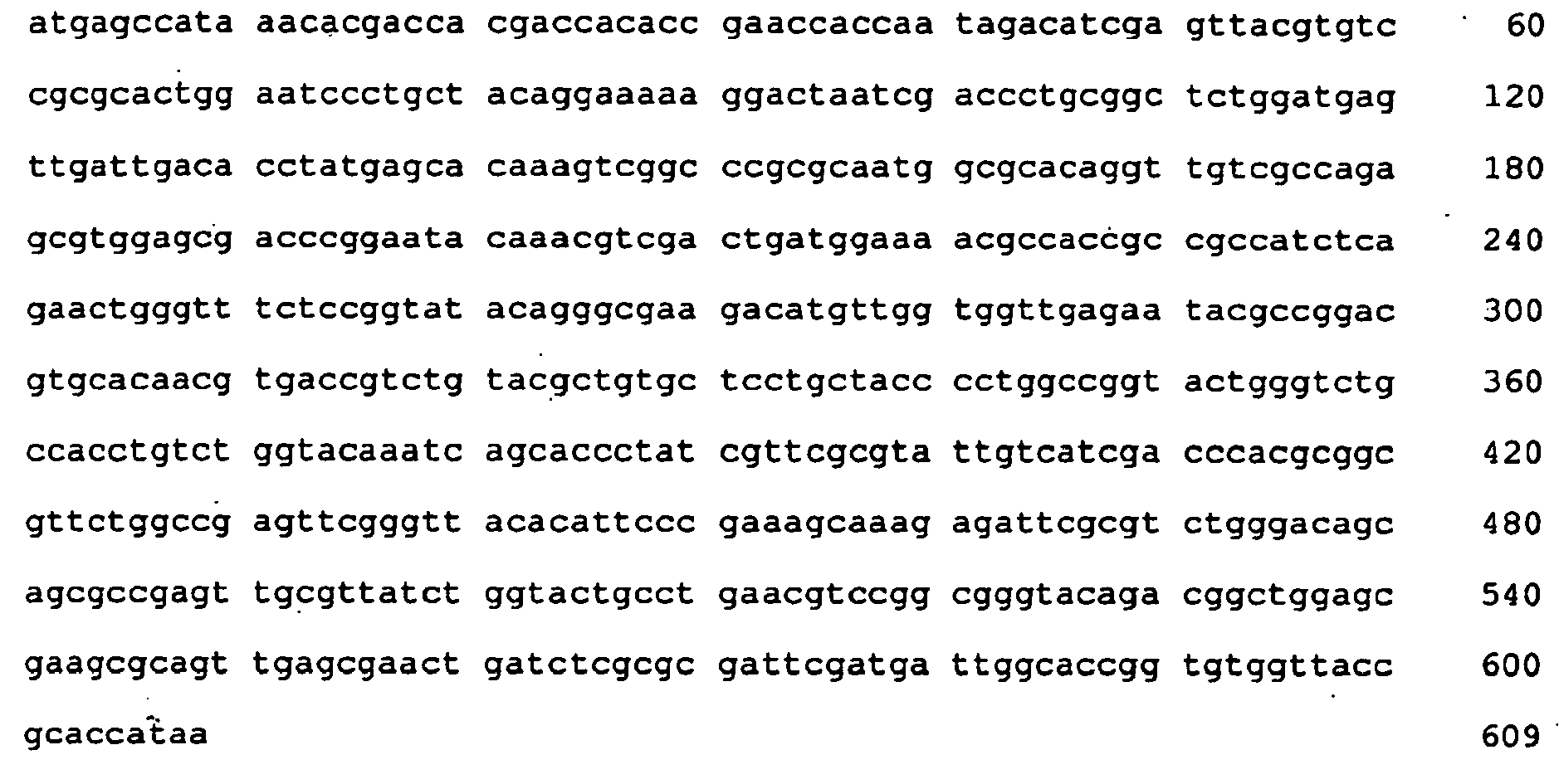
- <210> 6
<211> 202
<212> PRT
<213> Raoultella terrigena, strain 37.1 - <400> 6


- <210> 7
<211> 654
<212> DNA
<213> Raoultella terrigena, strain 37.1 - <400> 7

- <210> 8
<211> 217
<212> PRT
<213> Raoultella terrigena, strain 37.1 - <400> 8

- <210> 9
<211> 663
<212> DNA
<213> Pantoea sp., strain 17.3.1 - <400> 9


- <210> 10
<211> 194
<212> PRT
<213> Pantoea sp., strain 17.3.1 - <400> 10


- <210> 11
<211> 585
<212> DNA
<213> Pantoea sp., strain 17.3.1 - <400> 11
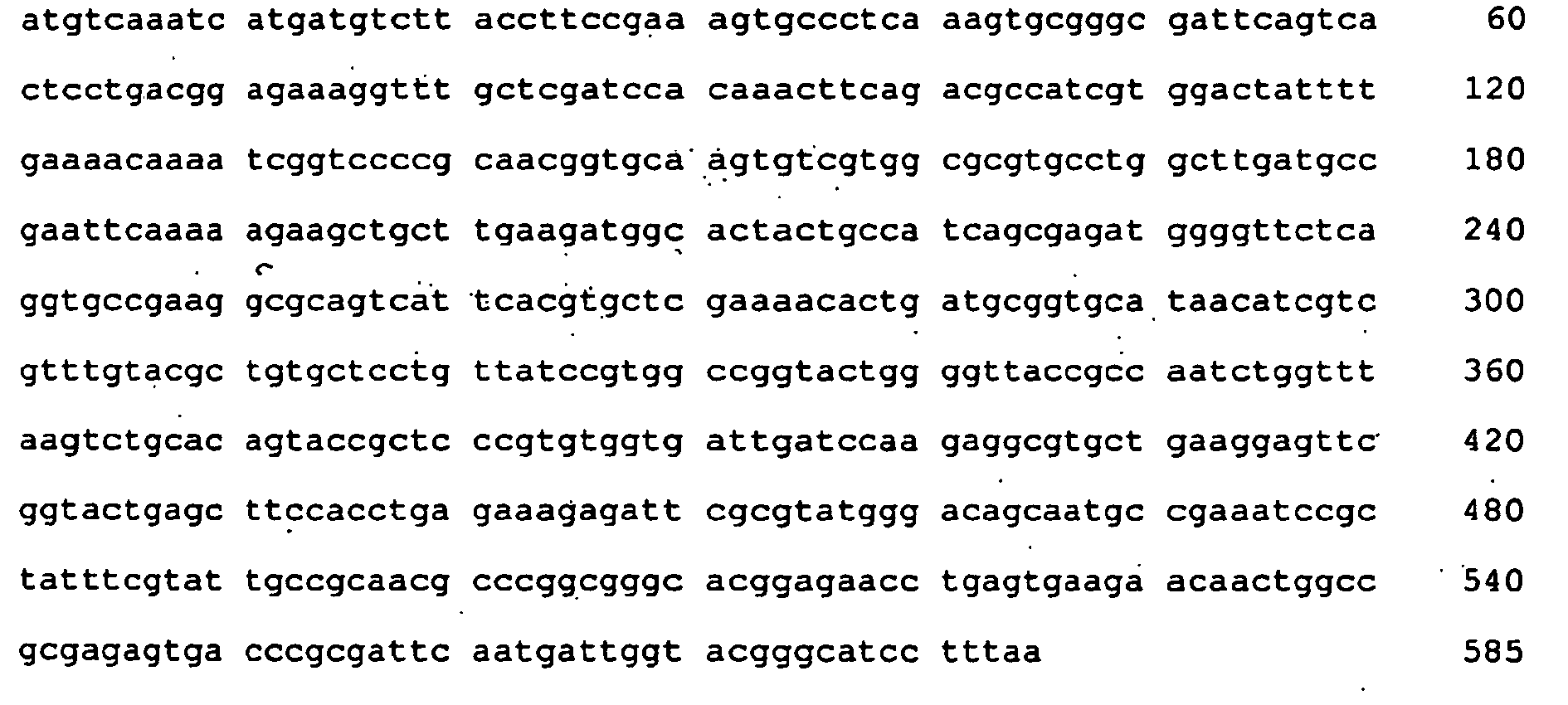
- <210> 12
<211> 220
<212> PRT
<213> Pantoea sp., strain 17.3.1 - <400> 12


- <210> 13
<211> 603
<212> DNA
<213> Brevibacterium linens, strain 32B.1 - <400> 13


- <210> 14
<211> 200
<212> PRT
<213> Brevibacterium linens, strain 32B.1 - <400> 14


- <210> 15
<211> 708
<212> DNA
<213> Brevibacterium linens, strain 32B.1 - <400> 15

- <210> 16
<211> 235
<212> PRT
<213> Brevibacterium linens, strain 32B.1 - <400> 16
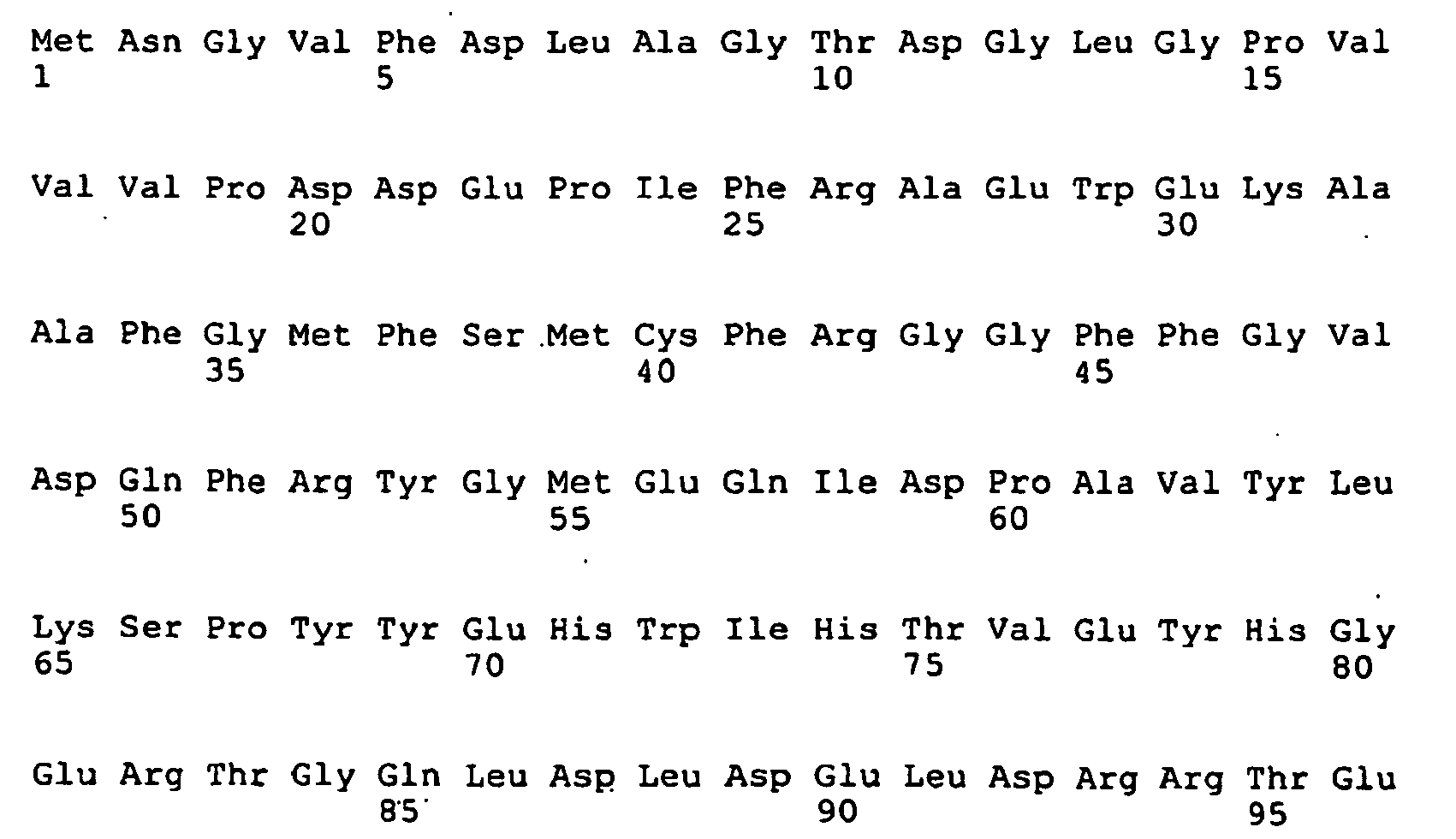

- <210> 17
<211> 609
<212> DNA
<213> Klebsiella oxytoca, strain 38.1.2 - <400> 17


- <210> 18
<211> 202
<212> PRT
<213> Klebsiella oxytoca, strain 38.1.2 - <400> 18

- <210> 19
<211> 654
<212> DNA
<213> Klebsiella oxytoca , strain 38.1.2 - <400> 19

- <210> 20
<211> 217
<212> PRT
<213> Klebsiella oxytoca, strain 38.1.2 - <400> 20


- <210> 21
<211> 432
<212> DNA
<213> Brevibacterium linens, strain, 32B.1 - <400> 21

- <210> 22
<211> 143
<212> PRT
<213> Brevibacterium linens, strain, 32B.1 - <400> 22


- <210> 23
<211> 6
<212> PRT
<213> artificial sequence - <220>
<223> motif of alpha-subunit - <400> 23

- <210> 24
<211> 4
<212> PRT
<213> artificial sequence - <220>
<223> motif of alpha-subunits - <400> 24

- <210> 25
<211> 5
<212> PRT
<213> artificial sequence - <220>
<223> motif of alpha-subunit - <400> 25

- <210> 26
<211> 4
<212> PRT
<213> artificial sequence - <220>
<223> motif of beta-subunit - <400> 26

- <210> 27
<211> 6
<212> PRT
<213> artificial sequence - <220>
<223> motif of beta-subunit - <400> 27

- <210> 28
<211> 4
<212> PRT
<213> artificial sequence - <220>
<223> motif of beta-subunit - <400> 28

- <210> 29
<211> 4
<212> PRT
<213> artificial sequence - <220>
<223> motif of beta-subunit - <400> 29

Claims (13)
- A polynucleotide or a pair of polynucleotides encoding an enzyme having nitrile hydratase (NHase) [E.C. 4.2.1.84] activity, wherein the coding sequence is selected from the group consisting of(a) a polynucleotide or a pair of polynucleotides having or comprising a nucleotide sequence encoding the α-subunit of the NHase having the amino acid sequence as shown in one of SEQ ID NOs: 2, 6 and 18, and the β-subunit of the NHase having the amino acid sequence as shown in one of SEQ ID NOs: 4, 8 and 20;(b) a polynucleotide or a pair of polynucleotides having or comprising a nucleotide sequence as shown in one of SEQ ID NOs: 1, 5 and 17 and encoding the α-subunit of the NHase, and nucleotide sequence as shown in one of SEQ ID NOs: 3, 7 and 19 encoding the β-subunit of the NHase;(c) a polynucleotide or a pair of polynucleotides comprising a nucleotide sequence which is at least 85% identical to a polynucleotide encoding the β-subunit of the NHase as shown in one of SEQ ID NOs: 3, 7 or 19, or at least 90% identical to a polynucleotide encoding the α-subunit of the NHase as shown in one of SEQ ID NOs: 1, 5 or 17; and(d) a polynucleotide or a pair of polynucleotides having a nucleotide sequence being degenerate to the nucleotide sequence of the polynucleotide or pair of polynucleotides of (c);or the complementary strand or pair of complementary strands of such a polynucleotide or pair of polynucleotides of (a) to (d).
- The polynucleotide or a pair of polynucleotides of claim 1, wherein said polynucleotide or a pair of polynucleotides is selected from:(a) a polynucleotide or a pair of polynucleotides having or comprising a nucleotide sequence encoding pairs of α- and β-subunits of the NHase, wherein the pairs of subunits have the amino acid sequences: (i) SEQ ID NOs: 2 and 4, (ii) SEQ ID NOs: 6 and 8, or (iii) SEQ ID NOs: 18 and 20;(b) a polynucleotide or a pair of polynucleotides having or comprising a nucleotide sequence encoding pairs of α- and β-subunits of the NHase, wherein the pairs of nucleotide sequences are as shown in: (i) SEQ ID NOs: 1 and 3, (ii) SEQ ID NOs: 5 and 7, or (iii) SEQ ID NOs: 17 and 19;(c) a polynucleotide or a pair of polynucleotides comprising a nucleotide sequence which is at least 85% identical to a polynucleotide encoding the β-subunit of the NHase as shown in one of SEQ ID NOs: 3, 7 or 19, or at least 90% identical to a polynucleotide encoding the α-subunit of the NHase as shown in one of SEQ ID NOs: 1, 5 or 17 and wherein the polynucleotide or pair of polynucleotides have a nucleotide sequence encoding a pair of an α- and a β-subunit having the required identity with the pairs of nucleotide sequences of (i) SEQ ID NOs: 1 and 3, (ii) SEQ ID NOs: 5 and 7, or (iii) SEQ ID NOs: 17 and 19; and(d) a polynucleotide or a pair of polynucleotides having or comprising a nucleotide sequence being degenerate to the nucleotide sequence of the polynucleotide or pair of polynucleotides of (c);or the complementary strand or pair of complementary strands of such a polynucleotide or pair of polynucleotides of (a) to (d).
- The polynucleotide or a pair of polynucleotides according to claim 1 or 2, wherein at least one of the coding regions for the α- or the β-subunit is fused with a heterologous or homologous polynucleotide.
- The polynucleotide of claim 3, wherein said heterologous or homologous polynucleotide encodes a polypeptide.
- A vector containing the polynucleotide of any one of claims 1 to 4.
- A host genetically engineered with the polynucleotide of any one of claims 1 to 4 or the vector of claim 5.
- A process for producing a pair of polypeptides, forming a heteromultimer, or a fusion protein having nitrile hydratase (NHase) [E.C. 4.2.1.84] activity and consisting of or comprising (an) α- and (a) β-subunit(s), the process comprising culturing the host of claim 6 and recovering the pair of polypeptides or fusion protein encoded by said polynucleotide or pair of polynucleotides.
- A process for producing bacteria or eukaryotic cells capable of expressing a pair of polypeptides or a fusion protein having nitrile hydratase (NHase) [E.C. 4.2.1.84] activity and consisting of or comprising (an) α- and (a) β-subunit(s), the process comprising genetically engineering bacteria or eukaryotic cells with the vector of claim 5.
- A pair of polypeptides or a fusion protein comprising the amino acid sequence encoded by a polynucleotide or pair of polynucleotides of any one of claims 1 to 4 or obtainable by the process of claim 7.
- An antibody specifically binding to the pair of polypeptides or fusion protein of claim 9.
- A composition comprising the polynucleotide or pair of polynucleotides of any one of claims 1 to 4, the pair of polypeptides or fusion protein of claim 9, and/or the antibody of claim 10.
- A method for the production of amides comprising the enantioselective conversion of nitriles by a heteromultimer, formed by the pair of polypeptides, or a fusion protein according to claim 9.
- The method according to claim 12, wherein racemic amygdalic nitrile is converted into (S)-amygdalic amide.
Priority Applications (3)
| Application Number | Priority Date | Filing Date | Title |
|---|---|---|---|
| DK10009308.7T DK2261327T3 (en) | 2006-04-07 | 2007-04-05 | Novel enantioselective microbial nitrile hydrates with broad substrate specificity |
| EP10009308.7A EP2261327B1 (en) | 2006-04-07 | 2007-04-05 | A group of novel enantioselective microbial nitrile hydratases with broad substrate specificity |
| EP07724055A EP2004814B1 (en) | 2006-04-07 | 2007-04-05 | A group of novel enantioselective microbial nitrile hydratases with broad substrate specificity |
Applications Claiming Priority (3)
| Application Number | Priority Date | Filing Date | Title |
|---|---|---|---|
| EP06007383A EP1842907A1 (en) | 2006-04-07 | 2006-04-07 | A group of novel enantioselective microbial nitrile hydratases with broad substrate specificity |
| PCT/EP2007/003114 WO2007115797A2 (en) | 2006-04-07 | 2007-04-05 | A group of novel enantioselective microbial nitrile hydratases with broad substrate specificity |
| EP07724055A EP2004814B1 (en) | 2006-04-07 | 2007-04-05 | A group of novel enantioselective microbial nitrile hydratases with broad substrate specificity |
Publications (2)
| Publication Number | Publication Date |
|---|---|
| EP2004814A2 EP2004814A2 (en) | 2008-12-24 |
| EP2004814B1 true EP2004814B1 (en) | 2010-09-08 |
Family
ID=36699317
Family Applications (3)
| Application Number | Title | Priority Date | Filing Date |
|---|---|---|---|
| EP06007383A Withdrawn EP1842907A1 (en) | 2006-04-07 | 2006-04-07 | A group of novel enantioselective microbial nitrile hydratases with broad substrate specificity |
| EP07724055A Not-in-force EP2004814B1 (en) | 2006-04-07 | 2007-04-05 | A group of novel enantioselective microbial nitrile hydratases with broad substrate specificity |
| EP10009308.7A Not-in-force EP2261327B1 (en) | 2006-04-07 | 2007-04-05 | A group of novel enantioselective microbial nitrile hydratases with broad substrate specificity |
Family Applications Before (1)
| Application Number | Title | Priority Date | Filing Date |
|---|---|---|---|
| EP06007383A Withdrawn EP1842907A1 (en) | 2006-04-07 | 2006-04-07 | A group of novel enantioselective microbial nitrile hydratases with broad substrate specificity |
Family Applications After (1)
| Application Number | Title | Priority Date | Filing Date |
|---|---|---|---|
| EP10009308.7A Not-in-force EP2261327B1 (en) | 2006-04-07 | 2007-04-05 | A group of novel enantioselective microbial nitrile hydratases with broad substrate specificity |
Country Status (7)
| Country | Link |
|---|---|
| US (1) | US8470576B2 (en) |
| EP (3) | EP1842907A1 (en) |
| AT (1) | ATE480617T1 (en) |
| CA (1) | CA2648557C (en) |
| DE (1) | DE602007009069D1 (en) |
| DK (2) | DK2004814T3 (en) |
| WO (1) | WO2007115797A2 (en) |
Families Citing this family (6)
| Publication number | Priority date | Publication date | Assignee | Title |
|---|---|---|---|---|
| AU2015203203B2 (en) * | 2011-06-07 | 2017-06-08 | Mitsubishi Chemical Corporation | Improved nitrile hydratase |
| EP2719760B1 (en) * | 2011-06-07 | 2016-06-29 | Mitsubishi Rayon Co., Ltd. | Improved nitrile hydratase |
| CN104862296B (en) * | 2015-04-22 | 2017-12-12 | 江南大学 | A kind of specific enzyme activity and stability-enhanced pattern of fusion nitrile hydratase |
| JP6757422B2 (en) * | 2016-12-28 | 2020-09-16 | 三井化学株式会社 | A mutant nitrile hydratase, a nucleic acid encoding the mutant nitrile hydrase, an expression vector and transformant containing the nucleic acid, a method for producing the mutant nitrile hydrase, and a method for producing an amide compound. |
| KR102791964B1 (en) | 2019-05-24 | 2025-04-08 | (주)아모레퍼시픽 | Method for evaluating a state of makeup |
| US20230183177A1 (en) * | 2020-04-24 | 2023-06-15 | Pharmazell Gmbh | Enantioselective chemo-enzymatic synthesis of optically active amino amide compounds |
Family Cites Families (14)
| Publication number | Priority date | Publication date | Assignee | Title |
|---|---|---|---|---|
| US6133411A (en) | 1966-07-26 | 2000-10-17 | The United States Of America As Represented By The Secretary Of The Navy | Slurry mixture forming an additive for producing a hydrodynamic drag reduction aqueous polymer solution |
| US4946778A (en) | 1987-09-21 | 1990-08-07 | Genex Corporation | Single polypeptide chain binding molecules |
| AU627648B2 (en) | 1990-02-28 | 1992-08-27 | Teruhiko Beppu | Dna fragment encoding a polypeptide having nitrile hydratase activity, a transformant containing the gene and a process for the production of amides using the transformant |
| US5593871A (en) | 1990-09-20 | 1997-01-14 | E. I. Du Pont De Nemours And Company | Process for the preparation of enantiometric 2-alkanoic acid amides from nitriles |
| JPH06303971A (en) | 1993-04-16 | 1994-11-01 | Mitsubishi Kasei Corp | New protein having nitrile hydratase activity, gene coding the protein and production of amide from nitrile using transformant containing the gene |
| JP3119468B2 (en) | 1994-11-09 | 2000-12-18 | 三菱レイヨン株式会社 | Method for producing optically active α-hydroxy acid or α-hydroxyamide |
| JPH11513255A (en) | 1995-10-06 | 1999-11-16 | イー・アイ・デユポン・ドウ・ヌムール・アンド・カンパニー | Nucleic acid fragments encoding stereospecific nitrile hydratase and amidase enzymes, and recombinant microorganisms expressing those enzymes useful for the production of chiral amides and acids |
| JP3408737B2 (en) | 1998-03-16 | 2003-05-19 | 三井化学株式会社 | Protein involved in nitrile hydratase activation and gene encoding the same |
| US20040014195A1 (en) * | 1999-12-29 | 2004-01-22 | Diversa Corporation | Nitrilases, nucleic acids encoding them and methods for making and using them |
| US20020137153A1 (en) * | 2000-10-04 | 2002-09-26 | Ramer Sandra W. | Enantioselective production of amino carboxylic acids |
| JP2002325587A (en) | 2001-03-02 | 2002-11-12 | Daicel Chem Ind Ltd | Method for producing nitrile hydratase and amide |
| JP2004194588A (en) | 2002-12-19 | 2004-07-15 | Mitsui Chemicals Inc | New nitrile hydratase |
| DE102004013842A1 (en) | 2004-03-20 | 2005-10-13 | Degussa Ag | Nitrile hydratases from metagenome libraries |
| DE102004013824A1 (en) | 2004-03-20 | 2005-10-13 | Degussa Ag | Nitrile hydratases from Rhodococcus opacus |
-
2006
- 2006-04-07 EP EP06007383A patent/EP1842907A1/en not_active Withdrawn
-
2007
- 2007-04-05 DK DK07724055.4T patent/DK2004814T3/en active
- 2007-04-05 US US12/296,057 patent/US8470576B2/en not_active Expired - Fee Related
- 2007-04-05 CA CA2648557A patent/CA2648557C/en not_active Expired - Fee Related
- 2007-04-05 DE DE602007009069T patent/DE602007009069D1/en active Active
- 2007-04-05 WO PCT/EP2007/003114 patent/WO2007115797A2/en not_active Ceased
- 2007-04-05 EP EP07724055A patent/EP2004814B1/en not_active Not-in-force
- 2007-04-05 DK DK10009308.7T patent/DK2261327T3/en active
- 2007-04-05 EP EP10009308.7A patent/EP2261327B1/en not_active Not-in-force
- 2007-04-05 AT AT07724055T patent/ATE480617T1/en not_active IP Right Cessation
Also Published As
| Publication number | Publication date |
|---|---|
| US8470576B2 (en) | 2013-06-25 |
| CA2648557A1 (en) | 2007-10-18 |
| DK2261327T3 (en) | 2014-01-13 |
| WO2007115797A2 (en) | 2007-10-18 |
| EP1842907A1 (en) | 2007-10-10 |
| ATE480617T1 (en) | 2010-09-15 |
| DK2004814T3 (en) | 2010-12-06 |
| US20100047863A1 (en) | 2010-02-25 |
| WO2007115797A3 (en) | 2008-03-06 |
| EP2261327B1 (en) | 2013-11-20 |
| DE602007009069D1 (en) | 2010-10-21 |
| EP2261327A3 (en) | 2011-03-16 |
| CA2648557C (en) | 2017-01-03 |
| EP2004814A2 (en) | 2008-12-24 |
| EP2261327A2 (en) | 2010-12-15 |
Similar Documents
| Publication | Publication Date | Title |
|---|---|---|
| EP2261327B1 (en) | A group of novel enantioselective microbial nitrile hydratases with broad substrate specificity | |
| JPH11513255A (en) | Nucleic acid fragments encoding stereospecific nitrile hydratase and amidase enzymes, and recombinant microorganisms expressing those enzymes useful for the production of chiral amides and acids | |
| EP2013337B1 (en) | A group of esterases for the enantioselective production of fine and speciality chemicals | |
| RU2534346C2 (en) | Whole-cell biocatalyst | |
| CN109355271B (en) | A kind of epoxide hydrolase derived from marine red yeast and its application | |
| EP2013336B1 (en) | A novel group of esterases for the production of fine and speciality chemicals | |
| JP4307826B2 (en) | Variovorax-derived D-amidase, genes encoding it, plasmids and vectors containing such nucleic acids, hybridizing nucleic acids, primers for producing nucleic acids, improved rec-amidase, coding rec-amidase And nucleic acid preparation, use of D-amidase and nucleic acid, and whole cell catalyst | |
| WO2004108942A1 (en) | Novel nitrile hydratase | |
| JP4118687B2 (en) | D-carbamoylase derived from Arthrobacter crystallopoietes DSM20117 strain | |
| EP3312286A2 (en) | Process for converting dinitriles to dicarboxylic acids | |
| US7361507B1 (en) | Method for modulating nitrilase selectivity, nitrilases obtained by said method and use thereof | |
| US20030157664A1 (en) | Novel mutants of the formate dehydrogenase from Candida boidinii | |
| AU773130B2 (en) | Method for isolating and selecting genes coding for enzymes, and suitable culture medium | |
| CN110951711B (en) | A kind of esterase with degrading chiral ester activity and its encoding gene and application | |
| US7247465B2 (en) | Screening process for hydantoin racemases | |
| CN108396016B (en) | Esterase PHE21, encoding gene thereof and application thereof in preparation of chiral sec-butyl acetate | |
| Shi et al. | Purification, enzymatic properties of a recombinant D-hydantoinase and its dissociation by zinc ion | |
| US20030143677A1 (en) | Activated rec-D-hydantoinases | |
| WO2005095602A1 (en) | Novel modified s-hydroxynitrile lyase | |
| JP2001292772A (en) | Nitrile hydratase gene and amidase gene derived from bacterium belonging to the genus rhodococcus | |
| JPWO2008129873A1 (en) | S-selective phenylalanine aminomutase, DNA encoding the same, method for producing (S) -β-phenylalanine, and method for producing (S) -β-phenylalanine analogues | |
| EP1258532A1 (en) | Thermostable D-hydantoinase from Bacillus circulans and the application thereof | |
| JPH09327297A (en) | Hexokinase gene |
Legal Events
| Date | Code | Title | Description |
|---|---|---|---|
| PUAI | Public reference made under article 153(3) epc to a published international application that has entered the european phase |
Free format text: ORIGINAL CODE: 0009012 |
|
| 17P | Request for examination filed |
Effective date: 20080918 |
|
| AK | Designated contracting states |
Kind code of ref document: A2 Designated state(s): AT BE BG CH CY CZ DE DK EE ES FI FR GB GR HU IE IS IT LI LT LU LV MC MT NL PL PT RO SE SI SK TR |
|
| 17Q | First examination report despatched |
Effective date: 20090116 |
|
| RIN1 | Information on inventor provided before grant (corrected) |
Inventor name: EWERT, CHRISTIAN Inventor name: LIEBETON, KLAUS Inventor name: WAELZ, MARCUS Inventor name: HENSEL, MARTINA Inventor name: LUTZ-WAHL, SABINE Inventor name: FISCHER, LUTZ Inventor name: ECK, JUERGEN |
|
| GRAP | Despatch of communication of intention to grant a patent |
Free format text: ORIGINAL CODE: EPIDOSNIGR1 |
|
| DAX | Request for extension of the european patent (deleted) | ||
| GRAS | Grant fee paid |
Free format text: ORIGINAL CODE: EPIDOSNIGR3 |
|
| GRAA | (expected) grant |
Free format text: ORIGINAL CODE: 0009210 |
|
| RIN1 | Information on inventor provided before grant (corrected) |
Inventor name: LUTZ-WAHL, SABINE Inventor name: FISCHER, LUTZ Inventor name: ECK, JUERGEN Inventor name: HENSEL, MARTINA Inventor name: WAELZ, MARCUS Inventor name: EWERT, CHRISTIAN Inventor name: LIEBETON, KLAUS |
|
| AK | Designated contracting states |
Kind code of ref document: B1 Designated state(s): AT BE BG CH CY CZ DE DK EE ES FI FR GB GR HU IE IS IT LI LT LU LV MC MT NL PL PT RO SE SI SK TR |
|
| REG | Reference to a national code |
Ref country code: GB Ref legal event code: FG4D |
|
| REG | Reference to a national code |
Ref country code: CH Ref legal event code: EP |
|
| REG | Reference to a national code |
Ref country code: CH Ref legal event code: NV Representative=s name: VOSSIUS & PARTNER |
|
| REG | Reference to a national code |
Ref country code: IE Ref legal event code: FG4D |
|
| REF | Corresponds to: |
Ref document number: 602007009069 Country of ref document: DE Date of ref document: 20101021 Kind code of ref document: P |
|
| REG | Reference to a national code |
Ref country code: DK Ref legal event code: T3 |
|
| REG | Reference to a national code |
Ref country code: NL Ref legal event code: T3 |
|
| PG25 | Lapsed in a contracting state [announced via postgrant information from national office to epo] |
Ref country code: LT Free format text: LAPSE BECAUSE OF FAILURE TO SUBMIT A TRANSLATION OF THE DESCRIPTION OR TO PAY THE FEE WITHIN THE PRESCRIBED TIME-LIMIT Effective date: 20100908 Ref country code: AT Free format text: LAPSE BECAUSE OF FAILURE TO SUBMIT A TRANSLATION OF THE DESCRIPTION OR TO PAY THE FEE WITHIN THE PRESCRIBED TIME-LIMIT Effective date: 20100908 Ref country code: FI Free format text: LAPSE BECAUSE OF FAILURE TO SUBMIT A TRANSLATION OF THE DESCRIPTION OR TO PAY THE FEE WITHIN THE PRESCRIBED TIME-LIMIT Effective date: 20100908 |
|
| LTIE | Lt: invalidation of european patent or patent extension |
Effective date: 20100908 |
|
| PG25 | Lapsed in a contracting state [announced via postgrant information from national office to epo] |
Ref country code: PL Free format text: LAPSE BECAUSE OF FAILURE TO SUBMIT A TRANSLATION OF THE DESCRIPTION OR TO PAY THE FEE WITHIN THE PRESCRIBED TIME-LIMIT Effective date: 20100908 Ref country code: CY Free format text: LAPSE BECAUSE OF FAILURE TO SUBMIT A TRANSLATION OF THE DESCRIPTION OR TO PAY THE FEE WITHIN THE PRESCRIBED TIME-LIMIT Effective date: 20100908 Ref country code: SI Free format text: LAPSE BECAUSE OF FAILURE TO SUBMIT A TRANSLATION OF THE DESCRIPTION OR TO PAY THE FEE WITHIN THE PRESCRIBED TIME-LIMIT Effective date: 20100908 |
|
| PG25 | Lapsed in a contracting state [announced via postgrant information from national office to epo] |
Ref country code: SE Free format text: LAPSE BECAUSE OF FAILURE TO SUBMIT A TRANSLATION OF THE DESCRIPTION OR TO PAY THE FEE WITHIN THE PRESCRIBED TIME-LIMIT Effective date: 20100908 Ref country code: GR Free format text: LAPSE BECAUSE OF FAILURE TO SUBMIT A TRANSLATION OF THE DESCRIPTION OR TO PAY THE FEE WITHIN THE PRESCRIBED TIME-LIMIT Effective date: 20101209 Ref country code: LV Free format text: LAPSE BECAUSE OF FAILURE TO SUBMIT A TRANSLATION OF THE DESCRIPTION OR TO PAY THE FEE WITHIN THE PRESCRIBED TIME-LIMIT Effective date: 20100908 |
|
| PG25 | Lapsed in a contracting state [announced via postgrant information from national office to epo] |
Ref country code: CZ Free format text: LAPSE BECAUSE OF FAILURE TO SUBMIT A TRANSLATION OF THE DESCRIPTION OR TO PAY THE FEE WITHIN THE PRESCRIBED TIME-LIMIT Effective date: 20100908 Ref country code: IS Free format text: LAPSE BECAUSE OF FAILURE TO SUBMIT A TRANSLATION OF THE DESCRIPTION OR TO PAY THE FEE WITHIN THE PRESCRIBED TIME-LIMIT Effective date: 20110108 Ref country code: PT Free format text: LAPSE BECAUSE OF FAILURE TO SUBMIT A TRANSLATION OF THE DESCRIPTION OR TO PAY THE FEE WITHIN THE PRESCRIBED TIME-LIMIT Effective date: 20110110 Ref country code: SK Free format text: LAPSE BECAUSE OF FAILURE TO SUBMIT A TRANSLATION OF THE DESCRIPTION OR TO PAY THE FEE WITHIN THE PRESCRIBED TIME-LIMIT Effective date: 20100908 Ref country code: RO Free format text: LAPSE BECAUSE OF FAILURE TO SUBMIT A TRANSLATION OF THE DESCRIPTION OR TO PAY THE FEE WITHIN THE PRESCRIBED TIME-LIMIT Effective date: 20100908 Ref country code: EE Free format text: LAPSE BECAUSE OF FAILURE TO SUBMIT A TRANSLATION OF THE DESCRIPTION OR TO PAY THE FEE WITHIN THE PRESCRIBED TIME-LIMIT Effective date: 20100908 Ref country code: IT Free format text: LAPSE BECAUSE OF FAILURE TO SUBMIT A TRANSLATION OF THE DESCRIPTION OR TO PAY THE FEE WITHIN THE PRESCRIBED TIME-LIMIT Effective date: 20100908 |
|
| PG25 | Lapsed in a contracting state [announced via postgrant information from national office to epo] |
Ref country code: ES Free format text: LAPSE BECAUSE OF FAILURE TO SUBMIT A TRANSLATION OF THE DESCRIPTION OR TO PAY THE FEE WITHIN THE PRESCRIBED TIME-LIMIT Effective date: 20101219 Ref country code: BE Free format text: LAPSE BECAUSE OF FAILURE TO SUBMIT A TRANSLATION OF THE DESCRIPTION OR TO PAY THE FEE WITHIN THE PRESCRIBED TIME-LIMIT Effective date: 20100908 |
|
| PLBE | No opposition filed within time limit |
Free format text: ORIGINAL CODE: 0009261 |
|
| STAA | Information on the status of an ep patent application or granted ep patent |
Free format text: STATUS: NO OPPOSITION FILED WITHIN TIME LIMIT |
|
| 26N | No opposition filed |
Effective date: 20110609 |
|
| REG | Reference to a national code |
Ref country code: DE Ref legal event code: R097 Ref document number: 602007009069 Country of ref document: DE Effective date: 20110609 |
|
| PG25 | Lapsed in a contracting state [announced via postgrant information from national office to epo] |
Ref country code: MC Free format text: LAPSE BECAUSE OF NON-PAYMENT OF DUE FEES Effective date: 20110430 |
|
| PG25 | Lapsed in a contracting state [announced via postgrant information from national office to epo] |
Ref country code: MT Free format text: LAPSE BECAUSE OF FAILURE TO SUBMIT A TRANSLATION OF THE DESCRIPTION OR TO PAY THE FEE WITHIN THE PRESCRIBED TIME-LIMIT Effective date: 20100908 |
|
| REG | Reference to a national code |
Ref country code: IE Ref legal event code: MM4A |
|
| PG25 | Lapsed in a contracting state [announced via postgrant information from national office to epo] |
Ref country code: IE Free format text: LAPSE BECAUSE OF NON-PAYMENT OF DUE FEES Effective date: 20110405 |
|
| PG25 | Lapsed in a contracting state [announced via postgrant information from national office to epo] |
Ref country code: LU Free format text: LAPSE BECAUSE OF NON-PAYMENT OF DUE FEES Effective date: 20110405 |
|
| PG25 | Lapsed in a contracting state [announced via postgrant information from national office to epo] |
Ref country code: TR Free format text: LAPSE BECAUSE OF FAILURE TO SUBMIT A TRANSLATION OF THE DESCRIPTION OR TO PAY THE FEE WITHIN THE PRESCRIBED TIME-LIMIT Effective date: 20100908 Ref country code: BG Free format text: LAPSE BECAUSE OF FAILURE TO SUBMIT A TRANSLATION OF THE DESCRIPTION OR TO PAY THE FEE WITHIN THE PRESCRIBED TIME-LIMIT Effective date: 20101208 |
|
| PG25 | Lapsed in a contracting state [announced via postgrant information from national office to epo] |
Ref country code: HU Free format text: LAPSE BECAUSE OF FAILURE TO SUBMIT A TRANSLATION OF THE DESCRIPTION OR TO PAY THE FEE WITHIN THE PRESCRIBED TIME-LIMIT Effective date: 20100908 |
|
| REG | Reference to a national code |
Ref country code: FR Ref legal event code: PLFP Year of fee payment: 10 |
|
| PGFP | Annual fee paid to national office [announced via postgrant information from national office to epo] |
Ref country code: NL Payment date: 20160421 Year of fee payment: 10 |
|
| REG | Reference to a national code |
Ref country code: CH Ref legal event code: PFA Owner name: B.R.A.I.N. AG, DE Free format text: FORMER OWNER: B.R.A.I.N. AG, DE |
|
| PGFP | Annual fee paid to national office [announced via postgrant information from national office to epo] |
Ref country code: GB Payment date: 20160425 Year of fee payment: 10 Ref country code: CH Payment date: 20160425 Year of fee payment: 10 Ref country code: DE Payment date: 20160530 Year of fee payment: 10 |
|
| PGFP | Annual fee paid to national office [announced via postgrant information from national office to epo] |
Ref country code: FR Payment date: 20160423 Year of fee payment: 10 Ref country code: DK Payment date: 20160423 Year of fee payment: 10 |
|
| REG | Reference to a national code |
Ref country code: DE Ref legal event code: R119 Ref document number: 602007009069 Country of ref document: DE |
|
| REG | Reference to a national code |
Ref country code: DK Ref legal event code: EBP Effective date: 20170430 |
|
| REG | Reference to a national code |
Ref country code: CH Ref legal event code: PL |
|
| REG | Reference to a national code |
Ref country code: NL Ref legal event code: MM Effective date: 20170501 |
|
| GBPC | Gb: european patent ceased through non-payment of renewal fee |
Effective date: 20170405 |
|
| REG | Reference to a national code |
Ref country code: FR Ref legal event code: ST Effective date: 20171229 |
|
| PG25 | Lapsed in a contracting state [announced via postgrant information from national office to epo] |
Ref country code: DE Free format text: LAPSE BECAUSE OF NON-PAYMENT OF DUE FEES Effective date: 20171103 Ref country code: FR Free format text: LAPSE BECAUSE OF NON-PAYMENT OF DUE FEES Effective date: 20170502 Ref country code: NL Free format text: LAPSE BECAUSE OF NON-PAYMENT OF DUE FEES Effective date: 20170501 |
|
| PG25 | Lapsed in a contracting state [announced via postgrant information from national office to epo] |
Ref country code: CH Free format text: LAPSE BECAUSE OF NON-PAYMENT OF DUE FEES Effective date: 20170430 Ref country code: LI Free format text: LAPSE BECAUSE OF NON-PAYMENT OF DUE FEES Effective date: 20170430 Ref country code: GB Free format text: LAPSE BECAUSE OF NON-PAYMENT OF DUE FEES Effective date: 20170405 |
|
| PG25 | Lapsed in a contracting state [announced via postgrant information from national office to epo] |
Ref country code: DK Free format text: LAPSE BECAUSE OF NON-PAYMENT OF DUE FEES Effective date: 20170430 |