EP2000322A2 - Paper fastener and file or folder - Google Patents
Paper fastener and file or folder Download PDFInfo
- Publication number
- EP2000322A2 EP2000322A2 EP07739083A EP07739083A EP2000322A2 EP 2000322 A2 EP2000322 A2 EP 2000322A2 EP 07739083 A EP07739083 A EP 07739083A EP 07739083 A EP07739083 A EP 07739083A EP 2000322 A2 EP2000322 A2 EP 2000322A2
- Authority
- EP
- European Patent Office
- Prior art keywords
- folded
- plate material
- body part
- document fastener
- document
- Prior art date
- Legal status (The legal status is an assumption and is not a legal conclusion. Google has not performed a legal analysis and makes no representation as to the accuracy of the status listed.)
- Withdrawn
Links
- 239000000463 material Substances 0.000 claims abstract description 65
- 229920005989 resin Polymers 0.000 claims abstract description 28
- 239000011347 resin Substances 0.000 claims abstract description 28
- 238000005096 rolling process Methods 0.000 claims description 11
- 238000003780 insertion Methods 0.000 abstract description 11
- 230000037431 insertion Effects 0.000 abstract description 11
- 238000000034 method Methods 0.000 description 9
- 239000011230 binding agent Substances 0.000 description 4
- 230000000694 effects Effects 0.000 description 3
- 239000002184 metal Substances 0.000 description 3
- 229920005672 polyolefin resin Polymers 0.000 description 3
- 239000000853 adhesive Substances 0.000 description 2
- 230000001070 adhesive effect Effects 0.000 description 2
- 239000011295 pitch Substances 0.000 description 2
- 238000003825 pressing Methods 0.000 description 2
- 230000002265 prevention Effects 0.000 description 2
- 230000015556 catabolic process Effects 0.000 description 1
- 238000006731 degradation reaction Methods 0.000 description 1
- 229920000098 polyolefin Polymers 0.000 description 1
- NHDHVHZZCFYRSB-UHFFFAOYSA-N pyriproxyfen Chemical compound C=1C=CC=NC=1OC(C)COC(C=C1)=CC=C1OC1=CC=CC=C1 NHDHVHZZCFYRSB-UHFFFAOYSA-N 0.000 description 1
Images




Classifications
-
- B—PERFORMING OPERATIONS; TRANSPORTING
- B42—BOOKBINDING; ALBUMS; FILES; SPECIAL PRINTED MATTER
- B42F—SHEETS TEMPORARILY ATTACHED TOGETHER; FILING APPLIANCES; FILE CARDS; INDEXING
- B42F13/00—Filing appliances with means for engaging perforations or slots
- B42F13/02—Filing appliances with means for engaging perforations or slots with flexible or resilient means
- B42F13/06—Filing appliances with means for engaging perforations or slots with flexible or resilient means with strips or bands
- B42F13/10—Filing appliances with means for engaging perforations or slots with flexible or resilient means with strips or bands of plastics
-
- Y—GENERAL TAGGING OF NEW TECHNOLOGICAL DEVELOPMENTS; GENERAL TAGGING OF CROSS-SECTIONAL TECHNOLOGIES SPANNING OVER SEVERAL SECTIONS OF THE IPC; TECHNICAL SUBJECTS COVERED BY FORMER USPC CROSS-REFERENCE ART COLLECTIONS [XRACs] AND DIGESTS
- Y10—TECHNICAL SUBJECTS COVERED BY FORMER USPC
- Y10T—TECHNICAL SUBJECTS COVERED BY FORMER US CLASSIFICATION
- Y10T24/00—Buckles, buttons, clasps, etc.
- Y10T24/20—Paper fastener
- Y10T24/202—Resiliently biased
- Y10T24/205—One piece
Definitions
- This invention relates to a document fastener that can be used as a binder to simply bind leaves, and a file or a folder that uses the document fastener.
- the binder disclosed in the patent document 1 comprises a body part extending longitudinally and a pair of folded pieces extending from the body part, and can hold leaves in a bound state by engaging a part of the folded piece with a part of the body part by making use of a concave/convex structure with forming a loop shape as a whole.
- a document fastener using a strip-shaped body made of drawn polyolefin resin more preferably a strip-shaped body made by rolling and drawing the drawn polyolefin, has been devised. Since it is possible for this kind of the document fastener to keep a folded state to a certain degree in spite of the resin because an angle to return from the folded state is small, the document fastener can effectively acts as a binder. In addition, the document fastener is easy to handle and it becomes easy to sort and discard the document fastener.
- the document fastener disclosed in the patent document 2 is made in a homogeneously rolled and drawn state and uniform in thickness as a whole, when the document fastener is applied to a folder having a narrow slit like an individual folder, there is a problem that it is difficult to insert the end portion of the document fastener into the slit. If the end portion is formed to be thin-walled to an extent of facilitating insertion of the end portion, it is expected that this can be an obstacle to a function of keeping the folded state.
- the present claimed invention is made with focusing on this problem and intends to provide a new document fastener and a file or a folder that facilitates insertion of a document fastener into a narrow slit and that is improved in durability by making use of a property of the document fastener whose folded state can be kept due to resin.
- the present claimed invention takes the following measures.
- a document fastener of this invention is a document fastener comprising a plate material made of resin having a body part extending longitudinally and a pair of folded pieces extending from the body part, and is characterized by that a thickness of at least both end portions of the plate material is formed to be thinner than a thickness of other portions of the plate material and at least a boundary between the body part and the folded piece is made to be foldable, and a folded state on the boundary can be kept by making use of the properties of the resin itself without engaging the folded piece with the body part or without engaging each of the folded pieces. If the document fastener is made of resin, it might be difficult for the document fastener to be inserted into a narrow slit arranged on a folder due to its thickness.
- both end portions of the document fastener is formed to be thin-walled, insertion becomes easy.
- a function of holding the folded state would never be interfered.
- the document fastener is made of metal and the end portion is made to be thin-walled, the end portion becomes keen, which requires careful handling.
- the document fastener is made of resin, there is no need of such worry in handling the document fastener.
- a rib is arranged on the boundary between the body part and the folded piece.
- the rib is arranged on a face opposite to a folded direction and a folding operation guidance part is arranged on a face of the folded direction.
- the folded piece is foldable further at an arbitrary position.
- a document fastener that comprises a plate material made of resin that extends longitudinally and that is foldable at an arbitrary position, and is characterized by that a thickness of both end portions of the plate material is formed to be thinner than a thickness of other portions of the plate material, a pair of portions locating on the outer side of folded portions of the plate material at a time when the plate material is folded at two portions are formed as a pair of folded pieces and a portion locating between the folded pieces is formed as a body part, and a folded state of the plate material can be kept by making use of the properties of the resin itself without engaging the folded piece with the body part or without engaging each of the folded pieces.
- the plate material is foldable at any arbitrary position, it becomes possible to change a length of the body part so as to easily deal with various pitches of the binding hole of the leaves.
- the folded piece can be further folded at an arbitrary position on the distal end side of the folded portion, it becomes possible to effectively deal with variations of an amount of the interfiled leaves.
- both end portions of the plate material are strengthened in hardness.
- both end portions of the plate material are thin-walled by means of rolling and strengthened in hardness as well.
- a structure wherein at least both ends or vicinities of the both ends of the plate material is curved to be a concave shape in cross-section may be effectively adopted.
- a structure wherein the plate material is so formed that almost whole of the folded piece is curved to be a concave shape in cross-section also may be effectively adopted.
- it is possible to satisfy both facilitation of inserting the folded piece and assurance of a back-up state of the body part by forming a width of almost whole of the folded piece narrower than a width of the body part.
- the plate material is curved to be a concave shape in cross-section so that a surface to be an inner surface in case of folding the plate material becomes concave.
- the document fastener can be used by itself, and the document fastener can be used as a file or a folder by being engaged with a front cover body of the file or the folder.
- this invention has the above-mentioned structure, it is possible to provide a document fastener that can effectively keep the folded state by making use of the properties of resin, that can be easily inserted into a narrow slit and that is effectively improved in durability in case of folding the same portion frequently, and a file or a folder that uses the document fastener.
- a document fastener 1 in accordance with this embodiment shown in Fig. 1 can interfile leaves 3 by itself, and the document fastener 1 can also be used with being inserted into a folder 2 or the like.
- the document fastener 1 comprises a plate material a made of resin having a body part 11 extending longitudinally and a pair of folded pieces 12 extending from the body part 11, and is made by cutting a sheet with a press processing or the like.
- the sheet is obtained by rolling a polyolefin resin sheet and then drawing it, wherein rolling is a process to elongate the sheet to be thin by supplying the polyolefin resin sheet to a rolling mill roller, and drawing is a process to be conducted by the use of a roller rolling method or a zone drawing method under a heated atmosphere.
- the sheet becomes fibrous having a directional property in the drawing direction and laminated in a direction of its thickness so that a property of keeping a folded state is generated at a time when the sheet is folded in a direction of its thickness.
- a length of the body part 11 of the plate material a obtained in this way generally corresponds to a distance between binding holes 3a, 3a of the leaves 3 shown in Fig. 2 , a size of a pair of the folded pieces 12 is set to be appropriate for uprising in a direction that the folded pieces 12 are inserted into the binding holes 3a, 3a after being folded at both ends of the body part 11, and the body part 11 and the folded piece 12 are foldable on boundaries 13, 13 therebetween as shown in Fig. 4 .
- the folded pieces 12, 12 are folded in a direction to approach each other (the direction may be a direction to be separated each other) after being inserted so that the leaves 3 can be interfiled with a folded state on the boundary 13 kept by making use of the properties of the resin itself without engaging the folded piece 12 with the body part 11 or without engaging each of the folded pieces 12, 12.
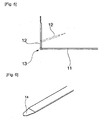
- the folded piece 12 is further foldable at any position as shown in Fig. 5 and its folded state can be kept by making use of the properties of the plate material a.
- a thickness of both end portions 14 of the plate material a is formed to be thinner than a thickness of other portions of the plate material a and a rib 13a is formed on the boundary 13 between the body part 11 and the folded piece 12.
- end portions of the plate material a are rerolled locally by means of pressing or the like so as to be thinner than other portions, and the rib 13a is formed to bulge a little toward a face opposite to the folded direction on the boundary 13.
- a folding operation guidance part 13b to guide a position to be folded is formed on the face of the folded direction to cave in a little.
- the end portion 14 is in a shape of a general triangle with its apex a little rounded to facilitate insertion of the end portion 14.
- a folder 2 using this document fastener 1 comprises, as shown in Fig. 1 , a pair of cover bodies 21, 21 and a spine 22 connecting the cover bodies 21, 21, and narrow slits 23 are formed on a surface of each cover body 21 near the spine 22 by cutting the surface.
- the folder 2 can kep the leaves 3 in an interfiled state with a process of inserting the folded pieces 12 of the document fastener 1 into the slit 23 from an outside of the folder 2 so that the inserted folded pieces 12 stand on an inside of the folder 2, inserting the binding hole 3a of the leaves 3 shown in Fig. 2 over the folded piece 12, and then further folding the folded piece 12 at an arbitrary position.
- the document fastener 1 comprises the plate material a made of resin having the body part 11 extending longitudinally and a pair of the folded pieces 12 extending from the body part 11, and the thickness of both end portions 14 of the plate material a is formed to be thinner than the thickness of other portions of the plate material a and the boundary 13 between the body part 11 and the folded piece 12 is made to be foldable, and the folded state on the boundary 13 can be kept by making use of the properties of the resin itself.
- the end portion 14 is made to be thin-walled, it becomes easy to insert the folded piece 12 into the narrow slit 23 of the folder 2, and since only the end portion 14 is made to be thin-walled and other portion is secured to have a necessary thickness, it is possible to keep an appropriate interfiled state without any problem for a mechanism to keep the folded state.
- the plate material is made of metal and the end portion of the plate material is made to be thin-walled, the end portion becomes keen, thereby requiring careful handling.
- the document fastener 1 is made of resin, there is no need of such worry in handling the document fastener 1, which makes it possible to use the fastener 1 easily and securely.
- the boundary 13 between the body part 11 and the folded piece 12 is frequently folded every time the leaves 3 are added or removed, there is a concern that the document fastener 1 becomes fragile in a short period of time and the keeping force is degraded although the document fastener 1 is made of resin.
- the rib 13a is formed on the boundary 13 between the body part 11 and the folded piece 12 as in this embodiment, it is possible to keep a shape keeping function by suppressing progress of fatigue, thereby effectively elongating a product life cycle.
- the holding operation guidance part 13b contributes to prevention of difficulty in folding the plate material a because of the rib 13a, and the rib 13a contributes to prevention of degradation of the shape keeping properties because of the holding operation guidance part 13b.
- the folded piece 12 is made to be further foldable at any arbitrary position, it is possible to effectively deal with change in an amount of interfiled leaves 3.
- the hardness of the plate material a is about a degree with which the plate material a can be further folded at any arbitrary position uniformly along the longitudinal direction, there might be a case that the end portion 14 is broken because the end portion 14 is thin-walled, resulting in failing insertion of the end portion 14 into the slit 23.
- both end portions 14 of the plate material a are provided with the rolling process and not only the thin-walled effect but also increased hardness can be expected due to the rolling process, it is possible to effectively prevent the trouble in inserting the end portion 14 into the slit 23.
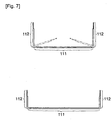
- a document fastener wherein an area of a body part or a folded piece is not determined, it may comprise, as shown in Fig. 6 , a plate material a made of resin that extends longitudinally and that is foldable at an arbitrary position like the above-mentioned embodiment, wherein a thickness of both end portions 14 of the plate material a may be formed to be thinner than a thickness of other portions of the plate material a , portions locating on the outer side of folded portions of the plate material a at a time when the plate material a is folded at two portions may be set as a pair of folded pieces 112, 112 and a portion locating between the folded pieces 112, 112, may be set as a body part 111, and a folded state of the plate material a can be kept by making use of the properties of the resin itself.
- the plate material a is foldable at any arbitrary position, it becomes possible to change a length of the body part 111 so as to easily deal with various pitches of the binding holes 3a of the leaves 3.
- the folded piece 112 can be further folded at an arbitrary position, it becomes possible to effectively deal with variations of an amount of the interfiled leaves 3.
- an adhesive portion 211x is formed inside of the body part 211, it becomes possible to improve a degree of fixing the body part 211 to a reverse side of the cover body 21. If an adhesive portion 212x is formed inside of the folded piece 212, it becomes possible to improve a degree of fixing the folded piece 212 to a surface of the leaves 3.
- a body part 311 is formed to be wider than a folded piece 312 as shown in Fig. 9 so that the folder 2 or the leaves 3 smoothly fits the body part 311 will also be effective.
- a document fastener 401 as shown in Fig. 10 through Fig. 14 also becomes effective to adopt.
- the document fastener 401 can interfile the leaves 3 by itself, and the document fastener 401 can also be used with being inserted into a folder 2 or the like.
- the document fastener 401 comprises a plate material a made of resin, the same as that of the document fastener 1 in the above-mentioned embodiment, having a body part 411 extending longitudinally and a pair of folded pieces 412 extending from the body part 411, and is made by cutting a sheet with a press processing or the like.
- An end portion 414 is in a shape of a general triangle with its apex a little rounded to facilitate insertion of the end portion 414.
- a length of the body part 411 of the plate material a generally corresponds to a distance between binding holes 3a, 3a shown in Fig.
- a size of a pair of the folded pieces 412 is set to be appropriate for uprising in a direction that the folded piece 412 is inserted into the binding holes 3a, 3a after being folded from both ends of the body part 411, and the body part 411 and the folded piece 412 are foldable on boundaries 413, 413 therebetween. Then the folded pieces 412, 412 are folded in a direction to approach each other after being inserted so that the leaves 3 can be interfiled with a folded state on the boundary 413 held by making use of the properties of the resin itself without engaging the folded piece 412 with the body part 411 or without engaging each of the folded pieces 412, 412.
- the folded piece 412 is further foldable at any position tailored to a thickness of a bunch of the leaves 3 and its folded state can be kept by making use of the properties of the plate material a.
- a convex cylindrical die and a concave cylindrical die are arranged to hold almost all of the folded piece 412 of the plate material a from upside and downside (concretely, from a distal end except for an end portion 414 having a shape of a general triangle to the neighborhood of the boundary 413 between the body part 411 and the folded piece 412 as shown in Fig.
- the folded piece 412 is press-molded between the convex cylindrical die and the concave cylindrical die so as to form a curved surface 412a whose cross-section is a concave wherein a face locating inside in case that the plate material a is folded becomes concave.
- the document fastener in this embodiment is so arranged that a thickness of almost all of the folded piece 412 is formed to be thinner than a thickness of the body part 411, and a width dy of almost all of the folded piece 412 is formed to be narrower than a width dx of the body part 411, and the folded piece 412 and the body part 411 are connected with gradually changing a width of a portion near the boundary 413.
- the folded piece 412 since almost whole of the folded piece 412 is curved in its cross-section so that the folded piece 412 is in a shape that is tough against a force applied to a longitudinal direction, the folded piece 412 straightly enters into the slit 23 without being buckled even if a relatively strong pushing force is applied thereto.
- the folded piece 412 can be folded relatively easily when a force is applied to a direction in a folded direction. And since a face locating inside when the folded piece 412 is folded is concave in cross section, a pair of the folded pieces 412, 412 can be folded to approach each other as shown in Fig. 11 with locally releasing a curved shape only at the folded portion locating closer to the distal end from the boundary portion 413 including the boundary portion 413.
- the folded pieces 412 if the face locating inside when the folded piece 412 is folded is made to be concave, it is possible for the folded pieces 412 to press the leaves 3 by making use of a pair of side edges of the folded pieces 412 more accurately than a case of a reverse structure, more specifically, the face locating outside when the folded piece 412 is folded is made to be concave. Furthermore, since a portion where a curved state is released due to a folding operation is limited to a narrow range, it is possible to prevent a tendency that the folded piece 412 tries to stand up to be restored to the original shape due to a repulsive force from the resin as much as possible.
- the cross section of the folded piece 412 including the end portion 414 in Fig. 10 through Fig. 14 may be curved in a concave shape, or the end portion 414 alone can be curved to be concave in cross-section. In case of the later, it is preferable that a relatively wide area along a longitudinal direction from the distal end of the folded piece 412 is considered to be the end portion.
- a structure to curve the cross section in a concave shape can be also used for a structure shown in Fig. 1 through Fig. 5 to reinforce hardness of the end portion by means of a rolling process.
Landscapes
- Sheet Holders (AREA)
- Absorbent Articles And Supports Therefor (AREA)
Abstract
Description
- This invention relates to a document fastener that can be used as a binder to simply bind leaves, and a file or a folder that uses the document fastener.
- Conventionally, it has been common that this kind of the document fastener is made of metal, however, it is difficult to sort and discard the document fastener and it requires care to deal with the document fastener because its edge is sharp. Then a binder made of resin is recently conceived. For example, the binder disclosed in the
patent document 1 comprises a body part extending longitudinally and a pair of folded pieces extending from the body part, and can hold leaves in a bound state by engaging a part of the folded piece with a part of the body part by making use of a concave/convex structure with forming a loop shape as a whole. - However, with the arrangement of the above-mentioned
patent document 1, a mold to form a concave/convex structure is costly and it is not suitable to repeat a process of adding or removing leaves with frequency because an operation of engaging or disengaging the folded piece with or from the body part requires some degree of a knack and a force of a fingertip as well. - Meanwhile, as shown in the
patent document 2, a document fastener using a strip-shaped body made of drawn polyolefin resin, more preferably a strip-shaped body made by rolling and drawing the drawn polyolefin, has been devised. Since it is possible for this kind of the document fastener to keep a folded state to a certain degree in spite of the resin because an angle to return from the folded state is small, the document fastener can effectively acts as a binder. In addition, the document fastener is easy to handle and it becomes easy to sort and discard the document fastener. - Patent document 1: Japan patent laid open number
11-78336 - Patent document 2: Japan patent laid open number
2005-67027 - However, since the document fastener disclosed in the
patent document 2 is made in a homogeneously rolled and drawn state and uniform in thickness as a whole, when the document fastener is applied to a folder having a narrow slit like an individual folder, there is a problem that it is difficult to insert the end portion of the document fastener into the slit. If the end portion is formed to be thin-walled to an extent of facilitating insertion of the end portion, it is expected that this can be an obstacle to a function of keeping the folded state. - The present claimed invention is made with focusing on this problem and intends to provide a new document fastener and a file or a folder that facilitates insertion of a document fastener into a narrow slit and that is improved in durability by making use of a property of the document fastener whose folded state can be kept due to resin.
- In order to attain the above object, the present claimed invention takes the following measures.
- More specifically, a document fastener of this invention is a document fastener comprising a plate material made of resin having a body part extending longitudinally and a pair of folded pieces extending from the body part, and is characterized by that a thickness of at least both end portions of the plate material is formed to be thinner than a thickness of other portions of the plate material and at least a boundary between the body part and the folded piece is made to be foldable, and a folded state on the boundary can be kept by making use of the properties of the resin itself without engaging the folded piece with the body part or without engaging each of the folded pieces. If the document fastener is made of resin, it might be difficult for the document fastener to be inserted into a narrow slit arranged on a folder due to its thickness. Then if both end portions of the document fastener is formed to be thin-walled, insertion becomes easy. In addition, since only the end portion is thin-walled, a function of holding the folded state would never be interfered. Furthermore, if the document fastener is made of metal and the end portion is made to be thin-walled, the end portion becomes keen, which requires careful handling. However, if the document fastener is made of resin, there is no need of such worry in handling the document fastener.
- In order to improve durability, it is preferable that a rib is arranged on the boundary between the body part and the folded piece.
- As a preferable embodiment represented is that the rib is arranged on a face opposite to a folded direction and a folding operation guidance part is arranged on a face of the folded direction.
- In order to make it possible to effectively deal with a change of the amount of the leaves to be bound, it is represented that the folded piece is foldable further at an arbitrary position.
- As another structure of the document fastener of this invention represented is a document fastener that comprises a plate material made of resin that extends longitudinally and that is foldable at an arbitrary position, and is characterized by that a thickness of both end portions of the plate material is formed to be thinner than a thickness of other portions of the plate material, a pair of portions locating on the outer side of folded portions of the plate material at a time when the plate material is folded at two portions are formed as a pair of folded pieces and a portion locating between the folded pieces is formed as a body part, and a folded state of the plate material can be kept by making use of the properties of the resin itself without engaging the folded piece with the body part or without engaging each of the folded pieces. With this structure, since the plate material is foldable at any arbitrary position, it becomes possible to change a length of the body part so as to easily deal with various pitches of the binding hole of the leaves. In addition, since the folded piece can be further folded at an arbitrary position on the distal end side of the folded portion, it becomes possible to effectively deal with variations of an amount of the interfiled leaves.
- In order to further facilitate insertion of the document fastener into a slit of a folder, it is preferable that both end portions of the plate material are strengthened in hardness.
- Especially, it is effective that both end portions of the plate material are thin-walled by means of rolling and strengthened in hardness as well.
- As another structure to further facilitate insertion of the document fastener into a slit of a folder, a structure wherein at least both ends or vicinities of the both ends of the plate material is curved to be a concave shape in cross-section may be effectively adopted. In case that an area of the folded piece is clearly determined previously, a structure wherein the plate material is so formed that almost whole of the folded piece is curved to be a concave shape in cross-section also may be effectively adopted. Especially, in the later case, it is possible to prevent the resistance of the plate material against insertion from increasing in the middle of insertion if not only the end portion of the plate material but also a wall thickness of almost whole of the folded piece is thinner than a wall thickness of the body part. Furthermore, in the later case, it is possible to satisfy both facilitation of inserting the folded piece and assurance of a back-up state of the body part by forming a width of almost whole of the folded piece narrower than a width of the body part.
- In order to make it possible to appropriately press the leaves in a folded state and to prevent the folded piece from easily restoring to an original state, it is preferable that the plate material is curved to be a concave shape in cross-section so that a surface to be an inner surface in case of folding the plate material becomes concave.
- Since this invention has the above-mentioned structure, it is a matter of course that the document fastener can be used by itself, and the document fastener can be used as a file or a folder by being engaged with a front cover body of the file or the folder.
- Since this invention has the above-mentioned structure, it is possible to provide a document fastener that can effectively keep the folded state by making use of the properties of resin, that can be easily inserted into a narrow slit and that is effectively improved in durability in case of folding the same portion frequently, and a file or a folder that uses the document fastener.
-
-
Fig. 1 is a perspective view of a folder in accordance with one embodiment of the present claimed invention. -
Fig. 2 is a perspective view of a state when leaves are interfiled by the folder by the use of a document fastener. -
Fig. 3 is a partially enlarged perspective view of the document fastener in accordance with this embodiment. -
Fig. 4 is a functional explanatory view of the document fastener. -
Fig. 5 is a functional explanatory view of the document fastener. -
Fig. 6 is a partially enlarged perspective view of a document fastener in accordance with another embodiment of the present claimed invention. -
Fig. 7 is a functional explanatory view of the document fastener. -
Fig. 8 is a functional explanatory view of the document fastener. -
Fig. 9 is a view showing a modified form of the document fastener. -
Fig. 10 is a perspective view of a folder in accordance with an embodiment other than the above-mentioned embodiment of the present claimed invention. -
Fig. 11 is a perspective view of a state when leaves are interfiled by the folder by the use of a document fastener. -
Fig. 12 is a partially perspective view of the document fastener in accordance with this embodiment. -
Fig. 13 is a cross-sectional view taken along the A-A line inFig. 2 . -
Fig. 14 is a perspective view showing a state in a middle of inserting the document fastener into the folder. - It is a matter of course that a document fastener 1 in accordance with this embodiment shown in
Fig. 1 can interfileleaves 3 by itself, and thedocument fastener 1 can also be used with being inserted into afolder 2 or the like. - With a concrete explanation, the
document fastener 1 comprises a plate material a made of resin having abody part 11 extending longitudinally and a pair of foldedpieces 12 extending from thebody part 11, and is made by cutting a sheet with a press processing or the like. The sheet is obtained by rolling a polyolefin resin sheet and then drawing it, wherein rolling is a process to elongate the sheet to be thin by supplying the polyolefin resin sheet to a rolling mill roller, and drawing is a process to be conducted by the use of a roller rolling method or a zone drawing method under a heated atmosphere. With this process, the sheet becomes fibrous having a directional property in the drawing direction and laminated in a direction of its thickness so that a property of keeping a folded state is generated at a time when the sheet is folded in a direction of its thickness. - A length of the
body part 11 of the plate material a obtained in this way generally corresponds to a distance between bindingholes leaves 3 shown inFig. 2 , a size of a pair of the foldedpieces 12 is set to be appropriate for uprising in a direction that the foldedpieces 12 are inserted into thebinding holes body part 11, and thebody part 11 and the foldedpiece 12 are foldable onboundaries Fig. 4 . Then the foldedpieces leaves 3 can be interfiled with a folded state on theboundary 13 kept by making use of the properties of the resin itself without engaging the foldedpiece 12 with thebody part 11 or without engaging each of the foldedpieces piece 12 is further foldable at any position as shown inFig. 5 and its folded state can be kept by making use of the properties of the plate material a. - In this embodiment, as shown in
Fig. 3 , a thickness of bothend portions 14 of the plate material a is formed to be thinner than a thickness of other portions of the plate material a and arib 13a is formed on theboundary 13 between thebody part 11 and the foldedpiece 12. Concretely, end portions of the plate material a are rerolled locally by means of pressing or the like so as to be thinner than other portions, and therib 13a is formed to bulge a little toward a face opposite to the folded direction on theboundary 13. A foldingoperation guidance part 13b to guide a position to be folded is formed on the face of the folded direction to cave in a little. Theend portion 14 is in a shape of a general triangle with its apex a little rounded to facilitate insertion of theend portion 14. - A
folder 2 using thisdocument fastener 1 comprises, as shown inFig. 1 , a pair ofcover bodies spine 22 connecting thecover bodies narrow slits 23 are formed on a surface of eachcover body 21 near thespine 22 by cutting the surface. Thefolder 2 can kep theleaves 3 in an interfiled state with a process of inserting the foldedpieces 12 of thedocument fastener 1 into theslit 23 from an outside of thefolder 2 so that the inserted foldedpieces 12 stand on an inside of thefolder 2, inserting thebinding hole 3a of theleaves 3 shown inFig. 2 over the foldedpiece 12, and then further folding the foldedpiece 12 at an arbitrary position. - As mentioned, the
document fastener 1 comprises the plate material a made of resin having thebody part 11 extending longitudinally and a pair of the foldedpieces 12 extending from thebody part 11, and the thickness of bothend portions 14 of the plate material a is formed to be thinner than the thickness of other portions of the plate material a and theboundary 13 between thebody part 11 and the foldedpiece 12 is made to be foldable, and the folded state on theboundary 13 can be kept by making use of the properties of the resin itself. - As mentioned, since the
end portion 14 is made to be thin-walled, it becomes easy to insert the foldedpiece 12 into thenarrow slit 23 of thefolder 2, and since only theend portion 14 is made to be thin-walled and other portion is secured to have a necessary thickness, it is possible to keep an appropriate interfiled state without any problem for a mechanism to keep the folded state. In addition, if the plate material is made of metal and the end portion of the plate material is made to be thin-walled, the end portion becomes keen, thereby requiring careful handling. However, since thedocument fastener 1 is made of resin, there is no need of such worry in handling thedocument fastener 1, which makes it possible to use thefastener 1 easily and securely. - Especially, since the
boundary 13 between thebody part 11 and the foldedpiece 12 is frequently folded every time theleaves 3 are added or removed, there is a concern that thedocument fastener 1 becomes fragile in a short period of time and the keeping force is degraded although thedocument fastener 1 is made of resin. However, if therib 13a is formed on theboundary 13 between thebody part 11 and the foldedpiece 12 as in this embodiment, it is possible to keep a shape keeping function by suppressing progress of fatigue, thereby effectively elongating a product life cycle. - In addition, since the
rib 13a is arranged on the face opposite to the folded direction and the holdingoperation guidance part 13b is arranged on the face of the folded direction, the holdingoperation guidance part 13b contributes to prevention of difficulty in folding the plate material a because of therib 13a, and therib 13a contributes to prevention of degradation of the shape keeping properties because of the holdingoperation guidance part 13b. - In addition, since the folded
piece 12 is made to be further foldable at any arbitrary position, it is possible to effectively deal with change in an amount of interfiled leaves 3. - Furthermore, if the hardness of the plate material a is about a degree with which the plate material a can be further folded at any arbitrary position uniformly along the longitudinal direction, there might be a case that the
end portion 14 is broken because theend portion 14 is thin-walled, resulting in failing insertion of theend portion 14 into theslit 23. However, in this embodiment, since bothend portions 14 of the plate material a are provided with the rolling process and not only the thin-walled effect but also increased hardness can be expected due to the rolling process, it is possible to effectively prevent the trouble in inserting theend portion 14 into theslit 23. - With the above-mentioned structure, it is possible to utilize the
folder 2 user-friendly by engaging thedocument fastener 1 with thecover body 21 of thefolder 2. - Each concrete arrangement is not limited to the above-mentioned embodiment.
- For example, as an example of a document fastener wherein an area of a body part or a folded piece is not determined, it may comprise, as shown in
Fig. 6 , a plate material a made of resin that extends longitudinally and that is foldable at an arbitrary position like the above-mentioned embodiment, wherein a thickness of bothend portions 14 of the plate material a may be formed to be thinner than a thickness of other portions of the plate material a, portions locating on the outer side of folded portions of the plate material a at a time when the plate material a is folded at two portions may be set as a pair of foldedpieces pieces body part 111, and a folded state of the plate material a can be kept by making use of the properties of the resin itself. - With this structure, since the plate material a is foldable at any arbitrary position, it becomes possible to change a length of the
body part 111 so as to easily deal with various pitches of thebinding holes 3a of theleaves 3. In addition, since the foldedpiece 112 can be further folded at an arbitrary position, it becomes possible to effectively deal with variations of an amount of the interfiled leaves 3. - In addition, as shown in
Fig. 8 , if anadhesive portion 211x is formed inside of thebody part 211, it becomes possible to improve a degree of fixing thebody part 211 to a reverse side of thecover body 21. If anadhesive portion 212x is formed inside of the foldedpiece 212, it becomes possible to improve a degree of fixing the foldedpiece 212 to a surface of theleaves 3. - Furthermore, an arrangement wherein a
body part 311 is formed to be wider than a foldedpiece 312 as shown inFig. 9 so that thefolder 2 or theleaves 3 smoothly fits thebody part 311 will also be effective. - In addition, as one of the arrangements other than the above to realize a thin-walled end portion without providing a rolling process, a
document fastener 401 as shown inFig. 10 through Fig. 14 also becomes effective to adopt. - It is a matter of course that the
document fastener 401 can interfile theleaves 3 by itself, and thedocument fastener 401 can also be used with being inserted into afolder 2 or the like. - More specifically, the
document fastener 401 comprises a plate material a made of resin, the same as that of thedocument fastener 1 in the above-mentioned embodiment, having abody part 411 extending longitudinally and a pair of foldedpieces 412 extending from thebody part 411, and is made by cutting a sheet with a press processing or the like. Anend portion 414 is in a shape of a general triangle with its apex a little rounded to facilitate insertion of theend portion 414. A length of thebody part 411 of the plate material a generally corresponds to a distance betweenbinding holes Fig. 11 , and a size of a pair of the foldedpieces 412 is set to be appropriate for uprising in a direction that the foldedpiece 412 is inserted into thebinding holes body part 411, and thebody part 411 and the foldedpiece 412 are foldable onboundaries pieces leaves 3 can be interfiled with a folded state on theboundary 413 held by making use of the properties of the resin itself without engaging the foldedpiece 412 with thebody part 411 or without engaging each of the foldedpieces piece 412 is further foldable at any position tailored to a thickness of a bunch of theleaves 3 and its folded state can be kept by making use of the properties of the plate material a. - In addition, in this embodiment, at a time of a process of cutting the sheet by means of pressing, or before or after the process, a convex cylindrical die and a concave cylindrical die, not shown in drawings, are arranged to hold almost all of the folded
piece 412 of the plate material a from upside and downside (concretely, from a distal end except for anend portion 414 having a shape of a general triangle to the neighborhood of theboundary 413 between thebody part 411 and the foldedpiece 412 as shown inFig. 12 ) and the foldedpiece 412 is press-molded between the convex cylindrical die and the concave cylindrical die so as to form acurved surface 412a whose cross-section is a concave wherein a face locating inside in case that the plate material a is folded becomes concave. The document fastener in this embodiment is so arranged that a thickness of almost all of the foldedpiece 412 is formed to be thinner than a thickness of thebody part 411, and a width dy of almost all of the foldedpiece 412 is formed to be narrower than a width dx of thebody part 411, and the foldedpiece 412 and thebody part 411 are connected with gradually changing a width of a portion near theboundary 413. - When an
end portion 414 of thedocument fastener 401 having the above structure is pushed against and inserted into theslit 23 of thefolder 2 shown inFig. 10 , theend portion 414 of the foldedpiece 412 first enters into theslit 23 as shown inFig. 14 , and then a portion locating closer to a proximal end from theend portion 414 enters into theslit 23 with deforming or pushing to open theslit 23 in the same shape as that of the curved cross-section of the foldedpiece 412. At this time, since whole of the foldedpiece 412 including theend portion 414 is made to be thin-walled, it is possible to easily insert the foldedpiece 412 into thenarrow slit 23. In addition, since almost whole of the foldedpiece 412 is curved in its cross-section so that the foldedpiece 412 is in a shape that is tough against a force applied to a longitudinal direction, the foldedpiece 412 straightly enters into theslit 23 without being buckled even if a relatively strong pushing force is applied thereto. - Meanwhile, even though the cross section of the folded
piece 412 is curved, the foldedpiece 412 can be folded relatively easily when a force is applied to a direction in a folded direction. And since a face locating inside when the foldedpiece 412 is folded is concave in cross section, a pair of the foldedpieces Fig. 11 with locally releasing a curved shape only at the folded portion locating closer to the distal end from theboundary portion 413 including theboundary portion 413. In addition, if the face locating inside when the foldedpiece 412 is folded is made to be concave, it is possible for the foldedpieces 412 to press theleaves 3 by making use of a pair of side edges of the foldedpieces 412 more accurately than a case of a reverse structure, more specifically, the face locating outside when the foldedpiece 412 is folded is made to be concave. Furthermore, since a portion where a curved state is released due to a folding operation is limited to a narrow range, it is possible to prevent a tendency that the foldedpiece 412 tries to stand up to be restored to the original shape due to a repulsive force from the resin as much as possible. - The cross section of the folded
piece 412 including theend portion 414 inFig. 10 through Fig. 14 may be curved in a concave shape, or theend portion 414 alone can be curved to be concave in cross-section. In case of the later, it is preferable that a relatively wide area along a longitudinal direction from the distal end of the foldedpiece 412 is considered to be the end portion. In addition, a structure to curve the cross section in a concave shape can be also used for a structure shown inFig. 1 through Fig. 5 to reinforce hardness of the end portion by means of a rolling process. - Other arrangement may be variously modified without departing from the spirit of the invention, and it is a matter of course that the same effect can be obtained if this document fastener is applied to a file.
Claims (13)
- A document fastener comprising a plate material made of resin having a body part extending longitudinally and a pair of folded pieces extending from the body part, wherein a thickness of at least both end portions of the plate material is formed to be thinner than a thickness of other portions of the plate material and at least a boundary between the body part and the folded piece is made to be foldable, and a folded state on the boundary can be held by making use of the properties of the resin itself without engaging the folded piece with the body part or without engaging each of the folded pieces.
- The document fastener described in claim 1, wherein a rib is arranged on the boundary between the body part and the folded piece.
- The document fastener described in claim 2, wherein the rib is arranged on a face opposite to a folded direction and a folding operation guidance part is arranged on a face of the folded direction.
- The document fastener described in claim 3, wherein the folded piece is foldable further at an arbitrary position.
- A document fastener comprising a plate material made of resin that extends longitudinally and that is foldable at an arbitrary position, wherein
a thickness of both end portions of the plate material is formed to be thinner than a thickness of other portions of the plate material,
a pair of portions locating on the outer side of folded portions of the plate material at a time when the plate material is folded at two portions are formed as a pair of folded pieces and a portion locating between the folded pieces is formed as a body part,
and a folded state of the plate material can be held by making use of the properties of the resin itself without engaging the folded piece with the body part or without engaging each of the folded pieces. - The document fastener described in claim 1 through 5, wherein
both end portions of the plate material are strengthened in hardness. - The document fastener described in claim 1 trough 6, wherein
both end portions of the plate material are both thin-walled by means of rolling and strengthened in hardness. - The document fastener described in claim 1 through 7, wherein
at least both ends or vicinities of the both ends of the plate material is curved to be a concave shape in cross-section. - The document fastener described in claim 1 through 4, wherein
the plate material is so formed that almost whole of the folded piece is curved to be a concave shape in cross-section. - The document fastener described in claim 9, wherein
the plate material is so formed that a wall thickness of almost whole of the folded piece is thinner than a wall thickness of the body part. - The document fastener described in claim 9 or 10, wherein
the plate material is so formed that a width of almost whole of the folded piece is narrower than a width of the body part. - The document fastener described in claim 8 through 11, wherein
the plate material is curved to be a concave shape in cross-section so that a surface to be an inner surface in case of folding the plate material becomes concave. - A file or a folder characterized by engaging the document fastener described in claim 1 through 12 with a front cover body.
Applications Claiming Priority (3)
| Application Number | Priority Date | Filing Date | Title |
|---|---|---|---|
| JP2006086757 | 2006-03-27 | ||
| JP2007015612A JP4795255B2 (en) | 2006-03-27 | 2007-01-25 | Document fasteners and files or folders |
| PCT/JP2007/055640 WO2007111195A1 (en) | 2006-03-27 | 2007-03-20 | Paper fastener and file or folder |
Publications (3)
| Publication Number | Publication Date |
|---|---|
| EP2000322A2 true EP2000322A2 (en) | 2008-12-10 |
| EP2000322A9 EP2000322A9 (en) | 2009-03-25 |
| EP2000322A4 EP2000322A4 (en) | 2013-07-03 |
Family
ID=38541115
Family Applications (1)
| Application Number | Title | Priority Date | Filing Date |
|---|---|---|---|
| EP07739083.9A Withdrawn EP2000322A4 (en) | 2006-03-27 | 2007-03-20 | Paper fastener and file or folder |
Country Status (5)
| Country | Link |
|---|---|
| US (1) | US8419308B2 (en) |
| EP (1) | EP2000322A4 (en) |
| JP (1) | JP4795255B2 (en) |
| TW (1) | TWI402182B (en) |
| WO (1) | WO2007111195A1 (en) |
Families Citing this family (2)
| Publication number | Priority date | Publication date | Assignee | Title |
|---|---|---|---|---|
| USD622320S1 (en) * | 2007-12-21 | 2010-08-24 | Ideastream Consumer Products, Llc | File folder |
| USD689548S1 (en) * | 2011-03-25 | 2013-09-10 | Ideastream Consumer Products, Llc | Folder |
Family Cites Families (23)
| Publication number | Priority date | Publication date | Assignee | Title |
|---|---|---|---|---|
| US82181A (en) * | 1868-09-15 | Improvement in paper-fasteners | ||
| US857748A (en) * | 1905-04-26 | 1907-06-25 | George W Mcgill | Metallic paper-fastener. |
| US1233983A (en) * | 1912-10-30 | 1917-07-17 | Horace F Clark | Paper-fastener. |
| US2192701A (en) * | 1937-09-08 | 1940-03-05 | Vogel Max | Prong fastener for binders, folders, and the like |
| US2323393A (en) * | 1941-12-13 | 1943-07-06 | Hartmann Paul | Binder folder |
| US2514939A (en) * | 1946-03-19 | 1950-07-11 | Jay D Crary | Paper fastener |
| US2526975A (en) * | 1946-10-22 | 1950-10-24 | Ira D Siegfried | Fastener for paper files |
| US3307234A (en) * | 1964-09-21 | 1967-03-07 | Intex Oil Company | File fastener |
| JPS4219774Y1 (en) * | 1964-12-12 | 1967-11-16 | ||
| GB1357454A (en) * | 1971-02-14 | 1974-06-19 | Spirollo Swan Ltd | File fasteners |
| US4093387A (en) * | 1973-08-02 | 1978-06-06 | Ab Malmo Pac | Fastener for detachably interconnecting punched documents |
| NL7810992A (en) * | 1978-11-03 | 1980-05-07 | Wilhelm Hubertus Loeff | BUNDLE BRACKET, TO BE USED WITH A DEVICE FOR DETACHING AND LOADING DOCUMENTS FROM A LETTER ORDERS. |
| JPS6088785U (en) * | 1983-11-24 | 1985-06-18 | カール事務器株式会社 | Fastener for paper binding |
| JPS61112983U (en) * | 1984-12-28 | 1986-07-17 | ||
| JPH01163177U (en) * | 1988-05-08 | 1989-11-14 | ||
| JPH0446944Y2 (en) * | 1989-02-03 | 1992-11-05 | ||
| JPH03100481A (en) | 1989-09-13 | 1991-04-25 | Jeol Ltd | Sample cooling structure in electronic spin resonance device |
| JPH03100481U (en) * | 1990-01-29 | 1991-10-21 | ||
| JP2617809B2 (en) | 1990-06-15 | 1997-06-04 | 鐘淵化学工業株式会社 | Flame retardant resin composition |
| JPH0513785A (en) | 1991-07-01 | 1993-01-22 | Fujitsu Ltd | Manufacture of optical semiconductor device |
| JPH0513785U (en) * | 1991-07-31 | 1993-02-23 | 憲司 岩尾 | Document binder |
| JP4132903B2 (en) * | 2002-03-20 | 2008-08-13 | コクヨ株式会社 | Binding tools and files |
| JP4032897B2 (en) * | 2002-09-17 | 2008-01-16 | ダイニック株式会社 | Paper fastener reinforcement sheet |
-
2007
- 2007-01-25 JP JP2007015612A patent/JP4795255B2/en active Active
- 2007-03-20 US US12/294,484 patent/US8419308B2/en active Active
- 2007-03-20 EP EP07739083.9A patent/EP2000322A4/en not_active Withdrawn
- 2007-03-20 WO PCT/JP2007/055640 patent/WO2007111195A1/en not_active Ceased
- 2007-03-22 TW TW096109938A patent/TWI402182B/en active
Also Published As
| Publication number | Publication date |
|---|---|
| TW200800640A (en) | 2008-01-01 |
| EP2000322A9 (en) | 2009-03-25 |
| TWI402182B (en) | 2013-07-21 |
| US8419308B2 (en) | 2013-04-16 |
| EP2000322A4 (en) | 2013-07-03 |
| JP4795255B2 (en) | 2011-10-19 |
| JP2007290351A (en) | 2007-11-08 |
| WO2007111195A1 (en) | 2007-10-04 |
| US20100225101A1 (en) | 2010-09-09 |
Similar Documents
| Publication | Publication Date | Title |
|---|---|---|
| JPH06239085A (en) | Holder and holding file with holder | |
| US8419308B2 (en) | Document fastener and file or folder | |
| JPWO2011016503A1 (en) | clip | |
| JP4066032B2 (en) | Document binding method and apparatus | |
| JP2017105099A (en) | Clip file | |
| CN100542831C (en) | File binders and folders or binders | |
| RU2723235C1 (en) | Device for double folding of sheets | |
| JP3211991U (en) | Paper binding tool | |
| JP2009012241A (en) | Clip | |
| JP2000158562A (en) | Ruled line forming blade for plastic sheet | |
| KR102204914B1 (en) | A Binder with atachable clips | |
| EP2476559B1 (en) | Document sheath | |
| JP2004195992A (en) | Filing tool and file using it | |
| JP3163280U (en) | Bending ruled engraving blade | |
| JP5283450B2 (en) | Paper folding machine | |
| JP4096781B2 (en) | Binding tool | |
| HK1106750A (en) | Fastener and file and folder | |
| CN108099445B (en) | Board used as binding clamp and application method thereof | |
| JP4393953B2 (en) | Binding tool | |
| JP3123472U (en) | clip | |
| JP4060740B2 (en) | Spine clip holder | |
| KR200217559Y1 (en) | Clip | |
| KR200425195Y1 (en) | Clips Used For File Folders | |
| JP4864651B2 (en) | Binding tool | |
| JP6325903B2 (en) | File folder |
Legal Events
| Date | Code | Title | Description |
|---|---|---|---|
| PUAI | Public reference made under article 153(3) epc to a published international application that has entered the european phase |
Free format text: ORIGINAL CODE: 0009012 |
|
| 17P | Request for examination filed |
Effective date: 20080917 |
|
| AK | Designated contracting states |
Kind code of ref document: A2 Designated state(s): DE FR GB IT |
|
| PUAB | Information related to the publication of an a document modified or deleted |
Free format text: ORIGINAL CODE: 0009199EPPU |
|
| DAX | Request for extension of the european patent (deleted) | ||
| RBV | Designated contracting states (corrected) |
Designated state(s): DE FR GB IT |
|
| RAP1 | Party data changed (applicant data changed or rights of an application transferred) |
Owner name: SEKISUI SEIKEI, LTD. |
|
| A4 | Supplementary search report drawn up and despatched |
Effective date: 20130604 |
|
| RIC1 | Information provided on ipc code assigned before grant |
Ipc: B42F 13/10 20060101ALI20130528BHEP Ipc: B42F 13/06 20060101AFI20130528BHEP |
|
| STAA | Information on the status of an ep patent application or granted ep patent |
Free format text: STATUS: THE APPLICATION IS DEEMED TO BE WITHDRAWN |
|
| 18D | Application deemed to be withdrawn |
Effective date: 20140103 |