EP1997338B1 - Verfahren, wodurch ein drahtloses gerät eine netzwerkverbindung herstellen kann, ohne das heimatregister eines netzbetreibers zu verwenden - Google Patents
Verfahren, wodurch ein drahtloses gerät eine netzwerkverbindung herstellen kann, ohne das heimatregister eines netzbetreibers zu verwenden Download PDFInfo
- Publication number
- EP1997338B1 EP1997338B1 EP07731992.9A EP07731992A EP1997338B1 EP 1997338 B1 EP1997338 B1 EP 1997338B1 EP 07731992 A EP07731992 A EP 07731992A EP 1997338 B1 EP1997338 B1 EP 1997338B1
- Authority
- EP
- European Patent Office
- Prior art keywords
- server
- location
- wireless
- call
- pascm
- Prior art date
- Legal status (The legal status is an assumption and is not a legal conclusion. Google has not performed a legal analysis and makes no representation as to the accuracy of the status listed.)
- Active
Links
Images



Classifications
-
- H—ELECTRICITY
- H04—ELECTRIC COMMUNICATION TECHNIQUE
- H04W—WIRELESS COMMUNICATION NETWORKS
- H04W4/00—Services specially adapted for wireless communication networks; Facilities therefor
- H04W4/02—Services making use of location information
-
- H—ELECTRICITY
- H04—ELECTRIC COMMUNICATION TECHNIQUE
- H04L—TRANSMISSION OF DIGITAL INFORMATION, e.g. TELEGRAPHIC COMMUNICATION
- H04L65/00—Network arrangements, protocols or services for supporting real-time applications in data packet communication
- H04L65/1066—Session management
- H04L65/1069—Session establishment or de-establishment
-
- H—ELECTRICITY
- H04—ELECTRIC COMMUNICATION TECHNIQUE
- H04L—TRANSMISSION OF DIGITAL INFORMATION, e.g. TELEGRAPHIC COMMUNICATION
- H04L65/00—Network arrangements, protocols or services for supporting real-time applications in data packet communication
- H04L65/1066—Session management
- H04L65/1096—Supplementary features, e.g. call forwarding or call holding
-
- H—ELECTRICITY
- H04—ELECTRIC COMMUNICATION TECHNIQUE
- H04L—TRANSMISSION OF DIGITAL INFORMATION, e.g. TELEGRAPHIC COMMUNICATION
- H04L65/00—Network arrangements, protocols or services for supporting real-time applications in data packet communication
- H04L65/1066—Session management
- H04L65/1101—Session protocols
-
- H—ELECTRICITY
- H04—ELECTRIC COMMUNICATION TECHNIQUE
- H04W—WIRELESS COMMUNICATION NETWORKS
- H04W4/00—Services specially adapted for wireless communication networks; Facilities therefor
- H04W4/02—Services making use of location information
- H04W4/029—Location-based management or tracking services
-
- H—ELECTRICITY
- H04—ELECTRIC COMMUNICATION TECHNIQUE
- H04W—WIRELESS COMMUNICATION NETWORKS
- H04W4/00—Services specially adapted for wireless communication networks; Facilities therefor
- H04W4/12—Messaging; Mailboxes; Announcements
- H04W4/14—Short messaging services, e.g. short message services [SMS] or unstructured supplementary service data [USSD]
-
- H—ELECTRICITY
- H04—ELECTRIC COMMUNICATION TECHNIQUE
- H04W—WIRELESS COMMUNICATION NETWORKS
- H04W40/00—Communication routing or communication path finding
- H04W40/02—Communication route or path selection, e.g. power-based or shortest path routing
-
- H—ELECTRICITY
- H04—ELECTRIC COMMUNICATION TECHNIQUE
- H04W—WIRELESS COMMUNICATION NETWORKS
- H04W40/00—Communication routing or communication path finding
- H04W40/02—Communication route or path selection, e.g. power-based or shortest path routing
- H04W40/20—Communication route or path selection, e.g. power-based or shortest path routing based on geographic position or location
-
- H—ELECTRICITY
- H04—ELECTRIC COMMUNICATION TECHNIQUE
- H04W—WIRELESS COMMUNICATION NETWORKS
- H04W76/00—Connection management
- H04W76/10—Connection setup
-
- H—ELECTRICITY
- H04—ELECTRIC COMMUNICATION TECHNIQUE
- H04W—WIRELESS COMMUNICATION NETWORKS
- H04W8/00—Network data management
- H04W8/02—Processing of mobility data, e.g. registration information at HLR [Home Location Register] or VLR [Visitor Location Register]; Transfer of mobility data, e.g. between HLR, VLR or external networks
- H04W8/08—Mobility data transfer
- H04W8/082—Mobility data transfer for traffic bypassing of mobility servers, e.g. location registers, home PLMNs or home agents
-
- H—ELECTRICITY
- H04—ELECTRIC COMMUNICATION TECHNIQUE
- H04W—WIRELESS COMMUNICATION NETWORKS
- H04W8/00—Network data management
- H04W8/02—Processing of mobility data, e.g. registration information at HLR [Home Location Register] or VLR [Visitor Location Register]; Transfer of mobility data, e.g. between HLR, VLR or external networks
- H04W8/08—Mobility data transfer
- H04W8/12—Mobility data transfer between location registers or mobility servers
-
- H—ELECTRICITY
- H04—ELECTRIC COMMUNICATION TECHNIQUE
- H04W—WIRELESS COMMUNICATION NETWORKS
- H04W8/00—Network data management
- H04W8/02—Processing of mobility data, e.g. registration information at HLR [Home Location Register] or VLR [Visitor Location Register]; Transfer of mobility data, e.g. between HLR, VLR or external networks
- H04W8/04—Registration at HLR or HSS [Home Subscriber Server]
-
- H—ELECTRICITY
- H04—ELECTRIC COMMUNICATION TECHNIQUE
- H04W—WIRELESS COMMUNICATION NETWORKS
- H04W80/00—Wireless network protocols or protocol adaptations to wireless operation
- H04W80/04—Network layer protocols, e.g. mobile IP [Internet Protocol]
Definitions
- This invention relates in general terms to a method and apparatus of interfacing and connecting a wireless device to a network. It relates in particular to a method of enabling a wireless device to make a network connection without using a network operator's home location register (HLR).
- HLR home location register
- Wireless devices can now handle voice and/or data, allowing simplex and/or duplex voice calls, video calls, text messaging, and internet browsing.
- Some wireless communication devices can now handle voice-over-internet-protocol (VoIP) calls, and others are able to handle multimedia (voice, video, graphics) calls through the wireless networks and/or through wireless networks connected to the internet or media servers.
- VoIP voice-over-internet-protocol
- Those wireless networks could be traditional wireless network operators or so called virtual network operators.
- the restrictions can even limit which web servers the user is actually allowed to access; in most or all cases the restrictions will limit the users in their home country to only one wireless network, i.e. the home wireless network to which the user is subscribed to.
- a Home Location Register is a database that contains mobile subscriber information for all subscribers to an operator. It is owned and maintained by that mobile operator.
- a Visitor Location Register is a database owned and maintained by a mobile operator. It contains temporary information about mobile subscribers that are currently located in a geographic area served by that mobile operator, but whose Home Location Register (HLR) is elsewhere.
- HLR subscriber information includes the International Mobile Subscriber Identity (IMSI), service subscription information, location information (the identity of the currently serving Visitor Location Register (VLR) to enable the routing of mobile-terminated calls), service restrictions and supplementary services information.
- IMSI International Mobile Subscriber Identity
- service subscription information includes the International Mobile Subscriber Identity (IMSI), service subscription information, location information (the identity of the currently serving Visitor Location Register (VLR) to enable the routing of mobile-terminated calls), service restrictions and supplementary services information.
- location information the identity of the currently serving Visitor Location Register (VLR) to enable the routing of mobile-terminated calls
- service restrictions includes the status of mobile-terminated calls.
- supplementary services information includes the International Mobile Subscriber Identity (IMSI), service subscription information, location information (the identity of the currently serving Visitor Location Register (VLR) to enable the routing of mobile-terminated calls), service restrictions and supplementary services information.
- the HLR also initiates transactions with VLRs to complete incoming calls and to update subscriber data.
- the IMSI is a unique non-dialable number allocated to each mobile subscriber that identifies the subscriber and his or her operator subscription.
- the IMSI is stored in the Subscriber Identity Module (SIM).
- SIM Subscriber Identity Module
- the IMSI is made up of three parts (1) the mobile country code (MCC) consisting of three digits, (2) the Mobile Network Code (MNC) consisting of two digits, and (3) the Mobile Subscriber Identity Number (MSIN) with up to 10 digits.
- MCC mobile country code
- MNC Mobile Network Code
- MSIN Mobile Subscriber Identity Number
- SS7 messages are used to obtain information about the subscriber from the HLR, and to create a temporary record for the subscriber in the VLR.
- the VLR automatically updates the HLR with the new location information, which it does using an SS7 Location Update Request Message.
- the Location Update Message is routed to the HLR through the SS7 network, based on the global title translation of the IMSI that is stored within the SCCP Called Party Address portion of the message.
- the HLR responds with a message that informs the VLR whether the subscriber should be provided service in the new location.
- VMNOs virtual mobile network operators
- WO 01/49057A1 discloses that a roaming subscriber transmits a feature code when in a visited network.
- the mobile switching centre routes it to the home network, where it is intercepted by a server.
- the server determines that a pre-paid call is being requested and routes a request to a pre-pay platform, by-passing the Home Location Register.
- the pre-pay platform sets up the call.
- WO2005101857A1 discloses a call management service.
- An embodiment therein pertains to a call management service for a communications system, configured to automatically: receive telephone call data identifying a destination end point and identifying a source end point; initiate a call-back telephone call to said source end point to set-up a first call leg responsive to receiving said telephone call data; initiate a telephone call to said destination end point to set-up a second call leg; combine said first and second call legs together thereby to provide voice communication between said source and destination end points; and transmit call leg status signals for said voice communication over a separate real-time communications connections signalling link to a communications client associated with at least one of said end points.
- a wireless device located in a region, to initiate a network connection without using a network operator's home location register that covers that region, wherein a server includes a software application that functions as a calls manager, the method comprising the steps of:
- a wireless device can initiate a network connection without using a network operator's home location register (HLR) or visitor location register (VLR).
- HLR home location register
- VLR visitor location register
- the wireless device sends data to a server that defines a call request; and the server decides on the appropriate routing over all available networks for that call request.
- the server can receive communications from the device using any one of several different protocols, and is not limited to the MAP (mobile application part) protocol.
- the wireless device can use SMS or HTTP over the internet to communicate with the server.
- the server may enable the connection by conferencing the device and recipient into a single call.
- the server receives and detects incoming communications/calls, by monitoring all the available external interfaces to the server.
- the server can also acts as a media server, so that the network connection is not limited to a voice connection, but includes also the transfer of any media asset, including data, video, and audio files, web pages and data, video and audio streaming.
- the server initiates a local call to the device, using the information on the server's location data base and services data base to correctly re-route a calling party to the device.
- the server maintains a database of location updates provided by the device.
- the server may also act as a VOIP server.
- the device can include a module that is responsible for contacting the server.
- This module can be implemented as software that is downloadable to the device.
- the module establishes and controls communication between the device and the server and provides location updates to the server.
- the module therefore monitors the wireless network name and country code associated with the device.
- the module sends any change in the wireless network name or country code to the server.
- the module also sends real time clock data with each message to the server, defining the time at which the message was sent according to the real time clock the module has access to.
- the user has to enter any data required by the server manually into the device. This will apply in particular where the device includes no module as described above.
- the device may include a single SIM, the module enabling the device to operate as though it included two or more different IMSIs or SIMs.
- the module can be adapted to switch the single SIM between (a) operating as a local SIM and (b) operating as a roaming SIM.
- the module may itself form part of the single SIM.
- the module monitors the device for an international call request, incoming call signalling, and caller ID.
- the module notifies the user if a connection has been made by the server to the required recipient; the module also notifies the user if no connection has been made and the attempt has timed-out.
- the module is adapted to switch the network operator that the device uses for a particular connection.
- the server stores a record of the duration of each call, a record identifying each call and the respective call recipient.
- the server can then enable bills to be sent directly to the device user.
- the server will typically decide on the lowest cost routing for the connection.
- the available networks includes networks controlled by multiple wireless network operators and networks controlled by multiple wireline network operators.
- the available networks can also include a network used or accessed by a mobile virtual network operator, virtual telecoms operator or a virtual telecoms provider.
- the wireless device itself can be a mobile telephone, wireless card, smart phone or wireless module.
- a proprietary applications module which is capable of communicating user and/or media information to an application server (AS) with a built-in proprietary applications server calls manager (PASCM).
- PAM is also capable of communicating user and/or media information to a media server (MS).
- the communication requires a wireless device (WD) or wireless handheld device (HS), with a built-in PAM, a wireless connection (IF-B) and a wireless network (WN).
- WD wireless device
- HS wireless handheld device
- IF-B wireless connection
- WN wireless network
- a proprietary applications server calls manager (PASCM) is capable of communicating with any WD or HS that has a built in proprietary applications module ( PAM ).
- PAM proprietary applications module
- the PAM establishes data communication between the WD or the HS and a wireless network coupled to a digital communication system with the PASCM.
- the PAM provides location updates each time the WD or HS changes WN name or WN country or region or state.
- the PAM acts as a buffer processor between the WD or HS and the IF-B.
- the PAM will, automatically and transparently to the user, either (i) add a prefix to the dialled number and initiate the standard non-altered call or (ii) initiate a modified call with a prefix-number through the IF-B or (iii) send a call request to the PASCM with a dedicated SMS through the IF-B, or (iv) send a call request to the PASCM with an HTTP message using the internet or (v) send a call request to the PASCM through some other mechanism.
- the PASCM When the PASCM processes the call request it will, depending on its internal database, initiate the call set-up request by initiating the call from the AS to the WD or HS that initiated such call request and the 3 rd party that the WD or HS wishes to reach; it then conferences both into one phone call connection.
- the PASCM records the status and actions of each WD and/or HS (with built in PAM): namely, their latest locations at all times, as well as the time of each WD and/or HS call and the duration of each call and the corresponding called 3 rd party identification by the PASCM on behalf of each WD or HS (with built-in PAM). This is done, inter alia, for billing processing.
- Figure 1 is a block diagram of a multi media communications system, which can be used to implement an embodiment of the present invention. For this exemplary embodiment, there is shown
- WD n multiple wireless devices
- HS n multiple wireless handheld devices
- IF-Bn multiple wireless interfaces
- wireless network n multiple fixed networks
- fixed network n multiple wireless and/or wired interfaces
- AS n application servers
- MS n multiple media servers
- a wireless handheld device HS
- a wireless device WD
- an application server AS
- a built-in PASCM The wireless device WD and handheld device HS have a downloaded or an embedded PAM.
- WD and HS are configured in accordance with a combination of technologies used in the field of handheld wireless devices and personal digital handheld wireless devices, such as (but not limited to) wireless phones, cellular phones, mobile phones, hand held radio frequency digital communication devices, personal digital assistants and so called smart-phones, which can communicate with the wireless networks as described.
- the wireless network is configured in accordance with a combination of technologies used in the field of wireless digital communications networks; such as GSM-GPRS-WAP based wireless networks, GSM-GPRS-WAP-EDGE based wireless networks, UMTS based wireless networks, PCS based wireless networks, DCS based wireless networks, TDMA based wireless networks, WiFi or WiMax based wireless networks.
- the fixed network is configured in accordance with a combination of technologies used in the field of fixed wired line digital communications networks; such as but not limited to ATM based switching networks, ADSL or DSL based switching exchanges, fiber optics based switching exchanges, electronic data communication Internet network.
- the application server is where the PASCM resides and all the data from any WD and/or HS (with a built-in PAM) is received, decoded, stored and processed. This data relates to individual users' location updates, calls set-up and any other such features, such as (but not limited to) call divert and billing.
- the MS is configured in accordance with a combination of technologies used in the field of digital multi-media servers; such as (but not limited to) private storage devices that have their own unique address by means of a simple PC termination; private shared mass storage devices with their own allocated space and their own internet host address, using mass data processing computing devices; publicly shared mass storage devices which each have their own allocated space and their own internet host address, using mass data processing computing devices.
- technologies used in the field of digital multi-media servers such as (but not limited to) private storage devices that have their own unique address by means of a simple PC termination; private shared mass storage devices with their own allocated space and their own internet host address, using mass data processing computing devices; publicly shared mass storage devices which each have their own allocated space and their own internet host address, using mass data processing computing devices.
- the MS specific multimedia data in its most common application, is accessed by means of a unique address, such as (but not limited to) an internet web-site address accessed through the internet.
- a dedicated MS such as (but not limited to) a dedicated music server or a dedicated video/movie server or a dedicated multimedia server, can also be configured to reside at private sites such as private homes, at private or public company locations, private or public organizations locations, or even reside at the fixed network or wireless network locations such as (but not limited to) residing in the WAP (wireless application protocol) base internet network.
- the wireless and/or wired interface C is configured in accordance with a combination of technologies used in the field of fixed wired line digital communications networks; such as (but not limited to) point to point wireless terrestrial connections, point to multipoint wireless connections, point to satellite and satellite to terrestrial connections, ATM based PSTN telephone line, coax or fiber optics connections, ADSL or DSL based PSTN telephone line, coax or fiber optics connections, Fiber optics based PSTN telephone line, coax or fiber optics connections.
- technologies used in the field of fixed wired line digital communications networks such as (but not limited to) point to point wireless terrestrial connections, point to multipoint wireless connections, point to satellite and satellite to terrestrial connections, ATM based PSTN telephone line, coax or fiber optics connections, ADSL or DSL based PSTN telephone line, coax or fiber optics connections, Fiber optics based PSTN telephone line, coax or fiber optics connections.
- the MS of Figure 1 could also act as an application server, by simply embedding a single or multiple PASCM within such single or multiple MS.
- Any VoIP server could act as an application server again by simply embedding a single or multiple PASCM within such single or multiple VoIP server.
- FIG. 1 Essentially, in accordance with an embodiment of the present invention, we have a method of and apparatus for interfacing and connecting a handheld device or a wireless device to set up call in accordance to a user's own choice of routing (and/or accessing media data) with any 3 rd party end user.
- the WD and/or HS (with a built-in PAM) establishes data communication over a wireless network that is coupled to a digital communication system that feeds the PASCM.
- the PAM provides location updates each time the WD or HS changes wireless network name or wireless network country or region or state.
- the PAM acts as a buffer processor between the WD and/or HS and the IF-B, and in the event the call is a local in country/region/state call, or an international call, then the PAM will, automatically and transparently to the user:
- the server AS When the server AS (in which a PASCM is embedded) processes the call request, it will, depending on its internal database, enable the call set-up request by initiating the call from the server to the originating WD and/or HS (with a built-in PAM) and also to the 3 rd party that the WD and/or HS, requested to communicate with. It will then conference both into one phone call connection.
- the PASCM keeps records for each WD and/or HS (with built in PAM), including the latest locations, as well as any user features activated, such as call divert, as well as the actual time of each WD and/or HS call established by the PASCM, the duration of each call and corresponding called 3 rd party identification. This is for bill processing. Depending on a case by case basis as established in the PASCM internal data base, the billing will be done:
- the WD and/or HS establishes data communication
- the WD and/or HS communicates the user information to the MS allowing full duplex user authentication of the WD and/or HS and thus exchanging, uploading and/or downloading user data and media data, in particular dedicated web-pages, audio and video media downloads from the MS to the WD and/or HS.
- FIGS 2, 3 , 4 and 5 show two different preferred integration embodiments of the proprietary application module (PAM), which in the context of the foregoing are self explanatory, basically showing the integration of a PAM within a wireless device and within a handheld device respectively.
- PAM proprietary application module
- FIGS 6 to 10 show five different preferred embodiments of the proprietary application module (PAM) of the invention, which in the context of the foregoing are self explanatory, basically showing some example of the different combinations of the composition of a PAM by combining its sub-modules respectively.
- PAM proprietary application module
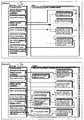
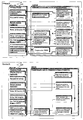
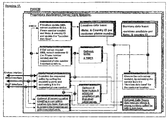
- FIGS 11 to 16 show the preferred implementation of the proprietary application module (PAM), which in the context of the foregoing are self explanatory, basically showing in each Figure 11 to 16 an example flow-chart implementation of the following PAM sub-modules:
- PAM proprietary application module
- FIG 17 shows the preferred embodiment of the proprietary application server module (PASCM), which in the context of the foregoing are self explanatory, basically showing an example of its flow-chart implementation.
- PASCM proprietary application server module
- the present invention provides a method and apparatus of interfacing and connecting a wireless device(s) and specific application server(s) for location update(s), in- and out-going call(s) routing & calls set-up, as well as accessing media data from specific servers linked to or embedded in the wireless network(s), fixed network(s) or the internet.
- Implementations of the invention provide an advantage allowing any wireless device with a built-in PAM (and also any media server) to be interconnected through the existing wireless networks.
- this invention provides an advantage allowing any wireless device with a built-in PAM to choose the optimal call routing without needing to use a network operator's HLR.
- the PAM(s) would reside in the wireless end-users' wireless handheld device(s) (HS) and/or wireless device(s) (WD).
- the PASCM(s) could reside in server(s) connected to the internet.
- IMVNO Internet mobile virtual network operator
- VTO virtual telecoms operator
- VTP virtual telecoms provider
- the proprietary applications module ( PAM ) and a proprietary applications server calls manager (PASCM) is capable of communicating through a wireless connection (IF-B) and a wireless and/or wired connection (IF-C).
- the proprietary applications module ( PAM ) is capable of communicating Wireless devices' (WD) and/or wireless Handheld devices' (HS) user and/or media information to the proprietary applications server manager (PASCM).
- the proprietary applications server calls manager is capable of communicating with any WD and/or HS that has a built in proprietary applications module ( PAM ) and communicating and exchanging user information with any 3 rd party- wireless network (WN) and their end users, even if they do not have a build-in PAM and/or any fixed network (FN) and their end users and/or any voice over internet protocol network/server (VoIP) and their end users.
- PAM proprietary applications module
- WN 3 rd party- wireless network
- FN fixed network
- VoIP voice over internet protocol network/server
- WD, WDn, HS and HSn are wireless devices and wireless handheld devices in any available current and future wireless technologies respectively, with a built-in PAM.
- IF-B and IF-Bn are wireless interfaces in any available current and future wireless technologies respectively.
- WN and WNn are wireless networks in any available current and future wireless technologies respectively.
- IF-C and IF-Cn are wireless and/or wired interfaces in any available current and future wireless and/or wired technologies respectively.
- FN and FNn are fixed networks in any available current and future fixed line technologies respectively.
- VoIP and VoIPn are wireless and/or wired voice over internet protocol networks or voice over internet protocol servers in any available current and future wireless and/or fixed line technologies respectively.
- AS and ASn are dedicated applications servers, in any available current and future servers technologies respectively, with a built-in PASCM.
- MS and MSn are media servers in any available current and future servers technologies respectively.
- Any individual or multiple PASCM may be built-in as a single (or multiple) module into any one or more of WN, WNn, FN, FNn, MS, MSn, VoIP and VoIPn or any such other processing device(s) and/or server(s) connected to any communications system(s), such as (but not limited to) so called “servers”, “internet servers”, “computers”, “PCs”, “media servers”, “wireless switching exchanges”, “fixed switching exchanges”, “wireless network processors”, “fixed network processor”, “ATM network”, “ADSL network”, “DSL network”, “internet servers”, “intranet servers”.
- servers such as (but not limited to) so called “servers”, “internet servers”, “computers”, “PCs”, “media servers”, “wireless switching exchanges”, “fixed switching exchanges”, “wireless network processors”, “fixed network processor”, “ATM network”, “ADSL network”, “DSL network”, “internet servers”, “intranet servers”.
- Any individual or multiple PAM may be built-in into any WD, HS or any such other wireless device, such as (but not limited to) so called “handsets”, “handy”, “mobile phones”, “cellular phones”, “wireless phones”, “smart phones”, “wireless devices”, “wireless PC cards”, “wireless modules”
- Any individual or multiple PAM may consist of any or all of the following proprietary sub-modules (or any single or multiple combination of these sub-modules) or indeed an equivalent of each such sub-module(s) performing a similar function:
- a wireless device (WD) and/or wireless handheld device (HS) are capable of communicating their geographical location to an PASCM; the proprietary sub-module location update (LU) is a sub-part of the PAM and the LU enables the WD and/or HS through its built in PAM to inform the PASCM of the geographical location, meaning wireless network name & country code, of the WD and/or HS respectively.
- the proprietary sub-module location update (LU) is a sub-part of the PAM and the LU enables the WD and/or HS through its built in PAM to inform the PASCM of the geographical location, meaning wireless network name & country code, of the WD and/or HS respectively.
- the LU monitors the WD and/or HS internal network it is authorised for and actually synchronised to and extracts the corresponding wireless network name & country code.
- the country code can be also a state or region code, and the LU stores it in a temporary LU register memory or alternatively, if access is available from the LU to the WD and/or HS static read/write memory (such as i.e. EEPROM) then such location information will be stored by the LU in a free WD and/or HS memory address location.
- the LU then sends this stored location information by means of a dedicated SMS containing such location information to a predefined destination (i.e. phone number).
- the SMS will then be transmitted by the WD and/or HS standard SMS protocol through the wireless interface (IF-B) to its final destination - i.e. the PASCM.
- the LU will continue to monitor any change of the wireless network name & country code to which the WD and/or HS is authorised and synchronised to, in comparison to the latest stored location information of such WD and/or HS. Only in the event of any change of either the network name code or the country name code, will the LU will repeat the previously mentioned procedure of sending a new SMS to the PASCM with the new location information and overwriting the previously memorised/stored location information with the latest new location information into the LU register memory or, if available, within the static read/write memory of the WD and/or HS.
- the PAM is capable of transmitting, together with the information it sends to the PASCM, as described above, the real time clock information of when each data was sent by the PAM to the PASCM.
- the PASCM is capable of receiving, storing and processing, together with the information it receives from the PAM, the real time information (derived from the real time clock) at which the data was originated by the PAM.
- the PASCM also has a real time clock built-in for its internal data processing.
- ICSUO1 the proprietary sub-module international call set-up option1
- the ICSUO1 monitors the WD and/or HS internal key-pad, and (if available) any hotkey dedicated to an international call request; it also monitors for incoming call signalling, and caller ID if available.
- the key-pad serial numbers are buffered and stored in a ICSUO1 phone number register memory at the time the send key is hit by the WD and/or HS user. Then, the ICSUO1 will take priority over the WD and/ HS call engine whilst it is processing the data and act as a buffer between the send key action inside the WD and/or HS and the internal outgoing call- and outgoing SMS- engine of the WD and/or HS (or other engine used to communicate with the PACSM).
- the ICSUO1 will check if the stored phone number starts with either a "+” or "00" and if not it will stop its routines and allow the PAM to run its other sub-modules. But if 'yes', then the ICSUO1 will send an SMS (or other signal or message, e.g. over the internet) to the PASCM with the stored phone number previously mentioned.
- SMS or other signal or message, e.g. over the internet
- ICSUO1 timer which initiates the monitoring of the incoming call signalling of the WD and/or HS by the ICSUO1, and if access to the WD and/or HS display is available to the ICSUO1, then the ICSUO1 will display a user feedback message, such as "please hold” whilst the timer is running and “Retry later” if the timer expires. If the timer expires, the ICSUO1 stops and resets all its routines, the timer and the buffered phone number.
- the ICSUO1 will accept the incoming call and optionally notify the requesting WD and/or HS that his call request to his specified 3 rd party number has been established by, for example, a loudspeaker feedback and/or a display feedback if available; it will also reset the timer.
- the ICSUO1 will accept the incoming call anyway and reset the timer. Also (optionally) if access is available to the WD and/or HS call waiting function by the ICSUO1, then the ICSUO1 will activate the call waiting function when the it starts its internal ICSUO1 timer.
- the wireless device (WD) and/or wireless handheld device (HS), (through its build-in PAM), is capable of re-routing an international call set-up request(s); a proprietary sub-module international call set-up option2 (ICSUO2) is a sub-part of the PAM and enables re-routing of an international call request by the WD and/or HS to a specific identified 3 rd party.
- ICSUO2 monitors the WD and/or HS internal key-pad, and any dedicated hotkey for an international call set-up request. The key-pad serial numbering for that request is buffered and stored in a ICSUO2 phone number register memory at the time the send key is hit by the WD and/or HS user.
- the ICSU2 will take priority over the WD and/ HS call engine whilst it is processing the data and act as a buffer between the send key action (or similar action with the same function inside the WD and/or HS) and the internal outgoing call engine of the WD and/or HS. Following the previous action, the ICSUO2 checks if the stored phone number starts with either a "+" or "00" and if 'yes', it will stop its routines and allow the PAM to run its other sub-modules.
- the ICSUO2 will add a pre-fix number to the stored phone number register and initiate an outgoing call on behalf of the requesting WD and/or HS using the new pre-fix phone number to call the requested 3 rd party.
- the ICSUO2 will, instead of adding a prefix number to the requested dialled number, replace it with a destination identifier of the requested 3 rd party that the user wishes to establish a communication with, for those cases that the WD and/or HS supports alternative ways of calling 3 rd parties, such as (but not limited to) where GPRS calls are supported, EDGE calls are supported, VoIP calls are supported.
- the proprietary sub-module international call set-up option1 (ICSUO1) and the proprietary sub-module international call set-up option2 (ICSUO2) are a sub-part of the PAM and inform the PASCM of an international call request by the WD and/or HS to a specific, identified 3 rd party and/or re-routing of an international call set-up request.
- Both the ICSUO1 and ICSUO2 monitor the WD and/or HS internal actual synchronized wireless network- and country- name/code; only one of these sub-modules will be active and the other deactivated, depending on the services available in a look-up table for each wireless network- and country- name/code.
- the proprietary sub-module local call set-up option1 (LCSUO1) is a sub-part of the PAM and the LCSUO1 and enables re-routing of a national/in-country/regional call request by the WD and/or HS to a specific identified 3 rd party.
- the LCSUO1 monitors the WD and/or HS internal key-pad, and any dedicated hotkey for that re-routing call request.
- the key-pad serial numbering is buffered and stored in a ICSUO2 phone number register memory at the time the send key is hit by the WD and/or HS user and then the ICSU2 will take priority over the WD and/ HS call engine whilst it is processing the data and act as a buffer between the send key action (or similar action with the same function inside the WD and/or HS) and the internal outgoing call engine of the WD and/or HS.
- the LCSUO1 checks if the stored phone number starts with either a "+" or "00" and if 'yes' it will stop its routines and allow the PAM to run its other sub-modules.
- the LCSUO1 will add a pre-fix number to the stored phone number register and initiate an outgoing call on behalf of the requesting WD and/or HS using the new pre-fix phone number to call the requested 3 rd party.
- the LCSUO2 will, instead of adding a prefix number to the requested dialled number, replace it with a destination identifier of the requested 3 rd party that the user wishes to establish a communication with, where the WD and/or HS supports alternative ways of calling 3 rd parties, such as (but not limited to) where GPRS calls are supported, EDGE calls are supported, VoIP calls are supported.
- the proprietary sub-module local call set-up option2 (LCSUO2 ) is a sub-part of the PAM and informs the PASCM of a national/in-country/regional call request by the WD and/or HS to a specific identified 3 rd party.
- the LCSUO2 monitors the WD and/or HS internal key-pad, and any dedicated hotkey, for this call request; it also monitors incoming call signalling, and caller ID if available.
- the key-pad serial numbering is buffered and stored in a LCSUO2 phone number register memory at the time the send key is hit by the WD and/or HS user and then the LCSUO2 will take priority over the WD and/ HS call engine whilst it is processing the data and act as a buffer between the send key action inside the WD and/or HS and the internal outgoing call- and outgoing SMS- engine (or other communications engine - essentially anything that enables communication with the PACSM) of the WD and/or HS.
- the LCSUO2 will check if the stored phone number starts with either a "+" or "00" and if 'yes' stop its routines and allow the PAM to run its other sub-modules.
- the LCSUO2 will send a SMS (or other data packet etc, depending on the nature of the communications protocol and type) to the PASCM with the stored phone number previously mentioned.
- it will start or re-initiate an internal LCSUO2 timer, which initiates the monitoring of the incoming calls signalling of the WD and/or HS by the LCSUO2, and if an access to the WD and/or HS display is available to the LCSUO2 then the LCSUO2 will display a user feedback message, such as in example "please hold” whilst timer is running and “Retry later” if the timer expires.
- the LCSUO2 stops and resets all its routines, timer and buffered phone number. However, if the timer is not expired and an incoming call is received from a pre-defined identifier, then the LCSUO2 will accept the incoming call and optionally notify the requesting WD and/or HS that his call request to his specified 3 rd party number has been established by (for example) a loudspeaker feedback and/or a display feedback if available. It will also reset the timer.
- the LCSUO2 will accept the incoming call anyway and reset the timer. Also optionally if access is available to the WD and/or HS call waiting function by the LCSUO2, then the LCSUO2 will activate the call waiting function when it starts its internal LCSUO2 timer.
- the proprietary sub-module local call set-up option1 (LCSUO1) and the proprietary sub-module local call set-up option2 (LCSUO2) are a sub-part of the PAM and the LCSUO1 and LCSUO2 allow the WD and/or HS to either re-route a national/in-country/regional calls request, or inform the PASCM of a national/in-country/regional calls request by the WD and/or HS to a specific identified 3 rd party.
- Both the LCSUO1 and LCSUO2 monitor the WD and/or HS internal actual synchronized wireless network- and country-name/code; only one of the sub-modules will be active and the other deactivated, depending on the services available in a look-up table for each wireless network- and country- name/code.
- the wireless device and/or wireless handheld device (HS)
- the proprietary media server connection set-up sub-module is a sub-part of the PAM and the MSCSU allows the WD and/or HS to communicate or re-route the web browser addresses requested by the WD and/or HS to a specific identified web internet server address.
- the MSCSU monitors the WD and/or HS internal key-pad, web browser- and its addresses- engine and any dedicated hotkey for this function.
- the web address requested by the WD and/or HS is buffered and stored by the MSCSU in a MSCSU "temporary register memory" at the time the send key or dedicated web key is hit by the WD and/or HS user.
- the MSCSU will take priority over the WD and/ HS web browser engine whilst it is processing the data and act as a buffer between the send- or dedicated web- key action inside the WD and/or HS and the internal web browser engine of the WD and/or HS.
- the MSCSU will check if its internal web internet server addresses data base has a re-route web address for the wireless network name- and country- code to which the WD and/or HS is synchronised to, and if not, the MSCSU will use the temporary web address register memory to set up the web connection on behalf of the WD and/or HS, and if 'yes' the MSCSU will use the re-route web address from the internal MSCSU "web internet server addresses data base" corresponding to the wireless network name- and country- code to which the WD and/or HS is synchronised to, to set up the web connection on behalf of the WD and/or HS. Once the web connection has been set-up, the MSCSU resets its internal "temporary register memory".
- the proprietary applications server calls manager is capable of communicating and exchanging user information with any WD or HS (that has a built-in proprietary applications module (PAM)) and communicating and exchanging user information with any 3 rd party- wireless network (WN). It is capable of communicating with their wireless end users, even if they do not have a built-in PAM and/or communicating and exchanging user information with any 3 rd party fixed network (FN) and communicating with their end users. It is capable of communicating and exchanging user information with any voice over internet protocol network/server (VoIP) and communicating with their end users.
- the PASCM monitors all incoming messages (e.g.
- SMS, HTTP etc for example those originated by any PAM, as well as monitoring the wireless interfaces (IF-B), and the wired and/or wireless interfaces (IF-C), as well as the interface to the "voice over internet protocol server/network" (VoIP).
- IF-B wireless interfaces
- IF-C wired and/or wireless interfaces
- VoIP voice over internet protocol server/network
- the PASCM proceeds to extract the identifier of the sender of the message and its location, for example the phone number of the originator and network name- and country- code to which the originator is synchronised to, and consequently updates the "location data base" for this specifically identified user.
- This approach eliminates the need for there to be a conventional HLR and hence removes the dependency on conventional network operators, who control the HLRs.
- the PASCM monitors all incoming SMS and HTTP messages (and messages using any other format or protocol), for example those originated by any PAM, as well as monitoring the wireless interfaces (IF-B), and the wired and/or wireless interfaces (IF-C), as well as the interface to "voice over internet protocol server/network" (VoIP). If an incoming SMS (etc.) is detected as being originated by a PAM as a "call set-up request" SMS, then the PASCM proceeds to extract the identifier of the sender of the SMS and the identifier of the 3 rd party it wishes to establish a communication with and optionally store these in a temporary buffer memory.
- IF-B wireless interfaces
- IF-C wired and/or wireless interfaces
- VoIP voice over internet protocol server/network
- PASCM programmable timer
- the PASCM will choose the calls set-up route, depending on the requesting party's location from the PASCM "location data base” and the PASCM “services database” corresponding to such specific "call set-up requesting party" location.
- the PASCM With the selected calls route(s), for example wireless interface IF-B and/or wired interface IF-C and/or voice over internet protocol VOIP, the PASCM will initiate a call to the requesting party. And it will initiate a call to the 3 rd party it wishes to talk to and conference both calls as one single communication between the parties. Multi-party conference calls are also possible. If the previously mentioned timer expires, then the requested call set-up that corresponds to that specific time-out will be aborted and the corresponding temporary buffer cleared/reset.
- the requested call set-up that corresponds to that specific time-out will be aborted and the corresponding temporary buffer cleared/reset.
- the PASCM monitors all its internal routines and in particular all temporary buffer memories with the information of all the "call set-up" requesting parties and the "3 rd party each of them wishes to establish a communication with” and initiates one or two timers corresponding to each call that the PASCM initiates between each specific call requesting party and the corresponding 3 rd party it is communicating to.
- timer(s) together with the identifier of the call requesting party, as well as the identifier of 3 rd party it communicated with, will then be stored in a PASCM billing data base or optionally stored in any other database, external to the PASCM, for billing processing.
- the PASCM will terminate those specific corresponding call(s) it had set-up and reset the timers and temporary buffers corresponding to such specific call set-up request.
- Any individual or multiple PAM may be stored- into any WN, WNn, FN, FNn, MS, MSn, VoIP and VoIPn or any such other storage device(s) and/or server(s) connected to any communications system(s), such as (but not limited to) so called “servers”, “internet servers”, “computers”, “PCs”, “media servers”, “wireless switching exchanges”, “fixed switching exchanges”, “wireless network processors”, “fixed network processor”, “ATM network”, “ADSL network”, “DSL network”, “internet servers”, “intranet servers”. From or through these storage devices/servers, any current and/or future wireless device can download a PAM or any evolution-, update-, upgrade-, modification of a PAM. Downloading can use for example GPRS, WAP, JAVA.
- Any individual or multiple PAM may be a part of (including an integral part of) any wireless device (WD) and/or wireless handheld device (HS), be it as software-, firmware-, hardware- or a combination that can perform the same or an equivalent function as the PAM we have described. Any such individual or multiple PAM may be activated or deactivated by the user of each individual WD and/or HS.
- WD wireless device
- HS wireless handheld device
- Any individual or multiple PASCM may be stored- into any WN, WNn, FN, FNn, MS, MSn, VoIP and VoIPn or any such other storage device(s) and/or server(s) connected to any communications system(s), such as in example but not limited to so called “servers”, “internet servers”, “computers”, “PCs”, “media servers”, “wireless switching exchanges”, “fixed switching exchanges”, “wireless network processors”, “fixed network processor”, “ATM network”, “ADSL network”, “DSL network”, “internet servers”, “intranet servers”.
- servers such as in example but not limited to so called “servers”, “internet servers”, “computers”, “PCs”, “media servers”, “wireless switching exchanges”, “fixed switching exchanges”, “wireless network processors”, “fixed network processor”, “ATM network”, “ADSL network”, “DSL network”, “internet servers”, “intranet servers”.
- One or a multiple of PASCMs is capable of receiving and detecting incoming communications/calls, by monitoring all the available external interfaces to the PASCM, such as but not limited to the wireless interface and/or wired interface and/or VoiP interface.
- the incoming calls are from any 3 rd party requesting to communicate with any WD and/or HS with a built-in PAM; the 3 rd party calls the unique PASCM identifier of such individual WD and/or HS user recognised within the PASCM.
- PASCM that will always initiate a local call to the specific WD and/or HS, using the information of the PASCM "location data base" and the “Services data base” to re-route the calling party either through VoIP to the country where the WD and/or HS is located and then through a standard PASCM call set-up as defined within this invention.
- the PAM is capable of communicating with the PASCM; it is capable of communicating to the PASCM a "call divert identifier activation" that alerts the PASCM that all communications from the PASCM are to be diverted to the specific divert identifier as communicated by the PAM to PASCM; for example a divert phone number or a VoIP address or any such other calling route identifier where the originating WD and/or HS can be contacted for any call set-up by the PASCM.
- a "call divert identifier activation" that alerts the PASCM that all communications from the PASCM are to be diverted to the specific divert identifier as communicated by the PAM to PASCM; for example a divert phone number or a VoIP address or any such other calling route identifier where the originating WD and/or HS can be contacted for any call set-up by the PASCM.
- the PAM is also capable of communicating to the PASCM a "call divert identifier de-activation", alerting the PASCM that the PAM can be contacted for all communications, in particular the call set-up originated from the PASCM for call routing to the WD and/or HS (that originated the information communicated to the PASCM), through its original identifier, for example its own original identifying phone number.
- the PASCM is capable of detecting and storing, a "call divert identifier activation" originated by a specific WD and/or HS user (with a built-in PAM), in the corresponding user location data base.
- the PASCM will use the "call divert identifier activation" to divert any call set-up the PASCM originates from then on, to a specific user, as identified within the PASCM location data base.
- the PASCM re-routes any calls to that specific user to the location identifier that the user provided, until such time that the PASCM detects and stores a "call divert identifier de-activation" originated by that same user.
- the PASCM updates the location identifier of that specific user in its location database and the PASCM returns to its normal procedures/routines as defined previously within this invention.
- All the users' billing information detection and storage forms an integral part of a PASCM. All the users' billing data processing also forms an integral part of the PASCM.
- the PASCM is capable of routing any 3 rd party incoming call to any VoIP destination.
- the LU, ICSUO1 and LCSUO2 informs the PASCM with the WD and/or HS location update, local call- and/or international call- set-up request, or any such other data transferred by the LU, ICSUO1 and LCSUO2 to the PASCM, by means of GPRS or WAP as an alternative to or instead of an SMS or any such other means available in any WD and/or HS with a build-in PAM which achieves the same function.
- the PASCM extracts information originated by a WD and/or HS (with built-in PAM), such as but not limited to location updates, call requests, or any such other data transferred by the LU, ICSUO1 and LCSUO2 (which are sub-modules of the PAM) to the PASCM. Transfer can be by means of GPRS or WAP as an alternative to or instead of SMS or HTTP message, or can be any such other means available in any WD and/or HS which achieves the same function.
- the PASCM is capable of processing its internal data taking into account the real time clock information corresponding to data it receives and stores from the PAM, as well as its own internal real time clock information.
- the internal real time clock can optionally be used for example for the following: to adjust its internal PASCM counters, for example (but not limited to) the call set-up processing timer(s), in order to align the timer within the PAM that monitors the incoming call set-up and the timer in the PASCM that establishes the corresponding call.
- the call set-up timer of the PAM is set at expiration time value "a" and the corresponding timer of the call set-up within the PASCM will then be adjusted and set at ("a"- (real time clock value of PASCM at the time the PASCM received the corresponding data - real time clock value of such corresponding call set-up message originated from the corresponding PAM)).
- any such other PASCM timer adjustments can be used, depending on each network(s) route and corresponding data transfer delay between the PAM data transmission and the PASCM data reception.
- the PAM is capable of communicating to the PASCM through the same method and means as explained earlier on that the WD and/or HS (with the built-in PAM) is switched on or off and where the PASCM is capable of receiving and detecting and storing such switch-on or switch-off state of the PAM.
- the PAM is capable of communicating with the PASCM and the wireless network, providing a standard call divert to a phone number (or equivalent identifier) controlled by the PASCM and assigned to that specific PAM.
- a "re-route identifier activation" is also provided by the PAM to the PASCM, alerting the PASCM that all incoming communications detected by the PASCM from the phone number or equivalent identifier controlled by the PASCM and assigned to that specific PAM are to be routed through the PASCM to the corresponding PAM.
- the PASCM Upon detection of such incoming calls by the PASCM, the PASCM will first check its internal data base to see if a "call divert identifier activation" is set for the corresponding WD and/or HS user (with a built-in PAM) and re-route the corresponding incoming call to such divert identifier. If not set, the PASCM will re-route the corresponding incoming call to the corresponding WD and/or HS user (with a built-in PAM).
- the PASCM can take into account the switch-on or switch-off state of the corresponding PAM within the PASCM database and provide a "busy" or “not reachable” notification to the incoming user trying to communicate with the corresponding PAM, in the event the switch-off mode is set and the "call divert identifier activation" is not set. Or it can re-route the corresponding incoming call to the call identifier set by the corresponding PAM within the PASCM data base when the "call divert identifier activation" is set.
- the PASCM can re-route the corresponding incoming call to the WD and/or HS (with the built-in PAM) when the switch-on mode is set and the "call divert identifier activation" is not set within the PASCM data base.
Landscapes
- Engineering & Computer Science (AREA)
- Computer Networks & Wireless Communication (AREA)
- Signal Processing (AREA)
- Business, Economics & Management (AREA)
- General Business, Economics & Management (AREA)
- Multimedia (AREA)
- Databases & Information Systems (AREA)
- Mobile Radio Communication Systems (AREA)
- Telephonic Communication Services (AREA)
Claims (18)
- Ein Verfahren zum Ermöglichen, dass eine drahtlose Vorrichtung von einem Teilnehmer zu einem Netzbetreiber, ohne Verwendung des Ausgangsstandortsregisters des Netzbetreibers, eine Netzwerkverbindung initiiert, wobei das Verfahren die folgenden Schritte beinhaltet:a) die drahtlose Vorrichtung kommuniziert mit einem Server über eine drahtlose Verbindung ohne Verwendung des Ausgangsstandortsregisters des Netzbetreibers, wobei der Server einen Server-Anrufemanager umfasst;b) der Server-Anrufemanager extrahiert einen Identifikator eines Senders und eines Standorts aus einer empfangenen Nachricht;c) der Server-Anrufemanager aktualisiert einen Standort in einer Standortdatenbank des Servers für den Sender, wobei sich die Standortdatenbank des Servers von dem Ausgangsstandortregister des Netzbetreibers unterscheidet;d) die drahtlose Vorrichtung sendet Daten über die drahtlose Verbindung an den Server, der eine Anrufanforderung definiert, ohne das Ausgangsstandortregister des Netzbetreibers zu verwenden;e) der Server-Anrufemanager trifft, als Reaktion auf die Anrufanforderung, eine Entscheidung über das angemessene Routing über alle verfügbaren Netzwerke für diese Anrufanforderung gemäß dem Standort des Senders in der Standortdatenbank des Servers.
- Verfahren nach Anspruch 1, wobei der Server unter Verwendung von einem beliebigen von mehreren unterschiedlichen Protokollen Kommunikationen von der Vorrichtung empfangen kann und nicht auf das MAP-Protokoll beschränkt ist.
- Verfahren nach einem der vorhergehenden Ansprüche, wobei die drahtlose Vorrichtung SMS verwendet, um mit dem Server zu kommunizieren.
- Verfahren nach einem der vorhergehenden Ansprüche, wobei die drahtlose Vorrichtung HTTP über das Internet verwendet, um mit dem Server zu kommunizieren.
- Vorrichtung nach Anspruch 4, wobei der Benutzer beliebige von dem Server geforderte Daten manuell in die Vorrichtung eingeben muss.
- Verfahren nach einem der vorhergehenden Ansprüche, wobei der Server die Verbindung ermöglicht, indem die Vorrichtung und der Empfänger durch Konferenz in einem einzigen Aufruf verbunden werden.
- Verfahren nach einem der vorhergehenden Ansprüche, wobei der Server eingehende Kommunikationen/Anrufe empfängt und erkennt, indem alle verfügbaren externen Schnittstellen zum Server überwacht werden.
- Verfahren nach einem der vorhergehenden Ansprüche, wobei der Server auch als ein Medienserver fungiert, sodass die Netzwerkverbindung nicht auf eine Sprachverbindung beschränkt ist, sondern auch die Übertragung von einem beliebigen Medienbestand, umfassend Daten-, Video- und Audiodateien, Webseiten und -daten, Video- und Audio-Streaming, umfasst.
- Verfahren nach einem der vorhergehenden Ansprüche, wobei der Server einen lokalen Anruf an die Vorrichtung unter Verwendung der Informationen in der Standortdatenbank und Dienstedatenbank des Servers initiiert, um einen Anrufer korrekt zur Vorrichtung umzuleiten.
- Verfahren nach einem der vorhergehenden Ansprüche, wobei der Server eine Datenbank von Standortaktualisierungen, die von der Vorrichtung bereitgestellt werden, wartet.
- Verfahren nach Anspruch 10, wobei die Standortaktualisierungen von SMS- oder HTTP-Standortaktualisierungsnachrichten, die von der Vorrichtung bereitgestellt werden, stammen.
- Verfahren nach einem der vorhergehenden Ansprüche, wobei der Server auch als ein VoIP-Server fungiert.
- Verfahren nach einem der vorhergehenden Ansprüche, wobei die Vorrichtung ein Modul umfasst, das für den Kontakt mit dem Server verantwortlich ist.
- Verfahren nach Anspruch 13, wobei das Modul als Software implementiert ist, die auf die Vorrichtung herunterladbar ist.
- Verfahren nach Anspruch 13, wobei das Modul die Kommunikation zwischen der Vorrichtung und dem Server herstellt und steuert.
- Verfahren nach Anspruch 13, wobei das Modul dem Server Standortaktualisierungen bereitstellt.
- Ein System, beinhaltend eine drahtlose Vorrichtung von einem Teilnehmer zu einem Netzbetreiber, zum Ermöglichen, dass die drahtlose Vorrichtung, ohne Verwendung des Ausgangsstandortsregisters des Netzbetreibers, eine Netzwerkverbindung initiiert, wobei der Server einen Server-Anrufemanager umfasst. Wobei in dem System:a) die drahtlose Vorrichtung betreibbar ist, um mit dem Server über eine drahtlose Verbindung ohne Verwendung des Ausgangsstandortregisters des Netzwerkbetreibers zu kommunizieren;b) der Server-Anrufemanager konfiguriert ist, um von einer empfangenen Nachricht einen Identifikator eines Senders und eines Standorts zu extrahieren;c) der Server-Anrufemanager konfiguriert ist, um einen Standort in einer Standortdatenbank des Servers für den Sender zu aktualisieren, wobei sich die Standortdatenbank des Servers von dem Ausgangsstandortregister des Netzbetreibers unterscheidet;d) die drahtlose Vorrichtung betreibbar ist, um über die drahtlose Verbindung Daten an den Server zu senden, welcher eine Anrufanforderung definiert, ohne das Ausgangsstandortregister des Netzbetreibers zu verwenden;e) der Server-Anrufemanager als Reaktion auf die Anrufanforderung betreibbar ist, um eine Entscheidung über das angemessene Routing über alle verfügbaren Netzwerke für diese Anrufanforderung gemäß dem Standort des Senders in der Standortdatenbank des Servers zu treffen.
- Ein Server, der betreibbar ist, um zu ermöglichen, dass eine drahtlose Vorrichtung von einem Teilnehmer zu einem Netzbetreiber, ohne Verwendung des Ausgangsstandortsregisters des Netzbetreibers, eine Netzwerkverbindung initiiert, wobei der Server einen Server-Anrufemanager umfasst, und:a) die drahtlose Vorrichtung betreibbar ist, um mit dem Server über eine drahtlose Verbindung ohne Verwendung des Ausgangsstandortregisters des Netzwerkbetreibers zu kommunizieren;b) der Server-Anrufemanager konfiguriert ist, um von einer empfangenen Nachricht einen Identifikator eines Senders und eines Standorts zu extrahieren;c) der Server-Anrufemanager konfiguriert ist, um einen Standort in einer Standortdatenbank des Servers für den Sender zu aktualisieren, wobei sich die Standortdatenbank des Servers von dem Ausgangsstandortregister des Netzbetreibers unterscheidet;d) die drahtlose Vorrichtung betreibbar ist, um über die drahtlose Verbindung Daten an den Server zu senden, welcher eine Anrufanforderung definiert, ohne das Ausgangsstandortregister des Netzbetreibers zu verwenden;e) der Server-Anrufemanager als Reaktion auf die Anrufanforderung betreibbar ist, um eine Entscheidung über das angemessene Routing über alle verfügbaren Netzwerke für diese Anrufanforderung gemäß dem Standort des Senders in der Standortdatenbank des Servers zu treffen.
Applications Claiming Priority (2)
| Application Number | Priority Date | Filing Date | Title |
|---|---|---|---|
| GBGB0604537.1A GB0604537D0 (en) | 2006-03-07 | 2006-03-07 | Method and apparatus of interfacing and connecting a wireless device(s) and specific application server(s) for location update(s), in-and out-going call(s)... |
| PCT/GB2007/000782 WO2007101996A1 (en) | 2006-03-07 | 2007-03-07 | A method of enabling a wireless device to make a network connection without using a network operator's home location register |
Publications (2)
| Publication Number | Publication Date |
|---|---|
| EP1997338A1 EP1997338A1 (de) | 2008-12-03 |
| EP1997338B1 true EP1997338B1 (de) | 2016-09-07 |
Family
ID=36219264
Family Applications (1)
| Application Number | Title | Priority Date | Filing Date |
|---|---|---|---|
| EP07731992.9A Active EP1997338B1 (de) | 2006-03-07 | 2007-03-07 | Verfahren, wodurch ein drahtloses gerät eine netzwerkverbindung herstellen kann, ohne das heimatregister eines netzbetreibers zu verwenden |
Country Status (5)
| Country | Link |
|---|---|
| US (3) | US8861512B2 (de) |
| EP (1) | EP1997338B1 (de) |
| ES (1) | ES2605944T3 (de) |
| GB (2) | GB0604537D0 (de) |
| WO (1) | WO2007101996A1 (de) |
Families Citing this family (9)
| Publication number | Priority date | Publication date | Assignee | Title |
|---|---|---|---|---|
| WO2009038541A1 (en) * | 2007-09-21 | 2009-03-26 | Zringgo Pte Ltd | Methods and systems for communications |
| CN101594585A (zh) * | 2008-05-30 | 2009-12-02 | 鸿富锦精密工业(深圳)有限公司 | 寻找最省钱通话方式的系统及方法 |
| US20100304784A1 (en) * | 2009-05-29 | 2010-12-02 | Hua Lin | System and Method for Placing a Mobile Telephone Call on a Secondary Network |
| US9992021B1 (en) | 2013-03-14 | 2018-06-05 | GoTenna, Inc. | System and method for private and point-to-point communication between computing devices |
| CN105007581B (zh) * | 2015-08-12 | 2018-03-20 | 腾讯科技(深圳)有限公司 | 一种上网认证方法及客户端 |
| US10530733B2 (en) * | 2015-11-10 | 2020-01-07 | Hipmunk, Inc. | Inferring preferences from message metadata and conversations |
| US10650621B1 (en) | 2016-09-13 | 2020-05-12 | Iocurrents, Inc. | Interfacing with a vehicular controller area network |
| JP6955170B2 (ja) * | 2018-04-24 | 2021-10-27 | 日本電信電話株式会社 | Rtp監視装置及びrtp監視方法 |
| US20250203339A1 (en) * | 2023-12-14 | 2025-06-19 | T-Mobile Innovations Llc | International internet protocol multimedia subsystem (ims) call network authorization |
Family Cites Families (45)
| Publication number | Priority date | Publication date | Assignee | Title |
|---|---|---|---|---|
| FI96815C (fi) * | 1993-06-23 | 1996-08-26 | Nokia Telecommunications Oy | Puhelunmuodostusmenetelmä |
| US5901341A (en) * | 1994-06-10 | 1999-05-04 | Uniden America Corporation | Land mobile radio system having a cell in which mobile radios transmit and receive both data and audio |
| US5847680A (en) * | 1997-12-05 | 1998-12-08 | Trimble Navigation Limited | GPS receiver having fast resolution of carrier phase ambiguity |
| JP2000078283A (ja) * | 1998-08-28 | 2000-03-14 | Fujitsu Ltd | 調停型呼接続システム |
| JP2000115838A (ja) * | 1998-09-30 | 2000-04-21 | Mitsubishi Electric Corp | 移動通信端末 |
| US6614781B1 (en) * | 1998-11-20 | 2003-09-02 | Level 3 Communications, Inc. | Voice over data telecommunications network architecture |
| US6014558A (en) * | 1998-12-28 | 2000-01-11 | Northern Telecom Limited | Variable rate optional security measures method and apparatus for wireless communications network |
| US6868272B1 (en) * | 1999-06-08 | 2005-03-15 | Utstarcom, Inc. | Method and apparatus for roaming in hierarchical mobile communications network |
| ATE407533T1 (de) * | 1999-12-23 | 2008-09-15 | Markport Ltd | Vorausbezahltes umherstreifen in mobilen telekommunikationsnetzen |
| US7523190B1 (en) * | 1999-12-23 | 2009-04-21 | Bickerstaff Cynthia L | Real-time performance assessment of large area network user experience |
| US7180889B1 (en) * | 1999-12-30 | 2007-02-20 | At&T Corp. | Personal control of address assignment and greeting options for multiple BRG ports |
| US20010039660A1 (en) * | 2000-03-31 | 2001-11-08 | Ucentric Holdings, Inc. | Home area network including arrangement for distributing television programming over local cable |
| US7209950B2 (en) * | 2000-08-15 | 2007-04-24 | Zonamovil.Com, Inc. | Method and apparatus for a network independent short message delivery system |
| US7035932B1 (en) * | 2000-10-27 | 2006-04-25 | Eric Morgan Dowling | Federated multiprotocol communication |
| US8996698B1 (en) * | 2000-11-03 | 2015-03-31 | Truphone Limited | Cooperative network for mobile internet access |
| US7576692B2 (en) * | 2001-02-23 | 2009-08-18 | Nokia Corporation | Method for positioning, a positioning system, and an electronic device |
| US6813347B2 (en) * | 2001-04-10 | 2004-11-02 | Lucent Technologies Inc. | Selective call waiting |
| US20030055985A1 (en) * | 2001-08-03 | 2003-03-20 | Joshua Corb | System and method for integrating voice over internet protocol network with personal computing devices |
| US7533271B2 (en) * | 2001-09-05 | 2009-05-12 | Vixs Systems, Inc. | Method and apparatus for remote control and monitoring of a multimedia system |
| EP1442625B1 (de) * | 2001-10-30 | 2010-10-20 | Alexander C. Lang | Verfahren und vorrichtung zum bereitstellen von leistungsmerkmalen zum aufbau und zur steuerung von erweiterten anrufen unter verwendung eines kurznachrichtendienstes |
| US7593686B1 (en) * | 2002-01-29 | 2009-09-22 | Sprint Spectrum L.P. | Method and system for selecting transmission modes for streaming media content to a wireless handset access technology |
| US20040198327A1 (en) * | 2002-04-22 | 2004-10-07 | Mavis Bates | Telecommunications call completion |
| AUPS324602A0 (en) * | 2002-06-28 | 2002-07-18 | Ehrlich, Julian | Electronic message system |
| US7043264B2 (en) * | 2002-12-18 | 2006-05-09 | America Online, Inc. | Message transmission system in a GPRS environment |
| US20040162058A1 (en) | 2002-12-23 | 2004-08-19 | Dorron Mottes | Multi MVNO and service provider platform and management |
| GB2405051B (en) * | 2003-07-16 | 2006-06-28 | Callkey Ltd | Call establishment |
| JP2005045324A (ja) | 2003-07-22 | 2005-02-17 | Mvno Co Ltd | 通信システムおよびそれを用いた通信方法 |
| US20050079855A1 (en) | 2003-08-20 | 2005-04-14 | Jethi Rashesh J. | Architecture that enables a mobile virtual network operator (MVNO) to create a branded wireless offering |
| EP2192724B1 (de) * | 2003-09-16 | 2013-10-23 | BlackBerry Limited | Verfahren zur Erzeugung einer Peer-to-Peer-Sofortmitteilungslösung ohne die Verwendung eines Instant-Messaging-Servers |
| US20050228860A1 (en) * | 2004-04-12 | 2005-10-13 | Kimmo Hamynen | Methods and apparatus for geographically based Web services |
| GB0408457D0 (en) * | 2004-04-15 | 2004-05-19 | Ring 2 Comm Ltd | Various improvements relating to telephone and conference calls between telephony devices |
| FR2869491B1 (fr) * | 2004-04-22 | 2006-08-18 | Alcatel Sa | Reseau de telecommunication comportant plusieurs reseaux prives superposes ; autocommutateur pour la mise en oeuvre de ce reseau ; et centre d'appels d'urgence |
| US20060047539A1 (en) * | 2004-08-31 | 2006-03-02 | Paul Huang | Healthcare administration transaction method and system for the same |
| CN100488220C (zh) * | 2004-11-08 | 2009-05-13 | 华为技术有限公司 | 为用户提供固网智能业务的方法及其系统 |
| US7574490B2 (en) * | 2004-11-20 | 2009-08-11 | Microsoft Corporation | Strategies for configuring a server-based information-transmission infrastructure |
| GB2422271A (en) * | 2005-01-12 | 2006-07-19 | Intellprop Ltd | Telecommunications services apparatus and method for processing of voice calls |
| US7577420B2 (en) * | 2005-02-17 | 2009-08-18 | Sudharshan Srinivasan | Instant help security system for emergency help using 2G, 2.5G and 3G cellular wirelesses half duplex call |
| US7852831B2 (en) * | 2005-02-22 | 2010-12-14 | Akbar Imran M | Method and system for providing private virtual secure Voice over Internet Protocol communications |
| US7894807B1 (en) * | 2005-03-30 | 2011-02-22 | Openwave Systems Inc. | System and method for routing a wireless connection in a hybrid network |
| KR100642935B1 (ko) * | 2005-05-06 | 2006-11-10 | (주)아이디스 | 네임 서비스 시스템 및 방법 |
| US7920529B1 (en) * | 2005-05-24 | 2011-04-05 | At&T Mobility Ii Llc | Intermediary query manager for 2G and 3G services |
| EP1886511B1 (de) * | 2005-05-27 | 2017-12-13 | Telefonaktiebolaget LM Ericsson (publ) | Anrufumleitung in einem mobilfunksystem |
| JP2007206772A (ja) * | 2006-01-31 | 2007-08-16 | Fujifilm Corp | 端末装置及びサーバー及びランドマーク名検索システム及び検索プログラム |
| WO2008127512A2 (en) * | 2007-02-27 | 2008-10-23 | Roamware, Inc. | Method and system for providing camel services to a home network's outbound roamer without need for camel support or agreement |
| US8265083B1 (en) * | 2011-07-27 | 2012-09-11 | Vonage Network, Llc | Systems and methods of providing communications services |
-
2006
- 2006-03-07 GB GBGB0604537.1A patent/GB0604537D0/en not_active Ceased
-
2007
- 2007-03-07 GB GB0704420A patent/GB2436016A/en not_active Withdrawn
- 2007-03-07 WO PCT/GB2007/000782 patent/WO2007101996A1/en not_active Ceased
- 2007-03-07 US US12/281,840 patent/US8861512B2/en active Active
- 2007-03-07 EP EP07731992.9A patent/EP1997338B1/de active Active
- 2007-03-07 ES ES07731992.9T patent/ES2605944T3/es active Active
-
2014
- 2014-09-18 US US14/490,370 patent/US9591551B2/en active Active
-
2015
- 2015-03-27 US US14/671,562 patent/US9173154B2/en active Active
Also Published As
| Publication number | Publication date |
|---|---|
| US20150003400A1 (en) | 2015-01-01 |
| US9591551B2 (en) | 2017-03-07 |
| US20090303942A1 (en) | 2009-12-10 |
| US9173154B2 (en) | 2015-10-27 |
| GB0604537D0 (en) | 2006-04-12 |
| US8861512B2 (en) | 2014-10-14 |
| WO2007101996A1 (en) | 2007-09-13 |
| GB0704420D0 (en) | 2007-04-18 |
| ES2605944T3 (es) | 2017-03-17 |
| US20150201361A1 (en) | 2015-07-16 |
| EP1997338A1 (de) | 2008-12-03 |
| GB2436016A (en) | 2007-09-12 |
Similar Documents
| Publication | Publication Date | Title |
|---|---|---|
| US9173154B2 (en) | Method of enabling a wireless device to make a network connection without using a network operator's home location register | |
| US9532208B2 (en) | Method of and apparatus for interfacing and connecting a wireless device and a wireless network using a subscriber identity module having plural IMSI associates with different network operators | |
| TWI345408B (en) | Method for providing routing information, computer program,arrangement in a communication system, mobile terminal and routing server | |
| US7890111B2 (en) | System and method for virtual wireless roaming | |
| KR101110722B1 (ko) | 통신 네트워크의 복합 서비스의 활성화 방법 | |
| CN102640526A (zh) | 用于固定/移动网络的用户标识管理代理 | |
| EP2241098B1 (de) | Annordnung und verfharen zur verbindungsaufbau zwischen einer internet-umgebung und einer mobilfunk-umgebung | |
| US7403516B2 (en) | Enabling packet switched calls to a wireless telephone user | |
| TW201325146A (zh) | Wlan尚建立多媒體信息服務之無線通信方法及系統 | |
| CN101001468A (zh) | 网际协议承载语音用户接入方法、定位装置和网络设备 | |
| KR100369982B1 (ko) | 인터넷 폰 서비스 시스템 | |
| KR100902046B1 (ko) | 브이오아이피 부재중 정보 전달 서비스 시스템 및 그 방법 | |
| CN1985530B (zh) | Wlan上建立多媒体信息服务的无线通信方法及系统 | |
| CN101142838A (zh) | 用于路由无线通信的系统 | |
| GB2435156A (en) | Communication system for accessing more than one device at a single address | |
| KR101016269B1 (ko) | 해외 로밍 메시징 서비스에서 주번호와 부번호를 이용하여발신 및 착신을 처리하는 무선 통신 방법 및 시스템 | |
| CN1802863B (zh) | 移动业务的通信方法 | |
| KR20050008951A (ko) | 착신제어시스템을 이용한 착신 컨텐츠 정보 표시방법 | |
| HK1101630B (en) | Wireless communication method and system for establishing a multimedia message service over a wlan | |
| KR20050076855A (ko) | 이동통신시스템에서 호 접속 정보 제공 방법 | |
| HK1173308A (en) | Method for use in a wireless transmit/receive unit |
Legal Events
| Date | Code | Title | Description |
|---|---|---|---|
| PUAI | Public reference made under article 153(3) epc to a published international application that has entered the european phase |
Free format text: ORIGINAL CODE: 0009012 |
|
| 17P | Request for examination filed |
Effective date: 20081007 |
|
| AK | Designated contracting states |
Kind code of ref document: A1 Designated state(s): AT BE BG CH CY CZ DE DK EE ES FI FR GB GR HU IE IS IT LI LT LU LV MC MT NL PL PT RO SE SI SK TR |
|
| 17Q | First examination report despatched |
Effective date: 20110530 |
|
| DAX | Request for extension of the european patent (deleted) | ||
| RAP1 | Party data changed (applicant data changed or rights of an application transferred) |
Owner name: SHOO 533 LIMITED |
|
| REG | Reference to a national code |
Ref country code: DE Ref legal event code: R079 Ref document number: 602007047818 Country of ref document: DE Free format text: PREVIOUS MAIN CLASS: H04Q0007380000 Ipc: H04W0076020000 |
|
| GRAP | Despatch of communication of intention to grant a patent |
Free format text: ORIGINAL CODE: EPIDOSNIGR1 |
|
| RIC1 | Information provided on ipc code assigned before grant |
Ipc: H04W 76/02 20090101AFI20160419BHEP Ipc: H04L 29/06 20060101ALI20160419BHEP |
|
| INTG | Intention to grant announced |
Effective date: 20160509 |
|
| GRAS | Grant fee paid |
Free format text: ORIGINAL CODE: EPIDOSNIGR3 |
|
| GRAA | (expected) grant |
Free format text: ORIGINAL CODE: 0009210 |
|
| AK | Designated contracting states |
Kind code of ref document: B1 Designated state(s): AT BE BG CH CY CZ DE DK EE ES FI FR GB GR HU IE IS IT LI LT LU LV MC MT NL PL PT RO SE SI SK TR |
|
| REG | Reference to a national code |
Ref country code: GB Ref legal event code: FG4D |
|
| RIN1 | Information on inventor provided before grant (corrected) |
Inventor name: CAMILLERI, MICHAEL Inventor name: MERINO GONZALEZ, JOSE, LUIS |
|
| REG | Reference to a national code |
Ref country code: CH Ref legal event code: EP |
|
| REG | Reference to a national code |
Ref country code: IE Ref legal event code: FG4D |
|
| REG | Reference to a national code |
Ref country code: AT Ref legal event code: REF Ref document number: 827821 Country of ref document: AT Kind code of ref document: T Effective date: 20161015 |
|
| REG | Reference to a national code |
Ref country code: DE Ref legal event code: R096 Ref document number: 602007047818 Country of ref document: DE |
|
| REG | Reference to a national code |
Ref country code: LT Ref legal event code: MG4D |
|
| REG | Reference to a national code |
Ref country code: NL Ref legal event code: MP Effective date: 20160907 |
|
| REG | Reference to a national code |
Ref country code: FR Ref legal event code: PLFP Year of fee payment: 11 |
|
| PG25 | Lapsed in a contracting state [announced via postgrant information from national office to epo] |
Ref country code: LT Free format text: LAPSE BECAUSE OF FAILURE TO SUBMIT A TRANSLATION OF THE DESCRIPTION OR TO PAY THE FEE WITHIN THE PRESCRIBED TIME-LIMIT Effective date: 20160907 Ref country code: FI Free format text: LAPSE BECAUSE OF FAILURE TO SUBMIT A TRANSLATION OF THE DESCRIPTION OR TO PAY THE FEE WITHIN THE PRESCRIBED TIME-LIMIT Effective date: 20160907 |
|
| REG | Reference to a national code |
Ref country code: AT Ref legal event code: MK05 Ref document number: 827821 Country of ref document: AT Kind code of ref document: T Effective date: 20160907 |
|
| PG25 | Lapsed in a contracting state [announced via postgrant information from national office to epo] |
Ref country code: SE Free format text: LAPSE BECAUSE OF FAILURE TO SUBMIT A TRANSLATION OF THE DESCRIPTION OR TO PAY THE FEE WITHIN THE PRESCRIBED TIME-LIMIT Effective date: 20160907 Ref country code: GR Free format text: LAPSE BECAUSE OF FAILURE TO SUBMIT A TRANSLATION OF THE DESCRIPTION OR TO PAY THE FEE WITHIN THE PRESCRIBED TIME-LIMIT Effective date: 20161208 Ref country code: NL Free format text: LAPSE BECAUSE OF FAILURE TO SUBMIT A TRANSLATION OF THE DESCRIPTION OR TO PAY THE FEE WITHIN THE PRESCRIBED TIME-LIMIT Effective date: 20160907 Ref country code: LV Free format text: LAPSE BECAUSE OF FAILURE TO SUBMIT A TRANSLATION OF THE DESCRIPTION OR TO PAY THE FEE WITHIN THE PRESCRIBED TIME-LIMIT Effective date: 20160907 |
|
| REG | Reference to a national code |
Ref country code: ES Ref legal event code: FG2A Ref document number: 2605944 Country of ref document: ES Kind code of ref document: T3 Effective date: 20170317 |
|
| PG25 | Lapsed in a contracting state [announced via postgrant information from national office to epo] |
Ref country code: RO Free format text: LAPSE BECAUSE OF FAILURE TO SUBMIT A TRANSLATION OF THE DESCRIPTION OR TO PAY THE FEE WITHIN THE PRESCRIBED TIME-LIMIT Effective date: 20160907 Ref country code: EE Free format text: LAPSE BECAUSE OF FAILURE TO SUBMIT A TRANSLATION OF THE DESCRIPTION OR TO PAY THE FEE WITHIN THE PRESCRIBED TIME-LIMIT Effective date: 20160907 |
|
| PG25 | Lapsed in a contracting state [announced via postgrant information from national office to epo] |
Ref country code: PL Free format text: LAPSE BECAUSE OF FAILURE TO SUBMIT A TRANSLATION OF THE DESCRIPTION OR TO PAY THE FEE WITHIN THE PRESCRIBED TIME-LIMIT Effective date: 20160907 Ref country code: PT Free format text: LAPSE BECAUSE OF FAILURE TO SUBMIT A TRANSLATION OF THE DESCRIPTION OR TO PAY THE FEE WITHIN THE PRESCRIBED TIME-LIMIT Effective date: 20170109 Ref country code: BE Free format text: LAPSE BECAUSE OF FAILURE TO SUBMIT A TRANSLATION OF THE DESCRIPTION OR TO PAY THE FEE WITHIN THE PRESCRIBED TIME-LIMIT Effective date: 20160907 Ref country code: BG Free format text: LAPSE BECAUSE OF FAILURE TO SUBMIT A TRANSLATION OF THE DESCRIPTION OR TO PAY THE FEE WITHIN THE PRESCRIBED TIME-LIMIT Effective date: 20161207 Ref country code: SK Free format text: LAPSE BECAUSE OF FAILURE TO SUBMIT A TRANSLATION OF THE DESCRIPTION OR TO PAY THE FEE WITHIN THE PRESCRIBED TIME-LIMIT Effective date: 20160907 Ref country code: CZ Free format text: LAPSE BECAUSE OF FAILURE TO SUBMIT A TRANSLATION OF THE DESCRIPTION OR TO PAY THE FEE WITHIN THE PRESCRIBED TIME-LIMIT Effective date: 20160907 Ref country code: IS Free format text: LAPSE BECAUSE OF FAILURE TO SUBMIT A TRANSLATION OF THE DESCRIPTION OR TO PAY THE FEE WITHIN THE PRESCRIBED TIME-LIMIT Effective date: 20170107 Ref country code: AT Free format text: LAPSE BECAUSE OF FAILURE TO SUBMIT A TRANSLATION OF THE DESCRIPTION OR TO PAY THE FEE WITHIN THE PRESCRIBED TIME-LIMIT Effective date: 20160907 |
|
| REG | Reference to a national code |
Ref country code: DE Ref legal event code: R097 Ref document number: 602007047818 Country of ref document: DE |
|
| PLBE | No opposition filed within time limit |
Free format text: ORIGINAL CODE: 0009261 |
|
| STAA | Information on the status of an ep patent application or granted ep patent |
Free format text: STATUS: NO OPPOSITION FILED WITHIN TIME LIMIT |
|
| PG25 | Lapsed in a contracting state [announced via postgrant information from national office to epo] |
Ref country code: DK Free format text: LAPSE BECAUSE OF FAILURE TO SUBMIT A TRANSLATION OF THE DESCRIPTION OR TO PAY THE FEE WITHIN THE PRESCRIBED TIME-LIMIT Effective date: 20160907 |
|
| 26N | No opposition filed |
Effective date: 20170608 |
|
| PG25 | Lapsed in a contracting state [announced via postgrant information from national office to epo] |
Ref country code: SI Free format text: LAPSE BECAUSE OF FAILURE TO SUBMIT A TRANSLATION OF THE DESCRIPTION OR TO PAY THE FEE WITHIN THE PRESCRIBED TIME-LIMIT Effective date: 20160907 |
|
| REG | Reference to a national code |
Ref country code: CH Ref legal event code: PL |
|
| REG | Reference to a national code |
Ref country code: DE Ref legal event code: R079 Ref document number: 602007047818 Country of ref document: DE Free format text: PREVIOUS MAIN CLASS: H04W0076020000 Ipc: H04W0076100000 |
|
| PG25 | Lapsed in a contracting state [announced via postgrant information from national office to epo] |
Ref country code: MC Free format text: LAPSE BECAUSE OF FAILURE TO SUBMIT A TRANSLATION OF THE DESCRIPTION OR TO PAY THE FEE WITHIN THE PRESCRIBED TIME-LIMIT Effective date: 20160907 |
|
| REG | Reference to a national code |
Ref country code: IE Ref legal event code: MM4A |
|
| PG25 | Lapsed in a contracting state [announced via postgrant information from national office to epo] |
Ref country code: LU Free format text: LAPSE BECAUSE OF NON-PAYMENT OF DUE FEES Effective date: 20170307 |
|
| REG | Reference to a national code |
Ref country code: FR Ref legal event code: PLFP Year of fee payment: 12 |
|
| PG25 | Lapsed in a contracting state [announced via postgrant information from national office to epo] |
Ref country code: IE Free format text: LAPSE BECAUSE OF NON-PAYMENT OF DUE FEES Effective date: 20170307 Ref country code: LI Free format text: LAPSE BECAUSE OF NON-PAYMENT OF DUE FEES Effective date: 20170331 Ref country code: CH Free format text: LAPSE BECAUSE OF NON-PAYMENT OF DUE FEES Effective date: 20170331 |
|
| REG | Reference to a national code |
Ref country code: ES Ref legal event code: PC2A Owner name: GHOST TELECOM LIMITED Effective date: 20180710 Ref country code: ES Ref legal event code: PC2A Effective date: 20180710 |
|
| REG | Reference to a national code |
Ref country code: DE Ref legal event code: R082 Ref document number: 602007047818 Country of ref document: DE Representative=s name: LAVOIX MUNICH, DE Ref country code: DE Ref legal event code: R081 Ref document number: 602007047818 Country of ref document: DE Owner name: GHOST TELECOM LTD., GB Free format text: FORMER OWNER: SHOO 533 LTD., WOKINGHAM, BERKSHIRE, GB |
|
| PG25 | Lapsed in a contracting state [announced via postgrant information from national office to epo] |
Ref country code: MT Free format text: LAPSE BECAUSE OF NON-PAYMENT OF DUE FEES Effective date: 20170307 |
|
| REG | Reference to a national code |
Ref country code: FR Ref legal event code: TP Owner name: GHOST TELECOM LIMITED, GB Effective date: 20181022 |
|
| PG25 | Lapsed in a contracting state [announced via postgrant information from national office to epo] |
Ref country code: HU Free format text: LAPSE BECAUSE OF FAILURE TO SUBMIT A TRANSLATION OF THE DESCRIPTION OR TO PAY THE FEE WITHIN THE PRESCRIBED TIME-LIMIT; INVALID AB INITIO Effective date: 20070307 |
|
| PG25 | Lapsed in a contracting state [announced via postgrant information from national office to epo] |
Ref country code: CY Free format text: LAPSE BECAUSE OF NON-PAYMENT OF DUE FEES Effective date: 20160907 |
|
| PG25 | Lapsed in a contracting state [announced via postgrant information from national office to epo] |
Ref country code: TR Free format text: LAPSE BECAUSE OF FAILURE TO SUBMIT A TRANSLATION OF THE DESCRIPTION OR TO PAY THE FEE WITHIN THE PRESCRIBED TIME-LIMIT Effective date: 20160907 |
|
| PGFP | Annual fee paid to national office [announced via postgrant information from national office to epo] |
Ref country code: DE Payment date: 20250313 Year of fee payment: 19 |
|
| PGFP | Annual fee paid to national office [announced via postgrant information from national office to epo] |
Ref country code: FR Payment date: 20250128 Year of fee payment: 19 |
|
| PGFP | Annual fee paid to national office [announced via postgrant information from national office to epo] |
Ref country code: IT Payment date: 20250311 Year of fee payment: 19 Ref country code: GB Payment date: 20250324 Year of fee payment: 19 |
|
| PGFP | Annual fee paid to national office [announced via postgrant information from national office to epo] |
Ref country code: ES Payment date: 20250410 Year of fee payment: 19 |