EP1985348A1 - Filtrierverfahren und Vorrichtung mit poröser Walze - Google Patents
Filtrierverfahren und Vorrichtung mit poröser Walze Download PDFInfo
- Publication number
- EP1985348A1 EP1985348A1 EP07106918A EP07106918A EP1985348A1 EP 1985348 A1 EP1985348 A1 EP 1985348A1 EP 07106918 A EP07106918 A EP 07106918A EP 07106918 A EP07106918 A EP 07106918A EP 1985348 A1 EP1985348 A1 EP 1985348A1
- Authority
- EP
- European Patent Office
- Prior art keywords
- filter
- roller
- filter belt
- rollers
- pore
- Prior art date
- Legal status (The legal status is an assumption and is not a legal conclusion. Google has not performed a legal analysis and makes no representation as to the accuracy of the status listed.)
- Withdrawn
Links
- 239000011148 porous material Substances 0.000 title claims abstract description 123
- 238000001914 filtration Methods 0.000 title description 35
- 238000000034 method Methods 0.000 claims abstract description 102
- 238000000926 separation method Methods 0.000 claims abstract description 78
- 239000000725 suspension Substances 0.000 claims abstract description 75
- 239000012065 filter cake Substances 0.000 claims abstract description 69
- 230000001105 regulatory effect Effects 0.000 claims abstract description 13
- 230000035699 permeability Effects 0.000 claims abstract description 11
- 239000012530 fluid Substances 0.000 claims abstract description 7
- 239000000463 material Substances 0.000 claims description 34
- 239000007788 liquid Substances 0.000 claims description 27
- 239000005060 rubber Substances 0.000 claims description 17
- 239000002245 particle Substances 0.000 claims description 14
- 239000004033 plastic Substances 0.000 claims description 12
- 239000002184 metal Substances 0.000 claims description 11
- 229910052751 metal Inorganic materials 0.000 claims description 11
- XLYOFNOQVPJJNP-UHFFFAOYSA-N water Substances O XLYOFNOQVPJJNP-UHFFFAOYSA-N 0.000 claims description 11
- 239000011521 glass Substances 0.000 claims description 10
- 102000004190 Enzymes Human genes 0.000 claims description 8
- 108090000790 Enzymes Proteins 0.000 claims description 8
- 239000000919 ceramic Substances 0.000 claims description 8
- 239000004753 textile Substances 0.000 claims description 7
- 239000004677 Nylon Substances 0.000 claims description 6
- 239000011248 coating agent Substances 0.000 claims description 6
- 238000000576 coating method Methods 0.000 claims description 6
- 229920001778 nylon Polymers 0.000 claims description 6
- 239000000126 substance Substances 0.000 claims description 6
- 239000003054 catalyst Substances 0.000 claims description 5
- 238000005406 washing Methods 0.000 claims description 5
- 244000025254 Cannabis sativa Species 0.000 claims description 4
- 241000735470 Juncus Species 0.000 claims description 3
- 229910000831 Steel Inorganic materials 0.000 claims description 3
- 239000007863 gel particle Substances 0.000 claims description 3
- 238000007790 scraping Methods 0.000 claims description 3
- 239000010935 stainless steel Substances 0.000 claims description 3
- 229910001220 stainless steel Inorganic materials 0.000 claims description 3
- 239000010959 steel Substances 0.000 claims description 3
- 239000003599 detergent Substances 0.000 claims description 2
- 229910010293 ceramic material Inorganic materials 0.000 claims 2
- 239000002609 medium Substances 0.000 description 34
- 239000010802 sludge Substances 0.000 description 9
- 235000011389 fruit/vegetable juice Nutrition 0.000 description 6
- 241000894006 Bacteria Species 0.000 description 5
- 238000004140 cleaning Methods 0.000 description 5
- 150000001875 compounds Chemical class 0.000 description 5
- 235000013399 edible fruits Nutrition 0.000 description 5
- 239000003921 oil Substances 0.000 description 5
- 238000001556 precipitation Methods 0.000 description 5
- 238000009825 accumulation Methods 0.000 description 4
- 235000013405 beer Nutrition 0.000 description 4
- 239000012535 impurity Substances 0.000 description 4
- 235000013311 vegetables Nutrition 0.000 description 4
- 241000196324 Embryophyta Species 0.000 description 3
- 238000005119 centrifugation Methods 0.000 description 3
- 210000003608 fece Anatomy 0.000 description 3
- 239000000706 filtrate Substances 0.000 description 3
- 238000011010 flushing procedure Methods 0.000 description 3
- 235000013305 food Nutrition 0.000 description 3
- 239000007789 gas Substances 0.000 description 3
- 239000010871 livestock manure Substances 0.000 description 3
- 238000004519 manufacturing process Methods 0.000 description 3
- 238000003825 pressing Methods 0.000 description 3
- 238000011514 vinification Methods 0.000 description 3
- QGZKDVFQNNGYKY-UHFFFAOYSA-N Ammonia Chemical compound N QGZKDVFQNNGYKY-UHFFFAOYSA-N 0.000 description 2
- 241000233866 Fungi Species 0.000 description 2
- 229910002651 NO3 Inorganic materials 0.000 description 2
- NHNBFGGVMKEFGY-UHFFFAOYSA-N Nitrate Chemical compound [O-][N+]([O-])=O NHNBFGGVMKEFGY-UHFFFAOYSA-N 0.000 description 2
- 239000003795 chemical substances by application Substances 0.000 description 2
- 238000005352 clarification Methods 0.000 description 2
- 239000002537 cosmetic Substances 0.000 description 2
- 230000001419 dependent effect Effects 0.000 description 2
- 239000000835 fiber Substances 0.000 description 2
- 238000010438 heat treatment Methods 0.000 description 2
- 235000013336 milk Nutrition 0.000 description 2
- 239000008267 milk Substances 0.000 description 2
- 210000004080 milk Anatomy 0.000 description 2
- 239000000123 paper Substances 0.000 description 2
- 239000008194 pharmaceutical composition Substances 0.000 description 2
- 239000000047 product Substances 0.000 description 2
- 102000004169 proteins and genes Human genes 0.000 description 2
- 108090000623 proteins and genes Proteins 0.000 description 2
- 238000007789 sealing Methods 0.000 description 2
- 210000005253 yeast cell Anatomy 0.000 description 2
- OKTJSMMVPCPJKN-UHFFFAOYSA-N Carbon Chemical compound [C] OKTJSMMVPCPJKN-UHFFFAOYSA-N 0.000 description 1
- UGFAIRIUMAVXCW-UHFFFAOYSA-N Carbon monoxide Chemical compound [O+]#[C-] UGFAIRIUMAVXCW-UHFFFAOYSA-N 0.000 description 1
- 229920001875 Ebonite Polymers 0.000 description 1
- GUBGYTABKSRVRQ-QKKXKWKRSA-N Lactose Natural products OC[C@H]1O[C@@H](O[C@H]2[C@H](O)[C@@H](O)C(O)O[C@@H]2CO)[C@H](O)[C@@H](O)[C@H]1O GUBGYTABKSRVRQ-QKKXKWKRSA-N 0.000 description 1
- 241000124008 Mammalia Species 0.000 description 1
- 241001465754 Metazoa Species 0.000 description 1
- 239000004909 Moisturizer Substances 0.000 description 1
- GXCLVBGFBYZDAG-UHFFFAOYSA-N N-[2-(1H-indol-3-yl)ethyl]-N-methylprop-2-en-1-amine Chemical compound CN(CCC1=CNC2=C1C=CC=C2)CC=C GXCLVBGFBYZDAG-UHFFFAOYSA-N 0.000 description 1
- 241000207836 Olea <angiosperm> Species 0.000 description 1
- STTYIMSDIYISRG-UHFFFAOYSA-N Valyl-Serine Chemical compound CC(C)C(N)C(=O)NC(CO)C(O)=O STTYIMSDIYISRG-UHFFFAOYSA-N 0.000 description 1
- 241000219094 Vitaceae Species 0.000 description 1
- 239000005862 Whey Substances 0.000 description 1
- 102000007544 Whey Proteins Human genes 0.000 description 1
- 108010046377 Whey Proteins Proteins 0.000 description 1
- LUTSRLYCMSCGCS-BWOMAWGNSA-N [(3s,8r,9s,10r,13s)-10,13-dimethyl-17-oxo-1,2,3,4,7,8,9,11,12,16-decahydrocyclopenta[a]phenanthren-3-yl] acetate Chemical compound C([C@@H]12)C[C@]3(C)C(=O)CC=C3[C@@H]1CC=C1[C@]2(C)CC[C@H](OC(=O)C)C1 LUTSRLYCMSCGCS-BWOMAWGNSA-N 0.000 description 1
- 229910021529 ammonia Inorganic materials 0.000 description 1
- 244000052616 bacterial pathogen Species 0.000 description 1
- 235000013361 beverage Nutrition 0.000 description 1
- 239000012620 biological material Substances 0.000 description 1
- 239000007844 bleaching agent Substances 0.000 description 1
- 239000008280 blood Substances 0.000 description 1
- 210000004369 blood Anatomy 0.000 description 1
- 230000036760 body temperature Effects 0.000 description 1
- 238000013124 brewing process Methods 0.000 description 1
- 238000009435 building construction Methods 0.000 description 1
- 229910052799 carbon Inorganic materials 0.000 description 1
- 210000004027 cell Anatomy 0.000 description 1
- 238000006243 chemical reaction Methods 0.000 description 1
- 238000002485 combustion reaction Methods 0.000 description 1
- 230000001276 controlling effect Effects 0.000 description 1
- 238000007796 conventional method Methods 0.000 description 1
- 235000013365 dairy product Nutrition 0.000 description 1
- 230000018044 dehydration Effects 0.000 description 1
- 238000006297 dehydration reaction Methods 0.000 description 1
- 239000003651 drinking water Substances 0.000 description 1
- 235000020188 drinking water Nutrition 0.000 description 1
- 230000000694 effects Effects 0.000 description 1
- 230000007613 environmental effect Effects 0.000 description 1
- 239000003546 flue gas Substances 0.000 description 1
- 235000021021 grapes Nutrition 0.000 description 1
- 230000036512 infertility Effects 0.000 description 1
- 239000011810 insulating material Substances 0.000 description 1
- 239000012774 insulation material Substances 0.000 description 1
- 238000005342 ion exchange Methods 0.000 description 1
- JEIPFZHSYJVQDO-UHFFFAOYSA-N iron(III) oxide Inorganic materials O=[Fe]O[Fe]=O JEIPFZHSYJVQDO-UHFFFAOYSA-N 0.000 description 1
- YOBAEOGBNPPUQV-UHFFFAOYSA-N iron;trihydrate Chemical compound O.O.O.[Fe].[Fe] YOBAEOGBNPPUQV-UHFFFAOYSA-N 0.000 description 1
- 239000008101 lactose Substances 0.000 description 1
- 239000006249 magnetic particle Substances 0.000 description 1
- 230000001333 moisturizer Effects 0.000 description 1
- 229930014626 natural product Natural products 0.000 description 1
- 230000007935 neutral effect Effects 0.000 description 1
- 239000002773 nucleotide Substances 0.000 description 1
- 125000003729 nucleotide group Chemical group 0.000 description 1
- 235000015097 nutrients Nutrition 0.000 description 1
- 239000003973 paint Substances 0.000 description 1
- 230000000704 physical effect Effects 0.000 description 1
- 239000002244 precipitate Substances 0.000 description 1
- 238000002203 pretreatment Methods 0.000 description 1
- 238000000746 purification Methods 0.000 description 1
- 235000020185 raw untreated milk Nutrition 0.000 description 1
- 239000000376 reactant Substances 0.000 description 1
- 230000008929 regeneration Effects 0.000 description 1
- 238000011069 regeneration method Methods 0.000 description 1
- 230000000717 retained effect Effects 0.000 description 1
- 239000000344 soap Substances 0.000 description 1
- 239000002689 soil Substances 0.000 description 1
- 239000007787 solid Substances 0.000 description 1
- 239000004071 soot Substances 0.000 description 1
- 239000000758 substrate Substances 0.000 description 1
- 230000002588 toxic effect Effects 0.000 description 1
- 231100000563 toxic property Toxicity 0.000 description 1
- 239000006163 transport media Substances 0.000 description 1
- 239000002351 wastewater Substances 0.000 description 1
Images






Classifications
-
- B—PERFORMING OPERATIONS; TRANSPORTING
- B01—PHYSICAL OR CHEMICAL PROCESSES OR APPARATUS IN GENERAL
- B01D—SEPARATION
- B01D33/00—Filters with filtering elements which move during the filtering operation
- B01D33/044—Filters with filtering elements which move during the filtering operation with filtering bands or the like supported on cylinders which are pervious for filtering
-
- B—PERFORMING OPERATIONS; TRANSPORTING
- B01—PHYSICAL OR CHEMICAL PROCESSES OR APPARATUS IN GENERAL
- B01D—SEPARATION
- B01D33/00—Filters with filtering elements which move during the filtering operation
- B01D33/06—Filters with filtering elements which move during the filtering operation with rotary cylindrical filtering surfaces, e.g. hollow drums
- B01D33/073—Filters with filtering elements which move during the filtering operation with rotary cylindrical filtering surfaces, e.g. hollow drums arranged for inward flow filtration
-
- B—PERFORMING OPERATIONS; TRANSPORTING
- B01—PHYSICAL OR CHEMICAL PROCESSES OR APPARATUS IN GENERAL
- B01D—SEPARATION
- B01D33/00—Filters with filtering elements which move during the filtering operation
- B01D33/35—Filters with filtering elements which move during the filtering operation with multiple filtering elements characterised by their mutual disposition
- B01D33/37—Filters with filtering elements which move during the filtering operation with multiple filtering elements characterised by their mutual disposition in parallel connection
-
- B—PERFORMING OPERATIONS; TRANSPORTING
- B01—PHYSICAL OR CHEMICAL PROCESSES OR APPARATUS IN GENERAL
- B01D—SEPARATION
- B01D33/00—Filters with filtering elements which move during the filtering operation
- B01D33/58—Handling the filter cake in the filter for purposes other than for regenerating the filter cake remaining on the filtering element
- B01D33/62—Handling the filter cake in the filter for purposes other than for regenerating the filter cake remaining on the filtering element for drying
- B01D33/64—Handling the filter cake in the filter for purposes other than for regenerating the filter cake remaining on the filtering element for drying by compression
- B01D33/646—Handling the filter cake in the filter for purposes other than for regenerating the filter cake remaining on the filtering element for drying by compression by pressure rollers
Definitions
- the present invention relates to the field of filtering, more precisely the present invention concerns a method and an apparatus for the separation of dry matter from a medium and the use of said method and apparatus.
- Centrifugation is a accelerated type of precipitation, where agents aiding the separation is also added. Centrifugation is a very expensive separation method.
- the filter cake is not accumulated on the filter but is accumulated in the suspension. This requires the filtering process to be either stopped or for the existence of an outlet for the accumulated dry matter. In the latter situation the removed dry matter will still have a relatively high liquid content.
- a further filtering method is flushing.
- the filtering process is stopped and the filter is washed.
- the dry matter is accompanied by a lot of liquid.
- WO 03/055570 describes a method and an apparatus for separating dry matter from liquid, comprising providing an enclosed separation environment capable of being pressure regulated, and in said enclosed separation environment contacting at least one filter with a suspension accumulating dry matter on the at least one filter and passing the at least one filter through at least one set of solid impermeable rollers.
- the present invention relates to an improved filtering method and system for use in a variety of applications.
- the invention relates to a method for separating dry matter from a medium, comprising the steps of
- the invention in another aspect relates to a method for separating dry matter from a medium, comprising the steps of
- the invention in another aspect relates to a apparatus for the separation of dry matter from a medium, comprising
- substantially dry filter cake is obtained.
- use of such substantially dry filter cake or the medium is within the scope of the invention.
- the present invention further focuses on the use of the above method and apparatus in a variety of separation purposes, see below.
- filter cake an accumulation of dry matter before liquid is removed according to the present invention.
- pore roller is meant a roller comprising pores extending from the surface of said roller to at least one channel extending axially through said roller.
- substantially dry filter cake covers an accumulation of dry matter after liquid has been removed.
- particles and/or objects are meant anything that the filter described by the invention will retain.
- the invention relates to a method for separating dry matter from a medium, comprising the steps of
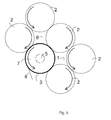
- a plurality of rollers define a separation chamber according to the invention. At least some of the rollers are arranged in a manner so that a filter belt passes between a set of rollers whereby the filter cake on said filter belt is compressed by a pressure exerted by said rollers towards each other.
- the suspension to be filtered is arranged in the separation chamber and the medium is transported into the pores of the pore roller during separation.
- the suspension to be filtered is arranged in the pore roller or flown through the pore roller, and the medium is transported into the separation chamber during separation.
- the method and the system includes at least two rollers, such as at least three rollers, such as at least four rollers, such as at least five rollers, such as at least six rollers.
- the method and the system may comprise more than one set of rollers, wherein one roller is a pore roller. Accordingly the method and the system may comprise at least two sets of rollers, such as at least three sets of rollers, such as at least four sets of rollers.
- the at least one pore roller is a roller comprising pores extending from the surface of the roller to at least one channel extending axially in said roller ???beh ⁇ ver den v ⁇ re aksial???.
- the size of the pores is preferably adjusted to a particle size of the dry matter to be separated as well as to the filter belt used in the process.
- the pore roller has a pore size of at the most 5 mm, such as at the most 4 mm, for example at the most 3 mm, such as at the most 2 mm, for example at the most between 1 mm, such as at the most 75 ⁇ m, for example at the most 50 ⁇ m, such as at the most 25 ⁇ m, for example at the most 10 ⁇ m, such as at the most 1 ⁇ m, for example at the most 0.5 ⁇ m, for example at the most 0.1 ⁇ m, for example at the most 0.05 ⁇ m, for example at the most 0.01 ⁇ m.
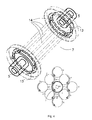
- the size of the pores may be substantially identical along the pore, or the pore may extend into a wider groove when the pore reaches the outer surface of the roller or the inner surface of the roller in the channel, see for example figures 1 and 9 .
- the pore roller is made from any suitable material, such as metal, rubber, plastic, including nylon, ceramics, and glass. In a preferred embodiment the pore roller is made from a ceramic or glass.
- the outer part of the pore roller is made from one material, such as metal, rubber, plastic, including nylon, ceramics, and glass
- the inner part of the pore roller is made from another material, such material may also be selected from metal, rubber, plastic, including nylon, ceramics, and glass.
- the pore roller may be connected to means for pressurizing the system, for example so that pressure or vacuum is applied to the channel(s) of the pore roller in order to pressurize the filtering system.
- the other roller(s) of the system may be any suitable rollers, including a pore roller as described above. In many embodiments the other roller(s) is(are) a roller without any pores. Other rollers in the system further comprise rollers having the purpose of defining the separation chamber without being contacted by the filter belt, see for example figures 4 , 5 and 6 .
- the at least one set of rollers of the invention may be made from identical material or it may be made from different material.
- the individual rollers may be made of one material or a variety of materials.
- roller material covers both rollers contacting the filter band as well as any other rollers in the system.
- At least one roller from the at least one set of rollers is made from nylon.
- At least one roller from the at least one set of rollers is made from plastic.
- the individual rollers from the at least one set of rollers are made from stainless steel and rubber.
- the at least one guide roller is made from rubber.
- At least one set of rollers wherein one roller is inflatable.
- Inflatable rollers may in one embodiment enforce the tightness with which the rollers embrace the at least one filter.
- only a part of the roller is inflatable, such as the end portion of the individual roller.
- rollers in the system may be temperature regulated if appropriate with respect to the suspension to be filtered.
- at least one roller has a temperature of below 0 °C, such as below -2 °C, for example below -5 °C.
- the temperature is increased, for example to body temperature.
- the at least one set of rollers may in one embodiment have a temperature of below 0 °C (zero degrees celcius) as mentioned above and at least one other set of rollers may be made from rubber or another material as previously described.
- the at least one set of rollers is preferably capable of exerting a pressure of 5 kg/cm 2 on the at least one filter, such as at least 10 kg/cm 2 on the at least one filter, for example at least 15 kg/cm 2 on the at least one filter, such as at least 20 kg/cm 2 on the at least one filter, for example at least 25 kg/cm 2 on the at least one filter, such as at least 30 kg/cm 2 on the at least one filter, for example at least 35 kg/cm 2 on the at least one filter, such as at least 40 kg/cm 2 on the at least one filter, for example at least 45 kg/cm 2 on the at least one filter, such as at least 50 kg/cm 2 on the at least one filter.
- a pressure of 5 kg/cm 2 on the at least one filter such as at least 10 kg/cm 2 on the at least one filter, for example at least 15 kg/cm 2 on the at least one filter, such as at least 20 kg/cm 2 on the at least one filter,
- Each chamber may according to the invention have a particular purpose.
- One chamber may have the function of being a receptive for suspension to be filtered.
- Another chamber may have the function of being receptive for a liquid or suspension to be used for washing the at least one filter.
- Such liquid or suspension may be neutral, such as water.
- the at least one filter means is brought in contact with the suspension.
- the at least one filter may, in one embodiment, be moved through the suspension. This movement may be performed mechanically or it may be performed manually.
- the filter means may be a filter belt covering a part of the pore roller or the whole circumference of the pore roller.
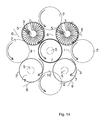
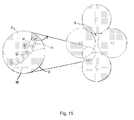
- the filter means may be filter means attached to the pore roller or integrated with the surface of the pore roller, such as the filter means shown in Figure 15 .
- the at least one filter covers the pore roller so that the filter is brought into contact with the separation chamber due to the rotational movement of the pore roller.
- the present method comprises at least one filter, such as at least two filters, for example at least three filters, such as at least four filters, for example at least five filters.
- the number of filters used for the purposes of the present invention is dependent on factors, such as the nature of the suspension, the volume of the suspension to be filtered.
- a first coarse pore filter may be used during a pre-filtering process followed by the use of a second fine pore filter for clarification filtering.
- nature of the suspension is meant the physical and/or chemical properties, such as the toxic properties of the suspension; the type of material, and the dry matter content of the suspension.
- the at least one filter of the invention may have a pore size according to for example the type of suspension to be filtered and the expectations of the level of dry matter content of the suspension after separation. Furthermore, the pore size of the filter may be adapted to the pore size of the pore roller.
- the pores of the filter belt is mainly determined by the particles of the suspension.
- the pore size of the filter belt is smaller than the pore size of the pore roller, and in another embodiment the pore size of the filter belt is larger than the pore size of the pore roller.
- the particles of the suspension are withheld by the filter belt only, and therefore it is preferred that the pores of the pore roller are larger than the pores of the filter belt.
- the filter has a pore size of at the most 5 mm, such as at the most 4 mm, for example at the most 3 mm, such as at the most 2 mm, for example at the most between 1 mm, such as at the most 75 ⁇ m, for example at the most 50 ⁇ m, such as at the most 25 ⁇ m, for example at the most 10 ⁇ m, such as at the most 1 ⁇ m, for example at the most 0.5 ⁇ m.
- the permeability of the filter according to the invention may be chosen with regard to the nature of the suspension to be filtered/separated, and of the aimed level of dry matter present after the separation.
- the filter has a permeability of water of at least 20.000 I/h/bar/m 2 , such as at least 30.000 I/h/bar/m 2 , for example at least 40.000 I/h/bar/m 2 , such as at least 50.000 I/h/bar/m 2 , for example at least 60.000 I/h/bar/m 2 , such as at least 70.000 I/h/bar/m 2 , for example at least 80.000 I/h/bar/m 2 , such as at least 90.000 I/h/bar/m 2 , for example at least 100.000 I/h/bar/m 2 .
- the present method comprises in one embodiment a filter belt, which is a band.
- the filter is normally only used once and thereafter discharged, however it may be used in more than one separation chamber before discharge.
- the filter belt is a circular filter belt, whereby the various filter parts are re-entered into a separation chamber more than once.
- Figure 8 One example is shown in Figure 8 , wherein the filter belt covers a guide roll before entering the separation chamber again.
- Figures 2 and 3 Another embodiment is shown in Figures 2 and 3 wherein the filter belt covers the surface of the pore roller.
- the filter of the invention may be provided with ion-exchange material, wherein the filter has a regeneration zone following the filtration zone.
- This embodiment may be used advantageously to separate water from nitrate, for example.
- the method of the present invention may comprise at least one filter made from various material.
- the material from which the filter is made may be suited to the individual suspensions.
- the at least one filter is made from a flexible material.
- flexible material is meant a material capable of vertical and horizontal movement when exposed to physical pressure. Such material may for example be rubber or plastic.
- the at least one filter comprises at least one cavity and is made from a flexible material.
- the flexible material may aid in the liquid being pressed from the filter cake when the filter cake on the filter is passed through at least one set of rollers.
- the at least one filter is sterile.
- sterile filter may be used in the separation of sterile suspensions, for example pharmaceutical compositions where sterility is vital for the successful quality of the invention or when filtering air, for example to operation theatres or for sterile laboratory work.
- the at least one filter is capable of filtering at least 500 I/m 2 /t, such as at least 550 I/m 2 /t, for example at least 600 I/m 2 /t, such as at least 650 I/m 2 /t, for example at least 700 I/m 2 /t, such as at least 750 I/m 2 /t, for example at least 800 I/m 2 /t.
- the filtering capacity is an estimate covering the capacity before the actual filtering process has commenced.
- the filter belt is preferably either continuously moving or stepwise moving.
- the velocity of the filter movement may be in steps, comprising one step of a stand still, i.e. 0 km/h and at least one other step of movement, i.e a velocity of more than 0 km/h.
- the duration of the individual steps depends on parameters, such as the physical properties of the filter and the nature of the suspension to be filtered.
- the velocity of the movement of the filter is pressure controlled.
- the velocity of the movement of the filter is controlled by the flow rate of the suspension.
- the separation of dry matter from liquid is according to the invention performed in the separation chamber capable of being pressure regulated.
- pressure regulated is meant that means for regulating/controlling the pressure in the enclosed separation chamber are provided for.
- the pressure may be regulated/controlled such that there is either vacuum or overpressure in the separation chamber.
- vacuum is meant a pressure determined in bar, which is lower than the atmospheric pressure.
- overpressure is meant a pressure, which is higher than the atmospheric pressure.
- the atmospheric pressure is defined as 0 (zero) bar.
- the pressure exerted on the separation chamber is from -1 to - 0.05 bar relative to the atmospheric pressure.
- the pressure exerted on the separation chamber is from 0.05 to 10 bar relative to the atmospheric pressure.
- the pressure exerted on the separation chamber is from 1.0 to 6 bar relative to the atmospheric pressure.
- the pressure exerted on the separation chamber is from 1.5 to 4 bar relative to the atmospheric pressure.
- suspension may be fed to the filtering apparatus, also within the scope of the invention, continuously throughout the filtering process.
- the volume of suspension fed and the velocity with which the suspension is fed to the filtering apparatus are dependent on factors, such as the physical nature of the suspension, the amount of suspension desired to be filtered, and the size and types of the at least one filter.
- the suspension is provided as a non-continuous stream. This may for example be the case when a suspension is stationary placed in the separation chamber container wherein the at least one filter is brought in contact with the suspension.
- the suspension has a dry matter content prior to the separation of at least 5%.
- the dry matter content of the suspension prior to separation is at least 10%.
- the dry matter content of the suspension prior to separation is at least 15%, for example at least 20%, such as at least 25%, for example at least 30%, such as at least 35%, for example 40%, such as at least 45%, for example at least 50%.
- the suspension after separation has a dry matter content of at the most 50%, such as at the most 45%, for example at the most 40%, such as at the most 35%, for example at the most 30%, such as at the most 25%, for example at the most 20%, such as at the most 35%, for example at the most 30%, such as at the most 25, for example at the most 20%, such as at the most 15%, for example at the most 10%, such as at the most 5%, for example at the most 2%.
- substantially dry filter cake The dry matter collected on the at least one filter is denoted "substantially dry filter cake”.
- the removal of the substantially dry filter cake may take place simultaneously with the continuation of the separation process, i.e. the fact that the substantially dry filter cake is being removed does not influence the continuity of the separation process.
- the substantially dry filter cake is removed from the at least one filter by the means of vibration.
- the at least one filter may be recycled to the separation chamber. This requires the cleaning of the at least one filter.
- the durability of the at least one filter may depend upon the type of filter, the nature of the suspension and time of use of said filter.
- the cleaning of the filter according to the invention may in one embodiment be performed by enzymes, which are capable of engulfing dry matter material residues on the at least one filter.
- the at least one filter is cleaned by the means of high-pressure washing.
- the at least one filter is cleaned by chemicals, such as a detergent.
- the present invention relates to a method and a system for separating dry matter from a medium.
- the present invention may be used in relation to any dry matter and medium, wherein the medium is normally either a gaseous medium or a liquid.
- the invention may be used in a variety of purposes and a variety of industries.
- the present invention may be used in connection with separation processes wherein a process for converting either the dry matter or the medium or both is included. This may be relevant if for example a catalyst is included in the filter.
- a filter belt carrying compounds having affinity for one or more types of dry matter in the suspension, so that said dry matter is "caught" by the compounds optionally for further processing or use after separation from the medium.
- the method and the system according to the invention may be used for separating dry matter from a medium, wherein either the dry matter or the medium or both may be used after the separation.
- the present invention may be used in the industry of producing food, feed and beverages. Examples are:
- One example of such an application is in the manufacture of juice, wherein it is desired to separate fruit or vegetable etc. components from the fruit or vegetable etc. liquid. Further, filter aid may be removed from liquid juice.
- such a juice making the invention may additionally be used in private homes.
- the present invention may be applied to any food suspension where it is desirable to separate dry matter from liquid.
- pulp may be removed from crushed grapes.
- yeast cells are removed from ready-made wine obtaining yeast-free wine.
- haze is removed from yeast-free wine obtaining ready to drink wine.
- the present invention may replace conventional winemaking techniques by not using enzymes in the winemaking process.
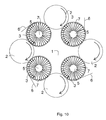
- the filter cake obtained from the filtering process may be dehydrated and enzymes added. This is performed to extract colour and remaining juice. (see the illustration in figure 10 ).
- the present separation method/apparatus may be applied to the separation of bacteria or fat from raw milk. Further, spores may be removed from milk used for cheese-making. In another embodiment water, protein, or lactose is removed from whey.
- the present method and apparatus may be used in the eatable oil industry.
- liquid i.e. oil from the source of said oil, the source being for example components of olives, various seeds, and other sources of eatable oils.
- a grass filter type is used for this application.
- bleach soil is removed from crude eatable oil.
- the present invention may replace the conventional screw presser.
- substantially dry filter cake is also within the scope of the present invention.
- the substantially dry filter cake may be used for animal feed.
- the substantially dry filter cake may be used as insulating material, for example in building constructions.
- the textile industry may use the substantially dry filter cake as insulation material in, such as outdoor equipment articles, for example sleeping bags.
- the use of the method and apparatus may be for sludge treatment, for example by eliminating unwanted particles before it re-enters the surrounding environment. Further, It is within the scope of the invention to recycle waste-water by applying the present invention. Such re-cycling may be applied to commercial car washing.
- the use of the present invention is for processing manure. This is an important process associated with modern agricultural industries.
- the manure may be subjected to the present separation process to eliminate water before re-cycling the manure, for example in a bio-gas plant.
- the present invention may in a further embodiment be used in the pharmaceutical industry.
- the separation method in the purification of pharmaceutical compositions.
- the invention may in another embodiment be used in the cosmetics industry for the removal of impurities from cosmetic products, such as soap, make-up and moisturizers.
- the present invention may be used in an automatic coffee machine. By applying the present invention the coffee made will maintain the same strength throughout the brewing process.
- the present invention may further be used to remove nitrate, bacteria and/or ochre from drinking water.
- the present invention may be used to separate impurities from paint; biological material, such as plant material from gutter outflow; impurities from gasoline; impurities from blood and dry matter from water from a kitchen sink outlet.
- the method and the system according to the invention may be used for separating antibodies, proteins, nucleotides, and the like for use in medical and biotechnical fields.
- the present invention may be used for separating dry matter from air or a gas. Examples are:
- Another example is cleansing of air, for example cleansing of air for sterile use, such as air for an operation theatre.
Landscapes
- Chemical & Material Sciences (AREA)
- Chemical Kinetics & Catalysis (AREA)
- Filtration Of Liquid (AREA)
- Filtering Materials (AREA)
- Filtering Of Dispersed Particles In Gases (AREA)
Priority Applications (9)
| Application Number | Priority Date | Filing Date | Title |
|---|---|---|---|
| EP07106918A EP1985348A1 (de) | 2007-04-25 | 2007-04-25 | Filtrierverfahren und Vorrichtung mit poröser Walze |
| PCT/DK2008/050094 WO2008131780A1 (en) | 2007-04-25 | 2008-04-25 | A filtration method and apparatus including a roller with pores |
| DK08734549.2T DK2152380T3 (da) | 2007-04-25 | 2008-04-25 | Filtreringsmetode og apparat, der omfatter en valse med porer |
| PT08734549T PT2152380E (pt) | 2007-04-25 | 2008-04-25 | Método de filtração e aparelho que inclui um rolo poroso |
| EP08734549A EP2152380B1 (de) | 2007-04-25 | 2008-04-25 | Filtrationsverfahren und -vorrichtung mit einer rolle mit poren |
| ES08734549T ES2390514T3 (es) | 2007-04-25 | 2008-04-25 | Un procedimiento de filtración y un aparato que incluye un rodillo con poros |
| HRP20120726AT HRP20120726T1 (hr) | 2007-04-25 | 2008-04-25 | Postupak i uređaj za filtriranje s valjkom s porama |
| SI200830751T SI2152380T1 (sl) | 2007-04-25 | 2008-04-25 | Postopek filtriranja in aparat ki vljučuje valjs porami |
| PL08734549T PL2152380T3 (pl) | 2007-04-25 | 2008-04-25 | Sposób filtracji i urządzenie zawierające rolkę z porami |
Applications Claiming Priority (1)
| Application Number | Priority Date | Filing Date | Title |
|---|---|---|---|
| EP07106918A EP1985348A1 (de) | 2007-04-25 | 2007-04-25 | Filtrierverfahren und Vorrichtung mit poröser Walze |
Publications (1)
| Publication Number | Publication Date |
|---|---|
| EP1985348A1 true EP1985348A1 (de) | 2008-10-29 |
Family
ID=38508912
Family Applications (2)
| Application Number | Title | Priority Date | Filing Date |
|---|---|---|---|
| EP07106918A Withdrawn EP1985348A1 (de) | 2007-04-25 | 2007-04-25 | Filtrierverfahren und Vorrichtung mit poröser Walze |
| EP08734549A Active EP2152380B1 (de) | 2007-04-25 | 2008-04-25 | Filtrationsverfahren und -vorrichtung mit einer rolle mit poren |
Family Applications After (1)
| Application Number | Title | Priority Date | Filing Date |
|---|---|---|---|
| EP08734549A Active EP2152380B1 (de) | 2007-04-25 | 2008-04-25 | Filtrationsverfahren und -vorrichtung mit einer rolle mit poren |
Country Status (8)
| Country | Link |
|---|---|
| EP (2) | EP1985348A1 (de) |
| DK (1) | DK2152380T3 (de) |
| ES (1) | ES2390514T3 (de) |
| HR (1) | HRP20120726T1 (de) |
| PL (1) | PL2152380T3 (de) |
| PT (1) | PT2152380E (de) |
| SI (1) | SI2152380T1 (de) |
| WO (1) | WO2008131780A1 (de) |
Cited By (2)
| Publication number | Priority date | Publication date | Assignee | Title |
|---|---|---|---|---|
| WO2014198907A1 (en) * | 2013-06-13 | 2014-12-18 | Technical University Of Denmark | Pore roller filtration apparatus |
| CN111617543A (zh) * | 2020-06-07 | 2020-09-04 | 段鑫 | 一种节能型污水处理用转鼓式格栅机 |
Families Citing this family (5)
| Publication number | Priority date | Publication date | Assignee | Title |
|---|---|---|---|---|
| RU2434666C1 (ru) * | 2010-05-04 | 2011-11-27 | Научно-производственная фирма с ограниченной ответственностью "Экополимер" | Фильтрующий вал ленточного фильтр-пресса |
| US20200147531A1 (en) * | 2016-05-26 | 2020-05-14 | Danmarks Tekniske Universitet | Roller filtration apparatus |
| CN109304052B (zh) * | 2018-10-23 | 2021-06-08 | 天宇(山东)橡塑制品有限公司 | 一种橡胶过滤机 |
| CN109806654A (zh) * | 2019-03-13 | 2019-05-28 | 陈照 | 一种高效防堵的液体过滤装置 |
| WO2022003172A1 (en) | 2020-07-02 | 2022-01-06 | Danmarks Tekniske Universitet | Roller filtration apparatus |
Citations (6)
| Publication number | Priority date | Publication date | Assignee | Title |
|---|---|---|---|---|
| DE1924471A1 (de) * | 1969-05-13 | 1970-11-19 | Neil Malarkey Jun | Filterband |
| JPS5673514A (en) * | 1979-11-16 | 1981-06-18 | Yoshihiro Hayashida | Continuous filter |
| JPS58159820A (ja) * | 1982-03-17 | 1983-09-22 | Yoshihiro Hayashida | 連続「ろ」過装置 |
| WO2003055570A1 (en) * | 2001-12-28 | 2003-07-10 | Danmarks Tekniske Universitet | A filtration method and apparatus |
| US20030146174A1 (en) * | 2001-12-28 | 2003-08-07 | Hansen Preben Boje | Filtration method and apparatus |
| WO2006002638A1 (en) * | 2004-07-01 | 2006-01-12 | Danmarks Tekniske Universitet | An apparatus for the separation of dry matter from a fluid |
-
2007
- 2007-04-25 EP EP07106918A patent/EP1985348A1/de not_active Withdrawn
-
2008
- 2008-04-25 DK DK08734549.2T patent/DK2152380T3/da active
- 2008-04-25 ES ES08734549T patent/ES2390514T3/es active Active
- 2008-04-25 EP EP08734549A patent/EP2152380B1/de active Active
- 2008-04-25 SI SI200830751T patent/SI2152380T1/sl unknown
- 2008-04-25 WO PCT/DK2008/050094 patent/WO2008131780A1/en not_active Ceased
- 2008-04-25 HR HRP20120726AT patent/HRP20120726T1/hr unknown
- 2008-04-25 PT PT08734549T patent/PT2152380E/pt unknown
- 2008-04-25 PL PL08734549T patent/PL2152380T3/pl unknown
Patent Citations (6)
| Publication number | Priority date | Publication date | Assignee | Title |
|---|---|---|---|---|
| DE1924471A1 (de) * | 1969-05-13 | 1970-11-19 | Neil Malarkey Jun | Filterband |
| JPS5673514A (en) * | 1979-11-16 | 1981-06-18 | Yoshihiro Hayashida | Continuous filter |
| JPS58159820A (ja) * | 1982-03-17 | 1983-09-22 | Yoshihiro Hayashida | 連続「ろ」過装置 |
| WO2003055570A1 (en) * | 2001-12-28 | 2003-07-10 | Danmarks Tekniske Universitet | A filtration method and apparatus |
| US20030146174A1 (en) * | 2001-12-28 | 2003-08-07 | Hansen Preben Boje | Filtration method and apparatus |
| WO2006002638A1 (en) * | 2004-07-01 | 2006-01-12 | Danmarks Tekniske Universitet | An apparatus for the separation of dry matter from a fluid |
Cited By (2)
| Publication number | Priority date | Publication date | Assignee | Title |
|---|---|---|---|---|
| WO2014198907A1 (en) * | 2013-06-13 | 2014-12-18 | Technical University Of Denmark | Pore roller filtration apparatus |
| CN111617543A (zh) * | 2020-06-07 | 2020-09-04 | 段鑫 | 一种节能型污水处理用转鼓式格栅机 |
Also Published As
| Publication number | Publication date |
|---|---|
| ES2390514T3 (es) | 2012-11-13 |
| EP2152380B1 (de) | 2012-06-13 |
| HRP20120726T1 (hr) | 2012-10-31 |
| DK2152380T3 (da) | 2012-09-24 |
| PT2152380E (pt) | 2012-09-17 |
| WO2008131780A1 (en) | 2008-11-06 |
| SI2152380T1 (sl) | 2012-11-30 |
| EP2152380A1 (de) | 2010-02-17 |
| PL2152380T3 (pl) | 2012-11-30 |
Similar Documents
| Publication | Publication Date | Title |
|---|---|---|
| US7651619B2 (en) | Filtration method and apparatus | |
| EP2152380B1 (de) | Filtrationsverfahren und -vorrichtung mit einer rolle mit poren | |
| EP1471988B1 (de) | Filtrationsverfahren und -vorrichtung | |
| CZ351797A3 (cs) | Filtrační prostředky, jejich regenerace, filtrační nosiče a způsob filtrace | |
| DE69419296D1 (de) | Mikrofiltrationsverfahren zum Entfernen von Trübung verursachenden Verbindungen aus einer Füssigkeit | |
| EP3915669A1 (de) | Filtervorrichtung zum filtern eines fluids und verfahren zum filtern eines fluids | |
| US20250207077A1 (en) | Bioreactor with filter unit and method for treating a cell broth | |
| Bottino et al. | Application of membrane processes for the filtration of extra virgin olive oil | |
| Ortega-Rivas | Review and advances in apple juice processing | |
| Kumari et al. | Filtration and clarification | |
| AU2024204668A1 (en) | System and method of applied radial technology chromatography | |
| Verma et al. | Separation Technologies: Filtration and Centrifugation for Food and Dairy Processing | |
| CN101451127B (zh) | 从薯类细胞组织中提取β-淀粉酶的方法 | |
| CA2567472C (en) | Method and apparatus for separation of solids and liquid suspensions by filter unclogging aided filtration | |
| Cassano et al. | Membranes for industrial microfiltration and ultrafiltration | |
| WO2015040501A1 (en) | Hdmf and recombinant product filtration system | |
| CA2517770C (en) | Industrial silicon carbide filtration method | |
| WO2010115575A1 (de) | Herstellung von sojasosse mittels anschwemmkerzenfilter | |
| Baysan et al. | Application of filtration in beverage production | |
| CA2464488A1 (en) | Method for reducing the total bacteria count in aqueous dispersions | |
| Varzakas | 3 Centrifugation–Filtration | |
| Ye et al. | Fouling in Beer Clarification Using Polyethersulfone Hollow Fiber Membranes | |
| DK166435B1 (da) | Fremgangsmaade til fjernelse af mikroorganismer ved mikrofiltrering af et materiale paa et primaert membranfilter uden vaesentlig dannelse af en sekundaer membran samt apparatur til anvendelse ved udoevelse af fremgangsmaaden | |
| Shala et al. | Influence of Filtration in the Final Product Stability and Quality Clarity Beer | |
| Nandi et al. | Microfiltration membranes: fabrication and application |
Legal Events
| Date | Code | Title | Description |
|---|---|---|---|
| PUAI | Public reference made under article 153(3) epc to a published international application that has entered the european phase |
Free format text: ORIGINAL CODE: 0009012 |
|
| AK | Designated contracting states |
Kind code of ref document: A1 Designated state(s): AT BE BG CH CY CZ DE DK EE ES FI FR GB GR HU IE IS IT LI LT LU LV MC MT NL PL PT RO SE SI SK TR |
|
| AX | Request for extension of the european patent |
Extension state: AL BA HR MK RS |
|
| AKX | Designation fees paid | ||
| REG | Reference to a national code |
Ref country code: DE Ref legal event code: 8566 |
|
| STAA | Information on the status of an ep patent application or granted ep patent |
Free format text: STATUS: THE APPLICATION IS DEEMED TO BE WITHDRAWN |
|
| 18D | Application deemed to be withdrawn |
Effective date: 20090430 |