EP1979708B1 - Kühllager, motoren und andere drehkomponenten zur wärmeerzeugung - Google Patents
Kühllager, motoren und andere drehkomponenten zur wärmeerzeugung Download PDFInfo
- Publication number
- EP1979708B1 EP1979708B1 EP07756280.9A EP07756280A EP1979708B1 EP 1979708 B1 EP1979708 B1 EP 1979708B1 EP 07756280 A EP07756280 A EP 07756280A EP 1979708 B1 EP1979708 B1 EP 1979708B1
- Authority
- EP
- European Patent Office
- Prior art keywords
- vanes
- heat
- enclosure
- spinning member
- heat transfer
- Prior art date
- Legal status (The legal status is an assumption and is not a legal conclusion. Google has not performed a legal analysis and makes no representation as to the accuracy of the status listed.)
- Active
Links
Images




Classifications
-
- G—PHYSICS
- G01—MEASURING; TESTING
- G01C—MEASURING DISTANCES, LEVELS OR BEARINGS; SURVEYING; NAVIGATION; GYROSCOPIC INSTRUMENTS; PHOTOGRAMMETRY OR VIDEOGRAMMETRY
- G01C19/00—Gyroscopes; Turn-sensitive devices using vibrating masses; Turn-sensitive devices without moving masses; Measuring angular rate using gyroscopic effects
-
- B—PERFORMING OPERATIONS; TRANSPORTING
- B63—SHIPS OR OTHER WATERBORNE VESSELS; RELATED EQUIPMENT
- B63B—SHIPS OR OTHER WATERBORNE VESSELS; EQUIPMENT FOR SHIPPING
- B63B39/00—Equipment to decrease pitch, roll, or like unwanted vessel movements; Apparatus for indicating vessel attitude
- B63B39/04—Equipment to decrease pitch, roll, or like unwanted vessel movements; Apparatus for indicating vessel attitude to decrease vessel movements by using gyroscopes directly
-
- F—MECHANICAL ENGINEERING; LIGHTING; HEATING; WEAPONS; BLASTING
- F16—ENGINEERING ELEMENTS AND UNITS; GENERAL MEASURES FOR PRODUCING AND MAINTAINING EFFECTIVE FUNCTIONING OF MACHINES OR INSTALLATIONS; THERMAL INSULATION IN GENERAL
- F16C—SHAFTS; FLEXIBLE SHAFTS; ELEMENTS OR CRANKSHAFT MECHANISMS; ROTARY BODIES OTHER THAN GEARING ELEMENTS; BEARINGS
- F16C37/00—Cooling of bearings
- F16C37/007—Cooling of bearings of rolling bearings
-
- F—MECHANICAL ENGINEERING; LIGHTING; HEATING; WEAPONS; BLASTING
- F16—ENGINEERING ELEMENTS AND UNITS; GENERAL MEASURES FOR PRODUCING AND MAINTAINING EFFECTIVE FUNCTIONING OF MACHINES OR INSTALLATIONS; THERMAL INSULATION IN GENERAL
- F16F—SPRINGS; SHOCK-ABSORBERS; MEANS FOR DAMPING VIBRATION
- F16F15/00—Suppression of vibrations in systems; Means or arrangements for avoiding or reducing out-of-balance forces, e.g. due to motion
- F16F15/30—Flywheels
-
- F—MECHANICAL ENGINEERING; LIGHTING; HEATING; WEAPONS; BLASTING
- F16—ENGINEERING ELEMENTS AND UNITS; GENERAL MEASURES FOR PRODUCING AND MAINTAINING EFFECTIVE FUNCTIONING OF MACHINES OR INSTALLATIONS; THERMAL INSULATION IN GENERAL
- F16C—SHAFTS; FLEXIBLE SHAFTS; ELEMENTS OR CRANKSHAFT MECHANISMS; ROTARY BODIES OTHER THAN GEARING ELEMENTS; BEARINGS
- F16C2370/00—Apparatus relating to physics, e.g. instruments
-
- Y—GENERAL TAGGING OF NEW TECHNOLOGICAL DEVELOPMENTS; GENERAL TAGGING OF CROSS-SECTIONAL TECHNOLOGIES SPANNING OVER SEVERAL SECTIONS OF THE IPC; TECHNICAL SUBJECTS COVERED BY FORMER USPC CROSS-REFERENCE ART COLLECTIONS [XRACs] AND DIGESTS
- Y10—TECHNICAL SUBJECTS COVERED BY FORMER USPC
- Y10T—TECHNICAL SUBJECTS COVERED BY FORMER US CLASSIFICATION
- Y10T74/00—Machine element or mechanism
- Y10T74/12—Gyroscopes
-
- Y—GENERAL TAGGING OF NEW TECHNOLOGICAL DEVELOPMENTS; GENERAL TAGGING OF CROSS-SECTIONAL TECHNOLOGIES SPANNING OVER SEVERAL SECTIONS OF THE IPC; TECHNICAL SUBJECTS COVERED BY FORMER USPC CROSS-REFERENCE ART COLLECTIONS [XRACs] AND DIGESTS
- Y10—TECHNICAL SUBJECTS COVERED BY FORMER USPC
- Y10T—TECHNICAL SUBJECTS COVERED BY FORMER US CLASSIFICATION
- Y10T74/00—Machine element or mechanism
- Y10T74/12—Gyroscopes
- Y10T74/1204—Gyroscopes with caging or parking means
- Y10T74/1207—Rotor spin and cage release type
-
- Y—GENERAL TAGGING OF NEW TECHNOLOGICAL DEVELOPMENTS; GENERAL TAGGING OF CROSS-SECTIONAL TECHNOLOGIES SPANNING OVER SEVERAL SECTIONS OF THE IPC; TECHNICAL SUBJECTS COVERED BY FORMER USPC CROSS-REFERENCE ART COLLECTIONS [XRACs] AND DIGESTS
- Y10—TECHNICAL SUBJECTS COVERED BY FORMER USPC
- Y10T—TECHNICAL SUBJECTS COVERED BY FORMER US CLASSIFICATION
- Y10T74/00—Machine element or mechanism
- Y10T74/12—Gyroscopes
- Y10T74/1296—Flywheel structure
Definitions
- This invention relates to methods and apparatus for cooling bearings, motors, and other heat generating components that support and drive rotating machinery, e.g., flywheels that are enclosed in a partial vacuum.
- a control moment gyro (CMG) used for roll attenuation in boats is dependent on a heavy flywheel operating at high rotational speeds.
- the spinning flywheel is supported by bearings that are subjected to high axial and radial loads. As a result, these bearings produce a substantial amount of friction-generated heat, which must be dissipated in order to avoid dangerous heat build up.
- the flywheel is supported in a conventional, ambient environment, the heat can be dissipated by air convection, which can be assisted by having a fan blow air across the outer and inner bearing races and the adjacent metal members. But if the flywheel is enclosed in a partial vacuum, e.g., as described in our patent, U.S. Patent No.
- Heat conduction occurs by molecules bumping into other molecules.
- the fast moving molecules in the warm metal bump into molecules in your skin, transferring energy to them.
- Heat convection occurs when molecules are moved as a consequence of air (or other gas or liquid) flowing from one location to another.
- the warm radiator heats a room by conduction of heat to air immediately adjacent the surface of the radiator, and then by convection as that warmed air flows around the room.
- the warmth in the air is transferred to the occupants of the room by conduction, when the molecules in warm air contact the skin or clothing of the person.
- Heat conduction may occur through a gas, liquid, or solid. When it occurs through a gas, it can be called gaseous conduction. When it occurs through a solid (e.g., through a metal or other good conductor of heat), it can be called solid conduction.
- the amount of heat transferred is directly proportional to the thermal conductivity of the gas, the area of the surfaces, and the temperature difference between the surfaces, and is inversely proportional to the distance between the surfaces.
- the thermal conductivity of the gas (K) is constant irrespective of pressure until the pressure is so low that the gas molecular mean free path is equal to or greater than the distance between the surfaces ( ⁇ X). This means that the amount of heat transferred will be independent of pressure until the gas mean free path is equal to or greater than the distance between the surfaces. Below the pressure where the gas molecular mean free path is greater than the distance between the surfaces, the gas molecules will continue to conduct heat but now there is a reduction in the thermal conductivity (and the amount heat transferred) with further reductions in the gas pressure.
- DE 19909491A1 describes a cooling device for a shaft rotatably mounted within a housing in which no special sealing of the shaft is required.
- First cooling fins in the shape of flat annular disks are provided on the outer surface of a sleeve in contact with the shaft.
- Second cooling fins in the form of flat annular disks are provided in the bore of a sleeve in contact with an external heat sink.
- First fins project into gaps between the second fins. Heat transfer is effected by radiation and heat transfer by gas present between the first and second fins.
- EP 1193837 describes an alternator for a vehicle having rotary disks on the rotor and opposed stationary disks on inner surfaces of a front bracket and a rear bracket.
- the stationary disks mesh with rotary disks with air gaps therebetween for heat transfer. Projections are provided on the heat transfer surfaces of the stationary disks to generate turbulent air flow in the spaces defined between the rotary disks and the stationary disks.
- US 2004/0244513 describes a gyroscopic roll stabilizer for a boat, having a flywheel, a flywheel drive motor configured to spin the flywheel about a spin axis, and an enclosure surrounding a portion or all of the flywheel and maintaining a below-ambient pressure or containing a below-ambient density gas.
- US 2005/0040776 describes a flywheel energy storage system including a vacuum enclosure having a flywheel, a motor / generator, and a shaft enclosed within.
- a heat pipe in the shaft portion of the apparatus provides cooling for the high heat generated by the motor/generator and bearings.
- the flywheel energy storage system includes a bearing assembly facilitating rotation of the shaft, flywheel and rotor of the motor / generator about an axis.
- a bearing assembly includes an inner ring, an outer ring and a plurality of bearing balls.
- the flywheel hub is connected to a rotating shaft having cooling fins extending radially from the shaft.
- the cooling fins fit within a split clam-shell type set of stationary heat transfer fins which extend from the inside of the vacuum enclosure so that natural, self-contained cooling of the complete flywheel energy storage system may be achieved.
- Known cooling techniques include immersing the bearings in a circulating oil bath or jetting oil through the bearings (as in a gas turbine engine) or pumping a large volume of air/oil mist through the bearings (as in machine tool spindles) to lubricate and cool them.
- these methods are complicated and they tend to increase the heat generated by the bearing as the viscous drag of the rolling elements churning through the oil substantially increases the power required to drive the flywheel or other spinning member.
- the air/oil mist method is not applicable to vacuum applications as it requires substantial air flow.
- Some machine tool manufacturers pump water down a hole that is gun drilled through the spindle shaft to remove heat from the bearings and motor. This is also difficult to apply to vacuum applications as the water must be maintained at ambient pressure to prevent it from vaporizing.
- the invention comprises apparatus as defined in claim 1.
- the present disclosure describes apparatus for transferring heat from and cooling one or more heat generating components that support or drive a flywheel or other spinning member.
- the apparatus comprises a first heat transfer element attached to and spinning with the spinning member, a second heat transfer element stationary with respect to the spinning member, wherein the first and second heat transfer elements move relative to one another, and wherein the first and second heat transfer elements are shaped and positioned in close proximity to one another so that substantial heat is transferred from the first heat transfer element to the second heat transfer element.
- the close proximity of the two surfaces or elements promotes heat transfer primarily by gaseous conduction.
- the relative rotational movement and close proximity of the elements may create rotating cavity flows that promote heat transfer by gaseous convection. These rotating flows continually circulate air molecules from the hotter first element to the cooler second element.
- Heat transfer between the first and second heat transfer elements may occur both by gaseous conduction and convection though primarily by gaseous conduction.
- the first and second heat transfer elements may have closely spaced exposed surfaces across which heat is transferred.
- the first heat transfer element comprises a plurality of first vanes
- the second heat transfer element comprises a plurality of second vanes
- the first vanes move with respect to the second vanes
- the first vanes extend into gaps between the second vanes so that the first and second vanes are interleaved, and substantial heat may be transferred from the first vanes to the second vanes.
- the spinning member surrounds the spinning member, the first heat transfer element may comprise the outer surface of the spinning member, and the second heat transfer element may comprise the inner surface of the enclosure spaced by a small gap from the spinning member so that substantial heat is transferred by gaseous conduction from the spinning member to the enclosure.
- the separation between the first vanes and second vanes may be greater than 0.025 mm but less than 10 mm.
- the spinning member is enclosed within an enclosure containing a gas at below-ambient pressure or below-ambient density, the first heat transfer element and first vanes spin relative to the enclosure, the second heat transfer element and second vanes are fixed relative to the enclosure, and the second heat transfer element is positioned so that heat can be readily transferred from the second heat transfer element to the exterior of the enclosure.
- the gas may be both below-ambient pressure and below-ambient density.
- the axis of rotation about which the spinning member spins may define an axial direction
- the first vanes may be cylindrical elements extending in a first axial direction from a first base attached to the spinning member
- the second vanes may be cylindrical elements extending in a second axial direction, opposite the first axial direction, from a second base attached to the enclosure
- the gaps between the second vanes may be cylindrical channels shaped and positioned to receive the cylindrical first vanes.
- the axis of rotation about which the spinning member spins may define an axial direction
- the first and second vanes may be planar elements extending in radial directions perpendicularly to the axial direction
- the gaps between the second vanes may be planar channels shaped and positioned to receive the planar first vanes.
- the first and second heat transfer elements are located adjacent a bearing that supports the spinning member, the bearing has an inner race and an outer race, the first vanes and inner race are attached to the spinning member so heat flows by conduction from the inner race to the first vanes and from the spinning member to the first vanes, the outer race is attached to the enclosure, and the inner race, spinning member, first vanes and second vanes are sized and positioned so that heat from the inner race of the bearing flows by solid conduction from the inner race to the spinning member and to the first vanes, by solid conduction from the spinning member to the first vanes, and primarily by gaseous conduction from the first vanes to the second vanes, and by solid conduction from the second vanes to the exterior of the enclosure.
- the apparatus may comprise at least two bearings, each with its own first and second heat transfer elements as described.
- the spinning member may be a flywheel and the flywheel and enclosure may be part of gyroscopic roll stabilizer for a boat.
- the invention may further comprise a heat sink to which heat flows from the second vanes.
- the heat sink may comprise air-cooled fins on the exterior of the enclosure.
- the gas between the first and second transfer elements may have a molecular mean free path equal to or less than the distance between the heat transfer elements.
- the invention may further comprise a plurality of sets of first and second vanes.
- the gas may have a higher thermal conductivity than air.
- the heat generating component may comprise one or more bearings.
- the heat generating component may comprise one or more electrical motors.
- the gap between the hotter rotating vanes and the cooler non-rotating vanes may be kept very small, and thus provide a heat path to the exterior of the device as long as the rotating vanes are hotter than the stationary vanes.
- Heat may be conducted from the heat generating components to the rotating vanes by solid conduction, then across the air gap to the stationary vanes by gaseous conduction and convection and then by conduction and convection to the atmosphere or a heat sink.
- At least some of the described arrangements in this disclosure have significant advantages at below ambient pressure, wherein convective cooling with air becomes more difficult because of the reduced pressure, and radiant heat transfer may be negligible because the temperature differentials may not be large enough to transfer a significant amount of heat.
- Reliance on gaseous conduction benefits from the fact that the thermal conductivity of a gas increases with temperature so that as the gas warms up it will conduct more heat across the gap (for a fixed temperature differential) between the rotating and stationary vanes. This helps stabilize thermal behavior.
- Rotating cavity flows will exist in the small gaps between the fixed and rotating vanes even in a partial vacuum.
- the gas density and/or rotational speed will be high enough that gaseous convection will augment the gaseous conduction cooling.
- the rotating flow circulates the gas molecules so they are continuously transported from the hot rotating vanes to the cooler stationary vanes.
- the first aspect permits heat to be removed passively without circulating any fluids inside the enclosure. This considerably simplifies the device or machine, as a coolant pump, motor, filter and heat exchanger are not required. Grease lubricated bearings can be used and these will have less frictional torque than oil lubricated bearings.
- the apparatus described overcomes the problem of cooling rotating components that generate heat and are enclosed in a partial vacuum. This permits the development of control moment gyros (CMGs) for stabilizing small boats and the development of flywheel energy storage devices that use rolling element bearings, as now there is a way of removing the heat from these rotating components that does not increase operating power requirements.
- CMGs control moment gyros
- the apparatus described may assist in cooling the inner races of bearings, motors and other rotating heat generating components that operate in confined spaces at ambient or above ambient pressure (e.g. machine tool spindles).
- FIG. 1 Shown in FIG. 1 is a gyroscopic roll stabilizer 10 for small boats (of the type described in U.S. Patent No. 6,973,847 , incorporated herein by reference).
- a steel flywheel 12 spins within an aluminum enclosure 14, which is evacuated to a below-ambient pressure, and may include a below-ambient density gas (e.g., helium or hydrogen) to reduce friction on the spinning flywheel.
- An electric motor (frameless DC brushless) 16 integrated within the interior of the enclosure drives the flywheel, which is supported by an upper bearing assembly 18 and lower bearing assembly 20.
- each bearing assembly includes an outer housing 22, 24, outer race 26, 28, inner race 30, 32, and balls 34. Seals 36 are provided on both the top and bottom of each bearing. Upper and lower retainers 40, 42 hold the upper bearing in place. These bearings are lubricated by a grease pack.
- Each cooling collar assembly includes an inner rotating collar 54, 56, and an outer stationary collar 58, 60 that also forms the enclosure end cap.
- Collars 54, 56, 58, 60 may be constructed of a variety of materials with good heat conductivity (e.g., aluminum, copper, or plastic).
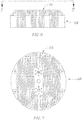
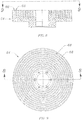
- the outer collars 58, 60 have ten cylindrical vanes 62, each of a different radius. Cylindrical gaps 64 are formed between the vanes.
- the vanes are approximately 2.77 mm in radial thickness, and the radial separation between vanes (i.e., the radial width of the gaps) is approximately 4.78 mm.
- the vanes 62 are about 32 mm in length along the axial direction.
- the inner collars 54, 56 have eleven cylindrical vanes 66 and cylindrical gaps 68 between the vanes ( FIGS. 2-3 ), each of a different radius, and sized and positioned so that the vanes 66 mate with vanes 62 of the mating outer collars. Vanes 66 are approximately the same length (32 mm), width, and radial thickness as vanes 62, and are received in gaps 64 between vanes 62.
- the radial separation between a rotating vane from one collar and a stationary vane from another is approximately 1 mm.
- this separation may be made as small as possible subject to practical limitations such as machining and operating tolerances.
- the separation is typically not less than the mean free path of the gas molecules at the operating pressure. This small separation ensures that the gas thermal conductivity is not reduced by the vacuum pressure and assists heat transfer by gaseous convection.
- the operating pressure is 1 Torr
- the operating temperature is 100 C
- the molecular mean free path of air is 0.066 mm, which is significantly less that the 1 mm radial separation
- the distance may vary from these general guidelines so long as substantial heat is transferred across the separation.
- outer collars 58, 60 have additional heat transfer vanes 70, which transfer heat from the collar to the surrounding atmosphere (by conduction at the surface of the vanes, with convection moving air past the vanes).
- the rotating and stationary vanes 66, 62 each have a total surface area of 0.34 square meters.
- a typical temperature differential between the rotating and stationary vanes is 15 C, and air conduction alone will transfer 153 watts across the gap to cool the bearing inner race at this differential.
- the stationary vanes could be actively cooled by blowing air over them (outside the containment) to create a bigger temperature differential between the rotating and stationary vanes.
- a 30 C temperature differential would transfer 306 watts by gaseous conduction alone.
- the amount of heat transfer could be increased by back filling the vacuum chamber with helium or hydrogen after the initial pump down.
- Helium's thermal conductivity is approximately 5.6 times that of air, and therefore a 15 C temperature differential would transfer 855 watts of heat by gaseous conduction alone. If further increases in heat transfer were required the radial separation between the fixed and rotating vanes could be reduced from 1 mm to 0.5 mm. It is typically feasible to operate with that small a radial separation as machines like CMGs and flywheel energy storage devices are typically manufactured to very tight tolerances (less than 0.025 mm typically), and their flywheels are supported in very high precision rolling element bearings.
- the flywheel is enclosed in helium at 1 Torr, the radial separation is 0.5 mm, and the temperature differential is 15 C, then 1710 watts of heat can be transferred from the bearing inner races by gaseous conduction alone. It is also possible to adjust the amount of heat transferred by increasing or decreasing the surface area of the vanes.
- FIGS. 10-14 show an implementation of the liquid cooling scheme not forming part of the invention.
- the liquid cooling implementation also depends on cooling collars on the rotating shaft adjacent to the primary source of heat, i.e., the inner race of the flywheel bearings.
- the fins on the collars consist of spaced planar disks extending radially outward from the shaft, and there are no mating fixed fins attached to the flywheel containment.
- cooling is accomplished by oil jets positioned on the containment outboard of the disks which squirt streams of oil between the rotating disks and toward the center of the flywheel shaft, thus conducting the heat from the disks to the oil, which is then flung by centrifugal force outward to be collected by an inner liner inside the containment but outside the perimeter of the flywheel.
- This forces the hot oil to follow the inner curvature of the containment on its downward gravitational path, where it transfers the heat to the containment, aided by interior ridges on the containment which increase the surface area contacted by the oil.
- the oil is collected in a sump at the bottom of the device, where it is pumped back up to the oil jets, completing the cooling cycle.
- FIG. 10 the heat generated by the bearing inner races and electric motor rotor, is transferred to upper and lower cooling collar assemblies 71, 72 located adjacent to the upper and lower bearing inner races 73, 74.
- a stationary housing 75 surrounds the upper cooling collar and forms the enclosure end cap.
- the stationary housing 76 surrounding the lower cooling collar is part of the oil reservoir assembly 77.
- the reservoir assembly also contains the cooling oil 78, cooling pump 79, cooling pump motor 80, and a filter and valves (not shown).
- the cooling collar assemblies 71, 72 may be constructed of a variety of materials that have good thermal conductivity (e.g. aluminum and copper).
- the cooling collar assemblies each have 4 horizontal vanes that form 3 gaps between the vanes.
- the inner radius of the gaps is 54 mm
- the outer radius is 89 mm
- the width of the gaps is 2.4 mm.
- the upper and lower stationary housings that surround the cooling collars each contain 3 oil jets 81 (one per gap). These jets are mounted and oriented such that they spray a stream of cooling oil into and parallel to the gaps between the horizontal vanes.
- the jet orifice diameter is 0.64 mm where the stream exits.
- the very thin stream of cooling oil contacts the bottom of each gap in the cooling collar vanes and is redirected by the high speed of rotation such that it creates a thin film that completely covers the vane surfaces before centrifugal forces throw the film off.
- the cooler oil film moving at high speed across the hotter vane surface picks up heat by conduction and carries it away by convection. The result is very efficient heat transfer from the inner race of the bearing to the cooling collar, and then to the cooling oil.
- the heated oil exiting the upper collar vanes strikes the stationary housing 75, drops through holes in the bearing housing 82 and is collected by an inner liner 83 inside the containment but outside the perimeter of the flywheel 84.
- the liner is mounted to interior ribs of the containment 85 to increase the surface area in contact with the oil. This liner/rib arrangement forces the hot oil to follow the inner curvature of the containment on its downward gravitational path to the reservoir below the lower bearing. As the oil follows this contour, it transfers heat to the cooler containment, which steadily decreases the oil temperature until it reaches the reservoir 77.
- bypass oil flow that is sprayed on the containment between the ribs and liner just below the upper bearing. This bypass flow increases the amount of oil in contact with the containment and helps cool the oil in the reservoir.
- the reservoir contains a mix of oil from the upper collar that has been cooled by the containment, bypass oil that has been cooled by the containment, and oil from the lower collar that has not been cooled.
- the containment's internal and external surface areas and external cooling may be designed so that sufficient heat is extracted from the oil exiting the upper collar and from the bypass oil flow to cool the mix of oil in the reservoir.
- the oil in the reservoir is picked up by the pump and pumped back up to the oil jets and sprayed on the upper and lower collars and through the bypass jets, thus completing the cooling cycle.
- This particular cooling collar implementation has a total vane surface area of 0.093 square meters in contact with oil.
- the oil pump delivers 0.5 liter per minute per collar or 0.165 liter per minute per jet.
- the temperature of the oil increases 15 deg C (from its entry onto the vanes to its exit from the vanes) to transfer 250 watts of heat from the bearing inner race and maintain the inner race at a temperature in the range of 80-100 C.
- the liquid cooling scheme is flexible if it is necessary to provide more cooling.
- the cooling vane area, number of gaps/jets, and cooling flow rate can all be increased to increase the rate of heat transfer from the bearing inner races and motor to the containment. If the oil used for heat transfer is not sufficiently cooled by the containment, then forced air cooling can be applied to the exterior of the containment.
- the reservoir oil can be circulated through a dedicated oil/air or oil/water heat exchanger to extract more heat from the oil and further lower the oil's temperature prior to spraying it on the collars.
- oil instead of grease to lubricate the bearings.
- the same oil used for heat transfer with the cooling collars can be used for lubricating the bearings.
- the amount of oil required to lubricate the bearings is very small. Therefore it can be delivered by a number of methods including jetting, micro dosing, wicking or by letting a small amount of the oil exiting the collar vanes enter the bearing.
- Implementations may include multiple vane or collar assemblies installed on a single shaft to cool a number of heat generating components or improve cooling of one component.
- Gases which have higher thermal conductivities and specific heats than air e.g. helium and hydrogen
- the vane assemblies may be constructed of good heat conducting metals (such as copper and aluminum) or thermally conductive plastics.
- Gaseous conduction and convective cooling may be provided by keeping the gap between the flywheel and its enclosure very small, thereby permitting heat to flow from the flywheel rim and/or disc to the cooler enclosure.
- This arrangement may provide a second path of heat transfer or it may be the principal heat transfer path.
- Liquid cooling implementations may include multiple vane or collar assemblies installed on a single shaft to cool a number of heat generating components or improve cooling of one component. If oil is used as the coolant fluid, it can also be used to lubricate the bearings.
- the vane assemblies may be constructed of good heat conducting metals (such as copper and aluminum) or thermally conductive plastics.
- the fluid used for cooling could be oil, water, or a heat transfer fluid.
Landscapes
- Engineering & Computer Science (AREA)
- General Engineering & Computer Science (AREA)
- Mechanical Engineering (AREA)
- Physics & Mathematics (AREA)
- Remote Sensing (AREA)
- Radar, Positioning & Navigation (AREA)
- General Physics & Mathematics (AREA)
- Ocean & Marine Engineering (AREA)
- Aviation & Aerospace Engineering (AREA)
- Acoustics & Sound (AREA)
- Chemical & Material Sciences (AREA)
- Combustion & Propulsion (AREA)
- Mounting Of Bearings Or Others (AREA)
- Spinning Methods And Devices For Manufacturing Artificial Fibers (AREA)
- Spinning Or Twisting Of Yarns (AREA)
- Motor Or Generator Cooling System (AREA)
Claims (15)
- Vorrichtung, Folgendes umfassend:ein drehendes Element;eine oder mehrere Wärme erzeugende Komponenten, enthaltend ein Lager, auf dem das drehende Element gelagert ist;Kühlvorrichtung, konfiguriert zum Transferieren von Wärme von dem einen oder den mehreren Wärme erzeugenden Komponenten und zum Kühlen derselben; wobei die Vorrichtung ferner Folgendes umfasst:ein Gehäuse (14), das das drehende Element (12) in einem von dem Gehäuse aufrechterhaltenen Teilvakuum umschließt;ein erstes Wärme transferierendes Element, umfassend eine erste Mehrzahl von Leitblechen (66) innerhalb des Gehäuses, befestigt an dem drehenden Element (12), sodass die erste Mehrzahl von Leitblechen sich gemeinsam mit dem drehenden Element mit Bezug auf das Gehäuse dreht;ein zweites Wärme transferierendes Element, umfassend eine zweite Mehrzahl von Leitblechen (62) innerhalb des Gehäuses, mit Bezug auf das Gehäuse (14) derart fixiert, dass sich die ersten Leitbleche mit Bezug auf die zweiten Leitbleche bewegen, wobei die zweiten Leitbleche (62) Spalten (64) definieren, in die hinein sich die ersten Leitbleche (66) erstrecken, sodass sich die ersten und die zweiten Leitbleche abwechseln, und
wobeidie ersten und die zweiten Leitbleche (66, 62) neben dem Lager (18, 20) angeordnet sind, auf dem das drehende Element (12) gelagert ist,das Lager (18, 20) einen Innenring (30, 32) und einen Außenring (26, 28) aufweist,die ersten Leitbleche (66) und der Innenring (30, 32) an dem drehenden Element (12) befestigt sind, sodass Wärme durch Leitung von dem Innenring (30, 32) zu den ersten Leitblechen (66) und von dem drehenden Element (12) zu den ersten Leitblechen (66) strömt,der Außenring (30, 28) an dem Gehäuse (14) befestigt ist, undder Innenring (30, 32), das drehende Element (12), die ersten Leitbleche (66) und die zweiten Leitbleche (62) derart bemessen und angeordnet sind, dass Wärme von dem Innenring des Lagers über Festkörperleitung von dem Innenring (30, 32) zu dem drehenden Element (12) und zu den ersten Leitblechen (66), über Festkörperleitung von dem drehenden Element zu den ersten Leitblechen, und primär über Gasleitung von den ersten Leitblechen (66) zu den zweiten Leitblechen (62), und über Festkörperleitung von den zweiten Leitblechen (62) zum Äußeren des Gehäuses (14) strömt. - Vorrichtung nach Anspruch 1, wobei das Gas in dem Gehäuse (14) eine höhere Wärmeleitfähigkeit als Luft aufweist.
- Vorrichtung nach Anspruch 1, wobei die Beabstandung zwischen den ersten Leitblechen (66) und den zweiten Leitblechen (62) größer als 0,025 mm, aber kleiner als 10 mm ist.
- Vorrichtung nach Anspruch 1, wobei die Beabstandung zwischen den ersten Leitblechen und den zweiten Leitblechen größer als 0,5 mm, aber kleiner als 1 mm ist.
- Vorrichtung nach Anspruch 1, wobei
die Drehachse, um die sich das drehende Element (12) dreht, eine Achsenrichtung definiert,
die ersten Leitbleche (66) zylindrische Elemente sind, die sich von einer ersten an dem drehenden Element befestigten Basis in einer ersten Richtung entlang der Achsenrichtung erstrecken,
die zweiten Leitbleche zylindrische Elemente sind, die sich von einer zweiten an dem Gehäuse (14) befestigten Basis in einer zweiten, der ersten Richtung entgegengesetzten Richtung entlang der Achsenrichtung erstrecken, und
die Spalten (64) zwischen den zweiten Leitblechen (62) zylindrische Kanäle sind, die geformt und angeordnet sind, um die zylindrischen ersten Leitbleche (66) aufzunehmen. - Vorrichtung nach Anspruch 1, wobei
die Drehachse, um die sich das drehende Element (12) dreht, eine Achsenrichtung definiert,
die ersten und die zweiten Leitbleche ebene Elemente sind, die sich in radialen Richtungen senkrecht zu der Achsenrichtung erstrecken, und
die Spalten zwischen den zweiten Leitblechen ebene Kanäle sind, die geformt und angeordnet sind, um die ebenen ersten Leitbleche aufzunehmen. - Vorrichtung nach Anspruch 1, wobei die Vorrichtung wenigstens zwei Lager (18, 20) umfasst, wobei jedes davon ein eigenes erstes und zweites Wärme transferierendes Element wie beschrieben aufweist.
- Vorrichtung nach Anspruch 1, wobei das drehende Element (12) ein Schwungrad ist und das Schwungrad und das Gehäuse Teile eines gyroskopischen Rollstabilisators (10) für ein Boot sind.
- Vorrichtung nach Anspruch 1, wobei das drehende Element (12) ein Schwungrad ist und das Schwungrad und das Gehäuse Teile eines Schwungrad-Energiespeichersystems sind.
- Vorrichtung nach Anspruch 1, ferner umfassend einen Kühlkörper, zu dem hin Wärme von den zweiten Leitblechen strömt.
- Vorrichtung nach Anspruch 10, wobei der Kühlkörper luftgekühlte Lamellen am Äußeren des Gehäuses umfasst.
- Vorrichtung nach Anspruch 1, wobei das Gas in dem Gehäuse (14) sowie zwischen dem ersten und dem zweiten transferierenden Element einen molekularen mittleren freien Weg im Teilvakuum aufweist, der höchstens dem Abstand zwischen den ersten und den zweiten Leitblechen (66, 62) entspricht.
- Vorrichtung nach Anspruch 1, mehrere Gruppen aus ersten und zweiten Leitblechen (66, 62) umfassend.
- Vorrichtung nach Anspruch 2, wobei der Wärmetransfer zwischen dem ersten und dem zweiten Wärme transferierenden Element hauptsächlich durch Gasleitung unter Einsatz von Heliumgas oder Wasserstoffgas stattfindet.
- Vorrichtung nach Anspruch 1, wobei die Wärme erzeugende Komponente einen oder mehrere Elektromotoren (16) umfasst.
Priority Applications (1)
| Application Number | Priority Date | Filing Date | Title |
|---|---|---|---|
| PL07756280T PL1979708T3 (pl) | 2006-01-12 | 2007-01-04 | Chłodzenie łożysk, silników oraz innych elementów obrotowych generujących ciepło |
Applications Claiming Priority (2)
| Application Number | Priority Date | Filing Date | Title |
|---|---|---|---|
| US11/330,896 US7546782B2 (en) | 2006-01-12 | 2006-01-12 | Cooling bearings, motors and other rotating heat generating components |
| PCT/US2007/060091 WO2007095403A2 (en) | 2006-01-12 | 2007-01-04 | Cooling bearings, motors and other rotating heat generating components |
Publications (3)
| Publication Number | Publication Date |
|---|---|
| EP1979708A2 EP1979708A2 (de) | 2008-10-15 |
| EP1979708A4 EP1979708A4 (de) | 2013-03-06 |
| EP1979708B1 true EP1979708B1 (de) | 2017-05-24 |
Family
ID=38231500
Family Applications (1)
| Application Number | Title | Priority Date | Filing Date |
|---|---|---|---|
| EP07756280.9A Active EP1979708B1 (de) | 2006-01-12 | 2007-01-04 | Kühllager, motoren und andere drehkomponenten zur wärmeerzeugung |
Country Status (10)
| Country | Link |
|---|---|
| US (2) | US7546782B2 (de) |
| EP (1) | EP1979708B1 (de) |
| CN (1) | CN101443987B (de) |
| AU (1) | AU2007214984B2 (de) |
| BR (1) | BRPI0707129B1 (de) |
| DK (1) | DK1979708T3 (de) |
| ES (1) | ES2638169T3 (de) |
| PL (1) | PL1979708T3 (de) |
| PT (1) | PT1979708T (de) |
| WO (1) | WO2007095403A2 (de) |
Families Citing this family (31)
| Publication number | Priority date | Publication date | Assignee | Title |
|---|---|---|---|---|
| US7546782B2 (en) * | 2006-01-12 | 2009-06-16 | Seakeeper, Inc. | Cooling bearings, motors and other rotating heat generating components |
| CA2686843A1 (en) | 2009-12-02 | 2011-06-02 | Flywheel Energy Systems Inc. | Compliant bearing mount with a position restoring shear force absorber |
| US8596151B2 (en) * | 2010-02-26 | 2013-12-03 | Honeywell International Inc. | Momentum exchange assemblies and inner gimbal assemblies for use in control moment gyroscopes |
| CN101783545A (zh) * | 2010-03-08 | 2010-07-21 | 苏州菲莱特能源科技有限公司 | 一种飞轮储能系统中的新型冷却系统 |
| CN102381452A (zh) * | 2010-09-03 | 2012-03-21 | 财团法人联合船舶设计发展中心 | 船舶稳定装置 |
| US9242525B2 (en) | 2013-09-30 | 2016-01-26 | Herbert S Kobayashi | Rotating air conditioner and method |
| WO2015146569A1 (ja) | 2014-03-22 | 2015-10-01 | Ntn株式会社 | 軸受装置の冷却構造 |
| CN105429425A (zh) * | 2015-12-22 | 2016-03-23 | 上海市东方海事工程技术有限公司 | 油冷型永磁调速器 |
| AU2017216483B2 (en) | 2016-08-19 | 2023-02-23 | Veem Ltd | Gyrostabilisers |
| CN107269571B (zh) * | 2017-08-04 | 2023-04-07 | 重庆水泵厂有限责任公司 | 一种泵用轴承箱润滑油自循环系统 |
| US11150025B2 (en) * | 2018-05-10 | 2021-10-19 | Raytheon Company | Heat exchangers for multi-axis gimbal pointing or targeting systems |
| IT201800005683A1 (it) | 2018-05-24 | 2019-11-24 | Giroscopio per stabilizzatore antirollio | |
| EP3784561A4 (de) * | 2018-05-31 | 2021-07-21 | Wave Tamer LLC | Gyroskopischer bootsrollenstabilisator |
| CN110131319B (zh) * | 2019-04-03 | 2020-09-25 | 上海矶怃科技有限公司 | 冷却用于支撑或驱动旋转件的发热部件的装置 |
| AU2020253265B2 (en) | 2019-04-03 | 2025-10-02 | Wavetamer Llc | Braking system for gyroscopic boat roll stablizer |
| IT201900006895A1 (it) | 2019-05-16 | 2020-11-16 | Verme Massimo | Apparato giroscopico di stabilizzazione per imbarcazioni |
| NO345263B1 (en) | 2019-10-21 | 2020-11-23 | Sleipner Motor As | Gyro stabilizer |
| AU2021231492C1 (en) | 2020-03-02 | 2024-06-20 | Wavetamer Llc | Gyroscopic boat roll stabilizer with bearing cooling |
| CN115427757B (zh) * | 2020-03-06 | 2026-01-09 | 维姆有限责任公司 | 陀螺稳定器组件 |
| CN111810544A (zh) * | 2020-06-01 | 2020-10-23 | 四川九天真空科技股份有限公司 | 导热片、轴承复合支撑散热结构以及真空泵 |
| AU2021330667B2 (en) * | 2020-08-26 | 2025-02-06 | Wavetamer Llc | Gyroscopic boat roll stabilizer with motor cooling |
| US11807344B2 (en) | 2020-09-30 | 2023-11-07 | Wavetamer Llc | Gyroscopic roll stabilizer with flywheel cavity seal arrangement |
| WO2022072350A1 (en) | 2020-09-30 | 2022-04-07 | Wavetamer Llc | Gyroscopic roll stabilizer with flywheel shaft through passage |
| US11794863B2 (en) | 2020-10-19 | 2023-10-24 | Ultraflex S.P.A. | Anti-roll stabilizer device for boats |
| EP4141281B1 (de) * | 2021-08-24 | 2024-12-04 | MI-Partners BV | Gerät mit kontaktloser hitzeübertragung |
| NO348533B1 (en) * | 2021-10-28 | 2025-03-03 | Sleipner Motor As | Gyro stabilizer |
| US12448094B2 (en) | 2022-05-03 | 2025-10-21 | Wavetamer Llc | Internal fluid reservoir for gyroscopic boat stabilizer |
| CN115523786B (zh) * | 2022-08-04 | 2026-03-10 | 上海新跃联汇电子科技有限公司 | 一种冷却装置及船舶减摇陀螺 |
| EP4594671A1 (de) * | 2022-09-27 | 2025-08-06 | Veem Ltd | Gyrostabilisatoranordnung |
| JP2025533780A (ja) * | 2022-09-27 | 2025-10-09 | ヴィーム リミテッド | ジャイロスタビライザアセンブリ |
| US12227271B1 (en) * | 2023-09-11 | 2025-02-18 | Wavetamer Llc | Deceleration of gyroscopic boat roll stabilizer |
Family Cites Families (22)
| Publication number | Priority date | Publication date | Assignee | Title |
|---|---|---|---|---|
| US2330121A (en) * | 1940-10-04 | 1943-09-21 | Jack & Heintz Inc | Motor cooling system |
| US3062507A (en) * | 1957-11-18 | 1962-11-06 | Smith Corp A O | Multi-layer vessel having a heat transfer material disposed between layers |
| US3421578A (en) * | 1966-12-22 | 1969-01-14 | Louis L Marton | Heat dissipator |
| US3999400A (en) * | 1970-07-10 | 1976-12-28 | Gray Vernon H | Rotating heat pipe for air-conditioning |
| US3706231A (en) * | 1970-10-02 | 1972-12-19 | North American Rockwell | Turbulence and vortex suppression in gyros |
| US3706234A (en) * | 1970-12-29 | 1972-12-19 | Reuben R Erich | Oil well pump actuating mechanism |
| US4262483A (en) * | 1978-07-20 | 1981-04-21 | Degeus Arie M | Rotating heat pipe solar power generator |
| US4290316A (en) * | 1979-06-13 | 1981-09-22 | Rockwell International Corporation | Free-rotor gas-bearing gyroscope having electromagnetic rotor restraint and acceleration output signal |
| US4569639A (en) * | 1982-05-03 | 1986-02-11 | Tecumseh Products Company | Oil distribution system for a compressor |
| JPS6329365U (de) * | 1986-08-11 | 1988-02-26 | ||
| JP3058930B2 (ja) * | 1991-04-01 | 2000-07-04 | 三菱重工業株式会社 | 回転軸の冷却装置 |
| US5628267A (en) * | 1993-11-01 | 1997-05-13 | Mitsubishi Jukogyo Kabushiki Kaisha | Oscillation suppression device and ship provided with the same |
| US6527865B1 (en) * | 1997-09-11 | 2003-03-04 | Applied Materials, Inc. | Temperature controlled gas feedthrough |
| DE19909491A1 (de) | 1999-03-04 | 2000-09-07 | Alfred Jaeger | Kühleinrichtung für eine Welle |
| JP3675322B2 (ja) * | 2000-09-18 | 2005-07-27 | 株式会社日立製作所 | 車両用交流発電機 |
| TW549375U (en) * | 2000-10-05 | 2003-08-21 | Ind Tech Res Inst | High speed heat dissipation device for spindle |
| US6664680B1 (en) * | 2000-12-20 | 2003-12-16 | Indigo Energy, Inc. | Flywheel device with active magnetic bearings |
| GB0114397D0 (en) * | 2001-06-13 | 2001-08-08 | Boc Group Plc | Improved lubricating systems for regenerative vacuum pumps |
| JP3486405B2 (ja) * | 2001-08-10 | 2004-01-13 | 三菱重工業株式会社 | 減揺装置 |
| IL160823A0 (en) * | 2001-09-13 | 2004-08-31 | Lewis B Sibley | Flywheel energy storage systems |
| US6973847B2 (en) * | 2003-06-04 | 2005-12-13 | Gearloose Engineering, Inc. | Gyroscopic roll stabilizer for boats |
| US7546782B2 (en) * | 2006-01-12 | 2009-06-16 | Seakeeper, Inc. | Cooling bearings, motors and other rotating heat generating components |
-
2006
- 2006-01-12 US US11/330,896 patent/US7546782B2/en active Active
-
2007
- 2007-01-04 BR BRPI0707129-9A patent/BRPI0707129B1/pt active IP Right Grant
- 2007-01-04 CN CN2007800075824A patent/CN101443987B/zh active Active
- 2007-01-04 WO PCT/US2007/060091 patent/WO2007095403A2/en not_active Ceased
- 2007-01-04 PT PT77562809T patent/PT1979708T/pt unknown
- 2007-01-04 PL PL07756280T patent/PL1979708T3/pl unknown
- 2007-01-04 ES ES07756280.9T patent/ES2638169T3/es active Active
- 2007-01-04 EP EP07756280.9A patent/EP1979708B1/de active Active
- 2007-01-04 AU AU2007214984A patent/AU2007214984B2/en active Active
- 2007-01-04 DK DK07756280.9T patent/DK1979708T3/en active
-
2009
- 2009-06-15 US US12/484,501 patent/US8117930B2/en not_active Expired - Lifetime
Also Published As
| Publication number | Publication date |
|---|---|
| CN101443987A (zh) | 2009-05-27 |
| DK1979708T3 (en) | 2017-09-11 |
| PL1979708T3 (pl) | 2018-04-30 |
| AU2007214984A1 (en) | 2007-08-23 |
| US8117930B2 (en) | 2012-02-21 |
| PT1979708T (pt) | 2017-08-30 |
| EP1979708A4 (de) | 2013-03-06 |
| EP1979708A2 (de) | 2008-10-15 |
| US20070157749A1 (en) | 2007-07-12 |
| ES2638169T3 (es) | 2017-10-19 |
| US7546782B2 (en) | 2009-06-16 |
| WO2007095403A3 (en) | 2008-11-20 |
| AU2007214984B2 (en) | 2012-02-09 |
| BRPI0707129B1 (pt) | 2018-07-24 |
| WO2007095403A2 (en) | 2007-08-23 |
| BRPI0707129A2 (pt) | 2011-04-19 |
| US20090301373A1 (en) | 2009-12-10 |
| CN101443987B (zh) | 2012-12-26 |
Similar Documents
| Publication | Publication Date | Title |
|---|---|---|
| EP1979708B1 (de) | Kühllager, motoren und andere drehkomponenten zur wärmeerzeugung | |
| DK2799047T3 (en) | WATER-ABSORBING LAYERING COMPOSITION | |
| JP4800111B2 (ja) | 電動機 | |
| CN103299517B (zh) | 用于电力机器的流体冷却的系统和方法 | |
| US10132574B2 (en) | Axial flow heat exchanger devices and methods for heat transfer using axial flow devices | |
| US7160086B2 (en) | Rotary machine cooling system | |
| CN104105895B (zh) | 滚动轴承设施 | |
| US11527939B2 (en) | Cooling arrangement for an electric machine, and electric machine | |
| US20190063438A1 (en) | Screw compressor | |
| CN101959640A (zh) | 具备冷却结构的旋转工作台装置、具备冷却结构的旋转轴承 | |
| EP3739727B1 (de) | Flüssigkeitskühlung von fettgeschmierten lagern | |
| JP7712992B2 (ja) | 電気機械およびギアボックスを備える構成および車両 | |
| JP3083364U (ja) | 高速放熱装置 | |
| JP2024513959A (ja) | 複数のpcbステータを有する直接液冷軸方向磁束電気機械のためのシステム、方法、および装置 | |
| JP4135182B2 (ja) | 電動機一体型ポンプの冷却潤滑構造 | |
| JPH0382356A (ja) | モータの冷却構造 | |
| CN117748808A (zh) | 一种磁悬浮电机 | |
| Ponnappan et al. | Test results of water and methanol high-speed rotating heat pipes | |
| JP3710509B2 (ja) | 動圧軸受形モータ及びポリゴンミラー駆動用スキャナモータ | |
| US12473836B2 (en) | Generator, gear box, turbomachine, and flow control device | |
| JP7422794B2 (ja) | 工作機械のテーブル装置 | |
| JP2025001325A (ja) | 回転電機および回転電機を用いた空気圧縮機 | |
| JP2025174536A (ja) | モータビルトイン方式の主軸装置 | |
| CN120641662A (zh) | 集成冷却和润滑的旋转轴装置 | |
| JPH0568521B2 (de) |
Legal Events
| Date | Code | Title | Description |
|---|---|---|---|
| PUAI | Public reference made under article 153(3) epc to a published international application that has entered the european phase |
Free format text: ORIGINAL CODE: 0009012 |
|
| 17P | Request for examination filed |
Effective date: 20080812 |
|
| AK | Designated contracting states |
Kind code of ref document: A2 Designated state(s): AT BE BG CH CY CZ DE DK EE ES FI FR GB GR HU IE IS IT LI LT LU LV MC NL PL PT RO SE SI SK TR |
|
| AX | Request for extension of the european patent |
Extension state: AL BA HR MK RS |
|
| RAP1 | Party data changed (applicant data changed or rights of an application transferred) |
Owner name: SEAKEEPER, INC |
|
| R17D | Deferred search report published (corrected) |
Effective date: 20081120 |
|
| RIC1 | Information provided on ipc code assigned before grant |
Ipc: H02K 9/00 20060101AFI20090325BHEP |
|
| DAX | Request for extension of the european patent (deleted) | ||
| REG | Reference to a national code |
Ref country code: DE Ref legal event code: R079 Ref document number: 602007051112 Country of ref document: DE Free format text: PREVIOUS MAIN CLASS: G01C0019000000 Ipc: H02K0009000000 |
|
| A4 | Supplementary search report drawn up and despatched |
Effective date: 20130201 |
|
| RIC1 | Information provided on ipc code assigned before grant |
Ipc: F16C 37/00 20060101ALI20130128BHEP Ipc: H02K 9/00 20060101AFI20130128BHEP |
|
| 17Q | First examination report despatched |
Effective date: 20150320 |
|
| GRAP | Despatch of communication of intention to grant a patent |
Free format text: ORIGINAL CODE: EPIDOSNIGR1 |
|
| STAA | Information on the status of an ep patent application or granted ep patent |
Free format text: STATUS: GRANT OF PATENT IS INTENDED |
|
| INTG | Intention to grant announced |
Effective date: 20161214 |
|
| GRAS | Grant fee paid |
Free format text: ORIGINAL CODE: EPIDOSNIGR3 |
|
| GRAA | (expected) grant |
Free format text: ORIGINAL CODE: 0009210 |
|
| STAA | Information on the status of an ep patent application or granted ep patent |
Free format text: STATUS: THE PATENT HAS BEEN GRANTED |
|
| AK | Designated contracting states |
Kind code of ref document: B1 Designated state(s): AT BE BG CH CY CZ DE DK EE ES FI FR GB GR HU IE IS IT LI LT LU LV MC NL PL PT RO SE SI SK TR |
|
| REG | Reference to a national code |
Ref country code: GB Ref legal event code: FG4D |
|
| REG | Reference to a national code |
Ref country code: CH Ref legal event code: EP |
|
| REG | Reference to a national code |
Ref country code: IE Ref legal event code: FG4D |
|
| REG | Reference to a national code |
Ref country code: AT Ref legal event code: REF Ref document number: 896446 Country of ref document: AT Kind code of ref document: T Effective date: 20170615 |
|
| REG | Reference to a national code |
Ref country code: DE Ref legal event code: R096 Ref document number: 602007051112 Country of ref document: DE |
|
| REG | Reference to a national code |
Ref country code: PT Ref legal event code: SC4A Ref document number: 1979708 Country of ref document: PT Date of ref document: 20170830 Kind code of ref document: T Free format text: AVAILABILITY OF NATIONAL TRANSLATION Effective date: 20170823 |
|
| REG | Reference to a national code |
Ref country code: NL Ref legal event code: FP |
|
| REG | Reference to a national code |
Ref country code: DK Ref legal event code: T3 Effective date: 20170906 |
|
| REG | Reference to a national code |
Ref country code: SE Ref legal event code: TRGR |
|
| RAP2 | Party data changed (patent owner data changed or rights of a patent transferred) |
Owner name: SEAKEEPER, INC. |
|
| REG | Reference to a national code |
Ref country code: LT Ref legal event code: MG4D |
|
| REG | Reference to a national code |
Ref country code: AT Ref legal event code: MK05 Ref document number: 896446 Country of ref document: AT Kind code of ref document: T Effective date: 20170524 |
|
| REG | Reference to a national code |
Ref country code: ES Ref legal event code: FG2A Ref document number: 2638169 Country of ref document: ES Kind code of ref document: T3 Effective date: 20171019 |
|
| PG25 | Lapsed in a contracting state [announced via postgrant information from national office to epo] |
Ref country code: AT Free format text: LAPSE BECAUSE OF FAILURE TO SUBMIT A TRANSLATION OF THE DESCRIPTION OR TO PAY THE FEE WITHIN THE PRESCRIBED TIME-LIMIT Effective date: 20170524 Ref country code: LT Free format text: LAPSE BECAUSE OF FAILURE TO SUBMIT A TRANSLATION OF THE DESCRIPTION OR TO PAY THE FEE WITHIN THE PRESCRIBED TIME-LIMIT Effective date: 20170524 |
|
| PG25 | Lapsed in a contracting state [announced via postgrant information from national office to epo] |
Ref country code: BG Free format text: LAPSE BECAUSE OF FAILURE TO SUBMIT A TRANSLATION OF THE DESCRIPTION OR TO PAY THE FEE WITHIN THE PRESCRIBED TIME-LIMIT Effective date: 20170824 Ref country code: LV Free format text: LAPSE BECAUSE OF FAILURE TO SUBMIT A TRANSLATION OF THE DESCRIPTION OR TO PAY THE FEE WITHIN THE PRESCRIBED TIME-LIMIT Effective date: 20170524 |
|
| REG | Reference to a national code |
Ref country code: FR Ref legal event code: PLFP Year of fee payment: 12 |
|
| PG25 | Lapsed in a contracting state [announced via postgrant information from national office to epo] |
Ref country code: CZ Free format text: LAPSE BECAUSE OF FAILURE TO SUBMIT A TRANSLATION OF THE DESCRIPTION OR TO PAY THE FEE WITHIN THE PRESCRIBED TIME-LIMIT Effective date: 20170524 Ref country code: SK Free format text: LAPSE BECAUSE OF FAILURE TO SUBMIT A TRANSLATION OF THE DESCRIPTION OR TO PAY THE FEE WITHIN THE PRESCRIBED TIME-LIMIT Effective date: 20170524 Ref country code: EE Free format text: LAPSE BECAUSE OF FAILURE TO SUBMIT A TRANSLATION OF THE DESCRIPTION OR TO PAY THE FEE WITHIN THE PRESCRIBED TIME-LIMIT Effective date: 20170524 Ref country code: RO Free format text: LAPSE BECAUSE OF FAILURE TO SUBMIT A TRANSLATION OF THE DESCRIPTION OR TO PAY THE FEE WITHIN THE PRESCRIBED TIME-LIMIT Effective date: 20170524 |
|
| REG | Reference to a national code |
Ref country code: GR Ref legal event code: EP Ref document number: 20170402310 Country of ref document: GR Effective date: 20180119 |
|
| REG | Reference to a national code |
Ref country code: DE Ref legal event code: R097 Ref document number: 602007051112 Country of ref document: DE |
|
| PLBE | No opposition filed within time limit |
Free format text: ORIGINAL CODE: 0009261 |
|
| STAA | Information on the status of an ep patent application or granted ep patent |
Free format text: STATUS: NO OPPOSITION FILED WITHIN TIME LIMIT |
|
| 26N | No opposition filed |
Effective date: 20180227 |
|
| PG25 | Lapsed in a contracting state [announced via postgrant information from national office to epo] |
Ref country code: SI Free format text: LAPSE BECAUSE OF FAILURE TO SUBMIT A TRANSLATION OF THE DESCRIPTION OR TO PAY THE FEE WITHIN THE PRESCRIBED TIME-LIMIT Effective date: 20170524 |
|
| REG | Reference to a national code |
Ref country code: CH Ref legal event code: PL |
|
| PG25 | Lapsed in a contracting state [announced via postgrant information from national office to epo] |
Ref country code: LU Free format text: LAPSE BECAUSE OF NON-PAYMENT OF DUE FEES Effective date: 20180104 |
|
| REG | Reference to a national code |
Ref country code: IE Ref legal event code: MM4A |
|
| REG | Reference to a national code |
Ref country code: BE Ref legal event code: MM Effective date: 20180131 |
|
| PG25 | Lapsed in a contracting state [announced via postgrant information from national office to epo] |
Ref country code: CH Free format text: LAPSE BECAUSE OF NON-PAYMENT OF DUE FEES Effective date: 20180131 Ref country code: LI Free format text: LAPSE BECAUSE OF NON-PAYMENT OF DUE FEES Effective date: 20180131 Ref country code: BE Free format text: LAPSE BECAUSE OF NON-PAYMENT OF DUE FEES Effective date: 20180131 |
|
| PG25 | Lapsed in a contracting state [announced via postgrant information from national office to epo] |
Ref country code: IE Free format text: LAPSE BECAUSE OF NON-PAYMENT OF DUE FEES Effective date: 20180104 |
|
| PG25 | Lapsed in a contracting state [announced via postgrant information from national office to epo] |
Ref country code: MC Free format text: LAPSE BECAUSE OF FAILURE TO SUBMIT A TRANSLATION OF THE DESCRIPTION OR TO PAY THE FEE WITHIN THE PRESCRIBED TIME-LIMIT Effective date: 20170524 |
|
| PG25 | Lapsed in a contracting state [announced via postgrant information from national office to epo] |
Ref country code: HU Free format text: LAPSE BECAUSE OF FAILURE TO SUBMIT A TRANSLATION OF THE DESCRIPTION OR TO PAY THE FEE WITHIN THE PRESCRIBED TIME-LIMIT; INVALID AB INITIO Effective date: 20070104 |
|
| PG25 | Lapsed in a contracting state [announced via postgrant information from national office to epo] |
Ref country code: CY Free format text: LAPSE BECAUSE OF FAILURE TO SUBMIT A TRANSLATION OF THE DESCRIPTION OR TO PAY THE FEE WITHIN THE PRESCRIBED TIME-LIMIT Effective date: 20170524 |
|
| P01 | Opt-out of the competence of the unified patent court (upc) registered |
Effective date: 20230517 |
|
| PGFP | Annual fee paid to national office [announced via postgrant information from national office to epo] |
Ref country code: GB Payment date: 20251204 Year of fee payment: 20 |
|
| PGFP | Annual fee paid to national office [announced via postgrant information from national office to epo] |
Ref country code: FI Payment date: 20251230 Year of fee payment: 20 |
|
| PGFP | Annual fee paid to national office [announced via postgrant information from national office to epo] |
Ref country code: NL Payment date: 20251215 Year of fee payment: 20 Ref country code: FR Payment date: 20251208 Year of fee payment: 20 |
|
| PGFP | Annual fee paid to national office [announced via postgrant information from national office to epo] |
Ref country code: GR Payment date: 20251210 Year of fee payment: 20 |
|
| PGFP | Annual fee paid to national office [announced via postgrant information from national office to epo] |
Ref country code: SE Payment date: 20251210 Year of fee payment: 20 |
|
| PGFP | Annual fee paid to national office [announced via postgrant information from national office to epo] |
Ref country code: PL Payment date: 20251212 Year of fee payment: 20 |
|
| PGFP | Annual fee paid to national office [announced via postgrant information from national office to epo] |
Ref country code: ES Payment date: 20260209 Year of fee payment: 20 |
|
| PGFP | Annual fee paid to national office [announced via postgrant information from national office to epo] |
Ref country code: DE Payment date: 20251210 Year of fee payment: 20 Ref country code: DK Payment date: 20260113 Year of fee payment: 20 |
|
| PGFP | Annual fee paid to national office [announced via postgrant information from national office to epo] |
Ref country code: IT Payment date: 20251219 Year of fee payment: 20 |
|
| PGFP | Annual fee paid to national office [announced via postgrant information from national office to epo] |
Ref country code: IS Payment date: 20260107 Year of fee payment: 20 |
|
| PGFP | Annual fee paid to national office [announced via postgrant information from national office to epo] |
Ref country code: TR Payment date: 20260102 Year of fee payment: 20 |
|
| PGFP | Annual fee paid to national office [announced via postgrant information from national office to epo] |
Ref country code: PT Payment date: 20260102 Year of fee payment: 20 |