EP1977573B1 - Verfahren zur verwaltung der verwendung von kanalisierungskoden während eines soft-handoff - Google Patents
Verfahren zur verwaltung der verwendung von kanalisierungskoden während eines soft-handoff Download PDFInfo
- Publication number
- EP1977573B1 EP1977573B1 EP07762913A EP07762913A EP1977573B1 EP 1977573 B1 EP1977573 B1 EP 1977573B1 EP 07762913 A EP07762913 A EP 07762913A EP 07762913 A EP07762913 A EP 07762913A EP 1977573 B1 EP1977573 B1 EP 1977573B1
- Authority
- EP
- European Patent Office
- Prior art keywords
- channelization code
- tpc field
- timing
- network station
- station
- Prior art date
- Legal status (The legal status is an assumption and is not a legal conclusion. Google has not performed a legal analysis and makes no representation as to the accuracy of the status listed.)
- Active
Links
Images



Classifications
-
- H—ELECTRICITY
- H04—ELECTRIC COMMUNICATION TECHNIQUE
- H04W—WIRELESS COMMUNICATION NETWORKS
- H04W56/00—Synchronisation arrangements
- H04W56/004—Synchronisation arrangements compensating for timing error of reception due to propagation delay
-
- H—ELECTRICITY
- H04—ELECTRIC COMMUNICATION TECHNIQUE
- H04W—WIRELESS COMMUNICATION NETWORKS
- H04W36/00—Hand-off or reselection arrangements
- H04W36/16—Performing reselection for specific purposes
- H04W36/18—Performing reselection for specific purposes for allowing seamless reselection, e.g. soft reselection
-
- H—ELECTRICITY
- H04—ELECTRIC COMMUNICATION TECHNIQUE
- H04J—MULTIPLEX COMMUNICATION
- H04J13/00—Code division multiplex systems
- H04J13/16—Code allocation
-
- H—ELECTRICITY
- H04—ELECTRIC COMMUNICATION TECHNIQUE
- H04W—WIRELESS COMMUNICATION NETWORKS
- H04W52/00—Power management, e.g. Transmission Power Control [TPC] or power classes
- H04W52/04—Transmission power control [TPC]
-
- H—ELECTRICITY
- H04—ELECTRIC COMMUNICATION TECHNIQUE
- H04W—WIRELESS COMMUNICATION NETWORKS
- H04W52/00—Power management, e.g. Transmission Power Control [TPC] or power classes
- H04W52/04—Transmission power control [TPC]
- H04W52/38—TPC being performed in particular situations
- H04W52/40—TPC being performed in particular situations during macro-diversity or soft handoff
-
- H—ELECTRICITY
- H04—ELECTRIC COMMUNICATION TECHNIQUE
- H04W—WIRELESS COMMUNICATION NETWORKS
- H04W52/00—Power management, e.g. Transmission Power Control [TPC] or power classes
- H04W52/04—Transmission power control [TPC]
- H04W52/54—Signalisation aspects of the TPC commands, e.g. frame structure
-
- H—ELECTRICITY
- H04—ELECTRIC COMMUNICATION TECHNIQUE
- H04W—WIRELESS COMMUNICATION NETWORKS
- H04W56/00—Synchronisation arrangements
-
- H—ELECTRICITY
- H04—ELECTRIC COMMUNICATION TECHNIQUE
- H04W—WIRELESS COMMUNICATION NETWORKS
- H04W88/00—Devices specially adapted for wireless communication networks, e.g. terminals, base stations or access point devices
- H04W88/18—Service support devices; Network management devices
Definitions
- FIG. 1 illustrates a portion of a UMTS wireless communication network.
- user equipment UE wirelessly communicates with a Node-B serving the communication needs of a geographic area (often referred to as a cell or collection of cells).
- a UE may be a mobile phone, wireless equipped PDA, wireless equipped laptop, etc.
- UEs are also commonly called mobile stations or mobile units.
- Node Bs are network stations and are also commonly called base stations.
- Node-Bs communicate with a radio network controller (RNC), which may configure the UE and the Node B for communication over various channels.
- RNC radio network controller
- FIG. 2A shows the F-DPCH slot format as opposed to the regular DPCCH (Dedicated Physical Control CHannel) slot format illustrated in Figure 2B .
- the DPPCH slot format during DTX (Discontinuous Transmission) periods indicated in Figure 2A , includes TFCI (Transport Format Combination Indicator) and dedicated Pilot bits.
- the F-DPCH carries control information; namely, transport power control bits (TPC) from, for example, the Node B to the UE.
- TPC transport power control bits
- the F-DPCH may be used when all higher layer data, control and user plane, are mapped on the HS-DSCH transport channel, which was specified as part of the release 5 versions of the 3GPP specifications.
- the only information currently kept on F-DPCH are the TPC bits, which are dedicated to each user and are transmitted once per slot.
- a slot of the F-DPCH has a length of 2560 chips that may be divided into ten fields of 256 chips each.
- the DTX periods can be used to multiplex the TPC information of different UEs as depicted in Figure 3 . Accordingly, operation of the F-DPCH allows to time multiplex up to 10 users or UEs on a single channelization code; and therefore, makes more efficient use of the code resources compared to the operation on a DPCH (Dedicated Physical CHannel) in earlier releases, where one channelization code had to be utilized per user.
- DPCH Dedicated Physical CHannel
- a single channelization code may have ten fields, each supporting the F-DPCH of a different user.
- ten UEs can be served utilizing a single channelization code for the ten F-DPCHs instead of ten different channelization codes for all UE's F-DPCH.
- channelization codes are not used for F-DPCHs in this manner for UEs or mobile stations in a soft handoff or handover operation.
- the two or more Node Bs involved in the soft handoff attempt to maintain a timing alignment with respect to the UE.
- the process for effecting this synchronization is well known and described in, for example, 3GPP TR 25.878.
- drift does occur and the requirement that the TPC bits received from the two different Node Bs fall into a certain reception window (e.g., +/- 148 chips) of the UE may not be met.
- a certain reception window e.g., +/- 148 chips
- one proposal suggests using an extra channelization code for each extra Node B to UE connection that results during soft handoff. Namely, if the soft handoff involves the original serving Node B and two candidate Node Bs, the RNC will assign two new channelization codes, one for each of the candidate Node Bs to use for F-DPCH transmissions to the UE.
- 3GPP TSG RAN Meeting #28, RP-050209 discloses the reception of F-DPCH from a plurality of cells and identifies as an advantage the simultaneous reception of TPC commands from said different cells, provided that the downlink receive timing of all cells is within a certain window.
- TSG RAN Meeting #28, RP-040082 identifies, in general, the need of an optimisation of downlink channelisation code utilisation in HSDPA and refers to fractional DPCH.
- TSG RAN Meeting WG1 #39, Tdoc R1-041336 discusses shifting TCP field positions in F-DPCH to maximise code saving.
- WO 02/25839 A1 discloses selecting an optimum timing reference in soft-handover to have the maximum number of base stations in the allowed window of +/-148 chips.
- the present invention provides a method for managing the use of channelization codes during soft handoff according to claim 1. Further preferred embodiments are according to the dependent claims.
- the existing channelization code is assigned if it is determined that a field associated with the existing channelization code used by the candidate network station is unused and meets timing criteria associated with the corresponding field received by the mobile station from the transferring network station.
- an unused channelization code is assigned for use by the candidate network station only if it is not determined that a field associated with the existing channelization code used by the candidate network station is unused and meets timing criteria associated with the corresponding field received by the mobile station from the transferring network station.
- the timing criteria is met if an unused field of the existing channelization code is received by the mobile station within a timing window established with respect to receipt of the corresponding field from the transferring network station.
- the timing window may be +148 chips to -148 chips with respect to receipt of the corresponding field form the transferring network station.
- the candidate network station sends forward link communication channel data during the field of the existing channelization code if the assigning step assigns the existing channelization code.
- the forward link communication channel may be a Fractional Dedicated Physical Channel.
- timing of the field of the assigned channelization code that corresponds to the corresponding field received by the mobile station from the transferring network station is monitored to detect drift beyond an acceptable timing window with respect to the corresponding field. If drift beyond the acceptable timing window is detected, then the channelization code assignment process according to an embodiment of the present invention is repeated. In yet another embodiment, whether one channelization code used by a candidate network station has an unused field that meets timing criteria associated with a corresponding used field of another used channelization code used by the candidate network is discriminated.
- the unused field of the one channelization code is then used instead of the used field of the another used channelization code such that the used field of the one channelization code becomes unused if the discriminating step determines that the another used channelization code has an unused field that meets timing criteria associated with a corresponding used field of the one channelization code.
- Figure 4 illustrates an example of a UE or mobile station in soft handoff or soft handover according to an embodiment of the present invention.
- a first Node B1 originally serves the communication needs of a UE. Subsequently, the UE enters into a soft handoff operation in which responsibility for handling the communications needs of the UE is to be transferred from the first Node B1 to a second Node B2.
- the first Node B 1 is often referred to as the transferring network station.
- the second Node B2 is often referred to as the candidate network station because the second Node B2 is a candidate to receive the mobile station.
- the soft handoff process is well-known and will not be described in detail for the sake of brevity. Instead, the role of the RNC in managing the channelization codes during soft handoff according to embodiments of the present invention will be described in detail.
- connection from the first Node B1 to the UE will be referred to as a first radio link RL1 and the connection from the second Node B2 to the UE will be referred to as a second radio link RL2.
- a channelization code for the first radio link RL1 is configured to have multiplexed F-DPCH as shown in Figure 3 .
- the first Node B1 prior to the soft handoff, will have been operating according to the multiplexing format of Figure 3 . And, this format is maintained even though a mobile station served by the first Node B1 has entered soft handoff. Stated another way, the channelization code use and the F-DPCHs' time offsets of the transferring Node B remain unchanged.
- the RNC manages the multiplexing format of the second Node B2 - the receiving Node B - such that the use of channelization codes is minimized.
- the RNC attempts to maintain a timing alignment between the first radio link RL1 and the second radio link RL2 with respect to the UE.
- the F-DPCH transmission to the UE on the first radio link RL1 and the second radio link RL2 are synchronized.
- the process for effecting this synchronization is well known and described in, for example, 3GPP TR 25.878.
- drift does occur and the requirement that the TPC bits received from the two different Node Bs fall into a certain reception window (e.g., +/- 148 chips) of the UE may not be met.
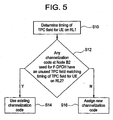
- FIG. 5 illustrates a flow chart of the channelization code management process performed by the RNC when the soft handoff operation begins.
- the RNC determines the timing of the TPC field in the F-DPCH for the mobile station on RL1. Namely, the RNC may receive timing reports as is well-known, for example, as described in 3GPP TS 25.331.
- step S12 the RNC determines if the second Node B2 uses any existing channelization codes for F-DPCHs that have an unused TPC field matching the timing of the TPC field for the UE on the first radio link RL1.
- the timing match occurs when the unused TPC field of the existing channelization code is received by the mobile station within a timing window (e.g., +/- 148 chips) about the receipt of the TPC field by the mobile station on the first radio link RL1.
- the RNC instructs the second Node B2 to use the existing channelization code in sending the TPC field or the F-DPCH for the UE such that the TPC field on the second radio link RL2 matches the timing of the corresponding TPC field on the first radio link RL1.
- the RNC assigns the second Node B a new channelization code from a pool of unused channelization codes, and instructs the second Node B2 to use the new channelization code in sending the TPC field on the second radio link RL2 such that the timing of the TPC field of the second radio link RL2 matches the timing of the TPC field on the first radio link RL1.
- FIG. 8 illustrates an example of TPC fields for different UEs having the same channelization code on the second radio link RL2. As shown, in this example, five users are multiplexed onto one channelization code with some gaps of 256 chips between the TPC fields of some of the UEs. These gaps result if the reception windows of the UEs determined by the timing of the respective first radio links do not allow usage of the TPC fields for this channelization code.
- the RNC may need to change the channelization code and/or TPC field used on the second radio link RL2 for the UE.
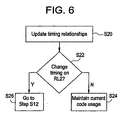
- This update process is illustrated in the flow chart of Figure 6 .
- the RNC receives updates in step S20 on the timing of the first and second radio links RL1 and RL2 in any well-known manner, for example, as set forth in TS 25.331.
- the RNC determines in step S22 if the timing of the F-DPCH for the UE on the second radio link RL2 should be changed. For example, the RNC may determine the timing difference between the TPC fields on the first and second radio links RL1 and RL2 (e.g., determine the drift), and if this timing difference exceeds a threshold amount, the RNC decides to change the timing of the F-DPCH for the UE on the second radio link RL2. Namely, if a change is decided, processing goes to step S12 of Figure 5 ; wherein the RNC will assign a new unused TPC field of an existing channelization code or assign a new channelization code for the F-DPCH on the second radio link RL2.
- this may result in using a different TPC field with the same channelization code as presently used on the second radio link RL2, or may result in the use of a different existing channelization code. Also, this may result in a channelization code becoming unused. If so, then the channelization code is returned to the pool of unused channelization codes for future assignment. Returning to step S22, if no timing change is to be made, then the RNC maintains the use of the channelization code for the UE.
- the acceptable timing window (e.g., +/- the threshold value in the above example), does not need to be the same timing window used in step S12, but may be. Also, while both the timing window of step S12 and the timing window of step S22 were described as symmetrical with respect the TPC field received by the mobile station on the first radio link RL1, one or both of these timing windows may be asymmetrical.
- the RNC continues to manage the channelization codes to minimize the number of channelization codes being used.
- An example of this management process is illustrated in Figure 7 .
- the management process illustrated in Figure 7 is performed for each UE currently scheduled on, for example, the least used channelization code, and is performed based on the timing information obtained from the UEs, such as in step S20 discussed above. While the following process will be described as being performed for the least used channelization code, it will be understood that the process may be applied to or find equal application to the other channelization codes used by the UE.
- step S30 the RNC determines if another existing channelization code has an unused TPC field matching the timing of the TPC field for the UE on the least used channelization code. If so, then in step S34, the RNC changes the channelization code for the TPC field (e.g.. F-DPCH) to the other existing channelization code. Then, in step S36, the RNC determines if the least used channelization code has become unused as a result of step S34. If so, the RNC returns the least used channelization code to the pool of unused channelization codes in step S38.
- TPC field e.g. F-DPCH
- the RNC returns to step S30 and begins the process for the next UE using the least used channelization code. Similar to step S12, the timing match occurs when the unused TPC field is received by the mobile station within a timing window (e.g., +/- 148 chips) about the receipt of the used TPC field.
- a timing window e.g., +/- 148 chips
- step S30 the RNC determines if another existing channelization code has an unused TPC field matching the timing of the TPC field for the UE on the least used channelization code. If no match is found, then in step S32, the RNC maintains the present use of the least used channelization code by the UE, and begins the process for the next UE using the least used channelization code.
- this process may then be repeated for the other channelization codes in use by the Node B.
- the embodiments of the present invention provide for conserving code resources for UEs using F-DPCH while in soft handoff. Therefore F-DPCH operation in soft handoff is more efficient.
- the embodiments of the present invention also allow for more advanced radio resource management, which is driven by the RNC. And, a high system capacity will result from the implementation of these methods.
Landscapes
- Engineering & Computer Science (AREA)
- Computer Networks & Wireless Communication (AREA)
- Signal Processing (AREA)
- Mobile Radio Communication Systems (AREA)
- Electrotherapy Devices (AREA)
- Heat Treatment Of Sheet Steel (AREA)
- Eye Examination Apparatus (AREA)
Claims (8)
- Ein Verfahren zur Verwaltung der Benutzung von Kanalisierungscodes während eines Soft-Handoffs einer Mobilstation von einer übertragenden Netzwerkstation an einen Netzwerkstationskandidaten, GEKENNZEICHNET durch :Ermitteln, ob ein Sendeleistungsregelungs-TPC-Feld, welches einem von dem Netzwerkstationskandidaten benutzten bestehenden Kanalisierungscode zugeordnet ist, unbenutzt ist und den einem entsprechenden an der Mobilstation von der übertragenden Netzwerkstation empfangenen TPC-Feld zugeordneten Zeitmessungskriterien entspricht (S12), wobei die Zeitmessungskriterien erfüllt werden, wenn ein unbenutztes TPC-Feld des bestehenden Kanalisierungscodes innerhalb eines in Bezug auf den Empfang des entsprechenden TPC-Feldes eingestellten Zeitfensters von der übertragenden Station an der Mobilstation empfangen wird; undZuordnen eines Kanalisierungscodes für die Benutzung durch den Netzwerkstationskandidaten für die Kommunikation mit der Mobilstation auf der Basis des Ermittlungsschrittes (S14, S 16).
- Das Verfahren nach Anspruch 1, wobei der Zuordnungsschritt den bestehenden Kanalisierungscode zuordnet, wenn die Zeitmessungskriterien erfüllt werden (S14).
- Das Verfahren nach Anspruch 2, wobei der Zuordnungsschritt einen unbenutzten Kanalisierungscode für die Benutzung durch den Netzwerkstationskandidaten nur zuordnet, wenn der Ermittlungsschritt nicht ermittelt, dass die Zeitmessungskriterien nicht erfüllt werden (S16).
- Das Verfahren nach Anspruch 1, wobei der Zuordnungsschritt einen unbenutzten Kanalisierungscode für die Benutzung durch den Netzwerkstationskandidaten nur zuordnet, wenn der Ermittlungsschritt nicht ermittelt, dass die Zeitmessungskriterien erfüllt werden (S16).
- Das Verfahren nach Anspruch 1, nach dem Zuordnungsschritt weiterhin GEKENNZEICHNET durch:Erkennen, ob eine Zeitmessung zwischen einem TPC-Feld des zugeordneten Kanalisierungscodes, welcher dem entsprechenden an der Mobilstation von der übertragenden Netzwerkstation empfangenen TPC-Feld entspricht, über ein zulässiges Zeitfenster hinaus in Bezug auf das entsprechende TPC-Feld abweicht (S20, S22); undWiederholen der Ermittlungs- und Zuordnungsschritte, wenn der Erkennungsschritt erkennt, dass die Zeitmessung zwischen dem TPC-Feld des zugeordneten Kanalisierungscodes, welcher dem jeweiligen an der Mobilstation von dem übertragenden Netzwerkstation empfangen TPC-Feld entspricht, über ein zulässiges Zeitfenster hinaus in Bezug auf das entsprechende TPC-Feld abweicht (S26, S12).
- Das Verfahren nach Anspruch 5, wobei der Erkennungsschritt weiterhin GEKENNZEICHNET ist durch:Ermitteln einer Zeitmessungsdifferenz zwischen dem TPC-Feld des zugeordneten Kanalisierungscodes und dem entsprechenden an der Mobilstationen von der übertragenden Netzwerkstation empfangenen TPC-Feld (S20); undErkennen einer Abweichung über ein zulässiges Zeitfenster hinaus, wenn der absolute Wert der Zeitmessungsdifferenz einen Grenzwertbetrag überschreitet (S22).
- Das Verfahren nach Anspruch 1, nach dem Zuordnungsschritt weiterhin GEKENNZEICHNET durch:Erkennen eines Mangels an zulässiger Synchronisation zwischen (i) einem TPC-Feld des zugeordneten Kanalisierungscodes, welcher dem entsprechenden an der Mobilstation von der übertragenden Netzwerkstation empfangenen TPC-Feld entspricht, und (ii) dem entsprechenden an der Mobilstation von der übertragenden Netzwerkstation empfangenen TPC-Feld (S20, S22); undWiederholen der Ermittlungs- und Zuordnungsschritte, wenn der Erkennungsschritt einen Mangel an zulässiger Synchronisation erkennt (S26).
- Das Verfahren nach Anspruch 1, weiterhin GEKENNZEICHNET durch:Unterscheiden, ob ein von dem Netzwerkstationskandidaten verwendeter Kanalisierungscode ein unbenutztes TPC-Feld beinhaltet, welches einem entsprechenden benutzten TPC-Feld eines anderen benutzten Kanalisierungscode, der von dem Netzwerkkandidaten benutzt wird, zugeordnete Zeitmessungskriterien erfüllt (S30); undVerwenden des unbenutzten TPC-Feldes dieses einen Kanalisierungscodes anstelle des benutzten TPC-Feldes des anderen benutzten Kanalisierungscodes, so dass das benutzte TPC-Feld des einen Kanalisierungscodes unbenutzt wird, wenn der Unterscheidungsschritt ermittelt, dass der andere benutzte Kanalisierungscode ein unbenutztes TPC-Feld enthält, welches die einem entsprechenden benutzten TPC-Feld des einen Kanalisierungscode zugeordneten Zeitmessungskriterien erfüllt (S34).
Applications Claiming Priority (2)
| Application Number | Priority Date | Filing Date | Title |
|---|---|---|---|
| US11/340,527 US7689222B2 (en) | 2006-01-27 | 2006-01-27 | Method of managing use of channelization codes during soft handoff |
| PCT/US2007/002256 WO2007089636A2 (en) | 2006-01-27 | 2007-01-26 | Method of managing use of channelization codes during soft handoff |
Publications (2)
| Publication Number | Publication Date |
|---|---|
| EP1977573A2 EP1977573A2 (de) | 2008-10-08 |
| EP1977573B1 true EP1977573B1 (de) | 2010-06-02 |
Family
ID=38220667
Family Applications (1)
| Application Number | Title | Priority Date | Filing Date |
|---|---|---|---|
| EP07762913A Active EP1977573B1 (de) | 2006-01-27 | 2007-01-26 | Verfahren zur verwaltung der verwendung von kanalisierungskoden während eines soft-handoff |
Country Status (8)
| Country | Link |
|---|---|
| US (1) | US7689222B2 (de) |
| EP (1) | EP1977573B1 (de) |
| JP (1) | JP4990915B2 (de) |
| KR (1) | KR101358882B1 (de) |
| CN (1) | CN101375564B (de) |
| AT (1) | ATE470329T1 (de) |
| DE (1) | DE602007006910D1 (de) |
| WO (1) | WO2007089636A2 (de) |
Families Citing this family (7)
| Publication number | Priority date | Publication date | Assignee | Title |
|---|---|---|---|---|
| CN100401796C (zh) | 2006-01-19 | 2008-07-09 | 华为技术有限公司 | 基站节点资源分配方法 |
| CA2658517C (en) * | 2006-08-22 | 2012-12-11 | Qualcomm Incorporated | Systems and methods for increasing the capacity of a channel in a communications system |
| EP2165570B1 (de) * | 2007-07-06 | 2015-06-17 | Nokia Technologies Oy | Neukonfigurierung des schlitzformats eines fraktionierten dedizierten kanals |
| JP5039591B2 (ja) * | 2008-02-05 | 2012-10-03 | 株式会社エヌ・ティ・ティ・ドコモ | 移動通信方法、移動通信システム及び無線制御装置 |
| EP2272289B1 (de) | 2008-04-29 | 2016-12-07 | Telefonaktiebolaget LM Ericsson (publ) | Verfahren und anordnung zur sendeleistungsregelung von mehreren abwärtsstreckenträgern |
| JP5359254B2 (ja) * | 2008-12-19 | 2013-12-04 | 富士通株式会社 | 送信電力制御情報設定方法 |
| US20130294276A1 (en) * | 2011-01-13 | 2013-11-07 | Telefonaktiebolaget L M Ericsson (Publ) | Estimation of channel quality indicator using unused codes |
Family Cites Families (17)
| Publication number | Priority date | Publication date | Assignee | Title |
|---|---|---|---|---|
| JPH0879818A (ja) * | 1994-09-07 | 1996-03-22 | Fujitsu Ltd | 移動通信のチャネル切替え方法 |
| JPH10327450A (ja) * | 1997-05-26 | 1998-12-08 | Kokusai Electric Co Ltd | 無線通信システム及びそれにおけるソフトハンドオフ方法 |
| GB2343330A (en) * | 1998-10-29 | 2000-05-03 | Fujitsu Ltd | Soft handoff method using a backup link |
| JP2001008262A (ja) * | 1999-06-23 | 2001-01-12 | Hitachi Ltd | ダイナミック符号割当て符号分割多元接続通信方法、および、それを実現するための基地局 |
| JP2001251667A (ja) * | 2000-02-02 | 2001-09-14 | Lg Electronics Inc | 共通パケットチャネルの割当方法 |
| GB0007337D0 (en) * | 2000-03-28 | 2000-05-17 | Koninkl Philips Electronics Nv | Radio communication system |
| CN1235352C (zh) | 2000-09-15 | 2006-01-04 | 皇家菲利浦电子有限公司 | 从站以及操作该从站的方法 |
| JP3787269B2 (ja) * | 2000-10-19 | 2006-06-21 | 株式会社エヌ・ティ・ティ・ドコモ | 移動通信システムにおける拡散符号同期方法および受信装置 |
| WO2002069514A1 (en) * | 2001-02-27 | 2002-09-06 | Samsung Electronics Co., Ltd | Apparatus and method for coding/decoding tfci bits in an asynchronous cdma communication system |
| US6996056B2 (en) * | 2001-05-31 | 2006-02-07 | Nortel Networks Limited | Method and apparatus for orthogonal code management in CDMA systems using smart antenna technology |
| US6785250B2 (en) * | 2001-07-09 | 2004-08-31 | Qualcomm Incorporated | Method and apparatus for time-sharing channelization code in a CDMA communication system |
| JP4184969B2 (ja) * | 2001-11-17 | 2008-11-19 | サムスン エレクトロニクス カンパニー リミテッド | 移動通信システムにおけるハンドオーバーのための信号測定装置及び方法 |
| US7096019B2 (en) * | 2002-05-31 | 2006-08-22 | Nokia Corporation | Apparatus, and associated method, for allocating channels in a radio communication system responsive to mobile station movement |
| CA2571423C (en) | 2004-06-21 | 2014-08-05 | Nokia Corporation | Recovery method for lost signaling connection with high speed downlink packet access/fractional dedicated physical channel |
| JP4709229B2 (ja) * | 2005-02-01 | 2011-06-22 | テレフオンアクチーボラゲット エル エム エリクソン(パブル) | F−dpch用のアウターループ送信電力制御方法 |
| US20060285521A1 (en) * | 2005-05-02 | 2006-12-21 | Ville Steudle | Method, system, apparatus and software product implementing downlink code management for fractional dedicated physical channel in timing conflict situations |
| US20070047489A1 (en) * | 2005-08-26 | 2007-03-01 | Bachl Rainer W | Handoffs in wireless communications network incorporating voice over IP using shared supplemental spreading codes |
-
2006
- 2006-01-27 US US11/340,527 patent/US7689222B2/en active Active - Reinstated
-
2007
- 2007-01-26 AT AT07762913T patent/ATE470329T1/de not_active IP Right Cessation
- 2007-01-26 CN CN200780003314.5A patent/CN101375564B/zh active Active
- 2007-01-26 JP JP2008552461A patent/JP4990915B2/ja not_active Expired - Fee Related
- 2007-01-26 DE DE602007006910T patent/DE602007006910D1/de active Active
- 2007-01-26 EP EP07762913A patent/EP1977573B1/de active Active
- 2007-01-26 WO PCT/US2007/002256 patent/WO2007089636A2/en not_active Ceased
- 2007-01-26 KR KR1020087018066A patent/KR101358882B1/ko not_active Expired - Fee Related
Also Published As
| Publication number | Publication date |
|---|---|
| CN101375564B (zh) | 2012-05-23 |
| WO2007089636A2 (en) | 2007-08-09 |
| CN101375564A (zh) | 2009-02-25 |
| ATE470329T1 (de) | 2010-06-15 |
| WO2007089636A3 (en) | 2007-10-04 |
| EP1977573A2 (de) | 2008-10-08 |
| KR101358882B1 (ko) | 2014-02-05 |
| KR20080096516A (ko) | 2008-10-30 |
| US7689222B2 (en) | 2010-03-30 |
| DE602007006910D1 (de) | 2010-07-15 |
| JP4990915B2 (ja) | 2012-08-01 |
| JP2009524996A (ja) | 2009-07-02 |
| US20070178902A1 (en) | 2007-08-02 |
Similar Documents
| Publication | Publication Date | Title |
|---|---|---|
| KR100892312B1 (ko) | 이동 통신 시스템에서 하향공유제어채널 전력 제어 방법 | |
| EP1313231B1 (de) | Verfahren zur Sendeleistungsregelung für HS-SCCH in einem UMTS-system | |
| US6747963B1 (en) | Apparatus and method for gated transmission in a CDMA communication system | |
| EP1977573B1 (de) | Verfahren zur verwaltung der verwendung von kanalisierungskoden während eines soft-handoff | |
| EP1212854B1 (de) | Verfahren zur durchführung von usts-weiterreichen und usts-modusumschaltung in einem mobilen kommunikationssystem | |
| RU2287902C2 (ru) | Способ передачи информации по управлению мощностью для высокоскоростного совместно используемого канала управления в системе подвижной связи | |
| JP5669789B2 (ja) | 無線通信システムにおける無線リンクの伝送を制御する方法および装置 | |
| JP4843692B2 (ja) | 移動無線通信システム用の電力制御装置 | |
| EP1257075B1 (de) | Sendevorrichtung und sendeverfahren | |
| KR20020083625A (ko) | 역방향 동기 전송 방식을 사용하는 부호분할다중접속 통신시스템에서 역방향 동기 방법 | |
| EP1810452B1 (de) | Verfahren zur steuerung eines oder mehrerer endgeräte von einer basisstation aus | |
| JP2006148944A (ja) | 共通パケットチャネルに対する緊急停止制御情報の伝送方法 | |
| KR100775163B1 (ko) | 이동 통신 시스템에서 hi에 대한 전력제어을 위한정보전송 및 그 검출방법 | |
| US20160112972A1 (en) | Data sending and receiving methods and devices | |
| KR100839244B1 (ko) | 이동 통신 시스템에서 공유제어채널 전력 제어 방법 | |
| Cause et al. | 8.3. 2 Synchronised Radio Link Reconfiguration Preparation | |
| CN1954516A (zh) | 根据不连续传输状态值控制下链及上链编码复合传输信道传输功率的无线通信方法及装置 | |
| KR20060014283A (ko) | 상향링크 패킷 스케쥴링 방법 |
Legal Events
| Date | Code | Title | Description |
|---|---|---|---|
| PUAI | Public reference made under article 153(3) epc to a published international application that has entered the european phase |
Free format text: ORIGINAL CODE: 0009012 |
|
| 17P | Request for examination filed |
Effective date: 20080624 |
|
| AK | Designated contracting states |
Kind code of ref document: A2 Designated state(s): AT BE BG CH CY CZ DE DK EE ES FI FR GB GR HU IE IS IT LI LT LU LV MC NL PL PT RO SE SI SK TR |
|
| 17Q | First examination report despatched |
Effective date: 20081219 |
|
| RAP3 | Party data changed (applicant data changed or rights of an application transferred) |
Owner name: LUCENT TECHNOLOGIES INC. |
|
| RIC1 | Information provided on ipc code assigned before grant |
Ipc: H04W 36/18 20090101AFI20091030BHEP |
|
| GRAP | Despatch of communication of intention to grant a patent |
Free format text: ORIGINAL CODE: EPIDOSNIGR1 |
|
| GRAS | Grant fee paid |
Free format text: ORIGINAL CODE: EPIDOSNIGR3 |
|
| GRAA | (expected) grant |
Free format text: ORIGINAL CODE: 0009210 |
|
| AK | Designated contracting states |
Kind code of ref document: B1 Designated state(s): AT BE BG CH CY CZ DE DK EE ES FI FR GB GR HU IE IS IT LI LT LU LV MC NL PL PT RO SE SI SK TR |
|
| REG | Reference to a national code |
Ref country code: GB Ref legal event code: FG4D |
|
| REG | Reference to a national code |
Ref country code: CH Ref legal event code: EP |
|
| REG | Reference to a national code |
Ref country code: IE Ref legal event code: FG4D |
|
| REF | Corresponds to: |
Ref document number: 602007006910 Country of ref document: DE Date of ref document: 20100715 Kind code of ref document: P |
|
| REG | Reference to a national code |
Ref country code: NL Ref legal event code: VDEP Effective date: 20100602 |
|
| PG25 | Lapsed in a contracting state [announced via postgrant information from national office to epo] |
Ref country code: LT Free format text: LAPSE BECAUSE OF FAILURE TO SUBMIT A TRANSLATION OF THE DESCRIPTION OR TO PAY THE FEE WITHIN THE PRESCRIBED TIME-LIMIT Effective date: 20100602 Ref country code: SE Free format text: LAPSE BECAUSE OF FAILURE TO SUBMIT A TRANSLATION OF THE DESCRIPTION OR TO PAY THE FEE WITHIN THE PRESCRIBED TIME-LIMIT Effective date: 20100602 |
|
| LTIE | Lt: invalidation of european patent or patent extension |
Effective date: 20100602 |
|
| PG25 | Lapsed in a contracting state [announced via postgrant information from national office to epo] |
Ref country code: SI Free format text: LAPSE BECAUSE OF FAILURE TO SUBMIT A TRANSLATION OF THE DESCRIPTION OR TO PAY THE FEE WITHIN THE PRESCRIBED TIME-LIMIT Effective date: 20100602 Ref country code: LV Free format text: LAPSE BECAUSE OF FAILURE TO SUBMIT A TRANSLATION OF THE DESCRIPTION OR TO PAY THE FEE WITHIN THE PRESCRIBED TIME-LIMIT Effective date: 20100602 Ref country code: AT Free format text: LAPSE BECAUSE OF FAILURE TO SUBMIT A TRANSLATION OF THE DESCRIPTION OR TO PAY THE FEE WITHIN THE PRESCRIBED TIME-LIMIT Effective date: 20100602 Ref country code: FI Free format text: LAPSE BECAUSE OF FAILURE TO SUBMIT A TRANSLATION OF THE DESCRIPTION OR TO PAY THE FEE WITHIN THE PRESCRIBED TIME-LIMIT Effective date: 20100602 |
|
| PG25 | Lapsed in a contracting state [announced via postgrant information from national office to epo] |
Ref country code: PL Free format text: LAPSE BECAUSE OF FAILURE TO SUBMIT A TRANSLATION OF THE DESCRIPTION OR TO PAY THE FEE WITHIN THE PRESCRIBED TIME-LIMIT Effective date: 20100602 Ref country code: CY Free format text: LAPSE BECAUSE OF FAILURE TO SUBMIT A TRANSLATION OF THE DESCRIPTION OR TO PAY THE FEE WITHIN THE PRESCRIBED TIME-LIMIT Effective date: 20100602 |
|
| PG25 | Lapsed in a contracting state [announced via postgrant information from national office to epo] |
Ref country code: NL Free format text: LAPSE BECAUSE OF FAILURE TO SUBMIT A TRANSLATION OF THE DESCRIPTION OR TO PAY THE FEE WITHIN THE PRESCRIBED TIME-LIMIT Effective date: 20100602 Ref country code: EE Free format text: LAPSE BECAUSE OF FAILURE TO SUBMIT A TRANSLATION OF THE DESCRIPTION OR TO PAY THE FEE WITHIN THE PRESCRIBED TIME-LIMIT Effective date: 20100602 |
|
| PG25 | Lapsed in a contracting state [announced via postgrant information from national office to epo] |
Ref country code: SK Free format text: LAPSE BECAUSE OF FAILURE TO SUBMIT A TRANSLATION OF THE DESCRIPTION OR TO PAY THE FEE WITHIN THE PRESCRIBED TIME-LIMIT Effective date: 20100602 Ref country code: RO Free format text: LAPSE BECAUSE OF FAILURE TO SUBMIT A TRANSLATION OF THE DESCRIPTION OR TO PAY THE FEE WITHIN THE PRESCRIBED TIME-LIMIT Effective date: 20100602 Ref country code: PT Free format text: LAPSE BECAUSE OF FAILURE TO SUBMIT A TRANSLATION OF THE DESCRIPTION OR TO PAY THE FEE WITHIN THE PRESCRIBED TIME-LIMIT Effective date: 20101004 Ref country code: CZ Free format text: LAPSE BECAUSE OF FAILURE TO SUBMIT A TRANSLATION OF THE DESCRIPTION OR TO PAY THE FEE WITHIN THE PRESCRIBED TIME-LIMIT Effective date: 20100602 Ref country code: BE Free format text: LAPSE BECAUSE OF FAILURE TO SUBMIT A TRANSLATION OF THE DESCRIPTION OR TO PAY THE FEE WITHIN THE PRESCRIBED TIME-LIMIT Effective date: 20100602 Ref country code: IS Free format text: LAPSE BECAUSE OF FAILURE TO SUBMIT A TRANSLATION OF THE DESCRIPTION OR TO PAY THE FEE WITHIN THE PRESCRIBED TIME-LIMIT Effective date: 20101002 |
|
| PG25 | Lapsed in a contracting state [announced via postgrant information from national office to epo] |
Ref country code: IT Free format text: LAPSE BECAUSE OF FAILURE TO SUBMIT A TRANSLATION OF THE DESCRIPTION OR TO PAY THE FEE WITHIN THE PRESCRIBED TIME-LIMIT Effective date: 20100602 |
|
| PLBE | No opposition filed within time limit |
Free format text: ORIGINAL CODE: 0009261 |
|
| STAA | Information on the status of an ep patent application or granted ep patent |
Free format text: STATUS: NO OPPOSITION FILED WITHIN TIME LIMIT |
|
| PG25 | Lapsed in a contracting state [announced via postgrant information from national office to epo] |
Ref country code: DK Free format text: LAPSE BECAUSE OF FAILURE TO SUBMIT A TRANSLATION OF THE DESCRIPTION OR TO PAY THE FEE WITHIN THE PRESCRIBED TIME-LIMIT Effective date: 20100602 |
|
| 26N | No opposition filed |
Effective date: 20110303 |
|
| PG25 | Lapsed in a contracting state [announced via postgrant information from national office to epo] |
Ref country code: GR Free format text: LAPSE BECAUSE OF FAILURE TO SUBMIT A TRANSLATION OF THE DESCRIPTION OR TO PAY THE FEE WITHIN THE PRESCRIBED TIME-LIMIT Effective date: 20100903 |
|
| REG | Reference to a national code |
Ref country code: DE Ref legal event code: R097 Ref document number: 602007006910 Country of ref document: DE Effective date: 20110302 |
|
| PG25 | Lapsed in a contracting state [announced via postgrant information from national office to epo] |
Ref country code: MC Free format text: LAPSE BECAUSE OF NON-PAYMENT OF DUE FEES Effective date: 20110131 |
|
| REG | Reference to a national code |
Ref country code: CH Ref legal event code: PL |
|
| REG | Reference to a national code |
Ref country code: IE Ref legal event code: MM4A |
|
| PG25 | Lapsed in a contracting state [announced via postgrant information from national office to epo] |
Ref country code: LI Free format text: LAPSE BECAUSE OF NON-PAYMENT OF DUE FEES Effective date: 20110131 Ref country code: CH Free format text: LAPSE BECAUSE OF NON-PAYMENT OF DUE FEES Effective date: 20110131 |
|
| PG25 | Lapsed in a contracting state [announced via postgrant information from national office to epo] |
Ref country code: IE Free format text: LAPSE BECAUSE OF NON-PAYMENT OF DUE FEES Effective date: 20110126 |
|
| PG25 | Lapsed in a contracting state [announced via postgrant information from national office to epo] |
Ref country code: LU Free format text: LAPSE BECAUSE OF NON-PAYMENT OF DUE FEES Effective date: 20110126 |
|
| PG25 | Lapsed in a contracting state [announced via postgrant information from national office to epo] |
Ref country code: TR Free format text: LAPSE BECAUSE OF FAILURE TO SUBMIT A TRANSLATION OF THE DESCRIPTION OR TO PAY THE FEE WITHIN THE PRESCRIBED TIME-LIMIT Effective date: 20100602 Ref country code: BG Free format text: LAPSE BECAUSE OF FAILURE TO SUBMIT A TRANSLATION OF THE DESCRIPTION OR TO PAY THE FEE WITHIN THE PRESCRIBED TIME-LIMIT Effective date: 20100902 |
|
| PG25 | Lapsed in a contracting state [announced via postgrant information from national office to epo] |
Ref country code: HU Free format text: LAPSE BECAUSE OF FAILURE TO SUBMIT A TRANSLATION OF THE DESCRIPTION OR TO PAY THE FEE WITHIN THE PRESCRIBED TIME-LIMIT Effective date: 20100602 Ref country code: ES Free format text: LAPSE BECAUSE OF FAILURE TO SUBMIT A TRANSLATION OF THE DESCRIPTION OR TO PAY THE FEE WITHIN THE PRESCRIBED TIME-LIMIT Effective date: 20100913 |
|
| REG | Reference to a national code |
Ref country code: GB Ref legal event code: 732E Free format text: REGISTERED BETWEEN 20131128 AND 20131204 |
|
| REG | Reference to a national code |
Ref country code: FR Ref legal event code: CD Owner name: ALCATEL-LUCENT USA INC. Effective date: 20131122 |
|
| REG | Reference to a national code |
Ref country code: FR Ref legal event code: GC Effective date: 20140410 |
|
| REG | Reference to a national code |
Ref country code: FR Ref legal event code: RG Effective date: 20141015 |
|
| REG | Reference to a national code |
Ref country code: FR Ref legal event code: PLFP Year of fee payment: 9 |
|
| REG | Reference to a national code |
Ref country code: FR Ref legal event code: PLFP Year of fee payment: 10 |
|
| REG | Reference to a national code |
Ref country code: FR Ref legal event code: PLFP Year of fee payment: 11 |
|
| REG | Reference to a national code |
Ref country code: FR Ref legal event code: PLFP Year of fee payment: 12 |
|
| REG | Reference to a national code |
Ref country code: DE Ref legal event code: R082 Ref document number: 602007006910 Country of ref document: DE Representative=s name: METACOM LEGAL RECHTSANWAELTE, DE Ref country code: DE Ref legal event code: R082 Ref document number: 602007006910 Country of ref document: DE Representative=s name: METACOM LEGAL, DE Ref country code: DE Ref legal event code: R082 Ref document number: 602007006910 Country of ref document: DE Representative=s name: BARKHOFF REIMANN VOSSIUS, DE Ref country code: DE Ref legal event code: R081 Ref document number: 602007006910 Country of ref document: DE Owner name: WSOU INVESTMENTS, LLC, LOS ANGELES, US Free format text: FORMER OWNER: LUCENT TECHNOLOGIES, INC., MURRAY HILL, N.J., US |
|
| REG | Reference to a national code |
Ref country code: DE Ref legal event code: R082 Ref document number: 602007006910 Country of ref document: DE Representative=s name: METACOM LEGAL RECHTSANWAELTE, DE Ref country code: DE Ref legal event code: R082 Ref document number: 602007006910 Country of ref document: DE Representative=s name: METACOM LEGAL, DE Ref country code: DE Ref legal event code: R082 Ref document number: 602007006910 Country of ref document: DE Representative=s name: METACOM LEGAL NAGEL MARKOWSKY VOSSIUS RECHTSAN, DE |
|
| P01 | Opt-out of the competence of the unified patent court (upc) registered |
Effective date: 20230606 |
|
| PGFP | Annual fee paid to national office [announced via postgrant information from national office to epo] |
Ref country code: DE Payment date: 20250627 Year of fee payment: 19 |
|
| PGFP | Annual fee paid to national office [announced via postgrant information from national office to epo] |
Ref country code: GB Payment date: 20250627 Year of fee payment: 19 |
|
| PGFP | Annual fee paid to national office [announced via postgrant information from national office to epo] |
Ref country code: FR Payment date: 20250625 Year of fee payment: 19 |