EP1975165A1 - Substituierte Pyrrolidinamide, deren Herstellung und deren Verwendung als Arzneimittel - Google Patents
Substituierte Pyrrolidinamide, deren Herstellung und deren Verwendung als Arzneimittel Download PDFInfo
- Publication number
- EP1975165A1 EP1975165A1 EP07105053A EP07105053A EP1975165A1 EP 1975165 A1 EP1975165 A1 EP 1975165A1 EP 07105053 A EP07105053 A EP 07105053A EP 07105053 A EP07105053 A EP 07105053A EP 1975165 A1 EP1975165 A1 EP 1975165A1
- Authority
- EP
- European Patent Office
- Prior art keywords
- alkyl
- group
- amino
- atom
- hydroxy
- Prior art date
- Legal status (The legal status is an assumption and is not a legal conclusion. Google has not performed a legal analysis and makes no representation as to the accuracy of the status listed.)
- Ceased
Links
- 239000003814 drug Substances 0.000 title claims description 5
- LCDCPQHFCOBUEF-UHFFFAOYSA-N pyrrolidine-1-carboxamide Chemical class NC(=O)N1CCCC1 LCDCPQHFCOBUEF-UHFFFAOYSA-N 0.000 title abstract description 3
- 238000004519 manufacturing process Methods 0.000 title description 11
- 239000000203 mixture Substances 0.000 claims abstract description 73
- 150000003839 salts Chemical class 0.000 claims abstract description 36
- HBAQYPYDRFILMT-UHFFFAOYSA-N 8-[3-(1-cyclopropylpyrazol-4-yl)-1H-pyrazolo[4,3-d]pyrimidin-5-yl]-3-methyl-3,8-diazabicyclo[3.2.1]octan-2-one Chemical class C1(CC1)N1N=CC(=C1)C1=NNC2=C1N=C(N=C2)N1C2C(N(CC1CC2)C)=O HBAQYPYDRFILMT-UHFFFAOYSA-N 0.000 claims abstract description 22
- -1 C 1-5 -alkyloxy Chemical group 0.000 claims description 325
- 125000000217 alkyl group Chemical group 0.000 claims description 119
- 238000000034 method Methods 0.000 claims description 102
- 229910052757 nitrogen Inorganic materials 0.000 claims description 67
- 150000001875 compounds Chemical class 0.000 claims description 56
- 125000002924 primary amino group Chemical group [H]N([H])* 0.000 claims description 51
- WYURNTSHIVDZCO-UHFFFAOYSA-N Tetrahydrofuran Chemical compound C1CCOC1 WYURNTSHIVDZCO-UHFFFAOYSA-N 0.000 claims description 44
- 150000001721 carbon Chemical group 0.000 claims description 42
- 125000001153 fluoro group Chemical group F* 0.000 claims description 40
- 125000004435 hydrogen atom Chemical group [H]* 0.000 claims description 40
- 229910052799 carbon Inorganic materials 0.000 claims description 39
- 125000002887 hydroxy group Chemical group [H]O* 0.000 claims description 39
- 229910052760 oxygen Inorganic materials 0.000 claims description 35
- 125000002496 methyl group Chemical group [H]C([H])([H])* 0.000 claims description 34
- 229910052731 fluorine Inorganic materials 0.000 claims description 32
- GDTBXPJZTBHREO-UHFFFAOYSA-N bromine Chemical compound BrBr GDTBXPJZTBHREO-UHFFFAOYSA-N 0.000 claims description 31
- 239000001301 oxygen Substances 0.000 claims description 31
- IJGRMHOSHXDMSA-UHFFFAOYSA-N Atomic nitrogen Chemical compound N#N IJGRMHOSHXDMSA-UHFFFAOYSA-N 0.000 claims description 30
- 229910052717 sulfur Inorganic materials 0.000 claims description 30
- 125000001570 methylene group Chemical group [H]C([H])([*:1])[*:2] 0.000 claims description 28
- 125000005842 heteroatom Chemical group 0.000 claims description 27
- 229910052801 chlorine Inorganic materials 0.000 claims description 24
- 229910052794 bromium Inorganic materials 0.000 claims description 23
- 238000002360 preparation method Methods 0.000 claims description 23
- 125000003545 alkoxy group Chemical group 0.000 claims description 22
- 239000011737 fluorine Substances 0.000 claims description 22
- 150000003254 radicals Chemical class 0.000 claims description 21
- UFHFLCQGNIYNRP-UHFFFAOYSA-N Hydrogen Chemical compound [H][H] UFHFLCQGNIYNRP-UHFFFAOYSA-N 0.000 claims description 19
- 125000001997 phenyl group Chemical group [H]C1=C([H])C([H])=C(*)C([H])=C1[H] 0.000 claims description 19
- 125000004169 (C1-C6) alkyl group Chemical group 0.000 claims description 18
- RWRDLPDLKQPQOW-UHFFFAOYSA-N Pyrrolidine Chemical compound C1CCNC1 RWRDLPDLKQPQOW-UHFFFAOYSA-N 0.000 claims description 18
- 239000000460 chlorine Substances 0.000 claims description 18
- 239000001257 hydrogen Substances 0.000 claims description 18
- 229910052739 hydrogen Inorganic materials 0.000 claims description 18
- WKBOTKDWSSQWDR-UHFFFAOYSA-N Bromine atom Chemical group [Br] WKBOTKDWSSQWDR-UHFFFAOYSA-N 0.000 claims description 17
- MYMOFIZGZYHOMD-UHFFFAOYSA-N Dioxygen Chemical compound O=O MYMOFIZGZYHOMD-UHFFFAOYSA-N 0.000 claims description 17
- PXGOKWXKJXAPGV-UHFFFAOYSA-N Fluorine Chemical compound FF PXGOKWXKJXAPGV-UHFFFAOYSA-N 0.000 claims description 17
- 125000004433 nitrogen atom Chemical group N* 0.000 claims description 17
- OKTJSMMVPCPJKN-UHFFFAOYSA-N Carbon Chemical group [C] OKTJSMMVPCPJKN-UHFFFAOYSA-N 0.000 claims description 16
- 125000004453 alkoxycarbonyl group Chemical group 0.000 claims description 16
- 125000003282 alkyl amino group Chemical group 0.000 claims description 16
- 125000004434 sulfur atom Chemical group 0.000 claims description 16
- 125000006559 (C1-C3) alkylamino group Chemical group 0.000 claims description 15
- 125000004432 carbon atom Chemical group C* 0.000 claims description 15
- 125000006273 (C1-C3) alkyl group Chemical group 0.000 claims description 14
- RYHBNJHYFVUHQT-UHFFFAOYSA-N 1,4-Dioxane Chemical compound C1COCCO1 RYHBNJHYFVUHQT-UHFFFAOYSA-N 0.000 claims description 14
- ZCYVEMRRCGMTRW-UHFFFAOYSA-N 7553-56-2 Chemical group [I] ZCYVEMRRCGMTRW-UHFFFAOYSA-N 0.000 claims description 14
- QVGXLLKOCUKJST-UHFFFAOYSA-N atomic oxygen Chemical compound [O] QVGXLLKOCUKJST-UHFFFAOYSA-N 0.000 claims description 14
- 125000003917 carbamoyl group Chemical group [H]N([H])C(*)=O 0.000 claims description 14
- 125000003178 carboxy group Chemical group [H]OC(*)=O 0.000 claims description 14
- YLQBMQCUIZJEEH-UHFFFAOYSA-N tetrahydrofuran Natural products C=1C=COC=1 YLQBMQCUIZJEEH-UHFFFAOYSA-N 0.000 claims description 14
- NINIDFKCEFEMDL-UHFFFAOYSA-N Sulfur Chemical compound [S] NINIDFKCEFEMDL-UHFFFAOYSA-N 0.000 claims description 13
- 125000001072 heteroaryl group Chemical group 0.000 claims description 12
- 125000001424 substituent group Chemical group 0.000 claims description 12
- 125000006560 (C1-C5)alkylcarbonylamino group Chemical group 0.000 claims description 11
- 125000003342 alkenyl group Chemical group 0.000 claims description 11
- 125000004429 atom Chemical group 0.000 claims description 11
- 125000001797 benzyl group Chemical group [H]C1=C([H])C([H])=C(C([H])=C1[H])C([H])([H])* 0.000 claims description 11
- 239000012634 fragment Substances 0.000 claims description 11
- 125000002950 monocyclic group Chemical group 0.000 claims description 11
- 125000002023 trifluoromethyl group Chemical group FC(F)(F)* 0.000 claims description 11
- 125000003903 2-propenyl group Chemical group [H]C([*])([H])C([H])=C([H])[H] 0.000 claims description 10
- KZBUYRJDOAKODT-UHFFFAOYSA-N Chlorine Chemical compound ClCl KZBUYRJDOAKODT-UHFFFAOYSA-N 0.000 claims description 10
- NQRYJNQNLNOLGT-UHFFFAOYSA-N Piperidine Chemical compound C1CCNCC1 NQRYJNQNLNOLGT-UHFFFAOYSA-N 0.000 claims description 10
- HGCIXCUEYOPUTN-UHFFFAOYSA-N cyclohexene Chemical compound C1CCC=CC1 HGCIXCUEYOPUTN-UHFFFAOYSA-N 0.000 claims description 10
- LPIQUOYDBNQMRZ-UHFFFAOYSA-N cyclopentene Chemical compound C1CC=CC1 LPIQUOYDBNQMRZ-UHFFFAOYSA-N 0.000 claims description 10
- 125000001841 imino group Chemical group [H]N=* 0.000 claims description 10
- 239000011593 sulfur Substances 0.000 claims description 10
- 125000004457 alkyl amino carbonyl group Chemical group 0.000 claims description 9
- 125000000304 alkynyl group Chemical group 0.000 claims description 9
- 125000006842 cycloalkyleneimino group Chemical group 0.000 claims description 9
- 239000000126 substance Substances 0.000 claims description 9
- 125000000876 trifluoromethoxy group Chemical group FC(F)(F)O* 0.000 claims description 9
- 125000006698 (C1-C3) dialkylamino group Chemical group 0.000 claims description 8
- 125000000882 C2-C6 alkenyl group Chemical group 0.000 claims description 8
- ZAMOUSCENKQFHK-UHFFFAOYSA-N Chlorine atom Chemical group [Cl] ZAMOUSCENKQFHK-UHFFFAOYSA-N 0.000 claims description 8
- 125000004448 alkyl carbonyl group Chemical group 0.000 claims description 8
- 229910052740 iodine Inorganic materials 0.000 claims description 8
- 150000002825 nitriles Chemical class 0.000 claims description 8
- 125000004430 oxygen atom Chemical group O* 0.000 claims description 8
- 229920006395 saturated elastomer Polymers 0.000 claims description 8
- 108010074860 Factor Xa Proteins 0.000 claims description 7
- YNAVUWVOSKDBBP-UHFFFAOYSA-N Morpholine Chemical compound C1COCCN1 YNAVUWVOSKDBBP-UHFFFAOYSA-N 0.000 claims description 7
- 125000001495 ethyl group Chemical group [H]C([H])([H])C([H])([H])* 0.000 claims description 7
- 125000004356 hydroxy functional group Chemical group O* 0.000 claims description 7
- 125000000956 methoxy group Chemical group [H]C([H])([H])O* 0.000 claims description 7
- 125000001412 tetrahydropyranyl group Chemical group 0.000 claims description 7
- 125000006562 (C1-C5) alkyloxycarbonylamino group Chemical group 0.000 claims description 6
- 125000003601 C2-C6 alkynyl group Chemical group 0.000 claims description 6
- DHXVGJBLRPWPCS-UHFFFAOYSA-N Tetrahydropyran Chemical compound C1CCOCC1 DHXVGJBLRPWPCS-UHFFFAOYSA-N 0.000 claims description 6
- YPWFISCTZQNZAU-UHFFFAOYSA-N Thiane Chemical compound C1CCSCC1 YPWFISCTZQNZAU-UHFFFAOYSA-N 0.000 claims description 6
- 125000003302 alkenyloxy group Chemical group 0.000 claims description 6
- 125000004390 alkyl sulfonyl group Chemical group 0.000 claims description 6
- ZSIQJIWKELUFRJ-UHFFFAOYSA-N azepane Chemical compound C1CCCNCC1 ZSIQJIWKELUFRJ-UHFFFAOYSA-N 0.000 claims description 6
- HONIICLYMWZJFZ-UHFFFAOYSA-N azetidine Chemical compound C1CNC1 HONIICLYMWZJFZ-UHFFFAOYSA-N 0.000 claims description 6
- 125000002915 carbonyl group Chemical group [*:2]C([*:1])=O 0.000 claims description 6
- 125000001309 chloro group Chemical group Cl* 0.000 claims description 6
- 125000001559 cyclopropyl group Chemical group [H]C1([H])C([H])([H])C1([H])* 0.000 claims description 6
- HTFFABIIOAKIBH-UHFFFAOYSA-N diazinane Chemical compound C1CCNNC1 HTFFABIIOAKIBH-UHFFFAOYSA-N 0.000 claims description 6
- 125000005843 halogen group Chemical group 0.000 claims description 6
- 230000002401 inhibitory effect Effects 0.000 claims description 6
- 125000000325 methylidene group Chemical group [H]C([H])=* 0.000 claims description 6
- AHHWIHXENZJRFG-UHFFFAOYSA-N oxetane Chemical compound C1COC1 AHHWIHXENZJRFG-UHFFFAOYSA-N 0.000 claims description 6
- 230000008569 process Effects 0.000 claims description 6
- RAOIDOHSFRTOEL-UHFFFAOYSA-N tetrahydrothiophene Chemical compound C1CCSC1 RAOIDOHSFRTOEL-UHFFFAOYSA-N 0.000 claims description 6
- XSROQCDVUIHRSI-UHFFFAOYSA-N thietane Chemical compound C1CSC1 XSROQCDVUIHRSI-UHFFFAOYSA-N 0.000 claims description 6
- 125000004568 thiomorpholinyl group Chemical group 0.000 claims description 6
- 125000005913 (C3-C6) cycloalkyl group Chemical group 0.000 claims description 5
- NQPJDJVGBDHCAD-UHFFFAOYSA-N 1,3-diazinan-2-one Chemical compound OC1=NCCCN1 NQPJDJVGBDHCAD-UHFFFAOYSA-N 0.000 claims description 5
- GLUUGHFHXGJENI-UHFFFAOYSA-N Piperazine Chemical compound C1CNCCN1 GLUUGHFHXGJENI-UHFFFAOYSA-N 0.000 claims description 5
- OYELEBBISJGNHJ-UHFFFAOYSA-N 1,3-oxazinan-2-one Chemical group O=C1NCCCO1 OYELEBBISJGNHJ-UHFFFAOYSA-N 0.000 claims description 4
- 125000004442 acylamino group Chemical group 0.000 claims description 4
- 125000004949 alkyl amino carbonyl amino group Chemical group 0.000 claims description 4
- 125000004656 alkyl sulfonylamino group Chemical group 0.000 claims description 4
- 125000005133 alkynyloxy group Chemical group 0.000 claims description 4
- 125000006598 aminocarbonylamino group Chemical group 0.000 claims description 4
- 125000004093 cyano group Chemical group *C#N 0.000 claims description 4
- 125000005167 cycloalkylaminocarbonyl group Chemical group 0.000 claims description 4
- 125000002534 ethynyl group Chemical group [H]C#C* 0.000 claims description 4
- 125000002757 morpholinyl group Chemical group 0.000 claims description 4
- 150000002829 nitrogen Chemical class 0.000 claims description 4
- RGSFGYAAUTVSQA-UHFFFAOYSA-N pentamethylene Natural products C1CCCC1 RGSFGYAAUTVSQA-UHFFFAOYSA-N 0.000 claims description 4
- 125000004193 piperazinyl group Chemical group 0.000 claims description 4
- 125000003386 piperidinyl group Chemical group 0.000 claims description 4
- 125000004076 pyridyl group Chemical group 0.000 claims description 4
- 125000000719 pyrrolidinyl group Chemical group 0.000 claims description 4
- 125000000475 sulfinyl group Chemical group [*:2]S([*:1])=O 0.000 claims description 4
- 125000001174 sulfone group Chemical group 0.000 claims description 4
- 125000000472 sulfonyl group Chemical group *S(*)(=O)=O 0.000 claims description 4
- 150000003462 sulfoxides Chemical class 0.000 claims description 4
- 125000003718 tetrahydrofuranyl group Chemical group 0.000 claims description 4
- 125000003396 thiol group Chemical class [H]S* 0.000 claims description 4
- WNXJIVFYUVYPPR-UHFFFAOYSA-N 1,3-dioxolane Chemical compound C1COCO1 WNXJIVFYUVYPPR-UHFFFAOYSA-N 0.000 claims description 3
- IZXIZTKNFFYFOF-UHFFFAOYSA-N 2-Oxazolidone Chemical compound O=C1NCCO1 IZXIZTKNFFYFOF-UHFFFAOYSA-N 0.000 claims description 3
- 125000001494 2-propynyl group Chemical group [H]C#CC([H])([H])* 0.000 claims description 3
- 125000002252 acyl group Chemical group 0.000 claims description 3
- 125000005336 allyloxy group Chemical group 0.000 claims description 3
- 125000003277 amino group Chemical group 0.000 claims description 3
- 125000002619 bicyclic group Chemical group 0.000 claims description 3
- 239000000969 carrier Substances 0.000 claims description 3
- 125000005169 cycloalkylcarbonylamino group Chemical group 0.000 claims description 3
- 125000004663 dialkyl amino group Chemical group 0.000 claims description 3
- 239000003085 diluting agent Substances 0.000 claims description 3
- 125000002541 furyl group Chemical group 0.000 claims description 3
- 125000000623 heterocyclic group Chemical group 0.000 claims description 3
- YAMHXTCMCPHKLN-UHFFFAOYSA-N imidazolidin-2-one Chemical compound O=C1NCCN1 YAMHXTCMCPHKLN-UHFFFAOYSA-N 0.000 claims description 3
- PNDPGZBMCMUPRI-UHFFFAOYSA-N iodine Chemical compound II PNDPGZBMCMUPRI-UHFFFAOYSA-N 0.000 claims description 3
- 125000001544 thienyl group Chemical group 0.000 claims description 3
- BRNULMACUQOKMR-UHFFFAOYSA-N thiomorpholine Chemical compound C1CSCCN1 BRNULMACUQOKMR-UHFFFAOYSA-N 0.000 claims description 3
- 125000000391 vinyl group Chemical group [H]C([*])=C([H])[H] 0.000 claims description 3
- 125000006555 (C3-C5) cycloalkyl group Chemical group 0.000 claims description 2
- 125000006570 (C5-C6) heteroaryl group Chemical group 0.000 claims description 2
- UOCLXMDMGBRAIB-UHFFFAOYSA-N 1,1,1-trichloroethane Chemical compound CC(Cl)(Cl)Cl UOCLXMDMGBRAIB-UHFFFAOYSA-N 0.000 claims description 2
- BXVSAYBZSGIURM-UHFFFAOYSA-N 2-phenoxy-4h-1,3,2$l^{5}-benzodioxaphosphinine 2-oxide Chemical compound O1CC2=CC=CC=C2OP1(=O)OC1=CC=CC=C1 BXVSAYBZSGIURM-UHFFFAOYSA-N 0.000 claims description 2
- 125000000175 2-thienyl group Chemical group S1C([*])=C([H])C([H])=C1[H] 0.000 claims description 2
- 125000004011 3 membered carbocyclic group Chemical group 0.000 claims description 2
- 125000006163 5-membered heteroaryl group Chemical group 0.000 claims description 2
- 125000006164 6-membered heteroaryl group Chemical group 0.000 claims description 2
- 125000006845 C1-5-alkyloxycarbonyl-C1-5-alkyl group Chemical group 0.000 claims description 2
- 108010022999 Serine Proteases Proteins 0.000 claims description 2
- 102000012479 Serine Proteases Human genes 0.000 claims description 2
- 125000005277 alkyl imino group Chemical group 0.000 claims description 2
- 125000000392 cycloalkenyl group Chemical group 0.000 claims description 2
- 125000006254 cycloalkyl carbonyl group Chemical group 0.000 claims description 2
- 125000006299 oxetan-3-yl group Chemical group [H]C1([H])OC([H])([H])C1([H])* 0.000 claims description 2
- 125000004043 oxo group Chemical group O=* 0.000 claims description 2
- 150000003457 sulfones Chemical class 0.000 claims description 2
- 229920002554 vinyl polymer Polymers 0.000 claims description 2
- 125000005195 alkyl amino carbonyloxy group Chemical group 0.000 claims 1
- 125000004471 alkyl aminosulfonyl group Chemical group 0.000 claims 1
- 125000005196 alkyl carbonyloxy group Chemical group 0.000 claims 1
- 125000004397 aminosulfonyl group Chemical group NS(=O)(=O)* 0.000 claims 1
- 125000000000 cycloalkoxy group Chemical group 0.000 claims 1
- ORTFAQDWJHRMNX-UHFFFAOYSA-N hydroxidooxidocarbon(.) Chemical group O[C]=O ORTFAQDWJHRMNX-UHFFFAOYSA-N 0.000 claims 1
- 239000008194 pharmaceutical composition Substances 0.000 claims 1
- LZOZLBFZGFLFBV-UHFFFAOYSA-N sulfene Chemical compound C=S(=O)=O LZOZLBFZGFLFBV-UHFFFAOYSA-N 0.000 claims 1
- 150000007522 mineralic acids Chemical class 0.000 abstract description 4
- 150000007524 organic acids Chemical class 0.000 abstract description 4
- 235000005985 organic acids Nutrition 0.000 abstract description 4
- YMWUJEATGCHHMB-UHFFFAOYSA-N Dichloromethane Chemical compound ClCCl YMWUJEATGCHHMB-UHFFFAOYSA-N 0.000 description 82
- VFRSADQPWYCXDG-LEUCUCNGSA-N ethyl (2s,5s)-5-methylpyrrolidine-2-carboxylate;2,2,2-trifluoroacetic acid Chemical compound OC(=O)C(F)(F)F.CCOC(=O)[C@@H]1CC[C@H](C)N1 VFRSADQPWYCXDG-LEUCUCNGSA-N 0.000 description 67
- XLYOFNOQVPJJNP-UHFFFAOYSA-N water Chemical compound O XLYOFNOQVPJJNP-UHFFFAOYSA-N 0.000 description 62
- XEKOWRVHYACXOJ-UHFFFAOYSA-N Ethyl acetate Chemical compound CCOC(C)=O XEKOWRVHYACXOJ-UHFFFAOYSA-N 0.000 description 55
- OKKJLVBELUTLKV-UHFFFAOYSA-N Methanol Chemical compound OC OKKJLVBELUTLKV-UHFFFAOYSA-N 0.000 description 54
- 238000001819 mass spectrum Methods 0.000 description 53
- VEXZGXHMUGYJMC-UHFFFAOYSA-N Hydrochloric acid Chemical compound Cl VEXZGXHMUGYJMC-UHFFFAOYSA-N 0.000 description 44
- 229910001868 water Inorganic materials 0.000 description 44
- ZMXDDKWLCZADIW-UHFFFAOYSA-N N,N-Dimethylformamide Chemical compound CN(C)C=O ZMXDDKWLCZADIW-UHFFFAOYSA-N 0.000 description 37
- HEMHJVSKTPXQMS-UHFFFAOYSA-M Sodium hydroxide Chemical compound [OH-].[Na+] HEMHJVSKTPXQMS-UHFFFAOYSA-M 0.000 description 37
- 239000000243 solution Substances 0.000 description 37
- WEVYAHXRMPXWCK-UHFFFAOYSA-N Acetonitrile Chemical compound CC#N WEVYAHXRMPXWCK-UHFFFAOYSA-N 0.000 description 36
- ZMANZCXQSJIPKH-UHFFFAOYSA-N Triethylamine Chemical compound CCN(CC)CC ZMANZCXQSJIPKH-UHFFFAOYSA-N 0.000 description 34
- LFQSCWFLJHTTHZ-UHFFFAOYSA-N Ethanol Chemical compound CCO LFQSCWFLJHTTHZ-UHFFFAOYSA-N 0.000 description 28
- 239000011541 reaction mixture Substances 0.000 description 23
- DTQVDTLACAAQTR-UHFFFAOYSA-N Trifluoroacetic acid Chemical compound OC(=O)C(F)(F)F DTQVDTLACAAQTR-UHFFFAOYSA-N 0.000 description 21
- 125000006527 (C1-C5) alkyl group Chemical group 0.000 description 20
- YXFVVABEGXRONW-UHFFFAOYSA-N Toluene Chemical compound CC1=CC=CC=C1 YXFVVABEGXRONW-UHFFFAOYSA-N 0.000 description 19
- 239000012074 organic phase Substances 0.000 description 17
- QCQCHGYLTSGIGX-GHXANHINSA-N 4-[[(3ar,5ar,5br,7ar,9s,11ar,11br,13as)-5a,5b,8,8,11a-pentamethyl-3a-[(5-methylpyridine-3-carbonyl)amino]-2-oxo-1-propan-2-yl-4,5,6,7,7a,9,10,11,11b,12,13,13a-dodecahydro-3h-cyclopenta[a]chrysen-9-yl]oxy]-2,2-dimethyl-4-oxobutanoic acid Chemical compound N([C@@]12CC[C@@]3(C)[C@]4(C)CC[C@H]5C(C)(C)[C@@H](OC(=O)CC(C)(C)C(O)=O)CC[C@]5(C)[C@H]4CC[C@@H]3C1=C(C(C2)=O)C(C)C)C(=O)C1=CN=CC(C)=C1 QCQCHGYLTSGIGX-GHXANHINSA-N 0.000 description 16
- SJRJJKPEHAURKC-UHFFFAOYSA-N N-Methylmorpholine Chemical compound CN1CCOCC1 SJRJJKPEHAURKC-UHFFFAOYSA-N 0.000 description 16
- PMZURENOXWZQFD-UHFFFAOYSA-L Sodium Sulfate Chemical compound [Na+].[Na+].[O-]S([O-])(=O)=O PMZURENOXWZQFD-UHFFFAOYSA-L 0.000 description 16
- 229910052938 sodium sulfate Inorganic materials 0.000 description 16
- 235000011152 sodium sulphate Nutrition 0.000 description 16
- 239000002904 solvent Substances 0.000 description 15
- 238000011282 treatment Methods 0.000 description 15
- KFZMGEQAYNKOFK-UHFFFAOYSA-N Isopropanol Chemical compound CC(C)O KFZMGEQAYNKOFK-UHFFFAOYSA-N 0.000 description 13
- WMFOQBRAJBCJND-UHFFFAOYSA-M Lithium hydroxide Chemical compound [Li+].[OH-] WMFOQBRAJBCJND-UHFFFAOYSA-M 0.000 description 13
- 125000006239 protecting group Chemical group 0.000 description 13
- 239000013543 active substance Substances 0.000 description 12
- 238000003776 cleavage reaction Methods 0.000 description 12
- 230000007017 scission Effects 0.000 description 12
- 235000011121 sodium hydroxide Nutrition 0.000 description 12
- 239000003643 water by type Substances 0.000 description 12
- VYPSYNLAJGMNEJ-UHFFFAOYSA-N Silicium dioxide Chemical compound O=[Si]=O VYPSYNLAJGMNEJ-UHFFFAOYSA-N 0.000 description 11
- QGZKDVFQNNGYKY-UHFFFAOYSA-N Ammonia Chemical compound N QGZKDVFQNNGYKY-UHFFFAOYSA-N 0.000 description 10
- KWYUFKZDYYNOTN-UHFFFAOYSA-M Potassium hydroxide Chemical compound [OH-].[K+] KWYUFKZDYYNOTN-UHFFFAOYSA-M 0.000 description 10
- QAOWNCQODCNURD-UHFFFAOYSA-N Sulfuric acid Chemical compound OS(O)(=O)=O QAOWNCQODCNURD-UHFFFAOYSA-N 0.000 description 10
- 108090000190 Thrombin Proteins 0.000 description 10
- 239000002253 acid Substances 0.000 description 10
- 239000002585 base Substances 0.000 description 10
- 229910052796 boron Inorganic materials 0.000 description 10
- HQKMJHAJHXVSDF-UHFFFAOYSA-L magnesium stearate Chemical compound [Mg+2].CCCCCCCCCCCCCCCCCC([O-])=O.CCCCCCCCCCCCCCCCCC([O-])=O HQKMJHAJHXVSDF-UHFFFAOYSA-L 0.000 description 10
- 238000004007 reversed phase HPLC Methods 0.000 description 10
- 239000000741 silica gel Substances 0.000 description 10
- 229910002027 silica gel Inorganic materials 0.000 description 10
- 238000003786 synthesis reaction Methods 0.000 description 10
- 229960004072 thrombin Drugs 0.000 description 10
- QOSSAOTZNIDXMA-UHFFFAOYSA-N Dicylcohexylcarbodiimide Chemical compound C1CCCCC1N=C=NC1CCCCC1 QOSSAOTZNIDXMA-UHFFFAOYSA-N 0.000 description 9
- 239000002775 capsule Substances 0.000 description 9
- IXCSERBJSXMMFS-UHFFFAOYSA-N hydrogen chloride Substances Cl.Cl IXCSERBJSXMMFS-UHFFFAOYSA-N 0.000 description 9
- 229910000041 hydrogen chloride Inorganic materials 0.000 description 9
- 230000002265 prevention Effects 0.000 description 9
- 230000001681 protective effect Effects 0.000 description 9
- UHOVQNZJYSORNB-UHFFFAOYSA-N Benzene Chemical compound C1=CC=CC=C1 UHOVQNZJYSORNB-UHFFFAOYSA-N 0.000 description 8
- RTZKZFJDLAIYFH-UHFFFAOYSA-N Diethyl ether Chemical compound CCOCC RTZKZFJDLAIYFH-UHFFFAOYSA-N 0.000 description 8
- JGFZNNIVVJXRND-UHFFFAOYSA-N N,N-Diisopropylethylamine (DIPEA) Chemical compound CCN(C(C)C)C(C)C JGFZNNIVVJXRND-UHFFFAOYSA-N 0.000 description 8
- KDLHZDBZIXYQEI-UHFFFAOYSA-N Palladium Chemical compound [Pd] KDLHZDBZIXYQEI-UHFFFAOYSA-N 0.000 description 8
- FAPWRFPIFSIZLT-UHFFFAOYSA-M Sodium chloride Chemical compound [Na+].[Cl-] FAPWRFPIFSIZLT-UHFFFAOYSA-M 0.000 description 8
- 239000004480 active ingredient Substances 0.000 description 8
- 230000000694 effects Effects 0.000 description 8
- 239000003112 inhibitor Substances 0.000 description 8
- VLKZOEOYAKHREP-UHFFFAOYSA-N n-Hexane Chemical compound CCCCCC VLKZOEOYAKHREP-UHFFFAOYSA-N 0.000 description 8
- 239000012071 phase Substances 0.000 description 8
- CSCPPACGZOOCGX-UHFFFAOYSA-N Acetone Chemical compound CC(C)=O CSCPPACGZOOCGX-UHFFFAOYSA-N 0.000 description 7
- YCKRFDGAMUMZLT-UHFFFAOYSA-N Fluorine atom Chemical group [F] YCKRFDGAMUMZLT-UHFFFAOYSA-N 0.000 description 7
- GUBGYTABKSRVRQ-QKKXKWKRSA-N Lactose Natural products OC[C@H]1O[C@@H](O[C@H]2[C@H](O)[C@@H](O)C(O)O[C@@H]2CO)[C@H](O)[C@@H](O)[C@H]1O GUBGYTABKSRVRQ-QKKXKWKRSA-N 0.000 description 7
- 239000008346 aqueous phase Substances 0.000 description 7
- 238000006243 chemical reaction Methods 0.000 description 7
- 239000003480 eluent Substances 0.000 description 7
- KRKNYBCHXYNGOX-UHFFFAOYSA-N citric acid Chemical compound OC(=O)CC(O)(C(O)=O)CC(O)=O KRKNYBCHXYNGOX-UHFFFAOYSA-N 0.000 description 6
- 238000011321 prophylaxis Methods 0.000 description 6
- VZGDMQKNWNREIO-UHFFFAOYSA-N tetrachloromethane Chemical compound ClC(Cl)(Cl)Cl VZGDMQKNWNREIO-UHFFFAOYSA-N 0.000 description 6
- 229920002261 Corn starch Polymers 0.000 description 5
- 230000005526 G1 to G0 transition Effects 0.000 description 5
- 239000007821 HATU Substances 0.000 description 5
- 239000008120 corn starch Substances 0.000 description 5
- 125000004786 difluoromethoxy group Chemical group [H]C(F)(F)O* 0.000 description 5
- 238000003818 flash chromatography Methods 0.000 description 5
- 230000005764 inhibitory process Effects 0.000 description 5
- 235000019359 magnesium stearate Nutrition 0.000 description 5
- NFHFRUOZVGFOOS-UHFFFAOYSA-N palladium;triphenylphosphane Chemical compound [Pd].C1=CC=CC=C1P(C=1C=CC=CC=1)C1=CC=CC=C1.C1=CC=CC=C1P(C=1C=CC=CC=1)C1=CC=CC=C1.C1=CC=CC=C1P(C=1C=CC=CC=1)C1=CC=CC=C1.C1=CC=CC=C1P(C=1C=CC=CC=1)C1=CC=CC=C1 NFHFRUOZVGFOOS-UHFFFAOYSA-N 0.000 description 5
- 239000002464 receptor antagonist Substances 0.000 description 5
- 229940044551 receptor antagonist Drugs 0.000 description 5
- 238000001308 synthesis method Methods 0.000 description 5
- 239000003826 tablet Substances 0.000 description 5
- 125000000999 tert-butyl group Chemical group [H]C([H])([H])C(*)(C([H])([H])[H])C([H])([H])[H] 0.000 description 5
- 238000012360 testing method Methods 0.000 description 5
- FYSNRJHAOHDILO-UHFFFAOYSA-N thionyl chloride Chemical compound ClS(Cl)=O FYSNRJHAOHDILO-UHFFFAOYSA-N 0.000 description 5
- JJJBOVXJPJORRO-ZJUUUORDSA-N 1-o-tert-butyl 2-o-methyl (2s,4r)-4-[(5-chlorothiophene-2-carbonyl)amino]pyrrolidine-1,2-dicarboxylate Chemical compound C1N(C(=O)OC(C)(C)C)[C@H](C(=O)OC)C[C@H]1NC(=O)C1=CC=C(Cl)S1 JJJBOVXJPJORRO-ZJUUUORDSA-N 0.000 description 4
- QTBSBXVTEAMEQO-UHFFFAOYSA-N Acetic acid Chemical compound CC(O)=O QTBSBXVTEAMEQO-UHFFFAOYSA-N 0.000 description 4
- 208000024827 Alzheimer disease Diseases 0.000 description 4
- HEDRZPFGACZZDS-UHFFFAOYSA-N Chloroform Chemical compound ClC(Cl)Cl HEDRZPFGACZZDS-UHFFFAOYSA-N 0.000 description 4
- FBPFZTCFMRRESA-KVTDHHQDSA-N D-Mannitol Chemical compound OC[C@@H](O)[C@@H](O)[C@H](O)[C@H](O)CO FBPFZTCFMRRESA-KVTDHHQDSA-N 0.000 description 4
- IAZDPXIOMUYVGZ-UHFFFAOYSA-N Dimethylsulphoxide Chemical compound CS(C)=O IAZDPXIOMUYVGZ-UHFFFAOYSA-N 0.000 description 4
- WSFSSNUMVMOOMR-UHFFFAOYSA-N Formaldehyde Chemical compound O=C WSFSSNUMVMOOMR-UHFFFAOYSA-N 0.000 description 4
- 229930195725 Mannitol Natural products 0.000 description 4
- AFVFQIVMOAPDHO-UHFFFAOYSA-N Methanesulfonic acid Chemical compound CS(O)(=O)=O AFVFQIVMOAPDHO-UHFFFAOYSA-N 0.000 description 4
- LRHPLDYGYMQRHN-UHFFFAOYSA-N N-Butanol Chemical compound CCCCO LRHPLDYGYMQRHN-UHFFFAOYSA-N 0.000 description 4
- MZRVEZGGRBJDDB-UHFFFAOYSA-N N-Butyllithium Chemical compound [Li]CCCC MZRVEZGGRBJDDB-UHFFFAOYSA-N 0.000 description 4
- OFBQJSOFQDEBGM-UHFFFAOYSA-N Pentane Chemical compound CCCCC OFBQJSOFQDEBGM-UHFFFAOYSA-N 0.000 description 4
- 239000002202 Polyethylene glycol Substances 0.000 description 4
- PXIPVTKHYLBLMZ-UHFFFAOYSA-N Sodium azide Chemical compound [Na+].[N-]=[N+]=[N-] PXIPVTKHYLBLMZ-UHFFFAOYSA-N 0.000 description 4
- 239000012317 TBTU Substances 0.000 description 4
- CLZISMQKJZCZDN-UHFFFAOYSA-N [benzotriazol-1-yloxy(dimethylamino)methylidene]-dimethylazanium Chemical compound C1=CC=C2N(OC(N(C)C)=[N+](C)C)N=NC2=C1 CLZISMQKJZCZDN-UHFFFAOYSA-N 0.000 description 4
- 150000001412 amines Chemical class 0.000 description 4
- 229910021529 ammonia Inorganic materials 0.000 description 4
- 230000002785 anti-thrombosis Effects 0.000 description 4
- 239000003146 anticoagulant agent Substances 0.000 description 4
- 125000005605 benzo group Chemical group 0.000 description 4
- 230000015572 biosynthetic process Effects 0.000 description 4
- 150000001732 carboxylic acid derivatives Chemical class 0.000 description 4
- 239000003054 catalyst Substances 0.000 description 4
- 239000003795 chemical substances by application Substances 0.000 description 4
- 239000012043 crude product Substances 0.000 description 4
- 125000004122 cyclic group Chemical group 0.000 description 4
- 238000001514 detection method Methods 0.000 description 4
- 238000011065 in-situ storage Methods 0.000 description 4
- 239000000594 mannitol Substances 0.000 description 4
- 235000010355 mannitol Nutrition 0.000 description 4
- BDAGIHXWWSANSR-UHFFFAOYSA-N methanoic acid Natural products OC=O BDAGIHXWWSANSR-UHFFFAOYSA-N 0.000 description 4
- KLQYKJMMAPSQCP-UHFFFAOYSA-N methyl 1-benzyl-4-methylpyrrolidine-3-carboxylate Chemical compound C1C(C)C(C(=O)OC)CN1CC1=CC=CC=C1 KLQYKJMMAPSQCP-UHFFFAOYSA-N 0.000 description 4
- YJVFFLUZDVXJQI-UHFFFAOYSA-L palladium(ii) acetate Chemical compound [Pd+2].CC([O-])=O.CC([O-])=O YJVFFLUZDVXJQI-UHFFFAOYSA-L 0.000 description 4
- 230000000144 pharmacologic effect Effects 0.000 description 4
- 229920001223 polyethylene glycol Polymers 0.000 description 4
- 239000011780 sodium chloride Substances 0.000 description 4
- 239000000829 suppository Substances 0.000 description 4
- BXUYTAFMPBZYHZ-UHFFFAOYSA-N tert-butyl 3-[(5-chlorothiophene-2-carbonyl)amino]-4-methoxypyrrolidine-1-carboxylate Chemical compound COC1CN(C(=O)OC(C)(C)C)CC1NC(=O)C1=CC=C(Cl)S1 BXUYTAFMPBZYHZ-UHFFFAOYSA-N 0.000 description 4
- CSRZQMIRAZTJOY-UHFFFAOYSA-N trimethylsilyl iodide Chemical compound C[Si](C)(C)I CSRZQMIRAZTJOY-UHFFFAOYSA-N 0.000 description 4
- RIOQSEWOXXDEQQ-UHFFFAOYSA-N triphenylphosphine Chemical compound C1=CC=CC=C1P(C=1C=CC=CC=1)C1=CC=CC=C1 RIOQSEWOXXDEQQ-UHFFFAOYSA-N 0.000 description 4
- 239000008215 water for injection Substances 0.000 description 4
- BMPDCQVRKDNUAP-UHFFFAOYSA-N 5-chlorothiophene-2-carbonyl chloride Chemical compound ClC(=O)C1=CC=C(Cl)S1 BMPDCQVRKDNUAP-UHFFFAOYSA-N 0.000 description 3
- 101710137189 Amyloid-beta A4 protein Proteins 0.000 description 3
- 101710151993 Amyloid-beta precursor protein Proteins 0.000 description 3
- 102100022704 Amyloid-beta precursor protein Human genes 0.000 description 3
- UGFAIRIUMAVXCW-UHFFFAOYSA-N Carbon monoxide Chemical compound [O+]#[C-] UGFAIRIUMAVXCW-UHFFFAOYSA-N 0.000 description 3
- XDTMQSROBMDMFD-UHFFFAOYSA-N Cyclohexane Chemical compound C1CCCCC1 XDTMQSROBMDMFD-UHFFFAOYSA-N 0.000 description 3
- FEWJPZIEWOKRBE-JCYAYHJZSA-N Dextrotartaric acid Chemical compound OC(=O)[C@H](O)[C@@H](O)C(O)=O FEWJPZIEWOKRBE-JCYAYHJZSA-N 0.000 description 3
- 102000004190 Enzymes Human genes 0.000 description 3
- 108090000790 Enzymes Proteins 0.000 description 3
- IMNFDUFMRHMDMM-UHFFFAOYSA-N N-Heptane Chemical compound CCCCCCC IMNFDUFMRHMDMM-UHFFFAOYSA-N 0.000 description 3
- 208000018737 Parkinson disease Diseases 0.000 description 3
- 239000004698 Polyethylene Substances 0.000 description 3
- DNIAPMSPPWPWGF-UHFFFAOYSA-N Propylene glycol Chemical compound CC(O)CO DNIAPMSPPWPWGF-UHFFFAOYSA-N 0.000 description 3
- JUJWROOIHBZHMG-UHFFFAOYSA-N Pyridine Chemical compound C1=CC=NC=C1 JUJWROOIHBZHMG-UHFFFAOYSA-N 0.000 description 3
- KEAYESYHFKHZAL-UHFFFAOYSA-N Sodium Chemical compound [Na] KEAYESYHFKHZAL-UHFFFAOYSA-N 0.000 description 3
- CDBYLPFSWZWCQE-UHFFFAOYSA-L Sodium Carbonate Chemical compound [Na+].[Na+].[O-]C([O-])=O CDBYLPFSWZWCQE-UHFFFAOYSA-L 0.000 description 3
- UIIMBOGNXHQVGW-UHFFFAOYSA-M Sodium bicarbonate Chemical compound [Na+].OC([O-])=O UIIMBOGNXHQVGW-UHFFFAOYSA-M 0.000 description 3
- FEWJPZIEWOKRBE-UHFFFAOYSA-N Tartaric acid Natural products [H+].[H+].[O-]C(=O)C(O)C(O)C([O-])=O FEWJPZIEWOKRBE-UHFFFAOYSA-N 0.000 description 3
- 150000007513 acids Chemical class 0.000 description 3
- 230000010933 acylation Effects 0.000 description 3
- 238000005917 acylation reaction Methods 0.000 description 3
- 150000001408 amides Chemical class 0.000 description 3
- DZHSAHHDTRWUTF-SIQRNXPUSA-N amyloid-beta polypeptide 42 Chemical compound C([C@@H](C(=O)N[C@@H](C)C(=O)N[C@@H](CCC(O)=O)C(=O)N[C@@H](CC(O)=O)C(=O)N[C@H](C(=O)NCC(=O)N[C@@H](CO)C(=O)N[C@@H](CC(N)=O)C(=O)N[C@@H](CCCCN)C(=O)NCC(=O)N[C@@H](C)C(=O)N[C@H](C(=O)N[C@@H]([C@@H](C)CC)C(=O)NCC(=O)N[C@@H](CC(C)C)C(=O)N[C@@H](CCSC)C(=O)N[C@@H](C(C)C)C(=O)NCC(=O)NCC(=O)N[C@@H](C(C)C)C(=O)N[C@@H](C(C)C)C(=O)N[C@@H]([C@@H](C)CC)C(=O)N[C@@H](C)C(O)=O)[C@@H](C)CC)C(C)C)NC(=O)[C@H](CC=1C=CC=CC=1)NC(=O)[C@@H](NC(=O)[C@H](CC(C)C)NC(=O)[C@H](CCCCN)NC(=O)[C@H](CCC(N)=O)NC(=O)[C@H](CC=1N=CNC=1)NC(=O)[C@H](CC=1N=CNC=1)NC(=O)[C@@H](NC(=O)[C@H](CCC(O)=O)NC(=O)[C@H](CC=1C=CC(O)=CC=1)NC(=O)CNC(=O)[C@H](CO)NC(=O)[C@H](CC(O)=O)NC(=O)[C@H](CC=1N=CNC=1)NC(=O)[C@H](CCCNC(N)=N)NC(=O)[C@H](CC=1C=CC=CC=1)NC(=O)[C@H](CCC(O)=O)NC(=O)[C@H](C)NC(=O)[C@@H](N)CC(O)=O)C(C)C)C(C)C)C1=CC=CC=C1 DZHSAHHDTRWUTF-SIQRNXPUSA-N 0.000 description 3
- 210000004556 brain Anatomy 0.000 description 3
- IETKMTGYQIVLRF-UHFFFAOYSA-N carbon monoxide;rhodium;triphenylphosphane Chemical compound [Rh].[O+]#[C-].C1=CC=CC=C1P(C=1C=CC=CC=1)C1=CC=CC=C1.C1=CC=CC=C1P(C=1C=CC=CC=1)C1=CC=CC=C1.C1=CC=CC=C1P(C=1C=CC=CC=1)C1=CC=CC=C1 IETKMTGYQIVLRF-UHFFFAOYSA-N 0.000 description 3
- 230000003197 catalytic effect Effects 0.000 description 3
- IJOOHPMOJXWVHK-UHFFFAOYSA-N chlorotrimethylsilane Chemical compound C[Si](C)(C)Cl IJOOHPMOJXWVHK-UHFFFAOYSA-N 0.000 description 3
- 238000005345 coagulation Methods 0.000 description 3
- 230000015271 coagulation Effects 0.000 description 3
- 238000004440 column chromatography Methods 0.000 description 3
- UAOMVDZJSHZZME-UHFFFAOYSA-N diisopropylamine Chemical compound CC(C)NC(C)C UAOMVDZJSHZZME-UHFFFAOYSA-N 0.000 description 3
- 239000006185 dispersion Substances 0.000 description 3
- 229940088598 enzyme Drugs 0.000 description 3
- 229940093915 gynecological organic acid Drugs 0.000 description 3
- 239000008101 lactose Substances 0.000 description 3
- UWYJYVMFZZIFNI-UHFFFAOYSA-N methyl 5,6,7,8-tetrahydro-4h-thieno[2,3-d]azepine-2-carboxylate Chemical compound C1CNCCC2=C1C=C(C(=O)OC)S2 UWYJYVMFZZIFNI-UHFFFAOYSA-N 0.000 description 3
- 125000001715 oxadiazolyl group Chemical group 0.000 description 3
- LXNAVEXFUKBNMK-UHFFFAOYSA-N palladium(II) acetate Substances [Pd].CC(O)=O.CC(O)=O LXNAVEXFUKBNMK-UHFFFAOYSA-N 0.000 description 3
- UYWQUFXKFGHYNT-UHFFFAOYSA-N phenylmethyl ester of formic acid Natural products O=COCC1=CC=CC=C1 UYWQUFXKFGHYNT-UHFFFAOYSA-N 0.000 description 3
- 239000001267 polyvinylpyrrolidone Substances 0.000 description 3
- 229920000036 polyvinylpyrrolidone Polymers 0.000 description 3
- 235000013855 polyvinylpyrrolidone Nutrition 0.000 description 3
- 239000000843 powder Substances 0.000 description 3
- 239000000047 product Substances 0.000 description 3
- 239000012312 sodium hydride Substances 0.000 description 3
- 229910000104 sodium hydride Inorganic materials 0.000 description 3
- 239000011975 tartaric acid Substances 0.000 description 3
- 235000002906 tartaric acid Nutrition 0.000 description 3
- LMPKNPKLQBEPBD-UHFFFAOYSA-N tert-butyl 3-[(5-chlorothiophene-2-carbonyl)amino]-4-hydroxypyrrolidine-1-carboxylate Chemical compound C1N(C(=O)OC(C)(C)C)CC(O)C1NC(=O)C1=CC=C(Cl)S1 LMPKNPKLQBEPBD-UHFFFAOYSA-N 0.000 description 3
- DLYUQMMRRRQYAE-UHFFFAOYSA-N tetraphosphorus decaoxide Chemical compound O1P(O2)(=O)OP3(=O)OP1(=O)OP2(=O)O3 DLYUQMMRRRQYAE-UHFFFAOYSA-N 0.000 description 3
- 239000003868 thrombin inhibitor Substances 0.000 description 3
- JOXIMZWYDAKGHI-UHFFFAOYSA-N toluene-4-sulfonic acid Chemical compound CC1=CC=C(S(O)(=O)=O)C=C1 JOXIMZWYDAKGHI-UHFFFAOYSA-N 0.000 description 3
- NOOLISFMXDJSKH-KXUCPTDWSA-N (-)-Menthol Chemical compound CC(C)[C@@H]1CC[C@@H](C)C[C@H]1O NOOLISFMXDJSKH-KXUCPTDWSA-N 0.000 description 2
- WZRARYRDSQSYTO-ZMYBRWDISA-N (2s,4r)-4-[(5-chlorothiophene-2-carbonyl)amino]-1-[(3r)-2,3-dimethyl-3,4-dihydro-1h-isoquinoline-6-carbonyl]-n,n-dimethylpyrrolidine-2-carboxamide Chemical compound N([C@H]1CN([C@@H](C1)C(=O)N(C)C)C(=O)C=1C=C2C[C@H](N(CC2=CC=1)C)C)C(=O)C1=CC=C(Cl)S1 WZRARYRDSQSYTO-ZMYBRWDISA-N 0.000 description 2
- JFDLONYIDDENQK-UHFFFAOYSA-N (3-amino-4-methylpyrrolidin-1-yl)-(2-methyl-3,4-dihydro-1h-isoquinolin-6-yl)methanone Chemical compound C1C(N)C(C)CN1C(=O)C1=CC=C(CN(C)CC2)C2=C1 JFDLONYIDDENQK-UHFFFAOYSA-N 0.000 description 2
- DXBCSXBQJKFPTP-MRVPVSSYSA-N (3r)-2,3-dimethyl-3,4-dihydro-1h-isoquinoline-6-carboxylic acid Chemical compound OC(=O)C1=CC=C2CN(C)[C@H](C)CC2=C1 DXBCSXBQJKFPTP-MRVPVSSYSA-N 0.000 description 2
- YULBGPRXVKYIKB-SSDOTTSWSA-N (3r)-6-bromo-2,3-dimethyl-3,4-dihydroisoquinolin-1-one Chemical compound BrC1=CC=C2C(=O)N(C)[C@H](C)CC2=C1 YULBGPRXVKYIKB-SSDOTTSWSA-N 0.000 description 2
- DGUKGSUONYQZOR-ZCFIWIBFSA-N (3r)-6-bromo-3-methyl-3,4-dihydro-2h-isoquinolin-1-one Chemical compound BrC1=CC=C2C(=O)N[C@H](C)CC2=C1 DGUKGSUONYQZOR-ZCFIWIBFSA-N 0.000 description 2
- VXNZUUAINFGPBY-UHFFFAOYSA-N 1-Butene Chemical compound CCC=C VXNZUUAINFGPBY-UHFFFAOYSA-N 0.000 description 2
- ASOKPJOREAFHNY-UHFFFAOYSA-N 1-Hydroxybenzotriazole Chemical compound C1=CC=C2N(O)N=NC2=C1 ASOKPJOREAFHNY-UHFFFAOYSA-N 0.000 description 2
- LMUPOQGHGMIUFC-UHFFFAOYSA-N 1-benzyl-4-methylpyrrolidin-1-ium-3-carboxylate Chemical compound C1C(C(O)=O)C(C)CN1CC1=CC=CC=C1 LMUPOQGHGMIUFC-UHFFFAOYSA-N 0.000 description 2
- VQJQKVZSLYGYBK-UHFFFAOYSA-N 2-(2-aminopropyl)-4-bromobenzonitrile Chemical compound CC(N)CC1=CC(Br)=CC=C1C#N VQJQKVZSLYGYBK-UHFFFAOYSA-N 0.000 description 2
- HZAXFHJVJLSVMW-UHFFFAOYSA-N 2-Aminoethan-1-ol Chemical compound NCCO HZAXFHJVJLSVMW-UHFFFAOYSA-N 0.000 description 2
- VQJQKVZSLYGYBK-SSDOTTSWSA-N 2-[(2r)-2-aminopropyl]-4-bromobenzonitrile Chemical compound C[C@@H](N)CC1=CC(Br)=CC=C1C#N VQJQKVZSLYGYBK-SSDOTTSWSA-N 0.000 description 2
- HOXMBAUWMFUUIF-UHFFFAOYSA-N 2-methyl-1,3-dihydroisoindole-5-carboxylic acid Chemical compound C1=C(C(O)=O)C=C2CN(C)CC2=C1 HOXMBAUWMFUUIF-UHFFFAOYSA-N 0.000 description 2
- OKGBKFZVWAOWLI-UHFFFAOYSA-N 2-methyl-3,4-dihydro-1h-isoquinoline-6-carboxylic acid Chemical compound OC(=O)C1=CC=C2CN(C)CCC2=C1 OKGBKFZVWAOWLI-UHFFFAOYSA-N 0.000 description 2
- CAANCSIKRXIAIZ-UHFFFAOYSA-N 2-methyl-3,4-dihydro-1h-isoquinoline-6-carboxylic acid;hydrochloride Chemical compound Cl.OC(=O)C1=CC=C2CN(C)CCC2=C1 CAANCSIKRXIAIZ-UHFFFAOYSA-N 0.000 description 2
- LIELBBMDHOZRFL-UHFFFAOYSA-N 3-methyl-1,2,4,5-tetrahydro-3-benzazepine Chemical compound C1CN(C)CCC2=CC=CC=C21 LIELBBMDHOZRFL-UHFFFAOYSA-N 0.000 description 2
- ZMASTURNBXCUOC-UHFFFAOYSA-N 3-methyl-1,2,4,5-tetrahydro-3-benzazepine-7-carboxylic acid;hydrochloride Chemical compound Cl.C1CN(C)CCC2=CC=C(C(O)=O)C=C21 ZMASTURNBXCUOC-UHFFFAOYSA-N 0.000 description 2
- OSWFIVFLDKOXQC-UHFFFAOYSA-N 4-(3-methoxyphenyl)aniline Chemical compound COC1=CC=CC(C=2C=CC(N)=CC=2)=C1 OSWFIVFLDKOXQC-UHFFFAOYSA-N 0.000 description 2
- NTAWYQGTXDUIQB-UHFFFAOYSA-N 4-methyl-1-(2-methyl-3,4-dihydro-1h-isoquinoline-6-carbonyl)pyrrolidine-3-carboxylic acid Chemical compound C1C(C(O)=O)C(C)CN1C(=O)C1=CC=C(CN(C)CC2)C2=C1 NTAWYQGTXDUIQB-UHFFFAOYSA-N 0.000 description 2
- TYMLOMAKGOJONV-UHFFFAOYSA-N 4-nitroaniline Chemical compound NC1=CC=C([N+]([O-])=O)C=C1 TYMLOMAKGOJONV-UHFFFAOYSA-N 0.000 description 2
- XLWIQMZVEXMDMJ-MRXNPFEDSA-N 5-chloro-n-[(3r)-1-(2-methyl-3,4-dihydro-1h-isoquinoline-6-carbonyl)pyrrolidin-3-yl]thiophene-2-carboxamide Chemical compound N([C@@H]1CCN(C1)C(=O)C=1C=C2CCN(CC2=CC=1)C)C(=O)C1=CC=C(Cl)S1 XLWIQMZVEXMDMJ-MRXNPFEDSA-N 0.000 description 2
- IQTDGVOAJGBGGZ-CYBMUJFWSA-N 5-chloro-n-[(3r)-1-(6-methyl-4,5,7,8-tetrahydrothieno[2,3-d]azepine-2-carbonyl)pyrrolidin-3-yl]thiophene-2-carboxamide Chemical compound N([C@@H]1CCN(C1)C(=O)C1=CC=2CCN(CCC=2S1)C)C(=O)C1=CC=C(Cl)S1 IQTDGVOAJGBGGZ-CYBMUJFWSA-N 0.000 description 2
- SXDWOBHLDWFQEZ-UHFFFAOYSA-N 5-chloro-n-[1-(3-methyl-1,2,4,5-tetrahydro-3-benzazepine-7-carbonyl)pyrrolidin-3-yl]thiophene-2-carboxamide Chemical compound C1=C2CCN(C)CCC2=CC=C1C(=O)N(C1)CCC1NC(=O)C1=CC=C(Cl)S1 SXDWOBHLDWFQEZ-UHFFFAOYSA-N 0.000 description 2
- LJEWRLBYCLZIJV-UHFFFAOYSA-N 5-chloro-n-[4-(hydroxymethyl)-1-(2-methyl-3,4-dihydro-1h-isoquinoline-6-carbonyl)pyrrolidin-3-yl]thiophene-2-carboxamide Chemical compound C=1C=C2CN(C)CCC2=CC=1C(=O)N(C1)CC(CO)C1NC(=O)C1=CC=C(Cl)S1 LJEWRLBYCLZIJV-UHFFFAOYSA-N 0.000 description 2
- PEIGFNRHJVXXFY-UHFFFAOYSA-N 5-chloro-n-[4-methoxy-1-(2-methyl-3,4-dihydro-1h-isoquinoline-6-carbonyl)pyrrolidin-3-yl]thiophene-2-carboxamide Chemical compound COC1CN(C(=O)C=2C=C3CCN(C)CC3=CC=2)CC1NC(=O)C1=CC=C(Cl)S1 PEIGFNRHJVXXFY-UHFFFAOYSA-N 0.000 description 2
- HEVSULUGOUMUSS-UHFFFAOYSA-N 5-chloro-n-[4-methoxy-1-(5-methyl-6,7-dihydro-4h-thieno[3,2-c]pyridine-2-carbonyl)pyrrolidin-3-yl]thiophene-2-carboxamide Chemical compound COC1CN(C(=O)C=2SC=3CCN(C)CC=3C=2)CC1NC(=O)C1=CC=C(Cl)S1 HEVSULUGOUMUSS-UHFFFAOYSA-N 0.000 description 2
- IJGGEUVCKQADIB-UHFFFAOYSA-N 5-chloro-n-[4-methoxy-1-(6-methyl-5,7-dihydro-4h-thieno[2,3-c]pyridine-2-carbonyl)pyrrolidin-3-yl]thiophene-2-carboxamide Chemical compound COC1CN(C(=O)C=2SC=3CN(C)CCC=3C=2)CC1NC(=O)C1=CC=C(Cl)S1 IJGGEUVCKQADIB-UHFFFAOYSA-N 0.000 description 2
- POQDQJMNQIIMSQ-GOSISDBHSA-N 5-ethynyl-n-[(3r)-1-(2-methyl-3,4-dihydro-1h-isoquinoline-6-carbonyl)pyrrolidin-3-yl]thiophene-2-carboxamide Chemical compound N([C@@H]1CCN(C1)C(=O)C=1C=C2CCN(CC2=CC=1)C)C(=O)C1=CC=C(C#C)S1 POQDQJMNQIIMSQ-GOSISDBHSA-N 0.000 description 2
- OAGKJKSEAGVECC-UHFFFAOYSA-N 5-methyl-4,5,6,7-tetrahydrothieno[3,2-c]pyridin-5-ium-2-carboxylate Chemical compound C1N(C)CCC2=C1C=C(C(O)=O)S2 OAGKJKSEAGVECC-UHFFFAOYSA-N 0.000 description 2
- RNEKDGQEFWGWFA-UHFFFAOYSA-N 5-o-tert-butyl 2-o-ethyl 6,7-dihydro-4h-thieno[3,2-c]pyridine-2,5-dicarboxylate Chemical compound C1N(C(=O)OC(C)(C)C)CCC2=C1C=C(C(=O)OCC)S2 RNEKDGQEFWGWFA-UHFFFAOYSA-N 0.000 description 2
- BSYNRYMUTXBXSQ-FOQJRBATSA-N 59096-14-9 Chemical compound CC(=O)OC1=CC=CC=C1[14C](O)=O BSYNRYMUTXBXSQ-FOQJRBATSA-N 0.000 description 2
- HWKABTJZNBGNLY-UHFFFAOYSA-N 6-methyl-4,5,7,8-tetrahydrothieno[2,3-d]azepine-2-carboxylic acid Chemical compound C1CN(C)CCC2=C1SC(C(O)=O)=C2 HWKABTJZNBGNLY-UHFFFAOYSA-N 0.000 description 2
- ZNPUIIBWQUGLQQ-UHFFFAOYSA-N 6-methyl-5,7-dihydro-4h-thieno[2,3-c]pyridine-2-carboxylic acid Chemical compound C1N(C)CCC2=C1SC(C(O)=O)=C2 ZNPUIIBWQUGLQQ-UHFFFAOYSA-N 0.000 description 2
- IKHGUXGNUITLKF-UHFFFAOYSA-N Acetaldehyde Chemical compound CC=O IKHGUXGNUITLKF-UHFFFAOYSA-N 0.000 description 2
- NLXLAEXVIDQMFP-UHFFFAOYSA-N Ammonia chloride Chemical compound [NH4+].[Cl-] NLXLAEXVIDQMFP-UHFFFAOYSA-N 0.000 description 2
- 239000005552 B01AC04 - Clopidogrel Substances 0.000 description 2
- 239000005528 B01AC05 - Ticlopidine Substances 0.000 description 2
- PQJBKRHZWQTTIM-UHFFFAOYSA-N CCOC(=O)C1CN(CC1NC(=O)c1ccc(Cl)s1)C(=O)c1ccc2CN(C)CCc2c1 Chemical compound CCOC(=O)C1CN(CC1NC(=O)c1ccc(Cl)s1)C(=O)c1ccc2CN(C)CCc2c1 PQJBKRHZWQTTIM-UHFFFAOYSA-N 0.000 description 2
- NOOLISFMXDJSKH-UHFFFAOYSA-N DL-menthol Natural products CC(C)C1CCC(C)CC1O NOOLISFMXDJSKH-UHFFFAOYSA-N 0.000 description 2
- 206010051055 Deep vein thrombosis Diseases 0.000 description 2
- 108010056764 Eptifibatide Proteins 0.000 description 2
- QUSNBJAOOMFDIB-UHFFFAOYSA-N Ethylamine Chemical compound CCN QUSNBJAOOMFDIB-UHFFFAOYSA-N 0.000 description 2
- LYCAIKOWRPUZTN-UHFFFAOYSA-N Ethylene glycol Chemical compound OCCO LYCAIKOWRPUZTN-UHFFFAOYSA-N 0.000 description 2
- 108010074864 Factor XI Proteins 0.000 description 2
- VZCYOOQTPOCHFL-OWOJBTEDSA-N Fumaric acid Chemical compound OC(=O)\C=C\C(O)=O VZCYOOQTPOCHFL-OWOJBTEDSA-N 0.000 description 2
- 239000001828 Gelatine Substances 0.000 description 2
- PEDCQBHIVMGVHV-UHFFFAOYSA-N Glycerine Chemical compound OCC(O)CO PEDCQBHIVMGVHV-UHFFFAOYSA-N 0.000 description 2
- OAKJQQAXSVQMHS-UHFFFAOYSA-N Hydrazine Chemical compound NN OAKJQQAXSVQMHS-UHFFFAOYSA-N 0.000 description 2
- 102000003960 Ligases Human genes 0.000 description 2
- 108090000364 Ligases Proteins 0.000 description 2
- RJUFJBKOKNCXHH-UHFFFAOYSA-N Methyl propionate Chemical compound CCC(=O)OC RJUFJBKOKNCXHH-UHFFFAOYSA-N 0.000 description 2
- BAVYZALUXZFZLV-UHFFFAOYSA-N Methylamine Chemical compound NC BAVYZALUXZFZLV-UHFFFAOYSA-N 0.000 description 2
- NQTADLQHYWFPDB-UHFFFAOYSA-N N-Hydroxysuccinimide Chemical compound ON1C(=O)CCC1=O NQTADLQHYWFPDB-UHFFFAOYSA-N 0.000 description 2
- CTQNGGLPUBDAKN-UHFFFAOYSA-N O-Xylene Chemical compound CC1=CC=CC=C1C CTQNGGLPUBDAKN-UHFFFAOYSA-N 0.000 description 2
- NBIIXXVUZAFLBC-UHFFFAOYSA-N Phosphoric acid Chemical compound OP(O)(O)=O NBIIXXVUZAFLBC-UHFFFAOYSA-N 0.000 description 2
- 101800004937 Protein C Proteins 0.000 description 2
- 102100036546 Salivary acidic proline-rich phosphoprotein 1/2 Human genes 0.000 description 2
- 101800001700 Saposin-D Proteins 0.000 description 2
- HVUMOYIDDBPOLL-XWVZOOPGSA-N Sorbitan monostearate Chemical compound CCCCCCCCCCCCCCCCCC(=O)OC[C@@H](O)[C@H]1OC[C@H](O)[C@H]1O HVUMOYIDDBPOLL-XWVZOOPGSA-N 0.000 description 2
- DKGAVHZHDRPRBM-UHFFFAOYSA-N Tert-Butanol Chemical compound CC(C)(C)O DKGAVHZHDRPRBM-UHFFFAOYSA-N 0.000 description 2
- 229940122388 Thrombin inhibitor Drugs 0.000 description 2
- 102000003938 Thromboxane Receptors Human genes 0.000 description 2
- 108090000300 Thromboxane Receptors Proteins 0.000 description 2
- 102100030951 Tissue factor pathway inhibitor Human genes 0.000 description 2
- 208000030886 Traumatic Brain injury Diseases 0.000 description 2
- 102100023038 WD and tetratricopeptide repeats protein 1 Human genes 0.000 description 2
- PYHZTDVOLLMLLH-CQSZACIVSA-N [(3r)-3-aminopyrrolidin-1-yl]-(2-methyl-3,4-dihydro-1h-isoquinolin-6-yl)methanone Chemical compound C=1C=C2CN(C)CCC2=CC=1C(=O)N1CC[C@@H](N)C1 PYHZTDVOLLMLLH-CQSZACIVSA-N 0.000 description 2
- 229960000446 abciximab Drugs 0.000 description 2
- 229960000583 acetic acid Drugs 0.000 description 2
- 125000002777 acetyl group Chemical group [H]C([H])([H])C(*)=O 0.000 description 2
- 230000009471 action Effects 0.000 description 2
- 239000012190 activator Substances 0.000 description 2
- 230000002776 aggregation Effects 0.000 description 2
- 238000004220 aggregation Methods 0.000 description 2
- 150000001298 alcohols Chemical class 0.000 description 2
- 229910052783 alkali metal Inorganic materials 0.000 description 2
- 150000001340 alkali metals Chemical class 0.000 description 2
- 125000005194 alkoxycarbonyloxy group Chemical group 0.000 description 2
- 239000003708 ampul Substances 0.000 description 2
- RDOXTESZEPMUJZ-UHFFFAOYSA-N anisole Chemical compound COC1=CC=CC=C1 RDOXTESZEPMUJZ-UHFFFAOYSA-N 0.000 description 2
- 229940127219 anticoagulant drug Drugs 0.000 description 2
- 239000004019 antithrombin Substances 0.000 description 2
- 239000007864 aqueous solution Substances 0.000 description 2
- 239000003125 aqueous solvent Substances 0.000 description 2
- 125000003236 benzoyl group Chemical group [H]C1=C([H])C([H])=C(C([H])=C1[H])C(*)=O 0.000 description 2
- 125000001584 benzyloxycarbonyl group Chemical group C(=O)(OCC1=CC=CC=C1)* 0.000 description 2
- YNHIGQDRGKUECZ-UHFFFAOYSA-L bis(triphenylphosphine)palladium(ii) dichloride Chemical compound [Cl-].[Cl-].[Pd+2].C1=CC=CC=C1P(C=1C=CC=CC=1)C1=CC=CC=C1.C1=CC=CC=C1P(C=1C=CC=CC=1)C1=CC=CC=C1 YNHIGQDRGKUECZ-UHFFFAOYSA-L 0.000 description 2
- ILAHWRKJUDSMFH-UHFFFAOYSA-N boron tribromide Chemical compound BrB(Br)Br ILAHWRKJUDSMFH-UHFFFAOYSA-N 0.000 description 2
- 239000000872 buffer Substances 0.000 description 2
- MIOPJNTWMNEORI-UHFFFAOYSA-N camphorsulfonic acid Chemical compound C1CC2(CS(O)(=O)=O)C(=O)CC1C2(C)C MIOPJNTWMNEORI-UHFFFAOYSA-N 0.000 description 2
- PAEBIVWUMLRPSK-IDTAVKCVSA-N cangrelor Chemical compound C1=NC=2C(NCCSC)=NC(SCCC(F)(F)F)=NC=2N1[C@@H]1O[C@H](COP(O)(=O)OP(O)(=O)C(Cl)(Cl)P(O)(O)=O)[C@@H](O)[C@H]1O PAEBIVWUMLRPSK-IDTAVKCVSA-N 0.000 description 2
- 229960001080 cangrelor Drugs 0.000 description 2
- 229910002091 carbon monoxide Inorganic materials 0.000 description 2
- 239000012020 carbonyl hydrido tris(triphenylphosphine)rhodium(I) Substances 0.000 description 2
- PFKFTWBEEFSNDU-UHFFFAOYSA-N carbonyldiimidazole Chemical compound C1=CN=CN1C(=O)N1C=CN=C1 PFKFTWBEEFSNDU-UHFFFAOYSA-N 0.000 description 2
- 239000003593 chromogenic compound Substances 0.000 description 2
- 235000015165 citric acid Nutrition 0.000 description 2
- GKTWGGQPFAXNFI-HNNXBMFYSA-N clopidogrel Chemical compound C1([C@H](N2CC=3C=CSC=3CC2)C(=O)OC)=CC=CC=C1Cl GKTWGGQPFAXNFI-HNNXBMFYSA-N 0.000 description 2
- 229960003009 clopidogrel Drugs 0.000 description 2
- 238000002648 combination therapy Methods 0.000 description 2
- 238000001816 cooling Methods 0.000 description 2
- 230000000875 corresponding effect Effects 0.000 description 2
- 230000008878 coupling Effects 0.000 description 2
- 238000010168 coupling process Methods 0.000 description 2
- 238000005859 coupling reaction Methods 0.000 description 2
- PAFZNILMFXTMIY-UHFFFAOYSA-N cyclohexylamine Chemical compound NC1CCCCC1 PAFZNILMFXTMIY-UHFFFAOYSA-N 0.000 description 2
- NXQGGXCHGDYOHB-UHFFFAOYSA-L cyclopenta-1,4-dien-1-yl(diphenyl)phosphane;dichloropalladium;iron(2+) Chemical compound [Fe+2].Cl[Pd]Cl.[CH-]1C=CC(P(C=2C=CC=CC=2)C=2C=CC=CC=2)=C1.[CH-]1C=CC(P(C=2C=CC=CC=2)C=2C=CC=CC=2)=C1 NXQGGXCHGDYOHB-UHFFFAOYSA-L 0.000 description 2
- 238000005661 deetherification reaction Methods 0.000 description 2
- 229960001760 dimethyl sulfoxide Drugs 0.000 description 2
- VDCSGNNYCFPWFK-UHFFFAOYSA-N diphenylsilane Chemical compound C=1C=CC=CC=1[SiH2]C1=CC=CC=C1 VDCSGNNYCFPWFK-UHFFFAOYSA-N 0.000 description 2
- 208000037265 diseases, disorders, signs and symptoms Diseases 0.000 description 2
- 210000005064 dopaminergic neuron Anatomy 0.000 description 2
- 231100000673 dose–response relationship Toxicity 0.000 description 2
- GLGOPUHVAZCPRB-LROMGURASA-N eptifibatide Chemical compound N1C(=O)[C@H](CC(O)=O)NC(=O)CNC(=O)[C@H](CCCCNC(=N)N)NC(=O)CCSSC[C@@H](C(N)=O)NC(=O)[C@@H]2CCCN2C(=O)[C@@H]1CC1=CN=C2[C]1C=CC=C2 GLGOPUHVAZCPRB-LROMGURASA-N 0.000 description 2
- 229960004468 eptifibatide Drugs 0.000 description 2
- OCLXJTCGWSSVOE-UHFFFAOYSA-N ethanol etoh Chemical compound CCO.CCO OCLXJTCGWSSVOE-UHFFFAOYSA-N 0.000 description 2
- CUXFUPGSVPJZKC-UHFFFAOYSA-N ethyl 5-methyl-6,7-dihydro-4h-thieno[3,2-c]pyridine-2-carboxylate Chemical compound C1N(C)CCC2=C1C=C(C(=O)OCC)S2 CUXFUPGSVPJZKC-UHFFFAOYSA-N 0.000 description 2
- 238000001704 evaporation Methods 0.000 description 2
- 230000008020 evaporation Effects 0.000 description 2
- 239000002319 fibrinogen receptor antagonist Substances 0.000 description 2
- 238000011049 filling Methods 0.000 description 2
- 239000000706 filtrate Substances 0.000 description 2
- 125000004785 fluoromethoxy group Chemical group [H]C([H])(F)O* 0.000 description 2
- 235000019253 formic acid Nutrition 0.000 description 2
- 125000000524 functional group Chemical group 0.000 description 2
- 229920000159 gelatin Polymers 0.000 description 2
- 235000019322 gelatine Nutrition 0.000 description 2
- 239000012362 glacial acetic acid Substances 0.000 description 2
- 239000008187 granular material Substances 0.000 description 2
- 238000000338 in vitro Methods 0.000 description 2
- 230000001965 increasing effect Effects 0.000 description 2
- 230000004054 inflammatory process Effects 0.000 description 2
- 150000007529 inorganic bases Chemical class 0.000 description 2
- 125000001786 isothiazolyl group Chemical group 0.000 description 2
- 125000000842 isoxazolyl group Chemical group 0.000 description 2
- JVTAAEKCZFNVCJ-UHFFFAOYSA-N lactic acid Chemical compound CC(O)C(O)=O JVTAAEKCZFNVCJ-UHFFFAOYSA-N 0.000 description 2
- 108010013555 lipoprotein-associated coagulation inhibitor Proteins 0.000 description 2
- 230000014759 maintenance of location Effects 0.000 description 2
- 229940098779 methanesulfonic acid Drugs 0.000 description 2
- IRAXRQFCCSHQDX-WBVHZDCISA-N methyl (2s)-2-(butoxycarbonylamino)-3-[[2-[(5r)-3-(4-carbamimidoylphenyl)-4,5-dihydro-1,2-oxazol-5-yl]acetyl]amino]propanoate Chemical compound O1[C@@H](CC(=O)NC[C@H](NC(=O)OCCCC)C(=O)OC)CC(C=2C=CC(=CC=2)C(N)=N)=N1 IRAXRQFCCSHQDX-WBVHZDCISA-N 0.000 description 2
- ONNPQRKHGHHERP-CVEARBPZSA-N methyl (2s,4r)-4-[(5-chlorothiophene-2-carbonyl)amino]-1-(2-methyl-1,3-dihydroisoindole-5-carbonyl)pyrrolidine-2-carboxylate Chemical compound N([C@@H]1C[C@H](N(C1)C(=O)C=1C=C2CN(C)CC2=CC=1)C(=O)OC)C(=O)C1=CC=C(Cl)S1 ONNPQRKHGHHERP-CVEARBPZSA-N 0.000 description 2
- GMRBQSDKIGWOOB-MRVPVSSYSA-N methyl (3r)-2,3-dimethyl-1-oxo-3,4-dihydroisoquinoline-6-carboxylate Chemical compound O=C1N(C)[C@H](C)CC2=CC(C(=O)OC)=CC=C21 GMRBQSDKIGWOOB-MRVPVSSYSA-N 0.000 description 2
- AVGZXVOYSGBFNW-SECBINFHSA-N methyl (3r)-2,3-dimethyl-3,4-dihydro-1h-isoquinoline-6-carboxylate Chemical compound C1N(C)[C@H](C)CC2=CC(C(=O)OC)=CC=C21 AVGZXVOYSGBFNW-SECBINFHSA-N 0.000 description 2
- RSBKALMWYNRSJK-UHFFFAOYSA-N methyl 2,3-dihydro-1h-isoindole-5-carboxylate Chemical compound COC(=O)C1=CC=C2CNCC2=C1 RSBKALMWYNRSJK-UHFFFAOYSA-N 0.000 description 2
- PAXVHQBMQVIOQC-UHFFFAOYSA-N methyl 2-methyl-1,3-dihydroisoindole-5-carboxylate Chemical compound COC(=O)C1=CC=C2CN(C)CC2=C1 PAXVHQBMQVIOQC-UHFFFAOYSA-N 0.000 description 2
- KXYSKSUNLWRSFW-UHFFFAOYSA-N methyl 4-methylpyrrolidine-3-carboxylate Chemical compound COC(=O)C1CNCC1C KXYSKSUNLWRSFW-UHFFFAOYSA-N 0.000 description 2
- MYXWZJICHAFRCV-UHFFFAOYSA-N methyl 6-methyl-5,7-dihydro-4h-thieno[2,3-c]pyridine-2-carboxylate Chemical compound C1CN(C)CC2=C1C=C(C(=O)OC)S2 MYXWZJICHAFRCV-UHFFFAOYSA-N 0.000 description 2
- 230000006724 microglial activation Effects 0.000 description 2
- 239000002480 mineral oil Substances 0.000 description 2
- 235000010446 mineral oil Nutrition 0.000 description 2
- 238000002156 mixing Methods 0.000 description 2
- 210000002241 neurite Anatomy 0.000 description 2
- 210000002569 neuron Anatomy 0.000 description 2
- 150000007530 organic bases Chemical class 0.000 description 2
- 229910052763 palladium Inorganic materials 0.000 description 2
- FAIAAWCVCHQXDN-UHFFFAOYSA-N phosphorus trichloride Chemical compound ClP(Cl)Cl FAIAAWCVCHQXDN-UHFFFAOYSA-N 0.000 description 2
- XHXFXVLFKHQFAL-UHFFFAOYSA-N phosphoryl trichloride Chemical compound ClP(Cl)(Cl)=O XHXFXVLFKHQFAL-UHFFFAOYSA-N 0.000 description 2
- 229920000573 polyethylene Polymers 0.000 description 2
- 235000008476 powdered milk Nutrition 0.000 description 2
- 229960000856 protein c Drugs 0.000 description 2
- 238000010992 reflux Methods 0.000 description 2
- 229950002267 roxifiban Drugs 0.000 description 2
- 238000000926 separation method Methods 0.000 description 2
- 235000017557 sodium bicarbonate Nutrition 0.000 description 2
- 239000001587 sorbitan monostearate Substances 0.000 description 2
- 235000011076 sorbitan monostearate Nutrition 0.000 description 2
- 229940035048 sorbitan monostearate Drugs 0.000 description 2
- 208000010110 spontaneous platelet aggregation Diseases 0.000 description 2
- HXJUTPCZVOIRIF-UHFFFAOYSA-N sulfolane Chemical compound O=S1(=O)CCCC1 HXJUTPCZVOIRIF-UHFFFAOYSA-N 0.000 description 2
- 239000001117 sulphuric acid Substances 0.000 description 2
- XUTLOCQNGLJNSA-RGVLZGJSSA-N terbogrel Chemical compound CC(C)(C)\N=C(/NC#N)NC1=CC=CC(C(=C/CCCC(O)=O)\C=2C=NC=CC=2)=C1 XUTLOCQNGLJNSA-RGVLZGJSSA-N 0.000 description 2
- 229950006665 terbogrel Drugs 0.000 description 2
- RCPURAYTMYMDAE-MNOVXSKESA-N tert-butyl (2S,4R)-4-[(5-chlorothiophene-2-carbonyl)amino]-2-(dimethylcarbamoyl)pyrrolidine-1-carboxylate Chemical compound C(C)(C)(C)OC(=O)N1[C@@H](C[C@H](C1)NC(=O)C=1SC(=CC=1)Cl)C(N(C)C)=O RCPURAYTMYMDAE-MNOVXSKESA-N 0.000 description 2
- IIXDRFKUOYDJSJ-UHFFFAOYSA-N tert-butyl 3-[(5-chlorothiophene-2-carbonyl)amino]-4-(hydroxymethyl)pyrrolidine-1-carboxylate Chemical compound C(C)(C)(C)OC(=O)N1CC(C(C1)CO)NC(=O)C=1SC(=CC=1)Cl IIXDRFKUOYDJSJ-UHFFFAOYSA-N 0.000 description 2
- LRAJKJIPEFPNAN-UHFFFAOYSA-N tert-butyl 3-[(5-chlorothiophene-2-carbonyl)amino]pyrrolidine-1-carboxylate Chemical compound C1N(C(=O)OC(C)(C)C)CCC1NC(=O)C1=CC=C(Cl)S1 LRAJKJIPEFPNAN-UHFFFAOYSA-N 0.000 description 2
- MOZOQDNRVPHFOO-UHFFFAOYSA-N tert-butyl 3-amino-4-hydroxypyrrolidine-1-carboxylate Chemical compound CC(C)(C)OC(=O)N1CC(N)C(O)C1 MOZOQDNRVPHFOO-UHFFFAOYSA-N 0.000 description 2
- CSWBTQKOSPXYIE-UHFFFAOYSA-N tert-butyl 3-azido-4-hydroxypyrrolidine-1-carboxylate Chemical compound CC(C)(C)OC(=O)N1CC(O)C(N=[N+]=[N-])C1 CSWBTQKOSPXYIE-UHFFFAOYSA-N 0.000 description 2
- WYXGJISKBBPZNY-QGZVFWFLSA-N tert-butyl n-[(3r)-1-(2-methyl-3,4-dihydro-1h-isoquinoline-6-carbonyl)pyrrolidin-3-yl]carbamate Chemical compound C=1C=C2CN(C)CCC2=CC=1C(=O)N1CC[C@@H](NC(=O)OC(C)(C)C)C1 WYXGJISKBBPZNY-QGZVFWFLSA-N 0.000 description 2
- 125000005931 tert-butyloxycarbonyl group Chemical group [H]C([H])([H])C(OC(*)=O)(C([H])([H])[H])C([H])([H])[H] 0.000 description 2
- WHRNULOCNSKMGB-UHFFFAOYSA-N tetrahydrofuran thf Chemical compound C1CCOC1.C1CCOC1 WHRNULOCNSKMGB-UHFFFAOYSA-N 0.000 description 2
- 229960005001 ticlopidine Drugs 0.000 description 2
- PHWBOXQYWZNQIN-UHFFFAOYSA-N ticlopidine Chemical compound ClC1=CC=CC=C1CN1CC(C=CS2)=C2CC1 PHWBOXQYWZNQIN-UHFFFAOYSA-N 0.000 description 2
- COKMIXFXJJXBQG-NRFANRHFSA-N tirofiban Chemical compound C1=CC(C[C@H](NS(=O)(=O)CCCC)C(O)=O)=CC=C1OCCCCC1CCNCC1 COKMIXFXJJXBQG-NRFANRHFSA-N 0.000 description 2
- 229960003425 tirofiban Drugs 0.000 description 2
- VZCYOOQTPOCHFL-UHFFFAOYSA-N trans-butenedioic acid Natural products OC(=O)C=CC(O)=O VZCYOOQTPOCHFL-UHFFFAOYSA-N 0.000 description 2
- ITMCEJHCFYSIIV-UHFFFAOYSA-M triflate Chemical compound [O-]S(=O)(=O)C(F)(F)F ITMCEJHCFYSIIV-UHFFFAOYSA-M 0.000 description 2
- 125000004044 trifluoroacetyl group Chemical group FC(C(=O)*)(F)F 0.000 description 2
- 238000001665 trituration Methods 0.000 description 2
- 239000012224 working solution Substances 0.000 description 2
- 229940075966 (+)- menthol Drugs 0.000 description 1
- NOOLISFMXDJSKH-AEJSXWLSSA-N (+)-menthol Chemical compound CC(C)[C@H]1CC[C@H](C)C[C@@H]1O NOOLISFMXDJSKH-AEJSXWLSSA-N 0.000 description 1
- QBYIENPQHBMVBV-HFEGYEGKSA-N (2R)-2-hydroxy-2-phenylacetic acid Chemical compound O[C@@H](C(O)=O)c1ccccc1.O[C@@H](C(O)=O)c1ccccc1 QBYIENPQHBMVBV-HFEGYEGKSA-N 0.000 description 1
- WZRARYRDSQSYTO-KYNGSXCRSA-N (2s,4r)-4-[(5-chlorothiophene-2-carbonyl)amino]-1-[(3s)-2,3-dimethyl-3,4-dihydro-1h-isoquinoline-6-carbonyl]-n,n-dimethylpyrrolidine-2-carboxamide Chemical compound N([C@H]1CN([C@@H](C1)C(=O)N(C)C)C(=O)C=1C=C2C[C@@H](N(CC2=CC=1)C)C)C(=O)C1=CC=C(Cl)S1 WZRARYRDSQSYTO-KYNGSXCRSA-N 0.000 description 1
- WHAWSNXKKLQGLU-MSOLQXFVSA-N (2s,4r)-4-[(5-chlorothiophene-2-carbonyl)amino]-n,n-dimethyl-1-(2-methyl-3,4-dihydro-1h-isoquinoline-6-carbonyl)pyrrolidine-2-carboxamide Chemical compound N([C@@H]1C[C@H](N(C1)C(=O)C=1C=C2CCN(C)CC2=CC=1)C(=O)N(C)C)C(=O)C1=CC=C(Cl)S1 WHAWSNXKKLQGLU-MSOLQXFVSA-N 0.000 description 1
- AAWZDTNXLSGCEK-LNVDRNJUSA-N (3r,5r)-1,3,4,5-tetrahydroxycyclohexane-1-carboxylic acid Chemical compound O[C@@H]1CC(O)(C(O)=O)C[C@@H](O)C1O AAWZDTNXLSGCEK-LNVDRNJUSA-N 0.000 description 1
- BJEPYKJPYRNKOW-REOHCLBHSA-N (S)-malic acid Chemical compound OC(=O)[C@@H](O)CC(O)=O BJEPYKJPYRNKOW-REOHCLBHSA-N 0.000 description 1
- CRPTXKKKIGGDBX-UHFFFAOYSA-N (z)-but-2-ene Chemical group [CH2]C=CC CRPTXKKKIGGDBX-UHFFFAOYSA-N 0.000 description 1
- FTTATHOUSOIFOQ-UHFFFAOYSA-N 1,2,3,4,6,7,8,8a-octahydropyrrolo[1,2-a]pyrazine Chemical compound C1NCCN2CCCC21 FTTATHOUSOIFOQ-UHFFFAOYSA-N 0.000 description 1
- QBPPRVHXOZRESW-UHFFFAOYSA-N 1,4,7,10-tetraazacyclododecane Chemical compound C1CNCCNCCNCCN1 QBPPRVHXOZRESW-UHFFFAOYSA-N 0.000 description 1
- AZUYLZMQTIKGSC-UHFFFAOYSA-N 1-[6-[4-(5-chloro-6-methyl-1H-indazol-4-yl)-5-methyl-3-(1-methylindazol-5-yl)pyrazol-1-yl]-2-azaspiro[3.3]heptan-2-yl]prop-2-en-1-one Chemical compound ClC=1C(=C2C=NNC2=CC=1C)C=1C(=NN(C=1C)C1CC2(CN(C2)C(C=C)=O)C1)C=1C=C2C=NN(C2=CC=1)C AZUYLZMQTIKGSC-UHFFFAOYSA-N 0.000 description 1
- MZMNEDXVUJLQAF-YUMQZZPRSA-N 1-o-tert-butyl 2-o-methyl (2s,4s)-4-hydroxypyrrolidine-1,2-dicarboxylate Chemical compound COC(=O)[C@@H]1C[C@H](O)CN1C(=O)OC(C)(C)C MZMNEDXVUJLQAF-YUMQZZPRSA-N 0.000 description 1
- SKPZBDXMLCDILW-UHFFFAOYSA-N 1-o-tert-butyl 3-o-ethyl 4-[(5-chlorothiophene-2-carbonyl)amino]pyrrolidine-1,3-dicarboxylate Chemical compound CCOC(=O)C1CN(C(=O)OC(C)(C)C)CC1NC(=O)C1=CC=C(Cl)S1 SKPZBDXMLCDILW-UHFFFAOYSA-N 0.000 description 1
- 125000000530 1-propynyl group Chemical group [H]C([H])([H])C#C* 0.000 description 1
- QRGPMMLGUNVPAY-UHFFFAOYSA-N 1h-azepine-2-carboxylic acid;hydrochloride Chemical compound Cl.OC(=O)C1=CC=CC=CN1 QRGPMMLGUNVPAY-UHFFFAOYSA-N 0.000 description 1
- BYVHWRKMSXVVAM-UHFFFAOYSA-N 2,3-dihydro-1h-isoindol-2-ium-5-carboxylate Chemical compound OC(=O)C1=CC=C2CNCC2=C1 BYVHWRKMSXVVAM-UHFFFAOYSA-N 0.000 description 1
- LNSCNEJNLACZPA-UHFFFAOYSA-N 2,3-dihydroxy-2,3-bis(2-methylphenyl)butanedioic acid Chemical compound CC1=CC=CC=C1C(O)(C(O)=O)C(O)(C(O)=O)C1=CC=CC=C1C LNSCNEJNLACZPA-UHFFFAOYSA-N 0.000 description 1
- KMGUEILFFWDGFV-UHFFFAOYSA-N 2-benzoyl-2-benzoyloxy-3-hydroxybutanedioic acid Chemical compound C=1C=CC=CC=1C(=O)C(C(C(O)=O)O)(C(O)=O)OC(=O)C1=CC=CC=C1 KMGUEILFFWDGFV-UHFFFAOYSA-N 0.000 description 1
- FQQVTXCIAWWSLE-UHFFFAOYSA-N 2-bromo-6-methyl-5,7-dihydro-4h-thieno[2,3-c]pyridine Chemical compound C1N(C)CCC2=C1SC(Br)=C2 FQQVTXCIAWWSLE-UHFFFAOYSA-N 0.000 description 1
- 125000004922 2-methyl-3-pentyl group Chemical group CC(C)C(CC)* 0.000 description 1
- CESUXLKAADQNTB-ZETCQYMHSA-N 2-methylpropane-2-sulfinamide Chemical compound CC(C)(C)[S@@](N)=O CESUXLKAADQNTB-ZETCQYMHSA-N 0.000 description 1
- YOETUEMZNOLGDB-UHFFFAOYSA-N 2-methylpropyl carbonochloridate Chemical compound CC(C)COC(Cl)=O YOETUEMZNOLGDB-UHFFFAOYSA-N 0.000 description 1
- BMYNFMYTOJXKLE-UHFFFAOYSA-N 3-azaniumyl-2-hydroxypropanoate Chemical compound NCC(O)C(O)=O BMYNFMYTOJXKLE-UHFFFAOYSA-N 0.000 description 1
- ZLOVWHUCOSVIMS-HXUWFJFHSA-N 3-chloro-n-[(3r)-1-(2-methyl-3,4-dihydro-1h-isoquinoline-6-carbonyl)pyrrolidin-3-yl]benzamide Chemical compound N([C@@H]1CCN(C1)C(=O)C=1C=C2CCN(CC2=CC=1)C)C(=O)C1=CC=CC(Cl)=C1 ZLOVWHUCOSVIMS-HXUWFJFHSA-N 0.000 description 1
- YZJQFPOMPFYUMS-HXUWFJFHSA-N 3-methoxy-n-[(3r)-1-(2-methyl-3,4-dihydro-1h-isoquinoline-6-carbonyl)pyrrolidin-3-yl]benzamide Chemical compound COC1=CC=CC(C(=O)N[C@H]2CN(CC2)C(=O)C=2C=C3CCN(C)CC3=CC=2)=C1 YZJQFPOMPFYUMS-HXUWFJFHSA-N 0.000 description 1
- 125000004917 3-methyl-2-butyl group Chemical group CC(C(C)*)C 0.000 description 1
- 125000004919 3-methyl-2-pentyl group Chemical group CC(C(C)*)CC 0.000 description 1
- 125000004921 3-methyl-3-pentyl group Chemical group CC(CC)(CC)* 0.000 description 1
- LPEBMDFRIKYFCF-UHFFFAOYSA-N 4-bromo-2-methylbenzonitrile Chemical compound CC1=CC(Br)=CC=C1C#N LPEBMDFRIKYFCF-UHFFFAOYSA-N 0.000 description 1
- DYGADTGGHVRZOZ-QGZVFWFLSA-N 4-bromo-n-[(3r)-1-(2-methyl-3,4-dihydro-1h-isoquinoline-6-carbonyl)pyrrolidin-3-yl]thiophene-2-carboxamide Chemical compound N([C@@H]1CCN(C1)C(=O)C=1C=C2CCN(CC2=CC=1)C)C(=O)C1=CC(Br)=CS1 DYGADTGGHVRZOZ-QGZVFWFLSA-N 0.000 description 1
- LJPHHQBBUHBFBB-HXUWFJFHSA-N 4-chloro-n-[(3r)-1-(2-methyl-3,4-dihydro-1h-isoquinoline-6-carbonyl)pyrrolidin-3-yl]benzamide Chemical compound N([C@@H]1CCN(C1)C(=O)C=1C=C2CCN(CC2=CC=1)C)C(=O)C1=CC=C(Cl)C=C1 LJPHHQBBUHBFBB-HXUWFJFHSA-N 0.000 description 1
- XTXIEBNTYAUTPI-HXUWFJFHSA-N 4-methoxy-n-[(3r)-1-(2-methyl-3,4-dihydro-1h-isoquinoline-6-carbonyl)pyrrolidin-3-yl]benzamide Chemical compound C1=CC(OC)=CC=C1C(=O)N[C@H]1CN(C(=O)C=2C=C3CCN(C)CC3=CC=2)CC1 XTXIEBNTYAUTPI-HXUWFJFHSA-N 0.000 description 1
- 125000004920 4-methyl-2-pentyl group Chemical group CC(CC(C)*)C 0.000 description 1
- RZKIWETYKASFCW-MRXNPFEDSA-N 5-bromo-n-[(3r)-1-(2-methyl-3,4-dihydro-1h-isoquinoline-6-carbonyl)pyrrolidin-3-yl]furan-2-carboxamide Chemical compound N([C@@H]1CCN(C1)C(=O)C=1C=C2CCN(CC2=CC=1)C)C(=O)C1=CC=C(Br)O1 RZKIWETYKASFCW-MRXNPFEDSA-N 0.000 description 1
- UFQFWDQQCQBUKE-UHFFFAOYSA-N 5-bromo-n-[1-(2-methyl-3,4-dihydro-1h-isoquinoline-6-carbonyl)pyrrolidin-3-yl]thiophene-2-carboxamide Chemical compound C=1C=C2CN(C)CCC2=CC=1C(=O)N(C1)CCC1NC(=O)C1=CC=C(Br)S1 UFQFWDQQCQBUKE-UHFFFAOYSA-N 0.000 description 1
- AFAQFTLLTXXJOD-UHFFFAOYSA-N 5-bromo-n-[1-(3-methyl-1,2,4,5-tetrahydro-3-benzazepine-7-carbonyl)pyrrolidin-3-yl]thiophene-2-carboxamide Chemical compound C1=C2CCN(C)CCC2=CC=C1C(=O)N(C1)CCC1NC(=O)C1=CC=C(Br)S1 AFAQFTLLTXXJOD-UHFFFAOYSA-N 0.000 description 1
- CSOSOCSGTBGSSC-GOSISDBHSA-N 5-chloro-n-[(3r)-1-(2-methyl-3,4-dihydro-1h-isoquinoline-6-carbonyl)pyrrolidin-3-yl]pyridine-2-carboxamide Chemical compound N([C@@H]1CCN(C1)C(=O)C=1C=C2CCN(CC2=CC=1)C)C(=O)C1=CC=C(Cl)C=N1 CSOSOCSGTBGSSC-GOSISDBHSA-N 0.000 description 1
- SXDWOBHLDWFQEZ-QGZVFWFLSA-N 5-chloro-n-[(3r)-1-(3-methyl-1,2,4,5-tetrahydro-3-benzazepine-7-carbonyl)pyrrolidin-3-yl]thiophene-2-carboxamide Chemical compound N([C@@H]1CCN(C1)C(=O)C1=CC=C2CCN(CCC2=C1)C)C(=O)C1=CC=C(Cl)S1 SXDWOBHLDWFQEZ-QGZVFWFLSA-N 0.000 description 1
- XLWIQMZVEXMDMJ-INIZCTEOSA-N 5-chloro-n-[(3s)-1-(2-methyl-3,4-dihydro-1h-isoquinoline-6-carbonyl)pyrrolidin-3-yl]thiophene-2-carboxamide Chemical compound N([C@H]1CCN(C1)C(=O)C=1C=C2CCN(CC2=CC=1)C)C(=O)C1=CC=C(Cl)S1 XLWIQMZVEXMDMJ-INIZCTEOSA-N 0.000 description 1
- SXDWOBHLDWFQEZ-KRWDZBQOSA-N 5-chloro-n-[(3s)-1-(3-methyl-1,2,4,5-tetrahydro-3-benzazepine-7-carbonyl)pyrrolidin-3-yl]thiophene-2-carboxamide Chemical compound N([C@H]1CCN(C1)C(=O)C1=CC=C2CCN(CCC2=C1)C)C(=O)C1=CC=C(Cl)S1 SXDWOBHLDWFQEZ-KRWDZBQOSA-N 0.000 description 1
- FQVMXHYHVBEBJO-UHFFFAOYSA-N 5-chloro-n-[1-(2-methyl-3,4-dihydro-1h-isoquinoline-6-carbonyl)-4-phenylmethoxypyrrolidin-3-yl]thiophene-2-carboxamide Chemical compound C=1C=C2CN(C)CCC2=CC=1C(=O)N(CC1OCC=2C=CC=CC=2)CC1NC(=O)C1=CC=C(Cl)S1 FQVMXHYHVBEBJO-UHFFFAOYSA-N 0.000 description 1
- PDCFLAFBXMCQLZ-UHFFFAOYSA-N 5-chloro-n-[1-(2-methyl-3,4-dihydro-1h-isoquinoline-6-carbonyl)-4-phenylpyrrolidin-3-yl]thiophene-2-carboxamide Chemical compound C=1C=C2CN(C)CCC2=CC=1C(=O)N(CC1C=2C=CC=CC=2)CC1NC(=O)C1=CC=C(Cl)S1 PDCFLAFBXMCQLZ-UHFFFAOYSA-N 0.000 description 1
- XLWIQMZVEXMDMJ-UHFFFAOYSA-N 5-chloro-n-[1-(2-methyl-3,4-dihydro-1h-isoquinoline-6-carbonyl)pyrrolidin-3-yl]thiophene-2-carboxamide Chemical compound C=1C=C2CN(C)CCC2=CC=1C(=O)N(C1)CCC1NC(=O)C1=CC=C(Cl)S1 XLWIQMZVEXMDMJ-UHFFFAOYSA-N 0.000 description 1
- YGBXLZMLOKNJPX-UHFFFAOYSA-N 5-chloro-n-[1-(2-methyl-3,4-dihydro-1h-isoquinoline-7-carbonyl)pyrrolidin-3-yl]thiophene-2-carboxamide Chemical compound C1=C2CN(C)CCC2=CC=C1C(=O)N(C1)CCC1NC(=O)C1=CC=C(Cl)S1 YGBXLZMLOKNJPX-UHFFFAOYSA-N 0.000 description 1
- RDHIBQGHXWUZEQ-UHFFFAOYSA-N 5-chloro-n-[4-ethoxy-1-(3-methyl-1,2,3,4-tetrahydroisoquinoline-6-carbonyl)pyrrolidin-3-yl]thiophene-2-carboxamide Chemical compound CCOC1CN(C(=O)C=2C=C3CC(C)NCC3=CC=2)CC1NC(=O)C1=CC=C(Cl)S1 RDHIBQGHXWUZEQ-UHFFFAOYSA-N 0.000 description 1
- AFEOYMXQYRNBER-UHFFFAOYSA-N 5-chloro-n-[4-hydroxy-1-(2-methyl-3,4-dihydro-1h-isoquinoline-6-carbonyl)pyrrolidin-3-yl]thiophene-2-carboxamide Chemical compound C=1C=C2CN(C)CCC2=CC=1C(=O)N(C1)CC(O)C1NC(=O)C1=CC=C(Cl)S1 AFEOYMXQYRNBER-UHFFFAOYSA-N 0.000 description 1
- ZGCQNLMSWGINQG-UHFFFAOYSA-N 5-chloro-n-[4-hydroxy-1-(3-methyl-1,2,4,5-tetrahydro-3-benzazepine-7-carbonyl)pyrrolidin-3-yl]thiophene-2-carboxamide Chemical compound C1=C2CCN(C)CCC2=CC=C1C(=O)N(C1)CC(O)C1NC(=O)C1=CC=C(Cl)S1 ZGCQNLMSWGINQG-UHFFFAOYSA-N 0.000 description 1
- ADHWMCWFLPAHAZ-UHFFFAOYSA-N 5-chloro-n-[4-methoxy-1-(3-methyl-1,2,4,5-tetrahydro-3-benzazepine-7-carbonyl)pyrrolidin-3-yl]thiophene-2-carboxamide Chemical compound COC1CN(C(=O)C=2C=C3CCN(C)CCC3=CC=2)CC1NC(=O)C1=CC=C(Cl)S1 ADHWMCWFLPAHAZ-UHFFFAOYSA-N 0.000 description 1
- ACDNPVIRWVNWPW-UHFFFAOYSA-N 5-chloro-n-[4-methyl-1-(2-methyl-3,4-dihydro-1h-isoquinoline-6-carbonyl)pyrrolidin-3-yl]thiophene-2-carboxamide Chemical compound CC1CN(C(=O)C=2C=C3CCN(C)CC3=CC=2)CC1NC(=O)C1=CC=C(Cl)S1 ACDNPVIRWVNWPW-UHFFFAOYSA-N 0.000 description 1
- QZLSBOVWPHXCLT-UHFFFAOYSA-N 5-chlorothiophene-2-carboxylic acid Chemical compound OC(=O)C1=CC=C(Cl)S1 QZLSBOVWPHXCLT-UHFFFAOYSA-N 0.000 description 1
- CBDSPXPVZWMEOH-UHFFFAOYSA-N 5-ethynylthiophene-2-carboxylic acid Chemical compound OC(=O)C1=CC=C(C#C)S1 CBDSPXPVZWMEOH-UHFFFAOYSA-N 0.000 description 1
- XKEHOCBCGRWQIK-UHFFFAOYSA-N 6-methyl-5,7-dihydro-4h-thieno[2,3-c]pyridine Chemical compound C1N(C)CCC2=C1SC=C2 XKEHOCBCGRWQIK-UHFFFAOYSA-N 0.000 description 1
- 239000005541 ACE inhibitor Substances 0.000 description 1
- GUBGYTABKSRVRQ-XLOQQCSPSA-N Alpha-Lactose Chemical compound O[C@@H]1[C@@H](O)[C@@H](O)[C@@H](CO)O[C@H]1O[C@@H]1[C@@H](CO)O[C@H](O)[C@H](O)[C@H]1O GUBGYTABKSRVRQ-XLOQQCSPSA-N 0.000 description 1
- 208000037259 Amyloid Plaque Diseases 0.000 description 1
- 229940123413 Angiotensin II antagonist Drugs 0.000 description 1
- 239000005465 B01AC22 - Prasugrel Substances 0.000 description 1
- BVKZGUZCCUSVTD-UHFFFAOYSA-M Bicarbonate Chemical compound OC([O-])=O BVKZGUZCCUSVTD-UHFFFAOYSA-M 0.000 description 1
- 0 C*(*)*C(C)(*)IN(I*)I*NIN Chemical compound C*(*)*C(C)(*)IN(I*)I*NIN 0.000 description 1
- PVMBEJDNJVVNQK-UHFFFAOYSA-N CN(CC1)CCC2=C1C=CC(C(N(C1)C(CO)CC1N)=O)=C2 Chemical compound CN(CC1)CCC2=C1C=CC(C(N(C1)C(CO)CC1N)=O)=C2 PVMBEJDNJVVNQK-UHFFFAOYSA-N 0.000 description 1
- CKSWEHLHPHZOPP-UHFFFAOYSA-N CN(CC1)CCC2=C1C=CC(C(N(C1)C(COC)CC1N)=O)=C2 Chemical compound CN(CC1)CCC2=C1C=CC(C(N(C1)C(COC)CC1N)=O)=C2 CKSWEHLHPHZOPP-UHFFFAOYSA-N 0.000 description 1
- RLMIJRYREVGIMT-UHFFFAOYSA-N CN(CC1)CCC2=C1C=CC(C(N(CC(C1)N)C1C(N1CCOCC1)=O)=O)=C2 Chemical compound CN(CC1)CCC2=C1C=CC(C(N(CC(C1)N)C1C(N1CCOCC1)=O)=O)=C2 RLMIJRYREVGIMT-UHFFFAOYSA-N 0.000 description 1
- SHCQHYSRDIHKMV-PKTZIBPZSA-N CN(CC1)CCc2c1ccc(C(N(C[C@@H]1c3ccccc3)C[C@@H]1NC(c([s]1)ccc1Cl)=O)=O)c2 Chemical compound CN(CC1)CCc2c1ccc(C(N(C[C@@H]1c3ccccc3)C[C@@H]1NC(c([s]1)ccc1Cl)=O)=O)c2 SHCQHYSRDIHKMV-PKTZIBPZSA-N 0.000 description 1
- YSTABHJCNXZTGK-UHFFFAOYSA-N CN(CCC1=C2)CC1=CC=C2C(N(C1)C(CO)CC1N)=O Chemical compound CN(CCC1=C2)CC1=CC=C2C(N(C1)C(CO)CC1N)=O YSTABHJCNXZTGK-UHFFFAOYSA-N 0.000 description 1
- 229920002134 Carboxymethyl cellulose Polymers 0.000 description 1
- 102100022641 Coagulation factor IX Human genes 0.000 description 1
- 206010009900 Colitis ulcerative Diseases 0.000 description 1
- AAWZDTNXLSGCEK-UHFFFAOYSA-N Cordycepinsaeure Natural products OC1CC(O)(C(O)=O)CC(O)C1O AAWZDTNXLSGCEK-UHFFFAOYSA-N 0.000 description 1
- 206010011091 Coronary artery thrombosis Diseases 0.000 description 1
- FBPFZTCFMRRESA-FSIIMWSLSA-N D-Glucitol Natural products OC[C@H](O)[C@H](O)[C@@H](O)[C@H](O)CO FBPFZTCFMRRESA-FSIIMWSLSA-N 0.000 description 1
- XTHFKEDIFFGKHM-UHFFFAOYSA-N Dimethoxyethane Chemical compound COCCOC XTHFKEDIFFGKHM-UHFFFAOYSA-N 0.000 description 1
- 229940123900 Direct thrombin inhibitor Drugs 0.000 description 1
- 108010076282 Factor IX Proteins 0.000 description 1
- 108010054265 Factor VIIa Proteins 0.000 description 1
- 229940123583 Factor Xa inhibitor Drugs 0.000 description 1
- 102000009123 Fibrin Human genes 0.000 description 1
- 108010073385 Fibrin Proteins 0.000 description 1
- BWGVNKXGVNDBDI-UHFFFAOYSA-N Fibrin monomer Chemical compound CNC(=O)CNC(=O)CN BWGVNKXGVNDBDI-UHFFFAOYSA-N 0.000 description 1
- WHUUTDBJXJRKMK-UHFFFAOYSA-N Glutamic acid Natural products OC(=O)C(N)CCC(O)=O WHUUTDBJXJRKMK-UHFFFAOYSA-N 0.000 description 1
- 229940121710 HMGCoA reductase inhibitor Drugs 0.000 description 1
- HTTJABKRGRZYRN-UHFFFAOYSA-N Heparin Chemical compound OC1C(NC(=O)C)C(O)OC(COS(O)(=O)=O)C1OC1C(OS(O)(=O)=O)C(O)C(OC2C(C(OS(O)(=O)=O)C(OC3C(C(O)C(O)C(O3)C(O)=O)OS(O)(=O)=O)C(CO)O2)NS(O)(=O)=O)C(C(O)=O)O1 HTTJABKRGRZYRN-UHFFFAOYSA-N 0.000 description 1
- 241000282414 Homo sapiens Species 0.000 description 1
- 102000008100 Human Serum Albumin Human genes 0.000 description 1
- 108091006905 Human Serum Albumin Proteins 0.000 description 1
- 206010061218 Inflammation Diseases 0.000 description 1
- CKLJMWTZIZZHCS-REOHCLBHSA-N L-aspartic acid Chemical compound OC(=O)[C@@H](N)CC(O)=O CKLJMWTZIZZHCS-REOHCLBHSA-N 0.000 description 1
- WHUUTDBJXJRKMK-VKHMYHEASA-N L-glutamic acid Chemical compound OC(=O)[C@@H](N)CCC(O)=O WHUUTDBJXJRKMK-VKHMYHEASA-N 0.000 description 1
- 239000012448 Lithium borohydride Substances 0.000 description 1
- 206010027476 Metastases Diseases 0.000 description 1
- 239000012359 Methanesulfonyl chloride Substances 0.000 description 1
- 229920000168 Microcrystalline cellulose Polymers 0.000 description 1
- 206010028980 Neoplasm Diseases 0.000 description 1
- 206010029260 Neuroblastoma Diseases 0.000 description 1
- 108091005804 Peptidases Proteins 0.000 description 1
- 102000035195 Peptidases Human genes 0.000 description 1
- 208000005764 Peripheral Arterial Disease Diseases 0.000 description 1
- 208000030831 Peripheral arterial occlusive disease Diseases 0.000 description 1
- 208000010886 Peripheral nerve injury Diseases 0.000 description 1
- ZLMJMSJWJFRBEC-UHFFFAOYSA-N Potassium Chemical compound [K] ZLMJMSJWJFRBEC-UHFFFAOYSA-N 0.000 description 1
- OFOBLEOULBTSOW-UHFFFAOYSA-N Propanedioic acid Natural products OC(=O)CC(O)=O OFOBLEOULBTSOW-UHFFFAOYSA-N 0.000 description 1
- 239000004365 Protease Substances 0.000 description 1
- 208000010378 Pulmonary Embolism Diseases 0.000 description 1
- AAWZDTNXLSGCEK-ZHQZDSKASA-N Quinic acid Natural products O[C@H]1CC(O)(C(O)=O)C[C@H](O)C1O AAWZDTNXLSGCEK-ZHQZDSKASA-N 0.000 description 1
- IWYDHOAUDWTVEP-UHFFFAOYSA-N R-2-phenyl-2-hydroxyacetic acid Natural products OC(=O)C(O)C1=CC=CC=C1 IWYDHOAUDWTVEP-UHFFFAOYSA-N 0.000 description 1
- 206010038563 Reocclusion Diseases 0.000 description 1
- 206010040047 Sepsis Diseases 0.000 description 1
- VMHLLURERBWHNL-UHFFFAOYSA-M Sodium acetate Chemical class [Na+].CC([O-])=O VMHLLURERBWHNL-UHFFFAOYSA-M 0.000 description 1
- 102000007637 Soluble Guanylyl Cyclase Human genes 0.000 description 1
- 108010007205 Soluble Guanylyl Cyclase Proteins 0.000 description 1
- 101710145796 Staphylokinase Proteins 0.000 description 1
- 108010023197 Streptokinase Proteins 0.000 description 1
- KDYFGRWQOYBRFD-UHFFFAOYSA-N Succinic acid Natural products OC(=O)CCC(O)=O KDYFGRWQOYBRFD-UHFFFAOYSA-N 0.000 description 1
- CZMRCDWAGMRECN-UGDNZRGBSA-N Sucrose Chemical compound O[C@H]1[C@H](O)[C@@H](CO)O[C@@]1(CO)O[C@@H]1[C@H](O)[C@@H](O)[C@H](O)[C@@H](CO)O1 CZMRCDWAGMRECN-UGDNZRGBSA-N 0.000 description 1
- 229930006000 Sucrose Natural products 0.000 description 1
- 108010039185 Tenecteplase Proteins 0.000 description 1
- 101000712605 Theromyzon tessulatum Theromin Proteins 0.000 description 1
- 208000007536 Thrombosis Diseases 0.000 description 1
- 208000031737 Tissue Adhesions Diseases 0.000 description 1
- 108090000373 Tissue Plasminogen Activator Proteins 0.000 description 1
- 102000003978 Tissue Plasminogen Activator Human genes 0.000 description 1
- GSEJCLTVZPLZKY-UHFFFAOYSA-N Triethanolamine Chemical compound OCCN(CCO)CCO GSEJCLTVZPLZKY-UHFFFAOYSA-N 0.000 description 1
- 239000007983 Tris buffer Substances 0.000 description 1
- 201000006704 Ulcerative Colitis Diseases 0.000 description 1
- 108090000435 Urokinase-type plasminogen activator Proteins 0.000 description 1
- 102000003990 Urokinase-type plasminogen activator Human genes 0.000 description 1
- 206010047249 Venous thrombosis Diseases 0.000 description 1
- 238000009825 accumulation Methods 0.000 description 1
- 230000003213 activating effect Effects 0.000 description 1
- 230000004913 activation Effects 0.000 description 1
- 125000004423 acyloxy group Chemical group 0.000 description 1
- 230000032683 aging Effects 0.000 description 1
- HSFWRNGVRCDJHI-UHFFFAOYSA-N alpha-acetylene Natural products C#C HSFWRNGVRCDJHI-UHFFFAOYSA-N 0.000 description 1
- BJEPYKJPYRNKOW-UHFFFAOYSA-N alpha-hydroxysuccinic acid Natural products OC(=O)C(O)CC(O)=O BJEPYKJPYRNKOW-UHFFFAOYSA-N 0.000 description 1
- 229960003318 alteplase Drugs 0.000 description 1
- PNEYBMLMFCGWSK-UHFFFAOYSA-N aluminium oxide Inorganic materials [O-2].[O-2].[O-2].[Al+3].[Al+3] PNEYBMLMFCGWSK-UHFFFAOYSA-N 0.000 description 1
- 229910000147 aluminium phosphate Inorganic materials 0.000 description 1
- 235000019270 ammonium chloride Nutrition 0.000 description 1
- 238000002399 angioplasty Methods 0.000 description 1
- 239000002333 angiotensin II receptor antagonist Substances 0.000 description 1
- 229940044094 angiotensin-converting-enzyme inhibitor Drugs 0.000 description 1
- 150000008064 anhydrides Chemical class 0.000 description 1
- 239000003524 antilipemic agent Substances 0.000 description 1
- 230000006907 apoptotic process Effects 0.000 description 1
- 239000012300 argon atmosphere Substances 0.000 description 1
- 235000003704 aspartic acid Nutrition 0.000 description 1
- 125000003785 benzimidazolyl group Chemical group N1=C(NC2=C1C=CC=C2)* 0.000 description 1
- 125000000499 benzofuranyl group Chemical group O1C(=CC2=C1C=CC=C2)* 0.000 description 1
- 125000005872 benzooxazolyl group Chemical group 0.000 description 1
- 125000001164 benzothiazolyl group Chemical group S1C(=NC2=C1C=CC=C2)* 0.000 description 1
- 125000004196 benzothienyl group Chemical group S1C(=CC2=C1C=CC=C2)* 0.000 description 1
- 125000003354 benzotriazolyl group Chemical group N1N=NC2=C1C=CC=C2* 0.000 description 1
- AGEZXYOZHKGVCM-UHFFFAOYSA-N benzyl bromide Chemical compound BrCC1=CC=CC=C1 AGEZXYOZHKGVCM-UHFFFAOYSA-N 0.000 description 1
- 125000000051 benzyloxy group Chemical group [H]C1=C([H])C([H])=C(C([H])=C1[H])C([H])([H])O* 0.000 description 1
- OQFSQFPPLPISGP-UHFFFAOYSA-N beta-carboxyaspartic acid Natural products OC(=O)C(N)C(C(O)=O)C(O)=O OQFSQFPPLPISGP-UHFFFAOYSA-N 0.000 description 1
- 230000033228 biological regulation Effects 0.000 description 1
- 239000008280 blood Substances 0.000 description 1
- 210000004369 blood Anatomy 0.000 description 1
- CODNYICXDISAEA-UHFFFAOYSA-N bromine monochloride Chemical compound BrCl CODNYICXDISAEA-UHFFFAOYSA-N 0.000 description 1
- HQABUPZFAYXKJW-UHFFFAOYSA-N butan-1-amine Chemical compound CCCCN HQABUPZFAYXKJW-UHFFFAOYSA-N 0.000 description 1
- KDYFGRWQOYBRFD-NUQCWPJISA-N butanedioic acid Chemical compound O[14C](=O)CC[14C](O)=O KDYFGRWQOYBRFD-NUQCWPJISA-N 0.000 description 1
- 125000000484 butyl group Chemical group [H]C([*])([H])C([H])([H])C([H])([H])C([H])([H])[H] 0.000 description 1
- TVFDJXOCXUVLDH-UHFFFAOYSA-N caesium atom Chemical compound [Cs] TVFDJXOCXUVLDH-UHFFFAOYSA-N 0.000 description 1
- 229910000024 caesium carbonate Inorganic materials 0.000 description 1
- 125000002837 carbocyclic group Chemical group 0.000 description 1
- 230000006315 carbonylation Effects 0.000 description 1
- 238000005810 carbonylation reaction Methods 0.000 description 1
- 239000001768 carboxy methyl cellulose Substances 0.000 description 1
- 235000010948 carboxy methyl cellulose Nutrition 0.000 description 1
- 230000021523 carboxylation Effects 0.000 description 1
- 238000006473 carboxylation reaction Methods 0.000 description 1
- 239000008112 carboxymethyl-cellulose Substances 0.000 description 1
- 210000004027 cell Anatomy 0.000 description 1
- 230000030833 cell death Effects 0.000 description 1
- XMPZTFVPEKAKFH-UHFFFAOYSA-P ceric ammonium nitrate Chemical compound [NH4+].[NH4+].[Ce+4].[O-][N+]([O-])=O.[O-][N+]([O-])=O.[O-][N+]([O-])=O.[O-][N+]([O-])=O.[O-][N+]([O-])=O.[O-][N+]([O-])=O XMPZTFVPEKAKFH-UHFFFAOYSA-P 0.000 description 1
- 239000003610 charcoal Substances 0.000 description 1
- 239000003153 chemical reaction reagent Substances 0.000 description 1
- 238000004587 chromatography analysis Methods 0.000 description 1
- 125000000259 cinnolinyl group Chemical group N1=NC(=CC2=CC=CC=C12)* 0.000 description 1
- 239000011248 coating agent Substances 0.000 description 1
- 238000000576 coating method Methods 0.000 description 1
- 239000012141 concentrate Substances 0.000 description 1
- 229940099112 cornstarch Drugs 0.000 description 1
- 208000029078 coronary artery disease Diseases 0.000 description 1
- 208000002528 coronary thrombosis Diseases 0.000 description 1
- DEZRYPDIMOWBDS-UHFFFAOYSA-N dcm dichloromethane Chemical compound ClCCl.ClCCl DEZRYPDIMOWBDS-UHFFFAOYSA-N 0.000 description 1
- 230000034994 death Effects 0.000 description 1
- 231100000517 death Toxicity 0.000 description 1
- 230000007850 degeneration Effects 0.000 description 1
- 239000012024 dehydrating agents Substances 0.000 description 1
- 230000001419 dependent effect Effects 0.000 description 1
- ZBCBWPMODOFKDW-UHFFFAOYSA-N diethanolamine Chemical compound OCCNCCO ZBCBWPMODOFKDW-UHFFFAOYSA-N 0.000 description 1
- SBZXBUIDTXKZTM-UHFFFAOYSA-N diglyme Chemical compound COCCOCCOC SBZXBUIDTXKZTM-UHFFFAOYSA-N 0.000 description 1
- 229940043279 diisopropylamine Drugs 0.000 description 1
- XHFGWHUWQXTGAT-UHFFFAOYSA-N dimethylamine hydrochloride Natural products CNC(C)C XHFGWHUWQXTGAT-UHFFFAOYSA-N 0.000 description 1
- IQDGSYLLQPDQDV-UHFFFAOYSA-N dimethylazanium;chloride Chemical compound Cl.CNC IQDGSYLLQPDQDV-UHFFFAOYSA-N 0.000 description 1
- UXGNZZKBCMGWAZ-UHFFFAOYSA-N dimethylformamide dmf Chemical compound CN(C)C=O.CN(C)C=O UXGNZZKBCMGWAZ-UHFFFAOYSA-N 0.000 description 1
- JMQGGPRJQOQKRT-UHFFFAOYSA-N diphenyl hydrogen phosphate;azide Chemical compound [N-]=[N+]=[N-].C=1C=CC=CC=1OP(=O)(O)OC1=CC=CC=C1 JMQGGPRJQOQKRT-UHFFFAOYSA-N 0.000 description 1
- 201000010099 disease Diseases 0.000 description 1
- 208000035475 disorder Diseases 0.000 description 1
- 208000009190 disseminated intravascular coagulation Diseases 0.000 description 1
- 239000002934 diuretic Substances 0.000 description 1
- 229940030606 diuretics Drugs 0.000 description 1
- 239000008298 dragée Substances 0.000 description 1
- 229940079593 drug Drugs 0.000 description 1
- 125000004185 ester group Chemical group 0.000 description 1
- 150000002148 esters Chemical class 0.000 description 1
- 125000003754 ethoxycarbonyl group Chemical group C(=O)(OCC)* 0.000 description 1
- UAYKGOMDUQLCJS-UHFFFAOYSA-N ethylsulfanyl acetate Chemical compound CCSOC(C)=O UAYKGOMDUQLCJS-UHFFFAOYSA-N 0.000 description 1
- 238000011156 evaluation Methods 0.000 description 1
- 230000005713 exacerbation Effects 0.000 description 1
- 229960004222 factor ix Drugs 0.000 description 1
- 229940012414 factor viia Drugs 0.000 description 1
- 229950003499 fibrin Drugs 0.000 description 1
- 229960001318 fondaparinux Drugs 0.000 description 1
- KANJSNBRCNMZMV-ABRZTLGGSA-N fondaparinux Chemical compound O[C@@H]1[C@@H](NS(O)(=O)=O)[C@@H](OC)O[C@H](COS(O)(=O)=O)[C@H]1O[C@H]1[C@H](OS(O)(=O)=O)[C@@H](O)[C@H](O[C@@H]2[C@@H]([C@@H](OS(O)(=O)=O)[C@H](O[C@H]3[C@@H]([C@@H](O)[C@H](O[C@@H]4[C@@H]([C@@H](O)[C@H](O)[C@@H](COS(O)(=O)=O)O4)NS(O)(=O)=O)[C@H](O3)C(O)=O)O)[C@@H](COS(O)(=O)=O)O2)NS(O)(=O)=O)[C@H](C(O)=O)O1 KANJSNBRCNMZMV-ABRZTLGGSA-N 0.000 description 1
- 238000001640 fractional crystallisation Methods 0.000 description 1
- 238000005194 fractionation Methods 0.000 description 1
- 239000001530 fumaric acid Substances 0.000 description 1
- 125000003838 furazanyl group Chemical group 0.000 description 1
- 230000002518 glial effect Effects 0.000 description 1
- 239000004220 glutamic acid Substances 0.000 description 1
- 235000013922 glutamic acid Nutrition 0.000 description 1
- 235000011187 glycerol Nutrition 0.000 description 1
- 230000012010 growth Effects 0.000 description 1
- 239000003119 guanylate cyclase activator Substances 0.000 description 1
- 150000004820 halides Chemical class 0.000 description 1
- 229910052736 halogen Inorganic materials 0.000 description 1
- 150000002367 halogens Chemical class 0.000 description 1
- 229940116364 hard fat Drugs 0.000 description 1
- 210000003709 heart valve Anatomy 0.000 description 1
- 229920000669 heparin Polymers 0.000 description 1
- 238000000589 high-performance liquid chromatography-mass spectrometry Methods 0.000 description 1
- WQPDUTSPKFMPDP-OUMQNGNKSA-N hirudin Chemical compound C([C@@H](C(=O)N[C@@H](CCC(O)=O)C(=O)N[C@@H](CCC(O)=O)C(=O)N[C@@H]([C@@H](C)CC)C(=O)N1[C@@H](CCC1)C(=O)N[C@@H](CCC(O)=O)C(=O)N[C@@H](CCC(O)=O)C(=O)N[C@@H](CC=1C=CC(OS(O)(=O)=O)=CC=1)C(=O)N[C@@H](CC(C)C)C(=O)N[C@@H](CCC(N)=O)C(O)=O)NC(=O)[C@H](CC(O)=O)NC(=O)CNC(=O)[C@H](CC(O)=O)NC(=O)[C@H](CC(N)=O)NC(=O)[C@H](CC=1NC=NC=1)NC(=O)[C@H](CO)NC(=O)[C@H](CCC(N)=O)NC(=O)[C@H]1N(CCC1)C(=O)[C@H](CCCCN)NC(=O)[C@H]1N(CCC1)C(=O)[C@@H](NC(=O)CNC(=O)[C@H](CCC(O)=O)NC(=O)CNC(=O)[C@@H](NC(=O)[C@@H](NC(=O)[C@H]1NC(=O)[C@H](CCC(N)=O)NC(=O)[C@H](CC(N)=O)NC(=O)[C@H](CCCCN)NC(=O)[C@H](CCC(O)=O)NC(=O)CNC(=O)[C@H](CC(O)=O)NC(=O)[C@H](CO)NC(=O)CNC(=O)[C@H](CC(C)C)NC(=O)[C@H]([C@@H](C)CC)NC(=O)[C@@H]2CSSC[C@@H](C(=O)N[C@@H](CCC(O)=O)C(=O)NCC(=O)N[C@@H](CO)C(=O)N[C@@H](CC(N)=O)C(=O)N[C@H](C(=O)N[C@H](C(NCC(=O)N[C@@H](CCC(N)=O)C(=O)NCC(=O)N[C@@H](CC(N)=O)C(=O)N[C@@H](CCCCN)C(=O)N2)=O)CSSC1)C(C)C)NC(=O)[C@H](CC(C)C)NC(=O)[C@H]1NC(=O)[C@H](CC(C)C)NC(=O)[C@H](CC(N)=O)NC(=O)[C@H](CCC(N)=O)NC(=O)CNC(=O)[C@H](CO)NC(=O)[C@H](CCC(O)=O)NC(=O)[C@H]([C@@H](C)O)NC(=O)[C@@H](NC(=O)[C@H](CC(O)=O)NC(=O)[C@@H](NC(=O)[C@H](CC=2C=CC(O)=CC=2)NC(=O)[C@@H](NC(=O)[C@@H](N)C(C)C)C(C)C)[C@@H](C)O)CSSC1)C(C)C)[C@@H](C)O)[C@@H](C)O)C1=CC=CC=C1 WQPDUTSPKFMPDP-OUMQNGNKSA-N 0.000 description 1
- 238000007327 hydrogenolysis reaction Methods 0.000 description 1
- WGCNASOHLSPBMP-UHFFFAOYSA-N hydroxyacetaldehyde Natural products OCC=O WGCNASOHLSPBMP-UHFFFAOYSA-N 0.000 description 1
- 239000002471 hydroxymethylglutaryl coenzyme A reductase inhibitor Substances 0.000 description 1
- 125000002883 imidazolyl group Chemical group 0.000 description 1
- 238000001727 in vivo Methods 0.000 description 1
- 125000001041 indolyl group Chemical group 0.000 description 1
- 239000011261 inert gas Substances 0.000 description 1
- 238000002329 infrared spectrum Methods 0.000 description 1
- INQOMBQAUSQDDS-UHFFFAOYSA-N iodomethane Chemical compound IC INQOMBQAUSQDDS-UHFFFAOYSA-N 0.000 description 1
- 230000000302 ischemic effect Effects 0.000 description 1
- 125000000904 isoindolyl group Chemical group C=1(NC=C2C=CC=CC12)* 0.000 description 1
- 125000001449 isopropyl group Chemical group [H]C([H])([H])C([H])(*)C([H])([H])[H] 0.000 description 1
- 125000002183 isoquinolinyl group Chemical group C1(=NC=CC2=CC=CC=C12)* 0.000 description 1
- 239000004310 lactic acid Substances 0.000 description 1
- 235000014655 lactic acid Nutrition 0.000 description 1
- 229960001375 lactose Drugs 0.000 description 1
- 229960004873 levomenthol Drugs 0.000 description 1
- 230000000670 limiting effect Effects 0.000 description 1
- 230000007774 longterm Effects 0.000 description 1
- 239000003055 low molecular weight heparin Substances 0.000 description 1
- 229940127215 low-molecular weight heparin Drugs 0.000 description 1
- 229940057948 magnesium stearate Drugs 0.000 description 1
- VZCYOOQTPOCHFL-UPHRSURJSA-N maleic acid Chemical compound OC(=O)\C=C/C(O)=O VZCYOOQTPOCHFL-UPHRSURJSA-N 0.000 description 1
- 239000011976 maleic acid Substances 0.000 description 1
- 239000001630 malic acid Substances 0.000 description 1
- 235000011090 malic acid Nutrition 0.000 description 1
- 229960002510 mandelic acid Drugs 0.000 description 1
- 239000000463 material Substances 0.000 description 1
- 238000005259 measurement Methods 0.000 description 1
- 230000001404 mediated effect Effects 0.000 description 1
- 239000000155 melt Substances 0.000 description 1
- 238000002844 melting Methods 0.000 description 1
- 230000008018 melting Effects 0.000 description 1
- 230000009401 metastasis Effects 0.000 description 1
- QARBMVPHQWIHKH-UHFFFAOYSA-N methanesulfonyl chloride Chemical compound CS(Cl)(=O)=O QARBMVPHQWIHKH-UHFFFAOYSA-N 0.000 description 1
- UZKWTJUDCOPSNM-UHFFFAOYSA-N methoxybenzene Substances CCCCOC=C UZKWTJUDCOPSNM-UHFFFAOYSA-N 0.000 description 1
- ANAVDSJZEAOURI-SJORKVTESA-N methyl (2s,4r)-4-[(5-chlorothiophene-2-carbonyl)amino]-1-(2-methyl-3,4-dihydro-1h-isoquinoline-6-carbonyl)pyrrolidine-2-carboxylate Chemical compound N([C@@H]1C[C@H](N(C1)C(=O)C=1C=C2CCN(C)CC2=CC=1)C(=O)OC)C(=O)C1=CC=C(Cl)S1 ANAVDSJZEAOURI-SJORKVTESA-N 0.000 description 1
- MCVVUJPXSBQTRZ-ONEGZZNKSA-N methyl (e)-but-2-enoate Chemical compound COC(=O)\C=C\C MCVVUJPXSBQTRZ-ONEGZZNKSA-N 0.000 description 1
- MMWGFHCVCZUZMH-UHFFFAOYSA-N methyl 6-[(3-chlorophenyl)methyl]-4,5,7,8-tetrahydrothieno[2,3-d]azepine-2-carboxylate Chemical compound C1CC=2SC(C(=O)OC)=CC=2CCN1CC1=CC=CC(Cl)=C1 MMWGFHCVCZUZMH-UHFFFAOYSA-N 0.000 description 1
- DKIHPOLCBUTKEW-UHFFFAOYSA-N methyl 6-methyl-4,5,7,8-tetrahydrothieno[2,3-d]azepine-2-carboxylate Chemical compound C1CN(C)CCC2=C1C=C(C(=O)OC)S2 DKIHPOLCBUTKEW-UHFFFAOYSA-N 0.000 description 1
- XMJHPCRAQCTCFT-UHFFFAOYSA-N methyl chloroformate Chemical compound COC(Cl)=O XMJHPCRAQCTCFT-UHFFFAOYSA-N 0.000 description 1
- 229940017219 methyl propionate Drugs 0.000 description 1
- 239000008108 microcrystalline cellulose Substances 0.000 description 1
- 235000019813 microcrystalline cellulose Nutrition 0.000 description 1
- 229940016286 microcrystalline cellulose Drugs 0.000 description 1
- RPZAAFUKDPKTKP-UHFFFAOYSA-N n-(methoxymethyl)-1-phenyl-n-(trimethylsilylmethyl)methanamine Chemical compound COCN(C[Si](C)(C)C)CC1=CC=CC=C1 RPZAAFUKDPKTKP-UHFFFAOYSA-N 0.000 description 1
- QMEFLKRNGXPVFN-QGZVFWFLSA-N n-[(3r)-1-(2-methyl-3,4-dihydro-1h-isoquinoline-6-carbonyl)pyrrolidin-3-yl]thiophene-2-carboxamide Chemical compound N([C@@H]1CCN(C1)C(=O)C=1C=C2CCN(CC2=CC=1)C)C(=O)C1=CC=CS1 QMEFLKRNGXPVFN-QGZVFWFLSA-N 0.000 description 1
- 125000004108 n-butyl group Chemical group [H]C([H])([H])C([H])([H])C([H])([H])C([H])([H])* 0.000 description 1
- GUHSGHQVNSDCNV-UHFFFAOYSA-N n-dimethylalumanyl-n-methylmethanamine Chemical compound CN(C)[Al](C)C GUHSGHQVNSDCNV-UHFFFAOYSA-N 0.000 description 1
- WOOWBQQQJXZGIE-UHFFFAOYSA-N n-ethyl-n-propan-2-ylpropan-2-amine Chemical compound CCN(C(C)C)C(C)C.CCN(C(C)C)C(C)C WOOWBQQQJXZGIE-UHFFFAOYSA-N 0.000 description 1
- 125000001280 n-hexyl group Chemical group C(CCCCC)* 0.000 description 1
- 125000000740 n-pentyl group Chemical group [H]C([H])([H])C([H])([H])C([H])([H])C([H])([H])C([H])([H])* 0.000 description 1
- 125000004123 n-propyl group Chemical group [H]C([H])([H])C([H])([H])C([H])([H])* 0.000 description 1
- 125000005484 neopentoxy group Chemical group 0.000 description 1
- 125000001971 neopentyl group Chemical group [H]C([*])([H])C(C([H])([H])[H])(C([H])([H])[H])C([H])([H])[H] 0.000 description 1
- 230000000626 neurodegenerative effect Effects 0.000 description 1
- 230000002981 neuropathic effect Effects 0.000 description 1
- 231100000189 neurotoxic Toxicity 0.000 description 1
- 230000002887 neurotoxic effect Effects 0.000 description 1
- PSACHCMMPFMFAJ-UHFFFAOYSA-N nmm n-methylmorpholine Chemical compound CN1CCOCC1.CN1CCOCC1 PSACHCMMPFMFAJ-UHFFFAOYSA-N 0.000 description 1
- TVMXDCGIABBOFY-UHFFFAOYSA-N octane Chemical compound CCCCCCCC TVMXDCGIABBOFY-UHFFFAOYSA-N 0.000 description 1
- 230000003287 optical effect Effects 0.000 description 1
- 125000002971 oxazolyl group Chemical group 0.000 description 1
- 239000007800 oxidant agent Substances 0.000 description 1
- MUJIDPITZJWBSW-UHFFFAOYSA-N palladium(2+) Chemical compound [Pd+2] MUJIDPITZJWBSW-UHFFFAOYSA-N 0.000 description 1
- 230000008506 pathogenesis Effects 0.000 description 1
- 125000003538 pentan-3-yl group Chemical group [H]C([H])([H])C([H])([H])C([H])(*)C([H])([H])C([H])([H])[H] 0.000 description 1
- 125000001147 pentyl group Chemical group C(CCCC)* 0.000 description 1
- 239000003208 petroleum Substances 0.000 description 1
- 239000000825 pharmaceutical preparation Substances 0.000 description 1
- 238000005191 phase separation Methods 0.000 description 1
- 125000004592 phthalazinyl group Chemical group C1(=NN=CC2=CC=CC=C12)* 0.000 description 1
- 125000001557 phthalyl group Chemical group C(=O)(O)C1=C(C(=O)*)C=CC=C1 0.000 description 1
- 229940096701 plain lipid modifying drug hmg coa reductase inhibitors Drugs 0.000 description 1
- BWHMMNNQKKPAPP-UHFFFAOYSA-L potassium carbonate Substances [K+].[K+].[O-]C([O-])=O BWHMMNNQKKPAPP-UHFFFAOYSA-L 0.000 description 1
- 229910000027 potassium carbonate Inorganic materials 0.000 description 1
- 229960004197 prasugrel Drugs 0.000 description 1
- DTGLZDAWLRGWQN-UHFFFAOYSA-N prasugrel Chemical compound C1CC=2SC(OC(=O)C)=CC=2CN1C(C=1C(=CC=CC=1)F)C(=O)C1CC1 DTGLZDAWLRGWQN-UHFFFAOYSA-N 0.000 description 1
- 239000002244 precipitate Substances 0.000 description 1
- 150000003141 primary amines Chemical class 0.000 description 1
- 230000035755 proliferation Effects 0.000 description 1
- 230000001737 promoting effect Effects 0.000 description 1
- 238000000425 proton nuclear magnetic resonance spectrum Methods 0.000 description 1
- 208000005069 pulmonary fibrosis Diseases 0.000 description 1
- 125000003373 pyrazinyl group Chemical group 0.000 description 1
- 125000003226 pyrazolyl group Chemical group 0.000 description 1
- 125000002098 pyridazinyl group Chemical group 0.000 description 1
- UMJSCPRVCHMLSP-UHFFFAOYSA-N pyridine Natural products COC1=CC=CN=C1 UMJSCPRVCHMLSP-UHFFFAOYSA-N 0.000 description 1
- 125000000714 pyrimidinyl group Chemical group 0.000 description 1
- 125000000168 pyrrolyl group Chemical group 0.000 description 1
- 125000002294 quinazolinyl group Chemical group N1=C(N=CC2=CC=CC=C12)* 0.000 description 1
- 125000002943 quinolinyl group Chemical group N1=C(C=CC2=CC=CC=C12)* 0.000 description 1
- 125000001567 quinoxalinyl group Chemical group N1=C(C=NC2=CC=CC=C12)* 0.000 description 1
- 238000001953 recrystallisation Methods 0.000 description 1
- 230000009467 reduction Effects 0.000 description 1
- 239000002461 renin inhibitor Substances 0.000 description 1
- 229940086526 renin-inhibitors Drugs 0.000 description 1
- 208000037803 restenosis Diseases 0.000 description 1
- 229960002917 reteplase Drugs 0.000 description 1
- 108010051412 reteplase Proteins 0.000 description 1
- 238000012552 review Methods 0.000 description 1
- 206010039073 rheumatoid arthritis Diseases 0.000 description 1
- 239000011833 salt mixture Substances 0.000 description 1
- 231100000241 scar Toxicity 0.000 description 1
- 125000002914 sec-butyl group Chemical group [H]C([H])([H])C([H])([H])C([H])(*)C([H])([H])[H] 0.000 description 1
- 229910000030 sodium bicarbonate Inorganic materials 0.000 description 1
- 229910000029 sodium carbonate Inorganic materials 0.000 description 1
- 239000011877 solvent mixture Substances 0.000 description 1
- 239000000600 sorbitol Substances 0.000 description 1
- 230000000638 stimulation Effects 0.000 description 1
- 238000003756 stirring Methods 0.000 description 1
- 238000003860 storage Methods 0.000 description 1
- 229960005202 streptokinase Drugs 0.000 description 1
- 239000000758 substrate Substances 0.000 description 1
- 229960004793 sucrose Drugs 0.000 description 1
- 238000001356 surgical procedure Methods 0.000 description 1
- 239000000725 suspension Substances 0.000 description 1
- 229960000216 tenecteplase Drugs 0.000 description 1
- LRAJKJIPEFPNAN-SECBINFHSA-N tert-butyl (3r)-3-[(5-chlorothiophene-2-carbonyl)amino]pyrrolidine-1-carboxylate Chemical compound C1N(C(=O)OC(C)(C)C)CC[C@H]1NC(=O)C1=CC=C(Cl)S1 LRAJKJIPEFPNAN-SECBINFHSA-N 0.000 description 1
- WAANCPDOSCHJOQ-UHFFFAOYSA-N tert-butyl 3-[(5-chlorothiophene-2-carbonyl)amino]-4-phenylmethoxypyrrolidine-1-carboxylate Chemical compound C(C)(C)(C)OC(=O)N1CC(C(C1)NC(=O)C=1SC(=CC=1)Cl)OCC1=CC=CC=C1 WAANCPDOSCHJOQ-UHFFFAOYSA-N 0.000 description 1
- STYSIWNZDIJKGC-UHFFFAOYSA-N tert-butyl 3-amino-4-methoxypyrrolidine-1-carboxylate Chemical compound COC1CN(C(=O)OC(C)(C)C)CC1N STYSIWNZDIJKGC-UHFFFAOYSA-N 0.000 description 1
- CMIBWIAICVBURI-UHFFFAOYSA-N tert-butyl 3-aminopyrrolidine-1-carboxylate Chemical compound CC(C)(C)OC(=O)N1CCC(N)C1 CMIBWIAICVBURI-UHFFFAOYSA-N 0.000 description 1
- ROUYFJUVMYHXFJ-UHFFFAOYSA-N tert-butyl 4-oxopiperidine-1-carboxylate Chemical compound CC(C)(C)OC(=O)N1CCC(=O)CC1 ROUYFJUVMYHXFJ-UHFFFAOYSA-N 0.000 description 1
- NXZIGGBPLGAPTI-UHFFFAOYSA-N tert-butyl 6-oxa-3-azabicyclo[3.1.0]hexane-3-carboxylate Chemical compound C1N(C(=O)OC(C)(C)C)CC2OC21 NXZIGGBPLGAPTI-UHFFFAOYSA-N 0.000 description 1
- DQQJBEAXSOOCPG-SSDOTTSWSA-N tert-butyl n-[(3r)-pyrrolidin-3-yl]carbamate Chemical compound CC(C)(C)OC(=O)N[C@@H]1CCNC1 DQQJBEAXSOOCPG-SSDOTTSWSA-N 0.000 description 1
- OULAJFUGPPVRBK-UHFFFAOYSA-N tetratriacontan-1-ol Chemical compound CCCCCCCCCCCCCCCCCCCCCCCCCCCCCCCCCCO OULAJFUGPPVRBK-UHFFFAOYSA-N 0.000 description 1
- 125000003831 tetrazolyl group Chemical group 0.000 description 1
- 238000010257 thawing Methods 0.000 description 1
- 238000002560 therapeutic procedure Methods 0.000 description 1
- 125000000335 thiazolyl group Chemical group 0.000 description 1
- 230000002537 thrombolytic effect Effects 0.000 description 1
- 201000005060 thrombophlebitis Diseases 0.000 description 1
- 230000001732 thrombotic effect Effects 0.000 description 1
- 230000009772 tissue formation Effects 0.000 description 1
- 230000009529 traumatic brain injury Effects 0.000 description 1
- 125000003866 trichloromethyl group Chemical group ClC(Cl)(Cl)* 0.000 description 1
- 230000001960 triggered effect Effects 0.000 description 1
- JLTRXTDYQLMHGR-UHFFFAOYSA-N trimethylaluminium Chemical compound C[Al](C)C JLTRXTDYQLMHGR-UHFFFAOYSA-N 0.000 description 1
- 239000005051 trimethylchlorosilane Substances 0.000 description 1
- 125000000026 trimethylsilyl group Chemical group [H]C([H])([H])[Si]([*])(C([H])([H])[H])C([H])([H])[H] 0.000 description 1
- LENZDBCJOHFCAS-UHFFFAOYSA-N tris Chemical compound OCC(N)(CO)CO LENZDBCJOHFCAS-UHFFFAOYSA-N 0.000 description 1
- 125000002221 trityl group Chemical group [H]C1=C([H])C([H])=C([H])C([H])=C1C([*])(C1=C(C(=C(C(=C1[H])[H])[H])[H])[H])C1=C([H])C([H])=C([H])C([H])=C1[H] 0.000 description 1
- 238000002211 ultraviolet spectrum Methods 0.000 description 1
- 229960005356 urokinase Drugs 0.000 description 1
- 208000019553 vascular disease Diseases 0.000 description 1
- 229940124549 vasodilator Drugs 0.000 description 1
- 239000003071 vasodilator agent Substances 0.000 description 1
- 230000029663 wound healing Effects 0.000 description 1
- 239000008096 xylene Substances 0.000 description 1
- 229940124629 β-receptor antagonist Drugs 0.000 description 1
Classifications
-
- C—CHEMISTRY; METALLURGY
- C07—ORGANIC CHEMISTRY
- C07D—HETEROCYCLIC COMPOUNDS
- C07D417/00—Heterocyclic compounds containing two or more hetero rings, at least one ring having nitrogen and sulfur atoms as the only ring hetero atoms, not provided for by group C07D415/00
- C07D417/14—Heterocyclic compounds containing two or more hetero rings, at least one ring having nitrogen and sulfur atoms as the only ring hetero atoms, not provided for by group C07D415/00 containing three or more hetero rings
-
- A—HUMAN NECESSITIES
- A61—MEDICAL OR VETERINARY SCIENCE; HYGIENE
- A61P—SPECIFIC THERAPEUTIC ACTIVITY OF CHEMICAL COMPOUNDS OR MEDICINAL PREPARATIONS
- A61P11/00—Drugs for disorders of the respiratory system
-
- A—HUMAN NECESSITIES
- A61—MEDICAL OR VETERINARY SCIENCE; HYGIENE
- A61P—SPECIFIC THERAPEUTIC ACTIVITY OF CHEMICAL COMPOUNDS OR MEDICINAL PREPARATIONS
- A61P19/00—Drugs for skeletal disorders
- A61P19/02—Drugs for skeletal disorders for joint disorders, e.g. arthritis, arthrosis
-
- A—HUMAN NECESSITIES
- A61—MEDICAL OR VETERINARY SCIENCE; HYGIENE
- A61P—SPECIFIC THERAPEUTIC ACTIVITY OF CHEMICAL COMPOUNDS OR MEDICINAL PREPARATIONS
- A61P25/00—Drugs for disorders of the nervous system
- A61P25/14—Drugs for disorders of the nervous system for treating abnormal movements, e.g. chorea, dyskinesia
- A61P25/16—Anti-Parkinson drugs
-
- A—HUMAN NECESSITIES
- A61—MEDICAL OR VETERINARY SCIENCE; HYGIENE
- A61P—SPECIFIC THERAPEUTIC ACTIVITY OF CHEMICAL COMPOUNDS OR MEDICINAL PREPARATIONS
- A61P25/00—Drugs for disorders of the nervous system
- A61P25/28—Drugs for disorders of the nervous system for treating neurodegenerative disorders of the central nervous system, e.g. nootropic agents, cognition enhancers, drugs for treating Alzheimer's disease or other forms of dementia
-
- A—HUMAN NECESSITIES
- A61—MEDICAL OR VETERINARY SCIENCE; HYGIENE
- A61P—SPECIFIC THERAPEUTIC ACTIVITY OF CHEMICAL COMPOUNDS OR MEDICINAL PREPARATIONS
- A61P29/00—Non-central analgesic, antipyretic or antiinflammatory agents, e.g. antirheumatic agents; Non-steroidal antiinflammatory drugs [NSAID]
-
- A—HUMAN NECESSITIES
- A61—MEDICAL OR VETERINARY SCIENCE; HYGIENE
- A61P—SPECIFIC THERAPEUTIC ACTIVITY OF CHEMICAL COMPOUNDS OR MEDICINAL PREPARATIONS
- A61P35/00—Antineoplastic agents
-
- A—HUMAN NECESSITIES
- A61—MEDICAL OR VETERINARY SCIENCE; HYGIENE
- A61P—SPECIFIC THERAPEUTIC ACTIVITY OF CHEMICAL COMPOUNDS OR MEDICINAL PREPARATIONS
- A61P43/00—Drugs for specific purposes, not provided for in groups A61P1/00-A61P41/00
-
- A—HUMAN NECESSITIES
- A61—MEDICAL OR VETERINARY SCIENCE; HYGIENE
- A61P—SPECIFIC THERAPEUTIC ACTIVITY OF CHEMICAL COMPOUNDS OR MEDICINAL PREPARATIONS
- A61P7/00—Drugs for disorders of the blood or the extracellular fluid
-
- A—HUMAN NECESSITIES
- A61—MEDICAL OR VETERINARY SCIENCE; HYGIENE
- A61P—SPECIFIC THERAPEUTIC ACTIVITY OF CHEMICAL COMPOUNDS OR MEDICINAL PREPARATIONS
- A61P7/00—Drugs for disorders of the blood or the extracellular fluid
- A61P7/02—Antithrombotic agents; Anticoagulants; Platelet aggregation inhibitors
-
- A—HUMAN NECESSITIES
- A61—MEDICAL OR VETERINARY SCIENCE; HYGIENE
- A61P—SPECIFIC THERAPEUTIC ACTIVITY OF CHEMICAL COMPOUNDS OR MEDICINAL PREPARATIONS
- A61P9/00—Drugs for disorders of the cardiovascular system
-
- C—CHEMISTRY; METALLURGY
- C07—ORGANIC CHEMISTRY
- C07D—HETEROCYCLIC COMPOUNDS
- C07D401/00—Heterocyclic compounds containing two or more hetero rings, having nitrogen atoms as the only ring hetero atoms, at least one ring being a six-membered ring with only one nitrogen atom
- C07D401/02—Heterocyclic compounds containing two or more hetero rings, having nitrogen atoms as the only ring hetero atoms, at least one ring being a six-membered ring with only one nitrogen atom containing two hetero rings
- C07D401/06—Heterocyclic compounds containing two or more hetero rings, having nitrogen atoms as the only ring hetero atoms, at least one ring being a six-membered ring with only one nitrogen atom containing two hetero rings linked by a carbon chain containing only aliphatic carbon atoms
-
- C—CHEMISTRY; METALLURGY
- C07—ORGANIC CHEMISTRY
- C07D—HETEROCYCLIC COMPOUNDS
- C07D401/00—Heterocyclic compounds containing two or more hetero rings, having nitrogen atoms as the only ring hetero atoms, at least one ring being a six-membered ring with only one nitrogen atom
- C07D401/14—Heterocyclic compounds containing two or more hetero rings, having nitrogen atoms as the only ring hetero atoms, at least one ring being a six-membered ring with only one nitrogen atom containing three or more hetero rings
-
- C—CHEMISTRY; METALLURGY
- C07—ORGANIC CHEMISTRY
- C07D—HETEROCYCLIC COMPOUNDS
- C07D419/00—Heterocyclic compounds containing two or more hetero rings, at least one ring having nitrogen, oxygen, and sulfur atoms as the only ring hetero atoms
- C07D419/14—Heterocyclic compounds containing two or more hetero rings, at least one ring having nitrogen, oxygen, and sulfur atoms as the only ring hetero atoms containing three or more hetero rings
-
- C—CHEMISTRY; METALLURGY
- C07—ORGANIC CHEMISTRY
- C07D—HETEROCYCLIC COMPOUNDS
- C07D495/00—Heterocyclic compounds containing in the condensed system at least one hetero ring having sulfur atoms as the only ring hetero atoms
- C07D495/02—Heterocyclic compounds containing in the condensed system at least one hetero ring having sulfur atoms as the only ring hetero atoms in which the condensed system contains two hetero rings
- C07D495/04—Ortho-condensed systems
Definitions
- the present invention relates to novel substituted pyrrolidinamides of the general formula (I) their tautomers, their enantiomers, their diastereomers, their mixtures and their salts, in particular their physiologically acceptable salts with inorganic or organic acids or bases, which have valuable properties.
- the compounds of the above general formula (I) and their tautomers, their enantiomers, their diastereomers, their mixtures and their salts, in particular their physiologically acceptable salts with inorganic or organic acids or bases, and their stereoisomers have valuable pharmacological properties, in particular an antithrombotic Effect and a factor Xa-inhibiting effect.
- the present application relates to novel compounds of the above general formula (I), their preparation, the medicaments containing the pharmacologically active compounds, their preparation and use.
- Examples of monocyclic heteroaryl groups are the pyridyl, N -oxy-pyridyl, pyrazolyl, pyridazinyl, pyrimidinyl, pyrazinyl, [1,2,3] triazinyl, [1,3,5] triazinyl, [1 , 2,4] triazinyl, pyrrolyl, imidazolyl, [1,2,4] triazolyl, [1,2,3] triazolyl, tetrazolyl, furanyl, isoxazolyl, oxazolyl, [1,2 , 3] oxadiazolyl, [1,2,4] oxadiazolyl, furazanyl, thienyl, thiazolyl, isothiazolyl, [1,2,3] thiadiazolyl, [1,2,4] thiadiazolyl or [1 , 2,5] thiadiazolyl group.
- bicyclic heteroaryl groups are the benzimidazolyl, benzofuranyl, benzo [ c ] furanyl, benzothiophenyl, benzo [ c ] thiophenyl, benzothiazolyl, benzo [ c ] isothiazolyl, benzo [ d ] isothiazolyl, benzooxazolyl, benzo [ c ] isoxazolyl, benzo [ d ] isoxazolyl, benzo [1,2,5] oxadiazolyl, benzo [1,2,5] thiadiazolyl, benzo [1,2,3] thiadiazolyl, benzo [ d ] [ 1,2,3] triazinyl, benzo [1,2,4] triazinyl, benzotriazolyl, cinnolinyl, quinolinyl, N-oxy quinolinyl, isoquinolinyl, quinazolinyl, N-oxy quinoliny
- Examples of the C 1-6 alkyl groups mentioned above in the definitions are the methyl, ethyl, 1-propyl, 2-propyl, n-butyl, sec -butyl, tert- butyl, 1-pentyl , 2-pentyl, 3-pentyl, neo- pentyl, 3-methyl-2-butyl, 1-hexyl, 2-hexyl, 3-hexyl, 3-methyl-2-pentyl, 4 Methyl 2-pentyl, 3-methyl-3-pentyl, 2-methyl-3-pentyl, 2,2-dimethyl-3-butyl or 2,3-dimethyl-2-butyl group.
- Examples of the C 1-5 -alkyloxy groups mentioned in the definitions above are the methyloxy, ethyloxy, 1-propyloxy, 2-propyloxynebutyloxy, sec -butyloxy, tert- butyloxy, 1-pentyloxy, 2 Pentyloxy, 3-pentyloxy or neo- pentyloxy group.
- Examples of the C 2-5 alkenyl groups mentioned above in the definitions are the ethenyl, 1-propen-1-yl, 2-propen-1-yl, 1-buten-1-yl, 2-butene 1-yl, 3-buten-1-yl, 1-penten-1-yl, 2-penten-1-yl, 3-penten-1-yl, 4-penten-1-yl, 1-hexen-1-yl, 2-hexen-1-yl, 3-hexen-1-yl, 4-hexen-1-yl, 5-hexen-1-yl, but-1-ene -2-yl, but-2-en-2-yl, but-1-en-3-yl, 2-methyl-prop-2-en-1-yl, pent-1-ene-2 -yl, pent-2-en-2-yl, pent-3-en-2-yl, pent-4-en-2-yl, pent-1-en-3-yl, pentyl 2-en-3-yl, 2-methylbut-1-en-1
- Examples of the C 2-5 alkynyl groups mentioned above in the definitions are ethynyl, 1-propynyl, 2-propynyl, 1-butyn-1-yl, 1-butyn-3-yl, 2-butyne 1-yl, 3-butyn-1-yl, 1-pentyne-1-yl, 1-pentyne-3-yl, 1-pentyne-4-yl, 2-pentyne-1-yl , 2-Pentin-3-yl, 3-pentyne-1-yl, 4-pentyne-1-yl, 2-methyl-1-butyn-4-yl, 3-methyl-1-butyne-1 -yl or 3-methyl-1-butyn-3-yl group.
- optionally present reactive groups such as hydroxyl, carboxy, amino, alkylamino or imino groups can be protected during the reaction by conventional protecting groups, which are cleaved again after the reaction.
- a protective group for an amino, alkylamino or imino group the acetyl, trifluoroacetyl, benzoyl, ethoxycarbonyl, tert -butoxycarbonyl, benzyloxycarbonyl, benzyl, methoxybenzyl or 2,4-dimethoxybenzyl group, and for the amino group additionally the phthalyl group into consideration.
- the optional subsequent cleavage of a protective moiety used is carried out, for example hydrolytically in an aqueous solvent, for example in Water, isopropanol / water, tetrahydrofuran / water or dioxane / water, in the presence of an acid such as trifluoroacetic acid, hydrochloric acid or sulfuric acid or in the presence of an alkali metal base such as lithium hydroxide, sodium hydroxide or potassium hydroxide or by ether cleavage, for. B. in the presence of iodotrimethylsilane, at temperatures between 0 and 100 ° C, preferably at temperatures between 10 and 50 ° C.
- an aqueous solvent for example in Water, isopropanol / water, tetrahydrofuran / water or dioxane / water, in the presence of an acid such as trifluoroacetic acid, hydrochloric acid or sulfuric acid or in the presence of an alkali metal base such as lithium hydro
- cleavage of a benzyl, methoxybenzyl or benzyloxycarbonyl radical is for example effected by hydrogenolysis, e.g. with hydrogen in the presence of a catalyst such as palladium / carbon in a solvent such as methanol, ethanol, ethyl acetate, dimethylformamide, dimethylformamide / acetone or glacial acetic acid optionally with the addition of an acid such as hydrochloric acid at temperatures between 0 and 50 ° C, but preferably at room temperature, and at a hydrogen pressure of 1 to 7 bar, but preferably from 1 to 5 bar.
- a catalyst such as palladium / carbon
- a solvent such as methanol, ethanol, ethyl acetate, dimethylformamide, dimethylformamide / acetone or glacial acetic acid
- an acid such as hydrochloric acid
- the cleavage of a methoxybenzyl group can also be carried out in the presence of an oxidizing agent such as cerium (IV) ammonium nitrate in a solvent such as methylene chloride, acetonitrile or acetonitrile / water at temperatures between 0 and 50 ° C, but preferably at room temperature.
- an oxidizing agent such as cerium (IV) ammonium nitrate
- a solvent such as methylene chloride, acetonitrile or acetonitrile / water at temperatures between 0 and 50 ° C, but preferably at room temperature.
- the removal of a methoxy group is advantageously carried out in the presence of boron tribromide in a solvent such as methylene chloride at temperatures between -35 and -25 ° C.
- the cleavage of a 2,4-dimethoxybenzyl radical is preferably carried out in trifluoroacetic acid in the presence of anisole.
- cleavage of a tert -butyl or tert -Butoxycarbonylrestes is preferably carried out by treatment with an acid such as trifluoroacetic acid or hydrochloric acid optionally using a solvent such as methylene chloride, dioxane or ether.
- an acid such as trifluoroacetic acid or hydrochloric acid
- a solvent such as methylene chloride, dioxane or ether.
- the cleavage of a Phthalylrestes preferably takes place in the presence of hydrazine or a primary amine such as methylamine, ethylamine or n-butylamine in a solvent such as methanol, ethanol, isopropanol, toluene / water or dioxane at temperatures between 20 and 50 ° C.
- a primary amine such as methylamine, ethylamine or n-butylamine
- a solvent such as methanol, ethanol, isopropanol, toluene / water or dioxane at temperatures between 20 and 50 ° C.
- the cleavage of an allyloxycarbonyl radical is carried out by treatment with a catalytic amount of tetrakis (triphenylphosphine) palladium (0), preferably in a solvent such as tetrahydrofuran and preferably in the presence of an excess of a base such as morpholine or 1,3-dimedone at temperatures between 0 and 100 ° C, preferably at room temperature and under inert gas, or by treatment with a catalytic amount of tris (triphenylphosphine) rhodium (I) chloride in a solvent such as aqueous ethanol and optionally in the presence of a base such as 1,4-diazabicyclo [2.2. 2] octane at temperatures between 20 and 70 ° C.
- a catalytic amount of tetrakis (triphenylphosphine) palladium (0) preferably in a solvent such as tetrahydrofuran and preferably in the
- the obtained compounds of the general formula (I) can be separated into their enantiomers and / or diastereomers.
- the compounds of the general formula (I) which are obtained in racemates can be prepared by methods known per se (cf. Allinger NL and Eliel EL in "Topics in Stereochemistry", Vol. 6, Wiley Interscience, 1971 ) in their optical antipodes and compounds of general formula (I) having at least two asymmetric carbon atoms due to their physicochemical differences according to known methods, for example by chromatography and / or fractional crystallization, in their diastereomers, which, if they are in racemic form, then can be separated into the enantiomers as mentioned above.
- the separation of the enantiomers is preferably carried out by chromatographic column separation on chiral phases or by recrystallization from an optically active solvent or by reacting with a, with the racemic compound salts or derivatives such as esters or amides forming optically active substance, in particular acids and their activated Derivatives or alcohols, and separating the thus obtained diastereomeric salt mixture or derivative, for example due to different solubilities, wherein from the pure diastereomeric salts or derivatives, the free antipodes can be released by the action of suitable agents.
- optically active acids are, for example, the D- and L-forms of tartaric acid or dibenzoyltartaric acid, di-o-tolyltartaric acid, malic acid, mandelic acid, camphorsulphonic acid, glutamic acid, aspartic acid or quinic acid.
- optically active alcohol for example, (+) - or (-) - menthol and as an optically active acyl radical in amides, for example, the (+) - or (-) - Menthyloxycarbonylrest into consideration.
- the compounds of the formula (I) obtained can be converted into their salts, in particular for the pharmaceutical application, into their physiologically tolerated salts with inorganic or organic acids.
- suitable acids are hydrochloric acid, hydrobromic acid, sulfuric acid, methanesulfonic acid, phosphoric acid, fumaric acid, succinic acid, lactic acid, citric acid, tartaric acid or maleic acid.
- novel compounds of the formula (I) thus obtained if they contain a carboxy group, can optionally subsequently be converted into their salts with inorganic or organic bases, in particular for the pharmaceutical application into their physiologically tolerated salts.
- Suitable bases are, for example, sodium hydroxide, potassium hydroxide, cyclohexylamine, ethanolamine, diethanolamine and triethanolamine.
- the compounds of the general formula (I) and their tautomers, their enantiomers, their diastereomers and their physiologically tolerable salts have valuable pharmacological properties, in particular an antithrombotic effect, which is preferably based on a thrombin or factor Xa-influencing action, for example, on a thrombin-inhibiting or factor Xahemmenden Effect, on an aPTT-prolonging effect and on an inhibitory effect on related serine proteases such.
- Urokinase, factor VIIa, factor IX, factor XI and factor XI I Urokinase, factor VIIa, factor IX, factor XI and factor XI I.
- Enzyme kinetic measurement with chromogenic substrate The amount of p-nitroaniline (pNA) released by human factor Xa from the colorless chromogenic substrate is determined photometrically at 405 nm. It is proportional to the activity of the enzyme used. The inhibition of the enzyme activity by the test substance (based on the solvent control) is determined at various test substance concentrations and from this the IC 50 is calculated as the concentration which inhibits the factor Xa used by 50%.
- pNA p-nitroaniline
- Tris (hydroxymethyl) aminomethane buffer 100 mmol
- sodium chloride 150 mmol
- pH 8.0 pH 8.0 plus 1 mg / ml Human Albumin Fraction V, protease-free.
- Substrate S 2765 (Chromogenix), final concentration: 0.3 mM / L (1 KM) per reaction.
- Test substance final concentration 100, 30, 10, 3, 1, 0.3, 0.1, 0.03, 0.01, 0.003, 0.001 ⁇ mol / l.
- the compounds according to the invention are generally well tolerated.
- novel compounds and their physiologically acceptable salts are useful for the prevention and treatment of venous and arterial thrombotic disorders, such as the prevention and treatment of deep vein thrombosis, Thrombophlebitis, the prevention of post-bypass reocclusion or angioplasty (PT (C) A), peripheral arterial disease occlusion, prevention and treatment of pulmonary embolism, disseminated intravascular coagulation and severe sepsis, prevention and prophylaxis of DVT in patients with exacerbation of COPD, the treatment of ulcerative colitis, the prophylaxis and treatment of coronary thrombosis, the prophylaxis of stroke and the prevention of occlusion of shunts.
- PT (C) A) post-bypass reocclusion or angioplasty
- peripheral arterial disease occlusion prevention and treatment of pulmonary embolism, disseminated intravascular coagulation and severe sepsis, prevention and prophylaxis of DVT in patients with exacer
- the compounds of the invention are useful for antithrombotic support in thrombolytic treatment, such as alteplase, reteplase, tenecteplase, staphylokinase or streptokinase, for the prevention of long-term restenosis according to PT (C) A, for the prophylaxis and treatment of ischemic events in patients of all forms coronary heart disease, to prevent the metastasis and growth of tumors and inflammatory processes, eg in the treatment of pulmonary fibrosis, for the prophylaxis and treatment of rheumatoid arthritis, for the prevention or prevention of fibrin-dependent tissue adhesions and / or scar tissue formation and for promoting wound healing processes.
- thrombolytic treatment such as alteplase, reteplase, tenecteplase, staphylokinase or streptokinase
- C PT
- C prophylaxis and treatment of ischemic events in patients of all forms coronar
- the compounds mentioned can also be used as anticoagulants in connection with the production, storage, fractionation or use of whole blood or in invasive therapeutic methods, for example for coating prostheses, artificial heart valves and catheters for the reduction of thrombosis risk.
- the new compounds and their physiologically acceptable salts are also suitable for the treatment of Alzheimer's and Parkinson's disease.
- a rational for this results for example, from the following findings, from which one can conclude that thrombin inhibitor or factor Xa inhibitors, by inhibiting thrombin formation or activity, valuable drugs in the Treatment of Alzheimer's and Parkinson's disease.
- Clinical and experimental studies suggest that neurotoxic mechanisms, such as inflammation associated with the activation of proteases of the coagulation cascade, are involved in the death of neurons due to brain trauma.
- Several studies indicate involvement of thrombin in neurodegenerative processes such as stroke, repeated bypass surgery or traumatic brain injury. An increased thrombin activity could be detected for example even days after peripheral nerve injury.
- thrombin causes neurite retraction, as well as glial proliferation, and apoptosis in primary cultures of neurons and neuroblastoma cells (for a review see: Neurobiol. Aging, 2004, 25 (6), 783-793 ).
- various in vitro studies in brains of patients with Alzheimer's disease indicate that thrombin plays a role in the pathogenesis of this disease ( Neurosci. Lett., 1992, 146, 152-54 ). An accumulation of immunoreactive thrombin could be detected in neurite plaques in brains of Alzheimer's patients.
- thrombin has also been shown to play a role in the regulation and stimulation of amyloid precursor protein (APP) production, as well as in the cleavage of the APP into fragments detected in the amyloid plaques in the brains of Alzheimer's disease patients can. Furthermore, it has been shown that thrombin-induced microglial activation in vivo leads to the degeneration of nigral dopaminergic neurons. These findings suggest that microglial activation-triggered by endogenous substance (s) such as thrombin-are involved in the neuropathological process of cell death of dopaminergic neurons, as found in patients with Parkinson's disease ( J. Neurosci., 2003, 23, 5877-86 ).
- endogenous substance s
- novel compounds and their physiologically acceptable salts are also useful for the prophylaxis and treatment of arterial vascular diseases in combination therapy with lipid-lowering agents such as HMG-CoA reductase inhibitors and vasodilators, in particular ACE inhibitors, Angiotensin II antagonists, renin inhibitors, ⁇ -receptor antagonists, ⁇ -receptor antagonists, diuretics, Ca-channel blockers, or soluble guanylate cyclase stimulators.
- lipid-lowering agents such as HMG-CoA reductase inhibitors and vasodilators, in particular ACE inhibitors, Angiotensin II antagonists, renin inhibitors, ⁇ -receptor antagonists, ⁇ -receptor antagonists, diuretics, Ca-channel blockers, or soluble guanylate cyclase stimulators.
- the new compounds and their physiologically acceptable salts are also useful in combination therapy with other anticoagulants such as unfractionated heparin, low molecular weight heparin, fondaparinux or direct thrombin inhibitors, for example recombinant hirudin or "active site" thrombin inhibitors
- novel compounds and their physiologically acceptable salts can be used therapeutically in combination with acetylsalicylic acid, with inhibitors of platelet aggregation such as fibrinogen receptor antagonists (eg abciximab, eptifibatide, tirofiban, roxifiban), with physiological activators and inhibitors of the coagulation system and their recombinant analogues (eg protein C, TFPI, antithrombin) with inhibitors of ADP-induced aggregation (eg clopidogrel, prasugrel, ticlopidine), with P 2 T receptor antagonists (eg cangrelor) or with combined thromboxane receptor antagonists / synthetase inhibitors (eg Terbogrel).
- fibrinogen receptor antagonists eg abciximab, eptifibatide, tirofiban, roxifiban
- physiological activators and inhibitors of the coagulation system and their recombinant analogues eg
- the dose required to achieve a corresponding effect is expediently when intravenously administered 0.01 to 3 mg / kg, preferably 0.03 to 1.0 mg / kg, and oral administration 0.03 to 30 mg / kg, preferably 0.1 to 10 mg / kg, each 1 to 4 times a day.
- the compounds of the formula (I) according to the invention optionally in combination with other active substances, together with one or more inert customary carriers and / or diluents, for example with corn starch, lactose, cane sugar, microcrystalline cellulose, magnesium stearate, polyvinylpyrrolidone, citric acid, Tartaric acid, water, water / ethanol, water / glycerin, Water / sorbitol, water / polyethylene glycol, propylene glycol, cetylstearyl alcohol, carboxymethylcellulose or fatty substances such as hard fat or their suitable mixtures in conventional pharmaceutical preparations such as tablets, dragees, capsules, powders, suspensions or suppositories.
- inert customary carriers and / or diluents for example with corn starch, lactose, cane sugar, microcrystalline cellulose, magnesium stearate, polyvinylpyrrolidone, citric acid, Tartaric acid, water, water /
- novel compounds and their physiologically acceptable salts can be used therapeutically in combination with acetylsalicylic acid, with inhibitors of platelet aggregation such as fibrinogen receptor antagonists (eg abciximab, eptifibatide, tirofiban, roxifiban), with physiological activators and inhibitors of the coagulation system and their recombinant analogues (eg protein C, TFPI, antithrombin) with inhibitors of ADP-induced aggregation (eg clopidogrel, ticlopidine), with P 2 T receptor antagonists (eg cangrelor) or with combined thromboxane receptor antagonists / synthetase inhibitors (eg Terbogrel).
- fibrinogen receptor antagonists eg abciximab, eptifibatide, tirofiban, roxifiban
- physiological activators and inhibitors of the coagulation system and their recombinant analogues eg protein C, TFPI,
- the ratios indicated for the flow agents relate to volume units of the respective solvents.
- silica gel was the Company Millipore (MATREX TM , 35-70 ⁇ m). If further information on the configuration is missing, it is unclear whether they are pure stereoisomers or mixtures of enantiomers / diastereomers.
- HPLC-MS data were generated under the following conditions.
- the stationary phase used was a column Varian MS 100 C18, 3 ⁇ m, 4.6 mm x 30 mm.
- the stationary phase used was a column Varian MS 100 C18, 3 ⁇ m, 4.6 mm x 30 mm.
- the diode array detection took place in the wavelength range 210-380 nm.
- the stationary phase was a column of Waters Xbridge C18, 3.5 ⁇ m, 4.6 mm x 20 mm.
- the diode array detection took place in the wavelength range 210-380 nm.
- the stationary phase was a Varian Polaris C18, 3 ⁇ m, 4.6 mm x 30 mm.
- the diode array detection took place in the wavelength range 210-380 nm.
- the stationary phase used was a column of Waters Xbridge C18, 3.5 ⁇ m, 4.6 mm x 20 mm.
- the diode array detection took place in the wavelength range 210-380 nm.
- Example 1 b Preparation of Example 1 b from (R) -3 - [(5-chloro-thiophene-2-carbonyl) -amino] -pyrrolidine-1-carboxylic acid tert-butyl ester and 6-methyl-5,6,7,8 -Tetrahydro-4H-thieno [2,3-d] azepine-2-carboxylic acid (as hydrochloride).
- R t value 1.15 min (method B) C 19 H 22 ClN 3 O 2 S 2 x CF 3 CO 2 H (423.99)
- Mass spectrum: (M + H) + 424/426 (chloroisotopes)
- the organic phase is separated, washed several times with water and then dried over sodium sulfate and i. Vak. concentrated.
- the crude product thus obtained is dissolved in 15 ml of DCM and mixed with a mixture of 1.8 ml (16.0 mmol) of ethyl mercaptoacetate and 2.8 ml (19.9 mmol) of TEA in 5 ml of DCM. Subsequently, the reaction mixture is heated under reflux for 2.5 hours and then stirred for one hour at RT. Water is added, the organic phase is separated off and washed with plenty of water. The organic phase is dried over sodium sulfate, filtered and i. Vak. concentrated.
- Example 1 b Preparation of Example 1 b from (3SR, 4SR) -3 - [(5-chloro-thiophene-2-carbonyl) -amino] -4-methoxy-pyrrolidine-1-carboxylic acid tert-butyl ester and 6-methyl-4 , 5,6,7-tetrahydro-thieno [2,3-c] pyridine-2-carboxylic acid (as hydrochloride salt).
- R t value 1.16 min (method B) C 19 H 22 ClN 3 O 3 S 2 x CF 3 CO 2 H (439.99)
- Mass spectrum: (M + H) + 440/442 (chloroisotopes)
- Active substance and mannitol are dissolved in water. After bottling is freeze-dried.
- the solution to the ready-to-use solution is water for injections.
- Active substance and mannitol are dissolved in water. After bottling is freeze-dried.
- the solution to the ready-to-use solution is water for injections.
- (1), (2) and (3) are mixed and granulated with an aqueous solution of (4).
- the dried granules are admixed with (5).
- From this mixture tablets are pressed, biplan with facet on both sides and one-sided part notch. Diameter of the tablets: 9 mm.
- (1), (2) and (3) are mixed and granulated with an aqueous solution of (4).
- the dried granules are admixed with (5).
- From this mixture tablets are pressed, biplan with double-sided facet and one-sided part notch. Diameter of the tablets: 12 mm.
- (1) is triturated with (3). This trituration is added to the mixture of (2) and (4) under intensive mixing.
- This powder mixture is filled in a capsule filling machine in size 3 hard gelatine capsule capsules.
- (1) is triturated with (3). This trituration is added to the mixture of (2) and (4) under intensive mixing.
- This powder mixture is filled on a capsule filling machine into size 0 hard gelatine capsule capsules.
- 1 suppository contains:
- the polyethylene glycol is melted together with polyethylene sorbitan monostearate. At 40 ° C., the ground active substance is homogeneously dispersed in the melt. It is cooled to 38 ° C and poured into slightly pre-cooled suppository molds.
Landscapes
- Organic Chemistry (AREA)
- Chemical & Material Sciences (AREA)
- Health & Medical Sciences (AREA)
- Pharmacology & Pharmacy (AREA)
- Veterinary Medicine (AREA)
- Bioinformatics & Cheminformatics (AREA)
- Chemical Kinetics & Catalysis (AREA)
- General Chemical & Material Sciences (AREA)
- Medicinal Chemistry (AREA)
- Nuclear Medicine, Radiotherapy & Molecular Imaging (AREA)
- Engineering & Computer Science (AREA)
- Life Sciences & Earth Sciences (AREA)
- Public Health (AREA)
- Animal Behavior & Ethology (AREA)
- General Health & Medical Sciences (AREA)
- Neurosurgery (AREA)
- Biomedical Technology (AREA)
- Neurology (AREA)
- Hematology (AREA)
- Rheumatology (AREA)
- Diabetes (AREA)
- Heart & Thoracic Surgery (AREA)
- Orthopedic Medicine & Surgery (AREA)
- Hospice & Palliative Care (AREA)
- Psychiatry (AREA)
- Pain & Pain Management (AREA)
- Cardiology (AREA)
- Immunology (AREA)
- Psychology (AREA)
- Physical Education & Sports Medicine (AREA)
- Pulmonology (AREA)
- Pharmaceuticals Containing Other Organic And Inorganic Compounds (AREA)
- Nitrogen Condensed Heterocyclic Rings (AREA)
- Plural Heterocyclic Compounds (AREA)
- Heterocyclic Carbon Compounds Containing A Hetero Ring Having Oxygen Or Sulfur (AREA)
- Nitrogen And Oxygen Or Sulfur-Condensed Heterocyclic Ring Systems (AREA)
- Heterocyclic Carbon Compounds Containing A Hetero Ring Having Nitrogen And Oxygen As The Only Ring Hetero Atoms (AREA)
Abstract
Gegenstand der vorliegenden Erfindung sind neue substituierte Pyrrolidinamide der allgemeinen Formel (I)

in denen D, L, E, G, J, M, L1, L2, R4 und R5 wie in der Beschreibung definiert sind, deren Tautomere, deren Enantiomere, deren Diastereomere, deren Gemische und deren Salze, insbesondere deren physiologisch verträgliche Salze mit anorganischen oder organischen Säuren oder Basen, welche wertvolle Eigenschaften aufweisen.
Description
- Gegenstand der vorliegenden Erfindung sind neue substituierte Pyrrolidinamide der allgemeinen Formel (I)

- Die Verbindungen der obigen allgemeinen Formel (I) sowie deren Tautomere, deren Enantiomere, deren Diastereomere, deren Gemische und deren Salze, insbesondere deren physiologisch verträgliche Salze mit anorganischen oder organischen Säuren oder Basen, und deren Stereoisomere weisen wertvolle pharmakologische Eigenschaften auf, insbesondere eine antithrombotische Wirkung und eine Faktor Xa-inhibierende Wirkung.
- Gegenstand der vorliegenden Anmeldung sind neue Verbindungen der obigen allgemeinen Formel (I), deren Herstellung, die die pharmakologisch wirksamen Verbindungen enthaltenden Arzneimittel, deren Herstellung und Verwendung.
- Eine 1. Ausführungsform der vorliegenden Erfindung umfasst diejenigen Verbindungen der allgemeinen Formel (I), in denen
- D
- ein substituiertes bicyclisches Ringsystem der Formel (IIa), (IIb) oder (IIc)


K1 und K4 jeweils unabhängig voneinander eine Bindung, eine -CH2-, -CHR7a-, -CR7bR7c- oder eine -C(O)-Gruppe bedeuten, und wobei
R7a/R7b/R7c jeweils unabhängig voneinander ein Fluoratom, eine Hydroxy-, C1-5-Alkyloxy-, Amino-, C1-5-Alkylamino-, Di-(C1-5-alkyl)-amino-, C3-5-Cycloalkylenimino-, C1-5-Alkylcarbonylaminogruppe, eine C1-5-Alkylgruppe, die durch 1-3 Fluoratome substituiert sein kann, eine Hydroxy-C1-5-alkyl-, C1-5-Alkyloxy-C1-5-alkyl-, Amino-C1-5-alkyl-, C1-5-Alkylamino-C1-5-alkyl-, Di-(C1-5-alkyl)-amino-C1-5-alkyl-, C4-7Cycloalkylenimino-C1-5-alkyl-, Carboxy-C0-5-alkyl-, C1-5-Alkyloxycarbonyl-C0-5-alkyl-, Aminocarbonyl-C0-5-alkyl-, C1-5-Alkylaminocarbonyl-C0-5-alkyl-, Di-(C1-5-alkyl)-aminocarbonyl-C0-5-alkyl- oder eine C4-7Cycloalkyleniminocarbonyl-C0-5-alkylgruppe bedeutet,
wobei nicht gleichzeitig beide Reste R7b/R7c über ein Heteroatom an das Ringkohlenstoffatom gebunden sein können, außer -C(R7bR7c)- entspricht einer -CF2-Gruppe, oder
R7a eine durch Fluor-, Chlor- , Brom-, Methyl-, Methoxy-, Amino- oder Nitro-substituierte Phenyl- oder monocyclische Heteroarylgruppe bedeutet, oder
zwei Reste R7b/R7c zusammen mit dem Ringkohlenstoffatom einen 3-, 4-, 5-, 6- oder 7-gliedrigen gesättigten Carbocyclus oder einen Cyclopenten-, Cyclohexen-, Oxetan-, Azetidin-, Thietan-, Tetrahydrofuran-, Pyrrolidin-, Tetrahydrothiophen-, Tetrahydropyran-, Piperidin-, Pentamethylensulfid-, Hexamethylenimin-, 1,3-Dioxolan-, 1,4-Dioxan-, Hexahydropyridazin-, Piperazin-, Thiomorpholin-, Morpholin-, 2-Imidazolidinon-, 2-Oxazolidinon-, Tetrahydro-2(1H)-pyrimidinon- oder [1,3]Oxazinan-2-on-ring bilden können,
wobei dessen Methylengruppen durch 1-2 C1-3-Alkyl- oder CF3-gruppen substituiert sein können, und/oder
dessen Methylengruppen, sofern sie nicht an ein Heteroatom gebunden sind, durch 1-2 Fluoratome substituiert sein können, und/oder
bei dem eine -CH2-Gruppe neben einem N-Atom durch eine -CO-Gruppe ersetzt sein kann, und/oder dessen Iminogruppen jeweils durch eine C1-3-Alkyl- oder C1-3-Alkylcarbonyl-gruppe substituiert sein können, und/oder
bei dem das Schwefelatom zu einer Sulfoxid oder Sulfongruppe oxidiert sein kann, - K2 und K3
- jeweils unabhängig voneinander eine -CH2-, -CHR8a-, -CR8bR8c- oder eine -C(O)-Gruppe bedeuten, wobei
R8a/R8b/R8c jeweils unabhängig voneinander eine C1-5-Alkylgruppe, die durch 1-3 Fluoratome substituiert sein kann, eine Hydroxy-C1-5-alkyl-, C1-5-Alkyloxy-C1-5-alkyl-, Amino-C1-5-alkyl-, C1-5-Alkylamino-C1-5-alkyl-, Di-(C1-5-alkyl)-amino-C1-5-alkyl-, C4-7-Cycloalkylenimino-C1-5-alkyl-, Carboxy-C0-5-alkyl-, C1-5-Alkyloxycarbonyl-C0-5-alkyl-, Aminocarbonyl-C0-5-alkyl-, C1-5-Alkylaminocarbonyl-C0-5-alkyl-, Di-(C1-5-alkyl)-aminocarbonyl-C0-5-alkyl- oder eine C4-7-Cycloalkyleniminocarbonyl-C0-5-alkyl-gruppe bedeutet,
oder zwei Reste R8b/R8c zusammen mit dem Ringkohlenstoffatom einen 3-, 4-, 5-, 6- oder 7-gliedrigen gesättigten Carbocyclus oder einen Cyclopenten-, Cyclohexen-, Oxetan-, Azetidin-, Thietan-, Tetrahydrofuran-, Pyrrolidin-, Tetrahydrothiophen-, Tetrahydropyran-, Piperidin-, Pentamethylensulfid-, Hexamethylenimin-, Hexahydropyridazin-, Tetrahydro-2(1H)-pyrimidinon-, [1,3]Oxazinan-2-on-ring bilden können,
wobei dessen Methylengruppen durch 1-2 C1-3-Alkyl- oder CF3-gruppen substituiert sein können, und/oder
dessen Methylengruppen, sofern sie nicht an ein Heteroatom gebunden sind, durch 1-2 Fluoratome substituiert sein können, und/oder
bei dem eine -CH2-Gruppe neben einem Stickstoffatom durch eine -CO-Gruppe ersetzt sein kann, und/oder
dessen Iminogruppen jeweils durch eine C1-3-Alkyl- oder C1-3-Alkylcarbonyl-gruppe substituiert sein können, und/oder
bei dem das Schwefelatom zu einer Sulfoxid- oder Sulfongruppe oxidiert sein kann,
mit der Massgabe, dass ein durch R8b oder R8c eingebrachtes Heteroatom nicht durch nur ein Kohlenstoffatom von X in Formel (I) entfernt sein darf, und - X
- ein Sauerstoff- oder Schwefelatom, eine CF2-, Sulfen-, Sulfon- oder eine NR1-Gruppe bedeutet, in der
R1 ein Wasserstoffatom oder eine Hydroxy-, C1-3-Alkyloxy-, Amino-, C1-3-Alkylamino-, Di-(C1-3-alkyl)-amino-, eine C1-5-Alkyl-, C2-5-Alkenyl-CH2-, C2-5-Alkinyl-CH2-, C3-6-Cycloalkyl-, C4-6-Cycloalkenyl-, Oxetan-3-yl-, Tetrahydrofuran-3-yl-, Benzyl-, C1-5-Alkyl-carbonyl-, Trifluormethylcarbonyl-, C3-6-Cycloalkyl-carbonyl-, C1-5-Alkylsulfonyl-, C3-6-Cycloalkyl-sulfonyl-, Aminocarbonyl-, C1-5-Alkylaminocarbonyl-, Di-(C1-5-alkyl)-aminocarbonyl-, C1-5-Alkyloxycarbonyl-, C4-7-Cycloalkyleniminocarbonyl-gruppe bedeutet,
wobei die in den voranstehend genannten Gruppen befindlichen Methylen- und Methylgruppen zusätzlich durch eine C1-3Alkyl-, Carboxy-, C1-5-Alkoxycarbonylgruppe substituiert sein können, oder durch eine Hydroxy-, C1-5-Alkyloxy-, Amino-, C1-5-Alkylamino-, C1-5-Dialkylamino- oder C4-7-Cycloalkyleniminogruppe substituiert sein können, sofern die Methylen- oder Methylgruppen nicht direkt an ein Heteroatom aus der Gruppe O, N oder S gebunden sind, und/oder ein bis drei Wasserstoffatome durch Fluoratome ersetzt sein können, sofern die Methylen- oder Methylgruppen nicht direkt an ein Heteroatom aus der Gruppe O, N oder S gebunden sind,
und in dem
A1 entweder N oder CR10 bedeutet,
A2 entweder N oder CR11 bedeutet,
A3 entweder N oder CR12 bedeutet,
A4 entweder N oder CR12 bedeutet,
A5 NH, Schwefel oder Sauerstoff bedeutet, wobei R10, R11 und R12 jeweils unabhängig voneinander
ein Wasserstoff-, Fluor-, Chlor-, Brom- oder lodatom, oder eine C1-5-Alkyl-, CF3-, C2-5 -Alkenyl-, C2-5-Alkinyl-, eine Phenyl-, eine Cyano-, Carboxy-, C1-5-Alkyloxycarbonyl-, Hydroxy-, C1-3-Alkyloxy-, CF3O-, CHF2O-, CH2FO-, Amino-, C1-5-Alkylamino-, Di-(C1-5-Alkyl)-amino- oder C4-7-Cycloalkylenimino-gruppe bedeuten, und - -L-E-G-J-
- eine -C-C-C-C-Gruppe bedeutet, die durch R4 und R5 substituiert sein kann, und
- L1
- eine -C(O)-Gruppe bedeutet, und
- R4
- ein Wasserstoffatom oder
eine geradkettige oder verzweigte C1-6-Alkyl-, C2-6-Alkenyl- oder C2-6-Alkinylgruppe bedeutet,
wobei die Wasserstoffatome der Methylen- und/oder Methylfragmente der geradkettigen oder verzweigten C1-6-Alkyl-, C2-6-Alkenyl- oder C2-6-Alkinylgruppe gegebenenfalls ganz oder teilweise durch Fluoratome ersetzt sein können, und/oder
wobei die Wasserstoffatome der Methylen- und/oder Methylfragmente der geradkettigen oder verzweigten C1-6-Alkyl-, C2-6-Alkenyl- oder C2-6-Alkinylgruppe gegebenenfalls jeweils unabhängig voneinander durch ein bis zwei Substituenten ausgewählt aus einer C3-5-Cycloalkylgruppe, einer Nitril-, Hydroxy- oder C1-5-Alkyloxygruppe, wobei die Wasserstoffatome der C1-5-Alkyloxygruppe gegebenenfalls ganz oder teilweise durch Fluoratome ersetzt sein können, einer Allyloxy-, Propargyloxy-, Benzyloxy-, C1-5-Alkylcarbonyloxy-, C1-5-Alkyloxycarbonyloxy-, Carboxy-C1-5-alkyloxy-, C1-5-Alkyloxycarbonyl-C1-5-alkyloxy-, Mercapto-, C1-5-Alkylsulfanyl-, C1-5-Alkylsulfinyl-, C1-5-Alkylsulfonyl-, Carboxy-, C1-5-Alkyloxycarbonyl-, Aminocarbonyl-, C1-5-Alkylaminocarbonyl-, Di-(C1-5-alkyl)-aminocarbonyl-, C4-7-Cycloalkyleniminocarbonyl-, Aminosulfonyl-, C1-5-Alkylaminosulfonyl-, Di-(C1-5-alkyl)-aminosulfonyl-, C4-7-Cycloalkyleniminosulfonyl-, Amino-, C1-5-Alkylamino-, Di-(C1-5-alkyl)-amino-, C1-5-Alkylcarbonylamino-, C1-5-Alkylsulfonylamino-, N-(C1-5-Alkylsulfonyl)-C1-5-alkylamino-, C3-6-Cycloalkylcarbonylaminogruppe, oder einer Morpholinyl-, Thiomorpholinyl-, Pyrrolidinyl-, Piperidinyl-, Piperazinyl-, Tetrahydrofuranyl-, Tetrahydropyranyl-gruppe substituiert sein können, wobei die vorgenannten Carbo- und Hetero-cyclen im Ring jeweils durch 1-4 C1-3-Alkyl- oder C1-3-Alkylcarbonylgruppen oder jeweils durch 1-2 Oxogruppen substituiert sein können, und/oder
wobei die Wasserstoffatome der sp2-hybridisierten Kohlenstoffatome der geradkettigen oder verzweigten C2-6-Alkenyl-gruppe gegebenenfalls ganz oder teilweise durch Fluoratome ersetzt sein können, oder
eine Nitril-, Carboxy-, Aminocarbonyl-, C1-5-Alkylaminocarbonyl-, C3-6-Cycloalkylaminocarbonyl-, Di-(C1-5-alkyl)-aminocarbonyl-, C1-5-Alkyloxycarbonyl- oder eine C4-7-Cycloalkyleniminocarbonylgruppe in der gegebenenfalls eine Methylengruppe durch ein Sauerstoff-, Schwefel- oder C0-3-Alkyl-substituiertes Stickstoffatom ersetzt sein kann, oder
eine Phenyl-, mono- oder bicyclische Heteroaryl-, Phenyl-C1-5-alkyl- oder mono- oder bicyclische Heteroaryl-C1-5-alkylgruppe,
die im Phenyl- oder Heteroarylteil gegebenenfalls ein- bis dreifach durch gleiche oder unterschiedliche Substituenten ausgewählt aus der Gruppe bestehend aus Fluor-, Chlor-, Brom-und Iodatomen, und C1-5-Alkyl-, Trifluormethyl-, Amino-, C1-5-alkyl-amino-, Di-(C1-5-alkyl)-amino-, Hydroxy-, C1-5-Alkyloxy-, Mono-, Di- oder Trifluormethoxy-, Carboxy- und C1-5-Alkyloxycarbonylgruppe, substituiert sein kann,
bedeutet,
oder sofern R4 mit G verknüpft ist auch ein Fluoratom oder eine Hydroxy-, C1-5-Alkyl-oxy-, C2-5-Alkenyl-oxy-, C2-5-Alkinyl-oxy-, C3-6-Cycloalkyl-oxy-, C1-5-Alkylaminocarbonyloxy-, Di(C1-5-alkyl)aminocarbonyloxy- oder C4-7-Cycloalkyleniminocarbonyloxy-, Phenyl-C0-3-alkyloxy-, Heteroaryl-C0-3-alkyl-oxy-, Amino-, C1-5-Alkylamino-, Di-(C1-5-alkyl)-amino-, C4-7-Cycloalkylenimino-, C1-3-Acylamino-, (C1-3-Acyl)C1-3-alkylamino-, C1-5-Alkyloxycarbonylamino-, C1-5-Alkylaminocarbonylamino-, Di(C1-5-alkyl)aminocarbonylamino- oder eine C4-7-Cycloalkyleniminocarbonylamino-gruppe darstellen kann,
wobei die in den vorgenannten Alkyl- oder Cycloalkylresten vorhandenen Methyl oder Methylengruppen jeweils unabhängig voneinander durch einen Substituenten ausgewählt aus der Gruppe Morpholinyl-, Thiomorpholinyl-, Pyrrolidinyl-, Piperidinyl-, Piperazinyl-, Tetrahydrofuranyl-, Tetrahydropyranyl, Dimethylaminocarbonyl-, C1-5-Alkyloxycarbonyl-, Carboxy-, Methyl-, Hydroxy-, Methoxy- oder Aminosubstituiert sein können, und
die vorgenannten Phenyl- oder Heteroarylreste gegebenenfalls ein- bis dreifach durch gleiche oder unterschiedliche Substituenten ausgewählt aus der Gruppe bestehend aus Fluor-, Chlor-, Brom-und Iodatomen, und C1-5-Alkyl-, Trifluormethyl-, Amino-, C1-5-alkyl-amino-, Di-(C1-5-alkyl)-amino-, Hydroxy-, C1-5-Alkyloxy-, Mono-, Di- oder Trifluormethoxy-, Carboxy- und C1-5-Alkyloxycarbonylgruppe, substituiert sein können,
mit der Maßgabe, dass zwei Heteroatome aus der Gruppe Sauerstoff und Stickstoff durch genau eine gegebenenfalls substituierte -CH2-Gruppe voneinander getrennt sind, und/oder
dass zwei Atome eine -O-O- oder -S-O- Bindung bilden, ausgeschlossen ist, und - R5
- ein Wasserstoffatom, eine C1-5 Alkyl-, C2-5 Alkenyl- oder C2-5 Alkinyl- oder eine Phenyl-C0-5Alkylgruppe bedeutet, wobei die Alkylgruppe durch eine Hydroxy-, Methoxy-, Hydroxycarbonyl- oder C1-5Alkoxycarbonyl-gruppe substituiert sein kann,
oder sofern R5 mit G verknüpft ist auch eine Hydroxy- oder Methoxy-gruppe darstellen kann, oder - R4 und R5
- sofern sie an das selbe Kohlenstoffatom gebunden sind, zusammen mit dem Kohlenstoffatom eine -C=O Gruppe, oder eine -CF2 Gruppe bilden können, oder
- R4 und R5
- sofern sie an das selbe Kohlenstoffatom oder an zwei benachbarte Kohlenstoffatome gebunden sind, zusammen mit dem oder den Kohlenstoffatomen einen 3-7-gliedrigen Carbocyclus oder einen einfach ungesättigten 5-7 gliedrigen Carbocyclus bilden können,
wobei eines der Kohlenstoffkettenglieder dieses Cyclus durch ein Sauerstoff- oder Schwefelatom oder eine -NH-, -N(C1-5-Alkyl)-, -N(C1-4-Alkylcarbonyl)- oder eine Carbonyl-, Sulfinyl- oder Sulfonylgruppe ersetzt sein kann, und/oder
wobei zwei direkt benachbarte Kohlenstoffkettenglieder dieser C4-7-Carbocyclen zusammen durch eine -C(O)NH-, -C(O)N(C1-5-Alkyl)-, -S(O)2NH-, oder -S(O)2N(C1-5-Alkyl)-Gruppe ersetzt sein können, und/oder
wobei vier direkt benachbarte Kohlenstoffkettenglieder dieser C5-7-Carbocyclen zusammen durch eine -O-CH2-CH2-O-Gruppe ersetzt sein können, und/oder
wobei 1 bis 3 Kohlenstoffatome dieser 3-7-gliedrigen Cyclen gegebenenfalls unabhängig voneinander durch jeweils ein oder zwei Fluoratome oder eine oder zwei C1-5-Alkyl-gruppen oder eine Hydroxy-, C1-5-Alkyloxy-, C1-5-Alkylcarbonyloxy-, Amino-, C1-5-Alkylamino-, Di-(C1-5-alkyl)-amino-, C4-7-Cycloalkylenimino-, C1-5-Alkylcarbonylamino-, C3-6-Cycloalkylcarbonylamino-, Nitril-, Carboxy-C1-5-alkyl-, C1-5-Alkyloxycarbonyl-C1-5-alkyl-, Carboxy-, C1-5-Alkyloxycarbonyl-, Aminocarbonyl-, C1-5-Alkylaminocarbonyl-, Di-(C1-5-alkyl)-aminocarbonyl- oder C4-7-Cycloalkyleniminocarbonylgruppe substituiert sein können,
mit der Maßgabe, dass ein solcher, zusammen aus R4 und R5 gebildeter Cyclus,
in dem zwei Stickstoffatome oder ein Stickstoff und ein Sauerstoffatom im Cyclus durch genau eine gegebenenfalls substituierte -CH2-Gruppe voneinander getrennt sind, und/oder
in der zwei Atome im Ring eine -O-O- oder -S-O- Bindung bilden,
ausgeschlossen ist, und - L2
- eine -C(O)-Gruppe bedeutet, und
- M
- einen gegebenenfalls durch R2 und R3 substituierten Phenyl-, Pyridyl-, Thienyl- oder Furyl-Ring bedeutet, in dem
R2 ein Fluor-, Chlor-, Brom- oder Jod-atom oder eine Methyl-, Ethyl-, Vinyl-, Methoxy-, Ethinyl-, Cyano- oder -C(O)NH2-Gruppe darstellt, und
R3 ein Wasserstoff-, Fluor-, Chlor-, Brom- oder Jod-atom oder eine Hydroxy-, Methoxy-, Trifluormethoxy-gruppe, oder eine gegebenenfalls durch Fluoratome substituierte C1-3-Alkyl-gruppe, oder eine Cyano-, Amino- oder NH2C(O)-Gruppe darstellt, - Beispiele für monocyclische Heteroarylgruppen sind die Pyridyl-, N-Oxy-pyridyl-, Pyrazolyl-, Pyridazinyl-, Pyrimidinyl-, Pyrazinyl-, [1,2,3]Triazinyl-, [1,3,5]Triazinyl-, [1,2,4]Triazinyl-, Pyrrolyl-, Imidazolyl-, [1,2,4]Triazolyl-, [1,2,3]Triazolyl-, Tetrazolyl-, Furanyl-, Isoxazolyl-, Oxazolyl-, [1,2,3]Oxadiazolyl-, [1,2,4]Oxadiazolyl-, Furazanyl-, Thienyl-, Thiazolyl-, Isothiazolyl-, [1,2,3]Thiadiazolyl-, [1,2,4]Thiadiazolyl- oder [1,2,5]Thiadiazolyl-Gruppe.
- Beispiele für bicyclische Heteroarylgruppen sind die Benzimidazolyl, Benzofuranyl-, Benzo[c]furanyl-, Benzothiophenyl-, Benzo[c]thiophenyl-, Benzothiazolyl-, Benzo[c]isothiazolyl-, Benzo[d]isothiazolyl-, Benzooxazolyl-, Benzo[c]isoxazolyl-, Benzo[d]isoxazolyl-, Benzo[1,2,5]oxadiazolyl-, Benzo[1,2,5]thiadiazolyl-, Benzo[1,2,3]thiadiazolyl-, Benzo[d][1,2,3]triazinyl-, Benzo[1,2,4]triazinyl-, Benzotriazolyl-, Cinnolinyl-, Chinolinyl-, N-Oxy-chinolinyl-, Isochinolinyl-, Chinazolinyl-, N-Oxy-chinazolinyl-, Chinoxalinyl-, Phthalazinyl-, Indolyl-, Isoindolyl- oder 1-Oxa-2,3-diaza-indenyl-Gruppe.
- Beispiele für die voranstehend in den Definitionen erwähnten C1-6-Alkylgruppen sind die Methyl-, Ethyl-, 1-Propyl-, 2-Propyl-, n-Butyl-, sec-Butyl-, tert-Butyl-, 1-Pentyl-, 2-Pentyl-, 3-Pentyl-, neo-Pentyl-, 3-Methyl-2-butyl-, 1-Hexyl-, 2-Hexyl-, 3-Hexyl, 3-Methyl-2-pentyl-, 4-Methyl-2-pentyl-, 3-Methyl-3-pentyl-, 2-Methyl-3-pentyl-, 2,2-Dimethyl-3-butyl- oder 2,3-Dimethyl-2-butyl-Gruppe.
- Beispiele für die voranstehend in den Definitionen erwähnten C1-5-Alkyloxygruppen sind die Methyloxy-, Ethyloxy-, 1-Propyloxy-, 2-Propyloxyn-Butyloxy-, sec-Butyloxy-, tert-Butyloxy-, 1-Pentyloxy-, 2-Pentyloxy-, 3-Pentyloxy- oder neo-Pentyloxy-Gruppe.
- Beispiele für die voranstehend in den Definitionen erwähnten C2-5-Alkenylgruppen sind die Ethenyl-, 1-Propen-1-yl-, 2-Propen-1-yl-, 1-Buten-1-yl-, 2-Buten-1-yl-, 3-Buten-1-yl-, 1-Penten-1-yl-, 2-Penten-1-yl-, 3-Penten-1-yl-, 4-Penten-1-yl-, 1-Hexen-1-yl-, 2-Hexen-1-yl-, 3-Hexen-1-yl-, 4-Hexen-1-yl-, 5-Hexen-1-yl-, But-1-en-2-yl-, But-2-en-2-yl-, But-1-en-3-yl-, 2-Methyl-prop-2-en-1-yl-, Pent-1-en-2-yl-, Pent-2-en-2-yl-, Pent-3-en-2-yl-, Pent-4-en-2-yl-, Pent-1-en-3-yl-, Pent-2-en-3-yl-, 2-Methyl-but-1-en-1-yl-, 2-Methyl-but-2-en-1-yl-, 2-Methyl-but-3-en-1-yl- oder 2-Ethyl-prop-2-en-1-yl -Gruppe,
- Beispiele für die voranstehend in den Definitionen erwähnten C2-5-Alkinylgruppen sind die Ethinyl-, 1-Propinyl-, 2-Propinyl-, 1-Butin-1-yl-, 1-Butin-3-yl-, 2-Butin-1-yl-, 3-Butin-1-yl-, 1-Pentin-1-yl-, 1-Pentin-3-yl-, 1-Pentin-4-yl-, 2-Pentin-1-yl-, 2-Pentin-3-yl-, 3-Pentin-1-yl-, 4-Pentin-1-yl-, 2-Methyl-1-butin-4-yl-, 3-Methyl-1-butin-1-yl- oder 3-Methyl-1-butin-3-yl-Gruppe.
- Eine 2. Ausführungsform der vorliegenden Erfindung umfasst diejenigen Verbindungen der allgemeinen Formel (I) in denen D, E, G, J, L, L1, L2 und M wie in Ausführungsform 1 beschrieben definiert sind, und in der
- R4
- ein Wasserstoffatom oder
eine geradkettige oder verzweigte C1-6-Alkylgruppe bedeutet,
wobei die Wasserstoffatome der Methylen- und/oder Methylfragmente der geradkettigen oder verzweigten C1-6-Alkylgruppe gegebenenfalls ganz oder teilweise durch Fluoratome ersetzt sein können, und/oder
wobei die Wasserstoffatome der Methylen- und/oder Methylfragmente der geradkettigen oder verzweigten C1-6-Alkylgruppe gegebenenfalls jeweils unabhängig voneinander durch einen Substituenten ausgewählt aus einer Hydroxy-, C1-5-Alkyloxy-, Carboxy-, C1-5-Alkyloxycarbonyl-, Aminocarbonyl-, C1-5-Alkylaminocarbonyl-, Di-(C1-5-alkyl)-aminocarbonyl-, C4-7-Cycloalkyleniminocarbonyl-, Amino-, C1-5-Alkylamino-, Di-(C1-5-alkyl)-amino-, C1-5-Alkylcarbonylamino-, C1-5-Alkylsulfonylamino-, N-(C1-5-Alkylsulfonyl)-C1-5-alkylamino-, C3-6-Cycloalkylcarbonylaminogruppe substituiert sein können, oder
eine Nitril-, Carboxy-, Aminocarbonyl-, C1-5-Alkylaminocarbonyl-, C3-6-Cycloalkylaminocarbonyl-, Di-(C1-5-alkyl)-aminocarbonyl-, C1-5-Alkyloxycarbonyl- oder eine C4-7-Cycloalkyleniminocarbonylgruppe in der gegebenenfalls eine Methylengruppe durch ein Sauerstoff-, Schwefel- oder C0-3-Alkyl-substituiertes Stickstoffatom ersetzt sein kann, bedeutet, und
oder sofern R4 mit G verknüpft ist auch ein Fluoratom oder eine Hydroxy-, C1-5-Alkyl-oxy-, C2-5-Alkenyl-oxy-, C2-5-Alkinyl-oxy-, C3-6-Cycloalkyl-oxy-, C1-5-Alkylaminocarbonyloxy-, Di(C1-5-alkyl)aminocarbonyloxy- oder C4-7-Cycloalkyleniminocarbonyloxy-, Phenyl-C0-2-alkyloxygruppe, Amino-, C1-5-Alkylamino-, Di-(C1-5-alkyl)-amino-, C4-7-Cycloalkylenimino-, C1-3-Acylamino-, (C1-3-Acyl)C1-3-alkylamino-, C1-5-Alkyloxycarbonylamino-, C1-5-Alkylaminocarbonylamino-, Di(C1-5-alkyl)aminocarbonylamino- oder eine C4-7-Cycloalkyleniminocarbonylamino-gruppe darstellen kann,
wobei die in den vorgenannten Alkyl- oder Cycloalkylresten vorhandenen Methyl oder Methylengruppen jeweils unabhängig voneinander durch einen Substituenten ausgewählt aus der Gruppe Dimethylaminocarbonyl-, C1-5-Alkyloxycarbonyl-, Carboxy-, Methyl-, Hydroxy-, Methoxy- oder Amino- substituiert sein können,
mit der Maßgabe, dass zwei Heteroatome aus der Gruppe Sauerstoff und Stickstoff durch genau eine gegebenenfalls substituierte -CH2-Gruppe voneinander getrennt sind, und/oder
dass zwei Atome eine -O-O- oder -S-O-Bindung bilden, ausgeschlossen ist, und - R5
- ein Wasserstoffatom oder eine C1-5 Alkyl-, Allyl-, Propargyl- oder Benzylgruppe bedeutet, oder sofern R5 mit G verknüpft ist, auch eine Hydroxy- oder Methoxy-gruppe darstellen kann, oder
- R4 und R5
- sofern sie an das selbe Kohlenstoffatom gebunden sind, zusammen mit dem Kohlenstoffatom eine -C=O-Gruppe, oder eine -CF2- Gruppe bilden können, oder
- R4 und R5
- sofern sie an das selbe Kohlenstoffatom oder an zwei benachbarte Kohlenstoffatome gebunden sind, zusammen mit dem oder den Kohlenstoffatomen einen 3-7-gliedrigen Carbocyclus bilden können,
wobei eines der Kohlenstoffkettenglieder dieses Cyclus durch ein Sauerstoff- oder Schwefelatom oder eine -NH-, -N(C1-5-Alkyl)-,-N(C1-4-Alkylcarbonyl)- oder eine Carbonyl-, Sulfinyl- oder Sulfonylgruppe ersetzt sein kann, und/oder
wobei zwei direkt benachbarte Kohlenstoffkettenglieder dieser C4-7-Carbocyden zusammen durch eine -C(O)NH-, -C(O)N(C1-5-Alkyl)-, -S(O)2NH-, oder -S(O)2N(C1-5-Alkyl)-Gruppe ersetzt sein können, und/oder
wobei vier direkt benachbarte Kohlenstoffkettenglieder dieser C5-7-Carbocyclen zusammen durch eine -O-CH2-CH2O-Gruppe ersetzt sein können,
mit der Maßgabe, dass ein solcher, zusammen aus R4 und R5 gebildeter Cyclus,
in dem zwei Stickstoffatome oder ein Stickstoff und ein Sauerstoffatom im Cyclus durch genau eine gegebenenfalls substituierte -CH2-Gruppe voneinander getrennt sind, und/oder
in der zwei Atome im Ring eine -O-O- oder -S-O-Bindung bilden,
ausgeschlossen ist, - Eine 3. Ausführungsform der vorliegenden Erfindung umfasst diejenigen Verbindungen der allgemeinen Formel (I), in denen E, G, J, L, L1, L2, M, R4 und R5 wie in den Ausführungsformen 1 oder 2 beschrieben definiert sind, und in der
- D
- ein substituiertes bicyclisches Ringsystem der Formel (IIa) oder (IIb)


K1 und K4 jeweils unabhängig voneinander eine Bindung, eine -CH2-, -CHR7a-, -CR7bR7c- oder eine -C(O)-Gruppe bedeuten, und wobei
R7a/R7b/R7c jeweils unabhängig voneinander ein Fluoratom, eine Hydroxy-, C1-5-Alkyloxy-, eine C1-5-Alkylgruppe bedeutet,
wobei nicht gleichzeitig beide Reste R7b/R7c über ein Heteroatom an das Ringkohlenstoffatom gebunden sein können, außer - C(R7bR7c)- entspricht einer -CF2-Gruppe, oder
zwei Reste R7b/R7c zusammen mit dem Ringkohlenstoffatom einen 3-gliedrigen Carbocyclus bilden können,
mit der Maßgabe, dass K1 und K4 gleichzeitig eine Bindung bedeuten, ausgeschlossen ist, und
K2 und K3 jeweils unabhängig voneinander eine -CH2-, -CHR8a-, -CR8bR8c- oder eine -C(O)- Gruppe bedeuten, wobei
R8a/R8b/R8c jeweils unabhängig voneinander eine C1-5-Alkylgruppe bedeutet, und/oder
zwei Reste R8b/R8c zusammen mit dem Ringkohlenstoffatom einen 3-gliedrigen gesättigten Carbocyclus bilden können - X
- ein Sauerstoff- oder Schwefelatom, eine -CF2- oder eine NR1-Gruppe bedeutet, in der
R1 ein Wasserstoffatom oder eine Hydroxy-, C1-3-Alkyloxy-, Amino-, C1-3-Alkylamino-, Di-(C1-3-alkyl)-amino-, eine C1-5-Alkyl-, C2-5-Alkenyl-CH2-, C2-5-Alkinyl-CH2- oder eine C3-6-Cycloalkylgruppe bedeutet, - A1
- entweder N oder CR10 bedeutet,
- A2
- entweder N oder CR11 bedeutet,
- A3
- entweder N oder CR12 bedeutet,
- A4
- entweder N oder CR12 bedeutet,
- A5
- NH, Schwefel oder Sauerstoff bedeutet,
- Eine 4. Ausführungsform der vorliegenden Erfindung umfasst diejenigen Verbindungen der Ausführungsformen 1, 2 oder 3, in denen
- X
- eine NR1-Gruppe bedeutet, in der
R1 ein Wasserstoffatom oder eine C1-5-Alkyl-, Allyl- oder Cyclopropylgruppe bedeutet, und - A1
- CR10 bedeutet,
- A2
- CR11 bedeutet,
- A3
- CR12 bedeutet,
- A4
- entweder N oder CR12 bedeutet,
- A5
- Schwefel bedeutet,
- Eine 5. Ausführungsform der vorliegenden Erfindung umfasst diejenigen Verbindungen der Ausführungsformen 1, 2, 3 oder 4, in denen
- D
- ein substituiertes bicyclisches Ringsystem der Formel

K1 eine -CH2-, -CHR7a-, oder eine -CR7bR7c- Gruppe bedeutet, und
K2 und K3 jeweils unabhängig voneinander eine -CH2-, -CHR8a-, oder eine - CR8bR8c- Gruppe bedeuten, wobei
R8a/R8b/R8c jeweils unabhängig voneinander eine C1-5-Alkylgruppe bedeutet, und
K4 eine Bindung, eine -CH2-, -CHR7a-, -CR7bR7c- oder eine -C(O)-Gruppe bedeutet,
wobei
R7a eine C1-5-Alkylgruppe bedeutet und
R7b/R7c jeweils unabhängig voneinander eine Hydroxy-, C1-5-Alkyloxy- oder eine C1-5-Alkylgruppe bedeutet,
wobei nicht gleichzeitig beide Reste R7b/R7c über ein Sauerstoffatom an das Ringkohlenstoffatom gebunden sein können, und - R1
- ein Wasserstoffatom oder eine C1-3-Alkyl-, Allyl- oder Cyclopropylgruppe bedeutet, und in denen
- A1
- CR10 bedeutet,
- A2
- CR11 bedeutet,
- A3
- CR12 bedeutet,
- A4
- entweder N oder CR12 bedeutet,
- -L-E-G-J-
- eine -C-C-C-C-Gruppe bedeutet, die durch R4 und R5 substituiert sein kann, und
- R4
- ein Wasserstoffatom oder
eine geradkettige oder verzweigte C1-3-Alkylgruppe bedeutet,
wobei die Wasserstoffatome der Methylen- und/oder Methylfragmente der geradkettigen oder verzweigten C1-6-Alkylgruppe gegebenenfalls unabhängig voneinander durch einen Substituenten ausgewählt aus einer Hydroxy-, C1-5-Alkyloxy-, Carboxy-, C1-5-Alkyloxycarbonyl-gruppe substituiert sein können, oder
sofern R4 mit G verknüpft ist, auch ein Fluoratom oder eine Hydroxy-, Methoxy-, C3-5-Alkenyl-oxy-, C2-5-Alkyl-oxy-, C3-6-Cycloalkyl-oxy-, Benzyloxy-, C1-5-Alkylaminocarbonyloxy-, Di(C1-5-alkyl)aminocarbonyloxy- oder eine C4-7-Cycloalkyleniminocarbonyloxygruppe darstellen kann,
mit der Maßgabe,
dass zwei Heteroatome aus der Gruppe Sauerstoff und Stickstoff durch genau eine gegebenenfalls substituierte -CH2-Gruppe voneinander getrennt sind,
ausgeschlossen ist, und - R5
- ein Wasserstoffatom oder eine C1-5 Alkyl-, Allyl-, Benzyl- oder Phenylgruppe bedeutet, oder sofern R5 mit G verknüpft ist, auch eine Hydroxy- oder Methoxy-gruppe darstellen kann, oder
- R4 und R5
- sofern sie an das selbe Kohlenstoffatom gebunden sind, zusammen mit dem Kohlenstoffatom eine -C=O-Gruppe, oder eine -CF2- Gruppe bilden können, oder
- R4 und R5
- sofern sie an das selbe Kohlenstoffatom oder an zwei benachbarte Kohlenstoffatome gebunden sind, zusammen mit dem oder den Kohlenstoffatomen einen 3-6-gliedrigen Carbocyclus bilden können,
wobei vier direkt benachbarte Kohlenstoffkettenglieder dieser C5-6-Carbocyclen zusammen durch eine -O-CH2-CH2O-Gruppe ersetzt sein können, - Eine 6. Ausführungsform der vorliegenden Erfindung umfasst diejenigen Verbindungen der Ausführungsformen 1, 2, 3, 4 oder 5, in denen
- D
- ein substituiertes bicyclisches Ringsystem der Formel

K1 eine -CH2-, -CHR7a-, oder eine -CR7bR7c- Gruppe bedeutet, und
K2 und K3 jeweils unabhängig voneinander eine -CH2-, -CHR8a-, oder eine - CR8bR8c- Gruppe bedeuten, wobei
R8a/R8b/R8c jeweils unabhängig voneinander eine C1-5-Alkylgruppe bedeutet, und
K4 eine Bindung, eine -CH2-, -CHR7a-, oder eine -CR7bR7c- Gruppe
bedeutet,
wobei
R7a eine C1-5-Alkylgruppe bedeutet, und
R7b/R7c jeweils unabhängig voneinander eine Hydroxy-, C1-5-Alkyloxy- oder eine C1-5-Alkylgruppe bedeutet,
wobei nicht gleichzeitig beide Reste R7b/R7c über ein Sauerstoffatom an das Ringkohlenstoffatom gebunden sein können, - R1
- ein Wasserstoffatom oder eine C1-3-Alkyl- oder Cyclopropylgruppe bedeutet, und in denen
- A1
- CR10 bedeutet,
- A2
- CR11 bedeutet,
- A3
- CR12 bedeutet,
- A4
- entweder N oder CR12 bedeutet,
- Eine 7. Ausführungsform der vorliegenden Erfindung umfasst diejenigen Verbindungen der Ausführungsformen 1, 2, 3, 4, 5 oder 6, in denen
- M
- einen Thiophen-2-yl-Ring der Formel

R2 ein Chlor-, Bromatom oder eine Ethinyl-Gruppe darstellt, - Erfindungsgemäß erhält man die Verbindungen der allgemeinen Formel (1) nach an sich bekannten Verfahren, beispielsweise nach folgenden Verfahren:
- (a) Die Herstellung einer Verbindung der allgemeinen Formel (111)

und die gegebenenfalls an vorhandenen Amino-, Hydroxy-, Carboxy- oder Thiolgruppen durch gängige Schutzgruppen wie beispielsweise denen in T.W. Greene, P.G.M. Wuts in "Protective Groups in Organic Synthesis", Wiley, 1991 und 1999, beschriebenen geschützt sein kann, und deren Schutzgruppen in Literatur nach bekannter Methode abgespalten werden können,
wird in den Ausführungsbeispielen beschrieben oder kann beispielsweise nach einem der folgenden Formelschemata 1 und 2 oder in Analogie zu den Syntheseverfahren, die inW02002/14308 W02006/114402 beschrieben sind, durchgeführt werden.


Q eine Austrittsgruppe oder eine in-situ in eine Austrittsgruppe überführbare Gruppe wie beispielsweise ein Halogenatom, eine Hydroxy-, C1-4-Alkyloxy-, Alkyloxycarbonyloxy-, Pentafluorphenyloxy-, 4-Nitrophenyloxy-, eine Trichlormethyl- oder Acyloxy-gruppe darstellt, und PG eine in Literatur bekannte Schutzgruppe der Aminofunktion wie beispielsweise eine tert.-Butoxycarbonyl-, Benzyloxycarbonyl- oder eine Trifluoracetyl-gruppe darstellt.
Die in Schema 1 und 2 beschriebenen Reaktionsstufen i) -iv) können auf die in den Beispielen beschriebene Weise oder nach in Literatur bekannter Bedingungen beispielsweise wie folgt durchgeführt werden:- i) Acylierung eines Amins (V) mit einer gegebenenfalls aktivierten Carbonsäure (IV) oder (VIII) :
Die Acylierung wird zweckmäßigerweise mit einem entsprechenden Halogenid oder Anhydrid in einem Lösungsmittel wie Methylenchlorid, Chloroform, Tetrachlorkohlenstoff, Ether, Tetrahydrofuran, Dioxan, Benzol, Toluol, Acetonitril, Dimethylformamid, Dimethylsulfoxid, Natronlauge oder Sulfolan gegebenenfalls in Gegenwart einer anorganischen oder organischen Base bei Temperaturen zwischen -20 und 200°C, vorzugsweise jedoch bei Temperaturen zwischen -10 und 100°C, durchgeführt.
Die Acylierung kann jedoch auch mit der freien Säure gegebenenfalls in Gegenwart eines die Säure aktivierenden Mittels oder eines wasserentziehenden Mittels, beispielsweise in Gegenwart von Ethyl-1-ethoxy-1,2-dihydrochinolin-1-carboxylat, Chlorameisensäureisobutylester, Thionylchlorid, Trimethylchlorsilan, Chlorwasserstoff, Schwefelsäure, Methansulfonsäure, p-Toluolsulfonsäure, Phosphortrichlorid, Phosphorpentoxid, Propanphosphonsäurecycloanhydrid, N,N'-Dicyclohexylcarbodiimid, N,N'-Dicyclohexylcarbodiimid/Camphersulfonsäure, N,N'-Dicyclohexyl-carbodiimid/N-Hydroxysuccinimid oder 1-Hydroxy-benztriazol, N,N'-Carbonyldiimidazol, O-(Benzotriazol-1-yl)-N,N,N',N'-tetramethyl-uroniumtetrafluorborat/N-Methylmorpholin, O-(Benzotriazol-1-yl)-N,N,N',N'-tetramethyl-uroniumtetrafluorborat/N-Ethyldiisopropylamin, O-(7-Azabenzotriazol-1-yl)-N,N,N;N'-tetramethyluronium-hexafluorphosphat/N-Methylmorpholin, O-Pentafluorophenyl-N,N,N',N'-tetramethyluroniumhexafluorophosphat/Triethylamin, N,N'-Thionyldiimidazol oder Triphenylphosphin/Tetrachlorkohlenstoff, gegebenenfalls unter Zusatz einer Hilfsbase wie Natronlauge, Cäsium-, Kalium- oder Natrium-carbonat oder -hydrogencarbonat oder einer Aminbase wie Pyridin, Triethylamin, N-Methylmorpholin oder Diisopropylethylamin bei Temperaturen zwischen -20 und 200°C, vorzugsweise jedoch bei Temperaturen zwischen -10 und 160°C, durchgeführt werden.
Weitere Verfahren zur Amidkupplung sind beispielsweise in P.D. Bailey, I.D. Collier, K.M. Morgan in "Comprehensive Functional Group Interconversions", Vol. 5, Seite 257ff., Pergamon 1995, oder auch im Houben-Weyl Ergänzungsband 22, Thieme Verlag, 2003 und der dort zitierten Literatur beschrieben. - ii) bzw. iii) Abspaltung einer Schutzgruppe
Die gegebenenfalls anschließende Abspaltung eines verwendeten Schutzrestes erfolgt beispielsweise hydrolytisch in einem wässrigen Lösungsmittel, z.B. in Wasser, Isopropanol/Wasser, Tetrahydrofuran/Wasser oder Dioxan/Wasser, in Gegenwart einer Säure wie Trifluoressigsäure, Salzsäure oder Schwefelsäure oder in Gegenwart einer Alkalibase wie Lithiumhydroxid, Natriumhydroxid oder Kaliumhydroxid oder mittels Etherspaltung, z. B. in Gegenwart von lodtrimethylsilan, bei Temperaturen zwischen 0 und 100°C, vorzugsweise bei Temperaturen zwischen 10 und 50°C.
Die Abspaltung eines Benzyl-, Methoxybenzyl- oder Benzyloxycarbonylrestes erfolgt jedoch beispielsweise hydrogenolytisch, z.B. mit Wasserstoff in Gegenwart eines Katalysators wie Palladium/Kohle in einem Lösungsmittel wie Tetrahydrofuran, Methanol, Ethanol, Essigsäureethylester, Dimethylformamid, Dimethylformamid/Aceton oder Eisessig gegebenenfalls unter Zusatz einer Säure wie Salzsäure bei Temperaturen zwischen 0 und 50°C, vorzugsweise jedoch bei Raumtemperatur, und bei einem Wasserstoffdruck von 1 bis 7 bar, vorzugsweise jedoch von 1 bis 5 bar.
Die Abspaltung einer Schutzgruppe kann aber auch nach den in T.W. Greene, P.G.M. Wuts in "Protective Groups in Organic Synthesis", Wiley, 1991 und 1999, beschriebenen Verfahren durchgeführt werden.
- i) Acylierung eines Amins (V) mit einer gegebenenfalls aktivierten Carbonsäure (IV) oder (VIII) :
- (b) Die Bausteine der allgemeinen Formel

in denen D wie in Ausführungsform 1 erwähnt definiert sind, und
die gegebenenfalls an vorhandenen Amino-, Hydroxy-, Carboxy- oder Thiol-gruppen durch gängige Schutzgruppen, wie beispielsweise denen in T.W. Greene, P.G.M. Wuts in "Protective Groups in Organic Synthesis", Wiley, 1991 und 1999, beschriebenen geschützt sein können, und deren Schutzgruppen in Literatur nach bekannter Methode im Verlauf der Synthesesequenz zu Verbindungen der Formel (I) abgespalten werden können,
sind aus der Literatur bekannt, oder deren Synthese wird in den Ausführungsbeispielen beschrieben, oder sie können beispielsweise nach in Literatur bekannter Syntheseverfahren oder in Analogie zu in Literatur bekannten Syntheseverfahren wie beispielsweise inDE3105858 ,JP04046139
Beispielsweise kann eine Verbindung der allgemeinen Formel (IV), in der D wie in Ausführungsform 1 erwähnt definiert sind, durch palladiumvermittelte Carboxylierung in Alkoholen oder Wasser aus Verbindungen der allgemeinen Formeln (X) oder (Xa)
L3 eine Austrittsgruppe oder eine in-situ in eine Austrittsgruppe überführbare Gruppe wie beispielsweise ein Halogenatom oder ein Trifluormethansulfonat darstellt, und
in der A1, A2, A3, A4, A5, K1, K2, K3, K4 und X wie in Ausführungsform 1 erwähnt definiert sind, wie folgt hergestellt werden.
Die Einführung einer Estergruppe aus Verbindungen der allgemeinen Formeln (X) oder (Xa) wird beispielsweise zweckmäßigerweise mit einem Alkohol durch katalytische Carbonylierung mit Kohlenmonoxid, beispielsweise unter einem Druck zwischen 0.5 und 100 bar, vorzugsweise jedoch zwischen 1 und 50 bar, zweckmäßigerweise in Gegenwart eines Katalysators wie beispielsweise Palladium(II)acetat, Tetrakis(triphenylphosphin)palladium(0) oder Dichlorbis(triphenylphosphin)palladium(II), zweckmäßigerweise in einem Lösungsmittel oder Lösungsmittelgemisch wie Wasser, Methanol, Ethanol, Isopropanol, Butanol, Pentan, Hexan, Cyclohexan, Heptan, Benzol, Toluol, Xylol, Ethylacetat, Methylpropionat, Glykol, Glykoldimethylether, Diethylenglykoldimethylether, Dioxan, Tetrahydrofuran, beispielsweise bei Temperaturen zwischen -30 und 250°C, vorzugsweise jedoch zwischen 0 und 150°C, durchgeführt. - (c) Die Bausteine der allgemeinen Formel

W02006/114402 beschrieben, hergestellt werden. - Bei den vorstehend beschriebenen Umsetzungen können gegebenenfalls vorhandene reaktive Gruppen wie Hydroxy-, Carboxy-, Amino-, Alkylamino- oder Iminogruppen während der Umsetzung durch übliche Schutzgruppen geschützt werden, welche nach der Umsetzung wieder abgespalten werden.
- Beispielsweise kommt als Schutzrest für eine Hydroxygruppe die Methoxy-, Benzyloxy-, Trimethylsilyl-, Acetyl-, Benzoyl-, tert.-Butyl-, Trityl-, Benzyl- oder Tetrahydropyranyl-gruppe in Betracht.
- Beispielsweise kommt als Schutzrest für eine Carboxylgruppe die Trimethylsilyl-, Methyl-, Ethyl-, tert.-Butyl-, Benzyl- oder Tetrahydropyranyl-gruppe in Betracht.
- Beispielsweise kommt als Schutzrest für eine Amino-, Alkylamino- oder Iminogruppe die Acetyl-, Trifluoracetyl-, Benzoyl-, Ethoxycarbonyl-, tert.-Butoxycarbonyl-, Benzyloxycarbonyl-, Benzyl-, Methoxybenzyl- oder 2,4-Dimethoxybenzyl-gruppe, und für die Aminogruppe zusätzlich die Phthalylgruppe in Betracht.
- Beispielsweise kommt als Schutzrest für eine Ethinylgruppe die Trimethylsilyl-, Diphenylmethylsilyl-, tert.Butyldimethylsilyl- oder eine 1-Hydroxy-1-methyl-ethylgruppe in Betracht.
- Weitere Schutzgruppen die eingesetzt werden können und deren Abspaltung sind in T.W. Greene, P.G.M. Wuts, "Protective Groups in Organic Synthesis", Wiley, 1991 und 1999 beschrieben.
- Die gegebenenfalls anschließende Abspaltung eines verwendeten Schutzrestes erfolgt beispielsweise hydrolytisch in einem wässrigen Lösungsmittel, z.B. in Wasser, Isopropanol/Wasser, Tetrahydrofuran/Wasser oder Dioxan/Wasser, in Gegenwart einer Säure wie Trifluoressigsäure, Salzsäure oder Schwefelsäure oder in Gegenwart einer Alkalibase wie Lithiumhydroxid, Natriumhydroxid oder Kaliumhydroxid oder mittels Etherspaltung, z. B. in Gegenwart von lodtrimethylsilan, bei Temperaturen zwischen 0 und 100°C, vorzugsweise bei Temperaturen zwischen 10 und 50°C.
- Die Abspaltung eines Benzyl-, Methoxybenzyl- oder Benzyloxycarbonylrestes erfolgt jedoch beispielsweise hydrogenolytisch, z.B. mit Wasserstoff in Gegenwart eines Katalysators wie Palladium/Kohle in einem Lösungsmittel wie Methanol, Ethanol, Essigsäureethylester, Dimethylformamid, Dimethylformamid/Aceton oder Eisessig gegebenenfalls unter Zusatz einer Säure wie Salzsäure bei Temperaturen zwischen 0 und 50°C, vorzugsweise jedoch bei Raumtemperatur, und bei einem Wasserstoffdruck von 1 bis 7 bar, vorzugsweise jedoch von 1 bis 5 bar.
- Die Abspaltung einer Methoxybenzylgruppe kann auch in Gegenwart eines Oxidationsmittels wie Cer(IV)ammoniumnitrat in einem Lösungsmittel wie Methylenchlorid, Acetonitril oder Acetonitril/Wasser bei Temperaturen zwischen 0 und 50°C, vorzugsweise jedoch bei Raumtemperatur, erfolgen.
- Die Abspaltung einer Methoxygruppe erfolgt zweckmäßigerweise in Gegenwart Bortribromid in einem Lösungsmittel wie Methylenchlorid bei Temperaturen zwischen -35 und -25°C.
- Die Abspaltung eines 2,4-Dimethoxybenzylrestes erfolgt jedoch vorzugsweise in Trifluoressigsäure in Gegenwart von Anisol.
- Die Abspaltung eines tert.-Butyl- oder tert.-Butoxycarbonylrestes erfolgt vorzugsweise durch Behandlung mit einer Säure wie Trifluoressigsäure oder Salzsäure gegebenenfalls unter Verwendung eines Lösungsmittels wie Methylenchlorid, Dioxan oder Ether.
- Die Abspaltung eines Phthalylrestes erfolgt vorzugsweise in Gegenwart von Hydrazin oder eines primären Amins wie Methylamin, Ethylamin oder n-Butylamin in einem Lösungsmittel wie Methanol, Ethanol, Isopropanol, Toluol/Wasser oder Dioxan bei Temperaturen zwischen 20 und 50°C.
- Die Abspaltung eines Allyloxycarbonylrestes erfolgt durch Behandlung mit einer katalytischen Menge Tetrakis-(triphenylphosphin)-palladium(0) vorzugsweise in einem Lösungsmittel wie Tetrahydrofuran und vorzugsweise in Gegenwart eines Überschusses von einer Base wie Morpholin oder 1,3-Dimedon bei Temperaturen zwischen 0 und 100°C, vorzugsweise bei Raumtemperatur und unter Inertgas, oder durch Behandlung mit einer katalytischen Menge von Tris-(triphenylphosphin)-rhodium(I)chlorid in einem Lösungsmittel wie wässrigem Ethanol und gegebenenfalls in Gegenwart einer Base wie 1,4-Diazabicyclo[2.2.2]octan bei Temperaturen zwischen 20 und 70°C.
- Ferner können die erhaltenen Verbindungen der allgemeinen Formel (I) in ihre Enantiomeren und/oder Diastereomeren aufgetrennt werden.
- So lassen sich beispielsweise die erhaltenen Verbindungen der allgemeinen Formel (I), welche in Racematen auftreten, nach an sich bekannten Methoden (siehe Allinger N. L. und Eliel E. L. in "Topics in Stereochemistry", Vol. 6, Wiley Interscience, 1971) in ihre optischen Antipoden und Verbindungen der allgemeinen Formel (I) mit mindestes zwei asymmetrischen Kohlenstoffatomen auf Grund ihrer physikalisch-chemischen Unterschiede nach an sich bekannten Methoden, z.B. durch Chromatographie und/oder fraktionierte Kristallisation, in ihre Diastereomeren auftrennen, die, falls sie in racemischer Form anfallen, anschließend wie oben erwähnt in die Enantiomeren getrennt werden können.
- Die Enantiomerentrennung erfolgt vorzugsweise durch chromatographische Säulentrennung an chiralen Phasen oder durch Umkristallisieren aus einem optisch aktiven Lösungsmittel oder durch Umsetzen mit einer, mit der racemischen Verbindung Salze oder Derivate wie z.B. Ester oder Amide bildenden optisch aktiven Substanz, insbesondere Säuren und ihre aktivierten Derivate oder Alkohole, und Trennen des auf diese Weise erhaltenen diastereomeren Salzgemisches oder Derivates, z.B. auf Grund von verschiedenen Löslichkeiten, wobei aus den reinen diastereomeren Salzen oder Derivaten die freien Antipoden durch Einwirkung geeigneter Mittel freigesetzt werden können. Besonders gebräuchliche, optisch aktive Säuren sind z.B. die D- und L-Formen von Weinsäure oder Dibenzoylweinsäure, Di-o-Tolylweinsäure, Apfelsäure, Mandelsäure, Camphersulfonsäure, Glutaminsäure, Asparaginsäure oder Chinasäure. Als optisch aktiver Alkohol kommt beispielsweise (+)- oder (-)-Menthol und als optisch aktiver Acylrest in Amiden beispielsweise der (+)- oder (-)-Menthyloxycarbonylrest in Betracht.
- Desweiteren können die erhaltenen Verbindungen der Formel (I) in ihre Salze, insbesondere für die pharmazeutische Anwendung in ihre physiologisch verträglichen Salze mit anorganischen oder organischen Säuren, übergeführt werden. Als Säuren kommen hierfür beispielsweise Salzsäure, Bromwasserstoffsäure, Schwefelsäure, Methansulfonsäure, Phosphorsäure, Fumarsäure, Bernsteinsäure, Milchsäure, Zitronensäure, Weinsäure oder Maleinsäure in Betracht.
- Außerdem lassen sich die so erhaltenen neuen Verbindungen der Formel (I), falls diese eine Carboxygruppe enthalten, gegebenenfalls anschließend in ihre Salze mit anorganischen oder organischen Basen, insbesondere für die pharmazeutische Anwendung in ihre physiologisch verträglichen Salze, überführen. Als Basen kommen hierbei beispielsweise Natriumhydroxid, Kaliumhydroxid, Cyclohexylamin, Ethanolamin, Diethanolamin und Triethanolamin in Betracht.
- Wie bereits eingangs erwähnt, weisen die Verbindungen der allgemeinen Formel (I) sowie deren Tautomere, deren Enantiomere, deren Diastereomere und deren physiologisch verträglichen Salze wertvolle pharmakologische Eigenschaften auf, insbesondere eine antithrombotische Wirkung, welche vorzugsweise auf einer Thrombin oder Faktor Xa beeinflussenden Wirkung beruht, beispielsweise auf einer thrombinhemmenden oder Faktor Xahemmenden Wirkung, auf einer die aPTT-Zeit verlängernden Wirkung und auf einer Hemmwirkung auf verwandte Serinproteasen wie z. B. Urokinase, Faktor VIIa, Faktor IX, Faktor XI und Faktor XI I.
- Die im Experimentellen Teil angeführten Verbindungen können auf ihre Wirkung auf die Hemmung des Faktors Xa wie folgt untersucht werden.
- Enzymkinetische Messung mit chromogenem Substrat. Die durch humanen Faktor Xa aus dem farblosen chromogenen Substrat freigesetzte Menge an p-Nitroanilin (pNA) wird photometrisch bei 405 nm bestimmt. Sie ist proportional der Aktivität des eingesetzten Enzyms. Die Hemmung der Enzymaktivität durch die Testsubstanz (bezogen auf die Lösungsmittelkontrolle) wird bei verschiedenen Testsubstanz-Konzentrationen ermittelt und hieraus die IC50 berechnet als diejenige Konzentration, die den eingesetzten Faktor Xa um 50 % hemmt.
- Tris(hydroxymethyl)-aminomethan-Puffer (100 mMol) und Natriumchlorid (150 mMol), pH 8.0 plus 1 mg/ml Human Albumin Fraction V, Proteasefrei.
- Faktor Xa (Calbiochem), Spez. Aktivität: 217 IU/mg, Endkonzentration: 7 IU/ml pro Reaktionsansatz.
- Substrat S 2765 (Chromogenix), Endkonzentration: 0.3 mM/l (1 KM) pro Reaktionsansatz.
- Testsubstanz: Endkonzentration 100, 30, 10, 3, 1, 0.3, 0.1, 0.03, 0.01, 0.003, 0.001 µMol/l.
- 10 µl einer 23.5-fach konzentrierteren Ausgangslösung der Testsubstanz bzw. Lösungsmittel (Kontrolle), 175 µl TRIS/HSA-Puffer und 25 µl Faktor Xa-Gebrauchslösung von 65.8 U/L werden 10 Minuten bei 37°C inkubiert. Nach Zugabe von 25 µl S 2765-Gebrauchslösung (2.82 mMol/L) wird die Probe im Photometer (SpectraMax 250) bei 405 nm für 600 Sekunden bei 37°C gemessen.
-
- 1. Ermittlung der maximalen Zunahme (deltaOD/Minuten) über 21 Messpunkte.
- 2. Ermittlung der %-Hemmung bezogen auf die Lösungsmittelkontrolle.
- 3. Erstellen einer Dosiswirkungskurve (%-Hemmung vs Substanzkonzentration).
- 4. Ermittlung der IC50 durch Interpolation des X-Wertes (Substanzkonzentration) der Dosiswirkungskurve bei Y = 50 % Hemmung.
- Alle getesteten Verbindungen zeigen IC50-Werte, die kleiner als 100 µmol/L sind.
- Die erfindungsgemäß hergestellten Verbindungen sind im allgemeinen gut verträglich.
- Aufgrund ihrer pharmakologischen Eigenschaften eignen sich die neuen Verbindungen und deren physiologisch verträgliche Salze zur Vorbeugung und Behandlung venöser und arterieller thrombotischer Erkrankungen, wie zum Beispiel der Vorbeugung und Behandlung von tiefen Beinvenen-Thrombosen, Thrombophlebitis, der Verhinderung von Reokklusionen nach Bypass-Operationen oder Angioplastie (PT(C)A), sowie der Okklusion bei peripheren arteriellen Erkrankungen, sowie Vorbeugung und Behandlung von Lungenembolie, der disseminierten intravaskulären Gerinnung und der schweren Sepsis, der Verhinderung und Prophylaxe der DVT in Patienten mit Exacerbation der COPD, der Behandlung der ulzerativen Colitis, der Prophylaxe und Behandlung der Koronarthrombose, der Prophylaxe des Schlaganfalls und der Verhinderung der Okklusion von Shunts.
- Zusätzlich sind die erfindungsgemäßen Verbindungen zur antithrombotischen Unterstützung bei einer thrombolytischen Behandlung, wie zum Beispiel mit Alteplase, Reteplase, Tenecteplase, Staphylokinase oder Streptokinase, zur Verhinderung der Langzeitrestenose nach PT(C)A, zur Prophylaxe und Behandlung von ischämischen Vorfällen in Patienten mit allen Formen der koronaren Herzerkrankung, zur Verhinderung der Metastasierung und des Wachstums von Tumoren und von Entzündungsprozessen, z.B. bei der Behandlung der pulmonalen Fibrose, zur Prophylaxe und Behandlung der rheumatoiden Arthritis, zur Verhütung oder Verhinderung von fibrin-abhängigen Gewebsadhäsionen und/oder Narbengewebebildung sowie zur Förderung von Wundheilungsprozessen geeignet.
- Die genannten Verbindungen können auch als Antikoagulantien in Zusammenhang mit der Herstellung, Lagerung, Fraktionierung oder Verwendung von Vollblut oder bei invasiven Therapieverfahren, zum Beispiel zum Beschichten von Prothesen, künstlichen Herzklappen und Kathetern zur Reduktion des Thromboserisikos eingesetzt werden.
- Aufgrund ihrer pharmakologischen Eigenschaften eignen sich außerdem die neuen Verbindungen und deren physiologisch verträgliche Salze zur Behandlung der Alzheimer- und Parkinson'schen Krankheit. Eine Rationale dafür ergibt sich zum Beispiel aus folgende Befunden, aus denen man schließen kann, dass Thrombinhemmer bzw. Faktor Xa Hemmer, durch Hemmung der Thrombinbildung bzw. -aktivität, wertvolle Medikamente in der Behandlung der Alzheimer- und Parkinson'schen Krankheit darstellen könnten. Klinische und experimentelle Studien legen nahe, dass neurotoxische Mechanismen, beispielsweise die mit der Aktivierung von Proteasen der Gerinnungskaskade einhergehende Entzündung, beteiligt ist am Absterben von Neuronen infolge von Hirntraumata. Verschiedene Studien deuten auf eine Beteiligung von Thrombin bei neurodegenerativen Prozessen hin, beispielsweise infolge eines Schlaganfalls, wiederholter Bypassoperation oder traumatischen Hirnverletzungen. Eine erhöhte Thrombinaktivität konnte beispielsweise noch Tage nach peripherer Nervenverletzung nachgewiesen werden. Es konnte weiterhin gezeigt werden, dass Thrombin eine Neuritenretraktion, sowie Glia-Proliferation, und Apoptose in Primärkulturen von Neuronen und Neuroblastomzellen hervorruft (zur Übersicht siehe: Neurobiol. Aging, 2004, 25(6), 783-793). Darüberhinaus deuten verschiedene in vitro Studien an Gehirnen von Patienten mit Alzheimer-Krankheit darauf hin, dass Thrombin in der Pathogenese dieser Krankheit eine Rolle spielt (Neurosci. Lett., 1992, 146, 152-54). Eine Anreicherung immunreaktiven Thrombins konnte in Neuriten-Plaques in Gehirnen von Alzheimer-Patienten nachgewiesen werden. In vitro wurde gezeigt, dass Thrombin ebenfalls eine Rolle bei der Regulation und Stimulation der Produktion des "Amyloid Precursor Proteins" (APP) spielt sowie bei der Spaltung des APP in Fragmente, welche in den Amyloid-Plaques im Gehirn von Alzheimer-Patienten nachgewiesen werden können. Weiterhin konnte gezeigt werden, dass die thrombin-induzierte mikrogliale Aktivierung in vivo zur Degeneration von nigralen dopaminergen Neuronen führt. Diese Befunde lassen den Schluss zu, dass mikrogliale Aktivierung -ausgelöst durch endogene Substanz(en) wie beispielsweise Thrombin- beteiligt sind am neuropathologischen Prozess des Zelltodes dopaminerger Neurone, wie er bei Patienten mit Parkinson'scher Krankheit vorkommt (J. Neurosci., 2003, 23, 5877-86).
- Die neuen Verbindungen und ihre physiologisch verträglichen Salze sind auch für die Prophylaxe und Behandlug von arteriellen vaskulären Erkrankungen in der Kombinationstherapie mit lipidsenkenden Wirkstoffen wie HMG-CoA Reduktase Inhibitoren und Vasodilatatoren, insbesondere ACE-Inhibitoren, Angiotensin II-Antagonisten, Renin-Inhibitoren, β-Rezeptor-Antagonisten, a-Rezeptor-Antagonisten, Diuretika, Ca-Kanalblockern, oder Stimulatoren der löslichen Guanylatzyklase einsetzbar.
- Durch Erhöhung der antithrombotischen Wirkung sind die neuen Verbindungen und ihre physiologisch verträglichen Salze auch in der Kombinationstherapie mit anderen Antikoagulantien wie beispielsweise unfraktioniertem Heparin, niedermolekularem Heparin, Fondaparinux oder direkten Thrombinhemmern, zum Beispiel rekombinantem Hirudin oder "active-site"-Thrombinhemmern, einsetzbar
- Die neuen Verbindungen und deren physiologisch verträgliche Salze können therapeutisch in Kombination mit Azetylsalizylsäure, mit Inhibitoren der Plättchen-Aggregation wie Fibrinogen-Rezeptorantagonisten (z.B. Abciximab, Eptifibatide, Tirofiban, Roxifiban), mit physiologischen Aktivatoren und Inhibitoren des Gerinnungssystems und deren rekombinanter Analoga (z.B. Protein C, TFPI, Antithrombin), mit Inhibitoren der ADP-induzierten Aggregation (z.B. Clopidogrel, Prasugrel, Ticlopidin), mit P2T-Rezeptorantagonisten (z.B. Cangrelor) oder mit kombinierten Thromboxan Rezeptorantagonisten/Synthetaseinhibitoren (z.B. Terbogrel) eingesetzt werden.
- Die zur Erzielung einer entsprechenden Wirkung erforderliche Dosierung beträgt zweckmäßigerweise bei intravenöser Gabe 0.01 bis 3 mg/kg, vorzugsweise 0.03 bis 1.0 mg/kg, und bei oraler Gabe 0.03 bis 30 mg/kg, vorzugsweise 0.1 bis 10 mg/kg, jeweils 1 bis 4 x täglich.
- Hierzu lassen sich die erfindungsgemäß hergestellten Verbindungen der Formel (I), gegebenenfalls in Kombination mit anderen Wirksubstanzen, zusammen mit einem oder mehreren inerten üblichen Trägerstoffen und/oder Verdünnungsmitteln, z.B. mit Maisstärke, Milchzucker, Rohrzucker, mikrokristalliner Zellulose, Magnesiumstearat, Polyvinylpyrrolidon, Zitronensäure, Weinsäure, Wasser, Wasser/Ethanol, Wasser/Glycerin, Wasser/Sorbit, Wasser/Polyethylenglykol, Propylenglykol, Cetylstearylalkohol, Carboxymethylcellulose oder fetthaltigen Substanzen wie Hartfett oder deren geeigneten Gemischen, in übliche galenische Zubereitungen wie Tabletten, Dragees, Kapseln, Pulver, Suspensionen oder Zäpfchen einarbeiten.
- Die neuen Verbindungen und deren physiologisch verträgliche Salze können therapeutisch in Kombination mit Acetylsalicylsäure, mit Inhibitoren der Plättchen-Aggregation wie Fibrinogen-Rezeptorantagonisten (z.B. Abciximab, Eptifibatide, Tirofiban, Roxifiban), mit physiologischen Aktivatoren und Inhibitoren des Gerinnungssystems und deren rekombinanter Analoga (z.B. Protein C, TFPI, Antithrombin), mit Inhibitoren der ADP-induzierten Aggregation (z.B. Clopidogrel, Ticlopidin), mit P2T-Rezeptorantagonisten (z.B. Cangrelor) oder mit kombinierten Thromboxan Rezeptorantagonisten/Synthetaseinhibitoren (z.B. Terbogrel) eingesetzt werden.
- Die nachfolgenden Beispiele sollen die Erfindung näher erläutern, ohne diese jedoch in ihrem Umfang zu beschränken.
- Für die hergestellten Verbindungen liegen in der Regel Schmelzpunkte und/oder IR-, UV-, 1H-NMR und/oder Massenspektren vor. Wenn nicht anders angegeben, wurden Rf-Werte unter Verwendung von DC-Fertigplatten Kieselgel 60 F254 (E. Merck, Darmstadt, Artikel-Nr. 1.05714) ohne Kammersättigung bestimmt. Die unter der Bezeichnung Alox ermittelten Rf-Werte wurden unter Verwendung von DC-Fertigplatten Aluminiumoxid 60 F254 (E. Merck, Darmstadt, Artikel-Nr. 1.05713) ohne Kammersättigung bestimmt. Die unter der Bezeichnung Reversed-Phase-8 ermittelten Rf-Werte wurden unter Verwendung von DC-Fertigplatten RP-8 F254s (E. Merck, Darmstadt, Artikel-Nr. 1.15684) ohne Kammersättigung bestimmt. Die bei den Fliessmitteln angegebenen Verhältnisse beziehen sich auf Volumeneinheiten der jeweiligen Lösungsmittel. Zu chromatographischen Reinigungen wurde Kieselgel der Firma Millipore (MATREX™, 35-70 µm) verwendet. Falls nähere Angaben zur Konfiguration fehlen, bleibt offen, ob es sich um reine Stereoisomere oder um Enantiomeren-/Diastereomerengemische handelt.
- Die HPLC-MS Daten wurden unter den folgenden Bedingungen erzeugt.
- Waters Alliance 2695, Waters Micromass ZQ Massen Spektrometer mit Diodenarraydetektor 2996.
Als mobile Phase wurde eingesetzt: - A: Wasser mit 0.13% TFA
- B: Acetonitril
- Als stationäre Phase diente eine Säule Varian MS 100 C18, 3 µm, 4.6 mm x 30 mm.
- Waters Alliance 2695, Waters Micromass ZQ Massen Spektrometer mit Diodenarraydetektor 2996.
Als mobile Phase wurde eingesetzt: - A: Wasser mit 0.13% TFA
- B: Acetonitril
- Als stationäre Phase diente eine Säule Varian MS 100 C18, 3 µm, 4.6 mm x 30 mm.
- Die Diodenarraydetektion erfolgte im Wellenlängenbereich 210-380 nm.
- Waters Alliance 2695, Waters Micromass ZQ Massen Spektrometer mit Diodenarraydetektor 2996.
Als mobile Phase wurde eingesetzt: - A: Wasser mit 0.1% Ammoniak
- B: Acetonitril
- Als stationäre Phase diente eine Säule Waters Xbridge C18, 3.5 µm, 4.6 mm x 20 mm.
- Die Diodenarraydetektion erfolgte im Wellenlängenbereich 210-380 nm.
- Waters Alliance 2695, Waters Micromass ZQ Massen Spektrometer mit Diodenarraydetektor 2996.
Als mobile Phase wurde eingesetzt: - A: Wasser mit 0.13% Trifluoressigsäure
- B: Acetonitril
- Als stationäre Phase diente eine Varian Polaris C18, 3 µm, 4.6 mm x 30 mm.
- Die Diodenarraydetektion erfolgte im Wellenlängenbereich 210-380 nm.
- Waters Alliance 2695, Waters Micromass ZQ Massen Spektrometer mit Diodenarraydetektor 2996.
Als mobile Phase wurde eingesetzt: - A: Wasser mit 0.1% Ammoniak
- B: Acetonitril
- Als stationäre Phase diente eine Säule Waters Xbridge C18, 3.5 µm, 4.6 mm x 20 mm.
- Die Diodenarraydetektion erfolgte im Wellenlängenbereich 210-380 nm.
- In den Versuchsbeschreibungen werden die folgenden Abkürzungen verwendet.
- DCM
- Dichlormethan
- DIPEA
- N-Ethyl-diisopropylamin
- DMF
- N,N-Dimethylformamid
- EtOH
- Ethanol
- ges.
- gesättigt
- h
- Stunde(n)
- HATU
- O-(7-Azabenzotriazol-1-yl)-N,N,N',N'-tetramethyluroniumhexafluorphosphat
- i. Vak.
- im Vakuum
- konz.
- konzentriert
- min
- Minute(n)
- NMM
- N-Methyl-morpholin
- Rf
- Retentionsfaktor
- Rt
- Retentionszeit
- TBTU
- O-(Benzotriazol-1-yl)-N,N,N',N'-tetramethyluroniumtetrafluorborat
- TEA
- Triethylamin
- TFA
- Trifluoressigsäure
- THF
- Tetrahydrofuran
-

- 0.5 g (2.7 mmol) 3-Amino-pyrrolidin-1-carbonsäure-tert.-butylester werden in 7 ml DCM gelöst, mit 1.4 ml (10.1 mmol) TEA und 0.5 g (2.7 mmol) 5-Chlorthiophen-2-carbonsäurechlorid versetzt und eine Stunde bei RT gerührt. Das Reaktionsgemisch wird mit DCM verdünnt und nacheinander mit verd. wässriger KHSO4-Lösung, ges. wässriger NaHCO3-Lösung und Wasser gewaschen. Die vereinigten organischen Phasen werden über Natriumsulfat getrocknet und i. Vak. bis zur Trockene eingeengt.
Rt-Wert: 0.65 min (Methode A)
C14H19ClN2O3S (330.83)
Massenspektrum: (M+H)+ = 329/331 (Chlorisotope) - 150 mg (453 mmol) 3-[(5-Chlor-thiophen-2-carbonyl)-amino]-pyrrolidin-1-carbonsäure-tert.-butylester werden in einem Gemisch aus DCM/TFA (v/v 1:1) bei RT für 30 min gerührt. Dann wird 1 ml (76 mmol) TEA zugetropft, so dass die Mischung alkalisch reagiert.
- In einem weiteren Reaktionsgefäß werden 110 mg (455 mmol) 3-Methyl-2,3,4,5-tetrahydro-1H-benzo[d]azepin-7-carbonsäure-Hydrochlorid in 5 ml DCM vorgelegt und nacheinander mit 0.3 ml (2.3 mmol) TEA und 0.2 g (0.5 mmol) TBTU versetzt. Diese Reaktionsmischung wird für 20 min bei RT gerührt, dann zu der zuvor hergestellten Amin-Lösung gegeben und für 72 Stunden gerührt. Das Reaktionsgemisch wird i. Vak. eingeengt, und der Rückstand wird mit TFA sauer gestellt und mittels RP-HPLC gereinigt.
Rt-Wert: 1.16 min (Methode B)
C21H24CIN2O3S x CF3CO2H (417.96)
Massenspektrum: (M+H)+ = 418/420 (Chlorisotope) - Analog können die folgenden Verbindungen hergestellt werden:
Nr. Strukturformel Massenpeak(s) Rf-Wert bzw. Rt Name 2 
(M+H)+ = 404/406 (Chlorisotope) Rt-Wert = 0.44 min (Methode A) 5-Chlor-thiophen-2-carbonsäure-[1-(2-methyl-1,2,3,4-tetrahydro-isochinolin-6-carbonyl)-pyrrolidin-3-yl]-amid (als Trifluoracetat-Salz) 3 
(M+H)+ = 404/406 (Chlorisotope) Rt-Wert = 0.44 min (Methode A) 5-Chlor-thiophen-2-carbonsäure-[1-(2-methyl-1,2,3,4-tetrahydro-isochinolin-7-carbonyl)-pyrrolidin-3-yl]-amid (als Trifluoracetat-Salz) 4 
(M+H)+ = 476/478 (Chlorisotope) Rt-Wert = 1.25 min (Methode B) (3RS,4RS)-4-[(5-Chlor-thiophen-2-carbonyl)-amino]-1-(2-methyl-1,2,3,4-tetrahydro-isochinolin-6-carbonyl)-pyrrolidin-3-carbonsäure ethylester (als Trifluoracetat-Salz) 5 
(M+H)+ = 490/492 (Chlorisotope) Rt-Wert: 1.29 min (Methode B) (3RS,4RS)-4[(5-Chlor-thiophen-2-carbonyl)-amino]-1-(3-methyl-2,3,4,5-tetrahydro-1H-benzo[d]azepin-7-carbonyl)-pyrrolidin-3-carbonsäure-ethylester (als Trifluoracetat-Salz) 8 
(M+H)+ = 404/406 (Chlorisotope) Rt-Wert = 1.14 min (Methode B) (R)-5-Chlor-thiophen-2-carbonsäure-[1-(2-methyl-1,2,3,4-tetrahydro-isochinolin-6-carbonyl)-pyrrolidin-3-yl]-amid (als Trifluoracetat-Salz) 9 
(M+H)+ = 418/420 (Chlorisotope) Rt-Wert = 1.14 min (Methode B) (S)-5-Chlor-thiophen-2-carbonsäure-[1-(3-methyl-2,3,4,5-tetrahydro-1H-benzo[d]azepin-7-carbonyl)-pyrrolidin-3-yl]-amid (als Trifluoracetat-Salz) 10 
(M+H)+ = 418/420 (Chlorisotope) Rt-Wert = 1.17 min (Methode B) (R)-5-Chlor-thiophen-2-carbonsäure-[1-(3-methyl-2,3,4,5-tetrahydro-1H-benzo[d]azepin-7-carbonyl)-pyrrolidin-3-yl]-amid (als Trifluoracetat-Salz) 11 
(M+H)+ = 462/464 (Bromisotope) Rt-Wert = 1.15 min (Methode B) 5-Brom-thiophen-2-carbonsäure-[1-(3-methyl-2,3,4,5-tetrahydro-1H-benzo[d]azepin-7-carbonyl)-pyrrolidin-3-yl]-amid (als Trifluoracetat-Salz) 12 
(M+H)+ = 448/450 (Bromsotope) Rt-Wert = 1.13 min (Methode B) 5-Brom-thiophen-2-carbonsäure-[1-(2-methyl-1,2,3,4-tetrahydro-isochinolin-6-carbonyl)-pyrrolidin-3-yl]-amid (als Trifluoracetat-Salz) 13 
(M+H)+ = 404/406 (Chlorisotope) Rt-Wert = 1.14 min (Methode B) (S)-5-Chlor-thiophen-2-carbonsäure-[1-(2-methyl-1,2,3,4-tetrahydro-isochinolin-6-carbonyl)-pyrrolidin-3-yl]-amid (als Trifluoracetat-Salz) 23 
(M+H)+ = 420/422 (Chlorisotope) Rt-Wert = 0.99 min (Methode B) (3SR,4SR)-5-Chlor-thiophen-2-carbonsäure-[4-hydroxy-1-(2-metyl-1,2,3,4-tetrahydro-isochinolin-6-carbonyl)-pyrrolidin-3-yl]-amid (als Trifluoracetat-Salz) 25 
(M+H)+ = 434/436 (Chlorisotope) Rt-Wert: 1.02 min (Methode B) (3SR,4SR)-5-Chlor-thiophen-2-carbonsäure-[4-hydroxy-1-(3-metyl-2,3,4,5-tetrahydro-1H-benzo[d]azepin-7-carbonyl)-pyrrolidin-3-yl]-amid (als Trifluoracetat-Salz) 28 
(M+H)+ = 480/482 (Chlorisotope) Rt-Wert = 1.32 min (Methode B) (3RS,4SR)-5-Chlor-thiophen-2-carbonsäure-[1-(2-methyl-1,2,3,4-tetrahydro-isochinolin-6-carbonyl)-4-phenyl-pyrrolidin-3-yl]-amid (als Trifluoracetat-Salz) 29 
(M+H)+ = 494/496 (Chlorisotope) Rt-Wert: 1.36 min (Methode B) (3RS,4SR)-5-Chlor-thiophen-2-carbonsäure-[1-(3-methyl-2,3,4,5-tetrahydro-1H-benzo[d]azepin-7-carbonyl)-4-phenyl-pyrrolidin-3-yl]-amid (als Trifluoracetat-Salz) -

- 14 mg (24 µmol) (3SR,4RS)-4-[(5-Chlor-thiophen-2-carbonyl)-amino]-1-(2-methyl-1,2,3,4-tetrahydro-isochinolin-6-carbonyl)-pyrrolidin-3-carbonsäureethylester (als Trifluoracetat-Salz) werden in 500 µL Methanol gelöst, mit 120 µL Lithiumhydroxid-Lösung (8%ig in Wasser) versetzt und 16 Stunden bei RT gerührt. Man konzentriert die Mischung i.Vak. und reinigt den Rückstand mittels
RP-HPLC.
Rt-Wert: 1.07 min (Methode B)
C21H22ClN3O4S x CF3CO2H (447.94)
Massenspektrum: (M+H)+ = 448/450 (Chlorisotope) - Analog können die folgenden Verbindungen hergestellt werden:
Nr. Strukturformel Massenpeak(s) Rf-Wert bzw. Rt Name 7 
(M+H)+ = 462/464 (Chlorisotope) Rt-Wert: 1.10 min (Methode B) (3SR,4RS)-4-[(5-Chlor-thiophen-2-carbonyl)-amino]-1-(3-methyl-2,3,4,5-tetrahydro-1H-benzo[d]azepin-7-carbonyl)-pyrrolidin-3-carbonsäure (als Trifluoracetat-Salz) 21 
(M+H)+ = 462/464 (Chlorisotope) Rt-Wert: 1.11 min (Methode B) (2S,4R)-4-[(5-Chlor-thiophen-2-carbonyl)-amino]-1-(3-methyl-2,3,4,5-tetrahydro-1H-benzo[d]azepin-7-carbonyl)-pyrrolidin-2-carbonsäure (als Trifluoracetat-Salz) -

- 6.5 g (26.3 mmol) (2S,4S)-4-Hydroxy-pyrrolidin-1,2-dicarbonsäure-1-tert.-butylester-2-methylester werden in 40 ml DCM gelöst und bei 0°C mit 4.4 ml (31.7 mmol) TEA und 2.5 ml (32.2 mmol) Methansulfonsäurechlorid versetzt. Die Mischung wird 30 Minuten bei 0°C und zwei Stunden bei RT gerührt. Anschließend gießt man die Mischung auf Wasser und extrahiert die wässrige Phase dreimal mit DCM. Die vereinigten organischen Phasen werden über Natriumsulfat getrocknet und i.Vak. konzentriert.
Rt-Wert: 1.27 min (Methode B)
C12H21NO7S (323.36)
Massenspektrum: (M+H)+ = 324 - 8.5 g (26.3 mmol) (2S,4S)-Methansulfonyloxy-pyrrolidin-1,2-dicarbonsäure-1-tert.-butylester-2-methylester werden in 25 ml DMF gelöst und bei RT mit 6.0 g (92.3 mmol) Natriumazid versetzt. Die Mischung wird 20 Stunden bei 50°C gerührt. Anschließend konzentriert man das Reaktionsgemisch i.Vak. und versetzt den Rückstand mit Ethylacetat und Wasser. Die wässrige Phase wird dreimal mit Ethylacetat extrahiert. Die vereinigten organischen Phasen werden über Natriumsulfat getrocknet und i.Vak. konzentriert.
Rt-Wert: 1.38 min (Methode B)
C11H18N4O4 (270.29)
Massenspektrum: (M+H)+ = 271 - 7.5 g (27.8 mmol) (2S,4R)-Azido-pyrrolidin-1,2-dicarbonsäure-1-tert.-butylester-2-methylester werden in 15 ml Methanol gelöst, mit 500 mg Palladium/Kohle (10%ig) versetzt und zwei Tage mit 3 bar Wasserstoff hydriert. Anschließend wird die Mischung filtriert und i. Vak. eingeengt.
Rt-Wert: 0.91 min (Methode B)
C11H20N2O4 (244.29)
Massenspektrum: (M+H)+ = 245 - Herstellung analog Beispiel 1 a aus (2S,4R)-Amino-pyrrolidin-1,2-dicarbonsäure-1-tert.-butylester-2-methylester und 5-Chlor-thiophen-2-carbonylchlorid.
Rt-Wert: 1.56 min (Methode B)
C11H21ClN2O5S (388.87)
Massenspektrum: (M-H)- = 387/389 (Chlorisotope) - Herstellung analog Beispiel 1 b aus (2S,4R)-4-[(5-Chlor-thiophen-2-carbonyl)-amino]-pyrrolidin-1,2-dicarbonsäure-1-tert.-butylester-2-methylester und 3-Methyl-2,3,4,5-tetrahydro-1H-benzo[d]azepin-7-carbonsäure-Hydrochlorid.
Rt-Wert: 1.29 min (Methode B)
C23H26ClN3O4S x CF3CO2H (476.00)
Massenspektrum: (M+H)+ = 476/478 (Chlorisotope) - Analog können die folgenden Verbindungen hergestellt werden:
Nr. Strukturformel Massenpeak(s) Rf-Wert bzw. Rt Name 15 
(M+H)+ = 462/464 (Chlorisotope) Rt-Wert: 1.01 min (Methode B) (2S,4R)-4-[(5-Chlor-thiophen-2-carbonyl)-amino]-1-(2-methyl-1,2,3,4-tetrahydro-isochinolin-6-carbonyl)-pyrrolidin-2-carbonsäure-methylester (als Trifluoracetat-Salz) -

- 210 mg (2.6 mmol) Dimethylamin-Hydrochlorid werden in 5 ml DCM gelöst und mit 3 ml Trimethylaluminium-Lösung (2M in Toluol, 6 mmol) versetzt. Man rührt diese Mischung für 30 Minuten, gibt dann eine Lösung aus 1.0 g (2.6 mmol) (2S,4R)-4-[(5-Chlor-thiophen-2-carbonyl)-amino]-pyrrolidin-1,2-dicarbonsäure-1-tert.-butylester-2-methylester in 5 ml DCM hinzu und rührt 16 Stunden bei RT. Dann werden weitere 3 mmol Dimethylaluminium-dimethylamid-Lösung in DCM/Toluol (hergestellt analog) zugegeben und weitere drei Tage bei RT gerührt. Man verdünnt die Mischung mit 20 ml DCM und versetzt mit wenig Wasser. Diese Mischung wird i. Vak. eingeengt. Der Rückstand wird mit DCM versetzt und nacheinander mit Wasser und 0.5 N Natronlauge gewaschen. Die organische Phase wird einmal mit 0.5 N Salzsäure gewaschen, über Natriumsulfat getrocknet und i.Vak. eingeengt.
Rt-Wert: 1.32 min (Methode B)
C17H24ClN3O4S (401.91)
Massenspektrum: (M+H)+ = 402/404 (Chlorisotope) - Herstellung analog Beispiel 1 b aus (2S,4R)-4-[(5-Chlor-thiophen-2-carbonyl)-amino]-2-dimethylcarbamoyl-pyrrolidin-1-carbonsäure-tert.-butylester und 3-Methyl-2,3,4,5-tetrahydro-1H-benzo[d]azepin-7-carbonsäure-Hydrochlorid.
Rt-Wert: 1.07 min (Methode B)
C24H29ClN4O3S x CF3CO2H (489.04)
Massenspektrum: (M+H)+ = 489/491 (Chlorisotope) - Analog können die folgenden Verbindungen hergestellt werden:
Nr. Strukturformel Massenpeak(s) Rf-Wert bzw. Rt Name. 17 
(M+H)+ = 475/477 (Chlorisotope) Rt-Wert: 1.05 min (Methode B) (2S,4R)-4-[(5-Chlor-thiophen-2-carbonyl)-amino]-1-(2-methyl-1,2,3,4-tetrahydro-isochinolin-6-carbonyl)-pyrrolidin-2-carbonsäure-dimethylamid (als Trifluoracetat-Salz) 33 
(M+H)+ = 531/533 (Chlorisotope) Rt-Wert: 1.09 min (Methode B) (2S,4R)-5-Chlor-thiophen-2-carbonsäure-[1-(3-methyl-2,3,4,5-tetrahydro-1H-benzo[d]azepin-7-carbonyl)-5-(morpholin-4-carbonyl)-pyrrolidin-3-yl]-amid (als Trifluoracetat-Salz) 34 
(M+H)+ = 517/519 (Chlorisotope) Rt-Wert: 1.05 min (Methode B) (2S,4R)-5-Chlor-thiophen-2-carbonsäure-[2-methyl-1,2,3,4-tetrahydro-isochinolin-6-carbonyl)-5-(morpholin-4-carbonyl)-pyrrolidin-3-yl]-amid (als Trifluoracetat-Salz) -

- 168 mg (417 µmol) (3RS,4RS)-4-[(5-Chlor-thiophen-2-carbonyl)-amino]-pyrrolidin-1,3-dicarbonsäure-1-tert.-butylester-3-ethylester werden in 4 ml THF gelöst, portionsweise mit insgesamt 20 mg (872 µmol) Lithiumborhydrid versetzt und für eine Stunde bei RT gerührt. Anschließend wird die Reaktionsmischung in ges. Natriumchlorid-Lösung gegossen und gerührt. Man extrahiert die wässrige Phase dreimal mit Ethylacetat, trocknet die vereinigten organischen Phasen über Natriumsulfat und engt i.Vak. zur Trockene ein.
Rt-Wert: 1.36 min (Methode B)
C15H21ClN2O4S (360.86)
Massenspektrum: (M+H)+ = 361/363 (Chlorisotope) - Herstellung analog Beispiel 1 b aus (3RS,4RS)-3-[(5-Chlor-thiophen-2-carbonyl)-amino]-4-hydroxymethyl-pyrrolidin-1-carbonsäure-tert.-butylester und 2-Methyl-1,2,3,4-tetrahydro-isochinolin-6-carbonsäure-Hydrochlorid.
Rt-Wert: 1.00 min (Methode B)
C21H24ClN3O3S (433.95)
Massenspektrum: (M+H)+ = 434/436 (Chlorisotope) - Analog können die folgenden Verbindungen hergestellt werden:
Nr. Strukturformel Massenpeak(s) Rf-Wert bzw. Rt Name 18 
(M+H)+ = 448/450 (Chlorisotope) Rt-Wert: 1.03 min (Methode B) (2S,4R)-5-Chlor-thiophen-2-carbonsäure-[5-hydroxymethyl-1-(3-methyl-2,3,4,5-tetrahydro-1H-benzo[d]azepin-7-carbonyl)-pyrrolidin-3-yl]-amid 20 
(M+H)+ = 434/436 (Chlorisotope) Rt-Wert: 1.00 min (Methode B) (2S,4R)-5-Chlor-thiophen-2-carbonsäure-[5-hydroxymethyl-1-(2-methyl-1,2,3,4-tetrahydro-isochinolin-6-carbonyl)-pyrrolidin-3-yl]-amid (als Trifluoracetat-Salz) -

- Herstellung analog Beispiel 1a aus (3SR,4SR)-3-Amino-4-methoxy-pyrrolidin-1-carbonsäure-tert.-butylester (hergestellt analog Y. Tsuzuki et al. Tetrahedron Asymm. 2001, 12, 2989) und 5-Chlorthiophen-2-carbonylchlorid.
Rt-Wert: 1.36 min (Methode B)
C15H21CIN2O4S (360.86)
Massenspektrum: (M+H)+ = 361/363 (Chlorisotope) - Herstellung analog Beispiel 1 b aus (3SR,4SR)-3-[(5-Chlor-thiophen-2-carbonyl)-amino]-4-methoxy-pyrrolidin-1-carbonsäure-tert.-butylester und 2-Methyl-1,2,3,4-tetrahydro-isochinolin-6-carbonsäure-Hydrochlorid.
Rt-Wert: 1.11 min (Methode B)
C21H24ClN3O3S (433.96)
Massenspektrum: (M+H)+ = 434/436 (Chlorisotope) - Analog können die folgenden Verbindungen hergestellt werden:
Nr. Strukturformel Massenpeak(s) Rf-Wert bzw. Rt Name 24 
(M+H)+ = 448/450 (Chlorisotope) Rt-Wert: 1.12 min (Methode B) (3SR,4SR)-5-Chlor-thiophen-2-carbonsäure-[4-methoxy-1-(3-methyl-2,3,4,5-tetrahydro-1H-benzo[d]azepin-7-carbonyl)-pyrrolidin-3-yl]-amid (als Trifluoracetat-Salz) -

- 6,0 ml (42,8 mmol) Diisopropylamin werden in 80 ml THF gelöst, langsam mit 26,7 ml (42,8 mmol) Butyllithium-Lösung (1.6 M in n-Hexan) bei 0°C versetzt, für 30 min nachgerührt. Anschließend wird diese Lösung auf -78°C abgekühlt und eine Lösung von 4,0 g (20.4 mmol) 4-Brom-2-methyl-benzonitril in 15 ml THF langsam zugetropft. Man rührt diese Mischung 70 Minuten bei -78°C und tropft dann eine Lösung von 1,5 g (10.2 mmol) (SS)-Ethyliden-N-tert.-butyl-sulfinamid (hergestellt analog J. Ellman et al. J. Org. Chem. 2001, 66, 8772 aus Acetaldehyd und (SS)-tert.-Butylsulfinamid) in 15 ml THF zu. Man rührt 2,5 Stunden bei -70 - -65°C. Die Reaktionsmischung wird mit 5 ml ges. Ammoniumchlorid-Lösung versetzt und nach dem Auftauen mit Wasser und Ethylacetat versetzt. Man extrahiert die wässrige Phase dreimal mit Ethylacetat, trocknet die vereinigten organischen Phasen über Natriumsulfat und engt i. Vak. zur Trockene ein. Der Rückstand wird säulenchromatographisch an Silicagel gereinigt (Fließmittel DCM/MeOH 100:3)
Rt-Wert: 1.45 min (Methode B)
C14H19BrN2OS (343.28)
Massenspektrum: (M+H)+ = 343/345 (Bromisotope) - 830 mg (2.4 mmol) (SS,R)-2-Methyl-propan-2-sulfinsäure-[2-(5-brom-2-cyano-phenyl)-1-methyl-ethyl]-amid werden in 10 ml ethanolischer Salzsäure (40%ig) gelöst und für 3 Stunden bei 60°C und dann 16 Stunden bei RT gerührt. Anschließend wird die Reaktionsmischung zur Trockene eingeengt.
Rt-Wert: 0.97 min (Methode B)
C10H11BrN2 x HCl (239.12)
Massenspektrum: (M+H)+ = 239/241 (Bromisotope) - 480 mg (1.7 mmol) (R)-2-(2-Amino-propyl)-4-brom-benzonitril (als Hydrochlorid-Salz) werden in 5 ml 10 N Natronlauge gelöst und für 16 Stunden bei 80°C gerührt. Anschließend wird die Reaktionsmischung mit Salzsäure sauer gestellt und dreimal mit Ethylacetat extrahiert. Die vereinigten ogranischen Phasen werden über Natriumsulfat getrocknet, filtriert und i. Vak. eingeengt. Der Rückstand wird mittels RP-HPLC gereinigt.
Rt-Wert: 1.31 min (Methode B)
C10H10BrNO (240.10)
Massenspektrum: (M+H)+ = 240/242 (Bromisotope) - 426 mg (1.7 mmol) (R)-6-Brom-3-methyl-3,4-dihydro-2H-isochinolin-1-on werden in 3 ml DMF gelöst und bei 0°C mit 80 mg (2 mmol) Natriumhydrid (60%ig in Mineralöldispersion) versetzt. Nach 10 Minuten werden 122 µl (1.9 mmol) Methyliodid zugetropft, und die Mischung wird für 16 Stunden bei RT gerührt. Anschließend wird die Reaktionsmischung mit Wasser versetzt und dreimal mit Ethylacetat extrahiert. Die vereinigten organischen Phasen werden über Natriumsulfat getrocknet, filtriert und i. Vak. eingeengt. Der Rückstand wird mittels Flashchromatographie an Silicagel (Fließmittel DCM/MeOH 20:1) gereinigt.
Rt-Wert: 1.40 min (Methode B)
C11H12BrNO (254.12)
Massenspektrum: (M+H)+ = 254/256 (Bromisotope) - In einem inertisierten Autoklaven werden 100 mg (394 µmol) (R)-6-Brom-2,3-dimethyl-3,4-dihydro-2H-isochinolin-1-on in einer Mischung aus 20 ml MeOH und 5 ml DMF gelöst und mit 20 mg (89 µmol) Palladium(II)-acetat, 70 mg (86 µmol) 1,1'-Bis-(diphenylphospino)-ferrocen-dichlorpalladium(II)-Komplex mit DCM und mit 110 µl (08. mmol) TEA versetzt. Dann werden 2 bar Kohlenmonoxid aufgepresst und die Mischung für 16 Stunden geschüttelt. Anschließend wird noch zweimal die gleiche Menge Palladium(II)-acetat und 1,1'-Bis-(diphenylphospino)-ferrocen-dichlorpalladium(II)-Komplex mit DCM zugesetzt und jeweils weitere 24 Stunden bei gleicher Temperatur geschüttelt. Man lässt die Mischung abkühlen und filtriert vom Katalysatorgemisch ab. Das Filtrat wird i. Vak. eingeengt. Der so erhaltene Rückstand wird mittels Flashchromatographie an Silicagel (Fließmittel PE/EE 1:1) aufgereinigt. Die Produkt enthaltenden Fraktionen werden vereinigt und i. Vak. konzentriert. Das Rohprodukt wird mittel RP-HPLC gereinigt.
Rt-Wert: 1.22 min (Methode B)
C13H15NO3 (233.26)
Massenspektrum: (M+H)+ = 234 - 60 mg (257 µmol) (R)-2,3-Dimethyl-1-oxo-1,2,3,4-tetrahydroisochinolin-6-carbonsäure-methylester werden unter Argon-Athmosphäre in 2 ml THF gelöst und bei RT mit 100 µl (542 µmol) Diphenylsilan versetzt. Anschließend werden 20 mg (21 µmol) Carbonylhydridotris(triphenylphosphin)rhodium(I) zugegeben und die Mischung für zwei Stunden gerührt. Man gibt weitere 50 µl Diphenylsilan und 10 mg Carbonylhydridotris(triphenylphosphin)rhodium(I) hinzu und rührt die Mischung weitere 2,5 Stunden. Anschließend wird das Reaktionsgemisch i. Vak. eingeengt und mittels Flashchromatographie an Silicagel (Fließmittel DCM/MeOH 95:5) gereinigt.
Rt-Wert: 0.93 min (Methode B)
C13H17NO2 (219.28)
Massenspektrum: (M+H)+ = 220 - 44 mg (201 µmol) (R)-2,3-Dimethyl-1,2,3,4-tetrahydroisochinolin-6-carbonsäure-methylester werden in 2 ml 6 N Salzsäure gelöst und bei 60°C einen Tag gerührt. Anschließend wird das Reaktionsgemisch i. Vak. konzentriert und lyophilisiert.
Rt-Wert: 0.62 min (Methode B)
C12H15NO2 x HCl (205.26)
Massenspektrum: (M+H)+ = 206 - Herstellung analog Beispiel 1 b aus (2S,4R)-4-[(5-Chlor-thiophen-2-carbonyl)-amino]-2-dimethylcarbamoyl-pyrrolidin-1-carbonsäure-tert.-butylester und (R)-2,3-Dimethyl-1,2,3,4-tetrahydroisochinolin-6-carbonsäure (als Hydrochlorid-Salz) mit HATU als Kupplungsreagenz.
Rt-Wert: 1.10 min (Methode B)
C24H29CIN4O3S x CF3CO2H (489.04)
Massenspektrum: (M+H)+ = 489/491 (Chlorisotope) - Analog können die folgenden Verbindungen hergestellt werden:
Nr. Strukturformel Massenpeak(s) Rf-Wert bzw. Rt Name 30 
(M+H)+ = 489/491 (Chlorisotope) Rt-Wert: 1.16 min (Methode B) (2S,4R)-4-[(5-Chlor-thiophen-2-carbonyl)-amino]-1-[(3S)-2,3-dimethyl-1,2,3,4-tetrahydroisochinolin-6-carbonyl]-pyrrolidin-2-carbonsäure-dimethylamid (als Trifluoracetat-Salz) -

- 1.7 g (9.2 mmol) rac-6-Oxa-3-aza-bicyclo[3.1.0]hexan-3-carbonsäure-tert.-butylester (hergestellt analog Y. Tsuzuki et al. Tetrahedron Asymm. 2001, 12, 2989) werden in einem Gemisch aus 16 ml 1,4-Dioxan und 3 ml Wasser gelöst, mit 1.8 g (27.5 mmol) Natriumazid versetzt und 20 Stunden bei 100°C gerührt. Anschließend wird die Reaktionsmischung abgekühlt, mit Wasser versetzt und dreimal mit Ethylacetat extrahiert. Die vereinigten organischen Phasen werden mit ges. Natriumchlorid-Lösung gewaschen und, mit Aktivkohle versetzt, über Natriumsulfat getrocknet und i. Vak. eingeengt.
Rf-Wert: 0.80 (Kieselgel, Fließmittel DCM/MeOH 10:1))
C9H16N4O3 (228.25)
Massenspektrum: (M+H)+ = 229 - Hergestellt analog Beispiel 14 c aus (3SR,4SR)-3-Azido-4-hydroxy-pyrrolidin-1-carbonsäure-tert.-butylester.
Rt-Wert: 0.42 min (Methode C)
C9H18N2O3 (202.25)
Massenspektrum: (M+H)+ = 203 - 201 mg (1.2 mmol) 5-Chlorthiophen-2-carbonsäure und 436 mg (1.4 mmol) TBTU werden in 5 ml DCM suspendiert und mit 260 µl (1.9 mmol) TEA versetzt. Man rührt die Mischung 30 Minuten und gibt dann eine Lösung von 250 mg (1.2 mmol) (3SR,4SR)-3-Amino-4-hydroxy-pyrrolidin-1-carbonsäure-tert.-butylester in 5 ml DCM hinzu und rührt 16 Stunden bei RT. Anschließend gießt man das Reaktionsgemisch in Wasser und extrahiert mit DCM. Die organische Phase wird mit ges. Natriumchlorid-Lösung gewaschen und, mit Aktivkohle versetzt, über Natriumsulfat getrocknet. Man filtriert und engt das Filtrat zur Trockene ein. Der so erhaltene Rückstand wird säulenchromatographisch gereinigt
(Silicagel, Fließmittel DCM/MeOH 10:1).
Rt-Wert: 0.70 min (Methode C)
C14H19C1N2O4S (346.83)
Massenspektrum: (M+H)+ = 347/349 (Chlorisotope) - 67 mg (193 µmol) (3SR,4SR)-3-[(5-Chlor-thiophen-2-carbonyl)-amino]-4-hydroxy-pyrrolidin-1-carbonsäure-tert.-butylester werden in 500 µl DMF gelöst und nacheinander mit 15 mg (367 µmol) Natriumhydrid (60%ige Dispersion in Mineralöl) und 25 µl (212 µmol) Benzylbromid versetzt. Nach zwei Stunden werden weitere 15 mg Natriumhydrid-Dispersion zugesetzt und die Reaktionsmischung 16 Stunden bei RT gerührt. Anschließend wird das Gemisch auf Wasser gegossen und mit DCM extrahiert. Die organische Phase wird über Natriumsulfat getrocknet, filtriert und i. Vak. eingeengt. Der so erhaltene Rückstand wird säulenchromatographisch an Silicagel (Fließmittel Petrolether/Ethylacetat 3:1) gereinigt
Rt-Wert: 1.80 min (Methode B)
C21H25ClN2O4S (436.95
Massenspektrum: (M+H)+ = 437/439 (Chlorisotope) - Hergestellt analog Beispiel 1 b aus (3SR,4SR)-3-[(5-Chlor-thiophen-2-carbonyl)-amino]-4-hydroxy-pyrrolidin-1-carbonsäure-tert.-butylester.
Rt-Wert: 1.42 min (Methode B)
C27H28ClN3O3S (510.06)
Massenspektrum: (M+H)+ = 510/512 (Chlorisotope) - Analog können die folgenden Verbindungen hergestellt werden:
Nr. Strukturformel Massenpeak(s) Rf-Wert bzw. Rt Name 27 
(M+H)+ = 448/450 (Chlorisotope) Rt-Wert: 1.21 min (Methode B) (3SR,4SR)-5-Chlor-thiophen-2-carbonsäure-[4-ethoxy-1-(3-methyl-1,2,3,4-tetrahydro-isochinolin-6-carbonyl)-pyrrolidin-3-yl]-amid (als 31 
(M+H)+ = 462/464 (Chlorisotope) Rt-Wert: 1.16 min (Methode B) (2S,4R)-5-Chlor-thiophen-2-carbonsäure-[5-methoxymethyl-1-(3-methyl-2,3,4,5-tetrahydro-1H-benzo[d]azepin-7-carbonyl)-pyrrolidin-3-yl]-amid (als Trifluoracetat-Salz) -

- 1.1 g (4.8 mmol) 2-Methyl-1,2,3,4-tetrahydroisochinolin-6-carbonsäure (als Hydrochlorid) werden in 12 ml DMF gelöst, mit 2.1 ml (19.3 mmol) NMM und 1.8 g (4.8 mmol) HATU versetzt und fünf Minuten bei RT gerührt. Dann werden 0.9 g (4.8 mmol) (R)-Pyrrolidin-3-yl-carbaminsäure-tert.-butylester zugegeben und die Mischung für 16 Stunden gerührt. Anschließend wird das Gemisch auf Wasser gegossen und mit DCM extrahiert. Man trennt die organische Phase über eine Phasentrennkartusche ab und engt i. Vak. zur Trockene ein. Der Rückstand wird mittels Flashchromatographie an Silicagel (Fließmittel DCM/MeOH 9:1 bis 8:2) gereinigt.
Rt-Wert: 1.00 min (Methode B)
C20H29N3O3 (330.83)
Massenspektrum: (M+H)+ = 360 - 1.4 g (3.8 mmol) (R)-[1-(2-Methyl-1,2,3,4-tetrahydroisochinolin-6-carbonyl)-pyrrolidin-3-yl]-carbaminsäure-tert.-butylester werden in 5 ml THF gelöst und langsam mit 9.5 ml Salzsäure (4 M in 1,4-Dioxan) versetzt. Man rührt für zwei Stunden, engt dann die Mischung auf 2/3 des Volumens ein und filtriert das Rohprodukt als Niederschlag ab, das anschießend mittels RP-HPLC (Fließmittel: Gradient Ammoniak/Acetonitril) gereinigt wird.
Rt-Wert: 0.42 min (Methode C)
C15H21N3O (259.35)
Massenspektrum: (M+H)+ = 260 - Hergestellt analog Beispiel 39 a aus (R)-(3-Amino-pyrrolidin-1-yl)-(2-methyl-1,2,3,4-tetrahydroisochinolin-6-yl)-methanon und 5-Ethinyl-thiophen-2-carbonsäure.
Rt-Wert: 1.06 min (Methode B)
C22H23N3O2S x CF3CO2H (393.51)
Massenspektrum: (M+H)+ = 394 - Analog können die folgenden Verbindungen hergestellt werden:
Nr. Strukturformel Massenpeak(s) Rf-Wert bzw. Rt Name 36 
(M+H)+ = 370 Rt-Wert = 0.91 min (Methode B) (R)-Thiophen-2-carbonsäure-[1-(2-methyl-1,2,3,4-tetrahydro-isochinolin-6-carbonyl)-pyrrolidin-3-yl]-amid (als Trifluoracetat-Salz) 37 
(M+H)+ = 394 Rt-Wert = 0.97 min (Methode B) (R)-3-Methoxy-N-[1-(2-methyl-1,2,3,4-tetrahydroisochinolin-6-carbonyl)-pyrrolidin-3-yl]-benzamid (als Trifluoracetat-Salz) 38 
(M+H)+ = 394 Rt-Wert = 0.96 min (Methode B) (R)-4-Methoxy-N-[1-(2-methyl-1,2,3,4-tetrahydroisochinolin-6-carbonyl)-pyrrolidin-3-yl]-benzamid (als Trifluoracetat-Salz) 40 
(M+H)+ = 448/450 (Bromisotope) Rt-Wert = 1.08 min (Methode B) (R)-4-Brom-thiophen-2-carbonsäure-[1-(2-methyl-1,2,3,4-tetrahydro-isochinolin-6-carbonyl)-pyrrolidin-3-yl]-amid (als Trifluoracetat-Salz) 41 
(M+H)+ = 432/434 (Bromisotope) Rt-Wert = 0.96 min (Methode B) (R)-5-Brom-furan-2-carbonsäure-[1-(2-methyl-1,2,3,4-tetrahydro-isochinolin-6-carbonyl)-pyrrolidin-3-yl]-amid (als Trifluoracetat-Salz) 42 
(M+H)+ = 399/401 (Chlorisotope) Rt-Wert = 1.01 min (Methode B) (R)-5-Chlor-pyridin-2-carbonsäure-[1-(2-methyl-1,2,3,4-tetrahydroisochinolin-6-carbonyl)-pyrrolidin-3-yl]-amid (als Bis-Trifluoracetat-Salz) 43 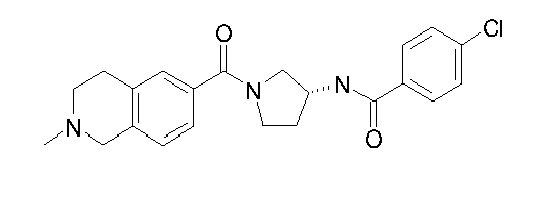
(M+H)+ = 398/400 (Chlorisotope) Rt-Wert = 1.01 min (Methode B) (R)-4-Chlor-N-[1-(2-methyl-1,2,3,4-tetrahydroisochinolin-6-carbonyl)-pyrrolidin-3-yl]-benzamid (als Trifluoracetat-Salz) 44 
(M+H)+ = 398/400 (Chlorisotope) Rt-Wert = 1.01 min (Methode B) (R)-3-Chlor-N-[1-(2-methyl-1,2,3,4-tetrahydroisochinolin-6-carbonyl)-pyrrolidin-3-yl]-benzamid (als Trifluoracetat-Salz) -

- 830 µl (7.8 mmol) Crotonsäuremethylester werden in 25 ml DCM gelöst und mit 61 µl (0.79 mmol) TFA versetzt. Dann wird eine Lösung aus 2,0 ml (7.8 mmol) N-Methoxymethyl-N-trimethylsilylmethyl-benzylamin in 5 ml DCM innerhalb von 20 Minuten zugetropft. Die Reaktionsmischung wird 16 Stunden gerührt und dann i. Vak. eingeengt. Der Rückstand wird mittels RP-HPLC gereinigt.
Rt-Wert: 0.94 min (Methode B)
C14H19NO2 (233.31)
Massenspektrum: (M+H)+ = 234 - 2.0 g (5.7 mmol) (3RS,4RS)-1-Benzyl-4-methyl-pyrrolidin-3-carbonsäuremethylester (als Trifluoracetat-Salz) werden in 4 ml Methanol gelöst und mit 5 ml Lithiumhydroxid-Lösung (8%ig in Wasser) versetzt. Die Mischung wird fünf Stunden bei RT gerührt, dann mit 3.2 ml 4N Salzsäure versetzt und zur Trockene eingeengt.
Rt-Wert: 0.83 min (Methode B)
C13H17NO2 (219.29)
Massenspektrum: (M+H)+ = 220 - 1.3 g (4.9 mmol) (3RS,4RS)-1-Benzyl-4-methyl-pyrrolidin-3-carbonsäure (als Hydrochlorid-Salz) werden in 10 ml Methanol gelöst und unter Eisbad-Kühlung mit 0.6 ml (8.5 mmol) Thionylchlorid versetzt. Das Eisbad wird entfernt und die Mischung für drei Stunden unter Rückfluß erhitzt. Anschließend wird die Mischung i. Vak. eingeengt und mit 1 N Natronlauge versetzt. Die wässrige Phase wird dreimal mit Ethylacetat extrahiert. Die vereinigten organischen Phasen werden über Natriumsulfat getrocknet, filtriert und i. Vak. eingeengt.
Rt-Wert: 1.00 min (Methode B)
C14H19NO2 (233.31)
Massenspektrum: (M+H)+ = 234 - 927 mg (4 mmol) (3RS,4RS)-1-Benzyl-4-methyl-pyrrolidin-3-carbonsäuremethylester werden in 15 ml Methanol gelöst, mit 100 mg Palladium/Kohle (10%ig) und 2 ml 2N Salzsäure versetzt und 14 Stunden mit 3 bar Wasserstoff hydriert. Anschließend wird die Mischung filtriert und i. Vak. eingeengt.
Rt-Wert: 0.39 min (Methode B)
C7H13NO2 x HCl (143.19)
Massenspektrum: (M+H)+ = 144 - 880 mg (3.9 mmol) 2-Methyl-1,2,3,4-tetrahydroisochinolin-6-carbonsäure (als Hydrochlorid-Salz) werden in 2 ml DMF gelöst und mit 1,5 g (3.9 mmol) HATU und 1,7 ml (15.6 mmol) NMM versetzt. Man rührt fünf Minuten bei RT und gibt dann eine Lösung von 700 mg (3.9 mmol) (3RS,4RS)-4-Methyl-pyrrolidin-3-carbonsäure-methylester (als Hydrochlorid-Salz) in 2 ml DMF zu. Die Reaktionsmischung wird 16 Stunden bei RT gerührt, dann mit 2N Natronlauge versetzt und dreimal mit Ethylacetat ausgeschüttelt. Die wässrige Phase wird mit TFA sauer gestellt und mittels RP-HPLC gereinigt. Man erhält die Carbonsäure als Produkt.
Rt-Wert: 0.74 min (Methode B)
C17H22N2O3 x CF3CO2H (302.38)
Massenspektrum: (M+H)+ = 303 - 72 mg (173 µmol) (3RS,4RS)-4-Methyl-1-(2-methyl-1,2,3,4-tetrahydroisochinolin-6-carbonyl)-pyrrolidin-3-carbonsäure (als Trifluoracetat-Salz) werden in 4 ml tert.-Butanol gelöst und mit 95 µl (682 µmol) TEA versetzt. Dann gibt man 150 µl (675 µmol) Diphenylphosphorsäureazid hinzu und rührt für zwei Stunden unter Rückfluß. Die Reaktionsmischung wird dann mit 2N Natronlauge versetzt und dreimal mit Ethylacetat ausgeschüttelt. Die wässrige Phase wird i. Vak. auf 6 ml Volumen konzentriert und mittels RP-HPLC (Fließmittel: Ammoniak/Acetonitril) gereinigt. Man erhält das Amin als Produkt.
Rt-Wert: 0.46 min (Methode C)
C16H23N3O (273.37)
Massenspektrum: (M+H)+ = 274 - Hergestellt analog Beispiel 1 a aus (3RS,4RS)-(3-Amino-4-methyl-pyrrolidin-1-yl)-(2-methyl-1,2,3,4-tetrahydroisochinolin-6-yl)-methanon.
Rt-Wert: 1.18 min (Methode B)
C21H24CIN3O2S x CF3CO2H (417.96)
Massenspektrum: (M+H)+ = 418/420 (Chlorisotope) -

- Herstellung analog Beispiel 45 c aus 2,3-Dihydro-1H-isoindol-5-carbonsäure (als Hydrochlorid-Salz; hergestellt analog
EP 0 528 369 ).
Rt-Wert: 0.49 min (Methode D)
C10H11NO2 (177.20)
Massenspektrum: (M+H)+ = 178 - 1,2 g (6.6 mmol) 2,3-Dihydro-1H-isoindol-5-carbonsäure-methylester werden in 5 ml Ameisensäure gelöst, mit 2 ml Formalin-Lösung (37%ige Lösung in Wasser) versetzt, für 3,5 Stunden auf 70°C erhitzt und für 16 Stunden bei RT gerührt. Das Reaktionsgemisch wird i. Vak. eingeengt und mit 0.1 N Natronlauge versetzt und dreimal mit Ethylacetat ausgeschüttelt. Die vereinigten organischen Phasen werden über Natriumsulfat getrocknet, filtriert und i. Vak. eingeengt.
Rt-Wert: 0.60 min (Methode E)
C11H13NO2 (191.23)
Massenspektrum: (M+H)+ = 192 - Herstellung analog Beispiel 26 g aus 2-Methyl-2,3-dihydro-1H-isoindol-5-carbonsäure-methylester.
Rt-Wert: 0.25 min (Methode B)
C10H11NO2 x HCl (177.20)
Massenspektrum: (M+H)+ = 178 - Herstellung analog Beispiel 1 b aus (2S,4R)-4-[(5-Chlor-thiophen-2-carbonyl)-amino]-pyrrolidin-1,2-dicarbonsäure-1-tert.-butylester-2-methylester und 2-Methyl-2,3-dihydro-1H-isoindol-5-carbonsäure (als Hydrochlorid-Salz).
Rt-Wert: 1.14 min (Methode B)
C21H22CIN3O4S x CF3CO2H (447.94)
Massenspektrum: (M+H)+ = 448/450 (Chlorisotope) -

- Herstellung analog
DE 3105858 aus 6-(3-Chlor-benzyl)-5,6,7,8-tetrahydro-4H-thieno[2,3-d]azepin-2-carbonsäure-methylester.
Rt-Wert: 0.85 min (Methode B)
C10H13NO2S x HCl (211.28)
Massenspektrum: (M+H)+ = 212 - Herstellung analog Beispiel 46 b aus 5,6,7,8-Tetrahydro-4H-thieno[2,3-d]azepin-2-carbonsäure-methylester (als Hydrochlorid).
Rt-Wert: 0.64 min (Methode E)
C11H15NO2S (225.31)
Massenspektrum: (M+H)+ = 226 - Herstellung analog Beispiel 45 b aus 5,6,7,8-Tetrahydro-4H-thieno[2,3-d]azepin-2-carbonsäure-methylester (als Hydrochlorid).
Ausbeute: quantitativ
C10H13NO2S x HCl (211.28)
Massenspektrum: (M+H)+ = 212 - Herstellung analog Beispiel 1 b aus(R)-3-[(5-Chlor-thiophen-2-carbonyl)-amino]-pyrrolidin-1-carbonsäure-tert.-butylester und 6-Methyl-5,6,7,8-Tetrahydro-4H-thieno[2,3-d]azepin-2-carbonsäure (als Hydrochlorid).
Rt-Wert: 1.15 min (Methode B)
C19H22ClN3O2S2 x CF3CO2H (423.99)
Massenspektrum: (M+H)+ = 424/426 (Chlorisotope) -

- 1.5 ml (20.1 mmol) DMF bei 0°C langsam mit 1.5 ml (16.1 mmol) Phosphoroxychlorid versetzt. Anschließend nimmt man die Mischung in 10 ml DCM auf und rührt für 45 Minuten bei RT. Dann werden 2.2 g (9.8 mmol) 4-Oxo-piperidin-1-carbonsäure-tert.-butylester, gelöst in 10 ml DCM, zur Mischung bei 0-5°C zugetropft. Es werden weitere 10 ml DCM zugegeben und für eine Stunde bei RT gerührt. Die Reaktionsmischung wird dann auf ein Gemisch aus Eis und 20 ml gesättiger Natriumacetat-Lösung gegossen und für eine Stunde gerührt. Die organische Phase wird abgetrennt, mehrfach mit Wasser gewaschen und dann über Natriumsulfat getrocknet und i. Vak. eingeengt.
Das so erhaltene Rohprodukt wird in 15 ml DCM gelöst und mit einem Gemisch aus 1.8 ml (16.0 mmol) Mercaptoessigsäure-ethylester und 2.8 ml (19.9 mmol) TEA in 5 ml DCM versetzt. Anschließend wird das Reaktionsgemisch für 2,5 Stunden unter Rückfluß erhitzt und dann eine Stunde bei RT nachgerührt. Man gibt Wasser zu, trennt die organische Phase ab und wäscht mit viel Wasser nach. Die organische Phase wird über Natriumsulfat getrocknet, filtriert und i. Vak. eingeengt. Der Rückstand wird mittels Flashchromatographie an Silicagel (Fließmittelgemisch Cyclohexan/Ethylacetat 9:1 bis 8:2) gereinigt.
Rt-Wert: 1.71 min (Methode B)
C15H21NO4S (311.40)
Massenspektrum: (M+H)+ = 312 - 615 mg (987 µmol, 50%ige Reinheit) 6,7-Dihydro-4H-thieno[3,2-c]pyridin-2,5-dicarbonsäure-5-tert.-butylester-2-ethylester werden in 4 ml eines Gemisches aus TFA und DCM (v/v 1:1) gelöst und für 30 Minuten bei RT gerührt. Man neutralisiert das Reaktionsgemisch unter Zugabe von TEA und engt i. Vak. ein. Das so erhaltene Rohprodukt wird in 4 ml Ameisensäure gelöst und mit 0.5 ml (6.7 mmol) Formalin-Lösung (37%ig in Wasser) versetzt. Die Reaktionsmischung wird für 16 Stunden bei 70°C gerührt. Nach Abkühlen auf RT wird das Gemisch mit 50%iger wässriger Natronlauge und gesättigter Natriumhydrogencarbonat-Lösung basisch gestellt und mit Ethylacetat extrahiert. Die organische Phase wird dreimal mit Wasser gewaschen, über Natriumsulfat getrocknet, filtriert und i. Vak. eingeengt. Der Rückstand wird mittel RP-HPLC gereinigt.
Rt-Wert: 0.90 min (Methode B)
C11H15NO2S x CF3CO2H (225.31)
Massenspektrum: (M+H)+ = 226 - Herstellung analog Beispiel 45 b aus 5-Methyl-4,5,6,7-tetrahydro-thieno[3,2-c]pyridin-2-carbonsäure-ethylester (als Trifluoracetat-Salz).
Rt-Wert: 0.29 min (Methode B)
C9H11NO2S x HCl (197.26)
Massenspektrum: (M+H)+ = 198 - Herstellung analog Beispiel 1 b aus (3SR,4SR)-3-[(5-Chlor-thiophen-2-carbonyl)-amino]-4-methoxy-pyrrolidin-1-carbonsäure-tert.-butylester und 5-Methyl-4,5,6,7-tetrahydro-thieno[3,2-c]pyridin-2-carbonsäure (als Hydrochlorid-Salz).
Rt-Wert: 1.17 min (Methode B)
C19H22ClN3O3S2 x CF3CO2H (439.99)
Massenspektrum: (M+H)+ = 440/442 (Chlorisotope) -

- 496 mg (2.1 mmol) 2-Brom-6-methyl-4,5,6,7-tetrahydro-thieno[2,3-c]pyridin (hergestellt analog
EP 0314154 aus 6-Methyl-4,5,6,7-tetrahydro-thieno[2,3-c]pyridin) werden in 10 ml THF gelöst und auf-78°C gekühlt. Dann werden 2 ml (3.2 mmol) n-Butyllithium-Lösung (1.6 M in n-Hexan) langsam zugetropft. Das Reaktionsgemisch wird 30 Minuten bei -78°C gerührt und dann mit 1.0 ml (12.9 mmol) Chlorameisensäure-methylester versetzt. Man rührt fünf Minuten bei - 78°C, erwärmt auf RT und engt die Mischung i. Vak. ein. Der Rückstand wird mittels RP-HPLC gereinigt.
Rt-Wert: 0.79 min (Methode B)
C10H13NO2S x CF3CO2H (211.28)
Massenspektrum: (M+H)+ = 212 - Herstellung analog Beispiel 45 b aus 6-Methyl-4,5,6,7-tetrahydro-thieno[2,3-c]pyridin-2-carbonsäure-methylester (als Trifluoracetat-Salz).
Rt-Wert: 0.22 min (Methode B)
C9H11NO2S x HCl (197.26)
Massenspektrum: (M+H)+ = 198 - Herstellung analog Beispiel 1 b aus (3SR,4SR)-3-[(5-Chlor-thiophen-2-carbonyl)-amino]-4-methoxy-pyrrolidin-1-carbonsäure-tert.-butylester und 6-Methyl-4,5,6,7-tetrahydro-thieno[2,3-c]pyridin-2-carbonsäure (als Hydrochlorid-Salz).
Rt-Wert: 1.16 min (Methode B)
C19H22ClN3O3S2 x CF3CO2H (439.99)
Massenspektrum: (M+H)+ = 440/442 (Chlorisotope) - Die nachfolgenden Beispiele beschreiben die Herstellung pharmazeutischer Anwendungsformen, die als Wirkstoff eine beliebige Verbindung der allgemeinen Formel I enthalten.
-
Wirkstoff 75.0 mg Mannitol 50.0 mg Wasser für Injektionszwecke ad 10.0 ml - Wirkstoff und Mannitol werden in Wasser gelöst. Nach Abfüllung wird gefriergetrocknet. Die Auflösung zur gebrauchsfertigen Lösung erfolgt mit Wasser für Injektionszwecke.
-
Wirkstoff 35.0 mg Mannitol 100.0 mg Wasser für Injektionszwecke ad 2.0 ml - Wirkstoff und Mannitol werden in Wasser gelöst. Nach Abfüllung wird gefriergetrocknet.
Die Auflösung zur gebrauchsfertigen Lösung erfolgt mit Wasser für Injektionszwecke. -
(1) Wirkstoff 50.0 mg (2) Milchzucker 98.0 mg (3) Maisstärke 50.0 mg (4) Polyvinylpyrrolidon 15.0 mg (5) Magnesiumstearat 2.0 mg 215.0 mg - (1), (2) und (3) werden gemischt und mit einer wässrigen Lösung von (4) granuliert. Dem getrockneten Granulat wird (5) zugemischt. Aus dieser Mischung werden Tabletten gepresst, biplan mit beidseitiger Facette und einseitiger Teilkerbe.
Durchmesser der Tabletten: 9 mm. -
(1) Wirkstoff 350.0 mg (2) Milchzucker 136.0 mg (3) Maisstärke 80.0 mg (4) Polyvinylpyrrolidon 30.0 mg (5) Magnesiumstearat 4.0 mg 600.0 mg - (1), (2) und (3) werden gemischt und mit einer wässrigen Lösung von (4) granuliert. Dem getrockneten Granulat wird (5) zugemischt. Aus dieser Mischung werden Tabletten gepresst, biplan mit beidseitiger Facette und einseitiger Teilkerbe.
Durchmesser der Tabletten: 12 mm. -
(1) Wirkstoff 50.0 mg (2) Maisstärke getrocknet 58.0 mg (3) Milchzucker pulverisiert 50.0 mg (4) Magnesiumstearat 2.0 mg 160.0 mg - (1) wird mit (3) verrieben. Diese Verreibung wird der Mischung aus (2) und (4) unter intensiver Mischung zugegeben.
- Diese Pulvermischung wird auf einer Kapselabfüllmaschine in HartgelatineSteckkapseln Größe 3 abgefüllt.
-
(1) Wirkstoff 350.0 mg (2) Maisstärke getrocknet 46.0 mg (3) Milchzucker pulverisiert 30.0 mg (4) Magnesiumstearat 4.0 mg 430.0 mg - (1) wird mit (3) verrieben. Diese Verreibung wird der Mischung aus (2) und (4) unter intensiver Mischung zugegeben.
- Diese Pulvermischung wird auf einer Kapselabfüllmaschine in HartgelatineSteckkapseln Größe 0 abgefüllt.
-
Wirkstoff 100.0 mg Polyethylenglykol (M.G. 1500) 600.0 mg Polyethylenglykol (M.G. 6000) 460.0 mg Polyethylensorbitanmonostearat 840.0 mg 2000.0 mg - Das Polyethylenglykol wird zusammen mit Polyethylensorbitanmonostearat geschmolzen. Bei 40°C wird die gemahlene Wirksubstanz in der Schmelze homogen dispergiert. Es wird auf 38°C abgekühlt und in schwach vorgekühlte Suppositorienformen ausgegossen.
die 6-gliedrige Heteroarylgruppe ein, zwei oder drei Stickstoffatome, und
die 5-gliedrige Heteroarylgruppe eine gegebenenfalls durch eine C1-3-Alkylgruppe substituierte Iminogruppe, ein Sauerstoff- oder Schwefelatom, oder
eine gegebenenfalls durch eine C1-3-Alkylgruppe substituierte Iminogruppe oder ein Sauerstoff- oder Schwefelatom und zusätzlich ein oder zwei Stickstoffatome, oder
eine gegebenenfalls durch eine C1-3-Alkylgruppe substituierte Iminogruppe und drei Stickstoffatome,
enthält,
und außerdem an die vorstehend erwähnten monocyclischen Heteroarylgruppen über zwei benachbarte Kohlenstoffatome ein gegebenenfalls durch ein Fluor-, Chlor- oder Bromatom, eine C1-3-Alkyl-, Hydroxy-, C1-3-Alkyloxygruppe, Amino-, C1-3-Alkylamino-, Di-(C1-3-alkyl)-amino- oder C3-6-Cycloalkyleniminogruppe substituierter Phenylring ankondensiert sein kann,
und die Bindung über ein Stickstoffatom oder über ein Kohlenstoffatom des heterocyclischen Teils oder eines ankondensierten Phenylrings erfolgt,
und wobei, soweit nichts anderes erwähnt wurde, unter dem voranstehend in den Definitionen erwähnten Ausdruck "Halogenatom" ein Atom aus der Gruppe Fluor, Chlor, Brom und Iod zu verstehen ist,
und wobei die in den voranstehend erwähnten Definitionen enthaltenen Alkyl-, Alkenyl-, Alkinyl- und Alkyloxygruppen, die mehr als zwei Kohlenstoffatome aufweisen, soweit nichts anderes erwähnt wurde, geradkettig oder verzweigt sein können und die Alkylgruppen in den voranstehend genannten dialkylierten Resten, beispielsweise die Dialkylaminogruppen, gleich oder verschieden sein können,
und wobei die Wasserstoffatome der in den voranstehend erwähnten Definitionen enthaltenen Methyl- oder Ethylgruppen, sofern nichts anderes erwähnt, ganz oder teilweise durch Fluoratome ersetzt sein können,
deren Tautomere, deren Enantiomere, deren Diastereomere, deren Gemische und deren Salze.
insgesamt in den Formeln (IIa) oder (IIb) maximal vier Reste ausgewählt aus R7a R7b, R7c, R8a, R8b und R8c vorhanden sein dürfen, und
ein Wasserstoff-, Fluor-, Chlor-, Brom- oder Iodatom, oder eine C1-5-Alkyl-, CF3-, eine Cyano-, Carboxy-, C1-5-Alkyloxycarbonyl-, Hydroxy-, C1-3-Alkyloxy-, CF3O-, CHF2O-, CH2FO-, Amino-, C1-5-Alkylamino-, Di-(C1-5-Alkyl)-amino- oder C4-7-Cycloalkyleniminogruppe bedeuten, deren Tautomere, deren Enantiomere, deren Diastereomere, deren Gemische und deren Salze.
ein Wasserstoff-, Fluor- oder Chloratom, oder eine Methyl-, CF3-, Hydroxy-, Methoxy-, CF3O-, CHF2O-, CH2FO-Gruppe bedeuten,
deren Tautomere, deren Enantiomere, deren Diastereomere, deren Gemische und deren Salze.
ein Wasserstoff-, Fluor- oder Chloratom, oder eine Methyl-, CF3-, Hydroxy-, Methoxy-, CF3O-, CHF2O-, CH2FO-Gruppe bedeuten, und
insgesamt in der Formel (IIf) maximal vier Reste ausgewählt aus R7a, R7b, R7c, R8a, R8b und R8c vorhanden sein dürfen, und
ein Wasserstoff-, Fluor- oder Chloratom, oder eine Methyl-, CF3-, Hydroxy-, Methoxy-, CF3O-, CHF2O-, CH2FO-Gruppe bedeuten,
deren Tautomere, deren Enantiomere, deren Diastereomere, deren Gemische und deren Salze.
| Zeit in min | %A | %B | Flussrate in ml/min |
| 0.00 | 95 | 5 | 6.00 |
| 0.01 | 95 | 5 | 6.00 |
| 0.89 | 2 | 98 | 6.00 |
| 0.90 | 2 | 98 | 6.00 |
| 0.95 | 95 | 5 | 6.00 |
| 1.05 | 95 | 5 | 6.00 |
| 1.10 | 95 | 5 | 0.10 |
| Zeit in min | %A | %B | Flussrate in ml/min |
| 0.00 | 95 | 5 | 3.50 |
| 0.18 | 95 | 5 | 3.50 |
| 2.00 | 2 | 98 | 3.50 |
| 2.20 | 2 | 98 | 3.50 |
| 2.30 | 95 | 5 | 3.50 |
| 2.50 | 95 | 5 | 3.50 |
| 2.60 | 95 | 5 | 0.10 |
| Zeit in min | %A | %B | Flussrate in ml/min |
| 0.00 | 95 | 5 | 4.00 |
| 0.01 | 95 | 5 | 4.00 |
| 0.89 | 2 | 98 | 4.00 |
| 0.90 | 2 | 98 | 4.00 |
| 0.95 | 95 | 5 | 4.00 |
| 1.05 | 95 | 5 | 4.00 |
| 1.10 | 95 | 5 | 0.10 |
| Zeit in min | %A | %B | Flussrate in ml/min |
| 0.00 | 100 | 0 | 5.00 |
| 0.08 | 100 | 0 | 5.00 |
| 1.70 | 0 | 100 | 5.00 |
| 1.75 | 0 | 100 | 5.00 |
| 1.80 | 100 | 0 | 5.00 |
| 1.85 | 100 | 0 | 5.00 |
| 1.90 | 100 | 0 | 0.10 |
| Zeit in min | %A | %B | Flussrate in ml/min |
| 0.00 | 95 | 5 | 4.00 |
| 0.01 | 95 | 5 | 4.00 |
| 0.89 | 2 | 98 | 4.00 |
| 0.90 | 2 | 98 | 4.00 |
| 0.95 | 95 | 5 | 4.00 |
| 1.05 | 95 | 5 | 4.00 |
| 1.10 | 95 | 5 | 0.50 |
Claims (11)
- Verbindungen der allgemeinen Formel (I)
 D ein substituiertes bicyclisches Ringsystem der Formel (IIa), (IIb) oder (IIc)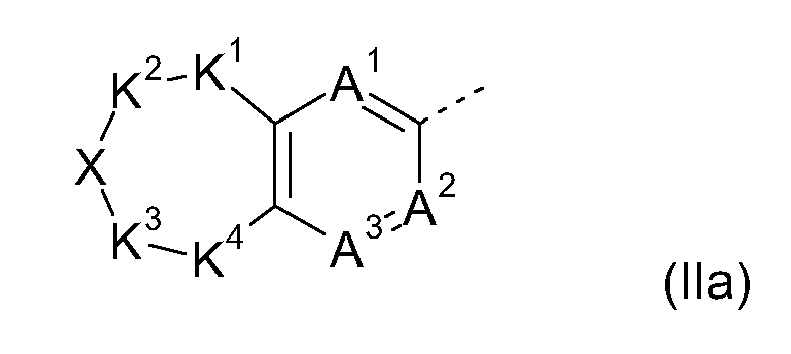


K1 und K4 jeweils unabhängig voneinander eine Bindung, eine -CH2-, -CHR7a-, -CR7bR7c- oder eine -C(O)-Gruppe bedeuten, und wobei
R7a/R7b/R7c
jeweils unabhängig voneinander ein Fluoratom, eine Hydroxy-, C1-5-Alkyloxy-, Amino-, C1-5-Alkylamino-, Di-(C1-5-alkyl)-amino-, C3-5-Cycloalkylenimino-, C1-5-Alkylcarbonylaminogruppe,
eine C1-5-Alkylgruppe, die durch 1-3 Fluoratome substituiert sein kann, eine Hydroxy-C1-5-alkyl-, C1-5-Alkyloxy-C1-5-alkyl-, Amino-C1-5-alkyl-, C1-5-Alkylamino-C1-5-alkyl-, Di-(C1-5-alkyl)-amino-C1-5-alkyl-, C4-7-Cycloalkylenimino-C1-5-alkyl-, Carboxy-C0-5-alkyl-, C1-5-Alkyloxycarbonyl-C0-5-alkyl-, Aminocarbonyl-C0-5-alkyl-, C1-5-Alkylaminocarbonyl-C0-5-alkyl-, Di-(C1-5-alkyl)-aminocarbonyl-C0-5-alkyl- oder eine C4-7-Cycloalkyleniminocarbonyl-C0-5-alkylgruppe bedeutet,
wobei nicht gleichzeitig beide Reste R7b/R7c über ein Heteroatom an das Ringkohlenstoffatom gebunden sein können, außer -C(R7bR7c)- entspricht einer -CF2-Gruppe, oder
R7a eine durch Fluor-, Chlor- , Brom-, Methyl-, Methoxy-, Amino- oder Nitro-substituierte Phenyl- oder monocyclische Heteroarylgruppe bedeutet, oder
zwei Reste R7b/R7c zusammen mit dem Ringkohlenstoffatom einen 3-, 4-, 5-, 6- oder 7-gliedrigen gesättigten Carbocyclus oder einen Cyclopenten-, Cyclohexen-, Oxetan-, Azetidin-, Thietan-, Tetrahydrofuran-, Pyrrolidin-, Tetrahydrothiophen-, Tetrahydropyran-, Piperidin-, Pentamethylensulfid-, Hexamethylenimin-, 1,3-Dioxolan-, 1,4-Dioxan-, Hexahydropyridazin-, Piperazin-, Thiomorpholin-, Morpholin-, 2-Imidazolidinon-, 2-Oxazolidinon-, Tetrahydro-2(1H)-pyrimidinon- oder [1,3]Oxazinan-2-on-ring bilden können,
wobei dessen Methylengruppen durch 1-2 C1-3-Alkyl- oder CF3-gruppen substituiert sein können, und/oder
dessen Methylengruppen, sofern sie nicht an ein Heteroatom gebunden sind, durch 1-2 Fluoratome substituiert sein können, und/oder
bei dem eine -CH2-Gruppe neben einem N-Atom durch eine -CO-Gruppe ersetzt sein kann, und/oder
dessen Iminogruppen jeweils durch eine C1-3-Alkyl- oder C1-3-Alkylcarbonyl-gruppe substituiert sein können, und/oder bei dem das Schwefelatom zu einer Sulfoxid oder Sulfongruppe oxidiert sein kann,
K2 und K3
jeweils unabhängig voneinander eine -CH2-, -CHR8a-, -CR8bR8c- oder eine -C(O)-Gruppe bedeuten, wobei
R8a/R8b/R8c
jeweils unabhängig voneinander eine C1-5-Alkylgruppe, die durch 1-3 Fluoratome substituiert sein kann, eine Hydroxy-C1-5-alkyl-, C1-5-Alkyloxy-C1-5-alkyl-, Amino-C1-5-alkyl-, C1-5-Alkylamino-C1-5-alkyl-, Di-(C1-5-alkyl)-amino-C1-5-alkyl-, C4-7-Cycloalkylenimino-C1-5-alkyl-, Carboxy-C0-5-alkyl-, C1-5-Alkyloxycarbonyl-C0-5-alkyl-, Aminocarbonyl-C0-5-alkyl-, C1-5-Alkylaminocarbonyl-C0-5-alkyl-, Di-(C1-5-alkyl)-aminocarbonyl-C0-5-alkyl- oder eine C4-7-Cycloalkyleniminocarbonyl-C0-5-alkyl-gruppe bedeutet,
oder zwei Reste R8b/R8c zusammen mit dem Ringkohlenstoffatom einen 3-, 4-, 5-, 6- oder 7-gliedrigen gesättigten Carbocyclus oder einen Cyclopenten-, Cyclohexen-, Oxetan-, Azetidin-, Thietan-, Tetrahydrofuran-, Pyrrolidin-, Tetrahydrothiophen-, Tetrahydropyran-, Piperidin-, Pentamethylensulfid-, Hexamethylenimin-, Hexahydropyridazin-, Tetrahydro-2(1H)-pyrimidinon-, [1,3]Oxazinan-2-on-ring bilden können,
wobei dessen Methylengruppen durch 1-2 C1-3-Alkyl- oder CF3-gruppen substituiert sein können, und/oder
dessen Methylengruppen, sofern sie nicht an ein Heteroatom gebunden sind, durch 1-2 Fluoratome substituiert sein können, und/oder
bei dem eine -CH2-Gruppe neben einem Stickstoffatom durch eine -CO-Gruppe ersetzt sein kann, und/oder
dessen Iminogruppen jeweils durch eine C1-3-Alkyl- oder C1-3-Alkylcarbonyl-gruppe substituiert sein können, und/oder
bei dem das Schwefelatom zu einer Sulfoxid- oder Sulfongruppe oxidiert sein kann,
mit der Massgabe, dass ein durch R8b oder R8c eingebrachtes Heteroatom nicht durch nur ein Kohlenstoffatom von X in Formel (1) entfernt sein darf, und
insgesamt in Formel (IIa) oder (IIb) oder (IIc) maximal vier Reste ausgewählt aus R7a, R7b, R7c, R8a, R8b und R8c vorhanden sein dürfen, undX ein Sauerstoff- oder Schwefelatom, eine CF2-, Sulfen-, Sulfon- oder eine NR1-Gruppe bedeutet, in derR1 ein Wasserstoffatom oder eine Hydroxy-, C1-3-Alkyloxy-, Amino-, C1-3-Alkylamino-, Di-(C1-3-alkyl)-amino-, eine C1-5-Alkyl-, C2-5-Alkenyl-CH2-, C2-5-Alkinyl-CH2-, C3-6-Cycloalkyl-, C4-6-Cycloalkenyl-, Oxetan-3-yl-, Tetrahydrofuran-3-yl-, Benzyl-, C1-5-Alkyl-carbonyl-, Trifluormethylcarbonyl-, C3-6-Cycloalkyl-carbonyl-, C1-5-Alkylsulfonyl-, C3-6-Cycloalkyl-sulfonyl-, Aminocarbonyl-, C1-5-Alkylaminocarbonyl-, Di-(C1-5-alkyl)-aminocarbonyl-, C1-5-Alkyloxycarbonyl-, C4-7-Cycloalkyleniminocarbonyl-gruppe bedeutet,und in dem
wobei die in den voranstehend genannten Gruppen befindlichen Methylen- und Methylgruppen zusätzlich durch eine C1-3Alkyl-, Carboxy-, C1-5 -Alkoxycarbonylgruppe substituiert sein können, oder durch eine Hydroxy-, C1-5-Alkyloxy-, Amino-, C1-5-Alkylamino-, C1-5-Dialkylamino- oder C4-7-Cycloalkyleniminogruppe substituiert sein können, sofern die Methylen- oder Methylgruppen nicht direkt an ein Heteroatom aus der Gruppe O, N oder S gebunden sind, und/oder ein bis drei Wasserstoffatome durch Fluoratome ersetzt sein können, sofern die Methylen- oder Methylgruppen nicht direkt an ein Heteroatom aus der Gruppe O, N oder S gebunden sind,A1 entweder N oder CR10 bedeutet,A2 entweder N oder CR11 bedeutet,A3 entweder N oder CR12 bedeutet,A4 entweder N oder CR12 bedeutet,A5 NH, Schwefel oder Sauerstoff bedeutet,wobei R10, R11 und R12 jeweils unabhängig voneinander
ein Wasserstoff-, Fluor-, Chlor-, Brom- oder lodatom, oder eine C1-5-Alkyl-, CF3-, C2-5 -Alkenyl-, C2-5-Alkinyl-, eine Phenyl-, eine Cyano-, Carboxy-, C1-5-Alkyloxycarbonyl-, Hydroxy-, C1-3-Alkyloxy-, CF3O-, CHF2O-, CH2FO-, Amino-, C1-5-Alkylamino-, Di-(C1-5-Alkyl)-amino- oder C4-7-Cycloalkylenimino-gruppe bedeuten, und-L-E-G-J- eine -C-C-C-C-Gruppe bedeutet, die durch R4 und R5 substituiert sein kann, undL1 eine -C(O)-Gruppe bedeutet, undR4 ein Wasserstoffatom oder
eine geradkettige oder verzweigte C1-6-Alkyl-, C2-6-Alkenyl- oder C2-6-Alkinylgruppe bedeutet,
wobei die Wasserstoffatome der Methylen- und/oder Methylfragmente der geradkettigen oder verzweigten C1-6-Alkyl-, C2-6-Alkenyl- oder C2-6-Alkinylgruppe gegebenenfalls ganz oder teilweise durch Fluoratome ersetzt sein können, und/oder
wobei die Wasserstoffatome der Methylen- und/oder Methylfragmente der geradkettigen oder verzweigten C1-6-Alkyl-, C2-6-Alkenyl- oder C2-6-Alkinylgruppe gegebenenfalls jeweils unabhängig voneinander durch ein bis zwei Substituenten ausgewählt aus einer C3-5-Cycloalkylgruppe, einer Nitril-, Hydroxy- oder C1-5-Alkyloxygruppe, wobei die Wasserstoffatome der C1-5-Alkyloxygruppe gegebenenfalls ganz oder teilweise durch Fluoratome ersetzt sein können, einer Allyloxy-, Propargyloxy-, Benzyloxy-, C1-5-Alkylcarbonyloxy-, C1-5-Alkyloxycarbonyloxy-, Carboxy-C1-5-alkyloxy-, C1-5-Alkyloxycarbonyl-C1-5-alkyloxy-, Mercapto-, C1-5-Alkylsulfanyl-, C1-5-Alkylsulfinyl-, C1-5-Alkylsulfonyl-, Carboxy-, C1-5-Alkyloxycarbonyl-, Aminocarbonyl-, C1-5-Alkylaminocarbonyl-, Di-(C1-5-alkyl)-aminocarbonyl-, C4-7Cycloalkyleniminocarbonyl-, Aminosulfonyl-, C1-5-Alkylaminosulfonyl-, Di-(C1-5-alkyl)-aminosulfonyl-, C4-7-Cycloalkyleniminosulfonyl-, Amino-, C1-5-Alkylamino-, Di-(C1-5-alkyl)-amino-, C1-5-Alkylcarbonylamino-, C1-5-Alkylsulfonylamino-, N-(C1-5-Alkylsulfonyl)-C1-5-alkylamino-, C3-6-Cycloalkylcarbonylaminogruppe, oder einer Morpholinyl-, Thiomorpholinyl-, Pyrrolidinyl-, Piperidinyl-, Piperazinyl-, Tetrahydrofuranyl-, Tetrahydropyranyl-gruppe substituiert sein können, wobei die vorgenannten Carbo- und Hetero-cyclen im Ring jeweils durch 1-4 C1-3-Alkyl- oder C1-3-Alkylcarbonylgruppen oder jeweils durch 1-2 Oxogruppen substituiert sein können, und/oder
wobei die Wasserstoffatome der sp2-hybridisierten Kohlenstoffatome der geradkettigen oder verzweigten C2-6-Alkenyl-gruppe gegebenenfalls ganz oder teilweise durch Fluoratome ersetzt sein können, oder
eine Nitril-, Carboxy-, Aminocarbonyl-, C1-5-Alkylaminocarbonyl-, C3-6-Cycloalkylaminocarbonyl-, Di-(C1-5-alkyl)-aminocarbonyl-, C1-5-Alkyloxycarbonyl- oder eine C4-7-Cycloalkyleniminocarbonylgruppe in der gegebenenfalls eine Methylengruppe durch ein Sauerstoff-, Schwefel- oder C0-3-Alkyl-substituiertes Stickstoffatom ersetzt sein kann, oder
eine Phenyl-, mono- oder bicyclische Heteroaryl-, Phenyl-C1-5-alkyl- oder mono- oder bicyclische Heteroaryl-C1-5-alkylgruppe,
die im Phenyl- oder Heteroarylteil gegebenenfalls ein- bis dreifach durch gleiche oder unterschiedliche Substituenten ausgewählt aus der Gruppe bestehend aus Fluor-, Chlor-, Brom-und Iodatomen, und C1-5-Alkyl-, Trifluormethyl-, Amino-, C1-5-alkyl-amino-, Di-(C1-5-alkyl)-amino-, Hydroxy-, C1-5-Alkyloxy-, Mono-, Di- oder Trifluormethoxy-, Carboxy- und C1-5-Alkyloxycarbonylgruppe, substituiert sein kann,
bedeutet,
oder sofern R4 mit G verknüpft ist auch ein Fluoratom oder eine Hydroxy-, C1-5-Alkyl-oxy-, C2-5-Alkenyl-oxy-, C2-5-Alkinyl-oxy-, C3-6-Cycloalkyl-oxy-, C1-5-Alkylaminocarbonyloxy-, Di(C1-5-alkyl)aminocarbonyloxy- oder C4-7-Cycloalkyleniminocarbonyloxy-, Phenyl-C0-3-alkyloxy-, Heteroaryl-C0-3-alkyl-oxy-, Amino-, C1-5-Alkylamino-, Di-(C1-5-alkyl)-amino-, C4-7-Cycloalkylenimino-, C1-3-Acylamino-, (C1-3-Acyl)C1-3-alkylamino-, C1-5-Alkyloxycarbonylamino-, C1-5-Alkylaminocarbonylamino-, Di(C1-5-alkyl)aminocarbonylamino- oder eine C4-7-Cycloalkyleniminocarbonylamino-gruppe darstellen kann,
wobei die in den vorgenannten Alkyl- oder Cycloalkylresten vorhandenen Methyl oder Methylengruppen jeweils unabhängig voneinander durch einen Substituenten ausgewählt aus der Gruppe Morpholinyl-, Thiomorpholinyl-, Pyrrolidinyl-, Piperidinyl-, Piperazinyl-, Tetrahydrofuranyl-, Tetrahydropyranyl, Dimethylaminocarbonyl-, C1-5-Alkyloxycarbonyl-, Carboxy-, Methyl-, Hydroxy-, Methoxy- oder Aminosubstituiert sein können, und
die vorgenannten Phenyl- oder Heteroarylreste gegebenenfalls ein- bis dreifach durch gleiche oder unterschiedliche Substituenten ausgewählt aus der Gruppe bestehend aus Fluor-, Chlor-, Brom-und Iodatomen, und C1-5-Alkyl-, Trifluormethyl-, Amino-, C1-5-alkyl-amino-, Di-(C1-5-alkyl)-amino-, Hydroxy-, C1-5-Alkyloxy-, Mono-, Di- oder Trifluormethoxy-, Carboxy- und C1-5-Alkyloxycarbonylgruppe, substituiert sein können,
mit der Maßgabe, dass zwei Heteroatome aus der Gruppe Sauerstoff und Stickstoff durch genau eine gegebenenfalls substituierte -CH2-Gruppe voneinander getrennt sind, und/oder
dass zwei Atome eine -O-O- oder -S-O- Bindung bilden, ausgeschlossen ist, undR5 ein Wasserstoffatom, eine C1-5Alkyl-, C2-5Alkenyl- oder C2-5Alkinyl- oder eine Phenyl-C0-5Alkylgruppe bedeutet, wobei die Alkylgruppe durch eine Hydroxy-, Methoxy-, Hydroxycarbonyl- oder C1-5Alkoxycarbonyl-gruppe substituiert sein kann,
oder sofern R5 mit G verknüpft ist auch eine Hydroxy- oder Methoxygruppe darstellen kann, oderR4 und R5 sofern sie an das selbe Kohlenstoffatom gebunden sind, zusammen mit dem Kohlenstoffatom eine -C=O Gruppe, oder eine -CF2 Gruppe bilden können, oderR4 und R5 sofern sie an das selbe Kohlenstoffatom oder an zwei benachbarte Kohlenstoffatome gebunden sind, zusammen mit dem oder den Kohlenstoffatomen einen 3-7-gliedrigen Carbocyclus oder einen einfach ungesättigten 5-7 gliedrigen Carbocyclus bilden können,
wobei eines der Kohlenstoffkettenglieder dieses Cyclus durch ein Sauerstoff- oder Schwefelatom oder eine -NH-, -N(C1-5-Alkyl)-,-N(C1-4-Alkylcarbonyl)- oder eine Carbonyl-, Sulfinyl- oder Sulfonylgruppe ersetzt sein kann, und/oder
wobei zwei direkt benachbarte Kohlenstoffkettenglieder dieser C4-7-Carbocyclen zusammen durch eine -C(O)NH-, -C(O)N(C1-5-Alkyl)-, -S(O)2NH-, oder -S(O)2N(C1-5-Alkyl)-Gruppe ersetzt sein können, und/oder
wobei vier direkt benachbarte Kohlenstoffkettenglieder dieser C5-7-Carbocyclen zusammen durch eine -O-CH2-CH2-O-Gruppe ersetzt sein können, und/oder
wobei 1 bis 3 Kohlenstoffatome dieser 3-7-gliedrigen Cyclen gegebenenfalls unabhängig voneinander durch jeweils ein oder zwei Fluoratome oder eine oder zwei C1-5-Alkyl-gruppen oder eine Hydroxy-, C1-5-Alkyloxy-, C1-5-Alkylcarbonyloxy-, Amino-, C1-5-Alkylamino-, Di-(C1-5-alkyl)-amino-, C4-7-Cycloalkylenimino-, C1-5-Alkylcarbonylamino-, C3-6-Cycloalkylcarbonylamino-, Nitril-, Carboxy-C1-5-alkyl-, C1-5-Alkyloxycarbonyl-C1-5-alkyl-, Carboxy-, C1-5-Alkyloxycarbonyl-, Aminocarbonyl-, C1-5-Alkylaminocarbonyl-, Di-(C1-5-alkyl)-aminocarbonyl- oder C4-7-Cycloalkyleniminocarbonylgruppe substituiert sein können,
mit der Maßgabe, dass ein solcher, zusammen aus R4 und R5 gebildeter Cyclus,
in dem zwei Stickstoffatome oder ein Stickstoff und ein Sauerstoffatom im Cyclus durch genau eine gegebenenfalls substituierte -CH2-Gruppe voneinander getrennt sind, und/oder
in der zwei Atome im Ring eine -O-O- oder -S-O- Bindung bilden,
ausgeschlossen ist, undL2 eine -C(O)-Gruppe bedeutet, undM einen gegebenenfalls durch R2 und R3 substituierten Phenyl-, Pyridyl-, Thienyl- oder Furyl-Ring bedeutet, in demund wobei, soweit nichts anderes erwähnt wurde, unter dem voranstehend in den Definitionen erwähnten Ausdruck "Halogenatom" ein Atom aus der Gruppe Fluor, Chlor, Brom und Iod zu verstehen ist,R2 ein Fluor-, Chlor-, Brom- oder Jod-atom oder eine Methyl-, Ethyl-, Vinyl-, Methoxy-, Ethinyl-, Cyano- oder -C(O)NH2-Gruppe darstellt, undR3 ein Wasserstoff-, Fluor-, Chlor-, Brom- oder Jod-atom oder eine Hydroxy-, Methoxy-, Trifluormethoxy-gruppe, oder eine gegebenenfalls durch Fluoratome substituierte C1-3-Alkyl-gruppe, oder eine Cyano-, Amino- oder NH2C(O)-Gruppe darstellt,wobei, soweit nichts anderes erwähnt wurde, unter dem voranstehend in den Definitionen erwähnten Ausdruck "Heteroarylgruppe" eine monocyclische 5- oder 6-gliedrige Heteroarylgruppe zu verstehen ist, wobei
die 6-gliedrige Heteroarylgruppe ein, zwei oder drei Stickstoffatome, und
die 5-gliedrige Heteroarylgruppe eine gegebenenfalls durch eine C1-3-Alkylgruppe substituierte Iminogruppe, ein Sauerstoff- oder Schwefelatom, oder
eine gegebenenfalls durch eine C1-3-Alkylgruppe substituierte Iminogruppe oder ein Sauerstoff- oder Schwefelatom und zusätzlich ein oder zwei Stickstoffatome, oder
eine gegebenenfalls durch eine C1-3-Alkylgruppe substituierte Iminogruppe und drei Stickstoffatome,
enthält,
und außerdem an die vorstehend erwähnten monocyclischen Heteroarylgruppen über zwei benachbarte Kohlenstoffatome ein gegebenenfalls durch ein Fluor-, Chlor- oder Bromatom, eine C1-3-Alkyl-, Hydroxy-, C1-3-Alkyloxygruppe, Amino-, C1-3-Alkylamino-, Di-(C1-3-alkyl)-amino- oder C3-6-Cycloalkyleniminogruppe substituierter Phenylring ankondensiert sein kann,
und die Bindung über ein Stickstoffatom oder über ein Kohlenstoffatom des heterocyclischen Teils oder eines ankondensierten Phenylrings erfolgt,
und wobei die in den voranstehend erwähnten Definitionen enthaltenen Alkyl-, Alkenyl-, Alkinyl- und Alkyloxygruppen, die mehr als zwei Kohlenstoffatome aufweisen, soweit nichts anderes erwähnt wurde, geradkettig oder verzweigt sein können und die Alkylgruppen in den voranstehend genannten dialkylierten Resten, beispielsweise die Dialkylaminogruppen, gleich oder verschieden sein können,
und wobei die Wasserstoffatome der in den voranstehend erwähnten Definitionen enthaltenen Methyl- oder Ethylgruppen, sofern nichts anderes erwähnt, ganz oder teilweise durch Fluoratome ersetzt sein können,
deren Tautomere, deren Enantiomere, deren Diastereomere, deren Gemische und deren Salze. - Verbindungen der allgemeinen Formel (I) nach Anspruch 1, in denen D, E, G, J, L, L1, L2 und M wie in Anspruch 1 beschrieben definiert sind, und in derR4 ein Wasserstoffatom oder
eine geradkettige oder verzweigte C1-6-Alkylgruppe bedeutet,
wobei die Wasserstoffatome der Methylen- und/oder Methylfragmente der geradkettigen oder verzweigten C1-6-Alkylgruppe gegebenenfalls ganz oder teilweise durch Fluoratome ersetzt sein können, und/oder
wobei die Wasserstoffatome der Methylen- und/oder Methylfragmente der geradkettigen oder verzweigten C1-6-Alkylgruppe gegebenenfalls jeweils unabhängig voneinander durch einen Substituenten ausgewählt aus einer Hydroxy-, C1-5-Alkyloxy-, Carboxy-, C1-5-Alkyloxycarbonyl-, Aminocarbonyl-, C1-5-Alkylaminocarbonyl-, Di-(C1-5-alkyl)-aminocarbonyl-, C4-7-Cycloalkyleniminocarbonyl-, Amino-, C1-5-Alkylamino-, Di-(C1-5-alkyl)-amino-, C1-5-Alkylcarbonylamino-, C1-5-Alkylsulfonylamino-, N-(C1-5-Alkylsulfonyl)-C1-5-alkylamino-, C3-6-Cycloalkylcarbonylaminogruppe substituiert sein können, oder
eine Nitril-, Carboxy-, Aminocarbonyl-, C1-5-Alkylaminocarbonyl-, C3-6-Cycloalkylaminocarbonyl-,Di-(C1-5-alkyl)-aminocarbonyl-, C1-5-Alkyloxycarbonyl- oder eine C4-7-Cycloalkyleniminocarbonylgruppe in der gegebenenfalls eine Methylengruppe durch ein Sauerstoff-, Schwefel- oder C0-3-Alkyl-substituiertes Stickstoffatom ersetzt sein kann, bedeutet, und
oder sofern R4 mit G verknüpft ist auch ein Fluoratom oder eine Hydroxy-, C1-5-Alkyl-oxy-, C2-5-Alkenyl-oxy-, C2-5-Alkinyl-oxy-, C3-6-Cycloalkyl-oxy-, C1-5-Alkylaminocarbonyloxy-, Di(C1-5-alkyl)aminocarbonyloxy- oder C4-7-Cycloalkyleniminocarbonyloxy-, Phenyl-C0-2-alkyloxygruppe, Amino-, C1-5-Alkylamino-, Di-(C1-5-alkyl)-amino-, C4-7-Cycloalkylenimino-, C1-3-Acylamino-, (C1-3-Acyl)C1-3-alkylamino-, C1-5-Alkyloxycarbonylamino-, C1-5-Alkylaminocarbonylamino-, Di(C1-5-alkyl)aminocarbonylamino- oder eine C4-7-Cycloalkyleniminocarbonylamino-gruppe darstellen kann,
wobei die in den vorgenannten Alkyl- oder Cycloalkylresten vorhandenen Methyl oder Methylengruppen jeweils unabhängig voneinander durch einen Substituenten ausgewählt aus der Gruppe Dimethylaminocarbonyl-, C1-5-Alkyloxycarbonyl-, Carboxy-, Methyl-, Hydroxy-, Methoxy- oder Amino- substituiert sein können,
mit der Maßgabe, dass zwei Heteroatome aus der Gruppe Sauerstoff und Stickstoff durch genau eine gegebenenfalls substituierte -CH2-Gruppe voneinander getrennt sind, und/oder
dass zwei Atome eine -O-O- oder -S-O-Bindung bilden, ausgeschlossen ist, undR5 ein Wasserstoffatom oder eine C1-5Alkyl-, Allyl-, Propargyl- oder Benzylgruppe bedeutet, oder sofern R5 mit G verknüpft ist, auch eine Hydroxy- oder Methoxy-gruppe darstellen kann, oderR4 und R5 sofern sie an das selbe Kohlenstoffatom gebunden sind, zusammen mit dem Kohlenstoffatom eine -C=O-Gruppe, oder eine -CF2- Gruppe bilden können, oderR4 und R5 sofern sie an das selbe Kohlenstoffatom oder an zwei benachbarte Kohlenstoffatome gebunden sind, zusammen mit dem oder den Kohlenstoffatomen einen 3-7-gliedrigen Carbocyclus bilden können,ausgeschlossen ist,
wobei eines der Kohlenstoffkettenglieder dieses Cyclus durch ein Sauerstoff- oder Schwefelatom oder eine -NH-, -N(C1-5-Alkyl)-, N(C1-4-Alkylcarbonyl)- oder eine Carbonyl-, Sulfinyl- oder Sulfonylgruppe ersetzt sein kann, und/oder
wobei zwei direkt benachbarte Kohlenstoffkettenglieder dieser C4-7-Carbocyclen zusammen durch eine -C(O)NH-, -C(O)N(C1-5-Alkyl)-, -S(O)2NH-, oder -S(O)2N(C1-5-Alkyl)-Gruppe ersetzt sein können, und/oder
wobei vier direkt benachbarte Kohlenstoffkettenglieder dieser C5-7-Carbocyclen zusammen durch eine -O-CH2-CH2O-Gruppe ersetzt sein können,
mit der Maßgabe, dass ein solcher, zusammen aus R4 und R5 gebildeter Cyclus,
in dem zwei Stickstoffatome oder ein Stickstoff und ein Sauerstoffatom im Cyclus durch genau eine gegebenenfalls substituierte -CH2-Gruppe voneinander getrennt sind, und/oder
in der zwei Atome im Ring eine -O-O- oder -S-O-Bindung bilden,
deren Tautomere, deren Enantiomere, deren Diastereomere, deren Gemische und deren Salze. - Verbindungen der allgemeinen Formel (I) nach Anspruch 1 oder 2, in denen E, G, J, L, L1, L2 , M, R4 und R5 wie in Anspruch 1 oder 2 beschrieben definiert sind, und in derD ein substituiertes bicyclisches Ringsystem der Formel (IIa) oder (IIb)deren Tautomere, deren Enantiomere, deren Diastereomere, deren Gemische und deren Salze.


K1 und K4
jeweils unabhängig voneinander eine Bindung, eine -CH2-, -CHR7a-, -CR7bR7c- oder eine -C(O)-Gruppe bedeuten, und wobei
R7a/R7b/R7c
jeweils unabhängig voneinander ein Fluoratom, eine Hydroxy-, C1-5-Alkyloxy-, eine C1-5-Alkylgruppe bedeutet,
wobei nicht gleichzeitig beide Reste R7b/R7c über ein Heteroatom an das Ringkohlenstoffatom gebunden sein können, außer - C(R7bR7c)- entspricht einer -CF2-Gruppe, oder
zwei Reste R7b/R7c zusammen mit dem Ringkohlenstoffatom einen 3-gliedrigen Carbocyclus bilden können,
mit der Maßgabe, dass K1 und K4 gleichzeitig eine Bindung bedeuten, ausgeschlossen ist, und
K2 und K3
jeweils unabhängig voneinander eine -CH2-, -CHR8a-, -CR8bR8c- oder eine -C(O)- Gruppe bedeuten, wobei
R8a/R8b/R8c
jeweils unabhängig voneinander eine C1-5-Alkylgruppe bedeutet, und/oder
zwei Reste R8b/R8c zusammen mit dem Ringkohlenstoffatom einen 3-gliedrigen gesättigten Carbocyclus bilden können
und
insgesamt in den Formeln (IIa) oder (IIb) maximal vier Reste ausgewählt aus R7a, R7b, R7c, R8a, R8b und R8c vorhanden sein dürfen, undX ein Sauerstoff- oder Schwefelatom, eine -CF2- oder eine NR1-Gruppe bedeutet, in derund in demR1 ein Wasserstoffatom oder eine Hydroxy-, C1-3-Alkyloxy-, Amino-, C1-3-Alkylamino-, Di-(C1-3-alkyl)-amino-, eine C1-5-Alkyl-, C2-5-Alkenyl-CH2-, C2-5-Alkinyl-CH2- oder eine C3-6-Cycloalkylgruppe bedeutet,A1 entweder N oder CR10 bedeutet,A2 entweder N oder CR11 bedeutet,A3 entweder N oder CR12 bedeutet,A4 entweder N oder CR12 bedeutet,A5 NH, Schwefel oder Sauerstoff bedeutet,wobei R10, R11 und R12 jeweils unabhängig voneinander
ein Wasserstoff-, Fluor-, Chlor-, Brom- oder lodatom, oder eine C1-5-Alkyl-, CF3-, eine Cyano-, Carboxy-, C1-5-Alkyloxycarbonyl-, Hydroxy-, C1-3-Alkyloxy-, CF3O-, CHF2O-, CH2FO-, Amino-, C1-5-Alkylamino-, Di-(C1-5-Alkyl)-amino- oder C4-7-Cycloalkyleniminogruppe bedeuten, - Verbindungen der allgemeinen Formel (I) nach einem der Ansprüche 1 bis 3, in denenX eine NR1-Gruppe bedeutet, in derderen Tautomere, deren Enantiomere, deren Diastereomere, deren Gemische und deren Salze.R1 ein Wasserstoffatom oder eine C1-5-Alkyl-, Allyl- oder Cyclopropylgruppe bedeutet, undA1 CR10 bedeutet,A2 CR11 bedeutet,A3 CR12 bedeutet,A4 entweder N oder CR12 bedeutet,A5 Schwefel bedeutet,wobei R10, R11 und R12 jeweils unabhängig voneinander
ein Wasserstoff-, Fluor- oder Chloratom, oder eine Methyl-, CF3-, Hydroxy-, Methoxy-, CF3O-, CHF2O-, CH2FO-Gruppe bedeuten, - Verbindungen der allgemeinen Formel (I) nach einem der Ansprüche 1 bis 4, in denenD ein substituiertes bicyclisches Ringsystem der Formel
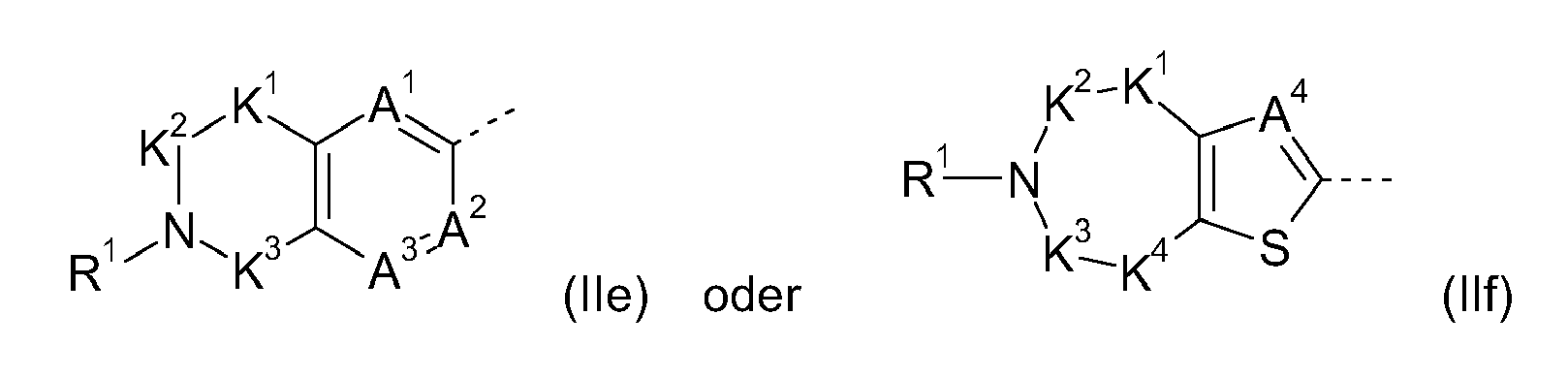
K1 eine -CH2-, -CHR7a-, oder eine -CR7bR7c- Gruppe bedeutet, und K2 und K3
jeweils unabhängig voneinander eine -CH2-, -CHR8a-, oder eine - CR8bR8c- Gruppe bedeuten, wobei
R8a/R8b/R8c
jeweils unabhängig voneinander eine C1-5-Alkylgruppe bedeutet, und
K4 eine Bindung, eine -CH2-, -CHR7a-, oder eine -CR7bR7c- Gruppe bedeutet,
wobeiR7a eine C1-5-Alkylgruppe bedeutet undR7b/R7c jeweils unabhängig voneinander eine Hydroxy-, C1-5-Alkyloxy- oder eine C1-5-Alkylgruppe bedeutet, wobei nicht gleichzeitig beide Reste R7b/R7c über ein Sauerstoffatom an das Ringkohlenstoffatom gebunden sein können, undinsgesamt in den Formeln (IIe) oder (IIf) maximal vier Reste ausgewählt aus R7a R7b, R7c, R8a, R8b und R8c vorhanden sein dürfen, undR1 ein Wasserstoffatom oder eine C1-3-Alkyl-, Allyl- oder Cyclopropylgruppe bedeutet, und in denenA1 CR10 bedeutet,A2 CR11 bedeutet,A3 CR12 bedeutet,A4 entweder N oder CR12 bedeutet,wobei R10, R11 und R12 jeweils unabhängig voneinander
ein Wasserstoff-, Fluor- oder Chloratom, oder eine Methyl-, CF3-, Hydroxy-, Methoxy-, CF3O-, CHF2O-, CH2FO-Gruppe bedeuten, und-L-E-G-J- eine -C-C-C-C-Gruppe bedeutet, die durch R4 und R5 substituiert sein kann, undR4 ein Wasserstoffatom oder
eine geradkettige oder verzweigte C1-3-Alkylgruppe bedeutet, wobei die Wasserstoffatome der Methylen- und/oder Methylfragmente der geradkettigen oder verzweigten C1-6-Alkylgruppe gegebenenfalls unabhängig voneinander durch einen Substituenten ausgewählt aus einer Hydroxy-, C1-5-Alkyloxy-, Carboxy-, C1-5-Alkyloxycarbonyl-gruppe substituiert sein können, oder
sofern R4 mit G verknüpft ist, auch ein Fluoratom oder eine Hydroxy-, Methoxy-, C3-5-Alkenyl-oxy-, C2-5-Alkyl-oxy-, C3-6-Cycloalkyl-oxy-, Benzyloxy-, C1-5-Alkylaminocarbonyloxy-, Di(C1-5-alkyl)aminocarbonyloxy- oder eine C4-7-Cycloalkyleniminocarbonyloxygruppe darstellen kann,
mit der Maßgabe,
dass zwei Heteroatome aus der Gruppe Sauerstoff und Stickstoff durch genau eine gegebenenfalls substituierte -CH2-Gruppe voneinander getrennt sind,
ausgeschlossen ist, undR5 ein Wasserstoffatom oder eine C1-5 Alkyl-, Allyl-, Benzyl- oder Phenylgruppe bedeutet, oder sofern R5 mit G verknüpft ist, auch eine Hydroxy- oder Methoxy-gruppe darstellen kann, oderR4 und R5 sofern sie an das selbe Kohlenstoffatom gebunden sind, zusammen mit dem Kohlenstoffatom eine -C=O-Gruppe, oder eine -CF2- Gruppe bilden können, oderR4 und R5 sofern sie an das selbe Kohlenstoffatom oder an zwei benachbarte Kohlenstoffatome gebunden sind, zusammen mit dem oder den Kohlenstoffatomen einen 3-6-gliedrigen Carbocyclus bilden können,wobei vier direkt benachbarte Kohlenstoffkettenglieder dieser C5-6-Carbocyclen zusammen durch eine -O-CH2-CH2O-Gruppe ersetzt sein können,
deren Tautomere, deren Enantiomere, deren Diastereomere, deren Gemische und deren Salze. - Verbindungen der allgemeinen Formel (I) nach einem der Ansprüche 1 bis 5, in denenD ein substituiertes bicyclisches Ringsystem der Formelderen Tautomere, deren Enantiomere, deren Diastereomere, deren Gemische und deren Salze.
 K1 eine -CH2-, -CHR7a-, oder eine -CR7bR7c- Gruppe bedeutet, undK2 und K3 jeweils unabhängig voneinander eine -CH2-, -CHR8a-, oder eine - CR8bR8c- Gruppe bedeuten, wobei
R8a/R8b/R8c
jeweils unabhängig voneinander eine C1-5-Alkylgruppe bedeutet, undK4 eine Bindung, eine -CH2-, -CHR7a-, oder eine -CR7bR7c- Gruppe
bedeutet,
wobeiR7a eine C1-5-Alkylgruppe bedeutet, undR7b/R7c jeweils unabhängig voneinander eine Hydroxy-, C1-5-Alkyloxy- oder eine C1-5-Alkylgruppe bedeutet,und
wobei nicht gleichzeitig beide Reste R7b/R7c über ein Sauerstoffatom an das Ringkohlenstoffatom gebunden sein können,
insgesamt in der Formel (IIf) maximal vier Reste ausgewählt aus R7a, R7b, R7c, R8a, R8b, und R8c vorhanden sein dürfen, undR1 ein Wasserstoffatom oder eine C1-3-Alkyl- oder Cyclopropylgruppe bedeutet, und in denenA1 CR10 bedeutet,A2 CR11 bedeutet,A3 CR12 bedeutet,A4 entweder N oder CR12 bedeutet,wobei R10, R11 und R12 jeweils unabhängig voneinander
ein Wasserstoff-, Fluor- oder Chloratom, oder eine Methyl-, CF3-, Hydroxy-, Methoxy-, CF3O-, CHF2O-, CH2FO-Gruppe bedeuten, - Verbindungen der allgemeinen Formel (I) nach einem der Ansprüche 1 bis 6, in denenM einen Thiophen-2-yl-Ring der Formelderen Tautomere, deren Enantiomere, deren Diastereomere, deren Gemische und deren Salze.
 R2 ein Chlor-, Bromatom oder eine Ethinyl-Gruppe darstellt,
 - Physiologisch verträgliche Salze der Verbindungen gemäß einem der Ansprüche 1 bis 7.
- Arzneimittel, enthaltend eine Verbindung nach mindestens einem der Ansprüche 1 bis 7 oder ein physiologisch verträgliches Salz gemäß Anspruch 8, neben gegebenenfalls einem oder mehreren inerten Trägerstoffen und/oder Verdünnungsmitteln.
- Verwendung einer Verbindung nach mindestens einem der Ansprüche 1 bis 7 oder eines physiologisch verträglichen Salzes gemäß Anspruch 8 zur Herstellung eines Arzneimittels mit einem inhibitorischen Effekt auf Faktor Xa und/oder einem inhibitorischen Effekt auf verwandte Serinproteasen.
- Verfahren zur Herstellung eines Arzneimittels gemäß Anspruch 9, dadurch gekennzeichnet, dass auf nichtchemischem Wege eine Verbindung nach mindestens einem der Ansprüche 1 bis 7 oder ein physiologisch verträgliches Salz gemäß Anspruch 8 in einen oder mehrere inerte Trägerstoffe und/oder Verdünnungsmittel eingearbeitet wird.
Priority Applications (11)
| Application Number | Priority Date | Filing Date | Title |
|---|---|---|---|
| EP07105053A EP1975165A1 (de) | 2007-03-27 | 2007-03-27 | Substituierte Pyrrolidinamide, deren Herstellung und deren Verwendung als Arzneimittel |
| UY30979A UY30979A1 (es) | 2007-03-27 | 2008-03-25 | Pirrolidinamidas sustituidas, su preparacion y su uso como medicamentos |
| PE2008000536A PE20090226A1 (es) | 2007-03-27 | 2008-03-25 | PIRROLIDINAMIDAS SUSTITUIDAS COMO INHIBIDORES DEL FACTOR Xa Y SU PREPARACION |
| CL2008000873A CL2008000873A1 (es) | 2007-03-27 | 2008-03-26 | Compuestos derivados de pirrolidin amidas; composicion farmaceutica que comprende dichos compuestos; y su uso para tratar trombosis. |
| ARP080101240A AR065852A1 (es) | 2007-03-27 | 2008-03-26 | Pirrolidinamidas sustituidas, util como inhibidor de factor xa |
| PCT/EP2008/053568 WO2008116881A1 (de) | 2007-03-27 | 2008-03-26 | Substituierte pyrrolidinamide, deren herstellung und deren verwendung als arzneimittel |
| EP08718234A EP2132193B1 (de) | 2007-03-27 | 2008-03-26 | Substituierte pyrrolidinamide, deren herstellung und deren verwendung als arzneimittel |
| US12/531,343 US8309542B2 (en) | 2007-03-27 | 2008-03-26 | Substituted pyrrolidine amides, the production thereof, and the use thereof as medications |
| JP2010500259A JP5397959B2 (ja) | 2007-03-27 | 2008-03-26 | 置換ピロリジンアミド、それの製造方法、及び、それの薬剤としての使用 |
| TW097110833A TW200902022A (en) | 2007-03-27 | 2008-03-26 | Substituted pyrrolidinamides, manufacturing and use thereof as medicaments |
| CA002682012A CA2682012A1 (en) | 2007-03-27 | 2008-03-26 | Substituted pyrrolidinamides, manufacturing and use thereof as medicaments |
Applications Claiming Priority (1)
| Application Number | Priority Date | Filing Date | Title |
|---|---|---|---|
| EP07105053A EP1975165A1 (de) | 2007-03-27 | 2007-03-27 | Substituierte Pyrrolidinamide, deren Herstellung und deren Verwendung als Arzneimittel |
Publications (1)
| Publication Number | Publication Date |
|---|---|
| EP1975165A1 true EP1975165A1 (de) | 2008-10-01 |
Family
ID=38599360
Family Applications (2)
| Application Number | Title | Priority Date | Filing Date |
|---|---|---|---|
| EP07105053A Ceased EP1975165A1 (de) | 2007-03-27 | 2007-03-27 | Substituierte Pyrrolidinamide, deren Herstellung und deren Verwendung als Arzneimittel |
| EP08718234A Not-in-force EP2132193B1 (de) | 2007-03-27 | 2008-03-26 | Substituierte pyrrolidinamide, deren herstellung und deren verwendung als arzneimittel |
Family Applications After (1)
| Application Number | Title | Priority Date | Filing Date |
|---|---|---|---|
| EP08718234A Not-in-force EP2132193B1 (de) | 2007-03-27 | 2008-03-26 | Substituierte pyrrolidinamide, deren herstellung und deren verwendung als arzneimittel |
Country Status (10)
| Country | Link |
|---|---|
| US (1) | US8309542B2 (de) |
| EP (2) | EP1975165A1 (de) |
| JP (1) | JP5397959B2 (de) |
| AR (1) | AR065852A1 (de) |
| CA (1) | CA2682012A1 (de) |
| CL (1) | CL2008000873A1 (de) |
| PE (1) | PE20090226A1 (de) |
| TW (1) | TW200902022A (de) |
| UY (1) | UY30979A1 (de) |
| WO (1) | WO2008116881A1 (de) |
Cited By (2)
| Publication number | Priority date | Publication date | Assignee | Title |
|---|---|---|---|---|
| WO2009153179A1 (en) * | 2008-06-16 | 2009-12-23 | F. Hoffmann-La Roche Ag | Pyrrolidine derivatives as nk2 receptor antagonists |
| EP3193609A4 (de) * | 2014-09-10 | 2018-02-28 | Epizyme, Inc. | Substituierte pyrrolidin-carboxamid-verbindungen |
Families Citing this family (20)
| Publication number | Priority date | Publication date | Assignee | Title |
|---|---|---|---|---|
| EP2220079A2 (de) * | 2007-11-15 | 2010-08-25 | Boehringer Ingelheim International GmbH | Substituierte amide sowie ihre herstellung und verwendung als medikamente |
| CA2772522A1 (en) * | 2009-09-11 | 2011-03-17 | Sunovion Pharmaceuticals Inc. | Histamine h3 inverse agonists and antagonists and methods of use thereof |
| TWI633087B (zh) | 2012-06-13 | 2018-08-21 | 赫孚孟拉羅股份公司 | 新穎二氮雜螺環烷及氮雜螺環烷 |
| EP3590940B1 (de) | 2012-09-25 | 2021-06-09 | F. Hoffmann-La Roche AG | Hexahydropyrrolo[3,4-c]pyrrol-derivate und verwandte verbindungen als autotaxin (atx) inhibitoren und als inhibitoren der lysophosphatinsäure (lpa) produktion zur behandlung von z.b. nierenerkrankungen |
| AR095079A1 (es) | 2013-03-12 | 2015-09-16 | Hoffmann La Roche | Derivados de octahidro-pirrolo[3,4-c]-pirrol y piridina-fenilo |
| NO3074400T3 (de) | 2013-11-26 | 2018-04-14 | ||
| MA39792B1 (fr) | 2014-03-26 | 2019-12-31 | Hoffmann La Roche | Composés bicycliques en tant qu'inhibiteurs de production d'autotaxine (atx) et d'acide lysophosphatidique (lpa) |
| EP3122751B1 (de) | 2014-03-26 | 2019-10-30 | F.Hoffmann-La Roche Ag | Kondensierte [1,4]diazepin-verbindungen als hemmer der produktion von autotaxin (atx) und lysophosphatidsäure (lpa) |
| EP3078378B1 (de) | 2015-04-08 | 2020-06-24 | Vaiomer | Verwendung von faktor-xa-inhibitoren zur regulierung von glykämie |
| MX387736B (es) | 2015-09-04 | 2025-03-18 | Hoffmann La Roche | Derivados de fenoximetilo. |
| CN107635995B (zh) | 2015-09-24 | 2022-08-19 | 豪夫迈·罗氏有限公司 | 作为atx抑制剂的二环化合物 |
| KR20180054634A (ko) | 2015-09-24 | 2018-05-24 | 에프. 호프만-라 로슈 아게 | 이중 오토탁신(atx)/탄산 무수화효소(ca) 억제제로서 신규한 이환형 화합물 |
| PE20180451A1 (es) | 2015-09-24 | 2018-03-05 | Hoffmann La Roche | Nuevos compuestos biciclicos como inhibidores de atx |
| MX2017015034A (es) | 2015-09-24 | 2018-04-13 | Hoffmann La Roche | Nuevos compuestos biciclicos como inhibidores duales de autotaxina (atx)/anhidrasa carbonica (ca). |
| AU2017382176A1 (en) | 2016-12-21 | 2019-05-30 | Biotheryx, Inc. | Thienopyrrole derivatives for use in targeting proteins, compositions, methods, and uses thereof |
| MA49879A (fr) | 2017-03-16 | 2020-06-24 | Hoffmann La Roche | Composés hétérocycliques utiles en tant qu'inhibiteurs doubles d'atx/ca |
| CN110382484B (zh) | 2017-03-16 | 2022-12-06 | 豪夫迈·罗氏有限公司 | 新的作为atx抑制剂的二环化合物 |
| EP3920885A1 (de) | 2019-02-08 | 2021-12-15 | Frequency Therapeutics, Inc. | Valproinsäureverbindungen und wnt-agonisten zur behandlung von ohrerkrankungen |
| PE20220572A1 (es) * | 2019-04-30 | 2022-04-20 | Calico Life Sciences Llc | Moduladores de la via integrada del estres |
| KR102333564B1 (ko) * | 2019-11-28 | 2021-12-01 | 동방에프티엘(주) | 광학 활성 다이아민 유도체 및 티아졸 유도체의 생산을 위한 새로운 합성경로 |
Citations (2)
| Publication number | Priority date | Publication date | Assignee | Title |
|---|---|---|---|---|
| WO2004017908A2 (en) * | 2002-08-26 | 2004-03-04 | Takeda Pharmaceutical Company Limited | Calcium receptor modulating compound and use thereof |
| WO2005032472A2 (en) * | 2003-10-01 | 2005-04-14 | Bristol-Myers Squibb Company | Pyrrolidine and piperidine derivatives as factor xa inhibitors |
Family Cites Families (8)
| Publication number | Priority date | Publication date | Assignee | Title |
|---|---|---|---|---|
| AU2001282871A1 (en) * | 2000-08-17 | 2002-02-25 | Eli Lilly And Company | Antithrombotic agents |
| AU2003273179A1 (en) * | 2002-05-10 | 2003-12-12 | Bristol-Myers Squibb Company | 1,1-disubstituted cycloalkyl derivatives as factor xa inhibitors |
| US7205318B2 (en) * | 2003-03-18 | 2007-04-17 | Bristol-Myers Squibb Company | Lactam-containing cyclic diamines and derivatives as a factor Xa inhibitors |
| US7820699B2 (en) | 2005-04-27 | 2010-10-26 | Hoffmann-La Roche Inc. | Cyclic amines |
| PE20070171A1 (es) | 2005-06-30 | 2007-03-08 | Boehringer Ingelheim Int | GLICINAMIDAS SUSTITUIDAS CON EFECTO ANTITROMBOTICO E INHIBIDOR DEL FACTOR Xa |
| US20070032473A1 (en) * | 2005-07-19 | 2007-02-08 | Kai Gerlach | Substituted amides and their use as medicaments |
| EP1818330A1 (de) | 2006-02-14 | 2007-08-15 | Boehringer Ingelheim Pharma GmbH & Co.KG | Substituierte Prolinamide, deren Herstellung und deren Verwendung als Arzneimittel |
| PE20080702A1 (es) | 2006-05-16 | 2008-07-10 | Boehringer Ingelheim Int | PROLINAMIDAS SUSTITUIDAS COMO INHIBIDORES DEL FACTOR Xa |
-
2007
- 2007-03-27 EP EP07105053A patent/EP1975165A1/de not_active Ceased
-
2008
- 2008-03-25 UY UY30979A patent/UY30979A1/es not_active Application Discontinuation
- 2008-03-25 PE PE2008000536A patent/PE20090226A1/es not_active Application Discontinuation
- 2008-03-26 CA CA002682012A patent/CA2682012A1/en not_active Abandoned
- 2008-03-26 TW TW097110833A patent/TW200902022A/zh unknown
- 2008-03-26 JP JP2010500259A patent/JP5397959B2/ja not_active Expired - Fee Related
- 2008-03-26 WO PCT/EP2008/053568 patent/WO2008116881A1/de not_active Ceased
- 2008-03-26 US US12/531,343 patent/US8309542B2/en active Active
- 2008-03-26 CL CL2008000873A patent/CL2008000873A1/es unknown
- 2008-03-26 EP EP08718234A patent/EP2132193B1/de not_active Not-in-force
- 2008-03-26 AR ARP080101240A patent/AR065852A1/es unknown
Patent Citations (2)
| Publication number | Priority date | Publication date | Assignee | Title |
|---|---|---|---|---|
| WO2004017908A2 (en) * | 2002-08-26 | 2004-03-04 | Takeda Pharmaceutical Company Limited | Calcium receptor modulating compound and use thereof |
| WO2005032472A2 (en) * | 2003-10-01 | 2005-04-14 | Bristol-Myers Squibb Company | Pyrrolidine and piperidine derivatives as factor xa inhibitors |
Cited By (3)
| Publication number | Priority date | Publication date | Assignee | Title |
|---|---|---|---|---|
| WO2009153179A1 (en) * | 2008-06-16 | 2009-12-23 | F. Hoffmann-La Roche Ag | Pyrrolidine derivatives as nk2 receptor antagonists |
| US8404679B2 (en) | 2008-06-16 | 2013-03-26 | Hoffmann-La Roche Inc. | Pyrrolidine derivatives as NK2 receptor antagonists |
| EP3193609A4 (de) * | 2014-09-10 | 2018-02-28 | Epizyme, Inc. | Substituierte pyrrolidin-carboxamid-verbindungen |
Also Published As
| Publication number | Publication date |
|---|---|
| JP5397959B2 (ja) | 2014-01-22 |
| AR065852A1 (es) | 2009-07-08 |
| PE20090226A1 (es) | 2009-04-02 |
| US20100099664A1 (en) | 2010-04-22 |
| UY30979A1 (es) | 2008-10-31 |
| CL2008000873A1 (es) | 2009-03-27 |
| EP2132193B1 (de) | 2012-10-24 |
| US8309542B2 (en) | 2012-11-13 |
| TW200902022A (en) | 2009-01-16 |
| CA2682012A1 (en) | 2008-10-02 |
| JP2010522713A (ja) | 2010-07-08 |
| EP2132193A1 (de) | 2009-12-16 |
| WO2008116881A1 (de) | 2008-10-02 |
Similar Documents
| Publication | Publication Date | Title |
|---|---|---|
| EP2132193B1 (de) | Substituierte pyrrolidinamide, deren herstellung und deren verwendung als arzneimittel | |
| EP2051975B1 (de) | Substituierte prolinamide, deren herstellung und deren verwendung als arzneimittel | |
| EP1899330B1 (de) | Substituierte glycinamide mit antithrombotischer und faktor xa-inhibierender wirkung | |
| EP1987021B1 (de) | Substituierte prolinamide, deren herstellung und deren verwendung als arzneimittel | |
| EP1747217A1 (de) | Neue substituierte thiophencarbonsäureamide, deren herstellung und deren verwendung als arzneimittel | |
| DE102004047840A1 (de) | Neue substituierte Thiophencarbonsäureamide, deren Herstellung und deren Verwendung als Arzneimittel | |
| WO2007009963A1 (de) | Substituierte amide, deren herstellung und deren verwendung als arzneimittel | |
| WO2005111013A1 (de) | Substituierte thiophen-2-carbonsäureamide, deren herstellung und deren verwendung als arzneimittel | |
| WO2005111014A1 (de) | Substituierte thiophencarbonsäureamide, deren herstellung und deren verwendung als arzneimittel | |
| EP1858890B1 (de) | Neue substituierte pyrrolidinone mit antithrombotischer wirkung, deren herstellung und deren verwendung als arzneimittel | |
| EP1583757A1 (de) | Neue substituierte stickstoffhaltige heterobicyclen und deren verwendung als faktor xa inhibitoren | |
| HK1131140B (en) | Substituted prolinamides, and the use thereof | |
| CN101443326A (zh) | 取代的脯氨酰胺、其制备方法及其作为药物的用途 |
Legal Events
| Date | Code | Title | Description |
|---|---|---|---|
| PUAI | Public reference made under article 153(3) epc to a published international application that has entered the european phase |
Free format text: ORIGINAL CODE: 0009012 |
|
| AK | Designated contracting states |
Kind code of ref document: A1 Designated state(s): AT BE BG CH CY CZ DE DK EE ES FI FR GB GR HU IE IS IT LI LT LU LV MC MT NL PL PT RO SE SI SK TR |
|
| AX | Request for extension of the european patent |
Extension state: AL BA HR MK RS |
|
| AKX | Designation fees paid | ||
| STAA | Information on the status of an ep patent application or granted ep patent |
Free format text: STATUS: THE APPLICATION HAS BEEN REFUSED |
|
| 18R | Application refused |
Effective date: 20090508 |
|
| REG | Reference to a national code |
Ref country code: DE Ref legal event code: 8566 |