EP1974948A2 - Image-forming method using heat-sensitive transfer system - Google Patents
Image-forming method using heat-sensitive transfer system Download PDFInfo
- Publication number
- EP1974948A2 EP1974948A2 EP08005812A EP08005812A EP1974948A2 EP 1974948 A2 EP1974948 A2 EP 1974948A2 EP 08005812 A EP08005812 A EP 08005812A EP 08005812 A EP08005812 A EP 08005812A EP 1974948 A2 EP1974948 A2 EP 1974948A2
- Authority
- EP
- European Patent Office
- Prior art keywords
- group
- heat
- layer
- image
- heat transfer
- Prior art date
- Legal status (The legal status is an assumption and is not a legal conclusion. Google has not performed a legal analysis and makes no representation as to the accuracy of the status listed.)
- Withdrawn
Links
- 238000012546 transfer Methods 0.000 title claims abstract description 329
- 238000000034 method Methods 0.000 title claims abstract description 65
- 229920000642 polymer Polymers 0.000 claims abstract description 144
- 239000000975 dye Substances 0.000 claims abstract description 133
- 239000002245 particle Substances 0.000 claims abstract description 56
- 230000009477 glass transition Effects 0.000 claims abstract description 44
- 238000009413 insulation Methods 0.000 claims abstract description 36
- 230000007423 decrease Effects 0.000 claims abstract description 10
- 229920001477 hydrophilic polymer Polymers 0.000 claims abstract description 7
- 239000010410 layer Substances 0.000 claims description 414
- 239000011241 protective layer Substances 0.000 claims description 45
- 108010010803 Gelatin Proteins 0.000 claims description 17
- 229920000159 gelatin Polymers 0.000 claims description 17
- 235000019322 gelatine Nutrition 0.000 claims description 17
- 235000011852 gelatine desserts Nutrition 0.000 claims description 17
- 239000008273 gelatin Substances 0.000 claims description 15
- 230000015572 biosynthetic process Effects 0.000 claims description 6
- -1 silver halide Chemical class 0.000 description 227
- 229920005989 resin Polymers 0.000 description 131
- 239000011347 resin Substances 0.000 description 131
- 238000000576 coating method Methods 0.000 description 79
- 239000011248 coating agent Substances 0.000 description 76
- 125000000217 alkyl group Chemical group 0.000 description 72
- 125000004432 carbon atom Chemical group C* 0.000 description 63
- 125000004435 hydrogen atom Chemical group [H]* 0.000 description 63
- 150000001875 compounds Chemical class 0.000 description 53
- 125000003118 aryl group Chemical group 0.000 description 52
- 229920000126 latex Polymers 0.000 description 52
- 239000004816 latex Substances 0.000 description 51
- 125000001424 substituent group Chemical group 0.000 description 51
- 125000000623 heterocyclic group Chemical group 0.000 description 47
- 239000000203 mixture Substances 0.000 description 39
- LYCAIKOWRPUZTN-UHFFFAOYSA-N Ethylene glycol Chemical compound OCCO LYCAIKOWRPUZTN-UHFFFAOYSA-N 0.000 description 38
- 229920002545 silicone oil Polymers 0.000 description 36
- 239000002253 acid Substances 0.000 description 33
- 239000007788 liquid Substances 0.000 description 33
- 229920002554 vinyl polymer Polymers 0.000 description 32
- 125000004104 aryloxy group Chemical group 0.000 description 31
- 230000003578 releasing effect Effects 0.000 description 31
- ZWEHNKRNPOVVGH-UHFFFAOYSA-N 2-Butanone Chemical compound CCC(C)=O ZWEHNKRNPOVVGH-UHFFFAOYSA-N 0.000 description 30
- 125000003545 alkoxy group Chemical group 0.000 description 30
- 239000000976 ink Substances 0.000 description 30
- 229920000515 polycarbonate Polymers 0.000 description 29
- 229920000728 polyester Polymers 0.000 description 29
- 239000004417 polycarbonate Substances 0.000 description 28
- 239000006096 absorbing agent Substances 0.000 description 27
- 125000003277 amino group Chemical group 0.000 description 27
- 239000001993 wax Substances 0.000 description 27
- 239000000178 monomer Substances 0.000 description 26
- 239000007787 solid Substances 0.000 description 26
- 229920001296 polysiloxane Polymers 0.000 description 25
- 239000000047 product Substances 0.000 description 25
- YXFVVABEGXRONW-UHFFFAOYSA-N Toluene Chemical compound CC1=CC=CC=C1 YXFVVABEGXRONW-UHFFFAOYSA-N 0.000 description 24
- 125000004453 alkoxycarbonyl group Chemical group 0.000 description 24
- 239000000243 solution Substances 0.000 description 24
- IISBACLAFKSPIT-UHFFFAOYSA-N bisphenol A Chemical compound C=1C=C(O)C=CC=1C(C)(C)C1=CC=C(O)C=C1 IISBACLAFKSPIT-UHFFFAOYSA-N 0.000 description 23
- 229920002451 polyvinyl alcohol Polymers 0.000 description 23
- 125000004414 alkyl thio group Chemical group 0.000 description 22
- 125000003917 carbamoyl group Chemical group [H]N([H])C(*)=O 0.000 description 22
- 125000005843 halogen group Chemical group 0.000 description 22
- 239000000463 material Substances 0.000 description 22
- 239000003795 chemical substances by application Substances 0.000 description 21
- BASFCYQUMIYNBI-UHFFFAOYSA-N platinum Substances [Pt] BASFCYQUMIYNBI-UHFFFAOYSA-N 0.000 description 21
- 125000004442 acylamino group Chemical group 0.000 description 20
- 229920001577 copolymer Polymers 0.000 description 20
- 239000000123 paper Substances 0.000 description 20
- 235000019422 polyvinyl alcohol Nutrition 0.000 description 20
- 238000002360 preparation method Methods 0.000 description 20
- 238000007639 printing Methods 0.000 description 20
- 239000002904 solvent Substances 0.000 description 20
- 239000000126 substance Substances 0.000 description 20
- 239000006097 ultraviolet radiation absorber Substances 0.000 description 20
- BZHJMEDXRYGGRV-UHFFFAOYSA-N Vinyl chloride Chemical compound ClC=C BZHJMEDXRYGGRV-UHFFFAOYSA-N 0.000 description 19
- 125000002252 acyl group Chemical group 0.000 description 19
- 125000003342 alkenyl group Chemical group 0.000 description 19
- 239000011230 binding agent Substances 0.000 description 19
- 239000003054 catalyst Substances 0.000 description 19
- 125000004093 cyano group Chemical group *C#N 0.000 description 19
- 125000004466 alkoxycarbonylamino group Chemical group 0.000 description 17
- 125000004397 aminosulfonyl group Chemical group NS(=O)(=O)* 0.000 description 17
- 229920005992 thermoplastic resin Polymers 0.000 description 17
- OFOBLEOULBTSOW-UHFFFAOYSA-N Malonic acid Chemical compound OC(=O)CC(O)=O OFOBLEOULBTSOW-UHFFFAOYSA-N 0.000 description 16
- 125000004423 acyloxy group Chemical group 0.000 description 16
- 125000005194 alkoxycarbonyloxy group Chemical group 0.000 description 16
- 125000005200 aryloxy carbonyloxy group Chemical group 0.000 description 16
- 150000002009 diols Chemical class 0.000 description 16
- 125000002887 hydroxy group Chemical group [H]O* 0.000 description 16
- OKKJLVBELUTLKV-UHFFFAOYSA-N Methanol Chemical compound OC OKKJLVBELUTLKV-UHFFFAOYSA-N 0.000 description 15
- 125000005161 aryl oxy carbonyl group Chemical group 0.000 description 15
- 125000000753 cycloalkyl group Chemical group 0.000 description 15
- ORGHESHFQPYLAO-UHFFFAOYSA-N vinyl radical Chemical class C=[CH] ORGHESHFQPYLAO-UHFFFAOYSA-N 0.000 description 15
- 239000004925 Acrylic resin Substances 0.000 description 14
- 229920000178 Acrylic resin Polymers 0.000 description 14
- LFQSCWFLJHTTHZ-UHFFFAOYSA-N Ethanol Chemical compound CCO LFQSCWFLJHTTHZ-UHFFFAOYSA-N 0.000 description 14
- 125000004390 alkyl sulfonyl group Chemical group 0.000 description 14
- 125000006598 aminocarbonylamino group Chemical group 0.000 description 14
- 125000003178 carboxy group Chemical group [H]OC(*)=O 0.000 description 14
- 239000006185 dispersion Substances 0.000 description 14
- 239000004014 plasticizer Substances 0.000 description 14
- 229920001225 polyester resin Polymers 0.000 description 14
- 239000004645 polyester resin Substances 0.000 description 14
- 239000004698 Polyethylene Substances 0.000 description 13
- 125000005162 aryl oxy carbonyl amino group Chemical group 0.000 description 13
- 125000005135 aryl sulfinyl group Chemical group 0.000 description 13
- 125000004391 aryl sulfonyl group Chemical group 0.000 description 13
- 125000005110 aryl thio group Chemical group 0.000 description 13
- 229920000573 polyethylene Polymers 0.000 description 13
- 239000012790 adhesive layer Substances 0.000 description 12
- 125000004644 alkyl sulfinyl group Chemical group 0.000 description 12
- 125000004656 alkyl sulfonylamino group Chemical group 0.000 description 12
- 125000000304 alkynyl group Chemical group 0.000 description 12
- 125000004657 aryl sulfonyl amino group Chemical group 0.000 description 12
- MTHSVFCYNBDYFN-UHFFFAOYSA-N diethylene glycol Chemical compound OCCOCCO MTHSVFCYNBDYFN-UHFFFAOYSA-N 0.000 description 12
- 229920000915 polyvinyl chloride Polymers 0.000 description 12
- 239000004372 Polyvinyl alcohol Substances 0.000 description 11
- 229920006387 Vinylite Polymers 0.000 description 11
- 238000009835 boiling Methods 0.000 description 11
- 238000005516 engineering process Methods 0.000 description 11
- 239000010419 fine particle Substances 0.000 description 11
- 125000000449 nitro group Chemical group [O-][N+](*)=O 0.000 description 11
- 239000003960 organic solvent Substances 0.000 description 11
- 125000000020 sulfo group Chemical group O=S(=O)([*])O[H] 0.000 description 11
- XLYOFNOQVPJJNP-UHFFFAOYSA-N water Substances O XLYOFNOQVPJJNP-UHFFFAOYSA-N 0.000 description 11
- YCKRFDGAMUMZLT-UHFFFAOYSA-N Fluorine atom Chemical compound [F] YCKRFDGAMUMZLT-UHFFFAOYSA-N 0.000 description 10
- 239000000654 additive Substances 0.000 description 10
- 238000001035 drying Methods 0.000 description 10
- 125000001495 ethyl group Chemical group [H]C([H])([H])C([H])([H])* 0.000 description 10
- 239000011737 fluorine Substances 0.000 description 10
- 229910052731 fluorine Inorganic materials 0.000 description 10
- 239000012948 isocyanate Substances 0.000 description 10
- 125000002496 methyl group Chemical group [H]C([H])([H])* 0.000 description 10
- 229910052697 platinum Inorganic materials 0.000 description 10
- 238000000859 sublimation Methods 0.000 description 10
- 230000008022 sublimation Effects 0.000 description 10
- 239000004094 surface-active agent Substances 0.000 description 10
- 125000000391 vinyl group Chemical group [H]C([*])=C([H])[H] 0.000 description 10
- XEKOWRVHYACXOJ-UHFFFAOYSA-N Ethyl acetate Chemical compound CCOC(C)=O XEKOWRVHYACXOJ-UHFFFAOYSA-N 0.000 description 9
- ZMXDDKWLCZADIW-UHFFFAOYSA-N N,N-Dimethylformamide Chemical compound CN(C)C=O ZMXDDKWLCZADIW-UHFFFAOYSA-N 0.000 description 9
- 238000010521 absorption reaction Methods 0.000 description 9
- 125000002490 anilino group Chemical group [H]N(*)C1=C([H])C([H])=C([H])C([H])=C1[H] 0.000 description 9
- 230000000903 blocking effect Effects 0.000 description 9
- 235000019441 ethanol Nutrition 0.000 description 9
- 239000004800 polyvinyl chloride Substances 0.000 description 9
- KFZMGEQAYNKOFK-UHFFFAOYSA-N Isopropanol Chemical compound CC(C)O KFZMGEQAYNKOFK-UHFFFAOYSA-N 0.000 description 8
- 239000004743 Polypropylene Substances 0.000 description 8
- DNIAPMSPPWPWGF-UHFFFAOYSA-N Propylene glycol Chemical compound CC(O)CO DNIAPMSPPWPWGF-UHFFFAOYSA-N 0.000 description 8
- PPBRXRYQALVLMV-UHFFFAOYSA-N Styrene Chemical compound C=CC1=CC=CC=C1 PPBRXRYQALVLMV-UHFFFAOYSA-N 0.000 description 8
- 229920002433 Vinyl chloride-vinyl acetate copolymer Polymers 0.000 description 8
- 150000007513 acids Chemical class 0.000 description 8
- 125000000392 cycloalkenyl group Chemical group 0.000 description 8
- 239000002612 dispersion medium Substances 0.000 description 8
- 239000001257 hydrogen Substances 0.000 description 8
- 229910052739 hydrogen Inorganic materials 0.000 description 8
- RAXXELZNTBOGNW-UHFFFAOYSA-N imidazole Natural products C1=CNC=N1 RAXXELZNTBOGNW-UHFFFAOYSA-N 0.000 description 8
- 125000005328 phosphinyl group Chemical group [PH2](=O)* 0.000 description 8
- 229920002037 poly(vinyl butyral) polymer Polymers 0.000 description 8
- 229920001155 polypropylene Polymers 0.000 description 8
- ARCGXLSVLAOJQL-UHFFFAOYSA-N trimellitic acid Chemical compound OC(=O)C1=CC=C(C(O)=O)C(C(O)=O)=C1 ARCGXLSVLAOJQL-UHFFFAOYSA-N 0.000 description 8
- 229920003314 Elvaloy® Polymers 0.000 description 7
- XTXRWKRVRITETP-UHFFFAOYSA-N Vinyl acetate Chemical compound CC(=O)OC=C XTXRWKRVRITETP-UHFFFAOYSA-N 0.000 description 7
- WNLRTRBMVRJNCN-UHFFFAOYSA-N adipic acid Chemical compound OC(=O)CCCCC(O)=O WNLRTRBMVRJNCN-UHFFFAOYSA-N 0.000 description 7
- 150000001602 bicycloalkyls Chemical group 0.000 description 7
- 229920000402 bisphenol A polycarbonate polymer Polymers 0.000 description 7
- 230000008859 change Effects 0.000 description 7
- 229920001903 high density polyethylene Polymers 0.000 description 7
- 239000004700 high-density polyethylene Substances 0.000 description 7
- 230000006872 improvement Effects 0.000 description 7
- OTLDLKLSNZMTTA-UHFFFAOYSA-N octahydro-1h-4,7-methanoindene-1,5-diyldimethanol Chemical compound C1C2C3C(CO)CCC3C1C(CO)C2 OTLDLKLSNZMTTA-UHFFFAOYSA-N 0.000 description 7
- 125000001820 oxy group Chemical group [*:1]O[*:2] 0.000 description 7
- 150000003839 salts Chemical class 0.000 description 7
- 238000000926 separation method Methods 0.000 description 7
- 229920002050 silicone resin Polymers 0.000 description 7
- 125000004469 siloxy group Chemical group [SiH3]O* 0.000 description 7
- 125000003808 silyl group Chemical group [H][Si]([H])([H])[*] 0.000 description 7
- 125000004149 thio group Chemical group *S* 0.000 description 7
- 229920003169 water-soluble polymer Polymers 0.000 description 7
- 239000004793 Polystyrene Substances 0.000 description 6
- 239000002216 antistatic agent Substances 0.000 description 6
- WERYXYBDKMZEQL-UHFFFAOYSA-N butane-1,4-diol Chemical compound OCCCCO WERYXYBDKMZEQL-UHFFFAOYSA-N 0.000 description 6
- 125000001951 carbamoylamino group Chemical group C(N)(=O)N* 0.000 description 6
- 239000012461 cellulose resin Substances 0.000 description 6
- 238000006243 chemical reaction Methods 0.000 description 6
- 229920006026 co-polymeric resin Polymers 0.000 description 6
- 230000000052 comparative effect Effects 0.000 description 6
- 239000000945 filler Substances 0.000 description 6
- 238000010438 heat treatment Methods 0.000 description 6
- 229920001684 low density polyethylene Polymers 0.000 description 6
- 239000004702 low-density polyethylene Substances 0.000 description 6
- 125000004123 n-propyl group Chemical group [H]C([H])([H])C([H])([H])C([H])([H])* 0.000 description 6
- 238000006116 polymerization reaction Methods 0.000 description 6
- 229920005749 polyurethane resin Polymers 0.000 description 6
- 229920002689 polyvinyl acetate Polymers 0.000 description 6
- 229920001059 synthetic polymer Polymers 0.000 description 6
- 125000003396 thiol group Chemical group [H]S* 0.000 description 6
- IAYPIBMASNFSPL-UHFFFAOYSA-N Ethylene oxide Chemical class C1CO1 IAYPIBMASNFSPL-UHFFFAOYSA-N 0.000 description 5
- 229920001328 Polyvinylidene chloride Polymers 0.000 description 5
- VYPSYNLAJGMNEJ-UHFFFAOYSA-N Silicium dioxide Chemical compound O=[Si]=O VYPSYNLAJGMNEJ-UHFFFAOYSA-N 0.000 description 5
- GWEVSGVZZGPLCZ-UHFFFAOYSA-N Titan oxide Chemical compound O=[Ti]=O GWEVSGVZZGPLCZ-UHFFFAOYSA-N 0.000 description 5
- 125000002777 acetyl group Chemical class [H]C([H])([H])C(*)=O 0.000 description 5
- NIXOWILDQLNWCW-UHFFFAOYSA-N acrylic acid group Chemical group C(C=C)(=O)O NIXOWILDQLNWCW-UHFFFAOYSA-N 0.000 description 5
- 125000003282 alkyl amino group Chemical group 0.000 description 5
- 229910052799 carbon Inorganic materials 0.000 description 5
- 229920002301 cellulose acetate Polymers 0.000 description 5
- 230000007547 defect Effects 0.000 description 5
- 239000000839 emulsion Substances 0.000 description 5
- 150000002148 esters Chemical class 0.000 description 5
- 125000001449 isopropyl group Chemical group [H]C([H])([H])C([H])(*)C([H])([H])[H] 0.000 description 5
- 238000004519 manufacturing process Methods 0.000 description 5
- 150000002894 organic compounds Chemical class 0.000 description 5
- 239000000049 pigment Substances 0.000 description 5
- 229920006122 polyamide resin Polymers 0.000 description 5
- 229920000647 polyepoxide Polymers 0.000 description 5
- 229920006267 polyester film Polymers 0.000 description 5
- 229920001223 polyethylene glycol Polymers 0.000 description 5
- 229920002223 polystyrene Polymers 0.000 description 5
- 239000011118 polyvinyl acetate Substances 0.000 description 5
- CXMXRPHRNRROMY-UHFFFAOYSA-N sebacic acid Chemical compound OC(=O)CCCCCCCCC(O)=O CXMXRPHRNRROMY-UHFFFAOYSA-N 0.000 description 5
- 125000006296 sulfonyl amino group Chemical group [H]N(*)S(*)(=O)=O 0.000 description 5
- 125000000472 sulfonyl group Chemical group *S(*)(=O)=O 0.000 description 5
- 229920003002 synthetic resin Polymers 0.000 description 5
- 125000000999 tert-butyl group Chemical group [H]C([H])([H])C(*)(C([H])([H])[H])C([H])([H])[H] 0.000 description 5
- OGIDPMRJRNCKJF-UHFFFAOYSA-N titanium oxide Inorganic materials [Ti]=O OGIDPMRJRNCKJF-UHFFFAOYSA-N 0.000 description 5
- VZCYOOQTPOCHFL-UHFFFAOYSA-N trans-butenedioic acid Natural products OC(=O)C=CC(O)=O VZCYOOQTPOCHFL-UHFFFAOYSA-N 0.000 description 5
- 239000011800 void material Substances 0.000 description 5
- 239000001043 yellow dye Substances 0.000 description 5
- VTYYLEPIZMXCLO-UHFFFAOYSA-L Calcium carbonate Chemical compound [Ca+2].[O-]C([O-])=O VTYYLEPIZMXCLO-UHFFFAOYSA-L 0.000 description 4
- IMROMDMJAWUWLK-UHFFFAOYSA-N Ethenol Chemical compound OC=C IMROMDMJAWUWLK-UHFFFAOYSA-N 0.000 description 4
- UFHFLCQGNIYNRP-UHFFFAOYSA-N Hydrogen Chemical compound [H][H] UFHFLCQGNIYNRP-UHFFFAOYSA-N 0.000 description 4
- XEEYBQQBJWHFJM-UHFFFAOYSA-N Iron Chemical compound [Fe] XEEYBQQBJWHFJM-UHFFFAOYSA-N 0.000 description 4
- 239000002202 Polyethylene glycol Substances 0.000 description 4
- 239000004721 Polyphenylene oxide Substances 0.000 description 4
- GOOHAUXETOMSMM-UHFFFAOYSA-N Propylene oxide Chemical class CC1CO1 GOOHAUXETOMSMM-UHFFFAOYSA-N 0.000 description 4
- DHKHKXVYLBGOIT-UHFFFAOYSA-N acetaldehyde Diethyl Acetal Natural products CCOC(C)OCC DHKHKXVYLBGOIT-UHFFFAOYSA-N 0.000 description 4
- 230000001070 adhesive effect Effects 0.000 description 4
- 125000004429 atom Chemical group 0.000 description 4
- 229920006217 cellulose acetate butyrate Polymers 0.000 description 4
- 238000004040 coloring Methods 0.000 description 4
- 239000000470 constituent Substances 0.000 description 4
- 239000003431 cross linking reagent Substances 0.000 description 4
- JHIVVAPYMSGYDF-UHFFFAOYSA-N cyclohexanone Chemical compound O=C1CCCCC1 JHIVVAPYMSGYDF-UHFFFAOYSA-N 0.000 description 4
- 238000009792 diffusion process Methods 0.000 description 4
- 239000003822 epoxy resin Substances 0.000 description 4
- 229920001519 homopolymer Polymers 0.000 description 4
- WGCNASOHLSPBMP-UHFFFAOYSA-N hydroxyacetaldehyde Natural products OCC=O WGCNASOHLSPBMP-UHFFFAOYSA-N 0.000 description 4
- VZCYOOQTPOCHFL-UPHRSURJSA-N maleic acid Chemical compound OC(=O)\C=C/C(O)=O VZCYOOQTPOCHFL-UPHRSURJSA-N 0.000 description 4
- 239000011976 maleic acid Substances 0.000 description 4
- 238000005259 measurement Methods 0.000 description 4
- 238000002156 mixing Methods 0.000 description 4
- 229910052757 nitrogen Inorganic materials 0.000 description 4
- BDJRBEYXGGNYIS-UHFFFAOYSA-N nonanedioic acid Chemical compound OC(=O)CCCCCCCC(O)=O BDJRBEYXGGNYIS-UHFFFAOYSA-N 0.000 description 4
- 239000003921 oil Substances 0.000 description 4
- 239000002574 poison Substances 0.000 description 4
- 231100000614 poison Toxicity 0.000 description 4
- 229920003229 poly(methyl methacrylate) Polymers 0.000 description 4
- 229920000570 polyether Polymers 0.000 description 4
- 230000000379 polymerizing effect Effects 0.000 description 4
- 239000004926 polymethyl methacrylate Substances 0.000 description 4
- 229920005862 polyol Polymers 0.000 description 4
- 150000003077 polyols Chemical class 0.000 description 4
- 239000004814 polyurethane Substances 0.000 description 4
- 229920000036 polyvinylpyrrolidone Polymers 0.000 description 4
- 235000013855 polyvinylpyrrolidone Nutrition 0.000 description 4
- 230000001681 protective effect Effects 0.000 description 4
- 239000002356 single layer Substances 0.000 description 4
- PXGZQGDTEZPERC-UHFFFAOYSA-N 1,4-cyclohexanedicarboxylic acid Chemical compound OC(=O)C1CCC(C(O)=O)CC1 PXGZQGDTEZPERC-UHFFFAOYSA-N 0.000 description 3
- CSCPPACGZOOCGX-UHFFFAOYSA-N Acetone Chemical compound CC(C)=O CSCPPACGZOOCGX-UHFFFAOYSA-N 0.000 description 3
- UHOVQNZJYSORNB-UHFFFAOYSA-N Benzene Chemical compound C1=CC=CC=C1 UHOVQNZJYSORNB-UHFFFAOYSA-N 0.000 description 3
- WVDDGKGOMKODPV-UHFFFAOYSA-N Benzyl alcohol Chemical compound OCC1=CC=CC=C1 WVDDGKGOMKODPV-UHFFFAOYSA-N 0.000 description 3
- 229930185605 Bisphenol Natural products 0.000 description 3
- LSNNMFCWUKXFEE-UHFFFAOYSA-M Bisulfite Chemical compound OS([O-])=O LSNNMFCWUKXFEE-UHFFFAOYSA-M 0.000 description 3
- ZTQSAGDEMFDKMZ-UHFFFAOYSA-N Butyraldehyde Chemical compound CCCC=O ZTQSAGDEMFDKMZ-UHFFFAOYSA-N 0.000 description 3
- 229920002134 Carboxymethyl cellulose Polymers 0.000 description 3
- YTPLMLYBLZKORZ-UHFFFAOYSA-N Divinylene sulfide Natural products C=1C=CSC=1 YTPLMLYBLZKORZ-UHFFFAOYSA-N 0.000 description 3
- 239000001856 Ethyl cellulose Substances 0.000 description 3
- ZZSNKZQZMQGXPY-UHFFFAOYSA-N Ethyl cellulose Chemical compound CCOCC1OC(OC)C(OCC)C(OCC)C1OC1C(O)C(O)C(OC)C(CO)O1 ZZSNKZQZMQGXPY-UHFFFAOYSA-N 0.000 description 3
- 229920000663 Hydroxyethyl cellulose Polymers 0.000 description 3
- 229920002153 Hydroxypropyl cellulose Polymers 0.000 description 3
- 229910019142 PO4 Inorganic materials 0.000 description 3
- 229920002125 Sokalan® Polymers 0.000 description 3
- 229920001807 Urea-formaldehyde Polymers 0.000 description 3
- FJWGYAHXMCUOOM-QHOUIDNNSA-N [(2s,3r,4s,5r,6r)-2-[(2r,3r,4s,5r,6s)-4,5-dinitrooxy-2-(nitrooxymethyl)-6-[(2r,3r,4s,5r,6s)-4,5,6-trinitrooxy-2-(nitrooxymethyl)oxan-3-yl]oxyoxan-3-yl]oxy-3,5-dinitrooxy-6-(nitrooxymethyl)oxan-4-yl] nitrate Chemical compound O([C@@H]1O[C@@H]([C@H]([C@H](O[N+]([O-])=O)[C@H]1O[N+]([O-])=O)O[C@H]1[C@@H]([C@@H](O[N+]([O-])=O)[C@H](O[N+]([O-])=O)[C@@H](CO[N+]([O-])=O)O1)O[N+]([O-])=O)CO[N+](=O)[O-])[C@@H]1[C@@H](CO[N+]([O-])=O)O[C@@H](O[N+]([O-])=O)[C@H](O[N+]([O-])=O)[C@H]1O[N+]([O-])=O FJWGYAHXMCUOOM-QHOUIDNNSA-N 0.000 description 3
- 238000005299 abrasion Methods 0.000 description 3
- 239000000853 adhesive Substances 0.000 description 3
- 239000001361 adipic acid Substances 0.000 description 3
- 235000011037 adipic acid Nutrition 0.000 description 3
- 125000002723 alicyclic group Chemical group 0.000 description 3
- 125000001931 aliphatic group Chemical group 0.000 description 3
- 239000007864 aqueous solution Substances 0.000 description 3
- 230000008901 benefit Effects 0.000 description 3
- KGBXLFKZBHKPEV-UHFFFAOYSA-N boric acid Chemical compound OB(O)O KGBXLFKZBHKPEV-UHFFFAOYSA-N 0.000 description 3
- 239000004327 boric acid Substances 0.000 description 3
- CDQSJQSWAWPGKG-UHFFFAOYSA-N butane-1,1-diol Chemical compound CCCC(O)O CDQSJQSWAWPGKG-UHFFFAOYSA-N 0.000 description 3
- QHIWVLPBUQWDMQ-UHFFFAOYSA-N butyl prop-2-enoate;methyl 2-methylprop-2-enoate;prop-2-enoic acid Chemical compound OC(=O)C=C.COC(=O)C(C)=C.CCCCOC(=O)C=C QHIWVLPBUQWDMQ-UHFFFAOYSA-N 0.000 description 3
- 235000010948 carboxy methyl cellulose Nutrition 0.000 description 3
- 238000004132 cross linking Methods 0.000 description 3
- 238000011161 development Methods 0.000 description 3
- 235000014113 dietary fatty acids Nutrition 0.000 description 3
- 238000000113 differential scanning calorimetry Methods 0.000 description 3
- 239000002270 dispersing agent Substances 0.000 description 3
- 238000009826 distribution Methods 0.000 description 3
- 230000000694 effects Effects 0.000 description 3
- 239000003995 emulsifying agent Substances 0.000 description 3
- 238000010556 emulsion polymerization method Methods 0.000 description 3
- 229920001249 ethyl cellulose Polymers 0.000 description 3
- 235000019325 ethyl cellulose Nutrition 0.000 description 3
- 239000000194 fatty acid Substances 0.000 description 3
- 229930195729 fatty acid Natural products 0.000 description 3
- 238000005187 foaming Methods 0.000 description 3
- 230000006870 function Effects 0.000 description 3
- XPFVYQJUAUNWIW-UHFFFAOYSA-N furfuryl alcohol Chemical compound OCC1=CC=CO1 XPFVYQJUAUNWIW-UHFFFAOYSA-N 0.000 description 3
- 235000019447 hydroxyethyl cellulose Nutrition 0.000 description 3
- 235000010977 hydroxypropyl cellulose Nutrition 0.000 description 3
- 239000011256 inorganic filler Substances 0.000 description 3
- 229910003475 inorganic filler Inorganic materials 0.000 description 3
- 150000002513 isocyanates Chemical class 0.000 description 3
- 239000000314 lubricant Substances 0.000 description 3
- 239000006224 matting agent Substances 0.000 description 3
- 238000002844 melting Methods 0.000 description 3
- 230000008018 melting Effects 0.000 description 3
- OFBQJSOFQDEBGM-UHFFFAOYSA-N n-pentane Natural products CCCCC OFBQJSOFQDEBGM-UHFFFAOYSA-N 0.000 description 3
- 125000001624 naphthyl group Chemical group 0.000 description 3
- 229920005615 natural polymer Polymers 0.000 description 3
- SLCVBVWXLSEKPL-UHFFFAOYSA-N neopentyl glycol Chemical compound OCC(C)(C)CO SLCVBVWXLSEKPL-UHFFFAOYSA-N 0.000 description 3
- 229940117969 neopentyl glycol Drugs 0.000 description 3
- 229920001220 nitrocellulos Polymers 0.000 description 3
- 125000004433 nitrogen atom Chemical group N* 0.000 description 3
- 239000012766 organic filler Substances 0.000 description 3
- 239000012188 paraffin wax Substances 0.000 description 3
- 239000013500 performance material Substances 0.000 description 3
- 125000001997 phenyl group Chemical group [H]C1=C([H])C([H])=C(*)C([H])=C1[H] 0.000 description 3
- 235000021317 phosphate Nutrition 0.000 description 3
- 125000001476 phosphono group Chemical group [H]OP(*)(=O)O[H] 0.000 description 3
- 229920001610 polycaprolactone Polymers 0.000 description 3
- 239000004632 polycaprolactone Substances 0.000 description 3
- 229920005668 polycarbonate resin Polymers 0.000 description 3
- 239000004431 polycarbonate resin Substances 0.000 description 3
- 238000006068 polycondensation reaction Methods 0.000 description 3
- 229920000139 polyethylene terephthalate Polymers 0.000 description 3
- 239000004848 polyfunctional curative Substances 0.000 description 3
- 229920001721 polyimide Polymers 0.000 description 3
- 229920000098 polyolefin Polymers 0.000 description 3
- 229920002635 polyurethane Polymers 0.000 description 3
- 239000005033 polyvinylidene chloride Substances 0.000 description 3
- 239000000843 powder Substances 0.000 description 3
- 125000004076 pyridyl group Chemical group 0.000 description 3
- 230000002829 reductive effect Effects 0.000 description 3
- 230000004044 response Effects 0.000 description 3
- 229920006395 saturated elastomer Polymers 0.000 description 3
- 230000035945 sensitivity Effects 0.000 description 3
- 229910052709 silver Inorganic materials 0.000 description 3
- 239000004332 silver Substances 0.000 description 3
- 235000014347 soups Nutrition 0.000 description 3
- 229920003048 styrene butadiene rubber Polymers 0.000 description 3
- 239000000758 substrate Substances 0.000 description 3
- 229910052717 sulfur Inorganic materials 0.000 description 3
- 239000000057 synthetic resin Substances 0.000 description 3
- 229920002803 thermoplastic polyurethane Polymers 0.000 description 3
- UZKWTJUDCOPSNM-UHFFFAOYSA-N 1-ethenoxybutane Chemical compound CCCCOC=C UZKWTJUDCOPSNM-UHFFFAOYSA-N 0.000 description 2
- WNWHHMBRJJOGFJ-UHFFFAOYSA-N 16-methylheptadecan-1-ol Chemical compound CC(C)CCCCCCCCCCCCCCCO WNWHHMBRJJOGFJ-UHFFFAOYSA-N 0.000 description 2
- YBYIRNPNPLQARY-UHFFFAOYSA-N 1H-indene Chemical compound C1=CC=C2CC=CC2=C1 YBYIRNPNPLQARY-UHFFFAOYSA-N 0.000 description 2
- SMZOUWXMTYCWNB-UHFFFAOYSA-N 2-(2-methoxy-5-methylphenyl)ethanamine Chemical compound COC1=CC=C(C)C=C1CCN SMZOUWXMTYCWNB-UHFFFAOYSA-N 0.000 description 2
- XNWFRZJHXBZDAG-UHFFFAOYSA-N 2-METHOXYETHANOL Chemical compound COCCO XNWFRZJHXBZDAG-UHFFFAOYSA-N 0.000 description 2
- ZNQVEEAIQZEUHB-UHFFFAOYSA-N 2-ethoxyethanol Chemical compound CCOCCO ZNQVEEAIQZEUHB-UHFFFAOYSA-N 0.000 description 2
- XLLIQLLCWZCATF-UHFFFAOYSA-N 2-methoxyethyl acetate Chemical compound COCCOC(C)=O XLLIQLLCWZCATF-UHFFFAOYSA-N 0.000 description 2
- 125000003903 2-propenyl group Chemical group [H]C([*])([H])C([H])=C([H])[H] 0.000 description 2
- 125000004179 3-chlorophenyl group Chemical group [H]C1=C([H])C(*)=C([H])C(Cl)=C1[H] 0.000 description 2
- GZVHEAJQGPRDLQ-UHFFFAOYSA-N 6-phenyl-1,3,5-triazine-2,4-diamine Chemical compound NC1=NC(N)=NC(C=2C=CC=CC=2)=N1 GZVHEAJQGPRDLQ-UHFFFAOYSA-N 0.000 description 2
- NIXOWILDQLNWCW-UHFFFAOYSA-M Acrylate Chemical compound [O-]C(=O)C=C NIXOWILDQLNWCW-UHFFFAOYSA-M 0.000 description 2
- NLHHRLWOUZZQLW-UHFFFAOYSA-N Acrylonitrile Chemical compound C=CC#N NLHHRLWOUZZQLW-UHFFFAOYSA-N 0.000 description 2
- OYPRJOBELJOOCE-UHFFFAOYSA-N Calcium Chemical compound [Ca] OYPRJOBELJOOCE-UHFFFAOYSA-N 0.000 description 2
- 102000011632 Caseins Human genes 0.000 description 2
- 108010076119 Caseins Proteins 0.000 description 2
- 241000196324 Embryophyta Species 0.000 description 2
- VZCYOOQTPOCHFL-OWOJBTEDSA-N Fumaric acid Chemical compound OC(=O)\C=C\C(O)=O VZCYOOQTPOCHFL-OWOJBTEDSA-N 0.000 description 2
- QIGBRXMKCJKVMJ-UHFFFAOYSA-N Hydroquinone Chemical compound OC1=CC=C(O)C=C1 QIGBRXMKCJKVMJ-UHFFFAOYSA-N 0.000 description 2
- 229920000877 Melamine resin Polymers 0.000 description 2
- 241001465754 Metazoa Species 0.000 description 2
- CERQOIWHTDAKMF-UHFFFAOYSA-N Methacrylic acid Chemical compound CC(=C)C(O)=O CERQOIWHTDAKMF-UHFFFAOYSA-N 0.000 description 2
- VVQNEPGJFQJSBK-UHFFFAOYSA-N Methyl methacrylate Chemical group COC(=O)C(C)=C VVQNEPGJFQJSBK-UHFFFAOYSA-N 0.000 description 2
- LRHPLDYGYMQRHN-UHFFFAOYSA-N N-Butanol Chemical compound CCCCO LRHPLDYGYMQRHN-UHFFFAOYSA-N 0.000 description 2
- PXHVJJICTQNCMI-UHFFFAOYSA-N Nickel Chemical compound [Ni] PXHVJJICTQNCMI-UHFFFAOYSA-N 0.000 description 2
- 239000000020 Nitrocellulose Substances 0.000 description 2
- 239000004677 Nylon Substances 0.000 description 2
- CTQNGGLPUBDAKN-UHFFFAOYSA-N O-Xylene Chemical compound CC1=CC=CC=C1C CTQNGGLPUBDAKN-UHFFFAOYSA-N 0.000 description 2
- 239000004952 Polyamide Substances 0.000 description 2
- 239000004642 Polyimide Substances 0.000 description 2
- YSMRWXYRXBRSND-UHFFFAOYSA-N TOTP Chemical compound CC1=CC=CC=C1OP(=O)(OC=1C(=CC=CC=1)C)OC1=CC=CC=C1C YSMRWXYRXBRSND-UHFFFAOYSA-N 0.000 description 2
- ZFOZVQLOBQUTQQ-UHFFFAOYSA-N Tributyl citrate Chemical compound CCCCOC(=O)CC(O)(C(=O)OCCCC)CC(=O)OCCCC ZFOZVQLOBQUTQQ-UHFFFAOYSA-N 0.000 description 2
- QYKIQEUNHZKYBP-UHFFFAOYSA-N Vinyl ether Chemical compound C=COC=C QYKIQEUNHZKYBP-UHFFFAOYSA-N 0.000 description 2
- XLOMVQKBTHCTTD-UHFFFAOYSA-N Zinc monoxide Chemical compound [Zn]=O XLOMVQKBTHCTTD-UHFFFAOYSA-N 0.000 description 2
- YIMQCDZDWXUDCA-UHFFFAOYSA-N [4-(hydroxymethyl)cyclohexyl]methanol Chemical compound OCC1CCC(CO)CC1 YIMQCDZDWXUDCA-UHFFFAOYSA-N 0.000 description 2
- 230000002159 abnormal effect Effects 0.000 description 2
- 230000009471 action Effects 0.000 description 2
- 125000004448 alkyl carbonyl group Chemical group 0.000 description 2
- 125000003368 amide group Chemical group 0.000 description 2
- 150000001408 amides Chemical class 0.000 description 2
- 239000003963 antioxidant agent Substances 0.000 description 2
- 239000003125 aqueous solvent Substances 0.000 description 2
- 125000000751 azo group Chemical group [*]N=N[*] 0.000 description 2
- 239000002585 base Substances 0.000 description 2
- IOJUPLGTWVMSFF-UHFFFAOYSA-N benzothiazole Chemical compound C1=CC=C2SC=NC2=C1 IOJUPLGTWVMSFF-UHFFFAOYSA-N 0.000 description 2
- 125000001164 benzothiazolyl group Chemical group S1C(=NC2=C1C=CC=C2)* 0.000 description 2
- 230000005540 biological transmission Effects 0.000 description 2
- BJQHLKABXJIVAM-UHFFFAOYSA-N bis(2-ethylhexyl) phthalate Chemical compound CCCCC(CC)COC(=O)C1=CC=CC=C1C(=O)OCC(CC)CCCC BJQHLKABXJIVAM-UHFFFAOYSA-N 0.000 description 2
- 229920001400 block copolymer Polymers 0.000 description 2
- 239000011575 calcium Substances 0.000 description 2
- 229910052791 calcium Inorganic materials 0.000 description 2
- 229910000019 calcium carbonate Inorganic materials 0.000 description 2
- 125000002915 carbonyl group Chemical group [*:2]C([*:1])=O 0.000 description 2
- 150000001732 carboxylic acid derivatives Chemical class 0.000 description 2
- 239000004203 carnauba wax Substances 0.000 description 2
- 235000013869 carnauba wax Nutrition 0.000 description 2
- 229920001525 carrageenan Polymers 0.000 description 2
- BECPQYXYKAMYBN-UHFFFAOYSA-N casein, tech. Chemical compound NCCCCC(C(O)=O)N=C(O)C(CC(O)=O)N=C(O)C(CCC(O)=N)N=C(O)C(CC(C)C)N=C(O)C(CCC(O)=O)N=C(O)C(CC(O)=O)N=C(O)C(CCC(O)=O)N=C(O)C(C(C)O)N=C(O)C(CCC(O)=N)N=C(O)C(CCC(O)=N)N=C(O)C(CCC(O)=N)N=C(O)C(CCC(O)=O)N=C(O)C(CCC(O)=O)N=C(O)C(COP(O)(O)=O)N=C(O)C(CCC(O)=N)N=C(O)C(N)CC1=CC=CC=C1 BECPQYXYKAMYBN-UHFFFAOYSA-N 0.000 description 2
- 235000021240 caseins Nutrition 0.000 description 2
- 229940021722 caseins Drugs 0.000 description 2
- 229920002678 cellulose Polymers 0.000 description 2
- 239000001913 cellulose Substances 0.000 description 2
- 235000010980 cellulose Nutrition 0.000 description 2
- 239000003086 colorant Substances 0.000 description 2
- 238000003851 corona treatment Methods 0.000 description 2
- 229920006037 cross link polymer Polymers 0.000 description 2
- 238000007766 curtain coating Methods 0.000 description 2
- QYQADNCHXSEGJT-UHFFFAOYSA-N cyclohexane-1,1-dicarboxylate;hydron Chemical compound OC(=O)C1(C(O)=O)CCCCC1 QYQADNCHXSEGJT-UHFFFAOYSA-N 0.000 description 2
- PDXRQENMIVHKPI-UHFFFAOYSA-N cyclohexane-1,1-diol Chemical compound OC1(O)CCCCC1 PDXRQENMIVHKPI-UHFFFAOYSA-N 0.000 description 2
- NNBZCPXTIHJBJL-UHFFFAOYSA-N decalin Chemical compound C1CCCC2CCCCC21 NNBZCPXTIHJBJL-UHFFFAOYSA-N 0.000 description 2
- 230000006866 deterioration Effects 0.000 description 2
- SWXVUIWOUIDPGS-UHFFFAOYSA-N diacetone alcohol Chemical compound CC(=O)CC(C)(C)O SWXVUIWOUIDPGS-UHFFFAOYSA-N 0.000 description 2
- DOIRQSBPFJWKBE-UHFFFAOYSA-N dibutyl phthalate Chemical compound CCCCOC(=O)C1=CC=CC=C1C(=O)OCCCC DOIRQSBPFJWKBE-UHFFFAOYSA-N 0.000 description 2
- GVGUFUZHNYFZLC-UHFFFAOYSA-N dodecyl benzenesulfonate;sodium Chemical compound [Na].CCCCCCCCCCCCOS(=O)(=O)C1=CC=CC=C1 GVGUFUZHNYFZLC-UHFFFAOYSA-N 0.000 description 2
- 229920001971 elastomer Polymers 0.000 description 2
- 238000004945 emulsification Methods 0.000 description 2
- UIWXSTHGICQLQT-UHFFFAOYSA-N ethenyl propanoate Chemical compound CCC(=O)OC=C UIWXSTHGICQLQT-UHFFFAOYSA-N 0.000 description 2
- 125000000816 ethylene group Chemical group [H]C([H])([*:1])C([H])([H])[*:2] 0.000 description 2
- 125000002534 ethynyl group Chemical group [H]C#C* 0.000 description 2
- 238000007765 extrusion coating Methods 0.000 description 2
- 239000006081 fluorescent whitening agent Substances 0.000 description 2
- 125000002485 formyl group Chemical group [H]C(*)=O 0.000 description 2
- 125000002541 furyl group Chemical group 0.000 description 2
- 150000004676 glycans Chemical class 0.000 description 2
- 150000002334 glycols Chemical class 0.000 description 2
- LNEPOXFFQSENCJ-UHFFFAOYSA-N haloperidol Chemical compound C1CC(O)(C=2C=CC(Cl)=CC=2)CCN1CCCC(=O)C1=CC=C(F)C=C1 LNEPOXFFQSENCJ-UHFFFAOYSA-N 0.000 description 2
- 125000005842 heteroatom Chemical group 0.000 description 2
- 239000001863 hydroxypropyl cellulose Substances 0.000 description 2
- 238000010191 image analysis Methods 0.000 description 2
- 239000003999 initiator Substances 0.000 description 2
- 230000003993 interaction Effects 0.000 description 2
- 230000005865 ionizing radiation Effects 0.000 description 2
- 150000002500 ions Chemical class 0.000 description 2
- 230000001788 irregular Effects 0.000 description 2
- ZXEKIIBDNHEJCQ-UHFFFAOYSA-N isobutanol Chemical compound CC(C)CO ZXEKIIBDNHEJCQ-UHFFFAOYSA-N 0.000 description 2
- 125000001786 isothiazolyl group Chemical group 0.000 description 2
- 239000000155 melt Substances 0.000 description 2
- DZVCFNFOPIZQKX-LTHRDKTGSA-M merocyanine Chemical compound [Na+].O=C1N(CCCC)C(=O)N(CCCC)C(=O)C1=C\C=C\C=C/1N(CCCS([O-])(=O)=O)C2=CC=CC=C2O\1 DZVCFNFOPIZQKX-LTHRDKTGSA-M 0.000 description 2
- 229910052751 metal Chemical class 0.000 description 2
- 239000002184 metal Chemical class 0.000 description 2
- 229920000609 methyl cellulose Polymers 0.000 description 2
- 239000001923 methylcellulose Substances 0.000 description 2
- 235000010981 methylcellulose Nutrition 0.000 description 2
- 239000012170 montan wax Substances 0.000 description 2
- AJDUTMFFZHIJEM-UHFFFAOYSA-N n-(9,10-dioxoanthracen-1-yl)-4-[4-[[4-[4-[(9,10-dioxoanthracen-1-yl)carbamoyl]phenyl]phenyl]diazenyl]phenyl]benzamide Chemical compound O=C1C2=CC=CC=C2C(=O)C2=C1C=CC=C2NC(=O)C(C=C1)=CC=C1C(C=C1)=CC=C1N=NC(C=C1)=CC=C1C(C=C1)=CC=C1C(=O)NC1=CC=CC2=C1C(=O)C1=CC=CC=C1C2=O AJDUTMFFZHIJEM-UHFFFAOYSA-N 0.000 description 2
- 239000000025 natural resin Substances 0.000 description 2
- 229940079938 nitrocellulose Drugs 0.000 description 2
- 229920001778 nylon Polymers 0.000 description 2
- 125000004430 oxygen atom Chemical group O* 0.000 description 2
- 125000001037 p-tolyl group Chemical group [H]C1=C([H])C(=C([H])C([H])=C1*)C([H])([H])[H] 0.000 description 2
- UWJJYHHHVWZFEP-UHFFFAOYSA-N pentane-1,1-diol Chemical compound CCCCC(O)O UWJJYHHHVWZFEP-UHFFFAOYSA-N 0.000 description 2
- 239000005011 phenolic resin Substances 0.000 description 2
- 229920006287 phenoxy resin Polymers 0.000 description 2
- 239000013034 phenoxy resin Substances 0.000 description 2
- 239000010452 phosphate Substances 0.000 description 2
- 150000003008 phosphonic acid esters Chemical class 0.000 description 2
- 150000003014 phosphoric acid esters Chemical class 0.000 description 2
- 229920003216 poly(methylphenylsiloxane) Polymers 0.000 description 2
- 229920002285 poly(styrene-co-acrylonitrile) Polymers 0.000 description 2
- 229920002401 polyacrylamide Polymers 0.000 description 2
- 229920000058 polyacrylate Polymers 0.000 description 2
- 239000004584 polyacrylic acid Substances 0.000 description 2
- 229920002239 polyacrylonitrile Polymers 0.000 description 2
- 229920002647 polyamide Polymers 0.000 description 2
- 239000005020 polyethylene terephthalate Substances 0.000 description 2
- 239000002952 polymeric resin Substances 0.000 description 2
- 229920000193 polymethacrylate Polymers 0.000 description 2
- 229920005672 polyolefin resin Polymers 0.000 description 2
- 229920006324 polyoxymethylene Polymers 0.000 description 2
- 229920001451 polypropylene glycol Polymers 0.000 description 2
- 229920001282 polysaccharide Polymers 0.000 description 2
- 239000005017 polysaccharide Substances 0.000 description 2
- 239000001267 polyvinylpyrrolidone Substances 0.000 description 2
- 230000008569 process Effects 0.000 description 2
- 238000012545 processing Methods 0.000 description 2
- BDERNNFJNOPAEC-UHFFFAOYSA-N propan-1-ol Chemical compound CCCO BDERNNFJNOPAEC-UHFFFAOYSA-N 0.000 description 2
- 125000004805 propylene group Chemical group [H]C([H])([H])C([H])([*:1])C([H])([H])[*:2] 0.000 description 2
- 125000003226 pyrazolyl group Chemical group 0.000 description 2
- CYIDZMCFTVVTJO-UHFFFAOYSA-N pyromellitic acid Chemical compound OC(=O)C1=CC(C(O)=O)=C(C(O)=O)C=C1C(O)=O CYIDZMCFTVVTJO-UHFFFAOYSA-N 0.000 description 2
- 230000002441 reversible effect Effects 0.000 description 2
- 239000000377 silicon dioxide Substances 0.000 description 2
- 238000007767 slide coating Methods 0.000 description 2
- 229940080264 sodium dodecylbenzenesulfonate Drugs 0.000 description 2
- 238000003756 stirring Methods 0.000 description 2
- 125000004434 sulfur atom Chemical group 0.000 description 2
- 239000000454 talc Substances 0.000 description 2
- 229910052623 talc Inorganic materials 0.000 description 2
- 238000012360 testing method Methods 0.000 description 2
- 125000003718 tetrahydrofuranyl group Chemical group 0.000 description 2
- 125000000335 thiazolyl group Chemical group 0.000 description 2
- 125000005031 thiocyano group Chemical group S(C#N)* 0.000 description 2
- 229930192474 thiophene Natural products 0.000 description 2
- XZZNDPSIHUTMOC-UHFFFAOYSA-N triphenyl phosphate Chemical compound C=1C=CC=CC=1OP(OC=1C=CC=CC=1)(=O)OC1=CC=CC=C1 XZZNDPSIHUTMOC-UHFFFAOYSA-N 0.000 description 2
- 230000037303 wrinkles Effects 0.000 description 2
- XOOUIPVCVHRTMJ-UHFFFAOYSA-L zinc stearate Chemical compound [Zn+2].CCCCCCCCCCCCCCCCCC([O-])=O.CCCCCCCCCCCCCCCCCC([O-])=O XOOUIPVCVHRTMJ-UHFFFAOYSA-L 0.000 description 2
- DNIAPMSPPWPWGF-VKHMYHEASA-N (+)-propylene glycol Chemical compound C[C@H](O)CO DNIAPMSPPWPWGF-VKHMYHEASA-N 0.000 description 1
- PUPZLCDOIYMWBV-UHFFFAOYSA-N (+/-)-1,3-Butanediol Chemical compound CC(O)CCO PUPZLCDOIYMWBV-UHFFFAOYSA-N 0.000 description 1
- FBOUIAKEJMZPQG-AWNIVKPZSA-N (1E)-1-(2,4-dichlorophenyl)-4,4-dimethyl-2-(1,2,4-triazol-1-yl)pent-1-en-3-ol Chemical compound C1=NC=NN1/C(C(O)C(C)(C)C)=C/C1=CC=C(Cl)C=C1Cl FBOUIAKEJMZPQG-AWNIVKPZSA-N 0.000 description 1
- NJVOHKFLBKQLIZ-UHFFFAOYSA-N (2-ethenylphenyl) prop-2-enoate Chemical compound C=CC(=O)OC1=CC=CC=C1C=C NJVOHKFLBKQLIZ-UHFFFAOYSA-N 0.000 description 1
- SMKKEOQDQNCTGL-ZETCQYMHSA-N (2s)-2-[(2-nitrophenoxy)methyl]oxirane Chemical compound [O-][N+](=O)C1=CC=CC=C1OC[C@H]1OC1 SMKKEOQDQNCTGL-ZETCQYMHSA-N 0.000 description 1
- SZCWBURCISJFEZ-UHFFFAOYSA-N (3-hydroxy-2,2-dimethylpropyl) 3-hydroxy-2,2-dimethylpropanoate Chemical compound OCC(C)(C)COC(=O)C(C)(C)CO SZCWBURCISJFEZ-UHFFFAOYSA-N 0.000 description 1
- GAXDEROCNMZYCS-QXMHVHEDSA-N (z)-n,n-dimethyloctadec-9-enamide Chemical compound CCCCCCCC\C=C/CCCCCCCC(=O)N(C)C GAXDEROCNMZYCS-QXMHVHEDSA-N 0.000 description 1
- CSNIZNHTOVFARY-UHFFFAOYSA-N 1,2-benzothiazole Chemical compound C1=CC=C2C=NSC2=C1 CSNIZNHTOVFARY-UHFFFAOYSA-N 0.000 description 1
- IAUKWGFWINVWKS-UHFFFAOYSA-N 1,2-di(propan-2-yl)naphthalene Chemical compound C1=CC=CC2=C(C(C)C)C(C(C)C)=CC=C21 IAUKWGFWINVWKS-UHFFFAOYSA-N 0.000 description 1
- IVSZLXZYQVIEFR-UHFFFAOYSA-N 1,3-Dimethylbenzene Natural products CC1=CC=CC(C)=C1 IVSZLXZYQVIEFR-UHFFFAOYSA-N 0.000 description 1
- YPFDHNVEDLHUCE-UHFFFAOYSA-N 1,3-propanediol Substances OCCCO YPFDHNVEDLHUCE-UHFFFAOYSA-N 0.000 description 1
- 229940035437 1,3-propanediol Drugs 0.000 description 1
- OXLITIGRBOEDEZ-UHFFFAOYSA-N 1,5-diamino-4,8-dihydroxy-2-(4-hydroxyphenyl)anthracene-9,10-dione Chemical compound C=1C(O)=C2C(=O)C=3C(N)=CC=C(O)C=3C(=O)C2=C(N)C=1C1=CC=C(O)C=C1 OXLITIGRBOEDEZ-UHFFFAOYSA-N 0.000 description 1
- 229940043375 1,5-pentanediol Drugs 0.000 description 1
- ALVZNPYWJMLXKV-UHFFFAOYSA-N 1,9-Nonanediol Chemical compound OCCCCCCCCCO ALVZNPYWJMLXKV-UHFFFAOYSA-N 0.000 description 1
- GBAJQXFGDKEDBM-UHFFFAOYSA-N 1-(methylamino)-4-(3-methylanilino)anthracene-9,10-dione Chemical compound C1=2C(=O)C3=CC=CC=C3C(=O)C=2C(NC)=CC=C1NC1=CC=CC(C)=C1 GBAJQXFGDKEDBM-UHFFFAOYSA-N 0.000 description 1
- MHXFWEJMQVIWDH-UHFFFAOYSA-N 1-amino-4-hydroxy-2-phenoxyanthracene-9,10-dione Chemical compound C1=C(O)C=2C(=O)C3=CC=CC=C3C(=O)C=2C(N)=C1OC1=CC=CC=C1 MHXFWEJMQVIWDH-UHFFFAOYSA-N 0.000 description 1
- IANQTJSKSUMEQM-UHFFFAOYSA-N 1-benzofuran Chemical compound C1=CC=C2OC=CC2=C1 IANQTJSKSUMEQM-UHFFFAOYSA-N 0.000 description 1
- WWCSTJWKTAXUGJ-UHFFFAOYSA-N 1943-97-1 Chemical compound C1=CC(O)=CC=C1C1(C=2C=CC(O)=CC=2)C(C2C3CCC2)CC3C1 WWCSTJWKTAXUGJ-UHFFFAOYSA-N 0.000 description 1
- JCTXKRPTIMZBJT-UHFFFAOYSA-N 2,2,4-trimethylpentane-1,3-diol Chemical compound CC(C)C(O)C(C)(C)CO JCTXKRPTIMZBJT-UHFFFAOYSA-N 0.000 description 1
- YQTCQNIPQMJNTI-UHFFFAOYSA-N 2,2-dimethylpropan-1-one Chemical group CC(C)(C)[C]=O YQTCQNIPQMJNTI-UHFFFAOYSA-N 0.000 description 1
- VDSSCEGRDWUQAP-UHFFFAOYSA-N 2,2-dipropylpropane-1,3-diol Chemical compound CCCC(CO)(CO)CCC VDSSCEGRDWUQAP-UHFFFAOYSA-N 0.000 description 1
- WMVJWKURWRGJCI-UHFFFAOYSA-N 2,4-bis(2-methylbutan-2-yl)phenol Chemical compound CCC(C)(C)C1=CC=C(O)C(C(C)(C)CC)=C1 WMVJWKURWRGJCI-UHFFFAOYSA-N 0.000 description 1
- JAHNSTQSQJOJLO-UHFFFAOYSA-N 2-(3-fluorophenyl)-1h-imidazole Chemical compound FC1=CC=CC(C=2NC=CN=2)=C1 JAHNSTQSQJOJLO-UHFFFAOYSA-N 0.000 description 1
- WFUUAJVRMXKBBI-UHFFFAOYSA-N 2-[1-(2-hydroxyethyl)cyclohexyl]ethanol Chemical compound OCCC1(CCO)CCCCC1 WFUUAJVRMXKBBI-UHFFFAOYSA-N 0.000 description 1
- PHCYXPLSQNMCRY-UHFFFAOYSA-N 2-[2,4-bis(2-methylbutan-2-yl)phenoxy]butanoic acid Chemical compound CCC(C(O)=O)OC1=CC=C(C(C)(C)CC)C=C1C(C)(C)CC PHCYXPLSQNMCRY-UHFFFAOYSA-N 0.000 description 1
- NQAJBKZEQYYFGK-UHFFFAOYSA-N 2-[[4-[2-(4-cyclohexylphenoxy)ethyl-ethylamino]-2-methylphenyl]methylidene]propanedinitrile Chemical compound C=1C=C(C=C(C#N)C#N)C(C)=CC=1N(CC)CCOC(C=C1)=CC=C1C1CCCCC1 NQAJBKZEQYYFGK-UHFFFAOYSA-N 0.000 description 1
- WAVNYPVYNSIHNC-UHFFFAOYSA-N 2-benzylidenepropanedinitrile Chemical compound N#CC(C#N)=CC1=CC=CC=C1 WAVNYPVYNSIHNC-UHFFFAOYSA-N 0.000 description 1
- BJCIHMAOTRVTJI-UHFFFAOYSA-N 2-butoxy-n,n-dibutyl-5-(2,4,4-trimethylpentan-2-yl)aniline Chemical compound CCCCOC1=CC=C(C(C)(C)CC(C)(C)C)C=C1N(CCCC)CCCC BJCIHMAOTRVTJI-UHFFFAOYSA-N 0.000 description 1
- POAOYUHQDCAZBD-UHFFFAOYSA-N 2-butoxyethanol Chemical compound CCCCOCCO POAOYUHQDCAZBD-UHFFFAOYSA-N 0.000 description 1
- 125000001340 2-chloroethyl group Chemical group [H]C([H])(Cl)C([H])([H])* 0.000 description 1
- 125000001731 2-cyanoethyl group Chemical group [H]C([H])(*)C([H])([H])C#N 0.000 description 1
- WVQHODUGKTXKQF-UHFFFAOYSA-N 2-ethyl-2-methylhexane-1,1-diol Chemical compound CCCCC(C)(CC)C(O)O WVQHODUGKTXKQF-UHFFFAOYSA-N 0.000 description 1
- UADWUILHKRXHMM-UHFFFAOYSA-N 2-ethylhexyl benzoate Chemical compound CCCCC(CC)COC(=O)C1=CC=CC=C1 UADWUILHKRXHMM-UHFFFAOYSA-N 0.000 description 1
- 229940106004 2-ethylhexyl benzoate Drugs 0.000 description 1
- 125000002941 2-furyl group Chemical group O1C([*])=C([H])C([H])=C1[H] 0.000 description 1
- VGKYEIFFSOPYEW-UHFFFAOYSA-N 2-methyl-4-[(4-phenyldiazenylphenyl)diazenyl]phenol Chemical compound Cc1cc(ccc1O)N=Nc1ccc(cc1)N=Nc1ccccc1 VGKYEIFFSOPYEW-UHFFFAOYSA-N 0.000 description 1
- JQXYBDVZAUEPDL-UHFFFAOYSA-N 2-methylidene-5-phenylpent-4-enoic acid Chemical compound OC(=O)C(=C)CC=CC1=CC=CC=C1 JQXYBDVZAUEPDL-UHFFFAOYSA-N 0.000 description 1
- 125000001494 2-propynyl group Chemical group [H]C#CC([H])([H])* 0.000 description 1
- 125000000175 2-thienyl group Chemical group S1C([*])=C([H])C([H])=C1[H] 0.000 description 1
- PYSRRFNXTXNWCD-UHFFFAOYSA-N 3-(2-phenylethenyl)furan-2,5-dione Chemical compound O=C1OC(=O)C(C=CC=2C=CC=CC=2)=C1 PYSRRFNXTXNWCD-UHFFFAOYSA-N 0.000 description 1
- DSSAWHFZNWVJEC-UHFFFAOYSA-N 3-(ethenoxymethyl)heptane Chemical compound CCCCC(CC)COC=C DSSAWHFZNWVJEC-UHFFFAOYSA-N 0.000 description 1
- RDFQSFOGKVZWKF-UHFFFAOYSA-N 3-hydroxy-2,2-dimethylpropanoic acid Chemical compound OCC(C)(C)C(O)=O RDFQSFOGKVZWKF-UHFFFAOYSA-N 0.000 description 1
- SXFJDZNJHVPHPH-UHFFFAOYSA-N 3-methylpentane-1,5-diol Chemical compound OCCC(C)CCO SXFJDZNJHVPHPH-UHFFFAOYSA-N 0.000 description 1
- VPWNQTHUCYMVMZ-UHFFFAOYSA-N 4,4'-sulfonyldiphenol Chemical class C1=CC(O)=CC=C1S(=O)(=O)C1=CC=C(O)C=C1 VPWNQTHUCYMVMZ-UHFFFAOYSA-N 0.000 description 1
- QLIQIXIBZLTPGQ-UHFFFAOYSA-N 4-(2-hydroxyethoxy)benzoic acid Chemical compound OCCOC1=CC=C(C(O)=O)C=C1 QLIQIXIBZLTPGQ-UHFFFAOYSA-N 0.000 description 1
- YEJRWHAVMIAJKC-UHFFFAOYSA-N 4-Butyrolactone Chemical compound O=C1CCCO1 YEJRWHAVMIAJKC-UHFFFAOYSA-N 0.000 description 1
- 125000004172 4-methoxyphenyl group Chemical group [H]C1=C([H])C(OC([H])([H])[H])=C([H])C([H])=C1* 0.000 description 1
- HBLRZDACQHNPJT-UHFFFAOYSA-N 4-sulfonaphthalene-2,7-dicarboxylic acid Chemical compound OS(=O)(=O)C1=CC(C(O)=O)=CC2=CC(C(=O)O)=CC=C21 HBLRZDACQHNPJT-UHFFFAOYSA-N 0.000 description 1
- AIXZBGVLNVRQSS-UHFFFAOYSA-N 5-tert-butyl-2-[5-(5-tert-butyl-1,3-benzoxazol-2-yl)thiophen-2-yl]-1,3-benzoxazole Chemical compound CC(C)(C)C1=CC=C2OC(C3=CC=C(S3)C=3OC4=CC=C(C=C4N=3)C(C)(C)C)=NC2=C1 AIXZBGVLNVRQSS-UHFFFAOYSA-N 0.000 description 1
- 125000004070 6 membered heterocyclic group Chemical group 0.000 description 1
- NMZURKQNORVXSV-UHFFFAOYSA-N 6-methyl-2-phenylquinoline Chemical compound C1=CC2=CC(C)=CC=C2N=C1C1=CC=CC=C1 NMZURKQNORVXSV-UHFFFAOYSA-N 0.000 description 1
- ZCYVEMRRCGMTRW-UHFFFAOYSA-N 7553-56-2 Chemical group [I] ZCYVEMRRCGMTRW-UHFFFAOYSA-N 0.000 description 1
- 125000005330 8 membered heterocyclic group Chemical group 0.000 description 1
- QGZKDVFQNNGYKY-UHFFFAOYSA-O Ammonium Chemical compound [NH4+] QGZKDVFQNNGYKY-UHFFFAOYSA-O 0.000 description 1
- WKBOTKDWSSQWDR-UHFFFAOYSA-N Bromine atom Chemical group [Br] WKBOTKDWSSQWDR-UHFFFAOYSA-N 0.000 description 1
- DKPFZGUDAPQIHT-UHFFFAOYSA-N Butyl acetate Natural products CCCCOC(C)=O DKPFZGUDAPQIHT-UHFFFAOYSA-N 0.000 description 1
- FERIUCNNQQJTOY-UHFFFAOYSA-M Butyrate Chemical compound CCCC([O-])=O FERIUCNNQQJTOY-UHFFFAOYSA-M 0.000 description 1
- FERIUCNNQQJTOY-UHFFFAOYSA-N Butyric acid Natural products CCCC(O)=O FERIUCNNQQJTOY-UHFFFAOYSA-N 0.000 description 1
- OKTJSMMVPCPJKN-UHFFFAOYSA-N Carbon Chemical group [C] OKTJSMMVPCPJKN-UHFFFAOYSA-N 0.000 description 1
- 229920008347 Cellulose acetate propionate Polymers 0.000 description 1
- 229920002284 Cellulose triacetate Polymers 0.000 description 1
- RYGMFSIKBFXOCR-UHFFFAOYSA-N Copper Chemical compound [Cu] RYGMFSIKBFXOCR-UHFFFAOYSA-N 0.000 description 1
- 239000004375 Dextrin Substances 0.000 description 1
- 229920001353 Dextrin Polymers 0.000 description 1
- 239000004803 Di-2ethylhexylphthalate Substances 0.000 description 1
- IEPRKVQEAMIZSS-UHFFFAOYSA-N Di-Et ester-Fumaric acid Natural products CCOC(=O)C=CC(=O)OCC IEPRKVQEAMIZSS-UHFFFAOYSA-N 0.000 description 1
- MQIUGAXCHLFZKX-UHFFFAOYSA-N Di-n-octyl phthalate Natural products CCCCCCCCOC(=O)C1=CC=CC=C1C(=O)OCCCCCCCC MQIUGAXCHLFZKX-UHFFFAOYSA-N 0.000 description 1
- IEPRKVQEAMIZSS-WAYWQWQTSA-N Diethyl maleate Chemical compound CCOC(=O)\C=C/C(=O)OCC IEPRKVQEAMIZSS-WAYWQWQTSA-N 0.000 description 1
- VGGSQFUCUMXWEO-UHFFFAOYSA-N Ethene Chemical compound C=C VGGSQFUCUMXWEO-UHFFFAOYSA-N 0.000 description 1
- 229920000896 Ethulose Polymers 0.000 description 1
- 239000001859 Ethyl hydroxyethyl cellulose Substances 0.000 description 1
- 239000005977 Ethylene Substances 0.000 description 1
- 239000004606 Fillers/Extenders Substances 0.000 description 1
- 241000238631 Hexapoda Species 0.000 description 1
- 239000004354 Hydroxyethyl cellulose Substances 0.000 description 1
- 229920004313 LEXAN™ RESIN 141 Polymers 0.000 description 1
- WHXSMMKQMYFTQS-UHFFFAOYSA-N Lithium Chemical compound [Li] WHXSMMKQMYFTQS-UHFFFAOYSA-N 0.000 description 1
- HBBGRARXTFLTSG-UHFFFAOYSA-N Lithium ion Chemical compound [Li+] HBBGRARXTFLTSG-UHFFFAOYSA-N 0.000 description 1
- FYYHWMGAXLPEAU-UHFFFAOYSA-N Magnesium Chemical compound [Mg] FYYHWMGAXLPEAU-UHFFFAOYSA-N 0.000 description 1
- 239000004425 Makrolon Substances 0.000 description 1
- CERQOIWHTDAKMF-UHFFFAOYSA-M Methacrylate Chemical compound CC(=C)C([O-])=O CERQOIWHTDAKMF-UHFFFAOYSA-M 0.000 description 1
- NTIZESTWPVYFNL-UHFFFAOYSA-N Methyl isobutyl ketone Chemical compound CC(C)CC(C)=O NTIZESTWPVYFNL-UHFFFAOYSA-N 0.000 description 1
- UIHCLUNTQKBZGK-UHFFFAOYSA-N Methyl isobutyl ketone Natural products CCC(C)C(C)=O UIHCLUNTQKBZGK-UHFFFAOYSA-N 0.000 description 1
- GYCMBHHDWRMZGG-UHFFFAOYSA-N Methylacrylonitrile Chemical compound CC(=C)C#N GYCMBHHDWRMZGG-UHFFFAOYSA-N 0.000 description 1
- CWNSVVHTTQBGQB-UHFFFAOYSA-N N,N-Diethyldodecanamide Chemical compound CCCCCCCCCCCC(=O)N(CC)CC CWNSVVHTTQBGQB-UHFFFAOYSA-N 0.000 description 1
- UEEJHVSXFDXPFK-UHFFFAOYSA-N N-dimethylaminoethanol Chemical compound CN(C)CCO UEEJHVSXFDXPFK-UHFFFAOYSA-N 0.000 description 1
- ALQSHHUCVQOPAS-UHFFFAOYSA-N Pentane-1,5-diol Chemical compound OCCCCCO ALQSHHUCVQOPAS-UHFFFAOYSA-N 0.000 description 1
- YGYAWVDWMABLBF-UHFFFAOYSA-N Phosgene Chemical compound ClC(Cl)=O YGYAWVDWMABLBF-UHFFFAOYSA-N 0.000 description 1
- 229920002845 Poly(methacrylic acid) Polymers 0.000 description 1
- 229920002319 Poly(methyl acrylate) Polymers 0.000 description 1
- 239000004695 Polyether sulfone Substances 0.000 description 1
- 239000004734 Polyphenylene sulfide Substances 0.000 description 1
- ZLMJMSJWJFRBEC-UHFFFAOYSA-N Potassium Chemical compound [K] ZLMJMSJWJFRBEC-UHFFFAOYSA-N 0.000 description 1
- NPYPAHLBTDXSSS-UHFFFAOYSA-N Potassium ion Chemical compound [K+] NPYPAHLBTDXSSS-UHFFFAOYSA-N 0.000 description 1
- 239000004820 Pressure-sensitive adhesive Substances 0.000 description 1
- 229920000297 Rayon Polymers 0.000 description 1
- FKNQFGJONOIPTF-UHFFFAOYSA-N Sodium cation Chemical compound [Na+] FKNQFGJONOIPTF-UHFFFAOYSA-N 0.000 description 1
- 229920002472 Starch Polymers 0.000 description 1
- 229920000147 Styrene maleic anhydride Polymers 0.000 description 1
- 239000002174 Styrene-butadiene Substances 0.000 description 1
- KDYFGRWQOYBRFD-UHFFFAOYSA-N Succinic acid Natural products OC(=O)CCC(O)=O KDYFGRWQOYBRFD-UHFFFAOYSA-N 0.000 description 1
- 239000004809 Teflon Substances 0.000 description 1
- 229920006362 Teflon® Polymers 0.000 description 1
- KYPYTERUKNKOLP-UHFFFAOYSA-N Tetrachlorobisphenol A Chemical compound C=1C(Cl)=C(O)C(Cl)=CC=1C(C)(C)C1=CC(Cl)=C(O)C(Cl)=C1 KYPYTERUKNKOLP-UHFFFAOYSA-N 0.000 description 1
- FZWLAAWBMGSTSO-UHFFFAOYSA-N Thiazole Chemical compound C1=CSC=N1 FZWLAAWBMGSTSO-UHFFFAOYSA-N 0.000 description 1
- ORLQHILJRHBSAY-UHFFFAOYSA-N [1-(hydroxymethyl)cyclohexyl]methanol Chemical compound OCC1(CO)CCCCC1 ORLQHILJRHBSAY-UHFFFAOYSA-N 0.000 description 1
- ISKQADXMHQSTHK-UHFFFAOYSA-N [4-(aminomethyl)phenyl]methanamine Chemical compound NCC1=CC=C(CN)C=C1 ISKQADXMHQSTHK-UHFFFAOYSA-N 0.000 description 1
- 239000002250 absorbent Substances 0.000 description 1
- 230000002745 absorbent Effects 0.000 description 1
- 230000001133 acceleration Effects 0.000 description 1
- 239000011354 acetal resin Substances 0.000 description 1
- 125000000738 acetamido group Chemical group [H]C([H])([H])C(=O)N([H])[*] 0.000 description 1
- 125000003668 acetyloxy group Chemical group [H]C([H])([H])C(=O)O[*] 0.000 description 1
- 150000008065 acid anhydrides Chemical class 0.000 description 1
- GTZCVFVGUGFEME-UHFFFAOYSA-N aconitic acid Chemical compound OC(=O)CC(C(O)=O)=CC(O)=O GTZCVFVGUGFEME-UHFFFAOYSA-N 0.000 description 1
- 229920001893 acrylonitrile styrene Polymers 0.000 description 1
- 230000000996 additive effect Effects 0.000 description 1
- 230000002411 adverse Effects 0.000 description 1
- 239000005456 alcohol based solvent Substances 0.000 description 1
- 230000001476 alcoholic effect Effects 0.000 description 1
- 150000001298 alcohols Chemical class 0.000 description 1
- 229910001413 alkali metal ion Inorganic materials 0.000 description 1
- 150000001336 alkenes Chemical class 0.000 description 1
- 125000003806 alkyl carbonyl amino group Chemical group 0.000 description 1
- 125000005196 alkyl carbonyloxy group Chemical group 0.000 description 1
- PNEYBMLMFCGWSK-UHFFFAOYSA-N aluminium oxide Inorganic materials [O-2].[O-2].[O-2].[Al+3].[Al+3] PNEYBMLMFCGWSK-UHFFFAOYSA-N 0.000 description 1
- 150000003863 ammonium salts Chemical class 0.000 description 1
- 239000002280 amphoteric surfactant Substances 0.000 description 1
- 238000004458 analytical method Methods 0.000 description 1
- 150000001448 anilines Chemical class 0.000 description 1
- 238000010539 anionic addition polymerization reaction Methods 0.000 description 1
- 125000000129 anionic group Chemical group 0.000 description 1
- 239000003945 anionic surfactant Substances 0.000 description 1
- 150000001450 anions Chemical class 0.000 description 1
- 125000001204 arachidyl group Chemical group [H]C([*])([H])C([H])([H])C([H])([H])C([H])([H])C([H])([H])C([H])([H])C([H])([H])C([H])([H])C([H])([H])C([H])([H])C([H])([H])C([H])([H])C([H])([H])C([H])([H])C([H])([H])C([H])([H])C([H])([H])C([H])([H])C([H])([H])C([H])([H])[H] 0.000 description 1
- 125000006615 aromatic heterocyclic group Chemical group 0.000 description 1
- 239000003849 aromatic solvent Substances 0.000 description 1
- 229910052785 arsenic Inorganic materials 0.000 description 1
- 125000001769 aryl amino group Chemical group 0.000 description 1
- 125000004658 aryl carbonyl amino group Chemical group 0.000 description 1
- 125000005129 aryl carbonyl group Chemical group 0.000 description 1
- 125000005199 aryl carbonyloxy group Chemical group 0.000 description 1
- 239000000987 azo dye Substances 0.000 description 1
- IRERQBUNZFJFGC-UHFFFAOYSA-L azure blue Chemical compound [Na+].[Na+].[Na+].[Na+].[Na+].[Na+].[Na+].[Na+].[Al+3].[Al+3].[Al+3].[Al+3].[Al+3].[Al+3].[S-]S[S-].[O-][Si]([O-])([O-])[O-].[O-][Si]([O-])([O-])[O-].[O-][Si]([O-])([O-])[O-].[O-][Si]([O-])([O-])[O-].[O-][Si]([O-])([O-])[O-].[O-][Si]([O-])([O-])[O-] IRERQBUNZFJFGC-UHFFFAOYSA-L 0.000 description 1
- 235000013871 bee wax Nutrition 0.000 description 1
- 229940092738 beeswax Drugs 0.000 description 1
- 239000012166 beeswax Substances 0.000 description 1
- 125000000043 benzamido group Chemical group [H]N([*])C(=O)C1=C([H])C([H])=C([H])C([H])=C1[H] 0.000 description 1
- UADWUILHKRXHMM-ZDUSSCGKSA-N benzoflex 181 Natural products CCCC[C@H](CC)COC(=O)C1=CC=CC=C1 UADWUILHKRXHMM-ZDUSSCGKSA-N 0.000 description 1
- WPYMKLBDIGXBTP-UHFFFAOYSA-N benzoic acid Chemical compound OC(=O)C1=CC=CC=C1 WPYMKLBDIGXBTP-UHFFFAOYSA-N 0.000 description 1
- 150000001558 benzoic acid derivatives Chemical class 0.000 description 1
- 125000003236 benzoyl group Chemical group [H]C1=C([H])C([H])=C(C([H])=C1[H])C(*)=O 0.000 description 1
- 125000001231 benzoyloxy group Chemical group C(C1=CC=CC=C1)(=O)O* 0.000 description 1
- 235000019445 benzyl alcohol Nutrition 0.000 description 1
- WMNULTDOANGXRT-UHFFFAOYSA-N bis(2-ethylhexyl) butanedioate Chemical compound CCCCC(CC)COC(=O)CCC(=O)OCC(CC)CCCC WMNULTDOANGXRT-UHFFFAOYSA-N 0.000 description 1
- 230000000740 bleeding effect Effects 0.000 description 1
- 238000005282 brightening Methods 0.000 description 1
- 239000011367 bulky particle Substances 0.000 description 1
- 239000001273 butane Substances 0.000 description 1
- KDYFGRWQOYBRFD-NUQCWPJISA-N butanedioic acid Chemical compound O[14C](=O)CC[14C](O)=O KDYFGRWQOYBRFD-NUQCWPJISA-N 0.000 description 1
- 125000000484 butyl group Chemical group [H]C([*])([H])C([H])([H])C([H])([H])C([H])([H])[H] 0.000 description 1
- 238000004364 calculation method Methods 0.000 description 1
- 239000004204 candelilla wax Substances 0.000 description 1
- 235000013868 candelilla wax Nutrition 0.000 description 1
- 229940073532 candelilla wax Drugs 0.000 description 1
- 239000002775 capsule Substances 0.000 description 1
- 150000001721 carbon Chemical group 0.000 description 1
- 239000006229 carbon black Substances 0.000 description 1
- BVKZGUZCCUSVTD-UHFFFAOYSA-N carbonic acid Chemical compound OC(O)=O BVKZGUZCCUSVTD-UHFFFAOYSA-N 0.000 description 1
- 150000004651 carbonic acid esters Chemical class 0.000 description 1
- 150000001735 carboxylic acids Chemical class 0.000 description 1
- 125000002091 cationic group Chemical group 0.000 description 1
- 238000010538 cationic polymerization reaction Methods 0.000 description 1
- 239000003093 cationic surfactant Substances 0.000 description 1
- 150000001768 cations Chemical class 0.000 description 1
- 229920003174 cellulose-based polymer Polymers 0.000 description 1
- 239000000919 ceramic Substances 0.000 description 1
- 239000007795 chemical reaction product Substances 0.000 description 1
- 229910052801 chlorine Inorganic materials 0.000 description 1
- 125000001309 chloro group Chemical group Cl* 0.000 description 1
- HNEGQIOMVPPMNR-IHWYPQMZSA-N citraconic acid Chemical compound OC(=O)C(/C)=C\C(O)=O HNEGQIOMVPPMNR-IHWYPQMZSA-N 0.000 description 1
- 229940018557 citraconic acid Drugs 0.000 description 1
- 239000004927 clay Substances 0.000 description 1
- 229910052570 clay Inorganic materials 0.000 description 1
- 239000011362 coarse particle Substances 0.000 description 1
- 239000008119 colloidal silica Substances 0.000 description 1
- 239000000084 colloidal system Substances 0.000 description 1
- 239000002131 composite material Substances 0.000 description 1
- 238000009833 condensation Methods 0.000 description 1
- 230000005494 condensation Effects 0.000 description 1
- 239000006258 conductive agent Substances 0.000 description 1
- 238000010276 construction Methods 0.000 description 1
- 239000010949 copper Substances 0.000 description 1
- 229910052802 copper Inorganic materials 0.000 description 1
- 239000011258 core-shell material Substances 0.000 description 1
- 239000013078 crystal Substances 0.000 description 1
- 125000006165 cyclic alkyl group Chemical group 0.000 description 1
- 125000004122 cyclic group Chemical group 0.000 description 1
- 150000001925 cycloalkenes Chemical class 0.000 description 1
- 125000000113 cyclohexyl group Chemical group [H]C1([H])C([H])([H])C([H])([H])C([H])(*)C([H])([H])C1([H])[H] 0.000 description 1
- 125000001511 cyclopentyl group Chemical group [H]C1([H])C([H])([H])C([H])([H])C([H])(*)C1([H])[H] 0.000 description 1
- 235000019425 dextrin Nutrition 0.000 description 1
- 125000000664 diazo group Chemical group [N-]=[N+]=[*] 0.000 description 1
- JBSLOWBPDRZSMB-FPLPWBNLSA-N dibutyl (z)-but-2-enedioate Chemical compound CCCCOC(=O)\C=C/C(=O)OCCCC JBSLOWBPDRZSMB-FPLPWBNLSA-N 0.000 description 1
- XXJWXESWEXIICW-UHFFFAOYSA-N diethylene glycol monoethyl ether Chemical compound CCOCCOCCO XXJWXESWEXIICW-UHFFFAOYSA-N 0.000 description 1
- 229940075557 diethylene glycol monoethyl ether Drugs 0.000 description 1
- 125000005442 diisocyanate group Chemical group 0.000 description 1
- 125000002147 dimethylamino group Chemical group [H]C([H])([H])N(*)C([H])([H])[H] 0.000 description 1
- TVWTZAGVNBPXHU-FOCLMDBBSA-N dioctyl (e)-but-2-enedioate Chemical compound CCCCCCCCOC(=O)\C=C\C(=O)OCCCCCCCC TVWTZAGVNBPXHU-FOCLMDBBSA-N 0.000 description 1
- USIUVYZYUHIAEV-UHFFFAOYSA-N diphenyl ether Chemical compound C=1C=CC=CC=1OC1=CC=CC=C1 USIUVYZYUHIAEV-UHFFFAOYSA-N 0.000 description 1
- SZXQTJUDPRGNJN-UHFFFAOYSA-N dipropylene glycol Chemical compound OCCCOCCCO SZXQTJUDPRGNJN-UHFFFAOYSA-N 0.000 description 1
- 208000028659 discharge Diseases 0.000 description 1
- 238000012674 dispersion polymerization Methods 0.000 description 1
- 238000010494 dissociation reaction Methods 0.000 description 1
- 230000005593 dissociations Effects 0.000 description 1
- DLAHAXOYRFRPFQ-UHFFFAOYSA-N dodecyl benzoate Chemical compound CCCCCCCCCCCCOC(=O)C1=CC=CC=C1 DLAHAXOYRFRPFQ-UHFFFAOYSA-N 0.000 description 1
- 229940106055 dodecyl benzoate Drugs 0.000 description 1
- KWKXNDCHNDYVRT-UHFFFAOYSA-N dodecylbenzene Chemical compound CCCCCCCCCCCCC1=CC=CC=C1 KWKXNDCHNDYVRT-UHFFFAOYSA-N 0.000 description 1
- MCPKSFINULVDNX-UHFFFAOYSA-N drometrizole Chemical compound CC1=CC=C(O)C(N2N=C3C=CC=CC3=N2)=C1 MCPKSFINULVDNX-UHFFFAOYSA-N 0.000 description 1
- 239000000806 elastomer Substances 0.000 description 1
- 238000010894 electron beam technology Methods 0.000 description 1
- 238000007720 emulsion polymerization reaction Methods 0.000 description 1
- 230000002708 enhancing effect Effects 0.000 description 1
- 125000003700 epoxy group Chemical group 0.000 description 1
- 239000005007 epoxy-phenolic resin Substances 0.000 description 1
- 125000001301 ethoxy group Chemical group [H]C([H])([H])C([H])([H])O* 0.000 description 1
- 125000003754 ethoxycarbonyl group Chemical group C(=O)(OCC)* 0.000 description 1
- 125000006627 ethoxycarbonylamino group Chemical group 0.000 description 1
- 235000019326 ethyl hydroxyethyl cellulose Nutrition 0.000 description 1
- 239000005038 ethylene vinyl acetate Substances 0.000 description 1
- 125000006125 ethylsulfonyl group Chemical group 0.000 description 1
- 125000004705 ethylthio group Chemical group C(C)S* 0.000 description 1
- 238000011156 evaluation Methods 0.000 description 1
- 150000004665 fatty acids Chemical class 0.000 description 1
- 238000010528 free radical solution polymerization reaction Methods 0.000 description 1
- 239000001530 fumaric acid Substances 0.000 description 1
- WOLATMHLPFJRGC-UHFFFAOYSA-N furan-2,5-dione;styrene Chemical compound O=C1OC(=O)C=C1.C=CC1=CC=CC=C1 WOLATMHLPFJRGC-UHFFFAOYSA-N 0.000 description 1
- 239000000499 gel Substances 0.000 description 1
- 125000002350 geranyl group Chemical group [H]C([*])([H])/C([H])=C(C([H])([H])[H])/C([H])([H])C([H])([H])C([H])=C(C([H])([H])[H])C([H])([H])[H] 0.000 description 1
- 239000011521 glass Substances 0.000 description 1
- 239000011086 glassine Substances 0.000 description 1
- 229920000578 graft copolymer Polymers 0.000 description 1
- 238000007756 gravure coating Methods 0.000 description 1
- 238000007646 gravure printing Methods 0.000 description 1
- 229910001385 heavy metal Inorganic materials 0.000 description 1
- IUJAMGNYPWYUPM-UHFFFAOYSA-N hentriacontane Chemical compound CCCCCCCCCCCCCCCCCCCCCCCCCCCCCCC IUJAMGNYPWYUPM-UHFFFAOYSA-N 0.000 description 1
- 125000001072 heteroaryl group Chemical group 0.000 description 1
- 150000002391 heterocyclic compounds Chemical class 0.000 description 1
- ACCCMOQWYVYDOT-UHFFFAOYSA-N hexane-1,1-diol Chemical compound CCCCCC(O)O ACCCMOQWYVYDOT-UHFFFAOYSA-N 0.000 description 1
- XXMIOPMDWAUFGU-UHFFFAOYSA-N hexane-1,6-diol Chemical compound OCCCCCCO XXMIOPMDWAUFGU-UHFFFAOYSA-N 0.000 description 1
- FUZZWVXGSFPDMH-UHFFFAOYSA-N hexanoic acid Chemical compound CCCCCC(O)=O FUZZWVXGSFPDMH-UHFFFAOYSA-N 0.000 description 1
- 229930195733 hydrocarbon Natural products 0.000 description 1
- 150000002430 hydrocarbons Chemical class 0.000 description 1
- 229920001600 hydrophobic polymer Polymers 0.000 description 1
- 125000004356 hydroxy functional group Chemical group O* 0.000 description 1
- 125000002883 imidazolyl group Chemical group 0.000 description 1
- 238000010348 incorporation Methods 0.000 description 1
- 125000003453 indazolyl group Chemical group N1N=C(C2=C1C=CC=C2)* 0.000 description 1
- 150000002484 inorganic compounds Chemical class 0.000 description 1
- 229910010272 inorganic material Inorganic materials 0.000 description 1
- 229910052500 inorganic mineral Inorganic materials 0.000 description 1
- 229910052809 inorganic oxide Inorganic materials 0.000 description 1
- 239000010954 inorganic particle Substances 0.000 description 1
- 229910017053 inorganic salt Inorganic materials 0.000 description 1
- 229910052740 iodine Inorganic materials 0.000 description 1
- 150000008040 ionic compounds Chemical class 0.000 description 1
- 229920000831 ionic polymer Polymers 0.000 description 1
- 229920000554 ionomer Polymers 0.000 description 1
- 229910052742 iron Inorganic materials 0.000 description 1
- IQPQWNKOIGAROB-UHFFFAOYSA-N isocyanate group Chemical group [N-]=C=O IQPQWNKOIGAROB-UHFFFAOYSA-N 0.000 description 1
- 125000003253 isopropoxy group Chemical group [H]C([H])([H])C([H])(O*)C([H])([H])[H] 0.000 description 1
- ZLTPDFXIESTBQG-UHFFFAOYSA-N isothiazole Chemical compound C=1C=NSC=1 ZLTPDFXIESTBQG-UHFFFAOYSA-N 0.000 description 1
- 239000012182 japan wax Substances 0.000 description 1
- 239000005453 ketone based solvent Substances 0.000 description 1
- 238000010030 laminating Methods 0.000 description 1
- 238000003475 lamination Methods 0.000 description 1
- 229910052745 lead Inorganic materials 0.000 description 1
- 239000004611 light stabiliser Substances 0.000 description 1
- 125000005647 linker group Chemical group 0.000 description 1
- 229910052744 lithium Inorganic materials 0.000 description 1
- 229910001416 lithium ion Inorganic materials 0.000 description 1
- 239000011777 magnesium Substances 0.000 description 1
- 229910052749 magnesium Inorganic materials 0.000 description 1
- VTHJTEIRLNZDEV-UHFFFAOYSA-L magnesium dihydroxide Chemical compound [OH-].[OH-].[Mg+2] VTHJTEIRLNZDEV-UHFFFAOYSA-L 0.000 description 1
- 239000000347 magnesium hydroxide Substances 0.000 description 1
- 229910001862 magnesium hydroxide Inorganic materials 0.000 description 1
- FPYJFEHAWHCUMM-UHFFFAOYSA-N maleic anhydride Chemical compound O=C1OC(=O)C=C1 FPYJFEHAWHCUMM-UHFFFAOYSA-N 0.000 description 1
- 230000007246 mechanism Effects 0.000 description 1
- 239000002609 medium Substances 0.000 description 1
- LVWZTYCIRDMTEY-UHFFFAOYSA-N metamizole Chemical compound O=C1C(N(CS(O)(=O)=O)C)=C(C)N(C)N1C1=CC=CC=C1 LVWZTYCIRDMTEY-UHFFFAOYSA-N 0.000 description 1
- 125000005395 methacrylic acid group Chemical class 0.000 description 1
- 125000001434 methanylylidene group Chemical group [H]C#[*] 0.000 description 1
- 125000000956 methoxy group Chemical group [H]C([H])([H])O* 0.000 description 1
- 125000001160 methoxycarbonyl group Chemical group [H]C([H])([H])OC(*)=O 0.000 description 1
- 125000006626 methoxycarbonylamino group Chemical group 0.000 description 1
- 229940043265 methyl isobutyl ketone Drugs 0.000 description 1
- XJRBAMWJDBPFIM-UHFFFAOYSA-N methyl vinyl ether Chemical compound COC=C XJRBAMWJDBPFIM-UHFFFAOYSA-N 0.000 description 1
- 125000000250 methylamino group Chemical group [H]N(*)C([H])([H])[H] 0.000 description 1
- 125000001570 methylene group Chemical group [H]C([H])([*:1])[*:2] 0.000 description 1
- LVHBHZANLOWSRM-UHFFFAOYSA-N methylenebutanedioic acid Natural products OC(=O)CC(=C)C(O)=O LVHBHZANLOWSRM-UHFFFAOYSA-N 0.000 description 1
- 125000002816 methylsulfanyl group Chemical group [H]C([H])([H])S[*] 0.000 description 1
- 125000006216 methylsulfinyl group Chemical group [H]C([H])([H])S(*)=O 0.000 description 1
- 125000004170 methylsulfonyl group Chemical group [H]C([H])([H])S(*)(=O)=O 0.000 description 1
- 239000000693 micelle Substances 0.000 description 1
- 230000000813 microbial effect Effects 0.000 description 1
- 238000001000 micrograph Methods 0.000 description 1
- 239000011707 mineral Substances 0.000 description 1
- 239000012046 mixed solvent Substances 0.000 description 1
- FTQWRYSLUYAIRQ-UHFFFAOYSA-N n-[(octadecanoylamino)methyl]octadecanamide Chemical compound CCCCCCCCCCCCCCCCCC(=O)NCNC(=O)CCCCCCCCCCCCCCCCC FTQWRYSLUYAIRQ-UHFFFAOYSA-N 0.000 description 1
- IJDNQMDRQITEOD-UHFFFAOYSA-N n-butane Chemical compound CCCC IJDNQMDRQITEOD-UHFFFAOYSA-N 0.000 description 1
- VKWNTWQXVLKCSG-UHFFFAOYSA-N n-ethyl-1-[(4-phenyldiazenylphenyl)diazenyl]naphthalen-2-amine Chemical compound CCNC1=CC=C2C=CC=CC2=C1N=NC(C=C1)=CC=C1N=NC1=CC=CC=C1 VKWNTWQXVLKCSG-UHFFFAOYSA-N 0.000 description 1
- 125000006608 n-octyloxy group Chemical group 0.000 description 1
- RXOHFPCZGPKIRD-UHFFFAOYSA-N naphthalene-2,6-dicarboxylic acid Chemical compound C1=C(C(O)=O)C=CC2=CC(C(=O)O)=CC=C21 RXOHFPCZGPKIRD-UHFFFAOYSA-N 0.000 description 1
- 229910052759 nickel Inorganic materials 0.000 description 1
- FVXBCDWMKCEPCL-UHFFFAOYSA-N nonane-1,1-diol Chemical compound CCCCCCCCC(O)O FVXBCDWMKCEPCL-UHFFFAOYSA-N 0.000 description 1
- 239000002736 nonionic surfactant Substances 0.000 description 1
- 229910052755 nonmetal Inorganic materials 0.000 description 1
- LYRFLYHAGKPMFH-UHFFFAOYSA-N octadecanamide Chemical compound CCCCCCCCCCCCCCCCCC(N)=O LYRFLYHAGKPMFH-UHFFFAOYSA-N 0.000 description 1
- NOPZJEGEHWRZSE-UHFFFAOYSA-N octadecyl formate Chemical group CCCCCCCCCCCCCCCCCCOC=O NOPZJEGEHWRZSE-UHFFFAOYSA-N 0.000 description 1
- JRZJOMJEPLMPRA-UHFFFAOYSA-N olefin Natural products CCCCCCCC=C JRZJOMJEPLMPRA-UHFFFAOYSA-N 0.000 description 1
- 125000001117 oleyl group Chemical group [H]C([*])([H])C([H])([H])C([H])([H])C([H])([H])C([H])([H])C([H])([H])C([H])([H])C([H])([H])/C([H])=C([H])\C([H])([H])C([H])([H])C([H])([H])C([H])([H])C([H])([H])C([H])([H])C([H])([H])C([H])([H])[H] 0.000 description 1
- 150000002892 organic cations Chemical class 0.000 description 1
- 239000011146 organic particle Substances 0.000 description 1
- 125000003854 p-chlorophenyl group Chemical group [H]C1=C([H])C(*)=C([H])C([H])=C1Cl 0.000 description 1
- URLKBWYHVLBVBO-UHFFFAOYSA-N p-dimethylbenzene Natural products CC1=CC=C(C)C=C1 URLKBWYHVLBVBO-UHFFFAOYSA-N 0.000 description 1
- 125000000636 p-nitrophenyl group Chemical group [H]C1=C([H])C(=C([H])C([H])=C1*)[N+]([O-])=O 0.000 description 1
- 239000003973 paint Substances 0.000 description 1
- 230000036961 partial effect Effects 0.000 description 1
- 239000001814 pectin Substances 0.000 description 1
- 229920001277 pectin Polymers 0.000 description 1
- 235000010987 pectin Nutrition 0.000 description 1
- 239000003208 petroleum Substances 0.000 description 1
- 238000005191 phase separation Methods 0.000 description 1
- ISWSIDIOOBJBQZ-UHFFFAOYSA-N phenol group Chemical group C1(=CC=CC=C1)O ISWSIDIOOBJBQZ-UHFFFAOYSA-N 0.000 description 1
- 229920001568 phenolic resin Polymers 0.000 description 1
- 150000002989 phenols Chemical class 0.000 description 1
- 125000000951 phenoxy group Chemical group [H]C1=C([H])C([H])=C(O*)C([H])=C1[H] 0.000 description 1
- 125000006678 phenoxycarbonyl group Chemical group 0.000 description 1
- WVDDGKGOMKODPV-ZQBYOMGUSA-N phenyl(114C)methanol Chemical compound O[14CH2]C1=CC=CC=C1 WVDDGKGOMKODPV-ZQBYOMGUSA-N 0.000 description 1
- 125000003356 phenylsulfanyl group Chemical group [*]SC1=C([H])C([H])=C([H])C([H])=C1[H] 0.000 description 1
- 125000003170 phenylsulfonyl group Chemical group C1(=CC=CC=C1)S(=O)(=O)* 0.000 description 1
- NBIIXXVUZAFLBC-UHFFFAOYSA-K phosphate Chemical compound [O-]P([O-])([O-])=O NBIIXXVUZAFLBC-UHFFFAOYSA-K 0.000 description 1
- 150000003013 phosphoric acid derivatives Chemical class 0.000 description 1
- 229910052698 phosphorus Inorganic materials 0.000 description 1
- 125000005498 phthalate group Chemical class 0.000 description 1
- 150000003021 phthalic acid derivatives Chemical class 0.000 description 1
- 229920003023 plastic Polymers 0.000 description 1
- 239000004033 plastic Substances 0.000 description 1
- 150000003057 platinum Chemical class 0.000 description 1
- 150000003058 platinum compounds Chemical class 0.000 description 1
- 229920001485 poly(butyl acrylate) polymer Polymers 0.000 description 1
- 229920001490 poly(butyl methacrylate) polymer Polymers 0.000 description 1
- 229920001643 poly(ether ketone) Polymers 0.000 description 1
- 229920001483 poly(ethyl methacrylate) polymer Polymers 0.000 description 1
- 229920003207 poly(ethylene-2,6-naphthalate) Polymers 0.000 description 1
- 229920001200 poly(ethylene-vinyl acetate) Polymers 0.000 description 1
- 229920002492 poly(sulfone) Polymers 0.000 description 1
- 229920006350 polyacrylonitrile resin Polymers 0.000 description 1
- 229920000768 polyamine Chemical class 0.000 description 1
- 229920001707 polybutylene terephthalate Polymers 0.000 description 1
- 229920006393 polyether sulfone Polymers 0.000 description 1
- 239000011112 polyethylene naphthalate Substances 0.000 description 1
- 229920013716 polyethylene resin Polymers 0.000 description 1
- 239000009719 polyimide resin Substances 0.000 description 1
- 239000003505 polymerization initiator Substances 0.000 description 1
- 229920000306 polymethylpentene Polymers 0.000 description 1
- 239000011116 polymethylpentene Substances 0.000 description 1
- 229920000069 polyphenylene sulfide Polymers 0.000 description 1
- 229920005990 polystyrene resin Polymers 0.000 description 1
- 229920000166 polytrimethylene carbonate Polymers 0.000 description 1
- 229920002102 polyvinyl toluene Polymers 0.000 description 1
- 239000011148 porous material Substances 0.000 description 1
- 239000011591 potassium Substances 0.000 description 1
- 229910052700 potassium Inorganic materials 0.000 description 1
- 229910001414 potassium ion Inorganic materials 0.000 description 1
- 238000001556 precipitation Methods 0.000 description 1
- 125000001844 prenyl group Chemical group [H]C([*])([H])C([H])=C(C([H])([H])[H])C([H])([H])[H] 0.000 description 1
- 125000002924 primary amino group Chemical group [H]N([H])* 0.000 description 1
- SCUZVMOVTVSBLE-UHFFFAOYSA-N prop-2-enenitrile;styrene Chemical compound C=CC#N.C=CC1=CC=CC=C1 SCUZVMOVTVSBLE-UHFFFAOYSA-N 0.000 description 1
- FUPZEKMVZVPYLE-UHFFFAOYSA-N prop-2-enoic acid;prop-2-enylbenzene Chemical compound OC(=O)C=C.C=CCC1=CC=CC=C1 FUPZEKMVZVPYLE-UHFFFAOYSA-N 0.000 description 1
- 125000001436 propyl group Chemical group [H]C([*])([H])C([H])([H])C([H])([H])[H] 0.000 description 1
- QQONPFPTGQHPMA-UHFFFAOYSA-N propylene Natural products CC=C QQONPFPTGQHPMA-UHFFFAOYSA-N 0.000 description 1
- 125000000246 pyrimidin-2-yl group Chemical group [H]C1=NC(*)=NC([H])=C1[H] 0.000 description 1
- 238000011002 quantification Methods 0.000 description 1
- 125000001453 quaternary ammonium group Chemical group 0.000 description 1
- 150000003242 quaternary ammonium salts Chemical class 0.000 description 1
- 125000004151 quinonyl group Chemical group 0.000 description 1
- 150000003254 radicals Chemical class 0.000 description 1
- 229920005604 random copolymer Polymers 0.000 description 1
- 230000009467 reduction Effects 0.000 description 1
- 239000005060 rubber Substances 0.000 description 1
- 239000012176 shellac wax Substances 0.000 description 1
- 238000004904 shortening Methods 0.000 description 1
- 229910021487 silica fume Inorganic materials 0.000 description 1
- 229920002379 silicone rubber Polymers 0.000 description 1
- 239000004945 silicone rubber Substances 0.000 description 1
- 229910001415 sodium ion Inorganic materials 0.000 description 1
- 159000000000 sodium salts Chemical class 0.000 description 1
- 239000012321 sodium triacetoxyborohydride Substances 0.000 description 1
- GGCZERPQGJTIQP-UHFFFAOYSA-N sodium;9,10-dioxoanthracene-2-sulfonic acid Chemical compound [Na+].C1=CC=C2C(=O)C3=CC(S(=O)(=O)O)=CC=C3C(=O)C2=C1 GGCZERPQGJTIQP-UHFFFAOYSA-N 0.000 description 1
- 239000012177 spermaceti Substances 0.000 description 1
- 229940084106 spermaceti Drugs 0.000 description 1
- 230000006641 stabilisation Effects 0.000 description 1
- 238000011105 stabilization Methods 0.000 description 1
- 235000019698 starch Nutrition 0.000 description 1
- 125000003696 stearoyl group Chemical group O=C([*])C([H])([H])C([H])([H])C([H])([H])C([H])([H])C([H])([H])C([H])([H])C([H])([H])C([H])([H])C([H])([H])C([H])([H])C([H])([H])C([H])([H])C([H])([H])C([H])([H])C([H])([H])C([H])([H])C([H])([H])[H] 0.000 description 1
- 238000003860 storage Methods 0.000 description 1
- 238000006467 substitution reaction Methods 0.000 description 1
- 125000000475 sulfinyl group Chemical group [*:2]S([*:1])=O 0.000 description 1
- 125000000565 sulfonamide group Chemical group 0.000 description 1
- 125000000542 sulfonic acid group Chemical group 0.000 description 1
- 238000010558 suspension polymerization method Methods 0.000 description 1
- 150000000000 tetracarboxylic acids Chemical class 0.000 description 1
- 125000000147 tetrahydroquinolinyl group Chemical group N1(CCCC2=CC=CC=C12)* 0.000 description 1
- QEMXHQIAXOOASZ-UHFFFAOYSA-N tetramethylammonium Chemical compound C[N+](C)(C)C QEMXHQIAXOOASZ-UHFFFAOYSA-N 0.000 description 1
- BXYHVFRRNNWPMB-UHFFFAOYSA-N tetramethylphosphanium Chemical compound C[P+](C)(C)C BXYHVFRRNNWPMB-UHFFFAOYSA-N 0.000 description 1
- 230000000930 thermomechanical effect Effects 0.000 description 1
- 125000001113 thiadiazolyl group Chemical group 0.000 description 1
- 125000001544 thienyl group Chemical group 0.000 description 1
- 229910052718 tin Inorganic materials 0.000 description 1
- 150000003606 tin compounds Chemical class 0.000 description 1
- 230000007704 transition Effects 0.000 description 1
- 229910052723 transition metal Inorganic materials 0.000 description 1
- 150000003624 transition metals Chemical class 0.000 description 1
- ZIBGPFATKBEMQZ-UHFFFAOYSA-N triethylene glycol Chemical compound OCCOCCOCCO ZIBGPFATKBEMQZ-UHFFFAOYSA-N 0.000 description 1
- 125000000026 trimethylsilyl group Chemical group [H]C([H])([H])[Si]([*])(C([H])([H])[H])C([H])([H])[H] 0.000 description 1
- 238000013024 troubleshooting Methods 0.000 description 1
- 235000013799 ultramarine blue Nutrition 0.000 description 1
- 125000004417 unsaturated alkyl group Chemical group 0.000 description 1
- PXXNTAGJWPJAGM-UHFFFAOYSA-N vertaline Natural products C1C2C=3C=C(OC)C(OC)=CC=3OC(C=C3)=CC=C3CCC(=O)OC1CC1N2CCCC1 PXXNTAGJWPJAGM-UHFFFAOYSA-N 0.000 description 1
- 230000000007 visual effect Effects 0.000 description 1
- 238000012800 visualization Methods 0.000 description 1
- 229920001285 xanthan gum Polymers 0.000 description 1
- 239000008096 xylene Substances 0.000 description 1
- 239000011787 zinc oxide Substances 0.000 description 1
- 229910000859 α-Fe Inorganic materials 0.000 description 1
- PAPBSGBWRJIAAV-UHFFFAOYSA-N ε-Caprolactone Chemical compound O=C1CCCCCO1 PAPBSGBWRJIAAV-UHFFFAOYSA-N 0.000 description 1
Images


Classifications
-
- B—PERFORMING OPERATIONS; TRANSPORTING
- B41—PRINTING; LINING MACHINES; TYPEWRITERS; STAMPS
- B41M—PRINTING, DUPLICATING, MARKING, OR COPYING PROCESSES; COLOUR PRINTING
- B41M5/00—Duplicating or marking methods; Sheet materials for use therein
- B41M5/26—Thermography ; Marking by high energetic means, e.g. laser otherwise than by burning, and characterised by the material used
- B41M5/34—Multicolour thermography
- B41M5/345—Multicolour thermography by thermal transfer of dyes or pigments
-
- B—PERFORMING OPERATIONS; TRANSPORTING
- B41—PRINTING; LINING MACHINES; TYPEWRITERS; STAMPS
- B41M—PRINTING, DUPLICATING, MARKING, OR COPYING PROCESSES; COLOUR PRINTING
- B41M5/00—Duplicating or marking methods; Sheet materials for use therein
- B41M5/26—Thermography ; Marking by high energetic means, e.g. laser otherwise than by burning, and characterised by the material used
- B41M5/40—Thermography ; Marking by high energetic means, e.g. laser otherwise than by burning, and characterised by the material used characterised by the base backcoat, intermediate, or covering layers, e.g. for thermal transfer dye-donor or dye-receiver sheets; Heat, radiation filtering or absorbing means or layers; combined with other image registration layers or compositions; Special originals for reproduction by thermography
- B41M5/42—Intermediate, backcoat, or covering layers
-
- B—PERFORMING OPERATIONS; TRANSPORTING
- B41—PRINTING; LINING MACHINES; TYPEWRITERS; STAMPS
- B41M—PRINTING, DUPLICATING, MARKING, OR COPYING PROCESSES; COLOUR PRINTING
- B41M5/00—Duplicating or marking methods; Sheet materials for use therein
- B41M5/26—Thermography ; Marking by high energetic means, e.g. laser otherwise than by burning, and characterised by the material used
- B41M5/40—Thermography ; Marking by high energetic means, e.g. laser otherwise than by burning, and characterised by the material used characterised by the base backcoat, intermediate, or covering layers, e.g. for thermal transfer dye-donor or dye-receiver sheets; Heat, radiation filtering or absorbing means or layers; combined with other image registration layers or compositions; Special originals for reproduction by thermography
- B41M5/42—Intermediate, backcoat, or covering layers
- B41M5/44—Intermediate, backcoat, or covering layers characterised by the macromolecular compounds
-
- Y—GENERAL TAGGING OF NEW TECHNOLOGICAL DEVELOPMENTS; GENERAL TAGGING OF CROSS-SECTIONAL TECHNOLOGIES SPANNING OVER SEVERAL SECTIONS OF THE IPC; TECHNICAL SUBJECTS COVERED BY FORMER USPC CROSS-REFERENCE ART COLLECTIONS [XRACs] AND DIGESTS
- Y10—TECHNICAL SUBJECTS COVERED BY FORMER USPC
- Y10S—TECHNICAL SUBJECTS COVERED BY FORMER USPC CROSS-REFERENCE ART COLLECTIONS [XRACs] AND DIGESTS
- Y10S430/00—Radiation imagery chemistry: process, composition, or product thereof
- Y10S430/1053—Imaging affecting physical property or radiation sensitive material, or producing nonplanar or printing surface - process, composition, or product: radiation sensitive composition or product or process of making binder containing
- Y10S430/1055—Radiation sensitive composition or product or process of making
- Y10S430/106—Binder containing
-
- Y—GENERAL TAGGING OF NEW TECHNOLOGICAL DEVELOPMENTS; GENERAL TAGGING OF CROSS-SECTIONAL TECHNOLOGIES SPANNING OVER SEVERAL SECTIONS OF THE IPC; TECHNICAL SUBJECTS COVERED BY FORMER USPC CROSS-REFERENCE ART COLLECTIONS [XRACs] AND DIGESTS
- Y10—TECHNICAL SUBJECTS COVERED BY FORMER USPC
- Y10S—TECHNICAL SUBJECTS COVERED BY FORMER USPC CROSS-REFERENCE ART COLLECTIONS [XRACs] AND DIGESTS
- Y10S430/00—Radiation imagery chemistry: process, composition, or product thereof
- Y10S430/165—Thermal imaging composition
Definitions
- The, present invention resides in an image-forming method applying a heat-sensitive transfer system which uses a heat-sensitive transfer image-receiving sheet and a heat-sensitive transfer sheet, in which the heat-sensitive transfer image-receiving sheet comprises a support, at least one dye receptor layer on the support, and at least one heat insulation layer containing both hollow polymer particles and a hydrophilic polymer that is disposed between the dye receptor layer and the support; and the heat-sensitive transfer sheet comprises at least one yellow heat transfer layer, at least one magenta heat transfer layer, and/or at least one cyan heat transfer layer on a support:
- the heat transfer layer contains at least a sublimation type dye and a binder resin. It is a preferable embodiment of the present invention that the ink may contains organic or inorganic finely divided powder, waxes, silicone resins, and fluorine-containing organic compounds, in accordance with necessity.
- the heat transfer layer of the ink sheet that is used in the present invention use can be made of dyes that have been usually employed as a yellow dye.
- a yellow dye at least one dye represented by any one of formulae (Y1) to (Y4) is preferably contained in the heat transfer layer.
- the yellow dye that can be used in the present invention is not limited to these dyes.
- Ar 1 preferred is an aryl group that may be substituted or unsubstituted with a substituent.
- substituents include those groups exemplified above as a substituent of R 11 , R 12 , R 13 and R 14 , and in addition, an alkyloxycarbonyl group, a sulfonyl group, a sulfonylamino group, a hydroxyl group, and a nitro group.
- a heterocyclic group is also preferred as Ar 1 .
- heterocyclic group examples include an imidazolyl group, a pyridyl group, a pyrazolyl group, a thiazolyl group, a benzoimidazolyl group, a quinonyl group, a benzopyrazolyl group, a benzothiazolyl group, an isothiazolyl group, a benzoisothiazolyl group, a pyridoisothiazolyl group, and a thiadiazolyl group.
- the group having an alkyl moiety, an aryl moiety, or a heterocyclic moiety as a partial structure may further be substituted with a substituent(s).
- substituents include a halogen atom, an unsaturated alkyl group, a cycloalkyl group, an aryl group, a heterocyclic group, an alkoxy group, an acyloxy group, a carbamoyloxy group, an alkoxycarbonyloxy group, an aryloxycarbonyloxy group, an amino group, an acylamino group, an aminocarbonylamino group, an alkoxycarbonylamino group, a sulfamoylamino group, an alkyl- or aryl-sulfonylamino group, an alkylthio group, a sulfamoyl group, an alkyl group, an aryl-sulfinyl group, an aryl-sulfonylamino group, an
- Examples of the substituents represented by R 71 to R 74 include a halogen atom, an alkyl group (including a cycloalkyl group regardless of ring number), an alkenyl group (including a cycloalkenyl group regardless of ring number), an alkynyl group, an aryl group, a heterocyclic group, a cyano group, an alkoxy group, an aryloxy group, an acyloxy group, a carbamoyloxy group, an alkoxycarbonyloxy group, an aryloxycarbonyloxy group, an amino group (including an alkylamino group and an anilino group), an acylamino group, an aminocarbonylamino group, an alkoxycarbonylamino group, an aryloxycarbonylamino group, a sulfamoylamino group, an alkyl- or aryl-sulfonylamino group, an alkylthio group, an s
- the dye represented by any one of formulae (M1) to (M4) can be synthesized according to a usual manner.
- R 111 and R 113 each independently represent a hydrogen atom or a substituent.
- R 112 and R 114 each independently represent a substituent; n18 represents an integer of 0 to 4; n19 represents an integer of 0 to 2.
- n18 represents an integer of 2 to 4
- R 114 s may be the same or different from each other, and when n19 represents 2, R 112 s may be the same or different from each other; each of these groups may further be substituted.
- D 22 and D 23 each are preferably a hydrogen atom or an alkyl group (preferably an alkyl group having 1 to 12 carbon atoms, e.g., methyl, ethyl, isopropyl, n-propyl, t-butyl), and more preferably a methyl group, an ethyl group or an n-propyl group. These alkyl groups may be substituted with another substituent.
- the dye represented by formula (C2) can be synthesized according to a usual manner.
- the binder resins that are contained in a dye ink in order to carry the above-described dyes, various materials are known and are able to be used in the present invention.
- the resins include modified cellulose resins such as ethyl cellulose, hydroxyethyl cellulose, ethyl hydroxycellulose, hydroxypropyl cellulose, ethylhydroxyethyl cellulose, methyl cellulose, cellulose acetate, cellulose acetate butyrate, cellulose acetate propionate, and cellulose nitrate; vinyl resins such as polyvinyl alcohol, polyvinyl acetate, polyvinyl butyrate, polyvinyl acetal, polyvinyl pyrroridone, polystyrene, and polyvinyl chloride; acrylic resins such as polyacrylonitrile, polyacrylic acid ester, and polyacrylamide; polyurethane resins; polyamide resins; polyester resins; polycarbonate resins; phenoxy resins; phenol resin
- an easy adhesion layer composed of a resin on a support and to dispose a heat transfer layer on the easy adhesion layer.
- a resin for forming the easy adhesion layer there can be used, for example, urethane resins, polyester resins, polypropylene resins, polyol resins, acrylic resins, and reaction products of these resins and isocyanate compounds.
- the isocyanate compound include diisocyanate compounds and triisocyanate compounds, each of which is conventionally used.
- a coating amount of the resin preferably ranges from 0.05 g / m 2 to 0.1 g / m 2 .
- a back layer 5 can be formed on one surface of a support 2, and a transferable protective layer laminate 4 which is constituted a releasing layer 4a, a protective layer 4b and an adhesive layer 4c in this order from the support, can be formed on other surface of the support 2 between ink layers 3 of a yellow heat transfer layer Y, a magenta heat transfer layer M, and a cyan heat transfer layer C.
- the protective layer 4b may be formed by plural layers. In the case where the protective layer 4b also has functions of other layers, the releasing layer 4b and the adhesive layer 4c can be omitted. It is also possible to use a support 2 on which an easy adhesive layer has already been formed.
- aromatic dicarboxylic acid substituted with the sulfonic acid there are exemplified sulfoterephtharic acid, 5-sulfoisophtharic acid, 4-sulfophtharic acid, 4-sulfonaphthalene- 2,7-dicarboxylic acid, 5-(4-sulfophenoxy)isophtharic acid, ammonium salts of these acids, and metal salts of these acids wherein examples of the metal include lithium, potassium, magnesium, calcium, copper, and iron. Of these acids, sodium salt of 5-sulfoisophtharic acid is especially preferred.
- the adhesive layer may contain ultraviolet absorbing agents as described above. Further, it is optional to add other additives such as coloring pigments, white pigments, extender pigments, fillers, antistatic agents, antioxidants, and fluorescent whitening agents in accordance with necessity.
- the adhesion layer is formed by coating and then drying a coating liquid containing the above-described resin for construction of the adhesion layer, and the above-described additives that are optionally added to the adhesion layer, so that a thickness of the adhesion layer preferably becomes a range of from 0.5 ⁇ m to about 10 ⁇ m at the dry state.
- a dry thickness of the adhesive layer preferably ranges from 0.5 ⁇ m to 5 ⁇ m, more preferably from 0.5 ⁇ m to 3 ⁇ m.
- a method of obtaining ultraviolet-shielding resin by the steps of dissolving ultraviolet absorbing agents in a monomer or oligomer of the resin that is used in the protective layer, and then polymerizing the monomer or oligomer ( JP-A-2006-21333 ).
- the ultraviolet absorbing agents are not reactive.
- each substituent in, for example, groups having an alkyl part, aryl part or heterocyclic part may be substituted with the following substituents.
- specific examples include exemplified groups of the corresponding groups among the groups shown below.
- halogen atom e.g. a chlorine atom, a bromine atom, or an iodine atom
- alkyl group which represents a substituted or unsubstituted linear, branched, or cyclic alkyl group, and which includes an alkyl group (preferably an alkyl group having 1 to 30 carbon atoms, e.g.
- a vinyl group preferably an allyl group, a prenyl group, a geranyl group, or an oleyl group
- a cycloalkenyl group preferably a substituted or unsubstituted cycloalkenyl group having 3 to 30 carbon atoms, i.e. a monovalent group obtained by removing one hydrogen atom from a cycloalkene having 3 to 30 carbon atoms, e.g.
- a formyloxy group an acetyloxy group, a pivaloyloxy group, a stearoyloxy group, a benzoyloxy group, or a p-methoxyphenylcarbonyloxy group
- a carbamoyloxy group preferably a substituted or unsubstituted carbamoyloxy group having 1 to 30 carbon atoms, e.g.
- a methoxycarbonyloxy group a methoxycarbonyloxy group, an ethoxycarbonyloxy group, a t-butoxycarbonyloxy group, or an n-octylcarbonyloxy group
- an aryloxycarbonyloxy group preferably a substituted or unsubstituted aryloxycarbonyloxy group having 7 to 30 carbon atoms, e.g.
- a phenoxycarbonyloxy group a p-methoxyphenoxycarbonyloxy group, or a p-n-hexadecyloxyphenoxycarbonyloxy group
- an amino group preferably an amino group, a substituted or unsubstituted alkylamino group having 1 to 30 carbon atoms, or a substituted or unsubstituted anilino group having 6 to 30 carbon atoms, e.g.
- an amino group preferably a formylamino group, a substituted or unsubstituted alkylcarbonylamino group having 1 to 30 carbon atoms, or a substituted or unsubstituted arylcarbonylamino group having 6 to 30 carbon atoms, e.g.
- a methylsulfonylamino group a butylsulfonylamino group, a phenylsulfonylamino group, a 2,3,5-trichlorophenylsulfonylamino group, or a p-methylphenylsulfonylamino group
- a mercapto group an alkylthio group (preferably a substituted or unsubstituted alkylthio group having 1 to 30 carbon atoms, e.g.
- a 2-benzothiazolylthio group or a 1-phenyltetrazol-5-ylthio group a sulfamoyl group (preferably a substituted or unsubstituted sulfamoyl group having 0 to 30 carbon atoms, e.g.
- a methylsulfinyl group an ethylsulfinyl group, a phenylsulfinyl group, or a p-methylphenylsulfinyl group
- an alkyl- or aryl-sulfonyl group preferably a substituted or unsubstituted alkylsulfonyl group having 1 to 30 carbon atoms, or a substituted or unsubstituted arylsulfonyl group having 6 to 30 carbon atoms, e.g.
- a methylsulfonyl group a methylsulfonyl group, an ethylsulfonyl group, a phenylsulfonyl group, or a p-methylphenylsulfonyl group
- an acyl group preferably a formyl group, a substituted or unsubstituted alkylcarbonyl group having 2 to 30 carbon atoms, a substituted or unsubstituted arylcarbonyl group having 7 to 30 carbon atoms, or a substituted or unsubstituted heterocyclic carbonyl group having 4 to 30 carbon atoms, which is bonded to said carbonyl group through a carbon atom, e.g.
- an acetyl group a pivaloyl group, a 2-chloroacetyl group, a stearoyl group, a benzoyl group, a p-n-octyloxyphenylcarbonyl group, a 2-pyridylcarbonyl group, or a 2-furylcarbonyl group); an aryloxycarbonyl group (preferably a substituted or unsubstituted aryloxycarbonyl group having 7 to 30 carbon atoms, e.g.
- a carbamoyl group an N-methylcarbamoyl group, an N,N-dimethylcarbamoyl group, an N,N-di-n-octylcarbamoyl group, or an N-(methylsulfonyl)carbamoyl group); an aryl- or heterocyclic-azo group (preferably a substituted or unsubstituted aryl azo group having 6 to 30 carbon atoms, or a substituted or unsubstituted heterocyclic azo group having 3 to 30 carbon atoms, e.g.
- a phenylazo group a p-chlorophenylazo group, or a 5-ethylthio-1,3,4-thiadiazol-2-ylazo group
- an imido group preferably an N-succinimido group or an N-phthalimido group
- a phosphino group preferably a substituted or unsubstituted phosphino group having 2 to 30 carbon atoms, e.g.
- a diphenoxyphosphinyloxy group or a dioctyloxyphosphinyloxy group a phosphinylamino group (preferably a substituted or unsubstituted phosphinylamino group having 2 to 30 carbon atoms, e.g. a dimethoxyphosphinylamino group or a dimethylaminophosphinylamino group); a silyl group (preferably a substituted or unsubstituted silyl group having 3 to 30 carbon atoms, e.g. a trimethylsilyl group, a t-butyldimethylsilyl group, or a phenyldimethylsilyl group).
- the ultraviolet absorber represented by any one of the formulae (1) to (8) is water-soluble, it is preferred to have an ionic hydrophilic group.
- the ionic hydrophilic group includes a sulfo group, a carboxyl group, a phosphono group, and a quaternary ammonium group.
- a carboxyl group, a phosphono group, and a sulfo group are preferred, and a carboxyl group and a sulfo group are particularly preferred.
- the carboxyl group, phosphono group, and sulfo group may be in the state of a salt
- the examples of the counter ions for forming the salts include an ammonium ion, an alkali metal ion (e.g., a lithium ion, a sodium ion, and a potassium ion), and an organic cation (a tetramethylammonium ion, a tetramethylguanidium ion, and a tetramethylphosphonium ion).
- ultraviolet absorbers represented by any one of the Formulae (1) to (8) those represented by any one of the Formulae (1) to (4) are preferable in the point that they themselves have high light fastness, and those represented by any one of the Formulae (1) to (3) are further preferable in view of absorbing characteristics.
- these absorbers those represented by the Formulae (1) and (3) are particularly preferable.
- compounds represented by any one of the Formulae (4) to (8) are preferable from the viewpoint of preventing coloring caused by dissociation.
- a solid or liquid releasing agent or lubricant in a back layer.
- known compounds can be used. Examples of these compounds include various kinds of waxes such as zinc stearate, stearic acid amide, carnauba wax, montan wax, polyethylene wax, and paraffin wax, higher aliphatic acid alcohol, organopolysiloxane, anionic surfactants, cationic surfactants, amphoteric surfactants, nonionic surfactants, fluorine surfactants, organic carboxylic acid and their derivatives, fluorine resins, silicone resin, phosphoric acid ester compounds, and organic or inorganic fine particles.
- waxes such as zinc stearate, stearic acid amide, carnauba wax, montan wax, polyethylene wax, and paraffin wax, higher aliphatic acid alcohol, organopolysiloxane, anionic surfactants, cationic surfactants, amphoteric surfactants, nonionic surfactants, fluorine surfactants
- a thickness of the back layer is preferably in the range of from 0.1 ⁇ m to 10 ⁇ m, more preferably from 0.3 ⁇ m to 5 ⁇ m, and especially preferably from 0.5 ⁇ m to 3 ⁇ m.
- the heat-sensitive transfer image-receiving sheet (hereinafter also referred to as an image-receiving sheet) used in the present invention will be explained.
- thermoplastic resin is preferably used in the receptor layer.
- the thermoplastic resin (polymer) that is preferably used in the receptor layer in the present invention include vinyl-series resins, such as halogenated polymers (e.g., polyvinyl chloride and polyvinylidene chloride), polyvinyl acetate, ethylene-vinyl acetate copolymer, vinyl chloride-vinyl acetate copolymer, polyacryl ester, polystylene, and polystylene acrylate; acetal-series resins, such as polyvinylformal, polyvinylbutyral and polyvinylacetal; polyester-series resins, such as polyethylene terephthalate, polybutylene terephthalate and polycaprolactone (e.g., PLACCEL H-5 (trade name) manufactured by DAICEL CHEMICAL INDUSTRIES, LTD.); polycarbonate-series resins; cellulose-series resins, such as those described
- the dicarboxylic acid component is further preferably 1,4-cyclohexane dicarboxylic acid or isophtharic acid.
- polyester polymers it is preferable to use polyester polymers obtained by polycondensation using at least one of the above-described dicarboxylic acid components and at least one of the above-described diol components, so that the thus-obtained polyester polymers could have a molecular weight (mass average molecular weight (Mw)) of generally about 11,000 or more, preferably about 15,000 or more, and more preferably about 17,000 or more. If polyester polymers of too low molecular weight are used, elastic coefficient of the formed receptor layer becomes low and also it raises lack of thermal resistance. Resultantly, it sometimes becomes difficult to assure the releasing property of the heat-sensitive transfer sheet and the image-receiving sheet.
- Mw mass average molecular weight
- the polycarbonate-series polymer that can be used in the receptor layer in the present invention is explained in more detail.
- the polycarbonate polymers mean a polyester composed of a carbonic acid and a diol as a unit.
- the polycarbonate polymers can be synthesized by, for example, a method in which a diol and a phosgene are reacted or a method in which a diol and a carbonic acid ester are reacted.
- bisphenol A More preferred are bisphenol A, ethylene glycol and butanediol. Especially preferred are bisphenol A and ethylene glycol.
- polycarbonate polymers that can be used in the present invention, at least one of the above-described diol components is used. A plurality of diols may be used as a mixture thereof.
- the polycarbonate polymers that can be used in the present invention are a polycondensation compound having a molecular weight (weight average molecular weight (Mw)) of generally about 1,000 or more, preferably about 3,000 or more, more preferably about 5,000 or more, and especially preferably about 10,000 or more.
- Mw weight average molecular weight
- Specific examples of the polycarbonate polymers include Makrolon-5700 (trade name, manufactured by Bayer AG) and LEXAN-141 (trade name, manufactured by General Electric Corporation)
- the polyether block unit may be produced from a linear aliphatic diol having 2 to about 10 carbon atoms. But, a polyether block unit produced from ethylene glycol is preferred.
- the polyether block unit has a number molecular weight of about 4,000 to about 50,000, while the bisphenol A-polycarbonate block unit has a number molecular weight of about 15,000 to about 250,000.
- a molecular weight of the whole block copolymer is preferably in the range of about 30,000 to about 300,000. Specific examples thereof include Makrolon KL3-1013 (trade name, manufactured by Bayer AG).
- these unmodified and modified bisphenol A-polycarbonates are mixed together. Specifically, it is preferred to blend an unmodified bisphenol A-polycarbonate with a polyether-modified polycarbonate in a ratio by mass of from 80:20 to 10:90. The ratio by mass of from 50:50 to 40:60 is especially preferred from a viewpoint of improvement in resistance to finger print. Technologies of blending the unmodified and modified bisphenol A-polycarbonates are also described in JP-A-6-227160 .
- thermoplastic resin (polymers) used in the receptor layer use can be made of a blend of the above-described polycarbonate polymers and the above-described polyester polymers. In the blend, it is preferred to secure compatibility of the polycarbonate polymers and the polyester polymers.
- the polyester polymers preferably have a glass transition temperature (Tg) of about 40°C to about 100°C, and the polycarbonate polymers preferably have a Tg of about 100°C to about 200°C. It is preferable that the polyester polymers have a Tg lower than that of the polycarbonate polymers and act as a plasticizer to the polycarbonate polymers.
- a preferable Tg of a finished polyester/polycarbonate blend is in the range of 40°C to 100°C. Even though a polyester/polycarbonate blend polymer has a higher Tg, it may be used advantageously by addition of a plasticizer.
- an unmodified bisphenol A-polycarbonate and polyester polymers are blended in such a ratio by mass that a Tg of the finished blend not only becomes a preferable value but also a cost can be controlled to the minimum.
- the polycarbonate polymers and the polyester polymers can be blended advantageously in a ratio by mass of approximately from 75:25 to 25:75. It is more preferable to blend them in a ratio by mass of from about 60:40 to about 40:60. Technologies of a blend series of the polycarbonate polymers and the polyester polymers are disclosed in JP-A-6-227161 .
- JP-A-8-39942 there are technologies in which a receiving sheet for a heat-sensitive dye transfer process is constructed using dibutyl tin diacetate at a time of crosslinking reaction of a polycarbonate with isocyanate. Such the technologies enable to improve not only acceleration of the crosslinking reaction, but also image stability, resistance to finger print, and the like.
- the vinyl chloride-series polymers particularly a copolymer using vinyl chloride, used in the receptor layer are explained in more detail.
- the vinyl chloride-vinyl acetate copolymer is not necessarily constituted of vinyl chloride and vinyl acetate alone, and may include vinyl alcohol and maleic acid constituents to an extent to which the effects of the present invention would be obtained.
- examples of other monomer constituents of such a copolymer constituted mainly of vinyl chloride and vinyl acetate include vinyl alcohol and its derivatives such as vinyl propionate; acrylic or methacrylic acids and their derivatives such as their methyl, ethyl, propyl, butyl and 2-ethylhexyl esters; maleic acid and its derivatives such as diethyl maleate, dibutyl maleate and dioctyl maleate; vinyl ether derivatives such as methyl vinyl ether, butyl vinyl ether and 2-ethylhexyl vinyl ether; acrylonitrile and methacrylonitrile; and styrene.
- latex polymers can also be preferably used.
- the latex polymer will be explained.
- the latex polymer that can be used in the receptor layer is preferred to form a dispersion in which hydrophobic polymers comprising a monomer unit of water-insoluble vinyl chloride are dispersed as fine particles in a water-soluble dispersion medium.
- the dispersed state may be one in which polymer is emulsified in a dispersion medium, one in which polymer underwent emulsion polymerization, one in which polymer underwent micelle dispersion, one in which polymer molecules partially have a hydrophilic structure and thus the molecular chains themselves are dispersed in a molecular state, or the like.
- aqueous type so-called here means that 60% by mass or more of the solvent (dispersion medium) of the coating solution is water.
- a water miscible organic solvent may be used, such as methyl alcohol, ethyl alcohol, isopropyl alcohol, methyl cellosolve, ethyl cellosolve, dimethylformamide, ethyl acetate, diacetone alcohol, furfuryl alcohol, benzyl alcohol, diethylene glycol monoethyl ether, and oxyethyl phenyl ether.
- an inorganic oxide colloid, an ionic polymer, or the like may be used.
- an antistatic agent use may be made of any antistatic agent including a cationic antistatic agent, such as a quaternary ammonium salt and a polyamine derivative, an anionic antistatic agent, such as an alkyl phosphate, and a nonionic antistatic agent, such as a fatty acid ester.
- the writing layer and the charge control layer may be formed in a manner similar to those described, for example, in the specification of Japanese Patent No. 3585585 .
- the heat-sensitive transfer image-receiving sheet for use in the present invention can be preferably formed, by applying at least one receptor layer, at least one intermediate layer and at least one heat-insulation layer, on a support, through simultaneous multi-layer coating.
- the productivity is greatly improved and, at the same time, image defects can be remarkably reduced, by using the above simultaneous multilayer coating for the production of an image-receiving sheet having a multilayer structure.
- the coating amount of a coating solution per one layer constituting the multilayer is preferably in a range from 1 g/m 2 to 500 g/m 2 .
- the number of layers in the multilayer structure may be arbitrarily selected from a number of 2 or more.
- the receptor layer is preferably disposed as a layer most apart from the support.
- an image is preferably formed by superposing a heat-sensitive transfer sheet on a heat-sensitive transfer image-receiving sheet so that a heat transfer layer of the heat-sensitive transfer sheet is in contact with a dye receptor layer of the heat-sensitive transfer image-receiving sheet, and giving thermal energy in accordance with image signals given from a thermal head.
- an image is formed by superposing a heat-sensitive transfer sheet on a heat-sensitive transfer image-receiving sheet so that a heat transfer layer of the heat-sensitive transfer sheet is in contact with a dye receptor layer of the heat-sensitive transfer image-receiving sheet, and giving thermal energy in accordance with image signals given from a thermal head, and thereby forming a protective layer on the image by using the thermal head to transfer the protective layer having the transferable protective layer laminated structure.
- a line speed at the time of printing is preferably 0.8 m sec / line or less, more preferably 0.73 m sec / line or less, and further preferably 0.65 m sec / line or less.
- the maximum ultimate temperature of the thermal head at the time of printing is preferably in the range of from 180°C to 450°C, more preferably from 200°C to 450°C, and furthermore preferably from 350°C to 450°C.
- any of the conventionally known providing means may be used.
- application of a heat energy of about 5 to 100 mJ/mm 2 by controlling recording time in a recording device such as a thermal printer e.g. trade name: Video Printer VY-100, manufactured by Hitachi, Ltd.
- a thermal printer e.g. trade name: Video Printer VY-100, manufactured by Hitachi, Ltd.
- Tg glass transition temperature
- Tg-A glass transition point
- the glass transition point (Tg-A) according to the present invention indicates a glass transition temperature of the ink layer (heat transfer layer) per se (itself) of the ink sheet.
- the heat transfer layer which is a mixture, has a glass transition temperature being measurable.
- Tg-A When Tg-A are reduced in order of the yellow, magenta and cyan heat transfer layer, it is preferred that a difference of Tg-A between each of a couple of heat transfer layers is 1°C or more.
- Tg-A of a heat transfer layer is too low (for example, Tg-A of the cyan heat transfer layer is less than 45°C), a ribbon wrinkle trouble arises as mentioned above.
- a substantial upper limit to the difference of the Tg-A values is 15°C or less.
- Such a difference of Tg-A values can be applied to not only a couple of a yellow heat transfer layer and a magenta heat transfer layer, but also a couple of a magenta heat transfer layer and a cyan heat transfer layer.
- Releasing agent (trade name: X-22-3000T, manufactured by Shin-Etsu Chemical Co., Ltd.) Releasing agent (trade name: TSF 4701, manufactured by 0.05 parts by mass MOMENTIVE Performance Materials Japan LLC.) Matting agent (trade name: Flo-thene UF, manufactured by 0.03 parts by mass Sumitomo Seika Chemicals Co., Ltd.) 0.15 parts by mass Methyl ethyl ketone/toluene (2/1, at mass ratio) 84 parts by mass Preparation of release-layer-coating liquid for heat-sensitive transferable protective layer PU 1 Modified cellulose resin (trade name: L-30, manufactured by DAICEL CHEMICAL INDUSTRIES, LTD.) 5.0 parts by mass Methyl ethyl ketone 95.0 parts by mass Preparation of separation-layer-coating liquid for heat-sensitive transferable protective layer PO1 Acrylic resin solution (Solid content: 40%) (trade name: UNO-1, manufactured by
- Back side layer-coating solution BC 1 Acrylic-series polyol resin 26.0 parts by mass (trade name: ACRYDIC A-801, manufactured by Dainippon Incorporated) Ink and Chemicals, Zinc stearate (trade name: SZ-2000, manufactured by Sakai Chemical Industry Co., Ltd.) 0.43 part by mass Phosphate 1.27 parts by mass (trade name: PLYSURF A217, manufactured by Dai-ichi Kogyo Seiyaku Co., Ltd.) Isocyanate (50% solution) (trade name: BURNOCK D-800, manufactured by 8.0 parts by mass Dainippon Ink and Chemicals, Incorporated) Methyl ethyl ketone/toluene (2/1, at mass ratio) 64 parts by mass
- a heat-sensitive transfer sheet A was prepared by coating the above-described coating liquids on the easy adhesion layer coating side of the thus-prepared polyethylene film so that a yellow heat transfer layer, a magenta heat transfer layer, a cyan heat transfer layer, and a protective layer could be disposed in area order.
- the release-layer-coating liquid for protective layer PU1 was coated and dried, and then the separation-layer-coating liquid for protective layer PO1 was coated and dried, and then the adhesion-layer-coating liquid for protective layer A1 was coated.
- heat-sensitive transfer sheet samples 100 to 109 as set forth in Table 1 were prepared changing each of color heat transfer layer coating liquids as described below.
- Samples 102 to 109 each of which provides Tg-A values as shown in Table 1 were prepared adjusting a molecular weight of the binder in a dye layer on basis of the heat-sensitive transfer sheet sample 100.
- print was formed using a heat-sensitive transfer sheet manufacture by K.K. DNP Print Rush.
- White intermediate layer Polyester resin (Trade name: Vylon 200, manufactured by Toyobo Co., Ltd.) 10 parts by mass Fluorescent whitening agent (Trade name: Uvitex OB, manufactured by Ciba-Geigy) 1 part by mass Titanium oxide 30 parts by mass Methyl ethyl ketone/toluene (1/1, at mass ratio) 90 parts by mass Receptor layer Vinyl chloride/vinyl acetate resin (Trade name: Solbin A, manufactured by Nisshin Chemicals Co., Ltd.) 100 parts by mass Amino-modified silicone (Trade name: X22-3050C, manufactured by Shin-Etsu Chemical Co., Ltd.) 5 parts by mass Epoxy-modified silicone (Trade name: X22-300E, manufactured by Shin-Etsu Chemical Co., Ltd.) 5 parts by mass Methyl ethyl ketone/toluene (1/1, at mass ratio) 400 parts by mass
Landscapes
- Physics & Mathematics (AREA)
- Optics & Photonics (AREA)
- Thermal Transfer Or Thermal Recording In General (AREA)
- Impression-Transfer Materials And Handling Thereof (AREA)
Abstract
in which the heat-sensitive transfer image-receiving sheet has a support, at least one dye receptor layer on the support, and at least one heat insulation layer containing both hollow polymer particles and a hydrophilic polymer that is disposed between the dye receptor layer and the support; and the heat-sensitive transfer sheet has at least one yellow heat transfer layer, at least one magenta heat transfer layer, and/or at least one cyan heat transfer layer on a support:
comprising controlling each glass transition point (Tg-A) of three heat transfer layers so that they decrease in area order; and
comprising transferring at least three kinds of heat transfer dyes contained in the heat transfer layers to the dye receptor layer in order.
Description
- The present invention relates to an image-forming method using a heat-sensitive (thermal) transfer system, which has an excellent continuous printing suitability and forms an image that hardly involves defects.
- Various heat-sensitive transfer recording methods have been known so far. Among these methods, dye diffusion transfer recording systems attract attention as a process that can produce a color hard copy having an image quality closest to that of silver halide photography (see, for example, "Joho Kiroku (Hard Copy) to Sono Zairyo no Shintenkai (Information Recording (Hard Copy) and New Development of Recording Materials)" published by Toray Research Center Inc., 1993, pp.241-285; and "Printer Zairyo no Kaihatsu (Development of Printer Materials)" published by CMC Publishing Co., Ltd., 1995, p. 180). Moreover, this system has advantages over silver halide photography: it is a dry system, it enables direct visualization from digital data, it makes reproduction simple, and the like. Further with a recent trend of speeding-up in printing, the dye diffusion transfer recording system is getting to have such an advantage that a printing time necessary to discharge a head of one sheet is short.
- In this dye diffusion transfer recording system, a heat-sensitive transfer sheet (hereinafter also referred to as an ink sheet) containing dyes is superposed on a heat-sensitive transfer image-receiving sheet (hereinafter also referred to as an image-receiving sheet), and then the ink sheet is heated by a thermal head whose exothermic action is controlled by electric signals, in order to transfer the dyes contained in the ink sheet to the image-receiving sheet, thereby recording an image information. Three colors: cyan, magenta, and yellow, are used for recording a color image by overlapping one color to other, thereby enabling transferring and recording a color image having continuous gradation for color densities.
- From the view point of improving coloring properties in this system, proposals to use various dyes are disclosed (see publications such as
JP-A-7-232482 JP-A-5-221161 JP-A-4-357088 JP-A-62-55194 JP-A-8-207461 - In this system of thermally transferring a dye, methods of controlling glass transition temperature (Tg) are proposed from the view point of improvement in coloring efficiency (see
JP-B-7-29504 JP-A-2005-119280 - The, present invention resides in an image-forming method applying a heat-sensitive transfer system which uses a heat-sensitive transfer image-receiving sheet and a heat-sensitive transfer sheet,
in which the heat-sensitive transfer image-receiving sheet comprises a support, at least one dye receptor layer on the support, and at least one heat insulation layer containing both hollow polymer particles and a hydrophilic polymer that is disposed between the dye receptor layer and the support; and the heat-sensitive transfer sheet comprises at least one yellow heat transfer layer, at least one magenta heat transfer layer, and/or at least one cyan heat transfer layer on a support: - comprising controlling each glass transition point (Tg-A) of three heat transfer layers so that they decrease in area order; and
- comprising transferring at least three kinds of heat transfer dyes contained in the heat transfer layers to the dye receptor layer in order.
- Further, the present invention resides in a heat-sensitive transfer sheet comprising at least one yellow heat transfer layer, at least one magenta heat transfer layer, and at least one cyan heat transfer layer on a support, wherein glass transition points (Tg-A) of the yellow heat transfer layer, the magenta heat transfer layer, and the cyan heat transfer layer decrease in that order.
- Other and further features and advantages of the invention will appear more fully from the following description, appropriately referring to the accompanying drawings.
-
-
Fig. 1 (a) to Fig. 1 (c) are plane figures showing one embodiment of the heat-sensitive transfer sheet (ink sheet). -
Fig. 2 is a plane figure showing one embodiment of the heat-sensitive transfer sheet in which each heat transfer layer (dye layer) is formed on a separate support, respectively. -
Fig. 3 is a cross-sectional view showing one embodiment of the heat-sensitive transfer sheet. - The present invention provides the following means:
- (1) An image-forming method applying a heat-sensitive transfer system which uses a heat-sensitive transfer image-receiving sheet and a heat-sensitive transfer sheet,
in which the heat-sensitive transfer image-receiving sheet comprises a support, at least one dye receptor layer on the support, and at least one heat insulation layer containing both hollow polymer particles and a hydrophilic polymer that is disposed between the dye receptor layer and the support; and the heat-sensitive transfer sheet comprises at least one yellow heat transfer layer, at least one magenta heat transfer layer, and/or at least one cyan heat transfer layer on a support:- comprising controlling each glass transition point (Tg-A) of three heat transfer layers so that they decrease in area order; and
- comprising transferring at least three kinds of heat transfer dyes contained in the heat transfer layers to the dye receptor layer in order.
- (2) The image-forming method as described in the above item (1), wherein the heat-sensitive transfer sheet comprises a yellow heat transfer layer, a magenta heat transfer layer, and a cyan heat transfer layer, and each layer is formed on the surface of the same support in area order.
- (3) The image-forming method as described in the above item (1) or (2), comprising the step of:
- using a printer in which a maximum ultimate temperature (Tm) of a thermal head is 180°C or more to 450°C or less, at the time when a heat-sensitive transfer is performed using the heat-sensitive transfer sheet containing the heat transfer dye.
- (4) The image-forming method as described in any one of the above items (1) to (3), wherein the printer has line speed of 0.8 m sec/line or less at the time of image formation.
- (5) The image-forming method as described in any one of the above items (1) to (4), wherein at least one of the hydrophilic polymer contained in the heat insulation layer of the heat-sensitive transfer image-receiving sheet is gelatin.
- (6) The image-forming method as described in any one of the above items (1) to (5), comprising the steps of:
- superposing the heat-sensitive transfer sheet on the heat-sensitive transfer image-receiving sheet so that the dye receptor layer of the heat-sensitive transfer image-receiving sheet is in contact with the heat transfer layer of the heat-sensitive transfer sheet; and
- giving thermal energy from a thermal head in accordance with image signals, thereby to form an image.
- (7) The image-forming method as described in any one of the above items (1) to (6), comprising the steps of:
- superposing the heat-sensitive transfer sheet on the heat-sensitive transfer image-receiving sheet so that the receptor layer of the heat-sensitive transfer image-receiving sheet is in contact with the heat transfer layer of the heat-sensitive transfer sheet;
- giving thermal energy from a thermal head in accordance with image signals, thereby to form an image; and
- forming a protective layer by using the thermal head.
- (8) A heat-sensitive transfer sheet comprising at least one yellow heat transfer layer, at least one magenta heat transfer layer, and at least one cyan heat transfer layer on a support, wherein glass transition points (Tg-A) of the yellow heat transfer layer, the magenta heat transfer layer, and the cyan heat transfer layer decrease in that order.
- (9) The heat-sensitive transfer sheet as described in the above item (8), wherein the glass transition point of the yellow heat transfer layer is 50°C or more to 85°C or less, the glass transition point of the magenta heat transfer layer is 46°C or more to 80°C or less, and the glass transition point of the cyan heat transfer layer is 45°C or more to 75°C or less.
- (10) The heat-sensitive transfer sheet as described in the above item (8) or (9), wherein a difference of the glass transition point between the yellow heat transfer layer and the magenta heat transfer layer is 1°C or more, and a difference of the glass transition point between the magenta heat transfer layer and the cyan heat transfer layer is 1°C or more.
- The present invention will be explained in detail below.
- The following is an explanation of a heat-sensitive transfer sheet (ink sheet) that is used in the present invention.
- The ink sheet that is used together with the heat-sensitive transfer image-receiving sheet at the time of a heat-sensitive transfer image formation is composed of a support and, disposed thereon, a heat transfer layer (hereinafter sometimes referred to as a dye layer) containing a diffusion transfer dye that is prepared in the form of a dye ink.
- Hereinafter, the heat transfer layer for use in the present invention will be explained.
- The heat transfer layer contains at least a sublimation type dye and a binder resin. It is a preferable embodiment of the present invention that the ink may contains organic or inorganic finely divided powder, waxes, silicone resins, and fluorine-containing organic compounds, in accordance with necessity.
- The dye for use in the present invention is not particularly limited, so far as the dye is able to diffuse by heat and/or able to be incorporated in a sublimation type heat-sensitive transfer sheet, and able to transfer by heat from the sublimation type heat-sensitive transfer sheet to a heat-sensitive transfer image-receiving sheet. Accordingly, as the dye that is used for the heat-sensitive transfer sheet, ordinarily used dyes or known dyes can be effectively used.
- Preferable examples of the dye include diarylmethane-series dyes; triarylmethane-series dyes; thazole-series dyes; methine-series dyes such as merocyanine; azomethine-series dyes typically exemplified by indoaniline, acetophenoneazomethine, pyrazoloazomethine, imidazole azomethine, imidazo azomethine, and pyridone azomethine; xanthene-series dyes; oxazine-series dyes; cyanomethylene-series dyes typically exemplified by dicyanostyrene, and tricyanostyrene; thazine-series dyes; azine-series dyes; acridine-series dyes; benzene azo-series dyes; azo-series dye such as pyridone azo, thiophene azo, isothiazole azo, pyrol azo, pyralazo, imidazole azo, thiadiazole azo, triazole azo, disazo; spiropyran-series dyes; indolinospiropyran-series dyes; fluoran-series dyes; rhodaminelactam-series dyes; naphthoquinone-series dyes; anthraquinone-series dyes; and quinophthalon-series dyes.
- Specific examples of the yellow dyes include Disperse Yellow 231, Disperse Yellow 201 and Solvent Yellow 93. Specific examples of the magenta dyes include Disperse Violet 26, Disperse Red 60, and Solvent Red 19. Specific examples of the cyan dyes include Solvent Blue 63, Solvent Blue 36, Disperse Blue 354 and Disperse Blue 35. As a matter of course, it is also possible to use suitable dyes other than these dyes as exemplified above.
- Further, dyes each having a different hue from each other as described above may be arbitrarily combined together. For instance, a black hue can be obtained from a combination of dyes.
- Dyes that can be preferably used in the present invention are explained in detail below.
- In the heat transfer layer of the ink sheet that is used in the present invention, use can be made of dyes that have been usually employed as a yellow dye. Among these, at least one dye represented by any one of formulae (Y1) to (Y4) is preferably contained in the heat transfer layer. However, the yellow dye that can be used in the present invention is not limited to these dyes.
- First, the dye represented by formula (Y1) is explained in detail below.

- In formula (Y1), Ar1, R12 and R14 represent a monovalent substituent. R11 and R13 represent a hydrogen atom or a monovalent substituent. There is no particular limitation on the substituent. Representative examples of the substituent include a halogen atom, an alkyl group, an alkenyl group, an alkynyl group, an aryl group, a heterocyclic group, a cyano group, an alkoxy group, an aryloxy group, an acyloxy group, a carbamoyloxy group, an alkoxycarbonyloxy group, an aryloxycarbonyloxy group, an amino group (including an alkylamino group, an anilino group, and a heterocyclic amino group), an acylamino group, an aminocarbonylamino group, an alkoxycarbonylamino group, an aryloxycarbonylamino group, a sulfamoylamino group, an alkyl- or aryl-sulfonylamino group, an alkylthio group, a sulfamoyl group, an alkyl- or aryl-sulfinyl group, an alkyl- or aryl-sulfonyl group, an acyl group, an aryloxycarbonyl group, an alkoxycarbonyl group, a carbamoyl group, an aryl- or heterocyclic-azo group, and an imido group. Each of these groups may further be substituted.
- In formula (Y1), R13 and R14 may form a ring. There is no particular limitation to atoms necessary to form a ring. Typical examples are the atoms represented by -C(R15)=N-, -N=C(R15)-, -C(=O)-C(R15)=C(R16)-, or -C(=O)-N(R15)-C(=O)-, wherein R15 and R16 each independently represent a hydrogen atom or a substituent. Examples of the substituent are the same as examples of the substituent represented by R11, R12, R13 and R14.
- R12 represents a hydrogen atom, an alkyl group, an alkoxy group, an aryl group, an alkoxycarbonyl group, a cyano group, or a carbamoyl group, preferably. R14 represents a hydrogen atom, an alkyl group, an aryl group, or a heteroaryl group, preferably. R11 and R13 each independently represent a hydrogen atom or an alkyl group, preferably. And each of the above-mentioned groups may further be substituted.
- In formula (Y1), as Ar1, preferred is an aryl group that may be substituted or unsubstituted with a substituent. Examples of the substituent include those groups exemplified above as a substituent of R11, R12 , R13 and R14, and in addition, an alkyloxycarbonyl group, a sulfonyl group, a sulfonylamino group, a hydroxyl group, and a nitro group. Further, a heterocyclic group is also preferred as Ar1. Preferable examples of the heterocyclic group include an imidazolyl group, a pyridyl group, a pyrazolyl group, a thiazolyl group, a benzoimidazolyl group, a quinonyl group, a benzopyrazolyl group, a benzothiazolyl group, an isothiazolyl group, a benzoisothiazolyl group, a pyridoisothiazolyl group, and a thiadiazolyl group.
- The maximum absorption wavelength of the azo dye represented by formula (Y1) that can be used in the present invention is preferably in the range of from 400 nm to 480 nm, more preferably from 420 nm to 460 nm.
- Preferable examples of the compound represented by formula (Y1) are shown below, but the compounds that can be used in the present invention are not limited to the following specific examples.
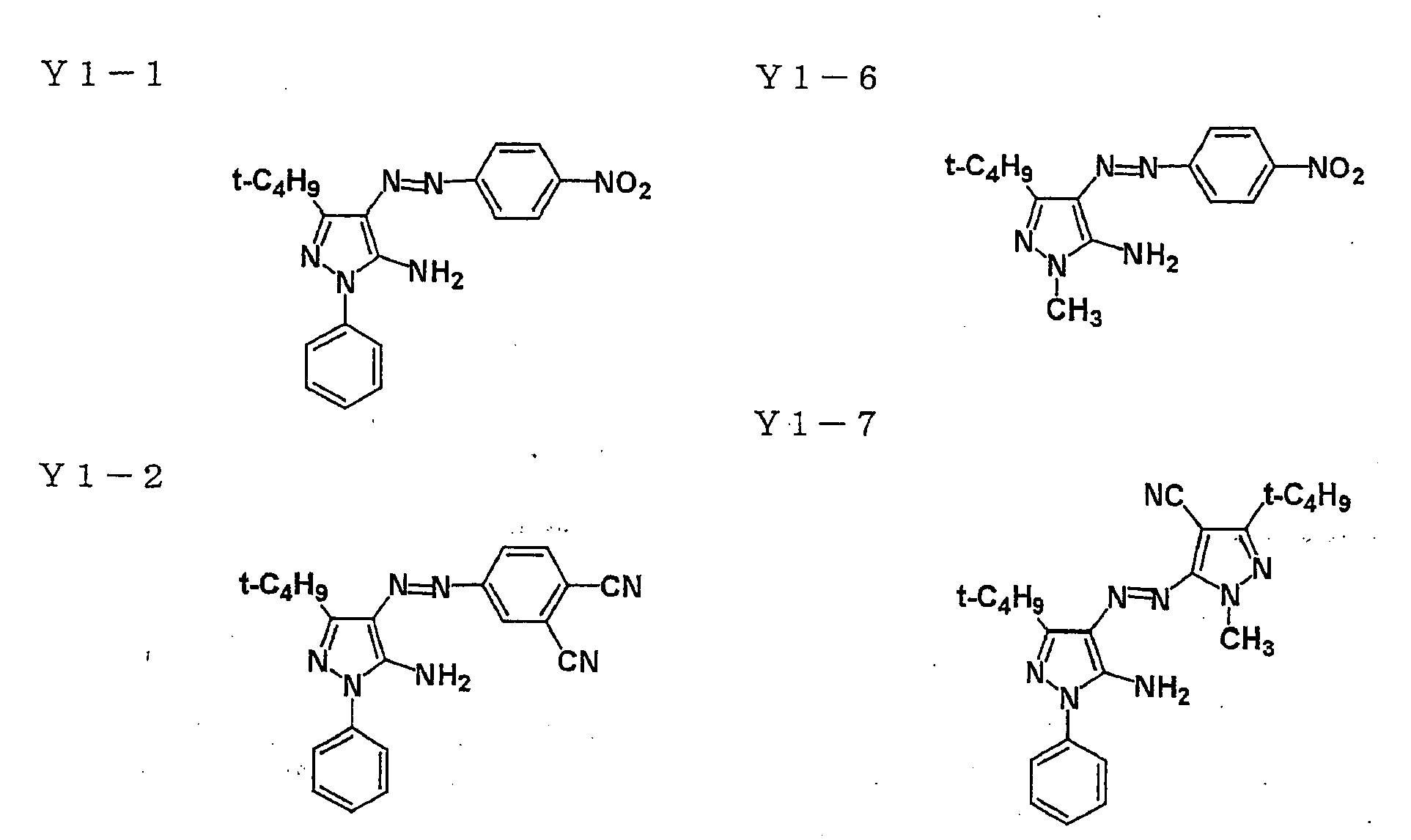


- The dye represented by formula (Y1) can be synthesized according to a usual manner.
- Next, the dye represented by formula (Y2) is explained in detail below.

- In formula (Y2), RA represents a substituent. Preferable examples of the substituent include a halogen atom, a hydroxyl group, an alkyl group having 1 to 8 carbon atoms, a cycloalkyl group, an alkoxy group, an alkoxycarbonyl group, an alkylthio group, an alkylsulfonyl group, an amino group, an alkylamino group, an arylamino group, a sulfonamide group, an aryloxy group, and an arylthio group, and more preferable an alkyl group having 1 to 8 carbon atoms and a hydroxyl group. x represents an integer of 0 to 6. x is preferable an integer of 0 to 3, more preferable 1 to 2. RB and RC each independently represent an acyl group, an alkoxycarbonyl group, or a carbamoyl group.
- Among the above groups, the group having an alkyl moiety, an aryl moiety, or a heterocyclic moiety as a partial structure, may further be substituted with a substituent(s). Examples of the substituent include a halogen atom, an unsaturated alkyl group, a cycloalkyl group, an aryl group, a heterocyclic group, an alkoxy group, an acyloxy group, a carbamoyloxy group, an alkoxycarbonyloxy group, an aryloxycarbonyloxy group, an amino group, an acylamino group, an aminocarbonylamino group, an alkoxycarbonylamino group, a sulfamoylamino group, an alkyl- or aryl-sulfonylamino group, an alkylthio group, a sulfamoyl group, an alkyl group, an aryl-sulfinyl group, an aryl-sulfonyl group, an acyl group, an aryloxycarbonyl group, an alkoxycarbonyl group, a carbamoyl group, an aryl- or heterocyclic-azo group, an imido group, a hydroxyl group, a cyano group, a nitro group, a sulfo group, and a carboxyl group.
- Preferable examples of the compound represented by formula (Y2) are shown below, but the compounds that can be used in the present invention are not limited to the following specific examples.


- Next, the dye represented by formula (Y3) is explained in detail below.

- In formula (Y3), R1A represents an allyl group or an alkyl group. R7A represents a substituted or unsubstituted alkyl, aryl or acyl group. A represents -CH2-, -CH2CH2-, -CH2CH2O-, -CH2CH2OCH2-, or -CH2CH2OCH2CH2-. R3A represents a hydrogen atom or an alkyl group. Each group may further be substituted (including, for example, a cycloalkyl group, an alkoxy group, an acyloxy group, and a hydroxyl group).
- Preferable examples of the compound represented by formula (Y3) are shown below, but the compounds that can be used in the present invention are not limited to the following specific examples.


- Next, the dye represented by formula (Y4) is explained in detail below.

- In formula (Y4), R1B, R2B, R3B, and R4B each independently represent a hydrogen atom or a substituent. Examples of the substituent include an alkyl group, an aryl group, an alkoxy group, and alkylamino group.
- Preferable examples of the compound represented by formula (Y4) are shown below, but the compounds that can be used in the present invention are not limited to the following specific examples.


- The dyes represented by any one of formulae (Y2), (Y3), and (Y4) can be synthesized according to a usual method.
- In the heat transfer layer of the ink sheet that is used in the present invention, use can be made of dyes that have been usually employed as a magenta dye. Among these, at least one magenta dye represented by any one of formulae (M1) to (M4) is preferably used. However, the magenta dye that can be used in the present invention is not limited to these dyes.
- First, the dye represented by formula (M1) is explained below.

- In formula (M1), D1, D2, D3 D4, and D5 each independently represent a hydrogen atom, a halogen atom, an alkyl group, an alkoxy group, an aryl group, an aryloxy group, a cyano group, an acylamino group, a sulfonylamino group, a ureido group, an alkoxycarbonylamino group, an alkylthio group, an arylthio group, an alkoxycarbonyl group, a carbamoyl group, a sulfamoyl group, a sulfonyl group, an acyl group, or an amino group; D6 and D7 each independently represent a hydrogen atom, an alkyl group, alkylcyano group or an aryl group; D6 and D7 may be bonded together to form a ring; D3 and D6 and/or D5 and D7 may be bonded together to form a ring; X, Y, and Z each independently represent =C(D8)- or a nitrogen atom, in which D8 represents a hydrogen atom, an alkyl group, an aryl group, an alkoxy group, an aryloxy group, or an amino group; when X and Y each represent =C(D8)- or Y and Z each represent =C(D8)-, two D8s may be bonded together to form a saturated or unsaturated carbon ring; and each of the above-mentioned groups may further be substituted.
- Among the dyes represented by formula (M1), a dye represented by formula (M1B) is preferable.

- In formula (M1B), D19, D20, D21D22, and D23 each independently represent a hydrogen atom, a halogen atom, an alkyl group, an alkoxy group, an aryl group, an aryloxy group, a cyano group, an acylamino group, a sulfonylamino group, a ureido group, an alkoxycarbonylamino group, an alkylthio group, an arylthio group, an alkoxycarbonyl group, a carbamoyl group, a sulfamoyl group, a sulfonyl group, an acyl group, or an amino group. D24 and D25 each independently represent a hydrogen atom, an alkyl group, alkylcyano group or an aryl group. D24 and D25 may be bonded together to form a ring. D21 and D24 and/or D23 and D25 may be bonded together to form a ring. D26 represents an alkyl group, an aryl group, an alkoxy group; an aryloxy group, or an amino group. And each of the above-mentioned groups may further be substituted.
- Preferable examples of the compound represented by formula (M1) are shown below, but the compounds that can be used in the present invention are not limited to the following specific examples.

- Second, the dye represented by formula (M2) is explained in detail.
formula (M2) A-N=N-E
- In formula (M2), A represents an optionally substituted heterocyclic group whose hetero ring is selected from imidazole, pyrrazole, thiazole, benzothiazole, isothiazole, benzoisothiazole, and thiophene. Preferred heterocyclic rings are an imidazoly group, a pyrazolyl group, a thiazolyl group, a benzothiazolyl group, an isothiazolyl group, a benzoisothiazolyl group, or a thienyl group, of these substituents, preferred is an imidazoly group. E ach of which may further be substituted.
- Examples of the substituent with which the heterocyclic group represented by A may be substituted include a cyano group, a thiocyano group, a nitro group, a halogen atom, an alkyl group, an alkoxy group, a formyl group, an alkylthio group, an alkylsulfonyl group, an alkoxycarbonyl group, and an alkylcarbonyl group. Of these substituents, preferred are a cyano group, a thiocyano group, a cyanomethyl group, a nitro group, and alkyl group.
- E represents an optionally substituted aminophenyl group, tetrahydroquinolinyl group, yulolidyl group, or aminoquinolinyl group. Herein, the amino moiety in the aminophenyl group and the aminoquinolinyl group embraces an amino group and a substituted amino group. Examples of the substituent with which E may be substituted include an alkyl group, an alkenyl group, a cycloalkyl group, an aryl group, an amide group, and a heterocyclic group.
- E is preferably an aminophenyl group which is not substituted or substituted with an alkyl group, an amide group.
- Preferable examples of the compound represented by formula (M2) are shown below, but the compounds that can be used in the present invention are not limited to the following specific examples.


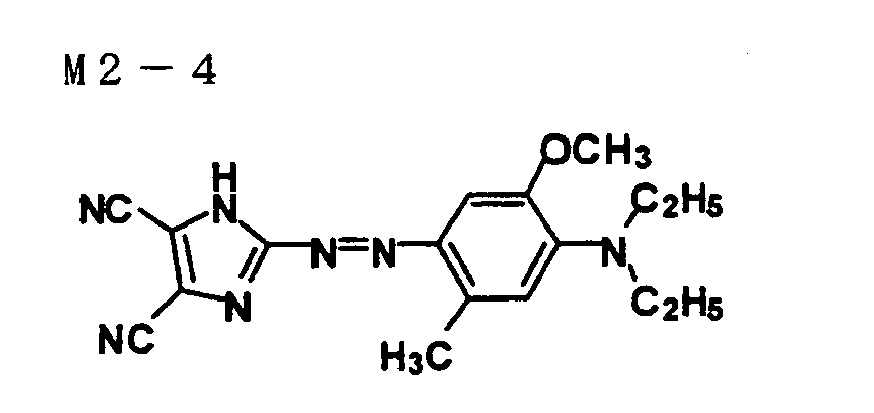


- Next, the dye represented by formula (M3) or (M4) is explained in detail.


- In formula (M3), R71 and R73 each independently represent a hydrogen atom or a substituent; R72 and R74 each independently represent a substituent; n11 represents an integer of 0 to 4; n12 represents an integer of 0 to 2; when n11 represents an integer of 2 to 4, R74s may be the same or different from each other; and when n12 represents 2, R72s may be the same or different from each other.
- Examples of the substituents represented by R71 to R74 include a halogen atom, an alkyl group (including a cycloalkyl group regardless of ring number), an alkenyl group (including a cycloalkenyl group regardless of ring number), an alkynyl group, an aryl group, a heterocyclic group, a cyano group, an alkoxy group, an aryloxy group, an acyloxy group, a carbamoyloxy group, an alkoxycarbonyloxy group, an aryloxycarbonyloxy group, an amino group (including an alkylamino group and an anilino group), an acylamino group, an aminocarbonylamino group, an alkoxycarbonylamino group, an aryloxycarbonylamino group, a sulfamoylamino group, an alkyl- or aryl-sulfonylamino group, an alkylthio group, an sulfamoyl group, an alkyl- or aryl-sulfinyl group, an alkyl- or aryl-sulfonyl group, an acyl group, an aryloxycarbonyl group, an alkoxycarbonyl group, a carbamoyl group, an aryl- or heterocyclic-azo group, and an imido group. Each of the above-mentioned substituents may further be substituted.
- R71 and R73 each are a hydrogen atom, a substituted or unsubstituted alkyl group, a substituted or unsubstituted alkenyl group, a substituted or unsubstituted aryl group, or a substituted or unsubstituted heterocyclic group; preferably a hydrogen atom or a substituted or unsubstituted alkyl group, more preferably a hydrogen atom or a substituted or unsubstituted alkyl group having 1 to 6 carbon atoms, and further preferably a hydrogen atom.
- R72 and R74 each independently represent a halogen atom, an alkyl group, an alkenyl group, an alkynyl group, an aryl group, a heterocyclic group, a cyano group, an alkoxy group, an aryloxy group, an acyloxy group, a carbamoyloxy group, an alkoxycarbonyloxy group, an aryloxycarbonyloxy group, an amino group, an acylamino group, an aminocarbonylamino group, an alkoxycarbonylamino group, an aryloxycarbonylamino group, a sulfamoylamino group, an alkyl- or aryl-sufonylamino group, an alkylthio group, an sulfamoyl group, an alkyl- or aryl-sulfinyl group, an alkyl- or aryl-sulfonyl group, an acyl group, an aryloxycarbonyl group, an alkoxycarbonyl group or a carbamoyl group; preferably an alkoxy group, an aryloxy group, an acyloxy group, a carbamoyloxy group, an alkoxycarbonyloxy group, or an aryloxycarbonyloxy group; more preferably an alkoxy group or an aryloxy group. Each of the above-mentioned substituents may further be substituted.
- In formula (M4), R81 represents a hydrogen atom or a substituent, R82 and R84 each independently represent a substituent, n13 represents an integer of 0 to 4, and n14 represents an integer of 0 to 2. When n13 represents an integer of 2 to 4, R84s may be the same or different from each other. When n14 represents 2, R82s may be the same or different from each other. Examples of the substituents each represented by R81, R82 and R84 include those given as examples of the substituent each represented by R71 to R74 set forth above.
- Examples of the substituent represented by R81 include those given as examples of the substituents as described about R71 and R73, and preferable examples thereof are also same. R81 is more preferably a hydrogen atom or a substituted or unsubstituted alkyl group having 1 to 6 carbon atoms, and further preferably a hydrogen atom.
- Examples of the substituent represented by R82 and R84 include those given as examples of the substituent as described about R72 and R74. R82 and R84 each independently are preferably an alkoxy group, an aryloxy group, an acyloxy group, a carbamoyloxy group, an alkoxycarbonyloxy group and an aryloxycarbonyloxy group; and more preferably an alkoxy group and an aryloxy group. Each of these groups may be further substituted.
- The following is an explanation about a preferable combination of various substituents (atoms) that a dye represented by formula (M3) or (M4) may have: A preferred compound is a compound in which at least one of the substituents is the above-described preferable substituent. A more preferred compound is a compound in which more substituents are the above-described preferable substituents. The most preferred compound is a compound in which all substituents are the above-described preferable substituents.
- In the compound represented by formula (M3), it is preferable that R71 is a hydrogen atom, R72 is an aryloxy group, R73 is a hydrogen atom, n11 is an integer of 0, and n12 is an integer of 0 to 2. It is more preferable that R71 is a hydrogen atom, R72 is an aryloxy group, R73 is a hydrogen atom, n1 is integer of 0, and n12 is an integer of 2.
- In the compound represented by formula (M4), it is preferable that R81 is a hydrogen atom, R82 is an aryloxy group, n13 is an integer of 1 or 2, and n14 is an integer of 0. It is more preferable that R81 is a hydrogen atom, R82 is an aryloxy group, n13 is an integer of 1, and n14 is an integer of 0. It is further preferable that R81 is a hydrogen atom, R82 is an aryloxy group, n13 is an integer of 1, n14 is an integer of 0, and said R82 is positioned at ortho-site to the amino group.
- Preferable examples of the compound represented by formula (M3) or (M4) are shown below, but the compounds that can be used in the present invention are not limited to the following specific examples.

- The dye represented by any one of formulae (M1) to (M4) can be synthesized according to a usual manner.
- In the heat transfer layer of the ink sheet that is used in the present invention, use can be made of dyes that have been usually employed as a cyan dye. Among these, the cyan dye represented by formula (C1) or (C2) is preferably used. However, the cyan dye that can be used in the present invention is not limited to these dyes.
- First, the dye represented by formula (C1) is explained in detail.

- In formula (C1), R111 and R113 each independently represent a hydrogen atom or a substituent. R112 and R114 each independently represent a substituent; n18 represents an integer of 0 to 4; n19 represents an integer of 0 to 2. When n18 represents an integer of 2 to 4, R114s may be the same or different from each other, and when n19 represents 2, R112s may be the same or different from each other; each of these groups may further be substituted. Examples of the substituents represented by R111 to R114 include a halogen atom, an alkyl group, an alkenyl group, an alkynyl group, an aryl group, a heterocyclic group, an alkoxy group, an aryloxy group,a formyloxy group, a carbamoyloxy group, an alkoxycarbonyloxy group, an aryloxycarbonyloxy group, an amino group, an acylamino group, an aminocarbonylamino group, an alkoxycarbonylamino group, an aryloxycarbonylamino group, a sulfamoylamino group, an alkyl- or aryl-sulfonylamino group, an alkylthio group, an sulfamoyl group, an alkyl- or aryl-sulfinyl group, an alkyl- or aryl-sulfonyl group, an acyl group, an aryloxycarbonyl group, an alkoxycarbonyl group, a carbamoyl group, an aryl- or heterocyclic-azo group, and an imido group.
- R111 and R113 each independently are preferably a hydrogen atom, a substituted or unsubstituted alkyl group, a substituted or unsubstituted alkenyl group, a substituted or unsubstituted aryl group, and a substituted or unsubstituted heterocyclic group. R111 and R113 each independently are more preferably a hydrogen atom, a substituted or unsubstituted alkyl group having 1 to 6 carbon atoms, or a substituted or unsubstituted aryl group.
- R112 and R114 each independently are preferably a halogen atom, an alkyl group, an alkenyl group, an alkynyl group, an aryl group, a heterocyclic group, a cyano group, an alkoxy group, an aryloxy group, an acyloxy group, a carbamoyloxy group, an alkoxycarbonyloxy group, an aryloxycarbonyloxy group, an amino group, an acylamino group, an aminocarbonylamino group, an alkoxycarbonylamino group, an aryloxycarbonylamino group, a sulfamoylamino group, an alkyl- or aryl-sulfonylamino group, an alkylthio group, an sulfamoyl group, an alkyl- or aryl-sulfinyl group, an alkyl- or aryl-sulfonyl group, an acyl group, an aryloxycarbonyl group, an alkoxycarbonyl group, and a carbamoyl group. R112 and R114 each independently are more preferably a hydrogen atom, a halogen atom, an alkyl group, an alkenyl group, an aryl group, a heterocyclic group, an alkoxy group, an aryloxy group, an acyloxy group, a carbamoyloxy group, an alkoxycarbonyloxy group, an aryloxycarbonyloxy group, an amino group, an acylamino group, an aminocarbonylamino group, an alkoxycarbonylamino group, an aryloxycarbonylamino group, an alkylthio group, an acyl group, an aryloxycarbonyl group, an alkoxycarbonyl group, or carbamoyl group, further preferably a halogen atom, a substituted or unsubstituted alkyl group, a substituted or unsubstituted alkenyl group, a substituted or unsubstituted aryl group, or a substituted or unsubstituted heterocyclic group; and further more preferably a substituted or unsubstituted alkyl group.
- Preferable examples of the compound represented by formula (C1) are shown below, but the compounds that can be used in the present invention are not limited to the following specific examples.

- Among the dyes represented by formula (C1), those not available on the market can be synthesized according to the methods described in publications or specifications of
US Patent Nos. 4,757,046 and3,770,370 , German Patent No.2316755 ,JP-A-2004-51873 JP-A-7-137455 JP-A-61-31292 - Next, the dye represented by formula (C2) is explained in detail.

- In formula (C2), D14 to D21 each independently represent a hydrogen atom, a halogen atom, an alkyl group, an alkoxy group, an aryl group, an aryloxy group, a cyano group, an acylamino group, a sulfonylamino group, a ureido group, an alkoxycarbonylamino group, an alkylthio group, an arylthio group, an alkoxycarbonyl group, a carbamoyl group, a sulfamoyl group, a sulfonyl group, an acyl group or an amino group. D22 and D23 each independently represent a hydrogen atom, an alkyl group or an aryl group. D22 and D23 may be bonded together to form a ring. D19 and D22 and/or D20 and D23 may be bonded together to form a ring.
- D14 is preferably an acylamino group, a ureido group or an alkoxycarbonyl group, more preferably an acylamino group, or a ureido group, furthermore preferably an acylamino group, and most preferably a group represented by the following formula (IV).
Formula (IV) -NH-C(=O)-D24
- In formula (IV), D24 is an alkyl group (preferably an alkyl group having 1 to 12 carbon atoms, e.g., methyl, ethyl, isopropyl, n-propyl, t-butyl), an aryl group (preferably an aryl group having 6 to 10 carbon atoms, e.g., phenyl, m-nitrophenyl, p-nitrophenyl, p-tolyl, p-methoxyphenyl, naphthyl, m-chlorophenyl, p-chlorophenyl) or a heterocyclic group (preferably a 5- to 8-membered heterocyclic group having 0 to 10 carbon atoms and containing, as a ring-constituting atom(s), a hetero atom selected from an oxygen atom, a nitrogen atom and a sulfur atom, e.g., pyridyl, furyl, tetrahydrofuryl). D24 is preferably a heterocyclic group or an alkyl group, and more preferably a pyridyl group, a furyl group, a tetrahydrofuryl group or a methyl group.
- D15, D16, D18, D19, D20, and D21 each are preferably a hydrogen atom or an alkyl group (preferably an alkyl group having 1 to 12 carbon atoms, e.g., methyl, ethyl, isopropyl, n-propyl, t-butyl), and more preferably a hydrogen atom, a methyl group or an ethyl group. D17 is preferably a hydrogen atom, an alkyl group (preferably an alkyl group having 1 to 12 carbon atoms, e.g., methyl, ethyl, isopropyl, n-propyl, t-butyl), a halogen atom, a cyano group, a nitro group, or a heterocyclic group; and more preferably a hydrogen atom or a halogen atom. D16 and D17 may be bonded together to form a ring. D22 and D23 each are preferably a hydrogen atom or an alkyl group (preferably an alkyl group having 1 to 12 carbon atoms, e.g., methyl, ethyl, isopropyl, n-propyl, t-butyl), and more preferably a methyl group, an ethyl group or an n-propyl group. These alkyl groups may be substituted with another substituent. In the case that the alkyl group is substituted with another substituent, preferable examples of the "another" substituent include a heterocyclic group, a halogen atom, an alkoxy group, an aryloxy group, an amino group, an acyl group, a acyloxy group, an acylamino group, an alkylthio group, an arylthio group, a sulfonylamino group, a sulfonyl group, a sulfinyl group, a carbamoyl group, a sulfamoyl group, an alkoxycarbonyl group and an aryloxycarbonyl group, with more preferable example being a carbamoyl group. D22 and D23 each are further preferably a hydrogen atom, a methyl group or an ethyl group.
- Preferable examples of the compound represented by formula (C2) are shown below, but the compounds that can be used in the present invention are not limited to the following specific examples.


- The dye represented by formula (C2) can be synthesized according to a usual manner.
- As the binder resins that are contained in a dye ink in order to carry the above-described dyes, various materials are known and are able to be used in the present invention. Examples of the resins include modified cellulose resins such as ethyl cellulose, hydroxyethyl cellulose, ethyl hydroxycellulose, hydroxypropyl cellulose, ethylhydroxyethyl cellulose, methyl cellulose, cellulose acetate, cellulose acetate butyrate, cellulose acetate propionate, and cellulose nitrate; vinyl resins such as polyvinyl alcohol, polyvinyl acetate, polyvinyl butyrate, polyvinyl acetal, polyvinyl pyrroridone, polystyrene, and polyvinyl chloride; acrylic resins such as polyacrylonitrile, polyacrylic acid ester, and polyacrylamide; polyurethane resins; polyamide resins; polyester resins; polycarbonate resins; phenoxy resins; phenol resins; epoxy resins; and various kinds of elastomers. Each of these resins set forth above are preferably used. These resins may be used alone, or mixed together. In the case of polymers, various kinds of resin-constituting monomers may be copolymerized before use. It is also a preferable embodiment to bridge the polymers with various kinds of cross-linking agents.
- Especially, modified cellulose resins and vinyl resins are preferably used. More preferably used are propionic acid-modified cellulose resins, polyvinyl butyral and polyvinyl acetal.
- The dye ink can be prepared by dissolving or dispersing the above-described sublimation type dye and binder resin in a solvent. As the solvent that is used at the time of preparation, various kinds of known solvents can be used. Examples of the solvent include alcohol solvents such as methanol, ethanol, isopropyl alcohol, butanol, and isobutanol; ketone solvents such as methylethyl ketone, methylisobutyl ketone, and cyclohexanone; aromatic solvents such as toluene and xylene; and water. The solvents may be used singly, or as a mixture thereof.
- In addition to the dye and the binder, various kinds of additives can be added to the heat transfer layer in order to improve various performances such as storage stability, traveling properties in a printer, and releasing properties after printing. As typical additives, organic or inorganic fine particles and waxes are preferably used.
- As the organic particles, it is preferred to use fine particles of the resin exemplified by polyolefin resins such as polyethylene and polypropylene, fluorine resins, polyamide resins such as nylon resins, urethane resins, styrene-acryl series crosslinked resins, phenol resins, urea resins, melamine resins, polyimide resins, and benzoguanamine resins. Polyethylene fine particles are more preferably used. As the inorganic particles, it is preferred to use fine particles of, for example, calcium carbonate, silica, clay, talc, titanium oxide, magnesium hydroxide, or zinc oxide.
- The organic or inorganic fine particles are preferably contained in a range of from 0.5 to 5 % by mass, based on the binder resin of the heat transfer layer.
- It is also a preferable embodiment that a wax is contained to the heat transfer layer in addition to the above-described sublimation type dye, binder, and organic or inorganic fine particles. As the wax that can be used, preferred are waxes derived from petroleum such as microcryastalline wax and paraffin wax; waxes derived from mineral such as montan wax; waxes derived from plants such as carnauba wax, Japan wax and candelilla wax; waxes derived from animals such as bees wax, spermaceti, insect wax and shellac wax; synthetic waxes such as Fischer-Tropsch wax, various kinds of low molecular polyethylene, aliphatic acid esters, aliphatic acid amides and silicone wax and partially modified waxes.
- Further, another preferable embodiment is to contain resins such as silicone resin, fluorine resin, acrylic resin, cellulose resin, vinyl chloride-vinyl acetate copolymer, and pyroxylin in the dye layer ink. These waxes and resins may be contained in the heat transfer layer in the range of from 0.1 % by mass to 10 % by mass, preferably from 1 % by mass to 3 % by mass, based on the total solid content of the heat transfer layer.
- Next, explained is a composition of the heat-sensitive transfer sheet that is used in the present invention.
- The heat-sensitive transfer sheet of the present invention has at least one heat transfer layer containing at least one dye, which is disposed on one surface of the support, and the heat transfer layer is formed by applying a coating liquid for heat transfer layer.
- As the support, any one of previously known materials can be used, so far as such the material has both a heat resistance and a mechanical strength necessary to the requirements for the support. Specific examples of preferable supports include thin papers such as a glassine paper, a condenser paper, and a paraffin paper; high-temperature polyesters such as polyethyleneterephthalate, polyethylenenaphthalate, polybuyleneterephthalate, polyphenylene sulfide, polyetherketone, and polyethersulfone; stretched or unstreched films of plastics such as polypropylene, polycarbonate, cellulose acetate, polyethylene derivatives, poly(vinyl chloride), poly(vinylidene chloride), polystyrene, polyamide, polyimide, polymethylpentene, and ionomers; and laminates of these materials. Of these materials, polyester films are especially preferred. Stretched polyester films are most preferred. A thickness of the support can be properly determined in accordance with the material of the support so that the mechanical strength and the heat resistance become optimum. Specifically, it is preferred to use a support having a thickness of about 1 µm to about 100 µm, more preferably from about 2 µm to about 50 µm, and further preferably from about 3 µm to about 10 µm.
- It is essential in the sublimation type heat-sensitive transfer recording system that only dye(s) having each hue that is contained in a heat-sensitive transfer sheet must be transferred at the time of printing. Transfer of a resin carrying the dye is not preferred. Therefore, a strong adhesion between a heat transfer layer and a support of the heat-sensitive transfer sheet is required. If the adhesion is weak, the heat transfer layer in itself adheres to a heat-sensitive image-receiving sheet, thereby resulting in deterioration of image quality of printing.
- In the case of the support such as a polyester film exemplified above as a preferable support, wettability of the ink with each hue as described later is not so sufficient that adhesive strength occasionally lacks.
- In order to deal with such the problem, it is preferred to employ a method of physically treating a surface of the support, and / or a method of forming an easy adhesion layer.
- It is preferred to form an easy adhesion layer composed of a resin on a support and to dispose a heat transfer layer on the easy adhesion layer. As a resin for forming the easy adhesion layer, there can be used, for example, urethane resins, polyester resins, polypropylene resins, polyol resins, acrylic resins, and reaction products of these resins and isocyanate compounds. Examples of the isocyanate compound include diisocyanate compounds and triisocyanate compounds, each of which is conventionally used. A coating amount of the resin preferably ranges from 0.05 g / m2 to 0.1 g / m2.
- In the production of the heat-sensitive transfer sheet, a support on which an easy adhesion layer is disposed in advance can be used, and a heat transfer layer can be formed on the said support.
- The heat transfer layer that is used in the present invention is formed by applying a coating liquid (an ink) for the heat transfer layer on a support using a gravure printing method or other forming means, followed by drying. The ink for heat transfer layer is obtained by dissolving or dispersing a sublimation type dye, a binder resin and optionally used additives such as organic or inorganic finely divided powder and waxes in a proper solvent.
- A thickness of the heat transfer layer is preferably in the range of from about 0.2 g/m2 to about 5 g / m2, more preferably from about 0.4 g / m2 to about 2 g / m2 at the dry state. A content of the sublimation type dye in the heat transfer layer is preferably in the range of from 5 % by mass to 90 % by mass, more preferably from about 10 % by mass to about 70 % by mass.
- Next, the heat sensitive transfer sheet of the present invention is explained in detail refferd to
Figs 1 to 3 , but the present invention is not intended to be limited thereto. The heat-sensitive transfer sheet of the present invention has at least one heat transfer layer containing at least one dye disposed on a support. It is preferred to dispose heat transfer layers; a yellow heat transfer layer Y, a magenta heat transfer layer M, and a cyan heat transfer layer C; with each hue in area order on the same support as shown inFig. 1 (a) . In addition, a black layer BK may be further disposed as shown inFig. 1 (b) . Further, as shown inFig. 1 (C) , a transferableprotective layer laminate 4 may be disposed between the heat transfer layers constituted of Y, M, C, and BK as described later. However, arrangement of the heat transfer layers with each hue in the present invention is not limited to the above, but any arrangement can be employed in accordance with necessity. It is preferred that the yellow heat transfer layer, the magenta heat transfer layer, and the cyan heat transfer layer are formed in this area order on the support. - Further, a releasing property between a heat-sensitive transfer sheet and a heat-sensitive image-receiving sheet and the like are changed depending on the printing order. Therefore, it is also a preferable embodiment to change a content of additives for use in each of the heat transfer layers in response to the change of releasing properties. For example, as a heat transfer layer is used later for printing, it is possible to increase a content of the releasing agent in the heat transfer layer.
- It is also possible to form each of heat transfer layers with each hue on a separate support, in place of disposing the heat transfer layers with each hue on the same support. (
Fig. 2 ) - In the heat-sensitive transfer sheet that is used in the present invention, the heat transfer layer (the dye layer) and the protective layer may have a single layer structure, or a multilayer structure such as a double layer structure and a three or more layer structure. Further, as the heat transfer layers, a single layer structure and a multilayer structure may coexist in the transfer sheet.
Fig. 3 shows one example of such the composite layer structure. Each of the yellow heat transfer layer, the magenta heat transfer layer and the cyan heat transfer layer has a single layer structure. - A total thickness of the heat transfer layers having a multilayer structure is preferably in the range of from about 0.2 g / m2 to about 5 g / m2, more preferably from about 0.4 g / m2 to about 2 g / m2. A thickness of one constituting layer of the heat transfer layer is preferably in the range of from about 0.2 g / m2 to about 2 g / m2. A total content of the sublimation type dye in the total heat transfer layers is preferably in the range of from 5 % by mass to 90 % by mass, more preferably from about 10 % by mass to about 70 % by mass.
- It is a preferable embodiment in the present invention to dispose a transferable protective layer laminate in the heat-sensitive transfer sheet. The transferable protective layer laminate is used to protect a heat-sensitive transferred image by forming a protective layer composed of a transparent resin on the heat-sensitive transferred image by heat-sensitive transfer, thereby to improve durability such as scratch resistance, light- fastness, and resistance to weather. Under the conditions that a dye transferred to the image-receiving sheet is left to be exposed at the surface of the image-receiving sheet, image durability, such as light-fastness, scratch resistance, and chemical resistance, are unsatisfactory. Therefore, it is preferred to dispose the transparent protective layer. As a preferable embodiment of the heat-
sensitive transfer sheet 1 of the present invention exemplified inFig. 3 , aback layer 5 can be formed on one surface of asupport 2, and a transferableprotective layer laminate 4 which is constituted a releasinglayer 4a, aprotective layer 4b and anadhesive layer 4c in this order from the support, can be formed on other surface of thesupport 2 betweenink layers 3 of a yellow heat transfer layer Y, a magenta heat transfer layer M, and a cyan heat transfer layer C. Theprotective layer 4b may be formed by plural layers. In the case where theprotective layer 4b also has functions of other layers, the releasinglayer 4b and theadhesive layer 4c can be omitted. It is also possible to use asupport 2 on which an easy adhesive layer has already been formed. - As a resin forming the protective layer, preferred are resins that are excellent in scratch resistance, chemical resistance, transparency and hardness. Examples of the resin include polyester resins polystyrene resins, acrylic resins, polyurethane resins, acrylic urethane resins, silicone-modified resins of the above-described resins, mixtures of these resins, ionizing radiation-curable resins, and ultraviolet-shielding resins. In addition, there can be used various kinds of resins that are conventionally known as a resin for forming protective layer. Further, in order to give ultraviolet absorbing capacity, or to improve coat separation properties at the time of transfer, gloss, brightness, or the like, it is also preferred to add ultraviolet absorbing agents, antioxidants, fluorescent brightening agents, organic fillers and / or inorganic fillers in accordance with necessity.
- As the acrylic resin that can be used in the present invention, it is preferable that polymers derived from at least one monomer selected from conventionally known acrylate monomers and methacrylate monomers. Other monomers than these acrylate-series monomers, such as styrene and acrylonitrile may be co-polymerized with said acryl-series monomers. A preferred monomer is methyl methacrylate. It is preferred that methyl methacrylate is contained in terms of preparation mass ratio of 50 mass% or more in the polymer.
- As the polyester resin that can be used in the present invention, there can be used conventionally known saturated polyester resins. Examples of an acid component of the polyester resin used in the present invention, include aromatic dicarboxylic acids such as terephtharic acid, isophtharic acid, orthophtharic acid, 2,6-naphthalene dicarboxylic acid, teterahydrophtharic acid, hexahydrophtharic acid, hexahydroisophtharic acid, and hexahydroterephtharic acid; aliphatic dicarboxylic acids such as succinic acid, adipic acid, azelaic acid, sebacic acid, dodecanedionic acid, and dimmer acid; and alicyclic dicarboxylic acids such as cyclohexane dicarboxylic acid, tricyclodecane dicarboxylic acid, and decalin dicarboxylic acid. Methyl-esterified derivatives of these compounds may be also used. Further, acid anhydrides of these compounds may be also used.
- Further, if necessary, the above-mentioned compounds may be also used together with other compounds such as p-(hydroxyethoxy)benzoic acid, hydroxypivalic acid, γ-butyryllactone, ε-caprolactone, fumaric acid, maleic acid, maleic acid anhydrate, itaconic acid, and citraconic acid. Further, if necessary, the above-mentioned compounds may be also used together with tri- or more multi-functional polycarboxylic acids such as tri and tetra carboxylic acids (e.g., trimellitic acid, pyromellitic acid), in so far as the proportion of the tri- or more multi- functional polycarboxylic acids is 10 mol% or less of the entire carboxylic acid components. Particularly preferred is the composition that contains at least one acid component which is an aromatic carboxylic acid a part of which is substituted with a sulfonic acid or a salt thereof, in one molecular chain. It is preferable to conduct polymerization with setting the upper limit of a substitution amount of the sulfonic acid (or salt thereof) within a range that ensures solubility to organic solvents, since this would make it possible to use the polyester resin with mixing with other organic-solvent-soluble additives or resins. As a preferable aromatic dicarboxylic acid substituted with the sulfonic acid (or salt thereof), there are exemplified sulfoterephtharic acid, 5-sulfoisophtharic acid, 4-sulfophtharic acid, 4-sulfonaphthalene- 2,7-dicarboxylic acid, 5-(4-sulfophenoxy)isophtharic acid, ammonium salts of these acids, and metal salts of these acids wherein examples of the metal include lithium, potassium, magnesium, calcium, copper, and iron. Of these acids, sodium salt of 5-sulfoisophtharic acid is especially preferred.
- Examples of a polyol component that is another component of the polyester resin that can be used in the present invention, include ethylene glycol, 1,2-propylene glycol, 1,3-propane diol, 1,4-butane diol, neopentyl glycol, 1,5-pentane diol, 1,6-hexane diol, 3-methyl-1,5-pentane diol, 1,9-nonane diol, 2-ethyl-2-butylpropane diol, hydroxypivalic acid neopentylglycol ester, dimethylolheptane, and 2,2,4-trimethyl-1,3-pentane diol. If necessary, there can be also used diethylene glycol, triethylene glycol, dipropylene glycol, polyethylene glycol, polypropylene glycol, polytetramethylene glycol, ethylene oxide adducts of neopentyl glycol, and propylene oxide adducts of neopentyl glycol.
- As aromatic-group-containing glycols, there are paraxylene glycol; metaxylene glycol, orthoxylene glycol, 1,4-phenylene glycol, ethylene oxide adduct of 1,4-phenylene glycol, bisphenol A, and glycols obtained by adding from 1 to several moles of ethylene oxide or propylene oxide to the two phenolic hydroxyl groups of bisphenols, such as ethylene oxide adducts or propylene oxide adducts of bisphenol A. Examples of alicyclic diol components include tricyclodecane diol, tricyclodecane dimethylol, tricyclodecane dimethanol (TCD-M), cyclohexane diol, 1,4-cyclohexane dimethanol, hydrogenated bisphenol A, ethylene oxide adducts or propylene oxide adducts of hydrogenated bisphenol A. As the above-described polyester resin, a preferable glass transition temperature ranges from 50 °C to 120 °C, and a preferable molecular weight ranges from 2,000 to 40,000. A molecular weight ranging from 4,000 to 20,000 is more preferred, because so-called "foil-off" properties at the time of transfer of the protective layer are improved.
- The use of the ionizing radiation-curable resins enables to obtain a protective layer that is excellent in both resistance to plasticizers and scratch resistance in particular. As an example, there are resins that are obtained by cross-linking and curing radical polymerizable polymers or oligomers upon irradiation of ionizing radiation. At this moment, polymerization and cross-link may be performed by adding a photopolymerization initiator in accordance with necessity, followed by irradiation of electron beam or ultraviolet ray. Further, known ionizing radiation-curable resins can be used.
- It is also a preferable embodiment that a protective layer contains ultraviolet-absorbing agents and / or ultraviolet-shielding resins in order to give light-fastness to the printed matter.
- With respect to these ultraviolet-absorbing agents, it is preferred to use a combination of ultraviolet-absorbing agents having a different system from each other so that an effective ultraviolet-absorbing wavelength region can be covered in accordance with characteristics of the dye that is used for image formation. With respect to the non-reactive ultraviolet-absorbing agents, a mixture of ultraviolet-absorbing agents having a different structure from each other is preferably used in order to prevent the ultraviolet-absorbing agent from precipitation.
- Examples of the organic fillers and / or the inorganic fillers include polyethylene wax, bis-amide, nylon, acrylic resin, cross-linked polystyrene, silicone resin, silicone rubber, talc, calcium carbonate, titanium oxide, alumina, and silica fine particles such as micro silica and colloidal silica. In the heat-sensitive transfer sheet according to the present invention, not only these exemplified materials, but also known other materials can be used preferably.
- With respect to the organic fillers and / or the inorganic fillers, it is preferred that not only a particle size of the fillers is 10 µm or less, preferably in the range of from 0.1 µm to 3 µm but also the fillers have good sliding properties and high transparency. An addition amount of the filler is preferably a degree to which transparency is kept at the time of transfer. Specifically, the addition amount is preferably in the range of from 0 to 100 mass parts, based on 100 mass parts of the resin.
- Depending on the kind of resin for forming protective layer, the protective layer is formed by the same method as the method of forming the above-described dye layer. A thickness of the protective layer is preferably in the range of from about 0.5 µm to about 10 µm.
- In the case where a protective layer is difficult to separate from a support at the time of transfer, it is also a preferable embodiment to form a
release layer 4a between the support and the protective layer. The release layer can be formed by the steps of preparing a coating liquid composed of a material that is excellent in release properties, such as waxes, silicone wax, silicone resin, and fluorine resin; a relatively high melting point resin that does not melt by heat from a thermal head, such as cellulose-based resin, acrylic resin, polyurethane resin, polyvinyl acetal resin, acrylic vinyl ether-based resin, maleic acid anhydride resin, silicone resin, fluorine resin; or the above-described resins containing a heat release agent such as waxes, and then coating the coating liquid according to a previously known coating method such as gravure coat and gravure reverse coat, followed by drying. Of these resins, preferred are acryl resins obtained by polymerizing acrylic acid or methacrylic acid singly, or copolymerizing acrylic acid or methacrylic acid with other monomers. These acrylic resins are excellent in adhesion to the substrate sheet, and release properties from the protective layer.
Further, these resins may be used alone or in a combination of these resins. - The release layer remains at the side of a support at the time of printing (transfer).
- A thickness of the release layer is preferably in the range of from about 0.5 µm to about 10 µm. Various kinds of particles are incorporated in the release layer, or alternatively a surface of the release layer at the protective layer-coating side is subjected to a matt treatment, thereby to mat the surface of the release layer.
- Resultantly, the surface of the image-receiving sheet after printing can be mat-finished (flatten).
- A separation layer may be formed between a transferable protective layer and a release layer. The separation layer is transferred together with the protective layer. After transfer, the separation layer becomes the outermost layer of the printed image-receiving sheet. Therefore, the separation layer is composed of a resin that is excellent in transparency, abrasion resistance and chemical resistance. As the resin, there are exemplified acrylic resin, epoxy resin, polyester resin, and styrene resin. Further, additives such as fillers and waxes may be added to the separation layer.
- It is preferred to dispose an adhesive layer on a protective layer as the outermost layer of the transferable protective layer laminate. Thereby, transfer properties of the protective layer are improved. In the adhesive layer, there can be used known pressure-sensitive adhesives, heat-sensitive adhesives, and thermoplastic resins. Specific examples of the adhesives include resins that are excellent in adhesiveness at the time of heating, such as polyester resin, vinyl chloride-vinyl acetate copolymer resin, acrylic resin, acrylic material-ultraviolet absorbing agent copolymer resin, ultraviolet absorbing resin, butyral resin, epoxy resin, polyamide resin, vinyl chloride resin, and polycarbonate resin. Of these resins, preferred are thermoplastic resins having a glass transition temperature of from 40°C to 80°C.
- If Tg is less than 40°C, adhesiveness between the coated image and a transparent protective layer tends to become insufficient. On the other hand, if Tg is more than 80°C, transfer properties of the transparent protective layer tends to become insufficient.
- Further, especially preferred are polyvinylchloride resins, polyvinyl acetate resins, and vinyl chloride-vinyl acetate copolymer resins, each of which has a polymerization degree of from 50 to 300, more preferably from 50 to 250.
- As the ultraviolet absorbing resin, there can be used resins such as products that are obtained by reaction and bonding of a thermoplastic resin or an ionizing radiation curable resin with a reactive ultraviolet absorbing agent.
- The adhesive layer may contain ultraviolet absorbing agents as described above. Further, it is optional to add other additives such as coloring pigments, white pigments, extender pigments, fillers, antistatic agents, antioxidants, and fluorescent whitening agents in accordance with necessity. The adhesion layer is formed by coating and then drying a coating liquid containing the above-described resin for construction of the adhesion layer, and the above-described additives that are optionally added to the adhesion layer, so that a thickness of the adhesion layer preferably becomes a range of from 0.5 µm to about 10 µm at the dry state. A dry thickness of the adhesive layer preferably ranges from 0.5 µm to 5 µm, more preferably from 0.5 µm to 3 µm.
- The ultraviolet absorber preferably absorbs light at wavelengths in the ultraviolet region, and the absorption edge of the absorption of the ultraviolet absorber is preferably out of the visible region. Specifically, after addition of the ultraviolet absorbing agent to a receptor layer so as to form a heat-sensitive transfer image-receiving sheet, it is preferred that the resultant heat-sensitive transfer image-receiving sheet has the maximum absorption in the wavelength region of from 330 nm to 370 nm and has an absorption density Abs of 0.8 or more at the maximum absorption wavelength, more preferably has an absorption density Abs of 0.5 or more at 380 nm. Also, the heat-sensitive transfer image-receiving sheet has an absorption density of, preferably, Abs 0.1 or less at 400 nm. If the absorption density at a wavelength range exceeding 400 nm is high, it is not preferable because an image is made yellowish. As the ultraviolet absorbing agents, use can be made of conventionally known inorganic or organic ultraviolet absorbing agents. As the organic ultraviolet absorbing agents, use can be made of non-reactive ultraviolet absorbing agents such as salicylate-series, benzophenone-series, benzotriazole-series, triazine-series, substituted acrylonitrile-series, nickel chelate-series, and hindered amine-series ultraviolet absorbing agents; and copolymers or graft polymers of thermoplastic resins (e.g., acrylic resins) and activated products obtained by introducing to the above-described non-reactive ultraviolet absorbing agents; addition-polymerizable double bonds originated from a vinyl group, an acryroyl group, a methacryroyl group, or the like, or alternatively by introducing thereto other types of groups such as an alcoholic hydroxyl group, an amino group, a carboxyl group, an epoxy group, and an isocyanate group. Of these ultraviolet absorbing agents, preferred are organic ultraviolet absorbing agents as described below, especially benzophenone-series, benzotriazole-series, and triazine-series ultraviolet absorbing agents.
- In addition, disclosed is a method of obtaining ultraviolet-shielding resin by the steps of dissolving ultraviolet absorbing agents in a monomer or oligomer of the resin that is used in the protective layer, and then polymerizing the monomer or oligomer (
JP-A-2006-21333 - Examples of the articles that have been sold as ultraviolet absorbing agents on the market include Tinuvin-P (a product of Ciba-Geigy), JF-77(a product of JOHOKU CHEMICAL), SEA SOUP 701 (a product of SHIROISHI CALCIUM), SUMI SOUP 200 (a product of Sumitomo Chemical), BIO SOUP 520 (a product of KYODO CHEMICAL), and ADK STAB LA-32 (a product of ADEKA).
- In the present invention, the ultraviolet absorber may be made to have a higher molecular weight. In this case, the ultraviolet absorber has a mass average molecular weight of preferably 10,000 or more, and more preferably 100,000 or more. As a means of obtaining a higher-molecular weight ultraviolet absorber, it is preferable to graft an ultraviolet absorber on a polymer. The polymer as the principal chain preferably has a polymer skeleton less capable of being dyed than the receptor polymer to be used together. Also, when the polymer is used to form a film, the film preferably has sufficient film strength. The graft ratio of the ultraviolet absorber to the polymer principal chain is preferably 5 to 20% by mass and more preferably 8 to 15% by mass.
- Also, the polymer containing a unit having ultraviolet absorbing ability (ultraviolet absorber unit) may be made to be used in a form of a latex. When the polymer is made to be used in a form of a latex, an aqueous dispersion-system coating solution may be used in application and coating to form the receptor layer, and this enables reduction of production cost. As a method of making the latex polymer (or making the polymer latex-wise), a method described in, for example, Japanese Patent No.
3450339 - In the case of using the polymer containing a unit having ultraviolet absorbing ability in a form of a latex, it may be mixed with a latex of the receptor polymer capable of being dyed, and the resulting mixture is coated. By doing so, a receptor layer, in which the ultraviolet absorber is homogeneously dispersed, can be formed.
- The addition amount of the polymer containing a unit having ultraviolet absorbing ability or its latex is preferably 5 to 50 parts by mass, and more preferably 10 to 30 parts by mass, to 100 parts by mass of the receptor polymer capable of being dyed or its latex to be used to form the receptor layer.
- The ultraviolet absorber may be either an organic compound or an inorganic compound.
- In the case of the organic ultraviolet absorber, those represented by any one of the following formulae (1) to (8) are preferable.
- The ultraviolet absorber represented by any one of the following formulae (1) to (8) is explained below.

- In formula (1), R111, R112, R113, R114, and R115 each independently represent a hydrogen atom, a halogen atom, an alkyl group (including a cycloalkyl group and a bicycloalkyl group), an alkenyl group (including a cycloalkenyl group and a bicycloalkenyl group), an alkynyl group, an aryl group, a heterocyclic group, a cyano group, a hydroxyl group, a nitro group, a carboxyl group, an alkoxy group, an aryloxy group, a silyloxy group, a heterocyclic oxy group, an acyloxy group, a carbamoyloxy group, an alkoxycarbonyloxy group, an aryloxycarbonyloxy group, an amino group (including an anilino group), an acylamino group, an aminocarbonylamino group, an alkoxycarbonylamino group, an aryloxycarbonylamino group, a sulfamoylamino group, an alkyl- or aryl-sulfonylamino group, a mercapto group, an alkylthio group, an arylthio group, a heterocyclic thio group, a sulfamoyl group, a sulfo group, an alkyl- or aryl-sulfinyl group, an alkyl- or aryl-sulfonyl group, an acyl group, an aryloxycarbonyl group, an alkoxycarbonyl group, a carbamoyl group, an aryl- or heterocyclic-azo group, an imido group, a phosphino group, a phosphinyl group, a phosphinyloxy group, a phosphinylamino group, or a silyl group.

- In formula (2), R21 and R22 each independently represent a hydrogen atom, a halogen atom, an alkyl group (including a cycloalkyl group and a bicycloalkyl group), an alkenyl group (including a cycloalkenyl group and a bicycloalkenyl group), an alkynyl group, an aryl group, a heterocyclic group, a cyano group, a hydroxyl group, a nitro group, a carboxyl group, an alkoxy group, an aryloxy group, a silyloxy group, a heterocyclic oxy group, an acyloxy group, a carbamoyloxy group, an alkoxycarbonyloxy group, an aryloxycarbonyloxy group, an amino group (including an anilino group), an acylamino group, an aminocarbonylamino group, an alkoxycarbonylamino group, an aryloxycarbonylamino group, a sulfamoylamino group, an alkyl- or aryl-sulfonylamino group, a mercapto group, an alkylthio group, an arylthio group, a heterocyclic thio group, a sulfamoyl group, a sulfo group, an alkyl- or aryl-sulfinyl group, an alkyl- or aryl-sulfonyl group, an acyl group, an aryloxycarbonyl group, an alkoxycarbonyl group, a carbamoyl group, an aryl- or heterocyclic-azo group, an imido group, a phosphino group, a phosphinyl group, a phosphinyloxy group, a phosphinylamino group, or a silyl group. T represents an aryl group, a heterocyclic group, or an aryloxy group. T preferably represents an aryl group.

- In the formula (3), X31, Y31 and Z31 each independently represent a substituted or unsubstituted alkyl group, aryl group, alkoxy group, aryloxy group, alkylthio group, arylthio group or heterocyclic group. At least one of X31, Y31 and Z31 represents a group represented by the following Formula (a).

- In formula (a), R31 and R32 each independently represent a hydrogen atom, a halogen atom, an alkyl group (including a cycloalkyl group and a bicycloalkyl group), an alkenyl group (including a cycloalkenyl group and a bicycloalkenyl group), an alkynyl group, an aryl group, a heterocyclic group, a cyano group, a hydroxyl group, a nitro group, a carboxyl group, an alkoxy group, an aryloxy group, a silyloxy group, a heterocyclic oxy group, an acyloxy group, a carbamoyloxy group, an alkoxycarbonyloxy group, an aryloxycarbonyloxy group, an amino group (including an anilino group), an acylamino group, an aminocarbonylamino group, an alkoxycarbonylamino group, an aryloxycarbonylamino group, a sulfamoylamino group, an alkyl- or aryl-sulfonylamino group, a mercapto group, an alkylthio group, an arylthio group, a heterocyclic thio group, a sulfamoyl group, a sulfo group, an alkyl- or aryl-sulfinyl group, an alkyl- or aryl-sulfonyl group, an acyl group, an aryloxycarbonyl group, an alkoxycarbonyl group, a carbamoyl group, an aryl- or heterocyclic-azo group, an imido group, a phosphino group, a phosphinyl group, a phosphinyloxy group, a phosphinylamino group, or a silyl group. Also, the neighboring R31 and R32 may be combined to form a ring.

- In formula (4), R41, R42, R43, and R44 each independently represent a hydrogen atom, a halogen atom, an alkyl group (including a cycloalkyl group and a bicycloalkyl group), an alkenyl group (including a cycloalkenyl group and a bicycloalkenyl group), an alkynyl group, an aryl group, a heterocyclic group, a cyano group, a hydroxyl group, a nitro group, a carboxyl group, an alkoxy group, an aryloxy group, a silyloxy group, a heterocyclic oxy group, an acyloxy group, a carbamoyloxy group, an alkoxycarbonyloxy group, an aryloxycarbonyloxy group, an amino group (including an anilino group), an acylamino group, an aminocarbonylamino group, an alkoxycarbonylamino group, an aryloxycarbonylamino group, a sulfamoylamino group, an alkyl- or aryl-sulfonylamino group, a mercapto group, an alkylthio group, an arylthio group, a heterocyclic thio group, a sulfamoyl group, a sulfo group, an alkyl- or aryl-sulfinyl group, an alkyl- or aryl-sulfonyl group, an acyl group, an aryloxycarbonyl group, an alkoxycarbonyl group, a carbamoyl group, an aryl- or heterocyclic-azo group, an imido group, a phosphino group, a phosphinyl group, a phosphinyloxy group, a phosphinylamino group, or a silyl group.

- In the formula (5), Q represents an aryl group or a five- or six-membered heterocyclic group, R51 represents a hydrogen atom or an alkyl group, X51 and Y51 each independently represent a cyano group, -COOR52, -CONR52R53, -COR52, -SO2OR52 or - SO2NR52R53, wherein R52 and R53 each independently represent a hydrogen atom, an alkyl group or an aryl group. One among R52 and R53 preferably represents a hydrogen atom. Also, X51 and Y51 may be combined to form a five- or six-membered ring. When X51 and Y51 are respectively a carboxyl group, they may respectively have a salt form.

- In the formula (6), R61 and R62 each independently represent a hydrogen atom, an alkyl group or an aryl group, or nonmetal atomic groups which are combined with each other to form a five- or six-membered ring. Also, any one of R61 and R62 may be combined with a methine group adjacent to the nitrogen atom to form a five- or six-membered ring. X61 and Y61 may be the same or different and have the same meanings as X51 and Y51 in formula (5).

- In the formula (7), R171, R172, R173, and R174 may be the same or different, and each independently represent a hydrogen atom, an alkyl group or an aryl group, provided that R171 and R174 may be combined with each other to form a double bond, wherein when R171 and R174 are combined with each other to form a double bond, R172 and R173 may be combined with each other to form a benzene ring or a naphthalene ring. R175 represents an alkyl group or an aryl group, Z71 represents an oxygen atom, a sulfur atom, a methylene group, an ethylene group, >N-R176 or >C(R177)(R178), where R176 represents an alkyl group or an aryl group, and R177 and R178 may be the same or different and respectively represent a hydrogen atom or an alkyl group. X71 and Y71 may be the same or different, and have the same meanings as X51 and Y51 in the formula (5). n denotes 0 or 1.

- In formula (8), R181 to R186 each independently represent a hydrogen atom, a halogen atom, an alkyl group (including a cycloalkyl group and a bicycloalkyl group), an alkenyl group (including a cycloalkenyl group and a bicycloalkenyl group), an alkynyl group, an aryl group, a heterocyclic group, a cyano group, a hydroxyl group, a nitro group, a carboxyl group, an alkoxy group, an aryloxy group, a silyloxy group, a heterocyclic oxy group, an acyloxy group, a carbamoyloxy group, an alkoxycarbonyloxy group, an aryloxycarbonyloxy group, an amino group (including an anilino group), an acylamino group, an aminocarbonylamino group, an alkoxycarbonylamino group, an aryloxycarbonylamino group, a sulfamoylamino group, an alkyl- or aryl-sulfonylamino group, a mercapto group, an alkylthio group, an arylthio group, a heterocyclic thio group, a sulfamoyl group, a sulfo group, an alkyl- or aryl-sulfinyl group, an alkyl- or aryl-sulfonyl group, an acyl group, an aryloxycarbonyl group, an alkoxycarbonyl group, a carbamoyl group, an aryl- or heterocyclic-azo group, an imido group, a phosphino group, a phosphinyl group, a phosphinyloxy group, a phosphinylamino group, or a silyl group; R187 and R188 may be the same or different and each represent a hydrogen atom, an alkyl group, or an aryl group, and R187 and R188 may bond together to form a 5- or 6-membered ring.
- In the formulae (1) to (8) and (a), each substituent in, for example, groups having an alkyl part, aryl part or heterocyclic part may be substituted with the following substituents. In the explanations of each group described in the formulae (1) to (8) and (a), specific examples include exemplified groups of the corresponding groups among the groups shown below.
- Such groups will be explained and exemplified hereinbelow.
- Specific examples include: a halogen atom (e.g. a chlorine atom, a bromine atom, or an iodine atom); an alkyl group [which represents a substituted or unsubstituted linear, branched, or cyclic alkyl group, and which includes an alkyl group (preferably an alkyl group having 1 to 30 carbon atoms, e.g. a methyl group, an ethyl group, an n-propyl group, an isopropyl group, a t-butyl group, an n-octyl group, an eicosyl group, a 2-chloroethyl group, a 2-cyanoethyl group, or a 2-ethylhexyl group), a cycloalkyl group (preferably a substituted or unsubstituted cycloalkyl group having 3 to 30 carbon atoms, e.g. a cyclohexyl group, a cyclopentyl group, or a 4-n-dodecylcyclohexyl group), a bicycloalkyl group (preferably a substituted or unsubstituted bicycloalkyl group having 5 to 30 carbon atoms, i.e. a monovalent group obtained by removing one hydrogen atom from a bicycloalkane having 5 to 30 carbon atoms, e.g. a bicyclo[1,2,2]heptan-2-yl group or a bicyclo[2,2,2]octan-3-yl group), and a tricyclo or higher structure having three or more ring structures; and an alkyl group in substituents described below (e.g. an alkyl group in an alkylthio group) represents such an alkyl group of the above concept]; an alkenyl group [which represents a substituted or unsubstituted linear, branched, or cyclic alkenyl group, and which includes an alkenyl group (preferably a substituted or unsubstituted alkenyl group having 2 to 30 carbon atoms, e.g. a vinyl group, an allyl group, a prenyl group, a geranyl group, or an oleyl group), a cycloalkenyl group (preferably a substituted or unsubstituted cycloalkenyl group having 3 to 30 carbon atoms, i.e. a monovalent group obtained by removing one hydrogen atom from a cycloalkene having 3 to 30 carbon atoms, e.g. a 2-cyclopenten-1-yl group or a 2-cyclohexen-1-yl group), and a bicycloalkenyl group (which represents a substituted or unsubstituted bicycloalkenyl group, preferably a substituted or unsubstituted bicycloalkenyl group having 5 to 30 carbon atoms, i.e. a monovalent group obtained by removing one hydrogen atom from a bicycloalkene having one double bond, e.g. a bicyclo[2,2,1]hept-2-en-1-yl group or a bicyclo[2,2,2]oct-2-en-4-yl group)]; an alkynyl group (preferably a substituted or unsubstituted alkynyl group having 2 to 30 carbon atoms, e.g. an ethynyl group, a propargyl group, or a trimethylsilylethynyl group); an aryl group (preferably a substituted or unsubstituted aryl group having 6 to 30 carbon atoms, e.g. a phenyl group, a p-tolyl group, a naphthyl group, an m-chlorophenyl group, or an o-hexadecanoylaminophenyl group); a heterocyclic group (preferably a monovalent group obtained by removing one hydrogen atom from a substituted or unsubstituted 5- or 6-membered aromatic or nonaromatic heterocyclic compound; more preferably a 5- or 6-membered aromatic heterocyclic group having 3 to 30 carbon atoms, e.g. a 2-furyl group, a 2-thienyl group, a 2-pyrimidinyl group, a 2-benzothiazolyl group); a cyano group; a hydroxyl group; a nitro group; a carboxyl group; an alkoxy group (preferably a substituted or unsubstituted alkoxy group having 1 to 30 carbon atoms, e.g. a methoxy group, an ethoxy group, an isopropoxy group, a t-butoxy group, an n-octyloxy group, or a 2-methoxyethoxy group); an aryloxy group (preferably a substituted or unsubstituted aryloxy group having 6 to 30 carbon atoms, e.g. a phenoxy group, a 2-methylphenoxy group, a 4-t-butylphenoxy group, a 3-nitrophenoxy group, or a 2-tetradecanoylaminophenoxy group); a silyloxy group (preferably a silyloxy group having 3 to 20 carbon atoms, e.g. a trimethylsilyloxy group or a t-butyldimethylsilyloxy group); a heterocyclic oxy group (preferably a substituted or unsubstituted heterocyclic oxy group having 2 to 30 carbon atoms, e.g. a 1-phenyltetrazol-5-oxy group or a 2-tetrahydropyranyloxy group); an acyloxy group (preferably a formyloxy group, a substituted or unsubstituted alkylcarbonyloxy group having 2 to 30 carbon atoms, or a substituted or unsubstituted arylcarbonyloxy group having 6 to 30 carbon atoms, e.g. a formyloxy group, an acetyloxy group, a pivaloyloxy group, a stearoyloxy group, a benzoyloxy group, or a p-methoxyphenylcarbonyloxy group); a carbamoyloxy group (preferably a substituted or unsubstituted carbamoyloxy group having 1 to 30 carbon atoms, e.g. an N,N-dimethylcarbamoyloxy group, an N,N-diethylcarbamoyloxy group, a morpholinocarbonyloxy group, an N,N-di-n-octylaminocarbonyloxy group, or an N-n-octylcarbamoyloxy group); an alkoxycarbonyloxy group (preferably a substituted or unsubstituted alkoxycarbonyloxy group having 2 to 30 carbon atoms, e.g. a methoxycarbonyloxy group, an ethoxycarbonyloxy group, a t-butoxycarbonyloxy group, or an n-octylcarbonyloxy group); an aryloxycarbonyloxy group (preferably a substituted or unsubstituted aryloxycarbonyloxy group having 7 to 30 carbon atoms, e.g. a phenoxycarbonyloxy group, a p-methoxyphenoxycarbonyloxy group, or a p-n-hexadecyloxyphenoxycarbonyloxy group); an amino group (preferably an amino group, a substituted or unsubstituted alkylamino group having 1 to 30 carbon atoms, or a substituted or unsubstituted anilino group having 6 to 30 carbon atoms, e.g. an amino group, a methylamino group, a dimethylamino group, an anilino group, an N-methyl-anilino group, or a diphenylamino group); an acylamino group (preferably a formylamino group, a substituted or unsubstituted alkylcarbonylamino group having 1 to 30 carbon atoms, or a substituted or unsubstituted arylcarbonylamino group having 6 to 30 carbon atoms, e.g. a formylamino group, an acetylamino group, a pivaloylamino group, a lauroylamino group, a benzoylamino group, or a 3,4,5-tri-n-octyloxyphenylcarbonylamino group); an aminocarbonylamino group (preferably a substituted or unsubstituted aminocarbonylamino group having 1 to 30 carbon atoms, e.g. a carbamoylamino group, an N,N-dimethylaminocarbonylamino group, an N,N-diethylaminocarbonylamino group, or a morpholinocarbonylamino group); an alkoxycarbonylamino group (preferably a substituted or unsubstituted alkoxycarbonylamino group having 2 to 30 carbon atoms, e.g. a methoxycarbonylamino group, an ethoxycarbonylamino group, a t-butoxycarbonylamino group, an n-octadecyloxycarbonylamino group, or an N-methyl-methoxycarbonylamino group); an aryloxycarbonylamino group (preferably a substituted or unsubstituted aryloxycarbonylamino group having 7 to 30 carbon atoms, e.g. a phenoxycarbonylamino group, a p-chlorophenoxycarbonylamino group, or an m-n-octyloxyphenoxycarbonylamino group); a sulfamoylamino group (preferably a substituted or unsubstituted sulfamoylamino group having 0 to 30 carbon atoms, e.g. a sulfamoylamino group, an N,N-dimethylaminosulfonylamino group, or an N-n-octylaminosulfonylamino group); an alkyl- or aryl-sulfonylamino group (preferably a substituted or unsubstituted alkylsulfonylamino group having 1 to 30 carbon atoms, or a substituted or unsubstituted arylsulfonylamino group having 6 to 30 carbon atoms, e.g. a methylsulfonylamino group, a butylsulfonylamino group, a phenylsulfonylamino group, a 2,3,5-trichlorophenylsulfonylamino group, or a p-methylphenylsulfonylamino group); a mercapto group; an alkylthio group (preferably a substituted or unsubstituted alkylthio group having 1 to 30 carbon atoms, e.g. a methylthio group, an ethylthio group, or an n-hexadecylthio group); an arylthio group (preferably a substituted or unsubstituted arylthio group having 6 to 30 carbon atoms, e.g. a phenylthio group, a p-chlorophenylthio group, or an m-methoxyphenylthio group); a heterocyclic thio group (preferably a substituted or unsubstituted heterocyclic thio group having 2 to 30 carbon atoms, e.g. a 2-benzothiazolylthio group or a 1-phenyltetrazol-5-ylthio group); a sulfamoyl group (preferably a substituted or unsubstituted sulfamoyl group having 0 to 30 carbon atoms, e.g. an N-ethylsulfamoyl group, an N-(3-dodecyloxypropyl)sulfamoyl group, an N,N-dimethylsulfamoyl group, an N-acetylsulfamoyl group, an N-benzoylsulfamoyl group, or an N-(N'-phenylcarbamoyl)sulfamoyl group); a sulfo group; an alkyl- or aryl-sulfinyl group (preferably a substituted or unsubstituted alkylsulfinyl group having 1 to 30 carbon atoms, or a substituted or unsubstituted arylsulfinyl group having 6 to 30 carbon atoms, e.g. a methylsulfinyl group, an ethylsulfinyl group, a phenylsulfinyl group, or a p-methylphenylsulfinyl group); an alkyl- or aryl-sulfonyl group (preferably a substituted or unsubstituted alkylsulfonyl group having 1 to 30 carbon atoms, or a substituted or unsubstituted arylsulfonyl group having 6 to 30 carbon atoms, e.g. a methylsulfonyl group, an ethylsulfonyl group, a phenylsulfonyl group, or a p-methylphenylsulfonyl group); an acyl group (preferably a formyl group, a substituted or unsubstituted alkylcarbonyl group having 2 to 30 carbon atoms, a substituted or unsubstituted arylcarbonyl group having 7 to 30 carbon atoms, or a substituted or unsubstituted heterocyclic carbonyl group having 4 to 30 carbon atoms, which is bonded to said carbonyl group through a carbon atom, e.g. an acetyl group, a pivaloyl group, a 2-chloroacetyl group, a stearoyl group, a benzoyl group, a p-n-octyloxyphenylcarbonyl group, a 2-pyridylcarbonyl group, or a 2-furylcarbonyl group); an aryloxycarbonyl group (preferably a substituted or unsubstituted aryloxycarbonyl group having 7 to 30 carbon atoms, e.g. a phenoxycarbonyl group, an o-chlorophenoxycarbonyl group, an m-nitrophenoxycarbonyl group, or a p-t-butylphenoxycarbonyl group); an alkoxycarbonyl group (preferably a substituted or unsubstituted alkoxycarbonyl group having 2 to 30 carbon atoms, e.g. a methoxycarbonyl group, an ethoxycarbonyl group, a t-butoxycarbonyl group, or an n-octadecyloxycarbonyl group); a carbamoyl group (preferably a substituted or unsubstituted carbamoyl group having 1 to 30 carbon atoms, e.g. a carbamoyl group, an N-methylcarbamoyl group, an N,N-dimethylcarbamoyl group, an N,N-di-n-octylcarbamoyl group, or an N-(methylsulfonyl)carbamoyl group); an aryl- or heterocyclic-azo group (preferably a substituted or unsubstituted aryl azo group having 6 to 30 carbon atoms, or a substituted or unsubstituted heterocyclic azo group having 3 to 30 carbon atoms, e.g. a phenylazo group, a p-chlorophenylazo group, or a 5-ethylthio-1,3,4-thiadiazol-2-ylazo group); an imido group (preferably an N-succinimido group or an N-phthalimido group); a phosphino group (preferably a substituted or unsubstituted phosphino group having 2 to 30 carbon atoms, e.g. a dimethylphosphino group, a diphenylphosphino group, or a methylphenoxyphosphino group); a phosphinyl group (preferably a substituted or unsubstituted phosphinyl group having 2 to 30 carbon atoms, e.g. a phosphinyl group, a dioctyloxyphosphinyl group, or a diethoxyphosphinyl group); a phosphinyloxy group (preferably a substituted or unsubstituted phosphinyloxy group having 2 to 30 carbon atoms, e.g. a diphenoxyphosphinyloxy group or a dioctyloxyphosphinyloxy group); a phosphinylamino group (preferably a substituted or unsubstituted phosphinylamino group having 2 to 30 carbon atoms, e.g. a dimethoxyphosphinylamino group or a dimethylaminophosphinylamino group); a silyl group (preferably a substituted or unsubstituted silyl group having 3 to 30 carbon atoms, e.g. a trimethylsilyl group, a t-butyldimethylsilyl group, or a phenyldimethylsilyl group).
- Among the substituents, with respect to one having a hydrogen atom, the hydrogen atom may be removed and be substituted by any of the above-mentioned substituents. Examples thereof include: an alkylcarbonylaminosulfonyl group, an arylcarbonylaminosulfonyl group, an alkylsulfonylaminocarbonyl group, and an arylsulfonylaminocarbonyl group. Specific examples thereof include a methylsulfonylaminocarbonyl group, a p-methylphenylsulfonylaminocarbonyl group, an acetylaminosulfonyl group, and a benzoylaminosulfonyl group.
- When the ultraviolet absorber represented by any one of the formulae (1) to (8) is water-soluble, it is preferred to have an ionic hydrophilic group. The ionic hydrophilic group includes a sulfo group, a carboxyl group, a phosphono group, and a quaternary ammonium group. As the ionic hydrophilic group, a carboxyl group, a phosphono group, and a sulfo group are preferred, and a carboxyl group and a sulfo group are particularly preferred. The carboxyl group, phosphono group, and sulfo group may be in the state of a salt, and the examples of the counter ions for forming the salts include an ammonium ion, an alkali metal ion (e.g., a lithium ion, a sodium ion, and a potassium ion), and an organic cation (a tetramethylammonium ion, a tetramethylguanidium ion, and a tetramethylphosphonium ion).
- Among ultraviolet absorbers represented by any one of the Formulae (1) to (8), those represented by any one of the Formulae (1) to (4) are preferable in the point that they themselves have high light fastness, and those represented by any one of the Formulae (1) to (3) are further preferable in view of absorbing characteristics. Among these absorbers, those represented by the Formulae (1) and (3) are particularly preferable. In the case where the ultraviolet absorber is used in a basic condition, on the other hand, compounds represented by any one of the Formulae (4) to (8) are preferable from the viewpoint of preventing coloring caused by dissociation.
- The compounds represented by any one of the formulae (1) to (8) can be synthesized by or according to any of the methods described, for example, in
JP-B-48-30492 JP-B-55-36984 JP-B-55-125875 JP-B-36-10466 JP-B-48-5496 JP-A-46-3335 JP-A-58-214152 JP-A-58-221844 JP-A-47-10537 JP-A-59-19945 JP-A-63-53544 JP-A-51-56620 JP-A-53-128333 JP-A-58-181040 JP-A-6-211813 JP-A-7-258228 JP-A-8-239368 JP-A-8-53427 JP-A-10-115898 JP-A-10-147577 JP-A-10-182621 JP-T-8-501291 U.S. Patents No. 3,754,919 ,No. 4,220,711 ,No. 2,719,086 ,No. 3,698,707 ,No. 3,707,375 ,No. 5,298,380 ,No. 5,500,332 ,No. 5,585,228 ,No. 5,814,438 , British Patent No.1,198,337 323408A No. 520938A No. 521823A No. 531258A No. 530135A No. 520938A - Also, the structures, material properties and action mechanisms of typical ultraviolet absorbers are described in Andreas Valet, "Light Stabilizers for Paint", issued by Vincentz.
- The back surface of the heat-sensitive transfer sheet directly contacts with a heating device such as a thermal head, and the sheet travels while the back surface is heated. Therefore, it is preferred to dispose a back layer on the back surface of a support in order to smooth the traveling by preventing the back surface from being heat sealed with the heating device such as a thermal head.
- In the back layer, there can be used alone or a mixture of natural or synthetic resins such as cellulosic-series resins (for example, ethyl cellulose, hydroxy cellulose, hydroxypropyl cellulose, methyl cellulose, cellulose acetate, cellulose acetate butyrate, and nitro cellulose), vinyl-series resins (for example, polyvinyl alcohol, polyvinyl acetate, polyvinyl acetal, and polyvinyl pyrrolidone), acrylic-series resins (for example, polymethyl methacrylate, polyethyl methacrylate, polyacryl amide, and acrylonitrile-styrene copolymer), polyamide resins, polyvinyl toluene resins, cumarone indene resins, polyester-series resins, polyurethane resins, silicone-modified or fluorine-modified polyurethane resins, and silicone resins.
- In order to improve heat resistance of the back layer, it is a preferable embodiment that the back layer is modified with a crosslinking agent into a crosslinked resin layer.
- Further to improve traveling, it is preferable to contain a solid or liquid releasing agent or lubricant in a back layer. As the solid or liquid releasing agent or lubricant, known compounds can be used. Examples of these compounds include various kinds of waxes such as zinc stearate, stearic acid amide, carnauba wax, montan wax, polyethylene wax, and paraffin wax, higher aliphatic acid alcohol, organopolysiloxane, anionic surfactants, cationic surfactants, amphoteric surfactants, nonionic surfactants, fluorine surfactants, organic carboxylic acid and their derivatives, fluorine resins, silicone resin, phosphoric acid ester compounds, and organic or inorganic fine particles.
- Such the back layer can be formed using a known coating method. A thickness of the back layer is preferably in the range of from 0.1 µm to 10 µm, more preferably from 0.3 µm to 5 µm, and especially preferably from 0.5 µm to 3 µm.
- Next, the heat-sensitive transfer image-receiving sheet (hereinafter also referred to as an image-receiving sheet) used in the present invention will be explained.
- The heat-sensitive (thermal) transfer image-receiving sheet used in the present invention is provided with at least one dye-receiving layer (receptor layer) on a support, and at least one heat insulation layer (porous layer) between the support and the receptor layer. Moreover, an undercoat layer such as a white-background-control layer, a charge-control layer (an electrification-control layer), an adhesive layer, and a primer layer, may be provided between the receptor layer and the heat insulation layer.
- The receptor layer and the heat insulation layer are preferably formed by a simultaneous multi-layer coating. When the undercoat layer is provided, the receptor layer, the undercoat layer, and the heat insulation layer may be formed by the simultaneous multi-layer coating.
- It is preferable that a curling control layer, a writing layer, or a charge-control layer be formed on the backside of the support. Each of these layers may be applied using a usual method such as a roll coating, a bar coating, a gravure coating, and a gravure reverse coating.
- In the present invention, a thermoplastic resin is preferably used in the receptor layer. Examples of the thermoplastic resin (polymer) that is preferably used in the receptor layer in the present invention include vinyl-series resins, such as halogenated polymers (e.g., polyvinyl chloride and polyvinylidene chloride), polyvinyl acetate, ethylene-vinyl acetate copolymer, vinyl chloride-vinyl acetate copolymer, polyacryl ester, polystylene, and polystylene acrylate; acetal-series resins, such as polyvinylformal, polyvinylbutyral and polyvinylacetal; polyester-series resins, such as polyethylene terephthalate, polybutylene terephthalate and polycaprolactone (e.g., PLACCEL H-5 (trade name) manufactured by DAICEL CHEMICAL INDUSTRIES, LTD.); polycarbonate-series resins; cellulose-series resins, such as those described in
JP-A-4-296595 JP-A-2002-264543 JP-A-57-169370 JP-A-57-207250 JP-A-60-25793 - It is further preferable that, among these polymers, the receptor layer preferably contain a polycarbonate, a polyester, a polyurethane, a polyvinyl chloride or its copolymer, a styrene-acrylonitrile copolymer, a polycaprolactone, or a mixture of two or more of these. It is particularly preferable that the receptor layer contain a polycarbonate, a polyester, a polyvinyl chloride or its copolymer, or a mixture of two or more of these. The following is a more detailed explanation of polycarbonate, polyester, and polyvinyl chloride. Incidentally, these polymers may be used singly or as mixtures thereof.
- The polyester-series polymers used in the receptor layer in the present invention is explained in more detail.
- The polyester polymers are obtained by polycondensation of a dicarboxylic acid component (including a derivative thereof) and a diol component (including a derivative thereof). The polyester polymers preferably contain an aromatic ring and/or an aliphatic ring. As to technologies related to the alicyclic polyester, those described in
JP-A-5-238167 - Examples of the dicarboxylic acid component include adipic acid, azelaic acid, isophtharic acid, trimellitic acid, terephtharic acid, 1,4-cyclohexane dicarboxylic acid, and a mixture of two or more of these acids. The dicarboxylic acid component is preferably isophtharic acid, trimellitic acid, terephtharic acid, or a mixture of two or more of these acids. From a viewpoint of improvement in light resistance, a dicarboxylic acid component having an alicyclic structure is more preferable as the dicarboxylic acid component. The dicarboxylic acid component is further preferably 1,4-cyclohexane dicarboxylic acid or isophtharic acid. Specifically, as the dicarboxylic acid component, a mixture of isophtharic acid in an amount of 50 to 100 mol%, trimellitic acid in an amount of 0 to 1 mol%, terephtharic acid in an amount of 0 to 50 mol%, and 1,4-cyclohexane dicarboxylic acid in an amount of 0 to 15 mol%, in which a total amount of these components is 100 mol%, is furthermore preferably used.
- Examples of the diol component include ethylene glycol, polyethylene glycol, tricyclodecane dimethanol, 1,4-butanediol, bisphenol, and a mixture of two or more of these diols. The diol component is preferably ethylene glycol, polyethylene glycol or tricyclodecane dimethanol. From a viewpoint of improvement in light resistance, a diol component having an alicyclic structure is more preferable as the diol component. Use can be made of an alicyclic diol component such as cyclohexanediol, cyclohexanedimethanol and cyclohexanediethanol, in addition to tricyclodecane dimethanol. The alicyclic diol component is preferably tricyclodecane dimethanol. Specifically, as the diol component, a mixture of ethylene glycol in an amount of 0 to 50 mol%, polyethylene glycol in an amount of 0 to 10 mol%, tricyclodecane dimethanol in an amount of 0 to 90 mol% (preferably from 30 to 90 mol%, more preferably from 40 to 90 mol%), 1,4-butanediol in an amount of 0 to 50 mol%, and bisphenol A in an amount of 0 to 50 mol%, in which a total amount of these components is 100 mol%, is furthermore preferably used.
- In the present invention, as the polyester polymers, it is preferable to use polyester polymers obtained by polycondensation using at least one of the above-described dicarboxylic acid components and at least one of the above-described diol components, so that the thus-obtained polyester polymers could have a molecular weight (mass average molecular weight (Mw)) of generally about 11,000 or more, preferably about 15,000 or more, and more preferably about 17,000 or more. If polyester polymers of too low molecular weight are used, elastic coefficient of the formed receptor layer becomes low and also it raises lack of thermal resistance. Resultantly, it sometimes becomes difficult to assure the releasing property of the heat-sensitive transfer sheet and the image-receiving sheet. A higher molecular weight is more preferable from a viewpoint of increase in elastic coefficient. The molecular weight is not limited in particular, so long as such failure does not occur that a higher molecular weight makes the polymer difficult to be dissolved in a solvent for a coating solution at the time of forming the receptor layer, or that an adverse effect arises in adhesive properties of the receptor layer to a substrate sheet after coating and drying the receptor layer. However, the molecular weight is preferably about 25,000 or less, and at highest a degree of about 30,000. The polyester polymers may be synthesized according to a known method.
- Examples of a saturated polyester used as the polyester polymers, include VYLON 200, VYLON 290 and VYLON 600 (each trade name, manufactured by Toyobo Co., Ltd.), KA-1038C (trade name, manufactured by Arakawa Chemical Industries, Ltd.), and TP220 and TP235 (each trade name, manufactured by The Nippon Synthetic Chemical Industry Co., Ltd.).
- The polycarbonate-series polymer that can be used in the receptor layer in the present invention is explained in more detail.
- The polycarbonate polymers mean a polyester composed of a carbonic acid and a diol as a unit. The polycarbonate polymers can be synthesized by, for example, a method in which a diol and a phosgene are reacted or a method in which a diol and a carbonic acid ester are reacted.
- Examples of the diol component include bisphenol A, ethylene glycol, propylene glycol, diethylene glycol, butanediol, pentanediol, hexanediol, 1,4-cyclohexanedimethanol, nonanediol, 4,4'-bicyclo(2,2,2,)hepto-2-ylidene bisphenol, 4,4'-(octahydro-4,7-methano-5H-indene-5-ylidene)bisphenol and 2,2',6,6'-tetrachloro bisphenol A. Preferred are bisphenol A, ethylene glycol, diethylene glycol, butanediol and pentanediol. More preferred are bisphenol A, ethylene glycol and butanediol. Especially preferred are bisphenol A and ethylene glycol. As for the polycarbonate polymers that can be used in the present invention, at least one of the above-described diol components is used. A plurality of diols may be used as a mixture thereof.
- The following is a detailed explanation of a bisphenol A-polycarbonate that is an especially preferred embodiment of the present invention.
- Technologies related to unmodified polycarbonates that center around the bisphenol A-polycarbonate are described in
U.S. Patent No. 4,695,286 . The polycarbonate polymers that can be used in the present invention are a polycondensation compound having a molecular weight (weight average molecular weight (Mw)) of generally about 1,000 or more, preferably about 3,000 or more, more preferably about 5,000 or more, and especially preferably about 10,000 or more. Specific examples of the polycarbonate polymers include Makrolon-5700 (trade name, manufactured by Bayer AG) and LEXAN-141 (trade name, manufactured by General Electric Corporation) - Technologies of producing modified polycarbonates by mixing bisphenol A with a diol such as ethylene glycol are described in
U.S. Patent No. 4,927,803 . The polyether block unit may be produced from a linear aliphatic diol having 2 to about 10 carbon atoms. But, a polyether block unit produced from ethylene glycol is preferred. In a preferred embodiment of the present invention, the polyether block unit has a number molecular weight of about 4,000 to about 50,000, while the bisphenol A-polycarbonate block unit has a number molecular weight of about 15,000 to about 250,000. A molecular weight of the whole block copolymer is preferably in the range of about 30,000 to about 300,000. Specific examples thereof include Makrolon KL3-1013 (trade name, manufactured by Bayer AG). - It is also preferable that these unmodified and modified bisphenol A-polycarbonates are mixed together. Specifically, it is preferred to blend an unmodified bisphenol A-polycarbonate with a polyether-modified polycarbonate in a ratio by mass of from 80:20 to 10:90. The ratio by mass of from 50:50 to 40:60 is especially preferred from a viewpoint of improvement in resistance to finger print. Technologies of blending the unmodified and modified bisphenol A-polycarbonates are also described in
JP-A-6-227160 - As for a preferable embodiment of the thermoplastic resin (polymers) used in the receptor layer, use can be made of a blend of the above-described polycarbonate polymers and the above-described polyester polymers. In the blend, it is preferred to secure compatibility of the polycarbonate polymers and the polyester polymers. The polyester polymers preferably have a glass transition temperature (Tg) of about 40°C to about 100°C, and the polycarbonate polymers preferably have a Tg of about 100°C to about 200°C. It is preferable that the polyester polymers have a Tg lower than that of the polycarbonate polymers and act as a plasticizer to the polycarbonate polymers. A preferable Tg of a finished polyester/polycarbonate blend is in the range of 40°C to 100°C. Even though a polyester/polycarbonate blend polymer has a higher Tg, it may be used advantageously by addition of a plasticizer.
- In a further preferable embodiment, an unmodified bisphenol A-polycarbonate and polyester polymers are blended in such a ratio by mass that a Tg of the finished blend not only becomes a preferable value but also a cost can be controlled to the minimum. The polycarbonate polymers and the polyester polymers can be blended advantageously in a ratio by mass of approximately from 75:25 to 25:75. It is more preferable to blend them in a ratio by mass of from about 60:40 to about 40:60. Technologies of a blend series of the polycarbonate polymers and the polyester polymers are disclosed in
JP-A-6-227161 - As for the polycarbonate polymers that can be used in the receptor layer, a net structure of a crosslinked polymer may be formed in the receptor layer by reacting a polycarbonate having an average molecular weight of about 1,000 to about 10,000, the ends of which have at least 2 hydroxyl groups, with a crosslinking agent capable of reacting with the hydroxyl groups. As described in
JP-A-6-155933 JP-A-8-39942 - The vinyl chloride-series polymers, particularly a copolymer using vinyl chloride, used in the receptor layer are explained in more detail.
- The polyvinyl chloride-series copolymer is preferably one having a vinyl chloride constituent content of 85 to 97 % by mass and a polymerization degree of 200 to 800. A monomer forming such a copolymer together with vinyl chloride has no particular restrictions, and any monomer may be used as far as it can be copolymerized with vinyl chloride. However, it is particularly preferably vinyl acetate. Accordingly, the polyvinyl chloride copolymer used in the receptor layer is advantageously a vinyl chloride-vinyl acetate copolymer. However, the vinyl chloride-vinyl acetate copolymer is not necessarily constituted of vinyl chloride and vinyl acetate alone, and may include vinyl alcohol and maleic acid constituents to an extent to which the effects of the present invention would be obtained. Examples of other monomer constituents of such a copolymer constituted mainly of vinyl chloride and vinyl acetate include vinyl alcohol and its derivatives such as vinyl propionate; acrylic or methacrylic acids and their derivatives such as their methyl, ethyl, propyl, butyl and 2-ethylhexyl esters; maleic acid and its derivatives such as diethyl maleate, dibutyl maleate and dioctyl maleate; vinyl ether derivatives such as methyl vinyl ether, butyl vinyl ether and 2-ethylhexyl vinyl ether; acrylonitrile and methacrylonitrile; and styrene. The ratio of each of the vinyl chloride and vinyl acetate components in the copolymer may be any ratio, but it is preferable that the ratio of the vinyl chloride component is 50 mass% or more of the copolymer. In addition, it is preferable that the ratio of the above-recited constituents other than the vinyl chloride and vinyl acetate is 10 mass% or less of the copolymer.
- Examples of such a vinyl chloride-vinyl acetate copolymer include SOLBIN C, SOLBIN CL, SOLBIN CH, SOLBIN CN, SOLBIN C5, SOLBIN M, SOLBIN MF, SOLBIN A, SOLBIN AL, SOLBIN TA5R, SOLBIN TAO, SOLBIN MK6, and SOLBIN TA2 (trade names, manufactured by Nissin Chemical Industry Co., Ltd.); S-LEC A, S-LEC C and S-LEC M (trade names, manufactured by Sekisui Chemical Co., Ltd.); Vinylite VAGH, Vinylite VYHH, Vinylite VMCH, Vinylite VYHD, Vinylite VYLF, Vinylite VYNS, Vinylite VMCC, Vinylite VMCA, Vinylite VAGD, Vinylite VERR and Vinylite VROH (trade names, manufactured by Union Carbide Corporation); and DENKA VINYL 1000GKT, DENKA VINYL 1000L, DENKA VINYL 1000CK, DENKA VINYL 1000A, DENKA VINYL 1000LK2, DENKA VINYL 1000AS, DENKA VINYL 1000MT2, DENKA VINYL 1000CSK, DENKA VINYL 1000CS, DENKA VINYL 1000GK, DENKA VINYL 1000GSK, DENKA VINYL 1000GS, DENKA VINYL 1000LT3, DENKA VINYL 1000D and DENKA VINYL 1000W (trade names, manufactured by Denki Kagaku Kogyo Kabushiki Kaisha).
- In the present invention, other than the aforementioned polymers, latex polymers can also be preferably used. Hereinafter, the latex polymer will be explained.
- In the heat-sensitive transfer image-receiving sheet used in the present invention, the latex polymer that can be used in the receptor layer is preferred to form a dispersion in which hydrophobic polymers comprising a monomer unit of water-insoluble vinyl chloride are dispersed as fine particles in a water-soluble dispersion medium. The dispersed state may be one in which polymer is emulsified in a dispersion medium, one in which polymer underwent emulsion polymerization, one in which polymer underwent micelle dispersion, one in which polymer molecules partially have a hydrophilic structure and thus the molecular chains themselves are dispersed in a molecular state, or the like. Latex polymers are described in "Gosei Jushi Emulsion (Synthetic Resin Emulsion)", compiled by Taira Okuda and Hiroshi Inagaki, issued by Kobunshi Kanko Kai (1978); "Gosei Latex no Oyo (Application of Synthetic Latex)", compiled by Takaaki Sugimura, Yasuo Kataoka, Souichi Suzuki, and Keishi Kasahara, issued by Kobunshi Kanko Kai (1993); Soichi Muroi, "Gosei Latex no Kagaku (Chemistry of Synthetic Latex)", issued by Kobunshi Kanko Kai (1970); Yoshiaki Miyosawa (supervisor) "Suisei Coating-Zairyo no Kaihatsu to Oyo (Development and Application of Aqueous Coating Material)", issued by CMC Publishing Co., Ltd. (2004) and
JP-A-64-538 - The particle size distribution of the dispersed particles is not particularly limited, and the particles may have either wide particle-size distribution or monodispersed particle-size distribution.
- The latex polymer for use in the present invention may be latex of the so-called core/shell type, other than ordinary latex polymer of a uniform structure. When using a core/shell type latex polymer, it is preferred in some cases that the core and the shell have different glass transition temperatures. The glass transition temperature (Tg) of the latex polymer for use in the present invention is preferably -30°C to 100°C, more preferably 0°C to 80°C, further more preferably 10°C to 70°C, and especially preferably 15°C to 60°C.
- The latex polymer that can be used in the receptor layer, use can be made of polyvinyl chlorides, a copolymer comprising vinyl chloride unit, such as a vinyl chloride-vinyl acetate copolymer and a vinyl chloride acrylate copolymer. In this case, the vinyl chloride unit in molar ratio is preferably in the range of from 50% to 95%. These polymers may be straight-chain, branched, or cross-linked polymers, the so-called homopolymers obtained by polymerizing single type of monomers, or copolymers obtained by polymerizing two or more types of monomers. In the case of the copolymers, these copolymers may be either random copolymers or block copolymers. The molecular weight of each of these polymers is preferably 5,000 to 1,000,000, and further preferably 10,000 to 500,000 in terms of number average molecular weight. Polymers having excessively small molecular weight impart insufficient dynamic strength to the layer containing the latex, and polymers having excessively large molecular weight bring about poor filming ability. Crosslinkable latex polymers are also preferably used.
- The latex polymer that can be used in the present invention is commercially available, and polymers described below may be utilized. Examples thereof include G351 and G576 (trade names, manufactured by Nippon Zeon Co., Ltd.); VINYBLAN 240, VINYBLAN 270, VINYBLAN 277, VINYBLAN 375, VINYBLAN 386, VINYBLAN 609, VINYBLAN 550, VINYBLAN 601, VINYBLAN 602, VINYBLAN 630, VINYBLAN 660, VINYBLAN 671, VINYBLAN 683, VINYBLAN 680, VINYBLAN 680S, VINYBLAN 681N, VINYBLAN 685R, VINYBLAN 277, VINYBLAN 380, VINYBLAN 381, VINYBLAN 410, VINYBLAN 430, VINYBLAN 432, VINYBLAN 860, VINYBLAN 863, VINYBLAN 865, VINYBLAN 867, VINYBLAN 900, VINYBLAN 900GT, VINYBLAN 938 and VINYBLAN 950 (trade names, manufactured by Nissin Chemical Industry Co., Ltd.).
- These latex polymers may be used singly, or two or more of these polymers may be blended, if necessary.
- In the receptor layer, a ratio of the latex polymer comprising a component of vinyl chloride is preferably 50 mass% or more of the whole solid content in the layer.
- In the present invention, it is preferable to prepare the receptor layer by applying an aqueous type coating solution and then drying it. The "aqueous type" so-called here means that 60% by mass or more of the solvent (dispersion medium) of the coating solution is water. As a component other than water in the coating solution, a water miscible organic solvent may be used, such as methyl alcohol, ethyl alcohol, isopropyl alcohol, methyl cellosolve, ethyl cellosolve, dimethylformamide, ethyl acetate, diacetone alcohol, furfuryl alcohol, benzyl alcohol, diethylene glycol monoethyl ether, and oxyethyl phenyl ether.
- The latex polymer for use in the present invention preferably has a minimum film-forming temperature (MFT) of from -30 to 90°C, more preferably from 0 to 70°C. In order to control the minimum film-forming temperature, a film-forming aid may be added. The film-forming aid is also called a temporary plasticizer, and it is an organic compound (usually an organic solvent) that reduces the minimum film-forming temperature of a latex polymer. It is described in, for example, Souichi Muroi, "Gosei Latex no Kagaku (Chemistry of Synthetic Latex)", issued by Kobunshi Kanko Kai (1970). Preferable examples of the film-forming aid are listed below, but the compounds that can be used in the present invention are not limited to the following specific examples.
- Z-1: Benzyl alcohol
- Z-2: 2,2,4-Trimethylpentanediol-1,3-monoisobutyrate
- Z-3: 2-Dimethylaminoethanol
- Z-4: Diethylene glycol
- The latex polymer for use in the present invention may be used (blended) with another latex polymer. Preferable examples of the another latex polymer include polylactates, polyurethanes, polycarbonates, polyesters, polyacetals, and SBR's. Among these, polyesters and polycarbonates are preferable.
- In combination with the above-described latex polymer for use in the present invention, any polymer can be used. The polymer that can be used in combination is preferably transparent or translucent, and colorless. The polymer may be a natural resin, polymer, or copolymer; a synthetic resin, polymer, or copolymer; or another film-forming medium; and specific examples include gelatins, polyvinyl alcohols, hydroxyethylcelluloses, cellulose acetates, cellulose acetate butyrates, polyvinylpyrrolidones, caseins, starches, polyacrylic acids, polymethylmethacrylic acids, polyvinyl chlorides, polymethacrylic acids, styrene-maleic anhydride copolymers, styrene-acrylonitrile copolymers, styrene-butadiene copolymers, polyvinyl acetals (e.g. polyvinyl formals, polyvinyl butyrals, etc.), polyesters, polyurethanes, phenoxy resins, polyvinylidene chlorides, polyepoxides, polycarbonates, polyvinyl acetates, polyolefins, and polyamides. In the coating liquid, a binder may be dissolved or dispersed in an aqueous solvent or in an organic solvent, or may be in the form of an emulsion.
- The glass transition temperature (Tg) of the binder for use in the present invention is preferably in the range of -30°C to 70°C, more preferably -10°C to 50°C, still more preferably 0°C to 40°C, in view of film-forming properties (brittleness for working) and image preservability. A blend of two or more types of polymers can be used as the binder. When a blend of two or more polymers is used, the average Tg obtained by summing up the Tg of each polymer weighted by its proportion, is preferably within the foregoing range. Also, when phase separation occurs or when a core-shell structure is adopted, the weighted average Tg is preferably within the foregoing range.
- The glass transition temperature (Tg) is calculated according to the following equation:

wherein, assuming that the polymer is a copolymer composed of n monomers from i=1 to i=n, Xi is a weight fraction of the i-th monomer (ΣXi=1) and Tgi is glass transition temperature (measured in absolute temperature) of a homopolymer formed from the i-th monomer. The symbol Σ means the sum of i=1 to i=n. The value of the glass transition temperature of a homopolymer formed from each monomer (Tgi) can be adopted from J. Brandrup and E. H. Immergut, "Polymer Handbook, 3rd. Edition", Wiley-Interscience (1989). However, with respect to a glass transition temperature of the heat transfer layer for use in the present invention, values that are obtained by actual measurement are employed. - The polymer used for the binder for use in the present invention can be easily obtained by a solution polymerization method, a suspension polymerization method, an emulsion polymerization method, a dispersion polymerization method, an anionic polymerization method, a cationic polymerization method, or the like. Above all, an emulsion polymerization method in which the polymer is obtained as a latex is the most preferable. Also, a method is preferable in which the polymer is prepared in a solution, and the solution is neutralized or an emulsifier is added to the solution, to which water is then added, to prepare an aqueous dispersion by forced stirring. For example, an emulsion polymerization method comprises conducting polymerization under stirring at about 30 °C to about 100 °C (preferably 60 °C to 90 °C) for 3 to 24 hours by using water or a mixed solvent of water and a water-miscible organic solvent (such as methanol, ethanol, or acetone) as a dispersion medium, a monomer mixture in an amount of 5 mass% to 150 mass% based on the amount of the dispersion medium, an emulsifier and a polymerization initiator. Various conditions such as the dispersion medium, the monomer concentration, the amount of initiator, the amount of emulsifier, the amount of dispersant, the reaction temperature, and the method for adding monomers are suitably determined considering the type of the monomers to be used. Furthermore, it is preferable to use a dispersant when necessary.
- In the coating solution of the latex polymer to be used in the present invention, an aqueous solvent can be used as the solvent, and a water-miscible organic solvent may optionally be used in combination. Examples of the water-miscible organic solvent include alcohols (for example, methyl alcohol, ethyl alcohol, and propyl alcohol), cellosolves (for example, methyl cellosolve, ethyl cellosolve, and butyl cellosolve), ethyl acetate, and dimethylformamide. The amount of the organic solvent to be added is preferably 50 mass% or less of the entire solvent, more preferably 30 mass% or less of the entire solvent.
- Furthermore, in the latex polymer to be used in the present invention, the polymer concentration is, based on the amount of the latex liquid, preferably 10 mass% to 70 mass%, more preferably 20 mass% to 60 mass%, and especially preferably 30 mass% to 55 mass%.
- The latex polymer in the image-receiving sheet that can be used in the present invention includes a state of a gel or dried film formed by removing a part of solvents by drying after coating.
- In the present invention, incorporation of an emulsified dispersion (emulsion) in the receptor layer is preferable, especially when the latex polymer is used.
- The term "emulsification" as used herein follows the commonly used definition. According to "Kagaku Daijiten (ENCYCLOPEDIA CHIMICA)", Kyoritsu Shuppan Co., Ltd., for example, "emulsification" is defined as "a phenomenon in which, in one liquid, another liquid which does not dissolve in the first liquid are dispersed as fine globules, to form an emulsion". In addition, the term "emulsified dispersion" refers to "a dispersion in which fine globules of one liquid are dispersed in another liquid which does not dissolve the globules". The "emulsified dispersion" preferred in the present invention is "a dispersion of oil globules in water". The content of an emulsified dispersion in the image-receiving sheet for use in the present invention is preferably from 0.03 g/m2 to 25.0 g/m2, more preferably from 1.0 g/m2 to 20.0 g/m2.
- In the present invention, it is preferable that a high-boiling solvent be included as an oil-soluble substance in the emulsified dispersion. Examples of the high-boiling solvent preferably used include phthalic acid esters (such as dibutyl phthalate, dioctyl phthalate, and di-2-ethyl-hexyl phthalate), phosphoric or phosphonic acid esters (such as triphenyl phosphate, tricresyl phosphate, tri-2-ethylhexyl phosphate), fatty acid esters (such as di-2-ethylhexyl succinate and tributyl citrate), benzoic acid esters (such as 2-ethylhexyl benzoate and dodecylbenzoate), amides (such as N,N-diethyldodecanamide and N,N-dimethyloleinamide), alcohol and phenol compounds (such as isostearyl alcohol and 2,4-di-tert-amylphenol), anilines (such as N,N-dibutyl-2-butoxy-5-tert-octylaniline), chlorinated paraffins, hydrocarbons (such as dodecylbenzene and diisopropylnaphthalene), and carboxylic acids (such as 2-(2,4-di-tert-amylphenoxy)butyric acid). Of these high-boiling solvents, phosphoric or phosphonic acid esters (such as triphenyl phosphate, tricresyl phosphate, and tri-2-ethylhexyl phosphate) are preferred over the others. In addition to such a high-boiling solvent, an organic solvent having a boiling point of 30°C to 160°C (such as ethyl acetate, butyl acetate, methyl ethyl ketone, cyclohexanone, methyl cellosolve acetate, or dimethylformamide) may be used as an auxiliary solvent. The content of high-boiling solvent in the emulsified dispersion is preferably from 3.0 to 25 % by mass, and more preferably from 5.0 to 20 % by mass.
- It is preferable that the emulsified dispersion further contain an agent for imparting fastness to images and an ultraviolet absorbent. The compounds preferably used as such agents are any of the compounds represented by formulae (B), (Ph), (E-1) to (E-3), (TS-I) to (TS-VII), (TS-VIIIA), (UA) to (UE) disclosed in
JP-A-2004-361936 JP-A-2004-361936 - For the purpose of enhancing the sensitivity of the receptor layer, a plasticizer (high boiling organic solvent) may also be added. Examples of such a plasticizer include compounds generally used as plasticizers for vinyl chloride resins, and more specifically monomeric plasticizers such as phthalates, phosphates, adipates and sebacates, and polyester-type plasticizers produced by polymerization of adipic acid or sebacic acid and propylene glycol. Although the former plasticizers are generally low in molecular weight, olefin-type special copolymer resins, which are used as polymeric plasticizer usable for vinyl chloride, may also be used. Examples of resins usable for such a purpose include products marketed under the names of ELVALOY 741, ELVALOY 742, ELVALOY HP443, ELVALOY HP553, ELVALOY EP4015, ELVALOY EP4043, ELVALOY EP4051 (trade names, manufactured by DuPont-Mitsui Polychemicals Co., Ltd.). Such plasticizers can be added to the resins in a proportion of about 100 % by mass based on the resin in the receptor layer, but it is appropriate to use them in a proportion of 30 % by mass or below in view of bleeding of prints. When the latex polymer is used, it is preferable that those plasticizers be used in a state of the emulsified dispersion as mentioned above.
- The receptor layer for use in the present invention can be cast by extrusion coating of a melt of the polymer resin as recited above without resorting to solvent coating. The techniques of this extrusion coating are described in Encyclopedia of Polymer Science and Engineering, vol. 3, p. 563, John Wiley, New York (1985), and ibid., vol. 6, p. 608 (1986). In addition, the technique for heat-sensitive dye transfer materials is disclosed in
JP-A-7-179075 - If the image-receiving surface of the heat-sensitive transfer image-receiving sheet lacks a sufficient releasing property, problems of so-called abnormal transfer arises. Examples of the abnormal transfer include a problem that a heat-sensitive transfer sheet and a heat-sensitive transfer image-receiving sheet mutually weld by heat from a thermal head for the image-forming, and thereby a big noise due to peeling arises at the time of peeling; a problem that a dye layer is entirely transferred; and a problem that the receptor layer is peeled from the support. As a method of solving such problems of releasing property, there are known a method of introducing various kinds of releasing agents (lubricant) in the receptor layer and a method of disposing a releasing layer additionally on the receptor layer. In the present invention, it is preferable to use a releasing agent in the receptor layer in order to keep more securely the releasing property between the heat-sensitive transfer sheet and the image-receiving sheet at the time of printing images.
- As the releasing agent, solid waxes such as polyethylene wax, amide wax and Teflon (registered trade name) powder; silicone oil, phosphate-series compounds, fluorine-based surfactants, silicone-based surfactants and others including releasing agents known in the technical fields concerned may be used. Among these, fluorine-series compounds typified by fluorine-based surfactants, silicone-based surfactants and silicone-series compounds such as silicone oil and/or its hardened products are preferably used.
- As the silicone oil, straight silicone oil and modified silicone oil or their hardened products may be used.
- Examples of the straight silicone oil include dimethylsilicone oil, methylphenylsilicone oil and methyl hydrogen silicone oil. Examples of the dimethylsilicone oil include KF96-10, KF96-100, KF96-1000, KF96H-10000, KF96H-12500 and KF96H-100000 (all of these names are trade names, manufactured by Shin-Etsu Chemical Co., Ltd.). Examples of the methylphenylsilicone oil include KF50-100, KF54 and KF56 (all of these names are trade names, manufactured by Shin-Etsu Chemical Co., Ltd.).
- The modified silicone oil may be classified into reactive silicone oils and non-reactive silicone oils. Examples of the reactive silicone oils include amino-modified, epoxy-modified, carboxyl-modified, hydroxy-modified, methacryl-modified, mercapto-modified, phenol-modified or one-terminal reactive/hetero-functional group-modified silicone oils. Examples of the amino-modified silicone oil include KF-393, KF-857, KF-858, X-22-3680, X-22-3801C, KF-8010, X-22-161A and KF-8012 (all of these names are trade names, manufactured by Shin-Etsu Chemical Co., Ltd.). Examples of the epoxy-modified silicone oil include KF-100T, KF-101, KF-60-164, KF-103, X-22-343 and X-22-3000T (all of these names are trade names, manufactured by Shin-Etsu Chemical Co., Ltd.). Examples of the carboxyl-modified silicone oil include X-22-162C (trade name, manufactured by Shin-Etsu Chemical Co., Ltd.). Examples of the hydroxy-modified silicone oil include X-22-160AS, KF-6001, KF-6002, KF-6003, X-22-170DX, X-22-176DX, X-22-176D and X-22-176DF (all of these names are trade names, manufactured by Shin-Etsu Chemical Co., Ltd.). Examples of the methacryl-modified silicone oil include X-22-164A, X-22-164C, X-24-8201, X-22-174D and X-22-2426 (all of these names are trade names, manufactured by Shin-Etsu Chemical Co., Ltd.).
- Reactive silicone oils may be hardened upon use, and may be classified into a reaction-curable type, photocurable type, catalyst-curable type, and the like. Among these types, silicone oil that is the reaction-curable type is particularly preferable. As the reaction-curable type silicone oil, products obtained by reacting an amino-modified silicone oil with an epoxy-modified silicone oil and then by curing are preferable. Also, examples of the catalyst-curable type or photocurable type silicone oil include KS-705F-PS, KS-705F-PS-1 and KS-770-PL-3 (all of these names are trade names, catalyst-curable silicone oils, manufactured by Shin-Etsu Chemical Co., Ltd.) and KS-720 and KS-774-PL-3 (all of these names are trade names, photocurable silicone oils, manufactured by Shin-Etsu Chemical Co., Ltd.). The addition amount of the curable type silicone oil is preferably 0.5 to 30% by mass based on the resin constituting the receptor layer. The releasing agent is used preferably in an amount of 2 to 4% by mass and further preferably 2 to 3% by mass based on 100 parts by mass of the polyester resin. If the amount is too small, the releasability cannot be secured without fail, whereas if the amount is excessive, a protective layer is not transferred to the heat-sensitive transfer image-receiving sheet resultantly.
- Examples of the non-reactive silicone oil include polyether-modified, methylstyryl-modified, alkyl-modified, higher fatty acid ester-modified, hydrophilic special-modified, higher alkoxy-modified or fluorine-modified silicone oils. Examples of the polyether-modified silicone oil include KF-6012 (trade name, manufactured by Shin-Etsu Chemical Co., Ltd.) and examples of the methylstyryl-modified silicone oil include 24-510 (trade name, manufactured by Shin-Etsu Chemical Co., Ltd.). Modified silicones represented by any one of the following
Formulae 1 to 3 may also be used.


- In the
Formula 1, R represents a hydrogen atom or a straight-chain or branched alkyl group which may be substituted with an aryl or cycloalkyl group. m and n respectively denote an integer of 2,000 or less, and a and b respectively denote an integer of 30 or less. - In the
Formula 2, R represents a hydrogen atom or a straight-chain or branched alkyl group which may be substituted with an aryl or cycloalkyl group. m denotes an integer of 2,000 or less, and a and b respectively denote an integer of 30 or less. - In the
Formula 3, R represents a hydrogen atom or a straight-chain or branched alkyl group which may be substituted with an aryl or cycloalkyl group. m and n respectively denote an integer of 2,000 or less, and a and b respectively denote an integer of 30 or less. R1 represents a single bond or a divalent linking group, E represents an ethylene group which may be further substituted, and P represents a propylene group which may be further substituted. - Silicone oils such as those mentioned above are described in "SILICONE HANDBOOK" (The Nikkan Kogyo Shimbun, Ltd.) and the technologies described in each publication of
JP-A-8-108636 JP-A-2002-264543 - In some cases, a dye binder is transferred to the receptor layer in a highlight portion of monochrome printing, to cause an irregular transfer. In addition, it is known that an addition polymerization-type silicone generally progresses a hardening reaction in the presence of a catalyst, and that almost all of complexes of transition metal of VIII group, such as Fe group and Pt group, are effective as the hardening catalyst. Among these, a platinum compound has the highest efficiency in general, and a platinum catalyst, which is generally a platinum complex soluble in the silicone oil, is preferably used. Addition amount necessary for the reaction is generally sufficiently about 1 to 100 ppm.
- This platinum catalyst has a strong interaction with an organic compound containing an element such as N, P and S, an ionic compound of heavy metal such as Sn, Pb, Hg, Bi and As, or an organic compound containing a polyvalent bond such as an acetylene group. Therefore, if the above-described compounds (catalyst poison) are used together with the platinum catalyst, the ability of the catalyst to hydrosilylate is lost. Resultantly, the platinum catalyst cannot work as the hardening catalyst. Therefore, a problem arises that the platinum catalyst causes silicone to lack in hardening ability, when used with such a catalyst poison (See "Silicone Handbook" published by Nikkan Kogyo Shunbun shya). As a result, such an addition polymerization-type silicone causing such a hardening failure cannot show a releasability needed, when it is used in the receptor layer. As a hardener reacting with an active hydrogen, it is considered to use an isocyanate compound. However, this isocyanate compound and an organic tin compound working as a catalyst to the isocyanate compound act as a catalyst poison to the platinum catalyst. Therefore, the addition polymerization-type silicone has been never used together with the isocyanate compound in the past. Resultantly, the addition polymerization-type silicone has been never used together with a modified silicone having an active hydrogen that shows a releasability needed when hardened with the isocyanate compound.
- However, the hardening failure of the addition polymerization-type silicone can be prevented by 1) setting an equivalent amount of the reactive group of the hardener capable of reacting with the active hydrogen, to the reactive group of both the thermoplastic resin and the modified silicone having an active hydrogen, in the range of from 1:1 to 10:1, and 2) setting an addition amount of the platinum catalyst based on the addition polymerization-type silicone in the range of 100 to 10,000 ppm in terms of platinum atom of the platinum catalyst. If the equivalent amount of the reactive group of the hardener capable of reacting with the active hydrogen according to the 1) described above is too small, an amount of silicone having an active hydrogen hardened with an active hydrogen of the thermoplastic resin is so small that an excellent releasability needed cannot be achieved. On the other hand, if the equivalent ratio is too large, a time which is allowed to use an ink in a coating solution for the receptor layer is so short that such the equivalent ratio cannot be substantially applied to the present invention. Beside, if the addition amount of the platinum catalyst according to the 2) described above is too small, activity is lost by the catalyst poison, whereas if the addition amount is too large, a time which is allowed to use an ink in a coating solution for the receptor layer is so short that such the addition amount cannot be substantially applied to the present invention.
- In the present invention, the amount of the receptor layer to be applied is preferably 0.5 to 10 g/m2 (solid basis, hereinafter, the amount to be applied in the present specification is a value on solid basis unless otherwise noted).
- In the case where the hardened modified silicone oil is not added to the receptor layer, the silicone oil may be added to a releasing layer provided on the receptor layer. In this case, the receptor layer may be provided using at least one of the above-described thermoplastic resins. Besides, a receptor layer to which silicone is added may be used. The releasing layer contains a hardened modified silicone oil. A kind of the silicone to be used and a method of using the silicone are the same as for use in the receptor layer. Also, in the case where a catalyst or a retardant is used, the above described descriptions related to addition of these additives to the receptor layer may be applied. The releasing layer may be formed using only a silicone, or alternatively a mixture of a silicone and a binder resin having a good compatibility therewith. A thickness of the releasing layer is generally in the range of about 0.001 to about 1 g/m2.
- Examples of the fluorine surfactants include Fluorad FC-430 and FC-431 (trade names manufactured by 3M Corp.).
- An undercoat layer is preferably formed between the receptor layer and the support. As the undercoat layer, for example, a white background controlling layer, a charge controlling layer, an adhesive layer, or a primer layer may be formed. These layers may be formed in the same manner as those described in, for example, each specification of
JP-B-3585599 JP-B-2925244 - A heat insulation layer serves to protect the support from heat when a thermal head or the like is used to carry out a transfer operation under heating. Also, because the heat insulation layer generally has proper cushion characteristics, a heat-sensitive transfer image-receiving sheet having high printing sensitivity can be obtained even in the case of using paper as a support. The heat insulation layer may be a single layer, or multi-layers. The heat insulation layer is generally arranged at a nearer location to the support than the receptor layer.
- In the image-receiving sheet for use in the present invention, the heat insulation layer contains hollow polymer particles.
- The hollow polymer particles in the present invention are polymer particles having independent pores inside of the particles. Examples of the hollow polymer particles include (1) non-foaming type hollow particles obtained in the following manner: a dispersion medium, such as water, is contained inside of a capsule wall formed of a polystyrene, acryl resin, or styrene/acryl resin, and, after a coating solution is applied and dried, the dispersion medium in the particles is vaporized out of the particles, with the result that the inside of each particle forms a hollow; (2) foaming type microballoons obtained in the following manner: a low-boiling point liquid, such as butane and pentane, is encapsulated in a resin constituted of any one of polyvinylidene chloride, polyacrylonitrile, polyacrylic acid, and polyacrylate, or their mixture or polymer, and after the resin coating material is applied, it is heated to expand the low-boiling point liquid inside of the particles, whereby the inside of each particle is made to be hollow; and (3) microballoons obtained by foaming the above (2) under heating in advance, to make hollow polymer particles.
- The particle size of the hollow polymer particles is preferably 0.1 to 20 µm, more preferably 0.1 to 2 µm, further preferably 0.1 to 1 µm, particularly preferably 0.2 to 0.8 µm. It is because an excessively small size may lead to decrease of the void ratio (hollow ratio) of the particles, prohibiting desirable heat-insulating property, while an excessively large size in relation to the film thickness of the heat insulation layer may result in problems in preparation of smooth surface and cause coating troubles due to the coarse or bulky particles.
- These hollow polymer particles preferably have a hollow ratio of about 20 to 70%, more preferably 20 to 50 %. With too small hollow ratio, it cannot give a sufficient heat-insulating efficiency, while with an excessively large hollow ratio for the hollow particles that have the above-described preferable particle diameter, imperfect hollow particles increase prohibiting sufficient film strength.
- The "hollow ratio" of the hollow polymer particles as referred to here is a value P calculated according to the Formula (a), based on the transmission image photographed by a transmission micrograph of hollow particles.

- In formula (a), Rai represents the circle-equivalent diameter of the inner periphery (which shows the periphery of a hollow portion), among two peripheries constituting an image of a specific particle i; Rbi represents the circle-equivalent diameter of the outer periphery (which shows the outer shape of a particle in interest), among the two peripheries constituting the image of the specific particle i; and n is the number of measured particles, and n is generally 300 or more. Herein, the term "circle-equivalent diameter" means the diameter of a circle having an area equivalent to the (projected) area that the hollow portion's periphery or the particle's outer shape has.
- The glass transition temperature (Tg) of the hollow polymer particles is preferably 70°C or higher, more preferably 100°C or higher. These hollow polymer particles may be used in combinations of two or more of those, according to the need.
- Such hollow polymer particles are commercially available. Specific examples of the above (1) include Rohpake 1055, manufactured by Rohm and Haas Co.; Boncoat PP-1000, manufactured by Dainippon Ink and Chemicals, Incorporated; SX866(B), manufactured by JSR Corporation; and Nippol MH5055, manufactured by Nippon Zeon (all of these product names are trade names). Specific examples of the above (2) include F-30, and F-50, manufactured by Matsumoto Yushi-Seiyaku Co., Ltd. (all of these product names are trade names). Specific examples of the above (3) include F-30E, manufactured by Matsumoto Yushi-Seiyaku Co., Ltd, and Expancel 461DE, 551DE, and 551DE20, manufactured by Nippon Ferrite (all of these product names are trade names). Among these, the hollow polymer particles of the above (1) may be preferably used.
- In the heat-sensitive transfer image-receiving sheet according to the present invention, it is also one of preferable embodiments that when hollow polymer particles are contained in a heat insulation layer, a water-soluble polymer (a hydrophilic polymer) is contained together with the hollow polymer particles.
- Herein, "water-soluble polymer" means a polymer which dissolves, in 100 g water at 20 °C, in an amount of preferably 0.05 g or more, more preferably 0.1 g or more, further preferably 0.5 g or more, and particularly preferably 1 g or more. As the water-soluble polymer, all of natural polymers, semi-synthetic polymers, and synthetic polymers are preferably used in the present invention.
- Among the water-soluble polymers which can be used in the present invention, the natural polymers and the semi-synthetic polymers will be explained in detail. Specific examples include the following polymers: plant type polysaccharides such as κ-carrageenans, τ-earrageenans, λ-carrageenans, and pectins; microbial type polysaccharides such as xanthan gums and dextrins; animal type natural polymers such as gelatins and caseins; and cellulose-based polymers such as carboxymethylcelluloses, hydroxyethylcelluloses, and hydroxypropylcelluloses.
- Gelatin is one of preferable embodiments in the present invention. Gelatin having a molecular weight of from 10,000 to 1,000,000 may be used in the present invention. Gelatin that can be used in the present invention may contain an anion such as Cl- and SO4 2-, or alternatively a cation such as Fe2+, Ca2+, Mg2+, Sn2+, and Zn2+. Gelatin is preferably added as an aqueous solution.
- Among the water-soluble polymers which can be used in the present invention, the synthetic polymers include polyvinylpyrrolidones, polyvinylpyrrolidone copolymers, polyvinyl alcohols, polyethylene glycols, polypropylene glycols, and water-soluble polyesters. Among the synthetic polymers that can be used in the present invention as the water-soluble polymer, polyvinyl alcohols are preferable. The polyvinyl alcohols are explained in detail below.
- Examples of the polyvinyl alcohols include completely saponificated polyvinyl alcohols, partially saponificated polyvinyl alcohols, and modified polyvinyl alcohols. With respect to the polyvinyl alcohols, those described in Koichi Nagano, et al., "Poval", Kobunshi Kankokai, Inc. are useful.
- The viscosity of polyvinyl alcohol can be adjusted or stabilized by adding a trace amount of a solvent or an inorganic salt to an aqueous solution of polyvinyl alcohol, and there can be employed compounds described in the aforementioned reference "Poval", Koichi Nagano et al., published by Kobunshi Kankokai, pp. 144-154. For example, a coated-surface quality can be improved by an addition of boric acid, and the addition of boric acid is preferable. The amount of boric acid added is preferably 0.01 to 40 mass% with respect to polyvinyl alcohol.
- Specific examples of the polyvinyl alcohol include PVA-105, PVA-110, PVA-117 and PVA-117H as the completely saponificated polyvinyl alcohol; PVA-203, PVA-205, PVA-210, and PVA-220 as the partially saponificated polyvinyl alcohol; and C-118, HL-12E, KL-118, and MP-203 as the modified polyvinyl alcohol.
- The solid content of the hollow polymer particles in the heat insulation layer preferably falls in a range from 5 to 2,000 parts by mass, more preferably 5 to 1,000 parts by mass, and further preferably 5 to 400 parts by mass, assuming that the solid content of the binder resin be 100 parts by mass. Also, the ratio by mass of the solid content of the hollow polymer particles in the coating solution is preferably 1 to 70% by mass and more preferably 10 to 40% by mass. If the ratio of the hollow polymer particles is excessively low, sufficient heat insulation cannot be obtained, whereas if the ratio of the hollow polymer particles is excessively large, the adhesion between the hollow polymer particles is reduced, and thereby sufficient film strength cannot be obtained, causing deterioration in abrasion resistance.
- A thickness of the heat insulation layer containing the hollow polymer particles is preferably from 5 to 50 µm, more preferably from 5 to 40 µm.
- A void ratio (porosity ratio) of the heat insulation layer, which is calculated from the thickness of the heat insulation layer containing hollow polymer particles and the solid-matter coating amount of the heat insulation layer including the hollow polymer particles, is preferably 10 to 70% and more preferably 15 to 60%. When the void ratio for the heat-insulation layer is too low, sufficient heat insulation property cannot be obtained. When the void ratio is too large, the binding force among hollow polymer particles deteriorates, and thus sufficient film strength cannot be obtained, and abrasion resistance deteriorates.
- The void ratio of the heat insulation layer as referred to herein is a value V calculated according to formula (b) below.

- In formula (b), L represents the thickness of the heat-insulating layer; gi represents the coating amount of a particular material i in terms of solid matter for the heat-insulating layer; and di represents the specific density of the particular material i. When di represents the specific density of the hollow polymer particles, di is the specific density of the wall material of hollow polymer particles.
- An undercoat layer may be formed between the receptor layer and the heat insulation layer. As the undercoat layer, for example, a white background controlling layer, a charge controlling layer, an adhesive layer, and a primer layer may be formed. These layers may be formed in the same manner as those described in, for example, each specification of
JP-B-3585599 JP-B-2925244 - A water-proof support is preferably used in the present invention. The use of the waterproof support makes it possible to prevent the support from absorbing moisture, whereby a fluctuation in the performance of the receptor layer with lapse of time can be prevented. As the waterproof support, for example, coated paper or laminate paper may be used.
- The coated paper is paper obtained by coating a sheet such as base paper with various resins, rubber latexes, or high-molecular materials, on one side or both sides of the sheet, wherein the coating amount differs depending on its use. Examples of such coated paper include art paper, cast coated paper, and Yankee paper.
- (A) Polyolefin resins such as polyethylene resin and polypropylene resin; copolymer resins composed of an olefin such as ethylene or propylene and another vinyl monomer; and acrylic resins.
- (B) Thermoplastic resins having an ester linkage: for example, polyester resins obtained by condensation of a dicarboxylic acid component (such a dicarboxylic acid component may be substituted with a sulfonic acid group, a carboxyl group, or the like) and an alcohol component (such an alcohol component may be substituted with a hydroxyl group, or the like); polyacrylate resins or polymethacrylate resins such as polymethylmethacrylate, polybutylmethacrylate, polymethylacrylate, polybutylacrylate, or the like; polycarbonate resins, polyvinyl acetate resins, styrene acrylate resins, styrene-methacrylate copolymer resins, vinyltoluene acrylate resins, or the like.
Concrete examples of them are those described inJP-A-59-101395 JP-A-63-7971 JP-A-63-7972 JP-A-63-7973 JP-A-60-294862
Commercially available thermoplastic resins usable herein are, for example, Vylon 290, Vylon 200, Vylon 280, Vylon 300, Vylon 103, Vylon GK-140, and Vylon GK-130 (products of Toyobo Co., Ltd.); Tafton NE-382, Tafton U-5, ATR-2009, and ATR-2010 (products of Kao Corporation); Elitel UE 3500, UE 3210, XA-8153, KZA-7049, and KZA-1449 (products of Unitika Ltd.); and Polyester TP-220 and R-188 (products of The Nippon Synthetic Chemical Industry Co., Ltd.); and thermoplastic resins in the Hyros series from Seiko Chemical Industries Co., Ltd., and the like (all of these names are trade names). - (C) Polyurethane resins, etc.
- (D) Polyamide resins, urea resins, etc.
- (E) Polysulfone resins, etc.
- (F) Polyvinyl chloride resins, polyvinylidene chloride resins, vinyl chloride/vinyl acetate copolymer resins, vinyl chloride/vinyl propionate copolymer resins, etc.
- (G) Polyol resins such as polyvinyl butyral; and cellulose resins such as ethyl cellulose resin and cellulose acetate resin.
- (H) Polycaprolactone resins, styrene/maleic anhydride resins, polyacrylonitrile resins, polyether resins, epoxy resins, and phenolic resins.
- The thermoplastic resins may be used either alone or in combination of two or more.
- The thermoplastic resin may contain a whitener, a conductive agent, a filler, a pigment or dye including, for example, titanium oxide, ultramarine blue, and carbon black; or the like, if necessary.
- The laminated paper is a paper which is formed by laminating various kinds of resin, rubber, polymer sheets or films on a sheet such as a base paper or the like. Specific examples of the materials useable for the lamination include polyolefins, polyvinyl chlorides, polyethylene terephthalates, polystyrenes, polymethacrylates, polycarbonates, polyimides, and triacetylcelluloses. These resins may be used alone, or in combination of two or more.
- Generally, the polyolefins are prepared by using a low-density polyethylene. However, for improving the thermal resistance of the support, it is preferred to use a polypropylene, a blend of a polypropylene and a polyethylene, a high-density polyethylene, or a blend of a high-density polyethylene and a low-density polyethylene. From the viewpoint of cost and its suitableness for the laminate, it is preferred to use the blend of a high-density polyethylene and a low-density polyethylene.
- The blend of a high-density polyethylene and a low-density polyethylene is preferably used in a blend ratio (a mass ratio) of 1/9 to 9/1, more preferably 2/8 to 8/2, and most preferably 3/7 to 7/3. When the thermoplastic resin layer is formed on the both surfaces of the support, the back side of the support is preferably formed using, for example, the high-density polyethylene or the blend of a high-density polyethylene and a low-density polyethylene. The molecular weight of the polyethylenes is not particularly limited. Preferably, both of the high-density polyethylene and the low-density polyethylene have a melt index of 1.0 to 40 g/10 minute and a high extrudability.
- The sheet or film may be subjected to a treatment to impart white reflection thereto. As a method of such a treatment, for example, a method of incorporating a pigment such as titanium oxide into the sheet or film can be mentioned.
- The thickness of the support is preferably from 25 µm to 300 µm, more preferably from 50 µm to 260 µm, and further preferably from 75 µm to 220 µm. The support can have any rigidity according to the purpose. When it is used as a support for electrophotographic image-receiving sheet of photographic image quality, the rigidity thereof is preferably near to that in a support for use in color silver halide photography.
- When the support is exposed as it is, there is the case where the heat-sensitive transfer image-receiving sheet is made to curl by moisture and/or temperature in the environment. It is therefore preferable to form a curling control layer on the backside of the support. The curling control layer not only prevents the image-receiving sheet from curling but also has a water-proof function. For the curling control layer, a polyethylene laminate, a polypropylene laminate or the like is used. Specifically, the curling control layer may be formed in a manner similar to those described in, for example,
JP-A-61-110135 JP-A-6-202295 - For the writing layer and the charge control layer, an inorganic oxide colloid, an ionic polymer, or the like may be used. As the antistatic agent, use may be made of any antistatic agent including a cationic antistatic agent, such as a quaternary ammonium salt and a polyamine derivative, an anionic antistatic agent, such as an alkyl phosphate, and a nonionic antistatic agent, such as a fatty acid ester. Specifically, the writing layer and the charge control layer may be formed in a manner similar to those described, for example, in the specification of Japanese Patent No.
3585585 - The method of producing the heat-sensitive transfer image-receiving sheet for use in the present invention is explained below.
- The heat-sensitive transfer image-receiving sheet for use in the present invention can be preferably formed, by applying at least one receptor layer, at least one intermediate layer and at least one heat-insulation layer, on a support, through simultaneous multi-layer coating.
- It is known that in the case of producing an image-receiving sheet composed of plural layers having different functions from each other (for example, an air cell layer, a heat insulation layer, an intermediate layer and a receptor layer) on a support, it may be produced by applying each layer successively one by one, or by overlapping the layers each already coated on a support or substrate, as shown in, for example,
JP-A-2004-106283 JP-A-2004-181888 JP-A-2004-345267 U.S. Patent Nos. 2,761,791 ,2,681,234 ,3,508,947 ,4,457,256 and3,993,019 ;JP-A-63-54975 JP-A-61-278848 JP-A-55-86557 JP-A-52-31727 JP-A-55-142565 JP-A-50-43140 JP-A-63-80872 JP-A-54-54020 JP-A-5-104061 JP-A-5-127305 JP-B-49-7050 - In the present invention, the productivity is greatly improved and, at the same time, image defects can be remarkably reduced, by using the above simultaneous multilayer coating for the production of an image-receiving sheet having a multilayer structure.
- The plural layers in the present invention are structured using resins as its major components. Coating solutions forming each layer are preferably water-dispersible latexes. The solid content by mass of the resin put in a latex state in each layer coating solution is preferably in a range from 5 to 80% and particularly preferably 20 to 60%. The average particle size of the resin contained in the above water-dispersed latex is preferably 5 µm or less and particularly preferably 1 µm or less. The above water-dispersed latex may contain a known additive, such as a surfactant, a dispersant, and a binder resin, according to the need.
- In the present invention, it is preferred that a laminate composed of plural layers be formed on a support and solidified just after the forming, according to the method described in
U.S. Patent No. 2,761,791 . For example, in the case of solidifying a multilayer structure by using a resin, it is preferable to raise the temperature immediately after the plural layers are formed on the support. Also, in the case where a binder (e.g., a gelatin) to be gelled at lower temperatures is contained, there is the case where it is preferable to drop the temperature immediately after the plural layers are formed on the support. - In the present invention, the coating amount of a coating solution per one layer constituting the multilayer is preferably in a range from 1 g/m2 to 500 g/m2. The number of layers in the multilayer structure may be arbitrarily selected from a number of 2 or more. The receptor layer is preferably disposed as a layer most apart from the support.
- In the image-forming method of the present invention, an image is preferably formed by superposing a heat-sensitive transfer sheet on a heat-sensitive transfer image-receiving sheet so that a heat transfer layer of the heat-sensitive transfer sheet is in contact with a dye receptor layer of the heat-sensitive transfer image-receiving sheet, and giving thermal energy in accordance with image signals given from a thermal head. Further, it is preferred that an image is formed by superposing a heat-sensitive transfer sheet on a heat-sensitive transfer image-receiving sheet so that a heat transfer layer of the heat-sensitive transfer sheet is in contact with a dye receptor layer of the heat-sensitive transfer image-receiving sheet, and giving thermal energy in accordance with image signals given from a thermal head, and thereby forming a protective layer on the image by using the thermal head to transfer the protective layer having the transferable protective layer laminated structure.
- Specifically, image-forming can be achieved by the similar manner to that as described in, for example,
JP-A-2005-88545 - In order to accomplish the above-described printing time, a line speed at the time of printing is preferably 0.8 m sec / line or less, more preferably 0.73 m sec / line or less, and further preferably 0.65 m sec / line or less. Further, from the viewpoint of improvement in transfer efficiency as one of speeding-up conditions, the maximum ultimate temperature of the thermal head at the time of printing is preferably in the range of from 180°C to 450°C, more preferably from 200°C to 450°C, and furthermore preferably from 350°C to 450°C.
- The method of the present invention may be utilized for printers, copying machines and the like, which employs a heat-sensitive transfer recording system.
- As a means for providing heat energy in the thermal transfer, any of the conventionally known providing means may be used. For example, application of a heat energy of about 5 to 100 mJ/mm2 by controlling recording time in a recording device such as a thermal printer (e.g. trade name: Video Printer VY-100, manufactured by Hitachi, Ltd.), sufficiently attains the expected result.
- Also, the heat-sensitive transfer image-receiving sheet for use in the present invention may be used in various applications enabling thermal transfer recording, such as heat-sensitive transfer image-receiving sheets in a form of thin sheets (cut sheets) or rolls; cards; and transmittable type manuscript-making sheets, by optionally selecting the type of support.
- Next, a glass transition temperature (Tg) and a glass transition point (Tg-A) are explained below.
- The noncrystalline solid changes by heating from the state in which the solid is as hard as crystals, or has no fluidity (so-called glass state) to the state in which viscosity of the solid drastically decreases in a certain narrow temperature range, so that fluidity of the solid increases (so-called rubbery state). The above-said temperature at which the state changes is a glass transition temperature (Tg). The glass transition temperature can be obtained by calculation as described above, but also by actual measurement. At the glass transition temperature, not only physical changes occur as described above, but also endothermic and exothermic phenomena arise according to the physical changes. Therefore, as to the measurement of the glass transition temperature, there are a physical measuring method such as a method of measuring a change of mechanical property by thermomechanical analysis (TMA), or a change of dynamic viscoelasticity while altering a temperature up and down; a thermodynamic method such as and a method of measuring a change of thermal response of the sample using differential scanning calorimetry (DSC) while altering a temperature. Thus, the glass transition temperature (Tg) is a measurable physical quantity that is defined with respect to the simple noncrystalline solid. Therefore, such the glass transition temperature (Tg) is thought to be the same phase transition point as the melting point and the boiling point.
- On the other hand, the glass transition point (Tg-A) according to the present invention indicates a glass transition temperature of the ink layer (heat transfer layer) per se (itself) of the ink sheet. As melting points and boiling points of aqueous solutions are present and measurable, the heat transfer layer, which is a mixture, has a glass transition temperature being measurable.
- In the present invention, each heat transfer layer is preferably coated in order of a yellow heat transfer layer, a magenta heat transfer layer and a cyan heat transfer layer. Accordingly, in this case, "glass transition point (Tg-A) reduces in area order" means that each value of the glass transition point (Tg-A) reduce in order of the yellow heat transfer layer, the magenta heat transfer layer and the cyan heat transfer layer.
- In each of the yellow, magenta and cyan heat transfer layers, preferable range of the glass transition point (Tg-A) is explained below. In the yellow heat transfer layer, Tg-A is preferably in the range of 50°C or more to 85°C or less, more preferably in the range of 50°C or more to 70°C or less. In the magenta heat transfer layer, Tg-A is preferably in the range of 46°C or more to 80°C or less, more preferably in the range of 47°C or more to 70°C or less. In the cyan heat transfer layer, Tg-A is preferably in the range of 45°C or more to 75°C or less, more preferably in the range of 46°C or more to 65°C or less. If Tg-A exceed their upper preferable limits, a transfer density sometimes becomes low. On the other hand, Tg-A lower than their preferable range sometimes causes a trouble such as a ribbon wrinkle trouble, even though the obtained transfer density is enough.
- When Tg-A are reduced in order of the yellow, magenta and cyan heat transfer layer, it is preferred that a difference of Tg-A between each of a couple of heat transfer layers is 1°C or more. On the other hand, there is no particular upper limitation, however, if the Tg-A of a heat transfer layer is too low (for example, Tg-A of the cyan heat transfer layer is less than 45°C), a ribbon wrinkle trouble arises as mentioned above. As a result, a substantial upper limit to the difference of the Tg-A values is 15°C or less. Such a difference of Tg-A values can be applied to not only a couple of a yellow heat transfer layer and a magenta heat transfer layer, but also a couple of a magenta heat transfer layer and a cyan heat transfer layer.
- As the (Tg-A) of the heat transfer layer according to the present specification, was employed the value that is obtained by measuring a thermal response to a change of temperature owing to thermo scanning in a range of from -20°C to 150°C by means of DSC instrument (EXSTAR 6000 model DSC instrument manufactured by SEIKO INSTRUMENT) with respect to the heat transfer layer that was physically peeled off from the heat-sensitive transfer sheet.
- According to the present invention, it is possible to provide an image-forming method applying a heat-sensitive transfer system which has excellent continuous printing suitability and forms an image that hardly involves defects.
- The present invention will be described in more detail based on the following examples, but the invention is not intended to be limited thereto.
- In the following examples, the terms "part(s)" and "%" are values by mass, unless otherwise specified.
- For preparation of heat-sensitive transfer sheets, the following coating liquids were prepared.
Preparation of a coating liquid for yellow heat transfer layer PY-1 Yellow dye compound (Y1-6) 3.9 parts by mass Yellow dye compound (Y3-7) Polyvinylacetoacetal resin (trade name: ESLEC KS-1, 3.9 parts by mass manufactured by Sekisui Chemical Co., Ltd.) 6.1 parts by mass Polyvinylbutyral resin (trade name: DENKA BUTYRAL #6000-C, manufactured by DENKI KAGAKU KOGYOU K. K.) 2.1 parts by mass Releasing agent 0.05 part by mass (trade name: X-22-3000T, manufactured by Shin-Etsu Chemical Co., Ltd.) Releasing agent (trade name: TSF 4701, manufactured by MOMENTIVE Performance Materials Japan LLC.) 0.03 parts by mass Matting agent (trade name: Flo-thene UF, manufactured by Sumitomo Seika Chemicals Co., Ltd.) 0.15 parts by mass Methyl ethyl ketone/toluene (2/1, at mass ratio) Preparation of a coating liquid for magenta heat transfer layer PM-1 84 parts by mass Magenta dye compound (M1-2) 0.1 parts by mass Magenta dye compound (M2-1) 0.7 parts by mass Magenta dye compound (M2-3) 6.6 parts by mass Cyan dye compound (C2-2) 0.4 parts by mass Polyvinylacetal resin (trade name: ESLEC KS-1, manufactured by Sekisui Chemical Co., Ltd.) 8.0 parts by mass Polyvinylbutyral resin (trade name: DENKA BUTYRAL #6000-C, manufactured by DENKI KAGAKU KOGYOU K. K.) 0.2 parts by mass Releasing agent 0.05 parts by mass (trade name: X-22-3000T, manufactured by Shin-Etsu Chemical Co., Ltd.) Releasing agent (trade name: TSF 4701, manufactured by 0.03 parts by mass MOMENTIVE Performance Materials Japan LLC.) Matting agent (trade name: Flo-thene UF, manufactured by Sumitomo Seika Chemicals Co., Ltd.) 0.15 parts by mass Methyl ethyl ketone/toluene (2/1, at mass ratio) Preparation of a coating liquid for cyan heat transfer layer PC-1 84 parts by mass Cyan dye compound (C1-3) 1.2 parts by mass Cyan dye compound (C2-2) 6.6 parts by mass Polyvinylacetal resin (trade name: ESLEC KS-1, manufactured Sekisui Chemical Co., Ltd.) by 7.4 parts by mass Polyvinylbutyral resin (trade name: DENKA BUTYRAL #6000-C, manufactured by DENKI KAGAKU KOGYOU K. K.) 0.8 parts by mass Releasing agent (trade name: X-22-3000T, manufactured by Shin-Etsu Chemical Co., Ltd.) Releasing agent (trade name: TSF 4701, manufactured by 0.05 parts by mass MOMENTIVE Performance Materials Japan LLC.) Matting agent (trade name: Flo-thene UF, manufactured by 0.03 parts by mass Sumitomo Seika Chemicals Co., Ltd.) 0.15 parts by mass Methyl ethyl ketone/toluene (2/1, at mass ratio) 84 parts by mass Preparation of release-layer-coating liquid for heat-sensitive transferable protective layer PU 1 Modified cellulose resin (trade name: L-30, manufactured by DAICEL CHEMICAL INDUSTRIES, LTD.) 5.0 parts by mass Methyl ethyl ketone 95.0 parts by mass Preparation of separation-layer-coating liquid for heat-sensitive transferable protective layer PO1 Acrylic resin solution (Solid content: 40%) (trade name: UNO-1, manufactured by Gifu Ceramics Limited) 90 parts by mass Methanol/isopropanol (1/1, at mass ratio) 10 parts by mass Preparation of adhesive-layer-coating liquid for heat-sensitive transferable protective layer A1 Acrylic resin (trade name: DIANAL BR-77, manufactured by MITSUBISHI RAYON CO., LTD.) 25 parts by mass The following ultraviolet absorber UV-1 1 part by mass The following ultraviolet absorber UV-2 2 parts by mass The following ultraviolet absorber UV-3 1 part by mass The following ultraviolet absorber UV-4 1 part by mass PMMA fine particles (polymethyl methacrylate fine particles) 0.4 part by mass Methyl ethyl ketone/toluene (2/1, at mass ratio) 70 parts by mass 

- In order to producing a back heat resistance layer of the heat-sensitive transfer sheet, the following coating liquid was prepared.
Back side layer-coating solution BC 1 Acrylic-series polyol resin 26.0 parts by mass (trade name: ACRYDIC A-801, manufactured by Dainippon Incorporated) Ink and Chemicals, Zinc stearate (trade name: SZ-2000, manufactured by Sakai Chemical Industry Co., Ltd.) 0.43 part by mass Phosphate 1.27 parts by mass (trade name: PLYSURF A217, manufactured by Dai-ichi Kogyo Seiyaku Co., Ltd.) Isocyanate (50% solution) (trade name: BURNOCK D-800, manufactured by 8.0 parts by mass Dainippon Ink and Chemicals, Incorporated) Methyl ethyl ketone/toluene (2/1, at mass ratio) 64 parts by mass - A polyester film 6.0 µm in thickness (trade name: Diafoil K200E-6F, manufactured by MITSUBISHI POLYESTER FILM CORPORATION), that was subjected to an adhesion-treatment on one surface of the film, was used as a support. The following back side-layer coating solution BC1 was applied onto the support on the other surface that was not subjected to the adhesion-treatment, so that the coating amount based on the solid content after drying would be 1 g/m2. After drying, the coated film was hardened by heat at 60°C.
- A heat-sensitive transfer sheet A was prepared by coating the above-described coating liquids on the easy adhesion layer coating side of the thus-prepared polyethylene film so that a yellow heat transfer layer, a magenta heat transfer layer, a cyan heat transfer layer, and a protective layer could be disposed in area order. In the case of forming a protective layer, the release-layer-coating liquid for protective layer PU1 was coated and dried, and then the separation-layer-coating liquid for protective layer PO1 was coated and dried, and then the adhesion-layer-coating liquid for protective layer A1 was coated.
- A coating amount of each of five layers applied in this preparation was controlled so that the solid content coating amount would become the value set forth below.
Yellow heat transfer layer 0.8 g/m2 Magenta heat transfer layer 0.8 g/m2 Cyan heat transfer layer 0.8 g/m2 Protective releasing layer 0.3 g/m2 Protective separation layer 0.5 g/m2 Protective adhesive layer 2.2 g/m2 - Further, heat-sensitive transfer sheet samples 100 to 109 as set forth in Table 1 were prepared changing each of color heat transfer layer coating liquids as described below.
- A paper support, on both sides of which polyethylene was laminated, was subjected to corona discharge treatment on the surface thereof, and then a gelatin subbing layer containing sodium dodecylbenzenesulfonate was disposed on the treated surface. The heat insulation layer and the receptor layer each having the following composition were multilayer-coated on the gelatin subbing layer, in the state that a undercoat layer, a heat insulation layer, a lower receptor layer, and a upper receptor layer were laminated in this order from the side of the support, by a method illustrated in Fig. 9 in
U.S. Patent No. 2,761,791 . The coating was performed so that coating amounts of the undercoat layer, the heat insulation layer, the lower receptor layer, and the upper receptor layer after drying would be 6.7 g/m2, 8.6 g/m2, 2.6 g/m2 and 2.7 g/m2, respectively.Upper Receptor Layer Vinyl chloride-series latex (as a solid content) (trade name: Vinybran 900, manufactured by Nisshin Chemicals Co., Ltd.) 22.2 parts by mass Vinyl chloride-series latex (as a solid content) (trade name: Vinybran 276, manufactured by Nisshin Chemicals Co., Ltd.) 2.5 parts by mass Gelatin 0.5 parts by mass Ester wax EW-1 as set forth below 2.0 parts by mass Surfactant F-1 as set forth below 0.04 parts by mass Lower receptor layer Vinyl chloride-series latex (as a solid content) (trade name: Vinybran 690, manufactured by Nisshin Chemicals Co., Ltd.) 24.4 parts by mass Gelatin 1.4 parts by mass Surfactant F-1 0.04 parts by mass Heat insulation layer Hollow latex polymer particles (as a solid content) (trade name: MH5055, manufactured by Nippon Zeon Co., Ltd.) 579 parts by mass Gelatin 279 parts by mass Undercoat layer Polyvinyl alcohol (POVAL PVA 205, trade name, a product of Kuraray) 16.8 parts by mass Styrene butadiene rubber latex (as a solid content) (SN-307, trade name, a product of NIPPON A & L INC) 150 parts by mass Surfactant F-1 0.1 parts by mass 

- Each of the above heat-sensitive transfer sheets and the heat-sensitive transfer image-receiving
sheet S 1 were processed so that they can be loaded to a sublimation-type thermal transfer printer ASK2000 (trade name, manufactured by FUJIFILM Corporation). Thereby output was achieved at a high speed print mode. At the time of printing, line speed was 0.73 m sec / line and a maximum ultimate temperature of a thermal head was 450°C. - Samples 102 to 109 each of which provides Tg-A values as shown in Table 1 were prepared adjusting a molecular weight of the binder in a dye layer on basis of the heat-sensitive transfer sheet sample 100. However, with respect to the sample 101, print was formed using a heat-sensitive transfer sheet manufacture by K.K. DNP Print Rush.
- After stabilization of the above-described sublimation type printer, heat-sensitive transfer sheet samples 100 to 109 and heat-sensitive transfer image-receiving
sheet S 1 by leaving them for 12 hours under the constant conditions of temperature 15°C and humidity 20% RH, 30 sheets of print were output using digital image information from which KG sized solid black image ((R, G, B) = (0, 0, 0)) would be formed. For quantification of ribbon shrivel (crease) that occurred in the 30th print, a print image was input on the conditions of 24 bit color and 100 dpi while controlling network scanner ES-2000 (a product of SEIKO EPSON) with PhotoShop CS (a product of Adobe) to make a data file with bmp format as a 8 bit color information in each pixel. In order to eliminate noise information at the edge of image in the time when the image was input, image analysis was performed using a central portion (98%) of the image. For image analysis of the ribbon shrivel, G information that provides the strongest visual sensitivity was extracted. The ribbon shrivel was defined as a pixel that failed to reproduce of black at the spot providing 25 or more information. RS was defined as a total number of such the pixels counted using a spreadsheet soft Excel (a product of Microsoft). The less the ribbon-shrivel occurs, the lower the RS value becomes. Whereas, the more the ribbon-shrivel occurs, the higher the RS value becomes. - Further, in order to measure a transfer density of the above-described print, a V density at the area where irregular transfer does not occur was measured using X-rite 53 OLP (a product of X-rite Corporation) in terms of average value of 20 points abstracted in the image.
- Further, with respect to the blocking owing to a failure of transfer, whether occurrence of the blocking is present was examined by naked eye. If occurrence of the blocking is found even in one sheet among 30 sheets examined as described above, the blocking is evaluated as "occurrence". The thus-obtained results are shown in Table 1.
Table 1 Sample No. Tg-A(°C) ribbon shrivel transfer density Blocking Remarks Y M C RS (V density) 100 51 68 57 125 1.8 ○(no occurrence) Comparative example 101 62 67 62 89 1.9 ○(no occurrence) Comparative example 102 51 60 65 852 2.0 ○(no occurrence) Comparative example 103 51 55 67 1283 2.1 ○(no occurrence) Comparative example 104 62 62 63 598 1.9 ○(no occurrence) Comparative example 105 75 68 57 35 2.1 ○(no occurrence) This invention 106 62 55 50 10 2.1 ○(no occurrence) This invention 107 51 47 46 5 2.2 ○(no occurrence) This invention 108 65 62 54 9 2.2 ○(no occurrence) This invention 109 48 44 40 1585 2.3 ×(occurrence) Comparative example - From the results in Table 1, it is understood that in each of the samples 102, 103 and 104 whose value of Tg-A increases in area order respectively as compared to the sample 100, even though the transfer density of each sample increases, the ribbon shrivel worsens. In contrast, in each of the samples 105 to 108 whose value of Tg-A decreases in area order, increase of transfer density has been achieved as well as improvement of the ribbon shrivel. On the contrary, in the sample 109 in which the value of Tg-A of the Cyan dye layer is less than 45°C, it cause the problem that blocking occurred as well as occurrence of ribbon shrivel.
- The same tests as Example 1 were conducted using the following image-receiving sheets S2 and S3, respectively, in place of the image-receiving
sheet S 1 that was prepared in Example 1. As a result, it is understood that the samples which used the heat-sensitive transfer image-receiving sheet and the heat-sensitive transfer sheet according to the present invention showed excellent results. Among the samples using the image-receiving sheet S2, it is also understood that the samples which used the image-receiving sheet S2 together with the heat-sensitive transfer sheet according to the present invention showed excellent results. - A synthetic paper (trade name: Yupo FPG 200, manufactured by Yupo Corporation, thickness: 200 µm) was used as the support; and, on one surface of the support, a white intermediate layer and a receptor layer, having the following compositions, were coated in this order by a bar coater. The coating was carried out such that the amount of the white intermediate layer and the amount of the receptor layer after each layer was dried would be 1.0 g/m2 and 4.0 g/m2, respectively, and these layers were respectively dried at 110°C for 30 seconds.
-
White intermediate layer Polyester resin (Trade name: Vylon 200, manufactured by Toyobo Co., Ltd.) 10 parts by mass Fluorescent whitening agent (Trade name: Uvitex OB, manufactured by Ciba-Geigy) 1 part by mass Titanium oxide 30 parts by mass Methyl ethyl ketone/toluene (1/1, at mass ratio) 90 parts by mass Receptor layer Vinyl chloride/vinyl acetate resin (Trade name: Solbin A, manufactured by Nisshin Chemicals Co., Ltd.) 100 parts by mass Amino-modified silicone (Trade name: X22-3050C, manufactured by Shin-Etsu Chemical Co., Ltd.) 5 parts by mass Epoxy-modified silicone (Trade name: X22-300E, manufactured by Shin-Etsu Chemical Co., Ltd.) 5 parts by mass Methyl ethyl ketone/toluene (1/1, at mass ratio) 400 parts by mass - A paper support, on both sides of which polyethylene was laminated, was subjected to corona discharge treatment on the surface thereof, and then a gelatin subbing layer containing sodium dodecylbenzenesulfonate was disposed on the treated surface. On the gelatin subbing layer, were multilayer-coated a heat insulation layer having the same composition as that in the image-receiving sheet S1 and an intermediate layer consisting of gelatin alone so that these layers would be superposed in this order from the support side, according to the method described in Fig. 9 of
US Patent No. 2,761,791 . Immediately after coating, these layers were dried at 50 °C for 16 hours. These layers were coated so that a dry coating amount of each of the heat insulation layer and the intermediate layer would become 15 g/m2 and 0.2 g/m2, respectively. On the intermediate layer of the thus-obtained sample, was coated a receptor layer having the same composition as that in the image-receiving sheet S2 using a bar coater. The receptor layer was coated so that a dry coating amount would become 4.0 g/m2. Immediately after coating, the sample was dried at 110 °C for 30 seconds. - Having described our invention as related to the present embodiments, it is our intention that the invention not be limited by any of the details of the description, unless otherwise specified, but rather be construed broadly within its spirit and scope as set out in the accompanying claims.
Claims (10)
- An image-forming method applying a heat-sensitive transfer system which uses a heat-sensitive transfer image-receiving sheet and a heat-sensitive transfer sheet,
in which the heat-sensitive transfer image-receiving sheet comprises a support, at least one dye receptor layer on the support, and at least one heat insulation layer containing both hollow polymer particles and a hydrophilic polymer that is disposed between the dye receptor layer and the support; and the heat-sensitive transfer sheet comprises at least one yellow heat transfer layer, at least one magenta heat transfer layer, and/or at least one cyan heat transfer layer on a support:comprising controlling each glass transition point (Tg-A) of three heat transfer layers so that they decrease in area order; andcomprising transferring at least three kinds of heat transfer dyes contained in the heat transfer layers to the dye receptor layer in order. - The image-forming method as described in claim 1, wherein the heat-sensitive transfer sheet comprises a yellow heat transfer layer, a magenta heat transfer layer, and a cyan heat transfer layer, and each layer is formed on the surface of the same support in area order.
- The image-forming method as described in claim 1 or 2, comprising the step of:using a printer in which a maximum ultimate temperature (Tm) of a thermal head is 180°C or more to 450°C or less, at the time when a heat-sensitive transfer is performed using the heat-sensitive transfer sheet containing the heat transfer dye.
- The image-forming method as described in any one of claims 1 to 3, wherein the printer has line speed of 0.8 m sec/line or less at the time of image formation.
- The image-forming method as described in any one of claims 1 to 4, wherein at least one of the hydrophilic polymer contained in the heat insulation layer of the heat-sensitive transfer image-receiving sheet is gelatin.
- The image-forming method as described in any one of claims 1 to 5, comprising the steps of:superposing the heat-sensitive transfer sheet on the heat-sensitive transfer image-receiving sheet so that the dye receptor layer of the heat-sensitive transfer image-receiving sheet is in contact with the heat transfer layer of the heat-sensitive transfer sheet; andgiving thermal energy from a thermal head in accordance with image signals, thereby to form an image.
- The image-forming method as described in any one of claims 1 to 6, comprising the steps of:superposing the heat-sensitive transfer sheet on the heat-sensitive transfer image-receiving sheet so that the receptor layer of the heat-sensitive transfer image-receiving sheet is in contact with the heat transfer layer of the heat-sensitive transfer sheet;giving thermal energy from a thermal head in accordance with image signals, thereby to form an image; andforming a protective layer by using the thermal head.
- A heat-sensitive transfer sheet comprising at least one yellow heat transfer layer, at least one magenta heat transfer layer, and at least one cyan heat transfer layer on a support, wherein glass transition points (Tg-A) of the yellow heat transfer layer, the magenta heat transfer layer, and the cyan heat transfer layer decrease in that order.
- The heat-sensitive transfer sheet as described in claim 8, wherein the glass transition point of the yellow heat transfer layer is 50°C or more to 85°C or less, the glass transition point of the magenta heat transfer layer is 46°C or more to 80°C or less, and the glass transition point of the cyan heat transfer layer is 45°C or more to 75°C or less.
- The heat-sensitive transfer sheet as described in claim 8 or 9, wherein a difference of the glass transition point between the yellow heat transfer layer and the magenta heat transfer layer is 1°C or more, and a difference of the glass transition point between the magenta heat transfer layer and the cyan heat transfer layer is 1°C or more.
Applications Claiming Priority (1)
| Application Number | Priority Date | Filing Date | Title |
|---|---|---|---|
| JP2007088236 | 2007-03-29 |
Publications (2)
| Publication Number | Publication Date |
|---|---|
| EP1974948A2 true EP1974948A2 (en) | 2008-10-01 |
| EP1974948A3 EP1974948A3 (en) | 2012-02-08 |
Family
ID=39448011
Family Applications (1)
| Application Number | Title | Priority Date | Filing Date |
|---|---|---|---|
| EP08005812A Withdrawn EP1974948A3 (en) | 2007-03-29 | 2008-03-27 | Image-forming method using heat-sensitive transfer system |
Country Status (3)
| Country | Link |
|---|---|
| US (1) | US7879524B2 (en) |
| EP (1) | EP1974948A3 (en) |
| JP (1) | JP4929218B2 (en) |
Families Citing this family (15)
| Publication number | Priority date | Publication date | Assignee | Title |
|---|---|---|---|---|
| JP2010274513A (en) * | 2009-05-28 | 2010-12-09 | Toppan Printing Co Ltd | Thermal transfer sheet and printed matter thereof |
| US7993559B2 (en) | 2009-06-24 | 2011-08-09 | Eastman Kodak Company | Method of making thermal imaging elements |
| US8377846B2 (en) | 2009-06-24 | 2013-02-19 | Eastman Kodak Company | Extruded image receiver elements |
| US8258078B2 (en) | 2009-08-27 | 2012-09-04 | Eastman Kodak Company | Image receiver elements |
| JP5573069B2 (en) * | 2009-09-25 | 2014-08-20 | 大日本印刷株式会社 | Protective layer transfer sheet |
| US8329616B2 (en) | 2010-03-31 | 2012-12-11 | Eastman Kodak Company | Image receiver elements with overcoat |
| JP5759735B2 (en) * | 2010-04-01 | 2015-08-05 | 株式会社セイコーアイ・インフォテック | Ink solvent manufacturing method, ink jet recording ink manufacturing method, ink cartridge manufacturing method |
| US8435925B2 (en) | 2010-06-25 | 2013-05-07 | Eastman Kodak Company | Thermal receiver elements and imaging assemblies |
| US8345075B2 (en) | 2011-04-27 | 2013-01-01 | Eastman Kodak Company | Duplex thermal dye receiver elements and imaging methods |
| CN105102236B (en) | 2013-04-08 | 2017-05-31 | 柯达阿拉里斯股份有限公司 | The thermal image receiver element prepared using aqueous composite |
| US9440473B2 (en) | 2013-12-07 | 2016-09-13 | Kodak Alaris Inc. | Conductive thermal imaging receiving layer with receiver overcoat layer comprising a surfactant |
| WO2015085084A1 (en) | 2013-12-07 | 2015-06-11 | Kodak Alaris Inc. | Conductive thermal transfer recording dye-receiving element |
| CN106457866B (en) | 2014-04-09 | 2018-10-26 | 柯达阿拉里斯股份有限公司 | Conductive heat imaging receiver layer with the receiver external coating comprising surfactant |
| EP3247568B1 (en) | 2015-01-19 | 2025-04-02 | Kodak Alaris Inc. | Conductive thermal imaging receiving layer with receiver overcoat layer comprising a surfactant |
| CN112829489B (en) * | 2021-01-06 | 2021-08-24 | 常州雅得印刷有限公司 | Printing process for UV flash three-dimensional pyrograph packaging box |
Citations (94)
| Publication number | Priority date | Publication date | Assignee | Title |
|---|---|---|---|---|
| US2681234A (en) | 1947-08-30 | 1954-06-15 | Jeffrey Mfg Co | Shuttle car, including improved steering mechanism |
| US2719086A (en) | 1952-10-31 | 1955-09-27 | Eastman Kodak Co | Photographic element |
| US2761791A (en) | 1955-02-23 | 1956-09-04 | Eastman Kodak Co | Method of multiple coating |
| US3508947A (en) | 1968-06-03 | 1970-04-28 | Eastman Kodak Co | Method for simultaneously applying a plurality of coated layers by forming a stable multilayer free-falling vertical curtain |
| GB1198337A (en) | 1967-08-03 | 1970-07-08 | Agfa Gevaert Ag | Photographic Materials containing Ultraviolet Light Absorbents |
| JPS463335A (en) | 1970-03-23 | 1971-10-28 | ||
| US3698707A (en) | 1969-12-22 | 1972-10-17 | Raymond L R Lucas | Sheet stacker and control stack removing means |
| US3707375A (en) | 1969-10-07 | 1972-12-26 | Fuji Photo Film Co Ltd | Color photographic light sensitive materials having improved light fastness |
| US3754919A (en) | 1968-12-06 | 1973-08-28 | Agfa Gevaert Ag | Photographic layers which contain uvabsorbers |
| US3770370A (en) | 1969-06-16 | 1973-11-06 | Eastman Kodak Co | Polyamide fibers dyed with a thiadiazolyl azo compound |
| JPS497050B1 (en) | 1965-12-23 | 1974-02-18 | ||
| DE2316755A1 (en) | 1973-04-04 | 1974-10-17 | Kalk Chemische Fabrik Gmbh | METHOD OF COMPACTING CALCIUM CHLORIDE |
| JPS5043140A (en) | 1973-08-22 | 1975-04-18 | ||
| JPS5156620A (en) | 1974-09-17 | 1976-05-18 | Eastman Kodak Co | SHASHINYOSO |
| US3993019A (en) | 1973-01-26 | 1976-11-23 | Eastman Kodak Company | Apparatus for coating a substrate |
| JPS5231727A (en) | 1975-09-05 | 1977-03-10 | Fuji Photo Film Co Ltd | Coating method |
| JPS53128333A (en) | 1977-04-15 | 1978-11-09 | Fuji Photo Film Co Ltd | Prevention of influences of ultraviolet ray upon photosensitive material of silver halogenide |
| JPS5454020A (en) | 1977-10-06 | 1979-04-27 | Fuji Photo Film Co Ltd | Production of photographic photosensitive material |
| JPS5586557A (en) | 1978-12-25 | 1980-06-30 | Fuji Photo Film Co Ltd | Coating device |
| US4220711A (en) | 1978-03-09 | 1980-09-02 | Fuji Photo Film Co., Ltd. | Silver halide color photographic light-sensitive element |
| JPS5536984B1 (en) | 1970-10-13 | 1980-09-25 | ||
| JPS55142565A (en) | 1979-04-25 | 1980-11-07 | Fuji Photo Film Co Ltd | Coating method |
| JPS57169370A (en) | 1981-04-10 | 1982-10-19 | Toshiba Corp | Heat transfer recorder |
| JPS57207250A (en) | 1981-06-17 | 1982-12-18 | Fuji Photo Film Co Ltd | Heat developing color photosensitive material |
| JPS58181040A (en) | 1982-04-16 | 1983-10-22 | Fuji Photo Film Co Ltd | Method for processing direct positive photosensitive silver halide material |
| JPS58214152A (en) | 1982-06-05 | 1983-12-13 | Konishiroku Photo Ind Co Ltd | Color photographic sensitive material |
| JPS58221844A (en) | 1982-06-03 | 1983-12-23 | Konishiroku Photo Ind Co Ltd | Color photographic sensitive material |
| JPS5919945A (en) | 1982-07-26 | 1984-02-01 | Fuji Photo Film Co Ltd | Photosensitive silver halide material |
| JPS59101395A (en) | 1982-12-01 | 1984-06-11 | Matsushita Electric Ind Co Ltd | Color image receiving body |
| US4457256A (en) | 1981-01-05 | 1984-07-03 | Polaroid Corporation | Precharged web coating apparatus |
| JPS6025793A (en) | 1983-07-25 | 1985-02-08 | Dainippon Printing Co Ltd | Thermal transfer sheet |
| JPS6131292A (en) | 1984-07-24 | 1986-02-13 | Mitsubishi Chem Ind Ltd | Dye for thermal transfer recording and sheet for thermal transfer recording |
| JPS61110135A (en) | 1984-11-02 | 1986-05-28 | Fuji Photo Film Co Ltd | Dye transfer method |
| JPS61278848A (en) | 1985-06-04 | 1986-12-09 | Fuji Photo Film Co Ltd | Preparation of photographic sensitive material |
| JPS6255194A (en) | 1985-08-27 | 1987-03-10 | インペリアル・ケミカル・インダストリーズ・ピーエルシー | Heat transfer sheet and method |
| JPS62152897A (en) | 1985-12-27 | 1987-07-07 | Sony Chem Kk | Transfer recording material for sublimation transfer type hard copying |
| US4695286A (en) | 1985-12-24 | 1987-09-22 | Eastman Kodak Company | High molecular weight polycarbonate receiving layer used in thermal dye transfer |
| JPS637973A (en) | 1986-06-30 | 1988-01-13 | Dainippon Printing Co Ltd | Thermal transfer sheet |
| JPS637972A (en) | 1986-06-30 | 1988-01-13 | Dainippon Printing Co Ltd | Thermal transfer sheet |
| JPS637971A (en) | 1986-06-30 | 1988-01-13 | Dainippon Printing Co Ltd | Sheet for receiving thermal transfer |
| JPS6353544A (en) | 1986-08-25 | 1988-03-07 | Konica Corp | Silver halide photographic sensitive material preventing sweating phenomenon and formation of static mark |
| JPS6354975A (en) | 1986-08-25 | 1988-03-09 | Fuji Photo Film Co Ltd | Simultaneous multi-layer coating method |
| JPS6380872A (en) | 1986-09-22 | 1988-04-11 | Fuji Photo Film Co Ltd | Coating method and apparatus |
| US4757046A (en) | 1986-10-06 | 1988-07-12 | Eastman Kodak Company | Merocyanine dye-donor element used in thermal dye transfer |
| JPS64538A (en) | 1987-02-19 | 1989-01-05 | Fuji Photo Film Co Ltd | Silver halide photographic sensitive material |
| EP0323408A1 (en) | 1987-12-28 | 1989-07-05 | Ciba-Geigy Ag | 2-(2-Hydroxyphenyl)-benztriazole derivatives |
| US4927803A (en) | 1989-04-28 | 1990-05-22 | Eastman Kodak Company | Thermal dye transfer receiving layer of polycarbonate with nonaromatic diol |
| JPH04296595A (en) | 1991-03-26 | 1992-10-20 | Sony Corp | Video photographic paper |
| JPH04357088A (en) | 1990-02-08 | 1992-12-10 | Basf Ag | Azo dye for thermal transfer printing |
| EP0520938A1 (en) | 1991-06-03 | 1992-12-30 | Ciba-Geigy Ag | UV-absorber containing photographic material |
| EP0521823A1 (en) | 1991-07-03 | 1993-01-07 | Ciba-Geigy Ag | Phenylthiophenyl ketones |
| EP0530135A1 (en) | 1991-06-03 | 1993-03-03 | Ciba-Geigy Ag | UV-absorber containing photographic material |
| EP0531258A1 (en) | 1991-09-05 | 1993-03-10 | Ciba-Geigy Ag | Photographic material containing a UV-absorber |
| JPH05104061A (en) | 1991-10-17 | 1993-04-27 | Fuji Photo Film Co Ltd | Coating method of joint part |
| JPH05127305A (en) | 1991-10-17 | 1993-05-25 | Fuji Photo Film Co Ltd | Method of application |
| JPH05221161A (en) | 1991-03-01 | 1993-08-31 | Dainippon Printing Co Ltd | Thermal transfer sheet |
| JPH05238167A (en) | 1991-12-03 | 1993-09-17 | Eastman Kodak Co | Thermal dye transfer receiving element with polyester dye image-receiving layer |
| US5298380A (en) | 1991-09-05 | 1994-03-29 | Ciba-Geigy Corporation | Photographic material which contains a UV absober |
| JPH06155933A (en) | 1992-08-03 | 1994-06-03 | Eastman Kodak Co | Dye accepting element for thermal dye transfer |
| JPH06202295A (en) | 1993-01-07 | 1994-07-22 | Fuji Photo Film Co Ltd | Coloring matter fixation element |
| JPH06211813A (en) | 1992-12-03 | 1994-08-02 | Ciba Geigy Ag | Bis- or tris-2'-hydroxyphenyltriazine ultraviolet absorber |
| JPH06227160A (en) | 1992-12-23 | 1994-08-16 | Eastman Kodak Co | Dyestuff accepting element for thermal dyestuff transfer |
| JPH06227161A (en) | 1992-12-23 | 1994-08-16 | Eastman Kodak Co | Dyestuff accepting element for thermal dyestuff transfer |
| JPH0729504B2 (en) | 1990-05-31 | 1995-04-05 | 大日本印刷株式会社 | Thermal transfer sheet |
| JPH07137455A (en) | 1993-06-17 | 1995-05-30 | Konica Corp | Image forming method by thermal transfer |
| JPH07179075A (en) | 1993-10-26 | 1995-07-18 | Eastman Kodak Co | Production of acceptor element for thermal dyestuff transfer |
| JPH07232482A (en) | 1993-12-28 | 1995-09-05 | Dainippon Printing Co Ltd | Thermal transfer sheet |
| JPH07258228A (en) | 1994-02-24 | 1995-10-09 | Ciba Geigy Ag | Dimeric benzotriazoles as ultraviolet absorbers |
| JPH0839942A (en) | 1994-06-24 | 1996-02-13 | Eastman Kodak Co | Dyestuff accepting element for thermal dyestuff transfer |
| JPH08501291A (en) | 1992-09-07 | 1996-02-13 | チバ−ガイギー アクチエンゲゼルシャフト | Hydroxyphenyl-s-triazine |
| JPH0853427A (en) | 1994-07-27 | 1996-02-27 | Ciba Geigy Ag | Trisaryl-s-triazine shifted to red side and composition stabilized therewith |
| US5500332A (en) | 1995-04-26 | 1996-03-19 | Eastman Kodak Company | Benzotriazole based UV absorbers and photographic elements containing them |
| JPH08108636A (en) | 1994-10-06 | 1996-04-30 | Dainippon Printing Co Ltd | Thermal transfer image receiving sheet |
| JPH08207461A (en) | 1995-02-06 | 1996-08-13 | Dainippon Printing Co Ltd | Thermal transfer sheet |
| JPH08239368A (en) | 1994-10-10 | 1996-09-17 | Ciba Geigy Ag | Bisresorcinyltriazine |
| US5585228A (en) | 1994-11-30 | 1996-12-17 | Eastman Kodak Company | Benzotriazole based UV absorbing compounds and photographic elements containing them |
| JPH10115898A (en) | 1996-09-13 | 1998-05-06 | Ciba Specialty Chem Holding Inc | Color photographic recording material |
| JPH10147577A (en) | 1996-09-13 | 1998-06-02 | Ciba Specialty Chem Holding Inc | Hydroxyphenyl triazine |
| JPH10182621A (en) | 1996-11-20 | 1998-07-07 | Ciba Specialty Chem Holding Inc | Hydroxyphenyl triazine |
| US5814438A (en) | 1996-03-29 | 1998-09-29 | Eastman Kodak Company | Benzotriazole-based novel UV absorbers and photographic elements containing them |
| JP2925244B2 (en) | 1990-05-28 | 1999-07-28 | キヤノン株式会社 | Drive control device |
| JP2002264543A (en) | 2001-03-09 | 2002-09-18 | Dainippon Printing Co Ltd | Thermal transfer image receiving sheet and printed matter |
| JP3450339B2 (en) | 1991-04-08 | 2003-09-22 | 一方社油脂工業株式会社 | Method for imparting light resistance and ultraviolet light transmission preventing properties to textiles and solution used therefor |
| JP2004051873A (en) | 2002-07-23 | 2004-02-19 | Mitsui Chemicals Inc | Method for producing quinophthalone compound |
| JP2004106283A (en) | 2002-09-17 | 2004-04-08 | Dainippon Printing Co Ltd | Thermal transfer image receiving sheet |
| JP2004181888A (en) | 2002-12-05 | 2004-07-02 | Dainippon Printing Co Ltd | Image receiving sheet for sublimation transfer |
| JP3585599B2 (en) | 1994-08-31 | 2004-11-04 | 大日本印刷株式会社 | Thermal transfer image receiving sheet |
| JP3585585B2 (en) | 1995-06-30 | 2004-11-04 | 大日本印刷株式会社 | Thermal transfer image receiving sheet |
| JP2004345267A (en) | 2003-05-23 | 2004-12-09 | Dainippon Printing Co Ltd | Thermal transfer image receiving sheet and method for manufacturing the same |
| JP2004361936A (en) | 2003-05-12 | 2004-12-24 | Fuji Photo Film Co Ltd | Silver halide color photographic sensitive material and image forming method |
| JP3610466B2 (en) | 1996-03-27 | 2005-01-12 | シンクレイヤ株式会社 | Data communication system |
| JP2005088545A (en) | 2003-09-19 | 2005-04-07 | Dainippon Printing Co Ltd | Method for producing thermal transfer image-receiving sheet |
| JP2005119280A (en) | 2003-09-25 | 2005-05-12 | Konica Minolta Photo Imaging Inc | Heat transfer recording material |
| JP2006021333A (en) | 2004-07-06 | 2006-01-26 | General Kk | Thermosensitive transfer ribbon and thermosensitive protective layer transfer sheet |
Family Cites Families (18)
| Publication number | Priority date | Publication date | Assignee | Title |
|---|---|---|---|---|
| JPS62152795A (en) * | 1985-12-26 | 1987-07-07 | Sony Chem Kk | Ink ribbon for sublimation transfer type hard copying |
| JPH06255194A (en) | 1993-03-09 | 1994-09-13 | Canon Inc | Serial printer apparatus |
| US6261995B1 (en) * | 1998-05-21 | 2001-07-17 | Konica Corporation | Thermal transfer intermediate material, a thermal transfer image forming material and a thermal transfer recording material set |
| JP4486174B2 (en) * | 1999-01-14 | 2010-06-23 | リンテック株式会社 | Thermal adhesive sheet for thermal transfer printing |
| US6709542B1 (en) * | 1999-09-30 | 2004-03-23 | Toppan Printing Co., Ltd. | Thermal transfer recording medium, image-forming method and image-bearing body |
| JP2001213055A (en) * | 2000-02-01 | 2001-08-07 | Toppan Printing Co Ltd | Thermal transfer recording medium and image forming method |
| EP1491355A1 (en) * | 2002-04-01 | 2004-12-29 | Fuji Photo Film Co., Ltd. | Multicolor image forming material |
| JP2004001386A (en) * | 2002-04-01 | 2004-01-08 | Fuji Photo Film Co Ltd | Multi-color imaging material and multi-color imaging method |
| US20050069656A1 (en) | 2003-09-25 | 2005-03-31 | Konica Minolta Photo Imaging, Inc. | Thermal transfer recording material |
| US7470649B2 (en) * | 2004-05-11 | 2008-12-30 | Konica Minolta Photo Imaging, Inc. | Thermal transfer image receiving sheet |
| JP2006043992A (en) * | 2004-08-03 | 2006-02-16 | Konica Minolta Photo Imaging Inc | Fog reducing method and thermosensitive transfer recording ink sheet |
| JP4493565B2 (en) * | 2004-08-25 | 2010-06-30 | 大日本印刷株式会社 | Thermal transfer image-receiving sheet and method for producing the same |
| JP2006082382A (en) * | 2004-09-16 | 2006-03-30 | Oji Paper Co Ltd | Thermal transfer receiving sheet and method for producing the same |
| US6972139B1 (en) * | 2004-12-20 | 2005-12-06 | Eastman Kodak Company | Thermal donor |
| JP4490382B2 (en) * | 2006-02-28 | 2010-06-23 | 富士フイルム株式会社 | Thermal transfer image-receiving sheet and method for producing the same |
| JP4503542B2 (en) * | 2006-02-28 | 2010-07-14 | 富士フイルム株式会社 | Image forming method using thermal transfer system |
| US7534546B2 (en) * | 2006-03-09 | 2009-05-19 | Fujifilm Corporation | Image-forming method using heat-sensitive transfer system |
| EP1980408A3 (en) * | 2007-03-29 | 2011-10-26 | FUJIFILM Corporation | Heat-sensitive transfer sheet and image-forming method |
-
2008
- 2008-03-27 EP EP08005812A patent/EP1974948A3/en not_active Withdrawn
- 2008-03-28 US US12/058,556 patent/US7879524B2/en not_active Expired - Fee Related
- 2008-03-31 JP JP2008089265A patent/JP4929218B2/en not_active Expired - Fee Related
Patent Citations (95)
| Publication number | Priority date | Publication date | Assignee | Title |
|---|---|---|---|---|
| US2681234A (en) | 1947-08-30 | 1954-06-15 | Jeffrey Mfg Co | Shuttle car, including improved steering mechanism |
| US2719086A (en) | 1952-10-31 | 1955-09-27 | Eastman Kodak Co | Photographic element |
| US2761791A (en) | 1955-02-23 | 1956-09-04 | Eastman Kodak Co | Method of multiple coating |
| JPS497050B1 (en) | 1965-12-23 | 1974-02-18 | ||
| GB1198337A (en) | 1967-08-03 | 1970-07-08 | Agfa Gevaert Ag | Photographic Materials containing Ultraviolet Light Absorbents |
| US3508947A (en) | 1968-06-03 | 1970-04-28 | Eastman Kodak Co | Method for simultaneously applying a plurality of coated layers by forming a stable multilayer free-falling vertical curtain |
| US3754919A (en) | 1968-12-06 | 1973-08-28 | Agfa Gevaert Ag | Photographic layers which contain uvabsorbers |
| US3770370A (en) | 1969-06-16 | 1973-11-06 | Eastman Kodak Co | Polyamide fibers dyed with a thiadiazolyl azo compound |
| US3707375A (en) | 1969-10-07 | 1972-12-26 | Fuji Photo Film Co Ltd | Color photographic light sensitive materials having improved light fastness |
| JPS4830492B1 (en) | 1969-10-07 | 1973-09-20 | ||
| US3698707A (en) | 1969-12-22 | 1972-10-17 | Raymond L R Lucas | Sheet stacker and control stack removing means |
| JPS463335A (en) | 1970-03-23 | 1971-10-28 | ||
| JPS5536984B1 (en) | 1970-10-13 | 1980-09-25 | ||
| US3993019A (en) | 1973-01-26 | 1976-11-23 | Eastman Kodak Company | Apparatus for coating a substrate |
| DE2316755A1 (en) | 1973-04-04 | 1974-10-17 | Kalk Chemische Fabrik Gmbh | METHOD OF COMPACTING CALCIUM CHLORIDE |
| JPS5043140A (en) | 1973-08-22 | 1975-04-18 | ||
| JPS5156620A (en) | 1974-09-17 | 1976-05-18 | Eastman Kodak Co | SHASHINYOSO |
| JPS5231727A (en) | 1975-09-05 | 1977-03-10 | Fuji Photo Film Co Ltd | Coating method |
| JPS53128333A (en) | 1977-04-15 | 1978-11-09 | Fuji Photo Film Co Ltd | Prevention of influences of ultraviolet ray upon photosensitive material of silver halogenide |
| JPS5454020A (en) | 1977-10-06 | 1979-04-27 | Fuji Photo Film Co Ltd | Production of photographic photosensitive material |
| US4220711A (en) | 1978-03-09 | 1980-09-02 | Fuji Photo Film Co., Ltd. | Silver halide color photographic light-sensitive element |
| JPS5586557A (en) | 1978-12-25 | 1980-06-30 | Fuji Photo Film Co Ltd | Coating device |
| JPS55142565A (en) | 1979-04-25 | 1980-11-07 | Fuji Photo Film Co Ltd | Coating method |
| US4457256A (en) | 1981-01-05 | 1984-07-03 | Polaroid Corporation | Precharged web coating apparatus |
| JPS57169370A (en) | 1981-04-10 | 1982-10-19 | Toshiba Corp | Heat transfer recorder |
| JPS57207250A (en) | 1981-06-17 | 1982-12-18 | Fuji Photo Film Co Ltd | Heat developing color photosensitive material |
| JPS58181040A (en) | 1982-04-16 | 1983-10-22 | Fuji Photo Film Co Ltd | Method for processing direct positive photosensitive silver halide material |
| JPS58221844A (en) | 1982-06-03 | 1983-12-23 | Konishiroku Photo Ind Co Ltd | Color photographic sensitive material |
| JPS58214152A (en) | 1982-06-05 | 1983-12-13 | Konishiroku Photo Ind Co Ltd | Color photographic sensitive material |
| JPS5919945A (en) | 1982-07-26 | 1984-02-01 | Fuji Photo Film Co Ltd | Photosensitive silver halide material |
| JPS59101395A (en) | 1982-12-01 | 1984-06-11 | Matsushita Electric Ind Co Ltd | Color image receiving body |
| JPS6025793A (en) | 1983-07-25 | 1985-02-08 | Dainippon Printing Co Ltd | Thermal transfer sheet |
| JPS6131292A (en) | 1984-07-24 | 1986-02-13 | Mitsubishi Chem Ind Ltd | Dye for thermal transfer recording and sheet for thermal transfer recording |
| JPS61110135A (en) | 1984-11-02 | 1986-05-28 | Fuji Photo Film Co Ltd | Dye transfer method |
| JPS61278848A (en) | 1985-06-04 | 1986-12-09 | Fuji Photo Film Co Ltd | Preparation of photographic sensitive material |
| JPS6255194A (en) | 1985-08-27 | 1987-03-10 | インペリアル・ケミカル・インダストリーズ・ピーエルシー | Heat transfer sheet and method |
| US4695286A (en) | 1985-12-24 | 1987-09-22 | Eastman Kodak Company | High molecular weight polycarbonate receiving layer used in thermal dye transfer |
| JPS62152897A (en) | 1985-12-27 | 1987-07-07 | Sony Chem Kk | Transfer recording material for sublimation transfer type hard copying |
| JPS637973A (en) | 1986-06-30 | 1988-01-13 | Dainippon Printing Co Ltd | Thermal transfer sheet |
| JPS637972A (en) | 1986-06-30 | 1988-01-13 | Dainippon Printing Co Ltd | Thermal transfer sheet |
| JPS637971A (en) | 1986-06-30 | 1988-01-13 | Dainippon Printing Co Ltd | Sheet for receiving thermal transfer |
| JPS6353544A (en) | 1986-08-25 | 1988-03-07 | Konica Corp | Silver halide photographic sensitive material preventing sweating phenomenon and formation of static mark |
| JPS6354975A (en) | 1986-08-25 | 1988-03-09 | Fuji Photo Film Co Ltd | Simultaneous multi-layer coating method |
| JPS6380872A (en) | 1986-09-22 | 1988-04-11 | Fuji Photo Film Co Ltd | Coating method and apparatus |
| US4757046A (en) | 1986-10-06 | 1988-07-12 | Eastman Kodak Company | Merocyanine dye-donor element used in thermal dye transfer |
| JPS64538A (en) | 1987-02-19 | 1989-01-05 | Fuji Photo Film Co Ltd | Silver halide photographic sensitive material |
| EP0323408A1 (en) | 1987-12-28 | 1989-07-05 | Ciba-Geigy Ag | 2-(2-Hydroxyphenyl)-benztriazole derivatives |
| US4927803A (en) | 1989-04-28 | 1990-05-22 | Eastman Kodak Company | Thermal dye transfer receiving layer of polycarbonate with nonaromatic diol |
| JPH04357088A (en) | 1990-02-08 | 1992-12-10 | Basf Ag | Azo dye for thermal transfer printing |
| JP2925244B2 (en) | 1990-05-28 | 1999-07-28 | キヤノン株式会社 | Drive control device |
| JPH0729504B2 (en) | 1990-05-31 | 1995-04-05 | 大日本印刷株式会社 | Thermal transfer sheet |
| JPH05221161A (en) | 1991-03-01 | 1993-08-31 | Dainippon Printing Co Ltd | Thermal transfer sheet |
| JPH04296595A (en) | 1991-03-26 | 1992-10-20 | Sony Corp | Video photographic paper |
| JP3450339B2 (en) | 1991-04-08 | 2003-09-22 | 一方社油脂工業株式会社 | Method for imparting light resistance and ultraviolet light transmission preventing properties to textiles and solution used therefor |
| EP0520938A1 (en) | 1991-06-03 | 1992-12-30 | Ciba-Geigy Ag | UV-absorber containing photographic material |
| EP0530135A1 (en) | 1991-06-03 | 1993-03-03 | Ciba-Geigy Ag | UV-absorber containing photographic material |
| EP0521823A1 (en) | 1991-07-03 | 1993-01-07 | Ciba-Geigy Ag | Phenylthiophenyl ketones |
| US5298380A (en) | 1991-09-05 | 1994-03-29 | Ciba-Geigy Corporation | Photographic material which contains a UV absober |
| EP0531258A1 (en) | 1991-09-05 | 1993-03-10 | Ciba-Geigy Ag | Photographic material containing a UV-absorber |
| JPH05127305A (en) | 1991-10-17 | 1993-05-25 | Fuji Photo Film Co Ltd | Method of application |
| JPH05104061A (en) | 1991-10-17 | 1993-04-27 | Fuji Photo Film Co Ltd | Coating method of joint part |
| JPH05238167A (en) | 1991-12-03 | 1993-09-17 | Eastman Kodak Co | Thermal dye transfer receiving element with polyester dye image-receiving layer |
| JPH06155933A (en) | 1992-08-03 | 1994-06-03 | Eastman Kodak Co | Dye accepting element for thermal dye transfer |
| JPH08501291A (en) | 1992-09-07 | 1996-02-13 | チバ−ガイギー アクチエンゲゼルシャフト | Hydroxyphenyl-s-triazine |
| JPH06211813A (en) | 1992-12-03 | 1994-08-02 | Ciba Geigy Ag | Bis- or tris-2'-hydroxyphenyltriazine ultraviolet absorber |
| JPH06227160A (en) | 1992-12-23 | 1994-08-16 | Eastman Kodak Co | Dyestuff accepting element for thermal dyestuff transfer |
| JPH06227161A (en) | 1992-12-23 | 1994-08-16 | Eastman Kodak Co | Dyestuff accepting element for thermal dyestuff transfer |
| JPH06202295A (en) | 1993-01-07 | 1994-07-22 | Fuji Photo Film Co Ltd | Coloring matter fixation element |
| JPH07137455A (en) | 1993-06-17 | 1995-05-30 | Konica Corp | Image forming method by thermal transfer |
| JPH07179075A (en) | 1993-10-26 | 1995-07-18 | Eastman Kodak Co | Production of acceptor element for thermal dyestuff transfer |
| JPH07232482A (en) | 1993-12-28 | 1995-09-05 | Dainippon Printing Co Ltd | Thermal transfer sheet |
| JPH07258228A (en) | 1994-02-24 | 1995-10-09 | Ciba Geigy Ag | Dimeric benzotriazoles as ultraviolet absorbers |
| JPH0839942A (en) | 1994-06-24 | 1996-02-13 | Eastman Kodak Co | Dyestuff accepting element for thermal dyestuff transfer |
| JPH0853427A (en) | 1994-07-27 | 1996-02-27 | Ciba Geigy Ag | Trisaryl-s-triazine shifted to red side and composition stabilized therewith |
| JP3585599B2 (en) | 1994-08-31 | 2004-11-04 | 大日本印刷株式会社 | Thermal transfer image receiving sheet |
| JPH08108636A (en) | 1994-10-06 | 1996-04-30 | Dainippon Printing Co Ltd | Thermal transfer image receiving sheet |
| JPH08239368A (en) | 1994-10-10 | 1996-09-17 | Ciba Geigy Ag | Bisresorcinyltriazine |
| US5585228A (en) | 1994-11-30 | 1996-12-17 | Eastman Kodak Company | Benzotriazole based UV absorbing compounds and photographic elements containing them |
| JPH08207461A (en) | 1995-02-06 | 1996-08-13 | Dainippon Printing Co Ltd | Thermal transfer sheet |
| US5500332A (en) | 1995-04-26 | 1996-03-19 | Eastman Kodak Company | Benzotriazole based UV absorbers and photographic elements containing them |
| JP3585585B2 (en) | 1995-06-30 | 2004-11-04 | 大日本印刷株式会社 | Thermal transfer image receiving sheet |
| JP3610466B2 (en) | 1996-03-27 | 2005-01-12 | シンクレイヤ株式会社 | Data communication system |
| US5814438A (en) | 1996-03-29 | 1998-09-29 | Eastman Kodak Company | Benzotriazole-based novel UV absorbers and photographic elements containing them |
| JPH10147577A (en) | 1996-09-13 | 1998-06-02 | Ciba Specialty Chem Holding Inc | Hydroxyphenyl triazine |
| JPH10115898A (en) | 1996-09-13 | 1998-05-06 | Ciba Specialty Chem Holding Inc | Color photographic recording material |
| JPH10182621A (en) | 1996-11-20 | 1998-07-07 | Ciba Specialty Chem Holding Inc | Hydroxyphenyl triazine |
| JP2002264543A (en) | 2001-03-09 | 2002-09-18 | Dainippon Printing Co Ltd | Thermal transfer image receiving sheet and printed matter |
| JP2004051873A (en) | 2002-07-23 | 2004-02-19 | Mitsui Chemicals Inc | Method for producing quinophthalone compound |
| JP2004106283A (en) | 2002-09-17 | 2004-04-08 | Dainippon Printing Co Ltd | Thermal transfer image receiving sheet |
| JP2004181888A (en) | 2002-12-05 | 2004-07-02 | Dainippon Printing Co Ltd | Image receiving sheet for sublimation transfer |
| JP2004361936A (en) | 2003-05-12 | 2004-12-24 | Fuji Photo Film Co Ltd | Silver halide color photographic sensitive material and image forming method |
| JP2004345267A (en) | 2003-05-23 | 2004-12-09 | Dainippon Printing Co Ltd | Thermal transfer image receiving sheet and method for manufacturing the same |
| JP2005088545A (en) | 2003-09-19 | 2005-04-07 | Dainippon Printing Co Ltd | Method for producing thermal transfer image-receiving sheet |
| JP2005119280A (en) | 2003-09-25 | 2005-05-12 | Konica Minolta Photo Imaging Inc | Heat transfer recording material |
| JP2006021333A (en) | 2004-07-06 | 2006-01-26 | General Kk | Thermosensitive transfer ribbon and thermosensitive protective layer transfer sheet |
Non-Patent Citations (13)
| Title |
|---|
| "Encyclopedia of Polymer Science and Engineering", vol. 3, 1985, JOHN WILEY, pages: 563 |
| "Joho Kiroku (Hard Copy) to Sono Zairyo no Shintenkai (Information Recording (Hard Copy) and New Development of Recording Materials", 1993, TORAY RESEARCH CENTER INC., pages: 241 - 285 |
| "Kagaku Daijiten (ENCYCLOPEDIA CHIMICA", KYORITSU SHUPPAN CO. |
| "Printer Zairyo no Kaihatsu (Development of Printer Materials)"", 1995, CMC PUBLISHING CO., pages: 180 |
| EDGAR B. GUTOFF ET AL.: "Coating and Drying Defects: Troubleshooting Operating Problems", 1995, JOHN WILEY & SONS COMPANY, pages: 101 - 103 |
| J. BRANDRUP; E. H. IMMERGUT: "Polymer Handbook", 1989, WILEY-INTERSCIENCE |
| KOICHI NAGANO ET AL.: "Poval", KOBUNSHI KANKOKAI, INC. |
| KOICHI NAGANO ET AL.: "Poval", KOBUNSHI KANKOKAI, pages: 144 - 154 |
| SOICHI MUROI, GOSEI LATEX NO KAGAKU (CHEMISTRY OF SYNTHETIC LATEX, 1970 |
| SOUICHI MUROI, GOSEI LATEX NO KAGAKU (CHEMISTRY OF SYNTHETIC LATEX, 1970 |
| TAIRA OKUDA; HIROSHI INAGAKI, GOSEI JUSHI EMULSION (SYNTHETIC RESIN EMULSION, 1978 |
| TAKAAKI SUGIMURA ET AL., GOSEI LATEX NO OYO (APPLICATION OF SYNTHETIC LATEX, 1993 |
| YOSHIAKI MIYOSAWA: "Suisei Coating-Zairyo no Kaihatsu to Oyo (Development and Application of Aqueous Coating Material", 2004, CMC PUBLISHING CO. |
Also Published As
| Publication number | Publication date |
|---|---|
| US20080254383A1 (en) | 2008-10-16 |
| EP1974948A3 (en) | 2012-02-08 |
| JP2008265332A (en) | 2008-11-06 |
| JP4929218B2 (en) | 2012-05-09 |
| US7879524B2 (en) | 2011-02-01 |
Similar Documents
| Publication | Publication Date | Title |
|---|---|---|
| US7879524B2 (en) | Image-forming method using heat-sensitive transfer system | |
| US8017552B2 (en) | Heat-sensitive transfer sheet and image-formation method | |
| EP2075139B1 (en) | Method of forming image by heat-sensitive transfer system | |
| EP1974942B1 (en) | Thermosensitive transfer ink sheet, and image forming method | |
| US8129309B2 (en) | Heat-sensitive transfer sheet for use in heat-sensitive transfer system and image-forming method using heat-sensitive transfer system | |
| EP1985457B1 (en) | Cardboard cylinder for a heat-sensitive transfer image-receiving sheet, rolled heat-sensitive transfer image-receiving sheet to form a roll shape, and image-forming method | |
| US20090207228A1 (en) | Method of forming image by thermal transfer | |
| JP2008265335A (en) | Image forming method using thermal transfer system | |
| EP1974941B1 (en) | Image-forming method using heat-sensitive transfer system | |
| US20080081766A1 (en) | Image-forming method using heat-sensitive transfer system | |
| US7955775B2 (en) | Image-forming method using heat-sensitive transfer system | |
| US20070213221A1 (en) | Image-forming method using thermal transfer system | |
| US7816064B2 (en) | Image-forming method using heat-sensitive transfer system | |
| JP2010052403A (en) | Thermosensitive transfer sheet | |
| JP2008272948A (en) | Thermal transfer ink sheet and image forming method | |
| US7534546B2 (en) | Image-forming method using heat-sensitive transfer system | |
| JP4512053B2 (en) | Image forming method using thermal transfer system | |
| US20070213223A1 (en) | Image-forming method using thermal transfer system | |
| JP4531708B2 (en) | Image forming method using thermal transfer system | |
| JP2008087298A (en) | Image forming method using thermal transfer system | |
| JP2008087296A (en) | Image forming method using thermal transfer system | |
| JP2008087299A (en) | Image forming method using thermal transfer system |
Legal Events
| Date | Code | Title | Description |
|---|---|---|---|
| PUAI | Public reference made under article 153(3) epc to a published international application that has entered the european phase |
Free format text: ORIGINAL CODE: 0009012 |
|
| AK | Designated contracting states |
Kind code of ref document: A2 Designated state(s): AT BE BG CH CY CZ DE DK EE ES FI FR GB GR HR HU IE IS IT LI LT LU LV MC MT NL NO PL PT RO SE SI SK TR |
|
| AX | Request for extension of the european patent |
Extension state: AL BA MK RS |
|
| RIC1 | Information provided on ipc code assigned before grant |
Ipc: B41M 5/42 20060101ALI20110919BHEP Ipc: B41M 5/34 20060101AFI20110919BHEP |
|
| PUAL | Search report despatched |
Free format text: ORIGINAL CODE: 0009013 |
|
| AK | Designated contracting states |
Kind code of ref document: A3 Designated state(s): AT BE BG CH CY CZ DE DK EE ES FI FR GB GR HR HU IE IS IT LI LT LU LV MC MT NL NO PL PT RO SE SI SK TR |
|
| AX | Request for extension of the european patent |
Extension state: AL BA MK RS |
|
| RIC1 | Information provided on ipc code assigned before grant |
Ipc: B41M 5/42 20060101ALI20120105BHEP Ipc: B41M 5/34 20060101AFI20120105BHEP |
|
| AKY | No designation fees paid | ||
| REG | Reference to a national code |
Ref country code: DE Ref legal event code: R108 |
|
| REG | Reference to a national code |
Ref country code: DE Ref legal event code: R108 Effective date: 20121017 |
|
| STAA | Information on the status of an ep patent application or granted ep patent |
Free format text: STATUS: THE APPLICATION IS DEEMED TO BE WITHDRAWN |
|
| 18D | Application deemed to be withdrawn |
Effective date: 20120811 |