EP1965321A1 - Informationsverarbeitungsvorrichtung, -verfahren und -programm - Google Patents
Informationsverarbeitungsvorrichtung, -verfahren und -programm Download PDFInfo
- Publication number
- EP1965321A1 EP1965321A1 EP08152067A EP08152067A EP1965321A1 EP 1965321 A1 EP1965321 A1 EP 1965321A1 EP 08152067 A EP08152067 A EP 08152067A EP 08152067 A EP08152067 A EP 08152067A EP 1965321 A1 EP1965321 A1 EP 1965321A1
- Authority
- EP
- European Patent Office
- Prior art keywords
- performer
- name
- pattern
- names
- section
- Prior art date
- Legal status (The legal status is an assumption and is not a legal conclusion. Google has not performed a legal analysis and makes no representation as to the accuracy of the status listed.)
- Withdrawn
Links
Images








Classifications
-
- G—PHYSICS
- G06—COMPUTING OR CALCULATING; COUNTING
- G06F—ELECTRIC DIGITAL DATA PROCESSING
- G06F16/00—Information retrieval; Database structures therefor; File system structures therefor
- G06F16/40—Information retrieval; Database structures therefor; File system structures therefor of multimedia data, e.g. slideshows comprising image and additional audio data
- G06F16/48—Retrieval characterised by using metadata, e.g. metadata not derived from the content or metadata generated manually
Definitions
- the present invention contains subject matter related to Japanese Patent Applications JP 2007-051354 , 2007-205083 , and 2007-303993 filed in the Japanese Patent Office on March 1, 2007, August 7, 2007, and November 26, 2007, respectively, the entire contents of which are incorporated herein by reference.
- the present invention relates to an information processing apparatus, method, and program, and particularly to an information processing apparatus, method, and program for allowing a user to efficiently extract information on performer names of the content out of information included in meta-data of a content.
- the present invention has been made in view of these circumstances. It is desirable to allow efficient extraction of information on performer names of a program, which is a content out of information included in the meta-data of a content, such as an electric program guide (EPG) in particular.
- EPG electric program guide
- an information processing apparatus including: acquisition means for acquiring meta-data of a content; morphological analyzing means for performing morphological analysis on text information included in the meta-data of the content; comparison means for comparing a morphological analysis result of the morphological analyzing means and a plurality of list patterns of predetermined performer names; and when there is a list pattern of predetermined performer names having matched at least one part or more out of the morphological analysis result on the basis of the comparison result of the comparison means, first extraction means for extracting a performer name with the list pattern of the matched predetermined performer name.
- the embodiment of the present invention may further include layout recognition means for recognizing a layout for each described content from the morphological analysis result of the morphological analyzing means, wherein the comparison means may compare information of outside performer-name field out of a layout of the morphological analysis result of the morphological analyzing means recognized by the layout recognition means with.
- the embodiment of the present invention may further include layout recognition means for recognizing a layout for each described content from the morphological analysis result of the morphological analyzing means; similarity-distance calculation means for calculating a similarity distance between information of inside performer-name field out of a layout of the morphological analysis result of the morphological analyzing means recognized by the layout recognition means and a plurality of list patterns of predetermined performer names; and second extraction means for extracting a performer name with a list pattern of predetermined performer names having a smallest similarity distance out of the morphological analysis result on the basis of the similarity-distance calculation result of the similarity-distance calculation means.
- the list pattern of predetermined performer names may include a list pattern of "performer name, symbol, performer name, symbol..”, "performer name, symbol, role name, performer name,..”, "role name, symbol, performer name, symbol, role name..”, or "performer name, performer name".
- the content may include a television program
- the meta-data includes information on the television program
- a method of processing information including the steps of: acquiring meta-data of a content; morphological analyzing on text information included in the meta-data of the content; comparing a morphological analysis result of the step of morphological analyzing and a plurality of list patterns of predetermined performer names; and when there is a list pattern of predetermined performer names having matched at least one part or more out of the morphological analysis result on the basis of the comparison result of the step of comparing, first extracting a performer name with the list pattern of the matched predetermined performer name.
- a program for causing a computer to perform processing including the steps of: acquiring meta-data of a content; morphological analyzing on text information included in the meta-data of the content; comparing a morphological analysis result of the step of morphological analyzing and a plurality of list patterns of predetermined performer names; and when there is a list pattern of predetermined performer names having matched at least one part or more out of the morphological analysis result on the basis of the comparison result of the step of comparing, first extracting a performer name with the list pattern of the matched predetermined performer name.
- a program storage medium stores the above-described program.
- meta-data of a content is acquired, text information included in the meta-data of the content is subjected to morphological analysis, a comparison is made between a morphological analysis result of the morphological analyzing means and a plurality of list patterns of predetermined performer names, and when there is a list pattern of predetermined performer names having matched at least one part or more out of the morphological analysis result on the basis of the comparison result of the comparison means, a performer name is extracted with the list pattern of the matched predetermined performer name.
- An information processing apparatus of the present invention may be an independent apparatus, or may be a block which performs information processing.
- an information processing apparatus including: acquisition means (for example, the EPG acquisition section 12 or the iEPG acquisition section 14 in Fig. 1 ) for acquiring meta-data of a content; morphological analyzing means (for example, the morphological analysis section 15 in Fig. 1 ) for performing morphological analysis on text information included in the meta-data of the content; comparison means (for example, the pattern comparison section 42 in Fig.
- extraction means for example, the performer-name extraction section 43 in Fig. 1 ) for extracting a performer name with the list pattern of the matched predetermined performer name.
- the embodiment of the present invention may further include layout recognition means (for example, the layout recognition section 20 in Fig. 1 ) for recognizing a layout for each described content from the morphological analysis result of the morphological analyzing means, wherein the comparison means (for example, the comparison section 42 in Fig. 1 ) may compare information of outside performer-name field out of a layout of the morphological analysis result of the morphological analyzing means recognized by the layout recognition means with.
- layout recognition means for example, the layout recognition section 20 in Fig. 1
- the comparison means for example, the comparison section 42 in Fig. 1
- the comparison means may compare information of outside performer-name field out of a layout of the morphological analysis result of the morphological analyzing means recognized by the layout recognition means with.
- the embodiment of the present invention may further include layout recognition means (for example, the layout recognition section 20 in Fig. 1 ) for recognizing a layout for each described content from the morphological analysis result of the morphological analyzing means; similarity-distance calculation means (for example, the similarity-distance calculation section 33 in Fig. 1 ) for calculating a similarity distance between information of inside performer-name field out of a layout of the morphological analysis result of the morphological analyzing means recognized by the layout recognition means and a plurality of list patterns of predetermined performer names; and second extraction means (for example, the performer-name extraction section 35 in Fig. 1 ) for extracting a performer name with a list pattern of predetermined performer name having a smallest similarity distance out of the morphological analysis result on the basis of the similarity-distance calculation result of the similarity-distance calculation means.
- layout recognition means for example, the layout recognition section 20 in Fig. 1
- similarity-distance calculation means for example,
- a method of processing information including the steps of: EPG acquiring (for example, step S2 in Fig. 3 ) for acquiring meta-data of a content; morphological analyzing (for example, step S4 in Fig. 3 ) on text information included in the meta-data of the content; comparing (for example, step S53 in Fig. 10 ) a morphological analysis result of the step of morphological analyzing and a plurality of list patterns of predetermined performer names; and when there is a list pattern of predetermined performer names having matched at least one name or more out of the morphological analysis result on the basis of the comparison result of the comparison means, extracting (for example, step S55 in Fig. 10 ) a performer name with the list pattern of the matched predetermined performer name.
- Fig. 1 illustrates a configuration of an information processing apparatus according to an embodiment of the present invention.
- An information processing apparatus 1 acquires an EPG (Electric Program Guide) including meta-data of a content distributed by a network, such as represented by the Internet, etc., a broadcast wave, etc., extracts performer names as keywords from information of a program (content) included in the electric program guide, and display the program corresponding to the performer names selected by an operation section 5, such as a remote controller, etc., including an operation button, a keyboard, and the like out of the extracted performer names.
- EPG Electronic Program Guide
- An operation section 5 such as a remote controller, etc., including an operation button, a keyboard, and the like out of the extracted performer names.
- the receiving section 11 receives a broadcast wave through an antenna 2, and supplies a signal to an EPG acquisition section 12 and a tuner 26.
- the EPG acquisition section 12 acquires EPG (Electric Program Guide) information out of the signal supplied from the receiving section 11, and supplies the information to an EPG-text-data extraction section 13, a layout recognition section 20, and a program search section 25.
- EPG Electronic Program Guide
- An iEPG acquisition section 14 accesses an EPG distribution server 4 specified by a predetermined URL (Uniform Resource Locator), etc., through a network 3, such as represented by the Internet, acquires the EPG information, and supplies the information to the EPG-text-data extraction section 13, the layout recognition section 20, and the program search section 25.
- a network 3 such as represented by the Internet
- the EPG-text-data extraction section 13 extracts text data from each of the EPG information supplied from the EPG acquisition section 12 or the EPG information supplied from the iEPG acquisition section 14, and supplies the data to a morphological analysis section 15.
- the morphological analysis section 15 divides the text data of the EPG information into minimum units (hereinafter, this is called a word) of a language, checked each word with information registered in a dictionary storage section 16 to identify a part of speech, thereby performing morphological analysis processing.
- the result is stored in a morphological analysis result buffer 17.
- the layout recognition section 20 recognizes a layout for each information displayed as an EPG on the basis of the EPG information supplied by the EPG acquisition section 12 or the iEPG acquisition section 14, and supplies the recognized layout information to a division and extraction section 21.
- the division and extraction section 21 recognizes the location of the performer field in which performer names are described, reads information inside the performer field from the morphological analysis result buffer 17 on the basis of the layout information supplied from the layout recognition section 20 to supply the information to an inside performer-field determination section 24 and reads information outside the performer field from the morphological analysis result buffer 17 to supply the information to an outside performer-field determination section 18.
- the division and extraction section 21 recognizes the location of the performer field in which performer names are described, reads information inside the performer field from the morphological analysis result buffer 17 on the basis of the layout information supplied from the layout recognition section 20 to supply the information to an inside performer-field determination section 24 and reads information outside the performer field from the morphological analysis result buffer 17 to supply the information to an outside performer-field determination section 18.
- the outside performer-field determination section 18 extracts performer names out of the information displayed as an EPG on the basis of the morphological analysis result included in the area other than the layout of the performer field to store the performer names into the performer-name extraction result storage section 22.
- a pattern extraction section 41 of the outside performer-field determination section 18 reads in sequence any one of a plurality of attribute list patterns stored in a pattern storage section 19, extracts a word being in the outside performer field stored in the morphological analysis result buffer 17 with the list pattern and information of the corresponding attribute, and supplies them to a pattern comparison section 42.
- the attribute pattern mentioned here is a list pattern having an attribute of a performer name, a role name, a foreign performer, a Japanese voice, a foreign role name, Japanese Kana, and a group name, and for example includes a first pattern to an eighth pattern as shown in Fig. 2 .
- the first pattern includes, for example, "performer, performer”, “performer; performer”, “performer.performer”, “performer performer”, “performer/performer”, and “performer ⁇ line break>performer”.
- This pattern includes some kind of symbol (including a space and a line break) between performer names, and is a list including performer names continuously.
- the second pattern includes, for example, "performer(role name)", and "performer ⁇ role name”.
- This pattern is a continuous list in which a role name is disposed next to a performer name and some kind of symbol (including a space and a line break) is included therebetween.
- the third pattern includes, for example, "role name : performer”, “role name ... performer”, “role name... ... ... ... performer”, “role name...performer” and “role name”performer”.
- This pattern is a continuous list in which a performer name is disposed next to a role name and some kind of symbol (including a space and a line break) is included therebetween.
- the fourth pattern includes, for example, "performer (group name)".
- This pattern is a continuous list in which a group name including the performer is disposed next to a performer.
- the fifth pattern includes, for example, "foreign performer...Japanese voice” and "foreign performer (Japanese voice)”.
- This pattern is a continuous list in which a dubbing Japanese name is disposed next to a foreign performer name, and some kind of symbol sandwiches them.
- the foreign performer name mentioned here is a personal name described by Japanese Katakana and alphabets.
- This pattern is a continuous list in which a symbol is disposed next to a foreign role name, and a foreign performer name is disposed next to that, and a dubbing Japanese name is disposed in parentheses next to it.
- the seventh pattern includes, for example, "foreign performer Japanese Kana”. This pattern is a continuous list in which Japanese Kana is disposed next to a foreign performer.
- the eighth pattern includes, for example, "foreign role name ⁇ foreign performer (Japanese Kana)".
- This pattern is a continuous list in which Japanese Kana in parentheses is disposed next to a foreign role name, some kind of symbol is disposed next, further, a foreign performer name is disposed, and furthermore, Japanese Kana in parentheses is disposed next.
- the performer name in the first to the eighth pattern includes a personal name as a part of speech as a matter of course, and further includes an attribute for identifying the famous person, such as an actress name, actor name, a singer name, etc.
- the role name includes, as an attribute, a word indicating a title, such as a "host”, a "producer”, etc., and also includes a personal name on a stage in a story.
- the pattern comparison section 42 compares an attribute list pattern extracted from the morphological analysis result buffer 17 by the pattern extraction section 41 on the assumption that the list pattern is any one of list patterns of the first to the eighth pattern described above, and stored in the pattern storage section 19, and the assumed list pattern, and determines whether the patterns match.
- a performer-name extraction section 43 extracts information on the performer names using the matched list pattern on the basis of the comparison result of the pattern comparison section 42, and stores the performer names into the performer-name extraction result storage section 22.
- the inside performer-field determination section 24 extracts performer names out of the information displayed as an EPG on the basis of the morphological analysis result included in the area inside of the performer field, and stores the performer names into the performer-name extraction result storage section 22.
- An attribute determination section 31 determines each attribute of the word supplied from the division and extraction section 21, and supplies the attribute to a pattern extraction section 32.
- the pattern extraction section 32 extracts an attribute pattern on the basis of the attribute determination result supplied from the attribute determination section 31, and supplies the attribute pattern to a similarity-distance calculation section 33.
- the similarity-distance calculation section 33 calculates a similarity distance indicating a similarity between the pattern supplied from the pattern extraction section 32 and the pattern stored in the pattern storage section 19, and supplies the similarity in sequence to a pattern determination section 34.
- the pattern determination section 34 recognizes a pattern having the smallest similarity distance to be a pattern extracted by the pattern extraction section 32 on the basis of the information of the similarity distance supplied from the similarity-distance calculation section 33, determines the extracted pattern, and supplies the determined pattern to a performer-name extraction section 35.
- the performer-name extraction section 35 extracts only performer names from the words supplied from the division and extraction section 21 on the basis of the patterns supplied from the pattern determination section 34, and stores the performer names into the performer-name extraction result storage section 22.
- An output section 23 outputs the performer names stored in the performer-name extraction result sot section 22.
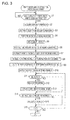
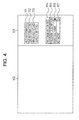
- step S1 the EPG acquisition section 12 or the iEPG acquisition section 14 determines whether the operation section 5 has been operated and an instruction has been given to display performer names, and the same processing is repeated until it is determined that the instruction has been given. For example, if an option tab 101 as shown in Fig. 4 is displayed and a button 116 on which "personal name" is described is operated, an instruction to display the performer names is assumed to have given, and the processing proceeds to step S2.
- Fig. 4 illustrates an example of an image displayed on the display section 6.
- a display field 102 of a normal broadcast program whose channel is selected by the tuner 26 is provided at the left side of an option tab 101.
- buttons 111 to 117 on which "HDD information”, “DVD information”, “image and sound quality setting”, “program recording”, “program description”, “personal name”, and “keyword” are displayed, respectively, are displayed.
- the button 111 is operated when information of a program recorded in the HDD (Hard Disk Drive) not shown in the figure is displayed.
- the button 112 is operated when program information recorded on a DVD inserted in a DVD (Digital Versatile Disk) drive not shown in the figure is displayed.
- the button 113 is operated when image and sound quality is set.
- the button 114 is operated when a program is recorded.
- the button 115 is operated when the program description, included in the EPG, of the program being displayed in the display field 102 is displayed.
- the button 116 is operated when the performer names, included in the EPG, of the program being displayed in the display field 102 is displayed as personal names.
- the button 117 is operated when the keywords, included in the EPG, of the program being displayed in the display field 102 is displayed.
- step S2 the EPG acquisition section 12 acquires the EPG information of a predetermined program included in the broadcast wave received by the antenna 2 through the receiving section 11, and supplies the information to the EPG-text-data extraction section 13 and the layout recognition section 20.
- the iEPG acquisition section 14 accesses the EPG distribution server 4 specified by a predetermined URL on the network 3, acquires the EPG information of a predetermined program, and supplies the information to the EPG-text-data extraction section 13 and the layout recognition section 20.
- step S3 the EPG-text-data extraction section 13 extracts text data from the supplied EPG information, and supplies the data to the morphological analysis section 15.
- step S4 the morphological analysis section 15 divides the text data of the supplied EPG information into words on the basis of the information stored in the dictionary storage section 16, identifies a part of speech of each word, and stores the result into the morphological analysis result buffer 17.
- a part of speech is a personal name out of a noun
- personal names for example, a famous actor name, a famous actress name, a famous actress name, a famous singer name, etc., it is possible to specify an attribute that the personal name is an actor name, an actress name, or a singer name.
- the morphological analysis section 15 not only identifies a grammatical part of speech for each word, but also classifies whether the word is a personal name, a product name, or a district name, etc., in the case of a noun. Further, in the case of a personal name, the morphological analysis section 15 classifies the word including an attribute on whether it is an actor name, an actress name, or a singer name in the case of a personal name.
- step S5 the layout recognition section 20 recognizes a layout on the basis of the display information of the EPG supplied from the EPG acquisition section 12 or the iEPG acquisition section 14, and supplies the recognition result to the division and extraction section 21.
- the layout recognition section 20 recognizes the layout as follows.
- the layout recognition section 20 recognizes, as a title display field, an uppermost area Z1 in which "YOU ARE ENCHANTED BY TAKO'S EYES ... YOU HAD A FATED ENCOUNTER ... " is displayed, Also, the layout recognition section 20 recognizes, as a story description field, an area Z2 in the middle, in which "A WOMAN LIKE AN ANGEL, WHOM MAIN-CHARACTER YAMADA OSAMU (INADA GORO) HAS ENCOUNTERED, IS, BELIEVE IT OR NOT, TAKO... A COLLEAGUE, TAKEUCHI TAKESHI (OOBAYASHI NANNRO) IS ... " is displayed.
- the layout recognition section 20 recognizes, as a program detailed description field, a lowermost area Z3, in which "PERFORMER INADA GORO (YAMADA OSAMU) MURASHITA TOMOKO (TAGUCHI MIYUKI) KANIHARA YURI (KANIHA TOMOMI) MEGUMU (YOYOGI SHOKO) SCRIPT MOTHER DIRECTOR MIKAMI YOSHISHIJE HASHIMOTO KEITA, AND OTHERS MUSIC MITSUBISHI ORIHITO THEME SONG: "LOVE FLOWER” KOUDA MI (RHYTHM ZOMBIE) PROGRAM DESCRIPTION THREE YEARS AGO FROM NOW, A COUPLE WAS BORN.
- the EPG display screen sometimes has a different order of the disposition of areas shown by the above-described areas Z1 to Z3, but has the areas having the similar structure.
- the layout recognition section 20 recognizes (estimates) these areas from the attributes.
- the layout recognition section 20 particularly recognizes the description field (an area Z3' described below) of "PERFORMER INADA GORO (YAMADA OSAMU) MURASHITA TOMOKO (TAGUCHI MIYUKI) KANIHARA YURI (KANIHARA TOMOMI) MEGUMU (YOYOGI SHOKO)" as a performer field in the area Z3. That is to say, in the case of Fig. 5 , the layout recognition section 20 recognizes a set of words including the description "PERFORMER” as a performer field.
- step S6 the division and extraction section 21 extracts the words inside of the performer field from the morphological analysis result buffer 17 on the basis of the layout information, and supplies the words to the inside performer-field determination section 24.
- step S7 the division and extraction section 21 extracts the words outside of the performer field from the morphological analysis result buffer 17 on the basis of the layout information, and supplies the words to the outside performer-field determination section 18.
- step S8 the inside performer-field determination section 24 performs inside performer-field determination processing, extracts the words of the performers from the words inside of the performer field, and stores the words into the performer-name extraction result storage section 22.
- step S31 the attribute determination section 31 determines whether each of the words is a word registered in an attribute, such as an actor, an actress, etc., for all the words supplied from the division and extraction section 21, and supplies the determination result to the pattern extraction section 32. That is to say, the attribute determination section 31 determines whether the supplied words in the performer field is a personal name having an attribute registered as a personal name, such as an actual actor, actress, etc., rather than a personal name of an attribute indicating a non-existent person, such as a role name, etc.
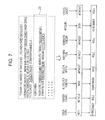
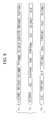
- step S32 the pattern extraction section 32 generates a determination pattern from the pattern indicating whether there is registration of a personal name on the basis of the determination result supplied from the attribute determination section 31. That is to say, for example, as shown in the upper part of Fig. 7 , when the performer field is shown by the area Z3', if the words "INADA GORO”, “MURASHITA TOMOKO”, and “MEGUMU” are recognized as actual personal names, and the others, “YAMADA OSAMU”, “TAGUCHI MIYUKI”, “KANIHARA YURI”, “KANIHARA TOMOMI”, and “YOYOGI SHOKO” are recognized as non-existent personal names, the pattern indicating whether registered or not becomes "WITH”, “WITHOUT”, “WITH”, “WITHOUT”, “WITHOUT”, “WITHOUT”, “WITH”, and “WITHOUT” as shown in the lower part of Fig.
- step S33 the similarity-distance calculation section 33 initializes a counter-i, which is not shown in the figure and for identifying the pattern, to 1.
- a pattern P2 which is the second pattern, becomes "PERFORMER”, "ROLE”, “PERFORMER”, “ROLE”, “PERFORMER”, “ROLE”, “PERFORMER”, and “ROLE”, and thus there are seven rights and one wrong.
- a pattern P3 which is the third pattern, becomes "ROLE”, "PERFORMER”, “ROLE”, “PERFORMER”, “ROLE”, “PERFORMER”, “ROLE”, and “PERFORMER”, and thus there are one right and seven wrongs.
- the similarity distance is not limited to the definition described above, and any other method may be used as long as the method shows a quantitative value of the similarity.
- any other method may be used as long as the method shows a quantitative value of the similarity.
- an edit graph algorithm, etc. may be used.
- the edit graph algorithm is, for example as shown in Fig. 9 . That is to say, in Fig. 9 , the diagrams are the cases where the counter-i is 1, 2, and 3 in sequence from left, respectively.
- the i-th pattern and the determination patterns are disposed on the X-axis and on the Y-axis, respectively, at individual intervals of one.
- a comparison is made between the patterns at the part having the same X-coordinate and Y-coordinate in sequence from the origin. If the parts match, a diagonal is drawn, and if the parts do not match, a line is drawn for one in horizontal direction to the X-direction and Y-direction, respectively.
- the number for a diagonal line is counted as 0, and the number for a horizontal direction line and the vertical direction line are counted as 1, respectively.
- the total count of these counts is the similarity distance by the edit graph algorithm.
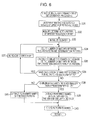
- step S36 the similarity-distance calculation section 33 determines whether the similarity distances have been calculated between all the patterns stored in the pattern storage section 19 and the determination pattern. For example, if all the similarity distances have not been calculated for all the patterns, the processing proceeds to step S37, the counter-i is incremented by 1, and the processing returns to step S34. That is to say, the processing from steps S34 to S37 is repeated until the calculation of the similarity distances for all the patterns have been completed. If the calculation of the similarity distances for all the patterns have been completed in step S37, in step S38, the pattern determination section 34 determines whether a minimum value of the calculated similarity distances is less than a predetermined threshold value. That is to say, a determination is made on whether the minimum similarity distance is a reliable value. In step S38, if the minimum similarity distance is less than the predetermined threshold value, that is to say, a reliable value, the processing proceeds to step S39.
- step S39 the pattern determination section 34 determines the pattern having a minimum similarity distance as a pattern to be used for extraction of performer names, and supplies the pattern information to the performer-name extraction section 35.
- the performer-name extraction section 35 extracts performer names from words supplied from the division and extraction section 21 on the basis of the pattern supplied from the pattern determination section 34. That is to say, for example, if the area Z3'in Fig.
- the performer-name extraction section 35 extracts "INADA GORO”, “MURASHITA TOMOKO”, “KANIHARA YURI”, and "MEGUMU” as performer names in sequence, and stores them into the performer-name extraction result storage section 22 in step 540.
- step S38 if the minimum similarity distance is greater than the predetermined value, and is determined not to be a reliable value, in step S41, the pattern determination section 34 extracts all the personal names as performer names using the first pattern, and in step S40, and stores the names into the performer-name extraction result storage section 22.
- the inside of the performer field is identified from the EPG display screen, the pattern of the performer names is determined, and the performer names are extracted.
- the pattern of the disposition of performer names in an area, which is a performer name field, having a high possibility that performer names are disposed in a relatively regular way.
- the reliability of the similarity distance is low, it becomes possible to prevent a failure in extracting performer names by extracting all the personal names inside of the performer field.
- step S9 the outside performer-field determination section 18 performs the outside performer-field determination processing, extracts the words of performers from the words other than the performer field, and stores the words into the performer-name extraction result storage section 22.
- step S51 the pattern extraction section 41 initializes the counter-i, which is for identifying a pattern and not shown in the figure, to 1.
- step S52 assuming of an attribute list pattern corresponding to the i-th pattern, the pattern extraction section 41 extracts the pattern from the morphological analysis result outside the performer field, which has been supplied in sequence from the division and extraction section 21, and supplies the pattern to the pattern comparison section 42. At this time, the pattern extraction section 41 informs the pattern comparison section 42 that the i-th pattern is extracted.
- step S53 the pattern comparison sec 42 compares the attribute of a word extracted by the pattern extraction section 41 in sequence from the morphological analysis result outside the performer field, which has been supplied by the division and extraction section 21, and a list pattern of the attributes in the i-th pattern.
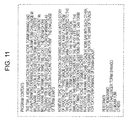
- Fig. 11 "THIS TIME, A NEWLYWED ACTION-TALENTED ACTOR, TORIMI SHINNGO AND A HEAVY-DRINKING EXPERIENCED ACTRESS, FUJIKAWA YUMI CHALLENGE Mr. MILLIONAIRE. ATTENTION IS FOCUSED ON TORIMI, WHO GOT A CENTER SHEET SUDDENLY. HE FINALY HAD A CHANCE TO DIRECTLY CONFRONT Mr. MILLIONAIRE, NOMITANMO BY THIRD TIME LUCKY.
- THE DREAM OF ONE THOUSAND YEN IS "HE GIVES DELUXE BICYCLES TO GROUP MEMBERS AS PRESENTS, AND GOES ON A CYCLING TOUR WITH THEM”.
- THE CHALLENGE OF TORIMI STARTS The DREAM OF ONE THOUSAND YEN is "HE GIVES DELUXE BICYCLES TO GROUP MEMBERS AS PRESENTS, AND GOES ON A CYCLING TOUR WITH THEM”.
- PERFORMER HOST NOMITANMO GUEST CHALLENGER: TORIMI SHINNGO FUJIKAWA YUMI OTHERS" is extracted as text data.
- the pattern extraction section 41 assumes that the string is "performer name”, “symbol”, and “performer name”, and extracts in sequence, first "NEWLYWED”, “ACTION”, and “-TALENTED”, next “ACTION”, “-TALENTED”, and “ACTOR”, and further "-TALENTED”, “ACTOR”, and “ ⁇ ”, that is to say, extracts three consecutive words as a pattern, and supplies them to the pattern comparison section 42.
- the pattern comparison section 42 compares a list pattern of the attributes corresponding to these three words, which has been supplied from the pattern extraction section 41, and a list pattern of the attributes in the first pattern.
- step S54 the pattern comparison section 42 determines whether list patterns match. That is to say, for example, in the case of "A NEWLYWED ACTION-TALENTED ACTOR, TORIMI SHINNGO AND A HEAVY-DRINKING EXPERIENCED ACTRESS, FUJIKAWA YUMI", personal names are only “TORIMI SHINNGO” and “FUJIKAWA YUMI”. Even if “TORIMI SHINNGO” and “FUJIKAWA YUMI” are recognized as an actor name and an actress name, respectively, the pattern of "performer”, “symbol”, and “performer” is not applied, and thus a determination is made that they do not match. Accordingly, the processing proceeds to step S55.
- step S55 the pattern comparison section 42 determines whether all the patterns stored in the pattern storage section 19 have been tested. If not tested, the pattern extraction section 41 increments the counter-i by 1 in step S56, and the processing returns to step S52.
- the pattern extraction section 41 assumes that the string is "role name” and “performer name”, and first extracts PERFORMER”, “HOST”, and “e”, next extracts "HOST”, “:”, and “NOMITANMO”, and further extracts ":”, “NOMITANMO”, and “GUEST”, that is to say, extracts three consecutive words in sequence, and supplies them to the pattern comparison section 42.
- step S54 the pattern comparison section 42 regards that as matched with the third pattern, and thus the processing proceeds to step S55.
- step S55 the pattern comparison section 42 instructs the performer-name extraction section 43 to extract performer names with the matched pattern.
- the performer-name extraction section 43 extracts performer names on the basis of the third pattern, "ROLE NAME”, “SYMBOL”, and "PERFORMER NAME", and stores them into the performer-name extraction result storage section 22. Then, the processing proceeds to step S56.
- step S56 when it is determined that all the patterns have been tested, that is to say, in this case, when the counter-i is greater than 8, because the counter-i indicating the number of list patterns counts up to 8, in step S58, the pattern comparison section 42 determines whether there is any pattern to match for all the pattern. In this case, the third pattern is matched, and thus the processing of step S59 is skipped.
- step S58 if no pattern is matched, in step S59, the pattern comparison section 42 instructs the performer-name extraction section 43 to extract performer names with the first pattern. That is to say, when no pattern is matched, personal names as performers are not extracted, and thus as long as a list pattern being sandwiched by some symbol, any string that can be read as a personal name is all read.
- the text data is either the first pattern, namely "performer name”, “symbol”, and “performer name”, or the second pattern, "performer name”, "symbol”, and "role name” from the display of the lower part "KUROISHI SUZUKO : TANIGAWA KYOKOKUZUYAMA HARUKI : ODA KEISUKESHIMANAKA SAORI : OOBAYASHI MAOOOKAGE TAMIO : HIGASHIMURA MASAHIKOFUKAKURA MICHIRU : SACHIKOKASHIWAMOTO MAKI : OOIKE EIKOOOKAGE TAKANOBU : IWAI MASANORIKUROISHI TORU : AMANO HIROKIKUZUYAMA MICHIZO : NAKADUME ISAO".
- a personal name can be recognized either as a "role name” or "performer name".
- the text data is actually the third pattern
- "ODA KEISUKE” is recognized as a personal name of a famous actor recognized by the morphological analysis processing as an actor name
- at least "KUZUYAMA HARUKI”, ":”, and "ODA KEISUKE” is recognized as "role name", "symbol”, and "performer name”
- TANIGAWA KYOKO "ODA KEISUKE”, "OOBAYASHI MAO”, "HIGASHIMURA MASAHIKO”, “SACHIKO”, “OOIKE EIKO”, “IWAI MASANORI”, “AMANO HIROKIKU”, and "NAKADUME ISAO” are extracted as performer names.
- step S59 all the personal names, "KUROISHI SUZUKO", “TANIGAWA KYOKO”, “KUZUYAMA HARUKI”, “ODA KEISUKE”, “SHIMANAKA SAORI”, “OOBAYASHI MAO”, “OOKAGE TAMIO”, “HIGASHIMURA MASAHIKO”, “FUKAKURA MICHIRU”, “SACHIKO”, “KASHIWAMOTO MAKI”, “OOIKE EIKO”, “OOKAGE TAKANOBU”, “IWAI MASANORI2, "KUROISHI TORU”, “AMANO HIROKI”, “KUZUYAMA MICHIZO”, and “NAKADUME ISAO” are extracted as performer names. In this case, there is a possibility of including an error as performer names. However, at least all the performer names are displayed.
- a list pattern of attributes by which performers are displayed is set in advance, and a comparison is made between the morphological analysis result and the set list pattern of attributes.
- step S10 the output section 23 reads the performer names stored in the performer-name extraction result storage section 22, and displays them in the display area 6.
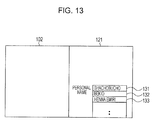
- the display section 6 displays performer names as personal names, for example, by the screen shown in Fig. 13 .
- a personal-name display field 121 is disposed at the right side of the display field 102 of a normal broadcast program, and the buttons 131 to 133, which are operated when selecting the extracted personal names are disposed corresponding to the extracted performer names.
- a button 131 is disposed for the performer name, "SHACHOBUCHO”
- a button 132 is disposed for the performer name, "BEKIO”
- a button 133 is disposed for the performer name, "HENNA EMIRI”.
- step S11 the program search section 25 determines whether a personal name that is a performer name is selected by any one of the buttons 131 to 133 having been operated by the operation of the operation section 5. For example, in Fig. 13 , when the button 131 is operated by the operation section 5 to select the keyword "SHACHOBUCHO", in step S12, the program search section 25 searches the program using the keyword "SHACHOBUCHO" on the EPG information supplied from the EPG acquisition section 12 or the iEPG acquisition section 14 (searches the program information of the EPG information for the program including the keyword "SHACHOBUCHO"), and displays the search result onto the display section 6, for example as shown in Fig. 14 in step S13. Also, when no selection is made in step S11, the processing of steps 12 and 13 is skipped.
- a selection keyword tab 151 is disposed, and the selected keyword is shown.
- "SHACHOBUCHO" which is the selected keyword, is shown.
- a search-result display field 152 is disposed, and the programs searched by the selected keyword are displayed.
- “TOMORROW 1:05AM MOVIE THEATER “OVER THE COUNTER”” is displayed.
- "2:30AM howbiz Extra #201” is displayed.
- "0:00AM INDIES MOVIE FESTIVAL - VOLUNTARY MOVIE” is displayed.
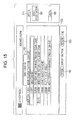
- step S14 the program search section 25 determines whether the operation section 5 has been operated to instruct word registration. For example, when the button 154 is operated by the operation section 5, an option-operation dialog box 171 is displayed as shown in Fig. 15 , further, a button 181 displaying "word registration" in the option-operation dialog box 171 is pressed and the word registration is instructed, in step 515, the program search section 25 stores "SHACHOBUCHO", which is a currently selected word, into the performer-name extraction result storage section 22. By this processing, the performer name for which word registration has been instructed is consistently displayed in the personal name display field 121 even though the name is not included in the EPG data.
- the option-operation dialog box 171 in Fig. 15 is provided with the button 181 to be operated when "word registration" is instructed and a button 182 to be operated when the option operation is canceled.
- step S14 if the word registration is not instructed, the processing of step S15 is skipped.
- step S16 a determination is made on whether end has been instructed or not. If not instructed, the processing returns to step S11. If end has been instructed, the processing is terminated.
- the area of the performer field is identified from the layout information on the basis of the information included in the Electric Program Guide (EPG), and the information inside of the performer field is subjected to the pattern analysis by the disposition of information including a performer name and a role name and without including a symbol, because there is a high possibility of having regular disposition of performer names.
- the performer names are extracted on the basis of the analyzed pattern, and thus it becomes possible to extract performer names with higher precision.
- the information outside of the performer field is subjected to the pattern analysis on the basis of the disposition of a performer, a role, and additionally a symbol, because there is a possibility of not having regular disposition of performer names compared with the inside of the performer field.
- the performer names are extracted on the basis of the analyzed pattern, and thus it becomes possible to extract performer names with higher precision.
- meta-data of a content is an EPG.
- the meta-data may be other than an EPG as long as meta-data is additional information of a content.
- the meta-data may be an ECG (Electronic Contents Guide), etc.
- the content is a television program.
- the content may be other than a television program as long as a content has meta-data.
- the content may be a moving image content or a music content, which is downloaded through a network.
- the content may be a moving image content or a music content, which is stored in a data storage medium, such as a DVD (Digital Versatile Disc), a BD (Blu-Ray Disc), etc.
- the above-described series of processing can be executed by hardware or can be executed by software.
- the programs constituting the software are built in a dedicated hardware of a computer.
- the various programs are installed, for example in a general-purpose personal computer capable of executing various functions from a program recording medium.
- Fig. 16 illustrates an example of a configuration of a general-purpose personal computer.
- This personal computer includes a CPU (Central Processing Unit) 1001.
- An input/output interface 1005 is connected to the CPU 1001 through a bus 1004.
- a ROM (Read Only Memory) 1002 and a RAM (Random Access Memory) 1003 are connected to the bus 1004.
- An input section 1006 including an input device, such as a keyboard for a user inputting operation commands, a mouse, etc., an output section 1007 for displaying a processing operation screen and an image of a processing result, a storage section 1008 including a hard disk drive storing programs and various data, and a communication section 1009 including a LAN (Local Area Network) adapter, etc., and performing communication processing through a network represented by the Internet are connected to the input/output interface 1005.
- an input device such as a keyboard for a user inputting operation commands, a mouse, etc.
- an output section 1007 for displaying a processing operation screen and an image of a processing result
- a storage section 1008 including a hard disk drive storing programs and various data
- a communication section 1009 including a LAN (Local Area Network) adapter, etc., and performing communication processing through a network represented by the Internet are connected to the input/output interface 1005.
- LAN Local Area Network
- a drive 1010 for reading data from and writing data to a removable medium 1011 such as a magnetic disk (including a flexible disk), an optical disc (including a CD-ROM (Compact Disc-Read Only Memory) and a DVD (Digital Versatile Disc)), a magneto-optical disc (including MD (Mini Disc)), or a semiconductor memory, etc., is connected.
- a magnetic disk including a flexible disk
- an optical disc including a CD-ROM (Compact Disc-Read Only Memory) and a DVD (Digital Versatile Disc)
- MD Mini Disc
- semiconductor memory etc.
- the CPU 1001 performs various kinds of processing in accordance with the programs stored in the ROM 1002, or the programs read from the removable medium 1011, such as a magnetic disk, an optical disc, a magneto-optical disc, a semiconductor memory, or the like, installed in the storage section 1008, and loaded from the storage section 1008 into the RAM 1003.
- the RAM 1003 also stores necessary data for the CPU 1001 to perform various kinds of processing appropriately.
- the steps describing the programs include the processing to be performed in time series in accordance with the described sequence as a matter of course. Also, the steps include the processing which is not necessarily executed in time series, but is executed in parallel or individually.
Landscapes
- Engineering & Computer Science (AREA)
- Theoretical Computer Science (AREA)
- Library & Information Science (AREA)
- Multimedia (AREA)
- Data Mining & Analysis (AREA)
- Databases & Information Systems (AREA)
- Physics & Mathematics (AREA)
- General Engineering & Computer Science (AREA)
- General Physics & Mathematics (AREA)
- Information Retrieval, Db Structures And Fs Structures Therefor (AREA)
Applications Claiming Priority (3)
| Application Number | Priority Date | Filing Date | Title |
|---|---|---|---|
| JP2007051354 | 2007-03-01 | ||
| JP2007205083 | 2007-08-07 | ||
| JP2007303993A JP5051448B2 (ja) | 2007-08-07 | 2007-11-26 | 情報処理装置および方法、並びにプログラム |
Publications (1)
| Publication Number | Publication Date |
|---|---|
| EP1965321A1 true EP1965321A1 (de) | 2008-09-03 |
Family
ID=39539659
Family Applications (1)
| Application Number | Title | Priority Date | Filing Date |
|---|---|---|---|
| EP08152067A Withdrawn EP1965321A1 (de) | 2007-03-01 | 2008-02-28 | Informationsverarbeitungsvorrichtung, -verfahren und -programm |
Country Status (2)
| Country | Link |
|---|---|
| US (1) | US7949667B2 (de) |
| EP (1) | EP1965321A1 (de) |
Cited By (2)
| Publication number | Priority date | Publication date | Assignee | Title |
|---|---|---|---|---|
| CN113626385A (zh) * | 2021-07-07 | 2021-11-09 | 厦门市美亚柏科信息股份有限公司 | 一种基于文本数据读取的方法和系统 |
| US11341190B2 (en) | 2020-01-06 | 2022-05-24 | International Business Machines Corporation | Name matching using enhanced name keys |
Families Citing this family (2)
| Publication number | Priority date | Publication date | Assignee | Title |
|---|---|---|---|---|
| JP2011109469A (ja) * | 2009-11-18 | 2011-06-02 | Canon Inc | コンテンツ受信装置及びコンテンツ受信装置の制御方法 |
| JP2011160278A (ja) * | 2010-02-02 | 2011-08-18 | Sony Corp | 情報処理装置、情報処理方法、およびプログラム |
Citations (10)
| Publication number | Priority date | Publication date | Assignee | Title |
|---|---|---|---|---|
| US5225981A (en) | 1986-10-03 | 1993-07-06 | Ricoh Company, Ltd. | Language analyzer for morphemically and syntactically analyzing natural languages by using block analysis and composite morphemes |
| US5819265A (en) * | 1996-07-12 | 1998-10-06 | International Business Machines Corporation | Processing names in a text |
| WO2001003425A1 (en) * | 1999-07-01 | 2001-01-11 | Koninklijke Philips Electronics N.V. | Method and apparatus for capturing broadcast epg data for program title display |
| US6608930B1 (en) * | 1999-08-09 | 2003-08-19 | Koninklijke Philips Electronics N.V. | Method and system for analyzing video content using detected text in video frames |
| JP2004134858A (ja) | 2002-10-08 | 2004-04-30 | Funai Electric Co Ltd | 放送受信装置及び番組検索装置 |
| US6925650B1 (en) | 2000-08-21 | 2005-08-02 | Hughes Electronics Corporation | Method and apparatus for automated creation of linking information |
| JP2006339947A (ja) | 2005-06-01 | 2006-12-14 | Sony Corp | 情報処理装置、情報処理方法および情報処理プログラム |
| JP2007051354A (ja) | 2005-08-19 | 2007-03-01 | Nissan Motor Co Ltd | 歯車の製造方法および製造装置 |
| JP2007205083A (ja) | 2006-02-03 | 2007-08-16 | Kobe Kizai:Kk | コンクリート壁構築装置 |
| JP2007303993A (ja) | 2006-05-12 | 2007-11-22 | Toyota Motor Corp | 干渉発色塗料の光学特性を決定する方法 |
Family Cites Families (5)
| Publication number | Priority date | Publication date | Assignee | Title |
|---|---|---|---|---|
| US20030229898A1 (en) * | 2002-06-05 | 2003-12-11 | Babu Suresh P. | Multiple on-demand media vendor integration |
| US20050125419A1 (en) * | 2002-09-03 | 2005-06-09 | Fujitsu Limited | Search processing system, its search server, client, search processing method, program, and recording medium |
| EP1568219A2 (de) * | 2002-11-08 | 2005-08-31 | Koninklijke Philips Electronics N.V. | Empfehlungssystem und entsprechendes verfahren zur bereitstellung von mediainhalt |
| US7243085B2 (en) * | 2003-04-16 | 2007-07-10 | Sony Corporation | Hybrid personalization architecture |
| JP2007150724A (ja) * | 2005-11-28 | 2007-06-14 | Toshiba Corp | 映像視聴支援システムおよび方法 |
-
2008
- 2008-02-28 EP EP08152067A patent/EP1965321A1/de not_active Withdrawn
- 2008-02-29 US US12/074,230 patent/US7949667B2/en not_active Expired - Fee Related
Patent Citations (10)
| Publication number | Priority date | Publication date | Assignee | Title |
|---|---|---|---|---|
| US5225981A (en) | 1986-10-03 | 1993-07-06 | Ricoh Company, Ltd. | Language analyzer for morphemically and syntactically analyzing natural languages by using block analysis and composite morphemes |
| US5819265A (en) * | 1996-07-12 | 1998-10-06 | International Business Machines Corporation | Processing names in a text |
| WO2001003425A1 (en) * | 1999-07-01 | 2001-01-11 | Koninklijke Philips Electronics N.V. | Method and apparatus for capturing broadcast epg data for program title display |
| US6608930B1 (en) * | 1999-08-09 | 2003-08-19 | Koninklijke Philips Electronics N.V. | Method and system for analyzing video content using detected text in video frames |
| US6925650B1 (en) | 2000-08-21 | 2005-08-02 | Hughes Electronics Corporation | Method and apparatus for automated creation of linking information |
| JP2004134858A (ja) | 2002-10-08 | 2004-04-30 | Funai Electric Co Ltd | 放送受信装置及び番組検索装置 |
| JP2006339947A (ja) | 2005-06-01 | 2006-12-14 | Sony Corp | 情報処理装置、情報処理方法および情報処理プログラム |
| JP2007051354A (ja) | 2005-08-19 | 2007-03-01 | Nissan Motor Co Ltd | 歯車の製造方法および製造装置 |
| JP2007205083A (ja) | 2006-02-03 | 2007-08-16 | Kobe Kizai:Kk | コンクリート壁構築装置 |
| JP2007303993A (ja) | 2006-05-12 | 2007-11-22 | Toyota Motor Corp | 干渉発色塗料の光学特性を決定する方法 |
Cited By (3)
| Publication number | Priority date | Publication date | Assignee | Title |
|---|---|---|---|---|
| US11341190B2 (en) | 2020-01-06 | 2022-05-24 | International Business Machines Corporation | Name matching using enhanced name keys |
| CN113626385A (zh) * | 2021-07-07 | 2021-11-09 | 厦门市美亚柏科信息股份有限公司 | 一种基于文本数据读取的方法和系统 |
| CN113626385B (zh) * | 2021-07-07 | 2022-07-15 | 厦门市美亚柏科信息股份有限公司 | 一种基于文本数据读取的方法和系统 |
Also Published As
| Publication number | Publication date |
|---|---|
| US20090077067A1 (en) | 2009-03-19 |
| US7949667B2 (en) | 2011-05-24 |
Similar Documents
| Publication | Publication Date | Title |
|---|---|---|
| JP4981026B2 (ja) | 複合ニュース・ストーリーの合成 | |
| JP6824332B2 (ja) | 動画サービス提供方法およびこれを用いるサービスサーバ | |
| KR100828166B1 (ko) | 동영상의 음성 인식과 자막 인식을 통한 메타데이터 추출방법, 메타데이터를 이용한 동영상 탐색 방법 및 이를기록한 기록매체 | |
| US6751776B1 (en) | Method and apparatus for personalized multimedia summarization based upon user specified theme | |
| EP1692629B1 (de) | System und verfahren zur integrierten analyse von intrinsischen und extrinsischen audiovisuellen daten | |
| JP4873018B2 (ja) | データ処理装置、データ処理方法、及び、プログラム | |
| Li et al. | Content-based movie analysis and indexing based on audiovisual cues | |
| US7769761B2 (en) | Information processing apparatus, method, and program product | |
| US20030065655A1 (en) | Method and apparatus for detecting query-driven topical events using textual phrases on foils as indication of topic | |
| EP2273490A1 (de) | Thema-spezifische Sprachmodellgenerierung | |
| US8406606B2 (en) | Playback apparatus and playback method | |
| JP3545824B2 (ja) | データ検索装置 | |
| JP5278425B2 (ja) | 映像分割装置、方法及びプログラム | |
| US7949667B2 (en) | Information processing apparatus, method, and program | |
| JP2020129377A (ja) | コンテンツ検索方法、装置、機器、および記憶媒体 | |
| JP5051448B2 (ja) | 情報処理装置および方法、並びにプログラム | |
| Tsoneva et al. | Automated summarization of narrative video on a semantic level | |
| EP1197884A2 (de) | Verfahren und Vorrichtung zum Erstellen und zum Navigieren von Audio-Dokumenten | |
| Kim et al. | Summarization of news video and its description for content‐based access | |
| CN100538696C (zh) | 用于本征与非本征视听数据的综合分析的系统和方法 | |
| Bost et al. | Serial speakers: a dataset of tv series | |
| CN101257359B (zh) | 信息处理装置和方法 | |
| KR102889621B1 (ko) | 동영상 인덱싱 장치 및 방법 | |
| Sano et al. | Automatic real-time selection and annotation of highlight scenes in televised soccer | |
| KR20260001646A (ko) | 음성 인식 및 요약 기술을 활용한 요약 콘텐츠 생성 방법 및 이를 위한 시스템 |
Legal Events
| Date | Code | Title | Description |
|---|---|---|---|
| PUAI | Public reference made under article 153(3) epc to a published international application that has entered the european phase |
Free format text: ORIGINAL CODE: 0009012 |
|
| AK | Designated contracting states |
Kind code of ref document: A1 Designated state(s): AT BE BG CH CY CZ DE DK EE ES FI FR GB GR HR HU IE IS IT LI LT LU LV MC MT NL NO PL PT RO SE SI SK TR |
|
| AX | Request for extension of the european patent |
Extension state: AL BA MK RS |
|
| 17P | Request for examination filed |
Effective date: 20090223 |
|
| AKX | Designation fees paid |
Designated state(s): DE FR GB |
|
| 17Q | First examination report despatched |
Effective date: 20090415 |
|
| STAA | Information on the status of an ep patent application or granted ep patent |
Free format text: STATUS: THE APPLICATION IS DEEMED TO BE WITHDRAWN |
|
| 18D | Application deemed to be withdrawn |
Effective date: 20150901 |