EP1964675A1 - Infrared laser-sensitive planographic printing plate precursor - Google Patents
Infrared laser-sensitive planographic printing plate precursor Download PDFInfo
- Publication number
- EP1964675A1 EP1964675A1 EP08003363A EP08003363A EP1964675A1 EP 1964675 A1 EP1964675 A1 EP 1964675A1 EP 08003363 A EP08003363 A EP 08003363A EP 08003363 A EP08003363 A EP 08003363A EP 1964675 A1 EP1964675 A1 EP 1964675A1
- Authority
- EP
- European Patent Office
- Prior art keywords
- printing plate
- methacrylate
- planographic printing
- acrylate
- group
- Prior art date
- Legal status (The legal status is an assumption and is not a legal conclusion. Google has not performed a legal analysis and makes no representation as to the accuracy of the status listed.)
- Granted
Links
- 238000007639 printing Methods 0.000 title claims abstract description 113
- 239000002243 precursor Substances 0.000 title claims abstract description 74
- 239000010410 layer Substances 0.000 claims abstract description 147
- 229920001577 copolymer Polymers 0.000 claims abstract description 64
- 125000000217 alkyl group Chemical group 0.000 claims abstract description 58
- 125000004432 carbon atom Chemical group C* 0.000 claims abstract description 54
- NIXOWILDQLNWCW-UHFFFAOYSA-M Acrylate Chemical compound [O-]C(=O)C=C NIXOWILDQLNWCW-UHFFFAOYSA-M 0.000 claims abstract description 48
- 239000002253 acid Substances 0.000 claims abstract description 44
- 239000000178 monomer Substances 0.000 claims abstract description 37
- CERQOIWHTDAKMF-UHFFFAOYSA-M Methacrylate Chemical compound CC(=C)C([O-])=O CERQOIWHTDAKMF-UHFFFAOYSA-M 0.000 claims abstract description 32
- 230000000379 polymerizing effect Effects 0.000 claims abstract description 30
- 239000002250 absorbent Substances 0.000 claims abstract description 22
- 230000002745 absorbent Effects 0.000 claims abstract description 22
- 230000005660 hydrophilic surface Effects 0.000 claims abstract description 17
- 238000007334 copolymerization reaction Methods 0.000 claims abstract description 9
- 239000002356 single layer Substances 0.000 claims abstract description 9
- 150000001875 compounds Chemical class 0.000 claims description 81
- 229920000642 polymer Polymers 0.000 claims description 64
- 229920005989 resin Polymers 0.000 claims description 47
- 239000011347 resin Substances 0.000 claims description 47
- 229920003986 novolac Polymers 0.000 claims description 13
- 230000008961 swelling Effects 0.000 claims description 2
- 125000002256 xylenyl group Chemical class C1(C(C=CC=C1)C)(C)* 0.000 claims 2
- 239000000243 solution Substances 0.000 description 79
- 229910052782 aluminium Inorganic materials 0.000 description 56
- 238000000034 method Methods 0.000 description 52
- XAGFODPZIPBFFR-UHFFFAOYSA-N aluminium Chemical compound [Al] XAGFODPZIPBFFR-UHFFFAOYSA-N 0.000 description 47
- 239000000203 mixture Substances 0.000 description 46
- 239000000975 dye Substances 0.000 description 45
- -1 alkyl phenol Chemical compound 0.000 description 43
- 239000000049 pigment Substances 0.000 description 42
- 238000011282 treatment Methods 0.000 description 40
- ISWSIDIOOBJBQZ-UHFFFAOYSA-N Phenol Natural products OC1=CC=CC=C1 ISWSIDIOOBJBQZ-UHFFFAOYSA-N 0.000 description 29
- 238000000576 coating method Methods 0.000 description 27
- 239000011248 coating agent Substances 0.000 description 26
- ZWEHNKRNPOVVGH-UHFFFAOYSA-N 2-Butanone Chemical compound CCC(C)=O ZWEHNKRNPOVVGH-UHFFFAOYSA-N 0.000 description 24
- CERQOIWHTDAKMF-UHFFFAOYSA-N Methacrylic acid Chemical compound CC(=C)C(O)=O CERQOIWHTDAKMF-UHFFFAOYSA-N 0.000 description 22
- XLYOFNOQVPJJNP-UHFFFAOYSA-N water Substances O XLYOFNOQVPJJNP-UHFFFAOYSA-N 0.000 description 22
- HEMHJVSKTPXQMS-UHFFFAOYSA-M Sodium hydroxide Chemical compound [OH-].[Na+] HEMHJVSKTPXQMS-UHFFFAOYSA-M 0.000 description 21
- SOGAXMICEFXMKE-UHFFFAOYSA-N Butylmethacrylate Chemical compound CCCCOC(=O)C(C)=C SOGAXMICEFXMKE-UHFFFAOYSA-N 0.000 description 20
- 230000002378 acidificating effect Effects 0.000 description 18
- 238000007788 roughening Methods 0.000 description 18
- 150000003839 salts Chemical class 0.000 description 15
- 235000000346 sugar Nutrition 0.000 description 15
- VVQNEPGJFQJSBK-UHFFFAOYSA-N Methyl methacrylate Chemical compound COC(=O)C(C)=C VVQNEPGJFQJSBK-UHFFFAOYSA-N 0.000 description 14
- 239000003513 alkali Substances 0.000 description 14
- 239000007864 aqueous solution Substances 0.000 description 13
- 239000000470 constituent Substances 0.000 description 13
- 230000008569 process Effects 0.000 description 13
- WSFSSNUMVMOOMR-UHFFFAOYSA-N Formaldehyde Chemical compound O=C WSFSSNUMVMOOMR-UHFFFAOYSA-N 0.000 description 12
- OKKJLVBELUTLKV-UHFFFAOYSA-N Methanol Chemical compound OC OKKJLVBELUTLKV-UHFFFAOYSA-N 0.000 description 12
- KWYUFKZDYYNOTN-UHFFFAOYSA-M Potassium hydroxide Chemical compound [OH-].[K+] KWYUFKZDYYNOTN-UHFFFAOYSA-M 0.000 description 12
- 238000001035 drying Methods 0.000 description 12
- 238000005507 spraying Methods 0.000 description 12
- 239000002585 base Substances 0.000 description 11
- 239000003795 chemical substances by application Substances 0.000 description 11
- IJKVHSBPTUYDLN-UHFFFAOYSA-N dihydroxy(oxo)silane Chemical compound O[Si](O)=O IJKVHSBPTUYDLN-UHFFFAOYSA-N 0.000 description 11
- 239000003921 oil Substances 0.000 description 11
- 235000019198 oils Nutrition 0.000 description 11
- 230000001603 reducing effect Effects 0.000 description 11
- 239000000126 substance Substances 0.000 description 11
- 239000004094 surface-active agent Substances 0.000 description 11
- 125000002843 carboxylic acid group Chemical group 0.000 description 10
- SUPCQIBBMFXVTL-UHFFFAOYSA-N ethyl 2-methylprop-2-enoate Chemical compound CCOC(=O)C(C)=C SUPCQIBBMFXVTL-UHFFFAOYSA-N 0.000 description 10
- 125000005462 imide group Chemical group 0.000 description 10
- 150000003739 xylenols Chemical class 0.000 description 10
- 239000004925 Acrylic resin Substances 0.000 description 9
- 229920000178 Acrylic resin Polymers 0.000 description 9
- LFQSCWFLJHTTHZ-UHFFFAOYSA-N Ethanol Chemical compound CCO LFQSCWFLJHTTHZ-UHFFFAOYSA-N 0.000 description 9
- NBIIXXVUZAFLBC-UHFFFAOYSA-N Phosphoric acid Chemical group OP(O)(O)=O NBIIXXVUZAFLBC-UHFFFAOYSA-N 0.000 description 9
- VYPSYNLAJGMNEJ-UHFFFAOYSA-N Silicium dioxide Chemical compound O=[Si]=O VYPSYNLAJGMNEJ-UHFFFAOYSA-N 0.000 description 9
- ZMANZCXQSJIPKH-UHFFFAOYSA-N Triethylamine Chemical compound CCN(CC)CC ZMANZCXQSJIPKH-UHFFFAOYSA-N 0.000 description 9
- 125000003118 aryl group Chemical group 0.000 description 9
- 230000000052 comparative effect Effects 0.000 description 9
- 238000004090 dissolution Methods 0.000 description 9
- 239000000463 material Substances 0.000 description 9
- FQPSGWSUVKBHSU-UHFFFAOYSA-N methacrylamide Chemical compound CC(=C)C(N)=O FQPSGWSUVKBHSU-UHFFFAOYSA-N 0.000 description 9
- 239000010802 sludge Substances 0.000 description 9
- 125000001424 substituent group Chemical group 0.000 description 9
- QGKMIGUHVLGJBR-UHFFFAOYSA-M (4z)-1-(3-methylbutyl)-4-[[1-(3-methylbutyl)quinolin-1-ium-4-yl]methylidene]quinoline;iodide Chemical compound [I-].C12=CC=CC=C2N(CCC(C)C)C=CC1=CC1=CC=[N+](CCC(C)C)C2=CC=CC=C12 QGKMIGUHVLGJBR-UHFFFAOYSA-M 0.000 description 8
- HRPVXLWXLXDGHG-UHFFFAOYSA-N Acrylamide Chemical compound NC(=O)C=C HRPVXLWXLXDGHG-UHFFFAOYSA-N 0.000 description 8
- GRYLNZFGIOXLOG-UHFFFAOYSA-N Nitric acid Chemical compound O[N+]([O-])=O GRYLNZFGIOXLOG-UHFFFAOYSA-N 0.000 description 8
- QAOWNCQODCNURD-UHFFFAOYSA-N Sulfuric acid Chemical compound OS(O)(=O)=O QAOWNCQODCNURD-UHFFFAOYSA-N 0.000 description 8
- 235000010724 Wisteria floribunda Nutrition 0.000 description 8
- 229910052910 alkali metal silicate Inorganic materials 0.000 description 8
- 239000003792 electrolyte Substances 0.000 description 8
- 125000004435 hydrogen atom Chemical group [H]* 0.000 description 8
- 229910017604 nitric acid Inorganic materials 0.000 description 8
- 239000003960 organic solvent Substances 0.000 description 8
- 239000002904 solvent Substances 0.000 description 8
- RUMACXVDVNRZJZ-UHFFFAOYSA-N 2-methylpropyl 2-methylprop-2-enoate Chemical compound CC(C)COC(=O)C(C)=C RUMACXVDVNRZJZ-UHFFFAOYSA-N 0.000 description 7
- 238000011156 evaluation Methods 0.000 description 7
- 239000007788 liquid Substances 0.000 description 7
- 238000005498 polishing Methods 0.000 description 7
- 235000011121 sodium hydroxide Nutrition 0.000 description 7
- 239000007787 solid Substances 0.000 description 7
- 239000007921 spray Substances 0.000 description 7
- 238000005406 washing Methods 0.000 description 7
- ARXJGSRGQADJSQ-UHFFFAOYSA-N 1-methoxypropan-2-ol Chemical compound COCC(C)O ARXJGSRGQADJSQ-UHFFFAOYSA-N 0.000 description 6
- QWBBPBRQALCEIZ-UHFFFAOYSA-N 2,3-dimethylphenol Chemical compound CC1=CC=CC(O)=C1C QWBBPBRQALCEIZ-UHFFFAOYSA-N 0.000 description 6
- CSCPPACGZOOCGX-UHFFFAOYSA-N Acetone Chemical compound CC(C)=O CSCPPACGZOOCGX-UHFFFAOYSA-N 0.000 description 6
- 229920002134 Carboxymethyl cellulose Polymers 0.000 description 6
- VEXZGXHMUGYJMC-UHFFFAOYSA-N Hydrochloric acid Chemical compound Cl VEXZGXHMUGYJMC-UHFFFAOYSA-N 0.000 description 6
- WMFOQBRAJBCJND-UHFFFAOYSA-M Lithium hydroxide Chemical compound [Li+].[OH-] WMFOQBRAJBCJND-UHFFFAOYSA-M 0.000 description 6
- BAPJBEWLBFYGME-UHFFFAOYSA-N Methyl acrylate Chemical compound COC(=O)C=C BAPJBEWLBFYGME-UHFFFAOYSA-N 0.000 description 6
- ZMXDDKWLCZADIW-UHFFFAOYSA-N N,N-Dimethylformamide Chemical compound CN(C)C=O ZMXDDKWLCZADIW-UHFFFAOYSA-N 0.000 description 6
- 239000011230 binding agent Substances 0.000 description 6
- 235000010948 carboxy methyl cellulose Nutrition 0.000 description 6
- 238000011161 development Methods 0.000 description 6
- UAOMVDZJSHZZME-UHFFFAOYSA-N diisopropylamine Chemical compound CC(C)NC(C)C UAOMVDZJSHZZME-UHFFFAOYSA-N 0.000 description 6
- 238000005530 etching Methods 0.000 description 6
- IWDCLRJOBJJRNH-UHFFFAOYSA-N p-cresol Chemical compound CC1=CC=C(O)C=C1 IWDCLRJOBJJRNH-UHFFFAOYSA-N 0.000 description 6
- 230000035945 sensitivity Effects 0.000 description 6
- 125000000542 sulfonic acid group Chemical group 0.000 description 6
- HIDBROSJWZYGSZ-UHFFFAOYSA-N 1-phenylpyrrole-2,5-dione Chemical compound O=C1C=CC(=O)N1C1=CC=CC=C1 HIDBROSJWZYGSZ-UHFFFAOYSA-N 0.000 description 5
- KXGFMDJXCMQABM-UHFFFAOYSA-N 2-methoxy-6-methylphenol Chemical compound [CH]OC1=CC=CC([CH])=C1O KXGFMDJXCMQABM-UHFFFAOYSA-N 0.000 description 5
- LYCAIKOWRPUZTN-UHFFFAOYSA-N Ethylene glycol Chemical compound OCCO LYCAIKOWRPUZTN-UHFFFAOYSA-N 0.000 description 5
- 239000004793 Polystyrene Substances 0.000 description 5
- JUJWROOIHBZHMG-UHFFFAOYSA-N Pyridine Chemical compound C1=CC=NC=C1 JUJWROOIHBZHMG-UHFFFAOYSA-N 0.000 description 5
- CDBYLPFSWZWCQE-UHFFFAOYSA-L Sodium Carbonate Chemical compound [Na+].[Na+].[O-]C([O-])=O CDBYLPFSWZWCQE-UHFFFAOYSA-L 0.000 description 5
- 150000001252 acrylic acid derivatives Chemical class 0.000 description 5
- 125000005396 acrylic acid ester group Chemical group 0.000 description 5
- 229910000272 alkali metal oxide Inorganic materials 0.000 description 5
- 239000012954 diazonium Substances 0.000 description 5
- 150000001989 diazonium salts Chemical class 0.000 description 5
- 230000000694 effects Effects 0.000 description 5
- JVICFMRAVNKDOE-UHFFFAOYSA-M ethyl violet Chemical compound [Cl-].C1=CC(N(CC)CC)=CC=C1C(C=1C=CC(=CC=1)N(CC)CC)=C1C=CC(=[N+](CC)CC)C=C1 JVICFMRAVNKDOE-UHFFFAOYSA-M 0.000 description 5
- 230000006870 function Effects 0.000 description 5
- 125000005397 methacrylic acid ester group Chemical group 0.000 description 5
- 150000002894 organic compounds Chemical class 0.000 description 5
- 239000002245 particle Substances 0.000 description 5
- 229920001568 phenolic resin Polymers 0.000 description 5
- 238000002360 preparation method Methods 0.000 description 5
- 239000008399 tap water Substances 0.000 description 5
- 235000020679 tap water Nutrition 0.000 description 5
- LWIHDJKSTIGBAC-UHFFFAOYSA-K tripotassium phosphate Chemical compound [K+].[K+].[K+].[O-]P([O-])([O-])=O LWIHDJKSTIGBAC-UHFFFAOYSA-K 0.000 description 5
- SMZOUWXMTYCWNB-UHFFFAOYSA-N 2-(2-methoxy-5-methylphenyl)ethanamine Chemical compound COC1=CC=C(C)C=C1CCN SMZOUWXMTYCWNB-UHFFFAOYSA-N 0.000 description 4
- JAHNSTQSQJOJLO-UHFFFAOYSA-N 2-(3-fluorophenyl)-1h-imidazole Chemical compound FC1=CC=CC(C=2NC=CN=2)=C1 JAHNSTQSQJOJLO-UHFFFAOYSA-N 0.000 description 4
- AFABGHUZZDYHJO-UHFFFAOYSA-N 2-Methylpentane Chemical compound CCCC(C)C AFABGHUZZDYHJO-UHFFFAOYSA-N 0.000 description 4
- NIXOWILDQLNWCW-UHFFFAOYSA-N 2-Propenoic acid Natural products OC(=O)C=C NIXOWILDQLNWCW-UHFFFAOYSA-N 0.000 description 4
- NLHHRLWOUZZQLW-UHFFFAOYSA-N Acrylonitrile Chemical compound C=CC#N NLHHRLWOUZZQLW-UHFFFAOYSA-N 0.000 description 4
- ATRRKUHOCOJYRX-UHFFFAOYSA-N Ammonium bicarbonate Chemical compound [NH4+].OC([O-])=O ATRRKUHOCOJYRX-UHFFFAOYSA-N 0.000 description 4
- ROSDSFDQCJNGOL-UHFFFAOYSA-N Dimethylamine Chemical compound CNC ROSDSFDQCJNGOL-UHFFFAOYSA-N 0.000 description 4
- IAZDPXIOMUYVGZ-UHFFFAOYSA-N Dimethylsulphoxide Chemical compound CS(C)=O IAZDPXIOMUYVGZ-UHFFFAOYSA-N 0.000 description 4
- QUSNBJAOOMFDIB-UHFFFAOYSA-N Ethylamine Chemical compound CCN QUSNBJAOOMFDIB-UHFFFAOYSA-N 0.000 description 4
- QIGBRXMKCJKVMJ-UHFFFAOYSA-N Hydroquinone Chemical compound OC1=CC=C(O)C=C1 QIGBRXMKCJKVMJ-UHFFFAOYSA-N 0.000 description 4
- BAVYZALUXZFZLV-UHFFFAOYSA-N Methylamine Chemical compound NC BAVYZALUXZFZLV-UHFFFAOYSA-N 0.000 description 4
- 239000004677 Nylon Substances 0.000 description 4
- 239000004115 Sodium Silicate Substances 0.000 description 4
- UIIMBOGNXHQVGW-UHFFFAOYSA-M Sodium bicarbonate Chemical compound [Na+].OC([O-])=O UIIMBOGNXHQVGW-UHFFFAOYSA-M 0.000 description 4
- 150000007513 acids Chemical class 0.000 description 4
- 239000001099 ammonium carbonate Substances 0.000 description 4
- 125000003178 carboxy group Chemical group [H]OC(*)=O 0.000 description 4
- 238000013016 damping Methods 0.000 description 4
- 239000008151 electrolyte solution Substances 0.000 description 4
- 150000002148 esters Chemical class 0.000 description 4
- RLSSMJSEOOYNOY-UHFFFAOYSA-N m-cresol Chemical compound CC1=CC=CC(O)=C1 RLSSMJSEOOYNOY-UHFFFAOYSA-N 0.000 description 4
- 229920002521 macromolecule Polymers 0.000 description 4
- 229910052751 metal Inorganic materials 0.000 description 4
- 239000002184 metal Substances 0.000 description 4
- LVHBHZANLOWSRM-UHFFFAOYSA-N methylenebutanedioic acid Natural products OC(=O)CC(=C)C(O)=O LVHBHZANLOWSRM-UHFFFAOYSA-N 0.000 description 4
- 229920001778 nylon Polymers 0.000 description 4
- 150000007524 organic acids Chemical class 0.000 description 4
- 230000003647 oxidation Effects 0.000 description 4
- 238000007254 oxidation reaction Methods 0.000 description 4
- BWHMMNNQKKPAPP-UHFFFAOYSA-L potassium carbonate Chemical compound [K+].[K+].[O-]C([O-])=O BWHMMNNQKKPAPP-UHFFFAOYSA-L 0.000 description 4
- WQGWDDDVZFFDIG-UHFFFAOYSA-N pyrogallol Chemical compound OC1=CC=CC(O)=C1O WQGWDDDVZFFDIG-UHFFFAOYSA-N 0.000 description 4
- NTHWMYGWWRZVTN-UHFFFAOYSA-N sodium silicate Chemical compound [Na+].[Na+].[O-][Si]([O-])=O NTHWMYGWWRZVTN-UHFFFAOYSA-N 0.000 description 4
- 229910052911 sodium silicate Inorganic materials 0.000 description 4
- 150000008163 sugars Chemical class 0.000 description 4
- 239000002344 surface layer Substances 0.000 description 4
- 238000004381 surface treatment Methods 0.000 description 4
- SJMYWORNLPSJQO-UHFFFAOYSA-N tert-butyl 2-methylprop-2-enoate Chemical compound CC(=C)C(=O)OC(C)(C)C SJMYWORNLPSJQO-UHFFFAOYSA-N 0.000 description 4
- GETQZCLCWQTVFV-UHFFFAOYSA-N trimethylamine Chemical compound CN(C)C GETQZCLCWQTVFV-UHFFFAOYSA-N 0.000 description 4
- 235000020681 well water Nutrition 0.000 description 4
- 239000002349 well water Substances 0.000 description 4
- HDTRYLNUVZCQOY-UHFFFAOYSA-N α-D-glucopyranosyl-α-D-glucopyranoside Natural products OC1C(O)C(O)C(CO)OC1OC1C(O)C(O)C(O)C(CO)O1 HDTRYLNUVZCQOY-UHFFFAOYSA-N 0.000 description 3
- UZKWTJUDCOPSNM-UHFFFAOYSA-N 1-ethenoxybutane Chemical compound CCCCOC=C UZKWTJUDCOPSNM-UHFFFAOYSA-N 0.000 description 3
- XNWFRZJHXBZDAG-UHFFFAOYSA-N 2-METHOXYETHANOL Chemical compound COCCO XNWFRZJHXBZDAG-UHFFFAOYSA-N 0.000 description 3
- ZNQVEEAIQZEUHB-UHFFFAOYSA-N 2-ethoxyethanol Chemical compound CCOCCO ZNQVEEAIQZEUHB-UHFFFAOYSA-N 0.000 description 3
- QPRQEDXDYOZYLA-UHFFFAOYSA-N 2-methylbutan-1-ol Chemical compound CCC(C)CO QPRQEDXDYOZYLA-UHFFFAOYSA-N 0.000 description 3
- MSXVEPNJUHWQHW-UHFFFAOYSA-N 2-methylbutan-2-ol Chemical compound CCC(C)(C)O MSXVEPNJUHWQHW-UHFFFAOYSA-N 0.000 description 3
- QTWJRLJHJPIABL-UHFFFAOYSA-N 2-methylphenol;3-methylphenol;4-methylphenol Chemical compound CC1=CC=C(O)C=C1.CC1=CC=CC(O)=C1.CC1=CC=CC=C1O QTWJRLJHJPIABL-UHFFFAOYSA-N 0.000 description 3
- 244000215068 Acacia senegal Species 0.000 description 3
- WEVYAHXRMPXWCK-UHFFFAOYSA-N Acetonitrile Chemical compound CC#N WEVYAHXRMPXWCK-UHFFFAOYSA-N 0.000 description 3
- UHOVQNZJYSORNB-UHFFFAOYSA-N Benzene Chemical compound C1=CC=CC=C1 UHOVQNZJYSORNB-UHFFFAOYSA-N 0.000 description 3
- 229920000084 Gum arabic Polymers 0.000 description 3
- KFZMGEQAYNKOFK-UHFFFAOYSA-N Isopropanol Chemical compound CC(C)O KFZMGEQAYNKOFK-UHFFFAOYSA-N 0.000 description 3
- IMNFDUFMRHMDMM-UHFFFAOYSA-N N-Heptane Chemical compound CCCCCCC IMNFDUFMRHMDMM-UHFFFAOYSA-N 0.000 description 3
- MUBZPKHOEPUJKR-UHFFFAOYSA-N Oxalic acid Chemical compound OC(=O)C(O)=O MUBZPKHOEPUJKR-UHFFFAOYSA-N 0.000 description 3
- 229910006069 SO3H Inorganic materials 0.000 description 3
- 229930006000 Sucrose Natural products 0.000 description 3
- CZMRCDWAGMRECN-UGDNZRGBSA-N Sucrose Chemical compound O[C@H]1[C@H](O)[C@@H](CO)O[C@@]1(CO)O[C@@H]1[C@H](O)[C@@H](O)[C@H](O)[C@@H](CO)O1 CZMRCDWAGMRECN-UGDNZRGBSA-N 0.000 description 3
- YXFVVABEGXRONW-UHFFFAOYSA-N Toluene Chemical compound CC1=CC=CC=C1 YXFVVABEGXRONW-UHFFFAOYSA-N 0.000 description 3
- HDTRYLNUVZCQOY-WSWWMNSNSA-N Trehalose Natural products O[C@@H]1[C@@H](O)[C@@H](O)[C@@H](CO)O[C@@H]1O[C@@H]1[C@H](O)[C@@H](O)[C@@H](O)[C@@H](CO)O1 HDTRYLNUVZCQOY-WSWWMNSNSA-N 0.000 description 3
- 239000000205 acacia gum Substances 0.000 description 3
- 235000010489 acacia gum Nutrition 0.000 description 3
- 230000009471 action Effects 0.000 description 3
- 239000000654 additive Substances 0.000 description 3
- HDTRYLNUVZCQOY-LIZSDCNHSA-N alpha,alpha-trehalose Chemical compound O[C@@H]1[C@@H](O)[C@H](O)[C@@H](CO)O[C@@H]1O[C@@H]1[C@H](O)[C@@H](O)[C@H](O)[C@@H](CO)O1 HDTRYLNUVZCQOY-LIZSDCNHSA-N 0.000 description 3
- 125000004429 atom Chemical group 0.000 description 3
- 239000000987 azo dye Substances 0.000 description 3
- 230000008901 benefit Effects 0.000 description 3
- CQEYYJKEWSMYFG-UHFFFAOYSA-N butyl acrylate Chemical compound CCCCOC(=O)C=C CQEYYJKEWSMYFG-UHFFFAOYSA-N 0.000 description 3
- 239000003086 colorant Substances 0.000 description 3
- 229930003836 cresol Natural products 0.000 description 3
- 230000007423 decrease Effects 0.000 description 3
- 235000013681 dietary sucrose Nutrition 0.000 description 3
- MTHSVFCYNBDYFN-UHFFFAOYSA-N diethylene glycol Chemical compound OCCOCCO MTHSVFCYNBDYFN-UHFFFAOYSA-N 0.000 description 3
- 239000006185 dispersion Substances 0.000 description 3
- 238000003379 elimination reaction Methods 0.000 description 3
- VOOLKNUJNPZAHE-UHFFFAOYSA-N formaldehyde;2-methylphenol Chemical compound O=C.CC1=CC=CC=C1O VOOLKNUJNPZAHE-UHFFFAOYSA-N 0.000 description 3
- 125000000524 functional group Chemical group 0.000 description 3
- XPFVYQJUAUNWIW-UHFFFAOYSA-N furfuryl alcohol Chemical compound OCC1=CC=CO1 XPFVYQJUAUNWIW-UHFFFAOYSA-N 0.000 description 3
- QNVRIHYSUZMSGM-UHFFFAOYSA-N hexan-2-ol Chemical compound CCCCC(C)O QNVRIHYSUZMSGM-UHFFFAOYSA-N 0.000 description 3
- FBPFZTCFMRRESA-UHFFFAOYSA-N hexane-1,2,3,4,5,6-hexol Chemical compound OCC(O)C(O)C(O)C(O)CO FBPFZTCFMRRESA-UHFFFAOYSA-N 0.000 description 3
- LNCPIMCVTKXXOY-UHFFFAOYSA-N hexyl 2-methylprop-2-enoate Chemical compound CCCCCCOC(=O)C(C)=C LNCPIMCVTKXXOY-UHFFFAOYSA-N 0.000 description 3
- 229910052739 hydrogen Inorganic materials 0.000 description 3
- 239000001257 hydrogen Substances 0.000 description 3
- 125000002887 hydroxy group Chemical group [H]O* 0.000 description 3
- 238000007654 immersion Methods 0.000 description 3
- 230000006872 improvement Effects 0.000 description 3
- 230000005764 inhibitory process Effects 0.000 description 3
- 125000005647 linker group Chemical group 0.000 description 3
- 238000002156 mixing Methods 0.000 description 3
- 229910052757 nitrogen Inorganic materials 0.000 description 3
- 229920001542 oligosaccharide Polymers 0.000 description 3
- 150000002482 oligosaccharides Chemical class 0.000 description 3
- 235000011007 phosphoric acid Nutrition 0.000 description 3
- 239000002244 precipitate Substances 0.000 description 3
- 238000001556 precipitation Methods 0.000 description 3
- 239000000047 product Substances 0.000 description 3
- NHARPDSAXCBDDR-UHFFFAOYSA-N propyl 2-methylprop-2-enoate Chemical compound CCCOC(=O)C(C)=C NHARPDSAXCBDDR-UHFFFAOYSA-N 0.000 description 3
- 230000002829 reductive effect Effects 0.000 description 3
- GHMLBKRAJCXXBS-UHFFFAOYSA-N resorcinol Chemical compound OC1=CC=CC(O)=C1 GHMLBKRAJCXXBS-UHFFFAOYSA-N 0.000 description 3
- 239000001488 sodium phosphate Substances 0.000 description 3
- 150000003440 styrenes Chemical class 0.000 description 3
- 229960004793 sucrose Drugs 0.000 description 3
- 150000005846 sugar alcohols Chemical class 0.000 description 3
- 150000003460 sulfonic acids Chemical class 0.000 description 3
- 229920002554 vinyl polymer Polymers 0.000 description 3
- QQVDJLLNRSOCEL-UHFFFAOYSA-N (2-aminoethyl)phosphonic acid Chemical compound [NH3+]CCP(O)([O-])=O QQVDJLLNRSOCEL-UHFFFAOYSA-N 0.000 description 2
- KVNYFPKFSJIPBJ-UHFFFAOYSA-N 1,2-diethylbenzene Chemical compound CCC1=CC=CC=C1CC KVNYFPKFSJIPBJ-UHFFFAOYSA-N 0.000 description 2
- AFZZYIJIWUTJFO-UHFFFAOYSA-N 1,3-diethylbenzene Chemical compound CCC1=CC=CC(CC)=C1 AFZZYIJIWUTJFO-UHFFFAOYSA-N 0.000 description 2
- QPVRKFOKCKORDP-UHFFFAOYSA-N 1,3-dimethylcyclohexa-2,4-dien-1-ol Chemical compound CC1=CC(C)(O)CC=C1 QPVRKFOKCKORDP-UHFFFAOYSA-N 0.000 description 2
- DSNHSQKRULAAEI-UHFFFAOYSA-N 1,4-Diethylbenzene Chemical compound CCC1=CC=C(CC)C=C1 DSNHSQKRULAAEI-UHFFFAOYSA-N 0.000 description 2
- NHJNEVDNUSFTSG-UHFFFAOYSA-N 1,5-dimethylcyclohexa-2,4-dien-1-ol Chemical compound CC1=CC=CC(C)(O)C1 NHJNEVDNUSFTSG-UHFFFAOYSA-N 0.000 description 2
- KSZZNVMRUFCPQA-UHFFFAOYSA-N 1,6-dimethylcyclohexa-2,4-dien-1-ol Chemical compound CC1C=CC=CC1(C)O KSZZNVMRUFCPQA-UHFFFAOYSA-N 0.000 description 2
- KBPLFHHGFOOTCA-UHFFFAOYSA-N 1-Octanol Chemical compound CCCCCCCCO KBPLFHHGFOOTCA-UHFFFAOYSA-N 0.000 description 2
- HXKKHQJGJAFBHI-UHFFFAOYSA-N 1-aminopropan-2-ol Chemical compound CC(O)CN HXKKHQJGJAFBHI-UHFFFAOYSA-N 0.000 description 2
- BBMCTIGTTCKYKF-UHFFFAOYSA-N 1-heptanol Chemical compound CCCCCCCO BBMCTIGTTCKYKF-UHFFFAOYSA-N 0.000 description 2
- JLIDVCMBCGBIEY-UHFFFAOYSA-N 1-penten-3-one Chemical compound CCC(=O)C=C JLIDVCMBCGBIEY-UHFFFAOYSA-N 0.000 description 2
- RSZXXBTXZJGELH-UHFFFAOYSA-N 2,3,4-tri(propan-2-yl)naphthalene-1-sulfonic acid Chemical compound C1=CC=CC2=C(C(C)C)C(C(C)C)=C(C(C)C)C(S(O)(=O)=O)=C21 RSZXXBTXZJGELH-UHFFFAOYSA-N 0.000 description 2
- KUFFULVDNCHOFZ-UHFFFAOYSA-N 2,4-xylenol Chemical compound CC1=CC=C(O)C(C)=C1 KUFFULVDNCHOFZ-UHFFFAOYSA-N 0.000 description 2
- OJVAMHKKJGICOG-UHFFFAOYSA-N 2,5-hexanedione Chemical compound CC(=O)CCC(C)=O OJVAMHKKJGICOG-UHFFFAOYSA-N 0.000 description 2
- HZAXFHJVJLSVMW-UHFFFAOYSA-N 2-Aminoethan-1-ol Chemical compound NCCO HZAXFHJVJLSVMW-UHFFFAOYSA-N 0.000 description 2
- NGNBDVOYPDDBFK-UHFFFAOYSA-N 2-[2,4-di(pentan-2-yl)phenoxy]acetyl chloride Chemical compound CCCC(C)C1=CC=C(OCC(Cl)=O)C(C(C)CCC)=C1 NGNBDVOYPDDBFK-UHFFFAOYSA-N 0.000 description 2
- ZFGVJNJIKMOTPW-UHFFFAOYSA-N 2-cyclohexylethyl 2-methylprop-2-enoate Chemical compound CC(=C)C(=O)OCCC1CCCCC1 ZFGVJNJIKMOTPW-UHFFFAOYSA-N 0.000 description 2
- CETWDUZRCINIHU-UHFFFAOYSA-N 2-heptanol Chemical compound CCCCCC(C)O CETWDUZRCINIHU-UHFFFAOYSA-N 0.000 description 2
- ZRUOTKQBVMWMDK-UHFFFAOYSA-N 2-hydroxy-6-methylbenzaldehyde Chemical compound CC1=CC=CC(O)=C1C=O ZRUOTKQBVMWMDK-UHFFFAOYSA-N 0.000 description 2
- XLLIQLLCWZCATF-UHFFFAOYSA-N 2-methoxyethyl acetate Chemical compound COCCOC(C)=O XLLIQLLCWZCATF-UHFFFAOYSA-N 0.000 description 2
- JITOHJHWLTXNCU-UHFFFAOYSA-N 2-methyl-n-(4-methylphenyl)sulfonylprop-2-enamide Chemical compound CC(=C)C(=O)NS(=O)(=O)C1=CC=C(C)C=C1 JITOHJHWLTXNCU-UHFFFAOYSA-N 0.000 description 2
- NQRAOOGLFRBSHM-UHFFFAOYSA-N 2-methyl-n-(4-sulfamoylphenyl)prop-2-enamide Chemical compound CC(=C)C(=O)NC1=CC=C(S(N)(=O)=O)C=C1 NQRAOOGLFRBSHM-UHFFFAOYSA-N 0.000 description 2
- SVTBMSDMJJWYQN-UHFFFAOYSA-N 2-methylpentane-2,4-diol Chemical compound CC(O)CC(C)(C)O SVTBMSDMJJWYQN-UHFFFAOYSA-N 0.000 description 2
- CFVWNXQPGQOHRJ-UHFFFAOYSA-N 2-methylpropyl prop-2-enoate Chemical compound CC(C)COC(=O)C=C CFVWNXQPGQOHRJ-UHFFFAOYSA-N 0.000 description 2
- XLLXMBCBJGATSP-UHFFFAOYSA-N 2-phenylethenol Chemical compound OC=CC1=CC=CC=C1 XLLXMBCBJGATSP-UHFFFAOYSA-N 0.000 description 2
- 125000003903 2-propenyl group Chemical group [H]C([*])([H])C([H])=C([H])[H] 0.000 description 2
- YQUVCSBJEUQKSH-UHFFFAOYSA-N 3,4-dihydroxybenzoic acid Chemical compound OC(=O)C1=CC=C(O)C(O)=C1 YQUVCSBJEUQKSH-UHFFFAOYSA-N 0.000 description 2
- YCOXTKKNXUZSKD-UHFFFAOYSA-N 3,4-xylenol Chemical compound CC1=CC=C(O)C=C1C YCOXTKKNXUZSKD-UHFFFAOYSA-N 0.000 description 2
- AORMDLNPRGXHHL-UHFFFAOYSA-N 3-ethylpentane Chemical compound CCC(CC)CC AORMDLNPRGXHHL-UHFFFAOYSA-N 0.000 description 2
- JSGVZVOGOQILFM-UHFFFAOYSA-N 3-methoxy-1-butanol Chemical compound COC(C)CCO JSGVZVOGOQILFM-UHFFFAOYSA-N 0.000 description 2
- MFKRHJVUCZRDTF-UHFFFAOYSA-N 3-methoxy-3-methylbutan-1-ol Chemical compound COC(C)(C)CCO MFKRHJVUCZRDTF-UHFFFAOYSA-N 0.000 description 2
- NPFYZDNDJHZQKY-UHFFFAOYSA-N 4-Hydroxybenzophenone Chemical compound C1=CC(O)=CC=C1C(=O)C1=CC=CC=C1 NPFYZDNDJHZQKY-UHFFFAOYSA-N 0.000 description 2
- HCFAJYNVAYBARA-UHFFFAOYSA-N 4-heptanone Chemical compound CCCC(=O)CCC HCFAJYNVAYBARA-UHFFFAOYSA-N 0.000 description 2
- LRFVTYWOQMYALW-UHFFFAOYSA-N 9H-xanthine Chemical compound O=C1NC(=O)NC2=C1NC=N2 LRFVTYWOQMYALW-UHFFFAOYSA-N 0.000 description 2
- ROWKJAVDOGWPAT-UHFFFAOYSA-N Acetoin Chemical compound CC(O)C(C)=O ROWKJAVDOGWPAT-UHFFFAOYSA-N 0.000 description 2
- KWOLFJPFCHCOCG-UHFFFAOYSA-N Acetophenone Chemical compound CC(=O)C1=CC=CC=C1 KWOLFJPFCHCOCG-UHFFFAOYSA-N 0.000 description 2
- QGZKDVFQNNGYKY-UHFFFAOYSA-N Ammonia Chemical compound N QGZKDVFQNNGYKY-UHFFFAOYSA-N 0.000 description 2
- 229910000013 Ammonium bicarbonate Inorganic materials 0.000 description 2
- IJGRMHOSHXDMSA-UHFFFAOYSA-N Atomic nitrogen Chemical compound N#N IJGRMHOSHXDMSA-UHFFFAOYSA-N 0.000 description 2
- NOWKCMXCCJGMRR-UHFFFAOYSA-N Aziridine Chemical compound C1CN1 NOWKCMXCCJGMRR-UHFFFAOYSA-N 0.000 description 2
- 235000011960 Brassica ruvo Nutrition 0.000 description 2
- KAKZBPTYRLMSJV-UHFFFAOYSA-N Butadiene Chemical compound C=CC=C KAKZBPTYRLMSJV-UHFFFAOYSA-N 0.000 description 2
- OKTJSMMVPCPJKN-UHFFFAOYSA-N Carbon Chemical compound [C] OKTJSMMVPCPJKN-UHFFFAOYSA-N 0.000 description 2
- CURLTUGMZLYLDI-UHFFFAOYSA-N Carbon dioxide Chemical compound O=C=O CURLTUGMZLYLDI-UHFFFAOYSA-N 0.000 description 2
- RYGMFSIKBFXOCR-UHFFFAOYSA-N Copper Chemical compound [Cu] RYGMFSIKBFXOCR-UHFFFAOYSA-N 0.000 description 2
- KCXZNSGUUQJJTR-UHFFFAOYSA-N Di-n-hexyl phthalate Chemical compound CCCCCCOC(=O)C1=CC=CC=C1C(=O)OCCCCCC KCXZNSGUUQJJTR-UHFFFAOYSA-N 0.000 description 2
- RWSOTUBLDIXVET-UHFFFAOYSA-N Dihydrogen sulfide Chemical class S RWSOTUBLDIXVET-UHFFFAOYSA-N 0.000 description 2
- 239000004593 Epoxy Substances 0.000 description 2
- JIGUQPWFLRLWPJ-UHFFFAOYSA-N Ethyl acrylate Chemical compound CCOC(=O)C=C JIGUQPWFLRLWPJ-UHFFFAOYSA-N 0.000 description 2
- YNQLUTRBYVCPMQ-UHFFFAOYSA-N Ethylbenzene Chemical compound CCC1=CC=CC=C1 YNQLUTRBYVCPMQ-UHFFFAOYSA-N 0.000 description 2
- PIICEJLVQHRZGT-UHFFFAOYSA-N Ethylenediamine Chemical compound NCCN PIICEJLVQHRZGT-UHFFFAOYSA-N 0.000 description 2
- DHMQDGOQFOQNFH-UHFFFAOYSA-N Glycine Chemical compound NCC(O)=O DHMQDGOQFOQNFH-UHFFFAOYSA-N 0.000 description 2
- RZKSECIXORKHQS-UHFFFAOYSA-N Heptan-3-ol Chemical compound CCCCC(O)CC RZKSECIXORKHQS-UHFFFAOYSA-N 0.000 description 2
- XEEYBQQBJWHFJM-UHFFFAOYSA-N Iron Chemical compound [Fe] XEEYBQQBJWHFJM-UHFFFAOYSA-N 0.000 description 2
- RRHGJUQNOFWUDK-UHFFFAOYSA-N Isoprene Chemical compound CC(=C)C=C RRHGJUQNOFWUDK-UHFFFAOYSA-N 0.000 description 2
- PEEHTFAAVSWFBL-UHFFFAOYSA-N Maleimide Chemical compound O=C1NC(=O)C=C1 PEEHTFAAVSWFBL-UHFFFAOYSA-N 0.000 description 2
- 229920000881 Modified starch Polymers 0.000 description 2
- FXHOOIRPVKKKFG-UHFFFAOYSA-N N,N-Dimethylacetamide Chemical compound CN(C)C(C)=O FXHOOIRPVKKKFG-UHFFFAOYSA-N 0.000 description 2
- LRHPLDYGYMQRHN-UHFFFAOYSA-N N-Butanol Chemical compound CCCCO LRHPLDYGYMQRHN-UHFFFAOYSA-N 0.000 description 2
- AMQJEAYHLZJPGS-UHFFFAOYSA-N N-Pentanol Chemical compound CCCCCO AMQJEAYHLZJPGS-UHFFFAOYSA-N 0.000 description 2
- KKCBUQHMOMHUOY-UHFFFAOYSA-N Na2O Inorganic materials [O-2].[Na+].[Na+] KKCBUQHMOMHUOY-UHFFFAOYSA-N 0.000 description 2
- PXHVJJICTQNCMI-UHFFFAOYSA-N Nickel Chemical compound [Ni] PXHVJJICTQNCMI-UHFFFAOYSA-N 0.000 description 2
- CTQNGGLPUBDAKN-UHFFFAOYSA-N O-Xylene Chemical group CC1=CC=CC=C1C CTQNGGLPUBDAKN-UHFFFAOYSA-N 0.000 description 2
- URLKBWYHVLBVBO-UHFFFAOYSA-N Para-Xylene Chemical group CC1=CC=C(C)C=C1 URLKBWYHVLBVBO-UHFFFAOYSA-N 0.000 description 2
- OFBQJSOFQDEBGM-UHFFFAOYSA-N Pentane Chemical compound CCCCC OFBQJSOFQDEBGM-UHFFFAOYSA-N 0.000 description 2
- ABLZXFCXXLZCGV-UHFFFAOYSA-N Phosphorous acid Chemical compound OP(O)=O ABLZXFCXXLZCGV-UHFFFAOYSA-N 0.000 description 2
- 239000004698 Polyethylene Substances 0.000 description 2
- 239000004743 Polypropylene Substances 0.000 description 2
- OFOBLEOULBTSOW-UHFFFAOYSA-N Propanedioic acid Natural products OC(=O)CC(O)=O OFOBLEOULBTSOW-UHFFFAOYSA-N 0.000 description 2
- 229920002472 Starch Polymers 0.000 description 2
- PPBRXRYQALVLMV-UHFFFAOYSA-N Styrene Chemical compound C=CC1=CC=CC=C1 PPBRXRYQALVLMV-UHFFFAOYSA-N 0.000 description 2
- WYURNTSHIVDZCO-UHFFFAOYSA-N Tetrahydrofuran Chemical compound C1CCOC1 WYURNTSHIVDZCO-UHFFFAOYSA-N 0.000 description 2
- ZFOZVQLOBQUTQQ-UHFFFAOYSA-N Tributyl citrate Chemical compound CCCCOC(=O)CC(O)(C(=O)OCCCC)CC(=O)OCCCC ZFOZVQLOBQUTQQ-UHFFFAOYSA-N 0.000 description 2
- GSEJCLTVZPLZKY-UHFFFAOYSA-N Triethanolamine Chemical compound OCCN(CCO)CCO GSEJCLTVZPLZKY-UHFFFAOYSA-N 0.000 description 2
- QYKIQEUNHZKYBP-UHFFFAOYSA-N Vinyl ether Chemical class C=COC=C QYKIQEUNHZKYBP-UHFFFAOYSA-N 0.000 description 2
- HCHKCACWOHOZIP-UHFFFAOYSA-N Zinc Chemical compound [Zn] HCHKCACWOHOZIP-UHFFFAOYSA-N 0.000 description 2
- 125000003647 acryloyl group Chemical group O=C([*])C([H])=C([H])[H] 0.000 description 2
- OIRDTQYFTABQOQ-KQYNXXCUSA-N adenosine Chemical compound C1=NC=2C(N)=NC=NC=2N1[C@@H]1O[C@H](CO)[C@@H](O)[C@H]1O OIRDTQYFTABQOQ-KQYNXXCUSA-N 0.000 description 2
- 229910052783 alkali metal Inorganic materials 0.000 description 2
- 125000002947 alkylene group Chemical group 0.000 description 2
- 229910045601 alloy Inorganic materials 0.000 description 2
- 239000000956 alloy Substances 0.000 description 2
- XXROGKLTLUQVRX-UHFFFAOYSA-N allyl alcohol Chemical compound OCC=C XXROGKLTLUQVRX-UHFFFAOYSA-N 0.000 description 2
- WNROFYMDJYEPJX-UHFFFAOYSA-K aluminium hydroxide Chemical compound [OH-].[OH-].[OH-].[Al+3] WNROFYMDJYEPJX-UHFFFAOYSA-K 0.000 description 2
- 229910000147 aluminium phosphate Inorganic materials 0.000 description 2
- 235000012538 ammonium bicarbonate Nutrition 0.000 description 2
- 235000012501 ammonium carbonate Nutrition 0.000 description 2
- 229910000148 ammonium phosphate Inorganic materials 0.000 description 2
- ZRIUUUJAJJNDSS-UHFFFAOYSA-N ammonium phosphates Chemical compound [NH4+].[NH4+].[NH4+].[O-]P([O-])([O-])=O ZRIUUUJAJJNDSS-UHFFFAOYSA-N 0.000 description 2
- RDOXTESZEPMUJZ-UHFFFAOYSA-N anisole Chemical compound COC1=CC=CC=C1 RDOXTESZEPMUJZ-UHFFFAOYSA-N 0.000 description 2
- 238000002048 anodisation reaction Methods 0.000 description 2
- 125000003710 aryl alkyl group Chemical group 0.000 description 2
- 125000000732 arylene group Chemical group 0.000 description 2
- HRBFQSUTUDRTSV-UHFFFAOYSA-N benzene-1,2,3-triol;propan-2-one Chemical compound CC(C)=O.OC1=CC=CC(O)=C1O HRBFQSUTUDRTSV-UHFFFAOYSA-N 0.000 description 2
- 230000015572 biosynthetic process Effects 0.000 description 2
- IISBACLAFKSPIT-UHFFFAOYSA-N bisphenol A Chemical compound C=1C=C(O)C=CC=1C(C)(C)C1=CC=C(O)C=C1 IISBACLAFKSPIT-UHFFFAOYSA-N 0.000 description 2
- 229910021538 borax Inorganic materials 0.000 description 2
- 239000000872 buffer Substances 0.000 description 2
- 230000003139 buffering effect Effects 0.000 description 2
- HQABUPZFAYXKJW-UHFFFAOYSA-N butan-1-amine Chemical compound CCCCN HQABUPZFAYXKJW-UHFFFAOYSA-N 0.000 description 2
- BTANRVKWQNVYAZ-UHFFFAOYSA-N butan-2-ol Chemical compound CCC(C)O BTANRVKWQNVYAZ-UHFFFAOYSA-N 0.000 description 2
- FUSUHKVFWTUUBE-UHFFFAOYSA-N buten-2-one Chemical compound CC(=O)C=C FUSUHKVFWTUUBE-UHFFFAOYSA-N 0.000 description 2
- XUPYJHCZDLZNFP-UHFFFAOYSA-N butyl butanoate Chemical compound CCCCOC(=O)CCC XUPYJHCZDLZNFP-UHFFFAOYSA-N 0.000 description 2
- 229910052799 carbon Inorganic materials 0.000 description 2
- 239000006229 carbon black Substances 0.000 description 2
- YCIMNLLNPGFGHC-UHFFFAOYSA-N catechol Chemical compound OC1=CC=CC=C1O YCIMNLLNPGFGHC-UHFFFAOYSA-N 0.000 description 2
- 239000003638 chemical reducing agent Substances 0.000 description 2
- 229910052802 copper Inorganic materials 0.000 description 2
- 239000010949 copper Substances 0.000 description 2
- RWGFKTVRMDUZSP-UHFFFAOYSA-N cumene Chemical compound CC(C)C1=CC=CC=C1 RWGFKTVRMDUZSP-UHFFFAOYSA-N 0.000 description 2
- 125000000753 cycloalkyl group Chemical group 0.000 description 2
- 125000002993 cycloalkylene group Chemical group 0.000 description 2
- DMEGYFMYUHOHGS-UHFFFAOYSA-N cycloheptane Chemical compound C1CCCCCC1 DMEGYFMYUHOHGS-UHFFFAOYSA-N 0.000 description 2
- JHIVVAPYMSGYDF-UHFFFAOYSA-N cyclohexanone Chemical compound O=C1CCCCC1 JHIVVAPYMSGYDF-UHFFFAOYSA-N 0.000 description 2
- OPTASPLRGRRNAP-UHFFFAOYSA-N cytosine Chemical compound NC=1C=CNC(=O)N=1 OPTASPLRGRRNAP-UHFFFAOYSA-N 0.000 description 2
- DIOQZVSQGTUSAI-UHFFFAOYSA-N decane Chemical compound CCCCCCCCCC DIOQZVSQGTUSAI-UHFFFAOYSA-N 0.000 description 2
- SWXVUIWOUIDPGS-UHFFFAOYSA-N diacetone alcohol Chemical compound CC(=O)CC(C)(C)O SWXVUIWOUIDPGS-UHFFFAOYSA-N 0.000 description 2
- MNNHAPBLZZVQHP-UHFFFAOYSA-N diammonium hydrogen phosphate Chemical compound [NH4+].[NH4+].OP([O-])([O-])=O MNNHAPBLZZVQHP-UHFFFAOYSA-N 0.000 description 2
- 229910000388 diammonium phosphate Inorganic materials 0.000 description 2
- 235000019838 diammonium phosphate Nutrition 0.000 description 2
- DOIRQSBPFJWKBE-UHFFFAOYSA-N dibutyl phthalate Chemical compound CCCCOC(=O)C1=CC=CC=C1C(=O)OCCCC DOIRQSBPFJWKBE-UHFFFAOYSA-N 0.000 description 2
- ZBCBWPMODOFKDW-UHFFFAOYSA-N diethanolamine Chemical compound OCCNCCO ZBCBWPMODOFKDW-UHFFFAOYSA-N 0.000 description 2
- FLKPEMZONWLCSK-UHFFFAOYSA-N diethyl phthalate Chemical compound CCOC(=O)C1=CC=CC=C1C(=O)OCC FLKPEMZONWLCSK-UHFFFAOYSA-N 0.000 description 2
- HPNMFZURTQLUMO-UHFFFAOYSA-N diethylamine Chemical compound CCNCC HPNMFZURTQLUMO-UHFFFAOYSA-N 0.000 description 2
- XXJWXESWEXIICW-UHFFFAOYSA-N diethylene glycol monoethyl ether Chemical compound CCOCCOCCO XXJWXESWEXIICW-UHFFFAOYSA-N 0.000 description 2
- SBZXBUIDTXKZTM-UHFFFAOYSA-N diglyme Chemical compound COCCOCCOC SBZXBUIDTXKZTM-UHFFFAOYSA-N 0.000 description 2
- LVTYICIALWPMFW-UHFFFAOYSA-N diisopropanolamine Chemical compound CC(O)CNCC(C)O LVTYICIALWPMFW-UHFFFAOYSA-N 0.000 description 2
- 229940043276 diisopropanolamine Drugs 0.000 description 2
- 229940043279 diisopropylamine Drugs 0.000 description 2
- 229940113088 dimethylacetamide Drugs 0.000 description 2
- ZPWVASYFFYYZEW-UHFFFAOYSA-L dipotassium hydrogen phosphate Chemical compound [K+].[K+].OP([O-])([O-])=O ZPWVASYFFYYZEW-UHFFFAOYSA-L 0.000 description 2
- BNIILDVGGAEEIG-UHFFFAOYSA-L disodium hydrogen phosphate Chemical compound [Na+].[Na+].OP([O-])([O-])=O BNIILDVGGAEEIG-UHFFFAOYSA-L 0.000 description 2
- 238000010494 dissociation reaction Methods 0.000 description 2
- 230000005593 dissociations Effects 0.000 description 2
- GMSCBRSQMRDRCD-UHFFFAOYSA-N dodecyl 2-methylprop-2-enoate Chemical compound CCCCCCCCCCCCOC(=O)C(C)=C GMSCBRSQMRDRCD-UHFFFAOYSA-N 0.000 description 2
- 230000005611 electricity Effects 0.000 description 2
- 230000008030 elimination Effects 0.000 description 2
- FJKIXWOMBXYWOQ-UHFFFAOYSA-N ethenoxyethane Chemical compound CCOC=C FJKIXWOMBXYWOQ-UHFFFAOYSA-N 0.000 description 2
- LZCLXQDLBQLTDK-UHFFFAOYSA-N ethyl 2-hydroxypropanoate Chemical compound CCOC(=O)C(C)O LZCLXQDLBQLTDK-UHFFFAOYSA-N 0.000 description 2
- MTZQAGJQAFMTAQ-UHFFFAOYSA-N ethyl benzoate Chemical compound CCOC(=O)C1=CC=CC=C1 MTZQAGJQAFMTAQ-UHFFFAOYSA-N 0.000 description 2
- FKRCODPIKNYEAC-UHFFFAOYSA-N ethyl propionate Chemical compound CCOC(=O)CC FKRCODPIKNYEAC-UHFFFAOYSA-N 0.000 description 2
- 125000001153 fluoro group Chemical group F* 0.000 description 2
- USEUJPGSYMRJHM-UHFFFAOYSA-N formaldehyde;4-methylphenol Chemical compound O=C.CC1=CC=C(O)C=C1 USEUJPGSYMRJHM-UHFFFAOYSA-N 0.000 description 2
- LNTHITQWFMADLM-UHFFFAOYSA-N gallic acid Chemical compound OC(=O)C1=CC(O)=C(O)C(O)=C1 LNTHITQWFMADLM-UHFFFAOYSA-N 0.000 description 2
- 229930182478 glucoside Natural products 0.000 description 2
- 150000008131 glucosides Chemical class 0.000 description 2
- UYTPUPDQBNUYGX-UHFFFAOYSA-N guanine Chemical compound O=C1NC(N)=NC2=C1N=CN2 UYTPUPDQBNUYGX-UHFFFAOYSA-N 0.000 description 2
- 210000004209 hair Anatomy 0.000 description 2
- 125000005843 halogen group Chemical group 0.000 description 2
- 238000010438 heat treatment Methods 0.000 description 2
- JTHNLKXLWOXOQK-UHFFFAOYSA-N hex-1-en-3-one Chemical compound CCCC(=O)C=C JTHNLKXLWOXOQK-UHFFFAOYSA-N 0.000 description 2
- ZSIAUFGUXNUGDI-UHFFFAOYSA-N hexan-1-ol Chemical compound CCCCCCO ZSIAUFGUXNUGDI-UHFFFAOYSA-N 0.000 description 2
- LNMQRPPRQDGUDR-UHFFFAOYSA-N hexyl prop-2-enoate Chemical compound CCCCCCOC(=O)C=C LNMQRPPRQDGUDR-UHFFFAOYSA-N 0.000 description 2
- 150000002430 hydrocarbons Chemical group 0.000 description 2
- FDGQSTZJBFJUBT-UHFFFAOYSA-N hypoxanthine Chemical compound O=C1NC=NC2=C1NC=N2 FDGQSTZJBFJUBT-UHFFFAOYSA-N 0.000 description 2
- 239000003112 inhibitor Substances 0.000 description 2
- 230000002401 inhibitory effect Effects 0.000 description 2
- PHTQWCKDNZKARW-UHFFFAOYSA-N isoamylol Chemical compound CC(C)CCO PHTQWCKDNZKARW-UHFFFAOYSA-N 0.000 description 2
- ZXEKIIBDNHEJCQ-UHFFFAOYSA-N isobutanol Chemical compound CC(C)CO ZXEKIIBDNHEJCQ-UHFFFAOYSA-N 0.000 description 2
- HJOVHMDZYOCNQW-UHFFFAOYSA-N isophorone Chemical compound CC1=CC(=O)CC(C)(C)C1 HJOVHMDZYOCNQW-UHFFFAOYSA-N 0.000 description 2
- 125000001449 isopropyl group Chemical group [H]C([H])([H])C([H])(*)C([H])([H])[H] 0.000 description 2
- JJWLVOIRVHMVIS-UHFFFAOYSA-N isopropylamine Chemical compound CC(C)N JJWLVOIRVHMVIS-UHFFFAOYSA-N 0.000 description 2
- IVSZLXZYQVIEFR-UHFFFAOYSA-N m-xylene Chemical group CC1=CC=CC(C)=C1 IVSZLXZYQVIEFR-UHFFFAOYSA-N 0.000 description 2
- VZCYOOQTPOCHFL-UPHRSURJSA-N maleic acid Chemical compound OC(=O)\C=C/C(O)=O VZCYOOQTPOCHFL-UPHRSURJSA-N 0.000 description 2
- 239000011976 maleic acid Substances 0.000 description 2
- FPYJFEHAWHCUMM-UHFFFAOYSA-N maleic anhydride Chemical compound O=C1OC(=O)C=C1 FPYJFEHAWHCUMM-UHFFFAOYSA-N 0.000 description 2
- HEBKCHPVOIAQTA-UHFFFAOYSA-N meso ribitol Natural products OCC(O)C(O)C(O)CO HEBKCHPVOIAQTA-UHFFFAOYSA-N 0.000 description 2
- 125000001434 methanylylidene group Chemical group [H]C#[*] 0.000 description 2
- QPJVMBTYPHYUOC-UHFFFAOYSA-N methyl benzoate Chemical compound COC(=O)C1=CC=CC=C1 QPJVMBTYPHYUOC-UHFFFAOYSA-N 0.000 description 2
- 125000002496 methyl group Chemical group [H]C([H])([H])* 0.000 description 2
- UAEPNZWRGJTJPN-UHFFFAOYSA-N methylcyclohexane Chemical compound CC1CCCCC1 UAEPNZWRGJTJPN-UHFFFAOYSA-N 0.000 description 2
- GDOPTJXRTPNYNR-UHFFFAOYSA-N methylcyclopentane Chemical compound CC1CCCC1 GDOPTJXRTPNYNR-UHFFFAOYSA-N 0.000 description 2
- 239000012046 mixed solvent Substances 0.000 description 2
- 235000019426 modified starch Nutrition 0.000 description 2
- JESXATFQYMPTNL-UHFFFAOYSA-N mono-hydroxyphenyl-ethylene Natural products OC1=CC=CC=C1C=C JESXATFQYMPTNL-UHFFFAOYSA-N 0.000 description 2
- MXDDRENDTSVWLG-UHFFFAOYSA-N n-(4-methylphenyl)sulfonylprop-2-enamide Chemical compound CC1=CC=C(S(=O)(=O)NC(=O)C=C)C=C1 MXDDRENDTSVWLG-UHFFFAOYSA-N 0.000 description 2
- VLKZOEOYAKHREP-UHFFFAOYSA-N n-Hexane Chemical compound CCCCCC VLKZOEOYAKHREP-UHFFFAOYSA-N 0.000 description 2
- 125000004433 nitrogen atom Chemical group N* 0.000 description 2
- BKIMMITUMNQMOS-UHFFFAOYSA-N nonane Chemical compound CCCCCCCCC BKIMMITUMNQMOS-UHFFFAOYSA-N 0.000 description 2
- 239000002736 nonionic surfactant Substances 0.000 description 2
- HMZGPNHSPWNGEP-UHFFFAOYSA-N octadecyl 2-methylprop-2-enoate Chemical compound CCCCCCCCCCCCCCCCCCOC(=O)C(C)=C HMZGPNHSPWNGEP-UHFFFAOYSA-N 0.000 description 2
- TVMXDCGIABBOFY-UHFFFAOYSA-N octane Chemical compound CCCCCCCC TVMXDCGIABBOFY-UHFFFAOYSA-N 0.000 description 2
- NZIDBRBFGPQCRY-UHFFFAOYSA-N octyl 2-methylprop-2-enoate Chemical compound CCCCCCCCOC(=O)C(C)=C NZIDBRBFGPQCRY-UHFFFAOYSA-N 0.000 description 2
- 229940065472 octyl acrylate Drugs 0.000 description 2
- ANISOHQJBAQUQP-UHFFFAOYSA-N octyl prop-2-enoate Chemical compound CCCCCCCCOC(=O)C=C ANISOHQJBAQUQP-UHFFFAOYSA-N 0.000 description 2
- JYVLIDXNZAXMDK-UHFFFAOYSA-N pentan-2-ol Chemical compound CCCC(C)O JYVLIDXNZAXMDK-UHFFFAOYSA-N 0.000 description 2
- XNLICIUVMPYHGG-UHFFFAOYSA-N pentan-2-one Chemical compound CCCC(C)=O XNLICIUVMPYHGG-UHFFFAOYSA-N 0.000 description 2
- AQIXEPGDORPWBJ-UHFFFAOYSA-N pentan-3-ol Chemical compound CCC(O)CC AQIXEPGDORPWBJ-UHFFFAOYSA-N 0.000 description 2
- FDPIMTJIUBPUKL-UHFFFAOYSA-N pentan-3-one Chemical compound CCC(=O)CC FDPIMTJIUBPUKL-UHFFFAOYSA-N 0.000 description 2
- GYDSPAVLTMAXHT-UHFFFAOYSA-N pentyl 2-methylprop-2-enoate Chemical compound CCCCCOC(=O)C(C)=C GYDSPAVLTMAXHT-UHFFFAOYSA-N 0.000 description 2
- ULDDEWDFUNBUCM-UHFFFAOYSA-N pentyl prop-2-enoate Chemical compound CCCCCOC(=O)C=C ULDDEWDFUNBUCM-UHFFFAOYSA-N 0.000 description 2
- PNJWIWWMYCMZRO-UHFFFAOYSA-N pent‐4‐en‐2‐one Natural products CC(=O)CC=C PNJWIWWMYCMZRO-UHFFFAOYSA-N 0.000 description 2
- 150000002989 phenols Chemical class 0.000 description 2
- 150000003009 phosphonic acids Chemical class 0.000 description 2
- 229920003023 plastic Polymers 0.000 description 2
- 239000004033 plastic Substances 0.000 description 2
- 239000002985 plastic film Substances 0.000 description 2
- 229920006255 plastic film Polymers 0.000 description 2
- 239000004014 plasticizer Substances 0.000 description 2
- 229920000573 polyethylene Polymers 0.000 description 2
- 229920001155 polypropylene Polymers 0.000 description 2
- 229920002223 polystyrene Polymers 0.000 description 2
- 239000011736 potassium bicarbonate Substances 0.000 description 2
- 235000015497 potassium bicarbonate Nutrition 0.000 description 2
- 229910000028 potassium bicarbonate Inorganic materials 0.000 description 2
- 229910000027 potassium carbonate Inorganic materials 0.000 description 2
- 235000011181 potassium carbonates Nutrition 0.000 description 2
- TYJJADVDDVDEDZ-UHFFFAOYSA-M potassium hydrogencarbonate Chemical compound [K+].OC([O-])=O TYJJADVDDVDEDZ-UHFFFAOYSA-M 0.000 description 2
- 229940086066 potassium hydrogencarbonate Drugs 0.000 description 2
- BDERNNFJNOPAEC-UHFFFAOYSA-N propan-1-ol Chemical compound CCCO BDERNNFJNOPAEC-UHFFFAOYSA-N 0.000 description 2
- PNXMTCDJUBJHQJ-UHFFFAOYSA-N propyl prop-2-enoate Chemical compound CCCOC(=O)C=C PNXMTCDJUBJHQJ-UHFFFAOYSA-N 0.000 description 2
- 239000011241 protective layer Substances 0.000 description 2
- UMJSCPRVCHMLSP-UHFFFAOYSA-N pyridine Natural products COC1=CC=CN=C1 UMJSCPRVCHMLSP-UHFFFAOYSA-N 0.000 description 2
- 229940079877 pyrogallol Drugs 0.000 description 2
- WVIICGIFSIBFOG-UHFFFAOYSA-N pyrylium Chemical class C1=CC=[O+]C=C1 WVIICGIFSIBFOG-UHFFFAOYSA-N 0.000 description 2
- 150000003242 quaternary ammonium salts Chemical class 0.000 description 2
- 229960001755 resorcinol Drugs 0.000 description 2
- YGSDEFSMJLZEOE-UHFFFAOYSA-N salicylic acid Chemical compound OC(=O)C1=CC=CC=C1O YGSDEFSMJLZEOE-UHFFFAOYSA-N 0.000 description 2
- 239000004576 sand Substances 0.000 description 2
- 239000004065 semiconductor Substances 0.000 description 2
- 150000003384 small molecules Chemical class 0.000 description 2
- 229910000030 sodium bicarbonate Inorganic materials 0.000 description 2
- 235000017557 sodium bicarbonate Nutrition 0.000 description 2
- 229910000029 sodium carbonate Inorganic materials 0.000 description 2
- 235000017550 sodium carbonate Nutrition 0.000 description 2
- 235000010339 sodium tetraborate Nutrition 0.000 description 2
- PNGLEYLFMHGIQO-UHFFFAOYSA-M sodium;3-(n-ethyl-3-methoxyanilino)-2-hydroxypropane-1-sulfonate;dihydrate Chemical compound O.O.[Na+].[O-]S(=O)(=O)CC(O)CN(CC)C1=CC=CC(OC)=C1 PNGLEYLFMHGIQO-UHFFFAOYSA-M 0.000 description 2
- 239000008107 starch Substances 0.000 description 2
- 235000019698 starch Nutrition 0.000 description 2
- 125000000547 substituted alkyl group Chemical group 0.000 description 2
- 125000003107 substituted aryl group Chemical group 0.000 description 2
- 150000003459 sulfonic acid esters Chemical class 0.000 description 2
- CXVGEDCSTKKODG-UHFFFAOYSA-N sulisobenzone Chemical compound C1=C(S(O)(=O)=O)C(OC)=CC(O)=C1C(=O)C1=CC=CC=C1 CXVGEDCSTKKODG-UHFFFAOYSA-N 0.000 description 2
- 239000006188 syrup Substances 0.000 description 2
- 235000020357 syrup Nutrition 0.000 description 2
- ISXSCDLOGDJUNJ-UHFFFAOYSA-N tert-butyl prop-2-enoate Chemical compound CC(C)(C)OC(=O)C=C ISXSCDLOGDJUNJ-UHFFFAOYSA-N 0.000 description 2
- 238000012360 testing method Methods 0.000 description 2
- ZUHZGEOKBKGPSW-UHFFFAOYSA-N tetraglyme Chemical compound COCCOCCOCCOCCOC ZUHZGEOKBKGPSW-UHFFFAOYSA-N 0.000 description 2
- JOXIMZWYDAKGHI-UHFFFAOYSA-N toluene-4-sulfonic acid Chemical compound CC1=CC=C(S(O)(=O)=O)C=C1 JOXIMZWYDAKGHI-UHFFFAOYSA-N 0.000 description 2
- VZCYOOQTPOCHFL-UHFFFAOYSA-N trans-butenedioic acid Natural products OC(=O)C=CC(O)=O VZCYOOQTPOCHFL-UHFFFAOYSA-N 0.000 description 2
- LDHQCZJRKDOVOX-UHFFFAOYSA-N trans-crotonic acid Natural products CC=CC(O)=O LDHQCZJRKDOVOX-UHFFFAOYSA-N 0.000 description 2
- WYXIGTJNYDDFFH-UHFFFAOYSA-Q triazanium;borate Chemical compound [NH4+].[NH4+].[NH4+].[O-]B([O-])[O-] WYXIGTJNYDDFFH-UHFFFAOYSA-Q 0.000 description 2
- RKBCYCFRFCNLTO-UHFFFAOYSA-N triisopropylamine Chemical compound CC(C)N(C(C)C)C(C)C RKBCYCFRFCNLTO-UHFFFAOYSA-N 0.000 description 2
- WUUHFRRPHJEEKV-UHFFFAOYSA-N tripotassium borate Chemical compound [K+].[K+].[K+].[O-]B([O-])[O-] WUUHFRRPHJEEKV-UHFFFAOYSA-N 0.000 description 2
- 229910000404 tripotassium phosphate Inorganic materials 0.000 description 2
- 235000019798 tripotassium phosphate Nutrition 0.000 description 2
- BSVBQGMMJUBVOD-UHFFFAOYSA-N trisodium borate Chemical compound [Na+].[Na+].[Na+].[O-]B([O-])[O-] BSVBQGMMJUBVOD-UHFFFAOYSA-N 0.000 description 2
- RYFMWSXOAZQYPI-UHFFFAOYSA-K trisodium phosphate Chemical compound [Na+].[Na+].[Na+].[O-]P([O-])([O-])=O RYFMWSXOAZQYPI-UHFFFAOYSA-K 0.000 description 2
- 229910000406 trisodium phosphate Inorganic materials 0.000 description 2
- 235000019801 trisodium phosphate Nutrition 0.000 description 2
- 229960004418 trolamine Drugs 0.000 description 2
- 239000002351 wastewater Substances 0.000 description 2
- 229920003169 water-soluble polymer Polymers 0.000 description 2
- 239000011701 zinc Substances 0.000 description 2
- 229910052725 zinc Inorganic materials 0.000 description 2
- 229910000859 α-Fe Inorganic materials 0.000 description 2
- DNIAPMSPPWPWGF-VKHMYHEASA-N (+)-propylene glycol Chemical compound C[C@H](O)CO DNIAPMSPPWPWGF-VKHMYHEASA-N 0.000 description 1
- OKJFKPFBSPZTAH-UHFFFAOYSA-N (2,4-dihydroxyphenyl)-(4-hydroxyphenyl)methanone Chemical compound C1=CC(O)=CC=C1C(=O)C1=CC=C(O)C=C1O OKJFKPFBSPZTAH-UHFFFAOYSA-N 0.000 description 1
- YJSCOYMPEVWETJ-UHFFFAOYSA-N (3-sulfamoylphenyl) 2-methylprop-2-enoate Chemical compound CC(=C)C(=O)OC1=CC=CC(S(N)(=O)=O)=C1 YJSCOYMPEVWETJ-UHFFFAOYSA-N 0.000 description 1
- MUTGBJKUEZFXGO-OLQVQODUSA-N (3as,7ar)-3a,4,5,6,7,7a-hexahydro-2-benzofuran-1,3-dione Chemical compound C1CCC[C@@H]2C(=O)OC(=O)[C@@H]21 MUTGBJKUEZFXGO-OLQVQODUSA-N 0.000 description 1
- KMOUUZVZFBCRAM-OLQVQODUSA-N (3as,7ar)-3a,4,7,7a-tetrahydro-2-benzofuran-1,3-dione Chemical compound C1C=CC[C@@H]2C(=O)OC(=O)[C@@H]21 KMOUUZVZFBCRAM-OLQVQODUSA-N 0.000 description 1
- JHNRZXQVBKRYKN-VQHVLOKHSA-N (ne)-n-(1-phenylethylidene)hydroxylamine Chemical compound O\N=C(/C)C1=CC=CC=C1 JHNRZXQVBKRYKN-VQHVLOKHSA-N 0.000 description 1
- WNXJIVFYUVYPPR-UHFFFAOYSA-N 1,3-dioxolane Chemical compound C1COCO1 WNXJIVFYUVYPPR-UHFFFAOYSA-N 0.000 description 1
- YPFDHNVEDLHUCE-UHFFFAOYSA-N 1,3-propanediol Substances OCCCO YPFDHNVEDLHUCE-UHFFFAOYSA-N 0.000 description 1
- RYHBNJHYFVUHQT-UHFFFAOYSA-N 1,4-Dioxane Chemical compound C1COCCO1 RYHBNJHYFVUHQT-UHFFFAOYSA-N 0.000 description 1
- CUVLMZNMSPJDON-UHFFFAOYSA-N 1-(1-butoxypropan-2-yloxy)propan-2-ol Chemical compound CCCCOCC(C)OCC(C)O CUVLMZNMSPJDON-UHFFFAOYSA-N 0.000 description 1
- QWOZZTWBWQMEPD-UHFFFAOYSA-N 1-(2-ethoxypropoxy)propan-2-ol Chemical compound CCOC(C)COCC(C)O QWOZZTWBWQMEPD-UHFFFAOYSA-N 0.000 description 1
- BFXWFQSYMVKOCJ-UHFFFAOYSA-N 1-N',2-N'-dihydroxyethanediimidamide Chemical compound ON=C(N)C(N)=NO BFXWFQSYMVKOCJ-UHFFFAOYSA-N 0.000 description 1
- HNAGHMKIPMKKBB-UHFFFAOYSA-N 1-benzylpyrrolidine-3-carboxamide Chemical compound C1C(C(=O)N)CCN1CC1=CC=CC=C1 HNAGHMKIPMKKBB-UHFFFAOYSA-N 0.000 description 1
- DURPTKYDGMDSBL-UHFFFAOYSA-N 1-butoxybutane Chemical compound CCCCOCCCC DURPTKYDGMDSBL-UHFFFAOYSA-N 0.000 description 1
- RWNUSVWFHDHRCJ-UHFFFAOYSA-N 1-butoxypropan-2-ol Chemical compound CCCCOCC(C)O RWNUSVWFHDHRCJ-UHFFFAOYSA-N 0.000 description 1
- XXCVIFJHBFNFBO-UHFFFAOYSA-N 1-ethenoxyoctane Chemical compound CCCCCCCCOC=C XXCVIFJHBFNFBO-UHFFFAOYSA-N 0.000 description 1
- OVGRCEFMXPHEBL-UHFFFAOYSA-N 1-ethenoxypropane Chemical compound CCCOC=C OVGRCEFMXPHEBL-UHFFFAOYSA-N 0.000 description 1
- RRQYJINTUHWNHW-UHFFFAOYSA-N 1-ethoxy-2-(2-ethoxyethoxy)ethane Chemical compound CCOCCOCCOCC RRQYJINTUHWNHW-UHFFFAOYSA-N 0.000 description 1
- JOLQKTGDSGKSKJ-UHFFFAOYSA-N 1-ethoxypropan-2-ol Chemical compound CCOCC(C)O JOLQKTGDSGKSKJ-UHFFFAOYSA-N 0.000 description 1
- BPIUIOXAFBGMNB-UHFFFAOYSA-N 1-hexoxyhexane Chemical compound CCCCCCOCCCCCC BPIUIOXAFBGMNB-UHFFFAOYSA-N 0.000 description 1
- IBLKWZIFZMJLFL-UHFFFAOYSA-N 1-phenoxypropan-2-ol Chemical compound CC(O)COC1=CC=CC=C1 IBLKWZIFZMJLFL-UHFFFAOYSA-N 0.000 description 1
- KUIZKZHDMPERHR-UHFFFAOYSA-N 1-phenylprop-2-en-1-one Chemical compound C=CC(=O)C1=CC=CC=C1 KUIZKZHDMPERHR-UHFFFAOYSA-N 0.000 description 1
- HYZJCKYKOHLVJF-UHFFFAOYSA-N 1H-benzimidazole Chemical compound C1=CC=C2NC=NC2=C1 HYZJCKYKOHLVJF-UHFFFAOYSA-N 0.000 description 1
- KPWDGTGXUYRARH-UHFFFAOYSA-N 2,2,2-trichloroethanol Chemical compound OCC(Cl)(Cl)Cl KPWDGTGXUYRARH-UHFFFAOYSA-N 0.000 description 1
- NBUKAOOFKZFCGD-UHFFFAOYSA-N 2,2,3,3-tetrafluoropropan-1-ol Chemical compound OCC(F)(F)C(F)F NBUKAOOFKZFCGD-UHFFFAOYSA-N 0.000 description 1
- HTQNYBBTZSBWKL-UHFFFAOYSA-N 2,3,4-trihydroxbenzophenone Chemical compound OC1=C(O)C(O)=CC=C1C(=O)C1=CC=CC=C1 HTQNYBBTZSBWKL-UHFFFAOYSA-N 0.000 description 1
- LXFQSRIDYRFTJW-UHFFFAOYSA-N 2,4,6-trimethylbenzenesulfonic acid Chemical compound CC1=CC(C)=C(S(O)(=O)=O)C(C)=C1 LXFQSRIDYRFTJW-UHFFFAOYSA-N 0.000 description 1
- IRLYGRLEBKCYPY-UHFFFAOYSA-N 2,5-dimethylbenzenesulfonic acid Chemical compound CC1=CC=C(C)C(S(O)(=O)=O)=C1 IRLYGRLEBKCYPY-UHFFFAOYSA-N 0.000 description 1
- OAYXUHPQHDHDDZ-UHFFFAOYSA-N 2-(2-butoxyethoxy)ethanol Chemical compound CCCCOCCOCCO OAYXUHPQHDHDDZ-UHFFFAOYSA-N 0.000 description 1
- SBASXUCJHJRPEV-UHFFFAOYSA-N 2-(2-methoxyethoxy)ethanol Chemical compound COCCOCCO SBASXUCJHJRPEV-UHFFFAOYSA-N 0.000 description 1
- XYVAYAJYLWYJJN-UHFFFAOYSA-N 2-(2-propoxypropoxy)propan-1-ol Chemical compound CCCOC(C)COC(C)CO XYVAYAJYLWYJJN-UHFFFAOYSA-N 0.000 description 1
- UHOPWFKONJYLCF-UHFFFAOYSA-N 2-(2-sulfanylethyl)isoindole-1,3-dione Chemical compound C1=CC=C2C(=O)N(CCS)C(=O)C2=C1 UHOPWFKONJYLCF-UHFFFAOYSA-N 0.000 description 1
- MXLVVOUBPBBRDE-UHFFFAOYSA-N 2-(4-hydroxyphenyl)ethyl 2-methylprop-2-enoate Chemical compound CC(=C)C(=O)OCCC1=CC=C(O)C=C1 MXLVVOUBPBBRDE-UHFFFAOYSA-N 0.000 description 1
- YEVQZPWSVWZAOB-UHFFFAOYSA-N 2-(bromomethyl)-1-iodo-4-(trifluoromethyl)benzene Chemical compound FC(F)(F)C1=CC=C(I)C(CBr)=C1 YEVQZPWSVWZAOB-UHFFFAOYSA-N 0.000 description 1
- FALRKNHUBBKYCC-UHFFFAOYSA-N 2-(chloromethyl)pyridine-3-carbonitrile Chemical compound ClCC1=NC=CC=C1C#N FALRKNHUBBKYCC-UHFFFAOYSA-N 0.000 description 1
- QNVRIHYSUZMSGM-LURJTMIESA-N 2-Hexanol Natural products CCCC[C@H](C)O QNVRIHYSUZMSGM-LURJTMIESA-N 0.000 description 1
- PTTPXKJBFFKCEK-UHFFFAOYSA-N 2-Methyl-4-heptanone Chemical compound CC(C)CC(=O)CC(C)C PTTPXKJBFFKCEK-UHFFFAOYSA-N 0.000 description 1
- WFSMVVDJSNMRAR-UHFFFAOYSA-N 2-[2-(2-ethoxyethoxy)ethoxy]ethanol Chemical compound CCOCCOCCOCCO WFSMVVDJSNMRAR-UHFFFAOYSA-N 0.000 description 1
- WAEVWDZKMBQDEJ-UHFFFAOYSA-N 2-[2-(2-methoxypropoxy)propoxy]propan-1-ol Chemical compound COC(C)COC(C)COC(C)CO WAEVWDZKMBQDEJ-UHFFFAOYSA-N 0.000 description 1
- WXHLLJAMBQLULT-UHFFFAOYSA-N 2-[[6-[4-(2-hydroxyethyl)piperazin-1-yl]-2-methylpyrimidin-4-yl]amino]-n-(2-methyl-6-sulfanylphenyl)-1,3-thiazole-5-carboxamide;hydrate Chemical compound O.C=1C(N2CCN(CCO)CC2)=NC(C)=NC=1NC(S1)=NC=C1C(=O)NC1=C(C)C=CC=C1S WXHLLJAMBQLULT-UHFFFAOYSA-N 0.000 description 1
- GPOGMJLHWQHEGF-UHFFFAOYSA-N 2-chloroethyl 2-methylprop-2-enoate Chemical compound CC(=C)C(=O)OCCCl GPOGMJLHWQHEGF-UHFFFAOYSA-N 0.000 description 1
- WHBAYNMEIXUTJV-UHFFFAOYSA-N 2-chloroethyl prop-2-enoate Chemical compound ClCCOC(=O)C=C WHBAYNMEIXUTJV-UHFFFAOYSA-N 0.000 description 1
- VZFZCAUMZFZJRS-UHFFFAOYSA-N 2-cyclohexylethyl prop-2-enoate Chemical compound C=CC(=O)OCCC1CCCCC1 VZFZCAUMZFZJRS-UHFFFAOYSA-N 0.000 description 1
- WBIQQQGBSDOWNP-UHFFFAOYSA-N 2-dodecylbenzenesulfonic acid Chemical compound CCCCCCCCCCCCC1=CC=CC=C1S(O)(=O)=O WBIQQQGBSDOWNP-UHFFFAOYSA-N 0.000 description 1
- VUIWJRYTWUGOOF-UHFFFAOYSA-N 2-ethenoxyethanol Chemical compound OCCOC=C VUIWJRYTWUGOOF-UHFFFAOYSA-N 0.000 description 1
- 229940093475 2-ethoxyethanol Drugs 0.000 description 1
- SVONRAPFKPVNKG-UHFFFAOYSA-N 2-ethoxyethyl acetate Chemical compound CCOCCOC(C)=O SVONRAPFKPVNKG-UHFFFAOYSA-N 0.000 description 1
- TZYRSLHNPKPEFV-UHFFFAOYSA-N 2-ethyl-1-butanol Chemical compound CCC(CC)CO TZYRSLHNPKPEFV-UHFFFAOYSA-N 0.000 description 1
- CSDSSGBPEUDDEE-UHFFFAOYSA-N 2-formylpyridine Chemical compound O=CC1=CC=CC=N1 CSDSSGBPEUDDEE-UHFFFAOYSA-N 0.000 description 1
- QMXCHEVUAIPIRM-UHFFFAOYSA-N 2-hydroxy-pentan-3-one Chemical compound CCC(=O)C(C)O QMXCHEVUAIPIRM-UHFFFAOYSA-N 0.000 description 1
- HXDLWJWIAHWIKI-UHFFFAOYSA-N 2-hydroxyethyl acetate Chemical compound CC(=O)OCCO HXDLWJWIAHWIKI-UHFFFAOYSA-N 0.000 description 1
- OMIGHNLMNHATMP-UHFFFAOYSA-N 2-hydroxyethyl prop-2-enoate Chemical group OCCOC(=O)C=C OMIGHNLMNHATMP-UHFFFAOYSA-N 0.000 description 1
- VRWOCLJWLOZDAI-UHFFFAOYSA-N 2-methyl-n-propanoylprop-2-enamide Chemical compound CCC(=O)NC(=O)C(C)=C VRWOCLJWLOZDAI-UHFFFAOYSA-N 0.000 description 1
- XYJLPCAKKYOLGU-UHFFFAOYSA-N 2-phosphonoethylphosphonic acid Chemical compound OP(O)(=O)CCP(O)(O)=O XYJLPCAKKYOLGU-UHFFFAOYSA-N 0.000 description 1
- QCAHUFWKIQLBNB-UHFFFAOYSA-N 3-(3-methoxypropoxy)propan-1-ol Chemical compound COCCCOCCCO QCAHUFWKIQLBNB-UHFFFAOYSA-N 0.000 description 1
- ALKYHXVLJMQRLQ-UHFFFAOYSA-N 3-Hydroxy-2-naphthoate Chemical compound C1=CC=C2C=C(O)C(C(=O)O)=CC2=C1 ALKYHXVLJMQRLQ-UHFFFAOYSA-N 0.000 description 1
- REEBWSYYNPPSKV-UHFFFAOYSA-N 3-[(4-formylphenoxy)methyl]thiophene-2-carbonitrile Chemical compound C1=CC(C=O)=CC=C1OCC1=C(C#N)SC=C1 REEBWSYYNPPSKV-UHFFFAOYSA-N 0.000 description 1
- QDWTXRWOKORYQH-UHFFFAOYSA-N 3-bromobenzenesulfonic acid Chemical compound OS(=O)(=O)C1=CC=CC(Br)=C1 QDWTXRWOKORYQH-UHFFFAOYSA-N 0.000 description 1
- IQOJIHIRSVQTJJ-UHFFFAOYSA-N 3-chlorobenzenesulfonic acid Chemical compound OS(=O)(=O)C1=CC=CC(Cl)=C1 IQOJIHIRSVQTJJ-UHFFFAOYSA-N 0.000 description 1
- CXJAFLQWMOMYOW-UHFFFAOYSA-N 3-chlorofuran-2,5-dione Chemical compound ClC1=CC(=O)OC1=O CXJAFLQWMOMYOW-UHFFFAOYSA-N 0.000 description 1
- IWTYTFSSTWXZFU-UHFFFAOYSA-N 3-chloroprop-1-enylbenzene Chemical compound ClCC=CC1=CC=CC=C1 IWTYTFSSTWXZFU-UHFFFAOYSA-N 0.000 description 1
- UTVOVDXBOIGHTP-UHFFFAOYSA-N 3-ethoxybutan-1-ol Chemical compound CCOC(C)CCO UTVOVDXBOIGHTP-UHFFFAOYSA-N 0.000 description 1
- KCUKYLXMBJRXOE-UHFFFAOYSA-N 3-ethyl-3-methoxypentan-1-ol Chemical compound CCC(CC)(OC)CCO KCUKYLXMBJRXOE-UHFFFAOYSA-N 0.000 description 1
- KHCUSEDRQWYNDS-UHFFFAOYSA-N 3-hydroxy-3-methylpentan-2-one Chemical compound CCC(C)(O)C(C)=O KHCUSEDRQWYNDS-UHFFFAOYSA-N 0.000 description 1
- QZYCWJVSPFQUQC-UHFFFAOYSA-N 3-phenylfuran-2,5-dione Chemical compound O=C1OC(=O)C(C=2C=CC=CC=2)=C1 QZYCWJVSPFQUQC-UHFFFAOYSA-N 0.000 description 1
- LDMRLRNXHLPZJN-UHFFFAOYSA-N 3-propoxypropan-1-ol Chemical compound CCCOCCCO LDMRLRNXHLPZJN-UHFFFAOYSA-N 0.000 description 1
- LKVFCSWBKOVHAH-UHFFFAOYSA-N 4-Ethoxyphenol Chemical compound CCOC1=CC=C(O)C=C1 LKVFCSWBKOVHAH-UHFFFAOYSA-N 0.000 description 1
- JLBJTVDPSNHSKJ-UHFFFAOYSA-N 4-Methylstyrene Chemical compound CC1=CC=C(C=C)C=C1 JLBJTVDPSNHSKJ-UHFFFAOYSA-N 0.000 description 1
- VYYCQXJWOKSCHR-UHFFFAOYSA-N 4-[2-(2-methylprop-2-enoyloxy)ethylcarbamoylamino]benzoic acid Chemical compound CC(=C)C(=O)OCCNC(=O)NC1=CC=C(C(O)=O)C=C1 VYYCQXJWOKSCHR-UHFFFAOYSA-N 0.000 description 1
- WFCQTAXSWSWIHS-UHFFFAOYSA-N 4-[bis(4-hydroxyphenyl)methyl]phenol Chemical compound C1=CC(O)=CC=C1C(C=1C=CC(O)=CC=1)C1=CC=C(O)C=C1 WFCQTAXSWSWIHS-UHFFFAOYSA-N 0.000 description 1
- MPFIISCRTZAMEQ-UHFFFAOYSA-N 4-chloro-n-(2-methylprop-2-enoyl)benzamide Chemical compound CC(=C)C(=O)NC(=O)C1=CC=C(Cl)C=C1 MPFIISCRTZAMEQ-UHFFFAOYSA-N 0.000 description 1
- WTQZSMDDRMKJRI-UHFFFAOYSA-N 4-diazoniophenolate Chemical compound [O-]C1=CC=C([N+]#N)C=C1 WTQZSMDDRMKJRI-UHFFFAOYSA-N 0.000 description 1
- GHMIQQBKYGPXLQ-UHFFFAOYSA-N 4-ethoxypentan-1-ol Chemical compound CCOC(C)CCCO GHMIQQBKYGPXLQ-UHFFFAOYSA-N 0.000 description 1
- LVSQXDHWDCMMRJ-UHFFFAOYSA-N 4-hydroxybutan-2-one Chemical compound CC(=O)CCO LVSQXDHWDCMMRJ-UHFFFAOYSA-N 0.000 description 1
- PCYZZYAEGNVNMH-UHFFFAOYSA-N 4-hydroxypentan-2-one Chemical compound CC(O)CC(C)=O PCYZZYAEGNVNMH-UHFFFAOYSA-N 0.000 description 1
- KOVAQMSVARJMPH-UHFFFAOYSA-N 4-methoxybutan-1-ol Chemical compound COCCCCO KOVAQMSVARJMPH-UHFFFAOYSA-N 0.000 description 1
- WVYWICLMDOOCFB-UHFFFAOYSA-N 4-methyl-2-pentanol Chemical compound CC(C)CC(C)O WVYWICLMDOOCFB-UHFFFAOYSA-N 0.000 description 1
- MQWCXKGKQLNYQG-UHFFFAOYSA-N 4-methylcyclohexan-1-ol Chemical compound CC1CCC(O)CC1 MQWCXKGKQLNYQG-UHFFFAOYSA-N 0.000 description 1
- VGVHNLRUAMRIEW-UHFFFAOYSA-N 4-methylcyclohexan-1-one Chemical compound CC1CCC(=O)CC1 VGVHNLRUAMRIEW-UHFFFAOYSA-N 0.000 description 1
- BTJIUGUIPKRLHP-UHFFFAOYSA-N 4-nitrophenol Chemical compound OC1=CC=C([N+]([O-])=O)C=C1 BTJIUGUIPKRLHP-UHFFFAOYSA-N 0.000 description 1
- ZDTXQHVBLWYPHS-UHFFFAOYSA-N 4-nitrotoluene-2-sulfonic acid Chemical compound CC1=CC=C([N+]([O-])=O)C=C1S(O)(=O)=O ZDTXQHVBLWYPHS-UHFFFAOYSA-N 0.000 description 1
- QHPQWRBYOIRBIT-UHFFFAOYSA-N 4-tert-butylphenol Chemical compound CC(C)(C)C1=CC=C(O)C=C1 QHPQWRBYOIRBIT-UHFFFAOYSA-N 0.000 description 1
- YLKCHWCYYNKADS-UHFFFAOYSA-N 5-hydroxynaphthalene-1-sulfonic acid Chemical compound C1=CC=C2C(O)=CC=CC2=C1S(O)(=O)=O YLKCHWCYYNKADS-UHFFFAOYSA-N 0.000 description 1
- JSHPTIGHEWEXRW-UHFFFAOYSA-N 5-hydroxypentan-2-one Chemical compound CC(=O)CCCO JSHPTIGHEWEXRW-UHFFFAOYSA-N 0.000 description 1
- MJSWVBQUHWPEDW-UHFFFAOYSA-N 5-methoxyhexan-1-ol Chemical compound COC(C)CCCCO MJSWVBQUHWPEDW-UHFFFAOYSA-N 0.000 description 1
- YCPXWRQRBFJBPZ-UHFFFAOYSA-N 5-sulfosalicylic acid Chemical compound OC(=O)C1=CC(S(O)(=O)=O)=CC=C1O YCPXWRQRBFJBPZ-UHFFFAOYSA-N 0.000 description 1
- UALYCKSVHDYQRP-UHFFFAOYSA-N 6-hydroxyhexan-2-one Chemical compound CC(=O)CCCCO UALYCKSVHDYQRP-UHFFFAOYSA-N 0.000 description 1
- VVPHSMHEYVOVLH-UHFFFAOYSA-N 6-hydroxynaphthalene-2-sulfonic acid Chemical compound C1=C(S(O)(=O)=O)C=CC2=CC(O)=CC=C21 VVPHSMHEYVOVLH-UHFFFAOYSA-N 0.000 description 1
- HWTDMFJYBAURQR-UHFFFAOYSA-N 80-82-0 Chemical compound OS(=O)(=O)C1=CC=CC=C1[N+]([O-])=O HWTDMFJYBAURQR-UHFFFAOYSA-N 0.000 description 1
- LPEKGGXMPWTOCB-UHFFFAOYSA-N 8beta-(2,3-epoxy-2-methylbutyryloxy)-14-acetoxytithifolin Natural products COC(=O)C(C)O LPEKGGXMPWTOCB-UHFFFAOYSA-N 0.000 description 1
- 229910000838 Al alloy Inorganic materials 0.000 description 1
- FBPFZTCFMRRESA-FBXFSONDSA-N Allitol Chemical compound OC[C@H](O)[C@H](O)[C@H](O)[C@H](O)CO FBPFZTCFMRRESA-FBXFSONDSA-N 0.000 description 1
- VHUUQVKOLVNVRT-UHFFFAOYSA-N Ammonium hydroxide Chemical compound [NH4+].[OH-] VHUUQVKOLVNVRT-UHFFFAOYSA-N 0.000 description 1
- UIERETOOQGIECD-UHFFFAOYSA-N Angelic acid Natural products CC=C(C)C(O)=O UIERETOOQGIECD-UHFFFAOYSA-N 0.000 description 1
- 229930185605 Bisphenol Natural products 0.000 description 1
- MRABAEUHTLLEML-UHFFFAOYSA-N Butyl lactate Chemical compound CCCCOC(=O)C(C)O MRABAEUHTLLEML-UHFFFAOYSA-N 0.000 description 1
- 239000002126 C01EB10 - Adenosine Substances 0.000 description 1
- 229920001747 Cellulose diacetate Polymers 0.000 description 1
- DQEFEBPAPFSJLV-UHFFFAOYSA-N Cellulose propionate Chemical compound CCC(=O)OCC1OC(OC(=O)CC)C(OC(=O)CC)C(OC(=O)CC)C1OC1C(OC(=O)CC)C(OC(=O)CC)C(OC(=O)CC)C(COC(=O)CC)O1 DQEFEBPAPFSJLV-UHFFFAOYSA-N 0.000 description 1
- 229920002284 Cellulose triacetate Polymers 0.000 description 1
- VYZAMTAEIAYCRO-UHFFFAOYSA-N Chromium Chemical compound [Cr] VYZAMTAEIAYCRO-UHFFFAOYSA-N 0.000 description 1
- 229920000742 Cotton Polymers 0.000 description 1
- XDTMQSROBMDMFD-UHFFFAOYSA-N Cyclohexane Chemical compound C1CCCCC1 XDTMQSROBMDMFD-UHFFFAOYSA-N 0.000 description 1
- YYLLIJHXUHJATK-UHFFFAOYSA-N Cyclohexyl acetate Chemical compound CC(=O)OC1CCCCC1 YYLLIJHXUHJATK-UHFFFAOYSA-N 0.000 description 1
- FBPFZTCFMRRESA-FSIIMWSLSA-N D-Glucitol Natural products OC[C@H](O)[C@H](O)[C@@H](O)[C@H](O)CO FBPFZTCFMRRESA-FSIIMWSLSA-N 0.000 description 1
- FBPFZTCFMRRESA-JGWLITMVSA-N D-glucitol Chemical compound OC[C@H](O)[C@@H](O)[C@H](O)[C@H](O)CO FBPFZTCFMRRESA-JGWLITMVSA-N 0.000 description 1
- 239000004375 Dextrin Substances 0.000 description 1
- 229920001353 Dextrin Polymers 0.000 description 1
- MQIUGAXCHLFZKX-UHFFFAOYSA-N Di-n-octyl phthalate Natural products CCCCCCCCOC(=O)C1=CC=CC=C1C(=O)OCCCCCCCC MQIUGAXCHLFZKX-UHFFFAOYSA-N 0.000 description 1
- 239000005696 Diammonium phosphate Substances 0.000 description 1
- ZAFNJMIOTHYJRJ-UHFFFAOYSA-N Diisopropyl ether Chemical compound CC(C)OC(C)C ZAFNJMIOTHYJRJ-UHFFFAOYSA-N 0.000 description 1
- YCKRFDGAMUMZLT-UHFFFAOYSA-N Fluorine atom Chemical compound [F] YCKRFDGAMUMZLT-UHFFFAOYSA-N 0.000 description 1
- 239000004471 Glycine Substances 0.000 description 1
- UFHFLCQGNIYNRP-UHFFFAOYSA-N Hydrogen Chemical compound [H][H] UFHFLCQGNIYNRP-UHFFFAOYSA-N 0.000 description 1
- WOBHKFSMXKNTIM-UHFFFAOYSA-N Hydroxyethyl methacrylate Chemical compound CC(=C)C(=O)OCCO WOBHKFSMXKNTIM-UHFFFAOYSA-N 0.000 description 1
- UGQMRVRMYYASKQ-UHFFFAOYSA-N Hypoxanthine nucleoside Natural products OC1C(O)C(CO)OC1N1C(NC=NC2=O)=C2N=C1 UGQMRVRMYYASKQ-UHFFFAOYSA-N 0.000 description 1
- DGAQECJNVWCQMB-PUAWFVPOSA-M Ilexoside XXIX Chemical compound C[C@@H]1CC[C@@]2(CC[C@@]3(C(=CC[C@H]4[C@]3(CC[C@@H]5[C@@]4(CC[C@@H](C5(C)C)OS(=O)(=O)[O-])C)C)[C@@H]2[C@]1(C)O)C)C(=O)O[C@H]6[C@@H]([C@H]([C@@H]([C@H](O6)CO)O)O)O.[Na+] DGAQECJNVWCQMB-PUAWFVPOSA-M 0.000 description 1
- UGQMRVRMYYASKQ-KQYNXXCUSA-N Inosine Chemical compound O[C@@H]1[C@H](O)[C@@H](CO)O[C@H]1N1C2=NC=NC(O)=C2N=C1 UGQMRVRMYYASKQ-KQYNXXCUSA-N 0.000 description 1
- 229930010555 Inosine Natural products 0.000 description 1
- NHTMVDHEPJAVLT-UHFFFAOYSA-N Isooctane Chemical compound CC(C)CC(C)(C)C NHTMVDHEPJAVLT-UHFFFAOYSA-N 0.000 description 1
- JGFBQFKZKSSODQ-UHFFFAOYSA-N Isothiocyanatocyclopropane Chemical compound S=C=NC1CC1 JGFBQFKZKSSODQ-UHFFFAOYSA-N 0.000 description 1
- FYYHWMGAXLPEAU-UHFFFAOYSA-N Magnesium Chemical compound [Mg] FYYHWMGAXLPEAU-UHFFFAOYSA-N 0.000 description 1
- RJUFJBKOKNCXHH-UHFFFAOYSA-N Methyl propionate Chemical compound CCC(=O)OC RJUFJBKOKNCXHH-UHFFFAOYSA-N 0.000 description 1
- GYCMBHHDWRMZGG-UHFFFAOYSA-N Methylacrylonitrile Chemical compound CC(=C)C#N GYCMBHHDWRMZGG-UHFFFAOYSA-N 0.000 description 1
- CNCOEDDPFOAUMB-UHFFFAOYSA-N N-Methylolacrylamide Chemical compound OCNC(=O)C=C CNCOEDDPFOAUMB-UHFFFAOYSA-N 0.000 description 1
- SECXISVLQFMRJM-UHFFFAOYSA-N N-Methylpyrrolidone Chemical compound CN1CCCC1=O SECXISVLQFMRJM-UHFFFAOYSA-N 0.000 description 1
- WHNWPMSKXPGLAX-UHFFFAOYSA-N N-Vinyl-2-pyrrolidone Chemical compound C=CN1CCCC1=O WHNWPMSKXPGLAX-UHFFFAOYSA-N 0.000 description 1
- 229930192627 Naphthoquinone Natural products 0.000 description 1
- 239000000020 Nitrocellulose Substances 0.000 description 1
- 229910004727 OSO3H Inorganic materials 0.000 description 1
- 229910018828 PO3H2 Inorganic materials 0.000 description 1
- 229910019142 PO4 Inorganic materials 0.000 description 1
- PWATWSYOIIXYMA-UHFFFAOYSA-N Pentylbenzene Chemical compound CCCCCC1=CC=CC=C1 PWATWSYOIIXYMA-UHFFFAOYSA-N 0.000 description 1
- QLZHNIAADXEJJP-UHFFFAOYSA-N Phenylphosphonic acid Chemical compound OP(O)(=O)C1=CC=CC=C1 QLZHNIAADXEJJP-UHFFFAOYSA-N 0.000 description 1
- OAICVXFJPJFONN-UHFFFAOYSA-N Phosphorus Chemical compound [P] OAICVXFJPJFONN-UHFFFAOYSA-N 0.000 description 1
- LGRFSURHDFAFJT-UHFFFAOYSA-N Phthalic anhydride Natural products C1=CC=C2C(=O)OC(=O)C2=C1 LGRFSURHDFAFJT-UHFFFAOYSA-N 0.000 description 1
- 239000002202 Polyethylene glycol Substances 0.000 description 1
- ZLMJMSJWJFRBEC-UHFFFAOYSA-N Potassium Chemical compound [K] ZLMJMSJWJFRBEC-UHFFFAOYSA-N 0.000 description 1
- 239000004111 Potassium silicate Substances 0.000 description 1
- NRCMAYZCPIVABH-UHFFFAOYSA-N Quinacridone Chemical compound N1C2=CC=CC=C2C(=O)C2=C1C=C1C(=O)C3=CC=CC=C3NC1=C2 NRCMAYZCPIVABH-UHFFFAOYSA-N 0.000 description 1
- JVWLUVNSQYXYBE-UHFFFAOYSA-N Ribitol Natural products OCC(C)C(O)C(O)CO JVWLUVNSQYXYBE-UHFFFAOYSA-N 0.000 description 1
- 235000010842 Sarcandra glabra Nutrition 0.000 description 1
- 240000004274 Sarcandra glabra Species 0.000 description 1
- 239000006087 Silane Coupling Agent Substances 0.000 description 1
- XUIMIQQOPSSXEZ-UHFFFAOYSA-N Silicon Chemical compound [Si] XUIMIQQOPSSXEZ-UHFFFAOYSA-N 0.000 description 1
- LSNNMFCWUKXFEE-UHFFFAOYSA-N Sulfurous acid Chemical compound OS(O)=O LSNNMFCWUKXFEE-UHFFFAOYSA-N 0.000 description 1
- YSMRWXYRXBRSND-UHFFFAOYSA-N TOTP Chemical compound CC1=CC=CC=C1OP(=O)(OC=1C(=CC=CC=1)C)OC1=CC=CC=C1C YSMRWXYRXBRSND-UHFFFAOYSA-N 0.000 description 1
- UWHCKJMYHZGTIT-UHFFFAOYSA-N Tetraethylene glycol, Natural products OCCOCCOCCOCCO UWHCKJMYHZGTIT-UHFFFAOYSA-N 0.000 description 1
- RTAQQCXQSZGOHL-UHFFFAOYSA-N Titanium Chemical compound [Ti] RTAQQCXQSZGOHL-UHFFFAOYSA-N 0.000 description 1
- 108010021119 Trichosanthin Proteins 0.000 description 1
- RHQDFWAXVIIEBN-UHFFFAOYSA-N Trifluoroethanol Chemical compound OCC(F)(F)F RHQDFWAXVIIEBN-UHFFFAOYSA-N 0.000 description 1
- XTXRWKRVRITETP-UHFFFAOYSA-N Vinyl acetate Chemical compound CC(=O)OC=C XTXRWKRVRITETP-UHFFFAOYSA-N 0.000 description 1
- TVXBFESIOXBWNM-UHFFFAOYSA-N Xylitol Natural products OCCC(O)C(O)C(O)CCO TVXBFESIOXBWNM-UHFFFAOYSA-N 0.000 description 1
- NNLVGZFZQQXQNW-ADJNRHBOSA-N [(2r,3r,4s,5r,6s)-4,5-diacetyloxy-3-[(2s,3r,4s,5r,6r)-3,4,5-triacetyloxy-6-(acetyloxymethyl)oxan-2-yl]oxy-6-[(2r,3r,4s,5r,6s)-4,5,6-triacetyloxy-2-(acetyloxymethyl)oxan-3-yl]oxyoxan-2-yl]methyl acetate Chemical compound O([C@@H]1O[C@@H]([C@H]([C@H](OC(C)=O)[C@H]1OC(C)=O)O[C@H]1[C@@H]([C@@H](OC(C)=O)[C@H](OC(C)=O)[C@@H](COC(C)=O)O1)OC(C)=O)COC(=O)C)[C@@H]1[C@@H](COC(C)=O)O[C@@H](OC(C)=O)[C@H](OC(C)=O)[C@H]1OC(C)=O NNLVGZFZQQXQNW-ADJNRHBOSA-N 0.000 description 1
- FJWGYAHXMCUOOM-QHOUIDNNSA-N [(2s,3r,4s,5r,6r)-2-[(2r,3r,4s,5r,6s)-4,5-dinitrooxy-2-(nitrooxymethyl)-6-[(2r,3r,4s,5r,6s)-4,5,6-trinitrooxy-2-(nitrooxymethyl)oxan-3-yl]oxyoxan-3-yl]oxy-3,5-dinitrooxy-6-(nitrooxymethyl)oxan-4-yl] nitrate Chemical compound O([C@@H]1O[C@@H]([C@H]([C@H](O[N+]([O-])=O)[C@H]1O[N+]([O-])=O)O[C@H]1[C@@H]([C@@H](O[N+]([O-])=O)[C@H](O[N+]([O-])=O)[C@@H](CO[N+]([O-])=O)O1)O[N+]([O-])=O)CO[N+](=O)[O-])[C@@H]1[C@@H](CO[N+]([O-])=O)O[C@@H](O[N+]([O-])=O)[C@H](O[N+]([O-])=O)[C@H]1O[N+]([O-])=O FJWGYAHXMCUOOM-QHOUIDNNSA-N 0.000 description 1
- 238000010521 absorption reaction Methods 0.000 description 1
- DHKHKXVYLBGOIT-UHFFFAOYSA-N acetaldehyde Diethyl Acetal Natural products CCOC(C)OCC DHKHKXVYLBGOIT-UHFFFAOYSA-N 0.000 description 1
- 150000001241 acetals Chemical class 0.000 description 1
- IPBVNPXQWQGGJP-UHFFFAOYSA-N acetic acid phenyl ester Natural products CC(=O)OC1=CC=CC=C1 IPBVNPXQWQGGJP-UHFFFAOYSA-N 0.000 description 1
- IPTNXMGXEGQYSY-UHFFFAOYSA-N acetic acid;1-methoxybutan-1-ol Chemical compound CC(O)=O.CCCC(O)OC IPTNXMGXEGQYSY-UHFFFAOYSA-N 0.000 description 1
- PXAJQJMDEXJWFB-UHFFFAOYSA-N acetone oxime Chemical compound CC(C)=NO PXAJQJMDEXJWFB-UHFFFAOYSA-N 0.000 description 1
- 229960005305 adenosine Drugs 0.000 description 1
- 230000002411 adverse Effects 0.000 description 1
- 238000007754 air knife coating Methods 0.000 description 1
- 150000001298 alcohols Chemical class 0.000 description 1
- 125000003172 aldehyde group Chemical group 0.000 description 1
- 150000001299 aldehydes Chemical class 0.000 description 1
- 125000001931 aliphatic group Chemical group 0.000 description 1
- 150000001340 alkali metals Chemical class 0.000 description 1
- 239000012670 alkaline solution Substances 0.000 description 1
- 150000001336 alkenes Chemical class 0.000 description 1
- 125000004849 alkoxymethyl group Chemical group 0.000 description 1
- 125000005250 alkyl acrylate group Chemical group 0.000 description 1
- XYLMUPLGERFSHI-UHFFFAOYSA-N alpha-Methylstyrene Chemical compound CC(=C)C1=CC=CC=C1 XYLMUPLGERFSHI-UHFFFAOYSA-N 0.000 description 1
- AWUCVROLDVIAJX-UHFFFAOYSA-N alpha-glycerophosphate Natural products OCC(O)COP(O)(O)=O AWUCVROLDVIAJX-UHFFFAOYSA-N 0.000 description 1
- 150000001413 amino acids Chemical class 0.000 description 1
- 125000003277 amino group Chemical group 0.000 description 1
- 229910021529 ammonia Inorganic materials 0.000 description 1
- QGZKDVFQNNGYKY-UHFFFAOYSA-O ammonium group Chemical group [NH4+] QGZKDVFQNNGYKY-UHFFFAOYSA-O 0.000 description 1
- 239000000908 ammonium hydroxide Substances 0.000 description 1
- 150000003863 ammonium salts Chemical class 0.000 description 1
- 239000002280 amphoteric surfactant Substances 0.000 description 1
- 125000000129 anionic group Chemical group 0.000 description 1
- 239000003945 anionic surfactant Substances 0.000 description 1
- 150000001450 anions Chemical class 0.000 description 1
- 239000010407 anodic oxide Substances 0.000 description 1
- 238000007743 anodising Methods 0.000 description 1
- PYKYMHQGRFAEBM-UHFFFAOYSA-N anthraquinone Natural products CCC(=O)c1c(O)c2C(=O)C3C(C=CC=C3O)C(=O)c2cc1CC(=O)OC PYKYMHQGRFAEBM-UHFFFAOYSA-N 0.000 description 1
- 239000001000 anthraquinone dye Substances 0.000 description 1
- 150000004056 anthraquinones Chemical class 0.000 description 1
- 239000002518 antifoaming agent Substances 0.000 description 1
- 150000003934 aromatic aldehydes Chemical class 0.000 description 1
- 150000004982 aromatic amines Chemical class 0.000 description 1
- 150000008365 aromatic ketones Chemical class 0.000 description 1
- VUEDNLCYHKSELL-UHFFFAOYSA-N arsonium Chemical class [AsH4+] VUEDNLCYHKSELL-UHFFFAOYSA-N 0.000 description 1
- 150000008378 aryl ethers Chemical class 0.000 description 1
- HNYOPLTXPVRDBG-UHFFFAOYSA-N barbituric acid Chemical compound O=C1CC(=O)NC(=O)N1 HNYOPLTXPVRDBG-UHFFFAOYSA-N 0.000 description 1
- 239000000981 basic dye Substances 0.000 description 1
- WPYMKLBDIGXBTP-UHFFFAOYSA-N benzoic acid Chemical class OC(=O)C1=CC=CC=C1 WPYMKLBDIGXBTP-UHFFFAOYSA-N 0.000 description 1
- AOJOEFVRHOZDFN-UHFFFAOYSA-N benzyl 2-methylprop-2-enoate Chemical compound CC(=C)C(=O)OCC1=CC=CC=C1 AOJOEFVRHOZDFN-UHFFFAOYSA-N 0.000 description 1
- GCTPMLUUWLLESL-UHFFFAOYSA-N benzyl prop-2-enoate Chemical compound C=CC(=O)OCC1=CC=CC=C1 GCTPMLUUWLLESL-UHFFFAOYSA-N 0.000 description 1
- BJQHLKABXJIVAM-UHFFFAOYSA-N bis(2-ethylhexyl) phthalate Chemical compound CCCCC(CC)COC(=O)C1=CC=CC=C1C(=O)OCC(CC)CCCC BJQHLKABXJIVAM-UHFFFAOYSA-N 0.000 description 1
- 229910052797 bismuth Inorganic materials 0.000 description 1
- JCXGWMGPZLAOME-UHFFFAOYSA-N bismuth atom Chemical compound [Bi] JCXGWMGPZLAOME-UHFFFAOYSA-N 0.000 description 1
- 238000007664 blowing Methods 0.000 description 1
- 239000001055 blue pigment Substances 0.000 description 1
- 239000001058 brown pigment Substances 0.000 description 1
- 239000007853 buffer solution Substances 0.000 description 1
- 244000309464 bull Species 0.000 description 1
- OBNCKNCVKJNDBV-UHFFFAOYSA-N butanoic acid ethyl ester Natural products CCCC(=O)OCC OBNCKNCVKJNDBV-UHFFFAOYSA-N 0.000 description 1
- YFNONBGXNFCTMM-UHFFFAOYSA-N butoxybenzene Chemical compound CCCCOC1=CC=CC=C1 YFNONBGXNFCTMM-UHFFFAOYSA-N 0.000 description 1
- 239000001191 butyl (2R)-2-hydroxypropanoate Substances 0.000 description 1
- JHIWVOJDXOSYLW-UHFFFAOYSA-N butyl 2,2-difluorocyclopropane-1-carboxylate Chemical compound CCCCOC(=O)C1CC1(F)F JHIWVOJDXOSYLW-UHFFFAOYSA-N 0.000 description 1
- PWLNAUNEAKQYLH-UHFFFAOYSA-N butyric acid octyl ester Natural products CCCCCCCCOC(=O)CCC PWLNAUNEAKQYLH-UHFFFAOYSA-N 0.000 description 1
- 239000004202 carbamide Substances 0.000 description 1
- 239000001569 carbon dioxide Substances 0.000 description 1
- 229910002092 carbon dioxide Inorganic materials 0.000 description 1
- 125000005626 carbonium group Chemical group 0.000 description 1
- 239000001768 carboxy methyl cellulose Substances 0.000 description 1
- 150000001244 carboxylic acid anhydrides Chemical class 0.000 description 1
- 150000001732 carboxylic acid derivatives Chemical class 0.000 description 1
- 150000001735 carboxylic acids Chemical class 0.000 description 1
- 239000008112 carboxymethyl-cellulose Substances 0.000 description 1
- 125000002091 cationic group Chemical group 0.000 description 1
- 239000003093 cationic surfactant Substances 0.000 description 1
- 229920006217 cellulose acetate butyrate Polymers 0.000 description 1
- 229920001727 cellulose butyrate Polymers 0.000 description 1
- 229920006218 cellulose propionate Polymers 0.000 description 1
- 239000013522 chelant Substances 0.000 description 1
- KRVSOGSZCMJSLX-UHFFFAOYSA-L chromic acid Substances O[Cr](O)(=O)=O KRVSOGSZCMJSLX-UHFFFAOYSA-L 0.000 description 1
- 229910052804 chromium Inorganic materials 0.000 description 1
- 239000011651 chromium Substances 0.000 description 1
- 239000000084 colloidal system Substances 0.000 description 1
- 238000009833 condensation Methods 0.000 description 1
- 230000005494 condensation Effects 0.000 description 1
- 150000004696 coordination complex Chemical class 0.000 description 1
- 238000004132 cross linking Methods 0.000 description 1
- LDHQCZJRKDOVOX-NSCUHMNNSA-N crotonic acid Chemical compound C\C=C\C(O)=O LDHQCZJRKDOVOX-NSCUHMNNSA-N 0.000 description 1
- 239000013078 crystal Substances 0.000 description 1
- ZXJXZNDDNMQXFV-UHFFFAOYSA-M crystal violet Chemical compound [Cl-].C1=CC(N(C)C)=CC=C1[C+](C=1C=CC(=CC=1)N(C)C)C1=CC=C(N(C)C)C=C1 ZXJXZNDDNMQXFV-UHFFFAOYSA-M 0.000 description 1
- 238000007766 curtain coating Methods 0.000 description 1
- IFDVQVHZEKPUSC-UHFFFAOYSA-N cyclohex-3-ene-1,2-dicarboxylic acid Chemical compound OC(=O)C1CCC=CC1C(O)=O IFDVQVHZEKPUSC-UHFFFAOYSA-N 0.000 description 1
- HPXRVTGHNJAIIH-UHFFFAOYSA-N cyclohexanol Chemical compound OC1CCCCC1 HPXRVTGHNJAIIH-UHFFFAOYSA-N 0.000 description 1
- OIWOHHBRDFKZNC-UHFFFAOYSA-N cyclohexyl 2-methylprop-2-enoate Chemical compound CC(=C)C(=O)OC1CCCCC1 OIWOHHBRDFKZNC-UHFFFAOYSA-N 0.000 description 1
- 229940104302 cytosine Drugs 0.000 description 1
- 238000005238 degreasing Methods 0.000 description 1
- 230000002542 deteriorative effect Effects 0.000 description 1
- 235000019425 dextrin Nutrition 0.000 description 1
- WYACBZDAHNBPPB-UHFFFAOYSA-N diethyl oxalate Chemical compound CCOC(=O)C(=O)OCC WYACBZDAHNBPPB-UHFFFAOYSA-N 0.000 description 1
- NOLRDOPZWRKPSO-UHFFFAOYSA-N diethylaminomethylphosphonic acid Chemical compound CCN(CC)CP(O)(O)=O NOLRDOPZWRKPSO-UHFFFAOYSA-N 0.000 description 1
- 238000009792 diffusion process Methods 0.000 description 1
- 238000007865 diluting Methods 0.000 description 1
- JVSWJIKNEAIKJW-UHFFFAOYSA-N dimethyl-hexane Natural products CCCCCC(C)C JVSWJIKNEAIKJW-UHFFFAOYSA-N 0.000 description 1
- JGUQDUKBUKFFRO-CIIODKQPSA-N dimethylglyoxime Chemical compound O/N=C(/C)\C(\C)=N\O JGUQDUKBUKFFRO-CIIODKQPSA-N 0.000 description 1
- PPSZHCXTGRHULJ-UHFFFAOYSA-N dioxazine Chemical compound O1ON=CC=C1 PPSZHCXTGRHULJ-UHFFFAOYSA-N 0.000 description 1
- 238000003618 dip coating Methods 0.000 description 1
- 229910000396 dipotassium phosphate Inorganic materials 0.000 description 1
- 235000019797 dipotassium phosphate Nutrition 0.000 description 1
- BJZIJOLEWHWTJO-UHFFFAOYSA-H dipotassium;hexafluorozirconium(2-) Chemical compound [F-].[F-].[F-].[F-].[F-].[F-].[K+].[K+].[Zr+4] BJZIJOLEWHWTJO-UHFFFAOYSA-H 0.000 description 1
- 150000002016 disaccharides Chemical class 0.000 description 1
- 229910000397 disodium phosphate Inorganic materials 0.000 description 1
- 235000019800 disodium phosphate Nutrition 0.000 description 1
- 229940060296 dodecylbenzenesulfonic acid Drugs 0.000 description 1
- ODQWQRRAPPTVAG-GZTJUZNOSA-N doxepin Chemical compound C1OC2=CC=CC=C2C(=C/CCN(C)C)/C2=CC=CC=C21 ODQWQRRAPPTVAG-GZTJUZNOSA-N 0.000 description 1
- 238000004043 dyeing Methods 0.000 description 1
- 238000005516 engineering process Methods 0.000 description 1
- 230000005183 environmental health Effects 0.000 description 1
- NHOGGUYTANYCGQ-UHFFFAOYSA-N ethenoxybenzene Chemical compound C=COC1=CC=CC=C1 NHOGGUYTANYCGQ-UHFFFAOYSA-N 0.000 description 1
- XJELOQYISYPGDX-UHFFFAOYSA-N ethenyl 2-chloroacetate Chemical compound ClCC(=O)OC=C XJELOQYISYPGDX-UHFFFAOYSA-N 0.000 description 1
- 125000001495 ethyl group Chemical group [H]C([H])([H])C([H])([H])* 0.000 description 1
- 229940116333 ethyl lactate Drugs 0.000 description 1
- 230000002349 favourable effect Effects 0.000 description 1
- LRFKWQGGENFBFO-UHFFFAOYSA-N fingolimod phosphate Chemical compound CCCCCCCCC1=CC=C(CCC(N)(CO)COP(O)(O)=O)C=C1 LRFKWQGGENFBFO-UHFFFAOYSA-N 0.000 description 1
- 229910052731 fluorine Inorganic materials 0.000 description 1
- 239000011737 fluorine Substances 0.000 description 1
- AWJWCTOOIBYHON-UHFFFAOYSA-N furo[3,4-b]pyrazine-5,7-dione Chemical compound C1=CN=C2C(=O)OC(=O)C2=N1 AWJWCTOOIBYHON-UHFFFAOYSA-N 0.000 description 1
- ANSXAPJVJOKRDJ-UHFFFAOYSA-N furo[3,4-f][2]benzofuran-1,3,5,7-tetrone Chemical compound C1=C2C(=O)OC(=O)C2=CC2=C1C(=O)OC2=O ANSXAPJVJOKRDJ-UHFFFAOYSA-N 0.000 description 1
- FBPFZTCFMRRESA-GUCUJZIJSA-N galactitol Chemical compound OC[C@H](O)[C@@H](O)[C@@H](O)[C@H](O)CO FBPFZTCFMRRESA-GUCUJZIJSA-N 0.000 description 1
- 229940074391 gallic acid Drugs 0.000 description 1
- 235000004515 gallic acid Nutrition 0.000 description 1
- 239000011521 glass Substances 0.000 description 1
- VOZRXNHHFUQHIL-UHFFFAOYSA-N glycidyl methacrylate Chemical compound CC(=C)C(=O)OCC1CO1 VOZRXNHHFUQHIL-UHFFFAOYSA-N 0.000 description 1
- 229930182470 glycoside Natural products 0.000 description 1
- 150000002338 glycosides Chemical class 0.000 description 1
- 230000005484 gravity Effects 0.000 description 1
- 239000001056 green pigment Substances 0.000 description 1
- 230000003695 hair diameter Effects 0.000 description 1
- CATSNJVOTSVZJV-UHFFFAOYSA-N heptan-2-one Chemical compound CCCCCC(C)=O CATSNJVOTSVZJV-UHFFFAOYSA-N 0.000 description 1
- NGAZZOYFWWSOGK-UHFFFAOYSA-N heptan-3-one Chemical compound CCCCC(=O)CC NGAZZOYFWWSOGK-UHFFFAOYSA-N 0.000 description 1
- 229940051250 hexylene glycol Drugs 0.000 description 1
- XMBWDFGMSWQBCA-UHFFFAOYSA-N hydrogen iodide Chemical class I XMBWDFGMSWQBCA-UHFFFAOYSA-N 0.000 description 1
- 229960004337 hydroquinone Drugs 0.000 description 1
- WGCNASOHLSPBMP-UHFFFAOYSA-N hydroxyacetaldehyde Natural products OCC=O WGCNASOHLSPBMP-UHFFFAOYSA-N 0.000 description 1
- 125000004029 hydroxymethyl group Chemical group [H]OC([H])([H])* 0.000 description 1
- 238000005286 illumination Methods 0.000 description 1
- 150000003949 imides Chemical class 0.000 description 1
- 229910001389 inorganic alkali salt Inorganic materials 0.000 description 1
- 239000001023 inorganic pigment Substances 0.000 description 1
- 229960003786 inosine Drugs 0.000 description 1
- 230000003993 interaction Effects 0.000 description 1
- 150000002500 ions Chemical class 0.000 description 1
- 229910052742 iron Inorganic materials 0.000 description 1
- JEIPFZHSYJVQDO-UHFFFAOYSA-N iron(III) oxide Inorganic materials O=[Fe]O[Fe]=O JEIPFZHSYJVQDO-UHFFFAOYSA-N 0.000 description 1
- LDHQCZJRKDOVOX-IHWYPQMZSA-N isocrotonic acid Chemical compound C\C=C/C(O)=O LDHQCZJRKDOVOX-IHWYPQMZSA-N 0.000 description 1
- PXZQEOJJUGGUIB-UHFFFAOYSA-N isoindolin-1-one Chemical compound C1=CC=C2C(=O)NCC2=C1 PXZQEOJJUGGUIB-UHFFFAOYSA-N 0.000 description 1
- 125000000468 ketone group Chemical group 0.000 description 1
- 150000002596 lactones Chemical group 0.000 description 1
- PBOSTUDLECTMNL-UHFFFAOYSA-N lauryl acrylate Chemical compound CCCCCCCCCCCCOC(=O)C=C PBOSTUDLECTMNL-UHFFFAOYSA-N 0.000 description 1
- 230000000670 limiting effect Effects 0.000 description 1
- 150000002672 m-cresols Chemical class 0.000 description 1
- 229910052749 magnesium Inorganic materials 0.000 description 1
- 239000011777 magnesium Substances 0.000 description 1
- 229940107698 malachite green Drugs 0.000 description 1
- FDZZZRQASAIRJF-UHFFFAOYSA-M malachite green Chemical compound [Cl-].C1=CC(N(C)C)=CC=C1C(C=1C=CC=CC=1)=C1C=CC(=[N+](C)C)C=C1 FDZZZRQASAIRJF-UHFFFAOYSA-M 0.000 description 1
- 239000000845 maltitol Substances 0.000 description 1
- 235000010449 maltitol Nutrition 0.000 description 1
- VQHSOMBJVWLPSR-WUJBLJFYSA-N maltitol Chemical compound OC[C@H](O)[C@@H](O)[C@@H]([C@H](O)CO)O[C@H]1O[C@H](CO)[C@@H](O)[C@H](O)[C@H]1O VQHSOMBJVWLPSR-WUJBLJFYSA-N 0.000 description 1
- 229940035436 maltitol Drugs 0.000 description 1
- WPBNNNQJVZRUHP-UHFFFAOYSA-L manganese(2+);methyl n-[[2-(methoxycarbonylcarbamothioylamino)phenyl]carbamothioyl]carbamate;n-[2-(sulfidocarbothioylamino)ethyl]carbamodithioate Chemical compound [Mn+2].[S-]C(=S)NCCNC([S-])=S.COC(=O)NC(=S)NC1=CC=CC=C1NC(=S)NC(=O)OC WPBNNNQJVZRUHP-UHFFFAOYSA-L 0.000 description 1
- MBKDYNNUVRNNRF-UHFFFAOYSA-N medronic acid Chemical compound OP(O)(=O)CP(O)(O)=O MBKDYNNUVRNNRF-UHFFFAOYSA-N 0.000 description 1
- 150000002734 metacrylic acid derivatives Chemical class 0.000 description 1
- 229940095102 methyl benzoate Drugs 0.000 description 1
- 229940057867 methyl lactate Drugs 0.000 description 1
- 229940017219 methyl propionate Drugs 0.000 description 1
- GYNNXHKOJHMOHS-UHFFFAOYSA-N methyl-cycloheptane Natural products CC1CCCCCC1 GYNNXHKOJHMOHS-UHFFFAOYSA-N 0.000 description 1
- CXKWCBBOMKCUKX-UHFFFAOYSA-M methylene blue Chemical compound [Cl-].C1=CC(N(C)C)=CC2=[S+]C3=CC(N(C)C)=CC=C3N=C21 CXKWCBBOMKCUKX-UHFFFAOYSA-M 0.000 description 1
- 229960000907 methylthioninium chloride Drugs 0.000 description 1
- 150000007522 mineralic acids Chemical class 0.000 description 1
- 235000019508 mustard seed Nutrition 0.000 description 1
- UUORTJUPDJJXST-UHFFFAOYSA-N n-(2-hydroxyethyl)prop-2-enamide Chemical compound OCCNC(=O)C=C UUORTJUPDJJXST-UHFFFAOYSA-N 0.000 description 1
- RINSWHLCRAFXEY-UHFFFAOYSA-N n-(4-sulfamoylphenyl)prop-2-enamide Chemical compound NS(=O)(=O)C1=CC=C(NC(=O)C=C)C=C1 RINSWHLCRAFXEY-UHFFFAOYSA-N 0.000 description 1
- AJDUTMFFZHIJEM-UHFFFAOYSA-N n-(9,10-dioxoanthracen-1-yl)-4-[4-[[4-[4-[(9,10-dioxoanthracen-1-yl)carbamoyl]phenyl]phenyl]diazenyl]phenyl]benzamide Chemical compound O=C1C2=CC=CC=C2C(=O)C2=C1C=CC=C2NC(=O)C(C=C1)=CC=C1C(C=C1)=CC=C1N=NC(C=C1)=CC=C1C(C=C1)=CC=C1C(=O)NC1=CC=CC2=C1C(=O)C1=CC=CC=C1C2=O AJDUTMFFZHIJEM-UHFFFAOYSA-N 0.000 description 1
- OJBZOTFHZFZOIJ-UHFFFAOYSA-N n-acetyl-2-methylprop-2-enamide Chemical compound CC(=O)NC(=O)C(C)=C OJBZOTFHZFZOIJ-UHFFFAOYSA-N 0.000 description 1
- RCHKEJKUUXXBSM-UHFFFAOYSA-N n-benzyl-2-(3-formylindol-1-yl)acetamide Chemical compound C12=CC=CC=C2C(C=O)=CN1CC(=O)NCC1=CC=CC=C1 RCHKEJKUUXXBSM-UHFFFAOYSA-N 0.000 description 1
- QQZOPKMRPOGIEB-UHFFFAOYSA-N n-butyl methyl ketone Natural products CCCCC(C)=O QQZOPKMRPOGIEB-UHFFFAOYSA-N 0.000 description 1
- UUIQMZJEGPQKFD-UHFFFAOYSA-N n-butyric acid methyl ester Natural products CCCC(=O)OC UUIQMZJEGPQKFD-UHFFFAOYSA-N 0.000 description 1
- PMJFVKWBSWWAKT-UHFFFAOYSA-N n-cyclohexylprop-2-enamide Chemical compound C=CC(=O)NC1CCCCC1 PMJFVKWBSWWAKT-UHFFFAOYSA-N 0.000 description 1
- SWPMNMYLORDLJE-UHFFFAOYSA-N n-ethylprop-2-enamide Chemical compound CCNC(=O)C=C SWPMNMYLORDLJE-UHFFFAOYSA-N 0.000 description 1
- FYCBGURDLIKBDA-UHFFFAOYSA-N n-hexyl-2-methylprop-2-enamide Chemical compound CCCCCCNC(=O)C(C)=C FYCBGURDLIKBDA-UHFFFAOYSA-N 0.000 description 1
- NXURUGRQBBVNNM-UHFFFAOYSA-N n-nitro-2-phenylprop-2-enamide Chemical compound [O-][N+](=O)NC(=O)C(=C)C1=CC=CC=C1 NXURUGRQBBVNNM-UHFFFAOYSA-N 0.000 description 1
- BPCNEKWROYSOLT-UHFFFAOYSA-N n-phenylprop-2-enamide Chemical compound C=CC(=O)NC1=CC=CC=C1 BPCNEKWROYSOLT-UHFFFAOYSA-N 0.000 description 1
- CHDKQNHKDMEASZ-UHFFFAOYSA-N n-prop-2-enoylprop-2-enamide Chemical compound C=CC(=O)NC(=O)C=C CHDKQNHKDMEASZ-UHFFFAOYSA-N 0.000 description 1
- YOOYVODKUBZAPO-UHFFFAOYSA-N naphthalen-1-ylphosphonic acid Chemical compound C1=CC=C2C(P(O)(=O)O)=CC=CC2=C1 YOOYVODKUBZAPO-UHFFFAOYSA-N 0.000 description 1
- 150000002791 naphthoquinones Chemical class 0.000 description 1
- 229910052759 nickel Inorganic materials 0.000 description 1
- 125000000449 nitro group Chemical group [O-][N+](*)=O 0.000 description 1
- 229920001220 nitrocellulos Polymers 0.000 description 1
- 125000000018 nitroso group Chemical group N(=O)* 0.000 description 1
- 150000007523 nucleic acids Chemical class 0.000 description 1
- 102000039446 nucleic acids Human genes 0.000 description 1
- 108020004707 nucleic acids Proteins 0.000 description 1
- 150000002883 o-cresols Chemical class 0.000 description 1
- 229940078552 o-xylene Drugs 0.000 description 1
- FSAJWMJJORKPKS-UHFFFAOYSA-N octadecyl prop-2-enoate Chemical compound CCCCCCCCCCCCCCCCCCOC(=O)C=C FSAJWMJJORKPKS-UHFFFAOYSA-N 0.000 description 1
- 238000007645 offset printing Methods 0.000 description 1
- 239000013307 optical fiber Substances 0.000 description 1
- 239000001053 orange pigment Substances 0.000 description 1
- 235000005985 organic acids Nutrition 0.000 description 1
- 229920000620 organic polymer Polymers 0.000 description 1
- 235000006408 oxalic acid Nutrition 0.000 description 1
- 150000002923 oximes Chemical class 0.000 description 1
- RPQRDASANLAFCM-UHFFFAOYSA-N oxiran-2-ylmethyl prop-2-enoate Chemical compound C=CC(=O)OCC1CO1 RPQRDASANLAFCM-UHFFFAOYSA-N 0.000 description 1
- 150000002931 p-cresols Chemical class 0.000 description 1
- FJKROLUGYXJWQN-UHFFFAOYSA-N papa-hydroxy-benzoic acid Natural products OC(=O)C1=CC=C(O)C=C1 FJKROLUGYXJWQN-UHFFFAOYSA-N 0.000 description 1
- 230000035515 penetration Effects 0.000 description 1
- UCUUFSAXZMGPGH-UHFFFAOYSA-N penta-1,4-dien-3-one Chemical class C=CC(=O)C=C UCUUFSAXZMGPGH-UHFFFAOYSA-N 0.000 description 1
- 230000000737 periodic effect Effects 0.000 description 1
- 230000035699 permeability Effects 0.000 description 1
- 125000002080 perylenyl group Chemical group C1(=CC=C2C=CC=C3C4=CC=CC5=CC=CC(C1=C23)=C45)* 0.000 description 1
- CSHWQDPOILHKBI-UHFFFAOYSA-N peryrene Natural products C1=CC(C2=CC=CC=3C2=C2C=CC=3)=C3C2=CC=CC3=C1 CSHWQDPOILHKBI-UHFFFAOYSA-N 0.000 description 1
- 239000005011 phenolic resin Substances 0.000 description 1
- CMPQUABWPXYYSH-UHFFFAOYSA-N phenyl phosphate Chemical compound OP(O)(=O)OC1=CC=CC=C1 CMPQUABWPXYYSH-UHFFFAOYSA-N 0.000 description 1
- WVDDGKGOMKODPV-ZQBYOMGUSA-N phenyl(114C)methanol Chemical compound O[14CH2]C1=CC=CC=C1 WVDDGKGOMKODPV-ZQBYOMGUSA-N 0.000 description 1
- WLJVXDMOQOGPHL-UHFFFAOYSA-M phenylacetate Chemical compound [O-]C(=O)CC1=CC=CC=C1 WLJVXDMOQOGPHL-UHFFFAOYSA-M 0.000 description 1
- 229940049953 phenylacetate Drugs 0.000 description 1
- MLCHBQKMVKNBOV-UHFFFAOYSA-N phenylphosphinic acid Chemical compound OP(=O)C1=CC=CC=C1 MLCHBQKMVKNBOV-UHFFFAOYSA-N 0.000 description 1
- 235000021317 phosphate Nutrition 0.000 description 1
- 150000004714 phosphonium salts Chemical class 0.000 description 1
- 150000003013 phosphoric acid derivatives Chemical class 0.000 description 1
- 150000003014 phosphoric acid esters Chemical class 0.000 description 1
- 150000003016 phosphoric acids Chemical class 0.000 description 1
- 229910052698 phosphorus Inorganic materials 0.000 description 1
- 239000011574 phosphorus Substances 0.000 description 1
- IEQIEDJGQAUEQZ-UHFFFAOYSA-N phthalocyanine Chemical compound N1C(N=C2C3=CC=CC=C3C(N=C3C4=CC=CC=C4C(=N4)N3)=N2)=C(C=CC=C2)C2=C1N=C1C2=CC=CC=C2C4=N1 IEQIEDJGQAUEQZ-UHFFFAOYSA-N 0.000 description 1
- 239000001007 phthalocyanine dye Substances 0.000 description 1
- 230000000704 physical effect Effects 0.000 description 1
- 239000004417 polycarbonate Substances 0.000 description 1
- 229920000515 polycarbonate Polymers 0.000 description 1
- 229920006267 polyester film Polymers 0.000 description 1
- 229920001223 polyethylene glycol Polymers 0.000 description 1
- 229920000139 polyethylene terephthalate Polymers 0.000 description 1
- 239000005020 polyethylene terephthalate Substances 0.000 description 1
- 229920001228 polyisocyanate Polymers 0.000 description 1
- 239000005056 polyisocyanate Substances 0.000 description 1
- 229920000166 polytrimethylene carbonate Polymers 0.000 description 1
- 229910052700 potassium Inorganic materials 0.000 description 1
- 229960003975 potassium Drugs 0.000 description 1
- 239000011591 potassium Substances 0.000 description 1
- XAEFZNCEHLXOMS-UHFFFAOYSA-M potassium benzoate Chemical compound [K+].[O-]C(=O)C1=CC=CC=C1 XAEFZNCEHLXOMS-UHFFFAOYSA-M 0.000 description 1
- NNHHDJVEYQHLHG-UHFFFAOYSA-N potassium silicate Chemical compound [K+].[K+].[O-][Si]([O-])=O NNHHDJVEYQHLHG-UHFFFAOYSA-N 0.000 description 1
- 229910052913 potassium silicate Inorganic materials 0.000 description 1
- 235000019353 potassium silicate Nutrition 0.000 description 1
- 239000000843 powder Substances 0.000 description 1
- 238000003825 pressing Methods 0.000 description 1
- 238000012545 processing Methods 0.000 description 1
- RUOJZAUFBMNUDX-UHFFFAOYSA-N propylene carbonate Chemical compound CC1COC(=O)O1 RUOJZAUFBMNUDX-UHFFFAOYSA-N 0.000 description 1
- LLHKCFNBLRBOGN-UHFFFAOYSA-N propylene glycol methyl ether acetate Chemical compound COCC(C)OC(C)=O LLHKCFNBLRBOGN-UHFFFAOYSA-N 0.000 description 1
- 239000001057 purple pigment Substances 0.000 description 1
- JEXVQSWXXUJEMA-UHFFFAOYSA-N pyrazol-3-one Chemical compound O=C1C=CN=N1 JEXVQSWXXUJEMA-UHFFFAOYSA-N 0.000 description 1
- BGUWFUQJCDRPTL-UHFFFAOYSA-N pyridine-4-carbaldehyde Chemical compound O=CC1=CC=NC=C1 BGUWFUQJCDRPTL-UHFFFAOYSA-N 0.000 description 1
- 125000001453 quaternary ammonium group Chemical group 0.000 description 1
- IZMJMCDDWKSTTK-UHFFFAOYSA-N quinoline yellow Chemical compound C1=CC=CC2=NC(C3C(C4=CC=CC=C4C3=O)=O)=CC=C21 IZMJMCDDWKSTTK-UHFFFAOYSA-N 0.000 description 1
- 239000001008 quinone-imine dye Substances 0.000 description 1
- 239000001054 red pigment Substances 0.000 description 1
- 238000007670 refining Methods 0.000 description 1
- 230000001105 regulatory effect Effects 0.000 description 1
- 229920003987 resole Polymers 0.000 description 1
- PYWVYCXTNDRMGF-UHFFFAOYSA-N rhodamine B Chemical compound [Cl-].C=12C=CC(=[N+](CC)CC)C=C2OC2=CC(N(CC)CC)=CC=C2C=1C1=CC=CC=C1C(O)=O PYWVYCXTNDRMGF-UHFFFAOYSA-N 0.000 description 1
- 229940043267 rhodamine b Drugs 0.000 description 1
- HEBKCHPVOIAQTA-ZXFHETKHSA-N ribitol Chemical compound OC[C@H](O)[C@H](O)[C@H](O)CO HEBKCHPVOIAQTA-ZXFHETKHSA-N 0.000 description 1
- 239000010731 rolling oil Substances 0.000 description 1
- ORIHZIZPTZTNCU-YVMONPNESA-N salicylaldoxime Chemical compound O\N=C/C1=CC=CC=C1O ORIHZIZPTZTNCU-YVMONPNESA-N 0.000 description 1
- 229960004889 salicylic acid Drugs 0.000 description 1
- DCKVNWZUADLDEH-UHFFFAOYSA-N sec-butyl acetate Chemical compound CCC(C)OC(C)=O DCKVNWZUADLDEH-UHFFFAOYSA-N 0.000 description 1
- SPVXKVOXSXTJOY-UHFFFAOYSA-O selenonium Chemical class [SeH3+] SPVXKVOXSXTJOY-UHFFFAOYSA-O 0.000 description 1
- 238000000926 separation method Methods 0.000 description 1
- 229910052710 silicon Inorganic materials 0.000 description 1
- 239000010703 silicon Substances 0.000 description 1
- 150000003377 silicon compounds Chemical class 0.000 description 1
- 239000000377 silicon dioxide Substances 0.000 description 1
- 229910052814 silicon oxide Inorganic materials 0.000 description 1
- 239000002002 slurry Substances 0.000 description 1
- AWUCVROLDVIAJX-GSVOUGTGSA-N sn-glycerol 3-phosphate Chemical compound OC[C@@H](O)COP(O)(O)=O AWUCVROLDVIAJX-GSVOUGTGSA-N 0.000 description 1
- 239000000344 soap Substances 0.000 description 1
- 239000011734 sodium Substances 0.000 description 1
- 229910052708 sodium Inorganic materials 0.000 description 1
- 229940083542 sodium Drugs 0.000 description 1
- 235000019794 sodium silicate Nutrition 0.000 description 1
- 239000002195 soluble material Substances 0.000 description 1
- 229960002920 sorbitol Drugs 0.000 description 1
- 238000004528 spin coating Methods 0.000 description 1
- 239000011550 stock solution Substances 0.000 description 1
- 229940014800 succinic anhydride Drugs 0.000 description 1
- 125000000446 sulfanediyl group Chemical group *S* 0.000 description 1
- 229940124530 sulfonamide Drugs 0.000 description 1
- 150000003456 sulfonamides Chemical class 0.000 description 1
- 229910052717 sulfur Inorganic materials 0.000 description 1
- 125000004434 sulfur atom Chemical group 0.000 description 1
- 239000000725 suspension Substances 0.000 description 1
- 230000002522 swelling effect Effects 0.000 description 1
- AUHHYELHRWCWEZ-UHFFFAOYSA-N tetrachlorophthalic anhydride Chemical compound ClC1=C(Cl)C(Cl)=C2C(=O)OC(=O)C2=C1Cl AUHHYELHRWCWEZ-UHFFFAOYSA-N 0.000 description 1
- YLQBMQCUIZJEEH-UHFFFAOYSA-N tetrahydrofuran Natural products C=1C=COC=1 YLQBMQCUIZJEEH-UHFFFAOYSA-N 0.000 description 1
- UFDHBDMSHIXOKF-UHFFFAOYSA-N tetrahydrophthalic acid Natural products OC(=O)C1=C(C(O)=O)CCCC1 UFDHBDMSHIXOKF-UHFFFAOYSA-N 0.000 description 1
- JOUDBUYBGJYFFP-FOCLMDBBSA-N thioindigo Chemical compound S\1C2=CC=CC=C2C(=O)C/1=C1/C(=O)C2=CC=CC=C2S1 JOUDBUYBGJYFFP-FOCLMDBBSA-N 0.000 description 1
- 239000010936 titanium Substances 0.000 description 1
- 229910052719 titanium Inorganic materials 0.000 description 1
- 230000007704 transition Effects 0.000 description 1
- STCOOQWBFONSKY-UHFFFAOYSA-N tributyl phosphate Chemical compound CCCCOP(=O)(OCCCC)OCCCC STCOOQWBFONSKY-UHFFFAOYSA-N 0.000 description 1
- HHLJUSLZGFYWKW-UHFFFAOYSA-N triethanolamine hydrochloride Chemical compound Cl.OCCN(CCO)CCO HHLJUSLZGFYWKW-UHFFFAOYSA-N 0.000 description 1
- ZIBGPFATKBEMQZ-UHFFFAOYSA-N triethylene glycol Chemical compound OCCOCCOCCO ZIBGPFATKBEMQZ-UHFFFAOYSA-N 0.000 description 1
- JLGLQAWTXXGVEM-UHFFFAOYSA-N triethylene glycol monomethyl ether Chemical compound COCCOCCOCCO JLGLQAWTXXGVEM-UHFFFAOYSA-N 0.000 description 1
- ROVRRJSRRSGUOL-UHFFFAOYSA-N victoria blue bo Chemical compound [Cl-].C12=CC=CC=C2C(NCC)=CC=C1C(C=1C=CC(=CC=1)N(CC)CC)=C1C=CC(=[N+](CC)CC)C=C1 ROVRRJSRRSGUOL-UHFFFAOYSA-N 0.000 description 1
- KOZCZZVUFDCZGG-UHFFFAOYSA-N vinyl benzoate Chemical compound C=COC(=O)C1=CC=CC=C1 KOZCZZVUFDCZGG-UHFFFAOYSA-N 0.000 description 1
- 229920001567 vinyl ester resin Polymers 0.000 description 1
- 125000000391 vinyl group Chemical group [H]C([*])=C([H])[H] 0.000 description 1
- 229940075420 xanthine Drugs 0.000 description 1
- 229910052724 xenon Inorganic materials 0.000 description 1
- FHNFHKCVQCLJFQ-UHFFFAOYSA-N xenon atom Chemical compound [Xe] FHNFHKCVQCLJFQ-UHFFFAOYSA-N 0.000 description 1
- 239000000811 xylitol Substances 0.000 description 1
- HEBKCHPVOIAQTA-SCDXWVJYSA-N xylitol Chemical compound OC[C@H](O)[C@@H](O)[C@H](O)CO HEBKCHPVOIAQTA-SCDXWVJYSA-N 0.000 description 1
- 235000010447 xylitol Nutrition 0.000 description 1
- 229960002675 xylitol Drugs 0.000 description 1
- 239000001043 yellow dye Substances 0.000 description 1
- 239000001052 yellow pigment Substances 0.000 description 1
Classifications
-
- B—PERFORMING OPERATIONS; TRANSPORTING
- B41—PRINTING; LINING MACHINES; TYPEWRITERS; STAMPS
- B41C—PROCESSES FOR THE MANUFACTURE OR REPRODUCTION OF PRINTING SURFACES
- B41C1/00—Forme preparation
- B41C1/10—Forme preparation for lithographic printing; Master sheets for transferring a lithographic image to the forme
- B41C1/1008—Forme preparation for lithographic printing; Master sheets for transferring a lithographic image to the forme by removal or destruction of lithographic material on the lithographic support, e.g. by laser or spark ablation; by the use of materials rendered soluble or insoluble by heat exposure, e.g. by heat produced from a light to heat transforming system; by on-the-press exposure or on-the-press development, e.g. by the fountain of photolithographic materials
-
- B—PERFORMING OPERATIONS; TRANSPORTING
- B41—PRINTING; LINING MACHINES; TYPEWRITERS; STAMPS
- B41C—PROCESSES FOR THE MANUFACTURE OR REPRODUCTION OF PRINTING SURFACES
- B41C1/00—Forme preparation
- B41C1/10—Forme preparation for lithographic printing; Master sheets for transferring a lithographic image to the forme
- B41C1/1008—Forme preparation for lithographic printing; Master sheets for transferring a lithographic image to the forme by removal or destruction of lithographic material on the lithographic support, e.g. by laser or spark ablation; by the use of materials rendered soluble or insoluble by heat exposure, e.g. by heat produced from a light to heat transforming system; by on-the-press exposure or on-the-press development, e.g. by the fountain of photolithographic materials
- B41C1/1016—Forme preparation for lithographic printing; Master sheets for transferring a lithographic image to the forme by removal or destruction of lithographic material on the lithographic support, e.g. by laser or spark ablation; by the use of materials rendered soluble or insoluble by heat exposure, e.g. by heat produced from a light to heat transforming system; by on-the-press exposure or on-the-press development, e.g. by the fountain of photolithographic materials characterised by structural details, e.g. protective layers, backcoat layers or several imaging layers
-
- B—PERFORMING OPERATIONS; TRANSPORTING
- B41—PRINTING; LINING MACHINES; TYPEWRITERS; STAMPS
- B41C—PROCESSES FOR THE MANUFACTURE OR REPRODUCTION OF PRINTING SURFACES
- B41C2201/00—Location, type or constituents of the non-imaging layers in lithographic printing formes
- B41C2201/02—Cover layers; Protective layers
-
- B—PERFORMING OPERATIONS; TRANSPORTING
- B41—PRINTING; LINING MACHINES; TYPEWRITERS; STAMPS
- B41C—PROCESSES FOR THE MANUFACTURE OR REPRODUCTION OF PRINTING SURFACES
- B41C2201/00—Location, type or constituents of the non-imaging layers in lithographic printing formes
- B41C2201/04—Intermediate layers
-
- B—PERFORMING OPERATIONS; TRANSPORTING
- B41—PRINTING; LINING MACHINES; TYPEWRITERS; STAMPS
- B41C—PROCESSES FOR THE MANUFACTURE OR REPRODUCTION OF PRINTING SURFACES
- B41C2210/00—Preparation or type or constituents of the imaging layers, in relation to lithographic printing forme preparation
- B41C2210/04—Negative working, i.e. the non-exposed (non-imaged) areas are removed
-
- B—PERFORMING OPERATIONS; TRANSPORTING
- B41—PRINTING; LINING MACHINES; TYPEWRITERS; STAMPS
- B41C—PROCESSES FOR THE MANUFACTURE OR REPRODUCTION OF PRINTING SURFACES
- B41C2210/00—Preparation or type or constituents of the imaging layers, in relation to lithographic printing forme preparation
- B41C2210/06—Developable by an alkaline solution
-
- B—PERFORMING OPERATIONS; TRANSPORTING
- B41—PRINTING; LINING MACHINES; TYPEWRITERS; STAMPS
- B41C—PROCESSES FOR THE MANUFACTURE OR REPRODUCTION OF PRINTING SURFACES
- B41C2210/00—Preparation or type or constituents of the imaging layers, in relation to lithographic printing forme preparation
- B41C2210/14—Multiple imaging layers
-
- B—PERFORMING OPERATIONS; TRANSPORTING
- B41—PRINTING; LINING MACHINES; TYPEWRITERS; STAMPS
- B41C—PROCESSES FOR THE MANUFACTURE OR REPRODUCTION OF PRINTING SURFACES
- B41C2210/00—Preparation or type or constituents of the imaging layers, in relation to lithographic printing forme preparation
- B41C2210/22—Preparation or type or constituents of the imaging layers, in relation to lithographic printing forme preparation characterised by organic non-macromolecular additives, e.g. dyes, UV-absorbers, plasticisers
-
- B—PERFORMING OPERATIONS; TRANSPORTING
- B41—PRINTING; LINING MACHINES; TYPEWRITERS; STAMPS
- B41C—PROCESSES FOR THE MANUFACTURE OR REPRODUCTION OF PRINTING SURFACES
- B41C2210/00—Preparation or type or constituents of the imaging layers, in relation to lithographic printing forme preparation
- B41C2210/24—Preparation or type or constituents of the imaging layers, in relation to lithographic printing forme preparation characterised by a macromolecular compound or binder obtained by reactions involving carbon-to-carbon unsaturated bonds, e.g. acrylics, vinyl polymers
-
- B—PERFORMING OPERATIONS; TRANSPORTING
- B41—PRINTING; LINING MACHINES; TYPEWRITERS; STAMPS
- B41C—PROCESSES FOR THE MANUFACTURE OR REPRODUCTION OF PRINTING SURFACES
- B41C2210/00—Preparation or type or constituents of the imaging layers, in relation to lithographic printing forme preparation
- B41C2210/26—Preparation or type or constituents of the imaging layers, in relation to lithographic printing forme preparation characterised by a macromolecular compound or binder obtained by reactions not involving carbon-to-carbon unsaturated bonds
- B41C2210/262—Phenolic condensation polymers, e.g. novolacs, resols
-
- B—PERFORMING OPERATIONS; TRANSPORTING
- B41—PRINTING; LINING MACHINES; TYPEWRITERS; STAMPS
- B41M—PRINTING, DUPLICATING, MARKING, OR COPYING PROCESSES; COLOUR PRINTING
- B41M5/00—Duplicating or marking methods; Sheet materials for use therein
- B41M5/26—Thermography ; Marking by high energetic means, e.g. laser otherwise than by burning, and characterised by the material used
- B41M5/36—Thermography ; Marking by high energetic means, e.g. laser otherwise than by burning, and characterised by the material used using a polymeric layer, which may be particulate and which is deformed or structurally changed with modification of its' properties, e.g. of its' optical hydrophobic-hydrophilic, solubility or permeability properties
- B41M5/368—Thermography ; Marking by high energetic means, e.g. laser otherwise than by burning, and characterised by the material used using a polymeric layer, which may be particulate and which is deformed or structurally changed with modification of its' properties, e.g. of its' optical hydrophobic-hydrophilic, solubility or permeability properties involving the creation of a soluble/insoluble or hydrophilic/hydrophobic permeability pattern; Peel development
Definitions
- the present invention relates to an infrared laser-sensitive planographic printing plate precursor, and more specifically, to a direct infrared laser-sensitive planographic printing plate precursor that can realize direct plate making by scanning infrared laser light based on a digital signal from a computer or the like.
- Infrared laser-sensitive planographic printing plate precursors that use an infrared laser that has an emission region in an infrared region as an exposure light source are planographic printing plate precursors that include, as essential components, a binder resin and an IR dye that absorbs light to generate heat.
- planographic printing plate precursors that include, as essential components, a binder resin and an IR dye that absorbs light to generate heat.
- the IR dye in the infrared laser-sensitive planographic printing plate precursor interacts with the binder to act as a dissolution inhibitor that substantially lowers the solubility of the binder resin.
- the IR dye absorbs light to generate heat; as the result, the interaction is weakened between the IR dye and the binder resin. Accordingly, during development, the exposed portion (non-image portion) is dissolved in an alkali developing solution to form a planographic printing plate.
- Such infrared laser-sensitive planographic printing plate precursors still have various problems. How to improve the lipophilicity of the surface thereof can be cited as one such problem.
- problems may occur such as poor ink adhesion at the start of printing or the ink becoming incapable of adhering during printing.
- the hydrophobicity becomes stronger, so lowering the permeability to the developing solution; as the result, the developability tends to decrease.
- a material that can balances the lipophilicity and the hydrophilicity is preferably used.
- the present invention has been made in view of the above circumstances and provides an infrared laser-sensitive planographic printing plate precursor.
- a first aspect of the invention provides an infrared laser-sensitive planographic printing plate precursor, comprising: a support having a hydrophilic surface; and a single layer or a plurality of photosensitive layers disposed on the support having a hydrophilic surface, wherein the outermost layer of the photosensitive layer(s) comprises an infrared absorbent and a copolymer that includes, as copolymerization components, (i) an acrylate or methacrylate having an alkyl group having four or more carbon atoms, (ii) an acrylate or methacrylate having an alkyl group having 1 to 3 carbon atoms, and (iii) a polymerizing monomer having an acid group, and the amount of the acrylate or methacrylate having an alkyl group having four or more carbon atoms is in a range of 0.1 to 20 mole percent of the copolymer.
- the invention intends to provide an infrared laser-sensitive planographic printing plate precursor that is excellent not only in the inking property of an image portion to enable to obtain excellent printed matters but also excellent as well in the developability and, even when many printing plates are continuously processed, can inhibit residue or sludge from generating in a developing solution.
- the invention is an infrared laser-sensitive planographic printing plate precursor, comprising: a support having a hydrophilic surface; and a single layer or a plurality of photosensitive layers disposed on the support having a hydrophilic surface, wherein the outermost surface layer of the photosensitive layers comprises an infrared absorbent and a copolymer that includes, as copolymerization components, (i) an acrylate or methacrylate having an alkyl group having four or more carbon atoms, (ii) an acrylate or methacrylate having an alkyl group having 1 to 3 carbon atoms, and (iii) a polymerizing monomer having an acid group, and the amount of the acrylate or methacrylate having an alkyl group having four or more carbon atoms isin a range of 0.1 to 20 mole percent of the copolymer.
- An infrared laser-sensitive planographic printing plate precursor of the invention (hereinafter, in some cases, referred to as a "planographic printing plate precursor of the invention") is an infrared laser-sensitive planographic printing plate precursor, comprising: a support having a hydrophilic surface; a single layer or a plurality of photosensitive layers on the support having a hydrophilic suruface, wherein the outermost surface layer of the photosensitive layers comprisesi an infrared absorbent and a copolymer that includes, as copolymerization components, (i) an acrylate or methacrylate having an alkyl group having four or more carbon atoms, (ii) an acrylate or methacrylate having an alkyl group having 1 to 3 carbon atoms, and (iii) a polymerizing monomer having an acid group, and the amount of the acrylate or methacrylate having an alkyl group having four or more carbon atoms being 0.1 to 20 mole percen of the copolymer (in some
- a planographic printing plate precursor of the invention when it contains the copolymer involving the invention, becomes excellent in the inking property and the developability of an image portion and, even when many planographic printing plate precursors are continuously processed, can inhibit the residue or the sludge from generating in a developing solution.
- the reason for this is considered as described below. That is, since (meth)acrylate having an alkyl group having four or more carbon atoms has strong lipophilicity, owing to an action thereof, the inking property of an image portion can be imparted.
- the amount of a copolymer component having strong lipophilicity is set in a range of 0.1 to 20 mole percent of the copolymer and (meth)acrylate having an alkyl group having 1 to 3 carbon atoms is contained as a copolymer component, the hydrophilicity can be inhibited from deteriorating and the developability can be maintained excellent. Still furthermore, it is considered that, owing to a polymerizing monomer having an acid group, the solubility and decomposing property to an alkaline developing solution is improved and thereby the residue and sludge can be inhibited from generating.
- (meth)acrylate means acrylate or methacrylate.
- a copolymer involving the invention, which the outermost surface layer of the photosensitive layer contains is a copolymer that contains two or more kinds of (meth)acrylates having an alkyl group and a polymerizing monomer having an acid group as copolymerizing components.
- At least one kind of at least two kinds of (meth)acrylates having an alkyl group is a (meth)acrylate having an alkyl group having at least four carbon atoms, and a (meth)acrylate having 1 to 3 carbon atoms is used in combination therewith.
- the alkyl group may be a branched one or one that has a ring structure.
- the alkyl group in a (meth)acrylate having an alkyl group having four or more carbon atoms has, from the viewpoints of obtaining sufficient hydrophilicity and the miscibility with other components, preferably 4 to 20 carbon atoms and more preferably 4 to 10 carbon atoms.
- Examples of (meth)acrylates having an alkyl group having four or more carbon atoms include n-butyl acrylate, n-butyl methacrylate, i-butyl acrylate, i-butyl methacrylate, t-butyl acrylate, t-butyl methacrylate, n-pentyl acrylate, n-pentyl methacrylate, n-hexyl acrylate, n-hexyl methacrylate, 2-cyclohexylethyl acrylate, 2-cyclohexylethyl methacrylate, octyl acrylate, octyl methacrylate, dodecyl acrylate, dodecyl methacrylate, octadecyl acrylate and octadecyl methacrylate.
- n-butyl acrylate, n-butyl methacrylate, i-butyl acrylate, i-butyl methacrylate, t-butyl acrylate arid t-butyl methacrylate are preferred.
- the amount of the (meth)acrylate having an alkyl group having four or more carbon atoms is essentially set in a range of 0.1 to 20 mole percent of an entirety of constituents of the copolymer.
- the amount of the (meth)acrylate having an alkyl group having four or more carbon atoms is less than 0.1 mole percent of the copolymer, an advantage of imparting the inking property to an image portion becomes smaller, and when it exceeds 20 mole percent, the hydrophilicity is largely deteriorated to lower the developability or the solubility.
- the amount of the (meth)acrylate having an alkyl group having four or more carbon atoms is preferably in a range of 1 to 20 mole percent and more preferably in a range of 5 to 18 mole percent of the copolymer.
- Examples of (meth)acrylates having an alkyl group having 1 to 3 carbon atoms include methyl acrylate, methyl methacrylate, ethyl acrylate, ethyl methacrylate, n-propyl acrylate, n-propyl methacrylate, i-propyl acrylate and i-propyl methacrylate. Among these, methyl methacrylate and ethyl methacrylate are preferred.
- the (meth)acrylates having an alkyl group having 1 to 3 carbon atoms impart the hydrophilicity to a photosensitive layer.
- the amount of the (meth)acrylate having an alkyl group having 1 to 3 carbon atoms is preferably in a range of 25 to 90 mole percent to the copolymer and more preferably in a range of 30 to 85 mole percent of an entirety of constituents of the copolymer.
- the amount of the (meth)acrylate having an alkyl group having 1 to 3 carbon atoms is set in a range of 25 to 90 mole percent, advantages of other copolymer components can be exerted at the maximum.
- Examples of the acid groups in polymerizing monomers having an acid group include acidic groups cited in (1) to (6) below.
- Ar represents a divalent aryl linking group that may have a substituent and R represents a hydrocarbon group that may have a substituent.
- Examples of the polymerizing monomers having an acidic group selected from the (1) to (6) include ones cited below.
- polymerizing monomers having an acidic group selected from the (1) to (6) polymerizing monomers having (1) a phenol group, (4) a carboxylic acid group and (5) a sulfonic acid group are preferred and, in particular, polymerizing monomers having (1) a phenol group or (4) a carboxylic acid group are preferred.
- the polymerizing monomers having an acidic group selected from the (1) to (6) is not limited particularly to one kind.
- Ones obtained by copolymerizing at least two kinds of polymerizing monomers each having the same acidic group or at least two kinds of polymerizing monomers each having an acidic group different from each other may be used.
- the amount of the polymerizing monomer having the acidic group is, in view of obtaining sufficient solubility to an alkaline developing solution that does not substantially contain a solvent, preferably 3 mole percent or more of the copolymer and more preferably 5 mole percent or more of an entirety of constituents of the copolymer. Furthermore, in view of not damaging the lipophilicity of the (meth)acrylate having an alkyl group having four or more carbon atoms, the ratio is preferably 60 mole percent or less to the copolymer.
- compositions of preferably used copolymers involving the invention examples of composition: (A) to (Q) are shown below. Described numerical values represent mole percent.
- the weight average molecular weight of the copolymer involving the invention is, in view of enabling to exert the lipophilicity of (meth)acrylate having an alkyl group having four more carbon atoms, preferably 2,000 or more and more preferably in a range of 5,000 to 300,000.
- the content of the copolymer is, in a contained layer, in a range of 0.1 to 30 percent by mass, preferably in a range of 1 to 25 percent by mass and particularly preferably in a range of 2 to 20 percent by mass.
- the addition amount of the copolymer is 0.1 percent by mass or more, an advantage thereof can be sufficiently exerted, and, the addition amount is preferably 30 percent by mass or less since the addition amount of other photosensitive component, in particular, an infrared absorbent described below is not reduced.
- a polymer compound is preferably contained in a photosensitive layer of the planographic printing plate precursor of the invention.
- a polymer compound is preferably contained in a photosensitive layer of the planographic printing plate precursor of the invention.
- the polymer compounds are as follows, but the invention is not limeted them.
- the polymer compound used in the invention is, in view of securing the developability, preferably a polymer compound high in the alkali solubility or the swelling property.
- polymer compounds having an acidic group cited in (1) to (6) shown below in a main chain and/or a side chain of a polymer can be cited.
- Ar representes a divalent aryl linking group that may have a substituent and R representes a hydrocarbon group that may have a substituent.
- polymer compounds having an acidic group selected from the (1) to (6) include ones cited below.
- polymers that use an unsaturated compound that has an acidic group of (1) to (6) on a side chain and a urea bond as a linking group can be used.
- a polymer compound having (1) a phenol group, (2) a sulfoneamide group, (3) an active imide group or (4) a carboxylic acid group is preferred, in particular, a polymer compound having (1) a phenol group, (2) a sulfoneamide group or (4) a carboxylic acid group being most preferred.
- the minimum constituent unit having an acidic group selected from the (1) to (6) is not necessarily restricted to one kind.
- Ones obtained by copolymerizing at least two kinds of the minimum constituent units having the same acidic group or at least two kinds of the minimum constituent units having different acidic groups may be used.
- a copolymerizing compound having an acidic group selected from the (1) to (6) is contained, in a copolymer, preferably 3 mole percent or more of the copolymer and more preferably 5 mole percentage or more. When it is contained less than 3 mole percent, the solubility to an alkaline developing solution that does not substantially contain a solvent is lowered.
- monomers cited in (m1) to (m11) can be used without restricting thereto.
- polymer compound in the invention different two or more kinds of polymer compounds may be used together.
- novolac resins and xylenol resins can be preferably used and a phenol formaldehyde resin, a m-cresol formaldehyde resin, a p-cresol formaldehyde resin, a m-/p-mixed cresol formaldehyde resin, a phenol/cresol (any one of m-, p-, o-, m-/p- mixture, m-/o- mixture and o-/p- mixture) mixed formaldehyde resin, a 1,2-xylenol resin, a 1,3-xylenol resin, a 1,4-xylenol resin, a 1,5-xylenol resin, a 2,3-xylenol resin, a 2,4-xylenol resin, a xylenol/phenol mixed resin, a xylenol/novolak mixed resin and
- a polymer compound that has a sulfoneamide group or a carboxylic group can be preferably used and is preferably a copolymer.
- the copolymer component thereof although alkyl (meth)acrylate, (meth)acrylamide and (meth)acrylonitrile are preferably used, in addition thereto, the monomer components described above may be slightly contained.
- a copolymer having maleimide such as N-phenyl maleimide as a constituent element can be particularly preferably used as a polymer compound and, as a copolymerization component thereof, although alkyl (meth)acrylate, (meth)acrylamide and (meth)acrylonitrile are used, other aforementioned monomer components may be slightly contained.
- the polymer compound is a resin such as a phenol formaldehyde resin or a cresol aldehyde resin
- the weight average molecular weight is in a range of 500 to 20,000 and the number average molecular weight is in a range of 200 to 10,000.
- the polymer compound of the invention is one other than the above-mentioned resin
- the polymer compound that has the weight average molecular weight of 2,000 or more and the number average molecular weight of 500 or more is preferred and the polymer compound that has the weight average molecular weight in a range of 5,000 to 300,000, the number average molecular weight in a range of 800 to 250,000, and a degree of dispersion (weight average molecular weight/number average molecular weight) in a range of 1.1 to 10 is more preferred.
- the addition amount of the polymer compound in a photosensitive layer is preferably in a range of 30 to 99 percent by mass, more preferably in a range of 50 to 99 percent by mass and particularly preferably in a range of 65 to 99 percent by mass.
- the addition amount of the polymer compound is 30 percent by mass or more, the endurance of the photosensitive layer is improved and, when the addition amount of the polymer compound is 99 percent by mass or less, without reducing an addition amount of an infrared absorbent described below, sufficient sensitivity can be obtained.
- pigments and dyes As an infrared absorbent, various kinds of known pigments and dyes can be cited.
- the pigment commercially available pigments and pigments described in the Color Index (C. I.) Binran (Color Index Handbook), "Saishin Ganryo Binran” (edited by Nihon Ganryo Gijyutu Kyokai, 1977 ), “ Saishin Ganryo Oyo Gijyutu” (published by CMC Publishing Co., 1986 ) and “ Insatu Inki Gijyutu” (published by CMC Publishing Co., 1984 ) can be cited.
- C. I. Color Index Handbook
- Saishin Ganryo Binran dited by Nihon Ganryo Gijyutu Kyokai, 1977
- Saishin Ganryo Oyo Gijyutu published by CMC Publishing Co., 1986
- Insatu Inki Gijyutu published by CMC Publishing Co., 1984
- the pigment examples include black pigments, yellow pigments, orange pigments, brown pigments, red pigments, purple pigments, blue pigments, green pigments, fluorescent pigments, metal powder pigments, and polymer-bonded dyes.
- insoluble azo pigments azo lake pigments, condensed azo pigments, chelate azo pigments, phthalocyanine pigments, anthraquinone pigments, perylene and perynone pigments, thioindigo pigments, quinacridone pigments, dioxazine pigments, isoindolinone pigments, quinophthalone pigments, dyeing lake pigments, azine pigments, nitroso pigments, nitro pigments, natural pigments, fluorescent pigments, inorganic pigments, and carbon black.
- These pigments may be used with or without surface treatment.
- surface treatment include a method of coating the surface of the pigments with resin or wax; a method of adhering a surfactant onto the surface; and a method of bonding a reactive material (such as a silane coupling agent, an epoxy compound, or a polyisocyanate) to the pigment surface.
- a reactive material such as a silane coupling agent, an epoxy compound, or a polyisocyanate
- a particle diameter of the pigment is preferably in a range of 0.01 to 10 ⁇ m, more preferably in a range of 0.05 to 1 ⁇ m and particularly preferably in a range of 0.1 to 1 ⁇ m.
- the particle diameter of the pigment is more than 0.01 ⁇ m, the stability in a photosensitive coating solution of the dispersion is improved and when the particle diameter thereof is 10 ⁇ m or less, the uniformity of the photosensitive layer can be improved.
- the method for dispersing the pigment may be a known dispersing technique used to produce ink or toner.
- a dispersing machine which can be used, include an ultrasonic disperser, a sand mill, an attriter, a pearl mill, a super mill, a ball mill, an impeller, a disperser, a KD mill, a colloid mill, a dynatron, a three-roll mill, and a pressing kneader. Details are described in " Latest Pigment Applied Technique” (by CMC Publishing Co., Ltd. in 1986 ).
- dyes commercially available dyes and known ones described in literatures (such as " Senryo Binran” (edited by Yuki Goseikagaku Kyokai, 1970 ) can be cited and examples thereof include azo dyes, metal complex azo dyes, pyrazolone azo dyes, anthraquinone dyes, phthalocyanine dyes, carbonium dyes, quinoneimine dyes, methine dyes and cyanine dyes.
- pigments or dyes pigments and dyes that absorb infrared light or near infrared light are, in view of being advantageous in the use of a laser that emits infrared light or near infrared light, particularly preferred.
- the infrared-light absorbing pigment or the near infrared-light absorbing pigment carbon black is preferably used.
- the infrared-light absorbing dye or near infrared-light absorbing dye include cyanine dyes described in JP-A Nos. 58-125246 , 59-84356 , 59-202829 , and 60-78787 ; methine dyes described in JP-A Nos. 58-173696 , 58-181690 , and 58-194595 ; naphthoquinone dyes described in JP-A Nos. 58-112793 , 58-224793 , 59-48187 , 59-73996 , 60-52940 , and 60-63744 ; squalirium dyes described in JP-A No. 58-112792 ; and cyanine dyes described in GB Patent No. 434,875 .
- the dye include near infrared absorbing sensitizers described in U.S. Patent No. 5,156,938 ; substituted arylbenzo(thio)pyrylium salts described in U.S. Patent No. 3,881,924 ; trimethinethiapyrylium salts described in JP-A No. 57-142645 ( U.S. Patent No. 4,327,169 ); pyrylium type compounds described in JP-A Nos. 58-181051 , 58-220143 , 59-41363 , 59-84248 , 59-84249 , 59-146063 , and 59-146061 ; cyanine dyes described in JP-ANo.
- the addition amount of the pigment or dye is preferably in a range of 0.01 to 50 percent by mass and more preferably in a range of 0.1 to 10 percent by mass of a total solid content of a printing plate material.
- the addition amount of the pigment or dye is particularly preferred and, in the case of the pigment, 3.1 to 10 percent by mass is particularly preferred.
- the addition amount of the pigment or dye is 0.01 percent by mass or more, sufficient sensitivity can be obtained, and; when the addition amount thereof is 50 percent by mass or less, the uniformity of a photosensitive layer is improved and sufficient durability of the photosensitive layer can be obtained.
- a photosensitive layer of a planographic printing plate precursor of the invention may be any one of a single layer configuration, a phase-separated configuration and a multilayer configuration.
- photosensitive layers described in, for instance, JP-A No. 7-285275 and WO 97/39894 can be used; as the phase-separated type photosensitive layer, photosensitive layers described in, for instance, JP-ANo. 11-44956 ; and as the multilayer type photosensitive layer, photosensitive layers described in JP-A No. 11-218914 , U. S. Patent Nos. 6352812B1 , 6352811B1 , 6358669B1 and 6534238B1 and EP No. 864420B1 , but the invention is not limited to them.
- a lower layer as well may contain an infrared absorbent.
- a layer that contains the polymer compound is not limited to an upper layer (the uppermost surface layer) or a lower layer and both of the upper layer and the lower layer may contain the polymer compound.
- polymer compounds in the upper layer and the lower layer may be the same or different ones.
- a so-called dissolution inhibitor such as another onium salt, an aromatic sulfone compound, an aromatic sulfonic acid ester compound or a polyfunctional amine compound, which, when added to the photosensitive layer, can improve the dissolution inhibition function to a developing solution of an alkali water-soluble polymer (alkali-soluble resin) is preferably added.
- a substance such as an onium salt, an o-quinonediazide compound or a sulfonic acid alkyl ester, which is pyrolytic and, in a non-pyrolyzed state, substantially lowers the solubility of an alkali-soluble resin is preferably used together in view of enabling to control the dissolution inhibition property to a developing solution of an image portion.
- onium salt used in the invention include diazonium salts described in S. I. Schlesinger, Photogr. Sci. Eng., 18, 387 (1974 ), T. S. Bal et al., Polymer, 21, 423 (1980 ), and JP-ANo. 5-158230 ; ammonium salts described in U.S. Patent Nos. 4,069,055 and 4,069,056 , and JP-A No. 3-140140 ; phosphonium salts described in D. C. Necker et al., Macromolecules, 17, 2468 (1984 ), C. S. Wen et al., Teh, Proc. Conf. Rad.
- diazonium salts and quaternary ammonium salts are particularly preferable from the viewpoints of both their capacity of hindering dissolution, and their thermal decomposability.
- the diazonium salts represented by general formula (I) in the JP-A No. 5-158230 and the diazonium salts represented by general formula (1) in JP-A No. 11-143064 are more preferable, and diazonium salts represented by general formula (1) in the JP-A No. 11-143064 , which have low absorption wavelength peaks within the visible ray range, are most preferable.
- the quaternary ammonium salts those represented by formulae (1) to (10) of [Ka 5] and [Ka 6] of JP-A No. 2002-229186 are preferable.
- As the sulfonium salt those represented by formula (II) of [ka 2] in the JP-A No. 2005-266003 are preferable.
- Examples of the counter ion of the onium salt include tetrafluoroboric acid, hexafluorophosphoric acid, triisopropylnaphthalenesulfonic acid, 5-nitro-o-toluenesulfonic acid, 5-sulfosalicylic acid, 2,5-dimethylbenzenesulfonic acid, 2,4,6-trimethylbenzenesulfonic acid, 2-nitrobenzenesulfonic acid, 3-chlorobenzenesulfonic acid, 3-bromobenzenesulfonic acid, 2-fluorocaprylnaphthalenesulfonic acid, dodecylbenzenesulfonic acid, 1-naphthol-5-sulfonic acid, 2-methoxy-4-hydroxy-5-benzoyl-benzenesulfonic acid, and p-toluenesulfonic acid.
- hexafluorophosphoric acid, and alkylaromatic sulfonic acids such as triisopropylnaphthalenesulfonic acid, 2,5-dimethylbezenesulfonic acid and 2-methoxy-4-hydroxy-5-benzoyl benzenesulfonic acid are particularly preferable.
- the quinonediazide is preferably an o-quinonediazide compound.
- the o-quinonediazide compound used in the invention is a compound having at least one o-quinonediazide group and having an alkali-solubility increased by being thermally decomposed.
- the compound may be any one of compounds having various structures.
- the o-quinonediazide compound assists the solubility of the photosensitive material both from the viewpoint of the effects of being thermally decomposed, and thereby losing the function of suppressing the dissolution of the binder, and the effect that the o-quinonediazide itself is changed into an alkali-soluble material.
- o-quinonediazide compound used in the invention include compounds described in J. Coser, "Light-Sensitive Systems” (John Wiley & Sons. Inc.), pp. 339-352 .
- Particularly preferable are sulfonic acid esters or sulfonamides of o-quinonediazide made to react with various aromatic polyhydroxy compounds or with aromatic amino compounds.
- esters made from benzoquinone-(1,2)-diazidesulfonic acid chloride or naphthoquinone-(1,2)-diazide-5-sulfonic acid chloride and pyrogallol-acetone resin, as described in JP-B No. 43-28403 ; and an ester made from benzoquinone-(1,2)-diazidesulfonic acid chloride or naphthoquinone-(1,2)-diazide-5-sulfonic acid chloride and phenol-formaldehyde resin.
- Additional preferable examples include an ester made from naphthoquinone-(1,2)-diazide-4-sulfonic acid chloride and phenol-formaldehyde resin or cresol-formaldehyde resin; and an ester made from naphthoquinone-(1,2)-diazide-4-sulfonic acid chloride and pyrogallol-acetone resin.
- the amount of onium salt and/or o-quinonediazide compound added as the decomposable dissolution suppresser(s) is preferably from 1 to 10%, more preferably from 1 to 5%, and even more preferably from 1 to 2% by relative to the total solid contents of the recording layer.
- the onium salts and the o-quinonediazide compounds may be used either independently or in the form of mixtures of two or more thereof.
- the amount of additives other than the o-quinonediazide compound added is preferably from 0.1 to 5%, more preferably from 0.1 to 2%, and even more preferably from 0.1 to 1.5% by mass.
- the additives and the binder used in the invention are preferably incorporated into the same layer.
- a dissolution suppresser having no decomposability may be used in combination.
- Preferable examples thereof include sulfonic acid esters, phosphoric acid esters, aromatic carboxylic acid esters, aromatic disulfones, carboxylic acid anhydrides, aromatic ketones, aromatic aldehydes, aromatic amines, and aromatic ethers, details of which are described in JP-A No. 10-268512 ; acidic color-developable dyes which have a lactone skeleton, an N,N-diarylamide skeleton or a diarylmethylimino skeleton and also function as a coloring agent, details of which are described in JP-A No.
- planographic printing plate precursor of the present invention may also contain a cyclic acid anhydride, a phenolic compound, or an organic acid.
- cyclic acid anhydride examples include phthalic anhydride, tetrahydrophthalic anhydride, hexahydrophthalic anhydride, 3,6-endooxy-4-tetrahydrophthalic anhydride, tetrachlorophthalic anhydride, maleic anhydride, chloromaleic anhydride, ⁇ -phenylmaleic anhydride, succinic anhydride, and pyromellitic anhydride which are described in U.S. Patent No. 4,115,128 .
- phenolic compound examples include bisphenol A, p-nitrophenol, p-ethoxyphenol, 2,4,4'-trihydroxybenzophenone, 2,3,4-trihydroxybenzophenone, 4-hydroxybenzophenone, 4,4',4"-trihydroxytriphenylmethane, 4,4',3",4"-tetrahydroxy-3,5,3',5'-tetramethyltriphenylmethane.
- organic acid examples include sulfonic acids, sulfonic acids, alkylsulfuric acids, phosphonic acids, phosphates, and carboxylic acids, which are described in JP-A No. 60-88942 or 2-96755 .
- the amount thereof is preferably from 0.05 to 20%, more preferably from 0.1 to 15%, and even more preferably from 0.1 to 10% by mass of the recording layer.
- an epoxy compound, vinyl ethers, a phenol compound having a hydroxymethyl group or a phenol compound having an alkoxymethyl group described in JP-A No. 8-276558 or a crosslinking compound having the alkali dissolution inhibition action described in JP-ANo. 11-160860 previously submitted by the present inventors can be, as needs arise, appropriately added.
- a printing agent for obtaining a visible image immediately after the heating due to exposure or a dye or a pigment as an image coloring agent may be added.
- a typical example of a printing-out agent is a combination of a compound which is heated by exposure to light, thereby emitting an acid (an optically acid-generating agent), and an organic dye which can form salts (salt formable organic dye).
- JP-A Nos. 50-36209 and 53-8128 examples thereof include combinations of an o-naphthoquinonediazide-4-sulfonic acid halogenide with a salt-formable organic dye, described in JP-A Nos. 50-36209 and 53-8128 ; and combinations of a trihalomethyl compound with a salt-formable organic dye, described in each of JP-A Nos. 53-36223 , 54-74728 , 60-3626 , 61-143748 , 61-151644 and 63-58440 .
- the trihalomethyl compound is classified into an oxazol compound or a triazine compound. Both of the compounds provide excellent in stability over the passage of time and produce a vivid printed-out image.
- a dye different from the above-mentioned salt-formable organic dye may be used.
- a dye, and of the salt-formable organic dye include oil-soluble dyes and basic dyes.
- Oil yellow #101, Oil Yellow #103, Oil Pink #312, Oil Green BG, Oil Blue BOS, Oil Blue #603, Oil Black BY, Oil Black BS, and Oil Black T-505 each of which is manufactured by Orient Chemical Industries Ltd.
- Dyes described in JP-A No. 62-293247 are particularly preferable. These dyes may be added to the photosensitive layer at a ratio of 0.01 to 10% by mass, and preferably 0.1 to 3% by mass, relative to the total solid contents therein.
- a plasticizer may be added to the planographic printing plate preccursor of the invention to give flexibility to a coating film made from the composition.
- the plasticizer include oligomers and polymers of butyl phthalyl, polyethylene glycol, tributyl citrate, diethyl phthalate, dibutyl phthalate, dihexyl phthalate, dioctyl phthalate, tricresyl phosphate, tributyl phosphate, trioctyl phosphate, tetrahydrofurfuryl olete, and acrylic acid and methacrylic acid.
- a planographic printing plate precursor of the invention can be prepared when the components are dissolved in a solvent, followed by coating on a support, further followed by drying to dispose a photosensitive layer.
- the coating solvents used here include methanol, ethanol, n-propanol, isopropyl alcohol, n-butanol, sec-butanol, isobutanol, 2-methyl-1-butanol, 3-methyl-1-butanol, 2-methyl-2-butanol, 2-ethyl-1-butanol, 1-pentanol, 2-pentanol, 3-pentanol, n-hexanol, 2-hexanol, cyclohexanol, methyl cyclohexanol, 1-heptanol, 2-heptanol, 3-heptanol, 1-octanol, 4-methyl-2-pentanol, 2-hexyl alcohol, benzyl alcohol, ethylene glycol, diethylene glycol,
- a concentration of a total solid content in the solvent is preferably in a range of 1 to 50 percent by mass and more preferably in a range of 1 to 30 percent by mass.
- a planographic printing plate precursor of the invention can be produced by coating the photosensitive composition solution on an appropriate support.
- a protective layer, a resin intermediate layer and a backcoat layer which will be described below, can be similarly formed.
- a coated amount of a solid content, which is obtained after coating and drying, is, in the case of a single layer, preferably in a range of 0.3 to 5.0 g/m 2 and more preferably in a range of 0.5 to 3.0 g/m 2 .
- an upper layer and a lower layer are preferably in a range of 0.05 to 2.0 g/m 2 and in a range of 0.3 to 5.0 g/m 2 and more preferably in a range of 0.1 to 1.0 g/m 2 and in a range of 0.5 to 3.0 g/m 2 .
- a mass ratio (upper layer/lower layer) of coated amounts of the upper layer and the lower layer is preferably in a range of 0.05 to 1 and more preferably in a range of 0.1 to 0.8.
- Various methods may be used for applying the recording layer coating solution. Examples thereof include bar coater coating, spin coating, spray coating, curtain coating, dip coating, air knife coating, blade coating, roll coating, and the like. As the coating amount decreases, the apparent sensitivity increases, but the film properties of the photosensitive layer deteriorates.
- a support used in a planographic printing plate precursor of the invention as far as it has a hydrophilic surface, there is no particular restriction, and one that is a dimensionally stable plate and satisfies necessary physical properties such as the strength and flexibility can be preferably used.
- Examples thereof include metal-laminated or metal-deposited paper or plastic films such as paper, plastics (such as polyethylene, polypropylene or polystyrene)-laminated paper, a plate of metal (such as aluminum, zinc or copper), a film of plastics (such as cellulose diacetate, cellulose triacetate, cellulose propionate, cellulose butyrate, cellulose acetate butyrate, cellulose nitrate, polyethylene terephthalate, polyethylene, polystyrene, polypropylene, polycarbonate or polyvinyl acetal).
- the hydrophilic surface means a support surface obtained by applying an anodic oxidation process, a hydrophilization process or a combination thereof, which will be described below.
- the support is preferably a polyester film or an aluminum plate, and more preferably an aluminum plate, since an aluminum plate is superior in terms of dimensional stability and is also relatively inexpensive.
- the aluminum plate include a pure aluminum plate and alloy plates made of aluminum as a main component with a very small amount of other elements.
- a plastic film on which aluminum is laminated or vapor-deposited may also be used.
- Examples of other elements contained in the aluminum alloys include silicon, iron, manganese, copper, magnesium, chromium, zinc, bismuth, nickel, and titanium.
- the content by percentage of different elements in the alloy is at most 10% by mass.
- a particularly preferable aluminum plate in the invention is a pure aluminum plate; however, since from the viewpoint of refining a completely pure aluminum cannot be easily produced, a very small amount of other elements may also be contained in the plate.
- the aluminum plate used as the support is not specified in terms of the composition thereof. Thus, aluminum plates which are conventionally known can be appropriately used.
- the thickness of the aluminum plate used in the invention is preferably from about 0.1 to 0.6 mm, and more preferably from 0.12 to 0.4 mm.
- the aluminum plate may optionally be subjected to degreasing treatment, in order to remove rolling oil or the like on the surface, with a surfactant, an organic solvent, an aqueous alkaline solution or the like.
- the surface-roughening treatment of the aluminum surface can be performed by various methods such as a mechanical surface-roughening method, a method of dissolving and roughening the surface electrochemically, and a method of dissolving the surface selectively in a chemical manner.
- Mechanical surface-roughening methods which can be used may be known methods, such as a ball polishing method, a brush polishing method, a blast polishing method or a buff polishing method.
- An electrochemical surface-roughening method may be a method of performing surface-roughening in an electrolyte of hydrochloric acid or nitric acid, by use of an alternating current or a direct current. As disclosed in JP-A No. 54-63902 , a combination of the two kinds of methods may be used.
- electrolyte used in the anodic oxidation process of an aluminum plate various kinds of electrolytes that form a porous oxide film can be used. In general, sulfuric acid, phosphoric acid, oxalic acid, chromic acid or a mixture thereof is used. A concentration of the electrolyte is appropriately determined depending on a kind of the electrolyte.
- Treatment conditions for anodization cannot be specified as a general rule since conditions vary depending on the electrolyte used; however, the following range of conditions are generally suitable: an electrolyte concentration of 1 to 80% by mass, a solution temperature of 5 to 70°C, a current density of 5 to 60 A/dm2, a voltage of 1 to 100 V, and an electrolyzing time of 10 seconds to 5 minutes. If the amount of anodic oxide film is less than 1.0 g/m2, printing resistance is inadequate or non-image portions of the planographic printing plate tend to become easily damaged and the so-called "blemish stains", resulting from ink adhering to damaged portions at the time of printing, are easily generated.
- hydrophilicity treatment may be an alkali metal silicate (for example, an aqueous sodium silicate solution) method, as disclosed in U.S. Patent Nos. 2,714,066 , 3,181,461, 3,280,734 , and 3,902,734 .
- the support is subjected to an immersing treatment or an electrolyzing treatment with an aqueous sodium silicate solution.
- the following methods may also be used: a method of treating the support with potassium fluorozirconate, as disclosed in JP-B No. 36-22063 , or with polyvinyl phosphonic acid, as disclosed in U.S. Patent Nos. 3,276,868 , 4,153,461 , and 4,689,272 .
- planographic printing plate precursor according to the present invention is a plate having a photosensitive layer as described above provided on a support, and an undercoat layer may be formed as needed between the support and the photosensitive layer.
- the undercoat layer between the support and the photosensitive layer functions as a heat-insulating layer, inhibiting diffusion of the heat generated by exposure to an infrared laser to the support and allowing more efficient use of an infrared laser, and thus, is advantageous in improving sensitivity.
- the photosensitive layer according to the invention is positioned on the exposure face or in the vicinity thereof, and thus significantly retains its sensitivity to an infrared laser.
- the photosensitive layer which is resistant to penetration of the alkaline developer, functions as a protective layer for the undercoat layer, improving development stability, forming an image having superior discrimination, and ensuring image stability over time.
- the undercoat layer is a layer containing an alkali-soluble polymer as its principal component and is extremely soluble in the developer. If the undercoat layer is formed close to the support, the exposed area, where the components in the photosensitive layer that becomes more soluble by exposure, is dissolved or dispersed in the developer more readily without generation of undissolved film, for example, when a less active developer is used, which seems to be effective for improving developing efficiency. For that reason, the undercoat layer is thought to be useful.
- organic compounds may be used as the components for the undercoat layer, and examples thereof include amino group-containing phosphonic acids that may be substituted such as carboxymethylcellulose, dextrin, gum arabic, and 2-aminoethylphosphonic acid; organic phosphonic acid that may be substituted such as phenylphosphonic acid, naphthylphosphonic acid, alkylphosphonic acids, glycerophosphonic acid, methylenediphosphonic acid and ethylenediphosphonic acid; organic phosphoric acids that may be substituted such as phenylphosphoric acid, naphthylphosphoric acid, alkylphosphoric acid and glycerophosphoric acid; organic phosphinic acids such as phenylphosphinic acid, naphthylphosphinic acid, alkylphosphinic acid and glycerophosphinic acid; amino acids such as glycine and ⁇ -alanine; hydroxy group-containing amine hydrochloride salts such as triethanolamine hydrochloride
- An undercoat layer containing at least one compound selected from the group consisting of organic polymer compounds having the structural unit represented by the following Formula is also preferable.
- R 11 represents a hydrogen or halogen atom or an alkyl group
- R 12 and R 13 each independently represent a hydrogen atom, a hydroxyl group, a halogen atom, an alkyl group, a substituted alkyl group, an aryl group, a substituted aryl group, -OR 14 , -COOR 15 , -CONHR 16 , -COR 17 or -CN, or R 12 and R 13 may bind to each other forming a ring
- R 14 to R 17 each independently represent an alkyl or aryl group
- X represents a hydrogen or metal atom, or NR 18 R 19 R 20 R 21
- R 18 to R 21 each independently represent a hydrogen atom, an alkyl group, a substituted alkyl group, an aryl group or a substituted aryl group, or R 18 and R 19 may bind to each other forming a ring
- m represents an integer of 1 to 3.
- An example of a suitable undercoat layer component for the planographic printing plate precursor according to the invention is a polymer compound having an acid group-containing a structural component and an onium group-containing component described in JP-A No. 2000-241962 . Specifically, it is a copolymer of an acid group-containing monomer and an onium group-containing monomer.
- the acid group is preferably an acid group having an acid dissociation constant (pKa) of 7 or more, more preferably -COOH, -SO 3 H, -OSO 3 H, -PO 3 H 2 , -OPO 3 H 2 , -CONHSO 2 -, or -SO 2 NHSO 2 -, and particularly preferably -COOH.
- the acid group-containing monomers include acrylic acid, methacrylic acid, crotonic acid, isocrotonic acid, itaconic acid, maleic acid, maleic anhydride, styrene derivatives having the acid group above, and the like.
- the onium salt is preferably an onium group having an atom in groups V and VI of the Periodic Table, more preferably an onium salt of a nitrogen, phosphorus or sulfur atom, and particularly preferably an onium salt of a nitrogen atom.
- Specific examples of the onium salt-containing monomers include methacrylates and methacrylamides having an ammonium group on the side chain, and styrenes having an onium group-containing substituent such as those having a quaternary ammonium group.
- Such an undercoat layer can be formed, for example, according to the following methods: a method of dissolving the organic compounds in an organic solvent or a mixed solvent of water, methanol, ethanol, methylethylketone, or the like, and applying and drying the solution on an aluminum plate (support); and a method of dissolving the organic compounds in an organic solvent or a mixed solvent of water, methanol, ethanol, methylethylketone, or the like, allowing an aluminum plate (support) to absorb the solution by immersion in the solution, and washing the plate with water or the like and drying it.
- the concentration of the solution is 0.01 to 20 wt %, preferably 0.05 to 5 wt %; the immersion temperature is 20 to 90°C, preferably 25 to 50°C; and the immersion period is 0.1 second to 20 minutes, preferably 2 seconds to 1 minutes.
- the solution used may be adjusted to a pH in a range of 1 to 12 by addition of a basic substance such as ammonia, triethylamine, or potassium hydroxide, or an acidic substance such as hydrochloric acid or phosphoric acid.
- a yellow dye may also be added, for improvement of tone reproducibility in the image-recording material.
- a coated amount of an undercoat layer is preferably in a range of 2 to 200 mg/m 2 and more preferably in a range of 5 to 100 mg/m 2 .
- the coated amount is 2 mg/m 2 or more, sufficient press life can be obtained.
- the coated amount is 200 mg/m 2 or less as well, the situation is the same.
- An image is formed thermally on the planographic printing plate precursor according to the present invention.
- direct image recording with a thermal recording head or the like scanning exposure with an infrared laser, high-illumination flash exposure with xenon discharge lamp or the like, infrared lamp exposure, or the like is used for this image formation, but exposure to a high-output infrared solid laser emitting a light at a wavelength of 700 to 1,200 nm, such as from an infrared light-emitting semiconductor laser or YAG laser is suitable.
- the laser output is preferably 100 mW or more, and it is preferable to use a multi-beam laser device to shorten the exposure period.
- the exposure period per pixel is preferably 20 ⁇ sec or less, and the irradiation energy applied onto the recording material is preferably 10 to 500 mJ/cm 2 .
- an exposed photosensitive planographic printing plate precursor is preferably developed by an alkaline aqueous solution that does not substantially contain an organic solvent and has the pH of 12 or more.
- “does not substantially contain an organic solvent” means that an organic solvent is not contained to an extent that causes an inconvenience from the viewpoints of environmental health, safety and workability.
- a ratio of the organic solvent in the developing solution is 0.5 percent by mass or less and preferably 0.3 percent by mass or less and most preferably zero.
- the pH thereof is preferably 12.0 or more and more preferably in a range of 12.0 to 14.0.
- a conventionally known aqueous alkali solution may be used.
- the alkali agent include inorganic alkali salts such as sodium silicate, potassium silicate, trisodium phosphate, tripotassium phosphate, triammonium phosphate, disodium hydrogenphosphate, dipotassium hydrogenphosphate, diammonium hydrogenphosphate, sodium carbonate, potassium carbonate, ammonium carbonate, sodium hydrogencarbonate, potassium hydrogencarbonate, ammonium hydrogen carbonate, sodium borate, potassium borate, ammonium borate, sodium hydroxide, ammonium hydroxide, potassium hydroxide and lithium hydroxide; and organic alkali agents such as monomethylamine, dimethylamine, trimethylamine, monoethylamine, diethylamine, triethylamine, monoisopropylamine, diisopropylamine, triisopropylamine, n-butylamine, monoethanolamine, dimethylamine salts such as sodium silicate, potassium silicate, trisodium
- one developer which exerts the effect of the invention is an aqueous solution of a pH 12 or higher so-called “silicate developer” containing alkali silicate as a base, or containing alkali silicate obtained by mixing a base with a silicon compound, and the other more preferable developer is a so-called “non-silicate developer” which does not contain alkali silicate, and contains a non-reducing sugar (organic compound having buffering action) and a base.
- an aqueous solution of alkali metal silicate can be regulated by a ratio (generally represented by mole ratio of [SiO 2 ]/[M 2 O]) of silicon oxide SiO 2 and alkali metal oxide M 2 O.
- a ratio generally represented by mole ratio of [SiO 2 ]/[M 2 O]
- silicon oxide SiO 2 and alkali metal oxide M 2 O for example, an aqueous solution of sodium silicate in which a mole ratio of SiO 2 /Na 2 O is 1.0 to 1.5 (that is,[SiO 2 ]/[Na 2 O] is 1.0 to 1.5), and a content of SiO 2 is 1 to 4% by mass as disclosed in JP-A No.
- non-silicate developing solution that does not contain alkali silicate and contains a non-reducing sugar and a base
- a non-reducing sugar that has the buffering property for inhibiting the pH from varying is preferably contained.
- the non-reducing sugars are sugars that neither have a free aldehyde group and ketone group nor show the reducing property and can be categorized into a trehalose type oligosaccharide where reducing groups are bonded each other, a glycoside where a reducing group of sugar and a non-sugar are bonded, and a sugar alcohol obtained by adding hydrogen to a sugar to reduce. Any one thereof can be used in the invention.
- non-reducing sugars described in JP-A No. 8-305039 can be preferably used.
- Examples of the trehalose type oligosaccharides include saccharose and trehalose.
- Examples of the glucosides include alkylglucosides, phenolglucosides, and mustard seed oil glucoside.
- Examples of the sugar alcohols include D, L-arabite, ribitol, xylitol, D, L-sorbitos, D, L-mannitol, D, L-iditol, D, L-talitol, dulcitol, and allodulcitol.
- maltitol, obtained by hydrogenating a disaccharide, and a reductant obtained by hydrogenating an oligosaccharide i.e., reduced starch syrup
- sugar alcohol and saccharose are more preferable.
- D-sorbitol, saccharose, and reduced starch syrup are even more preferable since they have buffer effect within an appropriate pH range and are inexpensive.
- non-reducing sugars may be used alone or in combinations of two or more.
- a content of the non-reducing sugar in the non-silicate developing solution is preferably 0.1 to 30 percent by mass and more preferably 1 to 20 percent by mass. When the content is less than 0.1 percent by mass, it is not easy to obtain a sufficient buffer action, and when the content exceeds 30 percent by mass, it is difficult to make a higher concentrated solution and the cost tends to rise.
- the base combined with the nonreducing sugar(s) may be an alkali agent that has been known so far.
- alkali agent examples thereof include inorganic alkali agents such as sodium hydroxide, potassium hydroxide, lithium hydroxide, trisodium phosphate, tripotassium phosphate, triammonium phosphate, disodium phosphate, dipotassium phosphate, diammonium phosphate, sodium carbonate, potassium carbonate, ammonium carbonate, sodium hydrogencarbonate, potassium hydrogencarbonate, ammonium hydrogencarbonate, sodium borate, potassium borate and ammonium borate; and organic alkali agents such as monomethylamine, dimethylamine, trimethylamine, monoethylamine, diethylamine, triethylamine, monoisopropylamine, diisopropylamine, triisopropylamine, n-butylamine, monoethanolamine, diethanolamine, triethanolamine, monoisopropanolamine, diisopropanolamine,
- the bases may be used alone or in combinations of two or more. Among these bases, sodium hydroxide and potassium hydroxide are preferable.
- a developer containing an alkali-metal salt of a nonreducing sugar as the principal component may be used as the non-silicate developer, replacing the combined use of a nonreducing sugar and a base.
- an alkaline buffer solution containing a weak acid other than the nonreducing sugar and a strong base may be used in the non-silicate developer.
- the weak acid preferably has a dissociation constant (pKa) of 10.0 to 13.2, and is selected from the weak acids described in " Ionization Constants of Organic Acids in Aqueous Solution” published by Pergmon Press , and others.
- suitable examples thereof include alcohols such as 2,2,3,3-tetrafluoropropanol-1 and trifluoroethanol, trichloroethanol; aldehydes such as pyridine-2-aldehyde and pyridine-4-aldehyde; phenolic hydroxyl group-containing compounds such as salicylic acid, 3-hydroxy-2-naphthoic acid, catechol, gallic acid, sulfosalicylic acid, 3,4-dihydroxysulfonic acid, 3,4-dihydroxybenzoic acid, hydroquinone, pyrogallol, o-, m-, and p-cresols, and resorcinol; oximes such as acetoxime, 2-hydroxybenzaldehyde oxime, dimethyl glyoxime, ethanediamide dioxime, and acetophenone oxime; nucleic acid-derived substances such as adenosine, inosine, guanine, cytol
- surfactants and organic solvents may be added as needed to the developer and replenisher, for improvement or control of developing efficiency, dispersion of development scum, or improvement of the ink compatibility of the image region of a printing plate.
- the surfactant is preferably an anionic, cationic, nonionic or amphoteric surfactant.
- a reducer such as hydroquinone, resorcin, sodium or potassium salt of an inorganic acid such as sulfurous acid or bisulfurous acid as well as an organic carboxylic acid, an antifoaming agent, a water softener, or the like may be added to the developer and replenisher as needed.
- planographic printing plate developed with the developer and replenisher is then post-treated with a rinse solution containing washing water, a surfactant, and the like and with a desensitizing solution containing gum arabic or a starch derivative. These treatments may be used in combination as the post-treatment.
- the replenishing process can be preferably applied.
- a printing plate developed with the developing solution and the replenishing solution is post-treated with washing water, a rinse solution containing a surfactant and a desensitizing solution containing gum Arabic and a starch derivative.
- these treatments can be variously combined to use.
- automatic developing machines for the printing plates have become widely used for the purpose of streamlining and standardizing the plate-making processes in the printing-plate and printing industries.
- These automatic developing machines generally consist of a developing unit and a post-treatment unit, a unit for conveying printing plates and various stock solution tanks, and units for spraying solutions, wherein the exposed printing plates are developed while they are conveyed horizontally and sprayed via spray nozzles with various solutions pumped out of the stock tanks.
- Another kind of automatic developing system wherein the printing plates are conveyed as they are immersed in treatment solution tanks filled with treating solutions one after another by means of the submerged guide rolls or the like.
- the plates are processed in the solutions, which are periodically replenished with replenisher according to the number of plates processed and the operating time.
- a method of essentially using only unused treating solutions i.e., a single-round method, may also be used.
- the planographic printing plate obtained after the steps of image exposure, development, water washing and/or rinsing, and/or gumming has unnecessary image portions (e.g., film edge spots on the original image film and the like), elimination of the unnecessary image portions is performed.
- elimination method although the method described for example in Japanese Patent Application Publication (JP-B) No. 2-13293 wherein an image-elimination solution is applied onto the undesirable image portions and the resulting plate is then washed with water after being left for a certain period; the method described in JP-A No. 59-174842 , wherein the undesirable image portions are eliminated by irradiation of an activated light through an optical fiber and then the resulting plate is developed, may be also used.
- the developed planographic printing plate thus obtained may, if desired, be coated with a desensitizing gum before it is sent to the printing process; or the plate is additionally subjected to a baking treatment a planographic printing plate higher in printing durability is desired.
- the plate is preferably treated before the baking treatments with an affinitizing solution described in JP-B No. 61-2518 JP-B No. 55-28062 , JP-ANo. 62-31859 , or JP-ANo. 61-159655 .
- the methods include application of the affinitizing solution onto planographic printing plates with sponges or cotton moistened therewith, application by immersing the printing plate into a bath filled with the affinitizing solution, and application by an automatic coater. Additionally, adjustment of the coating amount for uniformity by using a squeezee or a squeezee roller after application of the affinitizing solution provides more favorable results.
- the suitable coating amount of the affinitizing solution is generally 0.03 to 0.8 g/m 2 (as dry weight).
- the planographic printing plate applied with the affinitizing solution is then dried as needed and heated at high temperature in a burning processor (e.g., Burning Processor BP-1300 available from Fuji Photo Film Co.).
- the temperature and the period of heating vary according to the kind of the components constituting the images, but are preferably in a range of 180 to 300°C for 1 to 20 minutes.
- planographic printing plate that has been subjected to a baking treatment may then be subjected, if needed, to treatments commonly practiced in the art such as water washing and gumming, but if a surface treatment solution containing a water-soluble polymer compound or the like is used, the so-called desensitizing treatment such as gumming or the like may be eliminated.
- the planographic printing plate obtained after these treatments is then mounted on an offset printing machine or the like, and it is used for printing numerous sheets of paper.
- a 0.3 mm thick JIS-A-1050 aluminum plate was processed according to steps shown below to prepare a support.
- the and mechanical surface roughening was carried out by rotating roller type nylon brushes.
- the average particle size of the polishing agent was 8 ⁇ m and the maximum particle size was 50 ⁇ m.
- the material of the nylon brushes was 6-10 nylon and hair length and hair diameters were 45 mm and 0.3 mm, respectively.
- the nylon brushes were produced by implanting the hairs densely in holes formed in stainless cylinders with a diameter of ⁇ 300 mm. Three rotating brushes were used. Two supporting rollers ( ⁇ 200 mm diameter) were placed in lower parts of the brushes with a separation distance of 300 mm.
- the brush rollers were pushed until the load of the driving motor for rotating the brushes was increased by 7 kW or more from the load before the brush rollers being pushed against the aluminum sheet.
- the rotation direction of the brushes was the same as the moving direction of the aluminum sheet.
- the rotation speed of the brushes was 200 rpm.
- Etching treatment was carried out by spraying an aqueous NaOH solution (NaOH concentration being 26% by weight and also containing an aluminum ion 6.5% by weight) to the aluminum plate at 70°C, to dissolve the aluminum sheet by an amount of 6 g/m 2 . After that, the aluminum sheet was washed with water by spraying.
- aqueous NaOH solution NaOH concentration being 26% by weight and also containing an aluminum ion 6.5% by weight
- the aluminum plate was subjected to a desmutting treatment by spraying an aqueous solution containing 1 wt % nitric acid (additionally containing 0.5 wt % aluminum ion) at a temperature of 30°C, and then washed by spraying water.
- the aqueous nitric acid solutions used for desmutting was the wastewater obtained in the electrochemical surface-roughening step wherein the aluminum plates were electrochemically scratched in an aqueous nitric acid solution using an alternating electrical current.
- the aluminum plates were further scratched electrochemically by continuous use of a 60-Hz alternating current.
- the electrolyte used was an aqueous solution containing 10.5 g/L nitric acid (containing additionally 5 g/L of aluminum ion) at a temperature of 50°C.
- the electrochemical surface roughening was performed using a trapezoidal alternating current having a trapezoidal waveform with a transition period (TP) from zero to peak currency of 0.8 msec and a duty ratio of 1:1 with a carbon electrode as the counter electrode. Ferrite was used as the auxiliary anode.
- the electrolytic bath used was that of a radial cell type.
- the electric current density was 30 A/dm 2 at peak value, and when an aluminum plate is used as the anode, the total amount of electric current applied was 220 C/dm 2 . 5% of the current from the power source was divided and sent to the auxiliary electrode.
- the aluminum plate was sprayed with a solution containing 26 wt % caustic soda and 6.5 wt % aluminum ion at 32°C to melt the aluminum plate at 0.20 g/m 2 to remove the smut mainly containing aluminum hydroxide, which was generated during the previous electrochemical surface-roughening treatment using an alternating electrical current, and to polish the edge portion by dissolving the edge portions of the pits generated. Subsequently, the aluminum plates were washed by a spray using well water.
- the aluminum plate was desmutted by spraying an aqueous solution containing 15 wt % nitric acid (containing additionally 4.5 wt % aluminum ion) at a temperature of 30°C, and then washed by a spray using well water.
- Electrochemical surface roughening treatment was carried out continuously by using 60 Hz AC voltage.
- the electrolytic solution used in this step was an aqueous solution of hydrochloric acid (the concentration thereof being 7.5 g/L and also containing aluminum ion by 5 g/L) at 35°C.
- the AC power waveform had a trapezoidal rectangular waveform and a carbon electrode was used as an opposed electrode, to effect the electrochemical surface roughening treatment.
- Ferrite was used as an auxiliary anode.
- a radial cell type electrolytic bath was used.
- the current density was 25 A/dm 2 at the peak value of the current and the total electricity quantity was 50 C/dm 2 when the aluminum sheet was used as an anode.
- Etching treatment was carried out at 32°C for the aluminum sheet by spraying a solution containing 26 wt. % sodium hydroxide and 6.5 wt. % aluminum ion thereon, to dissolve 0.10 g/m 2 of the aluminum sheet, so as to remove the smut, of which main component is mainly aluminum hydroxide produced during the electrochemical roughening treatment of the surface by using alternating current in the prior step. Further, the edge portions of the pits formed were dissolved to make the edge portions smooth. After that, the aluminum sheet was washed by spraying water spray.
- Desmut treatment was is carried out by spraying with an aqueous solution of 25% by weight sulfuric acid (containing aluminum ion 0.5% by weight) at 60°C and then washing the resulting aluminum sheet was washed by spraying water spray.
- the electrolytic solution contained sulfuric acid by 170 g/L (and contained aluminum ion 0.5% by weight). The temperature of the electrolytic solution was 43°C. After then the aluminum sheet was washed with water by spraying.
- the electric current density was about 30 A/dm 2 .
- Final oxide film thickness was about 2.7 g/m 2 .
- An aluminum support obtained by an anodic oxidation process was dipped for 10 sec in a process tank kept at 30°C and containing an aqueous solution of 1 mass percent of No. 1 soda silicate to apply an alkali metal silicate process (silicate process). Thereafter, water washing was applied with well water. An adhesion amount of the silicate was 5.5 mg/m 2 .
- any one of photosensitive layers 1 to 4 described below was formed to prepare infrared laser-sensitive planographic printing plate precursors.
- a coating solution A having a composition below was coated by use of a wire bar, followed by drying for 40 sec in a dry oven kept at 150°C so that a coated amount may be 0.8 g/m 2 , thereby an underlayer was disposed.
- a coating solution B having a composition below was coated by use of a wire bar to form an upper layer, followed by drying for 40 sec at 150°C, and thereby an infrared laser-sensitive planographic printing plate precursor where a total coated amount of the lower layer and upper layer was 1.0 g/m 2 was obtained.
- a coating solution C having a composition below was coated by use of a wire bar and, thereafter, dried at 150°C for 40 sec in a dry oven so that a coated amount may be 1.3 g/m 2 , and thereby an underlayer was disposed.
- a coating solution B having above-mentioned composition was coated by use of a wire bar, followed by drying for 40 sec at 150°C so that a total coated amount may be 1.8 g/m 2 , and thereby an infrared laser-sensitive planographic printing plate precursor was obtained.
- a coating solution D having a composition below was coated by use of a wire bar, followed by drying in a drying oven for 40 sec at 160°C so that a coated amount may be 1.20 g/m 2 , and thereby an infrared laser-sensitive planographic printing plate precursor was obtained.
- a coating solution E having a composition below was coated by use of a wire bar, followed by drying in a drying oven for 60 sec at 160°C so that a coated amount may be 1.60 g/m 2 , and thereby an infrared laser-sensitive planographic printing plate precursor was obtained.
- the obtained infrared laser-sensitive planographic printing plate precursor was mounted on a Trendsetter (trade name, produced by Creo Products Inc.) and, under exposure energy of 150 mJ/cm 2 , a test pattern was image-wise drawn. Thereafter, by use of a PS Processor LP-940H (trade name, produced by Fuji Photo Film Co., Ltd.), with a liquid temperature maintained at 30°C, the planographic printing plate precursor was developed for 12 sec to obtain an evaluation sample.
- a developing solution at this time a liquid obtained by mixing a developing solution DT-2R (trade name, produced by Fuji Photo Film Co., Ltd.) and tap water at a ratio of 1: 6.5, followed by blowing carbon dioxide therein was used. Furthermore, as a finisher, a finisher FG-1 (trade name, produced by Fuji Photo Film Co., Ltd.) diluted with tap water at a ratio of 1:1 was used.
- the conductivity of the developing solution was varied at an interval of 2 mS/cm from 58 mS/cm to 42 mS/cm, a non-image portion of the obtained sample was observed with a loupe and the conductivity where a spot-like residual film started appearing was shown by a numerical value. Results thereof are shown in Table 1. The smaller the numerical value is, the better the non-image portion is. This means that even a developing solution low in a liquid temperature allows developing.
- the obtained infrared laser-sensitive planographic printing plate precursor was mounted on a Trendsetter (trade name, produced by Creo Products Inc.) and, under exposure energy of 150 mJ/cm 2 , a test pattern was image-wise drawn. Thereafter, by use of a PS Processor LP-940H (trade name, produced by Fuji Photo Film Co., Ltd.), with a liquid temperature maintained at 30°C, the planographic printing plate precursor was developed for 12 sec to obtain an evaluation sample.
- a developing solution at this time a liquid obtained by mixing a developing solution DT-2R (trade name, produced by Fuji Photo Film Co., Ltd.) and tap water at a ratio of 1: 8 was used.
- a finisher a finisher FG-1 (trade name, produced by Fuji Photo Film Co., Ltd.) diluted with tap water at a ratio of 1:1 was used.
- composition examples (A) to (N) show compositions cited as one example of compositions of copolymers involving the invention. Furthermore, a composition (X) shows i-butyl methacrylate/methyl methacrylate/methacrylic acid (molar ratio: 40/30/30) and a composition (Y) shows a formaldehyde condensation resin of p-t-butyl phenol.
- an infrared laser-sensitive planographic printing plate precursor that is excellent not only in the inking property of an image portion to enable to obtain excellent printed matters but also excellent as well in the developability and, even when many plates are continuously processed, can inhibit residue or sludge from generating in a developing solution can be provided.
Landscapes
- Physics & Mathematics (AREA)
- Optics & Photonics (AREA)
- Thermal Sciences (AREA)
- Engineering & Computer Science (AREA)
- Manufacturing & Machinery (AREA)
- Materials For Photolithography (AREA)
- Photosensitive Polymer And Photoresist Processing (AREA)
Abstract
Description
- The present invention relates to an infrared laser-sensitive planographic printing plate precursor, and more specifically, to a direct infrared laser-sensitive planographic printing plate precursor that can realize direct plate making by scanning infrared laser light based on a digital signal from a computer or the like.
- In recent years, progress in laser technology has been remarkable, particularly in higher-output and smaller-size solid state and semiconductor lasers having an emission wavelength in a range from the near-infrared to infrared regions. Accordingly, when plate making is performed directly from digital data from a computer or the like, these lasers are extremely useful as an exposure-light source.
- Infrared laser-sensitive planographic printing plate precursors that use an infrared laser that has an emission region in an infrared region as an exposure light source are planographic printing plate precursors that include, as essential components, a binder resin and an IR dye that absorbs light to generate heat. When an infrared laser is used to expose the infrared laser-sensitive planographic printing plate precursor, when the precursor has a positive-working photosensitive layer, in unexposed portions (image portions), the IR dye in the infrared laser-sensitive planographic printing plate precursor interacts with the binder to act as a dissolution inhibitor that substantially lowers the solubility of the binder resin. On the other hand, in exposed portions (non-image portions), the IR dye absorbs light to generate heat; as the result, the interaction is weakened between the IR dye and the binder resin. Accordingly, during development, the exposed portion (non-image portion) is dissolved in an alkali developing solution to form a planographic printing plate.
- Such infrared laser-sensitive planographic printing plate precursors still have various problems. How to improve the lipophilicity of the surface thereof can be cited as one such problem. When the lipophilicity of the surface is low, problems may occur such as poor ink adhesion at the start of printing or the ink becoming incapable of adhering during printing. However, as the lipophilicity is improved, the hydrophobicity becomes stronger, so lowering the permeability to the developing solution; as the result, the developability tends to decrease. Accordingly, in order to combine the inking properties and the developability, a material that can balances the lipophilicity and the hydrophilicity is preferably used.
- There have been various studies in order to overcome such problems. For instance, the use of a resin obtained by condensing an alkyl phenol having 3 to 15 carbon atoms and formaldehyde is proposed (see JP-ANo. 50-125806). In this case, although the inking properties can be improved, the the developability is insufficient. Furthermore, when a printing plate material that uses such resin is used a lot, sludge is generated; accordingly, there is a problem in that the printing plate material can be used only in limited applications.
- Furthermore, the use of a polymer that has a fluorine-based functional group is proposed (see
JP-A No. 2002-72474 - The present invention has been made in view of the above circumstances and provides an infrared laser-sensitive planographic printing plate precursor.
- A first aspect of the invention provides an infrared laser-sensitive planographic printing plate precursor, comprising: a support having a hydrophilic surface; and a single layer or a plurality of photosensitive layers disposed on the support having a hydrophilic surface, wherein the outermost layer of the photosensitive layer(s) comprises an infrared absorbent and a copolymer that includes, as copolymerization components, (i) an acrylate or methacrylate having an alkyl group having four or more carbon atoms, (ii) an acrylate or methacrylate having an alkyl group having 1 to 3 carbon atoms, and (iii) a polymerizing monomer having an acid group, and the amount of the acrylate or methacrylate having an alkyl group having four or more carbon atoms is in a range of 0.1 to 20 mole percent of the copolymer.
- The invention intends to provide an infrared laser-sensitive planographic printing plate precursor that is excellent not only in the inking property of an image portion to enable to obtain excellent printed matters but also excellent as well in the developability and, even when many printing plates are continuously processed, can inhibit residue or sludge from generating in a developing solution.
- The present inventors studied hard to overcome the problems and found that the problems could be overcome by an infrared laser-sensitive planographic printing plate precursor described below.
- That is, the invention is an infrared laser-sensitive planographic printing plate precursor, comprising: a support having a hydrophilic surface; and a single layer or a plurality of photosensitive layers disposed on the support having a hydrophilic surface, wherein the outermost surface layer of the photosensitive layers comprises an infrared absorbent and a copolymer that includes, as copolymerization components, (i) an acrylate or methacrylate having an alkyl group having four or more carbon atoms, (ii) an acrylate or methacrylate having an alkyl group having 1 to 3 carbon atoms, and (iii) a polymerizing monomer having an acid group, and the amount of the acrylate or methacrylate having an alkyl group having four or more carbon atoms isin a range of 0.1 to 20 mole percent of the copolymer.
- An infrared laser-sensitive planographic printing plate precursor of the invention (hereinafter, in some cases, referred to as a "planographic printing plate precursor of the invention") is an infrared laser-sensitive planographic printing plate precursor, comprising: a support having a hydrophilic surface; a single layer or a plurality of photosensitive layers on the support having a hydrophilic suruface, wherein the outermost surface layer of the photosensitive layers comprisesi an infrared absorbent and a copolymer that includes, as copolymerization components, (i) an acrylate or methacrylate having an alkyl group having four or more carbon atoms, (ii) an acrylate or methacrylate having an alkyl group having 1 to 3 carbon atoms, and (iii) a polymerizing monomer having an acid group, and the amount of the acrylate or methacrylate having an alkyl group having four or more carbon atoms being 0.1 to 20 mole percen of the copolymer (in some cases, such a copolymer is referred to as a "copolymer involving the invention").
- A planographic printing plate precursor of the invention, when it contains the copolymer involving the invention, becomes excellent in the inking property and the developability of an image portion and, even when many planographic printing plate precursors are continuously processed, can inhibit the residue or the sludge from generating in a developing solution. The reason for this is considered as described below. That is, since (meth)acrylate having an alkyl group having four or more carbon atoms has strong lipophilicity, owing to an action thereof, the inking property of an image portion can be imparted. Furthermore, when the amount of a copolymer component having strong lipophilicity is set in a range of 0.1 to 20 mole percent of the copolymer and (meth)acrylate having an alkyl group having 1 to 3 carbon atoms is contained as a copolymer component, the hydrophilicity can be inhibited from deteriorating and the developability can be maintained excellent. Still furthermore, it is considered that, owing to a polymerizing monomer having an acid group, the solubility and decomposing property to an alkaline developing solution is improved and thereby the residue and sludge can be inhibited from generating.
- In the description, (meth)acrylate means acrylate or methacrylate.
- The respective items will be described sequentially.
- A copolymer involving the invention, which the outermost surface layer of the photosensitive layer contains is a copolymer that contains two or more kinds of (meth)acrylates having an alkyl group and a polymerizing monomer having an acid group as copolymerizing components.
- Furthermore, in a copolymer involving the invention, at least one kind of at least two kinds of (meth)acrylates having an alkyl group is a (meth)acrylate having an alkyl group having at least four carbon atoms, and a (meth)acrylate having 1 to 3 carbon atoms is used in combination therewith. The alkyl group may be a branched one or one that has a ring structure.
- The alkyl group in a (meth)acrylate having an alkyl group having four or more carbon atoms has, from the viewpoints of obtaining sufficient hydrophilicity and the miscibility with other components, preferably 4 to 20 carbon atoms and more preferably 4 to 10 carbon atoms.
- Examples of (meth)acrylates having an alkyl group having four or more carbon atoms include n-butyl acrylate, n-butyl methacrylate, i-butyl acrylate, i-butyl methacrylate, t-butyl acrylate, t-butyl methacrylate, n-pentyl acrylate, n-pentyl methacrylate, n-hexyl acrylate, n-hexyl methacrylate, 2-cyclohexylethyl acrylate, 2-cyclohexylethyl methacrylate, octyl acrylate, octyl methacrylate, dodecyl acrylate, dodecyl methacrylate, octadecyl acrylate and octadecyl methacrylate. Among these, n-butyl acrylate, n-butyl methacrylate, i-butyl acrylate, i-butyl methacrylate, t-butyl acrylate arid t-butyl methacrylate are preferred.
- The amount of the (meth)acrylate having an alkyl group having four or more carbon atoms is essentially set in a range of 0.1 to 20 mole percent of an entirety of constituents of the copolymer. When the amount of the (meth)acrylate having an alkyl group having four or more carbon atoms is less than 0.1 mole percent of the copolymer, an advantage of imparting the inking property to an image portion becomes smaller, and when it exceeds 20 mole percent, the hydrophilicity is largely deteriorated to lower the developability or the solubility. The amount of the (meth)acrylate having an alkyl group having four or more carbon atoms is preferably in a range of 1 to 20 mole percent and more preferably in a range of 5 to 18 mole percent of the copolymer.
- Examples of (meth)acrylates having an alkyl group having 1 to 3 carbon atoms include methyl acrylate, methyl methacrylate, ethyl acrylate, ethyl methacrylate, n-propyl acrylate, n-propyl methacrylate, i-propyl acrylate and i-propyl methacrylate. Among these, methyl methacrylate and ethyl methacrylate are preferred.
- The (meth)acrylates having an alkyl group having 1 to 3 carbon atoms impart the hydrophilicity to a photosensitive layer. The amount of the (meth)acrylate having an alkyl group having 1 to 3 carbon atoms is preferably in a range of 25 to 90 mole percent to the copolymer and more preferably in a range of 30 to 85 mole percent of an entirety of constituents of the copolymer. When the amount of the (meth)acrylate having an alkyl group having 1 to 3 carbon atoms is set in a range of 25 to 90 mole percent, advantages of other copolymer components can be exerted at the maximum.
- Examples of the acid groups in polymerizing monomers having an acid group include acidic groups cited in (1) to (6) below.
- (1) Phenol group (-Ar-OH),
- (2) sulfoneamide group (-SO2NH-R),
- (3) substituted sulfoneamide base acid group (hereinafter, referred to as "active imide group") [-SO2NHCOR, -SO2NHSO2R, -CONHSO2R],
- (4) carboxylic acid group (-CO2H),
- (5) sulfonic acid group (-SO3H) and
- (6) phosphoric acid group (-OPO3H2).
- In the (1) through (6), Ar represents a divalent aryl linking group that may have a substituent and R represents a hydrocarbon group that may have a substituent.
- Examples of the polymerizing monomers having an acidic group selected from the (1) to (6) include ones cited below.
- (1) Examples of polymerizing monomers having a phenol group include acrylamide, methacrylamide, acrylic acid ester, methacrylic acid ester and hydroxy styrene, which contain a phenol group.
- (2) As polymerizing monomers having a sulfoneamide group, low molecular weight compounds that have an acryloyl group, an allyl group or a vinyloxy group and a substituted or mono-substituted aminosulfonyl group or a substituted sulfonylimino group in a molecule are preferred, and examples thereof include compounds represented by formulas (i) to (v) below.




- (3) As the polymerizing monomer having an active imide group, compounds that have an active imide group represented by a structural formula below and a polymerizable unsaturated group, respectively, at least one in a molecule can be cited.
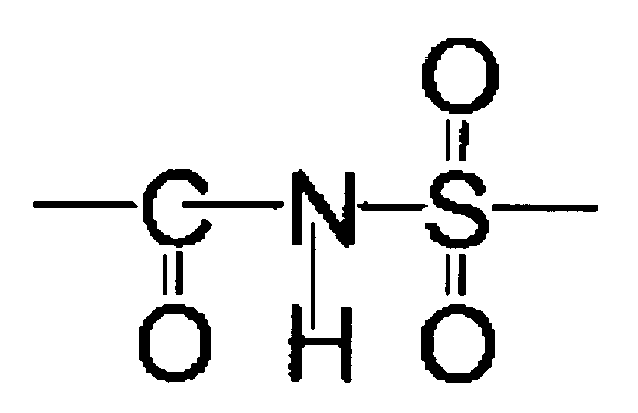
- (4) As the polymerizing monomer having a carboxylic acid group, acrylic acid, methacrylic acid, maleic acid and itaconic acid can be preferably used.
- (5) As the polymerizing polymer having a sulfonic acid group, acrylamide, methacrylamide, acrylic acid ester and methacrylic acid ester, which have an alkylsulfonic acid group can be cited.
- (6) As the polymerizing monomer having a phosphoric acid group, acrylamide, methacrylamide, acrylic acid ester and methacrylic acid ester, which have an alkylphosphoric acid group can be cited.
- Among the polymerizing monomers having an acidic group selected from the (1) to (6), polymerizing monomers having (1) a phenol group, (4) a carboxylic acid group and (5) a sulfonic acid group are preferred and, in particular, polymerizing monomers having (1) a phenol group or (4) a carboxylic acid group are preferred.
- Furthermore, the polymerizing monomers having an acidic group selected from the (1) to (6) is not limited particularly to one kind. Ones obtained by copolymerizing at least two kinds of polymerizing monomers each having the same acidic group or at least two kinds of polymerizing monomers each having an acidic group different from each other may be used.
- The amount of the polymerizing monomer having the acidic group is, in view of obtaining sufficient solubility to an alkaline developing solution that does not substantially contain a solvent, preferably 3 mole percent or more of the copolymer and more preferably 5 mole percent or more of an entirety of constituents of the copolymer. Furthermore, in view of not damaging the lipophilicity of the (meth)acrylate having an alkyl group having four or more carbon atoms, the ratio is preferably 60 mole percent or less to the copolymer.
- In the invention, as an example of compositions of preferably used copolymers involving the invention, examples of composition: (A) to (Q) are shown below. Described numerical values represent mole percent.
- (A) n-butyl methacrylate/methyl acrylate/methacrylic acid = 20/60/20,
- (B) n-butyl methacrylate/ethyl methacrylate/methacrylic acid = 15/70/15,
- (C) n-butyl methacrylate/propyl methacrylate/methacrylic acid = 10/55/35,
- (D) i-butyl methacrylate/methyl methacrylate/methacrylic acid = 15/60/25,
- (E) i-butyl methacrylate/ethyl methacrylate/methacrylic acid = 15/55/30,
- (F) t-butyl methacrylate/methyl methacrylate/methacrylic acid = 5/60/35,
- (G) t-butyl methacrylate/ethyl methacrylate/methacrylic acid = 5/50/45,
- (H) n-hexyl methacrylate/ethyl methacrylate/methacrylic acid = 15/50/35,
- (I) 2-cyclohexylethyl methacrylate/ethyl methacrylate/methacrylic acid = 5/65/30,
- (J) octyl methacrylate/methyl methacrylate/methacrylic acid = 5/70/25,
- (K) dodecyl methacrylate/methyl methacrylate/methacrylic acid = 1/65/34,
- (L) octadecyl methacrylate/methyl methacrylate/methacrylic acid = 3/60/37,
- (M) n-butyl methacrylate/methyl methacrylate/ethyl methacrylate/methacrylic acid = 10/40/30/20,
- (N) n-butyl methacrylate/i-butyl methacrylate/methyl methacrylate/methacrylic acid = 5/10/60/25,
- (O) n-butyl methacrylate/ethyl methacrylate/itaconic acid = 10/70/20,
- (P) i-butyl methacrylate/methyl methacrylate/2-(p-hydroxyphenyl)ethyl methacryle = 10/50/40, and
- (Q) n-butyl methacrylate/methyl methacrylate/methacrylic acid/2-(p-hydroxyphenyl)ethyl methacrylate = 15/60/20/5.
- The weight average molecular weight of the copolymer involving the invention is, in view of enabling to exert the lipophilicity of (meth)acrylate having an alkyl group having four more carbon atoms, preferably 2,000 or more and more preferably in a range of 5,000 to 300,000.
- In a planographic printing plate precursor of the invention, the content of the copolymer is, in a contained layer, in a range of 0.1 to 30 percent by mass, preferably in a range of 1 to 25 percent by mass and particularly preferably in a range of 2 to 20 percent by mass. When the addition amount of the copolymer is 0.1 percent by mass or more, an advantage thereof can be sufficiently exerted, and, the addition amount is preferably 30 percent by mass or less since the addition amount of other photosensitive component, in particular, an infrared absorbent described below is not reduced.
- In a photosensitive layer of the planographic printing plate precursor of the invention, separately from above-described copolymer, a polymer compound is preferably contained. Preferable examples of the polymer compounds are as follows, but the invention is not limeted them.
- The polymer compound used in the invention is, in view of securing the developability, preferably a polymer compound high in the alkali solubility or the swelling property. As such polymer compounds, polymer compounds having an acidic group cited in (1) to (6) shown below in a main chain and/or a side chain of a polymer can be cited.
- (1) Phenol group (-Ar-OH),
- (2) sulfoneamide group (-SO2NH-R),
- (3) substituted sulfoneamide base acid group (hereinafter, referred to as "active imide group") [-SO2NHCOR, -SO2NHSO2R, -CONHSO2R],
- (4) carboxylic acid group (-CO2H),
- (5) sulfonic acid group (-SO3H) and
- (6) phosphoric acid group (-OPO3H2).
- In (1) to (6), Ar representes a divalent aryl linking group that may have a substituent and R representes a hydrocarbon group that may have a substituent.
- Examples of the polymer compounds having an acidic group selected from the (1) to (6) include ones cited below.
- (1) Examples of polymer compounds having a phenol group include novolak resins, xylenol resins and resol resins, and, specifically, a phenol formaldehyde resin, a m-cresol formaldehyde resin, a p-cresol formaldehyde resin, a m-/p-mixed cresol formaldehyde resin, a phenol/cresol (any one of m-, p-, o-, m-/p- mixture, m-/o- mixture and o-/p- mixture) mixed formaldehyde resin, a 1,2-xylenol resin, a 1,3-xylenol resin, a 1,4-xylenol resin, a 1,5-xylenol resin, a 2,3-xylenol resin, a 2,4-xylenol resin, a xylenol/phenol mixed resin, a xylenol/novolak mixed resin, a xylenol/novolak/phenol mixed resin and a polycondensate of pyrogallol and acetone. Furthermore, polymer compounds obtained by copolymerizing a compound having a phenol group on a side chain can be cited. Examples thereof include polymer compounds that contain acrylamide, methacrylamide, acrylic acid ester, methacrylic acid ester or hydroxy styrene, which have a phenol group, as a copolymerizing component.
- (2) As polymer compounds having a sulfoneamide group, for instance, polymers constituted with a minimum constituent unit derived from a compound having a sulfone amide group as a main constituent can be cited. As such compounds, compounds that have a sulfoneamide group where at least one hydrogen atom is bonded to a nitrogen atom and a polymerizable unsaturated group respectively at least one in a molecule can be cited. Among these, low molecular weight compounds that have an acryloyl group, allyl group or vinyloxy group and a substituted or mono-substituted aminosulfonyl group or a substituted sulfonylimino group in a molecule are preferred, and, for instance, compounds that are described in a section of polymerizing monomer having a sulfoneamide group and represented by the formulas (i) to (v) can be cited.
Among the compounds represented by the formulas (i) to (v), which are preferably used as the polymer compound having a sulfoneamide group, in the planographic printing plate precursor of the invention, in particular, m-aminosulfonylphenyl methacrylate, N-(p-aminosulfonylphenyl)methacrylamide and N-(p-aminosulfonylphenyl)acrylamide can be preferably used. - (3) Examples of the polymer compound having an active imide group include compounds each having in the molecule thereof one or more active imide groups represented by the above-mentioned structural formula and one or more unsaturated groups which can be polymerized with the active imide group(s). Of these compounds, preferable are compounds each having in the molecule thereof one or more active imide groups represented by the following structural formula and one or more unsaturated groups which can be polymerized with the active imide group(s):
Specifically, N-(p-toluenesulfonyl)methacrylamide, N-(p-toluenesulfonyl)acrylamide and others can be preferably used. - (4) Examples of the polymer compound having a carboxylic acid group include compounds each having in the molecule thereof one or more carboxylic acid groups and one or more unsaturated groups which can be polymerized with the carboxylic acid group(s). In the present invention acrylic acid, methacrylic acid and itaconic acid can be preferably used.
- (5) As the polymer compound having a sulfonic acid group, for instance, polymers having a minimum constituent unit derived from a compound that has a sulfonic acid group and a polymerizable unsaturated group respectively at least one in a molecule as a main constituent unit can be cited.
- (6) As the polymer compound having a phosphoric acid group, for instance, polymers having a minimum constituent unit derived from a compound that has a phosphoric acid group and a polymerizable unsaturated group respectively at least one in a molecule as a main constituent unit can be cited.
- Other than the polymer compounds mentioned above, polymers that use an unsaturated compound that has an acidic group of (1) to (6) on a side chain and a urea bond as a linking group can be used.
- Among the polymer compounds that have an acidic group selected from the (1) to (6), a polymer compound having (1) a phenol group, (2) a sulfoneamide group, (3) an active imide group or (4) a carboxylic acid group is preferred, in particular, a polymer compound having (1) a phenol group, (2) a sulfoneamide group or (4) a carboxylic acid group being most preferred.
- Furthermore, in the polymer compound, the minimum constituent unit having an acidic group selected from the (1) to (6) is not necessarily restricted to one kind. Ones obtained by copolymerizing at least two kinds of the minimum constituent units having the same acidic group or at least two kinds of the minimum constituent units having different acidic groups may be used.
- When the polymer compound is a copolymer, a copolymerizing compound having an acidic group selected from the (1) to (6) is contained, in a copolymer, preferably 3 mole percent or more of the copolymer and more preferably 5 mole percentage or more. When it is contained less than 3 mole percent, the solubility to an alkaline developing solution that does not substantially contain a solvent is lowered.
- As the monomer component that is copolymerized with the polymerizing monomer having an acidic group, for instance, monomers cited in (m1) to (m11) can be used without restricting thereto.
- (m1) Acrylic acid esters and methacrylic acid esters having aliphatic hydroxyl groups such as 2-hydroxyethyl acrylate or 2-hydroxyethyl methacrylate.
- (m2) Alkyl acrylate such as methyl acrylate, ethyl acrylate, propyl acrylate, butyl acrylate, amyl acrylate, hexyl acrylate, octyl acrylate, benzyl acrylate, 2-chloroethyl acrylate, and glycidyl acrylate.
- (m3) Alkyl methacrylate such as methyl methacrylate, ethyl methacrylate, propyl methacrylate, butyl methacrylate, amyl methacrylate, hexyl methacrylate, cyclohexyl methacrylate, benzyl methacrylate, 2-chloroethyl methacrylate, and glycidyl methacrylate.
- (m4) Acrylamide or methacrylamide such as acrylamide, methacrylamide, N-methylol acrylamide, N-ethylacrylamide, N-hexylmethacrylamide, N-cyclohexylacrylamide, N-hydroxyethylacrylamide, N-phenylacrylamide, N-nitrophenylacrylamide, and N-ethyl-N-phenylacxrylamide.
- (m5) Vinyl ethers such as ethyl vinyl ether, 2-chloroethyl vinyl ether, hydroxyethyl vinyl ether, propyl vinyl ether, butyl vinyl ether, octyl vinyl ether, and phenyl vinyl ether.
- (m6) Vinyl esters such as vinyl acetate, vinyl chloroacetate, vinyl butylate, and vinyl benzoate.
- (m7) Styrenes such as styrene, α-methylstyrene, methylstyrene, and chloromethylstyrene.
- (m8) Vinyl ketones such as methyl vinyl ketone, ethyl vinyl ketone, propyl vinyl ketone, and phenyl vinyl ketone.
- (m9) Olefins such as ethylene, propylene, isobutylene, butadiene, and isoprene.
- (m10) N-vinylpyrrolidone, acrylonitrile, and methacrylonitrile.
- (m11) Unsaturated imides such as maleimide, N-phenylmaleimide, N-acryloylacrylamide, N-acetylmethacrylamide, N-propionylmethacrylamide, and N-(p-chlorobenzoyl)methacrylamide.
- As the polymer compound in the invention, different two or more kinds of polymer compounds may be used together.
- Among the polymer compounds exemplified above, novolac resins and xylenol resins can be preferably used and a phenol formaldehyde resin, a m-cresol formaldehyde resin, a p-cresol formaldehyde resin, a m-/p-mixed cresol formaldehyde resin, a phenol/cresol (any one of m-, p-, o-, m-/p- mixture, m-/o- mixture and o-/p- mixture) mixed formaldehyde resin, a 1,2-xylenol resin, a 1,3-xylenol resin, a 1,4-xylenol resin, a 1,5-xylenol resin, a 2,3-xylenol resin, a 2,4-xylenol resin, a xylenol/phenol mixed resin, a xylenol/novolak mixed resin and a xylenol/novolak/phenol resin can be cited.
- Furthermore, a polymer compound that has a sulfoneamide group or a carboxylic group can be preferably used and is preferably a copolymer. As the copolymer component thereof, although alkyl (meth)acrylate, (meth)acrylamide and (meth)acrylonitrile are preferably used, in addition thereto, the monomer components described above may be slightly contained. Furthermore, a copolymer having maleimide such as N-phenyl maleimide as a constituent element can be particularly preferably used as a polymer compound and, as a copolymerization component thereof, although alkyl (meth)acrylate, (meth)acrylamide and (meth)acrylonitrile are used, other aforementioned monomer components may be slightly contained.
- When, in the invention, the polymer compound is a resin such as a phenol formaldehyde resin or a cresol aldehyde resin, it is preferred that the weight average molecular weight is in a range of 500 to 20,000 and the number average molecular weight is in a range of 200 to 10,000. When the polymer compound of the invention is one other than the above-mentioned resin, the polymer compound that has the weight average molecular weight of 2,000 or more and the number average molecular weight of 500 or more is preferred and the polymer compound that has the weight average molecular weight in a range of 5,000 to 300,000, the number average molecular weight in a range of 800 to 250,000, and a degree of dispersion (weight average molecular weight/number average molecular weight) in a range of 1.1 to 10 is more preferred.
- In the invention, the addition amount of the polymer compound in a photosensitive layer is preferably in a range of 30 to 99 percent by mass, more preferably in a range of 50 to 99 percent by mass and particularly preferably in a range of 65 to 99 percent by mass. When the addition amount of the polymer compound is 30 percent by mass or more, the endurance of the photosensitive layer is improved and, when the addition amount of the polymer compound is 99 percent by mass or less, without reducing an addition amount of an infrared absorbent described below, sufficient sensitivity can be obtained.
- As an infrared absorbent, various kinds of known pigments and dyes can be cited. As the pigment, commercially available pigments and pigments described in the Color Index (C. I.) Binran (Color Index Handbook), "Saishin Ganryo Binran" (edited by Nihon Ganryo Gijyutu Kyokai, 1977), "Saishin Ganryo Oyo Gijyutu" (published by CMC Publishing Co., 1986) and "Insatu Inki Gijyutu" (published by CMC Publishing Co., 1984) can be cited.
- Examples of the pigment include black pigments, yellow pigments, orange pigments, brown pigments, red pigments, purple pigments, blue pigments, green pigments, fluorescent pigments, metal powder pigments, and polymer-bonded dyes. Specifically, the following can be used: insoluble azo pigments, azo lake pigments, condensed azo pigments, chelate azo pigments, phthalocyanine pigments, anthraquinone pigments, perylene and perynone pigments, thioindigo pigments, quinacridone pigments, dioxazine pigments, isoindolinone pigments, quinophthalone pigments, dyeing lake pigments, azine pigments, nitroso pigments, nitro pigments, natural pigments, fluorescent pigments, inorganic pigments, and carbon black.
- These pigments may be used with or without surface treatment. Examples of surface treatment include a method of coating the surface of the pigments with resin or wax; a method of adhering a surfactant onto the surface; and a method of bonding a reactive material (such as a silane coupling agent, an epoxy compound, or a polyisocyanate) to the pigment surface. The surface treatment methods are described in "Nature and Application of Metal Soap" (Saiwai Shobo), "Printing Ink Technique" (by CMC Publishing Co., Ltd. in 1984). And "Latest Pigment Applied Technique" (by CMC Publishing Co., Ltd. in 1986.
- A particle diameter of the pigment is preferably in a range of 0.01 to 10 µm, more preferably in a range of 0.05 to 1 µm and particularly preferably in a range of 0.1 to 1 µm. When the particle diameter of the pigment is more than 0.01 µm, the stability in a photosensitive coating solution of the dispersion is improved and when the particle diameter thereof is 10 µm or less, the uniformity of the photosensitive layer can be improved.
- The method for dispersing the pigment may be a known dispersing technique used to produce ink or toner. Examples of a dispersing machine, which can be used, include an ultrasonic disperser, a sand mill, an attriter, a pearl mill, a super mill, a ball mill, an impeller, a disperser, a KD mill, a colloid mill, a dynatron, a three-roll mill, and a pressing kneader. Details are described in "Latest Pigment Applied Technique" (by CMC Publishing Co., Ltd. in 1986).
- As the dye, commercially available dyes and known ones described in literatures (such as "Senryo Binran" (edited by Yuki Goseikagaku Kyokai, 1970) can be cited and examples thereof include azo dyes, metal complex azo dyes, pyrazolone azo dyes, anthraquinone dyes, phthalocyanine dyes, carbonium dyes, quinoneimine dyes, methine dyes and cyanine dyes. Among the pigments or dyes, pigments and dyes that absorb infrared light or near infrared light are, in view of being advantageous in the use of a laser that emits infrared light or near infrared light, particularly preferred.
- As the infrared-light absorbing pigment or the near infrared-light absorbing pigment carbon black is preferably used.
- Preferable examples of the infrared-light absorbing dye or near infrared-light absorbing dye include cyanine dyes described in
JP-A Nos. 58-125246 59-84356 59-202829 60-78787 JP-A Nos. 58-173696 58-181690 58-194595 JP-A Nos. 58-112793 58-224793 59-48187 59-73996 60-52940 60-63744 JP-A No. 58-112792 GB Patent No. 434,875 - Other preferable examples of the dye include near infrared absorbing sensitizers described in
U.S. Patent No. 5,156,938 ; substituted arylbenzo(thio)pyrylium salts described inU.S. Patent No. 3,881,924 ; trimethinethiapyrylium salts described inJP-A No. 57-142645 U.S. Patent No. 4,327,169 ); pyrylium type compounds described inJP-A Nos. 58-181051 58-220143 59-41363 59-84248 59-84249 59-146063 59-146061 JP-ANo. 59-216146 U.S. Patent No. 4,283,475 ; and pyrylium compounds Epolight III-178, Epolight III-130, Epolight III-125, Epolight V-176A described in Japanese Patent Application Publication (JP-B) Nos.5-13514 5-19702 - Furthermore, as the particularly preferred another examples of the dyes, near infrared absorbing dyes described as formulas (I) and (II) in
U.S. Patent No.4,756,993 can be cited. The addition amount of the pigment or dye is preferably in a range of 0.01 to 50 percent by mass and more preferably in a range of 0.1 to 10 percent by mass of a total solid content of a printing plate material. In the case of the dye, 0.5 to 10 percent by mass is particularly preferred and, in the case of the pigment, 3.1 to 10 percent by mass is particularly preferred. When the addition amount of the pigment or dye is 0.01 percent by mass or more, sufficient sensitivity can be obtained, and; when the addition amount thereof is 50 percent by mass or less, the uniformity of a photosensitive layer is improved and sufficient durability of the photosensitive layer can be obtained. - A photosensitive layer of a planographic printing plate precursor of the invention may be any one of a single layer configuration, a phase-separated configuration and a multilayer configuration.
- As the single layer type photosensitive layer, photosensitive layers described in, for instance,
JP-A No. 7-285275 WO 97/39894 JP-ANo. 11-44956 JP-A No. 11-218914 U. S. Patent Nos. 6352812B1 ,6352811B1 ,6358669B1 and6534238B1 andEP No. 864420B1 - Furthermore, in the case of the multilayer configuration, as far as the outermost layer of the photosensitive layer contains an infrared absorbent and a copolymer, without particularly limiting, a lower layer as well may contain an infrared absorbent. Still furthermore, when a planographic printing plate precursor of the invention contains a polymer compound, a layer that contains the polymer compound is not limited to an upper layer (the uppermost surface layer) or a lower layer and both of the upper layer and the lower layer may contain the polymer compound. In this case, polymer compounds in the upper layer and the lower layer may be the same or different ones.
- In layers disposed to a planographic printing plate precursor of the invention, as needs arise, various kinds of additives may be further added. For instance, in order to adjust the solubility of a photosensitive layer, a so-called dissolution inhibitor such as another onium salt, an aromatic sulfone compound, an aromatic sulfonic acid ester compound or a polyfunctional amine compound, which, when added to the photosensitive layer, can improve the dissolution inhibition function to a developing solution of an alkali water-soluble polymer (alkali-soluble resin) is preferably added. Among these, a substance such as an onium salt, an o-quinonediazide compound or a sulfonic acid alkyl ester, which is pyrolytic and, in a non-pyrolyzed state, substantially lowers the solubility of an alkali-soluble resin is preferably used together in view of enabling to control the dissolution inhibition property to a developing solution of an image portion.
- Preferable examples of the onium salt used in the invention include diazonium salts described in S. I. Schlesinger, Photogr. Sci. Eng., 18, 387 (1974), T. S. Bal et al., Polymer, 21, 423 (1980), and
JP-ANo. 5-158230 U.S. Patent Nos. 4,069,055 and4,069,056 , andJP-A No. 3-140140 U.S. Patent Nos. 4,069,055 and4,069,056 ; iodonium salts described in J. V. Crivello et al., Macromolecules, 10 (6), 1307 (1977), Chem. & Eng. News, Nov. 28, p31 (1988),EP No. 104,143 U.S. Patent Nos. 5,041,358 and4,491,628 , andJP-A Nos. 2-150848 2-296514 EP Nos. 370,693 233,567 297,443 297,442 U.S. Patent Nos. 4,933,377 ,3,902,114 ,5,041,358 ,4,491,628 ,4,760,013 ,4,734,444 and2,833,827 , andDE Patent Nos. 2,904,626 ,3,604,580 and3,604,581 ; selenonium salts described in J. V Crivello et al., Macromolecules, 10 (6), 1307 (1977), J. V. Crivello et al., J. Polymer Sci., Polymer Chem. Ed., 17, 1047 (1979); arsonium salts described in C. S. Wen et al., and The Proc. Conf. Rad. Curing ASIA, p478, Tokyo, Oct (1988). - Among such onium salts, diazonium salts and quaternary ammonium salts are particularly preferable from the viewpoints of both their capacity of hindering dissolution, and their thermal decomposability. The diazonium salts represented by general formula (I) in the
JP-A No. 5-158230 JP-A No. 11-143064 JP-A No. 11-143064 JP-A No. 2002-229186 JP-A No. 2005-266003 - Examples of the counter ion of the onium salt include tetrafluoroboric acid, hexafluorophosphoric acid, triisopropylnaphthalenesulfonic acid, 5-nitro-o-toluenesulfonic acid, 5-sulfosalicylic acid, 2,5-dimethylbenzenesulfonic acid, 2,4,6-trimethylbenzenesulfonic acid, 2-nitrobenzenesulfonic acid, 3-chlorobenzenesulfonic acid, 3-bromobenzenesulfonic acid, 2-fluorocaprylnaphthalenesulfonic acid, dodecylbenzenesulfonic acid, 1-naphthol-5-sulfonic acid, 2-methoxy-4-hydroxy-5-benzoyl-benzenesulfonic acid, and p-toluenesulfonic acid. Among these examples, hexafluorophosphoric acid, and alkylaromatic sulfonic acids such as triisopropylnaphthalenesulfonic acid, 2,5-dimethylbezenesulfonic acid and 2-methoxy-4-hydroxy-5-benzoyl benzenesulfonic acid are particularly preferable.
- The quinonediazide is preferably an o-quinonediazide compound. The o-quinonediazide compound used in the invention is a compound having at least one o-quinonediazide group and having an alkali-solubility increased by being thermally decomposed. The compound may be any one of compounds having various structures. In other words, the o-quinonediazide compound assists the solubility of the photosensitive material both from the viewpoint of the effects of being thermally decomposed, and thereby losing the function of suppressing the dissolution of the binder, and the effect that the o-quinonediazide itself is changed into an alkali-soluble material.
- Preferable examples of the o-quinonediazide compound used in the invention include compounds described in J. Coser, "Light-Sensitive Systems" (John Wiley & Sons. Inc.), pp. 339-352. Particularly preferable are sulfonic acid esters or sulfonamides of o-quinonediazide made to react with various aromatic polyhydroxy compounds or with aromatic amino compounds.
- Further preferable examples include an ester made from benzoquinone-(1,2)-diazidesulfonic acid chloride or naphthoquinone-(1,2)-diazide-5-sulfonic acid chloride and pyrogallol-acetone resin, as described in
JP-B No. 43-28403 - Additional preferable examples include an ester made from naphthoquinone-(1,2)-diazide-4-sulfonic acid chloride and phenol-formaldehyde resin or cresol-formaldehyde resin; and an ester made from naphthoquinone-(1,2)-diazide-4-sulfonic acid chloride and pyrogallol-acetone resin.
- Other useful o-quinonediazide compounds are reported in unexamined or examined patent documents, examples of which include
JP-ANos. 47-5303 48-63802 48-63803 48-96575 49-38701 48-13354 JP-B No. 41-11222 45-9610 49-17481 U.S. Patent Nos. 2,797,213 ,3,454,400 ,3,544,323 ,3,573,917 ,3,674,495 and3,785,825 ,GB Patent Nos. 1,227,602 1,251,345 1,267,005 1,329,888 1,330,932 DE Patent No. 854,890 . - The amount of onium salt and/or o-quinonediazide compound added as the decomposable dissolution suppresser(s) is preferably from 1 to 10%, more preferably from 1 to 5%, and even more preferably from 1 to 2% by relative to the total solid contents of the recording layer. The onium salts and the o-quinonediazide compounds may be used either independently or in the form of mixtures of two or more thereof.
- The amount of additives other than the o-quinonediazide compound added is preferably from 0.1 to 5%, more preferably from 0.1 to 2%, and even more preferably from 0.1 to 1.5% by mass. The additives and the binder used in the invention are preferably incorporated into the same layer.
- A dissolution suppresser having no decomposability may be used in combination. Preferable examples thereof include sulfonic acid esters, phosphoric acid esters, aromatic carboxylic acid esters, aromatic disulfones, carboxylic acid anhydrides, aromatic ketones, aromatic aldehydes, aromatic amines, and aromatic ethers, details of which are described in
JP-A No. 10-268512 JP-A No. 11-190903 JP-A No. 2000-105454 - Examples of cyclic acid anhydride include phthalic anhydride, tetrahydrophthalic anhydride, hexahydrophthalic anhydride, 3,6-endooxy-4-tetrahydrophthalic anhydride, tetrachlorophthalic anhydride, maleic anhydride, chloromaleic anhydride, α-phenylmaleic anhydride, succinic anhydride, and pyromellitic anhydride which are described in
U.S. Patent No. 4,115,128 . - Examples of phenolic compound include bisphenol A, p-nitrophenol, p-ethoxyphenol, 2,4,4'-trihydroxybenzophenone, 2,3,4-trihydroxybenzophenone, 4-hydroxybenzophenone, 4,4',4"-trihydroxytriphenylmethane, 4,4',3",4"-tetrahydroxy-3,5,3',5'-tetramethyltriphenylmethane.
- Examples of the organic acid include sulfonic acids, sulfonic acids, alkylsulfuric acids, phosphonic acids, phosphates, and carboxylic acids, which are described in
JP-A No. 60-88942 2-96755 - When the cyclic acid anhydride, the phenol or the organic acid is added to a photosensitive layer of a planographic printing plate precursor, the amount thereof is preferably from 0.05 to 20%, more preferably from 0.1 to 15%, and even more preferably from 0.1 to 10% by mass of the recording layer.
- Furthermore, other than the above-mentioned ones, an epoxy compound, vinyl ethers, a phenol compound having a hydroxymethyl group or a phenol compound having an alkoxymethyl group described in
JP-A No. 8-276558 JP-ANo. 11-160860 - Still furthermore, a printing agent for obtaining a visible image immediately after the heating due to exposure or a dye or a pigment as an image coloring agent may be added.
- A typical example of a printing-out agent is a combination of a compound which is heated by exposure to light, thereby emitting an acid (an optically acid-generating agent), and an organic dye which can form salts (salt formable organic dye).
- Specific examples thereof include combinations of an o-naphthoquinonediazide-4-sulfonic acid halogenide with a salt-formable organic dye, described in
JP-A Nos. 50-36209 53-8128 JP-A Nos. 53-36223 54-74728 60-3626 61-143748 61-151644 63-58440 - The trihalomethyl compound is classified into an oxazol compound or a triazine compound. Both of the compounds provide excellent in stability over the passage of time and produce a vivid printed-out image.
- As the image coloring agent, a dye different from the above-mentioned salt-formable organic dye may be used. Preferable examples of such a dye, and of the salt-formable organic dye, include oil-soluble dyes and basic dyes.
- Specific examples thereof include Oil yellow #101, Oil Yellow #103, Oil Pink #312, Oil Green BG, Oil Blue BOS, Oil Blue #603, Oil Black BY, Oil Black BS, and Oil Black T-505 (each of which is manufactured by Orient Chemical Industries Ltd.); Victoria Pure Blue, Crystal Violet (CI42555), Methyl Violet (CI42535), Ethyl Violet, Rhodamine B (CI145170B), Malachite Green (CI42000), and Methylene Blue (CI52015).
- Dyes described in
JP-A No. 62-293247 - Whenever necessary, a plasticizer may be added to the planographic printing plate preccursor of the invention to give flexibility to a coating film made from the composition. Examples of the plasticizer include oligomers and polymers of butyl phthalyl, polyethylene glycol, tributyl citrate, diethyl phthalate, dibutyl phthalate, dihexyl phthalate, dioctyl phthalate, tricresyl phosphate, tributyl phosphate, trioctyl phosphate, tetrahydrofurfuryl olete, and acrylic acid and methacrylic acid.
- A planographic printing plate precursor of the invention can be prepared when the components are dissolved in a solvent, followed by coating on a support, further followed by drying to dispose a photosensitive layer. Examples of the coating solvents used here include methanol, ethanol, n-propanol, isopropyl alcohol, n-butanol, sec-butanol, isobutanol, 2-methyl-1-butanol, 3-methyl-1-butanol, 2-methyl-2-butanol, 2-ethyl-1-butanol, 1-pentanol, 2-pentanol, 3-pentanol, n-hexanol, 2-hexanol, cyclohexanol, methyl cyclohexanol, 1-heptanol, 2-heptanol, 3-heptanol, 1-octanol, 4-methyl-2-pentanol, 2-hexyl alcohol, benzyl alcohol, ethylene glycol, diethylene glycol, triethylene glycol, tetraethylene glycol, 1,3-propanediol, 1,5-pentane glycol, dimethyl triglycol, furfuryl alcohol, hexylene glycol, hexyl ether, 3-methoxy-1-butanol, 3-methoxy-3-methyl butanol, butyl phenyl ether, ethylene glycol monoacetate, 2-methoxy ethanol, 2-ethoxy ethanol, propylene glycol monomethyl ether, propylene glycol monoethyl ether, propylene glycol monopropyl ether, propylene glycol monobutyl ether, propylene glycol phenyl ether, dipropylene glycol monomethyl ether, dipropylene glycol monoethyl ether, dipropylene glycol monopropyl ether, dipropylene glycol monobutyl ether, tripropylene glycol monomethyl ether, methyl carbitol, ethyl carbitol, ethyl carbitol acetate, butyl carbitol, triethylene glycol monomethyl ether, triethylene glycol monoethyl ether, tetraethylene glycol dimethyl ether, diacetone alcohol, acetophenone, cyclohexanone, methyl cyclohexanone, acetonyl acetone, isophorone, methyl lactate, ethyl lactate, butyl lactate, propylene carbonate, phenyl acetate, sec-butyl acetate, cyclohexyl acetate, diethyl oxalate, methyl benzoate, ethyl benzoate, γ-butylolactone, 3-methoxy-1-butanol, 4-methoxy-1-butanol, 3-ethoxy-1-butanol, 3-methoxy-3-methyl-1-butanol, 3-methoxy-3-ethyl-1-pentanol, 4-ethoxy-1-pentanol, 5-methoxy-1-hexanol, 4-hydroxy-2-pentanone, 5-hydroxy-2-pentanone, 6-hydroxy-2-pentanone, 4-hydroxy-3-pentanone, 6-hydroxy-2-hexanone, 3-methyl-3-hydroxy-2-pentanone, methyl cellosolve (MC), ethyl cellosolve (EC), allyl alcohol, isopropyl ether, butyl ether, anisole, propylene glycol monomethyl ether acetate, diethyl carbitol, tetrahydrofuran, dioxane, dioxolane, acetone, methyl propyl ketone, methyl ethyl ketone, methyl amyl ketone, diethyl ketone, ethyl butyl ketone, dipropyl ketone, diisobutyl ketone, 3-hydroxy-2-butanone, 4-hydroxy-2-butanone, 2-methoxyethyl acetate, 2-ethoxyethyl acetate, methoxybutyl acetate, methyl propionate, ethyl propionate, propyl propionate, methyl butyrate, ethyl butyrate, butyl butyrate, N-methyl-2-pyrolidone, acetonitrile, dimethyl formamide (DMF), dimethyl acetamide (DMAc), n-pentane, 2-methyl pentane, 3-ethyl pentane, methyl cyclopentane, n-hexane, isohexane, cyclohexane, methylcyclohexane, n-heptane, cycloheptane, n-octane, isooctane, nonane, decane, benzene, toluene, o-xylene, m-xylene, p-xylene, ethyl benzene, o-diethyl benzene, m-diethyl benzene, p-diethyl benzene, cumene, n-amyl benzene, dimethylsulfoxide (DMSO) and dimethyl diglycol (DMDG). These solvents may be used singularly or in a combination of at least two kinds thereof. In a photosensitive composition solution that uses the (mixed) solvent, a concentration of a total solid content in the solvent is preferably in a range of 1 to 50 percent by mass and more preferably in a range of 1 to 30 percent by mass.
- A planographic printing plate precursor of the invention can be produced by coating the photosensitive composition solution on an appropriate support. However, as needs arise, a protective layer, a resin intermediate layer and a backcoat layer, which will be described below, can be similarly formed.
- A coated amount of a solid content, which is obtained after coating and drying, is, in the case of a single layer, preferably in a range of 0.3 to 5.0 g/m2 and more preferably in a range of 0.5 to 3.0 g/m2. In the case of a multilayer, an upper layer and a lower layer, respectively, are preferably in a range of 0.05 to 2.0 g/m2 and in a range of 0.3 to 5.0 g/m2 and more preferably in a range of 0.1 to 1.0 g/m2 and in a range of 0.5 to 3.0 g/m2. Furthermore, a mass ratio (upper layer/lower layer) of coated amounts of the upper layer and the lower layer is preferably in a range of 0.05 to 1 and more preferably in a range of 0.1 to 0.8.
- Various methods may be used for applying the recording layer coating solution. Examples thereof include bar coater coating, spin coating, spray coating, curtain coating, dip coating, air knife coating, blade coating, roll coating, and the like. As the coating amount decreases, the apparent sensitivity increases, but the film properties of the photosensitive layer deteriorates.
- As a support used in a planographic printing plate precursor of the invention, as far as it has a hydrophilic surface, there is no particular restriction, and one that is a dimensionally stable plate and satisfies necessary physical properties such as the strength and flexibility can be preferably used. Examples thereof include metal-laminated or metal-deposited paper or plastic films such as paper, plastics (such as polyethylene, polypropylene or polystyrene)-laminated paper, a plate of metal (such as aluminum, zinc or copper), a film of plastics (such as cellulose diacetate, cellulose triacetate, cellulose propionate, cellulose butyrate, cellulose acetate butyrate, cellulose nitrate, polyethylene terephthalate, polyethylene, polystyrene, polypropylene, polycarbonate or polyvinyl acetal). The hydrophilic surface means a support surface obtained by applying an anodic oxidation process, a hydrophilization process or a combination thereof, which will be described below.
- The support is preferably a polyester film or an aluminum plate, and more preferably an aluminum plate, since an aluminum plate is superior in terms of dimensional stability and is also relatively inexpensive.
- Preferable examples of the aluminum plate include a pure aluminum plate and alloy plates made of aluminum as a main component with a very small amount of other elements. A plastic film on which aluminum is laminated or vapor-deposited may also be used.
- Examples of other elements contained in the aluminum alloys include silicon, iron, manganese, copper, magnesium, chromium, zinc, bismuth, nickel, and titanium. The content by percentage of different elements in the alloy is at most 10% by mass. A particularly preferable aluminum plate in the invention is a pure aluminum plate; however, since from the viewpoint of refining a completely pure aluminum cannot be easily produced, a very small amount of other elements may also be contained in the plate.
- The aluminum plate used as the support is not specified in terms of the composition thereof. Thus, aluminum plates which are conventionally known can be appropriately used. The thickness of the aluminum plate used in the invention is preferably from about 0.1 to 0.6 mm, and more preferably from 0.12 to 0.4 mm.
- If necessary, prior to the surface-roughening treatment, the aluminum plate may optionally be subjected to degreasing treatment, in order to remove rolling oil or the like on the surface, with a surfactant, an organic solvent, an aqueous alkaline solution or the like. The surface-roughening treatment of the aluminum surface can be performed by various methods such as a mechanical surface-roughening method, a method of dissolving and roughening the surface electrochemically, and a method of dissolving the surface selectively in a chemical manner.
- Mechanical surface-roughening methods which can be used may be known methods, such as a ball polishing method, a brush polishing method, a blast polishing method or a buff polishing method. An electrochemical surface-roughening method may be a method of performing surface-roughening in an electrolyte of hydrochloric acid or nitric acid, by use of an alternating current or a direct current. As disclosed in
JP-A No. 54-63902 - Thus surface-roughened aluminum plate, as needs arise, is alkali etched and neutralized, followed by, as needs arise, subjecting to the anodic oxidation process to heighten the water retention property and the wear resistance of the surface. As an electrolyte used in the anodic oxidation process of an aluminum plate, various kinds of electrolytes that form a porous oxide film can be used. In general, sulfuric acid, phosphoric acid, oxalic acid, chromic acid or a mixture thereof is used. A concentration of the electrolyte is appropriately determined depending on a kind of the electrolyte. Treatment conditions for anodization cannot be specified as a general rule since conditions vary depending on the electrolyte used; however, the following range of conditions are generally suitable: an electrolyte concentration of 1 to 80% by mass, a solution temperature of 5 to 70°C, a current density of 5 to 60 A/dm2, a voltage of 1 to 100 V, and an electrolyzing time of 10 seconds to 5 minutes. If the amount of anodic oxide film is less than 1.0 g/m2, printing resistance is inadequate or non-image portions of the planographic printing plate tend to become easily damaged and the so-called "blemish stains", resulting from ink adhering to damaged portions at the time of printing, are easily generated.
- After the anodizing treatment, the surface of the aluminum is if necessary subjected to treatment for obtaining hydrophilicity. This securance of hydrophilicity treatment may be an alkali metal silicate (for example, an aqueous sodium silicate solution) method, as disclosed in
U.S. Patent Nos. 2,714,066 ,3,181,461, 3,280,734 , and3,902,734 . In this method, the support is subjected to an immersing treatment or an electrolyzing treatment with an aqueous sodium silicate solution. In addition, the following methods may also be used: a method of treating the support with potassium fluorozirconate, as disclosed inJP-B No. 36-22063 U.S. Patent Nos. 3,276,868 ,4,153,461 , and4,689,272 . - The planographic printing plate precursor according to the present invention is a plate having a photosensitive layer as described above provided on a support, and an undercoat layer may be formed as needed between the support and the photosensitive layer.
- When formed, the undercoat layer between the support and the photosensitive layer functions as a heat-insulating layer, inhibiting diffusion of the heat generated by exposure to an infrared laser to the support and allowing more efficient use of an infrared laser, and thus, is advantageous in improving sensitivity. When forming the undercoat layer, the photosensitive layer according to the invention is positioned on the exposure face or in the vicinity thereof, and thus significantly retains its sensitivity to an infrared laser.
- Also in the unexposed areas, the photosensitive layer, which is resistant to penetration of the alkaline developer, functions as a protective layer for the undercoat layer, improving development stability, forming an image having superior discrimination, and ensuring image stability over time. The undercoat layer is a layer containing an alkali-soluble polymer as its principal component and is extremely soluble in the developer. If the undercoat layer is formed close to the support, the exposed area, where the components in the photosensitive layer that becomes more soluble by exposure, is dissolved or dispersed in the developer more readily without generation of undissolved film, for example, when a less active developer is used, which seems to be effective for improving developing efficiency. For that reason, the undercoat layer is thought to be useful.
- Various organic compounds may be used as the components for the undercoat layer, and examples thereof include amino group-containing phosphonic acids that may be substituted such as carboxymethylcellulose, dextrin, gum arabic, and 2-aminoethylphosphonic acid; organic phosphonic acid that may be substituted such as phenylphosphonic acid, naphthylphosphonic acid, alkylphosphonic acids, glycerophosphonic acid, methylenediphosphonic acid and ethylenediphosphonic acid; organic phosphoric acids that may be substituted such as phenylphosphoric acid, naphthylphosphoric acid, alkylphosphoric acid and glycerophosphoric acid; organic phosphinic acids such as phenylphosphinic acid, naphthylphosphinic acid, alkylphosphinic acid and glycerophosphinic acid; amino acids such as glycine and β-alanine; hydroxy group-containing amine hydrochloride salts such as triethanolamine hydrochloride salt; and the like. These compounds may be used in combinations of two or more.
- An undercoat layer containing at least one compound selected from the group consisting of organic polymer compounds having the structural unit represented by the following Formula is also preferable.

- In the Formula above, R11 represents a hydrogen or halogen atom or an alkyl group; R12 and R13 each independently represent a hydrogen atom, a hydroxyl group, a halogen atom, an alkyl group, a substituted alkyl group, an aryl group, a substituted aryl group, -OR14, -COOR15, -CONHR16, -COR17 or -CN, or R12 and R13 may bind to each other forming a ring; R14 to R17 each independently represent an alkyl or aryl group; X represents a hydrogen or metal atom, or NR18R19R20R21; R18 to R21 each independently represent a hydrogen atom, an alkyl group, a substituted alkyl group, an aryl group or a substituted aryl group, or R18 and R19 may bind to each other forming a ring; and m represents an integer of 1 to 3.
- An example of a suitable undercoat layer component for the planographic printing plate precursor according to the invention is a polymer compound having an acid group-containing a structural component and an onium group-containing component described in
JP-A No. 2000-241962 - Specific examples of the acid group-containing monomers include acrylic acid, methacrylic acid, crotonic acid, isocrotonic acid, itaconic acid, maleic acid, maleic anhydride, styrene derivatives having the acid group above, and the like. The onium salt is preferably an onium group having an atom in groups V and VI of the Periodic Table, more preferably an onium salt of a nitrogen, phosphorus or sulfur atom, and particularly preferably an onium salt of a nitrogen atom. Specific examples of the onium salt-containing monomers include methacrylates and methacrylamides having an ammonium group on the side chain, and styrenes having an onium group-containing substituent such as those having a quaternary ammonium group.
- In addition, the compounds described in
JP-A Nos. 2000-108538 2002-257484 2003-78699 - Such an undercoat layer can be formed, for example, according to the following methods: a method of dissolving the organic compounds in an organic solvent or a mixed solvent of water, methanol, ethanol, methylethylketone, or the like, and applying and drying the solution on an aluminum plate (support); and a method of dissolving the organic compounds in an organic solvent or a mixed solvent of water, methanol, ethanol, methylethylketone, or the like, allowing an aluminum plate (support) to absorb the solution by immersion in the solution, and washing the plate with water or the like and drying it.
- In the former method, it is possible to apply the solution of the organic compound at a concentration of 0.005 to 10 wt % by various methods.
- Alternatively, in the latter method, the concentration of the solution is 0.01 to 20 wt %, preferably 0.05 to 5 wt %; the immersion temperature is 20 to 90°C, preferably 25 to 50°C; and the immersion period is 0.1 second to 20 minutes, preferably 2 seconds to 1 minutes. The solution used may be adjusted to a pH in a range of 1 to 12 by addition of a basic substance such as ammonia, triethylamine, or potassium hydroxide, or an acidic substance such as hydrochloric acid or phosphoric acid. A yellow dye may also be added, for improvement of tone reproducibility in the image-recording material.
- A coated amount of an undercoat layer is preferably in a range of 2 to 200 mg/m2 and more preferably in a range of 5 to 100 mg/m2. When the coated amount is 2 mg/m2 or more, sufficient press life can be obtained. When the coated amount is 200 mg/m2 or less as well, the situation is the same.
- An image is formed thermally on the planographic printing plate precursor according to the present invention. Specifically, direct image recording with a thermal recording head or the like, scanning exposure with an infrared laser, high-illumination flash exposure with xenon discharge lamp or the like, infrared lamp exposure, or the like is used for this image formation, but exposure to a high-output infrared solid laser emitting a light at a wavelength of 700 to 1,200 nm, such as from an infrared light-emitting semiconductor laser or YAG laser is suitable.
- The laser output is preferably 100 mW or more, and it is preferable to use a multi-beam laser device to shorten the exposure period. The exposure period per pixel is preferably 20 µsec or less, and the irradiation energy applied onto the recording material is preferably 10 to 500 mJ/cm2.
- In the invention, an exposed photosensitive planographic printing plate precursor is preferably developed by an alkaline aqueous solution that does not substantially contain an organic solvent and has the pH of 12 or more. Here, "does not substantially contain an organic solvent" means that an organic solvent is not contained to an extent that causes an inconvenience from the viewpoints of environmental health, safety and workability. However, in the invention, it means that a ratio of the organic solvent in the developing solution is 0.5 percent by mass or less and preferably 0.3 percent by mass or less and most preferably zero. Furthermore, the pH thereof is preferably 12.0 or more and more preferably in a range of 12.0 to 14.0.
- As the developer (hereinafter this term will represent a developer including a replenisher), a conventionally known aqueous alkali solution may be used. Examples of the alkali agent include inorganic alkali salts such as sodium silicate, potassium silicate, trisodium phosphate, tripotassium phosphate, triammonium phosphate, disodium hydrogenphosphate, dipotassium hydrogenphosphate, diammonium hydrogenphosphate, sodium carbonate, potassium carbonate, ammonium carbonate, sodium hydrogencarbonate, potassium hydrogencarbonate, ammonium hydrogen carbonate, sodium borate, potassium borate, ammonium borate, sodium hydroxide, ammonium hydroxide, potassium hydroxide and lithium hydroxide; and organic alkali agents such as monomethylamine, dimethylamine, trimethylamine, monoethylamine, diethylamine, triethylamine, monoisopropylamine, diisopropylamine, triisopropylamine, n-butylamine, monoethanolamine, diethanolamine, triethanolamine, monoisopropanolamine, diisopropanolamine, ethyleneimine, ethylenediamine, and pyridine. These alkali agents may be used alone or in combinations of two or more thereof.
- Among the above aqueous alkali solutions, one developer which exerts the effect of the invention is an aqueous solution of a pH 12 or higher so-called "silicate developer" containing alkali silicate as a base, or containing alkali silicate obtained by mixing a base with a silicon compound, and the other more preferable developer is a so-called "non-silicate developer" which does not contain alkali silicate, and contains a non-reducing sugar (organic compound having buffering action) and a base.
- In the former, developability of an aqueous solution of alkali metal silicate can be regulated by a ratio (generally represented by mole ratio of [SiO2]/[M2O]) of silicon oxide SiO2 and alkali metal oxide M2O. For example, an aqueous solution of sodium silicate in which a mole ratio of SiO2/Na2O is 1.0 to 1.5 (that is,[SiO2]/[Na2O] is 1.0 to 1.5), and a content of SiO2 is 1 to 4% by mass as disclosed in
JP-A No. 54-62004 57-7427 - Furthermore, a so-called "non-silicate developing solution" that does not contain alkali silicate and contains a non-reducing sugar and a base can be also preferably used. In this case, a non-reducing sugar that has the buffering property for inhibiting the pH from varying is preferably contained. The non-reducing sugars are sugars that neither have a free aldehyde group and ketone group nor show the reducing property and can be categorized into a trehalose type oligosaccharide where reducing groups are bonded each other, a glycoside where a reducing group of sugar and a non-sugar are bonded, and a sugar alcohol obtained by adding hydrogen to a sugar to reduce. Any one thereof can be used in the invention. In the invention, non-reducing sugars described in
JP-A No. 8-305039 - Examples of the trehalose type oligosaccharides include saccharose and trehalose. Examples of the glucosides include alkylglucosides, phenolglucosides, and mustard seed oil glucoside. Examples of the sugar alcohols include D, L-arabite, ribitol, xylitol, D, L-sorbitos, D, L-mannitol, D, L-iditol, D, L-talitol, dulcitol, and allodulcitol. Furthermore, maltitol, obtained by hydrogenating a disaccharide, and a reductant obtained by hydrogenating an oligosaccharide (i.e., reduced starch syrup) are preferable. Of these examples, sugar alcohol and saccharose are more preferable. D-sorbitol, saccharose, and reduced starch syrup are even more preferable since they have buffer effect within an appropriate pH range and are inexpensive.
- These non-reducing sugars may be used alone or in combinations of two or more. A content of the non-reducing sugar in the non-silicate developing solution is preferably 0.1 to 30 percent by mass and more preferably 1 to 20 percent by mass. When the content is less than 0.1 percent by mass, it is not easy to obtain a sufficient buffer action, and when the content exceeds 30 percent by mass, it is difficult to make a higher concentrated solution and the cost tends to rise.
- The base combined with the nonreducing sugar(s) may be an alkali agent that has been known so far. Examples thereof include inorganic alkali agents such as sodium hydroxide, potassium hydroxide, lithium hydroxide, trisodium phosphate, tripotassium phosphate, triammonium phosphate, disodium phosphate, dipotassium phosphate, diammonium phosphate, sodium carbonate, potassium carbonate, ammonium carbonate, sodium hydrogencarbonate, potassium hydrogencarbonate, ammonium hydrogencarbonate, sodium borate, potassium borate and ammonium borate; and organic alkali agents such as monomethylamine, dimethylamine, trimethylamine, monoethylamine, diethylamine, triethylamine, monoisopropylamine, diisopropylamine, triisopropylamine, n-butylamine, monoethanolamine, diethanolamine, triethanolamine, monoisopropanolamine, diisopropanolamine, ethyleneimine, ethylenediamine, and pyridine.
- The bases may be used alone or in combinations of two or more. Among these bases, sodium hydroxide and potassium hydroxide are preferable. In the present invention, a developer containing an alkali-metal salt of a nonreducing sugar as the principal component may be used as the non-silicate developer, replacing the combined use of a nonreducing sugar and a base.
- Alternatively, an alkaline buffer solution containing a weak acid other than the nonreducing sugar and a strong base may be used in the non-silicate developer. The weak acid preferably has a dissociation constant (pKa) of 10.0 to 13.2, and is selected from the weak acids described in "Ionization Constants of Organic Acids in Aqueous Solution" published by Pergmon Press, and others.
- Specifically suitable examples thereof include alcohols such as 2,2,3,3-tetrafluoropropanol-1 and trifluoroethanol, trichloroethanol; aldehydes such as pyridine-2-aldehyde and pyridine-4-aldehyde; phenolic hydroxyl group-containing compounds such as salicylic acid, 3-hydroxy-2-naphthoic acid, catechol, gallic acid, sulfosalicylic acid, 3,4-dihydroxysulfonic acid, 3,4-dihydroxybenzoic acid, hydroquinone, pyrogallol, o-, m-, and p-cresols, and resorcinol; oximes such as acetoxime, 2-hydroxybenzaldehyde oxime, dimethyl glyoxime, ethanediamide dioxime, and acetophenone oxime; nucleic acid-derived substances such as adenosine, inosine, guanine, cytosine, hypoxanthine, and xanthine; diethylaminomethylphosphonic acid, benzimidazole, barbituric acid, and the like.
- Various surfactants and organic solvents may be added as needed to the developer and replenisher, for improvement or control of developing efficiency, dispersion of development scum, or improvement of the ink compatibility of the image region of a printing plate. The surfactant is preferably an anionic, cationic, nonionic or amphoteric surfactant. In addition, a reducer such as hydroquinone, resorcin, sodium or potassium salt of an inorganic acid such as sulfurous acid or bisulfurous acid as well as an organic carboxylic acid, an antifoaming agent, a water softener, or the like may be added to the developer and replenisher as needed.
- The planographic printing plate developed with the developer and replenisher is then post-treated with a rinse solution containing washing water, a surfactant, and the like and with a desensitizing solution containing gum arabic or a starch derivative. These treatments may be used in combination as the post-treatment.
- Furthermore, in the case of an automatic developing machine being used to develop, it is known that, when an aqueous solution stronger in the alkalinity than that of a developing solution (replenishing solution) is added to the developing solution, without exchanging for a long time a developing solution in a developing tank, many PS plates can be processed. In the invention as well, the replenishing process can be preferably applied. A printing plate developed with the developing solution and the replenishing solution is post-treated with washing water, a rinse solution containing a surfactant and a desensitizing solution containing gum Arabic and a starch derivative. In the post-treatment of the planographic printing plate precursor that uses a photosensitive composition of the invention, these treatments can be variously combined to use.
- In recent years, automatic developing machines for the printing plates have become widely used for the purpose of streamlining and standardizing the plate-making processes in the printing-plate and printing industries. These automatic developing machines generally consist of a developing unit and a post-treatment unit, a unit for conveying printing plates and various stock solution tanks, and units for spraying solutions, wherein the exposed printing plates are developed while they are conveyed horizontally and sprayed via spray nozzles with various solutions pumped out of the stock tanks. Also known is another kind of automatic developing system, wherein the printing plates are conveyed as they are immersed in treatment solution tanks filled with treating solutions one after another by means of the submerged guide rolls or the like. In this type of automatic processing, the plates are processed in the solutions, which are periodically replenished with replenisher according to the number of plates processed and the operating time. In addition, a method of essentially using only unused treating solutions, i.e., a single-round method, may also be used.
- In the present invention, if the planographic printing plate obtained after the steps of image exposure, development, water washing and/or rinsing, and/or gumming has unnecessary image portions (e.g., film edge spots on the original image film and the like), elimination of the unnecessary image portions is performed. As the elimination method, although the method described for example in Japanese Patent Application Publication (JP-B) No.
2-13293 JP-A No. 59-174842 - The developed planographic printing plate thus obtained may, if desired, be coated with a desensitizing gum before it is sent to the printing process; or the plate is additionally subjected to a baking treatment a planographic printing plate higher in printing durability is desired.
- If the planographic printing plate is to be subjected to a baking treatment, the plate is preferably treated before the baking treatments with an affinitizing solution described in
JP-B No. 61-2518 JP-B No. 55-28062 JP-ANo. 62-31859 JP-ANo. 61-159655 - The suitable coating amount of the affinitizing solution is generally 0.03 to 0.8 g/m2 (as dry weight). The planographic printing plate applied with the affinitizing solution is then dried as needed and heated at high temperature in a burning processor (e.g., Burning Processor BP-1300 available from Fuji Photo Film Co.). The temperature and the period of heating vary according to the kind of the components constituting the images, but are preferably in a range of 180 to 300°C for 1 to 20 minutes.
- The planographic printing plate that has been subjected to a baking treatment may then be subjected, if needed, to treatments commonly practiced in the art such as water washing and gumming, but if a surface treatment solution containing a water-soluble polymer compound or the like is used, the so-called desensitizing treatment such as gumming or the like may be eliminated. The planographic printing plate obtained after these treatments is then mounted on an offset printing machine or the like, and it is used for printing numerous sheets of paper.
- The invention will be described with reference to examples. but a range of the invention is not limited to them.
- A 0.3 mm thick JIS-A-1050 aluminum plate was processed according to steps shown below to prepare a support.
- While a suspension containing a polishing agent (silica sand) with a specific gravity of 1.12 and water was supplied as a polishing slurry to the a surface of each aluminum sheet, the and mechanical surface roughening was carried out by rotating roller type nylon brushes. The average particle size of the polishing agent was 8 µm and the maximum particle size was 50 µm. The material of the nylon brushes was 6-10 nylon and hair length and hair diameters were 45 mm and 0.3 mm, respectively. The nylon brushes were produced by implanting the hairs densely in holes formed in stainless cylinders with a diameter of φ300 mm. Three rotating brushes were used. Two supporting rollers (φ200 mm diameter) were placed in lower parts of the brushes with a separation distance of 300 mm. The brush rollers were pushed until the load of the driving motor for rotating the brushes was increased by 7 kW or more from the load before the brush rollers being pushed against the aluminum sheet. The rotation direction of the brushes was the same as the moving direction of the aluminum sheet. The rotation speed of the brushes was 200 rpm.
- Etching treatment was carried out by spraying an aqueous NaOH solution (NaOH concentration being 26% by weight and also containing an aluminum ion 6.5% by weight) to the aluminum plate at 70°C, to dissolve the aluminum sheet by an amount of 6 g/m2. After that, the aluminum sheet was washed with water by spraying.
- The aluminum plate was subjected to a desmutting treatment by spraying an aqueous solution containing 1 wt % nitric acid (additionally containing 0.5 wt % aluminum ion) at a temperature of 30°C, and then washed by spraying water. The aqueous nitric acid solutions used for desmutting was the wastewater obtained in the electrochemical surface-roughening step wherein the aluminum plates were electrochemically scratched in an aqueous nitric acid solution using an alternating electrical current.
- The aluminum plates were further scratched electrochemically by continuous use of a 60-Hz alternating current. The electrolyte used was an aqueous solution containing 10.5 g/L nitric acid (containing additionally 5 g/L of aluminum ion) at a temperature of 50°C. The electrochemical surface roughening was performed using a trapezoidal alternating current having a trapezoidal waveform with a transition period (TP) from zero to peak currency of 0.8 msec and a duty ratio of 1:1 with a carbon electrode as the counter electrode. Ferrite was used as the auxiliary anode. The electrolytic bath used was that of a radial cell type.
- The electric current density was 30 A/dm2 at peak value, and when an aluminum plate is used as the anode, the total amount of electric current applied was 220 C/dm2. 5% of the current from the power source was divided and sent to the auxiliary electrode.
- Subsequently, the aluminum plates were washed by a spray using well water.
- The aluminum plate was sprayed with a solution containing 26 wt % caustic soda and 6.5 wt % aluminum ion at 32°C to melt the aluminum plate at 0.20 g/m2 to remove the smut mainly containing aluminum hydroxide, which was generated during the previous electrochemical surface-roughening treatment using an alternating electrical current, and to polish the edge portion by dissolving the edge portions of the pits generated. Subsequently, the aluminum plates were washed by a spray using well water.
- The aluminum plate was desmutted by spraying an aqueous solution containing 15 wt % nitric acid (containing additionally 4.5 wt % aluminum ion) at a temperature of 30°C, and then washed by a spray using well water. The wastewater obtained in the electrochemical surface-roughening step, wherein the aluminum plates were electrochemically scratched in an aqueous nitric acid solution using an alternating electrical current, was used as the aqueous nitric acid solution for desmutting.
- Electrochemical surface roughening treatment was carried out continuously by using 60 Hz AC voltage. The electrolytic solution used in this step was an aqueous solution of hydrochloric acid (the concentration thereof being 7.5 g/L and also containing aluminum ion by 5 g/L) at 35°C. The AC power waveform had a trapezoidal rectangular waveform and a carbon electrode was used as an opposed electrode, to effect the electrochemical surface roughening treatment. Ferrite was used as an auxiliary anode. A radial cell type electrolytic bath was used.
- The current density was 25 A/dm2 at the peak value of the current and the total electricity quantity was 50 C/dm2 when the aluminum sheet was used as an anode.
- After that, the resulting aluminum sheet was washed with a water spray.
- Etching treatment was carried out at 32°C for the aluminum sheet by spraying a solution containing 26 wt. % sodium hydroxide and 6.5 wt. % aluminum ion thereon, to dissolve 0.10 g/m2 of the aluminum sheet, so as to remove the smut, of which main component is mainly aluminum hydroxide produced during the electrochemical roughening treatment of the surface by using alternating current in the prior step. Further, the edge portions of the pits formed were dissolved to make the edge portions smooth. After that, the aluminum sheet was washed by spraying water spray.
- Desmut treatment was is carried out by spraying with an aqueous solution of 25% by weight sulfuric acid (containing aluminum ion 0.5% by weight) at 60°C and then washing the resulting aluminum sheet was washed by spraying water spray.
- As an electrolytic solution, sulfuric acid was used. The electrolytic solution contained sulfuric acid by 170 g/L (and contained aluminum ion 0.5% by weight). The temperature of the electrolytic solution was 43°C. After then the aluminum sheet was washed with water by spraying.
- The electric current density was about 30 A/dm2. Final oxide film thickness was about 2.7 g/m2.
- The respective steps of (a) to (j) were sequentially carried out with the (e) step applied so that an etching amount may be 3.4 g/m2, and thereby a support A was prepared.
- Except that, when the support A was prepared, steps of (g), (h) and (i) were omitted, similarly to the preparation of the support A, a support B was prepared.
- Except that, when the support A was prepared, steps of (a), (g), (h) and (i) were omitted, similarly to the preparation of the support A, a support C was prepared.
- Except that, when the support A was prepared, steps of (a), (d), (e) and (f) were omitted and a sum total of electricity in the step (g) was changed so as to be 450 C/dm2, similarly to the preparation of the support A, a support D was prepared.
- To thus obtained supports A to D, subsequently, a silicate process shown in (k) below was applied, followed by forming an undercoat layer.
- An aluminum support obtained by an anodic oxidation process was dipped for 10 sec in a process tank kept at 30°C and containing an aqueous solution of 1 mass percent of No. 1 soda silicate to apply an alkali metal silicate process (silicate process). Thereafter, water washing was applied with well water. An adhesion amount of the silicate was 5.5 mg/m2.
- On thus processed aluminum plate, in the beginning, by use of a wire bar, an undercoating solution (1) below was coated and dried at 80°C for 20 sec. A coated amount after drying was 0.02 g/m2.
-
- Compound below (A number next to a parenthesis shows a molar ratio.) 0.1 g
- Methanol 100.0 g

- As shown in Table 1, on the obtained supports A to D, any one of photosensitive layers 1 to 4 described below was formed to prepare infrared laser-sensitive planographic printing plate precursors.
- On a support on which an undercoat layer was disposed, a coating solution A having a composition below was coated by use of a wire bar, followed by drying for 40 sec in a dry oven kept at 150°C so that a coated amount may be 0.8 g/m2, thereby an underlayer was disposed.
-
- Copolymer of N-(p-aminosulfonylphenyl)methacrylamide/methyl methacrylate/acrylonitrile = 35/35/30 (molar ratio) (weight average molecular weight: 65,000) 3.5 g
- m, p-cresol novolac (m/p ratio = 6/4, weight average molecular weight: 6000) 0.6 g
- Infrared absorbent shown below (cyanine dye A) 0.25 g
- Dye obtained by changing a counter anion of ethyl violet to 6-hydroxy-β-naphthalene sulfonate) 0.15 g
- Bisphenol sulfone 0.3 g
- Tetrahydrophthalic acid 0.4 g
- Fluorinated surfactant (Megafac F-780, produced by Dainippon Ink & Chemicals Inc.) 0.02 g
- Methyl ethyl ketone 60 g
- Propylene glycol monomethyl ether 20 g
- γ-butylolactone 20 g
- After the underlayer was disposed, a coating solution B having a composition below was coated by use of a wire bar to form an upper layer, followed by drying for 40 sec at 150°C, and thereby an infrared laser-sensitive planographic printing plate precursor where a total coated amount of the lower layer and upper layer was 1.0 g/m2 was obtained.
-
- Novolac resin (m-cresol/p-cresol/phenol = 3/2/5, weight average molecular weight: 8,000) 1.7 g
- Infrared absorbent mentioned above(cyanine dye A) 0.15 g
- Compound Q shown below 0.35 g
- Fluorinated surfactant (Megafac F-780, produced by Dainippon Ink & Chemicals Inc.) 0.03 g
- Copolymer of tridecafluorooctyl methacrylate/2-adamantyl acrylate/2-carboxyethyl methacrylate = 30/50/20 having a weight average molecular weight of 30,000 0.1 g
- Acrylic resin (copolymer involving the invention or reference acrylic resin, acrylic resin described in Table 1) 0.3 g
- Methyl ethyl ketone 33 g
- 1-methoxy-2-propanol 67 g

- On a support on which an undercoat layer was disposed, a coating solution C having a composition below was coated by use of a wire bar and, thereafter, dried at 150°C for 40 sec in a dry oven so that a coated amount may be 1.3 g/m2, and thereby an underlayer was disposed.
-
- Copolymer of N-phenylmaleimide/methacrylamide/methacrylic acid = 45/35/20 (molar ratio)(weight average molecular weight: 50,000) 0.85 g
- Ethyl violet 0.05 g
- Fluorinated surfactant (Megafac F-780, produced by Dainippon Ink & Chemicals Inc.) 0.02 g
- Methyl ethyl ketone 5 g
- Propylene glycol monomethyl ether 15 g
- γ-butylolactone 5 g
- After the underlayer was disposed, a coating solution B having above-mentioned composition was coated by use of a wire bar, followed by drying for 40 sec at 150°C so that a total coated amount may be 1.8 g/m2, and thereby an infrared laser-sensitive planographic printing plate precursor was obtained.
- On a support on which an undercoat layer was disposed, a coating solution D having a composition below was coated by use of a wire bar, followed by drying in a drying oven for 40 sec at 160°C so that a coated amount may be 1.20 g/m2, and thereby an infrared laser-sensitive planographic printing plate precursor was obtained.
-
- Copolymer of 2-(N'-(4-carboxyphenyl)ureido)ethyl methacrylate/N-phenylmaleimide = 75/25 (weight ratio) (weight average molecular weight: 30,000) 0.40 g
- Copolymer of N-phenylmaleimide/methacrylamide/methacrylic acid = 45/35/20 (molar ratio)(weight average molecular weight: 50,000) 0.45 g
- Infrared absorbent mentioned above (cyanine dye A) 0.10 g
- Ethyl violet 0.05 g
- Fluorinated surfactant (Megafac F-780, produced by Dainippon Ink & Chemicals Inc.) 0.02 g
- Acrylic resin (copolymer involving the invention, acrylic resin described in Table 1) 0.1 g
- Methyl ethyl ketone 5 g
- Propylene glycol monomethyl ether 20 g
- γ-butylolactone 5 g
- On a support on which an undercoat layer was disposed, a coating solution E having a composition below was coated by use of a wire bar, followed by drying in a drying oven for 60 sec at 160°C so that a coated amount may be 1.60 g/m2, and thereby an infrared laser-sensitive planographic printing plate precursor was obtained.
-
- Novolac resin (2,3-xylenol/m-cresol/p-cresol = 1/5/4, weight average molecular weight: 8,000) 1.0 g
- Infrared absorbent mentioned above (cyanine dye A) 0.10 g
- Ethyl violet 0.05 g
- Fluorinated surfactant (Megafac F-780, produced by Dainippon Ink & Chemicals Inc.) 0.02 g
- Acrylic resin (copolymer involving the invention, acrylic resin described in Table 1) 0.1 g
- Methyl ethyl ketone 20 g
- Supports and photosensitive layers obtained according to above-mentioned preparation methods and acrylic resins (copolymers involving the invention), respectively, were combined as shown in Table 1, thereby, infrared laser-sensitive planographic printing plate precursors of examples 1 through 16 and comparative examples 1 through 4 were obtained.
- The obtained infrared laser-sensitive planographic printing plate precursor was mounted on a Trendsetter (trade name, produced by Creo Products Inc.) and, under exposure energy of 150 mJ/cm2, a test pattern was image-wise drawn. Thereafter, by use of a PS Processor LP-940H (trade name, produced by Fuji Photo Film Co., Ltd.), with a liquid temperature maintained at 30°C, the planographic printing plate precursor was developed for 12 sec to obtain an evaluation sample. As a developing solution at this time, a liquid obtained by mixing a developing solution DT-2R (trade name, produced by Fuji Photo Film Co., Ltd.) and tap water at a ratio of 1: 6.5, followed by blowing carbon dioxide therein was used. Furthermore, as a finisher, a finisher FG-1 (trade name, produced by Fuji Photo Film Co., Ltd.) diluted with tap water at a ratio of 1:1 was used.
- The conductivity of the developing solution was varied at an interval of 2 mS/cm from 58 mS/cm to 42 mS/cm, a non-image portion of the obtained sample was observed with a loupe and the conductivity where a spot-like residual film started appearing was shown by a numerical value. Results thereof are shown in Table 1. The smaller the numerical value is, the better the non-image portion is. This means that even a developing solution low in a liquid temperature allows developing.
- Then, 1 m2 of the obtained infrared laser-sensitive planographic printing plate precursor was mounted on a Trendsetter (trade name, produced by Creo Products Inc.) and an entire surface was exposed at exposure energy of 150 mJ/cm2. Thereafter, a developing solution DT-2 (trade name, produced by Fuji Photo Film Co., Ltd.) and tap water were mixed at a ratio of 1:8, and 50 ml thereof was used to develop. After a processed liquid was left for 24 hr in a hermetically sealed glass bottle, whether there is precipitate on a bottle bottom or not was confirmed, and when no precipitate was found it was evaluated good, and, when precipitate was found, it was evaluated poor. Results thereof are shown in Table 1.
- The obtained infrared laser-sensitive planographic printing plate precursor was mounted on a Trendsetter (trade name, produced by Creo Products Inc.) and, under exposure energy of 150 mJ/cm2, a test pattern was image-wise drawn. Thereafter, by use of a PS Processor LP-940H (trade name, produced by Fuji Photo Film Co., Ltd.), with a liquid temperature maintained at 30°C, the planographic printing plate precursor was developed for 12 sec to obtain an evaluation sample. As a developing solution at this time, a liquid obtained by mixing a developing solution DT-2R (trade name, produced by Fuji Photo Film Co., Ltd.) and tap water at a ratio of 1: 8 was used. Furthermore, as a finisher, a finisher FG-1 (trade name, produced by Fuji Photo Film Co., Ltd.) diluted with tap water at a ratio of 1:1 was used.
- An obtained printing plate was mounted on a printing press LITHRONE 25 (trade name, produced by Komori Corp.), and then printing was started with Best One SUPER Light Resistant Rouge Ink (trade name, produced by T & K TOKA CO., LTD.,) and a liquid obtained by diluting CDS903 (trade name, produced by Tokyo Ink Co., Ltd.) to 1 % as damping water. After the printing was started and it was confirmed that excellent printed matters could be obtained at damping water scale of 5, the scale of damping water was varied to 7 and 100-th printed matter was visually observed. When an excellent printed matter same as that at the damping water scale of 5 was obtained, it was evaluated as good, and, when density decrease was observed, it was evaluated as poor. Results thereof are shown in Table 1.
[Table 1] Kind of Support Kind of Photosensitive Layer Acrylic Resin Evaluation Result Composition Weight Average Molecular Weight Developability Sludge Precipitation Inking Property Example 1 Support A Photosensitive Layer 1 Composition Example (A) 80,000 44 Good Good Example 2 Support A Photosensitive Layer 1 Composition Example (C) 150,000 44 Good Good Example 3 Support A Photosensitive Layer 1 Composition Example (D) 40,000 44 Good Good Example 4 Support A Photosensitive Layer 1 Composition Example (E) 70,000 44 Good Good Example 5 Support A Photosensitive Layer 1 Composition Example (I) 50,000 44 Good Good Example 6 Support A Photosensitive Layer 1 Composition Example (L) 10,000 44 Good Good Example 7 Support A Photosensitive Layer 1 Composition Example (Q) 40,000 44 Good Good Example 8 Support A Photosensitive Layer 2 Composition Example (B) 100,000 44 Good Good Example 9 Support A Photosensitive Layer 3 Composition Example (F) 80,000 46 Good Good Example 10 Support A Photosensitive Layer 4 Composition Example (P) 40,000 44 Good Good Example 11 Support B Photosensitive Layer 1 Composition Example (D) 30,000 46 Good Good Example 12 Support B Photosensitive Layer 4 Composition Example (K) 50,000 44 Good Good Example 13 Support C Photosensitive Layer 1 Composition Example (G) 20,000 46 Good Good Example 14 Support C Photosensitive Layer 4 Composition Example (Q) 100,000 44 Good Good Example 15 Support D Photosensitive Layer 1 Composition Example (E) 60,000 44 Good Good Example 16 Support D Photosensitive Layer 4 Composition Example (N) 50,000 44 Good Good Comparative Example 1 Support A Photosensitive Layer 1 No addition - 44 Good Poor Comparative Example 2 Support A Photosensitive Layer 1 Composition (X) 50,000 50 Good Good Comparative Example 3 Support A Photosensitive Layer 1 Composition (Y) 20,000 50 Poor Good Comparative Example 4 Support A Photosensitive Layer 4 No addition - 44 Good Poor - In Table 1, composition examples (A) to (N) show compositions cited as one example of compositions of copolymers involving the invention. Furthermore, a composition (X) shows i-butyl methacrylate/methyl methacrylate/methacrylic acid (molar ratio: 40/30/30) and a composition (Y) shows a formaldehyde condensation resin of p-t-butyl phenol.
- From Table 1, all infrared laser-sensitive planographic printing plate precursors of examples were excellent in the developability and inking property and did not show sludge precipitation after development. On the other hand, photosensitive planographic printing plates of comparative examples 1 and 4, in which a resin was not added, were poor in the inking property. Furthermore, photosensitive planographic printing plates of comparative examples 2 and 3, in which a resin other than the copolymer involving the invention was added, were poor in the developability, and a planographic printing plate of comparative example 3 generated sludge.
- According to the invention, an infrared laser-sensitive planographic printing plate precursor that is excellent not only in the inking property of an image portion to enable to obtain excellent printed matters but also excellent as well in the developability and, even when many plates are continuously processed, can inhibit residue or sludge from generating in a developing solution can be provided.
- <1> An infrared laser-sensitive planographic printing plate precursor, comprising: a support having a hydrophilic surface; and a single or a plurality of photosensitive layers disposed on the support having a hydrophilic surface, wherein the outermost layer of the photosensitive layer(s) comprises an infrared absorbent and a copolymer that includes, as copolymerization components, (i) an acrylate or methacrylate having an alkyl group having four or more carbon atoms, (ii) an acrylate or methacrylate having an alkyl group having 1 to 3 carbon atoms, and (iii) a polymerizing monomer having an acid group, and the amount of the acrylate or methacrylate having an alkyl group having four or more carbon atoms is in a range of 0.1 to 20 mole percent of the copolymer.
- <2> The infrared laser-sensitive planographic printing plate precursor of item <1>, wherein the amount of the acrylate or methacrylate having an alkyl group having four or more carbon atoms is in a range of 1 to 20 mole percent of the copolymer.
- <3> The infrared laser-sensitive planographic printing plate precursor of item <1>, wherein the amount of the acrylate or methacrylate having an alkyl group having four or more carbon atoms is in a range of 5 to 18 mole percent of the copolymer.
- <4> The infrared laser-sensitive planographic printing plate precursor of any one of items <1> o <3>, wherein the weight average molecular weight of the copolymer is in a range of 5,000 to 300,000.
- <5> The infrared laser-sensitive planographic printing plate precursor of any one of items <1> to <5>, wherein the content of the copolymer is in a range of 1 to 25% by mass of the copolymer.
- <6> The infrared laser-sensitive planographic printing plate precursor of any one of items <1> to <5>, further comprising an alkali-soluble polymer compound or swelling polymer compound.
- <7> The infrared laser-sensitive planographic printing plate precursor of item <6>, wherein the polymer compound is a novolac resin and/or a xylenol resin.
- <8> The infrared laser-sensitive planographic printing plate precursor of item <7>, wherein the weight average molecular weight of the novolac resin is in a range of 500 to 20,000.
- <9> The infrared laser-sensitive planographic printing plate precursor of item <7>, wherein the weight average molecular weight of the xylenol resin is 2,000 or more.
- <10> The infrared laser-sensitive planographic printing plate precursor of any one of items <1> to <9>, wherein a layer below the uppermost layer of the photosensitive layer includes an infrared absorbent.
- <11> An infrared laser-sensitive planographic printing plate precursor, comprising:
- a support having a hydrophilic surface; and a single or a plurality of photosensitive layers disposed on the support having a hydrophilic surface, wherein the outermost layer of the photosensitive layer includes an infrared absorbent and, as copolymerization components, (i) an acrylate or methacrylate having an alkyl group having four or more carbon atoms, (ii) an acrylate or methacrylate having an alkyl group having 1 to 3 carbon atoms, and (iii) a polymerizing monomer having an acid group, and an amount a of the acrylate or methacrylate having an alkyl group having four or more carbon atoms of the outermost photosensitive layer, an amount b of the acrylate or methacrylate having an alkyl group having 1 to 3 carbon atoms of the outermost photosensitive layer, and an amount c of the polymerizing monomer having an acid group of the outermost photosensitive layer are in the following ranges: 0.1 mole percent ≤ a ≤ 20 mole percent; 25 mole percent ≤ b ≤ 90 mole percent; 5 mole percent ≤ c ≤ 60 mole percent; and a + b + c ≤ 100 mole percent.
- <12> The infrared laser-sensitive planographic printing plate precursor of item <11>, wherein the layer directly below the outermost layer of the photosensitive layer includes an infrared absorbent.
- All publications, patent applications, and technical standards mentioned in this specification are herein incorporated by reference to the same extent as if such individual publication, patent application, or technical standard was specifically and individually indicated to be incorporated by reference.
- It will be obvious to those having skill in the art that many changes may be made in the above-described details of the preferred embodiments of the present invention. The scope of the invention, therefore, should be determined by the following claims.

Claims (12)
- An infrared laser-sensitive planographic printing plate precursor, comprising:a support having a hydrophilic surface; anda single layer or a plurality of photosensitive layers disposed on the support having a hydrophilic surface, whereinthe outermost layer of the photosensitive layer(s) comprises an infrared absorbent and a copolymer that includes, as copolymerization components, (i) an acrylate or methacrylate having an alkyl group having four or more carbon atoms, (ii) an acrylate or methacrylate having an alkyl group having 1 to 3 carbon atoms, and (iii) a polymerizing monomer having an acid group, and the amount of the acrylate or methacrylate having an alkyl group having four or more carbon atoms is in a range of 0.1 to 20 mole percent of the copolymer.
- The infrared laser-sensitive planographic printing plate precursor of claim 1, wherein the amount of the acrylate or methacrylate having an alkyl group having four or more carbon atoms is in a range of 1 to 20 mole percent of the copolymer.
- The infrared laser-sensitive planographic printing plate precursor of claim 1, wherein the amount of the acrylate or methacrylate having an alkyl group having four or more carbon atoms is in a range of 5 to 18 mole percent of the copolymer.
- The infrared laser-sensitive planographic printing plate precursor of claim 1, wherein the weight average molecular weight of the copolymer is in a range of 5,000 to 300,000.
- The infrared laser-sensitive planographic printing plate precursor of claim 1, wherein the content of the copolymer is in a range of 1 to 25% by mass of the outermost photosensitive layer.
- The infrared laser-sensitive planographic printing plate precursor of claim 1, further comprising:an alkali-soluble polymer compound or a swelling polymer compound.
- The infrared laser-sensitive planographic printing plate precursor of claim 6, wherein the polymer compound is a novolac resin and/or a xylenol resin.
- The infrared laser-sensitive planographic printing plate precursor of claim 7, wherein the weight average molecular weight of the novolac resin is in a range of 500 to 20,000.
- The infrared laser-sensitive planographic printing plate precursor of claim 7, wherein the weight average molecular weight of the xylenol resin is 2,000 or more.
- The infrared laser-sensitive planographic printing plate precursor of claim 1, wherein a layer below the uppermost layer of the photosensitive layer includes an infrared absorbent.
- An infrared laser-sensitive planographic printing plate precursor, comprising:a support having a hydrophilic surface; anda single layer or a plurality of photosensitive layers disposed on the support having a hydrophilic surface, whereinthe outermost layer of the photosensitive layer includes an infrared absorbent and, as copolymerization components, (i) an acrylate or methacrylate having an alkyl group having four or more carbon atoms, (ii) an acrylate or methacrylate having an alkyl group having 1 to 3 carbon atoms, and (iii) a polymerizing monomer having an acid group, and an amount a of the acrylate or methacrylate having an alkyl group having four or more carbon atoms of the outermost photosensitive layer, an amount b of the acrylate or methacrylate having an alkyl group having 1 to 3 carbon atoms of the outermost photosensitive layer, and an amount c of the polymerizing monomer having an acid group of the outermost photosensitive layer are in the following ranges:0.1 mole percent ≤ a ≤ 20 mole percent;25 mole percent ≤ b ≤ 90 mole percent;,5 mole percent ≤ c ≤ 60 mole percent; anda + b + c ≤ 100 mole percent.
- The infrared laser-sensitive planographic printing plate precursor of claim 11, wherein the layer directly below the outermost layer of the photosensitive layer includes an infrared absorbent.
Applications Claiming Priority (1)
| Application Number | Priority Date | Filing Date | Title |
|---|---|---|---|
| JP2007047721A JP5159123B2 (en) | 2007-02-27 | 2007-02-27 | Photosensitive lithographic printing plate precursor for infrared laser |
Publications (2)
| Publication Number | Publication Date |
|---|---|
| EP1964675A1 true EP1964675A1 (en) | 2008-09-03 |
| EP1964675B1 EP1964675B1 (en) | 2010-04-28 |
Family
ID=39415305
Family Applications (1)
| Application Number | Title | Priority Date | Filing Date |
|---|---|---|---|
| EP08003363A Not-in-force EP1964675B1 (en) | 2007-02-27 | 2008-02-25 | Infrared laser-sensitive planographic printing plate precursor |
Country Status (5)
| Country | Link |
|---|---|
| US (1) | US20080206670A1 (en) |
| EP (1) | EP1964675B1 (en) |
| JP (1) | JP5159123B2 (en) |
| AT (1) | ATE465871T1 (en) |
| DE (1) | DE602008001060D1 (en) |
Families Citing this family (2)
| Publication number | Priority date | Publication date | Assignee | Title |
|---|---|---|---|---|
| EP2204698B1 (en) | 2009-01-06 | 2018-08-08 | FUJIFILM Corporation | Plate surface treatment agent for lithographic printing plate and method for treating lithographic printing plate |
| KR101977886B1 (en) * | 2018-06-18 | 2019-05-13 | 영창케미칼 주식회사 | Chemical amplified type positive photoresist composition for pattern profile improvement |
Citations (32)
| Publication number | Priority date | Publication date | Assignee | Title |
|---|---|---|---|---|
| GB434875A (en) | 1933-02-08 | 1935-09-05 | Bela Gasper | An improved method of producing multi-colour photographic images on coloured and differently sensitized multi-layer photographic material |
| US3881924A (en) | 1971-08-25 | 1975-05-06 | Matsushita Electric Industrial Co Ltd | Organic photoconductive layer sensitized with trimethine compound |
| US4283475A (en) | 1979-08-21 | 1981-08-11 | Fuji Photo Film Co., Ltd. | Pentamethine thiopyrylium salts, process for production thereof, and photoconductive compositions containing said salts |
| US4327169A (en) | 1981-01-19 | 1982-04-27 | Eastman Kodak Company | Infrared sensitive photoconductive composition, elements and imaging method using trimethine thiopyrylium dye |
| JPS58112792A (en) | 1981-12-28 | 1983-07-05 | Ricoh Co Ltd | Optical information recording medium |
| JPS58112793A (en) | 1981-12-28 | 1983-07-05 | Ricoh Co Ltd | Optical information recording member |
| JPS58125246A (en) | 1982-01-22 | 1983-07-26 | Ricoh Co Ltd | Laser recording medium |
| JPS58173696A (en) | 1982-04-06 | 1983-10-12 | Canon Inc | Optical recording medium |
| JPS58181051A (en) | 1982-04-19 | 1983-10-22 | Canon Inc | Organic photoconductor |
| JPS58181690A (en) | 1982-04-19 | 1983-10-24 | Canon Inc | Optical recording medium |
| JPS58194595A (en) | 1982-05-10 | 1983-11-12 | Canon Inc | optical recording medium |
| JPS58220143A (en) | 1982-06-16 | 1983-12-21 | Canon Inc | Organic film |
| JPS58224793A (en) | 1982-06-25 | 1983-12-27 | Nec Corp | Optical recording medium |
| JPS5941363A (en) | 1982-08-31 | 1984-03-07 | Canon Inc | Pyrylium dye, thiopyrylium dye and its preparation |
| JPS5948187A (en) | 1982-09-10 | 1984-03-19 | Nec Corp | Photo recording medium |
| JPS5973996A (en) | 1982-10-22 | 1984-04-26 | Nec Corp | Optical recording medium |
| JPS5984248A (en) | 1982-11-05 | 1984-05-15 | Canon Inc | organic film |
| JPS5984249A (en) | 1982-11-05 | 1984-05-15 | Canon Inc | organic film |
| JPS5984356A (en) | 1982-11-05 | 1984-05-16 | Ricoh Co Ltd | How to create an optical disc master |
| JPS59146061A (en) | 1983-02-09 | 1984-08-21 | Canon Inc | Organic film |
| JPS59146063A (en) | 1983-02-09 | 1984-08-21 | Canon Inc | Organic film |
| JPS59202829A (en) | 1983-05-04 | 1984-11-16 | Sanpo Gokin Kogyo Kk | Mold for injection molding synthetic resin product |
| JPS59216146A (en) | 1983-05-24 | 1984-12-06 | Sony Corp | Electrophotographic sensitive material |
| JPS6052940A (en) | 1983-09-02 | 1985-03-26 | Nec Corp | Optical recording medium |
| JPS6063744A (en) | 1983-08-23 | 1985-04-12 | Nec Corp | Optical information recording medium |
| JPS6078787A (en) | 1983-10-07 | 1985-05-04 | Ricoh Co Ltd | Optical information recording medium |
| US4756993A (en) | 1986-01-27 | 1988-07-12 | Fuji Photo Film Co., Ltd. | Electrophotographic photoreceptor with light scattering layer or light absorbing layer on support backside |
| US5156938A (en) | 1989-03-30 | 1992-10-20 | Graphics Technology International, Inc. | Ablation-transfer imaging/recording |
| JPH0665327A (en) * | 1992-08-20 | 1994-03-08 | Hitachi Chem Co Ltd | Photosensitive resin composition and photosensitive element using the same |
| WO1998021038A1 (en) * | 1996-11-12 | 1998-05-22 | Kodak Polychrome Graphics | Radiation-sensitive compositions and printing plates |
| US6503685B1 (en) * | 1998-03-20 | 2003-01-07 | Dianippon Ink And Chemicals, Inc. | Heat sensitive composition, original plate using the same for lithographic printing plate, and process for preparing printing plate |
| JP2006267463A (en) * | 2005-03-23 | 2006-10-05 | Hitachi Chem Co Ltd | Photosensitive resin composition, photosensitive element, method for forming resist pattern and method for manufacturing printed wiring board |
Family Cites Families (6)
| Publication number | Priority date | Publication date | Assignee | Title |
|---|---|---|---|---|
| JPS5474728A (en) * | 1977-11-28 | 1979-06-15 | Fuji Photo Film Co Ltd | Photosensitive composition |
| JPH103165A (en) * | 1996-06-18 | 1998-01-06 | Konica Corp | Photosensitive composition |
| JP4181750B2 (en) * | 2001-01-12 | 2008-11-19 | 富士フイルム株式会社 | Positive image forming material |
| JP4199942B2 (en) * | 2001-07-09 | 2008-12-24 | 富士フイルム株式会社 | Planographic printing plate making method |
| DE60320204T2 (en) * | 2002-12-27 | 2009-05-14 | Fujifilm Corp. | Thermosensitive lithographic printing plate precursor |
| JP4328613B2 (en) * | 2002-12-27 | 2009-09-09 | 富士フイルム株式会社 | Heat-sensitive lithographic printing plate |
-
2007
- 2007-02-27 JP JP2007047721A patent/JP5159123B2/en not_active Expired - Fee Related
-
2008
- 2008-02-25 EP EP08003363A patent/EP1964675B1/en not_active Not-in-force
- 2008-02-25 DE DE602008001060T patent/DE602008001060D1/en active Active
- 2008-02-25 AT AT08003363T patent/ATE465871T1/en not_active IP Right Cessation
- 2008-02-26 US US12/037,257 patent/US20080206670A1/en not_active Abandoned
Patent Citations (33)
| Publication number | Priority date | Publication date | Assignee | Title |
|---|---|---|---|---|
| GB434875A (en) | 1933-02-08 | 1935-09-05 | Bela Gasper | An improved method of producing multi-colour photographic images on coloured and differently sensitized multi-layer photographic material |
| US3881924A (en) | 1971-08-25 | 1975-05-06 | Matsushita Electric Industrial Co Ltd | Organic photoconductive layer sensitized with trimethine compound |
| US4283475A (en) | 1979-08-21 | 1981-08-11 | Fuji Photo Film Co., Ltd. | Pentamethine thiopyrylium salts, process for production thereof, and photoconductive compositions containing said salts |
| US4327169A (en) | 1981-01-19 | 1982-04-27 | Eastman Kodak Company | Infrared sensitive photoconductive composition, elements and imaging method using trimethine thiopyrylium dye |
| JPS57142645A (en) | 1981-01-19 | 1982-09-03 | Eastman Kodak Co | Infrared sensitive photoconductive element |
| JPS58112792A (en) | 1981-12-28 | 1983-07-05 | Ricoh Co Ltd | Optical information recording medium |
| JPS58112793A (en) | 1981-12-28 | 1983-07-05 | Ricoh Co Ltd | Optical information recording member |
| JPS58125246A (en) | 1982-01-22 | 1983-07-26 | Ricoh Co Ltd | Laser recording medium |
| JPS58173696A (en) | 1982-04-06 | 1983-10-12 | Canon Inc | Optical recording medium |
| JPS58181051A (en) | 1982-04-19 | 1983-10-22 | Canon Inc | Organic photoconductor |
| JPS58181690A (en) | 1982-04-19 | 1983-10-24 | Canon Inc | Optical recording medium |
| JPS58194595A (en) | 1982-05-10 | 1983-11-12 | Canon Inc | optical recording medium |
| JPS58220143A (en) | 1982-06-16 | 1983-12-21 | Canon Inc | Organic film |
| JPS58224793A (en) | 1982-06-25 | 1983-12-27 | Nec Corp | Optical recording medium |
| JPS5941363A (en) | 1982-08-31 | 1984-03-07 | Canon Inc | Pyrylium dye, thiopyrylium dye and its preparation |
| JPS5948187A (en) | 1982-09-10 | 1984-03-19 | Nec Corp | Photo recording medium |
| JPS5973996A (en) | 1982-10-22 | 1984-04-26 | Nec Corp | Optical recording medium |
| JPS5984248A (en) | 1982-11-05 | 1984-05-15 | Canon Inc | organic film |
| JPS5984249A (en) | 1982-11-05 | 1984-05-15 | Canon Inc | organic film |
| JPS5984356A (en) | 1982-11-05 | 1984-05-16 | Ricoh Co Ltd | How to create an optical disc master |
| JPS59146061A (en) | 1983-02-09 | 1984-08-21 | Canon Inc | Organic film |
| JPS59146063A (en) | 1983-02-09 | 1984-08-21 | Canon Inc | Organic film |
| JPS59202829A (en) | 1983-05-04 | 1984-11-16 | Sanpo Gokin Kogyo Kk | Mold for injection molding synthetic resin product |
| JPS59216146A (en) | 1983-05-24 | 1984-12-06 | Sony Corp | Electrophotographic sensitive material |
| JPS6063744A (en) | 1983-08-23 | 1985-04-12 | Nec Corp | Optical information recording medium |
| JPS6052940A (en) | 1983-09-02 | 1985-03-26 | Nec Corp | Optical recording medium |
| JPS6078787A (en) | 1983-10-07 | 1985-05-04 | Ricoh Co Ltd | Optical information recording medium |
| US4756993A (en) | 1986-01-27 | 1988-07-12 | Fuji Photo Film Co., Ltd. | Electrophotographic photoreceptor with light scattering layer or light absorbing layer on support backside |
| US5156938A (en) | 1989-03-30 | 1992-10-20 | Graphics Technology International, Inc. | Ablation-transfer imaging/recording |
| JPH0665327A (en) * | 1992-08-20 | 1994-03-08 | Hitachi Chem Co Ltd | Photosensitive resin composition and photosensitive element using the same |
| WO1998021038A1 (en) * | 1996-11-12 | 1998-05-22 | Kodak Polychrome Graphics | Radiation-sensitive compositions and printing plates |
| US6503685B1 (en) * | 1998-03-20 | 2003-01-07 | Dianippon Ink And Chemicals, Inc. | Heat sensitive composition, original plate using the same for lithographic printing plate, and process for preparing printing plate |
| JP2006267463A (en) * | 2005-03-23 | 2006-10-05 | Hitachi Chem Co Ltd | Photosensitive resin composition, photosensitive element, method for forming resist pattern and method for manufacturing printed wiring board |
Also Published As
| Publication number | Publication date |
|---|---|
| US20080206670A1 (en) | 2008-08-28 |
| JP2008209774A (en) | 2008-09-11 |
| DE602008001060D1 (en) | 2010-06-10 |
| EP1964675B1 (en) | 2010-04-28 |
| JP5159123B2 (en) | 2013-03-06 |
| ATE465871T1 (en) | 2010-05-15 |
Similar Documents
| Publication | Publication Date | Title |
|---|---|---|
| EP1211065B1 (en) | Planographic printing plate precursor | |
| EP2080616B1 (en) | Planographic printing plate precursor | |
| EP1275497B1 (en) | Planographic printing plate precursor | |
| EP1568491B1 (en) | Planographic printing plate precursor | |
| EP2644379B1 (en) | Method of producing a planographic printing plate | |
| EP1705006A1 (en) | Planographic printing plate precursor and method of producing the same | |
| EP2106907B1 (en) | Planographic printing plate precursor | |
| EP1964675B1 (en) | Infrared laser-sensitive planographic printing plate precursor | |
| EP1574331B1 (en) | Planographic printing plate precursor | |
| EP1640173B1 (en) | Planographic printing plate precursor | |
| EP1738921B1 (en) | Photosensitive composition and planographic printing plate precursor using the same | |
| US20060040205A1 (en) | Planographic printing plate precursor | |
| EP2042308B1 (en) | Planographic printing plate precursor | |
| US20040214104A1 (en) | Image recording material | |
| EP2042310B1 (en) | Planographic printing plate precursor | |
| EP1690685B1 (en) | Planographic printing plate precursor | |
| EP1902840B1 (en) | Planographic printing plate precursor | |
| US7140298B2 (en) | Method for evaluating planographic printing plates and quality-control method thereof | |
| EP2042305B1 (en) | Planographic printing plate precursor | |
| EP1577087B1 (en) | Planographic printing plate precursor |
Legal Events
| Date | Code | Title | Description |
|---|---|---|---|
| PUAI | Public reference made under article 153(3) epc to a published international application that has entered the european phase |
Free format text: ORIGINAL CODE: 0009012 |
|
| AK | Designated contracting states |
Kind code of ref document: A1 Designated state(s): AT BE BG CH CY CZ DE DK EE ES FI FR GB GR HR HU IE IS IT LI LT LU LV MC MT NL NO PL PT RO SE SI SK TR |
|
| AX | Request for extension of the european patent |
Extension state: AL BA MK RS |
|
| 17P | Request for examination filed |
Effective date: 20090210 |
|
| 17Q | First examination report despatched |
Effective date: 20090316 |
|
| AKX | Designation fees paid |
Designated state(s): AT BE BG CH CY CZ DE DK EE ES FI FR GB GR HR HU IE IS IT LI LT LU LV MC MT NL NO PL PT RO SE SI SK TR |
|
| GRAP | Despatch of communication of intention to grant a patent |
Free format text: ORIGINAL CODE: EPIDOSNIGR1 |
|
| GRAS | Grant fee paid |
Free format text: ORIGINAL CODE: EPIDOSNIGR3 |
|
| GRAA | (expected) grant |
Free format text: ORIGINAL CODE: 0009210 |
|
| AK | Designated contracting states |
Kind code of ref document: B1 Designated state(s): AT BE BG CH CY CZ DE DK EE ES FI FR GB GR HR HU IE IS IT LI LT LU LV MC MT NL NO PL PT RO SE SI SK TR |
|
| REG | Reference to a national code |
Ref country code: GB Ref legal event code: FG4D |
|
| REG | Reference to a national code |
Ref country code: CH Ref legal event code: EP |
|
| REG | Reference to a national code |
Ref country code: IE Ref legal event code: FG4D |
|
| REF | Corresponds to: |
Ref document number: 602008001060 Country of ref document: DE Date of ref document: 20100610 Kind code of ref document: P |
|
| REG | Reference to a national code |
Ref country code: NL Ref legal event code: VDEP Effective date: 20100428 |
|
| LTIE | Lt: invalidation of european patent or patent extension |
Effective date: 20100428 |
|
| PG25 | Lapsed in a contracting state [announced via postgrant information from national office to epo] |
Ref country code: NL Free format text: LAPSE BECAUSE OF FAILURE TO SUBMIT A TRANSLATION OF THE DESCRIPTION OR TO PAY THE FEE WITHIN THE PRESCRIBED TIME-LIMIT Effective date: 20100428 Ref country code: ES Free format text: LAPSE BECAUSE OF FAILURE TO SUBMIT A TRANSLATION OF THE DESCRIPTION OR TO PAY THE FEE WITHIN THE PRESCRIBED TIME-LIMIT Effective date: 20100808 Ref country code: SE Free format text: LAPSE BECAUSE OF FAILURE TO SUBMIT A TRANSLATION OF THE DESCRIPTION OR TO PAY THE FEE WITHIN THE PRESCRIBED TIME-LIMIT Effective date: 20100428 Ref country code: LT Free format text: LAPSE BECAUSE OF FAILURE TO SUBMIT A TRANSLATION OF THE DESCRIPTION OR TO PAY THE FEE WITHIN THE PRESCRIBED TIME-LIMIT Effective date: 20100428 Ref country code: NO Free format text: LAPSE BECAUSE OF FAILURE TO SUBMIT A TRANSLATION OF THE DESCRIPTION OR TO PAY THE FEE WITHIN THE PRESCRIBED TIME-LIMIT Effective date: 20100728 |
|
| PG25 | Lapsed in a contracting state [announced via postgrant information from national office to epo] |
Ref country code: SI Free format text: LAPSE BECAUSE OF FAILURE TO SUBMIT A TRANSLATION OF THE DESCRIPTION OR TO PAY THE FEE WITHIN THE PRESCRIBED TIME-LIMIT Effective date: 20100428 Ref country code: LV Free format text: LAPSE BECAUSE OF FAILURE TO SUBMIT A TRANSLATION OF THE DESCRIPTION OR TO PAY THE FEE WITHIN THE PRESCRIBED TIME-LIMIT Effective date: 20100428 Ref country code: IS Free format text: LAPSE BECAUSE OF FAILURE TO SUBMIT A TRANSLATION OF THE DESCRIPTION OR TO PAY THE FEE WITHIN THE PRESCRIBED TIME-LIMIT Effective date: 20100828 Ref country code: HR Free format text: LAPSE BECAUSE OF FAILURE TO SUBMIT A TRANSLATION OF THE DESCRIPTION OR TO PAY THE FEE WITHIN THE PRESCRIBED TIME-LIMIT Effective date: 20100428 Ref country code: FI Free format text: LAPSE BECAUSE OF FAILURE TO SUBMIT A TRANSLATION OF THE DESCRIPTION OR TO PAY THE FEE WITHIN THE PRESCRIBED TIME-LIMIT Effective date: 20100428 Ref country code: AT Free format text: LAPSE BECAUSE OF FAILURE TO SUBMIT A TRANSLATION OF THE DESCRIPTION OR TO PAY THE FEE WITHIN THE PRESCRIBED TIME-LIMIT Effective date: 20100428 |
|
| PG25 | Lapsed in a contracting state [announced via postgrant information from national office to epo] |
Ref country code: CY Free format text: LAPSE BECAUSE OF FAILURE TO SUBMIT A TRANSLATION OF THE DESCRIPTION OR TO PAY THE FEE WITHIN THE PRESCRIBED TIME-LIMIT Effective date: 20100602 Ref country code: PL Free format text: LAPSE BECAUSE OF FAILURE TO SUBMIT A TRANSLATION OF THE DESCRIPTION OR TO PAY THE FEE WITHIN THE PRESCRIBED TIME-LIMIT Effective date: 20100428 |
|
| PG25 | Lapsed in a contracting state [announced via postgrant information from national office to epo] |
Ref country code: EE Free format text: LAPSE BECAUSE OF FAILURE TO SUBMIT A TRANSLATION OF THE DESCRIPTION OR TO PAY THE FEE WITHIN THE PRESCRIBED TIME-LIMIT Effective date: 20100428 Ref country code: DK Free format text: LAPSE BECAUSE OF FAILURE TO SUBMIT A TRANSLATION OF THE DESCRIPTION OR TO PAY THE FEE WITHIN THE PRESCRIBED TIME-LIMIT Effective date: 20100428 |
|
| PG25 | Lapsed in a contracting state [announced via postgrant information from national office to epo] |
Ref country code: CZ Free format text: LAPSE BECAUSE OF FAILURE TO SUBMIT A TRANSLATION OF THE DESCRIPTION OR TO PAY THE FEE WITHIN THE PRESCRIBED TIME-LIMIT Effective date: 20100428 Ref country code: SK Free format text: LAPSE BECAUSE OF FAILURE TO SUBMIT A TRANSLATION OF THE DESCRIPTION OR TO PAY THE FEE WITHIN THE PRESCRIBED TIME-LIMIT Effective date: 20100428 Ref country code: BE Free format text: LAPSE BECAUSE OF FAILURE TO SUBMIT A TRANSLATION OF THE DESCRIPTION OR TO PAY THE FEE WITHIN THE PRESCRIBED TIME-LIMIT Effective date: 20100428 Ref country code: RO Free format text: LAPSE BECAUSE OF FAILURE TO SUBMIT A TRANSLATION OF THE DESCRIPTION OR TO PAY THE FEE WITHIN THE PRESCRIBED TIME-LIMIT Effective date: 20100428 |
|
| PLBE | No opposition filed within time limit |
Free format text: ORIGINAL CODE: 0009261 |
|
| STAA | Information on the status of an ep patent application or granted ep patent |
Free format text: STATUS: NO OPPOSITION FILED WITHIN TIME LIMIT |
|
| PG25 | Lapsed in a contracting state [announced via postgrant information from national office to epo] |
Ref country code: IT Free format text: LAPSE BECAUSE OF FAILURE TO SUBMIT A TRANSLATION OF THE DESCRIPTION OR TO PAY THE FEE WITHIN THE PRESCRIBED TIME-LIMIT Effective date: 20100428 |
|
| 26N | No opposition filed |
Effective date: 20110131 |
|
| PG25 | Lapsed in a contracting state [announced via postgrant information from national office to epo] |
Ref country code: GR Free format text: LAPSE BECAUSE OF FAILURE TO SUBMIT A TRANSLATION OF THE DESCRIPTION OR TO PAY THE FEE WITHIN THE PRESCRIBED TIME-LIMIT Effective date: 20100729 |
|
| PG25 | Lapsed in a contracting state [announced via postgrant information from national office to epo] |
Ref country code: MC Free format text: LAPSE BECAUSE OF NON-PAYMENT OF DUE FEES Effective date: 20110228 |
|
| REG | Reference to a national code |
Ref country code: FR Ref legal event code: ST Effective date: 20111102 |
|
| REG | Reference to a national code |
Ref country code: IE Ref legal event code: MM4A |
|
| PG25 | Lapsed in a contracting state [announced via postgrant information from national office to epo] |
Ref country code: MT Free format text: LAPSE BECAUSE OF FAILURE TO SUBMIT A TRANSLATION OF THE DESCRIPTION OR TO PAY THE FEE WITHIN THE PRESCRIBED TIME-LIMIT Effective date: 20100428 |
|
| PG25 | Lapsed in a contracting state [announced via postgrant information from national office to epo] |
Ref country code: IE Free format text: LAPSE BECAUSE OF NON-PAYMENT OF DUE FEES Effective date: 20110225 Ref country code: FR Free format text: LAPSE BECAUSE OF NON-PAYMENT OF DUE FEES Effective date: 20110228 |
|
| REG | Reference to a national code |
Ref country code: CH Ref legal event code: PL |
|
| PG25 | Lapsed in a contracting state [announced via postgrant information from national office to epo] |
Ref country code: LI Free format text: LAPSE BECAUSE OF NON-PAYMENT OF DUE FEES Effective date: 20120229 Ref country code: CH Free format text: LAPSE BECAUSE OF NON-PAYMENT OF DUE FEES Effective date: 20120229 |
|
| PG25 | Lapsed in a contracting state [announced via postgrant information from national office to epo] |
Ref country code: LU Free format text: LAPSE BECAUSE OF NON-PAYMENT OF DUE FEES Effective date: 20110225 |
|
| PG25 | Lapsed in a contracting state [announced via postgrant information from national office to epo] |
Ref country code: PT Free format text: LAPSE BECAUSE OF NON-PAYMENT OF DUE FEES Effective date: 20100428 |
|
| PG25 | Lapsed in a contracting state [announced via postgrant information from national office to epo] |
Ref country code: BG Free format text: LAPSE BECAUSE OF FAILURE TO SUBMIT A TRANSLATION OF THE DESCRIPTION OR TO PAY THE FEE WITHIN THE PRESCRIBED TIME-LIMIT Effective date: 20100728 Ref country code: TR Free format text: LAPSE BECAUSE OF FAILURE TO SUBMIT A TRANSLATION OF THE DESCRIPTION OR TO PAY THE FEE WITHIN THE PRESCRIBED TIME-LIMIT Effective date: 20100428 |
|
| PG25 | Lapsed in a contracting state [announced via postgrant information from national office to epo] |
Ref country code: HU Free format text: LAPSE BECAUSE OF FAILURE TO SUBMIT A TRANSLATION OF THE DESCRIPTION OR TO PAY THE FEE WITHIN THE PRESCRIBED TIME-LIMIT Effective date: 20100428 |
|
| PGFP | Annual fee paid to national office [announced via postgrant information from national office to epo] |
Ref country code: DE Payment date: 20180214 Year of fee payment: 11 Ref country code: GB Payment date: 20180221 Year of fee payment: 11 |
|
| REG | Reference to a national code |
Ref country code: DE Ref legal event code: R119 Ref document number: 602008001060 Country of ref document: DE |
|
| GBPC | Gb: european patent ceased through non-payment of renewal fee |
Effective date: 20190225 |
|
| PG25 | Lapsed in a contracting state [announced via postgrant information from national office to epo] |
Ref country code: DE Free format text: LAPSE BECAUSE OF NON-PAYMENT OF DUE FEES Effective date: 20190903 Ref country code: GB Free format text: LAPSE BECAUSE OF NON-PAYMENT OF DUE FEES Effective date: 20190225 |