EP1944330A1 - Low-foaming silicone composition - Google Patents
Low-foaming silicone composition Download PDFInfo
- Publication number
- EP1944330A1 EP1944330A1 EP08250163A EP08250163A EP1944330A1 EP 1944330 A1 EP1944330 A1 EP 1944330A1 EP 08250163 A EP08250163 A EP 08250163A EP 08250163 A EP08250163 A EP 08250163A EP 1944330 A1 EP1944330 A1 EP 1944330A1
- Authority
- EP
- European Patent Office
- Prior art keywords
- general formula
- group
- integer
- represented
- unsubstituted
- Prior art date
- Legal status (The legal status is an assumption and is not a legal conclusion. Google has not performed a legal analysis and makes no representation as to the accuracy of the status listed.)
- Granted
Links
Classifications
-
- C—CHEMISTRY; METALLURGY
- C08—ORGANIC MACROMOLECULAR COMPOUNDS; THEIR PREPARATION OR CHEMICAL WORKING-UP; COMPOSITIONS BASED THEREON
- C08L—COMPOSITIONS OF MACROMOLECULAR COMPOUNDS
- C08L83/00—Compositions of macromolecular compounds obtained by reactions forming in the main chain of the macromolecule a linkage containing silicon with or without sulfur, nitrogen, oxygen or carbon only; Compositions of derivatives of such polymers
- C08L83/10—Block- or graft-copolymers containing polysiloxane sequences
- C08L83/12—Block- or graft-copolymers containing polysiloxane sequences containing polyether sequences
-
- C—CHEMISTRY; METALLURGY
- C08—ORGANIC MACROMOLECULAR COMPOUNDS; THEIR PREPARATION OR CHEMICAL WORKING-UP; COMPOSITIONS BASED THEREON
- C08G—MACROMOLECULAR COMPOUNDS OBTAINED OTHERWISE THAN BY REACTIONS ONLY INVOLVING UNSATURATED CARBON-TO-CARBON BONDS
- C08G77/00—Macromolecular compounds obtained by reactions forming a linkage containing silicon with or without sulfur, nitrogen, oxygen or carbon in the main chain of the macromolecule
- C08G77/42—Block-or graft-polymers containing polysiloxane sequences
- C08G77/46—Block-or graft-polymers containing polysiloxane sequences containing polyether sequences
-
- C—CHEMISTRY; METALLURGY
- C11—ANIMAL OR VEGETABLE OILS, FATS, FATTY SUBSTANCES OR WAXES; FATTY ACIDS THEREFROM; DETERGENTS; CANDLES
- C11D—DETERGENT COMPOSITIONS; USE OF SINGLE SUBSTANCES AS DETERGENTS; SOAP OR SOAP-MAKING; RESIN SOAPS; RECOVERY OF GLYCEROL
- C11D3/00—Other compounding ingredients of detergent compositions covered in group C11D1/00
- C11D3/0005—Other compounding ingredients characterised by their effect
- C11D3/0026—Low foaming or foam regulating compositions
-
- C—CHEMISTRY; METALLURGY
- C11—ANIMAL OR VEGETABLE OILS, FATS, FATTY SUBSTANCES OR WAXES; FATTY ACIDS THEREFROM; DETERGENTS; CANDLES
- C11D—DETERGENT COMPOSITIONS; USE OF SINGLE SUBSTANCES AS DETERGENTS; SOAP OR SOAP-MAKING; RESIN SOAPS; RECOVERY OF GLYCEROL
- C11D3/00—Other compounding ingredients of detergent compositions covered in group C11D1/00
- C11D3/16—Organic compounds
- C11D3/37—Polymers
- C11D3/3703—Macromolecular compounds obtained otherwise than by reactions only involving carbon-to-carbon unsaturated bonds
- C11D3/373—Macromolecular compounds obtained otherwise than by reactions only involving carbon-to-carbon unsaturated bonds containing silicones
- C11D3/3738—Alkoxylated silicones
Definitions
- the present invention relates to a low-foaming silicone composition
- a low-foaming silicone composition comprising an organopolysiloxane having a specific structure.
- agrichemicals When agrichemicals are sprayed onto crops in order to kill weeds, exterminate insect pests, or prevent disease or the like, uneven adhesion of the agrichemicals to the crops can cause a deterioration in their effectiveness. Accordingly, in order to enable an agrichemical to adhere uniformly to a crop within as short a time as possible following spraying, and enable the active ingredient to penetrate into the crop leaves and the like before rain falls, a method is usually employed in which a surfactant is added as a spreading agent to an aqueous solution or aqueous dispersion of the agrichemical, thereby lowering the surface tension of the aqueous solution or aqueous dispersion.
- Typical examples of the surfactants used include non-ionic surfactants such as polyoxyethylene alkylphenyl ethers, polyoxyethylene alkyl ethers and polyoxyethylene higher fatty acid esters.
- silicone-based surfactants are also used as they offer low toxicity and a powerful surfactant action.
- polyether-modified silicones with a specific structure containing a trisiloxane skeleton within the principal chain exhibit the most powerful surfactant action, and these surfactants are already in widespread use as spreading agents for agrichemicals (see patent reference 1).
- these polyether-modified silicones suffer from a deterioration in the surfactant action under conditions where the pH is either acidic or basic, this drawback can be addressed by modifying the structure of the siloxane chain (see patent reference 2).
- aqueous solutions and aqueous dispersions of agrichemicals containing these types of spreading agents have a reduced surface tension, they tend to be prone to foaming.
- an antifoaming agent is usually added during preparation of aqueous solutions or aqueous dispersions of agrichemicals.
- the above agrichemical spreading agents, and particularly polyether-modified silicones exhibit a powerful surfactant action, achieving complete suppression of foaming is difficult even when an antifoaming agent is added.
- a low-foaming spreading agent composition comprising a glycerol-modified organopolysiloxane has been proposed (see patent reference 3).
- this composition exhibits excellent foam suppression properties, its ability to break down foam that has already formed, namely its foam-breaking properties, are inadequate.
- silicone-based surfactants are also used in all manner of cleaning agents.
- silicone-based surfactants can be used for cleaning the production apparatus and product-holding tank used during the production of an emulsion. Excessive foaming similar to that described above is also a problem in these types of applications.
- An object of the present invention is to provide a silicone composition that exhibits a powerful surfactant action and low foaming properties.
- the present invention provides a low-foaming silicone composition, comprising:
- a second aspect of the present invention provides a spreading agent comprising the above composition.
- a third aspect of the present invention provides a cleaning agent comprising the above composition.
- a fourth aspect of the present invention provides a method for lowering the surface tension of a liquid, comprising adding the above composition to the liquid.
- the liquid include an aqueous solution or aqueous dispersion of an agrichemical.
- a fifth aspect of the present invention provides a method for cleaning an article, comprising washing the article with the above composition.
- the article include a production apparatus and product-holding tank used during the production of an emulsion.
- the silicone composition of the present invention exhibits a powerful surfactant action and has low foaming properties, and is consequently useful as a spreading agent, such as an agrichemical spreading agent, and as a cleaning agent, such as the cleaning agent used for cleaning the production apparatus and product-holding tank used during the production of an emulsion.
- the polyoxyalkylene-modified organopolysiloxane of the component (A) in the present invention is represented by the general formula (1) shown below. (wherein, R 1 , R 2 , R 3 , m and n are as defined above)
- R 1 examples include a hydroxyl group; alkyl groups such as a methyl group, ethyl group, propyl group, butyl group, pentyl group, hexyl group, heptyl group, octyl group, nonyl group, decyl group, dodecyl group, tridecyl group, tetradecyl group, hexadecyl group or octadecyl group; cycloalkyl groups such as a cyclopentyl group or cyclohexyl group; alkenyl groups such as a vinyl group or allyl group; aryl groups such as a phenyl group or tolyl group; aralkyl groups such as a benzyl group; and groups in which a portion of, or all of, the hydrogen atoms within one of the above hydrocarbon groups have been substituted with a cyano group or amino group or the like, such as a cyano
- a methyl group is preferred in terms of factors such as the surfactant action of the resulting component (A) and the ease of availability, and compounds in which at least 80 mol% (namely, from 80 to 100 mol%) of all the R 1 groups are methyl groups are preferred.
- the group R 2 is an organic group represented by the general formula (2) shown below. -R 4 -O-(C 2 H 4 O) x -(C 3 H 6 O) y -R 5 (2) (wherein, R 4 , R 5 , x, y, and the arrangement of the repeating units represented by the formula (C 2 H 4 O) and the repeating units represented by the formula (C 3 H 6 O) are as defined above)
- R 4 examples include an ethylene group, propylene group (trimethylene group), or butylene group (tetramethylene group).
- R 5 examples include a hydroxyl group; alkyl groups such as a methyl group, ethyl group, propyl group, butyl group, pentyl group or hexyl group; and an acetyl group.
- the molar ratio represented by x/(x+y) is preferably not less than 0.4 (namely, from 0.4 to 1). If this molar ratio is less than 0.4, then the water solubility of the component (A) may deteriorate.
- examples of the above group R 2 include the groups shown below. -C 3 H 6 O(C 2 H 4 O) 6 H -C 3 H 6 O(C 2 H 4 O) 10 H -C 3 H 6 O(C 2 H 4 O) 5 CH 3 -C 3 H 6 O(C 2 H 4 O) 8 CH 3 -C 3 H 6 O(C 2 H 4 O) 10 (C 3 H 6 O) 1 CH 3 -C 3 H 6 O(C 2 H 4 O) 10 (C 3 H 6 O) 4 C 4 H 9 -C 3 H 6 O(C 2 H 4 O) 8 -CO-CH 3 -C 3 H 6 O(C 2 H 4 O) 10 (C 3 H 6 O) 1 -CO-CH 3
- the hydrophilicity of the component (A) may become overly weak, causing a deterioration in the surfactant action. If the value of n exceeds 10, then the molecular weight of the component (A) may become overly large, causing a deterioration in the surfactant action.
- component (A) include the compounds shown below.
- the polyoxyalkylene-modified organopolysiloxane of the component (A) may use either a single compound or a combination of two or more different compounds.
- the polyoxyalkylene/perfluoroalkyl-comodified organopolysiloxane of the component (B) in the present invention is represented by the general formula (3) shown below. [wherein, R 6 , R 7 , R 8 , R 9 , o, p and q are as defined above)
- R 6 examples include the same groups as those exemplified above for the group R 1 in the general formula (1). Furthermore, as was the case for R 1 , at least 80 mol% (namely, from 80 to 100 mol%) of all the R 6 groups are preferably methyl groups.
- the group R 7 represents an organic group represented by the general formula (4) shown below. -R 10 -O-(C 2 H 4 O) z -(C 3 H 6 O) w -R 11 (4) (wherein, R 10 , R 11 , z, w, and the arrangement of the repeating units represented by the formula (C 2 H 4 O) and the repeating units represented by the formula (C 3 H 6 O) are as defined above).
- R 10 include the same groups as those exemplified above for the group R 4 in the general formula (2).
- R 11 include the same groups as those exemplified above for the group R 5 in the general formula (2).
- the molar ratio represented by z/(z+w) is preferably not more than 0.4 (namely, from 0 to 0.4). If this molar ratio exceeds 0.4, then the water dispersibility of the component (B) increases, which may cause a deterioration in the antifoaming properties.
- examples of the above group R 7 include the groups shown below. -C 3 H 6 O(C 3 H 6 O) 25 H -C 3 H 6 O(C 2 H 4 O) 3 (C 3 H 6 O) 15 H -C 3 H 6 O(C 2 H 4 O) 6 (C 3 H 6 O) 24 CH 3 -C 3 H 6 O(C 2 H 4 O) 3 (C 3 H 6 O) 15 C 4 H 9 -C 3 H 6 O(C 3 H 6 O) 8 C 4 H 9 -C 3 H 6 O(C 2 H 4 O) 3 (C 3 H 6 O) 15 -CO-CH 3 -C 3 H 6 O(C 3 H 6 O) 25 -CO-CH 3
- the group R 8 represents a perfluoroalkyl group-containing organic group represented by the general formula (5) shown below. -R 12 -(CF 2 ) u -CF 3 (5) (wherein, R 12 and u area as defined above)
- R 12 include the same groups as those exemplified above for the group R 4 in the general formula (2).
- examples of the group R 8 include the groups shown below. -C 2 H 4 CF 3 -C 2 H 4 C 4 F 9 -C 2 H 4 C 6 F 13 -C 2 H 4 C 8 F 17 -C 2 H 4 C 13 F 27
- the hydrophilicity of the component (B) may become overly weak, causing a deterioration in the surfactant action, and/or the compatibility with the component (A) may deteriorate.
- the value of p exceeds 30, then the viscosity of the component (B) increases, which may cause a deterioration in the handling properties, and/or the hydrophilicity may become overly high, which can cause a deterioration in the antifoaming properties.
- the value of q exceeds 100, then the hydrophilicity of the component (B) may become overly weak, causing a deterioration in the surfactant action, and/or the compatibility with the component (A) may deteriorate.
- component (B) include the compounds shown below.
- the polyoxyalkylene/perfluoroalkyl-comodified organopolysiloxane of the component (B) may use either a single compound or a combination of two or more different compounds.
- the glycerol-modified organopolysiloxane of the component (C) in the present invention is represented by the general formula (6) shown below: (wherein, R 13 , R 14 , R 15 , r and s are as defined above)
- R 13 examples include the same groups as those exemplified above for the group R 1 in the general formula (1). Furthermore, as was the case for R 1 , at least 80 mol% (namely, from 80 to 100 mol%) of all the R 13 groups are preferably methyl groups.
- the group R 14 represents an organic group represented by the general formula (7) shown below. (wherein, R 16 is as defined above) Examples of R 16 include the same groups as those exemplified above for the group R 4 in the general formula (2).
- examples of the group R 14 include the groups shown below. -C 2 H 4 OCH 2 CH(OH)CH 2 OH -C 3 H 6 OCH 2 CH(OH)CH 2 OH -C 4 H 8 OCH 2 CH(OH)CH 2 OH
- the hydrophilicity of the component (C) may decrease. If the value of s exceeds 2, then the surfactant action of the component (C) may deteriorate.
- component (C) includes the compounds shown below.
- the glycerol-modified organopolysiloxane of the component (C) may use either a single compound or a combination of two or more different compounds.
- the polyoxyalkylene-modified organopolysiloxane of the component (A) can be obtained by an addition reaction between an organohydrogenpolysiloxane containing a hydrogen atom bonded to a silicon atom (namely, an SiH group), and a compound having a principal chain comprising a polyoxyalkylene structure and containing an addition reactive alkenyl group such as an allyl group at a molecular chain terminal, in the presence of a platinum group metal-based hydrosilylation reaction catalyst such as platinum or rhodium or the like.
- the polyoxyalkylene/perfluoroalkyl-comodified organopolysiloxane of the component (B) can be obtained in the manner described below.
- a perfluoroalkyl group-containing organohydrogenpolysiloxane is obtained by mixing together, in a desired ratio, a cyclic diorganosiloxane that does not contain a perfluoroalkyl group, a cyclic diorganosiloxane containing a perfluoroalkyl group, a cyclic organohydrogensiloxane, and a siloxane oligomer in which both molecular chain terminals are blocked with units represented by a formula: X-Si(R 6 ) 2 -O 1/2 (wherein, R 6 is as defined above, each X represents, independently, an unsubstituted or substituted monovalent hydrocarbon group of 1 to 18 carbon atoms, a hydrogen atom, or an organic group represented by the above general formula (5)
- the perfluoroalkyl group-containing organohydrogenpolysiloxane and a polyoxyalkylene alkenyl ether such as a polyoxyalkylene monoallyl ether are subjected to an addition reaction, thereby yielding the polyoxyalkylene/perfluoroalkyl-comodified organopolysiloxane of the component (B).
- the glycerol-modified organopolysiloxane of the component (C) can be obtained in a similar manner to the component (A), by an addition reaction between an organohydrogenpolysiloxane and a glycerol alkenyl ether such as glycerol monoallyl ether.
- the hydrosilylation reaction catalyst mentioned above is preferably a platinum-based catalyst, and specific examples include chloroplatinic acid, alcohol-modified chloroplatinic acid, and chloroplatinic acid-vinylsiloxane complexes. Furthermore, sodium acetate or sodium citrate or the like may be used as a cocatalyst in combination with the platinum-based catalyst.
- the above addition reactions may be conducted within an organic solvent if required.
- the organic solvent include aliphatic alcohols such as methanol, ethanol, 2-propanol and butanol; aromatic hydrocarbons such as toluene and xylene; aliphatic or alicyclic hydrocarbons such as n-pentane, n-hexane and cyclohexane; and halogenated hydrocarbons such as dichloromethane, chloroform and carbon tetrachloride.
- Examples of the above acid catalyst include acetic acid, hydrochloric acid, sulfuric acid, methanesulfonic acid and trifluoromethanesulfonic acid.
- the composition of the present invention comprises from 51 to 99.9 parts by mass and preferably from 70 to 99 parts by mass of the component (A), from 0.1 to 49 parts by mass and preferably from 1 to 30 parts by mass of the component (B), and from 0 to 48.9 parts by mass and preferably from 0 to 30 parts by mass of the component (C) (provided that the combined quantity of the component (A), the component (B) and the component (C) is 100 parts by mass).
- the surfactant action of the resulting composition may deteriorate, whereas if the quantity exceeds 99.9 parts by mass, the composition may become prone to foaming. If the quantity of the component (B) is less than 0.1 parts by mass, then the composition may become prone to foaming, whereas if the quantity exceeds 49 parts by mass, the surfactant action of the resulting composition may deteriorate. If the quantity of the composition (C) exceeds 48.9 parts by mass, then the surfactant action of the resulting composition may deteriorate.
- viscosity refers to the dynamic viscosity, and represent values measured at 25°C in accordance with JIS K 2283.
- the following compounds were used as the component (A). (viscosity: 50.9 mm 2 /s, a light yellow, transparent liquid) This compound is termed "A 1". (viscosity: 19.6 mm 2 /s, a light yellow, transparent liquid) This compound is termed "A2”. (viscosity: 38.6 mm 2 /s, a light yellow, transparent liquid) This compound is termed "A3".
- compositions were prepared by mixing together the components in the mass ratios shown in Table 1.
- compositions were prepared by mixing together the components in the mass ratios shown in Table 2.
- the comparative example 1 contained no component (B) or component (C), and used only the component (A).
- the comparative example 2 contained no component (B) or component (C), and used only the component (A) and a polyalkylene glycol-based antifoaming agent: Disfoam NKL-5450 (a product name, manufactured by NOF Corporation) as an antifoaming agent (1).
- the comparative example 3 contained no component (B) or component (C), and used only the component (A) and a silicone-based antifoaming agent: FS antifoam 001 (a product name, manufactured by Dow Corning Corporation) as an antifoaming agent (2).
- a 1% by mass aqueous dispersion of each composition was placed in a glass bottle (internal diameter: 4.5 cm, height: 8.0 cm), and the glass bottle was shaken 250 times within one minute. The bottle was then left to stand, and the height (mm) of foam after standing for 30 seconds was measured.
- a 1% by mass aqueous dispersion containing only the component (A) was placed in a glass bottle (internal diameter: 4.5 cm, height: 8.0 cm), and the glass bottle was shaken 250 times within one minute to generate a foam. Subsequently, the component (B) and/or the component (C) were added to the aqueous dispersion to prepare an aqueous dispersion containing each of the components in the mass ratio shown in Table 1 or Table 2, and the glass bottle was then shaken a further 250 times within one minute. The bottle was then left to stand, and the height (mm) of foam after standing for 60 seconds was measured.
- a 0.1 % by mass aqueous dispersion of each composition was prepared, and the surface tension (mN/m) was measured at 25°C in accordance with the Wilhelmi method.
- compositions of the present invention exhibit minimal foaming, and exhibit low surface tension values (namely, have a powerful surfactant action).
Landscapes
- Chemical & Material Sciences (AREA)
- Organic Chemistry (AREA)
- Chemical Kinetics & Catalysis (AREA)
- Medicinal Chemistry (AREA)
- Oil, Petroleum & Natural Gas (AREA)
- Wood Science & Technology (AREA)
- Life Sciences & Earth Sciences (AREA)
- Health & Medical Sciences (AREA)
- Engineering & Computer Science (AREA)
- Polymers & Plastics (AREA)
- Compositions Of Macromolecular Compounds (AREA)
- Detergent Compositions (AREA)
- Degasification And Air Bubble Elimination (AREA)
- Agricultural Chemicals And Associated Chemicals (AREA)
- Silicon Polymers (AREA)
Abstract
Description
- The present invention relates to a low-foaming silicone composition comprising an organopolysiloxane having a specific structure.
- When agrichemicals are sprayed onto crops in order to kill weeds, exterminate insect pests, or prevent disease or the like, uneven adhesion of the agrichemicals to the crops can cause a deterioration in their effectiveness. Accordingly, in order to enable an agrichemical to adhere uniformly to a crop within as short a time as possible following spraying, and enable the active ingredient to penetrate into the crop leaves and the like before rain falls, a method is usually employed in which a surfactant is added as a spreading agent to an aqueous solution or aqueous dispersion of the agrichemical, thereby lowering the surface tension of the aqueous solution or aqueous dispersion.
- Typical examples of the surfactants used include non-ionic surfactants such as polyoxyethylene alkylphenyl ethers, polyoxyethylene alkyl ethers and polyoxyethylene higher fatty acid esters. Furthermore, silicone-based surfactants are also used as they offer low toxicity and a powerful surfactant action. Of such silicone-based surfactants, polyether-modified silicones with a specific structure containing a trisiloxane skeleton within the principal chain exhibit the most powerful surfactant action, and these surfactants are already in widespread use as spreading agents for agrichemicals (see patent reference 1). Moreover, although these polyether-modified silicones suffer from a deterioration in the surfactant action under conditions where the pH is either acidic or basic, this drawback can be addressed by modifying the structure of the siloxane chain (see patent reference 2).
- However, because aqueous solutions and aqueous dispersions of agrichemicals containing these types of spreading agents have a reduced surface tension, they tend to be prone to foaming. As a result, in order to prevent such foaming, an antifoaming agent is usually added during preparation of aqueous solutions or aqueous dispersions of agrichemicals. However, because the above agrichemical spreading agents, and particularly polyether-modified silicones, exhibit a powerful surfactant action, achieving complete suppression of foaming is difficult even when an antifoaming agent is added.
- Moreover, if a large quantity of antifoaming agent is added in order to achieve a satisfactory antifoaming effect, then the effects of the spreading agent or the agrichemical itself may be impaired. Consequently, an agrichemical spreading agent that exhibits a powerful surfactant action but minimal foaming has been keenly sought.
- In order to address the problems described above, a low-foaming spreading agent composition comprising a glycerol-modified organopolysiloxane has been proposed (see patent reference 3). However, although this composition exhibits excellent foam suppression properties, its ability to break down foam that has already formed, namely its foam-breaking properties, are inadequate.
- Furthermore, because of their powerful surfactant action, silicone-based surfactants are also used in all manner of cleaning agents. For example, silicone-based surfactants can be used for cleaning the production apparatus and product-holding tank used during the production of an emulsion. Excessive foaming similar to that described above is also a problem in these types of applications.
- [Patent Reference 1]
EP 0 355 650 A2 - [Patent Reference 2]
US 6,300,283 B1 - [Patent Reference 3]
JP 2005-336266 A - An object of the present invention is to provide a silicone composition that exhibits a powerful surfactant action and low foaming properties.
- As a result of intensive investigation aimed at achieving the above object, the inventors of the present invention were able to complete the present invention.
- In other words, the present invention provides a low-foaming silicone composition, comprising:
- (A) from 51 to 99.9 parts by mass of a polyoxyalkylene-modified organopolysiloxane represented by a general formula (1) shown below:

- R2 represents an organic group represented by a general formula (2) shown below:
-R4-O-(C2H4O)x-(C3H6O)y-R5 (2)
(wherein, each R4 represents, independently, an unsubstituted or substituted bivalent hydrocarbon group of 2 to 8 carbon atoms, each R5 represents, independently, a hydrogen atom, an unsubstituted or substituted monovalent hydrocarbon group of 1 to 6 carbon atoms, or an acetyl group (-COCH3), x represents an integer from 4 to 15, y represents an integer from 0 to 10, and when y is not zero, the arrangement of the repeating units represented by the formula (C2H4O) and the repeating units represented by the formula (C3H6O) in the general formula (2) is either random or a block-type arrangement), - each R3 represents, independently, a hydroxyl group, an unsubstituted or substituted monovalent hydrocarbon group of 1 to 18 carbon atoms, or an organic group represented by the general formula (2),
- m represents an integer from 0 to 10, n represents an integer from 0 to 10, and a sum of m+n represents an integer from 1 to 20,
- provided that when n = 0, at least one of the two R3 groups in the general formula (1) is an organic group represented by the general formula (2)];
- R2 represents an organic group represented by a general formula (2) shown below:
- (B) from 0.1 to 49 parts by mass of a polyoxyalkylene/perfluoroalkyl-comodified organopolysiloxane represented by a general formula (3) shown below:

- R7 represents an organic group represented by a general formula (4) shown below:
-R10-O-(C2H4O)z-(C3H6O)w-R11 (4)
(wherein, each R10 represents, independently, an unsubstituted or substituted bivalent hydrocarbon group of 2 to 8 carbon atoms, each R11 represents, independently, a hydrogen atom, an unsubstituted or substituted monovalent hydrocarbon group of 1 to 6 carbon atoms, or an acetyl group (-COCH3), z represents an integer from 0 to 10, w represents an integer from 4 to 60, and when z is not zero, the arrangement of the repeating units represented by the formula (C2H4O) and the repeating units represented by the formula (C3H6O) in the general formula (4) is either random or a block-type arrangement), - R8 represents a perfluoroalkyl group-containing organic group represented by a general formula (5) shown below:
-R12-(CF2)u-CF3 (5)
(wherein, each R12 represents, independently, an unsubstituted or substituted bivalent hydrocarbon group of 2 to 8 carbon atoms, and u represents an integer from 0 to 13), - each R9 represents, independently, a hydroxyl group, an unsubstituted or substituted monovalent hydrocarbon group of 1 to 18 carbon atoms, or an organic group represented by the general formula (4) or the general formula (5),
- o represents an integer from 0 to 100, p represents an integer from 0 to 30, q represents an integer from 1 to 100, and a sum of o+p+q represents an integer from 5 to 200,
- provided that when p = 0, at least one of the two R9 groups in the general formula (3) is an organic group represented by the general formula (4)]; and
- R7 represents an organic group represented by a general formula (4) shown below:
- (C) from 0 to 48.9 parts by mass of a glycerol-modified organopolysiloxane represented by a general formula (6) shown below:

- R14 represents an organic group represented by a general formula (7) shown below:

- each R15 represents, independently, an unsubstituted or substituted monovalent hydrocarbon group of 1 to 18 carbon atoms, or an organic group represented by the general formula (7),
- r represents an integer from 0 to 6, and s represents an integer from 0 to 2,
- provided that when s = 0, at least one of the two R15 groups in the general formula (6) is an organic group represented by the general formula (7)]
- (provided that the combined quantity of the component (A), the component (B) and the component (C) is 100 parts by mass).
- R14 represents an organic group represented by a general formula (7) shown below:
- A second aspect of the present invention provides a spreading agent comprising the above composition.
- A third aspect of the present invention provides a cleaning agent comprising the above composition.
- A fourth aspect of the present invention provides a method for lowering the surface tension of a liquid, comprising adding the above composition to the liquid. Examples of the liquid include an aqueous solution or aqueous dispersion of an agrichemical.
- A fifth aspect of the present invention provides a method for cleaning an article, comprising washing the article with the above composition. Examples of the article include a production apparatus and product-holding tank used during the production of an emulsion.
- The silicone composition of the present invention exhibits a powerful surfactant action and has low foaming properties, and is consequently useful as a spreading agent, such as an agrichemical spreading agent, and as a cleaning agent, such as the cleaning agent used for cleaning the production apparatus and product-holding tank used during the production of an emulsion.
- A more detailed description of the present invention is provided below.
- The polyoxyalkylene-modified organopolysiloxane of the component (A) in the present invention is represented by the general formula (1) shown below.

- Examples of R1 include a hydroxyl group; alkyl groups such as a methyl group, ethyl group, propyl group, butyl group, pentyl group, hexyl group, heptyl group, octyl group, nonyl group, decyl group, dodecyl group, tridecyl group, tetradecyl group, hexadecyl group or octadecyl group; cycloalkyl groups such as a cyclopentyl group or cyclohexyl group; alkenyl groups such as a vinyl group or allyl group; aryl groups such as a phenyl group or tolyl group; aralkyl groups such as a benzyl group; and groups in which a portion of, or all of, the hydrogen atoms within one of the above hydrocarbon groups have been substituted with a cyano group or amino group or the like, such as a cyanoethyl group, 3-aminopropyl group or N-β-(aminoethyl)-γ-aminopropyl group. Of these, a methyl group is preferred in terms of factors such as the surfactant action of the resulting component (A) and the ease of availability, and compounds in which at least 80 mol% (namely, from 80 to 100 mol%) of all the R1 groups are methyl groups are preferred.
- The group R2 is an organic group represented by the general formula (2) shown below.
-R4-O-(C2H4O)x-(C3H6O)y-R5 (2)
(wherein, R4, R5, x, y, and the arrangement of the repeating units represented by the formula (C2H4O) and the repeating units represented by the formula (C3H6O) are as defined above) - Examples of R4 include an ethylene group, propylene group (trimethylene group), or butylene group (tetramethylene group).
- Examples of R5 include a hydroxyl group; alkyl groups such as a methyl group, ethyl group, propyl group, butyl group, pentyl group or hexyl group; and an acetyl group.
- If the value of x is less than 4, then the water solubility of the component (A) falls, whereas if x exceeds 15, then the surfactant action of the component (A) may deteriorate. Moreover, the molar ratio represented by x/(x+y) is preferably not less than 0.4 (namely, from 0.4 to 1). If this molar ratio is less than 0.4, then the water solubility of the component (A) may deteriorate.
- Accordingly, examples of the above group R2 include the groups shown below.
-C3H6O(C2H4O)6H
-C3H6O(C2H4O)10H
-C3H6O(C2H4O)5CH3
-C3H6O(C2H4O)8CH3
-C3H6O(C2H4O)10(C3H6O)1CH3
-C3H6O(C2H4O)10(C3H6O)4C4H9
-C3H6O(C2H4O)8-CO-CH3
-C3H6O(C2H4O)10(C3H6O)1-CO-CH3
- Furthermore, examples of R3 include the groups exemplified above for the group R1 and the groups exemplified above for the group R2, although when n = 0, at least one of the two R3 groups in the general formula (1) is a group such as those exemplified above for the group R2.
- If the value of m exceeds 10, then the hydrophilicity of the component (A) may become overly weak, causing a deterioration in the surfactant action. If the value of n exceeds 10, then the molecular weight of the component (A) may become overly large, causing a deterioration in the surfactant action.
- Specific examples of the component (A) include the compounds shown below.


- The polyoxyalkylene-modified organopolysiloxane of the component (A) may use either a single compound or a combination of two or more different compounds.
- The polyoxyalkylene/perfluoroalkyl-comodified organopolysiloxane of the component (B) in the present invention is represented by the general formula (3) shown below.

- Examples of R6 include the same groups as those exemplified above for the group R1 in the general formula (1). Furthermore, as was the case for R1, at least 80 mol% (namely, from 80 to 100 mol%) of all the R6 groups are preferably methyl groups.
- The group R7 represents an organic group represented by the general formula (4) shown below.
-R10-O-(C2H4O)z-(C3H6O)w-R11 (4)
(wherein, R10, R11, z, w, and the arrangement of the repeating units represented by the formula (C2H4O) and the repeating units represented by the formula (C3H6O) are as defined above). Examples of R10 include the same groups as those exemplified above for the group R4 in the general formula (2). Examples of R11 include the same groups as those exemplified above for the group R5 in the general formula (2). - If the value of w is less than 4, then the compatibility of the component (B) with the component (A) deteriorates, whereas if w exceeds 60, then the surfactant action of the component (B) may deteriorate. Moreover, the molar ratio represented by z/(z+w) is preferably not more than 0.4 (namely, from 0 to 0.4). If this molar ratio exceeds 0.4, then the water dispersibility of the component (B) increases, which may cause a deterioration in the antifoaming properties.
- Accordingly, examples of the above group R7 include the groups shown below.
-C3H6O(C3H6O)25H
-C3H6O(C2H4O)3(C3H6O)15H
-C3H6O(C2H4O)6(C3H6O)24CH3
-C3H6O(C2H4O)3(C3H6O)15C4H9
-C3H6O(C3H6O)8C4H9
-C3H6O(C2H4O)3(C3H6O)15-CO-CH3
-C3H6O(C3H6O)25-CO-CH3
- The group R8 represents a perfluoroalkyl group-containing organic group represented by the general formula (5) shown below.
-R12-(CF2)u-CF3 (5)
(wherein, R12 and u area as defined above)
Examples of R12 include the same groups as those exemplified above for the group R4 in the general formula (2). - If the value of u exceeds 13, then the compatibility of the component (B) with the component (A) may deteriorate.
- Accordingly, examples of the group R8 include the groups shown below.
-C2H4CF3
-C2H4C4F9
-C2H4C6F13
-C2H4C8F17
-C2H4C13F27
- Furthermore, examples of R9 include the groups exemplified above for the group R6, the groups exemplified above for the group R7, and the groups exemplified above for the group R8, although when p = 0, at least one of the two R9 groups in the general formula (3) is a group such as those exemplified above for the group R7.
- If the value of o exceeds 100, then the hydrophilicity of the component (B) may become overly weak, causing a deterioration in the surfactant action, and/or the compatibility with the component (A) may deteriorate. If the value of p exceeds 30, then the viscosity of the component (B) increases, which may cause a deterioration in the handling properties, and/or the hydrophilicity may become overly high, which can cause a deterioration in the antifoaming properties. If the value of q exceeds 100, then the hydrophilicity of the component (B) may become overly weak, causing a deterioration in the surfactant action, and/or the compatibility with the component (A) may deteriorate.
- Specific examples of the component (B) include the compounds shown below.


- The polyoxyalkylene/perfluoroalkyl-comodified organopolysiloxane of the component (B) may use either a single compound or a combination of two or more different compounds.
- The glycerol-modified organopolysiloxane of the component (C) in the present invention is represented by the general formula (6) shown below:

- Examples of R13 include the same groups as those exemplified above for the group R1 in the general formula (1). Furthermore, as was the case for R1, at least 80 mol% (namely, from 80 to 100 mol%) of all the R13 groups are preferably methyl groups.
- The group R14 represents an organic group represented by the general formula (7) shown below.

Examples of R16 include the same groups as those exemplified above for the group R4 in the general formula (2). - Accordingly, examples of the group R14 include the groups shown below.
-C2H4OCH2CH(OH)CH2OH
-C3H6OCH2CH(OH)CH2OH
-C4H8OCH2CH(OH)CH2OH
- Furthermore, examples of R15 include the groups exemplified above for the group R13 and the groups exemplified above for the group R14, although when s = 0, at least one of the two R15 groups in the general formula (6) is a group such as those exemplified above for the group R14.
- If the value of r exceeds 6, then the hydrophilicity of the component (C) may decrease. If the value of s exceeds 2, then the surfactant action of the component (C) may deteriorate.
- Specific examples of the component (C) include the compounds shown below.


- The glycerol-modified organopolysiloxane of the component (C) may use either a single compound or a combination of two or more different compounds.
- The polyoxyalkylene-modified organopolysiloxane of the component (A) can be obtained by an addition reaction between an organohydrogenpolysiloxane containing a hydrogen atom bonded to a silicon atom (namely, an SiH group), and a compound having a principal chain comprising a polyoxyalkylene structure and containing an addition reactive alkenyl group such as an allyl group at a molecular chain terminal, in the presence of a platinum group metal-based hydrosilylation reaction catalyst such as platinum or rhodium or the like.
- The polyoxyalkylene/perfluoroalkyl-comodified organopolysiloxane of the component (B) can be obtained in the manner described below. First, a perfluoroalkyl group-containing organohydrogenpolysiloxane is obtained by mixing together, in a desired ratio, a cyclic diorganosiloxane that does not contain a perfluoroalkyl group, a cyclic diorganosiloxane containing a perfluoroalkyl group, a cyclic organohydrogensiloxane, and a siloxane oligomer in which both molecular chain terminals are blocked with units represented by a formula: X-Si(R6)2-O1/2 (wherein, R6 is as defined above, each X represents, independently, an unsubstituted or substituted monovalent hydrocarbon group of 1 to 18 carbon atoms, a hydrogen atom, or an organic group represented by the above general formula (5)) as a terminal blocking agent, and then conducting an equilibration reaction in the presence of an acid catalyst. Subsequently, in a similar manner to that described above for the component (A), the perfluoroalkyl group-containing organohydrogenpolysiloxane and a polyoxyalkylene alkenyl ether such as a polyoxyalkylene monoallyl ether are subjected to an addition reaction, thereby yielding the polyoxyalkylene/perfluoroalkyl-comodified organopolysiloxane of the component (B).
- The glycerol-modified organopolysiloxane of the component (C) can be obtained in a similar manner to the component (A), by an addition reaction between an organohydrogenpolysiloxane and a glycerol alkenyl ether such as glycerol monoallyl ether.
- The hydrosilylation reaction catalyst mentioned above is preferably a platinum-based catalyst, and specific examples include chloroplatinic acid, alcohol-modified chloroplatinic acid, and chloroplatinic acid-vinylsiloxane complexes. Furthermore, sodium acetate or sodium citrate or the like may be used as a cocatalyst in combination with the platinum-based catalyst.
- There are no particular restrictions on the quantity of the hydrosilylation reaction catalyst, provided it is an effective catalytic quantity. A typical quantity, calculated as a mass of the platinum group metal such as platinum or rhodium relative to the combined mass of the organohydrogenpolysiloxane and the alkenyl group-containing compound, is not more than 50 ppm, and quantities of 20 ppm or less are particularly desirable.
- The above addition reactions may be conducted within an organic solvent if required. Examples of the organic solvent include aliphatic alcohols such as methanol, ethanol, 2-propanol and butanol; aromatic hydrocarbons such as toluene and xylene; aliphatic or alicyclic hydrocarbons such as n-pentane, n-hexane and cyclohexane; and halogenated hydrocarbons such as dichloromethane, chloroform and carbon tetrachloride. Although there are no particular restrictions on the addition reaction conditions, conducting the reaction for approximately 1 to 10 hours under reflux is preferred.
- Examples of the above acid catalyst include acetic acid, hydrochloric acid, sulfuric acid, methanesulfonic acid and trifluoromethanesulfonic acid.
- The composition of the present invention comprises from 51 to 99.9 parts by mass and preferably from 70 to 99 parts by mass of the component (A), from 0.1 to 49 parts by mass and preferably from 1 to 30 parts by mass of the component (B), and from 0 to 48.9 parts by mass and preferably from 0 to 30 parts by mass of the component (C) (provided that the combined quantity of the component (A), the component (B) and the component (C) is 100 parts by mass).
- If the quantity of the component (A) is less than 51 parts by mass, then the surfactant action of the resulting composition may deteriorate, whereas if the quantity exceeds 99.9 parts by mass, the composition may become prone to foaming. If the quantity of the component (B) is less than 0.1 parts by mass, then the composition may become prone to foaming, whereas if the quantity exceeds 49 parts by mass, the surfactant action of the resulting composition may deteriorate. If the quantity of the composition (C) exceeds 48.9 parts by mass, then the surfactant action of the resulting composition may deteriorate.
- Specifics of the present invention are described below with reference to a series of examples and comparative examples, although the present invention is in no way limited by the examples presented below. In the following description, all references to "viscosity" refer to the dynamic viscosity, and represent values measured at 25°C in accordance with JIS K 2283.
- The following compounds were used as the component (A).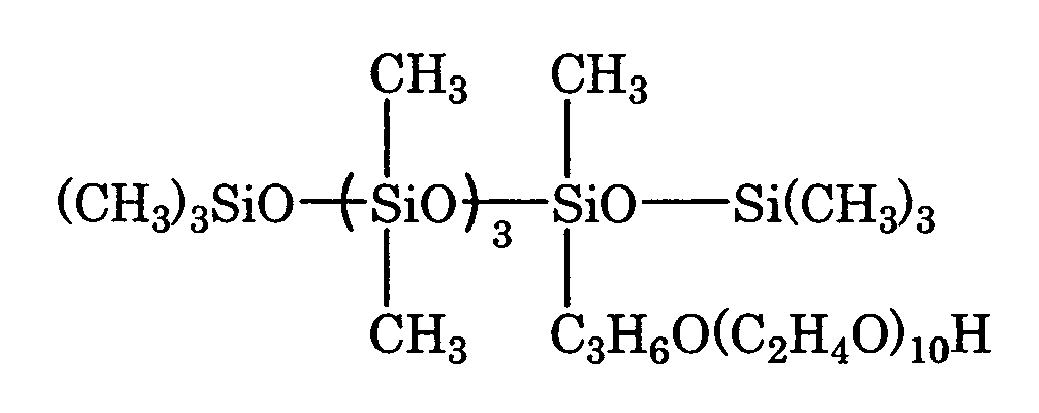
This compound is termed "A 1".
This compound is termed "A2".
This compound is termed "A3".
- The following compounds were used as the component (B).
This compound is termed "B1".
This compound is termed "B2".
This compound is termed "B3".
- The following compounds were used as the component (C).
This compound is termed "C1".
This compound is termed "C2".
This compound is termed "C3". - Compositions were prepared by mixing together the components in the mass ratios shown in Table 1.

- Compositions were prepared by mixing together the components in the mass ratios shown in Table 2.
- The comparative example 1 contained no component (B) or component (C), and used only the component (A).
- The comparative example 2 contained no component (B) or component (C), and used only the component (A) and a polyalkylene glycol-based antifoaming agent: Disfoam NKL-5450 (a product name, manufactured by NOF Corporation) as an antifoaming agent (1).
- The comparative example 3 contained no component (B) or component (C), and used only the component (A) and a silicone-based antifoaming agent: FS antifoam 001 (a product name, manufactured by Dow Corning Corporation) as an antifoaming agent (2).

- The external appearance and performance of the compositions of the above examples and comparative examples were evaluated. The results are shown in Table 3.
- A 1% by mass aqueous dispersion of each composition was placed in a glass bottle (internal diameter: 4.5 cm, height: 8.0 cm), and the glass bottle was shaken 250 times within one minute. The bottle was then left to stand, and the height (mm) of foam after standing for 30 seconds was measured.
- A 1% by mass aqueous dispersion containing only the component (A) was placed in a glass bottle (internal diameter: 4.5 cm, height: 8.0 cm), and the glass bottle was shaken 250 times within one minute to generate a foam. Subsequently, the component (B) and/or the component (C) were added to the aqueous dispersion to prepare an aqueous dispersion containing each of the components in the mass ratio shown in Table 1 or Table 2, and the glass bottle was then shaken a further 250 times within one minute. The bottle was then left to stand, and the height (mm) of foam after standing for 60 seconds was measured.
- A 0.1 % by mass aqueous dispersion of each composition was prepared, and the surface tension (mN/m) was measured at 25°C in accordance with the Wilhelmi method.

- As is evident from the results shown in Table 3, the compositions of the present invention exhibit minimal foaming, and exhibit low surface tension values (namely, have a powerful surfactant action).
Claims (10)
- A low-foaming silicone composition, comprising:(A) from 51 to 99.9 parts by mass of a polyoxyalkylene-modified organopolysiloxane represented by a general formula (1) shown below:
 R2 represents an organic group represented by a general formula (2) shown below:
-R4-O-(C2H4O)x-(C3H6O)y-R5 (2)
(wherein, each R4 represents, independently, an unsubstituted or substituted bivalent hydrocarbon group of 2 to 8 carbon atoms, each R5 represents, independently, a hydrogen atom, an unsubstituted or substituted monovalent hydrocarbon group of 1 to 6 carbon atoms, or an acetyl group (-COCH3), x represents an integer from 4 to 15, y represents an integer from 0 to 10, and when y is not zero, an arrangement of repeating units represented by a formula (C2H4O) and repeating units represented by a formula (C3H6O) in the general formula (2) is either random or a block-type arrangement),each R3 represents, independently, a hydroxyl group, an unsubstituted or substituted monovalent hydrocarbon group of 1 to 18 carbon atoms, or an organic group represented by the general formula (2),m represents an integer from 0 to 10, n represents an integer from 0 to 10, and a sum of m+n represents an integer from 1 to 20,provided that when n = 0, at least one of the two R3 groups in the general formula (1) is an organic group represented by the general formula (2)];(B) from 0.1 to 49 parts by mass of a polyoxyalkylene/perfluoroalkyl-comodified organopolysiloxane represented by a general formula (3) shown below: R7 represents an organic group represented by a general formula (4) shown below:
-R10-O-(C2H4O)z-(C3H6O)w-R11 (4)
(wherein, each R10 represents, independently, an unsubstituted or substituted bivalent hydrocarbon group of 2 to 8 carbon atoms, each R11 represents, independently, a hydrogen atom, an unsubstituted or substituted monovalent hydrocarbon group of 1 to 6 carbon atoms, or an acetyl group (-COCH3), z represents an integer from 0 to 10, w represents an integer from 4 to 60, and when z is not zero, an arrangement of repeating units represented by a formula (C2H4O) and repeating units represented by a formula (C3H6O) in the general formula (4) is either random or a block-type arrangement),R8 represents a perfluoroalkyl group-containing organic group represented by a general formula (5) shown below:
-R12-(CF2)u-CF3 (5)
(wherein, each R12 represents, independently, an unsubstituted or substituted bivalent hydrocarbon group of 2 to 8 carbon atoms, and u represents an integer from 0 to 13),each R9 represents, independently, a hydroxyl group, an unsubstituted or substituted monovalent hydrocarbon group of 1 to 18 carbon atoms, or an organic group represented by the general formula (4) or the general formula (5),o represents an integer from 0 to 100, p represents an integer from 0 to 30, q represents an integer from 1 to 100, and a sum of o+p+q represents an integer from 5 to 200,provided that when p = 0, at least one of the two R9 groups in the general formula (3) is an organic group represented by the general formula (4)]; and(C) from 0 to 48.9 parts by mass of a glycerol-modified organopolysiloxane represented by a general formula (6) shown below: R14 represents an organic group represented by a general formula (7) shown below:
 each R15 represents, independently, an unsubstituted or substituted monovalent hydrocarbon group of 1 to 18 carbon atoms, or an organic group represented by the general formula (7),r represents an integer from 0 to 6, and s represents an integer from 0 to 2,provided that when s = 0, at least one of the two R15 groups in the general formula (6) is an organic group represented by the general formula (7)](provided that a combined quantity of component (A), component (B) and component (C) is 100 parts by mass).
 - The composition according to claim 1, wherein from 80 to 100 mol% of all the R1 groups are methyl groups.
- The composition according to claim 1, wherein a molar ratio represented by x/(x+y) is from 0.4 to 1.
- The composition according to claim 1, wherein from 80 to 100 mol% of all the R6 groups are methyl groups.
- The composition according to claim 1, wherein a molar ratio represented by z/(z+w) is from 0 to 0.4.
- The composition according to claim 1, wherein from 80 to 100 mol% of all the R13 groups are methyl groups.
- A spreading agent comprising the composition defined in claim 1.
- A cleaning agent comprising the composition defined in claim 1.
- A method for lowering the surface tension of a liquid, comprising adding the composition defined in claim 1 to the liquid.
- A method for cleaning an article, comprising washing the article with the composition defined in claim 1.
Applications Claiming Priority (1)
| Application Number | Priority Date | Filing Date | Title |
|---|---|---|---|
| JP2007005567A JP4963065B2 (en) | 2007-01-15 | 2007-01-15 | Low foaming silicone composition |
Publications (2)
| Publication Number | Publication Date |
|---|---|
| EP1944330A1 true EP1944330A1 (en) | 2008-07-16 |
| EP1944330B1 EP1944330B1 (en) | 2012-01-11 |
Family
ID=39204035
Family Applications (1)
| Application Number | Title | Priority Date | Filing Date |
|---|---|---|---|
| EP08250163A Ceased EP1944330B1 (en) | 2007-01-15 | 2008-01-14 | Low-foaming silicone composition |
Country Status (3)
| Country | Link |
|---|---|
| US (1) | US7432235B2 (en) |
| EP (1) | EP1944330B1 (en) |
| JP (1) | JP4963065B2 (en) |
Cited By (4)
| Publication number | Priority date | Publication date | Assignee | Title |
|---|---|---|---|---|
| CN102511475A (en) * | 2011-12-09 | 2012-06-27 | 江南大学 | Composite emulsion stabilizer for preparing stable pesticide emulsion in water |
| EP2581401A1 (en) * | 2011-10-11 | 2013-04-17 | Shin-Etsu Chemical Co., Ltd. | Glycerol group-containing organopolysiloxane, cosmetic, and method for producing glycerol group-containing organopolysiloxane |
| US10077888B2 (en) | 2015-02-16 | 2018-09-18 | D.T.S. Illuminazione S.R.L. | Projector of light beams with adjustable optical bodies |
| US20220279780A1 (en) * | 2019-08-05 | 2022-09-08 | Ishihara Sangyo Kaisha, Ltd. | Agricultural formulation |
Families Citing this family (9)
| Publication number | Priority date | Publication date | Assignee | Title |
|---|---|---|---|---|
| WO2011108220A1 (en) * | 2010-03-01 | 2011-09-09 | 日本化薬株式会社 | Pest controlling composition |
| WO2011123737A1 (en) | 2010-04-01 | 2011-10-06 | The Procter & Gamble Company | Care polymers |
| JP5754849B2 (en) * | 2011-10-11 | 2015-07-29 | 信越化学工業株式会社 | Powder treatment agent, treated powder and powder dispersion in oil |
| RU2660116C2 (en) | 2013-08-13 | 2018-07-05 | Дау Силиконз Корпорейшн | Method of forming an antifoam granule |
| JP6298975B2 (en) * | 2014-07-08 | 2018-03-28 | サンノプコ株式会社 | Antifoam |
| US9725619B2 (en) * | 2015-02-05 | 2017-08-08 | Aculon, Inc. | Composition including silicon-containing compounds |
| WO2020028016A1 (en) * | 2018-07-31 | 2020-02-06 | Dow Global Technologies Llc | Composition with isocyanate compatible silicone stabilizer |
| WO2021230143A1 (en) * | 2020-05-14 | 2021-11-18 | 信越化学工業株式会社 | Organosilicon compound and method for producing same |
| WO2023132256A1 (en) * | 2022-01-05 | 2023-07-13 | 信越化学工業株式会社 | (poly)glycerin group- and polyoxyalkylene group-containing organopolysiloxane, treated hydrophobic powder, dispersion, and cosmetic |
Citations (4)
| Publication number | Priority date | Publication date | Assignee | Title |
|---|---|---|---|---|
| US4597894A (en) * | 1983-04-11 | 1986-07-01 | Shin-Etsu Chemical Co., Ltd. | Composition containing organopolysiloxane having polyoxyalkylene and perfluoroalkyl units |
| EP0355650A2 (en) | 1988-08-15 | 1990-02-28 | Dow Corning Corporation | Postemergent herbicide compositions containing silicone glycol adjuvants |
| US6300283B1 (en) | 1999-05-19 | 2001-10-09 | Shin-Etsu Chemical Co., Ltd. | Water-base agrochemical composition containing polyether-modified silicone |
| JP2005336266A (en) | 2004-05-25 | 2005-12-08 | Shin Etsu Chem Co Ltd | Low foaming spreading agent composition |
Family Cites Families (5)
| Publication number | Priority date | Publication date | Assignee | Title |
|---|---|---|---|---|
| JPS6422310A (en) * | 1987-07-17 | 1989-01-25 | Shinetsu Chemical Co | Antifoaming agent |
| US5454979A (en) * | 1992-08-27 | 1995-10-03 | Dow Corning Toray Silicon Co., Ltd. | Fluorosilicone antifoam |
| JP3808919B2 (en) * | 1995-09-20 | 2006-08-16 | 花王株式会社 | Oily solid cosmetic |
| JPH09278892A (en) * | 1996-04-09 | 1997-10-28 | Kao Corp | (poly)glycerin ester-modified organo(poly)siloxane, its production, and detergent composition containing it |
| US5908950A (en) * | 1996-05-31 | 1999-06-01 | Witco Corporation | Polyether modified fluoroalkylsiloxanes |
-
2007
- 2007-01-15 JP JP2007005567A patent/JP4963065B2/en active Active
-
2008
- 2008-01-14 US US12/013,666 patent/US7432235B2/en not_active Expired - Fee Related
- 2008-01-14 EP EP08250163A patent/EP1944330B1/en not_active Ceased
Patent Citations (4)
| Publication number | Priority date | Publication date | Assignee | Title |
|---|---|---|---|---|
| US4597894A (en) * | 1983-04-11 | 1986-07-01 | Shin-Etsu Chemical Co., Ltd. | Composition containing organopolysiloxane having polyoxyalkylene and perfluoroalkyl units |
| EP0355650A2 (en) | 1988-08-15 | 1990-02-28 | Dow Corning Corporation | Postemergent herbicide compositions containing silicone glycol adjuvants |
| US6300283B1 (en) | 1999-05-19 | 2001-10-09 | Shin-Etsu Chemical Co., Ltd. | Water-base agrochemical composition containing polyether-modified silicone |
| JP2005336266A (en) | 2004-05-25 | 2005-12-08 | Shin Etsu Chem Co Ltd | Low foaming spreading agent composition |
Cited By (6)
| Publication number | Priority date | Publication date | Assignee | Title |
|---|---|---|---|---|
| EP2581401A1 (en) * | 2011-10-11 | 2013-04-17 | Shin-Etsu Chemical Co., Ltd. | Glycerol group-containing organopolysiloxane, cosmetic, and method for producing glycerol group-containing organopolysiloxane |
| US8580241B2 (en) | 2011-10-11 | 2013-11-12 | Shin-Etsu Chemical Co., Ltd. | Glycerol group-containing organopolysiloxane, cosmetic, and method for producing glycerol group-containing organopolysiloxane |
| CN102511475A (en) * | 2011-12-09 | 2012-06-27 | 江南大学 | Composite emulsion stabilizer for preparing stable pesticide emulsion in water |
| US10077888B2 (en) | 2015-02-16 | 2018-09-18 | D.T.S. Illuminazione S.R.L. | Projector of light beams with adjustable optical bodies |
| US20220279780A1 (en) * | 2019-08-05 | 2022-09-08 | Ishihara Sangyo Kaisha, Ltd. | Agricultural formulation |
| AU2020324635B2 (en) * | 2019-08-05 | 2026-03-05 | Ishihara Sangyo Kaisha, Ltd. | Agricultural formulation |
Also Published As
| Publication number | Publication date |
|---|---|
| US20080171686A1 (en) | 2008-07-17 |
| JP4963065B2 (en) | 2012-06-27 |
| JP2008169176A (en) | 2008-07-24 |
| US7432235B2 (en) | 2008-10-07 |
| EP1944330B1 (en) | 2012-01-11 |
Similar Documents
| Publication | Publication Date | Title |
|---|---|---|
| EP1944330B1 (en) | Low-foaming silicone composition | |
| US10544267B2 (en) | Method for producing siloxanes containing glycerin substituents | |
| KR102471285B1 (en) | Process for producing compositions comprising platinum | |
| EP1597969B1 (en) | Glycerol-modified silicone spreading agent and a composition comprising the same | |
| US20040132951A1 (en) | Process for working up polyethersiloxanes | |
| US10765970B2 (en) | Defoamer oil compound, production method therefor, and defoamer composition | |
| JP7248826B2 (en) | silicone polyether foam control agent | |
| US9777121B2 (en) | Defoaming agent composition | |
| CA2742090A1 (en) | Process for preparing organic silicon compounds | |
| US20060140998A1 (en) | Agricultural disinfectant composition | |
| JP4430458B2 (en) | Low foaming spreading agent composition | |
| US7294653B2 (en) | Silicone antifoaming agent | |
| CN1864792B (en) | Defoaming composition | |
| JP3027088B2 (en) | Antifoam composition | |
| JP3570490B2 (en) | Foam inhibitor composition | |
| EP4453068B1 (en) | Silicone polyethers | |
| CN116099238A (en) | A kind of preparation method of organosilicon defoamer and its product and application | |
| EP3584363A1 (en) | Oil mist inhibitor, lubricant containing same, and oil mist reduction method | |
| CN116457393A (en) | Silicone defoamer composition | |
| CA3223237A1 (en) | Preparation of a foam stabilizing composition including a siloxane cationic surfactant, a cationic surfactant and a metal salt | |
| MXPA03008313A (en) | Pesticidal compositions containing silicon compounds. | |
| JPH05261206A (en) | Foam inhibitor composition | |
| JP3636293B2 (en) | Foam suppressant composition | |
| CN1215162C (en) | Siloxanes foam controlled compsns. stablized in detergent | |
| WO2025089374A1 (en) | Polyether-modified organopolysiloxane |
Legal Events
| Date | Code | Title | Description |
|---|---|---|---|
| PUAI | Public reference made under article 153(3) epc to a published international application that has entered the european phase |
Free format text: ORIGINAL CODE: 0009012 |
|
| AK | Designated contracting states |
Kind code of ref document: A1 Designated state(s): AT BE BG CH CY CZ DE DK EE ES FI FR GB GR HR HU IE IS IT LI LT LU LV MC MT NL NO PL PT RO SE SI SK TR |
|
| AX | Request for extension of the european patent |
Extension state: AL BA MK RS |
|
| 17P | Request for examination filed |
Effective date: 20081208 |
|
| 17Q | First examination report despatched |
Effective date: 20090119 |
|
| AKX | Designation fees paid |
Designated state(s): DE FR GB |
|
| GRAP | Despatch of communication of intention to grant a patent |
Free format text: ORIGINAL CODE: EPIDOSNIGR1 |
|
| GRAS | Grant fee paid |
Free format text: ORIGINAL CODE: EPIDOSNIGR3 |
|
| GRAA | (expected) grant |
Free format text: ORIGINAL CODE: 0009210 |
|
| AK | Designated contracting states |
Kind code of ref document: B1 Designated state(s): DE FR GB |
|
| REG | Reference to a national code |
Ref country code: GB Ref legal event code: FG4D |
|
| REG | Reference to a national code |
Ref country code: DE Ref legal event code: R096 Ref document number: 602008012622 Country of ref document: DE Effective date: 20120315 |
|
| PLBE | No opposition filed within time limit |
Free format text: ORIGINAL CODE: 0009261 |
|
| STAA | Information on the status of an ep patent application or granted ep patent |
Free format text: STATUS: NO OPPOSITION FILED WITHIN TIME LIMIT |
|
| 26N | No opposition filed |
Effective date: 20121012 |
|
| REG | Reference to a national code |
Ref country code: DE Ref legal event code: R097 Ref document number: 602008012622 Country of ref document: DE Effective date: 20121012 |
|
| REG | Reference to a national code |
Ref country code: FR Ref legal event code: PLFP Year of fee payment: 9 |
|
| REG | Reference to a national code |
Ref country code: FR Ref legal event code: PLFP Year of fee payment: 10 |
|
| REG | Reference to a national code |
Ref country code: FR Ref legal event code: PLFP Year of fee payment: 11 |
|
| PGFP | Annual fee paid to national office [announced via postgrant information from national office to epo] |
Ref country code: GB Payment date: 20231130 Year of fee payment: 17 |
|
| PGFP | Annual fee paid to national office [announced via postgrant information from national office to epo] |
Ref country code: FR Payment date: 20231212 Year of fee payment: 17 |
|
| PGFP | Annual fee paid to national office [announced via postgrant information from national office to epo] |
Ref country code: DE Payment date: 20231128 Year of fee payment: 17 |
|
| REG | Reference to a national code |
Ref country code: DE Ref legal event code: R119 Ref document number: 602008012622 Country of ref document: DE |
|
| GBPC | Gb: european patent ceased through non-payment of renewal fee |
Effective date: 20250114 |
|
| PG25 | Lapsed in a contracting state [announced via postgrant information from national office to epo] |
Ref country code: DE Free format text: LAPSE BECAUSE OF NON-PAYMENT OF DUE FEES Effective date: 20250801 |
|
| PG25 | Lapsed in a contracting state [announced via postgrant information from national office to epo] |
Ref country code: GB Free format text: LAPSE BECAUSE OF NON-PAYMENT OF DUE FEES Effective date: 20250114 |
|
| PG25 | Lapsed in a contracting state [announced via postgrant information from national office to epo] |
Ref country code: FR Free format text: LAPSE BECAUSE OF NON-PAYMENT OF DUE FEES Effective date: 20250131 |