EP0355650A2 - Postemergent herbicide compositions containing silicone glycol adjuvants - Google Patents
Postemergent herbicide compositions containing silicone glycol adjuvants Download PDFInfo
- Publication number
- EP0355650A2 EP0355650A2 EP89114998A EP89114998A EP0355650A2 EP 0355650 A2 EP0355650 A2 EP 0355650A2 EP 89114998 A EP89114998 A EP 89114998A EP 89114998 A EP89114998 A EP 89114998A EP 0355650 A2 EP0355650 A2 EP 0355650A2
- Authority
- EP
- European Patent Office
- Prior art keywords
- silicone glycol
- herbicide
- dispersant
- carbon atoms
- silicone
- Prior art date
- Legal status (The legal status is an assumption and is not a legal conclusion. Google has not performed a legal analysis and makes no representation as to the accuracy of the status listed.)
- Granted
Links
Classifications
-
- A—HUMAN NECESSITIES
- A01—AGRICULTURE; FORESTRY; ANIMAL HUSBANDRY; HUNTING; TRAPPING; FISHING
- A01N—PRESERVATION OF BODIES OF HUMANS OR ANIMALS OR PLANTS OR PARTS THEREOF; BIOCIDES, e.g. AS DISINFECTANTS, AS PESTICIDES OR AS HERBICIDES; PEST REPELLANTS OR ATTRACTANTS; PLANT GROWTH REGULATORS
- A01N25/00—Biocides, pest repellants or attractants, or plant growth regulators, characterised by their forms, or by their non-active ingredients or by their methods of application, e.g. seed treatment or sequential application; Substances for reducing the noxious effect of the active ingredients to organisms other than pests
- A01N25/24—Biocides, pest repellants or attractants, or plant growth regulators, characterised by their forms, or by their non-active ingredients or by their methods of application, e.g. seed treatment or sequential application; Substances for reducing the noxious effect of the active ingredients to organisms other than pests containing ingredients to enhance the sticking of the active ingredients
-
- A—HUMAN NECESSITIES
- A01—AGRICULTURE; FORESTRY; ANIMAL HUSBANDRY; HUNTING; TRAPPING; FISHING
- A01N—PRESERVATION OF BODIES OF HUMANS OR ANIMALS OR PLANTS OR PARTS THEREOF; BIOCIDES, e.g. AS DISINFECTANTS, AS PESTICIDES OR AS HERBICIDES; PEST REPELLANTS OR ATTRACTANTS; PLANT GROWTH REGULATORS
- A01N25/00—Biocides, pest repellants or attractants, or plant growth regulators, characterised by their forms, or by their non-active ingredients or by their methods of application, e.g. seed treatment or sequential application; Substances for reducing the noxious effect of the active ingredients to organisms other than pests
- A01N25/30—Biocides, pest repellants or attractants, or plant growth regulators, characterised by their forms, or by their non-active ingredients or by their methods of application, e.g. seed treatment or sequential application; Substances for reducing the noxious effect of the active ingredients to organisms other than pests characterised by the surfactants
Definitions
- an adjuvant being broadly defined as any substance which enhances the effectiveness of the herbicide.
- an activity-increasing adjuvant through proper formulation with an activity-increasing adjuvant, the damage inflicted upon a particular plant species by a herbicide can be amplified many fold.
- Such an activity-increasing adjuvant does not generally have biological activity on its own but only brings out the activity of the herbicide.
- herbicide formulations retain a significant degree of activity when plants treated therewith are exposed to rain shortly after application, this being a definition of the degree of "rainfastness.” This is particularly critical in the case of water-soluble postemergent herbicides, such as acifluorfen-sodium, which are easily washed away by rainfall occurring within about six hours of application.
- sticking agents are also included in the herbicide formulation, namely "sticking agents.”
- the main function of these materials is to impart an increased measure of adhesion of the herbicide composition to plant foliage and thus prevent premature washing away should precipitation occur after the plants are sprayed.
- the sticking agents are usually polymeric compounds which are generally water-insoluble and tacky in nature.
- the rainfastness of a postemergent herbicide can be synergistically increased by the inclusion of a combination of a silicone glycol, and a dispersant for the silicone glycol, in the herbicide composition.
- the improvement in rainfastness resulted only when the silicone glycol had an average of four or five ethylene oxide units in its glycol chain.
- neither the silicone glycols of the present invention, nor the dispersants therefore, provided rainfastness when used as the sole adjuvant in conjunction with the herbicide.
- the present invention therefore relates to a composition consisting essentially of:
- the present invention further relates to a method for inhibiting the growth of weeds, particularly velvetleaf plants, comprising contacting at least part of the weed with a herbicidal formulation, the improvement comprising using as said herbicidal formulation a homogeneous aqueous dispersion of the aforementioned composition.
- the herbicidal composition of the present invention is a homogeneous mixture consisting essentially of (I) a postemergent herbicide, (II) a silicone glycol adjuvant consisting essentially of (i) a silicone glycol having four or five ethylene oxide units in its glycol chain and (ii) a silicone glycol dispersant for silicone glycol (i), which imparts water dispersibility to said composition.
- the postemergent herbicide (I) of the present invention is selected from those herbicides well known in the art to be effective when applied after the emergence of a plant.
- postemergent herbicides include, inter alia, 3-isopropyl-1H-2,1,3-benzothiadiazin-4(3H)-one 2,2-dioxide(bentazon) and N-(phosphonomethyl)glycine(glyphosate).
- the former herbicide is marketed under the trade name BASAGRAN by BASF Wyandotte Corp., Parsippany, NJ and the latter herbicide is sold under the trade name ROUNDUP by Monsanto Agricultural Products Co., St. Louis, MO.
- the herbicide is preferably selected from the diphenyl ether structures exemplified by the general formula
- this class of herbicides include such compounds as 2,4-dichlorophenyl 4-nitrophenyl ether (nitrofen); 5-(2-chloro-4-trifluoromethylphenoxy)-2-nitrobenzoic acid (acifluorofen); ethoxycarbonylmethyl 2-[3-(2,6-dichloro-4-trifluoromethyl-phenoxy)-6-nitrophenoxy]-propionate; ethoxymethyl 2-[3-(chloro-4-trifluoromethyl-phenoxy)-6-nitrophenoxy]-propionate; sodium 5-[2-chloro-4(trifuoromethyl)phenoxy]-2-nitrobenzoate (acifluorfen-sodium); methyl 5-(2,4-dichlorophenoxy)-2-nitrobenzoate (bifenox); and 2-chloro-1-(3-ethoxy-4
- the silicone glycol (i) of the present invention has the average structure wherein Me hereinafter denotes a methyl radical and R is a divalent alkylene group having 2 to 6 carbon atoms, such as ethylene, trimethylene, tetramethylene or hexamethylene. It is preferred that R is a trimethylene group.
- Z is selected from the group consisting of hydrogen, an alkyl radical having 1 to 3 carbon atoms and an acyl group having 2 to 4 carbon atoms.
- Z is an acetoxy group.
- it is critical that the value of m is fixed at 4 or 5, preferably 4, ethylene oxide (EO) units.
- the silicone glycols described above are well known in the art and may be prepared by coupling the corresponding allyl-terminated glycol to a bis-siloxane structure having a hydrogen attached to the central silicon atom, said structure being Generally, the coupling is accomplished in the presence of a platinum catalyst.
- a platinum catalyst The skilled artisan will recognize that, in such coupling reactions, a fraction of the allyl-terminated glycol is not converted and will remain as an impurity in the final silicone glycol product.
- the allyl-terminated glycol employed may contain a minor proportion of molecules having less than 4 or more than 5, ethylene oxide units. This, in turn, results in silicone glycols having a value of m of less than 4 or greater than 5, respectively.
- the herbicide compositions may contain such impurities and still be within the scope of the present invention.
- the silicone glycol dispersant (ii) of the present invention is similar to the above described silicone glycol (i) and has the average formula wherein R and Z have their previously defined meanings, but may be assigned independently from component (i).
- n is about 8 to 24 and x is 1 to 5. It is preferred that x is 1 and n is about 12.
- a highly preferred silicone glycol dispersant of the present invention has the average structure
- silicone glycol dispersant (ii) imparts water dispersibility to the combination of the herbicide (I) and silicone glycol (i), since component (i) is itself not readily dispersed in water to form a stable system.
- compositions of the present invention may also contain other herbicide adjuvants commonly employed in the art.
- adjuvants include crop oil concentrate, ORTHO X-77 spreader, drift control agents, such as LO-DRIFT, defoaming agents, such as D-FOAMER, other compatibility agents, such as E-Z MIX, and other adjuvants well known in the herbicide art.
- silicone glycol (i) is first thoroughly mixed with from about 80 to 5 weight percent of the silicone glycol dispersant (ii) to form the silicone glycol adjuvant (II).
- silicone glycol adjuvant (II) is readily determined through routine experimentation by the skilled artisan.
- the amount of silicone glycol dispersant needed to obtain a stable, uniform water dispersion of the components is used to form the compositions of the present invention.
- stable it is meant herein that the aqueous dispersion does not phase-separate upon prolonged storage at ambient conditions.
- the minimum amount of silicone glycol dispersant compatible with this function, and the above noted percentage limits, is so employed.
- silicone glycol adjuvant (II) is then preferably blended with herbicide (I) to form a homogeneous dispersion which can then be diluted with water and sprayed onto plants according to the method of the present invention, described infra.
- the silicone glycol adjuvant (II) may be added directly to a water solution or dispersion of herbicide (I).
- silicone glycol adjuvant (II) is used for each part by weight of herbicide (I).
- herbicide (I) is used for each part by weight of herbicide (I).
- from about 0.2 to 17 parts by weight of the silicone glycol adjuvant (II) are so employed.
- Preferred embodiments of the present invention employ a silicone glycol having four ethylene oxide units in its molecule and the highly preferred silicone glycol dispersant, described above, in a weight ratio of about 2:1 to 9:1, respectively. In a particularly preferred embodiment, this ratio is 4:1 and about 5 parts by weight of silicone glycol adjuvant (II) is used for each part by weight of herbicide (I).
- compositions of the present invention consist essentially of from about 0.02 to 2.0 parts by weight of postemergent herbicide (I), from about 0.01 to 50 parts by weight, for each part by weight of said herbicide (I), of the silicone glycol adjuvant (II) and sufficient water to provide 100 parts by weight of the total composition.
- the present invention also relates to a method for inhibiting the growth of weeds, particularly the species Abutilon theophrasti, hereinafter referred to by its common name of "velvetleaf.”
- This method comprises contacting at least part of the weed with a homogeneous water dispersion of a herbicidal composition, as hereinabove described.
- This water dispersion is applied to the foliage of the weed by any of the methods commonly practiced in the art, preferably by spraying.
- the amount of the dispersion, and the herbicide contained therein, to be applied to the velvetleaf may be varied to a great extent, the optima being determined by such factors as soil conditions, weather conditions and the type of crops or other plants growing alongside the weed.
- the effective range is about 0.12 to 2 pounds per acre of herbicide formulation.
- compositions of the present invention are used according to the above described method, there is observed a marked improvement in the rainfastness of the herbicide compositions relative to those containing silicone glycol adjuvants having less than 4 or more than 5 (on average) ethylene oxide units in the glycol chain.
- silicone glycol adjuvants having less than 4 or more than 5 (on average) ethylene oxide units in the glycol chain.
- silicone glycols employed had the average structure wherein Me hereinafter denotes a methyl radical and m had the value indicated in the table below.
- Silicone Glycol m Numberer of Ethylene Oxide Units
- Purity (By Gas Chromatograph) SILICONE GLYCOL A 1 100 % SILICONE GLYCOL B 2 95.5 % SILICONE GLYCOL C 3 89 % SILICONE GLYCOL D 4 82 % SILICONE GLYCOL E 5 75 % SILICONE GLYCOL F 6 75 % SILICONE GLYCOL G 7 (average) 75 %
- SILICONE GLYCOLS A through E SILICONE GLYCOL F was likewise prepared from a glycol having 6 EO units which was stripped of glycols having less than six ethylene oxide, also under vacuum.
- SILICONE GLYCOL G was formed from undistilled materials and had an average of 7 E0 units in its glycol chain.
- the impurities in the silicone glycols shown in the above table consisted mainly of the respective beta-isomerized glycols.
- a highly preferred dispersant of the present invention having the average structure was employed and will be referred to as DISPERSANT 1 herein.
- the herbicide used in the examples was acifluorfen-sodium marketed by BASF Corporation (Research Triangle Park, NC) under the trade name BLAZER.
- HERBIMAX a standard organic surfactant, HERBIMAX, was used as an adjuvant with the BLAZER herbicide (Comparative Example 8).
- HERBIMAX Loveland Industries, Loveland, CO
- HERBIMAX is described as a balanced system of oil and surfactants designed to optimize performance of various herbicides in postemergence applications. It contains 17% of a surfactant blend and 83% paraffinic petroleum oil.
- Water dispersions of herbicide compositions were prepared by first mixing SILICONE GLYCOL A through SILICONE GLYCOL E with DISPERSANT 1 in a 4:1 ratio. These mixtures (0.94 gm each) were then blended with BLAZER (0.18 gm each) and each blend was diluted with water to provide 250 ml of total dispersion.
- Water dispersions similar to those of Examples 1 - 5 were prepared using SILICONE GLYCOL F and SILICONE GLYCOL G as adjuvants (0.94 gm) together with BLAZER (0.18 gm). No dispersant was employed in these examples and the dispersions were again diluted with water to 250 ml.
- the plants were 3 to 5 inches tall, they were sprayed with water dispersions of the herbicide compositions so as to broadcast herbicide (i.e., BLAZER) at a rate of 0.03 pounds per acre (0.03 lb/A) along with the adjuvant (i.e., silicone glycol plus dispersant, when used) at a rate of 3/4 pint/A.
- herbicide i.e., BLAZER
- adjuvant i.e., silicone glycol plus dispersant, when used
- Spraying was accomplished by means of a link-belt sprayer fitted with a TEEJET 8001 E nozzle which delivered the equivalent of 25 gallons/acre of the herbicide dispersion.
- the BLAZER application rate employed was previously found to induce approximately 50% injury to the velvetleaf after 7 days when an adjuvant, consisting of an 80/20 mix of a crude version of SILICONE GLYCOL D (i.e., prepared from undistilled materials) and DISPERSANT 1, was mixed with BLAZER and broadcast at the above rates.
- an adjuvant consisting of an 80/20 mix of a crude version of SILICONE GLYCOL D (i.e., prepared from undistilled materials) and DISPERSANT 1, was mixed with BLAZER and broadcast at the above rates.
- the 250 ml samples, described above provided the prescribed broadcast rates, except for the case of HERBIMAX, which was broadcast at a rate of 1 quart/acre.
- the rainfastness of the herbicide compositions was evaluated by spraying half the plants with water in order to simulate rainfall. This procedure consisted of spraying plants from above (8-10 inches above plant tops) using a TEEJET nozzle which delivered 0.4 gallons of water per minute. This nozzle was also mounted on a chain drive and reciprocally moved over four plants at a time, each such traverse taking about 9-10 seconds. The water spray was started 15 minutes after application of the herbicide compositions and was continued for approximately 7 minutes, at which point the equivalent of one inch of "rain" had fallen on each plant.
- Plant injury was visually determined using a double-blind experimental mode wherein four replicates were run for each herbicide composition. Phytotoxicity was ranked from zero, corresponding to no observable effect, to 100%, corresponding to total destruction of the plant. These results were averaged and the values reported using Duncan's multiple range test to distinguish statistical differences at the 95% confidence level. As is common practice in the art, the injury values reported infra include lower case superscript letters which indicate whether any given set of values is statistically identical. Thus, for example, when two injury values have such a superscript in common, this is an indication that these values are not statistically different at the 5% level by Duncan's method.
- DISPERSANT 2 was a silicone glycol having the average formula
- DISPERSANT 3 was an anionic surfactant, ammonium nonylphenoxypolyethoxysulfate (ALIPAL HF-433; GAF Corp., Wayne, NJ).
- DISPERSANT 4 was a cationic surfactant, POLYQUART H (Henkel Corporation, Teaneck, NJ) which is described as a polyamine-polyglycol condensate.
- DISPERSANT 5 was a nonionic surfactant, BRIJ 97 (ICI United States, Wilmington, DE) which is described as a polyoxyethylene(10) oleyl ether.
Landscapes
- Life Sciences & Earth Sciences (AREA)
- General Health & Medical Sciences (AREA)
- Health & Medical Sciences (AREA)
- Toxicology (AREA)
- Pest Control & Pesticides (AREA)
- Plant Pathology (AREA)
- Agronomy & Crop Science (AREA)
- Engineering & Computer Science (AREA)
- Dentistry (AREA)
- Wood Science & Technology (AREA)
- Zoology (AREA)
- Environmental Sciences (AREA)
- Agricultural Chemicals And Associated Chemicals (AREA)
Abstract
Description
- It is well recognized in the art that the full potency of a given organic herbicide is not generally attained without the inclusion of various adjuvants, an adjuvant being broadly defined as any substance which enhances the effectiveness of the herbicide. Thus, for example, through proper formulation with an activity-increasing adjuvant, the damage inflicted upon a particular plant species by a herbicide can be amplified many fold. Such an activity-increasing adjuvant does not generally have biological activity on its own but only brings out the activity of the herbicide.
- In addition to the herbicidal enhancement provided by the activity-increasing adjuvants, it is often important that herbicide formulations retain a significant degree of activity when plants treated therewith are exposed to rain shortly after application, this being a definition of the degree of "rainfastness." This is particularly critical in the case of water-soluble postemergent herbicides, such as acifluorfen-sodium, which are easily washed away by rainfall occurring within about six hours of application. Typically, this problem is currently addressed by inclusion of another class or adjuvants in the herbicide formulation, namely "sticking agents." The main function of these materials, as the appellation implies, is to impart an increased measure of adhesion of the herbicide composition to plant foliage and thus prevent premature washing away should precipitation occur after the plants are sprayed. The sticking agents are usually polymeric compounds which are generally water-insoluble and tacky in nature.
- It has now been found that the rainfastness of a postemergent herbicide can be synergistically increased by the inclusion of a combination of a silicone glycol, and a dispersant for the silicone glycol, in the herbicide composition. Quite surprisingly, the improvement in rainfastness resulted only when the silicone glycol had an average of four or five ethylene oxide units in its glycol chain. Contrarily, neither the silicone glycols of the present invention, nor the dispersants therefore, provided rainfastness when used as the sole adjuvant in conjunction with the herbicide. The present invention therefore relates to a composition consisting essentially of:
- (I) a postemergent herbicide; and
- (II) from about 0.01 to 50 parts by weight, for each part by weight of said herbicide (I), of a silicone glycol adjuvant consisting essentially of
- (i) from 20 to 95 weight percent of a silicone glycol having the average structure

- (ii) from 50 to 5 weight percent of a silicone glycol dispersant having the average formula

- (i) from 20 to 95 weight percent of a silicone glycol having the average structure
- The present invention further relates to a method for inhibiting the growth of weeds, particularly velvetleaf plants, comprising contacting at least part of the weed with a herbicidal formulation, the improvement comprising using as said herbicidal formulation a homogeneous aqueous dispersion of the aforementioned composition.
- The herbicidal composition of the present invention is a homogeneous mixture consisting essentially of (I) a postemergent herbicide, (II) a silicone glycol adjuvant consisting essentially of (i) a silicone glycol having four or five ethylene oxide units in its glycol chain and (ii) a silicone glycol dispersant for silicone glycol (i), which imparts water dispersibility to said composition.
- The postemergent herbicide (I) of the present invention is selected from those herbicides well known in the art to be effective when applied after the emergence of a plant. Examples of such postemergent herbicides include, inter alia, 3-isopropyl-1H-2,1,3-benzothiadiazin-4(3H)-one 2,2-dioxide(bentazon) and N-(phosphonomethyl)glycine(glyphosate). The former herbicide is marketed under the trade name BASAGRAN by BASF Wyandotte Corp., Parsippany, NJ and the latter herbicide is sold under the trade name ROUNDUP by Monsanto Agricultural Products Co., St. Louis, MO.
- For the purposes of the present invention, the herbicide is preferably selected from the diphenyl ether structures exemplified by the general formula

- The silicone glycol (i) of the present invention has the average structure
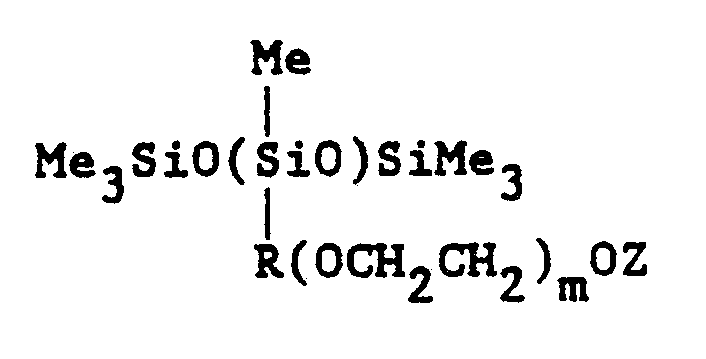
- The silicone glycols described above are well known in the art and may be prepared by coupling the corresponding allyl-terminated glycol to a bis-siloxane structure having a hydrogen attached to the central silicon atom, said structure being

- The silicone glycol dispersant (ii) of the present invention is similar to the above described silicone glycol (i) and has the average formula

- A highly preferred silicone glycol dispersant of the present invention has the average structure

- While not wishing to be bound by any particular theoretical explanation for the synergistic effect of components (i) and (ii), it is to be noted that the silicone glycol dispersant (ii) imparts water dispersibility to the combination of the herbicide (I) and silicone glycol (i), since component (i) is itself not readily dispersed in water to form a stable system.
- In addition to the aforementioned components, the compositions of the present invention may also contain other herbicide adjuvants commonly employed in the art. Examples of such adjuvants include crop oil concentrate, ORTHO X-77 spreader, drift control agents, such as LO-DRIFT, defoaming agents, such as D-FOAMER, other compatibility agents, such as E-Z MIX, and other adjuvants well known in the herbicide art.
- In order to prepare the compositions of the present invention, from about 20 to 95 weight percent of silicone glycol (i) is first thoroughly mixed with from about 80 to 5 weight percent of the silicone glycol dispersant (ii) to form the silicone glycol adjuvant (II). The optimum ratio of these ingredients dependent upon the particular silicone glycol dispersant employed and is readily determined through routine experimentation by the skilled artisan. As intimated above, the amount of silicone glycol dispersant needed to obtain a stable, uniform water dispersion of the components is used to form the compositions of the present invention. By "stable", it is meant herein that the aqueous dispersion does not phase-separate upon prolonged storage at ambient conditions. Generally, the minimum amount of silicone glycol dispersant compatible with this function, and the above noted percentage limits, is so employed.
- The above mentioned silicone glycol adjuvant (II) is then preferably blended with herbicide (I) to form a homogeneous dispersion which can then be diluted with water and sprayed onto plants according to the method of the present invention, described infra. Alternatively, the silicone glycol adjuvant (II) may be added directly to a water solution or dispersion of herbicide (I).
- In order to be within the scope of the present invention, from about 0.01 to 50 parts by weight of the silicone glycol adjuvant (II) are used for each part by weight of herbicide (I). Preferably, from about 0.2 to 17 parts by weight of the silicone glycol adjuvant (II) are so employed.
- Preferred embodiments of the present invention employ a silicone glycol having four ethylene oxide units in its molecule and the highly preferred silicone glycol dispersant, described above, in a weight ratio of about 2:1 to 9:1, respectively. In a particularly preferred embodiment, this ratio is 4:1 and about 5 parts by weight of silicone glycol adjuvant (II) is used for each part by weight of herbicide (I).
- In another aspect, the compositions of the present invention consist essentially of from about 0.02 to 2.0 parts by weight of postemergent herbicide (I), from about 0.01 to 50 parts by weight, for each part by weight of said herbicide (I), of the silicone glycol adjuvant (II) and sufficient water to provide 100 parts by weight of the total composition.
- The present invention also relates to a method for inhibiting the growth of weeds, particularly the species Abutilon theophrasti, hereinafter referred to by its common name of "velvetleaf." This method comprises contacting at least part of the weed with a homogeneous water dispersion of a herbicidal composition, as hereinabove described. This water dispersion is applied to the foliage of the weed by any of the methods commonly practiced in the art, preferably by spraying. The amount of the dispersion, and the herbicide contained therein, to be applied to the velvetleaf may be varied to a great extent, the optima being determined by such factors as soil conditions, weather conditions and the type of crops or other plants growing alongside the weed. Generally, however, the effective range is about 0.12 to 2 pounds per acre of herbicide formulation.
- When the compositions of the present invention are used according to the above described method, there is observed a marked improvement in the rainfastness of the herbicide compositions relative to those containing silicone glycol adjuvants having less than 4 or more than 5 (on average) ethylene oxide units in the glycol chain. Thus, when compared with currently used silicone glycol adjuvants, there is provided a distinct advantage by the instant compositions in that they permit the use of lower herbicide levels to attain a similar degree of injury to a weed when there is a reasonable likelihood of precipitation after broadcasting the herbicide. Such a reduction in herbicide levels generally results in reduced insult to adjacent cash crops and is considered highly desirable.
- The following examples are presented to further illustrate the compositions of this invention, but are not to be construed as limiting the invention, which is delineated in the appended claims. All parts and percentages in the examples are on a weight basis unless indicated to the contrary.
- In a first experimental series (Examples 1-7), the silicone glycols employed had the average structure

Silicone Glycol m (Number of Ethylene Oxide Units) Purity (By Gas Chromatograph) SILICONE GLYCOL A 1 100 % SILICONE GLYCOL B 2 95.5 % SILICONE GLYCOL C 3 89 % SILICONE GLYCOL D 4 82 % SILICONE GLYCOL E 5 75 % SILICONE GLYCOL F 6 75 % SILICONE GLYCOL G 7 (average) 75 % - These compounds were prepared by the platinum catalyzed addition of the appropriate allyl-terminated glycol to an organohydrogenpolysiloxane having the structure

- A highly preferred dispersant of the present invention having the average structure

- The herbicide used in the examples was acifluorfen-sodium marketed by BASF Corporation (Research Triangle Park, NC) under the trade name BLAZER.
- Additionally, for comparison, a standard organic surfactant, HERBIMAX, was used as an adjuvant with the BLAZER herbicide (Comparative Example 8). HERBIMAX (Loveland Industries, Loveland, CO) is described as a balanced system of oil and surfactants designed to optimize performance of various herbicides in postemergence applications. It contains 17% of a surfactant blend and 83% paraffinic petroleum oil.
- The following herbicide mixtures were prepared:
- Water dispersions of herbicide compositions were prepared by first mixing SILICONE GLYCOL A through SILICONE GLYCOL E with DISPERSANT 1 in a 4:1 ratio. These mixtures (0.94 gm each) were then blended with BLAZER (0.18 gm each) and each blend was diluted with water to provide 250 ml of total dispersion.
- Water dispersions similar to those of Examples 1 - 5 were prepared using SILICONE GLYCOL F and SILICONE GLYCOL G as adjuvants (0.94 gm) together with BLAZER (0.18 gm). No dispersant was employed in these examples and the dispersions were again diluted with water to 250 ml.
- An herbicide formulation containing 0.18 gm BLAZER and 2.5 ml (2.2 gm) of HERBIMAX was prepared by thoroughly mixing these ingredients and diluting with water, as before.
- Individually potted velvetleaf plants were grown under standard greenhouse conditions in BACCTO professional potting soil mix. Temperature was controlled at 75 +/-2°F. Irradiation consisted of normal sunlight supplemented by high-pressure sodium vapor lamps to provide an added 1,200 µE/m2.s at bench level (µE = microeinstein), wherein the day/night cycle was set at 18 hours and 6 hours, respectively.
- When the plants were 3 to 5 inches tall, they were sprayed with water dispersions of the herbicide compositions so as to broadcast herbicide (i.e., BLAZER) at a rate of 0.03 pounds per acre (0.03 lb/A) along with the adjuvant (i.e., silicone glycol plus dispersant, when used) at a rate of 3/4 pint/A. Spraying was accomplished by means of a link-belt sprayer fitted with a TEEJET 8001 E nozzle which delivered the equivalent of 25 gallons/acre of the herbicide dispersion. The BLAZER application rate employed was previously found to induce approximately 50% injury to the velvetleaf after 7 days when an adjuvant, consisting of an 80/20 mix of a crude version of SILICONE GLYCOL D (i.e., prepared from undistilled materials) and DISPERSANT 1, was mixed with BLAZER and broadcast at the above rates. In the spray apparatus employed, the 250 ml samples, described above, provided the prescribed broadcast rates, except for the case of HERBIMAX, which was broadcast at a rate of 1 quart/acre.
- In addition, the rainfastness of the herbicide compositions was evaluated by spraying half the plants with water in order to simulate rainfall. This procedure consisted of spraying plants from above (8-10 inches above plant tops) using a TEEJET nozzle which delivered 0.4 gallons of water per minute. This nozzle was also mounted on a chain drive and reciprocally moved over four plants at a time, each such traverse taking about 9-10 seconds. The water spray was started 15 minutes after application of the herbicide compositions and was continued for approximately 7 minutes, at which point the equivalent of one inch of "rain" had fallen on each plant.
- Plant injury was visually determined using a double-blind experimental mode wherein four replicates were run for each herbicide composition. Phytotoxicity was ranked from zero, corresponding to no observable effect, to 100%, corresponding to total destruction of the plant. These results were averaged and the values reported using Duncan's multiple range test to distinguish statistical differences at the 95% confidence level. As is common practice in the art, the injury values reported infra include lower case superscript letters which indicate whether any given set of values is statistically identical. Thus, for example, when two injury values have such a superscript in common, this is an indication that these values are not statistically different at the 5% level by Duncan's method.
- The above described herbicide dispersions were used to spray velvetleaf plants and the degree of injury, both with and without rain simulation, was observed seven days after spraying with the herbicide dispersions of Examples 1 - 8. These results, along with the Duncan statistical annotations, are presented in Table 1. As a control, four velvetleaf plants were observed which were not sprayed with any herbicide composition.
Table 1 Herbicide Dispersion Silicone Glycol Silicone Glycol Amount (gm)* DISPERSANT 1 Amount (gm)* Percent Injury to Plant No Rain With Rain Example 1 A 0.752 0.188 33 d,e 10 i,j Example 2 B 0.752 0.188 50 c 23 f,g Example 3 C 0.752 0.188 48 c 20 g,h Example 4 D 0.752 0.188 80 a,b 38 d Example 5 E 0.752 0.188 75 b 30 e Example 6 F 0.94 None 85 a 20 g,h Example 7 G 0.94 None 50 c 20 g,h Adjuvant Adjuvant Amount (gm) * Example 8 HERBIMAX 2.2 None 15 0 (Control -- No BLAZER, No adjuvants) 0 -- * In the spray apparatus employed, the 250 ml aqueous dispersions of the examples provided a total silicone glycol adjuvant broadcast rate of 3/4 pint/A, as called for in the test protocol. In the case of the HERBIMAX (Example 8), the broadcast rate was 1 quart/acre. - It can be seen from Table 1 that, although phytotoxicity of the herbicide compositions generally increased with the number of EO units in the silicone glycol under non-rain conditions, there was surprisingly found a maximum in plant injury after simulated rainfall when the silicone glycol contained 5, and particularly 4, EO units (i.e., Examples 5 and 4 of the present invention, respectively).
- In another experimental series, the procedure of Examples 1-7 were repeated, wherein silicone glycols having -OH end groups were mixed with BLAZER and the silicone glycol dispersant designated as DISPERSANT 1 (Table 2). Thus, these silicone glycols had the average structure

Table 2 Herbicide Dispersion Ethylene Oxide Units (m) Silicone Glycol Amount (gm) DISPERSANT 1 Amount (gm) Percent Injury to Plant No Rain With Rain Example 9 2 0.752 0.188 49 h,i 15 p,q Example 10 3 0.752 0.188 81 a,b,c 15 p,q Example 11 4 0.752 0.188 85 a,b 73 e,f Example 12 4 0.752 -- 66 f,g 16 p,q Example 13 4 0.94 -- 50 h 10 q,r Example 14 5 0.752 0.188 78 c,d,e 21 o,p Example 15 6 * 0.752 0.188 83 a,b,c 25 n,o Example 16 7 (avg.) 0.752 0.188 83 a,b,c 33 l,m Example 17 -- -- 0.94 40 j,k 5 r,s Example 18 -- -- 0.752 38 j,k,l 5 r,s Example 19 -- -- 0.188 15 p,q 0 s Example 20 (L-77) 0.752 0.188 88 a 43 i,j,k Example 21 (L-77) 0.94 -- 80 b,c,d 44 h,i,j Example 22 (L-77) 0.752 -- 81 a,b,c 36 k,l,m Control -- (No BLAZER, No adjuvants) 0 s 0 s * allyl-terminated glycols having 5 or fewer ethylene oxide units stripped off before preparation of the corresponding silicone glycol. - It is apparent that the herbicide formulation containing the silicone glycol having four ethylene oxide units (i.e., m = 4), in combination with DISPERSANT 1, provided significantly improved phytotoxicity after exposure to simulated rain conditions. Additionally, it can be seen from Table 2 (compare Examples 11 - 13) that the silicone glycol having four ethylene oxide units does not impart improved rain fastness to the BLAZER In the absence of the dispersant silicone glycol (i.e., DISPERSANT 1). Similarly, Examples 17 - 19 clearly demonstrate that the silicone glycol DISPERSANT 1 also results in poor rain fastness when used alone as the BLAZER adjuvant.
- In the same experimental series, various other dispersants were combined with silicone glycols having the average structure

- DISPERSANT 2 was a silicone glycol having the average formula

- DISPERSANT 3 was an anionic surfactant, ammonium nonylphenoxypolyethoxysulfate (ALIPAL HF-433; GAF Corp., Wayne, NJ).
- DISPERSANT 4 was a cationic surfactant, POLYQUART H (Henkel Corporation, Teaneck, NJ) which is described as a polyamine-polyglycol condensate.
- DISPERSANT 5 was a nonionic surfactant, BRIJ 97 (ICI United States, Wilmington, DE) which is described as a polyoxyethylene(10) oleyl ether.
- All of the above dispersants imparted water dispersibility to the silicone glycols, as evidenced by the formation of stable water dispersions in the above described test protocol wherein 0.752 grams of the silicone glycol and 0.188 grams of the dispersant were used as previously outlined. However, as shown in Table 3, none of these combinations resulted in improved rain fastness.
Table 3 Herbicide Dispersion Ethylene Oxide Units Dispersant Employed Percent Injury to Plant No Rain With Rain Example 23 2 DISPERSANT 2 15 p,q 0 s Example 24 4 DISPERSANT 2 20 o,p 5 r,s Example 25 6 * DISPERSANT 2 61 g 5 r,s Example 26 2 DISPERSANT 3 10 q,r 0 s Example 27 4 DISPERSANT 3 20 o,p 5 r,s Example 28 6 * DISPERSANT 3 73 c,f 30 m,n Example 29 2 DISPERSANT 4 5 r,s 0 s Example 30 4 DISPERSANT 4 15 p,q 0 s Example 31 6 * DISPERSANT 4 49 h,i 0 s Example 32 2 DISPERSANT 5 20 o,p 0 s Example 33 4 DISPERSANT 5 21 o,p 5 r,s Example 34 6 * DISPERSANT 5 50 h 25 n,o * allyl-terminated glycols having 5 or fewer ethylene oxide units stripped off before preparation of the corresponding silicone glycol. - When the various dispersants in the above examples (i.e., DISPERSANT 2, 3, 4 and 5) were used as the sole adjuvant at a level of 0.188 grams, the percent injury (with rain) was zero in each case.
Claims (3)
(i) from 20 to 95 weight percent of a silicone glycol having the average structure

(ii) from 80 to 5 weight percent of a silicone glycol dispersant having the average formula

(i) from 20 to 95 weight percent of a silicone glycol having the average structure

(ii) from 80 to 5 weight percent of a silicone glycol dispersant having the average formula

(i) a silicone glycol having the average structure

(ii) a silicone glycol dispersant having the average formula

Applications Claiming Priority (4)
| Application Number | Priority Date | Filing Date | Title |
|---|---|---|---|
| US23273788A | 1988-08-15 | 1988-08-15 | |
| US232737 | 1988-08-15 | ||
| US27406788A | 1988-11-21 | 1988-11-21 | |
| US274067 | 1988-11-21 |
Publications (3)
| Publication Number | Publication Date |
|---|---|
| EP0355650A2 true EP0355650A2 (en) | 1990-02-28 |
| EP0355650A3 EP0355650A3 (en) | 1991-06-26 |
| EP0355650B1 EP0355650B1 (en) | 1992-11-11 |
Family
ID=26926275
Family Applications (1)
| Application Number | Title | Priority Date | Filing Date |
|---|---|---|---|
| EP19890114998 Expired EP0355650B1 (en) | 1988-08-15 | 1989-08-14 | Postemergent herbicide compositions containing silicone glycol adjuvants |
Country Status (6)
| Country | Link |
|---|---|
| EP (1) | EP0355650B1 (en) |
| JP (1) | JPH0655642B2 (en) |
| AU (1) | AU611580B2 (en) |
| BR (1) | BR8904052A (en) |
| CA (1) | CA1337459C (en) |
| DE (1) | DE68903450T2 (en) |
Cited By (7)
| Publication number | Priority date | Publication date | Assignee | Title |
|---|---|---|---|---|
| EP0429293A1 (en) * | 1989-11-21 | 1991-05-29 | Dow Corning Corporation | Postemergent herbicide compositions containing acetoxy-terminated silicone glycol and dispersant |
| EP0535596A1 (en) * | 1991-09-30 | 1993-04-07 | Dow Corning Corporation | Herbicidal compositions containing a silicone adjuvant |
| EP1053678A1 (en) * | 1999-05-19 | 2000-11-22 | Shin-Etsu Chemical Co., Ltd. | Water-based agrochemical composition containing polyether-modified silicone |
| EP1314356A1 (en) * | 2001-11-21 | 2003-05-28 | Goldschmidt AG | Use of non-spreading silicone surfactants in agrochemical compositions |
| EP1673974A1 (en) * | 2004-12-24 | 2006-06-28 | Shin-Etsu Chemical Company, Ltd. | Agricultural disinfectant composition comprising hypochlorous acid and spreading agents |
| EP1944330A1 (en) | 2007-01-15 | 2008-07-16 | Shin-Etsu Chemical Co., Ltd. | Low-foaming silicone composition |
| EP1721523A3 (en) * | 2000-05-19 | 2013-01-23 | Monsanto Technology, LLC | Aqueous pesticide formulations and novel surfactants |
Families Citing this family (6)
| Publication number | Priority date | Publication date | Assignee | Title |
|---|---|---|---|---|
| US4990175A (en) * | 1989-06-13 | 1991-02-05 | Dow Corning Corporation | Foliar applied herbicidal compositions containing a silicone glycolsilicone alkane terpolymer adjuvant |
| RU2122790C1 (en) * | 1997-03-17 | 1998-12-10 | Дьяков Валерий Михайлович | General-purpose compound for treating crops |
| JP2000017177A (en) | 1998-06-30 | 2000-01-18 | Dow Corning Toray Silicone Co Ltd | Organopolysiloxane composition with excellent storage stability |
| JP4596535B2 (en) | 2004-04-21 | 2010-12-08 | 信越化学工業株式会社 | Disinfectant composition |
| US7998903B2 (en) | 2004-05-19 | 2011-08-16 | Shin-Etsu Chemical Co., Ltd. | Glycerol-modified silicone spreading agent and a composition comprising the same |
| JP5753405B2 (en) * | 2010-03-03 | 2015-07-22 | 石原産業株式会社 | How to reduce unwanted effects on turfgrass |
Family Cites Families (3)
| Publication number | Priority date | Publication date | Assignee | Title |
|---|---|---|---|---|
| NL133334C (en) * | 1964-06-19 | 1900-01-01 | ||
| GB1255249A (en) * | 1968-10-11 | 1971-12-01 | Dow Corning | Surface active agents employed to enhance the effect of herbicide solutions |
| JPH02504644A (en) * | 1988-06-14 | 1990-12-27 | モンサント カンパニー | Improved formulations of herbicides and their use |
-
1989
- 1989-07-18 CA CA 605948 patent/CA1337459C/en not_active Expired - Fee Related
- 1989-08-04 JP JP20147089A patent/JPH0655642B2/en not_active Expired - Lifetime
- 1989-08-11 BR BR898904052A patent/BR8904052A/en not_active Application Discontinuation
- 1989-08-14 EP EP19890114998 patent/EP0355650B1/en not_active Expired
- 1989-08-14 AU AU39564/89A patent/AU611580B2/en not_active Ceased
- 1989-08-14 DE DE1989603450 patent/DE68903450T2/en not_active Expired - Fee Related
Cited By (11)
| Publication number | Priority date | Publication date | Assignee | Title |
|---|---|---|---|---|
| EP0429293A1 (en) * | 1989-11-21 | 1991-05-29 | Dow Corning Corporation | Postemergent herbicide compositions containing acetoxy-terminated silicone glycol and dispersant |
| EP0535596A1 (en) * | 1991-09-30 | 1993-04-07 | Dow Corning Corporation | Herbicidal compositions containing a silicone adjuvant |
| EP1053678A1 (en) * | 1999-05-19 | 2000-11-22 | Shin-Etsu Chemical Co., Ltd. | Water-based agrochemical composition containing polyether-modified silicone |
| US6300283B1 (en) | 1999-05-19 | 2001-10-09 | Shin-Etsu Chemical Co., Ltd. | Water-base agrochemical composition containing polyether-modified silicone |
| EP1721523A3 (en) * | 2000-05-19 | 2013-01-23 | Monsanto Technology, LLC | Aqueous pesticide formulations and novel surfactants |
| US10736325B2 (en) | 2000-05-19 | 2020-08-11 | Monsanto Technology Llc | Surfactants and formulations |
| EP1314356A1 (en) * | 2001-11-21 | 2003-05-28 | Goldschmidt AG | Use of non-spreading silicone surfactants in agrochemical compositions |
| US6734141B2 (en) | 2001-11-21 | 2004-05-11 | Goldschmidt Ag | Use of non-spreading silicone surfactants in agrochemical compositions |
| EP1673974A1 (en) * | 2004-12-24 | 2006-06-28 | Shin-Etsu Chemical Company, Ltd. | Agricultural disinfectant composition comprising hypochlorous acid and spreading agents |
| EP1944330A1 (en) | 2007-01-15 | 2008-07-16 | Shin-Etsu Chemical Co., Ltd. | Low-foaming silicone composition |
| US7432235B2 (en) | 2007-01-15 | 2008-10-07 | Shin-Etsu Chemical Co., Ltd. | Low-foaming silicone composition comprising a polyoxyalkylene/perfluoroalkyl-comodified organopolysiloxane |
Also Published As
| Publication number | Publication date |
|---|---|
| BR8904052A (en) | 1990-03-20 |
| AU611580B2 (en) | 1991-06-13 |
| DE68903450T2 (en) | 1993-06-03 |
| EP0355650B1 (en) | 1992-11-11 |
| CA1337459C (en) | 1995-10-31 |
| EP0355650A3 (en) | 1991-06-26 |
| JPH0655642B2 (en) | 1994-07-27 |
| JPH0273002A (en) | 1990-03-13 |
| DE68903450D1 (en) | 1992-12-17 |
| AU3956489A (en) | 1990-02-15 |
Similar Documents
| Publication | Publication Date | Title |
|---|---|---|
| EP0429293B1 (en) | Postemergent herbicide compositions containing acetoxy-terminated silicone glycol and dispersant | |
| US6468944B1 (en) | Method of preparing glyphosate herbicide formulations | |
| JP3152991B2 (en) | Liquid herbicide composition | |
| US8809234B1 (en) | Drift reduction compositions for agricultural use | |
| EP2341778B1 (en) | A liquid, homogenous herbicide composition, a method of weed control, a method of production of liquid, homogenous herbicide composition and use of a liquid, homogenous herbicide composition for weed control | |
| EP0734206B1 (en) | Surfactants providing enhanced efficacy and/or rainfastness to pesticide formulations | |
| RU2336700C2 (en) | Highly-concentrated herbicidal preparation of glyphosate of low viscosity | |
| EP0355650B1 (en) | Postemergent herbicide compositions containing silicone glycol adjuvants | |
| EP0535596A1 (en) | Herbicidal compositions containing a silicone adjuvant | |
| WO1994024858A1 (en) | Herbicide, crop desiccant and defoliant adjuvants | |
| CA2074993A1 (en) | Glyphosate-containing herbicidal compositions having enhanced effectiveness | |
| EP0364202B1 (en) | Herbicide composition | |
| US6083875A (en) | Solid glyphosate formulations | |
| WO1992007467A1 (en) | Improved fatty acid-based herbicidal composition | |
| US5017216A (en) | Postemergent herbicide compositions containing silicone glycol adjuvants | |
| US5145977A (en) | Postemergent herbicide compositions containing acetoxy-terminated silicone glycol and dispersant | |
| US5145978A (en) | Postemergent herbicide compositions containing silicone glycol adjuvants | |
| EP0520585B1 (en) | Fungicidal compositions | |
| EP0403169A1 (en) | Foliar-applied herbicidal compositions containing a silicone glycol-silicone alkane terpolymer adjuvant | |
| HK1001037B (en) | Fungicidal compositions | |
| EP0585210A1 (en) | Herbicidal compositions | |
| WO2022149077A1 (en) | Azadirachtin formulations and process for preparing and use thereof | |
| CA1158453A (en) | Non-phenoxy herbicidal compositions | |
| NZ241238A (en) | Herbicide composition comprising glyphosate and a fatty acid. (51) a01n57/20 | |
| JPH0672808A (en) | Anti-antagonist for herbicide, herbicide composition and herbicidal method |
Legal Events
| Date | Code | Title | Description |
|---|---|---|---|
| PUAI | Public reference made under article 153(3) epc to a published international application that has entered the european phase |
Free format text: ORIGINAL CODE: 0009012 |
|
| AK | Designated contracting states |
Kind code of ref document: A2 Designated state(s): DE FR GB |
|
| 17P | Request for examination filed |
Effective date: 19910102 |
|
| PUAL | Search report despatched |
Free format text: ORIGINAL CODE: 0009013 |
|
| AK | Designated contracting states |
Kind code of ref document: A3 Designated state(s): DE FR GB |
|
| 17Q | First examination report despatched |
Effective date: 19920324 |
|
| GRAA | (expected) grant |
Free format text: ORIGINAL CODE: 0009210 |
|
| AK | Designated contracting states |
Kind code of ref document: B1 Designated state(s): DE FR GB |
|
| REF | Corresponds to: |
Ref document number: 68903450 Country of ref document: DE Date of ref document: 19921217 |
|
| ET | Fr: translation filed | ||
| PLBE | No opposition filed within time limit |
Free format text: ORIGINAL CODE: 0009261 |
|
| STAA | Information on the status of an ep patent application or granted ep patent |
Free format text: STATUS: NO OPPOSITION FILED WITHIN TIME LIMIT |
|
| 26N | No opposition filed | ||
| PGFP | Annual fee paid to national office [announced via postgrant information from national office to epo] |
Ref country code: DE Payment date: 19970605 Year of fee payment: 9 |
|
| PGFP | Annual fee paid to national office [announced via postgrant information from national office to epo] |
Ref country code: FR Payment date: 19970609 Year of fee payment: 9 |
|
| PGFP | Annual fee paid to national office [announced via postgrant information from national office to epo] |
Ref country code: GB Payment date: 19970612 Year of fee payment: 9 |
|
| PG25 | Lapsed in a contracting state [announced via postgrant information from national office to epo] |
Ref country code: GB Free format text: LAPSE BECAUSE OF NON-PAYMENT OF DUE FEES Effective date: 19980814 |
|
| GBPC | Gb: european patent ceased through non-payment of renewal fee |
Effective date: 19980814 |
|
| PG25 | Lapsed in a contracting state [announced via postgrant information from national office to epo] |
Ref country code: FR Free format text: LAPSE BECAUSE OF NON-PAYMENT OF DUE FEES Effective date: 19990430 |
|
| PG25 | Lapsed in a contracting state [announced via postgrant information from national office to epo] |
Ref country code: DE Free format text: LAPSE BECAUSE OF NON-PAYMENT OF DUE FEES Effective date: 19990601 |
|
| REG | Reference to a national code |
Ref country code: FR Ref legal event code: ST |