EP1933562A2 - Verfahren und Vorrichtung zum Multiplexen/Demultiplexen von Multiprogrammen - Google Patents
Verfahren und Vorrichtung zum Multiplexen/Demultiplexen von Multiprogrammen Download PDFInfo
- Publication number
- EP1933562A2 EP1933562A2 EP07111770A EP07111770A EP1933562A2 EP 1933562 A2 EP1933562 A2 EP 1933562A2 EP 07111770 A EP07111770 A EP 07111770A EP 07111770 A EP07111770 A EP 07111770A EP 1933562 A2 EP1933562 A2 EP 1933562A2
- Authority
- EP
- European Patent Office
- Prior art keywords
- system clock
- channel
- local
- packet
- values
- Prior art date
- Legal status (The legal status is an assumption and is not a legal conclusion. Google has not performed a legal analysis and makes no representation as to the accuracy of the status listed.)
- Withdrawn
Links
Images



Classifications
-
- H—ELECTRICITY
- H04—ELECTRIC COMMUNICATION TECHNIQUE
- H04N—PICTORIAL COMMUNICATION, e.g. TELEVISION
- H04N7/00—Television systems
- H04N7/08—Systems for the simultaneous or sequential transmission of more than one television signal, e.g. additional information signals, the signals occupying wholly or partially the same frequency band, e.g. by time division
-
- H—ELECTRICITY
- H04—ELECTRIC COMMUNICATION TECHNIQUE
- H04N—PICTORIAL COMMUNICATION, e.g. TELEVISION
- H04N21/00—Selective content distribution, e.g. interactive television or video on demand [VOD]
- H04N21/40—Client devices specifically adapted for the reception of or interaction with content, e.g. set-top-box [STB]; Operations thereof
- H04N21/43—Processing of content or additional data, e.g. demultiplexing additional data from a digital video stream; Elementary client operations, e.g. monitoring of home network or synchronising decoder's clock; Client middleware
- H04N21/434—Disassembling of a multiplex stream, e.g. demultiplexing audio and video streams, extraction of additional data from a video stream; Remultiplexing of multiplex streams; Extraction or processing of SI; Disassembling of packetised elementary stream
- H04N21/4344—Remultiplexing of multiplex streams, e.g. by modifying time stamps or remapping the packet identifiers
-
- H—ELECTRICITY
- H04—ELECTRIC COMMUNICATION TECHNIQUE
- H04N—PICTORIAL COMMUNICATION, e.g. TELEVISION
- H04N21/00—Selective content distribution, e.g. interactive television or video on demand [VOD]
- H04N21/20—Servers specifically adapted for the distribution of content, e.g. VOD servers; Operations thereof
- H04N21/23—Processing of content or additional data; Elementary server operations; Server middleware
- H04N21/236—Assembling of a multiplex stream, e.g. transport stream, by combining a video stream with other content or additional data, e.g. inserting a URL [Uniform Resource Locator] into a video stream, multiplexing software data into a video stream; Remultiplexing of multiplex streams; Insertion of stuffing bits into the multiplex stream, e.g. to obtain a constant bit-rate; Assembling of a packetised elementary stream
- H04N21/23608—Remultiplexing multiplex streams, e.g. involving modifying time stamps or remapping the packet identifiers
-
- H—ELECTRICITY
- H04—ELECTRIC COMMUNICATION TECHNIQUE
- H04N—PICTORIAL COMMUNICATION, e.g. TELEVISION
- H04N21/00—Selective content distribution, e.g. interactive television or video on demand [VOD]
- H04N21/20—Servers specifically adapted for the distribution of content, e.g. VOD servers; Operations thereof
- H04N21/23—Processing of content or additional data; Elementary server operations; Server middleware
- H04N21/236—Assembling of a multiplex stream, e.g. transport stream, by combining a video stream with other content or additional data, e.g. inserting a URL [Uniform Resource Locator] into a video stream, multiplexing software data into a video stream; Remultiplexing of multiplex streams; Insertion of stuffing bits into the multiplex stream, e.g. to obtain a constant bit-rate; Assembling of a packetised elementary stream
- H04N21/2365—Multiplexing of several video streams
- H04N21/23655—Statistical multiplexing, e.g. by controlling the encoder to alter its bitrate to optimize the bandwidth utilization
Definitions
- Methods and apparatuses consistent with the present invention relate to a digital broadcast reception/transmission system, and more particularly, to a multi-program multiplexing/demultiplexing method and apparatus for preventing MPEG jitters from being generated in digital broadcasts, and a multimedia receiver performing the multi-program multiplexing/demultiplexing method.
- digital broadcasts which can provide broadcast services having a higher picture quality, compared to analog broadcasts, and which have high interoperability with digital communication media, digital storage media, etc, have been developed.
- a digital broadcast is transmitted in the form of a transport stream encoded based on the MPEG-2 standard.
- a cable broadcast system multiplexes programs received through a plurality of channels, and transmits multiplexed transmission streams to a broadcast receiver.
- PCR Program Clock Reference
- the PCR is time information for setting a System Time Clock (STC) value of a system decoder to a value suitable for an encoder side.
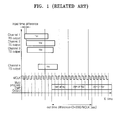
- FIG. 1 is a timing diagram for explaining a related art multi-program multiplexing method which is performed in a related art cable broadcasting system.
- a plurality of channel decoders output a plurality of transport stream packets TS1 to TSn, respectively, according to channel characteristics (for example, their transport stream rates).
- a Cable Card MPEG Packet (CMP) generator (not shown) adds control information to a transport stream of each channel and generates a CMP.
- a multiplexer (not shown) then multiplexes CMPs of the respective channels and generates a packet sequence.
- the output timing of the multiplexed packet sequence depends on the input order of transport stream packets and the duration of each transport stream packet.
- MPEG jitters occur in the related art multi-program multiplexing method. Accordingly, in the related art multi-program multiplexing method, errors occur in clock (27MHz) locking of an MPEG system, due to such MPEG jitters.
- Exemplary embodiments of the present invention overcome the above disadvantages and other disadvantages not described above. Also, the present invention is not required to overcome the disadvantages described above, and an exemplary embodiment of the present invention may not overcome any of the problems described above.
- the present invention provides a multi-program multiplexing/demultiplexing method and apparatus for preventing MPEG jitters from being generated by inserting a system clock control value for each channel into a multi-program packet, in a receiver which receives multi-programs.
- the present invention also provides a digital signal receiver including a multi-program multiplexer/demultiplexer, for preventing MPEG jitters from being generated.
- a multi-program multiplexing method comprising: extracting a plurality of transport stream packets from a plurality of channel decoders; comparing a reference clock value of each transport stream packet with a system clock value latched by the reference clock value, and generating a system clock control value; inserting the system clock value into a local packet of each channel; and multiplexing a plurality of local packets of a plurality of channels and generating a multi-program packet.
- a multi-program demultiplexing method comprising: receiving a multi-program packet into which a system clock control value for each channel is inserted; extracting the system clock control value and a local transport identifier (ID) from the multi-program packet; extracting a local transport stream packet according to the local transport ID, and linking the local transport stream packet with a corresponding system clock control value; and controlling a system clock signal with reference to a system clock control value corresponding to the local transport stream packet.
- ID local transport identifier
- a multi-program multiplexing apparatus comprising: at least one channel decoder unit selecting a broadcast signal of a desired channel from among a plurality of broadcast signals of a plurality of channels, and extracting a transport stream packet from the broadcast signal of the desired channel; a local time stamp generating unit generating a local time stamp according to a synchronization signal of the transport stream packet; a reference clock restoring unit comparing a reference clock value of the transport stream packet, with a system clock value latched by the reference clock value, and generating a system clock control value; a local packet generating unit generating a local packet for each channel, on the basis of the transport stream packet, the local time stamp, and the system clock control value; and a multiplexing unit receiving and multiplexing a plurality of local packets for a plurality of channels, and generating a packet sequence which is synchronized at an output frequency.
- a multi-program demultiplexing apparatus comprising: a packet demultiplexing unit extracting a local transport ID and a system clock control value, from a multi-program packet into which a system clock control value for each channel is inserted; a transport stream demultiplexing unit extracting a local transport stream packet according to the local transport ID; and a clock controller controlling a system clock signal for each channel according to the system clock control value for each channel.
- a multi-program multiplexing/demultiplexing apparatus is installed in a receiver. Accordingly, the receiver inserts a clock control value into each transport stream (TS) packet received through a plurality of channels in order to multiplex transport stream packets, and then demultiplexes the multiplexed TS packets.
- the receiver then generates a system time clock signal (hereinafter, referred to as a system clock signal) of 27 MHz that is to be synchronized with an oscillation frequency of 27 MHz which is used in a transmitter, in order to correctly restore a received signal.
- the transmitter transmits a Program Clock Reference (PCR) signal to the receiver so that a Phase Locked Loop (PLL) circuit of the receiver that will restore the system clock signal of 27 MHz can use the PCR signal as a reference clock signal.
- PCR Program Clock Reference
- PLL Phase Locked Loop
- FIG. 2 is a block diagram of a multi-program multiplexing apparatus according to an exemplary embodiment of the present invention.
- the multi-program multiplexing apparatus includes first, second, through to n-th channel decoders 211, 212, through to 21n, a local time stamp generator 220, a Program Clock Reference (PCR) restoring unit 230, first, second, through to n-th local packet generators 251, 252, through to 25n, a controller 240, and a packet multiplexing unit 260.
- PCR Program Clock Reference
- the first through n-th channel decoders 211 through 21n select broadcast signals of desired channels from among a plurality of broadcast signals received through a plurality of antennas, and extracts MPEG TS packets from the broadcast signals.
- Each MPEG TS packet includes a header area and a payload area.
- the header area includes 4 bits of a header and an additional header having a PCR value, and the payload area includes 188 bytes of video/audio signals.
- the header also includes a synchronization signal indicating a start location of the MPEG TS packet.
- the local time stamp generator 220 generates a local time stamp value for the MPEG TS packet of each channel extracted by the first through n-th channel decoders 211 through 21n, according to the synchronization signal of the MPEG TS packet of each channel.
- 4 bytes are assigned to the local time stamp value.
- the PCR restoring unit 230 extracts a PCR value from the MPEG TS packet extracted by the first through n-th decoders 211 through 21n, compares a System Time Clock (STC) value latched (e.g., stored or saved) when the PCR value is extracted, and generates a Pulse Width Modulation (PWM) control value.
- STC System Time Clock
- PWM Pulse Width Modulation
- the first through n-th packet generators 251 through 25n generate a local packet for each channel, using the 188 bytes of the MPEG TS packets generated by the first through n-th channel decoders 211 through 21n, the local time stamp value for each channel generated by the local time stamp generator 220, the PWM control value generated by the PCR restoring unit 230, and additional information generated by the controller 240.
- the local packet may be a Cable Card MPEG Packet (CMP) which is applied to a cable broadcast receiver.
- CMP Cable Card MPEG Packet
- the packet multiplexing unit 260 multiplexes local packets of n channels generated by the first though n-th local packet generators 251 through 25n, and generates a packet sequence which is synchronized at an output frequency.
- the controller 240 controls the operation of the first through n-th channel decoders 211 through 21n, the local time stamp generator 220, the reference clock restoring unit 230, the first through n-th local packet generators 251 through 25n, and the packet multiplexing unit 260, and generates additional information.
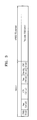
- FIG. 3 illustrates a signal format of a local packet generated by the first through n-th local packet generators 251 through 25n, according to an exemplary embodiment of the present invention.
- the local packet includes a header and an MPEG TS packet.
- the header includes 8 bits of a local TS ID area (LTSID), 24 bits of a reserved area (Res), 32 bits of a local time stamp area (LTS), 16 bits of a reserved area (Res), 8 bits of a PWM control value area (PWMV), and 8 bits of a Cyclic Redundancy Check (CRC) value.
- the MPEG TS packet includes 188 bytes of payload data.
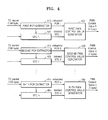
- FIG. 4 is a detailed view of the PCR restoring unit 230 illustrated in FIG. 2 .
- the PCR restoring unit 230 includes first, second, through to n-th PCR extractors 410, 411, through to 41n, first, second, through to n-th STC generators 421, 422, through to 42n, and first, second, through to n-th PWM control value generators 431, 432, through to 43n.
- the first through n-th PCR extractors 410 through 41n extract PCR values from the 188 bytes of TS packets received through a plurality of channels.
- the first through n-th STC generators 421 through 42n latch STC values, when the PCR values extracted by the first through n-th PCR extractors 410 through 41n are output.
- the first through n-th PWM control value generators 431 through 43n compare the PCR values extracted by the first through n-th PCR extractors 410 through 41 n with the STC values latched by the first through n-th STC generators 421 through 42n, generate error values according to the comparison result, and convert the error values into PWM control values. Accordingly, the first through n-th PWM control value generators 431 through 43n generate PWM control values, each PWM control value having 1 byte corresponding to a clock control value for each channel.
- FIG. 5 is a flowchart of a multi-program multiplexing method according to an exemplary embodiment of the present invention.
- a plurality of TS packets are respectively extracted from a plurality of channel decoders (operation 510).
- PCR value exists in a TS packet
- the PCR value is extracted from the TS packet (operation 530). Meanwhile, if no PCR value exists in any TS packet, packet multiplexing is performed (operation 560).
- the PWM control value corresponds to a control value of a system clock signal.
- the PWM control value is inserted into the corresponding local packet (operation 550).
- a local packet includes an MPEG TS packet generated by the corresponding channel decoder, a local time stamp value LTS, a PWM control value PWMV, etc.
- FIG. 6 is a block diagram of a multi-program demultiplexing apparatus according to an exemplary embodiment of the present invention.
- the multi-program demultiplexing apparatus includes a packet demultiplexing unit 610, first, second, through to n-th TS demultiplexing units 621, 622, through to 62n, first, second, through to n-th PWM controllers 631, 632, through to 63n, first, second, through to n-th buffer units 641, 642, through to 64n, and first, second, through to n-th system clock units 651, 652, through to 65n.
- the packet demultiplexing unit 610 extracts a header from a received multi-packet sequence, and divides the multi-packet sequence into a plurality of local TS packets according to LTSID. Also, the packet demultiplexing unit 610 extracts a PWM control value for each local channel from the header.
- the first through n-th TS demultiplexing units 621 through 62n parse the TS packets for respective channels extracted by the packet demultiplexing unit 610, to Elementary Streams (ESs), section streams, etc., according to audio data, video data, Program Specific Information (PSI), etc.
- ESs Elementary Streams
- PSI Program Specific Information
- Each of the first through n-th PWM controllers 631 through 63n includes a PWM generator (not shown) and a Low Pass Filter (LPF) (not shown), generates a PWM signal according to a PWM control value of each channel extracted by the packet demultiplexing unit 610, performs low-pass filtering on the PWM signal, and generates an analog voltage signal.
- PPF Low Pass Filter
- the first through n-th system clock units 651, 652, through to 65n drive a voltage controlled crystal oscillator (VCXO) (not shown) according to analog voltage signals generated by the first through n-th PWM controllers 631 through 63n, and generate system clock signals for the respective local channels through the VCXO.
- the system clock signals restore video/audio signals for the respective local channels.
- the first through n-th buffer units 641 through 64n store the ESs or section streams parsed by the first through n-th TS demultiplexing units 621 through 62n.
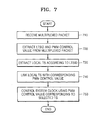
- FIG. 7 is a flowchart of a multi-program demultiplexing method according to an exemplary embodiment of the present invention.
- a local TS ID and a PWM control value are extracted from the multi-program packet (operation 720).
- a local TS packet is then extracted according to the local TS ID (operation 730), and the local TS packet is linked with the corresponding PWM control value (operation 740).
- a system clock signal is controlled using a PWM control value corresponding to the local TS packet that is to be reproduced (operation 750).
- the exemplary embodiments of the present invention can also be embodied as computer readable codes on a computer readable recording medium.
- the computer readable recording medium is any data storage device that can store data which can be thereafter read by a computer system. Examples of the computer readable recording medium include read-only memory (ROM), random-access memory (RAM), CD-ROMs, magnetic tapes, floppy disks, and optical data storage devices.
- ROM read-only memory
- RAM random-access memory
- a receiver which receives multi-programs through a plurality of channels, compares a PCR with an STC for each channel and inserts a PWM control value corresponding to a clock error into a multi-program packet, it is possible to prevent clock locking errors from being generated due to MPEG jitters generated in multi-program multiplexing.
Landscapes
- Engineering & Computer Science (AREA)
- Multimedia (AREA)
- Signal Processing (AREA)
- Time-Division Multiplex Systems (AREA)
- Compression Or Coding Systems Of Tv Signals (AREA)
- Two-Way Televisions, Distribution Of Moving Picture Or The Like (AREA)
Applications Claiming Priority (1)
| Application Number | Priority Date | Filing Date | Title |
|---|---|---|---|
| KR1020060119137A KR101080416B1 (ko) | 2006-11-29 | 2006-11-29 | 멀티-프로그램 다중화/역다중화 장치 및 방법 |
Publications (2)
| Publication Number | Publication Date |
|---|---|
| EP1933562A2 true EP1933562A2 (de) | 2008-06-18 |
| EP1933562A3 EP1933562A3 (de) | 2009-02-18 |
Family
ID=39338522
Family Applications (1)
| Application Number | Title | Priority Date | Filing Date |
|---|---|---|---|
| EP07111770A Withdrawn EP1933562A3 (de) | 2006-11-29 | 2007-07-04 | Verfahren und Vorrichtung zum Multiplexen/Demultiplexen von Multiprogrammen |
Country Status (4)
| Country | Link |
|---|---|
| US (1) | US8130797B2 (de) |
| EP (1) | EP1933562A3 (de) |
| KR (1) | KR101080416B1 (de) |
| CN (1) | CN101193310A (de) |
Families Citing this family (6)
| Publication number | Priority date | Publication date | Assignee | Title |
|---|---|---|---|---|
| KR20100025745A (ko) * | 2008-08-28 | 2010-03-10 | 삼성전자주식회사 | 신호 처리 장치 및 방법 |
| CN101426142B (zh) * | 2008-12-04 | 2011-12-21 | 上海大学 | 一种传输流再复用方法 |
| CN102498722B (zh) * | 2009-09-14 | 2016-08-10 | 汤姆森特许公司 | 利用选择mpeg-2传输流多路复用的多媒体流的基础分组进行该流的分发 |
| JP5970957B2 (ja) * | 2012-05-18 | 2016-08-17 | ソニー株式会社 | 送信装置、送信方法、受信装置、受信方法、プログラムおよび電子機器 |
| CN104584510B (zh) * | 2013-07-05 | 2019-04-19 | 索尼公司 | 发送设备、发送方法、接收设备和接收方法 |
| CN108989286B (zh) * | 2018-06-08 | 2020-01-14 | 北京开广信息技术有限公司 | 通用数据流的封装方法、解封装方法及装置 |
Family Cites Families (8)
| Publication number | Priority date | Publication date | Assignee | Title |
|---|---|---|---|---|
| US5381181A (en) | 1993-05-13 | 1995-01-10 | Thomson Consumer Electronics, Inc. | Clock recovery apparatus as for a compressed video signal |
| US7446774B1 (en) * | 1998-11-09 | 2008-11-04 | Broadcom Corporation | Video and graphics system with an integrated system bridge controller |
| US6996101B2 (en) * | 2000-11-29 | 2006-02-07 | International Business Machines Corporation | Re-mapping and interleaving transport packets of multiple transport streams for processing by a single transport demultiplexor |
| KR100752482B1 (ko) * | 2001-07-07 | 2007-08-28 | 엘지전자 주식회사 | 멀티채널 스트림 기록 재생장치 및 방법 |
| JP2003061088A (ja) * | 2001-08-08 | 2003-02-28 | Nec Corp | データ分離・復号装置 |
| KR100454959B1 (ko) * | 2002-04-30 | 2004-11-06 | 삼성전자주식회사 | 디지털방송을 시청할 수 있는 셋탑박스 시스템 및 그시청방법 |
| US7230987B2 (en) * | 2002-09-30 | 2007-06-12 | Broadcom Corporation | Multiple time-base clock for processing multiple satellite signals |
| JP4380598B2 (ja) * | 2005-06-16 | 2009-12-09 | 株式会社日立製作所 | 受信装置及び受信方法 |
-
2006
- 2006-11-29 KR KR1020060119137A patent/KR101080416B1/ko not_active Expired - Fee Related
-
2007
- 2007-07-04 EP EP07111770A patent/EP1933562A3/de not_active Withdrawn
- 2007-07-05 US US11/773,620 patent/US8130797B2/en not_active Expired - Fee Related
- 2007-07-30 CN CNA2007101371846A patent/CN101193310A/zh active Pending
Also Published As
| Publication number | Publication date |
|---|---|
| US8130797B2 (en) | 2012-03-06 |
| KR101080416B1 (ko) | 2011-11-04 |
| CN101193310A (zh) | 2008-06-04 |
| EP1933562A3 (de) | 2009-02-18 |
| KR20080048765A (ko) | 2008-06-03 |
| US20080123692A1 (en) | 2008-05-29 |
Similar Documents
| Publication | Publication Date | Title |
|---|---|---|
| US6233253B1 (en) | System for digital data format conversion and bit stream generation | |
| US8135020B1 (en) | Packet schedule timestamp for a compressed bitstream | |
| EP1588548B1 (de) | Staggercasting im robusten modus | |
| US5598415A (en) | Transmission of high rate isochronous data in MPEG-2 data streams | |
| US7193999B1 (en) | Reception system for replacing transport packets | |
| US7983345B2 (en) | Content receiving apparatus, video/audio output timing control method, and content provision system | |
| KR100632189B1 (ko) | 디지털 신호 멀티플렉싱 방법과 장치, 디지털 신호 전송 방법과 장치, 디지털 신호 기록 방법과 장치 및 기록 매체 | |
| CN100397895C (zh) | 数据处理装置及方法、以及数字广播接收机 | |
| US8130797B2 (en) | Method and apparatus for multiplexing/demultiplexing multi-programs | |
| EP1562381B1 (de) | Verfahren und Vorrichtung zur Anpassung der Datenübertragungsrate von MPEG-2 Daten | |
| US7075994B2 (en) | Signal transmission method and signal transmission apparatus | |
| EP2079233A2 (de) | Digitaler Rundfunkempfänger und digitales Rundfunkempfangsverfahren | |
| US6798756B1 (en) | Data transmission system and method, and data receiving method and device | |
| RU2121235C1 (ru) | Устройство для форматирования пакетированного цифрового потока данных, используемого для передачи телевизионной информации | |
| US7876653B2 (en) | Recording and reproducing apparatus and receiving apparatus | |
| JP3893643B2 (ja) | 信号多重化方法およびそれを用いた伝送信号生成装置 | |
| JP4650112B2 (ja) | 記録出力装置、記録出力方法及び記録装置 | |
| JP3400681B2 (ja) | データパケット再多重方法及び再多重装置 | |
| AU701138B2 (en) | Transmission of high rate isochronous data in MPEG-2 data streams | |
| JP4192766B2 (ja) | 受信装置および方法、記録媒体、並びにプログラム | |
| JP7428009B2 (ja) | 放送再送信システム、局側装置、宅側装置および放送再送信方法 | |
| JP2006229510A (ja) | ディジタル衛星放送システム、送信局、受信機 | |
| JP2001078158A (ja) | ケーブルテレビの送信装置、多重化装置ならびに受信装置 | |
| JP3978814B2 (ja) | 送信装置とその方法、受信装置、および、伝送装置 | |
| JP2005354732A (ja) | ケーブルテレビの送信装置、多重化装置ならびに受信装置 |
Legal Events
| Date | Code | Title | Description |
|---|---|---|---|
| PUAI | Public reference made under article 153(3) epc to a published international application that has entered the european phase |
Free format text: ORIGINAL CODE: 0009012 |
|
| 17P | Request for examination filed |
Effective date: 20070704 |
|
| AK | Designated contracting states |
Kind code of ref document: A2 Designated state(s): AT BE BG CH CY CZ DE DK EE ES FI FR GB GR HU IE IS IT LI LT LU LV MC MT NL PL PT RO SE SI SK TR |
|
| AX | Request for extension of the european patent |
Extension state: AL BA HR MK RS |
|
| PUAL | Search report despatched |
Free format text: ORIGINAL CODE: 0009013 |
|
| AK | Designated contracting states |
Kind code of ref document: A3 Designated state(s): AT BE BG CH CY CZ DE DK EE ES FI FR GB GR HU IE IS IT LI LT LU LV MC MT NL PL PT RO SE SI SK TR |
|
| AX | Request for extension of the european patent |
Extension state: AL BA HR MK RS |
|
| AKX | Designation fees paid | ||
| REG | Reference to a national code |
Ref country code: DE Ref legal event code: 8566 |
|
| STAA | Information on the status of an ep patent application or granted ep patent |
Free format text: STATUS: THE APPLICATION IS DEEMED TO BE WITHDRAWN |
|
| 18D | Application deemed to be withdrawn |
Effective date: 20090819 |