EP1930461A1 - Ferritic stainless steel for automobile exhaust gas passage components and welded steel pipe - Google Patents
Ferritic stainless steel for automobile exhaust gas passage components and welded steel pipe Download PDFInfo
- Publication number
- EP1930461A1 EP1930461A1 EP07022210A EP07022210A EP1930461A1 EP 1930461 A1 EP1930461 A1 EP 1930461A1 EP 07022210 A EP07022210 A EP 07022210A EP 07022210 A EP07022210 A EP 07022210A EP 1930461 A1 EP1930461 A1 EP 1930461A1
- Authority
- EP
- European Patent Office
- Prior art keywords
- pipe
- steel
- exhaust gas
- gas passage
- content
- Prior art date
- Legal status (The legal status is an assumption and is not a legal conclusion. Google has not performed a legal analysis and makes no representation as to the accuracy of the status listed.)
- Granted
Links
Images
Classifications
-
- C—CHEMISTRY; METALLURGY
- C22—METALLURGY; FERROUS OR NON-FERROUS ALLOYS; TREATMENT OF ALLOYS OR NON-FERROUS METALS
- C22C—ALLOYS
- C22C38/00—Ferrous alloys, e.g. steel alloys
- C22C38/004—Very low carbon steels, i.e. having a carbon content of less than 0,01%
-
- C—CHEMISTRY; METALLURGY
- C21—METALLURGY OF IRON
- C21D—MODIFYING THE PHYSICAL STRUCTURE OF FERROUS METALS; GENERAL DEVICES FOR HEAT TREATMENT OF FERROUS OR NON-FERROUS METALS OR ALLOYS; MAKING METAL MALLEABLE, e.g. BY DECARBURISATION OR TEMPERING
- C21D6/00—Heat treatment of ferrous alloys
- C21D6/002—Heat treatment of ferrous alloys containing Cr
-
- C—CHEMISTRY; METALLURGY
- C21—METALLURGY OF IRON
- C21D—MODIFYING THE PHYSICAL STRUCTURE OF FERROUS METALS; GENERAL DEVICES FOR HEAT TREATMENT OF FERROUS OR NON-FERROUS METALS OR ALLOYS; MAKING METAL MALLEABLE, e.g. BY DECARBURISATION OR TEMPERING
- C21D9/00—Heat treatment, e.g. annealing, hardening, quenching or tempering, adapted for particular articles; Furnaces therefor
- C21D9/46—Heat treatment, e.g. annealing, hardening, quenching or tempering, adapted for particular articles; Furnaces therefor for sheet metals
-
- C—CHEMISTRY; METALLURGY
- C22—METALLURGY; FERROUS OR NON-FERROUS ALLOYS; TREATMENT OF ALLOYS OR NON-FERROUS METALS
- C22C—ALLOYS
- C22C38/00—Ferrous alloys, e.g. steel alloys
- C22C38/002—Ferrous alloys, e.g. steel alloys containing In, Mg, or other elements not provided for in one single group C22C38/001 - C22C38/60
-
- C—CHEMISTRY; METALLURGY
- C22—METALLURGY; FERROUS OR NON-FERROUS ALLOYS; TREATMENT OF ALLOYS OR NON-FERROUS METALS
- C22C—ALLOYS
- C22C38/00—Ferrous alloys, e.g. steel alloys
- C22C38/06—Ferrous alloys, e.g. steel alloys containing aluminium
-
- C—CHEMISTRY; METALLURGY
- C22—METALLURGY; FERROUS OR NON-FERROUS ALLOYS; TREATMENT OF ALLOYS OR NON-FERROUS METALS
- C22C—ALLOYS
- C22C38/00—Ferrous alloys, e.g. steel alloys
- C22C38/18—Ferrous alloys, e.g. steel alloys containing chromium
- C22C38/40—Ferrous alloys, e.g. steel alloys containing chromium with nickel
- C22C38/42—Ferrous alloys, e.g. steel alloys containing chromium with nickel with copper
-
- C—CHEMISTRY; METALLURGY
- C22—METALLURGY; FERROUS OR NON-FERROUS ALLOYS; TREATMENT OF ALLOYS OR NON-FERROUS METALS
- C22C—ALLOYS
- C22C38/00—Ferrous alloys, e.g. steel alloys
- C22C38/18—Ferrous alloys, e.g. steel alloys containing chromium
- C22C38/40—Ferrous alloys, e.g. steel alloys containing chromium with nickel
- C22C38/46—Ferrous alloys, e.g. steel alloys containing chromium with nickel with vanadium
-
- C—CHEMISTRY; METALLURGY
- C22—METALLURGY; FERROUS OR NON-FERROUS ALLOYS; TREATMENT OF ALLOYS OR NON-FERROUS METALS
- C22C—ALLOYS
- C22C38/00—Ferrous alloys, e.g. steel alloys
- C22C38/18—Ferrous alloys, e.g. steel alloys containing chromium
- C22C38/40—Ferrous alloys, e.g. steel alloys containing chromium with nickel
- C22C38/48—Ferrous alloys, e.g. steel alloys containing chromium with nickel with niobium or tantalum
-
- C—CHEMISTRY; METALLURGY
- C22—METALLURGY; FERROUS OR NON-FERROUS ALLOYS; TREATMENT OF ALLOYS OR NON-FERROUS METALS
- C22C—ALLOYS
- C22C38/00—Ferrous alloys, e.g. steel alloys
- C22C38/18—Ferrous alloys, e.g. steel alloys containing chromium
- C22C38/40—Ferrous alloys, e.g. steel alloys containing chromium with nickel
- C22C38/50—Ferrous alloys, e.g. steel alloys containing chromium with nickel with titanium or zirconium
-
- C—CHEMISTRY; METALLURGY
- C22—METALLURGY; FERROUS OR NON-FERROUS ALLOYS; TREATMENT OF ALLOYS OR NON-FERROUS METALS
- C22C—ALLOYS
- C22C38/00—Ferrous alloys, e.g. steel alloys
- C22C38/18—Ferrous alloys, e.g. steel alloys containing chromium
- C22C38/40—Ferrous alloys, e.g. steel alloys containing chromium with nickel
- C22C38/54—Ferrous alloys, e.g. steel alloys containing chromium with nickel with boron
-
- C—CHEMISTRY; METALLURGY
- C21—METALLURGY OF IRON
- C21D—MODIFYING THE PHYSICAL STRUCTURE OF FERROUS METALS; GENERAL DEVICES FOR HEAT TREATMENT OF FERROUS OR NON-FERROUS METALS OR ALLOYS; MAKING METAL MALLEABLE, e.g. BY DECARBURISATION OR TEMPERING
- C21D2211/00—Microstructure comprising significant phases
- C21D2211/005—Ferrite
Definitions
- This invention relates to a ferritic stainless steel and its welded pipe used in the exhaust gas passage components of an automobile, typically in the exhaust manifold, catalytic converter case (cylindrical casing), front pipe and center pipe, and to automobile exhaust gas passage components utilizing the ferritic stainless steel and welded steel pipe.
- Patent Documents 1 and 2 teach ferritic stainless steels added with about 1 to 2 mass% of Cu. The Cu in the steel precipitates as Cu phase under heating to improve the high-temperature strength and thermal fatigue property of the steel.
- Patent Document 3 teaches that trace addition of Al or Ti enhances the toughness and secondary workability of the weld.
- trace addition of Al or Ti to ferritic stainless steel improved in high-temperature strength by inclusion of 1 to 2% Cu as mentioned above does not readily ensure sufficient toughness of a steel pipe produced by high-frequency welding.
- sufficient toughness is even harder to achieve in a component such as a catalytic converter case because the component is manufactured by subjecting a steel pipe that has been TIG welded or laser welded to very severe compressive working (pressing or spinning).
- a welded steel pipe made of a ferritic stainless steel containing around 1 to 2% Cu cannot be adequately improved in toughness merely by trace addition of Al or Ti as taught by Patent Document 3.
- the weld toughness of a high-frequency welded pipe is particularly easily affected by the pipe-making conditions determined by the amount of upset and heat input.
- the difficulty of consistently securing good toughness becomes even greater when the pipe-making conditions deviate from the optimum conditions.
- An object of the present invention is to provide a ferritic stainless steel for automobile exhaust gas passage components which is a Cu-containing ferritic stainless steel excellent in high-temperature oxidation resistance and high-temperature strength that excels in the toughness of a weld formed during pipe-making (in this specification, "weld” is defined to include the welded metal and surrounding heat-affected metal) and that offers a wide range of freedom in selecting suitable pipe-making conditions especially when subjected to high-frequency welding pipe-making.
- a ferritic stainless steel for automobile exhaust gas passage components comprising, in mass percent, C: not more than 0.03%, Si: not more than 1%, Mn: not more than 1.5%, Ni: not more than 0.6%, Cr: 10-20%, Nb: not more than 0.5%, Ti: 0.05-0.3%, Al: more than 0.03% to 0.12%, Cu: more than 1% to 2%, V: not more than 0.2%, N: not more than 0.03%, B: 0.0005-0.02%, O: not more than 0.01%, optionally one or more of Mo, W, Zr and Co: total of not more than 4%, and the balance of Fe and unavoidable impurities, the composition satisfying Expressions (1) and (2) Nb ⁇ 8 ⁇ C + N 0.02 ⁇ A ⁇ 1 - 54 / 48 ⁇ O ⁇ 0.1
- the present invention provides exhaust gas passage components of an automobile, typically in the exhaust manifold, catalytic converter, front pipe, center pipe, and other exhaust gas passage utilizing the welded steel pipe made of the aforesaid steel above.
- the present invention enables actualization of welded ferritic stainless steel pipe that possesses the heat resistance (high-temperature oxidation resistance and high-temperature strength) required of automobile exhaust gas passage components and also exhibits excellent weld toughness. Moreover, the present invention provides greater freedom in selecting suitable pipe-making conditions at the time of manufacturing the welded pipe. Therefore, even in the case of high-frequency welding pipe-making conducted at a high line speed, for example, high-quality steel pipe with good weld toughness can be reliably manufactured.
- C and N are generally effective for improving creep strength and other high-temperature strength properties but degrade oxidation resistant property, workability, low-temperature toughness and weldability when contained in excess.
- both C and N are limited to a content of not more than 0.03 mass%.
- Si is effective for improving high-temperature oxidation resistance. Moreover, it bonds with atmospheric oxygen during welding to help keep oxygen from entering the steel. However, when contained in excess, it increases hardness and thus degrades workability and low-temperature toughness.
- Si content is limited to not more than 1 mass% and can, for example, be limited to 0.1-0.6 mass%.
- Mn improves high-temperature oxidation resistance, especially scale peeling resistance. And like Si, it also bonds with atmospheric oxygen during welding to help keep oxygen from entering the steel. However, Mn impairs workability and weldability when added in excess. Further, Mn is an austenite stabilizing element that when added in a large amount facilitates generation of martensite phase and thus causes a decline in workability and other properties. Mn content is therefore limited to not more than 1.5 mass%, preferably not more than 1.3 mass%. It can, for instance, be defined as 0.1 mass% to less than 1 mass%.
- Ni is an austenite stabilizing element. Like Mn, it facilitates generation of martensite phase when added in excess and thus degrades workability and the like. A Ni content of up to 0.6 mass% is allowable.
- the Cr stabilizes ferrite phase and contributes to improvement of oxidation resistance, an important property of high-temperature steels. But an excessive Cr content makes the steel brittle and lowers its oxidation resistance.
- the Cr content is therefore defined as 10-20 mass%.
- the Cr content is preferably optimized for the use temperature of the steel. For example, when the temperature up to which good high-temperature oxidation resistance is required is up to 950 °C, the Cr content is preferably 16 mass% or more, and when up to 900 °C, is preferably 12-16 mass%.
- Nb is a highly effective element for obtaining good high-temperature strength in the high-temperature region above 700 °C. Solid solution strengthening is thought to make a major contribution in the composition of the present invention. Further, Nb has a C and N fixing action that works effectively to prevent a decline in toughness. In the present invention, effective improvement of high-temperature strength by Nb is ensured by incorporating the element in an amount satisfying Expression (1) Nb ⁇ 8 ⁇ C + N However, excessive Nb addition lowers workability and low-temperature toughness, and increases susceptibility to hot weld cracking. It also reduces the suitable pipe-making condition rate discussed hereinafter. Nb content is therefore defined as not more than 0.5 mass%.
- Ti fixes C and N and is generally known to be effective for improving formability and preventing toughness reduction.
- the situation is different at a weld.
- Most N is fixed in the form of TiN but under exposure to high temperatures during welding, the TiN decomposes and the N thereof once enters solid solution in the high-temperature region.
- TiN is formed in the high-temperature region near the solidifying point of the steel, the very rapid cooling rate after welding makes it impossible to fix N thoroughly by Ti alone during the post-welding cooling period. As a result, N tends to be present in solid solution at the weld. Therefore, as will be gone into in detail later, this invention calls for addition of Al in combination with Ti.
- Ti content In order to thoroughly manifest the C and N fixing effect of Ti, the content of Ti must be made 0.05 mass% or greater. But excessive addition of Ti degrades surface property by causing generation of a large amount of TiN and also has an adverse effect on weldability and low-temperature toughness. Ti content is therefore defined as 0.05-0.3 mass%.
- Al is an element commonly used as a deoxidizer and for improvement of high-temperature oxidation resistance. In this invention, however, it is particularly important as an element for fixing N at welds. As pointed out above, in the cooling phase after welding, it is impossible to fix N adequately at the weld by Ti alone. Unlike Ti, Al forms a nitride in the relatively low-temperature region below 1000 °C. Addition of Al together with Ti therefore makes it possible to effectively fix N at the weld during post-welding cooling, thus mitigating toughness reduction at the weld. In addition, the fixing of N by Ti and Al mitigates strain aging and improves secondary workability at the weld.
- Al content exceeding 0.03 mass% must be established to fully bring out this effect of Al and thereby expand the range of freedom in selecting suitable pipe-making conditions in high-frequency welding pipe-making.
- Al content is excessive, oxides are abundantly formed during welding and operate disadvantageously as starting points for deformation cracking.
- the upper limit of Al content is therefore defined as 0.12 mass%.
- the Al content must be further regulated relative to the O (oxygen) content of the steel so as to satisfy Expression (2) 0.02 ⁇ A ⁇ 1 - 54 / 48 ⁇ O ⁇ 0.1 As demonstrated by the Examples set out later, the freedom in selecting suitable pipe-making conditions in high-frequency welding pipe-making is markedly improved in the range of Al content satisfying Expression (2).
- the amount of Al represented by "Al - (54/48) O” is the Al remaining at the weld (called “effective Al” herein) after subtracting the Al consumed to form Al 2 O 3 by reaction with O present in the steel.
- Cu is an important element for enhancing high-temperature strength. More specifically, the present invention utilizes the finely dispersed precipitation of the Cu phase (sometimes called the ⁇ -Cu phase) to enhance strength particularly at 500-700 °C. A Cu content exceeding 1 mass% is therefore required. However, since too large a Cu content degrades workability, low-temperature toughness and weldability, Cu content is limited to not more than 2 mass%.
- V contributes to high-temperature strength improvement when added in combination with Nb and Cu. And when co-present with Nb, V improves workability, low-temperature toughness, resistance to grain boundary corrosion susceptibility, and toughness of weld heat affected regions. But since excessive addition degrades workability and low-temperature toughness, V content is made not more than 0.2 mass%. V content is preferably 0.01-0.2 mass%, more preferably 0.03-0.15 mass%.
- B is effective for inhibiting secondary working brittleness.
- the mechanism involved is thought to be reduction of oxygen in solid solution at the grain boundaries and/or grain boundary strengthening.
- excessive B addition degrades productivity and weldability.
- B content is defined as 0.0005-0.02 mass%.
- the amount present in the steel is preferably minimal.
- O content is also preferably kept as low as possible in order to maintain the effective Al mentioned earlier at the required level.
- O content must be kept to 0.01 mass% or less and also made to satisfy Expression (2) relative to Al content.
- Mo, W, Zr and Co are effective for improving the high-temperature strength of the ferritic stainless steel having the composition defined by the present invention.
- One or more thereof can be added as required. Owing to their embrittling effect on the steel when added in a large amount, however, the content of these elements, when added, is made not more than 4 mass% in total. Addition to a total content of 0.5-4 mass% affords optimum effect.
- the ferritic stainless steel of the foregoing composition can be produced by the melting method using a steelmaking process for ordinary stainless steel and thereafter be formed into annealed steel sheet of around 1-2.5 mm thickness by, for example, a process of "hot rolling ⁇ annealing ⁇ pickling," which may be followed by one or more cycles of a process of "cold rolling ⁇ annealing ⁇ pickling.”
- the average cooling rate from 900 °C to 400 °C in final annealing should preferably be controlled to 10-30 °C/sec.
- final annealing is meant the last annealing conducted in the steel sheet production stage and is, for instance, a heat treatment of holding the steel at a temperature of 950-1100 °C for a soaking time of 0-3 minutes.
- the annealed sheet (pipe material) is roll-folded into a prescribed pipe shape and the so-formed butt joint of the material is welded to make a pipe and thus obtain a welded steel pipe.
- the welding can be done by TIG welding, laser welding, high-frequency welding or any of various known pipe welding methods.
- the obtained steel pipe is subjected to heat treatment and/or pickling as required, and then formed into an exhaust gas passage component.
- the ferritic stainless steels of Table 1 were produced by the melting method and each was formed into two annealed steel sheets of different thickness, 2.0 mm and 1.5 mm, by the process of "hot rolling ⁇ annealing/pickling ⁇ cold rolling ⁇ final annealing/pickling.”
- the final annealing was conducted by holding at 1050 °C for 1 minute (soaking) and then cooling at an average cooling rate from 900 °C to 400 °C of 10-30 °C/sec.
- Example I High-frequency welding pipe-making
- High-frequency welding pipe-making was carried out under various conditions using the 2.0-mm steel sheet materials.
- the welded steel pipes manufactured had an outside diameter of 38.1 mm and a wall thickness of 2.0 mm.
- the upset amount and heat input conditions that resulted in a metal flow angle of 45° were defined as the "optimum conditions" for the type of steel concerned.
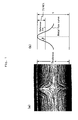
- the angle between a line drawn to lie 1/4 the wall thickness inward from the steel pipe outer surface (called the "reference line”) and the metal flow curve is defined as ⁇ (see FIG 1(b) ) and the maximum value of ⁇ in the steel pipe is defined as the metal flow angle of the steel pipe.
- the metal flow angle is measured by selecting from among the various metal flow curves the metal flow curve that makes the largest angle 0 with the reference line.
- upset amount is meant the butting amount of the sheet edges together during pipe welding.
- High-frequency welding pipe-making was carried out using each type of steel sheet under 15 sets of welding conditions by varying "upset amount” among 3 levels (-30%, 0%, +30%) and "heat input” among 5 levels (-40%, -20%, 0%, +20%, +40%), where the two 0% values represent the foregoing "optimum conditions" as the standard.
- a pipe measuring about 1000 mm in length was cut from the steel pipe obtained under the each set of welding conditions, immersed for 15 minutes in a tank of 5 °C water, and then immediately subjected to a flattening test in accordance with JIS G3459, wherein the weld was placed at right angle to the direction of compression by flat jig plates and the distance H between the plates after compression was 1/3 the outside pipe diameter before compression.
- the percentage of the total of 15 sets of conditions for which no embrittlement was observed was calculated and defined as the "suitable pipe-making condition rate (%)" of the steel concerned.
- a steel type whose suitable pipe-making condition rate calculated in this manner was 60% or greater was rated to be one enabling reliable manufacture of high-frequency welded steel pipe possessing the excellent weld toughness required by automobile exhaust gas passage components irrespective of the season of the year
- a test specimen including the weld was cut from the high-frequency welded steel pipe made from each steel type under the "optimum conditions.”
- the transition temperature of the specimen was determined by conducting an impact test with the specimen set in a Charpy impact tester so that the hammer struck on the weld.
- a steel whose weld transition temperature was 0 °C or lower was rated "good.”
- Example 2 Laser welding pipe-making
- the welded steel pipes manufactured had an outside diameter of 65 mm and a wall thickness of 1.5 mm.
- the welding conditions were such that the width of the rear bead of the weld was about the same as the wall thickness (in the range of 1.5-2.0 mm).
- a test specimen including the weld was cut from each welded steel pipe and the transition temperature was determined by conducting an impact test by the method explained above. A steel whose weld transition temperature was 0 °C or lower was rated "good".
- the 2.0-mm steel sheet materials made from the steels of Table 1 were subjected to high-temperature tensile testing. A 0.2% yield strength at 900 °C of 17 MPa or greater was rated G (good) and one of less than 17 MPa was rated P (Poor).
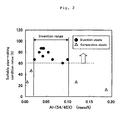
- FIG. 2 shows how suitable pipe-making condition rate varied with effective Al content (Al - (54/48) O) in the invention steels and comparative steels Nos. 21-24.
- the ferritic stainless steels whose compositions were within the range defined by the present invention (invention steels) all exhibited suitable pipe-making condition rates of 60% or greater in high-frequency welding pipe-making. They were excellent in the transition temperature and high-temperature strength of the welds, thus confirming their suitability for use in exhaust gas passage components that undergo harsh working during fabrication. Of particular note is that freedom in selecting suitable pipe-making conditions was markedly improved by optimizing the relationship between Al content and O (oxygen) content so as to satisfy Expression (2) (see FIG. 2 ).
- the comparative steels Nos. 21 and 22 were low in Al content, so that adequate effective Al content as defined by Expression (2) could not be achieved. This is thought to have made it impossible to thoroughly prevent entry of N and O from the air during welding, leading to the inferior suitable pipe-making condition rate and low-temperature toughness of the weld.
- the Al content of comparative steels Nos. 23 and 24 was too high, causing Al oxides to form abundantly at the weld. This is thought to account for the low toughness.
- No. 25 was poor in high-temperature strength owing to too low Nb content and Cu content.
- No. 26 was poor in low-temperature toughness owing to excessive Ti content. Because of the excessive O (oxygen) content of the steel, No.
Landscapes
- Chemical & Material Sciences (AREA)
- Engineering & Computer Science (AREA)
- Materials Engineering (AREA)
- Mechanical Engineering (AREA)
- Metallurgy (AREA)
- Organic Chemistry (AREA)
- Physics & Mathematics (AREA)
- Thermal Sciences (AREA)
- Crystallography & Structural Chemistry (AREA)
- Exhaust Silencers (AREA)
- Arc Welding In General (AREA)
- Heat Treatment Of Articles (AREA)
Abstract
Description
- This invention relates to a ferritic stainless steel and its welded pipe used in the exhaust gas passage components of an automobile, typically in the exhaust manifold, catalytic converter case (cylindrical casing), front pipe and center pipe, and to automobile exhaust gas passage components utilizing the ferritic stainless steel and welded steel pipe.
- The exhaust gas passage components of an automobile, such as the exhaust manifold, catalytic converter case, front pipe and center pipe, are required to be excellent in high-temperature oxidation resistance and high-temperature strength in the high-temperature region exceeding 700 °C. As a material having such heat resistance, Patent Documents 1 and 2 teach ferritic stainless steels added with about 1 to 2 mass% of Cu. The Cu in the steel precipitates as Cu phase under heating to improve the high-temperature strength and thermal fatigue property of the steel.
- Most of the aforesaid automobile exhaust gas passage components are produced by shaping welded steel pipes. Owing to the increasing number of units installed in the engine compartment in recent years, the amount of space available for installation of exhaust gas passage components has continued to decrease. This has led to many exhaust gas passage components being manufactured in complex shapes by special processing. The welded steel pipes used in exhaust gas passage components are therefore required to have even better formability than heretofore.
- Regarding a technique for improving the formability of welded steel pipe made of ferritic stainless steel, Patent Document 3 teaches that trace addition of Al or Ti enhances the toughness and secondary workability of the weld. However, a study carried out by the inventors showed that trace addition of Al or Ti to ferritic stainless steel improved in high-temperature strength by inclusion of 1 to 2% Cu as mentioned above does not readily ensure sufficient toughness of a steel pipe produced by high-frequency welding. Moreover, sufficient toughness is even harder to achieve in a component such as a catalytic converter case because the component is manufactured by subjecting a steel pipe that has been TIG welded or laser welded to very severe compressive working (pressing or spinning). In other words, it was found that a welded steel pipe made of a ferritic stainless steel containing around 1 to 2% Cu cannot be adequately improved in toughness merely by trace addition of Al or Ti as taught by Patent Document 3.
- In addition, the weld toughness of a high-frequency welded pipe is particularly easily affected by the pipe-making conditions determined by the amount of upset and heat input. In a ferritic stainless steel containing 1 to 2% Cu, the difficulty of consistently securing good toughness becomes even greater when the pipe-making conditions deviate from the optimum conditions.
- Patent Document 1:
WO 03/004714 - Patent Document 2:
JP 2006-117985A - Patent Document 3:
JP 2005-264269A - An object of the present invention is to provide a ferritic stainless steel for automobile exhaust gas passage components which is a Cu-containing ferritic stainless steel excellent in high-temperature oxidation resistance and high-temperature strength that excels in the toughness of a weld formed during pipe-making (in this specification, "weld" is defined to include the welded metal and surrounding heat-affected metal) and that offers a wide range of freedom in selecting suitable pipe-making conditions especially when subjected to high-frequency welding pipe-making.
- An in-depth study conducted by the inventors revealed that good toughness of the weld of ferritic stainless steel enhanced in high-temperature strength by Cu-phase precipitation can be effectively achieved by adding Ti and Al in combination and further strictly defining the Al content relative to the O (oxygen) content of the steel, thereby expanding the range of suitable pipe-making conditions in high-frequency welding pipe-making.
- Specifically, the aforesaid object is achieved by a ferritic stainless steel for automobile exhaust gas passage components comprising, in mass percent, C: not more than 0.03%, Si: not more than 1%, Mn: not more than 1.5%, Ni: not more than 0.6%, Cr: 10-20%, Nb: not more than 0.5%, Ti: 0.05-0.3%, Al: more than 0.03% to 0.12%, Cu: more than 1% to 2%, V: not more than 0.2%, N: not more than 0.03%, B: 0.0005-0.02%, O: not more than 0.01%, optionally one or more of Mo, W, Zr and Co: total of not more than 4%, and the balance of Fe and unavoidable impurities, the composition satisfying Expressions (1) and (2)


- Each element symbol in Expressions (1) and (2) is replaced by a value representing the content of the element in mass percent.
- Further, the present invention provides exhaust gas passage components of an automobile, typically in the exhaust manifold, catalytic converter, front pipe, center pipe, and other exhaust gas passage utilizing the welded steel pipe made of the aforesaid steel above.
- The present invention enables actualization of welded ferritic stainless steel pipe that possesses the heat resistance (high-temperature oxidation resistance and high-temperature strength) required of automobile exhaust gas passage components and also exhibits excellent weld toughness. Moreover, the present invention provides greater freedom in selecting suitable pipe-making conditions at the time of manufacturing the welded pipe. Therefore, even in the case of high-frequency welding pipe-making conducted at a high line speed, for example, high-quality steel pipe with good weld toughness can be reliably manufactured.
-
-
FIG. 1 is a microphotograph showing an example of metal flow observed at a weld cross-section of a high-frequency welded pipe. -
FIG. 2 is a graph showing how suitable pipe-making condition rate varied with effective Al content (Al - (54/48) O). - The composition of the ferritic stainless steel will now be explained.
C and N are generally effective for improving creep strength and other high-temperature strength properties but degrade oxidation resistant property, workability, low-temperature toughness and weldability when contained in excess. In this invention, both C and N are limited to a content of not more than 0.03 mass%. - Si is effective for improving high-temperature oxidation resistance. Moreover, it bonds with atmospheric oxygen during welding to help keep oxygen from entering the steel. However, when contained in excess, it increases hardness and thus degrades workability and low-temperature toughness. In this invention, Si content is limited to not more than 1 mass% and can, for example, be limited to 0.1-0.6 mass%.
- Mn improves high-temperature oxidation resistance, especially scale peeling resistance. And like Si, it also bonds with atmospheric oxygen during welding to help keep oxygen from entering the steel. However, Mn impairs workability and weldability when added in excess. Further, Mn is an austenite stabilizing element that when added in a large amount facilitates generation of martensite phase and thus causes a decline in workability and other properties. Mn content is therefore limited to not more than 1.5 mass%, preferably not more than 1.3 mass%. It can, for instance, be defined as 0.1 mass% to less than 1 mass%.
- Ni is an austenite stabilizing element. Like Mn, it facilitates generation of martensite phase when added in excess and thus degrades workability and the like. A Ni content of up to 0.6 mass% is allowable.
- Cr stabilizes ferrite phase and contributes to improvement of oxidation resistance, an important property of high-temperature steels. But an excessive Cr content makes the steel brittle and lowers its oxidation resistance. The Cr content is therefore defined as 10-20 mass%. The Cr content is preferably optimized for the use temperature of the steel. For example, when the temperature up to which good high-temperature oxidation resistance is required is up to 950 °C, the Cr content is preferably 16 mass% or more, and when up to 900 °C, is preferably 12-16 mass%.
- Nb is a highly effective element for obtaining good high-temperature strength in the high-temperature region above 700 °C. Solid solution strengthening is thought to make a major contribution in the composition of the present invention. Further, Nb has a C and N fixing action that works effectively to prevent a decline in toughness. In the present invention, effective improvement of high-temperature strength by Nb is ensured by incorporating the element in an amount satisfying Expression (1)

- Ti fixes C and N and is generally known to be effective for improving formability and preventing toughness reduction. However the situation is different at a weld. Most N is fixed in the form of TiN but under exposure to high temperatures during welding, the TiN decomposes and the N thereof once enters solid solution in the high-temperature region. Although TiN is formed in the high-temperature region near the solidifying point of the steel, the very rapid cooling rate after welding makes it impossible to fix N thoroughly by Ti alone during the post-welding cooling period. As a result, N tends to be present in solid solution at the weld. Therefore, as will be gone into in detail later, this invention calls for addition of Al in combination with Ti. In order to thoroughly manifest the C and N fixing effect of Ti, the content of Ti must be made 0.05 mass% or greater. But excessive addition of Ti degrades surface property by causing generation of a large amount of TiN and also has an adverse effect on weldability and low-temperature toughness. Ti content is therefore defined as 0.05-0.3 mass%.
- Al is an element commonly used as a deoxidizer and for improvement of high-temperature oxidation resistance. In this invention, however, it is particularly important as an element for fixing N at welds. As pointed out above, in the cooling phase after welding, it is impossible to fix N adequately at the weld by Ti alone. Unlike Ti, Al forms a nitride in the relatively low-temperature region below 1000 °C. Addition of Al together with Ti therefore makes it possible to effectively fix N at the weld during post-welding cooling, thus mitigating toughness reduction at the weld. In addition, the fixing of N by Ti and Al mitigates strain aging and improves secondary workability at the weld.
- At the weld, Al not only fixes N present in the steel but also acts to directly prevent entry of external N and/or O (oxygen) into the steel of the weld. This is significant because the atmosphere to which the molten metal is exposed during pipe-making (ordinarily shielded by N2, Ar or the like) entrains air, and when the amount entrained is great, N and O in the atmosphere tend to enter the steel from the weld to cause toughness reduction. However, in a ferritic stainless steel having an appropriate Al content, the Al in the steel acts to prevent entry of N and O from the atmosphere. Although the mechanism involved is not altogether clear, from the fact that analysis of the weld surface layer of a welded steel pipe made from the invention steel found concentration of Al, it is likely that Al2O3 formed by Al in the steel during welding blocks dispersion of N and O into the interior.
- An Al content exceeding 0.03 mass% must be established to fully bring out this effect of Al and thereby expand the range of freedom in selecting suitable pipe-making conditions in high-frequency welding pipe-making. However, when the Al content is excessive, oxides are abundantly formed during welding and operate disadvantageously as starting points for deformation cracking. The upper limit of Al content is therefore defined as 0.12 mass%.
- The Al content must be further regulated relative to the O (oxygen) content of the steel so as to satisfy Expression (2)

As demonstrated by the Examples set out later, the freedom in selecting suitable pipe-making conditions in high-frequency welding pipe-making is markedly improved in the range of Al content satisfying Expression (2). The amount of Al represented by "Al - (54/48) O" is the Al remaining at the weld (called "effective Al" herein) after subtracting the Al consumed to form Al2O3 by reaction with O present in the steel. It is thought that when the amount of effective Al rises to and above 0.02 mass%, O contained in the atmosphere during welding and the effective Al promptly unite to effectively block dispersion of N and O present in the atmosphere into the interior, thereby markedly improving the freedom in selecting suitable pipe-making conditions in high-frequency welding pipe-making. However, when the amount of effective Al comes to exceed 0.1 mass%, the freedom in selecting suitable pipe-making conditions declines sharply. The reason for this is probably that excessive Al oxides are formed at the weld and become starting points for deformation cracking. - Cu is an important element for enhancing high-temperature strength. More specifically, the present invention utilizes the finely dispersed precipitation of the Cu phase (sometimes called the ε-Cu phase) to enhance strength particularly at 500-700 °C. A Cu content exceeding 1 mass% is therefore required. However, since too large a Cu content degrades workability, low-temperature toughness and weldability, Cu content is limited to not more than 2 mass%.
- V contributes to high-temperature strength improvement when added in combination with Nb and Cu. And when co-present with Nb, V improves workability, low-temperature toughness, resistance to grain boundary corrosion susceptibility, and toughness of weld heat affected regions. But since excessive addition degrades workability and low-temperature toughness, V content is made not more than 0.2 mass%. V content is preferably 0.01-0.2 mass%, more preferably 0.03-0.15 mass%.
- B is effective for inhibiting secondary working brittleness. The mechanism involved is thought to be reduction of oxygen in solid solution at the grain boundaries and/or grain boundary strengthening. However, excessive B addition degrades productivity and weldability. In this invention, B content is defined as 0.0005-0.02 mass%.
- As O (oxygen) adversely affects weld toughness, the amount present in the steel is preferably minimal. O content is also preferably kept as low as possible in order to maintain the effective Al mentioned earlier at the required level. O content must be kept to 0.01 mass% or less and also made to satisfy Expression (2) relative to Al content.
- Mo, W, Zr and Co are effective for improving the high-temperature strength of the ferritic stainless steel having the composition defined by the present invention. One or more thereof can be added as required. Owing to their embrittling effect on the steel when added in a large amount, however, the content of these elements, when added, is made not more than 4 mass% in total. Addition to a total content of 0.5-4 mass% affords optimum effect.
- The ferritic stainless steel of the foregoing composition can be produced by the melting method using a steelmaking process for ordinary stainless steel and thereafter be formed into annealed steel sheet of around 1-2.5 mm thickness by, for example, a process of "hot rolling → annealing → pickling," which may be followed by one or more cycles of a process of "cold rolling → annealing → pickling." However, in order to achieve excellent high-temperature strength by Cu-phase precipitation, the average cooling rate from 900 °C to 400 °C in final annealing should preferably be controlled to 10-30 °C/sec. By "final annealing" is meant the last annealing conducted in the steel sheet production stage and is, for instance, a heat treatment of holding the steel at a temperature of 950-1100 °C for a soaking time of 0-3 minutes.
- The annealed sheet (pipe material) is roll-folded into a prescribed pipe shape and the so-formed butt joint of the material is welded to make a pipe and thus obtain a welded steel pipe. The welding can be done by TIG welding, laser welding, high-frequency welding or any of various known pipe welding methods. The obtained steel pipe is subjected to heat treatment and/or pickling as required, and then formed into an exhaust gas passage component.
- The ferritic stainless steels of Table 1 were produced by the melting method and each was formed into two annealed steel sheets of different thickness, 2.0 mm and 1.5 mm, by the process of "hot rolling → annealing/pickling → cold rolling → final annealing/pickling." The final annealing was conducted by holding at 1050 °C for 1 minute (soaking) and then cooling at an average cooling rate from 900 °C to 400 °C of 10-30 °C/sec.

- High-frequency welding pipe-making was carried out under various conditions using the 2.0-mm steel sheet materials. The welded steel pipes manufactured had an outside diameter of 38.1 mm and a wall thickness of 2.0 mm.
- The "suitable pipe-making condition rates (%)" of the obtained steel pipes were determined by the following method.
- In the high-frequency welding pipe-making, the upset amount and heat input conditions that resulted in a metal flow angle of 45° were defined as the "optimum conditions" for the type of steel concerned. In the structure etched of the weld cross-section where a metal flow curve like that shown
FIG 1(a) appears, the angle between a line drawn to lie 1/4 the wall thickness inward from the steel pipe outer surface (called the "reference line") and the metal flow curve is defined as θ (seeFIG 1(b) ) and the maximum value of θ in the steel pipe is defined as the metal flow angle of the steel pipe. In other words, the metal flow angle is measured by selecting from among the various metal flow curves the metal flow curve that makes thelargest angle 0 with the reference line. By "upset amount" is meant the butting amount of the sheet edges together during pipe welding. As a welding term, it is synonymous with "upset force." By "heat input" is meant the electrical power of the high-frequency welding (= current x voltage). - High-frequency welding pipe-making was carried out using each type of steel sheet under 15 sets of welding conditions by varying "upset amount" among 3 levels (-30%, 0%, +30%) and "heat input" among 5 levels (-40%, -20%, 0%, +20%, +40%), where the two 0% values represent the foregoing "optimum conditions" as the standard. A pipe measuring about 1000 mm in length was cut from the steel pipe obtained under the each set of welding conditions, immersed for 15 minutes in a tank of 5 °C water, and then immediately subjected to a flattening test in accordance with JIS G3459, wherein the weld was placed at right angle to the direction of compression by flat jig plates and the distance H between the plates after compression was 1/3 the outside pipe diameter before compression. The percentage of the total of 15 sets of conditions for which no embrittlement was observed was calculated and defined as the "suitable pipe-making condition rate (%)" of the steel concerned.
- A steel type whose suitable pipe-making condition rate calculated in this manner was 60% or greater was rated to be one enabling reliable manufacture of high-frequency welded steel pipe possessing the excellent weld toughness required by automobile exhaust gas passage components irrespective of the season of the year
- (temperature).
- A test specimen including the weld was cut from the high-frequency welded steel pipe made from each steel type under the "optimum conditions." The transition temperature of the specimen was determined by conducting an impact test with the specimen set in a Charpy impact tester so that the hammer struck on the weld. A steel whose weld transition temperature was 0 °C or lower was rated "good."
- Laser welding pipe-making was carried using the 1.5-mm steel sheet materials. The welded steel pipes manufactured had an outside diameter of 65 mm and a wall thickness of 1.5 mm. The welding conditions were such that the width of the rear bead of the weld was about the same as the wall thickness (in the range of 1.5-2.0 mm).
- A test specimen including the weld was cut from each welded steel pipe and the transition temperature was determined by conducting an impact test by the method explained above. A steel whose weld transition temperature was 0 °C or lower was rated "good".
- The 2.0-mm steel sheet materials made from the steels of Table 1 were subjected to high-temperature tensile testing. A 0.2% yield strength at 900 °C of 17 MPa or greater was rated G (good) and one of less than 17 MPa was rated P (Poor).
- The results obtained are shown in Table 2, while
FIG. 2 shows how suitable pipe-making condition rate varied with effective Al content (Al - (54/48) O) in the invention steels and comparative steels Nos. 21-24.
- As seen in Table 2, the ferritic stainless steels whose compositions were within the range defined by the present invention (invention steels) all exhibited suitable pipe-making condition rates of 60% or greater in high-frequency welding pipe-making. They were excellent in the transition temperature and high-temperature strength of the welds, thus confirming their suitability for use in exhaust gas passage components that undergo harsh working during fabrication. Of particular note is that freedom in selecting suitable pipe-making conditions was markedly improved by optimizing the relationship between Al content and O (oxygen) content so as to satisfy Expression (2) (see
FIG. 2 ). - In contrast, the comparative steels Nos. 21 and 22 were low in Al content, so that adequate effective Al content as defined by Expression (2) could not be achieved. This is thought to have made it impossible to thoroughly prevent entry of N and O from the air during welding, leading to the inferior suitable pipe-making condition rate and low-temperature toughness of the weld. To the contrary, the Al content of comparative steels Nos. 23 and 24 was too high, causing Al oxides to form abundantly at the weld. This is thought to account for the low toughness. No. 25 was poor in high-temperature strength owing to too low Nb content and Cu content. No. 26 was poor in low-temperature toughness owing to excessive Ti content. Because of the excessive O (oxygen) content of the steel, No. 27 experienced declines in both low-temperature toughness of the weld and suitable pipe-making condition rate even though it satisfied Expression (2). The suitable pipe-making condition rate of No. 28 was low because of excessive Nb content. Although No. 29 satisfied Expression (2), its excessive Al content made it inferior to the invention steels in suitable pipe-making condition rate and low-temperature toughness of the weld.
Claims (5)
- A ferritic stainless steel for automobile exhaust gas passage components comprising, in mass percent, C: not more than 0.03%, Si: not more than 1%, Mn: not more than 1.5%, Ni: not more than 0.6%, Cr: 10-20%, Nb: not more than 0.5%, Ti: 0.05-0.3%, Al: more than 0.03% to 0.12%, Cu: more than 1% to 2%, V: not more than 0.2%, N: not more than 0.03%, B: 0.0005-0.02%, O: not more than 0.01%, and the balance of Fe and unavoidable impurities, the composition satisfying Expressions (1) and (2)


- The ferritic stainless steel for automobile exhaust gas passage components according to claim 1, further including one or more of Mo, W, Zr and Co in a total of not more than 4%.
- A welded steel pipe made of a steel of claim 1 or 2.
- An automobile exhaust gas passage component fabricated by forming a welded steel pipe made of a steel of claim 1 or 2.
- An automobile exhaust gas passage component according to claim 4 that is an exhaust manifold, a catalytic converter case, a front pipe or a center pipe.
Applications Claiming Priority (1)
| Application Number | Priority Date | Filing Date | Title |
|---|---|---|---|
| JP2006330252A JP4948998B2 (en) | 2006-12-07 | 2006-12-07 | Ferritic stainless steel and welded steel pipe for automotive exhaust gas flow path members |
Publications (2)
| Publication Number | Publication Date |
|---|---|
| EP1930461A1 true EP1930461A1 (en) | 2008-06-11 |
| EP1930461B1 EP1930461B1 (en) | 2019-07-31 |
Family
ID=39247341
Family Applications (1)
| Application Number | Title | Priority Date | Filing Date |
|---|---|---|---|
| EP07022210.4A Active EP1930461B1 (en) | 2006-12-07 | 2007-11-15 | Ferritic stainless steel for automobile exhaust gas passage components and welded steel pipe |
Country Status (6)
| Country | Link |
|---|---|
| US (1) | US7943085B2 (en) |
| EP (1) | EP1930461B1 (en) |
| JP (1) | JP4948998B2 (en) |
| KR (1) | KR20080052501A (en) |
| CN (1) | CN101250672B (en) |
| ES (1) | ES2745627T3 (en) |
Cited By (16)
| Publication number | Priority date | Publication date | Assignee | Title |
|---|---|---|---|---|
| EP2060650A1 (en) | 2007-11-13 | 2009-05-20 | Nisshin Steel Co., Ltd. | Ferritic stainless steel material for automobile exhaust gas passage components |
| EP2112245A4 (en) * | 2007-02-02 | 2010-06-16 | Nisshin Steel Co Ltd | FERRITIC STAINLESS STEEL FOR EXHAUST GAS PIPING ELEMENT |
| EP2316979A4 (en) * | 2008-07-23 | 2014-01-22 | Nippon Steel & Sumikin Sst | Ferritic stainless steel for use in producing urea water tank |
| WO2014036091A1 (en) * | 2012-08-31 | 2014-03-06 | Ak Steel Properties, Inc. | Ferritic stainless steel with excellent oxidation resistance, good high temperature strength, and good formability |
| EP2628814A4 (en) * | 2010-10-14 | 2015-01-21 | Jfe Steel Corp | FERRITIC STAINLESS STEEL WITH EXCELLENT HEAT RESISTANCE AND PROCESSABILITY |
| EP2767605A4 (en) * | 2011-10-14 | 2015-06-03 | Jfe Steel Corp | FERRITIC STAINLESS STEEL |
| EP2824208A4 (en) * | 2012-03-09 | 2016-04-20 | Nippon Steel & Sumikin Sst | FERRITIC STAINLESS STEEL SHEET |
| US9365915B2 (en) | 2011-10-14 | 2016-06-14 | Jfe Steel Corporation | Ferritic stainless steel |
| EP3118342A4 (en) * | 2014-05-14 | 2017-03-15 | JFE Steel Corporation | Ferritic stainless steel |
| EP2546378A4 (en) * | 2010-03-11 | 2017-08-16 | Nippon Steel & Sumikin Stainless Steel Corporation | Highly oxidation-resistant ferrite stainless steel plate, highly heat-resistant ferrite stainless steel plate, and manufacturing method therefor |
| EP2617854A4 (en) * | 2010-09-16 | 2018-01-10 | Nippon Steel & Sumikin Stainless Steel Corporation | Heat-resistant ferrite-type stainless steel plate having excellent oxidation resistance |
| US10030282B2 (en) | 2012-02-15 | 2018-07-24 | Nippon Steel & Sumikin Stainless Steel Corporation | Ferrite-based stainless steel plate having excellent resistance against scale peeling, and method for manufacturing same |
| US10260134B2 (en) | 2012-03-30 | 2019-04-16 | Nippon Steel & Sumikin Stainless Steel Corporation | Hot rolled ferritic stainless steel sheet for cold rolling raw material |
| US10385429B2 (en) | 2013-03-27 | 2019-08-20 | Nippon Steel & Sumikin Stainless Steel Corporation | Hot-rolled ferritic stainless-steel plate, process for producing same, and steel strip |
| US10400318B2 (en) | 2014-05-14 | 2019-09-03 | Jfe Steel Corporation | Ferritic stainless steel |
| US10450623B2 (en) | 2013-03-06 | 2019-10-22 | Nippon Steel & Sumikin Stainless Steel Corporation | Ferritic stainless steel sheet having excellent heat resistance |
Families Citing this family (17)
| Publication number | Priority date | Publication date | Assignee | Title |
|---|---|---|---|---|
| JP5297630B2 (en) * | 2007-02-26 | 2013-09-25 | 新日鐵住金ステンレス株式会社 | Ferritic stainless steel plate with excellent heat resistance |
| JP5348458B2 (en) * | 2007-04-27 | 2013-11-20 | Jfeスチール株式会社 | Cr-containing steel pipe and manufacturing method thereof |
| US10351922B2 (en) * | 2008-04-11 | 2019-07-16 | Questek Innovations Llc | Surface hardenable stainless steels |
| US8808471B2 (en) | 2008-04-11 | 2014-08-19 | Questek Innovations Llc | Martensitic stainless steel strengthened by copper-nucleated nitride precipitates |
| JP2010116622A (en) * | 2008-11-14 | 2010-05-27 | Nisshin Steel Co Ltd | Ferritic stainless steel for heat pipe and steel sheet, and heat pipe and high temperature waste heat recovery device |
| JP5546911B2 (en) * | 2009-03-24 | 2014-07-09 | 新日鐵住金ステンレス株式会社 | Ferritic stainless steel sheet with excellent heat resistance and workability |
| JP2010236001A (en) * | 2009-03-31 | 2010-10-21 | Nisshin Steel Co Ltd | Ferritic stainless steel |
| JP5609571B2 (en) * | 2010-11-11 | 2014-10-22 | Jfeスチール株式会社 | Ferritic stainless steel with excellent oxidation resistance |
| FR2975147B1 (en) * | 2011-05-13 | 2014-04-25 | Mecanique Magnetique Sa | ACTIVE MAGNETIC BEARING CORROSION RESISTANT SHIRT |
| JP6196453B2 (en) * | 2012-03-22 | 2017-09-13 | 新日鐵住金ステンレス株式会社 | Ferritic stainless steel sheet with excellent scale peel resistance and method for producing the same |
| JP5958412B2 (en) * | 2013-04-23 | 2016-08-02 | Jfeスチール株式会社 | Ferritic stainless steel with excellent thermal fatigue properties |
| DE102013217969A1 (en) * | 2013-09-09 | 2015-03-12 | Sitech Sitztechnik Gmbh | Method for stabilizing and / or reducing stresses occurring within the wall-like structure by means of laser welding |
| DE102014103314B4 (en) * | 2014-03-12 | 2018-07-12 | Tenneco Gmbh | Exhaust pipe flange, group flange and exhaust system |
| JP6420494B1 (en) * | 2017-01-19 | 2018-11-07 | 日新製鋼株式会社 | Ferritic stainless steel, manufacturing method thereof, and ferritic stainless steel for automobile exhaust gas path member |
| US11268430B2 (en) * | 2019-01-17 | 2022-03-08 | Tenneco Automotive Operating Company Inc. | Diffusion surface alloyed metal exhaust component with welded edges |
| CN111151973A (en) * | 2019-12-31 | 2020-05-15 | 长春理工大学 | Method for manufacturing automobile catalytic converter shell by coiling, welding and spinning |
| CN115502519A (en) * | 2022-10-17 | 2022-12-23 | 山西太钢不锈钢股份有限公司 | Preparation method of ferritic stainless steel welded pipe with high-toughness welding heat affected zone |
Citations (8)
| Publication number | Priority date | Publication date | Assignee | Title |
|---|---|---|---|---|
| US5302214A (en) * | 1990-03-24 | 1994-04-12 | Nisshin Steel Co., Ltd. | Heat resisting ferritic stainless steel excellent in low temperature toughness, weldability and heat resistance |
| JP2000297355A (en) * | 1999-04-13 | 2000-10-24 | Sumitomo Metal Ind Ltd | Ferritic stainless steel for automotive exhaust system parts |
| JP2000303149A (en) * | 1999-04-16 | 2000-10-31 | Sumitomo Metal Ind Ltd | Ferritic stainless steel for automotive exhaust system parts |
| JP2002004011A (en) * | 2000-06-23 | 2002-01-09 | Nisshin Steel Co Ltd | Ferritic stainless steel for exhaust gas route member of gas turbine |
| WO2003004714A1 (en) | 2001-07-05 | 2003-01-16 | Nisshin Steel Co., Ltd. | Ferritic stainless steel for member of exhaust gas flow passage |
| JP2005264269A (en) | 2004-03-19 | 2005-09-29 | Nisshin Steel Co Ltd | Ferritic stainless steel having excellent toughness in weld zone |
| JP2006117985A (en) | 2004-10-20 | 2006-05-11 | Nisshin Steel Co Ltd | Ferritic stainless steel material and automotive exhaust gas path member with excellent thermal fatigue characteristics |
| JP2006291294A (en) * | 2005-04-11 | 2006-10-26 | Nisshin Steel Co Ltd | Ferritic stainless steel sheet with excellent spinning processability and spinning process |
Family Cites Families (5)
| Publication number | Priority date | Publication date | Assignee | Title |
|---|---|---|---|---|
| JP2696584B2 (en) * | 1990-03-24 | 1998-01-14 | 日新製鋼株式会社 | Ferrite heat-resistant stainless steel with excellent low-temperature toughness, weldability and heat resistance |
| EP1219719B1 (en) * | 2000-12-25 | 2004-09-29 | Nisshin Steel Co., Ltd. | A ferritic stainless steel sheet good of workability and a manufacturing method thereof |
| JP2002275590A (en) * | 2001-03-14 | 2002-09-25 | Nisshin Steel Co Ltd | Ferritic stainless steel for welding having excellent workability in weld zone |
| US8790573B2 (en) * | 2003-12-26 | 2014-07-29 | Jfe Steel Corporation | Ferritic Cr-contained steel |
| JP4309293B2 (en) * | 2004-01-19 | 2009-08-05 | 新日鐵住金ステンレス株式会社 | Ferritic stainless steel for automotive exhaust system parts |
-
2006
- 2006-12-07 JP JP2006330252A patent/JP4948998B2/en not_active Expired - Fee Related
-
2007
- 2007-10-31 CN CN2007101691740A patent/CN101250672B/en active Active
- 2007-11-15 ES ES07022210T patent/ES2745627T3/en active Active
- 2007-11-15 EP EP07022210.4A patent/EP1930461B1/en active Active
- 2007-12-05 US US11/987,867 patent/US7943085B2/en active Active
- 2007-12-07 KR KR1020070126945A patent/KR20080052501A/en not_active Ceased
Patent Citations (9)
| Publication number | Priority date | Publication date | Assignee | Title |
|---|---|---|---|---|
| US5302214A (en) * | 1990-03-24 | 1994-04-12 | Nisshin Steel Co., Ltd. | Heat resisting ferritic stainless steel excellent in low temperature toughness, weldability and heat resistance |
| JP2000297355A (en) * | 1999-04-13 | 2000-10-24 | Sumitomo Metal Ind Ltd | Ferritic stainless steel for automotive exhaust system parts |
| JP2000303149A (en) * | 1999-04-16 | 2000-10-31 | Sumitomo Metal Ind Ltd | Ferritic stainless steel for automotive exhaust system parts |
| JP2002004011A (en) * | 2000-06-23 | 2002-01-09 | Nisshin Steel Co Ltd | Ferritic stainless steel for exhaust gas route member of gas turbine |
| WO2003004714A1 (en) | 2001-07-05 | 2003-01-16 | Nisshin Steel Co., Ltd. | Ferritic stainless steel for member of exhaust gas flow passage |
| EP1413640A1 (en) * | 2001-07-05 | 2004-04-28 | Nisshin Steel Co., Ltd. | Ferritic stainless steel for member of exhaust gas flow passage |
| JP2005264269A (en) | 2004-03-19 | 2005-09-29 | Nisshin Steel Co Ltd | Ferritic stainless steel having excellent toughness in weld zone |
| JP2006117985A (en) | 2004-10-20 | 2006-05-11 | Nisshin Steel Co Ltd | Ferritic stainless steel material and automotive exhaust gas path member with excellent thermal fatigue characteristics |
| JP2006291294A (en) * | 2005-04-11 | 2006-10-26 | Nisshin Steel Co Ltd | Ferritic stainless steel sheet with excellent spinning processability and spinning process |
Cited By (20)
| Publication number | Priority date | Publication date | Assignee | Title |
|---|---|---|---|---|
| EP2112245A4 (en) * | 2007-02-02 | 2010-06-16 | Nisshin Steel Co Ltd | FERRITIC STAINLESS STEEL FOR EXHAUST GAS PIPING ELEMENT |
| EP2060650A1 (en) | 2007-11-13 | 2009-05-20 | Nisshin Steel Co., Ltd. | Ferritic stainless steel material for automobile exhaust gas passage components |
| EP2316979A4 (en) * | 2008-07-23 | 2014-01-22 | Nippon Steel & Sumikin Sst | Ferritic stainless steel for use in producing urea water tank |
| EP2546378A4 (en) * | 2010-03-11 | 2017-08-16 | Nippon Steel & Sumikin Stainless Steel Corporation | Highly oxidation-resistant ferrite stainless steel plate, highly heat-resistant ferrite stainless steel plate, and manufacturing method therefor |
| EP2617854A4 (en) * | 2010-09-16 | 2018-01-10 | Nippon Steel & Sumikin Stainless Steel Corporation | Heat-resistant ferrite-type stainless steel plate having excellent oxidation resistance |
| EP2628814A4 (en) * | 2010-10-14 | 2015-01-21 | Jfe Steel Corp | FERRITIC STAINLESS STEEL WITH EXCELLENT HEAT RESISTANCE AND PROCESSABILITY |
| EP2767605A4 (en) * | 2011-10-14 | 2015-06-03 | Jfe Steel Corp | FERRITIC STAINLESS STEEL |
| US9290830B2 (en) | 2011-10-14 | 2016-03-22 | Jfe Steel Corporation | Ferritic stainless steel |
| US9365915B2 (en) | 2011-10-14 | 2016-06-14 | Jfe Steel Corporation | Ferritic stainless steel |
| US10030282B2 (en) | 2012-02-15 | 2018-07-24 | Nippon Steel & Sumikin Stainless Steel Corporation | Ferrite-based stainless steel plate having excellent resistance against scale peeling, and method for manufacturing same |
| EP2824208A4 (en) * | 2012-03-09 | 2016-04-20 | Nippon Steel & Sumikin Sst | FERRITIC STAINLESS STEEL SHEET |
| US9885099B2 (en) | 2012-03-09 | 2018-02-06 | Nippon Steel & Sumikin Stainless Steel Corporation | Ferritic stainless steel sheet |
| US10260134B2 (en) | 2012-03-30 | 2019-04-16 | Nippon Steel & Sumikin Stainless Steel Corporation | Hot rolled ferritic stainless steel sheet for cold rolling raw material |
| AU2013308922B2 (en) * | 2012-08-31 | 2016-08-04 | Ak Steel Properties, Inc. | Ferritic stainless steel with excellent oxidation resistance, good high temperature strength, and good formability |
| WO2014036091A1 (en) * | 2012-08-31 | 2014-03-06 | Ak Steel Properties, Inc. | Ferritic stainless steel with excellent oxidation resistance, good high temperature strength, and good formability |
| US10450623B2 (en) | 2013-03-06 | 2019-10-22 | Nippon Steel & Sumikin Stainless Steel Corporation | Ferritic stainless steel sheet having excellent heat resistance |
| US10385429B2 (en) | 2013-03-27 | 2019-08-20 | Nippon Steel & Sumikin Stainless Steel Corporation | Hot-rolled ferritic stainless-steel plate, process for producing same, and steel strip |
| EP3118342A4 (en) * | 2014-05-14 | 2017-03-15 | JFE Steel Corporation | Ferritic stainless steel |
| US10400318B2 (en) | 2014-05-14 | 2019-09-03 | Jfe Steel Corporation | Ferritic stainless steel |
| US10415126B2 (en) | 2014-05-14 | 2019-09-17 | Jfe Steel Corporation | Ferritic stainless steel |
Also Published As
| Publication number | Publication date |
|---|---|
| CN101250672B (en) | 2011-09-14 |
| CN101250672A (en) | 2008-08-27 |
| EP1930461B1 (en) | 2019-07-31 |
| US20080138233A1 (en) | 2008-06-12 |
| JP4948998B2 (en) | 2012-06-06 |
| US7943085B2 (en) | 2011-05-17 |
| KR20080052501A (en) | 2008-06-11 |
| ES2745627T3 (en) | 2020-03-03 |
| JP2008144199A (en) | 2008-06-26 |
Similar Documents
| Publication | Publication Date | Title |
|---|---|---|
| EP1930461B1 (en) | Ferritic stainless steel for automobile exhaust gas passage components and welded steel pipe | |
| JP4386144B2 (en) | Ferritic stainless steel with excellent heat resistance | |
| JP4702493B1 (en) | Ferritic stainless steel with excellent heat resistance | |
| JP5387057B2 (en) | Ferritic stainless steel with excellent heat resistance and toughness | |
| EP2358918B1 (en) | Ferritic-austenitic stainless steel | |
| EP1413640A1 (en) | Ferritic stainless steel for member of exhaust gas flow passage | |
| US20130004360A1 (en) | Ferritic stainless steel sheet excellent in oxidation resistance and ferritic stainless steel sheet excellent in heat resistance and method of production of same | |
| JP2008190035A (en) | Ferritic stainless steel sheet for water heaters | |
| TWI548758B (en) | Fat iron stainless steel | |
| EP3620256A1 (en) | Arc welding method and welding wire | |
| JP4761993B2 (en) | Manufacturing method of ferritic stainless steel welded pipe for spinning | |
| JP2010007094A (en) | Ferritic heat resistant steel | |
| JP4998719B2 (en) | Ferritic stainless steel sheet for water heaters excellent in punching processability and method for producing the same | |
| JP5703075B2 (en) | Ferritic stainless steel plate with excellent heat resistance | |
| JP2021049572A (en) | Austenitic stainless steel weld joint | |
| JP2021049570A (en) | Austenitic stainless steel weld joint | |
| JP5428396B2 (en) | Ferritic stainless steel with excellent heat resistance and weldability | |
| JP4465066B2 (en) | Welding materials for ferrite and austenitic duplex stainless steels | |
| JP3937369B2 (en) | Processing method of ferritic stainless steel pipe | |
| JP2009235572A (en) | Ferritic stainless steel having excellent heat resistance and shape-fixability | |
| JP5428397B2 (en) | Ferritic stainless steel with excellent heat resistance and workability | |
| JP4493447B2 (en) | Manufacturing method of automobile frame material made of high-strength ERW steel pipe with excellent tapping properties | |
| JP2021049571A (en) | Austenitic stainless steel weld joint | |
| JP2004010967A (en) | Ferritic stainless steel pipe with excellent fabrication quality | |
| JP5838929B2 (en) | Ferritic stainless steel with excellent corrosion resistance at welds with austenitic stainless steel |
Legal Events
| Date | Code | Title | Description |
|---|---|---|---|
| PUAI | Public reference made under article 153(3) epc to a published international application that has entered the european phase |
Free format text: ORIGINAL CODE: 0009012 |
|
| AK | Designated contracting states |
Kind code of ref document: A1 Designated state(s): AT BE BG CH CY CZ DE DK EE ES FI FR GB GR HU IE IS IT LI LT LU LV MC MT NL PL PT RO SE SI SK TR |
|
| AX | Request for extension of the european patent |
Extension state: AL BA HR MK RS |
|
| 17P | Request for examination filed |
Effective date: 20081119 |
|
| AKX | Designation fees paid |
Designated state(s): DE ES FR GB |
|
| 17Q | First examination report despatched |
Effective date: 20090127 |
|
| GRAP | Despatch of communication of intention to grant a patent |
Free format text: ORIGINAL CODE: EPIDOSNIGR1 |
|
| RIC1 | Information provided on ipc code assigned before grant |
Ipc: C22C 38/48 20060101ALI20190130BHEP Ipc: C22C 38/46 20060101ALI20190130BHEP Ipc: C21D 9/46 20060101ALI20190130BHEP Ipc: C22C 38/06 20060101ALI20190130BHEP Ipc: C22C 38/54 20060101ALI20190130BHEP Ipc: C22C 38/50 20060101ALI20190130BHEP Ipc: C21D 6/00 20060101ALI20190130BHEP Ipc: C22C 38/00 20060101AFI20190130BHEP Ipc: C22C 38/42 20060101ALI20190130BHEP |
|
| INTG | Intention to grant announced |
Effective date: 20190220 |
|
| GRAS | Grant fee paid |
Free format text: ORIGINAL CODE: EPIDOSNIGR3 |
|
| GRAA | (expected) grant |
Free format text: ORIGINAL CODE: 0009210 |
|
| RAP1 | Party data changed (applicant data changed or rights of an application transferred) |
Owner name: NIPPON STEEL NISSHIN CO., LTD. |
|
| AK | Designated contracting states |
Kind code of ref document: B1 Designated state(s): DE ES FR GB |
|
| REG | Reference to a national code |
Ref country code: GB Ref legal event code: FG4D |
|
| REG | Reference to a national code |
Ref country code: DE Ref legal event code: R096 Ref document number: 602007058925 Country of ref document: DE |
|
| RAP2 | Party data changed (patent owner data changed or rights of a patent transferred) |
Owner name: NIPPON STEEL STAINLESS STEEL CORPORATION |
|
| REG | Reference to a national code |
Ref country code: DE Ref legal event code: R082 Ref document number: 602007058925 Country of ref document: DE Representative=s name: WAGNER & GEYER PARTNERSCHAFT MBB PATENT- UND R, DE Ref country code: DE Ref legal event code: R081 Ref document number: 602007058925 Country of ref document: DE Owner name: NIPPON STEEL STAINLESS STEEL CORPORATION, TOKY, JP Free format text: FORMER OWNER: NIPPON STEEL NISSHIN CO., LTD., TOKYO, JP |
|
| REG | Reference to a national code |
Ref country code: ES Ref legal event code: FG2A Ref document number: 2745627 Country of ref document: ES Kind code of ref document: T3 Effective date: 20200303 |
|
| REG | Reference to a national code |
Ref country code: DE Ref legal event code: R097 Ref document number: 602007058925 Country of ref document: DE |
|
| PLBE | No opposition filed within time limit |
Free format text: ORIGINAL CODE: 0009261 |
|
| STAA | Information on the status of an ep patent application or granted ep patent |
Free format text: STATUS: NO OPPOSITION FILED WITHIN TIME LIMIT |
|
| 26N | No opposition filed |
Effective date: 20200603 |
|
| GBPC | Gb: european patent ceased through non-payment of renewal fee |
Effective date: 20191115 |
|
| PG25 | Lapsed in a contracting state [announced via postgrant information from national office to epo] |
Ref country code: GB Free format text: LAPSE BECAUSE OF NON-PAYMENT OF DUE FEES Effective date: 20191115 |
|
| PGFP | Annual fee paid to national office [announced via postgrant information from national office to epo] |
Ref country code: ES Payment date: 20241204 Year of fee payment: 18 |
|
| PGFP | Annual fee paid to national office [announced via postgrant information from national office to epo] |
Ref country code: FR Payment date: 20250930 Year of fee payment: 19 |
|
| PGFP | Annual fee paid to national office [announced via postgrant information from national office to epo] |
Ref country code: DE Payment date: 20250930 Year of fee payment: 19 |
|
| REG | Reference to a national code |
Ref country code: DE Ref legal event code: R081 Ref document number: 602007058925 Country of ref document: DE Owner name: NIPPON STEEL CORPORATION, JP Free format text: FORMER OWNER: NIPPON STEEL STAINLESS STEEL CORPORATION, TOKYO, CHIYODA-KU, JP |