EP1925265B1 - Längenbestimmung eines flexiblen, langen Instruments - Google Patents
Längenbestimmung eines flexiblen, langen Instruments Download PDFInfo
- Publication number
- EP1925265B1 EP1925265B1 EP06023012A EP06023012A EP1925265B1 EP 1925265 B1 EP1925265 B1 EP 1925265B1 EP 06023012 A EP06023012 A EP 06023012A EP 06023012 A EP06023012 A EP 06023012A EP 1925265 B1 EP1925265 B1 EP 1925265B1
- Authority
- EP
- European Patent Office
- Prior art keywords
- instrument
- marker
- holder
- length
- data processing
- Prior art date
- Legal status (The legal status is an assumption and is not a legal conclusion. Google has not performed a legal analysis and makes no representation as to the accuracy of the status listed.)
- Not-in-force
Links
Images
Classifications
-
- A—HUMAN NECESSITIES
- A61—MEDICAL OR VETERINARY SCIENCE; HYGIENE
- A61B—DIAGNOSIS; SURGERY; IDENTIFICATION
- A61B90/00—Instruments, implements or accessories specially adapted for surgery or diagnosis and not covered by any of the groups A61B1/00 - A61B50/00, e.g. for luxation treatment or for protecting wound edges
- A61B90/36—Image-producing devices or illumination devices not otherwise provided for
-
- A—HUMAN NECESSITIES
- A61—MEDICAL OR VETERINARY SCIENCE; HYGIENE
- A61B—DIAGNOSIS; SURGERY; IDENTIFICATION
- A61B34/00—Computer-aided surgery; Manipulators or robots specially adapted for use in surgery
- A61B34/20—Surgical navigation systems; Devices for tracking or guiding surgical instruments, e.g. for frameless stereotaxis
- A61B2034/2046—Tracking techniques
- A61B2034/2055—Optical tracking systems
-
- A—HUMAN NECESSITIES
- A61—MEDICAL OR VETERINARY SCIENCE; HYGIENE
- A61B—DIAGNOSIS; SURGERY; IDENTIFICATION
- A61B34/00—Computer-aided surgery; Manipulators or robots specially adapted for use in surgery
- A61B34/20—Surgical navigation systems; Devices for tracking or guiding surgical instruments, e.g. for frameless stereotaxis
- A61B2034/2074—Interface software
-
- A—HUMAN NECESSITIES
- A61—MEDICAL OR VETERINARY SCIENCE; HYGIENE
- A61B—DIAGNOSIS; SURGERY; IDENTIFICATION
- A61B90/00—Instruments, implements or accessories specially adapted for surgery or diagnosis and not covered by any of the groups A61B1/00 - A61B50/00, e.g. for luxation treatment or for protecting wound edges
- A61B90/06—Measuring instruments not otherwise provided for
- A61B2090/061—Measuring instruments not otherwise provided for for measuring dimensions, e.g. length
-
- A—HUMAN NECESSITIES
- A61—MEDICAL OR VETERINARY SCIENCE; HYGIENE
- A61B—DIAGNOSIS; SURGERY; IDENTIFICATION
- A61B90/00—Instruments, implements or accessories specially adapted for surgery or diagnosis and not covered by any of the groups A61B1/00 - A61B50/00, e.g. for luxation treatment or for protecting wound edges
- A61B90/06—Measuring instruments not otherwise provided for
- A61B2090/062—Measuring instruments not otherwise provided for penetration depth
-
- A—HUMAN NECESSITIES
- A61—MEDICAL OR VETERINARY SCIENCE; HYGIENE
- A61B—DIAGNOSIS; SURGERY; IDENTIFICATION
- A61B90/00—Instruments, implements or accessories specially adapted for surgery or diagnosis and not covered by any of the groups A61B1/00 - A61B50/00, e.g. for luxation treatment or for protecting wound edges
- A61B90/06—Measuring instruments not otherwise provided for
- A61B2090/064—Measuring instruments not otherwise provided for for measuring force, pressure or mechanical tension
-
- A—HUMAN NECESSITIES
- A61—MEDICAL OR VETERINARY SCIENCE; HYGIENE
- A61B—DIAGNOSIS; SURGERY; IDENTIFICATION
- A61B34/00—Computer-aided surgery; Manipulators or robots specially adapted for use in surgery
- A61B34/10—Computer-aided planning, simulation or modelling of surgical operations
-
- A—HUMAN NECESSITIES
- A61—MEDICAL OR VETERINARY SCIENCE; HYGIENE
- A61B—DIAGNOSIS; SURGERY; IDENTIFICATION
- A61B34/00—Computer-aided surgery; Manipulators or robots specially adapted for use in surgery
- A61B34/20—Surgical navigation systems; Devices for tracking or guiding surgical instruments, e.g. for frameless stereotaxis
-
- A—HUMAN NECESSITIES
- A61—MEDICAL OR VETERINARY SCIENCE; HYGIENE
- A61B—DIAGNOSIS; SURGERY; IDENTIFICATION
- A61B90/00—Instruments, implements or accessories specially adapted for surgery or diagnosis and not covered by any of the groups A61B1/00 - A61B50/00, e.g. for luxation treatment or for protecting wound edges
Definitions
- the present invention relates to the length determination of an instrument, in particular a medical instrument, in particular in a clinical application, such as surgery.
- an instrument in particular a medical instrument, in particular in a clinical application, such as surgery.
- marker navigation systems particularly image guided surgery (IGS)
- IGS image guided surgery
- it is desirable to register and calibrate instruments.
- a reference system which rests for example in space or which is connected to a detection device (camera), be known.
- the tip of the instrument In some instruments, it is not possible or undesirable to apply marker means to the tip of the instrument since, for example, the tip of the instrument, such as a nail, can not otherwise be used for its intended purpose. However, in this case it is desirable for the marker navigation system to provide information about the location of the tip of the instrument. This requires information about the length of the instrument.
- the length of the instrument can be determined with rigid instruments, for example, simply by tapping the two ends by means of a pointer. The distance between the ends then corresponds to the length of the instrument. However, this is only inaccurate in non-ideal rigid instruments, with inaccuracy increasing with increasing elasticity of the instrument.
- US 5,921,922 discloses a method and system for calibrating an instrument. The calibration is performed interoperatively.
- WO-A-02/36018 discloses the determination of a deformation of a surgical instrument. It is assumed that an elastic bending of the instrument.
- EP-A-1 704 825 discloses a guidewire navigation.
- the aim is to determine the position of the distal end of a bone guide wire using an optical tracking navigation system.
- the object of the invention is to be able to measure the length of flexible instruments.
- marker devices are detected by means of a detection device (eg camera or ultrasound detector).
- the marker devices typically comprise three markers, which are arranged in fixed and predetermined relative position to one another and, in particular, are mechanically connected.
- the markers can be passive or active markers, where the passive markers reflect signals (eg, waves and / or radiation) emitted in their direction and the active markers themselves are sources of the signals (eg, radiation and / or waves).
- the signals emanating from the (active or passive) markers which may, for example, be wave signals or radiation signals, are detected by a detection device (eg camera).
- the marker device is preferably moved in order to provide the detection device with different views of the marker device.
- the position of the marker device is preferably determined by the position of the marker device in a predetermined reference frame.
- a reference system in which the detection device rests is used as the reference system.
- the position of the marker device is determined by the positions of the markers, in particular the midpoints of the markers in a reference frame.
- the positions can be described, for example, with Cartesian coordinates or spherical coordinates.
- the relative position of one part (eg detection device or marker device) to another part (eg marker device) can be described in particular by solid angles and / or distances and / or coordinates (in a frame of reference) and / or vectors and is preferably from the position describing the position z. B. calculated by means of a program that runs on a computer.
- relative position as used herein or the term " position of a part A relative to a part B" thus includes the term relative positions between the two parts, in particular between the marker devices and / or their markers or between a marker device (or its Markers) and the detection device.
- centroids or center points of the parts are selected as a point reference point for determining a position. If the position of a part in a reference frame is known, the position of the other of the two parts can be calculated based on the relative position of two parts from the position of one of the two parts.
- a start position is preferably known and the marker system then allows tracking of the position of the marker device when the marker device moves in space.
- the marker device according to the present invention therefore preferably comprises at least two markers, in particular and preferably three markers, and may of course also comprise more than three markers.
- the dimensions of the markers and the relative positions of the markers to each other are known and exist in particular as previously known data of a data processing device.
- the shape of the marker is known.
- the marker navigation system comprises a detection device which detects signals from the at least two markers.
- signals emanating from the markers which are either actively transmitted by the markers or reflected by the markers.
- a signal transmission source for example an infrared light source, is preferably provided which emits signals (eg ultrasonic waves or infrared light) in the direction of the passive markers (continuous or pulsed), the passive markers reflecting the signals.
- a data processing device in particular a computer, allows the calculation of the relative position of the marker device relative to the detection device, in particular the calculation of the position of the marker device in a reference system, by the detection device resting, for example in a reference system resting in an operating room.
- the data processing device is designed to carry out calculation and determination operations.
- the positions of the marker devices are calculated by the data processing device on the basis of the detected signals emanating from the marker devices.
- the objects (body structure or instrument) to which the marker devices are attached are calibrated. This means that the relative positions are known at least between parts of the object and the marker device which is attached to the object and / or are stored in particular in the data processing device, so that in particular display signals describing the positions of the objects based on the Layers of the marker devices can be determined.
- the layers of Marker devices are preferably calculated relative to the detection device, that is to say in a reference system in which the detection device rests. Of course, the layers can also be calculated in another frame of reference, eg in a frame of reference in which the patient is resting and / or in which one of the marker devices rests.
- the marker navigation system allows according to the invention the length determination, but preferably also the determination of the diameter, in particular also the shape of the instrument.
- the marker navigation system includes a holder configured to hold the instrument.
- one end of the instrument (the second end) is attached to the holder (mechanically), in particular detachably.
- the instrument is mounted on the holder so that the relative position between the second end of the instrument and the holder is fixed, d. H. the second end of the instrument is fixed relative to the holder.
- the first end of the instrument since the instrument is flexible at least to some extent.
- the holder preferably includes a handle and may, for example, also include a machine, such as a drill, configured to rotate the fixed instrument.
- a calibration device which preferably allows the determination of the diameter and / or the cross-sectional shape of the instrument.
- at least one opening is preferably provided in the calibration device. If several openings are provided, they preferably have a different shape, so that differently shaped instruments can be introduced.
- instruments are measured whose cross-sectional shape is constant over the entire length of the instrument, because in the calculation of the length of the instrument information about the shape of the instrument is included, so for example the assumption that the cross-section of the instrument over the entire length is the same ,
- openings are provided in the calibration device, they preferably have a different shape and size. This way can be done by custom fit Inserting an instrument into the openings one of the openings are assigned to the instrument. Since the shape and size of the opening is known, the shape and size of the cross section of the instrument corresponds to that of the opening. Further, since the relative position of the opening relative to the second marker device is known, which is attached to the calibrator, it is also known where the first end of the instrument is when it has been precisely inserted, and in particular into the opening until it stops. In particular, since the relative position of the bottom of each opening is known relative to the second marker means, so is the position of the first end of the instrument known.
- the at least one opening is also an opening with a circular cross-section, ie a cylindrical bore.
- openings of other forms z. B. rectangular shapes may be provided to introduce instruments with rectangular cross-section fit and thus be able to measure.
- the above-mentioned detection device is designed to detect a first layer of the first marker device that has the holder and a second layer of the second marker device that has the calibration device.
- the above-mentioned data processing device allows using the particular information that originate from the detection device and / or are predetermined and / or input, to determine the length of the instrument, in particular to calculate.
- the above-mentioned first and second positions have been determined by the detection device and the data therefor are input to the data processing device.
- the information about the cross-section of the instrument may be entered by a user reading a code written next to the opening into which the instrument has been inserted and identifying the shape and / or size and / or diameter of the opening.
- this can of course also be done, for example, by image processing, wherein a camera (for example, the same, which is also used as a detection device) observes the area where the first end of the instrument in the at least one opening of the Calibrator is introduced.
- the data processing device can then be used to determine into which opening the first end of the instrument is inserted.
- Other possible ways of determining the opening into which the instrument was introduced are disclosed in the detailed description below. If the information about the cross-section (for example the diameter and / or the cross-sectional area and / or the shape of the cross-section) of the instrument is thus known, essential information about the instrument is given. The other essential information about the instrument, namely the length, is additionally determined from the following information.
- the information about the elasticity of the material of the instrument The elasticity of the material of the instrument can be described for example by the modulus of elasticity, which is also called Young's modulus.
- the relative position between the second end of the instrument and the first marker means is used.
- the second end of the instrument is attached to a stop surface of the holder adjacent to the holder.
- the relative position between the abutment surface of the holder and the first marker device (the holder) is known and stored in the data processing device.
- known data or " known information” or the like, these are preferably data stored in the data processing device.
- the relative position between the second marker device (of the calibration device) and the at least one opening is known.
- a force which acts on the instrument is preferably also known.
- the instrument, in the event that no force acts, is rectilinear and in the case of a force, the instrument extends curvilinear, that is bent by the action of force.
- the calculation is based on a continuous curvature, so there should be no kinks in the longitudinal course of the instrument.
- the force acting on the instrument only at the ends of the Instruments acts, preferably only at one end.
- the force acts on the end at which it acts in the direction in which the instrument extends at this end.
- the direction of the force thus coincides with the direction of a tangent which is applied to the curved instrument at the end of the instrument.
- a force acts between an end face of the instrument at the second end of the instrument and the holder. It is therefore assumed that with the holder on the front side of the instrument a force is exerted, which leads to a curvature of the instrument.
- the holder is moved to determine the length of the instrument in order to detect a multiplicity of first and / or second layers and to incorporate them into the calculation.
- the accuracy of determining the length of the instrument can be increased by, for example, averaging the lengths determined for the various first and / or second layers.
- a possible deflectability of the instrument can be determined during its application and preferably stored by the data processing device. It is therefore possible to determine which possible relative positions the first end can occupy relative to the second end. In this case, it is advantageous if the same user executes the method for length determination, which later uses the instrument, because it can be assumed that the user spends similar forces.
- the thus determined possible relative positions between the first end and the second end can then be displayed as possible positions in the (medical) application of the instrument attached to the holder.
- these possible positions of the instrument, in particular the first end can also be calculated, as will be explained below.
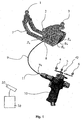
- FIG. 1 1 shows a calibration device 7, an instrument 9, a holder 10, a detection device 20 and a data processing device 30.
- the calibration device 7 comprises a marker device which has marker spheres 1, 2 and 3.
- the marker spheres 1, 2 and 3 are connected to each other via the body of the calibrating device 7 and occupy mutually predetermined relative positions.
- the body of the calibrator 7 includes openings. Of these openings, only the openings 8, 8a, 8b and 8c are provided with reference numerals for reasons of clarity.
- the openings are preferably cylindrical depressions having a known depth and a known diameter. Preferably, the openings differ in terms of their diameter.
- a code denoting the diameter of the opening is preferably printed adjacent to the opening.
- the instrument 9 is elongated and flexible, in particular elastic.
- the instrument preferably has a circular cross-section. In the in FIG. 1 As shown, the instrument is strongly curved. In practical application, however, the instruments can be made considerably more rigid and allow only a slight curvature.
- the instruments are particularly made of stainless steel, as it is used in particular in medicine and surgery.
- the modulus of elasticity of steel is 190 GPa to 200 GPa.
- glass fiber is 50 GPa to 90 GPa, whereas against that of silicone rubber, for example, only 10 MPa to 100 MPa.
- the instrument may also have other diameters, such as rectangular diameters, for example in the case of a metal plate.
- Typical diameters are in the millimeter range of z. B. greater than 0.1 mm and / or less than 20 mm.
- instruments are ultrasound probes, cannulas, catheters, in particular for ventricular drainage and for use in pain therapy (for example, peridural anesthesia, in particular PDK) or needles, as used, for example, in vertibroplasty or facet infiltration.
- pain therapy for example, peridural anesthesia, in particular PDK
- needles as used, for example, in vertibroplasty or facet infiltration.
- the instrument 9 is fastened to the holder 10 at a mounting end 11 of the holder 10.
- the instrument 9 is inserted into a suitably formed sleeve which is provided at the mounting end 11, and for example, due to the accuracy of fit and / or by means of a screw with the holder 10 fixedly connected.
- a marker device 12 which has three marker balls 4, 5 and 6.
- the marker balls 4, 5 and 6 of the marker device 12 are connected to each other via arms so that they occupy a predetermined relative position to each other.
- Calibrator 7 and holder 10 are calibrated so that the relative locations of at least portions of the surface of holder 10 and calibrator 7 relative to the marker spheres are known.
- the relative position between the openings (8, 8a, 8b, 8c,...) Of the calibrating device 7 relative to the marker spheres 1, 2 and 3 is known.
- the relative position of the mounting end 11 relative to the marker means 12 is known.
- the data and information referred to above as known are stored in the data processing device 30.
- the relative positions of the marker spheres 1, 2 and 3 relative to the apertures and the relative positions of the marker spheres 4, 5 and 6 relative to the end 11 are stored in the data processing device 30.
- 30 data signals from the detector device 20 enter the data processing system.
- the detector device 20 detects signals from the marker spheres 1, 2, 3, 4, 5 and 6.
- the detection device 20 is designed as a camera which detects light, for example infrared light emanating from the marker spheres, in particular reflected by them.
- the marker spheres reflect light if they have passive marker spheres are. In this case, they can be illuminated by continuous or pulsed light sources, for example, so that they reflect the light.
- the instruments used for the invention are preferably thin, d. H. the length is a multiple of the diameter, for example more than 2 times or 5 times or 10 times or 20 times the diameter.
- the geometry of the holder is stored in the computer 30, i. H. the relative position between the marker device 12 and the mounting end 11 is known.
- the mounting end 11 may be plugged into one of the openings 8, 8a, 8b or 8c in the calibrator, for example, until it comes in contact with the bottom of the holes. Since the depth and position (in particular geometry) of the holes is known and the relative position to the marker spheres 1, 2 and 3 is known, the relative position of the marker spheres 4, from the signals detected by the detection device 20 and further processed by the data processing device 30, 5 and 6, which are also detected, relative to the mounting end 11 are calculated by the data processing device 30.
- the instrument 9 is inserted into a preferably precisely fitting opening 8, so that the inner diameter of the opening 8 (at least approximately) coincides with the outer diameter of the instrument 9.
- the diameter of the opening 8 may be read by the calibrator by an operator and entered into the data processing device 30 for further processing.
- the determination of the diameter of the instrument 9 may also be automatic (without manual input by a user).
- the distance is significantly greater than the deflection with which the first end 9a of the instrument 9 can deviate from a position which occupies the first end 9a when the instrument 9 is rectilinear.
- the aforementioned openings may have a distance of, for example, 2 cm. If this is the case, the appropriate opening can be derived from the relative position between the marker device 12 and the calibration device 7.
- the data processing device 30 may determine from this relative position that only one of the openings is eligible for insertion of the instrument 9 therein has been.
- the other openings would require a significantly greater deflection of the instrument 9, but which is considered not real. How a practically possible deflection of the instrument 9 is calculated will be explained below.
- the data processing device In addition to the information about the diameter of the instrument, the data processing device also processes information about the elasticity of the material of the instrument.
- the modulus of elasticity is used for this purpose.
- the modulus of elasticity is a material characteristic value from materials engineering, which describes the relationship between stress and strain in the deformation of a solid body with linear elastic behavior. The amount of elastic modulus is greater, the more resistance a material opposes to its deformation.
- the position of the first end 9a of the instrument is known, because this end 9a is inserted all the way into the matching opening 8.
- the position of the bottom of the opening 8 relative to the marker balls 1, 2 and 3 is also known and stored in the data processing device 30.
- the position of the first end 9a of the instrument 9 is known and can be further processed by the data processing device.
- the instrument 9 is also inserted all the way into the sleeve 11 (mounting end 11) of the holder 10.
- the relative position of the second end 9b relative to the marker device 12 is known.
- the position of the second end 9b is thus known.
- the following data is present in the data processing device 30 for further processing: the diameter of the instrument 9, the position of the ends 9a and 9b (for example relative to the detection device 20 in a reference frame by the detection device 20 resting) and the modulus of elasticity of the material of the instrument.
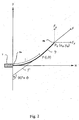
- the angle ⁇ is in FIG. 2 explained.
- the origin of the x, y coordinate system coincides with the bottom in the aperture 8 in the calibrator 7, with the first end of the instrument resting against the bottom.
- EI is the flexural rigidity of the instrument, where E is the modulus of elasticity and I depends on the geometry of the instrument and may be referred to as the cross-sectional moment of inertia.
- E the modulus of elasticity
- I depends on the geometry of the instrument and may be referred to as the cross-sectional moment of inertia.
- I the modulus of elasticity
- I the modulus of elasticity
- I the cross-sectional moment of inertia.
- I which differs from that mentioned above in the equation (1) results.
- the size "1" denotes the length from the first end 9a to a point P. The position of the point P can thus be described by the length 1 and by the angle ⁇ .
- the force acting on the end 9b at the point P e is the force F, which can be decomposed into two components F x (ie the component acting in the x-direction) and Fy (that is to say the component acting in y). It is assumed that the direction of the force F coincides with the tangent T described above. This is a realistic assumption, since with the help of the holder 10, the instrument 9 is to be introduced in practice, for example in a body structure, wherein on the instrument 9 in the direction of the tangent T with the holder 10 a compressive force is exerted to the instrument 9 on to advance in the body structure. It is therefore assumed that no bending forces and torques are exerted on the instrument 9, which can lead to a buckling of the instrument 9 at the assembly end 11 (ie at P e ).
- a force sensor is provided in the holding device 10.
- the force sensor is in particular in the vicinity of the mounting end 11.
- the force sensor preferably measures the amount of force that acts between the instrument 9 and the holder 10.
- the force gauge measures in particular the amount of force and preferably also the direction of the force. If the force sensor is provided, then the force F x and F y can be determined. Thus, from the above equations (2a) and (2b), ⁇ x and ⁇ y can be calculated. This simplifies the determination of the length L by means of equations (4) to (7).
- the instrument 9 for example a Kirschner wire, is inserted into a body structure (eg bone).
- a typical force F is exerted in the longitudinal direction of the instrument 9.
- typical forces used herein in the above calculation are greater than 0.1 N or 1 N or 10 N and, for example, less than 100 N or 1000 N.
- a typical force may be 1 N, for example.
- This assumed force has the magnitude F and is decomposed into the forces F x and F y for the above-mentioned calculation, where F x and F y are a function of F and ⁇ . Equation (4) thus allows the calculation of ⁇ e .
- equations (5) and (6) can then be used to calculate the position P e and thus the relative position between the first end and the second end of the instrument. Since the position of the second end of the instrument can be determined by detection of the marker device 12, the position of the first end of the instrument can be calculated by the data processing device 30 from this.
- the length of the instrument 9 is known and was, for example, with the aid of in FIG. 1 determined arrangement determined.
- the possible position of the first end 9a of the instrument can be calculated.
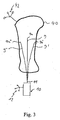
- the possible locations are in FIG. 3 9a, 9a 'and 9a ".
- the lines 9' and 9" denote the possible course of the instrument within the body structure 40 FIG. 3
- the data processing device 30 is therefore preferably connected to a display, the z. B. shows the calibrated and registered body structure 40, which is connected for example with a marker device 42, and / or a cone with possible positions of the first end 9a, 9a 'and 9a''and / or possible progressions of the instrument according to the lines 9, 9' and 9 '' from the first end to the second end of the instrument or a portion of the possible courses.
- the surgeon is thus allowed, without the use of an X-ray machine, to assess the risk of getting into an undesired area with the end 9a.
Landscapes
- Health & Medical Sciences (AREA)
- Surgery (AREA)
- Life Sciences & Earth Sciences (AREA)
- Heart & Thoracic Surgery (AREA)
- Molecular Biology (AREA)
- Oral & Maxillofacial Surgery (AREA)
- Engineering & Computer Science (AREA)
- Biomedical Technology (AREA)
- Nuclear Medicine, Radiotherapy & Molecular Imaging (AREA)
- Medical Informatics (AREA)
- Pathology (AREA)
- Animal Behavior & Ethology (AREA)
- General Health & Medical Sciences (AREA)
- Public Health (AREA)
- Veterinary Medicine (AREA)
- Apparatus For Radiation Diagnosis (AREA)
- Length Measuring Devices With Unspecified Measuring Means (AREA)
Description
- Die vorliegend Erfindung betrifft die Längenbestimmung eines Instruments, insbesondere eines medizinischen Instruments, insbesondere bei einer klinischen Anwendung, wie zum Beispiel einer Operation. Bei Markernavigationssystemen, insbesondere bei bildgeführter Chirurgie ("image guided surgery"; IGS) ist es wünschenswert, Instrumente zu registrieren und zu kalibrieren. Es sollte also die relative Lage von Teilen des Instruments relativ zu einem Bezugssystem, das beispielsweise im Raum ruht oder das mit einer Detektionseinrichtung (Kamera) verbunden ist, bekannt sein.
- Bei manchen Instrumenten ist es nicht möglich oder nicht gewünscht, an der Spitze des Instruments eine Markereinrichtung anzubringen, da beispielsweise die Spitze des Instruments, beispielsweise ein Nagel sonst für die beabsichtigten Zwecke nicht verwendet werden kann. Dennoch ist es in diesem Fall wünschenswert, dass das Markernavigationssystem Informationen über die Lage der Spitze des Instruments liefert. Hierzu ist eine Information über die Länge des Instruments von Nöten. Die Länge des Instruments kann bei starren Instrumenten beispielsweise einfach durch Abgreifen der beiden Enden mittels eines Pointers bestimmt werden. Der Abstand zwischen den Enden entspricht dann der Länge des Instruments. Dies ist jedoch bei nichtideal starren Instrumenten nur ungenau, wobei die Ungenauigkeit mit zunehmender Elastizität des Instruments zunimmt.
-
US 5,921,922 offenbart ein Verfahren und ein System zum Kalibrieren eines Instruments. Die Kalibrierung wird interoperativ durchgeführt. -
WO-A-02/36018 -
EP-A-1 704 825 offenbart eine Führungsdrahtnavigation. Dabei soll die Position des distalen Endes eines Knochenführungsdrahtes mithilfe eines optischen Tracking-Navigationssystems ermittelt werden.
Aufgabe der Erfindung ist es die Länge flexibler Instrumente vermessen zu können. - Vorstehende Aufgabe wird durch die unabhängigen Ansprüche gelöst. Die abhängigen Ansprüche sind auf vorteilhafte Weiterbildungen gerichtet.
- Erfindungsgemäß werden mittels einer Detektionseinrichtung (z. B. Kamera oder Ultraschalldetektor) Markereinrichtungen detektiert. Die Markereinrichtungen umfassen typischerweise drei Marker, die in fester und vorbestimmter relativer Lage zueinander angeordnet sind und insbesondere mechanisch verbunden sind. Die Marker können passive oder aktive Marker sein, wobei die passiven Marker Signale (z.B. Wellen und/oder Strahlung) reflektieren, die in ihre Richtung ausgesendet werden und die aktiven Marker selbst Ursprung der Signale (z.B. Strahlung und/oder Wellen) sind. Die von den (aktiven oder passiven) Markern ausgehenden Signale, bei denen es sich z.B. um Wellensignale oder Strahlungssignale handeln kann, werden von einer Detektionsvorrichtung (z. B. Kamera) detektiert. Um eine Position der Markereinrichtung relativ zu der Detektionseinrichtung festzulegen, wird dabei vorzugsweise die Markereinrichtung bewegt, um der Detektionseinrichtung verschiedene Ansichten der Markereinrichtung zu bieten. Auf dieser Grundlage kann dann in bekannter Weise die relative Lage der Markereinrichtung relativ zu der Detektionseinrichtung, insbesondere in einem im Raum ruhenden Bezugssystem bestimmt werden. In diesem Zusammenhang wird auf die
DE 196 39 615 A1 und die entsprechende US-Veröffentlichung6,351,659 hingewiesen, - Die Lage der Markereinrichtung wird bevorzugt durch die Position der Markereinrichtung in einem vorbestimmen Bezugssystem bestimmt. Vorzugsweise wird als Bezugssystem ein Bezugssystem verwendet, in dem die Detektionseinrichtung ruht. Insbesondere wird die Lage der Markereinrichtung durch die Positionen der Marker, insbesondere der Mittelpunkte der Marker in einem Bezugssystem bestimmt. Die Positionen können zum Beispiel mit kartesischen Koordinaten oder Kugelkoordinaten beschrieben werden. Die relative Lage von einem Teil (z. B. Detektionseinrichtung oder Markereinrichtung) zu einem anderen Teil (z. B. Markereinrichtung) kann insbesondere durch Raumwinkel und/oder Abstände und/oder Koordinaten (in einem Bezugssystem) und/oder Vektoren beschrieben werden und wird vorzugsweise aus dem die Lage beschreibenden Positionen z. B. mittels eines Programms errechnet, das auf einem Computer läuft.
- Der hierin verwendete Begriff "relative Lage" oder der Ausdruck "Lage eines Teils A relativ zu einem Teil B" umfasst also den Begriff der relativen Positionen zwischen den zwei Teilen, insbesondere zwischen den Markereinrichtungen und/oder deren Markern oder zwischen einer Markereinrichtung (oder deren Markern) und der Detektionseinrichtung. Insbesondere werden Schwerpunkte oder Mittelpunkte der Teile als punktförmiger Bezugspunkt zum Festlegen einer Position gewählt. Ist die Position eines Teils in einem Bezugssystem bekannt, so kann basierend auf der relativen Lage zweier Teile aus der Position eines der zwei Teile die Position des anderen der zwei Teile berechnet werden.
- Insbesondere falls die Markereinrichtung nur zwei Marker umfasst, ist bevorzugt eine Startposition bekannt und die Markersystem erlaubt dann die Verfolgung der Lage der Markereinrichtung bei Bewegung der Markereinrichtung im Raum.
- Die Markereinrichtung gemäß der vorliegenden Erfindung umfasst also vorzugsweise mindestens zwei Marker, insbesondere und bevorzugt drei Marker und können natürlich auch mehr als drei Marker umfassen. Die Abmessungen der Marker und die relativen Lagen der Marker zueinander sind bekannt und liegen insbesondere als vorbekannte Daten einer Datenverarbeitungseinrichtung vor. Vorzugsweise ist auch die Form der Marker bekannt.
- Weiter umfasst das erfindungsgemäße Markernavigationssystem eine Detektionseinrichtung, die Signale von den mindestens zwei Markern detektiert. Wie zuvor ausgeführt handelt es sich hierbei um von den Markern ausgehende Signale, die entweder aktiv von den Markern ausgesendet werden oder von den Markern reflektiert werden. Im letzteren Fall ist vorzugsweise weiter eine Signalsendequelle beispielsweise eine Infrarotlichtquelle vorgesehen, die Signale (z. B. Ultraschallwellen oder Infrarotlicht) in Richtung auf die passiven Marker (kontinuierlich oder gepulst) aussendet, wobei die passiven Marker die Signale reflektieren. Eine Datenverarbeitungseinrichtung, insbesondere ein Computer erlaubt die Berechnung der relativen Lage der Markereinrichtung relativ zur Detektionseinrichtung, insbesondere die Berechnung der Lage der Markereinrichtung in einem Bezugssystem, indem die Detektionseinrichtung ruht, also beispielsweise in einem Bezugssystem, das in einem Operationssaal ruht.
- Die erfindungsgemäße Datenverarbeitungseinrichtung ist ausgebildet, um Berechnungs- und Bestimmungsoperationen durchzuführen. Erfindungsgemäß werden durch die Datenverarbeitungseinrichtung die Lagen der Markereinrichtungen basierend auf den detektierten Signalen, die von den Markereinrichtungen ausgehen, berechnet. Vorzugsweise sind die Gegenstände (Körperstruktur oder Instrument), an denen die Markereinrichtungen angebracht sind, kalibriert. Dies bedeutet, dass die relativen Lagen zumindest zwischen Teilen des Gegenstandes und der Markereinrichtung, die an dem Gegenstand angebracht ist, bekannt sind und/oder insbesondere in der Datenverarbeitungseinrichtung abgespeichert sind, so dass insbesondere Anzeigesignale, die die Lagen der Gegenstände beschreiben, basierend auf den Lagen der Markereinrichtungen bestimmt werden können. Die Lagen der Markereinrichtungen werden bevorzugt relativ zu der Detektionseinrichtung berechnet, also in einem Bezugssystem, in dem die Detektionseinrichtung ruht. Natürlich können die Lagen auch in einem anderen Bezugssystem berechnet werden, z.B. in einem Bezugssystem, in dem der Patient ruht und/oder in dem eine der Markereinrichtungen ruht.
- Das erfindungsgemäße Markernavigationssystem erlaubt erfindungsgemäß die Längenbestimmung, vorzugsweise aber auch die Bestimmung des Durchmessers, insbesondere auch der Form des Instruments.
- Das Markernavigationssystem umfasst einen Halter, der ausgebildet ist, um das Instrument zu halten. Insbesondere wird ein Ende des Instruments (das zweite Ende) an dem Halter (mechanisch), insbesondere lösbar angebracht. Das Instrument ist so an dem Halter angebracht, dass die relative Lage zwischen dem zweiten Ende des Instruments und dem Halter fixiert ist, d. h. das zweite Ende des Instruments ist relativ zu dem Halter ortsfest. Wie oben ausgeführt, ist dies für das andere Ende, das erste Ende des Instruments nicht gewährleistet, da das Instrument zumindest in einem gewissen Umfang flexibel ist. Bei einem ideal starren Instrument wäre auch das erste Ende des Instruments ortsfest zu dem Halter. Der Halter umfasst vorzugsweise einen Griff und kann zum Beispiel auch eine Maschine, wie beispielsweise ein Bohrgerät umfassen, das ausgebildet ist, das fixierte Instrument zu drehen.
- Weiter ist ein Kalibriergerät vorgesehen, das vorzugsweise die Bestimmung des Durchmessers und/oder der Querschnittsform des Instruments erlaubt. Hierzu ist in dem Kalibriergerät vorzugsweise mindestens eine Öffnung vorgesehen. Sind mehrere Öffnungen vorgesehen, so haben diese vorzugsweise eine unterschiedliche Form, sodass unterschiedlich gestaltete Instrumente eingeführt werden können. Vorzugsweise werden Instrumente vermessen, deren Querschnittsform über die gesamte Länge des Instruments konstant ist, denn in die Berechnung der Länge des Instruments fließen Informationen über die Form des Instruments ein, also beispielsweise die Annahme ein, das der Querschnitt des Instruments über die gesamte Länge gleich ist.
- Sind in dem Kalibriergerät mehrere Öffnungen vorgesehen, so haben diese vorzugsweise eine unterschiedliche Form und Größe. Auf dieser Art und Weise kann durch passgenaues Einführen eines Instruments in die Öffnungen eine der Öffnungen dem Instrument zugeordnet werden. Da die Form und Größe der Öffnung bekannt ist, entspricht Form und Größe des Querschnitts des Instruments demjenigen der Öffnung. Da weiterhin die relative Lage der Öffnung relativ zu der zweiten Markereinrichtung bekannt ist, die an dem Kalibriergerät angebracht ist, ist weiterhin bekannt, wo sich das erste Ende des Instruments befindet wenn es passgenau, und insbesondere bis zum Anschlag in die Öffnung eingeführt wurde. Da insbesondere auch die relative Lage des Bodens einer jeden Öffnung relativ zu der zweiten Markereinrichtung bekannt ist, ist somit auch die Lage des ersten Endes des Instruments bekannt.
- Im Falle eines Instruments mit kreisförmigem Querschnitt, ist die mindestens eine Öffnung ebenfalls eine Öffnung mit einem kreisrunden Querschnitt, also eine zylindrische Bohrung. Natürlich können auch Öffnungen anderer Formen z. B. rechteckige Formen vorgesehen sein, um Instrumente mit rechteckigem Querschnitt passgenau einführen und damit vermessen zu können.
- Die oben genannte Detektionseinrichtung ist ausgebildet, um eine erste Lage der ersten Markereinrichtung, die der Halter aufweist und eine zweite Lage der zweiten Markereinrichtung, die das Kalibriergerät aufweist, zu detektieren.
- Die oben genannte Datenverarbeitungseinrichtung erlaubt unter der Verwendung bestimmter Informationen, die von der Detektionseinrichtung stammen und/oder vorgegeben sind und/oder eingegeben werden, die Länge des Instruments zu bestimmen, insbesondere zu berechnen.
- Bei diesen Informationen handelt es sich insbesondere um die Folgenden. Die oben genannte erste und zweite Lage wurde von der Detektionseinrichtung bestimmt und die Daten hierzu werden in die Datenverarbeitungseinrichtung eingegeben. Die Information über den Querschnitt des Instruments kann von einem Benutzer eingegeben werden, der eine Kennzahl abliest, die neben der Öffnung geschrieben steht, in die das Instrument eingeführt wurde, und die die Form und/oder Größe und/oder Durchmesser der Öffnung kennzeichnet. Alternativ kann dies natürlich beispielsweise auch durch Bildverarbeitung erfolgen, wobei eine Kamera (beispielsweise dieselbe, die auch als Detektionseinrichtung verwendet wird) den Bereich beobachtet, wo das erste Ende des Instruments in die mindestens eine Öffnung des Kalibriergeräts eingeführt wird. Aus der optischen Auswertung des Kamerabildes (beispielsweise den Markierungen neben den Öffnungen), lässt sich dann mittels der Datenverarbeitungseinrichtung ermitteln, in welche Öffnung das erste Ende des Instruments eingeführt ist. Weitere mögliche Arten der Bestimmung der Öffnung, in die das Instrument eingeführt wurde, werden bei der detaillierten Beschreibung weiter unten offenbart. Ist somit die Information über den Querschnitt (beispielsweise der Durchmesser und/oder die Querschnittsfläche und/oder die Form des Querschnitts) des Instruments bekannt, so ist eine wesentliche Information über das Instrument gegeben. Die andere wesentliche Information über das Instrument, nämlich die Länge, wird zusätzlich aus den folgenden Informationen bestimmt. Die Information über die Elastizität des Materials des Instruments. Die Elastizität des Materials des Instruments lässt sich beispielsweise durch den Elastizitätsmodul beschreiben, der auch Youngscher Modul genannt wird. Weiter wird zur Bestimmung der Länge die relative Lage zwischen dem zweiten Ende des Instruments und der ersten Markereinrichtung verwendet. Hierbei kann man nutzen, dass das zweiten Ende des Instruments an einer Anschlagsfläche des Halters anliegend am Halter angebracht wird. Die relative Lage zwischen Anschlagsfläche des Halters und der ersten Markereinrichtung (des Halters) ist bekannt und in der Datenverarbeitungseinrichtung gespeichert. Soweit hierin von "bekannten Daten" oder "bekannten Informationen" oder ähnlichen gesprochen wird, sind dies vorzugsweise Daten, die in der Datenverarbeitungseinrichtung gespeichert sind. Entsprechendes gilt für die relative Lage zwischen der zweiten Markereinrichtung (des Kalibriergerätes) und der mindestens einen Öffnung. Dabei ist, wie oben bereits ausgeführt wurde, insbesondere die relative Lage zwischen dem Boden der mindestens einen Öffnung, an dem das erste Ende des Instruments anliegt und der zweiten Markereinrichtung bekannt.
- Zusätzlich zu den oben genannten Informationen ist vorzugsweise auch noch eine Kraft bekannt, die auf das Instrument wirkt. In diesem Fall wird vorzugsweise davon ausgegangen, dass das Instrument, für den Fall, dass keine Kraft wirkt, geradlinig ist und im Falle einer Krafteinwirkung das Instrument sich krummlinig erstreckt, also durch die Krafteinwirkung gebogen wird.
- Bei der Berechnung wird von einer stetigen Krümmung ausgegangen, es sollen also keine Knicke im Längsverlauf des Instruments entstehen. Alternativ oder zusätzlich wird davon ausgegangen, dass die Kraft, die auf das Instrument wirkt, nur an den Enden des Instruments wirkt, vorzugsweise nur an einem Ende. Dabei wird bei der Berechnung mittels der Datenverarbeitungseinrichtung vorzugsweise weiter davon ausgegangen, dass die Kraft an dem Ende, an dem sie angreift in die Richtung wirkt, in die sich das Instrument an diesem Ende erstreckt. Die Richtung der Kraft stimmt also mit der Richtung einer Tangente überein, die an dem Ende des Instruments an das gekrümmte Instrument angelegt wird. Insbesondere wirkt eine Kraft zwischen einer Stirnseite des Instruments am zweiten Ende des Instruments und dem Halter. Es wird also davon ausgegangen, dass mit dem Halter auf die Stirnseite des Instruments eine Kraft ausgeübt wird, die zu einer Krümmung des Instruments führt.
- Vorzugsweise wird zur Längenbestimmung des Instruments der Halter bewegt, um eine Vielzahl erster und/oder zweiter Lagen zu detektieren und in die Berechnung einfließen zu lassen. Auf diese Art und Weise lässt sich die Genauigkeit der Bestimmung der Länge des Instruments erhöhen, indem beispielsweise die für die verschiedenen ersten und/oder zweiten Lagen bestimmten Längen einer Mittelwertbildung unterzogen werden. Alternativ oder zusätzlich lässt sich aus den detektierten, verschiedenen ersten und zweiten Lagen eine mögliche Auslenkbarkeit des Instruments bei seiner Anwendung bestimmen und vorzugsweise von der Datenverarbeitungseinrichtung abspeichern. Es lässt sich also feststellen, welche möglichen relativen Lagen das erste Ende relativ zum zweiten Ende einnehmen kann. Vorteilhaft ist hierbei, wenn derselbe Benutzer das Verfahren zur Längenbestimmung ausführt, der später das Instrument einsetzt, denn es ist davon auszugehen, dass der Benutzer ähnliche Kräfte aufwendet. Die somit festgestellten möglichen relativen Lagen zwischen dem ersten Ende und dem zweiten Ende können dann bei der (medizinischen) Anwendung des an dem Halter angebrachten Instruments als mögliche Lagen angezeigt werden. Alternativ können diese möglichen Lagen des Instruments, insbesondere des ersten Endes auch berechnet werden, wie im Folgenden ausgeführt wird.
- Im Folgenden erfolgt eine detaillierte Beschreibung der Erfindung. Dabei werden weitere vorteilhafte Merkmale der Erfindung offenbart. Verschiedene Merkmale unterschiedlicher Ausführungsformen können miteinander kombiniert werden.
-
Figur 1 zeigt eine Ausführungsform eines erfindungsgemäßen Markernavigationssystems. -
Figur 2 zeigt thematisch die Krümmung eines Instruments, als Grundlage zur Berechnung der Länge. -
Figur 3 zeigt möglich Verläufe des Instruments innerhalb einer Körperstruktur. -
Figur 1 zeigt ein Kalibriergerät 7, ein Instrument 9, einen Halter 10, eine Detektionseinrichtung 20 und eine Datenverarbeitungseinrichtung 30. - Das Kalibriergerät 7 umfasst eine Markereinrichtung, die Markerkugeln 1, 2 und 3 aufweist. Die Markerkugeln 1, 2 und 3 sind über den Körper des Kalibriergeräts 7 miteinander verbunden und nehmen zueinander vorbestimmte relative Lagen ein. Der Körper des Kalibriergeräts 7 umfasst Öffnungen. Von diesen Öffnungen sind nur die Öffnungen 8, 8a, 8b und 8c aus Übersichtlichkeitsgründen mit Bezugszeichen versehen. Die Öffnungen sind vorzugsweise zylindrische Vertiefungen mit einer vorbekannten Tiefe und einem vorbekannten Durchmesser. Vorzugsweise unterscheiden sich die Öffnungen hinsichtlich ihres Durchmessers. Eine Kennzahl, die den Durchmesser der Öffnung bezeichnet ist vorzugsweise neben die Öffnung gedruckt.
- Das Instrument 9 ist länglich und flexibel, insbesondere elastisch. Das Instrument hat vorzugsweise einen kreisrunden Querschnitt. In der in
Figur 1 gezeigten Abbildung ist das Instrument stark gekrümmt gezeichnet. In der praktischen Anwendung können die Instrumente jedoch erheblich starrer ausgebildet sein und nur eine geringe Krümmung zulassen. Die Instrumente sind insbesondere aus Edelstahl, wie er insbesondere in der Medizin und Chirurgie verwendet wird. Der Elastizitätsmodul von Stahl liegt bei 190 GPa bis 200 GPa. Der Elastizitätsmodul anderer Materialen, wie z. B. Glasfaser liegt bei 50 GPa bis 90 GPa, wohin gegen derjenige von Silikonkautschuk beispielsweise nur 10 MPa bis 100 MPa beträgt. - Das Instrument kann auch andere Durchmesser, wie beispielsweise rechteckförmige Durchmesser, beispielsweise im Falle einer Blechplatte aufweisen.
- Beispiele für Instrumente stellen der Kirschnerdraht, Schrauben, insbesondere Schanzschrauben für Knochen, Bohrer, Marknagel, Steinmannpins (für die externe Fixation des Knochens) dar. Typische Durchmesser liegen im Millimeterbereich von z. B. größer 0,1 mm und/oder kleiner 20 mm.
- Andere mögliche Instrumente sind die Schenkel einer Zange oder die Klingen einer Schere, die ebenfalls eine gewisse Elastizität aufweisen.
- Weitere Beispiele für Instrumente sind Ultraschallsonden, Kanülen, Katheter, insbesondere für die Ventrikeldrainage und zur Verwendung bei der Schmerztherapie (beispielsweise Periduralanästhesie, insbesondere PDK) oder Nadeln, wie sie beispielsweise bei der Vertibroplastie oder Facetteninfiltration verwendet werden.
- Das Instrument 9 wird an einem Montagende 11 des Halters 10 an dem Halter 10 befestigt. Beispielsweise wird hierzu das Instrument 9 in eine passend ausgebildete Hülse, die an dem Montageende 11 vorgesehen ist, eingeführt und beispielsweise aufgrund der Passgenauigkeit und/oder mittels einer Schraube mit dem Halter 10 ortsfest verbunden.
- Am Halter 10 ist ebenfalls eine Markereinrichtung 12 vorgesehen, die drei Markerkugeln 4, 5 und 6 aufweist. Die Markerkugeln 4, 5 und 6 der Markereinrichtung 12 sind über Arme miteinander so verbunden, dass sie eine vorbestimmte relative Lage jeweils zueinander einnehmen.
- Das Kalibriergerät 7 und der Halter 10 sind kalibriert, sodass die relativen Lagen zumindest von Teilen der Oberfläche des Halters 10 und des Kalibriergeräts 7 relativ zu den Markerkugeln bekannt sind.
- Insbesondere ist die relative Lage zwischen den Öffnungen (8, 8a, 8b, 8c,...) des Kalibriergeräts 7 relativ zu den Markerkugeln 1, 2 und 3 bekannt. Weiter ist die relative Lage des Montageendes 11 relativ zu der Markereinrichtung 12 (relativ zu den Markerkugeln 4, 5 und 6) bekannt.
- Vorzugsweise sind die oben als bekannt bezeichneten Daten und Informationen in der Datenverarbeitungseinrichtung 30 gespeichert. Insbesondere sind die relativen Lagen der Markerkugeln 1, 2 und 3 relativ zu den Öffnungen und die relativen Lagen der Markerkugeln 4, 5 und 6 relativ zu dem Ende 11 in der Datenverarbeitungseinrichtung 30 gespeichert. Weiter gehen in die Datenverarbeitung 30 Datensignale von der Detektoreinrichtung 20 ein. Die Detektoreinrichtung 20 detektiert Signale von den Markerkugeln 1, 2, 3, 4, 5 und 6. Insbesondere ist die Detektionseinrichtung 20 als Kamera ausgebildet, die Licht, beispielsweise Infrarotlicht detektiert, das von den Markerkugeln ausgeht, insbesondere von diesen reflektiert wird. Die Markerkugeln reflektieren Licht, falls sie passive Markerkugeln sind. In diesem Fall können sie beispielsweise durch kontinuierliche oder gepulste Lichtquellen angestrahlt werden, sodass sie das Licht reflektieren.
- Die für die Erfindung verwendeten Instrumente sind vorzugsweise dünn, d. h. die Länge beträgt ein Vielfaches des Durchmessers, beispielsweise mehr als das 2-fache oder 5-fache oder 10-fache oder 20-fache des Durchmessers.
- Im oben beschriebenen Fall ist die Geometrie des Halters im Computer 30 gespeichert, d. h. die relative Lage zwischen der Markereinrichtung 12 und dem Montageende 11 ist bekannt. Alternativ kann das Montageende 11 beispielsweise in eine der Öffnungen 8, 8a, 8b oder 8c in das Kalibriergeräts gesteckt werden, bis es mit dem Boden der Löcher in Kontakt kommt. Da die Tiefe und Lage (insbesondere Geometrie) der Löcher bekannt ist und die relative Lage zu den Markerkugeln 1, 2 und 3 bekannt ist, kann aus den von der Detektionseinrichtung 20 detektierten und von der Datenverarbeitungseinrichtung 30 weiterverarbeiteten Signalen die relative Lage der Markerkugeln 4, 5 und 6, die ebenfalls detektiert werden, relativ zu dem Montageende 11 von der Datenverarbeitungseinrichtung 30 berechnet werden.
- Erfindungsgemäß wird das Instrument 9 in eine vorzugsweise passgenaue Öffnung 8 eingeführt, sodass der Innendurchmesser der Öffnung 8 (zumindest in etwa) mit dem Außendurchmesser des Instruments 9 übereinstimmt. Der Durchmesser der Öffnung 8 kann von dem Kalibriergerät von einer Bedienperson abgelesen werden und in die Datenverarbeitungseinrichtung 30 zur weiteren Verarbeitung eingegeben werden.
- Alternativ kann die Feststellung des Durchmessers des Instruments 9 auch automatisch (ohne manuelle Eingabe durch einen Benutzer) erfolgen. Hierzu sind beispielsweise die Öffnungen 8, 8a, 8b, 8c,... weit voneinander beabstandet. Der Abstand ist insbesondere deutlich größer als die Auslenkung, mit der das erste Ende 9a des Instruments 9 von einer Lage abweichen kann, die das erste Ende 9a einnimmt, wenn das Instrument 9 geradlinig ist. Wie bereits oben erwähnt, sind bei Instrumenten aus Stahl nur geringe Auslenkungen von beispielsweise 1 cm zu erwarten. In diesem Fall können dann die vorgenannten Öffnungen einen Abstand von beispielsweise 2 cm aufweisen. Ist dies der Fall, so kann die passende Öffnung aus der relativen Lage zwischen der Markereinrichtung 12 und dem Kalibriergerät 7 abgeleitet werden. Die Datenverarbeitungseinrichtung 30 kann aus dieser relativen Lage bestimmen, dass nur eine der Öffnungen dafür in Frage kommt, dass das Instrument 9 darin eingeführt wurde. Die anderen Öffnungen würden eine erheblich größere Auslenkung des Instruments 9 erfordern, die aber als nicht reell angesehen wird. Wie eine praktisch mögliche Auslenkung des Instruments 9 berechnet wird, wird weiter unten dargelegt.
- Die Datenverarbeitungseinrichtung verarbeitet neben der Information über den Durchmesser des Instruments auch noch Information über die Elastizität des Materials des Instruments. Vorzugsweise wird hierzu der Elastizitätsmodul verwendet. Der Elastizitätsmodul ist ein Materialkennwert aus der Werkstofftechnik, der den Zusammenhang zwischen Spannung und Dehnung bei der Verformung eines festen Körpers bei linear elastischem Verhalten beschreibt. Der Betrag des Elastizitätsmoduls ist umso größer, je mehr Widerstand ein Material seiner Verformung entgegensetzt.
- Weiter ist die Lage des ersten Endes 9a des Instruments bekannt, denn dieses Ende 9a ist bis zum Anschlag in die dazu passende Öffnung 8 eingeführt. Die Lage des Bodens der Öffnung 8 relativ zu den Markerkugeln 1, 2 und 3 ist ebenfalls bekannt und in der Datenverarbeitungseinrichtung 30 eingespeichert. Durch die Detektion der Markerkugeln 1, 2 und 3 ist somit die Lage des ersten Endes 9a des Instruments 9 bekannt und kann von der Datenverarbeitungseinrichtung weiter verarbeitet werden. Weiter relative Lage des Anschlags für das Instrument in der Hülse 11 des Halters 10 relativ zur Markereinrichtung 12 bekannt. Das Instrument 9 ist ebenfalls bis zum Anschlag in die Hülse 11 (Montageende 11) des Halters 10 eingeführt. Somit ist die relative Lage des zweiten Endes 9b relativ zur Markereinrichtung 12 bekannt. Durch Detektieren der Markereinrichtung 12 mittels der Detektionseinrichtung 20 ist somit die Lage des zweiten Endes 9b bekannt.
- Somit sind folgende Daten zur weiteren Verarbeitung in der Datenverarbeitungseinrichtung 30 vorhanden: Der Durchmesser des Instruments 9, die Lage der Enden 9a und 9b (beispielsweise relativ zur Detektionseinrichtung 20 in einem Bezugssystem, indem die Detektionseinrichtung 20 ruht) und das Elastizitätsmodul des Materials des Instruments.
- Aus den vorgenannten bekannten Daten wird nun erfindungsgemäß die Länge des Instruments 9 wie folgt berechnet.
- Der Elastizitätsmodul E erlaubt die Berechnung der Biegesteifigkeit EI eines langen, dünnen Instruments mit kreisförmigem Querschnitts wie folgt:

- Die Differentialgleichung, die den Verlauf bzw. die Krümmung des gebogenen Instruments beschreibt lautet wie folgt:

- Der Winkel ϑ ist in
Figur 2 erläutert. Der Winkel ϑ ergibt sich durch Anlegen der Tangente an das gekrümmte Instrument 9 am zweiten Ende 9b und dem Schnittpunkt dieser Tangente T mit der Koordinatenachse y, wobei für den stumpfen Winkel α zwischen der Tangente T und der Koordinatenachse y gilt: α = 90° + ϑ. Der Ursprung des x, y-Koordinatensystems stimmt mit dem Boden in der Öffnung 8 in dem Kalibriergerät 7 überein, wobei das erste Ende des Instruments an dem Boden anliegt. - Für die in der obigen Gleichung (2) erwähnten γx und γy gilt:


- Wie oben erwähnt ist EI die Biegesteifigkeit des Instruments, wobei E das Elastizitätsmodul ist und I von der Geometrie des Instruments abhängt und als Querschnitts-Trägheitsmoment bezeichnet werden kann. Für rechteckförmige Querschnitte ergibt sich beispielsweise ein I, das von dem oben in der Gleichung (1) erwähnten abweicht. Die Größe "1" bezeichnet die Länge von dem ersten Ende 9a zu einem Punkt P. Die Lage des Punkts P lässt sich somit durch die Länge 1 und durch den Winkel ϑ beschreiben.
- Die obige Gleichung (2) kann integriert werden und man erhält dann:

- Wobei "c" eine Konstante ist und durch die Randbedingung d ϑ /dl = γy Xe bestimmt werden kann, die am ersten Ende 9a des Instruments, also am Ursprung des Koordinatensystems gilt. An dem Punkt Pe gilt ϑ = ϑe und die Länge des Instruments 9 lässt sich wie folgt berechnen:

- In der obigen Gleichung sind die Variablen ϑc, γx und γy unbekannt. Diese drei unbekannten Variablen können durch die folgenden Bedingungen berechnet werden:


- Bei der letzten Gleichung geht die Randbedingung ein, dass die Krümmung des Instruments oder genauer die Änderung des Winkels ϑ am Punkt Pe, also bei ϑe = ϑe verschwindet.
- Sind nun mit Hilfe der obigen Gleichungen (5), (6) und (7) die unbekannten Variablen ϑe, γx und γy berechnet, so lässt sich mit Hilfe der Gleichung (4) die Länge des Instruments berechnen.
- Bei dieser Berechnung wurde berücksichtigt, dass die Biegung des Instruments in einer Ebene erfolgt. Die Koordinaten in der Ebene werden durch das kartesische Koordinatensystem mit den Achsen x und y beschrieben. Die Punkte in der Ebene können darüber hinaus durch die Koordinaten ϑ und 1 beschrieben werden. Weiter wird angenommen, dass sich das Instrument frei in dem passenden Loch 8 in dem Kalibriergerät 7 drehen kann, sodass keine zusätzlichen Kräfte, insbesondere Verdrillungskräfte entstehen. Man nimmt also an, dass die Verbiegung des Instruments 9 lediglich in der xy-Ebene erfolgt und sonst keine Verformungskräfte wirken.
- Die Kraft, die auf das Ende 9b am Punkt Pe wirkt ist die Kraft F, die in zwei Komponenten Fx (also die in x-Richtung wirkende Komponente) und Fy (also die in y wirkende Komponente) zerlegt werden kann. Man nimmt an, dass die Richtung der Kraft F mit der oben beschriebenen Tangente T übereinstimmt. Dies ist eine realistische Annahme, da mit Hilfe des Halters 10 das Instrument 9 in der Praxis beispielsweise in eine Körperstruktur eingeführt werden soll, wobei auf das Instrument 9 in Richtung der Tangente T mit dem Halter 10 eine Druckkraft ausgeübt wird, um das Instrument 9 weiter in der Körperstruktur voranzutreiben. Es wird also davon ausgegangen, dass keine Knickkräfte und Drehmomente auf das Instrument 9 ausgeübt werden, die zu einem Knicken des Instruments 9 am Montageende 11 (also bei Pe) führen können.
- Bei einer weiteren Ausführungsform der Erfindung ist ein Kraftsensor bei der Halteeinrichtung 10 vorgesehen. Der Kraftsensor ist insbesondere in der Nähe des Montageendes 11. Der Kraftsensor misst vorzugsweise den Betrag der Kraft, der zwischen dem Instrument 9 und dem Halter 10 wirkt. Der Kraftmesser (Kraftsensor) misst insbesondere den Betrag der Kraft und vorzugsweise auch noch die Richtung der Kraft. Ist der Kraftsensor vorgesehen, so kann die Kraft Fx und Fy bestimmt werden. Somit kann aus den obigen Gleichungen (2a) und (2b) γx und γy berechnet werden. Dies vereinfacht die Bestimmung der Länge L mit Hilfe der Gleichungen (4) bis (7).
- Ist nun die Länge des Instruments bekannt, so kann dies bei der Verwendung des Instruments ausgenutzt werden, um mögliche Positionen des ersten Endes des Instruments anzuzeigen, falls diese unbekannt sind. Man geht also von der Situation aus, dass das zweite Ende an dem Halter 10 angebracht ist und von einem Bediener (Operateur) das Instrument beispielsweise in eine Körperstruktur eingeführt wird. Die Lage des ersten Endes ist dann unbekannt und kann aber wie folgt berechnet werden. Eine bekannte Größe ist nun die Länge L des Instruments. Weiter wird angenommen, dass eine bestimmte Kraft in die Richtung der Längserstreckung des Instruments, also mit einem Winkel ϑ = ϑe wirkt. Ein Beispiel für eine Situation in der Praxis, bei der mittels des Halters 10 das Instrument 9 in eine Körperstruktur 40 eingeführt wird, ist in
Figur 3 gezeigt. Das Instrument 9, beispielsweise ein Kirschnerdraht, wird in eine Körperstruktur (z. B. Knochen) eingeführt. Dabei wird eine typische Kraft F in Längsrichtung des Instruments 9 ausgeübt. Typische Kräfte, die hierin beispielsweise bei der obigen Berechnung zugrunde gelegt werden sind beispielsweise größer als 0,1 N oder 1 N oder 10 N und beispielsweise kleiner als 100 N oder 1.000 N. Eine typische Kraft kann also beispielsweise 1 N betragen. Diese angenommene Kraft hat den Betrag F und wird für die oben genannte Berechnung in die Kräfte Fx und Fy zerlegt, wobei Fx und Fy eine Funktion von F und ϑ sind. Die Gleichung (4) erlaubt somit die Berechnung von ϑe. Somit ist dann über die Gleichungen (5) und (6) die Position Pe und damit die relative Lage zwischen dem ersten Ende und dem zweiten Ende des Instruments berechenbar. Da die Lage des zweiten Endes des Instruments durch Detektion der Markereinrichtung 12 bestimmbar ist, kann hieraus die Lage des ersten Endes des Instruments durch die Datenverarbeitungseinrichtung 30 berechnet werden. - Für eine gegebene Kraft mit Betrag F ergibt sich somit eine mögliche Biegung des Instruments.
- Bei dem in
Figur 3 gezeigten Fall ist die Länge des Instruments 9 bekannt und wurde beispielsweise mit Hilfe der inFigur 1 gezeigten Anordnung bestimmt. Somit kann mit Hilfe der vorgenannten Gleichungen die mögliche Lage des ersten Endes 9a des Instruments berechnet werden. Die möglichen Lagen sind inFigur 3 als 9a, 9a' und 9a" bezeichnet. Die Linien 9' und 9" bezeichnen den möglichen Verlauf des Instruments innerhalb der Körperstruktur 40. Bei dem inFigur 3 gezeigten Fall erkennt man somit, dass bei einem weiteren vorantreiben des Instruments 9 in die Körperstruktur 40 ein Risiko dahingehend besteht, dass am Ende 9a' die Spitze des Instruments wieder aus der Köperstruktur 40 austreten kann. Dies kann unerwünscht sein. - Die Datenverarbeitungseinrichtung 30 wird deshalb vorzugsweise mit einer Anzeige verbunden, die z. B. die kalibrierte und registrierte Körperstruktur 40 zeigt, die beispielsweise mit einer Markereinrichtung 42 verbunden ist, und/oder einen Konus mit möglichen Positionen des ersten Endes 9a, 9a' und 9a'' und/oder möglichen Verläufen des Instruments gemäß den Linien 9, 9' und 9'' vom ersten Ende bis zum zweiten Ende des Instruments oder einen Abschnitt der möglichen Verläufe. Dem Operateur ist somit ermöglicht, ohne Einsatz eines Röntgengeräts das Risiko zu beurteilen, mit dem Ende 9a in einen unerwünschten Bereich zu kommen. Bei dem in
Figur 3 gezeigten Fall, wäre somit eine Überprüfung der Lage des ersten Endes des Instruments 9 angezeigt, da das erste Ende des Instruments droht, die Außenhaut des Knochens 40 zu durchdringen, wenn das Instrument 9 weiter voran getrieben wird. Dies ist leicht von dem Operateur zu überprüfen, das vorzugsweise sowohl die Körperstruktur als auch mögliche Lagen des Instruments durch die Anzeige gezeigt werden.
Claims (8)
- Markernavigationssystem zur Bestimmung der Länge L flexibler, langer Instrumente (9) insbesondere medizinischer Instrumente, die in ihrer Erstreckung sowohl geradlinig als auch stetig krummlinig sein können,
mit einem Halter (10) zum Halten des Instruments (9), das ein erstes und zweites Ende (9a, 9b) aufweist, wobei das zweite Ende (9b) an dem Halter (10) angebracht ist und der Halter (10) eine erste Markereinrichtung (12) aufweist;
mit einem Kalibriergerät (7), das eine zweite Markereinrichtung (1, 2, 3) und mindestens eine Öffnung (8, 8a, 8b, 8c) vorgegebener Form und Tiefe zum Einführen des ersten Endes (9a) aufweist;
mit einer Detektionseinrichtung (20) zum Detektieren einer ersten Lage der ersten Markereinrichtung (12) und einer zweiten Lage der zweiten Markereinrichtung (1, 2, 3);
mit einer Datenverarbeitungseinrichtung (30), dadurch gekennzeichnet, dass die Datenverarbeitungseinrichtung ausgebildet ist eine Länge des Instruments (9) entlang dessen geradlinig oder stetig gekrümmten Verlaufs basierend auf der Annahme, dass sich das Instrument frei in der passenden Öffnung (8) in dem Kalibriergerät (7) drehen kann und keine Verdrillungskräfte an dem Instrument (9) anliegen, und Folgendem zu bestimmen:basierend auf der detektierten ersten und zweiten Lage,basierend auf Information über den Querschnitt des Instruments (9),basierend auf Informationen über die Elastizität E des Materials des Instruments (9),basierend auf der relativen Lage zwischen dem zweiten Ende (9b) und der ersten Markereinrichtung (12), undbasierend auf der relativen Lage zwischen der zweiten Markereinrichtung (1, 2, 3) und der mindestens einen Öffnung (8). - Markernavigationssystem nach Anspruch 1, bei welchem die Datenverarbeitungseinrichtung (30) so ausgebildet ist, dass sie die Bestimmung der Länge L basierend auf der Annahme, dass eine vorbestimmte Kraft auf das Instrument (9) einwirkt, oder basierend auf einer gemessenen Kraft, die auf das Instrument (9) am zweiten Ende (9b) einwirkt, vornimmt.
- Markernavigationssystem nach Anspruch 2, bei welchem die vorbestimmte Kraft, die an mindestens einem der Enden (9a, 9b) des Instruments (9) ansetzt, in die Richtung wirkt, in die sich das Instrument (9) an dem mindestens einen Ende (9a, 9b) erstreckt.
- Markernavigationssystem nach Anspruch 2 oder 3 bei welchem die Datenverarbeitungseinrichtung (30) die Länge L unter der Annahme berechnet, dass das Instrument (9) durch die Kraft gekrümmt wird.
- Markernavigationssystem nach einem der vorhergehenden Ansprüche, bei welchem die Information über den Querschnitt umfasst, dass das Instrument (9) einen kreisförmigen Querschnitt mit einem bestimmten Durchmesser hat.
- Markernavigationssystem nach einem der vorhergehenden Ansprüche, bei welchem die Information über die Elastizität den Elastizitätsmodul E umfasst.
- Markernavigationssystem nach einem der vorhergehenden Ansprüche, bei welche die Information über die Elastizität des Materials des Instruments (9) umfasst, dass das Material ein Edelstahl ist.
- Verfahren zur Bestimmung der Länge L eines flexiblen, langen Instruments (9), insbesondere eines medizinischen Instruments, das in seiner Erstreckung sowohl geradlinig als auch krummlinig sein kann,
wobei das Verfahren die folgenden Schritte umfasst:das Instrument (9), das ein erstes und zweites Ende (9a, 9b) aufweist, wird mit seinem zweiten Ende (9b) an dem Halter (10) angebracht, der eine erste Markereinrichtung (12) aufweist,das erste Ende (9a) des Instruments wird in eine Öffnung (8) eines Kalibriergeräts (7) bis zum Anschlag eingeführt, wobei das Kalibriergerät (7) eine zweite Markereinrichtung (1, 2, 3) aufweist und Form und Tiefe sowie die relative Lage der Öffnung (8) relativ zu der zweiten Markereinrichtung (1, 2, 3) bekannt ist;eine erste Lage der ersten Markereinrichtung (12) und eine zweite Lage der zweiten Markereinrichtung (1, 2, 3) wird mittels einer Detektionseinrichtung (20) detektiert;dadurch gekennzeichnet, dass mit einer Datenverarbeitungseinrichtung (30) die Länge entlang des geradlinigen oder stetig gekrümmten Verlaufs des Instruments (9) basierend auf folgenden Daten und der Annahme, dass sich das Instrument frei in der passenden Öffnung (8) in dem Kalibriergerät (7) drehen kann und keine Verdrillungskräfte an dem Instrument (9) anliegen, berechnet wird:der detektierten ersten und zweiten Lage,Information über den Querschnitt des Instruments (9),Information über die Elastizität E des Materials des Instruments (9),der relativen Lage zwischen dem zweiten Ende (9b) und der ersten Markereinrichtung (12) undder relativen Lage zwischen der zweiten Markereinrichtung (1, 2, 3) und der mindestens einen Öffnung (8).
Priority Applications (3)
| Application Number | Priority Date | Filing Date | Title |
|---|---|---|---|
| DE502006005876T DE502006005876D1 (de) | 2006-11-06 | 2006-11-06 | Längenbestimmung eines flexiblen, langen Instruments |
| EP06023012A EP1925265B1 (de) | 2006-11-06 | 2006-11-06 | Längenbestimmung eines flexiblen, langen Instruments |
| US11/935,571 US20080139916A1 (en) | 2006-11-06 | 2007-11-06 | Determining the length of a long, flexible instrument |
Applications Claiming Priority (1)
| Application Number | Priority Date | Filing Date | Title |
|---|---|---|---|
| EP06023012A EP1925265B1 (de) | 2006-11-06 | 2006-11-06 | Längenbestimmung eines flexiblen, langen Instruments |
Publications (2)
| Publication Number | Publication Date |
|---|---|
| EP1925265A1 EP1925265A1 (de) | 2008-05-28 |
| EP1925265B1 true EP1925265B1 (de) | 2010-01-06 |
Family
ID=37890387
Family Applications (1)
| Application Number | Title | Priority Date | Filing Date |
|---|---|---|---|
| EP06023012A Not-in-force EP1925265B1 (de) | 2006-11-06 | 2006-11-06 | Längenbestimmung eines flexiblen, langen Instruments |
Country Status (3)
| Country | Link |
|---|---|
| US (1) | US20080139916A1 (de) |
| EP (1) | EP1925265B1 (de) |
| DE (1) | DE502006005876D1 (de) |
Cited By (5)
| Publication number | Priority date | Publication date | Assignee | Title |
|---|---|---|---|---|
| WO2012152322A1 (en) | 2011-05-11 | 2012-11-15 | Brainlab | Method for optimising local drug delivery |
| CN111110351A (zh) * | 2020-01-10 | 2020-05-08 | 北京天智航医疗科技股份有限公司 | 用于检测关节置换手术机器人系统精度的组件和方法 |
| US11357574B2 (en) | 2013-10-31 | 2022-06-14 | Intersect ENT International GmbH | Surgical instrument and method for detecting the position of a surgical instrument |
| US11430139B2 (en) | 2019-04-03 | 2022-08-30 | Intersect ENT International GmbH | Registration method and setup |
| US12390280B2 (en) | 2013-07-17 | 2025-08-19 | Fiagon Gmbh | Device and method for connecting a medical instrument to a position-detecting system |
Families Citing this family (8)
| Publication number | Priority date | Publication date | Assignee | Title |
|---|---|---|---|---|
| US20140235999A1 (en) * | 2011-08-26 | 2014-08-21 | Brainlab Ag | Method for determining the shape of a surgical instrument and surgical instrument having a deformable body |
| US10292775B2 (en) * | 2011-08-26 | 2019-05-21 | Brainlab Ag | Systems and method for determining the shape of a surgical instrument and surgical instruments having a deformable body |
| US8668345B2 (en) | 2011-11-30 | 2014-03-11 | Izi Medical Products | Retro-reflective marker with snap on threaded post |
| US8661573B2 (en) | 2012-02-29 | 2014-03-04 | Izi Medical Products | Protective cover for medical device having adhesive mechanism |
| US9468504B2 (en) * | 2013-02-27 | 2016-10-18 | B & D Dental Corporation | Dental cutting system and method with remote cutting guide |
| WO2017044874A1 (en) | 2015-09-10 | 2017-03-16 | Intuitive Surgical Operations, Inc. | Systems and methods for using tracking in image-guided medical procedure |
| CN112716605B (zh) * | 2021-03-31 | 2021-06-11 | 上海龙慧医疗科技有限公司 | 球窝式定位器双向自锁杆 |
| US12108993B2 (en) * | 2021-08-05 | 2024-10-08 | GE Precision Healthcare LLC | Methods and system for guided device insertion during medical imaging |
Family Cites Families (7)
| Publication number | Priority date | Publication date | Assignee | Title |
|---|---|---|---|---|
| US5122150A (en) * | 1985-03-27 | 1992-06-16 | Puig Ana E | Neurosurgical clip applier |
| JP3432825B2 (ja) * | 1992-08-14 | 2003-08-04 | ブリテイッシュ・テレコミュニケーションズ・パブリック・リミテッド・カンパニー | 位置決定システム |
| US6351659B1 (en) * | 1995-09-28 | 2002-02-26 | Brainlab Med. Computersysteme Gmbh | Neuro-navigation system |
| US5921992A (en) * | 1997-04-11 | 1999-07-13 | Radionics, Inc. | Method and system for frameless tool calibration |
| CA2427702A1 (en) * | 2000-11-03 | 2002-05-10 | Synthes (U.S.A.) | Determination of deformations of surgical tools |
| US6497152B2 (en) * | 2001-02-23 | 2002-12-24 | Paroscientific, Inc. | Method for eliminating output discontinuities in digital pressure transducers and digital pressure transducer employing same |
| EP1704825B1 (de) * | 2005-03-22 | 2012-02-08 | BrainLAB AG | Führungsdrahtnavigation |
-
2006
- 2006-11-06 EP EP06023012A patent/EP1925265B1/de not_active Not-in-force
- 2006-11-06 DE DE502006005876T patent/DE502006005876D1/de active Active
-
2007
- 2007-11-06 US US11/935,571 patent/US20080139916A1/en not_active Abandoned
Cited By (6)
| Publication number | Priority date | Publication date | Assignee | Title |
|---|---|---|---|---|
| WO2012152322A1 (en) | 2011-05-11 | 2012-11-15 | Brainlab | Method for optimising local drug delivery |
| US12390280B2 (en) | 2013-07-17 | 2025-08-19 | Fiagon Gmbh | Device and method for connecting a medical instrument to a position-detecting system |
| US11357574B2 (en) | 2013-10-31 | 2022-06-14 | Intersect ENT International GmbH | Surgical instrument and method for detecting the position of a surgical instrument |
| US11430139B2 (en) | 2019-04-03 | 2022-08-30 | Intersect ENT International GmbH | Registration method and setup |
| CN111110351A (zh) * | 2020-01-10 | 2020-05-08 | 北京天智航医疗科技股份有限公司 | 用于检测关节置换手术机器人系统精度的组件和方法 |
| CN111110351B (zh) * | 2020-01-10 | 2021-04-30 | 北京天智航医疗科技股份有限公司 | 用于检测关节置换手术机器人系统精度的组件和方法 |
Also Published As
| Publication number | Publication date |
|---|---|
| DE502006005876D1 (de) | 2010-02-25 |
| EP1925265A1 (de) | 2008-05-28 |
| US20080139916A1 (en) | 2008-06-12 |
Similar Documents
| Publication | Publication Date | Title |
|---|---|---|
| DE69112538T2 (de) | Computerunterstützte chirurgische Vorrichtung. | |
| EP1593350B1 (de) | Marknagel-Tracking | |
| DE102006032127B4 (de) | Kalibrierverfahren und Kalibriervorrichtung für eine chirurgische Referenzierungseinheit | |
| DE69738092T2 (de) | Krümmungsempfindlicher Katheter | |
| EP2910206B1 (de) | Medizinisches Instrumentarium | |
| EP1872735B1 (de) | Verfahren zum automatischen Identifizieren von Instrumenten bei der medizinischen Navigation | |
| EP1089669B1 (de) | Fiducial matching mittels fiducial-schraube | |
| DE69420228T2 (de) | Gegliederte Kanülenführung zur Anwendung bei einem Ultraschall-Abtastgerät | |
| EP2757989B1 (de) | Chirurgisches instrument | |
| EP1925265A1 (de) | Längenbestimmung eines flexiblen, langen Instruments | |
| DE102005042751A1 (de) | System, Einrichtung und Verfahren zum Ad-hoc-Nachverfolgen eines Objektes | |
| DE2443558B2 (de) | Vorrichtung zum Punktieren von körperinternen Organen und Gefäßen | |
| EP2105107A1 (de) | Kalibrierungsverfahren für achsenbestimmte medizinische oder medizintechnische Instrumente | |
| DE102008023760A1 (de) | Anordnung zur Bestimmung der Position und Lage eines an einem Objekt befindlichen Merkmals | |
| DE19530013C1 (de) | Verfahren und Positioniereinrichtung zur korrekten Positionierung eines Zieles in dem Zielbereich einer Strahlenbehandlungseinrichtung | |
| EP1413257B1 (de) | Vorrichtung zum Positionieren eines Elements, zum Beispiel in der Wirbelsäule | |
| EP2051096A2 (de) | Verfahren und Vorrichtung zur Bestimmung der Frontalebene des Beckenknochens | |
| DE19536180C2 (de) | Verfahren und Vorrichtungen zur Lokalisierung eines Instruments | |
| EP2248484B1 (de) | Werkzeug zum Erfassen von Ebenen eines Knochens und zugeordnetes Datenverarbeitungsverfahren | |
| DE102011083360A1 (de) | Instrument zur Pedikelpräparation mit Ultraschallsonde | |
| DE102005047895B4 (de) | Verfahren und Einrichtung zur Bestimmung der Lage eines Gegenstandes | |
| DE102009017243B4 (de) | System zur Bestimmung von Abweichungen der vorherbestimmten Lage eines unsichtbaren Merkmals aufgrund von Verformungen bei Implantaten | |
| DE102012218010A1 (de) | Positionierung eines medizinischen Instruments | |
| EP3459478B1 (de) | Medizintechnische verformungseinrichtung, verformungssystem und verfahren zum verformen eines artikels | |
| DE102010042012A1 (de) | Instrument mit Ultraschallsonde zur Pedikelpräparation |
Legal Events
| Date | Code | Title | Description |
|---|---|---|---|
| PUAI | Public reference made under article 153(3) epc to a published international application that has entered the european phase |
Free format text: ORIGINAL CODE: 0009012 |
|
| 17P | Request for examination filed |
Effective date: 20061106 |
|
| AK | Designated contracting states |
Kind code of ref document: A1 Designated state(s): AT BE BG CH CY CZ DE DK EE ES FI FR GB GR HU IE IS IT LI LT LU LV MC NL PL PT RO SE SI SK TR |
|
| AX | Request for extension of the european patent |
Extension state: AL BA HR MK RS |
|
| AKX | Designation fees paid |
Designated state(s): DE FR |
|
| GRAP | Despatch of communication of intention to grant a patent |
Free format text: ORIGINAL CODE: EPIDOSNIGR1 |
|
| GRAS | Grant fee paid |
Free format text: ORIGINAL CODE: EPIDOSNIGR3 |
|
| GRAA | (expected) grant |
Free format text: ORIGINAL CODE: 0009210 |
|
| AK | Designated contracting states |
Kind code of ref document: B1 Designated state(s): DE FR |
|
| REF | Corresponds to: |
Ref document number: 502006005876 Country of ref document: DE Date of ref document: 20100225 Kind code of ref document: P |
|
| PLBE | No opposition filed within time limit |
Free format text: ORIGINAL CODE: 0009261 |
|
| STAA | Information on the status of an ep patent application or granted ep patent |
Free format text: STATUS: NO OPPOSITION FILED WITHIN TIME LIMIT |
|
| 26N | No opposition filed |
Effective date: 20101007 |
|
| REG | Reference to a national code |
Ref country code: DE Ref legal event code: R082 Ref document number: 502006005876 Country of ref document: DE Representative=s name: SCHWABE SANDMAIR MARX, DE |
|
| REG | Reference to a national code |
Ref country code: DE Ref legal event code: R081 Ref document number: 502006005876 Country of ref document: DE Owner name: BRAINLAB AG, DE Free format text: FORMER OWNER: BRAINLAB AG, 85622 FELDKIRCHEN, DE Effective date: 20131104 Ref country code: DE Ref legal event code: R082 Ref document number: 502006005876 Country of ref document: DE Representative=s name: SCHWABE SANDMAIR MARX, DE Effective date: 20131104 Ref country code: DE Ref legal event code: R082 Ref document number: 502006005876 Country of ref document: DE Representative=s name: SCHWABE SANDMAIR MARX PATENTANWAELTE RECHTSANW, DE Effective date: 20131104 |
|
| PGFP | Annual fee paid to national office [announced via postgrant information from national office to epo] |
Ref country code: FR Payment date: 20141119 Year of fee payment: 9 Ref country code: DE Payment date: 20141119 Year of fee payment: 9 |
|
| REG | Reference to a national code |
Ref country code: DE Ref legal event code: R119 Ref document number: 502006005876 Country of ref document: DE |
|
| REG | Reference to a national code |
Ref country code: FR Ref legal event code: ST Effective date: 20160729 |
|
| PG25 | Lapsed in a contracting state [announced via postgrant information from national office to epo] |
Ref country code: DE Free format text: LAPSE BECAUSE OF NON-PAYMENT OF DUE FEES Effective date: 20160601 |
|
| PG25 | Lapsed in a contracting state [announced via postgrant information from national office to epo] |
Ref country code: FR Free format text: LAPSE BECAUSE OF NON-PAYMENT OF DUE FEES Effective date: 20151130 |