EP1924975B1 - Verfahren und vorrichtung zur echtheitsprüfung von banknoten - Google Patents
Verfahren und vorrichtung zur echtheitsprüfung von banknoten Download PDFInfo
- Publication number
- EP1924975B1 EP1924975B1 EP06791738.5A EP06791738A EP1924975B1 EP 1924975 B1 EP1924975 B1 EP 1924975B1 EP 06791738 A EP06791738 A EP 06791738A EP 1924975 B1 EP1924975 B1 EP 1924975B1
- Authority
- EP
- European Patent Office
- Prior art keywords
- radiation
- authenticity
- excitation
- checking
- luminescence
- Prior art date
- Legal status (The legal status is an assumption and is not a legal conclusion. Google has not performed a legal analysis and makes no representation as to the accuracy of the status listed.)
- Not-in-force
Links
Images
Classifications
-
- G—PHYSICS
- G06—COMPUTING OR CALCULATING; COUNTING
- G06K—GRAPHICAL DATA READING; PRESENTATION OF DATA; RECORD CARRIERS; HANDLING RECORD CARRIERS
- G06K19/00—Record carriers for use with machines and with at least a part designed to carry digital markings
- G06K19/06—Record carriers for use with machines and with at least a part designed to carry digital markings characterised by the kind of the digital marking, e.g. shape, nature, code
- G06K19/08—Record carriers for use with machines and with at least a part designed to carry digital markings characterised by the kind of the digital marking, e.g. shape, nature, code using markings of different kinds or more than one marking of the same kind in the same record carrier, e.g. one marking being sensed by optical and the other by magnetic means
- G06K19/083—Constructional details
- G06K19/086—Constructional details with markings consisting of randomly placed or oriented elements, the randomness of the elements being useable for generating a unique identifying signature of the record carrier, e.g. randomly placed magnetic fibers or magnetic particles in the body of a credit card
-
- G—PHYSICS
- G07—CHECKING-DEVICES
- G07D—HANDLING OF COINS OR VALUABLE PAPERS, e.g. TESTING, SORTING BY DENOMINATIONS, COUNTING, DISPENSING, CHANGING OR DEPOSITING
- G07D7/00—Testing specially adapted to determine the identity or genuineness of valuable papers or for segregating those which are unacceptable, e.g. banknotes that are alien to a currency
- G07D7/06—Testing specially adapted to determine the identity or genuineness of valuable papers or for segregating those which are unacceptable, e.g. banknotes that are alien to a currency using wave or particle radiation
- G07D7/12—Visible light, infrared or ultraviolet radiation
Definitions
- the present invention relates to a method for checking the authenticity of banknotes, and to a test device suitable for this purpose.
- the luminescent substances may be added to the banknote paper and / or the banknote imprint. Frequently, the luminescent substance is also contained in the substrate material distributed colored or colorless fibers, called mottled fibers.
- the luminescent substance - which may be both fluorescent and phosphorescent substances - emits the substance in a defined spectral range when it is irradiated by radiation from a likewise defined spectral range.
- the excitation radiation can be located both in the visible and in the non-visible spectral range.
- the emitted luminescence radiation can be in the visible or non-visible spectral range.
- both radiations must not overlap, since otherwise the luminescence radiation from the excitation radiation is indistinguishable in any case in the case of fluorescent substances.
- the emitted fluorescence radiation is roughly between 600 nm and 700 nm.
- the luminescence at, for example, 620 nm is effected by excitation at shorter wavelengths. Since the counterfeits in the aforementioned areas are excitable and emit, counterfeits can no longer be easily distinguished on the basis of this authenticity feature of originals. The same applies to the current Russian ruble notes, in which the same or similar fibers are used. It is possible that other currencies will be equipped with appropriate fibers today or in the future.
- a security device or structure includes an optical gain medium and a bounded structure which impart an overall geometry to the structure, which in combination with at least one material property of the structure, promotes an increase in the electromagnetic radiation emitted by the gain medium to favor, in one embodiment, the generation of at least one mode that emits electromagnetic radiation within a narrow range
- Suitable shapes for the structure include elongated, generally cylindrical shapes such as filaments, a spherical shape, a partial spherical shape, a ring shape, a cubic and other polyhedral shape, and a disc shape
- the structure preferably includes at least one of a monolithic structure or a multi-layered structure or an ordered structure that can support the distributed feedback.
- the security device may be incorporated in currency, a passport, a lottery ticket, a negotiable security, a credit or debit card
- DE 3121484 A1 describes securities with luminescent authenticity marks, which emit only invisible light of wavelengths other than the authenticity signal after being excited with invisible light.
- the luminophores can be added to the printing inks used or they can be added to the paper stock in the pulp production.
- a corresponding test instrument makes it possible to ascertain the authenticity of the security in the presence of customers, but unnoticed by them; there exploits the invisibility of the test signal and the authenticity signal and conceals the test device behind a visible light-impermeable plate, but which is transparent to the test signal and the authenticity signal.
- the object of the present invention is therefore to find a simple solution to the problem that the luminescent substances used in banknotes are sooner or later successfully imitated by counterfeiters and the luminescent substances are thereby rendered unsuitable as an authenticity feature.
- the invention is based on the finding that the luminescent substances of the counterfeit banknotes do not have exactly the excitation and emission behavior as the luminescent substances used in the original banknotes.
- the original banknotes are excited to emit red luminescence radiation in such an excitation radiation.
- the luminescence is detected, for example by means of the human eye as a visual inspection, original and forgery can be reliably distinguished from each other.
- the fastness test is considered positive when the luminescent radiation appears red. If the luminescence radiation is detected by sensors, this detection is preferably restricted to the specific wavelength range from 640 to 700 nm.
- excitation in the wavelength range of 520-550 nm and the detection of the luminescence radiation at 640 to 700 nm The same applies to excitation in the wavelength range of 520-550 nm and the detection of the luminescence radiation at 640 to 700 nm.
- a combination of the excitation wavelengths is also conceivable, so that the luminescence radiation at 640 to 700 nm is detected alternately under the excitation in the wavelength ranges 520 to 550 nm and 600 to 640 nm.
- the long-pass filter should preferably have a transmission of at most 10% at a wavelength below 610 nm and a transmission of at least 50% at a wavelength above 630 nm.
- a corresponding testing device preferably as a handy, i. hand-held, flexible device is designed, therefore, comprises at least one excitation radiation source for emitting radiation from the limited wave range of 600 to 640 nm, so as to excite the banknote to emit the luminescent radiation.
- test device advantageously has the above-mentioned long-pass filter for masking radiation from the excitation radiation region, wherein the long-pass filter must be arranged relative to the excitation radiation source such that luminescence radiation emitted by the banknote is detectable by the long-pass filter, either sensory or by means of the human eye.
- the test device furthermore has a detector which is sensitive at least in the wavelength range from 640 to 700 nm.
- the sensitivity of the detector is limited to this wavelength range.
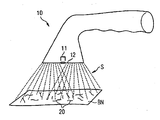
- Fig. 1 shows a test apparatus 10 for checking the authenticity of a banknote BN, which is equipped with mottled fibers 20, which contains excitable substances for the emission of luminescent radiation.
- the test apparatus 10 is designed as a handheld device for individual, flexible and location-independent use. It may for example be battery powered, but also have an electrical connection, not shown here.
- the banknote BN is irradiated with luminescence radiation S from the desired wavelength range as excitation radiation (600 to 640 nm).
- excitation radiation 600 to 640 nm
- a HeNe laser or laser diodes (633 nm) can be used. It is also possible to use corresponding LEDs with emission maximum at 633 nm.
- a detector 11 detects the radiation emitted by the banknote. If the test is carried out in the dark, this is essentially the luminescence radiation of the mottling fibers 20. If the excitation radiation is not absorbed or transmitted by the banknote BN, this radiation also comprises reflected portions of the excitation radiation S. To mask out these excitation radiation components, is in the beam path in front of the detector 11, a long-pass filter 12 is provided which transmits wavelengths below 610 nm to a maximum of 10% and transmits wavelengths above 630 nm to at least 50%. Suitable, for example, is a filter from the Schott company with the designation RG 630.
- the detector 11 Since the detector 11 has high sensitivity in the wavelength range of 640 to 700 nm, the luminescence radiation of the mottling fibers 20 can be reliably detected in this way.
- suitable filters such as a filter from Schott with the designation BG 40 with a transmission of ⁇ 10% for wavelengths greater than 720 nm.
- the mottled fibers of counterfeit banknotes are not luminescent in the red Spectral range excitable.
- the luminescence radiation can also be detected with the naked eye.
- the Long pass filter 12 to be arranged at a corresponding point such that through the long pass filter 12 through the irradiated with the excitation radiation S banknote BN can be considered.
Landscapes
- Health & Medical Sciences (AREA)
- General Health & Medical Sciences (AREA)
- Toxicology (AREA)
- Physics & Mathematics (AREA)
- General Physics & Mathematics (AREA)
- Engineering & Computer Science (AREA)
- Theoretical Computer Science (AREA)
- Inspection Of Paper Currency And Valuable Securities (AREA)
- Investigating, Analyzing Materials By Fluorescence Or Luminescence (AREA)
- Credit Cards Or The Like (AREA)
Description
- Die vorliegende Erfindung betrifft ein Verfahren zum Prüfen der Echtheit von Banknoten, sowie eine dazu geeignete Prüfvorrichtung.
- Es ist inzwischen üblich, Banknoten mittels lumineszierender Substanzen gegen Fälschung zu schützen. Die lumineszierenden Substanzen können dem Banknotenpapier und/oder dem Banknotenaufdruck hinzugefügt sein. Häufig ist die lumineszierende Substanz auch in im Substratmaterial verteilten farbigen oder farblosen Fasern, sogenannten Melierfasern, enthalten.
- Je nach Art der lumineszierenden Substanz - das können sowohl fluoreszierende als auch phosphoreszierende Substanzen sein - emittiert die Substanz in einem definierten Spektralbereich, wenn sie mittels Strahlung aus einem ebenfalls definierten Spektralbereich bestrahlt wird. Die Anregungsstrahlung kann dabei sowohl im sichtbaren als auch im nichtsichtbaren Spektralbereich liegen. Ebenso kann die emittierte Lumineszenzstrahlung im sichtbaren oder nicht-sichtbaren Spektralbereich liegen. Beide Strahlungen dürfen sich jedoch nicht überlappen, da ansonsten die Lumineszenzstrahlung von der Anregungsstrahlung jedenfalls im Falle fluoreszierender Substanzen nicht zu unterscheiden ist.
- Derartige Echtheitsmerkmale wirken nicht nur als Kopierschutz, sondern waren zumindest in der Vergangenheit aufgrund der Komplexität der Lumineszenzstoffe nur schwer nachahmbar. Heutzutage sind jedoch auch Fälschungen im Umlauf, die solche Lumineszenzstoffe enthalten, sogar in Form von im Dokument verteilten Melierfasern. So gibt es US-Dollar-Fälschungen mit hoher Qualität, die Lumineszenzfasern enthalten, welche im selben Wellenlängenbereich zur Lumineszenz anregbar sind wie Original-US-Banknoten und auch im selben Wellenlängenbereich Lumineszenzstrahlung emittieren wie die Originalbanknoten. Die Anregung der in US-Banknoten der Emission aus dem Jahre 1996 enthaltenen roten Melierfasern und der in den US-Banknoten der Emission aus dem Jahre 2004 enthaltenen roten und blauen Melierfasern ist im relativ breitbandigen Bereich von zumindest 500 bis 640 nm möglich. Die emittierte Fluoreszenzstrahlung liegt dagegen grob geschätzt zwischen 600 nm und 700 nm. Es gibt somit einen Überlappungsbereich zwischen etwa 600 und 640 nm, das heißt, die Lumineszenz bei z.B. 620 nm erfolgt durch eine Anregung bei kürzeren Wellenlängen. Da auch die Fälschungen in den genannten Bereichen anregbar sind und emittieren, können Fälschungen nicht mehr ohne weiteres anhand dieses Echtheitsmerkmals von Originalen unterschieden werden. Entsprechendes gilt für die aktuellen russischen Rubelbanknoten, in denen dieselben oder ähnliche Fasern eingesetzt sind. Es ist möglich, dass bereits heute oder zukünftig weitere Währungen mit entsprechenden Fasern ausgerüstet werden.
- Eine Alternative zur Lösung dieses Problems besteht darin, neue Lumineszenzstoffe zu entwickeln und einzusetzen, die ganz charakteristische Eigenschaften besitzen. So werden beispielsweise in den Druckschriften
EP 0 066 854 A1 ,WO 99/38701 WO 99/38703 - In
WO 00/46742 A1 -
DE 3121484 A1 beschreibt Wertpapiere mit lumineszierenden Echtheitskennzeichen, welche nach Anregung mit unsichtbarem Licht ausschließlich unsichtbares Licht anderer Wellenlängen als Echtheitssignal aussenden. Die Luminophore können den verwendeten Druckfarben beigefügt sein oder sie können dem Papierstoff bei der Papierstoffherstellung zugesetzt sein. Ein entsprechendes Prüfgerät ermöglicht es, die Echtheit des Wertpapiers in Gegenwart von Kunden, aber von diesen unbemerkt festzustellen; dabei wird die Unsichtbarkeit von Prüfsignal und Echtheitssignal ausgenutzt und die Prüfvorrichtung hinter einer für sichtbares Licht undurchlässigen Platte verborgen, welche aber für das Prüfsignal und für das Echtheitssignal durchlässig ist. - Aufgabe der vorliegenden Erfindung ist es daher, eine einfache Lösung zu dem Problem zu finden, dass die in Banknoten eingesetzten Lumineszenzstoffe früher oder später von Fälschern erfolgreich nachgeahmt werden und die Lumineszenzstoffe dadurch als Echtheitsmerkmal untauglich werden.
- Diese Aufgabe wird erfindungsgemäß durch ein Verfahren mit den Merkmalen des Patentanspruchs 1 gelöst. In den davon abhängigen Ansprüchen sind vorteilhafte Ausgestaltungen und Weiterbildungen der Erfindung angegeben.
- Die Erfindung basiert auf der Feststellung, dass die Lumineszenzstoffe der nachgeahmten Banknoten nicht exakt das Anregungs- und Emissionsverhalten aufweisen wie die in den Originalbanknoten verwendeten Lumineszenzstoffe. In Bezug auf die zuvor konkret diskutierten Melierfasern, wie sie beispielsweise in US-Banknoten eingesetzt werden, bedeutet dies, dass die derzeit auf dem Markt befindlichen Fälschungen keine Lumineszenzstrahlung emittieren, wenn sie mit Anregungsstrahlung aus dem beschränkten Wellelängenbereich von 600 bis 640 nm bestrahlt werden. Die Originalbanknoten dagegen werden bei einer solchen Anregungsstrahlung zur Emission von roter Lumineszenzstrahlung angeregt. Sofern also (zumindest auch) im Wellenlängenbereich von 640 bis 700 nm die Lumineszenzstrahlung detektiert wird, beispielsweise mittels des menschlichen Auges als Sichtprüfung, lassen sich Original und Fälschung zuverlässig voneinander unterscheiden. Die Echtheitsprüfung wird dann als positiv bewertet, wenn die Lumineszenzstrahlung rot erscheint. Wird die Lumineszenzstrahlung sensorisch detektiert, so wird diese Detektion vorzugsweise auf den konkreten Wellenlängenbereich von 640 bis 700 nm beschränkt.
- Ähnliches gilt für Anregung im Wellenlängenbereich von 520-550 nm und der Detektion der Lumineszenzstrahlung bei 640 bis 700nm. Es ist auch eine Kombination der Anregungswellenlängen denkbar, so dass die Lumineszenzstrahlung bei 640 bis 700nm abwechselnd unter der Anregung in den Wellenlängenbereichen 520 bis 550 nm und 600 bis 640 nm detektiert wird.
- In allen Fällen ist es vorteilhaft, beim Detektieren der Lumineszenzstrahlung die Anregungsstrahlung, die teilweise von der Banknote zum Detektor bzw. zum Betrachter reflektiert werden kann, mittels eines Langpassfilters auszufiltern. Der Langpassfilter sollte vorzugsweise bei einer Wellenlänge unter 610 nm eine Transmission von maximal 10 % und bei einer Wellenlänge über 630 nm eine Transmission von mindestens 50 % besitzen.
- Eine entsprechende Prüfvorrichtung, die vorzugsweise als handliche, d.h. in der Hand haltbare, Vorrichtung zum flexiblen Gebrauch ausgebildet ist, umfasst demzufolge zumindest eine Anregungsstrahlungsquelle zum Aussenden von Strahlung aus dem beschränkten Wellenbereich von 600 bis 640 nm, um damit die Banknote zur Emission der Lumineszenzstrahlung anzuregen.
- Des weiteren besitzt die Prüfvorrichtung vorteilhafter Weise den vorerwähnten Langpassfilter zum Ausblenden von Strahlung aus dem Anregungsstrahlungsbereich, wobei der Langpassfilter relativ zur Anregungsstrahlungsquelle derart angeordnet sein muss, dass von der Banknote emittierte Lumineszenzstrahlung durch den Langpassfilter detektierbar ist, entweder sensorisch oder mittels des menschlichen Auges.
- Im Falle einer sensorischen Erfassung der emittierten Lumineszenzstrahlung besitzt die Prüfvorrichtung des Weiteren einen Detektor, der zumindest im Wellenlängenbereich von 640 bis 700 nm empfindlich ist. Vorzugsweise ist die Empfindlichkeit des Detektors auf diesen Wellenlängenbereich beschränkt.
- Nachfolgend wird die Erfindung beispielhaft anhand der Figur 1 erläutert.
- Fig. 1 zeigt eine Prüfvorrichtung 10 zum Prüfen der Echtheit einer Banknote BN, die mit Melierfasern 20 ausgestattet ist, welche zur Emission von Lumineszenzstrahlung anregbare Stoffe enthält. Die Prüfvorrichtung 10 ist als Handgerät für den individuellen, flexiblen und ortsunabhängigen Einsatz ausgebildet. Sie kann beispielsweise batteriebetrieben sein, aber auch einen hier nicht dargestellten elektrischen Anschluss besitzen.
- Mittels der Prüfvorrichtung wird die Banknote BN mit Lumineszenzstrahlung S aus dem gewünschten Wellenlängenbereich als Anregungsstrahlung (600 bis 640 nm) bestrahlt. Dazu kann beispielsweise ein HeNe-Laser oder Laserdioden (633 nm) eingesetzt werden. Es können auch entsprechende LEDs mit Emissionsmaximum bei 633 nm verwendet werden.
- Ein Detektor 11 erfasst die von der Banknote ausgehende Strahlung. Wenn die Prüfung im Dunkeln durchgeführt wird, handelt es sich dabei im Wesentlichen um die Lumineszenzstrahlung der Melierfasern 20. Soweit die Anregungsstrahlung nicht von der Banknote BN absorbiert oder transmittiert wird, umfasst diese Strahlung aber auch reflektierte Anteile der Anregungsstrahlung S. Um diese Anregungsstrahlungsanteile auszublenden, ist im Strahlengang vor dem Detektor 11 ein Langpassfilter 12 vorgesehen, der Wellenlängen unter 610 nm zu maximal 10 % durchlässt und Wellenlängen über 630 nm zu mindestens 50 % durchlässt. Geeignet ist beispielsweise ein Filter der Firma Schott mit der Bezeichnung RG 630. Da der Detektor 11 im Wellenlängenbereich von 640 bis 700 nm hohe Empfindlichkeit besitzt, kann auf diese Weise die Lumineszenzstrahlung der Melierfasern 20 zuverlässig detektiert werden. Um längerwellige Strahlung >700nm zu unterdrücken können entsprechende Filter wie beispielsweise ein Filter der Firma Schott mit Bezeichnung BG 40 mit einer Transmission von <10 % für Wellenlängen größer als 720 nm. Die Melierfasern gefälschter Banknoten dagegen sind in dem genannten Anregungsspektrum nicht zur Lumineszenz im roten Spektralbereich anregbar.
- Anstelle des Detektors 11 kann die Lumineszenzstrahlung selbstverständlich auch mit dem bloßen Auge detektiert werden. In diesem Falle ist der Langpassfilter 12 an einer entsprechenden Stelle derart anzuordnen, dass durch den Langpassfilter 12 hindurch die mit der Anregungsstrahlung S bestrahlte Banknote BN betrachtet werden kann.
Claims (5)
- Verfahren zum Prüfen der Echtheit von Banknoten (BN), die mit zur Emission von Lumineszenzstrahlung anregbaren Stoffen als Echtheitsmerkmal ausgestattet sind, umfassend die Schritte:- Anregen der Emission mittels Anregungsstrahlung aus dem beschränkten Wellenlängenbereich von 600 bis 640 nm oder 520 bis 550 nm und- Detektieren der emittierten Lumineszenzstrahlung zumindest auch im Wellenlängenbereich von 640 bis 700 nm,
dadurch gekennzeichnet, dass beim Schritt des Detektierens der Lumineszenzstrahlung Anteile der Anregungsstrahlung mittels eines Langpassfilters (12) ausgeblendet werden, der vorzugsweise bei einer Wellenlänge von unter 610 nm eine Transmission von maximal 10 % und bei einer Wellenlänge über 630 nm eine Transmission von mindestens 50 % besitzt, und
dass die Emission in den Anregungsbereichen 600 bis 640 nm und 520 bis 550 nm abwechselnd stattfindet und die Lumineszenzstrahlung von 640 bis 700 nm detektiert wird. - Verfahren nach Anspruch 1, dadurch gekennzeichnet, dass es zum Prüfen von solchen Banknoten eingesetzt wird, bei denen die Stoffe ein breitbandiges Anregungsspektrum und/oder ein breitbandiges Emissionsspektrum besitzen.
- Verfahren nach einem der Ansprüche 1 oder 2, dadurch gekennzeichnet, dass es zum Prüfen der Echtheit von US-Banknoten, insbesondere der Emission 1996 und/oder 2004, eingesetzt wird.
- Verfahren nach einem der Ansprüche 1 oder 2, dadurch gekennzeichnet, dass es zum Prüfen der Echtheit von russischen Rubelbanknoten eingesetzt wird.
- Verfahren nach einem der Ansprüche 1 bis 4, gekennzeichnet durch den Schritt des Bewertens der Echtheitsprüfung als positiv, wenn die Lumineszenzstrahlung rot erscheint.
Applications Claiming Priority (2)
| Application Number | Priority Date | Filing Date | Title |
|---|---|---|---|
| DE102005041054A DE102005041054A1 (de) | 2005-08-30 | 2005-08-30 | Verfahren und Vorrichtung zur Echtheitsprüfung von Banknoten |
| PCT/EP2006/008489 WO2007025740A1 (de) | 2005-08-30 | 2006-08-30 | Verfahren und vorrichtung zur echtheitsprüfung von banknoten |
Publications (2)
| Publication Number | Publication Date |
|---|---|
| EP1924975A1 EP1924975A1 (de) | 2008-05-28 |
| EP1924975B1 true EP1924975B1 (de) | 2016-07-13 |
Family
ID=37106311
Family Applications (1)
| Application Number | Title | Priority Date | Filing Date |
|---|---|---|---|
| EP06791738.5A Not-in-force EP1924975B1 (de) | 2005-08-30 | 2006-08-30 | Verfahren und vorrichtung zur echtheitsprüfung von banknoten |
Country Status (4)
| Country | Link |
|---|---|
| US (1) | US7860293B2 (de) |
| EP (1) | EP1924975B1 (de) |
| DE (1) | DE102005041054A1 (de) |
| WO (1) | WO2007025740A1 (de) |
Families Citing this family (11)
| Publication number | Priority date | Publication date | Assignee | Title |
|---|---|---|---|---|
| US7162035B1 (en) | 2000-05-24 | 2007-01-09 | Tracer Detection Technology Corp. | Authentication method and system |
| EP2168103A1 (de) * | 2007-06-06 | 2010-03-31 | De La Rue International Limited | Vorrichtung und verfahren zum analysieren eines sicherheitsdokuments |
| ES2523585T3 (es) * | 2007-06-06 | 2014-11-27 | De La Rue International Limited | Aparato para analizar un documento de seguridad |
| EP2168104A1 (de) | 2007-06-06 | 2010-03-31 | De La Rue International Limited | Vorrichtung zum analysieren eines sicherheitsdokuments |
| GB0801479D0 (en) | 2008-01-26 | 2008-03-05 | Smartwater Res Ltd | Improvements to methods of in field analysis |
| US7995196B1 (en) | 2008-04-23 | 2011-08-09 | Tracer Detection Technology Corp. | Authentication method and system |
| US8265346B2 (en) | 2008-11-25 | 2012-09-11 | De La Rue North America Inc. | Determining document fitness using sequenced illumination |
| US8780206B2 (en) | 2008-11-25 | 2014-07-15 | De La Rue North America Inc. | Sequenced illumination |
| US8749767B2 (en) | 2009-09-02 | 2014-06-10 | De La Rue North America Inc. | Systems and methods for detecting tape on a document |
| US8194237B2 (en) | 2009-10-15 | 2012-06-05 | Authentix, Inc. | Document sensor |
| US9053596B2 (en) | 2012-07-31 | 2015-06-09 | De La Rue North America Inc. | Systems and methods for spectral authentication of a feature of a document |
Family Cites Families (23)
| Publication number | Priority date | Publication date | Assignee | Title |
|---|---|---|---|---|
| GB1585533A (en) * | 1976-12-07 | 1981-03-04 | Portals Ltd | Security papers |
| DE3121484A1 (de) | 1980-05-30 | 1982-04-29 | GAO Gesellschaft für Automation und Organisation mbH, 8000 München | "wertpapier mit substanzen, verfahren und vorrichtung zur pruefung derselben" |
| EP0053183B1 (de) * | 1980-05-30 | 1984-12-12 | GAO Gesellschaft für Automation und Organisation mbH | Wertpapier mit echtheitsmerkmalen in form von nur im unsichtbaren bereich des optischen spektrums lumineszierenden substanzen und verfahren zur prüfung derselben |
| DE3122470C2 (de) | 1981-06-05 | 1985-09-05 | GAO Gesellschaft für Automation und Organisation mbH, 8000 München | Sicherheitspapier und Verfahren zur Herstellung desselben |
| EP0303725B1 (de) * | 1987-08-19 | 1992-06-17 | GAO Gesellschaft für Automation und Organisation mbH | Sicherheitspapier |
| NO893323D0 (no) * | 1989-08-18 | 1989-08-18 | Inter Marketing Oy | Optisk ekthets-testing av pengesedler og liknende. |
| US5992601A (en) * | 1996-02-15 | 1999-11-30 | Cummins-Allison Corp. | Method and apparatus for document identification and authentication |
| GB9717194D0 (en) * | 1997-08-13 | 1997-10-22 | De La Rue Thomas & Co Ltd | Detector methods and apparatus |
| US5974150A (en) * | 1997-09-30 | 1999-10-26 | Tracer Detection Technology Corp. | System and method for authentication of goods |
| DE19803997B4 (de) | 1998-02-02 | 2018-01-25 | Giesecke+Devrient Currency Technology Gmbh | Wertdokument |
| DE19804021A1 (de) | 1998-02-02 | 1999-08-05 | Giesecke & Devrient Gmbh | Wertdokument |
| EP1291828A3 (de) * | 1998-10-23 | 2005-05-18 | Bundesdruckerei GmbH | In einem Gehäuse eingebautes elektrolumineszierendes Halbleiterfestkörperelement als Prüfmittel für lumineszierende Sicherheitsmerkmale |
| US6552290B1 (en) * | 1999-02-08 | 2003-04-22 | Spectra Systems Corporation | Optically-based methods and apparatus for performing sorting coding and authentication using a gain medium that provides a narrowband emission |
| EP1158459B2 (de) * | 2000-05-16 | 2017-02-15 | Sicpa Holding Sa | Verfahren , Vorrichtung und System zur Authentifikation einer Markierung |
| FR2812300B1 (fr) * | 2000-07-28 | 2003-01-10 | Cypher Science | Encre liquide securisee revelable optiquement et procede de marquage de produits par une telle encre |
| DE10111116A1 (de) | 2001-03-08 | 2002-09-19 | Giesecke & Devrient Gmbh | Wertdokument |
| ES2232216B1 (es) | 2001-09-21 | 2006-07-16 | Fabrica Nacional De Moneda Y Timbre-Real Casa De La Moneda | Metodo de control de papel de seguridad y dispositivo para la practica de dicho control. |
| EP1316924A1 (de) * | 2001-11-28 | 2003-06-04 | Agfa-Gevaert | Verfahren zur Sicherheitsmarkierung und Artikel mit Sicherheitsmarkierung |
| AU2004214420A1 (en) * | 2003-02-19 | 2004-09-02 | Sicel Technologies Inc. | In vivo fluorescence sensors, systems, and related methods operating in conjunction with fluorescent analytes |
| DE10322794B4 (de) | 2003-05-19 | 2011-08-11 | Bundesdruckerei GmbH, 10969 | Sensor für die Echtheitserkennung eines lumineszierenden Sicherheitselements eines Wertdokuments, Wertdokument sowie Verfahren zur Herstellung eines Wertdokuments |
| DE10326983A1 (de) * | 2003-06-12 | 2004-12-30 | Giesecke & Devrient Gmbh | Wertdokument mit einem maschinenlesbaren Echtheitskennzeichen |
| US7687271B2 (en) * | 2004-04-22 | 2010-03-30 | Kodak Graphic Communications Canada Company | Covert authentication method and apparatus |
| US7209223B1 (en) * | 2004-11-15 | 2007-04-24 | Luna Innovations Incorporated | Optical device for measuring optical properties of a sample and method relating thereto |
-
2005
- 2005-08-30 DE DE102005041054A patent/DE102005041054A1/de not_active Ceased
-
2006
- 2006-08-30 WO PCT/EP2006/008489 patent/WO2007025740A1/de not_active Ceased
- 2006-08-30 EP EP06791738.5A patent/EP1924975B1/de not_active Not-in-force
- 2006-08-30 US US11/512,400 patent/US7860293B2/en active Active
Also Published As
| Publication number | Publication date |
|---|---|
| US20070051868A1 (en) | 2007-03-08 |
| EP1924975A1 (de) | 2008-05-28 |
| US7860293B2 (en) | 2010-12-28 |
| DE102005041054A1 (de) | 2007-03-01 |
| WO2007025740A1 (de) | 2007-03-08 |
Similar Documents
| Publication | Publication Date | Title |
|---|---|---|
| EP1636765B1 (de) | Wertdokument mit einem maschinenlesbaren echtheitskennzeichen | |
| US6686074B2 (en) | Secured documents identified with anti-stokes fluorescent compositions | |
| EP3847038B1 (de) | Sicherheitselement | |
| CH659145A5 (de) | Verfahren zur echtheitspruefung von mit lumineszierenden substanzen abgesicherten wertpapieren und vorrichtung zur durchfuehrung des verfahrens. | |
| EP4164893B1 (de) | Wertdokument mit einem trägerelement und einem folienelement, und verfahren zum klassifizieren eines wertdokuments | |
| EP1924975B1 (de) | Verfahren und vorrichtung zur echtheitsprüfung von banknoten | |
| DE102008050768B3 (de) | Sicherheitsmerkmal auf Basis Lumineszenz emittierender Stoffe, Wert- und Sicherheitsdokument mit einem solchen Sicherheitsmerkmal, ein Verfahren sowie eine Vorrichtung zur Verifikation eines solchen Sicherheitsmerkmals | |
| EP1673735A1 (de) | Wertdokument | |
| WO2006053685A2 (de) | Wertdokumente, herstellung und prüfung von wertdokumenten | |
| EP4014210A1 (de) | Verfahren und vorrichtung zum prüfen von wertdokumenten | |
| EP1675731B1 (de) | Wertdokument | |
| EP1673231B1 (de) | Wertdokument mit verschiedenen merkmalstoffen | |
| EP1673232B1 (de) | Wertdokument | |
| DE102013216308A1 (de) | Verfahren und Vorrichtung zur Prüfung eines Sicherheitselements eines Sicherheitsdokuments | |
| EP2453418B1 (de) | Verfahren und Vorrichtung zur Überprüfung der Echtheit von Banknoten mit Sicherheitsfenstern | |
| DE102004055761A1 (de) | Wertdokumente, Herstellung und Prüfung von Wertdokumenten | |
| EP2313872A1 (de) | Verfahren zur prüfung der echtheit eines dokuments, computerprogrammprodukt, prüfgerät und datenverarbeitungssystem | |
| DE102005016824A1 (de) | Vorrichtung und Verfahren zur Prüfung von Wertdokumenten | |
| EP1789933A1 (de) | Verfahren und vorrichtung zum messen von blattgut | |
| WO2005035270A2 (de) | Wertdokument | |
| DE102005032704A1 (de) | Wertdokumente, Herrstellung und Prüfung von Wertdokumenten | |
| DE102021210432A1 (de) | Winkelabhängiges gedrucktes verborgenes Sicherheitselement | |
| DE102005008256A1 (de) | Sicherheitspapier sowie daraus hergestelltes Wertdokument | |
| DE2530905A1 (de) | Automatengerechter verfaelschungsschutz fuer wertpapiere u.dgl. |
Legal Events
| Date | Code | Title | Description |
|---|---|---|---|
| PUAI | Public reference made under article 153(3) epc to a published international application that has entered the european phase |
Free format text: ORIGINAL CODE: 0009012 |
|
| 17P | Request for examination filed |
Effective date: 20080331 |
|
| AK | Designated contracting states |
Kind code of ref document: A1 Designated state(s): AT BE BG CH CY CZ DE DK EE ES FI FR GB GR HU IE IS IT LI LT LU LV MC NL PL PT RO SE SI SK TR |
|
| 17Q | First examination report despatched |
Effective date: 20080624 |
|
| DAX | Request for extension of the european patent (deleted) | ||
| REG | Reference to a national code |
Ref country code: DE Ref legal event code: R079 Ref document number: 502006015041 Country of ref document: DE Free format text: PREVIOUS MAIN CLASS: G07D0007120000 Ipc: G06K0019080000 |
|
| GRAP | Despatch of communication of intention to grant a patent |
Free format text: ORIGINAL CODE: EPIDOSNIGR1 |
|
| RIC1 | Information provided on ipc code assigned before grant |
Ipc: G06K 19/08 20060101AFI20160107BHEP Ipc: G07D 7/12 20160101ALI20160107BHEP |
|
| INTG | Intention to grant announced |
Effective date: 20160209 |
|
| GRAS | Grant fee paid |
Free format text: ORIGINAL CODE: EPIDOSNIGR3 |
|
| GRAA | (expected) grant |
Free format text: ORIGINAL CODE: 0009210 |
|
| AK | Designated contracting states |
Kind code of ref document: B1 Designated state(s): AT BE BG CH CY CZ DE DK EE ES FI FR GB GR HU IE IS IT LI LT LU LV MC NL PL PT RO SE SI SK TR |
|
| REG | Reference to a national code |
Ref country code: GB Ref legal event code: FG4D Free format text: NOT ENGLISH |
|
| REG | Reference to a national code |
Ref country code: AT Ref legal event code: REF Ref document number: 812848 Country of ref document: AT Kind code of ref document: T Effective date: 20160715 Ref country code: CH Ref legal event code: EP |
|
| REG | Reference to a national code |
Ref country code: IE Ref legal event code: FG4D Free format text: LANGUAGE OF EP DOCUMENT: GERMAN |
|
| REG | Reference to a national code |
Ref country code: DE Ref legal event code: R096 Ref document number: 502006015041 Country of ref document: DE |
|
| REG | Reference to a national code |
Ref country code: CH Ref legal event code: NV Representative=s name: PATENTANWAELTE SCHAAD, BALASS, MENZL AND PARTN, CH |
|
| PGFP | Annual fee paid to national office [announced via postgrant information from national office to epo] |
Ref country code: CH Payment date: 20160830 Year of fee payment: 11 |
|
| REG | Reference to a national code |
Ref country code: LT Ref legal event code: MG4D |
|
| REG | Reference to a national code |
Ref country code: NL Ref legal event code: MP Effective date: 20160713 |
|
| PG25 | Lapsed in a contracting state [announced via postgrant information from national office to epo] |
Ref country code: BE Free format text: LAPSE BECAUSE OF NON-PAYMENT OF DUE FEES Effective date: 20160831 |
|
| PG25 | Lapsed in a contracting state [announced via postgrant information from national office to epo] |
Ref country code: FI Free format text: LAPSE BECAUSE OF FAILURE TO SUBMIT A TRANSLATION OF THE DESCRIPTION OR TO PAY THE FEE WITHIN THE PRESCRIBED TIME-LIMIT Effective date: 20160713 Ref country code: LT Free format text: LAPSE BECAUSE OF FAILURE TO SUBMIT A TRANSLATION OF THE DESCRIPTION OR TO PAY THE FEE WITHIN THE PRESCRIBED TIME-LIMIT Effective date: 20160713 Ref country code: IS Free format text: LAPSE BECAUSE OF FAILURE TO SUBMIT A TRANSLATION OF THE DESCRIPTION OR TO PAY THE FEE WITHIN THE PRESCRIBED TIME-LIMIT Effective date: 20161113 Ref country code: NL Free format text: LAPSE BECAUSE OF FAILURE TO SUBMIT A TRANSLATION OF THE DESCRIPTION OR TO PAY THE FEE WITHIN THE PRESCRIBED TIME-LIMIT Effective date: 20160713 Ref country code: IT Free format text: LAPSE BECAUSE OF FAILURE TO SUBMIT A TRANSLATION OF THE DESCRIPTION OR TO PAY THE FEE WITHIN THE PRESCRIBED TIME-LIMIT Effective date: 20160713 |
|
| PG25 | Lapsed in a contracting state [announced via postgrant information from national office to epo] |
Ref country code: SE Free format text: LAPSE BECAUSE OF FAILURE TO SUBMIT A TRANSLATION OF THE DESCRIPTION OR TO PAY THE FEE WITHIN THE PRESCRIBED TIME-LIMIT Effective date: 20160713 Ref country code: PL Free format text: LAPSE BECAUSE OF FAILURE TO SUBMIT A TRANSLATION OF THE DESCRIPTION OR TO PAY THE FEE WITHIN THE PRESCRIBED TIME-LIMIT Effective date: 20160713 Ref country code: PT Free format text: LAPSE BECAUSE OF FAILURE TO SUBMIT A TRANSLATION OF THE DESCRIPTION OR TO PAY THE FEE WITHIN THE PRESCRIBED TIME-LIMIT Effective date: 20161114 Ref country code: LV Free format text: LAPSE BECAUSE OF FAILURE TO SUBMIT A TRANSLATION OF THE DESCRIPTION OR TO PAY THE FEE WITHIN THE PRESCRIBED TIME-LIMIT Effective date: 20160713 Ref country code: GR Free format text: LAPSE BECAUSE OF FAILURE TO SUBMIT A TRANSLATION OF THE DESCRIPTION OR TO PAY THE FEE WITHIN THE PRESCRIBED TIME-LIMIT Effective date: 20161014 Ref country code: ES Free format text: LAPSE BECAUSE OF FAILURE TO SUBMIT A TRANSLATION OF THE DESCRIPTION OR TO PAY THE FEE WITHIN THE PRESCRIBED TIME-LIMIT Effective date: 20160713 |
|
| REG | Reference to a national code |
Ref country code: DE Ref legal event code: R097 Ref document number: 502006015041 Country of ref document: DE |
|
| REG | Reference to a national code |
Ref country code: DE Ref legal event code: R084 Ref document number: 502006015041 Country of ref document: DE |
|
| PG25 | Lapsed in a contracting state [announced via postgrant information from national office to epo] |
Ref country code: MC Free format text: LAPSE BECAUSE OF FAILURE TO SUBMIT A TRANSLATION OF THE DESCRIPTION OR TO PAY THE FEE WITHIN THE PRESCRIBED TIME-LIMIT Effective date: 20160713 Ref country code: RO Free format text: LAPSE BECAUSE OF FAILURE TO SUBMIT A TRANSLATION OF THE DESCRIPTION OR TO PAY THE FEE WITHIN THE PRESCRIBED TIME-LIMIT Effective date: 20160713 Ref country code: EE Free format text: LAPSE BECAUSE OF FAILURE TO SUBMIT A TRANSLATION OF THE DESCRIPTION OR TO PAY THE FEE WITHIN THE PRESCRIBED TIME-LIMIT Effective date: 20160713 |
|
| PLBE | No opposition filed within time limit |
Free format text: ORIGINAL CODE: 0009261 |
|
| STAA | Information on the status of an ep patent application or granted ep patent |
Free format text: STATUS: NO OPPOSITION FILED WITHIN TIME LIMIT |
|
| REG | Reference to a national code |
Ref country code: FR Ref legal event code: ST Effective date: 20170428 |
|
| PG25 | Lapsed in a contracting state [announced via postgrant information from national office to epo] |
Ref country code: DK Free format text: LAPSE BECAUSE OF FAILURE TO SUBMIT A TRANSLATION OF THE DESCRIPTION OR TO PAY THE FEE WITHIN THE PRESCRIBED TIME-LIMIT Effective date: 20160713 Ref country code: BG Free format text: LAPSE BECAUSE OF FAILURE TO SUBMIT A TRANSLATION OF THE DESCRIPTION OR TO PAY THE FEE WITHIN THE PRESCRIBED TIME-LIMIT Effective date: 20161013 Ref country code: SK Free format text: LAPSE BECAUSE OF FAILURE TO SUBMIT A TRANSLATION OF THE DESCRIPTION OR TO PAY THE FEE WITHIN THE PRESCRIBED TIME-LIMIT Effective date: 20160713 Ref country code: CZ Free format text: LAPSE BECAUSE OF FAILURE TO SUBMIT A TRANSLATION OF THE DESCRIPTION OR TO PAY THE FEE WITHIN THE PRESCRIBED TIME-LIMIT Effective date: 20160713 |
|
| REG | Reference to a national code |
Ref country code: IE Ref legal event code: MM4A |
|
| 26N | No opposition filed |
Effective date: 20170418 |
|
| PG25 | Lapsed in a contracting state [announced via postgrant information from national office to epo] |
Ref country code: IE Free format text: LAPSE BECAUSE OF NON-PAYMENT OF DUE FEES Effective date: 20160830 Ref country code: FR Free format text: LAPSE BECAUSE OF NON-PAYMENT OF DUE FEES Effective date: 20160913 |
|
| REG | Reference to a national code |
Ref country code: DE Ref legal event code: R081 Ref document number: 502006015041 Country of ref document: DE Owner name: GIESECKE+DEVRIENT CURRENCY TECHNOLOGY GMBH, DE Free format text: FORMER OWNER: GIESECKE DEVRIENT GMBH, 81677 MUENCHEN, DE Ref country code: DE Ref legal event code: R081 Ref document number: 502006015041 Country of ref document: DE Owner name: GIESECKE+DEVRIENT CURRENCY TECHNOLOGY GMBH, DE Free format text: FORMER OWNER: GIESECKE & DEVRIENT GMBH, 81677 MUENCHEN, DE |
|
| PG25 | Lapsed in a contracting state [announced via postgrant information from national office to epo] |
Ref country code: LU Free format text: LAPSE BECAUSE OF NON-PAYMENT OF DUE FEES Effective date: 20160830 Ref country code: SI Free format text: LAPSE BECAUSE OF FAILURE TO SUBMIT A TRANSLATION OF THE DESCRIPTION OR TO PAY THE FEE WITHIN THE PRESCRIBED TIME-LIMIT Effective date: 20160713 |
|
| REG | Reference to a national code |
Ref country code: AT Ref legal event code: MM01 Ref document number: 812848 Country of ref document: AT Kind code of ref document: T Effective date: 20160830 |
|
| PG25 | Lapsed in a contracting state [announced via postgrant information from national office to epo] |
Ref country code: AT Free format text: LAPSE BECAUSE OF NON-PAYMENT OF DUE FEES Effective date: 20160830 |
|
| REG | Reference to a national code |
Ref country code: GB Ref legal event code: 732E Free format text: REGISTERED BETWEEN 20180118 AND 20180124 |
|
| REG | Reference to a national code |
Ref country code: CH Ref legal event code: PL |
|
| PG25 | Lapsed in a contracting state [announced via postgrant information from national office to epo] |
Ref country code: LI Free format text: LAPSE BECAUSE OF NON-PAYMENT OF DUE FEES Effective date: 20170831 Ref country code: CH Free format text: LAPSE BECAUSE OF NON-PAYMENT OF DUE FEES Effective date: 20170831 |
|
| PG25 | Lapsed in a contracting state [announced via postgrant information from national office to epo] |
Ref country code: CY Free format text: LAPSE BECAUSE OF FAILURE TO SUBMIT A TRANSLATION OF THE DESCRIPTION OR TO PAY THE FEE WITHIN THE PRESCRIBED TIME-LIMIT Effective date: 20160713 Ref country code: HU Free format text: LAPSE BECAUSE OF FAILURE TO SUBMIT A TRANSLATION OF THE DESCRIPTION OR TO PAY THE FEE WITHIN THE PRESCRIBED TIME-LIMIT; INVALID AB INITIO Effective date: 20060830 |
|
| PG25 | Lapsed in a contracting state [announced via postgrant information from national office to epo] |
Ref country code: TR Free format text: LAPSE BECAUSE OF FAILURE TO SUBMIT A TRANSLATION OF THE DESCRIPTION OR TO PAY THE FEE WITHIN THE PRESCRIBED TIME-LIMIT Effective date: 20160713 |
|
| PGFP | Annual fee paid to national office [announced via postgrant information from national office to epo] |
Ref country code: DE Payment date: 20190831 Year of fee payment: 14 |
|
| REG | Reference to a national code |
Ref country code: DE Ref legal event code: R119 Ref document number: 502006015041 Country of ref document: DE |
|
| PG25 | Lapsed in a contracting state [announced via postgrant information from national office to epo] |
Ref country code: DE Free format text: LAPSE BECAUSE OF NON-PAYMENT OF DUE FEES Effective date: 20210302 |
|
| P01 | Opt-out of the competence of the unified patent court (upc) registered |
Effective date: 20230520 |
|
| PGFP | Annual fee paid to national office [announced via postgrant information from national office to epo] |
Ref country code: GB Payment date: 20230824 Year of fee payment: 18 |
|
| GBPC | Gb: european patent ceased through non-payment of renewal fee |
Effective date: 20240830 |
|
| PG25 | Lapsed in a contracting state [announced via postgrant information from national office to epo] |
Ref country code: GB Free format text: LAPSE BECAUSE OF NON-PAYMENT OF DUE FEES Effective date: 20240830 |