EP1924045A2 - OFDM mit limitierter Bandbreite - Google Patents
OFDM mit limitierter Bandbreite Download PDFInfo
- Publication number
- EP1924045A2 EP1924045A2 EP07022219A EP07022219A EP1924045A2 EP 1924045 A2 EP1924045 A2 EP 1924045A2 EP 07022219 A EP07022219 A EP 07022219A EP 07022219 A EP07022219 A EP 07022219A EP 1924045 A2 EP1924045 A2 EP 1924045A2
- Authority
- EP
- European Patent Office
- Prior art keywords
- bandwidth
- limit
- received signal
- signal quality
- value
- Prior art date
- Legal status (The legal status is an assumption and is not a legal conclusion. Google has not performed a legal analysis and makes no representation as to the accuracy of the status listed.)
- Granted
Links
Images

Classifications
-
- H—ELECTRICITY
- H04—ELECTRIC COMMUNICATION TECHNIQUE
- H04L—TRANSMISSION OF DIGITAL INFORMATION, e.g. TELEGRAPHIC COMMUNICATION
- H04L25/00—Baseband systems
- H04L25/02—Details ; arrangements for supplying electrical power along data transmission lines
- H04L25/03—Shaping networks in transmitter or receiver, e.g. adaptive shaping networks
- H04L25/03006—Arrangements for removing intersymbol interference
- H04L25/03012—Arrangements for removing intersymbol interference operating in the time domain
-
- H—ELECTRICITY
- H04—ELECTRIC COMMUNICATION TECHNIQUE
- H04L—TRANSMISSION OF DIGITAL INFORMATION, e.g. TELEGRAPHIC COMMUNICATION
- H04L27/00—Modulated-carrier systems
- H04L27/26—Systems using multi-frequency codes
- H04L27/2601—Multicarrier modulation systems
- H04L27/2626—Arrangements specific to the transmitter only
-
- H—ELECTRICITY
- H04—ELECTRIC COMMUNICATION TECHNIQUE
- H04L—TRANSMISSION OF DIGITAL INFORMATION, e.g. TELEGRAPHIC COMMUNICATION
- H04L1/00—Arrangements for detecting or preventing errors in the information received
- H04L1/12—Arrangements for detecting or preventing errors in the information received by using return channel
- H04L1/16—Arrangements for detecting or preventing errors in the information received by using return channel in which the return channel carries supervisory signals, e.g. repetition request signals
- H04L1/18—Automatic repetition systems, e.g. Van Duuren systems
-
- H—ELECTRICITY
- H04—ELECTRIC COMMUNICATION TECHNIQUE
- H04L—TRANSMISSION OF DIGITAL INFORMATION, e.g. TELEGRAPHIC COMMUNICATION
- H04L25/00—Baseband systems
- H04L25/02—Details ; arrangements for supplying electrical power along data transmission lines
- H04L25/03—Shaping networks in transmitter or receiver, e.g. adaptive shaping networks
- H04L25/03828—Arrangements for spectral shaping; Arrangements for providing signals with specified spectral properties
- H04L25/03834—Arrangements for spectral shaping; Arrangements for providing signals with specified spectral properties using pulse shaping
-
- H—ELECTRICITY
- H04—ELECTRIC COMMUNICATION TECHNIQUE
- H04L—TRANSMISSION OF DIGITAL INFORMATION, e.g. TELEGRAPHIC COMMUNICATION
- H04L27/00—Modulated-carrier systems
- H04L27/26—Systems using multi-frequency codes
- H04L27/2601—Multicarrier modulation systems
- H04L27/2602—Signal structure
-
- H—ELECTRICITY
- H04—ELECTRIC COMMUNICATION TECHNIQUE
- H04L—TRANSMISSION OF DIGITAL INFORMATION, e.g. TELEGRAPHIC COMMUNICATION
- H04L1/00—Arrangements for detecting or preventing errors in the information received
- H04L1/0001—Systems modifying transmission characteristics according to link quality, e.g. power backoff
- H04L1/0002—Systems modifying transmission characteristics according to link quality, e.g. power backoff by adapting the transmission rate
- H04L1/0003—Systems modifying transmission characteristics according to link quality, e.g. power backoff by adapting the transmission rate by switching between different modulation schemes
-
- H—ELECTRICITY
- H04—ELECTRIC COMMUNICATION TECHNIQUE
- H04L—TRANSMISSION OF DIGITAL INFORMATION, e.g. TELEGRAPHIC COMMUNICATION
- H04L27/00—Modulated-carrier systems
- H04L27/26—Systems using multi-frequency codes
- H04L27/2601—Multicarrier modulation systems
- H04L27/2626—Arrangements specific to the transmitter only
- H04L27/26265—Arrangements for sidelobes suppression specially adapted to multicarrier systems, e.g. spectral precoding
Definitions
- Embodiments of the present invention may relate to an apparatus and method for transmitting an orthogonal frequency division multiplexing access (OFDMA) symbol in a radio access system (RAS) of an OFDMA system. More particularly, embodiments of the present invention may relate to an apparatus and method for transmitting an OFDMA symbol based on an adaptive control of a bandwidth limit parameter to enhance a downlink data rate of a WiBro RAS.
- OFDMA orthogonal frequency division multiplexing access
- RAS radio access system
- a signal is transmitted in the OFDMA scheme to provide a high data rate service to mobile users.
- the OFDMA scheme is advantageous since it can cope with problems of serious frequency selective fading channels due to multi path fading in a radio access system with a high data rate.
- the carriers that are appropriately arranged in the OFDMA signal may be received without interferences due to adjacent carriers.
- the sidebands of the adjacent carriers in the OFDMA signal are overlapped, the carriers are arranged to be orthogonal to each other in the entire OFDMA signal. Thus, they do not interfere with each other.
- a guard interval is inserted between two adjacent OFDMA symbols to prevent inter symbol interference (ISI) due to interferences between the adjacent OFDMA symbols, as well as inter carrier interference (ICI) due to crosstalk between the adjacent sub carriers.
- ISI inter symbol interference
- ICI inter carrier interference
- the guard interval is longer than the maximal delay spread of the channel. Therefore, the symbol duration is a sum of the valid symbol duration, during which the data is actually transmitted, and the guard interval.
- the receiver removes the guard interval and then demodulates the data for the valid symbol duration.
- the last signal of the valid symbol duration is duplicated and inserted to the guard interval to maintain the orthogonal characteristics of carriers, which are referred to as cyclic prefix (CP).
- CP cyclic prefix
- the frequency spectrum of the OFDMA signal is a sum of sinc functions, each of which is a frequency function of each sub carrier. If the interval between the adjacent sub carriers is an integer multiple of a reciprocal of the valid symbol duration, then the orthogonal characteristics are maintained. However, the bad roll off characteristics of the sinc function causes the adjacent channel interference to generate.
- a band limit filter or a window such as root raised cosine (RRC) is used to remove or decrease out of band spectrum components in order to decrease the adjacent channel interference.
- RRC root raised cosine
- Such a window or filter determines a spectrum mask that reduces the ISI and an error vector magnitude (EVM).
- a bandwidth limit parameter For example, in the transceiver of WiBro RAS (made by LG-Nortel), the radio frequency (RF) unit has been developed based on the fixed bandwidth limit parameter at the output of the modem.
- RF radio frequency
- a symbol is modulated to transmit in binary phase shift keying (BPSK), quadrature phase shift keying (QPSK), 16 quadrature amplitude modulation (QAM) or 64QAM.
- BPSK binary phase shift keying
- QPSK quadrature phase shift keying
- QAM 16 quadrature amplitude modulation
- 64QAM 64QAM
- the above four modulation schemes are utilized to adjust the data rate to maintain a highest downlink data rate as possible, if the received signal quality of a receiver is not sufficiently good due to noise (e.g., white noise) in the radio air or a long distance between the transmitter and the receiver such as a mobile station or relay.
- the transmitter transmitting a symbol with 64QAM lowers the data rate to 16 QAM in response to receiving continual repeat requests from the receiver such as a mobile station to maintain the received signal quality of the receiver at a certain level.
- the modulation scheme is changed to have a lower data rate for maintaining the received signal quality of the receiver at a certain level, then it is difficult to maintain transmitting data at a high data rate.
- the inconvenience of the mobile station users increases since a significant amount of data cannot be transmitted at a high data rate at a time. Further, the bandwidth cannot be efficiently utilized since the number of coded bits per sub carrier decreases.
- the objective of embodiments according to the present invention is to provide an apparatus and method for transmitting an OFDMA symbol to enable the highest downlink data rate.
- the bandwidth limit parameter may be first adjusted before the modulation scheme is changed to have a lower data rate.
- FIG. 1 illustrates an OFDMA transmitting apparatus according to an example arrangement
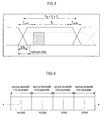
- FIG. 2 illustrates an OFDMA symbol configuration in the time domain
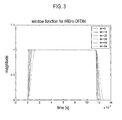
- FIG. 3 illustrates a relationship between a bandwidth limit parameter m and a window function in the time domain
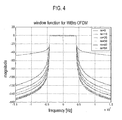
- FIG. 4 illustrates a relationship between a bandwidth limit parameter m and a window function in the frequency domain
- FIG. 5 illustrates an OFDMA symbol received through two paths
- FIG. 6 illustrates a bandwidth limit parameter m and a data rate that vary depending on the received signal quality of a receiver according to an example embodiment.
- FIG. 1 illustrates an OFDMA transmitting apparatus according to an example arrangement. Other arrangements may also be used.
- the OFDMA system may include a controller 120, a transceiver 140, a power amplifier 160, a channel collector 180 and an antenna 190.
- the controller 120 may manage/control radio access to a mobile station or a relay, radio access resources, etc.
- the transceiver 140 may perform modulation/demodulation, digital to analog conversion and frequency band conversion of a digital signal for transmission to a desired frequency band.
- the power amplifier 160 may amplify the power of the signal processed in the transceiver 140 and the amplified signal may be transmitted via the antenna 190.
- the channel collector 180 may collect the processing results of the transceiver 140, etc. and store channel information for each user.
- the controller 120 may change a symbol modulation scheme to enhance the received signal quality of a receiver, if the received signal quality does not satisfy the requirements, i.e., bit error rate (BER) or symbol error rate (SER) at the receiver becomes higher due to noise (e.g., white noise) in the radio air or a long distance between an RAS and a mobile station.
- bit error rate BER
- SER symbol error rate
- a modulation may include converting user data information to an electric signal for storing and transmitting the information. Specifically, an amplitude, a frequency or a phase of the carrier signal may be changed based on the information to generate a modulation signal.
- modulating a signal may be advantageous in sharing a transmission medium among a plurality of users (multiple access), adapting a signal to a transmission medium physically.
- An apparatus to modulate a signal is called “a modulator” and an apparatus to recover an original signal from a modulated signal is called “demodulator.”
- the modulator and the demodulator may be included in the transceiver 140.
- the modulation schemes in WiBro RAS may include binary phase shift keying (BPSK), quadrature phase shift keying (QPSK), 16 quadrature amplitude modulation (QAM) and 64QAM.
- BPSK binary phase shift keying
- QPSK quadrature phase shift keying
- QAM 16 quadrature amplitude modulation
- 64QAM 64QAM.
- BPSK binary phase shift keying
- QPSK 16 quadrature amplitude modulation
- 2 bit information may be transmitted at once. For example, each 2 bit information of 00, 01, 10 and 11 may be transmitted by changing the phase of a carrier wave by 90°.
- QAM two carrier waves perpendicular to each other may be amplitude-phase-shifted to transmit two types of information in the same band.
- both an amplitude and phase of a carrier wave may be modulated to enhance the data transmission rate within the limited band.
- the transmitted carrier wave may have, e.g., 16 levels or 64 levels, in a symbol.
- the BPSK modulation may support, e.g., 6Mbps and 9Mbps
- the QPSK may support 12Mbps and 19Mbps
- the 16QAM may support 27Mbps and 36Mbps
- the 64QAM may support 54Mbps.
- An OFDMA symbol may be generated from the above-mentioned modulated digital symbol as explained below.
- N c digital symbols which may be QAM symbols or QPSK symbols
- N - N c "0"s may be added to form input N symbols and inverse fast fourier transform (IFFT) may be performed for the input N symbols.
- IFFT inverse fast fourier transform
- FIG. 2 illustrates an OFDMA symbol configuration in the time domain.
- the last T prefix samples of the IFFT samples may be inserted to the start of the OFDMA symbol. Further, the start T prefix samples of the IFFT samples may be added to the end of the OFDMA symbol. Then, a window may be applied to the OFDMA symbol for multiplication to decrease the power of the sub carriers out of the band.
- Tg is a guard interval
- T b is a valid symbol duration
- T s is an OFDMA symbol duration
- T prefix is a pre-guard interval
- T postfix is a post-guard interval.
- T s may be shorter than the entire symbol time since the adjacent symbols overlap partly in the roll off region.
- FIG. 3 illustrates a relationship between a bandwidth limit parameter m and a window function in the time domain.
- the window function is rectangular shaped. As m becomes larger, the rectangularity of the window function becomes weaker.
- the previous OFDMA symbol may be added to the current OFDMA symbol. Equation 3 is explained in more detail with respect to FIG. 4.
- FIG. 4 illustrates a relationship between a bandwidth limit parameter m and a window function in the frequency domain.
- the relationship shown in FIG. 4 is obtained by taking a convolution of the frequency characteristics W(f ) with the window function w(n ) with N used ' the number of the sub carriers, e.g., 864 sub carriers (impulses) in the frequency domain. 864 is an example number without limitation.
- the bandwidth limit parameter m becomes larger (e.g., from 0 to 10)
- a spectrum mask decreasing an out of band emission
- the bandwidth limit parameter m becomes larger, the overlapping region in the time domain increases. In such a case, symbol spread in the receiver due to the multi path delay may be a problem.
- FIG. 5 illustrates an OFDMA symbol received through two paths. Similar to FIG. 2, Tg is a guard interval, T b is a valid symbol duration, T s is an OFDMA symbol duration, T prefix is a pre-guard interval and T postfix is a post-guard interval.
- the solid line represents an OFDMA signal received in the first path ("first path signal”) and the dotted line represents an OFDMA signal received in the second path (“second path signal").
- the second path signal is delayed compared to the first path signal by T d .
- the receiver may demodulate the received signal by performing fast fourier transform (FFT) upon the received signal for T, which includes the previous symbol and the roll off value due to the delayed OFDMA signal.
- FFT fast fourier transform
- inter channel interference ICI
- ISI inter symbol interference
- ICI or ISI may be generated depending on the roll off, although the relative delay T d of the second path signal to the first path signal is less than the guard interval Tg.
- the orthogonal characteristics of sub carriers in the OFDMA system can be maintained when the amplitudes and the phases of sub carriers are constant during the valid symbol duration T b . Accordingly, if the roll of factor is ⁇ , then the valid guard interval decreases by ⁇ T s . Thus, it is important to determine appropriate ⁇ T s for enhancing the receiver performance in the OFDMA communications.
- FIG. 5 illustrates two paths for explanation. However, the present invention is not limited thereto.
- WiBro RAS is susceptible to multi path fading.
- the fading may be dependent on time or on whether the system is operating in city or in suburb.
- the transceiver may determine ⁇ i adaptively to enhance the RAS system. Referring back to FIG. 4, as the bandwidth limit parameter m increases, the spectrum characteristics enhance. However, if the bandwidth limit parameter m is larger than 64, the orthogonal characteristics of sub carriers may not be maintained since the curved portion of the window overlaps the symbol in the frequency domain.
- the requirements for the bandwidth limit parameter m may be represented by the following Equation 4: 0 ⁇ m ⁇ m max - L wherein m max is a maximal bandwidth limit parameter such that the curved portion of the window does not overlap with the OFDMA symbol in the frequency domain, and L is a length of the channel impulse response.
- m max is a maximal bandwidth limit parameter such that the curved portion of the window does not overlap with the OFDMA symbol in the frequency domain
- L is a length of the channel impulse response.
- the synchronization of a received symbol or the accurate recovery of a received frame in the receiver becomes more difficult.
- the bandwidth limit parameter m is closer to a lower limit, e.g., 0 in FIG. 4, the synchronization of a received symbol or the accurate recovery of a received frame in the receiver enhances.
- the spectrum mask of the window becomes worse, which makes it hard to satisfy the mask requirements for RAS.
- the controller 120 may control the bandwidth limit parameter m based on the received signal quality of the receiver, if the received signal quality of the receiver is bad, or in response to receiving an automatic repeat request (ARQ) such as negative acknowledgement (NACK: a response to a packet error or setting error) or a repeat request.
- ARQ automatic repeat request
- the controller 120 may change the bandwidth limit parameter m to be within the requirements of Equation 4.
- the controller 120 may change a current modulation scheme to have a lower data rate, e.g., from 64QAM to 16QAM or to have a higher data rate, e.g., from 16QAM to 64QAM, if the changed bandwidth limit parameter does not satisfy the requirements of Equation 4.
- the modulation scheme determined in the controller 120 is explained in more detail with reference to FIG. 6.
- FIG. 6 illustrates a bandwidth limit parameter m and a data rate that vary depending on the received signal quality of a receiver according to an example embodiment.
- the x axis is BER of the received signal, which increases in the right direction.
- the BER is only an example of the received signal quality and any criterion, whose value is reciprocal to the received signal quality, may be used.
- a symbol modulation scheme may be changed to 64QAM 620, 16QAM 640, QPSK 660 and BPSK 680 depending on the BER. In other words, as the received signal quality is better, a modulation scheme having a higher data rate may be selected.
- a modulation scheme having a lower data rate may be selected to maintain the received signal quality of the receiver at a certain level.
- the controller 120 may limit the bandwidth more, i.e., increase the bandwidth limit parameter m to enhance the receiver performance.
- the controller 120 may limit bandwidth less, i.e., decrease the bandwidth limit parameter m to enhance the receiver performance. Therefore, the controller 120 may change the bandwidth limit parameter m to be within the requirements of Equation 4 before changing the modulation scheme when the received signal quality (BER) becomes a certain value.
- the controller 120 may increase the bandwidth limit parameter m to limit the bandwidth more, if the received signal quality is good. Similarly, the controller 120 may decrease the bandwidth limit parameter m to limit the bandwidth less, if the received signal quality is bad.
- the controller 120 may change the data rate (modulation scheme), if the changed bandwidth limit parameter m does not satisfy the requirements of Equation 4. For example, the controller 120 may change the data rate to a higher value, if the value of the bandwidth limit parameter m exceeds the upper limit. Thereafter, the controller 120 may change the bandwidth limit parameter m according to the changed higher data rate. Similarly, the controller 120 may change the data rate to a lower value, if the bandwidth limit parameter m is less than the lower limit. Then, the controller 120 may change the bandwidth limit parameter m according to the changed lower data rate.
- the controller 120 may decrease the bandwidth limit parameter m to limit the bandwidth less in response to receiving the repeat request from the receiver. Thereafter, if a repeat request is not received, then the controller 120 may maintain the bandwidth limit parameter m and the data rate. If a repeat request is still received from the receiver after a symbol with the decreased bandwidth limit parameter m is transmitted, then the controller 120 may change the bandwidth limit parameter m to the minimal value within the requirements of Equation 4. If a repeat request is still received from the receiver after a symbol with the minimal bandwidth limit parameter m is transmitted, then the controller 120 may change the modulation scheme to have a lower data rate.
- the bandwidth limit parameter m may be first adjusted with the same modulation scheme. Therefore, the received signal quality may be enhanced with a higher data rate compared to the conventional techniques, in which the modulation scheme is changed to have a lower data rate unconditionally in response to receiving the repeat request.
- the transceiver 140 may use digital I/Q channel signals to monitor the spectrum mask and the received signal quality in real time.
- the transceiver 140 reports to the controller 120 in response to increasing the BER of the receiver or in response to receiving the repeat request from the receiver.
- the transceiver 140 may use a pilot signal to estimate the BER of the receiver.
- the pilot signal is transmitted from the receiver to the transmitter to acquire synchronization timing or a reference carrier for demodulation.
- the pilot signal is robust since it is a BPSK signal having a larger Euclidean distance than 16QAM or 64QAM.
- the transceiver 140 may utilize a data stream having a determined pattern as a stimulation signal in the partial usage of the sub channel (PUSC) of a user data channel during pilot signal ranging to measure the BER of the mobile station.
- PUSC sub channel
- An example embodiment may be achieved in whole or in part by an apparatus for transmitting an orthogonal frequency division multiplexing access (OFDMA) symbol in an OFDMA system.
- the apparatus may include a transceiver to monitor the received signal quality of a receiver.
- the apparatus may also include a controller to adaptively determine a bandwidth limit parameter based on the received signal quality.
- the transceiver may generate an OFDMA symbol based on the bandwidth limit parameter to transmit to the receiver.
- the controller may determine whether a value to limit bandwidth less than previous bandwidth limit parameter violates bandwidth limit requirements for the OFDMA system when the current received signal quality is worse than the previous received signal quality. If the value to limit bandwidth less does not violate the bandwidth limit requirements, then the controller may determine the bandwidth limit parameter as the value to limit bandwidth less. If the value to limit bandwidth less violates the bandwidth limit requirements, then the controller may determine a modulation scheme including a low data rate and determine the bandwidth limit parameter based on the modulation scheme including the low data rate. The controller may determine whether a value to limit bandwidth more than the previous bandwidth limit parameter violates the bandwidth limit requirements for the OFDMA system when the current received signal quality is better than the previous received signal quality.
- the controller may determine the bandwidth limit parameter as the value to limit bandwidth more. If the value to limit bandwidth more violates the bandwidth limit requirements, then the controller may determine a modulation scheme including a high data rate and determine the bandwidth limit parameter based on the modulation scheme including the high data rate.
- Another example embodiment may be achieved in whole or in part by a method of transmitting an orthogonal frequency division multiplexing access (OFDMA) symbol in an OFDMA system.
- the method may include monitoring the received signal quality of a receiver.
- the method may also include determining a bandwidth limit parameter adaptively based on the received signal quality.
- the method may also include generating an OFDMA symbol based on the bandwidth limit parameter to transmit to the receiver.
- OFDMA orthogonal frequency division multiplexing access
- the bandwidth limit parameter in response to receiving continual repeat requests from the receiver such as a mobile station, the bandwidth limit parameter may be first adjusted without changing the modulation scheme to have a lower data rate. Therefore, the downlink data rate may be maintained higher.
- the modulation scheme in response to receiving a repeat request, it may be unnecessary to change the modulation scheme to have a lower data rate.
- a significant amount of data may be transmitted at a high data rate to increase the mobile station users' convenience.
- the bandwidth limit parameter is not fixed but may be adjusted freely to facilitate the efficient use of the system.
- embodiments of the present invention can be implemented in hardware, software, firmware, middleware or a combination thereof and utilized in systems, subsystems, components or sub-components thereof.
- elements of embodiments of the present invention may include instructions/code segments for performing tasks.
- the program or code segments can be stored in a machine readable medium, such as a processor readable medium or a computer program product, or transmitted by a computer data signal embodied in a carrier wave, or a signal modulated by a carrier, over a transmission medium or communication link.
- the machine-readable medium or processor-readable medium may include any medium that can store or transfer information in a form readable and executable by a machine (e.g., a processor, a computer, etc.).
- any reference in this specification to "one embodiment,” “an embodiment,” “example embodiment,” etc. means that a particular feature, structure, or characteristic described in connection with the embodiment is included in at least one embodiment of the invention.
- the appearances of such phrases in various places in the specification are not necessarily all referring to the same embodiment.
Landscapes
- Engineering & Computer Science (AREA)
- Computer Networks & Wireless Communication (AREA)
- Signal Processing (AREA)
- Power Engineering (AREA)
- Physics & Mathematics (AREA)
- Spectroscopy & Molecular Physics (AREA)
- Mobile Radio Communication Systems (AREA)
- Digital Transmission Methods That Use Modulated Carrier Waves (AREA)
- Transmitters (AREA)
Applications Claiming Priority (1)
| Application Number | Priority Date | Filing Date | Title |
|---|---|---|---|
| KR1020060113162A KR101093346B1 (ko) | 2006-11-16 | 2006-11-16 | Ofdma 심볼 송신 장치 및 송신 방법 |
Publications (3)
| Publication Number | Publication Date |
|---|---|
| EP1924045A2 true EP1924045A2 (de) | 2008-05-21 |
| EP1924045A3 EP1924045A3 (de) | 2011-12-07 |
| EP1924045B1 EP1924045B1 (de) | 2013-02-13 |
Family
ID=39203343
Family Applications (1)
| Application Number | Title | Priority Date | Filing Date |
|---|---|---|---|
| EP07022219A Not-in-force EP1924045B1 (de) | 2006-11-16 | 2007-11-15 | OFDM mit limitierter Bandbreite |
Country Status (3)
| Country | Link |
|---|---|
| US (1) | US8027294B2 (de) |
| EP (1) | EP1924045B1 (de) |
| KR (1) | KR101093346B1 (de) |
Families Citing this family (8)
| Publication number | Priority date | Publication date | Assignee | Title |
|---|---|---|---|---|
| US8203998B2 (en) * | 2008-03-28 | 2012-06-19 | Qualcomm Incorporated | System and methods for cancelling interference in a communication system |
| US20100220651A1 (en) * | 2009-03-02 | 2010-09-02 | Mediatek Inc. | Method and apparatus for broadcasting and receiving system information in OFDMA systems |
| JP5678171B2 (ja) | 2010-04-12 | 2015-02-25 | クゥアルコム・インコーポレイテッドQualcomm Incorporated | ネットワークにおける低オーバーヘッド通信のためのチャネル推定 |
| US9294868B2 (en) | 2012-12-13 | 2016-03-22 | Industrial Technology Research Institute | Device, method and system for communicating data |
| US9479272B2 (en) | 2014-05-14 | 2016-10-25 | Samsung Electronics Co., Ltd | Method and apparatus for processing a transmission signal in communication system |
| WO2017112866A1 (en) * | 2015-12-23 | 2017-06-29 | Idac Holdings, Inc. | Methods of offloading computation from mobile device to cloud |
| TWI593240B (zh) * | 2016-05-27 | 2017-07-21 | 晨星半導體股份有限公司 | 包含錯誤更正程序之解碼裝置及解碼方法 |
| WO2020124526A1 (en) * | 2018-12-21 | 2020-06-25 | Telefonaktiebolaget Lm Ericsson (Publ) | Preparing a symbol for transmission |
Family Cites Families (12)
| Publication number | Priority date | Publication date | Assignee | Title |
|---|---|---|---|---|
| US7406117B2 (en) * | 2002-03-21 | 2008-07-29 | Westell Technologies, Inc. | XDSL multi-hybrid modem with power spectral density shaping |
| US20030235252A1 (en) * | 2002-06-19 | 2003-12-25 | Jose Tellado | Method and system of biasing a timing phase estimate of data segments of a received signal |
| US7355997B2 (en) * | 2004-05-07 | 2008-04-08 | Cisco Technology, Inc. | Data rate shifting methods and techniques |
| US7272190B2 (en) * | 2004-07-07 | 2007-09-18 | Motorola, Inc. | Method and apparatus for determining channel quality and performing adaptive modulation/coding within a multicarrier communication system |
| US7499393B2 (en) * | 2004-08-11 | 2009-03-03 | Interdigital Technology Corporation | Per stream rate control (PSRC) for improving system efficiency in OFDM-MIMO communication systems |
| JPWO2006109474A1 (ja) * | 2005-03-30 | 2008-10-23 | 松下電器産業株式会社 | 通信端末装置、基地局装置及びリソース割り当て方法 |
| US7660289B2 (en) | 2005-05-09 | 2010-02-09 | Intel Corporation | System, apparatus and method of varying channel bandwidth |
| US8902875B2 (en) * | 2005-08-25 | 2014-12-02 | Broadcom Corporation | Subcarrier allocation in OFDMA with imperfect channel state information at the transmitter |
| KR100834668B1 (ko) * | 2005-11-04 | 2008-06-02 | 삼성전자주식회사 | 통신 시스템에서 스케쥴링 장치 및 방법 |
| BRPI0717893A2 (pt) * | 2006-11-01 | 2013-11-05 | Qualcomm Inc | Multiplexação de controle e dados com deslocamentos de potência variável em um sistema sc-fdma |
| US8532605B2 (en) * | 2007-08-09 | 2013-09-10 | Intel Mobile Communications GmbH | Determining a receiving quality in a radio communication device |
| JP2009094612A (ja) * | 2007-10-04 | 2009-04-30 | Hitachi Communication Technologies Ltd | 無線通信システムにおけるハンドオフ制御方法 |
-
2006
- 2006-11-16 KR KR1020060113162A patent/KR101093346B1/ko not_active Expired - Fee Related
-
2007
- 2007-11-15 US US11/940,697 patent/US8027294B2/en not_active Expired - Fee Related
- 2007-11-15 EP EP07022219A patent/EP1924045B1/de not_active Not-in-force
Non-Patent Citations (1)
| Title |
|---|
| None |
Also Published As
| Publication number | Publication date |
|---|---|
| EP1924045B1 (de) | 2013-02-13 |
| KR101093346B1 (ko) | 2011-12-14 |
| EP1924045A3 (de) | 2011-12-07 |
| US8027294B2 (en) | 2011-09-27 |
| US20080117872A1 (en) | 2008-05-22 |
| KR20080044394A (ko) | 2008-05-21 |
Similar Documents
| Publication | Publication Date | Title |
|---|---|---|
| EP1924045B1 (de) | OFDM mit limitierter Bandbreite | |
| US7787358B2 (en) | Uplink inter-carrier interference cancellation of OFDMA systems | |
| US8630359B2 (en) | Radio transmission method, radio reception method, radio transmission apparatus and radio reception apparatus | |
| US9479272B2 (en) | Method and apparatus for processing a transmission signal in communication system | |
| US8804861B2 (en) | Peak-to-average power ratio reduction in a multicarrier signal | |
| EP2122951B1 (de) | Unterdrückung von zwischenträger-interferenzen in ofdma-kommunikationssystemen | |
| US9497735B2 (en) | Method of signal multiplexing and transmitter in radio communication system | |
| EP1463251B1 (de) | Mehrträgerübertragung mit Kanalschätzung | |
| US8194531B2 (en) | Methods for transmitting and receiving a multicarrier signal, carrying out a channel estimation, and corresponding devices and computer program products | |
| EP1742433B1 (de) | Vefahren und Einrichtung zum Bearbeiten von Zeitfenstern für die Übertragung eines Signals in einem Kommunikationssystem | |
| EP2491692B1 (de) | Orthogonale und lineare frequenzmodulierte Kommunikationen | |
| US20090274036A1 (en) | Harq based ici coding scheme | |
| US20040032909A1 (en) | Reference symbol multicarrier signal designed to limit intersymbol interference | |
| Ishikawa et al. | Bi-directional ofdm transmission using adaptive modulation that spreads data symbols | |
| JP2003158499A (ja) | 通信方法および通信装置 | |
| US8401109B2 (en) | Methods for sending and receiving a multicarrier signal comprising a preamble comprising data elements, corresponding devices and computer products | |
| US8345791B2 (en) | Methods for transmitting and receiving a multicarrier signal comprising isolated pilots, corresponding devices and computer program products | |
| US20150195119A1 (en) | Method and apparatus for transmitting and receiving signal in ofdm system | |
| JP5445624B2 (ja) | 送信局及び受信局 | |
| KR101128143B1 (ko) | 채널 추정에 사용되는 데이터의 오버헤드를 줄이기 위한 통신 시스템 및 방법 | |
| KR20050119053A (ko) | 오에프디엠시스템에서의 펑쳐링 패턴을 적용한 채널품질측정 장치 및 방법 | |
| JP2007243235A (ja) | 無線通信装置及び無線通信方法、並びにコンピュータ・プログラム | |
| KR20060084524A (ko) | 광대역 무선통신시스템에서 심볼간 간섭을 제거하기 위한장치 및 방법 | |
| Kim et al. | Performance improvement of OFDM system using an adaptive coding technique in wireless home network | |
| Albdran | The Bit Error Rate (BER) Performance in Multi-Carrier (OFDM) and Single-Carrier |
Legal Events
| Date | Code | Title | Description |
|---|---|---|---|
| PUAI | Public reference made under article 153(3) epc to a published international application that has entered the european phase |
Free format text: ORIGINAL CODE: 0009012 |
|
| AK | Designated contracting states |
Kind code of ref document: A2 Designated state(s): AT BE BG CH CY CZ DE DK EE ES FI FR GB GR HU IE IS IT LI LT LU LV MC MT NL PL PT RO SE SI SK TR |
|
| AX | Request for extension of the european patent |
Extension state: AL BA HR MK RS |
|
| RAP1 | Party data changed (applicant data changed or rights of an application transferred) |
Owner name: LG-ERICSSON CO., LTD. |
|
| PUAL | Search report despatched |
Free format text: ORIGINAL CODE: 0009013 |
|
| AK | Designated contracting states |
Kind code of ref document: A3 Designated state(s): AT BE BG CH CY CZ DE DK EE ES FI FR GB GR HU IE IS IT LI LT LU LV MC MT NL PL PT RO SE SI SK TR |
|
| AX | Request for extension of the european patent |
Extension state: AL BA HR MK RS |
|
| RIC1 | Information provided on ipc code assigned before grant |
Ipc: H04L 27/26 20060101AFI20111103BHEP Ipc: H04L 25/03 20060101ALI20111103BHEP |
|
| 17P | Request for examination filed |
Effective date: 20120601 |
|
| AKX | Designation fees paid |
Designated state(s): AT BE BG CH CY CZ DE DK EE ES FI FR GB GR HU IE IS IT LI LT LU LV MC MT NL PL PT RO SE SI SK TR |
|
| GRAP | Despatch of communication of intention to grant a patent |
Free format text: ORIGINAL CODE: EPIDOSNIGR1 |
|
| GRAS | Grant fee paid |
Free format text: ORIGINAL CODE: EPIDOSNIGR3 |
|
| GRAA | (expected) grant |
Free format text: ORIGINAL CODE: 0009210 |
|
| AK | Designated contracting states |
Kind code of ref document: B1 Designated state(s): AT BE BG CH CY CZ DE DK EE ES FI FR GB GR HU IE IS IT LI LT LU LV MC MT NL PL PT RO SE SI SK TR |
|
| REG | Reference to a national code |
Ref country code: GB Ref legal event code: FG4D |
|
| REG | Reference to a national code |
Ref country code: AT Ref legal event code: REF Ref document number: 596995 Country of ref document: AT Kind code of ref document: T Effective date: 20130215 |
|
| REG | Reference to a national code |
Ref country code: IE Ref legal event code: FG4D |
|
| REG | Reference to a national code |
Ref country code: DE Ref legal event code: R096 Ref document number: 602007028366 Country of ref document: DE Effective date: 20130411 |
|
| REG | Reference to a national code |
Ref country code: AT Ref legal event code: MK05 Ref document number: 596995 Country of ref document: AT Kind code of ref document: T Effective date: 20130213 |
|
| REG | Reference to a national code |
Ref country code: NL Ref legal event code: VDEP Effective date: 20130213 |
|
| REG | Reference to a national code |
Ref country code: LT Ref legal event code: MG4D |
|
| PG25 | Lapsed in a contracting state [announced via postgrant information from national office to epo] |
Ref country code: LT Free format text: LAPSE BECAUSE OF FAILURE TO SUBMIT A TRANSLATION OF THE DESCRIPTION OR TO PAY THE FEE WITHIN THE PRESCRIBED TIME-LIMIT Effective date: 20130213 Ref country code: SE Free format text: LAPSE BECAUSE OF FAILURE TO SUBMIT A TRANSLATION OF THE DESCRIPTION OR TO PAY THE FEE WITHIN THE PRESCRIBED TIME-LIMIT Effective date: 20130213 Ref country code: IS Free format text: LAPSE BECAUSE OF FAILURE TO SUBMIT A TRANSLATION OF THE DESCRIPTION OR TO PAY THE FEE WITHIN THE PRESCRIBED TIME-LIMIT Effective date: 20130613 Ref country code: ES Free format text: LAPSE BECAUSE OF FAILURE TO SUBMIT A TRANSLATION OF THE DESCRIPTION OR TO PAY THE FEE WITHIN THE PRESCRIBED TIME-LIMIT Effective date: 20130524 Ref country code: BG Free format text: LAPSE BECAUSE OF FAILURE TO SUBMIT A TRANSLATION OF THE DESCRIPTION OR TO PAY THE FEE WITHIN THE PRESCRIBED TIME-LIMIT Effective date: 20130513 Ref country code: AT Free format text: LAPSE BECAUSE OF FAILURE TO SUBMIT A TRANSLATION OF THE DESCRIPTION OR TO PAY THE FEE WITHIN THE PRESCRIBED TIME-LIMIT Effective date: 20130213 |
|
| PG25 | Lapsed in a contracting state [announced via postgrant information from national office to epo] |
Ref country code: SI Free format text: LAPSE BECAUSE OF FAILURE TO SUBMIT A TRANSLATION OF THE DESCRIPTION OR TO PAY THE FEE WITHIN THE PRESCRIBED TIME-LIMIT Effective date: 20130213 Ref country code: PL Free format text: LAPSE BECAUSE OF FAILURE TO SUBMIT A TRANSLATION OF THE DESCRIPTION OR TO PAY THE FEE WITHIN THE PRESCRIBED TIME-LIMIT Effective date: 20130213 Ref country code: BE Free format text: LAPSE BECAUSE OF FAILURE TO SUBMIT A TRANSLATION OF THE DESCRIPTION OR TO PAY THE FEE WITHIN THE PRESCRIBED TIME-LIMIT Effective date: 20130213 Ref country code: FI Free format text: LAPSE BECAUSE OF FAILURE TO SUBMIT A TRANSLATION OF THE DESCRIPTION OR TO PAY THE FEE WITHIN THE PRESCRIBED TIME-LIMIT Effective date: 20130213 Ref country code: PT Free format text: LAPSE BECAUSE OF FAILURE TO SUBMIT A TRANSLATION OF THE DESCRIPTION OR TO PAY THE FEE WITHIN THE PRESCRIBED TIME-LIMIT Effective date: 20130613 Ref country code: GR Free format text: LAPSE BECAUSE OF FAILURE TO SUBMIT A TRANSLATION OF THE DESCRIPTION OR TO PAY THE FEE WITHIN THE PRESCRIBED TIME-LIMIT Effective date: 20130514 Ref country code: LV Free format text: LAPSE BECAUSE OF FAILURE TO SUBMIT A TRANSLATION OF THE DESCRIPTION OR TO PAY THE FEE WITHIN THE PRESCRIBED TIME-LIMIT Effective date: 20130213 |
|
| PG25 | Lapsed in a contracting state [announced via postgrant information from national office to epo] |
Ref country code: RO Free format text: LAPSE BECAUSE OF FAILURE TO SUBMIT A TRANSLATION OF THE DESCRIPTION OR TO PAY THE FEE WITHIN THE PRESCRIBED TIME-LIMIT Effective date: 20130213 Ref country code: EE Free format text: LAPSE BECAUSE OF FAILURE TO SUBMIT A TRANSLATION OF THE DESCRIPTION OR TO PAY THE FEE WITHIN THE PRESCRIBED TIME-LIMIT Effective date: 20130213 Ref country code: DK Free format text: LAPSE BECAUSE OF FAILURE TO SUBMIT A TRANSLATION OF THE DESCRIPTION OR TO PAY THE FEE WITHIN THE PRESCRIBED TIME-LIMIT Effective date: 20130213 Ref country code: SK Free format text: LAPSE BECAUSE OF FAILURE TO SUBMIT A TRANSLATION OF THE DESCRIPTION OR TO PAY THE FEE WITHIN THE PRESCRIBED TIME-LIMIT Effective date: 20130213 Ref country code: NL Free format text: LAPSE BECAUSE OF FAILURE TO SUBMIT A TRANSLATION OF THE DESCRIPTION OR TO PAY THE FEE WITHIN THE PRESCRIBED TIME-LIMIT Effective date: 20130213 Ref country code: CZ Free format text: LAPSE BECAUSE OF FAILURE TO SUBMIT A TRANSLATION OF THE DESCRIPTION OR TO PAY THE FEE WITHIN THE PRESCRIBED TIME-LIMIT Effective date: 20130213 |
|
| PLBE | No opposition filed within time limit |
Free format text: ORIGINAL CODE: 0009261 |
|
| STAA | Information on the status of an ep patent application or granted ep patent |
Free format text: STATUS: NO OPPOSITION FILED WITHIN TIME LIMIT |
|
| PG25 | Lapsed in a contracting state [announced via postgrant information from national office to epo] |
Ref country code: IT Free format text: LAPSE BECAUSE OF FAILURE TO SUBMIT A TRANSLATION OF THE DESCRIPTION OR TO PAY THE FEE WITHIN THE PRESCRIBED TIME-LIMIT Effective date: 20130213 |
|
| 26N | No opposition filed |
Effective date: 20131114 |
|
| PGFP | Annual fee paid to national office [announced via postgrant information from national office to epo] |
Ref country code: GB Payment date: 20131023 Year of fee payment: 7 Ref country code: DE Payment date: 20131024 Year of fee payment: 7 |
|
| REG | Reference to a national code |
Ref country code: DE Ref legal event code: R097 Ref document number: 602007028366 Country of ref document: DE Effective date: 20131114 |
|
| REG | Reference to a national code |
Ref country code: CH Ref legal event code: PL |
|
| PG25 | Lapsed in a contracting state [announced via postgrant information from national office to epo] |
Ref country code: LI Free format text: LAPSE BECAUSE OF NON-PAYMENT OF DUE FEES Effective date: 20131130 Ref country code: CH Free format text: LAPSE BECAUSE OF NON-PAYMENT OF DUE FEES Effective date: 20131130 Ref country code: MC Free format text: LAPSE BECAUSE OF FAILURE TO SUBMIT A TRANSLATION OF THE DESCRIPTION OR TO PAY THE FEE WITHIN THE PRESCRIBED TIME-LIMIT Effective date: 20130213 |
|
| REG | Reference to a national code |
Ref country code: FR Ref legal event code: ST Effective date: 20140731 |
|
| REG | Reference to a national code |
Ref country code: IE Ref legal event code: MM4A |
|
| PG25 | Lapsed in a contracting state [announced via postgrant information from national office to epo] |
Ref country code: IE Free format text: LAPSE BECAUSE OF NON-PAYMENT OF DUE FEES Effective date: 20131115 |
|
| PG25 | Lapsed in a contracting state [announced via postgrant information from national office to epo] |
Ref country code: FR Free format text: LAPSE BECAUSE OF NON-PAYMENT OF DUE FEES Effective date: 20131202 |
|
| REG | Reference to a national code |
Ref country code: DE Ref legal event code: R119 Ref document number: 602007028366 Country of ref document: DE |
|
| PG25 | Lapsed in a contracting state [announced via postgrant information from national office to epo] |
Ref country code: CY Free format text: LAPSE BECAUSE OF FAILURE TO SUBMIT A TRANSLATION OF THE DESCRIPTION OR TO PAY THE FEE WITHIN THE PRESCRIBED TIME-LIMIT Effective date: 20130213 Ref country code: TR Free format text: LAPSE BECAUSE OF FAILURE TO SUBMIT A TRANSLATION OF THE DESCRIPTION OR TO PAY THE FEE WITHIN THE PRESCRIBED TIME-LIMIT Effective date: 20130213 |
|
| GBPC | Gb: european patent ceased through non-payment of renewal fee |
Effective date: 20141115 |
|
| PG25 | Lapsed in a contracting state [announced via postgrant information from national office to epo] |
Ref country code: LU Free format text: LAPSE BECAUSE OF NON-PAYMENT OF DUE FEES Effective date: 20131115 Ref country code: HU Free format text: LAPSE BECAUSE OF FAILURE TO SUBMIT A TRANSLATION OF THE DESCRIPTION OR TO PAY THE FEE WITHIN THE PRESCRIBED TIME-LIMIT; INVALID AB INITIO Effective date: 20071115 |
|
| PG25 | Lapsed in a contracting state [announced via postgrant information from national office to epo] |
Ref country code: MT Free format text: LAPSE BECAUSE OF FAILURE TO SUBMIT A TRANSLATION OF THE DESCRIPTION OR TO PAY THE FEE WITHIN THE PRESCRIBED TIME-LIMIT Effective date: 20130213 |
|
| PG25 | Lapsed in a contracting state [announced via postgrant information from national office to epo] |
Ref country code: DE Free format text: LAPSE BECAUSE OF NON-PAYMENT OF DUE FEES Effective date: 20150602 Ref country code: GB Free format text: LAPSE BECAUSE OF NON-PAYMENT OF DUE FEES Effective date: 20141115 |