EP1916539A2 - Verfolgungssystem mit redundanter sicherheit und rückübertragungsfunktionen - Google Patents
Verfolgungssystem mit redundanter sicherheit und rückübertragungsfunktionen Download PDFInfo
- Publication number
- EP1916539A2 EP1916539A2 EP06820018A EP06820018A EP1916539A2 EP 1916539 A2 EP1916539 A2 EP 1916539A2 EP 06820018 A EP06820018 A EP 06820018A EP 06820018 A EP06820018 A EP 06820018A EP 1916539 A2 EP1916539 A2 EP 1916539A2
- Authority
- EP
- European Patent Office
- Prior art keywords
- positioning devices
- localiser
- tracking system
- redundant security
- positioning
- Prior art date
- Legal status (The legal status is an assumption and is not a legal conclusion. Google has not performed a legal analysis and makes no representation as to the accuracy of the status listed.)
- Withdrawn
Links
Images

Classifications
-
- G—PHYSICS
- G01—MEASURING; TESTING
- G01S—RADIO DIRECTION-FINDING; RADIO NAVIGATION; DETERMINING DISTANCE OR VELOCITY BY USE OF RADIO WAVES; LOCATING OR PRESENCE-DETECTING BY USE OF THE REFLECTION OR RERADIATION OF RADIO WAVES; ANALOGOUS ARRANGEMENTS USING OTHER WAVES
- G01S5/00—Position-fixing by co-ordinating two or more direction or position line determinations; Position-fixing by co-ordinating two or more distance determinations
- G01S5/0009—Transmission of position information to remote stations
- G01S5/0018—Transmission from mobile station to base station
- G01S5/0027—Transmission from mobile station to base station of actual mobile position, i.e. position determined on mobile
-
- G—PHYSICS
- G01—MEASURING; TESTING
- G01S—RADIO DIRECTION-FINDING; RADIO NAVIGATION; DETERMINING DISTANCE OR VELOCITY BY USE OF RADIO WAVES; LOCATING OR PRESENCE-DETECTING BY USE OF THE REFLECTION OR RERADIATION OF RADIO WAVES; ANALOGOUS ARRANGEMENTS USING OTHER WAVES
- G01S5/00—Position-fixing by co-ordinating two or more direction or position line determinations; Position-fixing by co-ordinating two or more distance determinations
- G01S5/0009—Transmission of position information to remote stations
- G01S5/0045—Transmission from base station to mobile station
- G01S5/0054—Transmission from base station to mobile station of actual mobile position, i.e. position calculation on base station
-
- G—PHYSICS
- G01—MEASURING; TESTING
- G01S—RADIO DIRECTION-FINDING; RADIO NAVIGATION; DETERMINING DISTANCE OR VELOCITY BY USE OF RADIO WAVES; LOCATING OR PRESENCE-DETECTING BY USE OF THE REFLECTION OR RERADIATION OF RADIO WAVES; ANALOGOUS ARRANGEMENTS USING OTHER WAVES
- G01S5/00—Position-fixing by co-ordinating two or more direction or position line determinations; Position-fixing by co-ordinating two or more distance determinations
- G01S5/02—Position-fixing by co-ordinating two or more direction or position line determinations; Position-fixing by co-ordinating two or more distance determinations using radio waves
- G01S5/0284—Relative positioning
- G01S5/0289—Relative positioning of multiple transceivers, e.g. in ad hoc networks
-
- G—PHYSICS
- G08—SIGNALLING
- G08B—SIGNALLING SYSTEMS, e.g. PERSONAL CALLING SYSTEMS; ORDER TELEGRAPHS; ALARM SYSTEMS
- G08B21/00—Alarms responsive to a single specified undesired or abnormal condition and not otherwise provided for
- G08B21/02—Alarms for ensuring the safety of persons
- G08B21/0202—Child monitoring systems using a transmitter-receiver system carried by the parent and the child
- G08B21/0261—System arrangements wherein the object is to detect trespassing over a fixed physical boundary, e.g. the end of a garden
-
- G—PHYSICS
- G08—SIGNALLING
- G08B—SIGNALLING SYSTEMS, e.g. PERSONAL CALLING SYSTEMS; ORDER TELEGRAPHS; ALARM SYSTEMS
- G08B21/00—Alarms responsive to a single specified undesired or abnormal condition and not otherwise provided for
- G08B21/02—Alarms for ensuring the safety of persons
- G08B21/0202—Child monitoring systems using a transmitter-receiver system carried by the parent and the child
- G08B21/0269—System arrangements wherein the object is to detect the exact location of child or item using a navigation satellite system, e.g. GPS
-
- G—PHYSICS
- G08—SIGNALLING
- G08B—SIGNALLING SYSTEMS, e.g. PERSONAL CALLING SYSTEMS; ORDER TELEGRAPHS; ALARM SYSTEMS
- G08B21/00—Alarms responsive to a single specified undesired or abnormal condition and not otherwise provided for
- G08B21/02—Alarms for ensuring the safety of persons
- G08B21/0202—Child monitoring systems using a transmitter-receiver system carried by the parent and the child
- G08B21/0272—System arrangements wherein the object is to detect exact location of child or item using triangulation other than GPS
-
- G—PHYSICS
- G08—SIGNALLING
- G08B—SIGNALLING SYSTEMS, e.g. PERSONAL CALLING SYSTEMS; ORDER TELEGRAPHS; ALARM SYSTEMS
- G08B21/00—Alarms responsive to a single specified undesired or abnormal condition and not otherwise provided for
- G08B21/02—Alarms for ensuring the safety of persons
- G08B21/0202—Child monitoring systems using a transmitter-receiver system carried by the parent and the child
- G08B21/0294—Display details on parent unit
-
- G—PHYSICS
- G08—SIGNALLING
- G08B—SIGNALLING SYSTEMS, e.g. PERSONAL CALLING SYSTEMS; ORDER TELEGRAPHS; ALARM SYSTEMS
- G08B21/00—Alarms responsive to a single specified undesired or abnormal condition and not otherwise provided for
- G08B21/18—Status alarms
- G08B21/22—Status alarms responsive to presence or absence of persons
-
- G—PHYSICS
- G08—SIGNALLING
- G08B—SIGNALLING SYSTEMS, e.g. PERSONAL CALLING SYSTEMS; ORDER TELEGRAPHS; ALARM SYSTEMS
- G08B25/00—Alarm systems in which the location of the alarm condition is signalled to a central station, e.g. fire or police telegraphic systems
- G08B25/009—Signalling of the alarm condition to a substation whose identity is signalled to a central station, e.g. relaying alarm signals in order to extend communication range
-
- G—PHYSICS
- G08—SIGNALLING
- G08B—SIGNALLING SYSTEMS, e.g. PERSONAL CALLING SYSTEMS; ORDER TELEGRAPHS; ALARM SYSTEMS
- G08B29/00—Checking or monitoring of signalling or alarm systems; Prevention or correction of operating errors, e.g. preventing unauthorised operation
- G08B29/16—Security signalling or alarm systems, e.g. redundant systems
-
- H—ELECTRICITY
- H04—ELECTRIC COMMUNICATION TECHNIQUE
- H04K—SECRET COMMUNICATION; JAMMING OF COMMUNICATION
- H04K3/00—Jamming of communication; Counter-measures
- H04K3/20—Countermeasures against jamming
- H04K3/22—Countermeasures against jamming including jamming detection and monitoring
- H04K3/222—Countermeasures against jamming including jamming detection and monitoring wherein jamming detection includes detecting the absence or impossibility of intelligible communication on at least one channel
-
- H—ELECTRICITY
- H04—ELECTRIC COMMUNICATION TECHNIQUE
- H04K—SECRET COMMUNICATION; JAMMING OF COMMUNICATION
- H04K3/00—Jamming of communication; Counter-measures
- H04K3/20—Countermeasures against jamming
- H04K3/22—Countermeasures against jamming including jamming detection and monitoring
- H04K3/224—Countermeasures against jamming including jamming detection and monitoring with countermeasures at transmission and/or reception of the jammed signal, e.g. stopping operation of transmitter or receiver, nulling or enhancing transmitted power in direction of or at frequency of jammer
- H04K3/226—Selection of non-jammed channel for communication
-
- H—ELECTRICITY
- H04—ELECTRIC COMMUNICATION TECHNIQUE
- H04K—SECRET COMMUNICATION; JAMMING OF COMMUNICATION
- H04K3/00—Jamming of communication; Counter-measures
- H04K3/80—Jamming or countermeasure characterized by its function
- H04K3/90—Jamming or countermeasure characterized by its function related to allowing or preventing navigation or positioning, e.g. GPS
Definitions
- the present invention relates to a tracking system with redundant security and retransmission features, which has been specially conceived for remote tracking and tracing of people, animals or objects.
- the object of the invention is to provide a rugged tracking system which is not made inoperative through problems in the communication interface (inoperability), problems in the positioning system (inoperability) or access problems (inaccessibility) between the positioning devices and the localiser.
- the radiolocation technique is known for the location of people, animals or objects.
- a transmitting unit periodically emits a radiofrequency signal which is detected and interpreted by a receiving unit.
- the receiver will indicate the direction or the position in which the transmitting unit is situated.
- Radiotracking systems which are characterized in the use of a transmitter which has a positioning system (such as the GPS system) and which transmit a radiofrequency signal with that information through one and only one communications network or system. That information is stored in a data centre, which can be consulted by a terminal with access to the centre. Access to the centre is commonly carried out through Internet or through a customer support telephone service. The form of transmitting the data of the position is through mobile telephony networks.
- a positioning system such as the GPS system
- That information is stored in a data centre, which can be consulted by a terminal with access to the centre. Access to the centre is commonly carried out through Internet or through a customer support telephone service.
- the form of transmitting the data of the position is through mobile telephony networks.
- Radiotracking systems are also known in which the transmitter has a positioning system (commonly GPS) and transmits the information of its position through a modulated radiofrequency signal which reaches the receiver in a direct way, which either is not mobile or needs to be connected to a computer to display the position of the originator in a graphic form.
- a positioning system commonly GPS
- a modulated radiofrequency signal which reaches the receiver in a direct way, which either is not mobile or needs to be connected to a computer to display the position of the originator in a graphic form.
- Radiotracking systems are known in which the originator waits to be polled by the receiver in order to transmit the information of its position. Radiotracking systems are also known in which the transmitter transmits its position to the receiver in the event of alert or emergency.
- the tracking system with redundant security and retransmission features which the invention proposes resolves the problem outlined above in a fully satisfactory manner, using two or more communication interfaces and using the retransmission features functionality, to deliver the information of the position of the transmitter (positioning devices) to the receiver (localiser) and vice versa, and using two or more positioning systems, avoiding the possible problems of inoperability and/or inaccessibility.
- the system that is disclosed is constituted by a positioning devices, one or more localisers, several wireless communication systems or networks and one or more control centres.
- Both the localiser and the positioning devices have two or more communication interfaces. Also, both have two or more positioning systems.
- the communication interfaces can be GSM, DCS, PCS, CDMA, UMTS, TETRA, Bluetooth, 802.11 in any one of their variants or versions thereof, Wimax, and similar.
- the different positioning systems can be GPS (Global Positioning System), GLONASS, GALILEO, GSM, or similar.
- a localiser will be able to communicate with one or more positioning devices simultaneously. Likewise, a positioning devices will be able to communicate with one or more localisers simultaneously.
- the localiser will be able to communicate with the positioning devices in diverse ways using one of its access interfaces to the medium. They will be able to communicate:
- a hybrid communication is also possible in which two or more forms are used of those described above.
- the localiser will send a polling message to the positioning devices through a communication interface to find the position of the positioning devices.
- the positioning devices will receive the polling message through a communication interface. After interpreting the message, it will respond with another message which contains the requested information and it will be sent through a communication interface. If the requested information is the position, the positioning devices will obtain it from one of the positioning systems.
- the positioning devices and the localiser can exchange messages using one, two or more communication interfaces.
- the localiser can request a second node localiser which performs the functions of intermediate node, which second node localiser can in turn request a third node localiser to perform the functions of intermediate node, and so forth until reaching a node localiser that has accessibility to the positioning devices. If this happens, an indirect route will have been set up between the localiser and the positioning devices.
- the polling message sent by the localiser will be forwarded by the node localisers involved (indirect route) to the positioning devices, which will respond to the message sent with another message which will follow the same route in the reverse direction until reaching the localiser.
- the route set up for the communication (exchange of messages) between the localiser and the positioning devices is chosen dynamically in terms of the position of the localiser, positioning devices and node localisers and the accessibility between them, being based on an optimised routing algorithm (reactive or proactive) for this type of network, which is not an object of the present invention.
- a route is understood to be the path that a message follows from the source to the destination. With this functionality, inaccessibility is avoided in the tracking system.
- the positioning devices if the positioning devices does not have direct accessibility (single hop) with the localiser and nor can it find an indirect route (several hops) to access the positioning devices using the same communication interface, the positioning devices will abandon the communication interface used and will change to using another communication interface. With this functionality, inaccessibility is avoided in the tracking system.
- the localiser or the positioning devices detect that the communication interface which they are using is inoperative, they will switch to another communication interface that is operative in order to communicate. With this functionality, inoperability is avoided in the tracking system.
- the inoperability status in the communication will be detected when the localiser or the positioning devices are unable to transmit the desired message through the communication interface in use.
- the selection of the communication interface will be governed by a system of priorities. These priorities can be fixed for any instant, or be dependent upon environmental parameters.
- the localiser and the positioning devices can use different communication interfaces if between them there is a gateway which carries out the pertinent conversion of protocol, frequency or modulation.
- the localiser or the positioning devices detects that the communication interface which they are using is inoperative, they will switch to another positioning system which is operative in order to receive its position. With this functionality, inoperability is avoided in the tracking system.
- the states of inoperability in the positioning will be detected when the localiser or the positioning devices are unable to receive their position with the positioning system in use.
- the selection of the positioning system will be governed by a system of priorities. These priorities can be fixed for any event, or dependent upon environmental parameters.
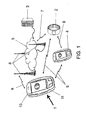
- the tracking system which is disclosed is constituted fundamentally by at least a localiser (1) and a positioning devices (2) which can communicate through two or more wireless communication interfaces and one or more control centres (3) and be positioned using two or more positioning systems.
- the localiser (1) will be able to communicate with the positioning devices (2) in diverse ways using one of its communication interfaces.
- FIG. 1 in which in addition to the localiser (1), the positioning devices (2) and the control centre (3), a node localiser (4), a GSM multi-purpose network infrastructure (5) with multiple BTS access points (6) participate in the tracking system.
- the localiser (1) and the positioning devices (2) both have two communication interfaces, a GSM communication interface and a TETRA communication interface.
- the localiser (1) and the positioning devices (2) have both two positioning systems, a GPS positioning system and a GSM positioning system (service offered by the GSM operator).
- the localiser (1) and the positioning devices (2) both have a subscriber number to the GSM network, both knowing the two numbers.
- the data centre (3) is connected to the GSM multi-purpose network infrastructure (of one of the multiple forms possible).
- the localiser (1) can know the position or another detail of the positioning devices (2) in several ways:
- the localiser (1) will be connected to Internet through GPRS (making use of a GSM radio-link (8) between the localiser (1) and a BTS access point (6)) and access the web server of the control centre (3), where it can query the historical record of the positions of the positioning devices (2) (if this service was requested previously) or other data of interest.
- GPRS making use of a GSM radio-link (8) between the localiser (1) and a BTS access point (6)
- the web server of the control centre (3) where it can query the historical record of the positions of the positioning devices (2) (if this service was requested previously) or other data of interest.
- the localiser (1) If the localiser (1) only wishes to obtain the position of the positioning devices, it can use a shortcut method to carry out the polling, which consists in calling the number (GSM or TETRA) of the positioning devices instead of sending a message.
- the positioning devices (2) will reject the incoming call, prepare the information on its position and encapsulate it in a message. Starting from here the system will work in the same manner as previously explained.
- the positioning devices (2) may have its position up-to-date, and can respond to an enquiry immediately, or on the other hand, if it does not have its position up-to-date, the positioning devices will have to obtain its position through one of its two positioning systems.
- the positioning devices (2) will obtain its position through the GPS system, activating the GPS receiver (10). If after a certain time the GPS receiver (10) does not respond with the position, the positioning devices will abandon this positioning system and switch to the GSM positioning system, at this time the positioning devices will request the service from the GSM operator, commonly sending an SMS message to a specific number, after which, the GSM operator will send an SMS message to the positioning devices (2) indicating its position (the characteristics for use of this service are particular to each operator).
- the selection order of one positioning system or another is governed by fixed or variable priorities depending on the environment. In a simplified manner orders of priority can be established that minimize battery consumption, minimize the economic cost and minimize the response time.
- the positioning devices (2) will only obtain its position in the event of receiving a polling.
- the localiser (1) will communicate with the positioning devices (2) in one of the possible ways, basing its selection on some fixed or variable priorities depending on the environment. In a simplified manner orders of priority can be established that minimize battery consumption, minimize the economic cost and minimize the response time.
- the positioning devices (2) will send the requested information to the localiser (1) if, and only if, the permits register of the positioning devices (2) includes the localiser (1) as having permission for reading that information.
- the localiser (1) Once the localiser (1) knows the position of the positioning devices (2), it will show the position of the positioning devices (2) on a map on the display (11), and optionally and if the scale of the map so allows, it will also show its own position.
- the localiser (1) will obtain its position in the same way as the positioning devices (2) does.
- the positioning devices (2) can send a warning message with its position to the localiser (1) or to the data centre (3) depending on the status of sensors or depending on its position.
- the positioning devices (2) can have a geo-referenced perimeter configured which it cannot surpass. In this case, the positioning devices (2) will update its position periodically, and if it detects that it is outside of the configured perimeter, it will send a warning message with its position to the localiser (1) or to the data centre (depending on how it is configured). It will act in the same way if it has to poll sensors periodically, which must report a value of between a configured minimum and a maximum.
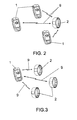
- the tracking system can comprise several localisers (1) and a positioning devices (2).
- the positioning devices (2) has the three localisers (1) in its register with access permission.
- the three localisers (1) are interested in knowing the position of the positioning devices (2).
- the positioning devices (2) will send an answer message by broadcasting (message going to all). The message will have to be encrypted.
- the system can incorporate one localiser (1) and several positioning devices (2).
- the positioning devices (2) have the localiser (1) in their register with access permission.
- the localiser (1) is interested in knowing the position of the three positioning devices (2).
- the localiser (1) will be able to request information from one of the positioning devices (2) sending a message through a radio-link (9) with that positioning devices (2) in a direct manner. If the localiser (1) wants to know the position of the three positioning devices (2), it will send a broadcast message. If the message includes the polled TETRA numbers, only the positioning devices (2) affected will respond. If the message does not include the polled TETRA numbers, all the positioning devices will respond that have the localiser (1) in their register with access permission.
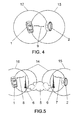
- FIG 4 an example of communication is shown between a localiser (1) and a positioning devices (2) in a direct manner through a TETRA radio-link (9), wherein the TETRA coverage radius (12) of the localiser (1) and the TETRA coverage radius (13) of the positioning devices (2) are shown explicitly.
- the positioning devices (2) be inside the coverage radius (12) of the localiser (1) and that the localiser (1) be inside the coverage radius (13) of the positioning devices (2).
- FIG 5 an example of communication is shown between a localiser (1) and a positioning devices (2) in a direct manner through a GSM network infrastructure (5).
- the positioning devices (2) be inside the GSM coverage radius (14) of a GSM BTS (6), that said GSM BTS (6) be inside the GSM coverage radius (15) of the positioning devices (2), that the localiser (1) be inside the GSM coverage radius (14) of a GSM BTS (6) and that said GSM BTS (6) be inside the GSM coverage radius (16) of the localiser (1).
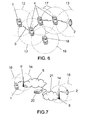
- FIG 6 an example of communication is shown between a localiser (1) and a positioning devices (2) in an indirect manner through one or more node localisers (4).
- the positioning devices (2) be inside the TETRA coverage radius (17) of a node localiser (4), that said localiser (4) be inside the TETRA coverage radius (13) of the positioning devices (2), that the localiser (1) be inside the TETRA coverage radius (17) of a node localiser (4), that said localiser (4) be inside the TETRA coverage radius (12) of the localiser (1) and that the intermediate node localisers (4) through which the communication path is set up have their TETRA coverage radii (17) overlapping consecutively.
- node localisers (18) can also be node localisers (18) not implicated in the communications route, either because they do not belong to the optimum route, or because their TETRA coverage radius (19) does not overlap with two or more node localisers (4).
- FIG 7 an example of communication is shown between a localiser (1) and a positioning devices (2) in a direct way each using a different communication interface and through a GSM network infrastructure (5), a gateway (20) and a TETRA network infrastructure (21).
- FIG 8 an example of communication is shown between a localiser (1) and a positioning devices (2) in a deferred manner through a GSM network infrastructure (5), and a data centre (3).
- the localiser (1) will obtain the position of the positioning devices (2) in the following manner:
- the localiser (1) will be connected to Internet (by GPRS or with a data call) through the GSM network (5), using a GSM radio-link (8) with a GSM BTS (6).
- the localiser (1) Once connected to Internet, the localiser (1) will access the web service of the data centre (3) and will request the desired information on the positioning devices (2). If the localiser has access permission to that information, the web server of the data centre (3) will deliver the requested information.
- the data centre (3) will have to poll the positioning devices (2) by sending it a message through the GSM network (5).
- the GSM network (5) will deliver the message to the positioning devices (2), the positioning devices (2) will decode the message, prepare the requested information, code it in a text message and send said text message to the GSM subscriber number of the data centre (3) through the GSM network (5) (making use of a GSM radio-link (7), a BTS access point (6) and the positioning devices (2)).
- the GSM network (5) will deliver the text message to the data centre (3) and the latter will reveal the information to the localiser (1) through the web service.
- the data centre can poll the positioning devices (2) in any one of the forms that the localiser (1) can employ or respond to the localiser (1) in any one of the forms that the positioning devices (2) can employ, which forms have been explained above.
- the data centre (3) can have a web interface accessible through Internet and wherein a user can carry out any of the actions that he can carry out with a localiser (1), provided the user has access permission to the positioning devices (2).
- the communication route (22) indicates the route that the data follow.
- FIG 9 an example of communication is shown between a localiser (1) and a positioning devices (2) in a hybrid manner, using two different communication interfaces through a node localiser (4), a node localiser working in gateway mode (23), a GSM network infrastructure (5), and a data centre (3).
- the localiser (1) will obtain the position of the positioning devices (2) in the following manner:
Landscapes
- Engineering & Computer Science (AREA)
- Physics & Mathematics (AREA)
- General Physics & Mathematics (AREA)
- Radar, Positioning & Navigation (AREA)
- Remote Sensing (AREA)
- Emergency Management (AREA)
- Business, Economics & Management (AREA)
- Health & Medical Sciences (AREA)
- Child & Adolescent Psychology (AREA)
- General Health & Medical Sciences (AREA)
- Computer Networks & Wireless Communication (AREA)
- Signal Processing (AREA)
- Computer Security & Cryptography (AREA)
- Mobile Radio Communication Systems (AREA)
Applications Claiming Priority (2)
| Application Number | Priority Date | Filing Date | Title |
|---|---|---|---|
| ES200502072 | 2005-08-19 | ||
| PCT/ES2006/070129 WO2007020317A2 (es) | 2005-08-19 | 2006-08-10 | Sistema de localizacion con seguridad redundante y retransmision |
Publications (1)
| Publication Number | Publication Date |
|---|---|
| EP1916539A2 true EP1916539A2 (de) | 2008-04-30 |
Family
ID=37603472
Family Applications (1)
| Application Number | Title | Priority Date | Filing Date |
|---|---|---|---|
| EP06820018A Withdrawn EP1916539A2 (de) | 2005-08-19 | 2006-08-10 | Verfolgungssystem mit redundanter sicherheit und rückübertragungsfunktionen |
Country Status (3)
| Country | Link |
|---|---|
| US (1) | US8436725B2 (de) |
| EP (1) | EP1916539A2 (de) |
| WO (1) | WO2007020317A2 (de) |
Families Citing this family (5)
| Publication number | Priority date | Publication date | Assignee | Title |
|---|---|---|---|---|
| CN102811418A (zh) * | 2011-05-29 | 2012-12-05 | 丽台科技股份有限公司 | 移动通信装置的追踪系统与方法 |
| US9565584B2 (en) * | 2013-06-24 | 2017-02-07 | Cisco Technology, Inc. | Human mobility rule-based device location tracking |
| US11348428B2 (en) * | 2020-03-12 | 2022-05-31 | Sam Heidari | System and methods for identifying a subject through device-free and device-oriented sensing technologies |
| US11495108B2 (en) * | 2019-08-02 | 2022-11-08 | PB, Inc. | Private wireless network communications systems, methods and devices |
| CN110572811B (zh) * | 2019-09-19 | 2022-06-07 | 环旭电子股份有限公司 | 超宽频动态定位方法及其系统 |
Family Cites Families (5)
| Publication number | Priority date | Publication date | Assignee | Title |
|---|---|---|---|---|
| US20010048364A1 (en) * | 2000-02-23 | 2001-12-06 | Kalthoff Robert Michael | Remote-to-remote position locating system |
| US7072668B2 (en) * | 2001-05-22 | 2006-07-04 | Geospatial Technologies, Inc. | Durable global asset-tracking device and a method of using the same |
| WO2003085414A2 (en) * | 2002-04-02 | 2003-10-16 | Randazzo William S | Navigation system for locating and communicating with wireless mesh network |
| AU2002368022A1 (en) | 2002-06-14 | 2003-12-31 | Koninklijke Philips Electronic N.V. | A method for handling position data in a mobile equipment, and a mobile equipment having improved position data handling capabilities |
| US7091852B2 (en) * | 2002-07-02 | 2006-08-15 | Tri-Sentinel, Inc. | Emergency response personnel automated accountability system |
-
2006
- 2006-08-10 EP EP06820018A patent/EP1916539A2/de not_active Withdrawn
- 2006-08-10 WO PCT/ES2006/070129 patent/WO2007020317A2/es not_active Ceased
- 2006-08-10 US US11/994,596 patent/US8436725B2/en not_active Expired - Fee Related
Non-Patent Citations (1)
| Title |
|---|
| See references of WO2007020317A3 * |
Also Published As
| Publication number | Publication date |
|---|---|
| WO2007020317A2 (es) | 2007-02-22 |
| US8436725B2 (en) | 2013-05-07 |
| US20100134280A1 (en) | 2010-06-03 |
| WO2007020317A3 (es) | 2007-05-03 |
Similar Documents
| Publication | Publication Date | Title |
|---|---|---|
| EP1323283B1 (de) | Kommunikationsmanagementsystem für das personalisierte mobilitätsmanagement drahtloser dienste und verfahren dafür | |
| JP4767974B2 (ja) | 通信システムおよび通信方法 | |
| JPH1094028A (ja) | 移動端末および移動通信システム | |
| US20030058808A1 (en) | Communication system for location sensitive information and method therefor | |
| CN102695124A (zh) | 电子名片发送方法、装置和服务器 | |
| WO2002062092A1 (en) | A method and a system for finding a partner based on location information in a communication system | |
| US8436725B2 (en) | Tracking system with redundant security and retransmission features | |
| JP4247286B2 (ja) | 無線通信システム | |
| KR20070110574A (ko) | 근거리 무선 통신을 이용한 교통 정보 서비스 시스템 및 그방법 | |
| EP1350409B1 (de) | Überwachung mobiler einheiten | |
| KR100451896B1 (ko) | 실시간 교통정보 처리시스템 및 그 처리방법 | |
| JP2005333247A (ja) | 位置情報配信装置、移動端末、位置情報交換システム、位置情報交換方法、位置情報配信プログラムおよび位置情報交換プログラム | |
| JP3015708B2 (ja) | 携帯端末、基地局、システム制御装置及び携帯電話システム | |
| JP3240892B2 (ja) | データ送受信方法およびこの方法を実施する装置 | |
| KR100839858B1 (ko) | 고정 노드, 802.15.4 맥 계층에서 고정 노드와 이동 노드간효율적인 양방향 위치 인식을 위한 채널 설정 방법 및이를 이용한 이동 노드들간 메시지 송수신방법 | |
| KR101882587B1 (ko) | 복수 개의 통신망을 연결할 수 있는 IoT 장치 및 그 통신 방법 | |
| KR20060120969A (ko) | 메세지 서비스를 이용한 위치 정보 제공 시스템 및 방법 | |
| JP3742266B2 (ja) | 位置情報通知方法及びシステム並びにセンタ装置及び移動端末 | |
| JP5239608B2 (ja) | 移動体監視装置、移動体監視方法、移動体監視システムおよびコンピュータプログラム | |
| KR100719970B1 (ko) | 통신단말기의 위치파악이 가능한 지능형 교통정보시스템 및그 방법 | |
| JP2006191218A (ja) | 通信装置 | |
| JP2006246317A (ja) | アドホック網を構成する通信装置 | |
| JP2006330885A (ja) | 監視システムおよび監視方法 | |
| JP2007064887A (ja) | 巡回進捗管理システムおよびその親局装置、子局装置 | |
| JP2004274659A (ja) | 情報伝送システム及びそれに用いる情報中継装置 |
Legal Events
| Date | Code | Title | Description |
|---|---|---|---|
| PUAI | Public reference made under article 153(3) epc to a published international application that has entered the european phase |
Free format text: ORIGINAL CODE: 0009012 |
|
| 17P | Request for examination filed |
Effective date: 20071123 |
|
| AK | Designated contracting states |
Kind code of ref document: A2 Designated state(s): AT BE BG CH CY CZ DE DK EE ES FI FR GB GR HU IE IS IT LI LT LU LV MC NL PL PT RO SE SI SK TR |
|
| 17Q | First examination report despatched |
Effective date: 20090306 |
|
| STAA | Information on the status of an ep patent application or granted ep patent |
Free format text: STATUS: THE APPLICATION IS DEEMED TO BE WITHDRAWN |
|
| 18D | Application deemed to be withdrawn |
Effective date: 20110301 |