EP1911062B1 - Two-dimensional quadrupole ion trap - Google Patents
Two-dimensional quadrupole ion trap Download PDFInfo
- Publication number
- EP1911062B1 EP1911062B1 EP06800743.4A EP06800743A EP1911062B1 EP 1911062 B1 EP1911062 B1 EP 1911062B1 EP 06800743 A EP06800743 A EP 06800743A EP 1911062 B1 EP1911062 B1 EP 1911062B1
- Authority
- EP
- European Patent Office
- Prior art keywords
- ion trap
- aperture
- recess
- rods
- linear ion
- Prior art date
- Legal status (The legal status is an assumption and is not a legal conclusion. Google has not performed a legal analysis and makes no representation as to the accuracy of the status listed.)
- Active
Links
- 238000005040 ion trap Methods 0.000 title claims description 72
- 150000002500 ions Chemical class 0.000 claims description 66
- 230000005405 multipole Effects 0.000 claims description 2
- 230000000694 effects Effects 0.000 description 4
- 230000005684 electric field Effects 0.000 description 4
- 238000006073 displacement reaction Methods 0.000 description 3
- 238000010276 construction Methods 0.000 description 2
- 230000001419 dependent effect Effects 0.000 description 2
- 238000001514 detection method Methods 0.000 description 2
- 238000001819 mass spectrum Methods 0.000 description 2
- 239000000463 material Substances 0.000 description 2
- 238000012986 modification Methods 0.000 description 2
- 230000004048 modification Effects 0.000 description 2
- 230000035945 sensitivity Effects 0.000 description 2
- 230000004913 activation Effects 0.000 description 1
- 230000004323 axial length Effects 0.000 description 1
- 230000009286 beneficial effect Effects 0.000 description 1
- 230000015572 biosynthetic process Effects 0.000 description 1
- 230000015556 catabolic process Effects 0.000 description 1
- 230000008859 change Effects 0.000 description 1
- 238000001816 cooling Methods 0.000 description 1
- 238000013016 damping Methods 0.000 description 1
- 230000003247 decreasing effect Effects 0.000 description 1
- 238000006731 degradation reaction Methods 0.000 description 1
- 238000005421 electrostatic potential Methods 0.000 description 1
- 230000005284 excitation Effects 0.000 description 1
- 239000007789 gas Substances 0.000 description 1
- 239000001307 helium Substances 0.000 description 1
- 229910052734 helium Inorganic materials 0.000 description 1
- SWQJXJOGLNCZEY-UHFFFAOYSA-N helium atom Chemical compound [He] SWQJXJOGLNCZEY-UHFFFAOYSA-N 0.000 description 1
- 239000001257 hydrogen Substances 0.000 description 1
- 229910052739 hydrogen Inorganic materials 0.000 description 1
- 125000004435 hydrogen atom Chemical class [H]* 0.000 description 1
- 238000002347 injection Methods 0.000 description 1
- 239000007924 injection Substances 0.000 description 1
- 239000011810 insulating material Substances 0.000 description 1
- 238000002955 isolation Methods 0.000 description 1
- 238000000034 method Methods 0.000 description 1
- 230000008569 process Effects 0.000 description 1
- 230000009467 reduction Effects 0.000 description 1
- 230000011218 segmentation Effects 0.000 description 1
- 238000007493 shaping process Methods 0.000 description 1
Images


Classifications
-
- H—ELECTRICITY
- H01—ELECTRIC ELEMENTS
- H01J—ELECTRIC DISCHARGE TUBES OR DISCHARGE LAMPS
- H01J49/00—Particle spectrometers or separator tubes
- H01J49/26—Mass spectrometers or separator tubes
- H01J49/34—Dynamic spectrometers
- H01J49/42—Stability-of-path spectrometers, e.g. monopole, quadrupole, multipole, farvitrons
- H01J49/4205—Device types
- H01J49/422—Two-dimensional RF ion traps
- H01J49/4225—Multipole linear ion traps, e.g. quadrupoles, hexapoles
-
- H—ELECTRICITY
- H01—ELECTRIC ELEMENTS
- H01J—ELECTRIC DISCHARGE TUBES OR DISCHARGE LAMPS
- H01J49/00—Particle spectrometers or separator tubes
- H01J49/26—Mass spectrometers or separator tubes
- H01J49/34—Dynamic spectrometers
- H01J49/42—Stability-of-path spectrometers, e.g. monopole, quadrupole, multipole, farvitrons
- H01J49/4205—Device types
- H01J49/422—Two-dimensional RF ion traps
- H01J49/423—Two-dimensional RF ion traps with radial ejection
Definitions
- the disclosed embodiments of the present invention relate generally to a two-dimensional ion trap.
- Quadrupole ion traps are devices in which ions are introduced into or formed and contained within a trapping volume formed by a plurality of electrode or rod structures by means of substantially quadrupolar electrostatic potentials generated by applying RF voltages, DC voltages or a combination thereof to the rods.
- the rod shapes are typically hyperbolic.
- a two-dimensional or linear ion trap typically includes two pairs of electrodes or rods, which contain ions by utilizing an RF quadrupole trapping potential in two dimensions, while a non-quadrupole DC trapping field is used in the third dimension.
- Simple plate lenses at the ends of a quadrupolar structure can provide the DC trapping field.
- ions When using a mass selective instability scan in a linear ion trap, the ions are most efficiently ejected from the trap in a radial direction. Some researchers have ejected ions between two of the quadrupole rods. However, due to high field gradients loss of ions is substantial. To increase the efficiency ions are ejected through a rod by introducing an aperture in the rod. For the linear ion trap, one manner in which an aperture can be introduced is along the length of the rod. When an aperture (or apertures) is cut into one or more of the linear ion trap electrodes to allow ions to be ejected from the device, the electric potentials are degraded from the theoretical quadrupole potential and therefore the presence of this aperture can impact several important performance factors. Consequently, the characteristics of this aperture are significant.
- the performance of such a two-dimensional ion trap is more susceptible to mechanical errors than a three-dimensional ion trap.
- all of the ions occupy a spherical or ellipsoidal space at the center of the ion trap, typically an ion cloud of approximately 1mm in diameter.
- the ions in a two-dimensional ion trap are spread out along a substantial fraction of the entire length of the ion trap in the axial direction which can be several centimeters or more. Therefore, geometric imperfections, misalignment of the rods, or the mis-shaping of the rods can contribute substantially to the performance of the two-dimensional ion trap.
- the fringe fields caused by the end of the electrodes as well as the ends of any slots cut into the rods can also cause significant deviation in the strength of the radial quadrupole field along the length of the device.
- the ejection aperture would extend along the entire length of the rod, but this presents numerous construction challenges.
- ejection slots are typically located only along some fraction of the central region (for example 60%) of the total ion trap length. This however, would lead to a variation in the radial quadrupolar potential near the ends of the slots in addition the effects at the ends of the rods. Ions which reside in these areas would would be ejected at different times than ions residing more in the center of the device and therefore would result in a reduction in mass resolution.
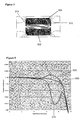
- Figure 1 depicts a two-dimensional quadrupole structure 100 having hyperbolic rods 105, 110, 115 and 120, each rod 105, 110, 115, 120 cut into three axial sections, Front section (a), Center Section (b) and Back Section (c). These three sections, each with a discreet DC level, allow containment of the ions along the axis in the Center Section (b) of the ion trap. More details on this structure can be found in U.S. Patent 5,420,425 .
- the use of a linear ion trap in which the rods are segmented provides one way in which to minimize the axial variation of the electric fields towards the ends of the rods and therefore to minimize its affect on the performance.
- This architecture creates a radial trapping potential which is very homogenous in the region where the ions are contained within the central section of the trap.
- the voltages necessary to operate such a two-dimensional, three-sectioned quadrupole structure 100 equates to nine separate combinations of voltages applied to twelve electrodes (including the DC voltages applied to the separate sections of each rod to produce an axial trapping field, the RF voltage applied to the rod pairs to produce the radial trapping field, and the AC voltage applied across one pair of rods for isolation, activation, and ejection of ions). This requires the construction of a considerably elaborate RF/AC/DC system.
- a simpler design for a linear ion trap uses single rod sections 305 with axial trapping provided solely by DC voltages applied to the end lenses 310, as illustrated in Figure 3 . This reduces the number of discreet voltages from nine to three, significantly reducing the complexity of the electronics system.
- a significant disadvantage of this design is that the axial trapping fields do not penetrate well into the interior of the ion trap, allowing ions to travel further from the center of the trap. This can be seen in Figure 2 , trace 210, which illustrates that when 200V is applied to the end lenses, ions with 1eV of axial energy expand to cover approximately 40mm (+/- 20mm from center). This allows the ions to experience more axial field inhomogeneities due to the fringe fields at the end of the rods and the finite length of the ejection aperture.
- WO-A-02/091427 discloses a linear ion trap having those features set out in the precharacterizing portion of claim 1.
- the present invention provides an improved linear ion trap as defined in claim 1 and mass spectrometer incorporating such an ion trap as defined in claim 13..
- the invention provides an aperture design for use in a linear ion trap that is optimized to minimize possible axial field inhomogeneities whilst preserving the structural integrity of the quadrupole rods.
- the invention provides a linear ion trap for trapping and subsequently ejecting ions.
- the linear ion trap comprises a plurality of rods which define an interior trapping volume which has an axis extending longitudinally.
- One or more of the rods includes an aperture which extends both radially through the rod and longitudinally along the rod.
- the aperture being configured such that the ions can pass from the interior trapping volume through the aperture to a region outside the interior trapping volume.
- At least one recess is disposed adjacent the aperture, extending longitudinally along the rod and facing the trapping region, the recess not extending radially through the rod.
- the plurality of rods can include multipole rods shaped to provide a substantially quadrupolar potential in the interior trapping region.
- the recess can be directly coupled to the aperture and can include two recesses.
- the recess can have a depth extending radially into the rod, the depth being greater than a width of the recess.
- the recess can have a depth that is greater than three times the width of the recess.
- the aperture can open outwardly in a direction from the interior trapping volume to a region exterior to the interior trapping volume.
- the recess can open outwardly in a direction from within the rod towards the interior trapping volume.
- the aperture can be an elongated slot having two ends.
- the recess can extend longitudinally beyond one or both ends of such a slot.
- the at least one recess may include two recesses, one recess disposed at each end of the elongated slot.
- the elongated slot can have a width, and the width of the recess can be substantially the same as the width of the elongated slot.
- Utilization of an aperture with an electrode structure according to the invention can reduce the complexity of the electronics system required to operate a linear ion trap. Utilization of an aperture according to the invention can allow ions to experience less axial field inhomogeneities. The presence of an aperture according to the invention can reduce or minimize the distortion of the radial quadrupolar potential and enhance the axial field homogeneity. Utilization of an aperture according to the invention can minimize possible fringe effects whilst preserving the structural integrity of the quadrupole rods. As a consequence, performance of a mass spectrometer incorporating a linear ion trap according the invention can yield an improved resolution and mass accuracy. A single segmented ion trap according to this invention can provide mass resolution similar to an ion trap with a segmented rod architecture.
- FIG. 4A A two-dimensional substantially quadrupole structure 400 is shown in Figure 4A comprising a plurality of electrodes or rods, in this particular case, two pairs of opposing rods, a first pair 405, 410 and a second pair 415, 420.
- the rod pairs are aligned with the x and y axes and are therefore the first pair 405, 410 is denoted as the X rod pair, and the second pair 415, 420 is denoted as the Y rod pair.
- the rods 405, 410, 415, 420 have a hyperbolic profile to substantially match the equipotential contours of the quadrupolar RF potentials desired within the structure.
- an ion trap is formed.
- An interior trapping volume 425 is defined by two end plates (not shown), at least one of which has an aperture, with the appropriate voltages to keep the ions trapped in the interior trapping volume 425, a volume, for example, on the order of 40mm in length.
- the entrance end plate can be used to gate ions in the direction of the arrow 430 into the ion trap.
- the two end plates differ in potential from the trapping volume such that an axial "potential well" is formed in the trapping volume to trap the ions.
- a 200V axial trapping potential is enough to confine the ions to the trapping volume, the central 40mm of the ion trap.
- the ions experience more axial field inhomogenities than typically experienced by the ions in a three-sectioned ion trap (as described above) due to the fringe fields produced at the end of the rods and also to the truncation of any aperture in the rods.
- Elongated apertures 435 in the electrode structures 415, 420 allow the trapped ions to be mass-selectively ejected (in the mass selective instability scan mode) in the direction of the arrows 440, a direction orthogonal to the central axis 445 of the quadrupole structure 400.
- the central axis 445 extends longitudinally parallel to the rods. This enables the quadrupole structure 400 to be utilized as an ion trap mass spectrometer, provided that the ejected ions are passed onto a suitable detector to provide the mass-to-charge ratio information.
- the two-dimensional substantially quadrupole potentials are generated by hyperbolic shaped rods.
- the rods 405, 410, 415,420 may be generated by straight or other curved rod shapes.
- the geometry of the aperture 435 is dependent in part on the shape and curvature of the elongated rod structure.
- ions are axially injected into the linear quadrupole structure 400.
- the ions are radially contained by the RF quadrupole trapping potentials applied to the X and Y rod sets 405, 410 and 415, 420 respectively.
- the ions are then axially trapped by applying trapping potentials to the end plate lenses.
- the trapping parameters are changed so that trapped ions become unstable in order of their mass-to-charge ratio. This may entail changing the amplitude of the RF voltage so that it is ramped linearly to higher amplitudes, while a dipolar AC resonance ejection voltage is applied across the rods in the direction of the detection.
- linear ion trap described above can also be used to process and store ions for later axial ejection into an associated tandem mass analyzer such as a Fourier transform mass analyzer, RF quadrupole analyzer, time of flight analyzer, three-dimensional ion trap analyzer or an electrostatic analyzer.
- tandem mass analyzer such as a Fourier transform mass analyzer, RF quadrupole analyzer, time of flight analyzer, three-dimensional ion trap analyzer or an electrostatic analyzer.
- an important feature of the linear ion trap is the elongated aperture 435 which allows ions to exit the quadrupole structure 400 in order to be detected.
- the aperture (or apertures) 435 is cut radially through one or more of the rods of the linear ion trap.
- the presence of an aperture 435 introduces field faults distorting the radial quadrupolar potential and the axial field homogeneity, which, if not considered, can degrade the performance of the mass spectrometer yielding poor resolution and mass accuracy. This distortion can be minimized by using as small an aperture 435 as possible, which is of small length and small width.
- the length and the width of the aperture 435 directly determine how much of the ion cloud will actually be ejected from the trap and reach the detector, and therefore these dimensions are critical in determining sensitivity.
- the aperture needs to be at least as long as the axial extent of the ion cloud.
- ions located near the ends of the aperture experience contributions to the electric field from sections of the rod which do and do not include the aperture.
- a change in the radial field strength occurs in this region. As discussed above, this would cause ions of the same mass to be ejected at slightly different times than ions closer to the center of the trapping volume, causing the resolution of the resulting mass spectrum to be degraded.
- Figure 4C illustrates a cross-sectional view of the Y rods 415, 420 according to an aspect of the invention, in which the aperture 435 is optimized to avoid possible fringe effects whilst preserving the structural integrity of the quadrupole rods 415, 420.
- the linear quadrupole structure 400 has hyperbolic rod profiles with an r 0 of 4mm.
- the hyperbolic rods in operation, provide for a trapping volume 425 having a central axis 445. Containment of the ions radially in the linear two-dimensional trap is achieved by providing a substantially quadrupolar potential in the trapping volume 425.
- the end plates (not shown), each with a discrete DC level, allow containment of the ions in the axial region of the ion trap 400.
- the aperture 435 is an elongated slot that extends radially through the rods 415 and 420.
- the aperture 435 is configured such that ions can pass from the interior trapping volume 425 through the aperture 435 to a region exterior to the interior trapping volume 425, which is outside the confinement of the four rods 405, 410, 415, and 420.
- a recess 460 is disposed adjacent the aperture 435, extending longitudinally along the rods 415 and opens to the interior trapping volume 425. This recess 460, unlike the aperture 435, does not extend radially through the rod 415.
- the base 465 of the recess 460 has a length 470 (6mm) that extends longitudinally away from the aperture 435, and a depth 475 that does not fully penetrate through the thickness of the rod 415.
- the depth 475 of the recess 460 is greater than the width of the recess 480, for example, two or three times greater, for reasons that shall be explained later.
- the length 470 of the recess 460 could extend to the end of the rod 415, 420, but any extension beyond the length 485 of the aperture 435 is beneficial.
- two recesses 460 are illustrated, one recess at each end 450, 455 of the elongated slot 435.
- the recesses 460 as shown are coupled directly to the aperture 435, creating one large volume.
- the elongated slot is configured with substantially parallel walls, and therefore the length of the aperture 435 at the surface of the rod that faces exterior to the interior trapping volume 425, is that same as that of the inner length 485, that is inner length 485 of the aperture 435 at the base 465 of the recess 460.
- the width 480 of the recess 460 has substantially the same width 495 as the aperture 435.
- an aperture design for a linear ion trap in which the aperture is optimized to minimize possible fringe effects whilst preserving the structural integrity of the quadrupole rods.
- the opening into the aperture 435 appears to be a combined length 490, in this particular case 41mm, which allows the ions to experience less axial field inhomogeneities than a 29mm slot, for example.
- the combination of the two recesses 460 which do not fully penetrate the rods 415 of 420 and the aperture 435, which does fully penetrate the rods 415 of 420 appear to the ions to be an aperture of combined length 490.
- the depth 475 of the recess 460 is greater than, typically several times deeper than the width 480 creates fields which are equivalent to a slot, or an aperture that fully penetrates the rods 415, 420. If the 41mm length were to actually fully penetrate the rods 415, 420, the excessive removal of material required to form such a 41mm long elongated slot would weaken the overall structure integrity of the rods 415, 420 and they would be more prone to flexing along their length during the formation of the quadrupole rods themselves.
- Both the inner length 485 of the aperture 435 at the base 465 of the recess 460, and the length of the aperture 435 on the face of the rod that faces away from the interior trapping volume 425, in this example are both 29mm, which is a smaller length than the combined length 490 (a 41mm opening), the combination of the length of the two recesses 460 and the aperture length 485, providing for a mechanically sound structure, but providing the functionality required.
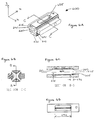
- Figure 5 shows the axial homogeneity of the radial field in various linear ion trap designs.
- Trace 510 shows the field for a three-segmented quadrupole rod structure, as illustrated in Figure 1 , the aperture having no recess as described herein, and being in the region of 29mm in length. A strong drop in field can be seen at approximately 18mm due to the gap between the rod segments. Fortunately, ions travel only about 12mm from the axial center, and thus do not experience this inhomogeneity.
- Trace 520 illustrates the axial inhomogeneity for a linear ion trap as illustrated in Figure 3 (no axial segments) with a 29mm aperture.
- the field initially weakens at approximately 12mm displacement, and then strengthens at approximately 17mm.
- the absence of axial segmentation of the rods allows displacements up to approximately 20mm from the trap center, and thus ions will experience these field inhomogeneities. This ultimately could result in an ion trap with poor resolution.
- Trace 530 illustrates the axial inhomogeneity for a linear ion trap as illustrated in Figures 4A , with a 41mm combined length (aperture and recess length) on the inner surface (facing the interior trapping volume 425) of the rods 415, 420, and a 29mm aperture length on the outer surface (away from the interior trapping volume 425) of the rods 415, 420.
- the homogeneity is much improved, with the axial field falling off at large axial displacements due to fringe fields from the end lenses.
- Figures 6A to 6D show an alternative substantially quadrupolar structure 600 comprising two pairs of opposing electrodes. Although all four rods have a hyperbolic profile, as can be seen, one pair of electrodes, the X rods 605, 610 includes the use of insulating material 695 in addition to the conventional rod material. In this example, the aperture 635 is tapered, it opens in an outwardly direction from the interior trapping volume to a region exterior to the interior trapping volume 625.
- the three significant dimensions in the eyes of the ions are the inner length 685 of the aperture 635 at the base 665 of the recess 660, the combined aperture 635 and recess length 670 on the inner surface (facing the interior trapping volume 625) of the rods 415, 420, and the depth 675 of the recess 660. That being the case, as illustrated in Figure 4C , the aperture length on the side of the rods facing away from the interior trapping volume 625 can be larger than the inner length 685 of the aperture 635.
- the aperture 635 opens outwardly in a direction from the interior trapping volume 625 to a region exterior to the interior trapping volume 625. This is created by utilizing slanted or chamfered walls to create the aperture 635 (as can be seen in Figure 6A ).
- the aperture 635 is not the only feature that may be tapered as described above.
- the recess 660 may also open outwardly in a direction from within the rod toward the interior trapping volume 625.
- the aperture 635 can comprise a counterbore configuration that is widened to a region exterior to the trapping volume 625 in one or more discrete steps.
- the number of apertures utilized in the linear ion trap can be varied for several reasons. First to help determine or define the kind of field faults created by the apertures themselves. For example, as mentioned above, if only one aperture in one rod is used, large amounts of odd-ordered potentials such as dipole and hexapole potentials are generated. Whereas, if two apertures of identical size are used on opposing rods, even order potentials such as the quadrupole and octopole potentials are effected. These different kinds are potentials are known to cause increased or decreased performance in terms of mass accuracy and resolution. Consequently, the magnitude of each of these different potential types can be tailored using the number and dimensions of the apertures in this device.
Landscapes
- Chemical & Material Sciences (AREA)
- Analytical Chemistry (AREA)
- Electron Tubes For Measurement (AREA)
- Other Investigation Or Analysis Of Materials By Electrical Means (AREA)
Applications Claiming Priority (2)
| Application Number | Priority Date | Filing Date | Title |
|---|---|---|---|
| US11/197,083 US7180057B1 (en) | 2005-08-04 | 2005-08-04 | Two-dimensional quadrupole ion trap |
| PCT/US2006/030405 WO2007019293A2 (en) | 2005-08-04 | 2006-08-01 | Two-dimensional quadrupole ion trap |
Publications (2)
| Publication Number | Publication Date |
|---|---|
| EP1911062A2 EP1911062A2 (en) | 2008-04-16 |
| EP1911062B1 true EP1911062B1 (en) | 2016-11-02 |
Family
ID=37622727
Family Applications (1)
| Application Number | Title | Priority Date | Filing Date |
|---|---|---|---|
| EP06800743.4A Active EP1911062B1 (en) | 2005-08-04 | 2006-08-01 | Two-dimensional quadrupole ion trap |
Country Status (6)
| Country | Link |
|---|---|
| US (1) | US7180057B1 (enExample) |
| EP (1) | EP1911062B1 (enExample) |
| JP (1) | JP2009503803A (enExample) |
| CN (1) | CN100580866C (enExample) |
| CA (1) | CA2614932C (enExample) |
| WO (1) | WO2007019293A2 (enExample) |
Families Citing this family (11)
| Publication number | Priority date | Publication date | Assignee | Title |
|---|---|---|---|---|
| EP1960090B1 (en) * | 2005-12-13 | 2018-10-10 | Brigham Young University | Miniature toroidal radio frequency ion trap mass analyzer |
| US7501623B2 (en) * | 2006-01-30 | 2009-03-10 | Varian, Inc. | Two-dimensional electrode constructions for ion processing |
| US7858930B2 (en) * | 2007-12-12 | 2010-12-28 | Washington State University | Ion-trapping devices providing shaped radial electric field |
| GB0816258D0 (en) * | 2008-09-05 | 2008-10-15 | Ulive Entpr Ltd | Process |
| CN103367093B (zh) * | 2012-03-30 | 2016-12-21 | 岛津分析技术研发(上海)有限公司 | 线型离子束缚装置及其阵列结构 |
| US8921764B2 (en) * | 2012-09-04 | 2014-12-30 | AOSense, Inc. | Device for producing laser-cooled atoms |
| CN103021785B (zh) * | 2012-11-29 | 2016-09-28 | 复旦大学 | 一种具有台阶栅网电极结构的离子阱装置 |
| CN103903954B (zh) * | 2014-03-13 | 2016-03-30 | 复旦大学 | 一种线性离子阱 |
| CN103972022B (zh) * | 2014-04-24 | 2016-08-17 | 复旦大学 | 一种含高阶场成分的线性离子阱 |
| GB2546967B (en) * | 2016-01-27 | 2020-04-15 | Thermo Fisher Scient Bremen Gmbh | Quadrupole mass spectrometer |
| US20250102479A1 (en) * | 2023-09-22 | 2025-03-27 | Thermo Finnigan Llc | Method of utilizing deuterium gas for chromatography applications, deuterium gas generator and devices for conservation thereof |
Family Cites Families (8)
| Publication number | Priority date | Publication date | Assignee | Title |
|---|---|---|---|---|
| US5420425A (en) * | 1994-05-27 | 1995-05-30 | Finnigan Corporation | Ion trap mass spectrometer system and method |
| JP3617662B2 (ja) * | 1997-02-28 | 2005-02-09 | 株式会社島津製作所 | 質量分析装置 |
| CA2446964C (en) | 2001-05-08 | 2010-07-20 | Thermo Finnigan Llc | Ion trap |
| US6811651B2 (en) * | 2001-06-22 | 2004-11-02 | Tokyo Electron Limited | Gas temperature control for a plasma process |
| US6797950B2 (en) * | 2002-02-04 | 2004-09-28 | Thermo Finnegan Llc | Two-dimensional quadrupole ion trap operated as a mass spectrometer |
| DE10236346A1 (de) * | 2002-08-08 | 2004-02-19 | Bruker Daltonik Gmbh | Nichtlinearer Resonanzauswurf aus linearen Ionenfallen |
| US6936815B2 (en) * | 2003-06-05 | 2005-08-30 | Thermo Finnigan Llc | Integrated shield in multipole rod assemblies for mass spectrometers |
| CN1305101C (zh) * | 2004-10-27 | 2007-03-14 | 东南大学 | 微腔体四极质谱管 |
-
2005
- 2005-08-04 US US11/197,083 patent/US7180057B1/en not_active Expired - Lifetime
-
2006
- 2006-08-01 CA CA2614932A patent/CA2614932C/en not_active Expired - Fee Related
- 2006-08-01 JP JP2008525219A patent/JP2009503803A/ja active Pending
- 2006-08-01 WO PCT/US2006/030405 patent/WO2007019293A2/en not_active Ceased
- 2006-08-01 CN CN200680028082A patent/CN100580866C/zh active Active
- 2006-08-01 EP EP06800743.4A patent/EP1911062B1/en active Active
Also Published As
| Publication number | Publication date |
|---|---|
| EP1911062A2 (en) | 2008-04-16 |
| JP2009503803A (ja) | 2009-01-29 |
| WO2007019293A3 (en) | 2007-12-27 |
| US7180057B1 (en) | 2007-02-20 |
| CA2614932A1 (en) | 2007-02-15 |
| US20070029476A1 (en) | 2007-02-08 |
| CA2614932C (en) | 2011-03-08 |
| CN101238545A (zh) | 2008-08-06 |
| WO2007019293A2 (en) | 2007-02-15 |
| CN100580866C (zh) | 2010-01-13 |
Similar Documents
| Publication | Publication Date | Title |
|---|---|---|
| CA2474857C (en) | Two-dimensional quadrupole ion trap operated as a mass spectrometer | |
| US7405401B2 (en) | Ion extraction devices, mass spectrometer devices, and methods of selectively extracting ions and performing mass spectrometry | |
| EP1905061B1 (en) | Mass spectrometer | |
| DE112010006135B3 (de) | Ionenfallen-Massenspektrometer | |
| CN1833300B (zh) | 在离子总体中获取多个母离子的串联质谱分析数据 | |
| EP1704578B1 (en) | Ion extraction devices and methods of selectively extracting ions | |
| EP2681759B1 (en) | Mass analyser and method of mass analysis | |
| JP3818671B2 (ja) | 多重極子質量分光計の軸方向射出方法 | |
| EP2962094B1 (en) | Multi-pole ion trap for mass spectrometry | |
| EP2113129B1 (en) | Mass spectrometer | |
| EP1928582B1 (en) | Novel linear ion trap for mass spectrometry | |
| CA2655358C (en) | High throughput quadrupolar ion trap | |
| US8304720B2 (en) | Two-dimensional ion trap with ramped axial potentials | |
| WO2007130303A1 (en) | Electrode networks for parallel ion traps | |
| EP1911062B1 (en) | Two-dimensional quadrupole ion trap | |
| US7378653B2 (en) | Increasing ion kinetic energy along axis of linear ion processing devices | |
| EP3357080B1 (en) | Mass-selective axial ejection linear ion trap | |
| WO2025165874A1 (en) | Ion trap for enhanced time-of-flight ion utilization |
Legal Events
| Date | Code | Title | Description |
|---|---|---|---|
| PUAI | Public reference made under article 153(3) epc to a published international application that has entered the european phase |
Free format text: ORIGINAL CODE: 0009012 |
|
| 17P | Request for examination filed |
Effective date: 20080118 |
|
| AK | Designated contracting states |
Kind code of ref document: A2 Designated state(s): AT BE BG CH CY CZ DE DK EE ES FI FR GB GR HU IE IS IT LI LT LU LV MC NL PL PT RO SE SI SK TR |
|
| AX | Request for extension of the european patent |
Extension state: AL BA HR MK RS |
|
| 17Q | First examination report despatched |
Effective date: 20080528 |
|
| DAX | Request for extension of the european patent (deleted) | ||
| GRAP | Despatch of communication of intention to grant a patent |
Free format text: ORIGINAL CODE: EPIDOSNIGR1 |
|
| INTG | Intention to grant announced |
Effective date: 20160601 |
|
| GRAS | Grant fee paid |
Free format text: ORIGINAL CODE: EPIDOSNIGR3 |
|
| GRAA | (expected) grant |
Free format text: ORIGINAL CODE: 0009210 |
|
| AK | Designated contracting states |
Kind code of ref document: B1 Designated state(s): AT BE BG CH CY CZ DE DK EE ES FI FR GB GR HU IE IS IT LI LT LU LV MC NL PL PT RO SE SI SK TR |
|
| REG | Reference to a national code |
Ref country code: GB Ref legal event code: FG4D |
|
| RIN1 | Information on inventor provided before grant (corrected) |
Inventor name: SCHWARTZ, JAE, C. Inventor name: SENKO, MICHAEL, W. |
|
| REG | Reference to a national code |
Ref country code: AT Ref legal event code: REF Ref document number: 842601 Country of ref document: AT Kind code of ref document: T Effective date: 20161115 Ref country code: CH Ref legal event code: EP |
|
| REG | Reference to a national code |
Ref country code: IE Ref legal event code: FG4D |
|
| REG | Reference to a national code |
Ref country code: DE Ref legal event code: R096 Ref document number: 602006050780 Country of ref document: DE |
|
| PG25 | Lapsed in a contracting state [announced via postgrant information from national office to epo] |
Ref country code: LV Free format text: LAPSE BECAUSE OF FAILURE TO SUBMIT A TRANSLATION OF THE DESCRIPTION OR TO PAY THE FEE WITHIN THE PRESCRIBED TIME-LIMIT Effective date: 20161102 |
|
| REG | Reference to a national code |
Ref country code: NL Ref legal event code: MP Effective date: 20161102 |
|
| REG | Reference to a national code |
Ref country code: LT Ref legal event code: MG4D |
|
| REG | Reference to a national code |
Ref country code: AT Ref legal event code: MK05 Ref document number: 842601 Country of ref document: AT Kind code of ref document: T Effective date: 20161102 |
|
| PG25 | Lapsed in a contracting state [announced via postgrant information from national office to epo] |
Ref country code: SE Free format text: LAPSE BECAUSE OF FAILURE TO SUBMIT A TRANSLATION OF THE DESCRIPTION OR TO PAY THE FEE WITHIN THE PRESCRIBED TIME-LIMIT Effective date: 20161102 Ref country code: GR Free format text: LAPSE BECAUSE OF FAILURE TO SUBMIT A TRANSLATION OF THE DESCRIPTION OR TO PAY THE FEE WITHIN THE PRESCRIBED TIME-LIMIT Effective date: 20170203 Ref country code: NL Free format text: LAPSE BECAUSE OF FAILURE TO SUBMIT A TRANSLATION OF THE DESCRIPTION OR TO PAY THE FEE WITHIN THE PRESCRIBED TIME-LIMIT Effective date: 20161102 Ref country code: LT Free format text: LAPSE BECAUSE OF FAILURE TO SUBMIT A TRANSLATION OF THE DESCRIPTION OR TO PAY THE FEE WITHIN THE PRESCRIBED TIME-LIMIT Effective date: 20161102 |
|
| PG25 | Lapsed in a contracting state [announced via postgrant information from national office to epo] |
Ref country code: IS Free format text: LAPSE BECAUSE OF FAILURE TO SUBMIT A TRANSLATION OF THE DESCRIPTION OR TO PAY THE FEE WITHIN THE PRESCRIBED TIME-LIMIT Effective date: 20170302 Ref country code: PL Free format text: LAPSE BECAUSE OF FAILURE TO SUBMIT A TRANSLATION OF THE DESCRIPTION OR TO PAY THE FEE WITHIN THE PRESCRIBED TIME-LIMIT Effective date: 20161102 Ref country code: FI Free format text: LAPSE BECAUSE OF FAILURE TO SUBMIT A TRANSLATION OF THE DESCRIPTION OR TO PAY THE FEE WITHIN THE PRESCRIBED TIME-LIMIT Effective date: 20161102 Ref country code: PT Free format text: LAPSE BECAUSE OF FAILURE TO SUBMIT A TRANSLATION OF THE DESCRIPTION OR TO PAY THE FEE WITHIN THE PRESCRIBED TIME-LIMIT Effective date: 20170302 Ref country code: AT Free format text: LAPSE BECAUSE OF FAILURE TO SUBMIT A TRANSLATION OF THE DESCRIPTION OR TO PAY THE FEE WITHIN THE PRESCRIBED TIME-LIMIT Effective date: 20161102 Ref country code: ES Free format text: LAPSE BECAUSE OF FAILURE TO SUBMIT A TRANSLATION OF THE DESCRIPTION OR TO PAY THE FEE WITHIN THE PRESCRIBED TIME-LIMIT Effective date: 20161102 |
|
| PG25 | Lapsed in a contracting state [announced via postgrant information from national office to epo] |
Ref country code: DK Free format text: LAPSE BECAUSE OF FAILURE TO SUBMIT A TRANSLATION OF THE DESCRIPTION OR TO PAY THE FEE WITHIN THE PRESCRIBED TIME-LIMIT Effective date: 20161102 Ref country code: RO Free format text: LAPSE BECAUSE OF FAILURE TO SUBMIT A TRANSLATION OF THE DESCRIPTION OR TO PAY THE FEE WITHIN THE PRESCRIBED TIME-LIMIT Effective date: 20161102 Ref country code: CZ Free format text: LAPSE BECAUSE OF FAILURE TO SUBMIT A TRANSLATION OF THE DESCRIPTION OR TO PAY THE FEE WITHIN THE PRESCRIBED TIME-LIMIT Effective date: 20161102 Ref country code: SK Free format text: LAPSE BECAUSE OF FAILURE TO SUBMIT A TRANSLATION OF THE DESCRIPTION OR TO PAY THE FEE WITHIN THE PRESCRIBED TIME-LIMIT Effective date: 20161102 Ref country code: EE Free format text: LAPSE BECAUSE OF FAILURE TO SUBMIT A TRANSLATION OF THE DESCRIPTION OR TO PAY THE FEE WITHIN THE PRESCRIBED TIME-LIMIT Effective date: 20161102 |
|
| REG | Reference to a national code |
Ref country code: DE Ref legal event code: R097 Ref document number: 602006050780 Country of ref document: DE |
|
| PG25 | Lapsed in a contracting state [announced via postgrant information from national office to epo] |
Ref country code: BG Free format text: LAPSE BECAUSE OF FAILURE TO SUBMIT A TRANSLATION OF THE DESCRIPTION OR TO PAY THE FEE WITHIN THE PRESCRIBED TIME-LIMIT Effective date: 20170202 Ref country code: IT Free format text: LAPSE BECAUSE OF FAILURE TO SUBMIT A TRANSLATION OF THE DESCRIPTION OR TO PAY THE FEE WITHIN THE PRESCRIBED TIME-LIMIT Effective date: 20161102 Ref country code: BE Free format text: LAPSE BECAUSE OF FAILURE TO SUBMIT A TRANSLATION OF THE DESCRIPTION OR TO PAY THE FEE WITHIN THE PRESCRIBED TIME-LIMIT Effective date: 20161102 |
|
| PLBE | No opposition filed within time limit |
Free format text: ORIGINAL CODE: 0009261 |
|
| STAA | Information on the status of an ep patent application or granted ep patent |
Free format text: STATUS: NO OPPOSITION FILED WITHIN TIME LIMIT |
|
| 26N | No opposition filed |
Effective date: 20170803 |
|
| PG25 | Lapsed in a contracting state [announced via postgrant information from national office to epo] |
Ref country code: SI Free format text: LAPSE BECAUSE OF FAILURE TO SUBMIT A TRANSLATION OF THE DESCRIPTION OR TO PAY THE FEE WITHIN THE PRESCRIBED TIME-LIMIT Effective date: 20161102 |
|
| REG | Reference to a national code |
Ref country code: CH Ref legal event code: PL |
|
| PG25 | Lapsed in a contracting state [announced via postgrant information from national office to epo] |
Ref country code: MC Free format text: LAPSE BECAUSE OF FAILURE TO SUBMIT A TRANSLATION OF THE DESCRIPTION OR TO PAY THE FEE WITHIN THE PRESCRIBED TIME-LIMIT Effective date: 20161102 |
|
| PG25 | Lapsed in a contracting state [announced via postgrant information from national office to epo] |
Ref country code: CH Free format text: LAPSE BECAUSE OF NON-PAYMENT OF DUE FEES Effective date: 20170831 Ref country code: LI Free format text: LAPSE BECAUSE OF NON-PAYMENT OF DUE FEES Effective date: 20170831 |
|
| REG | Reference to a national code |
Ref country code: FR Ref legal event code: ST Effective date: 20180430 |
|
| REG | Reference to a national code |
Ref country code: IE Ref legal event code: MM4A |
|
| PG25 | Lapsed in a contracting state [announced via postgrant information from national office to epo] |
Ref country code: LU Free format text: LAPSE BECAUSE OF NON-PAYMENT OF DUE FEES Effective date: 20170801 |
|
| PG25 | Lapsed in a contracting state [announced via postgrant information from national office to epo] |
Ref country code: IE Free format text: LAPSE BECAUSE OF NON-PAYMENT OF DUE FEES Effective date: 20170801 |
|
| PG25 | Lapsed in a contracting state [announced via postgrant information from national office to epo] |
Ref country code: FR Free format text: LAPSE BECAUSE OF NON-PAYMENT OF DUE FEES Effective date: 20170831 |
|
| PG25 | Lapsed in a contracting state [announced via postgrant information from national office to epo] |
Ref country code: HU Free format text: LAPSE BECAUSE OF FAILURE TO SUBMIT A TRANSLATION OF THE DESCRIPTION OR TO PAY THE FEE WITHIN THE PRESCRIBED TIME-LIMIT; INVALID AB INITIO Effective date: 20060801 |
|
| PG25 | Lapsed in a contracting state [announced via postgrant information from national office to epo] |
Ref country code: CY Free format text: LAPSE BECAUSE OF NON-PAYMENT OF DUE FEES Effective date: 20161102 |
|
| PG25 | Lapsed in a contracting state [announced via postgrant information from national office to epo] |
Ref country code: TR Free format text: LAPSE BECAUSE OF FAILURE TO SUBMIT A TRANSLATION OF THE DESCRIPTION OR TO PAY THE FEE WITHIN THE PRESCRIBED TIME-LIMIT Effective date: 20161102 |
|
| P01 | Opt-out of the competence of the unified patent court (upc) registered |
Effective date: 20230520 |
|
| PGFP | Annual fee paid to national office [announced via postgrant information from national office to epo] |
Ref country code: DE Payment date: 20240726 Year of fee payment: 19 |
|
| PGFP | Annual fee paid to national office [announced via postgrant information from national office to epo] |
Ref country code: GB Payment date: 20240816 Year of fee payment: 19 |