EP1908992B1 - Gear drive - Google Patents
Gear drive Download PDFInfo
- Publication number
- EP1908992B1 EP1908992B1 EP05851077A EP05851077A EP1908992B1 EP 1908992 B1 EP1908992 B1 EP 1908992B1 EP 05851077 A EP05851077 A EP 05851077A EP 05851077 A EP05851077 A EP 05851077A EP 1908992 B1 EP1908992 B1 EP 1908992B1
- Authority
- EP
- European Patent Office
- Prior art keywords
- teeth
- point
- tooth
- gear
- engagement
- Prior art date
- Legal status (The legal status is an assumption and is not a legal conclusion. Google has not performed a legal analysis and makes no representation as to the accuracy of the status listed.)
- Expired - Lifetime
Links
Images


Classifications
-
- F—MECHANICAL ENGINEERING; LIGHTING; HEATING; WEAPONS; BLASTING
- F16—ENGINEERING ELEMENTS AND UNITS; GENERAL MEASURES FOR PRODUCING AND MAINTAINING EFFECTIVE FUNCTIONING OF MACHINES OR INSTALLATIONS; THERMAL INSULATION IN GENERAL
- F16H—GEARING
- F16H55/00—Elements with teeth or friction surfaces for conveying motion; Worms, pulleys or sheaves for gearing mechanisms
- F16H55/02—Toothed members; Worms
- F16H55/08—Profiling
-
- Y—GENERAL TAGGING OF NEW TECHNOLOGICAL DEVELOPMENTS; GENERAL TAGGING OF CROSS-SECTIONAL TECHNOLOGIES SPANNING OVER SEVERAL SECTIONS OF THE IPC; TECHNICAL SUBJECTS COVERED BY FORMER USPC CROSS-REFERENCE ART COLLECTIONS [XRACs] AND DIGESTS
- Y10—TECHNICAL SUBJECTS COVERED BY FORMER USPC
- Y10T—TECHNICAL SUBJECTS COVERED BY FORMER US CLASSIFICATION
- Y10T74/00—Machine element or mechanism
- Y10T74/19—Gearing
- Y10T74/19949—Teeth
-
- Y—GENERAL TAGGING OF NEW TECHNOLOGICAL DEVELOPMENTS; GENERAL TAGGING OF CROSS-SECTIONAL TECHNOLOGIES SPANNING OVER SEVERAL SECTIONS OF THE IPC; TECHNICAL SUBJECTS COVERED BY FORMER USPC CROSS-REFERENCE ART COLLECTIONS [XRACs] AND DIGESTS
- Y10—TECHNICAL SUBJECTS COVERED BY FORMER USPC
- Y10T—TECHNICAL SUBJECTS COVERED BY FORMER US CLASSIFICATION
- Y10T74/00—Machine element or mechanism
- Y10T74/19—Gearing
- Y10T74/19949—Teeth
- Y10T74/19963—Spur
- Y10T74/19972—Spur form
Definitions
- the invention relates to a wheel gear, in particular gear transmission, which is formed of gears with an angular pitch of the teeth of cooperating sprockets.
- the sprockets are provided with influencing elements and multi-flow elements of the serially interacting sprockets and the spur teeth of the teeth section and / or pointwise in theoretical points of contact at the tooth head convex and concave arched at the root in arc lying outside the Wälzddling flowing together and with other involutes (Quasievolventen) Connected routes.
- the compression strength of the rolling point is thus maximally increased.
- the values for the contact durability of the engagement phases (in the pitch point and outside the pitch point) are balanced.
- the increased smoothness of the work and the low bending stresses are achieved by the shape particularities of the frontal profiles of the teeth.
- the front profiles of the teeth are built from the involute and the point-wise coupled arc-shaped basic routes. They are convex at the head and concave at the base of the teeth. The parameters are independent of signs and the absolute degree of deviation of the axial distance ⁇ a w > 0 and ⁇ a w ⁇ 0.
- the arc-shaped basic sections are connected to each other via additional arc sections.
- the concave path has a radius p pa at the head and a radius p pf at the convex path at the root of the tooth.
- the arc sections are small-scale technological, due to the concentrator curvature effect.
- the effect is the reduction in bending stresses due to the increasing curvature of the geometric concentrator (for certain charge parameters according to the transverse bending scheme).
- the disadvantage of this solution is the limited constructional flexibility in the execution of the effects of the curvature and the increasing intimacy of the contact in all engagement phases.
- a gearbox with a mixed toothing is also from the USSR patent 18397100 known.
- This wheel gear is of type IP multi-flow elements with the displacement of the engagement phases of tooth-end profiles at different pairs of cooperating sprockets, z.
- Each pair of interacting sprockets has involute (a >> a 1a ) and point-wise coupled extensions of the end tooth profiles. They form the independent engagement phases with the break of continuity in their kinematic engagement. Discretely (only for individual points and local profile sections), there is a common tangential plane when the engagement teeth come into contact.
- the spur tooth profiles of the transmission IP have the involute (Quasievolventen-) routes and lying out of the pitch point section and / or point-wise coupled (at the head convex and at the foot concave) arc sections.
- the break point is formed in the theoretical contact point at the root of the tooth.
- the involute distances also have in the boundary points different (on both sides of the break point) touch types of the tooth profiles, ranging from the convex-concave contact to the biconvex contact.
- the transmission generally has a WBB type contact with no axial overlap conditions.
- the transmission is characterized by curvature effects. These include the increased intimate contact (which extends to the WBB in the out-of-rolling engagement phases), the increased superadditivity of the spline, and the structural flexibility of the forehead and longitudinal teeth. It also improves the values of the meshing dynamics, the combination of the running-in behavior and the wear resistance, the vibroacoustics, the load capacity and the working time of the wheel gear.
- a toothing which has a combination of an involute profile and a non-involute profile.
- the toothing has in particular a continuous or constant relative sheet travel or a constant curvature ratio.
- the toothing has a high degree of coverage of at least 2 or a coverage coefficient ⁇ y ⁇ 2 and a front coverage coefficient ⁇ ⁇ > 1.
- the toothing has a first portion which has at least approximately involute form. This first section is located in an area passing through the pitch circle. Adjacent to this first section are two adjacent second sections formed in accordance with a Novikov serration profile. The second sections are located in areas that are outside the pitch circle. At least in two sections, the edge surface of the tooth flank participating in the tooth engagement has a deviation from the edge surface of the theoretical tooth profile in the direction of increasing tooth thickness.
- This toothing also has a degree of coverage of at least 1 or a coverage coefficient ⁇ y ⁇ 1 and a front coverage coefficient> 1.
- the size and intimacy of non-pitching contact (by reducing the involute non-growth sizes of ⁇ D1,2 ) can be increased due to the effect of superadditivity and compounding in which the involute distance parameters vary become.
- this task can be solved by the shift of the eponymous teeth phases of the sprockets by the angle T p1,2 to the full exclusion of the involute.
- This is done by the execution of the discrete wheel gear with multi-flow elements, in particular of multi-part wheels in package form.
- the wheel gear of this kind is characterized by the fact that it combines with the discrete engagement changes of the different pairs of cooperating sprockets and with approximately equal angular distances between adjacent crossing points of the projections of normals to the spur profiles (in theoretical contact points K and characteristic points of the active stretches).
- the wheels are interconnected by means of the relative displacement in the direction of rotation of the eponymous engagement phases of the spur tooth profiles of two or more coaxial, straight or helical sprockets. Also used is the combination of the discrete engagement changes of the teeth in different pairs of cooperating sprockets and approximately equal angular distances between the adjacent intersection points with the pitch of the projections of normals to the spur profiles of all the sprockets of each wheel on its face plane (the crossing points being the theoretical ones) Contact points K are formed with characteristic average or boundary points of the active lines).
- the angle values of the discrete forehead engagement change are from the ratio ⁇ D ⁇ 1 . 2 1 . 2 . 3 ... / ⁇ 1 . 2 ⁇ 0 . 35 selected.
- the lines of the kinematic perfect contact of the teeth occur discretely in different gearing phases on different distances in the width of the multi-part wheel and in the height of its teeth in appearance. This is in contrast to the continuous movement of the contact lines and points on the surface of the teeth in the traditional gears over their height (as in the involute gear with spur teeth) and across the width of the ring gear (as in Novikov gearbox).
- the increased uniformity of the distribution of engagement change phases increases the smoothness of the work in the discrete transmission, including in two-wheel design of the wheels.
- the improvement in the overall (combined forehead and longitudinal) shape of the teeth ensures the fairly high level of intimate engagement and the exclusion of axial forces during engagement, which are inadequate for any other gearing.
- ⁇ ⁇ ⁇ ⁇ + ⁇ ⁇
- the transmission is designed with the front coverage coefficient of the teeth being less than or equal to zero.
- ⁇ ⁇ and ⁇ ⁇ are the coefficients of the frontal or axial overlap of the teeth.
- the design includes small dimensioned technological sections of the spur tooth profile, with the upper limit point of the small-dimensioned convex technologi Service Distance of the tooth profile in one of the mating wheels at the tooth tip is.
- the involute (quasi-involute) paths of the profiles on the co-operating teeth form the phases of post-pitch and pre-pitch engagement.
- the main advantages of the discrete transmission IP are obtained.
- the effect of balancing the contact strength of the tooth head and foot and the so-called head effect appear in the discrete out-of-square gears IP.
- Each arching path other than the pitching point in the pair of identical reference profiles should be mixed and described according to various laws of kinking in theoretical contact points.
- the out of the Wälz Vietnamese lying distances of the tooth root and the tooth head should be coupled fluently with each other, for. B. connected to the involute path or be coupled in one point with the profile angle ⁇ c .
- the point-wise coupled out-of-pitch paths of the profiles at the tooth pairs in the range of pressure angles exceeding the theoretical pressure angle a k can be described by the flowing curves. These curves approach the circular arcs with the curvature radii as close to the technology as possible. This is the case when the permissible deviations of the geometry and assembly parameters are taken, which are equivalent to the extension of the pitch of the spur gears and the axial adjustment of the bevel gears.
- Fig. 1 schematically an influence gear with the interacting in the kinematic gears in the phase of the spur of the Stirnyakprofile, wherein the sections of the gears are given in the Stirnebe-NEN
- Fig. 2 schematically a multi-flow gearbox in kinematic engagement with the on three engagement lines (C, D and E) cooperating gears
- Fig. 1 schematically an influence gear with the interacting in the kinematic gears in the phase of the spur of the Stirniereprofile, wherein the sections of the gears are given in the Stirnebe-NEN
- Fig. 2 schematically a multi-flow gearbox in kinematic engagement with the on three engagement lines (C, D and E) cooperating gears
- FIG. 3 schematically a multi-flow gearbox in kinematic engagement with the three engagement lines (C, D and E) cooperating gears, the gears are symbolically represented by multi-part Rä-the three coaxial sprockets in section and run the cuts in different end levels
- Figure 4 schematically an influence gear with counter-gears in the phase of the spur of the spur tooth profiles during power engagement
- Fig. 5 the phase of the force-intervention change of the teeth at the influence forehead with sprockets
- Fig. 6 a gearbox with multi-piece wheels, each having four sprockets, which are unevenly offset from each other
- Fig. 7 the phase of force-engagement change of the teeth in a multi-flow spur gear with multi-piece wheels
- Fig. 8 the section of a multi-part three-gear gear of a non-point-point gearbox with integral contact pattern, which is shown on the Zahnflan- ken
- Fig. 9 a pair of non-identical tooth reference profiles in the gearbox, wherein the tooth profiles have pointwise coupled arc sections of two types and the couplings with the involute path immediately at the point (eg for the single track sections) as well as with small dimensioned technological sections ( eg for the Ausspur routes)
- Fig. 10 a pair of non-identical tooth reference profiles in an out-of-point gear having point-to-point coupled arc sections connected to the out-of-pitch involute paths through the small-scale technological paths;
- Fig. 9 a pair of non-identical tooth reference profiles in the gearbox, wherein the tooth profiles have pointwise coupled arc sections of two types and the couplings with the involute path immediately at the point (eg for the single track sections) as well as with small dimensioned technological sections (
- Fig. 11 a pair of the non-identical tooth reference profiles in a point-out gear with the point-wise coupled arc scattering which are directly connected (drawn with points) to the non-pitch involute distances and Fig. 12 a pair of the tooth reference profiles in a transmission with the point-coupled routes having a variable curvature sign.
- the spur gear after Fig. 1 is used in heavily loaded drives.
- This spur gear has the gears 1 and 2, which are defined by the axes O 1 and O 2 , the circles - pitch circles r w1 and r w2 , and the tip circles r a1 and r a2 and complicat Vietnamesee r f1 and r f2 -.
- the gears 1 and 2 rotate at the angular velocities ⁇ 1 and ⁇ 2 .
- the parameters for the gear 1 with the index 1 and the parameters for the gear 2 with the index 2 are indicated.
- the end edges of the cooperating teeth 3 and 4 and 5 and 6 of the sprockets 1 ° and 2 ° contain the pointwise coupled lying out of the rolling point arc sections 8 and 7, 9 and 10.
- Fig. 1 are also the involute distances shown in dot-dash lines 11 and 12 with the basic circles with the radii r b1 and r b2 and the pressure angle a tw included.
- the involute distances lie between the lower and upper limit points of the radii r ep1 and r ep2 or r eg1 and r eg2 and are connected to each other in points K 3 , K 4 K 5 and K 6 .
- the teeth 5 and 6, which in Fig. 1 are shown when they are removed, ⁇ touch each other at point N 2 .
- the point N 2 coincides with the theoretical contact points K 1 and K 2 of the out-of-rolling points 7 and 8 and with the limit points of the involute paths 11 and 12 together.
- This transmission comprises a central wheel 1 on the axis O 1 and a coaxial elevator wheel 1 °, the teeth of which are not shown.
- the elevator wheels are mounted on different axes O 2 ', O 2 "and O 2 "'). They form three power flows to the zones C, D and E with the relative displacement of the engagement phases of the tooth 1 with the wheels 2 ', 2 ", 2"'.
- FIG. 3 schematically illustrates the transmission in kinematic engagement with multiple rivers with the interacting in three engagement zones C, D and E gears.
- These gears are in Fig. 3 symbolically by multipart Three-sprocket wheels 1 and 2 with the coaxial sprockets 1 ', 1 "and 1"' and 2 ', 2 "and 2"' shown, wherein the cuts are given in different end planes that are equal to each other by the angle T p1,2 are offset.
- the distances at the tooth head of a wheel are convex and concave at the tooth root of the counter wheel.
- the edge contact with the teeth 3 and 4 with the initial contact at the point K t arise.
- the edge contact can also be done near this initial contact.
- the point K 1 moves down to the front profile of the tooth 3.
- the intimate contact on the convex stretches 9 and the concave stretches 10 take place.
- the reference numerals 27 and 28 show the normal contact voltages at the teeth 3 and 4 or 5 and 6 in comparison to the gradients indicated at 29 and 30. These courses are typical for the edge contact of the teeth with smaller height dimensions of the pointwise coupled sections of the working profiles of the tooth head.
- the curves also qualitatively characterize the ratios of the temperature increases during meshing. The main period of redistribution of load coincides with the most favorable phase when both pairs of teeth have a convex-concave touch without involute distances.
- the improvement of the parameters of the forehead engagement change from the teeth in the transmission with multiple power flows as well as the reduction of the oscillation excitation z NP of the frequency is achieved by the combination of the discrete engagement changes of the teeth (33, 34, 35, 36, 37, 38, 39, 40) ; 41, 42; 43,44, etc.), where z is the number of teeth on the sprocket.
- P is the number of sprockets cooperating with the displacement in the pair of multi-part sprockets
- N is the number of arcs on the working profile of the teeth.
- distances of the tooth profiles are shown symbolically with a dotted line only in the left part of the four-wheeled wheel 2.
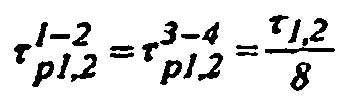
- the relative angular displacements of the same engagement phases in the end profiles of the teeth of the serially cooperating sprocket pairs T p1,2 are as ⁇ p ⁇ 1 .
- the force intervention change ( Fig. 7 ) of the teeth 33-34 and 35-36 of the multi-part polygonal wheels (with crossing points P 0 and P 1 with the pitch circle of the projections of normals to the working profiles at the points K ' 2 and K'' 2 coinciding with the pitch point P do not coincide) occurs in the deformation change of the relative displacements of the sprockets 1'-1 "and 2'-2" of the phase of the match ( Fig. 6 ) of points K 1 'and K 2 ' ⁇ p ⁇ 1 ⁇ p ⁇ 1 1 - 2 and ⁇ p ⁇ 2 > ⁇ p ⁇ 2 1 - 2 until the position of the wheels 1 and 2 (s. Fig.
- the sprockets 48, 49 and 50 with the disc rims ( Fig. 8 ) of the multi-part three-gear wheel are offset from each other and connected to each other by elements 51 of the Kurwik spur gear.
- the keyway 52 is used to Radbefest Trent on the shaft.
- the integral wear patterns (after momentary power rotation with the mating gear) with the pitch after the tooth roots and tooth tips of the teeth 56 and 57, 58 and 59, 60 and 61 can be seen.
- the IP type throw-out gear based on a pair of the reference profiles 72 and 73 (FIG. Fig. 10 ) is performed with the involute (straight) sections 74 and pointwise coupled sections 75 and 76 with a theoretical angle a k ⁇ a 1aJ .
- the tracks are interconnected with the small-sized technological profile sections 77 and 78 of the teeth.
- the connection is such that the involute paths 74 of the profiles on the cooperating teeth form the phases of post-pitch and pre-pitch engagement.
- the intervention change phases are divided into points K 1 (for the upper boundary point a of the profile of the actual wheel) and K 2 by two intervals q min and q max with the point of contact of the pointwise coupled routes.
- the structural flexibility of the IP toothing is increased. It is eliminated after the kinematic interaction weakened Wälzyakpiecen.
- the running-in behavior and the reliability of the IP transmission are thereby improved and its main advantages are obtained with ⁇ ⁇ ⁇ 1.
- the effect of balancing the contact strength of the tooth head and the type 72 tooth root on one of the mating gears can be seen. This realizes the so-called Head effect at its fullest.
- the counter-wheels with any longitudinal shape of the teeth can be carried out with the significantly reinforced engagement phase before the pitch point and with the greater strength drop of the teeth, wherein the reinforced engagement phase after the effects of the contact curvature of the teeth and the engagement phase can also occur after the pitch point.
- the upper limit point C 2 of the small-scale technological path of the tooth profile of one of the mating wheels is located at the tooth tip.
- the involute paths 81 and 82 of the profiles at the cooperating teeth form the phases of the pre-pitch and post-pitch engagement with the partial double-pair engagement and the engagement change on the point-coupled links 83 and 84 (phase K 0 ) and 85 and 86 (phase K 1 ).
- Such a double-pair transmission of the IP type has three characteristic engagement periods: one pair and double pair period and the period with the lack of overlap ⁇ .
- the phase of the frontal engagement of the point-wise coupled sections at the point K 1 lies between the boundary engagement points of the involute paths K 3 and K 2 of the adjacent tooth pairs.
- this phase is at the exit from the engagement (K 3 ) of involute distances from one pair of teeth to coming into engagement (K 2 ) of the involute distances of another pair of teeth.
- the discrete engagement of the teeth in conjunction with differential kinematic involute pregroove and post-pitch engagement improves vibroacoustic parameters and, in particular, increases the efficiency of out-of-center engagement in high-speed IP-type transmissions.
- the discrete off-center gear with a variable relative wheel-axle position during operation is executed without involute gear phases.
- Each basic section of the profile in the pair of identical reference profiles 87 and 88 ( Fig. 12 ) is described as a mixing section. This is done according to various laws 89, 90 and 91, 92 and 93, 94 and 95, 96 with formation of the break points.
- the break points coincide with theoretical contact points K of the arcuate basic distances of the end profile of the foot and tooth, which are coupled at point C with the angle of the profile A c .
- the front profiles of the teeth with the biconcave shape have an increased mutual output.
- the engagement change phases of the teeth at the points O 1 and O 2 on the sections 89-90 and 95-96 with the interval q min are characterized by a favorable profile shape.
- the interval q max includes the engagement change of the sections 91 - 92 and 93 - 94 in the vicinity of their engagement phases in the pitch point.
- the point-to-point out-of-rolling paths (eg, 89-90 and 95-96) of the profiles of a pair of tooth reference profiles are made in the range of pressure angles with the deviations of the geometric values.
- the contact angles exceed the theoretical contact angle a k .
- the deviations of the geometric values are equivalent to the increase of the axial distance ⁇ a w > 0.
- the lying out of the rolling point arcuate basic distances of the tooth profiles in the range of pressure angles which are greater than the pressure angle a k are described with the flowing curves. These curves approach the circular arcs with the curvature radii that are as close to the technology as possible.
- f f is the tolerance of the tooth profile
- ⁇ p p f -p a
- p af are the radii of curvature of the profiles of the contacting convex and concave stretches of a pair of the reference profiles of the cooperating teeth
- a max is the maximum profile angle of the tooth head.
Landscapes
- Engineering & Computer Science (AREA)
- General Engineering & Computer Science (AREA)
- Mechanical Engineering (AREA)
- Gears, Cams (AREA)
- Valve Device For Special Equipments (AREA)
- Lock And Its Accessories (AREA)
Abstract
Description
Die Erfindung betrifft ein Radgetriebe, insbesondere Zahnradgetriebe, das aus Zahnrädern mit einer Winkelteilung der Zähne von zusammenwirkenden Zahnkränzen gebildet ist. Dabei sind die Zahnkränze mit Einflusselementen und Mehrflusselementen der seriell zusammenwirkenden Zahnkränze versehen und die Stirnzahnprofile der Zähne abschnitts- und/oder punktweise in theoretischen Berührungspunkten beim Zahnkopf konvex und beim Zahnfuß konkav gewölbt in außerhalb vom Wälzpunkt liegende Bogenstrecken fließend miteinander und mit anderen Evolventen (Quasievolventen)-Strecken verbunden.The invention relates to a wheel gear, in particular gear transmission, which is formed of gears with an angular pitch of the teeth of cooperating sprockets. The sprockets are provided with influencing elements and multi-flow elements of the serially interacting sprockets and the spur teeth of the teeth section and / or pointwise in theoretical points of contact at the tooth head convex and concave arched at the root in arc lying outside the Wälzpunkt flowing together and with other involutes (Quasievolventen) Connected routes.
Aus dem UdSSR-Patent Nr.
Durch die Realisierung von zwei Effekten
- a) des Effektes der Superadditivität des kinematischen Prinzips IP (im Gegensatz zum additiven Prinzip mit einfacher Summierung der Verzahnungskomponenten bei deren Kombination in der Mischverzahnung) und
- b) des Effektes der Berührungskrümmung gibt es in solchen Getrieben keinen Verlust der Berührungsfläche der Zähne (Berührungseffekt des wesentlichen, über die Beschreibung der Lösung für das Hertz'sche Kontaktproblem hinausgehenden Einflusses der wachsenden Innigkeit des Kontakts von elastischen Körpern auf die Reduzierung der Flächenpressung und infolgedessen Feststellung der prinzipiellen Möglichkeit zur wesentlichen Verbesserung der Eingriffsphasen im Wälzpunkt und außerhalb des Wälzpunktes).
- a) the effect of the superadditivity of the kinematic principle IP (in contrast to the additive principle with simple summation of the gear components in their combination in the mixing toothing) and
- b) the effect of the contact curvature there is no loss of the contact surface of the teeth in such transmissions (contact effect of the essential beyond the description of the solution for the Hertzian contact problem influence of growing intimacy of the contact of elastic bodies on the reduction of the surface pressure and consequently Determination of the principal possibility for substantial improvement of the engagement phases in the pitching point and outside the pitching point).
Die Pressungsfestigkeit des Wälzpunktes ist damit maximal erhöht. Die Werte für die Kontakt-Dauerhaftigkeit der Eingriffsphasen (im Wälzpunkt und außerhalb vom Wälzpunkt) sind ausgeglichen. Insbesondere werden die erhöhte Sanftigkeit der Arbeit und die niedrigen Biegespannungen durch die Formbesonderheiten der Stirnprofile der Zähne erreicht. Zu den Nachteilen des bekannten Getriebes gehören die beschränkte bauliche Flexibilität in Bezug auf die Erhöhung der Innigkeit und die Realisierung des Krümmungseffekts des Kontakts in Außer-Wälzpunkt-Eingriffsphasen sowie die Auswahl der Parameter für die Längsform (εβ = 1) der Zähne.The compression strength of the rolling point is thus maximally increased. The values for the contact durability of the engagement phases (in the pitch point and outside the pitch point) are balanced. In particular, the increased smoothness of the work and the low bending stresses are achieved by the shape particularities of the frontal profiles of the teeth. Disadvantages of the known transmission include the limited structural flexibility with regard to increasing the intimacy and realizing the curvature effect of the contact in off-center engagement phases as well as selecting the parameters for the longitudinal shape (ε β = 1) of the teeth.
Aus dem
Ein Radgetriebe mit einer Mischverzahnung ist auch aus dem UdSSR-Patent
Aus dem
Durch diese Beschränkungen der baulichen Flexibilität der bekannten Getriebe mit der Vorgabe bezüglich der Stirn- und Gesamtüberdeckung der Zähne von εα > 1 und εγ > 1 wird das Wachstum der Innigkeit bei der Berührung (Eingriffswinkel atw und/oder Höhenmaße der außer dem Wälzpunkt liegenden punktweise gekoppelten Strecken) in verschiedenen Eingriffsphasen sowie des Superadditivität-Grades bei der Mischverzahnung erhalten.As a result of these restrictions on the structural flexibility of the known gearboxes with regard to the frontal and total overlap of the teeth of ε α > 1 and ε γ > 1, the growth of intimacy at contact (pressure angle atw and / or height dimensions of the point outside the pitch point point-wise coupled Stretching) in different engagement phases as well as the degree of superadditivity in the mixing toothing.
Durch die
Durch die
Es ist daher Aufgabe der Erfindung, bei einem Radgetriebe der eingangs erwähnten Art die bauliche Flexibilität und die Innigkeit der Zahnberührung zwecks Verbesserung der Qualitätswerte zu steigern.It is therefore an object of the invention to increase the structural flexibility and the intimacy of the tooth contact in order to improve the quality values in a wheel gear of the type mentioned.
Diese Aufgabe der Erfindung wird dadurch gelöst, dass die zusammenwirkenden Zahnkränze mit den Winkeln (ϕa1,2) einer Stirnüberdeckung ausgeführt sind, wobei der Abbruch der Phasen des Stirn-Eingriffswechsels der Zähne um den Winkel (ϕD1,2) oder ϕ'D1,2 des diskreten Eingriffswechsels von Endpunkt (N2) der Zusammenwirkung von Stirnprofilen der Zähne bis zum Anfangspunkt (N2) der Zusammenwirkung von Zahnprofilen des weiteren Zahnpaares gebildet ist und dass mindestens eine Phase des diskreten Eingriffswinkels vom Zahnpaar durch die außer dem Wälzpunkt liegenden beim Zahnkopf konvexen und beim Zahnfuß konkaven Bogenstrecken gebildet ist und das Getriebe mit einem Koeffizienten für die Stirnüberdeckung der Zähne εa < 1 ausgeführt ist (z. B. bei einem gesamten Überdeckungskoeffizienten εy = 0).This object of the invention is achieved in that the cooperating sprockets with the angles (φ a1,2 ) of a front overlap are performed, wherein the termination of the phases of the front-engagement change of the teeth by the angle (φ D1,2 ) or φ ' D1 , 2 of the discrete engagement change of end point (N 2 ) of the interaction of front teeth of the teeth to the starting point (N 2 ) of the interaction of tooth profiles of the other pair of teeth is formed and that at least one phase of the discrete pressure angle of the pair of teeth by the out of the rolling point lying at the tooth head convex and concave at the root of the arch is formed and the transmission with a coefficient for the front overlap of the teeth ε a <1 is executed (eg, for a total coverage coefficient ε y = 0).
Die Stirnzahnprofile enthalten die abschnitts- und/oder punktweise gekoppelten Bogenstrecken, die beim Kopf konvex mit dem Radius pa und beim Fuß konkav mit dem Radius pf gewölbt sind und den theoretischen Druckwinkel ak aufweisen. Die Bogenstrecken weisen die erhöhte Innigkeit der Berührung auf und sind fließend mit anderen beispielsweisen Evolventenstrecken verbunden. Auch weisen sie die Brüche in den Phasen des Eingriffswinkels von Stirnzahnprofilen beim Winkel des diskreten Eingriffswechsels ϕd1,2 auf. Dabei ist mindestens eine Phase des diskreten Eingriffswechsels von Stirnprofilen der Zahnpaare durch den Kontakt der außer dem Wälzpunkt liegenden konvex-konkaven Strecken gebildet. Das Radgetriebe weist solche Phasen des Eingriffswechsels von Stirnprofilen der Gegenzähne in deren konvex-konkaven Strecken auf. Im Weiteren werden diese Radgetriebe diskrete Getriebe genannt. Das sind die Getriebe, die den kinematisch richtigen Eingriff der Stirnzahnprofile nur in einzelnen Eingriffsphasen oder abschnittsweise gewährleisten, wenn die Stirnüberdeckungswinkel bei jedem der Gegenräder kleiner sind als deren Winkelteilungen. Der Verzicht auf die durch die traditionellen Prinzipien für die Bildung der Gegenzahnräder bedingten Beschränkungen hinsichtlich der Zahnform (Stirn- und Längsform) wird von der baulichen Ungleichmäßigkeit der Mitnahme begleitet, die durch die Besonderheiten der Zahnform in der Phase von deren Eingriffswechsel ausgeglichen werden. Erstens sind die zyklischen und kinematischen Abweichungen des Getriebes nach dem Niveau kommensurabel mit den zugelassenen Fehlern der realen Evolventengetriebe. Zweitens wird durch den Stirn-Eingriffswechsel der Zähne in den außer dem Wälzpunkt liegenden Bogenstrecken mit hoher Innigkeit des Eingriffs und durch den Effekt der Eingriffskrümmung beim Krafteingriff Folgendes erzielt:
- a) die Anforderungen an das Getriebe im Zusammenhang mit der kinematischen Genauigkeit, dem Zahneingriff durch die Lage der Getriebeachsen und der Sanftheit der Arbeit (Wälzsprung der Zahnfrequenz) werden gemäßigt und
- b) die sanfte Arbeit, das gute Tragbild, die niedrige Geschwindigkeit des Zahnstoßes, die Reduzierung der dynamischen Belastung und vibroakustischen Aktivität sowie die Erhöhung der Belastbarkeit und Haltbarkeit.
- a) the requirements for the gearbox in the context of kinematic accuracy, the meshing by the position of the transmission axes and the gentleness of the work (rolling jump of the tooth frequency) are moderated and
- b) the gentle work, the good contact pattern, the low speed of the tooth kick, the reduction of the dynamic load and vibroacoustic activity as well as the increase of the resilience and durability.
Bei den Zähnen mit beliebiger Längsform können die eingegebenen Intervalle ϕD1.2 zwischen den Eingriffsphasen in den Grenz- bzw. theoretischen Berührungspunkten der neugekoppelten Strecken der Stirnzahnprofile umso größer sein, je kleiner die Umlaufgeschwindigkeit der zusammenwirkenden Zahnräder und je größer die Höhenmaße der punktweise gekoppelten Strecken sind. Die Größe und die Innigkeit der Berührung von außer dem Wälzpunkt liegenden Strecken (durch die Reduzierung der Größen der Evolventenstrecken ohne Wachstum von ϕD1,2) können erhöht werden und zwar aufgrund des Effektes der Superadditivität und der Mischverzahnung, in dem die Parameter der Evolventenstrecken variiert werden.For the teeth of arbitrary longitudinal shape, the smaller the rotational speed of the interacting gears and the greater the height measurements of the pointwise coupled paths, the greater the input intervals φ D1.2 between the engagement phases in the boundary and theoretical contact points of the newly coupled paths of the spur tooth profiles are. The size and intimacy of non-pitching contact (by reducing the involute non-growth sizes of φ D1,2 ) can be increased due to the effect of superadditivity and compounding in which the involute distance parameters vary become.
Aber endgültig kann diese Aufgabe durch die Verschiebung der gleichnamigen Verzahnungsphasen der Zahnkränze um den Winkel Tp1,2 bis zum vollen Ausschluss der Evolventenstrecken gelöst werden. Dies erfolgt durch die Ausführung des diskreten Radgetriebes mit Mehrfluss-Elementen, insbesondere aus mehrteiligen Rädern in Paketform. Das Radgetriebe dieser Art ist dadurch gekennzeichnet, dass es mit der Kombination der diskreten Eingriffswechsel der nach verschiedenen Paaren der zusammenwirkenden Zahnkränze und mit ungefähr gleichen Winkelentfernungen zwischen benachbarten Kreuzungspunkten der Projektionen von Normalen zu den Stirnzahnprofilen (in theoretischen Berührungspunkten K und charakteristischen Punkten der aktiven Strecken) aller Zahnkränze mit der Wälzbahn von jedem Rad auf dessen Stirnebene, z. B. mit dem Nullkoeffizienten für die gesamte Überdeckung εy = 0, ausgeführt ist und dass die Winkel des diskreten Stirn-Eingriffswechsels aus dem Verhältnis (ϕD1,2/T1,2 = 0,25 gewählt sind.But finally, this task can be solved by the shift of the eponymous teeth phases of the sprockets by the angle T p1,2 to the full exclusion of the involute. This is done by the execution of the discrete wheel gear with multi-flow elements, in particular of multi-part wheels in package form. The wheel gear of this kind is characterized by the fact that it combines with the discrete engagement changes of the different pairs of cooperating sprockets and with approximately equal angular distances between adjacent crossing points of the projections of normals to the spur profiles (in theoretical contact points K and characteristic points of the active stretches). all sprockets with the Wälzbahn of each wheel on the front end, z. B. with the zero coefficient for the entire coverage ε y = 0, is executed and that the angles of the discrete front engagement change from the ratio (φ D1,2 / T 1,2 = 0,25 are selected.
Die Räder sind untereinander mittels der relativen Verschiebung in Umlaufrichtung der gleichnamigen Eingriffsphasen der Stirnzahnprofile von zwei und mehr koaxialen, gerad- oder schrägverzahnten Zahnkränzen verbunden. Darunter wird auch die Kombination der diskreten Eingriffswechsel der Zähne in verschiedenen Paaren der zusammenwirkenden Zahnkränze und ungefähr gleiche Winkelentfernungen zwischen den benachbarten Kreuzungspunkten mit der Wälzbahn der Projektionen von Normalen zu den Stirnzahnprofilen aller Zahnkränze von jedem Rad auf dessen Stirnebene benutzt (wobei die Kreuzungspunkte durch die theoretischen Berührungspunkte K mit charakteristischen Durchschnitts- bzw. Grenzpunkten der aktiven Strecken gebildet sind). Die Winkelwerte des diskreten Stirn-Eingriffswechsels sind aus dem Verhältnis 
Empfehlenswert ist eine Außer-Wälzpunkt-Ausführung des Typs IP, wobei Stirnräder, Kegelräder oder Schneckenräder eingesetzt sind. Diese Ausführung wird dann als Außer-Wälzpunkt-Getriebe ausgebildet, wobei der obere Grenzpunkt der kleindimensionierten konvexen technologischen Strecke des Zahn-Stirnprofils bei einem Zahnkopf der Gegenräder liegt, die Evolventenstrecken die Phasen des Nach-Wälzpunkt- und Vor-Wälzpunkt-Eingriffs bilden und die Winkel des diskreten Stirn-Eingriffswechsels aus dem Verhältnis ϕD1,2/τ1,2 = 0,4 gewählt sind.It is recommended to use an out-of-point version of type IP, using spur gears, bevel gears or worm wheels. This embodiment is then formed as out-of-center gear, wherein the upper limit of the small-sized convex technological path of the tooth-end profile is located at a tooth tip of the counter wheels, the involute paths form the phases of the post-Wälzpunkt- and Vor-Wälzpunkt- engagement and the Angle of the discrete forehead engagement change from the ratio φ D1,2 / τ 1,2 = 0.4 are selected.
Die Ausführung umfasst kleindimensionierte technologische Strecken des Stirnzahnprofils, wobei der obere Grenzpunkt der kleindimensionierten konvexen technologisehen Strecke des Zahnprofils bei einem der Gegenräder beim Zahnkopf liegt. Die Evolventen-(Quasievolventen-)Strecken der Profile bei den zusammenwirkenden Zähnen bilden die Phasen des Nach-Wälzpunkt- und des Vor-Wälzpunkt-Eingriffs. Beim Außer-Wälzpunkt-Getriebe IP sind die geschwächten Wälzpunkt-Strecken beseitigt, Dadurch wird ermöglicht, das Einlaufverhalten (insbesondere bei εβ = 0) und die Funktionszuverlässigkeit des Getriebes zu verbessern. Dabei werden die Hauptvorteile des diskreten Getriebes IP erhalten. Darüber hinaus treten in den diskreten Außer-Wälzpunkt-Getrieben IP der Effekt der Ausgleichung der Berührungsfestigkeit des Zahnkopfes und -fußes und der so genannte Kopfeffekt in Erscheinung. Durch den Bereich der Winkelverhältnisse ϕD1,2/T1,2 = 0,4 sind die Eingriffsbedingungen bei εβ= 0,5 bestimmt. Bei εβ < 0,5 wäre es sinnvoll, diesen bis = 0,2 zu senken.The design includes small dimensioned technological sections of the spur tooth profile, with the upper limit point of the small-dimensioned convex technologisehen Distance of the tooth profile in one of the mating wheels at the tooth tip is. The involute (quasi-involute) paths of the profiles on the co-operating teeth form the phases of post-pitch and pre-pitch engagement. When out-of-pitch point transmission IP weakened pitch point routes are eliminated Thereby, the running-in behavior (in particular with ε β = 0), it is possible to improve the function and reliability of the transmission. The main advantages of the discrete transmission IP are obtained. In addition, the effect of balancing the contact strength of the tooth head and foot and the so-called head effect appear in the discrete out-of-square gears IP. By the range of angular ratios φ D1,2 / T1 , 2 = 0.4, the engagement conditions at ε β = 0.5 are determined. If ε β <0.5, it would make sense to reduce this to = 0.2.
Bei Kegelrad-, Hypoid- und anderen Getrieben in Außer-Wälzpunkt-Ausführung empfiehlt sich eine Ausführung, die dadurch gekennzeichnet ist, dass sie als Außer-Wälzpunkt-Getriebe ausgeführt ist. Dabei sind die Bogenstrecken des Zahnfußes und des Zahnkopfes fließend miteinander verbunden, z. B. im Zwischen-Knickpunkt "c" beim Teilungsfuß des Zahns mit dem Profilwinkel ac. Die Winkel des diskreten Stirn-Eingriffswechsels sind aus dem Verhältnis ϕD1,2/T1,2 = 0,25 gewählt.For bevel, hypoid and other out-of-point gearboxes, we recommend a version that is characterized by being designed as an out-of-center gearbox. The arc sections of the tooth base and the tooth head are fluidly connected to each other, z. B. in the intermediate break point "c" at the Teilungsfuß of the tooth with the profile angle a c . The angles of the discrete forehead engagement change are selected from the ratio φ D1,2 / T1,2 = 0.25.
Jede außer dem Wälzpunkt liegende Bogenstrecke beim Paar der identischen Bezugsprofile sollte gemischt und nach verschiedenen Gesetzen mit der Knickbildung in theoretischen Berührungspunkten beschrieben sein. Die außer dem Wälzpunkt liegenden Strecken des Zahnfußes und des Zahnkopfes sollten fließend miteinander gekoppelt sein, z. B. mit der Evolventenstrecke verbunden bzw. in einem Punkt mit dem Profilwinkel αc gekoppelt sein. Das Getriebe kann mit dem diskreten Eingriffswechsel in theoretischen Berührungspunkten und dem reduzierten gesamten Überdeckungskoeffizienten εγ, (z. B. bei εγ = 0) ausgeführt werden. Die Winkel des anderen diskreten Eingriffswinkels sind aus dem Verhältnis ϕD1,2/T1,2 = 0.25 gewählt. Dank der gegensätzlichen Zeichen der Streckenkrümmung auf beiden Seiten des theoretischen Berührungspunkts ist ein derartiges Getriebe praktisch unempfindlich gegenüber den Abweichungen des Achsenabstands Δaw > 0.Each arching path other than the pitching point in the pair of identical reference profiles should be mixed and described according to various laws of kinking in theoretical contact points. The out of the Wälzpunkt lying distances of the tooth root and the tooth head should be coupled fluently with each other, for. B. connected to the involute path or be coupled in one point with the profile angle α c . The transmission can be performed with the discrete engagement change in theoretical contact points and the reduced total coverage coefficient ε γ, (z. B. when ε γ = 0). The angles of the other discrete pressure angle are selected from the ratio φ D1,2 / T 1,2 = 0.25. Thanks to the contrasting signs of the line curvature on both sides of the theoretical point of contact, such a transmission is practically insensitive to the deviations of the axial distance Δa w > 0.
Bei verschiedenen diskreten Getrieben können die punktweise gekoppelten außer dem Wälzpunkt liegenden Strecken der Profile bei den Zahnpaaren im Bereich der Druckwinkel, die den theoretischen Druckwinkel ak überschreiten, mit den fließenden Kurven beschrieben werden. Diese Kurven nähern sich an die Kreisbögen mit den technologisch möglichst nahen Krümmungsradien an. Das ist der Fall, wenn die zulässigen Abweichungen der Geometrie- und Montageparameter genommen werden, die äquivalent zur Erweiterung des Achsenabstands bei den Stirnrädern und der Axialanstellung der Kegelräder sind. Dadurch wird einerseits das kinematische Prinzip der Unabhängigkeit bei der Auswahl der Krümmungsradien der punktweise gekoppelten, außer dem Wälzpunkt liegenden Strecken der Stirnzahnprofile von den Geometrieabweichungen des Getriebes eingeführt. Diese Abweichungen sind den Änderungen des Achsenabstands äquivalent. Andererseits bestimmen diese Abweichungen nur die maximal mögliche Ist-Innigkeit der Berührung bis zur Oberflächenberührung für die Strecken a = ak der Zähne (d. h. bei den verantwortungsvollsten Phasen von deren Eingriffswechsel). Die Ist-Innigkeit stimmt auch mit jedem stochastisch in Erscheinung tretenden Niveau der Abweichungen überein. Es wird dadurch auch der Ist-Wert des Flankenspiels bestimmt. Zur Vergrößerung der Höhenmaße der punktweise gekoppelten Strecken (z. B. in einer der Drehrichtungen) werden die Zähne des diskreten Getriebes mit dem asymmetrischen Stirnprofil angefertigt.In various discrete transmissions, the point-wise coupled out-of-pitch paths of the profiles at the tooth pairs in the range of pressure angles exceeding the theoretical pressure angle a k can be described by the flowing curves. These curves approach the circular arcs with the curvature radii as close to the technology as possible. This is the case when the permissible deviations of the geometry and assembly parameters are taken, which are equivalent to the extension of the pitch of the spur gears and the axial adjustment of the bevel gears. As a result, on the one hand, the kinematic principle of independence in the selection of the radii of curvature of the pointwise coupled, out of the rolling point lying distances of the spur gear profiles introduced by the geometry deviations of the transmission. These deviations are equivalent to the changes in the distance between the axes. On the other hand, these deviations determine only the maximum possible actual intimacy of the touch up to the surface contact for the distances a = a k of the teeth (ie in the most responsible phases of their intervention change). The actuality also agrees with every stochastically apparent level of deviations. It also determines the actual value of the backlash. To increase the height dimensions of the point-wise coupled sections (eg in one of the directions of rotation), the teeth of the discrete gear are made with the asymmetrical front profile.
Das technische Ergebnis und der positive Effekt gegenüber dem Stand der Technik liegen darin, dass die Erfindung - durch die bauliche Flexibilität und Innigkeit der Zahnberührung - die Empfindlichkeit des Eingriffs gegenüber Geometrieabweichungen reduziert. Zudem wird Folgendes erreicht:
- a) niedrige Niveaus der Berührungs- (Oberflächen- und Tiefenspannungen) und Biegespannungen sowie der Berührungstemperaturen,
- b) geringere Anzahl der Zähne,
- c) verbesserte Bedingungen für den Zahnaufbau,
- d) Zahnformen, die die Belastung der Lager senken,
- e) besonders erleichterte Zahnradausführungen,
- f) Reduzierung (um 1 dBA) der vibroakustischen Aktivität, der Abmessungen, des Gewichts, des Stahlbedarfs und der Selbstkosten,
- g) Herabsetzung der Anforderungen an die Schmierungs- und Wärmeableitungsbedingungen beim Kraftgetriebe,
- h) einfachere Anfertigung dieser Kraftgetriebe und
- i) Verbesserungen des Einlaufverhaltens des Wirkungsgrads, der Schnellläufigkeit, der Belast- und Überlastbarkeit (bis 2-fach) und der Betriebsdauer (bis 10-fach).
- a) low levels of contact (surface and depth stresses) and bending stresses and contact temperatures,
- b) fewer teeth,
- c) improved conditions for tooth structure,
- d) Tooth forms that reduce the load on the bearings,
- e) particularly facilitated gear designs,
- f) reduction (by 1 dBA) of vibroacoustic activity, dimensions, weight, steel requirements and cost,
- g) reducing the requirements for lubrication and heat dissipation conditions in the power transmission,
- h) easier to manufacture this power transmission and
- i) Improvements of the run-in behavior of the efficiency, the high speed, the load and overload capacity (up to 2 times) and the operating time (up to 10 times).
Dabei sind die eingeführten kinematischen Prinzipien neu und erfüllen die Bedingungen für den technischen Fortschritt. Zudem ist das Kriterium der industriellen Anwendbarkeit gegeben.The introduced kinematic principles are new and fulfill the conditions for technical progress. In addition, the criterion of industrial applicability is given.
Die Erfindung wird anhand von in den Zeichnungen dargestellten Ausführungsbeispielen näher erläutert. Es zeigen:
Das Stirnradgetriebe nach
Die Stirnflanken der zusammenwirkenden Zähne 3 und 4 sowie 5 und 6 der Zahnkränze 1° und 2° enthalten die punktweise gekoppelten außer dem Wälzpunkt liegenden Bogenstrecken 8 und 7, 9 und 10. Die Radien pa beim Kopf sind konvex und die Radien pa beim Fuß sind konkav gewölbt und bilden die theoretischen Berührungspunkte K1 und K2 ... K8 und den Druckwinkel ak = akw. In der
Eine weitere Vergrößerung der Maße und der Rolle der außer dem Wälzpunkt liegenden punktweise gekoppelten Strecken und die gleichzeitige Reduzierung der Maße (und der vollständige Ausschluss) der eine reduzierte bauliche Flexibilität aufweisenden Evolventenstrecken des Stirnprofils ergibt die Mehrfluss-Ausführung des Getriebes nach
Die Verbesserung der Parameter des Stirn-Eingriffswechsels von den Zähnen beim Getriebe mit mehreren Leistungsflüssen sowie die Reduzierung der Schwingungserregung z NP der Frequenz wird durch die Kombination der diskreten Eingriffswechsel der Zähne (33,34; 35,36; 37,38; 39,40; 41,42; 43,44 usw.) erreicht, wobei z die Anzahl der Zähne beim Zahnkranz. P die Anzahl der mit der Verschiebung zusammenwirkender Zahnkränze beim Paar der mehrteiligen Vielkranz-Räder und N die Anzahl der Bogenstrecken auf dem Arbeitsprofil der Zähne ist. In 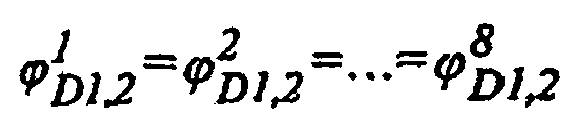


gewählt.
selected.
Der Kraft-Eingriffswechsel (



Die Zahnkränze 48, 49 und 50 mit den Scheiben-Felgen (
Durch eine derartige Ausführung sind die Wälzpunktphase und die StrecKen der Evolventenverzahnung ausgeschlossen. Die Größe der punktweise gekoppelten Strecken des Stirnprofils und die Belastbarkeit des Getriebes sind wesentlich vergrößert.By such a design, the Wälzpunktphase and the StrecKen the involute toothing are excluded. The size of the pointwise coupled sections of the front profile and the load capacity of the transmission are significantly increased.
Zur größeren Verschleißfestigkeit des diskreten Getriebes vom IP-Typ schließen die Flankenprofile der Bezugsprofile bei den Zähnen 62 und 63 geradlinige (Evolventen) -Strecken 64 und 65 mit dem Profilwinkel α ein (
Das Außer-Wälzpunkt-Getriebe vom IP-Typ auf der Basis von einem Paar der Bezugsprofile 72 und 73 (
Die Ausführung der Profile der Zähne 80 und 79 (
Der obere Grenzpunkt C2 der kleindimensionierten technologischen Strecke des Zahnprofils von einem der Gegenräder liegt beim Zahnkopf. Die Evolventenstrecken 81 und 82 der Profile bei den zusammenwirkenden Zähnen bilden die Phasen des Vor-Wälzpunkt- und des Nach-Wälzpunkt-Eingriffs mit dem teilweisen Doppelpaar-Eingriff und mit dem Eingriffswechsel auf den punktweise gekoppelten Strecken 83 und 84 (Phase K0) und 85 und 86 (Phase K1). Ein derartiges Doppelpaar-Getriebe vom IP-Typ hat drei charakteristische Eingriffsperioden: Einpaar- und Doppelpaar-Periode sowie die Periode mit der mangelnden Überdeckung Δε. Die Phase des Stirneingriffs der punktweise gekoppelten Strecken im Punkt K1 liegt zwischen den Grenz-Eingriffspunkten der Evolventenstrecken K3 und K2 der benachbarten Zahnpaare. Das bedeutet, dass diese Phase am Austritt aus dem Eingriff (K3) der Evolventenstrecken von einem Zahnpaar bis zum Kommen in Eingriff (K2) der Evolventenstrecken von einem weiteren Zahnpaar liegt. Der diskrete Eingriffswechsel der Zähne in Verbindung mit unterschiedlicher Kinematik des evolventenförmigen Vor-Wälzpunkt- und des Nach-Wälzpunkt-Eingriffs verbessert die vibroakustischen Parameter und erhöht insbesondere die Effizienz des Außer-Wälzpunkt-Eingriffs bei Hochgeschwindigkeits-Getrieben vom IP-Typ.The upper limit point C 2 of the small-scale technological path of the tooth profile of one of the mating wheels is located at the tooth tip. The
Das diskrete Außer-Wälzpunkt-Getriebe mit einer im Laufe des Betriebs veränderlichen relativen Radachsen-Position wird ohne Evolventenverzahnungs-Phasen ausgeführt. Jede Grundstrecke des Profils beim Paar der identischen Bezugsprofile 87 und 88 (
Die Knickpunkte fallen mit theoretischen Berührungspunkten K der bogenförmigen Grundstrecken des Stirnprofils vom Fuß und Zahn zusammen, die im Punkt C mit dem Winkel des Profils ac gekoppelt sind. Auf der kinematisch geschwächten Strecke des Wälzpunkts weisen die Stirnprofile der Zähne mit der bikonkaven Form einen vergrößerten gegenseitigen Abtrieb auf. Die Eingriffswechsel-Phasen der Zähne in den Punkten O1 und O2 auf den Strecken 89 - 90 und 95 - 96 mit dem Intervall qmin charakterisieren sich durch eine günstige Profilform. Das Intervall qmax schließt den Eingriffswechsel der Strecken 91 - 92 und 93 - 94 in der Nähe von deren Eingriffsphasen im Wälzpunkt ein. Ein solches Getriebe hat einen kinematisch richtigen Eingriff in theoretischen Punkten K mit dem gesamten Überdeckungskoeffizienten εγ = 0.The break points coincide with theoretical contact points K of the arcuate basic distances of the end profile of the foot and tooth, which are coupled at point C with the angle of the profile A c . On the kinematically weakened section of the rolling point, the front profiles of the teeth with the biconcave shape have an increased mutual output. The engagement change phases of the teeth at the points O 1 and O 2 on the sections 89-90 and 95-96 with the interval q min are characterized by a favorable profile shape. The interval q max includes the engagement change of the sections 91 - 92 and 93 - 94 in the vicinity of their engagement phases in the pitch point. Such a transmission has a kinematically correct engagement in theoretical points K with the total coverage coefficient ε γ = 0.
Bei verschiedenen diskreten Getrieben sind die punktweise gekoppelten außer dem Wälzpunkt liegenden Strecken (z. B. 89 - 90 und 95 - 96) der Profile von einem Paar der Zahn-Bezugsprofile im Bereich der Druckwinkel mit den Abweichungen der geometrischen Werte ausgeführt. Die Druckwinkel überschreiten den theoretischen Druckwinkel ak. Die Abweichungen der geometrischen Werte sind zu der Vergrößerung des Achsenabstands Δaw > 0 äquivalent. Die außer dem Wälzpunkt liegenden bogenförmigen Grundstrecken der Zahnprofile im Bereich der Druckwinkel, die größer als der Druckwinkel ak sind, sind mit den fließenden Kurven beschrieben. Diese Kurven nähern sich den Kreisbögen mit den technologisch möglichst nahen Krümmungsradien an. Die Krümmungsradien werden beispielsweise als 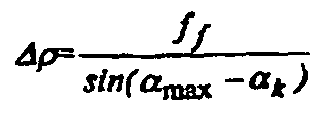
Das Testen der Kraft-Stirnrad-Getriebe (mit Gerad-, Schräg- und Bogenverzahnung) sowie der Schrauben- und Kegelradgetriebe (mit Bogenzähnen) zeigte die Möglichkeit zur wesentlichen Reduzierung der Selbstkosten der Erzeugnisse durch niedrigere Anforderungen an die Legierung des Materials und durch die chemothermische- und Fertigbearbeitung der Zähne auf. U. a. gilt das für die Stirnradgetriebe des Moduls m = 2,5 ö 10 mm mit vollen und mehrteiligen Stahlrädem. Bei diesem wurde erreicht:
- a) die Reduzierung der Selbstkosten und
- b) gleichzeitig eine Erhöhung der Belastbarkeit (2-fach bei Hoberf = HRC57, ϕD1,2 = 0,085T1,2, εβ = 0, εγ = 0,915
und 1,9-fach bei den mehrteiligen Dreikranz-Rädern Hoberf ≈ HB320, z1,2 = 29, ϕD1,2 = T1,2/6, εγ = 0), eine Verlängerung der störungsfreien Betriebsdauer (über 10-fach bei Hoberf = HB320, ϕD1,2 = 0,135T1,2, εβ = 1.96, εa = 0,865), - c) eine Reduzierung des Geräuschpegels (um 3 - 4dBA bei Hoberf = HRC58, ϕD1,2 = 0,086T1,2, εβ = 0, εγ = 0,914),
- d) die Vermeidung einer Verkeilung des Getriebes (Hoberf = HB320, ϕD1,2 = 0,062T1,2, εβ = 1,429, εγ = 2,367) unter den extremen Bedingungen ohne Spiel und mit dem Achsenneigungsfehler bei den Gegenrädern γ = 1,45·10-3 der Radialverzahnung und
- e) eine Reduzierung der Achsenmaße des schrägverzahnten Getriebes mit dem breiten Zahnkranz (1,67-fach von 150 mm auf 90 mm, Hoberf = HB320, ϕD1,2= 0,135T1,2, εβ = 1,176, εa = 0,865).
- a) the reduction of the cost price and
- b) at the same time an increase in the load capacity (2 times at H oberf = HRC57, φ D1,2 = 0.085T 1.2 , ε β = 0, ε γ = 0.915 and 1.9 times in the multi-part three-wheeled wheels H superf ≈ HB320, z 1,2 = 29, φ D1,2 = T 1,2 / 6, ε γ = 0), an extension of the uninterrupted service life (over 10 times at H oberf = HB320, φ D1,2 = 0.135T 1.2 , ε β = 1.96, ε a = 0.865),
- c) a reduction of the noise level (by 3 - 4dBA at H oberf = HRC58, φ D1,2 = 0.086T 1.2 , ε β = 0, ε γ = 0.914),
- d) the avoidance of a wedging of the gearbox (H oberf = HB320, φD 1.2 = 0,062T 1,2 , ε β = 1,429, ε γ = 2,367) under the extreme conditions without clearance and with the axle inclination error at the counter wheels γ = 1.45 · 10 -3 of the radial toothing and
- e) a reduction in the axial dimensions of the helical gear with the wide sprocket (1.67-fold from 150 mm to 90 mm, H oberf = HB320, φ D1,2 = 0,135T 1,2 , ε β = 1,176, ε a = 0.865).
Das Radgetriebe ist anwendbar in verschiedenen technischen Objekten und kann in verschiedenen Bereichen menschlicher Tätigkeit eingesetzt werden. Seine Varianten können als Stirnrad-, Kegelrad-, Hypoid-, Schrauben-, Schnecken- und Spiroidgetriebe und dessen Räder als volle oder mehrteilige Räder mit beliebiger Längsform der Zähne ausgeführt werden. Die Erfindung bewirkt:
- a) Verbesserung der Parameter von Kraftgetrieben,
- b) Erhöhung der Belastbarkeit (bis 2-fach), der Betriebsdauer (bis 10-fach), der Schnellläufigkeit, des Wirkungsgrads und der Verschleißfestigkeit,
- c) Reduzierung der dynamischen (vibroakustischen) Aktivität (um 1ö4 dBA) beim Eingriff, dessen Empfindlichkeit gegenüber Fertigungs- und Verformungsabweichungen der Geometrie,
- d) Vereinfachung der Anfertigungstechnologie,
- e) Reduzierung der Abmessungen, des Gewichts, des Stahlbedarfs und der Selbstkosten und
- f) Reduzierung der Betriebsausgaben (u. a. niedrigere Anforderungen an die Schmier- und Wärmeableitungsbedingungen) und des Verkeilungsrisikos des Getriebes.
- a) improving the parameters of power transmissions,
- b) Increasing the load capacity (up to 2 times), the operating time (up to 10 times), the high speed, the efficiency and the wear resistance,
- c) reduction of the dynamic (vibroacoustic) activity (by 1ö4 dBA) during the procedure, its sensitivity to manufacturing and deformation deviations of the geometry,
- d) simplification of the manufacturing technology,
- e) reduction of dimensions, weight, steel requirements and overheads and
- f) Reduction of operating expenses (including lower requirements for lubrication and heat dissipation conditions) and gearbox wedging risk.
Sie erhöht die bauliche Flexibilität der Verzahnung und weist einen breiten Anwendungsbereich auf in unterschiedlichen Transportmaschinen, im Werkzeugmaschinenbau, im allgemeinen Getriebebau und in anderen Maschinenbauzweigen.It increases the structural flexibility of the gearing and has a wide range of applications in various transport machines, in machine tools, in general gear construction and in other mechanical engineering branches.
Zur Anfertigung des Radgetriebes und des erforderlichen Zahnbearbeitungswerkzeugs reicht die gängige weit verbreitete Ausrüstung aus.For the production of the wheel gear and the required tooth processing tool, the usual widespread equipment is sufficient.
Claims (5)
- A wheel gear, comprised of toothed wheels (1, 2) with an angular pitch (T1, T2) of the teeth (3, 4, or respectively 5, 6) of interacting gear rims (1°, 2°), wherein the gear rims (1°, 2°) are provided with single-flow elements (1' and 2', 1" and 2") and multiple-flow elements of the serially interacting gear rims, and wherein, in theoretical contact points (K3, K5 and K4, K6, K1 and K2) with the tips of the teeth, the transverse tooth profiles of the teeth (3, 4, or respectively 5, 6) are continuously connected in a sectional or point-like manner with each other, are arched in a convex manner at the tips of the teeth and in a concave manner at the roots of the teeth, in sections of an arc (8 and 10, or respectively 9 and 7) located outside the pitch point, and with other involutes, or respectively quasi- involute sections (12, 11),
characterized in that
the interacting gear rims (1°, 2°) are designed with the angles (ϕa1,2,) of a front covering, wherein the termination of the phases of the transverse engagement change of the teeth is constituted by the angle ϕD1,2 or ϕ'D1,2 of the discrete engagement change from the end point (N2) of the interaction of transverse profiles of the teeth (5 and 7) as far as the starting point (N2) of the interaction of the further pair of teeth (3 and 4), and that at least one phase of the discrete engagement angle is constituted by the pair of teeth by means of the sections of arc (9 and 10), which are located outside of the pitch point and are convex at the tip of the teeth and concave at the root of the teeth, and the gear is embodied with a coefficient for the front coverage of the teeth ∈a < 1, for example in case of a total coverage coefficient ∈y = 0. - The wheel gear in accordance with claim 1, which is embodied in the form of multiple-flow elements and which contains the multiple wheels connected with each other in a package with the relative displacement of the same engagement phases of the engagement phases of the transverse tooth profiles of two or more coaxial gear rims, for example straight-toothed gear rims 1', 1", 1"' and 2, 2', 2", 2"'and 2"",
characterized in that
it is embodied with the combination of the discrete engagement changes of the teeth (33 - 34, 35 - 36, 37 - 38, 39 - 40, 41 - 42, 43 - 44, etc.) in accordance with different pairs of the gear rims acting together and with approximately the same angular distances between adjoining intersection points of the projection of normal lines to the transverse tooth profiles, in theoretical contact points K and characteristic points of the active courses, of all gear rims with the pitch line of each wheel on its front plane, for example with the zero coefficient for the entire coverage ∈y = 0, and that the angles of the discrete front engagement change are selected from the relation ϕD1,2/T1,2 = 0.25. - The wheel gear in accordance with claim 1, which is embodied in the form of a spur wheel gear, bevel wheel gear or worm gear on the basis of a pair of the non-identical reference profiles (72 and 73) with the involute sections (74) of the transverse profiles of the teeth, wherein each transverse profile is connected with at least one arc surface (76, 75) located outside of the pitch point by means of an additional technological section (77, 78) of small dimension,
characterized in that
it is embodied as an out-of-pitch-point gear, wherein the upper limit point of the convex technological section (78) of small dimension of the tooth transverse profile is located next to a tooth tip of the counter-wheels, the involute sections constitute the phases of the after-pitch point and pre-pitch point engagement, and the angles of the discrete engagement change are selected from the relation ϕD1,2/T1,2 0.4. - The wheel gear in accordance with claim 1, which is embodied in the form of a spur wheel gear or hypoid gear on the basis of a pair of reference profiles (87, 88), whose transverse tooth profiles contain the arc-shaped sections (91, 92, 93, 94), which are concave at the tip and convex at the root, and are described by means of the mixed curves with the formation of a kink in the theoretical contact points (K) of the sections located outside of the pitch point.
characterized in that
it is embodied as an out-of-pitch-point gear, in which the arc-shaped sections (89 and 91, 90 and 92, 93 and 95, 94 and 96) of the tip of the tooth and the root of the tooth are continuously connected with each other, for example in the intermediate kink point "c" at the pitch root of the tooth with the profile angle ac, and the angles of the discrete front engagement change are selected from the relation ϕD1,2/T1,2 = 0.25. - The wheel gear in accordance with claims 1 to 4,
characterized in that
it is embodied with the deviations of the geometry and assembly parameters which are equivalent to an increase of the axle distance of spur wheels or the axle placement of beveled wheels, and that the arc sections of the transverse tooth profile located outside of the pitch point in the area of the pressure angles, which are larger than the theoretical pressure angle ak are described by means of the flowing curves which approximate the arc of a circle with the same, or approximately the same, radii of curvature.
Applications Claiming Priority (1)
| Application Number | Priority Date | Filing Date | Title |
|---|---|---|---|
| PCT/RU2005/000367 WO2007008096A1 (en) | 2005-07-05 | 2005-07-05 | Gear drive |
Publications (3)
| Publication Number | Publication Date |
|---|---|
| EP1908992A1 EP1908992A1 (en) | 2008-04-09 |
| EP1908992A4 EP1908992A4 (en) | 2009-06-10 |
| EP1908992B1 true EP1908992B1 (en) | 2010-05-05 |
Family
ID=37637373
Family Applications (1)
| Application Number | Title | Priority Date | Filing Date |
|---|---|---|---|
| EP05851077A Expired - Lifetime EP1908992B1 (en) | 2005-07-05 | 2005-07-05 | Gear drive |
Country Status (11)
| Country | Link |
|---|---|
| US (1) | US8061229B2 (en) |
| EP (1) | EP1908992B1 (en) |
| JP (1) | JP4838307B2 (en) |
| KR (1) | KR101378157B1 (en) |
| CN (1) | CN101203699B (en) |
| AT (1) | ATE467071T1 (en) |
| CA (1) | CA2611328C (en) |
| DE (1) | DE502005009549D1 (en) |
| EA (1) | EA011706B1 (en) |
| GB (1) | GB2442392A (en) |
| WO (1) | WO2007008096A1 (en) |
Families Citing this family (33)
| Publication number | Priority date | Publication date | Assignee | Title |
|---|---|---|---|---|
| JP5338165B2 (en) * | 2008-07-15 | 2013-11-13 | トヨタ紡織株式会社 | Gear and coupling device using the gear |
| DE102008045318B3 (en) * | 2008-09-02 | 2009-10-08 | Voith Patent Gmbh | Toothing of a gear |
| JP4449045B1 (en) * | 2008-09-05 | 2010-04-14 | 正博 池村 | Gear device |
| US20100317483A1 (en) * | 2009-06-10 | 2010-12-16 | Eaton Corporation | High performance differential |
| JP5423460B2 (en) * | 2010-02-12 | 2014-02-19 | 株式会社ジェイテクト | Oscillating gear machining method and machine |
| US8475315B2 (en) * | 2010-02-15 | 2013-07-02 | Jtekt Corporation | Swing internal contact type planetary gear device and rotation drive device |
| US9267594B2 (en) * | 2010-08-24 | 2016-02-23 | American Axle & Manufacturing, Inc. | Controlled relative radius of curvature forged bevel gears with involute section |
| CN102278423B (en) * | 2011-06-30 | 2014-06-04 | 重庆大学 | Analytical method and system of mechanical efficiency of planet gear mechanism |
| CN102235465B (en) * | 2011-06-30 | 2014-10-08 | 重庆大学 | Planetary gear mechanism kinematic analysis method and system |
| WO2013067039A1 (en) * | 2011-10-31 | 2013-05-10 | Genesis Partners, L.P. | Gear tooth profile with transition zone blending relief |
| CN102494103B (en) * | 2011-11-24 | 2013-11-20 | 镇江大力液压马达股份有限公司 | Uniform contact one-tooth-difference cycloid pin gear pair |
| DE102011089021A1 (en) * | 2011-12-19 | 2013-06-20 | Zf Friedrichshafen Ag | Transmission device with an internally toothed ring gear and two meshing spur gears |
| DE102012203177A1 (en) * | 2012-03-01 | 2013-09-05 | Zf Friedrichshafen Ag | Gear set, especially for a rotary wing aircraft |
| KR101485863B1 (en) * | 2012-08-17 | 2015-01-26 | 가부시키가이샤 하모닉 드라이브 시스템즈 | Wave gear device having three-dimensional-contact tooth profile |
| JP5955705B2 (en) * | 2012-08-28 | 2016-07-20 | 大岡技研株式会社 | Sun gear |
| DE102013004861B3 (en) * | 2013-03-21 | 2014-02-27 | Voith Patent Gmbh | Toothing of a gear |
| CN103410946A (en) * | 2013-08-22 | 2013-11-27 | 内蒙古第一机械集团有限公司 | Method for forming small-modulus involute spline tooth |
| CN103939575B (en) * | 2014-04-10 | 2016-05-11 | 重庆大学 | Point contact gear, Meshing Pair and process tool thereof based on conjugate curves |
| US9812923B2 (en) | 2014-05-23 | 2017-11-07 | Aero Industries, Inc. | Gear motor |
| CN104289157A (en) * | 2014-09-26 | 2015-01-21 | 广东省肇庆市特种设备检验所 | Autoclave |
| JP6565221B2 (en) * | 2015-03-04 | 2019-08-28 | 富士ゼロックス株式会社 | Drive transmission device |
| DE102015109870A1 (en) * | 2015-06-19 | 2016-12-22 | Dr. Ing. H.C. F. Porsche Aktiengesellschaft | spur gear |
| CN105224744B (en) * | 2015-09-29 | 2018-03-16 | 西安交通大学 | A kind of method for peeling off gear engagement modeling based on mesh stiffness |
| JP2019500562A (en) | 2015-12-11 | 2019-01-10 | ギア イノベーションズ リミテッド ライアビリティ カンパニー | Continuous tooth root surface contact type conjugate gear |
| GB201609531D0 (en) * | 2016-05-31 | 2016-07-13 | Romax Technology Ltd | Planetary gearsets |
| CN106122378B (en) * | 2016-08-23 | 2018-12-11 | 华南理工大学 | A kind of line gear mechanism of rotation-movement conversion |
| HUP1900107A1 (en) * | 2019-04-02 | 2020-10-28 | Maform Kft | Two-stage speed increaser gearing and gear train for a clockwork. |
| US11473664B2 (en) * | 2019-10-21 | 2022-10-18 | Aktiebolaget Skf | Gear tooth chamfer for an annular gear |
| JP7327835B2 (en) * | 2019-10-23 | 2023-08-16 | 住友電工焼結合金株式会社 | gear member |
| CN111442074B (en) * | 2020-01-17 | 2023-08-11 | 宿迁学院 | Lightweight involute tooth profile structure of aerospace pump and reverse design method thereof |
| CN112377594B (en) * | 2020-11-10 | 2024-05-10 | 重庆交通大学 | Sectional type dotted line meshing gear pair |
| CN115270359B (en) * | 2022-09-28 | 2023-01-17 | 中国航发四川燃气涡轮研究院 | Design method of low-contact-stress tenon connection structure under size constraint |
| CN116480752B (en) * | 2023-04-07 | 2026-04-17 | 广东海洋大学 | Parabolic gear mechanism with double circular arc combined tooth profile on end face |
Family Cites Families (22)
| Publication number | Priority date | Publication date | Assignee | Title |
|---|---|---|---|---|
| DE1225459B (en) * | 1963-01-02 | 1966-09-22 | Gustav Niemann Dr Ing | Helical or curved toothing for face or bevel gears |
| JPS4968153A (en) * | 1972-11-09 | 1974-07-02 | ||
| US3918315A (en) * | 1974-07-22 | 1975-11-11 | William S Rouverol | High capacity gearing |
| SU602726A1 (en) * | 1976-01-04 | 1978-04-15 | Ростовский Ордена Трудового Красного Знамени Государственный Университет | Gearing |
| SU954686A1 (en) * | 1976-12-12 | 1982-08-30 | Ростовский Ордена Трудового Красного Знамени Государственный Университет | Toothed gearing |
| SU1048197A1 (en) * | 1979-10-17 | 1983-10-15 | Ростовский Ордена Трудового Красного Знамени Государственный Университет | Combined-type gear train |
| SU1075035A1 (en) * | 1981-05-27 | 1984-02-23 | Ростовский Ордена Трудового Красного Знамени Государственный Университет | Gear transmission |
| US4640149A (en) | 1983-03-04 | 1987-02-03 | The Boeing Company | High profile contact ratio, non-involute gear tooth form and method |
| US4589300A (en) * | 1984-08-17 | 1986-05-20 | Rouverol William S | Low transmission error gearing |
| US4644814A (en) * | 1985-07-22 | 1987-02-24 | Rouverol William S | Wide-angle gearing |
| WO1988003623A1 (en) | 1986-11-03 | 1988-05-19 | Rostovsky Gosudarstvenny Universitet Imeni M.A.Sus | Gear drive with mixed-type meshing |
| SU1571330A1 (en) * | 1988-04-25 | 1990-06-15 | Научно-Исследовательский Институт Механики И Прикладной Математики Ростовского Государственного Университета Им.М.А.Суслова | Gearing of combination engagement |
| JPH037164A (en) * | 1989-06-06 | 1991-01-14 | Tonen Corp | Hard structure forming material |
| JPH0464756A (en) * | 1990-07-02 | 1992-02-28 | Michio Kuroki | Gear |
| US5181433A (en) * | 1990-09-20 | 1993-01-26 | Chiba Dies Co., Ltd. | Gear |
| US5135373A (en) * | 1990-11-01 | 1992-08-04 | Stackpole Limited | Spur gear with epi-cycloidal and hypo-cycloidal tooth shapes |
| ES2102741T3 (en) * | 1994-07-30 | 1997-08-01 | Grob Ernst Fa | CROWN FOR PLANETARY GEAR TRAIN. |
| US5490433A (en) * | 1995-01-23 | 1996-02-13 | Althen; Craig L. | Semi-continuous transmission |
| RU2160403C1 (en) * | 1999-07-07 | 2000-12-10 | Открытое акционерное общество "Новолипецкий металлургический комбинат" | Spur gearing |
| JP4737839B2 (en) * | 2000-01-19 | 2011-08-03 | 株式会社エンプラス | Gear and gear device |
| US6837123B2 (en) * | 2001-03-23 | 2005-01-04 | Hawkins Richard M | Non-involute gears with conformal contact |
| CN2639619Y (en) * | 2003-03-27 | 2004-09-08 | 孟桂云 | High-efficient gear |
-
2005
- 2005-07-05 JP JP2008519204A patent/JP4838307B2/en not_active Expired - Fee Related
- 2005-07-05 KR KR1020087001639A patent/KR101378157B1/en not_active Expired - Fee Related
- 2005-07-05 CN CN2005800501875A patent/CN101203699B/en not_active Expired - Fee Related
- 2005-07-05 US US11/922,944 patent/US8061229B2/en not_active Expired - Fee Related
- 2005-07-05 WO PCT/RU2005/000367 patent/WO2007008096A1/en not_active Ceased
- 2005-07-05 CA CA2611328A patent/CA2611328C/en not_active Expired - Fee Related
- 2005-07-05 AT AT05851077T patent/ATE467071T1/en active
- 2005-07-05 EP EP05851077A patent/EP1908992B1/en not_active Expired - Lifetime
- 2005-07-05 DE DE502005009549T patent/DE502005009549D1/en not_active Expired - Lifetime
- 2005-07-05 GB GB0800349A patent/GB2442392A/en not_active Withdrawn
- 2005-07-05 EA EA200800215A patent/EA011706B1/en not_active IP Right Cessation
Also Published As
| Publication number | Publication date |
|---|---|
| DE502005009549D1 (en) | 2010-06-17 |
| CN101203699B (en) | 2011-06-08 |
| JP2008545103A (en) | 2008-12-11 |
| EA011706B1 (en) | 2009-04-28 |
| EP1908992A1 (en) | 2008-04-09 |
| GB2442392A (en) | 2008-04-02 |
| KR20080027867A (en) | 2008-03-28 |
| CA2611328C (en) | 2013-06-25 |
| EP1908992A4 (en) | 2009-06-10 |
| WO2007008096A1 (en) | 2007-01-18 |
| GB0800349D0 (en) | 2008-02-20 |
| JP4838307B2 (en) | 2011-12-14 |
| US20090165585A1 (en) | 2009-07-02 |
| CN101203699A (en) | 2008-06-18 |
| KR101378157B1 (en) | 2014-04-04 |
| US8061229B2 (en) | 2011-11-22 |
| CA2611328A1 (en) | 2007-01-18 |
| EA200800215A1 (en) | 2008-04-28 |
| ATE467071T1 (en) | 2010-05-15 |
Similar Documents
| Publication | Publication Date | Title |
|---|---|---|
| EP1908992A1 (en) | Gear drive | |
| EP2177788B1 (en) | Toothed wheel gearing (variants) and a planetary toothed mechanism based thereon (variants) | |
| DE69518843T2 (en) | TOPOLOGICAL CORRECTION OF TRANSMISSION TEETH BY BALANCE | |
| DE69715628T2 (en) | OPTIONALLY INTERRUPTING ROLLER CHAIN WHEEL WITH IMPROVED NOISE BEHAVIOR | |
| DE69838820T2 (en) | CROWN GEAR WITH EVOLVED CONE | |
| DE2801281C2 (en) | FLOWMETER ON THE PRINCIPLE OF POSITIVE DISPLACEMENT | |
| CH626692A5 (en) | ||
| EP2532926A1 (en) | Eccentrically cycloidal engagement of toothed profiles having curved teeth | |
| EP1402200A1 (en) | Toothed wheel with a toroidal, curved pitch surface and toothed gearing with said toothed wheel | |
| DE1957922C3 (en) | Toothed belt drive, the toothed belt of which has an endless tension member with teeth made of an elastomeric material | |
| EP0017065B1 (en) | Pair of engaged toothed wheels capable of withstanding high stress | |
| DE2124006C3 (en) | Rotary piston machine for liquids with an externally toothed and an internally toothed gear | |
| WO2013127595A1 (en) | Gearwheel set, in particular for a gyroplane | |
| DE2840303A1 (en) | GEAR GEARBOX AND METHOD FOR THE PRODUCTION THEREOF | |
| DE2532560A1 (en) | TRANSMISSION WITH HIGH PERFORMANCE | |
| EP2909510A1 (en) | Tooth geometries for a harmonic pin ring drive | |
| EP0149008B1 (en) | Planetary gearing | |
| EP0293473B1 (en) | Gear drive with mixed-type meshing | |
| WO2024213349A1 (en) | Skiving tool and method for working tooth flanks of a toothing | |
| DE2445104A1 (en) | Gear with non-involute tooth flanks - has pressure angle varying from minimum to maximum at opposite ends | |
| EP0046311B1 (en) | Method and cutter head for producing gear teeth with lengthwise ease-off | |
| DE2234777C3 (en) | compressor | |
| DE2617951C3 (en) | Planetary gear | |
| DE2446172A1 (en) | Involute gear teeth with varying form correction - produces teeth with longer arc of contact to reduce shock loading | |
| DE112012004434T5 (en) | Internal gear pump |
Legal Events
| Date | Code | Title | Description |
|---|---|---|---|
| PUAI | Public reference made under article 153(3) epc to a published international application that has entered the european phase |
Free format text: ORIGINAL CODE: 0009012 |
|
| 17P | Request for examination filed |
Effective date: 20080205 |
|
| AK | Designated contracting states |
Kind code of ref document: A1 Designated state(s): AT BE BG CH CY CZ DE DK EE ES FI FR GB GR HU IE IS IT LI LT LU LV MC NL PL PT RO SE SI SK TR |
|
| A4 | Supplementary search report drawn up and despatched |
Effective date: 20090513 |
|
| GRAP | Despatch of communication of intention to grant a patent |
Free format text: ORIGINAL CODE: EPIDOSNIGR1 |
|
| DAX | Request for extension of the european patent (deleted) | ||
| GRAS | Grant fee paid |
Free format text: ORIGINAL CODE: EPIDOSNIGR3 |
|
| GRAA | (expected) grant |
Free format text: ORIGINAL CODE: 0009210 |
|
| AK | Designated contracting states |
Kind code of ref document: B1 Designated state(s): AT BE BG CH CY CZ DE DK EE ES FI FR GB GR HU IE IS IT LI LT LU LV MC NL PL PT RO SE SI SK TR |
|
| REG | Reference to a national code |
Ref country code: GB Ref legal event code: FG4D |
|
| REG | Reference to a national code |
Ref country code: CH Ref legal event code: EP |
|
| REG | Reference to a national code |
Ref country code: IE Ref legal event code: FG4D |
|
| REF | Corresponds to: |
Ref document number: 502005009549 Country of ref document: DE Date of ref document: 20100617 Kind code of ref document: P |
|
| REG | Reference to a national code |
Ref country code: NL Ref legal event code: VDEP Effective date: 20100505 |
|
| LTIE | Lt: invalidation of european patent or patent extension |
Effective date: 20100505 |
|
| PG25 | Lapsed in a contracting state [announced via postgrant information from national office to epo] |
Ref country code: NL Free format text: LAPSE BECAUSE OF FAILURE TO SUBMIT A TRANSLATION OF THE DESCRIPTION OR TO PAY THE FEE WITHIN THE PRESCRIBED TIME-LIMIT Effective date: 20100505 Ref country code: SE Free format text: LAPSE BECAUSE OF FAILURE TO SUBMIT A TRANSLATION OF THE DESCRIPTION OR TO PAY THE FEE WITHIN THE PRESCRIBED TIME-LIMIT Effective date: 20100505 Ref country code: ES Free format text: LAPSE BECAUSE OF FAILURE TO SUBMIT A TRANSLATION OF THE DESCRIPTION OR TO PAY THE FEE WITHIN THE PRESCRIBED TIME-LIMIT Effective date: 20100816 Ref country code: LT Free format text: LAPSE BECAUSE OF FAILURE TO SUBMIT A TRANSLATION OF THE DESCRIPTION OR TO PAY THE FEE WITHIN THE PRESCRIBED TIME-LIMIT Effective date: 20100505 |
|
| PG25 | Lapsed in a contracting state [announced via postgrant information from national office to epo] |
Ref country code: FI Free format text: LAPSE BECAUSE OF FAILURE TO SUBMIT A TRANSLATION OF THE DESCRIPTION OR TO PAY THE FEE WITHIN THE PRESCRIBED TIME-LIMIT Effective date: 20100505 Ref country code: IS Free format text: LAPSE BECAUSE OF FAILURE TO SUBMIT A TRANSLATION OF THE DESCRIPTION OR TO PAY THE FEE WITHIN THE PRESCRIBED TIME-LIMIT Effective date: 20100905 Ref country code: LV Free format text: LAPSE BECAUSE OF FAILURE TO SUBMIT A TRANSLATION OF THE DESCRIPTION OR TO PAY THE FEE WITHIN THE PRESCRIBED TIME-LIMIT Effective date: 20100505 Ref country code: SI Free format text: LAPSE BECAUSE OF FAILURE TO SUBMIT A TRANSLATION OF THE DESCRIPTION OR TO PAY THE FEE WITHIN THE PRESCRIBED TIME-LIMIT Effective date: 20100505 |
|
| REG | Reference to a national code |
Ref country code: IE Ref legal event code: FD4D |
|
| PG25 | Lapsed in a contracting state [announced via postgrant information from national office to epo] |
Ref country code: CY Free format text: LAPSE BECAUSE OF FAILURE TO SUBMIT A TRANSLATION OF THE DESCRIPTION OR TO PAY THE FEE WITHIN THE PRESCRIBED TIME-LIMIT Effective date: 20100526 Ref country code: PL Free format text: LAPSE BECAUSE OF FAILURE TO SUBMIT A TRANSLATION OF THE DESCRIPTION OR TO PAY THE FEE WITHIN THE PRESCRIBED TIME-LIMIT Effective date: 20100505 Ref country code: GR Free format text: LAPSE BECAUSE OF FAILURE TO SUBMIT A TRANSLATION OF THE DESCRIPTION OR TO PAY THE FEE WITHIN THE PRESCRIBED TIME-LIMIT Effective date: 20100806 |
|
| BERE | Be: lapsed |
Owner name: ZHURAVLEV, GERMAN ALEXANDROVICH Effective date: 20100731 |
|
| PG25 | Lapsed in a contracting state [announced via postgrant information from national office to epo] |
Ref country code: PT Free format text: LAPSE BECAUSE OF FAILURE TO SUBMIT A TRANSLATION OF THE DESCRIPTION OR TO PAY THE FEE WITHIN THE PRESCRIBED TIME-LIMIT Effective date: 20100906 Ref country code: IE Free format text: LAPSE BECAUSE OF FAILURE TO SUBMIT A TRANSLATION OF THE DESCRIPTION OR TO PAY THE FEE WITHIN THE PRESCRIBED TIME-LIMIT Effective date: 20100505 Ref country code: EE Free format text: LAPSE BECAUSE OF FAILURE TO SUBMIT A TRANSLATION OF THE DESCRIPTION OR TO PAY THE FEE WITHIN THE PRESCRIBED TIME-LIMIT Effective date: 20100505 Ref country code: DK Free format text: LAPSE BECAUSE OF FAILURE TO SUBMIT A TRANSLATION OF THE DESCRIPTION OR TO PAY THE FEE WITHIN THE PRESCRIBED TIME-LIMIT Effective date: 20100505 |
|
| PG25 | Lapsed in a contracting state [announced via postgrant information from national office to epo] |
Ref country code: SK Free format text: LAPSE BECAUSE OF FAILURE TO SUBMIT A TRANSLATION OF THE DESCRIPTION OR TO PAY THE FEE WITHIN THE PRESCRIBED TIME-LIMIT Effective date: 20100505 Ref country code: RO Free format text: LAPSE BECAUSE OF FAILURE TO SUBMIT A TRANSLATION OF THE DESCRIPTION OR TO PAY THE FEE WITHIN THE PRESCRIBED TIME-LIMIT Effective date: 20100505 Ref country code: MC Free format text: LAPSE BECAUSE OF NON-PAYMENT OF DUE FEES Effective date: 20100731 |
|
| REG | Reference to a national code |
Ref country code: CH Ref legal event code: PL |
|
| PLBE | No opposition filed within time limit |
Free format text: ORIGINAL CODE: 0009261 |
|
| STAA | Information on the status of an ep patent application or granted ep patent |
Free format text: STATUS: NO OPPOSITION FILED WITHIN TIME LIMIT |
|
| PG25 | Lapsed in a contracting state [announced via postgrant information from national office to epo] |
Ref country code: IT Free format text: LAPSE BECAUSE OF FAILURE TO SUBMIT A TRANSLATION OF THE DESCRIPTION OR TO PAY THE FEE WITHIN THE PRESCRIBED TIME-LIMIT Effective date: 20100505 |
|
| 26N | No opposition filed |
Effective date: 20110208 |
|
| PG25 | Lapsed in a contracting state [announced via postgrant information from national office to epo] |
Ref country code: CH Free format text: LAPSE BECAUSE OF NON-PAYMENT OF DUE FEES Effective date: 20100731 Ref country code: LI Free format text: LAPSE BECAUSE OF NON-PAYMENT OF DUE FEES Effective date: 20100731 |
|
| REG | Reference to a national code |
Ref country code: DE Ref legal event code: R097 Ref document number: 502005009549 Country of ref document: DE Effective date: 20110207 |
|
| PG25 | Lapsed in a contracting state [announced via postgrant information from national office to epo] |
Ref country code: BE Free format text: LAPSE BECAUSE OF NON-PAYMENT OF DUE FEES Effective date: 20100731 |
|
| PG25 | Lapsed in a contracting state [announced via postgrant information from national office to epo] |
Ref country code: BG Free format text: LAPSE BECAUSE OF FAILURE TO SUBMIT A TRANSLATION OF THE DESCRIPTION OR TO PAY THE FEE WITHIN THE PRESCRIBED TIME-LIMIT Effective date: 20100505 Ref country code: LU Free format text: LAPSE BECAUSE OF NON-PAYMENT OF DUE FEES Effective date: 20100705 Ref country code: HU Free format text: LAPSE BECAUSE OF FAILURE TO SUBMIT A TRANSLATION OF THE DESCRIPTION OR TO PAY THE FEE WITHIN THE PRESCRIBED TIME-LIMIT Effective date: 20101106 |
|
| PG25 | Lapsed in a contracting state [announced via postgrant information from national office to epo] |
Ref country code: TR Free format text: LAPSE BECAUSE OF FAILURE TO SUBMIT A TRANSLATION OF THE DESCRIPTION OR TO PAY THE FEE WITHIN THE PRESCRIBED TIME-LIMIT Effective date: 20100505 |
|
| PG25 | Lapsed in a contracting state [announced via postgrant information from national office to epo] |
Ref country code: BG Free format text: LAPSE BECAUSE OF FAILURE TO SUBMIT A TRANSLATION OF THE DESCRIPTION OR TO PAY THE FEE WITHIN THE PRESCRIBED TIME-LIMIT Effective date: 20100805 |
|
| PGFP | Annual fee paid to national office [announced via postgrant information from national office to epo] |
Ref country code: DE Payment date: 20130829 Year of fee payment: 9 Ref country code: CZ Payment date: 20130920 Year of fee payment: 9 Ref country code: AT Payment date: 20130911 Year of fee payment: 9 |
|
| PGFP | Annual fee paid to national office [announced via postgrant information from national office to epo] |
Ref country code: GB Payment date: 20130829 Year of fee payment: 9 Ref country code: FR Payment date: 20130829 Year of fee payment: 9 |
|
| PG25 | Lapsed in a contracting state [announced via postgrant information from national office to epo] |
Ref country code: CZ Free format text: LAPSE BECAUSE OF NON-PAYMENT OF DUE FEES Effective date: 20140705 |
|
| REG | Reference to a national code |
Ref country code: DE Ref legal event code: R119 Ref document number: 502005009549 Country of ref document: DE |
|
| REG | Reference to a national code |
Ref country code: AT Ref legal event code: MM01 Ref document number: 467071 Country of ref document: AT Kind code of ref document: T Effective date: 20140705 |
|
| GBPC | Gb: european patent ceased through non-payment of renewal fee |
Effective date: 20140705 |
|
| REG | Reference to a national code |
Ref country code: FR Ref legal event code: ST Effective date: 20150331 |
|
| PG25 | Lapsed in a contracting state [announced via postgrant information from national office to epo] |
Ref country code: DE Free format text: LAPSE BECAUSE OF NON-PAYMENT OF DUE FEES Effective date: 20150203 |
|
| REG | Reference to a national code |
Ref country code: DE Ref legal event code: R119 Ref document number: 502005009549 Country of ref document: DE Effective date: 20150203 |
|
| PG25 | Lapsed in a contracting state [announced via postgrant information from national office to epo] |
Ref country code: AT Free format text: LAPSE BECAUSE OF NON-PAYMENT OF DUE FEES Effective date: 20140705 Ref country code: GB Free format text: LAPSE BECAUSE OF NON-PAYMENT OF DUE FEES Effective date: 20140705 Ref country code: FR Free format text: LAPSE BECAUSE OF NON-PAYMENT OF DUE FEES Effective date: 20140731 |