EP1908433B1 - Brückengerüst als Zahnersatz - Google Patents
Brückengerüst als Zahnersatz Download PDFInfo
- Publication number
- EP1908433B1 EP1908433B1 EP20070019420 EP07019420A EP1908433B1 EP 1908433 B1 EP1908433 B1 EP 1908433B1 EP 20070019420 EP20070019420 EP 20070019420 EP 07019420 A EP07019420 A EP 07019420A EP 1908433 B1 EP1908433 B1 EP 1908433B1
- Authority
- EP
- European Patent Office
- Prior art keywords
- bridge
- bridge framework
- ceramic
- primary
- male
- Prior art date
- Legal status (The legal status is an assumption and is not a legal conclusion. Google has not performed a legal analysis and makes no representation as to the accuracy of the status listed.)
- Not-in-force
Links
Images
Classifications
-
- A—HUMAN NECESSITIES
- A61—MEDICAL OR VETERINARY SCIENCE; HYGIENE
- A61C—DENTISTRY; APPARATUS OR METHODS FOR ORAL OR DENTAL HYGIENE
- A61C13/00—Dental prostheses; Making same
- A61C13/08—Artificial teeth; Making same
- A61C13/083—Porcelain or ceramic teeth
-
- A—HUMAN NECESSITIES
- A61—MEDICAL OR VETERINARY SCIENCE; HYGIENE
- A61C—DENTISTRY; APPARATUS OR METHODS FOR ORAL OR DENTAL HYGIENE
- A61C13/00—Dental prostheses; Making same
- A61C13/08—Artificial teeth; Making same
Definitions
- the invention relates to a bridge framework for a dental prosthesis in the form of a large-span bridge of a ceramic material based on zirconium dioxide, consisting of a primary part and a secondary part connected thereto, wherein the connection between the primary part and the secondary part is formed via a connecting element and the parts to be joined are designed as corresponding shaped parts in the form of a male part and a female part, and wherein the bridge frame can be placed on prepared tooth stumps. Furthermore, the invention relates to a method for producing such a bridge framework.
- the zirconia ceramic material is becoming increasingly important as a metal substitute because of its excellent mechanical properties, such as its high flexural strength and hardness, and its excellent biocompatibility. Its color and its biotechnical properties enable the production of high-quality esthetic dental components, such as crowns and bridge constructions.
- high-quality esthetic dental components such as crowns and bridge constructions.
- large-span bridge frameworks and bridge structures made of zirconia ceramic can be done so far only by means of relatively complex CAD / CAM systems. Only these are suitable to manufacture components with sufficiently large dimensions in one piece from a corresponding ceramic blank.
- blanks of a size required for the manufacture of such components are relatively expensive and are only conditionally available.
- the object of the invention is to provide a bridge framework of the type mentioned in such a way that it also withstand stronger compressive forces acting on the connection area, without prematurely failing, and that it is also suitable both in the posterior region and in the anterior region to be used. Furthermore, a method for producing such a bridge framework is to be specified by the invention.
- the solution of the first object is achieved according to the invention, that after joining the parts to be joined from a zirconium dioxide material in a bridge member an inner enclosed central region is formed with a material connection between the primary part and the secondary part, wherein the compound via a in a ceramic Brand solidifiable ceramic solder is formed.
- the bridge scaffold according to the invention also withstands elevated pressure in that punctiform stresses on the central bridge area the applied tensile and bending forces are redirected to adjacent anchoring elements, such as crowns or partial crowns. In this way, a substantial reduction of bending and shearing stresses to values that can not endanger the composite system as a whole, guaranteed.
- the bridge frameworks according to the invention are doing with the usual in dental laboratories funds available and at the same time relatively easy and inexpensive to produce.
- a favorable design is that the male has an upper end edge with the Matrizen Scheme and a lower support area with a circular groove for receiving the die.
- the corresponding boundaries of primary and secondary parts are formed as rounding in the form of flowing transitions.
- this allows optimal inflow of the adhesive through capillary forces into the regions to be joined together.
- the optimal conditions for an application of the inventively provided ceramic solder to achieve a cohesive connection are ensured.
- a load-bearing training is also created in particular by the fact that the cross-section of the lying between the bridge members connecting elements has an area size of at least 9 mm 2 .
- the entire bridge framework produced in this way be veneered in the joined state.
- the bridge framework according to the invention can thus be used without restrictions both in the anterior and in the posterior region, regardless of the size and the number of bridge elements required. In this case, there is no static restriction for the overall construction, even with a small number of remaining abutment teeth, so that can be used by only four existing abutment teeth according to the invention produced circular bridges.
- the invention provides a combination of small-span bridge elements to large-span restorations in the form of a horizontal extension as well as a vertical extension at insufficient blank height to design oversized long teeth.
- the materials used in the invention may be both sintered green material and hot isostatically pressed zirconia, so-called HIP zircon.
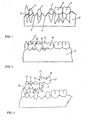
- FIG. 1 shows an initial situation for receiving a bridge framework made of ceramic on prepared tooth stumps 1 with a surrounding the tooth roots Periodontium 2 and the gingival margin 3, with areas 4, in which teeth are missing, as well as with existing natural teeth. 5
- a bridge framework provided for the supply of this situation exists according to FIGS. 2 and 3 from a primary part 6 with a connection area as a male part 7 and an associated secondary part 8 with a female part 9 as a corresponding connection area.
- crowns 10 of the bridge framework are assigned to the tooth stumps 1 and are connected to one another by bridge members 11 via integrally formed regions situated between the bridge members, so-called connecting elements 12.
- the joining region of primary part 6 and secondary part 8 to be joined is formed in a bridge member 11.
- the male part 7 as part of the bridge member 11 following the connector 12 is formed as a conical extension in the insertion direction and has rounded portions with flowing transitions.
- a stepped edge 13 for the aufndde secondary part 8 with the die 9 to form the bridge member 11 is formed in the upper region of the bridge member 11 with the male part 7 .
- the die 9 is received via a lower support area 14 with a circular groove 15 of the male part 7.
- an adhesive gap 16 between the male part 7 and the die 9 is formed, which receives the ceramic solder.
- the groove 15 offers not only one for joining enlarged surface, but at the same time gives an optimal pressure absorption.
- the joining takes place in a ceramic firing, before finally the bridge framework is ceramic-veneered as a whole.
Landscapes
- Health & Medical Sciences (AREA)
- Epidemiology (AREA)
- Oral & Maxillofacial Surgery (AREA)
- Dentistry (AREA)
- Life Sciences & Earth Sciences (AREA)
- Animal Behavior & Ethology (AREA)
- General Health & Medical Sciences (AREA)
- Public Health (AREA)
- Veterinary Medicine (AREA)
- Ceramic Engineering (AREA)
- Engineering & Computer Science (AREA)
- Chemical & Material Sciences (AREA)
- Dental Preparations (AREA)
- Ceramic Products (AREA)
Description
- Die Erfindung bezieht sich auf ein Brückengerüst für einen Zahnersatz in Form einer großspannigen Brücke aus einem keramischen Werkstoff auf der Basis von Zirkondioxid, bestehend aus einem Primärteil und einem mit diesem verbundenen Sekundärteil, wobei die Verbindung zwischen dem Primärteil und dem Sekundärteil über ein verbindungselement gebildet ist und die zu verbindenden Teile als korrespondierende Formteile in Gestalt einer Patrize und einer Matrize ausgebildet sind und wobei das Brückengerüst auf präparierte zahnstümpfe aufsetzbar ist. Ferner bezieht sich die Erfindung auf ein Verfahren zur Herstellung eines solchen Brückengerüstes.
- Im Bereich der Dentaltechnik erlangt der keramische Werkstoff zirkondioxid aufgrund seiner hervorragenden mechanischen Eigenschaften, wie der hohen Biegefestigkeit und Härte, sowie aufgrund seiner exzellenten Biokompatibilität zunehmende Bedeutung als Metallersatz. Seine Farbe und seine biotechnischen Eigenschaften ermöglichen die Herstellung von hochwertigen ästethischen Dentalkomponenten, wie Kronen und Brückenkonstruktionen. Es besteht allerdings in der Praxis die Schwierigkeit, daß die Fertigung großspanniger Brückengerüste und Brückenkonstruktionen aus Zirkondioxid-Keramik bisher nur mittels relativ aufwendiger CAD/CAM-Anlagen erfolgen kann. Nur diese sind geeignet, Komponenten mit hinreichend großen Abmessungen in einem Stück aus einem entsprechenden Keramikrohling zu fertigen. Hinzu kommt, daß Rohlinge in einer Größe, die für die Fertigung solcher Komponenten erforderlich ist, relativ kostspielig sind und nur bedingt zur Verfügung stehen.
- Es besteht daher das Bestreben, mehrgliedrige Brückengerüste aus mehreren einzelnen Komponenten zu fertigen, die jeweils zunächst einzeln aus entsprechend dimensionierten Keramikrohlingen hergestellt werden können, die eine wesentlich geringere Ausgangsgröße aufweisen müssen und deren Bearbeitung deshalb auch auf in herkömmlichen Zahntechniklaboren vorhandenen Bearbeitungseinrichtungen möglich ist. Ein derartiges Brüchengerüst ist beispielsverse aus der
DE-A-3930 358 bekannt. - Aus der
DE 102 48 629 A1 ist ein Brückengerüst der eingangs genannten Art aus einem keramischen Werkstoff, insbesondere aus Zirkonoxid, sowie ein Verfahren zu dessen Herstellung bekannt geworden, wobei das derart hergestellte Brückengerüst auch auf Zahnstümpfe aufsetzbar sein soll, die nicht parallel zueinander stehen. Zu diesem Zweck ist bei diesem bekannten Brückengerüst, dessen Länge größer ist als die üblicherweise zur Verfügung stehenden Keramik-Rohlinge, vorgesehen, daß es aus zumindest zwei Geschiebekomponenten in Form einer Matrize und einer Patrize besteht und daß diese beiden Komponenten nach dem Aufsetzen auf die jeweils zugeordneten und entsprechend vorbereiteten Zahnstümpfe miteinander verklebt werden. Hierzu verläuft zwischen der Matrize und der Patrize ein definierter Spalt, in den ein Bindemittel, wie Zement oder Klebstoff, eingebracht wird, um die Matrize mit der Patrize zu verbinden. - Daneben ist es bereits bekannt, bei der Verbindung von aus Keramik gefertigten Primär- und Sekundärteilen zu einem Brückengerüst das Primärteil mit einem Ansatz in Form eines sogenannten Geschiebes, beispielsweise eines Schroederzapfens, zu versehen, der über einen Steg einstöckig an das Primärteil angeformt ist und auf den das Sekundärteil im wesentlichen vertikal aufgeschoben wird.
- Ferner ist in der
DE 198 35 778 A1 eine Verankerung für einen herausnehmbaren Zahnersatz mit einem Brückengerüst beschrieben, bei dem eine fest verbindbare Patrize und eine von dieser lösbare Matrize miteinander korrespondierende Oberflächen aufweisen, jedoch werden bei dieser bekannten Anordnung Patrize und Matrize nicht dauerhaft miteinander verbunden. - In diesen bekannten Fällen stellt sich das Problem, eine ausreichende Bruchfestigkeit eines so hergestellten Brückengerüstes, insbesondere bei punktförmigen Druck- und Kerbbelastungen auf den mittleren Bereich der Brücke, sicherzustellen.
- Aufgabe der Erfindung ist es, ein Brückengerüst der eingangs genannten Art so auszubilden, daß es auch stärkeren Druckkräften, die auf den verbindungsbereich einwirken, widersteht, ohne vorzeitig zu versagen, und daß es zugleich geeignet ist, sowohl im Seitenzahnbereich als auch im Frontzahnbereich eingesetzt zu werden. Weiterhin soll durch die Erfindung ein Verfahren zur Herstellung eines solchen Brückengerüstes angegeben werden.
- Die Lösung der ersten Aufgabe erfolgt erfindungsgemäß dadurch, daß nach dem Zusammenfügen der miteinander zu verbindenden Teile aus einem Zirkondioxidwerkstoff in einem Brückenglied ein innenliegender umschlossener zentraler Bereich mit einer stoffschlüssigen Verbindung zwischen dem Primärteil und dem Sekundärteil gebildet ist, wobei die Verbindung über ein in einem keramischen Brand verfestigbares Keramiklot gebildet ist.
- Durch die erfindungsgemäße Ausbildung des Brückengerüstes wird ein keramikgerechtes Design ermöglicht. Da das Fügen in einem Brückenglied über ein beim keramischen Brand der Brücke als Ganzes verfestigendes Keramiklot erfolgt und zu einer stoffschlüssigen Verbindung von Primär- und Sekundärteil miteinander führt, widersteht das Brückengerüst nach der Erfindung auch erhöhtem Druck dadurch, daß bei punktförmigen Beanspruchungen auf den mittleren Brückenbereich die einwirkenden Zug- und Biegekräfte auf benachbarte Verankerungselemente, wie Kronen oder Teilkronen, umgeleitet werden. Auf diese Weise ist eine weitgehende Reduktion von Biege- und Scherbeanspruchungen auf Werte, die das Verbundsystem als Ganzes nicht gefährden können, gewährleistet. Die Brückengerüste nach der Erfindung sind dabei mit den in zahntechnischen Laboren üblicherweise verfügbaren Mitteln und zugleich relativ einfach und preisgünstig herstellbar.
- Eine günstige Ausbildung besteht darin, daß die Patrize eine obere Abschlußkante mit dem Matrizenbereich und einen unteren Auflagebereich mit einer zirkulären Hohlkehle zur Aufnahme der Matrize aufweist. Um eine schonende Krafteinleitung herbeizuführen und um scharfe Kanten zu vermeiden, wird zudem vorgeschlagen, daß die korrespondierenden Begrenzungen von Primär- und Sekundärteil als Abrundungen in Form von fließenden Übergängen ausgebildet sind. Dies ermöglicht zugleich ein optimales Einfließen des Klebers durch Kapillarkräfte in die miteinander zu verbindenden Bereiche. Auf diese Weise werden die optimalen Bedingungen für eine Anwendung des erfindungsgemäß vorgesehenen Keramiklotes zur Erzielung einer stoffschlüssigen Verbindung gewährleistet. Eine belastbare Ausbildung wird darüber hinaus insbesondere dadurch geschaffen, daß der Querschnitt der zwischen den Brückengliedern liegenden Verbindungselementen eine Flächengröße von wenigstens 9 mm2 aufweist.
- Weiterhin wird vorgeschlagen, daß das gesamte derart hergestellte Brückengerüst im gefügten Zustand verblendet wird. Das erfindungsgemäße Brückengerüst ist damit ohne Einschränkungen sowohl im Front- als auch im Seitenzahnbereich einsetzbar, unabhängig von der Größe und der Anzahl der erforderlichen Brückenglieder. Dabei besteht selbst bei einer geringen Anzahl von noch vorhandenen Pfeilerzähnen keine statische Einschränkung für die Gesamtkonstruktion, so daß nach dem erfindungsgemäß hergestellten zirkulären Brücken auch bei nur noch vier vorhandenen Pfeilerzähnen verwendet werden können.
- Durch die Erfindung ist eine Kombination von kleinspannigen Brückenelementen zu großspannigen Restaurationen in Form einer horizontalen Erweiterung ebenso möglich wie eine vertikale Verlängerung bei nicht ausreichender Blankhöhe zur Gestaltung überdimensional langer Zähne. Bei den im Rahmen der Erfindung eingesetzten Werkstoffen kann es sich dabei sowohl um gesintertes Grünlingsmaterial als auch um heiß-isostatisch verpreßtes Zirkondioxid, sogenanntes HIP-Zirkon, handeln.
- Nachfolgend soll die Erfindung anhand von in den Zeichnungen dargestellten Ausführungsbeispielen näher erläutert werden. Es zeigen:
- Fig. 1
- eine Ausgangsposition zum Aufsetzen eines Brückengerüstes mit drei präparierten Stümpfen in einer ersten Ausführungsform,
- Fig. 2
- die Anordnung gemäß
Fig. 1 mit einem aufgesetzten Brückengerüst aus miteinander verbundenem Primärteil und Sekundärteil, - Fig. 3
- eine Prinzipdarstellung der zugeordneten zusammenzusetzenden Teile und die angedeutete Einschubbewegung der Anordnung gemäß
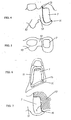
Fig. 1 , - Fig. 4
- einen Verbindungsbereich des Primärteils gemäß
Fig. 3 mit einer Patrize in vergrößerter vestibulärer Darstellung, - Fig. 5
- eine Draufsicht oder okklusale Ansicht der Anordnung gemäß
Fig. 4 , - Fig. 6
- eine Draufsicht in Pfeilrichtung oder approximale Ansicht auf den verbindungsbereich der Anordnung gemäß
Fig. 4 und - Fig. 7
- eine vergrößerte Schnittdarstellung des Verbindungsbereiches zwischen Primärteil und aufgesetztem Sekundärteil der Anordnung gemäß den
Figuren 2 und 3 mit einem Klebespalt. - Die Darstellung gemäß
Fig. 1 zeigt eine Ausgangssituation zur Aufnahme eines Brückengerüstes aus Keramik über präparierte Zahnstümpfe 1 mit einem die zahnwurzeln umgebenden Periodontium 2 und dem Zahnfleischsaum 3, mit Bereichen 4, in denen Zähne fehlen, sowie mit noch vorhandenen natürlichen Zähnen 5. - Ein zur versorgung dieser Situation vorgesehenes Brückengerüst besteht gemäß den
Figuren 2 und 3 aus einem Primärteil 6 mit einem Verbindungsbereich als Patrize 7 und einem zugeordneten Sekundärteil 8 mit einer Matrize 9 als korrespondierendem verbindungsbereich. Hierbei sind Kronen 10 des Brückengerüstes den Zahnstümpfen 1 zugeordnet und durch Brückenglieder 11 über zwischen den Brückengliedern liegende angeformte Bereiche, sogenannte Verbindungselemente 12, miteinander verbunden. Der zu fügende Verbindungsbereich von Primärteil 6 und Sekundärteil 8 ist in einem Brückenglied 11 ausgebildet. - Die Patrize 7 als Teil des Brückengliedes 11 im Anschluß an den Verbinder 12 ist als konische Erweiterung in Einschubrichtung ausgebildet und besitzt Abrundungen mit fließenden Übergängen. Im oberen Bereich des Brückengliedes 11 mit der Patrize 7 ist eine abgesetzte Abschlußkante 13 für das aufzusetzende Sekundärteil 8 mit der Matrize 9 zur Bildung des Brückengliedes 11 ausgebildet. Die Matrize 9 wird dabei über einen unteren Auflagebereich 14 mit einer zirkulären Hohlkehle 15 der Patrize 7 aufgenommen. Hierbei wird ein Klebespalt 16 zwischen der Patrize 7 und der Matrize 9 gebildet, der das Keramiklot aufnimmt. Die Hohlkehle 15 bietet dabei nicht nur eine für das Fügen vergrößerte Oberfläche, sondern ergibt zugleich eine optimale Druckaufnahme.
- Nach dem Einbringen des Keramiklotes in den Klebespalt 16 und dem Zusammenführen von Primärteil 6 und Sekundärteil 8 erfolgt das Fügen in einem keramischen Brand, bevor das Brückengerüst abschließend als Ganzes keramisch verblendet wird.
- Durch die Umschließung der Patrize 7 durch die Matrize 9 wird eine große Auflagefläche für die Verbindung geschaffen, die eine optimale Druckverteilung ermöglicht. Ferner ist bei der in den
Figuren 1 bis 7 dargestellten Ausführungsform am Primärteil 6 eine okklusale Aufmodellation 17 durch Verklebung mit dem heißaushärtenden Keramiklot vorgesehen. - Bei dem vorangehend beschriebenen Ausführungsbeispiel ist damit eine optimal formschlüssige und nach der erfolgten Verbindung durch das im keramischen Brand aushärtende Keramiklot insbesondere auch stoffschlüssige Verbindung von Primär- und Sekundärteil gegeben. Die dabei erzielbare Bruchfestigkeit in dem gefügten Brückenglied ist so hoch, daß die auf diese weise hergestellten Brückengerüste bei einer Bruchprüfung in einem Dreipunktbiegeversuch nicht an der Klebestelle, sondern im Bereich des nicht geklebten umgebenden vollmaterials versagen, wenn die Biegefestigkeit des für die Herstellung des Brückengerüstes verwendeten Zirkondioxids überschritten wird.
Claims (6)
- Brückengerüst für einen Zahnersatz in Form einer großspannigen Brücke aus einem keramischen Werkstoff auf der Basis von Zirkondioxid, bestehend aus einem Primärteil (6) und einem mit diesem verbundenen Sekundärteil (8), wobei die Verbindung zwischen dem Primärteil und dem Sekundärteil über ein verbindungselement (12) gebildet ist und die zu verbindenden Teile als korrespondierende Formteile in Gestalt einer Patrize und einer Matrize ausgebildet sind und wobei das Brückengerüst auf präparierte Zahnstümpfe aufsetzbar ist, wobei nach dem Zusammenfügender miteinander zu verbindenden Teile aus einem Zirkondioxidwerkstoff in einem Brückenglied ein innenliegender umschlossener zentraler Bereich mit einer stoffschlüssigen Verbindung zwischen dem Primärteil (6) und dem Sekundärteil (8) gebildet ist, und wodei die Verbindung über ein in einem keramischen Brand verfestigbares Keramiklot gebildet ist.
- Brückengerüst nach Anspruch 1, dadurch gekennzeichnet, daß das Primärteil (6) im verbindungsbereich als Matrize (7) ausgebildet ist und das Sekundärteil (8) die zugeordnete Patrize (9) aufweist, die auf die Matrize (7) in etwa vertikal aufschiebbar ist.
- Brückengerüst nach Anspruch 2, dadurch gekennzeichnet, daß die Patrize als konische Erweiterung in Einschubrichtung ausgeformt ist und eine obere Abschlußkante (13) mit dem Matrizenbereich und einen unteren Auflagebereich (14) mit einer zirkulären Hohlkehle (15) zur Aufnahme der Matrize (9) aufweist.
- Brückengerüst nach einem der Ansprüche 1 bis 3, dadurch gekennzeichnet, daß die korrespondierenden Begrenzungen von Patrize (7) und Matrize (9) als Abrundungen in Form von fließenden Übergängen ausgebildet sind.
- Brückengerüst nach einem der Ansprüche 1 bis 4, dadurch gekennzeichnet, daß der Querschnitt des verbindungselementes (12) zwischen den Elementen der Brücke eine Flächengröße von wenigstens 9 mm2 aufweist.
- Brückengerüst nach einem der Ansprüche 1 bis 5, dadurch gekennzeichnet, daß das Brückengerüst in gefügtem Zustand keramisch verblendbar ist.
Applications Claiming Priority (1)
| Application Number | Priority Date | Filing Date | Title |
|---|---|---|---|
| DE200610047341 DE102006047341B4 (de) | 2006-10-06 | 2006-10-06 | Brückengerüst als Zahnersatz |
Publications (2)
| Publication Number | Publication Date |
|---|---|
| EP1908433A1 EP1908433A1 (de) | 2008-04-09 |
| EP1908433B1 true EP1908433B1 (de) | 2013-01-16 |
Family
ID=38957702
Family Applications (1)
| Application Number | Title | Priority Date | Filing Date |
|---|---|---|---|
| EP20070019420 Not-in-force EP1908433B1 (de) | 2006-10-06 | 2007-10-04 | Brückengerüst als Zahnersatz |
Country Status (3)
| Country | Link |
|---|---|
| EP (1) | EP1908433B1 (de) |
| DE (1) | DE102006047341B4 (de) |
| ES (1) | ES2402010T3 (de) |
Families Citing this family (4)
| Publication number | Priority date | Publication date | Assignee | Title |
|---|---|---|---|---|
| DE102009051655B3 (de) * | 2009-07-14 | 2010-12-30 | Dcm Gmbh | Verfahren zur Konditionierung der Oberflächen von Dentalkomponenten und Verwendungen des Verfahrens |
| EP3082644B1 (de) * | 2013-12-19 | 2017-09-06 | Juvora Limited | Dentale rahmen und zugehörige vorrichtung und verfahren |
| CN112386344B (zh) * | 2020-10-15 | 2022-10-21 | 儒蓉(成都)医疗科技有限公司 | 一种弹性贴面桥及其制备方法 |
| DE102023133355A1 (de) | 2023-11-29 | 2025-06-05 | Maximilian Prücklmaier | Zahnprovisorium zur vorübergehenden und/oder lösbaren Anordnung an zumindest zwei Implantaten in einem Mundbereich sowie Herstellungsverfahren des Zahnprovisoriums |
Family Cites Families (8)
| Publication number | Priority date | Publication date | Assignee | Title |
|---|---|---|---|---|
| US4744757A (en) * | 1985-03-20 | 1988-05-17 | Corning Glass Works | Fixed partial dentures and method of making |
| DE3930358A1 (de) | 1989-09-12 | 1991-05-08 | Dental Labor Werner Puckert | Prothetisches brueckengeruest fuer festsitzenden zahnersatz und verfahren zu seiner herstellung |
| ATE274860T1 (de) * | 1995-12-19 | 2004-09-15 | Ivoclar Vivadent Ag | Verfahren zur herstellung von zahnkronen und/oder zahnbrücken |
| DE19835778A1 (de) | 1998-08-07 | 2000-02-17 | Weigl Paul | Verankerung für herausnehmbaren Zahnersatz an Kronen oder Brücken |
| DE19853949C2 (de) * | 1998-11-23 | 2003-01-09 | Ivoclar Vivadent Ag | Keramische Zahnrestauration |
| DE60122683T2 (de) * | 2000-03-22 | 2007-05-10 | K L Aps | Zahnbrückenanordnung und bindemittel dafür |
| DE10248629A1 (de) | 2002-07-02 | 2004-01-22 | Degudent Gmbh | Verfahren zur Herstellung eines dentalen Brückengerüsts sowie Positivmodell für ein solches |
| WO2004004595A2 (de) * | 2002-07-02 | 2004-01-15 | Degudent Gmbh | Verfahren zur herstellung eines dentalen brückengerüsts sowie positivmodell für ein solches |
-
2006
- 2006-10-06 DE DE200610047341 patent/DE102006047341B4/de not_active Expired - Fee Related
-
2007
- 2007-10-04 ES ES07019420T patent/ES2402010T3/es active Active
- 2007-10-04 EP EP20070019420 patent/EP1908433B1/de not_active Not-in-force
Also Published As
| Publication number | Publication date |
|---|---|
| DE102006047341A1 (de) | 2008-04-10 |
| DE102006047341B4 (de) | 2013-08-08 |
| ES2402010T3 (es) | 2013-04-26 |
| EP1908433A1 (de) | 2008-04-09 |
Similar Documents
| Publication | Publication Date | Title |
|---|---|---|
| EP0781530B1 (de) | Verfahren zur Herstellung von Zahnkronen und/oder Zahnbrücken | |
| EP2775955B1 (de) | Fräsblock, verfahren zur herstellung von teil- oder totalprothesen sowie fräsblocksystem | |
| DE102005023105B4 (de) | Verfahren zur Herstellung eines Zahnersatzteils und ein derart hergestelltes Zahnersatzteil | |
| DE102012201092B4 (de) | Zahntechnisches Implantatsystem | |
| EP2090263A1 (de) | Abutment mit Inlay fuer Dentalimplantate | |
| DE102009001782A1 (de) | Gingivaformer | |
| DE102012108153A1 (de) | Rohling und Verfahren zur Herstellung einer Dentalrestauration durch substraktive Bearbeitung | |
| DE10348369B4 (de) | Zahnrestaurationsteil sowie Verfahren zur Herstellung eines Zahnrestaurationsteils | |
| EP1004278B1 (de) | Keramische Zahnrestauration | |
| EP1908433A1 (de) | Brückengerüst als Zahnersatz | |
| DE102016107935A1 (de) | Verfahren zum Herstellen einer realen Verblendung sowie Verblendung und Brücke erhältlich nach dem Verfahren | |
| DE102008058305A1 (de) | Verbindungsvorrichtung zur Befestigung einer dentalen Prothese an einem Kieferknochen und Verfahren zur Herstellung einer Verbindungsvorrichtung | |
| EP1603483B1 (de) | Verfahren zur herstellung einer zahnersatzprothese und kunstzahn dafür | |
| DE102008064273B4 (de) | Doppelkrone | |
| EP2800538A1 (de) | Dentalimplantat | |
| DE19608755C2 (de) | Trägerelemente für ein Metallgerüst einer implantatgetragenen Suprakonstruktion und Verfahren zur Herstellung | |
| DE102005059922B4 (de) | Verfahren zur Herstellung eines Retainers oder Lückenhalters | |
| DE3535266A1 (de) | Dentale verankerung | |
| DE19624864C2 (de) | Restaurationsstift | |
| DE102013207048A1 (de) | Verfahren zur Herstellung eines Präzisionsgebissmodells für die Herstellung/Anpassung eines Zahnersatzes | |
| DE2102564A1 (de) | Zahnprothese | |
| DE10348370B4 (de) | Zahnrestaurationsteil | |
| EP0664106A2 (de) | System zur Restauration zerstörter Zähne | |
| EP3125819B1 (de) | Verfahren zur herstellung einer künstlichen zahnkrone, zahnkrone sowie überdeckung mit dieser zahnkrone | |
| DE20004765U1 (de) | Tertiärstrukturaufbau für die Herstellung von Zahnersatz |
Legal Events
| Date | Code | Title | Description |
|---|---|---|---|
| PUAI | Public reference made under article 153(3) epc to a published international application that has entered the european phase |
Free format text: ORIGINAL CODE: 0009012 |
|
| AK | Designated contracting states |
Kind code of ref document: A1 Designated state(s): AT BE BG CH CY CZ DE DK EE ES FI FR GB GR HU IE IS IT LI LT LU LV MC MT NL PL PT RO SE SI SK TR |
|
| AX | Request for extension of the european patent |
Extension state: AL BA HR MK RS |
|
| RIN1 | Information on inventor provided before grant (corrected) |
Inventor name: ZOTHNER, AURICA |
|
| 17P | Request for examination filed |
Effective date: 20080705 |
|
| AKX | Designation fees paid |
Designated state(s): AT BE BG CH CY CZ DE DK EE ES FI FR GB GR HU IE IS IT LI LT LU LV MC MT NL PL PT RO SE SI SK TR |
|
| 17Q | First examination report despatched |
Effective date: 20090803 |
|
| GRAP | Despatch of communication of intention to grant a patent |
Free format text: ORIGINAL CODE: EPIDOSNIGR1 |
|
| GRAS | Grant fee paid |
Free format text: ORIGINAL CODE: EPIDOSNIGR3 |
|
| GRAA | (expected) grant |
Free format text: ORIGINAL CODE: 0009210 |
|
| AK | Designated contracting states |
Kind code of ref document: B1 Designated state(s): AT BE BG CH CY CZ DE DK EE ES FI FR GB GR HU IE IS IT LI LT LU LV MC MT NL PL PT RO SE SI SK TR |
|
| REG | Reference to a national code |
Ref country code: GB Ref legal event code: FG4D Free format text: NOT ENGLISH |
|
| REG | Reference to a national code |
Ref country code: CH Ref legal event code: EP |
|
| REG | Reference to a national code |
Ref country code: IE Ref legal event code: FG4D Free format text: LANGUAGE OF EP DOCUMENT: GERMAN |
|
| REG | Reference to a national code |
Ref country code: AT Ref legal event code: REF Ref document number: 593442 Country of ref document: AT Kind code of ref document: T Effective date: 20130215 Ref country code: CH Ref legal event code: EP |
|
| REG | Reference to a national code |
Ref country code: DE Ref legal event code: R096 Ref document number: 502007011210 Country of ref document: DE Effective date: 20130307 |
|
| REG | Reference to a national code |
Ref country code: NL Ref legal event code: T3 |
|
| REG | Reference to a national code |
Ref country code: CH Ref legal event code: NV Representative=s name: ALDO ROEMPLER PATENTANWALT, CH |
|
| REG | Reference to a national code |
Ref country code: LT Ref legal event code: MG4D |
|
| PG25 | Lapsed in a contracting state [announced via postgrant information from national office to epo] |
Ref country code: LT Free format text: LAPSE BECAUSE OF FAILURE TO SUBMIT A TRANSLATION OF THE DESCRIPTION OR TO PAY THE FEE WITHIN THE PRESCRIBED TIME-LIMIT Effective date: 20130116 Ref country code: SE Free format text: LAPSE BECAUSE OF FAILURE TO SUBMIT A TRANSLATION OF THE DESCRIPTION OR TO PAY THE FEE WITHIN THE PRESCRIBED TIME-LIMIT Effective date: 20130116 Ref country code: IS Free format text: LAPSE BECAUSE OF FAILURE TO SUBMIT A TRANSLATION OF THE DESCRIPTION OR TO PAY THE FEE WITHIN THE PRESCRIBED TIME-LIMIT Effective date: 20130516 Ref country code: BG Free format text: LAPSE BECAUSE OF FAILURE TO SUBMIT A TRANSLATION OF THE DESCRIPTION OR TO PAY THE FEE WITHIN THE PRESCRIBED TIME-LIMIT Effective date: 20130416 |
|
| PG25 | Lapsed in a contracting state [announced via postgrant information from national office to epo] |
Ref country code: SI Free format text: LAPSE BECAUSE OF FAILURE TO SUBMIT A TRANSLATION OF THE DESCRIPTION OR TO PAY THE FEE WITHIN THE PRESCRIBED TIME-LIMIT Effective date: 20130116 Ref country code: LV Free format text: LAPSE BECAUSE OF FAILURE TO SUBMIT A TRANSLATION OF THE DESCRIPTION OR TO PAY THE FEE WITHIN THE PRESCRIBED TIME-LIMIT Effective date: 20130116 Ref country code: PT Free format text: LAPSE BECAUSE OF FAILURE TO SUBMIT A TRANSLATION OF THE DESCRIPTION OR TO PAY THE FEE WITHIN THE PRESCRIBED TIME-LIMIT Effective date: 20130516 Ref country code: PL Free format text: LAPSE BECAUSE OF FAILURE TO SUBMIT A TRANSLATION OF THE DESCRIPTION OR TO PAY THE FEE WITHIN THE PRESCRIBED TIME-LIMIT Effective date: 20130116 Ref country code: FI Free format text: LAPSE BECAUSE OF FAILURE TO SUBMIT A TRANSLATION OF THE DESCRIPTION OR TO PAY THE FEE WITHIN THE PRESCRIBED TIME-LIMIT Effective date: 20130116 Ref country code: GR Free format text: LAPSE BECAUSE OF FAILURE TO SUBMIT A TRANSLATION OF THE DESCRIPTION OR TO PAY THE FEE WITHIN THE PRESCRIBED TIME-LIMIT Effective date: 20130417 |
|
| PG25 | Lapsed in a contracting state [announced via postgrant information from national office to epo] |
Ref country code: CZ Free format text: LAPSE BECAUSE OF FAILURE TO SUBMIT A TRANSLATION OF THE DESCRIPTION OR TO PAY THE FEE WITHIN THE PRESCRIBED TIME-LIMIT Effective date: 20130116 Ref country code: EE Free format text: LAPSE BECAUSE OF FAILURE TO SUBMIT A TRANSLATION OF THE DESCRIPTION OR TO PAY THE FEE WITHIN THE PRESCRIBED TIME-LIMIT Effective date: 20130116 Ref country code: RO Free format text: LAPSE BECAUSE OF FAILURE TO SUBMIT A TRANSLATION OF THE DESCRIPTION OR TO PAY THE FEE WITHIN THE PRESCRIBED TIME-LIMIT Effective date: 20130116 Ref country code: SK Free format text: LAPSE BECAUSE OF FAILURE TO SUBMIT A TRANSLATION OF THE DESCRIPTION OR TO PAY THE FEE WITHIN THE PRESCRIBED TIME-LIMIT Effective date: 20130116 Ref country code: DK Free format text: LAPSE BECAUSE OF FAILURE TO SUBMIT A TRANSLATION OF THE DESCRIPTION OR TO PAY THE FEE WITHIN THE PRESCRIBED TIME-LIMIT Effective date: 20130116 |
|
| PLBE | No opposition filed within time limit |
Free format text: ORIGINAL CODE: 0009261 |
|
| STAA | Information on the status of an ep patent application or granted ep patent |
Free format text: STATUS: NO OPPOSITION FILED WITHIN TIME LIMIT |
|
| PG25 | Lapsed in a contracting state [announced via postgrant information from national office to epo] |
Ref country code: CY Free format text: LAPSE BECAUSE OF FAILURE TO SUBMIT A TRANSLATION OF THE DESCRIPTION OR TO PAY THE FEE WITHIN THE PRESCRIBED TIME-LIMIT Effective date: 20130116 |
|
| 26N | No opposition filed |
Effective date: 20131017 |
|
| PGFP | Annual fee paid to national office [announced via postgrant information from national office to epo] |
Ref country code: GB Payment date: 20131004 Year of fee payment: 7 |
|
| REG | Reference to a national code |
Ref country code: DE Ref legal event code: R097 Ref document number: 502007011210 Country of ref document: DE Effective date: 20131017 |
|
| PG25 | Lapsed in a contracting state [announced via postgrant information from national office to epo] |
Ref country code: MC Free format text: LAPSE BECAUSE OF FAILURE TO SUBMIT A TRANSLATION OF THE DESCRIPTION OR TO PAY THE FEE WITHIN THE PRESCRIBED TIME-LIMIT Effective date: 20130116 |
|
| REG | Reference to a national code |
Ref country code: IE Ref legal event code: MM4A |
|
| PGFP | Annual fee paid to national office [announced via postgrant information from national office to epo] |
Ref country code: FR Payment date: 20140328 Year of fee payment: 7 |
|
| PG25 | Lapsed in a contracting state [announced via postgrant information from national office to epo] |
Ref country code: IE Free format text: LAPSE BECAUSE OF NON-PAYMENT OF DUE FEES Effective date: 20131004 |
|
| GBPC | Gb: european patent ceased through non-payment of renewal fee |
Effective date: 20141004 |
|
| PG25 | Lapsed in a contracting state [announced via postgrant information from national office to epo] |
Ref country code: TR Free format text: LAPSE BECAUSE OF FAILURE TO SUBMIT A TRANSLATION OF THE DESCRIPTION OR TO PAY THE FEE WITHIN THE PRESCRIBED TIME-LIMIT Effective date: 20130116 |
|
| PG25 | Lapsed in a contracting state [announced via postgrant information from national office to epo] |
Ref country code: HU Free format text: LAPSE BECAUSE OF FAILURE TO SUBMIT A TRANSLATION OF THE DESCRIPTION OR TO PAY THE FEE WITHIN THE PRESCRIBED TIME-LIMIT; INVALID AB INITIO Effective date: 20071004 Ref country code: GB Free format text: LAPSE BECAUSE OF NON-PAYMENT OF DUE FEES Effective date: 20141004 |
|
| REG | Reference to a national code |
Ref country code: FR Ref legal event code: ST Effective date: 20150630 |
|
| PG25 | Lapsed in a contracting state [announced via postgrant information from national office to epo] |
Ref country code: MT Free format text: LAPSE BECAUSE OF FAILURE TO SUBMIT A TRANSLATION OF THE DESCRIPTION OR TO PAY THE FEE WITHIN THE PRESCRIBED TIME-LIMIT Effective date: 20130116 Ref country code: FR Free format text: LAPSE BECAUSE OF NON-PAYMENT OF DUE FEES Effective date: 20141031 |
|
| PGFP | Annual fee paid to national office [announced via postgrant information from national office to epo] |
Ref country code: LU Payment date: 20181022 Year of fee payment: 12 |
|
| PGFP | Annual fee paid to national office [announced via postgrant information from national office to epo] |
Ref country code: SE Payment date: 20181211 Year of fee payment: 13 |
|
| REG | Reference to a national code |
Ref country code: DE Ref legal event code: R082 Ref document number: 502007011210 Country of ref document: DE Representative=s name: ELBPATENT | MARSCHALL & PARTNER PARTG MBB, DE Ref country code: DE Ref legal event code: R082 Ref document number: 502007011210 Country of ref document: DE Representative=s name: ELBPATENT - MARSCHALL & PARTNER PARTGMBB, DE |
|
| PG25 | Lapsed in a contracting state [announced via postgrant information from national office to epo] |
Ref country code: LU Free format text: LAPSE BECAUSE OF NON-PAYMENT OF DUE FEES Effective date: 20191004 |
|
| REG | Reference to a national code |
Ref country code: AT Ref legal event code: MM01 Ref document number: 593442 Country of ref document: AT Kind code of ref document: T Effective date: 20191004 |
|
| PG25 | Lapsed in a contracting state [announced via postgrant information from national office to epo] |
Ref country code: AT Free format text: LAPSE BECAUSE OF NON-PAYMENT OF DUE FEES Effective date: 20191004 |
|
| PGFP | Annual fee paid to national office [announced via postgrant information from national office to epo] |
Ref country code: NL Payment date: 20211124 Year of fee payment: 15 Ref country code: ES Payment date: 20211123 Year of fee payment: 15 |
|
| PGFP | Annual fee paid to national office [announced via postgrant information from national office to epo] |
Ref country code: IT Payment date: 20211124 Year of fee payment: 15 Ref country code: CH Payment date: 20211125 Year of fee payment: 15 Ref country code: BE Payment date: 20211124 Year of fee payment: 15 |
|
| REG | Reference to a national code |
Ref country code: CH Ref legal event code: PL |
|
| REG | Reference to a national code |
Ref country code: NL Ref legal event code: MM Effective date: 20221101 |
|
| REG | Reference to a national code |
Ref country code: BE Ref legal event code: MM Effective date: 20221031 |
|
| P01 | Opt-out of the competence of the unified patent court (upc) registered |
Effective date: 20230527 |
|
| PG25 | Lapsed in a contracting state [announced via postgrant information from national office to epo] |
Ref country code: NL Free format text: LAPSE BECAUSE OF NON-PAYMENT OF DUE FEES Effective date: 20221101 Ref country code: LI Free format text: LAPSE BECAUSE OF NON-PAYMENT OF DUE FEES Effective date: 20221031 Ref country code: CH Free format text: LAPSE BECAUSE OF NON-PAYMENT OF DUE FEES Effective date: 20221031 |
|
| PG25 | Lapsed in a contracting state [announced via postgrant information from national office to epo] |
Ref country code: BE Free format text: LAPSE BECAUSE OF NON-PAYMENT OF DUE FEES Effective date: 20221031 |
|
| PG25 | Lapsed in a contracting state [announced via postgrant information from national office to epo] |
Ref country code: IT Free format text: LAPSE BECAUSE OF NON-PAYMENT OF DUE FEES Effective date: 20221004 |
|
| REG | Reference to a national code |
Ref country code: ES Ref legal event code: FD2A Effective date: 20231127 |
|
| PG25 | Lapsed in a contracting state [announced via postgrant information from national office to epo] |
Ref country code: ES Free format text: LAPSE BECAUSE OF NON-PAYMENT OF DUE FEES Effective date: 20221005 |
|
| PG25 | Lapsed in a contracting state [announced via postgrant information from national office to epo] |
Ref country code: ES Free format text: LAPSE BECAUSE OF NON-PAYMENT OF DUE FEES Effective date: 20221005 |
|
| PGFP | Annual fee paid to national office [announced via postgrant information from national office to epo] |
Ref country code: DE Payment date: 20230929 Year of fee payment: 17 |
|
| REG | Reference to a national code |
Ref country code: DE Ref legal event code: R119 Ref document number: 502007011210 Country of ref document: DE |
|
| PG25 | Lapsed in a contracting state [announced via postgrant information from national office to epo] |
Ref country code: DE Free format text: LAPSE BECAUSE OF NON-PAYMENT OF DUE FEES Effective date: 20250501 |