EP1908008B1 - Verfahren für zeitmarkierungen mit wasserzeichen, verfahren und vorrichtung zur zeitstempeldecodierung, verwendung und programmprodukte für die entsprechenden computer - Google Patents
Verfahren für zeitmarkierungen mit wasserzeichen, verfahren und vorrichtung zur zeitstempeldecodierung, verwendung und programmprodukte für die entsprechenden computer Download PDFInfo
- Publication number
- EP1908008B1 EP1908008B1 EP06792542A EP06792542A EP1908008B1 EP 1908008 B1 EP1908008 B1 EP 1908008B1 EP 06792542 A EP06792542 A EP 06792542A EP 06792542 A EP06792542 A EP 06792542A EP 1908008 B1 EP1908008 B1 EP 1908008B1
- Authority
- EP
- European Patent Office
- Prior art keywords
- signal
- timestamp
- value
- phase
- decoding
- Prior art date
- Legal status (The legal status is an assumption and is not a legal conclusion. Google has not performed a legal analysis and makes no representation as to the accuracy of the status listed.)
- Ceased
Links
Images
Classifications
-
- G—PHYSICS
- G06—COMPUTING OR CALCULATING; COUNTING
- G06T—IMAGE DATA PROCESSING OR GENERATION, IN GENERAL
- G06T1/00—General purpose image data processing
- G06T1/0021—Image watermarking
- G06T1/0085—Time domain based watermarking, e.g. watermarks spread over several images
Definitions
- the invention is placed in the field of watermarking, which is a marking technique of inserting one or more tattoo messages into a set of support data, in order to fight against fraud and piracy. and to ensure the protection of intellectual property rights.
- the invention relates to a method of tattooing at least one timestamp in a set of support data, and a method for decoding at least one tattooed timestamp in a set of support data.
- the invention can be applied to any type of support data (video, image, audio, text, 3D data, etc.).
- the invention applies regardless of the format of the support data: in the form of a stream (for example a video signal captured on a television channel), in the form of a file, in the form of a recording (cassette , DVD ...), etc.
- a time stamp (for example the date and time) which defines a time (or time position) with respect to an origin in a landmark is called a "time stamp" (also known as a "timestamp").
- time stamp also known as a "timestamp”
- given time and which is associated with a part of a signal (for example a unit of data, such as an image, of a set of data).
- a time stamp can be associated with each image and corresponds to the position of this image in the sequence.
- the reference used to define the time is not necessarily the universal time reference expressed in years, months, ..., minutes seconds, relative to at the origin of the usual times in the Gregorian calendar.
- One can for example choose as the time origin (t 0) the time corresponding to the first frame of a sequence (in the case of video), or on a given date (January 1, 2000 e.g. ).
- the unit of measure of time is not necessarily one of the usual units (day, second, etc.): in the case of video, it may be more relevant to define the basic unit as the duration of time. an image (1/25 th of a second in the case of the European TV standard). Note that one can very easily switch from one time marker to another by a simple conversion.
- the tattooing message comprises at least one timestamp.
- a tattoo system is an information transmission system that includes at least one transmitter (the "tattoo artist” itself), which modifies a video support for inserting the tattoo message, and at least one receiver (“Tattoo player”), which upon receipt of any video determines whether it is tattooed and, if so, what is the message inserted.
- the transmitter takes as input a set of data "support” (typically video data) and a number of parameters.
- the parameters include generally the tattoo message (also called “Carrier tattoo"), which is represented by a sequence of M bits (M ⁇ 1).
- M the tattoo message
- the tattoo artist modifies the video to produce a video tattooed.
- the receiver takes a video input as well as possibly a number of parameters (eg a key).
- it also takes as input the original video, which can be used to facilitate the determination of the channel parameters, by comparison between the original video and the video tested (video on which we seek to read the tattoo).
- the original video can also be used to facilitate the reading of the tattoo message: for example, subtracting the original from the tested video can reduce the impact of the noise affecting the tattoo, especially the noise produced by the original video. -even. From these data he usually performs a detection step, which determines whether the video is tattooed or not.
- the detection If the detection is positive, it carries out a step of determining (or decoding) the tattoo message or messages (one can have several tattoo messages if the support data are from a compositing operation, for example editing several video sequences , averaging images, making a montage or a mosaic using several support data, etc.).
- the tattoo messages detected are possibly accompanied by auxiliary information: for example a reliability index (estimation of the probability that the estimated tattoo message is wrong), tattoo location information (temporal and / or spatial location, in the case of compositing).
- tattooing is generally of interest only being associated with supporting data, for example to identify a broadcast extract.
- supporting data for example to identify a broadcast extract.
- the known method is to tattoo, on this portion of the video, a timestamp containing the corresponding date and time.
- the date-changing frequency and accuracy can vary from application to application: for example, if you need to accurately identify time (for example, tattooing is used to synchronize video and audio), then you will update the date contained in the timestamps to tattoo all the images, and the accuracy of the date will have to be of the order of 40 ms (duration of a video image in European TV format). If each timestamp is only used to identify a portion of video (for example, to automatically identify a broadcast program), then we can be content with a less accurate by changing the date contained in timestamps to tattoo than every second. ⁇ page 4a>
- a disadvantage of the known technique is that the size of the tattooed message depends on the maximum value allowed for the timestamp, as well as the desired accuracy. If for example one wishes to be able to identify a portion of video in a film (for example on a DVD), with a precision to the second, the tattooed timestamp, with the known technique, will be an identifier of the form h: mm: ss (hours, minutes, seconds).
- each tattooed timestamp must then be an identifier of the form mm :: jj :: hh :: mm : ss (months, days, hours, minutes, seconds).
- mm :: jj :: hh :: mm : ss months, days, hours, minutes, seconds.
- this can be problematic if the tattooed video undergoes alterations during his life, especially during its transmission. Indeed, changes in the video (for example, compression at a loss MPEG2 type) are a noise for the tattoo.
- the tattoo of each time stamp is to directly tattoo the value d k of this time stamp in each of the images.
- this value is for example an identifier of the form mm :: jj :: hh :: mm :: ss defining an instant with an accuracy of one second.
- one or more of the decoded values may be erroneous: if the number of errors is small, we can then detect them by locating the timestamps that are not consistent with the rest of the sequence (the "jumps" of values), then correct them. On the other hand, if a large number of decoded values are erroneous, it is then no longer possible to detect them and thus to correct them.
- the video consists of an assembly of several untattooed segments, or tattooed with timestamps of possibly different natures (that is to say, defined in different time references), it is sometimes interesting to precisely identify the transitions between these different segments.
- untattooed segments or tattooed with timestamps of possibly different natures (that is to say, defined in different time references)
- the tattooed timestamp may no longer be readable on certain images or parts of the sequence.
- the method of the aforementioned prior art where we reread the tattooed timestamp on each of the images of the sequence, it is thus possible to locally decode erroneous timestamps, or fail to decode tattooed timestamp. In this case, it becomes difficult to correctly and accurately identify the transitions between segments (tattooed or not tattooed) of the sequence. Unfixed decoding errors can thus be interpreted as the presence of "micro-segments" of very small length (a few images at most), which is very unlikely.
- the object of the invention is in particular to overcome these various disadvantages of the known art of the prior art.
- a tattoo / decode technique of a timestamp (s) in a data set for example a video sequence
- a data set for example a video sequence
- the invention also aims, in at least one embodiment, to provide such a technique with which the bit rate necessary for the coding of the time stamp is no longer directly dictated by the amplitude of the time stamp and its accuracy. ; this rate can be reduced if we accept a higher detection latency. For example, for the same steganographic bandwidth reserved for time stamping, it is necessary to increase the accuracy and the amplitude of the time stamp.
- Another object of the invention in at least one embodiment, is to provide such a technique by which it is no longer necessary to know precisely the characteristics (error rate) of the steganographic transmission channel to size. the accuracy and amplitude of the time stamp.
- an objective of the invention in at least one embodiment, is to propose a coding having an extensible character ("scalable" in English) allowing detection to adapt to the error rate of the channel, in introducing a granularity in detection greater or less.
- a complementary objective of the invention in at least one embodiment, is to provide such a technique
- Yet another object of the invention in at least one embodiment, is to provide such a technique allowing, in addition to the timestamps, to know precisely the boundaries of tattooed segments with timestamps of the same nature (defined in the same reference frame). temporal), and to minimize the risk of decoding errors induced by channel noise.
- Yet another object of the invention in at least one embodiment, is to provide such a technique making it possible to take into account the specificities of the noise introduced by the codings using the motion compensation (of the MEPG type), in order to increase the reliability of the decoding.
- the general principle of the invention therefore consists in tattooing a time stamp, not in the form of an identifier (for example of the form mm :: jj :: hh :: mm: as, for a month, days, hours, minutes, and seconds), but as the value at a given time of a reference timestamp signal (i.e., a clock signal).
- a reference timestamp signal i.e., a clock signal
- the reference time stamp signal takes distinct values when t varies from t d to t f , with t d and t f the start and end times of the tattooing of timestamps. This allows decoding to identify each time stamp uniquely.
- the support data set is a sequence of successive data units, and in that each value of the reference time stamp signal is tattooed in a separate data unit.
- the latency in detection is reduced.
- the support data set is a sequence of successive data units, and in that each value of the reference time stamp signal is tattooed by being distributed in at least two successive data units.
- the detection latency is increased, but it is possible, for the same steganographic bandwidth reserved for the time stamping, to increase the accuracy and the amplitude of the time stamp.
- sequence of successive data units belongs to the group comprising: sequences of video type data units, also called video sequences and sequences of audio type data units, also called audio sequences.
- this feature allows reception (decoding of timestamps), to bring several successive received values to several estimates of the same value received, and to perform a global treatment on these estimates of the same value received (possibly after merging them).
- the tattoo of the horodate according to the invention as an extensible coding ("scalable" in English) over time. Indeed, if the signal is very noisy, we can receive globally processing several data units (images for example) consecutive before proceeding to decoding. We then have an equalizer code of redundancy higher, so more resistant to noise; on the other hand the latency in detection will be higher.
- the resolution minimum tattooed sequence size required to decode a segment therefore varies automatically according to the signal-to-noise ratio, without the need to modify the coding.
- the values x 1 ,..., X k , x k + 1 ,... are words that are distinct from an m-sequence code, and that the functions f and f -1 are circular permutations.
- each of the values of the reference time-stamp signal comprises N parts, with N ⁇ 2, a part of rank 1, called the fast part, being incremented all the time stamps and taking cyclic values according to a period p 1 , a part of rank i, with i ⁇ ⁇ 2 ... N ⁇ , being incremented when the rank portion i-1 has performed a complete period p i-1 , and taking cyclic values according to a period p i .
- the association and tattooing steps are performed separately, and identically or not, for each of the N parts of the values.
- the slow part separation / other part (s) has the advantage of reducing the decoding complexity.
- the sequence x 1 ,..., X k , x k + 1 ,... is a sequence of fast portions of values of the timestamp signal.
- the timestamps are transmitted according to the timestamp tattooing method of the invention (i.e. in the form of the value at a given instant of a reference timestamp signal) and not in the form of an identifier according to the prior art (for example of the form mm :: jj :: hh :: mm :: ss).
- the phase-shifted timestamp signal takes different values when t varies from t to t f ', with t of t and r' the instants of starting and ending timestamp decoding.
- the support data set is a sequence of successive data units, and in that, during the reading step, each value, coded or uncoded, is read in a separate data unit.
- the support data set is a sequence of successive data units, and, during the reading step, each value, coded or uncoded, is obtained by combining information read in minus two units of data.
- the reading step comprises the following steps: raw reception of at least one received value; and decoding said at least one received value, to obtain a read value of the phase-shifted signal equal to one of the values of the reference signal.
- the raw reception step makes it possible to receive a sequence, said received sequence, of at least two received values
- the decoding step consists of a sliding correlation decoding between said received sequence and a reference sequence.
- the raw reception step makes it possible to receive a sequence; said received sequence, of at least two received values; the raw reception step is followed by a global processing step of said received sequence, making it possible to obtain a resultant value; and the decoding step relates to said resultant value.
- the initial values x 1 ,..., X k , x k + 1 , ... x T are words distinct from an m-sequence code, and in that the functions f and f -1 are circular permutations.
- the decoding based on the T 'estimates of the initial value x j is a majority decoding.
- the overall processing step further comprises a step of merging the T 'estimates of the initial value x j , making it possible to obtain a merged value.
- the decoding step includes decoding the merged value.
- the global processing step comprises a step of merging T 'received values, with T' ⁇ T, making it possible to obtain a merged value
- the decoding step consists of decode the merged value
- the merged value is decoded with exhaustive decoding.
- the melting step consists of averaging.
- the raw reception step makes it possible to receive a sequence, said received sequence, of at least two received values.
- Each of the received values comprises N parts, with N ⁇ 2, a part of rank 1, called fast part, being incremented all time stamps and taking cyclic values according to a period p 1 , a part of rank i, with i ⁇ ⁇ 2 ... N ⁇ , being incremented when the rank portion i-1 has performed a full period p i-1 , and taking cyclic values according to a period p i .
- the global processing and coding steps are performed separately, and identically or not, for each of the N parts of the received values.
- the decoding method further comprises a step of determining the start and end boundaries of at least one tattooed segment within said support data set, each tattooed segment comprising a plurality of values of the phase-shifted timestamp signal which all correspond to the same phase shift, each of the start and end boundaries being determined by detecting an estimated phase-shift discontinuity from the values of the phase-shifted timestamp signal, or by an absence of Tattoo detection on a sufficiently long segment.
- the step of determining the boundaries of a given tattooed segment is performed in conjunction with the step of reading the values of the phase-shifted timestamp signal included in said given tattooed segment.
- the step of determining the boundaries of a given tattooed segment, on the one hand, and the step of reading the values of the phase-shifted timestamp signal included in said given tattooed segment, on the other hand are carried out according to a round-trip mechanism, with one or several iterations, making it possible to estimate the boundaries then the values, or conversely.
- the support data set is a sequence of successive data units.
- the boot phase comprises the following preliminary steps: quality measurement, intrinsic and / or extrinsic, of each of the data units; and selecting some of the data units, based on the results of the quality measurement step.
- Each of the segments for which global processing and decoding is attempted includes only selected data units.
- the round-trip mechanism comprises: a phase of determining the boundaries of a tattooed segment, using a statistical measure of data coherence, said measurement being intrinsic and / or extrinsic; then a phase of decoding the values of the phase-shifted timestamp signal included in the tattooed segment.
- the invention also relates to a computer program product downloadable from a communication network and / or recorded on a computer readable medium and / or executable by a processor, said computer program product comprising program code instructions for the performing the steps of the method according to the invention of tattooing at least one timestamp, when said program is executed on a computer.
- the invention also relates to a computer program product downloadable from a communication network and / or recorded on a computer-readable and / or executable medium by a processor, said computer program product including program code instructions for a computer program. execution of the steps of the method according to the invention for decoding at least one tattooed timestamp, when said program is executed on a computer.
- the invention therefore relates to a method of tattooing timestamps in a set of support data and a corresponding method of decoding timestamps.
- the set of support data in which the timestamps are tattooed is a video sequence comprising successive images. It is clear, however, that the invention applies to any type of bearer data set.
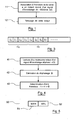
- the method of tattooing timestamps comprises the following steps, for each time stamp: association (11) with the time stamp of the value at a given moment of a reference time stamp signal, then tattooing (12). ) of this value in the support video sequence.
- the reference time stamp signal is a deterministic signal, varying over time in a given time frame and writing s (t), where t is incremented according to a no incrementation equal to a predetermined unit of time. For example, t can be incremented all images, or all seconds, or all 10 images etc.
- the reference timestamp takes discrete values as t varies from t d (start time) to t f (end time).
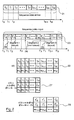
- the values m 0 , m 1 ... m M of the reference time stamp signal s (t), at times t 0 , t 1 ... t M are tattooed in separate images I 0 , I 1 .. I M of the video sequence 21. This is summarized by the table referenced 22 on the figure 2 .
- each value of the reference timestamp signal is tattooed by being distributed in several (four) images.
- the bits of the value m 0 are distributed in the images I 0 to I 3
- the bits of the value m 1 are distributed in the images I 4 to I 7 , etc.
- the accuracy of time stamping and the detection granularity are two decorrelated parameters: one can imagine very accurate diagrams requiring a large number of images for decoding. For example, it is possible to encode only one bit of the sequence per image, and to re-read the time stamp on a group of n successive images: the bit rate will then be very small, although the precision remains high. An implication of this is that one can either focus the coding of the timestamp in each image, or allocate it temporally. By privileging the spatial dimension, the latency in detection is reduced. By favoring the temporal dimension, the detection latency is increased, but for the same steganographic bandwidth reserved for the time stamping, the precision and amplitude of the time stamp can be increased.
- the reference time stamp signal s (t) is known and a phase-shifted timestamp signal s' (t) of the form s (t + ⁇ ) is received, t varying from t to (start time) at t f '(end time).
- the phase shift ⁇ ⁇ also called phase at the origin, is unknown, and one tries to estimate it.
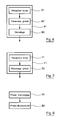
- the decoding of the date stamp is thus carried out as follows.
- ⁇ 0 ' t 0 - t 0 '.
- the horodate h will be equal to t + ⁇ 0 '.
- the decoding of the date stamp is thus carried out as follows.
- ⁇ 0 " t 0 -t 0 ".
- the horodate h will be equal to t + ⁇ 0 ".
- phase-shifted signal s (t + ⁇ ) is very often tainted with noise.
- a signal s' (t + ⁇ ) s (t + ⁇ ) + e (t), e (t) being a noise signal.
- the reading step 41 comprises the following steps: raw reception of at least one received value (reception of bits, without processing on the latter), then independent decoding of each received value , to obtain a read value of the phase-shifted signal equal to one of the values of the reference signal.
- Decoding is necessary because, because the received signal is noisy, the received value may not correspond to any of the possible values of the reference signal, and it is therefore necessary to find (and finally to take as value read) the possible value of the signal. closer to the value received.
- the reading step 41 comprises the following steps: receiving raw (71) of a sequence of received values, then overall decoding (72) said sequence of received values to obtain a read value of the phase signal equal to a values of the reference signal.
- This global decoding consists, for example, in a sliding correlation decoding between the sequence of received values and the sequence of values of the reference signal.
- the received value maximizing the intercorrelation is retained as read value and is used to estimate the phase shift (which itself allows to determine the timestamps of the same tattooed segment).
- the reading step 41 comprises the following steps: receiving raw (61) of a sequence of received values, and overall processing (62) the sequence of received values to obtain a resultant value, and finally decoding (63 ) of this resultant value to obtain a read value of the phase-shifted signal equal to one of the values of the reference signal.
- the initial values x 1 ,..., X k , x k + 1 , ... x T are, for example, words that are distinct from an m-sequence code, and in this case the functions f and f -1 are circular permutations (see detailed description below of the decoding of the fast part MTR of the value associated with a time stamp).
- T 'estimates of an initial value x j with T' ⁇ T and i ⁇ ⁇ 1 ... T ⁇ , by applying the function f or the function f -1 a given number of times to each of T 'received values.
- the decoding step then consists in performing a majority decoding on the T 'estimates of the same initial value x j .
- a second example (of the third implementation of the reading step 41) differs from the first example above in that, during the overall processing step (62), a T-merge is furthermore performed. estimates of the initial value x j , to obtain a merged value, and in that the decoding step (63) consists of decoding the merged value.
- the decoding of the merged value is for example an exhaustive decoding.
- the melting step consists, for example, in averaging the T estimates of the initial value x j .
- the received sequence comprises T received values y 1 , ..., y k , y k + 1, ... y T , corresponding to T values.
- initial x 1, ..., x k, x k + 1, ... x T noisy which are for example separate words of any code (classical correcting code (BCH, Reed-Solomon, convolutional code ..
- T 'values received are merged with T' ⁇ T, so as to obtain a merged value (equal, for example to the average of the T 'received values.)
- the decoding step (63) then consists in performing a decoding of the merged value, for example an exhaustive decoding.
- the encoding of the time stamp as a scalable coding ("scalable" in English) over time. Indeed, if the signal is very noisy, we can treat the information of several consecutive images globally before proceeding to the decoding (one gets returns to a result value and decodes only the latter). We then have an equalizer code of redundancy higher, so more resistant to noise. On the other hand, the latency in detection will be higher. The resolution (minimum tattooed sequence size required to decode a segment) therefore varies automatically according to the signal-to-noise ratio, without the need to modify the coding.
- the stages of association and tattooing are performed separately, and identically or not, for each of the parts.
- This separation has the advantage of reducing the decoding complexity.
- rank 1 In general, one can have a decomposition in N parts.
- a sequence of values received y 1 , ..., y k , ... corresponding to a sequence of initial values x 1 , ... , xk, ... noisy, the initial values x 1 , ..., x k , ... being such that a k + 1 th initial value can be calculated as a function of the k th initial value: ⁇ k x k + 1 f ( x k )
- x i can be either a scalar (a number) or a vector (a sequence of numbers).
- the function f does not increase the weight of the error vector (for example if f is a permutation), then we can consider only the elements ⁇ j for the decoding without losing information. For example, we can perform a majority decoding: the performances will be equivalent to those we would have obtained with a repetition of i + 1 . On the other hand, if the calculation of the function f is not too expensive, the decoding complexity will be much lower than with a correlation decoding as described above.
- the noise level varies according to the reception instants (for example if the probability of error varies over time), and if moreover we know how to estimate this noise level (by techniques described in 6.5 .2 in particular), it is then possible to select the elements (received values) corresponding to the lowest noise level and to perform the fusion only on these elements there.
- the code consists of all the circular permutations of the output sequence.
- the minimum distance between any two words in the code is 2 m-1 (512 in our case).
- the fast part MTR of an ith value of the reference time-stamp signal is coded by the ith permuted sequence (ith code word): c i .
- the code thus comprises a set of 1023 words (thus makes it possible to encode messages of length slightly less than 10 bits) encoded over a length of 1023 (thus redundancy slightly greater than 102). This very redundant code thus makes it possible to obtain a good resistance to noise.
- the cyclic structure of the m-sequence code also makes it possible to facilitate the merger prior to decoding: in fact, it is known that the noisy words of successive images r ' i , r' i + 1, ...
- r ' i + k correspond successive cyclic shifts of the same unknown word, c j.
- the words r ' j obtained therefore correspond to different noisy versions of the same word. We can therefore average them, in order to reduce the incidence of noise and improve decoding.
- the fusion of n words is therefore equivalent to a repetition of n times the word.
- One of the possible ways to perform the decoding is to perform the correlation with all the words of the code (exhaustive decoding). We consider the word most likely as the one with the best correlation score with the received word. The probability of error that is made by selecting this word is evaluated by comparing the correlation score with a predetermined threshold. This threshold depends on the probability of error considered acceptable for the system.
- Any type of code can be used to transmit the MTL slow part of each value of the reference time-stamp signal (there is no constraint on the successor calculation complexity as for the fast part), for example a standard correction code (BCH, Reed-Solomon, convolutional code 10) or an m-sequence code as described above.
- a standard correction code BCH, Reed-Solomon, convolutional code .
- m-sequence code as described above.
- Decoding according to the invention can be made more efficient by exploiting the segment tattoo model.
- Lmin minimum length of the order of one second: it is thus possible to delete the smaller segments, which most likely correspond to false alarms or errors.
- a hole of detection between two tattooed segments with the same phase shift, it is very likely that we are dealing with a continuously tattooed segment. If this hole is of a reasonable size (of the order of a few seconds), we can fill it.
- the segmental aspect can also be exploited during the decoding itself, by using the intrinsic scalability conferred on the coding.
- Lmin minimum size
- the difficulty lies in the fact that we do not know the position of the segment boundaries, and therefore we do not know a priori which images can be merged together: it is therefore necessary to perform the decoding (estimation of the value of the tattooing) along with segment boundary estimation.
- a tracking mechanism is used to determine the boundaries of the segment (forward and backward tracking).
- a portion of video belongs to the same tattooed segment (determination of boundaries) before decoding, using a statistical measure of data consistency.
- This measurement may be intrinsic (based on the timestamp data only) or extrinsic (for example, using an error rate estimate made when decoding another part of the tattoo).
- these decoding principles are general and are not applicable only to the particular case of the method presented here of coding of the timestamp by transmitting a timestamp signal, and looking for the phase shift of this signal at decoding.
- the morphological properties of the segments can also be used with any mechanism for transmitting the date and time, for example with the method described in the state of the art. For example, we can try to decode the date and time individually on each image or each image group of the sequence, then use the prior information on the sizes of the holes and segments in order to consolidate the decodings obtained.
- tracking mechanisms on these methods by performing, from the date and time previously decoded on a portion of the video, a prediction of the date and time on a related part. of this portion, and seeking to verify or invalidate this prediction on the related part. This tracking mechanism will thus make it possible to more accurately and reliably determine the boundaries of the tattooed segment.
- the algorithm has been designed to adapt to variations in the channel error rate, as well as to a jitter phenomenon due to MPEG coding.
- the number of merged samples is limited, as is the time window used (the smallest segment of video containing all the merged samples, these being not necessarily consecutive).
- the "quality" of each sample is first evaluated, either by an extrinsic quality measurement or by an intrinsic quality measurement.
- Extrinsic quality measurement when tattooing an identifier at the same time as the time stamp, and then decoding it, the decoding results of the identifier can be used to measure the ratio signal to noise. If the identifier consists of a fixed pattern, the correlation score can be used. Yes the identifier is coded on n bits, and an exhaustive decoding is impossible, two cases are possible: either the decoding fails (and in this case one does not attempt the decoding of the timestamp, or one attributes the note of minimal quality in the image), or the decoding succeeds and is assigned as note the correlation score with the decoded word).
- Intrinsic quality measurement Here we rely on the date stamp data themselves (received value data) to estimate the quality of the transmission. This is particularly possible when it is possible to achieve, with low complexity, a comprehensive decoding. The most probable word is obtained, as well as the associated quality (correlation score, for example). This score can be used to select the best images before merging. However, other measures of quality are possible even when the decoding is not exhaustive (for example, distance to the decoded word if the decoding succeeds, in the case of incomplete decoding).
- the fusion can be carried out as described for example in 6.3.1.
- the tracking can handle the variations of the channel error rate (typically lower signal-to-noise ratio on the predicted images compared to the Intra images) in different ways: hysteresis mechanism (lower correlation threshold in the tracking phase than in the boot phase); temporal mechanism (at the same time as a correlation threshold, a threshold number of undetected consecutive images is fixed) ...
- T_MAX number of consecutive undetected images tolerated
- Threshold correlation threshold for detection
- the detection of the fast part MTR can be improved by taking into account the possible fluctuations of the phase shift around its mean value.
- a more adequate representation consists of interpreting a modulo n integer as a phase (an angle) of a point on a circle (the set of authorized points being discrete and regularly distributed over the circle).
- An integer k modulo n can therefore be represented in its complex form: e 2 ⁇ ik / n , where i is the complex root of -1.
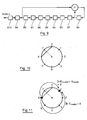
- the figure 10 is a representation of integers modulo 8 as points on a circle. This figure also shows the calculation of the average of 0 and 6, which leads to 7.
- the first step may consist, for example, in a test of 2T + 1 assumptions, where T is the maximum amplitude of the jitter (typically, T is the size of GOP MPEG).
- T is the maximum amplitude of the jitter (typically, T is the size of GOP MPEG).
- the hypotheses to be tested are then the set of phases [ ⁇ m -T; ⁇ m + T].
- the most likely phase shift ⁇ t will be chosen as the chosen hypothesis (maximizing correlation, for example).
- the distance between phase shifts should also be calculated with caution, taking into account the "circular" nature of the processed data.
- the figure 11 illustrates a calculation of distance between two phase shifts for the values 1 and 6, in the same representation of integers modulo 8 as that of the figure 10 .
- Tattooed timestamps can be used in conjunction with a database (program map) to identify a video clip.
- the database contains a list [start date; end date; title and characteristics of the program].
- the tattoo of timestamps can also be used for network control purposes. For example, a propagation delay along a TV channel can be identified.
- Timestamps can also be used to identify encodings along the chain (in the case of MPEG encoding: GOP length and structure).
- Timestamps can be used to locate and locate pumping in a sequence by identifying the discontinuities of the timestamp signal received. This is particularly interesting for detecting ad breaks when resuming a program.
- Timestamps it is also possible to use timestamps to check that an advertisement has been transmitted in its entirety, and has not been cut off.
Landscapes
- Physics & Mathematics (AREA)
- General Physics & Mathematics (AREA)
- Engineering & Computer Science (AREA)
- Theoretical Computer Science (AREA)
- Editing Of Facsimile Originals (AREA)
- Image Processing (AREA)
- Compression Or Coding Systems Of Tv Signals (AREA)
- Television Systems (AREA)
- Compression, Expansion, Code Conversion, And Decoders (AREA)
- Credit Cards Or The Like (AREA)
Claims (8)
- Verfahren zur Bestimmung mindestens eines Zeitstempels aus einer Menge von Supportdaten nach Übertragung der besagten Menge von Supportdaten, dadurch gekennzeichnet, dass das Verfahren die folgenden Schritte umfasst:- Lesen (41) - in der Menge von Supportdaten - mindestens eines Werts eines zeitverschobenen Zeitstempelsignals, des so genannten phasenverschobenen Zeitstempelsignals, während der besagten Übertragung mit derselben Form wie ein Bezugszeitstempelsignal, das jedoch im Vergleich zu diesem eine unbekannte Zeitverschiebung, die als Phasenverschiebung bezeichnet wird, Φ in einer gegebenen Zeitmarkierung aufweist, wobei das vorherige Wasserzeichen jedes Zeitstempels aus einem Wasserzeichen des Werts zu einem gegebenen Wasserzeichenzeitpunkt des Bezugszeitstempelsignals besteht, bei dem es sich um ein deterministisches Signal handelt, das sich im Laufe der Zeit in der gegebenen Zeitmarkierung ändert und als (s)t geschrieben wird, wobei (s)t sich von t unterscheidet, wobei t gemäß einem Inkrementierungsschritt entsprechend einer vorherbestimmten Zeiteinheit inkrementiert wird;- Schätzung (42) der Phasenverschiebung Φ aus dem besagten mindestens einen gelesenen Wert des phasenverschobenen Zeitstempelsignals und der Kenntnis des Bezugszeitstempelsignals;- für den besagten mindestens einen gelesenen Wert, der zu einem gegebenen Zeitpunkt tr gelesen wurde, Bestimmung (43) eines assoziierten Zeitstempels h in Abhängigkeit von dem besagten Lesezeitpunkt tr und der geschätzten Phasenverschiebung Φ;wobei jeder der Werte des Bezugszeitstempelsignals N Teile (51, 52) umfasst, wobei N ≥ 2 ist, einen Teil der Reihe 1, den so genannten schnellen Teil (51), der mit jedem der Zeitstempel inkrementiert wird und gemäß einer Periode p1 zyklische Werte annimmt, einen Teil der Reihe i, wobei i ∈{2...N) ist, der inkrementiert wird, wenn der Teil der Reihe i-1 eine komplette Periode pi-1 durchgeführt hat, und gemäß einer Periode pi zyklische Werte annimmt.
- Verfahren nach Anspruch 1, dadurch gekennzeichnet, dass die Bestimmung des assoziierten Zeitstempels h in dem Addieren des besagten Lesezeitpunkts tr und der geschätzten Phasenverschiebung Φ besteht: h = tr + Φ.
- Verfahren nach einem der Ansprüche 1 und 2, dadurch gekennzeichnet, dass die Bestimmung des assoziierten Zeitstempels h außerdem eine Veränderung der Abtastfrequenz zwischen dem Bezugszeitstempelsignal und dem phasenverschobenen Zeitstempelsignal berücksichtigt, so dass der besagte assoziierte Zeitstempel h wie folgt ist: h = ω.tr + Φ, wobei ω dem Verhältnis zwischen der Abtastfrequenz des Bezugszeitstempelsignals und der Abtastfrequenz des phasenverschobenen Zeitstempelsignals entspricht.
- Verfahren nach einem der Ansprüche 1 bis 3, dadurch gekennzeichnet, dass das phasenverschobene Zeitstempelsignal verschiedene Werte annimmt, wenn t sich von td' zu tf' ändert, wobei td' und tf' der Startzeitpunkt und der Endzeitpunkt der Dekodierung von Zeitstempeln sind.
- Verfahren nach einem der Ansprüche 1 bis 3, dadurch gekennzeichnet, dass die Menge von Supportdaten eine Sequenz von aufeinander folgenden Bildern ist und dass im Laufe des Leseschritts jeder Wert, kodiert oder unkodiert, in einem jeweils anderen Bild gelesen wird.
- Verfahren nach einem der Ansprüche 1 bis 3, dadurch gekennzeichnet, dass die Menge von Supportdaten eine Sequenz von aufeinander folgenden Bildern ist und dass im Laufe des Leseschritts jeder Wert, kodiert oder unkodiert, durch Kombination von in mindestens zwei Bildern gelesenen Informationen erhalten wird.
- Verfahren nach einem der Ansprüche 1 bis 6, dadurch gekennzeichnet, dass der Leseschritt die folgenden Schritte umfasst:- Empfang von Rohdaten (61; 71) mindestens eines empfangenen Werts;- Dekodierung (63; 72) des besagten mindestens einen empfangenen Werts, was ermöglicht, einen gelesenen Wert des phasenverschobenen Signals zu erhalten, der einem der Werte des Bezugssignals entspricht.
- Vorrichtung zur Bestimmung mindestens eines Zeitstempels aus einer Menge von Supportdaten nach Übertragung der besagten Menge von Supportdaten, dadurch gekennzeichnet, dass die Vorrichtung Folgendes umfasst:- Lesemittel, die das Lesen - in der Menge von Supportdaten - mindestens eines Werts eines zeitverschobenen Zeitstempelsignals, des so genannten phasenverschobenen Zeitstempelsignals, während der besagten Übertragung mit derselben Form wie ein Bezugszeitstempelsignal, das jedoch im Vergleich zu diesem eine unbekannte Zeitverschiebung, die als Phasenverschiebung bezeichnet wird, Φ in einer gegebenen Zeitmarkierung aufweist, ermöglichen, wobei das vorherige Wasserzeichen jedes Zeitstempels aus einem Wasserzeichen des Werts zu einem gegebenen Wasserzeichenzeitpunkt des Bezugszeitstempelsignals besteht, bei dem es sich um ein deterministisches Signal handelt, das sich im Laufe der Zeit in der gegebenen Zeitmarkierung ändert und als (s)t geschrieben wird, wobei (s)t sich von t unterscheidet, wobei t gemäß einem Inkrementierungsschritt entsprechend einer vorherbestimmten Zeiteinheit inkrementiert wird;- Mittel zur Schätzung der Phasenverschiebung Φ aus dem besagten mindestens einen Wert des phasenverschobenen Zeitstempelsignals und der Kenntnis des Bezugszeitstempelsignals;- Mittel zur Bestimmung - für den besagten mindestens einen gelesenen Wert, der zu einem gegebenen Zeitpunkt tr gelesen wurde - eines assoziierten Zeitstempels h in Abhängigkeit von dem besagten Lesezeitpunkt tr und der geschätzten Phasenverschiebung Φ; wobei jeder der Werte des Bezugszeitstempelsignals N Teile (51, 52) umfasst, wobei N ≥ 2 ist, einen Teil der Reihe 1, den so genannten schnellen Teil (51), der mit allen Zeitstempeln inkrementiert wird und gemäß einer Periode p1 zyklische Werte annimmt, einen Teil der Reihe i, wobei i ∈{2...N) ist, der inkrementiert wird, wenn der Teil der Reihe i-1 eine komplette Periode pi-1 durchgeführt hat, und gemäß einer Periode pi zyklische Werte annimmt.
Applications Claiming Priority (2)
| Application Number | Priority Date | Filing Date | Title |
|---|---|---|---|
| FR0507872A FR2889014A1 (fr) | 2005-07-22 | 2005-07-22 | Procede et dispositif de tatouage d'horodates, procede et dispositif de decodage d'horodates, applications et produits programmes d'ordinateur correspondants |
| PCT/EP2006/064495 WO2007010030A1 (fr) | 2005-07-22 | 2006-07-21 | Procédé et dispositif de tatouage d'horodates, procédé et dispositif de décodage d'horodates, applications et produits programmes d'ordinateur correspondants |
Publications (2)
| Publication Number | Publication Date |
|---|---|
| EP1908008A1 EP1908008A1 (de) | 2008-04-09 |
| EP1908008B1 true EP1908008B1 (de) | 2012-10-03 |
Family
ID=36266220
Family Applications (1)
| Application Number | Title | Priority Date | Filing Date |
|---|---|---|---|
| EP06792542A Ceased EP1908008B1 (de) | 2005-07-22 | 2006-07-21 | Verfahren für zeitmarkierungen mit wasserzeichen, verfahren und vorrichtung zur zeitstempeldecodierung, verwendung und programmprodukte für die entsprechenden computer |
Country Status (7)
| Country | Link |
|---|---|
| US (1) | US8209539B2 (de) |
| EP (1) | EP1908008B1 (de) |
| JP (1) | JP5130209B2 (de) |
| CN (1) | CN101268491B (de) |
| BR (1) | BRPI0613720A2 (de) |
| FR (1) | FR2889014A1 (de) |
| WO (1) | WO2007010030A1 (de) |
Families Citing this family (24)
| Publication number | Priority date | Publication date | Assignee | Title |
|---|---|---|---|---|
| EP1993290A4 (de) | 2006-03-07 | 2017-02-22 | Nippon Telegraph And Telephone Corporation | Verfahren, einrichtung und programm zum einbetten elektronischer wasserzeichen, verfahren, einrichtung und programm zum detektieren elektronischer wasserzeichen |
| US8788079B2 (en) * | 2010-11-09 | 2014-07-22 | Vmware, Inc. | Monitoring audio fidelity and audio-video synchronization |
| US9674562B1 (en) | 2008-12-18 | 2017-06-06 | Vmware, Inc. | Quality evaluation of multimedia delivery in cloud environments |
| US9214004B2 (en) | 2008-12-18 | 2015-12-15 | Vmware, Inc. | Watermarking and scalability techniques for a virtual desktop planning tool |
| US9151821B2 (en) | 2009-07-24 | 2015-10-06 | Qualcomm Incorporated | Watermarking antenna beams for position determination |
| US9336117B2 (en) | 2010-11-09 | 2016-05-10 | Vmware, Inc. | Remote display performance measurement triggered by application display upgrade |
| US20120134529A1 (en) * | 2010-11-28 | 2012-05-31 | Pedro Javier Vazquez | Method and apparatus for applying of a watermark to a video during download |
| US8812621B2 (en) * | 2011-05-03 | 2014-08-19 | Cisco Technology, Inc. | Reducing fetching load on cache servers in adaptive streaming |
| EP2693392A1 (de) | 2012-08-01 | 2014-02-05 | Thomson Licensing | Sekundärbildschirmsystem und Verfahren zum Rendern von Sekundärbildschirminformationen auf einem Sekundärbildschirm |
| US9264704B2 (en) * | 2013-06-30 | 2016-02-16 | Vmware, Inc. | Frame image quality as display quality benchmark for remote desktop |
| US9965296B2 (en) | 2013-06-30 | 2018-05-08 | Vmware, Inc. | Relative frame rate as display quality benchmark for remote desktop |
| US9239747B1 (en) * | 2013-09-16 | 2016-01-19 | Google Inc. | Image timestamp correction using metadata |
| US10176309B2 (en) * | 2016-10-28 | 2019-01-08 | Acronis International Gmbh | Systems and methods for authenticating video using watermarks |
| US10347262B2 (en) | 2017-10-18 | 2019-07-09 | The Nielsen Company (Us), Llc | Systems and methods to improve timestamp transition resolution |
| US10448123B1 (en) * | 2018-07-02 | 2019-10-15 | The Nielsen Company (Us), Llc | Methods and apparatus to extend a timestamp range supported by a watermark |
| US10448122B1 (en) * | 2018-07-02 | 2019-10-15 | The Nielsen Company (Us), Llc | Methods and apparatus to extend a timestamp range supported by a watermark |
| US11234049B2 (en) * | 2019-06-24 | 2022-01-25 | The Nielsen Company (Us), Llc | Use of steganographically-encoded time information as basis to control implementation of dynamic content modification |
| EP3771220A1 (de) * | 2019-07-24 | 2021-01-27 | Nagravision S.A. | Wasserzeichenmarkierung von videofragmenten in zwei oder mehr varianten |
| FR3099611B1 (fr) * | 2019-08-02 | 2022-05-27 | Continental Automotive Gmbh | Méthode et système pour vérifier un affichage de message sur un afficheur digital |
| CN112995759A (zh) * | 2019-12-13 | 2021-06-18 | 腾讯科技(北京)有限公司 | 互动业务处理方法、系统、装置、设备及存储介质 |
| CN115134640B (zh) * | 2021-03-25 | 2025-06-27 | 华为技术有限公司 | 同步播放方法及装置 |
| WO2024139950A1 (zh) * | 2022-12-30 | 2024-07-04 | 海信视像科技股份有限公司 | 显示设备及用于显示设备的处理方法 |
| CN116743797A (zh) * | 2023-05-21 | 2023-09-12 | 长江生态环保集团有限公司 | 一种城市水管家集控系统中的外部数据处理方法 |
| CN118981778B (zh) * | 2024-07-23 | 2025-11-25 | 中国银联股份有限公司 | 水印添加方法、水印提取方法、装置、设备、存储介质和程序产品 |
Family Cites Families (14)
| Publication number | Priority date | Publication date | Assignee | Title |
|---|---|---|---|---|
| GB9303518D0 (en) | 1993-02-22 | 1993-04-07 | Merrell Dow Pharma | Combinations of retroviral inhibitors |
| JP2000152199A (ja) | 1998-11-13 | 2000-05-30 | Sony Corp | 電子透かし情報の重畳方法、電子透かし情報の伝送方法、電子透かし情報の重畳装置、オーサリング装置および映像信号出力装置 |
| JP3768705B2 (ja) * | 1998-11-27 | 2006-04-19 | キヤノン株式会社 | 電子透かし埋め込み装置、出力制御装置及びコンピュータ読み取り可能な記憶媒体 |
| JP3722646B2 (ja) * | 1999-06-01 | 2005-11-30 | 松下電器産業株式会社 | データに透かし情報を埋め込む方法およびプログラム記録媒体 |
| JP2001339700A (ja) * | 2000-05-26 | 2001-12-07 | Nec Corp | 電子透かし処理装置並びに電子透かし挿入方法および電子透かし検出方法 |
| JP2002176630A (ja) * | 2000-12-07 | 2002-06-21 | Nippon Telegr & Teleph Corp <Ntt> | 時空間情報付与・検出方法、装置及び時空間情報付与・検出プログラム記録媒体 |
| US7958359B2 (en) * | 2001-04-30 | 2011-06-07 | Digimarc Corporation | Access control systems |
| JP2003092675A (ja) * | 2001-09-19 | 2003-03-28 | Matsushita Electric Ind Co Ltd | 電子透かし埋め込み装置、その装置からなるファイルサーバ、ネットワークデータサーバおよびデータ配信システム |
| JP2003163897A (ja) * | 2001-11-22 | 2003-06-06 | Nippon Hoso Kyokai <Nhk> | コンテンツ送信方法、コンテンツ送信装置、コンテンツ送信プログラムおよびコンテンツ受信制御方法、コンテンツ受信制御装置、コンテンツ受信制御プログラムならびにコンテンツ時刻制御システム |
| JP2003259314A (ja) * | 2002-02-26 | 2003-09-12 | Nippon Hoso Kyokai <Nhk> | 映像音声同期方法及びそのシステム |
| JP2004080094A (ja) * | 2002-08-09 | 2004-03-11 | Canon Inc | 情報処理装置及び情報処理方法並びにプログラム及びコンピュータ読み取り可能な記録媒体 |
| JP4127636B2 (ja) * | 2002-08-30 | 2008-07-30 | 株式会社東芝 | 電子透かし埋め込み装置及び方法 |
| JP2004158913A (ja) * | 2002-11-01 | 2004-06-03 | Canon Inc | 音声画像処理装置 |
| CN1720748A (zh) * | 2002-12-04 | 2006-01-11 | 皇家飞利浦电子股份有限公司 | 信号的同步 |
-
2005
- 2005-07-22 FR FR0507872A patent/FR2889014A1/fr active Pending
-
2006
- 2006-07-21 JP JP2008521978A patent/JP5130209B2/ja not_active Expired - Fee Related
- 2006-07-21 CN CN2006800349020A patent/CN101268491B/zh not_active Expired - Fee Related
- 2006-07-21 BR BRPI0613720-2A patent/BRPI0613720A2/pt not_active IP Right Cessation
- 2006-07-21 US US11/989,150 patent/US8209539B2/en not_active Expired - Fee Related
- 2006-07-21 EP EP06792542A patent/EP1908008B1/de not_active Ceased
- 2006-07-21 WO PCT/EP2006/064495 patent/WO2007010030A1/fr not_active Ceased
Non-Patent Citations (1)
| Title |
|---|
| HABER S ET AL: "HOW TO TIME-STAMP A DIGITAL DOCUMENT", JOURNAL OF CRYPTOLOGY, vol. 3, no. 2, 1991, pages 99 - 111, XP002292804 * |
Also Published As
| Publication number | Publication date |
|---|---|
| EP1908008A1 (de) | 2008-04-09 |
| CN101268491B (zh) | 2012-08-22 |
| US20090217052A1 (en) | 2009-08-27 |
| BRPI0613720A2 (pt) | 2011-02-08 |
| WO2007010030A1 (fr) | 2007-01-25 |
| JP5130209B2 (ja) | 2013-01-30 |
| JP2009515371A (ja) | 2009-04-09 |
| US8209539B2 (en) | 2012-06-26 |
| FR2889014A1 (fr) | 2007-01-26 |
| CN101268491A (zh) | 2008-09-17 |
Similar Documents
| Publication | Publication Date | Title |
|---|---|---|
| EP1908008A1 (de) | Verfahren für zeitmarkierungen mit wasserzeichen, verfahren und vorrichtung zur zeitstempeldecodierung, verwendung und programmprodukte für die entsprechenden computer | |
| US7957977B2 (en) | Media program identification method and apparatus based on audio watermarking | |
| FR2467519A1 (fr) | Dispositif pour mettre en correlation des valeurs successives de numeros detectes de trame avec un numero de trame precedemment detecte et ensemble pour reduire les erreurs de parcours de l'aiguille dans un tourne-videodisque | |
| FR2819672A1 (fr) | Procede et dispositif d'emission et de reception d'images numeriques utilisant un marqueur d'image pour le decodage | |
| FR2550402A1 (de) | ||
| FR2694647A1 (fr) | Procédé de décodage de canaux avec commande à la source par élargissement de l'algorithme de Viterbi et utilisation de ce procédé. | |
| EP2785039B1 (de) | Tätowierverfahren und -vorrichtung einer Bildfolge, Authentifizierungsverfahren und -vorrichtung einer tätowierten Bildfolge und entsprechendes Computerprogramm | |
| EP1330110B1 (de) | Dekodierverfahren und -system für Wasserzeichen | |
| FR2702914A1 (fr) | Dispositif de codage de suites d'images constituées d'images de nature film et d'images de nature vidéo, et dispositif de décodage correspondant. | |
| FR2942095A1 (fr) | Procede et dispositif d'identification de pertes de donnees video | |
| FR2834852A1 (fr) | Procede et dispositif de segmentation temporelle d'une sequence video | |
| EP1289307B1 (de) | Videokodierungsverfahren | |
| FR2821998A1 (fr) | Procede de codage d'images numeriques base sur la dissimulation d'erreurs | |
| EP2559218B1 (de) | Empfang von digitalen inhalten im trickmodus | |
| WO2007093728A2 (fr) | Fichier numerique marque par une suite de marques dont la concatenation forme un message et procede d'extraction d'une marque d'un tel fichier numerique marque | |
| WO2006037899A1 (fr) | Procede et dispositif de lecture de tatouage, produit programme d'ordinateur et moyen de stockage correspondants. | |
| WO2006108768A1 (fr) | Procédé et dispositif de décodage d'un code à longueur variable prenant en compte une information de probabilité a priori | |
| EP1897264A2 (de) | Rahmensynchronisationsverfahren und -einrichtung | |
| FR2467457A1 (fr) | Tourne-videodisque commande par microprocesseur et procede pour synchroniser le systeme de commande numerique sur le signal video | |
| EP1720263A1 (de) | An ein Direct Sequence Spread Spectrum DSSS Übertragungssystem angepasstes Empfangsgerät mit Mechanismus zur Datenwiederherstellung | |
| EP2817969B1 (de) | Verfahren zur erzeugung eines stroms aus digitalen paketen am ausgang eines codierers, vorrichtung zur erzeugung einer solchen codierten stroms und system zur verwendung eines solchen codierten stroms | |
| FR2467521A1 (fr) | Dispositifs d'enregistrement, de restitution ou decodage et de detection de fin de programme pour videodisque | |
| EP1383336A2 (de) | Dekompressions- und Wiedergabemethode für objektbasierte Multimediadatenströme; entsprechender Apparat und entsprechendes System sowie Signal | |
| FR3163235A1 (fr) | Procédé de détection d’une marque dans une séquence vidéo, dispositif électronique et programme d’ordinateur associés | |
| FR3155076A1 (fr) | Procédé de désignation d’un compte d’utilisateur et dispositif électronique associé |
Legal Events
| Date | Code | Title | Description |
|---|---|---|---|
| PUAI | Public reference made under article 153(3) epc to a published international application that has entered the european phase |
Free format text: ORIGINAL CODE: 0009012 |
|
| 17P | Request for examination filed |
Effective date: 20080206 |
|
| AK | Designated contracting states |
Kind code of ref document: A1 Designated state(s): DE FR GB |
|
| 17Q | First examination report despatched |
Effective date: 20080610 |
|
| RBV | Designated contracting states (corrected) |
Designated state(s): DE FR GB |
|
| GRAP | Despatch of communication of intention to grant a patent |
Free format text: ORIGINAL CODE: EPIDOSNIGR1 |
|
| DAX | Request for extension of the european patent (deleted) | ||
| GRAS | Grant fee paid |
Free format text: ORIGINAL CODE: EPIDOSNIGR3 |
|
| GRAA | (expected) grant |
Free format text: ORIGINAL CODE: 0009210 |
|
| AK | Designated contracting states |
Kind code of ref document: B1 Designated state(s): DE FR GB |
|
| REG | Reference to a national code |
Ref country code: GB Ref legal event code: FG4D Free format text: NOT ENGLISH |
|
| REG | Reference to a national code |
Ref country code: DE Ref legal event code: R096 Ref document number: 602006032286 Country of ref document: DE Effective date: 20121206 |
|
| PLBE | No opposition filed within time limit |
Free format text: ORIGINAL CODE: 0009261 |
|
| STAA | Information on the status of an ep patent application or granted ep patent |
Free format text: STATUS: NO OPPOSITION FILED WITHIN TIME LIMIT |
|
| 26N | No opposition filed |
Effective date: 20130704 |
|
| REG | Reference to a national code |
Ref country code: DE Ref legal event code: R097 Ref document number: 602006032286 Country of ref document: DE Effective date: 20130704 |
|
| REG | Reference to a national code |
Ref country code: FR Ref legal event code: PLFP Year of fee payment: 11 |
|
| REG | Reference to a national code |
Ref country code: FR Ref legal event code: PLFP Year of fee payment: 12 |
|
| REG | Reference to a national code |
Ref country code: FR Ref legal event code: PLFP Year of fee payment: 13 |
|
| PGFP | Annual fee paid to national office [announced via postgrant information from national office to epo] |
Ref country code: FR Payment date: 20190731 Year of fee payment: 14 Ref country code: DE Payment date: 20190711 Year of fee payment: 14 |
|
| PGFP | Annual fee paid to national office [announced via postgrant information from national office to epo] |
Ref country code: GB Payment date: 20190719 Year of fee payment: 14 |
|
| REG | Reference to a national code |
Ref country code: DE Ref legal event code: R119 Ref document number: 602006032286 Country of ref document: DE |
|
| GBPC | Gb: european patent ceased through non-payment of renewal fee |
Effective date: 20200721 |
|
| PG25 | Lapsed in a contracting state [announced via postgrant information from national office to epo] |
Ref country code: GB Free format text: LAPSE BECAUSE OF NON-PAYMENT OF DUE FEES Effective date: 20200721 Ref country code: FR Free format text: LAPSE BECAUSE OF NON-PAYMENT OF DUE FEES Effective date: 20200731 |
|
| PG25 | Lapsed in a contracting state [announced via postgrant information from national office to epo] |
Ref country code: DE Free format text: LAPSE BECAUSE OF NON-PAYMENT OF DUE FEES Effective date: 20210202 |