EP1905440A1 - Verwendung einer pharmazeutischen Zusammensetzung enthaltend ein Anticholinergikum zur Abtötung von Mikroorganismen und zur Behandlung von Atemwegsinfektionen - Google Patents
Verwendung einer pharmazeutischen Zusammensetzung enthaltend ein Anticholinergikum zur Abtötung von Mikroorganismen und zur Behandlung von Atemwegsinfektionen Download PDFInfo
- Publication number
- EP1905440A1 EP1905440A1 EP06120196A EP06120196A EP1905440A1 EP 1905440 A1 EP1905440 A1 EP 1905440A1 EP 06120196 A EP06120196 A EP 06120196A EP 06120196 A EP06120196 A EP 06120196A EP 1905440 A1 EP1905440 A1 EP 1905440A1
- Authority
- EP
- European Patent Office
- Prior art keywords
- formula
- compound
- use according
- weight percent
- concentration
- Prior art date
- Legal status (The legal status is an assumption and is not a legal conclusion. Google has not performed a legal analysis and makes no representation as to the accuracy of the status listed.)
- Ceased
Links
- 244000005700 microbiome Species 0.000 title claims abstract description 18
- 206010057190 Respiratory tract infections Diseases 0.000 title claims abstract description 17
- 208000020029 respiratory tract infectious disease Diseases 0.000 title claims abstract description 11
- 239000008194 pharmaceutical composition Substances 0.000 title claims description 15
- 230000001078 anti-cholinergic effect Effects 0.000 title description 3
- 150000001875 compounds Chemical class 0.000 claims abstract description 51
- 125000002496 methyl group Chemical group [H]C([H])([H])* 0.000 claims abstract description 15
- 125000001997 phenyl group Chemical group [H]C1=C([H])C([H])=C(*)C([H])=C1[H] 0.000 claims abstract description 15
- 150000001450 anions Chemical class 0.000 claims abstract description 14
- 239000003814 drug Substances 0.000 claims abstract description 13
- 125000001544 thienyl group Chemical group 0.000 claims abstract description 10
- 238000004519 manufacturing process Methods 0.000 claims abstract description 9
- 239000000203 mixture Substances 0.000 claims description 40
- 238000009472 formulation Methods 0.000 claims description 29
- 239000000443 aerosol Substances 0.000 claims description 18
- 241000894006 Bacteria Species 0.000 claims description 10
- 241000233866 Fungi Species 0.000 claims description 8
- 239000003755 preservative agent Substances 0.000 claims description 8
- HBAQYPYDRFILMT-UHFFFAOYSA-N 8-[3-(1-cyclopropylpyrazol-4-yl)-1H-pyrazolo[4,3-d]pyrimidin-5-yl]-3-methyl-3,8-diazabicyclo[3.2.1]octan-2-one Chemical class C1(CC1)N1N=CC(=C1)C1=NNC2=C1N=C(N=C2)N1C2C(N(CC1CC2)C)=O HBAQYPYDRFILMT-UHFFFAOYSA-N 0.000 claims description 7
- 241000589517 Pseudomonas aeruginosa Species 0.000 claims description 7
- 230000003287 optical effect Effects 0.000 claims description 7
- 244000063299 Bacillus subtilis Species 0.000 claims description 6
- 235000014469 Bacillus subtilis Nutrition 0.000 claims description 6
- 241000588724 Escherichia coli Species 0.000 claims description 6
- 241000589516 Pseudomonas Species 0.000 claims description 6
- 241000191967 Staphylococcus aureus Species 0.000 claims description 6
- 239000007864 aqueous solution Substances 0.000 claims description 6
- 230000002335 preservative effect Effects 0.000 claims description 6
- 125000000175 2-thienyl group Chemical group S1C([*])=C([H])C([H])=C1[H] 0.000 claims description 5
- 241000228245 Aspergillus niger Species 0.000 claims description 5
- 241000222122 Candida albicans Species 0.000 claims description 5
- 229940095731 candida albicans Drugs 0.000 claims description 5
- 241000193830 Bacillus <bacterium> Species 0.000 claims description 3
- 241001647372 Chlamydia pneumoniae Species 0.000 claims description 3
- 241000186216 Corynebacterium Species 0.000 claims description 3
- 241000588921 Enterobacteriaceae Species 0.000 claims description 3
- 241000606768 Haemophilus influenzae Species 0.000 claims description 3
- 241000588747 Klebsiella pneumoniae Species 0.000 claims description 3
- 241000588655 Moraxella catarrhalis Species 0.000 claims description 3
- 241000202934 Mycoplasma pneumoniae Species 0.000 claims description 3
- 241000588653 Neisseria Species 0.000 claims description 3
- 241000193998 Streptococcus pneumoniae Species 0.000 claims description 3
- 241000193996 Streptococcus pyogenes Species 0.000 claims description 3
- 241001312524 Streptococcus viridans Species 0.000 claims description 3
- 229940047650 haemophilus influenzae Drugs 0.000 claims description 3
- 229940031000 streptococcus pneumoniae Drugs 0.000 claims description 3
- KRKNYBCHXYNGOX-UHFFFAOYSA-N citric acid Chemical compound OC(=O)CC(O)(C(O)=O)CC(O)=O KRKNYBCHXYNGOX-UHFFFAOYSA-N 0.000 description 12
- 239000000654 additive Substances 0.000 description 11
- 150000003839 salts Chemical class 0.000 description 9
- 239000000243 solution Substances 0.000 description 9
- CIWBSHSKHKDKBQ-JLAZNSOCSA-N Ascorbic acid Chemical compound OC[C@H](O)[C@H]1OC(=O)C(O)=C1O CIWBSHSKHKDKBQ-JLAZNSOCSA-N 0.000 description 8
- CPELXLSAUQHCOX-UHFFFAOYSA-M Bromide Chemical compound [Br-] CPELXLSAUQHCOX-UHFFFAOYSA-M 0.000 description 8
- OVBJJZOQPCKUOR-UHFFFAOYSA-L EDTA disodium salt dihydrate Chemical compound O.O.[Na+].[Na+].[O-]C(=O)C[NH+](CC([O-])=O)CC[NH+](CC([O-])=O)CC([O-])=O OVBJJZOQPCKUOR-UHFFFAOYSA-L 0.000 description 8
- 239000002253 acid Substances 0.000 description 8
- 239000002904 solvent Substances 0.000 description 7
- VZCYOOQTPOCHFL-UHFFFAOYSA-N trans-butenedioic acid Natural products OC(=O)C=CC(O)=O VZCYOOQTPOCHFL-UHFFFAOYSA-N 0.000 description 7
- LFQSCWFLJHTTHZ-UHFFFAOYSA-N Ethanol Chemical compound CCO LFQSCWFLJHTTHZ-UHFFFAOYSA-N 0.000 description 6
- VZCYOOQTPOCHFL-OWOJBTEDSA-N Fumaric acid Chemical compound OC(=O)\C=C\C(O)=O VZCYOOQTPOCHFL-OWOJBTEDSA-N 0.000 description 6
- VEXZGXHMUGYJMC-UHFFFAOYSA-N Hydrochloric acid Chemical compound Cl VEXZGXHMUGYJMC-UHFFFAOYSA-N 0.000 description 6
- 239000004480 active ingredient Substances 0.000 description 6
- 239000008139 complexing agent Substances 0.000 description 6
- -1 for example Substances 0.000 description 6
- 208000006545 Chronic Obstructive Pulmonary Disease Diseases 0.000 description 5
- 239000003963 antioxidant agent Substances 0.000 description 5
- 235000006708 antioxidants Nutrition 0.000 description 5
- LERNTVKEWCAPOY-VOGVJGKGSA-N C[N+]1(C)[C@H]2C[C@H](C[C@@H]1[C@H]1O[C@@H]21)OC(=O)C(O)(c1cccs1)c1cccs1 Chemical compound C[N+]1(C)[C@H]2C[C@H](C[C@@H]1[C@H]1O[C@@H]21)OC(=O)C(O)(c1cccs1)c1cccs1 LERNTVKEWCAPOY-VOGVJGKGSA-N 0.000 description 4
- VEXZGXHMUGYJMC-UHFFFAOYSA-M Chloride anion Chemical compound [Cl-] VEXZGXHMUGYJMC-UHFFFAOYSA-M 0.000 description 4
- AFVFQIVMOAPDHO-UHFFFAOYSA-N Methanesulfonic acid Chemical compound CS(O)(=O)=O AFVFQIVMOAPDHO-UHFFFAOYSA-N 0.000 description 4
- FAPWRFPIFSIZLT-UHFFFAOYSA-M Sodium chloride Chemical compound [Na+].[Cl-] FAPWRFPIFSIZLT-UHFFFAOYSA-M 0.000 description 4
- QAOWNCQODCNURD-UHFFFAOYSA-N Sulfuric acid Chemical compound OS(O)(=O)=O QAOWNCQODCNURD-UHFFFAOYSA-N 0.000 description 4
- 150000007513 acids Chemical class 0.000 description 4
- 235000010323 ascorbic acid Nutrition 0.000 description 4
- 239000011668 ascorbic acid Substances 0.000 description 4
- 229960005070 ascorbic acid Drugs 0.000 description 4
- 235000015165 citric acid Nutrition 0.000 description 4
- 239000000843 powder Substances 0.000 description 4
- 229940037001 sodium edetate Drugs 0.000 description 4
- 239000000126 substance Substances 0.000 description 4
- 229960000257 tiotropium bromide Drugs 0.000 description 4
- XLYOFNOQVPJJNP-UHFFFAOYSA-N water Substances O XLYOFNOQVPJJNP-UHFFFAOYSA-N 0.000 description 4
- QTBSBXVTEAMEQO-UHFFFAOYSA-N Acetic acid Chemical compound CC(O)=O QTBSBXVTEAMEQO-UHFFFAOYSA-N 0.000 description 3
- FEWJPZIEWOKRBE-JCYAYHJZSA-N Dextrotartaric acid Chemical compound OC(=O)[C@H](O)[C@@H](O)C(O)=O FEWJPZIEWOKRBE-JCYAYHJZSA-N 0.000 description 3
- PEDCQBHIVMGVHV-UHFFFAOYSA-N Glycerine Chemical compound OCC(O)CO PEDCQBHIVMGVHV-UHFFFAOYSA-N 0.000 description 3
- KFZMGEQAYNKOFK-UHFFFAOYSA-N Isopropanol Chemical compound CC(C)O KFZMGEQAYNKOFK-UHFFFAOYSA-N 0.000 description 3
- DNIAPMSPPWPWGF-UHFFFAOYSA-N Propylene glycol Chemical compound CC(O)CO DNIAPMSPPWPWGF-UHFFFAOYSA-N 0.000 description 3
- 208000006673 asthma Diseases 0.000 description 3
- 239000002585 base Substances 0.000 description 3
- 150000004677 hydrates Chemical class 0.000 description 3
- 125000002887 hydroxy group Chemical group [H]O* 0.000 description 3
- VZCYOOQTPOCHFL-UPHRSURJSA-N maleic acid Chemical compound OC(=O)\C=C/C(O)=O VZCYOOQTPOCHFL-UPHRSURJSA-N 0.000 description 3
- 150000007522 mineralic acids Chemical class 0.000 description 3
- 230000000144 pharmacologic effect Effects 0.000 description 3
- 239000000902 placebo Substances 0.000 description 3
- 229940068196 placebo Drugs 0.000 description 3
- 239000003380 propellant Substances 0.000 description 3
- 239000012085 test solution Substances 0.000 description 3
- 238000002560 therapeutic procedure Methods 0.000 description 3
- 229930003231 vitamin Natural products 0.000 description 3
- 239000011782 vitamin Substances 0.000 description 3
- 235000013343 vitamin Nutrition 0.000 description 3
- 229940088594 vitamin Drugs 0.000 description 3
- GVJHHUAWPYXKBD-UHFFFAOYSA-N (±)-α-Tocopherol Chemical compound OC1=C(C)C(C)=C2OC(CCCC(C)CCCC(C)CCCC(C)C)(C)CCC2=C1C GVJHHUAWPYXKBD-UHFFFAOYSA-N 0.000 description 2
- YFMFNYKEUDLDTL-UHFFFAOYSA-N 1,1,1,2,3,3,3-heptafluoropropane Chemical compound FC(F)(F)C(F)C(F)(F)F YFMFNYKEUDLDTL-UHFFFAOYSA-N 0.000 description 2
- QTBSBXVTEAMEQO-UHFFFAOYSA-M Acetate Chemical compound CC([O-])=O QTBSBXVTEAMEQO-UHFFFAOYSA-M 0.000 description 2
- 229920001817 Agar Polymers 0.000 description 2
- KRKNYBCHXYNGOX-UHFFFAOYSA-K Citrate Chemical compound [O-]C(=O)CC(O)(CC([O-])=O)C([O-])=O KRKNYBCHXYNGOX-UHFFFAOYSA-K 0.000 description 2
- VPNYRYCIDCJBOM-UHFFFAOYSA-M Glycopyrronium bromide Chemical compound [Br-].C1[N+](C)(C)CCC1OC(=O)C(O)(C=1C=CC=CC=1)C1CCCC1 VPNYRYCIDCJBOM-UHFFFAOYSA-M 0.000 description 2
- JRRNZNSGDSFFIR-UHFFFAOYSA-M Mepenzolate bromide Chemical compound [Br-].C1[N+](C)(C)CCCC1OC(=O)C(O)(C=1C=CC=CC=1)C1=CC=CC=C1 JRRNZNSGDSFFIR-UHFFFAOYSA-M 0.000 description 2
- 229910002651 NO3 Inorganic materials 0.000 description 2
- NHNBFGGVMKEFGY-UHFFFAOYSA-N Nitrate Chemical compound [O-][N+]([O-])=O NHNBFGGVMKEFGY-UHFFFAOYSA-N 0.000 description 2
- MUBZPKHOEPUJKR-UHFFFAOYSA-N Oxalic acid Chemical compound OC(=O)C(O)=O MUBZPKHOEPUJKR-UHFFFAOYSA-N 0.000 description 2
- 229910019142 PO4 Inorganic materials 0.000 description 2
- NBIIXXVUZAFLBC-UHFFFAOYSA-N Phosphoric acid Chemical compound OP(O)(O)=O NBIIXXVUZAFLBC-UHFFFAOYSA-N 0.000 description 2
- 229920003171 Poly (ethylene oxide) Polymers 0.000 description 2
- QAOWNCQODCNURD-UHFFFAOYSA-L Sulfate Chemical compound [O-]S([O-])(=O)=O QAOWNCQODCNURD-UHFFFAOYSA-L 0.000 description 2
- 239000013543 active substance Substances 0.000 description 2
- 239000008272 agar Substances 0.000 description 2
- 150000001298 alcohols Chemical class 0.000 description 2
- 230000000845 anti-microbial effect Effects 0.000 description 2
- 229940065524 anticholinergics inhalants for obstructive airway diseases Drugs 0.000 description 2
- 230000008901 benefit Effects 0.000 description 2
- WPYMKLBDIGXBTP-UHFFFAOYSA-N benzoic acid Chemical compound OC(=O)C1=CC=CC=C1 WPYMKLBDIGXBTP-UHFFFAOYSA-N 0.000 description 2
- 239000002775 capsule Substances 0.000 description 2
- 239000000812 cholinergic antagonist Substances 0.000 description 2
- 230000001332 colony forming effect Effects 0.000 description 2
- XBDQKXXYIPTUBI-UHFFFAOYSA-N dimethylselenoniopropionate Natural products CCC(O)=O XBDQKXXYIPTUBI-UHFFFAOYSA-N 0.000 description 2
- 239000001530 fumaric acid Substances 0.000 description 2
- 230000002070 germicidal effect Effects 0.000 description 2
- 229940015042 glycopyrrolate Drugs 0.000 description 2
- 229940093915 gynecological organic acid Drugs 0.000 description 2
- XMBWDFGMSWQBCA-UHFFFAOYSA-N hydrogen iodide Chemical compound I XMBWDFGMSWQBCA-UHFFFAOYSA-N 0.000 description 2
- OEXHQOGQTVQTAT-JRNQLAHRSA-N ipratropium Chemical compound O([C@H]1C[C@H]2CC[C@@H](C1)[N@@+]2(C)C(C)C)C(=O)C(CO)C1=CC=CC=C1 OEXHQOGQTVQTAT-JRNQLAHRSA-N 0.000 description 2
- 229960001888 ipratropium Drugs 0.000 description 2
- 229960003092 mepenzolate Drugs 0.000 description 2
- BDAGIHXWWSANSR-UHFFFAOYSA-N methanoic acid Natural products OC=O BDAGIHXWWSANSR-UHFFFAOYSA-N 0.000 description 2
- 150000007524 organic acids Chemical class 0.000 description 2
- 235000005985 organic acids Nutrition 0.000 description 2
- 239000000546 pharmaceutical excipient Substances 0.000 description 2
- NBIIXXVUZAFLBC-UHFFFAOYSA-K phosphate Chemical compound [O-]P([O-])([O-])=O NBIIXXVUZAFLBC-UHFFFAOYSA-K 0.000 description 2
- 239000010452 phosphate Substances 0.000 description 2
- 208000023504 respiratory system disease Diseases 0.000 description 2
- FIMXSEMBHGTNKT-UPGAHCIJSA-N scopine Chemical group C([C@@H]1N2C)C(O)C[C@@H]2[C@@H]2[C@H]1O2 FIMXSEMBHGTNKT-UPGAHCIJSA-N 0.000 description 2
- 239000011780 sodium chloride Substances 0.000 description 2
- 239000003381 stabilizer Substances 0.000 description 2
- KDYFGRWQOYBRFD-UHFFFAOYSA-L succinate(2-) Chemical compound [O-]C(=O)CCC([O-])=O KDYFGRWQOYBRFD-UHFFFAOYSA-L 0.000 description 2
- 239000004094 surface-active agent Substances 0.000 description 2
- 229940095064 tartrate Drugs 0.000 description 2
- JOXIMZWYDAKGHI-UHFFFAOYSA-M toluene-4-sulfonate Chemical compound CC1=CC=C(S([O-])(=O)=O)C=C1 JOXIMZWYDAKGHI-UHFFFAOYSA-M 0.000 description 2
- JOXIMZWYDAKGHI-UHFFFAOYSA-N toluene-4-sulfonic acid Chemical compound CC1=CC=C(S(O)(=O)=O)C=C1 JOXIMZWYDAKGHI-UHFFFAOYSA-N 0.000 description 2
- JNYAEWCLZODPBN-JGWLITMVSA-N (2r,3r,4s)-2-[(1r)-1,2-dihydroxyethyl]oxolane-3,4-diol Chemical class OC[C@@H](O)[C@H]1OC[C@H](O)[C@H]1O JNYAEWCLZODPBN-JGWLITMVSA-N 0.000 description 1
- WRIDQFICGBMAFQ-UHFFFAOYSA-N (E)-8-Octadecenoic acid Natural products CCCCCCCCCC=CCCCCCCC(O)=O WRIDQFICGBMAFQ-UHFFFAOYSA-N 0.000 description 1
- BJEPYKJPYRNKOW-REOHCLBHSA-N (S)-malic acid Chemical compound OC(=O)[C@@H](O)CC(O)=O BJEPYKJPYRNKOW-REOHCLBHSA-N 0.000 description 1
- IIZPXYDJLKNOIY-JXPKJXOSSA-N 1-palmitoyl-2-arachidonoyl-sn-glycero-3-phosphocholine Chemical compound CCCCCCCCCCCCCCCC(=O)OC[C@H](COP([O-])(=O)OCC[N+](C)(C)C)OC(=O)CCC\C=C/C\C=C/C\C=C/C\C=C/CCCCC IIZPXYDJLKNOIY-JXPKJXOSSA-N 0.000 description 1
- FPIPGXGPPPQFEQ-UHFFFAOYSA-N 13-cis retinol Natural products OCC=C(C)C=CC=C(C)C=CC1=C(C)CCCC1(C)C FPIPGXGPPPQFEQ-UHFFFAOYSA-N 0.000 description 1
- LQJBNNIYVWPHFW-UHFFFAOYSA-N 20:1omega9c fatty acid Natural products CCCCCCCCCCC=CCCCCCCCC(O)=O LQJBNNIYVWPHFW-UHFFFAOYSA-N 0.000 description 1
- NMGODFWGUBLTTA-UHFFFAOYSA-N 3-amino-1h-quinazoline-2,4-dione Chemical compound C1=CC=C2C(=O)N(N)C(=O)NC2=C1 NMGODFWGUBLTTA-UHFFFAOYSA-N 0.000 description 1
- BMYNFMYTOJXKLE-UHFFFAOYSA-N 3-azaniumyl-2-hydroxypropanoate Chemical compound NCC(O)C(O)=O BMYNFMYTOJXKLE-UHFFFAOYSA-N 0.000 description 1
- OSWFIVFLDKOXQC-UHFFFAOYSA-N 4-(3-methoxyphenyl)aniline Chemical compound COC1=CC=CC(C=2C=CC(N)=CC=2)=C1 OSWFIVFLDKOXQC-UHFFFAOYSA-N 0.000 description 1
- QSBYPNXLFMSGKH-UHFFFAOYSA-N 9-Heptadecensaeure Natural products CCCCCCCC=CCCCCCCCC(O)=O QSBYPNXLFMSGKH-UHFFFAOYSA-N 0.000 description 1
- 0 CC(*)(*)C(O[C@@]1(CC2(C3C45O[C@@]34)C5*(*)(*)C2C1)I)=O Chemical compound CC(*)(*)C(O[C@@]1(CC2(C3C45O[C@@]34)C5*(*)(*)C2C1)I)=O 0.000 description 1
- 239000003109 Disodium ethylene diamine tetraacetate Substances 0.000 description 1
- DGAQECJNVWCQMB-PUAWFVPOSA-M Ilexoside XXIX Chemical compound C[C@@H]1CC[C@@]2(CC[C@@]3(C(=CC[C@H]4[C@]3(CC[C@@H]5[C@@]4(CC[C@@H](C5(C)C)OS(=O)(=O)[O-])C)C)[C@@H]2[C@]1(C)O)C)C(=O)O[C@H]6[C@@H]([C@H]([C@@H]([C@H](O6)CO)O)O)O.[Na+] DGAQECJNVWCQMB-PUAWFVPOSA-M 0.000 description 1
- GRYLNZFGIOXLOG-UHFFFAOYSA-N Nitric acid Chemical compound O[N+]([O-])=O GRYLNZFGIOXLOG-UHFFFAOYSA-N 0.000 description 1
- 239000005642 Oleic acid Substances 0.000 description 1
- ZQPPMHVWECSIRJ-UHFFFAOYSA-N Oleic acid Natural products CCCCCCCCC=CCCCCCCCC(O)=O ZQPPMHVWECSIRJ-UHFFFAOYSA-N 0.000 description 1
- 239000002202 Polyethylene glycol Substances 0.000 description 1
- OFOBLEOULBTSOW-UHFFFAOYSA-N Propanedioic acid Natural products OC(=O)CC(O)=O OFOBLEOULBTSOW-UHFFFAOYSA-N 0.000 description 1
- 239000004147 Sorbitan trioleate Substances 0.000 description 1
- PRXRUNOAOLTIEF-ADSICKODSA-N Sorbitan trioleate Chemical compound CCCCCCCC\C=C/CCCCCCCC(=O)OC[C@@H](OC(=O)CCCCCCC\C=C/CCCCCCCC)[C@H]1OC[C@H](O)[C@H]1OC(=O)CCCCCCC\C=C/CCCCCCCC PRXRUNOAOLTIEF-ADSICKODSA-N 0.000 description 1
- KDYFGRWQOYBRFD-UHFFFAOYSA-N Succinic acid Natural products OC(=O)CCC(O)=O KDYFGRWQOYBRFD-UHFFFAOYSA-N 0.000 description 1
- FEWJPZIEWOKRBE-UHFFFAOYSA-N Tartaric acid Natural products [H+].[H+].[O-]C(=O)C(O)C(O)C([O-])=O FEWJPZIEWOKRBE-UHFFFAOYSA-N 0.000 description 1
- FPIPGXGPPPQFEQ-BOOMUCAASA-N Vitamin A Natural products OC/C=C(/C)\C=C\C=C(\C)/C=C/C1=C(C)CCCC1(C)C FPIPGXGPPPQFEQ-BOOMUCAASA-N 0.000 description 1
- 229930003427 Vitamin E Natural products 0.000 description 1
- 239000003513 alkali Substances 0.000 description 1
- 229910000288 alkali metal carbonate Inorganic materials 0.000 description 1
- 150000008041 alkali metal carbonates Chemical class 0.000 description 1
- 150000008044 alkali metal hydroxides Chemical class 0.000 description 1
- FPIPGXGPPPQFEQ-OVSJKPMPSA-N all-trans-retinol Chemical compound OC\C=C(/C)\C=C\C=C(/C)\C=C\C1=C(C)CCCC1(C)C FPIPGXGPPPQFEQ-OVSJKPMPSA-N 0.000 description 1
- BJEPYKJPYRNKOW-UHFFFAOYSA-N alpha-hydroxysuccinic acid Natural products OC(=O)C(O)CC(O)=O BJEPYKJPYRNKOW-UHFFFAOYSA-N 0.000 description 1
- 229910000147 aluminium phosphate Inorganic materials 0.000 description 1
- 150000001412 amines Chemical group 0.000 description 1
- KDYFGRWQOYBRFD-NUQCWPJISA-N butanedioic acid Chemical compound O[14C](=O)CC[14C](O)=O KDYFGRWQOYBRFD-NUQCWPJISA-N 0.000 description 1
- 150000001768 cations Chemical class 0.000 description 1
- 229960004106 citric acid Drugs 0.000 description 1
- 230000000536 complexating effect Effects 0.000 description 1
- 239000006184 cosolvent Substances 0.000 description 1
- 235000014113 dietary fatty acids Nutrition 0.000 description 1
- 150000004683 dihydrates Chemical class 0.000 description 1
- 239000012895 dilution Substances 0.000 description 1
- 238000010790 dilution Methods 0.000 description 1
- 201000010099 disease Diseases 0.000 description 1
- 208000037265 diseases, disorders, signs and symptoms Diseases 0.000 description 1
- 235000019301 disodium ethylene diamine tetraacetate Nutrition 0.000 description 1
- 239000013583 drug formulation Substances 0.000 description 1
- LYCAIKOWRPUZTN-UHFFFAOYSA-N ethylene glycol Natural products OCCO LYCAIKOWRPUZTN-UHFFFAOYSA-N 0.000 description 1
- 239000000194 fatty acid Substances 0.000 description 1
- 229930195729 fatty acid Natural products 0.000 description 1
- 235000019253 formic acid Nutrition 0.000 description 1
- 229960002598 fumaric acid Drugs 0.000 description 1
- 235000011087 fumaric acid Nutrition 0.000 description 1
- WIGCFUFOHFEKBI-UHFFFAOYSA-N gamma-tocopherol Natural products CC(C)CCCC(C)CCCC(C)CCCC1CCC2C(C)C(O)C(C)C(C)C2O1 WIGCFUFOHFEKBI-UHFFFAOYSA-N 0.000 description 1
- 150000002334 glycols Chemical class 0.000 description 1
- HNDVDQJCIGZPNO-UHFFFAOYSA-N histidine Natural products OC(=O)C(N)CC1=CN=CN1 HNDVDQJCIGZPNO-UHFFFAOYSA-N 0.000 description 1
- WGCNASOHLSPBMP-UHFFFAOYSA-N hydroxyacetaldehyde Natural products OCC=O WGCNASOHLSPBMP-UHFFFAOYSA-N 0.000 description 1
- 230000000937 inactivator Effects 0.000 description 1
- 230000002757 inflammatory effect Effects 0.000 description 1
- 150000002500 ions Chemical class 0.000 description 1
- QXJSBBXBKPUZAA-UHFFFAOYSA-N isooleic acid Natural products CCCCCCCC=CCCCCCCCCC(O)=O QXJSBBXBKPUZAA-UHFFFAOYSA-N 0.000 description 1
- 239000000787 lecithin Substances 0.000 description 1
- 235000010445 lecithin Nutrition 0.000 description 1
- 229940067606 lecithin Drugs 0.000 description 1
- 239000011976 maleic acid Substances 0.000 description 1
- 239000001630 malic acid Substances 0.000 description 1
- 235000011090 malic acid Nutrition 0.000 description 1
- 239000012528 membrane Substances 0.000 description 1
- 238000005374 membrane filtration Methods 0.000 description 1
- 150000001457 metallic cations Chemical class 0.000 description 1
- 238000012986 modification Methods 0.000 description 1
- 230000004048 modification Effects 0.000 description 1
- 229910017604 nitric acid Inorganic materials 0.000 description 1
- MGFYIUFZLHCRTH-UHFFFAOYSA-N nitrilotriacetic acid Chemical compound OC(=O)CN(CC(O)=O)CC(O)=O MGFYIUFZLHCRTH-UHFFFAOYSA-N 0.000 description 1
- 230000000414 obstructive effect Effects 0.000 description 1
- ZQPPMHVWECSIRJ-KTKRTIGZSA-N oleic acid Chemical compound CCCCCCCC\C=C/CCCCCCCC(O)=O ZQPPMHVWECSIRJ-KTKRTIGZSA-N 0.000 description 1
- 238000010979 pH adjustment Methods 0.000 description 1
- 230000020477 pH reduction Effects 0.000 description 1
- 229920001223 polyethylene glycol Polymers 0.000 description 1
- 235000010482 polyoxyethylene sorbitan monooleate Nutrition 0.000 description 1
- 229920001451 polypropylene glycol Polymers 0.000 description 1
- 229920000053 polysorbate 80 Polymers 0.000 description 1
- 239000001267 polyvinylpyrrolidone Substances 0.000 description 1
- 229920000036 polyvinylpyrrolidone Polymers 0.000 description 1
- 235000013855 polyvinylpyrrolidone Nutrition 0.000 description 1
- 238000004321 preservation Methods 0.000 description 1
- 235000019260 propionic acid Nutrition 0.000 description 1
- IUVKMZGDUIUOCP-BTNSXGMBSA-N quinbolone Chemical compound O([C@H]1CC[C@H]2[C@H]3[C@@H]([C@]4(C=CC(=O)C=C4CC3)C)CC[C@@]21C)C1=CCCC1 IUVKMZGDUIUOCP-BTNSXGMBSA-N 0.000 description 1
- 229910052708 sodium Inorganic materials 0.000 description 1
- 239000011734 sodium Substances 0.000 description 1
- 239000012453 solvate Substances 0.000 description 1
- 235000019337 sorbitan trioleate Nutrition 0.000 description 1
- 229960000391 sorbitan trioleate Drugs 0.000 description 1
- 239000008347 soybean phospholipid Substances 0.000 description 1
- 239000000375 suspending agent Substances 0.000 description 1
- 239000011975 tartaric acid Substances 0.000 description 1
- 235000002906 tartaric acid Nutrition 0.000 description 1
- 238000010998 test method Methods 0.000 description 1
- UEUXEKPTXMALOB-UHFFFAOYSA-J tetrasodium;2-[2-[bis(carboxylatomethyl)amino]ethyl-(carboxylatomethyl)amino]acetate Chemical compound [Na+].[Na+].[Na+].[Na+].[O-]C(=O)CN(CC([O-])=O)CCN(CC([O-])=O)CC([O-])=O UEUXEKPTXMALOB-UHFFFAOYSA-J 0.000 description 1
- 230000001225 therapeutic effect Effects 0.000 description 1
- 229930003799 tocopherol Natural products 0.000 description 1
- 239000011732 tocopherol Substances 0.000 description 1
- 235000019149 tocopherols Nutrition 0.000 description 1
- 235000019155 vitamin A Nutrition 0.000 description 1
- 239000011719 vitamin A Substances 0.000 description 1
- 235000019165 vitamin E Nutrition 0.000 description 1
- 239000011709 vitamin E Substances 0.000 description 1
- 229940046009 vitamin E Drugs 0.000 description 1
- 229940045997 vitamin a Drugs 0.000 description 1
- QUEDXNHFTDJVIY-UHFFFAOYSA-N γ-tocopherol Chemical class OC1=C(C)C(C)=C2OC(CCCC(C)CCCC(C)CCCC(C)C)(C)CCC2=C1 QUEDXNHFTDJVIY-UHFFFAOYSA-N 0.000 description 1
Classifications
-
- A—HUMAN NECESSITIES
- A61—MEDICAL OR VETERINARY SCIENCE; HYGIENE
- A61K—PREPARATIONS FOR MEDICAL, DENTAL OR TOILETRY PURPOSES
- A61K31/00—Medicinal preparations containing organic active ingredients
- A61K31/33—Heterocyclic compounds
- A61K31/395—Heterocyclic compounds having nitrogen as a ring hetero atom, e.g. guanethidine or rifamycins
- A61K31/435—Heterocyclic compounds having nitrogen as a ring hetero atom, e.g. guanethidine or rifamycins having six-membered rings with one nitrogen as the only ring hetero atom
- A61K31/4353—Heterocyclic compounds having nitrogen as a ring hetero atom, e.g. guanethidine or rifamycins having six-membered rings with one nitrogen as the only ring hetero atom ortho- or peri-condensed with heterocyclic ring systems
- A61K31/437—Heterocyclic compounds having nitrogen as a ring hetero atom, e.g. guanethidine or rifamycins having six-membered rings with one nitrogen as the only ring hetero atom ortho- or peri-condensed with heterocyclic ring systems the heterocyclic ring system containing a five-membered ring having nitrogen as a ring hetero atom, e.g. indolizine, beta-carboline
-
- A—HUMAN NECESSITIES
- A61—MEDICAL OR VETERINARY SCIENCE; HYGIENE
- A61P—SPECIFIC THERAPEUTIC ACTIVITY OF CHEMICAL COMPOUNDS OR MEDICINAL PREPARATIONS
- A61P11/00—Drugs for disorders of the respiratory system
-
- A—HUMAN NECESSITIES
- A61—MEDICAL OR VETERINARY SCIENCE; HYGIENE
- A61P—SPECIFIC THERAPEUTIC ACTIVITY OF CHEMICAL COMPOUNDS OR MEDICINAL PREPARATIONS
- A61P31/00—Antiinfectives, i.e. antibiotics, antiseptics, chemotherapeutics
- A61P31/04—Antibacterial agents
-
- A—HUMAN NECESSITIES
- A61—MEDICAL OR VETERINARY SCIENCE; HYGIENE
- A61P—SPECIFIC THERAPEUTIC ACTIVITY OF CHEMICAL COMPOUNDS OR MEDICINAL PREPARATIONS
- A61P31/00—Antiinfectives, i.e. antibiotics, antiseptics, chemotherapeutics
- A61P31/10—Antimycotics
-
- Y—GENERAL TAGGING OF NEW TECHNOLOGICAL DEVELOPMENTS; GENERAL TAGGING OF CROSS-SECTIONAL TECHNOLOGIES SPANNING OVER SEVERAL SECTIONS OF THE IPC; TECHNICAL SUBJECTS COVERED BY FORMER USPC CROSS-REFERENCE ART COLLECTIONS [XRACs] AND DIGESTS
- Y02—TECHNOLOGIES OR APPLICATIONS FOR MITIGATION OR ADAPTATION AGAINST CLIMATE CHANGE
- Y02A—TECHNOLOGIES FOR ADAPTATION TO CLIMATE CHANGE
- Y02A50/00—TECHNOLOGIES FOR ADAPTATION TO CLIMATE CHANGE in human health protection, e.g. against extreme weather
- Y02A50/30—Against vector-borne diseases, e.g. mosquito-borne, fly-borne, tick-borne or waterborne diseases whose impact is exacerbated by climate change
Definitions
- the present invention relates to a pharmaceutical composition of a compound of the above formula 1 , optionally in the form of the individual optical isomers, mixtures of the individual enantiomers or racemates, wherein the pharmaceutical composition contains no preservative.
- the application of the compounds of formula 1 is preferably carried out by inhalation.
- suitable inhalable powders which are filled into suitable capsules (inhalettes) by means of appropriate powder inhalers may be used.
- inhalation application can also be carried out by application of suitable inhalation aerosols.
- suitable inhalation aerosols include powdered inhalation aerosols which contain, for example, HFA134a, HFA227 or their mixture as propellant, but also inhalation solutions, in particular aqueous, ethanolic or ethanolic / aqueous inhalation solutions.
- anion X - is selected from the group consisting of chloride, bromide, iodide, sulfate, phosphate, methanesulfonate, nitrate, maleate, acetate, citrate, fumarate, Tartrate, oxalate, succinate, benzoate and p-toluenesulfonate.
- the salts of formula 1 are used, wherein X - is an anion selected from the group consisting of chloride, bromide, 4-toluenesulfonate and methanesulfonate.
- Particularly preferred in the context of the present invention are those formulations which contain the compound of formula 1 in which X - represents bromide.
- references to the compound of formula 1 in the context of the present invention always include all possible amorphous and crystalline modifications of this compound. References to the compound of formula 1 in the context of the present invention furthermore include all possible solvates and hydrates which can be formed by this compound.
- a compound of formula 1 wherein R 1 and R 2 are both phenyl, R is methyl and X - bromide (2,2-Diphenylpropionsäurescopinester-methobromide), for killing microorganisms as well as for the manufacture of a medicament for the treatment of respiratory infections.
- This compound of formula 1, wherein R 1 and R 2 are both phenyl, R is methyl and X - is bromide is used to kill microorganisms as well as for the manufacture of a medicament for the treatment of respiratory tract infections particularly preferably in aqueous solution for inhalation and in the concentration of 0.1 to 2.5 weight percent, in particular from 0.2 to 1.5 weight percent.
- a compound of formula 1 wherein R 1 and R 2 are both 2-thienyl, R OH and X - bromide (tiotropium bromide), for killing microorganisms as well as for producing a medicament for the treatment of respiratory tract infections.
- This compound of formula 1 wherein R 1 and R 2 are both 2-thienyl, R is hydroxyl and X - bromide, is used to kill microorganisms as well as for the manufacture of a medicament for the treatment of respiratory infections, particularly preferably in aqueous solution for inhalation and in the Concentration of 0.005 to 2.5 weight percent, in particular from 0.01 to 0.5 weight percent used.
- the compounds of formula 1 are used to kill microorganisms selected from the group consisting of fungi and bacteria.
- the compounds according to formula 1 more preferably for killing bacteria selected from the group consisting of Escherichia coli (eg ATCC 8739), Pseudomonas aeruginosa (eg ATCC 9027), Staphylococcus aureus (eg ATCC 6538), Bacillus subtilis (eg ATCC 6633), Streptococcus viridans (eg M1040), Streptococcus pyogenes (eg ATCC12344 or ATCC 19615), Neisseria spp., Streptococcus pneumoniae (eg ATCC 49 619), Corynebacterium spp., Pseudomonas spp.
- Escherichia coli eg ATCC 8739
- Pseudomonas aeruginosa eg ATCC 9027
- Pseudomonas eeruginosa Mycoplasma pneumoniae (eg ATCC 29342), Pseudomonas aeruginosa (eg ATCC 15442), Haemophilus influenzae (eg ATCC 51907 or ATCC 33391), Chlamydophila pneumoniae (eg ATCC VR 1310), Moraxella catarrhalis (eg ATCC 25238 or ATCC 8176), Enterobacteriaceae, Klebsiella pneumoniae (eg ATCC 10031 or ATCC 13883) and Bacillus spp.
- Pseudomonas eeruginosa Mycoplasma pneumoniae
- Pseudomonas aeruginosa eg ATCC 15442
- Haemophilus influenzae eg ATCC 51907 or ATCC 33391
- Chlamydophila pneumoniae eg ATCC VR 1310
- Moraxella catarrhalis eg ATCC 25238
- Candida albicans eg ATCC 10231
- Aspergillus niger eg ATCC 16404
- Particular preference is given to the compounds according to formula 1 for killing bacteria selected from the group consisting of Escherichia coli (eg ATCC 8739), Staphylococcus aureus (eg ATCC 6538), Bacillus subtilis (eg ATCC 6633) and for killing fungi selected from Group consisting of Candida albicans (eg ATCC 10231) and Aspergillus niger (eg ATCC 16404).
- Another preferred embodiment of the present invention relates to the use of the compounds of formula 1 for the manufacture of a medicament for the treatment of respiratory tract infections.
- respiratory tract infections are preferably selected by bacteria selected from the group consisting of Escherichia coli (eg ATCC 8739), Pseudomonas aeruginosa (eg ATCC 9027), Staphylococcus aureus (eg ATCC 6538), Bacillus subtilis (eg ATCC 6633), Streptococcus viridans (eg M1040) , Streptococcus pyogenes (eg ATCC12344 or ATCC 19615), Neisseria spp., Streptococcus pneumoniae (eg ATCC 49 619), Corynebacterium spp., Pseudomonas spp.
- Escherichia coli eg ATCC 8739
- Pseudomonas aeruginosa eg ATCC 9027
- Pseudomonas eeruginosa Mycoplasma pneumoniae (eg ATCC 29342), Pseudomonas aeruginosa (eg ATCC 15442), Haemophilus influenzae (eg ATCC 51907 or ATCC 33391), Chlamydophila pneumoniae (eg ATCC VR 1310), Moraxella catarrhalis (eg ATCC 25238 or ATCC 8176), Enterobacteriaceae, Klebsiella pneumoniae (eg ATCC 10031 or ATCC 13883) and Bacillus spp, but especially by bacteria selected from the group consisting of Escherichia coli (eg ATCC 8739), Pseudomonas aeruginosa (eg ATCC 9027), Staphylococcus aureus (eg ATCC 6538), Bacillus subtilis (eg ATCC 6633).
- Escherichia coli eg ATCC 8739
- These respiratory tract infections are furthermore preferably caused by fungi, in particular selected from the group consisting of Candida albicans (eg ATCC 10231) and Aspergillus niger (eg ATCC 16404). Particularly preferred is the use of the compounds of formula 1 for the manufacture of a medicament for the treatment of respiratory infections caused by the fungi Aspergillus niger and Candida albicans or by a bacterium selected from the group consisting of Pseudomonas aeroginosa or Staphylococcus aureus, Bacillus subtilis and Escherichia coli become.
- those compounds of the formula 1 are preferably used in which the anion X - is selected from the group consisting of chloride, bromide, iodide, sulfate, phosphate, methanesulfonate, nitrate, maleate, acetate, citrate, fumarate, Tartrate, oxalate, succinate, benzoate and p-toluenesulfonate.
- the salts of formula 1 are used, wherein X - is an anion selected from the group consisting of chloride, bromide, 4-toluenesulfonate and methanesulfonate.
- Particularly preferred in the context of the present invention are those formulations which contain the compound of formula 1 in which X - represents bromide.
- the application of the compounds of formula 1 is preferably carried out by inhalation.
- suitable inhalable powders which are filled into suitable capsules (inhalettes) by means of appropriate powder inhalers may be used.
- inhalation application can also be carried out by application of suitable inhalation aerosols.
- powdered inhalation aerosols containing, for example, HFA134a, HFA227 or their mixture as a propellant, and of course also propellant-containing or propellant-free inhalable solutions of the compounds of formula 1 in a solvent selected from the group consisting of water, ethanol and a water / ethanol mixture, wherein aqueous inhalation solutions are preferred and aqueous, propellant-free inhalable solutions are particularly preferred.
- the invention relates to a pharmaceutical composition
- a pharmaceutical composition comprising a compound according to formula 1 , in which R 1 and R 2 are both phenyl, R is methyl and X - is bromide (2,2-diphenylpropionic acid copoprene methobromide), optionally in the form of the individual optical isomers, mixtures of the individual enantiomers or racemates, characterized in that the pharmaceutical composition contains no preservative.
- This pharmaceutical composition is preferably an aqueous, in particular a propellant-free aqueous aerosol formulation containing a 2,2-Diphenylpropionsäurescopinester methobromide.
- the 2,2-Diphenylpropionsäurescopinester-methobromide is preferably present in a concentration of 0.1 to 2.5 weight percent, in particular in a concentration of 0.2 to 1.5 weight percent in the aqueous aerosol formulation.
- the pH of this preferred formulation according to the invention is preferably in a range of 2.5 and 6.5, preferably in a range of 3.0 to 5.0, more preferably in the range of 3.5 to 4.5, in particular in Range 3.6 to 4.4.
- the invention relates to a pharmaceutical composition containing a compound of formula 1 , wherein R 1 and R 2 are 2-thienyl, R is hydroxy and X - bromide (tiotropium bromide), optionally in the form of the individual optical isomers, mixtures of individual enantiomers or racemates, characterized in that the pharmaceutical composition contains no preservative.
- This pharmaceutical composition is preferably an aqueous, in particular a propellant-free aerosol formulation containing tiotropium bromide.
- tiotropium bromide is preferably present in a concentration of 0.005 to 2.5 percent by weight, in particular in a concentration of 0.01 to 0.5 percent by weight in the aqueous aerosol formulation.
- the pH of the formulation according to the invention is between 2.0 and 4.5, preferably between 2.5 and 3.5 and more preferably between 2.7 and 3.3 and more preferably between 2.7 and 3.2. Most preferred are pH values with an upper limit of 3.1.
- the preferred aqueous, propellant-free aerosol formulations preferably additionally contain the necessary for adjusting the pH acid (s).
- the pH is adjusted by adding pharmacologically acceptable acids.
- preferred inorganic acids in this regard are: hydrochloric acid, hydrobromic acid, Nitric acid, sulfuric acid and / or phosphoric acid.
- particularly suitable organic acids are: ascorbic acid, citric acid, malic acid, tartaric acid, maleic acid, succinic acid, fumaric acid, acetic acid, formic acid and / or propionic acid and others.
- Preferred inorganic acids are hydrochloric acid, sulfuric acid. It is also possible to use the acids which already form an acid addition salt with the active substance.
- ascorbic acid, fumaric acid and citric acid are preferred, with citric acid being most preferred.
- mixtures of the abovementioned acids in particular in the case of acids which, in addition to their acidification properties, also possess other properties, for example as flavorings or antioxidants, such as, for example, citric acid or ascorbic acid.
- acids which, in addition to their acidification properties also possess other properties, for example as flavorings or antioxidants, such as, for example, citric acid or ascorbic acid.
- inorganic acids hydrochloric acid is expressly mentioned.
- pharmacologically acceptable bases can be used to accurately titrate out the pH.
- Suitable bases are, for example, alkali metal hydroxides and alkali metal carbonates. Preferred alkali ion is sodium. If such bases are used, care must be taken that the resulting salts, which are then present in the finished pharmaceutical formulation, are also pharmacologically acceptable with the abovementioned acid.
- the preferred aqueous, propellant-free aerosol formulations in addition to the solvent water and the compound of formula 1 additionally contain a complexing agent, in particular sodium edetate, other cosolvents and other auxiliaries and additives such as antioxidants, surfactants, etc., with the exception of preservatives.
- a complexing agent in particular sodium edetate, other cosolvents and other auxiliaries and additives such as antioxidants, surfactants, etc.
- complexing agents are preferably understood to be molecules capable of forming complex bonds.
- Cations more preferably metallic cations, are preferably to be complexed by these compounds.
- the formulations according to the invention contain as complexing agents preferably editic acid (EDTA) or known salts thereof, for example sodium EDTA or disodium EDTA. Preference is given to using sodium edetate and disodium edetate, if appropriate in the form of their hydrates, particularly preferably in the form of their dihydrates. If complexing agents are used in the formulations according to the invention, their content is preferably in a range from 5 to 20 mg per 100 ml, more preferably in a range from 7 to 15 mg per 100 ml of the formulation according to the invention.
- EDTA editic acid
- disodium EDTA Preference is given to using sodium edetate and disodium edetate, if appropriate in the form of their hydrates, particularly preferably in the form of their dihydrates.
- complexing agents are used in the formulations according to the invention, their content is preferably in a range from 5 to 20 mg per 100 ml, more preferably in a range from 7 to 15 mg per
- the formulations according to the invention particularly preferably contain a complexing agent, preferably sodium edetate or disodium edetate or one of its hydrates, in an amount of about 9 to 12 mg per 100 ml, in particular about 10 mg per 100 ml of the formulation according to the invention.
- a complexing agent preferably sodium edetate or disodium edetate or one of its hydrates
- the formulation according to the invention may be added further pharmacologically acceptable excipients.
- auxiliaries and additives are understood as meaning any pharmacologically acceptable and therapeutically useful substance which is not an active ingredient but which can be formulated together with the active ingredient in the pharmacologically suitable solvent in order to improve the qualitative properties of the active ingredient formulation. These substances preferably do not develop any appreciable or at least no undesirable pharmacological effect in the context of the intended therapy.
- the auxiliaries and additives include e.g. Stabilizers, antioxidants and / or preservatives that extend the useful life of the finished drug formulation as well as flavorings, vitamins and / or other additives known in the art.
- the additives also include pharmacologically acceptable salts such as sodium chloride.
- Preferred excipients include antioxidants, such as ascorbic acid, if not already used for pH adjustment, vitamin A, vitamin E, tocopherols, and similar vitamins or provitamins found in the human organism.
- Preferred co-solvents are those which contain hydroxyl groups or other polar groups, for example alcohols - in particular isopropyl alcohol, glycols - in particular propylene glycol, polyethylene glycol, polypropylene glycol, glycol ethers, glycerol, polyoxyethylene alcohols and polyoxyethylene fatty acid esters, if they are not already the solvent or suspending agent ,
- auxiliaries and additives are understood to be any pharmacologically acceptable and therapeutically useful substance which, on the one hand, is not an active ingredient and, on the other hand, no preservative, but can be formulated together with the active ingredient in the pharmacologically suitable solvent in order to improve the qualitative properties of the active ingredient formulation , These substances preferably do not develop any appreciable or at least no undesirable pharmacological effect in the context of the intended therapy.
- the auxiliaries and additives include e.g. surfactants, e.g.
- the additives also include pharmacologically acceptable salts such as sodium chloride.
- defined volumes of the test solutions and the placebo solutions are each mixed with identical amounts of an inoculating solution of a particular microorganism, homogenized and incubated at a temperature and humidity suitable for the growth of the microorganism.
- the number of germinable organisms ("colony forming units") of the inoculated formulations is then measured and in each case for the test solution and for the Compared to placebo solution.
- TSB medium medium A
- inactivator no. 5 3% Tween 80, 0.3% lecithin, 0.1% histidine
- these dilutions are subjected to membrane filtration.
- the membrane filters were sequentially transferred to TSA medium (medium B) and to Sabourraud agar (medium C). The TSA plates were incubated at 30-35 ° C for 3-5 days and the Sabourraud agar plates at 20-25 ° C for 5 days each. Subsequently, the colonies on both plates are counted.
Landscapes
- Health & Medical Sciences (AREA)
- General Health & Medical Sciences (AREA)
- Life Sciences & Earth Sciences (AREA)
- Chemical & Material Sciences (AREA)
- Veterinary Medicine (AREA)
- Pharmacology & Pharmacy (AREA)
- Medicinal Chemistry (AREA)
- Animal Behavior & Ethology (AREA)
- Public Health (AREA)
- Nuclear Medicine, Radiotherapy & Molecular Imaging (AREA)
- General Chemical & Material Sciences (AREA)
- Organic Chemistry (AREA)
- Chemical Kinetics & Catalysis (AREA)
- Communicable Diseases (AREA)
- Oncology (AREA)
- Epidemiology (AREA)
- Bioinformatics & Cheminformatics (AREA)
- Pulmonology (AREA)
- Engineering & Computer Science (AREA)
- Pharmaceuticals Containing Other Organic And Inorganic Compounds (AREA)
- Nitrogen Condensed Heterocyclic Rings (AREA)
- Medicinal Preparation (AREA)
- Agricultural Chemicals And Associated Chemicals (AREA)
- Medicines That Contain Protein Lipid Enzymes And Other Medicines (AREA)
Abstract
Die vorliegende Erfindung betrifft die Verwendung einer Verbindung der Formel 1
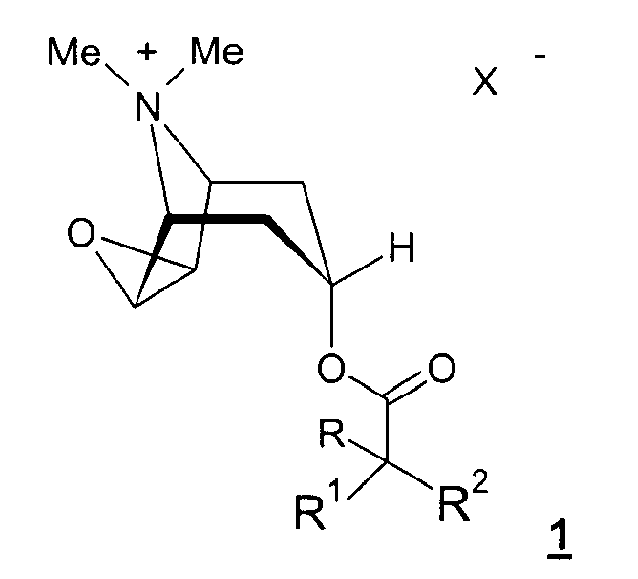
worin
X -
ein einfach negativ geladenes Anion,
R
H, Methyl oder OH
R1 und R2
gleich oder verschieden, Phenyl oder Thienyl bedeuten,
zur Herstellung eines Arzneimittels zur Abtötung von Mikroorganismen und/oder zur Herstellung eines Arzneimittels zur Behandlung von durch Mikroorganismen verursachten Atemwegsinfektionen.
X -
ein einfach negativ geladenes Anion,
R
H, Methyl oder OH
R1 und R2
gleich oder verschieden, Phenyl oder Thienyl bedeuten,
zur Herstellung eines Arzneimittels zur Abtötung von Mikroorganismen und/oder zur Herstellung eines Arzneimittels zur Behandlung von durch Mikroorganismen verursachten Atemwegsinfektionen.
Description
- Die vorliegende Erfindung betrifft die Verwendung einer Verbindung der Formel 1

- X -
- ein einfach negativ geladenes Anion,
- R
- H, Methyl oder OH
- R1 und R2
- gleich oder verschieden, Phenyl oder Thienyl bedeuten,
- Weiterhin betrifft die vorliegende Erfindung eine pharmazeutische Zusammensetzung einer Verbindung der obigen Formel 1 , gegebenenfalls in Form der einzelnen optischen Isomeren, Mischungen der einzelnen Enantiomeren oder Racemate, wobei die pharmazeutische Zusammensetzung kein Konservierungsmittel enthält.
- Die Verbindungen der Formel 1 sind aus der
WO 02/32899 WO 91/04252 - Es war Aufgabe der vorliegenden Erfindung, neue Verwendungen für die Verbindungen der Formel 1 bereitzustellen.
- Überraschenderweise konnte gefunden werden, dass die Verbindungen der Formel 1

- X -
- ein einfach negativ geladenes Anion,
- R
- H, Methyl oder OH
- R1 und R2
- gleich oder verschieden, Phenyl oder Thienyl
- Die Applikation der Verbindungen nach Formel 1 erfolgt hierbei vorzugsweise auf inhalativem Wege. Hierbei können geeignete Inhalationspulver, die in geeignete Kapseln (Inhaletten) abgefüllt mittels entsprechender Pulverinhalatoren appliziert werden, zum Einsatz kommen. Alternativ dazu kann eine inhalative Anwendung auch durch Applikation geeigneter Inhalationsaerosole erfolgen. Hierzu zählen auch pulverförmige Inhalationsaerosole, die beispielsweise HFA134a, HFA227 oder deren Gemisch als Treibgas enthalten, aber auch Inhalationslösungen, insbesondere wässrige, ethanolische oder ethanolisch/wässrige Inhalationslösungen.
- In
US 2004/0209954 A1 wird beschrieben, dass bestimmte quaternäre Amine mit anticholinerger Wirkung wie Glycopyrrolat, Mepenzolat und Ipratropium eine antimikrobielle Aktivität besitzen, wobei jedoch keines der dort genannten Anticholinergika eine Scopin-Struktur besitzt. Die Scopin-Derivate der Formel 1 , die von den Anticholinergika Glycopyrrolat, Mepenzolat und Ipratropium strukturell weit entfernt sind, werden inUS 2004/0209954 A1 jedoch nicht erwähnt. - Im Rahmen der vorliegenden Erfindung gelangen bevorzugt jene Verbindungen der Formel 1 zur Anwendung, in denen das Anion X - ausgewählt ist aus der Gruppe bestehend aus Chlorid, Bromid, lodid, Sulfat, Phosphat, Methansulfonat, Nitrat, Maleat, Acetat, Citrat, Fumarat, Tartrat, Oxalat, Succinat, Benzoat und p-Toluolsulfonat.
- Bevorzugt gelangen die Salze der Formel 1 zur Anwendung, worin X - ein Anion ausgewählt aus der Gruppe Chlorid, Bromid, 4-Toluolsulfonat und Methansulfonat bedeutet.
- Erfindungsgemäß besonders bevorzugt im Rahmen der vorliegenden Erfindung sind diejenigen Formulierungen, die die Verbindung der Formel 1 , in der X - für Bromid steht, enthalten.
- Bezugnahmen auf die Verbindung der Formel 1 schließen im Rahmen der vorliegenden Erfindung stets alle möglichen amorphen und kristallinen Modifikationen dieser Verbindung mit ein. Bezugnahmen auf die Verbindung der Formel 1 schließen im Rahmen der vorliegenden Erfindung ferner alle möglichen Solvate und Hydrate, die von dieser Verbindung gebildet werden können, mit ein.
- Besonders bevorzugt ist die Verwendung einer Verbindung nach Formel 1 ,wobei R1 und R2 beide Phenyl, R Methyl und X- Bromid bedeuten (2,2-Diphenylpropionsäurescopinester-Methobromid), zur Abtötung von Mikroorganismen sowie auch zur Herstellung eines Arzneimittels zur Behandlung von Atemwegsinfektionen. Diese Verbindung nach Formel 1 , wobei R1 und R2 beide Phenyl, R Methyl und X- Bromid bedeuten, wird zur Abtötung von Mikroorganismen sowie auch zur Herstellung eines Arzneimittels zur Behandlung von Atemwegsinfektionen besonders bevorzugt in wässriger Lösung zur Inhalation und in der Konzentration von 0,1 bis 2,5 Gewichtsprozent, insbesondere von 0,2 bis 1,5 Gewichtsprozent eingesetzt.
- Besonders bevorzugt ist weiterhin die Verwendung einer Verbindung nach Formel 1, wobei R1 und R2 beide 2-Thienyl, R OH und X- Bromid bedeutet (Tiotropiumbromid), zur Abtötung von Mikroorganismen sowie auch zur Herstellung eines Arzneimittels zur Behandlung von Atemwegsinfektionen. Diese Verbindung nach Formel 1 , wobei R1 und R2 beide 2-Thienyl, R Hydroxyl und X- Bromid bedeuten, wird zur Abtötung von Mikroorganismen sowie auch zur Herstellung eines Arzneimittels zur Behandlung von Atemwegsinfektionen besonders bevorzugt in wässriger Lösung zur Inhalation und in der Konzentration von 0,005 bis 2,5 Gewichtsprozent, insbesondere von 0,01 bis 0,5 Gewichtsprozent eingesetzt.
- Vorzugsweise werden die Verbindungen nach Formel 1 zur Abtötung von Mikroorganismen ausgewählt aus der Gruppe bestehend aus Pilzen und Bakterien eingesetzt. Die Verbindungen nach Formel 1 stärker bevorzugt zur Abtötung von Bakterien ausgewählt aus der Gruppe bestehend aus Escherichia coli (z.B. ATCC 8739), Pseudomonas aeruginosa (z.B. ATCC 9027), Staphylococcus aureus (z.B. ATCC 6538), Bacillus subtilis (z.B. ATCC 6633), Streptococcus viridans (z.B. M1040), Streptococcus pyogenes (z.B. ATCC12344 oder ATCC 19615), Neisseria spp., Streptococcus pneumoniae (z.B. ATCC 49 619), Corynebacterium spp., Pseudomonas spp. (z.B. Pseudomonas eeruginosa), Mycoplasma pneumoniae (z.B. ATCC 29342), Pseudomonas aeruginosa (z.B. ATCC 15442), Haemophilus influenzae (z.B. ATCC 51907 oder ATCC 33391), Chlamydophila pneumoniae (z.B. ATCC VR 1310), Moraxella catarrhalis (z.B. ATCC 25238 oder ATCC 8176), Enterobacteriaceae, Klebsiella pneumoniae (z.B. ATCC 10031 oder ATCC 13883) und Bacillus spp. eingesetzt oder zur Abtötung von Pilzen ausgewählt aus der Gruppe bestehend aus Candida albicans (z.B. ATCC 10231) und Aspergillus niger (z.B. ATCC 16404) eingesetzt. Besonders bevorzugt sind die Verbindungen nach Formel 1 zur Abtötung von Bakterien ausgewählt aus der Gruppe bestehend aus aus Escherichia coli (z.B. ATCC 8739), Staphylococcus aureus (z.B. ATCC 6538), Bacillus subtilis (z.B. ATCC 6633) und zur Abtötung von Pilzen ausgewählt aus der Gruppe bestehend aus Candida albicans (z.B. ATCC 10231) und Aspergillus niger (z.B. ATCC 16404) geeignet.
- Eine weitere bevorzugte Ausführungsform der vorliegenden Erfindung betrifft die Verwendung der Verbindungen der Formel 1 zur Herstellung eines Arzneimittels zur Behandlung von Atemwegsinfektionen. Diese Atemwegsinfektionen werden vorzugsweise durch Bakterien ausgewählt aus der Gruppe bestehend aus Escherichia coli (z.B. ATCC 8739), Pseudomonas aeruginosa (z.B. ATCC 9027), Staphylococcus aureus (z.B. ATCC 6538), Bacillus subtilis (z.B. ATCC 6633), Streptococcus viridans (z.B. M1040), Streptococcus pyogenes (z.B. ATCC12344 oder ATCC 19615), Neisseria spp., Streptococcus pneumoniae (z.B. ATCC 49 619), Corynebacterium spp., Pseudomonas spp. (z.B. Pseudomonas eeruginosa), Mycoplasma pneumoniae (z.B. ATCC 29342), Pseudomonas aeruginosa (z.B. ATCC 15442), Haemophilus influenzae (z.B. ATCC 51907 oder ATCC 33391), Chlamydophila pneumoniae (z.B. ATCC VR 1310), Moraxella catarrhalis (z.B. ATCC 25238 oder ATCC 8176), Enterobacteriaceae, Klebsiella pneumoniae (z.B. ATCC 10031 oder ATCC 13883) und Bacillus spp, insbesondere aber durch Bakterien ausgewählt aus der Gruppe bestehend aus Escherichia coli (z.B. ATCC 8739), Pseudomonas aeruginosa (z.B. ATCC 9027), Staphylococcus aureus (z.B. ATCC 6538), Bacillus subtilis (z.B. ATCC 6633) verursacht. Diese Atemwegsinfektionen werden weiterhin vorzugsweise durch Pilze, insbesondere ausgewählt aus der Gruppe bestehend aus Candida albicans (z.B. ATCC 10231) und Aspergillus niger (z.B. ATCC 16404) verursacht. Besonders bevorzugt ist die Verwendung der Verbindungen der Formel 1 zur Herstellung eines Arzneimittels zur Behandlung von Atemwegsinfektionen, die durch die Pilze Aspergillus niger und Candida albicans oder durch ein Bakterium ausgewählt aus der Gruppe bestehend aus Pseudomonas aeroginosa oder Staphylococcus aureus, Bacillus subtilis und Escherichia coli hervorgerufen werden.
- In einer weiteren bevorzugten Ausführungsform betrifft die Erfindung eine pharmazeutische Zusammensetzung enthaltend eine Verbindung der Formel 1

- X -
- ein einfach negativ geladenes Anion,
- R
- H, Methyl oder OH
- R1 und R2
- gleich oder verschieden, Phenyl oder Thienyl bedeuten,
- Im Rahmen der vorliegenden Erfindung gelangen bevorzugt jene Verbindungen der Formel 1 zur Anwendung, in denen das Anion X - ausgewählt ist aus der Gruppe bestehend aus Chlorid, Bromid, Iodid, Sulfat, Phosphat, Methansulfonat, Nitrat, Maleat, Acetat, Citrat, Fumarat, Tartrat, Oxalat, Succinat, Benzoat und p-Toluolsulfonat.
- Bevorzugt gelangen die Salze der Formel 1 zur Anwendung, worin X - ein Anion ausgewählt aus der Gruppe Chlorid, Bromid, 4-Toluolsulfonat und Methansulfonat bedeutet.
- Erfindungsgemäß besonders bevorzugt im Rahmen der vorliegenden Erfindung sind diejenigen Formulierungen, die die Verbindung der Formel 1 , in der X - für Bromid steht, enthalten.
- Die Applikation der Verbindungen nach Formel 1 erfolgt vorzugsweise auf inhalativem Wege. Hierbei können geeignete Inhalationspulver, die in geeignete Kapseln (Inhaletten) abgefüllt mittels entsprechender Pulverinhalatoren appliziert werden, zum Einsatz kommen. Alternativ dazu kann eine inhalative Anwendung auch durch Applikation geeigneter Inhalationsaerosole erfolgen. Hierzu zählen auch pulverförmige Inhalationsaerosole, die beispielsweise HFA134a, HFA227 oder deren Gemisch als Treibgas enthalten, und natürlich auch treibgashaltige oder treibgasfreie Inhalationslösungen der Verbindungen nach Formel 1 in einem Lösungsmittel ausgewählt aus der Gruppe bestehend aus Wasser, Ethanol und einem Wasser/Ethanol-Gemisch, wobei wässrige Inhalationslösungen bevorzugt und wässrige, treibgasfreie Inhalationslösungen besonders bevorzugt sind.
- In einer besonders bevorzugten Ausführungsform betrifft die Erfindung eine pharmazeutische Zusammensetzung enthaltend eine Verbindung nach Formel 1, worin R1 und R2 beide Phenyl, R Methyl und X- Bromid bedeuten (2,2-Diphenylpropionsäurescopinester-Methobromid), gegebenenfalls in Form der einzelnen optischen Isomeren, Mischungen der einzelnen Enantiomeren oder Racemate, dadurch gekennzeichnet, dass die pharmazeutische Zusammensetzung kein Konservierungsmittel enthält. Diese pharmazeutische Zusammensetzung ist vorzugsweise eine wässrige, insbesondere eine treibgasfreie wässrige Aerosolformulierung enthaltend ein 2,2-Diphenylpropionsäurescopinester-Methobromid.
- Hierbei ist das 2,2-Diphenylpropionsäurescopinester-Methobromid vorzugsweise in einer Konzentration von 0,1 bis 2,5 Gewichtsprozent, insbesondere in einer Konzentration von 0,2 bis 1,5 Gewichtsprozent in der wässrigen Aerosolformulierung anwesend. Der pH-Wert dieser bevorzugten Formulierung liegt erfindungsgemäß bevorzugt in einem Bereich von 2,5 und 6,5, vorzugsweise in einem Bereich von 3,0 bis 5,0, stärker bevorzugt im Bereich von 3,5 bis 4,5 , insbesondere im Bereich 3,6 bis 4,4.
- In einer weiteren besonders bevorzugten Ausführungsform betrifft die Erfindung eine pharmazeutische Zusammensetzung enthaltend eine Verbindung nach Formel 1 , worin R1 und R2 2-Thienyl, R Hydroxy und X- Bromid bedeuten (Tiotropiumbromid), gegebenenfalls in Form der einzelnen optischen Isomeren, Mischungen der einzelnen Enantiomeren oder Racemate, dadurch gekennzeichnet, dass die pharmazeutische Zusammensetzung kein Konservierungsmittel enthält. Diese pharmazeutische Zusammensetzung ist vorzugsweise eine wässrige, insbesondere eine treibgasfreie Aerosolformulierung enthaltend Tiotropiumbromid.
- Hierbei ist Tiotropiumbromid vorzugsweise in einer Konzentration von 0,005 bis 2,5 Gewichtsprozent, insbesondere in einer Konzentration von 0,01 bis 0,5 Gewichtsprozent in der wässrigen Aerosolformulierung anwesend. Der pH-Wert der erfindungsgemäßen Formulierung liegt zwischen 2,0 und 4,5, bevorzugt zwischen 2,5 und 3,5 und stärker bevorzugt zwischen 2,7 und 3,3 und besonders bevorzugt zwischen 2,7 und 3,2. Am stärksten bevorzugt sind pH-Werte mit einer oberen Grenze von 3,1.
- Die bevorzugten wässrigen, treibgasfreien Aerosolformulierungen enthalten vorzugsweise zusätzlich die zum Einstellen des pH-Werts notwendige Säure(n).
- Der pH-Wert wird durch Zugabe von pharmakologisch verträglichen Säuren eingestellt. Beispiele für diesbezüglich bevorzugte anorganische Säuren sind: Salzsäure, Bromwasserstoffsäure, Salpetersäure, Schwefelsäure und/oder Phosphorsäure. Beispiele für besonders geeignete organische Säuren sind: Ascorbinsäure, Zitronensäure, Äpfelsäure, Weinsäure, Maleinsäure, Bernsteinsäure, Fumarsäure, Essigsäure, Ameisensäure und/oder Propionsäure und andere. Bevorzugte anorganische Säuren sind Salzsäure, Schwefelsäure. Es können auch die Säuren verwendet werden, die bereits mit dem Wirkstoff ein Säureadditionssalz bilden. Unter den organischen Säuren sind Ascorbinsäure, Fumarsäure und Zitronensäure bevorzugt, wobei Zitronensäure am stärksten bevorzugt ist. Gegebenenfalls können auch Gemische der genannten Säuren eingesetzt werden, insbesondere in Fällen von Säuren, die neben ihren Säuerungseigenschaften auch andere Eigenschaften, z.B. als Geschmackstoffe oder Antioxidantien besitzen, wie beispielsweise Zitronensäure oder Ascorbinsäure. Als anorganische Säuren wird ausdrücklich Salzsäure genannt.
- Gegebenenfalls können auch pharmakologisch verträgliche Basen zum genauen Austitrieren des pH-Wertes eingesetzt werden. Als Basen eignen sich beispielsweise Alkalihydroxide und Alkalicarbonate. Bevorzugtes Alkaliion ist Natrium. Werden solche Basen verwendet, ist darauf zu achten, daß auch die daraus resultierenden Salze, die dann in der fertigen Arzneimittelformulierung enthalten sind, mit der oben genannten Säure pharmakologisch akzeptabel ist.
- Die bevorzugten wässrigen, treibgasfreien Aerosolformulierungen können außer dem Lösungsmittel Wasser und der Verbindung der Formel 1 zusätzlich einen Komplexbildner, insbesondere Natriumedetat, weitere Cosolventien sowie weitere Hilfs- und Zusatzstoffe wie z.B. Antioxidantien, oberflächenaktive Stoffe etc. mit Ausnahme von Konservierungsstoffen enthalten. In einer anderen Ausführungsform der wässrigen, treibgasfreien Aerosolformulierungen sind außer der Verbindung nach Formel 1 und dem Lösungsmittel Wasser keinerlei weitere Zusätze vorhanden.
- Unter Komplexbildner werden im Rahmen der vorliegenden Erfindung bevorzugt Moleküle verstanden, die in der Lage sind Komplexbindungen einzugehen. Bevorzugt sollen durch diese Verbindungen Kationen, besonders bevorzugt metallische Kationen komplexiert werden.
- Die erfindungsgemäßen Formulierungen enthalten als Komplexbildner bevorzugt Editinsäure (EDTA) oder bekannte Salze davon, z.B. Natrium-EDTA, bzw. Dinatrium-EDTA. Bevorzugt wird Natriumedetat und Dinatriumedetat, gegebenenfalls in Form ihrer Hydrate, besonders bevorzugt in Form ihrer Dihydrate eingesetzt.
Werden im Rahmen der erfindungsgemäßen Formulierungen Komplexbildner verwendet, so liegt deren Gehalt bevorzugt in einem Bereich von 5 bis 20 mg pro 100 ml, stärker bevorzugt in einem Bereich von 7 bis 15 mg pro 100 ml der erfindungsgemäßen Formulierung. Besonders bevorzugt enthalten die erfindungsgemäßen Formulierungen einen Komplexbildner, vorzugsweise Natriumedetat oder Dinatriumedetat bzw. eines ihrer Hydrate, in einer Menge von etwa 9 bis 12 mg pro 100 ml, insbesondere von etwa 10 mg pro 100 ml der erfindungsgemäßen Formulierung. - Analoges wie bereits für Natriumedetat und Dinatriumedetat ausgeführt, gilt auch für mögliche, mit EDTA oder seinen Salzen vergleichbare Zusatzstoffe, die komplexbildende Eigenschaften aufweisen und anstelle dessen verwendet werden können, wie beispielsweise Nitrilotriessigsäure und deren Salze.
- Der erfindungsgemäßen Formulierung können weitere pharmakologisch verträgliche Hilfsstoffe zugesetzt werden. Unter Hilfs- und Zusatzstoffen wird in diesem Zusammenhang jeder pharmakologisch verträgliche und therapeutisch sinnvolle Stoff verstanden, der kein Wirkstoff ist, aber zusammen mit dem Wirkstoff in dem pharmakologisch geeigneten Lösungsmittel formuliert werden kann, um die qualitativen Eigenschaften der Wirkstoffformulierung zu verbessern. Bevorzugt entfalten diese Stoffe keine oder im Kontext mit der angestrebten Therapie keine nennenswerte oder zumindest keine unerwünschte pharmakologische Wirkung. Zu den Hilfs- und Zusatzstoffen zählen z.B. Stabilisatoren, Antioxidantien und/oder Konservierungsstoffe, die die Verwendungsdauer der fertigen Arzneimittelformulierung verlängern sowie Geschmackstoffe, Vitamine und/oder sonstige dem Stand der Technik bekannte Zusatzstoffe. Zu den Zusatzstoffen zählen auch pharmakologisch unbedenkliche Salze wie beispielsweise Natriumchlorid.
- Zu den bevorzugten Hilfsstoffen zählen Antioxidantien, wie beispielsweise Ascorbinsäure, sofern nicht bereits für die Einstellung des pH-Werts verwendet, Vitamin A, Vitamin E, Tocopherole und ähnliche im menschlichen Organismus vorkommende Vitamine oder Provitamine.
- Bevorzugte Co-Solventien sind solche, die Hydroxylgruppen oder andere polare Gruppen enthalten, beispielsweise Alkohole - insbesondere lsopropylalkohol, Glykole - insbesondere Propylenglykol, Polyethylenglykol, Polypropylenglykol, Glykolether, Glycerol, Polyoxyethylenalkohole und Polyoxyethylen-Fettsäureester, sofern sie nicht bereits das Lösungs- oder Suspensionsmittel sind.
- Unter Hilfs- und Zusatzstoffen wird in diesem Zusammenhang jeder pharmakologisch verträgliche und therapeutisch sinnvolle Stoff verstanden, der einerseits kein Wirkstoff und andererseits kein Konservierungsmittel ist, aber zusammen mit dem Wirkstoff in dem pharmakologisch geeigneten Lösungsmittel formuliert werden kann, um die qualitativen Eigenschaften der Wirkstoffformulierung zu verbessern. Bevorzugt entfalten diese Stoffe keine oder im Kontext mit der angestrebten Therapie keine nennenswerte oder zumindest keine unerwünschte pharmakologische Wirkung. Zu den Hilfs- und Zusatzstoffen zählen z.B. oberflächenaktive Stoffe, wie z.B. Sojalecithin, Ölsäure, Sorbitanester, wie Sorbitantrioleat, Polyvinylpyrrolidon sonstige Stabilisatoren, Komplexbildner, Antioxidantien, Geschmackstoffe, Vitamine und/oder sonstige dem Stand der Technik bekannte Zusatzstoffe. Zu den Zusatzstoffen zählen auch pharmakologisch unbedenkliche Salze wie beispielsweise Natriumchlorid.
- Die keimtötende Wirkung der Verbindungen nach Formel 1 kann durch Vergleich von Testlösungen ( = wäßrige Lösungen, die die Verbindung nach Formel 1 enthalten, mit Placebo-Lösungen ( = identische wäßrige Lösungen ohne die Verbindung nach Formel 1 ) nach dem Testverfahren wie in European Pharmacopoeia 4 (2002), General Text 5.1.3, Efficiacy of Antimicrobial Preservation beschrieben nachgewiesen werden. Hierbei werden definierte Volumina der Testlösungen und der Placebo-Lösungen jeweils mit identischen Mengen einer Inoculationslösung eines bestimmen Mikroorganismus versetzt, homogenisiert und bei einer für das Wachstum des Mikroorganismus geeigneten Temperatur und Luftfeuchtigkeit inkubiert. Zu definierten Zeitpunkten (z.B. nach 1 Tag, 2 Tagen, 3 Tagen, 7 Tagen, 14 Tagen und 28 Tagen) wird dann die Anzahl der keimfähigen Organismen ("colony forming units") der inokulierten Formulierungen gemessen und jeweils für die Testlösung und für die Placebo-Lösung verglichen.
- Zur Bestimmung der Anzahl der keimfähigen Organismen ("colony forming units") der inokulierten Formulierungen werden zu definierten Zeitpunkten Proben aus diesen Formulierungen entnommen und mit TSB-Medium (Medium A) enthaltend Inaktivator No. 5 (3% Tween 80, 0,3% Lecithin, 0,1% Histidin) verdünnt. Anschließend werden diese Verdünnungen einer Membranfiltration unterworfen. Zur Ermittlung der Anzahl der Bakterien oder der Pilze wurden die Membranfilter nacheinander auf TSA-Medium (Medium B) und auf Sabourraud Agar (Medium C) übertragen. Die TSA-Platten wurden für 3-5 Tage bei 30-35 °C und die Sabourraud-Agarplatten bei 20-25 °C jeweils für fünf Tage inkubiert. Anschließend werden die Kolonien auf beiden Platten ausgezählt.
keimtötende Wirkung besitzen und insbesondere zur Abtötung von Mikroorganismen wie Bakterien und Pilzen verwendet werden können. Es konnte weiterhin gefunden werden, dass sich die Verbindungen der Formel 1 auch zur Herstellung eines Arzneimittels zur Behandlung von Atemwegsinfektionen eignen. Einen besonderen erfindungsgemäßen Vorteil stellt hierbei die Möglichkeit dar, mit nur einem einzigen Wirkstoff, nämlich einer Verbindung der Formel 1, sowohl Asthma oder COPD als auch die häufig mit diesen Erkrankungen einhergehenden Atemwegsinfektionen behandeln zu können.
Claims (20)
- Verwendung einer Verbindung der Formel 1
 X - ein einfach negativ geladenes Anion,R H, Methyl oder OHR1 und R2 gleich oder verschieden, Phenyl oder Thienylbedeuten,
gegebenenfalls in Form der einzelnen optischen Isomeren, Mischungen der einzelnen Enantiomeren oder Racemate, zur Herstellung eines Arzneimittels zur Abtötung von Mikroorganismen. - Verwendung einer Verbindung der Formel 1
 X - ein einfach negativ geladenes Anion,R H, Methyl oder OHR1 und R2 gleich oder verschieden, Phenyl oder Thienylbedeuten,
gegebenenfalls in Form der einzelnen optischen Isomeren, Mischungen der einzelnen Enantiomeren oder Racemate, zur Herstellung eines Arzneimittels zur Behandlung von durch Mikroorganismen verursachten Atemwegsinfektionen. - Verwendung nach Anspruch 1 oder 2, dadurch gekennzeichnet, dass die Verbindung der Formel 1 inhalativ angewendet wird.
- Verwendung nach Anspruch 1 bis 3, dadurch gekennzeichnet, dass in der Verbindung der Formel 1 R1 und R2 beide Phenyl, R Methyl und X - Bromid bedeutet.
- Verwendung nach Anspruch 4, dadurch gekennzeichnet, dass die Verbindung nach Formel 1 in einer wässrigen Lösung in einer Konzentration von 0,1 bis 2,5 Gewichtsprozent anwesend ist.
- Verwendung nach Anspruch 4, dadurch gekennzeichnet, dass die Verbindung nach Formel 1 in einer wässrigen Lösung in einer Konzentration von 0,2 bis 1,5 Gewichtsprozent anwesend ist.
- Verwendung nach Anspruch 1 bis 3, dadurch gekennzeichnet, dass in der Verbindung der Formel 1 R1 und R2 2-Thienyl und R OH bedeutet.
- Verwendung nach Anspruch 7, dadurch gekennzeichnet, dass die Verbindung der Formel 1 in einer Konzentration von 0,005 bis 2,5 Gewichtsprozent anwesend ist.
- Verwendung nach Anspruch 7, dadurch gekennzeichnet, dass die Verbindung der Formel 1 in einer Konzentration von 0,01 bis 0,5 Gewichtsprozent anwesend ist.
- Verwendung nach Anspruch 1 bis 9, dadurch gekennzeichnet, dass die Mikroorganismen Pilze oder Bakterien sind.
- Verwendung nach Anspruch 10, dadurch gekennzeichnet, dass die Mikroorganismen Bakterien sind und ausgewählt sind aus der Gruppe bestehend aus Escherichia coli, Pseudomonas aeruginosa, Staphylococcus aureus, Bacillus subtilis, Streptococcus viridans, Streptococcus pyogenes, Neisseria spp., Streptococcus pneumoniae, Corynebacterium spp., Pseudomonas spp., Mycoplasma pneumoniae, Pseudomonas aeruginosa, Haemophilus influenzae, Chlamydophila pneumoniae, Moraxella catarrhalis, Enterobacteriaceae, Klebsiella pneumoniae und Bacillus spp. eingesetzt.
- Verwendung nach Anspruch 10, dadurch gekennzeichnet, dass die Mikroorganismen Pilze sind und ausgewählt sind aus der Gruppe bestehend aus Candida albicans und Aspergillus niger.
- Pharmazeutische Zusammensetzung enthaltend eine Verbindung der Formel 1
 X - ein einfach negativ geladenes Anion,R H, Methyl oder OHR1 und R2 gleich oder verschieden, Phenyl oder Thienylbedeuten,
gegebenenfalls in Form der einzelnen optischen Isomeren, Mischungen der einzelnen Enantiomeren oder Racemate, dadurch gekennzeichnet, dass die pharmazeutische Zusammensetzung kein Konservierungsmittel enthält. - Pharmazeutische Zusammensetzung nach Anspruch 13, dadurch gekennzeichnet, dass diese eine wässrige Aerosolformulierung ist.
- Wässerige Aerosolformulierung zur Inhalation nach Anspruch 13 oder 14, dadurch gekennzeichnet, dass R1 und R2 beide Phenyl, R Methyl und X - Bromid bedeuten.
- Wässerige Aerosolformulierung zur Inhalation nach Anspruch 15, dadurch gekennzeichnet, dass die Verbindung nach Formel 1 in einer Konzentration von 0,1 bis 2,5 Gewichtsprozent anwesend ist.
- Wässerige Aerosolformulierung zur Inhalation nach Anspruch 15, dadurch gekennzeichnet, dass die Verbindung nach Formel 1 in einer Konzentration von 0,2 bis 1,5 Gewichtsprozent anwesend ist.
- Wässerige Aerosolformulierung zur Inhalation nach Anspruch 13 oder 14, dadurch gekennzeichnet, dass R1 und R2 beide 2-Thienyl, R OH und X- Bromid bedeuten.
- Wässerige Aerosolformulierung zur Inhalation nach Anspruch 18, dadurch gekennzeichnet, dass die Verbindung nach Formel 1 in einer Konzentration von 0,005 bis 2,5Gewichtsprozent anwesend ist.
- Wässerige Aerosolformulierung zur Inhalation nach Anspruch 18, dadurch gekennzeichnet, dass die Verbindung nach Formel 1 in einer Konzentration von 0,1 bis 0,5 Gewichtsprozent anwesend ist.
Priority Applications (6)
| Application Number | Priority Date | Filing Date | Title |
|---|---|---|---|
| EP06120196A EP1905440A1 (de) | 2006-09-06 | 2006-09-06 | Verwendung einer pharmazeutischen Zusammensetzung enthaltend ein Anticholinergikum zur Abtötung von Mikroorganismen und zur Behandlung von Atemwegsinfektionen |
| EP07802794A EP2081573A2 (de) | 2006-09-06 | 2007-08-22 | Verwendung einer pharmazeutischen zusammensetzung enthaltend ein anticholinergikum zur abtötung von mikroorganismen und zur behandlung von atemwegsinfektionen |
| PCT/EP2007/058722 WO2008028805A2 (de) | 2006-09-06 | 2007-08-22 | Verwendung einer pharmazeutischen zusammensetzung enthaltend ein anticholinergikum zur abtötung von mikroorganismen und zur behandlung von atemwegsinfektionen |
| JP2009527098A JP2010536712A (ja) | 2006-09-06 | 2007-08-22 | 微生物を死滅させるとともに呼吸器感染症を治療する抗コリン作用薬を含む医薬組成物の使用 |
| US12/440,097 US20100040559A1 (en) | 2006-09-06 | 2007-08-22 | Use of a Pharmaceutical Composition Comprising an Anticholinergic for Killing Microorganisms and for Treating Respiratory Tract Infections |
| CA002662732A CA2662732A1 (en) | 2006-09-06 | 2007-08-22 | Use of a pharmaceutical composition comprising an anticholinergic for killing microorganisms and for treating respiratory tract infections |
Applications Claiming Priority (1)
| Application Number | Priority Date | Filing Date | Title |
|---|---|---|---|
| EP06120196A EP1905440A1 (de) | 2006-09-06 | 2006-09-06 | Verwendung einer pharmazeutischen Zusammensetzung enthaltend ein Anticholinergikum zur Abtötung von Mikroorganismen und zur Behandlung von Atemwegsinfektionen |
Publications (1)
| Publication Number | Publication Date |
|---|---|
| EP1905440A1 true EP1905440A1 (de) | 2008-04-02 |
Family
ID=37891636
Family Applications (2)
| Application Number | Title | Priority Date | Filing Date |
|---|---|---|---|
| EP06120196A Ceased EP1905440A1 (de) | 2006-09-06 | 2006-09-06 | Verwendung einer pharmazeutischen Zusammensetzung enthaltend ein Anticholinergikum zur Abtötung von Mikroorganismen und zur Behandlung von Atemwegsinfektionen |
| EP07802794A Withdrawn EP2081573A2 (de) | 2006-09-06 | 2007-08-22 | Verwendung einer pharmazeutischen zusammensetzung enthaltend ein anticholinergikum zur abtötung von mikroorganismen und zur behandlung von atemwegsinfektionen |
Family Applications After (1)
| Application Number | Title | Priority Date | Filing Date |
|---|---|---|---|
| EP07802794A Withdrawn EP2081573A2 (de) | 2006-09-06 | 2007-08-22 | Verwendung einer pharmazeutischen zusammensetzung enthaltend ein anticholinergikum zur abtötung von mikroorganismen und zur behandlung von atemwegsinfektionen |
Country Status (5)
| Country | Link |
|---|---|
| US (1) | US20100040559A1 (de) |
| EP (2) | EP1905440A1 (de) |
| JP (1) | JP2010536712A (de) |
| CA (1) | CA2662732A1 (de) |
| WO (1) | WO2008028805A2 (de) |
Families Citing this family (6)
| Publication number | Priority date | Publication date | Assignee | Title |
|---|---|---|---|---|
| KR101781237B1 (ko) * | 2010-01-28 | 2017-09-22 | 테론 파마슈티칼즈, 인크. | 7-아조니아바이시클로〔2.2.1〕헵탄 유도체, 제조 방법, 및 그의 제약적 용도 |
| MX369121B (es) | 2011-03-04 | 2019-10-30 | Gruenenthal Gmbh | Formulacion farmaceutica acuosa de tapentadol para administracion oral. |
| MX348831B (es) * | 2011-03-04 | 2017-06-30 | Gruenenthal Gmbh | Administración parenteral de tapentadol. |
| JP2019142972A (ja) * | 2011-03-04 | 2019-08-29 | グリュネンタール・ゲゼルシャフト・ミト・ベシュレンクテル・ハフツング | タペンタドールの非経口的投与 |
| TW201642843A (zh) | 2015-03-27 | 2016-12-16 | 歌林達有限公司 | 他噴他多腸胃外給藥的穩定製劑 |
| EP3515412B1 (de) | 2016-09-23 | 2025-04-23 | Grünenthal GmbH | Stabile formulierungen zur parenteralen verabreichung von tapentadol |
Citations (7)
| Publication number | Priority date | Publication date | Assignee | Title |
|---|---|---|---|---|
| WO2002032898A2 (de) * | 2000-10-14 | 2002-04-25 | Boehringer Ingelheim Pharma Gmbh & Co. Kg | Neue anticholinergika, verfahren zu deren herstellung und deren verwendung als arzneimittel |
| WO2002096423A2 (en) * | 2001-05-25 | 2002-12-05 | Boehringer Ingelheim Pharma Gmbh & Co. Kg | Combination of a pde4 inhibitor and tiotropium or derivate thereof for treating obstructive airways |
| WO2003084519A2 (de) * | 2002-04-11 | 2003-10-16 | Boehringer Ingelheim Pharma Gmbh & Co.Kg | Aerosolformulierung für die inhalation enthaltend ein tiotropiumsalz |
| US20050008578A1 (en) * | 2003-07-11 | 2005-01-13 | Boehringer Ingelheim International Gmbh | HFC solution formulations containing an anticholinergic |
| WO2005044186A2 (en) * | 2003-10-28 | 2005-05-19 | Glaxo Group Limited | Inhalable pharmaceutical formulations employing desiccating agents and methods of administering the same |
| US20050239778A1 (en) * | 2004-04-22 | 2005-10-27 | Boehringer Ingelheim International Gmbh | Novel medicament combinations for the treatment of respiratory diseases |
| WO2006015970A2 (en) * | 2004-08-13 | 2006-02-16 | Boehringer Ingelheim International Gmbh | Medicaments for the prevention or treatment of alveolar pneumonia comprising an anticholinergic |
Family Cites Families (1)
| Publication number | Priority date | Publication date | Assignee | Title |
|---|---|---|---|---|
| US7417051B2 (en) * | 2002-04-12 | 2008-08-26 | Boehringer Ingelheim Pharma Gmbh & Co. Kg | Medicaments comprising betamimetics and a novel anticholinergic |
-
2006
- 2006-09-06 EP EP06120196A patent/EP1905440A1/de not_active Ceased
-
2007
- 2007-08-22 CA CA002662732A patent/CA2662732A1/en not_active Abandoned
- 2007-08-22 JP JP2009527098A patent/JP2010536712A/ja active Pending
- 2007-08-22 EP EP07802794A patent/EP2081573A2/de not_active Withdrawn
- 2007-08-22 WO PCT/EP2007/058722 patent/WO2008028805A2/de not_active Ceased
- 2007-08-22 US US12/440,097 patent/US20100040559A1/en not_active Abandoned
Patent Citations (7)
| Publication number | Priority date | Publication date | Assignee | Title |
|---|---|---|---|---|
| WO2002032898A2 (de) * | 2000-10-14 | 2002-04-25 | Boehringer Ingelheim Pharma Gmbh & Co. Kg | Neue anticholinergika, verfahren zu deren herstellung und deren verwendung als arzneimittel |
| WO2002096423A2 (en) * | 2001-05-25 | 2002-12-05 | Boehringer Ingelheim Pharma Gmbh & Co. Kg | Combination of a pde4 inhibitor and tiotropium or derivate thereof for treating obstructive airways |
| WO2003084519A2 (de) * | 2002-04-11 | 2003-10-16 | Boehringer Ingelheim Pharma Gmbh & Co.Kg | Aerosolformulierung für die inhalation enthaltend ein tiotropiumsalz |
| US20050008578A1 (en) * | 2003-07-11 | 2005-01-13 | Boehringer Ingelheim International Gmbh | HFC solution formulations containing an anticholinergic |
| WO2005044186A2 (en) * | 2003-10-28 | 2005-05-19 | Glaxo Group Limited | Inhalable pharmaceutical formulations employing desiccating agents and methods of administering the same |
| US20050239778A1 (en) * | 2004-04-22 | 2005-10-27 | Boehringer Ingelheim International Gmbh | Novel medicament combinations for the treatment of respiratory diseases |
| WO2006015970A2 (en) * | 2004-08-13 | 2006-02-16 | Boehringer Ingelheim International Gmbh | Medicaments for the prevention or treatment of alveolar pneumonia comprising an anticholinergic |
Also Published As
| Publication number | Publication date |
|---|---|
| WO2008028805A2 (de) | 2008-03-13 |
| WO2008028805A3 (de) | 2008-05-22 |
| EP2081573A2 (de) | 2009-07-29 |
| US20100040559A1 (en) | 2010-02-18 |
| CA2662732A1 (en) | 2008-03-13 |
| JP2010536712A (ja) | 2010-12-02 |
Similar Documents
| Publication | Publication Date | Title |
|---|---|---|
| EP1335728B1 (de) | Arzneimittelkompositionen auf der basis von tiotropiumsalzen und salzen des salmeterols | |
| DE60308891T2 (de) | Neue komplexe von polyhydroxyalkanfettsäureestern und niacinamid | |
| EP1551792A1 (de) | Neue betamimetika mit verlängerter wirkungsdauer, verfahren zu deren herstellung und deren verwendung als arzneimittel | |
| EP1178832A1 (de) | NEUARTIGE ARZNEIMITTELKOMPOSITIONEN AUF DER BASIS VON ANTICHOLINERGISCH WIRKSAMEN VERBINDUNGEN UND $g(b)-MIMETIKA | |
| EP2081573A2 (de) | Verwendung einer pharmazeutischen zusammensetzung enthaltend ein anticholinergikum zur abtötung von mikroorganismen und zur behandlung von atemwegsinfektionen | |
| EP0193056A1 (de) | Kombination von Flupirtin und anticholinergisch wirkenden Spasmolytika | |
| EP1708715A1 (de) | Verwendung von substituierten pteridinen zur behandlung von atemwegserkrankungen | |
| DE10216427A1 (de) | Arzneimittelkompositionen enthaltend heterocyclische Verbindungen und ein neues Anticholinergikum | |
| DE3902079A1 (de) | I.m. injektionsformen von gyrase-inhibitoren | |
| EP2253312B1 (de) | Verwendung von aus extremophilen Bakterien gewonnenen Osmolyten zur Herstellung von inhalierbaren Arzneimitteln zur Prophylaxe und Behandlung pulmonaler und kardiovaskulärer Erkrankungen, sowie eine Osmolyte als Wirkstoffbestandteil enthaltende Inhalationsvorrichtung | |
| WO2003066044A1 (de) | Neue arzneimittelkompositionen enthaltend neben anticholinergika heterocyclische verbindungen | |
| WO2004069253A1 (de) | Behandlung bakterieller erkrankungen der atmungsorgane durch lokale applikation von fluorchinolonen | |
| EP0928192B1 (de) | Antimykotisches gel mit hoher wirkstofffreisetzung | |
| EP1429768B1 (de) | Neue arzneimittel zur inhalation | |
| DE60310730T2 (de) | Pharmazeutische zusammensetzungen aus anticholinergica und p38 kinase hemmern zur behandlung von erkrankungen der atemwege | |
| DE60203106T2 (de) | Azolylcarbynol-derivative von aryl (oder heteroaryl) zur behandlung von atemwegserkrankungen | |
| EP1631287A2 (de) | Neue langwirksame arzneimittelkombinationen ein anticholinergikum und einen beta-2-adrenorezeptorantagonisten enthaltend zur behandlung von atemwegserkrankungen | |
| WO2002036104A2 (de) | Inhalative lösungsformulierung mit einem tiotropiumsalz | |
| EP0138020B1 (de) | Antiadhäsive Prophylactica und Arzneimittel enthaltend ein sekretolytisch wirksames Benzylaminderivat | |
| CN106137955B (zh) | 一种外用噻托溴铵制剂的止汗用途 | |
| DE10163421A1 (de) | Verwendung von (+)-(1S,2S)-3-(3-Dimethylamino-1-ethyl-2-methyl-propyl)phenol als Antiemetikum | |
| DE10111058A1 (de) | Neue Arzneimittelkompositionen auf der Basis von Anticholinergika und NK¶1¶-Rezeptor-Antagonisten | |
| DE69528922T2 (de) | Herstellung von 2-Bromo-5-(2-bromo-2-nitro-vinyl)-furan und deren Verwendung als Microzide | |
| DE10256317A1 (de) | Arzneimittel enthaltend Betamimetika und ein neues Anticholinergikum | |
| DE10305319A1 (de) | Behandlung bakteriell verursachter Lungenkrankheiten |
Legal Events
| Date | Code | Title | Description |
|---|---|---|---|
| PUAI | Public reference made under article 153(3) epc to a published international application that has entered the european phase |
Free format text: ORIGINAL CODE: 0009012 |
|
| AK | Designated contracting states |
Kind code of ref document: A1 Designated state(s): AT BE BG CH CY CZ DE DK EE ES FI FR GB GR HU IE IS IT LI LT LU LV MC NL PL PT RO SE SI SK TR |
|
| AX | Request for extension of the european patent |
Extension state: AL BA HR MK YU |
|
| AKX | Designation fees paid | ||
| STAA | Information on the status of an ep patent application or granted ep patent |
Free format text: STATUS: THE APPLICATION HAS BEEN REFUSED |
|
| 18R | Application refused |
Effective date: 20080920 |
|
| REG | Reference to a national code |
Ref country code: DE Ref legal event code: 8566 |