EP1902963A2 - Protecting/packaging material for lithographic printing plate and method for packaging lithographic printing plate - Google Patents
Protecting/packaging material for lithographic printing plate and method for packaging lithographic printing plate Download PDFInfo
- Publication number
- EP1902963A2 EP1902963A2 EP07018731A EP07018731A EP1902963A2 EP 1902963 A2 EP1902963 A2 EP 1902963A2 EP 07018731 A EP07018731 A EP 07018731A EP 07018731 A EP07018731 A EP 07018731A EP 1902963 A2 EP1902963 A2 EP 1902963A2
- Authority
- EP
- European Patent Office
- Prior art keywords
- lithographic printing
- printing plate
- protecting
- packaging
- packaging material
- Prior art date
- Legal status (The legal status is an assumption and is not a legal conclusion. Google has not performed a legal analysis and makes no representation as to the accuracy of the status listed.)
- Withdrawn
Links
- 239000005022 packaging material Substances 0.000 title claims abstract description 67
- 238000004806 packaging method and process Methods 0.000 title claims abstract description 55
- 238000000034 method Methods 0.000 title claims abstract description 41
- 239000000460 chlorine Substances 0.000 claims abstract description 41
- 230000001681 protective effect Effects 0.000 claims abstract description 38
- ZAMOUSCENKQFHK-UHFFFAOYSA-N Chlorine atom Chemical compound [Cl] ZAMOUSCENKQFHK-UHFFFAOYSA-N 0.000 claims abstract description 37
- 229910052801 chlorine Inorganic materials 0.000 claims abstract description 37
- 239000010410 layer Substances 0.000 description 69
- 239000000123 paper Substances 0.000 description 60
- -1 azide compounds Chemical class 0.000 description 48
- 229920003266 Leaf® Polymers 0.000 description 43
- 125000004432 carbon atom Chemical group C* 0.000 description 36
- 150000001875 compounds Chemical class 0.000 description 29
- 239000000463 material Substances 0.000 description 18
- 239000003505 polymerization initiator Substances 0.000 description 15
- 239000000976 ink Substances 0.000 description 13
- 239000000243 solution Substances 0.000 description 10
- 229910052782 aluminium Inorganic materials 0.000 description 9
- XAGFODPZIPBFFR-UHFFFAOYSA-N aluminium Chemical compound [Al] XAGFODPZIPBFFR-UHFFFAOYSA-N 0.000 description 9
- 239000006096 absorbing agent Substances 0.000 description 8
- 239000011777 magnesium Substances 0.000 description 8
- 229920000642 polymer Polymers 0.000 description 8
- 125000003118 aryl group Chemical group 0.000 description 7
- 229920001684 low density polyethylene Polymers 0.000 description 7
- 239000004702 low-density polyethylene Substances 0.000 description 7
- 125000001424 substituent group Chemical group 0.000 description 6
- BVKZGUZCCUSVTD-UHFFFAOYSA-L Carbonate Chemical compound [O-]C([O-])=O BVKZGUZCCUSVTD-UHFFFAOYSA-L 0.000 description 5
- 238000010521 absorption reaction Methods 0.000 description 5
- 125000002915 carbonyl group Chemical group [*:2]C([*:1])=O 0.000 description 5
- 239000004615 ingredient Substances 0.000 description 5
- VLTRZXGMWDSKGL-UHFFFAOYSA-M perchlorate Chemical compound [O-]Cl(=O)(=O)=O VLTRZXGMWDSKGL-UHFFFAOYSA-M 0.000 description 5
- 150000003839 salts Chemical class 0.000 description 5
- FYYHWMGAXLPEAU-UHFFFAOYSA-N Magnesium Chemical compound [Mg] FYYHWMGAXLPEAU-UHFFFAOYSA-N 0.000 description 4
- 229920001131 Pulp (paper) Polymers 0.000 description 4
- NINIDFKCEFEMDL-UHFFFAOYSA-N Sulfur Chemical compound [S] NINIDFKCEFEMDL-UHFFFAOYSA-N 0.000 description 4
- 125000003342 alkenyl group Chemical group 0.000 description 4
- 125000000217 alkyl group Chemical group 0.000 description 4
- 125000000304 alkynyl group Chemical group 0.000 description 4
- 229910052749 magnesium Inorganic materials 0.000 description 4
- 239000002245 particle Substances 0.000 description 4
- 230000009257 reactivity Effects 0.000 description 4
- 229910052717 sulfur Inorganic materials 0.000 description 4
- 239000011593 sulfur Substances 0.000 description 4
- JIHQDMXYYFUGFV-UHFFFAOYSA-N 1,3,5-triazine Chemical class C1=NC=NC=N1 JIHQDMXYYFUGFV-UHFFFAOYSA-N 0.000 description 3
- QAOWNCQODCNURD-UHFFFAOYSA-L Sulfate Chemical compound [O-]S([O-])(=O)=O QAOWNCQODCNURD-UHFFFAOYSA-L 0.000 description 3
- 125000003545 alkoxy group Chemical group 0.000 description 3
- 125000003282 alkyl amino group Chemical group 0.000 description 3
- 150000001450 anions Chemical class 0.000 description 3
- 125000004104 aryloxy group Chemical group 0.000 description 3
- 239000011575 calcium Substances 0.000 description 3
- 125000003178 carboxy group Chemical group [H]OC(*)=O 0.000 description 3
- 239000003795 chemical substances by application Substances 0.000 description 3
- 238000005520 cutting process Methods 0.000 description 3
- 125000004093 cyano group Chemical group *C#N 0.000 description 3
- 125000004663 dialkyl amino group Chemical group 0.000 description 3
- 238000005516 engineering process Methods 0.000 description 3
- 229910052736 halogen Inorganic materials 0.000 description 3
- 125000005843 halogen group Chemical group 0.000 description 3
- 230000002209 hydrophobic effect Effects 0.000 description 3
- 239000002655 kraft paper Substances 0.000 description 3
- 125000000472 sulfonyl group Chemical group *S(*)(=O)=O 0.000 description 3
- 125000004001 thioalkyl group Chemical group 0.000 description 3
- 125000005000 thioaryl group Chemical group 0.000 description 3
- VVBLNCFGVYUYGU-UHFFFAOYSA-N 4,4'-Bis(dimethylamino)benzophenone Chemical compound C1=CC(N(C)C)=CC=C1C(=O)C1=CC=C(N(C)C)C=C1 VVBLNCFGVYUYGU-UHFFFAOYSA-N 0.000 description 2
- 239000002390 adhesive tape Substances 0.000 description 2
- 239000011230 binding agent Substances 0.000 description 2
- 239000006227 byproduct Substances 0.000 description 2
- 150000001728 carbonyl compounds Chemical class 0.000 description 2
- 239000011248 coating agent Substances 0.000 description 2
- 238000000576 coating method Methods 0.000 description 2
- 239000012954 diazonium Substances 0.000 description 2
- 150000001989 diazonium salts Chemical class 0.000 description 2
- 230000000694 effects Effects 0.000 description 2
- 239000000835 fiber Substances 0.000 description 2
- 230000004927 fusion Effects 0.000 description 2
- XMBWDFGMSWQBCA-UHFFFAOYSA-N hydrogen iodide Chemical class I XMBWDFGMSWQBCA-UHFFFAOYSA-N 0.000 description 2
- 150000002576 ketones Chemical class 0.000 description 2
- 238000004643 material aging Methods 0.000 description 2
- 229910052751 metal Inorganic materials 0.000 description 2
- 239000002184 metal Substances 0.000 description 2
- SQDFHQJTAWCFIB-UHFFFAOYSA-N n-methylidenehydroxylamine Chemical class ON=C SQDFHQJTAWCFIB-UHFFFAOYSA-N 0.000 description 2
- 150000002896 organic halogen compounds Chemical class 0.000 description 2
- 150000001451 organic peroxides Chemical class 0.000 description 2
- 229920000098 polyolefin Polymers 0.000 description 2
- 239000000047 product Substances 0.000 description 2
- 239000007870 radical polymerization initiator Substances 0.000 description 2
- 239000002994 raw material Substances 0.000 description 2
- 230000035945 sensitivity Effects 0.000 description 2
- 239000011734 sodium Substances 0.000 description 2
- 238000003860 storage Methods 0.000 description 2
- CIHOLLKRGTVIJN-UHFFFAOYSA-N tert‐butyl hydroperoxide Chemical compound CC(C)(C)OO CIHOLLKRGTVIJN-UHFFFAOYSA-N 0.000 description 2
- 229920001169 thermoplastic Polymers 0.000 description 2
- 238000011282 treatment Methods 0.000 description 2
- 125000003866 trichloromethyl group Chemical group ClC(Cl)(Cl)* 0.000 description 2
- WRXCBRHBHGNNQA-UHFFFAOYSA-N (2,4-dichlorobenzoyl) 2,4-dichlorobenzenecarboperoxoate Chemical compound ClC1=CC(Cl)=CC=C1C(=O)OOC(=O)C1=CC=C(Cl)C=C1Cl WRXCBRHBHGNNQA-UHFFFAOYSA-N 0.000 description 1
- VMHYWKBKHMYRNF-UHFFFAOYSA-N (2-chlorophenyl)-phenylmethanone Chemical compound ClC1=CC=CC=C1C(=O)C1=CC=CC=C1 VMHYWKBKHMYRNF-UHFFFAOYSA-N 0.000 description 1
- CKGKXGQVRVAKEA-UHFFFAOYSA-N (2-methylphenyl)-phenylmethanone Chemical compound CC1=CC=CC=C1C(=O)C1=CC=CC=C1 CKGKXGQVRVAKEA-UHFFFAOYSA-N 0.000 description 1
- HGXJDMCMYLEZMJ-UHFFFAOYSA-N (2-methylpropan-2-yl)oxy 2,2-dimethylpropaneperoxoate Chemical compound CC(C)(C)OOOC(=O)C(C)(C)C HGXJDMCMYLEZMJ-UHFFFAOYSA-N 0.000 description 1
- ZORJPNCZZRLEDF-UHFFFAOYSA-N (3-methoxy-3-methylbutoxy)carbonyloxy (3-methoxy-3-methylbutyl) carbonate Chemical compound COC(C)(C)CCOC(=O)OOC(=O)OCCC(C)(C)OC ZORJPNCZZRLEDF-UHFFFAOYSA-N 0.000 description 1
- URBLVRAVOIVZFJ-UHFFFAOYSA-N (3-methylphenyl)-phenylmethanone Chemical compound CC1=CC=CC(C(=O)C=2C=CC=CC=2)=C1 URBLVRAVOIVZFJ-UHFFFAOYSA-N 0.000 description 1
- KEOLYBMGRQYQTN-UHFFFAOYSA-N (4-bromophenyl)-phenylmethanone Chemical compound C1=CC(Br)=CC=C1C(=O)C1=CC=CC=C1 KEOLYBMGRQYQTN-UHFFFAOYSA-N 0.000 description 1
- WXPWZZHELZEVPO-UHFFFAOYSA-N (4-methylphenyl)-phenylmethanone Chemical compound C1=CC(C)=CC=C1C(=O)C1=CC=CC=C1 WXPWZZHELZEVPO-UHFFFAOYSA-N 0.000 description 1
- NALFRYPTRXKZPN-UHFFFAOYSA-N 1,1-bis(tert-butylperoxy)-3,3,5-trimethylcyclohexane Chemical compound CC1CC(C)(C)CC(OOC(C)(C)C)(OOC(C)(C)C)C1 NALFRYPTRXKZPN-UHFFFAOYSA-N 0.000 description 1
- HSLFISVKRDQEBY-UHFFFAOYSA-N 1,1-bis(tert-butylperoxy)cyclohexane Chemical compound CC(C)(C)OOC1(OOC(C)(C)C)CCCCC1 HSLFISVKRDQEBY-UHFFFAOYSA-N 0.000 description 1
- BEQKKZICTDFVMG-UHFFFAOYSA-N 1,2,3,4,6-pentaoxepane-5,7-dione Chemical compound O=C1OOOOC(=O)O1 BEQKKZICTDFVMG-UHFFFAOYSA-N 0.000 description 1
- KABXCMUKNKDRHI-UHFFFAOYSA-N 1,2-dimethoxypropan-2-yl hydroxy carbonate Chemical compound COCC(C)(OC)OC(=O)OO KABXCMUKNKDRHI-UHFFFAOYSA-N 0.000 description 1
- OTHANJXFOXIOLL-UHFFFAOYSA-N 1-hydroxy-1-(2-methylphenyl)propan-2-one Chemical compound CC(=O)C(O)C1=CC=CC=C1C OTHANJXFOXIOLL-UHFFFAOYSA-N 0.000 description 1
- 239000012956 1-hydroxycyclohexylphenyl-ketone Substances 0.000 description 1
- HQOVXPHOJANJBR-UHFFFAOYSA-N 2,2-bis(tert-butylperoxy)butane Chemical compound CC(C)(C)OOC(C)(CC)OOC(C)(C)C HQOVXPHOJANJBR-UHFFFAOYSA-N 0.000 description 1
- PIZHFBODNLEQBL-UHFFFAOYSA-N 2,2-diethoxy-1-phenylethanone Chemical compound CCOC(OCC)C(=O)C1=CC=CC=C1 PIZHFBODNLEQBL-UHFFFAOYSA-N 0.000 description 1
- KWVGIHKZDCUPEU-UHFFFAOYSA-N 2,2-dimethoxy-2-phenylacetophenone Chemical compound C=1C=CC=CC=1C(OC)(OC)C(=O)C1=CC=CC=C1 KWVGIHKZDCUPEU-UHFFFAOYSA-N 0.000 description 1
- RICRAVHJCLFPFF-UHFFFAOYSA-N 2,4,6-tris(chloromethyl)-1,3,5-triazine Chemical compound ClCC1=NC(CCl)=NC(CCl)=N1 RICRAVHJCLFPFF-UHFFFAOYSA-N 0.000 description 1
- CCZNFGBAORROPB-UHFFFAOYSA-N 2,4,6-tris(dibromomethyl)-1,3,5-triazine Chemical compound BrC(Br)C1=NC(C(Br)Br)=NC(C(Br)Br)=N1 CCZNFGBAORROPB-UHFFFAOYSA-N 0.000 description 1
- LNRJBPCTMHMOFA-UHFFFAOYSA-N 2,4,6-tris(dichloromethyl)-1,3,5-triazine Chemical compound ClC(Cl)C1=NC(C(Cl)Cl)=NC(C(Cl)Cl)=N1 LNRJBPCTMHMOFA-UHFFFAOYSA-N 0.000 description 1
- URJAUSYMVIZTHC-UHFFFAOYSA-N 2,4,6-tris(tribromomethyl)-1,3,5-triazine Chemical compound BrC(Br)(Br)C1=NC(C(Br)(Br)Br)=NC(C(Br)(Br)Br)=N1 URJAUSYMVIZTHC-UHFFFAOYSA-N 0.000 description 1
- DXUMYHZTYVPBEZ-UHFFFAOYSA-N 2,4,6-tris(trichloromethyl)-1,3,5-triazine Chemical compound ClC(Cl)(Cl)C1=NC(C(Cl)(Cl)Cl)=NC(C(Cl)(Cl)Cl)=N1 DXUMYHZTYVPBEZ-UHFFFAOYSA-N 0.000 description 1
- BTJPUDCSZVCXFQ-UHFFFAOYSA-N 2,4-diethylthioxanthen-9-one Chemical compound C1=CC=C2C(=O)C3=CC(CC)=CC(CC)=C3SC2=C1 BTJPUDCSZVCXFQ-UHFFFAOYSA-N 0.000 description 1
- LCHAFMWSFCONOO-UHFFFAOYSA-N 2,4-dimethylthioxanthen-9-one Chemical compound C1=CC=C2C(=O)C3=CC(C)=CC(C)=C3SC2=C1 LCHAFMWSFCONOO-UHFFFAOYSA-N 0.000 description 1
- DMWVYCCGCQPJEA-UHFFFAOYSA-N 2,5-bis(tert-butylperoxy)-2,5-dimethylhexane Chemical compound CC(C)(C)OOC(C)(C)CCC(C)(C)OOC(C)(C)C DMWVYCCGCQPJEA-UHFFFAOYSA-N 0.000 description 1
- JGBAASVQPMTVHO-UHFFFAOYSA-N 2,5-dihydroperoxy-2,5-dimethylhexane Chemical compound OOC(C)(C)CCC(C)(C)OO JGBAASVQPMTVHO-UHFFFAOYSA-N 0.000 description 1
- DQMOHZLFVGYNAN-UHFFFAOYSA-N 2-(2-phenylethenyl)-4,6-bis(trichloromethyl)-1,3,5-triazine Chemical compound ClC(Cl)(Cl)C1=NC(C(Cl)(Cl)Cl)=NC(C=CC=2C=CC=CC=2)=N1 DQMOHZLFVGYNAN-UHFFFAOYSA-N 0.000 description 1
- XMNIXWIUMCBBBL-UHFFFAOYSA-N 2-(2-phenylpropan-2-ylperoxy)propan-2-ylbenzene Chemical compound C=1C=CC=CC=1C(C)(C)OOC(C)(C)C1=CC=CC=C1 XMNIXWIUMCBBBL-UHFFFAOYSA-N 0.000 description 1
- WJKHYAJKIXYSHS-UHFFFAOYSA-N 2-(4-chlorophenyl)-4,6-bis(trichloromethyl)-1,3,5-triazine Chemical compound C1=CC(Cl)=CC=C1C1=NC(C(Cl)(Cl)Cl)=NC(C(Cl)(Cl)Cl)=N1 WJKHYAJKIXYSHS-UHFFFAOYSA-N 0.000 description 1
- FVNIIPIYHHEXQA-UHFFFAOYSA-N 2-(4-methoxynaphthalen-1-yl)-4,6-bis(trichloromethyl)-1,3,5-triazine Chemical compound C12=CC=CC=C2C(OC)=CC=C1C1=NC(C(Cl)(Cl)Cl)=NC(C(Cl)(Cl)Cl)=N1 FVNIIPIYHHEXQA-UHFFFAOYSA-N 0.000 description 1
- QRHHZFRCJDAUNA-UHFFFAOYSA-N 2-(4-methoxyphenyl)-4,6-bis(trichloromethyl)-1,3,5-triazine Chemical compound C1=CC(OC)=CC=C1C1=NC(C(Cl)(Cl)Cl)=NC(C(Cl)(Cl)Cl)=N1 QRHHZFRCJDAUNA-UHFFFAOYSA-N 0.000 description 1
- MPNIGZBDAMWHSX-UHFFFAOYSA-N 2-(4-methylphenyl)-4,6-bis(trichloromethyl)-1,3,5-triazine Chemical compound C1=CC(C)=CC=C1C1=NC(C(Cl)(Cl)Cl)=NC(C(Cl)(Cl)Cl)=N1 MPNIGZBDAMWHSX-UHFFFAOYSA-N 0.000 description 1
- XLQIRWWNVOTDQS-UHFFFAOYSA-N 2-(7-oxabicyclo[4.1.0]hepta-1(6),2,4-trien-4-yl)-4,6-bis(trichloromethyl)-1,3,5-triazine Chemical compound ClC(Cl)(Cl)C1=NC(C(Cl)(Cl)Cl)=NC(C=2C=C3OC3=CC=2)=N1 XLQIRWWNVOTDQS-UHFFFAOYSA-N 0.000 description 1
- MCNPOZMLKGDJGP-UHFFFAOYSA-N 2-[2-(4-methoxyphenyl)ethenyl]-4,6-bis(trichloromethyl)-1,3,5-triazine Chemical compound C1=CC(OC)=CC=C1C=CC1=NC(C(Cl)(Cl)Cl)=NC(C(Cl)(Cl)Cl)=N1 MCNPOZMLKGDJGP-UHFFFAOYSA-N 0.000 description 1
- FGTYTUFKXYPTML-UHFFFAOYSA-N 2-benzoylbenzoic acid Chemical compound OC(=O)C1=CC=CC=C1C(=O)C1=CC=CC=C1 FGTYTUFKXYPTML-UHFFFAOYSA-N 0.000 description 1
- QEMUVGKPNFMGAZ-UHFFFAOYSA-N 2-benzylsulfanyl-4,6-bis(trichloromethyl)-1,3,5-triazine Chemical compound ClC(Cl)(Cl)C1=NC(C(Cl)(Cl)Cl)=NC(SCC=2C=CC=CC=2)=N1 QEMUVGKPNFMGAZ-UHFFFAOYSA-N 0.000 description 1
- KRDXTHSSNCTAGY-UHFFFAOYSA-N 2-cyclohexylpyrrolidine Chemical compound C1CCNC1C1CCCCC1 KRDXTHSSNCTAGY-UHFFFAOYSA-N 0.000 description 1
- VGZZAZYCLRYTNQ-UHFFFAOYSA-N 2-ethoxyethoxycarbonyloxy 2-ethoxyethyl carbonate Chemical compound CCOCCOC(=O)OOC(=O)OCCOCC VGZZAZYCLRYTNQ-UHFFFAOYSA-N 0.000 description 1
- MIRQGKQPLPBZQM-UHFFFAOYSA-N 2-hydroperoxy-2,4,4-trimethylpentane Chemical compound CC(C)(C)CC(C)(C)OO MIRQGKQPLPBZQM-UHFFFAOYSA-N 0.000 description 1
- XYKPEDAFWPOVCY-UHFFFAOYSA-N 2-methoxy-4,6-bis(tribromomethyl)-1,3,5-triazine Chemical compound COC1=NC(C(Br)(Br)Br)=NC(C(Br)(Br)Br)=N1 XYKPEDAFWPOVCY-UHFFFAOYSA-N 0.000 description 1
- LWRBVKNFOYUCNP-UHFFFAOYSA-N 2-methyl-1-(4-methylsulfanylphenyl)-2-morpholin-4-ylpropan-1-one Chemical compound C1=CC(SC)=CC=C1C(=O)C(C)(C)N1CCOCC1 LWRBVKNFOYUCNP-UHFFFAOYSA-N 0.000 description 1
- GOTIJEQQGSMAIN-UHFFFAOYSA-N 2-methyl-4,6-bis(tribromomethyl)-1,3,5-triazine Chemical compound CC1=NC(C(Br)(Br)Br)=NC(C(Br)(Br)Br)=N1 GOTIJEQQGSMAIN-UHFFFAOYSA-N 0.000 description 1
- LETDRANQSOEVCX-UHFFFAOYSA-N 2-methyl-4,6-bis(trichloromethyl)-1,3,5-triazine Chemical compound CC1=NC(C(Cl)(Cl)Cl)=NC(C(Cl)(Cl)Cl)=N1 LETDRANQSOEVCX-UHFFFAOYSA-N 0.000 description 1
- HAZQZUFYRLFOLC-UHFFFAOYSA-N 2-phenyl-4,6-bis(trichloromethyl)-1,3,5-triazine Chemical compound ClC(Cl)(Cl)C1=NC(C(Cl)(Cl)Cl)=NC(C=2C=CC=CC=2)=N1 HAZQZUFYRLFOLC-UHFFFAOYSA-N 0.000 description 1
- RCUOAHPSDFRHOR-UHFFFAOYSA-N 2-phenylsulfanyl-4,6-bis(trichloromethyl)-1,3,5-triazine Chemical compound ClC(Cl)(Cl)C1=NC(C(Cl)(Cl)Cl)=NC(SC=2C=CC=CC=2)=N1 RCUOAHPSDFRHOR-UHFFFAOYSA-N 0.000 description 1
- KTALPKYXQZGAEG-UHFFFAOYSA-N 2-propan-2-ylthioxanthen-9-one Chemical compound C1=CC=C2C(=O)C3=CC(C(C)C)=CC=C3SC2=C1 KTALPKYXQZGAEG-UHFFFAOYSA-N 0.000 description 1
- DOSGQNSHFPTAOA-UHFFFAOYSA-N 2-propyl-4,6-bis(trichloromethyl)-1,3,5-triazine Chemical compound CCCC1=NC(C(Cl)(Cl)Cl)=NC(C(Cl)(Cl)Cl)=N1 DOSGQNSHFPTAOA-UHFFFAOYSA-N 0.000 description 1
- FRIBMENBGGCKPD-UHFFFAOYSA-N 3-(2,3-dimethoxyphenyl)prop-2-enal Chemical compound COC1=CC=CC(C=CC=O)=C1OC FRIBMENBGGCKPD-UHFFFAOYSA-N 0.000 description 1
- XYFRHHAYSXIKGH-UHFFFAOYSA-N 3-(5-methoxy-2-methoxycarbonyl-1h-indol-3-yl)prop-2-enoic acid Chemical compound C1=C(OC)C=C2C(C=CC(O)=O)=C(C(=O)OC)NC2=C1 XYFRHHAYSXIKGH-UHFFFAOYSA-N 0.000 description 1
- PDVOFQRTERYOEO-UHFFFAOYSA-N 4-(diethylamino)-2-ethylbenzoic acid Chemical compound CCN(CC)C1=CC=C(C(O)=O)C(CC)=C1 PDVOFQRTERYOEO-UHFFFAOYSA-N 0.000 description 1
- SFCYMBAPKIRRBR-UHFFFAOYSA-N 4-(dimethylazaniumyl)-2-ethylbenzoate Chemical compound CCC1=CC(N(C)C)=CC=C1C(O)=O SFCYMBAPKIRRBR-UHFFFAOYSA-N 0.000 description 1
- WPYMKLBDIGXBTP-UHFFFAOYSA-N Benzoic acid Natural products OC(=O)C1=CC=CC=C1 WPYMKLBDIGXBTP-UHFFFAOYSA-N 0.000 description 1
- 239000005711 Benzoic acid Substances 0.000 description 1
- 239000004342 Benzoyl peroxide Substances 0.000 description 1
- OMPJBNCRMGITSC-UHFFFAOYSA-N Benzoylperoxide Chemical compound C=1C=CC=CC=1C(=O)OOC(=O)C1=CC=CC=C1 OMPJBNCRMGITSC-UHFFFAOYSA-N 0.000 description 1
- OYPRJOBELJOOCE-UHFFFAOYSA-N Calcium Chemical compound [Ca] OYPRJOBELJOOCE-UHFFFAOYSA-N 0.000 description 1
- 244000025254 Cannabis sativa Species 0.000 description 1
- 235000012766 Cannabis sativa ssp. sativa var. sativa Nutrition 0.000 description 1
- 235000012765 Cannabis sativa ssp. sativa var. spontanea Nutrition 0.000 description 1
- OKTJSMMVPCPJKN-UHFFFAOYSA-N Carbon Chemical compound [C] OKTJSMMVPCPJKN-UHFFFAOYSA-N 0.000 description 1
- RWSOTUBLDIXVET-UHFFFAOYSA-N Dihydrogen sulfide Chemical class S RWSOTUBLDIXVET-UHFFFAOYSA-N 0.000 description 1
- DGAQECJNVWCQMB-PUAWFVPOSA-M Ilexoside XXIX Chemical compound C[C@@H]1CC[C@@]2(CC[C@@]3(C(=CC[C@H]4[C@]3(CC[C@@H]5[C@@]4(CC[C@@H](C5(C)C)OS(=O)(=O)[O-])C)C)[C@@H]2[C@]1(C)O)C)C(=O)O[C@H]6[C@@H]([C@H]([C@@H]([C@H](O6)CO)O)O)O.[Na+] DGAQECJNVWCQMB-PUAWFVPOSA-M 0.000 description 1
- HJRBEHGGICYUDN-UHFFFAOYSA-N O=S.[B+3] Chemical class O=S.[B+3] HJRBEHGGICYUDN-UHFFFAOYSA-N 0.000 description 1
- ZCQWOFVYLHDMMC-UHFFFAOYSA-N Oxazole Chemical compound C1=COC=N1 ZCQWOFVYLHDMMC-UHFFFAOYSA-N 0.000 description 1
- 239000004372 Polyvinyl alcohol Substances 0.000 description 1
- XUIMIQQOPSSXEZ-UHFFFAOYSA-N Silicon Chemical compound [Si] XUIMIQQOPSSXEZ-UHFFFAOYSA-N 0.000 description 1
- RTAQQCXQSZGOHL-UHFFFAOYSA-N Titanium Chemical compound [Ti] RTAQQCXQSZGOHL-UHFFFAOYSA-N 0.000 description 1
- IIOBAWYKQQMMEQ-UHFFFAOYSA-N [B+3].I Chemical class [B+3].I IIOBAWYKQQMMEQ-UHFFFAOYSA-N 0.000 description 1
- RJRZPEGSCQEPNL-UHFFFAOYSA-N [B+3].P Chemical class [B+3].P RJRZPEGSCQEPNL-UHFFFAOYSA-N 0.000 description 1
- 238000002679 ablation Methods 0.000 description 1
- 150000008062 acetophenones Chemical class 0.000 description 1
- YRKCREAYFQTBPV-UHFFFAOYSA-N acetylacetone Natural products CC(=O)CC(C)=O YRKCREAYFQTBPV-UHFFFAOYSA-N 0.000 description 1
- 239000003513 alkali Substances 0.000 description 1
- 229910001508 alkali metal halide Inorganic materials 0.000 description 1
- 150000008045 alkali metal halides Chemical class 0.000 description 1
- DIZPMCHEQGEION-UHFFFAOYSA-H aluminium sulfate (anhydrous) Chemical compound [Al+3].[Al+3].[O-]S([O-])(=O)=O.[O-]S([O-])(=O)=O.[O-]S([O-])(=O)=O DIZPMCHEQGEION-UHFFFAOYSA-H 0.000 description 1
- 150000003863 ammonium salts Chemical class 0.000 description 1
- VUEDNLCYHKSELL-UHFFFAOYSA-N arsonium Chemical class [AsH4+] VUEDNLCYHKSELL-UHFFFAOYSA-N 0.000 description 1
- QVGXLLKOCUKJST-UHFFFAOYSA-N atomic oxygen Chemical compound [O] QVGXLLKOCUKJST-UHFFFAOYSA-N 0.000 description 1
- 239000007869 azo polymerization initiator Substances 0.000 description 1
- 239000002585 base Substances 0.000 description 1
- 235000010233 benzoic acid Nutrition 0.000 description 1
- RWCCWEUUXYIKHB-UHFFFAOYSA-N benzophenone Chemical compound C=1C=CC=CC=1C(=O)C1=CC=CC=C1 RWCCWEUUXYIKHB-UHFFFAOYSA-N 0.000 description 1
- 239000012965 benzophenone Substances 0.000 description 1
- 150000008366 benzophenones Chemical class 0.000 description 1
- 235000019400 benzoyl peroxide Nutrition 0.000 description 1
- YGWAFVKXCAQAGJ-UHFFFAOYSA-N bis(2-methylpentan-2-yl) 4-[3,4-bis(2-methylpentan-2-ylperoxycarbonyl)benzoyl]benzene-1,2-dicarboperoxoate Chemical compound C1=C(C(=O)OOC(C)(C)CCC)C(C(=O)OOC(C)(C)CCC)=CC=C1C(=O)C1=CC=C(C(=O)OOC(C)(C)CCC)C(C(=O)OOC(C)(C)CCC)=C1 YGWAFVKXCAQAGJ-UHFFFAOYSA-N 0.000 description 1
- MQDJYUACMFCOFT-UHFFFAOYSA-N bis[2-(1-hydroxycyclohexyl)phenyl]methanone Chemical compound C=1C=CC=C(C(=O)C=2C(=CC=CC=2)C2(O)CCCCC2)C=1C1(O)CCCCC1 MQDJYUACMFCOFT-UHFFFAOYSA-N 0.000 description 1
- FAMJVEVTWNPFSF-UHFFFAOYSA-N bis[2-(2-hydroxypropan-2-yl)-4-propan-2-ylphenyl]methanone Chemical compound CC(O)(C)C1=CC(C(C)C)=CC=C1C(=O)C1=CC=C(C(C)C)C=C1C(C)(C)O FAMJVEVTWNPFSF-UHFFFAOYSA-N 0.000 description 1
- LZZMTLWFWQRJIS-UHFFFAOYSA-N bis[2-(4-propan-2-ylphenyl)propan-2-yl] 4-[3,4-bis[2-(4-propan-2-ylphenyl)propan-2-ylperoxycarbonyl]benzoyl]benzene-1,2-dicarboperoxoate Chemical compound C1=CC(C(C)C)=CC=C1C(C)(C)OOC(=O)C1=CC=C(C(=O)C=2C=C(C(C(=O)OOC(C)(C)C=3C=CC(=CC=3)C(C)C)=CC=2)C(=O)OOC(C)(C)C=2C=CC(=CC=2)C(C)C)C=C1C(=O)OOC(C)(C)C1=CC=C(C(C)C)C=C1 LZZMTLWFWQRJIS-UHFFFAOYSA-N 0.000 description 1
- 238000004061 bleaching Methods 0.000 description 1
- KGBXLFKZBHKPEV-UHFFFAOYSA-N boric acid Chemical class OB(O)O KGBXLFKZBHKPEV-UHFFFAOYSA-N 0.000 description 1
- 150000001639 boron compounds Chemical class 0.000 description 1
- 244000309464 bull Species 0.000 description 1
- ADKBGLXGTKOWIU-UHFFFAOYSA-N butanediperoxoic acid Chemical compound OOC(=O)CCC(=O)OO ADKBGLXGTKOWIU-UHFFFAOYSA-N 0.000 description 1
- 229910052791 calcium Inorganic materials 0.000 description 1
- 235000009120 camo Nutrition 0.000 description 1
- 229910052799 carbon Inorganic materials 0.000 description 1
- 235000005607 chanvre indien Nutrition 0.000 description 1
- SPTHWAJJMLCAQF-UHFFFAOYSA-M ctk4f8481 Chemical compound [O-]O.CC(C)C1=CC=CC=C1C(C)C SPTHWAJJMLCAQF-UHFFFAOYSA-M 0.000 description 1
- PESYEWKSBIWTAK-UHFFFAOYSA-N cyclopenta-1,3-diene;titanium(2+) Chemical class [Ti+2].C=1C=C[CH-]C=1.C=1C=C[CH-]C=1 PESYEWKSBIWTAK-UHFFFAOYSA-N 0.000 description 1
- 125000000058 cyclopentadienyl group Chemical group C1(=CC=CC1)* 0.000 description 1
- 230000008021 deposition Effects 0.000 description 1
- 238000001514 detection method Methods 0.000 description 1
- 235000014113 dietary fatty acids Nutrition 0.000 description 1
- KGGOIDKBHYYNIC-UHFFFAOYSA-N ditert-butyl 4-[3,4-bis(tert-butylperoxycarbonyl)benzoyl]benzene-1,2-dicarboperoxoate Chemical compound C1=C(C(=O)OOC(C)(C)C)C(C(=O)OOC(C)(C)C)=CC=C1C(=O)C1=CC=C(C(=O)OOC(C)(C)C)C(C(=O)OOC(C)(C)C)=C1 KGGOIDKBHYYNIC-UHFFFAOYSA-N 0.000 description 1
- 230000008030 elimination Effects 0.000 description 1
- 238000003379 elimination reaction Methods 0.000 description 1
- ZSWFCLXCOIISFI-UHFFFAOYSA-N endo-cyclopentadiene Natural products C1C=CC=C1 ZSWFCLXCOIISFI-UHFFFAOYSA-N 0.000 description 1
- 230000001747 exhibiting effect Effects 0.000 description 1
- 229930195729 fatty acid Natural products 0.000 description 1
- 239000000194 fatty acid Substances 0.000 description 1
- 150000004665 fatty acids Chemical class 0.000 description 1
- 238000012840 feeding operation Methods 0.000 description 1
- 239000010419 fine particle Substances 0.000 description 1
- 125000000524 functional group Chemical group 0.000 description 1
- 238000000227 grinding Methods 0.000 description 1
- 239000011487 hemp Substances 0.000 description 1
- 125000000623 heterocyclic group Chemical group 0.000 description 1
- 239000003999 initiator Substances 0.000 description 1
- 230000000977 initiatory effect Effects 0.000 description 1
- 150000002500 ions Chemical class 0.000 description 1
- 239000007788 liquid Substances 0.000 description 1
- 229920002521 macromolecule Polymers 0.000 description 1
- 125000002496 methyl group Chemical class [H]C([H])([H])* 0.000 description 1
- 239000003094 microcapsule Substances 0.000 description 1
- 238000002156 mixing Methods 0.000 description 1
- 239000000203 mixture Substances 0.000 description 1
- 239000000178 monomer Substances 0.000 description 1
- JCOJBDPLGQMVNL-UHFFFAOYSA-N n-[4-[4,6-bis(trichloromethyl)-1,3,5-triazin-2-yl]phenyl]-4-hydroxybenzamide Chemical compound C1=CC(O)=CC=C1C(=O)NC1=CC=C(C=2N=C(N=C(N=2)C(Cl)(Cl)Cl)C(Cl)(Cl)Cl)C=C1 JCOJBDPLGQMVNL-UHFFFAOYSA-N 0.000 description 1
- 229910052760 oxygen Inorganic materials 0.000 description 1
- 239000001301 oxygen Substances 0.000 description 1
- 238000012858 packaging process Methods 0.000 description 1
- 150000002978 peroxides Chemical class 0.000 description 1
- 125000001997 phenyl group Chemical group [H]C1=C([H])C([H])=C(*)C([H])=C1[H] 0.000 description 1
- 150000004714 phosphonium salts Chemical class 0.000 description 1
- 230000000704 physical effect Effects 0.000 description 1
- 229920003023 plastic Polymers 0.000 description 1
- 239000004033 plastic Substances 0.000 description 1
- 238000006116 polymerization reaction Methods 0.000 description 1
- 229920002451 polyvinyl alcohol Polymers 0.000 description 1
- BWJUFXUULUEGMA-UHFFFAOYSA-N propan-2-yl propan-2-yloxycarbonyloxy carbonate Chemical compound CC(C)OC(=O)OOC(=O)OC(C)C BWJUFXUULUEGMA-UHFFFAOYSA-N 0.000 description 1
- 239000011241 protective layer Substances 0.000 description 1
- 230000005855 radiation Effects 0.000 description 1
- 239000004627 regenerated cellulose Substances 0.000 description 1
- 230000001846 repelling effect Effects 0.000 description 1
- 229910052710 silicon Inorganic materials 0.000 description 1
- 239000010703 silicon Substances 0.000 description 1
- 238000004513 sizing Methods 0.000 description 1
- 229910052708 sodium Inorganic materials 0.000 description 1
- 239000007787 solid Substances 0.000 description 1
- 238000005728 strengthening Methods 0.000 description 1
- 230000008961 swelling Effects 0.000 description 1
- NMOALOSNPWTWRH-UHFFFAOYSA-N tert-butyl 7,7-dimethyloctaneperoxoate Chemical compound CC(C)(C)CCCCCC(=O)OOC(C)(C)C NMOALOSNPWTWRH-UHFFFAOYSA-N 0.000 description 1
- JZFHXRUVMKEOFG-UHFFFAOYSA-N tert-butyl dodecaneperoxoate Chemical compound CCCCCCCCCCCC(=O)OOC(C)(C)C JZFHXRUVMKEOFG-UHFFFAOYSA-N 0.000 description 1
- BWSZXUOMATYHHI-UHFFFAOYSA-N tert-butyl octaneperoxoate Chemical compound CCCCCCCC(=O)OOC(C)(C)C BWSZXUOMATYHHI-UHFFFAOYSA-N 0.000 description 1
- 229920005992 thermoplastic resin Polymers 0.000 description 1
- 229910052719 titanium Inorganic materials 0.000 description 1
- 239000010936 titanium Substances 0.000 description 1
- 229910052723 transition metal Inorganic materials 0.000 description 1
- 125000004953 trihalomethyl group Chemical group 0.000 description 1
- 239000002699 waste material Substances 0.000 description 1
- XLYOFNOQVPJJNP-UHFFFAOYSA-N water Substances O XLYOFNOQVPJJNP-UHFFFAOYSA-N 0.000 description 1
Images


Classifications
-
- B—PERFORMING OPERATIONS; TRANSPORTING
- B65—CONVEYING; PACKING; STORING; HANDLING THIN OR FILAMENTARY MATERIAL
- B65D—CONTAINERS FOR STORAGE OR TRANSPORT OF ARTICLES OR MATERIALS, e.g. BAGS, BARRELS, BOTTLES, BOXES, CANS, CARTONS, CRATES, DRUMS, JARS, TANKS, HOPPERS, FORWARDING CONTAINERS; ACCESSORIES, CLOSURES, OR FITTINGS THEREFOR; PACKAGING ELEMENTS; PACKAGES
- B65D65/00—Wrappers or flexible covers; Packaging materials of special type or form
- B65D65/02—Wrappers or flexible covers
- B65D65/16—Wrappers or flexible covers with provision for excluding or admitting light
-
- B—PERFORMING OPERATIONS; TRANSPORTING
- B41—PRINTING; LINING MACHINES; TYPEWRITERS; STAMPS
- B41N—PRINTING PLATES OR FOILS; MATERIALS FOR SURFACES USED IN PRINTING MACHINES FOR PRINTING, INKING, DAMPING, OR THE LIKE; PREPARING SUCH SURFACES FOR USE AND CONSERVING THEM
- B41N3/00—Preparing for use and conserving printing surfaces
-
- B—PERFORMING OPERATIONS; TRANSPORTING
- B65—CONVEYING; PACKING; STORING; HANDLING THIN OR FILAMENTARY MATERIAL
- B65D—CONTAINERS FOR STORAGE OR TRANSPORT OF ARTICLES OR MATERIALS, e.g. BAGS, BARRELS, BOTTLES, BOXES, CANS, CARTONS, CRATES, DRUMS, JARS, TANKS, HOPPERS, FORWARDING CONTAINERS; ACCESSORIES, CLOSURES, OR FITTINGS THEREFOR; PACKAGING ELEMENTS; PACKAGES
- B65D5/00—Rigid or semi-rigid containers of polygonal cross-section, e.g. boxes, cartons or trays, formed by folding or erecting one or more blanks made of paper
- B65D5/42—Details of containers or of foldable or erectable container blanks
- B65D5/44—Integral, inserted or attached portions forming internal or external fittings
- B65D5/50—Internal supporting or protecting elements for contents
- B65D5/5021—Integral elements for containers formed by folding-up portions connected to a central panel from all sides
-
- B—PERFORMING OPERATIONS; TRANSPORTING
- B65—CONVEYING; PACKING; STORING; HANDLING THIN OR FILAMENTARY MATERIAL
- B65D—CONTAINERS FOR STORAGE OR TRANSPORT OF ARTICLES OR MATERIALS, e.g. BAGS, BARRELS, BOTTLES, BOXES, CANS, CARTONS, CRATES, DRUMS, JARS, TANKS, HOPPERS, FORWARDING CONTAINERS; ACCESSORIES, CLOSURES, OR FITTINGS THEREFOR; PACKAGING ELEMENTS; PACKAGES
- B65D65/00—Wrappers or flexible covers; Packaging materials of special type or form
- B65D65/38—Packaging materials of special type or form
-
- B—PERFORMING OPERATIONS; TRANSPORTING
- B65—CONVEYING; PACKING; STORING; HANDLING THIN OR FILAMENTARY MATERIAL
- B65D—CONTAINERS FOR STORAGE OR TRANSPORT OF ARTICLES OR MATERIALS, e.g. BAGS, BARRELS, BOTTLES, BOXES, CANS, CARTONS, CRATES, DRUMS, JARS, TANKS, HOPPERS, FORWARDING CONTAINERS; ACCESSORIES, CLOSURES, OR FITTINGS THEREFOR; PACKAGING ELEMENTS; PACKAGES
- B65D85/00—Containers, packaging elements or packages, specially adapted for particular articles or materials
- B65D85/62—Containers, packaging elements or packages, specially adapted for particular articles or materials for stacks of articles; for special arrangements of groups of articles
-
- G—PHYSICS
- G03—PHOTOGRAPHY; CINEMATOGRAPHY; ANALOGOUS TECHNIQUES USING WAVES OTHER THAN OPTICAL WAVES; ELECTROGRAPHY; HOLOGRAPHY
- G03C—PHOTOSENSITIVE MATERIALS FOR PHOTOGRAPHIC PURPOSES; PHOTOGRAPHIC PROCESSES, e.g. CINE, X-RAY, COLOUR, STEREO-PHOTOGRAPHIC PROCESSES; AUXILIARY PROCESSES IN PHOTOGRAPHY
- G03C3/00—Packages of films for inserting into cameras, e.g. roll-films, film-packs; Wrapping materials for light-sensitive plates, films or papers, e.g. materials characterised by the use of special dyes, printing inks, adhesives
Definitions
- the present invention relates to a protecting/packaging material for a lithographic printing plate and a method for packaging the lithographic printing plate. Particularly, the present invention relates to the improvement in toning of the lithographic printing plate caused by the protecting/packaging material.
- a lithographic printing plate generally has oleophilic image areas which receive an ink during printing and hydrophilic nonimage areas which receive a fountain solution.
- Lithographic printing is a printing process in which the surface of a lithographic printing plate is made to have a difference in ink adhesion by forming oleophilic image areas as ink-receiving areas and hydrophilic nonimage areas as fountain-solution-receiving areas (non-ink-receiving areas) based on the fact that water has the property of repelling oilbased inks, and an ink is adhered only to the image areas and then transferred to a material to be printed, such as paper.
- digitization technology in which image information is electronically processed, accumulated, and outputted by a computer has recently come to spread extensively, and various new image output techniques suitable for such digitization technology have come to be practically used. That is, attention has been focused on a computer-to-plate technique in which a highly convergent radiation such as a laser light is caused to carry digitized image information and this light is used to scan and expose a lithographic printing original plate to directly produce a lithographic printing plate without via a lith film.
- a highly convergent radiation such as a laser light
- a lithographic printing plate comprising a hydrophilic support and, formed thereon, an image-forming layer comprising a hydrophilic binder and hydrophobic thermoplastic-polymer particles dispersed therein as the lithographic printing plate of such a computer-to-plate (for example, see Japanese Patent No. 2938397 ).
- This lithographic printing original plate can be used in the following manner. The lithographic printing original plate is exposed with an infrared laser to thermally bond the hydrophobic thermoplastic-resin particles to one another and thereby form an image. Thereafter, this lithographic printing original plate is attached to the cylinder of a printing machine and developed thereon with a fountain solution and/or an ink (hereinafter, referred to as "lithographic printing plate for on-press development").
- a strip of raw material of the conventional lithographic printing plate and lithographic printing plate for on-press development is cut to product size in a processing process, and the cut materials are then packaged for shipment.
- the lithographic printing plates are generally packaged by the following method.
- a stacked bundle of one unit is prepared by stacking several to tens of the lithographic printing plates, and this stacked bundle is packaged.
- the stacked lithographic printing plates may rub mutually to damage photosensitive layers.
- metal is adhered to an edge in only the lithographic printing plate (that is, when using no inter leaf to be described later) using metal as the support.
- the cut surface of the lithographic printing plate is not in a specular surface state, and is in a bumpy notched state.
- inter leaf is inserted between the stacked lithographic printing plates. Not only the enhancement of the protection and cutting property of the photosensitive layer but also easy peeling property in supplying the lithographic printing plate to an image forming device such as a setter are required for this inter leaf.
- inter leafs for attaining the above object include one prepared by making paper contain wax ( Japanese Examined Application Publication No. 61-19025 ), one prepared by making paper contain a fatty acid or a salt thereof ( Japanese Patent Application Laid-Open No. 55-118041 ), and one prepared by making paper contain polyolefin pulp and an alkali metal halide ( Japanese Patent Application Laid-Open No. 57-99647 ).
- the package paper or the like are used. That is, while several to tens of the lithographic printing plates are stacked, a protective pasteboard is provided on the upper surface and lower surface of a stacked bundle prepared by inserting inter leafs between the lithographic printing plates. In this state, the stacked bundle is packaged by the package paper.
- the lithographic printing plate packaged by the conventional protecting/packaging material protecting and/or packaging the lithographic printing plate has had a problem that "toning" caused by the ink of the nonimage areas is generated. Particularly, the toning was notably generated in the lithographic printing plate having the photosensitive layer for on-press development.
- the present inventor has conducted earnest studies of the cause of the toning based on the fact, and has found that a protecting material (for example, a inter leaf, a protective pasteboard or the like) or a packaging material used in contact with the photosensitive layer of the lithographic printing plate, are a main cause.
- a protecting material for example, a inter leaf, a protective pasteboard or the like
- a packaging material used in contact with the photosensitive layer of the lithographic printing plate are a main cause.
- the present invention has been accomplished in view of the problems described above. It is an object of the present invention to provide a protecting/packaging material for a lithographic printing plate capable of preventing the toning of the lithographic printing plate. It is another object of the present invention to provide a method for packaging the lithographic printing plate.
- a protecting/packaging material for protecting and/or packaging a lithographic printing plate, which serves in contact with a photosensitive layer of the lithographic printing plate, wherein the protecting/packaging material has a chlorine concentration of 1.5% by weight or less.
- protecting/packaging material a protecting material and a packaging material
- the toning caused by the protecting/packaging material can be prevented by protecting or packaging the lithographic printing plate using the protecting/packaging material having a chlorine concentration of 1.5% by weight or less.
- the protecting material and packaging material prepared by coating plastic on paper or a paper base are generally used, the present invention includes the other protecting material and packaging material.
- a protecting/packaging material for protecting and/or packaging a lithographic printing plate as set forth in the first aspect of the present invention, wherein the protecting/packaging material has a chlorine concentration of 0.47% by weight or less.
- the protecting/packaging material having a chlorine concentration of 0.47% by weight or less can prevent the toning more surely.
- a protecting/packaging material for protecting and/or packaging a lithographic printing plate as set forth in the first or second aspect of the present invention, wherein the protecting/packaging material is a inter leaf inserted between the lithographic printing plates when the lithographic printing plates are stacked.
- the inter leaf prevents the damage of a photosensitive layer caused by friction of the lithographic printing plates in stacking the lithographic printing plates. Since it is particularly preferable that the inter leaf has a large area in contact with the photosensitive layer, the chlorine concentration of the inter leaf is set to 1.5% by weight or less for preventing the toning.
- a protecting/packaging material for protecting and/or packaging a lithographic printing plate as set forth in the first or second aspect of the present invention, wherein the protecting/packaging material is package paper for packaging the lithographic printing plate or a stacked bundle of the lithographic printing plates.
- the packaging material may be brought into contact with the photosensitive layer when the packaging material packages the lithographic printing plate or the stacked bundle, it is preferable to set the chlorine concentration to 1.5% by weight or less. Since the inter leaf is not used when the packaging material packages one lithographic printing plate particularly, the package paper is directly brought into contact with the lithographic printing plate.
- a protecting/packaging material for protecting and/or packaging a lithographic printing plate as set forth in the first or second aspect of the present invention, wherein the protecting/packaging material is a protective pasteboard applied to an upper surface and lower surface of the lithographic printing plate or stacked bundle of the lithographic printing plates when the protecting/packaging material packages the lithographic printing plate.
- the chlorine concentration of the protective pasteboard is 1.5% by weight or less.
- a protecting/packaging material for protecting and/or packaging a lithographic printing plate as set forth in any one of the first to fifth aspects of the present invention, wherein the lithographic printing plate includes a photosensitive layer for on-press development.
- the protecting/packaging material of the present invention is particularly effective.
- the toning is considered to be easily exhibited on the lithographic printing plate including the photosensitive layer for on-press development since a polymerization initiator contained as the ingredient of the photosensitive layer is decomposed by chlorine contained in the protecting/packaging material.
- a method for packaging a lithographic printing plate comprising the step of packaging the lithographic printing plate using a packaging material having a chlorine concentration of 1.5% by weight or less.
- the method of the seventh aspect includes the step of packaging the lithographic printing plate using the packaging material having a chlorine concentration of 1.5% by weight or less, the toning of the lithographic printing plate can be prevented.
- a method for packaging a lithographic printing plate as set forth in the seventh aspect of the present invention further comprising, prior to packaging the lithographic printing plate using the packaging material, at least one of the steps of: stacking the plurality of lithographic printing plates to produce a stacked bundle and inserting a inter leaf having a chlorine concentration of 1.5% by weight or less between the stacked lithographic printing plates; and applying a protective pasteboard having a chlorine concentration of 1.5% by weight or less to the upper surface and/or lower surface of the stacked bundle.
- the stacked bundle prepared by stacking the lithographic printing plates is often packaged as one unit.
- a step for inserting the inter leaf between the lithographic printing plates and a step for providing the protective pasteboard on the upper surface and/or lower surface of the stacked bundle are often performed, and thus it is preferable that the chlorine concentration of the inter leaf or protective pasteboard is 1.5% by weight or less.
- a lithographic printing plate or a stack thereof protected and/or packaged by the protecting/packaging material of the first or second aspect.
- the toning of the lithographic printing plate caused by the protecting/packaging material can be prevented.
- the present invention is particularly effective for preventing the toning of the lithographic printing plate having the photosensitive layer for on-press development.
- the lithographic printing plate which easily exhibits toning and has a photosensitive layer for on-press development will be described.
- On-press development is a platemaking method using an image-recording layer allowing unnecessary parts to be removed on a lithographic printing plate during the ordinary printing process, and after exposure, removing nonimage areas thereof on a printing machine to develop the lithographic printing plate.
- a lithographic printing original plate comprising a hydrophilic support and, formed thereon, an image-forming layer comprising a hydrophilic binder and hydrophobic thermoplastic-polymer particles dispersed therein.
- the technique described above in which an image is formed by the mere bonding of polymer fine particles by thermal fusion attains satisfactory on-press developability.
- this technique has had a problem that image strength (adhesion to the support) is considerably low and run length is insufficient.
- a lithographic printing original plate which improves the run length of the lithographic printing original plate capable of on-press development (for example, Japanese Patent Application Laid-Open Nos. 2001-277740 and 2001-277742 ).
- the lithographic printing original plate includes a hydrophilic support, and a thermal layer provided on the hydrophilic support, the thermal layer containing microcapsules containing a compound having a functional group reacted by heat.
- An infrared absorber is contained in the thermal layer or a layer adjacent thereto.
- lithographic printing original plate capable of on-press development comprising a support which is typically an aluminum plate, and formed thereon, a photosensitive layer comprising an infrared absorber, a radical polymerization initiator and a polymerizable compound as another technique which improves the run length (for example, Japanese Patent Application Laid-Open No. 2002-287334 ). Furthermore, the following lithographic printing original plate has been described in Japanese Patent Application Laid-Open No. 2000-39711 .
- the lithographic printing original plate includes an aluminum support and formed thereon, a photosensitive layer comprising a photosensitive composition containing (a) a water-soluble or water-dispersible polymer, (b) a monomer or oligomer having a photopolymerizable ethylenically unsaturated double bond, and (c) a photopolymerization initiation system having absorption maximum in an ultraviolet range, and is capable of on-press development after exposure.
- a photosensitive composition containing (a) a water-soluble or water-dispersible polymer, (b) a monomer or oligomer having a photopolymerizable ethylenically unsaturated double bond, and (c) a photopolymerization initiation system having absorption maximum in an ultraviolet range, and is capable of on-press development after exposure.
- the techniques utilizing a polymerization reaction can enhance image strength since the image areas have a higher chemical-bond density than the image areas formed by the thermal fusion bonding of fine polymer particles.
- the techniques were still insufficient in view of coexistence of the on-press developability and thin line reproducibility or run length.
- an overcoat layer (protective layer) is usually provided on the image-recording layer for the purposes of preventing the image-recording layer from suffering mars, shutting off oxygen, and preventing ablation in high-illuminance laser exposure.
- a water-soluble high polymer compound having excellent crystallinity such as polyvinyl alcohol has been used for the overcoat layer as the main component
- the further improvement of on-press developability, thin line reproducibility, run length and on-press developing running property (aptitudes such as the mixing of on-press developing removed object to fountain solution and the deposition of the removed object onto a platen in continuously repeating on-press development and printing) has been desired.
- an overcoat layer contains an inorganic layer compound, and thereby the high sensitivity and storage stability of a photosensitive material are attained.
- a negative image recording material due to alkali development is disclosed in this Patent, and is different from an on-press developing plate material.
- the present inventor has proposed a lithographic printing plate for on-press development provided with the following constitution as the lithographic printing plate having excellent on-press developability, thin line reproducibility, run length and on-press developing running property.
- Examples of the polymerization initiators used for the lithographic printing plates of the above items (1) to (4) include organic halogen compounds, carbonyl compounds, organic peroxides, azo polymerization initiators, azide compounds, metallocene compounds, hexaarylbiimidazole compounds, organoboron compounds, disulfone compounds, oxime ester compounds, oxime ether compounds, and onium salt compounds.
- the polymerization initiator has an absorption maximum wavelength of 400 nm or less. It is more preferable that the polymerization initiator has an absorption maximum wavelength of 360 nm or less. It is most preferable that the polymerization initiator has an absorption maximum wavelength of 300 nm or less.
- the safety under white light of the lithographic printing original plate is enhanced by setting the absorption wavelength to the ultraviolet range.
- These polymerization initiators can be added in an amount of 0.1 to 50% by mass, preferably 0.5 to 30% by mass, particularly preferably 1 to 20% by mass, based on all solid ingredients constituting the image-recording layer. When the initiator amount is within this range, satisfactory sensitivity is obtained and the nonimage areas have satisfactory insusceptibility to toning during printing.
- These polymerization initiators may be used alone or in combination of two or more thereof. Any of these polymerization initiators and the other ingredients may be added to the same layer. Alternatively, a layer containing any of the polymerization initiators may be separately formed.
- organic halogen compounds include the compounds described in Wakabayashi, et al., "Bull. Chem. Soc. Japan” 42, 2924 (1969 ), the specification of U.S. Patent No. 3,905,815 , Japanese Examined Application Publication No. 46-4605 , Japanese Patent Application Laid-Open Nos. 48-36281 , 53-133428 , 55-32070 , 60-239736 , 61-169835 , 61-169837 , 62-58241 , 62-212401 , 63-70243 and 63-298339 , and M. P. Hutt, "Journal of Heterocyclic Chemistry” 1 (No. 3) (1970 ).
- oxazole and S-triazine compounds with substituted trihalomethyl group are preferred. More preferable examples include s-triazine derivatives in which at least one mono-, di- or trihalogen-substituted methyl group is attached to an s-triazine ring, such as 2,4,6-tris(monochloromethyl)-s-triazine, 2,4,6-tris(dichloromethyl)-s-triazine, 2,4,6-tris(trichloromethyl)-s-triazine, 2-methyl-4,6-bis(trichloromethyl)-s-triazine, 2-n-propyl-4,6-bis(trichloromethyl)-s-triazine, 2-( ⁇ , ⁇ , ⁇ -trichloroethyl)-4,6-bis(trichloromethyl)-s-triazine, 2-phenyl-4,6-bis(trichloromethyl)-s-triazine, 2-(
- carbonyl compounds examples include benzophenone derivatives such as benzophenone, Michler's ketone, 2-methylbenzophenone, 3-methylbenzophenone, 4-methylbenzophenone, 2-chlorobenzophenone, 4-bromobenzophenone, and 2-carboxybenzophenone; acetophenone derivatives such as 2,2-dimethoxy-2-phenylacetophenone, 2,2-diethoxyacetophenone, 1-hydroxycyclohexylphenyl ketone, ⁇ -hydroxy-2-methylphenyl propanone, 1-hydroxy-1-methylethyl-(p-isopropylphenyl) ketone, 1-hydroxy-1-(p-dodecylphenyl) ketone, 2-methyl-(4'-(methylthio)phenyl)-2-morpholino-1-propanone, 1,1,1-trichloromethyl-(p-butylphenyl) ketone; thioxantone derivatives such as thioxantone,
- azo compounds for example, the azo compounds or the like described in Japanese Patent Application Laid-Open No. 8-108621 can be used.
- organic peroxides examples include trimethylcyclohexanone peroxide, acetylacetone peroxide, 1,1-bis(tert-butylperoxy)-3,3,5-trimethylcyclohexane, 1,1-bis(tert-butylperoxy)cyclohexane, 2,2-bis(tert-butylperoxy)butane, tert-butyl hydroperoxide, cumene hydroperoxide, diisopropylbenzene hydroperoxide, 2,5-dimethylhexane-2,5-dihydroperoxide, 1,1,3,3-tetramethylbutyl hydroperoxide, tert-butylcumyl peroxide, dicumyl peroxide, 2,5-dimethyl-2,5-di(tert-butylperoxy)hexane, 2,5-oxanoyl peroxide, peroxysuccinic acid, benzoyl peroxide, 2,4-dichloro
- metallocene compounds include various titanocene compounds as described in Japanese Patent Application Laid-Open Nos. 59-152396 , 61-151197 , 63-41484 , 2-249 , 2-4705 and 5-83588 , such as di-cyclopentadienyl-Ti-bis-phenyl, di-cyclopentadienyl-Ti-bis-2,6-di-fluorophen-1-yl, di-cyclopentadienyl-Ti-bis-2,4-di-fluorophen-1-yl, di-cyclopentadienyl-Ti-bis-2,4,6-trifluoropheny-1-yl, di-cyclopentadienyl-Ti-bis-2,3,5,6-tetrafluorophen-1-yl, di-cyclopentadienyl-Ti-bis-2,3,4,5,6-pentafluorophen-1-yl, di-methylcyclopenta
- hexaaryl biimidazole compounds examples include various compounds described in Japanese Examined Application Publication No. 6-29285 , and the specifications of U.S. Patent Nos. 3,479,185 , 4,311,783 and 4,622,286 .
- organic boron compounds examples include organic boric acid salts as described in Japanese Patent Application Laid-Open Nos. 62-143044 , 62-150242 , 9-188685 , 9-188686 , 9-188710 , 2000-131837 and 2002-107916 , the specification of Japanese Patent No. 2764769 , Japanese Patent Application Laid-Open No. 2002-116539 and Kunz, Martin, "Rad Tech'98. Proceeding April 19-22, 1998, Chicago "; organic boron-sulfonium complexes or organic boron-oxosulfonium complexes as described in Japanese Patent Application Laid-Open Nos.
- disulfone compounds examples include compounds as described in Japanese Patent Application Laid-Open Nos. 61-166544 and 2003-328465 or the like.
- oxime ester compounds examples include compounds described in J.C.S. Perkin II (1979) 1653-1660 , J.C.S. Perkin II (1979) 156-162 , Journal of Photopolymer Science and Technology (1995) 202-232 and in Japanese Patent Application Laid-Open No. 2000-66385 , compounds described in Japanese Patent Application Laid-Open No. 2000-80068 . Specific examples include compounds represented by the following structural formulae:
- Examples of the oxime ether compounds include compounds described in Japanese Patent Application Laid-Open Nos. 8-202035 and 10-237118 . Specific examples include compounds represented by the following structural formulae.
- onium salt compounds examples include diazonium salts as described in S. I. Schlesinger, Photogr. Sci. Eng., 18, 387(1974 ) and T. S. Bal et al., Polymer, 21, 423 (1980 ); ammonium salts as described in the specification of U.S. Patent No. 4,069,055 , and Japanese Patent Application Laid-Open No. 4-365049 or the like; phosphonium salts as described in the specifications of U.S. Patent Nos. 4,069,055 and 4,069,056 ; iodonium salts as described in the specifications of EP No. 104,143 , U.S. Patent Nos.
- oxime ester compounds or onium salts (diazonium salts, iodonium salts, or sulfonium salts) shown above.
- these onium salts are not acid-generating agents, and they function as ionic radical polymerization initiators.
- the onium salts suitably used are represented by the following formulae (RI-I) to (RI-III):
- Ar11 represents an aryl group having up to 20 carbon atoms and optionally having 1 to 6 substituents, wherein preferable substituents include an alkyl group having 1 to 12 carbon atoms, an alkenyl group having 1 to 12 carbon atoms, an alkynyl group having 1 to 12 carbon atoms, an aryl group having 1 to 12 carbon atoms, an alkoxy group having 1 to 12 carbon atoms, an aryloxy group having 1 to 12 carbon atoms, a halogen atom, an alkylamino group having 1 to 12 carbon atoms, a dialkylamino group having 1 to 12 carbon atoms, an alkylamido group or arylamido group having 1 to 12 carbon atoms, a carbonyl group, a carboxyl group, a cyano group, a sulfonyl group, a thioalkyl group having 1 to 12 carbon atoms, and a thioaryl group having 1
- Z11- represents a monovalent anion.
- a halogen ion a perchlorate ion, a hexafluorophosphate ion, a tetrafluoroborate ion, a sulfonate ion, a sulfinate ion, a thiosulfonate ion, and a sulfate ion.
- Ar21 and Ar22 each independently represent an aryl group having up to 20 carbon atoms and optionally having 1 to 6 substituents, wherein preferable substituents include an alkyl group having 1 to 12 carbon atoms, an alkenyl group having 1 to 12 carbon atoms, an alkynyl group having 1 to 12 carbon atoms, an aryl group having 1 to 12 carbon atoms, an alkoxy group having 1 to 12 carbon atoms, an aryloxy group having 1 to 12 carbon atoms, a halogen atom, an alkylamino group having 1 to 12 carbon atoms, a dialkylamino group having 1 to 12 carbon atoms, an alkylamido group or arylamido group having 1 to 12 carbon atoms, a carbonyl group, a carboxyl group, a cyano group, a sulfonyl group, a thioalkyl group having 1 to 12 carbon atoms, and a thi
- Z21- represents a monovalent anion.
- a halogen ion a perchlorate ion, a hexafluorophosphate ion, a tetrafluoroborate ion, a sulfonate ion, a sulfinate ion, a thiosulfonate ion, and a sulfate ion.
- preferred are the perchlorate ion, hexafluorophosphate ion, tetrafluoroborate ion, sulfonate ion, sulfinate ion and carbonate ion in the aspects of stability and reactivity.
- R31, R32 and R33 each independently represent an aryl group, alkyl group, alkenyl group or alkynyl group having up to 20 carbon atoms and optionally having 1 to 6 substituents.
- aryl group preferred is the aryl group in the aspects of reactivity and stability.
- substituents include an alkyl group having 1 to 12 carbon atoms, an alkenyl group having 1 to 12 carbon atoms, an alkynyl group having 1 to 12 carbon atoms, an aryl group having 1 to 12 carbon atoms, an alkoxy group having 1 to 12 carbon atoms, an aryloxy group having 1 to 12 carbon atoms, a halogen atom, an alkylamino group having 1 to 12 carbon atoms, a dialkylamino group having 1 to 12 carbon atoms, an alkylamido group or arylamido group having 1 to 12 carbon atoms, a carbonyl group, a carboxyl group, a cyano group, a sulfonyl group, a thioalkyl group having 1 to 12 carbon atoms, and a thioaryl group having 1 to 12 carbon atoms.
- Z31- represents a monovalent anion. Specific examples thereof include a halogen ion, a perchlorate ion, a hexafluorophosphate ion, a tetrafluoroborate ion, a sulfonate ion, a sulfinate ion, a thiosulfonate ion, a sulfate ion, and carbonate ion.
- perchlorate ion preferred are the perchlorate ion, hexafluorophosphate ion, tetrafluoroborate ion, sulfonate ion, sulfinate ion and carbonate ion, in the aspects of stability and reactivity. More preferred is the carbonate ion as described in Japanese Patent Application Laid-Open No. 2001-343742 , and particularly preferred is the carbonate ion as described in Japanese Patent Application Laid-Open No. 2002-148790 .
- the lithographic printing plate including the photosensitive layer for on-press development having the above ingredients [(a) actinic ray absorber, (b) polymerization initiator and (c) polymerizable compound] was protected or packaged using the protecting/packaging material such as the conventional inter leaf, protective pasteboard and packaging material, the toning was exhibited in the lithographic printing plate.
- the protecting/packaging material such as the conventional inter leaf, protective pasteboard and packaging material
- the toning was not exhibited.
- a lithographic printing plate 10 is formed by applying a photosensitive layer on a thin aluminum support formed in a rectangle plate form. This photosensitive layer is subjected to platemaking processes such as exposure, a developing process and gum coating. The lithographic printing plate 10 is set in a printing machine, and ink is then applied thereto to print characters and images or the like on a paper space thereof.
- a surface on which the photosensitive layer is formed is referred to as an image forming surface 10P
- a surface on which the photosensitive layer is not formed is referred to as a nonimage forming surface 10Q.
- Examples of the lithographic printing plates 10 include a so-called double-side product of which both surfaces are the image forming surface 10P. However, in Fig. 1, a so-called one-side product of which only one-side is the image forming surface 10P is shown.
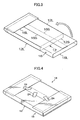
- a stacked bundle 12 of the lithographic printing plate 10 is constituted by alternately stacking inter leafs 14 for protecting the photosensitive layer and the lithographic printing plates 10 in a thickness direction, and further disposing protective pasteboards 22 on the upper surface and lower surface of the stacked bundle 12.
- the inter leaf 14 and protective pasteboard 22 of the present invention having a chlorine concentration of 1.5% by weight or less, preferably 0.47% by weight or less are respectively used.
- the number of the lithographic printing plates 10 constituting one stacked bundle 12 is not particularly limited. However, for example, 10 to 100 sheets of the lithographic printing plates 10 can be used in view of the efficiencies of conveyance and storage. Also, when 10 to 100 sheets of the lithographic printing plates 10 constitute the stacked bundle 12, the lithographic printing plates 10 and the protective pasteboards 22 are preferably fixed by a fixing device such as an adhesive tape so as to prevent a deviation between the lithographic printing plate 10 and the protective pasteboard 22. Also, the stacked bundle 12 can be constituted by much more lithographic printing plates 10 to more efficiently convey and store the stacked bundle 12 (by number of few handling).
- the number of sheets of the lithographic printing plates 10 may be set to about 6,500 sheets at the maximum, and the protective pasteboards 22 may be inserted per 20 to 100 sheets of the lithographic printing plates 10. Furthermore, the number of sheets of the lithographic printing plates 10 may be set to about 6,500 sheets at the maximum, and the protective pasteboards 22 may be provided on only the upper and lower sides. In addition, the protective pasteboard 22 may be omitted depending upon the kind of the lithographic printing plate 10.
- the stacked bundle 12 thus constituted is packaged by a package paper 16.
- the package paper 16 is constituted by a rectangular unbleached kraft paper formed in a predetermined size as an example.
- the package paper 16 of the present invention having a chlorine concentration of 1.5% by weight or less, preferably 0.47% by weight or less is used.
- the stacked bundle 12 is roughly placed in the center of the package paper 16 so that the long side 12L of the stacked bundle 12 is parallel with the short side 16S of the package paper 16.
- the length of the long side 16L of the package paper 16 is set to a predetermined length so that the vicinities of the short sides 16S of the package paper 16 overlap partially on each other with the package paper 16 folded from both the sides along the long side 12L of the stacked bundle 12 (see Fig. 3).
- the length of the short side 16S of the package paper 16 is set to a predetermined length so as to partially overlap the upper surface of the stacked bundle 12 in plan view when the long side 16L of the package paper 16 is further folded from a state where the vicinities of the short sides 16S overlap partially on each other (see Fig. 3).
- the stacked bundle 12 is packaged by the package paper 16, whereby, as shown in Fig. 4, the whole surface of the stacked bundle 12 is covered with the package paper 16.
- the package paper 16 is stuck at a prescribed position by an adhesive tape 24 to fix the package paper 16 so as to prevent the package paper 16 from carelessly being spread or dropped.
- Fig. 4 shows an example of a structure where the stacked bundle 12 is packaged by the package paper 16, and needless to say, the present invention is not limited thereto.
- the lithographic printing plate 10 needs only to be surely protected from light and moisture by covering the stacked bundle 12 with the package paper 16 (in some cases, by the combination with an exterior material 18 to be described later).
- the stacked bundle 12 packaged by the package paper 16 can be also further packaged by the exterior material depending upon the kind of the lithographic printing plate 10.
- Fig. 5 shows the lithographic printing plate packaged by a packaging box 26 made of cardboard as an example of the exterior material.
- a bottom surface laminate plate 32 and an upper surface laminate plate 34 are adjacently disposed at the short side of a bottom surface plate 28 and the short side of an upper surface plate 30.
- a plurality of folding lines 36 are formed on the bottom surface laminate plate 32 and the upper surface laminate plate 34.
- spiral laminate parts 38 and 40 are constituted by folding the plates 32, 34 at the folding lines 36.
- the stacked bundle 12 may be further loaded on a palette and a loading member particularly prepared according to the kind and conveyance method or the like of the lithographic printing plate 10, and the palette and the loading member will be described later.
- various kinds of the inter leafs 14, protective pasteboards 22, package papers 16 and packaging boxes 26 according to the present invention which contain the palette and the other loading member when they are further used, have a predetermined shape, structure and physical properties or the like respectively determined according to the kind, shape and characteristics or the like of the lithographic printing plate 10.
- the characteristics of the lithographic printing plate 10 can be maintained in a fixed range to surely hold the quality by independently using them or by combining them with the other packaging material for the lithographic printing plate to package the lithographic printing plate 10.
- the lithographic printing plate 10 may be set to an automatic platemaking machine having an automatic plate feeding function and a so-called plate setter or the like in a state where the stacked bundle 12 is constituted, and may be supplied (plate-fed) to a platemaking process.
- the inter leaf 14 and the protective pasteboard 22 should be peeled off from the lithographic printing plate 10 to plate-feed the inter leaf 14 and the protective pasteboard 22. Therefore, the use of the automatic platemaking machine and plate setter or the like having the automatic plate feeding function for automatically peeling off the inter leaf 14 and supplying the lithographic printing plate 10 can attain the efficiency of platemaking work.
- the inter leaf 14 When, for example, the inter leaf 14 is adsorbed and held up by a sucker or the like with the inter leaf 14 brought into contact with the image forming surface 10P of the lithographic printing plate 10, the inter leaf 14 and the lithographic printing plate 10 may be integrally held up and supplied. Also, even when the nonimage forming surface 10Q of the lithographic printing plate 10 is adsorbed and held up, the lithographic printing plate 10 may be supplied with the inter leaf 14 stuck to the image forming surface 10P.
- the inter leaf 14 and the lithographic printing plate 10 may be held up and supplied with the inter leaf 14 and the lithographic printing plate 10 stuck at the bottom.
- the sure protection of the photosensitive layer (image forming surface) of the lithographic printing plate 10 is required as the original function of the inter leaf 14. Even when, particularly, the inter leaf 14 and the image forming surface rub with each other, so-called film peeling (phenomenon where the photosensitive layer is peeled off) needs to be surely prevented.
- the inter leaf 14 has a contact part which is brought into contact with the photosensitive layer of the lithographic printing plate 10 and has Beck's smoothness (defined in JIS P8119) of 3 seconds to 900 seconds (inclusive), more preferably 8 seconds to 560 seconds (inclusive).
- the inter leaf 14 for example, paper containing wood pulp of 100%, paper containing synthetic pulp without containing the wood pulp of 100%, and paper prepared by providing a low density polyethylene layer on the surface of each of the papers or the like can be used. Since, particularly, the paper containing no synthetic pulp reduces the material cost, the inter leaf 14 can be produced at low cost. More specific examples include a inter leaf which is papermade from bleaching kraft pulp and has a basis weight of 30 to 60 g/m 2 , a density of 0.7 to 0.85 g/cm 3 , a moisture of 4.0 to 8.0% and pH of 4 to 6. However, of course, the inter leaf is not limited thereto.
- the protective pasteboard 22 has a contact part which is brought into contact with the photosensitive layer of the lithographic printing plate 10 and has Beck's smoothness (defined in JIS P8119) of 3 seconds to 900 seconds (inclusive), more preferably 8 seconds to 560 seconds (inclusive).
- the protective pasteboard 22 for example, wood pulp, natural fibers such as hemp, synthetic pulp which is obtained from linear polymers such as polyolefin, and regenerated cellulose or the like can be used alone or combination thereof.
- the protective pasteboard 22 can be produced at low cost by selecting low cost materials such as the wood pulp and the natural fibers. More specific examples include the protective pasteboard 22 prepared by papermaking using a paper material prepared by finely grinding used paper, adding a sizing agent of 0.1% based on the pasteboard weight and a paper-strengthening agent of 0.2% based on the pasteboard weight into a paper material diluted to a concentration of 4%, and further adding aluminum sulfate until pH is set to 5.0.
- the protective pasteboard 22 has a density 0.72 g/cm 3 and a basis weight 640 g/m 2 .
- the protective pasteboard 22 is not limited thereto.
- the other condition is not particularly limited.
- the package paper 16 can be produced at low cost by selecting the material of low cost.
- the protective pasteboard 22 having a moisture-proof layer may be used if needed.
- the moisture-proof layer having a structure prepared by sticking a layer made of low density polyethylene (LDPE) to the protective pasteboard generally used is often used. Therefore, when the layer made of low density polyethylene (LDPE) is stuck on the surface of the protective pasteboard 22, the chlorine concentration contained in the layer made of low density polyethylene (LDPE) needs to be 1.5% by weight or less.
- LDPE low density polyethylene
- the lithographic printing plate comprises the support (aluminum plate), the image-recording layer which contains (a) the actinic ray absorber, (b) the polymerization initiator and (c) the polymerizable compound and can be removed by the printing ink, the fountain solution or both the printing ink and the fountain solution, and the overcoat layer containing the inorganic layer compound in this order.
- inter leafs 14 A paper, B paper, C paper-1, C paper-2, D paper-1, D paper-2) shown in Table 1 were inserted between lithographic printing plates 10 of the stacked bundle 12 to produce six samples of stacked bundles having different inter leafs 14.
- the six samples of the stacked bundles were respectively packaged by aluminum kraft paper as package paper having a chlorine concentration of 2 wt% or less to produce samples of six packaging bodies (see Fig. 4).
- the samples of the packaging bodies were left for three days under an environment of 60°C.
- the printing was performed using the lithographic printing plate 10 of each of the samples of the packaging bodies to confirm the existence of the toning caused by the protecting/packaging material such as the inter leaf 14 or package paper 16.
- the lithographic printing plate 10 prepared by respectively inserting four kinds of the inter leafs 14 of the A paper, B paper, D paper-1 and D paper-2 and protecting and packaging using the package paper 16 having a chlorine concentration of 2 wt% or less had no generated toning, and made the quality get a passing grade.
- the A paper and B paper having a chlorine concentration of 0.47% by weight or less showed satisfactory results.
- the C paper-1 and the C paper-2 exhibited the toning notably, and made the quality of the lithographic printing plate 10 get a failing grade.
- the present inventor investigated which element is related to the toning from the element concentrations in Table 1 of four kinds of the passing A paper, B paper, D paper-1 and D paper-2 and the element concentrations in table 1 of two kinds of the failing C paper-1 and C paper-2.
- the present inventor can consider that the concentrations of carbon (C), sodium (Na), silicon (Si), calcium (Ca) and the other elements are substantially same in the A paper, the B paper, the D paper-1, the D paper-2, the C paper-1 and the C paper-2.
- concentrations of magnesium (Mg), aluminum (Al), sulfur (S) and chlorine (Cl) are different.
- the passing A paper, D paper-1 and D paper-2 contain more magnesium (Mg), and conversely, the failing C paper-1 and C paper-2 contain less magnesium (Mg).
- Mg magnesium
- the passing D paper-2 also contains aluminum (Al) of the same range. Thereby, the present inventor investigates that aluminum (Al) is not the element having a negative influence on the toning.
- the present inventor investigates that only chlorine has a correspondence relation with the toning and the chlorine concentration contained in the protecting/packaging material has a large effect on the toning of the lithographic printing plate in protecting and packaging the lithographic printing plate 10 by the protecting/packaging material.
- the present inventor presumes that the polymerization initiator contained in the photosensitive layer of the lithographic printing plate is decomposed by chlorine when the chlorine concentration contained in the protecting/packaging material exceeds 1.5% by weight, thereby exhibiting the toning.
Landscapes
- Engineering & Computer Science (AREA)
- Mechanical Engineering (AREA)
- Microelectronics & Electronic Packaging (AREA)
- Physics & Mathematics (AREA)
- General Physics & Mathematics (AREA)
- Printing Plates And Materials Therefor (AREA)
- Packaging Of Special Articles (AREA)
- Wrappers (AREA)
Abstract
Description
- The present invention relates to a protecting/packaging material for a lithographic printing plate and a method for packaging the lithographic printing plate. Particularly, the present invention relates to the improvement in toning of the lithographic printing plate caused by the protecting/packaging material.
- A lithographic printing plate generally has oleophilic image areas which receive an ink during printing and hydrophilic nonimage areas which receive a fountain solution. Lithographic printing is a printing process in which the surface of a lithographic printing plate is made to have a difference in ink adhesion by forming oleophilic image areas as ink-receiving areas and hydrophilic nonimage areas as fountain-solution-receiving areas (non-ink-receiving areas) based on the fact that water has the property of repelling oilbased inks, and an ink is adhered only to the image areas and then transferred to a material to be printed, such as paper.
- The conventional platemaking processes for the lithographic printing original plate necessitate a step in which unnecessary parts of the image-recording layer after exposure are dissolved and removed with a developing solution or the like. However, to eliminate or simplify such a wet treatment performed additionally is one of the problems to be accomplished. In particular, the discard of waste liquids resulting from wet treatments has recently become a matter of considerable concern of the whole industrial world from the standpoint of care of the global environment and, hence, there is an increasingly growing desire for the accomplishment of the problem.
- On the other hand, digitization technology in which image information is electronically processed, accumulated, and outputted by a computer has recently come to spread extensively, and various new image output techniques suitable for such digitization technology have come to be practically used. That is, attention has been focused on a computer-to-plate technique in which a highly convergent radiation such as a laser light is caused to carry digitized image information and this light is used to scan and expose a lithographic printing original plate to directly produce a lithographic printing plate without via a lith film.
- For example, there has been known a lithographic printing plate comprising a hydrophilic support and, formed thereon, an image-forming layer comprising a hydrophilic binder and hydrophobic thermoplastic-polymer particles dispersed therein as the lithographic printing plate of such a computer-to-plate (for example, see
Japanese Patent No. 2938397 - A strip of raw material of the conventional lithographic printing plate and lithographic printing plate for on-press development is cut to product size in a processing process, and the cut materials are then packaged for shipment.
- The lithographic printing plates are generally packaged by the following method. A stacked bundle of one unit is prepared by stacking several to tens of the lithographic printing plates, and this stacked bundle is packaged. In this case, the stacked lithographic printing plates may rub mutually to damage photosensitive layers. Also, when the raw material of the lithographic printing plate is cut in a product size by a cutter, metal is adhered to an edge in only the lithographic printing plate (that is, when using no inter leaf to be described later) using metal as the support. The cut surface of the lithographic printing plate is not in a specular surface state, and is in a bumpy notched state.
- Then, in order to protect the photosensitive layer from the friction damage of a cut edge and the cut damage in cutting, and to suppress the damage of the cut edge itself to increase the number of times of cutting, a thin sheet referred to as inter leaf is inserted between the stacked lithographic printing plates. Not only the enhancement of the protection and cutting property of the photosensitive layer but also easy peeling property in supplying the lithographic printing plate to an image forming device such as a setter are required for this inter leaf.
- Conventional examples of the inter leafs for attaining the above object include one prepared by making paper contain wax (
Japanese Examined Application Publication No. 61-19025 Japanese Patent Application Laid-Open No. 55-118041 Japanese Patent Application Laid-Open No. 57-99647 - In the packaging process of the lithographic printing plate, not only the above inter leaf but also the protective pasteboard (commonly known as padding cardboard), the package paper or the like are used. That is, while several to tens of the lithographic printing plates are stacked, a protective pasteboard is provided on the upper surface and lower surface of a stacked bundle prepared by inserting inter leafs between the lithographic printing plates. In this state, the stacked bundle is packaged by the package paper.
- However, the lithographic printing plate packaged by the conventional protecting/packaging material protecting and/or packaging the lithographic printing plate has had a problem that "toning" caused by the ink of the nonimage areas is generated. Particularly, the toning was notably generated in the lithographic printing plate having the photosensitive layer for on-press development.
- The present inventor has conducted earnest studies of the cause of the toning based on the fact, and has found that a protecting material (for example, a inter leaf, a protective pasteboard or the like) or a packaging material used in contact with the photosensitive layer of the lithographic printing plate, are a main cause.
- The present invention has been accomplished in view of the problems described above. It is an object of the present invention to provide a protecting/packaging material for a lithographic printing plate capable of preventing the toning of the lithographic printing plate. It is another object of the present invention to provide a method for packaging the lithographic printing plate.
- The above objects are accomplished, in accordance with a first aspect of the present invention, by the provision of a protecting/packaging material for protecting and/or packaging a lithographic printing plate, which serves in contact with a photosensitive layer of the lithographic printing plate, wherein the protecting/packaging material has a chlorine concentration of 1.5% by weight or less.
- The present inventor found that chlorine contained in a protecting material and a packaging material (hereinafter, referred to as "protecting/packaging material") causes toning and a chlorine concentration exceeding 1.5% by weight causes the toning.
- In accordance with the first aspect, the toning caused by the protecting/packaging material can be prevented by protecting or packaging the lithographic printing plate using the protecting/packaging material having a chlorine concentration of 1.5% by weight or less. Although the protecting material and packaging material prepared by coating plastic on paper or a paper base are generally used, the present invention includes the other protecting material and packaging material.
- In accordance with a second aspect of the present invention, there is provided a protecting/packaging material for protecting and/or packaging a lithographic printing plate as set forth in the first aspect of the present invention, wherein the protecting/packaging material has a chlorine concentration of 0.47% by weight or less.
- The protecting/packaging material having a chlorine concentration of 0.47% by weight or less can prevent the toning more surely.
- In accordance with a third aspect of the present invention, there is provided a protecting/packaging material for protecting and/or packaging a lithographic printing plate as set forth in the first or second aspect of the present invention, wherein the protecting/packaging material is a inter leaf inserted between the lithographic printing plates when the lithographic printing plates are stacked.
- The inter leaf prevents the damage of a photosensitive layer caused by friction of the lithographic printing plates in stacking the lithographic printing plates. Since it is particularly preferable that the inter leaf has a large area in contact with the photosensitive layer, the chlorine concentration of the inter leaf is set to 1.5% by weight or less for preventing the toning.
- In accordance with a fourth aspect of the present invention, there is provided a protecting/packaging material for protecting and/or packaging a lithographic printing plate as set forth in the first or second aspect of the present invention, wherein the protecting/packaging material is package paper for packaging the lithographic printing plate or a stacked bundle of the lithographic printing plates.
- Since the packaging material may be brought into contact with the photosensitive layer when the packaging material packages the lithographic printing plate or the stacked bundle, it is preferable to set the chlorine concentration to 1.5% by weight or less. Since the inter leaf is not used when the packaging material packages one lithographic printing plate particularly, the package paper is directly brought into contact with the lithographic printing plate.
- In accordance with a fifth aspect of the present invention, there is provided a protecting/packaging material for protecting and/or packaging a lithographic printing plate as set forth in the first or second aspect of the present invention, wherein the protecting/packaging material is a protective pasteboard applied to an upper surface and lower surface of the lithographic printing plate or stacked bundle of the lithographic printing plates when the protecting/packaging material packages the lithographic printing plate.
- Since the photosensitive layer is exposed in any of the upper surface and lower surface of the stacked bundle to directly bring the protective pasteboard into contact with the photosensitive layer, it is preferable to set the chlorine concentration of the protective pasteboard to 1.5% by weight or less.
- In accordance with a sixth aspect of the present invention, there is provided a protecting/packaging material for protecting and/or packaging a lithographic printing plate as set forth in any one of the first to fifth aspects of the present invention, wherein the lithographic printing plate includes a photosensitive layer for on-press development.
- As described above, since the toning of the lithographic printing plate is particularly and easily exhibited on the lithographic printing plate including the photosensitive layer for on-press development, the protecting/packaging material of the present invention is particularly effective. The toning is considered to be easily exhibited on the lithographic printing plate including the photosensitive layer for on-press development since a polymerization initiator contained as the ingredient of the photosensitive layer is decomposed by chlorine contained in the protecting/packaging material.
- The above objects are accomplished, in accordance with a seventh aspect of the present invention, by the provision of a method for packaging a lithographic printing plate, comprising the step of packaging the lithographic printing plate using a packaging material having a chlorine concentration of 1.5% by weight or less.
- Since the method of the seventh aspect includes the step of packaging the lithographic printing plate using the packaging material having a chlorine concentration of 1.5% by weight or less, the toning of the lithographic printing plate can be prevented.
- In accordance with an eighth aspect of the present invention, there is provided a method for packaging a lithographic printing plate as set forth in the seventh aspect of the present invention, further comprising, prior to packaging the lithographic printing plate using the packaging material, at least one of the steps of: stacking the plurality of lithographic printing plates to produce a stacked bundle and inserting a inter leaf having a chlorine concentration of 1.5% by weight or less between the stacked lithographic printing plates; and applying a protective pasteboard having a chlorine concentration of 1.5% by weight or less to the upper surface and/or lower surface of the stacked bundle.
- Since, in the process for packaging the lithographic printing plate, the stacked bundle prepared by stacking the lithographic printing plates is often packaged as one unit. In this case, a step for inserting the inter leaf between the lithographic printing plates and a step for providing the protective pasteboard on the upper surface and/or lower surface of the stacked bundle are often performed, and thus it is preferable that the chlorine concentration of the inter leaf or protective pasteboard is 1.5% by weight or less.
- In accordance with a ninth aspect of the present invention, there is provided a lithographic printing plate or a stack thereof protected and/or packaged by the protecting/packaging material of the first or second aspect.
- Thereby, the toning caused by the protecting/packaging material for the lithographic printing plate or a stack thereof can be prevented.
- According to the protecting/packaging material for the lithographic printing plate of the present invention and the method for packaging the lithographic printing plate, the toning of the lithographic printing plate caused by the protecting/packaging material can be prevented. The present invention is particularly effective for preventing the toning of the lithographic printing plate having the photosensitive layer for on-press development.
-
- Fig. 1 is an illustration of a first process of a method for packaging a lithographic printing plate;
- Fig. 2 is an illustration of a second process of a method for packaging a lithographic printing plate;
- Fig. 3 is an illustration of a third process of a method for packaging a lithographic printing plate;
- Fig. 4 is an illustration of a fourth process of a method for packaging a lithographic printing plate;
- Fig. 5 is an illustration for packaging a packaging body packaged in the first to fourth processes using a package box; and
- Fig. 6 is a development view of a package box.
- Hereinafter, with reference to the drawings, the preferred embodiment of a protecting/packaging material for a lithographic printing plate and method for packaging the lithographic printing plate of the present invention will be described in full detail.
- First, the lithographic printing plate which easily exhibits toning and has a photosensitive layer for on-press development will be described.
- On-press development is a platemaking method using an image-recording layer allowing unnecessary parts to be removed on a lithographic printing plate during the ordinary printing process, and after exposure, removing nonimage areas thereof on a printing machine to develop the lithographic printing plate. For example, there has been known a lithographic printing original plate comprising a hydrophilic support and, formed thereon, an image-forming layer comprising a hydrophilic binder and hydrophobic thermoplastic-polymer particles dispersed therein.
- The technique described above in which an image is formed by the mere bonding of polymer fine particles by thermal fusion attains satisfactory on-press developability. However, this technique has had a problem that image strength (adhesion to the support) is considerably low and run length is insufficient. There has been proposed a lithographic printing original plate which improves the run length of the lithographic printing original plate capable of on-press development (for example,
Japanese Patent Application Laid-Open Nos. 2001-277740 2001-277742 - There has been known a lithographic printing original plate capable of on-press development comprising a support which is typically an aluminum plate, and formed thereon, a photosensitive layer comprising an infrared absorber, a radical polymerization initiator and a polymerizable compound as another technique which improves the run length (for example,
Japanese Patent Application Laid-Open No. 2002-287334 Japanese Patent Application Laid-Open No. 2000-39711 - The techniques utilizing a polymerization reaction can enhance image strength since the image areas have a higher chemical-bond density than the image areas formed by the thermal fusion bonding of fine polymer particles. However, the techniques were still insufficient in view of coexistence of the on-press developability and thin line reproducibility or run length.
- On the other hand, in the lithographic printing plate for on-press development, an overcoat layer (protective layer) is usually provided on the image-recording layer for the purposes of preventing the image-recording layer from suffering mars, shutting off oxygen, and preventing ablation in high-illuminance laser exposure. Herein, although a water-soluble high polymer compound having excellent crystallinity such as polyvinyl alcohol has been used for the overcoat layer as the main component, the further improvement of on-press developability, thin line reproducibility, run length and on-press developing running property (aptitudes such as the mixing of on-press developing removed object to fountain solution and the deposition of the removed object onto a platen in continuously repeating on-press development and printing) has been desired.
- On the other hand, in
Japanese Patent Application Laid-Open No. 11-38633 - From such a background, the present inventor has proposed a lithographic printing plate for on-press development provided with the following constitution as the lithographic printing plate having excellent on-press developability, thin line reproducibility, run length and on-press developing running property.
- (1) A lithographic printing plate comprising a support, an image-recording layer which contains (a) an actinic ray absorber, (b) a polymerization initiator and (c) a polymerizable compound and can be removed by an printing ink, a fountain solution or both the printing ink and the fountain solution, and an overcoat layer containing an inorganic layer compound in this order.
- (2) A lithographic printing plate comprising a support, an undercoat layer containing a compound having a polymerizable group, an image-recording layer which contains (a) an actinic ray absorber, (b) a polymerization initiator and (c) a polymerizable compound and can be removed by an printing ink, a fountain solution or both the printing ink and the fountain solution, and an overcoat layer containing an inorganic layer compound in this order.
- (3) A lithographic printing plate wherein (a) the actinic ray absorber is an infrared absorber.
- (4) A lithographic printing plate wherein the inorganic layer compound contained in the overcoat layer is a swelling inorganic layer compound.
- Examples of the polymerization initiators used for the lithographic printing plates of the above items (1) to (4) include organic halogen compounds, carbonyl compounds, organic peroxides, azo polymerization initiators, azide compounds, metallocene compounds, hexaarylbiimidazole compounds, organoboron compounds, disulfone compounds, oxime ester compounds, oxime ether compounds, and onium salt compounds.
- It is preferable that the polymerization initiator has an absorption maximum wavelength of 400 nm or less. It is more preferable that the polymerization initiator has an absorption maximum wavelength of 360 nm or less. It is most preferable that the polymerization initiator has an absorption maximum wavelength of 300 nm or less. Thus, the safety under white light of the lithographic printing original plate is enhanced by setting the absorption wavelength to the ultraviolet range.
- These polymerization initiators can be added in an amount of 0.1 to 50% by mass, preferably 0.5 to 30% by mass, particularly preferably 1 to 20% by mass, based on all solid ingredients constituting the image-recording layer. When the initiator amount is within this range, satisfactory sensitivity is obtained and the nonimage areas have satisfactory insusceptibility to toning during printing. These polymerization initiators may be used alone or in combination of two or more thereof. Any of these polymerization initiators and the other ingredients may be added to the same layer. Alternatively, a layer containing any of the polymerization initiators may be separately formed.
- Specific examples of the organic halogen compounds include the compounds described in Wakabayashi, et al., "Bull. Chem. Soc. Japan" 42, 2924 (1969), the specification of
U.S. Patent No. 3,905,815 ,Japanese Examined Application Publication No. 46-4605 Japanese Patent Application Laid-Open Nos. 48-36281 53-133428 55-32070 60-239736 61-169835 61-169837 62-58241 62-212401 63-70243 63-298339 - Examples of the carbonyl compounds include benzophenone derivatives such as benzophenone, Michler's ketone, 2-methylbenzophenone, 3-methylbenzophenone, 4-methylbenzophenone, 2-chlorobenzophenone, 4-bromobenzophenone, and 2-carboxybenzophenone; acetophenone derivatives such as 2,2-dimethoxy-2-phenylacetophenone, 2,2-diethoxyacetophenone, 1-hydroxycyclohexylphenyl ketone, α-hydroxy-2-methylphenyl propanone, 1-hydroxy-1-methylethyl-(p-isopropylphenyl) ketone, 1-hydroxy-1-(p-dodecylphenyl) ketone, 2-methyl-(4'-(methylthio)phenyl)-2-morpholino-1-propanone, 1,1,1-trichloromethyl-(p-butylphenyl) ketone; thioxantone derivatives such as thioxantone, 2-ethyl thioxantone, 2-isopropyl thioxantone, 2-chlorothioxantone, 2,4-dimethyl thioxantone, 2,4-diethyl thioxantone, and 2,4-diisopropyl thioxantone; and benzoic acid ester derivatives such as ethyl p-dimethylaminobenzoic acid, and ethyl p-diethylaminobenzoic acid.
- As the azo compounds, for example, the azo compounds or the like described in
Japanese Patent Application Laid-Open No. 8-108621 - Examples of the organic peroxides include trimethylcyclohexanone peroxide, acetylacetone peroxide, 1,1-bis(tert-butylperoxy)-3,3,5-trimethylcyclohexane, 1,1-bis(tert-butylperoxy)cyclohexane, 2,2-bis(tert-butylperoxy)butane, tert-butyl hydroperoxide, cumene hydroperoxide, diisopropylbenzene hydroperoxide, 2,5-dimethylhexane-2,5-dihydroperoxide, 1,1,3,3-tetramethylbutyl hydroperoxide, tert-butylcumyl peroxide, dicumyl peroxide, 2,5-dimethyl-2,5-di(tert-butylperoxy)hexane, 2,5-oxanoyl peroxide, peroxysuccinic acid, benzoyl peroxide, 2,4-dichlorobenzoyl peroxide, diisopropyl peroxydicarbonate, di-2-ethylhexyl peroxydicarbonate, di-2-ethoxyethyl peroxydicarbonate, dimethoxyisopropyl peroxycarbonate, di(3-methyl-3-methoxybutyl) peroxydicarbonate, tert-butyl peroxyacetate, tert-butyl peroxypivalate, tert-butyl peroxyneodecanoate, tert-butyl peroxyoctanoate, tert-butyl peroxylaurate, tosyl carbonate, 3,3',4,4'-tetra-(t-butyl peroxycarbonyl)benzophenone, 3,3',4,4'-tetra-(t-hexyl peroxycarbonyl)benzophenone, 3,3',4,4'-tetra-(p-isopropylcumyl peroxycarbonyl)benzophenone, carbonyl di(t-butylperoxy dihydrogen diphthalate), and carbonyl di(t-hexylperoxy dihydrogen diphthalate).
- Examples of the metallocene compounds include various titanocene compounds as described in
Japanese Patent Application Laid-Open Nos. 59-152396 61-151197 63-41484 2-249 2-4705 5-83588 Japanese Patent Application Laid-Open Nos. 1-304453 1-152109 - Examples of the hexaaryl biimidazole compounds include various compounds described in
Japanese Examined Application Publication No. 6-29285 U.S. Patent Nos. 3,479,185 ,4,311,783 and4,622,286 . Specific examples include 2,2'-bis(o-chlorophenyl)-4,4',5,5'-tetraphenyl biimidazole, 2,2'-bis(o-bromophenyl)-4,4',5,5'-tetraphenyl biimidazole, 2,2'-bis(o,p-dichlorophenyl)-4,4',5,5'-tetraphenyl biimidazole, 2,2'-bis(o-chlorophenyl)-4,4',5,5'-tetra(m-methoxyphenyl) biimidazole, 2,2'-bis(o,o'-dichlorophenyl)-4,4',5,5'-tetraphenyl biimidazole, 2,2'-bis(o-nitrophenyl)-4,4',5,5'-tetraphenyl biimidazole, 2,2'-bis(o-methylphenyl)-4,4',5,5'-tetraphenyl biimidazole, and 2,2'-bis(o-trifluorophenyl)-4,4',5,5'-tetraphenyl biimidazole. - Examples of the organic boron compounds include organic boric acid salts as described in
Japanese Patent Application Laid-Open Nos. 62-143044 62-150242 9-188685 9-188686 9-188710 2000-131837 2002-107916 Japanese Patent No. 2764769 Japanese Patent Application Laid-Open No. 2002-116539 Japanese Patent Application Laid-Open Nos. 6-157623 6-175564 6-175561 Japanese Patent Application Laid-Open Nos. 6-175554 6-175553 Japanese Patent Application Laid-Open No. 9-188710 Japanese Patent Application Laid-Open Nos. 6-348011 7-128785 7-140589 7-306527 7-292014 - Examples of the disulfone compounds include compounds as described in
Japanese Patent Application Laid-Open Nos. 61-166544 2003-328465 - Examples of the oxime ester compounds include compounds described in J.C.S. Perkin II (1979) 1653-1660, J.C.S. Perkin II (1979) 156-162, Journal of Photopolymer Science and Technology (1995) 202-232 and in
Japanese Patent Application Laid-Open No. 2000-66385 Japanese Patent Application Laid-Open No. 2000-80068 
- Examples of the oxime ether compounds include compounds described in
Japanese Patent Application Laid-Open Nos. 8-202035 10-237118 
- Examples of the onium salt compounds include diazonium salts as described in S. I. Schlesinger, Photogr. Sci. Eng., 18, 387(1974) and T. S. Bal et al., Polymer, 21, 423 (1980); ammonium salts as described in the specification of
U.S. Patent No. 4,069,055 , andJapanese Patent Application Laid-Open No. 4-365049 U.S. Patent Nos. 4,069,055 and4,069,056 ; iodonium salts as described in the specifications ofEP No. 104,143 U.S. Patent Nos. 339,049 and410,201 andJapanese Patent Application Laid-Open Nos. 2-150848 2-296514 EP No. 370,693 390,214 233,567 297,443 297,442 U.S. Patent Nos. 4,933,377 ,161,811 ,410,201 ,339,049 ,4,760,013 ,4,734,444 ,2,833,827 ,DE No. 2,904,626 ,3,604,580 and3,604,581 ; celenonium salts as described in J. V. Crivello et al., Macromolecules, 10(6), 1307 (1977) and J. V. Crivello et al., J. Polymer Sci., Polymer Chem. Ed., 17, 1047 (1979); and arsonium salts as described in C. S. Wen et al., Teh, Proc. Conf. Rad. Curing ASIA, p478, Tokyo, October (1988). - Particularly, from the standpoints of reactivity and stability, preferable examples include the oxime ester compounds or onium salts (diazonium salts, iodonium salts, or sulfonium salts) shown above. According to the invention, these onium salts are not acid-generating agents, and they function as ionic radical polymerization initiators. The onium salts suitably used are represented by the following formulae (RI-I) to (RI-III):

- In Formula (RI-I), Ar11 represents an aryl group having up to 20 carbon atoms and optionally having 1 to 6 substituents, wherein preferable substituents include an alkyl group having 1 to 12 carbon atoms, an alkenyl group having 1 to 12 carbon atoms, an alkynyl group having 1 to 12 carbon atoms, an aryl group having 1 to 12 carbon atoms, an alkoxy group having 1 to 12 carbon atoms, an aryloxy group having 1 to 12 carbon atoms, a halogen atom, an alkylamino group having 1 to 12 carbon atoms, a dialkylamino group having 1 to 12 carbon atoms, an alkylamido group or arylamido group having 1 to 12 carbon atoms, a carbonyl group, a carboxyl group, a cyano group, a sulfonyl group, a thioalkyl group having 1 to 12 carbon atoms, and a thioaryl group having 1 to 12 carbon atoms. Z11- represents a monovalent anion. Specific examples thereof include a halogen ion, a perchlorate ion, a hexafluorophosphate ion, a tetrafluoroborate ion, a sulfonate ion, a sulfinate ion, a thiosulfonate ion, and a sulfate ion. Among these, preferred are the peroxychlorate ion, hexafluorophosphate ion, tetrafluoroborate ion, sulfonate ion and sulfinate ion in the aspect of stability.
- In Formula (RI-II), Ar21 and Ar22 each independently represent an aryl group having up to 20 carbon atoms and optionally having 1 to 6 substituents, wherein preferable substituents include an alkyl group having 1 to 12 carbon atoms, an alkenyl group having 1 to 12 carbon atoms, an alkynyl group having 1 to 12 carbon atoms, an aryl group having 1 to 12 carbon atoms, an alkoxy group having 1 to 12 carbon atoms, an aryloxy group having 1 to 12 carbon atoms, a halogen atom, an alkylamino group having 1 to 12 carbon atoms, a dialkylamino group having 1 to 12 carbon atoms, an alkylamido group or arylamido group having 1 to 12 carbon atoms, a carbonyl group, a carboxyl group, a cyano group, a sulfonyl group, a thioalkyl group having 1 to 12 carbon atoms, and a thioaryl group having 1 to 12 carbon atoms. Z21- represents a monovalent anion. Specific examples thereof include a halogen ion, a perchlorate ion, a hexafluorophosphate ion, a tetrafluoroborate ion, a sulfonate ion, a sulfinate ion, a thiosulfonate ion, and a sulfate ion. Among these, preferred are the perchlorate ion, hexafluorophosphate ion, tetrafluoroborate ion, sulfonate ion, sulfinate ion and carbonate ion in the aspects of stability and reactivity.
- In Formula (RI-III), R31, R32 and R33 each independently represent an aryl group, alkyl group, alkenyl group or alkynyl group having up to 20 carbon atoms and optionally having 1 to 6 substituents. Among these, preferred is the aryl group in the aspects of reactivity and stability. Examples of the substituents include an alkyl group having 1 to 12 carbon atoms, an alkenyl group having 1 to 12 carbon atoms, an alkynyl group having 1 to 12 carbon atoms, an aryl group having 1 to 12 carbon atoms, an alkoxy group having 1 to 12 carbon atoms, an aryloxy group having 1 to 12 carbon atoms, a halogen atom, an alkylamino group having 1 to 12 carbon atoms, a dialkylamino group having 1 to 12 carbon atoms, an alkylamido group or arylamido group having 1 to 12 carbon atoms, a carbonyl group, a carboxyl group, a cyano group, a sulfonyl group, a thioalkyl group having 1 to 12 carbon atoms, and a thioaryl group having 1 to 12 carbon atoms. Z31- represents a monovalent anion. Specific examples thereof include a halogen ion, a perchlorate ion, a hexafluorophosphate ion, a tetrafluoroborate ion, a sulfonate ion, a sulfinate ion, a thiosulfonate ion, a sulfate ion, and carbonate ion. Among these, preferred are the perchlorate ion, hexafluorophosphate ion, tetrafluoroborate ion, sulfonate ion, sulfinate ion and carbonate ion, in the aspects of stability and reactivity. More preferred is the carbonate ion as described in
Japanese Patent Application Laid-Open No. 2001-343742 Japanese Patent Application Laid-Open No. 2002-148790 - Specific examples of the suitable onium salt compounds are shown below, but the onium salt compounds should not be construed as being limited to the following examples.


- When the lithographic printing plate including the photosensitive layer for on-press development having the above ingredients [(a) actinic ray absorber, (b) polymerization initiator and (c) polymerizable compound] was protected or packaged using the protecting/packaging material such as the conventional inter leaf, protective pasteboard and packaging material, the toning was exhibited in the lithographic printing plate. On the other hand, even if the lithographic printing plate was similarly protected or packaged by the protecting/packaging material of the present invention in which the chlorine concentration of the protecting/packaging material was set to 1.5% by weight or less, the toning was not exhibited.
- This suggests that chlorine contained in the protecting/packaging material may decompose the polymerization initiator as the ingredient of the photosensitive layer, resulting in the toning.
- Next, an example of a method for packaging the stacked bundle of the lithographic printing plate using the protecting/packaging material of the present invention will be described.
- A
lithographic printing plate 10 is formed by applying a photosensitive layer on a thin aluminum support formed in a rectangle plate form. This photosensitive layer is subjected to platemaking processes such as exposure, a developing process and gum coating. Thelithographic printing plate 10 is set in a printing machine, and ink is then applied thereto to print characters and images or the like on a paper space thereof. Herein, a surface on which the photosensitive layer is formed is referred to as animage forming surface 10P, and a surface on which the photosensitive layer is not formed is referred to as a nonimage forming surface 10Q. Examples of thelithographic printing plates 10 include a so-called double-side product of which both surfaces are theimage forming surface 10P. However, in Fig. 1, a so-called one-side product of which only one-side is theimage forming surface 10P is shown. - As shown in Fig. 1, a
stacked bundle 12 of thelithographic printing plate 10 is constituted by alternately stackinginter leafs 14 for protecting the photosensitive layer and thelithographic printing plates 10 in a thickness direction, and further disposingprotective pasteboards 22 on the upper surface and lower surface of the stackedbundle 12. Herein, theinter leaf 14 andprotective pasteboard 22 of the present invention having a chlorine concentration of 1.5% by weight or less, preferably 0.47% by weight or less are respectively used. - The number of the
lithographic printing plates 10 constituting one stackedbundle 12 is not particularly limited. However, for example, 10 to 100 sheets of thelithographic printing plates 10 can be used in view of the efficiencies of conveyance and storage. Also, when 10 to 100 sheets of thelithographic printing plates 10 constitute the stackedbundle 12, thelithographic printing plates 10 and theprotective pasteboards 22 are preferably fixed by a fixing device such as an adhesive tape so as to prevent a deviation between thelithographic printing plate 10 and theprotective pasteboard 22. Also, the stackedbundle 12 can be constituted by much morelithographic printing plates 10 to more efficiently convey and store the stacked bundle 12 (by number of few handling). For example, the number of sheets of thelithographic printing plates 10 may be set to about 6,500 sheets at the maximum, and theprotective pasteboards 22 may be inserted per 20 to 100 sheets of thelithographic printing plates 10. Furthermore, the number of sheets of thelithographic printing plates 10 may be set to about 6,500 sheets at the maximum, and theprotective pasteboards 22 may be provided on only the upper and lower sides. In addition, theprotective pasteboard 22 may be omitted depending upon the kind of thelithographic printing plate 10. - As shown in Figs. 2 to 4, the stacked
bundle 12 thus constituted is packaged by apackage paper 16. Thepackage paper 16 is constituted by a rectangular unbleached kraft paper formed in a predetermined size as an example. Herein, thepackage paper 16 of the present invention having a chlorine concentration of 1.5% by weight or less, preferably 0.47% by weight or less is used. - As shown in Fig. 2, the stacked
bundle 12 is roughly placed in the center of thepackage paper 16 so that thelong side 12L of the stackedbundle 12 is parallel with theshort side 16S of thepackage paper 16. The length of thelong side 16L of thepackage paper 16 is set to a predetermined length so that the vicinities of theshort sides 16S of thepackage paper 16 overlap partially on each other with thepackage paper 16 folded from both the sides along thelong side 12L of the stacked bundle 12 (see Fig. 3). - The length of the
short side 16S of thepackage paper 16 is set to a predetermined length so as to partially overlap the upper surface of the stackedbundle 12 in plan view when thelong side 16L of thepackage paper 16 is further folded from a state where the vicinities of theshort sides 16S overlap partially on each other (see Fig. 3). Thus, the stackedbundle 12 is packaged by thepackage paper 16, whereby, as shown in Fig. 4, the whole surface of the stackedbundle 12 is covered with thepackage paper 16. - Finally, the
package paper 16 is stuck at a prescribed position by anadhesive tape 24 to fix thepackage paper 16 so as to prevent thepackage paper 16 from carelessly being spread or dropped. - Fig. 4 shows an example of a structure where the stacked
bundle 12 is packaged by thepackage paper 16, and needless to say, the present invention is not limited thereto. After all, thelithographic printing plate 10 needs only to be surely protected from light and moisture by covering the stackedbundle 12 with the package paper 16 (in some cases, by the combination with anexterior material 18 to be described later). - The stacked
bundle 12 packaged by thepackage paper 16 can be also further packaged by the exterior material depending upon the kind of thelithographic printing plate 10. Fig. 5 shows the lithographic printing plate packaged by apackaging box 26 made of cardboard as an example of the exterior material. - As is apparent from the development view shown in Fig. 6, in this
packaging box 26, a bottomsurface laminate plate 32 and an uppersurface laminate plate 34 are adjacently disposed at the short side of abottom surface plate 28 and the short side of anupper surface plate 30. A plurality offolding lines 36 are formed on the bottomsurface laminate plate 32 and the uppersurface laminate plate 34. As shown in Fig. 5, spirallaminate parts plates bundle 12 with thepackage paper 16 is protected by thepackaging box 26. Even when, for example, a large force is acted on the packaging body from the outside, thelithographic printing plate 10 is prevented from being transformed or damaged. - The stacked
bundle 12 may be further loaded on a palette and a loading member particularly prepared according to the kind and conveyance method or the like of thelithographic printing plate 10, and the palette and the loading member will be described later. - Herein, various kinds of the
inter leafs 14,protective pasteboards 22,package papers 16 andpackaging boxes 26 according to the present invention, which contain the palette and the other loading member when they are further used, have a predetermined shape, structure and physical properties or the like respectively determined according to the kind, shape and characteristics or the like of thelithographic printing plate 10. The characteristics of thelithographic printing plate 10 can be maintained in a fixed range to surely hold the quality by independently using them or by combining them with the other packaging material for the lithographic printing plate to package thelithographic printing plate 10. - The
lithographic printing plate 10 may be set to an automatic platemaking machine having an automatic plate feeding function and a so-called plate setter or the like in a state where the stackedbundle 12 is constituted, and may be supplied (plate-fed) to a platemaking process. In this case, theinter leaf 14 and theprotective pasteboard 22 should be peeled off from thelithographic printing plate 10 to plate-feed theinter leaf 14 and theprotective pasteboard 22. Therefore, the use of the automatic platemaking machine and plate setter or the like having the automatic plate feeding function for automatically peeling off theinter leaf 14 and supplying thelithographic printing plate 10 can attain the efficiency of platemaking work. - However, when the
inter leaf 14 and theprotective pasteboard 22 are strongly stuck to thelithographic printing plate 10, theinter leaf 14 and theprotective pasteboard 22 are supplied without peeling off theinter leaf 14 and theprotective pasteboard 22 from the lithographic printing plate. Accordingly, disadvantages such as the stopping of the automatic plate feeding operation may be generated. - When, for example, the
inter leaf 14 is adsorbed and held up by a sucker or the like with theinter leaf 14 brought into contact with theimage forming surface 10P of thelithographic printing plate 10, theinter leaf 14 and thelithographic printing plate 10 may be integrally held up and supplied. Also, even when the nonimage forming surface 10Q of thelithographic printing plate 10 is adsorbed and held up, thelithographic printing plate 10 may be supplied with theinter leaf 14 stuck to theimage forming surface 10P. Furthermore, when theimage forming surface 10P of thelithographic printing plate 10 or the nonimage forming surface 10Q which is not brought into contact with theinter leaf 14 is adsorbed and held up from the stackedbundle 12, theinter leaf 14 and thelithographic printing plate 10 may be held up and supplied with theinter leaf 14 and thelithographic printing plate 10 stuck at the bottom. - Also, the sure protection of the photosensitive layer (image forming surface) of the
lithographic printing plate 10 is required as the original function of theinter leaf 14. Even when, particularly, theinter leaf 14 and the image forming surface rub with each other, so-called film peeling (phenomenon where the photosensitive layer is peeled off) needs to be surely prevented. - In order to satisfy the condition, the
inter leaf 14 has a contact part which is brought into contact with the photosensitive layer of thelithographic printing plate 10 and has Beck's smoothness (defined in JIS P8119) of 3 seconds to 900 seconds (inclusive), more preferably 8 seconds to 560 seconds (inclusive). - As the
inter leaf 14, for example, paper containing wood pulp of 100%, paper containing synthetic pulp without containing the wood pulp of 100%, and paper prepared by providing a low density polyethylene layer on the surface of each of the papers or the like can be used. Since, particularly, the paper containing no synthetic pulp reduces the material cost, theinter leaf 14 can be produced at low cost. More specific examples include a inter leaf which is papermade from bleaching kraft pulp and has a basis weight of 30 to 60 g/m2, a density of 0.7 to 0.85 g/cm3, a moisture of 4.0 to 8.0% and pH of 4 to 6. However, of course, the inter leaf is not limited thereto. - Also, the
protective pasteboard 22 has a contact part which is brought into contact with the photosensitive layer of thelithographic printing plate 10 and has Beck's smoothness (defined in JIS P8119) of 3 seconds to 900 seconds (inclusive), more preferably 8 seconds to 560 seconds (inclusive). - As the material of the
protective pasteboard 22, for example, wood pulp, natural fibers such as hemp, synthetic pulp which is obtained from linear polymers such as polyolefin, and regenerated cellulose or the like can be used alone or combination thereof. Particularly, theprotective pasteboard 22 can be produced at low cost by selecting low cost materials such as the wood pulp and the natural fibers. More specific examples include theprotective pasteboard 22 prepared by papermaking using a paper material prepared by finely grinding used paper, adding a sizing agent of 0.1% based on the pasteboard weight and a paper-strengthening agent of 0.2% based on the pasteboard weight into a paper material diluted to a concentration of 4%, and further adding aluminum sulfate until pH is set to 5.0. Theprotective pasteboard 22 has a density 0.72 g/cm3 and a basis weight 640 g/m2. However, theprotective pasteboard 22 is not limited thereto. - Also, even in the
package paper 16, preferably, Beck's smoothness of at least a part which is brought into contact with the image forming surface of thelithographic printing plate 10, i.e., the contact part satisfy the above condition. - When the
package paper 16 satisfies this condition, the other condition is not particularly limited. Thereby, for example, thepackage paper 16 can be produced at low cost by selecting the material of low cost. - Also, recently, there has been a sensitive type (hereinafter, "laser exposure type")
lithographic printing plate 10 drawing using laser. When the stackedbundle 12 is constituted using the aboveprotective pasteboard 22 in the laser exposure typelithographic printing plate 10, the moisture contained in theprotective pasteboard 22 may deteriorate the photosensitive layer depending upon the characteristics of the photosensitive layer. Thereby, theprotective pasteboard 22 having a moisture-proof layer may be used if needed. The moisture-proof layer having a structure prepared by sticking a layer made of low density polyethylene (LDPE) to the protective pasteboard generally used is often used. Therefore, when the layer made of low density polyethylene (LDPE) is stuck on the surface of theprotective pasteboard 22, the chlorine concentration contained in the layer made of low density polyethylene (LDPE) needs to be 1.5% by weight or less. - The following test was performed by using the lithographic printing plate for on-press development described in the above embodiment. The lithographic printing plate comprises the support (aluminum plate), the image-recording layer which contains (a) the actinic ray absorber, (b) the polymerization initiator and (c) the polymerizable compound and can be removed by the printing ink, the fountain solution or both the printing ink and the fountain solution, and the overcoat layer containing the inorganic layer compound in this order.
- As shown in Fig. 1, six kinds of inter leafs 14 (A paper, B paper, C paper-1, C paper-2, D paper-1, D paper-2) shown in Table 1 were inserted between
lithographic printing plates 10 of the stackedbundle 12 to produce six samples of stacked bundles havingdifferent inter leafs 14. Next, the six samples of the stacked bundles were respectively packaged by aluminum kraft paper as package paper having a chlorine concentration of 2 wt% or less to produce samples of six packaging bodies (see Fig. 4). The samples of the packaging bodies were left for three days under an environment of 60°C. Then, the printing was performed using thelithographic printing plate 10 of each of the samples of the packaging bodies to confirm the existence of the toning caused by the protecting/packaging material such as theinter leaf 14 orpackage paper 16. Theprotective pasteboard 22 was not used in this example.[Table 1] Weight g/m 2 Moisture content wt% pH Conductivity Element concentration (wt%) * C Na Mg Al Si S Cl Ca Others A paper 41.0 6.6 4.58 5.85 98.71 - 0.18 0.54 0.20 0.08 0.17 0.11 0.01 B paper 30.8 7.1 4.90 5.88 98.51 0.10 0.10 0.54 0.15 0.06 0.47 0.07 - C paper-1 53.4 7.6 4.45 19.55 96.09 0.12 0.06 1.09 0.25 0.21 2.02 0.16 - C paper-2 53.7 7.2 4.32 18.88 96.40 0.17 0.07 0.87 0.14 0.23 1.92 0.16 0.04 D paper-1 42.0 7.2 4.70 10.85 97.64 0.11 0.31 0.03 0.10 0.22 1.50 0.05 0.04 D paper-2 43.0 7.0 4.60 12.02 96.67 0.11 0.31 1.00 0.10 0.22 1.50 0.05 0.04 *Elements having a content of 0.01 wt% or more were shown. Symbol "-" shows non-detection. - As a result, the
lithographic printing plate 10 prepared by respectively inserting four kinds of theinter leafs 14 of the A paper, B paper, D paper-1 and D paper-2 and protecting and packaging using thepackage paper 16 having a chlorine concentration of 2 wt% or less had no generated toning, and made the quality get a passing grade. Particularly, the A paper and B paper having a chlorine concentration of 0.47% by weight or less showed satisfactory results. - On the other hand, the C paper-1 and the C paper-2 exhibited the toning notably, and made the quality of the
lithographic printing plate 10 get a failing grade. - The present inventor investigated which element is related to the toning from the element concentrations in Table 1 of four kinds of the passing A paper, B paper, D paper-1 and D paper-2 and the element concentrations in table 1 of two kinds of the failing C paper-1 and C paper-2.
- As shown in Table 1, the present inventor can consider that the concentrations of carbon (C), sodium (Na), silicon (Si), calcium (Ca) and the other elements are substantially same in the A paper, the B paper, the D paper-1, the D paper-2, the C paper-1 and the C paper-2. The concentrations of magnesium (Mg), aluminum (Al), sulfur (S) and chlorine (Cl) are different.
- Then, referring to the element having a different concentration, the passing A paper, D paper-1 and D paper-2 contain more magnesium (Mg), and conversely, the failing C paper-1 and C paper-2 contain less magnesium (Mg). Thereby, the present inventor investigates that magnesium (Mg) is not the element having a negative influence on the toning.
- Although the failing C paper-1 and C paper-2 contain more aluminum (Al), the passing D paper-2 also contains aluminum (Al) of the same range. Thereby, the present inventor investigates that aluminum (Al) is not the element having a negative influence on the toning.
- Although the failing C paper-1 and C paper-2 contain more sulfur (S), the passing D paper-1 and D paper-2 contain sulfur (S) of the same range. Thereby, the present inventor investigates that sulfur (S) is not the element having a negative influence on the toning.
- Finally, the passing A paper, B paper, D paper-1 and D paper-2 contain few chlorine (Cl), and the failing C paper-1 and C paper-2 contain more chlorine (Cl).
- From the description, the present inventor investigates that only chlorine has a correspondence relation with the toning and the chlorine concentration contained in the protecting/packaging material has a large effect on the toning of the lithographic printing plate in protecting and packaging the
lithographic printing plate 10 by the protecting/packaging material. The present inventor presumes that the polymerization initiator contained in the photosensitive layer of the lithographic printing plate is decomposed by chlorine when the chlorine concentration contained in the protecting/packaging material exceeds 1.5% by weight, thereby exhibiting the toning. - Originally, referring to each of the element concentrations shown in Table 1, it is an ideal to change one element concentration, and produce a plurality of protecting/packaging materials having fixed concentrations of remaining elements to examine which element is related to the toning. However, since the examination cannot be actually performed, the present inventor investigates that the chlorine concentration has an effect on the toning by the elimination method described above.
Claims (9)
- A protecting/packaging material (18) for protecting and/or packaging a lithographic printing plate (10), which serves in contact with a photosensitive layer (10P) of the lithographic printing plate (10), characterized in that
the protecting/packaging material (18) has a chlorine concentration of 1.5% by weight or less. - The protecting/packaging material (18) for protecting and/or packaging a lithographic printing plate (10) according to claim 1, characterized in that
the protecting/packaging material (18) has a chlorine concentration of 0.47% by weight or less. - The protecting/packaging material (18) for protecting and/or packaging a lithographic printing plate (10) according to claim 1 or 2, characterized in that
the protecting/packaging material (18) is a inter leaf (14) inserted between the lithographic printing plates (10) when the lithographic printing plates (10) are stacked. - The protecting/packaging material (18) for protecting and/or packaging a lithographic printing plate (10) according to claim 1 or 2, characterized in that
the protecting/packaging material (18) is package paper (16) for packaging the lithographic printing plate (10) or a stacked bundle (12) of the lithographic printing plates (10). - The protecting/packaging material (18) for protecting and/or packaging a lithographic printing plate (10) according to claim 1 or 2, characterized in that
the protecting/packaging material (18) is a protective pasteboard (22) applied to the upper and lower surfaces of the lithographic printing plate (10) or stacked bundle (12) of the lithographic printing plates (10) when the protecting/packaging material (18) packages the lithographic printing plate(s) (10). - The protecting/packaging material (18) for protecting and/or packaging a lithographic printing plate (10) according to any one of claims 1 to 5, characterized in that
the lithographic printing plate (10) includes a photosensitive layer for on-press development. - A packaging method for packaging a lithographic printing plate (10), characterized by comprising
the step of packaging the lithographic printing plate (10) using a packaging material having a chlorine concentration of 1.5% by weight or less. - The packaging method for packaging a lithographic printing plate (10) according to claim 7, further characterized by comprising, prior to packaging the lithographic printing plate (10) using the packaging material, at least one of the steps of:stacking a plurality of lithographic printing plates (10) to produce a stacked bundle (12) and inserting a inter leaf (14) having a chlorine concentration of 1.5% by weight or less between the stacked lithographic printing plates (10); andapplying a protective pasteboard (22) having a chlorine concentration of 1.5% by weight or less to the upper surface and/or lower surface of the stacked bundle (12).
- A lithographic printing plate (10) or a stack thereof, which is protected and/or packaged by the protecting/packaging material (18) of claim 1 or 2.
Applications Claiming Priority (1)
| Application Number | Priority Date | Filing Date | Title |
|---|---|---|---|
| JP2006259657A JP2008080499A (en) | 2006-09-25 | 2006-09-25 | Protection and packaging material for planographic printing plates and packaging method for planographic printing plates |
Publications (2)
| Publication Number | Publication Date |
|---|---|
| EP1902963A2 true EP1902963A2 (en) | 2008-03-26 |
| EP1902963A3 EP1902963A3 (en) | 2009-06-24 |
Family
ID=38800886
Family Applications (1)
| Application Number | Title | Priority Date | Filing Date |
|---|---|---|---|
| EP07018731A Withdrawn EP1902963A3 (en) | 2006-09-25 | 2007-09-24 | Protecting/packaging material for lithographic printing plate and method for packaging lithographic printing plate |
Country Status (3)
| Country | Link |
|---|---|
| US (1) | US20080072779A1 (en) |
| EP (1) | EP1902963A3 (en) |
| JP (1) | JP2008080499A (en) |
Cited By (1)
| Publication number | Priority date | Publication date | Assignee | Title |
|---|---|---|---|---|
| FR2994160A1 (en) * | 2012-08-02 | 2014-02-07 | Ds Smith Kaysersberg | REPLIABLE SELF-SUPPORTING PLATE |
Families Citing this family (3)
| Publication number | Priority date | Publication date | Assignee | Title |
|---|---|---|---|---|
| US8148048B2 (en) * | 2008-02-14 | 2012-04-03 | Gary Ganghui Teng | Method of processing on-press developable lithographic printing plate having overcoat |
| JP2010201886A (en) * | 2009-03-06 | 2010-09-16 | Fujifilm Corp | Original plate packing body of planographic printing plate |
| IT202200006503A1 (en) * | 2022-04-01 | 2023-10-01 | Claudio Bertolotto | PAPER PROTECTIVE CASING OF A PLATE BODY, IN PARTICULAR A DOOR LEAF, BLANK AND PAPER BODY FOR THE CREATION OF SUCH CASING |
Citations (7)
| Publication number | Priority date | Publication date | Assignee | Title |
|---|---|---|---|---|
| JPS55118041A (en) | 1979-03-05 | 1980-09-10 | Fuji Photo Film Co Ltd | Set-off sheet for photosensitive printing plate material |
| JPS5799647A (en) | 1980-12-11 | 1982-06-21 | Mitsubishi Chem Ind Ltd | Photosensitive lithographic printing plate material |
| JPS6119025A (en) | 1984-07-06 | 1986-01-27 | 富士電機株式会社 | Method of producing fuse |
| JP2000039711A (en) | 1998-05-21 | 2000-02-08 | Fuji Photo Film Co Ltd | Original plate of photosensitive planographic printing plate |
| JP2001277742A (en) | 2000-01-27 | 2001-10-10 | Fuji Photo Film Co Ltd | Original plate for lithographic printing plate |
| JP2001277740A (en) | 2000-01-27 | 2001-10-10 | Fuji Photo Film Co Ltd | Original plate for lithographic printing plate |
| JP2002287334A (en) | 2001-03-26 | 2002-10-03 | Fuji Photo Film Co Ltd | Original plate of planographic printing plate and planographic prirting method |
Family Cites Families (11)
| Publication number | Priority date | Publication date | Assignee | Title |
|---|---|---|---|---|
| EP0564011B1 (en) * | 1992-04-01 | 1998-05-06 | Agfa-Gevaert N.V. | Dental film packet |
| JP3085330B2 (en) * | 1992-08-17 | 2000-09-04 | 富士写真フイルム株式会社 | Packaging materials and packages for photographic photosensitive materials |
| US6030750A (en) * | 1995-10-24 | 2000-02-29 | Agfa-Gevaert. N.V. | Method for making a lithographic printing plate involving on press development |
| JP2001066737A (en) * | 1999-08-30 | 2001-03-16 | Fuji Photo Film Co Ltd | Packaging structure of planographic printing plate and interior material for the planographic printing plate |
| US20010033904A1 (en) * | 2000-03-03 | 2001-10-25 | Takayuki Usui | Planographic printing plate packaging material and planographic printing plate packaging structure |
| JP4130066B2 (en) * | 2001-04-18 | 2008-08-06 | 富士フイルム株式会社 | Package of original plate for lithographic printing plate |
| US20020170842A1 (en) * | 2001-05-16 | 2002-11-21 | Fuji Photo Film Co.,Ltd. | Packaging structure for planographic printing plates and method of packaging the same |
| JP4319373B2 (en) * | 2002-04-09 | 2009-08-26 | 富士フイルム株式会社 | Planographic printing plate slip and lithographic printing plate packaging structure |
| JP4815113B2 (en) * | 2003-09-24 | 2011-11-16 | 富士フイルム株式会社 | Planographic printing plate precursor and planographic printing method |
| JP4241418B2 (en) * | 2004-02-05 | 2009-03-18 | 富士フイルム株式会社 | Polymerizable planographic printing plate |
| JP2005246966A (en) * | 2004-02-06 | 2005-09-15 | Fuji Photo Film Co Ltd | Laminate for lithographic printing plate precursor |
-
2006
- 2006-09-25 JP JP2006259657A patent/JP2008080499A/en not_active Abandoned
-
2007
- 2007-09-24 EP EP07018731A patent/EP1902963A3/en not_active Withdrawn
- 2007-09-25 US US11/860,753 patent/US20080072779A1/en not_active Abandoned
Patent Citations (7)
| Publication number | Priority date | Publication date | Assignee | Title |
|---|---|---|---|---|
| JPS55118041A (en) | 1979-03-05 | 1980-09-10 | Fuji Photo Film Co Ltd | Set-off sheet for photosensitive printing plate material |
| JPS5799647A (en) | 1980-12-11 | 1982-06-21 | Mitsubishi Chem Ind Ltd | Photosensitive lithographic printing plate material |
| JPS6119025A (en) | 1984-07-06 | 1986-01-27 | 富士電機株式会社 | Method of producing fuse |
| JP2000039711A (en) | 1998-05-21 | 2000-02-08 | Fuji Photo Film Co Ltd | Original plate of photosensitive planographic printing plate |
| JP2001277742A (en) | 2000-01-27 | 2001-10-10 | Fuji Photo Film Co Ltd | Original plate for lithographic printing plate |
| JP2001277740A (en) | 2000-01-27 | 2001-10-10 | Fuji Photo Film Co Ltd | Original plate for lithographic printing plate |
| JP2002287334A (en) | 2001-03-26 | 2002-10-03 | Fuji Photo Film Co Ltd | Original plate of planographic printing plate and planographic prirting method |
Cited By (1)
| Publication number | Priority date | Publication date | Assignee | Title |
|---|---|---|---|---|
| FR2994160A1 (en) * | 2012-08-02 | 2014-02-07 | Ds Smith Kaysersberg | REPLIABLE SELF-SUPPORTING PLATE |
Also Published As
| Publication number | Publication date |
|---|---|
| JP2008080499A (en) | 2008-04-10 |
| US20080072779A1 (en) | 2008-03-27 |
| EP1902963A3 (en) | 2009-06-24 |
Similar Documents
| Publication | Publication Date | Title |
|---|---|---|
| EP1902963A2 (en) | Protecting/packaging material for lithographic printing plate and method for packaging lithographic printing plate | |
| EP1258777A2 (en) | Packaging structure for planographic printing plates and method of packaging the same | |
| EP1739482A1 (en) | Image-forming process, lithographic printing plate, and lithography process | |
| EP1190850B1 (en) | Method for measuring strength of image forming surface of planographic printing plate, and forming packaging structure for planographic printing plates | |
| WO2005111717A2 (en) | Image recording method | |
| JP2002211502A (en) | Lithographic form plate packaging method, guide member for packaging lithographic form plate, and lithographic form plate packaging apparatus | |
| EP1136282B1 (en) | Interleaf sheet for planographic printing plates, abutting member for planographic printing plates, and packaging structure for planographic printing plates | |
| EP1816515B1 (en) | Package for planographic printing plates and method for packaging planographic printing plates | |
| US20010036597A1 (en) | Protective interleaf sheet for planographic printing plates, and packaging method of planographic printing plates | |
| EP1522890A2 (en) | Packaging method for lithographic printing plate | |
| JP2003081447A (en) | Lithographic printing plate laminated bundle and lithographic printing plate loading member | |
| EP1594006A2 (en) | Method for making a printing plate and a plate exposing apparatus | |
| CN1184111C (en) | Flat-bed printing platen package material, and flat-bed printing platen package structure | |
| EP1160098A1 (en) | Stacked planographic printing plates and stacking method for planographic printing plates | |
| JP2002337967A (en) | Structure and method for packaging lithographic printing plate | |
| JP2001199472A (en) | Packaging material for lithography plate and packaging structure therefor | |
| JP2001247155A (en) | Material and structure for packaging lithographic form plate | |
| JP2004168366A (en) | Method for packaging interleaf for lithographic printing plate | |
| JP2003104319A (en) | Binding member, and lithographic printing plate binding structure | |
| JP2001228583A (en) | Package of sheetlike photosensitive material | |
| JP2005096118A (en) | Lithographic printing plate laminate and lithographic printing plate packaging structure | |
| JP2003011970A (en) | Packaging structure for planographic printing plate | |
| JP2005231872A (en) | Manufacturing method for lithographic printing plate |
Legal Events
| Date | Code | Title | Description |
|---|---|---|---|
| PUAI | Public reference made under article 153(3) epc to a published international application that has entered the european phase |
Free format text: ORIGINAL CODE: 0009012 |
|
| AK | Designated contracting states |
Kind code of ref document: A2 Designated state(s): AT BE BG CH CY CZ DE DK EE ES FI FR GB GR HU IE IS IT LI LT LU LV MC MT NL PL PT RO SE SI SK TR |
|
| AX | Request for extension of the european patent |
Extension state: AL BA HR MK YU |
|
| PUAL | Search report despatched |
Free format text: ORIGINAL CODE: 0009013 |
|
| AK | Designated contracting states |
Kind code of ref document: A3 Designated state(s): AT BE BG CH CY CZ DE DK EE ES FI FR GB GR HU IE IS IT LI LT LU LV MC MT NL PL PT RO SE SI SK TR |
|
| AX | Request for extension of the european patent |
Extension state: AL BA HR MK RS |
|
| RIC1 | Information provided on ipc code assigned before grant |
Ipc: G03C 3/00 20060101ALI20090520BHEP Ipc: B41N 3/00 20060101ALI20090520BHEP Ipc: B65D 65/38 20060101ALI20090520BHEP Ipc: B65D 85/62 20060101ALI20090520BHEP Ipc: B65D 65/16 20060101ALI20090520BHEP Ipc: B65D 5/50 20060101AFI20080116BHEP |
|
| 17P | Request for examination filed |
Effective date: 20091210 |
|
| AKX | Designation fees paid |
Designated state(s): DE FR GB |
|
| 17Q | First examination report despatched |
Effective date: 20100604 |
|
| STAA | Information on the status of an ep patent application or granted ep patent |
Free format text: STATUS: THE APPLICATION IS DEEMED TO BE WITHDRAWN |
|
| 18D | Application deemed to be withdrawn |
Effective date: 20101215 |