EP1900778A1 - Silicone-based curable composition containing polycyclic hydrocarbon group - Google Patents
Silicone-based curable composition containing polycyclic hydrocarbon group Download PDFInfo
- Publication number
- EP1900778A1 EP1900778A1 EP07017718A EP07017718A EP1900778A1 EP 1900778 A1 EP1900778 A1 EP 1900778A1 EP 07017718 A EP07017718 A EP 07017718A EP 07017718 A EP07017718 A EP 07017718A EP 1900778 A1 EP1900778 A1 EP 1900778A1
- Authority
- EP
- European Patent Office
- Prior art keywords
- component
- group
- carbon
- curable composition
- molecule
- Prior art date
- Legal status (The legal status is an assumption and is not a legal conclusion. Google has not performed a legal analysis and makes no representation as to the accuracy of the status listed.)
- Granted
Links
- 0 CC(CCCC1)*1(C)*(C)=C Chemical compound CC(CCCC1)*1(C)*(C)=C 0.000 description 3
Classifications
-
- C—CHEMISTRY; METALLURGY
- C08—ORGANIC MACROMOLECULAR COMPOUNDS; THEIR PREPARATION OR CHEMICAL WORKING-UP; COMPOSITIONS BASED THEREON
- C08L—COMPOSITIONS OF MACROMOLECULAR COMPOUNDS
- C08L83/00—Compositions of macromolecular compounds obtained by reactions forming in the main chain of the macromolecule a linkage containing silicon with or without sulfur, nitrogen, oxygen or carbon only; Compositions of derivatives of such polymers
- C08L83/14—Compositions of macromolecular compounds obtained by reactions forming in the main chain of the macromolecule a linkage containing silicon with or without sulfur, nitrogen, oxygen or carbon only; Compositions of derivatives of such polymers in which at least two but not all the silicon atoms are connected by linkages other than oxygen atoms
-
- C—CHEMISTRY; METALLURGY
- C08—ORGANIC MACROMOLECULAR COMPOUNDS; THEIR PREPARATION OR CHEMICAL WORKING-UP; COMPOSITIONS BASED THEREON
- C08G—MACROMOLECULAR COMPOUNDS OBTAINED OTHERWISE THAN BY REACTIONS ONLY INVOLVING UNSATURATED CARBON-TO-CARBON BONDS
- C08G77/00—Macromolecular compounds obtained by reactions forming a linkage containing silicon with or without sulfur, nitrogen, oxygen or carbon in the main chain of the macromolecule
- C08G77/04—Polysiloxanes
- C08G77/14—Polysiloxanes containing silicon bound to oxygen-containing groups
-
- C—CHEMISTRY; METALLURGY
- C08—ORGANIC MACROMOLECULAR COMPOUNDS; THEIR PREPARATION OR CHEMICAL WORKING-UP; COMPOSITIONS BASED THEREON
- C08G—MACROMOLECULAR COMPOUNDS OBTAINED OTHERWISE THAN BY REACTIONS ONLY INVOLVING UNSATURATED CARBON-TO-CARBON BONDS
- C08G77/00—Macromolecular compounds obtained by reactions forming a linkage containing silicon with or without sulfur, nitrogen, oxygen or carbon in the main chain of the macromolecule
- C08G77/04—Polysiloxanes
- C08G77/06—Preparatory processes
- C08G77/08—Preparatory processes characterised by the catalysts used
-
- C—CHEMISTRY; METALLURGY
- C08—ORGANIC MACROMOLECULAR COMPOUNDS; THEIR PREPARATION OR CHEMICAL WORKING-UP; COMPOSITIONS BASED THEREON
- C08G—MACROMOLECULAR COMPOUNDS OBTAINED OTHERWISE THAN BY REACTIONS ONLY INVOLVING UNSATURATED CARBON-TO-CARBON BONDS
- C08G77/00—Macromolecular compounds obtained by reactions forming a linkage containing silicon with or without sulfur, nitrogen, oxygen or carbon in the main chain of the macromolecule
- C08G77/04—Polysiloxanes
- C08G77/12—Polysiloxanes containing silicon bound to hydrogen
-
- C—CHEMISTRY; METALLURGY
- C08—ORGANIC MACROMOLECULAR COMPOUNDS; THEIR PREPARATION OR CHEMICAL WORKING-UP; COMPOSITIONS BASED THEREON
- C08G—MACROMOLECULAR COMPOUNDS OBTAINED OTHERWISE THAN BY REACTIONS ONLY INVOLVING UNSATURATED CARBON-TO-CARBON BONDS
- C08G77/00—Macromolecular compounds obtained by reactions forming a linkage containing silicon with or without sulfur, nitrogen, oxygen or carbon in the main chain of the macromolecule
- C08G77/04—Polysiloxanes
- C08G77/22—Polysiloxanes containing silicon bound to organic groups containing atoms other than carbon, hydrogen and oxygen
- C08G77/26—Polysiloxanes containing silicon bound to organic groups containing atoms other than carbon, hydrogen and oxygen nitrogen-containing groups
-
- C—CHEMISTRY; METALLURGY
- C08—ORGANIC MACROMOLECULAR COMPOUNDS; THEIR PREPARATION OR CHEMICAL WORKING-UP; COMPOSITIONS BASED THEREON
- C08G—MACROMOLECULAR COMPOUNDS OBTAINED OTHERWISE THAN BY REACTIONS ONLY INVOLVING UNSATURATED CARBON-TO-CARBON BONDS
- C08G77/00—Macromolecular compounds obtained by reactions forming a linkage containing silicon with or without sulfur, nitrogen, oxygen or carbon in the main chain of the macromolecule
- C08G77/48—Macromolecular compounds obtained by reactions forming a linkage containing silicon with or without sulfur, nitrogen, oxygen or carbon in the main chain of the macromolecule in which at least two but not all the silicon atoms are connected by linkages other than oxygen atoms
- C08G77/50—Macromolecular compounds obtained by reactions forming a linkage containing silicon with or without sulfur, nitrogen, oxygen or carbon in the main chain of the macromolecule in which at least two but not all the silicon atoms are connected by linkages other than oxygen atoms by carbon linkages
-
- C—CHEMISTRY; METALLURGY
- C08—ORGANIC MACROMOLECULAR COMPOUNDS; THEIR PREPARATION OR CHEMICAL WORKING-UP; COMPOSITIONS BASED THEREON
- C08K—Use of inorganic or non-macromolecular organic substances as compounding ingredients
- C08K5/00—Use of organic ingredients
- C08K5/56—Organo-metallic compounds, i.e. organic compounds containing a metal-to-carbon bond
Definitions
- the present invention relates to a polycyclic hydrocarbon group-containing silicone-based curable composition that is useful as a sealing material for optical devices such as optical elements, and as a sealing material for other electronic devices such as semiconductor elements.
- LED blue and white light emitting diodes
- Coating and sealing materials for LEDs require favorable transparency, and although conventional epoxy resins exhibit a high degree of hardness and superior crack resistance, they arc known to undergo discoloration caused by ultraviolet light or heat, which leads to a deterioration in the LED output.
- silicone resins have been investigated as one potential solution to the above discoloration problem (see patent reference 1).
- Soft silicone resins generally exhibit excellent heat resistance, but they suffer from poor workability and are prone to dirt adhesion. Furthermore, although hard silicones provide excellent workability and handling properties, they tend to suffer from inferior crack resistance.
- the present invention takes the above problems associated with the conventional technology into consideration, with an object of providing a polycyclic hydrocarbon group-containing silicone-based curable composition, which has a high degree of hardness, excellent heat resistance and crack resistance, and is useful as a sealing material for optical devices such as optical elements, and as a sealing material for other electronic devices such as semiconductor elements.
- the present invention provides a polycyclic hydrocarbon group-containing silicone-based curable composition, comprising:
- the curable composition of the present invention yields a cured product that has a high degree of hardness, excellent resistance to heat discoloration, and excellent crack resistance and transparency. Accordingly, the composition is ideally suited for applications that involve protecting, sealing or bonding light emitting diode elements. Furthermore, the composition is also useful as a lens material, a sealing material for various optical materials, a variety of optical materials such as display materials, an insulating material for electronic materials, and a coating material.
- the component (A) of the composition of the present invention is an addition reaction product of:
- the compound (a) in the compound (a) containing two hydrogen atoms bonded to silicon atoms (hereafter also referred to as "SiH groups") within each molecule as represented by the above general formula (1), which represents one of the reaction raw materials for the component (A), in those cases where the group A within the general formula (1) is a bivalent group represented by the above general formula (2), the compound (a) can be represented by a general formula (4) shown below: (wherein, each R group and R' group represents, independently, an unsubstituted or substituted monovalent hydrocarbon group containing from 1 to 12 carbon atoms, and preferably from to 6 carbon atoms, or an alkoxy group containing from 1 to 6 carbon atoms, and preferably from 1 to 4 carbon atoms, and n represents an integer from 0 to 100, and preferably from 0 to 10).
- R or R' represents an aforementioned monovalent hydrocarbon group
- suitable groups include alkyl groups such as a methyl group, ethyl group, propyl group, isopropyl group, butyl group, tert-butyl group, pentyl group, isopentyl group, hexyl group or sec-hexyl group; cycloalkyl groups such as a cyclopentyl group or cyclohexyl group; aryl groups such as a phenyl group or an o-, m- or p-tolyl group; aralkyl groups such as a benzyl group or 2-phenylethyl group; alkenyl groups such as a vinyl group, allyl group, 1-butenyl group or 1-hexenyl group; alkenylaryl groups such as a p-vinylphenyl group; or groups in which at least one hydrogen atom bonded to a carbon
- R or R' represents an aforementioned alkoxy group
- suitable groups include a methoxy group, ethoxy group, propoxy group, isopropoxy group, butoxy group, sec-butoxy group or tcrt-butoxy group.
- R and R' are groups other than alkenyl groups or alkenylaryl groups are preferred, and compounds in which all of the R and R' groups are methyl groups arc particularly preferred in terms of the ease with which they can be produced industrially, and their resulting availability.
- the compound represented by the above general formula (4) may be either a single compound, or a combination of two or more different compounds.
- the compound (a) in the compound (a) containing two SiH groups within each molecule as represented by the above general formula (1), which represents one of the reaction raw materials for the component (A), in those cases where the group A within the general formula (1) is a bivalent group represented by the above structural formula (3), the compound (a) can be represented by a general formula (5) shown below: (wherein, R is as defined above in relation to the general formula (4)).
- R groups within the general formula (5) shown above include the same groups as those described for the R groups within the above general formula (4), and groups other than alkenyl groups or alkenylaryl groups are preferred, and compounds in which all of the R groups are methyl groups are particularly preferred.
- the compound represented by the above general formula (5) may be either a single compound, or a combination of two or more different compounds.
- the aforementioned component (a), winch represents one of the reaction raw materials for the component (A), may use either a single compound, or a combination of two or more different compounds.
- addition reactive describes the property of being able to receive the addition of a silicon atom-bonded hydrogen atom (via a a process known as a hydrosilylation reaction).
- the component (b) may be any one of: (i) a hydrocarbon in which addition reactive carbon-carbon double bonds are formed between two adjacent carbon atoms from amongst the carbon atoms that form the polycyclic skeleton of the polycyclic hydrocarbon, (ii) a hydrocarbon in which hydrogen atoms bonded to carbon atoms that form the polycyclic skeleton of the polycyclic hydrocarbon are substituted with groups containing addition reactive carbon-carbon double bonds, and (iii) a hydrocarbon in which an addition reactive carbon-carbon double bond is formed between two adjacent carbon atoms from amongst the carbon atoms that form the polycyclic skeleton of the polycyclic hydrocarbon, and a hydrogen atom bonded to a carbon atom that forms part of the polycyclic skeleton of the polycyclic hydrocarbon is substituted with a group containing an addition reactive carbon-carbon double bond,
- this component (b) examples include 5-vinylbicyclo[2.2.1]hept-2-ene, represented by a structural formula (x) shown below: 6-vinylbicyclo[2.2.1]hept-2-ene, represented by a structural formula (y) shown below: or a combination of these two compounds (hereafter, in those cases where there is no need to differentiate between these three options, the generic term "vinylnorbornene” may be used); as well as dicyclopentadiene, represented by a structural formula (z) shown below.
- the position of substitution for the vinyl group in the above vinylnorbornenes may adopt either a cis arrangement (the exo form) or a trans arrangement (the endo form), or alternatively, because this variation in the vinyl group arrangement does not cause any significant changes in the reactivity of the component, a combination of both isomers may also be used.
- the component (A) of the composition of the present invention can be produced as an addition reaction product containing no SiH groups, by conducting an addition reaction in the presence of a hydrosilylation reaction catalyst between 1 mol of the aforementioned component (a) containing two SiH groups within each molecule, and an excess equivalent to more than 1 mol but not more than 10 mols, and preferably more than 1 mol but not more than 5 mols, of the aforementioned component (b) containing two addition reactive carbon-carbon double bonds within each molecule.
- a component (A) obtained in this manner contains not only addition reactive carbon-carbon double bonds derived from the component (b), but may also include addition reactive carbon-carbon double bonds derived from the component (a) (specifically, addition reactive carbon-carbon double bonds derived from the R groups within the general formula (1) and/or the R' groups within the general formula (2)).
- the component (A) comprises at least two addition reactive carbon-carbon double bonds within each molecule, and this number of double bonds is preferably within a range from 2 to 6, and is more preferably 2. If the component (A) contains too many of these addition reactive carbon-carbon double bonds, then the cured product obtained by curing the composition of the present invention tends to more prone to cracking.
- the hydrosilylation reaction catalyst mentioned above can use any of the conventionally used catalysts. Suitable examples include platinum-based catalysts such as metallic platinum supported on carbon powder, platinum black, platinic chloride, chloroplatinic acid, reaction products of chloroplatinic acid and monovalent alcohols, complexes of chloroplatinic acid and olefins, and platinum bisacetoacetate; as well as other platinum group metal-based catalysts such as palladium-based catalysts and rhodium-based catalysts. Furthermore, there are no particular restrictions on the addition reaction conditions, or on the use of solvent, and normal practices can be followed.
- the product component (A) contains two addition reactive carbon-carbon double bonds derived from the structure of the component (b) within each molecule.
- the component (A) may also comprise residues derived from the component (a), and these residues may include structures that are bonded via bivalent polycyclic hydrocarbon residues derived from the structure of the component (b) but containing no addition reactive carbon-carbon double bonds.
- examples of the component (A) include compounds represented by a general formula (6) shown below: Y-X-(Y'-X)p-Y (6) (wherein, X is a bivalent residue of the compound of the component (a), Y is a monovalent residue of the polycyclic hydrocarbon of the component (b), Y' is a bivalent residue of the component (b), and p represents an integer from 0 to 10, and preferably from 0 to 5).
- the value ofp which represents the number of repeating units (Y'-X), can be controlled by adjusting the quantity of the molar excess of the component (b) that is reacted with each mol of the component (a).
- group Y in the above general formula (6) include monovalent residues represented by the structural formulas shown below: (hereafter, in those cases where there is no need to differentiate between the above 6 residues, the generic term “NB group” may be used, and the abbreviation “NB” may be used to refer to the above 6 structures without differentiation); (hereafter, in those cases where there is no need to differentiate between the above 7 residues, these structures may be abbreviated using the term "DCP").
- each of thc structural formulas also includes the structure produced by a 180 degree rotation within the plane of the paper, about an axis perpendicular to the plane of the paper.
- component (A) of the present invention may use either a single compound, or a combination of two or more different compounds.
- the component (B) of the present invention is a compound containing three or more SiH groups within each molecule.
- the SiH groups within this component (B) undergo addition, via a hydrosilylation reaction, with the two or more addition reactive carbon-carbon double bonds within each molecule of the component (A), thereby forming a cured product with a three dimensional network structure.
- each R 1 represents, independently, either a hydrogen atom, or an unsubstituted or substituted monovalent hydrocarbon group other than an alkenyl group that contains from 1 to 12 carbon atoms, and preferably from 1 to 6 carbon atoms
- q represents an integer from 3 to 10, and preferably from 3 to 8
- r represents an integer from 0 to 7, and preferably from 0 to 2
- the sum of q+r is an integer within a range from 3 to 10, and preferably from 3 to 6).
- R 1 in the above general formula (7) represents an unsubstituted or substituted monovalent hydrocarbon group other than an alkenyl group
- suitable groups include alkyl groups such as a methyl group, ethyl group, propyl group, isopropyl group, butyl group, tert-butyl group, pentyl group, isopentyl group, hexyl group or see-hexyl group; cycloalkyl groups such as a cyclopentyl group or cyclohexyl group; aryl groups such as a phenyl group or an o-, m- or p-tolyl group; aralkyl groups such as a benzyl group or 2-phenylethyl group; or a group in which at least one hydrogen atom bonded to a carbon atom within an aforementioned group has been substituted with a substituent such as a halogen atom, a cyano group or an epoxy
- component (B) examples include addition reaction products containing three or more SiH groups within each molecule, obtained by conducting a hydrosilylation reaction between the aforementioned vinylnorbornene and 1,3,5,7-tetramethylcyclotetrasiloxane, such as the compounds represented by a general formula (8) shown below: (wherein, s represents an integer from 1 to 100, and preferably from 1 to 10).
- a polycyclic hydrocarbon group By introducing a polycyclic hydrocarbon group, a cured product with a high degree of hardness, excellent resistance to heat discoloration, and excellent crack resistance and transparency can be obtained.
- the component (B) of the present invention may use either a single compound, or a combination of two or more different compounds.
- the blend quantity of the component (B) is preferably determined in the following manner.
- the composition of the present invention may also include an optional component containing a hydrogen atom bonded to a silicon atom other than the component (B), and/or an optional component containing an addition reactive carbon-carbon double bond bonded to a silicon atom other than the component (A).
- the quantity of hydrogen atoms bonded to silicon atoms within the entire composition is typically within a range from 0.5 to 2.0 mols, and preferably from 0.8 to 1.5 mols, for each 1 mol of addition reactive carbon-carbon double bonds bonded to silicon atoms within the entire composition.
- the hydrogen atoms bonded to silicon atoms within the component (B) typically account for 20 to 100 mol%, and preferably from 40 to 100 mol%, of all the hydrogen atoms bonded to silicon atoms within the composition.
- the addition reactive carbon-carbon double bonds within the component (A) typically account for 20 to 100 mol%, and preferably from 40 to 100 mol%, of all the addition reactive carbon-carbon double bonds bonded to silicon atoms within the composition
- the blend quantity of the component (B) within the composition of the present invention is adjusted so that for each 1 mol of addition reactive carbon-carbon double bonds within the component (A), the number of mols of SiH groups within the component (B) is typically within a range from 0.5 to 2.0 mols, and is preferably from 0.8 to 1.5 mols.
- the hydrosilylation catalyst of the component (C) of the present invention can be the same as the catalyst described above in the section entitled "Preparation of the Component (A)".
- the compound containing a hindered amine structure and a phenol structure that functions as the component (D) of the present invention acts as a stabilizer, and suppresses oxidation of the polycyclic hydrocarbon groups that can cause discoloration.
- Specific examples of the compound (D) include compounds having a structure represented by a general formula (9) shown below. [wherein, each R 2 represents, independently, a monovalent hydrocarbon group such as a methyl group, ethyl group or t-butyl group, R 3 represents a hydrogen atom, methyl group or ethyl group, and X represents a bivalent residue]
- bivalent residue represented by X include the structures shown below. [wherein, R 3 is as defined above, and is preferably a methyl group]
- a more specific example of the compounds represented by the general formula (9) is the compound represented by the formula (10) shown below.
- This compound can be obtained commercially under the brand name TINUVIN 144 (manufactured by Ciba Specialty Chemicals Inc.).
- a typical quantity of the component (D), relative to the combined mass of the component (A) and the component (B), is from 10 to 10,000 ppm, and this quantity is preferably from 100 to 1,000 ppm.
- a cured product of the curable resin composition of the present invention may contain residual unreacted addition reactive carbon-carbon double bonds from the component (A), and these double bonds can cause coloration upon oxidation.
- any of the conventionally available antioxidants can be added to the composition of the present invention.
- suitable antioxidants include 2,6-di-t-butyl-4-methylphenol, 2,5-di-t-amylhydroquinone, 2,5-di-t-butylhydroquinone, 4,4'-butylidene-bis(3-methyl-6-t-butylphenol), 2,2'-methylene-bis(4-methyl-6-t-butylphenol), and 2,2'-methylene-bis(4-ethyl-6-t-butylphenol). These compounds may be used either alone, or in combinations of two or more different compounds.
- a typical quantity, relative to the combined mass of the component (A) and the component (B), is from 10 to 10,000 ppm, and this quantity is preferably from 100 to 1,000 ppm.
- straight-chain diorganopolysiloxanes or network-type organopolysiloxanes containing either an alkenyl group bonded to a silicon atom or a SiH group; and/or unreactive (that is, containing no alkenyl groups bonded to silicon atoms nor SiH groups) straight-chain or cyclic diorganopolysiloxanes or silphenylene-based compounds may be added to the composition.
- addition reaction retarders such as 1-ethynylcyclohexanol and 3,5-dimethyl-1-hexyn-3-ol may also be added.
- inorganic fillers such as fumed silica may also be added to improve the strength, provided such addition docs not impair the transparency.
- dyes, pigments, flame retardants and the like may also be added.
- light stabilizers can also be used to impart resistance to light degradation caused by light energy from sunlight, fluorescent lights or the like.
- Hindered amine-based stabilizers which capture the radicals generated upon photooxidation degradation, are ideal as these light stabilizers, and by using such light stabilizers in combination with the antioxidants described above, the oxidation prevention effect can be further enhanced.
- Specific examples of these light stabilizers include bis(2,2,6,6-tetramethyl-4-piperidyl) sebacate and 4-benzoyl-2,2,6,6-tetramethylpiperidine.
- a silane coupling agent may be added to improve the adhesion of the composition to substrates, and a plasticizer may also be added to prevent cracking.
- composition of the present invention there are no particular restrictions on the curing conditions used for the composition of the present invention, which will vary depending on the quantity of the composition, although normally, curing at 60 to 180°C for a period of 5 to 180 minutes is preferred.
- a 500 ml four-neck flask fitted with a stirrer, a cooling tube, a dropping funnel and a thermometer was charged with 156 g (1.3 mols) of a vinylnorbornene (brand name: V0062, manufactured by Tokyo Kasei Kogyo Co., Ltd., a substantially equimolar isomeric mixture of 5-vinylbicyclo[2.2.1]hept-2-ene and 6-vinylbicyclo[2.2.1]hept-2-ene), and the flask was then heated to 85°C using an oil bath.
- a vinylnorbornene brand name: V0062, manufactured by Tokyo Kasei Kogyo Co., Ltd., a substantially equimolar isomeric mixture of 5-vinylbicyclo[2.2.1]hept-2-ene and 6-vinylbicyclo[2.2.1]hept-2-ene
- a 500 ml four-neck flask fitted with a stirring device, a cooling tube, a dropping funnel and a thermometer was charged with 60 g (0.5 mols) of a vinylnorbornene (brand name: V0062, manufactured by Tokyo Kasei Kogyo Co., Ltd., a substantially equimolar isomeric mixture of 5-vinylbicyclo[2.2.1]hept-2-ene and 6-vinylbicyclo[2.2.1]hept-2-ene), and the flask was then heated to 85°C using an oil bath, 0.02 g of a carbon powder supporting 5% by weight of platinum metal was then added to the flask, and with the mixture undergoing constant stirring, 38.8 g (0.2 mols) of 1,4-bis(dimethylsilyl)benzene was added dropwise over a period of 25 minutes.
- a vinylnorbornene brand name: V0062, manufactured by Tokyo Kasei Kogyo Co., Ltd., a substantially
- reaction mixture was heated and stirred at 90°C for 24 hours, and was then cooled to room temperature. Subsequently, the carbon-supported platinum metal was removed by filtration, and the excess vinylnorbornene was removed by evaporation under reduced pressure, yielding 79 g of a colorless, transparent, oily reaction product (viscosity at 25°C: 1,220 mm 2 /s).
- a 500 ml four-neck flask fitted with a stirring device, a cooling tube, a dropping funnel and a thermometer was charged with 80 g of toluene and 115.2 g (0.48 mols) of 1,3,5,7-tetramethylcyclotctrasiloxane, and the flask was then heated to 117°C using an oil bath.
- 0.05 g of a carbon powder supporting 5% by weight of platinum metal was then added to the flask, and with the mixture undergoing constant stirring, 48 g (0.4 mols) of a vinylnorbornene (brand name: V0062, manufactured by Tokyo Kasei Kogyo Co., Ltd., a substantially equimolar isomeric mixture of 5-vinylbicyclo[2.2.1]hept-2-ene and 6-vinylbicyclo[2.2.1]hept-2-ene) was added dropwise over a period of 16 minutes. Following completion of the dropwise addition, the reaction mixture was heated and stirred at 125°C for 16 hours, and was then cooled to room temperature.
- a vinylnorbornene brand name: V0062, manufactured by Tokyo Kasei Kogyo Co., Ltd., a substantially equimolar isomeric mixture of 5-vinylbicyclo[2.2.1]hept-2-ene and 6-vinylbicyclo[2.2.1]hept-2-ene
- the cured products of the examples exhibit significantly superior resistance to heat discoloration.
Landscapes
- Chemical & Material Sciences (AREA)
- Health & Medical Sciences (AREA)
- Chemical Kinetics & Catalysis (AREA)
- Medicinal Chemistry (AREA)
- Polymers & Plastics (AREA)
- Organic Chemistry (AREA)
- Compositions Of Macromolecular Compounds (AREA)
- Silicon Polymers (AREA)
- Led Device Packages (AREA)
Abstract
(A) an addition reaction product of (a) a specific organosilicon compound containing two hydrosilyl groups, and (b) a polycyclic hydrocarbon containing two addition reactive carbon-carbon double bonds within each molecule, wherein the addition reaction product contains at least two addition reactive carbon-carbon double bonds within each molecule,
(B) a compound containing three or more hydrogen atoms bonded to silicon atoms within each molecule,
(C) a hydrosilylation reaction catalyst, and
(D) a stabilizer containing a hindered amine structure and a phenol structure within each molecule.
Description
- The present invention relates to a polycyclic hydrocarbon group-containing silicone-based curable composition that is useful as a sealing material for optical devices such as optical elements, and as a sealing material for other electronic devices such as semiconductor elements.
- In recent years, the output of blue and white light emitting diodes (LED) has increased, and they are now starting to be used for mobile telephone flashes, backlights for liquid crystal displays, and for general illumination. However, this increase in the LED output has lead to increases in the quantity of ultraviolet light emitted and the quantity of heat generated, meaning the materials used for constructing the devices require better levels of light resistance, heat resistance and crack resistance.
- Coating and sealing materials for LEDs require favorable transparency, and although conventional epoxy resins exhibit a high degree of hardness and superior crack resistance, they arc known to undergo discoloration caused by ultraviolet light or heat, which leads to a deterioration in the LED output.
- The use of silicone resins has been investigated as one potential solution to the above discoloration problem (see patent reference 1). Soft silicone resins generally exhibit excellent heat resistance, but they suffer from poor workability and are prone to dirt adhesion. Furthermore, although hard silicones provide excellent workability and handling properties, they tend to suffer from inferior crack resistance.
- [Patent Reference 1]
US 2005/0213926 A1 - The present invention takes the above problems associated with the conventional technology into consideration, with an object of providing a polycyclic hydrocarbon group-containing silicone-based curable composition, which has a high degree of hardness, excellent heat resistance and crack resistance, and is useful as a sealing material for optical devices such as optical elements, and as a sealing material for other electronic devices such as semiconductor elements.
- As a result of intensive investigation aimed at achieving the above object, the inventors of the present invention were able to complete the present invention.
- In other words, the present invention provides a polycyclic hydrocarbon group-containing silicone-based curable composition, comprising:
- (A) an addition reaction product of (a) a compound containing two hydrogen atoms bonded to silicon atoms within each molecule, represented by a general formula (1) shown below:


(b) a polycyclic hydrocarbon containing two addition reactive carbon-carbon double bonds within each molecule, wherein the addition reaction product contains at least two addition reactive carbon-carbon double bonds within each molecule, - (B) a compound containing three or more hydrogen atoms bonded to silicon atoms within each molecule,
- (C) a hydrosilylation reaction catalyst, and
- (D) a stabilizer containing a hindered amine structure and a phenol structure within each molecule.
- The curable composition of the present invention yields a cured product that has a high degree of hardness, excellent resistance to heat discoloration, and excellent crack resistance and transparency. Accordingly, the composition is ideally suited for applications that involve protecting, sealing or bonding light emitting diode elements. Furthermore, the composition is also useful as a lens material, a sealing material for various optical materials, a variety of optical materials such as display materials, an insulating material for electronic materials, and a coating material.
- As follows is a more detailed description of the present invention.
- The component (A) of the composition of the present invention is an addition reaction product of:
- (a) a compound containing two hydrogen atoms bonded to silicon atoms within each molecule, represented by a general formula (1) shown below:


- (b) a polycyclic hydrocarbon containing two addition reactive carbon-carbon double bonds within each molecule, wherein the addition reaction product contains at least two addition reactive carbon-carbon double bonds within each molecule. By introducing a polycyclic hydrocarbon group, a cured product with a high degree of hardness, excellent resistance to heat discoloration, and excellent crack resistance and transparency can be obtained.
- In the compound (a) containing two hydrogen atoms bonded to silicon atoms (hereafter also referred to as "SiH groups") within each molecule as represented by the above general formula (1), which represents one of the reaction raw materials for the component (A), in those cases where the group A within the general formula (1) is a bivalent group represented by the above general formula (2), the compound (a) can be represented by a general formula (4) shown below:

- In the above formula, in those cases where R or R' represents an aforementioned monovalent hydrocarbon group, examples of suitable groups include alkyl groups such as a methyl group, ethyl group, propyl group, isopropyl group, butyl group, tert-butyl group, pentyl group, isopentyl group, hexyl group or sec-hexyl group; cycloalkyl groups such as a cyclopentyl group or cyclohexyl group; aryl groups such as a phenyl group or an o-, m- or p-tolyl group; aralkyl groups such as a benzyl group or 2-phenylethyl group; alkenyl groups such as a vinyl group, allyl group, 1-butenyl group or 1-hexenyl group; alkenylaryl groups such as a p-vinylphenyl group; or groups in which at least one hydrogen atom bonded to a carbon atom within an aforementioned group has been substituted with a substituent such as a halogen atom, a cyano group or an epoxy ring-containing group, including halogenated alkyl groups such as a chloromethyl group, 3-chloropropyl group or 3,3,3-trifluoropropyl group; a 2-cyanoethyl group; or a 3-glycidoxypropyl group.
- Furthermore, in those cases where R or R' represents an aforementioned alkoxy group, examples of suitable groups include a methoxy group, ethoxy group, propoxy group, isopropoxy group, butoxy group, sec-butoxy group or tcrt-butoxy group.
- Of the above possibilities, compounds in which R and R' are groups other than alkenyl groups or alkenylaryl groups are preferred, and compounds in which all of the R and R' groups are methyl groups arc particularly preferred in terms of the ease with which they can be produced industrially, and their resulting availability.
- Specific examples of preferred compounds represented by the above general formula (4) arc presented below, although the compound is not restricted to the structures shown. In the formulas, "Me" represents a methyl group.
- HMe2SiOSiMe2H
- HMe2SiO(Me2SiO)SiMe2H
- HMe2SiO(Me2SiO)4SiMe2H
- HMe2SiO(Me2SiO)8SiMe2H
- HMe2SiO(Me2SiO)12SiMe2H
- The compound represented by the above general formula (4) may be either a single compound, or a combination of two or more different compounds.
- In the compound (a) containing two SiH groups within each molecule as represented by the above general formula (1), which represents one of the reaction raw materials for the component (A), in those cases where the group A within the general formula (1) is a bivalent group represented by the above structural formula (3), the compound (a) can be represented by a general formula (5) shown below:

- Examples of the R groups within the general formula (5) shown above include the same groups as those described for the R groups within the above general formula (4), and groups other than alkenyl groups or alkenylaryl groups are preferred, and compounds in which all of the R groups are methyl groups are particularly preferred.
- Specific examples of compounds represented by the above general formula (5) include silphenylene compounds such as:
- 1,4-bis(dimethylsilyl)benzene, represented by the structural formula:
HMe2Si-p-C6H4-SiMe2H,
and - 1,3-bis(dimethylsilyl)benzene represented by the structural formula:
HMe2Si-m-C6H4-SiMe2H.
- The compound represented by the above general formula (5) may be either a single compound, or a combination of two or more different compounds.
- In addition, the aforementioned component (a), winch represents one of the reaction raw materials for the component (A), may use either a single compound, or a combination of two or more different compounds.
- In the polycyclic hydrocarbon (b) containing two addition reactive carbon-carbon double bonds within each molecule, which represents one of the reaction raw materials for the component (A), the term "addition reactive" describes the property of being able to receive the addition of a silicon atom-bonded hydrogen atom (via a a process known as a hydrosilylation reaction).
- The component (b) may be any one of: (i) a hydrocarbon in which addition reactive carbon-carbon double bonds are formed between two adjacent carbon atoms from amongst the carbon atoms that form the polycyclic skeleton of the polycyclic hydrocarbon, (ii) a hydrocarbon in which hydrogen atoms bonded to carbon atoms that form the polycyclic skeleton of the polycyclic hydrocarbon are substituted with groups containing addition reactive carbon-carbon double bonds, and (iii) a hydrocarbon in which an addition reactive carbon-carbon double bond is formed between two adjacent carbon atoms from amongst the carbon atoms that form the polycyclic skeleton of the polycyclic hydrocarbon, and a hydrogen atom bonded to a carbon atom that forms part of the polycyclic skeleton of the polycyclic hydrocarbon is substituted with a group containing an addition reactive carbon-carbon double bond,
- Examples of this component (b) include 5-vinylbicyclo[2.2.1]hept-2-ene, represented by a structural formula (x) shown below:

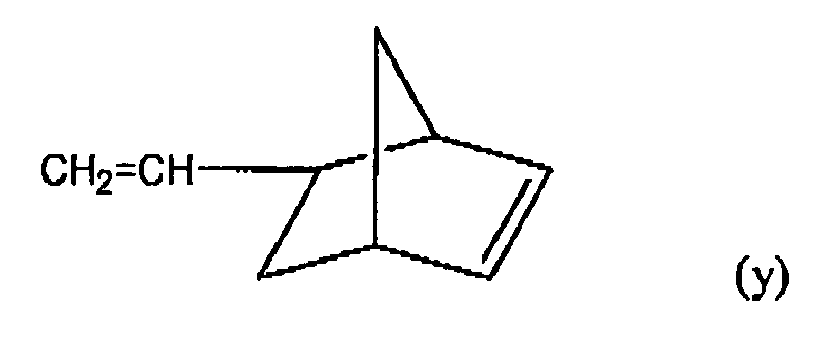

- The position of substitution for the vinyl group in the above vinylnorbornenes may adopt either a cis arrangement (the exo form) or a trans arrangement (the endo form), or alternatively, because this variation in the vinyl group arrangement does not cause any significant changes in the reactivity of the component, a combination of both isomers may also be used.
- The component (A) of the composition of the present invention can be produced as an addition reaction product containing no SiH groups, by conducting an addition reaction in the presence of a hydrosilylation reaction catalyst between 1 mol of the aforementioned component (a) containing two SiH groups within each molecule, and an excess equivalent to more than 1 mol but not more than 10 mols, and preferably more than 1 mol but not more than 5 mols, of the aforementioned component (b) containing two addition reactive carbon-carbon double bonds within each molecule.
- A component (A) obtained in this manner contains not only addition reactive carbon-carbon double bonds derived from the component (b), but may also include addition reactive carbon-carbon double bonds derived from the component (a) (specifically, addition reactive carbon-carbon double bonds derived from the R groups within the general formula (1) and/or the R' groups within the general formula (2)). As a result, the component (A) comprises at least two addition reactive carbon-carbon double bonds within each molecule, and this number of double bonds is preferably within a range from 2 to 6, and is more preferably 2. If the component (A) contains too many of these addition reactive carbon-carbon double bonds, then the cured product obtained by curing the composition of the present invention tends to more prone to cracking.
- The hydrosilylation reaction catalyst mentioned above can use any of the conventionally used catalysts. Suitable examples include platinum-based catalysts such as metallic platinum supported on carbon powder, platinum black, platinic chloride, chloroplatinic acid, reaction products of chloroplatinic acid and monovalent alcohols, complexes of chloroplatinic acid and olefins, and platinum bisacetoacetate; as well as other platinum group metal-based catalysts such as palladium-based catalysts and rhodium-based catalysts. Furthermore, there are no particular restrictions on the addition reaction conditions, or on the use of solvent, and normal practices can be followed.
- As described above, during the preparation of the component (A), because the component (b) is used in a molar excess relative to the component (a), the product component (A) contains two addition reactive carbon-carbon double bonds derived from the structure of the component (b) within each molecule. In addition, the component (A) may also comprise residues derived from the component (a), and these residues may include structures that are bonded via bivalent polycyclic hydrocarbon residues derived from the structure of the component (b) but containing no addition reactive carbon-carbon double bonds.
- In other words, examples of the component (A) include compounds represented by a general formula (6) shown below:
Y-X-(Y'-X)p-Y (6)
(wherein, X is a bivalent residue of the compound of the component (a), Y is a monovalent residue of the polycyclic hydrocarbon of the component (b), Y' is a bivalent residue of the component (b), and p represents an integer from 0 to 10, and preferably from 0 to 5). - The value ofp, which represents the number of repeating units (Y'-X), can be controlled by adjusting the quantity of the molar excess of the component (b) that is reacted with each mol of the component (a).
- Specific examples of the group Y in the above general formula (6) include monovalent residues represented by the structural formulas shown below:




- Specific examples of the group Y' in the above general formula (6) include bivalent residues represented by the structural formulas shown below.


- In the asymmetric bivalent residues represented by the above structural formulas, the left-right direction of the residue is not restricted to the orientation shown in the above formula, and each of thc structural formulas also includes the structure produced by a 180 degree rotation within the plane of the paper, about an axis perpendicular to the plane of the paper.
- Specific examples of preferred forms of the component (A) represented by the above general formula (6) arc presented below, although the component (A) is not restricted to the structures shown. (The meanings of "NB" and "DCP" are as defined above.)
- NB-Me2SiOSiMe2-NB
- NB-Me2SiO(Me2SiO)SiMe2-NB
- NB-Me2SiO(Me2SiO)4SiMe2-NB
- NB-Me2SiO(Me2SiO)8SiMe2-NB
- NB-Me2SiO(Me2SiO)12SiMe2-NB
- NB-Me2Si-p-C6H4-SiMe2-NB
- NB-Me2Si-m-C6H4-SiMe2-NB

- DCP-Me2SiOSiMe2-DCP
- DCP-Me2SiO(Me2SiO)SiMe2-DCP
- DCP-Me2SiO(Me2SiO)4SiMe2-DCP
- DCP-Me2SiO(Me2SiO)8SiMe2-DCP
- DCP-Me2SiO(Me2SiO)12SiMe2-DCP
- DCP-Me2Si-p-C6H4-SiMe2-DCP
- DCP-Me2Si-m-C6H4-SiMe2-DCP

- Moreover, the component (A) of the present invention may use either a single compound, or a combination of two or more different compounds.
- The component (B) of the present invention is a compound containing three or more SiH groups within each molecule. The SiH groups within this component (B) undergo addition, via a hydrosilylation reaction, with the two or more addition reactive carbon-carbon double bonds within each molecule of the component (A), thereby forming a cured product with a three dimensional network structure.
- Examples of the component (B) include cyclic siloxane-based compounds represented by a general formula (7) shown below:

- In those cases where R1 in the above general formula (7) represents an unsubstituted or substituted monovalent hydrocarbon group other than an alkenyl group, examples of suitable groups include alkyl groups such as a methyl group, ethyl group, propyl group, isopropyl group, butyl group, tert-butyl group, pentyl group, isopentyl group, hexyl group or see-hexyl group; cycloalkyl groups such as a cyclopentyl group or cyclohexyl group; aryl groups such as a phenyl group or an o-, m- or p-tolyl group; aralkyl groups such as a benzyl group or 2-phenylethyl group; or a group in which at least one hydrogen atom bonded to a carbon atom within an aforementioned group has been substituted with a substituent such as a halogen atom, a cyano group or an epoxy ring-containing group, including halogenated alkyl groups such as a chloromethyl group, 3-chloropropyl group, or 3,3,3-trifluoropropyl group; a 2-cyanoethyl group; or a 3-glycidoxypropyl group.
- Of the above compounds represented by the general formula (7), compounds in which all the R1 groups are methyl groups are preferred in terms of the ease with which they can be produced industrially, and their resulting availability.
- Specific examples of the component (B) include addition reaction products containing three or more SiH groups within each molecule, obtained by conducting a hydrosilylation reaction between the aforementioned vinylnorbornene and 1,3,5,7-tetramethylcyclotetrasiloxane, such as the compounds represented by a general formula (8) shown below:

- Specific examples of preferred forms of the component (B) are presented below, although the component (B) is not restricted to the structures shown.
- (HMeSiO)3
- (HMeSiO)4
- (HMeSiO)3(Me2SiO)
- (HMeSiO)4(Me2SiO)

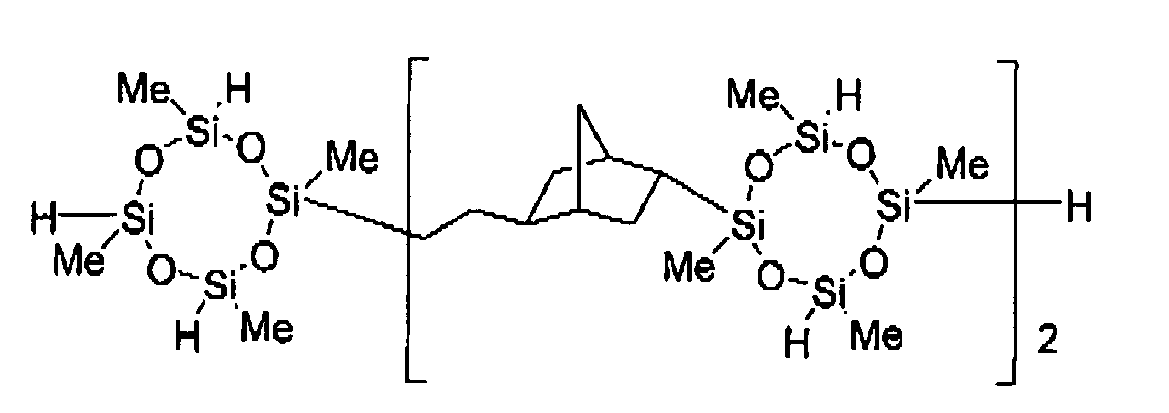
- The component (B) of the present invention may use either a single compound, or a combination of two or more different compounds.
- The blend quantity of the component (B) is preferably determined in the following manner. As described below, the composition of the present invention may also include an optional component containing a hydrogen atom bonded to a silicon atom other than the component (B), and/or an optional component containing an addition reactive carbon-carbon double bond bonded to a silicon atom other than the component (A). In the composition of the present invention, the quantity of hydrogen atoms bonded to silicon atoms within the entire composition is typically within a range from 0.5 to 2.0 mols, and preferably from 0.8 to 1.5 mols, for each 1 mol of addition reactive carbon-carbon double bonds bonded to silicon atoms within the entire composition. Moreover, the hydrogen atoms bonded to silicon atoms within the component (B) typically account for 20 to 100 mol%, and preferably from 40 to 100 mol%, of all the hydrogen atoms bonded to silicon atoms within the composition. Furthermore, the addition reactive carbon-carbon double bonds within the component (A) typically account for 20 to 100 mol%, and preferably from 40 to 100 mol%, of all the addition reactive carbon-carbon double bonds bonded to silicon atoms within the composition Provided the blend quantity of the component (B) satisfies the above conditions, a cured product can be obtained that exhibits a satisfactory level of hardness for applications such as coating materials.
- In those cases where the composition does not include the optional components described above, the blend quantity of the component (B) within the composition of the present invention is adjusted so that for each 1 mol of addition reactive carbon-carbon double bonds within the component (A), the number of mols of SiH groups within the component (B) is typically within a range from 0.5 to 2.0 mols, and is preferably from 0.8 to 1.5 mols.
- The hydrosilylation catalyst of the component (C) of the present invention can be the same as the catalyst described above in the section entitled "Preparation of the Component (A)".
- There are no particular restrictions on the quantity of the component (C) added to the composition of the present invention, and any effective catalytic quantity is suitable. A typical quantity of the component (C), calculated as the mass of platinum group metal atoms relative to the combined mass of the component (A) and the component (B), is from 1 to 500 ppm, and this quantity is preferably from 2 to 100 ppm. By ensuring a quantity within this range, the time required for the curing reaction is suitably short, and problems such as coloring of the cured product do not arise.
- The compound containing a hindered amine structure and a phenol structure that functions as the component (D) of the present invention acts as a stabilizer, and suppresses oxidation of the polycyclic hydrocarbon groups that can cause discoloration. Specific examples of the compound (D) include compounds having a structure represented by a general formula (9) shown below.

- Specific examples of the bivalent residue represented by X include the structures shown below.


- A more specific example of the compounds represented by the general formula (9) is the compound represented by the formula (10) shown below.

- There are no particular restrictions on the blend quantity of the component (D), which need only be sufficient to effectively prevent coloration. A typical quantity of the component (D), relative to the combined mass of the component (A) and the component (B), is from 10 to 10,000 ppm, and this quantity is preferably from 100 to 1,000 ppm.
- In addition to the components (A) through (D) described above, other components may also be added to the composition of the present invention, provided such addition docs not impair the objects and effects of the present invention.
- A cured product of the curable resin composition of the present invention may contain residual unreacted addition reactive carbon-carbon double bonds from the component (A), and these double bonds can cause coloration upon oxidation.
- In such cases, any of the conventionally available antioxidants can be added to the composition of the present invention. Examples of suitable antioxidants include 2,6-di-t-butyl-4-methylphenol, 2,5-di-t-amylhydroquinone, 2,5-di-t-butylhydroquinone, 4,4'-butylidene-bis(3-methyl-6-t-butylphenol), 2,2'-methylene-bis(4-methyl-6-t-butylphenol), and 2,2'-methylene-bis(4-ethyl-6-t-butylphenol). These compounds may be used either alone, or in combinations of two or more different compounds.
- In those cases where an antioxidant is used, there arc no particular restrictions on the blend quantity, and any quantity that provides an effective antioxidant action is suitable. A typical quantity, relative to the combined mass of the component (A) and the component (B), is from 10 to 10,000 ppm, and this quantity is preferably from 100 to 1,000 ppm. By ensuring a blend quantity within this range, a satisfactory antioxidant action can be achieved, and a cured product with superior optical characteristics, with no coloring, turbidity or oxidation degradation, can be obtained.
- In order to regulate the viscosity of the composition of the present invention, or regulate the hardness of the cured product produced from the composition of the present invention, straight-chain diorganopolysiloxanes or network-type organopolysiloxanes containing either an alkenyl group bonded to a silicon atom or a SiH group; and/or unreactive (that is, containing no alkenyl groups bonded to silicon atoms nor SiH groups) straight-chain or cyclic diorganopolysiloxanes or silphenylene-based compounds may be added to the composition.
- Furthermore, in order to extend the pot life, addition reaction retarders such as 1-ethynylcyclohexanol and 3,5-dimethyl-1-hexyn-3-ol may also be added. In addition, inorganic fillers such as fumed silica may also be added to improve the strength, provided such addition docs not impair the transparency. Moreover, if necessary, dyes, pigments, flame retardants and the like may also be added.
- In addition, light stabilizers can also be used to impart resistance to light degradation caused by light energy from sunlight, fluorescent lights or the like. Hindered amine-based stabilizers, which capture the radicals generated upon photooxidation degradation, are ideal as these light stabilizers, and by using such light stabilizers in combination with the antioxidants described above, the oxidation prevention effect can be further enhanced. Specific examples of these light stabilizers include bis(2,2,6,6-tetramethyl-4-piperidyl) sebacate and 4-benzoyl-2,2,6,6-tetramethylpiperidine.
- In addition, in those cases where the composition of the present invention is used as a sealing material, a silane coupling agent may be added to improve the adhesion of the composition to substrates, and a plasticizer may also be added to prevent cracking.
- There are no particular restrictions on the curing conditions used for the composition of the present invention, which will vary depending on the quantity of the composition, although normally, curing at 60 to 180°C for a period of 5 to 180 minutes is preferred.
- As follows is a description of specific details of the present invention, based on a series of examples and comparative examples, although the present invention is in no way restricted to the examples presented below.
- A 500 ml four-neck flask fitted with a stirrer, a cooling tube, a dropping funnel and a thermometer was charged with 156 g (1.3 mols) of a vinylnorbornene (brand name: V0062, manufactured by Tokyo Kasei Kogyo Co., Ltd., a substantially equimolar isomeric mixture of 5-vinylbicyclo[2.2.1]hept-2-ene and 6-vinylbicyclo[2.2.1]hept-2-ene), and the flask was then heated to 85°C using an oil bath. 0.05 g of a carbon powder supporting 5% by mass of platinum metal was then added to the flask, and with the mixture undergoing constant stirring, 67 g (0.5 mols) of 1,1,3,3-tetramethyldisiloxane was added dropwise over a period of 60 minutes. Following completion of the dropwise addition, the reaction mixture was heated and stirred at 90°C for 24 hours, and was then cooled to room temperature. Subsequently, the carbon-supported platinum metal was removed by filtration, and the excess vinylnorbornene was removed by evaporation under reduced pressure, yielding 170 g of a colorless, transparent, oily reaction product (viscosity at 25°C: 110 mm2/s).
- The results of FT-IR, NMR and GPC analyses of the above reaction product confirmed that the product was a mixture of:
- (1) approximately 70 mol% of a compound containing a single -Si-O-Si- linkage: NBMe2SiOSiMe2NB,
- (2) approximately 25 mol% of compounds containing two -Si-O-Si- linkages: (one example of a representative structural formula is shown below),

- (3) approximately 5 mol% of compounds containing three -Si-O-Si- linkages: (one example of a representative structural formula is shown below),

- A 500 ml four-neck flask fitted with a stirring device, a cooling tube, a dropping funnel and a thermometer was charged with 60 g (0.5 mols) of a vinylnorbornene (brand name: V0062, manufactured by Tokyo Kasei Kogyo Co., Ltd., a substantially equimolar isomeric mixture of 5-vinylbicyclo[2.2.1]hept-2-ene and 6-vinylbicyclo[2.2.1]hept-2-ene), and the flask was then heated to 85°C using an oil bath, 0.02 g of a carbon powder supporting 5% by weight of platinum metal was then added to the flask, and with the mixture undergoing constant stirring, 38.8 g (0.2 mols) of 1,4-bis(dimethylsilyl)benzene was added dropwise over a period of 25 minutes. Following completion of the dropwise addition, the reaction mixture was heated and stirred at 90°C for 24 hours, and was then cooled to room temperature. Subsequently, the carbon-supported platinum metal was removed by filtration, and the excess vinylnorbornene was removed by evaporation under reduced pressure, yielding 79 g of a colorless, transparent, oily reaction product (viscosity at 25°C: 1,220 mm2/s).
- The results of FT-IR, NMR and GPC analyses of the above reaction product continued that the product was a mixture of:
- (1) approximately 72 mol% of a compound containing a single p-phenylene group: NBMe2Si-p-C6H4-SiMe2NB
- (2) approximately 24 mol% of compounds containing two p-phenylene groups: (one example of a representative structural formula is shown below),

- (3) approximately 4 mol% of compounds containing three p-phenylene groups: (one example of a representative structural formula is shown below),

- A 500 ml four-neck flask fitted with a stirring device, a cooling tube, a dropping funnel and a thermometer was charged with 80 g of toluene and 115.2 g (0.48 mols) of 1,3,5,7-tetramethylcyclotctrasiloxane, and the flask was then heated to 117°C using an oil bath. 0.05 g of a carbon powder supporting 5% by weight of platinum metal was then added to the flask, and with the mixture undergoing constant stirring, 48 g (0.4 mols) of a vinylnorbornene (brand name: V0062, manufactured by Tokyo Kasei Kogyo Co., Ltd., a substantially equimolar isomeric mixture of 5-vinylbicyclo[2.2.1]hept-2-ene and 6-vinylbicyclo[2.2.1]hept-2-ene) was added dropwise over a period of 16 minutes. Following completion of the dropwise addition, the reaction mixture was heated and stirred at 125°C for 16 hours, and was then cooled to room temperature. Subsequently, the carbon-supported platinum metal was removed by filtration, and the toluene was removed by evaporation under reduced pressure, yielding 152 g of a colorless, transparent, oily reaction product (viscosity at 25°C: 2,500 mm2/s).
- The results of FT-IR, NMR and GPC analyses of the above reaction product confirmed that the product was a mixture of:
- (1) approximately 6 mol% of compounds containing one tetramethylcyclotetrasiloxane ring: (one example of a representative structural formula is shown below),

- (2) approximately 25 mol% of compounds containing two tetramethylcyclotetrasiloxane rings: (one example of a representative structural formula is shown below),

- (3) approximately 16 mol% of compounds containing three tetramethylcyclotetrasiloxane rings: (one example of a representative structural formula is shown below),

- (4) approximately 11 mol% of compounds containing four tetramethylcyclotetrasiloxane rings: (one example of a representative structural formula is shown below),

- (5) the remainder comprising compounds containing from 5 to 12 tetramethylcyclotetrasiloxane rings: (one example of a representative structural formula is shown below).

-
- (A1) 5 parts by mass of the reaction product obtained in the synthesis example 1, (A2) 60 parts by mass of the reaction product obtained in the synthesis example 2,
- (B1) 5 parts by mass of (MeHSiO)4, (B2) 30 parts by mass of the reaction product obtained in the synthesis example 3
(the molar ratio [total SiH groups within the components (B1) and (B2)] / [total carbon-carbon double bonds within the components (A1) and (A2)] = 1.03, hereafter, this molar ratio of SiH groups / carbon-carbon double bonds is abbreviated as "SiH/C=C (molar ratio)"), - (C) a sufficient quantity of a platinum-vinylsiloxane complex to provide 20 ppm of platinum metal atoms relative to the combined mass of the components (A1), (A2), (B1) and (B2),
- (D) 0.05 parts by mass of a stabilizer containing a hindered amine structure and a phenol structure (TINUVIN 144, manufactured by Ciba Specialty Chemicals Inc.), and 0.03 parts by mass of 1-ethynylcyclohexanol
-
- (A2) 81 parts by mass of the reaction product obtained in the synthesis example 2,
- (B1) 19 parts by mass of (MeHSiO)4
(SiH/C=C (molar ratio) = 0.98), - (C) a sufficient quantity of a platinum-vinylsiloxane complex to provide 20 ppm of platinum metal atoms relative to the combined mass of the components (A2) and (B1),
- (D) 0.05 parts by mass of a stabilizer containing a hindered amine structure and a phenol structure (TINUVIN 144, manufactured by Ciba Specialty Chemicals Inc.), and 0.03 parts by mass of 1-ethynyloyclohexanol
-
- (A1) 58 parts by mass of the reaction product obtained in the synthesis example 1,
- (B2) 42 parts by mass of the reaction product obtained in the synthesis example 3,
(SiH/C=C (molar ratio) = 0.99), - (C) a sufficient quantity of a platinum-vinylsiloxane complex to provide 20 ppm of platinum metal atoms relative to the combined mass of the components (A1) and (B2),
- (D) 0.05 parts by mass of a stabilizer containing a hindered amine structure and a phenol structure (TINUVIN 144, manufactured by Ciba Specialty Chemicals Inc.), and 0.03 parts by mass of 1-ethynylcyclohexanol
-
- (A2) 61 parts by mass of the reaction product obtained in the synthesis example 2,
- (B2) 39 parts by mass of the reaction product obtained in the synthesis example 3,
(SiH/C=C (molar ratio) = 1.00), - (C) a sufficient quantity of a platinum-vinylsiloxane complex to provide 20 ppm of platinum metal atoms relative to the combined mass of the components (A2) and (B2),
- (D) 0.05 parts by mass of a stabilizer containing a hindered amine structure and a phenol structure (TINUVIN 144, manufactured by Ciba Specialty Chemicals Inc.), and 0.03 parts by mass of 1-ethynylcyclohexanol
-
- (A1) 10 parts by mass of the reaction product obtained in the synthesis example 1, (A2) 55 parts by mass of the reaction product obtained in the synthesis example 2,
- (B1) 5 parts by mass of (MeHSiO)4, (B2) 30 parts by mass of the reaction product obtained in the synthesis example 3
(SiH/C=C (molar ratio) =1.02), - (C) a sufficient quantity of a platinum-vinylsiloxanc complex to provide 20 ppm of platinum metal atoms relative to the combined mass of the components (A1), (A2), (B1) and (B2),
- (D) 0.05 parts by mass of a stabilizer containing a hindered amine structure and a phenol structure (TINUVIN 144, manufactured by Ciba Specialty Chemicals Inc.), and 0.03 parts by mass of 1-ethynyleyclohexanol
- With the exception of not using the component (D) described above in the example 1, a composition and a cured product were prepared in the same manner as the example 1.
- With the exception of using 0.05 parts by mass of 2,6-di-t-butyl-4-methylphcnol containing a phenol structure instead of the component (D) described above in the example 1, a composition and a cured product were prepared in the same manner as the example 1.
- With the exception of using 0.05 parts by mass of bis(2,2,6,6-tetramcthyl-4-piperidyl) sebacate containing a hindered amine structure instead of the component (D) described above in the example 1, a composition and a cured product were prepared in the same manner as the example 1.
- With the exception of using 0.05 parts by mass of 2,6-di-t-butyl-4-methylphenol and 0.05 parts by mass ofbis(2,2,6,6-tctramethyl-4-piperidyl) sebacate instead of the component (D) described above in the example 1, a composition and a cured product were prepared in the same manner as the example 1.
-
- (1) The performance of the cured products obtained in each of the examples and comparative examples described above was evaluated using the following techniques.
- External Appearance-
The external appearance of each cured product was inspected visually. The results are shown in Table 1. - Hardness -
The hardness (Shore D) of each cured product was measured in accordance with ASTM D 2240. The results of the measurements are shown in Table 1. - Crack Resistance -
The resin compositions obtained in the examples and comparative examples were each poured into a PPA cup comprising an LED chip that had been wire bonded with gold wire, and subsequently cured by heating at 100°C for 1 hour and then at 150°C for a further 5 hours. Using a thermal shock test device, the resulting structures were each subjected to 100 cycles of a thermal shock test, with each cycle comprising 30 minutes at -40°C and then 30 minutes at 120°C, and the structures were then inspected for cracking. The results are shown in Table 1, using the grades shown below.- A: No change
- B: Micro-cracks around the wiring portion
- C: Cracking around the wiring portion and the chip portion
- D: Cracks exist throughout the entire sealing resin, or detachment of the sealing resin
- Heat Resistance -
Samples of the 2 mm thick cured products prepared in each of the examples and comparative examples were left to stand, either for 240 hours at 150°C or for 24 hours at 180°C, and the light transmittance at 400 nm was then measured.
- External Appearance-
- When compared with the comparative examples, the cured products of the examples exhibit significantly superior resistance to heat discoloration.


Claims (9)
- A polycyclic hydrocarbon group-containing silicone-based curable composition, comprising:(A) an addition reaction product of (a) a compound containing two hydrogen atoms bonded to silicon atoms within each molecule, represented by a general formula (1) shown below:


(b) a polycyclic hydrocarbon containing two addition reactive carbon-carbon double bonds within each molecule, wherein the addition reaction product contains at least two addition reactive carbon-carbon double bonds within each molecule,(B) a compound containing three or more hydrogen atoms bonded to silicon atoms within each molecule,(C) a hydrosilylation reaction catalyst, and(D) a compound containing a hindered amine structure and a phenol structure within each molecule. - The curable composition according to claim 1, wherein the polycyclic hydrocarbon of the component (b) is 5-vinylbicyclo[2.2.1]hept-2-ene, 6-vinylbicyclo[2.2.1]hept-2-enc, or a combination thereof.
- The curable composition according to either claim 1 or 2, wherein the component (A) is a compound represented by a general formula (6) shown below:
Y-X-(Y'-X)p-Y (6)
(wherein, X is a bivalent residue of the compound of the component (a), Y is a monovalent residue of the polycyclic hydrocarbon of the component (b), Y' is a bivalent residue of the component (b), and p represents an integer from 0 to 10). - The curable composition according to any one of claims 1, 2 or 3, wherein the component (B) is a cyclic siloxane-based compound represented by a general formula (7) shown below:

- The curable composition according to any one of claims 1, 2 or 3, wherein the component (B) is a reaction product of 5-vinylbicyclo[2.2.1]hept-2-ene, 6-vinylbicyclo[2.2.1]hept-2-ene or a combination thereof, with 1,3,5,7-tetramethylcyclotetrasiloxane.
- The curable composition according to any one of claims 1 through 5, wherein a quantity of the component (D) relative to a combined mass of the component (A) and the component (B) is within a range from 10 ppm to 10,000 ppm.
- The curable composition according to any one of claims 1 through 6, wherein the component (D) is a compound with a structure represented by a general formula (9) shown below.

- The curable composition according to any one of claims 1 through 7, wherein a quantity of hydrogen atoms bonded to silicon atoms within the composition is within a range from 0.5 to 2.0 mols for each 1 mol of addition reactive carbon-carbon double bonds bonded to silicon atoms within the composition.
- The curable composition according to any one of claims 1 through 8, wherein a ratio of a number of hydrogen atoms bonded to silicon atoms within the component (B) relative to a total number of hydrogen atoms bonded to silicon atoms within the composition is within a range from 20 to 100 mol%, and a ratio of a number of addition reactive carbon-carbon double bonds within the component (A) relative to a total number of addition reactive carbon-carbon double bonds within the composition is within a range from 20 to 100 mol%.
Applications Claiming Priority (1)
| Application Number | Priority Date | Filing Date | Title |
|---|---|---|---|
| JP2006247210A JP2008069210A (en) | 2006-09-12 | 2006-09-12 | Polycyclic hydrocarbon group-containing silicone-based curable composition |
Publications (2)
| Publication Number | Publication Date |
|---|---|
| EP1900778A1 true EP1900778A1 (en) | 2008-03-19 |
| EP1900778B1 EP1900778B1 (en) | 2009-06-17 |
Family
ID=38668673
Family Applications (1)
| Application Number | Title | Priority Date | Filing Date |
|---|---|---|---|
| EP07017718A Active EP1900778B1 (en) | 2006-09-12 | 2007-09-11 | Silicone-based curable composition containing polycyclic hydrocarbon group |
Country Status (7)
| Country | Link |
|---|---|
| US (1) | US20080071023A1 (en) |
| EP (1) | EP1900778B1 (en) |
| JP (1) | JP2008069210A (en) |
| KR (1) | KR101446800B1 (en) |
| CN (1) | CN101143930B (en) |
| DE (1) | DE602007001317D1 (en) |
| TW (1) | TWI410461B (en) |
Families Citing this family (29)
| Publication number | Priority date | Publication date | Assignee | Title |
|---|---|---|---|---|
| JP2008274184A (en) * | 2007-05-07 | 2008-11-13 | Shin Etsu Chem Co Ltd | Polycyclic hydrocarbon group-containing organosilicon compound having a hydrogen atom bonded to a silicon atom and method for producing the same |
| JP5279197B2 (en) * | 2007-05-07 | 2013-09-04 | 信越化学工業株式会社 | Curable organosilicon composition and cured product thereof |
| JP2011225654A (en) * | 2010-04-16 | 2011-11-10 | Nippon Kayaku Co Ltd | Diolefin resin, epoxy resin, and composition for the same |
| KR101762990B1 (en) | 2010-04-26 | 2017-07-28 | 쓰리본드 화인 케미칼 가부시키가이샤 | Photocurable silicone gel composition and application thereof |
| JP5373696B2 (en) * | 2010-05-07 | 2013-12-18 | 信越化学工業株式会社 | Novel silphenylene skeleton-containing silicone polymer compound and method for producing the same |
| JP5780029B2 (en) * | 2010-07-14 | 2015-09-16 | Jsr株式会社 | Polysiloxane composition and pattern forming method |
| WO2012008538A1 (en) | 2010-07-14 | 2012-01-19 | Jsr株式会社 | Polysiloxane composition and method of pattern formation |
| KR101277722B1 (en) | 2010-07-14 | 2013-06-24 | 제일모직주식회사 | Hybrid siloxane polymer composition and encapsulation material obtained from the siloxane polymer composition and electronic device including the encapsulation material |
| JP5539252B2 (en) * | 2011-03-24 | 2014-07-02 | 信越化学工業株式会社 | Curable composition |
| JP5733087B2 (en) | 2011-07-29 | 2015-06-10 | 信越化学工業株式会社 | Room temperature moisture thickening type thermally conductive silicone grease composition |
| JP5931503B2 (en) * | 2012-02-27 | 2016-06-08 | 信越化学工業株式会社 | White thermosetting silicone composition and light reflecting material for white light-emitting diode comprising cured product of the composition |
| CN104583264B (en) * | 2012-08-31 | 2017-03-29 | 新日铁住金化学株式会社 | Epoxy silicone resin and curable resin composition using same |
| US9963469B2 (en) * | 2013-03-14 | 2018-05-08 | Momentive Performance Materials Inc. | High refractive index siloxanes |
| JP6173789B2 (en) * | 2013-06-20 | 2017-08-02 | 日東電工株式会社 | Solar cell encapsulant composition, solar cell encapsulant layer, and solar cell module using the same |
| JP6258048B2 (en) * | 2014-01-28 | 2018-01-10 | 信越化学工業株式会社 | Organically modified silicone resin composition |
| JP6148204B2 (en) * | 2014-06-03 | 2017-06-14 | 信越化学工業株式会社 | Curable composition and semiconductor device |
| JP5960337B1 (en) * | 2015-11-19 | 2016-08-02 | 有限会社日本エコロノミックス | Emergency lock |
| US10287400B2 (en) * | 2016-04-14 | 2019-05-14 | Momentive Performance Materials Inc. | Curable silicone composition and applications and uses thereof |
| JP2018044125A (en) * | 2016-09-16 | 2018-03-22 | 旭化成株式会社 | Curable composition |
| JP7043165B2 (en) * | 2016-09-16 | 2022-03-29 | 旭化成株式会社 | Curable composition |
| JP6867839B2 (en) * | 2017-03-17 | 2021-05-12 | 旭化成株式会社 | Curable composition |
| JP6867203B2 (en) * | 2017-03-17 | 2021-04-28 | 旭化成株式会社 | Curable composition |
| JP6823578B2 (en) | 2017-11-02 | 2021-02-03 | 信越化学工業株式会社 | Additive-curable silicone composition, cured product, optical element |
| TWI743440B (en) * | 2018-01-31 | 2021-10-21 | 日商信越化學工業股份有限公司 | Infrared penetrating curable composition, its cured product and optical semiconductor device |
| JP6981933B2 (en) * | 2018-08-15 | 2021-12-17 | 信越化学工業株式会社 | A curable composition, a cured product of the composition, and a semiconductor device using the cured product. |
| JP7088879B2 (en) * | 2019-05-24 | 2022-06-21 | 信越化学工業株式会社 | Additive-curable silicone compositions, cured products and opto-semiconductor devices |
| JP7401247B2 (en) * | 2019-10-08 | 2023-12-19 | 信越化学工業株式会社 | Curable composition, cured product thereof, and semiconductor device |
| JP7388865B2 (en) | 2019-10-08 | 2023-11-29 | 信越化学工業株式会社 | Addition-curing silicone composition, cured product thereof, and semiconductor device |
| JP7461148B2 (en) * | 2020-01-24 | 2024-04-03 | 信越化学工業株式会社 | Radical curable composition and cured product |
Citations (3)
| Publication number | Priority date | Publication date | Assignee | Title |
|---|---|---|---|---|
| EP0388028A2 (en) * | 1989-02-24 | 1990-09-19 | Loctite Corporation | Curable norbornenyl functional silicone formulations |
| US5171816A (en) * | 1986-10-14 | 1992-12-15 | Loctite Corporation | Curable norbornenyl functional silicone formulations |
| DE4128932A1 (en) * | 1991-08-30 | 1993-03-04 | Wacker Chemie Gmbh | Novel organo(poly)siloxane(s) with 5-norbornene-2-yl gps. - are useful in adhesive coating compsns. crosslinked by the thiol-ene reaction |
Family Cites Families (22)
| Publication number | Priority date | Publication date | Assignee | Title |
|---|---|---|---|---|
| DE2647452A1 (en) * | 1975-11-07 | 1977-05-18 | Ciba Geigy Ag | NEW HYDROXYBENZYLMALONIC ACID DERIVATIVES |
| US5068303A (en) * | 1989-10-16 | 1991-11-26 | Hercules Incorporated | Organosilicon materials |
| US5008360A (en) * | 1989-10-16 | 1991-04-16 | Hercules Incorporated | Organosilicon materials |
| US5242979A (en) * | 1990-10-05 | 1993-09-07 | Hercules Incorporated | Organosilicon compositions containing hydrocarbon elastomers |
| US5171817A (en) * | 1991-04-15 | 1992-12-15 | Hercules Incorporated | Organosilicon compositions containing siloxane elastomers |
| US5196498A (en) * | 1991-09-24 | 1993-03-23 | Hercules Incorporated | Organosilicon polymers |
| US5254655A (en) * | 1992-02-05 | 1993-10-19 | Hercules Incorporated | Organosilicon polymers, and dyes, exhibiting nonlinear optical response |
| US5391678A (en) * | 1992-12-03 | 1995-02-21 | Hercules Incorporated | Curable and cured organosilicon compositions |
| US5523374A (en) * | 1992-12-03 | 1996-06-04 | Hercules Incorporated | Curable and cured organosilicon compositions |
| US5408026A (en) * | 1993-08-23 | 1995-04-18 | Cowan; Patrick J. | Curable and cured organosilicon compositions, and process for making same |
| JP2004149782A (en) * | 2002-10-09 | 2004-05-27 | Mitsubishi Chemicals Corp | Thermoplastic resin composition and molded article using the same |
| US7019100B2 (en) * | 2003-04-23 | 2006-03-28 | Shin-Etsu Chemical Co., Ltd. | Curable silicone resin composition |
| JP3952194B2 (en) * | 2003-06-02 | 2007-08-01 | 信越化学工業株式会社 | Siloxane copolymer, process for producing the same, and thermosetting resin composition using the same |
| DE102004039111A1 (en) * | 2003-08-14 | 2005-04-14 | Shin-Etsu Chemical Co., Ltd. | Curable silicone resin composition |
| JP2005089671A (en) * | 2003-09-19 | 2005-04-07 | Shin Etsu Chem Co Ltd | Curable silicone resin composition |
| TW200513483A (en) * | 2003-10-10 | 2005-04-16 | Shinetsu Chemical Co | Curable composition |
| JP2005272697A (en) * | 2004-03-25 | 2005-10-06 | Shin Etsu Chem Co Ltd | Curable silicone resin composition, optical semiconductor sealing material, and optical semiconductor device |
| KR101127351B1 (en) * | 2004-06-23 | 2012-03-30 | 신에쓰 가가꾸 고교 가부시끼가이샤 | Curable Silicone Resin Composition |
| KR101135801B1 (en) * | 2004-08-31 | 2012-04-16 | 신에쓰 가가꾸 고교 가부시끼가이샤 | Curable Compositions |
| JP4634810B2 (en) * | 2005-01-20 | 2011-02-16 | 信越化学工業株式会社 | Silicone sealed LED |
| JP4395472B2 (en) * | 2005-11-08 | 2010-01-06 | 信越化学工業株式会社 | Method for sealing semiconductor element mounted on gold-plated printed circuit board |
| JP5279197B2 (en) * | 2007-05-07 | 2013-09-04 | 信越化学工業株式会社 | Curable organosilicon composition and cured product thereof |
-
2006
- 2006-09-12 JP JP2006247210A patent/JP2008069210A/en active Pending
-
2007
- 2007-09-11 TW TW096133900A patent/TWI410461B/en active
- 2007-09-11 US US11/853,448 patent/US20080071023A1/en not_active Abandoned
- 2007-09-11 DE DE602007001317T patent/DE602007001317D1/en active Active
- 2007-09-11 EP EP07017718A patent/EP1900778B1/en active Active
- 2007-09-11 KR KR1020070091876A patent/KR101446800B1/en active Active
- 2007-09-11 CN CN2007101487734A patent/CN101143930B/en active Active
Patent Citations (3)
| Publication number | Priority date | Publication date | Assignee | Title |
|---|---|---|---|---|
| US5171816A (en) * | 1986-10-14 | 1992-12-15 | Loctite Corporation | Curable norbornenyl functional silicone formulations |
| EP0388028A2 (en) * | 1989-02-24 | 1990-09-19 | Loctite Corporation | Curable norbornenyl functional silicone formulations |
| DE4128932A1 (en) * | 1991-08-30 | 1993-03-04 | Wacker Chemie Gmbh | Novel organo(poly)siloxane(s) with 5-norbornene-2-yl gps. - are useful in adhesive coating compsns. crosslinked by the thiol-ene reaction |
Also Published As
| Publication number | Publication date |
|---|---|
| TWI410461B (en) | 2013-10-01 |
| JP2008069210A (en) | 2008-03-27 |
| EP1900778B1 (en) | 2009-06-17 |
| DE602007001317D1 (en) | 2009-07-30 |
| KR20080024078A (en) | 2008-03-17 |
| TW200835748A (en) | 2008-09-01 |
| CN101143930B (en) | 2011-12-14 |
| CN101143930A (en) | 2008-03-19 |
| US20080071023A1 (en) | 2008-03-20 |
| KR101446800B1 (en) | 2014-10-01 |
Similar Documents
| Publication | Publication Date | Title |
|---|---|---|
| EP1900778B1 (en) | Silicone-based curable composition containing polycyclic hydrocarbon group | |
| US7700697B2 (en) | Curable organosilicon composition and cured product thereof | |
| KR101182070B1 (en) | Silicone Sealed LED | |
| JP4520251B2 (en) | Curable composition | |
| JP4347103B2 (en) | Curable silicone composition | |
| KR20120020069A (en) | Curable silicone-based composition comprising polycyclic hydrocarbon skeleton containing component | |
| US7019100B2 (en) | Curable silicone resin composition | |
| US7176270B2 (en) | Curable composition | |
| JP4112443B2 (en) | Curable silicone resin composition | |
| CN110093038B (en) | Infrared-transmitting curable composition, cured product thereof, and optical semiconductor device | |
| CN110835516B (en) | Curable composition, cured product of the composition, and semiconductor device using the cured product | |
| JP5547100B2 (en) | White thermosetting silicone composition and white light-emitting diode reflector comprising a cured product of the composition | |
| CN105980482A (en) | Curable composition, semiconductor device, and ester-bond-containing organic silicon compound | |
| TWI864132B (en) | Curable composition, cured product thereof, and semiconductor device | |
| EP1990344B1 (en) | Polycyclic hydrocarbon group-containing organosilicon compound having hydrogen atoms bonded to silicon atoms, and method of producing same | |
| JP5036125B2 (en) | Curable silicone resin composition | |
| JP2019151767A (en) | Thermosetting silicone composition, silicone resin cured product, and semiconductor device | |
| KR101135801B1 (en) | Curable Compositions | |
| JP6941455B2 (en) | Curable composition | |
| KR101127351B1 (en) | Curable Silicone Resin Composition | |
| KR20090110241A (en) | Curable Silicone Compositions for Optical Lenses |
Legal Events
| Date | Code | Title | Description |
|---|---|---|---|
| PUAI | Public reference made under article 153(3) epc to a published international application that has entered the european phase |
Free format text: ORIGINAL CODE: 0009012 |
|
| AK | Designated contracting states |
Kind code of ref document: A1 Designated state(s): AT BE BG CH CY CZ DE DK EE ES FI FR GB GR HU IE IS IT LI LT LU LV MC MT NL PL PT RO SE SI SK TR |
|
| AX | Request for extension of the european patent |
Extension state: AL BA HR MK YU |
|
| 17P | Request for examination filed |
Effective date: 20080919 |
|
| AKX | Designation fees paid |
Designated state(s): DE FR GB |
|
| GRAP | Despatch of communication of intention to grant a patent |
Free format text: ORIGINAL CODE: EPIDOSNIGR1 |
|
| GRAS | Grant fee paid |
Free format text: ORIGINAL CODE: EPIDOSNIGR3 |
|
| GRAA | (expected) grant |
Free format text: ORIGINAL CODE: 0009210 |
|
| RIN1 | Information on inventor provided before grant (corrected) |
Inventor name: TABEI, EIICHIC |
|
| AK | Designated contracting states |
Kind code of ref document: B1 Designated state(s): DE FR GB |
|
| REG | Reference to a national code |
Ref country code: GB Ref legal event code: FG4D |
|
| REF | Corresponds to: |
Ref document number: 602007001317 Country of ref document: DE Date of ref document: 20090730 Kind code of ref document: P |
|
| PLBE | No opposition filed within time limit |
Free format text: ORIGINAL CODE: 0009261 |
|
| STAA | Information on the status of an ep patent application or granted ep patent |
Free format text: STATUS: NO OPPOSITION FILED WITHIN TIME LIMIT |
|
| 26N | No opposition filed |
Effective date: 20100318 |
|
| REG | Reference to a national code |
Ref country code: FR Ref legal event code: PLFP Year of fee payment: 10 |
|
| REG | Reference to a national code |
Ref country code: FR Ref legal event code: PLFP Year of fee payment: 11 |
|
| REG | Reference to a national code |
Ref country code: FR Ref legal event code: PLFP Year of fee payment: 12 |
|
| PGFP | Annual fee paid to national office [announced via postgrant information from national office to epo] |
Ref country code: DE Payment date: 20250730 Year of fee payment: 19 |
|
| PGFP | Annual fee paid to national office [announced via postgrant information from national office to epo] |
Ref country code: GB Payment date: 20250731 Year of fee payment: 19 |
|
| PGFP | Annual fee paid to national office [announced via postgrant information from national office to epo] |
Ref country code: FR Payment date: 20250808 Year of fee payment: 19 |