EP1896905B1 - Fluessigtoner und ein verfahren zum aufladen von tonerpartikeln influessigtonern - Google Patents
Fluessigtoner und ein verfahren zum aufladen von tonerpartikeln influessigtonern Download PDFInfo
- Publication number
- EP1896905B1 EP1896905B1 EP05749885A EP05749885A EP1896905B1 EP 1896905 B1 EP1896905 B1 EP 1896905B1 EP 05749885 A EP05749885 A EP 05749885A EP 05749885 A EP05749885 A EP 05749885A EP 1896905 B1 EP1896905 B1 EP 1896905B1
- Authority
- EP
- European Patent Office
- Prior art keywords
- toner
- liquid
- charge
- salt
- aluminum
- Prior art date
- Legal status (The legal status is an assumption and is not a legal conclusion. Google has not performed a legal analysis and makes no representation as to the accuracy of the status listed.)
- Ceased
Links
- 239000007788 liquid Substances 0.000 title claims description 108
- 239000002245 particle Substances 0.000 title claims description 62
- 238000000034 method Methods 0.000 title claims description 31
- 239000002671 adjuvant Substances 0.000 claims description 49
- 150000003839 salts Chemical class 0.000 claims description 38
- AZDRQVAHHNSJOQ-UHFFFAOYSA-N alumane Chemical class [AlH3] AZDRQVAHHNSJOQ-UHFFFAOYSA-N 0.000 claims description 21
- 239000000463 material Substances 0.000 claims description 15
- -1 aluminum bis(2-ethylhexyl) sulfosuccinate Chemical compound 0.000 claims description 13
- 229910052782 aluminium Inorganic materials 0.000 claims description 11
- VQTDTYRECUNSJH-UHFFFAOYSA-H dialuminum 2-sulfobutanedioate Chemical compound [Al+3].[Al+3].OS(=O)(=O)C(CC([O-])=O)C([O-])=O.OS(=O)(=O)C(CC([O-])=O)C([O-])=O.OS(=O)(=O)C(CC([O-])=O)C([O-])=O VQTDTYRECUNSJH-UHFFFAOYSA-H 0.000 claims description 11
- OYPRJOBELJOOCE-UHFFFAOYSA-N Calcium Chemical compound [Ca] OYPRJOBELJOOCE-UHFFFAOYSA-N 0.000 claims description 7
- 239000004215 Carbon black (E152) Substances 0.000 claims description 7
- 229910052788 barium Inorganic materials 0.000 claims description 7
- DSAJWYNOEDNPEQ-UHFFFAOYSA-N barium atom Chemical compound [Ba] DSAJWYNOEDNPEQ-UHFFFAOYSA-N 0.000 claims description 7
- 229910052791 calcium Inorganic materials 0.000 claims description 7
- 239000011575 calcium Substances 0.000 claims description 7
- 229930195733 hydrocarbon Natural products 0.000 claims description 7
- 150000002430 hydrocarbons Chemical class 0.000 claims description 7
- IIZPXYDJLKNOIY-JXPKJXOSSA-N 1-palmitoyl-2-arachidonoyl-sn-glycero-3-phosphocholine Chemical compound CCCCCCCCCCCCCCCC(=O)OC[C@H](COP([O-])(=O)OCC[N+](C)(C)C)OC(=O)CCC\C=C/C\C=C/C\C=C/C\C=C/CCCCC IIZPXYDJLKNOIY-JXPKJXOSSA-N 0.000 claims description 6
- BKWFFAAXCVBKRZ-UHFFFAOYSA-H C(CCCCCCCCCCCC)C(C(C(=O)[O-])S(=O)(=O)O)(C(=O)[O-])CCCCCCCCCCCCC.C(CCCCCCCCCCCC)C(C(C(=O)[O-])S(=O)(=O)O)(C(=O)[O-])CCCCCCCCCCCCC.C(CCCCCCCCCCCC)C(C(C(=O)[O-])S(=O)(=O)O)(C(=O)[O-])CCCCCCCCCCCCC.[Al+3].[Al+3] Chemical compound C(CCCCCCCCCCCC)C(C(C(=O)[O-])S(=O)(=O)O)(C(=O)[O-])CCCCCCCCCCCCC.C(CCCCCCCCCCCC)C(C(C(=O)[O-])S(=O)(=O)O)(C(=O)[O-])CCCCCCCCCCCCC.C(CCCCCCCCCCCC)C(C(C(=O)[O-])S(=O)(=O)O)(C(=O)[O-])CCCCCCCCCCCCC.[Al+3].[Al+3] BKWFFAAXCVBKRZ-UHFFFAOYSA-H 0.000 claims description 6
- 239000000787 lecithin Substances 0.000 claims description 6
- 235000010445 lecithin Nutrition 0.000 claims description 6
- 229940067606 lecithin Drugs 0.000 claims description 6
- 230000001737 promoting effect Effects 0.000 claims description 3
- RTZKZFJDLAIYFH-UHFFFAOYSA-N Diethyl ether Chemical compound CCOCC RTZKZFJDLAIYFH-UHFFFAOYSA-N 0.000 description 18
- LFQSCWFLJHTTHZ-UHFFFAOYSA-N Ethanol Chemical compound CCO LFQSCWFLJHTTHZ-UHFFFAOYSA-N 0.000 description 9
- 230000009257 reactivity Effects 0.000 description 8
- 239000012141 concentrate Substances 0.000 description 7
- 238000000227 grinding Methods 0.000 description 7
- OKKJLVBELUTLKV-UHFFFAOYSA-N Methanol Chemical compound OC OKKJLVBELUTLKV-UHFFFAOYSA-N 0.000 description 6
- YXFVVABEGXRONW-UHFFFAOYSA-N Toluene Chemical compound CC1=CC=CC=C1 YXFVVABEGXRONW-UHFFFAOYSA-N 0.000 description 6
- 239000000203 mixture Substances 0.000 description 6
- VLKZOEOYAKHREP-UHFFFAOYSA-N n-Hexane Chemical compound CCCCCC VLKZOEOYAKHREP-UHFFFAOYSA-N 0.000 description 6
- 230000000694 effects Effects 0.000 description 5
- 239000012535 impurity Substances 0.000 description 5
- 239000003550 marker Substances 0.000 description 5
- 239000007787 solid Substances 0.000 description 5
- 239000000758 substrate Substances 0.000 description 5
- JLDSOYXADOWAKB-UHFFFAOYSA-N aluminium nitrate Chemical compound [Al+3].[O-][N+]([O-])=O.[O-][N+]([O-])=O.[O-][N+]([O-])=O JLDSOYXADOWAKB-UHFFFAOYSA-N 0.000 description 4
- 239000004615 ingredient Substances 0.000 description 4
- HQKMJHAJHXVSDF-UHFFFAOYSA-L magnesium stearate Chemical compound [Mg+2].CCCCCCCCCCCCCCCCCC([O-])=O.CCCCCCCCCCCCCCCCCC([O-])=O HQKMJHAJHXVSDF-UHFFFAOYSA-L 0.000 description 4
- 238000004519 manufacturing process Methods 0.000 description 4
- 238000005259 measurement Methods 0.000 description 4
- 238000002156 mixing Methods 0.000 description 4
- 230000003071 parasitic effect Effects 0.000 description 4
- 239000000049 pigment Substances 0.000 description 4
- NLKNQRATVPKPDG-UHFFFAOYSA-M potassium iodide Chemical compound [K+].[I-] NLKNQRATVPKPDG-UHFFFAOYSA-M 0.000 description 4
- FGIUAXJPYTZDNR-UHFFFAOYSA-N potassium nitrate Chemical compound [K+].[O-][N+]([O-])=O FGIUAXJPYTZDNR-UHFFFAOYSA-N 0.000 description 4
- XLYOFNOQVPJJNP-UHFFFAOYSA-N water Substances O XLYOFNOQVPJJNP-UHFFFAOYSA-N 0.000 description 4
- 238000006243 chemical reaction Methods 0.000 description 3
- 239000003795 chemical substances by application Substances 0.000 description 3
- 229910003460 diamond Inorganic materials 0.000 description 3
- 239000010432 diamond Substances 0.000 description 3
- 239000006185 dispersion Substances 0.000 description 3
- 229920000642 polymer Polymers 0.000 description 3
- 229920005989 resin Polymers 0.000 description 3
- 239000011347 resin Substances 0.000 description 3
- 239000002002 slurry Substances 0.000 description 3
- 229920003298 Nucrel® Polymers 0.000 description 2
- CDBYLPFSWZWCQE-UHFFFAOYSA-L Sodium Carbonate Chemical compound [Na+].[Na+].[O-]C([O-])=O CDBYLPFSWZWCQE-UHFFFAOYSA-L 0.000 description 2
- XAGFODPZIPBFFR-UHFFFAOYSA-N aluminium Chemical compound [Al] XAGFODPZIPBFFR-UHFFFAOYSA-N 0.000 description 2
- CEGOLXSVJUTHNZ-UHFFFAOYSA-K aluminium tristearate Chemical compound [Al+3].CCCCCCCCCCCCCCCCCC([O-])=O.CCCCCCCCCCCCCCCCCC([O-])=O.CCCCCCCCCCCCCCCCCC([O-])=O CEGOLXSVJUTHNZ-UHFFFAOYSA-K 0.000 description 2
- 230000003993 interaction Effects 0.000 description 2
- 235000019359 magnesium stearate Nutrition 0.000 description 2
- 229910052751 metal Inorganic materials 0.000 description 2
- 239000002184 metal Substances 0.000 description 2
- 150000002978 peroxides Chemical class 0.000 description 2
- XAEFZNCEHLXOMS-UHFFFAOYSA-M potassium benzoate Chemical compound [K+].[O-]C(=O)C1=CC=CC=C1 XAEFZNCEHLXOMS-UHFFFAOYSA-M 0.000 description 2
- 235000010333 potassium nitrate Nutrition 0.000 description 2
- 239000004323 potassium nitrate Substances 0.000 description 2
- 230000037452 priming Effects 0.000 description 2
- 238000003860 storage Methods 0.000 description 2
- BNGXYYYYKUGPPF-UHFFFAOYSA-M (3-methylphenyl)methyl-triphenylphosphanium;chloride Chemical compound [Cl-].CC1=CC=CC(C[P+](C=2C=CC=CC=2)(C=2C=CC=CC=2)C=2C=CC=CC=2)=C1 BNGXYYYYKUGPPF-UHFFFAOYSA-M 0.000 description 1
- HNSDLXPSAYFUHK-UHFFFAOYSA-N 1,4-bis(2-ethylhexyl) sulfosuccinate Chemical compound CCCCC(CC)COC(=O)CC(S(O)(=O)=O)C(=O)OCC(CC)CCCC HNSDLXPSAYFUHK-UHFFFAOYSA-N 0.000 description 1
- KWORKYDIARWARF-UHFFFAOYSA-N N-(4-chloro-2-methylphenyl)-4-[(4-chloro-2-methylphenyl)diazenyl]-3-hydroxynaphthalene-2-carboxamide Chemical compound Cc1cc(Cl)ccc1NC(=O)c1cc2ccccc2c(N=Nc2ccc(Cl)cc2C)c1O KWORKYDIARWARF-UHFFFAOYSA-N 0.000 description 1
- 239000007832 Na2SO4 Substances 0.000 description 1
- PMZURENOXWZQFD-UHFFFAOYSA-L Sodium Sulfate Chemical compound [Na+].[Na+].[O-]S([O-])(=O)=O PMZURENOXWZQFD-UHFFFAOYSA-L 0.000 description 1
- QAOWNCQODCNURD-UHFFFAOYSA-N Sulfuric acid Chemical compound OS(O)(=O)=O QAOWNCQODCNURD-UHFFFAOYSA-N 0.000 description 1
- 239000002253 acid Substances 0.000 description 1
- 230000002378 acidificating effect Effects 0.000 description 1
- 239000000654 additive Substances 0.000 description 1
- 230000000996 additive effect Effects 0.000 description 1
- 229940063655 aluminum stearate Drugs 0.000 description 1
- 238000004458 analytical method Methods 0.000 description 1
- 239000007795 chemical reaction product Substances 0.000 description 1
- 238000001816 cooling Methods 0.000 description 1
- 238000009826 distribution Methods 0.000 description 1
- 239000000975 dye Substances 0.000 description 1
- 229920005648 ethylene methacrylic acid copolymer Polymers 0.000 description 1
- 238000001704 evaporation Methods 0.000 description 1
- 238000001914 filtration Methods 0.000 description 1
- PTCGDEVVHUXTMP-UHFFFAOYSA-N flutolanil Chemical compound CC(C)OC1=CC=CC(NC(=O)C=2C(=CC=CC=2)C(F)(F)F)=C1 PTCGDEVVHUXTMP-UHFFFAOYSA-N 0.000 description 1
- 125000000524 functional group Chemical group 0.000 description 1
- 230000007062 hydrolysis Effects 0.000 description 1
- 238000006460 hydrolysis reaction Methods 0.000 description 1
- 238000003384 imaging method Methods 0.000 description 1
- 239000007791 liquid phase Substances 0.000 description 1
- 230000007935 neutral effect Effects 0.000 description 1
- 239000003921 oil Substances 0.000 description 1
- 150000003097 polyterpenes Chemical class 0.000 description 1
- 239000002244 precipitate Substances 0.000 description 1
- 230000001376 precipitating effect Effects 0.000 description 1
- 239000000376 reactant Substances 0.000 description 1
- 239000011369 resultant mixture Substances 0.000 description 1
- 238000000926 separation method Methods 0.000 description 1
- 229920002545 silicone oil Polymers 0.000 description 1
- 239000000344 soap Substances 0.000 description 1
- 229910000029 sodium carbonate Inorganic materials 0.000 description 1
- 159000000000 sodium salts Chemical class 0.000 description 1
- 229910052938 sodium sulfate Inorganic materials 0.000 description 1
- 238000003756 stirring Methods 0.000 description 1
- 239000004094 surface-active agent Substances 0.000 description 1
- 229920001169 thermoplastic Polymers 0.000 description 1
- 229920005992 thermoplastic resin Polymers 0.000 description 1
- 238000004448 titration Methods 0.000 description 1
Images

Classifications
-
- G—PHYSICS
- G03—PHOTOGRAPHY; CINEMATOGRAPHY; ANALOGOUS TECHNIQUES USING WAVES OTHER THAN OPTICAL WAVES; ELECTROGRAPHY; HOLOGRAPHY
- G03G—ELECTROGRAPHY; ELECTROPHOTOGRAPHY; MAGNETOGRAPHY
- G03G9/00—Developers
- G03G9/08—Developers with toner particles
- G03G9/12—Developers with toner particles in liquid developer mixtures
- G03G9/135—Developers with toner particles in liquid developer mixtures characterised by stabiliser or charge-controlling agents
- G03G9/1355—Ionic, organic compounds
-
- G—PHYSICS
- G03—PHOTOGRAPHY; CINEMATOGRAPHY; ANALOGOUS TECHNIQUES USING WAVES OTHER THAN OPTICAL WAVES; ELECTROGRAPHY; HOLOGRAPHY
- G03G—ELECTROGRAPHY; ELECTROPHOTOGRAPHY; MAGNETOGRAPHY
- G03G9/00—Developers
- G03G9/08—Developers with toner particles
- G03G9/12—Developers with toner particles in liquid developer mixtures
- G03G9/135—Developers with toner particles in liquid developer mixtures characterised by stabiliser or charge-controlling agents
Definitions
- the present invention relates to the process of producing liquid toners for use in electrostatic printing and in particular to charging toner particles comprised in the liquid toners.
- a typical "electrostatic" digital printer To print an image on an appropriate substrate, a typical "electrostatic" digital printer first forms a copy of the image, conventionally referred to as a "latent image", on a photosensitive surface of a cylindrical roller, hereinafter referred to as a “photosensitive imaging plate” (PIP).
- PIP photosensitive imaging plate
- a laser then scans the charged photosensitive surface and discharges regions thereon to generate a pattern of charged and discharged, or partially discharged, pixels on the photosurface that forms the latent image and replicates the image to be printed.
- a developer electrode is used to develop the latent image by applying ink or toner, hereinafter generically, toner, to the photosensitive surface.
- the toner comprises charged toner particles of a desired color, which adhere to the charged or the discharged or partially discharged pixels, depending on the details of the printing process used.
- the toner on the PIP is then optionally transferred from the PIP to a suitable transfer surface of another roller, conventionally referred to as an "intermediate transfer member" (ITM).
- ITM intermediate transfer member
- the toner is transferred from the ITEM (or the PIP, if no ITM is used) to the substrate, to print the image when the substrate passes through a nip between the ITM and an impression roller. In some cases the toner is transferred directly from the PIP to the substrate without an intermediate transfer via the ITM.
- the toner is a liquid toner comprising charged toner particles dispersed in a non-polar carrier liquid having a relatively high electrical resistance.
- the toner particles generally comprise a polymer in which, optionally, a pigment is dispersed.
- the toner particles are charged with an amount of charge that endows them with an appropriate mobility. Charging is generally accomplished by adding to the particles at least one charge control agent, alternatively referred to as a "charge director" (CD), which usually comprises organic salt or zwitterionic molecules.
- CD charge director
- a charge priming agent conventionally referred to as a charge adjuvant (CA) that promotes charging of the toner particles by the charge director is also often added to the particles.
- CA charge adjuvant
- aluminum alkoxide, or a metallic soap for example, magnesium stearate, aluminum tristearate or octoate, are commonly used as a charge adjuvant.
- CAs such as aluminum or magnesium stearate
- carrier liquids typically used for liquid toners To provide for effective activity of these CAs, they are generally added to a toner during production when toner ingredients are ground together so that the grinding process can thoroughly mix the CAs with the toner ingredients and optionally, react with them.
- these CAs must in general be ground together with toner ingredients, they cannot usually be added to a toner after production to adjust for deviation of toner particle charge from a desired normative charge or to reverse or moderate dissipation of toner charge that may occur during the shelf life of the toner.
- CAs such as the aluminum alkoxides (which are the reaction product of a metal and an appropriate alcohol are practically soluble in toner carrier liquids.
- these CAs tend to be highly reactive not only with toner ingredients but also with impurities, in particular water, that typically adulterate liquid toners. They tend to generate charge not only on toner particles, but to add to "parasitic” charge in the carrier liquid by interacting with the charge director and molecules in the carrier liquid that are not associated with the toner particles to generate charged molecular species.
- the parasitic charge contributes to background "parasitic conductivity" of the toner that tends to degrade quality of an image printed with the toner.
- US patent 4,794,651 and 5,565,299 describe materials and processes for preparing a liquid toner.
- US patents 4,707,429 and 5,225,306 describe materials and processes for preparing a liquid toner using an aluminum tri-stearate charge adjuvant and aluminum alkoxide charge priming agent (Isopar soluble CA).
- US patent 5,573,882 describes materials and processes for preparing a liquid toner using a charge adjuvant.
- US 5,393,635 describes a negative charge director for liquid electrographic toners in which a negative charge is generated by a weakly associating charged functional group covalently bonded to the resin of the toner particles and a very strongly chelating molecule dispersed in the liquid phase to achieve charge separation.
- EP 0 609 003 discloses a negatively charged liquid developer comprising a nonpolar liquid, thermoplastic resin particles, a nonpolar liquid soluble ionic or zwitterionic charge director and an aluminium hydroxy carboxylic acid charge adjuvant.
- GB 1 448 350 discloses a liquid developer comprising a dispersion in an insulating carrier liquid of a toner, a surface active agent and a polyterpene resin.
- the present application discloses a charge adjuvant (CA), which when added to a liquid toner improves effectiveness of a charge director comprised in charging toner particles in the toner.
- CA charge adjuvant
- the present application discloses a CA that is added to a toner after toner production to allow for the adjustment of the charge level of the toner on a batch by batch basis. It is believed that the charge adjuvants in accordance with embodiments of the invention can be used to enhance toner particle charge that might have dissipated during the shelf life of the toner.
- the present application discloses the provision, in a liquid toner, of a charge director that comprises an organic metal salt.
- the present application discloses a CA that is relatively highly soluble in the toner carrier liquid at room temperature and can be used to provide consistent and controllable levels of toner particle charging relative to prior art CAs that are soluble in the carrier liquid.
- the charge adjuvant may exhibit relatively low reactivity with charge director molecules and impurities that typically contaminate liquid toners.
- the solubility of the adjuvant in the carrier liquid is believed to provide for increased contact between charge adjuvant molecules and toner particles and enhances efficacy of the adjuvant molecules in modifying the toner particles so that the charge director more readily charges them.
- the solubility of the adjuvant in the carrier liquid is greater than 2% by weight (w/w) of the carrier liquid.
- the solubility is greater than 3% w/w.
- the solubility is greater than or equal to 5% or 10%w/w.
- the solubility may be great enough so that the total amount of charge adjuvant that is used can be substantially all dissolved in the carrier liquid at room temperature, in the absence of toner particles.
- the term "high solubility” means a solubility at this level or greater.
- the relatively low reactivity of the adjuvant with charge director and impurity molecules reduces a tendency of the adjuvant to react with the charge director and/or impurities in processes that compete with charging of toner particles, decrease reactivity of the adjuvant with the toner particles and amplify parasitic background conductivity of the toner.
- the low reactivity can be measured by mixing a CD solution in Isopar with soluble adjuvant in the range which is used for charge enhancement. If the increase in conductivity is below 25% of the original conductivity in the CD solution, then the interaction is considered “low". This increase is caused by a (small) increase due to the dissolved salt and the change in the charge director caused by reaction with the adjuvant.
- the adjuvant is effective in improving toner particle chargeability substantially independent of when it is added to the toner.
- the adjuvant may not only be added, as is done conventionally, during grinding of the toner, but may also be added, with substantially a same effectiveness in abetting charging of toner particles in the toner, after the toner particles are produced and/or after the charge director is added to the toner.
- at least some of the charge adjuvant is added to the toner together with the charge director, for example they are both dissolved in a quantity of carrier liquid and the solution is added to the dispersion of toner particles in carrier liquid.
- selective quantities of the CA can be added to different batches of a toner after they are produced to moderate deviations in the charging level of toner particles in the batches from a desired charging level.
- Selective quantities of the CA may also be added to a toner to moderate charge dissipation of toner particles that might occur during the shelf life of the toner.
- the carrier liquid is an isoparaffin such as Isopar-L (Isoparaphinic synthetic liquid) manufactured by EXXON, or a mixture of Isopar and Marcol 82 (EXXON) as known in the art and the salt is an Isopar soluble aluminum salt.
- the inventors have synthesized aluminum salts belonging to the family of aluminum sulfosuccinates, which are used as charge adjuvants that have relatively high solubility in Isopar at room temperatures and relatively low reactivity with charge directors typically used to charge toner particles in a liquid toner.
- the inventive adjuvants according to claim 1 also have relatively low reactivity with impurities such as water that typically contaminate liquid toners.
- the salt comprises a salt from the group consisting of Al(OT) 3 (aluminum tri bis(2-ethylhexyl) sulfosuccinate) and Al(TR) 3 aluminum tri (di-tridecylsulfosuccinate).
- Al(OT) 3 is the most efficient.
- the level of charging achieved by Al(OT) 3 is about as twice that achieved when Al(DDBS) 3 is used as the additive.
- AI(TR) 3 is about 15% more effective (than Al(DDBS) 3 ).
- the salts in the group exhibit solubility greater than about 5% w/w in Isopar.
- the charge director comprises at least one of basic barium petronate (BBP), calcium petronate and/or a zwitterionic material, such as lecithin.
- BBP basic barium petronate
- the charge adjuvants' are believed to be generally effective as adjuvants for a wide range of charge directors
- a charge adjuvant for promoting charging of toner particles comprising:
- the aluminum salt comprises an aluminum sulfosuccinate.
- the salt comprises at least one salt from the group of salts consisting of Al(OT) 3 (aluminum bis(2-ethylhexyl) sulfosuccinate) and Al(TR) 3 (aluminum tri di-tridecylsulfosuccinate).
- the dielectric carrier liquid may be a liquid hydrocarbon, optionally an isoparaffin.
- the salt has a solubility in the carrier liquid greater than or equal to 2%, 3% or 5% w/w.
- the aluminum salt comprises an aluminum sulfosuccinate.
- the salt comprises at least one salt from the group of salts consisting of Al(OT) 3 (aluminum bis(2-ethylhexyl) sulfosuccinate) and Al(TR) 3 (aluminum tri di-tridecylsulfosuccinate).
- the dielectric carrier liquid is a liquid hydrocarbon, optionally an isoparaffin.
- the salt is highly soluble in the carrier liquid.
- the salt has a solubility in the carrier liquid greater than or equal to 2%, 3% or 5% w/w.
- the charge director comprises at least one of the group consisting of basic barium petronate (BBP), calcium petronate and a zwitterionic material.
- BBP basic barium petronate
- the zwitterionic material comprises lecithin.
- the charge adjuvant is added in one or more of the following ways (1) after the charge director, (2) before the charge director and together with the charge director. Alternatively or additionally, the adjuvant is added after an initial charge generated on the toner particles has dissipated.
- the present invention provides a liquid toner comprising a dielectric carrier liquid; toner particles; and a charge director dissolved in the dielectric carrier liquid.
- the liquid toner also comprises a charge adjuvant for promoting charging of toner particles by said charge director, the charge adjuvant comprising an organic aluminum salt dissolved in the liquid, said organic aluminum salt comprising aluminum sulfosuccinate and is soluble in the carrier liquid at room temperature.
- the present invention further provides a method of charging toner particles in a liquid toner comprising toner particles dispersed in a carrier liquid, the method comprising adding a charge director to the toner; and adding an organic aluminum salt that is soluble in the carrier liquid as a charge adjuvant to the toner, wherein the aluminum salt comprises an aluminum sulfosuccinate.
- liquid toner comprising:
- the aluminum salt comprises an aluminum sulfosuccinate.
- the salt comprises at least one salt from the group of salts consisting of Al(OT) 3 (aluminum bis(2-ethylhexyl) sulfosuccinate) and Al(TR) 3 (aluminum tri di-tridecylsulfosuccinate).
- the dielectric carrier liquid is a liquid hydrocarbon, optionally an isoparaffin.
- the salt is highly soluble in the carrier liquid.
- the salt has a solubility in the carrier liquid greater than or equal to 2%, 3% or 5% w/w.
- the charge director comprises at least one of the group consisting of basic barium petronate (BBP), calcium petronate and a zwitterionic material.
- BBP basic barium petronate
- the zwitterionic material comprises lecithin.
- a liquid toner for which toner particles comprised therein are to be charged in accordance with an embodiment of the invention may be prepared using any of various methods known in the art.
- a thermoplastic polymer such as, optionally, Nucrel 699 resin, (Ethylene - methacrylic acid copolymer) manufactured by Du Pont
- a carrier liquid for example Isopar-L (Isoparaphinic synthetic liquid) manufactured by EXXON, at elevated temperature (e.g. 120°C - 130°C) to form a slurry of the carrier liquid and polymer toner particles plasticized with the carrier liquid.
- the slurry is allowed to cool while mixing and carrier liquid is generally added to dilute the slurry so that it comprises, for example, between 10-23% by weight of solids. While cooling it is precipitated in a form of paste.
- Pigments or dyes are, optionally, added to provide the toner particles with a desired color and the mixture is loaded into a ball mill and ground starting at a temperature of about 60°C and being reduced to room temperature, generally for about 20 hours, until the toner particles have a desired size distribution and are appropriately percolated by the pigment.
- a charge adjuvant that has relatively high solubility in Isopar L and relatively low reactivity with a charge director used to charge the toner particles is added to the toner during grinding.
- the charge adjuvant is not added during grinding but is added after the toner has been produced and already comprises the charge director.
- the charge adjuvants is an aluminum salt belonging to the family of aluminum sulfosuccinates.
- the salt comprises at least one salt chosen form the group consisting of Al(OT) 3 and Al(TR) 3 .
- the salts in the group exhibit solubility greater than about 5% by weight in Isopar-L.
- the liquid toner is allowed to cool to room temperature, and a charge director is added and mixed to percolate the charge director through the toner.
- the charge director comprises molecules of at least one of basic barium petronate, calcium petronate, and a zwitterionic material such as lecithin. The toner is then left to sit for a sufficient period for the charge director to charge the toner particles.
- the resulting toner generally comprises a relatively high concentration of non-volatile solids and is diluted with additional quantities of Isopar as may be needed for storage or printing.
- the toner may be diluted to about 20% by weight of non-volatile solids (NVS).
- NVS non-volatile solids
- the concentrate is typically diluted with additional carrier liquid to a concentration of 1% to 2.5% by weight of NVS.
- the inventors have produced exemplary yellow and cyan toners in which the toners were charged with BBP as charge director and the aluminum sulfosuccinate salt, Al(OT) 3 , was used as a charge adjuvant, in accordance with embodiments of the invention.
- Quantities of Al(OT) 3 for the exemplary toners were produced in processes similar to that described below by converting commercially available sodium salt, NaOT, to an acid derivative and converting the derivative to a corresponding potassium salt The potassium salt is reacted with aluminum nitrate to provide the aluminum sulfosuccinate.
- a quantity of Al(OT) 3 was produced by first dissolving five grams of NaOT (0.011 mol) in 100 ml of ethanol for about 20 minutes and filtering the resultant solution to remove traces of Na 2 CO 3 . About 0.55 g of concentrated H 2 SO 4 (0.0055 mol) were diluted in 30 ml of diethyl ether and added, drop wise at room temperature, to the NaOT solution over a period of about 10 minutes. The solution was then stored in the freezer for 15 hours during which Na 2 SO 4 precipitated out of the solution.
- the precipitates were filtered off and the resultant solution titrated with 1 mol of KOH in methanol, until a change in pH of the solution indicated that the solution had changed from acidic to basic and that titration was substantially complete.
- the resultant titrates which included K-OT, were purified by evaporating the methanol and dissolving the resultant solids in ether. Salts insoluble in the ether were filtered off and the solution was tested with potassium iodide paper to determine if it was contaminated with peroxides. The ether was then evaporated to leave K-OT. The process yield was about 95%.
- the diethyl ether solution was tested with KI paper to assure that it was not contaminated with peroxides and the diethyl ether evaporated.
- the resultant residue was dissolved in 50 ml of hexane and left to stand in a refrigerator for about 15 hours.
- the cooled solution was filtered to remove any residual undissolved potassium nitrate and the hexane evaporated to leave a resultant residue of Al(OT) 3 .
- a procedure in which the residue was dissolved in toluene and the toluene evaporated was repeated twice to remove traces of water and alcohol from the Al(OT) 3 .
- a concentrate of the toner in which non-volatile solids accounted for about 10% by weight was produced using a suitable pigment and a toner production process similar to that described above.
- the concentrate was produced from a neutral "base" toner prepared by first mixing 7.5 kg of Nucrel 699 (du Pont) and 7.5 kg of Isopar L (Exxon) in a Ross double planetary mixer for about I hour at speed 2 and a temperature of about 150°C. A quantity of about 15 kg of Isopar preheated to about 90°C was then added and the mixture mixed for another I hour at speed 5. The resultant mixture was cooled to room temperature during continued mixing at speed 3.
- the yellow toner concentrate was produced by adding 52.9 g Paliotol yellow D1155 (BASF), 13.3 g Paliotol D 1819 (BASF) and 661 g Isopar L to 1573 g of the base toner and grinding the mixture in an S 1 attritor (Union process, Akron , Ohio) for 20 hours at 250 rpm.
- the cyan toner concentrate was produced by adding 85.3 g Permanent carmine PBB02 (Clariant), 11.8 g Quindo magenta (Bayer) and 753 g Isopar L to 1594 g of the base toner and grinding the mixture in an S 1 attritor for 20 hours at 250 rpm.
- Fig. 1 shows a graph of the measured particle conductivities (PC) for the yellow and cyan toners charged with BBP at a concentration of 50 mg/g of NVS and concentrations of Al(OT) 3 in a range from 0 to about 40 mg/g NVS.
- concentration of Al(OT) 3 is given along the abscissa and corresponding PCs are given in pS/cm along the ordinate.
- Square marker icons indicate PC measurements acquired for the cyan toner. The icons are connected with dashed lines.
- Diamond marker icons indicate PC measurements acquired for the yellow toner. The diamond marker icons are connected by solid lines.
- the graph shows that, for both toners, the addition of Al(OT) 3 markedly improves PC.
- PC is improved by a factor of about 10 (from a PC equal to about 50 to a PC equal to about 510) over the range of concentrations of Al(OT) 3 shown in the graph.
- PC improves by a factor equal to about 7.6 (from a PC equal to about 70 to a PC equal to about 536) over the Al(OT) 3 concentration range.
- PC increases at an average rate of about 40 pS/cm per 10 mg/g increase in concentration of Al(OT) 3 over the concentration range of Al(OT) 3 shown.
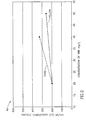
- Fig. 2 shows a graph of change in PC in the yellow and cyan toners as a function of change in concentration of BBP for a fixed concentration of Al(OT) 3 equal to about 10 mg/g.
- square marker icons and dashed trend line refer two the cyan toner and diamond marker icons and dashed trend line refer to the cyan toner.
- For the cyan toner PC measurements were acquired for BBP concentrations equal to 20 mg/g and 40 mg/g and for the yellow toner PC measurements were acquired for 20 mg/g and 50 mg/g concentrations of BBP. From Fig. 2 it is readily evident that for the range of BBP concentrations shown in the graph, change in concentration of BBP is substantially less effective in producing a change in PC.
- each of the verbs, "comprise” “include” and “have”, are used to indicate that the object or objects of the verb are not necessarily a complete listing of members, components, elements or parts of the subject or subjects of the verb.
Landscapes
- Physics & Mathematics (AREA)
- General Physics & Mathematics (AREA)
- Liquid Developers In Electrophotography (AREA)
Claims (21)
- Ein flüssiger Toner, der folgende Merkmale aufweist:eine dielektrische Trägerflüssigkeit;Tonerpartikel; undeinen Ladungsdirektor, der in der dielektrischen Trägerflüssigkeit gelöst ist;dadurch gekennzeichnet, dass der flüssige Toner ein Ladungshilfsmittel zum Fördern eines Ladens von Tonerpartikeln durch den Ladungsdirektor aufweist, wobei das Ladungshilfsmittel ein organisches Aluminiumsalz aufweist, das in der Flüssigkeit gelöst ist, wobei das organische Aluminiumsalz Aluminiumsulfosuccinat aufweist und bei Raumtemperatur in der Trägerflüssigkeit löslich ist.
- Ein flüssiger Toner gemäß Anspruch 1, bei dem:die Tonerpartikel mit dem organischen Aluminiumsalz, das bei Raumtemperatur in der Trägerflüssigkeit löslich ist, zur Reaktion gebracht wurden; undwobei das Aluminiumsalz wirksam ist, um die Aufladbarkeit der Tonerpartikel durch den Ladungsdirektor zu erhöhen.
- Ein flüssiger Toner gemäß Anspruch 1 oder Anspruch 2, bei dem das Salz zumindest ein Salz aus der Gruppe von Salzen aufweist, die Al(OT)3 (Aluminum-bis"(2" Ethylhexyl)sulfosuccinat) und Al(TR)3 (Aluminum-tri-di-Tridecylsulfosuccinat) umfasst.
- Ein flüssiger Toner gemäß Anspruch 2, bei dem das Salz Aluminium-bis-(2-Ethylhexyl)sulfosuccinat aufweist.
- Ein flüssiger Toner gemäß einem der vorhergehenden Ansprüche, bei dem die dielektrische Trägerflüssigkeit ein flüssiger Kohlenwasserstoffist.
- Ein flüssiger Toner gemäß Anspruch 4, bei dem der flüssige Kohlenwasserstoff ein Isoparaffin ist.
- Ein flüssiger Toner gemäß einem der vorhergehenden Ansprüche, bei dem das Salz eine Löslichkeit in der Trägerflüssigkeit größer oder gleich 2 Masse% aufweist.
- Ein flüssiger Toner gemäß einem der vorhergehenden Ansprüche, bei dem das Salz eine Löslichkeit in der Trägerflüssigkeit größer oder gleich 5 Masse% aufweist.
- Ein flüssiger Toner gemäß einem der vorhergehenden Ansprüche, bei dem der Ladungsdirektor zumindest eines aus der Gruppe aufweist, die basisches Bariumpetronat (BBP), Calciumpetronat und ein zwitterionisches Material umfasst.
- Ein flüssiger Toner gemäß Anspruch 9, bei dem das zwitterionische Material Lecithin aufweist.
- Ein Verfahren zum Laden von Tonerpartikeln in einem flüssigen Toner, der Tonerpartikel aufweist, die in einer Trägerflüssigkeit dispergiert sind, wobei das Verfahren folgende Schritte aufweist:Hinzufügen eines Ladungsdirektors zu dem Toner; undHinzufügen eines organischen Aluminiumsalzes, das in der Trägerflüssigkeit löslich ist, als ein Ladungshiifsmittel zu dem Toner, wobei das Aluminiumsalz ein Aluminiumsulfosuccinat aufweist.
- Ein Verfahren gemäß Anspruch 11, bei dem das Salz zumindest ein Salz aus der Gruppe von Salzen aufweist, die Aluminum-bis-(2-Ethyihexyl)sulfosuccinat und -Aluminum-tri-di-Tridecylsulfosuccinat umfasst.
- Ein Verfahren gemäß Anspruch 12, bei dem das Salz Aluminium-bis-(2-Ethylhexyl)sulfosuccinat aufweist.
- Ein Verfahren gemäß einem der Ansprüche 1-13, bei dem die Trägerflüssigkeit ein flüssiger Kohlenwasserstoff ist.
- Ein Verfahren gemäß einem der Ansprüche 11-14, bei dem das Salz eine Löslichkeit in der Trägerflüssigkeit größer oder gleich etwa 3 Masse% aufweist.
- Ein Verfahren gemäß einem der Ansprüche 11-15, bei dem das Salz eine Löslichkeit in der Trägerflüssigkeit größer oder gleich etwa 5 Masse% aufweist.
- Ein Verfahren gemäß einem der Ansprüche 11-16, bei dem der Ladungsdirektor zumindest eines aus der Gruppe aufweist, die basisches Bariumpetronat (BBP), Calciumpetronat und ein zwitterionisches Material umfasst.
- Ein Verfahren gemäß einem der Ansprüche 11-17, bei dem das Ladungshilfsmittel nach dem Ladungsdirektor hinzugefügt wird.
- Ein Verfahren gemäß einem der Anspruche 11-17, bei dem das Ladungshüfsmittei vor dem Ladungsdirektor hinzugefügt wird.
- Ein Verfahren gemäß einem der Anspruche 11-17, bei dem das Ladungshilfsmitte! zusammen mit dem Ladungsdirektor hinzugefügt wird.
- Ein Verfahren gemäß einem der Ansprüche 11-20, bei dem das Hilfsmittel hinzugefügt wird, nachdem eine Anfangsladung, die an den Tonerpartikeln erzeugt ist, dissipiert ist.
Applications Claiming Priority (1)
| Application Number | Priority Date | Filing Date | Title |
|---|---|---|---|
| PCT/IL2005/000594 WO2006131905A1 (en) | 2005-06-06 | 2005-06-06 | A method of charging toner particles |
Publications (2)
| Publication Number | Publication Date |
|---|---|
| EP1896905A1 EP1896905A1 (de) | 2008-03-12 |
| EP1896905B1 true EP1896905B1 (de) | 2009-11-25 |
Family
ID=35677349
Family Applications (1)
| Application Number | Title | Priority Date | Filing Date |
|---|---|---|---|
| EP05749885A Ceased EP1896905B1 (de) | 2005-06-06 | 2005-06-06 | Fluessigtoner und ein verfahren zum aufladen von tonerpartikeln influessigtonern |
Country Status (5)
| Country | Link |
|---|---|
| US (1) | US8029963B2 (de) |
| EP (1) | EP1896905B1 (de) |
| JP (1) | JP5002591B2 (de) |
| DE (1) | DE602005017945D1 (de) |
| WO (1) | WO2006131905A1 (de) |
Families Citing this family (5)
| Publication number | Priority date | Publication date | Assignee | Title |
|---|---|---|---|---|
| WO2012047195A1 (en) * | 2010-10-04 | 2012-04-12 | Hewlett-Packard Development Company, L.P. | High nvs liquid toner |
| WO2012097877A1 (en) | 2011-01-21 | 2012-07-26 | Hewlett-Packard Indigo B.V. | Liquid electrophotography printing apparatus and methods thereof |
| WO2013107522A1 (en) | 2012-01-20 | 2013-07-25 | Hewlett-Packard Indigo B.V. | Concentrating an ink composition |
| WO2013178268A1 (en) * | 2012-05-31 | 2013-12-05 | Hewlett-Packard Indigo B.V | Electrostatic inks and method for their production |
| JP6269211B2 (ja) * | 2014-03-18 | 2018-01-31 | コニカミノルタ株式会社 | 液体現像剤 |
Family Cites Families (11)
| Publication number | Priority date | Publication date | Assignee | Title |
|---|---|---|---|---|
| GB1411739A (en) * | 1972-07-12 | 1975-10-29 | Agfa Gevaert | Liquid electrophotographic developers |
| GB1448350A (en) * | 1973-06-14 | 1976-09-02 | Canon Kk | Liquid developer for electrostatic latent image |
| US4879197A (en) * | 1985-04-12 | 1989-11-07 | Mitsubishi Paper Mills, Ltd. | Method of developing electronic photograph with liquid developer and cleaning excess thereof |
| US5028508A (en) * | 1989-12-20 | 1991-07-02 | Dximaging | Metal salts of beta-diketones as charging adjuvants for electrostatic liquid developers |
| US5308731A (en) * | 1993-01-25 | 1994-05-03 | Xerox Corporation | Liquid developer compositions with aluminum hydroxycarboxylic acids |
| US5935755A (en) * | 1995-08-21 | 1999-08-10 | Xerox Corporation | Method for document marking and recognition |
| US5942365A (en) * | 1996-02-26 | 1999-08-24 | Xerox Corporation | Developer compositions and imaging processes |
| JPH09311506A (ja) * | 1996-05-17 | 1997-12-02 | Nippon Paint Co Ltd | 液体現像剤及びその製造方法 |
| JPH10282732A (ja) * | 1997-04-04 | 1998-10-23 | Minolta Co Ltd | 電子写真用液体現像剤 |
| EP1695151A1 (de) * | 2003-10-26 | 2006-08-30 | Hewlett-Packard Development Company, L.P. | Herstellungsverfahren für flüssigentwickler |
| US7736829B2 (en) * | 2007-01-09 | 2010-06-15 | Hewlett-Packard Development Company, L.P. | Charge adjuvants in electrostatic inks |
-
2005
- 2005-06-06 WO PCT/IL2005/000594 patent/WO2006131905A1/en not_active Ceased
- 2005-06-06 DE DE602005017945T patent/DE602005017945D1/de not_active Expired - Lifetime
- 2005-06-06 EP EP05749885A patent/EP1896905B1/de not_active Ceased
- 2005-06-06 JP JP2008515371A patent/JP5002591B2/ja not_active Expired - Fee Related
- 2005-06-06 US US11/916,650 patent/US8029963B2/en not_active Expired - Fee Related
Also Published As
| Publication number | Publication date |
|---|---|
| EP1896905A1 (de) | 2008-03-12 |
| US8029963B2 (en) | 2011-10-04 |
| DE602005017945D1 (de) | 2010-01-07 |
| US20090220884A1 (en) | 2009-09-03 |
| WO2006131905A1 (en) | 2006-12-14 |
| JP5002591B2 (ja) | 2012-08-15 |
| JP2008542848A (ja) | 2008-11-27 |
Similar Documents
| Publication | Publication Date | Title |
|---|---|---|
| US9417545B2 (en) | Charge director for liquid toner | |
| EP1898267B1 (de) | Verfahren zur herstellung eines flüssigen entwicklers | |
| EP2652052B1 (de) | Flüssige elektrophotografische tinte | |
| ES2426010T3 (es) | Procedimiento para la producción de un revelador líquido y revelador líquido producido mediante el procedimiento | |
| US20080163789A1 (en) | Charge adjuvants in electrostatic inks | |
| US5306590A (en) | High solids liquid developer containing carboxyl terminated polyester toner resin | |
| US9547248B2 (en) | Inks for liquid electrophotography | |
| EP1896905B1 (de) | Fluessigtoner und ein verfahren zum aufladen von tonerpartikeln influessigtonern | |
| US5206108A (en) | Method of producing a high solids replenishable liquid developer containing a friable toner resin | |
| JPH0756573B2 (ja) | マルチブロツクポリマを含む液体静電現像剤 | |
| EP2856264B1 (de) | Elektrostaische tinten und verfahren zu deren herstellung | |
| US8221952B2 (en) | Method of charging toner particles | |
| US5942365A (en) | Developer compositions and imaging processes | |
| JP3238148B2 (ja) | 液状の電子写真用現像剤組成物の溶媒和に基づく電荷制御 | |
| US5672457A (en) | Liquid developers and methods thereof | |
| JPH02310565A (ja) | 静電液体現像液用の帯電補助剤としてのニツケル(2)塩 | |
| JPH05289391A (ja) | カラートナー |
Legal Events
| Date | Code | Title | Description |
|---|---|---|---|
| PUAI | Public reference made under article 153(3) epc to a published international application that has entered the european phase |
Free format text: ORIGINAL CODE: 0009012 |
|
| 17P | Request for examination filed |
Effective date: 20080107 |
|
| AK | Designated contracting states |
Kind code of ref document: A1 Designated state(s): DE GB |
|
| RBV | Designated contracting states (corrected) |
Designated state(s): DE GB |
|
| DAX | Request for extension of the european patent (deleted) | ||
| 17Q | First examination report despatched |
Effective date: 20090417 |
|
| GRAP | Despatch of communication of intention to grant a patent |
Free format text: ORIGINAL CODE: EPIDOSNIGR1 |
|
| RTI1 | Title (correction) |
Free format text: LIQUID DEVELOPER AND A METHOD OF CHARGING TONER PARTICLES IN LQIUID DEVELOPERS |
|
| GRAS | Grant fee paid |
Free format text: ORIGINAL CODE: EPIDOSNIGR3 |
|
| GRAA | (expected) grant |
Free format text: ORIGINAL CODE: 0009210 |
|
| AK | Designated contracting states |
Kind code of ref document: B1 Designated state(s): DE GB |
|
| REG | Reference to a national code |
Ref country code: GB Ref legal event code: FG4D |
|
| REF | Corresponds to: |
Ref document number: 602005017945 Country of ref document: DE Date of ref document: 20100107 Kind code of ref document: P |
|
| PLBE | No opposition filed within time limit |
Free format text: ORIGINAL CODE: 0009261 |
|
| STAA | Information on the status of an ep patent application or granted ep patent |
Free format text: STATUS: NO OPPOSITION FILED WITHIN TIME LIMIT |
|
| 26N | No opposition filed |
Effective date: 20100826 |
|
| PGFP | Annual fee paid to national office [announced via postgrant information from national office to epo] |
Ref country code: GB Payment date: 20200525 Year of fee payment: 16 |
|
| PGFP | Annual fee paid to national office [announced via postgrant information from national office to epo] |
Ref country code: DE Payment date: 20210519 Year of fee payment: 17 |
|
| GBPC | Gb: european patent ceased through non-payment of renewal fee |
Effective date: 20210606 |
|
| PG25 | Lapsed in a contracting state [announced via postgrant information from national office to epo] |
Ref country code: GB Free format text: LAPSE BECAUSE OF NON-PAYMENT OF DUE FEES Effective date: 20210606 |
|
| REG | Reference to a national code |
Ref country code: DE Ref legal event code: R119 Ref document number: 602005017945 Country of ref document: DE |
|
| PG25 | Lapsed in a contracting state [announced via postgrant information from national office to epo] |
Ref country code: DE Free format text: LAPSE BECAUSE OF NON-PAYMENT OF DUE FEES Effective date: 20230103 |