EP1894880A1 - Fahrtreppe mit Kammbürsten, Stufenkamm einer solchen Fahrtreppe sowie Verfahren um eine Fahrtreppe zu modernisieren - Google Patents
Fahrtreppe mit Kammbürsten, Stufenkamm einer solchen Fahrtreppe sowie Verfahren um eine Fahrtreppe zu modernisieren Download PDFInfo
- Publication number
- EP1894880A1 EP1894880A1 EP07114990A EP07114990A EP1894880A1 EP 1894880 A1 EP1894880 A1 EP 1894880A1 EP 07114990 A EP07114990 A EP 07114990A EP 07114990 A EP07114990 A EP 07114990A EP 1894880 A1 EP1894880 A1 EP 1894880A1
- Authority
- EP
- European Patent Office
- Prior art keywords
- comb
- brushes
- teeth
- escalator
- pallet
- Prior art date
- Legal status (The legal status is an assumption and is not a legal conclusion. Google has not performed a legal analysis and makes no representation as to the accuracy of the status listed.)
- Granted
Links
- 238000000034 method Methods 0.000 title claims abstract description 7
- 229910001369 Brass Inorganic materials 0.000 claims abstract description 4
- 229910001335 Galvanized steel Inorganic materials 0.000 claims abstract description 4
- 239000010951 brass Substances 0.000 claims abstract description 4
- 239000008397 galvanized steel Substances 0.000 claims abstract description 4
- 210000001520 comb Anatomy 0.000 description 7
- 230000008901 benefit Effects 0.000 description 6
- 230000035515 penetration Effects 0.000 description 6
- 230000006378 damage Effects 0.000 description 5
- 208000027418 Wounds and injury Diseases 0.000 description 3
- 230000001055 chewing effect Effects 0.000 description 3
- 208000014674 injury Diseases 0.000 description 3
- 238000004519 manufacturing process Methods 0.000 description 3
- 239000000463 material Substances 0.000 description 3
- 230000000149 penetrating effect Effects 0.000 description 3
- 230000004888 barrier function Effects 0.000 description 2
- 238000009434 installation Methods 0.000 description 2
- 238000012423 maintenance Methods 0.000 description 2
- 230000009993 protective function Effects 0.000 description 2
- 208000034656 Contusions Diseases 0.000 description 1
- 238000005452 bending Methods 0.000 description 1
- 239000011111 cardboard Substances 0.000 description 1
- 239000003086 colorant Substances 0.000 description 1
- 239000000356 contaminant Substances 0.000 description 1
- 238000011161 development Methods 0.000 description 1
- 230000018109 developmental process Effects 0.000 description 1
- 238000009826 distribution Methods 0.000 description 1
- 239000000428 dust Substances 0.000 description 1
- 230000000694 effects Effects 0.000 description 1
- 239000000835 fiber Substances 0.000 description 1
- 238000010438 heat treatment Methods 0.000 description 1
- RSMUVYRMZCOLBH-UHFFFAOYSA-N metsulfuron methyl Chemical compound COC(=O)C1=CC=CC=C1S(=O)(=O)NC(=O)NC1=NC(C)=NC(OC)=N1 RSMUVYRMZCOLBH-UHFFFAOYSA-N 0.000 description 1
- 239000000123 paper Substances 0.000 description 1
- 239000002245 particle Substances 0.000 description 1
- -1 pebbles Substances 0.000 description 1
- 230000002265 prevention Effects 0.000 description 1
- 239000004576 sand Substances 0.000 description 1
- 238000004904 shortening Methods 0.000 description 1
- 230000000007 visual effect Effects 0.000 description 1
Images



Classifications
-
- B—PERFORMING OPERATIONS; TRANSPORTING
- B66—HOISTING; LIFTING; HAULING
- B66B—ELEVATORS; ESCALATORS OR MOVING WALKWAYS
- B66B29/00—Safety devices of escalators or moving walkways
- B66B29/02—Safety devices of escalators or moving walkways responsive to, or preventing, jamming by foreign objects
- B66B29/06—Combplates
-
- B—PERFORMING OPERATIONS; TRANSPORTING
- B66—HOISTING; LIFTING; HAULING
- B66B—ELEVATORS; ESCALATORS OR MOVING WALKWAYS
- B66B19/00—Mining-hoist operation
- B66B19/007—Mining-hoist operation method for modernisation of elevators
Definitions
- the invention relates to an escalator with step comb, a step comb of such an escalator and a method to modernize an escalator.
- the invention is equally applicable to both escalators and moving walks.
- the steps of a conventional escalator are attached to two transport chains and together with these form an endless, revolving step band, which runs over a pair of transport sprockets at both ends of the escalator, one transport sprocket pair belonging to the drive station and driving and deflecting the step belt and the other Sprocket pair is part of a step-band diverter station.
- the individual steps of the step belt are equipped with two front and two rear guide rollers on which the steps are guided by guide rails and deflection curves, which are fastened predominantly to the supporting structure of the escalator, in position-dependently defined position.
- the steps of an escalator run along a predetermined path, which is laterally defined by the fixed base plates.
- a passenger located on the step surface of a step stands opposite the riser surface of the leading step.
- the trailing step slides along the riser surface of the leading step and then under a comb plate, so that the Stepping surfaces of the leading and trailing step come to the same level and disappear under the comb plate.
- the comb plate has a step comb, which has comb teeth.
- the tread surfaces of the steps have ridges that pass between the comb teeth to remove objects that might be found in the ribs before the steps disappear under the comb plate and are transported back. Nevertheless, there is a risky or dangerous gap between the ribs of a step and the step comb.
- a gap must remain between the ribs of a step and the step comb. Otherwise, a significant friction would be generated, which would lead to an inadmissible heating and would increase drive power and wear.
- Such a gap or air gap is a security risk. Due to the existing game, the gap width can reach a larger area, so that a Schuhkanten-, Schal-, Stöckel-, Rocksaum- or manual intervention, especially in children, is possible. As a result, the risk of bruising and other injuries to the passenger is not excluded.
- the injury to persons in the comb plate area caused by the relative movement between the moving steps and the fixed comb plate is a major problem of conventional escalators.
- the object can be pulled into the gap by friction and the relative movement, especially at that comb plate where the Escalator leaves. This is followed by the upper comb plate when driving upwards and the lower comb plate when driving downwards.
- the patent JP2000000529 discloses brushes which are arranged on a comb plate to clean the step surface of the step.
- the brushes are located at a certain, spacious distance behind the step comb, so that objects can pinch into the underlying gap.
- the brushes are in contact with the tread surface of the step, damaging the tread surface and causing noise.
- the brushes have a very short life due to the constant friction with the tread surface. The forces exerted by the steps damage the structure of the brushes and lead to a shortening. Also, an insufficient shape and load stability or contact stability is detected.
- the invention is therefore an object of the invention to provide an escalator, which does not have the disadvantages mentioned above and the reliability significantly increases ease of manufacture and significantly extends the life.
- comb brushes are arranged on the step comb in an approximately parallel direction to the comb teeth in an escalator with steps, which has a step comb with comb teeth.
- Such positioned comb brushes as described above provide a necessary contact prevention of articles with the step comb.
- the comb brushes prevent contact of articles with the step comb and at the same time the penetration of the articles into the gap between the ribs of the tread surface and the step comb.
- Foreign objects such as: shoes, umbrellas, scarves, bag straps, plastic bags or other objects are brushed away from the step combs by the comb brushes, with the comb brushes pushing the objects out of the danger zone.
- the foreign objects are brushed and transported over the comb brushes on the step combs out. Consequently, chewing or wedging objects is not possible or very much prevented.
- the use or the use of the escalator is thereby significantly improved and security increased essential.
- the brush combs can brush away even very small objects, such as sand, pebbles, dust, particles or dirt, which could not be pushed aside by the comb teeth. If these contaminants enter the escalator or escalator gearbox, the lifespan of the escalator will be greatly reduced and maintenance will be required. The comb brushes thus help to extend the life of the escalator and reduce maintenance operations.
- the brushes release any frictional contact with the escalator user or unwanted debris before it can enter the gap between the moving stages and the step comb.
- inventive brushes are thus technically oriented, mounted or arranged so that the brushes are approximately parallel to the comb teeth and protrude along the comb plate on the tread surface of the underflow stage. According to the invention also any frictional contact between two objects is prevented from penetrating into the gap between the movable steps and the step comb.
- the comb brushes are arranged on the step comb over the comb teeth.
- the comb brushes brush off any object that is on the tread of the current stage before the item comes into contact with the comb teeth.
- the comb teeth are thereby protected and the grooves of the tread of the step are cleaned.
- the comb brushes are arranged on the step comb over the intermediate spaces, ie between the comb teeth.
- An advantage of this embodiment is that the ribs of the tread of the current stage are thoroughly covered by the brushes.
- the comb brushes push away any object that is on the ribs of the tread of the current stage before the object comes into contact with the step comb.
- This embodiment is particularly well suited for pebbles, since the stones in the step combs often a large To do damage.
- the step comb is thus protected, especially in the area between the interdental spaces between the comb teeth, where there is no protection by the comb teeth.
- the comb brushes are arranged on the step comb in a combination of first and second embodiments.
- the comb brushes are placed over the comb teeth and between the comb teeth.
- the comb brushes are arranged along the entire width of the step comb. This design allows for an impenetrable barrier that provides maximum protection. Consequently, penetration over the gaps is impossible.
- the comb brushes made of plastic bristles or brass bristles or galvanized steel bristles.
- the comb brushes are in special or any colors, e.g. yellow or red or yellow / black or red / black, so that it is easier to recognize the endangered or dangerous zones.
- the comb brushes are sprayed or glued or screwed or glued or snapped fixed on the step comb.
- step brushes are arranged on the step comb of a comb plate of an escalator, such a step comb can be easily and inexpensively produced as semi-finished and then quickly and easily be used on an escalator.
- an escalator with steps comprising a step comb with comb teeth is modernized by attaching comb brushes to the step comb in approximately parallel direction to the comb teeth.
- Fig. 1 can be seen in detail a step 1 of an escalator, which has a tread surface with ribs, and a comb plate 4 with a step comb 2, wherein comb brushes 3, 3 'are arranged on the step comb 2 in approximately parallel to comb teeth 5.
- the comb brushes are preferably inserted at the edge or front edge of the step comb or moored at the front.
- the comb brushes 3, 3 prevent pinching or grinding of shoes, umbrellas, scarves, bag straps, handbags, plastic bags or other objects by minimizing contact. They prevent the intrusion of all foreign elements: newspaper pieces, plastic bags, pebbles, garments, linen fibers, paper, cardboard, food and coarse dirt, as well as snow and ice.
- the gap between the comb teeth 5 and the ribbing of the escalator steps 1 is kept narrower. As a result, the passing step or the step band of the air gap is taken. A chewing or wedging of objects or stones or fingers is no longer possible or very much prevented.
- the comb brushes 3, 3 counteract the penetrating objects. They reduce the air gap to almost zero millimeters and sweep the objects out of the danger zone.
- the comb brushes 3, 3 'prevent like a dense wall of plastic bristles, the penetration or reaching of the gap between the step comb and step step surface.
- a dense, hermetic, almost impermeable bristle boundary is now located between the ribs of the tread of the escalator stage 1 and the lower part of the step comb 2.
- Such comb brushes 3, 3 ' may, for example, be yellow or red in order to give a clear visual indication to the passengers that a gap is present there. A clear visibility of danger or respect is thus given.
- a durable, resistant, insensitive brush material should be used, such as plastic bristles or brass bristles or galvanized steel wire bristles.
- the sufficient dimensioning and design of the comb brushes 3, 3 ' is given due to the number of passengers and their resulting stresses.
- Fig. 1 shows a variant with comb brushes 3 over the teeth or comb teeth or raking teeth 5 and with comb brushes 3 'over the spaces between comb teeth. This embodiment provides maximum protection and impervious obstruction to foreign objects.
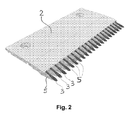
- Fig. 2 shows a second variant.
- This second variant with comb brushes 3 only over the teeth or comb teeth or raking teeth 5 provides sufficient protection and brushes the penetrating objects out of the step grooves and makes their penetration impossible.
- Fig. 3 shows a third variant.
- the third variant with comb brushes 3 'over the spaces between the teeth 5 provides additional protection over the current, current version.
- the steps are brushed and foreign objects are removed.
- the comb teeth 5 remove the remaining, larger foreign objects and ensure trouble-free operation of the system.
- the comb brushes are arranged along the entire width of the step comb.
- the end of the bristles of the comb brushes is rounded. This is advantageous because the risk of injury to the passengers upon contact with the bristles is reduced.
- the bristles of the brushes are corrugated. This is advantageous because such bristles have a higher dimensional stability and longer life.
- FIG. 4 shows comb brushes 3, 3 'with straight bristles
- FIG. 5 shows comb brushes 3, 3' with wavy bristles.
- the wave structure increases the mechanical strength of the bosts and allows a better distribution of the forces exerted by objects or passengers.
- the wave structure stabilizes the bristles against bending obliquely to the longitudinal axis compared to the straight bristles. If the straight bristles are pressed in the longitudinal axis, they bend and can no longer exert any counterforce. In contrast, the wavy bristles absorb the pressure in the longitudinal axis as spring tension stored in the shafts, the bristles maintain their alignment and are not bent.
- the wave structure also reduces friction by punctiform contact with the step surface of the step.
- the corrugated bristles significantly reduce by their density the gap or air gap between the running, driven escalator steps 1 and the step comb 2, whereby the risk of penetration of a foot of a passenger in the gap or air gap is further reduced.
- comb brushes 3, 3 ' can be easily arranged in a factory in approximately parallel to comb teeth 5.
- This solution allows a quick and easy installation of the comb brushes 3, 3 'on the escalator or on the moving walkway and reduces the manufacturing costs and installation costs.
- An escalator with steps 1 or a moving walk with pallets which (r) has a step comb 2 or pallet comb with comb teeth 5, can also be modernized in the comb brushes 3, 3 'to the step comb 2 and pallet comb in approximately parallel direction the comb teeth 5 are attached.
- This modernization method allows by attaching the comb brushes 3, 3 'a quick and easy improvement of the escalator or the moving walk, in terms of operational safety and passenger safety, since the risk of entrapment or Einzwickgefahr or Einkeilgefahr is prevented.
- the present invention can of course also be applied to a moving walk.
- a moving walk with pallets which has a pallet comb 2 with comb teeth 5, equipped by comb brushes 3, 3 ', which are arranged on the pallet comb 2 in approximately parallel direction to comb teeth 5.
- the comb teeth 5 can be omitted. In this case, the protective function of the comb teeth 5 is completely taken over by the comb brushes 3.
Landscapes
- Escalators And Moving Walkways (AREA)
Abstract
Description
- Die Erfindung betrifft eine Fahrtreppe mit Stufenkamm, ein Stufenkamm einer solchen Fahrtreppe sowie ein Verfahren um eine Fahrtreppe zu modernisieren.
- Die Erfindung ist sowohl auf Fahrtreppen wie auch auf Fahrsteige gleichermaßen anwendbar.
- Die Stufen einer üblichen Fahrtreppe sind an zwei Transportketten befestigt und bilden zusammen mit diesen ein endloses, umlaufendes Stufenband, das über je ein Paar Transportkettenräder an beiden Enden der Fahrtreppe läuft, wobei das eine Transportkettenradpaar zur Antriebsstation gehört und das Stufenband antreibt und umlenkt und das andere Kettenradpaar Teil einer Stufenband-Umlenkstation ist. Die einzelnen Stufen des Stufenbands sind mit je zwei vorderen und zwei hinteren Führungsrollen ausgerüstet, an denen die Stufen durch vorwiegend an der Tragkonstruktion der Fahrtreppe befestigte Führungsschienen und Umlenkkurven in positionsabhängig definierter Lage geführt werden.
- Die Stufen einer Fahrtreppe verlaufen entlang einer vorbestimmten Bahn, welche durch die feststehenden Sockelbleche seitlich definiert wird. Ein sich auf der Trittstufenfläche einer Stufe befindender Passagier steht gegenüber der Setzstufenfläche der vorlaufenden Stufe. Im Austrittsbereich gleitet die nachlaufende Stufe entlang der Setzstufenfläche der vorlaufenden Stufe und dann unter eine Kammplatte, so dass die Trittstufenflächen der vorlaufenden und nachlaufenden Stufe auf dieselbe Ebene kommen und unter der Kammplatte verschwinden. Die Kammplatte weist einen Stufenkamm auf, welcher Kammzähne aufweist. Die Trittstufenflächen der Stufen weisen Rippen auf, die zwischen den Kammzähnen passieren, um Gegenstände zu entfernen, die sich in den Rippen finden könnten, bevor die Stufen unter die Kammplatte verschwinden und zurücktransportiert werden. Trotz allem gibt es aber einen riskanten bzw. gefahrvollen Spalt zwischen den Rippen einer Stufe und dem Stufenkamm.
- Zum Ausgleich von Toleranzen muss zwischen den Rippen einer Stufe and dem Stufenkamm ein Spalt verbleiben. Sonst würde eine erhebliche Reibung erzeugt, die zu einer unzulässigen Erwärmung führen und Antriebsleistung sowie Verschleiss erhöhen würde.
- Aus diesem Grund muss zwischen den Rippen einer Stufe and dem Stufenkamm ein Spalt bzw. Luftspalt verbleiben.
- Ein derartiger Spalt bzw. Luftspalt ist ein Sicherheitsrisiko. Aufgrund des vorhandenen Spiels kann die Spaltbreite einen grösseren Bereich erreichen, so dass ein Schuhkanten-, Schal-, Stöckel-, Rocksaum- oder Handeingriff, gerade bei Kindern, möglich wird. Infolgedessen ist die Gefahr von Quetschungen und sonstigen Verletzungen für den Fahrgast nicht ausgeschlossen.
- Die Verletzung von Personen im Kammplattenbereich verursacht durch die Relativbewegung zwischen den bewegten Stufen und der feststehenden Kammplatte ist ein Hauptproblem der herkömmlichen Fahrtreppen. Darüber hinaus, wenn ein auf der bewegten Stufe befindlicher Gegenstand mit dem Stufenkamm in Kontakt kommt, kann der Gegenstand durch Reibung und die Relativbewegung in den Spalt gezogen werden, vor allem bei jener Kammplatte wo man die Fahrtreppe verlässt. Daraus folgt bei Aufwärtsfahrt die obere Kammplatte und bei Abwärtsfahrt die untere Kammplatte.
- Das Patent
JP2000000529 - Daher liegt der Erfindung die Aufgabe zugrunde, eine Fahrtreppe zu schaffen, welche die oben genannten Nachteile nicht aufweist und die Betriebssicherheit bei einfacher Herstellbarkeit essentiell steigert und die Lebensdauer deutlich verlängert.
- Diese Aufgabe wird erfindungsgemäß durch die unabhängigen Ansprüche gelöst. Vorteilhafte Weiterbildungen ergeben sich aus den Unteransprüchen.
- Erfindungsgemäss ist es vorgesehen, dass in einer Fahrtreppe mit Stufen, welche einen Stufenkamm mit Kammzähnen aufweist, Kammbürsten an dem Stufenkamm in annähernd paralleler Richtung zu den Kammzähnen angeordnet sind.
- Derart, wie oben beschriebene, positionierte Kammbürsten stellen eine erforderliche Kontaktverhinderung von Gegenständen mit dem Stufenkamm dar. Die Kammbürsten verhindern den Kontakt von Gegenständen mit dem Stufenkamm und gleichzeitig das Eindringen der Gegenstände in den Spalt zwischen den Rippen der Trittstufenfläche und dem Stufenkamm. Fremdartige Gegenstände, wie z.B.: Schuhe, Regenschirme, Schals, Taschenriemen, Kunststoffsäcke oder andere Gegenstände werden von den Stufenkämmen mittels den Kammbürsten weggebürstet, wobei die Kammbürsten die Gegenstände aus dem Gefahrenbereich schieben bzw. bürsten. Die Fremdgegenstände werden ausgebürstet und über die Kammbürsten auf die Stufenkämme hinaustransportiert. Folglich wird ein Einzwicken oder Einkeilen von Gegenständen nicht möglich oder sehr stark verhindert. Die Benutzung bzw. der Gebrauch der Fahrtreppe wird dadurch wesentlich verbessert und die Sicherheit essentiell gesteigert.
Die Kammbürsten können auch sehr kleine Gegenstände, wie Sand, Kieselsteine, Staub, Partikel oder Schmutz wegbürsten, die nicht durch die Kammzähne beiseite geschoben werden konnten. Wenn diese Verunreinigungen in die Fahrtreppe bzw. in das Fahrtreppengetriebe eindringen, wird die Lebensdauer der Fahrtreppe stark reduziert und es werden Wartungseingriffe notwendig. Die Kammbürsten tragen folglich dazu bei, die Lebensdauer der Fahrtreppe zu verlängern und die Wartungsoperationen zu reduzieren. - Die Bürsten lösen jeden Reibkontakt zum Fahrtreppenbenutzer oder zu ungewollten Fremdkörpern auf, bevor ein Eindringen in den Spalt zwischen den bewegten Stufen und dem Stufenkamm erfolgen kann.
- Die Vorrichtung im Patent
JP2000000529 - Die erfindungsgemässen Bürsten werden fachlich folglich so orientiert, montiert bzw. angeordnet, dass die Bürsten annähernd parallel zu den Kammzähnen sind und entlang der Kammplatte über die Trittstufenfläche der unterlaufenden Stufe hinausragen. Gemäss der Erfindung wird auch jeder Reibkontakt zwischen zwei Gegenständen vor einem Eindringen in den Spalt zwischen den beweglichen Stufen und dem Stufenkamm verhindert.
- In einer bevorzugten Ausführungsform der Erfindung sind die Kammbürsten an dem Stufenkamm über den Kammzähnen angeordnet.
- Die Kammbürsten bürsten jeden Gegenstand weg, der sich auf der Trittfläche der laufenden Stufe befindet, bevor der Gegenstand in Kontakt mit den Kammzähnen kommt. Die Kammzähne werden dadurch geschützt und die Rillen der Trittfläche der Stufe werden gereinigt.
- In einer zweiten bevorzugten Ausführungsform der Erfindung sind die Kammbürsten an dem Stufenkamm über den Zwischenräumen, also zwischen den Kammzähnen angeordnet.
- Vorteilhaft an diese Ausführungsform ist, dass die Rippen der Trittfläche der laufenden Stufe gründlich durch die Bürsten abgedeckt werden. Die Kammbürsten schieben jeden Gegenstand weg, der sich auf den Rippen der Trittfläche der laufenden Stufe befindet, bevor der Gegenstand in Kontakt mit dem Stufenkamm kommt. Besonders gut ist diese Ausführungsform für Kieselsteine geeignet, da die Steine bei den Stufenkämmen oft einen grossen Schaden anrichten. Der Stufenkamm wird somit geschützt, vor allem im Bereich der Zwischenräume zwischen den Kammzähnen, wo kein Schutz, durch die Kammzähne, besteht.
- In einer dritten bevorzugten Ausführungsform der Erfindung werden die Kammbürsten in einer Kombination von erster und zweiter Ausführungsform an dem Stufenkamm angeordnet. Die Kammbürsten werden über den Kammzähnen und zwischen den Kammzähnen angeordnet.
- In einer vierten bevorzugten Ausführungsform der Erfindung sind die Kammbürsten entlang der ganzen Breite des Stufenkammes angeordnet. Diese Ausführung ermöglicht eine undurchdringliche Barriere bzw. Versperrung, die einen maximalen Schutz bietet. Folglich ist ein Vordringen über die Zwischenräume unmöglich.
- In einer weiteren bevorzugten Ausführungsform der Erfindung bestehen die Kammbürsten aus Kunststoffborsten oder Messingborsten oder verzinkte Stahlborsten. Durch den Einsatz dieser Werkstoffe wird die Reibkontaktverhinderung weiter erhöht. Die obengenannten Werkstoffe haben ausserdem den Vorteil zwei in Reibung befindliche Gegenstände leichter bzw. müheloser bzw. problemloser bzw. zuverlässiger zu trennen.
- In einer weiteren bevorzugten Ausführungsform der Erfindung sind die Kammbürsten in speziellen oder irgendwelchen Farben, z.B. gelb oder rot oder gelb/schwarz oder rot/schwarz ausgeführt, damit eine bessere Erkennbarkeit zu den gefährdeten bzw. gefährlichen Zonen gegeben ist.
- In einer weiteren bevorzugten Ausführungsform der Erfindung sind die Kammbürsten aufgespritzt oder aufgeklebt oder mitgeschraubt oder eingeklebt oder eingeschnappt auf dem Stufenkamm befestigt.
- Kostengünstige und einfache übliche Herstellungsverfahren der Bürsten lassen sich somit verwenden.
- Wenn Kammbürsten an dem Stufenkamm einer Kammplatte einer Fahrtreppe angeordnet sind, kann ein solcher Stufenkamm einfach und kostengünstig als Halbzeug produziert werden und dann schnell und einfach an einer Fahrtreppe eingesetzt werden.
- In einer letzten Ausführungsform der Erfindung wird eine Fahrtreppe mit Stufen, welche einen Stufenkamm mit Kammzähnen aufweist, modernisiert, indem Kammbürsten an den Stufenkamm in annähernd paralleler Richtung zu den Kammzähnen angebracht werden.
- Von den oben beschriebenen Vorteilen können auch herkömmliche Fahreinrichtungen durch diese Moderniesungsverfahren einfach und schnell profitieren.
- Ausführungsbeispiele der Erfindung sind in den Fig. 1 bis 5 dargestellt und werden in der nachfolgenden Beschreibung näher erläutert.
- Fig. 1 zeigt eine schematische Anordnung von einem Fahrtreppenstufenkamm mit den erfindungsgemässen Kammbürsten;
- Fig. 2 zeigt eine Ausführungsform der Erfindung, wobei die Kammbürsten an dem Stufenkamm über den Kammzähnen angeordnet sind;
- Fig. 3 zeigt eine andere Ausführungsform der Erfindung, wobei die Kammbürsten an dem Stufenkamm über den Zwischenräumen zwischen den Kammzähnen angeordnet sind;
- Fig. 4 zeigt Kammbürsten mit geraden Borsten;
- Fig. 5 zeigt Kammbürsten mit gewellten Borsten;
- In Fig. 1 sieht man im Detail eine Stufe 1 einer Fahrtreppe, welche eine Trittstufenfläche mit Rippen aufweist, und eine Kammplatte 4 mit einem Stufenkamm 2, wobei Kammbürsten 3, 3' an dem Stufenkamm 2 in annähernd Parallelrichtung zu Kammzähnen 5 angeordnet sind. Die Kammbürsten 3, 3' sind vorzugsweise entlang der ganzen Breite des Stufenkamms angeordnet. Die Kammbürsten werden vorzugsweise an der Kante bzw. Vorderkante des Stufenkamms eingesetzt oder an der Vorderseite festgemacht.
- Die Kammbürsten 3, 3' verhindern durch eine Kontaktminimierung ein Einklemmen oder Mitschleifen von Schuhen, Regenschirmen, Schals, Taschenriemen, Handtaschen, Kunststoffsäcken oder anderen Gegenständen. Sie verhindern ein Eindringen von allen Fremdelementen: Zeitungspapierstücke, Plastiktüten, Kieselsteine, Kleidungsstücke, Wäschefasern, Papier, Karton, Lebensmittel und gröberen Schmutz sowie Schnee und Eis.
- Der Spalt zwischen den Kammzähnen 5 und der Verrippung der Fahrtreppenstufen 1 wird enger gehalten. Dadurch wird der vorbeifahrenden Stufe bzw. dem Stufenband der Luftspalt genommen. Ein Einzwicken oder Einkeilen von Gegenständen oder Steinen oder Fingern ist nicht mehr möglich oder sehr stark verhindert. Die Kammbürsten 3, 3' wirken den eindringenden Gegenständen entgegen. Sie verkleinern den Luftspalt auf nahezu null Millimeter und kehren die Gegenstände aus dem Gefahrenbereich.
- Der grosse Vorteil der Kammbürsten 3, 3' liegt in der fächerartigen und somit absperrenden Aufstellung. Der Spalt zwischen Stufentrittfläche und Stufenkamm wird verbarrikadiert und ein Erreichen der Kammplattenkante verunmöglicht. Ein weiterer Vorteil der Kammbürsten 3, 3' liegt, gegenüber festen Randelementen bzw. feststehenden Platten, in deren Flexibilität. Somit wird ein Berühren durch das Schuhwerk biegsam ausgewichen und der fallweise benötigte Platzbedarf wird freigegeben.
- Die Kammbürsten 3, 3' verhindern wie ein dichter Wall aus Kunststoffborsten das Vordringen bzw. das Erreichen des Spaltes zwischen Stufenkamm und Stufentrittfläche. Eine dichte, hermetische, fast undurchlässige Borstenbegrenzung befindet sich nun zwischen den Rippen der Trittfläche der Fahrtreppenstufe 1 und dem unteren Teil des Stufenkammes 2.
- Die Kammbürsten 3, 3' können aufgespritzt oder aufgeklebt oder mitgeschraubt oder eingeklebt oder eingeschnappt auf dem Stufenkamm 2 befestigt werden.
- Solche Kammbürsten 3, 3' können beispielsweise gelb oder rot sein, um einen klaren sichtbaren Hinweis den Passagieren zu geben, dass ein Spalt dort vorhanden ist. Eine eindeutige Sichtbarkeit der Gefahr oder Achtung ist somit gegeben.
- Die Kammbürsten 3, 3' bilden eine Barriere bzw. Schranke zu den Passagieren und hemmen bzw. erschweren ein Berühren der Vorderkante des Stufenkammes. Es kann keine Verbindung zum Stufenkammspalt hergestellt werden und ein Einzwicken oder Einkeilen oder Einquetschen ist unmöglich.
- Weiters sind die Kammbürsten 3, 3' so kompakt ausgeführt, dass sie der Belastung durch den Personenverkehr standhalten.
- Deshalb ist auch ein dauerhaftes, widerstandsfähiges, unempfindliches Bürstenmaterial zu verwenden, wie z.B. Kunststoffborsten oder Messingborsten oder verzinkte Stahldrahtborsten.
Die ausreichende Dimensionierung und Auslegung der Kammbürsten 3, 3' ist aufgrund der Passagierzahl und deren daraus folgenden Beanspruchungen gegeben. - Es gibt verschiedene Varianten der Kämme 2 mit Kammbürsten 3 und Kammbürsten 3'.
Fig. 1 zeigt eine Variante mit Kammbürsten 3 über den Zähnen oder Kammzähnen oder Rechenzähnen 5 und mit Kammbürsten 3' über den Zwischenräumen zwischen Kammzähnen. Diese Ausführungsform bietet einen maximalen Schutz und eine undurchdringliche Versperrung für Fremdgegenstände. - Fig. 2 zeigt eine zweite Variante. Diese zweite Variante mit Kammbürsten 3 nur über den Zähnen oder Kammzähnen oder Rechenzähnen 5 bietet ausreichend Schutz und bürstet die eindringenden Gegenstände aus den Stufenrillen heraus und macht deren Vordringen unmöglich.
- Fig. 3 zeigt eine dritte Variante. Die dritte Variante mit Kammbürsten 3' über den Zwischenräumen zwischen den Zähnen 5 bietet einen zusätzlichen Schutz gegenüber der jetzigen, heutigen Ausführung. Die Stufenstege werden gebürstet und Fremdgegenstände entfernt. Die Kammzähne 5 entfernen die restlichen, größeren Fremdgegenstände und sorgen für einen störungsfreien Betrieb der Anlage.
- In einer bevorzugten Ausführungsform der Erfindung sind die Kammbürsten entlang der ganzen Breite des Stufenkammes angeordnet.
- Nach einer bevorzugten Ausführung der Erfindung ist das Ende der Borsten der Kammbürsten abgerundet. Das ist vorteilhaft, weil die Gefahr einer Verletzung der Passagiere bei Kontakt mit den Borsten vermindert wird.
- Nach einer weiteren Ausführung der Erfindung sind die Borsten der Bürsten gewellt. Das ist vorteilhaft, weil solche Borsten eine höhere Formstabilität und längere Lebensdauer aufweisen.
- Fig. 4 zeigt Kammbürsten 3, 3' mit geraden Borsten, während Fig. 5 Kammbürsten 3, 3' mit gewellten Borsten zeigt.
- Die Wellenstruktur erhöht die mechanische Festigkeit der Bosten und ermöglicht eine bessere Verteilung der Kräfte, die durch Gegenstände oder Passagiere ausgeübt werden. Die Wellenstruktur stabilisiert die Borsten gegen eine Verbiegung schräg zur Längsachse verglichen mit den geraden Borsten. Wenn die geraden Borsten in der Längsachse gedrückt werden, verbiegen sie sich und können keine Gegenkraft mehr ausüben. Im Unterschied dazu nehmen die gewellten Borsten den Druck in Längsachse als Federspannung auf, welche in den Wellen gespeichert wird, halten die Borsten ihre Ausrichtung bei und werden nicht verbogen.
- Die Wellenstruktur reduziert auch durch punktförmigen Kontakt mit der Trittfläche der Stufe die Reibung.
- Die gewellten Borsten verringern durch ihre Dichte massgeblich den Spalt bzw. Luftspalt zwischen der laufenden, angetriebenen Fahrtreppenstufen 1 und dem Stufenkamm 2, wobei die Gefahr des Eindringens eines Fusses eines Passagiers in den Spalt bzw. Luftspalt noch weiter reduziert wird.
- An einem Stufenkamm 2 für eine Fahrtreppe oder einen Fahrsteig, welcher Kammzähne 5 aufweist, können Kammbürsten 3, 3' problemlos in einer Fabrik in annähernd Parallelrichtung zu Kammzähnen 5 angeordnet werden.
- Diese Lösung ermöglicht eine schnelle und einfache Montage der Kammbürsten 3, 3' an der Fahrtreppe oder an dem Fahrsteig und reduziert die Herstellungskosten und Montagekosten.
- Eine Fahrtreppe mit Stufen 1 oder ein Fahrsteig mit Paletten, welche(r) einen Stufenkamm 2 bzw. Palettenkamm mit Kammzähnen 5 aufweist, kann auch modernisiert werden, in dem Kammbürsten 3, 3' an den Stufenkamm 2 bzw. Palettenkamm in annähernd paralleler Richtung zu den Kammzähnen 5 angebracht werden.
- Diese Modernisierungsmethode ermöglicht durch das Anbringen der Kammbürsten 3, 3' eine schnelle und einfache Verbesserung der Fahrtreppe oder des Fahrsteiges, in punkto Betriebssicherheit und Passagiersicherheit, da die Einklemmgefahr bzw. Einzwickgefahr bzw. Einkeilgefahr verhindert wird.
- Bei einer Fahrtreppe bzw. Fahrsteig mit einer Balustrade werden an allen Fahrtreppenstufenkämmen 2 Kammbürsten 3, 3' montiert. Sowohl auf der oberen Kammplatte 4 wie auch auf der unteren Kammplatte 4 werden Fahrtreppenstufenkämme 2 mit Kammbürsten 3, 3' ausgeführt.
- Die vorliegende Erfindung lässt sich naturgemäss auch auf einem Fahrsteig anwenden. In diesem Fall wird ein Fahrsteig mit Paletten, welcher einen Palettenkamm 2 mit Kammzähnen 5 aufweist,
durch Kammbürsten 3, 3' ausgerüstet, welche an dem Palettenkamm 2 in annähernd Parallelrichtung zu Kammzähnen 5 angeordnet sind. - Wenn die Bürsten genügend beständig und hart sind, können die Kammzähne 5 entfallen. In diesem Fall wird die Schutzfunktion der Kammzähne 5 vollständig durch die Kammbürsten 3 übernommen.
- Wenn die Trittfläche der Stufe oder Palette keine Rippen aufweist, werden Kammbürsten 3, 3' erfindungsgemäss an dem Stufenkamm 2 mit einem Winkel zwischen 0 und 40°bzw. bis zu 50° gegenüber der horizontalen Ebene angeordnet, so dass ihre Schutzfunktion ausgeübt werden kann.
Claims (11)
- Fahrtreppe mit Stufen (1), welche einen Stufenkamm (2) mit Kammzähnen (5) aufweist,
dadurch gekennzeichnet,
dass Kammbürsten (3, 3') an dem Stufenkamm (2) in annähernd paralleler Richtung zu den Kammzähnen (5) angeordnet sind. - Fahrsteig mit Paletten (1), welcher einen Palettenkamm (2) mit Kammzähnen (5) aufweist,
dadurch gekennzeichnet,
dass Kammbürsten (3, 3') an dem Palettenkamm (2) in annähernd paralleler Richtung zu den Kammzähnen (5) angeordnet sind. - Fahrtreppe oder Fahrsteig nach Anspruch 1 oder 2,
dadurch gekennzeichnet,
dass die Kammbürsten (3) an dem Stufenkamm (2) bzw. an dem Palettenkamm (2) über den Kammzähnen (5) angeordnet sind. - Fahrtreppe oder Fahrsteig nach Anspruch 1 oder 2 oder 3,
dadurch gekennzeichnet,
dass die Kammbürsten (3') an dem Stufenkamm (2) bzw. an dem Palettenkamm (2) über den Zwischenräumen der Kammzähne (5) oder zwischen den Kammzähnen (5) angeordnet sind. - Fahrtreppe oder Fahrsteig nach einem der Ansprüche von 1 bis 4,
dadurch gekennzeichnet,
dass die Kammbürsten (3') an dem Stufenkamm (2) bzw. an dem Palettenkamm (2) über den Kammzähnen (5) und zwischen den Kammzähnen (5) angeordnet sind. - Fahrtreppe oder Fahrsteig nach einem der vorigen Ansprüche,
dadurch gekennzeichnet,
dass die Kammbürsten aus Kunststoffborsten oder Messingborsten oder verzinkte Stahlborsten bestehen und/oder gelb oder rot oder gelb/schwarz oder rot/schwarz sind. - Fahrtreppe oder Fahrsteig nach einem der vorigen Ansprüche,
dadurch gekennzeichnet,
dass die Kammbürsten aufgespritzt oder aufgeklebt oder mitgeschraubt oder eingeklebt oder eingeschnappt oder eingeklemmt auf dem Stufenkamm befestigt sind. - Stufenkamm (2) für eine Fahrtreppe, welcher Kammzähne (5) aufweist,
dadurch gekennzeichnet,
dass Kammbürsten (3, 3') an dem Stufenkamm (2) in annähernd paralleler Richtung zu den Kammzähnen (5) angeordnet sind. - Palettenkamm (2) für einen Fahrsteig, welcher Kammzähne (5) aufweist,
dadurch gekennzeichnet,
dass Kammbürsten (3, 3') an dem Palettenkamm (2) in annähernd paralleler Richtung zu den Kammzähnen (5) angeordnet sind. - Verfahren um eine Fahrtreppe mit Stufen (1), welche einen Stufenkamm (2) mit Kammzähnen (5) aufweist, zu modernisieren
dadurch gekennzeichnet,
dass Kammbürsten (3, 3') an den Stufenkamm (2) in annähernd paralleler Richtung zu den Kammzähnen (5) angebracht werden. - Verfahren um einen Fahrsteig mit Paletten (1), welcher einen Palettenkamm (2) mit Kammzähnen (5) aufweist, zu modernisieren
dadurch gekennzeichnet,
dass Kammbürsten (3, 3') an dem Palettenkamm (2) in annähernd paralleler Richtung zu den Kammzähnen (5) angebracht werden.
Priority Applications (1)
| Application Number | Priority Date | Filing Date | Title |
|---|---|---|---|
| EP20070114990 EP1894880B1 (de) | 2006-08-29 | 2007-08-24 | Fahrtreppe mit Kammbürsten, Stufenkamm einer solchen Fahrtreppe sowie Verfahren um eine Fahrtreppe zu modernisieren |
Applications Claiming Priority (2)
| Application Number | Priority Date | Filing Date | Title |
|---|---|---|---|
| EP06119739 | 2006-08-29 | ||
| EP20070114990 EP1894880B1 (de) | 2006-08-29 | 2007-08-24 | Fahrtreppe mit Kammbürsten, Stufenkamm einer solchen Fahrtreppe sowie Verfahren um eine Fahrtreppe zu modernisieren |
Publications (2)
| Publication Number | Publication Date |
|---|---|
| EP1894880A1 true EP1894880A1 (de) | 2008-03-05 |
| EP1894880B1 EP1894880B1 (de) | 2013-03-20 |
Family
ID=38996327
Family Applications (1)
| Application Number | Title | Priority Date | Filing Date |
|---|---|---|---|
| EP20070114990 Not-in-force EP1894880B1 (de) | 2006-08-29 | 2007-08-24 | Fahrtreppe mit Kammbürsten, Stufenkamm einer solchen Fahrtreppe sowie Verfahren um eine Fahrtreppe zu modernisieren |
Country Status (1)
| Country | Link |
|---|---|
| EP (1) | EP1894880B1 (de) |
Cited By (1)
| Publication number | Priority date | Publication date | Assignee | Title |
|---|---|---|---|---|
| CN101585483B (zh) * | 2008-05-23 | 2013-04-24 | 株式会社日立制作所 | 乘客传送设备 |
Citations (2)
| Publication number | Priority date | Publication date | Assignee | Title |
|---|---|---|---|---|
| JPH08198572A (ja) * | 1995-01-24 | 1996-08-06 | Hitachi Building Syst Eng & Service Co Ltd | 乗客コンベアのくし板装置 |
| JP2001335275A (ja) * | 2000-05-24 | 2001-12-04 | Nisshin:Kk | 移動踏板の清掃装置 |
-
2007
- 2007-08-24 EP EP20070114990 patent/EP1894880B1/de not_active Not-in-force
Patent Citations (2)
| Publication number | Priority date | Publication date | Assignee | Title |
|---|---|---|---|---|
| JPH08198572A (ja) * | 1995-01-24 | 1996-08-06 | Hitachi Building Syst Eng & Service Co Ltd | 乗客コンベアのくし板装置 |
| JP2001335275A (ja) * | 2000-05-24 | 2001-12-04 | Nisshin:Kk | 移動踏板の清掃装置 |
Cited By (1)
| Publication number | Priority date | Publication date | Assignee | Title |
|---|---|---|---|---|
| CN101585483B (zh) * | 2008-05-23 | 2013-04-24 | 株式会社日立制作所 | 乘客传送设备 |
Also Published As
| Publication number | Publication date |
|---|---|
| EP1894880B1 (de) | 2013-03-20 |
Similar Documents
| Publication | Publication Date | Title |
|---|---|---|
| DE10308417B4 (de) | Rollsteig | |
| US7597181B2 (en) | Escalator with comb brushes, step comb of such an escalator, and method for modernizing an escalator | |
| EP1659085B1 (de) | Fahrtreppe mit Setzstufenbürsten, Stufe einer solchen Fahrtreppe sowie Verfahren um eine Fahrtreppe zu modernisieren | |
| DE60118607T2 (de) | Rolltreppe mit stufenflansch | |
| EP0603643A1 (de) | Fahrtreppe mit Stufen, welche seitliche Sicherheitsabgrenzungen aufweisen | |
| EP0497170B1 (de) | Aktenvernichter mit Schnittgut-Transportband | |
| EP0734981B1 (de) | Beladevorrichtung | |
| DE4420646C2 (de) | Führungsanordnung für Schiebetüren, insbesondere Aufzugstüren | |
| DE112008004191B4 (de) | Beweglicher Schürzenmechanismus für kettenangetriebene Personenbeförderungsvorrichtungen | |
| EP1894880B1 (de) | Fahrtreppe mit Kammbürsten, Stufenkamm einer solchen Fahrtreppe sowie Verfahren um eine Fahrtreppe zu modernisieren | |
| DE2504421A1 (de) | Antriebsschlitten fuer gewinnungsmaschinen im bergbau | |
| EP2100827B1 (de) | Förderband zum Bewegen von Fahrzeugen in einer Fahrzeugbehandlungsanlage | |
| DE2009806B2 (de) | Fördervorrichtung für den Transport von Wagen zwischen Stockwerken | |
| DE19925399C2 (de) | Stufe für ein Personenbeförderungssystem | |
| DE2730109C2 (de) | Steigförderer | |
| EP0678463B1 (de) | Kettenförderer | |
| EP1659086B1 (de) | Fahrtreppe bzw. Fahrsteig mit integrirten Stufenbürsten | |
| DE2017089A1 (de) | Vorrichtung zum Transportieren eines Fahrzeuges durch eine Autowaschstraße | |
| DE10394099B4 (de) | Kammplattenanordnung für Fahrgastbeförderungsmittel mit mitbewegendem Flansch | |
| EP0610579B1 (de) | Fahrtreppe oder Fahrsteig | |
| DE3344653C2 (de) | ||
| EP1621512B1 (de) | Fahrtreppe bzw. Fahrsteig mit Handlaufeinlauf, Handlaufeinlauf einer solchen Fahrtreppe bzw. Fahrsteiges sowie Verfahren um einen Spalt im Handlaufeinlauf zu verringern | |
| DE10125686B4 (de) | Stufenbefestigung an der Stufenkette einer Fahrtreppe | |
| DE2009206A1 (de) | Personenfördereinrichtung wie Rolltreppe oder Rollsteig | |
| DE102006034519B3 (de) | Splitterschutzvorrichtung für eine Holzbearbeitungsmaschine |
Legal Events
| Date | Code | Title | Description |
|---|---|---|---|
| PUAI | Public reference made under article 153(3) epc to a published international application that has entered the european phase |
Free format text: ORIGINAL CODE: 0009012 |
|
| AK | Designated contracting states |
Kind code of ref document: A1 Designated state(s): AT BE BG CH CY CZ DE DK EE ES FI FR GB GR HU IE IS IT LI LT LU LV MC MT NL PL PT RO SE SI SK TR |
|
| AX | Request for extension of the european patent |
Extension state: AL BA HR MK YU |
|
| 17P | Request for examination filed |
Effective date: 20080904 |
|
| AKX | Designation fees paid |
Designated state(s): AT BE BG CH CY CZ DE DK EE ES FI FR GB GR HU IE IS IT LI LT LU LV MC MT NL PL PT RO SE SI SK TR |
|
| REG | Reference to a national code |
Ref country code: HK Ref legal event code: DE Ref document number: 1118522 Country of ref document: HK |
|
| GRAP | Despatch of communication of intention to grant a patent |
Free format text: ORIGINAL CODE: EPIDOSNIGR1 |
|
| GRAS | Grant fee paid |
Free format text: ORIGINAL CODE: EPIDOSNIGR3 |
|
| GRAA | (expected) grant |
Free format text: ORIGINAL CODE: 0009210 |
|
| AK | Designated contracting states |
Kind code of ref document: B1 Designated state(s): AT BE BG CH CY CZ DE DK EE ES FI FR GB GR HU IE IS IT LI LT LU LV MC MT NL PL PT RO SE SI SK TR |
|
| REG | Reference to a national code |
Ref country code: GB Ref legal event code: FG4D Free format text: NOT ENGLISH |
|
| REG | Reference to a national code |
Ref country code: CH Ref legal event code: EP |
|
| REG | Reference to a national code |
Ref country code: IE Ref legal event code: FG4D Free format text: LANGUAGE OF EP DOCUMENT: GERMAN |
|
| REG | Reference to a national code |
Ref country code: AT Ref legal event code: REF Ref document number: 601971 Country of ref document: AT Kind code of ref document: T Effective date: 20130415 |
|
| REG | Reference to a national code |
Ref country code: DE Ref legal event code: R096 Ref document number: 502007011484 Country of ref document: DE Effective date: 20130508 |
|
| REG | Reference to a national code |
Ref country code: ES Ref legal event code: FG2A Ref document number: 2414962 Country of ref document: ES Kind code of ref document: T3 Effective date: 20130723 |
|
| PG25 | Lapsed in a contracting state [announced via postgrant information from national office to epo] |
Ref country code: LT Free format text: LAPSE BECAUSE OF FAILURE TO SUBMIT A TRANSLATION OF THE DESCRIPTION OR TO PAY THE FEE WITHIN THE PRESCRIBED TIME-LIMIT Effective date: 20130320 Ref country code: BG Free format text: LAPSE BECAUSE OF FAILURE TO SUBMIT A TRANSLATION OF THE DESCRIPTION OR TO PAY THE FEE WITHIN THE PRESCRIBED TIME-LIMIT Effective date: 20130620 Ref country code: SE Free format text: LAPSE BECAUSE OF FAILURE TO SUBMIT A TRANSLATION OF THE DESCRIPTION OR TO PAY THE FEE WITHIN THE PRESCRIBED TIME-LIMIT Effective date: 20130320 |
|
| REG | Reference to a national code |
Ref country code: LT Ref legal event code: MG4D |
|
| PG25 | Lapsed in a contracting state [announced via postgrant information from national office to epo] |
Ref country code: LV Free format text: LAPSE BECAUSE OF FAILURE TO SUBMIT A TRANSLATION OF THE DESCRIPTION OR TO PAY THE FEE WITHIN THE PRESCRIBED TIME-LIMIT Effective date: 20130320 Ref country code: GR Free format text: LAPSE BECAUSE OF FAILURE TO SUBMIT A TRANSLATION OF THE DESCRIPTION OR TO PAY THE FEE WITHIN THE PRESCRIBED TIME-LIMIT Effective date: 20130621 Ref country code: SI Free format text: LAPSE BECAUSE OF FAILURE TO SUBMIT A TRANSLATION OF THE DESCRIPTION OR TO PAY THE FEE WITHIN THE PRESCRIBED TIME-LIMIT Effective date: 20130320 |
|
| REG | Reference to a national code |
Ref country code: NL Ref legal event code: VDEP Effective date: 20130320 |
|
| PG25 | Lapsed in a contracting state [announced via postgrant information from national office to epo] |
Ref country code: EE Free format text: LAPSE BECAUSE OF FAILURE TO SUBMIT A TRANSLATION OF THE DESCRIPTION OR TO PAY THE FEE WITHIN THE PRESCRIBED TIME-LIMIT Effective date: 20130320 Ref country code: NL Free format text: LAPSE BECAUSE OF FAILURE TO SUBMIT A TRANSLATION OF THE DESCRIPTION OR TO PAY THE FEE WITHIN THE PRESCRIBED TIME-LIMIT Effective date: 20130320 Ref country code: SK Free format text: LAPSE BECAUSE OF FAILURE TO SUBMIT A TRANSLATION OF THE DESCRIPTION OR TO PAY THE FEE WITHIN THE PRESCRIBED TIME-LIMIT Effective date: 20130320 Ref country code: PT Free format text: LAPSE BECAUSE OF FAILURE TO SUBMIT A TRANSLATION OF THE DESCRIPTION OR TO PAY THE FEE WITHIN THE PRESCRIBED TIME-LIMIT Effective date: 20130722 Ref country code: IS Free format text: LAPSE BECAUSE OF FAILURE TO SUBMIT A TRANSLATION OF THE DESCRIPTION OR TO PAY THE FEE WITHIN THE PRESCRIBED TIME-LIMIT Effective date: 20130720 Ref country code: RO Free format text: LAPSE BECAUSE OF FAILURE TO SUBMIT A TRANSLATION OF THE DESCRIPTION OR TO PAY THE FEE WITHIN THE PRESCRIBED TIME-LIMIT Effective date: 20130320 |
|
| PG25 | Lapsed in a contracting state [announced via postgrant information from national office to epo] |
Ref country code: PL Free format text: LAPSE BECAUSE OF FAILURE TO SUBMIT A TRANSLATION OF THE DESCRIPTION OR TO PAY THE FEE WITHIN THE PRESCRIBED TIME-LIMIT Effective date: 20130320 Ref country code: CY Free format text: LAPSE BECAUSE OF FAILURE TO SUBMIT A TRANSLATION OF THE DESCRIPTION OR TO PAY THE FEE WITHIN THE PRESCRIBED TIME-LIMIT Effective date: 20130320 |
|
| PLBE | No opposition filed within time limit |
Free format text: ORIGINAL CODE: 0009261 |
|
| STAA | Information on the status of an ep patent application or granted ep patent |
Free format text: STATUS: NO OPPOSITION FILED WITHIN TIME LIMIT |
|
| PG25 | Lapsed in a contracting state [announced via postgrant information from national office to epo] |
Ref country code: DK Free format text: LAPSE BECAUSE OF FAILURE TO SUBMIT A TRANSLATION OF THE DESCRIPTION OR TO PAY THE FEE WITHIN THE PRESCRIBED TIME-LIMIT Effective date: 20130320 |
|
| 26N | No opposition filed |
Effective date: 20140102 |
|
| BERE | Be: lapsed |
Owner name: INVENTIO A.G. Effective date: 20130831 |
|
| REG | Reference to a national code |
Ref country code: DE Ref legal event code: R097 Ref document number: 502007011484 Country of ref document: DE Effective date: 20140102 |
|
| PG25 | Lapsed in a contracting state [announced via postgrant information from national office to epo] |
Ref country code: MC Free format text: LAPSE BECAUSE OF FAILURE TO SUBMIT A TRANSLATION OF THE DESCRIPTION OR TO PAY THE FEE WITHIN THE PRESCRIBED TIME-LIMIT Effective date: 20130320 |
|
| REG | Reference to a national code |
Ref country code: IE Ref legal event code: MM4A |
|
| PG25 | Lapsed in a contracting state [announced via postgrant information from national office to epo] |
Ref country code: BE Free format text: LAPSE BECAUSE OF NON-PAYMENT OF DUE FEES Effective date: 20130831 |
|
| PG25 | Lapsed in a contracting state [announced via postgrant information from national office to epo] |
Ref country code: IE Free format text: LAPSE BECAUSE OF NON-PAYMENT OF DUE FEES Effective date: 20130824 |
|
| PG25 | Lapsed in a contracting state [announced via postgrant information from national office to epo] |
Ref country code: MT Free format text: LAPSE BECAUSE OF FAILURE TO SUBMIT A TRANSLATION OF THE DESCRIPTION OR TO PAY THE FEE WITHIN THE PRESCRIBED TIME-LIMIT Effective date: 20130320 |
|
| PG25 | Lapsed in a contracting state [announced via postgrant information from national office to epo] |
Ref country code: HU Free format text: LAPSE BECAUSE OF FAILURE TO SUBMIT A TRANSLATION OF THE DESCRIPTION OR TO PAY THE FEE WITHIN THE PRESCRIBED TIME-LIMIT; INVALID AB INITIO Effective date: 20070824 Ref country code: LU Free format text: LAPSE BECAUSE OF NON-PAYMENT OF DUE FEES Effective date: 20130824 |
|
| REG | Reference to a national code |
Ref country code: FR Ref legal event code: PLFP Year of fee payment: 10 |
|
| REG | Reference to a national code |
Ref country code: FR Ref legal event code: PLFP Year of fee payment: 11 |
|
| PGFP | Annual fee paid to national office [announced via postgrant information from national office to epo] |
Ref country code: AT Payment date: 20170822 Year of fee payment: 11 |
|
| REG | Reference to a national code |
Ref country code: FR Ref legal event code: PLFP Year of fee payment: 12 |
|
| PGFP | Annual fee paid to national office [announced via postgrant information from national office to epo] |
Ref country code: ES Payment date: 20180921 Year of fee payment: 12 Ref country code: FR Payment date: 20180827 Year of fee payment: 12 Ref country code: IT Payment date: 20180830 Year of fee payment: 12 Ref country code: DE Payment date: 20180823 Year of fee payment: 12 |
|
| PGFP | Annual fee paid to national office [announced via postgrant information from national office to epo] |
Ref country code: GB Payment date: 20180822 Year of fee payment: 12 Ref country code: CH Payment date: 20180822 Year of fee payment: 12 Ref country code: FI Payment date: 20180822 Year of fee payment: 12 Ref country code: TR Payment date: 20180814 Year of fee payment: 12 Ref country code: CZ Payment date: 20180823 Year of fee payment: 12 |
|
| REG | Reference to a national code |
Ref country code: AT Ref legal event code: MM01 Ref document number: 601971 Country of ref document: AT Kind code of ref document: T Effective date: 20180824 |
|
| PG25 | Lapsed in a contracting state [announced via postgrant information from national office to epo] |
Ref country code: AT Free format text: LAPSE BECAUSE OF NON-PAYMENT OF DUE FEES Effective date: 20180824 |
|
| REG | Reference to a national code |
Ref country code: DE Ref legal event code: R119 Ref document number: 502007011484 Country of ref document: DE |
|
| REG | Reference to a national code |
Ref country code: FI Ref legal event code: MAE |
|
| GBPC | Gb: european patent ceased through non-payment of renewal fee |
Effective date: 20190824 |
|
| PG25 | Lapsed in a contracting state [announced via postgrant information from national office to epo] |
Ref country code: FI Free format text: LAPSE BECAUSE OF NON-PAYMENT OF DUE FEES Effective date: 20190824 |
|
| PG25 | Lapsed in a contracting state [announced via postgrant information from national office to epo] |
Ref country code: LI Free format text: LAPSE BECAUSE OF NON-PAYMENT OF DUE FEES Effective date: 20190831 Ref country code: CZ Free format text: LAPSE BECAUSE OF NON-PAYMENT OF DUE FEES Effective date: 20190824 Ref country code: CH Free format text: LAPSE BECAUSE OF NON-PAYMENT OF DUE FEES Effective date: 20190831 |
|
| PG25 | Lapsed in a contracting state [announced via postgrant information from national office to epo] |
Ref country code: DE Free format text: LAPSE BECAUSE OF NON-PAYMENT OF DUE FEES Effective date: 20200303 Ref country code: FR Free format text: LAPSE BECAUSE OF NON-PAYMENT OF DUE FEES Effective date: 20190831 |
|
| PG25 | Lapsed in a contracting state [announced via postgrant information from national office to epo] |
Ref country code: IT Free format text: LAPSE BECAUSE OF NON-PAYMENT OF DUE FEES Effective date: 20190824 Ref country code: GB Free format text: LAPSE BECAUSE OF NON-PAYMENT OF DUE FEES Effective date: 20190824 |
|
| REG | Reference to a national code |
Ref country code: ES Ref legal event code: FD2A Effective date: 20210108 |
|
| PG25 | Lapsed in a contracting state [announced via postgrant information from national office to epo] |
Ref country code: ES Free format text: LAPSE BECAUSE OF NON-PAYMENT OF DUE FEES Effective date: 20190825 |
|
| PG25 | Lapsed in a contracting state [announced via postgrant information from national office to epo] |
Ref country code: TR Free format text: LAPSE BECAUSE OF NON-PAYMENT OF DUE FEES Effective date: 20190824 |