EP1894317B1 - Transmit spatial diversity for cellular single frequency networks - Google Patents
Transmit spatial diversity for cellular single frequency networks Download PDFInfo
- Publication number
- EP1894317B1 EP1894317B1 EP06760742.4A EP06760742A EP1894317B1 EP 1894317 B1 EP1894317 B1 EP 1894317B1 EP 06760742 A EP06760742 A EP 06760742A EP 1894317 B1 EP1894317 B1 EP 1894317B1
- Authority
- EP
- European Patent Office
- Prior art keywords
- transmit antenna
- data stream
- transmit
- signal
- period
- Prior art date
- Legal status (The legal status is an assumption and is not a legal conclusion. Google has not performed a legal analysis and makes no representation as to the accuracy of the status listed.)
- Active
Links
Images


Classifications
-
- H—ELECTRICITY
- H04—ELECTRIC COMMUNICATION TECHNIQUE
- H04B—TRANSMISSION
- H04B7/00—Radio transmission systems, i.e. using radiation field
- H04B7/02—Diversity systems; Multi-antenna system, i.e. transmission or reception using multiple antennas
- H04B7/04—Diversity systems; Multi-antenna system, i.e. transmission or reception using multiple antennas using two or more spaced independent antennas
- H04B7/0491—Diversity systems; Multi-antenna system, i.e. transmission or reception using multiple antennas using two or more spaced independent antennas using two or more sectors, i.e. sector diversity
-
- H—ELECTRICITY
- H04—ELECTRIC COMMUNICATION TECHNIQUE
- H04B—TRANSMISSION
- H04B7/00—Radio transmission systems, i.e. using radiation field
- H04B7/02—Diversity systems; Multi-antenna system, i.e. transmission or reception using multiple antennas
- H04B7/022—Site diversity; Macro-diversity
-
- H—ELECTRICITY
- H04—ELECTRIC COMMUNICATION TECHNIQUE
- H04B—TRANSMISSION
- H04B7/00—Radio transmission systems, i.e. using radiation field
- H04B7/02—Diversity systems; Multi-antenna system, i.e. transmission or reception using multiple antennas
- H04B7/04—Diversity systems; Multi-antenna system, i.e. transmission or reception using multiple antennas using two or more spaced independent antennas
- H04B7/06—Diversity systems; Multi-antenna system, i.e. transmission or reception using multiple antennas using two or more spaced independent antennas at the transmitting station
- H04B7/0686—Hybrid systems, i.e. switching and simultaneous transmission
- H04B7/0691—Hybrid systems, i.e. switching and simultaneous transmission using subgroups of transmit antennas
-
- H—ELECTRICITY
- H04—ELECTRIC COMMUNICATION TECHNIQUE
- H04L—TRANSMISSION OF DIGITAL INFORMATION, e.g. TELEGRAPHIC COMMUNICATION
- H04L1/00—Arrangements for detecting or preventing errors in the information received
- H04L1/02—Arrangements for detecting or preventing errors in the information received by diversity reception
- H04L1/06—Arrangements for detecting or preventing errors in the information received by diversity reception using space diversity
- H04L1/0618—Space-time coding
- H04L1/0625—Transmitter arrangements
-
- H—ELECTRICITY
- H04—ELECTRIC COMMUNICATION TECHNIQUE
- H04L—TRANSMISSION OF DIGITAL INFORMATION, e.g. TELEGRAPHIC COMMUNICATION
- H04L1/00—Arrangements for detecting or preventing errors in the information received
- H04L1/02—Arrangements for detecting or preventing errors in the information received by diversity reception
- H04L1/06—Arrangements for detecting or preventing errors in the information received by diversity reception using space diversity
- H04L1/0618—Space-time coding
- H04L1/0637—Properties of the code
- H04L1/0656—Cyclotomic systems, e.g. Bell Labs Layered Space-Time [BLAST]
-
- H—ELECTRICITY
- H04—ELECTRIC COMMUNICATION TECHNIQUE
- H04L—TRANSMISSION OF DIGITAL INFORMATION, e.g. TELEGRAPHIC COMMUNICATION
- H04L27/00—Modulated-carrier systems
- H04L27/32—Carrier systems characterised by combinations of two or more of the types covered by groups H04L27/02, H04L27/10, H04L27/18 or H04L27/26
- H04L27/34—Amplitude- and phase-modulated carrier systems, e.g. quadrature-amplitude modulated carrier systems
- H04L27/3488—Multiresolution systems
-
- H—ELECTRICITY
- H04—ELECTRIC COMMUNICATION TECHNIQUE
- H04B—TRANSMISSION
- H04B7/00—Radio transmission systems, i.e. using radiation field
- H04B7/02—Diversity systems; Multi-antenna system, i.e. transmission or reception using multiple antennas
- H04B7/04—Diversity systems; Multi-antenna system, i.e. transmission or reception using multiple antennas using two or more spaced independent antennas
- H04B7/06—Diversity systems; Multi-antenna system, i.e. transmission or reception using multiple antennas using two or more spaced independent antennas at the transmitting station
- H04B7/0613—Diversity systems; Multi-antenna system, i.e. transmission or reception using multiple antennas using two or more spaced independent antennas at the transmitting station using simultaneous transmission
- H04B7/0667—Diversity systems; Multi-antenna system, i.e. transmission or reception using multiple antennas using two or more spaced independent antennas at the transmitting station using simultaneous transmission of delayed versions of same signal
-
- H—ELECTRICITY
- H04—ELECTRIC COMMUNICATION TECHNIQUE
- H04B—TRANSMISSION
- H04B7/00—Radio transmission systems, i.e. using radiation field
- H04B7/02—Diversity systems; Multi-antenna system, i.e. transmission or reception using multiple antennas
- H04B7/04—Diversity systems; Multi-antenna system, i.e. transmission or reception using multiple antennas using two or more spaced independent antennas
- H04B7/08—Diversity systems; Multi-antenna system, i.e. transmission or reception using multiple antennas using two or more spaced independent antennas at the receiving station
- H04B7/0837—Diversity systems; Multi-antenna system, i.e. transmission or reception using multiple antennas using two or more spaced independent antennas at the receiving station using pre-detection combining
- H04B7/0842—Weighted combining
- H04B7/0848—Joint weighting
-
- H—ELECTRICITY
- H04—ELECTRIC COMMUNICATION TECHNIQUE
- H04L—TRANSMISSION OF DIGITAL INFORMATION, e.g. TELEGRAPHIC COMMUNICATION
- H04L1/00—Arrangements for detecting or preventing errors in the information received
- H04L1/0001—Systems modifying transmission characteristics according to link quality, e.g. power backoff
- H04L1/0002—Systems modifying transmission characteristics according to link quality, e.g. power backoff by adapting the transmission rate
Definitions
- the present invention relates generally to telecommunications, and, more specifically, to methods, apparatus, and articles of manufacture for broadcasting and multicasting from a cellular radio network.
- a modem communication system is expected to provide reliable data transmission for a variety of applications, including voice and data applications.
- known communication systems are based on frequency division multiple access (FDMA), time division multiple access (TDMA), code division multiple access (CDMA), and perhaps other multiple access communication schemes.
- FDMA frequency division multiple access
- TDMA time division multiple access
- CDMA code division multiple access
- a CDMA system may be designed to support one or more CDMA standards, such as (1) the "TIA/EIA-95 Mobile Station-Base Station Compatibility Standard for Dual-Mode Wideband Spread Spectrum Cellular System” (this standard with its enhanced revisions A and B may be referred to as the "IS-95 standard”), (2) the “TIA/EIA-98-C Recommended Minimum Standard for Dual-Mode Wideband Spread Spectrum Cellular Mobile Station,” also known as the 'IS-98 standard," (3) the standard sponsored by a consortium named “3rd Generation Partnership Project” (3GPP) and embodied in a set of documents including documents known as 3G TS 25.211, 3G TS 25.212, 3G TS 25.213, and 3G TS 25.214 (the "W-CDMA standard”), (4) the standard sponsored by a consortium named “3rd Generation Partnership Project 2" (3GPP2) and embodied in a set of documents including "C.S0002-A Physical Layer Standard for cdma2000 Spread Spectrum Systems," the "C.
- UE wireless user equipment
- cellular radio networks such as cellular telephones.
- UEs include display screens with sufficient resolution to render video presentations.
- MBMS Multimedia Broadcast Multicast Service
- GSM Global System for Mobile Communications
- UMTS Universal Mobile Telecommunications System
- MBMS and its enhanced version, E-MBMS are being standardized in various groups of 3GPP (Third Generation Partnership Project).
- Downlink (DL) capacity is an important performance characteristic of cellular systems. Increased downlink capacity can be used, for example, to make more broadcast/multicast channels available to the subscribers, and to improve the quality of the broadcast transmissions. For a fixed frequency range available for cellular system transmissions, capacity depends on spectral efficiency. Given limited availability of electromagnetic spectrum, it is therefore desirable to increase spectral efficiency of cellular systems, including spectral efficiency of broadcasts and multicasts. To avoid costs associated with infrastructure updating, it is desirable to increase spectral efficiency of existing infrastructure without or with limited changes.
- BTSs base transceiver stations
- Nodes-B have a single transmit antenna for single frequency network (SFN) operation.
- SFN single frequency network
- GB 2408172 describes a scheme in a communication system that combines non-time-coincident macro diversity with timeslot re-use.
- US 2005/0068918 describes techniques for performing hierarchical coding in a multi-antenna communication system (e.g. a SIMO, MISO or MIMO system).
- a multi-antenna communication system e.g. a SIMO, MISO or MIMO system.
- the invention provides a method of transmitting data from a plurality of sectors in a cellular communication system according to claim 1 or claim 10.
- the invention provides a radio networks controller for a cellular communication system comprising a plurality of sectors according to claim 6 or claim 12.
- the invention provides a machine-readable medium comprising instructions for a processor of a radio network controller for a cellular communication system comprising a plurality of sectors, according to claim 9 or claim 13.
- the invention provides a cellular communication system comprising a radio network controller and a wireless user equipment device, according to claim 14.
- the invention provides a method for receiving data sent from a cellular communication system according to claim 17.
- the invention provides a wireless user equipment device for communicating with a base transceiver station of a radio network, according to claim 21.
- the invention provides a machine-readable medium comprising instructions for a processor of a wireless user equipment device, according to claim 22.
- the words “embodiment,” “variant,” and similar expressions are used to refer to particular apparatus, process, or article of manufacture, and not necessarily to the same apparatus, process, or article of manufacture.
- “one embodiment” (or a similar expression) used in one place or context can refer to a particular apparatus, process, or article of manufacture; the same or a similar expression in a different place can refer to a different apparatus, process, or article of manufacture.
- the expression “alternative embodiment” and similar phrases are used to indicate one of a number of different possible embodiments. The number of possible embodiments is not necessarily limited to two or any other quantity.
- a "set" means one item or a plurality of items.
- a transmit antenna set may include one transmit antenna or a plurality of transmit antennae.
- Base transceiver stations (BTSs) and base station controllers (BSCs) are parts of a network called "radio network,” “RN,” “access network,” or “AN.”
- a base station controller may also be referred to as a radio network controller or "RNC.”
- a radio network may be a UTRAN or UMTS Terrestrial Radio Access Network.
- the radio network may transport data packets between multiple user equipment devices.
- the radio network may be further connected to additional networks outside the radio network, such as a corporate intranet, the Internet, or a conventional public switched telephone network (“PSTN”), and may transport data packets between each user equipment device and such outside networks.
- PSTN public switched telephone network
- Single frequency network or “SFN” is a radio network that operates several transmitters on the same frequency. To avoid or reduce interference, the several transmitters may be synchronized. Thus, the same signal is sent from the several transmitters.
- a single frequency network may also be configured to transmit multiple streams/flows of data on the same frequency, each data stream or flow being transmitted from a different set of transmitters of the network.
- MIMO multiple-input multiple-output
- MIMO uses multiple spatially-diverse transmit antennae at a transmitting entity, and multiple spatially-diverse antennae at a receiver.
- N T,1 and N T,2 and two receive antennae N R,1 and N R,2 four physical transmission channels are present: CH 1,1 between N T,1 and N R,1 , CH 1,2 between N T,1 and N R,2 , CH 2,1 between N T,2 and N R,1 , and CH 2,2 between N T,2 and N R,2 .
- the notation CH ij corresponds to a channel between a transmit antenna N T, i and a receive antenna N R, j .
- Each of these channels is subjected to channel conditions, such as delay, interference, noise, multipath/fading, dispersion, and distortion. Because of the spatial diversity of the receive and transmit antennae, the combined effects of these conditions are typically different for each of these channels.
- a channel coefficient corresponding to a channel CH i,j is referred to as h i,j .
- the channel coefficients h i,j can be estimated, making an estimate of the channel matrix H available. Note that each coefficient h i,j need not be a simple multiplier coefficient, but encompasses all factors affecting the associated channel.
- a first transmit stream TS 1 (on a given frequency F ) being transmitted from N T,1
- a second stream TS 2 being transmitted from N T,2
- a first receive stream RS 1 is received at N R,1
- a second receive stream RS 2 is received at N R,2 .
- each transmit stream is broadcast from a single antenna. It is also possible to broadcast one stream from multiple transmit antennae. In this latter case, we can treat each channel coefficient h i,j as a coefficient of the transmission channel from the ith set of antennae that transmit a stream TS i to a receive antenna (or a set of receive antennae) j .
- the analytical treatment of this latter case is similar to the analytical treatment of the case of one transmit stream per transmit antenna.
- Open loop MIMO techniques can be used as an additional option for increasing spectral efficiency of cellular SFN broadcasting and multicasting. Because MIMO uses multiple transmit antennae, one way to employ MIMO is to transmit multiple streams from multiple antennae of the same site or sector ("cell").
- the receive signal-to-noise ratio (SNR) at a UE can be very high; for the macro-cell link budget with 2800 meter inter-site distance, the SNR is typically higher than 14 dB for 95% of the users.
- SNR receive signal-to-noise ratio
- Some system simulations show that, in a 1x1 deployment, for 95% coverage, the SFN spectral efficiency of E-MBMS is 1.2 bps/Hz. Given the presence of multiple transmit and receive antennae, such a high SNR makes it feasible to use open loop (without feedback) MIMO as an additional option for E-MBMS.
- Figure 1 shows a cellular single frequency radio network 105 that includes a radio network controller 110, and cells 120 and 130. Each of these cells has a base transmitter station and two Tx antennae: the cell 120 has a BTS 121 and transmit antennae 122A and 122B, while the cell 130 has a BTS 131 and transmit antennae 132A and 132B.
- a UE 140 has two Rx antennae, 142A and 142B.
- a specific open loop MIMO variant of this embodiment uses a generic cyclic or pseudo random antenna permutation (PRAP) scheme, wherein S streams with identical Modulation and Code Set (MCS) combinations are transmitted from each cell.
- PRAP generic cyclic or pseudo random antenna permutation
- the radio network 105 may transmit a first transmit stream 151 from the antennae 122A and 132A, and at the same time transmit a second transmit stream 152 from the antennae 122B and 132B.
- H-BLAST Horizontal Bell Labs Layered Space Time Code
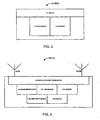
- FIG. 2 illustrates selected components of an exemplary embodiment of the radio network controller 110.
- the radio network controller 110 includes a BTS interface 111 to enable the RNC 110 to communicate with the BTSs 120 and 130, a processor 112, and a memory device 113 storing computer code instructions.
- the processor 112 is coupled to the memory device 113 and to the BTS interface 111, so that the processor 112 reads and executes the code stored in the memory device 113, configuring the BTS interface 111 to cause the BTSs 120 and 130 to communicate with the UE 140 and other UEs using the processes described throughout this document.
- the radio network may include additional controllers.
- FIG. 3 illustrates selected components of an exemplary embodiment of the UE 140.
- the UE 140 includes receive antennae 142A and 142B, a radio network transceiver (receiver and transmitter) 143, an encoder/decoder block 144, a user input device (e.g ., a keypad) 145, a display ( e.g ., an LCD screen) 146, a processor 147, and a memory device 148.
- the radio network transceiver 143, encoder and decoder block 144, user input device 145, and display 146 are configured by the processor 147 under control of the code stored in the memory device 148.
- the user equipment device 140 is configured to communicate with the radio network 105 over wireless communication links using a wireless cellular network transmission protocol, such as the cellular packet transmission protocols described above, and to execute processes described throughout this document.
- a wireless cellular network transmission protocol such as the cellular packet transmission protocols described above
- Additional UEs may be in communication with the radio network 105.
- the radio network may also include additional base transceiver stations.
- the radio network 105 may transmit to the UE 140 using Orthogonal Frequency Division Multiplexing (OFDM).
- OFDM Orthogonal Frequency Division Multiplexing
- each stream may be transmitted from the radio network 105 to the UE 140 on a separate antenna; further, the mapping of stream ID to transmit antenna ID is permuted in time, so that the Rx SNR for each stream is approximately identical.
- the composite SFN channel frequency response for each Tx antenna can be estimated using, for example, a Minimum Mean Square Error (MMSE) or low complexity zero-forced Robust MMSE solution.
- MMSE Minimum Mean Square Error
- Robust MMSE solution low complexity zero-forced Robust MMSE solution.
- stream separation and inter-stream interference suppression may be achieved using a MMSE filter.
- each stream may be independently decoded, and then successively canceled out from all other streams. Cancellation steps may be iterated until all streams are decoded.
- the complexity of successive interference cancellation (SIC) depends on the number of streams.
- the receiver receives a first signal using a first receive antenna, and a second signal using a second receive antenna.
- the first signal includes a first data stream transmitted through a first physical channel from a first transmit antenna or a first set of transmitter antennae, and a second data stream transmitted through a second physical channel from a second transmit antenna or a second set of transmit antennae.
- the second signal includes the first data stream transmitted through a third physical channel, and the second data stream transmitted through a fourth physical channel.
- the four channels are estimated, for example, using pilot channels at the receiver, or at the radio network with data provided by the receiver.
- the first and second data streams can then be separated by the receiver to obtain a first separated data stream and a second separated data stream.
- the receiver After separation, the receiver attempts to decode first data in the first data stream and second data in the second data stream. If the first attempt to decode the data is not successful, the receiver may attempt to decode again after cancelling the interference based on the partial decoding obtained during the first attempt.
- the first and the second data streams may be multicast or broadcast on common channel(s).
- N T 1 ( i.e., one transmit antenna per cell).
- the SNR may be lower than in the strict SNF operation where all cells transmit the same stream, because each stream may be transmitted from a partial subset of the network's cells. Nevertheless, it is likely that the SNR is still high enough to exploit spatial multiplexing gains. This is particularly so if the number of such sets/streams is small and, consequently, the number of transmit antennae in each set is relatively large, providing good coverage throughout the geographic area of interest.
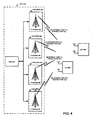
- FIG. 4 illustrates a single frequency radio network 405 using TDM and MIMO to broadcast or multicast to UEs 440A and 440B.
- the radio network 405 includes a radio network controller 410 and cells/BTSs 420, 424, 428, and 432. (Each cell is conterminous with a BTS in this embodiment, but this need not always be the case.)
- the BTSs have respective transmit antennae 421, 425, 429, and 433.
- the structure of the radio network controller 410 may be similar or identical to the structure of the radio network controller 110.
- the structure of each of the UEs 440A/B may also be the same as or similar to the structure of the UE 140.
- the radio network 405 and the UEs 440A/B are configured to communicate in accordance with the methods described below in relation to this embodiment.
- S N R
- a generic PRAP or Code Re-use BLAST (CR-BLAST) scheme is used, and N R streams are transmitted from N N R cells at any given time.
- Each of the N R streams thus corresponds to a set of transmit antennae in the associated set of cells.
- the mapping of streams to transmit antenna sets is permuted in time.
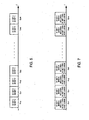
- multiple streams are multiplexed in a time division multiplexed manner on a single transmit antenna per cell.
- half the symbols per slot may be dedicated to one stream, and the other half of the symbols are dedicated to the second stream.
- T1 a first period of time
- a first stream of symbols is transmitted from a first set of transmit antennae that includes the transmit antennae 425 and 433 of the BTSs 424 and 432
- a second stream of symbols is transmitted from a second set of transmit antennae that includes transmit antennae 421 and 429 of the BTSs 420 and 428.
- T2 time period
- the first stream is transmitted from the second transmit set, while the second stream is transmitted from the first transmit set.
- UEs that are sufficiently far from each of the transmit antennae such as the UE 440A, benefit from the spatial multiplexing gains resulting from the use of MIMO.
- the UE 440A receives both symbol streams.
- the UEs in cell interiors such as the UE 440B, benefit from temporal multiplexing and high C/I.
- the UE 440B may receive only one of the streams at a time, but with a relatively high C/I ratio and concomitantly high SNR, particularly in view of the proximity of the UE 440B to a transmit antenna.
- each stream may be independently decoded, and then successively canceled out from all other streams. Cancellation steps may be iterated until all streams are decoded.
- the complexity of successive interference cancellation (SIC) depends on the number of streams.
- the receiver of this embodiment may receive, during one or more first time periods, a first signal using a first receive antenna, and a second signal using a second receive antenna.
- the first signal includes (1) a first data stream transmitted through a first physical channel from a first transmit antenna or a first set of transmit antennae, and (2) a second data stream transmitted through a second physical channel from a second transmit antenna or a second set of transmit antennae.
- the second signal includes the first data stream transmitted through a third physical channel, and the second data stream transmitted through a fourth physical channel.
- the first data stream carries first data during the first time period(s), and the second data stream carries second data during the first time period(s).
- the four channels are estimated, for example, using pilot channels at the receiver.
- the first and second data streams can then be separated by the receiver to obtain a first separated data stream and a second separated data stream. After separation, the receiver attempts to decode the first data in the first data stream and the second data in the second data stream.
- the receiver may attempt to decode again after cancelling the interference based on the partial decoding obtained during the first attempt.
- the receiver may also attempt to decode the data from the signals received during subsequent time period or periods. Thus, if the first attempt to decode is not successful, the receiver may receive at the first antenna the first signal during one or more second time periods, and receive at the second antenna the second signal during the one or more second time periods. The receiver may separate the first and second data streams from at least one of the first signal and the second signal using some or all of the channel estimates, to obtain first separated data stream and second separated data stream of the second time periods. After the streams are separated, the receiver may again attempt to decode the first and the second data from the first and second separated data streams of the first and second time periods.
- the first signal during the second periods includes the second data stream transmitted through the first physical channel and the first data stream transmitted through the second physical channel
- the second signal includes the second data stream transmitted through the third physical channel and the first data stream transmitted through the fourth physical channel.
- the first data stream carries the first data during the second time periods
- the second data stream carries the second data during the second time periods.
- the data may be transmitted redundantly during the first and second time period(s).
- the first and the second data streams may be multicast or broadcast on common channel(s).
- FIG 6 illustrates a single frequency radio network 605 using Hierarchical Modulation (HM) and MIMO to broadcast or multicast to UEs 640A and 640B.
- the radio network 605, which is similar to the network 405 of Figure 4 includes a radio network controller 610 and cells/BTSs 620, 624, 628, and 632. The cells have respective transmit antennae 621, 625, 629, and 633.
- the structure of the radio network controller 610 may be similar or identical to the structure of the radio network controller 110, which is shown in Figure 2 .
- the structure of each of the UEs 640A/B may also be the same as or similar to the structure of the UE 140, which is shown in Figure 3 .
- the radio network and the UEs 640A/B are configured to communicate in accordance with the methods described below in relation to this embodiment.
- N R a generic PRAP or Code Re-use BLAST (CR-BLAST) scheme is used, and N R streams are transmitted from cells at any given time.
- the streams are carried by hierarchically modulated signals.
- a carrier is encoded with two data flows.
- 64-QAM Quadrature Amplitude Modulation
- data is mapped so that there is a QPSK flow contained in the 64-QAM.
- QPSK data flow the QPSK data flow
- 16-QAM data flow The combined data rate of the two data flows may be the same as the data rate of the corresponding 64-QAM data flow.
- symbols are encoded onto a carrier so that different sections in the complex signal plane of the modulation constellation (such as the Q-I plane) represent different positions of the symbol alphabet bits.
- the left part of the Q-I plane may correspond to the "1" value of the most significant bit of a symbol
- the right half of the plane may correspond to the "0” value of this bit
- the lower half of the plane may correspond to the "1” value of the second most significant bit position
- the top half of the plane may correspond to the "0” value of this bit.
- a symbol falling in the top left quadrant would represent "10” in the two most significant bit positions
- a symbol in the top right quadrant would represent "00” in these positions
- symbols in the bottom left and bottom right quadrants would represent "11" and "01” values, respectively.
- Additional bits of the symbol corresponding to the 16-QAM data flow are determined by the symbol's position within the particular quadrant determined by the first two bits.
- the QPSK data flow is more robust than the 16-QAM data flow, meaning that the QPSK data flow may be decoded at lower SNR and lower C/I ratios of the signal. Spacing within the constellation may be varied to provide additional robustness to the QPSK data flow at the cost of the 16-QAM data flow. Thus, the more-robust BPSK data flow has a greater coverage than the less-robust 16-QAM data flow.
- the more robust layer of a hierarchically modulated signal (such as the BPSK stream in the 64-QAM example above) will be referred to as the base layer; the less robust layer of the hierarchically modulated signal (such as the 16-QAM stream of the 64-QAM example) will be referred to as the enhancement layer.
- Hierarchical modulation provides a mechanism for increasing transmission capacity.
- the capacity increase comes at the expense of reduced coverage for enhancement layer, while the base layer performance is improved.
- the stream mapping may be permuted in time from base to enhancement layers.
- a first data stream S1 may be transmitted from the first set of antennae on the base layer of a first hierarchically modulated signal and, concurrently, from the second set of antennae on the enhancement layer of a second hierarchically modulated signal.
- the first data stream may be transmitted from the first set of antennae on the enhancement layer of the first hierarchically modulated signal and, concurrently, from the second set of antennae on the base layer of the second hierarchically modulated signal.
- data in each stream may be redundantly transmitted during successive time periods.
- a receiver may be configured to receive at a first receive antenna a first receive signal that includes (1) the first signal component transmitted from a first transmit antenna (or a first set of transmit antennae) through a first physical channel, and (2) a second signal component transmitted from a second transmit antenna (or a second set of transmit antennae) through a second physical channel.
- the first signal component may include (1) a first base layer carrying a first data stream, and (2) a first enhancement layer carrying a second data stream; the second signal component may include (1) a second base layer carrying the second data stream, and (2) a second enhancement layer carrying the first data stream.
- the receiver may be further configured to receive at a second antenna a second signal that includes (1) a third signal component transmitted through a third physical channel, and (2) a fourth signal component transmitted through a fourth physical channel.
- the third signal component may include (1) a third base layer carrying the first data stream, and (2) a third enhancement layer carrying the second data stream;
- the fourth signal component may include (1) a fourth base layer carrying the second data stream, and (2) a fourth enhancement layer carrying the first data stream.
- the first, second, third, and fourth physical channels may be estimated to obtain channel estimates for the channels.
- Channel estimation may be performed by the receiver and be based on pilot channels. After some or all the channel estimates become available, the receiver may separate the first and second signal components. After the signal separation, the receiver may attempt to decode the first data stream from the first base layer and the second data stream from the first enhancement layer.
- the receiver may attempt to decode the second data stream from both the first enhancement layer and the second base layer.
- the receiver may estimate the quality of the first signal and, if the quality of the first signal (e . g ., SNR) is higher than a predetermined measure, decode the second data stream from the first enhancement layer; if the quality of the first signal does not exceed the measure, the receiver may separate the third and fourth signal components using the channel estimates, and attempt decode the second data stream from the second base layer.
- the quality of the first signal e . g ., SNR
- the receiver may also estimate the quality of the second signal and, if the quality of the second signal is below a predetermined threshold, attempt to decode the second data stream from the first enhancement layer; if the quality of the second signal is not below the threshold, the receiver may separate the third and fourth signal components and attempt to decode the second data stream from the second base layer.
- Interference Cancellation (IC) techniques may be used to cancel the interference from base layer to enhancement layer of the same signal.
- the system can switch to Space Time Transmit Diversity (STTD), or turn off the transmit diversity antennae.
- STTD Space Time Transmit Diversity
- the first of these options may be simpler with no RF implications of dynamic switching on/off the transmit diversity antennae.
- steps of the various methods have been described serially in this disclosure, some of these steps may be performed by separate elements in conjunction or in parallel, asynchronously or synchronously, in a pipelined manner, or otherwise. There is no particular requirement that the steps be performed in the same order in which this description lists them, except where explicitly so indicated, otherwise made clear from the context, or inherently required. Furthermore, not every illustrated step or communication message is necessarily required in every embodiment in accordance with the invention, while some steps or communication messages that have not been specifically illustrated may be desirable in some embodiments in accordance with the invention.
- DSP digital signal processor
- ASIC application specific integrated circuit
- FPGA field programmable gate array
- a general purpose processor may be a microprocessor, but in the alternative, the processor may be any conventional processor, controller, microcontroller, or state machine.
- a processor may also be implemented as a combination of computing devices, e . g ., a combination of a DSP and a microprocessor, a plurality of microprocessors, one or more microprocessors in conjunction with a DSP core, or any other such configuration.
- a software module may reside in random access memory (RAM), flash memory, read only memory (ROM), erasable programmable read only memory (EPROM), electrically erasable programmable read only memory (EEPROM), registers, hard disk, removable disk, CD-ROM, or any other form of storage medium known in the art.
- An exemplary storage medium is coupled to the processor such that the processor can read information from, and write information to, the storage medium.
- the storage medium may be integral to the processor.
- the processor and the storage medium may reside in an ASIC.
- the ASIC may reside in a user equipment device.
- the processor and the storage medium may reside as discrete components in a user equipment device.
Landscapes
- Engineering & Computer Science (AREA)
- Computer Networks & Wireless Communication (AREA)
- Signal Processing (AREA)
- Quality & Reliability (AREA)
- Mobile Radio Communication Systems (AREA)
- Radio Transmission System (AREA)
- Time-Division Multiplex Systems (AREA)
Priority Applications (1)
| Application Number | Priority Date | Filing Date | Title |
|---|---|---|---|
| EP10168349A EP2228915A3 (en) | 2005-06-14 | 2006-06-09 | Transmit spatialdiversity for cellular single frequency networks |
Applications Claiming Priority (3)
| Application Number | Priority Date | Filing Date | Title |
|---|---|---|---|
| US69062205P | 2005-06-14 | 2005-06-14 | |
| US11/450,229 US8059608B2 (en) | 2005-06-14 | 2006-06-08 | Transmit spatial diversity for cellular single frequency networks |
| PCT/US2006/022725 WO2006138203A1 (en) | 2005-06-14 | 2006-06-09 | Transmit spatial diversity for cellular single frequency networks |
Related Child Applications (2)
| Application Number | Title | Priority Date | Filing Date |
|---|---|---|---|
| EP10168349A Division-Into EP2228915A3 (en) | 2005-06-14 | 2006-06-09 | Transmit spatialdiversity for cellular single frequency networks |
| EP11184393 Division-Into | 2011-10-07 |
Publications (2)
| Publication Number | Publication Date |
|---|---|
| EP1894317A1 EP1894317A1 (en) | 2008-03-05 |
| EP1894317B1 true EP1894317B1 (en) | 2014-04-23 |
Family
ID=37524096
Family Applications (2)
| Application Number | Title | Priority Date | Filing Date |
|---|---|---|---|
| EP10168349A Withdrawn EP2228915A3 (en) | 2005-06-14 | 2006-06-09 | Transmit spatialdiversity for cellular single frequency networks |
| EP06760742.4A Active EP1894317B1 (en) | 2005-06-14 | 2006-06-09 | Transmit spatial diversity for cellular single frequency networks |
Family Applications Before (1)
| Application Number | Title | Priority Date | Filing Date |
|---|---|---|---|
| EP10168349A Withdrawn EP2228915A3 (en) | 2005-06-14 | 2006-06-09 | Transmit spatialdiversity for cellular single frequency networks |
Country Status (6)
| Country | Link |
|---|---|
| US (2) | US8059608B2 (enExample) |
| EP (2) | EP2228915A3 (enExample) |
| JP (4) | JP2008547267A (enExample) |
| KR (1) | KR100942652B1 (enExample) |
| CN (1) | CN102684764B (enExample) |
| WO (1) | WO2006138203A1 (enExample) |
Families Citing this family (66)
| Publication number | Priority date | Publication date | Assignee | Title |
|---|---|---|---|---|
| US8059608B2 (en) * | 2005-06-14 | 2011-11-15 | Qualcomm Incorporated | Transmit spatial diversity for cellular single frequency networks |
| KR100961743B1 (ko) * | 2005-12-09 | 2010-06-07 | 삼성전자주식회사 | 다중 홉 중계방식의 광대역 무선 접속통신시스템에서 중계서비스를 지원하기 위한 장치 및 방법 |
| US8072943B2 (en) * | 2005-12-09 | 2011-12-06 | Samsung Electronics Co., Ltd. | Wireless communication system and methodology for communicating via multiple information streams |
| US7965687B2 (en) * | 2005-12-15 | 2011-06-21 | Sasken Communications Technologies | Method and system for multiple-input-multiple-output (MIMO) communication in a wireless network |
| EP2055022A1 (en) * | 2006-07-27 | 2009-05-06 | Telefonaktiebolaget LM Ericsson (PUBL) | Hierarchical broadcast transmission via multiple transmitters |
| CN101232474B (zh) * | 2006-08-28 | 2013-08-28 | 三星电子株式会社 | 宽带无线接入系统中的接收装置和方法 |
| US8006029B2 (en) * | 2006-11-30 | 2011-08-23 | Intel Corporation | DDR flash implementation with direct register access to legacy flash functions |
| US8130875B2 (en) * | 2006-12-11 | 2012-03-06 | Cisco Technology, Inc. | Method for estimating channel response in a wireless communications network based on pilot signals |
| US8005160B2 (en) * | 2006-12-30 | 2011-08-23 | Nortel Networks Limited | Processing differentiated hierarchical modulation used in radio frequency communications |
| US8116412B1 (en) | 2006-12-30 | 2012-02-14 | Rockstar Bidco, LP | Modulation division multiple access |
| US7986746B2 (en) * | 2006-12-30 | 2011-07-26 | Nortel Networks Limited | Content differentiated hierarchical modulation used in radio frequency communications |
| US8130693B2 (en) * | 2007-01-09 | 2012-03-06 | Viasat, Inc. | MIMO satellite system |
| US9185634B2 (en) * | 2007-04-17 | 2015-11-10 | Innovative Sonic Limited | Method and apparatus for enhancing receiving efficiency of an multimedia broadcast multicast service in a wireless communications system |
| KR101004695B1 (ko) * | 2007-04-17 | 2011-01-04 | 이노베이티브 소닉 리미티드 | 무선통신시스템에서 멀티미디어 브로드캐스트 및멀티캐스트 서비스(mbms) 수신효율을 향상시키는 방법및 장치 |
| AU2008245594A1 (en) * | 2007-04-27 | 2008-11-06 | Interdigital Technology Corporation | Method and apparatus of resource management for multimedia broadcast multicast services |
| US20080298336A1 (en) * | 2007-05-31 | 2008-12-04 | Sridhar Gollamudi | macro-diversity technique for multicast transmission in a wireless communication system |
| KR101094441B1 (ko) | 2007-06-20 | 2011-12-20 | 한국전자통신연구원 | 디지털 방송 신호의 전송 방법, 전송 장치, 수신 방법 및수신 장치 |
| US8145272B2 (en) * | 2007-08-08 | 2012-03-27 | Cisco Technology, Inc. | Pilot-based two-dimensional channel estimation |
| US8229441B2 (en) * | 2007-08-24 | 2012-07-24 | Avaya Inc. | Graduated single frequency network |
| WO2009045069A2 (en) | 2007-10-03 | 2009-04-09 | Lg Electronics Inc. | Optimizing transmission for broadcast multicast service |
| JP5116853B2 (ja) * | 2007-10-25 | 2013-01-09 | テレフオンアクチーボラゲット エル エム エリクソン(パブル) | E−utranシステムにおいてmbmsデータを送信する方法 |
| CN101426207B (zh) * | 2007-10-29 | 2011-11-16 | 中国移动通信集团公司 | 一种单频网络控制方法及单频网络控制实体 |
| CN101447854B (zh) * | 2007-11-27 | 2012-11-07 | 上海华为技术有限公司 | 数据发送/转发/处理方法及装置 |
| US8130823B2 (en) * | 2007-12-19 | 2012-03-06 | Broadcom Corporation | Channel adaptive video transmission system for use with layered video coding and methods for use therewith |
| WO2009119041A1 (ja) * | 2008-03-26 | 2009-10-01 | パナソニック株式会社 | 無線通信装置、無線通信システム及び無線通信方法 |
| US20090257342A1 (en) * | 2008-04-10 | 2009-10-15 | Media Tek Inc. | Resource block based pilot pattern design for 1/2 - stream mimo ofdma systems |
| US8724717B2 (en) * | 2008-04-10 | 2014-05-13 | Mediatek Inc. | Pilot pattern design for high-rank MIMO OFDMA systems |
| US8179983B2 (en) * | 2008-05-20 | 2012-05-15 | Broadcom Corporation | Video processing system with layered video coding for fast channel change and methods for use therewith |
| SG157971A1 (en) * | 2008-06-13 | 2010-01-29 | Panasonic Corp | A multiple-input multiple-output (mimo) transmitter and communication system |
| US8514693B2 (en) * | 2008-07-11 | 2013-08-20 | Alcatel Lucent | Broadcast and multicast in single frequency networks using othrogonal space-time codes |
| US8249509B2 (en) * | 2008-11-24 | 2012-08-21 | Cisco Technology, Inc. | Dynamic channel estimation based on channel conditions |
| US20100150245A1 (en) * | 2008-12-15 | 2010-06-17 | Sony Ericsson Mobile Communications Ab | Multimedia Stream Selection |
| KR101013652B1 (ko) * | 2008-12-30 | 2011-02-10 | 주식회사 세아네트웍스 | 무선 통신 시스템의 데이터 송신 방법 |
| US8953520B2 (en) * | 2009-02-13 | 2015-02-10 | Qualcomm Incorporated | Method and apparatus for inter-sector MIMO |
| US8879470B2 (en) * | 2009-02-27 | 2014-11-04 | Alcatel Lucent | Cooperative beam forming method, apparatus and base station |
| US20100304773A1 (en) * | 2009-05-27 | 2010-12-02 | Ramprashad Sean A | Method for selective antenna activation and per antenna or antenna group power assignments in cooperative signaling wireless mimo systems |
| US8908615B2 (en) * | 2009-07-01 | 2014-12-09 | Institute For Information Industry | Base station, relay station, computing apparatus, and reference signal transmission, allocation, and receiving methods thereof |
| KR101631477B1 (ko) * | 2009-08-05 | 2016-06-17 | 삼성전자주식회사 | 적응적으로 단일 포인트 송/수신 및 협력 멀티 포인트 송/수신을 적용하는 통신 시스템 |
| US20110033011A1 (en) * | 2009-08-05 | 2011-02-10 | Industrial Technology Research Institute | Methods and apparatuses relating to multi-resolution transmissions with mimo scheme |
| US8902828B2 (en) | 2009-10-05 | 2014-12-02 | Qualcomm Incorporated | Carrier indicator field for cross carrier assignments |
| US8295335B2 (en) | 2009-12-31 | 2012-10-23 | Intel Corporation | Techniques to control uplink power |
| CN101820669B (zh) * | 2010-01-28 | 2012-11-14 | 北京邮电大学 | 一种pdcch资源分配的方法和装置 |
| US20120076204A1 (en) * | 2010-09-23 | 2012-03-29 | Qualcomm Incorporated | Method and apparatus for scalable multimedia broadcast using a multi-carrier communication system |
| US9400714B2 (en) * | 2011-06-06 | 2016-07-26 | International Business Machines Corporation | Wirelessly communicating a data file |
| US10365969B2 (en) | 2011-11-01 | 2019-07-30 | International Business Machines Corporation | Multiple wireless communication systems stream slices based on geography |
| US9609631B2 (en) * | 2012-01-20 | 2017-03-28 | Mediatek Inc. | Wireless communication apparatuses and related methods |
| US20130235783A1 (en) * | 2012-03-09 | 2013-09-12 | Qualcomm Incorporated | Evolved multimedia broadcast multicast service capacity enhancements |
| US8812039B2 (en) * | 2012-07-16 | 2014-08-19 | Telefonaktiebolaget L M Ericsson (Publ) | Method and system for reducing inter-cell interference using intra-ENB downlink coordinated multipoint services |
| US10863313B2 (en) | 2014-08-01 | 2020-12-08 | Polte Corporation | Network architecture and methods for location services |
| US10440512B2 (en) | 2012-08-03 | 2019-10-08 | Polte Corporation | Angle of arrival (AOA) positioning method and system for positional finding and tracking objects using reduced attenuation RF technology |
| US9337973B2 (en) | 2012-09-11 | 2016-05-10 | Industrial Technology Research Institute | Method of cooperative MIMO wireless communication and base station using the same |
| KR102367210B1 (ko) | 2012-10-01 | 2022-02-24 | 지이 비디오 컴프레션, 엘엘씨 | 공간적 인트라 예측 파라미터들의 인터-레이어 예측을 이용한 스케일러블 비디오 코딩 |
| CN104782062B (zh) * | 2012-12-06 | 2017-12-26 | 英特尔公司 | 用于小区专用参考信号(crs)的序列生成 |
| US9148325B2 (en) * | 2013-05-23 | 2015-09-29 | Ridha HAMILA | System and methods for compensation of I/Q imbalance in beamforming OFDM systems |
| WO2015009101A1 (ko) * | 2013-07-18 | 2015-01-22 | 엘지전자 주식회사 | 무선 접속 시스템에서 계층적 변조를 이용한 강건한 심볼 송수신 방법 |
| EP3051871B1 (en) * | 2013-09-26 | 2017-10-25 | Fujitsu Limited | Base station, mobile station, wireless communication system, and wireless communication method |
| US9749999B2 (en) * | 2013-11-18 | 2017-08-29 | Taiwan Semiconductor Manufacturing Co., Ltd. | Hierarchical modulation for unicast streams |
| US20150139293A1 (en) * | 2013-11-18 | 2015-05-21 | Wi-Lan Labs, Inc. | Hierarchical modulation for multiple streams |
| JP6287217B2 (ja) * | 2014-01-08 | 2018-03-07 | 株式会社デンソー | 無線通信装置 |
| EP3519586B1 (en) * | 2016-09-28 | 2024-03-13 | Life Technologies Corporation | Methods for sequencing nucleic acids using termination chemistry |
| WO2019220243A1 (en) * | 2018-05-18 | 2019-11-21 | Telefonaktiebolaget Lm Ericsson (Publ) | Systems and methods for designing a distributed mimo network |
| EP3794861B1 (en) | 2018-05-18 | 2022-02-23 | Telefonaktiebolaget LM Ericsson (publ) | Performance simulation of a distributed mimo antenna system |
| US11183773B2 (en) * | 2018-10-16 | 2021-11-23 | Hook'd WiFi Inc. | Configurable communication system using stacked antennas |
| US11239570B2 (en) | 2018-10-16 | 2022-02-01 | Hook'd WiFi Inc. | Wireless communications system with scalable architecture |
| US12224868B2 (en) * | 2019-02-14 | 2025-02-11 | Telefonaktiebolaget Lm Ericsson (Publ) | Multi-layer transmission technique |
| US20230403715A1 (en) * | 2020-11-25 | 2023-12-14 | Qualcomm Incorporated | User equipment cooperation |
Family Cites Families (27)
| Publication number | Priority date | Publication date | Assignee | Title |
|---|---|---|---|---|
| JP2000078222A (ja) * | 1991-03-27 | 2000-03-14 | Matsushita Electric Ind Co Ltd | 送信装置、受信装置、伝送装置、送信方法、受信方法 |
| DE19858113C1 (de) | 1998-12-16 | 2000-03-30 | Siemens Ag | Verfahren zur Datenübertragung mit Makrodiversitäts-Empfang |
| DE69940111D1 (de) | 1999-02-16 | 2009-01-29 | Mitsubishi Electric Corp | Funkübertragungssystem, sender und empfänger |
| DE60036973T2 (de) | 1999-02-26 | 2008-08-28 | Texas Instruments Inc., Dallas | Verfahren zum Betreiben eines Kommunikationsschaltkreises |
| GB0029426D0 (en) * | 2000-12-02 | 2001-01-17 | Koninkl Philips Electronics Nv | Radio communication system |
| US7116722B2 (en) * | 2001-02-09 | 2006-10-03 | Lucent Technologies Inc. | Wireless communication system using multi-element antenna having a space-time architecture |
| JP4719932B2 (ja) | 2001-07-10 | 2011-07-06 | 学校法人慶應義塾 | 送信サイトダイバーシチシステム |
| CN100375418C (zh) * | 2001-08-09 | 2008-03-12 | 诺基亚公司 | 分集发送器和分集发送方法 |
| US20030066004A1 (en) * | 2001-09-28 | 2003-04-03 | Rudrapatna Ashok N. | Harq techniques for multiple antenna systems |
| EP1337082B1 (en) * | 2002-02-14 | 2005-10-26 | Lucent Technologies Inc. | Receiver and method for multi-input multi-output iterative detection using feedback of soft estimates |
| US6862456B2 (en) | 2002-03-01 | 2005-03-01 | Cognio, Inc. | Systems and methods for improving range for multicast wireless communication |
| GB0216060D0 (en) * | 2002-07-11 | 2002-08-21 | Koninkl Philips Electronics Nv | Improvements in or relating to multiple transmission channel wireless communic ation systems |
| US7349438B2 (en) * | 2002-09-17 | 2008-03-25 | Lucent Technologies Inc. | Formatter, method of formatting encoded symbols and wireless communication system employing the same |
| US7394860B2 (en) * | 2002-10-02 | 2008-07-01 | Nortel Networks Limited | Combined space-time decoding |
| KR100630108B1 (ko) * | 2002-10-10 | 2006-09-27 | 삼성전자주식회사 | 공간-시간 블럭부호를 사용하여 송신 안테나 다이버시티를지원하는 송수신 장치 |
| JP4694469B2 (ja) * | 2003-02-19 | 2011-06-08 | クゥアルコム・インコーポレイテッド | マルチユーザ通信システムにおける拡張された符号化の方法および装置 |
| JP4128197B2 (ja) | 2003-06-30 | 2008-07-30 | 富士通株式会社 | 多入力多出力伝送システム |
| KR20050013451A (ko) | 2003-07-28 | 2005-02-04 | 삼성전자주식회사 | 멀티캐스트 멀티미디어 방송 서비스를 제공하는부호분할다중접속 이동통신시스템에서 소프트 핸드오버결정장치 및 방법 |
| US7724838B2 (en) * | 2003-09-25 | 2010-05-25 | Qualcomm Incorporated | Hierarchical coding with multiple antennas in a wireless communication system |
| US7120395B2 (en) * | 2003-10-20 | 2006-10-10 | Nortel Networks Limited | MIMO communications |
| GB2408172B (en) | 2003-11-12 | 2007-11-14 | Ipwireless Inc | Method and apparatus for improved throughput in a communication system |
| US8204149B2 (en) | 2003-12-17 | 2012-06-19 | Qualcomm Incorporated | Spatial spreading in a multi-antenna communication system |
| US7194042B2 (en) | 2004-01-13 | 2007-03-20 | Qualcomm Incorporated | Data transmission with spatial spreading in a mimo communication system |
| US8077691B2 (en) | 2004-03-05 | 2011-12-13 | Qualcomm Incorporated | Pilot transmission and channel estimation for MISO and MIMO receivers in a multi-antenna system |
| US7630356B2 (en) * | 2004-04-05 | 2009-12-08 | Nortel Networks Limited | Methods for supporting MIMO transmission in OFDM applications |
| US7327983B2 (en) * | 2004-06-25 | 2008-02-05 | Mitsubishi Electric Research Laboratories, Inc. | RF-based antenna selection in MIMO systems |
| US8059608B2 (en) | 2005-06-14 | 2011-11-15 | Qualcomm Incorporated | Transmit spatial diversity for cellular single frequency networks |
-
2006
- 2006-06-08 US US11/450,229 patent/US8059608B2/en active Active
- 2006-06-09 KR KR1020087000922A patent/KR100942652B1/ko active Active
- 2006-06-09 EP EP10168349A patent/EP2228915A3/en not_active Withdrawn
- 2006-06-09 WO PCT/US2006/022725 patent/WO2006138203A1/en not_active Ceased
- 2006-06-09 JP JP2008516971A patent/JP2008547267A/ja not_active Withdrawn
- 2006-06-09 EP EP06760742.4A patent/EP1894317B1/en active Active
- 2006-06-09 CN CN201210140266.7A patent/CN102684764B/zh active Active
-
2010
- 2010-09-01 US US12/873,551 patent/US8570982B2/en active Active
-
2011
- 2011-05-02 JP JP2011103026A patent/JP2011234373A/ja not_active Withdrawn
-
2012
- 2012-04-06 JP JP2012087383A patent/JP5475046B2/ja active Active
-
2013
- 2013-12-02 JP JP2013249646A patent/JP5925750B2/ja not_active Expired - Fee Related
Also Published As
| Publication number | Publication date |
|---|---|
| CN102684764B (zh) | 2015-09-16 |
| KR20080016958A (ko) | 2008-02-22 |
| JP2008547267A (ja) | 2008-12-25 |
| JP5475046B2 (ja) | 2014-04-16 |
| JP2014090444A (ja) | 2014-05-15 |
| KR100942652B1 (ko) | 2010-02-17 |
| WO2006138203A1 (en) | 2006-12-28 |
| US8059608B2 (en) | 2011-11-15 |
| JP2012170108A (ja) | 2012-09-06 |
| EP2228915A2 (en) | 2010-09-15 |
| EP2228915A3 (en) | 2012-08-22 |
| CN102684764A (zh) | 2012-09-19 |
| US20060280262A1 (en) | 2006-12-14 |
| JP2011234373A (ja) | 2011-11-17 |
| US20100322350A1 (en) | 2010-12-23 |
| JP5925750B2 (ja) | 2016-05-25 |
| EP1894317A1 (en) | 2008-03-05 |
| US8570982B2 (en) | 2013-10-29 |
Similar Documents
| Publication | Publication Date | Title |
|---|---|---|
| EP1894317B1 (en) | Transmit spatial diversity for cellular single frequency networks | |
| CN101238648B (zh) | 用于从蜂窝式无线电网络进行广播及多播的方法和设备 | |
| US8976838B2 (en) | Apparatus for assigning and estimating transmission symbols | |
| JP4316496B2 (ja) | 位相および振幅較正を伴った多チャンネル無線送信器および受信器のための方法およびシステム | |
| CN100370696C (zh) | 无线通信中处理空间复用信号的方法和系统 | |
| JP5567338B2 (ja) | マルチサイトおよびマルチビーム送信のための、空間−時間/空間−周波数符号化 | |
| Henarejos et al. | Dual polarized modulation and reception for next generation mobile satellite communications | |
| KR20090048642A (ko) | 무선 통신 시스템, 스케줄링 방법 및 이동국 | |
| WO2007121568A1 (en) | Method and system for closed loop multiple input/output antenna environments in wireless communication | |
| Zhang et al. | Analysis of cyclic delay diversity on DVB-H systems over spatially correlated channel | |
| US20120114016A1 (en) | Method for Processing Data | |
| US20140269768A1 (en) | Methods and apparatus for increasing diversity in downlink transmissions | |
| Oh et al. | Novel transmit diversity techniques for broadcast services in cellular networks | |
| Hong et al. | Performance of cyclic delay diversity in DAB/DMB | |
| Hemalatha et al. | Space diversity knotted with WiMAX-a way for undistorted and anti-corruptive channel | |
| Narikiyo et al. | Mobile reception performance of SFBC-MIMO transmission system with Walsh code scattered pilot-Computer simulation and field test results | |
| Ren et al. | A novel scheme for space-time block coding with a variable transmit diversity gain in OFDM systems | |
| Souto et al. | An iterative receiver for WCDMA systems with MIMO transmissions and hierarchical constellations | |
| CN1909512B (zh) | 无线网络上的多媒体组播传输方法和设备 | |
| Hong et al. | Interleaved spatial diversity transmission with coordinate interleaver for MIMO-OFDM systems | |
| KR20090055468A (ko) | 다수의 송신 안테나를 가진 시스템에서의 파일롯 신호 송수신 방법 | |
| Mlayeh et al. | Performance evaluation and analysis of switching algorithms in MIMO-OFDM system with ideal and non-ideal CSI | |
| Sugiyama et al. | Implementation and performance evaluation of simple SDM-COFDM prototype using propagation coefficient matrix tracking for fast fading MIMO channels | |
| Eddie et al. | Improving QoS with MIMO-OFDM in future broadband wireless networks | |
| Naiqian et al. | The capacity gain of mobile multimedia broadcasting system by using CSIT in MIMO |
Legal Events
| Date | Code | Title | Description |
|---|---|---|---|
| PUAI | Public reference made under article 153(3) epc to a published international application that has entered the european phase |
Free format text: ORIGINAL CODE: 0009012 |
|
| 17P | Request for examination filed |
Effective date: 20080111 |
|
| AK | Designated contracting states |
Kind code of ref document: A1 Designated state(s): AT BE BG CH CY CZ DE DK EE ES FI FR GB GR HU IE IS IT LI LT LU LV MC NL PL PT RO SE SI SK TR |
|
| DAX | Request for extension of the european patent (deleted) | ||
| DAX | Request for extension of the european patent (deleted) | ||
| 17Q | First examination report despatched |
Effective date: 20090929 |
|
| GRAP | Despatch of communication of intention to grant a patent |
Free format text: ORIGINAL CODE: EPIDOSNIGR1 |
|
| GRAP | Despatch of communication of intention to grant a patent |
Free format text: ORIGINAL CODE: EPIDOSNIGR1 |
|
| INTG | Intention to grant announced |
Effective date: 20130704 |
|
| GRAP | Despatch of communication of intention to grant a patent |
Free format text: ORIGINAL CODE: EPIDOSNIGR1 |
|
| INTG | Intention to grant announced |
Effective date: 20131203 |
|
| GRAS | Grant fee paid |
Free format text: ORIGINAL CODE: EPIDOSNIGR3 |
|
| GRAA | (expected) grant |
Free format text: ORIGINAL CODE: 0009210 |
|
| AK | Designated contracting states |
Kind code of ref document: B1 Designated state(s): AT BE BG CH CY CZ DE DK EE ES FI FR GB GR HU IE IS IT LI LT LU LV MC NL PL PT RO SE SI SK TR |
|
| REG | Reference to a national code |
Ref country code: GB Ref legal event code: FG4D |
|
| REG | Reference to a national code |
Ref country code: CH Ref legal event code: EP |
|
| REG | Reference to a national code |
Ref country code: AT Ref legal event code: REF Ref document number: 664358 Country of ref document: AT Kind code of ref document: T Effective date: 20140515 |
|
| REG | Reference to a national code |
Ref country code: IE Ref legal event code: FG4D |
|
| REG | Reference to a national code |
Ref country code: DE Ref legal event code: R096 Ref document number: 602006041204 Country of ref document: DE Effective date: 20140605 |
|
| REG | Reference to a national code |
Ref country code: AT Ref legal event code: MK05 Ref document number: 664358 Country of ref document: AT Kind code of ref document: T Effective date: 20140423 |
|
| REG | Reference to a national code |
Ref country code: NL Ref legal event code: VDEP Effective date: 20140423 |
|
| REG | Reference to a national code |
Ref country code: LT Ref legal event code: MG4D |
|
| PG25 | Lapsed in a contracting state [announced via postgrant information from national office to epo] |
Ref country code: NL Free format text: LAPSE BECAUSE OF FAILURE TO SUBMIT A TRANSLATION OF THE DESCRIPTION OR TO PAY THE FEE WITHIN THE PRESCRIBED TIME-LIMIT Effective date: 20140423 Ref country code: FI Free format text: LAPSE BECAUSE OF FAILURE TO SUBMIT A TRANSLATION OF THE DESCRIPTION OR TO PAY THE FEE WITHIN THE PRESCRIBED TIME-LIMIT Effective date: 20140423 Ref country code: LT Free format text: LAPSE BECAUSE OF FAILURE TO SUBMIT A TRANSLATION OF THE DESCRIPTION OR TO PAY THE FEE WITHIN THE PRESCRIBED TIME-LIMIT Effective date: 20140423 Ref country code: BG Free format text: LAPSE BECAUSE OF FAILURE TO SUBMIT A TRANSLATION OF THE DESCRIPTION OR TO PAY THE FEE WITHIN THE PRESCRIBED TIME-LIMIT Effective date: 20140723 Ref country code: GR Free format text: LAPSE BECAUSE OF FAILURE TO SUBMIT A TRANSLATION OF THE DESCRIPTION OR TO PAY THE FEE WITHIN THE PRESCRIBED TIME-LIMIT Effective date: 20140724 Ref country code: IS Free format text: LAPSE BECAUSE OF FAILURE TO SUBMIT A TRANSLATION OF THE DESCRIPTION OR TO PAY THE FEE WITHIN THE PRESCRIBED TIME-LIMIT Effective date: 20140823 Ref country code: CY Free format text: LAPSE BECAUSE OF FAILURE TO SUBMIT A TRANSLATION OF THE DESCRIPTION OR TO PAY THE FEE WITHIN THE PRESCRIBED TIME-LIMIT Effective date: 20140423 |
|
| PG25 | Lapsed in a contracting state [announced via postgrant information from national office to epo] |
Ref country code: ES Free format text: LAPSE BECAUSE OF FAILURE TO SUBMIT A TRANSLATION OF THE DESCRIPTION OR TO PAY THE FEE WITHIN THE PRESCRIBED TIME-LIMIT Effective date: 20140423 Ref country code: AT Free format text: LAPSE BECAUSE OF FAILURE TO SUBMIT A TRANSLATION OF THE DESCRIPTION OR TO PAY THE FEE WITHIN THE PRESCRIBED TIME-LIMIT Effective date: 20140423 Ref country code: LV Free format text: LAPSE BECAUSE OF FAILURE TO SUBMIT A TRANSLATION OF THE DESCRIPTION OR TO PAY THE FEE WITHIN THE PRESCRIBED TIME-LIMIT Effective date: 20140423 Ref country code: SE Free format text: LAPSE BECAUSE OF FAILURE TO SUBMIT A TRANSLATION OF THE DESCRIPTION OR TO PAY THE FEE WITHIN THE PRESCRIBED TIME-LIMIT Effective date: 20140423 Ref country code: PL Free format text: LAPSE BECAUSE OF FAILURE TO SUBMIT A TRANSLATION OF THE DESCRIPTION OR TO PAY THE FEE WITHIN THE PRESCRIBED TIME-LIMIT Effective date: 20140423 |
|
| PG25 | Lapsed in a contracting state [announced via postgrant information from national office to epo] |
Ref country code: PT Free format text: LAPSE BECAUSE OF FAILURE TO SUBMIT A TRANSLATION OF THE DESCRIPTION OR TO PAY THE FEE WITHIN THE PRESCRIBED TIME-LIMIT Effective date: 20140825 |
|
| REG | Reference to a national code |
Ref country code: DE Ref legal event code: R097 Ref document number: 602006041204 Country of ref document: DE |
|
| PG25 | Lapsed in a contracting state [announced via postgrant information from national office to epo] |
Ref country code: MC Free format text: LAPSE BECAUSE OF FAILURE TO SUBMIT A TRANSLATION OF THE DESCRIPTION OR TO PAY THE FEE WITHIN THE PRESCRIBED TIME-LIMIT Effective date: 20140423 Ref country code: CZ Free format text: LAPSE BECAUSE OF FAILURE TO SUBMIT A TRANSLATION OF THE DESCRIPTION OR TO PAY THE FEE WITHIN THE PRESCRIBED TIME-LIMIT Effective date: 20140423 Ref country code: LU Free format text: LAPSE BECAUSE OF FAILURE TO SUBMIT A TRANSLATION OF THE DESCRIPTION OR TO PAY THE FEE WITHIN THE PRESCRIBED TIME-LIMIT Effective date: 20140609 Ref country code: DK Free format text: LAPSE BECAUSE OF FAILURE TO SUBMIT A TRANSLATION OF THE DESCRIPTION OR TO PAY THE FEE WITHIN THE PRESCRIBED TIME-LIMIT Effective date: 20140423 Ref country code: BE Free format text: LAPSE BECAUSE OF FAILURE TO SUBMIT A TRANSLATION OF THE DESCRIPTION OR TO PAY THE FEE WITHIN THE PRESCRIBED TIME-LIMIT Effective date: 20140423 Ref country code: SK Free format text: LAPSE BECAUSE OF FAILURE TO SUBMIT A TRANSLATION OF THE DESCRIPTION OR TO PAY THE FEE WITHIN THE PRESCRIBED TIME-LIMIT Effective date: 20140423 Ref country code: RO Free format text: LAPSE BECAUSE OF FAILURE TO SUBMIT A TRANSLATION OF THE DESCRIPTION OR TO PAY THE FEE WITHIN THE PRESCRIBED TIME-LIMIT Effective date: 20140423 Ref country code: EE Free format text: LAPSE BECAUSE OF FAILURE TO SUBMIT A TRANSLATION OF THE DESCRIPTION OR TO PAY THE FEE WITHIN THE PRESCRIBED TIME-LIMIT Effective date: 20140423 |
|
| REG | Reference to a national code |
Ref country code: CH Ref legal event code: PL |
|
| PLBE | No opposition filed within time limit |
Free format text: ORIGINAL CODE: 0009261 |
|
| STAA | Information on the status of an ep patent application or granted ep patent |
Free format text: STATUS: NO OPPOSITION FILED WITHIN TIME LIMIT |
|
| REG | Reference to a national code |
Ref country code: IE Ref legal event code: MM4A |
|
| REG | Reference to a national code |
Ref country code: FR Ref legal event code: ST Effective date: 20150227 |
|
| PG25 | Lapsed in a contracting state [announced via postgrant information from national office to epo] |
Ref country code: IT Free format text: LAPSE BECAUSE OF FAILURE TO SUBMIT A TRANSLATION OF THE DESCRIPTION OR TO PAY THE FEE WITHIN THE PRESCRIBED TIME-LIMIT Effective date: 20140423 |
|
| 26N | No opposition filed |
Effective date: 20150126 |
|
| PG25 | Lapsed in a contracting state [announced via postgrant information from national office to epo] |
Ref country code: CH Free format text: LAPSE BECAUSE OF NON-PAYMENT OF DUE FEES Effective date: 20140630 Ref country code: IE Free format text: LAPSE BECAUSE OF NON-PAYMENT OF DUE FEES Effective date: 20140609 Ref country code: LI Free format text: LAPSE BECAUSE OF NON-PAYMENT OF DUE FEES Effective date: 20140630 |
|
| REG | Reference to a national code |
Ref country code: DE Ref legal event code: R097 Ref document number: 602006041204 Country of ref document: DE Effective date: 20150126 |
|
| PG25 | Lapsed in a contracting state [announced via postgrant information from national office to epo] |
Ref country code: FR Free format text: LAPSE BECAUSE OF NON-PAYMENT OF DUE FEES Effective date: 20140630 |
|
| PG25 | Lapsed in a contracting state [announced via postgrant information from national office to epo] |
Ref country code: SI Free format text: LAPSE BECAUSE OF FAILURE TO SUBMIT A TRANSLATION OF THE DESCRIPTION OR TO PAY THE FEE WITHIN THE PRESCRIBED TIME-LIMIT Effective date: 20140423 |
|
| PG25 | Lapsed in a contracting state [announced via postgrant information from national office to epo] |
Ref country code: HU Free format text: LAPSE BECAUSE OF FAILURE TO SUBMIT A TRANSLATION OF THE DESCRIPTION OR TO PAY THE FEE WITHIN THE PRESCRIBED TIME-LIMIT; INVALID AB INITIO Effective date: 20060609 Ref country code: TR Free format text: LAPSE BECAUSE OF FAILURE TO SUBMIT A TRANSLATION OF THE DESCRIPTION OR TO PAY THE FEE WITHIN THE PRESCRIBED TIME-LIMIT Effective date: 20140423 |
|
| PGFP | Annual fee paid to national office [announced via postgrant information from national office to epo] |
Ref country code: GB Payment date: 20240509 Year of fee payment: 19 |
|
| PGFP | Annual fee paid to national office [announced via postgrant information from national office to epo] |
Ref country code: DE Payment date: 20240509 Year of fee payment: 19 |