EP1888664B1 - Verfahren zur herstellung von viskoelastischen polyurethan-weichschaumstoffen - Google Patents
Verfahren zur herstellung von viskoelastischen polyurethan-weichschaumstoffen Download PDFInfo
- Publication number
- EP1888664B1 EP1888664B1 EP06763166A EP06763166A EP1888664B1 EP 1888664 B1 EP1888664 B1 EP 1888664B1 EP 06763166 A EP06763166 A EP 06763166A EP 06763166 A EP06763166 A EP 06763166A EP 1888664 B1 EP1888664 B1 EP 1888664B1
- Authority
- EP
- European Patent Office
- Prior art keywords
- weight
- process according
- diphenylmethane diisocyanate
- catalysts
- isocyanate groups
- Prior art date
- Legal status (The legal status is an assumption and is not a legal conclusion. Google has not performed a legal analysis and makes no representation as to the accuracy of the status listed.)
- Revoked
Links
- 238000004519 manufacturing process Methods 0.000 title description 6
- 239000006261 foam material Substances 0.000 title 1
- 239000003054 catalyst Substances 0.000 claims abstract description 67
- UPMLOUAZCHDJJD-UHFFFAOYSA-N 4,4'-Diphenylmethane Diisocyanate Chemical compound C1=CC(N=C=O)=CC=C1CC1=CC=C(N=C=O)C=C1 UPMLOUAZCHDJJD-UHFFFAOYSA-N 0.000 claims abstract description 40
- 239000004721 Polyphenylene oxide Substances 0.000 claims abstract description 36
- 229920000570 polyether Polymers 0.000 claims abstract description 36
- 150000001298 alcohols Chemical class 0.000 claims abstract description 28
- 238000000034 method Methods 0.000 claims abstract description 27
- 150000001875 compounds Chemical class 0.000 claims abstract description 26
- 239000000203 mixture Substances 0.000 claims abstract description 23
- 229920001228 polyisocyanate Polymers 0.000 claims abstract description 21
- 239000005056 polyisocyanate Substances 0.000 claims abstract description 20
- 229920005830 Polyurethane Foam Polymers 0.000 claims abstract description 14
- 239000011496 polyurethane foam Substances 0.000 claims abstract description 14
- IQPQWNKOIGAROB-UHFFFAOYSA-N isocyanate group Chemical group [N-]=C=O IQPQWNKOIGAROB-UHFFFAOYSA-N 0.000 claims abstract description 13
- 125000004435 hydrogen atom Chemical group [H]* 0.000 claims abstract description 11
- 239000004604 Blowing Agent Substances 0.000 claims abstract description 8
- 125000002887 hydroxy group Chemical group [H]O* 0.000 claims description 16
- LFQSCWFLJHTTHZ-UHFFFAOYSA-N Ethanol Chemical compound CCO LFQSCWFLJHTTHZ-UHFFFAOYSA-N 0.000 claims description 15
- 125000002947 alkylene group Chemical group 0.000 claims description 11
- 125000005842 heteroatom Chemical group 0.000 claims description 7
- 125000004432 carbon atom Chemical group C* 0.000 claims description 6
- 125000003277 amino group Chemical group 0.000 claims description 4
- IUNMPGNGSSIWFP-UHFFFAOYSA-N dimethylaminopropylamine Chemical compound CN(C)CCCN IUNMPGNGSSIWFP-UHFFFAOYSA-N 0.000 claims description 3
- 125000001931 aliphatic group Chemical group 0.000 claims description 2
- LFSYUSUFCBOHGU-UHFFFAOYSA-N 1-isocyanato-2-[(4-isocyanatophenyl)methyl]benzene Chemical compound C1=CC(N=C=O)=CC=C1CC1=CC=CC=C1N=C=O LFSYUSUFCBOHGU-UHFFFAOYSA-N 0.000 claims 1
- 230000001588 bifunctional effect Effects 0.000 claims 1
- 239000006260 foam Substances 0.000 description 24
- 229920005862 polyol Polymers 0.000 description 18
- 150000003077 polyols Chemical class 0.000 description 18
- -1 polymethylene Polymers 0.000 description 14
- IAYPIBMASNFSPL-UHFFFAOYSA-N Ethylene oxide Chemical compound C1CO1 IAYPIBMASNFSPL-UHFFFAOYSA-N 0.000 description 12
- PEDCQBHIVMGVHV-UHFFFAOYSA-N Glycerine Chemical compound OCC(O)CO PEDCQBHIVMGVHV-UHFFFAOYSA-N 0.000 description 9
- GOOHAUXETOMSMM-UHFFFAOYSA-N Propylene oxide Chemical compound CC1CO1 GOOHAUXETOMSMM-UHFFFAOYSA-N 0.000 description 9
- 239000003963 antioxidant agent Substances 0.000 description 9
- 238000007906 compression Methods 0.000 description 8
- 230000006835 compression Effects 0.000 description 8
- DMBHHRLKUKUOEG-UHFFFAOYSA-N diphenylamine Chemical compound C=1C=CC=CC=1NC1=CC=CC=C1 DMBHHRLKUKUOEG-UHFFFAOYSA-N 0.000 description 8
- XLYOFNOQVPJJNP-UHFFFAOYSA-N water Substances O XLYOFNOQVPJJNP-UHFFFAOYSA-N 0.000 description 8
- CURLTUGMZLYLDI-UHFFFAOYSA-N Carbon dioxide Chemical compound O=C=O CURLTUGMZLYLDI-UHFFFAOYSA-N 0.000 description 7
- 239000000047 product Substances 0.000 description 7
- DNIAPMSPPWPWGF-UHFFFAOYSA-N Propylene glycol Chemical compound CC(O)CO DNIAPMSPPWPWGF-UHFFFAOYSA-N 0.000 description 6
- 239000000654 additive Substances 0.000 description 6
- 150000001412 amines Chemical class 0.000 description 6
- 238000006243 chemical reaction Methods 0.000 description 6
- 239000012948 isocyanate Substances 0.000 description 6
- 150000002513 isocyanates Chemical class 0.000 description 6
- 229920002635 polyurethane Polymers 0.000 description 6
- 239000004814 polyurethane Substances 0.000 description 6
- ISWSIDIOOBJBQZ-UHFFFAOYSA-N Phenol Chemical compound OC1=CC=CC=C1 ISWSIDIOOBJBQZ-UHFFFAOYSA-N 0.000 description 5
- 229920000265 Polyparaphenylene Polymers 0.000 description 5
- 230000003679 aging effect Effects 0.000 description 5
- 229920000642 polymer Polymers 0.000 description 5
- 239000007858 starting material Substances 0.000 description 5
- 230000032683 aging Effects 0.000 description 4
- HIFVAOIJYDXIJG-UHFFFAOYSA-N benzylbenzene;isocyanic acid Chemical compound N=C=O.N=C=O.C=1C=CC=CC=1CC1=CC=CC=C1 HIFVAOIJYDXIJG-UHFFFAOYSA-N 0.000 description 4
- 238000002360 preparation method Methods 0.000 description 4
- 239000000126 substance Substances 0.000 description 4
- ZWEHNKRNPOVVGH-UHFFFAOYSA-N 2-Butanone Chemical compound CCC(C)=O ZWEHNKRNPOVVGH-UHFFFAOYSA-N 0.000 description 3
- CSCPPACGZOOCGX-UHFFFAOYSA-N Acetone Chemical compound CC(C)=O CSCPPACGZOOCGX-UHFFFAOYSA-N 0.000 description 3
- 0 CC(C)(*C(C)(C)N(C)O)*1=C*C=C1 Chemical compound CC(C)(*C(C)(C)N(C)O)*1=C*C=C1 0.000 description 3
- YMWUJEATGCHHMB-UHFFFAOYSA-N Dichloromethane Chemical compound ClCCl YMWUJEATGCHHMB-UHFFFAOYSA-N 0.000 description 3
- RTZKZFJDLAIYFH-UHFFFAOYSA-N Diethyl ether Chemical compound CCOCC RTZKZFJDLAIYFH-UHFFFAOYSA-N 0.000 description 3
- XEKOWRVHYACXOJ-UHFFFAOYSA-N Ethyl acetate Chemical compound CCOC(C)=O XEKOWRVHYACXOJ-UHFFFAOYSA-N 0.000 description 3
- LYCAIKOWRPUZTN-UHFFFAOYSA-N Ethylene glycol Chemical compound OCCO LYCAIKOWRPUZTN-UHFFFAOYSA-N 0.000 description 3
- 239000001569 carbon dioxide Substances 0.000 description 3
- 229910002092 carbon dioxide Inorganic materials 0.000 description 3
- 230000000052 comparative effect Effects 0.000 description 3
- 238000009472 formulation Methods 0.000 description 3
- 238000005338 heat storage Methods 0.000 description 3
- 150000002596 lactones Chemical class 0.000 description 3
- 239000007788 liquid Substances 0.000 description 3
- 150000002989 phenols Chemical class 0.000 description 3
- 229920000728 polyester Polymers 0.000 description 3
- 239000003380 propellant Substances 0.000 description 3
- 239000011541 reaction mixture Substances 0.000 description 3
- 239000003381 stabilizer Substances 0.000 description 3
- IANQTJSKSUMEQM-UHFFFAOYSA-N 1-benzofuran Chemical compound C1=CC=C2OC=CC2=C1 IANQTJSKSUMEQM-UHFFFAOYSA-N 0.000 description 2
- GTEXIOINCJRBIO-UHFFFAOYSA-N 2-[2-(dimethylamino)ethoxy]-n,n-dimethylethanamine Chemical compound CN(C)CCOCCN(C)C GTEXIOINCJRBIO-UHFFFAOYSA-N 0.000 description 2
- ACZGCWSMSTYWDQ-UHFFFAOYSA-N 3h-1-benzofuran-2-one Chemical class C1=CC=C2OC(=O)CC2=C1 ACZGCWSMSTYWDQ-UHFFFAOYSA-N 0.000 description 2
- ZAMOUSCENKQFHK-UHFFFAOYSA-N Chlorine atom Chemical compound [Cl] ZAMOUSCENKQFHK-UHFFFAOYSA-N 0.000 description 2
- LCGLNKUTAGEVQW-UHFFFAOYSA-N Dimethyl ether Chemical compound COC LCGLNKUTAGEVQW-UHFFFAOYSA-N 0.000 description 2
- OFBQJSOFQDEBGM-UHFFFAOYSA-N Pentane Chemical compound CCCCC OFBQJSOFQDEBGM-UHFFFAOYSA-N 0.000 description 2
- ATUOYWHBWRKTHZ-UHFFFAOYSA-N Propane Chemical compound CCC ATUOYWHBWRKTHZ-UHFFFAOYSA-N 0.000 description 2
- PPBRXRYQALVLMV-UHFFFAOYSA-N Styrene Chemical compound C=CC1=CC=CC=C1 PPBRXRYQALVLMV-UHFFFAOYSA-N 0.000 description 2
- ZJCCRDAZUWHFQH-UHFFFAOYSA-N Trimethylolpropane Chemical compound CCC(CO)(CO)CO ZJCCRDAZUWHFQH-UHFFFAOYSA-N 0.000 description 2
- 230000006399 behavior Effects 0.000 description 2
- 238000009835 boiling Methods 0.000 description 2
- 230000003197 catalytic effect Effects 0.000 description 2
- 239000007795 chemical reaction product Substances 0.000 description 2
- 239000003795 chemical substances by application Substances 0.000 description 2
- 238000003776 cleavage reaction Methods 0.000 description 2
- 239000003995 emulsifying agent Substances 0.000 description 2
- 229930195733 hydrocarbon Natural products 0.000 description 2
- 150000002430 hydrocarbons Chemical class 0.000 description 2
- NNPPMTNAJDCUHE-UHFFFAOYSA-N isobutane Chemical compound CC(C)C NNPPMTNAJDCUHE-UHFFFAOYSA-N 0.000 description 2
- TVMXDCGIABBOFY-UHFFFAOYSA-N octane Chemical compound CCCCCCCC TVMXDCGIABBOFY-UHFFFAOYSA-N 0.000 description 2
- 238000010525 oxidative degradation reaction Methods 0.000 description 2
- 238000012545 processing Methods 0.000 description 2
- 230000007017 scission Effects 0.000 description 2
- XCPFSALHURPPJE-UHFFFAOYSA-N (3,5-ditert-butyl-4-hydroxyphenyl) propanoate Chemical compound CCC(=O)OC1=CC(C(C)(C)C)=C(O)C(C(C)(C)C)=C1 XCPFSALHURPPJE-UHFFFAOYSA-N 0.000 description 1
- AJDIZQLSFPQPEY-UHFFFAOYSA-N 1,1,2-Trichlorotrifluoroethane Chemical compound FC(F)(Cl)C(F)(Cl)Cl AJDIZQLSFPQPEY-UHFFFAOYSA-N 0.000 description 1
- DDMOUSALMHHKOS-UHFFFAOYSA-N 1,2-dichloro-1,1,2,2-tetrafluoroethane Chemical compound FC(F)(Cl)C(F)(F)Cl DDMOUSALMHHKOS-UHFFFAOYSA-N 0.000 description 1
- BJKRRLWNBFNWNA-UHFFFAOYSA-N 2-[2-(dimethylamino)ethoxy]ethyl carbamate Chemical compound CN(C)CCOCCOC(N)=O BJKRRLWNBFNWNA-UHFFFAOYSA-N 0.000 description 1
- QAOQFQUAGFTWMP-UHFFFAOYSA-N 3-(2-tert-butyl-5-hydroxy-4-methylphenyl)propanoic acid Chemical compound C(C)(C)(C)C=1C(=CC(=C(C1)C)O)CCC(=O)O QAOQFQUAGFTWMP-UHFFFAOYSA-N 0.000 description 1
- KRPRVQWGKLEFKN-UHFFFAOYSA-N 3-(3-aminopropoxy)propan-1-amine Chemical compound NCCCOCCCN KRPRVQWGKLEFKN-UHFFFAOYSA-N 0.000 description 1
- NLHHRLWOUZZQLW-UHFFFAOYSA-N Acrylonitrile Chemical compound C=CC#N NLHHRLWOUZZQLW-UHFFFAOYSA-N 0.000 description 1
- VLHJSTAGUHWSLN-UHFFFAOYSA-N CC1N2C=C(C)C12 Chemical compound CC1N2C=C(C)C12 VLHJSTAGUHWSLN-UHFFFAOYSA-N 0.000 description 1
- 239000004970 Chain extender Substances 0.000 description 1
- 239000004971 Cross linker Substances 0.000 description 1
- 239000004338 Dichlorodifluoromethane Substances 0.000 description 1
- VGGSQFUCUMXWEO-UHFFFAOYSA-N Ethene Chemical compound C=C VGGSQFUCUMXWEO-UHFFFAOYSA-N 0.000 description 1
- 239000005977 Ethylene Substances 0.000 description 1
- PIICEJLVQHRZGT-UHFFFAOYSA-N Ethylenediamine Chemical compound NCCN PIICEJLVQHRZGT-UHFFFAOYSA-N 0.000 description 1
- JKIJEFPNVSHHEI-UHFFFAOYSA-N Phenol, 2,4-bis(1,1-dimethylethyl)-, phosphite (3:1) Chemical compound CC(C)(C)C1=CC(C(C)(C)C)=CC=C1OP(OC=1C(=CC(=CC=1)C(C)(C)C)C(C)(C)C)OC1=CC=C(C(C)(C)C)C=C1C(C)(C)C JKIJEFPNVSHHEI-UHFFFAOYSA-N 0.000 description 1
- 229920002396 Polyurea Polymers 0.000 description 1
- 238000010521 absorption reaction Methods 0.000 description 1
- 229910052783 alkali metal Inorganic materials 0.000 description 1
- 150000001340 alkali metals Chemical class 0.000 description 1
- 150000001414 amino alcohols Chemical class 0.000 description 1
- 230000003078 antioxidant effect Effects 0.000 description 1
- 239000000022 bacteriostatic agent Substances 0.000 description 1
- 239000002585 base Substances 0.000 description 1
- 150000007514 bases Chemical class 0.000 description 1
- 150000001735 carboxylic acids Chemical class 0.000 description 1
- 239000000460 chlorine Substances 0.000 description 1
- 229910052801 chlorine Inorganic materials 0.000 description 1
- 238000009833 condensation Methods 0.000 description 1
- 230000005494 condensation Effects 0.000 description 1
- 238000004132 cross linking Methods 0.000 description 1
- 125000004122 cyclic group Chemical group 0.000 description 1
- 230000003247 decreasing effect Effects 0.000 description 1
- 230000007547 defect Effects 0.000 description 1
- 239000007857 degradation product Substances 0.000 description 1
- 230000006866 deterioration Effects 0.000 description 1
- PXBRQCKWGAHEHS-UHFFFAOYSA-N dichlorodifluoromethane Chemical compound FC(F)(Cl)Cl PXBRQCKWGAHEHS-UHFFFAOYSA-N 0.000 description 1
- 235000019404 dichlorodifluoromethane Nutrition 0.000 description 1
- 229940042935 dichlorodifluoromethane Drugs 0.000 description 1
- UMNKXPULIDJLSU-UHFFFAOYSA-N dichlorofluoromethane Chemical compound FC(Cl)Cl UMNKXPULIDJLSU-UHFFFAOYSA-N 0.000 description 1
- 229940099364 dichlorofluoromethane Drugs 0.000 description 1
- 229940087091 dichlorotetrafluoroethane Drugs 0.000 description 1
- 239000000975 dye Substances 0.000 description 1
- 238000005516 engineering process Methods 0.000 description 1
- 150000002148 esters Chemical class 0.000 description 1
- 150000002170 ethers Chemical class 0.000 description 1
- 238000002474 experimental method Methods 0.000 description 1
- 239000000945 filler Substances 0.000 description 1
- 239000003063 flame retardant Substances 0.000 description 1
- 239000004872 foam stabilizing agent Substances 0.000 description 1
- 230000001408 fungistatic effect Effects 0.000 description 1
- 239000007789 gas Substances 0.000 description 1
- 150000008282 halocarbons Chemical class 0.000 description 1
- 125000005843 halogen group Chemical group 0.000 description 1
- 230000007062 hydrolysis Effects 0.000 description 1
- 238000006460 hydrolysis reaction Methods 0.000 description 1
- 150000004679 hydroxides Chemical class 0.000 description 1
- 238000011065 in-situ storage Methods 0.000 description 1
- 238000010348 incorporation Methods 0.000 description 1
- 238000009776 industrial production Methods 0.000 description 1
- 239000004615 ingredient Substances 0.000 description 1
- 238000009413 insulation Methods 0.000 description 1
- 239000001282 iso-butane Substances 0.000 description 1
- 235000013847 iso-butane Nutrition 0.000 description 1
- 150000002576 ketones Chemical class 0.000 description 1
- 239000011159 matrix material Substances 0.000 description 1
- 238000005259 measurement Methods 0.000 description 1
- 238000000691 measurement method Methods 0.000 description 1
- 229940073584 methylene chloride Drugs 0.000 description 1
- 239000000178 monomer Substances 0.000 description 1
- IJDNQMDRQITEOD-UHFFFAOYSA-N n-butane Chemical compound CCCC IJDNQMDRQITEOD-UHFFFAOYSA-N 0.000 description 1
- 150000002825 nitriles Chemical class 0.000 description 1
- AQSJGOWTSHOLKH-UHFFFAOYSA-N phosphite(3-) Chemical class [O-]P([O-])[O-] AQSJGOWTSHOLKH-UHFFFAOYSA-N 0.000 description 1
- OJMIONKXNSYLSR-UHFFFAOYSA-N phosphorous acid Chemical compound OP(O)O OJMIONKXNSYLSR-UHFFFAOYSA-N 0.000 description 1
- 239000000049 pigment Substances 0.000 description 1
- 229920003023 plastic Polymers 0.000 description 1
- 239000004033 plastic Substances 0.000 description 1
- 238000006116 polymerization reaction Methods 0.000 description 1
- 239000011148 porous material Substances 0.000 description 1
- 239000001294 propane Substances 0.000 description 1
- 239000007787 solid Substances 0.000 description 1
- 239000004094 surface-active agent Substances 0.000 description 1
- 125000001302 tertiary amino group Chemical group 0.000 description 1
- CYRMSUTZVYGINF-UHFFFAOYSA-N trichlorofluoromethane Chemical compound FC(Cl)(Cl)Cl CYRMSUTZVYGINF-UHFFFAOYSA-N 0.000 description 1
- 229940029284 trichlorofluoromethane Drugs 0.000 description 1
- IMNIMPAHZVJRPE-UHFFFAOYSA-N triethylenediamine Chemical compound C1CN2CCN1CC2 IMNIMPAHZVJRPE-UHFFFAOYSA-N 0.000 description 1
- JOYRKODLDBILNP-UHFFFAOYSA-N urethane group Chemical group NC(=O)OCC JOYRKODLDBILNP-UHFFFAOYSA-N 0.000 description 1
- 239000003190 viscoelastic substance Substances 0.000 description 1
- 239000012855 volatile organic compound Substances 0.000 description 1
Classifications
-
- C—CHEMISTRY; METALLURGY
- C08—ORGANIC MACROMOLECULAR COMPOUNDS; THEIR PREPARATION OR CHEMICAL WORKING-UP; COMPOSITIONS BASED THEREON
- C08G—MACROMOLECULAR COMPOUNDS OBTAINED OTHERWISE THAN BY REACTIONS ONLY INVOLVING UNSATURATED CARBON-TO-CARBON BONDS
- C08G18/00—Polymeric products of isocyanates or isothiocyanates
- C08G18/06—Polymeric products of isocyanates or isothiocyanates with compounds having active hydrogen
- C08G18/08—Processes
- C08G18/16—Catalysts
- C08G18/18—Catalysts containing secondary or tertiary amines or salts thereof
- C08G18/1825—Catalysts containing secondary or tertiary amines or salts thereof having hydroxy or primary amino groups
-
- C—CHEMISTRY; METALLURGY
- C08—ORGANIC MACROMOLECULAR COMPOUNDS; THEIR PREPARATION OR CHEMICAL WORKING-UP; COMPOSITIONS BASED THEREON
- C08G—MACROMOLECULAR COMPOUNDS OBTAINED OTHERWISE THAN BY REACTIONS ONLY INVOLVING UNSATURATED CARBON-TO-CARBON BONDS
- C08G18/00—Polymeric products of isocyanates or isothiocyanates
- C08G18/06—Polymeric products of isocyanates or isothiocyanates with compounds having active hydrogen
- C08G18/08—Processes
- C08G18/10—Prepolymer processes involving reaction of isocyanates or isothiocyanates with compounds having active hydrogen in a first reaction step
-
- C—CHEMISTRY; METALLURGY
- C08—ORGANIC MACROMOLECULAR COMPOUNDS; THEIR PREPARATION OR CHEMICAL WORKING-UP; COMPOSITIONS BASED THEREON
- C08G—MACROMOLECULAR COMPOUNDS OBTAINED OTHERWISE THAN BY REACTIONS ONLY INVOLVING UNSATURATED CARBON-TO-CARBON BONDS
- C08G18/00—Polymeric products of isocyanates or isothiocyanates
- C08G18/06—Polymeric products of isocyanates or isothiocyanates with compounds having active hydrogen
- C08G18/08—Processes
- C08G18/16—Catalysts
- C08G18/18—Catalysts containing secondary or tertiary amines or salts thereof
- C08G18/1833—Catalysts containing secondary or tertiary amines or salts thereof having ether, acetal, or orthoester groups
-
- C—CHEMISTRY; METALLURGY
- C08—ORGANIC MACROMOLECULAR COMPOUNDS; THEIR PREPARATION OR CHEMICAL WORKING-UP; COMPOSITIONS BASED THEREON
- C08G—MACROMOLECULAR COMPOUNDS OBTAINED OTHERWISE THAN BY REACTIONS ONLY INVOLVING UNSATURATED CARBON-TO-CARBON BONDS
- C08G18/00—Polymeric products of isocyanates or isothiocyanates
- C08G18/06—Polymeric products of isocyanates or isothiocyanates with compounds having active hydrogen
- C08G18/08—Processes
- C08G18/16—Catalysts
- C08G18/18—Catalysts containing secondary or tertiary amines or salts thereof
- C08G18/1841—Catalysts containing secondary or tertiary amines or salts thereof having carbonyl groups which may be linked to one or more nitrogen or oxygen atoms
-
- C—CHEMISTRY; METALLURGY
- C08—ORGANIC MACROMOLECULAR COMPOUNDS; THEIR PREPARATION OR CHEMICAL WORKING-UP; COMPOSITIONS BASED THEREON
- C08G—MACROMOLECULAR COMPOUNDS OBTAINED OTHERWISE THAN BY REACTIONS ONLY INVOLVING UNSATURATED CARBON-TO-CARBON BONDS
- C08G18/00—Polymeric products of isocyanates or isothiocyanates
- C08G18/06—Polymeric products of isocyanates or isothiocyanates with compounds having active hydrogen
- C08G18/28—Polymeric products of isocyanates or isothiocyanates with compounds having active hydrogen characterised by the compounds used containing active hydrogen
- C08G18/40—High-molecular-weight compounds
- C08G18/48—Polyethers
- C08G18/4804—Two or more polyethers of different physical or chemical nature
- C08G18/482—Mixtures of polyethers containing at least one polyether containing nitrogen
-
- C—CHEMISTRY; METALLURGY
- C08—ORGANIC MACROMOLECULAR COMPOUNDS; THEIR PREPARATION OR CHEMICAL WORKING-UP; COMPOSITIONS BASED THEREON
- C08G—MACROMOLECULAR COMPOUNDS OBTAINED OTHERWISE THAN BY REACTIONS ONLY INVOLVING UNSATURATED CARBON-TO-CARBON BONDS
- C08G18/00—Polymeric products of isocyanates or isothiocyanates
- C08G18/06—Polymeric products of isocyanates or isothiocyanates with compounds having active hydrogen
- C08G18/28—Polymeric products of isocyanates or isothiocyanates with compounds having active hydrogen characterised by the compounds used containing active hydrogen
- C08G18/40—High-molecular-weight compounds
- C08G18/48—Polyethers
- C08G18/4833—Polyethers containing oxyethylene units
- C08G18/4837—Polyethers containing oxyethylene units and other oxyalkylene units
- C08G18/4841—Polyethers containing oxyethylene units and other oxyalkylene units containing oxyethylene end groups
-
- C—CHEMISTRY; METALLURGY
- C08—ORGANIC MACROMOLECULAR COMPOUNDS; THEIR PREPARATION OR CHEMICAL WORKING-UP; COMPOSITIONS BASED THEREON
- C08G—MACROMOLECULAR COMPOUNDS OBTAINED OTHERWISE THAN BY REACTIONS ONLY INVOLVING UNSATURATED CARBON-TO-CARBON BONDS
- C08G2110/00—Foam properties
- C08G2110/0008—Foam properties flexible
-
- C—CHEMISTRY; METALLURGY
- C08—ORGANIC MACROMOLECULAR COMPOUNDS; THEIR PREPARATION OR CHEMICAL WORKING-UP; COMPOSITIONS BASED THEREON
- C08G—MACROMOLECULAR COMPOUNDS OBTAINED OTHERWISE THAN BY REACTIONS ONLY INVOLVING UNSATURATED CARBON-TO-CARBON BONDS
- C08G2110/00—Foam properties
- C08G2110/0041—Foam properties having specified density
- C08G2110/0058—≥50 and <150kg/m3
-
- C—CHEMISTRY; METALLURGY
- C08—ORGANIC MACROMOLECULAR COMPOUNDS; THEIR PREPARATION OR CHEMICAL WORKING-UP; COMPOSITIONS BASED THEREON
- C08G—MACROMOLECULAR COMPOUNDS OBTAINED OTHERWISE THAN BY REACTIONS ONLY INVOLVING UNSATURATED CARBON-TO-CARBON BONDS
- C08G2110/00—Foam properties
- C08G2110/0083—Foam properties prepared using water as the sole blowing agent
-
- C—CHEMISTRY; METALLURGY
- C08—ORGANIC MACROMOLECULAR COMPOUNDS; THEIR PREPARATION OR CHEMICAL WORKING-UP; COMPOSITIONS BASED THEREON
- C08G—MACROMOLECULAR COMPOUNDS OBTAINED OTHERWISE THAN BY REACTIONS ONLY INVOLVING UNSATURATED CARBON-TO-CARBON BONDS
- C08G2290/00—Compositions for creating anti-fogging
Definitions
- the invention relates to a method for producing viscoelastic flexible polyurethane foams with a reduced emission of organic substances.
- Polyurethane flexible foams are used in many technical fields, in particular for upholstery or noise insulation. They are usually prepared by reacting polyisocyanates with compounds having at least two isocyanate-reactive hydrogen atoms in the presence of blowing agents and optionally catalysts and customary auxiliaries and / or additives. Viscoelastic flexible polyurethane foams are used in particular in the furniture industry, in particular for the production of mattresses, as well as in the motor vehicle industry, in particular for the foam backing of carpets and for sound absorption.
- polyurethane foams emit volatile organic compounds. These may be, for example, catalysts, degradation products or unreacted volatile starting materials. These emissions are perceived as a quality defect for many fields of application of flexible polyurethane foams, for example when used in motor vehicle interiors or when used in furniture or mattresses.
- VOC volatile organic
- FOG condensable compounds
- incorporable catalysts have been used, that is to say those which, in addition to the tertiary amino group, have further isocyanate-reactive groups via which they are incorporated into the polymer backbone.
- Such catalysts are for example in EP-A-451 826 and EP-A-677 540 described.
- a disadvantage of the use of incorporable catalysts is in particular that the catalysts incorporated in the polymer backbone catalyze the cleavage of the urethane groups. As a result, on the one hand, the mechanical properties of the polyurethanes worsen over time, and on the other hand, fugitive compounds can form during the cleavage, which in turn can emit from the foam again.
- RD 431026 describes reduced softening polyurethane foams made using MDI as the isocyanate. Installable amine catalysts were used as catalysts.
- a disadvantage of many installable catalysts is the early incorporation into the polymer chain. As a result, the catalysts in the reaction mixture are no longer freely movable, which can lead to inhomogeneities in the polymer backbone.
- foams based on incorporable catalysts generally have much worse aging properties than foams prepared with conventional light-volatile amine catalysts.
- An essential requirement for foams is the resistance after damp heat storage.
- the foam samples are subjected to a moist heat storage and then carried out a compression deformation measurement on the samples.
- Foams based on installable amine catalysts usually reach the required emission levels after moist heat storage; however, the back reaction by the incorporated catalysts leads to disruptions in the polymer matrix. These usually lead to low-emission foams exceeding the specified values for the aging properties. This problem becomes greater with decreasing elasticity of the foam, because in the case of undercrosslinked, viscoelastic foams, the lack of aging resistance can not be absorbed by a high degree of crosslinking.
- the object of the present invention was to provide viscoelastic, flexible polyurethane foams, which are characterized by low emission and good mechanical properties, in particular good aging properties.
- viscoelastic polyurethane flexible foams are understood as meaning those foams which have a resilience of ⁇ 40% and an attenuation (loss factor) of at least 0.3.
- the object of the invention was achieved by the use of diphenylmethane diisocyanate (MDI) and / or prepolymers based on MDI as polyisocyanate and the use of a special catalyst combination.
- MDI diphenylmethane diisocyanate
- prepolymers based on MDI as polyisocyanate
- polyisocyanates a As polyisocyanates a), as described, ai) diphenylmethane diisocyanate (MD) or aii) mixtures of diphenylmethane diisocyanate and polymethylene polyphenylene polyisocyanates (crude MDI), and / or aiii) prepolymers containing isocyanate groups, preparable by reacting aiv) polyether alcohols with diphenylmethane diisocyanate or mixtures Diphenylmethane diisocyanate and Polymethylenpolyphenylenpolyisocyanaten used.
- MD diphenylmethane diisocyanate
- CAMI polymethylene polyphenylene polyisocyanates
- all isomers of the 2-core MDI can be used.
- the proportion of 4,4'-MDI in the MDI is preferably at least 80% by weight, particularly preferably at least 90% by weight.
- the remainder is essentially 2,4'-MDI.
- the mixtures of diphenylmethane diisocyanate and polymethylene polyphenylene polyisocyanates usually have an NCO content in the range between 29 and 33 wt .-%.
- the content of 2-core MDI is preferably in the range of 37 to 41% by weight, and the content of 3-core MDI is preferably in the range of 23 to 28% by weight.
- the rest are higher nuclear homologs.
- Such products are commercially available and are sold for example by BASF AG as Lupranat® M20.
- the prepolymers aiii) preferably have an NCO content of 23 and 31 wt .-%, in particular from 25 to 30 wt .-%. They are prepared by reacting aiv) polyether alcohols with diphenylmethane diisocyanate or mixtures of diphenylmethane diisocyanate and polymethylene polyphenylene polyisocyanates. The isocyanates correspond in their composition to the products described as ai) and aii).
- the prepolymers aiii) have a content of 2-core MDI in the range between 40 and 85 wt .-% and a content of 3-core MDI between 5 and 30 wt .-%, each based on the weight of the prepolymer, on.
- the proportion of 4,4'-MDI in the prepolymer is preferably greater than 35 wt .-%, more preferably between 30 and 70 wt .-%, each based on the prepolymer.
- the proportion of 2,4-MDI is in particular less than 20 wt .-%, preferably between 10 and 20 wt .-%.
- polyether alcohols aiv) are preferably 2- to 3-functional polyether alcohols having a hydroxyl number in the range between 25 and 60 mgKOH / g, as they are commonly used for the production of flexible polyurethane foams.
- polyester alcohols and / or polyether alcohols bi are used for the process according to the invention.
- the polyether alcohols bi) used usually have a functionality of 2 to 4, preferably 2 to 3, and a molecular weight of 450 to 8000 g / mol, preferably 3600 to 6500 g / mol. They are usually prepared by catalytic addition of lower alkylene oxides, usually ethylene oxide and / or propylene oxide, to hydroxyl-functional starter substances.
- the starting substances used are usually water and / or 2- or 3-functional alcohols, such as ethylene glycol, propylene glycol, glycerol or trimethylolpropane (TMP).
- alkylene oxides as mentioned, mostly ethylene oxide and / or propylene oxide are used. These can be deposited individually, sequentially or in a mixture with each other.
- TMP trimethylolpropane
- component bi) contains at least one polyether alcohol which is prepared by addition of alkylene oxides, in particular ethylene oxide and / or propylene oxide, to 2- to 3-functional alcohols and whose hydroxyl number is in the range between 20 and 450 mgKOH / g , in particular 20 and 100 mgKOH / g.
- the preparation of the polyether alcohols bi) is usually carried out by catalytic addition of alkylene oxides, in particular ethylene oxide and / or propylene oxide, to H-functional starter substances.
- the catalysts used are preferably basic compounds, in particular hydroxides of alkali metals. More recently, multimetal cyanide compounds, also referred to as DMC catalysts, are often used.
- polyether alcohols bi it is also possible to use polymer-modified polyether alcohols. These are usually prepared by in situ polymerization of olefinically unsaturated monomers, in particular acrylonitrile and / or styrene in the polyether alcohols.
- the polymer-modified polyether alcohols also include polyurea-containing polyether alcohols.
- the polymer-modified polyether alcohols bi) preferably have a hydroxyl number in the range from 10 to 100 mgKOH / g, preferably from 15 to 60 mgKOH / g, and preferably a solids content of from 2 to 60% by weight, preferably from 5 to 50% by weight.
- the polyester alcohols bi) used are usually prepared by condensation of at least difunctional carboxylic acids with at least difunctional alcohols.
- the polyester alcohols bi) used are usually prepared by condensation of at least difunctional carboxylic acids with at least difunctional alcohols.
- the compound having at least 2 isocyanate-reactive groups also includes chain extenders and crosslinkers. These are preferably H-functional compounds having molecular weights of 62 to 400 g / mol, in particular 2 to 3-functional alcohols, amines or amino alcohols. Their amount is in particular 0 to 25, preferably 2 to 12 parts by weight, based on 100 parts by weight of polyether alcohol and / or polyester alcohols.
- component b) contains at least bii) an addition product of alkylene oxide onto a compound with at least one amino group in the molecule, in particular dimethylaminopropylamine.
- addition products of alkylene oxide to a compound having at least one amino group in the molecule, in particular dimethylaminopropylamine, bii) preferably have a molecular weight in the range of 160 to 500 g / mol. They are used in particular in an amount of 0.01 to 10 wt .-%, based on the weight of component b).
- the compounds having at least two hydrogen atoms which are reactive with isocyanate groups in particular the polyether alcohols, contain amine-free antioxidants, ie those which do not contain any amino groups.
- amine-free antioxidants ie those which do not contain any amino groups.
- the addition of antioxidants is common and necessary to suppress the thermo-oxidative degradation of the polyols. Many antioxidants can also migrate out of the plastic and thus increase the emission.
- hindered phenols i) are octadecyl-3- (3,5-di-t-butyl-4-hydroxyphenylpropionate), 3,5-bis (1,1-dimethylethyl-4-hydroxy-C7-C9-alkyl branched Esters, ethylene (bisoxyethylene) bis (3- (5-t-butylhydroxy-4-tolyl) -propionate),
- lactones ii) in particular benzofuran-2-one derivatives are described in EP 1291384 and DE 19618786 ,
- amine-free antioxidants which do not split off phenol iii) are described, for example, in the patent EP 905180 such as tris (2,4-di-t-butylphenyl) phosphite.
- the antioxidants consist of 20-90% by weight, preferably from 50 to 90% by weight of sterically hindered phenol derivatives and 10-80% by weight, preferably from 10 to 40% by weight of benzofuran. 2-one derivatives and 0 to 30 wt .-%, preferably from 0 to 20 wt .-% of other amine-free antioxidant compounds which do not split phenol.
- antioxidants are added to the compounds having at least two isocyanate-reactive hydrogen atoms b) usually immediately after the preparation. If necessary, further antioxidants can be added immediately before the reaction with the isocyanates.
- the amount of antioxidants in the compounds having at least two isocyanate-reactive hydrogen atoms is usually in the range of 100 to 8000 ppm, preferably 500 to 5000 ppm.
- the polyether alcohols aiv) and the polyether alcohols bi) at the chain end have a block of the same alkylene oxide, in particular ethylene oxide.
- the hydroxyl number of the polyether alcohol is aiv) 5 to 12 mgKOH / g above or below the hydroxyl value of the polyether alcohol bi).
- the hydroxyl value of the polyether alcohol bi) is preferably in the range between 20 and 100 mgKOH / g.
- the catalysts c) are preferably used in an amount of 0.02 to 5 wt .-%.
- the ratio of the catalysts ci) and cii) to one another depends on the desired properties of the foams. As described, it is necessary that at least one catalyst each ci) and cii) is present. In principle, it is also possible to use a plurality of catalysts ci) and cii).
- Propellants and, if appropriate, auxiliaries and / or additives are furthermore used for the process according to the invention.
- propellant for the process according to the invention is usually water, which reacts with isocyanate groups to form carbon dioxide used.
- so-called physically acting blowing agents can also be used in admixture with water.
- Such preferably usable liquids are hydrocarbons, such as pentane, n- and iso-butane and propane, ethers, such as dimethyl ether and diethyl ether, ketones, such as acetone and methyl ethyl ketone, ethyl acetate and preferably halogenated hydrocarbons, such as methylene chloride, trichlorofluoromethane, dichlorodifluoromethane, dichloromonofluoromethane, Dichlorotetrafluoroethane and 1,1,2-trichloro-1,2,2-trifluoroethane. It is also possible to use mixtures of these low-boiling liquids with one another and / or with other substituted or unsubstituted hydrocarbons.
- hydrocarbons such as pentane, n- and iso-butane and propane
- ethers such as dimethyl ether and diethyl ether
- ketones such as acetone and
- blowing agent and carbon dioxide can be used, which is preferably dissolved as a gas in the starting components.
- water and / or carbon dioxide are used as blowing agent.
- the amount of physical blowing agent required besides water can be easily determined depending on the desired foam density and is about 0 to 50 parts by weight, preferably 0 to 20 parts by weight per 100 parts by weight of the polyhydroxyl compound.
- Auxiliaries and / or additives can also be incorporated into the reaction mixture. Mention may be made, for example, of external and internal release agents, foam stabilizers, hydrolysis protectants, pore regulators, fungistatic and bacteriostatic substances, dyes, pigments, fillers, surfactants and flame retardants.
- polyurethane foams In the industrial production of polyurethane foams, it is customary to combine the compounds having at least two active hydrogen atoms and the other starting materials and auxiliaries and / or additives before the reaction to a so-called polyol component.
- the organic polyisocyanates are reacted with the compounds having at least two active hydrogen atoms in the presence of the abovementioned blowing agents, catalysts and auxiliaries and / or additives, usually in the form of a polyol component.
- the isocyanate and polyol components are reacted in an amount such that the index is preferably between 50 and 200, preferably between 70 and 150 and in particular between 80 and 120.
- the preparation of the polyurethane foams is preferably carried out by the oneshot method, for example by means of high pressure or low pressure technology.
- the foams can be in open or closed metallic molds or by continuously applying the reaction mixture to belt lines to produce foam blocks.
- a polyol and an isocyanate component are produced and foamed.
- the components are preferably mixed at a temperature in the range between 15 to 120 ° C, preferably 20 to 80 ° C and placed in the mold or on the strip line.
- the temperature in the mold is usually in the range between 15 and 120 ° C, preferably between 30 and 80 ° C.
- the flexible polyurethane foams produced by the process according to the invention have a very low emission (VOC and FOG) in the case of the mechanical properties and aging properties demanded by the market.
- the polyols, catalysts and additives listed in Tables 1 and 2 were mixed to give a polyol component and mixed with the prepolymers containing isocyanate groups at the indicated isocyanate index in a hand experiment with a Vollradrrocker, the mixture was placed in a mold and allowed to foam there.
- Table 1 formulation Comparative example example example example Polyol 1 MT 56.30 54.85 58.45 58.45 Polyol 2 MT 31.00 26.00 26.00 26.00 Polyol3 MT 7.50 7.50 7.50 7.50 Polyol 4 5.50 2.00 2.00 water MT 2.30 3.10 3.10 3.10 Stabilizer 1 MT 0.70 0.90 0.90 0.90 Catalyst 1 MT 0.10 Catalyst 2 MT 0.65 Catalyst 3 MT 0.20 Catalyst 4 MT 0.10 emulsifier 1.00 1.00 1.00 1.00 color paste 0.15 0.15 0.15 0.15 Catalyst 5 0.41 0.30 0.30 Catalyst 6 0.30 0.30 Catalyst 7 0.2 Catalyst 8 0.1 Catalyst 11 0.30 0.30 0.30 0.30 Iso 1 X X X Iso 2 X index 80 80 80 80 78 processing behavior Bulk density, core Kg
Landscapes
- Chemical & Material Sciences (AREA)
- Health & Medical Sciences (AREA)
- Chemical Kinetics & Catalysis (AREA)
- Medicinal Chemistry (AREA)
- Polymers & Plastics (AREA)
- Organic Chemistry (AREA)
- Polyurethanes Or Polyureas (AREA)
Description
- Gegenstand der Erfindung ist ein Verfahren zur Herstellung von viskoelastischen Polyurethan-Weichschaumstoffen mit einer verringerten Emission von organischen Stoffen.
- Polyurethan-Weichschaumstoffe werden in vielen technischen Gebieten, insbesondere zur Polsterung oder Geräuschdämmung, eingesetzt. Ihre Herstellung erfolgt üblicherweise durch Umsetzung von Polyisocyanaten mit Verbindungen mit mindestens zwei mit Isocyanatgruppen reaktiven Wasserstoffatomen in Gegenwart von Treibmitteln sowie gegebenenfalls Katalysatoren und üblichen Hilfs- und/oder Zusatzstoffen. Viskoelastische Polyurethan-Weichschaumstoffe werden insbesondere in der Möbelindustrie, insbesondere zur Herstellung von Matratzen, sowie in der Kraftfahrzeugindustrie, insbesondere zum Hinterschäumen von Teppichen und zur Schallabsorption eingesetzt.
- Die meisten Polyurethan-Schaumstoffe emittieren flüchtige organische Verbindungen. Dabei kann es sich beispielsweise um Katalysatoren, Abbauprodukte oder nicht umgesetzte flüchtige Einsatzstoffe handeln. Diese Emissionen werden für viele Einsatzgebiete der Polyurethan-Weichschaumstoffe, beispielsweise beim Einsatz in Kraftfahrzeuginnenräumen oder bei der Anwendung in Möbeln oder Matratzen, als Qualitätsmangel empfunden.
- Der Markt verlangt daher zunehmend nach emissionsarmen Schaumstoffen. Insbesondere die Automobilindustrie fordert eine deutliche Reduktion von flüchtigen organischen (VOC) und kondensierbaren Verbindungen (Fogging oder FOG) in Schaumstoffen.
- Es hat in der Vergangenheit nicht an Versuchen gefehlt, die Emissionsneigung der Polyurethan-Weichschaumstoffe zu vermindern.
- Da als eine wesentliche Quelle der Emissionen flüchtige Aminkatalysatoren ausgemacht wurden, erfolgte die Verwendung von einbaubaren Katalysatoren, dass heißt solchen, die neben der tertiären Aminogruppe weitere, mit Isocyanatgruppen reaktive Gruppen aufweisen, über die sie in das Polymergerüst eingebaut werden. Derartige Katalysatoren sind beispielsweise in
EP-A-451 826 EP-A-677 540 - In RD 431026 werden Polyurethan-Weichschaumstoffe mit einer verringerten Emission beschrieben, die unter Verwendung von MDI als Isocyanat hergestellt wurden. Als Katalysatoren wurden einbaubare Aminkatalysatoren eingesetzt.
- Ein Nachteil vieler einbaubarer Katalysatoren ist der frühzeitige Einbau in die Polymerkette. Dadurch sind die Katalysatoren in der Reaktionsmischung nicht mehr frei beweglich, was zu Inhomogenitäten im Polymergerüst führen kann.
- Da diese reaktiven Katalysatoren auch die Rückreaktion katalysieren, weisen Schäume auf der Basis von einbaubaren Katalysatoren in der Regel sehr viel schlechtere Alterungseigenschaften auf, als Schäume, die mit herkömmlichen leicht-flüchtigen AminKatalysatoren hergestellt wurden. Eine wesentliche Anforderung an Schaumstoffe ist hierbei die Beständigkeit nach der Feucht-Wärme-Lagerung. Dabei werden die Schaumproben einer Feucht-Wärme-Lagerung unterzogen und anschließend eine Druckverformungsmessung an den Proben durchgeführt. Schäume auf der Basis einbaubarer Aminkatalysatoren erreichen nach einer Feucht-Wärme-Lagerung zumeist die geforderten Emissionswerte; die Rückreaktion durch die eingebauten Katalysatoren führt jedoch zu Störungen in der Polymermatrix. Diese führen meist dazu, dass emissionsreduzierte Schäume die spezifizierten Werte für die Alterungseigenschaften überschreiten. Dieses Problem wird mit abnehmender Elastizität des Schaums größer, da man im Fall von untervernetzten, viskoelastischen Schäumen die mangelnde Alterungsbeständigkeit nicht durch einen hohen Vernetzungsgrad auffangen kann.
- Bei den bekannten Schaumstoffen wird somit eine Verringerung der Emission durch den Einsatz von einbaubaren Katalysatoren mit einer Verschlechterung der Alterungseigenschaften der Schaumstoffe erkauft. Dies ist jedoch für viele Anwendungen nicht akzeptabel.
- Aufgabe der vorliegenden Erfindung war es, viskoelastische, Polyurethan-Weichschaumstoffe bereitzustellen, die sich durch eine geringe Emission und gute mechanische Eigenschaften, insbesondere gute Alterungseigenschaften, auszeichnen.
- Unter viskoelastischen Polyurethan-Weichschaumstoffen werden in der vorliegenden Erfindung solche Schaumstoffe verstanden, die eine Rückprallelastizität von < 40 % und eine Dämpfung (Verlustfaktor) von mindestens 0,3 aufweisen.
- Die Aufgabe der Erfindung konnte gelöst werden durch den Einsatz von Diphenylmethandiisocyanat (MDI) und/oder Prepolymeren auf Basis von MDI als Polyisocyanat und den Einsatz einer speziellen Katalysatorkombination.
- Gegenstand der Erfindung ist demzufolge ein Verfahren zur Herstellung von viskoelastischen Polyurethan-Schaumstoffen durch Umsetzung von
- a) mindestens einem Polyisocyanat mit
- b) mindestens einer Verbindung mit mindestens zwei mit Isocyanatgruppen reaktiven Wasserstoffatomen in Anwesenheit von
- c) Katalysatoren und
- d) Treibmitteln, dadurch gekennzeichnet, dass
- Als Polyisocyanate a) werden, wie beschrieben, ai) Diphenylmethandiisocyanat (MD) oder aii) Mischungen aus Diphenylmethandiisocyanat und Polymethylenpolyphenylenpolyisocyanaten (Roh-MDI), und/oder aiii) Isocyanatgruppen enthaltene Prepolymere, herstellbar durch Umsetzung von aiv) Polyetheralkoholen mit Diphenylmethandiisocyanat oder Mischungen aus Diphenylmethandiisocyanat und Polymethylenpolyphenylenpolyisocyanaten eingesetzt.
- Als MDI ai) können alle Isomeren des 2-Kern-MDI eingesetzt werden. Vorzugsweise ist der Anteil an 4,4'-MDI im MDI mindestens 80 Gew.-%, besonders bevorzugt mindestens 90 Gew.-%. Der Rest ist im wesentlichen 2,4'-MDI.
- Die Mischungen aus Diphenylmethandiisocyanat und Polymethylenpolyphenylenpolyisocyanaten (Roh-MDI) aii) haben zumeist einen NCO-Gehalt in Bereich zwischen 29 und 33 Gew.-%. Der Gehalt an 2-Kern-MDI liegt vorzugsweise im Bereich zwischen 37 und 41 Gew.-% und der Gehalt an 3-Kern-MDI liegt vorzugsweise im Bereich zwischen 23 und 28 Gew.-%. Der Rest sind höherkernige Homologe. Derartige Produkte sind handelsüblich und werden beispielsweise von der BASF AG als Lupranat® M20 vertrieben.
- Die Prepolymere aiii) haben vorzugsweise einen NCO-Gehalt von 23 und 31 Gew.-%, insbesondere von 25 bis 30 Gew.-%. Ihre Herstellung erfolgt durch Umsetzung von aiv) Polyetheralkoholen mit Diphenylmethandiisocyanat oder Mischungen aus Diphenylmethandiisocyanat und Polymethylenpolyphenylenpolyisocyanaten. Die Isocyanate entsprechen in ihrer Zusammensetzung den als ai) und aii) beschriebenen Produkten.
- Vorzugsweise weisen die Prepolymere aiii) einen Gehalt an 2-Kern-MDI im Bereich zwischen 40 und 85 Gew.-% und einen Gehalt an 3-Kern-MDI zwischen 5 und 30 Gew.-%, jeweils bezogen auf das Gewicht des Prepolymeren, auf.
- Der Anteil von 4,4'-MDI im Prepolymer ist vorzugsweise größer 35 Gew.-%, besonders bevorzugt zwischen 30 und 70 Gew.-%, jeweils bezogen auf das Prepolymer. Der Anteil an 2,4-MDI ist insbesondere kleiner 20 Gew.-%, vorzugsweise zwischen 10 und 20 Gew.-%.
- Als Polyetheralkohole aiv) werden vorzugsweise 2- bis 3-funktionelle Polyetheralkohole mit einer Hydroxylzahl im Bereich zwischen 25 und 60 mgKOH/g, wie sie üblicherweise zur Herstellung von Polyurethan-Weichschaumstoffen eingesetzt werden.
- Als Verbindungen mit mindestens zwei mit Isocyanatgruppen reaktiven Wasserstoffatomen b) werden für das erfindungsgemäße Verfahren insbesondere Polyesteralkohole und/oder Polyetheralkohole bi) eingesetzt.
- Die eingesetzten Polyetheralkohole bi) haben zumeist eine Funktionalität von 2 bis 4, vorzugsweise 2 bis 3, und ein Molekulargewicht von 450 bis 8000 g/mol, vorzugsweise 3600 bis 6500 g/mol. Ihre Herstellung erfolgt zumeist katalytische Anlagerung niederer Alkylenoxide, zumeist Ethylenoxid und/oder Propylenoxid, an hydroxylfunktionelle Startsubstanzen. Als Startsubstanzen werden zumeist Wasser und/oder 2- oder 3-funktionelle Alkohole, wie Ethylenglykol, Propylenglykol, Glyzerin oder Trimethylolpropan (TMP) eingesetzt. Als Alkylenoxide kommen, wie erwähnt, zumeist Ethylenoxid und/oder Propylenoxid zum Einsatz. Diese können einzeln, nacheinander oder im Gemisch miteinander angelagert werden. Bei Weichschaumpolyetheralkoholen wird zur Erhöhung des Anteils an primären Hydroxylgruppen häufig an den Kettenenden ein Ethylenoxidblock angelagert.
- In einer bevorzugten Ausführungsform der Erfindung enthält die Komponente bi) mindestens einen Polyetheralkohol, der durch Anlagerung von Alkylenoxiden, insbesondere Ethylenoxid und/oder Propylenoxid, an 2- bis 3-funktionelle Alkohole hergestellt wird und dessen Hydroxylzahl im Bereich zwischen 20 und 450 mgKOH/g, insbesondere 20 und 100 mgKOH/g, liegt.
- Die Herstellung der Polyetheralkohole bi) erfolgt üblicherweise durch katalytische Anlagerung von Alkylenoxiden, insbesondere Ethylenoxid und/oder Propylenoxid, an H-funktionelle Startsubstanzen. Als Katalysatoren werden vorzugsweise basische Verbindungen, insbesondere Hydroxide von Alkalimetallen, eingesetzt. In jüngerer Zeit werden häufig auch Multimetallcyanidverbindungen, auch als DMC-Katalysatoren bezeichnet, eingesetzt.
- Als Polyetheralkohole bi) können auch polymermodifizierte Polyetheralkohole eingesetzt werden. Diese werden zumeist durch in-situ-Polymerisation von olefinisch ungesättigten Monomeren, insbesondere Acrylnitril und/oder Styrol in den Polyetheralkoholen hergestellt. Zu den polymermodifizierten Polyetheralkoholen gehören auch Polyharnstoffdispersionen enthaltende Polyetheralkohole.
- Die polymermodifizierten Polyetheralkohole bi) haben vorzugsweise eine Hydroxylzahl im Bereich 10 bis 100 mgKOH/g, bevorzugt 15 bis 60 mgKOH/g, und vorzugsweise einen Feststoffanteil von 2 - 60 Gew.-%, bevorzugt von 5 - 50 Gew.-%.
- Die eingesetzten Polyesteralkohole bi) werden zumeist durch Kondensation von mindestens zweifunktionellen Carbonsäuren mit mindestens zweifunktionellen Alkoholen hergestellt. Für das erfindungsgemäße Verfahren kommen insbesondere solche mit einer Funktionalität von durchschnittlich 2,0 bis 3,5, vorzugsweise 2,0 bis 2,8, und einem Molekulargewicht von durchschnittlich 800 bis 4000 g/mol, insbesondere 1500 bis 2800 g/mol, zum Einsatz.
- Zu den Verbindung mit mindestens 2 mit Isocyanat reaktiven Gruppen gehören auch Kettenverlängerer und Vernetzer. Dabei handelt es sich vorzugsweise um H-funktionelle Verbindungen mit Molekulargewichten von 62 bis 400 g/mol, insbesondere 2- bis 3-funktionelle Alkohole, Amine oder Aminoalkohole. Ihre Menge beträgt insbesondere 0 bis 25, vorzugsweise 2 bis 12 Gewichtsteile, bezogen auf 100 Gewichtsteile Polyetheralkohol und/oder Polyesteralkohole.
- In einer bevorzugten Ausführungsform des erfindungsgemäßen Verfahrens enthält die Komponente b) mindestens bii) ein Anlagerungsprodukt von Alkylenoxid an eine Verbindung mit mindestens einer Aminogruppe im Molekül, insbesondere Dimethylaminopropylamin.Diese Anlagerungsprodukte von Alkylenoxid an an eine Verbindung mit mindestens einer Aminogruppe im Molekül, insbesondere Dimethylaminopropylamin, bii) weisen vorzugsweise eine Molmasse im Bereich von 160 bis 500 g/mol auf. Sie werden insbesondere in einer Menge von 0,01 bis 10 Gew.-%, bezogen auf das Gewicht der Komponente b), eingesetzt.
- In einer bevorzugten Ausführungsform des erfindungemäßen Verfahrens enthalten die Verbindungen mit mindestens zwei mit Isocyanatgruppen reaktiven Wasserstoffatomen, insbesondere die Polyetheralkohole, aminfreie Antioxidantien, das heißt solche, die keine Aminogruppen enthalten. Der Zusatz der Antioxidantien ist üblich und erforderlich, um den thermooxidativen Abbau der Polyole zu unterdrücken. Viele Antioxidantien können ebenfalls aus dem Kunststoff migrieren und somit die Emission ansteigt.
- Die in den Verbindungen mit mindestens zwei mit Isocyanatgruppen reaktiven Wasserstoffatomen enthaltenen aminfreien Stabilisatoren gegen thermooxidativen Abbau sind vorzugsweise ausgewählt aus der Gruppe, enthaltend
- i) sterisch gehinderte Phenole,
- ii) Lactone, insbesondere Benzofuran-2-on-derivate
- iii) weitere aminfreie Antioxidantien, die kein Phenol abspalten, wie beispielsweise sterisch gehinderte Phosphite,
- Beispiele für sterisch gehinderte Phenole i) sind Octadecyl-3-(3,5-di-t-butyl-4-hydroxyphenylpropionat), 3,5-Bis-(1,1-dimethylethyl-4-hydroxy-C7-C9-alkylverzweigte Ester, Ethylen(bisoxyethylen)bis-(3-(5-t-butylhydroxy-4-tolyl)-propionat),
- Beispiele für Lactone ii), insbesondere Benzofuran-2-on-derivate sind beschrieben in
EP 1291384 undDE 19618786 . - Beispiele für die aminfreien Antioxidantien, die kein Phenol abspalten iii) sind beispielsweise beschrieben im Patent
EP 905180 - In einer bevorzugten Ausführungsform der Erfindung bestehen die Antioxidantien aus 20-90 Gew.-%, bevorzugt aus 50 bis 90 Gew.-% sterisch gehinderten Phenolderivaten und 10-80 Gew.-%, bevorzugt aus 10 bis 40 Gew.-% Benzofuran-2-one-derivaten und 0 bis 30 Gew.-%, bevorzugt aus 0 bis 20 Gew.-% aus anderen aminfreien Antioxidantverbindungen, die kein Phenol abspalten.
- Diese Verbindungen werden den Verbindungen mit mindestens zwei mit Isocyanatgruppen reaktiven Wasserstoffatomen b) zumeist unmittelbar nach der Herstellung zugesetzt. Bei Bedarf können unmittelbar vor der Umsetzung mit den Isocyanaten weitere Antioxidantien zugesetzt werden. Die Menge der Antioxidantien in den Verbindungen mit mindestens zwei mit Isocyanatgruppen reaktiven Wasserstoffatomen liegt üblicherweise im Bereich 100 bis 8000 ppm, bevorzugt 500 bis 5000 ppm.
- In einer bevorzugten Ausführungsform des erfindungsgemäßen Verfahrens weisen die Polyetheralkohole aiv) und die Polyetheralkohole bi) am Kettenende einen Block aus dem gleichen Alkylenoxid, insbesondere Ethylenoxid, auf.
- In einer weiteren bevorzugten Ausführungsform des erfindungsgemäßen Verfahrens liegt die Hydroxylzahl des Polyetheralkohols aiv) 5 bis 12 mgKOH/g über oder unter der Hydroxylzahl des Polyetheralkohols bi). Bei dieser Ausführungsform liegt die Hydroxylzahl des Polyetheralkohols bi) vorzugsweise im Bereich zwischen 20 und 100 mgKOH/g.
- Die Katalysatoren c) werden vorzugsweise in einer Menge von 0,02 bis 5 Gew.-% eingesetzt. Das Verhältnis der Katalysatoren ci) und cii) zueinander hängt von den angestrebten Eigenschaften der Schaumstoffe ab. Wie beschrieben, ist es erforderlich, dass mindestens je ein Katalysator ci) und cii) anwesend ist. Prinzipiell können auch mehrere Katalysatoren ci) und cii) eingesetzt werden.
- Für das erfindungsgemäße Verfahren werden weiterhin auch Treibmittel sowie gegebenenfalls Hilfs- und/oder Zusatzstoffe eingesetzt werden.
- Als Treibmittel für das erfindungsgemäße Verfahren wird zumeist Wasser, das mit Isocyanatgruppen unter Bildung von Kohlendioxid reagiert, eingesetzt. Die Wassermengen, die zweckmäßigerweise verwendet werden, betragen, abhängig von der angestrebten Dichte der Schaumstoffe, 0,1 bis 8 Gewichtsteile, vorzugsweise 1,5 bis 5 Gewichtsteile, bezogen auf 100 Gewichtsteile Komponente b).
- Im Gemisch mit Wasser können gegebenenfalls auch sogenannte physikalisch wirkende Treibmittel eingesetzt werden. Dies sind Flüssigkeiten, welche gegenüber den Rezepturbestandteilen inert sind und Siedepunkte unter 100°C, vorzugsweise unter 50°C, insbesondere zwischen -50°C und 30°C bei Atmosphärendruck aufweisen, so dass sie unter dem Einfluss der exothermen Polyadditionsreaktion verdampfen. Beispiele derartiger, vorzugsweise verwendbarer Flüssigkeiten sind Kohlenwasserstoffe, wie Pentan, n- und iso-Butan und Propan, Ether, wie Dimethlyether und Diethylether, Ketone, wie Aceton und Methylethylkleton, Ethylacetat und vorzugsweise halogenierte Kohlenwasserstoffe, wie Methylenchlorid, Trichlorfluormethan, Dichlordifluormethan, Dichlormonofluormethan, Dichlortetrafluorethan und 1,1,2-Trichlor-1,2,2-trifluorethan. Auch Gemische dieser niedrigsiedenden Flüssigkeiten untereinander und/oder mit anderen substituierten oder unsubstituierten Kohlenwasserstoffen können verwendet werden.
- Als Treibmittel kann auch Kohlendioxid eingesetzt werden, das vorzugsweise als Gas in den Ausgangskomponenten gelöst wird.
- Bevorzugt werden Wasser und/oder Kohlendioxid als Treibmittel verwendet.
- Die neben Wasser erforderliche Menge an physikalisch wirkenden Treibmitteln kann in Abhängigkeit von der gewünschten Schaumstoffdichte auf einfache Weise ermittelt werden und beträgt ungefähr 0 bis 50 Gewichtsteile, vorzugsweise 0 bis 20 Gewichtsteile pro 100 Gewichtsteile Polyhydroxylverbindung.
- Der Reaktionsmischung können auch noch Hilfsmittel und/oder Zusatzstoffe einverleibt werden. Genannt seien beispielsweise äußere und innere Trennmittel, Schaumstabilisatoren, Hydrolyseschutzmittel, Porenregler, fungistatisch und bakteriostatisch wirkende Substanzen, Farbstoffe, Pigmente, Füllstoffe, oberflächenaktive Stoffe und Flammschutzmittel.
- Bei der technischen Herstellung von Polyurethan-Schaumstoffen ist es üblich, die Verbindungen mit mindestens zwei aktiven Wasserstoffatomen und die weiteren Einsatzstoffe sowie Hilfs- und/oder Zusatzstoffe vor der Umsetzung zu einer sogenannten Polyolkomponente zu vereinigen.
- Weitere Angaben über die verwendeten Ausgangsstoffe finden sich beispielsweise im Kunststoffhandbuch, Band 7, Polyurethane, herausgegeben von Günter Oertel, Carl-Hanser-Verlag, München, 3. Auflage 1993.
- Zur Herstellung der erfindungsgemäßen Polyurethane werden die organischen Polyisocyanate mit den Verbindungen mit mindestens zwei aktiven Wasserstoffatomen im Beisein der genannten Treibmittel, Katalysatoren und Hilfs- und/oder Zusatzstoffe, zumeist in Form einer Polyolkomponente, zur Reaktion gebracht.
- Bei der Herstellung der erfindungsgemäßen Polyurethane werden Isocyanat- und Polyolkomponente in einer solchen Menge zur Reaktion gebracht, dass der Index vorzugsweise zwischen 50 und 200, bevorzugt zwischen 70 bis 150 und insbesondere zwischen 80 bis 120 liegt.
- Die Herstellung der Polyurethan-Schaumstoffe erfolgt vorzugsweise nach dem oneshot-Verfahren, beispielsweise mit Hilfe der Hochdruck- oder Niederdrucktechnik. Die Schaumstoffe können in offenen oder geschlossenen metallischen Formwerkzeugen oder durch das kontinuierliche Auftragen des Reaktionsgemisches auf Bandstraßen zur Erzeugung von Schaumblöcken hergestellt werden.
- Besonders vorteilhaft ist es, nach dem sogenannten Zweikomponentenverfahren zu arbeiten, bei dem, wie oben ausgeführt, eine Polyol- und eine Isocyanatkomponente hergestellt und verschäumt werden. Die Komponenten werden vorzugsweise bei einer Temperatur im Bereich zwischen 15 bis 120°C, vorzugsweise 20 bis 80°C vermischt und in das Formwerkzeug beziehungsweise auf die Bandstraße gebracht. Die Temperatur im Formwerkzeug liegt zumeist im Bereich zwischen 15 und 120°C, vorzugsweise zwischen 30 und 80°C.
- Die nach dem erfindungsgemäßen Verfahren hergestellten Polyurethan-Weichschaumstoffe weisen, wie beschrieben, eine sehr niedrige Emission (VOC und FOG) bei den vom Markt geforderten mechanischen Eigenschaften und Alterungseigenschaften auf.
- Ihr Einsatz erfolgt vorzugsweise in Kraftfahrzeuginnenräumen sowie zur Herstellung von Möbeln und Matratzen.
- Die Erfindung soll an den nachfolgenden Beispielen näher erläutert werden.
- Die in Tabelle 1 und 2 aufgeführten Polyole, Katalysatoren und Zusatzstoffe wurden zu einer Polyolkomponente vermischt und mit den Isocyanatgruppen enthaltenden Prepolymeren bei dem angegebenen Isocyanatindex in einem Handversuch mit einem Vollradrührer vermischt, die Mischung in eine Form gegeben und dort ausschäumen gelassen.
- Von den erhaltenen Schaumstoffen wurden die in Tabelle 1 und 2 aufgeführten Kennwerte bestimmt.
Tabelle 1 Formulierung Vergleichsbeispiel Beispiel Beispiel Beispiel Polyol 1 MT 56,30 54,85 58,45 58,45 Polyol 2 MT 31,00 26,00 26,00 26,00 Polyol3 MT 7,50 7,50 7,50 7,50 Polyol 4 5,50 2,00 2,00 Wasser MT 2,30 3,10 3,10 3,10 Stabilisator 1 MT 0,70 0,90 0,90 0,90 Katalysator 1 MT 0,10 Katalysator 2 MT 0,65 Katalysator 3 MT 0,20 Katalysator 4 MT 0,10 Emulgator 1,00 1,00 1,00 1,00 Farbpaste 0,15 0,15 0,15 0,15 Katalysator 5 0,41 0,30 0,30 Katalysator 6 0,30 0,30 Katalysator 7 0,2 Katalysator 8 0,1 Katalysator 11 0,30 0,30 0,30 Iso 1 X X X Iso 2 X Index 80 80 80 78 Verarbeitungsverhalten Rohdichte, Kern Kg/m3 76 60 59 59 Bruchdehnung % 145 150 155 146 Zugfestigkeit kPa 125 135 135 134 Druckverformungsrest % 3,2 11 10,5 8,1 nach Alterung 5h,120°C 2Cyclen % 7,5 23,8 26,3 12,3 Stauchhärte 40% kPa 5,8 4,7 4,4 5,4 Verlustfaktor 0,41 0,39 0,38 0,37 Speichermodul N/cm2 16,5 12,8 11,6 21,1 Gasförmige und kondensierbare Emissionen VOC nach DC-PB VWL 709 insgesamt ppm 524 81 98 1,4-Diacabicyclo (2.2.2)oktan ppm 83 36 27 Diphenylaminderivate ppm 5 0 0 Bis(dimethylamino ethyl)ether 71 0 0 Fogging nach DC-PB VWL 709 Insgesamt ppm 185 94 27 Diphenylaminderivate ppm 11 0 0 Tabelle 2 Formulierung Vergleichsbeispiel Beispiel Polyol 1 MT 56,30 62,2 Polyol 2 MT 31,00 24,5 Polyol 3 MT 7,50 7,50 Polyol 4 Wasser MT 2,30 2,95 Dabco® DC 2525 MT 0,70 1,0 Katalysator 1 MT 0,10 Katalysator 2 MT 0,65 Katalysator 3 MT 0,20 Katalysator 4 MT 0,10 Emulgator 1,00 1,00 Farbpaste 0,15 0,15 Katalysator 5 0,05 Katalysator 7 0,65 Katalysator 8 0,1 Katalysator 9 0,5 Katalysator 10 0,4 Iso 1 X X Iso 2 Index 80 80 Verarbeitungsverhalten Rohdichte, Kern Kg/m3 76 75 Bruchdehnung % 145 148 Zugfestigkeit kPa 125 177 Druckverformungsrest % 3,2 7,3 nach Alterung 5h,120°C 2Cyclen % 7,5 22,4 Stauchhärte 40% kPa 5,8 5,1 Verlustfaktor 0,41 0,41 Speichermodul N/cm2 16,5 20 Gasförmige und kondensierbare Emissionen VOC nach DC-PB VWL 709 insgesamt ppm 524 65 1,4-Diacabicyclo (2.2.2)oktan ppm 83 0 Diphenylaminderivate ppm 5 0 Bis(dimethylaminoethyl )ether 71 0 Fogging nach DC-PB VWL 709 Insgesamt ppm 185 88 Diphenylaminderivate ppm 11 - Polyol 1 - Polyetheralkohol aus Glycerin, einem PO-Block und einem Endblock aus Ethylenoxid, Hydroxylzahl 25-28 mgKOH/g
Polyol 2 -Polyetheralkohol aus Glycerin, einem Heteric-Block aus Propylenoxid und Ethylenoxid und einem Endblock aus Ethylenoxid, Hydroxylzahl 42 mgKOHlg,
Polyol 3 - Polyetheralkohol aus Propylenglykol und Propylenoxid, Hydroxylzahl 250 mgKOH/g
Polyol 4 - Polyetheralkohol ausEtylendiamin, einem Propylenoxidblock und einem Ethylenoxid-Endblock
Stabilisator 1 - Dabco® DC 2525, Firma Air Products
Katalysator 1 - Dabco BL 11®, Fa. Air Products
Katalysator 2 - Dabco 8154® , Fa. Air Products
Katalysator 3 - Niax A 107®, Fa. Osi,
Katalysator 4 - Lupranat N 201®, Fa. BASF
Katalysator 5 - Bisdimethylaminopropylharnstoff
Katalysator 6 - Bis(N,N-Dimethylaminoethoxyethyl)carbamat,
Katalysator 7 - Dimethyaminopropylharnstoff,
Katalysator 8 - N,N,N-Trimethyl-N-hydroxyethylbis(aminopropylether)
Katalysator 9 - Diethylethanolamin
Katalysator 10 - Bis(N,N-dimethyl-3-aminopropyl)Amin
Katalysator 11 - Dimethylaminopropylamin - Iso 1 - Umsetzungsprodukt aus einer Mischung aus 9,5 Gew.-Teilen 2,4'-MDI, 56,1 Gew.-Teilen 4,4'-MDI und 21,4 Gew-Teilen Polymer-MDI mit einem dreifunktionellen Polyetheralkohol auf Basis von Propylenoxid und Ethylenoxid, Hydroxylzahl 42 mgKOH/g, NCO-Gehalt 28 Gew.-%
- Iso 2 - Umsetzungsprodukt aus einer Mischung aus 22 Gew.-Teilen 2,4'-MDI, 47,5 Gew.-Teilen 4,4'-MDI und 20,1 Gew.-Teilen Polymer-MDI mit einem dreifunktionellen Polyetheralkohol auf Basis von Propylenoxid und Ethylenoxid, Hydroxylzahl 35 mgKOH/g, NCO-Gehalt 29 Gew.-%
- Die Kennwerte wurden nach den folgenden Meßmethoden bestimmt.
Rohdichte in kg/m3 DIN EN ISO 845 VOC in ppm PB VWL 709 FOG in ppm PB VWL 709 Bruchdehung in % DIN EN ISO 1798 Zugfestigkeit in kPa DIN EN ISO 1798 Druckverformungsrest in % DIN EN ISO 1856 Druckverformungsrest nach Autoklav-Alterung in % DIN EN ISO 1856 Stauchhärte in kPa DIN EN ISO 3386 Verlustfaktor DBL 5452 Speichermodul in N/cm2 DBL 5452


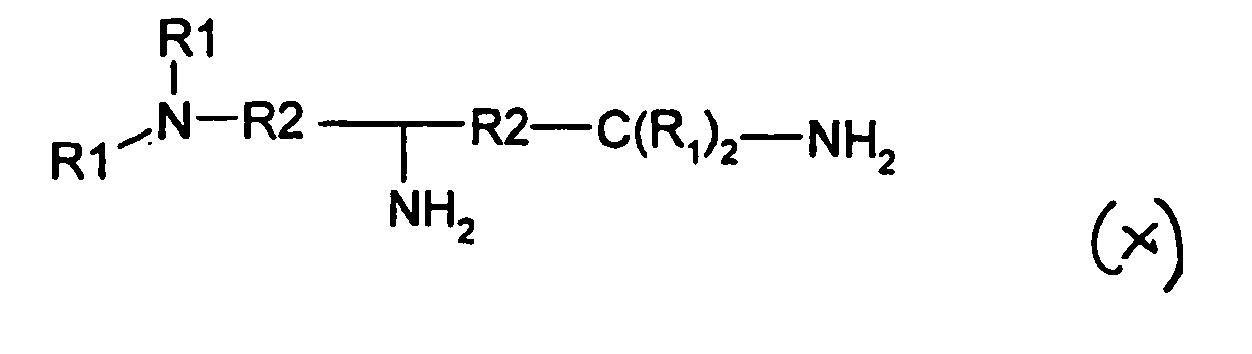


R2 einen aliphatischen, cycloaliphatischen oder aromatischen Rest mit 1 bis 10 Kohlenstoffatomen , und
R3, einen linearen, verzweigten oder cyclischen, gegebenenfalls mit einem Heteroatom substituierten Rest mit 1 bis 5 Kohlenstoffatomen bedeutet,
eingesetzt werden.
Bei den Heteroatomen handelt es sich vorzugsweise um Halogenatome, insbesondere um Chlor.
Claims (13)
- Verfahren zur Herstellung von viskoelastischen Polyurethanschäumen durch Umsetzung vona) mindestens einem Polyisocyanat mitb) mindestens einer Verbindung mit mindestens zwei mit Isocyanatgruppen reaktiven Wasserstoffatomen in Anwesenheit vonc) Katalysatoren undd) Treibmitteln, dadurch gekennzeichnet, dasseingesetzt werden.
als a) Polyisocyanate ai) Diphenylmethandiisocyanat oder aii) Mischungen aus Diphenylmethandiisocyanat und Polymethylenpolyphenylenpolyisocyanaten, und/oder aiii) Isocyanatgruppen enthaltende Prepolymere, herstellbar durch Umsetzung von aiv) Polyetheralkoholen mit Diphenylmethandiisocyanat oder Mischungen aus Diphenylmethandiisocyanat und Polymethylenpolyphenylenpoly-isocyanaten und als Katalysatoren c) eine Mischung aus mindestens je einem Katalysator ci) und cii), wobei ci) ausgewählt aus der Gruppe, enthaltend Verbindungen der allgemeinen Formeln (I) bis (VII), mit


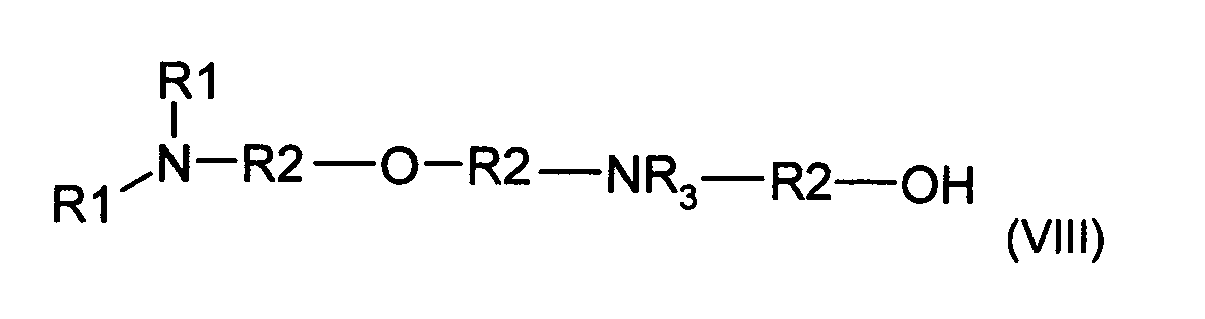


R2 einen aliphatischen, cycloaliphatischen oder aromatischen Rest mit 1 bis 10 Kohlenstoffatomen , und
R3, einen linearen, verzweigten oder cyclischen, gegebenenfalls mit einem Heteroatom substituierten Rest mit 1 bis 5 Kohlenstoffatomen bedeutet, - Verfahren nach Anspruch 1, dadurch gekennzeichnet, dass die Isocyanatgruppen enthaltenden Prepolymere aiii) einen NCO-Gehalt im Bereich von 23 bis 32 Gew.-% aufweisen.
- Verfahren nach Anspruch 1, dadurch gekennzeichnet, dass die Katalysatoren c) in einer Menge von 0,02 - 5 Gew.-%, bezogen auf das Gewicht aller Einsatzkomponenten des Verfahrens, eingesetzt werden.
- Verfahren nach Anspruch 1, dadurch gekennzeichnet, dass die Isocyanatgruppen enthaltenden Prepolymere aiii) einen Gehalt an 4,4'-Diphenylmethandiisocyanat von 35 - 70 Gew.-%, bezogen auf das Gewicht des Prepolymeren, aufweisen.
- Verfahren nach Anspruch 1, dadurch gekennzeichnet, dass die Isocyanatgruppen enthaltenden Prepolymere aiii) einen Gehalt an 2,4'-Diphenylmethandiisocyanat von 10 bis 20 Gew.-%, bezogen auf das Gewicht des Prepolymeren, aufweisen.
- Verfahren nach Anspruch 1, dadurch gekennzeichnet, dass die Isocyanatgruppen enthaltenden Prepolymere aiii) einen Gehalt an 2-Kern-Diphenylmethandiisocyanat von 40 bis 85 Gew.-% und einen Gehalt an 3-Kern bzw. höherkernigem Diphenylmethandiisocyanat von 5 bis 30 Gew.-%, jeweils bezogen auf das Gewicht des Prepolymeren, aufweisen.
- Verfahren nach Anspruch 1, dadurch gekennzeichnet, dass die Komponente b) mindestens bii) ein Anlagerungsprodukt von Alkylenoxid an eine Verbindung mit mindestens einer Aminogruppe im Molekül enthält.
- Verfahren nach Anspruch 1, dadurch gekennzeichnet, dass die Komponente bii) eine Hydroxylzahl im Bereich zwischen 160 und 500 mgKOH/g aufweist.
- Verfahren nach Anspruch 1, dadurch gekennzeichnet, dass die Komponente bii) in einer Menge von 0,01-10 Gew.-% bezogen auf das Gewicht der Komponente b) eingesetzt wird.
- Verfahren nach Anspruch 1, dadurch gekennzeichnet, dass die Komponente bii) mindestens ein Anlagerungsprodukt von Alkylenoxid an Dimethylaminopropylamin ist.
- Verfahren nach Anspruch 1, dadurch gekennzeichnet, dass die Komponente bi) mindestens einen Polyetheralkohol bi) enthält, der durch Anlagerung von Alkylenoxid an einen zwei- und/oder dreifunktionellen Alkohol hergestellt wurde und eine Hydroxylzahl im Bereich zwischen 20 und 450 mgKOH/g aufweist.
- Verfahren nach Anspruch 1, dadurch gekennzeichnet, dass die Polyetheralkohole aiv) und bi) in ihrer Polyetherkette einen Endblock aus dem gleichen Alkylenoxid aufweisen.
- Verfahren nach Anspruch 1, dadurch gekennzeichnet, dass die Hydroxylzahl des Polyetheralkohols aiv) 5 bis 12 mgKOH/g über oder unter der Hydroxylzahl des Polyetheralkohols bi) liegt.
Applications Claiming Priority (2)
| Application Number | Priority Date | Filing Date | Title |
|---|---|---|---|
| DE102005024144A DE102005024144A1 (de) | 2005-05-23 | 2005-05-23 | Verfahren zur Herstellung von viskoelastischen Polyurethan-Weichschaumstoffen |
| PCT/EP2006/062383 WO2006125740A2 (de) | 2005-05-23 | 2006-05-17 | Verfahren zur herstellung von viskoelastischen polyurethan-weichschaumstoffen |
Publications (2)
| Publication Number | Publication Date |
|---|---|
| EP1888664A2 EP1888664A2 (de) | 2008-02-20 |
| EP1888664B1 true EP1888664B1 (de) | 2010-02-24 |
Family
ID=36928176
Family Applications (1)
| Application Number | Title | Priority Date | Filing Date |
|---|---|---|---|
| EP06763166A Revoked EP1888664B1 (de) | 2005-05-23 | 2006-05-17 | Verfahren zur herstellung von viskoelastischen polyurethan-weichschaumstoffen |
Country Status (7)
| Country | Link |
|---|---|
| US (1) | US20080194718A1 (de) |
| EP (1) | EP1888664B1 (de) |
| AT (1) | ATE458766T1 (de) |
| CA (1) | CA2609308A1 (de) |
| DE (2) | DE102005024144A1 (de) |
| ES (1) | ES2340316T3 (de) |
| WO (1) | WO2006125740A2 (de) |
Cited By (1)
| Publication number | Priority date | Publication date | Assignee | Title |
|---|---|---|---|---|
| US10266635B2 (en) | 2012-07-27 | 2019-04-23 | Basf Se | Polyurethane foams comprising phosphorus compounds |
Families Citing this family (38)
| Publication number | Priority date | Publication date | Assignee | Title |
|---|---|---|---|---|
| DE102007046860A1 (de) * | 2007-09-28 | 2009-04-09 | Evonik Goldschmidt Gmbh | Aminkatalysatoren geeignet zur Herstellung emissionsarmer, rekatalysestabiler Polyurethanweichschaumstoffe |
| EP2050865B1 (de) * | 2007-10-15 | 2014-11-26 | Bayer Intellectual Property GmbH | Bodenbedeckung mit viskoelastischen Dämpfungseigenschaften |
| PL2295438T5 (pl) | 2008-05-30 | 2025-07-07 | Tosoh Corporation | Sposób wytwarzania kompozycji zawierającej hydroksyalkilotrietylenodiaminę i kompozycja katalizatora do wytwarzania żywicy poliuretanowej z zastosowaniem kompozycji hydroksyalkilotrietylenodiaminy |
| CN102414234A (zh) * | 2009-03-05 | 2012-04-11 | 陶氏环球技术有限责任公司 | 源自hppo的多元醇以及由该多元醇制备的聚氨酯产品 |
| GB2482176A (en) | 2010-07-23 | 2012-01-25 | Christopher Wickham Noakes | Production of polyols for use in low ball rebound polyurethane foams |
| WO2012086807A1 (ja) | 2010-12-22 | 2012-06-28 | 東ソー株式会社 | 新規な環状アミン化合物及びそれを用いたポリウレタン樹脂の製造方法 |
| EP2690118A1 (de) * | 2012-07-27 | 2014-01-29 | Basf Se | Polyurethane enthaltend Phosphorverbindungen |
| EP2799459A1 (de) | 2013-05-03 | 2014-11-05 | Basf Se | Polyurethane enthaltend Halogenverbindungen |
| MY176404A (en) | 2012-09-13 | 2020-08-06 | Basf Se | Polyurethanes containing halogen compounds |
| EP2708577A1 (de) | 2012-09-13 | 2014-03-19 | Basf Se | Polyurethane enthaltend halogenverbindungen |
| WO2015050876A1 (en) * | 2013-10-01 | 2015-04-09 | Huntsman Petrochemical Llc | Reduction of aldehydes in amine catalysts |
| MX390818B (es) | 2013-12-02 | 2025-03-20 | Basf Se | Poliuretanos que tienen emision de aldehido reducida. |
| JP6698526B2 (ja) | 2013-12-02 | 2020-05-27 | ビーエーエスエフ ソシエタス・ヨーロピアBasf Se | 低減されたアルデヒドの排出を有するポリウレタン |
| CN106459367B (zh) | 2014-06-13 | 2019-12-06 | 巴斯夫欧洲公司 | 具有降低的醛排放的聚氨酯 |
| WO2016166008A1 (de) | 2015-04-17 | 2016-10-20 | Basf Se | Polyurethane mit reduzierter aldehydemission |
| BR112017025021A2 (pt) | 2015-05-28 | 2018-08-07 | Basf Se | ?processo para a produção de poliuretanos, poliuretano e uso de um poliuretano? |
| EP3464404B1 (de) | 2016-06-03 | 2020-10-07 | Basf Se | Polyurethane mit reduzierter aldehydemission |
| CA3064515A1 (en) | 2017-06-27 | 2019-01-03 | Basf Se | Flexible polyurethane foams having improved air permeability |
| EP3746494B1 (de) | 2018-02-02 | 2024-05-29 | Basf Se | Polyurethane mit geringen emissionen organischer verbindungen |
| EP3827039B1 (de) | 2018-07-25 | 2025-05-21 | Basf Se | Silikonfreie schaumstabilisatoren für die herstellung von polyurethanschaumstoffen |
| WO2020084003A1 (de) | 2018-10-24 | 2020-04-30 | Basf Se | Polyurethanschaumstoffe mit vermindertem gehalt an aromatischen aminen |
| WO2020126586A1 (de) | 2018-12-19 | 2020-06-25 | Basf Se | Polyurethan-weichschäume mit verbesserten dauergebrauchseigenschaften |
| PL4175991T3 (pl) | 2020-07-01 | 2024-11-25 | Basf Se | Pianki poliuretanowe o ulepszonych właściwościach akustycznych |
| JP7814388B2 (ja) | 2020-11-25 | 2026-02-16 | ビーエーエスエフ ソシエタス・ヨーロピア | アルデヒド放出量を低減させたポリウレタン |
| EP4267642B1 (de) | 2020-12-23 | 2026-06-24 | Basf Se | Neuer katalysator zur herstellung von polyurethanen |
| KR20230136212A (ko) | 2021-02-03 | 2023-09-26 | 바스프 에스이 | 탈취성 폴리우레탄 포옴을 제조하기 위한 2-성분 시스템 |
| EP4288472A1 (de) | 2021-02-03 | 2023-12-13 | Basf Se | Polyurethanschaumstoffe zur korrosionsverminderung von polymeren materialien |
| EP4355803A1 (de) | 2021-06-14 | 2024-04-24 | Basf Se | Polyamine als aldehydfänger |
| WO2023194225A1 (en) | 2022-04-06 | 2023-10-12 | Basf Se | Polyurethane composition for vapor barrier in the building with low indoor temperature |
| CN120019527A (zh) | 2022-09-09 | 2025-05-16 | 巴斯夫欧洲公司 | 具有改善的金属粘附性的电池灌封材料 |
| JP2025530497A (ja) | 2022-09-22 | 2025-09-11 | ビーエーエスエフ ソシエタス・ヨーロピア | 電池物品の製造方法およびそれから製造される電池物品 |
| WO2024104923A1 (en) | 2022-11-16 | 2024-05-23 | Basf Se | Manganese- and iron-containing catalysts comprising an imine ligand for the synthesis of polyurethanes |
| WO2024115432A1 (en) | 2022-12-02 | 2024-06-06 | Basf Se | Water blown environmentally friendly high yield spray polyurethane foam |
| EP4727988A1 (de) | 2023-06-14 | 2026-04-22 | Basf Se | Wärmeleitfähige zweikomponentenklebstoffe |
| CN121605137A (zh) | 2023-07-28 | 2026-03-03 | 巴斯夫欧洲公司 | 具有良好机械性能和高尺寸稳定性的水发泡低密度喷涂泡沫 |
| WO2025132340A1 (en) | 2023-12-22 | 2025-06-26 | Basf Se | Battery housing with heat insulation properties |
| WO2025162109A1 (en) | 2024-01-29 | 2025-08-07 | Basf Se | A stabilized isocyanate composition and two-component system for preparing polyurethane |
| WO2026132254A1 (en) | 2024-12-19 | 2026-06-25 | Basf Se | Polyurethane composition comprising polycarboxylate ether |
Family Cites Families (10)
| Publication number | Priority date | Publication date | Assignee | Title |
|---|---|---|---|---|
| US6232356B1 (en) * | 1997-05-05 | 2001-05-15 | Air Products And Chemicals, Inc. | Reactive catalyst compositions for improving water blown polyurethane foam performance |
| US5859079A (en) * | 1997-05-21 | 1999-01-12 | Air Products And Chemicals, Inc. | Polyurethane catalyst compositions for improving foam performance |
| DE19924804C5 (de) * | 1999-05-29 | 2009-02-12 | Basf Se | Verfahren zur Herstellung von schallabsorbierenden Polyurethanschäumen mit adhäsiver Oberfläche |
| DE19930098A1 (de) * | 1999-07-01 | 2001-01-11 | Performance Chemicals Handels | Emissionsarme Polyurethan-Schaumstoffe |
| EP1097953A3 (de) * | 1999-11-03 | 2001-11-14 | Otto Bock Schaumstoffwerke GmbH & Co. KG | Verfahren zur Herstellung von Polyurethanschaumstoffen |
| US6423756B1 (en) * | 2000-11-10 | 2002-07-23 | Crompton Corporation | Process to improve polyurethane foam performance |
| BR0208765A (pt) * | 2001-04-01 | 2005-01-04 | Dow Global Technologies Inc | Espuma de poliuretano rìgidas |
| DE10156014A1 (de) * | 2001-11-15 | 2003-06-05 | Basf Ag | Verfahren zur Herstellung von Polyetheralkoholen |
| US6653363B1 (en) * | 2002-12-04 | 2003-11-25 | Foamex, L.P. | Low energy-loss, high firmness, temperature sensitive polyurethane foams |
| US6858654B1 (en) * | 2003-10-27 | 2005-02-22 | Air Products And Chemicals, Inc. | Catalyst blends for producing low thermal desorption polyurethane foams |
-
2005
- 2005-05-23 DE DE102005024144A patent/DE102005024144A1/de not_active Withdrawn
-
2006
- 2006-05-17 US US11/915,163 patent/US20080194718A1/en not_active Abandoned
- 2006-05-17 AT AT06763166T patent/ATE458766T1/de active
- 2006-05-17 EP EP06763166A patent/EP1888664B1/de not_active Revoked
- 2006-05-17 DE DE502006006255T patent/DE502006006255D1/de not_active Expired - Lifetime
- 2006-05-17 WO PCT/EP2006/062383 patent/WO2006125740A2/de not_active Ceased
- 2006-05-17 CA CA002609308A patent/CA2609308A1/en not_active Abandoned
- 2006-05-17 ES ES06763166T patent/ES2340316T3/es not_active Expired - Lifetime
Cited By (1)
| Publication number | Priority date | Publication date | Assignee | Title |
|---|---|---|---|---|
| US10266635B2 (en) | 2012-07-27 | 2019-04-23 | Basf Se | Polyurethane foams comprising phosphorus compounds |
Also Published As
| Publication number | Publication date |
|---|---|
| WO2006125740A2 (de) | 2006-11-30 |
| ATE458766T1 (de) | 2010-03-15 |
| DE502006006255D1 (de) | 2010-04-08 |
| US20080194718A1 (en) | 2008-08-14 |
| EP1888664A2 (de) | 2008-02-20 |
| CA2609308A1 (en) | 2006-11-30 |
| ES2340316T3 (es) | 2010-06-01 |
| WO2006125740A3 (de) | 2007-02-15 |
| DE102005024144A1 (de) | 2006-11-30 |
Similar Documents
| Publication | Publication Date | Title |
|---|---|---|
| EP1888664A2 (de) | Verfahren zur herstellung von viskoelastischen polyurethan-weichschaumstoffen | |
| EP1981926B1 (de) | Verfahren zur herstellung von offenzelligen viskoelastischen polyurethan-weichschaumstoffen | |
| EP2225304B1 (de) | Viskoelastischer polyurethanschaumstoff | |
| EP2551287B1 (de) | Additivzusammensetzung, einsetzbar zur Steuerung der Schaumeigenschaften bei der Herstellung von Polyurethanweichschäumen, die Polyole auf Basis nachwachsender Rohstoffe enthalten | |
| DE102007046860A1 (de) | Aminkatalysatoren geeignet zur Herstellung emissionsarmer, rekatalysestabiler Polyurethanweichschaumstoffe | |
| EP3067343B1 (de) | Antioxidantien zur Herstellung emissionsarmer PUR-Systeme | |
| EP1266918B1 (de) | Verfahren zur Herstellung von hochelastischen Polyurethanschaumstoffen | |
| DE4437878A1 (de) | Verfahren zur Herstellung von fogging-armen Polyurethan-Schaumstoffen und hierfür verwendbare spezielle Polyoxyalkylen-polyole | |
| DE69611623T3 (de) | Polyurethanelastomere | |
| DE3819940A1 (de) | Verfahren zur herstellung von polyurethan-weichblockschaumstoffen | |
| WO2007144272A1 (de) | Offenzellige viskoelastische polyurethan-weichschaumstoffe | |
| EP3870624B1 (de) | Polyurethanschaumstoffe mit vermindertem gehalt an aromatischen aminen | |
| EP2872542A1 (de) | Verfahren zur herstellung emissionsarmer polyurethanweichschaumstoffe | |
| DE4318120C2 (de) | Verfahren zur Herstellung von offenzelligen Polyurethan-Weichschaumstoffen | |
| EP0908478A1 (de) | Verfahren zur Herstellung von Polyurethan-Weichschaumstoffen | |
| EP3512896B1 (de) | Verfahren zur erniedrigung der aldehydemissionen von polyurethanschaumstoffen | |
| DE3613973A1 (de) | Verfahren zur herstellung von polyharnstoffschaum-formteilen | |
| EP1127913B1 (de) | Verfahren zur Herstellung von Polyurethan-Schaumstoffen | |
| EP1630185B1 (de) | Verfahren zur Herstellung von Polyurethan-Weichschaumstoffen | |
| DE3844049A1 (de) | Verfahren zur herstellung von flammwidrigen, elastischen polyurethan-weichschaumstoffen und niedrigviskose melamin-polyether-polyoldispersionen hierfuer | |
| EP3820922B1 (de) | Verfahren zur herstellung von viskoelastischen polyurethanschaumstoffen | |
| EP1048677A1 (de) | Mischungen zur Herstellung von Polyisocyanat-Polyadditionsprodukten | |
| DE60016689T2 (de) | Verfahren zur Herstellung von Polyurethan-Weichschaumstoffen mit niedriger Dichte | |
| EP4563612A1 (de) | Polyurethanschaumstoff mit verminderter emission |
Legal Events
| Date | Code | Title | Description |
|---|---|---|---|
| PUAI | Public reference made under article 153(3) epc to a published international application that has entered the european phase |
Free format text: ORIGINAL CODE: 0009012 |
|
| 17P | Request for examination filed |
Effective date: 20071227 |
|
| AK | Designated contracting states |
Kind code of ref document: A2 Designated state(s): AT BE BG CH CY CZ DE DK EE ES FI FR GB GR HU IE IS IT LI LT LU LV MC NL PL PT RO SE SI SK TR |
|
| RAP1 | Party data changed (applicant data changed or rights of an application transferred) |
Owner name: BASF SE |
|
| DAX | Request for extension of the european patent (deleted) | ||
| 17Q | First examination report despatched |
Effective date: 20080808 |
|
| GRAP | Despatch of communication of intention to grant a patent |
Free format text: ORIGINAL CODE: EPIDOSNIGR1 |
|
| GRAS | Grant fee paid |
Free format text: ORIGINAL CODE: EPIDOSNIGR3 |
|
| GRAA | (expected) grant |
Free format text: ORIGINAL CODE: 0009210 |
|
| AK | Designated contracting states |
Kind code of ref document: B1 Designated state(s): AT BE BG CH CY CZ DE DK EE ES FI FR GB GR HU IE IS IT LI LT LU LV MC NL PL PT RO SE SI SK TR |
|
| REG | Reference to a national code |
Ref country code: GB Ref legal event code: FG4D Free format text: NOT ENGLISH |
|
| REG | Reference to a national code |
Ref country code: CH Ref legal event code: EP |
|
| REG | Reference to a national code |
Ref country code: IE Ref legal event code: FG4D Free format text: LANGUAGE OF EP DOCUMENT: GERMAN |
|
| REF | Corresponds to: |
Ref document number: 502006006255 Country of ref document: DE Date of ref document: 20100408 Kind code of ref document: P |
|
| REG | Reference to a national code |
Ref country code: ES Ref legal event code: FG2A Ref document number: 2340316 Country of ref document: ES Kind code of ref document: T3 |
|
| REG | Reference to a national code |
Ref country code: NL Ref legal event code: VDEP Effective date: 20100224 |
|
| LTIE | Lt: invalidation of european patent or patent extension |
Effective date: 20100224 |
|
| PG25 | Lapsed in a contracting state [announced via postgrant information from national office to epo] |
Ref country code: LT Free format text: LAPSE BECAUSE OF FAILURE TO SUBMIT A TRANSLATION OF THE DESCRIPTION OR TO PAY THE FEE WITHIN THE PRESCRIBED TIME-LIMIT Effective date: 20100224 Ref country code: IS Free format text: LAPSE BECAUSE OF FAILURE TO SUBMIT A TRANSLATION OF THE DESCRIPTION OR TO PAY THE FEE WITHIN THE PRESCRIBED TIME-LIMIT Effective date: 20100624 Ref country code: PT Free format text: LAPSE BECAUSE OF FAILURE TO SUBMIT A TRANSLATION OF THE DESCRIPTION OR TO PAY THE FEE WITHIN THE PRESCRIBED TIME-LIMIT Effective date: 20100625 |
|
| PG25 | Lapsed in a contracting state [announced via postgrant information from national office to epo] |
Ref country code: LV Free format text: LAPSE BECAUSE OF FAILURE TO SUBMIT A TRANSLATION OF THE DESCRIPTION OR TO PAY THE FEE WITHIN THE PRESCRIBED TIME-LIMIT Effective date: 20100224 Ref country code: SI Free format text: LAPSE BECAUSE OF FAILURE TO SUBMIT A TRANSLATION OF THE DESCRIPTION OR TO PAY THE FEE WITHIN THE PRESCRIBED TIME-LIMIT Effective date: 20100224 Ref country code: FI Free format text: LAPSE BECAUSE OF FAILURE TO SUBMIT A TRANSLATION OF THE DESCRIPTION OR TO PAY THE FEE WITHIN THE PRESCRIBED TIME-LIMIT Effective date: 20100224 Ref country code: PL Free format text: LAPSE BECAUSE OF FAILURE TO SUBMIT A TRANSLATION OF THE DESCRIPTION OR TO PAY THE FEE WITHIN THE PRESCRIBED TIME-LIMIT Effective date: 20100224 |
|
| REG | Reference to a national code |
Ref country code: IE Ref legal event code: FD4D |
|
| PG25 | Lapsed in a contracting state [announced via postgrant information from national office to epo] |
Ref country code: IE Free format text: LAPSE BECAUSE OF FAILURE TO SUBMIT A TRANSLATION OF THE DESCRIPTION OR TO PAY THE FEE WITHIN THE PRESCRIBED TIME-LIMIT Effective date: 20100224 Ref country code: NL Free format text: LAPSE BECAUSE OF FAILURE TO SUBMIT A TRANSLATION OF THE DESCRIPTION OR TO PAY THE FEE WITHIN THE PRESCRIBED TIME-LIMIT Effective date: 20100224 Ref country code: RO Free format text: LAPSE BECAUSE OF FAILURE TO SUBMIT A TRANSLATION OF THE DESCRIPTION OR TO PAY THE FEE WITHIN THE PRESCRIBED TIME-LIMIT Effective date: 20100224 Ref country code: EE Free format text: LAPSE BECAUSE OF FAILURE TO SUBMIT A TRANSLATION OF THE DESCRIPTION OR TO PAY THE FEE WITHIN THE PRESCRIBED TIME-LIMIT Effective date: 20100224 Ref country code: GR Free format text: LAPSE BECAUSE OF FAILURE TO SUBMIT A TRANSLATION OF THE DESCRIPTION OR TO PAY THE FEE WITHIN THE PRESCRIBED TIME-LIMIT Effective date: 20100525 Ref country code: CY Free format text: LAPSE BECAUSE OF FAILURE TO SUBMIT A TRANSLATION OF THE DESCRIPTION OR TO PAY THE FEE WITHIN THE PRESCRIBED TIME-LIMIT Effective date: 20100224 Ref country code: SE Free format text: LAPSE BECAUSE OF FAILURE TO SUBMIT A TRANSLATION OF THE DESCRIPTION OR TO PAY THE FEE WITHIN THE PRESCRIBED TIME-LIMIT Effective date: 20100224 |
|
| PLBI | Opposition filed |
Free format text: ORIGINAL CODE: 0009260 |
|
| PLBI | Opposition filed |
Free format text: ORIGINAL CODE: 0009260 |
|
| BERE | Be: lapsed |
Owner name: BASF SE Effective date: 20100531 |
|
| PG25 | Lapsed in a contracting state [announced via postgrant information from national office to epo] |
Ref country code: BG Free format text: LAPSE BECAUSE OF FAILURE TO SUBMIT A TRANSLATION OF THE DESCRIPTION OR TO PAY THE FEE WITHIN THE PRESCRIBED TIME-LIMIT Effective date: 20100524 Ref country code: SK Free format text: LAPSE BECAUSE OF FAILURE TO SUBMIT A TRANSLATION OF THE DESCRIPTION OR TO PAY THE FEE WITHIN THE PRESCRIBED TIME-LIMIT Effective date: 20100224 Ref country code: CZ Free format text: LAPSE BECAUSE OF FAILURE TO SUBMIT A TRANSLATION OF THE DESCRIPTION OR TO PAY THE FEE WITHIN THE PRESCRIBED TIME-LIMIT Effective date: 20100224 |
|
| 26 | Opposition filed |
Opponent name: HUNTSMAN INTERNATIONAL LLC Effective date: 20101022 |
|
| PLBI | Opposition filed |
Free format text: ORIGINAL CODE: 0009260 |
|
| PLAX | Notice of opposition and request to file observation + time limit sent |
Free format text: ORIGINAL CODE: EPIDOSNOBS2 |
|
| 26 | Opposition filed |
Opponent name: HUNTSMAN INTERNATIONAL LLC Effective date: 20101022 Opponent name: AIR PRODUCTS AND CHEMICALS, INC. Effective date: 20101122 |
|
| PG25 | Lapsed in a contracting state [announced via postgrant information from national office to epo] |
Ref country code: MC Free format text: LAPSE BECAUSE OF NON-PAYMENT OF DUE FEES Effective date: 20100531 |
|
| REG | Reference to a national code |
Ref country code: CH Ref legal event code: PL |
|
| 26 | Opposition filed |
Opponent name: AIR PRODUCTS AND CHEMICALS, INC. Effective date: 20101122 Opponent name: HUNTSMAN INTERNATIONAL LLC Effective date: 20101022 Opponent name: BAYER MATERIALSCIENCE AG Effective date: 20101124 |
|
| PG25 | Lapsed in a contracting state [announced via postgrant information from national office to epo] |
Ref country code: DK Free format text: LAPSE BECAUSE OF FAILURE TO SUBMIT A TRANSLATION OF THE DESCRIPTION OR TO PAY THE FEE WITHIN THE PRESCRIBED TIME-LIMIT Effective date: 20100224 |
|
| PG25 | Lapsed in a contracting state [announced via postgrant information from national office to epo] |
Ref country code: LI Free format text: LAPSE BECAUSE OF NON-PAYMENT OF DUE FEES Effective date: 20100531 Ref country code: CH Free format text: LAPSE BECAUSE OF NON-PAYMENT OF DUE FEES Effective date: 20100531 |
|
| PG25 | Lapsed in a contracting state [announced via postgrant information from national office to epo] |
Ref country code: IT Free format text: LAPSE BECAUSE OF FAILURE TO SUBMIT A TRANSLATION OF THE DESCRIPTION OR TO PAY THE FEE WITHIN THE PRESCRIBED TIME-LIMIT Effective date: 20100224 Ref country code: BE Free format text: LAPSE BECAUSE OF NON-PAYMENT OF DUE FEES Effective date: 20100531 |
|
| PLAF | Information modified related to communication of a notice of opposition and request to file observations + time limit |
Free format text: ORIGINAL CODE: EPIDOSCOBS2 |
|
| PLAF | Information modified related to communication of a notice of opposition and request to file observations + time limit |
Free format text: ORIGINAL CODE: EPIDOSCOBS2 |
|
| PLBB | Reply of patent proprietor to notice(s) of opposition received |
Free format text: ORIGINAL CODE: EPIDOSNOBS3 |
|
| PLAB | Opposition data, opponent's data or that of the opponent's representative modified |
Free format text: ORIGINAL CODE: 0009299OPPO |
|
| R26 | Opposition filed (corrected) |
Opponent name: BAYER MATERIALSCIENCE AG Effective date: 20101124 Opponent name: AIR PRODUCTS AND CHEMICALS, INC. Effective date: 20101122 Opponent name: HUNTSMAN INTERNATIONAL LLC Effective date: 20101022 |
|
| REG | Reference to a national code |
Ref country code: DE Ref legal event code: R103 Ref document number: 502006006255 Country of ref document: DE Ref country code: DE Ref legal event code: R064 Ref document number: 502006006255 Country of ref document: DE |
|
| PGFP | Annual fee paid to national office [announced via postgrant information from national office to epo] |
Ref country code: GB Payment date: 20120531 Year of fee payment: 7 Ref country code: FR Payment date: 20120618 Year of fee payment: 7 |
|
| RDAF | Communication despatched that patent is revoked |
Free format text: ORIGINAL CODE: EPIDOSNREV1 |
|
| PG25 | Lapsed in a contracting state [announced via postgrant information from national office to epo] |
Ref country code: HU Free format text: LAPSE BECAUSE OF FAILURE TO SUBMIT A TRANSLATION OF THE DESCRIPTION OR TO PAY THE FEE WITHIN THE PRESCRIBED TIME-LIMIT Effective date: 20100825 Ref country code: LU Free format text: LAPSE BECAUSE OF NON-PAYMENT OF DUE FEES Effective date: 20100517 |
|
| PG25 | Lapsed in a contracting state [announced via postgrant information from national office to epo] |
Ref country code: TR Free format text: LAPSE BECAUSE OF FAILURE TO SUBMIT A TRANSLATION OF THE DESCRIPTION OR TO PAY THE FEE WITHIN THE PRESCRIBED TIME-LIMIT Effective date: 20100224 |
|
| PGFP | Annual fee paid to national office [announced via postgrant information from national office to epo] |
Ref country code: DE Payment date: 20120730 Year of fee payment: 7 Ref country code: ES Payment date: 20120629 Year of fee payment: 7 |
|
| RDAG | Patent revoked |
Free format text: ORIGINAL CODE: 0009271 |
|
| STAA | Information on the status of an ep patent application or granted ep patent |
Free format text: STATUS: PATENT REVOKED |
|
| PG25 | Lapsed in a contracting state [announced via postgrant information from national office to epo] |
Ref country code: AT Free format text: LAPSE BECAUSE OF NON-PAYMENT OF DUE FEES Effective date: 20110517 |
|
| 27W | Patent revoked |
Effective date: 20120725 |
|
| GBPR | Gb: patent revoked under art. 102 of the ep convention designating the uk as contracting state |
Effective date: 20120725 |
|
| REG | Reference to a national code |
Ref country code: DE Ref legal event code: R107 Ref document number: 502006006255 Country of ref document: DE Effective date: 20130411 |
|
| REG | Reference to a national code |
Ref country code: AT Ref legal event code: MA03 Ref document number: 458766 Country of ref document: AT Kind code of ref document: T Effective date: 20120725 |