EP1886747A1 - Process for producing aluminum composite material - Google Patents
Process for producing aluminum composite material Download PDFInfo
- Publication number
- EP1886747A1 EP1886747A1 EP06732189A EP06732189A EP1886747A1 EP 1886747 A1 EP1886747 A1 EP 1886747A1 EP 06732189 A EP06732189 A EP 06732189A EP 06732189 A EP06732189 A EP 06732189A EP 1886747 A1 EP1886747 A1 EP 1886747A1
- Authority
- EP
- European Patent Office
- Prior art keywords
- preform
- aluminum
- pressurizing
- less
- stage
- Prior art date
- Legal status (The legal status is an assumption and is not a legal conclusion. Google has not performed a legal analysis and makes no representation as to the accuracy of the status listed.)
- Withdrawn
Links
- 229910052782 aluminium Inorganic materials 0.000 title claims abstract description 85
- XAGFODPZIPBFFR-UHFFFAOYSA-N aluminium Chemical compound [Al] XAGFODPZIPBFFR-UHFFFAOYSA-N 0.000 title claims abstract description 85
- 239000002131 composite material Substances 0.000 title claims abstract description 56
- 238000000034 method Methods 0.000 title claims abstract description 54
- XEEYBQQBJWHFJM-UHFFFAOYSA-N Iron Chemical compound [Fe] XEEYBQQBJWHFJM-UHFFFAOYSA-N 0.000 claims abstract description 169
- 229910052742 iron Inorganic materials 0.000 claims abstract description 68
- 229910000838 Al alloy Inorganic materials 0.000 claims abstract description 51
- 239000000463 material Substances 0.000 claims abstract description 49
- 238000005266 casting Methods 0.000 claims abstract description 45
- 239000007789 gas Substances 0.000 claims abstract description 45
- 239000012298 atmosphere Substances 0.000 claims abstract description 44
- 239000011261 inert gas Substances 0.000 claims abstract description 30
- 238000000465 moulding Methods 0.000 claims abstract description 26
- 238000005245 sintering Methods 0.000 claims abstract description 23
- 239000002245 particle Substances 0.000 claims description 10
- 229910052751 metal Inorganic materials 0.000 description 17
- 239000002184 metal Substances 0.000 description 17
- 238000010586 diagram Methods 0.000 description 14
- 238000010438 heat treatment Methods 0.000 description 14
- 238000004519 manufacturing process Methods 0.000 description 7
- OKTJSMMVPCPJKN-UHFFFAOYSA-N Carbon Chemical compound [C] OKTJSMMVPCPJKN-UHFFFAOYSA-N 0.000 description 5
- 238000001816 cooling Methods 0.000 description 5
- 239000002994 raw material Substances 0.000 description 5
- 229910052802 copper Inorganic materials 0.000 description 4
- 239000010949 copper Substances 0.000 description 4
- 238000005470 impregnation Methods 0.000 description 4
- 239000011148 porous material Substances 0.000 description 4
- 239000000843 powder Substances 0.000 description 4
- 238000011282 treatment Methods 0.000 description 4
- RYGMFSIKBFXOCR-UHFFFAOYSA-N Copper Chemical compound [Cu] RYGMFSIKBFXOCR-UHFFFAOYSA-N 0.000 description 3
- 229910052799 carbon Inorganic materials 0.000 description 3
- 230000000694 effects Effects 0.000 description 3
- 239000007788 liquid Substances 0.000 description 3
- QGZKDVFQNNGYKY-UHFFFAOYSA-N Ammonia Chemical compound N QGZKDVFQNNGYKY-UHFFFAOYSA-N 0.000 description 2
- XKRFYHLGVUSROY-UHFFFAOYSA-N Argon Chemical compound [Ar] XKRFYHLGVUSROY-UHFFFAOYSA-N 0.000 description 2
- IJGRMHOSHXDMSA-UHFFFAOYSA-N Atomic nitrogen Chemical compound N#N IJGRMHOSHXDMSA-UHFFFAOYSA-N 0.000 description 2
- PXHVJJICTQNCMI-UHFFFAOYSA-N Nickel Chemical compound [Ni] PXHVJJICTQNCMI-UHFFFAOYSA-N 0.000 description 2
- 238000005255 carburizing Methods 0.000 description 2
- 229910052804 chromium Inorganic materials 0.000 description 2
- 239000011651 chromium Substances 0.000 description 2
- HGPXWXLYXNVULB-UHFFFAOYSA-M lithium stearate Chemical compound [Li+].CCCCCCCCCCCCCCCCCC([O-])=O HGPXWXLYXNVULB-UHFFFAOYSA-M 0.000 description 2
- 239000000314 lubricant Substances 0.000 description 2
- 238000003825 pressing Methods 0.000 description 2
- 239000007921 spray Substances 0.000 description 2
- 239000004215 Carbon black (E152) Substances 0.000 description 1
- UGFAIRIUMAVXCW-UHFFFAOYSA-N Carbon monoxide Chemical compound [O+]#[C-] UGFAIRIUMAVXCW-UHFFFAOYSA-N 0.000 description 1
- VYZAMTAEIAYCRO-UHFFFAOYSA-N Chromium Chemical compound [Cr] VYZAMTAEIAYCRO-UHFFFAOYSA-N 0.000 description 1
- 229910000677 High-carbon steel Inorganic materials 0.000 description 1
- ZOKXTWBITQBERF-UHFFFAOYSA-N Molybdenum Chemical compound [Mo] ZOKXTWBITQBERF-UHFFFAOYSA-N 0.000 description 1
- 239000000443 aerosol Substances 0.000 description 1
- 229910045601 alloy Inorganic materials 0.000 description 1
- 239000000956 alloy Substances 0.000 description 1
- 229910021529 ammonia Inorganic materials 0.000 description 1
- 238000000137 annealing Methods 0.000 description 1
- 229910052786 argon Inorganic materials 0.000 description 1
- 239000012300 argon atmosphere Substances 0.000 description 1
- 229910002091 carbon monoxide Inorganic materials 0.000 description 1
- 230000015556 catabolic process Effects 0.000 description 1
- 239000003795 chemical substances by application Substances 0.000 description 1
- 239000000470 constituent Substances 0.000 description 1
- 238000005520 cutting process Methods 0.000 description 1
- 238000006731 degradation reaction Methods 0.000 description 1
- 230000002708 enhancing effect Effects 0.000 description 1
- 150000002194 fatty esters Chemical class 0.000 description 1
- 229930195733 hydrocarbon Natural products 0.000 description 1
- 150000002430 hydrocarbons Chemical class 0.000 description 1
- 239000001257 hydrogen Substances 0.000 description 1
- 229910052739 hydrogen Inorganic materials 0.000 description 1
- 125000004435 hydrogen atom Chemical class [H]* 0.000 description 1
- 229910000765 intermetallic Inorganic materials 0.000 description 1
- UQSXHKLRYXJYBZ-UHFFFAOYSA-N iron oxide Inorganic materials [Fe]=O UQSXHKLRYXJYBZ-UHFFFAOYSA-N 0.000 description 1
- 235000013980 iron oxide Nutrition 0.000 description 1
- VBMVTYDPPZVILR-UHFFFAOYSA-N iron(2+);oxygen(2-) Chemical class [O-2].[Fe+2] VBMVTYDPPZVILR-UHFFFAOYSA-N 0.000 description 1
- 229910052749 magnesium Inorganic materials 0.000 description 1
- 229910052748 manganese Inorganic materials 0.000 description 1
- 239000011572 manganese Substances 0.000 description 1
- 238000002844 melting Methods 0.000 description 1
- 230000008018 melting Effects 0.000 description 1
- 238000003801 milling Methods 0.000 description 1
- 238000002156 mixing Methods 0.000 description 1
- 229910052750 molybdenum Inorganic materials 0.000 description 1
- 239000011733 molybdenum Substances 0.000 description 1
- 229910052759 nickel Inorganic materials 0.000 description 1
- 238000005121 nitriding Methods 0.000 description 1
- 229910052757 nitrogen Inorganic materials 0.000 description 1
- 230000003647 oxidation Effects 0.000 description 1
- 238000007254 oxidation reaction Methods 0.000 description 1
- -1 oxides Substances 0.000 description 1
- 230000002093 peripheral effect Effects 0.000 description 1
- 239000002244 precipitate Substances 0.000 description 1
- 230000001376 precipitating effect Effects 0.000 description 1
- 230000002265 prevention Effects 0.000 description 1
- 239000000047 product Substances 0.000 description 1
- 238000010791 quenching Methods 0.000 description 1
- 230000000171 quenching effect Effects 0.000 description 1
- 239000001044 red dye Substances 0.000 description 1
- 102220342298 rs777367316 Human genes 0.000 description 1
- 238000007873 sieving Methods 0.000 description 1
- 229910052710 silicon Inorganic materials 0.000 description 1
- 238000007711 solidification Methods 0.000 description 1
- 230000008023 solidification Effects 0.000 description 1
- 239000000126 substance Substances 0.000 description 1
- 238000005496 tempering Methods 0.000 description 1
- 229910052719 titanium Inorganic materials 0.000 description 1
- 239000010936 titanium Substances 0.000 description 1
- 238000005406 washing Methods 0.000 description 1
- 229910052725 zinc Inorganic materials 0.000 description 1
Images

Classifications
-
- B—PERFORMING OPERATIONS; TRANSPORTING
- B22—CASTING; POWDER METALLURGY
- B22D—CASTING OF METALS; CASTING OF OTHER SUBSTANCES BY THE SAME PROCESSES OR DEVICES
- B22D19/00—Casting in, on, or around objects which form part of the product
- B22D19/14—Casting in, on, or around objects which form part of the product the objects being filamentary or particulate in form
-
- C—CHEMISTRY; METALLURGY
- C22—METALLURGY; FERROUS OR NON-FERROUS ALLOYS; TREATMENT OF ALLOYS OR NON-FERROUS METALS
- C22C—ALLOYS
- C22C33/00—Making ferrous alloys
- C22C33/02—Making ferrous alloys by powder metallurgy
- C22C33/0242—Making ferrous alloys by powder metallurgy using the impregnating technique
-
- C—CHEMISTRY; METALLURGY
- C22—METALLURGY; FERROUS OR NON-FERROUS ALLOYS; TREATMENT OF ALLOYS OR NON-FERROUS METALS
- C22F—CHANGING THE PHYSICAL STRUCTURE OF NON-FERROUS METALS AND NON-FERROUS ALLOYS
- C22F1/00—Changing the physical structure of non-ferrous metals or alloys by heat treatment or by hot or cold working
- C22F1/04—Changing the physical structure of non-ferrous metals or alloys by heat treatment or by hot or cold working of aluminium or alloys based thereon
Definitions
- the present invention relates to a process for producing aluminum composite material in which an iron sintered body is cast-in inserted with aluminum.
- a process for producing composite material has been proposed variously, composite material in which a metal, such as aluminum, is made into a host material and a preform comprising a porous sintered material is composited therewith.
- a production process for producing such a composite material aprocessforproducingcomposite material by means of casting has been known, process in which a preform, being made of a porous sintered body, such as iron, for instance, and being molded in advance, is set within a die; and process in which a highly-pressurized metallic molten metal is fed into this die and is pressurized therein to infiltrate the metallic molten metal into the preform, thereby producing a composite material.
- a preform which is formed of an iron porous sintered body, is preheated at a predetermined temperature of 250 °C-350 °C in a preheating furnace, for instance.
- preheating preform since the closer the temperature of preheating preform is to the fusing temperature of host-material metal the more the infiltratability of host-material metal into preform improves, it has been desired to further make the preheating temperature higher temperature.
- a preform comprises an iron sintered body
- the preheating temperature is adapted to be the aforementioned predetermined temperature or less so as to avoid it.
- the adhesiveness between the materials is one of the important conditions that determines the characteristic of composite material.
- drawbacks such as pressure leakage, the occurrence or extension of cracks by means of the fact that pressures apply to mal-adhesiveness locations, when the adhesiveness between materials is poor.
- the present invention is one which has been done in view of such circumstances, and it is an object to provide a process for producing aluminum composite material in which an iron sintered body of much higher adhesion is cast-in inserted with aluminum.
- an aluminum composite material of good adhesiveness is obtainable by means of combining the following: adapting the occupational volumetric fraction of iron sintered body to be from 50% or more to 70% or less; enhancing the preheating temperature so that it is adapted to be from 300 °C or more to 400 °C or less by means of preheating iron sintered-bodypreform in vacuum, in an inert-gas atmosphere, in a reducing-gas atmosphere, or in a mixture-gas atmosphere of inert gas and reducing gas; adapting the casting-die temperature to be from 200 °C or more to 400 °C or less; and carrying out the method of pressurizing aluminum or aluminum-alloy molten metal in 2-stage pressurizing at a lower pressure and at a higher pressure, thereby arriving at completing the present invention.
- a process according to the present invention for producing aluminum composite material is characterized in that it has:
- Another process according to the present invention for producing aluminum composite material is characterized in that it has:
- An aluminum composite material which is produced by the present production process, is such that the adhesiveness at the boundary between aluminum or aluminum alloy and iron sintered body improves.
- said preheating temperature can be from 350 °C or more to 400 °C or less.
- said die temperature can be from 200 °C or more to 250 °C or less.
- preheating preform The closer the temperature of preheating preform is to the molten-metal temperature of aluminum or aluminum alloy the more the impregnation of iron sintered body with aluminum or aluminum alloy improves, and thereby the adhesiveness between the two materials improves.
- the upper limit of the preform preheating temperature can be 400 °C or less.
- the preheating temperature can be made closer to the molten-metal temperature of aluminum or aluminum alloy as much as possible, the failure adhesiveness between iron sintered body and aluminum or aluminum alloy arises because intermetallic compounds and oxides generate as it becomes a higher temperature.
- the die temperature of the casting die can be said preform heating temperature or less.
- the reason for this has not been clear yet, it is believed as follows: since the thermal-expansion coefficient of aluminum is greater than the thermal-expansion coefficient of iron, the impregnation of iron sintered material with aluminum or aluminum alloy becomes better by means of lowering the casting-die temperature than the preform preheating temperature.
- said 2-stage pressurizing method can be a first pressurizing stage in which the molten aluminum or aluminum alloy is pressurized at a lower pressure of from 20 MPa or more to 30 MPa or less for from 5 seconds or more to 15 seconds or less, and a second pressurizing stage which follows the first pressurizing method and in which the molten aluminum or aluminum alloy is pressurized at a higher pressure of from 70 MPa or more to 100 MPa or less for from 3 minutes or more to 5 minutes or less.
- the pores of iron sintered-body preform have been squashed by means of pressurizing it. Accordingly, the pores of iron sintered body are impregnated with the molten metal of aluminum or aluminum alloy firstly at a lower pressure without ever squashing the pores of preform, and then they are impregnated with the molten metal of aluminum or aluminum alloy thereafter at a required pressure.
- the adhesiveness at the boundary between the two materials improves because of physical anchor effect.
- the iron powder's occupational volumetric fraction can be from 55% or more to 65% or less.
- said iron powder can be such that the particle diameter can be from 45 ⁇ m or more to 200 ⁇ m or less.
- the particle diameter falls in said range, it is possible to secure desirable good cast-in inserting ability, and moreover it is possible to secure desirable strength.
- the process according to the present invention for producing aluminum composite material process in which an iron sintered body is cast-in inserted with aluminum can improve the adhesiveness at the boundary between aluminum or aluminum alloy and iron sintered body, because it has the aforementioned production steps. It can inhibit the drawbacks, such as pressure leakage, the occurrence of cracks, the extension of cracks and the degradation of conductivity, for instance, which have been occurring conventionally because of faulty adhesiveness at the boundary.
- Fig. 1 illustrates a preform molding step in an embodiment mode according to the present invention: wherein (a) is a schematic diagram of such a state that an iron powder, and the like, are filled into a molding die and are pressurized therein; and wherein (b) is a schematic diagram of such a state that a molded preform is sintered within a sintering furnace.
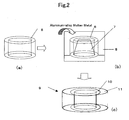
- Fig. 2 illustrates a composite-material forming step in an embodiment mode according to the present invention: wherein (a) is a schematic diagram of an iron sintered-body preform; wherein (b) is a schematic diagram of such a state that the iron sintered-body preform is placed in a casting die; and wherein (c) is a schematic diagram of an after-casting aluminum composite material.
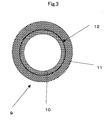
- Fig. 3 is a cross-sectional schematic diagram of an aluminum composite material in an example according the present invention, aluminum composite material which is subjected to cross-sectional processing.
- a process according to the present invention for producing aluminum composite material comprises: a preform molding step of molding a porous iron sintered-material preform; and a composite-material forming step of impregnating said preform with molten aluminum or aluminum alloy by pressurizing the molten aluminum or aluminum alloy, thereby carrying out casting.
- the preform molding step is a step, which is characterized in that an iron powder is molded so that an occupational volumetric fraction becomes from 50% or more to 70% or less; and in that the iron powder is sintered at a sintering temperature of from 1, 100 °C or more to 1,300 °C or less in vacuum, in an inert-gas atmosphere, in a reducing-gas atmosphere, or in a mixture-gas atmosphere of inert gas and reducing gas, thereby molding a porous iron sintered-material perform.
- the porous iron sintered-material preform's shape is such that, as far as it is an aimed shape, there is not any limitation on the shape especially.
- the iron' s occupational volumetric fraction can be from 50% or more to 70% or less.
- the occupational volumetric fraction is expressed as "VF" (the abbreviation of Volume Fraction), and is expressed in %.
- the "VF" canbe controlled by means of controlling the particle diameter and amount of the iron powder, and the pressure, upon molding the preform.
- the porous iron sintered-material preform's porosity fraction becomes 30% or more, and thereby the impregnation of iron sintered material with aluminum or aluminum alloy is good.
- the iron powder's "VF” can be from 55% or more to 65% or less.
- an aluminum composite material which is good in terms of the strength and adhesiveness, is obtainable.
- the iron powder is not limited especially as far as being a powder including iron.
- the iron powder's particle diameter can be from 45 ⁇ m or more to 200 ⁇ m or less. By means of using an iron powder whose particle diameter falls in this range, it is possible to secure desirable cast-in inserting ability, and it is possible to secure desirable strength.
- the sintering can be carried out by holding an employed raw material at a high temperature of the employed raw material' s fusing point or less in vacuum, in an inert-gas atmosphere, in a reducing-gas atmosphere, or in a mixture-gas atmosphere of inert gas and reducing gas.
- the sintering is carried out at a sintering temperature of from 1,100 °C or more to 1,200 °C or less for 45 minutes. It is desirable that an after-sintering cooling rate can be 30 °C -40 °C/min.
- porous iron sintered-material perform raw material, it does not matter to add a lubricant, and the like, in addition to an iron powder.
- the composite-material forming step is a step in which said preform, which is preheated at a preheating temperature of from 300 °C or more to 400 °C or less in vacuum, in an inert-gas atmosphere, in a reducing-gas atmosphere, or in a mixture-gas atmosphere of inert gas and reducing gas, is placed in a casting die whose die temperature is from 200 °C or more to 400 °C or less; and then the preform is impregnated with molten aluminum or aluminum alloy by pressurizing the molten aluminum or aluminum alloy by a 2-stage pressurizing method, thereby carrying out casting.
- the inert gas is such that nitrogen, argon, and the like, can be employed.
- reducing gas hydrogen, carbon monoxide, ammonia, and the like, can be employed.
- the preheating is such that it is allowable as well to put the preform in a heating furnace and then heat it, or it is allowable as well to carry out high-frequency heating. In order to inhibit the superficial oxidation of the perform, it is preferable to carry out the preheating in a short period of time.
- the casting die' s die temperature can be said preform preheating temperature or less.
- the preheating is such that it is allowable as well to place the casting die in a heating furnace and then carry out the preheating within the heating furnace, or it is allowable as well to carry out high-frequency heating.
- the aluminum alloy is not limited especially regarding its type.
- aluminum alloys, and the like which include Mg, Cu, Zn, Si, Mn, Fe, Cr or Ti, and so forth.
- the 2-stage pressurizing method comprises: a first pressurizing stage in which the molten aluminum or aluminum alloy is pressurized at a lower pressure; and a second pressurizing state which follows the first pressurizing stage and in which the molten aluminum or aluminum alloy is pressurized at a higher pressure than the pressure in the first pressurizing step.
- the pressurizing can be carried out using a head pressure.
- head pressure it is allowable that a pressure can be applied thereto to the same extent as die-cast molding (several dozens of MPa-several hundreds of MPa, for instance).
- the aluminum composite material after casting can also be air cooled as it is being kept in the casting die after releasing pressure, or can be taken out of the casting die and then be air cooled.
- the other process according to the present invention for producing aluminum composite material comprises a composite-material forming step of pressurizing a molten aluminum or aluminum alloy and then impregnating a porous iron sintered-material preform with the molten aluminum or aluminum alloy, thereby carrying out casting.
- FIG. 1 an explanatory diagram of a preform molding step is shown.
- (a) is a schematic diagram of such a state that an iron powder, and the like, are filled into a molding die and are pressurized therein.
- (b) is a schematic diagram of such a state that a molded preform is sintered within a sintering furnace.
- a die 1 as the molding die is formed as a cylinder shape, and is configured so that it is disintegrable into a plurality of molding-die constituent pieces.
- a high-carbon steel carbon concentration: 0.1%-0.6%), such as S25C, is employed, for instance.
- a raw material such as an iron powder
- the pressurizing is such that, depending on the iron powder' s particle diameter, amount, and the like, an appropriate pressure is used.
- the molded iron powders 4 are put in a sintering furnace 5, and the sintering is carried out in vacuum, in an inert-gas atmosphere, in a reducing-gas atmosphere, or in a mixture-gas atmosphere of inert gas and reducing gas.
- the sintering is carried out by means of holding them at such a high temperature as the melting point or less of the iron powder, and the like.
- the after-sintering preform sintered bodies are cooled by means of cooling the temperature of the sintering furnace.
- the shape of the iron sintered bodies is formed as a cylindrical shape; however, by means of employing the die 1 with a shape which is conformed to the shape of aimed composite material, the iron sintered bodies with a desirable shape are formable.
- FIG. 2 an explanatory diagram of a composite-material forming step is shown.
- (a) is a schematic diagram of an iron sintered-body preform
- (b) is a schematic diagram of such a state that the iron sintered-body preform is placed in a casting die
- (c) is a schematic diagram of an after-casting aluminum composite material.
- a porous iron sintered-body preform 6 is preheated at a preheating temperature of more than 300 °C in vacuum, in an inert-gas atmosphere, in a reducing-gas atmosphere, or in a mixture-gas atmosphere of inert gas and reducing gas.
- the preheating can be carried out either by putting it in a preheating furnace or by performing high-frequency heating. Moreover, it is allowable as well to carry out high-frequency heating in such a state that it is placed onto a casting die 7 for fixing preform.
- the preheated porous iron sintered-body preform 6 is placed onto the casting die 7 for fixing preform.
- the casting dies 7 and 8 are preheated to such a temperature that is lower than the temperature of preheating the preform 6.
- aluminumoraluminum-alloymolten metal is poured into the casting die 8 in which the preform 6 is placed.
- the 2-stage pressurizing is such that, after carrying it out at a lower pressure for several seconds, it is carried out at a higher pressure for several minutes.
- lithium stearate i.e., a lubricant, a carbon powder
- the mixing proportion was set as follows: when the entirety is taken as 100% by weight, 98.3%-by-weight iron powder; 0.7%-by-weight carbon powder; and 1%-by-weight lithium stearate.
- a preforming die made of iron was prepared. Said mixed raw material powder was put in the preforming die, and was pressurized so that the "VF" became 60% or 70%. In order to establish 60% “VF,” it was pressurized to an extent of about 150 MPa, thereby carrying out molding.
- the shape of preform was such that a cylindrical shape was used.
- the after-pressurizing iron powder was put in a sintering furnace, and was sintered at 1,150 °C for 45 minutes in the presence of an AX gas (N 2 -75 % H 2 ). After the sintering, the cooling of the sintering furnace was carried out at a cooling rate of 30-40 °C /min.
- the porous iron sintered-material preform which was cooled adjacent to room temperature, was put in a heating furnace, and was preheated in the presence of an argon atmosphere.
- the porous iron sintered-material preform which was preheated, was taken out of the heating furnace, and was placed within a casting die, which had been preheated in advance to 200 °C or 250 °C with the other heating furnace.
- the preheating temperature was adapted to being 300 °C or 400 °C.
- a 750-800 °C molten metal which comprised an aluminum alloy ADC12, was poured.
- the molten metal was poured to such an extent that it filled up the inside of the casting die substantially, and then a head pressure was applied to it.
- the head pressure was such that the following were carried out: one in which 80 MPa was applied to the molten metal for 4 minutes from the beginning (Pressurizing Method #1); and one in which 20 MPa was applied to the molten metal for 10 seconds and thereafter 100 MPa was applied to it for 4 minutes (Pressurizing Method #2) .
- the top end surface of the obtained aluminum composite materials according to Example Nos. 1 and 2 was subjected to milling, thereby subjecting them to cross-sectional processing.
- FIG. 3 a cross-sectional schematic diagram of an aluminum composite material is displayed, composite material which was subjected to cross-sectional processing.
- An aluminum composite material 9 in which an aluminum alloy 11 was cast-in inserted around a porous iron sintered-material preform 10, is shown therein.
- the boundary between the preform 10 and the aluminum alloy 11 is designated with a boundary 12.
- the solution penetrant test was one in which a red penetrant liquid including a fatty ester, a high-boiling-point hydrocarbon and a red dye was sprayed onto said cross section by a spray; it was washed with a washing liquid 5 minutes later; and thereafter an aerosol developing agent was coated thereon likewise using a spray, thereby observing the cross section visually.
- the red penetrant liquid got into spaces in the boundary between the porous iron sintered material and the aluminum alloy, and thereby the boundary could be observed visually.
Landscapes
- Chemical & Material Sciences (AREA)
- Engineering & Computer Science (AREA)
- Mechanical Engineering (AREA)
- Materials Engineering (AREA)
- Metallurgy (AREA)
- Organic Chemistry (AREA)
- Physics & Mathematics (AREA)
- Thermal Sciences (AREA)
- Crystallography & Structural Chemistry (AREA)
- Powder Metallurgy (AREA)
Abstract
Description
- The present invention relates to a process for producing aluminum composite material in which an iron sintered body is cast-in inserted with aluminum.
- A process for producing composite material has been proposed variously, composite material in which a metal, such as aluminum, is made into a host material and a preform comprising a porous sintered material is composited therewith. As for a production process for producing such a composite material, aprocessforproducingcomposite material by means of casting has been known, process in which a preform, being made of a porous sintered body, such as iron, for instance, and being molded in advance, is set within a die; and process in which a highly-pressurized metallic molten metal is fed into this die and is pressurized therein to infiltrate the metallic molten metal into the preform, thereby producing a composite material.
- In the aforementioned process for producing composite material by means of casting, a preform, which is formed of an iron porous sintered body, is preheated at a predetermined temperature of 250 °C-350 °C in a preheating furnace, for instance.
- However, since the closer the temperature of preheating preform is to the fusing temperature of host-material metal the more the infiltratability of host-material metal into preform improves, it has been desired to further make the preheating temperature higher temperature.
- In the case where a preform comprises an iron sintered body, when it is adapted to be 400 °C or more, since the iron sintered body' s surface is oxidized so that foreign materials, such as oxides, precipitate in the surface, the preheating temperature is adapted to be the aforementioned predetermined temperature or less so as to avoid it.
- Assignment to be Solved by the Invention
- Since the aforementioned process for producing composite material is one in which materials of different species are combined to form it, the adhesiveness between the materials is one of the important conditions that determines the characteristic of composite material. In particular, in the case where it is employed in component parts, articles of manufacture, and the like, to which high pressures are applied, there might be a probability of the occurrence of drawbacks, such as pressure leakage, the occurrence or extension of cracks by means of the fact that pressures apply to mal-adhesiveness locations, when the adhesiveness between materials is poor.
- Moreover, when the adhesiveness between materials is poor, there might be a fear that foreign materials or voids, which contain air, are present at the boundary. In the case where the aforementioned material is employed inmaterials which require thermal conductivity, when there are foreign materials or voids at the boundary, it is believed probable that the thermal conductivity degrades.
- The present invention is one which has been done in view of such circumstances, and it is an object to provide a process for producing aluminum composite material in which an iron sintered body of much higher adhesion is cast-in inserted with aluminum.
- Means for Solving the Assignment
- Hence, the present inventors studied earnestly in order to solve this assignment, and then, as a result of trial and error over and over again, they discovered that an aluminum composite material of good adhesiveness is obtainable by means of combining the following: adapting the occupational volumetric fraction of iron sintered body to be from 50% or more to 70% or less; enhancing the preheating temperature so that it is adapted to be from 300 °C or more to 400 °C or less by means of preheating iron sintered-bodypreform in vacuum, in an inert-gas atmosphere, in a reducing-gas atmosphere, or in a mixture-gas atmosphere of inert gas and reducing gas; adapting the casting-die temperature to be from 200 °C or more to 400 °C or less; and carrying out the method of pressurizing aluminum or aluminum-alloy molten metal in 2-stage pressurizing at a lower pressure and at a higher pressure, thereby arriving at completing the present invention.
- Specifically, a process according to the present invention for producing aluminum composite material is characterized in that it has:
- a preform molding step of molding a porous iron sintered-material preform by molding an iron powder so that an occupational volumetric fraction becomes from 50% or more to 70% or less, and then by sintering the iron powder at a sintering temperature of from 1, 100 °C or more to 1,300 °C or less in vacuum, in an inert-gas atmosphere, in a reducing-gas atmosphere, or in a mixture-gas atmosphere of inert gas and reducing gas, thereby molding a porous iron sintered material preform; and
- a composite-material forming step of placing said preform in a casting die whose die temperature is from 200 °C or more to 400 °C or less, the preform being preheated at a preheating temperature of from 300 °C or more to 400 °C or less in vacuum, in an inert-gas atmosphere, in a reducing-gas atmosphere, or in a mixture-gas atmosphere of inert gas and reducing gas, and then carrying out casting by means of impregnating the preform with molten aluminum or aluminum alloy by pressurizing the molten aluminum or aluminum alloy by a 2-stage pressurizing method, the 2-stage pressurizing method comprising a first pressurizing stage in which the molten aluminum or aluminum alloy is pressurized at a lower pressure and a second pressurizing stage which follows the first pressurizing stage and in which the molten aluminum or aluminum alloy is pressurized at a higher pressure than the pressure in the first pressurizing stage.
- Moreover, another process according to the present invention for producing aluminum composite material is characterized in that it has:
- a composite-material forming step of placing a porous iron sintered-material preform in a casting die whose die temperature is from 200 °C or more to 400 °C or less, porous iron sintered-material preform which is preheated at a preheating temperature of from 300 °C or more to 400 °C or less in vacuum, in an inert-gas atmosphere, in a reducing-gas atmosphere, or in a mixture-gas atmosphere of inert gas and reducing gas, and porous iron sintered-material preform in which an occupational volumetric fraction of iron powder is from 50% or more to 70% or less and then carrying out casting by means of impregnating the porousironsintered-materialpreform with molten aluminum or aluminum alloy by pressurizing the molten aluminum or aluminum alloy with a 2-stage pressurizing method, the 2-stage pressurizing method comprising a first pressurizing stage in which the molten aluminum or aluminum alloy is pressurized at a lower pressure and a second pressurizing stage which follows the first pressurizing stage and in which the molten aluminum or aluminum alloy is pressurized at a higher pressure than the pressure in the first pressurizing stage.
- An aluminum composite material, which is produced by the present production process, is such that the adhesiveness at the boundary between aluminum or aluminum alloy and iron sintered body improves.
- It is more preferable that said preheating temperature can be from 350 °C or more to 400 °C or less.
- Moreover, it is more preferable that said die temperature can be from 200 °C or more to 250 °C or less.
- By means of carrying out the preheating of preform in vacuum, in an inert-gas atmosphere, in a reducing-gas atmosphere, or in an mixture-gas atmosphere of inert gas and reducing gas, it is possible to make it a high temperature that exceeds 300 °C or more without precipitating any foreign materials, such as iron oxides and the other substances' oxides, which are generated by means of high heat, at the boundary.
- The closer the temperature of preheating preform is to the molten-metal temperature of aluminum or aluminum alloy the more the impregnation of iron sintered body with aluminum or aluminum alloy improves, and thereby the adhesiveness between the two materials improves.
- Moreover, the upper limit of the preform preheating temperature can be 400 °C or less. As aforementioned, although the preheating temperature can be made closer to the molten-metal temperature of aluminum or aluminum alloy as much as possible, the failure adhesiveness between iron sintered body and aluminum or aluminum alloy arises because intermetallic compounds and oxides generate as it becomes a higher temperature.
- Moreover, it is preferable that the die temperature of the casting die can be said preform heating temperature or less. Although the reason for this has not been clear yet, it is believed as follows: since the thermal-expansion coefficient of aluminum is greater than the thermal-expansion coefficient of iron, the impregnation of iron sintered material with aluminum or aluminum alloy becomes better by means of lowering the casting-die temperature than the preform preheating temperature.
- It is preferable that said 2-stage pressurizing method can be a first pressurizing stage in which the molten aluminum or aluminum alloy is pressurized at a lower pressure of from 20 MPa or more to 30 MPa or less for from 5 seconds or more to 15 seconds or less, and a second pressurizing stage which follows the first pressurizing method and in which the molten aluminum or aluminum alloy is pressurized at a higher pressure of from 70 MPa or more to 100 MPa or less for from 3 minutes or more to 5 minutes or less.
- The pores of iron sintered-body preform have been squashed by means of pressurizing it. Accordingly, the pores of iron sintered body are impregnated with the molten metal of aluminum or aluminum alloy firstly at a lower pressure without ever squashing the pores of preform, and then they are impregnated with the molten metal of aluminum or aluminum alloy thereafter at a required pressure. By means of using the aforementioned 2-stage pressurizing method, since it is possible to impregnate the pores of iron sintered body with the molten metal of aluminum or aluminum alloy without ever squashing them, the adhesiveness at the boundary between the two materials improves because of physical anchor effect.
- It is more preferable that the iron powder's occupational volumetric fraction can be from 55% or more to 65% or less.
- When the iron powder's occupational volumetric fraction falls in said range in a porous preform sintered body, the impregnation of iron sintered body with aluminum or aluminum alloy is good.
- Moreover, it is preferable that said iron powder can be such that the particle diameter can be from 45 µm or more to 200 µm or less.
- By means of the fact that the iron powder's particle diameter falls in the aforementioned range, it is possible to adjust the iron powder's occupational volumetric fraction by means of the iron powder's particle diameter.
- Moreover, by means of the fact that the particle diameter falls in said range, it is possible to secure desirable good cast-in inserting ability, and moreover it is possible to secure desirable strength.
- Effect of the Invention
- The process according to the present invention for producing aluminum composite material, process in which an iron sintered body is cast-in inserted with aluminum can improve the adhesiveness at the boundary between aluminum or aluminum alloy and iron sintered body, because it has the aforementioned production steps. It can inhibit the drawbacks, such as pressure leakage, the occurrence of cracks, the extension of cracks and the degradation of conductivity, for instance, which have been occurring conventionally because of faulty adhesiveness at the boundary.
- In particular, in the case where it is used as a material being employed under high pressure, the effect of adhesiveness improvement becomes more notable.
-
Fig. 1 illustrates a preform molding step in an embodiment mode according to the present invention: wherein (a) is a schematic diagram of such a state that an iron powder, and the like, are filled into a molding die and are pressurized therein; and wherein (b) is a schematic diagram of such a state that a molded preform is sintered within a sintering furnace. -
Fig. 2 illustrates a composite-material forming step in an embodiment mode according to the present invention: wherein (a) is a schematic diagram of an iron sintered-body preform; wherein (b) is a schematic diagram of such a state that the iron sintered-body preform is placed in a casting die; and wherein (c) is a schematic diagram of an after-casting aluminum composite material. -
Fig. 3 is a cross-sectional schematic diagram of an aluminum composite material in an example according the present invention, aluminum composite material which is subjected to cross-sectional processing. - Explanation on Reference Numerals
-
- 1: Die 2, 3: Pressing Dies
- 4: Iron Powder 5: Sintering Furnace
- 6: Porous Iron Sintered-material Preform
- 7: Casting Die for Fixing Preform 8: Casting Die
- 9: Aluminum Composite Material
- 10: Porous Iron Sintered-material Preform
- 11: Aluminum Alloy 12: Boundary
- Hereinafter, a best mode for carrying out a process according to the present invention for producing composite material will be explained.
- A process according to the present invention for producing aluminum composite material comprises: a preform molding step of molding a porous iron sintered-material preform; and a composite-material forming step of impregnating said preform with molten aluminum or aluminum alloy by pressurizing the molten aluminum or aluminum alloy, thereby carrying out casting.
- The preform molding step is a step, which is characterized in that an iron powder is molded so that an occupational volumetric fraction becomes from 50% or more to 70% or less; and in that the iron powder is sintered at a sintering temperature of from 1, 100 °C or more to 1,300 °C or less in vacuum, in an inert-gas atmosphere, in a reducing-gas atmosphere, or in a mixture-gas atmosphere of inert gas and reducing gas, thereby molding a porous iron sintered-material perform.
- The porous iron sintered-material preform's shape is such that, as far as it is an aimed shape, there is not any limitation on the shape especially. By means of putting an iron powder in a molding die, which possesses an aimed shape, pressuring it and heating it, it is possible to mold a desirable preform.
- On that occasion, it is desirable that the iron' s occupational volumetric fraction can be from 50% or more to 70% or less. Here, the occupational volumetric fraction is expressed as "VF" (the abbreviation of Volume Fraction), and is expressed in %.
- The "VF" canbe controlled by means of controlling the particle diameter and amount of the iron powder, and the pressure, upon molding the preform.
- Whenthe"VF"is70%orless, the porous iron sintered-material preform's porosity fraction becomes 30% or more, and thereby the impregnation of iron sintered material with aluminum or aluminum alloy is good.
- In particular, it is desirable that the iron powder's "VF" can be from 55% or more to 65% or less. By means of employing an iron sintered-material preform, which exhibits the "VF" falling in this range, an aluminum composite material, which is good in terms of the strength and adhesiveness, is obtainable.
- The iron powder is not limited especially as far as being a powder including iron. Forexample, it is possible to employ powders of pure iron, iron including copper, iron including copper and carbon, iron including copper, carbon and nickel, or iron including chromium and/or molybdenum, and the like.
- It is preferable that the iron powder's particle diameter can be from 45 µm or more to 200 µm or less. By means of using an iron powder whose particle diameter falls in this range, it is possible to secure desirable cast-in inserting ability, and it is possible to secure desirable strength.
- The sintering can be carried out by holding an employed raw material at a high temperature of the employed raw material' s fusing point or less in vacuum, in an inert-gas atmosphere, in a reducing-gas atmosphere, or in a mixture-gas atmosphere of inert gas and reducing gas.
- For example, the sintering is carried out at a sintering temperature of from 1,100 °C or more to 1,200 °C or less for 45 minutes. It is desirable that an after-sintering cooling rate can be 30 °C -40 °C/min.
- Moreover, after the sintering, it is allowable as well to carry out post treatments, such as carburizing, nitriding, hardening, tempering, normalizing, annealing and steam treatments.
- As the porous iron sintered-material perform raw material, it does not matter to add a lubricant, and the like, in addition to an iron powder.
- The composite-material forming step is a step in which said preform, which is preheated at a preheating temperature of from 300 °C or more to 400 °C or less in vacuum, in an inert-gas atmosphere, in a reducing-gas atmosphere, or in a mixture-gas atmosphere of inert gas and reducing gas, is placed in a casting die whose die temperature is from 200 °C or more to 400 °C or less; and then the preform is impregnated with molten aluminum or aluminum alloy by pressurizing the molten aluminum or aluminum alloy by a 2-stage pressurizing method, thereby carrying out casting.
- The inert gas is such that nitrogen, argon, and the like, can be employed.
- As for the reducing gas, hydrogen, carbon monoxide, ammonia, and the like, can be employed.
- The preheating is such that it is allowable as well to put the preform in a heating furnace and then heat it, or it is allowable as well to carry out high-frequency heating. In order to inhibit the superficial oxidation of the perform, it is preferable to carry out the preheating in a short period of time.
- For example, it is possible to employ high-frequency heating under an inert-gas atmosphere.
- It is preferable that the casting die' s die temperature can be said preform preheating temperature or less. The preheating is such that it is allowable as well to place the casting die in a heating furnace and then carry out the preheating within the heating furnace, or it is allowable as well to carry out high-frequency heating.
- It is allowable as well to carry out the preheating of the preform and the preheating of the casting die at the same location simultaneously, or it is allowable as well to carry them out at different locations at different times. For example, in the case of high-frequency heating, it is possible to carry out the preheating to the preform and the preheating to the casting die in different temperature settings simultaneously.
- As far as being an alloy including aluminum, the aluminum alloy is not limited especially regarding its type. For example, it is possible to name aluminum alloys, and the like, which include Mg, Cu, Zn, Si, Mn, Fe, Cr or Ti, and so forth.
- The 2-stage pressurizing method comprises: a first pressurizing stage in which the molten aluminum or aluminum alloy is pressurized at a lower pressure; and a second pressurizing state which follows the first pressurizing stage and in which the molten aluminum or aluminum alloy is pressurized at a higher pressure than the pressure in the first pressurizing step.
- It is allowable as well to carry out the pressurizing using a head pressure, or it is allowable as well to carry it out by the other methods. It is preferable that, especially in view of the removal of gases within casting die and the prevention of casting shrinkage and occurrence of voids that arise being accompanied by cooling and solidification, the pressurizing can be carried out using a head pressure.
- In the case of head pressure, it is allowable that a pressure can be applied thereto to the same extent as die-cast molding (several dozens of MPa-several hundreds of MPa, for instance).
- The aluminum composite material after casting can also be air cooled as it is being kept in the casting die after releasing pressure, or can be taken out of the casting die and then be air cooled.
- Moreover, the other process according to the present invention for producing aluminum composite material comprises a composite-material forming step of pressurizing a molten aluminum or aluminum alloy and then impregnating a porous iron sintered-material preform with the molten aluminum or aluminum alloy, thereby carrying out casting.
- Except that a porous iron sintered-material preform which is molded by a certain method not being limited especially and in which an occupational volumetric fraction of iron powder is from 50% or more to 70% less is used, this production process is the same as the aforementioned process, the explanations will be omitted.
- Hereinafter, an embodiment mode of the process according to the present invention for producing aluminum composite material will be explained using
Fig. 1 andFig. 2 . - In
Fig. 1 , an explanatory diagram of a preform molding step is shown. (a) is a schematic diagram of such a state that an iron powder, and the like, are filled into a molding die and are pressurized therein. (b) is a schematic diagram of such a state that a molded preform is sintered within a sintering furnace. - Using
Fig. 1 , the preform molding step will be hereinafter explained. Adie 1 as the molding die is formed as a cylinder shape, and is configured so that it is disintegrable into a plurality of molding-die constituent pieces. As for the material quality of thedie 1, a high-carbon steel (carbon concentration: 0.1%-0.6%), such as S25C, is employed, for instance. - Within the
die 1, a raw material, such as an iron powder, is put in, and is pressurized with the pressing dies 2, 3 so as to make the "VF" of the iron powder within thedie 1 from 50% or more to 70% or less. The pressurizing is such that, depending on the iron powder' s particle diameter, amount, and the like, an appropriate pressure is used. - The molded
iron powders 4 are put in asintering furnace 5, and the sintering is carried out in vacuum, in an inert-gas atmosphere, in a reducing-gas atmosphere, or in a mixture-gas atmosphere of inert gas and reducing gas. The sintering is carried out by means of holding them at such a high temperature as the melting point or less of the iron powder, and the like. - Next, the after-sintering preform sintered bodies are cooled by means of cooling the temperature of the sintering furnace.
- Moreover, in addition to the above, in the case where much higher dimensional accuracy is required, it is allowable as well to pressurize the sintered bodies again to carry out dimensional correction. Moreover, for the other purpose, it is allowable as well to carry out treatments, such as high-frequency hardening, carburizing and quenching, steam treatments, or the like.
- Note that, in
Fig. 1 , the shape of the iron sintered bodies is formed as a cylindrical shape; however, by means of employing thedie 1 with a shape which is conformed to the shape of aimed composite material, the iron sintered bodies with a desirable shape are formable. - Next, using
Fig. 2 , a composite-material forming step will be hereinafter explained. - In
Fig. 2 , an explanatory diagram of a composite-material forming step is shown. (a) is a schematic diagram of an iron sintered-body preform, (b) is a schematic diagram of such a state that the iron sintered-body preform is placed in a casting die, and (c) is a schematic diagram of an after-casting aluminum composite material. - First of all, a porous iron sintered-
body preform 6 is preheated at a preheating temperature of more than 300 °C in vacuum, in an inert-gas atmosphere, in a reducing-gas atmosphere, or in a mixture-gas atmosphere of inert gas and reducing gas. The preheating can be carried out either by putting it in a preheating furnace or by performing high-frequency heating. Moreover, it is allowable as well to carry out high-frequency heating in such a state that it is placed onto acasting die 7 for fixing preform. - The preheated porous iron sintered-
body preform 6 is placed onto the casting die 7 for fixing preform. The casting dies 7 and 8 are preheated to such a temperature that is lower than the temperature of preheating thepreform 6. Next, aluminumoraluminum-alloymolten metal is poured into the casting die 8 in which thepreform 6 is placed. - Next, it is pressurized in two stages. The 2-stage pressurizing is such that, after carrying it out at a lower pressure for several seconds, it is carried out at a higher pressure for several minutes.
- After releasing pressure, it is air cooled together with the casting dies. A completed
aluminum composite material 9 is taken out of the casting dies. - Examples
- Hereinafter, examples of the process according to the present invention for producing aluminum composite material will be explained.
- An iron power, from which those with a particle diameter of 45 µm or less were removed by sieving, lithium stearate, i.e., a lubricant, a carbon powder, were mixed using a mixer. The mixing proportion was set as follows: when the entirety is taken as 100% by weight, 98.3%-by-weight iron powder; 0.7%-by-weight carbon powder; and 1%-by-weight lithium stearate.
- Next, a preforming die made of iron was prepared. Said mixed raw material powder was put in the preforming die, and was pressurized so that the "VF" became 60% or 70%. In order to establish 60% "VF," it was pressurized to an extent of about 150 MPa, thereby carrying out molding. The shape of preform was such that a cylindrical shape was used.
- The after-pressurizing iron powder was put in a sintering furnace, and was sintered at 1,150 °C for 45 minutes in the presence of an AX gas (N2-75 % H2). After the sintering, the cooling of the sintering furnace was carried out at a cooling rate of 30-40 °C /min.
- Thus, a cylinder-shaped porous iron sintered-material preform with 150-mm height, φ 120-mm outside diameter and φ 100-mm inside diameter was obtained.
- The porous iron sintered-material preform, which was cooled adjacent to room temperature, was put in a heating furnace, and was preheated in the presence of an argon atmosphere.
- The porous iron sintered-material preform, which was preheated, was taken out of the heating furnace, and was placed within a casting die, which had been preheated in advance to 200 °C or 250 °C with the other heating furnace. The preheating temperature was adapted to being 300 °C or 400 °C.
- Through an opening of the casting die, a 750-800 °C molten metal, which comprised an aluminum alloy ADC12, was poured. The molten metal was poured to such an extent that it filled up the inside of the casting die substantially, and then a head pressure was applied to it.
- The head pressure was such that the following were carried out: one in which 80 MPa was applied to the molten metal for 4 minutes from the beginning (Pressurizing Method #1); and one in which 20 MPa was applied to the molten metal for 10 seconds and thereafter 100 MPa was applied to it for 4 minutes (Pressurizing Method #2) .
- Finally, pressure was released, and then the casting die was air cooled.
- Thereafter, a cast product was taken out of the casting die, and the cylindrical inner peripheral surface was subj ected to cutting.
- Thus, a cylinder-shaped aluminum composite material with 150-mm height, φ 200-mm outside diameter and φ 90-100-mm inside diameter was obtained.
- The production conditions of the respective examples are set forth in Table 1.
-
[TABLE 1] Preform Production Conditions Casting Conditions Sintering Atmosphere VF (%) Preform Preheating Temp. (°C) Pressurizing Method Final Head Pressure Molten-metal Temp. (°C) Die Temp. (°C) Ex. No. 1 AX Gas 60 300 #1 80 750 200 Ex. No. 2 AX Gas 70 400 #2 100 800 250 *Pressurizing Method: #1 is 1-stage pressurizing, and #2 is 2-stage pressurizing. - The top end surface of the obtained aluminum composite materials according to Example Nos. 1 and 2 was subjected to milling, thereby subjecting them to cross-sectional processing.
- In
Fig. 3 , a cross-sectional schematic diagram of an aluminum composite material is displayed, composite material which was subjected to cross-sectional processing. - An
aluminum composite material 9, in which analuminum alloy 11 was cast-in inserted around a porous iron sintered-material preform 10, is shown therein. The boundary between thepreform 10 and thealuminum alloy 11 is designated with aboundary 12. - Using the processed cross section according to Example Nos. 1 and 2, a solution penetrant test was carried out.
- The solution penetrant test was one in which a red penetrant liquid including a fatty ester, a high-boiling-point hydrocarbon and a red dye was sprayed onto said cross section by a spray; it was washed with a
washing liquid 5 minutes later; and thereafter an aerosol developing agent was coated thereon likewise using a spray, thereby observing the cross section visually. - The red penetrant liquid got into spaces in the boundary between the porous iron sintered material and the aluminum alloy, and thereby the boundary could be observed visually.
- In the results of the cross-section observation in which the aluminum composite materials according to Example Nos. 1 and 2 were used, no red-discolored portions were observed at the boundary between the porous sintered material and the aluminum alloy.
Claims (8)
- A process for producing aluminum composite material, the process being characterized in that it has:a preform molding step of molding a porous iron sintered-material preform by molding an iron powder so that an occupational volumetric fraction becomes from 50% or more to 70% or less, and then by sintering the iron powder at a sintering temperature of from 1,100 °C or more to 1, 300 °C or less in vacuum, in an inert-gas atmosphere, in a reducing-gas atmosphere, or in a mixture-gas atmosphere of inert gas and reducing gas, thereby molding a porous iron sintered material preform; anda composite-material forming step of placing said preform in a casting die whose die temperature is from 200 °C or more to 400 °C or less, the preform being preheated at a preheating temperature of from 300 °C or more to 400 °C or less in vacuum, in an inert-gas atmosphere, in a reducing-gas atmosphere, or in a mixture-gas atmosphere of inert gas and reducing gas, and then carrying out casting by means of impregnating the preform with molten aluminum or aluminum alloy by pressurizing the molten aluminum or aluminum alloy by a 2-stage pressurizing method, the 2-stage pressurizing method comprising a first pressurizing stage in which the molten aluminum or aluminum alloy is pressurized at a lower pressure and a second pressurizing stage which follows the first pressurizing stage and in which the molten aluminum or aluminum alloy is pressurized at a higher pressure than the pressure in the first pressurizing stage.
- The process for producing aluminum composite material set forth in claim 1, wherein said occupational volumetric fraction is from 55% or more to 65% or less.
- The process for producing aluminum composite material set forth in claim 1 or 2, wherein said preheating temperature is from 350 °C or more to 400 °C or less.
- The process for producing aluminum composite material set forth in either one of claims 1-3, wherein said die temperature is from 200 °C or more to 250 °C or less.
- The process for producing aluminum composite material set forth in either one of claims 1-4, wherein said 2-stage pressurizing method comprises: a first pressurizing stage in which the molten aluminum or aluminum alloy is pressurized at a lower pressure of from 20 MPa or more to 30 MPa or less for from 5 seconds or more to 15 seconds or less; and a second pressurizing stage which follows the first pressurizing method and in which the molten aluminum or aluminum alloy is pressurized at a higher pressure of from 70 MPa or more to 100 MPa or less for from 3 minutes or more to 5 minutes or less.
- The process for producing aluminum composite material set forth in either one of claims 1-5, wherein said iron powder is such that the particle diameter is from 45 µm or more to 200 µm or less.
- The process for producing aluminum composite material set forth in either one of claims 1-6, wherein said die temperature of the casting die is said preform preheating temperature or less.
- A process for producing aluminum composite material, the process being characterized in that it has:a composite-material forming step of placing a porous iron sintered-material preform in a casting die whose die temperature is from 200 °C or more to 400 °C or less, porous iron sintered-material preform which is preheated at a preheating temperature of from 300 °C or more to 400 °C or less in vacuum, in an inert-gas atmosphere, in a reducing-gas atmosphere, or in a mixture-gas atmosphere of inert gas and reducing gas, and porous iron sintered-material preform in which an occupational volumetric fraction of iron powder is from 50% or more to 70% or less and then carrying out casting by means of impregnating the porous iron sintered-material preform with molten aluminum or aluminum alloy by pressurizing the molten aluminum or aluminum alloy with a 2-stage pressurizing method, the 2-stage pressurizing method comprising a first pressurizing stage in which the molten aluminum or aluminum alloy is pressurized at a lower pressure and a second pressurizing stage which follows the first pressurizing stage and in which the molten aluminum or aluminum alloy is pressurized at a higher pressure than the pressure in the first pressurizing stage.
Applications Claiming Priority (2)
| Application Number | Priority Date | Filing Date | Title |
|---|---|---|---|
| JP2005152934A JP2006326630A (en) | 2005-05-25 | 2005-05-25 | Method for manufacturing aluminum composite material |
| PCT/JP2006/308381 WO2006126351A1 (en) | 2005-05-25 | 2006-04-14 | Process for production of aluminum composite material |
Publications (2)
| Publication Number | Publication Date |
|---|---|
| EP1886747A1 true EP1886747A1 (en) | 2008-02-13 |
| EP1886747A4 EP1886747A4 (en) | 2009-04-22 |
Family
ID=37451780
Family Applications (1)
| Application Number | Title | Priority Date | Filing Date |
|---|---|---|---|
| EP06732189A Withdrawn EP1886747A4 (en) | 2005-05-25 | 2006-04-14 | Process for production of aluminum composite material |
Country Status (4)
| Country | Link |
|---|---|
| US (1) | US20090136377A1 (en) |
| EP (1) | EP1886747A4 (en) |
| JP (1) | JP2006326630A (en) |
| WO (1) | WO2006126351A1 (en) |
Families Citing this family (5)
| Publication number | Priority date | Publication date | Assignee | Title |
|---|---|---|---|---|
| CN102350490A (en) * | 2011-09-07 | 2012-02-15 | 南昌大学 | Method for preparing low-cost, environment-friendly and abrasion-resistant bicontinuous phase compound material |
| CN106392037A (en) * | 2016-09-14 | 2017-02-15 | 中北电气有限公司 | Direct casting technology for pure aluminum metal mold |
| US10851020B2 (en) | 2018-01-23 | 2020-12-01 | Dsc Materials Llc | Machinable metal matrix composite and method for making the same |
| US11001914B2 (en) | 2018-01-23 | 2021-05-11 | Dsc Materials Llc | Machinable metal matrix composite and method for making the same |
| JP7784588B1 (en) | 2024-07-16 | 2025-12-11 | 株式会社エフ・シー・シー | Casting manufacturing apparatus and casting manufacturing method |
Family Cites Families (7)
| Publication number | Priority date | Publication date | Assignee | Title |
|---|---|---|---|---|
| JPH01193496A (en) * | 1988-01-25 | 1989-08-03 | Kubota Ltd | Metal-ceramic composite sliding member containing lubricating oil |
| JPH05123856A (en) * | 1991-10-30 | 1993-05-21 | Yoshida Cast Kogyo Kk | Production of noble metal ornaments |
| JP2000336438A (en) * | 1999-03-25 | 2000-12-05 | Kubota Corp | Metal-ceramic composite material and method for producing the same |
| DE10009008C1 (en) * | 2000-02-25 | 2001-09-13 | Bayern Freistaat | Process for producing a composite structure with a metal foam core |
| JP3605571B2 (en) * | 2001-03-27 | 2004-12-22 | トーカロ株式会社 | Metal matrix composite material treated with noble metal element and method for producing the same |
| JP2004050225A (en) * | 2002-07-19 | 2004-02-19 | Hitachi Ltd | How to make metal production |
| FR2863186B1 (en) * | 2003-12-04 | 2006-12-15 | Toyota Jidoshokki Kk | COMPOSITE COMPOSITE ELEMENT, IRON-BASED POROUS SUBSTANCE FOR COMPOSITE CASTING ELEMENTS AND PRESSURE CASING METHODS OF MANUFACTURING THIS CASING UNDER PRESSURE COMPRESSOR COMPONENT ELEMENT |
-
2005
- 2005-05-25 JP JP2005152934A patent/JP2006326630A/en active Pending
-
2006
- 2006-04-14 US US11/920,865 patent/US20090136377A1/en not_active Abandoned
- 2006-04-14 EP EP06732189A patent/EP1886747A4/en not_active Withdrawn
- 2006-04-14 WO PCT/JP2006/308381 patent/WO2006126351A1/en not_active Ceased
Also Published As
| Publication number | Publication date |
|---|---|
| EP1886747A4 (en) | 2009-04-22 |
| JP2006326630A (en) | 2006-12-07 |
| US20090136377A1 (en) | 2009-05-28 |
| WO2006126351A1 (en) | 2006-11-30 |
Similar Documents
| Publication | Publication Date | Title |
|---|---|---|
| JP4304245B2 (en) | Powder metallurgy object with a molded surface | |
| US4063940A (en) | Making of articles from metallic powder | |
| KR101636117B1 (en) | High-strength magnesium alloy wire and method for manufacturing same, high-strength magnesium alloy product, and high-strength magnesium alloy spring | |
| US5972521A (en) | Expanded metal structure and method of making same | |
| KR101659199B1 (en) | Magnesium alloy member and method for manufacturing same | |
| JP3774625B2 (en) | Method for forging sintered parts | |
| JP2001276961A (en) | Porous metal preform and method for producing metal composite member using the preform | |
| US20100196188A1 (en) | Method of producing a steel moulding | |
| JP2015108195A (en) | Low alloy steel powder | |
| US20090136377A1 (en) | Process for producing aluminum composite material | |
| US5561834A (en) | Pneumatic isostatic compaction of sintered compacts | |
| JP6149718B2 (en) | Iron-based sintered alloy, method for producing the same, and high-carbon iron-based powder | |
| JP4133078B2 (en) | Method for producing fiber reinforced metal | |
| JPS6345306A (en) | Production of sintered member | |
| KR20000009993A (en) | Swash plate manufacturing method for airconditioner using vacuum die casting combined with squeeze | |
| CN1918312B (en) | Method of making a diamond cut component for a cutting tool | |
| JP2007131886A (en) | Method for producing fiber reinforced metal with excellent wear resistance | |
| US20090129964A1 (en) | Method of forming powder metal components having surface densification | |
| WO2016147796A1 (en) | Machine component and production method therefor | |
| JP2003033859A (en) | Manufacturing method of cylinder block | |
| JP2008200703A (en) | Method for producing metal matrix composite | |
| CN112267080B (en) | Hot isostatic pressing process for eliminating casting defects of cobalt-chromium-tungsten alloy and cobalt-chromium-tungsten alloy | |
| KR20210146535A (en) | Nanoporous Sintered Bushing for Aerial elevating platform and Manufacturing Method thereof | |
| CN116689767B (en) | A kind of manufacturing method of aluminum alloy material for aerospace | |
| JPH03197603A (en) | Manufacturing method for high-density titanium alloy sintered parts |
Legal Events
| Date | Code | Title | Description |
|---|---|---|---|
| PUAI | Public reference made under article 153(3) epc to a published international application that has entered the european phase |
Free format text: ORIGINAL CODE: 0009012 |
|
| 17P | Request for examination filed |
Effective date: 20071114 |
|
| AK | Designated contracting states |
Kind code of ref document: A1 Designated state(s): DE FR |
|
| RTI1 | Title (correction) |
Free format text: PROCESS FOR PRODUCTION OF ALUMINUM COMPOSITE MATERIAL |
|
| DAX | Request for extension of the european patent (deleted) | ||
| RBV | Designated contracting states (corrected) |
Designated state(s): DE FR |
|
| A4 | Supplementary search report drawn up and despatched |
Effective date: 20090319 |
|
| RIC1 | Information provided on ipc code assigned before grant |
Ipc: B22F 3/26 20060101ALI20090313BHEP Ipc: B22D 19/00 20060101AFI20061214BHEP Ipc: C22C 33/02 20060101ALI20090313BHEP |
|
| STAA | Information on the status of an ep patent application or granted ep patent |
Free format text: STATUS: THE APPLICATION HAS BEEN WITHDRAWN |
|
| 18W | Application withdrawn |
Effective date: 20090616 |