EP1878776A1 - Adhesive composition curable with actinic energy ray - Google Patents
Adhesive composition curable with actinic energy ray Download PDFInfo
- Publication number
- EP1878776A1 EP1878776A1 EP06732268A EP06732268A EP1878776A1 EP 1878776 A1 EP1878776 A1 EP 1878776A1 EP 06732268 A EP06732268 A EP 06732268A EP 06732268 A EP06732268 A EP 06732268A EP 1878776 A1 EP1878776 A1 EP 1878776A1
- Authority
- EP
- European Patent Office
- Prior art keywords
- meth
- acrylate
- weight
- adhesive composition
- active energy
- Prior art date
- Legal status (The legal status is an assumption and is not a legal conclusion. Google has not performed a legal analysis and makes no representation as to the accuracy of the status listed.)
- Granted
Links
- 0 *C(C(O)Oc1ccccc1)=C Chemical compound *C(C(O)Oc1ccccc1)=C 0.000 description 1
Classifications
-
- C—CHEMISTRY; METALLURGY
- C08—ORGANIC MACROMOLECULAR COMPOUNDS; THEIR PREPARATION OR CHEMICAL WORKING-UP; COMPOSITIONS BASED THEREON
- C08F—MACROMOLECULAR COMPOUNDS OBTAINED BY REACTIONS ONLY INVOLVING CARBON-TO-CARBON UNSATURATED BONDS
- C08F290/00—Macromolecular compounds obtained by polymerising monomers on to polymers modified by introduction of aliphatic unsaturated end or side groups
- C08F290/02—Macromolecular compounds obtained by polymerising monomers on to polymers modified by introduction of aliphatic unsaturated end or side groups on to polymers modified by introduction of unsaturated end groups
- C08F290/06—Polymers provided for in subclass C08G
-
- C—CHEMISTRY; METALLURGY
- C09—DYES; PAINTS; POLISHES; NATURAL RESINS; ADHESIVES; COMPOSITIONS NOT OTHERWISE PROVIDED FOR; APPLICATIONS OF MATERIALS NOT OTHERWISE PROVIDED FOR
- C09J—ADHESIVES; NON-MECHANICAL ASPECTS OF ADHESIVE PROCESSES IN GENERAL; ADHESIVE PROCESSES NOT PROVIDED FOR ELSEWHERE; USE OF MATERIALS AS ADHESIVES
- C09J133/00—Adhesives based on homopolymers or copolymers of compounds having one or more unsaturated aliphatic radicals, each having only one carbon-to-carbon double bond, and at least one being terminated by only one carboxyl radical, or of salts, anhydrides, esters, amides, imides, or nitriles thereof; Adhesives based on derivatives of such polymers
- C09J133/04—Homopolymers or copolymers of esters
- C09J133/06—Homopolymers or copolymers of esters of esters containing only carbon, hydrogen and oxygen, the oxygen atom being present only as part of the carboxyl radical
- C09J133/08—Homopolymers or copolymers of acrylic acid esters
-
- C—CHEMISTRY; METALLURGY
- C08—ORGANIC MACROMOLECULAR COMPOUNDS; THEIR PREPARATION OR CHEMICAL WORKING-UP; COMPOSITIONS BASED THEREON
- C08F—MACROMOLECULAR COMPOUNDS OBTAINED BY REACTIONS ONLY INVOLVING CARBON-TO-CARBON UNSATURATED BONDS
- C08F290/00—Macromolecular compounds obtained by polymerising monomers on to polymers modified by introduction of aliphatic unsaturated end or side groups
- C08F290/02—Macromolecular compounds obtained by polymerising monomers on to polymers modified by introduction of aliphatic unsaturated end or side groups on to polymers modified by introduction of unsaturated end groups
- C08F290/06—Polymers provided for in subclass C08G
- C08F290/061—Polyesters; Polycarbonates
-
- C—CHEMISTRY; METALLURGY
- C08—ORGANIC MACROMOLECULAR COMPOUNDS; THEIR PREPARATION OR CHEMICAL WORKING-UP; COMPOSITIONS BASED THEREON
- C08F—MACROMOLECULAR COMPOUNDS OBTAINED BY REACTIONS ONLY INVOLVING CARBON-TO-CARBON UNSATURATED BONDS
- C08F8/00—Chemical modification by after-treatment
-
- C—CHEMISTRY; METALLURGY
- C08—ORGANIC MACROMOLECULAR COMPOUNDS; THEIR PREPARATION OR CHEMICAL WORKING-UP; COMPOSITIONS BASED THEREON
- C08G—MACROMOLECULAR COMPOUNDS OBTAINED OTHERWISE THAN BY REACTIONS ONLY INVOLVING UNSATURATED CARBON-TO-CARBON BONDS
- C08G18/00—Polymeric products of isocyanates or isothiocyanates
- C08G18/06—Polymeric products of isocyanates or isothiocyanates with compounds having active hydrogen
- C08G18/28—Polymeric products of isocyanates or isothiocyanates with compounds having active hydrogen characterised by the compounds used containing active hydrogen
- C08G18/67—Unsaturated compounds having active hydrogen
- C08G18/671—Unsaturated compounds having only one group containing active hydrogen
- C08G18/672—Esters of acrylic or alkyl acrylic acid having only one group containing active hydrogen
-
- C—CHEMISTRY; METALLURGY
- C09—DYES; PAINTS; POLISHES; NATURAL RESINS; ADHESIVES; COMPOSITIONS NOT OTHERWISE PROVIDED FOR; APPLICATIONS OF MATERIALS NOT OTHERWISE PROVIDED FOR
- C09J—ADHESIVES; NON-MECHANICAL ASPECTS OF ADHESIVE PROCESSES IN GENERAL; ADHESIVE PROCESSES NOT PROVIDED FOR ELSEWHERE; USE OF MATERIALS AS ADHESIVES
- C09J133/00—Adhesives based on homopolymers or copolymers of compounds having one or more unsaturated aliphatic radicals, each having only one carbon-to-carbon double bond, and at least one being terminated by only one carboxyl radical, or of salts, anhydrides, esters, amides, imides, or nitriles thereof; Adhesives based on derivatives of such polymers
-
- C—CHEMISTRY; METALLURGY
- C09—DYES; PAINTS; POLISHES; NATURAL RESINS; ADHESIVES; COMPOSITIONS NOT OTHERWISE PROVIDED FOR; APPLICATIONS OF MATERIALS NOT OTHERWISE PROVIDED FOR
- C09J—ADHESIVES; NON-MECHANICAL ASPECTS OF ADHESIVE PROCESSES IN GENERAL; ADHESIVE PROCESSES NOT PROVIDED FOR ELSEWHERE; USE OF MATERIALS AS ADHESIVES
- C09J133/00—Adhesives based on homopolymers or copolymers of compounds having one or more unsaturated aliphatic radicals, each having only one carbon-to-carbon double bond, and at least one being terminated by only one carboxyl radical, or of salts, anhydrides, esters, amides, imides, or nitriles thereof; Adhesives based on derivatives of such polymers
- C09J133/04—Homopolymers or copolymers of esters
- C09J133/06—Homopolymers or copolymers of esters of esters containing only carbon, hydrogen and oxygen, the oxygen atom being present only as part of the carboxyl radical
- C09J133/10—Homopolymers or copolymers of methacrylic acid esters
-
- C—CHEMISTRY; METALLURGY
- C09—DYES; PAINTS; POLISHES; NATURAL RESINS; ADHESIVES; COMPOSITIONS NOT OTHERWISE PROVIDED FOR; APPLICATIONS OF MATERIALS NOT OTHERWISE PROVIDED FOR
- C09J—ADHESIVES; NON-MECHANICAL ASPECTS OF ADHESIVE PROCESSES IN GENERAL; ADHESIVE PROCESSES NOT PROVIDED FOR ELSEWHERE; USE OF MATERIALS AS ADHESIVES
- C09J133/00—Adhesives based on homopolymers or copolymers of compounds having one or more unsaturated aliphatic radicals, each having only one carbon-to-carbon double bond, and at least one being terminated by only one carboxyl radical, or of salts, anhydrides, esters, amides, imides, or nitriles thereof; Adhesives based on derivatives of such polymers
- C09J133/04—Homopolymers or copolymers of esters
- C09J133/14—Homopolymers or copolymers of esters of esters containing halogen, nitrogen, sulfur or oxygen atoms in addition to the carboxy oxygen
-
- C—CHEMISTRY; METALLURGY
- C09—DYES; PAINTS; POLISHES; NATURAL RESINS; ADHESIVES; COMPOSITIONS NOT OTHERWISE PROVIDED FOR; APPLICATIONS OF MATERIALS NOT OTHERWISE PROVIDED FOR
- C09J—ADHESIVES; NON-MECHANICAL ASPECTS OF ADHESIVE PROCESSES IN GENERAL; ADHESIVE PROCESSES NOT PROVIDED FOR ELSEWHERE; USE OF MATERIALS AS ADHESIVES
- C09J151/00—Adhesives based on graft polymers in which the grafted component is obtained by reactions only involving carbon-to-carbon unsaturated bonds; Adhesives based on derivatives of such polymers
- C09J151/08—Adhesives based on graft polymers in which the grafted component is obtained by reactions only involving carbon-to-carbon unsaturated bonds; Adhesives based on derivatives of such polymers grafted on to macromolecular compounds obtained otherwise than by reactions only involving carbon-to-carbon unsaturated bonds
-
- C—CHEMISTRY; METALLURGY
- C09—DYES; PAINTS; POLISHES; NATURAL RESINS; ADHESIVES; COMPOSITIONS NOT OTHERWISE PROVIDED FOR; APPLICATIONS OF MATERIALS NOT OTHERWISE PROVIDED FOR
- C09J—ADHESIVES; NON-MECHANICAL ASPECTS OF ADHESIVE PROCESSES IN GENERAL; ADHESIVE PROCESSES NOT PROVIDED FOR ELSEWHERE; USE OF MATERIALS AS ADHESIVES
- C09J175/00—Adhesives based on polyureas or polyurethanes; Adhesives based on derivatives of such polymers
- C09J175/04—Polyurethanes
- C09J175/14—Polyurethanes having carbon-to-carbon unsaturated bonds
- C09J175/16—Polyurethanes having carbon-to-carbon unsaturated bonds having terminal carbon-to-carbon unsaturated bonds
-
- C—CHEMISTRY; METALLURGY
- C09—DYES; PAINTS; POLISHES; NATURAL RESINS; ADHESIVES; COMPOSITIONS NOT OTHERWISE PROVIDED FOR; APPLICATIONS OF MATERIALS NOT OTHERWISE PROVIDED FOR
- C09J—ADHESIVES; NON-MECHANICAL ASPECTS OF ADHESIVE PROCESSES IN GENERAL; ADHESIVE PROCESSES NOT PROVIDED FOR ELSEWHERE; USE OF MATERIALS AS ADHESIVES
- C09J4/00—Adhesives based on organic non-macromolecular compounds having at least one polymerisable carbon-to-carbon unsaturated bond ; adhesives, based on monomers of macromolecular compounds of groups C09J183/00 - C09J183/16
-
- C—CHEMISTRY; METALLURGY
- C08—ORGANIC MACROMOLECULAR COMPOUNDS; THEIR PREPARATION OR CHEMICAL WORKING-UP; COMPOSITIONS BASED THEREON
- C08L—COMPOSITIONS OF MACROMOLECULAR COMPOUNDS
- C08L2666/00—Composition of polymers characterized by a further compound in the blend, being organic macromolecular compounds, natural resins, waxes or and bituminous materials, non-macromolecular organic substances, inorganic substances or characterized by their function in the composition
- C08L2666/02—Organic macromolecular compounds, natural resins, waxes or and bituminous materials
Definitions
- the present invention relates to an active energy beam-curable adhesive composition that can carry out bonding of various types of substrates by irradiation with active energy beam such as an electron beam or UV rays.
- composition of the present invention is suitably used for laminate bonding of a thin layer adherend such as a plastic film or a plastic sheet used as an optical component and, furthermore, is suitably used in the production of various types of optical film or sheet used in a liquid crystal display device, an EL (electroluminescence) display device, a projection display device, an FED (field emission (field emission) display) display device, a plasma display device, etc., and is valued in these technical fields.
- a dry laminate method is mainly carried out in which, after a solvent type adhesive composition containing an ethylene-vinyl acetate copolymer or a polyurethane-based polymer is applied to a first thin layer adherend and dried, a second thin layer adherend is compression-bonded thereto by means of a nip roller, etc.
- the adhesive composition used in this method generally contains a large amount of solvent in order to make the amount of composition applied uniform, and because of this a large amount of solvent vapor escapes during drying, thus causing problems in terms of toxicity, work safety, and environmental pollution.
- the solvent free adhesive composition a two-part adhesive composition and an adhesive composition that is cured by active energy beam such as UV rays or an electron beam are widely used.
- a so-called polyurethane-based adhesive composition in which the main agent is a polymer mainly having a terminal hydroxyl group and the curing agent is a polyisocyanate compound having a terminal isocyanate group.
- the main agent is a polymer mainly having a terminal hydroxyl group
- the curing agent is a polyisocyanate compound having a terminal isocyanate group.
- this composition has the defect that the curing time is too long.
- the active energy beam-curable adhesive composition has a high curing rate, therefore has excellent productivity, and has been attracting attention recently.
- a thin display device such as a liquid crystal display device is widely used not only as a simple display device in a digital watch or in various types of electrical appliances but also as a display device of a television, a portable personal computer, a cellular telephone, a word processor, etc.
- active energy beam-curable adhesives have been used for the lamination of various types of optical film used in the liquid crystal display device.
- An adhesive composition used for the optical film is required to maintain its adhesive power under severe conditions of high temperature and high humidity.
- most conventional active energy beam-curable adhesive compositions have excellent adhesive strength in an initial stage, when they are used continuously for a long period of time under high temperature or high humidity, the adhesive strength thereof deteriorates, thus causing peeling off or whitening(opaque) due to moisture absorption.
- compositions comprising a urethane (meth)acrylate and a polymer having a glass transition temperature of at least 40°C (Patent Publication 1) or a composition comprising a urethane (meth)acrylate and an imide group-containing (meth)acrylate (Patent Publication 2).
- an active energy beam-curable adhesive composition comprising a urethane (meth)acrylate and a specific aromatic monofunctional (meth)acrylate (Patent Publication 3), but when this is used as a lamination adhesive between films, the adhesive strength is insufficient.
- Patent Publication 1 JP-A-2000-072833 (Claims)
- JP-A denotes a Japanese unexamined patent application publication
- Patent Publication 2 JP-A-2001-064594 (Claims)
- Patent Publication 3 Japanese Patent Application No. 2004-091926 (Claims) ( JP-A-2005-272773 (Claims))
- the present inventors have carried out an intensive investigation in order to find an active energy beam-curable adhesive composition having excellent adhesive power under high temperature and high humidity conditions and causing little coloration even when used for a long period of time.
- an active energy beam-curable adhesive composition that is a composition comprising a urethane (meth)acrylate having a specific structure and a specific monofunctional (meth)acrylate having a cyclic structure, among which methacrylate is contained at a specific proportion, has excellent adhesive power under either high temperature or high humidity conditions and causes little coloration, which is at a practical level, and the present invention has thus been accomplished as shown below.
- the present invention is an active energy beam-curable adhesive composition (hereinafter, also simply called a 'composition') comprising (A) 5 to 50 weight % of a urethane (meth)acrylate having a polyester or polycarbonate skeleton (hereinafter, also called component (A)), (B) 5 to 95 weight % of a compound having one (meth)acryloyl group represented by formula (1) below or/and a compound having one (meth)acryloyl group represented by formula (2) below (hereinafter, also called component (B)), and as necessary (C) 0 to 85 weight % of an ethylenically unsaturated group-containing compound other than components (A) and (B) above (hereinafter, also called component (C)), 5 to 30 weight % of methacrylate compound being contained in the total amount of components (A) to (C).
- component (A) urethane (meth)acrylate having a polyester or polycarbonate skeleton
- component (B) 5 to 95
- component (B) one represented by formula (1) in which R 2 is a phenyl or cumyl group and one represented by formula (2) in which R 4 is a t -butyl group are preferable.
- composition of the present invention one that gives a cured material having a glass transition temperature of 10°C to 70°C is preferable.
- composition of the present invention can preferably be used as an active energy beam-curable adhesive composition for optical materials and can also preferably be used as an active energy beam-curable adhesive composition for optical film lamination.
- the present invention is a process for producing a laminate, the process comprising coating a first substrate with any one of the compositions, laminating a second substrate thereon, and then irradiating from the surface of either substrate with active energy beam.
- the adhesive composition of the present invention can maintain excellent adhesive power under high temperature and high humidity conditions, causes little coloration over time, is effective for bonding of a thin layer adherend such as a plastic film used as various types of optical member, and can particularly suitably be used in the production of an optical film used in a liquid crystal display device, etc.
- acrylate and/or methacrylate are called (meth)acrylate
- an acryloyl group and/or a methacryloyl group are called a (meth)acryloyl group
- acrylic acid and/or methacrylic acid are called (meth)acrylic acid.
- the active energy beam-curable adhesive composition of the present invention comprises as constituent components (A) a urethane (meth)acrylate having a polyester or polycarbonate skeleton, (B) a compound having one (meth)acryloyl group represented by formula (1) below (hereinafter, called monofunctional (meth)acrylate 1) or/and a compound having one (meth)acryloyl group represented by formula (2) below (hereinafter, called monofunctional (meth)acrylate 2), and as necessary (C) an ethylenically unsaturated group-containing compound other than components (A) and (B) above.
- A a urethane (meth)acrylate having a polyester or polycarbonate skeleton
- B a compound having one (meth)acryloyl group represented by formula (1) below (hereinafter, called monofunctional (meth)acrylate 1) or/and a compound having one (meth)acryloyl group represented by formula (2) below (hereinafter, called monofunctional (meth)acrylate 2)
- each compound described below may be used on its own or in a combination of two or more types.
- Component (A) is a urethane (meth)acrylate having a polyester or polycarbonate skeleton.
- component (A) since component (A) is contained, a cured material obtained has excellent adhesive power under high temperature and high humidity conditions.
- composition comprising a urethane (meth)acrylate having a skeleton other than a polyester or a polycarbonate, which is different from component (A), gives a cured material having degraded adhesive power under high temperature and high humidity conditions.
- Component (A) may be either an oligomer or a polymer; one having a weight-average molecular weight of 500 to 50,000 is preferable, and it is more preferably 3,000 to 40,000, and particularly preferably 10,000 to 30,000.
- the weight-average molecular weight referred to in the present invention is a molecular weight measured by gel permeation chromatography on a polystyrene basis.
- component (A) various types of compound may be used, and examples thereof include a compound obtained by reacting a hydroxyl group-containing (meth)acrylate with a reaction product between a polyol having a polyester or polycarbonate skeleton and an organic polyisocyanate.
- component (A) is preferably a urethane (meth)acrylate having two (meth)acryloyl groups (hereinafter, also called a difunctional urethane (meth)acrylate), and is more preferably a difunctional urethane (meth)acrylate obtained by reacting a hydroxyl group-containing (meth)acrylate with a reaction product between a diol having a polyester or polycarbonate skeleton and an organic diisocyanate.
- a urethane (meth)acrylate having two (meth)acryloyl groups hereinafter, also called a difunctional urethane (meth)acrylate
- difunctional urethane (meth)acrylate obtained by reacting a hydroxyl group-containing (meth)acrylate with a reaction product between a diol having a polyester or polycarbonate skeleton and an organic diisocyanate.
- polyol having a polyester skeleton examples include an esterification product of a diol component such as a low molecular weight diol or a polycaprolactone diol with an acid component such as a dibasic acid or an anhydride thereof.
- low molecular weight diol examples include ethylene glycol, propylene glycol, cyclohexanedimethanol, 3-methyl-1,5-pentanediol, and 1,6-hexanediol.
- dibasic acid or an anhydride thereof examples include adipic acid, succinic acid, phthalic acid, tetrahydrophthalic acid, hexahydrophthalic acid, and terephthalic acid, and anhydrides thereof.
- polycarbonate polyol examples include a reaction product of the low molecular weight diol or/and a bisphenol such as bisphenol A with a dialkyl carbonate such as dibutyl carbonate or ethylene carbonate.
- organic polyisocyanate examples include tolylene diisocyanate, 1,6-hexane diisocyanate, 4,4'-diphenylmethane diisocyanate, polymethylene polyphenyl isocyanate, 1,6-hexane diisocyanate trimer, hydrogenated tolylene diisocyanate, hydrogenated 4,4'-diphenylmethane diisocyanate, xylylene diisocyanate, hydrogenated xylylene diisocyanate, paraphenylene diisocyanate, tolylene diisocyanate dimer, 1,5-naphthalene diisocyanate, hexamethylene diisocyanate adduct, 4,4'-dicyclohexylmethane diisocyanate, trimethylolpropane tris(tolylene diisocyanate) adduct, and isophorone diisocyanate.
- the organic polyisocyanate is preferably an organic diisocyanate.
- hydroxyl group-containing (meth)acrylate examples include hydroxyalkyl (meth)acrylates such as 2-hydroxyethyl (meth)acrylate, 2-hydroxypropyl (meth)acrylate, hydroxybutyl (meth)acrylate, hydroxypentyl (meth)acrylate, hydroxyhexyl (meth)acrylate, hydroxyoctyl (meth)acrylate, pentaerythritol tri-, di-, or mono-(meth)acrylate, and trimethylolpropane di- or mono-(meth)acrylate.
- hydroxyalkyl (meth)acrylates such as 2-hydroxyethyl (meth)acrylate, 2-hydroxypropyl (meth)acrylate, hydroxybutyl (meth)acrylate, hydroxypentyl (meth)acrylate, hydroxyhexyl (meth)acrylate, hydroxyoctyl (meth)acrylate, pentaerythritol tri-, di
- component (A) from the viewpoint of particularly excellent adhesive strength under high humidity and little coloration of the cured adhesive over time, a urethane acrylate employing a nonaromatic polyester polyol or polycarbonate polyol is preferable.
- Component (B) is monofunctional (meth)acrylate 1 or/and monofunctional (meth)acrylate 2.
- component (B) since component (B) is contained, coloration over time can be greatly suppressed.
- Monofunctional (meth)acrylate 1 is a compound represented by formula (1) below
- monofunctional (meth)acrylate 2 is a compound represented by formula (2) below.
- R 1 denotes a hydrogen atom or a methyl group
- R 2 denotes a halogen atom or a hydrocarbon group that has 10 or less carbons and does not have a hydrogen atom on the ⁇ -position carbon atom.
- m denotes an integer of 1 to 5.
- R 3 denotes a hydrogen atom or a methyl group
- R 4 denotes a halogen atom or a hydrocarbon group that has 10 or less carbons and does not have a hydrogen atom on the ⁇ -position carbon atom.
- n denotes an integer of 1 to 5.
- R 2 and R 4 respectively are halogen atoms or hydrocarbon groups that have 10 or less carbons and do not have a hydrogen atom on the ⁇ -position carbon atom.
- hydrocarbon group denoted by R 2 and R 4 that has 10 or less carbons and does not have a hydrogen atom on the ⁇ -position carbon atom
- hydrocarbon group include a t -butyl group, a phenyl group, a cumyl group, a perfluoroalkyl group such as a trifluoromethyl group, and a hexafluorocumyl group.
- halogen atom include a chlorine atom and a bromine atom.
- R 2 in formula (1) is the hydrocarbon group
- m is preferably 1
- R 4 in formula (2) is the hydrocarbon group
- n is preferably 1.
- R 2 in formula (1) is a halogen atom
- m is preferably 1 to 3
- R 4 in formula (2) is a halogen atom
- n is preferably 1 to 3.
- a compound for which m and n satisfy the above ranges has excellent compatibility with other components.
- R 2 is preferably a phenyl group or a cumyl group.
- R 4 is preferably a t -butyl group.
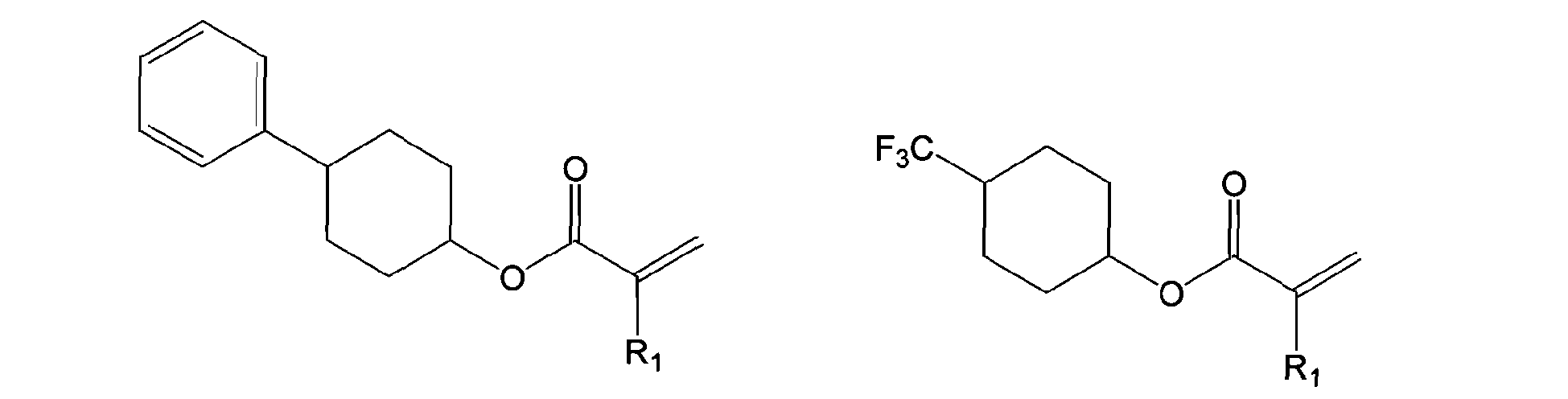
- monofunctional (meth)acrylate 1 examples include the compounds below.
- monofunctional (meth)acrylate 2 examples include the compounds below.
- composition of the present invention may comprise as necessary an ethylenically unsaturated group-containing compound.
- component (C) various types of compound may be used as long as they are compounds other than component (A) and component (B).
- component (C) there are a monomer, an oligomer, and a polymer.
- Examples of the monomer include a compound having one (meth)acryloyl group.
- Examples of this compound include ethyl (meth)acrylate, propyl (meth)acrylate, butyl (meth)acrylate, pentyl (meth)acrylate, hexyl (meth)acrylate, heptyl (meth)acrylate, 2-ethylhexyl (meth)acrylate, benzyl (meth)acrylate, and isobornyl (meth)acrylate.
- examples include (meth)acrylamide derivatives such as N -methylacrylamide, N -isopropylacrylamide, N,N -dimethylaminopropylacrylamide, N,N -dimethylacrylamide, N -vinylformamide, N -vinyl- N -methylformamide, N -vinylacetamide, N -vinyl- N -methylacetamide, and acryloylmorpholine; and N -vinyl compounds such as N -vinylpyrrolidone and N -vinylcaprolactam.
- (meth)acrylamide derivatives such as N -methylacrylamide, N -isopropylacrylamide, N,N -dimethylaminopropylacrylamide, N,N -dimethylacrylamide, N -vinylformamide, N -vinyl- N -methylformamide, N -vinylacetamide, N -vinyl- N -methylacetamide, and
- Examples of compounds having two or more (meth)acryloyl groups include alkylene glycol di(meth)acrylates such as ethylene glycol di(meth)acrylate, tetraethylene glycol di(meth)acrylate, propylene glycol di(meth)acrylate, and tripropylene glycol di(meth)acrylate; glycol di(meth)acrylates such as 1,6-hexanediol di(meth)acrylate and neopentyl glycol di(meth)acrylate; bisphenol di(meth)acrylates such as bisphenol A di(meth)acrylate or a derivative thereof with a halogen substituent on an aromatic ring and bisphenol F di(meth)acrylate or a derivative thereof with a halogen substituent on an aromatic ring; polyol poly(meth)acrylates such as dimethyloltricyclodecane di(meth)acrylate, trimethylolpropane tri(meth)acrylate, ditrimethylolpropan
- oligomer examples include polyester (meth)acrylate, epoxy (meth)acrylate, and polyether (meth)acrylate.
- polyester (meth)acrylate oligomer examples include a dehydration condensation product of a polyester polyol with (meth)acrylic acid.
- polyester polyol examples include a reaction product of a polyol with a carboxylic acid or an anhydride thereof.
- polyol examples include low molecular weight polyols such as ethylene glycol, diethylene glycol, triethylene glycol, tetraethylene glycol, polyethylene glycol, propylene glycol, dipropylene glycol, tripropylene glycol, polypropylene glycol, butylene glycol, polybutylene glycol, tetramethylene glycol, hexamethylene glycol, neopentyl glycol, cyclohexanedimethanol, 3-methyl-1,5-pentanediol, 1,6-hexanediol, trimethylolpropane, glycerol, pentaerythritol, and dipentaerythritol, and alkylene oxide adducts thereof.
- low molecular weight polyols such as ethylene glycol, diethylene glycol, triethylene glycol, tetraethylene glycol, polyethylene glycol, propylene glycol, dipropylene glycol, tripropylene
- Examples of the carboxylic acid or an anhydride thereof include dibasic acids such as orthophthalic acid, isophthalic acid, terephthalic acid, adipic acid, succinic acid, fumaric acid, maleic acid, hexahydrophthalic acid, tetrahydrophthalic acid, and trimellitic acid, and anhydrides thereof.
- dibasic acids such as orthophthalic acid, isophthalic acid, terephthalic acid, adipic acid, succinic acid, fumaric acid, maleic acid, hexahydrophthalic acid, tetrahydrophthalic acid, and trimellitic acid, and anhydrides thereof.
- polyester poly(meth)acrylate other than above, there can be cited compounds described in the above-mentioned 'UV ⁇ EB Koka Zairyo' (UV ⁇ EB Curing Materials) on pages 74 to 76 .
- the epoxy (meth)acrylate is a compound obtained by an addition reaction of (meth)acrylic acid to an epoxy resin, and examples thereof include compounds described in the above-mentioned 'UV ⁇ EB Koka Zairyo' on pages 74 to 75 .
- Examples of the epoxy resin include an aromatic epoxy resin and an aliphatic epoxy resin.
- aromatic epoxy resin examples include resorcinol diglycidyl ether; a di- or poly-glycidyl ether of bisphenol A, bisphenol F, bisphenol S, bisphenol fluorene, or an alkylene oxide adduct thereof; a novolac epoxy resin such as a phenol novolac epoxy resin or a cresol novolac epoxy resin; glycidyl phthalimide; and o-phthalic acid diglycidyl ester.
- resorcinol diglycidyl ether a di- or poly-glycidyl ether of bisphenol A, bisphenol F, bisphenol S, bisphenol fluorene, or an alkylene oxide adduct thereof
- a novolac epoxy resin such as a phenol novolac epoxy resin or a cresol novolac epoxy resin
- glycidyl phthalimide glycidyl phthalimide
- o-phthalic acid diglycidyl ester examples include resorcino
- the aliphatic epoxy resin examples include the diglycidyl ether of an alkylene glycol such as ethylene glycol, propylene glycol, 1,4-butanediol, or 1,6-hexanediol; the diglycidyl ether of a polyalkylene glycol such as the diglycidyl ether of polyethylene glycol or polypropylene glycol; the diglycidyl ether of neopentyl glycol, dibromoneopentyl glycol, or an alkylene oxide adduct thereof; the polyglycidyl ether of a polyhydric alcohol such as the di- or tri-glycidyl ether of trimethylolethane, trimethylolpropane, glycerol, or an alkylene oxide adduct thereof, or the di-, tri-, or tetra-glycidyl ether of pentaerythritol or an alkylene oxide adduct thereof; the di-
- the alkylene oxide of the alkylene oxide adducts above is preferably ethylene oxide, propylene oxide, etc.
- polyether (meth)acrylate oligomer there is a polyalkylene glycol (meth)diacrylate, and examples thereof include polyethylene glycol di(meth)acrylate, polypropylene glycol di(meth)acrylate, and polytetramethylene glycol di(meth)acrylate.
- the polymer there are a (meth)acrylic polymer having a (meth)acryloyloxy group and one formed by introducing a (meth)acryloyl group into a side chain of a functional group-containing (meth)acrylic polymer, and examples thereof include compounds described in 'UV ⁇ EB Koka Gijutsu' above on pages 78 to 79 .
- the glass transition temperature of a cured material of a composition described later is in a preferred range.
- component (A) is 5 to 50 weight %
- component (B) is 5 to 95 weight %
- component (C) is 0 to 85 weight %
- component (A) is 15 to 40 weight %
- component (B) is 5 to 60 weight %
- component (C) is 0 to 80 weight %.
- component (A) When the proportion of component (A) is less than 5 weight %, the adhesive power under high temperature is degraded, whereas when it is greater than 50 weight %, the initial adhesive power and the adhesive power under high humidity are degraded.
- component (B) is less than 5 weight %, the adhesive strength under high temperature or high humidity is degraded, and when it is greater than 95 weight %, the adhesive strength under high temperature is degraded.
- component (C) is greater than 85 weight %, the initial adhesive power and the adhesive power under high temperature or high humidity are degraded.
- composition of the present invention it is necessary for the composition of the present invention to comprise 5 to 30 weight % of methacrylate compound in the total amount of components (A) to (C).
- the adhesive strength might be degraded, and when it exceeds 30 weight %, the curability is degraded, and the productivity might be lowered.
- the methacrylate compound may be appropriately selected from components (A), (B), and (C) above.
- composition of the present invention is cured by UV rays, a photopolymerization initiator may be added as necessary.
- photopolymerization initiator examples include benzoin and alkyl ethers thereof such as benzoin, benzoin methyl ether, benzoin ethyl ether, and benzoin isopropyl ether; acetophenones such as acetophenone, 2,2-dimethoxy-2-phenylacetophenone, 2,2-diethoxy-2-phenylacetophenone, 1,1-dichloroacetophenone, 1-hydroxyacetophenone, 1-hydroxycyclohexyl phenyl ketone, and 2-methyl-1-[4-(methylthio)phenyl]-2-morpholinopropan-1-one; anthraquinones such as 2-methylanthraquinone, 2-ethylanthraquinone, 2-tertiary-butylanthraquinone, 1-chloroanthraquinone, and 2-amylanthraquinone; thioxanthones such as 2,4-dimethylthioxan
- the mixing proportion of the photopolymerization initiator is preferably at least 0.1 parts by weight but no greater than 10 parts by weight relative to 100 parts by weight of the composition, and more preferably at least 0.5 parts by weight but no greater than 5 parts by weight. From the viewpoint of there being little coloration over time, an ⁇ -hydroxyacetophenone-based or phosphine oxide-based photoinitiator is preferable.
- composition of the present invention may comprise, at an amount of up to 5 parts by weight relative to 100 parts by weight of the total of component (A) and component (B) and, as necessary component (C), a durability improving agent such as an antioxidant, a UV absorber, or a HALS (hindered amine light stabilizer), a leveling agent for making coating thickness uniform, or an antifoaming agent for suppressing foaming marks.
- a durability improving agent such as an antioxidant, a UV absorber, or a HALS (hindered amine light stabilizer)
- a leveling agent for making coating thickness uniform such as an antifoaming agent for suppressing foaming marks.
- a process for producing the composition of the present invention is not particularly limited, and it is obtained by stirring or mixing the essential components of the present invention or the essential components and another component as necessary by a standard method.
- the composition of the present invention preferably gives a cured material having a glass transition temperature (hereinafter, called Tg) of 10°C to 70°C.
- Tg glass transition temperature
- Tg means the temperature at which the main peak of the loss tangent (tan ⁇ ) of a viscoelastic spectrum of a cured material measured at 1 Hz is a maximum.
- composition of the present invention may be used for adhering various types of substrate, its application method may be a standard method, and examples thereof include a method in which after a substrate is coated, it is irradiated with active energy beam.
- the active energy beam examples include UV rays, X rays, and an electron beam
- UV rays are preferable since inexpensive equipment may be employed.
- the light source when curing is carried out with UV rays various types may be used, and examples thereof include a pressurized or high pressure mercury lamp, a metal halide lamp, a xenon lamp, an electrodeless discharge lamp, and a carbon arc lamp.
- an electron beam (EB) irradiator that can be used various types of equipment may be used, and examples thereof include a Cockcroft-Walton type, a Van de Graaff type, and a resonant transformer type.
- the electron beam preferably has an energy of 50 to 1,000 eV, and more preferably 100 to 300 eV.
- the composition of the present invention may preferably be used in production of a laminate, and a standard method normally carried out in production of a laminate may be employed. For example, there is a method involving coating a first substrate with the composition, laminating a second substrate thereon, and then irradiating from the surface of either substrate with active energy beam.
- composition of the present invention may preferably be used as an adhesive composition for an optical material and also as an adhesive composition for optical film lamination.
- a thin layer adherend used as an optical member is used as the substrate, and a laminate is obtained by the same method as above.
- the thin layer adherend used as an optical member mainly employs a plastic film and is required to be transparent to active energy beam, the film thickness may be selected according to the thin layer adherend used and the intended purpose, and the thickness is preferably no greater than 1 mm.
- plastic of a plastic film examples include a polyvinyl chloride resin, a polyvinylidene chloride, a cellulose-based resin, polyethylene, polypropylene, polystyrene, an acrylonitrile-butadiene-styrene resin (ABS resin), polyamide, polyester, polycarbonate, polyurethane, polyvinyl alcohol, an ethylene-vinyl acetate copolymer, and a chlorinated polypropylene.
- the surface may be subjected to a treatment such as metal vapor deposition.
- a method for coating a thin layer adherend may be any conventional method, and examples thereof include methods involving a natural coater, a knife belt coater, a floating knife, a knife over roll, a knife on blanket, spray, dip, a kiss roll, a squeeze roll, a reverse roll, an air blade, a curtain flow coater, and a gravure coater.
- the coating thickness of the composition of the present invention may be selected according to the thin layer adherend used and the intended purpose, and is preferably 0.1 to 1,000 ⁇ m, and more preferably 1 to 50 ⁇ m.
- a laminate film or sheet obtained from the adhesive composition of the present invention has excellent adhesive power under high temperature and high humidity conditions, it can suitably be used for an optical film or sheet such as a polarizing film, a retardation film, a prism sheet, a luminance improving film, a light guide plate, or a diffusing plate used in a liquid crystal display device, etc.
- an optical film or sheet such as a polarizing film, a retardation film, a prism sheet, a luminance improving film, a light guide plate, or a diffusing plate used in a liquid crystal display device, etc.
- Components (A), (B), and (C) and a photopolymerization initiator shown in Table 1 below were dissolved by heating at 60°C for 1 hour, thus giving active energy beam-curable adhesive compositions.
- TAC triacetyl cellulose
- a laminate film was produced in the same manner as above except that the TAC film was changed to a 50 ⁇ m thick polyethylene terephthalate (hereinafter, abbreviated to PET) film and the coating thickness was changed to 50 ⁇ m. This was called sample B. Sample A thus obtained was allowed to stand under the following conditions and then subjected to an evaluation of peel strength and appearance.
- PET polyethylene terephthalate
- Sample B thus obtained was allowed to stand under the following conditions and then subjected to an evaluation of coloration. After high temperature test: at 90°C for 500 hours
- the peel strength of a sample that had been subjected to the high temperature test and the high humidity test under the above-mentioned conditions was measured using a tensile tester under the conditions below.
- ⁇ YI The ⁇ YI of sample B was measured using an integrating sphere type spectral transmittance meter (DOT-3C, manufactured by Murakami Color Research Laboratory). ⁇ YI is expressed as the difference between the YI value of the laminate film after a heat resistance test and the YI value of the PET film before the test.
- Table 2 Ex. Tg(°C) Peel strength (gf/inch) Appearance Coloration ⁇ YI Initial stage After high temperature test After high humidity test After high temperature test After high humidity test After high temperature test After high humidity test After high temperature test 1 59 890 920 740 Good Good Good 1.0 2 46 970 980 810 Good Good Good 0.8 3 19 1020 890 970 Good Good Good 0.9 4 45 790 810 700 Good Good Good 1.0 5 44 810 800 740 Good Good Good 0.7
- Active energy beam-curable adhesive compositions were produced in the same manner as in the Examples except that the components shown in Table 2 below were used.
- M1600 polyether-based urethane acrylate, weight-average molecular weight about 3000 (ARONIX M-1600, manufactured by Toagosei Co., Ltd.) 14) NPA: nonylphenyl acrylate Compound represented by formula (3) below. 15) M110: p -cumylphenol ethylene oxide-modified acrylate (ARONIX M-110, manufactured by Toagosei Co., Ltd.) 16) CHMA: cyclohexyl methacrylate (CHMA, manufactured by Mitsubishi Rayon Co., Ltd.) (Table 4) Comp. Ex.
- adhesive composition of the present invention excellent adhesive power can be maintained under high temperature and high humidity conditions, there is little coloration over time, it is effective in laminate bonding of thin layer adherends such as plastic films used as various types of optical members, and it can be particularly suitably used in the production of an optical film used in a liquid crystal display device, etc.
Landscapes
- Chemical & Material Sciences (AREA)
- Organic Chemistry (AREA)
- Chemical Kinetics & Catalysis (AREA)
- Health & Medical Sciences (AREA)
- Medicinal Chemistry (AREA)
- Polymers & Plastics (AREA)
- General Chemical & Material Sciences (AREA)
- Adhesives Or Adhesive Processes (AREA)
- Laminated Bodies (AREA)
- Macromonomer-Based Addition Polymer (AREA)
- Adhesive Tapes (AREA)
Abstract
Description
- The present invention relates to an active energy beam-curable adhesive composition that can carry out bonding of various types of substrates by irradiation with active energy beam such as an electron beam or UV rays.
- The composition of the present invention is suitably used for laminate bonding of a thin layer adherend such as a plastic film or a plastic sheet used as an optical component and, furthermore, is suitably used in the production of various types of optical film or sheet used in a liquid crystal display device, an EL (electroluminescence) display device, a projection display device, an FED (field emission (field emission) display) display device, a plasma display device, etc., and is valued in these technical fields.
- Conventionally, as a lamination method in which thin layer adherends such as plastic films or sheets are laminated to each other or in which a thin layer adherend such as a plastic film or sheet and a thin layer adherend made of another material are laminated, a dry laminate method is mainly carried out in which, after a solvent type adhesive composition containing an ethylene-vinyl acetate copolymer or a polyurethane-based polymer is applied to a first thin layer adherend and dried, a second thin layer adherend is compression-bonded thereto by means of a nip roller, etc.
- The adhesive composition used in this method generally contains a large amount of solvent in order to make the amount of composition applied uniform, and because of this a large amount of solvent vapor escapes during drying, thus causing problems in terms of toxicity, work safety, and environmental pollution.
- As an adhesive composition that solves these problems, a solvent free adhesive composition has been examined.
- As the solvent free adhesive composition, a two-part adhesive composition and an adhesive composition that is cured by active energy beam such as UV rays or an electron beam are widely used.
- As the two-part adhesive composition, a so-called polyurethane-based adhesive composition is used, in which the main agent is a polymer mainly having a terminal hydroxyl group and the curing agent is a polyisocyanate compound having a terminal isocyanate group. However, this composition has the defect that the curing time is too long.
- In contrast thereto, the active energy beam-curable adhesive composition has a high curing rate, therefore has excellent productivity, and has been attracting attention recently.
- On the other hand, a thin display device such as a liquid crystal display device is widely used not only as a simple display device in a digital watch or in various types of electrical appliances but also as a display device of a television, a portable personal computer, a cellular telephone, a word processor, etc. In recent years, active energy beam-curable adhesives have been used for the lamination of various types of optical film used in the liquid crystal display device.
- An adhesive composition used for the optical film is required to maintain its adhesive power under severe conditions of high temperature and high humidity. Although most conventional active energy beam-curable adhesive compositions have excellent adhesive strength in an initial stage, when they are used continuously for a long period of time under high temperature or high humidity, the adhesive strength thereof deteriorates, thus causing peeling off or whitening(opaque) due to moisture absorption.
- As an active energy beam-curable adhesive composition having excellent adhesion under high temperature and high humidity the present applicant has so far proposed a composition comprising a urethane (meth)acrylate and a polymer having a glass transition temperature of at least 40°C (Patent Publication 1) or a composition comprising a urethane (meth)acrylate and an imide group-containing (meth)acrylate (Patent Publication 2).
- Furthermore, the present applicant has proposed, as an adhesive for a polymethyl methacrylate (PMMA) plate and a film, an active energy beam-curable adhesive composition comprising a urethane (meth)acrylate and a specific aromatic monofunctional (meth)acrylate (Patent Publication 3), but when this is used as a lamination adhesive between films, the adhesive strength is insufficient.
(Patent Publication 1)
JP-A-2000-072833
(Patent Publication 2)
JP-A-2001-064594
(Patent Publication 3)
Japanese Patent Application No. 2004-091926
(JP-A-2005-272773 - However, in recent years, there has been a demand for use under more severe conditions such as high temperature or high humidity, use outdoors under sunlight, and for a longer product life, and the conventionally proposed adhesive compositions are not satisfactory due to problems such as a decrease in the adhesive strength or coloration over time.
- The present inventors have carried out an intensive investigation in order to find an active energy beam-curable adhesive composition having excellent adhesive power under high temperature and high humidity conditions and causing little coloration even when used for a long period of time.
- As a result of various investigations by the present inventors, it has been found that an active energy beam-curable adhesive composition that is a composition comprising a urethane (meth)acrylate having a specific structure and a specific monofunctional (meth)acrylate having a cyclic structure, among which methacrylate is contained at a specific proportion, has excellent adhesive power under either high temperature or high humidity conditions and causes little coloration, which is at a practical level, and the present invention has thus been accomplished as shown below.
- The present invention is an active energy beam-curable adhesive composition (hereinafter, also simply called a 'composition') comprising (A) 5 to 50 weight % of a urethane (meth)acrylate having a polyester or polycarbonate skeleton (hereinafter, also called component (A)), (B) 5 to 95 weight % of a compound having one (meth)acryloyl group represented by formula (1) below or/and a compound having one (meth)acryloyl group represented by formula (2) below (hereinafter, also called component (B)), and as necessary (C) 0 to 85 weight % of an ethylenically unsaturated group-containing compound other than components (A) and (B) above (hereinafter, also called component (C)), 5 to 30 weight % of methacrylate compound being contained in the total amount of components (A) to (C).
- As component (B), one represented by formula (1) in which R2 is a phenyl or cumyl group and one represented by formula (2) in which R4 is a t-butyl group are preferable.
- As the composition of the present invention, one that gives a cured material having a glass transition temperature of 10°C to 70°C is preferable.
- The composition of the present invention can preferably be used as an active energy beam-curable adhesive composition for optical materials and can also preferably be used as an active energy beam-curable adhesive composition for optical film lamination.
- Moreover, the present invention is a process for producing a laminate, the process comprising coating a first substrate with any one of the compositions, laminating a second substrate thereon, and then irradiating from the surface of either substrate with active energy beam.
- The adhesive composition of the present invention can maintain excellent adhesive power under high temperature and high humidity conditions, causes little coloration over time, is effective for bonding of a thin layer adherend such as a plastic film used as various types of optical member, and can particularly suitably be used in the production of an optical film used in a liquid crystal display device, etc.
- The present invention is explained in detail below.
- In the present specification, acrylate and/or methacrylate are called (meth)acrylate, an acryloyl group and/or a methacryloyl group are called a (meth)acryloyl group, and acrylic acid and/or methacrylic acid are called (meth)acrylic acid.
- The active energy beam-curable adhesive composition of the present invention comprises as constituent components (A) a urethane (meth)acrylate having a polyester or polycarbonate skeleton, (B) a compound having one (meth)acryloyl group represented by formula (1) below (hereinafter, called monofunctional (meth)acrylate 1) or/and a compound having one (meth)acryloyl group represented by formula (2) below (hereinafter, called monofunctional (meth)acrylate 2), and as necessary (C) an ethylenically unsaturated group-containing compound other than components (A) and (B) above.
- Each of the components is explained below.
- As components (A) to (C), each compound described below may be used on its own or in a combination of two or more types.
- Component (A) is a urethane (meth)acrylate having a polyester or polycarbonate skeleton. In the present invention, since component (A) is contained, a cured material obtained has excellent adhesive power under high temperature and high humidity conditions.
- On the other hand, a composition comprising a urethane (meth)acrylate having a skeleton other than a polyester or a polycarbonate, which is different from component (A), gives a cured material having degraded adhesive power under high temperature and high humidity conditions.
- Component (A) may be either an oligomer or a polymer; one having a weight-average molecular weight of 500 to 50,000 is preferable, and it is more preferably 3,000 to 40,000, and particularly preferably 10,000 to 30,000.
- The weight-average molecular weight referred to in the present invention is a molecular weight measured by gel permeation chromatography on a polystyrene basis.
- As component (A), various types of compound may be used, and examples thereof include a compound obtained by reacting a hydroxyl group-containing (meth)acrylate with a reaction product between a polyol having a polyester or polycarbonate skeleton and an organic polyisocyanate.
- Furthermore, component (A) is preferably a urethane (meth)acrylate having two (meth)acryloyl groups (hereinafter, also called a difunctional urethane (meth)acrylate), and is more preferably a difunctional urethane (meth)acrylate obtained by reacting a hydroxyl group-containing (meth)acrylate with a reaction product between a diol having a polyester or polycarbonate skeleton and an organic diisocyanate.
- Examples of the polyol having a polyester skeleton include an esterification product of a diol component such as a low molecular weight diol or a polycaprolactone diol with an acid component such as a dibasic acid or an anhydride thereof.
- Examples of the low molecular weight diol include ethylene glycol, propylene glycol, cyclohexanedimethanol, 3-methyl-1,5-pentanediol, and 1,6-hexanediol.
- Examples of the dibasic acid or an anhydride thereof include adipic acid, succinic acid, phthalic acid, tetrahydrophthalic acid, hexahydrophthalic acid, and terephthalic acid, and anhydrides thereof.
- Examples of the polycarbonate polyol include a reaction product of the low molecular weight diol or/and a bisphenol such as bisphenol A with a dialkyl carbonate such as dibutyl carbonate or ethylene carbonate.
- Examples of the organic polyisocyanate include tolylene diisocyanate, 1,6-hexane diisocyanate, 4,4'-diphenylmethane diisocyanate, polymethylene polyphenyl isocyanate, 1,6-hexane diisocyanate trimer, hydrogenated tolylene diisocyanate, hydrogenated 4,4'-diphenylmethane diisocyanate, xylylene diisocyanate, hydrogenated xylylene diisocyanate, paraphenylene diisocyanate, tolylene diisocyanate dimer, 1,5-naphthalene diisocyanate, hexamethylene diisocyanate adduct, 4,4'-dicyclohexylmethane diisocyanate, trimethylolpropane tris(tolylene diisocyanate) adduct, and isophorone diisocyanate. Furthermore, the organic polyisocyanate is preferably an organic diisocyanate.
- Examples of the hydroxyl group-containing (meth)acrylate include hydroxyalkyl (meth)acrylates such as 2-hydroxyethyl (meth)acrylate, 2-hydroxypropyl (meth)acrylate, hydroxybutyl (meth)acrylate, hydroxypentyl (meth)acrylate, hydroxyhexyl (meth)acrylate, hydroxyoctyl (meth)acrylate, pentaerythritol tri-, di-, or mono-(meth)acrylate, and trimethylolpropane di- or mono-(meth)acrylate.
- They are obtained by stirring and heating the organic isocyanate and polyol component used in the presence of an addition catalyst such as dibutyltin dilaurate so as to effect an addition reaction, further adding a hydroxyalkyl (meth)acrylate, and stirring and heating so as to effect an addition reaction.
- As component (A), from the viewpoint of particularly excellent adhesive strength under high humidity and little coloration of the cured adhesive over time, a urethane acrylate employing a nonaromatic polyester polyol or polycarbonate polyol is preferable.
- Component (B) is monofunctional (meth)acrylate 1 or/and monofunctional (meth)acrylate 2. In the present invention, since component (B) is contained, coloration over time can be greatly suppressed.
- Monofunctional (meth)acrylate 1 is a compound represented by formula (1) below, and monofunctional (meth)acrylate 2 is a compound represented by formula (2) below.


- In formulae (1) and (2) above, R2 and R4 respectively are halogen atoms or hydrocarbon groups that have 10 or less carbons and do not have a hydrogen atom on the α-position carbon atom.
- In formulae (1) and (2) above, when a monofunctional (meth)acrylate in which R2 and R4 respectively are a hydrocarbon group having a hydrogen atom on the α-position carbon atom is used, a cured material obtained turns yellow.
- Specific examples of the hydrocarbon group denoted by R2 and R4 that has 10 or less carbons and does not have a hydrogen atom on the α-position carbon atom (hereinafter, simply called the hydrocarbon group) include a t-butyl group, a phenyl group, a cumyl group, a perfluoroalkyl group such as a trifluoromethyl group, and a hexafluorocumyl group. Examples of the halogen atom include a chlorine atom and a bromine atom.
- When R2 in formula (1) is the hydrocarbon group, m is preferably 1, and when R4 in formula (2) is the hydrocarbon group, n is preferably 1.
- When R2 in formula (1) is a halogen atom, m is preferably 1 to 3, and when R4 in formula (2) is a halogen atom, n is preferably 1 to 3. A compound for which m and n satisfy the above ranges has excellent compatibility with other components.
- From the viewpoint of the adhesive strength being high under high temperature or high humidity and there being little coloration over time, R2 is preferably a phenyl group or a cumyl group. From the viewpoint of the adhesive strength being high under high temperature or high humidity and there being little coloration over time, R4 is preferably a t-butyl group.
- Specific examples of monofunctional (meth)acrylate 1 include the compounds below.


- Specific examples of monofunctional (meth)acrylate 2 include the compounds below.

- The composition of the present invention may comprise as necessary an ethylenically unsaturated group-containing compound.
- As component (C), various types of compound may be used as long as they are compounds other than component (A) and component (B). As component (C), there are a monomer, an oligomer, and a polymer.
- Examples of the monomer include a compound having one (meth)acryloyl group.
- Examples of this compound include ethyl (meth)acrylate, propyl (meth)acrylate, butyl (meth)acrylate, pentyl (meth)acrylate, hexyl (meth)acrylate, heptyl (meth)acrylate, 2-ethylhexyl (meth)acrylate, benzyl (meth)acrylate, and isobornyl (meth)acrylate.
- Other than (meth)acrylates, examples include (meth)acrylamide derivatives such as N-methylacrylamide, N-isopropylacrylamide, N,N-dimethylaminopropylacrylamide, N,N-dimethylacrylamide, N-vinylformamide, N-vinyl-N-methylformamide, N-vinylacetamide, N-vinyl-N-methylacetamide, and acryloylmorpholine; and N-vinyl compounds such as N-vinylpyrrolidone and N-vinylcaprolactam.
- Examples of compounds having two or more (meth)acryloyl groups include alkylene glycol di(meth)acrylates such as ethylene glycol di(meth)acrylate, tetraethylene glycol di(meth)acrylate, propylene glycol di(meth)acrylate, and tripropylene glycol di(meth)acrylate; glycol di(meth)acrylates such as 1,6-hexanediol di(meth)acrylate and neopentyl glycol di(meth)acrylate; bisphenol di(meth)acrylates such as bisphenol A di(meth)acrylate or a derivative thereof with a halogen substituent on an aromatic ring and bisphenol F di(meth)acrylate or a derivative thereof with a halogen substituent on an aromatic ring; polyol poly(meth)acrylates such as dimethyloltricyclodecane di(meth)acrylate, trimethylolpropane tri(meth)acrylate, ditrimethylolpropane tetra(meth)acrylate, pentaerythritol tri(meth)acrylate, pentaerythritol tetra(meth)acrylate, and dipentaerythritol hexa(meth)acrylate; a poly(meth)acrylate of an alkylene oxide adduct of the above polyols; di- or tri-(meth)acrylates of an isocyanuric acid alkylene oxide; and moreover, compounds described in 'Saishin UV Koka Gijutsu' (Latest UV Curing Technology) (Insatsu Joho Kyokai (Printing Information Society), 1991, on pages 53 to 56.
- Examples of the oligomer include polyester (meth)acrylate, epoxy (meth)acrylate, and polyether (meth)acrylate.
- Examples of the polyester (meth)acrylate oligomer include a dehydration condensation product of a polyester polyol with (meth)acrylic acid.
- Examples of the polyester polyol include a reaction product of a polyol with a carboxylic acid or an anhydride thereof.
- Examples of the polyol include low molecular weight polyols such as ethylene glycol, diethylene glycol, triethylene glycol, tetraethylene glycol, polyethylene glycol, propylene glycol, dipropylene glycol, tripropylene glycol, polypropylene glycol, butylene glycol, polybutylene glycol, tetramethylene glycol, hexamethylene glycol, neopentyl glycol, cyclohexanedimethanol, 3-methyl-1,5-pentanediol, 1,6-hexanediol, trimethylolpropane, glycerol, pentaerythritol, and dipentaerythritol, and alkylene oxide adducts thereof.
- Examples of the carboxylic acid or an anhydride thereof include dibasic acids such as orthophthalic acid, isophthalic acid, terephthalic acid, adipic acid, succinic acid, fumaric acid, maleic acid, hexahydrophthalic acid, tetrahydrophthalic acid, and trimellitic acid, and anhydrides thereof.
- As a polyester poly(meth)acrylate other than above, there can be cited compounds described in the above-mentioned 'UV·EB Koka Zairyo' (UV·EB Curing Materials) on pages 74 to 76.
- The epoxy (meth)acrylate is a compound obtained by an addition reaction of (meth)acrylic acid to an epoxy resin, and examples thereof include compounds described in the above-mentioned 'UV·EB Koka Zairyo' on pages 74 to 75.
- Examples of the epoxy resin include an aromatic epoxy resin and an aliphatic epoxy resin.
- Specific examples of the aromatic epoxy resin include resorcinol diglycidyl ether; a di- or poly-glycidyl ether of bisphenol A, bisphenol F, bisphenol S, bisphenol fluorene, or an alkylene oxide adduct thereof; a novolac epoxy resin such as a phenol novolac epoxy resin or a cresol novolac epoxy resin; glycidyl phthalimide; and o-phthalic acid diglycidyl ester.
- Other than above, there can be cited compounds described in 'Epokishi Jushi -Saishinnoshinpo-' (Epoxy Resins -Latest Advances-) (Shokodo, 1990), Chapter 2 and 'Kobunshi Kako' (Polymer Processing), Supplement 9, Vol. 22, Special Edition, Epoxy Resins (Kobunshikankokai, 1973) on pages 4 to 6 and 9 to 16.
- Specific examples of the aliphatic epoxy resin include the diglycidyl ether of an alkylene glycol such as ethylene glycol, propylene glycol, 1,4-butanediol, or 1,6-hexanediol; the diglycidyl ether of a polyalkylene glycol such as the diglycidyl ether of polyethylene glycol or polypropylene glycol; the diglycidyl ether of neopentyl glycol, dibromoneopentyl glycol, or an alkylene oxide adduct thereof; the polyglycidyl ether of a polyhydric alcohol such as the di- or tri-glycidyl ether of trimethylolethane, trimethylolpropane, glycerol, or an alkylene oxide adduct thereof, or the di-, tri-, or tetra-glycidyl ether of pentaerythritol or an alkylene oxide adduct thereof; the di- or poly-glycidyl ether of hydrogenated bisphenol A or an alkylene oxide adduct thereof; tetrahydrophthalic acid diglycidyl ether; and hydroquinone diglycidyl ether.
- Other than above, there can be cited compounds described in the above 'Kobunshi Kako', Epoxy Resin Supplement, pages 3 to 6. Other than these aromatic and aliphatic epoxy resins, there can be cited an epoxy compound having a triazine nucleus in its skeleton, for example, TEPIC (Nissan Chemical Industries, Ltd.) and DENACOL EX-310 (Nagase Chemicals Ltd.), and there also can be cited compounds described in the above 'Kobunshi Kako', Epoxy Resin Supplement, pages 289 to 296.
- The alkylene oxide of the alkylene oxide adducts above is preferably ethylene oxide, propylene oxide, etc.
- As the polyether (meth)acrylate oligomer, there is a polyalkylene glycol (meth)diacrylate, and examples thereof include polyethylene glycol di(meth)acrylate, polypropylene glycol di(meth)acrylate, and polytetramethylene glycol di(meth)acrylate.
- As the polymer, there are a (meth)acrylic polymer having a (meth)acryloyloxy group and one formed by introducing a (meth)acryloyl group into a side chain of a functional group-containing (meth)acrylic polymer, and examples thereof include compounds described in 'UV·EB Koka Gijutsu' above on pages 78 to 79.
- As a compound for component (C), it is preferable to select it so that the glass transition temperature of a cured material of a composition described later is in a preferred range.
- In the present invention, with regard to the proportions of components (A), (B), and (C), component (A) is 5 to 50 weight %, component (B) is 5 to 95 weight %, and component (C) is 0 to 85 weight %, and preferably component (A) is 15 to 40 weight %, component (B) is 5 to 60 weight %, and component (C) is 0 to 80 weight %.
- When the proportion of component (A) is less than 5 weight %, the adhesive power under high temperature is degraded, whereas when it is greater than 50 weight %, the initial adhesive power and the adhesive power under high humidity are degraded. When component (B) is less than 5 weight %, the adhesive strength under high temperature or high humidity is degraded, and when it is greater than 95 weight %, the adhesive strength under high temperature is degraded. When component (C) is greater than 85 weight %, the initial adhesive power and the adhesive power under high temperature or high humidity are degraded.
- It is necessary for the composition of the present invention to comprise 5 to 30 weight % of methacrylate compound in the total amount of components (A) to (C). When it is less than 5 weight %, the adhesive strength might be degraded, and when it exceeds 30 weight %, the curability is degraded, and the productivity might be lowered.
- The methacrylate compound may be appropriately selected from components (A), (B), and (C) above.
- When the composition of the present invention is cured by UV rays, a photopolymerization initiator may be added as necessary.
- Examples of the photopolymerization initiator include benzoin and alkyl ethers thereof such as benzoin, benzoin methyl ether, benzoin ethyl ether, and benzoin isopropyl ether; acetophenones such as acetophenone, 2,2-dimethoxy-2-phenylacetophenone, 2,2-diethoxy-2-phenylacetophenone, 1,1-dichloroacetophenone, 1-hydroxyacetophenone, 1-hydroxycyclohexyl phenyl ketone, and 2-methyl-1-[4-(methylthio)phenyl]-2-morpholinopropan-1-one; anthraquinones such as 2-methylanthraquinone, 2-ethylanthraquinone, 2-tertiary-butylanthraquinone, 1-chloroanthraquinone, and 2-amylanthraquinone; thioxanthones such as 2,4-dimethylthioxanthone, 2,4-diethylthioxanthone, 2-chlorothioxanthone, and 2,4-diisopylthioxanthone; ketals such as acetophenone dimethyl ketal and benzil dimethyl ketal; monoacylphosphine oxides and bisacylphosphine oxides such as 2,4,6-trimethylbenzoyldiphenylphosphine oxide; benzophenones such as benzophenone; and xanthones. These photopolymerization initiators may be used singly or in a combination with a benzoic acid-based, amine-based, etc. photopolymerization initiation accelerator.
- The mixing proportion of the photopolymerization initiator is preferably at least 0.1 parts by weight but no greater than 10 parts by weight relative to 100 parts by weight of the composition, and more preferably at least 0.5 parts by weight but no greater than 5 parts by weight. From the viewpoint of there being little coloration over time, an α-hydroxyacetophenone-based or phosphine oxide-based photoinitiator is preferable.
- Furthermore, the composition of the present invention may comprise, at an amount of up to 5 parts by weight relative to 100 parts by weight of the total of component (A) and component (B) and, as necessary component (C), a durability improving agent such as an antioxidant, a UV absorber, or a HALS (hindered amine light stabilizer), a leveling agent for making coating thickness uniform, or an antifoaming agent for suppressing foaming marks.
- A process for producing the composition of the present invention is not particularly limited, and it is obtained by stirring or mixing the essential components of the present invention or the essential components and another component as necessary by a standard method.
- The composition of the present invention preferably gives a cured material having a glass transition temperature (hereinafter, called Tg) of 10°C to 70°C. When the Tg is less than 10°C, the adhesive strength during a heat resistance test might be degraded, and when the Tg exceeds 70°C, the initial peel strength might be degraded.
- In the present invention, Tg means the temperature at which the main peak of the loss tangent (tan δ) of a viscoelastic spectrum of a cured material measured at 1 Hz is a maximum.
- The composition of the present invention may be used for adhering various types of substrate, its application method may be a standard method, and examples thereof include a method in which after a substrate is coated, it is irradiated with active energy beam.
- Examples of the active energy beam include UV rays, X rays, and an electron beam, and UV rays are preferable since inexpensive equipment may be employed. As the light source when curing is carried out with UV rays, various types may be used, and examples thereof include a pressurized or high pressure mercury lamp, a metal halide lamp, a xenon lamp, an electrodeless discharge lamp, and a carbon arc lamp. When curing is carried out with an electron beam, as an electron beam (EB) irradiator that can be used various types of equipment may be used, and examples thereof include a Cockcroft-Walton type, a Van de Graaff type, and a resonant transformer type. The electron beam preferably has an energy of 50 to 1,000 eV, and more preferably 100 to 300 eV.
- The composition of the present invention may preferably be used in production of a laminate, and a standard method normally carried out in production of a laminate may be employed. For example, there is a method involving coating a first substrate with the composition, laminating a second substrate thereon, and then irradiating from the surface of either substrate with active energy beam.
- The composition of the present invention may preferably be used as an adhesive composition for an optical material and also as an adhesive composition for optical film lamination.
- In this case, a thin layer adherend used as an optical member is used as the substrate, and a laminate is obtained by the same method as above.
- The thin layer adherend used as an optical member mainly employs a plastic film and is required to be transparent to active energy beam, the film thickness may be selected according to the thin layer adherend used and the intended purpose, and the thickness is preferably no greater than 1 mm.
- Examples of the plastic of a plastic film include a polyvinyl chloride resin, a polyvinylidene chloride, a cellulose-based resin, polyethylene, polypropylene, polystyrene, an acrylonitrile-butadiene-styrene resin (ABS resin), polyamide, polyester, polycarbonate, polyurethane, polyvinyl alcohol, an ethylene-vinyl acetate copolymer, and a chlorinated polypropylene. According to the intended application, the surface may be subjected to a treatment such as metal vapor deposition.
- A method for coating a thin layer adherend may be any conventional method, and examples thereof include methods involving a natural coater, a knife belt coater, a floating knife, a knife over roll, a knife on blanket, spray, dip, a kiss roll, a squeeze roll, a reverse roll, an air blade, a curtain flow coater, and a gravure coater.
- Furthermore, the coating thickness of the composition of the present invention may be selected according to the thin layer adherend used and the intended purpose, and is preferably 0.1 to 1,000 µm, and more preferably 1 to 50 µm.
- Since a laminate film or sheet obtained from the adhesive composition of the present invention has excellent adhesive power under high temperature and high humidity conditions, it can suitably be used for an optical film or sheet such as a polarizing film, a retardation film, a prism sheet, a luminance improving film, a light guide plate, or a diffusing plate used in a liquid crystal display device, etc.
- The present invention is explained in detail below by reference to Examples and Comparative Examples. 'Parts' in each example below denotes parts by weight.
- Components (A), (B), and (C) and a photopolymerization initiator shown in Table 1 below were dissolved by heating at 60°C for 1 hour, thus giving active energy beam-curable adhesive compositions.
- The compositions thus obtained were evaluated in accordance with the test methods below. The results are given in Table 2.
(Table 1) Ex. (A) (B) (C) Photopolymerization initiator Other11) proportion MA 12) M12001) UN9200 A2) OPPA3) PCPA4) BCHM5) HBA6) HEMA 7) IBXA 8) I-1849) TPO10) 1 30 60 10 3 10 2 20 40 20 20 3 20 3 30 25 45 3 25 4 30 40 15 15 3 15 5 30 40 15 15 1 1 0.4 15 - In Table 1, the figures mean the number of parts, and the abbreviations have the following meanings.
- 1) M1200: polyester-based urethane acrylate having a nonaromatic polyester skeleton, weight-average molecular weight about 5000 (ARONIX M-1200, manufactured by Toagosei Co., Ltd.)
- 2) UN9200A: polycarbonate-based urethane acrylate having a nonaromatic polycarbonate skeleton, weight-average molecular weight about 20,000 (ART RESIN UN-9200A, manufactured by Negami Chemical Industrial Co., Ltd.)
- 3) OPPA: orthophenylphenol acrylate (ARONIX TO-2344, manufactured by Toagosei Co., Ltd.)
- 4) PCPA: p-cumylphenol acrylate (ARONIX TO-2345, manufactured by Toagosei Co., Ltd.)
- 5) BCHM: t-butylcyclohexyl methacrylate (TBCHMA, manufactured by NOF Corporation)
- 6) HBA: hydroxybutyl acrylate (4-HBA, manufactured by Osaka Organic Chemical Industry Ltd.)
- 7) HEMA: hydroxyethyl methacrylate (LIGHT-ESTER HO, manufactured by Kyoeisha Chemical Co., Ltd.)
- 8) IBXA: isobornyl acrylate (LIGHT-ACRYLATE IB-XA, manufactured by Kyoeisha Chemical Co., Ltd.)
- 9) I-184: 1-hydroxycyclohexyl phenyl ketone (IRGACURE 184, manufactured by Ciba Specialty Chemicals)
- 10) TPO: 2,4,6-trimethylbenzoyldiphenylphosphine oxide (Lucirin TPO, manufactured by BASF)
- 11) Other: a mixture of 0.2 parts of TINUVIN 1130 and 0.2 parts of TINUVIN 292. TINUVIN 1130; benzotriazole-based UV absorber (TINUVIN 1130, manufactured by Ciba Specialty Chemicals), TINUVIN 292; hindered amine light stabilizer (TINUVIN 292, manufactured by Ciba Specialty Chemicals)
- 12) The proportion of methacrylate in the total amount of components (A) to (C) (units: weight %)
- A 75 µm thick triacetyl cellulose (hereinafter, abbreviated to TAC) film was coated using a wire bar coater with a composition obtained to give a coating thickness of 10 µm. A 75 µm thick TAC film was laminated thereon by means of a nip roller, and this was sent past a 120 W/cm focused metal halide lamp twice at a position 10 cm beneath the lamp at a conveyor speed of 5 m/min, thus bonding the films and giving a laminate film. This was called sample A. A laminate film was produced in the same manner as above except that the TAC film was changed to a 50 µm thick polyethylene terephthalate (hereinafter, abbreviated to PET) film and the coating thickness was changed to 50 µm. This was called sample B. Sample A thus obtained was allowed to stand under the following conditions and then subjected to an evaluation of peel strength and appearance.
- Initial state: allowed to stand at room temperature for 30 minutes
- After high temperature test: at 90°C for 500 hours
- After high humidity test: at 70°C and 95%RH for 500 hours
- Sample B thus obtained was allowed to stand under the following conditions and then subjected to an evaluation of coloration.
After high temperature test: at 90°C for 500 hours - The peel strength of a sample that had been subjected to the high temperature test and the high humidity test under the above-mentioned conditions was measured using a tensile tester under the conditions below.
- Test piece: 25 mm × 100 mm
- Peel angle: 180 degrees
- Peel speed: 200 mm/min
- When the adhesive strength was sufficiently high and the substrate broke during measurement of the peel strength, it was described as base material failure.
- The measurement unit for the peel strength, gf/inch, is defined as 1 (gf/inch) = 3.86 × 10⁻³ (N/cm).
- A sample was subjected to the high temperature test and the high humidity test under the above-mentioned conditions and then subjected to an evaluation of its appearance by eye. Good, fair, and poor in the table denote the following.
- Good: good without whitening(opaque) or peeling.
- Fair: whitened(opaque).
- Poor: whitened(opaque) and peeled.
- The ΔYI of sample B was measured using an integrating sphere type spectral transmittance meter (DOT-3C, manufactured by Murakami Color Research Laboratory). ΔYI is expressed as the difference between the YI value of the laminate film after a heat resistance test and the YI value of the PET film before the test.
(Table 2) Ex. Tg(°C) Peel strength (gf/inch) Appearance Coloration ΔYI Initial stage After high temperature test After high humidity test After high temperature test After high humidity test After high temperature test 1 59 890 920 740 Good Good 1.0 2 46 970 980 810 Good Good 0.8 3 19 1020 890 970 Good Good 0.9 4 45 790 810 700 Good Good 1.0 5 44 810 800 740 Good Good 0.7 - Active energy beam-curable adhesive compositions were produced in the same manner as in the Examples except that the components shown in Table 2 below were used.
- The compositions thus obtained were subjected to the same evaluation as in Example 1. The results are given in Table 4. Since Comparative Example 4 did not cure completely under the same conditions, irradiation was repeated a further two times, and this completely cured sample was used.
(Table 3) Comp. Ex. (A) (A)' (B) (B)' (C) Photopolymerization initiator MA proportion M1200 M160013) OPPA NPA14) HBA HEMA IBXA M11015) CHMA16) I-184 1 60 10 30 3 30 2 50 25 25 3 25 3 30 40 30 3 0 4 40 10 50 3 50 5 30 45 25 3 25 6 30 40 15 15 3 0 7 40 40 20 3 0 - In Table 3, the figures denote the number of parts. Other than those below, the abbreviations have the same meanings as in Table 1.
13) M1600: polyether-based urethane acrylate, weight-average molecular weight about 3000 (ARONIX M-1600, manufactured by Toagosei Co., Ltd.)
14) NPA: nonylphenyl acrylate
Compound represented by formula (3) below.
15) M110: p-cumylphenol ethylene oxide-modified acrylate (ARONIX M-110, manufactured by Toagosei Co., Ltd.)
16) CHMA: cyclohexyl methacrylate (CHMA, manufactured by Mitsubishi Rayon Co., Ltd.)(Table 4) Comp. Ex. Tg (°C) Peel strength (gf/inch) Appearance Coloration ΔYI Initial stage After high temperature test After high humidity test After high temperature test After humidity test After high temperature test 1 55 390 190 15 Good Poor 1.3 2 81 110 70 100 Poor Fair 1.0 3 26 270 200 190 Good Fair 1.1 4 68 190 210 30 Fair Poor 2.0 5 15 230 190 170 Good Good 1.8 6 68 240 140 10 Good Poor 2.8 7 30 890 790 900 Good Good 2.5 - In accordance with the adhesive composition of the present invention, excellent adhesive power can be maintained under high temperature and high humidity conditions, there is little coloration over time, it is effective in laminate bonding of thin layer adherends such as plastic films used as various types of optical members, and it can be particularly suitably used in the production of an optical film used in a liquid crystal display device, etc.
Claims (7)
- An active energy beam-curable adhesive composition comprising:(A) 5 to 50 weight % of a urethane (meth)acrylate having a polyester or polycarbonate skeleton;(B) 5 to 95 weight % of a compound having one (meth)acryloyl group represented by formula (1) below or/and a compound having one (meth)acryloyl group represented by formula (2) below; andwherein R1 denotes a hydrogen atom or a methyl group, R2 denotes a halogen atom or a hydrocarbon group that has 10 or less carbons and does not have a hydrogen atom on the α-position carbon atom, and m denotes an integer of 1 to 5, and
as necessary (C) 0 to 85 weight % of an ethylenically unsaturated group-containing compound other than components (A) and (B) above;
5 to 30 weight % of methacrylate compound being contained in the total amount of components (A) to (C),

- The active energy beam-curable adhesive composition according to Claim 1, wherein component (B) is a compound having a phenyl group or a cumyl group as R2 in formula (1).
- The active energy beam-curable adhesive composition according to Claim 1, wherein component (B) is a compound having a t-butyl group as R4 in formula (2).
- The active energy beam-curable adhesive composition according to any one of Claim 1 to Claim 3, wherein a cured material of the composition has a glass transition temperature of 10°C to 70°C.
- An active energy beam-curable adhesive composition for an optical material, comprising the composition according to any one of Claim 1 to Claim 4.
- An active energy beam-curable adhesive composition for optical film lamination, comprising the composition according to any one of Claim 1 to Claim 4.
- A process for producing a laminate, the process comprising:coating a first substrate with the composition according to any one of Claim 1 to Claim 6, laminating a second substrate thereon, and then irradiating from the surface of either substrate with active energy beam.
Applications Claiming Priority (2)
| Application Number | Priority Date | Filing Date | Title |
|---|---|---|---|
| JP2005132615 | 2005-04-28 | ||
| PCT/JP2006/308557 WO2006118078A1 (en) | 2005-04-28 | 2006-04-24 | Adhesive composition curable with actinic energy ray |
Publications (3)
| Publication Number | Publication Date |
|---|---|
| EP1878776A1 true EP1878776A1 (en) | 2008-01-16 |
| EP1878776A4 EP1878776A4 (en) | 2009-08-12 |
| EP1878776B1 EP1878776B1 (en) | 2011-09-07 |
Family
ID=37307878
Family Applications (1)
| Application Number | Title | Priority Date | Filing Date |
|---|---|---|---|
| EP06732268A Expired - Lifetime EP1878776B1 (en) | 2005-04-28 | 2006-04-24 | Adhesive composition curable with actinic energy ray |
Country Status (7)
| Country | Link |
|---|---|
| US (1) | US20090065140A1 (en) |
| EP (1) | EP1878776B1 (en) |
| JP (1) | JP4900241B2 (en) |
| KR (1) | KR20080003008A (en) |
| CN (1) | CN101163767A (en) |
| TW (1) | TW200704733A (en) |
| WO (1) | WO2006118078A1 (en) |
Cited By (4)
| Publication number | Priority date | Publication date | Assignee | Title |
|---|---|---|---|---|
| WO2008067235A1 (en) * | 2006-11-28 | 2008-06-05 | Applied Extrusion Technologies, Inc. | Radiation curable adhesive with high molecular weight oligomer |
| EP2295481A4 (en) * | 2008-05-23 | 2011-12-28 | Showa Denko Kk | Curable composition containing a reactive (meth)acrylate polymer and a cured product thereof |
| CN105555256A (en) * | 2013-09-27 | 2016-05-04 | 富士胶片株式会社 | Artificial nail composition, artificial nail, artificial nail forming method, and nail art kit |
| WO2023180931A1 (en) * | 2022-03-22 | 2023-09-28 | 3M Innovative Properties Company | Copolymers and methods of making and using the same |
Families Citing this family (23)
| Publication number | Priority date | Publication date | Assignee | Title |
|---|---|---|---|---|
| TW200728330A (en) * | 2005-09-29 | 2007-08-01 | Jsr Corp | Radiation sensitive resin composition for optical waveguides, optical waveguide and method for manufacturing optical waveguide |
| JP4560523B2 (en) * | 2007-02-01 | 2010-10-13 | リンテック株式会社 | Optical recording medium manufacturing sheet, optical recording medium and manufacturing method thereof |
| WO2008111581A1 (en) * | 2007-03-12 | 2008-09-18 | Toagosei Co., Ltd. | Optical film laminate and display device using the same |
| US8378046B2 (en) * | 2007-10-19 | 2013-02-19 | 3M Innovative Properties Company | High refractive index pressure-sensitive adhesives |
| JP5105065B2 (en) * | 2008-01-22 | 2012-12-19 | 東亞合成株式会社 | Method for producing polarizing plate with retardation film |
| CN102057001A (en) * | 2008-06-06 | 2011-05-11 | 株式会社钟化 | Adhesive composition for slightly adhesive base, adhesive using the same and optical disk device |
| JP5493938B2 (en) * | 2009-04-28 | 2014-05-14 | 東洋紡株式会社 | Laminated polyester film for molding |
| JP5493939B2 (en) * | 2009-04-28 | 2014-05-14 | 東洋紡株式会社 | White laminated polyester film |
| TW201245380A (en) * | 2011-04-13 | 2012-11-16 | Toagosei Co Ltd | Active energy line cured-type adhesive composition |
| JP5834606B2 (en) * | 2011-08-05 | 2015-12-24 | Dic株式会社 | UV-curable adhesive resin composition, adhesive and laminate |
| KR101598160B1 (en) * | 2011-10-19 | 2016-02-26 | 디아이씨 가부시끼가이샤 | Active-energy-ray-curable resin composition, adhesive, and laminate film |
| KR101688173B1 (en) * | 2011-12-26 | 2016-12-21 | 코오롱인더스트리 주식회사 | Plastic substrate |
| WO2014204249A1 (en) * | 2013-06-19 | 2014-12-24 | 주식회사 엘지화학 | Adhesive composition |
| CN104640953B (en) | 2013-06-19 | 2017-04-12 | 株式会社Lg化学 | pressure sensitive adhesive composition |
| US10619080B2 (en) * | 2015-11-23 | 2020-04-14 | Lg Chem, Ltd. | Adhesive composition for optical use and optical device |
| WO2017179899A2 (en) * | 2016-04-12 | 2017-10-19 | 주식회사 엘지화학 | Optical adhesive composition |
| TWI732971B (en) * | 2016-12-09 | 2021-07-11 | 日商東亞合成股份有限公司 | Adhesive composition and its utilization |
| US10947417B2 (en) * | 2017-09-29 | 2021-03-16 | Taimide Tech. Inc. | Thermal-curable adhesive composition and adhesive sheet |
| JP7251724B2 (en) * | 2017-12-28 | 2023-04-04 | Kjケミカルズ株式会社 | Polymerizable resin composition using t-butylcyclohexyl (meth)acrylate |
| EP3778681A4 (en) * | 2018-03-28 | 2022-01-05 | Kuraray Noritake Dental Inc. | Photocurable resin composition |
| JP6571851B1 (en) * | 2018-09-27 | 2019-09-04 | デクセリアルズ株式会社 | Leak repair material, leak repair method, and piping |
| JP7387400B2 (en) * | 2019-11-15 | 2023-11-28 | ヘンケルジャパン株式会社 | UV thermosetting adhesive composition |
| US20240392167A1 (en) * | 2021-08-20 | 2024-11-28 | Nitto Denko Corporation | Pressure-sensitive adhesive sheet |
Family Cites Families (11)
| Publication number | Priority date | Publication date | Assignee | Title |
|---|---|---|---|---|
| JPS6047086A (en) * | 1983-08-26 | 1985-03-14 | Mitsui Toatsu Chem Inc | Adhesive composition |
| JPS6055072A (en) * | 1983-09-06 | 1985-03-29 | Mitsui Toatsu Chem Inc | Laminating adhesive |
| JP3988267B2 (en) * | 1998-08-20 | 2007-10-10 | Jsr株式会社 | Adhesive for optical disc |
| JP3434216B2 (en) | 1998-08-28 | 2003-08-04 | 東亞合成株式会社 | Active energy ray-curable composition for bonding or surface coating of liquid crystal polymer film |
| JP4473364B2 (en) * | 1999-06-03 | 2010-06-02 | Jsr株式会社 | Photocurable resin composition and optical member |
| JP3640149B2 (en) | 1999-08-27 | 2005-04-20 | 東亞合成株式会社 | Active energy ray-curable adhesive composition |
| JP2002097217A (en) * | 2000-09-26 | 2002-04-02 | Mitsubishi Chemicals Corp | Photocurable composition and cured product thereof |
| EP1376561A1 (en) * | 2002-06-19 | 2004-01-02 | Wellomer GmbH | Photocuring adhesive |
| KR100889758B1 (en) | 2002-09-03 | 2009-03-20 | 삼성모바일디스플레이주식회사 | Heating vessel of organic thin film forming apparatus |
| US20040229990A1 (en) * | 2003-05-16 | 2004-11-18 | Lord Corporation | Acrylic structural adhesive having improved T-peel strength |
| JP2005272773A (en) | 2004-03-26 | 2005-10-06 | Toagosei Co Ltd | Active energy beam-curable composition for optical material |
-
2006
- 2006-04-24 EP EP06732268A patent/EP1878776B1/en not_active Expired - Lifetime
- 2006-04-24 US US11/912,644 patent/US20090065140A1/en not_active Abandoned
- 2006-04-24 KR KR1020077027629A patent/KR20080003008A/en not_active Ceased
- 2006-04-24 JP JP2007514714A patent/JP4900241B2/en not_active Expired - Lifetime
- 2006-04-24 CN CNA2006800136611A patent/CN101163767A/en active Pending
- 2006-04-24 WO PCT/JP2006/308557 patent/WO2006118078A1/en not_active Ceased
- 2006-04-26 TW TW095114810A patent/TW200704733A/en unknown
Cited By (5)
| Publication number | Priority date | Publication date | Assignee | Title |
|---|---|---|---|---|
| WO2008067235A1 (en) * | 2006-11-28 | 2008-06-05 | Applied Extrusion Technologies, Inc. | Radiation curable adhesive with high molecular weight oligomer |
| EP2295481A4 (en) * | 2008-05-23 | 2011-12-28 | Showa Denko Kk | Curable composition containing a reactive (meth)acrylate polymer and a cured product thereof |
| CN105555256A (en) * | 2013-09-27 | 2016-05-04 | 富士胶片株式会社 | Artificial nail composition, artificial nail, artificial nail forming method, and nail art kit |
| EP3050555A4 (en) * | 2013-09-27 | 2016-08-03 | Fujifilm Corp | Artificial nail composition, artificial nail, artificial nail forming method, and nail art kit |
| WO2023180931A1 (en) * | 2022-03-22 | 2023-09-28 | 3M Innovative Properties Company | Copolymers and methods of making and using the same |
Also Published As
| Publication number | Publication date |
|---|---|
| EP1878776A4 (en) | 2009-08-12 |
| WO2006118078A1 (en) | 2006-11-09 |
| EP1878776B1 (en) | 2011-09-07 |
| KR20080003008A (en) | 2008-01-04 |
| JPWO2006118078A1 (en) | 2008-12-18 |
| US20090065140A1 (en) | 2009-03-12 |
| TW200704733A (en) | 2007-02-01 |
| JP4900241B2 (en) | 2012-03-21 |
| CN101163767A (en) | 2008-04-16 |
Similar Documents
| Publication | Publication Date | Title |
|---|---|---|
| EP1878776B1 (en) | Adhesive composition curable with actinic energy ray | |
| JP5733175B2 (en) | Active energy ray-curable adhesive composition | |
| CN102076806B (en) | Active energy ray curable adhesive composition | |
| US9018319B2 (en) | Radical-curable hot-melt urethane resin composition and optical molded body | |
| US6503961B1 (en) | Active energy beam-curable adhesive composition | |
| JP5652380B2 (en) | Curable adhesive composition | |
| KR100838132B1 (en) | Liquid curable resin composition | |
| CN107722916B (en) | UV-curable resin composition | |
| WO2012141275A1 (en) | Active energy ray-curable adhesive composition | |
| KR101598160B1 (en) | Active-energy-ray-curable resin composition, adhesive, and laminate film | |
| JP2002309185A (en) | Active energy ray-curable pressure-sensitive adhesive composition | |
| JPWO2008056751A1 (en) | Active energy ray-curable adhesive composition | |
| JP7006226B2 (en) | Active energy ray-curable adhesive composition and laminate | |
| JP5105065B2 (en) | Method for producing polarizing plate with retardation film | |
| WO2005087886A1 (en) | Radiation-curable composition | |
| JP7376849B2 (en) | Active energy ray-curable coating composition, cured product, laminate | |
| JPS6254710A (en) | Urethane-modified acrylate composition | |
| JP6863378B2 (en) | Photocurable resin composition and adhesive / adhesive using it | |
| KR20150112818A (en) | Active energy ray-curable resin composition, cured product, adhesive and laminate film | |
| JP3493724B2 (en) | Active energy ray-curable resin composition | |
| JPH07292323A (en) | Active energy ray-curable adhesive | |
| JP2019167524A (en) | Resin composition for active energy ray-curable hard coat, cured film, and laminate | |
| JPH0211634B2 (en) | ||
| JP6718139B2 (en) | Active energy ray curable coating agent for electronic substrates, cured product | |
| JPH07286133A (en) | Composition for active energy ray curing type coating compound |
Legal Events
| Date | Code | Title | Description |
|---|---|---|---|
| PUAI | Public reference made under article 153(3) epc to a published international application that has entered the european phase |
Free format text: ORIGINAL CODE: 0009012 |
|
| 17P | Request for examination filed |
Effective date: 20071123 |
|
| AK | Designated contracting states |
Kind code of ref document: A1 Designated state(s): AT BE BG CH CY CZ DE DK EE ES FI FR GB GR HU IE IS IT LI LT LU LV MC NL PL PT RO SE SI SK TR |
|
| DAX | Request for extension of the european patent (deleted) | ||
| A4 | Supplementary search report drawn up and despatched |
Effective date: 20090709 |
|
| RIC1 | Information provided on ipc code assigned before grant |
Ipc: C09J 4/00 20060101ALI20090703BHEP Ipc: C08F 290/06 20060101AFI20090703BHEP |
|
| 17Q | First examination report despatched |
Effective date: 20091028 |
|
| RIC1 | Information provided on ipc code assigned before grant |
Ipc: C09J 4/00 20060101ALI20100311BHEP Ipc: C08F 290/06 20060101AFI20100311BHEP |
|
| GRAP | Despatch of communication of intention to grant a patent |
Free format text: ORIGINAL CODE: EPIDOSNIGR1 |
|
| GRAS | Grant fee paid |
Free format text: ORIGINAL CODE: EPIDOSNIGR3 |
|
| GRAA | (expected) grant |
Free format text: ORIGINAL CODE: 0009210 |
|
| REG | Reference to a national code |
Ref country code: GB Ref legal event code: FG4D |
|
| REG | Reference to a national code |
Ref country code: CH Ref legal event code: EP |
|
| REG | Reference to a national code |
Ref country code: IE Ref legal event code: FG4D |
|
| REG | Reference to a national code |
Ref country code: DE Ref legal event code: R096 Ref document number: 602006024209 Country of ref document: DE Effective date: 20111103 |
|
| REG | Reference to a national code |
Ref country code: NL Ref legal event code: VDEP Effective date: 20110907 |
|
| PG25 | Lapsed in a contracting state [announced via postgrant information from national office to epo] |
Ref country code: LT Free format text: LAPSE BECAUSE OF FAILURE TO SUBMIT A TRANSLATION OF THE DESCRIPTION OR TO PAY THE FEE WITHIN THE PRESCRIBED TIME-LIMIT Effective date: 20110907 Ref country code: SE Free format text: LAPSE BECAUSE OF FAILURE TO SUBMIT A TRANSLATION OF THE DESCRIPTION OR TO PAY THE FEE WITHIN THE PRESCRIBED TIME-LIMIT Effective date: 20110907 Ref country code: FI Free format text: LAPSE BECAUSE OF FAILURE TO SUBMIT A TRANSLATION OF THE DESCRIPTION OR TO PAY THE FEE WITHIN THE PRESCRIBED TIME-LIMIT Effective date: 20110907 |
|
| LTIE | Lt: invalidation of european patent or patent extension |
Effective date: 20110907 |
|
| PG25 | Lapsed in a contracting state [announced via postgrant information from national office to epo] |
Ref country code: GR Free format text: LAPSE BECAUSE OF FAILURE TO SUBMIT A TRANSLATION OF THE DESCRIPTION OR TO PAY THE FEE WITHIN THE PRESCRIBED TIME-LIMIT Effective date: 20111208 Ref country code: AT Free format text: LAPSE BECAUSE OF FAILURE TO SUBMIT A TRANSLATION OF THE DESCRIPTION OR TO PAY THE FEE WITHIN THE PRESCRIBED TIME-LIMIT Effective date: 20110907 Ref country code: LV Free format text: LAPSE BECAUSE OF FAILURE TO SUBMIT A TRANSLATION OF THE DESCRIPTION OR TO PAY THE FEE WITHIN THE PRESCRIBED TIME-LIMIT Effective date: 20110907 Ref country code: SI Free format text: LAPSE BECAUSE OF FAILURE TO SUBMIT A TRANSLATION OF THE DESCRIPTION OR TO PAY THE FEE WITHIN THE PRESCRIBED TIME-LIMIT Effective date: 20110907 Ref country code: CY Free format text: LAPSE BECAUSE OF FAILURE TO SUBMIT A TRANSLATION OF THE DESCRIPTION OR TO PAY THE FEE WITHIN THE PRESCRIBED TIME-LIMIT Effective date: 20110907 |
|
| REG | Reference to a national code |
Ref country code: AT Ref legal event code: MK05 Ref document number: 523533 Country of ref document: AT Kind code of ref document: T Effective date: 20110907 |
|
| PG25 | Lapsed in a contracting state [announced via postgrant information from national office to epo] |
Ref country code: BE Free format text: LAPSE BECAUSE OF FAILURE TO SUBMIT A TRANSLATION OF THE DESCRIPTION OR TO PAY THE FEE WITHIN THE PRESCRIBED TIME-LIMIT Effective date: 20110907 |
|
| PG25 | Lapsed in a contracting state [announced via postgrant information from national office to epo] |
Ref country code: CZ Free format text: LAPSE BECAUSE OF FAILURE TO SUBMIT A TRANSLATION OF THE DESCRIPTION OR TO PAY THE FEE WITHIN THE PRESCRIBED TIME-LIMIT Effective date: 20110907 Ref country code: IS Free format text: LAPSE BECAUSE OF FAILURE TO SUBMIT A TRANSLATION OF THE DESCRIPTION OR TO PAY THE FEE WITHIN THE PRESCRIBED TIME-LIMIT Effective date: 20120107 Ref country code: SK Free format text: LAPSE BECAUSE OF FAILURE TO SUBMIT A TRANSLATION OF THE DESCRIPTION OR TO PAY THE FEE WITHIN THE PRESCRIBED TIME-LIMIT Effective date: 20110907 |
|
| PG25 | Lapsed in a contracting state [announced via postgrant information from national office to epo] |
Ref country code: IT Free format text: LAPSE BECAUSE OF FAILURE TO SUBMIT A TRANSLATION OF THE DESCRIPTION OR TO PAY THE FEE WITHIN THE PRESCRIBED TIME-LIMIT Effective date: 20110907 Ref country code: EE Free format text: LAPSE BECAUSE OF FAILURE TO SUBMIT A TRANSLATION OF THE DESCRIPTION OR TO PAY THE FEE WITHIN THE PRESCRIBED TIME-LIMIT Effective date: 20110907 Ref country code: PL Free format text: LAPSE BECAUSE OF FAILURE TO SUBMIT A TRANSLATION OF THE DESCRIPTION OR TO PAY THE FEE WITHIN THE PRESCRIBED TIME-LIMIT Effective date: 20110907 Ref country code: NL Free format text: LAPSE BECAUSE OF FAILURE TO SUBMIT A TRANSLATION OF THE DESCRIPTION OR TO PAY THE FEE WITHIN THE PRESCRIBED TIME-LIMIT Effective date: 20110907 Ref country code: RO Free format text: LAPSE BECAUSE OF FAILURE TO SUBMIT A TRANSLATION OF THE DESCRIPTION OR TO PAY THE FEE WITHIN THE PRESCRIBED TIME-LIMIT Effective date: 20110907 Ref country code: PT Free format text: LAPSE BECAUSE OF FAILURE TO SUBMIT A TRANSLATION OF THE DESCRIPTION OR TO PAY THE FEE WITHIN THE PRESCRIBED TIME-LIMIT Effective date: 20120109 |
|
| PLBE | No opposition filed within time limit |
Free format text: ORIGINAL CODE: 0009261 |
|
| STAA | Information on the status of an ep patent application or granted ep patent |
Free format text: STATUS: NO OPPOSITION FILED WITHIN TIME LIMIT |
|
| PG25 | Lapsed in a contracting state [announced via postgrant information from national office to epo] |
Ref country code: DK Free format text: LAPSE BECAUSE OF FAILURE TO SUBMIT A TRANSLATION OF THE DESCRIPTION OR TO PAY THE FEE WITHIN THE PRESCRIBED TIME-LIMIT Effective date: 20110907 |
|
| 26N | No opposition filed |
Effective date: 20120611 |
|
| REG | Reference to a national code |
Ref country code: DE Ref legal event code: R097 Ref document number: 602006024209 Country of ref document: DE Effective date: 20120611 |
|
| PG25 | Lapsed in a contracting state [announced via postgrant information from national office to epo] |
Ref country code: MC Free format text: LAPSE BECAUSE OF NON-PAYMENT OF DUE FEES Effective date: 20120430 |
|
| REG | Reference to a national code |
Ref country code: CH Ref legal event code: PL |
|
| REG | Reference to a national code |
Ref country code: IE Ref legal event code: MM4A |
|
| PG25 | Lapsed in a contracting state [announced via postgrant information from national office to epo] |
Ref country code: IE Free format text: LAPSE BECAUSE OF NON-PAYMENT OF DUE FEES Effective date: 20120424 Ref country code: LI Free format text: LAPSE BECAUSE OF NON-PAYMENT OF DUE FEES Effective date: 20120430 Ref country code: CH Free format text: LAPSE BECAUSE OF NON-PAYMENT OF DUE FEES Effective date: 20120430 |
|
| PG25 | Lapsed in a contracting state [announced via postgrant information from national office to epo] |
Ref country code: ES Free format text: LAPSE BECAUSE OF FAILURE TO SUBMIT A TRANSLATION OF THE DESCRIPTION OR TO PAY THE FEE WITHIN THE PRESCRIBED TIME-LIMIT Effective date: 20111218 |
|
| PG25 | Lapsed in a contracting state [announced via postgrant information from national office to epo] |
Ref country code: BG Free format text: LAPSE BECAUSE OF FAILURE TO SUBMIT A TRANSLATION OF THE DESCRIPTION OR TO PAY THE FEE WITHIN THE PRESCRIBED TIME-LIMIT Effective date: 20111207 |
|
| REG | Reference to a national code |
Ref country code: DE Ref legal event code: R082 Ref document number: 602006024209 Country of ref document: DE Representative=s name: KOTITSCHKE & HEURUNG PARTNERSCHAFT MBB PATENT-, DE Ref country code: DE Ref legal event code: R082 Ref document number: 602006024209 Country of ref document: DE Representative=s name: DR. RALF KOTITSCHKE, DE |
|
| PG25 | Lapsed in a contracting state [announced via postgrant information from national office to epo] |
Ref country code: TR Free format text: LAPSE BECAUSE OF FAILURE TO SUBMIT A TRANSLATION OF THE DESCRIPTION OR TO PAY THE FEE WITHIN THE PRESCRIBED TIME-LIMIT Effective date: 20110907 |
|
| PG25 | Lapsed in a contracting state [announced via postgrant information from national office to epo] |
Ref country code: LU Free format text: LAPSE BECAUSE OF NON-PAYMENT OF DUE FEES Effective date: 20120424 |
|
| PG25 | Lapsed in a contracting state [announced via postgrant information from national office to epo] |
Ref country code: HU Free format text: LAPSE BECAUSE OF FAILURE TO SUBMIT A TRANSLATION OF THE DESCRIPTION OR TO PAY THE FEE WITHIN THE PRESCRIBED TIME-LIMIT Effective date: 20060424 |
|
| REG | Reference to a national code |
Ref country code: FR Ref legal event code: PLFP Year of fee payment: 10 |
|
| PGFP | Annual fee paid to national office [announced via postgrant information from national office to epo] |
Ref country code: DE Payment date: 20150422 Year of fee payment: 10 Ref country code: GB Payment date: 20150422 Year of fee payment: 10 |
|
| PGFP | Annual fee paid to national office [announced via postgrant information from national office to epo] |
Ref country code: FR Payment date: 20150408 Year of fee payment: 10 |
|
| REG | Reference to a national code |
Ref country code: DE Ref legal event code: R119 Ref document number: 602006024209 Country of ref document: DE |
|
| GBPC | Gb: european patent ceased through non-payment of renewal fee |
Effective date: 20160424 |
|
| REG | Reference to a national code |
Ref country code: FR Ref legal event code: ST Effective date: 20161230 |
|
| PG25 | Lapsed in a contracting state [announced via postgrant information from national office to epo] |
Ref country code: FR Free format text: LAPSE BECAUSE OF NON-PAYMENT OF DUE FEES Effective date: 20160502 Ref country code: GB Free format text: LAPSE BECAUSE OF NON-PAYMENT OF DUE FEES Effective date: 20160424 Ref country code: DE Free format text: LAPSE BECAUSE OF NON-PAYMENT OF DUE FEES Effective date: 20161101 |