EP1878552B1 - Formwerkzeug - Google Patents
Formwerkzeug Download PDFInfo
- Publication number
- EP1878552B1 EP1878552B1 EP07012887.1A EP07012887A EP1878552B1 EP 1878552 B1 EP1878552 B1 EP 1878552B1 EP 07012887 A EP07012887 A EP 07012887A EP 1878552 B1 EP1878552 B1 EP 1878552B1
- Authority
- EP
- European Patent Office
- Prior art keywords
- push rod
- control device
- moulding tool
- tool according
- lifting element
- Prior art date
- Legal status (The legal status is an assumption and is not a legal conclusion. Google has not performed a legal analysis and makes no representation as to the accuracy of the status listed.)
- Not-in-force
Links
- 238000000465 moulding Methods 0.000 title claims description 35
- 238000006073 displacement reaction Methods 0.000 description 14
- 150000001875 compounds Chemical class 0.000 description 3
- 238000005452 bending Methods 0.000 description 2
- 238000012423 maintenance Methods 0.000 description 2
- 238000004519 manufacturing process Methods 0.000 description 2
- 238000000034 method Methods 0.000 description 2
- 238000004904 shortening Methods 0.000 description 2
- 230000005540 biological transmission Effects 0.000 description 1
- 230000009194 climbing Effects 0.000 description 1
- 238000010276 construction Methods 0.000 description 1
- 230000003247 decreasing effect Effects 0.000 description 1
- 230000001419 dependent effect Effects 0.000 description 1
- 230000000694 effects Effects 0.000 description 1
- 238000005538 encapsulation Methods 0.000 description 1
- 230000002349 favourable effect Effects 0.000 description 1
- 239000012530 fluid Substances 0.000 description 1
- 238000005187 foaming Methods 0.000 description 1
- 239000011521 glass Substances 0.000 description 1
- 238000001746 injection moulding Methods 0.000 description 1
- 238000009434 installation Methods 0.000 description 1
- 238000005461 lubrication Methods 0.000 description 1
- 239000000463 material Substances 0.000 description 1
- 230000001404 mediated effect Effects 0.000 description 1
- 239000002184 metal Substances 0.000 description 1
- 239000000203 mixture Substances 0.000 description 1
- 239000012778 molding material Substances 0.000 description 1
- 239000004033 plastic Substances 0.000 description 1
- 229920003023 plastic Polymers 0.000 description 1
- 239000004814 polyurethane Substances 0.000 description 1
- 230000000630 rising effect Effects 0.000 description 1
- 230000001360 synchronised effect Effects 0.000 description 1
Images

Classifications
-
- B—PERFORMING OPERATIONS; TRANSPORTING
- B29—WORKING OF PLASTICS; WORKING OF SUBSTANCES IN A PLASTIC STATE IN GENERAL
- B29C—SHAPING OR JOINING OF PLASTICS; SHAPING OF MATERIAL IN A PLASTIC STATE, NOT OTHERWISE PROVIDED FOR; AFTER-TREATMENT OF THE SHAPED PRODUCTS, e.g. REPAIRING
- B29C33/00—Moulds or cores; Details thereof or accessories therefor
- B29C33/44—Moulds or cores; Details thereof or accessories therefor with means for, or specially constructed to facilitate, the removal of articles, e.g. of undercut articles
- B29C33/442—Moulds or cores; Details thereof or accessories therefor with means for, or specially constructed to facilitate, the removal of articles, e.g. of undercut articles with mechanical ejector or drive means therefor
-
- B—PERFORMING OPERATIONS; TRANSPORTING
- B29—WORKING OF PLASTICS; WORKING OF SUBSTANCES IN A PLASTIC STATE IN GENERAL
- B29C—SHAPING OR JOINING OF PLASTICS; SHAPING OF MATERIAL IN A PLASTIC STATE, NOT OTHERWISE PROVIDED FOR; AFTER-TREATMENT OF THE SHAPED PRODUCTS, e.g. REPAIRING
- B29C33/00—Moulds or cores; Details thereof or accessories therefor
- B29C33/20—Opening, closing or clamping
- B29C33/26—Opening, closing or clamping by pivotal movement
-
- B—PERFORMING OPERATIONS; TRANSPORTING
- B29—WORKING OF PLASTICS; WORKING OF SUBSTANCES IN A PLASTIC STATE IN GENERAL
- B29C—SHAPING OR JOINING OF PLASTICS; SHAPING OF MATERIAL IN A PLASTIC STATE, NOT OTHERWISE PROVIDED FOR; AFTER-TREATMENT OF THE SHAPED PRODUCTS, e.g. REPAIRING
- B29C44/00—Shaping by internal pressure generated in the material, e.g. swelling or foaming ; Producing porous or cellular expanded plastics articles
- B29C44/34—Auxiliary operations
- B29C44/36—Feeding the material to be shaped
- B29C44/38—Feeding the material to be shaped into a closed space, i.e. to make articles of definite length
- B29C44/42—Feeding the material to be shaped into a closed space, i.e. to make articles of definite length using pressure difference, e.g. by injection or by vacuum
- B29C44/428—Mould constructions; Mould supporting equipment
-
- B—PERFORMING OPERATIONS; TRANSPORTING
- B29—WORKING OF PLASTICS; WORKING OF SUBSTANCES IN A PLASTIC STATE IN GENERAL
- B29C—SHAPING OR JOINING OF PLASTICS; SHAPING OF MATERIAL IN A PLASTIC STATE, NOT OTHERWISE PROVIDED FOR; AFTER-TREATMENT OF THE SHAPED PRODUCTS, e.g. REPAIRING
- B29C45/00—Injection moulding, i.e. forcing the required volume of moulding material through a nozzle into a closed mould; Apparatus therefor
- B29C45/03—Injection moulding apparatus
- B29C45/04—Injection moulding apparatus using movable moulds or mould halves
- B29C45/0408—Injection moulding apparatus using movable moulds or mould halves involving at least a linear movement
- B29C45/0416—Injection moulding apparatus using movable moulds or mould halves involving at least a linear movement co-operating with fixed mould halves
-
- B—PERFORMING OPERATIONS; TRANSPORTING
- B29—WORKING OF PLASTICS; WORKING OF SUBSTANCES IN A PLASTIC STATE IN GENERAL
- B29C—SHAPING OR JOINING OF PLASTICS; SHAPING OF MATERIAL IN A PLASTIC STATE, NOT OTHERWISE PROVIDED FOR; AFTER-TREATMENT OF THE SHAPED PRODUCTS, e.g. REPAIRING
- B29C45/00—Injection moulding, i.e. forcing the required volume of moulding material through a nozzle into a closed mould; Apparatus therefor
- B29C45/17—Component parts, details or accessories; Auxiliary operations
- B29C45/26—Moulds
- B29C45/33—Moulds having transversely, e.g. radially, movable mould parts
-
- B—PERFORMING OPERATIONS; TRANSPORTING
- B29—WORKING OF PLASTICS; WORKING OF SUBSTANCES IN A PLASTIC STATE IN GENERAL
- B29C—SHAPING OR JOINING OF PLASTICS; SHAPING OF MATERIAL IN A PLASTIC STATE, NOT OTHERWISE PROVIDED FOR; AFTER-TREATMENT OF THE SHAPED PRODUCTS, e.g. REPAIRING
- B29C45/00—Injection moulding, i.e. forcing the required volume of moulding material through a nozzle into a closed mould; Apparatus therefor
- B29C45/17—Component parts, details or accessories; Auxiliary operations
- B29C45/40—Removing or ejecting moulded articles
- B29C45/4005—Ejector constructions; Ejector operating mechanisms
-
- B—PERFORMING OPERATIONS; TRANSPORTING
- B29—WORKING OF PLASTICS; WORKING OF SUBSTANCES IN A PLASTIC STATE IN GENERAL
- B29C—SHAPING OR JOINING OF PLASTICS; SHAPING OF MATERIAL IN A PLASTIC STATE, NOT OTHERWISE PROVIDED FOR; AFTER-TREATMENT OF THE SHAPED PRODUCTS, e.g. REPAIRING
- B29C45/00—Injection moulding, i.e. forcing the required volume of moulding material through a nozzle into a closed mould; Apparatus therefor
- B29C45/03—Injection moulding apparatus
- B29C45/04—Injection moulding apparatus using movable moulds or mould halves
- B29C2045/0483—Injection moulding apparatus using movable moulds or mould halves pivotally mounted mould halves
-
- B—PERFORMING OPERATIONS; TRANSPORTING
- B29—WORKING OF PLASTICS; WORKING OF SUBSTANCES IN A PLASTIC STATE IN GENERAL
- B29C—SHAPING OR JOINING OF PLASTICS; SHAPING OF MATERIAL IN A PLASTIC STATE, NOT OTHERWISE PROVIDED FOR; AFTER-TREATMENT OF THE SHAPED PRODUCTS, e.g. REPAIRING
- B29C45/00—Injection moulding, i.e. forcing the required volume of moulding material through a nozzle into a closed mould; Apparatus therefor
- B29C45/17—Component parts, details or accessories; Auxiliary operations
- B29C2045/1784—Component parts, details or accessories not otherwise provided for; Auxiliary operations not otherwise provided for
- B29C2045/1792—Machine parts driven by an electric motor, e.g. electric servomotor
- B29C2045/1793—Machine parts driven by an electric motor, e.g. electric servomotor by an electric linear motor
-
- B—PERFORMING OPERATIONS; TRANSPORTING
- B29—WORKING OF PLASTICS; WORKING OF SUBSTANCES IN A PLASTIC STATE IN GENERAL
- B29C—SHAPING OR JOINING OF PLASTICS; SHAPING OF MATERIAL IN A PLASTIC STATE, NOT OTHERWISE PROVIDED FOR; AFTER-TREATMENT OF THE SHAPED PRODUCTS, e.g. REPAIRING
- B29C45/00—Injection moulding, i.e. forcing the required volume of moulding material through a nozzle into a closed mould; Apparatus therefor
- B29C45/14—Injection moulding, i.e. forcing the required volume of moulding material through a nozzle into a closed mould; Apparatus therefor incorporating preformed parts or layers, e.g. injection moulding around inserts or for coating articles
- B29C45/14336—Coating a portion of the article, e.g. the edge of the article
- B29C45/14434—Coating brittle material, e.g. glass
-
- B—PERFORMING OPERATIONS; TRANSPORTING
- B29—WORKING OF PLASTICS; WORKING OF SUBSTANCES IN A PLASTIC STATE IN GENERAL
- B29C—SHAPING OR JOINING OF PLASTICS; SHAPING OF MATERIAL IN A PLASTIC STATE, NOT OTHERWISE PROVIDED FOR; AFTER-TREATMENT OF THE SHAPED PRODUCTS, e.g. REPAIRING
- B29C45/00—Injection moulding, i.e. forcing the required volume of moulding material through a nozzle into a closed mould; Apparatus therefor
- B29C45/17—Component parts, details or accessories; Auxiliary operations
- B29C45/40—Removing or ejecting moulded articles
- B29C45/44—Removing or ejecting moulded articles for undercut articles
- B29C45/4435—Removing or ejecting moulded articles for undercut articles using inclined, tiltable or flexible undercut forming elements driven by the ejector means
-
- B—PERFORMING OPERATIONS; TRANSPORTING
- B29—WORKING OF PLASTICS; WORKING OF SUBSTANCES IN A PLASTIC STATE IN GENERAL
- B29C—SHAPING OR JOINING OF PLASTICS; SHAPING OF MATERIAL IN A PLASTIC STATE, NOT OTHERWISE PROVIDED FOR; AFTER-TREATMENT OF THE SHAPED PRODUCTS, e.g. REPAIRING
- B29C67/00—Shaping techniques not covered by groups B29C39/00 - B29C65/00, B29C70/00 or B29C73/00
- B29C67/24—Shaping techniques not covered by groups B29C39/00 - B29C65/00, B29C70/00 or B29C73/00 characterised by the choice of material
- B29C67/246—Moulding high reactive monomers or prepolymers, e.g. by reaction injection moulding [RIM], liquid injection moulding [LIM]
-
- B—PERFORMING OPERATIONS; TRANSPORTING
- B29—WORKING OF PLASTICS; WORKING OF SUBSTANCES IN A PLASTIC STATE IN GENERAL
- B29C—SHAPING OR JOINING OF PLASTICS; SHAPING OF MATERIAL IN A PLASTIC STATE, NOT OTHERWISE PROVIDED FOR; AFTER-TREATMENT OF THE SHAPED PRODUCTS, e.g. REPAIRING
- B29C70/00—Shaping composites, i.e. plastics material comprising reinforcements, fillers or preformed parts, e.g. inserts
- B29C70/68—Shaping composites, i.e. plastics material comprising reinforcements, fillers or preformed parts, e.g. inserts by incorporating or moulding on preformed parts, e.g. inserts or layers, e.g. foam blocks
- B29C70/74—Moulding material on a relatively small portion of the preformed part, e.g. outsert moulding
- B29C70/76—Moulding on edges or extremities of the preformed part
- B29C70/763—Moulding on edges or extremities of the preformed part the edges being disposed in a substantial flat plane
-
- B—PERFORMING OPERATIONS; TRANSPORTING
- B29—WORKING OF PLASTICS; WORKING OF SUBSTANCES IN A PLASTIC STATE IN GENERAL
- B29K—INDEXING SCHEME ASSOCIATED WITH SUBCLASSES B29B, B29C OR B29D, RELATING TO MOULDING MATERIALS OR TO MATERIALS FOR MOULDS, REINFORCEMENTS, FILLERS OR PREFORMED PARTS, e.g. INSERTS
- B29K2075/00—Use of PU, i.e. polyureas or polyurethanes or derivatives thereof, as moulding material
Definitions
- the invention relates to a mold with the preamble features of claim 1.
- a mold is from the JP 58-084740 A known, wherein a plurality of slides are actuated by a central piston rod and these elements thereby perform a translational movement.
- Forming tools in particular for the production or further processing of molded parts made of plastic-based molding compositions such as polyurethane (PU), usually have two displaceable or pivotable arranged in a tool carrier tool halves with suitable platens for the respective foaming or injection molding process.
- Such tools can be used to produce one-piece moldings by introducing the molding compound into a mold cavity.
- such molded parts can be inserted into the mold cavity in order to inject the molding compound into the mold after closing the mold halves, as in the production of one-part moldings.
- the tool halves are separated and removed the resulting molding from the mold cavity.
- Conventional molds have to the tool halves at least one, but usually two to four slides, which are moved over push rods to release the molding.
- many tools have at least one lifting element which lifts the molding from the mold and feeds it to the worker or a removal device for ease of removal.
- each slide has a respective hydraulic or pneumatic actuator. Since each actuator has its own drive, appropriately equipped molds, in particular by the numerous, necessary to operate the actuator fluid hoses and control modules in construction very complex, show high space requirements during installation and also cause high costs for maintenance and repair.
- Object of the present invention is therefore to provide a simple, inexpensive and low-maintenance device for the simultaneous control of the slide and the lifting element on the mold halves of molds available.
- the molding tool according to the invention has at least one slide on a tool half and also comprises at least one in the plane of the tool half translationally movable push rod. This is hinged to the slider.
- a drive device for a displaceable substantially perpendicular to the plane of the mold half lifting element for molding a molded part is provided.
- the mold also has a central control device for common actuation of the push rod or when using multiple slides, the push rods, and the drive device for the lifting element.
- the drive device may be formed substantially block or cylindrical.
- the slides may additionally be designed so that, upon reaching the end position, the translational displacement to the outside, i. away from the molding, can be pivoted to fully expose the edges of the molding, and thus ultimately the entire molding.
- Such a configuration is particularly suitable for undercut moldings.
- an electric motor or a stepping motor For driving the central control device, in particular an electric motor or a stepping motor is provided.
- the motor is a very accurate and direct control of the slide or the slider and at the same time the drive device for the lifting element possible because both tool elements are arranged on the same shaft and driven by this.
- the fact that only one drive element is present and the use of an electric motor also offers the possibility of corresponding molds compared to elaborate hydraulic or compressed air systems relatively inexpensive to produce, operate at low cost and maintain with little effort.
- a preferred embodiment of the present invention provides that the drive device has a crank block provided with a riser for positive guidance of the lifting element.
- the lifting element is, for example via at least one projection on its side remote from the mold cavity side, with the riser of the drive device into engagement.
- the rotational movement of the driven shaft connected to the drive device is thus converted into a translational movement of the lifting element.
- the lifting element which bears against the molded part to be demoulded from the mold cavity, or is applied to it during demoulding, lifts the molded part gently in the further course of the movement of the drive device, thereby releasing it forcefully from the mold half.
- the control device for the push rod (-n) is designed as a cam.
- the disk has a helical link guide, in which engages the push rod to be moved. This engagement is realized in particular via a pin-shaped projection which is provided on the push rod.
- the slide guide has a groove or a drum curve, when using multiple push rods on the appropriate number of grooves or drum curves.
- the spiral arrangement of the slotted guide causes, for example, during the rotation of the disc by 180 ° clockwise, the radial distance of the guided through the gate push rod (s) from the center of the disc steadily increased and thereby a translational, synchronous displacement of the push rod (-n ) takes place.
- the push rod or the push rods are fed to the center and moves the hinged thereto slider according to the center.
- control device is designed as the push rod extending the handlebar.
- the link (lever) is pivotally mounted both push rod and disk side to the central drive shaft.
- the rotation of the disc in particular by 90 ° clockwise or counterclockwise causes a pivoting of the handlebar, associated with the translational displacement of the push rod and the slider and thus the achievement of the working or removal position of the mold.
- control device is designed as the push rod extending, eccentrically arranged on a planetary lug.
- a planetary gear an electric motor can be installed with only one direction of rotation to drive the control device and thereby the entire mold even easier and cheaper to run.
- a further advantageous embodiment of the invention provides that when using more than one planet, each additional planetary gear is driven by a belt drive or a chain drive. It is particularly recommended, coaxial with the planetary gear, which meshes with the sun gear or is driven by the shaft via a belt or a chain to arrange a second wheel or a roller for guiding the belt or chain drive.
- a particularly favorable embodiment of the invention provides that four push rods are arranged at right angles to one another in the manner of a cross. By such an arrangement, four slides of a mold half can be moved synchronously, whereby the demolding of foamed, overmolded or embedded moldings is even easier to carry out. In addition, a particularly uniform concentricity of the drive and a uniform stress on the central shaft can be achieved by this arrangement.
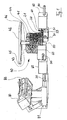
- Fig. 1 shows the mold according to the invention, in which a slider 80 is shown in the removal position of the mold according to the invention.
- a cam 20 By rotation of a cam 20 is a translational displacement of the push rods 30 and connected to these sliders 80. Just before reaching the end point of the displacement of the push rods 30 via a joint 81, a pivoting of the slider 80, which thereby release the stored in the circumferential lips 82 molding.
- the cam 20 are in the embodiment of the Fig. 1 pin-shaped projections 31 of the push rods 30 in engagement.
- a drive device 40 for a table-like designed lifting element 42 is arranged on the upper side 21 of the cam 20, a drive device 40 for a table-like designed lifting element 42 is arranged.
- the drive device 40 is provided in the form of a crank block 41, wherein a riser 44 is introduced as the circumference following, rising curve on the lifting element 42 facing side 43 of the crank block 41.
- the lifting element 42 has on its underside 45 on a pin 46 which runs on the riser 44. As a result, a displacement of the lifting element 42 is achieved perpendicular to the cam 20 and the crank block 41.
- the cam 20 and the drive device 40 are mounted together on a centrally disposed shaft 50 through which both elements are driven.
- the drive is effected by an electric motor arranged at the lower end of the shaft (not shown).
- the rotation of the shaft 50 by about 160 ° clockwise causes in the embodiment of Fig. 1 a displacement of the push rods 30 and thus the slider 80, (in Fig. 1 For reasons of clarity, only one of these slides 80 is shown) to the outside, and thus into the removal position of the molding tool.
- an upward movement of the lifting element 42 By movement of the lifting element 42, the breaking away and lifting of the mold cavity stored in the mold part takes place, the removal of which can be done quickly and easily after completion of the displacement of the lifting element 42.
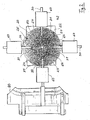
- Fig. 2 shows the embodiment of the control device according to the invention Fig. 1 in bottom view.
- the slides 80 of which in Fig. 2 only one is shown, are in the working position, ie the mold is prepared for receiving a new molding.
- the cam 20 has on its underside 22 via spirally cut into the cam 20 grooves 24, which form a slotted guide 25.
- the pin-shaped projections 31 of the push rods 30 are located on the shaft 50 nearest point, ie furthest to the edge 23 of the cam 20. About the pin-shaped projections 31 thus also the push rods 30 and with this the hinged thereto slide 80 to the center 26th the cam 20 moves towards.
- a rotation of the cam 20 by about 160 ° causes a mediated by the slide guide 25 displacement of the pin-shaped projections 31 in the grooves 24. These move spirally, ie with decreasing, radial distance to the edge 23 of the cam 20 in the groove 24, whereby a translational movement of the push rods 30 and the hinged thereto slider 80 takes place and the removal position of the mold is taken.
- the guide blocks 60 have a tunnel guide for receiving the push rods 30.
- Fig. 2 can be seen also the table-shaped lifting element 40, which is moved with rotation of the cam 20 perpendicularly away from this, thereby breaking off a mold cavity located in the mold part from the mold half and raises the worker or the removal device.
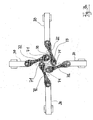
- Fig. 3a shows a further preferred embodiment of the control device according to the invention.
- a central of the shaft 50th penetrated disc 70 is provided which has perpendicular to each other, projecting pins 71.
- an end 75 is mounted in each case a link 72, whose opposite end 76 is articulated to the push rod 30.
- the push rod 30 is in the embodiment of Fig. 3a designed strip-shaped, their leadership is carried out accordingly in a rail 61 which engages around the push rod 30.
- Fig. 3b shows the control device Fig. 3a
- the disc 70 is shown rotated by 90 ° clockwise.
- the attached to the pins 71 link 72 were from the in Fig. 3a shown starting position, which is synonymous with the removal position of the mold, adjusted to the working position.
- This position change is effected by pivoting the link 72, whereby the distance between the push rods 30 and the disk center 73 is shortened and the slide 80 (see. Fig. 1 ) are moved accordingly.
- the slide 80 By reversing the direction of rotation of the drive and subsequent rotation of the disc 70 by 90 ° counterclockwise an opposite pivoting of the handlebar 72 and connected thereto, a displacement of the push rods 30 from the disk center 73 away. Due to the increased distance between the disk center point 73 and push rods 30, the slide 80 are also moved to the outside, away from the disk 70, in the removal position of the mold.
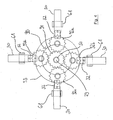
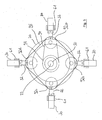
- a further preferred embodiment of the control device according to the invention in the manner of a planetary gear 90 is shown.
- the control device according to the invention has a guide pulley 93 arranged around the sun gear 91 for the planet gears 92a to 92d.
- the band-shaped push rods 30 are extended by hinged thereto, limited pivotable tabs 32 to the disk center 73 out.
- the push rods 30 are also in the embodiment of Fig.
- the control device is designed to be rotatable only in one direction and accordingly has a drive device 40 with a correspondingly adjusted riser 44 (see. Fig. 1 ).
- Fig. 5 also shows the bottom view of another embodiment of the control device according to the invention.
- a disc 70 is provided on a shaft 50 to which a concentrically arranged sun gear 91 is fixedly connected.
- the sun gear 91 drives a planetary gear 92a via a revolving belt 94.
- On the driven planetary gear 92a is eccentrically hinged to a tab 32 which is in engagement with the push rod 30.
- the push rod 30 is strip-shaped in the exemplary embodiment and is guided in a rail 61 to prevent bending occurring during actuation of the push rod 30 and to ensure their uniform, translational movement.
- a roller is mounted, in which a belt drive 95 is guided, which drives the other planet gears 92b to 92d.
- Each of the planet gears 92b to 92d has an eccentrically hinged tab 32 in extension of the push rod 30.
- the rotation of the sun gear 91 thus results in a rotation of the planetary gears 92a to 92d and thereby, depending on the achieved position of the planetary gears 92a to 92d a shortening or lengthening of the distance between the push rod 30 and the disk center 73 and associated therewith a displacement of the slider 80 (see , Fig. 1 ) in the removal or working position of the mold.
Landscapes
- Engineering & Computer Science (AREA)
- Mechanical Engineering (AREA)
- Manufacturing & Machinery (AREA)
- Moulds For Moulding Plastics Or The Like (AREA)
Description
- Die Erfindung betrifft ein Formwerkzeug mit den oberbegrifflichen Merkmalen des Patentanspruches 1. Ein derartiges Formwerkzeug ist aus der
JP 58-084740 A - Formwerkzeuge, insbesondere zur Herstellung oder Weiterverarbeitung von Formteilen aus kunststoffbasierten Formmassen wie beispielsweise aus Polyurethan (PU), verfügen in der Regel über zwei verschieb- oder verschwenkbar in einem Werkzeugträger angeordnete Werkzeughälften mit geeigneten Formaufspannplatten für das jeweilige Schäum- oder Spritzgussverfahren. Derartige Werkzeuge können verwendet werden, um durch Eintrag der Formmasse in ein Formnest, einteilige Formteile herzustellen. Darüber hinaus können allerdings auch aus anderen Werkstoffen, wie beispielsweise aus Glas oder Metall bestehende Formteile mit Formmasse umspritzt oder in diese eingebettet werden. Je nach Gestaltung des Formnests können derartige Formteile in das Formnest eingelegt werden, um nach dem Schließen der Werkzeughälften, wie bei der Herstellung einteiliger Formteile, die Formmasse in das Werkzeug einzuspritzen. Nach der Aushärtung der Formmasse werden die Werkzeughälften getrennt und das entstandene Formteil aus dem Formnest entnommen. Herkömmliche Formwerkzeuge weisen dazu an den Werkzeughälften mindestens einen, im Regelfall aber zwei bis vier Schieber auf, die über Schubstangen verschoben werden, um das Formteil freizugeben. Zusätzlich verfügen viele Werkzeuge über wenigstens ein Hubelement, das das Formteil aus der Form anhebt und zur Erleichterung der Entnahme auf den Werker oder eine Entnahmevorrichtung zuführt.
- Nachteil bekannter Werkzeuge ist es, dass jeder Schieber über jeweils einen hydraulischen oder pneumatischen Aktor verfügt. Da jeder Aktor einen eigenen Antrieb aufweist, sind entsprechend ausgerüstete Formwerkzeuge, insbesondere durch die zahlreichen, zur Betätigung des Aktors notwendigen Fluidschläuche und Steuermodule im Aufbau sehr komplex, zeigen hohen Platzbedarf bei der Aufstellung und verursachen zudem hohe Kosten für Wartung und Reparatur.
- Aufgabe der vorliegenden Erfindung ist es daher, eine einfache, kostengünstige und wartungsarme Vorrichtung zur gleichzeitigen Steuerung der Schieber und des Hubelementes an den Werkzeughälften von Formwerkzeugen zur Verfügung zu stellen.
- Diese Aufgabe wird durch ein Formwerkzeug mit den Merkmalen des Patentanspruchs 1 gelöst. Weitere vorteilhafte Ausführungsform der Erfindung sind Gegenstand der abhängigen Ansprüche.
- Das erfindungsgemäße Formwerkzeug verfügt über wenigstens einen Schieber an einer Werkzeughälfte und umfasst zudem wenigstens eine in der Ebene der Werkzeughälfte translatorisch bewegbare Schubstange. Diese ist am Schieber angelenkt. Zudem ist eine Antriebsvorrichtung für ein im wesentlichen senkrecht zur Ebene der Werkzeughälfte verschiebbares Hubelement zum Ausformen eines Formteils vorgesehen. Das Formwerkzeug besitzt zudem eine zentrale Steuervorrichtung zur gemeinsamen Betätigung der Schubstange bzw. bei Verwendung mehrerer Schieber, der Schubstangen, und der Antriebsvorrichtung für das Hubelement. Die Antriebsvorrichtung kann im wesentlichen block- oder zylinderförmig ausgeformt sein. Das Hubelement bildet während des Formvorganges entweder einen Teil der Formhälfte oder ist unterhalb der Formhälfte angeordnet und wird erst im Zuge des Entformvorganges in die Auswurf- bzw. Hubstellung verschoben. Die Schieber können zusätzlich so ausgebildet sein, dass sie bei Erreichen der Endposition der translatorischen Verschiebung nach außen, d.h. vom Formteil weg, verschwenkt werden können, um die Ränder des Formteils, und somit letztlich das gesamte Formteil, vollständig freizulegen. Eine derartige Ausgestaltung bietet sich vor allem bei hinterschnittenen Formteilen an.
- Zum Antrieb der zentralen Steuervorrichtung ist insbesondere ein Elektromotor oder ein Schrittmotor vorgesehen. Durch diese Ausgestaltung des Motors wird eine sehr genaue und direkte Steuerung des Schiebers bzw. der Schieber und gleichzeitig der Antriebsvorrichtung für das Hubelement möglich, da beide Werkzeugelemente an der gleichen Welle angeordnet und von dieser angetrieben werden. Die Tatsache, dass nur ein Antriebselement vorhanden ist und die Verwendung eines Elektromotors bietet außerdem die Möglichkeit, entsprechende Formwerkzeuge im Vergleich zu aufwändigen Hydraulik- oder Druckluftanlagen relativ kostengünstig herzustellen, mit niedrigen Kosten zu betreiben und mit wenig Aufwand instandzuhalten.
- Eine bevorzugte Ausführungsform der vorliegenden Erfindung sieht vor, dass die Antriebsvorrichtung einen mit einer Steigkulisse versehenen Kulissenbock zur Zwangsführung des Hubelements aufweist. Das Hubelement steht dabei, beispielsweise über wenigstens einen Vorsprung an seiner vom Formnest abgewandten Seite, mit der Steigkulisse der Antriebsvorrichtung in Eingriff. Die rotatorische Bewegung der mit der angetriebenen Welle verbundenen Antriebsvorrichtung wird so in eine translatorische Bewegung des Hubelementes umgesetzt. Das Hubelement, das an dem aus dem Formnest zu entformenden Formteil anliegt, oder während des Entformens an dieses angelegt wird, hebt im weiteren Verlauf der Bewegung der Antriebsvorrichtung das Formteil sanft an und löst dieses dadurch kraftvoll aus der Formhälfte. Durch die erfindungsgemäße Vorrichtung, insbesondere in Verbindung mit einem Elektro- oder Schrittmotor, kann damit ein besonders sanftes, gut steuerbares und somit schadensfreies Losbrechen des Formteiles aus der Formhälfte erreicht werden.
- Es erweist sich als vorteilhaft, wenn die Steuervorrichtung für die Schubstange(-n) als Kurvenscheibe ausgebildet ist. Die Scheibe weist dabei eine spiralförmig ausgebildete Kulissenführung auf, in die die zu verschiebende Schubstange eingreift. Dieser Eingriff wird insbesondere über einen stiftförmigen Vorsprung realisiert, der an der Schubstange vorgesehen ist. Die Kulissenführung verfügt über eine Nut oder eine Trommelkurve, bei Verwendung mehrerer Schubstangen über die entsprechende Anzahl von Nuten oder Trommelkurven. Die spiralige Anordnung der Kulissenführung bewirkt, dass sich beispielsweise während der Drehung der Scheibe um 180° im Uhrzeigersinn der radiale Abstand der durch die Kulisse geführten Schubstange(n) vom Mittelpunkt der Scheibe stetig vergrößert und dadurch eine translatorische, synchrone Verschiebung der Schubstange(-n) stattfindet. Bei Umkehr der Scheibendrehung wird die Schubstange bzw. werden die Schubstangen auf den Mittelpunkt zugeführt und die daran angelenkten Schieber entsprechend zum Zentrum hin bewegt.
- Eine weiterhin bevorzugte Ausführungsform der vorliegenden Erfindung sieht vor, dass die Steuervorrichtung als die Schubstange verlängernder Lenker ausgebildet ist. Der Lenker (Hebel) ist dabei sowohl schubstangen- als auch scheibenseitig an der zentralen Antriebswelle schwenkbar gelagert. Die Drehung der Scheibe, insbesondere um 90° im bzw. gegen den Uhrzeigersinn bewirkt eine Verschwenkung des Lenkers, damit verbunden die translatorische Verschiebung der Schubstange und des Schiebers und damit das Erreichen der Arbeits- bzw. Entnahmeposition des Formwerkzeuges.
- Als empfehlenswert wird angesehen, wenn die Steuervorrichtung als die Schubstange verlängernde, exzentrisch an einem Planetenrad angeordnete Lasche ausgebildet ist. Durch diese Ausbildung mit einem "Planetengetriebe" kann ein Elektromotor mit nur einer Drehrichtung zum Antrieb der Steuervorrichtung verbaut und dadurch das gesamte Formwerkzeug noch einfacher und kostengünstiger ausgeführt werden.
- In einer bevorzugten Ausführungsform der vorliegenden Erfindung steht das Planetenrad kämmend mit einem Sonnenrad in Eingriff, das an der angetriebenen Welle angeordnet ist oder ist durch einen über die Welle laufenden Riemen oder eine Kette angetrieben. Hierdurch kann bei entsprechender Kapselung auf eine Schmierung des Getriebes weitgehend verzichtet werden.
- Eine weitere vorteilhafte Ausführung der Erfindung sieht vor, dass bei Verwendung von mehr als einem Planetenrad, jedes weitere Planetenrad durch einen Riementrieb oder einen Kettentrieb angetrieben ist. Dabei empfiehlt es sich insbesondere, koaxial zum Planetenrad, das mit dem Sonnenrad kämmt bzw. durch die Welle über einen Riemen oder eine Ketten angetrieben ist, ein zweites Rad oder eine Rolle zur Führung des Riemen- oder Kettentriebes anzuordnen.
- Um eine besonders stabile Führung der Schubstange zu gewährleisten und um die Schubstange gegen Verbiegen zu sichern, ist es besonders empfehlenswert, die Schubstange in einer nahe an der zentralen Steuervorrichtung angeordneten Führung zu führen. Als Führung kommen alle realisierbaren Möglichkeiten zur Linearführung einer Stange in Frage, vor allem jedoch eine offene Schiene, die die Schubstange umgreift oder ein Führungsblock, durch den die Schubstange hindurchgeführt wird.
- Eine als besonders günstig anzusehende Ausführungsform der Erfindung sieht vor, dass vier Schubstangen rechtwinklig zueinander in Art eines Kreuzes angeordnet sind. Durch eine derartige Anordnung können vier Schieber einer Formwerkzeughälfte synchron bewegt werden, wodurch das Entformen geschäumter, umspritzter oder eingebetteter Formteile noch einfacher durchführbar wird. Außerdem kann durch diese Anordnung ein besonders gleichmäßiger Rundlauf des Antriebs und eine gleichmäßige Beanspruchung der zentralen Welle erreicht werden.
- Weitere Vorteile, Merkmale und Besonderheiten der Erfindung ergeben sich aus der nachfolgenden Beschreibung bevorzugter, jedoch nicht beschränkender Ausführungsformen der Erfindung anhand der schematischen und nicht maßstabsgetreuen Zeichnungen. Es zeigen:
- Fig. 1
- eine bevorzugte Ausführungsform des erfindungsgemäßen Formwerkzeuges in perspektivischer Darstellung,
- Fig. 2
- eine bevorzugte Ausführungsform der mit einer Kurvenscheibe versehenen Steuerungsvorrichtung in Unteransicht,
- Fig. 3a
- eine Ausführungsform der mit Lenkern (Hebeln) ausgestatteten Steuerungsvorrichtung in Unteransicht
- Fig. 3b
- eine Darstellung der Steuervorrichtung der
Fig. 3a mit verschwenkten Lenkern in Unteransicht, - Fig. 4
- eine weitere Ausführungsform der Steuerungsvorrichtung mit einem Planetengetriebe in Unteransicht, und
- Fig. 5
- eine Ausführungsform der erfindungsgemäßen Steuerungsvorrichtung mit durch einen Riementrieb angetriebenen Planetenrädern in Unteransicht.
-
Fig. 1 zeigt das erfindungsgemäße Formwerkzeug, bei dem ein Schieber 80 in der Entnahmeposition des erfindungsgemäßen Formwerkzeuges dargestellt ist. Durch Drehung einer Kurvenscheibe 20 erfolgt eine translatorische Verschiebung der Schubstangen 30 und der mit diesen verbundenen Schiebern 80. Kurz vor Erreichen des Endpunktes der Verschiebung der Schubstangen 30 erfolgt über ein Gelenk 81, ein Verschwenken der Schieber 80, die dadurch das in den umlaufenden Lippen 82 gelagerte Formteil freigeben. Mit der Kurvenscheibe 20 stehen im Ausführungsbeispiel derFig. 1 stiftförmige Vorsprünge 31 der Schubstangen 30 in Eingriff. Auf der Oberseite 21 der Kurvenscheibe 20 ist eine Antriebsvorrichtung 40 für ein tischartig ausgebildetes Hubelement 42 angeordnet. Die Antriebsvorrichtung 40 ist in Form eines Kulissenbockes 41 vorgesehen, wobei eine Steigkulisse 44 als dem Umfang folgende, ansteigende Kurve auf der dem Hubelement 42 zugewandten Seite 43 des Kulissenbockes 41 eingebracht ist. Das Hubelement 42 weist an seiner Unterseite 45 einen Stift 46 auf, der auf der Steigkulisse 44 läuft. Dadurch wird eine Verschiebung des Hubelementes 42 senkrecht zur Kurvenscheibe 20 bzw. zum Kulissenbock 41 erreicht. - Die Kurvenscheibe 20 und die Antriebvorrichtung 40 sind gemeinsam auf einer zentral angeordneten Welle 50 angebracht, über die beide Elemente angetrieben werden. Der Antrieb erfolgt durch einen am unteren Ende der Welle angeordneten Elektromotor (nicht dargestellt). Die Drehung der Welle 50 um ca. 160° im Uhrzeigersinn bewirkt im Ausführungsbeispiel der
Fig. 1 eine Verschiebung der Schubstangen 30 und damit der Schieber 80, (inFig. 1 wird aus Übersichtlichkeitsgründen nur einer dieser Schieber 80 dargestellt) nach außen, und damit in die Entnahmeposition des Formwerkzeuges. Gleichzeitig mit der Verschiebung der Schubstangen 30 erfolgt durch die Antriebsvorrichtung 40 eine Aufwärtsbewegung des Hubelementes 42. Durch Bewegung des Hubelementes 42 erfolgt das Losbrechen und Anheben des im Formnest gelagerten Formteils, dessen Entnahme nach Abschluss der Verschiebung des Hubelementes 42 schnell und einfach erfolgen kann. - Um die Form für die Aufnahme eines neuen Formteils vorzubereiten, erfolgt eine entsprechend entgegengesetzte Drehung der Welle 50 um 90° gegen den Uhrzeigersinn. Die über die stiftförmigen Vorsprünge 31 mit der Kurvenscheibe 20 in Eingriff stehenden Schubstangen 30 werden dadurch entgegengesetzt zur vorherigen Verschieberichtung verschoben und die Schieber 80 somit in Richtung der Welle 50 gezogen. Dadurch nimmt das Formwerkzeug seine Arbeitsposition ein. Während der Bewegung der Schieber 80 bzw. der Schubstangen 30 findet gleichzeitig ein Absenken des Hubelementes 42 statt. Dazu bewegen sich die Stifte 46 auf der Steigkulisse 44 in die zum Anheben entgegengesetzte Richtung, so dass das Hubelement 42 in die Ausgangsposition zurückgleiten kann. Die Schubstangen 30 sind durch die Führungsblöcke 60 hindurchgeführt, die unweit des Randes 23 der Kurvenscheibe 20 angeordnet sind. Diese Führungsblöcke 60 befinden sich im Bereich des Angriffspunktes der höchsten Verwindungskraft und gewährleisten so eine stabile Führung der Schubstangen 30.
- In
Fig. 2 zeigt die Ausführungsform der erfindungsgemäßen Steuervorrichtung ausFig. 1 in Unteransicht. Im Ausführungsbeispiel sind vier rechtwinklig zueinander angeordnete Schubstangen 30 vorgesehen. Die Schieber 80, von denen inFig. 2 nur ein einziger gezeigt wird, befinden sich in der Arbeitsposition, d.h. das Formwerkzeug ist für die Aufnahme eines neuen Formteils vorbereitet. Die Kurvenscheibe 20 verfügt auf ihrer Unterseite 22 über spiralig in die Kurvenscheibe 20 eingeschnittene Nuten 24, die eine Kulissenführung 25 bilden. Die stiftförmigen Vorsprünge 31 der Schubstangen 30 befinden sich am der Welle 50 nächstgelegenen Punkt, d.h. am weitesten beabstandet zum Rand 23 der Kurvenscheibe 20. Über die stiftförmigen Vorsprünge 31 wurden somit auch die Schubstangen 30 und mit diesen die daran angelenkten Schieber 80 auf das Zentrum 26 der Kurvenscheibe 20 hin bewegt. Eine Drehung der Kurvenscheibe 20 um etwa 160° bewirkt eine durch die Kulissenführung 25 vermittelte Verschiebung der stiftförmigen Vorsprünge 31 in den Nuten 24. Diese bewegen sich spiralig, d.h. mit abnehmendem, radialem Abstand zum Rand 23 der Kurvenscheibe 20 in der Nut 24, wodurch eine translatorische Bewegung der Schubstangen 30 und der daran angelenkten Schieber 80 stattfindet und die Entnahmeposition des Formwerkzeuges eingenommen wird. Um eine Verbindung der Schubstangen 30 zu unterbinden, werden diese in Führungsblöcken 60 geführt. Die Führungsblöcke 60 weisen eine Tunnelführung zur Aufnahme der Schubstangen 30 auf. InFig. 2 zu erkennen ist zudem das tischförmige Hubelement 40, das mit Drehung der Kurvenscheibe 20 senkrecht von dieser weg bewegt wird, dadurch ein im Formnest befindliches Formteil aus der Formhälfte losbricht und dem Werker bzw. der Entnahmevorrichtung entgegenhebt. -
Fig. 3a zeigt eine weitere, bevorzugte Ausführungsform der erfindungsgemäßen Steuervorrichtung. Im Ausführungsbeispiel ist eine zentral von der Welle 50 durchdrungene Scheibe 70 vorgesehen, die über senkrecht zueinander angeordnete, vorspringende Stifte 71 verfügt. An diesen Stiften 71 ist ein Ende 75 jeweils eines Lenkers 72 angebracht, dessen entgegengesetztes Ende 76 an der Schubstange 30 angelenkt ist. Die Schubstange 30 ist im Ausführungsbeispiel derFig. 3a leistenförmig ausgeführt, ihre Führung erfolgt dementsprechend in einer Schiene 61, die die Schubstange 30 umgreift. -
Fig. 3b zeigt die Steuervorrichtung ausFig. 3a , jedoch ist hier die Scheibe 70 um 90° im Uhrzeigersinn gedreht dargestellt. Die an den Stiften 71 angebrachten Lenker 72 wurden aus der inFig. 3a gezeigten Ausgangsposition, die gleichbedeutend mit der Entnahmeposition des Formwerkzeuges ist, in die Arbeitsposition verstellt. Dieser Positionswechsel wird durch Verschwenken der Lenker 72 bewirkt, wodurch sich der Abstand zwischen Schubstangen 30 und Scheibenmittelpunkt 73 verkürzt und die Schieber 80 (vgl.Fig. 1 ) entsprechend verschoben werden. Durch Umkehr der Drehrichtung des Antriebs und anschließender Drehung der Scheibe 70 um 90° gegen den Uhrzeigersinn erfolgt eine entgegengesetzte Verschwenkung der Lenker 72 und damit verbunden, eine Verschiebung der Schubstangen 30 vom Scheibenmittelpunkt 73 weg. Durch den vergrößerten Abstand zwischen Scheibenmittelpunkt 73 und Schubstangen 30 werden die Schieber 80 ebenfalls nach außen, von der Scheibe 70 weg, in die Entnahmeposition des Formwerkzeuges verschoben. - In
Fig. 4 ist eine weitere bevorzugte Ausführungsform der erfindungsgemäßen Steuervorrichtung in Art eines Planetengetriebes 90 dargestellt. Dabei sind ein auf der Welle 50 angebrachtes Sonnenrad 91 und vier mit diesem in Eingriff stehende, nur schematisch dargestellte Planetenräder 92a bis 92d vorgesehen. Zusätzlich weist die erfindungsgemäße Steuervorrichtung eine um das Sonnenrad 91 herum angeordnete Führungsscheibe 93 für die Planetenräder 92a bis 92d auf. Im Ausführungsbeispiel derFig. 4 werden die bandförmigen Schubstangen 30 durch daran angelenkte, begrenzt verschwenkbare Laschen 32 zum Scheibenmittelpunkt 73 hin verlängert. Die Schubstangen 30 werden auch im Ausführungsbeispiel derFig. 4 in Schienen 61 geführt, die die Schubstangen 30 umgreifen, und jede der Laschen 32 ist exzentrisch an jeweils einem der Planetenräder 92a bis 92d anlenkt. Die mit dem Sonnenrad 91 kämmenden Planetenräder 92a bis 92d bewirken bei Drehung des Sonnenrades 91 somit laschenvermittelt eine Verkürzung bzw. Verlängerung des Abstandes zwischen Schubstange 30 und Scheibenmittelpunkt 73, wodurch eine Verschiebung der Schieber 80 (vgl.Fig. 1 ) in die Arbeits- bzw. Entnahmeposition des Formwerkzeuges erreicht wird. In der gezeigten Ausführungsform ist die Steuervorrichtung nur in eine Richtung drehbar ausgeführt und verfügt dementsprechend über eine Antriebsvorrichtung 40 mit entsprechend abgestimmter Steigkulisse 44 (vgl.Fig. 1 ). -
Fig. 5 zeigt ebenfalls die Unteransicht einer weiteren Ausführungsform der erfindungsgemäßen Steuervorrichtung. Hierbei ist, ähnlich wie bereits inFig. 4 dargestellt, eine Scheibe 70 auf einer Welle 50 vorgesehen, mit der ein konzentrisch angeordnetes Sonnenrad 91 fest verbunden ist. Das Sonnenrad 91 treibt über einen umlaufenden Riemen 94 ein Planetenrad 92a. Am angetriebenen Planetenrad 92a ist exzentrisch eine Lasche 32 angelenkt, die mit der Schubstange 30 in Eingriff steht. Die Schubstange30 ist im Ausführungsbeispiel leistenförmig ausgebildet und wird in einer Schiene 61 geführt, um bei der Betätigung auftretende Verbiegung der Schubstange 30 zu verhindern und um deren gleichmäßige, translatorische Bewegung sicherzustellen. Deckungsgleich mit dem Planetenrad 92a ist eine Rolle angebracht, in der ein Riementrieb 95 geführt wird, der die übrigen Planetenräder 92b bis 92d antreibt. Jedes der Planetenräder 92b bis 92d weist eine exzentrisch angelenkte Lasche 32 in Verlängerung der Schubstange 30 auf. Durch die Rotation des Sonnenrades 91 erfolgt somit eine Drehung der Planetenräder 92a bis 92d und dadurch, je nach erreichter Stellung der Planetenräder 92a bis 92d eine Verkürzung bzw. Verlängerung des Abstandes zwischen Schubstange 30 und Scheibenmittelpunkt 73 und damit verbunden eine Verschiebung des Schiebers 80 (vgl.Fig. 1 ) in die Entnahme- bzw. Arbeitsposition des Formwerkzeuges. -
- 20 = Kurvenscheibe
- 21 = Oberseite
- 22 = Unterseite
- 23 = Rand
- 24 = Nut
- 25 = Kulissenführung
- 26 = Zentrum
- 30 = Schubstange(-n)
- 31 = stiftförmigen Vorsprünge
- 32 = Laschen
- 40 = Antriebsvorrichtung
- 41 = Kulissenbock
- 42 = Hubelement
- 43 = zugewandte Seite
- 44 = Steigkulisse
- 45 = Unterseite
- 46 = Stifte
- 50 = Welle
- 60 = Führungsblöcke
- 61 = Schiene
- 70 = Scheibe
- 71 = Stifte
- 72 = Lenker
- 73 = Scheibenmittelpunkt
- 75 = Ende
- 76 = entgegengesetztes Ende
- 80 = Schieber
- 90 = Planetengetriebe
- 91 = Sonnenrad
- 92a - d= Planetenrad
- 93 = Führungsscheibe
- 94 = Riemen
- 95 = Riementrieb
Claims (10)
- Formwerkzeug mit wenigstens einem Schieber (80) an einer Werkzeughälfte, umfassend:- wenigstens eine in der Ebene der Werkzeughälfte translatorisch bewegbare Schubstange (30), die am Schieber (80) angelenkt ist,- eine Antriebsvorrichtung (40) für ein im wesentlichen senkrecht verschiebbares Hubelement (42) zum Ausformen eines Formteils, und- eine zentrale Steuervorrichtung zur gemeinsamen Betätigung der Schubstange(n) (30) und der Antriebsvorrichtung (40),dadurch gekennzeichnet, dass
die Steuervorrichtung eine rotatorische in eine translatorische Bewegung umsetzt und das Hubelement (42) im wesentlichen rechtwinklig zur Schubstange (30) angeordnet ist. - Formwerkzeug nach Anspruch 1,
dadurch gekennzeichnet, dass
die Steuervorrichtung durch einen einzigen Motor, insbesondere einen Elektro- oder Schrittmotor angetrieben ist. - Formwerkzeug nach Anspruch 1 oder 2,
dadurch gekennzeichnet, dass
die Antriebsvorrichtung (40) einen mit einer Steigkulisse (44) versehenen Kulissenbock (41) zur Zwangsführung des Hubelements (42) aufweist. - Formwerkzeug nach einem der vorhergehenden Ansprüche,
dadurch gekennzeichnet, dass
die Steuervorrichtung als Kurvenscheibe (20) ausgebildet ist, in deren spiralförmig angeordnete Kulissenführung (25) die Schubstange (30) eingreift, insbesondere über einen stiftförmigen Vorsprung (31). - Formwerkzeug nach einem der Ansprüche 1 bis 3,
dadurch gekennzeichnet, dass
die Steuervorrichtung als die Schubstange (30) verlängernder Lenker (72) ausgebildet ist. - Formwerkzeug nach einem der Ansprüche 1 bis 3,
dadurch gekennzeichnet, dass
die Steuervorrichtung als die Schubstange (30) verlängernde, exzentrisch an einem Planetenrad (92a) angeordnete Lasche (32) ausgebildet ist. - Formwerkzeug nach Anspruch 6,
dadurch gekennzeichnet, dass
das Planetenrad (92a) kämmend mit einem Sonnenrad (91) in Eingriff steht oder durch einen Riemen (94) oder eine Kette angetrieben ist. - Formwerkzeug nach Anspruch 7,
dadurch gekennzeichnet, dass
bei Verwendung von mehr als einem Planetenrad (92a), jedes weitere Planetenrad (92b-d) durch einen Riementrieb (95) oder einen Kettentrieb angetrieben ist. - Formwerkzeug nach einem der vorhergehenden Ansprüche,
dadurch gekennzeichnet, dass,
die Schubstange (30) in einer nahe an der zentralen Steuervorrichtung angeordneten Führung (60) geführt ist. - Formwerkzeug nach einem der vorhergehenden Ansprüche,
dadurch gekennzeichnet, dass,
vier Schubstangen (30) rechtwinklig zueinander angeordnet sind.
Priority Applications (1)
| Application Number | Priority Date | Filing Date | Title |
|---|---|---|---|
| PL07012887T PL1878552T3 (pl) | 2006-07-11 | 2007-07-02 | Narzędzie kształtowe |
Applications Claiming Priority (1)
| Application Number | Priority Date | Filing Date | Title |
|---|---|---|---|
| DE200620010761 DE202006010761U1 (de) | 2006-07-11 | 2006-07-11 | Formwerkzeug |
Publications (2)
| Publication Number | Publication Date |
|---|---|
| EP1878552A1 EP1878552A1 (de) | 2008-01-16 |
| EP1878552B1 true EP1878552B1 (de) | 2018-11-07 |
Family
ID=38336388
Family Applications (1)
| Application Number | Title | Priority Date | Filing Date |
|---|---|---|---|
| EP07012887.1A Not-in-force EP1878552B1 (de) | 2006-07-11 | 2007-07-02 | Formwerkzeug |
Country Status (5)
| Country | Link |
|---|---|
| EP (1) | EP1878552B1 (de) |
| DE (1) | DE202006010761U1 (de) |
| ES (1) | ES2696973T3 (de) |
| HU (1) | HUE042936T2 (de) |
| PL (1) | PL1878552T3 (de) |
Cited By (1)
| Publication number | Priority date | Publication date | Assignee | Title |
|---|---|---|---|---|
| DE102021114436A1 (de) | 2021-06-04 | 2022-12-08 | FKT Formenbau und Kunststofftechnik GmbH | Entformungsbaugruppe für Spritzgießwerkzeuge |
Families Citing this family (1)
| Publication number | Priority date | Publication date | Assignee | Title |
|---|---|---|---|---|
| CN107953501B (zh) * | 2017-10-17 | 2023-10-20 | 福建鸿龙机械有限公司 | 一种转盘式eva鞋底二次发泡成型机及其成型方法 |
Family Cites Families (8)
| Publication number | Priority date | Publication date | Assignee | Title |
|---|---|---|---|---|
| DE2410446A1 (de) * | 1973-03-08 | 1974-09-19 | Jens Ove Nielsen | Auswerfvorrichtung fuer den formenteil einer giessmaschine, insbesondere einer kunststoff-spritzgiessmaschine |
| AU8212075A (en) * | 1975-06-13 | 1976-12-16 | Radial Pneus Australasia Pty L | Tyre vulcanising machine |
| JPS5937215B2 (ja) * | 1981-11-17 | 1984-09-08 | ホンダエンジニアリング株式会社 | 合成樹脂成形金型 |
| EP0354481B1 (de) * | 1988-08-09 | 1995-11-29 | Asahi Glass Company Ltd. | Verfahren zum Herstellen einer Glasscheibe mit einer Abdichtung und Form zum Herstellen einer solchen Glasscheibe |
| US6123535A (en) * | 1996-08-02 | 2000-09-26 | Libbey-Owens-Ford Co. | Molding apparatus for encapsulating a part |
| ES2205752T5 (es) * | 1999-05-24 | 2007-12-01 | Pilkington Italia S.P.A. | Moldeado de un perfil elastomerico de un cristal. |
| DE10064745A1 (de) * | 2000-12-22 | 2002-07-11 | Webasto Vehicle Sys Int Gmbh | Formwerkzeug und Verfahren zum randseitigen Anformen eines profilierten mehrseitigen Kunststoffrahmenteils an einen plattenförmigen Gegenstand |
| DE202005002900U1 (de) * | 2005-02-21 | 2005-06-02 | Bbg Gmbh & Co. Kg | Werkzeug |
-
2006
- 2006-07-11 DE DE200620010761 patent/DE202006010761U1/de not_active Expired - Lifetime
-
2007
- 2007-07-02 PL PL07012887T patent/PL1878552T3/pl unknown
- 2007-07-02 EP EP07012887.1A patent/EP1878552B1/de not_active Not-in-force
- 2007-07-02 HU HUE07012887A patent/HUE042936T2/hu unknown
- 2007-07-02 ES ES07012887T patent/ES2696973T3/es active Active
Non-Patent Citations (1)
| Title |
|---|
| None * |
Cited By (1)
| Publication number | Priority date | Publication date | Assignee | Title |
|---|---|---|---|---|
| DE102021114436A1 (de) | 2021-06-04 | 2022-12-08 | FKT Formenbau und Kunststofftechnik GmbH | Entformungsbaugruppe für Spritzgießwerkzeuge |
Also Published As
| Publication number | Publication date |
|---|---|
| PL1878552T3 (pl) | 2019-06-28 |
| ES2696973T3 (es) | 2019-01-21 |
| EP1878552A1 (de) | 2008-01-16 |
| HUE042936T2 (hu) | 2019-07-29 |
| DE202006010761U1 (de) | 2007-08-09 |
Similar Documents
| Publication | Publication Date | Title |
|---|---|---|
| DE102014116087B4 (de) | Gekoppelte Blasformvorrichtung einer drehbaren Blasmaschine | |
| EP2139670A1 (de) | Verfahren und vorrichtung zur herstellung eines kunststoffprofils | |
| DE2146245B2 (de) | Formwerkzeuge, insbesondere zum Herstellen von Formungen aus Polyurethan | |
| DE102010004781A1 (de) | Trenn- und Abisoliereinrichtung für eine Kabelverarbeitungsmaschine | |
| EP3708328B1 (de) | Werkzeug zum spritzgiessen von kunststoff-formteilen und verfahren zum bewegen eines schiebers einer werkzeughälfte des werkzeugs | |
| EP2523795B1 (de) | Kniehebel-schliesseinheit | |
| EP1621316A1 (de) | Spritzgiessform zum Herstellen von Fittings | |
| EP1162633A1 (de) | Verfahren zur Herstellung von Drilleitern | |
| EP2110220A2 (de) | Vorrichtung zur Herstellung von Formteilen, insbesondere von Schaumformteilen | |
| EP1878552A1 (de) | Formwerkzeug | |
| EP1857249B1 (de) | Vorrichtung zur Herstellung von Schaumformteilen | |
| EP2753463B1 (de) | Werkzeug zum spritzgiessen von kunststoffteilen | |
| EP1454783A1 (de) | Lamellen-Fahrzeugdach | |
| AT427U1 (de) | Spritzgusseinrichtung fuer kunststoffe | |
| DE10307669B3 (de) | Druckgußmaschine | |
| DE19702889C2 (de) | Antriebseinrichtung für einen Schließmechanismus und/oder eine Einspritzeinheit einer Spritzgießmaschine | |
| EP1055502A1 (de) | Formschliesseinheit für eine Spritzgiessmaschine | |
| DE69810378T2 (de) | Spritzgiessvorrichtung für Hohlgegenstände wie zum Beispiel Rohrverbindungen | |
| DE102006046862B3 (de) | Verfahren und Stellkrafterzeuger zur Bedienung von Montageplattformen | |
| WO2002057062A1 (de) | Auswerfvorrichtung für eine formmaschine | |
| WO2007065551A1 (de) | Antriebsvorrichtung für ein schiebetor und verfahren zu dessen montage | |
| EP1623811B1 (de) | Spritzgusswerkzeug zur Herstellung von Kunststoffteilen, insbesondere derartiges Werkzeug zum Herstellen von zwei Kunststoffleisten verbindenden Spritzguss-Eckverbindungsteilen | |
| DE2656217C2 (de) | Kurvengetriebe zum Antrieb von Arbeitsstationen einer Verpackungsmaschine | |
| DE2428631A1 (de) | Verfahren und maschine zum kontinuierlichen automatischen herstellen von lichterketten | |
| DE102014225165A1 (de) | Spritzgießmaschine mit einer Schließeinheit |
Legal Events
| Date | Code | Title | Description |
|---|---|---|---|
| PUAI | Public reference made under article 153(3) epc to a published international application that has entered the european phase |
Free format text: ORIGINAL CODE: 0009012 |
|
| AK | Designated contracting states |
Kind code of ref document: A1 Designated state(s): AT BE BG CH CY CZ DE DK EE ES FI FR GB GR HU IE IS IT LI LT LU LV MC MT NL PL PT RO SE SI SK TR |
|
| AX | Request for extension of the european patent |
Extension state: AL BA HR MK YU |
|
| 17P | Request for examination filed |
Effective date: 20080616 |
|
| 17Q | First examination report despatched |
Effective date: 20080717 |
|
| AKX | Designation fees paid |
Designated state(s): AT BE BG CH CY CZ DE DK EE ES FI FR GB GR HU IE IS IT LI LT LU LV MC MT NL PL PT RO SE SI SK TR |
|
| RIN1 | Information on inventor provided before grant (corrected) |
Inventor name: SATZGER BERNHARD Inventor name: LUDWIG, THOMAS Inventor name: BRANDNER, HANS |
|
| STAA | Information on the status of an ep patent application or granted ep patent |
Free format text: STATUS: EXAMINATION IS IN PROGRESS |
|
| GRAP | Despatch of communication of intention to grant a patent |
Free format text: ORIGINAL CODE: EPIDOSNIGR1 |
|
| STAA | Information on the status of an ep patent application or granted ep patent |
Free format text: STATUS: GRANT OF PATENT IS INTENDED |
|
| INTG | Intention to grant announced |
Effective date: 20171213 |
|
| RIN1 | Information on inventor provided before grant (corrected) |
Inventor name: LUDWIG, THOMAS Inventor name: SATZGER, BERNHARD Inventor name: BRANDNER, HANS |
|
| GRAJ | Information related to disapproval of communication of intention to grant by the applicant or resumption of examination proceedings by the epo deleted |
Free format text: ORIGINAL CODE: EPIDOSDIGR1 |
|
| STAA | Information on the status of an ep patent application or granted ep patent |
Free format text: STATUS: EXAMINATION IS IN PROGRESS |
|
| GRAP | Despatch of communication of intention to grant a patent |
Free format text: ORIGINAL CODE: EPIDOSNIGR1 |
|
| STAA | Information on the status of an ep patent application or granted ep patent |
Free format text: STATUS: GRANT OF PATENT IS INTENDED |
|
| INTC | Intention to grant announced (deleted) | ||
| INTG | Intention to grant announced |
Effective date: 20180515 |
|
| GRAS | Grant fee paid |
Free format text: ORIGINAL CODE: EPIDOSNIGR3 |
|
| GRAA | (expected) grant |
Free format text: ORIGINAL CODE: 0009210 |
|
| STAA | Information on the status of an ep patent application or granted ep patent |
Free format text: STATUS: THE PATENT HAS BEEN GRANTED |
|
| AK | Designated contracting states |
Kind code of ref document: B1 Designated state(s): AT BE BG CH CY CZ DE DK EE ES FI FR GB GR HU IE IS IT LI LT LU LV MC MT NL PL PT RO SE SI SK TR |
|
| RAP1 | Party data changed (applicant data changed or rights of an application transferred) |
Owner name: BBG GMBH & CO. KG |
|
| REG | Reference to a national code |
Ref country code: GB Ref legal event code: FG4D Free format text: NOT ENGLISH |
|
| REG | Reference to a national code |
Ref country code: CH Ref legal event code: EP Ref country code: AT Ref legal event code: REF Ref document number: 1061524 Country of ref document: AT Kind code of ref document: T Effective date: 20181115 |
|
| REG | Reference to a national code |
Ref country code: IE Ref legal event code: FG4D Free format text: LANGUAGE OF EP DOCUMENT: GERMAN |
|
| REG | Reference to a national code |
Ref country code: DE Ref legal event code: R096 Ref document number: 502007016474 Country of ref document: DE |
|
| REG | Reference to a national code |
Ref country code: ES Ref legal event code: FG2A Ref document number: 2696973 Country of ref document: ES Kind code of ref document: T3 Effective date: 20190121 |
|
| REG | Reference to a national code |
Ref country code: RO Ref legal event code: EPE |
|
| REG | Reference to a national code |
Ref country code: NL Ref legal event code: FP |
|
| REG | Reference to a national code |
Ref country code: LT Ref legal event code: MG4D |
|
| PG25 | Lapsed in a contracting state [announced via postgrant information from national office to epo] |
Ref country code: LV Free format text: LAPSE BECAUSE OF FAILURE TO SUBMIT A TRANSLATION OF THE DESCRIPTION OR TO PAY THE FEE WITHIN THE PRESCRIBED TIME-LIMIT Effective date: 20181107 Ref country code: BG Free format text: LAPSE BECAUSE OF FAILURE TO SUBMIT A TRANSLATION OF THE DESCRIPTION OR TO PAY THE FEE WITHIN THE PRESCRIBED TIME-LIMIT Effective date: 20190207 Ref country code: LT Free format text: LAPSE BECAUSE OF FAILURE TO SUBMIT A TRANSLATION OF THE DESCRIPTION OR TO PAY THE FEE WITHIN THE PRESCRIBED TIME-LIMIT Effective date: 20181107 Ref country code: IS Free format text: LAPSE BECAUSE OF FAILURE TO SUBMIT A TRANSLATION OF THE DESCRIPTION OR TO PAY THE FEE WITHIN THE PRESCRIBED TIME-LIMIT Effective date: 20190307 Ref country code: FI Free format text: LAPSE BECAUSE OF FAILURE TO SUBMIT A TRANSLATION OF THE DESCRIPTION OR TO PAY THE FEE WITHIN THE PRESCRIBED TIME-LIMIT Effective date: 20181107 |
|
| PG25 | Lapsed in a contracting state [announced via postgrant information from national office to epo] |
Ref country code: SE Free format text: LAPSE BECAUSE OF FAILURE TO SUBMIT A TRANSLATION OF THE DESCRIPTION OR TO PAY THE FEE WITHIN THE PRESCRIBED TIME-LIMIT Effective date: 20181107 Ref country code: PT Free format text: LAPSE BECAUSE OF FAILURE TO SUBMIT A TRANSLATION OF THE DESCRIPTION OR TO PAY THE FEE WITHIN THE PRESCRIBED TIME-LIMIT Effective date: 20190307 Ref country code: GR Free format text: LAPSE BECAUSE OF FAILURE TO SUBMIT A TRANSLATION OF THE DESCRIPTION OR TO PAY THE FEE WITHIN THE PRESCRIBED TIME-LIMIT Effective date: 20190208 |
|
| REG | Reference to a national code |
Ref country code: SK Ref legal event code: T3 Ref document number: E 29980 Country of ref document: SK |
|
| REG | Reference to a national code |
Ref country code: HU Ref legal event code: AG4A Ref document number: E042936 Country of ref document: HU |
|
| PG25 | Lapsed in a contracting state [announced via postgrant information from national office to epo] |
Ref country code: DK Free format text: LAPSE BECAUSE OF FAILURE TO SUBMIT A TRANSLATION OF THE DESCRIPTION OR TO PAY THE FEE WITHIN THE PRESCRIBED TIME-LIMIT Effective date: 20181107 |
|
| PGFP | Annual fee paid to national office [announced via postgrant information from national office to epo] |
Ref country code: CZ Payment date: 20190516 Year of fee payment: 13 Ref country code: PL Payment date: 20190527 Year of fee payment: 13 |
|
| REG | Reference to a national code |
Ref country code: DE Ref legal event code: R097 Ref document number: 502007016474 Country of ref document: DE |
|
| PG25 | Lapsed in a contracting state [announced via postgrant information from national office to epo] |
Ref country code: EE Free format text: LAPSE BECAUSE OF FAILURE TO SUBMIT A TRANSLATION OF THE DESCRIPTION OR TO PAY THE FEE WITHIN THE PRESCRIBED TIME-LIMIT Effective date: 20181107 |
|
| PGFP | Annual fee paid to national office [announced via postgrant information from national office to epo] |
Ref country code: FR Payment date: 20190612 Year of fee payment: 13 |
|
| PLBE | No opposition filed within time limit |
Free format text: ORIGINAL CODE: 0009261 |
|
| STAA | Information on the status of an ep patent application or granted ep patent |
Free format text: STATUS: NO OPPOSITION FILED WITHIN TIME LIMIT |
|
| PGFP | Annual fee paid to national office [announced via postgrant information from national office to epo] |
Ref country code: SK Payment date: 20190517 Year of fee payment: 13 |
|
| 26N | No opposition filed |
Effective date: 20190808 |
|
| PG25 | Lapsed in a contracting state [announced via postgrant information from national office to epo] |
Ref country code: SI Free format text: LAPSE BECAUSE OF FAILURE TO SUBMIT A TRANSLATION OF THE DESCRIPTION OR TO PAY THE FEE WITHIN THE PRESCRIBED TIME-LIMIT Effective date: 20181107 |
|
| PGFP | Annual fee paid to national office [announced via postgrant information from national office to epo] |
Ref country code: RO Payment date: 20190701 Year of fee payment: 13 |
|
| PGFP | Annual fee paid to national office [announced via postgrant information from national office to epo] |
Ref country code: GB Payment date: 20190710 Year of fee payment: 13 |
|
| PGFP | Annual fee paid to national office [announced via postgrant information from national office to epo] |
Ref country code: DE Payment date: 20190930 Year of fee payment: 13 |
|
| PG25 | Lapsed in a contracting state [announced via postgrant information from national office to epo] |
Ref country code: MC Free format text: LAPSE BECAUSE OF FAILURE TO SUBMIT A TRANSLATION OF THE DESCRIPTION OR TO PAY THE FEE WITHIN THE PRESCRIBED TIME-LIMIT Effective date: 20181107 |
|
| REG | Reference to a national code |
Ref country code: CH Ref legal event code: PL |
|
| PG25 | Lapsed in a contracting state [announced via postgrant information from national office to epo] |
Ref country code: TR Free format text: LAPSE BECAUSE OF FAILURE TO SUBMIT A TRANSLATION OF THE DESCRIPTION OR TO PAY THE FEE WITHIN THE PRESCRIBED TIME-LIMIT Effective date: 20181107 |
|
| REG | Reference to a national code |
Ref country code: BE Ref legal event code: MM Effective date: 20190731 |
|
| PG25 | Lapsed in a contracting state [announced via postgrant information from national office to epo] |
Ref country code: HU Free format text: LAPSE BECAUSE OF NON-PAYMENT OF DUE FEES Effective date: 20190703 Ref country code: NL Free format text: LAPSE BECAUSE OF NON-PAYMENT OF DUE FEES Effective date: 20190801 |
|
| REG | Reference to a national code |
Ref country code: NL Ref legal event code: MM Effective date: 20190801 |
|
| PG25 | Lapsed in a contracting state [announced via postgrant information from national office to epo] |
Ref country code: CH Free format text: LAPSE BECAUSE OF NON-PAYMENT OF DUE FEES Effective date: 20190731 Ref country code: LU Free format text: LAPSE BECAUSE OF NON-PAYMENT OF DUE FEES Effective date: 20190702 Ref country code: BE Free format text: LAPSE BECAUSE OF NON-PAYMENT OF DUE FEES Effective date: 20190731 Ref country code: LI Free format text: LAPSE BECAUSE OF NON-PAYMENT OF DUE FEES Effective date: 20190731 |
|
| PG25 | Lapsed in a contracting state [announced via postgrant information from national office to epo] |
Ref country code: IE Free format text: LAPSE BECAUSE OF NON-PAYMENT OF DUE FEES Effective date: 20190702 |
|
| PG25 | Lapsed in a contracting state [announced via postgrant information from national office to epo] |
Ref country code: IT Free format text: LAPSE BECAUSE OF NON-PAYMENT OF DUE FEES Effective date: 20190702 |
|
| REG | Reference to a national code |
Ref country code: AT Ref legal event code: MM01 Ref document number: 1061524 Country of ref document: AT Kind code of ref document: T Effective date: 20190702 |
|
| REG | Reference to a national code |
Ref country code: ES Ref legal event code: FD2A Effective date: 20201126 |
|
| PG25 | Lapsed in a contracting state [announced via postgrant information from national office to epo] |
Ref country code: AT Free format text: LAPSE BECAUSE OF NON-PAYMENT OF DUE FEES Effective date: 20190702 |
|
| PG25 | Lapsed in a contracting state [announced via postgrant information from national office to epo] |
Ref country code: CZ Free format text: LAPSE BECAUSE OF NON-PAYMENT OF DUE FEES Effective date: 20200702 Ref country code: ES Free format text: LAPSE BECAUSE OF NON-PAYMENT OF DUE FEES Effective date: 20190703 |
|
| REG | Reference to a national code |
Ref country code: DE Ref legal event code: R119 Ref document number: 502007016474 Country of ref document: DE |
|
| REG | Reference to a national code |
Ref country code: SK Ref legal event code: MM4A Ref document number: E 29980 Country of ref document: SK Effective date: 20200702 |
|
| GBPC | Gb: european patent ceased through non-payment of renewal fee |
Effective date: 20200702 |
|
| PG25 | Lapsed in a contracting state [announced via postgrant information from national office to epo] |
Ref country code: FR Free format text: LAPSE BECAUSE OF NON-PAYMENT OF DUE FEES Effective date: 20200731 Ref country code: GB Free format text: LAPSE BECAUSE OF NON-PAYMENT OF DUE FEES Effective date: 20200702 Ref country code: RO Free format text: LAPSE BECAUSE OF NON-PAYMENT OF DUE FEES Effective date: 20200702 |
|
| PG25 | Lapsed in a contracting state [announced via postgrant information from national office to epo] |
Ref country code: DE Free format text: LAPSE BECAUSE OF NON-PAYMENT OF DUE FEES Effective date: 20210202 Ref country code: CY Free format text: LAPSE BECAUSE OF FAILURE TO SUBMIT A TRANSLATION OF THE DESCRIPTION OR TO PAY THE FEE WITHIN THE PRESCRIBED TIME-LIMIT Effective date: 20181107 |
|
| PG25 | Lapsed in a contracting state [announced via postgrant information from national office to epo] |
Ref country code: SK Free format text: LAPSE BECAUSE OF NON-PAYMENT OF DUE FEES Effective date: 20200702 |
|
| PG25 | Lapsed in a contracting state [announced via postgrant information from national office to epo] |
Ref country code: MT Free format text: LAPSE BECAUSE OF FAILURE TO SUBMIT A TRANSLATION OF THE DESCRIPTION OR TO PAY THE FEE WITHIN THE PRESCRIBED TIME-LIMIT Effective date: 20181107 |
|
| PG25 | Lapsed in a contracting state [announced via postgrant information from national office to epo] |
Ref country code: PL Free format text: LAPSE BECAUSE OF NON-PAYMENT OF DUE FEES Effective date: 20200702 |