EP1862498A1 - Composition pour moulage par injection, piece produite à partir de la composition et procédé de production de la composition - Google Patents
Composition pour moulage par injection, piece produite à partir de la composition et procédé de production de la composition Download PDFInfo
- Publication number
- EP1862498A1 EP1862498A1 EP07354009A EP07354009A EP1862498A1 EP 1862498 A1 EP1862498 A1 EP 1862498A1 EP 07354009 A EP07354009 A EP 07354009A EP 07354009 A EP07354009 A EP 07354009A EP 1862498 A1 EP1862498 A1 EP 1862498A1
- Authority
- EP
- European Patent Office
- Prior art keywords
- composition
- weight
- cmp
- cmse
- composition according
- Prior art date
- Legal status (The legal status is an assumption and is not a legal conclusion. Google has not performed a legal analysis and makes no representation as to the accuracy of the status listed.)
- Granted
Links
- 239000000203 mixture Substances 0.000 title claims abstract description 114
- 238000001746 injection moulding Methods 0.000 title claims abstract description 17
- 238000000034 method Methods 0.000 title claims abstract description 10
- 239000002245 particle Substances 0.000 claims abstract description 102
- 239000012783 reinforcing fiber Substances 0.000 claims abstract description 49
- 239000011159 matrix material Substances 0.000 claims abstract description 43
- 239000002131 composite material Substances 0.000 claims abstract description 36
- 229910052500 inorganic mineral Inorganic materials 0.000 claims abstract description 36
- 239000011707 mineral Substances 0.000 claims abstract description 36
- 239000003063 flame retardant Substances 0.000 claims abstract description 35
- 239000007787 solid Substances 0.000 claims abstract description 31
- 229920001187 thermosetting polymer Polymers 0.000 claims abstract description 23
- 238000002156 mixing Methods 0.000 claims abstract description 20
- 229920005989 resin Polymers 0.000 claims abstract description 10
- 239000011347 resin Substances 0.000 claims abstract description 10
- 230000008569 process Effects 0.000 claims abstract description 8
- 239000000835 fiber Substances 0.000 claims abstract description 6
- RNFJDJUURJAICM-UHFFFAOYSA-N 2,2,4,4,6,6-hexaphenoxy-1,3,5-triaza-2$l^{5},4$l^{5},6$l^{5}-triphosphacyclohexa-1,3,5-triene Chemical compound N=1P(OC=2C=CC=CC=2)(OC=2C=CC=CC=2)=NP(OC=2C=CC=CC=2)(OC=2C=CC=CC=2)=NP=1(OC=1C=CC=CC=1)OC1=CC=CC=C1 RNFJDJUURJAICM-UHFFFAOYSA-N 0.000 claims description 30
- 239000000654 additive Substances 0.000 claims description 25
- 239000011324 bead Substances 0.000 claims description 24
- 230000000996 additive effect Effects 0.000 claims description 23
- 238000009826 distribution Methods 0.000 claims description 21
- 239000003795 chemical substances by application Substances 0.000 claims description 16
- 229920001169 thermoplastic Polymers 0.000 claims description 16
- 239000004416 thermosoftening plastic Substances 0.000 claims description 16
- 150000001875 compounds Chemical class 0.000 claims description 11
- 238000004513 sizing Methods 0.000 claims description 10
- 230000009970 fire resistant effect Effects 0.000 claims description 9
- 238000000926 separation method Methods 0.000 claims description 5
- 238000002360 preparation method Methods 0.000 claims description 4
- 239000011521 glass Substances 0.000 claims description 3
- 230000002787 reinforcement Effects 0.000 claims 3
- 238000006243 chemical reaction Methods 0.000 description 13
- 238000004132 cross linking Methods 0.000 description 9
- 238000002347 injection Methods 0.000 description 9
- 239000007924 injection Substances 0.000 description 9
- 239000003999 initiator Substances 0.000 description 7
- 239000010954 inorganic particle Substances 0.000 description 7
- AZQWKYJCGOJGHM-UHFFFAOYSA-N 1,4-benzoquinone Chemical compound O=C1C=CC(=O)C=C1 AZQWKYJCGOJGHM-UHFFFAOYSA-N 0.000 description 6
- PPBRXRYQALVLMV-UHFFFAOYSA-N Styrene Chemical compound C=CC1=CC=CC=C1 PPBRXRYQALVLMV-UHFFFAOYSA-N 0.000 description 6
- 101100464782 Saccharomyces cerevisiae (strain ATCC 204508 / S288c) CMP2 gene Proteins 0.000 description 5
- 239000000463 material Substances 0.000 description 5
- 239000003112 inhibitor Substances 0.000 description 4
- 229920002521 macromolecule Polymers 0.000 description 4
- 238000004519 manufacturing process Methods 0.000 description 4
- QIQXTHQIDYTFRH-UHFFFAOYSA-N octadecanoic acid Chemical compound CCCCCCCCCCCCCCCCCC(O)=O QIQXTHQIDYTFRH-UHFFFAOYSA-N 0.000 description 4
- 101100464779 Saccharomyces cerevisiae (strain ATCC 204508 / S288c) CNA1 gene Proteins 0.000 description 3
- 230000002902 bimodal effect Effects 0.000 description 3
- 238000007334 copolymerization reaction Methods 0.000 description 3
- 239000003365 glass fiber Substances 0.000 description 3
- 230000006872 improvement Effects 0.000 description 3
- 150000002978 peroxides Chemical class 0.000 description 3
- -1 polyethylene Polymers 0.000 description 3
- 230000035939 shock Effects 0.000 description 3
- 229920006305 unsaturated polyester Polymers 0.000 description 3
- AFSSYGZIYMAAOC-UHFFFAOYSA-N 2-butylperoxy-2-ethylhexanoic acid Chemical compound CCCCOOC(CC)(C(O)=O)CCCC AFSSYGZIYMAAOC-UHFFFAOYSA-N 0.000 description 2
- QIGBRXMKCJKVMJ-UHFFFAOYSA-N Hydroquinone Chemical compound OC1=CC=C(O)C=C1 QIGBRXMKCJKVMJ-UHFFFAOYSA-N 0.000 description 2
- 239000004793 Polystyrene Substances 0.000 description 2
- BLRPTPMANUNPDV-UHFFFAOYSA-N Silane Chemical compound [SiH4] BLRPTPMANUNPDV-UHFFFAOYSA-N 0.000 description 2
- 238000005299 abrasion Methods 0.000 description 2
- 238000010521 absorption reaction Methods 0.000 description 2
- 230000002401 inhibitory effect Effects 0.000 description 2
- 230000000670 limiting effect Effects 0.000 description 2
- HQKMJHAJHXVSDF-UHFFFAOYSA-L magnesium stearate Chemical compound [Mg+2].CCCCCCCCCCCCCCCCCC([O-])=O.CCCCCCCCCCCCCCCCCC([O-])=O HQKMJHAJHXVSDF-UHFFFAOYSA-L 0.000 description 2
- 238000005259 measurement Methods 0.000 description 2
- 238000000691 measurement method Methods 0.000 description 2
- 239000006082 mold release agent Substances 0.000 description 2
- 229920000728 polyester Polymers 0.000 description 2
- 229920002223 polystyrene Polymers 0.000 description 2
- 229910000077 silane Inorganic materials 0.000 description 2
- 150000004756 silanes Chemical class 0.000 description 2
- 239000000243 solution Substances 0.000 description 2
- CIHOLLKRGTVIJN-UHFFFAOYSA-N tert‐butyl hydroperoxide Chemical compound CC(C)(C)OO CIHOLLKRGTVIJN-UHFFFAOYSA-N 0.000 description 2
- 229920001567 vinyl ester resin Polymers 0.000 description 2
- 229920002554 vinyl polymer Polymers 0.000 description 2
- HECLRDQVFMWTQS-RGOKHQFPSA-N 1755-01-7 Chemical compound C1[C@H]2[C@@H]3CC=C[C@@H]3[C@@H]1C=C2 HECLRDQVFMWTQS-RGOKHQFPSA-N 0.000 description 1
- XMNIXWIUMCBBBL-UHFFFAOYSA-N 2-(2-phenylpropan-2-ylperoxy)propan-2-ylbenzene Chemical compound C=1C=CC=CC=1C(C)(C)OOC(C)(C)C1=CC=CC=C1 XMNIXWIUMCBBBL-UHFFFAOYSA-N 0.000 description 1
- FRIBMENBGGCKPD-UHFFFAOYSA-N 3-(2,3-dimethoxyphenyl)prop-2-enal Chemical compound COC1=CC=CC(C=CC=O)=C1OC FRIBMENBGGCKPD-UHFFFAOYSA-N 0.000 description 1
- QTBSBXVTEAMEQO-UHFFFAOYSA-M Acetate Chemical compound CC([O-])=O QTBSBXVTEAMEQO-UHFFFAOYSA-M 0.000 description 1
- NLZUEZXRPGMBCV-UHFFFAOYSA-N Butylhydroxytoluene Chemical compound CC1=CC(C(C)(C)C)=C(O)C(C(C)(C)C)=C1 NLZUEZXRPGMBCV-UHFFFAOYSA-N 0.000 description 1
- 229920000049 Carbon (fiber) Polymers 0.000 description 1
- 239000004593 Epoxy Substances 0.000 description 1
- CERQOIWHTDAKMF-UHFFFAOYSA-M Methacrylate Chemical compound CC(=C)C([O-])=O CERQOIWHTDAKMF-UHFFFAOYSA-M 0.000 description 1
- 150000007945 N-acyl ureas Chemical class 0.000 description 1
- 239000004698 Polyethylene Substances 0.000 description 1
- 235000021355 Stearic acid Nutrition 0.000 description 1
- XAGFODPZIPBFFR-UHFFFAOYSA-N aluminium Chemical compound [Al] XAGFODPZIPBFFR-UHFFFAOYSA-N 0.000 description 1
- 229910052782 aluminium Inorganic materials 0.000 description 1
- PNEYBMLMFCGWSK-UHFFFAOYSA-N aluminium oxide Inorganic materials [O-2].[O-2].[O-2].[Al+3].[Al+3] PNEYBMLMFCGWSK-UHFFFAOYSA-N 0.000 description 1
- 150000001412 amines Chemical class 0.000 description 1
- 239000004760 aramid Substances 0.000 description 1
- 229920006231 aramid fiber Polymers 0.000 description 1
- 230000015572 biosynthetic process Effects 0.000 description 1
- CJZGTCYPCWQAJB-UHFFFAOYSA-L calcium stearate Chemical compound [Ca+2].CCCCCCCCCCCCCCCCCC([O-])=O.CCCCCCCCCCCCCCCCCC([O-])=O CJZGTCYPCWQAJB-UHFFFAOYSA-L 0.000 description 1
- 239000008116 calcium stearate Substances 0.000 description 1
- 235000013539 calcium stearate Nutrition 0.000 description 1
- 239000004917 carbon fiber Substances 0.000 description 1
- 230000000052 comparative effect Effects 0.000 description 1
- 230000008878 coupling Effects 0.000 description 1
- 238000010168 coupling process Methods 0.000 description 1
- 238000005859 coupling reaction Methods 0.000 description 1
- 239000003431 cross linking reagent Substances 0.000 description 1
- 239000012933 diacyl peroxide Substances 0.000 description 1
- 230000000694 effects Effects 0.000 description 1
- 150000002118 epoxides Chemical class 0.000 description 1
- 239000011152 fibreglass Substances 0.000 description 1
- 239000006025 fining agent Substances 0.000 description 1
- 125000000524 functional group Chemical group 0.000 description 1
- 238000009998 heat setting Methods 0.000 description 1
- 238000010191 image analysis Methods 0.000 description 1
- 230000002427 irreversible effect Effects 0.000 description 1
- 150000002576 ketones Chemical class 0.000 description 1
- 235000019359 magnesium stearate Nutrition 0.000 description 1
- 230000007246 mechanism Effects 0.000 description 1
- 239000000178 monomer Substances 0.000 description 1
- 238000000465 moulding Methods 0.000 description 1
- OQCDKBAXFALNLD-UHFFFAOYSA-N octadecanoic acid Natural products CCCCCCCC(C)CCCCCCCCC(O)=O OQCDKBAXFALNLD-UHFFFAOYSA-N 0.000 description 1
- 125000000962 organic group Chemical group 0.000 description 1
- 150000002976 peresters Chemical class 0.000 description 1
- 229920003229 poly(methyl methacrylate) Polymers 0.000 description 1
- 229920000058 polyacrylate Polymers 0.000 description 1
- 229920000573 polyethylene Polymers 0.000 description 1
- 229920000139 polyethylene terephthalate Polymers 0.000 description 1
- 239000005020 polyethylene terephthalate Substances 0.000 description 1
- 229920000642 polymer Polymers 0.000 description 1
- 238000006116 polymerization reaction Methods 0.000 description 1
- 239000004926 polymethyl methacrylate Substances 0.000 description 1
- 235000013824 polyphenols Nutrition 0.000 description 1
- 239000004814 polyurethane Substances 0.000 description 1
- 229920002635 polyurethane Polymers 0.000 description 1
- 239000000843 powder Substances 0.000 description 1
- 230000000750 progressive effect Effects 0.000 description 1
- 230000001902 propagating effect Effects 0.000 description 1
- BDJXVNRFAQSMAA-UHFFFAOYSA-N quinhydrone Chemical compound OC1=CC=C(O)C=C1.O=C1C=CC(=O)C=C1 BDJXVNRFAQSMAA-UHFFFAOYSA-N 0.000 description 1
- 229940052881 quinhydrone Drugs 0.000 description 1
- 230000009467 reduction Effects 0.000 description 1
- 230000002829 reductive effect Effects 0.000 description 1
- 238000009877 rendering Methods 0.000 description 1
- 238000000518 rheometry Methods 0.000 description 1
- 239000008117 stearic acid Substances 0.000 description 1
- 238000003860 storage Methods 0.000 description 1
- 239000000126 substance Substances 0.000 description 1
- GJBRNHKUVLOCEB-UHFFFAOYSA-N tert-butyl benzenecarboperoxoate Chemical compound CC(C)(C)OOC(=O)C1=CC=CC=C1 GJBRNHKUVLOCEB-UHFFFAOYSA-N 0.000 description 1
- CNHDIAIOKMXOLK-UHFFFAOYSA-N toluquinol Chemical compound CC1=CC(O)=CC=C1O CNHDIAIOKMXOLK-UHFFFAOYSA-N 0.000 description 1
- 150000004684 trihydrates Chemical class 0.000 description 1
- 229920006337 unsaturated polyester resin Polymers 0.000 description 1
- 125000000391 vinyl group Chemical group [H]C([*])=C([H])[H] 0.000 description 1
- 238000012800 visualization Methods 0.000 description 1
- XLYOFNOQVPJJNP-UHFFFAOYSA-N water Substances O XLYOFNOQVPJJNP-UHFFFAOYSA-N 0.000 description 1
- 238000005303 weighing Methods 0.000 description 1
- XOOUIPVCVHRTMJ-UHFFFAOYSA-L zinc stearate Chemical compound [Zn+2].CCCCCCCCCCCCCCCCCC([O-])=O.CCCCCCCCCCCCCCCCCC([O-])=O XOOUIPVCVHRTMJ-UHFFFAOYSA-L 0.000 description 1
Images

Classifications
-
- C—CHEMISTRY; METALLURGY
- C08—ORGANIC MACROMOLECULAR COMPOUNDS; THEIR PREPARATION OR CHEMICAL WORKING-UP; COMPOSITIONS BASED THEREON
- C08J—WORKING-UP; GENERAL PROCESSES OF COMPOUNDING; AFTER-TREATMENT NOT COVERED BY SUBCLASSES C08B, C08C, C08F, C08G or C08H
- C08J5/00—Manufacture of articles or shaped materials containing macromolecular substances
- C08J5/04—Reinforcing macromolecular compounds with loose or coherent fibrous material
- C08J5/10—Reinforcing macromolecular compounds with loose or coherent fibrous material characterised by the additives used in the polymer mixture
-
- B—PERFORMING OPERATIONS; TRANSPORTING
- B29—WORKING OF PLASTICS; WORKING OF SUBSTANCES IN A PLASTIC STATE IN GENERAL
- B29C—SHAPING OR JOINING OF PLASTICS; SHAPING OF MATERIAL IN A PLASTIC STATE, NOT OTHERWISE PROVIDED FOR; AFTER-TREATMENT OF THE SHAPED PRODUCTS, e.g. REPAIRING
- B29C45/00—Injection moulding, i.e. forcing the required volume of moulding material through a nozzle into a closed mould; Apparatus therefor
- B29C45/0005—Injection moulding, i.e. forcing the required volume of moulding material through a nozzle into a closed mould; Apparatus therefor using fibre reinforcements
-
- B—PERFORMING OPERATIONS; TRANSPORTING
- B29—WORKING OF PLASTICS; WORKING OF SUBSTANCES IN A PLASTIC STATE IN GENERAL
- B29C—SHAPING OR JOINING OF PLASTICS; SHAPING OF MATERIAL IN A PLASTIC STATE, NOT OTHERWISE PROVIDED FOR; AFTER-TREATMENT OF THE SHAPED PRODUCTS, e.g. REPAIRING
- B29C45/00—Injection moulding, i.e. forcing the required volume of moulding material through a nozzle into a closed mould; Apparatus therefor
- B29C45/0013—Injection moulding, i.e. forcing the required volume of moulding material through a nozzle into a closed mould; Apparatus therefor using fillers dispersed in the moulding material, e.g. metal particles
Definitions
- the invention finally relates to a part obtained by injection molding of the composite composition described above.
- Thermosetting compositions used for the injection molding of parts of relatively small dimensions, in particular housings for electrical equipment, for example circuit breakers, are generally of the composite type.
- the invention is directed to a composition making it possible to overcome the drawbacks of the prior art.
- the balls have a form factor of less than 2.
- the balls have a substantially spherical shape.
- the balls are glass
- a reinforcing fiber comprises a plurality of filaments.
- the beads have a diameter of between 0.3 and 5 times the average diameter of the filaments.
- At least 90% by weight of the solid particles have an equivalent diameter of between 0.05 and 5 times the average diameter of the filaments of the reinforcing fibers.
- the particle size fraction corresponding to the separation of 50% by weight of the solid particles is 0.2 to 2.0 times the average diameter of the filaments of the reinforcing fibers.
- at least 50% by weight of the solid particles have a distribution of equivalent diameters comprising at least three modes.
- At least 90% by weight of the fire-resistant mineral particles have an average equivalent diameter of between 0.05 and 5 times the mean diameter of the filaments of the reinforcing fibers.
- the particle size fraction corresponding to the separation of 50% by weight of the flame-retardant inorganic particles is 0.1 to 2.0 times the average diameter of the filaments of the reinforcing fibers.
- the fire-resistant inorganic particles consist essentially of hydrated aluminas.
- the flame retardant mineral particles have different shapes.
- the organic matrix comprises a thermoplastic additive.
- the addition and mixing of the beads and the reinforcing fibers are performed substantially at the same time.
- another part of the organic matrix comprising a sizing agent is added substantially together with the flame retardant inorganic particles.
- the addition and mixing of the beads are carried out by maintaining the temperature of the composition at a substantially constant value.
- the invention also relates to a part obtained by injection molding of a composition, said composition being a composite composition as described above, the shape of the part being defined by the shape of the mold in which said composition is injected.
- FIG. 1 represents, by way of example, a distribution of the equivalent diameters of the fire-resistant mineral particles of the composite composition according to the invention.
- Fig. 2 schematically shows flame retardant inorganic particles having different shapes in an injection molded composition.
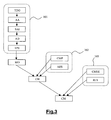
- FIG. 3 schematically represents an exemplary method of manufacturing a composite composition according to the invention.
- the organic matrix MO of the composite composition may comprise from 65 to 80% by weight, preferably from 72 to 78% by weight of a TDG thermosetting matrix.
- thermosetting matrix is meant a polymer-based material from which a part can be made by heat-setting, this material being the seat of irreversible chemical reactions at the end of which the definitive form is established.
- the thermosetting matrix TDG may be based on three-dimensional macromolecular compounds obtained by chemical transformation, these compounds being able to be thermally hardened or stiffened.
- the macromolecular compounds of the TDG thermosetting matrix may comprise or consist essentially of polyurethanes, epoxides, unsaturated polyesters, vinylesters, and / or phenolics.
- the macromolecular compounds of the TDG thermosetting matrix may also be hybrid type solutions combining compounds of different chemical natures.
- unsaturated polyesters it is possible to use orthophthalic, maleic, maleophthalic, isophthalic, vinylester and dicyclopentadiene resins.
- the thermosetting matrix is of generic type, that is to say that the chemical reactions associated with the use of this material are of known type, in particular reactions of radical copolymerization of a monomer, in general styrene, with the double bonds of a prepolymer.
- the prepolymer can be prepared in an initial step by polyesterification.
- the macromolecular compounds of the thermosetting matrix TDG are unsaturated polyesters, the latter are generally in solution in styrene acting at the time of the copolymerization as crosslinking agent.
- the radical copolymerization of styrene with the prepolymer a compound having a three-dimensional structure of polyester chains linked by small polystyrene chains is obtained.
- the organic matrix MO of the composite composition may comprise from 3 to 25% by weight, preferably from 5 to 15% by weight of a TPS thermoplastic additive.
- the TPS thermoplastic additive works in synergy with the thermosetting resin so as to reduce the intrinsic shrinkage caused by the polymerization of the thermosetting network during the crosslinking.
- TPS thermoplastic additives can be selected from polystyrene, polyethylene, acetate of polyvinyl, polyacrylate, polymethyl methacrylate, and / or thermoplastic polyesters
- thermoplastic additive TPS is of the specific type, that is to say that it allows the implementation of specific chemical reactions adapted to limit the intrinsic shrinkage induced by the crosslinking reactions of the TDG thermosetting matrix.
- the organic matrix MO of the composite composition may comprise from 0.005 to 0.2% by weight, preferably from 0.005 to 0.15% by weight, of an initiator additive AA.
- the initiator additive AA makes it possible to initiate the chemical reactions, in particular the crosslinking reactions, of the TDG thermosetting matrix.
- the initiator additive AA can act by decomposing and producing free radicals at given temperatures. This production of free radicals is generally carried out by a radical mechanism, the crosslinking reaction then propagating itself.
- the initiator additive AA can be any type of initiator additive known to those skilled in the art, such as alkyl hydroperoxides, dialkyl peroxides, peresters, diacyl peroxides, and / or peroxides derived from ketones. .
- the initiator additive AA may be t-butyl perbenzoate, tert-butyl hydroperoxide, cumene hydroperoxide, ditertiobutyl peroxide and / or dicumyl peroxide.
- the organic matrix MO of the composite composition may also comprise from 0.0001 to 0.01% by weight, preferably from 0.0001 to 0.002% by weight of a crosslinking inhibitor inhibitor additive SAI.
- This additive may comprise one or more additives whose role is to inhibit the crosslinking reactions of the TDG thermosetting matrix.
- This additive may be any type of inhibitor additive known to those skilled in the art, ie any additive that makes it possible to increase the shelf life of the injection molded parts from the composition of the invention.
- This additive may also be any additive rendering the injection molded parts compatible with industrial use.
- the inhibiting additive SAI generally makes it possible to delay, for a given period of time, the start of the crosslinking reactions of the TDG thermosetting matrix. Beyond this lapse of time, the kinetics of the crosslinking reactions become normal again.
- the inhibitor additive SAI may be chosen from the following compounds used alone or mixture: hydroquinone, monotertiobutylhydroquinone, toluhydroquinone, ditertiobutyl-2,5-hydroquinone, benzoquinone, quinhydrone, parabenzoquinone, paratertiobutylcatechol, ditertiobutyl-2,6-paracresol.
- the organic matrix MO of the composite composition may also comprise from 0.01 to 0.2% by weight, preferably from 0.02 to 0.1% by weight of a mold release agent AD.
- the mold release agent AD generally makes it easier to demold a part by limiting its adhesion to the walls of the mold.
- the release agent AD thus makes it possible to improve the surface condition of the injection-molded part.
- the release agent may comprise a stearic acid, and / or stearic acid salts.
- the release agent AD may comprise calcium stearate, zinc stearate and / or magnesium stearate.
- the composite composition comprises from 15 to 50% by weight of the organic matrix. Preferably, the composite composition comprises from 26 to 40% by weight of the organic matrix.
- the composite composition comprises from 5 to 15% by weight, preferably from 7 to 14% by weight of RF reinforcing fibers.
- a reinforcing fiber has a plurality of filaments.
- the fibers and filaments may have an average length of between 3 and 50 mm, preferably between 3 and 25 mm.
- the mean diameter of the filaments may be between 1 and 50 microns, preferably between 5 and 25 microns.
- the fibers are generally mixed with the organic matrix, which has the effect of reducing their length and intimately bonding them to all the compounds of the composition. Thus, the composite composition obtained is homogenized.
- the RF reinforcing fibers may be any fibers known to those skilled in the art, for example, in the form of cut son. Different types of materials can be used such as, for example, carbon fibers, polyethylene terephthalate aramid fibers, natural fibers of plant or mineral origin, glass fibers of different types, in particular of type E or else type S2.
- the composite composition may comprise from 20 to 70% by weight, preferably from 40 to 60% by weight of solid particles.
- the solid particles may comprise from 50 to 90% by weight, preferably from 70 to 90% by weight of CMP flame retardant inorganic particles.
- CMP flame retardant particles make it possible in particular to improve the fire behavior of the molded parts obtained from the composite composition.
- Flame-retardant particles are generally mineral particles hydrated in their natural state.
- the flame retardant particles essentially comprise hydrated aluminas, for example trihydrated aluminas. The latter generally make it possible spontaneously to release a large quantity of water, when the temperature reaches 280 to 300 ° C.
- the solid particles is constituted by CMSE beads, the mass quantity of these beads being greater than 5% by weight of the composite composition.
- the composite composition comprises from 5 to 15% by weight of CMSE beads.
- the mass quantity of CMSE balls is between 0.25 and 1.2 times the mass quantity of reinforcing fibers (RF).
- the CMSE beads are made from a mineral material whose purity and nature are compatible with the other compounds of the composite composition.
- the CMSE balls are made of glass.
- the CMSE beads may have a treated surface so as to impart appropriate inter-facial properties.
- the CMSE balls have a form factor of less than 2.
- the form factor is less than 1.3, or even substantially equal to 1.
- the form factor can be determined by measuring the ratio of the average length on the apparent average diameter. The measurement of the form factor can be performed by visualization on a scanning electron microscope. In this case, the form factor is determined by image analysis.
- the CMSE beads have a diameter of between 3 and 100 ⁇ m.
- the CMSE beads may also have a diameter of between 0.3 and 5 times the average diameter of the filaments of the reinforcing fibers.
- CMSE beads in particular makes it possible to limit the formation of aggregates and to increase the fluidity and homogeneity of the composite composition during its use.
- the rheological behavior of this composition is improved. This results in less pressure and less abrasion in injection and molding equipment, and this promotes the flow of the composite composition in these devices.
- the non-angular shape of these balls contributes to the improvement of the distribution of forces within the molded part, which makes it possible to obtain more homogeneous mechanical and electrical stress fields.
- the mechanical and dielectric durability of the molded part is increased and the impact strength is improved.
- the wear of the molds is reduced, which results in a reduction in production costs.
- the rheology of the composition is improved and reproducible, which greatly increases the resistance to mechanical stresses, while preserving the fire resistance.
- At least 90% by weight of all the solid particles have a mean equivalent diameter of between 0.05 and 5 times the mean diameter of the reinforcing fiber filaments and / or at least 90% by weight of the fire-resistant mineral particles.
- CMP have a mean equivalent diameter of between 0.05 and 5 times the average diameter of the filaments of the reinforcing fibers.
- the distribution of CMP flame retardant mineral particles is multimodal, for example bimodal, as shown in FIG. 1.
- at least 50% by weight of all the solid particles have a distribution.
- equivalent diameters comprising at least three modes, and / or at least 50% by weight of the CMP flame retardant mineral particles have a distribution of equivalent diameters comprising at least two modes.
- the presence of several modes makes it possible in particular to increase the compactness of the particles and to improve the dielectric and mechanical strength of the composite composition.
- the solid particles, and especially the CMP flame retardant mineral particles have different shapes.
- the shapes of these particles may be chosen to increase the compactness of these particles and to limit the number and / or size of the cavities in the injection molded composition. This allows in particular to improve the dielectric and mechanical strength of the injection molded parts of the composite composition.
- the shape of the particles can be characterized by a form factor or by an apparent density, that is to say by a method of weighing a given volume of powder after settling.
- the shape of solid particles Flame retardants CMP was determined by measuring the apparent density.
- the bulk density usually depends on how the particles are compacted. By shaking them, the finest particles fit into the empty spaces between the larger particles.
- the bulk density may be a measured bulk density measured according to ASTM B527.
- approximately 20 to 40% by weight of the CMP flame retardant mineral particles have an equivalent diameter of between 3 and 7 ⁇ m CMP2 and about 60 to 80% by weight of the fire-resistant mineral particles have an equivalent diameter situated between 10 and 15 ⁇ m CMP1.
- the flame retardant solid particles CMP1 and CMP2 are also shown in Figure 2.
- the CMP2 particles have a bulk density of about 150 to 250 kg / m3. These CMP2 particles tend to intercalate between CMP1 particles, which have a bulk density of about 650 to 800 kg / m3.
- the bimodal shape of the equivalent diameter distribution and the difference in shape between the flame retardant solid particles CMP 1 and CMP 2 impart improved mechanical and dielectric properties to the injection molded composition.
- the solid particles, and in particular the flame retardant mineral particles CMP2 preferably have a specific surface area of between 6 and 8 m 2 / g.
- the surface area typically represents the total area per unit mass of particles that is accessible to atoms and molecules.
- the measurement method is based on a process using the physical absorption of low temperature gas and refers to the work of Brunaeur, Emmett and Teller.
- the specific surface is also called BET surface or BET surface area.
- the measurement method referenced ISO9277: 1995 is used.
- the addition of the sizing agent AES together with the fire-retardant inorganic particles makes it possible in particular to create physicochemical forces between the particles and the matrix in order to optimize the coupling of these particles with the matrix.
- the specific sizing agent AES may be added either in pure form or in admixture.
- the amount of AES-added sizing agent added may be between 0.005 and 0.02 times the amount of CMP flame retardant mineral particles.
- the specific sizing agent AES can be any type of sizing agent known to those skilled in the art, making it possible to improve the adhesion between the compounds of the mixture.
- the specific sizing agent AES can comprise one or more silanes, for example those comprising functional groups of methacrylate, epoxy, amine, vinyl, ureide or trimethoxide type.
- the specific sizing agent AES is of the family of organofunctional silanes.
- composition comprising CMP flame retardant mineral particles
- silane molecules may be attached to the surface of said particles.
- the presence of these molecules makes it possible to create bonds with the organic matrix, which confers a better mechanical strength to the injection-molded composite composition.
- the step of adding and mixing CMSE beads and RF reinforcing fibers can be performed by maintaining the temperature of the composition at a substantially constant value.
- the addition of the CMSE beads and the RF reinforcing fibers can be progressive, for example, with a constant flow rate of the order of 1 kg per minute. This makes it possible not to start the crosslinking reaction of the TDG thermosetting matrix in the mixing apparatuses.
- composition may be carried out by any means known to those skilled in the art. It can be made in a hermetically sealed package and respecting the usual expiry times as well as the recommended temperatures, for example at 20 ° C +/- 3 ° C.
- Table 1 below shows two examples of composite compositions, one according to the prior art C1 and the other according to the invention C2.
- ⁇ U> Table 1 ⁇ / u> C1 (Prior art) % weight C2 (Invention) % weight Orthophthalic resin (TDG) 27.835 27.835 Tertio butylperoxy-2-ethylhexanoate (AA) 0.3 0.3 Mixture of ionol and parabenzoquinone (SAI) 0,045 0,045 Metallic Stearate (AD) 2 2 Thermoplastic (TPS) 7 7 Alumina tri hydrated (CMP) (*) 42.4 42.4 Organo functional silane (AES) 0.42 0.42 Sized spherical mineral charge (CMSE) 0 5 to 10 Fiberglass (RF) 20 10 to 15 (*) wide particle size distribution for C1 (grain equivalent diameter between 1 and 80 ⁇ m), and specific bimodal particle size distribution for C2 (see Figure 1).
- TDG Tertio butyl
- Table 2 shows the relative properties of the injection molded parts obtained from the composite compositions C1 and C2 presented in Table 1. ⁇ U> Table 2 ⁇ / u> Relative performance of C2 relative to C1 Flexural breaking stress ISO 14125 1.5 Charpy impact resistance ISO 179 1.3 Multi-axial elastic shock energy ISO 6603-2 shock - 10 J 2
- composition C2 Compared to the composition C1, the composition C2 provides a significant improvement in flexural strength and impact resistance Charpy. The performance improvement is even more significant with regard to energy absorption in multi - axial shock. Indeed, the absorbed energy is twice as high for composition C2 compared to composition C1.
- the injection molding of the composition can be carried out by any means known to those skilled in the art, for example by means of an industrial press having a capacity of 300 tons or more.
- composition according to the invention gives the injection molded parts improved mechanical strength and electrical resistance.
- the injection molding of the composition of the invention makes it possible to obtain parts with good reproducibility and causes less abrasion of the molds.
- composition of the invention makes it possible to proceed to the injection molding of parts of relatively small dimensions by any means of injection molding known to those skilled in the art, and in particular by means generally used for composite compositions comprising more than 15% by weight of reinforcing fibers such as glass fibers.
Landscapes
- Chemical & Material Sciences (AREA)
- Engineering & Computer Science (AREA)
- Manufacturing & Machinery (AREA)
- Mechanical Engineering (AREA)
- Materials Engineering (AREA)
- Chemical Kinetics & Catalysis (AREA)
- Medicinal Chemistry (AREA)
- Polymers & Plastics (AREA)
- Organic Chemistry (AREA)
- Health & Medical Sciences (AREA)
- Dispersion Chemistry (AREA)
- Compositions Of Macromolecular Compounds (AREA)
- Injection Moulding Of Plastics Or The Like (AREA)
- Processes Of Treating Macromolecular Substances (AREA)
- Materials For Medical Uses (AREA)
Abstract
Description
- L'invention concerne une composition composite pour moulage par injection comprenant :
- de 15 à 50 % en poids d'une matrice organique comportant une résine thermodurcissable,
- des fibres de renfort, et
- des particules solides comportant des particules minérales ignifugeantes.
- L'invention concerne également un procédé de production de 100 parties en poids d'une composition pour moulage par injection comprenant :
- la préparation d'au moins une partie d'une matrice organique par mélange de composés comportant une résine thermodurcissable,
- l'ajout et le mélange de fibres renfort, et
- l'ajout et le mélange de particules solides comportant des particules minérales ignifugeantes.
- L'invention concerne enfin une pièce obtenue par moulage par injection de la composition composite décrite précédemment.
- Les compositions thermodurcissables utilisées pour le moulage par injection de pièces de relativement petites dimensions, notamment des boîtiers pour des équipements électriques, par exemple des disjoncteurs, sont généralement du type composite.
- Il est connu d'utiliser, pour le moulage par injection, des compositions composites comportant une matrice organique, des fibres de renfort et des particules minérales ignifugeantes.
- La demande française de certificat d'utilité N° 2 728 908 décrit des éléments de construction très résistants aux flamme constitués essentiellement d'une résine polyester insaturée, durcie, renforcée par des fibres de verre et avec une charge de trihydrate d'oxyde d'aluminium.
- Lors de la mise en oeuvre de ce type de composition pour le moulage par injection de pièces de relativement petites dimensions, la répartition des fibres de renfort dans ces pièces est généralement peu homogène. De surcroît, l'orientation des fibres de renfort dans ces pièces est généralement peu isotrope.
- L'invention vise une composition permettant de remédier aux inconvénients de l'art antérieur.
- Une composition composite selon l'invention comprends:
- de 15 à 50 % en poids d'une matrice organique comportant une résine thermodurcissable,
- des fibres de renfort, et
- des particules solides comportant des particules minérales ignifugeantes,
- De préférence, les billes ont un facteur de forme inférieur à 2. Avantageusement, les billes ont une forme sensiblement sphérique. De préférence, les billes sont en verre
- Selon un mode préféré de l'invention, une fibre de renfort comporte une pluralité de filaments.
- De préférence, les billes ont un diamètre compris entre 0,3 et 5 fois le diamètre moyen des filaments.
- Selon un mode de réalisation, au moins 90 % en poids des particules solides présentent un diamètre équivalent compris entre 0,05 et 5 fois le diamètre moyen des filaments des fibres de renfort. De préférence, la coupe granulométrique correspondant à la séparation de 50 % en poids des particules solides est comprise en 0,2 et 2,0 fois le diamètre moyen des filaments des fibres de renfort. Avantageusement, au moins 50 % en poids des particules solides présentent une distribution des diamètres équivalents comprenant au moins trois modes.
- Selon un autre mode de réalisation, au moins 90 % en poids des particules minérales ignifugeantes présentent un diamètre équivalent moyen compris entre 0,05 et 5 fois le diamètre moyen des filaments des fibres de renfort. De préférence, la coupe granulométrique correspondant à la séparation de 50 % en poids des particules minérales ignifugeantes est comprise en 0,1 et 2,0 fois le diamètre moyen des filaments des fibres de renfort.
- De préférence, les particules minérales ignifugeantes sont essentiellement constituées par des alumines hydratées.
- De préférence, les particules minérales ignifugeantes ont des formes différentes.
- De préférence, la matrice organique comporte un additif thermoplastique.
- L'invention concerne également un procédé de production de 100 parties en poids d'une composition pour moulage par injection comprenant:
- la préparation d'au moins une partie d'une matrice organique, par mélange de composés comportant une résine thermodurcissable,
- l'ajout et le mélange de fibres renfort, et
- l'ajout et le mélange de particules solides comportant des particules minérales ignifugeantes,
- De préférence, l'ajout et le mélange des billes et des fibres de renfort sont réalisés sensiblement en même temps.
- De préférence, une autre partie de la matrice organique comportant un agent d'ensimage est ajoutée sensiblement conjointement aux particules minérales ignifugeantes.
- Avantageusement, l'ajout et le mélange des billes sont réalisés en maintenant la température de la composition à une valeur sensiblement constante.
- L'invention concerne également une pièce obtenue par moulage par injection d'une composition, ladite composition étant une composition composite telle que décrite précédemment, la forme de la pièce étant définie par la forme du moule dans lequel ladite composition est injectée.
- D'autres avantages et caractéristiques ressortiront plus clairement de la description qui suit de modes particuliers de réalisation de l'invention, donnés à titre d'exemples non limitatifs, et représentés dans les figures annexées.
- La figure 1 représente, à titre d'exemple, une distribution des diamètres équivalents des particules minérales ignifugeantes de la composition composite selon l'invention.
- La figure 2 représente schématiquement des particules minérales ignifugeantes ayant des formes différentes dans une composition moulée par injection.
- La figure 3 représente schématiquement un exemple de procédé de fabrication d'une composition composite conforme à l'invention.
- La matrice organique MO de la composition composite peut comporter de 65 à 80 % en poids, de préférence de 72 à 78 % en poids d'une matrice thermodurcissable TDG. On entend par matrice thermodurcissable, une matière à base de polymère, à partir de laquelle une pièce peut être réalisée par mise en oeuvre à chaud, cette matière étant le siège de réactions chimiques irréversibles au terme desquelles la forme définitive est établie. La matrice thermodurcissable TDG peut être à base de composés macromoléculaires tridimensionnels obtenus par transformation chimique, ces composés pouvant être thermiquement durcis ou rigidifiés. A titre d'exemples, les composés macromoléculaires de la matrice thermodurcissable TDG peuvent comporter ou être essentiellement constitués par des polyuréthanes, des époxydes, des polyesters insaturés, des vinylesters, et/ou des phénoliques. Les composés macromoléculaires de la matrice thermodurcissable TDG peuvent également être des solutions de type hybrides combinant des composés de natures chimiques différentes. Parmi les polyesters insaturés, il est possible d'utiliser des résines orthophtaliques, maléiques, maléophtaliques, isophtaliques, vinylester, dicyclopentadiène.
- De préférence, la matrice thermodurcissable est de type générique, c'est à dire que les réactions chimiques liées à la mise en oeuvre de cette matière sont de type connu, notamment des réactions de copolymérisation radicalaire d'un monomère, en général le styrène, avec les doubles liaisons d'un prépolymère. Le prépolymère peut être préparé lors d'une étape initiale par polyestérification. Dans le cas où les composés macromoléculaires de la matrice thermodurcissable TDG seraient des polyesters insaturés, ces derniers sont généralement en solution dans du styrène agissant au moment de la copolymérisation comme agent de réticulation. Dans le cas de la copolymérisation radicalaire du styrène avec le prépolymère, il est obtenu un composé ayant une structure tridimensionnelle de chaînes de polyesters liées par des petites chaînes polystyrène.
- La matrice organique MO de la composition composite peut comporter de 3 à 25 % en poids, de préférence de 5 à 15 % en poids d'un additif thermoplastique TPS. Généralement, l'additif thermoplastique TPS agit en synergie avec la résine thermodurcissable de manière à réduire le retrait intrinsèque provoqué par la polymérisation du réseau thermodurcissable lors de la réticulation. Les additifs thermoplastiques TPS peuvent être choisis parmi le polystyrène, le polyéthylène, l'acétate de polyvinyle, le polyacrylate, le polyméthyl méthacrylate, et/ou les polyesters thermoplastiques
- De préférence, l'additif thermoplastique TPS est du type spécifique, c'est à dire qu'il permet la mise en oeuvre de réactions chimiques spécifiques adaptées pour limiter le retrait intrinsèque induit par les réactions de réticulation de la matrice thermodurcissable TDG.
- La matrice organique MO de la composition composite peut comporter de 0,005 à 0,2 % en poids, de préférence de 0,005 à 0,15 % en poids d'un additif amorceur AA. Généralement, l'additif amorceur AA permet d'initier les réactions chimiques, notamment les réactions de réticulation, de la matrice thermodurcissable TDG. L'additif amorceur AA peut agir en se décomposant et en produisant des radicaux libres à des températures données. Cette production de radicaux libres est généralement réalisée par un mécanisme radicalaire, la réaction de réticulation se propageant ensuite d'elle-même. L'additif amorceur AA peut être tout type d'additif amorceur connu de l'homme du métier, tel que des hydroperoxydes d'alkyle, des peroxydes de dialkyle, des peresters, des peroxydes de diacyle, et/ou des peroxydes dérivés de cétones. Par exemple, l'additif amorceur AA peut être le perbenzoate de tertiobutyle, l'hydroperoxyde de tertiobutyle, l'hydroperoxyde de cumène, le peroxyde de ditertiobutyle et/ou leperoxyde de dicumyle.
- La matrice organique MO de la composition composite peut également comporter de 0,0001 à 0,01 % en poids, de préférence de 0,0001 à 0,002 % en poids d'un additif inhibiteur retardateur de réticulation SAI. Cet additif peut comporter un ou plusieurs additifs dont le rôle est d'inhiber les réactions de réticulation de la matrice thermodurcissable TDG. Cet additif peut être tout type d'additif inhibiteur connu de l'homme du métier, c'est à dire tout additif permettant d'accroître la durée de conservation des pièces moulées par injection à partir de la composition de l'invention. Cet additif peut être également tout additif rendant les pièces moulées par injection compatibles avec une utilisation industrielle. L'additif inhibiteur SAI permet généralement de retarder, pendant un laps de temps donné, le démarrage des réactions de réticulation de la matrice thermodurcissable TDG. Au-delà de ce laps de temps, la cinétique des réactions de réticulation redevient normale.
- L'additif inhibiteur SAI peut être choisi parmi les composés suivants utilisés seuls ou mélange: hydroquinone, monotertiobutylhydroquinone, toluhydroquinone, ditertiobutyl-2,5-hydroquinone, benzoquinone, quinhydrone, parabenzoquinone, paratertiobutylcatéchol, ditertiobutyl-2,6-paracrésol.
- La matrice organique MO de la composition composite peut également comporter de 0,01 à 0,2 % en poids, de préférence de 0,02 à 0,1 % en poids d'un agent de démoulage AD. L'agent de démoulage AD permet généralement de démouler plus facilement une pièce en limitant son adhérence aux parois du moule. L'agent de démoulage AD permet ainsi d'améliorer l'état de surface de la pièce moulé par injection. L'agent de démoulage peut comporter un acide stéarique, et/ou des sels d'acide stéarique. En particulier, l'agent de démoulage AD peut comporter le stéarate de calcium, le stéarate de zinc et/ou le stéarate de magnésium.
- La composition composite comporte de 15 à 50 % en poids de la matrice organique. De préférence, la composition composite comporte de 26 à 40 % en poids de la matrice organique.
- En plus de la matrice organique MO, la composition composite comporte de 5 à 15 % en poids, de préférence de 7 à 14 % en poids de fibres de renfort RF. Généralement, une fibre de renfort comporte une pluralité de filaments. Les fibres et les filaments peuvent présenter une longueur moyenne comprise entre 3 et 50 mm, de préférence comprise entre 3 et 25 mm. Le diamètre moyen des filaments peut être compris entre 1 et 50 µm, de préférence compris entre 5 et 25 µm. Les fibres sont généralement mélangées à la matrice organique, ce qui a pour effet de réduire leur longueur et de les lier intimement à l'ensemble des composés de la composition. Ainsi, la composition composite obtenue est homogénéisée.
- Les fibres de renforts RF peuvent être n'importe quelles fibres connues de l'homme de métier, se présentant, par exemple, sous forme de fils coupés. Différents types de matériaux peuvent être utilisés tels que, par exemple, des fibres de carbone, des fibres de polyéthylène téréphtalate aramide@, des fibres naturelles de provenance végétale ou minérale, des fibres de verre de différents types en particulier de type E ou encore de type S2.
- En plus de la matrice organique MO et des fibres de renfort RF, la composition composite peut comporter de 20 à 70 % en poids, de préférence de 40 à 60 % en poids de particules solides.
- Les particules solides peuvent comporter de 50à 90 % en poids, de préférence de 70 à 90 % en poids de particules minérales ignifugeantes CMP. Ces particules ignifugeantes CMP permettent notamment d'améliorer le comportement au feu des pièces moulées obtenues à partir de la composition composite. Les particules ignifugeantes sont généralement des particules minérales hydratées à l'état naturel. De préférence, les particules ignifugeantes comportent essentiellement des alumines hydratées, par exemple tri-hydratées. Ces dernières permettent généralement de libérer spontanément une importante quantité d'eau, lorsque la température atteint 280 à 300°C.
- Selon un aspect de l'invention, au moins une portion des particules solides est constituée par des billes CMSE, la quantité massique de ces billes étant supérieure à 5 % en poids de la composition composite. De préférence, la composition composite comporte de 5 à 15 % en poids de billes CMSE. Avantageusement, la quantité massique de billes CMSE est comprise entre 0,25 et 1,2 fois la quantité massique de fibres de renfort (RF). Généralement, les billes CMSE sont fabriquées à partir d'un matériau minéral dont la pureté et la nature sont compatibles avec les autres composés de la composition composite. De préférence, les billes CMSE sont en verre. Les billes CMSE peuvent présenter une surface traitée de manière à leur conférer des propriétés inter faciales appropriées.
- De préférence, les billes CMSE ont un facteur de forme inférieur à 2. Avantageusement, le facteur de forme est inférieur à 1,3, voire sensiblement égal à 1. Le facteur de forme peut être déterminé par la mesure du rapport de la longueur moyenne sur le diamètre moyen apparent. La mesure du facteur de forme peut être réalisée par visualisation sur un microscope électronique à balayage. En l'occurrence, le facteur de forme est déterminé par analyse d'images.
- De préférence, les billes CMSE ont un diamètre compris entre 3 et 100 µm. Avantageusement, les billes CMSE peuvent également avoir un diamètre compris entre 0,3 et 5 fois le diamètre moyen des filaments des fibres de renfort.
- L'utilisation de billes CMSE permet notamment de limiter la formation d'agrégats et d'accroître la fluidité et l'homogénéité de la composition composite lors de sa mise en oeuvre. De ce fait, le comportement rhéologique de cette composition s'en trouve amélioré. Ceci se traduit par une moindre pression et une moindre abrasion dans les appareils d'injection et de moulage, et cela favorise l'écoulement de la composition composite dans ces appareils. La forme non anguleuse de ces billes contribue à l'amélioration de la répartition des efforts au sein de la pièce moulée, ce qui permet d'obtenir des champs de contrainte mécanique et électrique plus homogènes. Ainsi, la durabilité mécanique et diélectrique de la pièce moulée s'en trouve accrue et la tenue aux chocs est améliorée. De même, l'usure des moules est minorée, ce qui se traduit par une réduction des coûts de production. Par ailleurs, la rhéologie de la composition est améliorée et reproductible, ce qui accroît grandement la tenue aux contraintes mécaniques, tout en préservant la tenue au feu.
- La granulométrie des particules solides de la composition a un impact sur les propriétés des pièces fabriquées à partir d'une telle composition, notamment sur la tenue mécanique et diélectrique de ces pièces. Cette granulométrie peut être déterminée soit par rapport aux particules minérales ignifugeantes CMP, soit par rapport à l'ensemble des particules solides de la composition, c'est à dire un ensemble incluant les particules minérales ignifugeantes CMP et les billes CMSE . La granulométrie de ces particules peut être déterminée statistiquement à partir de la distribution du diamètre équivalent de ces particules. La mesure de la granulométrie peut être réalisée par tout moyen connu de l'homme du métier, par exemple par diffraction laser. A partir de la distribution de diamètre équivalent des particules, il est possible de déterminer les grandeurs granulométriques suivantes :
- Une plage de diamètres équivalents dans laquelle ont retrouve une majorité, par exemple au moins 90 % en poids, des particules.
- Une coupe granulométrique correspondant à la taille maximale des mailles d'un tamis permettant de séparer fictivement une portion donnée de particules, par exemple la coupe d50 correspond au diamètre équivalent permettant de séparer 50 % en poids des particules.
- Le nombre de modes correspondant au nombre de pics de la distribution de diamètre équivalent des particules, chaque pic étant associé à une quantité donnée de particules.
- Avantageusement, au moins 90 % en poids de l'ensemble des particules solides présentent un diamètre équivalent moyen compris entre 0,05 et 5 fois le diamètre moyen des filaments des fibres de renfort et/ou au moins 90 % en poids des particules minérales ignifugeantes CMP présentent un diamètre équivalent moyen compris entre 0,05 et 5 fois le diamètre moyen des filaments des fibres de renfort.
- Avantageusement la coupe granulométrique d50 correspondant à la séparation de 50 % en poids des particules est :
- sur l'ensemble des particules solides, comprise entre 0,2 et 2,0 fois le diamètre moyen des filaments des fibres de renfort, et/ou
- sur seulement les particules minérales ignifugeantes CMP, comprise en 0,1 et 2,0 fois le diamètre moyen des filaments des fibres de renfort.
- Selon un aspect de l'invention, la distribution des particules minérales ignifugeantes CMP est multimodale, par exemple bimodale, comme cela est représenté à la figure 1. De préférence, au moins 50 % en poids de l'ensemble des particules solides présentent une distribution des diamètres équivalents comprenant au moins trois modes, et/ou au moins 50 % en poids des particules minérales ignifugeantes CMP présentent une distribution des diamètres équivalents comprenant au moins deux modes. La présence de plusieurs modes permet notamment d'augmenter la compacité des particules et d'améliorer la tenue diélectrique et mécanique de la composition composite.
- De préférence, les particules solides, et notamment les particules minérales ignifugeantes CMP, ont des formes différentes. Les formes de ces particules peuvent être choisies de façon à augmenter la compacité de ces particules et à limiter le nombre et/ou la taille des cavités dans la composition moulée par injection. Ceci permet notamment d'améliorer la tenue diélectrique et mécanique des pièces moulées par injection de la composition composite. La forme des particules peut être caractérisée par un facteur de forme ou par une densité apparente, c'est à dire par une méthode de pesée d'un volume donné de poudre après tassement. En l'occurrence, la forme des particules solides ignifugeantes CMP a été déterminée par mesure de la densité apparente. La densité apparente dépend généralement de la manière selon laquelle les particules sont compactées. En les secouant, les particules les plus fines s'insèrent dans les espaces vides entre les particules les plus grosses. La densité apparente peut être une densité apparente tapée mesurée conformément à la norme ASTM B527.
- Dans l'exemple de la figure 1, environ 20 à 40 % en poids des particules minérales ignifugeantes CMP présentent un diamètre équivalent situé entre 3 et 7 µm CMP2 et environ 60 à 80 % en poids des particules minérales ignifugeantes présentent un diamètre équivalent situé entre 10 et 15 µm CMP1. Les particules solides ignifugeantes CMP1 et CMP2 sont également représentées à la figure 2. Les particules CMP2 présentent une densité apparente d'environ 150 à 250 kg/m3. Ces particules CMP2 ont tendance à s'intercaler entre les particules CMP1, qui présentent une densité apparente d'environ 650 à 800 kg/m3. La forme bimodale de la distribution des diamètres équivalents et la différence de forme entre les particules solides ignifugeantes CMP 1 et CMP2 confèrent, à la composition moulée par injection, des propriétés mécaniques et diélectriques améliorées.
- Les particules solides, et notamment les particules minérales ignifugeantes CMP2, ont de préférence, une surface spécifique comprise entre 6 et 8 m2/g. La surface spécifique représente généralement la surface totale par unité de masse des particules qui est accessible aux atomes et aux molécules. La méthode de mesure est basée sur un procédé utilisant l'absorption physique de gaz à basse température et se réfère aux travaux de Brunaeur, Emmett et Teller. La surface spécifique est également appelée surface BET ou surface spécifique BET. De préférence, la méthode de mesure référencée ISO9277 : 1995 est utilisée.
- Comme cela est représenté à la figure 3, le procédé de préparation de 100 parties en poids d'une composition composite peut, à titre d'exemple, comporter les étapes suivantes :
- une étape de préparation 101 d'une première partie MO1 d'une matrice organique MO, par mélange de composés comportant une matrice thermodurcissable TDG, un additif thermoplastique TPS, un additif amorceur AA, un additif inhibiteur SAI, et un agent de démoulage AD,
- une étape d'ajout et de mélange, à la première partie MO1 de la matrice organique MO, d'une seconde partie MO2 de la matrice organique WO essentiellement constituée par un agent d'ensimage AES conjointement avec des particules minérales ignifugeantes CMP, pour obtenir un mélange complexe homogénéisé CH, et
- une étape d'ajout et de mélange au mélange complexe homogénéisé d'au moins 5 parties en poids de billes CMSE et de 5 à 15 parties en poids de fibres de renfort RF, pour obtenir une composition composite CMH selon l'invention comportant de 15 à 50 parties en poids de la matrice organique.
- L'ajout de l'agent d'ensimage AES conjointement avec les particules minérales ignifugeantes permet notamment de créer des forces physico-chimiques entre les particules et la matrice pour optimiser le couplage de ces particules avec la matrice.
- L'agent d'ensimage spécifique AES peut être ajouté soit à l'état pur, soit en mélange. De préférence, la quantité d'agent d'ensimage spécifique AES ajoutée peut être comprise entre 0,005 et 0,02 fois la quantité de particules minérales ignifugeantes CMP. L'agent d'ensimage spécifique AES peut être tout type d'agent d'ensimage connu de l'homme du métier, permettant d'améliorer l'adhésion entre les composés du mélange. L'agent d'ensimage spécifique AES peut comporter un ou plusieurs silanes, par exemple ceux comportant des groupements fonctionnels de type méthacrylate, époxy, amine, vinyl, uréide, triméthoxyde. De préférence, l'agent d'ensimage spécifique AES est de la famille des silanes organo-fonctionnels. La présence d'un agent d'ensimage spécifique AES dans la composition comportant des particules minérales ignifugeantes CMP peut permettre la fixation des molécules de silane à la surface desdites particules. De par leur nature, la présence de ces molécules permet de créer des liaisons avec la matrice organique, ce qui confère une meilleure tenue mécanique à la composition composite moulée par injection.
- L'étape d'ajout et de mélange des billes CMSE et des fibres de renfort RF peut être réalisée en maintenant la température de la composition à une valeur sensiblement constante. L'ajout des billes CMSE et des fibres de renfort RF peut être progressif, par exemple, avec un débit constant de l'ordre de 1 kg par minute. Ceci permet de ne pas démarrer la réaction de réticulation de la matrice thermodurcissable TDG dans les appareils de mélange.
- Le stockage de la composition peut être réalisé par n'importe quel moyen connu de l'homme du métier. 11 peut être réalisé dans un emballage fermé hermétiquement et respectant les durées de péremption habituelles ainsi que les températures recommandées, par exemple à 20°C +/- 3 °C.
- Le tableau 1 ci-dessous présente deux exemples de compositions composites, l'une selon l'art antérieur C1 et l'autre selon l'invention C2.
Tableau 1 C1
(Art antérieur)
% poidsC2
(Invention)
% poidsRésine orthophtalique (TDG) 27,835 27,835 Tertio butylperoxy-2-ethylhexanoate (AA) 0,3 0,3 Mélange de ionol et parabenzoquinone (SAI) 0,045 0,045 Stéarate métallique (AD) 2 2 Thermoplastique (TPS) 7 7 Alumine tri hydratée (CMP) (*) 42,4 42,4 Silane organo fonctionnels (AES) 0,42 0,42 Charge minérale sphérique ensimée (CMSE) 0 5 à 10 Fibre de verre (RF) 20 10 à 15 (*) large distribution granulométrique pour C1 (diamètre équivalent des grains compris entre 1 et 80 µm), et distribution granulométrique bimodale spécifique pour C2 (cf. figure 1). - Le tableau 2 ci-dessous présente les propriétés relatives des pièces moulées par injection obtenues à partir des compositions composites C1 et C2 présentées dans le tableau 1.
Tableau 2 Performance relative de C2 par rapport à C1 Contrainte à rupture en flexion
ISO 141251,5 Résistance au choc Charpy
ISO 1791,3 Energie élastique au choc multi axial
ISO 6603-2 choc - 10 J2 - Comparativement à la composition C1, la composition C2 apporte une nette amélioration de la résistance à la rupture en flexion ainsi que de la résistance au choc Charpy. L'amélioration de performance est encore plus significative en ce qui concerne l'absorption d'énergie en choc multi - axial. En effet, l'énergie absorbée est deux fois plus élevée pour la composition C2 comparativement à la composition C1.
- Le moulage par injection de la composition peut être réalisé par n'importe quel moyen connu de l'homme du métier, par exemple à l'aide d'une presse industrielle ayant une capacité de 300 tonnes ou plus.
- La composition selon l'invention confère aux pièces moulées par injection une tenue mécanique et une tenue électrique améliorées.
- Le moulage par injection de la composition de l'invention permet d'obtenir des pièces avec une bonne reproductibilité et entraîne une moindre abrasion des moules.
- La composition de l'invention permet de procéder au moulage par injection de pièces de relativement petites dimensions par tout moyen de moulage par injection connu de l'homme du métier, et notamment par des moyens généralement mis en oeuvre pour des compositions composite comportant plus de 15 % en poids de fibres de renfort tels que des fibres de verre.
Claims (19)
- Composition composite pour moulage par injection comprenant :- de 15 à 50 % en poids d'une matrice organique (MO) comportant une résine thermodurcissable (TDG),- des fibres de renfort (RF), et- des particules solides (CMP, CMSE) comportant des particules minérales ignifugeantes (CMP),caractérisée en ce que la quantité de fibres de renfort est comprise entre 5 et 15 % en poids de ladite composition, en ce qu'au moins une portion des particules solides supérieure à 5 % en poids de ladite composition comporte des billes (CMSE), et en ce qu'au moins 50 % en poids des particules minérales ignifugeantes (CMP) présentent une distribution des diamètres équivalents comprenant au moins deux modes.
- Composition selon la revendication 1, caractérisée en ce que les billes (CMSE) ont un facteur de forme inférieur à 2.
- Composition selon la revendication 2, caractérisée en ce que les billes (CMSE) ont une forme sensiblement sphérique.
- Composition selon l'une des revendications 1 à 3, caractérisée en ce que les billes (CMSE) sont en verre
- Composition selon l'une des revendications 1 à 4, caractérisée en ce qu'une fibre de renfort comporte une pluralité de filaments.
- Composition selon la revendication 5, caractérisée en ce que les billes (CMSE) ont un diamètre compris entre 0,3 et 5 fois le diamètre moyen des filaments.
- Composition selon l'une des revendications 5 ou 6, caractérisée en ce qu'au moins 90 % en poids des particules solides (CMP, CMSE) présentent un diamètre équivalent compris entre 0,05 et 5 fois le diamètre moyen des filaments des fibres de renfort.
- Composition selon la revendication 7, caractérisée en ce que la coupe granulométrique (d50) correspondant à la séparation de 50 % en poids des particules solides (CMP, CMSE) est comprise en 0,2 et 2,0 fois le diamètre moyen des filaments des fibres de renfort.
- Composition selon l'une des revendications 7 ou 8, caractérisée en ce qu'au moins 50 % en poids des particules solides (CMP, CMSE) présentent une distribution des diamètres équivalents comprenant au moins trois modes.
- Composition selon l'une des revendications 5 ou 6, caractérisée en ce qu'au moins 90 % en poids des particules minérales ignifugeantes (CMP) présentent un diamètre équivalent moyen compris entre 0,05 et 5 fois le diamètre moyen des filaments des fibres de renfort.
- Composition selon la revendication 8, caractérisée en ce que la coupe granulométrique (d50) correspondant à la séparation de 50 % en poids des particules minérales ignifugeantes (CMP) est comprise en 0,1 et 2,0 fois le diamètre moyen des filaments des fibres de renfort.
- Composition selon l'une des revendications 1 à 11, caractérisée en ce que les particules minérales ignifugeantes (CMP) sont essentiellement constituées par des alumines hydratées.
- Composition selon l'une des revendications 1 à 12, caractérisée en ce que les particules minérales ignifugeantes (CMP) ont des formes différentes.
- Composition selon l'une des revendications 1 à 13, caractérisée en ce que la matrice organique comporte un additif thermoplastique (TPS).
- Procédé de production de 100 parties en poids d'une composition pour moulage par injection comprenant :- la préparation d'au moins une partie (MO1) d'une matrice organique (MO), par mélange de composés comportant une résine thermodurcissable (TDG),- l'ajout et le mélange de fibres renfort (RF), et- l'ajout et le mélange de particules solides comportant des particules minérales ignifugeantes (CMP).caractérisé en ce que la quantité de fibres de renfort ajoutées et mélangées est comprise entre 5 et 15 parties en poids de ladite composition, en ce qu'une portion des particules solides ajoutées et mélangées comporte au moins 5 parties en poids de billes (CMSE), et en ce qu'au moins 50 % en poids des particules minérales ignifugeantes (CMP) présentent une distribution des diamètres équivalents comprenant au moins deux modes.
- Procédé selon la revendication 15, caractérisé en ce que l'ajout et le mélange des billes (CMSE) et des fibres de renfort (RF) sont réalisés sensiblement en même temps.
- Procédé selon l'une des revendications 15 à 16, caractérisé en ce qu'une autre partie de la matrice organique (MO) comportant un agent d'ensimage (AES) est ajoutée sensiblement conjointement aux particules minérales ignifugeantes (CMP).
- Procédé selon l'une des revendications 15 à 17, caractérisé en ce que l'ajout et le mélange des billes (CMSE) sont réalisés en maintenant la température de la composition à une valeur sensiblement constante.
- Pièce obtenue par moulage par injection d'une composition, caractérisée en ce que ladite composition est une composition composite selon l'une des revendications 1 à 14, la forme de la pièce étant définie par la forme du moule dans lequel ladite composition est injectée.
Applications Claiming Priority (1)
| Application Number | Priority Date | Filing Date | Title |
|---|---|---|---|
| FR0604814A FR2901797A1 (fr) | 2006-05-30 | 2006-05-30 | Composition pour moulage par injection, piece produite a partir de la composition et procede de production de la composition |
Publications (2)
| Publication Number | Publication Date |
|---|---|
| EP1862498A1 true EP1862498A1 (fr) | 2007-12-05 |
| EP1862498B1 EP1862498B1 (fr) | 2009-01-14 |
Family
ID=36997810
Family Applications (1)
| Application Number | Title | Priority Date | Filing Date |
|---|---|---|---|
| EP07354009A Not-in-force EP1862498B1 (fr) | 2006-05-30 | 2007-02-27 | Composition pour moulage par injection, piece produite à partir de la composition et procédé de production de la composition |
Country Status (7)
| Country | Link |
|---|---|
| US (1) | US20070282035A1 (fr) |
| EP (1) | EP1862498B1 (fr) |
| CN (1) | CN101081936A (fr) |
| AT (1) | ATE420915T1 (fr) |
| DE (1) | DE602007000481D1 (fr) |
| ES (1) | ES2320710T3 (fr) |
| FR (1) | FR2901797A1 (fr) |
Citations (5)
| Publication number | Priority date | Publication date | Assignee | Title |
|---|---|---|---|---|
| EP0570632A1 (fr) * | 1992-05-21 | 1993-11-24 | The Dow Chemical Company | Composites polymères de styrène polymérisé en masse renforcé par un mélange de particules fibreuses et sphériques |
| FR2728908A3 (fr) * | 1995-01-03 | 1996-07-05 | Basf Ag | Elements de construction tres resistants aux flammes |
| FR2772037A1 (fr) * | 1997-12-10 | 1999-06-11 | Univ Metz Laboratoire De Physi | Composition a base d'un polymere a comportement thixotrope et/ou pseudoplastique chargee en microbilles |
| WO2001096085A2 (fr) * | 2000-06-15 | 2001-12-20 | Quantum Composites, Inc. | Fabrication de composants moules par injection fortement conducteurs et appareil utilise pour cette fabrication |
| FR2822208A1 (fr) * | 2001-03-15 | 2002-09-20 | Valeo | Procede d'obtention d'une garniture de friction d'embrayage, garniture de friction d'embrayage obtenue par un tel procede et disque d'embrayage equipe d'une telle garniture de friction |
Family Cites Families (4)
| Publication number | Priority date | Publication date | Assignee | Title |
|---|---|---|---|---|
| US4193908A (en) * | 1978-09-20 | 1980-03-18 | Aluminum Company Of America | Method of reducing the viscosity of polyester-alumina _trihydrate dispersions by slight dehydration of trihydrate |
| US4960803A (en) * | 1987-07-24 | 1990-10-02 | Muhl Laszlo A | Fire retardant foam materials |
| US6905634B2 (en) * | 1998-10-13 | 2005-06-14 | Peter Burnell-Jones | Heat curable thermosetting luminescent resins |
| ES2246677B1 (es) * | 2001-06-22 | 2006-12-01 | Asahi Kasei Kabushiki Kaisha | Retardante de la llama en forma de particulas dotadas de recubrimient o para un polimero. |
-
2006
- 2006-05-30 FR FR0604814A patent/FR2901797A1/fr not_active Withdrawn
-
2007
- 2007-02-27 ES ES07354009T patent/ES2320710T3/es active Active
- 2007-02-27 EP EP07354009A patent/EP1862498B1/fr not_active Not-in-force
- 2007-02-27 DE DE602007000481T patent/DE602007000481D1/de active Active
- 2007-02-27 AT AT07354009T patent/ATE420915T1/de not_active IP Right Cessation
- 2007-05-03 US US11/797,454 patent/US20070282035A1/en not_active Abandoned
- 2007-05-28 CN CNA200710106392XA patent/CN101081936A/zh active Pending
Patent Citations (5)
| Publication number | Priority date | Publication date | Assignee | Title |
|---|---|---|---|---|
| EP0570632A1 (fr) * | 1992-05-21 | 1993-11-24 | The Dow Chemical Company | Composites polymères de styrène polymérisé en masse renforcé par un mélange de particules fibreuses et sphériques |
| FR2728908A3 (fr) * | 1995-01-03 | 1996-07-05 | Basf Ag | Elements de construction tres resistants aux flammes |
| FR2772037A1 (fr) * | 1997-12-10 | 1999-06-11 | Univ Metz Laboratoire De Physi | Composition a base d'un polymere a comportement thixotrope et/ou pseudoplastique chargee en microbilles |
| WO2001096085A2 (fr) * | 2000-06-15 | 2001-12-20 | Quantum Composites, Inc. | Fabrication de composants moules par injection fortement conducteurs et appareil utilise pour cette fabrication |
| FR2822208A1 (fr) * | 2001-03-15 | 2002-09-20 | Valeo | Procede d'obtention d'une garniture de friction d'embrayage, garniture de friction d'embrayage obtenue par un tel procede et disque d'embrayage equipe d'une telle garniture de friction |
Also Published As
| Publication number | Publication date |
|---|---|
| ATE420915T1 (de) | 2009-01-15 |
| CN101081936A (zh) | 2007-12-05 |
| DE602007000481D1 (de) | 2009-03-05 |
| FR2901797A1 (fr) | 2007-12-07 |
| EP1862498B1 (fr) | 2009-01-14 |
| ES2320710T3 (es) | 2009-05-27 |
| US20070282035A1 (en) | 2007-12-06 |
Similar Documents
| Publication | Publication Date | Title |
|---|---|---|
| US3764456A (en) | Polymeric high performance composites | |
| CN100564023C (zh) | 一种麻塑复合材料板材及其制备方法 | |
| EP2731996B2 (fr) | Utilisation d'un composé extenseur de chaine du polyamide en tant qu'agent stabilisant | |
| KR20110089265A (ko) | 섬유 강화 수지 조성물 및 그의 성형체 | |
| CN104204869B (zh) | 灯光反射器用成型材料和成型品 | |
| Bream et al. | Comminuted thermoset recyclate as a reinforcing filler for thermoplastics Part I Characterisation of recyclate feedstocks | |
| CN111574665A (zh) | 热固化性树脂组合物、团状模塑料和成形品 | |
| US7482402B2 (en) | Fiber reinforced polypropylene compositions | |
| JPS5847035A (ja) | 充填剤入り重合体に対する相乗強化促進剤系 | |
| EP1862498B1 (fr) | Composition pour moulage par injection, piece produite à partir de la composition et procédé de production de la composition | |
| EP1885538A2 (fr) | Composes de faible densite, de classe a, pour moulage en feuille, contenant du divinybenzene | |
| CN101671460A (zh) | 一种高韧性高强度的聚丙烯组合物及其制备方法和用途 | |
| FR2529218A1 (fr) | Materiau composite ayant d'excellentes proprietes mecaniques et electriques; composition de resine de polyolefine comprenant une polyolefine modifiee par un acide carboxylique insature en presence d'un catalyseur et une matiere de renforcement fibreuse | |
| Yu et al. | Fiber length distribution and thermal, mechanical and morphological properties of thermally conductive polycarbonate/chopped carbon fiber composites | |
| KR101063712B1 (ko) | 내스크래치성을 갖는 열가소성 수지의 제조 방법 | |
| JP7734542B2 (ja) | オキサゾリン変性ポリプロピレン | |
| EP4600297A1 (fr) | Matériau en poudre pour un façonnage tridimensionnel, procédé de fabrication d'article façonné tridimensionnel et article façonné tridimensionnel | |
| JP4038997B2 (ja) | 改質されたプロピレン系樹脂組成物の製造方法 | |
| JP2024518642A (ja) | ポリプロピレン樹脂組成物、その製造方法及びそれを含む成形品 | |
| CN120986029B (zh) | 一种多层结构tpee遮光材料及制备方法 | |
| CN118667323B (zh) | 一种含回收填料的聚氨酯复合材料及其制备方法 | |
| Lungu et al. | Solid state studies on the effect of fillers on the mechanical behaviour of photocured composites | |
| US12359045B2 (en) | Oxazoline-modified polypropylene | |
| KR102529566B1 (ko) | 경량 복합체 조성물 및 경량 복합체의 제조방법 | |
| KR20090093410A (ko) | 전선충전 pp얀용 고내열성 고분자 수지 조성물 |
Legal Events
| Date | Code | Title | Description |
|---|---|---|---|
| PUAI | Public reference made under article 153(3) epc to a published international application that has entered the european phase |
Free format text: ORIGINAL CODE: 0009012 |
|
| AK | Designated contracting states |
Kind code of ref document: A1 Designated state(s): AT BE BG CH CY CZ DE DK EE ES FI FR GB GR HU IE IS IT LI LT LU LV MC NL PL PT RO SE SI SK TR |
|
| AX | Request for extension of the european patent |
Extension state: AL BA HR MK YU |
|
| 17P | Request for examination filed |
Effective date: 20080208 |
|
| 17Q | First examination report despatched |
Effective date: 20080411 |
|
| AKX | Designation fees paid |
Designated state(s): AT BE BG CH CY CZ DE DK EE ES FI FR GB GR HU IE IS IT LI LT LU LV MC NL PL PT RO SE SI SK TR |
|
| GRAP | Despatch of communication of intention to grant a patent |
Free format text: ORIGINAL CODE: EPIDOSNIGR1 |
|
| RIC1 | Information provided on ipc code assigned before grant |
Ipc: C08J 5/10 20060101AFI20080825BHEP Ipc: B29C 45/00 20060101ALI20080825BHEP |
|
| GRAS | Grant fee paid |
Free format text: ORIGINAL CODE: EPIDOSNIGR3 |
|
| GRAA | (expected) grant |
Free format text: ORIGINAL CODE: 0009210 |
|
| AK | Designated contracting states |
Kind code of ref document: B1 Designated state(s): AT BE BG CH CY CZ DE DK EE ES FI FR GB GR HU IE IS IT LI LT LU LV MC NL PL PT RO SE SI SK TR |
|
| REG | Reference to a national code |
Ref country code: GB Ref legal event code: FG4D Free format text: NOT ENGLISH |
|
| REG | Reference to a national code |
Ref country code: CH Ref legal event code: EP |
|
| REG | Reference to a national code |
Ref country code: IE Ref legal event code: FG4D Free format text: LANGUAGE OF EP DOCUMENT: FRENCH |
|
| REF | Corresponds to: |
Ref document number: 602007000481 Country of ref document: DE Date of ref document: 20090305 Kind code of ref document: P |
|
| RAP2 | Party data changed (patent owner data changed or rights of a patent transferred) |
Owner name: SCHNEIDER ELECTRIC INDUSTRIES SAS |
|
| REG | Reference to a national code |
Ref country code: ES Ref legal event code: FG2A Ref document number: 2320710 Country of ref document: ES Kind code of ref document: T3 |
|
| PG25 | Lapsed in a contracting state [announced via postgrant information from national office to epo] |
Ref country code: NL Free format text: LAPSE BECAUSE OF FAILURE TO SUBMIT A TRANSLATION OF THE DESCRIPTION OR TO PAY THE FEE WITHIN THE PRESCRIBED TIME-LIMIT Effective date: 20090114 |
|
| NLT2 | Nl: modifications (of names), taken from the european patent patent bulletin |
Owner name: SCHNEIDER ELECTRIC INDUSTRIES SAS Effective date: 20090401 |
|
| NLV1 | Nl: lapsed or annulled due to failure to fulfill the requirements of art. 29p and 29m of the patents act | ||
| PG25 | Lapsed in a contracting state [announced via postgrant information from national office to epo] |
Ref country code: FI Free format text: LAPSE BECAUSE OF FAILURE TO SUBMIT A TRANSLATION OF THE DESCRIPTION OR TO PAY THE FEE WITHIN THE PRESCRIBED TIME-LIMIT Effective date: 20090114 Ref country code: LT Free format text: LAPSE BECAUSE OF FAILURE TO SUBMIT A TRANSLATION OF THE DESCRIPTION OR TO PAY THE FEE WITHIN THE PRESCRIBED TIME-LIMIT Effective date: 20090114 Ref country code: SI Free format text: LAPSE BECAUSE OF FAILURE TO SUBMIT A TRANSLATION OF THE DESCRIPTION OR TO PAY THE FEE WITHIN THE PRESCRIBED TIME-LIMIT Effective date: 20090114 |
|
| REG | Reference to a national code |
Ref country code: IE Ref legal event code: FD4D |
|
| BERE | Be: lapsed |
Owner name: SCHNEIDER ELECTRIC INDUSTRIES SAS Effective date: 20090228 |
|
| PG25 | Lapsed in a contracting state [announced via postgrant information from national office to epo] |
Ref country code: PT Free format text: LAPSE BECAUSE OF FAILURE TO SUBMIT A TRANSLATION OF THE DESCRIPTION OR TO PAY THE FEE WITHIN THE PRESCRIBED TIME-LIMIT Effective date: 20090615 Ref country code: AT Free format text: LAPSE BECAUSE OF FAILURE TO SUBMIT A TRANSLATION OF THE DESCRIPTION OR TO PAY THE FEE WITHIN THE PRESCRIBED TIME-LIMIT Effective date: 20090114 Ref country code: IS Free format text: LAPSE BECAUSE OF FAILURE TO SUBMIT A TRANSLATION OF THE DESCRIPTION OR TO PAY THE FEE WITHIN THE PRESCRIBED TIME-LIMIT Effective date: 20090514 Ref country code: SE Free format text: LAPSE BECAUSE OF FAILURE TO SUBMIT A TRANSLATION OF THE DESCRIPTION OR TO PAY THE FEE WITHIN THE PRESCRIBED TIME-LIMIT Effective date: 20090414 Ref country code: LV Free format text: LAPSE BECAUSE OF FAILURE TO SUBMIT A TRANSLATION OF THE DESCRIPTION OR TO PAY THE FEE WITHIN THE PRESCRIBED TIME-LIMIT Effective date: 20090114 Ref country code: PL Free format text: LAPSE BECAUSE OF FAILURE TO SUBMIT A TRANSLATION OF THE DESCRIPTION OR TO PAY THE FEE WITHIN THE PRESCRIBED TIME-LIMIT Effective date: 20090114 |
|
| PG25 | Lapsed in a contracting state [announced via postgrant information from national office to epo] |
Ref country code: MC Free format text: LAPSE BECAUSE OF NON-PAYMENT OF DUE FEES Effective date: 20090228 |
|
| PG25 | Lapsed in a contracting state [announced via postgrant information from national office to epo] |
Ref country code: DK Free format text: LAPSE BECAUSE OF FAILURE TO SUBMIT A TRANSLATION OF THE DESCRIPTION OR TO PAY THE FEE WITHIN THE PRESCRIBED TIME-LIMIT Effective date: 20090114 Ref country code: CZ Free format text: LAPSE BECAUSE OF FAILURE TO SUBMIT A TRANSLATION OF THE DESCRIPTION OR TO PAY THE FEE WITHIN THE PRESCRIBED TIME-LIMIT Effective date: 20090114 Ref country code: IE Free format text: LAPSE BECAUSE OF FAILURE TO SUBMIT A TRANSLATION OF THE DESCRIPTION OR TO PAY THE FEE WITHIN THE PRESCRIBED TIME-LIMIT Effective date: 20090114 Ref country code: EE Free format text: LAPSE BECAUSE OF FAILURE TO SUBMIT A TRANSLATION OF THE DESCRIPTION OR TO PAY THE FEE WITHIN THE PRESCRIBED TIME-LIMIT Effective date: 20090114 |
|
| PLBE | No opposition filed within time limit |
Free format text: ORIGINAL CODE: 0009261 |
|
| STAA | Information on the status of an ep patent application or granted ep patent |
Free format text: STATUS: NO OPPOSITION FILED WITHIN TIME LIMIT |
|
| PG25 | Lapsed in a contracting state [announced via postgrant information from national office to epo] |
Ref country code: SK Free format text: LAPSE BECAUSE OF FAILURE TO SUBMIT A TRANSLATION OF THE DESCRIPTION OR TO PAY THE FEE WITHIN THE PRESCRIBED TIME-LIMIT Effective date: 20090114 Ref country code: RO Free format text: LAPSE BECAUSE OF FAILURE TO SUBMIT A TRANSLATION OF THE DESCRIPTION OR TO PAY THE FEE WITHIN THE PRESCRIBED TIME-LIMIT Effective date: 20090114 |
|
| 26N | No opposition filed |
Effective date: 20091015 |
|
| PG25 | Lapsed in a contracting state [announced via postgrant information from national office to epo] |
Ref country code: BG Free format text: LAPSE BECAUSE OF FAILURE TO SUBMIT A TRANSLATION OF THE DESCRIPTION OR TO PAY THE FEE WITHIN THE PRESCRIBED TIME-LIMIT Effective date: 20090414 |
|
| PG25 | Lapsed in a contracting state [announced via postgrant information from national office to epo] |
Ref country code: BE Free format text: LAPSE BECAUSE OF NON-PAYMENT OF DUE FEES Effective date: 20090228 |
|
| PG25 | Lapsed in a contracting state [announced via postgrant information from national office to epo] |
Ref country code: GR Free format text: LAPSE BECAUSE OF FAILURE TO SUBMIT A TRANSLATION OF THE DESCRIPTION OR TO PAY THE FEE WITHIN THE PRESCRIBED TIME-LIMIT Effective date: 20090415 |
|
| PG25 | Lapsed in a contracting state [announced via postgrant information from national office to epo] |
Ref country code: LU Free format text: LAPSE BECAUSE OF NON-PAYMENT OF DUE FEES Effective date: 20090227 |
|
| PGRI | Patent reinstated in contracting state [announced from national office to epo] |
Ref country code: IT Effective date: 20110501 |
|
| PG25 | Lapsed in a contracting state [announced via postgrant information from national office to epo] |
Ref country code: HU Free format text: LAPSE BECAUSE OF FAILURE TO SUBMIT A TRANSLATION OF THE DESCRIPTION OR TO PAY THE FEE WITHIN THE PRESCRIBED TIME-LIMIT Effective date: 20090715 |
|
| PG25 | Lapsed in a contracting state [announced via postgrant information from national office to epo] |
Ref country code: TR Free format text: LAPSE BECAUSE OF FAILURE TO SUBMIT A TRANSLATION OF THE DESCRIPTION OR TO PAY THE FEE WITHIN THE PRESCRIBED TIME-LIMIT Effective date: 20090114 |
|
| PG25 | Lapsed in a contracting state [announced via postgrant information from national office to epo] |
Ref country code: CY Free format text: LAPSE BECAUSE OF FAILURE TO SUBMIT A TRANSLATION OF THE DESCRIPTION OR TO PAY THE FEE WITHIN THE PRESCRIBED TIME-LIMIT Effective date: 20090114 |
|
| REG | Reference to a national code |
Ref country code: CH Ref legal event code: PL |
|
| PG25 | Lapsed in a contracting state [announced via postgrant information from national office to epo] |
Ref country code: CH Free format text: LAPSE BECAUSE OF NON-PAYMENT OF DUE FEES Effective date: 20110228 Ref country code: LI Free format text: LAPSE BECAUSE OF NON-PAYMENT OF DUE FEES Effective date: 20110228 |
|
| REG | Reference to a national code |
Ref country code: FR Ref legal event code: PLFP Year of fee payment: 10 |
|
| REG | Reference to a national code |
Ref country code: FR Ref legal event code: PLFP Year of fee payment: 11 |
|
| REG | Reference to a national code |
Ref country code: FR Ref legal event code: PLFP Year of fee payment: 12 |
|
| PGFP | Annual fee paid to national office [announced via postgrant information from national office to epo] |
Ref country code: GB Payment date: 20190227 Year of fee payment: 13 Ref country code: DE Payment date: 20190214 Year of fee payment: 13 Ref country code: IT Payment date: 20190221 Year of fee payment: 13 Ref country code: ES Payment date: 20190301 Year of fee payment: 13 |
|
| PGFP | Annual fee paid to national office [announced via postgrant information from national office to epo] |
Ref country code: FR Payment date: 20190215 Year of fee payment: 13 Ref country code: DE Payment date: 20190214 Year of fee payment: 13 |
|
| REG | Reference to a national code |
Ref country code: DE Ref legal event code: R119 Ref document number: 602007000481 Country of ref document: DE |
|
| GBPC | Gb: european patent ceased through non-payment of renewal fee |
Effective date: 20200227 |
|
| PG25 | Lapsed in a contracting state [announced via postgrant information from national office to epo] |
Ref country code: GB Free format text: LAPSE BECAUSE OF NON-PAYMENT OF DUE FEES Effective date: 20200227 Ref country code: DE Free format text: LAPSE BECAUSE OF NON-PAYMENT OF DUE FEES Effective date: 20200901 Ref country code: FR Free format text: LAPSE BECAUSE OF NON-PAYMENT OF DUE FEES Effective date: 20200229 |
|
| REG | Reference to a national code |
Ref country code: ES Ref legal event code: FD2A Effective date: 20210708 |
|
| PG25 | Lapsed in a contracting state [announced via postgrant information from national office to epo] |
Ref country code: ES Free format text: LAPSE BECAUSE OF NON-PAYMENT OF DUE FEES Effective date: 20200228 |
|
| PG25 | Lapsed in a contracting state [announced via postgrant information from national office to epo] |
Ref country code: IT Free format text: LAPSE BECAUSE OF NON-PAYMENT OF DUE FEES Effective date: 20200227 |